WO2012018068A1 - Préparation pharmaceutique pour contrôler la libération d'un médicament soluble dans l'eau - Google Patents
Préparation pharmaceutique pour contrôler la libération d'un médicament soluble dans l'eau Download PDFInfo
- Publication number
- WO2012018068A1 WO2012018068A1 PCT/JP2011/067837 JP2011067837W WO2012018068A1 WO 2012018068 A1 WO2012018068 A1 WO 2012018068A1 JP 2011067837 W JP2011067837 W JP 2011067837W WO 2012018068 A1 WO2012018068 A1 WO 2012018068A1
- Authority
- WO
- WIPO (PCT)
- Prior art keywords
- preparation
- water
- silicone
- soluble
- kneaded
- Prior art date
- Legal status (The legal status is an assumption and is not a legal conclusion. Google has not performed a legal analysis and makes no representation as to the accuracy of the status listed.)
- Ceased
Links
Images






Classifications
-
- A—HUMAN NECESSITIES
- A61—MEDICAL OR VETERINARY SCIENCE; HYGIENE
- A61K—PREPARATIONS FOR MEDICAL, DENTAL OR TOILETRY PURPOSES
- A61K47/00—Medicinal preparations characterised by the non-active ingredients used, e.g. carriers or inert additives; Targeting or modifying agents chemically bound to the active ingredient
- A61K47/30—Macromolecular organic or inorganic compounds, e.g. inorganic polyphosphates
- A61K47/34—Macromolecular compounds obtained otherwise than by reactions only involving carbon-to-carbon unsaturated bonds, e.g. polyesters, polyamino acids, polysiloxanes, polyphosphazines, copolymers of polyalkylene glycol or poloxamers
-
- A—HUMAN NECESSITIES
- A61—MEDICAL OR VETERINARY SCIENCE; HYGIENE
- A61K—PREPARATIONS FOR MEDICAL, DENTAL OR TOILETRY PURPOSES
- A61K31/00—Medicinal preparations containing organic active ingredients
- A61K31/13—Amines
- A61K31/155—Amidines (), e.g. guanidine (H2N—C(=NH)—NH2), isourea (N=C(OH)—NH2), isothiourea (—N=C(SH)—NH2)
-
- A—HUMAN NECESSITIES
- A61—MEDICAL OR VETERINARY SCIENCE; HYGIENE
- A61K—PREPARATIONS FOR MEDICAL, DENTAL OR TOILETRY PURPOSES
- A61K31/00—Medicinal preparations containing organic active ingredients
- A61K31/16—Amides, e.g. hydroxamic acids
- A61K31/165—Amides, e.g. hydroxamic acids having aromatic rings, e.g. colchicine, atenolol, progabide
- A61K31/167—Amides, e.g. hydroxamic acids having aromatic rings, e.g. colchicine, atenolol, progabide having the nitrogen of a carboxamide group directly attached to the aromatic ring, e.g. lidocaine, paracetamol
-
- A—HUMAN NECESSITIES
- A61—MEDICAL OR VETERINARY SCIENCE; HYGIENE
- A61K—PREPARATIONS FOR MEDICAL, DENTAL OR TOILETRY PURPOSES
- A61K31/00—Medicinal preparations containing organic active ingredients
- A61K31/185—Acids; Anhydrides, halides or salts thereof, e.g. sulfur acids, imidic, hydrazonic or hydroximic acids
- A61K31/19—Carboxylic acids, e.g. valproic acid
- A61K31/195—Carboxylic acids, e.g. valproic acid having an amino group
-
- A—HUMAN NECESSITIES
- A61—MEDICAL OR VETERINARY SCIENCE; HYGIENE
- A61K—PREPARATIONS FOR MEDICAL, DENTAL OR TOILETRY PURPOSES
- A61K31/00—Medicinal preparations containing organic active ingredients
- A61K31/185—Acids; Anhydrides, halides or salts thereof, e.g. sulfur acids, imidic, hydrazonic or hydroximic acids
- A61K31/19—Carboxylic acids, e.g. valproic acid
- A61K31/195—Carboxylic acids, e.g. valproic acid having an amino group
- A61K31/197—Carboxylic acids, e.g. valproic acid having an amino group the amino and the carboxyl groups being attached to the same acyclic carbon chain, e.g. gamma-aminobutyric acid [GABA], beta-alanine, epsilon-aminocaproic acid or pantothenic acid
- A61K31/198—Alpha-amino acids, e.g. alanine or edetic acid [EDTA]
-
- A—HUMAN NECESSITIES
- A61—MEDICAL OR VETERINARY SCIENCE; HYGIENE
- A61K—PREPARATIONS FOR MEDICAL, DENTAL OR TOILETRY PURPOSES
- A61K31/00—Medicinal preparations containing organic active ingredients
- A61K31/33—Heterocyclic compounds
- A61K31/395—Heterocyclic compounds having nitrogen as a ring hetero atom, e.g. guanethidine or rifamycins
- A61K31/41—Heterocyclic compounds having nitrogen as a ring hetero atom, e.g. guanethidine or rifamycins having five-membered rings with two or more ring hetero atoms, at least one of which being nitrogen, e.g. tetrazole
- A61K31/42—Oxazoles
- A61K31/423—Oxazoles condensed with carbocyclic rings
-
- A—HUMAN NECESSITIES
- A61—MEDICAL OR VETERINARY SCIENCE; HYGIENE
- A61K—PREPARATIONS FOR MEDICAL, DENTAL OR TOILETRY PURPOSES
- A61K31/00—Medicinal preparations containing organic active ingredients
- A61K31/56—Compounds containing cyclopenta[a]hydrophenanthrene ring systems; Derivatives thereof, e.g. steroids
- A61K31/575—Compounds containing cyclopenta[a]hydrophenanthrene ring systems; Derivatives thereof, e.g. steroids substituted in position 17 beta by a chain of three or more carbon atoms, e.g. cholane, cholestane, ergosterol, sitosterol
-
- A—HUMAN NECESSITIES
- A61—MEDICAL OR VETERINARY SCIENCE; HYGIENE
- A61K—PREPARATIONS FOR MEDICAL, DENTAL OR TOILETRY PURPOSES
- A61K47/00—Medicinal preparations characterised by the non-active ingredients used, e.g. carriers or inert additives; Targeting or modifying agents chemically bound to the active ingredient
- A61K47/02—Inorganic compounds
-
- A—HUMAN NECESSITIES
- A61—MEDICAL OR VETERINARY SCIENCE; HYGIENE
- A61K—PREPARATIONS FOR MEDICAL, DENTAL OR TOILETRY PURPOSES
- A61K47/00—Medicinal preparations characterised by the non-active ingredients used, e.g. carriers or inert additives; Targeting or modifying agents chemically bound to the active ingredient
- A61K47/06—Organic compounds, e.g. natural or synthetic hydrocarbons, polyolefins, mineral oil, petrolatum or ozokerite
- A61K47/08—Organic compounds, e.g. natural or synthetic hydrocarbons, polyolefins, mineral oil, petrolatum or ozokerite containing oxygen, e.g. ethers, acetals, ketones, quinones, aldehydes, peroxides
- A61K47/10—Alcohols; Phenols; Salts thereof, e.g. glycerol; Polyethylene glycols [PEG]; Poloxamers; PEG/POE alkyl ethers
-
- A—HUMAN NECESSITIES
- A61—MEDICAL OR VETERINARY SCIENCE; HYGIENE
- A61K—PREPARATIONS FOR MEDICAL, DENTAL OR TOILETRY PURPOSES
- A61K47/00—Medicinal preparations characterised by the non-active ingredients used, e.g. carriers or inert additives; Targeting or modifying agents chemically bound to the active ingredient
- A61K47/06—Organic compounds, e.g. natural or synthetic hydrocarbons, polyolefins, mineral oil, petrolatum or ozokerite
- A61K47/08—Organic compounds, e.g. natural or synthetic hydrocarbons, polyolefins, mineral oil, petrolatum or ozokerite containing oxygen, e.g. ethers, acetals, ketones, quinones, aldehydes, peroxides
- A61K47/12—Carboxylic acids; Salts or anhydrides thereof
-
- A—HUMAN NECESSITIES
- A61—MEDICAL OR VETERINARY SCIENCE; HYGIENE
- A61K—PREPARATIONS FOR MEDICAL, DENTAL OR TOILETRY PURPOSES
- A61K47/00—Medicinal preparations characterised by the non-active ingredients used, e.g. carriers or inert additives; Targeting or modifying agents chemically bound to the active ingredient
- A61K47/06—Organic compounds, e.g. natural or synthetic hydrocarbons, polyolefins, mineral oil, petrolatum or ozokerite
- A61K47/28—Steroids, e.g. cholesterol, bile acids or glycyrrhetinic acid
-
- A—HUMAN NECESSITIES
- A61—MEDICAL OR VETERINARY SCIENCE; HYGIENE
- A61K—PREPARATIONS FOR MEDICAL, DENTAL OR TOILETRY PURPOSES
- A61K47/00—Medicinal preparations characterised by the non-active ingredients used, e.g. carriers or inert additives; Targeting or modifying agents chemically bound to the active ingredient
- A61K47/30—Macromolecular organic or inorganic compounds, e.g. inorganic polyphosphates
- A61K47/32—Macromolecular compounds obtained by reactions only involving carbon-to-carbon unsaturated bonds, e.g. carbomers, poly(meth)acrylates, or polyvinyl pyrrolidone
-
- A—HUMAN NECESSITIES
- A61—MEDICAL OR VETERINARY SCIENCE; HYGIENE
- A61K—PREPARATIONS FOR MEDICAL, DENTAL OR TOILETRY PURPOSES
- A61K47/00—Medicinal preparations characterised by the non-active ingredients used, e.g. carriers or inert additives; Targeting or modifying agents chemically bound to the active ingredient
- A61K47/30—Macromolecular organic or inorganic compounds, e.g. inorganic polyphosphates
- A61K47/36—Polysaccharides; Derivatives thereof, e.g. gums, starch, alginate, dextrin, hyaluronic acid, chitosan, inulin, agar or pectin
-
- A—HUMAN NECESSITIES
- A61—MEDICAL OR VETERINARY SCIENCE; HYGIENE
- A61K—PREPARATIONS FOR MEDICAL, DENTAL OR TOILETRY PURPOSES
- A61K47/00—Medicinal preparations characterised by the non-active ingredients used, e.g. carriers or inert additives; Targeting or modifying agents chemically bound to the active ingredient
- A61K47/30—Macromolecular organic or inorganic compounds, e.g. inorganic polyphosphates
- A61K47/36—Polysaccharides; Derivatives thereof, e.g. gums, starch, alginate, dextrin, hyaluronic acid, chitosan, inulin, agar or pectin
- A61K47/38—Cellulose; Derivatives thereof
-
- A—HUMAN NECESSITIES
- A61—MEDICAL OR VETERINARY SCIENCE; HYGIENE
- A61K—PREPARATIONS FOR MEDICAL, DENTAL OR TOILETRY PURPOSES
- A61K9/00—Medicinal preparations characterised by special physical form
- A61K9/0012—Galenical forms characterised by the site of application
- A61K9/0019—Injectable compositions; Intramuscular, intravenous, arterial, subcutaneous administration; Compositions to be administered through the skin in an invasive manner
- A61K9/0024—Solid, semi-solid or solidifying implants, which are implanted or injected in body tissue
Definitions
- the present invention relates to a sustained-release preparation for parenteral administration using silicone as a carrier, which exhibits a well-controlled release of a water-soluble drug in vivo.
- Controlled drug release from the formulation and sustained release enables sustained administration of the drug effect, so the number of administrations can be reduced in sustained-release formulations and high doses are avoided at once. Therefore, side effects are expected to be reduced.
- various implantable sustained-release preparations using a polymer material as a carrier have been studied for the purpose of sustained release.
- silicone a non-biodegradable synthetic polymer, has been used as a carrier for sustained-release preparations for a long time because it has excellent biocompatibility and has a proven track record as a medical material for implantation in the body. .
- Norplant As an example of a sustained-release preparation using silicone as a carrier, Norplant (registered trademark) is a capsule-type preparation in which levonorgestrel powder is encapsulated as an active ingredient in a cylindrical silicone container. It has the feature of releasing levonorgestrel in vivo for years. Further, as an example of the matrix type preparation, Compdos (registered trademark) in which the active ingredient estradiol is dispersed in silicone can be mentioned (for example, see Patent Document 1). These active ingredients of Norplant and Compdos are both fat-soluble drugs and can be dissolved and diffused in silicone of a hydrophobic polymer. From this, when the drug on the surface of the drug product is released by diffusion to the surrounding tissue, the concentration of the fat-soluble drug on the drug product surface decreases. Causes the drug to move and allows sustained release.
- water-soluble drugs are hardly soluble in hydrophobic polymer carriers and cannot be diffused and released autonomously. A completely different release mechanism from drugs is required.
- a reservoir type preparation may be used which is released from pores.
- a drug is dispersed in a carrier, where the drug particles present on the surface are first dissolved by the moisture in the surrounding tissue, and then the drug particles in contact with this dissolve. A continuous water channel is formed by repetition, and the drug is released by diffusing in the channel.
- Patent Document 2 reports a method of controlling drug release from silicone by adding albumin.
- Patent Document 3 as a technique for continuously releasing a water-soluble drug from a hydrophobic polymer carrier at a constant rate, an outer layer capable of controlling the swelling of the inner layer without passing water only around the layer containing the water-soluble drug.
- this technique is disadvantageous in that the size increases due to the outer layer coating, and the formulation cannot be miniaturized or formed into a thin film. Since it is limited only to the cross section that is not covered with the outer layer, a high concentration of drug is distributed in the vicinity of the cross section, which is not suitable for trying to deliver the drug uniformly within a desired range.
- Patent Document 4 discloses a drug sustained release dressing material, in which a hydrophilic component is used as a component for adjusting drug release from silicone. This is a mechanism in which the inside of the preparation becomes a high osmotic pressure state due to the hydrophilic component, and the drug is released by the expansion of the preparation and the subsequent shrinkage of the silicone polymer. For this reason, in an environment where water is present in the surroundings, the preparation swells and causes a large volume change. Therefore, when applied to a living body, obstacles such as pressure on surrounding tissues are expected, which is unsuitable for practical use. In addition, the release rate is fast and the release period is limited to several hours to several days, which is not suitable for sustained release over a long period.
- the hydrophilic component is a liquid
- glycerol is described as the most preferable hydrophilic component.
- liquid components such as liquid polyethylene glycol. It is unsuitable to inhibit the molding and curing of silicone and to contain it in the solid silicone preparation of the present invention described later.
- Patent Document 5 discloses a preparation in which a water-soluble substance is dispersed in a water-impermeable biocompatible material such as silicone as a sustained-release preparation for a fat-soluble drug.
- Patent Document 6 discloses a transdermal preparation based on a silicone-based or acrylic polymer.
- particles encapsulating a drug are dispersed in microspheres, and crospovidone or the like is used as a polymer for forming the microspheres.
- crospovidone or the like is used as a polymer for forming the microspheres.
- An object of the present invention is a formulation for parenteral administration that does not require a complicated structure such as an outer layer for controlled release, and enables excellent controlled release of a water-soluble drug in a matrix-type formulation having a simple structure,
- the object is to provide a practical silicone preparation that can be selected in accordance with the application site such as a rod shape or a film shape and that is suitable for miniaturization.
- the present inventors have included a solid poorly water-soluble substance as an additive in a matrix-type preparation in which water-soluble drug particles are uniformly dispersed in silicone. As a result, it was found that good release control of the water-soluble drug from the matrix-type silicone preparation was achieved, and the present invention was completed.
- Item 1 A solid preparation for parenteral administration using a silicone containing a water-soluble drug and a pharmaceutically acceptable solid poorly water-soluble substance as a carrier.
- Item 2. The preparation according to Item 1, wherein the poorly water-soluble substance is low-substituted hydroxypropylcellulose, partially pregelatinized starch, crospovidone, croscarmellose sodium, myristic acid, cholesterol and / or saccharin.
- Item 3. The preparation according to Item 1, wherein the poorly water-soluble substance is low-substituted hydroxypropylcellulose and / or cholesterol.
- Item 4. The preparation according to any one of Items 1 to 3, wherein the weight of the poorly water-soluble substance is 3 to 35% of the preparation weight.
- Item 5. The preparation according to any one of Items 1 to 4, wherein 55% or more of the preparation weight is silicone.
- Item 6. The preparation according to any one of Items 1 to 5, further comprising a water-soluble additive.
- Item 7 The preparation according to claim 6, wherein the water-soluble additive is sodium chloride, glucose, mannitol, lactose, glycine, sodium cholate, sodium desoxycholate and / or sodium glycocholate.
- Item 8. Item 7. The preparation according to Item 6, wherein the water-soluble additive is sodium chloride and / or sodium desoxycholate.
- Item 9 The preparation according to Item 8, wherein the hardly water-soluble substance is low-substituted hydroxypropylcellulose, and the water-soluble additive is sodium chloride.
- Item 10 The preparation according to Item 8, wherein the poorly water-soluble substance is cholesterol and the water-soluble additive is sodium chloride and sodium desoxycholate.
- Item 11 The sum of the weight of the water-soluble drug and the hardly water-soluble substance, and when the water-soluble additive is contained, the total weight of the water-soluble additive is 10 to 40% of the formulation weight, and the water-soluble drug and the water-soluble substance Item 11.
- Item 12. The preparation according to any one of Items 1 to 11, substantially comprising a water-soluble drug, a pharmaceutically acceptable solid poorly water-soluble substance, a water-soluble additive to be added as appropriate, and silicone as a carrier. .
- Item 13 The preparation according to any one of Items 1 to 12, wherein the solid preparation is a matrix-type preparation.
- Item 14 The formulation according to any one of Items 1 to 13, which is an in vivo implantable formulation.
- Item 15. The water-soluble drug is represented by the following formula (1): (Wherein R 1 represents a hydrogen atom or a carboxyl group, R 2 represents a hydrogen atom or a hydroxyl group, R 3 represents a hydrogen atom or a carboxyl group, and R 4 represents a hydrogen atom or a hydroxyl group) Item 15.
- Test Example 1 The result of Test Example 2 is shown. The result of Test Example 3 is shown. The result of Test Example 4 is shown. The result of Test Example 5 is shown. The result of Test Example 6 is shown. The result of Test Example 7 is shown. The result of Test Example 8 is shown. The result of Test Example 9 is shown. The result of Test Example 10 is shown. The result of Test Example 11 is shown. The result of Test Example 12 is shown. The result of Test Example 13 is shown. The result of Test Example 14 is shown. The result of Test Example 15 is shown. The result of Test Example 16 is shown. The result of Test Example 17 is shown. The result of Test Example 18 is shown. The result of Test Example 19 is shown. The result of Test Example 20 is shown. The result of Test Example 21 is shown.
- the water-soluble drug in the present invention refers to a drug that has low solubility in silicone and cannot be expected to release substantially by diffusion in silicone.
- the solubility in water is 0.1 mg / mL or more
- LogP of acetaminophen, zonisamide, metformin, L-phenylalanine, tranexamic acid, droxidopa used in the examples described later is 0.5, 0.2, -1.3, -1.5, -2.0, -3.2.
- the water-soluble drug applicable to the present invention is not selected depending on the molecular weight.
- albumin molecular weight: about 66000
- acetaminophen molecular weight: 151
- LogP is preferably ⁇ 3 or more and less than 1.
- the preferred LogP range is not particularly limited.
- the water-soluble drug is not particularly limited, but a water-soluble drug that is desirably administered continuously over a long period of time is preferable, and a water-soluble drug having a small amount and high activity is more preferable.
- water-soluble drugs used as anticancer agents antibiotics, anti-inflammatory agents, immunosuppressive agents, drugs for nervous system, tissue repair accelerators, cytoprotective agents and the like. More specific examples include, for example, cytokines such as interferon and interleukin, hematopoietic factors such as colony stimulating factor and erythropoietin, growth hormone, growth hormone releasing factor, calcitonin, luteinizing hormone, luteinizing hormone releasing hormone and the like.
- Examples include lactam, tetracycline, amino
- the preparation of the present invention may contain a plurality of drugs depending on the disease and application method.
- the “pharmaceutically acceptable salt” in Item 15 represents a pharmaceutically or veterinary acceptable salt, and is an inorganic base salt such as sodium salt, potassium salt, calcium salt, magnesium salt, aluminum salt, ammonium salt, etc. And organic base salts such as triethylammonium salt, triethanolammonium salt, pyridinium salt and diisopropylammonium salt, and basic amino acid salts such as arginine and lysine.
- a salt of monosodium / monopotassium salt and the like can also be mentioned.
- the solid poorly water-soluble substance in the present invention is a substance that is solid at room temperature, has a neutral pH in the living body, is hardly soluble in water at 37 ° C., and is medically and pharmaceutically acceptable. If there is no particular limitation. Specifically, 100 mL or more of water is required to dissolve 1 g, and more desirably 1000 mL of water is required to dissolve 1 g.
- swellable polymers used as disintegrants in oral preparations are applicable. Examples thereof include low-substituted hydroxypropylcellulose (L-HPC) containing 5 to 16% hydroxypropoxyl groups, partially pregelatinized starch.
- Examples of poorly water-soluble substances that are not swellable polymers include solid fatty acids such as myristic acid, lauric acid, and palmitic acid, cholesterol, saccharin, and the like, preferably myristic acid, cholesterol, and saccharin. These poorly water-soluble substances may be contained alone or in different types in the solid preparation of the present invention.
- Particularly preferred poorly water-soluble substances are L-HPC and / or cholesterol. By using cholesterol in combination with a substance that assists in its dissolution (for example, bile salts), a more preferable effect can be obtained.
- a water-soluble additive may be added for the purpose of further optimizing the release rate or stabilizing the drug.
- the water-soluble additive in the present invention is solid at room temperature, neutral pH in the living body environment, 1 g is dissolved in less than 100 mL of water at 37 ° C., more preferably 1 g is less than 10 mL. It is soluble in water.
- the water-soluble additive is not particularly limited as long as it is medically and pharmaceutically acceptable, and examples thereof include sugars, salts, amino acids, and bile salts.
- examples of the saccharide include glucose, mannitol, lactose, trehalose, sucrose, erythritol, sorbitol, xylitol, and preferably glucose, mannitol, and lactose.
- examples of the salts include sodium chloride, potassium chloride, calcium chloride, and preferably sodium chloride.
- Amino acids include 20 naturally occurring ⁇ -amino acids such as glycine, alanine, proline, serine, arginine, glutamic acid, and preferably glycine.
- bile salts primary bile salts sodium and chenodeoxycholate, secondary bile salts sodium desoxycholate and lithocholic acid, complex bile salts sodium glycocholate and sodium taurocholate
- sodium cholate, sodium desoxycholate, sodium glycocholate are used.
- Further preferred water-soluble additives are sodium chloride and / or sodium desoxycholate. These water-soluble additives may be included in the solid preparation of the present invention alone or in a plurality of different types.
- cholesterol when cholesterol is used as a poorly water-soluble substance, it is preferable to use a substance that assists in dissolution, and specifically, it is preferable to use the aforementioned bile salt in combination. It is more preferable to use sodium oxycholate or sodium glycocholate together, and most preferable to use sodium desoxycholate together.
- Silicone has a long history of being used as a material for artificial organs and medical devices as a material with excellent biocompatibility. Depending on the degree of polymerization of siloxane bonds and the difference in substituents, oil, gel, rubber, etc. There are various shapes.
- the silicone in the present invention is not particularly limited as long as it is a solid silicone, and may be a solid obtained by curing an oily or gelled silicone.
- polydimethylsiloxane SILASTIC Q7-4750 manufactured by Dow Corning or MED-4750 manufactured by Nusil can be used.
- substantially consists of a water-soluble drug, a pharmaceutically acceptable solid poorly water-soluble substance, an appropriately added water-soluble additive, and silicone as a carrier is mentioned here.
- each component is a main component, and the other components may be slightly contained as long as they do not affect the effect of the preparation of the present invention.
- the total weight of the water-soluble drug, the pharmaceutically acceptable solid poorly water-soluble substance, the appropriately added water-soluble additive, and the silicone as the carrier is 95% or more of the preparation weight, for example, It is 96% or more, 97% or more, 98% or more, 99% or more, or 100%.
- an X-ray impermeable marker or the like that can confirm the implantation position of the substance or preparation under X-rays may be included.
- the radiopaque marker include platinum alloys such as platinum, platinum / iridium, platinum / nickel, and palladium alloys.
- the solid preparation for parenteral administration in the present invention is not particularly limited as long as it is suitable for placement at an applicable site in shape and size.
- the shape include a rod shape, a needle shape, a thread shape, a coil shape, a conical shape, a screw shape, a button shape, a spherical shape, a hemispherical shape, and a sheet shape, and preferably a rod shape or a sheet shape. It is done.
- a diameter or thickness having a maximum length of about 0.1 mm to 10 cm, usually 0.3 mm to 3 cm is used.
- Examples of the solid preparation for parenteral administration in the present invention include transdermal preparations such as tape preparations and in vivo implantable preparations, and preferably in vivo implantable preparations.
- the matrix-type preparation in the present invention is a controlled-release preparation in which powder pharmaceuticals and powder additives are uniformly dispersed in silicone as a carrier.
- the content of the water-soluble drug is 42% or less, preferably 35% or less, more preferably 20% or less, and most preferably 15% or less of the formulation weight.
- the silicone content is 55% or more, preferably 60 to 90%, more preferably 65 to 85% of the formulation weight.
- the content of the solid poorly water-soluble substance is 3 to 35%, preferably 3 to 28% of the preparation weight.
- the preferred content of low-substituted hydroxypropylcellulose as a poorly water-soluble substance is 3 to 28%, and the preferred content of cholesterol is 4 to 20%.
- the content of water-soluble drugs, solid poorly water-soluble substances, and water-soluble additives that are added as appropriate is related to the silicone content. If the total content of components other than silicone is too small, channel formation is a release mechanism. May be insufficient and the drug in the preparation may not be released sufficiently. On the other hand, if it is too much, it may cause molding defects or decrease in strength of the silicone preparation.
- the content is adjusted so that the total weight of the components is 45% or less, preferably 10 to 40% of the formulation weight. Furthermore, if the content of the water-soluble substance is too high in the controlled release, the release becomes too fast and burst release, so the total weight of the water-soluble drug and water-soluble additive as the water-soluble substance exceeds 35%. Desirably not.
- Water-soluble drugs, solid poorly water-soluble substances, and water-soluble additives that are added as appropriate are dispersed as powders in silicone. However, the quality of these particles may affect their release properties. In order to keep the particle size constant, it is desirable to control the particle diameter within a certain range as necessary. Usually, the upper limit is controlled to be 300 ⁇ m or less, more preferably 200 ⁇ m or less.
- the preparations of the present invention in the form of small sheets and rods can be used as in vivo implantable preparations.
- BSA bovine serum albumin
- HSA human serum albumin
- acetaminophen, zonisamide, metformin hydrochloride, L-phenylalanine, tranexam examples of water-soluble low-molecular drugs
- acid and droxidopa were used, the scope of the present invention is not limited to these, including other materials and equipment.
- L-HPC Shin-Etsu Chemical Co., Ltd. Partially pregelatinized starch (Asahi Kasei Corporation) Crospovidone (BASF Japan Ltd.) Cross CMC-Na (FMC BioPolymer) CMC-Na (Nacalai Tesque Corporation) BSA (Nacalai Tesque Corporation) HSA (Nacalai Tesque Corporation) Sodium chloride crystal (Nacalai Tesque) Glycine (Nacalai Tesque Corporation) Glucose (Nacalai Tesque) Mannitol (Towa Kasei Kogyo Co., Ltd.) Lactose (DMV) Cholesterol (Kanto Chemical Co., Ltd.) Acetaminophen (Nacalai Tesque Corporation) Zonisamide (for example, can be produced by the method described in US Pat.
- Metformin hydrochloride for example, it can be produced by the production method described in French Patent Publication 2322860
- L-Phenylalanine Nacalai Tesque Corporation
- Tranexamic acid Nacalai Tesque Corporation
- Droxidopa for example, it can be produced by the production method described in Japanese Patent Publication No. 5-20425
- PEG4000 Nacalai Tesque Corporation
- Example 1 60 mg of L-HPC was added with 60 mg of BSA (bovine serum albumin) and mixed in a mortar to obtain a mixed powder.
- BSA bovine serum albumin
- 140 mg of SILASTIC Q7-4750 silicone A component and 140 mg of silicone B component manufactured by Dow Corning were kneaded with two rolls. After the silicone kneading, all of the mixed powder was quickly added and kneaded. Thereafter, the film was stretched with two rolls and cured at 40 ° C. for 1 day to obtain a sheet preparation having a thickness of 0.3 mm. This sheet preparation was cut into a size of 5 mm ⁇ 7 mm to obtain the preparation 1 of the present invention.
- Example 2 In advance, sodium chloride crystals were pulverized to a diameter of 100 ⁇ m or less in a mortar (particle diameter was confirmed with an optical microscope (phase-contrast microscope BX-51-33-PHU-D, OLYMPAS)). 48 mg of L-HPC was mixed with 12 mg of the above sodium chloride. Further, 60 mg of BSA was added and mixed in a mortar to obtain a mixed powder. On the other hand, 140 mg of SILASTIC Q7-4750 silicone A component and 140 mg of silicone B component manufactured by Dow Corning were kneaded with two rolls. After the silicone kneading, all of the mixed powder was quickly added and kneaded. Thereafter, the film was stretched with two rolls and cured at 40 ° C. for 1 day to obtain a sheet preparation having a thickness of 0.3 mm. This sheet preparation was cut into a size of 5 mm ⁇ 7 mm to obtain the preparation 2 of the present invention.
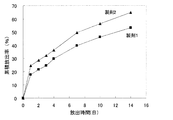
- Test example 1 Each preparation (shown in Table 1) obtained in Example 1 and Example 2 is put into 1 mL of phosphate buffered saline (PBS), left at 37 ° C., and released from the preparation. BSA was quantified with an ultraviolet spectrophotometer (SPECTROPHOTOMETER DU 800, BECKMAN COULTER, detection wavelength 280 nm, room temperature) to determine the cumulative emission rate. The results are shown in FIG. Good sustained release over 2 weeks was achieved with the formulations of the present invention.
- PBS phosphate buffered saline
- Comparative Example 1 SIwlastic Q7-4750 manufactured by Dow Corning 140 mg of silicone A component and 140 mg of the same silicone B component were kneaded with two rolls. After the silicone kneading, 120 mg of BSA was quickly added and kneaded. Thereafter, the film was stretched with two rolls and cured at 40 ° C. for 1 day to obtain a sheet preparation having a thickness of 0.4 mm. This sheet preparation was cut into a size of 5 mm ⁇ 7 mm to obtain Comparative preparation 1 of the present invention.
- Comparative Example 2 SIwlastic Q7-4750, manufactured by Dow Corning, 170 mg of silicone A component and 170 mg of the same B component were kneaded with two rolls. After the silicone kneading, 60 mg of BSA was quickly added and kneaded. Thereafter, the film was stretched with two rolls and cured at 40 ° C. for 1 day to obtain a sheet preparation having a thickness of 0.4 mm. This sheet preparation was cut into a size of 5 mm ⁇ 7 mm to obtain Comparative preparation 2 of the present invention.
- Comparative Example 3 60 mg of BMC was added to 60 mg of CMC-Na and mixed in a mortar to obtain a mixed powder.
- 140 mg of SILASTIC Q7-4750 silicone A component and 140 mg of silicone B component manufactured by Dow Corning were kneaded with two rolls. After the silicone kneading, all of the mixed powder was quickly added and kneaded. Thereafter, the film was stretched with two rolls and cured at 40 ° C. for 1 day to obtain a sheet preparation having a thickness of 0.4 mm. This sheet preparation was cut into a size of 5 mm ⁇ 7 mm to obtain Comparative preparation 3 of the present invention.
- Comparative formulation 1 was a formulation with no additive and a BSA content of 30%, but a significant initial burst released most of the content on day 1 and no subsequent persistence was observed.
- Comparative preparation 2 was a preparation containing no additive as in Comparative preparation 1 and having a BSA content of 15%. However, although the initial burst was small, sustained release was not obtained and the cumulative release rate remained low.
- Comparative preparation 3 does not contain the solid poorly water-soluble substance of the present invention, and contains 15% of CMC-Na, which is an additive described in Patent Document 4. However, similar to comparative preparation 1, release is fast and sustained release is recognized. I could't.
- Example 3 60 mg of HSA was added to 120 mg of cholesterol and mixed in a mortar to obtain a mixed powder.
- SILASTIC Q7-4750 silicone A component 210 mg and silicone B component 210 mg made by Dow Corning were kneaded with two rolls. After the silicone kneading, all of the mixed powder was quickly added and kneaded. Thereafter, the film was stretched with two rolls and cured at 40 ° C. for 1 day to obtain a sheet preparation having a thickness of 0.8 mm. This sheet preparation was cut into a size of 5 mm ⁇ 7 mm to obtain the preparation 3 of the present invention.
- Test example 3 Formulation 3 (shown in Table 3) obtained in Example 3 was put in 1 mL of PBS and allowed to stand at 37 ° C., and HSA released from the formulation was quantified with an ultraviolet spectrophotometer to determine the cumulative release rate. Asked. As shown in FIG. 3, good sustained release over 2 weeks was achieved.
- Comparative Example 4 SIwlastic Q7-4750 manufactured by Dow Corning 210 mg of silicone A component and 210 mg of the same silicone B component were kneaded with two rolls. After the silicone kneading, 180 mg of HSA was quickly added and kneaded. Thereafter, the film was stretched with two rolls and cured at 40 ° C. for 1 day to obtain a sheet preparation having a thickness of 0.8 mm. This sheet preparation was cut into a size of 5 mm ⁇ 7 mm to obtain a comparative preparation 4 of the present invention.
- Comparative Example 5 SIwlastic Q7-4750 made by Dow Corning 270 mg of silicone A component and 270 mg of the same silicone B component were kneaded with two rolls. After the silicone kneading, 60 mg of HSA was quickly added and kneaded. Thereafter, the film was stretched with two rolls and cured at 40 ° C. for 1 day to obtain a sheet preparation having a thickness of 0.8 mm. This sheet preparation was cut into a size of 5 mm ⁇ 7 mm to obtain Comparative preparation 5 of the present invention.
- Comparative formulation 4 was a formulation containing no additive and having an HSA content of 30%. However, due to a remarkably large initial burst, most of the content was released by the second day, and no subsequent persistence was observed. Comparative preparation 5 was a preparation containing no additive as in Comparative preparation 4 and having an HSA content of 10%. However, although the initial burst was small, sustained release was not obtained and the cumulative release rate remained low.
- Example 4 40 mg of acetaminophen was added to 80 mg of L-HPC and mixed in a mortar to obtain a mixed powder.
- 140 mg of SILASTIC Q7-4750 silicone A component and 140 mg of silicone B component manufactured by Dow Corning were kneaded with two rolls. After the silicone kneading, all of the mixed powder was quickly added and kneaded. This was set in a plastic syringe (Terumo Corporation), extruded, and cured at 40 ° C. for 1 day to obtain a rod preparation having a diameter of 2.0 mm. This rod preparation was cut into a length of 7 mm to obtain the preparation 4 of the present invention.
- Example 5 8 mg of acetaminophen was added to 112 mg of L-HPC and mixed in a mortar to obtain a mixed powder.
- 140 mg of SILASTIC Q7-4750 silicone A component and 140 mg of silicone B component manufactured by Dow Corning were kneaded with two rolls. After the silicone kneading, all of the mixed powder was quickly added and kneaded. This was set in a nozzle and extruded to be cured at 40 ° C. for 1 day to obtain a rod preparation having a diameter of 1.9 mm. This rod preparation was cut into a length of 7 mm to obtain a preparation 5 of the present invention.
- Example 6 L-HPC (104 mg) was mixed with lactose (8 mg). Further, 8 mg of acetaminophen was added and mixed in a mortar to obtain a mixed powder. On the other hand, 140 mg of SILASTIC Q7-4750 silicone A component and 140 mg of silicone B component manufactured by Dow Corning were kneaded with two rolls. After the silicone kneading, all of the mixed powder was quickly added and kneaded. This was set in a nozzle and extruded to be cured at 40 ° C. for 1 day to obtain a rod preparation having a diameter of 1.9 mm. This rod preparation was cut into a length of 7 mm to obtain a preparation 6 of the present invention.
- Test Example 5 The preparations obtained in Example 4 to Example 6 (shown in Table 5) were put into 1 mL of PBS and allowed to stand at 37 ° C., and the acetaminophen (AA) released from the preparations was measured with an ultraviolet spectrophotometer. And the cumulative release rate was determined. The results are shown in FIG. Formulation 4 was a formulation containing 10% acetaminophen and Formulation 5 was a formulation containing 2%, but both achieved good sustained release over 3 weeks.
- Formulation 6 was a formulation containing 2% of lactose, which is a water-soluble additive, as an additive, and achieved sustained release and an effect of promoting release by using a water-soluble additive in combination.
- Example 7 L-HPC (104 mg) was mixed with glycine (8 mg). Further, 8 mg of acetaminophen was added and mixed in a mortar to obtain a mixed powder.
- 140 mg of SILASTIC Q7-4750 silicone A component and 140 mg of silicone B component manufactured by Dow Corning were kneaded with two rolls. After the silicone kneading, all of the mixed powder was quickly added and kneaded. This was set in a nozzle and extruded to be cured at 40 ° C. for 1 day to obtain a rod preparation having a diameter of 2.0 mm. This rod preparation was cut into a length of 7 mm to obtain a preparation 7 of the present invention.
- Test Example 6 Formulation 7 (shown in Table 6) obtained in Example 7 was tested in the same manner as in Test Example 5 to determine the cumulative release rate of acetaminophen (AA). As shown in FIG. 6, a good sustained release over 18 days was achieved.
- Example 8 In advance, sodium chloride crystals were pulverized to a diameter of 100 ⁇ m or less in a mortar. L-HPC (102 mg) was mixed with the sodium chloride (18 mg). Further, 60 mg of acetaminophen was added and mixed in a mortar to obtain a mixed powder. On the other hand, SILASTIC Q7-4750 silicone A component 210 mg and silicone B component 210 mg made by Dow Corning were kneaded with two rolls. After the silicone kneading, all of the mixed powder was quickly added and kneaded. Thereafter, the film was stretched with two rolls and cured at 40 ° C. for 1 day to obtain a sheet preparation having a thickness of 0.8 mm. This sheet preparation was cut into a size of 5 mm ⁇ 7 mm to obtain the preparation 8 of the present invention.
- Example 7 Formulation 8 obtained in Example 8 (shown in Table 7) was allowed to stand at 37 ° C. in 1 mL of PBS, and acetaminophen (AA) released from the formulation was quantified with an ultraviolet spectrophotometer to determine the cumulative release rate. Asked. A good sustained release over 2 weeks was achieved as shown in FIG.
- Example 9 In advance, sodium chloride crystals were pulverized to a diameter of 100 ⁇ m or less in a mortar. 30 mg of the above sodium chloride was mixed with 100 mg of L-HPC. Further, 100 mg of acetaminophen was added and mixed in a mortar to obtain a mixed powder.
- SILSIC Q7-4750 manufactured by Dow Corning 385 mg of silicone A component and 385 mg of silicone B component were kneaded with two rolls. After the silicone kneading, all of the mixed powder was quickly added and kneaded. Thereafter, the film was stretched with two rolls and cured at 40 ° C. for 1 day to obtain a sheet preparation having a thickness of 0.8 mm. This sheet preparation was cut into a size of 5 mm ⁇ 7 mm to obtain the preparation 9 of the present invention.
- Example 10 In advance, sodium chloride crystals were pulverized to a diameter of 100 ⁇ m or less in a mortar. 50 mg L-HPC was mixed with 30 mg sodium chloride. Further, 100 mg of acetaminophen was added and mixed in a mortar to obtain a mixed powder.
- SILASTIC Q7-4750 made by Dow Corning, 410 mg of silicone A component and 410 mg of the same B component were kneaded with two rolls. After the silicone kneading, all of the mixed powder was quickly added and kneaded. Thereafter, the film was stretched with two rolls and cured at 40 ° C. for 1 day to obtain a sheet preparation having a thickness of 0.8 mm. This sheet preparation was cut into a size of 5 mm ⁇ 7 mm to obtain the preparation 10 of the present invention.
- Example 11 In advance, sodium chloride crystals were pulverized to a diameter of 100 ⁇ m or less in a mortar. 30 mg of L-HPC was mixed with 30 mg of the above sodium chloride. Further, 100 mg of acetaminophen was added and mixed in a mortar to obtain a mixed powder.
- SILASTIC Q7-4750 manufactured by Dow Corning 420 mg of silicone A component and 420 mg of the same silicone B component were kneaded with two rolls. After the silicone kneading, all of the mixed powder was quickly added and kneaded. Thereafter, the film was stretched with two rolls and cured at 40 ° C. for 1 day to obtain a sheet preparation having a thickness of 0.8 mm. This sheet preparation was cut into a size of 5 mm ⁇ 7 mm to obtain the preparation 11 of the present invention.
- Test Example 8 Each formulation (shown in Table 8) obtained in Examples 9 to 11 was tested in the same manner as in Test Example 7 to determine the cumulative release rate of acetaminophen (AA). The results are shown in FIG. These were formulations containing 3% by weight of the water-soluble additive NaCl in addition to the different contents of L-HPC, but all achieved good sustained release over 18 days.
- Example 12 In advance, sodium chloride crystals were pulverized to a diameter of 100 ⁇ m or less in a mortar. Sodium desoxycholate 34 mg and cholesterol 34 mg were mixed with 12 mg of the above sodium chloride. Furthermore, 40 mg of acetaminophen was added and mixed in a mortar to obtain a mixed powder. On the other hand, 140 mg of SILASTIC Q7-4750 silicone A component and 140 mg of silicone B component manufactured by Dow Corning were kneaded with two rolls. After the silicone kneading, all of the mixed powder was quickly added and kneaded. This was set in a nozzle and extruded to be cured at 40 ° C. for 1 day to obtain a rod preparation having a diameter of 2.1 mm. This rod preparation was cut into a length of 7 mm to obtain a preparation 12 of the present invention.
- Example 13 In advance, sodium chloride crystals were pulverized to a diameter of 100 ⁇ m or less in a mortar. Sodium desoxycholate 52 mg and cholesterol 16 mg were mixed with 12 mg of the above sodium chloride. Furthermore, 40 mg of acetaminophen was added and mixed in a mortar to obtain a mixed powder. On the other hand, 140 mg of SILASTIC Q7-4750 silicone A component and 140 mg of silicone B component manufactured by Dow Corning were kneaded with two rolls. After the silicone kneading, all of the mixed powder was quickly added and kneaded. This was set in a nozzle and extruded to be cured at 40 ° C. for 1 day to obtain a rod preparation having a diameter of 1.9 mm. This rod preparation was cut into a length of 7 mm to obtain a preparation 13 of the present invention.
- Test Example 9 Each formulation (shown in Table 9) obtained in Example 12 and Example 13 was tested in the same manner as in Test Example 5 to determine the cumulative release rate of acetaminophen (AA). The results are shown in FIG. These are preparations containing cholesterol as a solid poorly water-soluble substance of the present invention and sodium desoxycholate and NaCl as water-soluble additives, and all achieved good sustained release over 3 weeks. .
- Comparative Example 7 SIwlastic Q7-4750 manufactured by Dow Corning 140 mg of silicone A component and 140 mg of the same silicone B component were kneaded with two rolls. Immediately after the silicone kneading, 120 mg of acetaminophen was added and kneaded. This was set in a nozzle and extruded to be cured at 40 ° C. for 1 day to obtain a rod preparation having a diameter of 2.0 mm. This rod preparation was cut into a length of 7 mm to obtain a comparative preparation 7 of the present invention.
- Comparative preparation 7 obtained in Comparative Example 7 was tested in the same manner as in Test Example 5 to determine the cumulative release rate of acetaminophen (AA). The results are shown in FIG. Although this comparative preparation was a preparation containing no additive, the release rate was slow and the cumulative release rate of acetaminophen remained low.
- Comparative Example 8 In advance, sodium chloride crystals were pulverized to a diameter of 100 ⁇ m or less in a mortar. 8 mg of acetaminophen was added to 112 mg of the sodium chloride and mixed in a mortar to obtain a mixed powder. On the other hand, 140 mg of SILASTIC Q7-4750 silicone A component and 140 mg of silicone B component manufactured by Dow Corning were kneaded with two rolls. After the silicone kneading, all of the mixed powder was quickly added and kneaded. This was set in a nozzle and extruded to be cured at 40 ° C. for 1 day to obtain a rod preparation having a diameter of 2.0 mm. This rod preparation was cut into a length of 7 mm to obtain a comparative preparation 8 of the present invention.
- Comparative Example 9 8 mg of acetaminophen was added to 112 mg of water-soluble HPC (Nisso, SL NCl-0611) and mixed in a mortar to obtain a mixed powder.
- 140 mg of SILASTIC Q7-4750 silicone A component and 140 mg of silicone B component manufactured by Dow Corning were kneaded with two rolls. After the silicone kneading, all of the mixed powder was quickly added and kneaded. This was set in a nozzle and extruded to be cured at 40 ° C. for 1 day to obtain a rod preparation having a diameter of 2.0 mm. This rod preparation was cut into a length of 7 mm to obtain a comparative preparation 9 of the present invention.
- Comparative Example 10 8 mg of acetaminophen was added to 112 mg of PEG4000 and mixed in a mortar to obtain a mixed powder.
- 140 mg of SILASTIC Q7-4750 silicone A component and 140 mg of silicone B component manufactured by Dow Corning were kneaded with two rolls. After the silicone kneading, all of the mixed powder was quickly added and kneaded. This was set in a nozzle and extruded to be cured at 40 ° C. for 1 day to obtain a rod preparation having a diameter of 2.0 mm. This rod preparation was cut into a length of 7 mm to obtain a comparative preparation 10 of the present invention.
- Test Example 11 Each formulation (shown in Table 11) obtained in Comparative Example 8 to Comparative Example 10 was tested in the same manner as in Test Example 5 to determine the cumulative release rate of acetaminophen (AA). The results are shown in FIG. Comparative preparation 8 using only NaCl which is a general water-soluble additive without using the additive of the present invention, Comparative preparation 9 using water-soluble HPC described in Patent Document 4, Patent Document 4 and WO 00 / None of the comparative preparations 10 using PEG 4000, which is a water-soluble additive described in 15199, as the additive, showed a significantly high release rate, an initial burst release profile, and no long-term sustained release. In contrast, as described above, the preparation of the present invention was able to achieve a long-term good sustained release of acetaminophen.
- Example 14 100 mg of acetaminophen was added to 170 mg of L-HPC and mixed in a mortar to obtain a mixed powder.
- 365 mg of SILASTIC Q7-4750 manufactured by Dow Corning and 365 mg of the same silicone B component were kneaded with two rolls. After the silicone kneading, all of the mixed powder was quickly added and kneaded. This was set in a nozzle and extruded to be cured at 40 ° C. for 1 day to obtain a rod preparation having a diameter of 0.6 mm. This rod preparation was cut into a length of 10 mm to obtain a preparation 14 of the present invention.
- Example 15 100 mg of acetaminophen was added to 170 mg of L-HPC and mixed in a mortar to obtain a mixed powder.
- 365 mg of SILASTIC Q7-4750 manufactured by Dow Corning and 365 mg of the same silicone B component were kneaded with two rolls. After the silicone kneading, all of the mixed powder was quickly added and kneaded. This was set in a nozzle and extruded to be cured at 40 ° C. for 1 day to obtain a rod preparation having a diameter of 1.0 mm. This rod preparation was cut into a length of 10 mm to obtain a preparation 15 of the present invention.
- Example 16 100 mg of acetaminophen was added to 170 mg of L-HPC and mixed in a mortar to obtain a mixed powder.
- 365 mg of SILASTIC Q7-4750 manufactured by Dow Corning and 365 mg of the same silicone B component were kneaded with two rolls. After the silicone kneading, all of the mixed powder was quickly added and kneaded. This was set in a nozzle and extruded to be cured at 40 ° C. for 1 day to obtain a rod preparation having a diameter of 2.0 mm. This rod preparation was cut into a length of 10 mm to obtain a preparation 16 of the present invention.
- Example 17 100 mg of acetaminophen was added to 170 mg of L-HPC and mixed in a mortar to obtain a mixed powder.
- 365 mg of SILASTIC Q7-4750 manufactured by Dow Corning and 365 mg of the same silicone B component were kneaded with two rolls. After the silicone kneading, all of the mixed powder was quickly added and kneaded. This was set in a nozzle and extruded to be cured at 40 ° C. for 1 day to obtain a rod preparation having a diameter of 2.5 mm. This rod preparation was cut into a length of 10 mm to obtain a preparation 17 of the present invention.
- Test Example 12 The preparations (shown in Table 12) obtained in Example 14 to Example 17 were put into 1 mL of PBS and allowed to stand at 37 ° C., and acetaminophen (AA) released from the preparation was subjected to high performance liquid chromatography. (UFLC, Shimadzu Corporation) was quantified to determine the cumulative release rate. The results are shown in FIG. As shown in Table 12, the preparations obtained in Examples 14 to 17 were all the same composition but different in the diameter of the preparation. Good sustained release over 5 weeks was achieved with any diameter formulation. Moreover, the tendency for the discharge
- Sustained drug release is achieved based on a mechanism in which water gradually infiltrates from the preparation surface to the inside of the preparation.However, since the distance from the preparation surface to the deepest part of the preparation changes as the diameter changes, water is the deepest part of the preparation. The time required to penetrate until changed, and the duration of release will change.
- Example 18 In advance, sodium chloride crystals were pulverized to a diameter of 100 ⁇ m or less in a mortar. 30 mg of the above sodium chloride was mixed with 70 mg of L-HPC. Further, 100 mg of acetaminophen was added and mixed in a mortar to obtain a mixed powder.
- SILASTIC Q7-4750 manufactured by Dow Corning 400 mg of silicone A component and 400 mg of the same silicone B component were kneaded with two rolls. After the silicone kneading, all of the mixed powder was quickly added and kneaded. Thereafter, the film was stretched with two rolls and cured at 40 ° C. for 1 day to obtain a sheet preparation having a thickness of 0.8 mm. This sheet preparation was cut into a size of 5 mm ⁇ 7 mm to obtain the preparation 18 of the present invention.
- Example 19 In advance, glycine was pulverized to a diameter of 100 ⁇ m or less in a mortar. The above glycine 30 mg was mixed with L-HPC 70 mg. Further, 100 mg of acetaminophen was added and mixed in a mortar to obtain a mixed powder.
- SILASTIC Q7-4750 manufactured by Dow Corning 400 mg of silicone A component and 400 mg of the same silicone B component were kneaded with two rolls. After the silicone kneading, all of the mixed powder was quickly added and kneaded. Thereafter, the film was stretched with two rolls and cured at 40 ° C. for 1 day to obtain a sheet preparation having a thickness of 0.8 mm. This sheet preparation was cut into a size of 5 mm ⁇ 7 mm to obtain the preparation 19 of the present invention.
- Example 20 Glucose (30 mg) was mixed with L-HPC (70 mg). Further, 100 mg of acetaminophen was added and mixed in a mortar to obtain a mixed powder.
- SILASTIC Q7-4750 manufactured by Dow Corning 400 mg of silicone A component and 400 mg of the same silicone B component were kneaded with two rolls. After the silicone kneading, all of the mixed powder was quickly added and kneaded. Thereafter, the film was stretched with two rolls and cured at 40 ° C. for 1 day to obtain a sheet preparation having a thickness of 0.8 mm. This sheet preparation was cut into a size of 5 mm ⁇ 7 mm to obtain the preparation 20 of the present invention.
- Example 21 70 mg of L-HPC was mixed with 30 mg of mannitol. Further, 100 mg of acetaminophen was added and mixed in a mortar to obtain a mixed powder.
- SILASTIC Q7-4750 manufactured by Dow Corning 400 mg of silicone A component and 400 mg of the same silicone B component were kneaded with two rolls. After the silicone kneading, all of the mixed powder was quickly added and kneaded. Thereafter, the film was stretched with two rolls and cured at 40 ° C. for 1 day to obtain a sheet preparation having a thickness of 0.8 mm. This sheet preparation was cut into a size of 5 mm ⁇ 7 mm to obtain the preparation 21 of the present invention.
- Example 22 30 mg of lactose was mixed with 70 mg of L-HPC. Further, 100 mg of acetaminophen was added and mixed in a mortar to obtain a mixed powder.
- SILASTIC Q7-4750 manufactured by Dow Corning 400 mg of silicone A component and 400 mg of the same silicone B component were kneaded with two rolls. After the silicone kneading, all of the mixed powder was quickly added and kneaded. Thereafter, the film was stretched with two rolls and cured at 40 ° C. for 1 day to obtain a sheet preparation having a thickness of 0.8 mm. This sheet preparation was cut into a size of 5 mm ⁇ 7 mm to obtain the preparation 22 of the present invention.
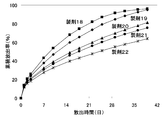
- Test Example 13 The preparations obtained in Examples 18 to 22 (shown in Table 13) were tested in the same manner as in Test Example 12 to determine the cumulative release rate of acetaminophen (AA). The results are shown in FIG. These are formulations containing different water-soluble additives, but good sustained release over 5 weeks was achieved in any formulation.
- Example 23 In advance, sodium chloride crystals were pulverized to a diameter of 100 ⁇ m or less in a mortar. 170 mg of crospovidone was mixed with 30 mg of the above sodium chloride. Further, 100 mg of droxidopa was added and mixed in a mortar to obtain a mixed powder.
- SILASTIC Q7-4750 made by Dow Corning, 350 mg of silicone A component and 350 mg of the same silicone B component were kneaded with two rolls. After the silicone kneading, all of the mixed powder was quickly added and kneaded. Thereafter, the film was stretched with two rolls and cured at 40 ° C. for 1 day to obtain a sheet preparation having a thickness of 0.8 mm. This sheet preparation was cut into a size of 5 mm ⁇ 7 mm to obtain the preparation 23 of the present invention.
- Example 14 Formulation 23 obtained in Example 23 (shown in Table 14) was put into 1 mL of PBS and allowed to stand at 5 ° C., and droxidopa released from the formulation was subjected to high performance liquid chromatography (UFLC, Shimadzu Corporation). And the cumulative release rate was determined. Good sustained release over 6 weeks was achieved as shown in FIG. Since droxidopa is unstable in heat in the solution state, the release test was conducted at 5 ° C., but there is a possibility that the stability to heat in the solution state can be improved by adding a stabilizer or the like.
- Example 24 100 mg of tranexamic acid was added to 70 mg of L-HPC and mixed in a mortar to obtain a mixed powder.
- SILASTIC Q7-4750 made by Dow Corning 415 mg of silicone A component and 415 mg of silicone B component were kneaded with two rolls. After the silicone kneading, all of the mixed powder was quickly added and kneaded. Thereafter, the film was stretched with two rolls and cured at 40 ° C. for 1 day to obtain a sheet preparation having a thickness of 0.8 mm. This sheet preparation was cut into a size of 5 mm ⁇ 7 mm to obtain the preparation 24 of the present invention.
- Test Example 15 Formulation 24 (shown in Table 15) obtained in Example 24 was put into 1 mL of PBS and allowed to stand at 37 ° C., and tranexamic acid released from the formulation was subjected to high performance liquid chromatography (UFLC, Shimadzu Corporation). ) To determine the cumulative release rate. As shown in FIG. 15, good sustained release over 4 weeks was achieved.
- UFLC high performance liquid chromatography
- Example 25 100 mg of L-phenylalanine was added to 170 mg of L-HPC and mixed in a mortar to obtain a mixed powder.
- 365 mg of SILASTIC Q7-4750 manufactured by Dow Corning and 365 mg of the same silicone B component were kneaded with two rolls. After the silicone kneading, all of the mixed powder was quickly added and kneaded. Thereafter, the film was stretched with two rolls and cured at 40 ° C. for 1 day to obtain a sheet preparation having a thickness of 0.8 mm. This sheet preparation was cut into a size of 5 mm ⁇ 7 mm to obtain the preparation 25 of the present invention.
- Test Example 16 Formulation 25 obtained in Example 25 (shown in Table 16) was put into 1 mL of PBS and allowed to stand at 37 ° C., and L-phenylalanine released from the formulation was subjected to high performance liquid chromatography (UFLC, Shimadzu Corporation). The cumulative release rate was determined by quantification by a manufacturing company). Good sustained release over 4 weeks was achieved as shown in FIG.
- Example 26 Metformin hydrochloride (100 mg) was added to L-HPC (70 mg) and mixed in a mortar to obtain a mixed powder.
- SILASTIC Q7-4750 made by Dow Corning 415 mg of silicone A component and 415 mg of silicone B component were kneaded with two rolls. After the silicone kneading, all of the mixed powder was quickly added and kneaded. Thereafter, the film was stretched with two rolls and cured at 40 ° C. for 1 day to obtain a sheet preparation having a thickness of 0.8 mm. This sheet preparation was cut into a size of 5 mm ⁇ 7 mm to obtain the preparation 26 of the present invention.
- Test Example 17 Formulation 26 obtained in Example 26 (shown in Table 17) was put into 1 mL of PBS and allowed to stand at 37 ° C., and metformin hydrochloride released from the formulation was subjected to high performance liquid chromatography (UFLC, Shimadzu Corporation). The cumulative release rate was determined by quantification by a manufacturing company). A good sustained release over 2 weeks was achieved as shown in FIG.
- Example 27 Zonisamide 100 mg was added to L-HPC 170 mg and mixed in a mortar to obtain a mixed powder.
- 365 mg of SILASTIC Q7-4750 manufactured by Dow Corning and 365 mg of the same silicone B component were kneaded with two rolls. After the silicone kneading, all of the mixed powder was quickly added and kneaded. Thereafter, the film was stretched with two rolls and cured at 40 ° C. for 1 day to obtain a sheet preparation having a thickness of 0.8 mm. This sheet preparation was cut into a size of 5 mm ⁇ 7 mm to obtain the preparation 27 of the present invention.
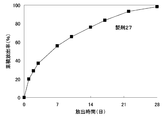
- Example 18 Formulation 27 (shown in Table 18) obtained in Example 27 was put into 1 mL of PBS and allowed to stand at 37 ° C., and zonisamide released from the formulation was subjected to high performance liquid chromatography (UFLC, Shimadzu Corporation). And the cumulative release rate was determined. A good sustained release over 4 weeks was achieved as shown in FIG.
- Example 28 100 mg of acetaminophen was added to 170 mg of L-HPC and mixed in a mortar to obtain a mixed powder.
- 365 mg of SILASTIC Q7-4750 manufactured by Dow Corning and 365 mg of the same silicone B component were kneaded with two rolls. After the silicone kneading, all of the mixed powder was quickly added and kneaded. Thereafter, the film was stretched with two rolls and cured at 40 ° C. for 1 day to obtain a sheet preparation having a thickness of 0.8 mm. This sheet preparation was cut into a size of 5 mm ⁇ 7 mm to obtain the preparation 28 of the present invention.
- Example 29 100 mg of acetaminophen was added to 170 mg of partially pregelatinized starch and mixed in a mortar to obtain a mixed powder.
- 365 mg of SILASTIC Q7-4750 manufactured by Dow Corning and 365 mg of the same silicone B component were kneaded with two rolls. After the silicone kneading, all of the mixed powder was quickly added and kneaded. Thereafter, the film was stretched with two rolls and cured at 40 ° C. for 1 day to obtain a sheet preparation having a thickness of 0.8 mm. This sheet preparation was cut into a size of 5 mm ⁇ 7 mm to obtain the preparation 29 of the present invention.
- Example 30 100 mg of acetaminophen was added to 70 mg of crospovidone and mixed in a mortar to obtain a mixed powder.
- SILASTIC Q7-4750 made by Dow Corning 415 mg of silicone A component and 415 mg of silicone B component were kneaded with two rolls. After the silicone kneading, all of the mixed powder was quickly added and kneaded. Thereafter, the film was stretched with two rolls and cured at 40 ° C. for 1 day to obtain a sheet preparation having a thickness of 0.8 mm. This sheet preparation was cut into a size of 5 mm ⁇ 7 mm to obtain the preparation 30 of the present invention.
- Example 31 Acetaminophen 100 mg was added to croscarmellose sodium 70 mg and mixed in a mortar to obtain a mixed powder.
- SILASTIC Q7-4750 made by Dow Corning 415 mg of silicone A component and 415 mg of silicone B component were kneaded with two rolls. After the silicone kneading, all of the mixed powder was quickly added and kneaded. Thereafter, the film was stretched with two rolls and cured at 40 ° C. for 1 day to obtain a sheet preparation having a thickness of 0.8 mm. This sheet preparation was cut into a size of 5 mm ⁇ 7 mm to obtain the preparation 31 of the present invention.
- Test Example 19 The preparations obtained in Example 28 to Example 31 (shown in Table 19) were tested in the same manner as in Test Example 12, and the cumulative release rate of acetaminophen (AA) was determined. The results are shown in FIG. These are preparations containing different poorly water-soluble substances, but all the preparations achieved good sustained release over 5 weeks.
- Example 32 In advance, sodium chloride crystals were pulverized to a diameter of 100 ⁇ m or less in a mortar. 30 mg of sodium chloride was mixed with 85 mg of sodium cholate and 85 mg of cholesterol. Further, 100 mg of zonisamide was added and mixed in a mortar to obtain a mixed powder.
- SILASTIC Q7-4750 made by Dow Corning, 350 mg of silicone A component and 350 mg of the same silicone B component were kneaded with two rolls. After the silicone kneading, all of the mixed powder was quickly added and kneaded. Thereafter, the film was stretched with two rolls and cured at 40 ° C. for 1 day to obtain a sheet preparation having a thickness of 0.8 mm. This sheet preparation was cut into a size of 5 mm ⁇ 7 mm to obtain the preparation 32 of the present invention.
- Example 33 In advance, sodium chloride crystals were pulverized to a diameter of 100 ⁇ m or less in a mortar. The sodium chloride 30 mg was mixed with sodium glycocholate 85 mg and cholesterol 85 mg. Further, 100 mg of zonisamide was added and mixed in a mortar to obtain a mixed powder.
- SILASTIC Q7-4750 made by Dow Corning, 350 mg of silicone A component and 350 mg of the same silicone B component were kneaded with two rolls. After the silicone kneading, all of the mixed powder was quickly added and kneaded. Thereafter, the film was stretched with two rolls and cured at 40 ° C. for 1 day to obtain a sheet preparation having a thickness of 0.8 mm. This sheet preparation was cut into a size of 5 mm ⁇ 7 mm to obtain the preparation 33 of the present invention.
- Test Example 20 The preparations obtained in Example 32 and Example 33 (shown in Table 20) were tested in the same manner as in Test Example 18 to determine the cumulative release rate of zonisamide. The results are shown in FIG. These are preparations containing cholesterol as a solid poorly water-soluble substance of the present invention and cholic acid and NaCl or glycocholic acid and NaCl as water-soluble additives, both of which have good sustainability over 6 weeks Release was achieved.
- Example 34 In advance, sodium chloride crystals were pulverized to a diameter of 100 ⁇ m or less in a mortar. 185 mg of saccharin was mixed with 15 mg of the sodium chloride. Further, 100 mg of zonisamide was added and mixed in a mortar to obtain a mixed powder.
- SILASTIC Q7-4750 made by Dow Corning, 350 mg of silicone A component and 350 mg of the same silicone B component were kneaded with two rolls. After the silicone kneading, all of the mixed powder was quickly added and kneaded. Thereafter, the film was stretched with two rolls and cured at 40 ° C. for 1 day to obtain a sheet preparation having a thickness of 0.8 mm. This sheet preparation was cut into a size of 5 mm ⁇ 7 mm to obtain the preparation 34 of the present invention.
- Example 35 In advance, sodium chloride crystals were pulverized to a diameter of 100 ⁇ m or less in a mortar. 70 mg of myristic acid was mixed with 30 mg of the above sodium chloride. Further, 100 mg of zonisamide was added and mixed in a mortar to obtain a mixed powder.
- SILASTIC Q7-4750 manufactured by Dow Corning 400 mg of silicone A component and 400 mg of the same silicone B component were kneaded with two rolls. After the silicone kneading, all of the mixed powder was quickly added and kneaded. Thereafter, the film was stretched with two rolls and cured at 40 ° C. for 1 day to obtain a sheet preparation having a thickness of 0.8 mm. This sheet preparation was cut into a size of 5 mm ⁇ 7 mm to obtain the preparation 35 of the present invention.
- Test Example 21 The preparations obtained in Example 34 and Example 35 (shown in Table 21) were tested in the same manner as in Test Example 18 to determine the cumulative release rate of zonisamide. The results are shown in FIG. These are preparations containing saccharin or myristic acid as the solid poorly water-soluble substance of the present invention and NaCl as the water-soluble additive, and all achieved good sustained release over 6 weeks or more.
Landscapes
- Health & Medical Sciences (AREA)
- Chemical & Material Sciences (AREA)
- Life Sciences & Earth Sciences (AREA)
- Medicinal Chemistry (AREA)
- Pharmacology & Pharmacy (AREA)
- Epidemiology (AREA)
- Animal Behavior & Ethology (AREA)
- General Health & Medical Sciences (AREA)
- Public Health (AREA)
- Veterinary Medicine (AREA)
- Inorganic Chemistry (AREA)
- Engineering & Computer Science (AREA)
- Chemical Kinetics & Catalysis (AREA)
- General Chemical & Material Sciences (AREA)
- Oil, Petroleum & Natural Gas (AREA)
- Proteomics, Peptides & Aminoacids (AREA)
- Biomedical Technology (AREA)
- Neurosurgery (AREA)
- Dermatology (AREA)
- Pain & Pain Management (AREA)
- Medicinal Preparation (AREA)
- Acyclic And Carbocyclic Compounds In Medicinal Compositions (AREA)
Abstract
Priority Applications (5)
| Application Number | Priority Date | Filing Date | Title |
|---|---|---|---|
| US13/814,330 US20130137781A1 (en) | 2010-08-06 | 2011-08-04 | Pharmaceutical preparation for controlling water-soluble drug release |
| CA2807225A CA2807225A1 (fr) | 2010-08-06 | 2011-08-04 | Preparation pharmaceutique pour controler la liberation d'un medicament soluble dans l'eau |
| EP11814693.5A EP2601974A4 (fr) | 2010-08-06 | 2011-08-04 | Préparation pharmaceutique pour contrôler la libération d'un médicament soluble dans l'eau |
| JP2012527761A JP5898619B2 (ja) | 2010-08-06 | 2011-08-04 | 水溶性薬物放出制御製剤 |
| CN2011800485350A CN103124565A (zh) | 2010-08-06 | 2011-08-04 | 用于控制水溶性药物释放的药物制剂 |
Applications Claiming Priority (2)
| Application Number | Priority Date | Filing Date | Title |
|---|---|---|---|
| JP2010177252 | 2010-08-06 | ||
| JP2010-177252 | 2010-08-06 |
Publications (1)
| Publication Number | Publication Date |
|---|---|
| WO2012018068A1 true WO2012018068A1 (fr) | 2012-02-09 |
Family
ID=45559564
Family Applications (1)
| Application Number | Title | Priority Date | Filing Date |
|---|---|---|---|
| PCT/JP2011/067837 Ceased WO2012018068A1 (fr) | 2010-08-06 | 2011-08-04 | Préparation pharmaceutique pour contrôler la libération d'un médicament soluble dans l'eau |
Country Status (6)
| Country | Link |
|---|---|
| US (1) | US20130137781A1 (fr) |
| EP (1) | EP2601974A4 (fr) |
| JP (1) | JP5898619B2 (fr) |
| CN (1) | CN103124565A (fr) |
| CA (1) | CA2807225A1 (fr) |
| WO (1) | WO2012018068A1 (fr) |
Families Citing this family (1)
| Publication number | Priority date | Publication date | Assignee | Title |
|---|---|---|---|---|
| JP6742343B2 (ja) | 2016-01-15 | 2020-08-19 | 大日本住友製薬株式会社 | 2環性複素環化合物 |
Citations (12)
| Publication number | Priority date | Publication date | Assignee | Title |
|---|---|---|---|---|
| FR2322860B1 (fr) | 1975-09-05 | 1979-04-27 | Aron Sa | |
| US4172896A (en) | 1978-06-05 | 1979-10-30 | Dainippon Pharmaceutical Co., Ltd. | Methane-sulfonamide derivatives, the preparation thereof and composition comprising the same |
| JPS5545694A (en) | 1978-09-22 | 1980-03-31 | Lilly Co Eli | Drug inserted body able to be taken out |
| JPS55100315A (en) * | 1979-01-23 | 1980-07-31 | Hoechst Ag | Silicone rubber base depot agent and its manufacture |
| JPS62174007A (ja) | 1985-10-11 | 1987-07-30 | Sumitomo Pharmaceut Co Ltd | シリコンエラストマ−系徐放性製剤 |
| JPH03151322A (ja) | 1989-10-23 | 1991-06-27 | Dow Corning Fr Sa | 薬剤持続的放出性包帯材として使用する製剤 |
| EP0481443A1 (fr) | 1990-10-17 | 1992-04-22 | Vectorpharma International S.P.A. | Compositions transdermiques thérapeutiques |
| JPH0520425A (ja) | 1991-07-09 | 1993-01-29 | Fujitsu Ltd | アニメーシヨン作成方法とその装置 |
| JPH07187994A (ja) | 1993-12-27 | 1995-07-25 | Sumitomo Pharmaceut Co Ltd | 薬物放出制御製剤 |
| WO2000015199A1 (fr) | 1998-09-10 | 2000-03-23 | Sumitomo Pharmaceuticals Company, Limited | Preparation de liberation prolongee de medicament a effet durable |
| JP2003501505A (ja) * | 1999-05-28 | 2003-01-14 | ニュートロジーナ・コーポレイション | サリチル酸を含有しているシリコーン・ゲル |
| JP2008502605A (ja) * | 2004-06-16 | 2008-01-31 | スマート ドラッグ システムズ インコーポレイティド | 徐放性ワクチン組成物 |
Family Cites Families (1)
| Publication number | Priority date | Publication date | Assignee | Title |
|---|---|---|---|---|
| JP4757995B2 (ja) * | 1999-11-10 | 2011-08-24 | 大日本住友製薬株式会社 | 薬物放出製剤 |
-
2011
- 2011-08-04 US US13/814,330 patent/US20130137781A1/en not_active Abandoned
- 2011-08-04 CN CN2011800485350A patent/CN103124565A/zh active Pending
- 2011-08-04 WO PCT/JP2011/067837 patent/WO2012018068A1/fr not_active Ceased
- 2011-08-04 EP EP11814693.5A patent/EP2601974A4/fr not_active Withdrawn
- 2011-08-04 CA CA2807225A patent/CA2807225A1/fr not_active Abandoned
- 2011-08-04 JP JP2012527761A patent/JP5898619B2/ja not_active Expired - Fee Related
Patent Citations (12)
| Publication number | Priority date | Publication date | Assignee | Title |
|---|---|---|---|---|
| FR2322860B1 (fr) | 1975-09-05 | 1979-04-27 | Aron Sa | |
| US4172896A (en) | 1978-06-05 | 1979-10-30 | Dainippon Pharmaceutical Co., Ltd. | Methane-sulfonamide derivatives, the preparation thereof and composition comprising the same |
| JPS5545694A (en) | 1978-09-22 | 1980-03-31 | Lilly Co Eli | Drug inserted body able to be taken out |
| JPS55100315A (en) * | 1979-01-23 | 1980-07-31 | Hoechst Ag | Silicone rubber base depot agent and its manufacture |
| JPS62174007A (ja) | 1985-10-11 | 1987-07-30 | Sumitomo Pharmaceut Co Ltd | シリコンエラストマ−系徐放性製剤 |
| JPH03151322A (ja) | 1989-10-23 | 1991-06-27 | Dow Corning Fr Sa | 薬剤持続的放出性包帯材として使用する製剤 |
| EP0481443A1 (fr) | 1990-10-17 | 1992-04-22 | Vectorpharma International S.P.A. | Compositions transdermiques thérapeutiques |
| JPH0520425A (ja) | 1991-07-09 | 1993-01-29 | Fujitsu Ltd | アニメーシヨン作成方法とその装置 |
| JPH07187994A (ja) | 1993-12-27 | 1995-07-25 | Sumitomo Pharmaceut Co Ltd | 薬物放出制御製剤 |
| WO2000015199A1 (fr) | 1998-09-10 | 2000-03-23 | Sumitomo Pharmaceuticals Company, Limited | Preparation de liberation prolongee de medicament a effet durable |
| JP2003501505A (ja) * | 1999-05-28 | 2003-01-14 | ニュートロジーナ・コーポレイション | サリチル酸を含有しているシリコーン・ゲル |
| JP2008502605A (ja) * | 2004-06-16 | 2008-01-31 | スマート ドラッグ システムズ インコーポレイティド | 徐放性ワクチン組成物 |
Also Published As
| Publication number | Publication date |
|---|---|
| US20130137781A1 (en) | 2013-05-30 |
| CN103124565A (zh) | 2013-05-29 |
| EP2601974A1 (fr) | 2013-06-12 |
| EP2601974A4 (fr) | 2015-06-24 |
| JPWO2012018068A1 (ja) | 2013-10-03 |
| CA2807225A1 (fr) | 2012-02-09 |
| JP5898619B2 (ja) | 2016-04-06 |
Similar Documents
| Publication | Publication Date | Title |
|---|---|---|
| CN103140226B (zh) | 用于治疗脊髓损伤的制剂 | |
| JP3720386B2 (ja) | 薬物放出制御製剤 | |
| JP4584331B2 (ja) | オクトレオチドの放出制御製剤 | |
| US5302397A (en) | Polymer-based drug delivery system | |
| US20140154321A1 (en) | Sustained release delivery devices | |
| JP2011093944A (ja) | 生体分解性徐放性ドラッグデリバリーシステム | |
| ES2637379T3 (es) | Material polimérico de administración de fármacos, método para fabricar el mismo y método para la administración de una composición de administración de fármacos | |
| US12059428B2 (en) | Methods of treating tumor metastasis | |
| JP2020529390A (ja) | 生体浸食性薬物送達デバイス | |
| ES2360180T3 (es) | Preparación de liberación mantenida de larga duración de un fármaco. | |
| JP2005517653A (ja) | X線不透過性徐放性医薬器具 | |
| JP5898619B2 (ja) | 水溶性薬物放出制御製剤 | |
| JP2009523791A (ja) | 1.0〜100kDaの分子量を有するデキストランを含む薬剤及びその調製方法 | |
| JPH0761959B2 (ja) | シリコンエラストマ−系徐放性製剤 | |
| CN119630398A (zh) | 眼内用尼达尼布的药物制剂 | |
| HK1182027A (en) | Pharmaceutical preparation for controlling water-soluble drug release | |
| JP2001199879A (ja) | 薬物放出製剤 | |
| HK1182335A (en) | Preparation for treatment of spinal cord injury |
Legal Events
| Date | Code | Title | Description |
|---|---|---|---|
| WWE | Wipo information: entry into national phase |
Ref document number: 201180048535.0 Country of ref document: CN |
|
| 121 | Ep: the epo has been informed by wipo that ep was designated in this application |
Ref document number: 11814693 Country of ref document: EP Kind code of ref document: A1 |
|
| ENP | Entry into the national phase |
Ref document number: 2807225 Country of ref document: CA |
|
| WWE | Wipo information: entry into national phase |
Ref document number: 2012527761 Country of ref document: JP |
|
| REEP | Request for entry into the european phase |
Ref document number: 2011814693 Country of ref document: EP |
|
| WWE | Wipo information: entry into national phase |
Ref document number: 2011814693 Country of ref document: EP |
|
| WWE | Wipo information: entry into national phase |
Ref document number: 13814330 Country of ref document: US |
|
| NENP | Non-entry into the national phase |
Ref country code: DE |