WO2012018077A1 - Accumulateur alcalin et procédé de fabrication de matière d'électrode positive destinée à un accumulateur alcalin - Google Patents
Accumulateur alcalin et procédé de fabrication de matière d'électrode positive destinée à un accumulateur alcalin Download PDFInfo
- Publication number
- WO2012018077A1 WO2012018077A1 PCT/JP2011/067857 JP2011067857W WO2012018077A1 WO 2012018077 A1 WO2012018077 A1 WO 2012018077A1 JP 2011067857 W JP2011067857 W JP 2011067857W WO 2012018077 A1 WO2012018077 A1 WO 2012018077A1
- Authority
- WO
- WIPO (PCT)
- Prior art keywords
- compound
- cobalt
- cerium
- positive electrode
- nickel hydroxide
- Prior art date
- Legal status (The legal status is an assumption and is not a legal conclusion. Google has not performed a legal analysis and makes no representation as to the accuracy of the status listed.)
- Ceased
Links
Images


Classifications
-
- H—ELECTRICITY
- H01—ELECTRIC ELEMENTS
- H01M—PROCESSES OR MEANS, e.g. BATTERIES, FOR THE DIRECT CONVERSION OF CHEMICAL ENERGY INTO ELECTRICAL ENERGY
- H01M10/00—Secondary cells; Manufacture thereof
- H01M10/24—Alkaline accumulators
- H01M10/30—Nickel accumulators
-
- C—CHEMISTRY; METALLURGY
- C01—INORGANIC CHEMISTRY
- C01G—COMPOUNDS CONTAINING METALS NOT COVERED BY SUBCLASSES C01D OR C01F
- C01G51/00—Compounds of cobalt
-
- C—CHEMISTRY; METALLURGY
- C01—INORGANIC CHEMISTRY
- C01G—COMPOUNDS CONTAINING METALS NOT COVERED BY SUBCLASSES C01D OR C01F
- C01G53/00—Compounds of nickel
- C01G53/80—Compounds containing nickel, with or without oxygen or hydrogen, and containing one or more other elements
- C01G53/82—Compounds containing nickel, with or without oxygen or hydrogen, and containing two or more other elements
-
- H—ELECTRICITY
- H01—ELECTRIC ELEMENTS
- H01M—PROCESSES OR MEANS, e.g. BATTERIES, FOR THE DIRECT CONVERSION OF CHEMICAL ENERGY INTO ELECTRICAL ENERGY
- H01M4/00—Electrodes
- H01M4/02—Electrodes composed of, or comprising, active material
- H01M4/24—Electrodes for alkaline accumulators
- H01M4/32—Nickel oxide or hydroxide electrodes
-
- H—ELECTRICITY
- H01—ELECTRIC ELEMENTS
- H01M—PROCESSES OR MEANS, e.g. BATTERIES, FOR THE DIRECT CONVERSION OF CHEMICAL ENERGY INTO ELECTRICAL ENERGY
- H01M4/00—Electrodes
- H01M4/02—Electrodes composed of, or comprising, active material
- H01M4/36—Selection of substances as active materials, active masses, active liquids
- H01M4/48—Selection of substances as active materials, active masses, active liquids of inorganic oxides or hydroxides
- H01M4/52—Selection of substances as active materials, active masses, active liquids of inorganic oxides or hydroxides of nickel, cobalt or iron
-
- H—ELECTRICITY
- H01—ELECTRIC ELEMENTS
- H01M—PROCESSES OR MEANS, e.g. BATTERIES, FOR THE DIRECT CONVERSION OF CHEMICAL ENERGY INTO ELECTRICAL ENERGY
- H01M4/00—Electrodes
- H01M4/02—Electrodes composed of, or comprising, active material
- H01M4/62—Selection of inactive substances as ingredients for active masses, e.g. binders, fillers
-
- H—ELECTRICITY
- H01—ELECTRIC ELEMENTS
- H01M—PROCESSES OR MEANS, e.g. BATTERIES, FOR THE DIRECT CONVERSION OF CHEMICAL ENERGY INTO ELECTRICAL ENERGY
- H01M4/00—Electrodes
- H01M4/02—Electrodes composed of, or comprising, active material
- H01M4/62—Selection of inactive substances as ingredients for active masses, e.g. binders, fillers
- H01M4/624—Electric conductive fillers
-
- C—CHEMISTRY; METALLURGY
- C01—INORGANIC CHEMISTRY
- C01P—INDEXING SCHEME RELATING TO STRUCTURAL AND PHYSICAL ASPECTS OF SOLID INORGANIC COMPOUNDS
- C01P2002/00—Crystal-structural characteristics
- C01P2002/50—Solid solutions
- C01P2002/52—Solid solutions containing elements as dopants
-
- C—CHEMISTRY; METALLURGY
- C01—INORGANIC CHEMISTRY
- C01P—INDEXING SCHEME RELATING TO STRUCTURAL AND PHYSICAL ASPECTS OF SOLID INORGANIC COMPOUNDS
- C01P2004/00—Particle morphology
- C01P2004/01—Particle morphology depicted by an image
-
- C—CHEMISTRY; METALLURGY
- C01—INORGANIC CHEMISTRY
- C01P—INDEXING SCHEME RELATING TO STRUCTURAL AND PHYSICAL ASPECTS OF SOLID INORGANIC COMPOUNDS
- C01P2004/00—Particle morphology
- C01P2004/80—Particles consisting of a mixture of two or more inorganic phases
- C01P2004/82—Particles consisting of a mixture of two or more inorganic phases two phases having the same anion, e.g. both oxidic phases
- C01P2004/84—Particles consisting of a mixture of two or more inorganic phases two phases having the same anion, e.g. both oxidic phases one phase coated with the other
-
- C—CHEMISTRY; METALLURGY
- C01—INORGANIC CHEMISTRY
- C01P—INDEXING SCHEME RELATING TO STRUCTURAL AND PHYSICAL ASPECTS OF SOLID INORGANIC COMPOUNDS
- C01P2006/00—Physical properties of inorganic compounds
- C01P2006/40—Electric properties
-
- H—ELECTRICITY
- H01—ELECTRIC ELEMENTS
- H01M—PROCESSES OR MEANS, e.g. BATTERIES, FOR THE DIRECT CONVERSION OF CHEMICAL ENERGY INTO ELECTRICAL ENERGY
- H01M4/00—Electrodes
- H01M4/02—Electrodes composed of, or comprising, active material
- H01M4/36—Selection of substances as active materials, active masses, active liquids
- H01M4/362—Composites
- H01M4/364—Composites as mixtures
-
- H—ELECTRICITY
- H01—ELECTRIC ELEMENTS
- H01M—PROCESSES OR MEANS, e.g. BATTERIES, FOR THE DIRECT CONVERSION OF CHEMICAL ENERGY INTO ELECTRICAL ENERGY
- H01M4/00—Electrodes
- H01M4/02—Electrodes composed of, or comprising, active material
- H01M4/36—Selection of substances as active materials, active masses, active liquids
- H01M4/362—Composites
- H01M4/366—Composites as layered products
-
- Y—GENERAL TAGGING OF NEW TECHNOLOGICAL DEVELOPMENTS; GENERAL TAGGING OF CROSS-SECTIONAL TECHNOLOGIES SPANNING OVER SEVERAL SECTIONS OF THE IPC; TECHNICAL SUBJECTS COVERED BY FORMER USPC CROSS-REFERENCE ART COLLECTIONS [XRACs] AND DIGESTS
- Y02—TECHNOLOGIES OR APPLICATIONS FOR MITIGATION OR ADAPTATION AGAINST CLIMATE CHANGE
- Y02E—REDUCTION OF GREENHOUSE GAS [GHG] EMISSIONS, RELATED TO ENERGY GENERATION, TRANSMISSION OR DISTRIBUTION
- Y02E60/00—Enabling technologies; Technologies with a potential or indirect contribution to GHG emissions mitigation
- Y02E60/10—Energy storage using batteries
-
- Y—GENERAL TAGGING OF NEW TECHNOLOGICAL DEVELOPMENTS; GENERAL TAGGING OF CROSS-SECTIONAL TECHNOLOGIES SPANNING OVER SEVERAL SECTIONS OF THE IPC; TECHNICAL SUBJECTS COVERED BY FORMER USPC CROSS-REFERENCE ART COLLECTIONS [XRACs] AND DIGESTS
- Y02—TECHNOLOGIES OR APPLICATIONS FOR MITIGATION OR ADAPTATION AGAINST CLIMATE CHANGE
- Y02P—CLIMATE CHANGE MITIGATION TECHNOLOGIES IN THE PRODUCTION OR PROCESSING OF GOODS
- Y02P70/00—Climate change mitigation technologies in the production process for final industrial or consumer products
- Y02P70/50—Manufacturing or production processes characterised by the final manufactured product
Definitions
- the present invention relates to an alkaline storage battery, particularly a positive electrode material thereof and a method for manufacturing the positive electrode material.
- the oxygen generation potential (also referred to as “oxygen overvoltage”) may be increased in order to suppress the oxygen generation reaction that is a side reaction during charging of the alkaline storage battery.
- oxygen overvoltage As a technique for shifting (increasing) the oxygen generation potential to the noble side, for example, as described in Patent Document 1 below, nickel hydroxide whose surface is coated with a cobalt compound is mainly used as a positive electrode material for an alkaline storage battery.
- a technique using an active material to which a rare earth element such as holmium (Ho) is added is known. As described above, the use of the positive electrode material to which rare earth elements are added has been confirmed to suppress self-discharge and improve charging efficiency.
- Ho holmium
- Patent Document 1 achieves higher performance such as suppression effect of self-discharge of alkaline storage battery and improvement of charging efficiency, further improvement of battery performance is expected from users of alkaline storage battery.
- There is a strong demand and the current situation is not necessarily enough to meet that demand.
- the present invention has been made in view of such circumstances, and an object thereof is to further improve the performance of the alkaline storage battery.
- a first invention of the present application includes a positive electrode material including nickel hydroxide, a cobalt cerium compound, and a compound of at least one element of calcium, yttrium, europium, holmium, erbium, thulium, ytterbium, and lutetium.
- An alkaline storage battery is configured with a positive electrode.
- the effect of increasing the oxygen generation potential by adding a compound such as holmium (Ho) to the nickel electrode of an alkaline storage battery increases the oxygen generation potential as the amount added increases, adding more than a certain amount
- This is known as a phenomenon in which the degree of increase in the oxygen generation potential is reduced even if the amount is further increased.
- the effect of increasing the oxygen generation potential is the increase in the oxygen generation potential for each additive element even if a plurality of types of the additive elements are added. It is empirically known that it does not add up the effect and does not improve the effect of increasing the oxygen generation potential when an amount corresponding to the total amount of these additives is added as a single material.
- the inventors of the present application have found that the oxygen generation potential can be further increased depending on the combination of materials constituting the positive electrode material of the alkaline storage battery. That is, a compound of at least one element of calcium (Ca), yttrium (Y), europium (Eu), holmium (Ho), erbium (Er), thulium (Tm), ytterbium (Yb) and lutetium (Lu)
- a cobalt cerium compound is used as a positive electrode material.
- the said cobalt cerium compound has a function as a conductive support agent similarly to the cobalt compound in the said patent document 1, when the content rate of cerium is increased, it has high reduction resistance compared with a cobalt compound. Even when overdischarge occurs, the function as a conductive additive can be maintained.
- this cobalt cerium compound in combination with a compound of at least one element of calcium, yttrium, europium, holmium, erbium, thulium, ytterbium and lutetium as a positive electrode material, the degree of increase in the oxygen generation potential can be increased. The oxygen generation potential could be further increased even in a region where it was believed that the oxygen generation potential would not be improved beyond that when it became smaller.
- the cobalt cerium compound has been described above by focusing only on the effect of increasing the oxygen generation potential.
- the cobalt cerium compound what is a compound of at least one element of calcium, yttrium, europium, holmium, erbium, thulium, ytterbium and lutetium? Has different qualities. That is, the compound such as calcium is often a material having a high resistivity, and if the amount added is too large, the conductivity is decreased, but if it is a cobalt cerium compound that is a conductive auxiliary agent, Such a problem does not occur, and it can contribute to the improvement of the oxygen generation potential while accurately functioning as a highly functional conductive aid.
- the second invention of the present application is such that the shape of the nickel hydroxide is formed into particles, and the cobalt cerium compound is in the form of particles of the surface of the nickel hydroxide. And a compound of at least one element of thulium, ytterbium and lutetium is arranged in a state of being distributed inside the particulate nickel hydroxide. That is, at least one of thulium, ytterbium, and lutetium among the compounds of at least one element of calcium, yttrium, europium, holmium, erbium, thulium, ytterbium, and lutetium listed in the configuration of the first invention. As for the compounds of the two elements, it was confirmed by analysis that these compounds have a characteristic arrangement form in the positive electrode material.
- FIG. 3 shows the results of observation with a scanning electron microscope having a material analysis function of the positive electrode material after the positive electrode of the alkaline storage battery was configured and the alkaline storage battery was charged and discharged.
- nickel hydroxide is used in the form of particles.
- FIG. 3A is a normal electron micrograph. In FIG.
- the positions at which the cross sections of the nickel hydroxide particles appear in a particularly easy-to-identify state are “(P)” and “(Q)”.
- 3 (b), 3 (c) and 3 (d) show the distribution of cobalt element, cerium element and ytterbium element, respectively, and the imaging magnification is slightly different from FIG. 3 (a). The image of the same part is shown, and in each figure, the positions “(P)” and “(Q)” of nickel hydroxide particles in FIG. 3A are displayed for comparison.
- FIG. 3D shows that the ytterbium compound is dispersed and distributed inside the nickel hydroxide particles by charging and discharging.
- the nickel hydroxide particles have a large number of pores, and it is considered that the generation of oxygen inside the nickel hydroxide particles is suppressed by the ytterbium compound entering the pores.
- the cerium element hardly penetrates into the nickel hydroxide particles from FIG. 3C and is dispersed on the surface of the nickel hydroxide particles.
- the cerium dispersed on the surface of the nickel hydroxide particles suppresses the generation of oxygen on the surface of the nickel hydroxide particles.
- the ytterbium compound and cerium are distributed at different positions relative to the nickel hydroxide particles, and both contribute to an increase in the oxygen generation potential. This relationship is common to thulium compounds and lutetium compounds.
- a cobalt cerium compound is not deposited on the surface of nickel hydroxide particles by a coprecipitation method, but a cerium compound (specifically, CeO 2 is exemplified) is mixed into a positive electrode material by powder mixing.
- the analysis results when mixed are also described.
- the surface of nickel hydroxide particles is coated with a cobalt compound, and the positive electrode material of the alkaline storage battery is constituted by a positive electrode material mixed with powdered cerium compound, and the analysis results after charging and discharging the alkaline storage battery in the same manner as above 4 shows.
- 4 (a) is a normal electron micrograph
- FIGS. 4 (b) and 4 (c) show the distribution of cobalt element and cerium element, respectively.
- a compound of thulium, a compound of ytterbium and lutetium for compounds other than the above compound, the above phenomenon does not occur, or the occurrence of the above phenomenon has not been confirmed, but the oxygen generation potential is improved by an unidentified phenomenon. Furthermore, thulium compounds, ytterbium compounds, and lutetium compounds have the property that they have a great effect of improving the oxygen generation potential even at high temperatures.
- a positive electrode including a positive electrode material including nickel hydroxide, a cobalt cerium compound, and a calcium compound is provided.
- the compound is set to a mixing ratio of 0.1% by mass or more with respect to the total of the nickel hydroxide, the cobalt cerium compound, and the calcium compound. That is, in the region where the calcium compound is mixed in an amount of 0.1% by mass or more with respect to the whole positive electrode material, the degree of increase in the oxygen generation potential with respect to the increase in the compound to be added is small. Therefore, it can be said that in such a region, the cobalt cerium compound and the calcium compound are combined to act particularly effectively in increasing the oxygen generation potential.
- a positive electrode including a positive electrode material including nickel hydroxide, a cobalt cerium compound, and a yttrium compound is provided.
- the compound is characterized in that it is set to a mixing ratio of 0.5% by mass or more in the abundance ratio of the yttrium element with respect to the total of the nickel hydroxide, cobalt cerium compound, and yttrium compound. That is, in the region where the yttrium compound has a mixing ratio of 0.5% by mass or more with respect to the whole positive electrode material, the degree of increase in the oxygen generation potential with respect to the increase in the compound to be added is small. Therefore, in such a region, it can be said that the above-mentioned cobalt cerium compound and yttrium compound act in combination particularly effectively in terms of increasing the oxygen generation potential.
- a positive electrode material comprising a positive electrode material comprising a compound of: It is characterized in that it is set to a mixing ratio of 1% by mass or more with respect to the total of the compound of at least one element of erbium, thulium, ytterbium and lutetium.
- the compound of at least one element of europium, holmium, erbium, thulium, ytterbium and lutetium is 1% by mass or more in the presence ratio of the element with respect to the whole positive electrode material.
- the degree of increase in the oxygen generation potential with respect to the increase is reduced. Therefore, in such a region, it is particularly effective in increasing the oxygen generation potential by combining the cobalt cerium compound with a compound of at least one element of europium, holmium, erbium, thulium, ytterbium and lutetium. It can be said that it acts on.
- a method for producing a positive electrode material for an alkaline storage battery at least one of nickel hydroxide, cobalt cerium compound, calcium, yttrium, europium, holmium, erbium, thulium, ytterbium and lutetium.
- a positive electrode material is produced by mixing a compound of one element.
- the oxygen generation potential can be increased by the combination of the above compounds. Further, the reduction resistance of cobalt can be enhanced while maintaining the conductivity of the electrode material high.
- nickel hydroxide particles coated with a cobalt cerium compound powder mixing a compound of at least one element of calcium, yttrium, europium, holmium, erbium, thulium, ytterbium and lutetium It is preferable to produce a positive electrode material.
- cerium can be dispersed on the surface of nickel particles without agglomeration.
- a compound of at least one element of calcium, yttrium, europium, holmium, erbium, thulium, ytterbium, and lutetium can be easily mixed with nickel hydroxide particles coated with a cobalt cerium compound.
- the cobalt cerium compound preferably contains a cerium dioxide phase.
- the cobalt compound contains a cerium dioxide phase, there is an effect of suppressing the reduction of cobalt oxyhydroxide when an overdischarge state occurs.
- the ratio of the cerium dioxide phase to the total of the cobalt oxyhydroxide phase and the cerium dioxide phase is 6.5% by mass or more, the reduction resistance appears remarkably.
- the ratio of the cerium dioxide phase to the total of the cobalt oxyhydroxide phase and the cerium dioxide phase is 13% by mass or more.
- the specific resistance value is maintained at a low value that is almost the same as when no cerium is added when the proportion of cerium dioxide present is 49% by mass.
- the specific resistance value is increased at 88% by mass, but it is a practically small value.
- the cobalt cerium compound can be produced only by a material for producing a cobalt cerium compound in a state where nickel hydroxide particles are not present in the liquid.
- a cerium compound as a positive electrode material also has an effect on an increase in oxygen generation potential.
- the oxygen generation potential can be increased efficiently.
- the oxygen generation potential can be increased. Furthermore, by including a cobalt cerium compound in the positive electrode material in the form of replacing a compound such as calcium, the positive electrode active material functions effectively while maintaining a low resistivity while ensuring equal or better performance with respect to the oxygen generation potential. Can do.
- the self-discharge of the alkaline storage battery is further suppressed, so that the performance of maintaining the remaining capacity of the alkaline storage battery can be further improved, and the charging efficiency of the alkaline storage battery can be further improved. Has been further improved.
- the position of each compound is optimized, and the oxygen generation potential can be further increased.
- the oxygen generation potential can be further increased in a region where the increase in the oxygen generation potential could not be expected so far. became.
- the oxygen generation potential when the positive electrode material contains an yttrium compound, the oxygen generation potential can be further increased in a region where the oxygen generation potential could not be expected to increase so far. became.
- the oxygen generation potential is conventionally expected to increase so much. In the region where it was not possible, the oxygen generation potential could be further increased.
- an oxygen generation potential can be raised efficiently by combining a nickel hydroxide particle and a cobalt cerium compound.
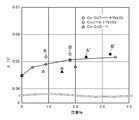
- FIG. 1 is a graph showing measurement results according to the embodiment of the present invention.
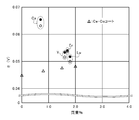
- FIG. 2 is a graph showing the measurement results according to the embodiment of the present invention.
- FIG. 3 is an analysis image for explaining the present invention.
- FIG. 4 is an analysis image for comparison with the present invention.
- an embodiment of an alkaline storage battery of the present invention will be described with reference to the drawings.
- a nickel metal hydride battery will be described as an example of an alkaline storage battery.
- the alkaline storage battery of the present embodiment has the same structure as that of a normal nickel metal hydride battery, and therefore detailed description thereof will be omitted, and the manufacturing process of the alkaline storage battery will be described.
- the manufacturing process of the positive electrode material of an alkaline storage battery will be described.
- nickel hydroxide is used as the positive electrode active material
- a cobalt cerium compound is used as the conductive additive.
- This cobalt cerium compound is a compound containing cobalt and cerium co-precipitated by a coprecipitation method, and the crystal structure thereof is a rhombohedral structure and a cobalt oxyhydroxide phase having a space group R3m structure crystal structure, and fluorite.
- a cerium dioxide phase having a crystal structure of a space group Fm3m structure wherein a part of cobalt in the cobalt oxyhydroxide phase is substituted with cerium and a part of cerium in the cerium dioxide phase is substituted with cobalt It has been confirmed from the result of X-ray analysis that it has a structure. That is, a so-called solid solution is formed.
- Method cobalt cerium compound is to make the co-precipitation method as described above, as the making technique of integrating the method of making a cobalt cerium compound alone, in the process of generating a cobalt cerium compound and nickel hydroxide
- the device is manufactured by a technique of being integrated with nickel hydroxide in the production process of the cobalt cerium compound.
- nickel hydroxide particles production of nickel hydroxide particles.
- an aqueous solution in which nickel sulfate is dissolved is dropped into an aqueous ammonium sulfate solution having a concentration of 1 mol / liter with pH 12 and temperature controlled at 45 ° C. while vigorously stirring.
- the pH adjustment can be performed using an 18 wt% NaOH aqueous solution.
- filtration, washing with water and drying are performed to obtain spherical nickel hydroxide particles.
- a part of nickel (Ni) in nickel hydroxide may be substituted with zinc (Zn), cobalt (Co), or the like.
- the nickel hydroxide particles produced as described above are integrated in the process of producing the cobalt-cerium compound. More specifically, the nickel hydroxide particles and the cobalt cerium compound are formed in a state where the surface of the nickel hydroxide particles is coated with the cobalt cerium compound through a step of depositing a compound of cerium and cobalt on the surface of the nickel hydroxide particles. And unite.
- nickel hydroxide particles prepared as described above are placed in a 0.1 mol / liter ammonium sulfate aqueous solution, and the pH is controlled at 9 and the temperature is 45 ° C., followed by vigorous stirring.
- the temperature is preferably controlled in the range of 30 ° C to 60 ° C. If it is lower than 30 ° C., the dispersibility of cerium may be lowered. If the temperature is higher than 60 ° C., low conductivity such as Co 3 O 4 may be generated.
- the temperature range is preferably in the range of 40 ° C to 50 ° C. Within such a range, the nickel hydroxide particles can be uniformly coated and the conductivity can be increased.
- the pH adjustment is performed using an 18 wt% NaOH aqueous solution.
- An aqueous solution in which cobalt sulfate and cerium nitrate are dissolved at a predetermined ratio is dropped into this solution.
- the oxidation treatment at this time is preferably heated while being mixed with an aqueous sodium hydroxide solution. It is preferable to mix the sodium hydroxide aqueous solution used so that (Na / (Co + Ce + Ni)) is 0.5 or more in atomic ratio.
- oxidation treatment 40 g of a 48 wt% NaOH aqueous solution is added to 120 g of nickel hydroxide particles with a hydroxide containing cobalt and cerium deposited on the surface, at 120 ° C. Heat in air for 1 hour. Subsequently, the target active material particle is produced by filtering, washing with water and drying. By this step, nickel hydroxide particles whose surface is coated with a cobalt cerium compound are obtained. By depositing by this method, a network of cobalt cerium compound is formed inside the electrode, so that a positive electrode for an alkaline storage battery having a low internal resistance can be obtained, and the amount of use can be greatly reduced.
- the coating amount of the cobalt cerium compound may be 0.5 to 10% by mass ratio, preferably 3 to 7%, as compared with the whole positive electrode material.
- the proportion of cerium in the cobalt cerium compound (Ce / (Co + Ce)) may be 5% to 40% in atomic ratio, preferably 10% to 30%, and more preferably 15% to 30%. It is. If it is 5% or more, high reducibility is obtained, and if it is 10% or more, further improvement of reducibility is recognized. If it exceeds 40%, the specific resistance value tends to increase.
- the nickel hydroxide particles produced as described above are further powder mixed with other materials.
- the other materials to be mixed are calcium (Ca), yttrium (Y), europium (Eu), holmium (Ho), erbium (Er), thulium (Tm), ytterbium (Yb) and lutetium (Lu). It is a compound of at least one of these elements, and more specifically, this compound is an oxide of each of the above elements. Note that this compound is not limited to an oxide, and may be any form as long as it dissolves in an alkaline solution.
- a positive electrode of an alkaline storage battery is produced from the positive electrode material produced as described above.
- This original plate was cut into 4 cm ⁇ 6 cm.
- a plate of this size is filled with cobalt cerium compound-coated nickel hydroxide so that the electrode capacity is 500 mAh.
- a separator was interposed, the positive electrode plate was sandwiched between hydrogen storage alloy negative electrodes having a capacity of 1500 mAh, and fixed with bolts so that a torque of 0.098 Nm was applied to form an open cell.
- As the electrolytic solution a 6.8 mol / l (“l” is liter) potassium hydroxide aqueous solution was used.
- the Hg / HgO electrode was used for the reference electrode.
- this test cell As an evaluation of this test cell, it was measured how the oxygen generation potential of the alkaline storage battery changes depending on the substance included in the positive electrode material.
- a specific evaluation method is to charge the test cell with a charging current of 0.1 ItA for 15 hours under a temperature environment of 20 ° C., rest for 1 hour, and then set the end voltage to 0.0 V with a discharging current of 0.2 ItA. The process of discharging as (voltage with respect to the reference electrode) was repeated, and the ⁇ value was determined from the charge curve of the third cycle.
- the ⁇ value is the difference between the oxygen generation potential of the positive electrode (nickel electrode) and the oxidation potential (potential in the charging reaction). The larger the value of “ ⁇ ”, the higher the oxygen generation potential and the smaller the self-discharge. It also means that the charging efficiency is increased.
- the actual ⁇ value is calculated by taking the potential difference between the charge amount of 120% and the charge amount of 75%.
- Table 1 shows the measurement results of the “ ⁇ ” value when the substances included in the positive electrode material and the composition ratio (% by mass) were changed.
- Table 1 the characteristics of the positive electrode material in which the surface of nickel hydroxide particles is coated with a cobalt cerium compound and the compound (oxide) of at least one element of Ca and the like are mixed with powder are compared.
- the characteristics of a cathode material prepared by powder-mixing the above compound (oxide) such as Ca with a nickel hydroxide particle surface coated only with a cobalt compound not containing a cerium compound are shown. Both show how “ ⁇ ” changes.
- Ni (OH) 2 (Ce—Co coat) in the “active material” column is nickel hydroxide particles whose surface is coated with a cobalt cerium compound as an active material.
- Ce element composition the composition ratio of Ce element (Ce metal) to the whole (the whole positive electrode material) is expressed in mass% (mass%).
- Substances to be added to the above nickel hydroxide active material by powder mixing are shown in the “mixture” column, and the ratio of the mixture to be added is “mass%” with respect to the whole positive electrode material in the “mixture addition amount” column.
- the composition ratio of the additive element to the whole metal element (the whole positive electrode material) in the mixture is shown in mass% in the column of “addition element composition”.
- the “total” column is the sum of the “Ce element composition” value and the “additive element composition” value.
- ⁇ value the measurement result of the above “ ⁇ ” under each production condition. Is displayed.
- Table 2 for comparison with the nickel hydroxide particles whose surface is coated with a cobalt cerium compound and a positive electrode material constituted by mixing a compound such as Ca, a compound such as Ca is not mixed and cobalt cerium is mixed.
- the positive electrode material is composed only of nickel hydroxide particles whose surface is coated with a compound
- the change in the measured value of “ ⁇ ” when the composition of the Ce element in the cobalt cerium compound is changed is shown.
- Table 2 also shows data when the composition of the Ce element is 0% by mass, that is, when nickel hydroxide particles whose surface is coated with a cobalt compound instead of a cobalt cerium compound are used as an active material.
- cerium is mixed with a cerium compound (specifically, CeO 2 ) in the positive electrode material by powder mixing in the same manner as the ytterbium compound in Table 1, so that the positive electrode of the alkaline storage battery is obtained.
- Data when configured is shown as a comparative example.
- the process of configuring as the positive electrode of the alkaline storage battery is common to each data in Table 1.
- Table 3 shows the data on the positive electrode material in which the surface of the nickel hydroxide particles is coated with a cobalt cerium compound and the powder mixture of the cerium compound, with the cobalt hydroxide on the surface of the nickel hydroxide particles.
- the composition of the Ce element in the cobalt cerium compound is shown. “ ⁇ ” when the value is changed is indicated by a white triangle.
- the horizontal axis of FIG. 1 shows the composition (mass%) of ytterbium when Yb 2 O 3 is mixed in the positive electrode material, and cerium when Yb 2 O 3 is not mixed. The composition (mass%) of (Ce) is taken.
- the positive electrode material is composed only of nickel hydroxide particles whose surface is covered with a cobalt compound
- the positive electrode material does not contain Yb 2 O 3 or Ce, Shown with both open triangles.
- the value of “ ⁇ ” increases as the mixing ratio of the ytterbium compound in the positive electrode material increases, and increases as the composition of ytterbium reaches 1% by mass or more. You can see that the degree is getting smaller.
- “ ⁇ ” also increases with an increase in the composition of cerium in the cobalt cerium compound covering the surface of the nickel hydroxide particles.
- the increase in “ ⁇ ” is small when the composition of the yttrium element is 0.5 mass% or more.
- a compound of at least one element of europium, holmium, erbium, thulium and lutetium was used instead of or together with the ytterbium compound. In this case, the characteristics are the same as those of the ytterbium compound.
- the composition of these elements is 1% by mass or more, the degree of increase in “ ⁇ ” decreases.
- FIG. 1 the data in the case of using a positive electrode material constituted by mixing powders of nickel hydroxide particles whose surfaces are coated with a cobalt cerium compound and Yb 2 O 3 are shown in Table 1 instead of the ytterbium composition.
- Data A ′ corresponds to data A
- data B ′ corresponds to data B.
- a positive electrode material constituted by powder-mixing nickel hydroxide particles coated with a cobalt cerium compound and Yb 2 O 3 was used.
- Yb 2 O 3 when Yb 2 O 3 is used, Yb 2 O 3 is a substance having a high resistivity, and when the mixing ratio is increased, the resistivity of the positive electrode material is increased, whereas the cobalt cerium compound is In the first place, it is used as a conductive aid, and it functions as a conductive aid that can suppress deterioration of properties due to high reduction resistance even during overdischarge without causing an increase in resistivity due to the presence of cerium. There is no problem in increasing the mixing ratio. Therefore, replacing Yb 2 O 3 with a cobalt cerium compound has an effect on both the point that the increase in resistivity of the positive electrode material can be suppressed and the point that the above “ ⁇ ” can be increased. Yes. Moreover, it contributes to the reduction of material cost by replacing expensive cobalt with cerium.
- FIG. 1 also shows data when the cerium compound (CeO 2 ) shown in Table 3 is included in the positive electrode material by powder mixing. .
- the data in the case of using a positive electrode material in which the surface of nickel hydroxide particles is coated with a cobalt cerium compound and a powder mixture of a cerium compound is shown as a black triangle in FIG. ,
- the composition ratio of the cerium element in the cobalt cerium compound covering the nickel hydroxide particles to the whole positive electrode material that is, the value of “Ce element composition” is plotted.
- the surface of the nickel hydroxide particles coated with the cobalt cerium compound is the cerium compound. It can be seen that even when (CeO 2 ) is added by powder mixing, the value of “ ⁇ ” does not increase but rather decreases.
- the data indicated by “A” and “B” in FIG. 1 is obtained by powdering nickel hydroxide particles coated with a cobalt cerium compound having the same “Ce element composition” value of “1.5 mass%” and a compound of ytterbium. Although it is data of the body mixture, the difference in the degree of improvement in the value of “ ⁇ ” is obvious compared to the data of the powder mixture of the cerium compound.
- the positive electrode of the alkaline storage battery is constituted by a positive electrode material in which the surface of nickel hydroxide particles is coated with a cobalt compound and a powder mixture of a cerium compound and an ytterbium compound.
- the lowermost data in Table 3, that is, the data on the positive electrode material in which the surface of nickel hydroxide particles is coated with a cobalt compound and the powder mixture of a cerium compound and an ytterbium compound are shown in FIG. Is shown.
- the horizontal axis is plotted with “1.8 mass%” which is the composition of the ytterbium element.
- nickel hydroxide particles whose surface is coated with a cobalt compound and ytterbium compound (Yb 2 O 3 ) powder mixed at a ratio of ytterbium element “1.8 mass%” the positive electrode material Further, even when a cerium compound (CeO 2 ) is added by powder mixing, the value of “ ⁇ ” does not increase but rather decreases.
- any combination does not contribute to the increase of “ ⁇ ”, and as described with reference to FIG. This corresponds to the situation in which the added cerium element is hardly present inside or on the surface of the nickel hydroxide particles.
- a compound of calcium (Ca), yttrium (Y), erbium (Er), and lutetium (Lu) (all oxides) is mixed with nickel hydroxide particles whose surfaces are coated with a cobalt cerium compound, to form a positive electrode.
- Y yttrium
- Er erbium
- Lu lutetium
- the value of “ ⁇ ” is improved for any element as in the case of ytterbium.
- europium (Eu), holmium (Ho), and thulium (Tm) have similar properties, and these compounds (more specifically, oxides) are water whose surfaces are coated with a cobalt cerium compound.
- the value of “ ⁇ ” can be improved.
- Europium (Eu), holmium (Ho), erbium (Er), a compound of at least one element of the thulium (Tm) and lutetium (Lu), were mixed with the nickel hydroxide particles coated with cobalt cerium compound on the surface even when constituting a positive electrode material Te, as in the above-described ytterbium, europium, holmium, erbium, compound of at least one element of thulium and lutetium, the presence ratio of the element to the entire positive electrode material 1 It is preferable to set the mixing ratio to be at least mass%.
- a positive electrode material is formed by mixing a calcium (Ca) compound with nickel hydroxide particles coated with a cobalt cerium compound on the surface, from the change characteristic of “ ⁇ ” described above, It is preferable to set the compound to a mixing ratio of 0.1% by mass or more in the presence ratio of calcium element with respect to the whole positive electrode material.
- yttrium For even further yttrium (Y), a compound of yttrium, in the case of constituting the positive electrode material is mixed with the nickel hydroxide particles coated with cobalt cerium compound on the surface, above the variation characteristics of " ⁇ ", yttrium It is preferable to set the compound at a mixing ratio of 0.5% by mass or more in terms of the ratio of the yttrium element to the whole positive electrode material.
- a process of producing a positive electrode of an alkaline storage battery (more specifically, a nickel metal hydride battery) using the positive electrode material produced as described above will be schematically described.
- a carboxymethyl cellulose (CMC) aqueous solution or the like is added to the positive electrode material to obtain a paste.
- the substance to be included in the positive electrode material and the composition thereof are set based on the evaluation result by the test cell described above.
- This paste is filled in a base material having electron conductivity such as a porous nickel base material (nickel foam base material), then dried, and pressed to a predetermined thickness to obtain a positive electrode for an alkaline storage battery.
- a paste mainly composed of a hydrogen storage alloy powder is applied to a negative electrode substrate made of a punched steel plate in which nickel is plated on iron, dried, and then pressed to a predetermined thickness to produce a negative electrode.
- the negative electrode, a polypropylene nonwoven fabric separator, and the positive electrode described above are laminated, and the laminate is wound into a roll.
- a positive electrode current collecting plate and a negative electrode current collecting plate After attaching a positive electrode current collecting plate and a negative electrode current collecting plate to this, it inserts in a bottomed cylindrical can body and injects electrolyte solution. After that, a ring-shaped gasket is attached to the periphery, and a disc-shaped lid provided with a cap-shaped terminal or the like is attached in a state of being in electrical contact with the positive electrode current collector plate, and the open end of the can body is attached. Fix by caulking.
- cobalt cerium hydroxide Let It is filtered, washed with water and dried to obtain cobalt cerium hydroxide. Further, the hydroxide containing cobalt and cerium is oxidized by heat treatment in the presence of oxygen to obtain a cobalt cerium compound. As a method for the oxidation treatment, a method of heating a hydroxide containing cobalt and cerium in the atmosphere can be used. The cobalt cerium compound thus produced can be used as a conductive aid in a form mixed with nickel hydroxide powder, which is an active material. Further, a compound of at least one element of calcium, yttrium, europium, holmium, erbium, thulium, ytterbium and lutetium is mixed with powder to obtain a positive electrode material.
Landscapes
- Chemical & Material Sciences (AREA)
- Chemical Kinetics & Catalysis (AREA)
- Electrochemistry (AREA)
- General Chemical & Material Sciences (AREA)
- Organic Chemistry (AREA)
- Inorganic Chemistry (AREA)
- Engineering & Computer Science (AREA)
- Manufacturing & Machinery (AREA)
- Battery Electrode And Active Subsutance (AREA)
Abstract
Priority Applications (4)
| Application Number | Priority Date | Filing Date | Title |
|---|---|---|---|
| EP11814702.4A EP2602857B1 (fr) | 2010-08-05 | 2011-08-04 | Accumulateur alcalin et procédé de fabrication de matière d'électrode positive destinée à un accumulateur alcalin |
| JP2012527766A JP5783178B2 (ja) | 2010-08-05 | 2011-08-04 | アルカリ蓄電池及びアルカリ蓄電池用正極材料の製造方法 |
| US13/814,349 US8883349B2 (en) | 2010-08-05 | 2011-08-04 | Alkaline secondary battery and method for manufacturing positive electrode material for alkaline secondary battery |
| CN201180038253.2A CN103053062B (zh) | 2010-08-05 | 2011-08-04 | 碱蓄电池和碱蓄电池用正极材料的制造方法 |
Applications Claiming Priority (2)
| Application Number | Priority Date | Filing Date | Title |
|---|---|---|---|
| JP2010-176810 | 2010-08-05 | ||
| JP2010176810 | 2010-08-05 |
Publications (1)
| Publication Number | Publication Date |
|---|---|
| WO2012018077A1 true WO2012018077A1 (fr) | 2012-02-09 |
Family
ID=45559573
Family Applications (1)
| Application Number | Title | Priority Date | Filing Date |
|---|---|---|---|
| PCT/JP2011/067857 Ceased WO2012018077A1 (fr) | 2010-08-05 | 2011-08-04 | Accumulateur alcalin et procédé de fabrication de matière d'électrode positive destinée à un accumulateur alcalin |
Country Status (5)
| Country | Link |
|---|---|
| US (1) | US8883349B2 (fr) |
| EP (1) | EP2602857B1 (fr) |
| JP (1) | JP5783178B2 (fr) |
| CN (1) | CN103053062B (fr) |
| WO (1) | WO2012018077A1 (fr) |
Cited By (3)
| Publication number | Priority date | Publication date | Assignee | Title |
|---|---|---|---|---|
| CN104037459A (zh) * | 2013-03-04 | 2014-09-10 | 淄博正大电源有限公司 | 一种颠覆传统工艺的超级动力镍氢电池 |
| US8877372B2 (en) | 2011-01-11 | 2014-11-04 | Gs Yuasa International Ltd. | Alkaline secondary battery |
| US9269952B2 (en) | 2011-01-11 | 2016-02-23 | Gs Yuasa International Ltd. | Positive active material for alkaline secondary battery, method for manufacturing the same and alkaline secondary battery |
Families Citing this family (2)
| Publication number | Priority date | Publication date | Assignee | Title |
|---|---|---|---|---|
| CN104143638B (zh) * | 2014-07-23 | 2017-02-15 | 长沙矿冶研究院有限责任公司 | 铈钴包覆氢氧化镍复合材料及其制备方法和应用 |
| JP7427944B2 (ja) * | 2019-12-06 | 2024-02-06 | 株式会社Gsユアサ | 制御装置、劣化推定システム、制御方法、及びコンピュータプログラム |
Citations (9)
| Publication number | Priority date | Publication date | Assignee | Title |
|---|---|---|---|---|
| JPH0831448A (ja) * | 1994-07-13 | 1996-02-02 | Toshiba Battery Co Ltd | アルカリ二次電池 |
| WO1998020570A1 (fr) * | 1996-11-07 | 1998-05-14 | Energy Conversion Devices, Inc. | Materiau a base d'hydroxyde de nickel actif sur le plan electrochimique pouvant alterner entre une phase beta et une phase gamma |
| JPH10261412A (ja) * | 1997-01-10 | 1998-09-29 | Matsushita Electric Ind Co Ltd | アルカリ蓄電池用ニッケル正極及びその製造方法 |
| JPH1125962A (ja) * | 1997-06-30 | 1999-01-29 | Sanyo Electric Co Ltd | アルカリ蓄電池用ニッケル正極 |
| JP2000173606A (ja) * | 1998-11-30 | 2000-06-23 | Sanyo Electric Co Ltd | 焼結式水酸化ニッケル正極及びこの正極を用いたアルカリ蓄電池及び焼結式水酸化ニッケル正極の製造方法 |
| JP2002029755A (ja) * | 2000-07-14 | 2002-01-29 | Sumitomo Metal Mining Co Ltd | アルカリ二次電池用水酸化ニッケル粉末の製造方法 |
| JP3358702B2 (ja) | 1996-10-17 | 2002-12-24 | 株式会社ユアサコーポレーション | アルカリ蓄電池用ニッケル電極 |
| JP2003017064A (ja) * | 2001-06-29 | 2003-01-17 | Yuasa Corp | アルカリ蓄電池のニッケル電極活物質用添加材 |
| JP2004273138A (ja) * | 2003-03-05 | 2004-09-30 | Canon Inc | 二次電池及び二次電池の製造方法 |
Family Cites Families (14)
| Publication number | Priority date | Publication date | Assignee | Title |
|---|---|---|---|---|
| EP0794584A4 (fr) | 1995-09-28 | 2007-01-31 | Yuasa Battery Co Ltd | Electrode de stockage d'hydrogene, electrode au nickel et batterie alcaline de stockage |
| FR2748607B1 (fr) | 1996-05-07 | 1998-06-05 | Accumulateurs Fixes | Electrode au nickel de type empatee pour accumulateur alcalin |
| JP3846602B2 (ja) | 1996-08-30 | 2006-11-15 | 株式会社ユアサ開発 | 密閉型ニッケル−水素蓄電池 |
| US6287726B1 (en) | 1997-01-10 | 2001-09-11 | Matsushita Electric Industrial Co., L.T.D. | Method for producing nickel positive electrode for alkaline storage batteries |
| CN1307734C (zh) | 1998-02-20 | 2007-03-28 | 三洋电机株式会社 | 碱性蓄电池用镍电极及其制造方法和碱性蓄电池 |
| JP4033660B2 (ja) * | 2001-10-25 | 2008-01-16 | 三洋電機株式会社 | ニッケル−水素蓄電池 |
| US7273680B2 (en) * | 2002-08-28 | 2007-09-25 | The Gillette Company | Alkaline battery including nickel oxyhydroxide cathode and zinc anode |
| US7172710B2 (en) * | 2003-03-03 | 2007-02-06 | Ovonic Battery Company, Inc. | Performance enhancing additive material for the nickel hydroxide positive electrode in rechargeable alkaline cells |
| JP2006069807A (ja) | 2004-08-31 | 2006-03-16 | Nichiha Corp | 無機質板およびその製造方法 |
| WO2006025331A1 (fr) | 2004-08-31 | 2006-03-09 | Nichiha Corporation | Plaque inorganique et procédé pour la production de celle-ci |
| US8057934B2 (en) | 2004-12-17 | 2011-11-15 | Gs Yuasa International Ltd. | Nickel electrode for alkaline secondary battery and alkaline secondary battery |
| JP2007149646A (ja) * | 2005-10-28 | 2007-06-14 | Sanyo Electric Co Ltd | ニッケル水素蓄電池 |
| CN100533822C (zh) * | 2006-09-29 | 2009-08-26 | 比亚迪股份有限公司 | 正极活性物质及其制备方法以及正极和电池 |
| US8968932B2 (en) * | 2009-07-17 | 2015-03-03 | Gs Yuasa International Ltd. | Cobalt cerium compound, alkaline secondary battery, and method for producing cobalt cerium compound |
-
2011
- 2011-08-04 JP JP2012527766A patent/JP5783178B2/ja active Active
- 2011-08-04 CN CN201180038253.2A patent/CN103053062B/zh active Active
- 2011-08-04 WO PCT/JP2011/067857 patent/WO2012018077A1/fr not_active Ceased
- 2011-08-04 US US13/814,349 patent/US8883349B2/en active Active
- 2011-08-04 EP EP11814702.4A patent/EP2602857B1/fr active Active
Patent Citations (9)
| Publication number | Priority date | Publication date | Assignee | Title |
|---|---|---|---|---|
| JPH0831448A (ja) * | 1994-07-13 | 1996-02-02 | Toshiba Battery Co Ltd | アルカリ二次電池 |
| JP3358702B2 (ja) | 1996-10-17 | 2002-12-24 | 株式会社ユアサコーポレーション | アルカリ蓄電池用ニッケル電極 |
| WO1998020570A1 (fr) * | 1996-11-07 | 1998-05-14 | Energy Conversion Devices, Inc. | Materiau a base d'hydroxyde de nickel actif sur le plan electrochimique pouvant alterner entre une phase beta et une phase gamma |
| JPH10261412A (ja) * | 1997-01-10 | 1998-09-29 | Matsushita Electric Ind Co Ltd | アルカリ蓄電池用ニッケル正極及びその製造方法 |
| JPH1125962A (ja) * | 1997-06-30 | 1999-01-29 | Sanyo Electric Co Ltd | アルカリ蓄電池用ニッケル正極 |
| JP2000173606A (ja) * | 1998-11-30 | 2000-06-23 | Sanyo Electric Co Ltd | 焼結式水酸化ニッケル正極及びこの正極を用いたアルカリ蓄電池及び焼結式水酸化ニッケル正極の製造方法 |
| JP2002029755A (ja) * | 2000-07-14 | 2002-01-29 | Sumitomo Metal Mining Co Ltd | アルカリ二次電池用水酸化ニッケル粉末の製造方法 |
| JP2003017064A (ja) * | 2001-06-29 | 2003-01-17 | Yuasa Corp | アルカリ蓄電池のニッケル電極活物質用添加材 |
| JP2004273138A (ja) * | 2003-03-05 | 2004-09-30 | Canon Inc | 二次電池及び二次電池の製造方法 |
Non-Patent Citations (1)
| Title |
|---|
| See also references of EP2602857A4 |
Cited By (3)
| Publication number | Priority date | Publication date | Assignee | Title |
|---|---|---|---|---|
| US8877372B2 (en) | 2011-01-11 | 2014-11-04 | Gs Yuasa International Ltd. | Alkaline secondary battery |
| US9269952B2 (en) | 2011-01-11 | 2016-02-23 | Gs Yuasa International Ltd. | Positive active material for alkaline secondary battery, method for manufacturing the same and alkaline secondary battery |
| CN104037459A (zh) * | 2013-03-04 | 2014-09-10 | 淄博正大电源有限公司 | 一种颠覆传统工艺的超级动力镍氢电池 |
Also Published As
| Publication number | Publication date |
|---|---|
| US8883349B2 (en) | 2014-11-11 |
| CN103053062A (zh) | 2013-04-17 |
| EP2602857B1 (fr) | 2017-04-26 |
| EP2602857A4 (fr) | 2014-07-02 |
| JP5783178B2 (ja) | 2015-09-24 |
| US20130136992A1 (en) | 2013-05-30 |
| JPWO2012018077A1 (ja) | 2013-10-03 |
| CN103053062B (zh) | 2015-12-02 |
| EP2602857A1 (fr) | 2013-06-12 |
Similar Documents
| Publication | Publication Date | Title |
|---|---|---|
| JP6090673B2 (ja) | アルカリ蓄電池とアルカリ蓄電池用の正極材 | |
| JP6293686B2 (ja) | アルカリ蓄電池の製造方法及びアルカリ蓄電池 | |
| JP5783178B2 (ja) | アルカリ蓄電池及びアルカリ蓄電池用正極材料の製造方法 | |
| JP4321997B2 (ja) | アルカリ蓄電池用正極活物質ならびにそれを用いた正極およびアルカリ蓄電池 | |
| JP5850548B2 (ja) | コバルトセリウム化合物の製造方法 | |
| CN103119762B (zh) | 碱性蓄电池用正极活性物质、其制造方法及碱性蓄电池 | |
| CN1937287B (zh) | 碱性蓄电池 | |
| CN103109402B (zh) | 碱蓄电池 | |
| JP5743185B2 (ja) | アルカリ蓄電池用正極活物質およびアルカリ蓄電池 | |
| JP2016069691A (ja) | 水素吸蔵合金、電極及びニッケル水素蓄電池 | |
| JP2016069692A (ja) | 水素吸蔵合金、電極及びニッケル水素蓄電池 | |
| KR102028849B1 (ko) | 정극 활물질 및 알칼리 전지 | |
| JP6090672B2 (ja) | アルカリ蓄電池及びアルカリ蓄電池用の正極材 | |
| JP5760353B2 (ja) | コバルトジルコニウム化合物及び活物質、それらの製造方法、並びにアルカリ蓄電池 | |
| JP2007122920A (ja) | アルカリ電池 | |
| JP2014082196A (ja) | アルカリ蓄電池及びアルカリ蓄電池用の正極材 |
Legal Events
| Date | Code | Title | Description |
|---|---|---|---|
| WWE | Wipo information: entry into national phase |
Ref document number: 201180038253.2 Country of ref document: CN |
|
| 121 | Ep: the epo has been informed by wipo that ep was designated in this application |
Ref document number: 11814702 Country of ref document: EP Kind code of ref document: A1 |
|
| ENP | Entry into the national phase |
Ref document number: 2012527766 Country of ref document: JP Kind code of ref document: A |
|
| NENP | Non-entry into the national phase |
Ref country code: DE |
|
| WWE | Wipo information: entry into national phase |
Ref document number: 13814349 Country of ref document: US |
|
| REEP | Request for entry into the european phase |
Ref document number: 2011814702 Country of ref document: EP |
|
| WWE | Wipo information: entry into national phase |
Ref document number: 2011814702 Country of ref document: EP |