WO2012018083A1 - 電子部品の製造方法 - Google Patents
電子部品の製造方法 Download PDFInfo
- Publication number
- WO2012018083A1 WO2012018083A1 PCT/JP2011/067873 JP2011067873W WO2012018083A1 WO 2012018083 A1 WO2012018083 A1 WO 2012018083A1 JP 2011067873 W JP2011067873 W JP 2011067873W WO 2012018083 A1 WO2012018083 A1 WO 2012018083A1
- Authority
- WO
- WIPO (PCT)
- Prior art keywords
- pressure
- sensitive adhesive
- adhesive layer
- cation
- electronic component
- Prior art date
- Legal status (The legal status is an assumption and is not a legal conclusion. Google has not performed a legal analysis and makes no representation as to the accuracy of the status listed.)
- Ceased
Links
Images


Classifications
-
- H—ELECTRICITY
- H10—SEMICONDUCTOR DEVICES; ELECTRIC SOLID-STATE DEVICES NOT OTHERWISE PROVIDED FOR
- H10P—GENERIC PROCESSES OR APPARATUS FOR THE MANUFACTURE OR TREATMENT OF DEVICES COVERED BY CLASS H10
- H10P72/00—Handling or holding of wafers, substrates or devices during manufacture or treatment thereof
- H10P72/70—Handling or holding of wafers, substrates or devices during manufacture or treatment thereof for supporting or gripping
- H10P72/74—Handling or holding of wafers, substrates or devices during manufacture or treatment thereof for supporting or gripping using temporarily an auxiliary support
- H10P72/7402—Wafer tapes, e.g. grinding or dicing support tapes
-
- H—ELECTRICITY
- H10—SEMICONDUCTOR DEVICES; ELECTRIC SOLID-STATE DEVICES NOT OTHERWISE PROVIDED FOR
- H10W—GENERIC PACKAGES, INTERCONNECTIONS, CONNECTORS OR OTHER CONSTRUCTIONAL DETAILS OF DEVICES COVERED BY CLASS H10
- H10W99/00—Subject matter not provided for in other groups of this subclass
-
- C—CHEMISTRY; METALLURGY
- C09—DYES; PAINTS; POLISHES; NATURAL RESINS; ADHESIVES; COMPOSITIONS NOT OTHERWISE PROVIDED FOR; APPLICATIONS OF MATERIALS NOT OTHERWISE PROVIDED FOR
- C09J—ADHESIVES; NON-MECHANICAL ASPECTS OF ADHESIVE PROCESSES IN GENERAL; ADHESIVE PROCESSES NOT PROVIDED FOR ELSEWHERE; USE OF MATERIALS AS ADHESIVES
- C09J7/00—Adhesives in the form of films or foils
- C09J7/20—Adhesives in the form of films or foils characterised by their carriers
- C09J7/22—Plastics; Metallised plastics
-
- C—CHEMISTRY; METALLURGY
- C09—DYES; PAINTS; POLISHES; NATURAL RESINS; ADHESIVES; COMPOSITIONS NOT OTHERWISE PROVIDED FOR; APPLICATIONS OF MATERIALS NOT OTHERWISE PROVIDED FOR
- C09J—ADHESIVES; NON-MECHANICAL ASPECTS OF ADHESIVE PROCESSES IN GENERAL; ADHESIVE PROCESSES NOT PROVIDED FOR ELSEWHERE; USE OF MATERIALS AS ADHESIVES
- C09J7/00—Adhesives in the form of films or foils
- C09J7/30—Adhesives in the form of films or foils characterised by the adhesive composition
- C09J7/38—Pressure-sensitive adhesives [PSA]
-
- C—CHEMISTRY; METALLURGY
- C09—DYES; PAINTS; POLISHES; NATURAL RESINS; ADHESIVES; COMPOSITIONS NOT OTHERWISE PROVIDED FOR; APPLICATIONS OF MATERIALS NOT OTHERWISE PROVIDED FOR
- C09J—ADHESIVES; NON-MECHANICAL ASPECTS OF ADHESIVE PROCESSES IN GENERAL; ADHESIVE PROCESSES NOT PROVIDED FOR ELSEWHERE; USE OF MATERIALS AS ADHESIVES
- C09J2203/00—Applications of adhesives in processes or use of adhesives in the form of films or foils
- C09J2203/326—Applications of adhesives in processes or use of adhesives in the form of films or foils for bonding electronic components such as wafers, chips or semiconductors
-
- C—CHEMISTRY; METALLURGY
- C09—DYES; PAINTS; POLISHES; NATURAL RESINS; ADHESIVES; COMPOSITIONS NOT OTHERWISE PROVIDED FOR; APPLICATIONS OF MATERIALS NOT OTHERWISE PROVIDED FOR
- C09J—ADHESIVES; NON-MECHANICAL ASPECTS OF ADHESIVE PROCESSES IN GENERAL; ADHESIVE PROCESSES NOT PROVIDED FOR ELSEWHERE; USE OF MATERIALS AS ADHESIVES
- C09J2433/00—Presence of (meth)acrylic polymer
-
- H—ELECTRICITY
- H10—SEMICONDUCTOR DEVICES; ELECTRIC SOLID-STATE DEVICES NOT OTHERWISE PROVIDED FOR
- H10P—GENERIC PROCESSES OR APPARATUS FOR THE MANUFACTURE OR TREATMENT OF DEVICES COVERED BY CLASS H10
- H10P72/00—Handling or holding of wafers, substrates or devices during manufacture or treatment thereof
- H10P72/70—Handling or holding of wafers, substrates or devices during manufacture or treatment thereof for supporting or gripping
- H10P72/74—Handling or holding of wafers, substrates or devices during manufacture or treatment thereof for supporting or gripping using temporarily an auxiliary support
- H10P72/7416—Handling or holding of wafers, substrates or devices during manufacture or treatment thereof for supporting or gripping using temporarily an auxiliary support used during dicing or grinding
-
- H—ELECTRICITY
- H10—SEMICONDUCTOR DEVICES; ELECTRIC SOLID-STATE DEVICES NOT OTHERWISE PROVIDED FOR
- H10P—GENERIC PROCESSES OR APPARATUS FOR THE MANUFACTURE OR TREATMENT OF DEVICES COVERED BY CLASS H10
- H10P72/00—Handling or holding of wafers, substrates or devices during manufacture or treatment thereof
- H10P72/70—Handling or holding of wafers, substrates or devices during manufacture or treatment thereof for supporting or gripping
- H10P72/74—Handling or holding of wafers, substrates or devices during manufacture or treatment thereof for supporting or gripping using temporarily an auxiliary support
- H10P72/744—Details of chemical or physical process used for separating the auxiliary support from a device or a wafer
-
- Y—GENERAL TAGGING OF NEW TECHNOLOGICAL DEVELOPMENTS; GENERAL TAGGING OF CROSS-SECTIONAL TECHNOLOGIES SPANNING OVER SEVERAL SECTIONS OF THE IPC; TECHNICAL SUBJECTS COVERED BY FORMER USPC CROSS-REFERENCE ART COLLECTIONS [XRACs] AND DIGESTS
- Y10—TECHNICAL SUBJECTS COVERED BY FORMER USPC
- Y10T—TECHNICAL SUBJECTS COVERED BY FORMER US CLASSIFICATION
- Y10T428/00—Stock material or miscellaneous articles
- Y10T428/14—Layer or component removable to expose adhesive
- Y10T428/1462—Polymer derived from material having at least one acrylic or alkacrylic group or the nitrile or amide derivative thereof [e.g., acrylamide, acrylate ester, etc.]
Definitions
- the present invention relates to a method for producing an electronic component using a pressure-sensitive adhesive sheet in which at least a pressure-sensitive adhesive layer and a separator are sequentially laminated on a base material and have a charge eliminating effect.
- a dicing adhesive sheet is bonded to the back surface of the semiconductor wafer.
- the pressure-sensitive adhesive sheet has, for example, a structure in which a pressure-sensitive adhesive layer and a separator are sequentially laminated on a base material. The separator is peeled off when the pressure-sensitive adhesive sheet is used, but at the time of peeling, a charge may be generated on the surface of the two separated separators and the pressure-sensitive adhesive layer to be charged.
- Patent Document 1 discloses an invention that reduces the amount of charge on the surface of the pressure-sensitive adhesive layer by adding an antistatic agent such as a surfactant to the pressure-sensitive adhesive layer.
- an antistatic agent such as a surfactant
- semiconductor devices as electronic components have been greatly reduced in size, and holding of a semiconductor wafer at the time of processing has become important in order to enable precise processing as well as prevention of charging.
- the antistatic agent is segregated on the surface of the pressure-sensitive adhesive layer, whereby the adhesive force is reduced and precise processing may not be performed.
- the addition of the antistatic agent alone may not sufficiently reduce the charging potential on the surface of the pressure-sensitive adhesive layer, and the circuit on the surface of the semiconductor wafer may still be destroyed, leading to a situation where it does not operate normally.
- the present invention has been made in view of the above problems, and its purpose is to efficiently remove charges charged in the pressure-sensitive adhesive sheet in a short time when an electronic component is manufactured using the pressure-sensitive adhesive sheet.
- An object of the present invention is to provide an electronic component manufacturing method capable of preventing electrostatic breakdown of a circuit or the like formed on the component.
- the inventors of the present application examined a method for manufacturing an electronic component in order to solve the conventional problems. As a result, the inventors have found that the above problems can be solved by adopting the following configuration, and have completed the present invention.
- the method for manufacturing an electronic component according to the present invention is a method for manufacturing an electronic component using an adhesive sheet in which at least an adhesive layer and a separator are sequentially laminated on a substrate in order to solve the above-described problem,
- the surface of the pressure-sensitive adhesive layer may be charged when the separator is peeled off. This charged charge can be removed or reduced by performing static elimination before the electronic component is bonded to the adhesive layer.
- a pressure-sensitive adhesive sheet having a pressure-sensitive adhesive layer having a surface charge charge half-life of 900 seconds or less by a charge decay measurement method based on JIS L1094 is used. With such a pressure-sensitive adhesive sheet, the surface of the pressure-sensitive adhesive layer can be efficiently neutralized in a short time, and therefore, even when the electronic component is attached on the pressure-sensitive adhesive layer, sufficient discharge to the electronic component is achieved. Can be suppressed. As a result, the manufacturing yield of electronic components can be improved.
- the pressure-sensitive adhesive sheet is obtained by adding an ionic liquid in the range of 0.01 to 30 parts by weight to 100 parts by weight of the base polymer in the pressure-sensitive adhesive layer. It is preferable.
- the ionic liquid is added to the pressure-sensitive adhesive layer, conductivity can be imparted to the pressure-sensitive adhesive layer. As a result, even if electric charges are charged on the surface of the pressure-sensitive adhesive layer due to the separation of the separator, discharge is promoted, so that static elimination becomes easy. Further, since the ionic liquid can be uniformly present in the pressure-sensitive adhesive layer, the charged charges can be effectively removed over the entire surface of the pressure-sensitive adhesive layer.
- the addition amount of the ionic liquid 0.01 parts by weight or more with respect to 100 parts by weight of the base polymer of the pressure-sensitive adhesive layer, the charged charges can be effectively removed over the entire surface of the pressure-sensitive adhesive layer.
- the addition amount 30 parts by weight or less with respect to 100 parts by weight of the base polymer of the pressure-sensitive adhesive layer it is possible to prevent contamination when the pressure-sensitive adhesive sheet is peeled from the electronic component.
- the base polymer in the pressure-sensitive adhesive layer of the pressure-sensitive adhesive sheet is formed of at least one of an acrylate having an alkyl group having 1 to 14 carbon atoms or a methacrylate having an alkyl group having 1 to 14 carbon atoms. It is preferable that at least 0.1 part by weight of the highly polar monomer is blended with 100 parts by weight of the acrylic polymer.
- a base polymer having an acid value of 1 to 200 as a constituent component of the pressure-sensitive adhesive layer as the pressure-sensitive adhesive sheet.
- the acid value of the base polymer 1 or more it is possible to suppress a decrease in the adhesive strength of the pressure-sensitive adhesive layer.
- high tackiness can be maintained by setting the acid value to 200 or less.
- the acid value means the number of mg of potassium hydroxide necessary to neutralize the COOH group contained in 1 g of the sample.
- the pressure-sensitive adhesive sheet in which the base polymer that is a constituent component of the pressure-sensitive adhesive layer has a carboxyl group.
- the adhesive strength of the pressure-sensitive adhesive layer can be improved. As a result, for example, when the semiconductor wafer is diced, it is possible to prevent the separated semiconductor chips from scattering and further improve the yield.
- a radiation-polymerizable oligomer as the constituent of the adhesive layer as the adhesive sheet.
- the said separator is a polyolefin film or a polyester film as said adhesive sheet.
- the pressure-sensitive adhesive sheet according to the present invention is characterized by being used in the electronic component manufacturing method described above in order to solve the above-mentioned problems.
- an electronic component is manufactured using a pressure-sensitive adhesive sheet having a pressure-sensitive adhesive layer having a surface charge charge half-life of 900 seconds or less by a charge decay measurement method based on JIS L1094.
- the charged charge half-life is 900 seconds or less
- the charge on the surface of the pressure-sensitive adhesive layer after separation of the separator is discharged, the charge can be efficiently discharged over the entire surface of the pressure-sensitive adhesive layer in a short time.
- FIG. 1 is an explanatory view schematically showing a method for manufacturing an electronic component according to the present embodiment.
- the electronic component manufacturing method uses a pressure-sensitive adhesive sheet 10 in which at least a pressure-sensitive adhesive layer 12 and a separator 13 are sequentially laminated on a substrate 11. More specifically, a step of peeling the separator 13 from the pressure-sensitive adhesive layer 12 in the pressure-sensitive adhesive sheet 10, a step of removing static charge on the surface of the pressure-sensitive adhesive layer 12, and the pressure-sensitive adhesive layer 12 after the charge removal And a step of bonding the electronic component 14 together.
- the electronic component in the manufacturing method is not particularly limited, and a known one can be used.
- Specific examples of electronic components include, for example, semiconductors and semiconductor wafers composed of silicon, gallium-arsenic, germanium, gallium nitride, etc., semiconductor packages in which these are integrated and sealed, and further constituent materials such as ruby, glass, ceramics, etc. And the like.
- semiconductors and semiconductor wafers composed of silicon, gallium-arsenic, germanium, gallium nitride, etc.
- semiconductor packages in which these are integrated and sealed and further constituent materials such as ruby, glass, ceramics, etc. And the like.
- the present embodiment will be described using a semiconductor wafer as an example of an electronic component, but the electronic component is not intended to be limited to a semiconductor wafer.
- the separator 13 is peeled off from the pressure-sensitive adhesive layer 12 of the pressure-sensitive adhesive sheet 10. At this time, the surface of the pressure-sensitive adhesive layer 12 and the separator 13 are charged.
- the peeling method is not particularly limited. However, when the peeling speed is increased and the separator 13 is peeled off, the amount of charge charged in each of the adhesive layer 12 and the separator 13 increases. It is preferable that the separator 13 is peeled off by reducing the size.
- the peeling conditions are preferably, for example, a temperature of 25 ° C., a relative humidity of 55%, a peeling speed of 100 mm / min to 5000 mm / min, and a peeling angle of 180 °.
- the static elimination method is not particularly limited.
- self-discharge type static eliminator AC type static eliminator, DC type static eliminator, blower type static eliminator, static eliminator using compressed air, static eliminator using corona discharge, etc.
- Type static eliminator UV or soft X-ray type static eliminator
- the charged voltage on the surface of the pressure-sensitive adhesive layer 12 after static elimination is preferably 200 V or less, more preferably 100 V or less, and particularly preferably 50 V or less.
- the half-life of the charge on the surface of the pressure-sensitive adhesive layer 12 is 900 seconds or less, preferably 0.01 seconds to 600 seconds, more preferably, The one of 0.01 seconds to 300 seconds is used. If the half-life of the charged charge is longer than 900 seconds, the charge removal on the surface of the pressure-sensitive adhesive layer 12 may be insufficient. As a result, when the semiconductor wafer 14 is bonded onto the pressure-sensitive adhesive layer 12, a discharge occurs on the semiconductor wafer 14, and the circuit formed on the surface of the semiconductor wafer 14 is destroyed and may not operate normally. is there.
- the half-life of the charged charge is a value determined by a charge decay measurement method based on JIS L1094.
- the measurement can be performed in an environment of an applied voltage of 10 V, a measurement time of 900 seconds, a temperature of 20 ° C., and a relative humidity of 40% Rh by using a static one meter (manufactured by Cicid Electrostatic Co., Ltd., model number: H-0110). .
- the semiconductor wafer 14 is bonded onto the pressure-sensitive adhesive layer 12 after static elimination (see FIG. 1D).
- the bonding for example, the semiconductor wafer 14 is pressure-bonded onto the pressure-sensitive adhesive layer 12, and this is adhered and held and fixed. This step is performed while pressing with a pressing means such as a pressure roll.
- the bonding temperature at the time of bonding is not particularly limited, and is preferably in the range of 20 ° C. to 80 ° C., for example.
- dicing can be performed on the semiconductor wafer 14 attached on the adhesive layer 12.
- the semiconductor wafer 14 is cut into a predetermined size and separated into individual pieces, and the semiconductor chip 15 is manufactured.
- Dicing is performed from the circuit surface side of the semiconductor wafer 14, for example. It does not specifically limit as a dicing apparatus used at a dicing process, A conventionally well-known thing can be used.
- a dicing apparatus used at a dicing process A conventionally well-known thing can be used.
- adhesive force Can be prevented.
- the semiconductor wafer 14 is securely bonded and fixed by the pressure-sensitive adhesive layer 12, chip chipping and chip jump can be suppressed, and damage to the semiconductor wafer 14 can also be suppressed.
- the dicing conditions can be appropriately set as necessary.
- the semiconductor chip 15 is picked up in order to peel off the semiconductor chip 15 adhered and fixed to the adhesive layer 12.
- the method of picking up is not particularly limited, and examples thereof include a method in which each semiconductor chip 5 is pushed up by a needle from the base material 11 side of the pressure-sensitive adhesive sheet 10 and the pushed-up semiconductor chip 15 is picked up by a pickup device.
- the pickup is preferably performed after irradiating the pressure-sensitive adhesive layer 12 with radiation.
- the semiconductor chip 15 can be peeled easily.
- the pickup can be performed without damaging the semiconductor chip 15.
- Conditions such as irradiation intensity and irradiation time at the time of radiation irradiation are not particularly limited, and may be set as necessary.
- the pressure-sensitive adhesive layer 12 according to the present embodiment is not particularly limited as long as the half-life of the charged charge on the surface thereof is 900 seconds or less according to the charge decay measurement method based on JIS L1094. .
- the pressure-sensitive adhesive composition which is a constituent component of the pressure-sensitive adhesive layer 12, for example, a composition containing a neutralizing agent is preferable.
- the neutralizing agent in the present invention means a material that imparts conductivity to the pressure-sensitive adhesive layer 12 by being blended in the pressure-sensitive adhesive layer 12, thereby promoting discharge.
- the neutralizing agent is preferably an ionic liquid. This is because the ionic liquid is a liquid organic compound and has good compatibility with a base polymer (details will be described later) in the pressure-sensitive adhesive composition. Thereby, it can suppress that an ionic liquid segregates on the surface of the adhesive layer 12, and the fall of adhesive force can also be prevented.
- the ionic liquid means a molten salt (ionic compound) that is liquid at room temperature (25 ° C.).
- the term “compatible” means that the ionic liquid and the base polymer are mixed uniformly when mixed by an appropriate mixing method (melt blending, solution blending), and are difficult to separate.
- a nitrogen-containing onium salt, a sulfur-containing onium salt, or a phosphorus-containing onium salt is preferably used, and an organic cation component represented by the following general formulas (A) to (D) for particularly excellent antistatic ability, Those composed of an anionic component are preferably used.
- R 1 in Formula (A) represents a hydrocarbon group having 4 to 20 carbon atoms and may contain a heteroatom
- R 2 and R 3 may be the same or different, and may be hydrogen or C 1-16. It represents a hydrocarbon group and may contain a hetero atom. However, when the nitrogen atom contains a double bond, there is no R 3 .
- [R 4 in the formula (B) represents a hydrocarbon group having 2 to 20 carbon atoms and may contain a hetero atom, and R 5 , R 6 , and R 7 may be the same or different and each may represent hydrogen or carbon number. Represents 1 to 16 hydrocarbon groups and may contain heteroatoms.
- [R 8 in Formula (C) represents a hydrocarbon group having 2 to 20 carbon atoms and may contain a hetero atom, and R 9 , R 10 , and R 11 may be the same or different and each may represent hydrogen or carbon number. Represents 1 to 16 hydrocarbon groups and may contain heteroatoms.
- [X in Formula (D) represents a nitrogen, sulfur, or phosphorus atom, and R 12 , R 13 , R 14 , and R 15 are the same or different and represent a hydrocarbon group having 1 to 20 carbon atoms. , And may contain a heteroatom. However, if X is a sulfur atom, R 12 is not. ]
- Examples of the cation represented by the formula (A) include a pyridinium cation, a piperidinium cation, a pyrrolidinium cation, a cation having a pyrroline skeleton, and a cation having a pyrrole skeleton.
- Specific examples include 1-ethylpyridinium cation, 1-butylpyridinium cation, 1-hexylpyridinium cation, 1-butyl-3-methylpyridinium cation, 1-butyl-4-methylpyridinium cation, 1-hexyl-3 -Methylpyridinium cation, 1-butyl-3,4-dimethylpyridinium cation, 1,1-dimethylpyrrolidinium cation, 1-ethyl-1-methylpyrrolidinium cation, 1-methyl-1-propylpyrrolidinium cation 2-methyl-1-pyrroline cation, 1-ethyl-2-phenylindole cation, 1,2-dimethylindole cation, and 1-ethylcarbazole cation.
- Examples of the cation represented by the formula (B) include an imidazolium cation, a tetrahydropyrimidinium cation, and a dihydropyrimidinium cation.
- Specific examples include 1,3-dimethylimidazolium cation, 1,3-diethylimidazolium cation, 1-ethyl-3-methylimidazolium cation, 1-butyl-3-methylimidazolium cation, 1-hexyl- 3-methylimidazolium cation, 1-octyl-3-methylimidazolium cation, 1-decyl-3-methylimidazolium cation, 1-dodecyl-3-methylimidazolium cation, 1-tetradecyl-3-methylimidazolium cation 1,2-dimethyl-3-propylimidazolium cation, 1-ethyl-2,3-dimethylimidazolium cation, 1-but
- Examples of the cation represented by the formula (C) include a pyrazolium cation and a virazolinium cation. Specific examples include 1-methylpyrazolium cation, 3-methylpyrazolium cation, 1-ethyl-2-methylpyrazolinium cation and the like.
- Examples of the cation represented by the formula (D) include a tetraalkylammonium cation, a trialkylsulfonium cation, a tetraalkylphosphonium cation, and those in which a part of the alkyl group is substituted with an alkenyl group.
- tetramethylammonium cation examples include tetramethylammonium cation, tetraethylammonium cation, tetrabutylammonium cation, tetrahexylammonium cation, triethylmethylammonium cation, tributylethylammonium cation, trimethyldecylammonium cation, N, N-diethyl-N-methyl-N -(2-methoxyethyl) ammonium cation, glycidyltrimethylammonium cation, N, N-dimethyl-N, N-dipropylammonium cation, N, N-dimethyl-N, N-dihexylammonium cation, N, N-dipropyl- N, N-dihexylammonium cation, trimethylsulfonium cation, triethylsulfon
- the anion component is not particularly limited as long as it satisfies that it becomes an ionic liquid.
- Cl ⁇ , Br ⁇ , I ⁇ , AlCl 4 ⁇ , Al 2 Cl 7 ⁇ , BF 4 ⁇ , PF 6 ⁇ , ClO 4 ⁇ , NO 3 ⁇ , CH 3 COO ⁇ , CF 3 COO ⁇ , CH 3 SO 3 ⁇ , CF 3 SO 3 ⁇ , (CF 3 SO 2 ) 2 N ⁇ , (CF 3 SO 2 ) 3 C ⁇ , AsF 6 ⁇ , SbF 6 ⁇ , NbF 6 ⁇ , TaF 6 ⁇ , F (HF) n ⁇ , (CN) 2 N ⁇ , C 4 F 9 SO 3 ⁇ , (C 2 F 5 SO 2 ) 2 N ⁇ , C 3 F 7 COO ⁇ , (CF 3 SO 2 ) (CF 3 CO) N ⁇ and the like are
- ionic liquid used in the present invention are appropriately selected from the combination of the cation component and the anion component, and are 1-butylpyridinium tetrafluoroborate, 1-butylpyridinium hexafluorophosphate, 1-butyl- 3-methylpyridinium tetrafluoroborate, 1-butyl-3-methylpyridinium trifluoromethanesulfonate, 1-butyl-3-methylpyridinium bis (trifluoromethanesulfonyl) imide, 1-butyl-3-methylpyridinium bis (pentafluoroethanesulfonyl) ) Imido, 1-hexylpyridinium tetrafluoroborate, 2-methyl-1-pyrroline tetrafluoroborate, 1-ethyl-2-phenylindole tetrafluoroborate, 1,2-dimethyl Ndoletetrafluoroborate, 1-ethylcarbazole
- the ionic liquid as described above may be a commercially available one, but can also be synthesized as follows.
- the method of synthesizing the ionic liquid is not particularly limited as long as the target ionic liquid can be obtained, but generally, the document “ionic liquids—the forefront and future of development” [CMC Publishing Co., Ltd.]
- the halide method, the hydroxide method, the acid ester method, the complex formation method, the neutralization method and the like as described in “Issuance”] are used.
- the halide method is a method carried out by reactions as shown in the following formulas (1) to (3).
- a tertiary amine and an alkyl halide are reacted to obtain a halide.
- (Reaction Formula (1) chlorine, bromine and iodine are used as the halogen)
- Acid (HA) or salt (MA, having anion structure (A ⁇ ) of the ionic liquid intended for the obtained halide M is reacted with a target anion such as ammonium, lithium, sodium, potassium and the like to form a salt, and a target ionic liquid (R 4 NA) is obtained.
- a target anion such as ammonium, lithium, sodium, potassium and the like
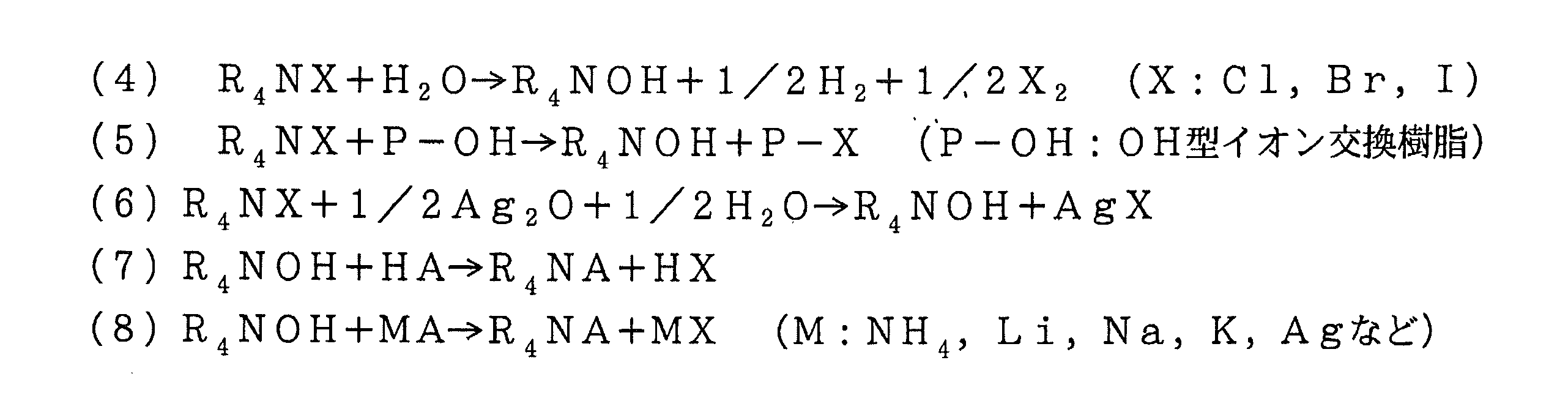
- the hydroxide method is a method carried out by reactions as shown in (4) to (8).
- reaction formula (4) ion exchange membrane electrolysis
- reaction formula (5) OH type ion exchange resin method
- Ag 2 O reaction formula (reaction formula (6)) to obtain the hydroxide (R 4 NOH).
- Chlorine, bromine and iodine are used as the halogen
- the obtained hydroxide is subjected to the reaction of the reaction formulas (7) to (8) in the same manner as the halogenation method, and the desired ionic liquid (R 4 NA) is obtained.
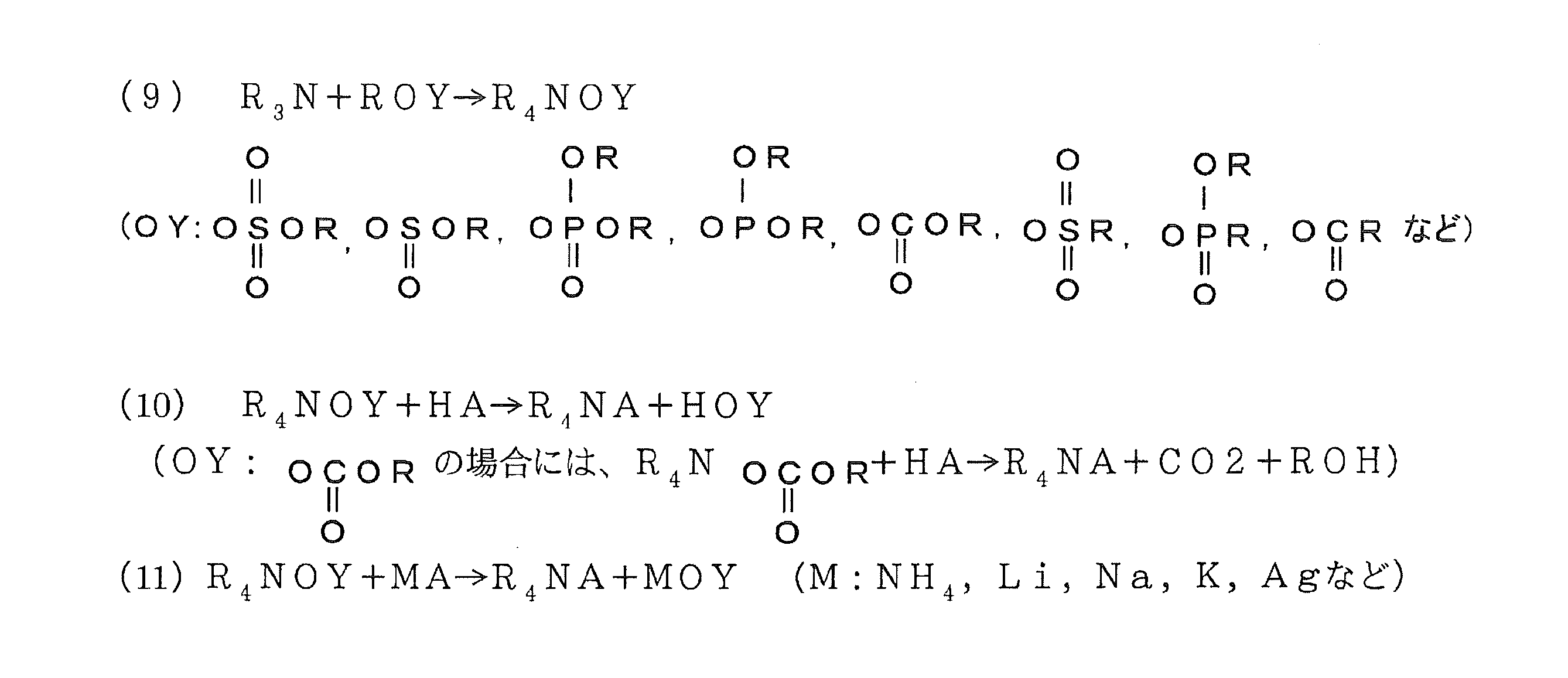
- the acid ester method is a method carried out by reactions as shown in (9) to (11).
- a tertiary amine (R 3 N) is reacted with an acid ester to obtain an acid ester product.
- reaction formula (9) as the acid ester, an ester of an inorganic acid such as sulfuric acid, sulfurous acid, phosphoric acid, phosphorous acid or carbonic acid, or an organic acid such as methanesulfonic acid, methylphosphonic acid or formic acid
- the obtained acid ester is used in the reactions of the reaction formulas (10) to (11) in the same manner as in the halogenation method to obtain the target ionic liquid (R 4 NA). Further, by using methyl trifluoromethanesulfonate, methyl trifluoroacetate or the like as the acid ester, an ionic liquid can be directly obtained.
- reaction formulas (12) to (14) The obtained quaternary ammonium fluoride salt is complexed with a fluoride such as BF 3 , AlF 3 , PF 5 , ASF 5 , SbF 5 , NbF 5 , TaF 5. An ionic liquid can be obtained. (Reaction Formula (15))
- the neutralization method is a method performed by a reaction as shown in (16).
- Tertiary amine and HBF 4 , HPF 6 , CH 3 COOH, CF 3 COOH, CF 3 SO 3 H, (CF 3 SO 2 ) 2 NH, (CF 3 SO 2 ) 3 CH, (C 2 F 5 SO 2 ) 2 It can be obtained by reacting with an organic acid such as NH.
- R represents hydrogen or a hydrocarbon group having 1 to 20 carbon atoms, and may contain a hetero atom.
- the blending amount of the ionic liquid varies depending on the compatibility of the polymer to be used and the ionic liquid, and thus cannot be defined unconditionally. However, in general, it is 0.01 parts by weight to 100 parts by weight of the base polymer. 40 parts by weight is preferred, 0.03 to 20 parts by weight is more preferred, and 0.05 to 10% by weight is most preferred. If the amount is less than 0.01 part by weight, sufficient antistatic properties cannot be obtained, and if it exceeds 40 parts by weight, contamination of the adherend such as a semiconductor wafer tends to increase.
- the base polymer it is preferable to use a polymer having an acid value of 1 to 200, preferably 2 to 150, more preferably 5 to 100.
- the acid value means the number of mg of potassium hydroxide necessary to neutralize the COOH group contained in 1 g of the sample.
- a polymer having a glass transition temperature Tg of 0 ° C. or lower, preferably ⁇ 100 ° C. to ⁇ 5 ° C., more preferably ⁇ 80 ° C. to ⁇ 10 ° C. may be used.
- glass transition temperature Tg exceeds 0 degreeC, even when an ionic liquid is contained, it may be difficult to obtain sufficient adhesive force.
- the base polymer examples include acrylic polymers, natural rubber, and styrene-isoprene-styrene block copolymers mainly composed of one or more of acrylates and / or methacrylates having an alkyl group having 1 to 14 carbon atoms (SIS block copolymer), styrene-butadiene-styrene block copolymer (SBS block copolymer), styrene-ethylene-butylene-styrene block copolymer (SEBS block copolymer), styrene-butadiene rubber, polybutadiene, Polymers generally applied as the polymer of the pressure-sensitive adhesive such as polyisoprene, polyisobutylene, butyl rubber, chloroprene rubber and silicone rubber can be mentioned.
- SIS block copolymer styrene-butadiene-styrene block copolymer
- SEBS block copolymer styrene
- the main component is one or two or more of acrylates and / or methacrylates having an alkyl group having 1 to 14 carbon atoms because a balance of compatibility with ionic liquids and excellent adhesive properties can be obtained.
- Acrylic polymers are preferably used.
- acrylic polymer mainly composed of one or more of acrylates and / or methacrylates having an alkyl group having 1 to 14 carbon atoms
- acrylates and / or methacrylates having an alkyl group having 1 to 14 carbon atoms ⁇ Hereinafter referred to as (meth) acrylate.
- the (meth) acrylate having an alkyl group having 1 to 14 carbon atoms include methyl (meth) acrylate, ethyl (meth) acrylate, n-butyl (meth) acrylate, t-butyl (meth) acrylate, isobutyl (Meth) acrylate, hexyl (meth) acrylate, 2-ethylhexyl (meth) acrylate, n-octyl (meth) acrylate, isooctyl (meth) acrylate, n-nonyl (meth) acrylate, isononyl (meth) acrylate, n-decyl (Meth) acrylate, isodecyl (meth) acrylate, n-dodecyl (meth) acrylate, n-tridecyl (meth) acrylate, n-tetradecyl (meth)
- the base polymer a polymer with high polarity (hydrophilicity) is preferable.
- a highly polar polymer compatibility with the static eliminating agent is improved, segregation of the static eliminating agent on the surface of the pressure-sensitive adhesive layer 12 can be prevented, and a decrease in adhesive strength can be suppressed.
- the highly polar base polymer is based on 100 parts by weight of a main monomer (for example, an acrylic polymer having one or more of acrylates and / or methacrylates having an alkyl group having 1 to 14 carbon atoms as a main component).
- a polymer containing 0.1 part by weight or more, preferably 0.1 part by weight to 30 parts by weight, more preferably 0.1 part by weight to 20 parts by weight of a highly polar monomer is preferable.
- the highly polar monomer include acrylic acid.
- high polarity means that the dielectric constant is 2.0 or more, for example.
- Other components include a sulfonic acid group-containing monomer, a phosphoric acid group-containing monomer, and a cyano group-containing monomer as appropriate so that the Tg is 0 ° C. or lower (usually ⁇ 100 ° C. or higher) for easy balance of adhesive performance.
- Vinyl ester, aromatic vinyl compound and other cohesive strength / heat resistance improving components carboxyl group-containing monomer, acid anhydride group-containing monomer, hydroxyl group-containing monomer, amide group-containing monomer, amino group-containing monomer, epoxy group-containing
- a component having a functional group that works as a crosslinking base point such as a monomer, N-acryloylmorpholine, vinyl ether, or the like.
- Other components can be used alone or in combination of two or more.
- the acid value of the acrylic polymer is 29 or less.
- the acid value of the acrylic polymer exceeds 29, the antistatic property tends to deteriorate.
- the acid value can be adjusted by adjusting the amount of acrylate and / or methacrylate having an acid functional group.
- the acrylic polymer having a carboxyl group include an acrylic polymer obtained by copolymerizing 2-ethylhexyl acrylate and acrylic acid.
- the acid value can be satisfied by adjusting the acrylic acid to 3.7 parts by weight or less with respect to 100 parts by weight of the total amount of 2-ethylhexyl acrylate and acrylic acid.
- sulfonic acid group-containing monomers examples include styrene sulfonic acid, allyl sulfonic acid, 2- (meth) acrylamide-2-methylpropane sulfonic acid, (meth) acrylamide propane sulfonic acid, sulfopropyl (meth) acrylate, and (meth) acryloyloxy. And naphthalenesulfonic acid.
- phosphate group-containing monomer include 2-hydroxyethyl acryloyl phosphate.
- Examples of the cyano group-containing monomer include acrylonitrile.
- Examples of vinyl esters include vinyl acetate.
- aromatic vinyl compounds include styrene.
- carboxyl group-containing monomer examples include (meth) acrylic acid, carboxyethyl (meth) acrylate, carboxypentyl (meth) acrylate, itaconic acid, maleic acid, fumaric acid, and crotonic acid.
- acid anhydride group-containing monomer examples include maleic anhydride and itaconic anhydride.
- Hydroxyl group-containing monomers include 2-hydroxyethyl (meth) acrylate, 2-hydroxypropyl (meth) acrylate, 4-hydroxybutyl (meth) acrylate, 6-hydroxyhexyl (meth) acrylate, 8-hydroxyoctyl (meth) acrylate 10-hydroxydecyl (meth) acrylate, 12-hydroxylauryl (meth) acrylate, (4-hydroxymethylcyclohexyl) methyl acrylate, N-methylol (meth) acrylamide, vinyl alcohol, allyl alcohol, 2-hydroxyethyl vinyl ether, 4 -Hydroxybutyl vinyl ether, diethylene glycol monovinyl ether and the like.
- vinyl ethers examples include vinyl ethyl ether.
- the acrylic polymer can be obtained by a polymerization method generally used as a synthesis method of an acrylic polymer such as solution polymerization, emulsion polymerization, bulk polymerization, suspension polymerization.
- the pressure-sensitive adhesive according to the present embodiment can provide pressure-sensitive adhesive sheets having further excellent heat resistance by appropriately crosslinking a base polymer, particularly an acrylic polymer.
- a base polymer particularly an acrylic polymer.
- an acrylic polymer such as a polyisocyanate compound, an epoxy compound, or an aziridine compound as a crosslinking base point
- a so-called cross-linking agent to add and react.
- polyisocyanate compounds and epoxy compounds are particularly preferably used.
- polyisocyanate compound examples include lower aliphatic polyisocyanates such as butylene diisocyanate and hexamethylene diisocyanate, alicyclic isocyanates such as cyclopentylene diisocyanate, cyclohexylene diisocyanate and isophorone diisocyanate, 2,4-tolylene diisocyanate, Aromatic diisocyanates such as 4,4'-diphenylmethane diisocyanate and xylylene diisocyanate, trimethylolpropane / tolylene diisocyanate trimer adduct (trade name Coronate L), trimethylolpropane / hexamethylene diisocyanate trimer adduct ( Product name Coronate HL), isocyanurate of hexamethylene diisocyanate (Product name Coronate HX) [both Japan Polyurethane Kogyo Co., Ltd.] and the like isocyanate adduct
- the amount of the polyisocyanate compound is generally 0.5 parts by weight or more based on 100 parts by weight of the acrylic polymer in order to obtain sufficient heat resistance due to the cohesive force of the acrylic pressure-sensitive adhesive. preferable. Moreover, it is preferable to mix
- the polyfunctional monomer having two or more radiation-reactive unsaturated bonds is one or more radiation reactions that can be crosslinked (cured) by irradiation with radiation such as vinyl, acryloyl, methacryloyl, and vinylbenzyl groups.
- a polyfunctional monomer component having two or more properties is used. In general, those having 10 or less radiation-reactive unsaturated bonds are preferably used. Two or more polyfunctional monomers can be used in combination.
- polyfunctional monomer examples include ethylene glycol di (meth) acrylate, diethylene glycol di (meth) acrylate, tetraethylene glycol di (meth) acrylate, neopentyl glycol di (meth) acrylate, 1,6 hexanediol di ( And (meth) acrylate, trimethylolpropane tri (meth) acrylate, pentaerythritol tri (meth) acrylate, dipentaerythritol hexa (meth) acrylate, divinylbenzene, and N, N′-methylenebisacrylamide.
- the radiation-polymerizable oligomer component includes various oligomers such as urethane, polyether, polyester, polycarbonate, and polybutadiene. Further, the oligomer component preferably has a weight average molecular weight in the range of about 100 to 30,000.
- the amount of the polyfunctional monomer or radiation-polymerizable oligomer used is appropriately selected depending on the balance with the acrylic polymer to be cross-linked, and further depending on the intended use as an adhesive sheet. In order to obtain sufficient heat resistance due to the cohesive strength of the acrylic pressure-sensitive adhesive, it is generally preferable to add 0.1 to 30 parts by weight with respect to 100 parts by weight of the acrylic polymer. Moreover, it is more preferable to mix
- the radiation examples include ultraviolet rays, laser beams, ⁇ rays, ⁇ rays, ⁇ rays, x rays, electron beams, and the like, and ultraviolet rays are preferably used from the viewpoints of controllability, good handleability, and cost. More preferably, ultraviolet rays having a wavelength of 200 nm to 400 nm are used. Ultraviolet rays can be irradiated using an appropriate light source such as a high-pressure mercury lamp, a microwave excitation lamp, or a chemical lamp. In addition, when using an ultraviolet-ray as a radiation, a photoinitiator is added to an acrylic adhesive.
- the photopolymerization initiator may be any substance that generates radicals or cations by irradiating ultraviolet rays having an appropriate wavelength that can trigger the polymerization reaction according to the type of the radiation-reactive component.
- radical photopolymerization initiators include benzoins such as benzoin, benzoin methyl ether, benzoin ethyl ether, o-benzoylbenzoic acid methyl-p-benzoin ethyl ether, benzoin isopropyl ether, ⁇ -methylbenzoin, benzyl dimethyl ketal, trichloroacetophenone Acetophenones such as 2,2-diethoxyacetophenone and 1-hydroxycyclohexyl phenyl ketone, propio such as 2-hydroxy-2-methylpropiophenone and 2-hydroxy-4'-isopropyl-2-methylpropiophenone Benones such as phenones, benzophenone, methylbenzophenone, p-chlorobenzophenone, p-dimethylaminobenzofuninone, 2-chlorothioxanthone, 2-ethylthio Thioxanthones such as xanthone and 2-is
- photocationic polymerization initiators include onium salts such as aromatic diazonium salts, aromatic iodonium salts, and aromatic sulfonium salts, organometallic complexes such as iron-allene complexes, titanocene complexes, and arylsilanol-aluminum complexes, nitrobenzyl
- organometallic complexes such as iron-allene complexes, titanocene complexes, and arylsilanol-aluminum complexes
- nitrobenzyl examples thereof include esters, sulfonic acid derivatives, phosphoric acid esters, sulfonic acid derivatives, phosphoric acid esters, phenol sulfonic acid esters, diazonaphthoquinone, and N-hydroxyimide sulfonate.
- the said photoinitiator it is also possible to use 2 or more types together.
- photoinitiated polymerization aid such as amines
- examples of the photoinitiator aid include 2-dimethylaminoethylbenzoate, dimethylaminoacetophenone, p-dimethylaminobenzoic acid ethyl ester, p-dimethylaminobenzoic acid isoamyl ester, and the like.
- Two or more photopolymerization initiation assistants can be used in combination.
- the polymerization initiation assistant is preferably blended in an amount of 0.05 to 10 parts by weight, more preferably 0.1 to 7 parts by weight with respect to 100 parts by weight of the acrylic polymer.
- the pressure-sensitive adhesive used in the present embodiment includes various conventionally known tackifiers, surface lubricants, leveling agents, antioxidants, corrosion inhibitors, light stabilizers, ultraviolet absorbers, and polymerization inhibitors.
- Silane coupling agents, inorganic or organic fillers, powders such as metal powders and pigments, particulates, foils, and other conventionally known additives should be added as appropriate according to the intended use. I can do it.
- the pressure-sensitive adhesive layer 12 has a thickness of usually 3 ⁇ m to 100 ⁇ m, preferably about 5 ⁇ m to 50 ⁇ m, a plastic film such as a polyester film, or a porous material such as paper or nonwoven fabric. It is formed by coating on one side or both sides of various base materials made of a sheet or tape. Particularly in the case of a surface protective film, it is preferable to use a plastic substrate as the substrate.
- the peeling adhesive strength of the surface of the pressure-sensitive adhesive layer 12 is preferably 2 N / 20 mm to 50 N / 20 mm, more preferably 3 N / 20 mm to 30 N / 20 mm, and particularly preferably 4 N / 20 mm to 20 N / 20 mm with respect to the semiconductor wafer. .
- the peeling adhesive strength is set to 2 N / 20 mm or more, for example, it is possible to prevent the occurrence of chip jumping during dicing of the semiconductor wafer.
- the thickness is 50 N / 20 mm or less, it is possible to prevent difficulty in picking up the semiconductor chip.
- the plastic substrate is not particularly limited as long as it can be formed into a sheet shape or a film shape.
- the thickness of the film is usually about 5 ⁇ m to 200 ⁇ m, preferably about 10 ⁇ m to 100 ⁇ m.
- silicone, fluorine, long-chain alkyl or fatty acid amide release agents release with silica powder, antifouling treatment, acid treatment, alkali treatment, primer treatment, Anti-adhesive treatment such as corona treatment, plasma treatment and ultraviolet treatment, coating type, kneading type, vapor deposition type and the like can also be carried out.
- a method for forming and applying the pressure-sensitive adhesive known methods used for the production of pressure-sensitive adhesive tapes are used. Specific examples include roll coating, gravure coating, reverse coating, roll brushing, spray coating, and air knife coating.
- the separator 13 is bonded for the purpose of protecting the surface of the pressure-sensitive adhesive layer 12.
- the base material constituting the separator 13 there are paper and plastic film, but a plastic film is preferably used because of its excellent surface smoothness. More specifically, polyolefin films such as polyethylene film, polypropylene film, polybutadiene film, and polymethylpentene film; polyester films such as polyethylene terephthalate film, polybutylene terephthalate film, polyurethane film, and the like can be given.
- the thickness of the separator 13 is usually about 5 ⁇ m to 200 ⁇ m, preferably about 10 ⁇ m to 100 ⁇ m.
- the bonding surface of the separator 13 with the pressure-sensitive adhesive layer 12 may be appropriately treated with a release agent such as a silicone-based, fluorine-based, long-chain alkyl-based or fatty acid amide-based release agent, silica powder, or the like. Good.
- Example 1 1 part by weight of 1-butyl-3-methylpyridinium bis (trifluoromethanesulfonyl) imide (trade name: CIL-312, manufactured by Nippon Carlit Co., Ltd.) as a static eliminating agent, and 100 parts by weight of the acrylic polymer A 5 parts by weight of polyisocyanate compound (trade name “Coronate L”, manufactured by Nippon Polyurethane Co., Ltd.) as an agent, 50 parts by weight of UV-polymerizable oligomer (manufactured by Nippon Synthetic Chemical Co., Ltd., product name: UV1700TL), photopolymerization 3 parts by weight of an initiator (trade name: Irgacure 2959, manufactured by Ciba Specialty Chemicals Co., Ltd.) was added to prepare an adhesive solution.
- an initiator trade name: Irgacure 2959, manufactured by Ciba Specialty Chemicals Co., Ltd.
- Example 2 a pressure-sensitive adhesive sheet according to this example was produced in the same manner as in Example 1 except that the blending amount of the static eliminating agent was changed to 1 part by weight.
- Example 6 a pressure-sensitive adhesive sheet according to this example was produced in the same manner as in Example 4 except that the blending amount of the static eliminating agent was changed to 10 parts by weight.
- Example 7 an adhesive sheet according to this comparative example was prepared in the same manner as in Example 1 except that acrylic polymer C was used and no UV oligomer or photopolymerization initiator was added. did.
- Example 9 In this example, a pressure-sensitive adhesive sheet according to this comparative example was produced in the same manner as in Example 7 except that the amount of the static eliminating agent was changed to 10 parts by weight.
- the weight average molecular weight was measured by using a GPC apparatus manufactured by Tosoh Corporation, HLC-8220 GPC, and obtained as a converted value of polystyrene.
- the measurement conditions are as follows. Sample concentration: 0.2 wt% (THF solution), sample injection amount: 10 ⁇ l, eluent: THF, flow rate: 0.6 ml / min, measurement temperature: 40 ° C., column: sample column; TSK guard column 1 SuperHZ-H + 2 TSKgel SuperHZM-H, reference column; 1 TSKgel SuperH-RC, detector: differential refractometer.
- the acid value was measured using an automatic titrator (COM-550) manufactured by Hiranuma Sangyo Co., Ltd., and was determined by the following equation.
- A ⁇ (Y ⁇ X) ⁇ f ⁇ 5.611 ⁇ / M
- A Acid value
- Y Titration volume of sample solution (ml)
- X Titration volume of solution containing only 50 g of mixed solvent (ml)
- f Factor of titration solution
- M Weight of polymer sample (g))
- Titration solution 0.1N, 2-propanol potassium hydroxide solution (manufactured by Wako Pure Chemical Industries, Ltd., for petroleum product neutralization value test), electrode: glass electrode; GE-101, comparative electrode; RE-201 Measurement mode: Petroleum product neutralization number test 1.
- the pressure-sensitive adhesive sheets according to Examples 1 to 9 of the present invention have a charge potential half-life of 900 seconds or less on the surface of the pressure-sensitive adhesive layer after separation of the separator. As a result, the potential could be removed in an extremely short time.
- the addition of acrylic acid which is a highly polar monomer, can prevent the pressure-sensitive adhesive layer from being peeled off and the adhesive force from being lowered.
- the pressure-sensitive adhesive sheet of Comparative Example 1 does not contain an ionic liquid, which is a neutralizing agent, so the half-life of the charging potential exceeds 900 seconds, and the potential remains high even after neutralization. It was.
Landscapes
- Chemical & Material Sciences (AREA)
- Organic Chemistry (AREA)
- Adhesive Tapes (AREA)
- Adhesives Or Adhesive Processes (AREA)
Abstract
Description
本実施の形態に係る粘着剤層12は、前述の通り、その表面の帯電電荷の半減期が、JIS L1094に基づく電荷減衰測定法により900秒以下のものであれば特に限定されるものではない。

[式(B)中のR4は、炭素数2から20の炭化水素基を表し、ヘテロ原子を含んでも良く、R5、R6、およびR7は、同一又は異なって、水素または炭素数1から16の炭化水素基を表し、ヘテロ原子を含んでも良い。]
[式(C)中のR8は、炭素数2から20の炭化水素基を表し、ヘテロ原子を含んでも良く、R9、R10、およびR11は、同一又は異なって、水素または炭素数1から16の炭化水素基を表し、ヘテロ原子を含んでも良い。]
[式(D)中のXは、窒素、硫黄、又はリン原子を表し、R12、R13、R14、およびR15は、同一又は異なって、炭素数1から20の炭化水素基を表し、ヘテロ原子を含んでも良い。但しXが硫黄原子の場合、R12はない。]



2-エチルヘキシルアクリレート80重量部、メチルアクリレート20重量部、アクリル酸10重量部、過酸化ベンゾイル0.2重量部の混合物を窒素気流中、65℃にて6時間反応させてTg=-49℃、重量平均分子量100万、酸価70のアクリルポリマーの溶液(25重量%)を得た。
2-エチルヘキシルアクリレート100重量部、アクリル酸4重量部、AIBN(アゾビスイソブチロニトリル)0.2重量部の混合物を窒素気流中、65℃にて6時間反応させてTg=-66℃、重量平均分子量55万、酸価30のアクリルポリマーの溶液(33重量%)を得た。
2-エチルヘキシルアクリレート100重量部、2-ヒドロキシエチルアクリレート4重量部、AIBN(アゾビスイソブチロニトリル)0.2重量部の混合物を窒素気流中、65℃にて6時間反応させてTg=-68℃、重量平均分子量55万、酸価0のアクリルポリマーの溶液(35重量%)を得た。
前記アクリルポリマーA100重量部に対し、除電剤としての1-ブチル-3-メチルピリジニウムビス(トリフロメタンスルホニル)イミド(日本カーリット(株)製、商品名;CIL-312)0.1重量部、架橋剤としてのポリイソシアネート化合物(商品名「コロネートL」、日本ポリウレタン(株)製)5重量部、紫外線重合性のオリゴマー(日本合成化学(株)製、商品名;UV1700TL)50重量部、光重合開始剤(チバ・スペシャルティー・ケミカルズ(株)製、商品名;イルガキュア2959)3重量部を加えて、粘着剤溶液を作製した。
本実施例に於いては、除電剤の配合量を1重量部に変更したこと以外は、前記実施例1と同様にして、本実施例に係る粘着シートを作製した。
本実施例に於いては、除電剤の配合量を10重量部に変更したこと以外は、前記実施例1と同様にして、本実施例に係る粘着シートを作製した。
本実施例に於いては、アクリルポリマーBを用い、かつ、UVオリゴマー及び光重合開始剤を配合しなかったこと以外は、前記実施例1と同様にして、本実施例に係る粘着シートを作製した。
本実施例に於いては、除電剤の配合量を1重量部に変更したこと以外は、前記実施例4と同様にして、本実施例に係る粘着シートを作製した。
本実施例に於いては、除電剤の配合量を10重量部に変更したこと以外は、前記実施例4と同様にして、本実施例に係る粘着シートを作製した。
本実施例に於いては、アクリルポリマーCを用い、かつ、UVオリゴマー及び光重合開始剤を配合しなかったこと以外は、前記実施例1と同様にして、本比較例に係る粘着シートを作製した。
本実施例に於いては、除電剤の配合量を1重量部に変更したこと以外は、前記実施例7と同様にして、本比較例に係る粘着シートを作製した。
本実施例に於いては、除電剤の配合量を10重量部に変更したこと以外は、前記実施例7と同様にして、本比較例に係る粘着シートを作製した。
本比較例に於いては、除電剤を配合しなかったこと以外は、前記実施例1と同様にして、本比較例に係る粘着シートを作製した。
重量平均分子量は、東ソー株式会社製GPC装置、HLC-8220GPCを用いて測定を行い、ポリステレン換算値にて求めた。測定条件は下記の通りである。サンプル濃度:0.2wt%(THF溶液)、サンプル注入量:10μl、溶離液:THF、流速:0.6ml/min、測定温度:40℃、カラム:サンプルカラム;TSKguardcolumn
SuperHZ-H1本+TSKgelSuperHZM-H2本、リファレンスカラム;TSKgel SuperH-RC1本、検出器:示差屈折計。
酸価は、平沼産業株式会社製の自動滴定装置(COM-550)を用いて測定を行い、次式により求めた。
A={(Y-X)×f×5.611}/M
(A;酸価、Y;サンプル溶液の滴定量(ml)、X;混合溶媒50gのみの溶液の滴定量(ml)、f;滴定溶液のファクター、M;ポリマーサンプルの重量(g))
各実施例及び比較例で作製した粘着シートに於ける粘着剤層表面の帯電電荷の半減期は、JIS L1094に基づく電荷減衰測定法により求めた。先ず、スタチックオネストメータ(シシド静電気株式会社製、型番:H-0110)を用いて、そのテーブル上に各粘着シートを固定した。次に、テーブルを水平方向へ回転させながらコロナ放電により、粘着シート表面に電圧を印加した。その電位の検出値が飽和値に達した後、高圧印加を遮断し、その後の電位の減衰状態を観察した。その値が飽和値の2分の1に達するまでの時間を測定し、半減値とした。尚、測定条件は、印加電圧10V、測定時間900秒、温度20℃、相対湿度40%Rhとした。
各粘着シートを流れ方向に対し20mm幅×12cm長さでサンプル片を切り出し、これをシリコンミラーウェハに貼り付け、約30分間放置して、引き剥がし粘着力を測定した。紫外線硬化型の粘着剤層が設けられた粘着シートに対しては、紫外線照射前の引き剥がし粘着力(N/20mm)を測定した。測定条件は、測定機器:テンシロン(オリエンテック社製)、温度23℃、引張速度:50mm/分、剥離角度:180°とした。
セパレータ剥離後の表面の除電性を確認した。具体的には、70mm×70mmサイズのアクリル板の上に、30mm×70mmサイズの両面テープを貼り合わせた。その上に、30mm×70mmサイズの実施例及び比較例に係る粘着シートの基材側を貼り合わせた。そして、セパレータを手で素早く剥離し、電位測定器[春日電機(株)社製 KSD-0202]を用いて粘着剤層表面の帯電量の測定を行った。次に、粘着剤層表面にアース線を接触させ、再度粘着剤層表面の帯電量を測定して、粘着剤層の帯電量の変化を確認した。その結果、アース線設置後1分以内に帯電量が半減した場合には「〇」、1分以内に半減しなかった場合には「×」とした。結果を下記表2に示す。
各粘着シートの電子部品に対する粘着性の評価は、シリコンウェハを電子部品とし、これをダイシングした際に起こるチップ飛び現象の確認を行うことによって評価した。具体的には、厚み200μmのシリコンウェハを下記の条件にてダイシングし、その際に粘着力が低く、保持できずに飛散したチップの有無を確認した。チップの飛散が見られなかった場合には「〇」、見られた場合には「×」とした。結果を下記表2に示す。
<ダイシング条件>
シリコンウェハ:6インチ 200μm
ダイシング装置:DISCO社製 DFD-651
ダイシングブレード:DISCO社製 27HECC
ブレード回転数:40000rpm
ダイシング速度:50mm/sec
ダイシング深さ:25μm
カットモード:ダウンカット
ダイシングサイズ:5mm×5mm


前記表1及び2の結果から明らかなように、本発明の実施例1~9に係る粘着シートは、セパレータ剥離後の粘着剤層の表面における帯電電位の半減期が900秒以下であり、除電を行うと、極めて短時間で電位を除去することができた。また、実施例1~6に係る粘着シートでは、極性の高いモノマーであるアクリル酸を添加したことにより、粘着剤層の引き剥がし粘着力の低下も防止できることが確認された。一方、比較例1の粘着シートは、除電剤であるイオン性液体が配合されていないため、帯電電位の半減期は900秒を超え、かつ、除電を行っても電位は高い状態のままであった。
11 基材
12 粘着剤層
13 セパレータ
14 半導体ウェハ
15 半導体チップ
Claims (8)
- 基材上に少なくとも粘着剤層及びセパレータが順次積層された粘着シートを用いる電子部品の製造方法であって、
前記粘着シートとして、前記粘着剤層の表面の帯電電荷の半減期が、JIS L1094に基づく電荷減衰測定法により900秒以下のものを用い、
前記粘着剤層から前記セパレータを剥離する工程と、
前記粘着剤層の表面における帯電電荷を除電する工程と、
除電後の前記粘着剤層上に電子部品を貼り合わせる工程とを少なくとも有する電子部品の製造方法。 - 前記粘着シートとして、前記粘着剤層中に、そのベースポリマー100重量部に対し0.01重量部~30重量部の範囲内のイオン性液体が添加されたものを用いる請求項1に記載の電子部品の製造方法。
- 前記粘着シートの前記粘着剤層におけるベースポリマーは、
炭素数1~14のアルキル基を有するアクリレート、又は炭素数1~14のアルキル基を有するメタクリレートの少なくとも何れかにより形成されたアクリルポリマーと、
極性の高いモノマーとにより少なくとも形成されており、
前記極性の高いモノマーは、前記アクリルポリマー100重量部に対して、0.1重量部以上配合されている請求項2に記載の電子部品の製造方法。 - 前記粘着シートとして、前記粘着剤層の構成成分であるベースポリマーの酸価が1~200のものを用いる請求項1~3の何れか1項に記載の電子部品の製造方法。
- 前記粘着シートとして、前記粘着剤層の構成成分であるベースポリマーがカルボキシル基を有するものを用いる請求項1~4の何れか1項に記載の電子部品の製造方法。
- 前記粘着シートとして、前記粘着剤層の構成成分が放射線重合性のオリゴマーのものを用いる請求項1~5の何れか1項に記載の電子部品の製造方法。
- 前記粘着シートとして、前記セパレータがポリオレフィンフィルム又はポリエステルフィルムのものを用いる請求項1~6の何れか1項に記載の電子部品の製造方法。
- 請求項1~7の何れか1項に記載の電子部品の製造方法において使用される粘着シート。
Priority Applications (4)
| Application Number | Priority Date | Filing Date | Title |
|---|---|---|---|
| JP2012507495A JP5605957B2 (ja) | 2010-08-06 | 2011-08-04 | 電子部品の製造方法 |
| US13/576,079 US20120291944A1 (en) | 2010-08-06 | 2011-08-04 | Method of producing electronic component |
| EP11814708.1A EP2602814A1 (en) | 2010-08-06 | 2011-08-04 | Electronic component manufacturing method |
| CN201180004835.9A CN102741983B (zh) | 2010-08-06 | 2011-08-04 | 电子部件的制造方法 |
Applications Claiming Priority (2)
| Application Number | Priority Date | Filing Date | Title |
|---|---|---|---|
| JP2010177942 | 2010-08-06 | ||
| JP2010-177942 | 2010-08-06 |
Publications (1)
| Publication Number | Publication Date |
|---|---|
| WO2012018083A1 true WO2012018083A1 (ja) | 2012-02-09 |
Family
ID=45559579
Family Applications (1)
| Application Number | Title | Priority Date | Filing Date |
|---|---|---|---|
| PCT/JP2011/067873 Ceased WO2012018083A1 (ja) | 2010-08-06 | 2011-08-04 | 電子部品の製造方法 |
Country Status (7)
| Country | Link |
|---|---|
| US (1) | US20120291944A1 (ja) |
| EP (1) | EP2602814A1 (ja) |
| JP (1) | JP5605957B2 (ja) |
| KR (1) | KR20120055601A (ja) |
| CN (1) | CN102741983B (ja) |
| TW (1) | TWI492282B (ja) |
| WO (1) | WO2012018083A1 (ja) |
Cited By (8)
| Publication number | Priority date | Publication date | Assignee | Title |
|---|---|---|---|---|
| JP2014049761A (ja) * | 2012-08-29 | 2014-03-17 | Dongwoo Fine-Chem Co Ltd | レーザダイシング用ウエハ保護膜組成物 |
| JP2015003988A (ja) * | 2013-06-20 | 2015-01-08 | 古河電気工業株式会社 | 半導体加工用粘着テープ |
| JP2016174145A (ja) * | 2015-03-03 | 2016-09-29 | ローム アンド ハース エレクトロニック マテリアルズ エルエルシーRohm and Haas Electronic Materials LLC | 一時接合 |
| JPWO2016195071A1 (ja) * | 2015-06-05 | 2018-03-22 | リンテック株式会社 | 保護膜形成用複合シート |
| JP2020007568A (ja) * | 2014-09-25 | 2020-01-16 | 日東電工株式会社 | 熱剥離型粘着シート |
| JP2022073713A (ja) * | 2020-11-02 | 2022-05-17 | 株式会社ディスコ | 保護部材付き被加工物の製造方法、被加工物の加工方法及び保護部材付き被加工物 |
| JP2023112221A (ja) * | 2022-02-01 | 2023-08-14 | リンテック株式会社 | ワーク加工用シート |
| JP2024037368A (ja) * | 2022-09-07 | 2024-03-19 | リンテック株式会社 | ワーク加工用シートおよびその使用方法 |
Families Citing this family (8)
| Publication number | Priority date | Publication date | Assignee | Title |
|---|---|---|---|---|
| JP2013247163A (ja) * | 2012-05-23 | 2013-12-09 | Furukawa Electric Co Ltd:The | 放射線硬化性半導体加工用粘着テープ |
| CN103009758A (zh) * | 2012-12-31 | 2013-04-03 | 崔庆珑 | 易于捡取的防静电晶圆切割膜 |
| CN103173135B (zh) * | 2013-02-26 | 2014-04-30 | 安徽明珠颜料科技有限公司 | 一种耐高温环氧树脂胶黏剂 |
| TWI600526B (zh) * | 2013-11-27 | 2017-10-01 | 住友化學股份有限公司 | 光學部件貼合體之製造裝置 |
| CN111808541A (zh) * | 2014-09-25 | 2020-10-23 | 日东电工株式会社 | 热剥离型粘合片 |
| CN105845618B (zh) * | 2015-01-13 | 2019-07-19 | 中芯国际集成电路制造(上海)有限公司 | 一种防止铜氧化扩散的方法 |
| JP7651255B2 (ja) * | 2018-09-03 | 2025-03-26 | 日東電工株式会社 | 粘着剤組成物、粘着シート、及び接合体 |
| CN121941733A (zh) * | 2023-08-17 | 2026-04-28 | 3M创新有限公司 | 导电组合物、电脱粘粘合剂体系和相关方法 |
Citations (7)
| Publication number | Priority date | Publication date | Assignee | Title |
|---|---|---|---|---|
| JPS63299246A (ja) * | 1987-05-29 | 1988-12-06 | F S K Kk | ウェハ貼着用粘着シ−ト |
| JPH02139927A (ja) * | 1988-11-21 | 1990-05-29 | Nitto Denko Corp | 半導体ウエハのテープ貼付け方法およびテープ剥離方法 |
| JP2002285134A (ja) | 2001-03-26 | 2002-10-03 | Sumitomo Bakelite Co Ltd | 半導体加工用粘着シート |
| JP2003105292A (ja) * | 2001-07-04 | 2003-04-09 | Furukawa Electric Co Ltd:The | 帯電防止ダイシングテープ |
| JP2005290357A (ja) * | 2004-03-08 | 2005-10-20 | Nitto Denko Corp | 粘着剤組成物、粘着シート類及び表面保護フィルム |
| WO2006123638A1 (ja) * | 2005-05-20 | 2006-11-23 | Nitto Denko Corporation | 粘着剤組成物、粘着シートおよび表面保護フィルム |
| JP2007031534A (ja) * | 2005-07-26 | 2007-02-08 | Denki Kagaku Kogyo Kk | 粘着シートおよび電子部品製造方法 |
Family Cites Families (3)
| Publication number | Priority date | Publication date | Assignee | Title |
|---|---|---|---|---|
| US7691925B2 (en) * | 2004-03-08 | 2010-04-06 | Nitto Denko Corporation | Pressure-sensitive adhesive composition, pressure-sensitive adhesive sheets and surface protecting film |
| TW200617124A (en) * | 2004-06-01 | 2006-06-01 | Nitto Denko Corp | Pressure-sensitive adhesive composition, pressure-sensitive adhesive sheet and surface protecting film |
| JP5030306B2 (ja) * | 2004-07-26 | 2012-09-19 | 日東電工株式会社 | 粘着剤組成物、粘着シート類及び表面保護フィルム |
-
2011
- 2011-08-04 KR KR1020127005772A patent/KR20120055601A/ko not_active Ceased
- 2011-08-04 US US13/576,079 patent/US20120291944A1/en not_active Abandoned
- 2011-08-04 EP EP11814708.1A patent/EP2602814A1/en not_active Withdrawn
- 2011-08-04 CN CN201180004835.9A patent/CN102741983B/zh active Active
- 2011-08-04 JP JP2012507495A patent/JP5605957B2/ja active Active
- 2011-08-04 WO PCT/JP2011/067873 patent/WO2012018083A1/ja not_active Ceased
- 2011-08-05 TW TW100128058A patent/TWI492282B/zh active
Patent Citations (7)
| Publication number | Priority date | Publication date | Assignee | Title |
|---|---|---|---|---|
| JPS63299246A (ja) * | 1987-05-29 | 1988-12-06 | F S K Kk | ウェハ貼着用粘着シ−ト |
| JPH02139927A (ja) * | 1988-11-21 | 1990-05-29 | Nitto Denko Corp | 半導体ウエハのテープ貼付け方法およびテープ剥離方法 |
| JP2002285134A (ja) | 2001-03-26 | 2002-10-03 | Sumitomo Bakelite Co Ltd | 半導体加工用粘着シート |
| JP2003105292A (ja) * | 2001-07-04 | 2003-04-09 | Furukawa Electric Co Ltd:The | 帯電防止ダイシングテープ |
| JP2005290357A (ja) * | 2004-03-08 | 2005-10-20 | Nitto Denko Corp | 粘着剤組成物、粘着シート類及び表面保護フィルム |
| WO2006123638A1 (ja) * | 2005-05-20 | 2006-11-23 | Nitto Denko Corporation | 粘着剤組成物、粘着シートおよび表面保護フィルム |
| JP2007031534A (ja) * | 2005-07-26 | 2007-02-08 | Denki Kagaku Kogyo Kk | 粘着シートおよび電子部品製造方法 |
Cited By (11)
| Publication number | Priority date | Publication date | Assignee | Title |
|---|---|---|---|---|
| JP2014049761A (ja) * | 2012-08-29 | 2014-03-17 | Dongwoo Fine-Chem Co Ltd | レーザダイシング用ウエハ保護膜組成物 |
| JP2015003988A (ja) * | 2013-06-20 | 2015-01-08 | 古河電気工業株式会社 | 半導体加工用粘着テープ |
| JP2020007568A (ja) * | 2014-09-25 | 2020-01-16 | 日東電工株式会社 | 熱剥離型粘着シート |
| JP2016174145A (ja) * | 2015-03-03 | 2016-09-29 | ローム アンド ハース エレクトロニック マテリアルズ エルエルシーRohm and Haas Electronic Materials LLC | 一時接合 |
| JPWO2016195071A1 (ja) * | 2015-06-05 | 2018-03-22 | リンテック株式会社 | 保護膜形成用複合シート |
| JP2020017758A (ja) * | 2015-06-05 | 2020-01-30 | リンテック株式会社 | 保護膜形成用複合シート |
| JP2022073713A (ja) * | 2020-11-02 | 2022-05-17 | 株式会社ディスコ | 保護部材付き被加工物の製造方法、被加工物の加工方法及び保護部材付き被加工物 |
| JP2023112221A (ja) * | 2022-02-01 | 2023-08-14 | リンテック株式会社 | ワーク加工用シート |
| JP7828769B2 (ja) | 2022-02-01 | 2026-03-12 | リンテック株式会社 | ワーク加工用シート |
| JP2024037368A (ja) * | 2022-09-07 | 2024-03-19 | リンテック株式会社 | ワーク加工用シートおよびその使用方法 |
| JP7843206B2 (ja) | 2022-09-07 | 2026-04-09 | リンテック株式会社 | ワーク加工用シートおよびその使用方法 |
Also Published As
| Publication number | Publication date |
|---|---|
| JP5605957B2 (ja) | 2014-10-15 |
| JPWO2012018083A1 (ja) | 2013-10-03 |
| EP2602814A1 (en) | 2013-06-12 |
| US20120291944A1 (en) | 2012-11-22 |
| CN102741983B (zh) | 2015-06-17 |
| TWI492282B (zh) | 2015-07-11 |
| CN102741983A (zh) | 2012-10-17 |
| KR20120055601A (ko) | 2012-05-31 |
| TW201220377A (en) | 2012-05-16 |
Similar Documents
| Publication | Publication Date | Title |
|---|---|---|
| JP5605957B2 (ja) | 電子部品の製造方法 | |
| JP4562180B2 (ja) | 粘着剤組成物、粘着シート類及び表面保護フィルム | |
| JP3912686B2 (ja) | 粘着剤組成物、粘着剤層、および表面保護フィルム | |
| JP5965814B2 (ja) | 再剥離用水分散型アクリル系粘着剤組成物、及び粘着シート | |
| JP5088806B2 (ja) | 粘着剤組成物、粘着シート類及び表面保護フィルム | |
| JP2013237721A (ja) | 再剥離用水分散型アクリル系粘着剤組成物、及び粘着シート | |
| TW201026808A (en) | Adhesive tape or sheet | |
| JP5308611B2 (ja) | 粘着剤組成物および粘着シート類 | |
| JP2012241152A (ja) | 粘着フィルム | |
| JP2015091924A (ja) | 薬液処理用粘着剤層、薬液処理用粘着シート、表面保護シート、及び、ガラス基板 | |
| WO2022097472A1 (ja) | 粘着テープ及び加工方法 | |
| JP5547107B2 (ja) | 粘着剤組成物および粘着シート類 | |
| JP5733867B2 (ja) | 粘着剤組成物、粘着シート類及び表面保護フィルム | |
| JP4453977B2 (ja) | 粘着剤組成物、粘着シート類及び表面保護フィルム | |
| JP2010209189A (ja) | 粘着シート | |
| JP4851753B2 (ja) | 粘着剤組成物および粘着シート類 | |
| JP5384279B2 (ja) | 粘着剤組成物、粘着シート類及び表面保護フィルム | |
| JP5523365B2 (ja) | 粘着剤組成物、粘着シート類および表面保護フィルム | |
| JP4805062B2 (ja) | 粘着剤組成物および粘着シート類 | |
| JP4799962B2 (ja) | 粘着剤組成物、粘着シート類、および表面保護フィルム |
Legal Events
| Date | Code | Title | Description |
|---|---|---|---|
| WWE | Wipo information: entry into national phase |
Ref document number: 201180004835.9 Country of ref document: CN |
|
| WWE | Wipo information: entry into national phase |
Ref document number: 2012507495 Country of ref document: JP |
|
| ENP | Entry into the national phase |
Ref document number: 20127005772 Country of ref document: KR Kind code of ref document: A |
|
| 121 | Ep: the epo has been informed by wipo that ep was designated in this application |
Ref document number: 11814708 Country of ref document: EP Kind code of ref document: A1 |
|
| WWE | Wipo information: entry into national phase |
Ref document number: 13576079 Country of ref document: US |
|
| NENP | Non-entry into the national phase |
Ref country code: DE |
|
| WWE | Wipo information: entry into national phase |
Ref document number: 2011814708 Country of ref document: EP |