WO2012018165A1 - Appareil de conditionnement d'air doté d'une cellule solaire - Google Patents
Appareil de conditionnement d'air doté d'une cellule solaire Download PDFInfo
- Publication number
- WO2012018165A1 WO2012018165A1 PCT/KR2010/009385 KR2010009385W WO2012018165A1 WO 2012018165 A1 WO2012018165 A1 WO 2012018165A1 KR 2010009385 W KR2010009385 W KR 2010009385W WO 2012018165 A1 WO2012018165 A1 WO 2012018165A1
- Authority
- WO
- WIPO (PCT)
- Prior art keywords
- parts
- power generation
- solar cell
- air conditioner
- cell panel
- Prior art date
- Legal status (The legal status is an assumption and is not a legal conclusion. Google has not performed a legal analysis and makes no representation as to the accuracy of the status listed.)
- Ceased
Links
Images



Classifications
-
- F—MECHANICAL ENGINEERING; LIGHTING; HEATING; WEAPONS; BLASTING
- F24—HEATING; RANGES; VENTILATING
- F24F—AIR-CONDITIONING; AIR-HUMIDIFICATION; VENTILATION; USE OF AIR CURRENTS FOR SCREENING
- F24F5/00—Air-conditioning systems or apparatus not covered by F24F1/00 or F24F3/00, e.g. using solar heat or combined with household units such as an oven or water heater
- F24F5/0046—Air-conditioning systems or apparatus not covered by F24F1/00 or F24F3/00, e.g. using solar heat or combined with household units such as an oven or water heater using natural energy, e.g. solar energy, energy from the ground
-
- F—MECHANICAL ENGINEERING; LIGHTING; HEATING; WEAPONS; BLASTING
- F24—HEATING; RANGES; VENTILATING
- F24F—AIR-CONDITIONING; AIR-HUMIDIFICATION; VENTILATION; USE OF AIR CURRENTS FOR SCREENING
- F24F1/00—Room units for air-conditioning, e.g. separate or self-contained units or units receiving primary air from a central station
- F24F1/06—Separate outdoor units, e.g. outdoor unit to be linked to a separate room comprising a compressor and a heat exchanger
-
- F—MECHANICAL ENGINEERING; LIGHTING; HEATING; WEAPONS; BLASTING
- F24—HEATING; RANGES; VENTILATING
- F24F—AIR-CONDITIONING; AIR-HUMIDIFICATION; VENTILATION; USE OF AIR CURRENTS FOR SCREENING
- F24F1/00—Room units for air-conditioning, e.g. separate or self-contained units or units receiving primary air from a central station
- F24F1/06—Separate outdoor units, e.g. outdoor unit to be linked to a separate room comprising a compressor and a heat exchanger
- F24F1/20—Electric components for separate outdoor units
-
- F—MECHANICAL ENGINEERING; LIGHTING; HEATING; WEAPONS; BLASTING
- F24—HEATING; RANGES; VENTILATING
- F24F—AIR-CONDITIONING; AIR-HUMIDIFICATION; VENTILATION; USE OF AIR CURRENTS FOR SCREENING
- F24F1/00—Room units for air-conditioning, e.g. separate or self-contained units or units receiving primary air from a central station
- F24F1/06—Separate outdoor units, e.g. outdoor unit to be linked to a separate room comprising a compressor and a heat exchanger
- F24F1/56—Casing or covers of separate outdoor units, e.g. fan guards
-
- F—MECHANICAL ENGINEERING; LIGHTING; HEATING; WEAPONS; BLASTING
- F24—HEATING; RANGES; VENTILATING
- F24F—AIR-CONDITIONING; AIR-HUMIDIFICATION; VENTILATION; USE OF AIR CURRENTS FOR SCREENING
- F24F13/00—Details common to, or for air-conditioning, air-humidification, ventilation or use of air currents for screening
- F24F13/30—Arrangement or mounting of heat-exchangers
-
- F—MECHANICAL ENGINEERING; LIGHTING; HEATING; WEAPONS; BLASTING
- F24—HEATING; RANGES; VENTILATING
- F24F—AIR-CONDITIONING; AIR-HUMIDIFICATION; VENTILATION; USE OF AIR CURRENTS FOR SCREENING
- F24F13/00—Details common to, or for air-conditioning, air-humidification, ventilation or use of air currents for screening
- F24F13/32—Supports for air-conditioning, air-humidification or ventilation units
-
- H—ELECTRICITY
- H02—GENERATION; CONVERSION OR DISTRIBUTION OF ELECTRIC POWER
- H02S—GENERATION OF ELECTRIC POWER BY CONVERSION OF INFRARED RADIATION, VISIBLE LIGHT OR ULTRAVIOLET LIGHT, e.g. USING PHOTOVOLTAIC [PV] MODULES
- H02S10/00—PV power plants; Combinations of PV energy systems with other systems for the generation of electric power
-
- H—ELECTRICITY
- H02—GENERATION; CONVERSION OR DISTRIBUTION OF ELECTRIC POWER
- H02S—GENERATION OF ELECTRIC POWER BY CONVERSION OF INFRARED RADIATION, VISIBLE LIGHT OR ULTRAVIOLET LIGHT, e.g. USING PHOTOVOLTAIC [PV] MODULES
- H02S30/00—Structural details of PV modules other than those related to light conversion
- H02S30/20—Collapsible or foldable PV modules
-
- F—MECHANICAL ENGINEERING; LIGHTING; HEATING; WEAPONS; BLASTING
- F24—HEATING; RANGES; VENTILATING
- F24F—AIR-CONDITIONING; AIR-HUMIDIFICATION; VENTILATION; USE OF AIR CURRENTS FOR SCREENING
- F24F5/00—Air-conditioning systems or apparatus not covered by F24F1/00 or F24F3/00, e.g. using solar heat or combined with household units such as an oven or water heater
- F24F5/0046—Air-conditioning systems or apparatus not covered by F24F1/00 or F24F3/00, e.g. using solar heat or combined with household units such as an oven or water heater using natural energy, e.g. solar energy, energy from the ground
- F24F2005/0064—Air-conditioning systems or apparatus not covered by F24F1/00 or F24F3/00, e.g. using solar heat or combined with household units such as an oven or water heater using natural energy, e.g. solar energy, energy from the ground using solar energy
- F24F2005/0067—Air-conditioning systems or apparatus not covered by F24F1/00 or F24F3/00, e.g. using solar heat or combined with household units such as an oven or water heater using natural energy, e.g. solar energy, energy from the ground using solar energy with photovoltaic panels
-
- Y—GENERAL TAGGING OF NEW TECHNOLOGICAL DEVELOPMENTS; GENERAL TAGGING OF CROSS-SECTIONAL TECHNOLOGIES SPANNING OVER SEVERAL SECTIONS OF THE IPC; TECHNICAL SUBJECTS COVERED BY FORMER USPC CROSS-REFERENCE ART COLLECTIONS [XRACs] AND DIGESTS
- Y02—TECHNOLOGIES OR APPLICATIONS FOR MITIGATION OR ADAPTATION AGAINST CLIMATE CHANGE
- Y02E—REDUCTION OF GREENHOUSE GAS [GHG] EMISSIONS, RELATED TO ENERGY GENERATION, TRANSMISSION OR DISTRIBUTION
- Y02E10/00—Energy generation through renewable energy sources
- Y02E10/50—Photovoltaic [PV] energy
Definitions
- the present disclosure relates to an air conditioner including a solar cell capable of converting solar energy into electric energy.
- an air conditioner is an apparatus configured to heat and cool an indoor area through a refrigerant cycle of compression-condensation-expansion-evaporation.
- Such an air conditioner includes an indoor unit where a refrigerant exchanges heat with indoor air, and an outdoor unit where the refrigerant exchanges heat with outdoor air.
- the indoor unit includes an indoor heat exchanger where the refrigerant exchanges heat with indoor air, a fan configured to blow indoor air, and a motor configured to rotate the fan.
- the outdoor unit includes an outdoor heat exchanger where the refrigerant exchanges heat with outdoor air, a fan configured to blow outdoor air, a motor configured to rotate the fan, a compressor configured to compress the refrigerant, an expansion part configured to expand the refrigerant, and a four-way valve configured to charge the flow direction of the refrigerant.
- the indoor heat exchanger When an indoor area is cooled, the indoor heat exchanger is used as an evaporator, and the outdoor unit is used as a condenser. When the indoor area is heated, the indoor heat exchanger is used as a condenser, and the outdoor unit is used as an evaporator. Switching between cooling and heating modes is carried out by changing the flow direction of the refrigerant by using the four-way valve.
- Embodiments provide an air conditioner including a solar cell panel the light-receiving area of which can be varied.
- an air conditioner with a solar cell including: an outdoor unit configured to exchange heat with outdoor air; and a solar cell panel disposed at a side of the outdoor unit and including a plurality of parts that are relatively movable, the plurality of parts including power generation regions configured to generate electricity from solar light, wherein as the plurality of parts are moved relatively to each other, areas of the power generation regions exposed to the sun are varied.
- an air conditioner with a solar cell comprising: an outdoor unit configured to exchange heat with outdoor air; and a solar cell panel connected to the outdoor unit and comprising a power generation region configured to generate electricity from solar light, the solar cell panel being selectively switched to one of a first disposition where the power generation region is exposed to the sun and a second disposition where the power generation region is not exposed to the sun.
- thhe power generation capacity of the solar cell panel can be varied, and the solar cell panel can be disposed in a smaller space.
- Fig. 1 is a perspective view illustrating a minimum light-receiving power generation operation of an air conditioner including a solar cell according to a first embodiment.
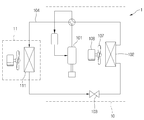
- Fig. 2 is a view illustrating flows of a refrigerant in the air conditioner including the solar cell according to the first embodiment.
- Fig. 3 is a perspective view illustrating a maximum light-receiving power generation operation of the air conditioner including the solar cell according to the first embodiment.
- Fig. 4 is a perspective view illustrating a minimum light-receiving power generation operation of an air conditioner including a solar cell according to a second embodiment.
- Fig. 5 is a side view illustrating the minimum light-receiving power generation operation of the air conditioner including the solar cell according to the second embodiment.
- Fig. 6 is a perspective view illustrating a maximum light-receiving power generation operation of the air conditioner including the solar cell according to the second embodiment.
- Fig. 7 is a side view illustrating the maximum light-receiving power generation operation of the air conditioner including the solar cell according to the second embodiment.
- Fig. 8 is a perspective view illustrating a solar power generation operation of an air conditioner including a solar cell according to a third embodiment.
- Fig. 9 is a side view illustrating the solar power generation operation of the air conditioner including the solar cell according to the third embodiment.
- Fig. 10 is a perspective view illustrating a stop of the solar power generation operation of the air conditioner including the solar cell according to the third embodiment.
- Fig. 11 is a side view illustrating the stop of the solar power generation operation of the air conditioner including the solar cell according to the third embodiment.
- Fig. 12 is a perspective view illustrating a solar power generation operation of an air conditioner including a solar cell according to a fourth embodiment.
- Fig. 13 is a side view illustrating the solar power generation operation of the air conditioner including the solar cell according to the fourth embodiment.
- Fig. 14 is a perspective view illustrating a stop of the solar power generation operation of the air conditioner including the solar cell according to the fourth embodiment.
- Fig. 15 is a perspective view illustrating a solar power generation operation of an air conditioner including a solar cell according to a fifth embodiment.
- Fig. 16 is a side view illustrating the solar power generation operation of the air conditioner including the solar cell according to the fifth embodiment.
- Fig. 17 is a perspective view illustrating a stop of the solar power generation operation of the air conditioner including the solar cell according to the fifth embodiment.
- Fig. 18 is a side view illustrating the stop of the solar power generation operation of the air conditioner including the solar cell according to the fifth embodiment.
- Fig. 1 is a perspective view illustrating a minimum light-receiving power generation operation of an air conditioner including a solar cell according to a first embodiment
- Fig. 2 is a view illustrating flows of a refrigerant in the air conditioner including the solar cell according to the first embodiment
- Fig. 3 is a perspective view illustrating a maximum light-receiving power generation operation of the air conditioner including the solar cell according to the first embodiment.
- an air conditioner 1 is equipped with a solar cell.
- the air conditioner 1 includes an outdoor unit 10 configured to exchange heat with outdoor air, a solar cell panel 22 configured to generate electricity from solar light, and a plurality of panel connection parts 23 configured to connect the solar cell panel 22 to the outdoor unit 10.
- the outdoor unit 10 may be connected to an indoor unit 11 which changes heat with indoor air and to refrigerant conduits 104, so that indoor air conditioning can be performed.
- the air conditioner 1 may include: a compressor 101 configured to compress a refrigerant; an indoor heat exchanger 111 in which the refrigerant exchanges heat with indoor air; an expansion part 103 configured to expand the refrigerant; an outdoor heat exchanger 102 in which the refrigerant exchanges heat with outdoor air; and refrigerant conduits 104 used to sequentially connect the compressor 101, the indoor heat exchanger 111, the expansion part 103, and the outdoor heat exchanger 102.
- a refrigeration cycle is repeated by circulating the refrigerant sequentially or reversely through the compressor 101, the indoor heat exchanger 111, the expansion part 103, and the outdoor heat exchanger 102, indoor air cooling or heating, that is, air conditioning can be performed.
- the compressor 101, the outdoor heat exchanger 102, and the expansion part 103 are disposed in the outdoor unit 10, and the indoor heat exchanger 111 is disposed in the indoor unit 11.
- two expansion parts 103 may be disposed in the outdoor unit 10 and the indoor unit 11, respectively, and the expansion parts 103 may be selectively used according to the flow direction of the refrigerant.
- a discharge outlet 100 may be formed in the front side of the outdoor unit 10 to discharge outdoor air, and a discharge grill 106 may be disposed on the discharge outlet 100 to prevent introduction of foreign particles into the outdoor unit 10.
- the outdoor heat exchanger 102, an outdoor fan 107 configured to blow outdoor air toward the outdoor heat exchanger 102, and a fan motor 108 may be disposed in the outdoor unit 10.
- the compressor 101 may be disposed in the outdoor unit 10.
- the solar cell panel 22 includes a solar battery capable of generating electricity by using solar light.
- a minimum unit of the solar battery may be referred to as a cell. That is, the solar cell panel 22 is an assembly of a plurality of solar cells 224.
- the solar cell panel 22 may include the solar cells 224, a glass attached to the front sides of the solar cells 224, and a back sheet attached to the rear sides of the solar cells 224.
- the solar cell panel 22 may further include: an infrared reflection film disposed between the solar cells 224 and the glass; a reflection film provided at the back sheet; and a refraction film disposed between the solar cells 224 and the back sheet.
- a region where the solar cells 224 are exposed through the glass may be defined as a power generation region 223, and the other region such as a side opposite to the side where the glass is attached may be defined as a power non-generation region. That is, when solar light is incident on the solar cells 224, electricity is generated in the power generation region 223 but not generated in the power non-generation region.
- the solar cell panel 22 is disposed on the topside of the outdoor unit 10.
- the solar cell panel 22 may be disposed on the topside of the outdoor unit 10 in a manner such that the panel connection parts 23 are connected to the topside of the outdoor unit 10 and the solar cell panel 22 is connected to the panel connection parts 23.
- the solar cell panel 22 includes first and second parts 221 and 222 that are slidably connected to each other.
- the first part 221 of the solar cell panel 22 is exposed to the outside, and the second part 222 is disposed at a position lower than the position of the first part 221 and is slidable in parallel with the first part 221.
- the first part 221 and the second part 222 include power generation regions 223, respectively.
- the power generation regions 223 of the first part 221 and the second part 222 are located on the topside of the first part 221 and the topside of the second part 222, respectively.
- the power generation region 223 of the first part 221 may always be exposed to the sun, and the power generation region 223 of the second part 222 may be at the rear side of the first part 221 or be exposed to the sun if the second part 222 is slid away from the first part 221. That is, according to the sliding of the first and second parts 221 and 222, the light-receiving area of the solar cell panel 22 can be varied. That is, a varying area of the power generation region 223 of the solar cell panel 22 can be exposed to the sun.
- the panel connection parts 23 are fixed to the topside of the outdoor unit 10, and in this state, the panel connection parts 23 supports the first and second parts 221 and 222 in a manner such that the first and second parts 221 and 222 can slide relative to each other.
- the panel connection parts 23 include guide parts 231 to guide movements of the first and second parts 221 and 222.
- the guide parts 231 are disposed on upper ends of the panel connection parts 23 at a predetermined oblique angle.
- the guide parts 231 include guide grooves 232 to guide the first and second parts 221 and 222 in a manner such that the first and second parts 221 and 222 can be moved back and forth relative to each other in an inclined direction.
- the guide grooves 232 are formed in lateral inner sides of the guide parts 231 so that both lateral ends of the first and second parts 221 and 222 can be accommodated in the guide grooves 232. Front and rear ends of the guide grooves 232 are opened so that the first and second parts 221 and 222 can be extended from and retracted into the guide grooves 232 in a state where the first and second parts 221 and 222 are accommodated in the guide grooves 232.
- the guide parts 231 may further include stoppers to limit sliding motions of the first and second parts 221 and 222 so that the first and second parts 221 and 222 cannot be detached from the guide parts 231.
- the light-receiving area of the solar cell panel 22 can be varied according to the necessary amount of power generation.
- the necessary amount of power generation is relatively small like the case of a minimum light-receiving power generation operation
- the first and second parts 221 and 222 may be slid to each other to block the power generation region 223 of the second part 222 and expose only the power generation region 223 of the first part 221 to the sun.
- the necessary amount of power generation is relatively large like the case of a maximum light-receiving power generation operation, the first and second parts 221 and 222 may be slid away from each other to expose both the power generation regions 223 of the first and second parts 221 and 222.
- the solar cell panel 22 may occupy less space because the first and second parts 221 and 222 are slid to each other.
- an air conditioner including a solar cell according to a second embodiment with reference to the accompanying drawings.
- a plurality of parts of a solar cell panel are configured to be folded by rotating the plurality of parts so that the light-receiving area of the solar cell panel can be varied.
- the same elements as those of the first embodiment will not be described again.
- Fig. 4 is a perspective view illustrating a minimum light-receiving power generation operation of an air conditioner including a solar cell according to a second embodiment
- Fig. 5 is a side view illustrating the minimum light-receiving power generation operation of the air conditioner including the solar cell according to the second embodiment
- Fig. 6 is a perspective view illustrating a maximum light-receiving power generation operation of the air conditioner including the solar cell according to the second embodiment
- Fig. 7 is a side view illustrating the maximum light-receiving power generation operation of the air conditioner including the solar cell according to the second embodiment.
- a solar cell panel 34 of the current embodiment includes a plurality of parts 341, 342, and 343.
- the parts 341, 342, and 343 are rotatably connected to each other so that the parts 341, 342, and 343 can be folded.
- the solar cell panel 34 includes a first part 341 that can be selectively placed on the topside of an outdoor unit 10, a second part 342 rotatably connected to a rear end of the first part 341, and a third part 343 rotatably connected to a front end of the second part 342.
- the first part 341 is the lowermost one of the plurality of parts 341, 342, and 343 and is selectively placed on the topside of the outdoor unit 10 as the plurality of parts 341, 342, and 343 are folded or extended.
- the second part 342 is rotatably hinged on a rear upper end of the first part 341 so that the second part 342 can be folded to a front upper side of the first part 341.
- the third part 343 is rotatably hinged on a front upper end of the second part 342 so that the third part 343 can be folded to a rear upper side of the second part 342.
- the third part 343 is the uppermost one of the plurality of parts 341, 342, and 343. The third part 343 is exposed to the sun regardless whether the plurality of parts 341, 342, and 343 are folded or extended.
- the plurality of parts 341, 342, and 343 may be connected to each other through electric wires so that electricity generated in the plurality of parts 341, 342, and 343 can be transmitted.
- Panel connection parts 35 include: first connection parts 351 rotatably connected to lateral front ends of the outdoor unit 10 and lateral front ends of the first part 341; second connection parts 352 rotatably connected to lateral rear ends of the outdoor unit 10 and lateral front ends of the second part 342; and third connection parts 353 rotatably connected to lateral sides of the second connection parts 352 and lateral rear ends of the third part 343.
- Five-bar linkages are formed by the outdoor unit 10, the first connection parts 351, the first part 341, the second part 342, and the second connection parts 352.
- the first and second parts 341 and 342 may be folded so that power generation regions 344 of the first and second parts 341 and 342 can face each other.
- Four-bar linkages are formed by the third connection parts 353, the third part 343, the second part 342, and the second connection parts 352.
- the second and third parts 342 and 343 may be folded so that power generation regions 344 of the second and third parts 342 and 343 can face each other.
- the solar cell panel 34 can be folded so that only the third part 343 of the plurality of parts 341, 342, and 343 can be exposed to the sun.
- the solar cell panel 34 can be extended so that all the power generation regions 344 of the plurality of parts 341, 342, and 343 can be exposed to the sun.
- the solar cell panel 34 further includes a support part 345 so that the power generation region 344 of the third part 343 can be positioned at a predetermined angle when the plurality of parts 341, 342, and 343 are folded.
- the shape of the support part 345 may be determined. For example, if the third part 343 is inclined forward at an angle of 45 , the sectional shape of the support part 345 may be an isosceles right triangle shape.
- the support part 345 may be disposed on at least one of the rear surfaces of the second and third parts 342 and 343.
- the light-receiving area of the solar cell panel 34 can be varied according to the necessary amount of power generation.
- the necessary amount of power generation is relatively small like the case of a minimum light-receiving power generation operation
- the plurality of parts 341, 342 and 343 may be folded to expose only the power generation region 344 of the third part 343 to the sun. That is, in the minimum light-receiving power generation operation, the first and second parts 341 and 342 may be rotated and folded so that the power generation regions 344 of the first and second parts 341 and 342 cannot be exposed.
- the plurality of parts 341, 342 and 343 may be extended to expose all the power generation regions 344 of the plurality of parts 341, 342 and 343 to the sun.
- the solar cell panel 34 may occupy less space because the plurality of parts 341, 342, and 343 are folded.
- a solar cell panel can be switched between a first disposition in which the solar cell panel can be operated and a second disposition in which the solar cell panel can be protected, according to the necessity of power generation.
- the same elements as those of the first embodiment will not be described again.
- Fig. 8 is a perspective view illustrating a solar power generation operation of an air conditioner including a solar cell according to a third embodiment
- Fig. 9 is a side view illustrating the solar power generation operation of the air conditioner including the solar cell according to the third embodiment.
- Fig. 10 is a perspective view illustrating a stop of the solar power generation operation of the air conditioner including the solar cell according to the third embodiment
- Fig. 11 is a side view illustrating the stop of the solar power generation operation of the air conditioner including the solar cell according to the third embodiment.
- a solar cell panel 42 of the current embodiment includes a plurality of parts (for example, first and second parts 421 and 422).
- the plurality of parts 421 and 422 are rotatably connected to each other so that the plurality of parts 421 and 422 can be folded.
- the plurality of parts 421 and 422 are rotatably connected by using a hinge.
- Each of the two panel connection parts 43 includes a first connection part 431 rotatably connected to the first part 421 of the plurality of parts 421 and 422 and an outdoor unit 10, and a second connection part 432 rotatably connected to the second part 422 of the plurality of parts 421 and 422 and the outdoor unit 10.
- the solar cell panel 42 can be switched between a first disposition in which power generation regions 423 of the solar cell panel 42 are exposed to the sun and a second disposition in which the power generation regions 423 are not exposed to the sun. That is, if the solar cell panel 42 is in the first disposition, the plurality of parts 421 and 422 are in an extended state. On the other hand, if the solar cell panel 42 is in the second disposition, the plurality of parts 421 and 422 are in a folded state so that the power generation regions 423 of the plurality of parts 421 and 422 can face each other.
- the first part 421 is positioned at a front side
- the second part 422 is positioned at a rear side.
- the rear end side of the first part 421 and the front end side of the second part 422 are rotatably connected to each other by using a hinge.
- the first and second parts 421 and 422 are positioned on the topside of the solar cell panel 42 so that the power generation regions 423 of the first and second parts 421 and 422 can be exposed to the sun.
- the rear end side of the first part 421 and the front end side of the second part 422 are coupled by using a hinge in a manner such that the first and second parts 421 and 422 can be rotated upward around the rear end side of the first part 421 and the front end side of the second part 422. That is, when the first and second parts 421 and 422 are folded, the power generation regions 423 of the first and second parts 421 and 422 face each other.
- first connection part 431 is rotatably connected to the front end side of the first part 421 and a side of the outdoor unit 10
- second connection part 432 is rotatably connected to the rear end side of the second part 422 and the other side of the outdoor unit 10.
- an end of the first connection part 431 is rotatably fixed to the front end side of the first part 421
- the other end of the first connection part 431 is rotatably fixed to the side of the outdoor unit 10.
- An end of the second connection part 432 is rotatably fixed to the rear end side of the second part 422, and the other end of the second connection part 432 is rotatably fixed to the other side of the outdoor unit 10.
- the other end of the first connection part 431 is fixed to the side of the outdoor unit 10 at a position ahead of the other end of the second connection part 432. Therefore, five-bar linkage is formed by the outdoor unit 10, the first part 421, the second part 422, the first connection part 431, and the second connection part 432, and the first and second parts 421 and 422 can be rotated to an extended or folded state.
- the plurality of parts 421 and 422 may be connected to each other through an electric wire so that electricity generated in the plurality of parts 421 and 422 can be transmitted.
- the first connection part 431 is shorter than the second connection part 432, and the length of the second connection part 432 is greater than the length of the lateral side of the second part 422. Therefore, when the first and second parts 421 and 422 are extended, the solar cell panel 42 faces forward and is inclined downwardly to receive more solar light.
- the first and second parts 421 and 422 can be rotated in a manner such that the second part 422 can be completely folded to the first part 421 and completely unfolded from the first part 421.
- the first disposition of the solar cell panel 42 is shown in Figs. 8 and 9.
- the second disposition of the solar cell panel 42 is shown in Figs. 10 and 11.
- the solar cell panel 42 can be switched between the first disposition and the second disposition according to the operation of the solar cell panel 42, that is, according to the necessity of power generation at the power generation regions 423.
- the solar cell panel 42 when the solar cell panel 42 is used, that is, when power generation is necessary at the power generation regions 423, the solar cell panel 42 is switched to and kept in the first disposition. Then, both the power generation regions 423 of the first and second parts 421 and 422 are exposed to the sun.
- the solar cell panel 42 is not used, that is, when power generation is not necessary at the power generation regions 423, the solar cell panel 42 is switched to and kept in the second disposition.
- the power generation regions 423 can be protected from external environments.
- the outdoor unit 10 of the air conditioner 1 is usually placed in an outdoor area, the power generation regions 423 of the solar cell panel 42 can be damaged due to various reasons such as bad weather, rain, and hail.
- the solar cell panel 42 is not used, and the solar cell panel 42 is switched to and kept in the first disposition to protect the power generation regions 423.
- a power generation region of a solar cell panel is selected screened by using a shield so that the light-receiving area of the power generation region of the solar cell panel can be varied or the power generation region of the solar cell panel can be protected.
- the same elements as those of the first embodiment will not be described again.
- Fig. 12 is a perspective view illustrating a solar power generation operation of an air conditioner including a solar cell according to a fourth embodiment
- Fig. 13 is a side view illustrating the solar power generation operation of the air conditioner including the solar cell according to the fourth embodiment
- Fig. 14 is a perspective view illustrating a stop of the solar power generation operation of the air conditioner including the solar cell according to the fourth embodiment.
- a solar cell panel 54 includes a shield 545 to selectively screen a power generation region 542.
- the solar cell panel 54 includes a panel 541 configured to generate electricity from solar light, an accommodation part 543 in which the panel 541 is placed, and a shield 545 used to selectively expose the panel 541 to the sun in a state where the panel 541 is accommodated in the accommodation part 543.
- the panel 541 is shaped like a rectangular flat plate and includes a power generation region 542 configured to generate electricity from incident solar light.
- the power generation region 542 is located on the topside of the panel 541.
- the accommodation part 543 has an inner space in which the panel 541 can be accommodated. In a state that the panel 541 is accommodated in the accommodation part 543, the topside of the accommodation part 543 is opened so that the power generation region 542 of the panel 541 can be exposed to the sun.
- the shield 545 can be slid along the topside of the accommodation part 543 to selectively expose the power generation region 542 to the sun.
- guide grooves 544 are formed in inner surfaces of an opening of the topside of the accommodation part 543 along the topside of the accommodation part 543 to guide the shield 545, such that the power generation region 542 of the panel 541 can be selective exposed opened to the sun by sliding the shield 545 along the guide grooves 544.
- a space 547 is formed in the rear and bottom sides of the accommodation part 543 so that the shield 545 can be selectively accommodated in the space 547 by sliding the shield 545 into the space 547.
- a space 548 of the panel 541 where the panel 541 is accommodated can be selectively opened and closed. That is, guide grooves 544 may be formed along the rear and bottom sides of the accommodation part 543.
- An handle 546 is provided on the topside of the shield 545 so that a user can slide the shield 545 by holding the handle 546.
- the solar cell panel 54 is connected to the topside of an outdoor unit 10 by a panel connection part 55.
- the panel connection part 55 connects the topside of the outdoor unit 10 and the bottom side of the accommodation part 543. Therefore, the solar cell panel 54 can be connected to the topside of the outdoor unit 10.
- the solar cell panel 54 can be switched between a first disposition in which the power generation region 542 of the solar cell panel 54 is exposed to the sun and a second disposition in which the power generation region 542 is not exposed to the sun.
- the first disposition of the solar cell panel 54 is shown in Figs. 12 and 13.
- the second disposition of the solar cell panel 54 is shown in Fig. 14.
- the shield 545 when the solar cell panel 54 is placed in the first disposition, the shield 545 may be slid along the guide grooves 544 of the accommodation part 543 into the space 547 of the accommodation part 543 and kept in the space 547. In addition, when the solar cell panel 54 is in the second disposition, the shield 545 may be slid along the guide grooves 544 of the accommodation part 543 to screen the opening of the topside of the accommodation part 543. That is, when the solar cell panel 54 is placed in the first disposition, the space 548 of the accommodation part 543 where the panel 541 is accommodated is not screened by the shield 545 so that the power generation region 542 can be exposed to the sun. In addition, when the solar cell panel 54 is placed in the first disposition, the space 548 of the accommodation part 543 where the panel 541 is accommodated is screened by the shield 545 so that the power generation region 542 cannot be exposed to the sun.
- the solar cell panel 54 when the solar cell panel 54 is not used, that is, when power generation at the power generation region 542 is not necessary, the solar cell panel 54 is switched to the second disposition to protect the power generation region 542 from external environments.
- the shield 545 screens the power generation region 542 of the solar cell panel 54 so that the power generation region 542 can be protected from external environments.
- a solar cell panel can be turned over to vary the light-receiving area of the solar cell panel or protect a power generation region of the solar cell panel.
- the same elements as those of the first embodiment will not be described again.
- Fig. 15 is a perspective view illustrating a solar power generation operation of an air conditioner including a solar cell according to a fifth embodiment
- Fig. 16 is a side view illustrating the solar power generation operation of the air conditioner including the solar cell according to the fifth embodiment
- Fig. 17 is a perspective view illustrating a stop of the solar power generation operation of the air conditioner including the solar cell according to the fifth embodiment
- Fig. 18 is a side view illustrating the stop of the solar power generation operation of the air conditioner including the solar cell according to the fifth embodiment.
- a solar cell panel 66 can be rotated upside down according to whether the solar cell panel 66 is used or not, and panel connection parts 67 connect the solar cell panel 66 to the topside of an outdoor unit 10.
- the solar cell panel 66 can be switched between a first disposition in which the power generation region 663 of the solar cell panel 66 is exposed to the sun and a second disposition in which the power generation region 663 is disposed in a direction opposite to the sun (that is, in a direction forward the outdoor unit 10).
- two panel connection parts 67 are provided which are connected to the solar cell panel 66 and ends of both sides of the outdoor unit 10.
- the panel connection parts 67 are rotatably fixed to rear ends of both sides of the outdoor unit 10.
- the panel connection parts 67 may have a fan shape and be centered on points fixed to the rear ends of both sides of the outdoor unit 10.
- front upper ends of the panel connection parts 67 are rotatably connected to the solar cell panel 66. At this time, at least one of a length from the front end of the solar cell panel 66 to a point of the solar cell panel 66 connected to the panel connection part 67 and a length from the point to the rear end of the solar cell panel 66 is shorter than a length from the rotation center of the panel connection part 67 (that is, a first point 671 of the panel connection part 67 connected to the outdoor unit 10) to a second point 672 of the panel connection part 67 connected to the solar cell panel 66. Therefore, the power generation region 663 and a power non-generation region 664 of the solar cell panel 66 can be freely turned over.
- a coupling part is provided at a third point 673 of the panel connection part 67 which corresponds to a lateral front end of the outdoor unit 10 when the solar cell panel 66 is placed in the first disposition
- a coupling part is provided at a fourth point 674 of the panel connection part 67 which corresponds to the lateral frond end of the outdoor unit 10 when the solar cell panel 66 is placed in the second disposition.
- the coupling parts may be coupling holes, and additional coupling members may be inserted into the outdoor unit 10 through the coupling holes. That is, when the solar cell panel 66 is placed in the first disposition, the solar cell panel 66 may be fixed to the outdoor unit 10 by inserting a coupling member into a coupling hole formed in the third point 673 of the panel connection part 67 and a side of the outdoor unit 10. In addition, when the solar cell panel 66 is placed in the second disposition, the solar cell panel 66 may be fixed to the outdoor unit 10 by inserting a coupling member into a coupling hole formed in the fourth point 674 of the panel connection part 67 and the side of the outdoor unit 10.
- a support part 665 may be provided on the power non-generation region 664, that is, on a side opposite to the power generation region 663, to support the solar cell panel 66 when the solar cell panel 66 is in the first disposition.
- the support part 665 makes contact with the topside of the outdoor unit 10 so that the solar cell panel 66 can be kept at a preset angle.
- the support part 665 may have a triangular sectional shape both sides of which make an angle of 45 with the power generation region 663. In this case, when the solar cell panel 66 is in the first disposition, since one side of the support part 665 makes contact with the topside of the outdoor unit 10, the power generation region 663 of the solar cell panel 66 can face forward at an upward angle of 45.
- the first arrangement of the solar cell panel 66 is shown in Figs. 15 and 16.
- the second arrangement of the solar cell panel 66 is shown in Figs. 17 and 18. That is, when the solar cell panel 66 is in the first disposition, the power generation region 663 is kept to face the sun, and when the solar cell panel 66 is in the second disposition, the power generation region 663 is kept to face a side opposite to the sun, that is, the topside of the outdoor unit 10.
- the solar cell panel 66 when the solar cell panel 66 is not used, that is, when power generation at the power generation region 663 is not necessary, the solar cell panel 66 is placed in the second disposition so that the power generation region 663 can be protected from external environments.
- the solar cell panel 66 when the solar cell panel 66 is not used, since the power generation region 663 of the solar cell panel 66 is kept to face the outdoor unit 10 (faces downward), the power generation region 663 can be prevented from being damaged by various causes such as rain and hail.
Landscapes
- Engineering & Computer Science (AREA)
- Chemical & Material Sciences (AREA)
- Combustion & Propulsion (AREA)
- Mechanical Engineering (AREA)
- General Engineering & Computer Science (AREA)
- Life Sciences & Earth Sciences (AREA)
- Sustainable Energy (AREA)
- Sustainable Development (AREA)
- Photovoltaic Devices (AREA)
Abstract
La présente invention concerne un appareil de conditionnement d'air doté d'une cellule solaire. L'appareil de conditionnement d'air comprend un panneau de cellules solaires qui peut alterner entre une première disposition, dans laquelle une zone de production d'énergie du panneau de cellules solaires est exposée au soleil, et une seconde disposition, dans laquelle la zone de production d'énergie n'est pas exposée au soleil. Par conséquent, ladite zone de production d'énergie du panneau de cellules solaires peut être protégée des environnements extérieurs.
Priority Applications (3)
| Application Number | Priority Date | Filing Date | Title |
|---|---|---|---|
| CN201080068868.5A CN103080659B (zh) | 2010-08-02 | 2010-12-28 | 具有太阳能电池的空调 |
| US13/813,713 US20130186120A1 (en) | 2010-08-02 | 2010-12-28 | Air conditioner with solar cell |
| EP10855678.8A EP2601450B1 (fr) | 2010-08-02 | 2010-12-28 | Appareil de conditionnement d'air doté d'une cellule solaire |
Applications Claiming Priority (2)
| Application Number | Priority Date | Filing Date | Title |
|---|---|---|---|
| KR10-2010-0074624 | 2010-08-02 | ||
| KR1020100074624A KR101710207B1 (ko) | 2010-08-02 | 2010-08-02 | 태양전지를 구비한 공기조화기 |
Publications (1)
| Publication Number | Publication Date |
|---|---|
| WO2012018165A1 true WO2012018165A1 (fr) | 2012-02-09 |
Family
ID=45559652
Family Applications (1)
| Application Number | Title | Priority Date | Filing Date |
|---|---|---|---|
| PCT/KR2010/009385 Ceased WO2012018165A1 (fr) | 2010-08-02 | 2010-12-28 | Appareil de conditionnement d'air doté d'une cellule solaire |
Country Status (5)
| Country | Link |
|---|---|
| US (1) | US20130186120A1 (fr) |
| EP (1) | EP2601450B1 (fr) |
| KR (1) | KR101710207B1 (fr) |
| CN (1) | CN103080659B (fr) |
| WO (1) | WO2012018165A1 (fr) |
Families Citing this family (12)
| Publication number | Priority date | Publication date | Assignee | Title |
|---|---|---|---|---|
| US9236751B2 (en) * | 2012-03-09 | 2016-01-12 | Aspect Solar Pte Ltd | Portable modular sun-tracking solar energy receiver system |
| US9612039B2 (en) * | 2013-05-14 | 2017-04-04 | Mobile Grid, Llc | Mobile solar power rack |
| FR3012581B1 (fr) * | 2013-10-24 | 2016-07-01 | Soler & Palau Res Sl | Caisson de ventilation mecanique controlee avec un panneau photovoltaique |
| CN106288444A (zh) * | 2016-08-11 | 2017-01-04 | 中国十七冶集团有限公司 | 一种太阳能一体化空调板 |
| JP2019124372A (ja) * | 2018-01-12 | 2019-07-25 | 三菱重工サーマルシステムズ株式会社 | 電源システム搭載型空気調和装置 |
| CN108809223B (zh) * | 2018-06-27 | 2020-04-24 | 宁波市自宏太阳能有限公司 | 一种空调室外机太阳能板的安装机构 |
| CN109162962A (zh) * | 2018-09-03 | 2019-01-08 | 珠海格力电器股份有限公司 | 出风设备 |
| CN112539189B (zh) * | 2020-12-02 | 2022-05-27 | 广东大粤新能源科技股份有限公司 | 一种环保型太阳能换气扇 |
| USD989271S1 (en) * | 2021-04-27 | 2023-06-13 | Dayn Amade Inventions Ltd. | Ventilating fan assembly with solar panels |
| CN114738909B (zh) * | 2022-03-09 | 2023-11-17 | 昆明同兴太阳能设备有限公司 | 一种利用太阳能双向驱动空气净化装置 |
| US12466506B2 (en) | 2022-09-26 | 2025-11-11 | Jahnkay Summons | Bicycle air conditioning assembly |
| CN117366697B (zh) * | 2023-11-29 | 2024-07-16 | 中规院城市更新(山东)有限公司 | 一种室外自发电的空调遮挡罩 |
Citations (6)
| Publication number | Priority date | Publication date | Assignee | Title |
|---|---|---|---|---|
| EP0576280A2 (fr) * | 1992-06-26 | 1993-12-29 | Sanyo Electric Co., Limited. | Méthode et dispositif de commande d'une installation de conditionnement d'air avec une cellule solaire |
| KR19980084194A (ko) * | 1997-05-21 | 1998-12-05 | 구자홍 | 태양전지를 이용한 에어컨의 구동용 전원공급장치 |
| KR20040085963A (ko) * | 2003-04-02 | 2004-10-08 | 엘지전자 주식회사 | 공기조화기 실외기의 전력공급장치 |
| JP2005249268A (ja) | 2004-03-03 | 2005-09-15 | Sanyo Electric Co Ltd | 分離型空気調和機の発電装置 |
| KR100629891B1 (ko) * | 2003-11-27 | 2006-09-29 | 산요덴키가부시키가이샤 | 공기조화장치 |
| KR20070010546A (ko) * | 2005-07-19 | 2007-01-24 | 엘지전자 주식회사 | 공기조화기의 실외기 |
Family Cites Families (10)
| Publication number | Priority date | Publication date | Assignee | Title |
|---|---|---|---|---|
| US5488801A (en) * | 1994-03-09 | 1996-02-06 | Nix; Martin E. | Solar appliances |
| US6101716A (en) * | 1998-02-12 | 2000-08-15 | Schulz; Steven L. | Evaporative cooler solar retrofit kit |
| US6134902A (en) * | 1999-01-14 | 2000-10-24 | Curry; Carline | Battery operated air conditioner |
| JP2004053149A (ja) * | 2002-07-22 | 2004-02-19 | Sanyo Electric Co Ltd | 空気調和装置 |
| US7476832B2 (en) * | 2006-06-29 | 2009-01-13 | Herb Vendig | Seasonally adjustable mounting system for solar panels having dual motor assembly |
| CN201126232Y (zh) * | 2007-11-05 | 2008-10-01 | 沈阳三洋空调有限公司 | 空调器的太阳能电源连接装置 |
| US7730676B2 (en) * | 2007-11-08 | 2010-06-08 | Wai Man Hon | Solar panel supporting system |
| CN201168970Y (zh) * | 2008-04-09 | 2008-12-24 | 陈忠华 | 太阳能剃须刀 |
| CN201328091Y (zh) * | 2008-12-25 | 2009-10-14 | 江苏派特科技发展有限公司 | 跟踪组合式太阳能移动电源系统 |
| CN101633304A (zh) * | 2009-08-21 | 2010-01-27 | 梁锋 | 车载太阳能罩 |
-
2010
- 2010-08-02 KR KR1020100074624A patent/KR101710207B1/ko active Active
- 2010-12-28 WO PCT/KR2010/009385 patent/WO2012018165A1/fr not_active Ceased
- 2010-12-28 EP EP10855678.8A patent/EP2601450B1/fr active Active
- 2010-12-28 US US13/813,713 patent/US20130186120A1/en not_active Abandoned
- 2010-12-28 CN CN201080068868.5A patent/CN103080659B/zh active Active
Patent Citations (6)
| Publication number | Priority date | Publication date | Assignee | Title |
|---|---|---|---|---|
| EP0576280A2 (fr) * | 1992-06-26 | 1993-12-29 | Sanyo Electric Co., Limited. | Méthode et dispositif de commande d'une installation de conditionnement d'air avec une cellule solaire |
| KR19980084194A (ko) * | 1997-05-21 | 1998-12-05 | 구자홍 | 태양전지를 이용한 에어컨의 구동용 전원공급장치 |
| KR20040085963A (ko) * | 2003-04-02 | 2004-10-08 | 엘지전자 주식회사 | 공기조화기 실외기의 전력공급장치 |
| KR100629891B1 (ko) * | 2003-11-27 | 2006-09-29 | 산요덴키가부시키가이샤 | 공기조화장치 |
| JP2005249268A (ja) | 2004-03-03 | 2005-09-15 | Sanyo Electric Co Ltd | 分離型空気調和機の発電装置 |
| KR20070010546A (ko) * | 2005-07-19 | 2007-01-24 | 엘지전자 주식회사 | 공기조화기의 실외기 |
Non-Patent Citations (1)
| Title |
|---|
| See also references of EP2601450A4 |
Also Published As
| Publication number | Publication date |
|---|---|
| CN103080659B (zh) | 2015-09-30 |
| KR101710207B1 (ko) | 2017-02-24 |
| CN103080659A (zh) | 2013-05-01 |
| EP2601450B1 (fr) | 2019-09-04 |
| US20130186120A1 (en) | 2013-07-25 |
| EP2601450A1 (fr) | 2013-06-12 |
| KR20120012588A (ko) | 2012-02-10 |
| EP2601450A4 (fr) | 2018-04-04 |
Similar Documents
| Publication | Publication Date | Title |
|---|---|---|
| WO2012018165A1 (fr) | Appareil de conditionnement d'air doté d'une cellule solaire | |
| WO2015072728A1 (fr) | Unité intérieure d'un climatiseur de type au plafond | |
| WO2015012588A1 (fr) | Unité d'intérieur de climatiseur et son procédé de raccordement de tuyau de fluide frigorigène | |
| WO2018225919A1 (fr) | Bloc-batterie | |
| WO2012148160A2 (fr) | Appareil de stockage de blocs-batteries et dispositif de refroidissement de blocs-batteries de stockage d'énergie utilisant cet appareil | |
| WO2021223106A1 (fr) | Armoire de dissipation de chaleur et dispositif de communication | |
| WO2019093583A1 (fr) | Climatiseur | |
| CN112557934B (zh) | 线束收缩轨迹可控的恒温式锂电池性能测试系统 | |
| WO2021137634A1 (fr) | Dispositif de stockage d'énergie et système de stockage d'énergie | |
| CN218732482U (zh) | 铠装移开式交流金属封闭开关设备 | |
| CN214412151U (zh) | 一种新型户外电缆分接箱 | |
| CN115407102A (zh) | 一种抗干扰能力强的室外电能表 | |
| CN217062919U (zh) | 一种多功能低压柜 | |
| KR101787098B1 (ko) | 태양전지를 구비한 공기조화기 | |
| CN114465100A (zh) | 一种防尘散热配电箱 | |
| CN117277175A (zh) | 一种用于电缆桥架安装的连接结构 | |
| CN220672735U (zh) | 电风扇 | |
| CN218276571U (zh) | 一种便携式光伏电站 | |
| CN214845937U (zh) | 一种光通信领域用多功能光缆分纤箱 | |
| CN113193488B (zh) | 储能装置、控制系统、控制方法及发电系统 | |
| CN219644356U (zh) | 一种通讯信息防潮箱 | |
| CN221767619U (zh) | 一种便携储能电源 | |
| CN220822245U (zh) | 一种用于高压开关柜的防雨装置 | |
| CN214411983U (zh) | 一种具有环境监测功能的变电箱 | |
| WO2019177214A1 (fr) | Unité extérieure pour climatiseur |
Legal Events
| Date | Code | Title | Description |
|---|---|---|---|
| WWE | Wipo information: entry into national phase |
Ref document number: 201080068868.5 Country of ref document: CN |
|
| 121 | Ep: the epo has been informed by wipo that ep was designated in this application |
Ref document number: 10855678 Country of ref document: EP Kind code of ref document: A1 |
|
| NENP | Non-entry into the national phase |
Ref country code: DE |
|
| WWE | Wipo information: entry into national phase |
Ref document number: 2010855678 Country of ref document: EP |
|
| WWE | Wipo information: entry into national phase |
Ref document number: 13813713 Country of ref document: US |