WO2012020794A1 - Système de communication, dispositif de transmission, dispositif de réception, procédé de communication et programme d'ordinateur - Google Patents
Système de communication, dispositif de transmission, dispositif de réception, procédé de communication et programme d'ordinateur Download PDFInfo
- Publication number
- WO2012020794A1 WO2012020794A1 PCT/JP2011/068263 JP2011068263W WO2012020794A1 WO 2012020794 A1 WO2012020794 A1 WO 2012020794A1 JP 2011068263 W JP2011068263 W JP 2011068263W WO 2012020794 A1 WO2012020794 A1 WO 2012020794A1
- Authority
- WO
- WIPO (PCT)
- Prior art keywords
- transmission
- unit
- value
- format
- frame
- Prior art date
- Legal status (The legal status is an assumption and is not a legal conclusion. Google has not performed a legal analysis and makes no representation as to the accuracy of the status listed.)
- Ceased
Links
Images





Classifications
-
- H—ELECTRICITY
- H04—ELECTRIC COMMUNICATION TECHNIQUE
- H04J—MULTIPLEX COMMUNICATION
- H04J3/00—Time-division multiplex systems
- H04J3/16—Time-division multiplex systems in which the time allocation to individual channels within a transmission cycle is variable, e.g. to accommodate varying complexity of signals, to vary number of channels transmitted
- H04J3/1605—Fixed allocated frame structures
- H04J3/1611—Synchronous digital hierarchy [SDH] or SONET
- H04J3/1617—Synchronous digital hierarchy [SDH] or SONET carrying packets or ATM cells
-
- H—ELECTRICITY
- H04—ELECTRIC COMMUNICATION TECHNIQUE
- H04L—TRANSMISSION OF DIGITAL INFORMATION, e.g. TELEGRAPHIC COMMUNICATION
- H04L12/00—Data switching networks
- H04L12/64—Hybrid switching systems
- H04L12/6418—Hybrid transport
Definitions
- the present invention relates to a data transmission / reception technique.
- GFP Generic Framing Procedure
- SONET / SDH Synchronous Optical Network / Synchronous Digital Hierarchy
- Ethernet registered trademark
- the GFP transmission device receives an Ethernet (registered trademark) frame or the like, and confirms the normality of the frame by an FCS check or the like.
- the GFP transmission apparatus stores the received Ethernet (registered trademark) frame in the client payload information (Client Payload Information) field of the GFP client frame, and generates a GFP client frame. Then, the GFP transmission device transmits a GFP client frame to the transmission path.
- an object of the present invention is to provide a technique that enables effective use of a transmission path band when data is transmitted after converting a format.
- One aspect of the present invention is a communication system including a transmission device and a reception device that transmit and receive data via a transmission line, and the transmission device changes a format of data to be transmitted to a format according to the transmission line.
- a format conversion unit to convert, a value of a predetermined field included in the transmission target data, and a transmission-side storage unit that associates and stores identification information; and the transmission target before or after conversion by the format conversion unit Delete the value of the predetermined field of data and generate reduced data by storing the identification information stored in the transmission side storage unit in the transmission target data in association with the value of the predetermined field to be deleted
- a compression unit that transmits the reduced data generated by the compression unit to the reception device via the transmission path,
- the receiving device includes a receiving unit that receives the reduced data from the transmitting device via the transmission path, a format restoring unit that restores a format corresponding to the transmission path to a format of the transmission target data, and the transmission A reception-side storage unit that stores the value of the predetermined field stored in
- One aspect of the present invention is the transmission device of a communication system including a transmission device and a reception device that transmit and receive data via a transmission line, and converts a format of transmission target data into a format corresponding to the transmission line
- the format conversion unit, the transmission side storage unit that stores the value of the predetermined field included in the transmission target data and the identification information in association with each other, and the transmission target data before or after conversion by the format conversion unit Of the predetermined field is deleted, and reduced data is generated by storing the identification information stored in the transmission-side storage unit in the transmission target data in association with the value of the predetermined field to be deleted
- the compression unit and the reduced data generated by the compression unit are reduced from the transmission device via the transmission path and from the transmission device.
- a receiving unit that receives data, a format restoring unit that restores a format corresponding to the transmission path to a format of the transmission target data, a value of the predetermined field stored in the transmission-side storage unit, and the identification information And a value of the predetermined field stored in the reception-side storage unit in association with the identification information stored in the reduced data before or after restoration by the format restoration unit
- a transmitting unit that transmits the data to the receiving device.
- One aspect of the present invention is the reception device of a communication system including a transmission device and a reception device that transmit and receive data via a transmission line, and converts a format of transmission target data into a format according to the transmission line.
- One aspect of the present invention is a transmission device including a transmission-side storage unit that performs transmission / reception of data via a transmission line and stores a value of a predetermined field included in transmission target data and identification information in association with each other;
- a communication apparatus comprising: a reception device including a reception storage unit that stores the value of the predetermined field and the identification information stored in the transmission storage unit, wherein the transmission device transmits A format conversion step of converting the format of the target data into a format corresponding to the transmission path; and the transmission device deletes the value of the predetermined field of the transmission target data before or after the conversion by the format conversion step.
- the identification information stored in the transmission-side storage unit in association with the value of the predetermined field to be deleted is stored in the transmission target data.
- a compression step for generating reduced data a transmission step for the transmission device to transmit the reduced data generated by the compression step to the reception device via the transmission path, and the reception device, A reception step of receiving the reduced data from the transmission device via a transmission path; a format restoration step in which the reception device restores a format corresponding to the transmission path to a format of the transmission target data; and the reception device Is an expansion step of assigning the value of the predetermined field stored in the reception-side storage unit in association with the identification information stored in the reduced data to the data before or after the restoration by the format restoration step And having.
- One aspect of the present invention is a transmission device including a transmission-side storage unit that performs transmission / reception of data via a transmission line and stores a value of a predetermined field included in transmission target data and identification information in association with each other;
- a transmission-side storage unit that performs transmission / reception of data via a transmission line and stores a value of a predetermined field included in transmission target data and identification information in association with each other;
- a receiving device comprising a receiving storage unit for storing the value of the predetermined field stored in the transmitting storage unit and the identification information
- a format of data to be transmitted is provided in the transmission path.
- a format conversion step for converting to a corresponding format, and deleting a value of the predetermined field of the transmission target data before or after conversion by the format conversion step, and associating with the value of the predetermined field to be deleted A compression step of generating reduced data by storing the identification information stored in the transmission-side storage unit in the transmission target data
- a format restoration step for restoring the format according to the path to the format of the transmission target data, and the value of the predetermined field stored in the reception-side storage unit in association with the identification information stored in the reduced data Is a computer program for executing the development step of assigning to the data before or after restoration by the format restoration step.
- the transmission path band when the format is converted and data is transmitted, the transmission path band can be used effectively.
- movement of a communication apparatus It is a flowchart showing the flow of operation
- movement of a communication apparatus It is a flowchart showing the modification of the operation
- FIG. 1 is a diagram illustrating a system configuration of the communication system 1.
- the communication system 1 includes a plurality of communication devices 10.
- the communication devices 10 are connected to each other via a transmission line 20 so that they can communicate with each other.
- the transmission path 20 may be configured as a wired transmission path, or may be configured as a wireless transmission path.
- the transmission line 20 may be configured as a SONET / SDH (Synchronous Optical Network / Synchronous Digital Hierarchy) network.
- the communication device 10 receives an Ethernet (registered trademark) frame from an Ethernet (registered trademark) work, and generates another frame including the Ethernet (registered trademark) frame.
- Other frames include a GFP client frame, a reduced GFP client frame, and a registration GFP client frame.
- the GFP client frame is a frame generated by applying an existing GFP (Generic Framing Protocol) technology.
- the reduced GFP client frame does not include data corresponding to a client header described later. Therefore, the reduced GFP client frame has a smaller data amount than the frame generated by applying the existing GFP technology. For this reason, transmission using the reduced GFP client frame makes it possible to effectively use the transmission path band as compared with the case of transmitting using a normal GFP client frame.
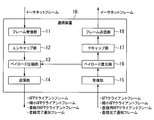
- FIG. 2 is a schematic block diagram showing the functional configuration of the communication device 10.
- the communication device 10 includes a CPU (Central Processing Unit) connected via a bus, a memory, an auxiliary storage device, and the like, and executes a communication program.
- the communication device 10 functions as a device including a frame reception unit 11, an encap unit 12, a payload compression unit 13, a transmission unit 14, a reception unit 15, a payload restoration unit 16, a decap unit 17, and a frame transmission unit 18. All or some of the functions of the communication device 10 may be realized using hardware such as ASIC (Application Specific Integrated Circuit), PLD (Programmable Logic Device), and FPGA (Field Programmable Gate Array).
- the communication program may be recorded on a computer-readable recording medium.
- the computer-readable recording medium is, for example, a portable medium such as a flexible disk, a magneto-optical disk, a ROM, a CD-ROM, or a storage device such as a hard disk built in the computer system.
- the communication program may be transmitted via a telecommunication line.
- the frame receiving unit 11 receives an Ethernet (registered trademark) frame from an Ethernet (registered trademark) work.
- the Ethernet (registered trademark) frame is data that flows on the Ethernet (registered trademark), and is data having a format defined by the standard.
- the frame receiving unit 11 removes the preamble of the frame delimiter from the received Ethernet (registered trademark) frame.
- the frame reception unit 11 confirms the normality of the Ethernet (registered trademark) frame based on a CRC (Cyclic Redundancy Check) included in the FCS (Frame Check Sequence) field of the received Ethernet (registered trademark) frame.
- the frame receiving unit 11 sends an Ethernet (registered trademark) frame having no problem in normality to the encap unit 12.
- the encap unit 12 When receiving the Ethernet (registered trademark) frame from the frame receiving unit 11, the encap unit 12 performs encapsulation according to the GFP client frame format on the Ethernet (registered trademark) frame. At this time, the encap unit 12 removes the value of the FCS field included in the Ethernet (registered trademark) frame and encapsulates it. By this encapsulation processing, a GFP client frame including an Ethernet (registered trademark) frame (excluding the value of the FCS field) is generated. The encap unit 12 sends the generated GFP client frame to the payload compressor 13. Thus, the encap unit 12 functions as at least a format conversion unit.
- the payload compression unit 13 When the payload compression unit 13 receives the GFP client frame from the encap unit 12, the payload compression unit 13 performs compression processing on the GFP client frame that satisfies the condition, and generates a reduced GFP client frame. On the other hand, the payload compression unit 13 does not perform compression processing on GFP client frames that do not satisfy the conditions. The payload compression unit 13 sends a frame such as a reduced GFP client frame to the transmission unit 14.
- the transmission unit 14 When the transmission unit 14 receives a reduced GFP client frame or the like from the payload compression unit 13, the transmission unit 14 transmits a frame such as a reduced GFP client frame to another communication apparatus 10 via the transmission path 20.
- the receiving unit 15 receives a frame such as a reduced GFP client frame from another communication apparatus 10 via the transmission path 20.
- the receiving unit 15 confirms the normality of the frame based on the CRC included in the Optional Payload FCS field of the received frame.
- the receiving unit 15 sends a frame having no problem in normality to the payload restoring unit 16.
- the payload restoration unit 16 restores the GFP client frame before the compression process is performed by performing a restoration process on the reduced GFP client frame.
- the payload restoration unit 16 sends the GFP client frame to the decap unit 17.
- the decapping unit 17 extracts data from the Client Payload Information field of the GFP client frame and adds an FCS field.
- the decap unit 17 calculates a CRC based on the extracted data, and stores the calculated CRC in the FCS field.
- the decapping unit 17 sends the generated Ethernet (registered trademark) frame to the frame transmission unit 18.
- the decap unit 17 functions as at least a format restoration unit.
- the frame transmitting unit 18 transmits the Ethernet (registered trademark) frame to the Ethernet (registered trademark) work.
- FIG. 3 is a diagram showing the configuration of the GFP client frame format.
- Reference numerals 911 to 914 shown in FIG. 3 all represent GFP client frame formats.
- the GFP client frame format is roughly divided into Core Header and Payload Area.
- Core Header is further divided into Length and cHEC.
- the Payload Area is further divided into Payload Header, Client Payload Information, and Optional Payload FCS.
- Payload Header is further divided into Type, type HEC, Ext. Header, and Ext. HEC.
- Type is divided into PTI, PFI, EXI, and UPI.
- the encap unit 12 performs the encapsulation by storing the Ethernet (registered trademark) frame from which the value of the FCS field is removed in the Client Payload Information field.
- FIG. 4 is a schematic block diagram showing a functional configuration of the payload compression unit 13.
- the payload compression unit 13 includes a payload compression table 131, a table control unit 132, a compressibility determination unit 133, and a compression processing unit 134.
- the compression table storage unit 131 is configured using a magnetic hard disk device, a semiconductor storage device, or the like.
- the compression table storage unit 131 stores a compression table.
- the compression table storage unit 131 functions as at least a transmission side storage unit.
- the table control unit 132 controls the contents of the compression table stored in the compression table storage unit 131.
- the table control unit 132 functions as at least a transmission side registration unit.
- Compressibility determination unit 133 determines whether or not compression processing unit 134 should perform compression processing based on the contents of the compression table. That is, the compressibility determination unit 133 determines whether or not to generate a reduced GFP client frame by performing compression processing on the GFP client frame received from the encap unit 12. Further, the compressibility determination unit 133 also determines whether or not a registration request should be made based on the contents of the compression table.
- the compression processing unit 134 performs compression processing on the GFP client frame based on the content of the compression table when the compression possibility determination unit 133 determines that compression processing should be performed.
- a reduced GFP client frame is generated by the compression processing of the compression processing unit 134.
- the compression processing unit 134 generates a GFP client frame for registration when the compression availability determination unit 133 determines that a registration request should be made.
- the format of the registration GFP client frame is the same as the GFP client frame format shown in FIG.
- the compression processing unit 134 functions as at least a compression unit and a registration notification unit.
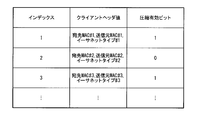
- FIG. 5 is a diagram illustrating a specific example of the compression table.
- the compression table has a single record associating values of items such as an index, a client header value, and a compression effective bit.
- the index is identification information given to each record of the table without duplication.
- the compression effective bit indicates whether or not the value of each record is reflected in the payload restoring unit 16 of the communication device 10 on the receiving side. In other words, the compression effective bit indicates whether or not to perform compression processing using the value of each record.
- the compression effective bit whose value is “1” indicates that the record is reflected in the payload restoring unit 16 of the communication device 10 on the receiving side. That is, a compression effective bit having a value of “1” indicates that compression processing is performed using the value of the record.
- the compression effective bit having a value of “0” indicates that the record is not reflected in the payload restoring unit 16 of the communication device 10 on the receiving side. That is, a compression effective bit having a value of “0” indicates that compression processing is not performed using the value of the record.
- the client header value is one or a plurality of values (hereinafter referred to as “client header value”) stored in the Ethernet (registered trademark) frame. Which value is the client header value among the values stored in the Ethernet (registered trademark) frame is set in advance by the designer or user of the communication apparatus 10. For example, some or all of the values stored in the header field of the Ethernet (registered trademark) frame may be set as the client header value.
- the values stored in the header field of the Ethernet (registered trademark) frame are values such as a destination MAC (Media Access Control) address, a source MAC address, an Ethernet (registered trademark) type, and the like.
- the value is stored in the payload field of the Ethernet (registered trademark) frame, some or all of the values stored in the header field in other layer formats (IP packet format, etc.) It may be set as a header value.
- the values stored in the header field in the other layer format are values such as a destination IP (Internet Protocol) address, a source IP address, a protocol number, a service type, and the like.
- a combination of header field values in different layer formats may be set as the client header value.
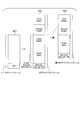
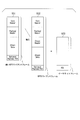
- FIG. 6 is a diagram illustrating an outline of compression processing by the compression processing unit 134.
- Reference numeral 921 represents an Ethernet (registered trademark) frame. As described above, the Ethernet® frame has an FCS field.
- Reference numeral 922 represents a GFP client frame. As described above, the Ethernet (registered trademark) frame (excluding the FCS field) is stored in the Client Payload Information field of the GFP client frame. The registration GFP client frame is also represented by reference numeral 922, and an Ethernet (registered trademark) frame (excluding the FCS field) is stored in the Client Payload Information field.
- Numeral 923 represents a reduced GFP client frame.
- the reduced GFP client frame differs from the GFP client frame in that it does not have a value of the Client Header (client header) field (client header value). Thus, since the reduced GFP client frame does not have a client header value, the data size is smaller than that of the GFP client frame.
- the compression processing unit 134 When performing compression processing, the compression processing unit 134 generates a reduced GFP client frame by deleting the client header value of the GFP client frame received from the encap unit 12.
- the compression processing unit 134 stores the index value of the record that matches the deleted client header value (hereinafter referred to as “index value”) in the record index field of the reduced GFP client frame.
- the record index field may be any field of the reduced GFP client frame.
- the Core Header field or Payload Header field of the reduced GFP client frame may be a record index field.
- the Type field of Payload Header may be a record index field.
- the UPI field of the Type field may be a record index field.
- the lower 4 bits of the UPI field may be a record index field. If the index value is expressed in decimal or hexadecimal, the compression processing unit 134 may convert the index value to binary and embed it in the record index field.
- FIG. 7 is a schematic block diagram illustrating a functional configuration of the payload restoration unit 16.
- the payload restoration unit 16 includes a frame type determination unit 161, a payload restoration table 162, a table control unit 163, and a restoration processing unit 164.
- the frame type determination unit 161 determines the type of the frame received by the reception unit 15.
- the restoration table storage unit 162 is configured using a magnetic hard disk device, a semiconductor storage device, or the like.
- the restoration table storage unit 162 stores a restoration table.
- the restoration table storage unit 162 functions at least as a reception side storage unit.
- the table control unit 163 controls the contents of the restoration table stored in the restoration table storage unit 162.
- the table control unit 163 functions as at least a receiving side registration unit.
- the restoration processing unit 164 performs restoration processing based on the contents of the restoration table, and restores a GFP client frame from the received reduced GFP client frame.
- the restoration processing unit 164 functions as at least a developing unit.
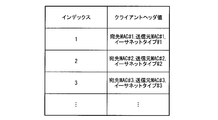
- FIG. 8 is a diagram showing a specific example of the restoration table.
- the restoration table has an index value and a client header value associated with each other as one record.
- the meaning represented by each item in the restoration table is the same as the meaning represented by the item of the same name in the compression table.
- the combination of the index value and the client header value registered in the restoration table is the same as the combination of the index value and the client header value included in the registration GFP client frame.
- the combination of the index value and the client header value included in the registration GFP client frame is the index value registered in the compression table of the payload compression unit 13 of the communication apparatus 10 that is the transmission source of the registration GFP client frame. Same as combination with client header value. Therefore, although there is a time lag in the restoration table, a record having the same content as the compression table of the payload compression unit 13 of the communication apparatus 10 connected via the transmission path 20 (except the value of the compression effective bit) is included. be registered.
- FIG. 9 is a diagram illustrating an outline of the restoration process by the restoration processing unit 164.
- Reference numeral 931 represents a reduced GFP client frame.
- the reduced GFP client frame differs from the GFP client frame in that it does not have a value of the Client Header (client header) field (client header value).
- the restoration processing unit 164 restores the GFP client frame by adding a client header value to the reduced GFP client frame.
- the restoration processing unit 164 reads a client header value that matches the index value stored in the record index field of the reduced GFP client frame from the restoration table. Then, the restoration processing unit 164 adds the read client header value to the reduced GFP client frame.
- Reference numeral 932 represents a GFP client frame restored by the restoration processing unit 164.
- an Ethernet (registered trademark) frame (except for the FCS field) is stored in the Client Payload Information field of the GFP client frame.
- Reference numeral 933 represents an Ethernet (registered trademark) frame.
- the Ethernet® frame is restored by adding the FCS field to the data stored in the Client ⁇ Payload Information field of the GFP client frame. This process is performed by the decap unit 17.
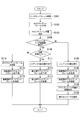
- FIG. 10 is a flowchart showing an operation flow at the time of data transmission to the transmission line 20 among the operations of the communication apparatus 10.
- the frame receiving unit 11 receives an Ethernet (registered trademark) frame (step S101).
- the encap unit 12 generates a GFP client frame using the received Ethernet (registered trademark) frame.
- the payload compression unit 13 receives the GFP client frame, and the compressibility determination unit 133 determines whether or not compression is possible.
- the compressibility determination unit 133 extracts a client header value from the GFP client frame (step S103).
- the compressibility determination unit 133 refers to the compression table and determines whether or not a record that matches the extracted client header value is registered (step S104).
- step S104 If no record that matches the extracted client header value is registered (step S104—NO), the compressibility determination unit 133 issues a new index value for the client header value (step S105).
- the compression availability determination unit 133 notifies the compression processing unit 134 of a determination result indicating that compression processing is not performed and a newly issued index value.
- the compression processing unit 134 Upon receiving this notification, the compression processing unit 134 generates a registration GFP client frame (step S106).
- the compression processing unit 134 stores data representing a GFP client frame for registration in the frame status field of the GFP client frame.
- the stored data is a predetermined bit string, for example, “1000”.
- the frame status field may be any field of the GFP client frame.
- the Core Header field or the Payload Header field may be a frame status field.
- the frame status field may be a Type field of Payload Header.
- the frame status field may be the UPI field of the Type field.
- the upper 4 bits of the UPI field may be a frame status field.
- the compression processing unit 134 embeds the index value notified from the compression possibility determination unit 133 in the record index field of the GFP client frame. Through the above processing, a registration GFP client frame is generated.
- the compression processing unit 134 calculates the CRC of the GFP client frame for registration, and stores the calculated value in the Optional Payload FCS field. Then, the compression processing unit 134 sends the registration GFP client frame to the transmission unit 14 without deleting the client header value. Thereafter, the transmission unit 14 transmits the GFP client frame for registration to the other communication device 10 via the transmission path 20 (step S107).
- the compressibility determination unit 133 instructs the table control unit 132 to register the newly issued index value and client header value as a new record (step S108).
- the table control unit 132 registers the client header value and the index value as one record in the compression table (step S109). At this time, the table control unit 132 sets the value of the compression effective bit of the newly registered record to “0”.
- step S104 when a record that matches the extracted client header value is registered (step S104—YES), the compressibility determination unit 133 determines whether the value of the compression effective bit of this record is “1”. (Step S110). When the value of the compression effective bit is “1” (step S110—YES), the compressibility determination unit 133 reads the index value of this record from the compression table (step S111). The compression availability determination unit 133 notifies the compression processing unit 134 of a determination result indicating that compression processing is performed and the index value of this record.
- the compression processing unit 134 Upon receiving this notification, the compression processing unit 134 generates a reduced GFP client frame (step S112). Specifically, the compression processing unit 134 deletes the client header value from the GFP client frame. In addition, the compression processing unit 134 stores data representing a reduced GFP client frame in the frame status field. Data representing a reduced GFP client frame is a predetermined bit string, for example, “1001”. Further, the compression processing unit 134 stores the index value notified from the compressibility determination unit 133 in the record index field. A reduced GFP client frame is generated by such compression processing of the compression processing unit 134.
- the compression processing unit 134 calculates the CRC of the reduced GFP client frame, and stores the calculated value in the Optional Payload FCS field. Then, the compression processing unit 134 sends the reduced GFP client frame to the transmission unit 14. Thereafter, the transmission unit 14 transmits the reduced GFP client frame to the other communication device 10 via the transmission path 20 (step S113).
- step S110 when the value of the compression effective bit is “0” (step S110—NO), the compression availability determination unit 133 obtains an index value corresponding to the record that matches the extracted client header value from the compression table. read out.
- the compression availability determination unit 133 notifies the compression processing unit 134 of a determination result indicating that compression processing is not performed and the read index value.
- the compression processing unit 134 Upon receiving this notification, the compression processing unit 134 generates a registration GFP client frame (step S115).
- the compression processing unit 134 calculates the CRC of the GFP client frame for registration, and stores the calculated value in the Optional Payload FCS field. Then, the compression processing unit 134 sends the registration GFP client frame to the transmission unit 14 without deleting the client header value. Thereafter, the transmission unit 14 transmits the GFP client frame for registration to the other communication device 10 via the transmission path 20 (step S116).
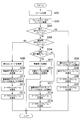
- FIG. 11 is a flowchart showing an operation flow when data is received from the transmission path 20 among the operations of the communication apparatus 10.
- the receiving unit 15 receives a frame from the transmission path 20 (step S201).
- the frame type determination unit 161 of the payload restoration unit 16 refers to the frame status field of the received frame and determines the frame type (step S202). For example, when the value of the frame status field (for example, the upper 4 bits of the UPI field) is “1000”, the frame type determination unit 161 determines that the received frame is a GFP client frame for registration. In addition, when the value of the frame status field is “1001”, the frame type determination unit 161 determines that the received frame is a reduced GFP client frame.
- the frame type determination unit 161 determines that the received frame is a registration completion notification frame.
- the frame type determination unit 161 determines that the received frame is a normal GFP client frame when the value of the frame status field is not “1000”, “1001”, or “0110”.
- the frame type determination unit 161 notifies the restoration processing unit 164 that the received frame is a reduced GFP client frame (step S203). S204).
- the restoration processing unit 164 extracts an index value from the record index field.
- the restoration processing unit 164 reads a client header value corresponding to the extracted index value from the restoration table.
- the restoration processing unit 164 restores the normal GFP client frame by adding the read client header value to the reduced GFP client frame (step S205).
- the restoration processing unit 164 sends the restored GFP client frame to the decap unit 17.
- the decap unit 17 deletes Core Header, Payload Header, and Optional Payload FCS.
- the decap unit 17 calculates the CRC based on the deleted data.
- the decap unit 17 then adds the calculated CRC value as the FCS field value to the deleted data.
- the decap unit 17 restores the Ethernet (registered trademark) frame (step S206).
- the Ethernet (registered trademark) frame restored by the decap unit 17 is transmitted to the Ethernet (registered trademark) work by the frame transmitting unit 18 (step S207).
- the frame type determination unit 161 extracts a client header value from the client header field of the registration GFP client frame.
- the frame type determination unit 161 also extracts an index value from the record index field of the registration GFP client frame.
- the frame type determination unit 161 transmits a record registration instruction to the table control unit 163 together with the extracted client header value and index value.
- the table control unit 163 registers the combination of the client header value and the index value received from the frame type determination unit 161 as one new record in the restoration table (step S209).
- the table control unit 163 When the registration is completed, the table control unit 163 generates a registration completion notification frame including the index value of the newly registered record. Then, the table control unit 163 transmits a registration completion notification frame to the communication apparatus 10 that has transmitted the registration GFP client frame via the transmission unit 14 (step S210).
- the frame type determination unit 161 notifies the restoration processing unit 164 that the received frame is a registration GFP client frame (step S211).
- the restoration processing unit 164 sends the received registration GFP client frame to the decap unit 17 as it is.
- the decap unit 17 deletes Core Header, Payload Header, and Optional Payload FCS.
- the decap unit 17 calculates the CRC based on the deleted data.
- the decap unit 17 then adds the calculated CRC value as the FCS field value to the deleted data.
- the decap unit 17 restores the Ethernet (registered trademark) frame (step S212).
- the Ethernet (registered trademark) frame restored by the decapping unit 17 is transmitted to the Ethernet (registered trademark) work by the frame transmitting unit 18 (step S213).
- the frame type determination unit 161 extracts an index value from the registration completion notification frame. Then, the frame type determination unit 161 transmits a registration completion notification together with the index value to the table control unit 132 of the payload compression unit 13 (step S215). The table control unit 132 rewrites the compression effective bit of the record corresponding to the index value received from the frame type determination unit 161 from “0” to “1” (step S216).
- the frame type determination unit 161 sends the received frame to the restoration processing unit 164.
- the GFP client frame is notified (step S217).
- the restoration processing unit 164 sends the received GFP client frame to the decap unit 17 as it is.
- the decap unit 17 deletes Core Header, Payload Header, and Optional Payload FCS. Further, the decap unit 17 calculates the CRC based on the deleted data. The decap unit 17 then adds the calculated CRC value as the FCS field value to the deleted data.
- the decap unit 17 restores the Ethernet (registered trademark) frame (step S218).
- the Ethernet (registered trademark) frame restored by the decapping unit 17 is transmitted to the Ethernet (registered trademark) work by the frame transmitting unit 18 (step S219).
- the communication system 1 when an Ethernet (registered trademark) frame is transmitted based on the GFP client frame format, a part of the GFP client frame is transmitted as a reduced GFP client frame.
- the data size of the reduced GFP client frame is smaller than the data size of a normal GFP client frame.
- the reduced GFP client frame has a smaller data size because the client header value portion is deleted. Therefore, it is possible to effectively use the transmission line bandwidth in the transmission line 20.
- Ethernet registered trademark
- transmission source MAC address a data interface
- Ethernet registered trademark
- Ethernet (registered trademark) type a client header field
- a maximum of 20% (Ethernet (registered trademark) frame is 64 bytes). This can contribute to a decrease in the line usage rate in the case of long).
- the compression effective bit remains “0” until the contents of the record registered in the compression table (combination of the index value and the client header value) are reflected in the restoration table, and the record is used.
- the compression process is not performed. Therefore, it is possible to prevent the compression process from being performed using a record not registered in the restoration table. That is, it is possible to prevent the reduced processing unit 164 from transmitting a reduced GFP client frame that cannot be restored. In order to obtain such an effect, it is not always necessary to transmit / receive the registration completion notification frame as described above.
- the table control unit 132 may be configured to rewrite the compression effective bit from “0” to “1” when a predetermined time has elapsed since the transmission of the registration GFP client frame.
- the frame type determination unit 161 of the communication device 10 determines whether it is a reduced GFP client frame or a normal GFP client frame. Therefore, communication between the communication devices 10 via the transmission path 20 is not hindered even in the event of an operation setting mismatch between the transmitting and receiving terminals.
- the communication device 10 is connected to an Ethernet (registered trademark) work, but may be connected to another network.
- 1 shows two Ethernet (registered trademark) works, two communication devices 10, and transmission paths 20 as the configuration of the communication system 1, the number of each configuration is not limited to two.
- the payload compression unit 13 of the communication device 10 deletes the client header value from the GFP client frame, but may be configured to delete the client header value from the Ethernet (registered trademark) frame. good.
- each header related to the GFP client frame format is added by the encap unit 12 to the Ethernet (registered trademark) frame from which the client header value is deleted.
- the payload compression unit 13 rewrites the value of the frame status field and the value of the record index field.
- the communication device 10 does not necessarily have all the configurations shown in FIG.
- one communication device 10 (hereinafter referred to as “transmission communication device 10a”) among the plurality of communication devices 10 connected via the transmission path 20 has only a function related to transmission
- the other communication device 10 ( Hereinafter, the “reception communication device 10b”) may be configured to have only a reception function.
- the transmission communication device 10a is configured to be able to perform the processing of step S201, step S215 and step S216 of the processing shown in the flowchart of FIG. 10 and the processing shown in the flowchart of FIG. It should be done.
- the receiving communication device 10b only needs to be configured so as to be able to perform processing excluding steps S215 and S216 in the processing shown in the flowchart of FIG.
- the communication device 10 may be configured so that the user can set the compression function and the restoration function on / off.
- the compression function is set to ON, the communication apparatus 10 performs the process as described above to generate a reduced GFP client frame.
- the compression function is set to OFF, the payload compression unit 13 of the communication device 10 sends the received GFP client frame to the transmission unit 14 as it is without performing compression processing.
- the restoration function is set to OFF, the frame type determination circuit 105 discards this frame when determining that the received frame is a reduced GFP client frame.
- the compression processing unit 134 may be configured to generate an update GFP client frame for updating the client header value of a record already registered in the compression table to another value. For example, if the client header value currently being processed is not registered in the compression table and the number of records registered in the compression table is the upper limit value, the compression permission determination unit 133 Instructs the compression processing unit 134 to generate an update GFP client frame. At this time, the compressibility determination unit 133 selects a record whose client header value is changed from records registered in the compression table according to a predetermined rule. For example, the compressibility determination unit 133 may select a record with the oldest created time, or may select a record with the oldest last used timing.
- the compression propriety determination unit 133 notifies the table control unit 132 of the index value of the selected record and the client header value that is the processing target.
- the table control unit 132 replaces the client header value of the notified index value record with the notified client header value in the compression table.
- the compression availability determination unit 133 notifies the compression processing unit 134 of the index value of the selected record together with the above instruction.
- the compression processing unit 134 rewrites the value of the frame status field of the GFP client frame to a predetermined bit string (for example, “1101”) indicating that it is an update GFP client frame. Then, the compression processing unit 134 rewrites the value of the record index field with the index value notified from the compressibility determination unit 133. By such processing, an update GFP client frame is generated.
- the table control unit 163 of the communication apparatus 10 updates the restoration table according to the update GFP client frame. Specifically, the table control unit 163 replaces the client header value of the record corresponding to the index value stored in the record index field of the update GFP client frame with the value of the client header field of the update GFP client frame. .
- the compression processing unit 134 may be configured to generate an initialization GFP client frame that instructs to initialize and delete all the records in the restoration table.
- the compression enable / disable determination unit 133 instructs the table control unit 132 to initialize the compression table when a predetermined condition is satisfied, such as when a communication error occurs a predetermined number of times or more.
- the table control unit 132 deletes all records in the compression table.
- the compressibility determination unit 133 instructs the compression processing unit 134 to generate an initialization GFP client frame.
- the compression processing unit 134 rewrites the value of the frame status field of the GFP client frame to a predetermined bit string (for example, “1111”) indicating that it is an initialization GFP client frame.
- the compression processing unit 134 may store a predetermined bit string (for example, “11111111”) in both the frame status field and the record index field.
- an initialization GFP client frame is generated.
- the table control unit 163 of the communication device 10 that has received the initialization GFP client frame deletes all the records in the restoration table. By sending and receiving the update GFP client frame and the initialization GFP client frame, the compression table and the restoration table can be more reliably synchronized.
- FIG. 12 is a flowchart showing a modification of the operation at the time of data reception from the transmission path among the operations of the communication device 10. Note that the flowchart shown in FIG. 12 is obtained by modifying a part of the flowchart shown in FIG. In order to avoid duplication of illustration and description, illustration and description of the same processing as the flowchart shown in FIG. 11 are omitted.
- step S208 if the received frame is a registration GFP client frame (step S203—NO, step S208—YES), the frame type determination unit 161 uses the index value from the record index field of the registration GFP client frame. To extract. Further, the frame type determination unit 161 extracts a client header value from the client header field of the registration GFP client frame. Then, the frame type determination unit 161 transmits a record registration instruction to the table control unit 163 together with the extracted client header value and index value. The table control unit 163 determines whether or not the extracted index value overlaps with an index value already registered in the restoration table or the compression table (step S301). If they overlap (YES in step S301), the table control unit 163 generates a registration error notification frame including this index value.
- the value of the frame status field of the registration error notification frame is set, for example, as “0001”. Then, the table control unit 163 transmits a registration error notification frame to the communication apparatus 10 that has transmitted the registration GFP client frame via the transmission unit 14 (step S302).
- the received registration GFP client frame itself has no error and is a valid frame. Therefore, an Ethernet (registered trademark) frame transmission process based on the received registration GFP client frame is performed.
- the frame type determination unit 161 notifies the restoration processing unit 164 that the received frame is a registration GFP client frame (step S303).
- the restoration processing unit 164 sends the received registration GFP client frame to the decap unit 17 as it is.
- the decap unit 17 Upon receiving the registration GFP client frame, the decap unit 17 deletes Core Header, Payload Header, and Optional Payload FCS. Further, the decap unit 17 calculates the CRC based on the deleted data. The decap unit 17 then adds the calculated CRC value as the FCS field value to the deleted data.
- the decap unit 17 restores the Ethernet (registered trademark) frame (step S304).
- the Ethernet (registered trademark) frame restored by the decap unit 17 is transmitted to the Ethernet (registered trademark) work by the frame transmitting unit 18 (step S305).
- the registration error notification frame has a frame status field, a record index field, and a header field.
- a value indicating an error is stored in the frame status field.
- the record index field stores a duplicate index value or a value indicating initialization (for example, “1111”).
- the header field stores the client header value registered in the restoration table in association with the duplicate index value.
- step S301-NO if there is no overlap in step S301 (step S301-NO), the same processing as in steps S209 to S213 in FIG. 11 is executed.
- the frame type determination unit 161 obtains an index value and a client header value from the registration error notification frame. Extract. Then, the frame type determination unit 161 transmits a registration error notification together with the index value and the client header value to the table control unit 132 of the payload compression unit 13.
- the table control unit 132 Upon receiving the registration error notification, the table control unit 132 replaces the client header value registered in the compression table in association with the notified index value with the client header value notified together with the registration error notification (step S307). .
- the frame type determination unit 161 determines that the received frame is a registration error notification frame when the value of the frame status field is “0001”.
- the present invention can be applied to a device that transmits and receives data.
Landscapes
- Engineering & Computer Science (AREA)
- Computer Networks & Wireless Communication (AREA)
- Signal Processing (AREA)
- Facsimiles In General (AREA)
Abstract
Un dispositif de transmission convertit un format de données destinées à la transmission en un format correspondant à un chemin de transmission, supprime une valeur d'un champ prédéfini des données destinées à la transmission, génère des données réduites en stockant dans les données destinées à la transmission des informations d'identification associées à la valeur du champ prédéfini à supprimer, et transmet les données réduites à un dispositif de réception. Le dispositif de réception reçoit les données réduites provenant du dispositif de transmission par le chemin de transmission, ajoute aux données reçues une valeur de champ prédéfinie mémorisée en association avec les informations d'identification stockées dans les données réduites, et rétablit le format correspondant au chemin de transmission au format des données destinées à la transmission.
Applications Claiming Priority (2)
| Application Number | Priority Date | Filing Date | Title |
|---|---|---|---|
| JP2010-180352 | 2010-08-11 | ||
| JP2010180352 | 2010-08-11 |
Publications (1)
| Publication Number | Publication Date |
|---|---|
| WO2012020794A1 true WO2012020794A1 (fr) | 2012-02-16 |
Family
ID=45567756
Family Applications (1)
| Application Number | Title | Priority Date | Filing Date |
|---|---|---|---|
| PCT/JP2011/068263 Ceased WO2012020794A1 (fr) | 2010-08-11 | 2011-08-10 | Système de communication, dispositif de transmission, dispositif de réception, procédé de communication et programme d'ordinateur |
Country Status (1)
| Country | Link |
|---|---|
| WO (1) | WO2012020794A1 (fr) |
Citations (4)
| Publication number | Priority date | Publication date | Assignee | Title |
|---|---|---|---|---|
| JP2004048115A (ja) * | 2002-07-08 | 2004-02-12 | Matsushita Electric Ind Co Ltd | 無線通信方法及び無線通信端末並びに無線lanシステム |
| JP2004517514A (ja) * | 2000-07-27 | 2004-06-10 | テレフオンアクチーボラゲツト エル エム エリクソン(パブル) | 移動体データ通信ネットワーク内でのハンドオーバ中にヘッダ圧縮コンテキストを制御する方法 |
| JP2005124077A (ja) * | 2003-10-20 | 2005-05-12 | Toshiba Corp | 無線lanシステム、その通信制御方法、送信局および受信局 |
| WO2008001422A1 (fr) * | 2006-06-26 | 2008-01-03 | Panasonic Corporation | Système de communication radio et dispositif de communication radio |
-
2011
- 2011-08-10 WO PCT/JP2011/068263 patent/WO2012020794A1/fr not_active Ceased
Patent Citations (4)
| Publication number | Priority date | Publication date | Assignee | Title |
|---|---|---|---|---|
| JP2004517514A (ja) * | 2000-07-27 | 2004-06-10 | テレフオンアクチーボラゲツト エル エム エリクソン(パブル) | 移動体データ通信ネットワーク内でのハンドオーバ中にヘッダ圧縮コンテキストを制御する方法 |
| JP2004048115A (ja) * | 2002-07-08 | 2004-02-12 | Matsushita Electric Ind Co Ltd | 無線通信方法及び無線通信端末並びに無線lanシステム |
| JP2005124077A (ja) * | 2003-10-20 | 2005-05-12 | Toshiba Corp | 無線lanシステム、その通信制御方法、送信局および受信局 |
| WO2008001422A1 (fr) * | 2006-06-26 | 2008-01-03 | Panasonic Corporation | Système de communication radio et dispositif de communication radio |
Similar Documents
| Publication | Publication Date | Title |
|---|---|---|
| JP3751823B2 (ja) | 実時間サービスにおけるヘッダ圧縮 | |
| RU2346402C1 (ru) | Способ и устройство для передачи/приема пакетных данных с использованием индикатора предопределенной длины в системах мобильной связи | |
| JP3599673B2 (ja) | 無線データ送受信装置及びその方法 | |
| US10299164B2 (en) | Protocol stack adaptation method and apparatus | |
| CN112003937B (zh) | 卫星数据传输方法、装置、计算机设备、存储介质 | |
| CN105531973B (zh) | 利用封装协议将客户端的ip地址发送至服务器的中继系统和方法 | |
| US20260039732A1 (en) | Device and method for transferring identification and/or data flow control information between devices | |
| CN110858790A (zh) | 一种数据包的传输方法、装置、存储介质及电子装置 | |
| WO2015168840A1 (fr) | Procédé et appareil de traitement de données | |
| CN101022405A (zh) | 一种通用成帧规程封装方法 | |
| CN112118073B (zh) | 一种数据处理方法、光传输设备及数字处理芯片 | |
| CN101156396A (zh) | 一种数据帧的传输处理方法和系统 | |
| CN101926131A (zh) | 用于通信业务的客户端/服务器适配方案 | |
| WO2017148419A1 (fr) | Procédé de transmission de données et serveur | |
| CN109962762B (zh) | 一种数据传输方法、发送装置及接收装置 | |
| CN102668432B (zh) | 判定装置、转发装置、判定方法、计算机程序 | |
| CN103634229B (zh) | 一种片间通讯方法及控制装置 | |
| CN112566123B (zh) | 一种确定异常网络节点的方法及装置 | |
| WO2014000439A1 (fr) | Procédé, appareil et système pour une transmission dans la bande de base, sur une porteuse à interface rf | |
| WO2017143538A1 (fr) | Procédé et appareil de transmission de données vocales | |
| CN100484101C (zh) | 一种以太网传输IPv6报文方法、系统与装置 | |
| CN104135487B (zh) | 数据发送方法、数据接收方法、装置和系统 | |
| CN107889162A (zh) | 处理协议数据单元的方法和装置 | |
| CN101610263B (zh) | E1业务边缘到边缘伪线仿真封装、解封装方法及装置 | |
| WO2014183525A1 (fr) | Procede de traitement de paquet et puce en cascade |
Legal Events
| Date | Code | Title | Description |
|---|---|---|---|
| 121 | Ep: the epo has been informed by wipo that ep was designated in this application |
Ref document number: 11816458 Country of ref document: EP Kind code of ref document: A1 |
|
| NENP | Non-entry into the national phase |
Ref country code: DE |
|
| 122 | Ep: pct application non-entry in european phase |
Ref document number: 11816458 Country of ref document: EP Kind code of ref document: A1 |
|
| NENP | Non-entry into the national phase |
Ref country code: JP |