WO2012036036A1 - 含フッ素共重合体 - Google Patents
含フッ素共重合体 Download PDFInfo
- Publication number
- WO2012036036A1 WO2012036036A1 PCT/JP2011/070344 JP2011070344W WO2012036036A1 WO 2012036036 A1 WO2012036036 A1 WO 2012036036A1 JP 2011070344 W JP2011070344 W JP 2011070344W WO 2012036036 A1 WO2012036036 A1 WO 2012036036A1
- Authority
- WO
- WIPO (PCT)
- Prior art keywords
- fluorine
- group
- meth
- containing copolymer
- acrylic acid
- Prior art date
- Legal status (The legal status is an assumption and is not a legal conclusion. Google has not performed a legal analysis and makes no representation as to the accuracy of the status listed.)
- Ceased
Links
Classifications
-
- C—CHEMISTRY; METALLURGY
- C08—ORGANIC MACROMOLECULAR COMPOUNDS; THEIR PREPARATION OR CHEMICAL WORKING-UP; COMPOSITIONS BASED THEREON
- C08F—MACROMOLECULAR COMPOUNDS OBTAINED BY REACTIONS ONLY INVOLVING CARBON-TO-CARBON UNSATURATED BONDS
- C08F230/00—Copolymers of compounds having one or more unsaturated aliphatic radicals, each having only one carbon-to-carbon double bond, and containing phosphorus, selenium, tellurium or a metal
- C08F230/04—Copolymers of compounds having one or more unsaturated aliphatic radicals, each having only one carbon-to-carbon double bond, and containing phosphorus, selenium, tellurium or a metal containing a metal
- C08F230/08—Copolymers of compounds having one or more unsaturated aliphatic radicals, each having only one carbon-to-carbon double bond, and containing phosphorus, selenium, tellurium or a metal containing a metal containing silicon
-
- A—HUMAN NECESSITIES
- A61—MEDICAL OR VETERINARY SCIENCE; HYGIENE
- A61K—PREPARATIONS FOR MEDICAL, DENTAL OR TOILETRY PURPOSES
- A61K8/00—Cosmetics or similar toiletry preparations
- A61K8/18—Cosmetics or similar toiletry preparations characterised by the composition
- A61K8/72—Cosmetics or similar toiletry preparations characterised by the composition containing organic macromolecular compounds
- A61K8/84—Cosmetics or similar toiletry preparations characterised by the composition containing organic macromolecular compounds obtained by reactions otherwise than those involving only carbon-carbon unsaturated bonds
- A61K8/89—Polysiloxanes
- A61K8/891—Polysiloxanes saturated, e.g. dimethicone, phenyl trimethicone, C24-C28 methicone or stearyl dimethicone
-
- A—HUMAN NECESSITIES
- A61—MEDICAL OR VETERINARY SCIENCE; HYGIENE
- A61Q—SPECIFIC USE OF COSMETICS OR SIMILAR TOILETRY PREPARATIONS
- A61Q19/00—Preparations for care of the skin
-
- C—CHEMISTRY; METALLURGY
- C08—ORGANIC MACROMOLECULAR COMPOUNDS; THEIR PREPARATION OR CHEMICAL WORKING-UP; COMPOSITIONS BASED THEREON
- C08F—MACROMOLECULAR COMPOUNDS OBTAINED BY REACTIONS ONLY INVOLVING CARBON-TO-CARBON UNSATURATED BONDS
- C08F14/00—Homopolymers and copolymers of compounds having one or more unsaturated aliphatic radicals, each having only one carbon-to-carbon double bond, and at least one being terminated by a halogen
- C08F14/18—Monomers containing fluorine
- C08F14/185—Monomers containing fluorine not covered by the groups C08F14/20 - C08F14/28
-
- C—CHEMISTRY; METALLURGY
- C08—ORGANIC MACROMOLECULAR COMPOUNDS; THEIR PREPARATION OR CHEMICAL WORKING-UP; COMPOSITIONS BASED THEREON
- C08F—MACROMOLECULAR COMPOUNDS OBTAINED BY REACTIONS ONLY INVOLVING CARBON-TO-CARBON UNSATURATED BONDS
- C08F290/00—Macromolecular compounds obtained by polymerising monomers on to polymers modified by introduction of aliphatic unsaturated end or side groups
- C08F290/02—Macromolecular compounds obtained by polymerising monomers on to polymers modified by introduction of aliphatic unsaturated end or side groups on to polymers modified by introduction of unsaturated end groups
- C08F290/04—Polymers provided for in subclasses C08C or C08F
-
- C—CHEMISTRY; METALLURGY
- C08—ORGANIC MACROMOLECULAR COMPOUNDS; THEIR PREPARATION OR CHEMICAL WORKING-UP; COMPOSITIONS BASED THEREON
- C08F—MACROMOLECULAR COMPOUNDS OBTAINED BY REACTIONS ONLY INVOLVING CARBON-TO-CARBON UNSATURATED BONDS
- C08F290/00—Macromolecular compounds obtained by polymerising monomers on to polymers modified by introduction of aliphatic unsaturated end or side groups
- C08F290/02—Macromolecular compounds obtained by polymerising monomers on to polymers modified by introduction of aliphatic unsaturated end or side groups on to polymers modified by introduction of unsaturated end groups
- C08F290/06—Polymers provided for in subclass C08G
- C08F290/068—Polysiloxanes
-
- C—CHEMISTRY; METALLURGY
- C09—DYES; PAINTS; POLISHES; NATURAL RESINS; ADHESIVES; COMPOSITIONS NOT OTHERWISE PROVIDED FOR; APPLICATIONS OF MATERIALS NOT OTHERWISE PROVIDED FOR
- C09C—TREATMENT OF INORGANIC MATERIALS, OTHER THAN FIBROUS FILLERS, TO ENHANCE THEIR PIGMENTING OR FILLING PROPERTIES ; PREPARATION OF CARBON BLACK ; PREPARATION OF INORGANIC MATERIALS WHICH ARE NO SINGLE CHEMICAL COMPOUNDS AND WHICH ARE MAINLY USED AS PIGMENTS OR FILLERS
- C09C1/00—Treatment of specific inorganic materials other than fibrous fillers; Preparation of carbon black
- C09C1/04—Compounds of zinc
- C09C1/043—Zinc oxide
-
- C—CHEMISTRY; METALLURGY
- C09—DYES; PAINTS; POLISHES; NATURAL RESINS; ADHESIVES; COMPOSITIONS NOT OTHERWISE PROVIDED FOR; APPLICATIONS OF MATERIALS NOT OTHERWISE PROVIDED FOR
- C09C—TREATMENT OF INORGANIC MATERIALS, OTHER THAN FIBROUS FILLERS, TO ENHANCE THEIR PIGMENTING OR FILLING PROPERTIES ; PREPARATION OF CARBON BLACK ; PREPARATION OF INORGANIC MATERIALS WHICH ARE NO SINGLE CHEMICAL COMPOUNDS AND WHICH ARE MAINLY USED AS PIGMENTS OR FILLERS
- C09C1/00—Treatment of specific inorganic materials other than fibrous fillers; Preparation of carbon black
- C09C1/22—Compounds of iron
- C09C1/24—Oxides of iron
-
- C—CHEMISTRY; METALLURGY
- C09—DYES; PAINTS; POLISHES; NATURAL RESINS; ADHESIVES; COMPOSITIONS NOT OTHERWISE PROVIDED FOR; APPLICATIONS OF MATERIALS NOT OTHERWISE PROVIDED FOR
- C09C—TREATMENT OF INORGANIC MATERIALS, OTHER THAN FIBROUS FILLERS, TO ENHANCE THEIR PIGMENTING OR FILLING PROPERTIES ; PREPARATION OF CARBON BLACK ; PREPARATION OF INORGANIC MATERIALS WHICH ARE NO SINGLE CHEMICAL COMPOUNDS AND WHICH ARE MAINLY USED AS PIGMENTS OR FILLERS
- C09C1/00—Treatment of specific inorganic materials other than fibrous fillers; Preparation of carbon black
- C09C1/36—Compounds of titanium
- C09C1/3607—Titanium dioxide
- C09C1/3684—Treatment with organo-silicon compounds
-
- C—CHEMISTRY; METALLURGY
- C09—DYES; PAINTS; POLISHES; NATURAL RESINS; ADHESIVES; COMPOSITIONS NOT OTHERWISE PROVIDED FOR; APPLICATIONS OF MATERIALS NOT OTHERWISE PROVIDED FOR
- C09C—TREATMENT OF INORGANIC MATERIALS, OTHER THAN FIBROUS FILLERS, TO ENHANCE THEIR PIGMENTING OR FILLING PROPERTIES ; PREPARATION OF CARBON BLACK ; PREPARATION OF INORGANIC MATERIALS WHICH ARE NO SINGLE CHEMICAL COMPOUNDS AND WHICH ARE MAINLY USED AS PIGMENTS OR FILLERS
- C09C1/00—Treatment of specific inorganic materials other than fibrous fillers; Preparation of carbon black
- C09C1/40—Compounds of aluminium
- C09C1/405—Compounds of aluminium containing combined silica, e.g. mica
-
- C—CHEMISTRY; METALLURGY
- C09—DYES; PAINTS; POLISHES; NATURAL RESINS; ADHESIVES; COMPOSITIONS NOT OTHERWISE PROVIDED FOR; APPLICATIONS OF MATERIALS NOT OTHERWISE PROVIDED FOR
- C09C—TREATMENT OF INORGANIC MATERIALS, OTHER THAN FIBROUS FILLERS, TO ENHANCE THEIR PIGMENTING OR FILLING PROPERTIES ; PREPARATION OF CARBON BLACK ; PREPARATION OF INORGANIC MATERIALS WHICH ARE NO SINGLE CHEMICAL COMPOUNDS AND WHICH ARE MAINLY USED AS PIGMENTS OR FILLERS
- C09C1/00—Treatment of specific inorganic materials other than fibrous fillers; Preparation of carbon black
- C09C1/40—Compounds of aluminium
- C09C1/42—Clays
-
- C—CHEMISTRY; METALLURGY
- C09—DYES; PAINTS; POLISHES; NATURAL RESINS; ADHESIVES; COMPOSITIONS NOT OTHERWISE PROVIDED FOR; APPLICATIONS OF MATERIALS NOT OTHERWISE PROVIDED FOR
- C09C—TREATMENT OF INORGANIC MATERIALS, OTHER THAN FIBROUS FILLERS, TO ENHANCE THEIR PIGMENTING OR FILLING PROPERTIES ; PREPARATION OF CARBON BLACK ; PREPARATION OF INORGANIC MATERIALS WHICH ARE NO SINGLE CHEMICAL COMPOUNDS AND WHICH ARE MAINLY USED AS PIGMENTS OR FILLERS
- C09C3/00—Treatment in general of inorganic materials, other than fibrous fillers, to enhance their pigmenting or filling properties
- C09C3/12—Treatment with organosilicon compounds
-
- A—HUMAN NECESSITIES
- A61—MEDICAL OR VETERINARY SCIENCE; HYGIENE
- A61K—PREPARATIONS FOR MEDICAL, DENTAL OR TOILETRY PURPOSES
- A61K2800/00—Properties of cosmetic compositions or active ingredients thereof or formulation aids used therein and process related aspects
- A61K2800/40—Chemical, physico-chemical or functional or structural properties of particular ingredients
- A61K2800/42—Colour properties
- A61K2800/43—Pigments; Dyes
-
- C—CHEMISTRY; METALLURGY
- C01—INORGANIC CHEMISTRY
- C01P—INDEXING SCHEME RELATING TO STRUCTURAL AND PHYSICAL ASPECTS OF SOLID INORGANIC COMPOUNDS
- C01P2004/00—Particle morphology
- C01P2004/50—Agglomerated particles
-
- C—CHEMISTRY; METALLURGY
- C08—ORGANIC MACROMOLECULAR COMPOUNDS; THEIR PREPARATION OR CHEMICAL WORKING-UP; COMPOSITIONS BASED THEREON
- C08F—MACROMOLECULAR COMPOUNDS OBTAINED BY REACTIONS ONLY INVOLVING CARBON-TO-CARBON UNSATURATED BONDS
- C08F220/00—Copolymers of compounds having one or more unsaturated aliphatic radicals, each having only one carbon-to-carbon double bond, and only one being terminated by only one carboxyl radical or a salt, anhydride ester, amide, imide or nitrile thereof
- C08F220/02—Monocarboxylic acids having less than ten carbon atoms; Derivatives thereof
- C08F220/10—Esters
- C08F220/22—Esters containing halogen
- C08F220/24—Esters containing halogen containing perhaloalkyl radicals
Definitions
- the present invention relates to a fluorine-containing copolymer. More specifically, the present invention relates to a fluorine-containing copolymer that is effectively used as a surface treatment agent for powders.
- fluorinated oils such as perfluoropolyether oils have been used by blending with non-fluorinated oils such as hydrocarbon oils and silicone oils, but fluorinated oils have been widely used so far. Since the affinity with non-fluorinated oil is poor, it is very difficult to mix and use both.
- Patent Document 2 discloses a long-chain alkyl (meth) acrylate, a fluorinated alkyl group-containing (meth) acrylate, and Cosmetics containing the above copolymer as a film-forming component are described.
- a copolymer has a softening point higher than room temperature, and cracking of the film occurs at room temperature.
- telomer compound having a perfluoroalkyl group having 8 to 12 carbon atoms is biodegraded in the environment and converted into a compound having a relatively high bioaccumulation property and environmental concentration property.
- compounds having a perfluoroalkyl group with 14 or more carbon atoms are very difficult to handle because of their physical and chemical properties, and are rarely used in practice.
- telomer compounds having a perfluoroalkyl group having 8 or more carbon atoms (see Patent Documents 3 to 9) inevitably generate or mix perfluorooctanoic acids having high bioaccumulation potential in the production process. For this reason, manufacturers of such telomer compounds are proceeding withdrawing from the production or replacing them with compounds having a perfluoroalkyl group having 6 or less carbon atoms (see, for example, Patent Document 10).
- the orientation on the surface of the treated substrate is remarkably lowered, and the melting point, glass transition point Tg, etc. are remarkably lower than those in the compound having 8 carbon atoms. It will be greatly affected by environmental conditions such as temperature, humidity, stress, and contact with organic solvents. Therefore, the required sufficient performance cannot be obtained, and the durability is also affected.
- An object of the present invention is a copolymer of a polyfluoroalkyl alcohol (meth) acrylic acid derivative composed of a compound having a perfluoroalkyl having 6 or less carbon atoms, which is said to have low bioaccumulation properties, and has water and oil repellency and water resistance. It is an object of the present invention to provide a fluorine-containing copolymer having excellent properties and affinity with pigments.
- the general formula C n F 2n + 1 (CH 2 CF 2 ) a (CF 2 CF 2 ) b (CH 2 CH 2 ) c OCOCR CH 2 [I] (Wherein R is a hydrogen atom or a methyl group, n is an integer of 1 to 6, a is an integer of 1 to 4, b is an integer of 1 to 3, and c is 1 to 3)
- R 4 and R 5 are each a hydrogen atom, a methyl group, or a phenyl group, and m is an integer of 1 to 200), and having a terminal (meth) acryloyloxy group
- a fluorine-containing copolymer comprising a siloxane copolymer.
- (meth) acrylic acid refers to acrylic acid or methacrylic acid
- (meth) acryloyloxy group refers to acryloyloxy group or methacryloyloxy group.
- the fluorine-containing copolymer according to the present invention when the monomer polyfluoroalkyl alcohol (meth) acrylic acid derivative [I] is released into the environment, the —CH 2 CF 2 — bond portion in the molecule is removed. It is converted to HF to form a double bond, which is decomposed by ozonolysis, etc., and has a structure that is easily decomposed into compounds with low environmental concentration, bioaccumulation, etc., and has 8 or more carbon atoms in its production process Does not produce environmentally hazardous substances such as perfluoroalkylcarboxylic acids.
- the polyfluoralkyl alcohol (meth) acrylic acid derivative [I] is copolymerized with a polysiloxane [II] having a terminal (meth) acryloyloxy group, whereby the resulting fluorinated copolymer has water resistance and pigment It shows good water and oil repellency while improving the affinity with etc.
- polyfluoroalkyl alcohol (meth) acrylic acid derivative [I] examples include the following compounds as described in Patent Document 1. And their corresponding methacrylic acid derivatives
- polysiloxane [II] having a terminal (meth) acryloyloxy group that undergoes a copolymerization reaction with these polyfluoroalkyl alcohol (meth) acrylic acid derivatives [I] is a polysiloxane whose main chain is a siloxane bond.
- dimethylpolysiloxane whose side chains are all methyl groups methylphenyl polysiloxane having phenyl groups in part of the side chains, methyl hydrogen polysiloxanes in which part of the side chains are hydrogen atoms, etc.
- the silicone oil whose main chain is dimethylpolysiloxane is preferably used.
- the R 2 group is a C 1 -C 6 linear or branched divalent alkylene group such as methylene, ethylene, propylene, isobutylene, hexylene, etc., and these groups are esters of (meth) acrylic acid esters. Derived from the group.
- polyfluoroalkyl alcohol (meth) acrylic acid derivatives [I] and polysiloxane [II] having a terminal (meth) acryloyloxy group can be copolymerized at an arbitrary ratio, more specifically.
- [I] is used in a weight ratio of 1 to 99, preferably 30 to 95, more preferably 70 to 90, while [II] is used in a ratio of 99 to 1, preferably 70 to 5, more preferably 30 to 10. (However, the sum of both is 100).
- These copolymerization ratios are determined by the relationship between the water / oil repellency and the affinity with the powder of the fluorine-containing copolymer. When the copolymerization ratio of the silicone monomer [II] is smaller than this, when this fluorine-containing copolymer is used as a surface treatment agent for powder, the affinity indicated by the smoothness and the adhesive force is lacking.
- copolymers it is also possible to copolymerize a fluorine atom-free polymerizable monomer and / or another fluorine-containing polymerizable monomer.
- the polyfluoroalkyl group it contains, preferably the perfluoroalkyl group must have 1 to 6, preferably 2 to 4 carbon atoms.
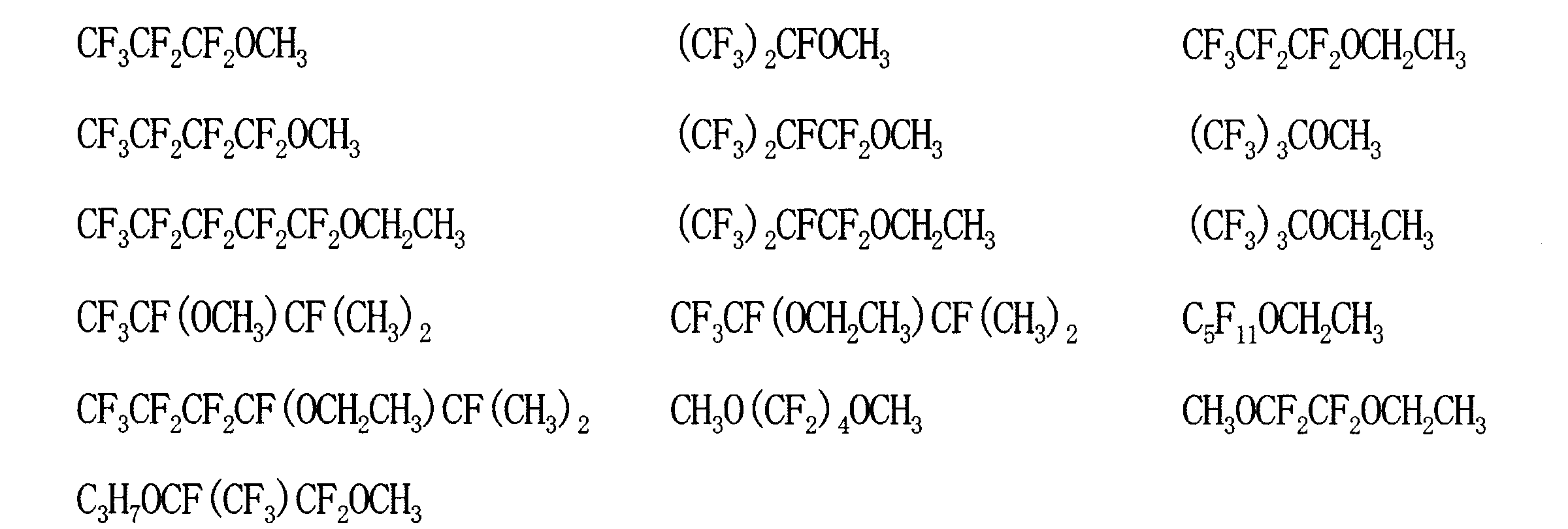
- the fluorine atom-free polymerizable monomer copolymerized with the polyfluoroalkyl alcohol (meth) acrylic acid derivative [I] and the polysiloxane [II] having a terminal (meth) acryloyloxy group includes the following general formula [III ], [IV] and [V], at least one kind of (meth) acrylic acid ester is preferably used.
- fluorine atom-free polymerizable monomer containing the compound [III], [IV] or [V] include, for example, methyl, ethyl, propyl, isopropyl, n-butyl, n-hexyl, 2-ethylhexyl, Alkyl groups such as n-octyl, lauryl and stearyl, cycloalkyl groups such as cyclohexyl, aralkyl groups such as benzyl, alkoxy such as methoxymethyl, 2-methoxyethyl, 2-ethoxyethyl, 2-butoxyethyl and 3-ethoxypropyl Acrylic ester or methacrylate ester esterified with alkyl group, fumaric acid or maleic acid monomethyl, dimethyl, monoethyl, diethyl, monopropyl, dipropyl, monobutyl, dibutyl, mono-2-ethylhexyl, di-2-
- the terminal polyfluoroalkyl group must have 1 to 6 carbon atoms, and when the R 9 group is a polyfluoroalkylene group, the total number of carbon atoms with the terminal polyfluoroalkyl group must be 1 to 6. I must.
- a polyfunctional monomer or oligomer can be copolymerized at a ratio of 10% by weight or less in the copolymer.
- Such polyfunctional monomers or oligomers include ethylene glycol di (meth) acrylate, propylene glycol di (meth) acrylate, 1,4-butanediol di (meth) acrylate, 1,6-hexanediol di (meth) Acrylate, 1,9-nonanediol di (meth) acrylate, neopentyl glycol di (meth) acrylate, tetraethylene glycol di (meth) acrylate, tripropylene glycol di (meth) acrylate, polypropylene glycol di (meth) acrylate, bisphenol A. Ethylene oxide adduct diacrylate, dimethylol tricyclodecane diacrylate, glycerin methacrylate acrylate, 3-acryloyloxyglycer
- a copolymer with a fluorine atom-free polymerizable comonomer is advantageous, and the fluorine atom-free polymerizable monomer is contained in an amount of about 30% by weight or less, preferably about 10%. Copolymerization of ⁇ 30% by weight is preferable from the viewpoint of both water and oil repellency and cost.
- a crosslinkable group-containing monomer such as (meth) acrylamide, N-methylol (meth) acrylamide, N-methoxymethylacrylamide, N-butoxymethylacrylamide, glycidyl (meth) acrylate, etc.
- the copolymerization can be carried out in a proportion of 10% by weight or less, preferably about 0.5 to 7% by weight.
- the durability of the water / oil repellent can be increased by crosslinking with the hydroxyl groups on the fiber surface or by self-crosslinking.
- the copolymerization reaction is performed by an emulsion polymerization method or a suspension polymerization method, but is preferably performed by a solution polymerization method.
- a reaction solvent for the solution polymerization method a hydrocarbon solvent, an alcohol solvent, an ester solvent, a ketone solvent, a hydrofluorocarbon solvent, a hydrofluoroether solvent, or the like is used. These solvents may be used alone or in combination.
- hydrocarbon solvent examples include linear or branched aliphatic hydrocarbons having 5 to 16 carbon atoms, cyclopentane, cyclohexane or alicyclic hydrocarbons such as methyl and ethyl-substituted products thereof, benzene, toluene, Aromatic hydrocarbons such as xylene, trifluoromethyl group-substituted aromatic hydrocarbons such as 1,4-bis (trifluoromethyl) benzene, 1,3-bis (trifluoromethyl) benzene, and the like can be mentioned.
- alcohol solvents examples include linear or branched alkanols having 1 to 8 carbon atoms.
- the alkanol may be 2-alkanol in addition to 1-alkanol.
- ester solvents include methyl acetate, ethyl, propyl, butyl ester, methyl propionate, methyl lactate, ethyl, pentyl ester, and the like.
- ketone solvent examples include acetone, methyl ethyl ketone, methyl isobutyl ketone, 2-pentanone, 3-pentanone, 2-hexanone and the like.
- hydrofluorocarbon solvent examples include the following.
- hydrofluoroethers examples include the following.
- diacyl peroxide, peroxycarbonate, peroxyester, etc. are used.
- diacyl peroxide, peroxycarbonate, peroxyester, etc. are used.
- Organic peroxides such as carbonate, di-n-propyl peroxydicarbonate, and diisopropyl peroxydicarbonate are used.
- an azo compound, an inorganic peroxide, or a redox system thereof may be used.
- the polymerization reaction may be difficult to proceed. In that case, a polymerization initiator may be added again during the polymerization reaction.
- a chain transfer agent may be used as necessary.
- the chain transfer agent include dimethyl ether, methyl tertiary butyl ether, C 1 to C 6 alkanes, methanol, ethanol, 2 -Propanol, cyclohexane, carbon tetrachloride, chloroform, dichloromethane, methane, ethyl acetate, ethyl malonate, acetone and the like.
- the copolymerization reaction is carried out at a reaction temperature of about 0 to 100 ° C., preferably about 5 to 60 ° C., particularly preferably about 40 to 50 ° C. using these reaction solvents, reaction initiators and the like. After completion of the reaction, a copolymer solution having a solid content concentration of about 5 to 30% by weight is obtained, and the fluorine-containing copolymer is obtained by removing the solvent from the reaction mixture.
- the polyfluoroalkyl alcohol (meth) acrylic acid copolymer [I] used in the copolymerization reaction is almost completely copolymerized as a result of analyzing the unreacted residual comonomer by gas chromatography. confirmed.
- the fluorine-containing copolymer thus obtained is separated by a method of evaporating to dryness and purified by a method of washing with a solvent or the like.
- the weight average molecular weight Mw (polystyrene conversion) of the obtained fluorinated copolymer is shown by high performance liquid chromatography, and its value is about 10,000 to 1,000,000.
- the fluorinated copolymer is preferably obtained as a polymer solution by a solution polymerization method or the like, it can be further used as 1,4-bis (trifluoromethyl) benzene, 1,3-bis (trifluoromethyl) benzene or the like.
- the solid content concentration is diluted with a fluorine-containing organic solvent to about 0.01 to 30% by weight, preferably about 0.05 to 5% by weight, and used as a water and oil repellent.
- a polymer obtained by an aqueous emulsion polymerization method, suspension polymerization method or the like can also be used.
- a flocculant is added to the polymerization reaction solution to aggregate the polymer
- a water- and oil-repellent agent comprising an organic solvent solution can be prepared by dissolving a fluorine-containing copolymer separated by washing with an organic solvent in a fluorine-containing organic solvent.
- this water- and oil-repellent agent comprising this fluorine-containing copolymer as an active ingredient, and a fluorine-containing organic solvent solution thereof, as other additives, cross-linking agents such as melamine resin, urea resin, blocked isocyanate, polymer, etc.
- cross-linking agents such as melamine resin, urea resin, blocked isocyanate, polymer, etc.
- Additives necessary for water and oil repellent applications such as extenders, silicone resins or oils, waxes and other water repellents, insect repellents, antistatic agents, dye stabilizers, antifungal agents, stain blockers, etc. it can.
- the water / oil repellent obtained in this manner is effectively applied as a water / oil repellent to a fabric product made of paper, film, fiber, cloth, woven fabric, carpet or filament, fiber, thread or the like.
- Application methods such as coating, dipping, spraying, padding, roll coating, or a combination thereof are generally used.
- a solid content concentration of the bath of about 0.1 to 10% by weight, it can be used as a pad bath. Is done.
- the material to be treated is padded in this pad bath, then excess liquid is removed with a squeeze roll and dried, and the polymer is attached to the material to be treated so that the amount of the polymer is about 0.01 to 10% by weight.
- drying is generally performed at a temperature of about 100 to 200 ° C. for about 1 minute to about 2 hours, and the water and oil repellent treatment is completed.
- the fluorine-containing copolymer according to the present invention is also a surface treatment of various powders containing inorganic pigments used in cosmetics such as foundations, such as talc, kaolin, mica, mica titanium, titanium oxide, iron oxide, and zinc oxide. Used as an agent to improve their water resistance and oil repellency.
- higher fatty acids such as petrolatum, lanolin and ceresin or salts thereof, squalane, liquid paraffin, ester oil, diglyceride, triglyceride, fluid oil such as silicone oil, fluorine such as perfluoropolyether oil, etc.
- Oils, surfactants, organic dyes or pigments, ethanol, preservatives, antioxidants, thickeners, pH adjusters, fragrances, UV absorbers, moisturizers, blood circulation promoters, cooling agents, antiperspirants Agents, bactericides, skin activators and the like can be blended and used at the same time.
- Synthesis example 1 (1) To a 1200 ml autoclave equipped with a stirrer and a thermometer, CF 3 (CF 2 ) 3 (CH 2 CF 2 ) (CF 2 CF 2 ) I (99.8GC%) 603 g (1.17 mol) and 7 g of di-tert-butyl peroxide were charged, and the autoclave was deaerated with a vacuum pump. When the internal temperature was heated to 80 ° C., ethylene was sequentially introduced to adjust the internal pressure to 0.5 MPa. When the internal pressure decreased to 0.2 MPa, ethylene was introduced again to 0.5 MPa, and this was repeated.
- the reaction product was distilled under reduced pressure under the conditions of an internal pressure of 0.2 kPa, an internal temperature of 100 to 144 ° C., and a tower top temperature of 58 to 59 ° C. to obtain 43.7 g of a purified reaction product (95.4 GC%) (distillation yield 88.2%) Got.
- the obtained purified reaction product was confirmed to be a compound represented by the following formula from the results of 1 H-NMR and 19 F-NMR.
- the reaction mixture was cooled to recover 72 g of the reaction solution, and 44.5 g of the residue from which toluene was removed with an evaporator was washed with tap water, and the reaction product (86.3 GC%), which was a colorless and transparent liquid at room temperature, was used as the lower layer. 40.9 g (yield 82.6%) was obtained.
- This reaction product was distilled under reduced pressure under the conditions of an internal pressure of 0.2 kPa, an internal temperature of 103 to 143 ° C., and a tower top temperature of 60 to 61 ° C. to obtain 15.7 g of a purified reaction product (99.2 GC%) (distillation yield: 44.1% )
- Synthesis example 2 (1) CF 3 (CF 2 ) 3 (CH 2 CF 2 ) (CF 2 CF 2 ) 2 I (99.9GC%) The reaction of introducing 34 g (1.2 mol) of ethylene using 529 g (0.86 mol) and 5 g of di-tert-butyl peroxide was carried out in the same manner as in Synthesis Example 1 (1). As a result, CF 3 (CF 2 ) 3 (CH 2 CF 2 ) (CF 2 CF 2 ) 2 (CH 2 CH 2 ) I (99.1GC%) 550 g (99.4% yield) was obtained.
- the reaction mixture was washed with 40 ml of water, and the lower layer (132.3 g) was mixed with 135 g of a 15 wt% p-toluenesulfonic acid aqueous solution and stirred at 80 ° C. for 7 hours. After allowing the reaction mixture to stand, 103 g (yield 53.5%) of a reaction product (65.5GC%) as a white solid was obtained as the lower layer.
- the reaction product was distilled under reduced pressure under the conditions of an internal pressure of 0.2 kPa, an internal temperature of 121 to 163 ° C, and a tower top temperature of 76 to 77 ° C, and purified reaction product (95.3GC%) 66.9g (distillation yield 94.2%) Got.
- the obtained purified reaction product was confirmed to be a compound represented by the following formula from the results of 1 H-NMR and 19 F-NMR.
- the reaction mixture was cooled to recover 82 g of the reaction solution, and 63.9 g of the residue from which toluene was removed with an evaporator was washed with tap water, and the reaction product (89.3 GC%), which was a colorless and transparent liquid at room temperature, was used as the lower layer. 60.8 g (yield 86.4%) was obtained.
- This reaction product was distilled under reduced pressure under the conditions of an internal pressure of 0.2 kPa, an internal temperature of 125 to 155 ° C., and a tower top temperature of 84 to 86 ° C. to obtain 42.2 g of a purified reaction product (99.4 GC%) (distillation yield: 77.2% )
- Synthesis example 3 60.0 g (0.11 mol) of the reaction product (95.4GC%) obtained in Synthesis Example 2 (2), 29 g of toluene, 1.6 g of p-toluenesulfonic acid and 0.07 g of hydroquinone were added to a capacity of 100 ml equipped with a condenser and a thermometer. Were added to a three-necked flask, the internal temperature was heated to 100 ° C., 12 g (0.14 mol) of methacrylic acid was added, and the mixture was stirred at an internal temperature of 118 ° C. for 3 hours.
- reaction mixture was cooled to recover 82 g of the reaction solution, and 64 g of the residue obtained by removing toluene with an evaporator was washed with tap water, and 60.8 g of a reaction product (89 GC%) that was a colorless and transparent liquid at room temperature as the lower layer (Yield 86%).
- This reaction product was distilled under reduced pressure under the conditions of an internal pressure of 0.2 kPa, an internal temperature of 125 to 155 ° C., and a tower top temperature of 84 to 86 ° C. to obtain 42.2 g of a purified reaction product (99.4 GC%) (distillation yield: 77.2% )
- Synthesis example 4 (1) To a 1200 ml autoclave equipped with a stirrer and a thermometer, CF 3 (CF 2 ) (CH 2 CF 2 ) (CF 2 CF 2 ) 2 I (97GC%) 603 g (1.17 mol) and 7 g of di-tert-butyl peroxide were charged, and the autoclave was deaerated with a vacuum pump. When the internal temperature was heated to 80 ° C., ethylene was sequentially introduced to adjust the internal pressure to 0.5 MPa. When the internal pressure decreased to 0.2 MPa, ethylene was introduced again to 0.5 MPa, and this was repeated.
- the reaction product is distilled under reduced pressure under the conditions of an internal pressure of 0.2 kPa, an internal temperature of 100 to 144 ° C., and a tower top temperature of 58 to 59 ° C. to obtain 43 g of a purified reaction product (95 GC%) (distillation yield of 88%). It was.
- the obtained purified reaction product was confirmed to be a compound represented by the following formula from the results of 1 H-NMR and 19 F-NMR.
- This reaction product was subjected to vacuum distillation under the conditions of an internal pressure of 0.2 kPa, an internal temperature of 103 to 143 ° C., and a tower top temperature of 60 to 61 ° C. to obtain 16 g of a purified reaction product (99 GC%) (distillation yield of 44%). Obtained.
- Example 1 50 g of fluorine-containing monomer A obtained in Synthesis Example 1 Methacrylic acid-terminated polydimethylsiloxane 50g Silicone monomer (Shin-Etsu Chemical X-22-174DX; Viscosity (25 °C) 60mm 2 / s, a specific gravity (25 ° C.) 0.97, refractive index (25 ° C.) 1.407, (Functional group equivalent 4,600 g / mol) 1,4-bis (trifluoromethyl) benzene 350g The above components were charged into a 500 ml reactor equipped with a condenser and replaced with nitrogen gas for 30 minutes.
- the weight average molecular weight Mw of the fluorinated monomer / silicone monomer copolymer isolated by placing the obtained copolymer solution in an oven at 120 ° C. and removing the solvent was 91000.
- Mw is measured by GPC measurement method using Shodex GPC KD 806M + KD-802 + KD-G at a temperature of 40 °C and elution rate of 10mM tetrahydrofuran solution as eluent is 1ml / min.
- a parallax refractometer was used as the instrument, and Labchat® 180 (polystyrene equivalent) manufactured by SIC was used for the analysis.
- the copolymer solution was cast on a PET film and dried at 120 ° C. for 2 hours to obtain a copolymer film.
- this film was immersed in water for 10 minutes, the contact angle after standing for 1 day was measured, and the change rate of contact angle before and after immersion in water was less than 3%. Less than 5% was evaluated as ⁇ , 5 to less than 10% as ⁇ , and 10% or more as ⁇ .
- Example 2 In Example 1, 70 g of the fluorinated monomer B obtained in Synthesis Example 2 was used in place of the fluorinated monomer A, and the amount of the silicone monomer was changed to 30 g to carry out a copolymerization reaction.
- Example 3 In Example 1, 30 g of fluorine-containing monomer C obtained in Synthesis Example 3 was used in place of fluorine-containing monomer A, and the amount of silicone monomer was changed to 70 g to carry out a copolymerization reaction.
- Example 4 In Example 1, 90 g of the fluorine-containing monomer D obtained in Synthesis Example 4 was used in place of the fluorine-containing monomer A, and the amount of the silicone monomer was changed to 10 g to carry out a copolymerization reaction.
- Example 5 In Example 1, 70 g of fluorine-containing monomer B was used in place of fluorine-containing monomer A, the amount of silicone monomer was changed to 20 g, and 10 g of stylyl methacrylate [StMA] was used to carry out a copolymerization reaction. .
- Example 6 In Example 1, 80 g of fluorine-containing monomer C was used in place of fluorine-containing monomer A, the amount of silicone monomer was changed to 10 g, and 10 g of benzyl methacrylate [BzMA] was further used for the copolymerization reaction.
- Example 7 In Example 1, 50 g of fluorine-containing monomer D was used in place of fluorine-containing monomer A, the amount of silicone monomer was changed to 30 g, and 20 g of 2-ethylhexyl methacrylate [EHMA] was used to carry out a copolymerization reaction. It was.
- Example 1 70 g of 2- (n-perfluorooctyl) ethyl acrylate [FAAC-8] was used in place of the fluorine-containing monomer A, and the amount of silicone monomer was changed to 30 g to carry out a copolymerization reaction. It was.
- Example 2 In Example 1, 70 g of 2- (n-perfluorohexyl) ethyl methacrylate [FAMAC-6] was used in place of the fluorine-containing monomer A, and the amount of silicone monomer was changed to 30 g to carry out a copolymerization reaction. It was.
- Example 1 70 g of FAAC-8 was used in place of the fluorine-containing monomer A, and 30 g of StMA was used in place of the silicone monomer, and the copolymerization reaction was performed.
- Example 1 the amount of the fluorine-containing monomer A was changed to 70 g, and 30 g of StMA was used instead of the silicone monomer to carry out a copolymerization reaction.
- Examples 3 and 6 using the fluorine-containing monomer C having a terminal methacrylate group are compared with Reference Example 2 using 2- (n-perfluorohexyl) ethyl methacrylate copolymer. All of water repellency, oil repellency and water resistance are improved.
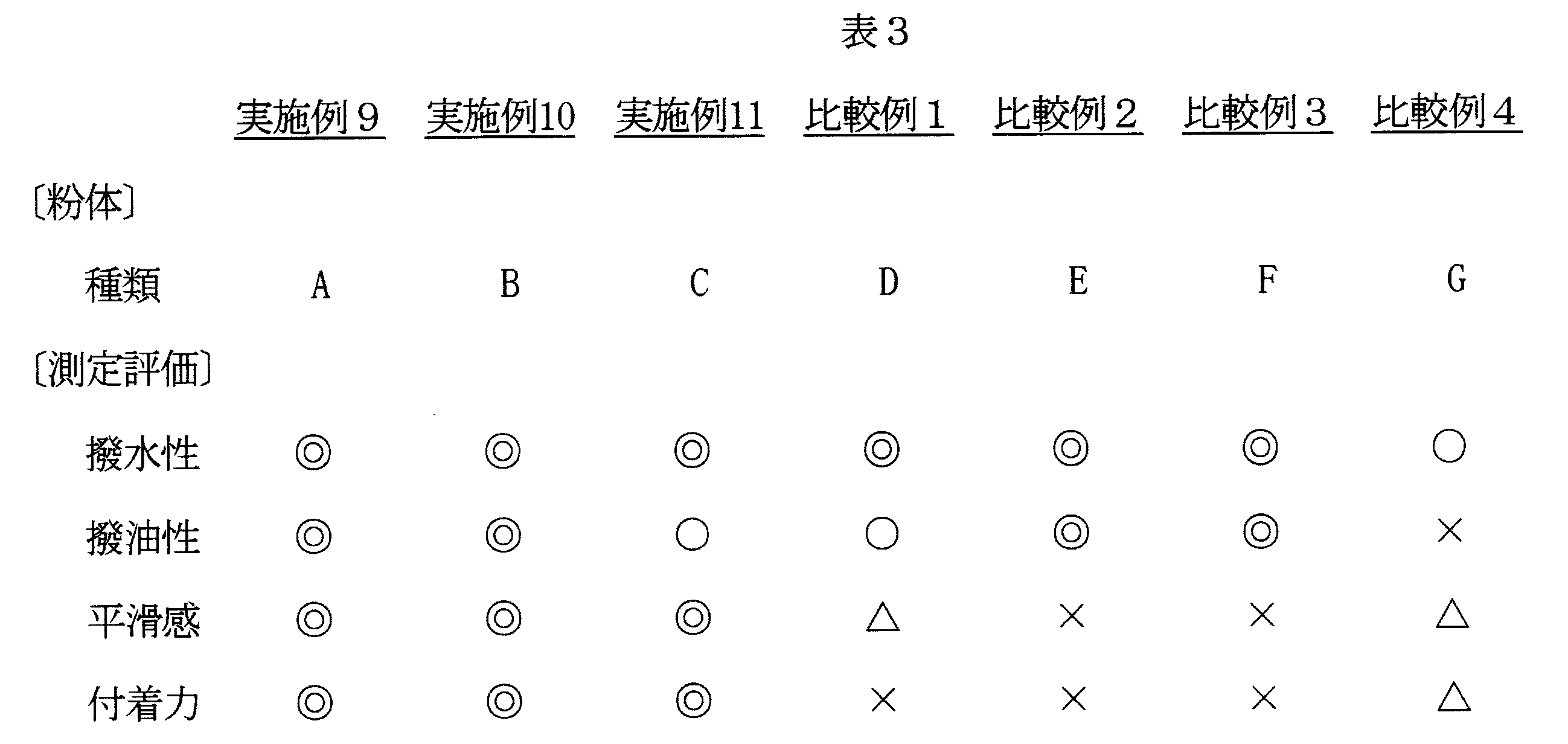
- This powder product was measured and evaluated for water repellency and oil repellency in the same manner as described above, and the smoothness and adhesion of the powder were evaluated.
- Smoothness, adhesion 5 expert panelists, 5 levels of powder texture such as powder smoothness, adhesion to skin (5: very good, 4: good, 3: normal, 2: bad) , 1: very bad), and the average score was evaluated as follows. Evaluation average score ⁇ 4.5-5.0 ⁇ Less than 3.5 to 4.5 ⁇ Less than 2.5 to 3.5 ⁇ 1.5 to less than 2.5 ⁇ ⁇ less than 1.5
- the powder surface-treated with the fluorine-containing copolymer according to the present invention was copolymerized with Comparative Example 1 using a 2- (n-perfluorooctyl) ethyl acrylate copolymer and a silicone monomer.
- the powder has excellent smoothness and adhesion, and not only water repellency and oil repellency but also powder compared with Comparative Example 4 using dimethylsiloxane. Excellent smoothness and adhesion.
Landscapes
- Chemical & Material Sciences (AREA)
- Organic Chemistry (AREA)
- Health & Medical Sciences (AREA)
- Chemical Kinetics & Catalysis (AREA)
- Medicinal Chemistry (AREA)
- Polymers & Plastics (AREA)
- Life Sciences & Earth Sciences (AREA)
- Animal Behavior & Ethology (AREA)
- General Health & Medical Sciences (AREA)
- Public Health (AREA)
- Veterinary Medicine (AREA)
- Dermatology (AREA)
- Dispersion Chemistry (AREA)
- Birds (AREA)
- Epidemiology (AREA)
- Addition Polymer Or Copolymer, Post-Treatments, Or Chemical Modifications (AREA)
- Macromonomer-Based Addition Polymer (AREA)
- Paints Or Removers (AREA)
Abstract
Description
CnF2n+1(CH2CF2)a(CF2CF2)b(CH2CH2)cOCOCR=CH2 〔I〕
で表わされるポリフルオロアルキルアルコール(メタ)アクリル酸誘導体を重合単位で5~100重量%含有する含フッ素重合体を提案しており、この含フッ素共重合体の有機溶剤溶液または水性分散液は、例えば撥水撥油剤、オイルバリヤ等の表面改質剤として有効に用いられる(特許文献1参照)。
CnF2n+1(CH2CF2)a(CF2CF2)b(CH2CH2)cOCOCR=CH2 〔I〕
(ここで、Rは水素原子またはメチル基であり、nは1~6の整数であり、aは1~4の整数であり、bは1~3の整数であり、cは1~3の整数である)で表わされるポリフルオロアルキルアルコール(メタ)アクリル酸誘導体および一般式


CH2=CR1COOR3 〔III〕
CH2=CR1COOR6Y 〔IV〕
CH2=CR1COO(R7O)lR8 〔V〕
R1:H、メチル基
R3:C1~C30の直鎖状、分岐状または脂環状のアルキル基、アラル
キル基
R6:C1~C30の直鎖状または分岐状のアルキレン基
R7:C1~C6の直鎖状または分岐状のアルキレン基
R8:H、C1~C30の直鎖状または分岐状のアルキル基、芳香族基
Y:架橋性官能基
l:1~50の整数
CH2=CRCOOR9(NR10SO2)mRf 〔VI〕
R:水素原子またはメチル基
R9:炭素数1~6の直鎖状または分岐状アルキレン基
R10:炭素数1~4の低級アルキル基
Rf:炭素数1~6、好ましくは2~4のポリフルオロアルキル基、
好ましくはパーフルオロアルキル基
m:0または1
で表わされるものが用いられ、例えば特許文献1段落〔0018〕に例示されるようなポリフルオロアルキル基含有(メタ)アクリレート単量体が示される。ただし、末端ポリフルオロアルキル基の炭素数nは1~6でなければならず、R9基がポリフルオロアルキレン基の場合には、末端ポリフルオロアルキル基との合計炭素数が1~6でなければならない。

(1) 攪拌機および温度計を備えた容量1200mlのオートクレーブに、
CF3(CF2)3(CH2CF2)(CF2CF2)I (99.8GC%)
603g(1.17モル)およびジ第3ブチルパーオキサイド7gを仕込み、真空ポンプでオートクレーブを脱気した。内温を80℃迄加熱したところで、エチレンを逐次的に導入し、内圧を0.5MPaとした。内圧が0.2MPa迄下がったら、再びエチレンを導入して0.5MPaとし、これをくり返した。内温を80~115℃に保ちながら、約3時間かけてエチレン49g(1.7モル)を導入した。内温50℃以下で内容物を回収し、
CF3(CF2)3(CH2CF2)(CF2CF2)(CH2CH2)I (98.3GC%)
635g(収率98.8%)を得た。
CF3(CF2)3(CH2CF2)(CF2CF2)(CH2CH2)I (98.3GC%)
100g(0.18モル)とN-メチルホルムアミド100g(1.68モル)を仕込み、150℃で4時間攪拌した。反応終了後、反応混合物を水30mlで洗浄し、その下層(82.8g)を15重量%p-トルエンスルホン酸水溶液83gと混合し、80℃で8時間攪拌した。反応混合物を静置後、下層として常温で無色透明の液体である反応生成物(78.4GC%)を60g(収率62.6%)得た。
CF3(CF2)3(CH2CF2)(CF2CF2)(CH2CH2)OH
CF3(CF2)3(CH2CF2)(CF2CF2)(CH2CH2)OCOCH=CH2 〔含フッ素モノマーA〕
(1) CF3(CF2)3(CH2CF2)(CF2CF2)2I (99.9GC%)
529g(0.86モル)およびジ第3ブチルパーオキサイド5gを用い、エチレン34g(1.2モル)を導入する反応を、合成例1の(1)と同様に行った。その結果、
CF3(CF2)3(CH2CF2)(CF2CF2)2(CH2CH2)I (99.1GC%)
550g(収率99.4%)を得た。
CF3(CF2)3(CH2CF2)(CF2CF2)2(CH2CH2)I (99.1GC%)
150g(0.24モル)とN-メチルホルムアミド105g(1.78モル)を仕込み、150℃で5時間攪拌した。反応終了後、反応混合物を水40mlで洗浄し、その下層(132.3g)を15重量%p-トルエンスルホン酸水溶液135gと混合し、80℃で7時間攪拌した。反応混合物を静置後、下層として白色の固体である反応生成物(65.5GC%)を103g(収率53.5%)得た。
CF3(CF2)3(CH2CF2)(CF2CF2)2(CH2CH2)OH
CF3(CF2)3(CH2CF2)(CF2CF2)2(CH2CH2)OCOCH=CH2 〔含フッ素モノマーB〕
合成例2(2)で得られた反応生成物(95.4GC%)60.0g(0.11モル)、トルエン29g、p-トルエンスルホン酸1.6gおよびハイドロキノン0.07gを、コンデンサおよび温度計を備えた容量100mlの三口フラスコに仕込み、内温を100℃迄加熱した後メタクリル酸12g(0.14モル)を加え、内温118℃で3時間攪拌した。反応終了後、冷却して82gの反応液を回収し、エバポレータでトルエンを除去した残渣64gを水道水で洗浄し、下層として常温で無色透明の液体である反応生成物(89GC%)を60.8g(収率86%)得た。
CF3(CF2)3(CH2CF2)(CF2CF2)2(CH2CH2)OCOC(CH3)=CH2 〔含フッ素モノマーC〕
(1) 攪拌機および温度計を備えた容量1200mlのオートクレーブに、
CF3(CF2)(CH2CF2)(CF2CF2)2I (97GC%)
603g(1.17モル)およびジ第3ブチルパーオキサイド7gを仕込み、真空ポンプでオートクレーブを脱気した。内温を80℃迄加熱したところで、エチレンを逐次的に導入し、内圧を0.5MPaとした。内圧が0.2MPa迄下がったら、再びエチレンを導入して0.5MPaとし、これをくり返した。内温を80~115℃に保ちながら、約3時間かけてエチレン49g(1.7モル)を導入した。内温50℃以下で内容物を回収し、
CF3(CF2)(CH2CF2)(CF2CF2)2(CH2CH2)I (98GC%)
630g(収率98.8%)を得た。
CF3(CF2)(CH2CF2)(CF2CF2)2(CH2CH2)I (98GC%)
100g(0.18モル)とN-メチルホルムアミド100g(1.68モル)を仕込み、150℃で4時間攪拌した。反応終了後、反応混合物を水30mlで洗浄し、その下層(82.8g)を15重量%p-トルエンスルホン酸水溶液83gと混合し、80℃で8時間攪拌した。反応混合物を静置後、下層として常温で無色透明の液体である反応生成物(78GC%)を60g(収率62%)得た。
CF3(CF2)(CH2CF2)(CF2CF2)2(CH2CH2)OH
CF3(CF2)(CH2CF2)(CF2CF2)2(CH2CH2)OCOCH=CH2 〔含フッ素モノマーD〕
合成例1で得られた含フッ素モノマーA 50g
メタクリル酸末端ポリジメチルシロキサン型 50g
シリコーンモノマー(信越化学工業製品X-22-174DX;
粘度(25℃)60mm2/秒、比重(25℃)0.97、屈折率(25℃)1.407、
官能基当量4,600g/モル)
1,4-ビス(トリフルオロメチル)ベンゼン 350g
以上の各成分を、コンデンサを備えた容量500mlの反応器に仕込み、窒素ガスで30分間置換した。反応器に、さらに
ビス(4-第3ブチルシクロヘキシル)パーオキシジカーボネート 1.0g
を添加した後(合計451.0g)、反応器内温度を徐々に50℃まで上げ、攪拌しながらこの温度で16時間重合反応を行った。
評価 水(撥水性) テトラデカン(撥油性)
◎ 110~130° 70°以上
○ 90~109° 60~69°
△ 70~ 89° 50~59°
× 69°以下 49°以下
実施例1において、含フッ素モノマーAの代りに合成例2で得られた含フッ素モノマーB 70gが用いられ、またシリコーンモノマー量が30gに変更されて、共重合反応が行われた。
実施例1において、含フッ素モノマーAの代りに合成例3で得られた含フッ素モノマーC 30gが用いられ、またシリコーンモノマー量が70gに変更されて、共重合反応が行われた。
実施例1において、含フッ素モノマーAの代りに合成例4で得られた含フッ素モノマーD 90gが用いられ、またシリコーンモノマー量が10gに変更されて、共重合反応が行われた。
実施例1において、含フッ素モノマーAの代りに含フッ素モノマーB 70gが用いられ、シリコーンモノマー量が20gに変更され、さらにスチアリルメタクリレート〔StMA〕10gが用いられて、共重合反応が行われた。
実施例1において、含フッ素モノマーAの代りに含フッ素モノマーC 80gが用いられ、シリコーンモノマー量が10gに変更され、さらにベンジルメタクリレート〔BzMA〕10gが用いられて、共重合反応が行われた。
実施例1において、含フッ素モノマーAの代りに含フッ素モノマーD 50gが用いられ、シリコーンモノマー量が30gに変更され、さらに2-エチルヘキシルメタクリレート〔EHMA〕20gが用いられて、共重合反応が行われた。
実施例1において、含フッ素モノマーA量が70gに、シリコーンモノマー量が10gにそれぞれ変更され、さらにベンジルメタクリレート〔BzMA〕10g、2-ヒドロキシエチルアクリレート〔2HEA〕5gおよびポリエチレングリコール(n=4)モノメタクリレート〔PE-200〕5gが用いられて、共重合反応が行われた。
実施例1において、含フッ素モノマーAの代りに2-(n-パーフルオロオクチル)エチルアクリレート〔FAAC-8〕が70g用いられ、またシリコーンモノマー量が30gに変更されて、共重合反応が行われた。
実施例1において、含フッ素モノマーAの代りに2-(n-パーフルオロヘキシル)エチルメタクリレート〔FAMAC-6〕が70g用いられ、またシリコーンモノマー量が30gに変更されて、共重合反応が行われた。
実施例1において、含フッ素モノマーAの代りにFAAC-8が70g用いられ、またシリコーンモノマーの代りにStMAが30g用いられて、共重合反応が行われた。
実施例1において、含フッ素モノマーA量が70gに変更され、またシリコーンモノマーの代りにStMAが30g用いられて、共重合反応が行われた。

(1) 各実施例、各参考例でそれぞれ得られた共重合体またはジメチルポリシロキサン(信越化学工業製品KF-96A;6mm2/秒)2重量部、マイカ48重量部およびイソプロパノール50重量部をミキサーに入れ、80℃迄加熱しながらイソプロパノールを減圧留去することにより、粉体A~Gを得た。
表2
粉体 ポリマー成分
A 実施例2で得られた共重合体
B 実施例5で得られた共重合体
C 実施例8で得られた共重合体
D 参考例1で得られた共重合体
E 参考例3で得られた共重合体
F 参考例4で得られた共重合体
G ジメチルポリシロキサン
酸化チタン 16重量部
ワセリン 3 〃
タルク 10 〃
酸化鉄 10 〃
ジメチルポリシロキサン 6 〃
流動パラフィン 5 〃
を加え(合計100重量部)、ミキサーを用いて均一になるように混合した後、これを金型でプレス成形して、ファンデーション用粉体製品を得た。
平滑感、付着力:専門パネラー5名により、粉体の平滑感、肌への付着力などの粉体の感触を5段階(5:非常に良い、4:良い、3:普通、2:悪い、1:非常に悪い)で評価し、その平均点で次のように評価した。
評価 平均点
◎ 4.5~5.0
○ 3.5~4.5未満
△ 2.5~3.5未満
× 1.5~2.5未満
×× 1.5未満
Claims (14)
- 一般式
CnF2n+1(CH2CF2)a(CF2CF2)b(CH2CH2)cOCOCR=CH2 〔I〕
(ここで、Rは水素原子またはメチル基であり、nは1~6の整数であり、aは1~4の整数であり、bは1~3の整数であり、cは1~3の整数である)で表わされるポリフルオロアルキルアルコール(メタ)アクリル酸誘導体および一般式
(ここで、R1は水素原子またはメチル基であり、R2はC1~C6の直鎖状または分岐状の2価アルキレン基であり、R3はC1~C30の直鎖状または分岐状のアルキル基であり、R4、R5はそれぞれ水素原子、メチル基またはフェニル基であり、mは1~200の整数である)で表わされる末端(メタ)アクリロイルオキシ基を有するポリシロキサンの共重合体よりなる含フッ素共重合体。
- 重量平均分子量Mwが10,000~1,000,000である請求項1記載の含フッ素共重合体。
- ポリフルオロアルキルアルコール(メタ)アクリル酸誘導体〔I〕と末端(メタ)アクリロイルオキシ基を有するポリシロキサン〔II〕とが、重量比で1~99:99~1の割合で共重合された請求項1記載の含フッ素共重合体。
- ポリフルオロアルキルアルコール(メタ)アクリル酸誘導体〔I〕と末端(メタ)アクリロイルオキシ基を有するポリシロキサン〔II〕とが、重量比で30~95:70~5の割合で共重合された請求項1記載の含フッ素共重合体。
- 一般式CH2=CR1COOR3(ここで、R1は水素原子またはメチル基であり、R3はC1~C30の直鎖状、分岐状または脂環状のアルキル基あるいはアラルキル基である)で表わされる(メタ)アクリル酸エステル〔III〕、一般式CH2=CR1COOR6Y(ここで、R1は水素原子またはメチル基であり、R6はC1~C30の直鎖状または分岐状のアルキレン基であり、Yは架橋性官能基である)で表わされる(メタ)アクリル酸エステル〔IV〕および一般式CH2=CR1COO(R7O)lR8(ここで、R1は水素原子またはメチル基であり、R7はC1~C6の直鎖状または分岐状のアルキレン基であり、R8は水素原子、C1~C30の直鎖状または分岐状のアルキル基あるいは芳香族基であり、lは1~50の整数である)で表わされる(メタ)アクリル酸エステル〔V〕の少くとも一種を、さらに共重合させた請求項1記載の含フッ素共重合体。
- アクリル酸エステル〔III〕、〔IV〕および〔V〕の少くとも一種を、共重合体中30重量%以下の割合で共重合させた請求項5記載の含フッ素共重合体。
- アクリル酸エステル〔III〕、〔IV〕および〔V〕の少くとも一種を、共重合体中10~30重量%の割合で共重合させた請求項6記載の含フッ素共重合体。
- 一般式
CH2=CRCOOR9(NR10SO2)mRf 〔VI〕
(ここで、Rは水素原子またはメチル基であり、R9は炭素数1~6の直鎖状または分岐状アルキレン基であり、R10は炭素数1~4の低級アルキル基であり、Rfは炭素数1~6のパーフルオロアルキル基であり、mは0または1である)で表わされる含フッ素重合性単量体を、さらに共重合させた請求項1記載の含フッ素共重合体。 - 含フッ素重合性単量体〔VI〕を、共重合体中30重量%以下の割合で共重合させた請求項8記載の含フッ素共重合体。
- 含フッ素重合性単量体〔VI〕を共重合体中10~30重量%の割合で共重合させた請求項9記載の含フッ素共重合体。
- 撥水撥油剤の有効成分として用いられる請求項1記載の含フッ素共重合体。
- 粉体の表面処理剤として用いられる請求項1記載の含フッ素共重合体。
- 請求項12記載の含フッ素共重合体で表面処理された粉体。
- 粉体が化粧品用無機顔料である請求項13記載の表面処理された粉体。
Priority Applications (5)
| Application Number | Priority Date | Filing Date | Title |
|---|---|---|---|
| KR1020137008030A KR101582344B1 (ko) | 2010-09-13 | 2011-09-07 | 함불소 공중합체 |
| US13/822,721 US8987397B2 (en) | 2010-09-13 | 2011-09-07 | Fluorine-containing copolymer |
| JP2012533958A JP5590131B2 (ja) | 2010-09-13 | 2011-09-07 | 含フッ素共重合体 |
| EP11825042.2A EP2617745B1 (en) | 2010-09-13 | 2011-09-07 | Fluorine-containing copolymer |
| CN201180044058.0A CN103080165B (zh) | 2010-09-13 | 2011-09-07 | 含氟共聚物 |
Applications Claiming Priority (2)
| Application Number | Priority Date | Filing Date | Title |
|---|---|---|---|
| JP2010204430 | 2010-09-13 | ||
| JP2010-204430 | 2010-09-13 |
Publications (1)
| Publication Number | Publication Date |
|---|---|
| WO2012036036A1 true WO2012036036A1 (ja) | 2012-03-22 |
Family
ID=45831503
Family Applications (1)
| Application Number | Title | Priority Date | Filing Date |
|---|---|---|---|
| PCT/JP2011/070344 Ceased WO2012036036A1 (ja) | 2010-09-13 | 2011-09-07 | 含フッ素共重合体 |
Country Status (6)
| Country | Link |
|---|---|
| US (1) | US8987397B2 (ja) |
| EP (1) | EP2617745B1 (ja) |
| JP (1) | JP5590131B2 (ja) |
| KR (1) | KR101582344B1 (ja) |
| CN (1) | CN103080165B (ja) |
| WO (1) | WO2012036036A1 (ja) |
Cited By (7)
| Publication number | Priority date | Publication date | Assignee | Title |
|---|---|---|---|---|
| WO2013058156A1 (ja) * | 2011-10-18 | 2013-04-25 | ユニマテック株式会社 | 含フッ素共重合体およびこれを有効成分とする表面改質剤 |
| JP2014201724A (ja) * | 2013-04-09 | 2014-10-27 | Agcセイミケミカル株式会社 | 表面処理組成物 |
| WO2016129362A1 (ja) * | 2015-02-13 | 2016-08-18 | ユニマテック株式会社 | 含フッ素共重合体およびこれを有効成分とする表面改質剤 |
| JPWO2014136892A1 (ja) * | 2013-03-06 | 2017-02-16 | ユニマテック株式会社 | 含フッ素オリゴマー、それを用いたナノシリカコンポジット粒子およびそれらの製造法 |
| JP2018095879A (ja) * | 2016-12-15 | 2018-06-21 | ダイキン工業株式会社 | 撥水剤 |
| WO2019230326A1 (ja) * | 2018-05-29 | 2019-12-05 | 株式会社 資生堂 | ブロックコポリマーを含む毛髪化粧料 |
| JPWO2021187294A1 (ja) * | 2020-03-17 | 2021-09-23 |
Families Citing this family (16)
| Publication number | Priority date | Publication date | Assignee | Title |
|---|---|---|---|---|
| WO2014208424A1 (ja) * | 2013-06-28 | 2014-12-31 | ダイキン工業株式会社 | 表面処理剤 |
| WO2016052263A1 (ja) * | 2014-09-30 | 2016-04-07 | ユニマテック株式会社 | ポリフルオロアルキルアリル化合物およびその製造法 |
| CN111437633B (zh) * | 2015-08-19 | 2022-03-15 | Jxtg能源株式会社 | 消泡剂和润滑油组合物 |
| JP6695760B2 (ja) | 2015-08-19 | 2020-05-20 | Jxtgエネルギー株式会社 | 消泡剤および潤滑油組成物 |
| JP6695762B2 (ja) * | 2015-08-19 | 2020-05-20 | Jxtgエネルギー株式会社 | 消泡剤および潤滑油組成物 |
| CN111282316B (zh) * | 2015-08-19 | 2022-03-15 | Jxtg能源株式会社 | 消泡剂和润滑油组合物 |
| JP6785090B2 (ja) | 2015-08-19 | 2020-11-18 | Eneos株式会社 | 潤滑油組成物および潤滑油の消泡方法 |
| JP7101615B2 (ja) * | 2015-08-31 | 2022-07-15 | ビイク-ヒエミー ゲゼルシャフト ミツト ベシユレンクテル ハフツング | ポリシロキサンマクロモノマー単位を有するコポリマー、該コポリマーの製造方法、ならびに該コポリマーの、コーティング組成物およびポリマー成形コンパウンドにおける使用 |
| EP3536719B1 (en) * | 2016-11-01 | 2022-10-12 | Unimatec Co., Ltd. | Fluoropolymer and rust preventive containing same as active ingredient |
| EP3586937A4 (en) | 2017-02-22 | 2020-12-30 | JXTG Nippon Oil & Energy Corporation | ANTI-FOAMS AND LUBRICATING COMPOSITION |
| KR102101394B1 (ko) | 2018-01-05 | 2020-04-16 | 숙명여자대학교산학협력단 | 고내열, 소수성 코팅용 폴리실록산계 폴리머 및 이를 포함하는 코팅용 조성물 |
| KR102543248B1 (ko) * | 2019-08-08 | 2023-06-14 | 주식회사 엘지에너지솔루션 | 겔 고분자 전해질용 고분자, 이를 포함하는 겔 고분자 전해질 및 리튬 이차전지 |
| KR20220104759A (ko) | 2019-11-21 | 2022-07-26 | 다우 글로벌 테크놀로지스 엘엘씨 | 다단계 중합체 |
| KR102117999B1 (ko) | 2019-11-26 | 2020-06-02 | 숙명여자대학교산학협력단 | 고내열, 소수성 코팅용 폴리실록산계 폴리머 및 이를 포함하는 코팅용 조성물 |
| KR102555398B1 (ko) | 2020-11-05 | 2023-07-12 | 숙명여자대학교산학협력단 | 고경도 초발수 투명 코팅액 |
| CN113652138A (zh) * | 2021-09-01 | 2021-11-16 | 河南恒润昌环保科技有限公司 | 一种重防腐水性漆及其制备方法和应用 |
Citations (13)
| Publication number | Priority date | Publication date | Assignee | Title |
|---|---|---|---|---|
| JPS5323271A (en) | 1976-08-13 | 1978-03-03 | Mitsubishi Electric Corp | Bump electrode forming method |
| JPS5323270B2 (ja) | 1975-09-18 | 1978-07-13 | ||
| JPS5748035B2 (ja) | 1979-04-03 | 1982-10-13 | ||
| JPH0245572B2 (ja) | 1982-04-19 | 1990-10-11 | Nippon Mektron Kk | |
| JPH0346444A (ja) | 1989-07-14 | 1991-02-27 | Nec Corp | 電話機 |
| JPH0378244B2 (ja) | 1983-03-14 | 1991-12-13 | Nippon Mektron Kk | |
| JPH044923A (ja) | 1990-04-23 | 1992-01-09 | Kawasaki Steel Corp | 鋼帯コイルの旋回装置 |
| JPH0411366B2 (ja) | 1984-03-16 | 1992-02-28 | ||
| CN1927894A (zh) * | 2006-09-28 | 2007-03-14 | 东华大学 | 一种含氟碳链丙烯酸酯及其共聚物的制备方法和应用 |
| WO2007105633A1 (ja) | 2006-03-10 | 2007-09-20 | Unimatec Co., Ltd. | ポリフルオロアルキルアルコールまたはその(メタ)アクリル酸誘導体およびそれらの製造法 |
| WO2009034773A1 (ja) | 2007-09-10 | 2009-03-19 | Unimatec Co., Ltd. | 含フッ素重合体およびこれを有効成分とする表面改質剤 |
| JP2010521541A (ja) * | 2007-02-28 | 2010-06-24 | イー・アイ・デュポン・ドウ・ヌムール・アンド・カンパニー | フルオロポリマー組成物および使用方法 |
| WO2010101091A1 (ja) * | 2009-03-04 | 2010-09-10 | ユニマテック株式会社 | 含フッ素重合体を有効成分とする表面改質剤 |
Family Cites Families (17)
| Publication number | Priority date | Publication date | Assignee | Title |
|---|---|---|---|---|
| JPS5239587A (en) | 1975-09-25 | 1977-03-26 | Daikin Ind Ltd | Mold releasing agent |
| JPS5932890B2 (ja) | 1976-08-13 | 1984-08-11 | 三菱電機株式会社 | シヨツトダイオ−ドの電極形成方法 |
| JPS5748035A (en) | 1980-09-08 | 1982-03-19 | Okabe Co Ltd | Constructing method for culvert |
| JPS60190309A (ja) | 1984-03-12 | 1985-09-27 | Nippon Mektron Ltd | 離型剤 |
| JPS61289009A (ja) | 1985-06-14 | 1986-12-19 | Kao Corp | 化粧料 |
| JPH0245572A (ja) | 1988-08-08 | 1990-02-15 | Toagosei Chem Ind Co Ltd | プライマー |
| US5068295A (en) * | 1989-02-15 | 1991-11-26 | Dainichiseika Color & Chemicals Mfg. Co., Ltd. | Water and oil repellants |
| JPH0378244A (ja) | 1989-08-21 | 1991-04-03 | Mitsubishi Electric Corp | 半導体装置 |
| EP1000602B1 (en) * | 1997-06-04 | 2010-04-07 | Daikin Industries, Limited | Copolymers for cosmetics |
| WO2006101218A1 (en) * | 2005-03-22 | 2006-09-28 | Fujifilm Corporation | Antireflection film, polarizing plate, and image display device |
| JP2007016081A (ja) * | 2005-07-05 | 2007-01-25 | Fujifilm Holdings Corp | 共重合体、その製造方法および硬化性樹脂組成物、反射防止フィルム、偏光板、画像表示装置 |
| JP5419376B2 (ja) * | 2007-04-20 | 2014-02-19 | 日東電工株式会社 | 粘着シートの自動車塗膜面への接着方法 |
| JP2008298859A (ja) * | 2007-05-29 | 2008-12-11 | Asahi Glass Co Ltd | 感光性組成物、それを用いた隔壁、隔壁の製造方法、カラーフィルタの製造方法、有機el表示素子の製造方法および有機tftアレイの製造方法 |
| KR101445423B1 (ko) * | 2007-06-26 | 2014-09-26 | 코니카 미놀타 어드밴스드 레이어즈 인코포레이티드 | 클리어 하드 코트 필름, 이를 사용한 반사 방지 필름, 편광판 및 표시 장치 |
| EP2138889A1 (en) * | 2008-06-26 | 2009-12-30 | Lachezar Komitov | Alignment layer for LCD |
| KR101665402B1 (ko) | 2009-01-28 | 2016-10-12 | 제이에스알 가부시끼가이샤 | 감방사선성 수지 조성물 및, 액정 표시 소자의 스페이서 및 그의 형성 방법 |
| KR20100138809A (ko) * | 2009-06-24 | 2010-12-31 | 도시바 기카이 가부시키가이샤 | 금속 절삭 칩의 컨베이어 장치 |
-
2011
- 2011-09-07 KR KR1020137008030A patent/KR101582344B1/ko active Active
- 2011-09-07 JP JP2012533958A patent/JP5590131B2/ja active Active
- 2011-09-07 WO PCT/JP2011/070344 patent/WO2012036036A1/ja not_active Ceased
- 2011-09-07 CN CN201180044058.0A patent/CN103080165B/zh active Active
- 2011-09-07 US US13/822,721 patent/US8987397B2/en active Active
- 2011-09-07 EP EP11825042.2A patent/EP2617745B1/en active Active
Patent Citations (13)
| Publication number | Priority date | Publication date | Assignee | Title |
|---|---|---|---|---|
| JPS5323270B2 (ja) | 1975-09-18 | 1978-07-13 | ||
| JPS5323271A (en) | 1976-08-13 | 1978-03-03 | Mitsubishi Electric Corp | Bump electrode forming method |
| JPS5748035B2 (ja) | 1979-04-03 | 1982-10-13 | ||
| JPH0245572B2 (ja) | 1982-04-19 | 1990-10-11 | Nippon Mektron Kk | |
| JPH0378244B2 (ja) | 1983-03-14 | 1991-12-13 | Nippon Mektron Kk | |
| JPH0411366B2 (ja) | 1984-03-16 | 1992-02-28 | ||
| JPH0346444A (ja) | 1989-07-14 | 1991-02-27 | Nec Corp | 電話機 |
| JPH044923A (ja) | 1990-04-23 | 1992-01-09 | Kawasaki Steel Corp | 鋼帯コイルの旋回装置 |
| WO2007105633A1 (ja) | 2006-03-10 | 2007-09-20 | Unimatec Co., Ltd. | ポリフルオロアルキルアルコールまたはその(メタ)アクリル酸誘導体およびそれらの製造法 |
| CN1927894A (zh) * | 2006-09-28 | 2007-03-14 | 东华大学 | 一种含氟碳链丙烯酸酯及其共聚物的制备方法和应用 |
| JP2010521541A (ja) * | 2007-02-28 | 2010-06-24 | イー・アイ・デュポン・ドウ・ヌムール・アンド・カンパニー | フルオロポリマー組成物および使用方法 |
| WO2009034773A1 (ja) | 2007-09-10 | 2009-03-19 | Unimatec Co., Ltd. | 含フッ素重合体およびこれを有効成分とする表面改質剤 |
| WO2010101091A1 (ja) * | 2009-03-04 | 2010-09-10 | ユニマテック株式会社 | 含フッ素重合体を有効成分とする表面改質剤 |
Non-Patent Citations (1)
| Title |
|---|
| See also references of EP2617745A4 * |
Cited By (10)
| Publication number | Priority date | Publication date | Assignee | Title |
|---|---|---|---|---|
| WO2013058156A1 (ja) * | 2011-10-18 | 2013-04-25 | ユニマテック株式会社 | 含フッ素共重合体およびこれを有効成分とする表面改質剤 |
| JPWO2014136892A1 (ja) * | 2013-03-06 | 2017-02-16 | ユニマテック株式会社 | 含フッ素オリゴマー、それを用いたナノシリカコンポジット粒子およびそれらの製造法 |
| JP2014201724A (ja) * | 2013-04-09 | 2014-10-27 | Agcセイミケミカル株式会社 | 表面処理組成物 |
| WO2016129362A1 (ja) * | 2015-02-13 | 2016-08-18 | ユニマテック株式会社 | 含フッ素共重合体およびこれを有効成分とする表面改質剤 |
| JPWO2016129362A1 (ja) * | 2015-02-13 | 2017-04-27 | ユニマテック株式会社 | 含フッ素共重合体およびこれを有効成分とする表面改質剤 |
| US10344172B2 (en) | 2015-02-13 | 2019-07-09 | Unimatec Co., Ltd. | Fluorine-containing copolymer and surface-modifying agent comprising the same as active ingredient |
| JP2018095879A (ja) * | 2016-12-15 | 2018-06-21 | ダイキン工業株式会社 | 撥水剤 |
| WO2019230326A1 (ja) * | 2018-05-29 | 2019-12-05 | 株式会社 資生堂 | ブロックコポリマーを含む毛髪化粧料 |
| JPWO2021187294A1 (ja) * | 2020-03-17 | 2021-09-23 | ||
| JP7663554B2 (ja) | 2020-03-17 | 2025-04-16 | 株式会社バルカー | ペースト |
Also Published As
| Publication number | Publication date |
|---|---|
| JPWO2012036036A1 (ja) | 2014-02-03 |
| EP2617745A4 (en) | 2015-12-30 |
| CN103080165B (zh) | 2015-05-20 |
| US20130172502A1 (en) | 2013-07-04 |
| CN103080165A (zh) | 2013-05-01 |
| JP5590131B2 (ja) | 2014-09-17 |
| KR101582344B1 (ko) | 2016-01-04 |
| EP2617745A1 (en) | 2013-07-24 |
| US8987397B2 (en) | 2015-03-24 |
| EP2617745B1 (en) | 2016-11-02 |
| KR20130088151A (ko) | 2013-08-07 |
Similar Documents
| Publication | Publication Date | Title |
|---|---|---|
| JP5590131B2 (ja) | 含フッ素共重合体 | |
| CN101802028B (zh) | 含氟聚合物及以其为有效成分的表面改性剂 | |
| CN103974985B (zh) | 含氟共聚物和以其作为有效成分的拒水拒油剂 | |
| WO2010101091A1 (ja) | 含フッ素重合体を有効成分とする表面改質剤 | |
| EP2749582B1 (en) | Fluorine-containing copolymer and surface modifying agent containing same as active ingredient | |
| JP5003759B2 (ja) | フルオロアルキルアルコール不飽和カルボン酸誘導体混合物、これらの重合体およびこの重合体を有効成分とする撥水撥油剤 | |
| JP2014172952A (ja) | 含フッ素重合体およびこれを有効成分とする表面改質剤 | |
| CN109863184B (zh) | 含氟聚合物以及将其作为有效成分的防锈剂 | |
| EP3064517B1 (en) | Fluorine-containing polymer, and surface modifier containing same as active ingredient | |
| KR20240032079A (ko) | 함불소 공중합체 및 이것을 사용한 표면개질 기재 | |
| CN103757916A (zh) | 一种皮革用含氟硅防水防油整理剂及其制备方法 |
Legal Events
| Date | Code | Title | Description |
|---|---|---|---|
| WWE | Wipo information: entry into national phase |
Ref document number: 201180044058.0 Country of ref document: CN |
|
| 121 | Ep: the epo has been informed by wipo that ep was designated in this application |
Ref document number: 11825042 Country of ref document: EP Kind code of ref document: A1 |
|
| WWE | Wipo information: entry into national phase |
Ref document number: 2012533958 Country of ref document: JP |
|
| NENP | Non-entry into the national phase |
Ref country code: DE |
|
| WWE | Wipo information: entry into national phase |
Ref document number: 13822721 Country of ref document: US |
|
| REEP | Request for entry into the european phase |
Ref document number: 2011825042 Country of ref document: EP |
|
| WWE | Wipo information: entry into national phase |
Ref document number: 2011825042 Country of ref document: EP |
|
| ENP | Entry into the national phase |
Ref document number: 20137008030 Country of ref document: KR Kind code of ref document: A |