WO2012036507A2 - Aptazyme libérant spécifiquement un antisens contre un microarn dans des cellules infectées par le vhc et son utilisation - Google Patents
Aptazyme libérant spécifiquement un antisens contre un microarn dans des cellules infectées par le vhc et son utilisation Download PDFInfo
- Publication number
- WO2012036507A2 WO2012036507A2 PCT/KR2011/006856 KR2011006856W WO2012036507A2 WO 2012036507 A2 WO2012036507 A2 WO 2012036507A2 KR 2011006856 W KR2011006856 W KR 2011006856W WO 2012036507 A2 WO2012036507 A2 WO 2012036507A2
- Authority
- WO
- WIPO (PCT)
- Prior art keywords
- hcv
- rna
- epthazyme
- antisense
- seq
- Prior art date
- Legal status (The legal status is an assumption and is not a legal conclusion. Google has not performed a legal analysis and makes no representation as to the accuracy of the status listed.)
- Ceased
Links
Images



Classifications
-
- C—CHEMISTRY; METALLURGY
- C12—BIOCHEMISTRY; BEER; SPIRITS; WINE; VINEGAR; MICROBIOLOGY; ENZYMOLOGY; MUTATION OR GENETIC ENGINEERING
- C12N—MICROORGANISMS OR ENZYMES; COMPOSITIONS THEREOF; PROPAGATING, PRESERVING, OR MAINTAINING MICROORGANISMS; MUTATION OR GENETIC ENGINEERING; CULTURE MEDIA
- C12N15/00—Mutation or genetic engineering; DNA or RNA concerning genetic engineering, vectors, e.g. plasmids, or their isolation, preparation or purification; Use of hosts therefor
- C12N15/09—Recombinant DNA-technology
- C12N15/11—DNA or RNA fragments; Modified forms thereof; Non-coding nucleic acids having a biological activity
- C12N15/113—Non-coding nucleic acids modulating the expression of genes, e.g. antisense oligonucleotides; Antisense DNA or RNA; Triplex- forming oligonucleotides; Catalytic nucleic acids, e.g. ribozymes; Nucleic acids used in co-suppression or gene silencing
- C12N15/1131—Non-coding nucleic acids modulating the expression of genes, e.g. antisense oligonucleotides; Antisense DNA or RNA; Triplex- forming oligonucleotides; Catalytic nucleic acids, e.g. ribozymes; Nucleic acids used in co-suppression or gene silencing against viruses
-
- A—HUMAN NECESSITIES
- A61—MEDICAL OR VETERINARY SCIENCE; HYGIENE
- A61P—SPECIFIC THERAPEUTIC ACTIVITY OF CHEMICAL COMPOUNDS OR MEDICINAL PREPARATIONS
- A61P31/00—Antiinfectives, i.e. antibiotics, antiseptics, chemotherapeutics
- A61P31/12—Antivirals
- A61P31/14—Antivirals for RNA viruses
-
- C—CHEMISTRY; METALLURGY
- C12—BIOCHEMISTRY; BEER; SPIRITS; WINE; VINEGAR; MICROBIOLOGY; ENZYMOLOGY; MUTATION OR GENETIC ENGINEERING
- C12N—MICROORGANISMS OR ENZYMES; COMPOSITIONS THEREOF; PROPAGATING, PRESERVING, OR MAINTAINING MICROORGANISMS; MUTATION OR GENETIC ENGINEERING; CULTURE MEDIA
- C12N15/00—Mutation or genetic engineering; DNA or RNA concerning genetic engineering, vectors, e.g. plasmids, or their isolation, preparation or purification; Use of hosts therefor
- C12N15/09—Recombinant DNA-technology
- C12N15/10—Processes for the isolation, preparation or purification of DNA or RNA
- C12N15/1034—Isolating an individual clone by screening libraries
- C12N15/1068—Template (nucleic acid) mediated chemical library synthesis, e.g. chemical and enzymatical DNA-templated organic molecule synthesis, libraries prepared by non ribosomal polypeptide synthesis [NRPS], DNA/RNA-polymerase mediated polypeptide synthesis
-
- C—CHEMISTRY; METALLURGY
- C12—BIOCHEMISTRY; BEER; SPIRITS; WINE; VINEGAR; MICROBIOLOGY; ENZYMOLOGY; MUTATION OR GENETIC ENGINEERING
- C12N—MICROORGANISMS OR ENZYMES; COMPOSITIONS THEREOF; PROPAGATING, PRESERVING, OR MAINTAINING MICROORGANISMS; MUTATION OR GENETIC ENGINEERING; CULTURE MEDIA
- C12N2310/00—Structure or type of the nucleic acid
- C12N2310/10—Type of nucleic acid
- C12N2310/12—Type of nucleic acid catalytic nucleic acids, e.g. ribozymes
- C12N2310/128—Type of nucleic acid catalytic nucleic acids, e.g. ribozymes processing or releasing ribozyme
-
- C—CHEMISTRY; METALLURGY
- C12—BIOCHEMISTRY; BEER; SPIRITS; WINE; VINEGAR; MICROBIOLOGY; ENZYMOLOGY; MUTATION OR GENETIC ENGINEERING
- C12N—MICROORGANISMS OR ENZYMES; COMPOSITIONS THEREOF; PROPAGATING, PRESERVING, OR MAINTAINING MICROORGANISMS; MUTATION OR GENETIC ENGINEERING; CULTURE MEDIA
- C12N2310/00—Structure or type of the nucleic acid
- C12N2310/10—Type of nucleic acid
- C12N2310/16—Aptamers
-
- C—CHEMISTRY; METALLURGY
- C12—BIOCHEMISTRY; BEER; SPIRITS; WINE; VINEGAR; MICROBIOLOGY; ENZYMOLOGY; MUTATION OR GENETIC ENGINEERING
- C12N—MICROORGANISMS OR ENZYMES; COMPOSITIONS THEREOF; PROPAGATING, PRESERVING, OR MAINTAINING MICROORGANISMS; MUTATION OR GENETIC ENGINEERING; CULTURE MEDIA
- C12N2310/00—Structure or type of the nucleic acid
- C12N2310/30—Chemical structure
- C12N2310/35—Nature of the modification
- C12N2310/351—Conjugate
- C12N2310/3519—Fusion with another nucleic acid
-
- C—CHEMISTRY; METALLURGY
- C12—BIOCHEMISTRY; BEER; SPIRITS; WINE; VINEGAR; MICROBIOLOGY; ENZYMOLOGY; MUTATION OR GENETIC ENGINEERING
- C12N—MICROORGANISMS OR ENZYMES; COMPOSITIONS THEREOF; PROPAGATING, PRESERVING, OR MAINTAINING MICROORGANISMS; MUTATION OR GENETIC ENGINEERING; CULTURE MEDIA
- C12N2320/00—Applications; Uses
- C12N2320/50—Methods for regulating/modulating their activity
Definitions
- the present invention relates to epthazyme and its use to release antisense specifically against microRNAs in HCV infected cells.
- Hepatitis C virus is a positive single-stranded RNA virus belonging to the genus Flaviviridae that causes non-A and non-B hepatitis (Kuo, G., et al., 1989, Science 244, 362-364). If it progresses chronically, it is known to develop cirrhosis or liver cancer and have a high mortality rate (Saito, I., et al., 1990, Proc. Natl Acad. Sci. USA 87, 6547-6549). Although one to two percent of the world's population is infected with the virus, it is very difficult to diagnose because it is present in vivo at very low titers and there is no effective treatment or vaccine for the HCV virus.
- MicroRNAs are endogenous, small, non-coding RNAs that generally inhibit cell gene expression in a sequence-specific manner, by decreasing or inhibiting translation of target mRNAs (Chekulaeva M, Filipowicz W. Mechanisms of miRNA-mediated posts). -transaltional regulation in animal cells.Curr Opin Cell Biol 2009, 21, 452-460).
- microRNA 122 is the most abundant microRNA in the liver (Chang J ,, et al., MiR-122, a mammalian liver-specific microRNA, is processed from hcr mRNA and may downregulate the high affinity cationic amino acid transporter.
- RNA Biol 2004, 1, 106-113 is known to promote the replication of HCV by interacting with the 5 'untranslate region (UTR) of the viral genome (Jopling CL ,, et al., Modulation of hepatitis C virus RNA abundance). by a liver-specific microRNA.Science 2005, 309, 1577-1581; Henke JI ,, et al., microRNA-122 stimulates translation of hepatitis C virus RNA. EMBO J 2008, 27, 3300-3310, etc.).
- UTR 5 'untranslate region
- microRNAs play an important role in regulating the expression of a large number of genes involved in the physiological function of cells, including lipid metabolism (Krutzfeldt J, et al., Silencing of microRNAs in vivo with 'anagomir). Nature 2005, 438, 685-689), non-specific inhibition of microRNA 122 in all cells is very likely to cause side effects from genetic modifications that play an important role in the physiological activity of cells.
- the present inventors have developed an epthazyme that specifically releases antisense for microRNA by being specifically induced by a substance encoded by HCV RNA so as to specifically inhibit microRNA activity only in cells in which HCV proliferates.
- the invention has been completed.
- Another object of the present invention includes an epthazyme that specifically binds to a substance encoded by HCV RNA only in HCV infected cells, inhibits its function, and simultaneously releases antisense to microRNA to inhibit the activity of microRNA. It is to provide a composition for treating HCV-related diseases and a treatment method using the same.
- the present invention provides an embodiment of the present invention comprising: i) an aptamer for a substance encoded by Hepatitis C virus (HCV) RNA; ii) a hammerhead ribozyme comprising antisense to micro RNA at the site released by self-cleavage; And iii) a comminication module sequence linking the aptamer and the hammerhead ribozyme, and inducing a self-cutting activity of a hammerhead ribozyme when the substance encoded by the HCV RNA is bound to the aptamer. It provides an eptazyme that specifically releases antisense for micro RNA in HCV infected cells, including.
- HCV Hepatitis C virus
- RNA the genome of HCV, produces a complex protein consisting of about 3000 amino acids by translation, and then the structural proteins such as C, E1, E2, NS2, NS3, And nonstructural proteins such as NS4, NS4A, NS4B, NS5, NS5A, and NS5B.
- NS5B in the HCV nonstructural protein is an RNA dependent RNA polymerase and is a major factor in HCV proliferation indicating that HCV is proliferating in a cell.
- the term "substance encoded by HCV RNA” refers to a protein or peptide indicating that HCV is proliferating in a cell, such as the structural and nonstructural proteins of the HCV.
- epthazyme may be used in combination with allosteric ribozyme
- micro RNA may be used in combination with miRNA
- mir and antisense for micro RNA may be used in combination with antimir. .
- Eptamers for the substance encoded by the HCV RNA of the present invention is higher than any of the structural proteins such as C, E1, E2 and non-structural proteins such as NS2, NS3, NS4, NS4A, NS4B, NS5 and NS5A.
- a substance that binds with a binding force and inhibits its function it may be an aptamer that specifically binds to HCV NS5B protein.
- Eptamers for NS5B of the present invention are molecules discovered by the inventors using the SELEX method (Systematic Evolution of Ligands of Exponential enrichment, in vitro selection method), and include the following sequence.
- Eptamer RNA Sequence (SEQ ID NO: 4)
- the "communication module sequence” refers to a sequence connecting the eptamer and the hammerhead ribozyme.
- the self-cutting activity of the hammerhead ribozyme may be induced.
- the present invention connects an aptamer and a hammerhead ribozyme that specifically binds to a protein encoded by HCV RNA through a connection module, thereby changing the activity of the hammerhead ribozyme in an allosteric manner.
- a connection module By providing an epthazyme, one can induce self-cleaving activity of hammerhead ribozyme specifically in cells in which HCV proliferates.
- ribozyme self-cleaved only in cells in which HCV proliferates can effectively and specifically inhibit HCV proliferation by releasing antisense against microRNAs necessary for HCV proliferation.
- the hammerhead ribozyme is self-cut and the sequence of the released portion is replaced with antisense for micro RNA, preferably with antisense for micro RNA 122. Accordingly, the hammerhead ribozyme of the present invention can inhibit the activity of microRNA by ultimately self-cutting only in cells in which HCV proliferates and release antisense to microRNAs, and ultimately inhibit HCV proliferation.
- Hammerhead ribozymes of the present invention include, but are not limited to, the following RNA sequences, and may have the sequence structure of FIG. 1.
- Figure 1 shows the consensus sequence and structure of the hammerhead ribozyme
- the (N) of Figure 1 represents A, U, C or G
- R is purine
- Y is pyrimidine (pyrimidine)
- h represents A, U or C.
- underlined portions in the following sequences represent portions replaced with antisense sequences for microRNA 122 and N represents any nucleotide of A, C, G, U.
- the antisense sequence for the microRNA is preferably inserted into a portion other than the catalyst core portion of the hammerhead ribozyme (the italic portion of SEQ ID NOs: 5 and 6).
- RNA sequence of Hammerhead ribozyme SEQ ID NO: 5
- RNA sequence of Hammerhead ribozyme SEQ ID NO: 6
- Antisense for microRNA 122 released by the self-cleavage of the hammerhead ribozyme of the present invention comprises the following sequence.
- the linkage module sequence links the aptamer and hammerhead ribozymes.
- a protein (ligand) is bound to an aptamer of aptamer according to the present invention, structural modification of aptamer and hammerhead ribozyme linked by a linking module sequence occurs, thereby activating the self-cutting of the hammerhead ribozyme to activate microRNA. Antisense against is released.
- connection module of the present invention can be screened through an in vitro screening method.
- the linking module candidate sequence is set to NNNNN, and a combination of random sequences including the same number of A, T, C, and G in each N is used.
- An aptamer for NS5B protein. ii) a hammerhead ribozyme and iii) a linkage module comprising an epthazyme library, and then contacting the epthazyme library with a protein other than the NS5B protein and the NS5B protein to specifically autolog in the presence of the NS5B protein.
- RNA pool showing cleavage activity and confirming the sequence of the linkage module of the obtained RNA pool, all sequences can be secured.
- the linkage module sequences obtained by this method were different depending on the epthazymes obtained in the present invention.
- the 5 'linkage module sequence is' CCTCT 'and the 3' linkage sequence is 'CACAC' and 'TCCAC'. Or 'TCACC'.
- the alternating sequence of the present invention comprises CCUCU (SEQ ID NO: 8) as the 5 'linkage module sequence, CACAC (SEQ ID NO: 9), UCCAC (SEQ ID NO: 10) or UCACC (SEQ ID NO: 11) as the 3' linkage module sequence. It may include.
- Eptazymes that release antisense for microRNA 122 dependent on NS5B of the present invention include, but are not limited to, the following RNA sequences.
- the 5'-NCNNNNNNGN-3 'portion of stem II is replaced with a 5' linkage sequence-an eptamer sequence-3 'linkage sequence May have a sequence.
- the underlined portion in the following sequence is the linking module, the sequence written in italics is the aptamer for HCV NS5B, and the bold portion is the antisense sequence for micro RNA 122.
- an aptamer for a substance encoded by HCV RNA i) a hammerhead ribozyme comprising antisense against micro RNA at the site released by self-cleavage; And iii) a comminication module sequence linking the aptamer and the hammerhead ribozyme, and inducing a self-cutting activity of a hammerhead ribozyme when the substance encoded by the HCV RNA is bound to the aptamer. It provides a composition for the treatment of HCV-related diseases, including Eptazyme.
- the HCV-related diseases are diseases caused by HCV and include hepatitis, liver fibrosis, cirrhosis and liver cancer.
- a method of treating HCV-related diseases comprising administering the composition for treating HCV to a subject having HCV carriers, hepatitis caused by HCV, liver fibrosis, cirrhosis or liver cancer.
- the epthazyme of the present invention specifically binds to a substance encoded by HCV RNA (eg, HCV NS5B protein) to inhibit NS5B function and at the same time hammerhead ribo
- HCV RNA eg, HCV NS5B protein
- the self-cleaving activity of Zyme is induced to release antisense against microRNA 122, which has the effect of inhibiting the proliferation of HCV specifically only in HCV infected cells (see Example 4). Therefore, the composition containing the epthazyme of the present invention can be usefully used for the treatment of HCV-related diseases.
- treatment refers to any action in which symptoms caused by HCV-related diseases are improved or beneficially changed by administration of the composition.
- individual means all animals including humans having HCV-related diseases. Means.
- the route of administration of the composition may be administered via any general route as long as it can reach the desired tissue.
- the composition of the present invention may be administered as desired, but is not limited to intraperitoneal administration, intravenous administration, intramuscular administration, subcutaneous administration, intradermal administration, intranasal administration, pulmonary administration, intrahepatic administration, rectal administration.
- the composition may also be administered by any device in which the active agent may migrate to the target cell.
- the therapeutic composition of the present invention is administered in a pharmaceutically effective amount.
- pharmaceutically effective amount means an amount sufficient to treat a disease at a reasonable benefit / risk ratio applicable to medical treatment, and an effective dose level is determined by the type and severity of the subject, age, sex, activity of the drug, drug Sensitivity, time of administration, route of administration and rate of release, duration of treatment, factors including concurrent use of drugs, and other factors well known in the medical arts.
- composition of the present invention can be used alone or in combination with methods using surgery, hormonal therapy, drug treatment and biological response modifiers for the treatment of HCV related diseases.
- the present invention provides a method for producing aptamer to release antisense specifically for micro RNA in HCV infected cells.
- the method specifically comprises 1) a primer set of SEQ ID NOs: 14 and 15 comprising 5 random sequences in the linking module (5 'primer: 5'-TTGGTGTCTGATGAGNN NNNCGCGCCATATTGTGAGGGGCGCG-3' and 3 'primer: 5'-TACGTTTGGT TTCCCAAACGTTTCGNNNNNCGCGCCCCTCACAAT-C) 3 ', N is the same number of G, A, T, C are included) and the addition of taq polymerase to perform PCR, 2) to the PCR product, a primer set of SEQ ID NO: 16 and 17 (5' primer: 5 '-GGTAATACG ACTCACTATAGGGTTGGTGTCTGATGAG-3' and 3 'primers: 5'-TTTTTTTT TTTTTTTTGGTGTTACGTTTGGTTTCCCAAA-3') and PCR with the addition of taq polymerase, 3) the PCR product was transcribed into RNA in vitro using T7 polymerase Prepar
- Eptazyme prepared by the above method can self-cleavage only in the presence of a substance encoded by HCV RNA (eg, HCV NS5B protein) to release antisense for microRNA 122, which is specific for HCV infected cells. Can inhibit the proliferation of HCV.
- HCV RNA eg, HCV NS5B protein
- the present invention does not inhibit the activity of the microRNA in the normal cell, and only shows the effect of inhibiting the microRNA activity specifically HCV-infected cells, it can be useful for the treatment of HCV-related diseases.
- the specific binding to the viral protein may inhibit the function of the viral protein, and at the same time may be effective by inhibiting the activity of the micro RNA, and specifically to treat HCV-related diseases.
- FIG. 2 shows a pTK-RL-3 ⁇ miR122T reporter structure.
- the box portion represents the target site for mature miRNAs.
- anti-miRNA activity of the anti-miRNA targeting different parts of the microRNA anti-Dicer star (1 lane), anti-miRNA Dicer (2 lane), anti-Drosha star (3) lanes), anti-miRNA Drosha (4 lanes), anti-mature miRNAs (5 lanes).
- Figure 5 shows the regulatory effect of anti-miRNA upon miR-17-5P activity (4 lanes: anti-miRNA Drosha, 5 lanes: anti-mature miRNA).
- Figure 6 shows the activity of the reporter gene induced by antimir-122 expression.
- FIG. 7 is a schematic diagram of NS5B dependent epthazyme.
- FIG. 9 is a graph quantitatively analyzing each of the selected aptzyme reactants by phosphorimager analysis.
- FIG. 10 shows the sequence and anticipated secondary structure of antimir-122 NDAR (A) and antimir-17-5p NDAR (B). Italicized sequences indicate linkage module sequences and arrows indicate self-cleaving sites.
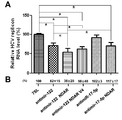
- FIG. 11 shows that miRNA-122 activity is selectively inhibited by antimir-122 NDAR in HCV replicon cells.
- Figure 13 shows HCV specific miRNA amplification inhibition by antimir NDAR.
- Figure 14 shows the inhibition of proliferation of HCV replicon by antimir-122.
- FIG. 15 is a schematic diagram illustrating a process of antimir-122 NDAR inhibiting the activity of microRNA 122 by releasing antisense against microRNA 122 depending on NS5B.
- HCV genotype 1b subgenome replicon pFK-I389neo / NS3-3 '/ 5.1, Provided by R. Bartenschlager (Univ. Of Heidelberg, Germany).
- HCV replicon RNA was synthesized by transcribing AseI and ScaI treated replicon plasmids to RNA in vitro (Hwang B ,, et al ,, Isolation of specific and high-affinity RNA aptamers against NS3 helicase domain of hepatitis C virus.RNA, 2004, 10, 1277-1290, etc.).
- Huh-7 human hepatoma cell line was purchased from ATCC and incubated in DMEM (Invitrogen) in 10% FBS.
- Huh-7 cells express high miR-122 and can be used to confirm HCV replication.
- HCV replicon RNA was transfected into Huh-7 cells using a Gene pulser system (Bio-Rad) at 950 ⁇ F and 250 V, and the HCV replicon cell line (stable HCV replicon cell line). ) Were incubated with G418 (Invitrogen, 500 ⁇ g / ml) to isolate.
- Reporter constructs in which expression is down-regulated in Huh-7 cells expressing miR-122 and HCV replicon Huh-7 cells are prepared according to the following method.
- the target sequence of '-CAAACACCATTGTCACACTCCA) was made by inserting 3'-UTR of the pTK-RL vector encoding Renillar luciferase under the HSVtk promoter (see Figure 2).
- PCR was carried out with primers (5'-CCGCTCGAGACAAACACCATTGTCACACTCCACCGGACAAACACCATTGTCA CACTC; 5'-CACTAGTTGGAGTGTGACAATGGTGTTTGTCCGGTGGAGTGTGACAATGGTGTTTGTCCGGTGGAGTGTGACAATGGTGTTTGTCCGGTGGAGTGACAATGGTGTTTGTCCGGTGGAGTGACAATGGTGTTTGTCCGGTGGAGTGACAATGGTGTTTG), and the amplified DNA was cloned into the pTK-RL vector, pho x and Tpe-R-R-R-R-R-R-R-R-R-R-R-R-R-R-R-R-R-R-R-R-R-R-R-R-R-R-R-R-R-R-R-R-R-R-R-R-R-R-R-R-R-R-R-R-R-R-R-R-R-R-R-R-R-
- a reporter construct without a target sequence of miRNA (MCS) and a reporter construct with three copies of the target sequence of miR-17-5p or let-7a were made (pTK-RL-3 ⁇ miR-17-5p, respectively).
- pTK-RL-3 ⁇ miRlet-7aT. The CMV promoter-driven firefly luciferase gene construct was used as an internal control (hereinafter referred to as pCMV-F. Luci).
- anti-Dicer star targets dicer processing site and miRNA passenger strand
- anti-Drosha star targets Drosha performance site and miRNA passenger strand
- anti-mature miRNA targets the feature miRNA
- anti-miRNA Drosha target Drosha performance site and mature miRNA part
- Figure 5 shows the regulatory effect of anti-miRNA upon miR-17-5p activity.
- Cells were transfected with miR-17-5pT or miR122T with a control vector (con lane) or a 7SL- or U6 + 1 based expression vector encoding anti-miR-17-5p (4 lanes: anti-miRNA Drosha) , Lane 5: anti-mature miRNA).
- Intracellular expression of antisense sequences targeting the mature miR-17-5p entire region effectively and specifically inhibited miR-17-5p activity.
- Specific anti-miR-17-5p activity was seen in both Huh-7 and HCV replicon Huh-7 cells.
- Figure 6 shows the activity of the reporter gene induced by antimir-122 expression.
- Cells were transfected with miR-122T with 7SL- or U6 + 1 based expression vectors encoding control vectors (con lanes) or anti-mature-miR-17-5p or anti-mature miR-122. Luciferase activity of the transfected cells was shown in comparison to the control vector transfected with a control vector with a reporter construct lacking the miR-122 binding site. As shown in FIG. 6, the expression of anti-mature miR-122 cells showed much higher activation of reporter gene expression in HCV replicon than in Huh-7 cells.
- Ribozyme library RNA was made by transcribing DNA amplified twice in succession from RNA into RNA as a template with the following primer set comprising five random sequences in the linkage module. At this time, N, A, C, G, T was included in the same number.
- RNA pools were removed according to the following method.
- the ribozyme library was reacted with ribozyme reaction buffer (20 mM Tris-HCl (pH 7.5), 300 mM NaCl, 4 mM DTT, 10 mM MgCl2) and BSA (bovin serum albumin) for 6 hours at 37 ° C.
- the reaction was electrophoresed on a 7 M urea-10% polyacrylamide gel and the uncleaved RNA was identified via EtBr staining.
- RNA pool was reverse transcribed using oligodT primer 5'-GGTAATACGACTCACTATAGGGTTGGTGTCTGATGAG, and the reverse transcribed cDNA was amplified with the following primers.
- the cDNA was transcribed into RNA to make an epsazyme pool, and reacted with HCV NS5B protein in ribozyme reaction buffer at 37 ° C. for one hour.
- the purified Eptazyme pool which is dependent on NS5B, was purified by electrophoresis with urea polyacrylamide gel, reverse transcribed the purified Eptazyme RNA (primer: 5'-TTTTTTTTTTTTTTTTTTTTTTGGTGTTACGTTTGGTTTCCCAAA), and PCR (5 'primer).
- the amplified DNA was cloned and 25 clones were sequenced. 8 shows 22 selected clones rich in pyrimidine and differing in sequence in the linking module.
- the aptamers were labeled with radioisotopes and then reacted with BSA or NS5B proteins.
- a ratio of [ ⁇ - 32 P] UTP (hot): cold UTP was 1: 4 using 200 ng of DNA template in a total volume of 20 ⁇ l, and 0.1 mM ATP, CTP, GTP, 10 ⁇ transcription buffer, 10 mM DTT, 40 U RNase inhibitor, and T7 RNA polymerase were added and reacted at 37 ° C. for 3 hours.
- 1.5 U DNase I promega was added, and further treated at 37 ° C. for 30 minutes, and then the DNA template was completely removed to label the epthazyme RNA.
- RNA was mixed with an RNA loading dye, denatured at 95 ° C, and electrophoresed at 180V on a 7M-10% polyatrylamide gel for 1 hour. It was developed by exposure to X-ray film for 3-24 hours.
- Figure 9 shows the NS5B specific self-cleaving specificity of the NS5B-dependent aptameim obtained in the present invention, it can be seen that the NS5B-dependent aptamer of the present invention specifically self-cleaved only in the presence of NS5B protein. .
- NS5B-dependently anti-miRNA releasing allosteric ribozymes that release antisense for miR-17-5p and miR-122, respectively, are called antimir-17-5p NDAR and antimir-122 NDAR.
- the sequence released from the selected ribozymes was replaced with antisense sequences for mature miRNA 122.
- PCR was performed using the selected allosteric ribozyme clone No. 4 cDNA as a template with the following primer sets.
- Each amplified DNA was treated with SalI and XbaI and cloned into pGEM T-easy vector (Promega).
- Each NDAR was made by incorporating a cloned vector as a template into RNA in vitro.
- To construct an expression vector expressing each NDAR in a cell each vector containing NDAR cDNA was treated with SalI and XbaI and U6 + 1 snRNA promoter-driven expression cassettes. Cloned).
- NDAR RNA transcribed on in vitro with calf intestine alkaline phosphatase (Ambion) and labeled 5′-end with [ ⁇ - 32 P] ATP (3000 Ci / mmol, Amersham) and T4 polynucleotide kinase (Ambion) It was. 20 fmol of end-labeled NDAR RNA was added to the reaction buffer (30 mM Tris-HCl (pH 7.5), 150 mM NaCl, 5 mM MgCl2, and 2 mM dithiothreitol) for 1 hour at 37 ° C. After the reaction, the reaction product was separated by electrophoresis on 7 M urea-12% polyacrylamide gel.
- the ladders were made and loaded onto the gel as size markers. Alkaline hydrolysis was performed at 20 ⁇ l reaction volume with 50 mM NaHCO 3 (pH 9.0), 1 mM EDTA, 0.25 mg / ml tRNA, and 54 fmole of NDAR RNA at 95 ° C. for 15 minutes. The cut NDAR RNA fragment was denatured at 80 ° C. for 5 minutes and then analyzed on a denaturing polyacrylamide gel.
- NDAR RNA 54 fmole was added to RNase T1 in 20 ⁇ l of a reaction mixture containing 20 mM NaCitrate, pH 5.0, 7 M urea, 1 mM EDTA, 0.25 mg / ml tRNA and 1 U of RNase T1 for 10 minutes at 37 ° C.
- 10 ⁇ l of RNA loading dye (10 ml formamide, 10 mM EDTA, 0.01% bromophenol blue, 0.01% xylene cyanol) was stopped and analyzed on a modified polyacrylamide gel.
- the resulting cDNA was then 5 'primer specific for the 5' end of ribozyme (primer for antimir-122 NDAR: 5'-TAATACGACTCACTATAGGGAATGGTGCTG; primer for antimir-17-5p NDAR: 5'-TAATACGACTCACTATAGGGAGTGCAGCTG) and nested PCR was performed in 25 cycles with 3 'primer (5'-AAGCAGTGGTATCAACGCAGAGT) at 98 ° C for 30 seconds-> 58 ° C for 30 seconds-> 72 ° C for 30 seconds.
- FIG. 10 shows the nucleotide sequence and anticipated secondary structure of antimir-122 NDAR and antimir-17-5p NDAR and self-cut sites identified through analysis of sequencing gels after in vitro self-cleaving assay and 3'-RACE method. will be.
- antimir-122 NDAR and antimir-17-5p NDAR were self-cleaved only in the presence of HCV NS5B.
- Analysis of the cleaved RNA product in the sequencing gel shows that self-cleavage occurs at sites around the expected cleavage region of NDAR. This means that antisense sequences targeting miRNAs are released by antimir NDAR.
- the following experiment was performed to determine whether the antimir-122 NDAR expression vector specifically inhibits the activity of microRNA 122 in HCV proliferating cells.
- the reporter construct without pCMV-F.luci 25 ng and pTKRL-3 ⁇ miR122T or miR-122 binding sites [R. 100 ng Luci (no target site) LT transduction reagent (Mirus) into Huh-7 and HCV replicon Huh-7 1 ⁇ 10 5 cells with 400 ng of 7SL- or U6 + 1-based antimiRNA expression vector After 24 hours, cells were obtained and lysed, and the reporter was measured by measuring relatively bright units using a luminometer TD-20 / 20 (Turner Designs Instrument) and a dual-luciferase reporter assay system (Promega).
- pCMV-F.luci 25 ng
- RL-3 ⁇ miR122T 200 ng
- antimir NDAR expression vectors for the analysis of selective anti-miRNA activity by allosteric ribozyme expression vectors. (400 ng) was transfected together for 48 hours before reporter activity was measured.
- FIG. 11 shows that miRNA-122 activity is selectively inhibited by antimir-122 NDAR in HCV replicon cells.
- Cells were transfected with 3 ⁇ miR122T and control 7SL vectors, or 7SL-induced expression vectors for antimir-122, antimir-122 NADR or antimir-122 NDAR4. Reporter construct transfection without any miRNA target sequence was used as a control.
- the expression of antisense against mature miR-122 inhibited the activity of miRNA, and as a result, the reporter activity of Huh-7 cells appeared, regardless of HCV proliferation.
- the expression of antimir-122 NDAR showed high activity in HCV-replicon Huh cells, but not in Huh cells. Through this, the expression of antimir-122 NDAR can selectively and efficiently increase the expression of reporter gene in HCV replicon cells.
- Cyclin G1 is a target of miR-122a, a microRNA frequently down-regulated in human hepatocellular carcinoma. Cancer Res 2007; 67: 6092-6099
- Adolase A Adolase A
- HCV replicon cells (each containing 8 ⁇ 10 5 cells) in 60 nm dishes were subjected to 7SL-induced NDAR construct (1 ⁇ g) according to the manufacturer's protocol using TransIT LT1 transfection reagent (Mirus Bio, Madison). Transfection with 50 mM Tris / HCl (pH 8.0), 150 mM NaCl, 0.2% sodium azide, 0.1% SDS, 0.1% NP-40, and 0.5% sodium deoxycholate after transfection.
- the cells were lysed in buffer for 30 hours Total protein (50 ⁇ g) in cell lysates was loaded onto SDS-polyacrylamide gel and PVDF membrane (Bio) was subjected to electrophoresis at 300 mA for 3 hours at 4 ° C.
- the membrane was blocked with 5% (v / v) scheme milk and immunoblotting was performed using the following antibodies: mouse monoclonal anti-NS5A (# MAB8694; Millipore, Billerica), Goth Polyclonal anti-Aldolase A (# sc-12059; Santa Cruz Biotechnology), rabbit polyclonal anti-Cyclin G1 ( # C-18; Santa Cruz Biotechnology), mouse anti- ⁇ -Tubulin (# DM1a; Santa Cruz Biotechnology)
- the secondary antibodies are: Goth anti-mouse IgG-HRP (# sc-2005; Santa Cruz Biotechnology) , Mouse mouse anti-goat IgG-HRP (# sc-23521; Santa Cruz Biotechnology), goth anti-rabbit IgG-HRP (# sc-2004; Santa Cruz Biotechnology) .
- the protein band is enhanced chemiluminescence protocol (Amersham-Pharmacia Biotech) Visualized as
- FIG. 12 shows selective deregulation of cell targets of miR-122 by antimir-122 in HCV replicon cells.
- Expression of antimir-122 activated the expression of two miR-122 target proteins independent of HCV proliferation.
- expression of antimir-122 NDAR selectively increased the expression of cellular miR-122 target protein only in HCV replicon Huh-7 cells.
- expression of the miR-122 target protein was not affected by the expression of antimir-17-5p or antimir-17-5p-NDAR, indicating the target miRNA specificity of the corresponding antimir.
- HCV replicon cells including 2 ⁇ 10 5 cells per well
- 12-well plates were prepared using a TransIT LT1 transfection reagent (Mirus Bio, Madison) according to the manufacturer's protocol for 7SL-induced NDAR constructs (1 ⁇ g).
- TransIT LT1 transfection reagent Morus Bio, Madison
- 7SL-induced NDAR constructs (1 ⁇ g).
- total RNA was isolated and reverse transcribed to a negative strand of HCV cDNA with a specific 3 'primer (5'CGTAACACCAACGGGCGCGCCATG) or a random primer for 18S cDNA.
- cDNAs were then subjected to 2 ⁇ Real-time PCR pre-mix, with forward primer (5'CGTAACACCAACGGGCGCGCCATG) and reverse primer (5'CTCGTCCTGCAGTTCATTCAGGGC) specific for the neomycin resistance marker gene of the HCV replicon construct. Amplified using Solgent Co. Real-time PCR was performed according to the manufacturer's protocol using Rotor-gene (Corbett, Valencia) and SYBR Green PCR Core Reagents (PE Biosystems, Carlsbad, Calif.). Conditions are as follows: 95 ° C. 30 sec, 58 ° C. 30 sec, and 72 ° C.
- the threshold level obtained from HCV is adjusted to the threshold found in 18S PCR products to accommodate small variations in cDNA loading.
- Calibrated forward primer; 5'GTAACCCGTTGAACCCCATT, reverse primer; 5'CCATCCAATCGGTAGTAGCG
- Quantification of miR-17-5p and miR-122 was performed using the TaqMan MicroRNA kit (miR-17-5p: 002308, miR-122: 002245; Applied Biosystem 18S RNA was used as internal control.
- HCV negative strand RNA and HCV NS5A protein levels were quantified in HCV replicon cells transfected with expression vectors encoding antimir-122 NDAR.
- Figure 14 shows the results of analyzing the HCV (-) subgenomic RNA level using real-time PCR.
- (B) shows the results of measuring HCV NS5A protein levels using Western analysis. Expression of antimir-122 inhibited HCV replication by 26%. In contrast, HCV replication was unaffected by irrelevant antimir-17-5p, suggesting that miR-122 specifically upregulates HCV replication. The expression of antimir-17-5p NDAR also inhibited HCV replication by 30%, presumably because the function of HCV NS5B protein was inhibited by aptamers. Note that the expression of antimir-122 NDAR inhibited HCV replication by up to 47%. It can be seen that the intracellular expression of the allosteric enzyme is miR-122 activity is lost and at the same time inhibits the function of HCV NS5B shows a synergistic effect of inhibiting HCV proliferation.
- the epthazyme of the present invention induces specific self-cleaving activity in the presence of HCV NS5B, thus releasing antisense for mature miRNA, thus miR-122 activity is specific only in cells infected with HCV. This is shown to be efficiently and specifically inhibited (see FIG. 15).
- the epthazyme of the present invention may specifically inhibit the proliferation of HCV only in HCV-infected cells by inhibiting the function of the HCV NS5B protein by specifically binding to the HCV NS5B protein.
Landscapes
- Life Sciences & Earth Sciences (AREA)
- Health & Medical Sciences (AREA)
- Engineering & Computer Science (AREA)
- Genetics & Genomics (AREA)
- Chemical & Material Sciences (AREA)
- Biomedical Technology (AREA)
- Organic Chemistry (AREA)
- General Engineering & Computer Science (AREA)
- Zoology (AREA)
- Wood Science & Technology (AREA)
- Biotechnology (AREA)
- Bioinformatics & Cheminformatics (AREA)
- Molecular Biology (AREA)
- General Health & Medical Sciences (AREA)
- Plant Pathology (AREA)
- Microbiology (AREA)
- Biochemistry (AREA)
- Physics & Mathematics (AREA)
- Biophysics (AREA)
- Virology (AREA)
- Bioinformatics & Computational Biology (AREA)
- Crystallography & Structural Chemistry (AREA)
- General Chemical & Material Sciences (AREA)
- Veterinary Medicine (AREA)
- Public Health (AREA)
- Animal Behavior & Ethology (AREA)
- Pharmacology & Pharmacy (AREA)
- Nuclear Medicine, Radiotherapy & Molecular Imaging (AREA)
- Medicinal Chemistry (AREA)
- Chemical Kinetics & Catalysis (AREA)
- Oncology (AREA)
- Communicable Diseases (AREA)
- Pharmaceuticals Containing Other Organic And Inorganic Compounds (AREA)
Abstract
La présente invention concerne une aptazyme comprenant un aptamère pour un matériau codé par l'ARN de virus de l'hépatite C (VHC), un ribozyme en tête de marteau qui possède, dans une partie libérée par autoclivage, un antisens pour un microARN, et une séquence de module de communication qui interconnecte l'aptamère et le ribozyme en tête de marteau, et qui induit l'activité d'autoclivage du ribozyme en tête de marteau lorsque le matériau codé par l'ARN de VHC est lié à l'aptamère. L'aptazyme de la présente invention présente un effet d'inhibition d'une activité du microARN spécifiquement dans des cellules dans lesquelles les VHC prolifèrent, et par conséquent une composition contenant l'aptazyme conforme à la présente invention peut être utilisée avantageusement dans le traitement de maladies associées au VHC.
Priority Applications (1)
| Application Number | Priority Date | Filing Date | Title |
|---|---|---|---|
| US13/823,845 US9284555B2 (en) | 2010-09-16 | 2011-09-16 | Aptazyme capable of selective silencing of target miRNA by releasing an antisense sequence in hepatitis C virus-infected cells and use thereof |
Applications Claiming Priority (2)
| Application Number | Priority Date | Filing Date | Title |
|---|---|---|---|
| KR1020100091145A KR101218470B1 (ko) | 2010-09-16 | 2010-09-16 | Hcv 감염 세포에서 특이적으로 마이크로 rna에 대한 안티센스를 방출하는 엡타자임 및 이를 이용한 hcv 관련 질환 치료용 조성물 |
| KR10-2010-0091145 | 2010-09-16 |
Publications (2)
| Publication Number | Publication Date |
|---|---|
| WO2012036507A2 true WO2012036507A2 (fr) | 2012-03-22 |
| WO2012036507A3 WO2012036507A3 (fr) | 2012-06-07 |
Family
ID=45832127
Family Applications (1)
| Application Number | Title | Priority Date | Filing Date |
|---|---|---|---|
| PCT/KR2011/006856 Ceased WO2012036507A2 (fr) | 2010-09-16 | 2011-09-16 | Aptazyme libérant spécifiquement un antisens contre un microarn dans des cellules infectées par le vhc et son utilisation |
Country Status (3)
| Country | Link |
|---|---|
| US (1) | US9284555B2 (fr) |
| KR (1) | KR101218470B1 (fr) |
| WO (1) | WO2012036507A2 (fr) |
Families Citing this family (3)
| Publication number | Priority date | Publication date | Assignee | Title |
|---|---|---|---|---|
| WO2015042447A1 (fr) * | 2013-09-20 | 2015-03-26 | Isis Pharmaceuticals, Inc. | Nucléosides thérapeutiques ciblées et leur utilisation |
| US10988779B2 (en) | 2016-06-22 | 2021-04-27 | Icahn School Of Medicine At Mount Sinai | Viral delivery of RNA utilizing self-cleaving ribozymes and CRISPR-based applications thereof |
| CN113444785B (zh) * | 2021-06-28 | 2022-06-21 | 甘肃农业大学 | 一种与仔猪C型产气荚膜梭菌感染性腹泻相关的ssc-miR-122-5p及其应用 |
Family Cites Families (2)
| Publication number | Priority date | Publication date | Assignee | Title |
|---|---|---|---|---|
| US20030008295A1 (en) * | 2000-03-06 | 2003-01-09 | Nassim Usman | Nucleic acid sensor molecules |
| WO2003057709A2 (fr) * | 2001-10-19 | 2003-07-17 | Sirna Therapeutics, Inc | Methode et reactif de detection de proteines et de peptides |
-
2010
- 2010-09-16 KR KR1020100091145A patent/KR101218470B1/ko not_active Expired - Fee Related
-
2011
- 2011-09-16 US US13/823,845 patent/US9284555B2/en active Active
- 2011-09-16 WO PCT/KR2011/006856 patent/WO2012036507A2/fr not_active Ceased
Also Published As
| Publication number | Publication date |
|---|---|
| US9284555B2 (en) | 2016-03-15 |
| KR101218470B1 (ko) | 2013-01-04 |
| WO2012036507A3 (fr) | 2012-06-07 |
| US20130245094A1 (en) | 2013-09-19 |
| KR20120029197A (ko) | 2012-03-26 |
Similar Documents
| Publication | Publication Date | Title |
|---|---|---|
| Song et al. | The hepatitis C virus RNA 3′-untranslated region strongly enhances translation directed by the internal ribosome entry site | |
| Garcı́a-Montalvo et al. | La protein binds to NS5 and NS3 and to the 5′ and 3′ ends of Dengue 4 virus RNA | |
| Zhang et al. | Silencing SARS-CoV Spike protein expression in cultured cells by RNA interference | |
| Lee et al. | cis-acting RNA signals in the NS5B C-terminal coding sequence of the hepatitis C virus genome | |
| Parashar et al. | Administration of E2 and NS1 siRNAs inhibit chikungunya virus replication in vitro and protects mice infected with the virus | |
| Li et al. | The DEAD-box RNA helicase DDX5 acts as a positive regulator of Japanese encephalitis virus replication by binding to viral 3′ UTR | |
| Kwon et al. | The ribonuclease L-dependent antiviral roles of human 2′, 5′-oligoadenylate synthetase family members against hepatitis C virus | |
| Lu et al. | Interferon-λ4 is a cell-autonomous type III interferon associated with pre-treatment hepatitis C virus burden | |
| Rozovics et al. | Picornavirus modification of a host mRNA decay protein | |
| Guo et al. | A conserved inhibitory mechanism of a lycorine derivative against enterovirus and hepatitis C virus | |
| JP2012136542A (ja) | ウィルス遺伝子発現を効率的に阻害する低分子干渉rnaおよびその使用方法 | |
| Vyas et al. | Inhibition of the protein kinase PKR by the internal ribosome entry site of hepatitis C virus genomic RNA | |
| Song et al. | Early growth response-1 facilitates enterovirus 71 replication by direct binding to the viral genome RNA | |
| Yang et al. | Inhibition of hepatitis C virus replication using adeno‐associated virus vector delivery of an exogenous anti–hepatitis C virus microrna cluster | |
| Ullmer et al. | Direct and indirect effects on viral translation and RNA replication are required for AUF1 restriction of enterovirus infections in human cells | |
| Kim et al. | Inhibition of hepatitis C virus gene expression by small interfering RNAs using a tri-cistronic full-length viral replicon and a transient mouse model | |
| Cao et al. | Classical swine fever virus non-structural proteins modulate Toll-like receptor signaling pathways in porcine monocyte-derived macrophages | |
| JP4545091B2 (ja) | C型肝炎ウイルスの働きを阻害するオリゴリボヌクレオチドまたはペプチド核酸 | |
| WO2012036507A2 (fr) | Aptazyme libérant spécifiquement un antisens contre un microarn dans des cellules infectées par le vhc et son utilisation | |
| Huang et al. | The 3′-terminal hexamer sequence of classical swine fever virus RNA plays a role in negatively regulating the IRES-mediated translation | |
| Li et al. | Identification of nucleotides in the 5’UTR and amino acids substitutions that are essential for the infectivity of 5’UTR-NS5A recombinant of hepatitis C virus genotype 1b (strain Con1) | |
| Kumar et al. | Inhibition of Hepatitis E virus replication using short hairpin RNA (shRNA) | |
| Ahn et al. | Interference of hepatitis C virus replication in cell culture by antisense peptide nucleic acids targeting the X‐RNA | |
| Ong et al. | Inhibition of West Nile virus replication in cells stably transfected with vector-based shRNA expression system | |
| Trepanier et al. | Reduction in intracellular HCV RNA and virus protein expression in human hepatoma cells following treatment with 2′-O-methyl-modified anti-core deoxyribozyme |
Legal Events
| Date | Code | Title | Description |
|---|---|---|---|
| 121 | Ep: the epo has been informed by wipo that ep was designated in this application |
Ref document number: 11825467 Country of ref document: EP Kind code of ref document: A2 |
|
| WWE | Wipo information: entry into national phase |
Ref document number: 13823845 Country of ref document: US |
|
| NENP | Non-entry into the national phase |
Ref country code: DE |
|
| 122 | Ep: pct application non-entry in european phase |
Ref document number: 11825467 Country of ref document: EP Kind code of ref document: A2 |