WO2012043060A1 - Matière hautement polymère et son procédé de production - Google Patents
Matière hautement polymère et son procédé de production Download PDFInfo
- Publication number
- WO2012043060A1 WO2012043060A1 PCT/JP2011/067868 JP2011067868W WO2012043060A1 WO 2012043060 A1 WO2012043060 A1 WO 2012043060A1 JP 2011067868 W JP2011067868 W JP 2011067868W WO 2012043060 A1 WO2012043060 A1 WO 2012043060A1
- Authority
- WO
- WIPO (PCT)
- Prior art keywords
- polymer material
- pressure
- thermoplastic resin
- cooling
- crystallinity
- Prior art date
- Legal status (The legal status is an assumption and is not a legal conclusion. Google has not performed a legal analysis and makes no representation as to the accuracy of the status listed.)
- Ceased
Links
Images



Classifications
-
- B—PERFORMING OPERATIONS; TRANSPORTING
- B29—WORKING OF PLASTICS; WORKING OF SUBSTANCES IN A PLASTIC STATE IN GENERAL
- B29C—SHAPING OR JOINING OF PLASTICS; SHAPING OF MATERIAL IN A PLASTIC STATE, NOT OTHERWISE PROVIDED FOR; AFTER-TREATMENT OF THE SHAPED PRODUCTS, e.g. REPAIRING
- B29C43/00—Compression moulding, i.e. applying external pressure to flow the moulding material; Apparatus therefor
- B29C43/02—Compression moulding, i.e. applying external pressure to flow the moulding material; Apparatus therefor of articles of definite length, i.e. discrete articles
- B29C43/10—Isostatic pressing, i.e. using non-rigid pressure-exerting members against rigid parts or dies
-
- C—CHEMISTRY; METALLURGY
- C08—ORGANIC MACROMOLECULAR COMPOUNDS; THEIR PREPARATION OR CHEMICAL WORKING-UP; COMPOSITIONS BASED THEREON
- C08F—MACROMOLECULAR COMPOUNDS OBTAINED BY REACTIONS ONLY INVOLVING CARBON-TO-CARBON UNSATURATED BONDS
- C08F6/00—Post-polymerisation treatments
- C08F6/26—Treatment of polymers prepared in bulk also solid polymers or polymer melts
-
- B—PERFORMING OPERATIONS; TRANSPORTING
- B29—WORKING OF PLASTICS; WORKING OF SUBSTANCES IN A PLASTIC STATE IN GENERAL
- B29C—SHAPING OR JOINING OF PLASTICS; SHAPING OF MATERIAL IN A PLASTIC STATE, NOT OTHERWISE PROVIDED FOR; AFTER-TREATMENT OF THE SHAPED PRODUCTS, e.g. REPAIRING
- B29C35/00—Heating, cooling or curing, e.g. crosslinking or vulcanising; Apparatus therefor
- B29C35/16—Cooling
-
- B—PERFORMING OPERATIONS; TRANSPORTING
- B29—WORKING OF PLASTICS; WORKING OF SUBSTANCES IN A PLASTIC STATE IN GENERAL
- B29C—SHAPING OR JOINING OF PLASTICS; SHAPING OF MATERIAL IN A PLASTIC STATE, NOT OTHERWISE PROVIDED FOR; AFTER-TREATMENT OF THE SHAPED PRODUCTS, e.g. REPAIRING
- B29C43/00—Compression moulding, i.e. applying external pressure to flow the moulding material; Apparatus therefor
- B29C43/003—Compression moulding, i.e. applying external pressure to flow the moulding material; Apparatus therefor characterised by the choice of material
-
- B—PERFORMING OPERATIONS; TRANSPORTING
- B29—WORKING OF PLASTICS; WORKING OF SUBSTANCES IN A PLASTIC STATE IN GENERAL
- B29C—SHAPING OR JOINING OF PLASTICS; SHAPING OF MATERIAL IN A PLASTIC STATE, NOT OTHERWISE PROVIDED FOR; AFTER-TREATMENT OF THE SHAPED PRODUCTS, e.g. REPAIRING
- B29C43/00—Compression moulding, i.e. applying external pressure to flow the moulding material; Apparatus therefor
- B29C43/02—Compression moulding, i.e. applying external pressure to flow the moulding material; Apparatus therefor of articles of definite length, i.e. discrete articles
-
- B—PERFORMING OPERATIONS; TRANSPORTING
- B29—WORKING OF PLASTICS; WORKING OF SUBSTANCES IN A PLASTIC STATE IN GENERAL
- B29C—SHAPING OR JOINING OF PLASTICS; SHAPING OF MATERIAL IN A PLASTIC STATE, NOT OTHERWISE PROVIDED FOR; AFTER-TREATMENT OF THE SHAPED PRODUCTS, e.g. REPAIRING
- B29C43/00—Compression moulding, i.e. applying external pressure to flow the moulding material; Apparatus therefor
- B29C43/32—Component parts, details or accessories; Auxiliary operations
- B29C43/52—Heating or cooling
-
- B—PERFORMING OPERATIONS; TRANSPORTING
- B29—WORKING OF PLASTICS; WORKING OF SUBSTANCES IN A PLASTIC STATE IN GENERAL
- B29C—SHAPING OR JOINING OF PLASTICS; SHAPING OF MATERIAL IN A PLASTIC STATE, NOT OTHERWISE PROVIDED FOR; AFTER-TREATMENT OF THE SHAPED PRODUCTS, e.g. REPAIRING
- B29C45/00—Injection moulding, i.e. forcing the required volume of moulding material through a nozzle into a closed mould; Apparatus therefor
- B29C45/0001—Injection moulding, i.e. forcing the required volume of moulding material through a nozzle into a closed mould; Apparatus therefor characterised by the choice of material
-
- B—PERFORMING OPERATIONS; TRANSPORTING
- B29—WORKING OF PLASTICS; WORKING OF SUBSTANCES IN A PLASTIC STATE IN GENERAL
- B29C—SHAPING OR JOINING OF PLASTICS; SHAPING OF MATERIAL IN A PLASTIC STATE, NOT OTHERWISE PROVIDED FOR; AFTER-TREATMENT OF THE SHAPED PRODUCTS, e.g. REPAIRING
- B29C45/00—Injection moulding, i.e. forcing the required volume of moulding material through a nozzle into a closed mould; Apparatus therefor
- B29C45/17—Component parts, details or accessories; Auxiliary operations
- B29C45/46—Means for plasticising or homogenising the moulding material or forcing it into the mould
- B29C45/57—Exerting after-pressure on the moulding material
-
- B—PERFORMING OPERATIONS; TRANSPORTING
- B29—WORKING OF PLASTICS; WORKING OF SUBSTANCES IN A PLASTIC STATE IN GENERAL
- B29C—SHAPING OR JOINING OF PLASTICS; SHAPING OF MATERIAL IN A PLASTIC STATE, NOT OTHERWISE PROVIDED FOR; AFTER-TREATMENT OF THE SHAPED PRODUCTS, e.g. REPAIRING
- B29C71/00—After-treatment of articles without altering their shape; Apparatus therefor
- B29C71/0063—After-treatment of articles without altering their shape; Apparatus therefor for changing crystallisation
-
- B—PERFORMING OPERATIONS; TRANSPORTING
- B29—WORKING OF PLASTICS; WORKING OF SUBSTANCES IN A PLASTIC STATE IN GENERAL
- B29C—SHAPING OR JOINING OF PLASTICS; SHAPING OF MATERIAL IN A PLASTIC STATE, NOT OTHERWISE PROVIDED FOR; AFTER-TREATMENT OF THE SHAPED PRODUCTS, e.g. REPAIRING
- B29C71/00—After-treatment of articles without altering their shape; Apparatus therefor
- B29C71/02—Thermal after-treatment
-
- B—PERFORMING OPERATIONS; TRANSPORTING
- B29—WORKING OF PLASTICS; WORKING OF SUBSTANCES IN A PLASTIC STATE IN GENERAL
- B29C—SHAPING OR JOINING OF PLASTICS; SHAPING OF MATERIAL IN A PLASTIC STATE, NOT OTHERWISE PROVIDED FOR; AFTER-TREATMENT OF THE SHAPED PRODUCTS, e.g. REPAIRING
- B29C35/00—Heating, cooling or curing, e.g. crosslinking or vulcanising; Apparatus therefor
- B29C35/02—Heating or curing, e.g. crosslinking or vulcanizing during moulding, e.g. in a mould
- B29C35/08—Heating or curing, e.g. crosslinking or vulcanizing during moulding, e.g. in a mould by wave energy or particle radiation
- B29C35/0805—Heating or curing, e.g. crosslinking or vulcanizing during moulding, e.g. in a mould by wave energy or particle radiation using electromagnetic radiation
- B29C2035/0811—Heating or curing, e.g. crosslinking or vulcanizing during moulding, e.g. in a mould by wave energy or particle radiation using electromagnetic radiation using induction
-
- B—PERFORMING OPERATIONS; TRANSPORTING
- B29—WORKING OF PLASTICS; WORKING OF SUBSTANCES IN A PLASTIC STATE IN GENERAL
- B29C—SHAPING OR JOINING OF PLASTICS; SHAPING OF MATERIAL IN A PLASTIC STATE, NOT OTHERWISE PROVIDED FOR; AFTER-TREATMENT OF THE SHAPED PRODUCTS, e.g. REPAIRING
- B29C43/00—Compression moulding, i.e. applying external pressure to flow the moulding material; Apparatus therefor
- B29C43/32—Component parts, details or accessories; Auxiliary operations
- B29C43/58—Measuring, controlling or regulating
- B29C2043/5808—Measuring, controlling or regulating pressure or compressing force
-
- B—PERFORMING OPERATIONS; TRANSPORTING
- B29—WORKING OF PLASTICS; WORKING OF SUBSTANCES IN A PLASTIC STATE IN GENERAL
- B29C—SHAPING OR JOINING OF PLASTICS; SHAPING OF MATERIAL IN A PLASTIC STATE, NOT OTHERWISE PROVIDED FOR; AFTER-TREATMENT OF THE SHAPED PRODUCTS, e.g. REPAIRING
- B29C71/00—After-treatment of articles without altering their shape; Apparatus therefor
- B29C71/02—Thermal after-treatment
- B29C2071/027—Tempering, i.e. heating an object to a high temperature and quenching it
-
- B—PERFORMING OPERATIONS; TRANSPORTING
- B29—WORKING OF PLASTICS; WORKING OF SUBSTANCES IN A PLASTIC STATE IN GENERAL
- B29C—SHAPING OR JOINING OF PLASTICS; SHAPING OF MATERIAL IN A PLASTIC STATE, NOT OTHERWISE PROVIDED FOR; AFTER-TREATMENT OF THE SHAPED PRODUCTS, e.g. REPAIRING
- B29C35/00—Heating, cooling or curing, e.g. crosslinking or vulcanising; Apparatus therefor
- B29C35/02—Heating or curing, e.g. crosslinking or vulcanizing during moulding, e.g. in a mould
- B29C35/0227—Heating or curing, e.g. crosslinking or vulcanizing during moulding, e.g. in a mould using pressure vessels, e.g. autoclaves, vulcanising pans
Definitions
- the present invention relates to a polymer material made of a thermoplastic resin and a method for producing the same, and more particularly to a polymer material having a crystal structure having a three-dimensional isotropic property and a high crystallinity and a method for producing the same. .
- polypropylene and polyethylene are inexpensive, but have low heat resistance. Therefore, there has been a limit to applications for which excellent heat resistance is required, for example, materials for electronic parts and electrical equipment. Therefore, attempts have been made to increase crystallinity in order to increase the mechanical strength and heat resistance of polyolefin resins such as polypropylene and thermoplastic resins such as polyvinyl chloride. For example, a method of slowly cooling the thermoplastic resin after obtaining a thermoplastic resin melt is known. However, such a method has a problem that the crystallinity cannot be sufficiently increased.
- Patent Document 1 discloses a method for producing oriented polymer crystals that can further increase the crystallinity.
- a polymer melt such as a polypropylene melt is stretched at a strain rate equal to or higher than the critical elongation strain rate to bring the polymer melt into an oriented melt state.
- cooling crystallization is performed to maintain the oriented melt state of the polymer melt. Accordingly, it is said that a sheet-like polymer oriented crystal having an increased crystallinity can be obtained.
- Patent Document 1 it is said that the crystallinity of the polymer oriented crystal can be increased by the above production method.
- the obtained polymer oriented crystal has anisotropy in crystallinity. Therefore, it has not been possible to obtain a polymer material with high crystallinity having three-dimensional isotropic properties.
- Patent Document 1 In addition, in the production method described in Patent Document 1, it is described that a polymer-oriented crystal body in a sheet-like or thin-walled form is obtained. However, in the production method described in Patent Document 1, thick-walled molding is performed. It is difficult to obtain a body and a molded body having a three-dimensionally complicated shape.
- Patent Document 1 since the high crystallinity having the three-dimensional isotropic property as described above could not be obtained, the isotropy of the resin physical properties such as the mechanical strength could not be improved. For the same reason, it has been difficult to increase the melting point and heat resistance of polymer materials of various shapes.
- the object of the present invention is high crystallinity, small variation in crystallinity, and three-dimensional isotropic crystallinity. Therefore, heat resistance is high, and resin properties are highly isotropic. It is an object of the present invention to provide a method for producing a polymer material and a polymer material having small variations in resin physical properties.
- the method for producing a polymer material according to the present invention includes a step of heating a thermoplastic resin to a melting point or higher determined from a melting peak measured by DSC to obtain a thermoplastic resin melt, and an atmospheric pressure in the thermoplastic resin melt.
- a step of applying a higher pressure a step of starting the cooling in a state where a pressure higher than the atmospheric pressure is applied to the thermoplastic resin solution, and a cooling end temperature lower than the upper limit temperature of the crystallization temperature range. And maintaining the pressure higher than the atmospheric pressure from the start of cooling to at least the cooling end temperature, or increasing the pressure higher than the pressure.
- the crystallization temperature range is a DSC chart measured by differential scanning calorimetry (DSC), from a temperature when the DSC curve leaves the baseline to a time when the DSC curve returns to the baseline again. Refers to the temperature range.
- the highest temperature within the crystallization temperature range is defined as a crystallization temperature range upper limit temperature, and the lowest temperature within the crystallization temperature range is defined as a crystallization temperature range lower limit temperature.
- the cooling end temperature is a temperature that is not more than the lower limit temperature of the crystallization temperature range.
- the crystallinity of the resulting polymer material can be further enhanced. Therefore, the melting point and heat resistance of the resulting polymer material can be further enhanced.
- the pressure is increased in the cooling process from the start of cooling to the end temperature of cooling.
- the crystal density becomes higher, a polymer material having a higher degree of crystallinity can be obtained. Therefore, the heat resistance of the resulting polymer material can be further enhanced.
- a hydrostatic pressure is applied when pressure is applied to the thermoplastic resin melt.
- an isotropic pressure can be reliably applied to the thermoplastic resin melt. Therefore, the heat resistance of the obtained polymer material can be more reliably increased and the isotropy of the resin physical properties can be more reliably increased.
- the shape of the target polymer material is not limited. That is, polymer materials having various shapes can be easily obtained.
- thermoplastic resin preferably, a polyolefin is used as the thermoplastic resin.
- a polyolefin By using a highly versatile polyolefin, it is possible to obtain a polymer material with high crystallinity while being inexpensive. Therefore, a polymer material having high heat resistance can be obtained at a low cost.
- the polymer material according to the present invention is obtained according to the method for producing a polymer material of the present invention, has a crystallinity of 50% or more, and has isotropic resin properties.
- the variation in crystallinity is such that the maximum value of crystallinity is within 1.5 times the minimum value, and more preferably 1.2 times. In that case, variation in resin physical properties such as mechanical strength and heat resistance can be effectively reduced.
- the polymer material according to the present invention is obtained according to the method for producing a polymer material of the present invention, and the melting point of the original thermoplastic resin is reduced.
- Tm is Tm0 and the melting point obtained from the melting peak measured by DSC of the obtained polymer material is Tm, Tm is 10 to 20 ° C higher than Tm0.
- the method for producing a polymer material according to the present invention since the polymer melt is cooled in a state where a pressure higher than the atmospheric pressure is applied, the molecular motion of the thermoplastic resin is regulated from the melt state with the cooling. Even if it starts to shift to the state to be performed, the above-mentioned applied pressure acts in that state. Accordingly, by cooling the polymer melt to a cooling end temperature lower than the upper limit temperature of the crystallization temperature range in the state where the pressure is applied, a crystal structure having a three-dimensional isotropic property is formed. Furthermore, in the polymer material having the above crystal structure, variation in crystallinity can be reduced. In addition, since crystallization starts and proceeds in a state where the pressure is applied, the crystallinity of the resulting polymer material can be increased.
- the polymer material obtained by the production method of the present invention has a three-dimensional isotropic crystal structure, and further has an increased crystallinity, so that the melting point can be increased. . Therefore, the heat resistance of the polymer material can be increased.
- the polymer material has a three-dimensional isotropic crystal structure, it is possible to increase the isotropic property of the polymer material such as mechanical strength and heat resistance. Furthermore, since the variation in crystallinity of the polymer material is small, the variation in resin physical properties can be reduced.
- the polymer material of the present invention obtained by the above production method has increased crystallinity, reduced variation in crystallinity, and has three-dimensional isotropic crystallinity.
- a polymer material having a crystallinity of 50% or more and an isotropic resin physical property can be provided.
- a polymer material having a melting point higher by 10 ° C. to 20 ° C. than the melting point of the original thermoplastic resin can be obtained.
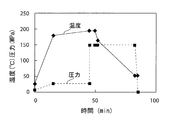
- FIG. 1 is a diagram showing heating and pressurizing profiles in Example 1.
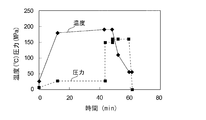
- FIG. FIG. 2 is a diagram showing heating and pressing profiles in Example 2.
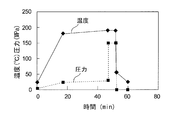
- FIG. 3 is a diagram showing heating and pressurization profiles in Example 3.
- FIG. 4 is a diagram showing heating and pressurizing profiles in Example 4.
- FIG. 5 is a diagram showing heating and pressing profiles in Example 5.
- FIG. 6 is a diagram showing a heating and pressurizing profile in Comparative Example 1.
- the thermoplastic resin is heated to a melting point Tm0 or higher.
- the thermoplastic resin to be used is not particularly limited, and various resins such as polyolefins such as polypropylene, polyethylene, ethylene- ⁇ -olein copolymer, polyvinyl chloride, polystyrene, polyamide, polycarbonate, saturated polyester, polymethacrylic acid ester, etc.
- a thermoplastic resin can be used.
- polyolefin such as polypropylene can be suitably used because it is inexpensive and easily available.
- the refractive index can be improved and it can be suitably used for optical applications such as an optical lens.
- the shape of the prepared thermoplastic resin is not particularly limited. However, it is desirable to use a thermoplastic resin molded body corresponding to the shape of the finally obtained polymer material. That is, even if the thermoplastic resin molded body is heated to a melting point Tm0 or higher to form a thermoplastic resin melt, the polymer material having the same shape as the original thermoplastic resin molded body is obtained by immediately cooling under pressure. Can be obtained. Therefore, preferably, when the thermoplastic resin molded body is heated to a melting point Tm0 or higher to form a thermoplastic resin melt, the thermoplastic resin molded body is placed in a container that maintains the outer shape of the original thermoplastic resin molded body. It is desirable to keep it. Thereby, after cooling under pressure, a polymer material having the same shape as the original thermoplastic resin molded body can be obtained.
- the method for heating the thermoplastic resin is not particularly limited, and a method using high frequency induction heating, an oven, a heater, or the like can be used. However, since it is necessary to carry out a pressurizing step to be described later, a method capable of heating in a container or apparatus that can be pressurized is used.
- the melting point Tm0 of the thermoplastic resin is a melting point obtained from a melting peak measured by DSC (differential scanning calorimetry).
- thermoplastic resin is heated to the melting point or higher, a pressure higher than the atmospheric pressure is added to the thermoplastic resin melt, and the thermoplastic resin melt is applied in a state where the pressure is applied. Cool the liquid.
- This pressurization may be performed from the stage of heating the thermoplastic resin, or may be performed after the time when the thermoplastic resin is heated to the melting point or higher and becomes a thermoplastic resin melt. In any case, it is necessary that the thermoplastic resin melt is pressurized to atmospheric pressure or higher when the thermoplastic resin melt starts to be cooled. And it is necessary to implement a cooling process with a pressurization state.
- the pressure applied to the thermoplastic resin melt in the cooling step may be maintained at a pressure higher than atmospheric pressure at least until the cooling end temperature is lower than the upper limit temperature of the crystallization temperature range.
- the crystallization temperature range refers to the range from the temperature when the DSC curve leaves the baseline to the time when the DSC curve returns to the baseline again in the DSC chart measured by suggested operation calorimetry (DSC). Refers to the temperature range.
- the highest temperature within the crystallization temperature range is defined as a crystallization temperature range upper limit temperature
- the lowest temperature within the crystallization temperature range is defined as a crystallization temperature range lower limit temperature.
- the pressure may be further increased.
- the crystal density in the obtained polymer material becomes higher, a polymer material having a higher degree of crystallinity can be obtained. Therefore, the melting point of the resulting polymer material can be further increased. Accordingly, the heat resistance can be further improved.
- cooling is started in a state where a pressure higher than atmospheric pressure is applied to the thermoplastic resin melt.
- a pressure higher than the atmospheric pressure may be applied before the start of cooling, or a pressure higher than the atmospheric pressure may be applied at the start of cooling.
- thermoplastic resin molecules can move freely.
- the thermoplastic resin melt is pressurized, the free molecular motion of the thermoplastic resin is regulated by the pressure.
- the thermoplastic resin melt shifts from the melt state to the solid state while the molecular motion of the thermoplastic resin is regulated. Therefore, when the thermoplastic resin melt moves to a solid state, three-dimensional isotropic crystallization proceeds.
- the resin physical properties refer to physical properties such as mechanical strength, heat resistance and refractive index of the resin.
- the cooling proceeds while the molecular motion is regulated as described above, the crystallinity of the resulting polymer material is increased. Thereby, the melting point of the obtained polymer material becomes higher than the melting point of the original thermoplastic resin. Therefore, a polymer material having excellent heat resistance can be obtained.
- the pressurized state is higher than the atmospheric pressure until the cooling end temperature is reached. In that case, the crystallinity of the resulting polymer material can be further increased. Therefore, the heat resistance of the resulting polymer material can be further increased.
- the pressure required for the pressurization is not particularly limited as long as it is at least atmospheric pressure.
- the pressure is preferably 1 MPa or more, more preferably 10 MPa or more.
- the pressure is 1 MPa or more, more preferably 10 MPa or more, a three-dimensional isotropic crystal structure can be obtained with certainty, and the crystallinity can be increased more effectively. Thereby, the melting point and heat resistance of the resulting polymer material can be effectively increased.
- the isotropy of the physical properties of the resin can be further enhanced.
- the upper limit of the pressure during the pressurization is not particularly limited as long as a three-dimensional isotropic crystal structure is obtained. However, if the pressure is too high, the equipment used for the pressurization increases, and the cost for the equipment may increase. For this reason, the upper limit of the pressure is desirably 200 MPa or less.
- the amount of pressure increase required for further increasing the pressure is not particularly limited, but is desirably 5 to 50 MPa or more.
- the crystallinity can be further increased, and the variation in crystallinity can be further reduced.
- the heat resistance of the resulting polymer material can be further increased, and variations in resin physical properties can be reduced.
- the pressurizing method is not particularly limited.
- a method of inserting a thermoplastic resin into various pressure media and applying pressure to the pressure media with a pressurizing source such as a pump can be used.
- a pressure medium water, oil, or the like can be used.
- a gas may be used as the pressure medium.
- the pressurizing method it is preferable to use hydrostatic pressure.
- the hydrostatic pressure is used, the pressure can be applied uniformly from the periphery of the thermoplastic resin, that is, isotropically. Therefore, it is possible to further increase the isotropy of crystallinity.
- the shape of the thermoplastic resin is not limited to a sheet shape, and a thick molded body or a thermoplastic resin having a complicated shape can be used. Therefore, various shapes of polymer materials can be easily obtained.
- the pressure time varies depending on the cooling rate, the melting point of the thermoplastic resin, and the crystallization temperature range.
- the pressurization time is preferably 10 seconds or more from the start of cooling, and more preferably 60 seconds or more.
- crystallization proceeds in a state where molecular motion is regulated as described above by cooling to a temperature lower than the upper limit temperature of the crystallization temperature range. Therefore, a polymer material having a high degree of crystallinity can be obtained by the cooling. Therefore, in the method for producing a polymer material of the present invention, the pressure is released at a cooling end temperature lower than the upper limit temperature of the crystallization temperature range. Depressurization can be performed by releasing pressure such as hydrostatic pressure.
- a polymer material having a high degree of crystallinity and three-dimensional isotropic crystallinity can be obtained. Accordingly, the melting point and heat resistance of the obtained polymer material are increased, and the isotropy of the resin physical properties is further improved. Since the polymer material has a small variation in crystallinity, the variation in resin physical properties is also small.
- the cooling end temperature is not particularly limited as long as it is lower than the crystallization temperature range upper limit temperature.
- the cooling end temperature is preferably a temperature not higher than the lower limit temperature of the crystallization temperature range. In that case, the crystallinity of the resulting polymer material can be further enhanced. Therefore, the melting point and heat resistance of the resulting polymer material can be further enhanced.
- the polymer material of the present invention is obtained by the production method of the present invention, has a crystallinity of 50% or more, and has three-dimensional isotropic resin properties.
- the three-dimensional isotropy of the resin physical properties means that the physical properties of the resin produced by increasing the crystallinity are three-dimensionally isotropic. For example, it means that resin physical properties such as mechanical strength and heat resistance are three-dimensionally isotropic.
- the variation in crystallinity is preferably such that the maximum value of the crystallinity is within 1.5 times the minimum value, more preferably 1.2 times. In this case, it is possible to provide a polymer material with little variation in resin physical properties such as mechanical strength and heat resistance.
- the variation in crystallinity is based on the degree of crystallinity at a plurality of points by measuring the degree of crystallinity at a plurality of points with a polymer material prepared as a sample, as described in the Examples section below. The variation in crystallinity can be evaluated.
- the polymer material of the present invention has a crystallinity as high as 50% or more, and has three-dimensional isotropic crystallinity. Therefore, in a polymer material made of a thermoplastic resin such as polypropylene, the isotropic property of the resin can be enhanced. In addition, since the degree of crystallinity is increased, the heat resistance of the polymer material can also be increased.
- the polymer material of the present invention is obtained by the production method of the present invention.
- Tm the melting point of the original thermoplastic resin
- Tm the melting point of the obtained polymer material
- Tm the melting point of the obtained polymer material
- Example 1 An injection molded body having a shape of 80 mm ⁇ 5 mm ⁇ thickness 1 mm made of polypropylene (manufactured by Nippon Polypro, polypropylene resin grade MA3H, melting point 167 ° C., crystallization temperature range 80 ° C. to 150 ° C.) was prepared. This polypropylene resin injection molding was sealed in a pressure vessel at room temperature (25.7 ° C.), and the initial pressure was set to 5 MPa as a hydrostatic pressure. Next, the polypropylene resin injection-molded body enclosed in the pressure vessel was heated to a temperature of 180 ° C. by a mantle heater disposed outside the pressure vessel. The hydrostatic pressure became 27 MPa by the heating.
- polypropylene manufactured by Nippon Polypro, polypropylene resin grade MA3H, melting point 167 ° C., crystallization temperature range 80 ° C. to 150 ° C.
- FIG. 1 and Table 1 show the heating and pressurization profiles of the heating, pressurizing and cooling steps in Example 1.
- Example 2 Except that the pressure at the start of cooling was increased to 160 MPa, the polypropylene resin molded body was heated, pressurized and cooled in the same manner as in Example 1 to obtain a polypropylene resin molded body.
- FIG. 2 and Table 2 show the heating and pressurizing profiles of the heating, pressurizing, and cooling steps in Example 2.
- Example 3 Except that it was cooled to a temperature of 115 ° C. at a cooling rate of 10 ° C./min or more while maintaining the pressure at 160 MPa, the polypropylene resin molded body was heated, pressurized and cooled in the same manner as in Example 2, A polypropylene resin molded body was obtained.
- FIG. 3 and Table 3 show the heating and pressurizing profiles of the heating, pressurizing and cooling steps in Example 3.
- Example 4 Polypropylene (manufactured by Nippon Polypro Co., Ltd., polypropylene resin grade MA3H, melting point 167 ° C., crystallization temperature range 80 ° C. to 150 ° C.) was cut out to obtain a bulk test piece of 50 mm ⁇ 50 mm ⁇ 50 mm.
- the block test piece was placed in a sample bag made of a composite film in which aluminum was vacuum-deposited on the inner surface of a synthetic resin film, and the sample bag was sealed in a pressure vessel at room temperature (25.7 ° C.). In the pressure vessel, the periphery of the sample bag was filled with water as a pressure medium. The sample bag can prevent contact between water and the test piece while transferring the surrounding pressure to the internal test piece.
- the initial pressure was 5 MPa by hydrostatic pressure.
- the polypropylene resin injection molded body enclosed in the pressure vessel was heated to a temperature of 180 ° C. by a mantle heater disposed outside the pressure vessel. Due to the heating, the hydrostatic pressure increased to 27 MPa. Then, it was heated to a temperature of 190 ° C. over 30 minutes by the mantle heater. When the temperature reached 190 ° C., the pressure was increased to 150 MPa and held for 5 minutes.
- FIG. 4 and Table 4 show the heating and pressurizing profiles of the heating, pressurizing and cooling steps in Example 4.
- Example 5 In the same manner as in Example 4, the sample bag containing the massive test piece was heated and pressurized. Thereafter, the pressure was further increased to 170 MPa at the start of cooling, and cooled to room temperature while maintaining the pressure at 170 MPa. Then, the test piece processed as mentioned above was taken out from the sample bag, and the polypropylene resin molding was obtained.
- FIG. 5 and Table 5 show the heating and pressurization profiles of the heating, pressurizing and cooling steps in Example 5.
- Comparative Example 1 An injection molded body having a shape of 80 mm ⁇ 5 mm ⁇ thickness 1 mm made of polypropylene (manufactured by Nippon Polypro, polypropylene resin grade MA3H, melting point 167 ° C., crystallization temperature range 80 ° C. to 150 ° C.) was prepared. This injection-injected body was used as the polypropylene resin molded body of Comparative Example 1.
- FIG. 6 and Table 6 show the heating and pressurization profiles of the heating, pressurizing and cooling steps in Comparative Example 2.
- Example 3 The same polypropylene as prepared in Example 4 was injection-molded to obtain a block test piece of 50 mm ⁇ 50 mm ⁇ 50 mm. This block test piece was used as a polypropylene resin molded body of Comparative Example 3.
- Crystallinity measuring device “DSC 6220” manufactured by SII Nano Technology Co., Ltd. was used.
- the polypropylene resin moldings obtained in Examples 1 to 5 were compared with the polypropylene resin moldings in Comparative Examples 1 to 3 obtained only by polypropylene injection molding. Has been greatly increased. This is obtained by heating, pressurizing, and cooling the injection molded body or the bulk test piece by using the heating and pressure profiles according to the production method of the present invention for the polypropylene resin molded bodies of Examples 1 to 5. It depends on what was done. Thereby, it is considered that the degree of crystallinity of the obtained polypropylene resin molding was increased.
- the melting point Tm of the original polypropylene resin molding of Comparative Example 1 was 167.7 ° C.
- the melting point of the polypropylene resin molding after treatment was rather low at 165.1 ° C.
- the melting point Tm was 10 ° C. higher than Tm0. This is because, as described above, the crystallinity of the obtained polypropylene resin molding was increased. Therefore, it can be seen that by following the production method of the present invention, it is possible to provide a polypropylene resin injection-molded article having improved crystallinity and heat resistance.
- the polypropylene resin moldings obtained in Examples 4 and 5 were more varied in crystallinity than the polypropylene resin molding of Comparative Example 3 obtained only by polypropylene injection molding. It can be seen that the three-dimensional anisotropy of the mechanical strength is extremely small. This is because the polypropylene resin molded bodies of Examples 4 and 5 were obtained by heating, pressurizing and cooling the massive test pieces according to the production method of the present invention. Thereby, it is considered that the degree of crystallinity of the obtained molded polypropylene resin is increased, and the variation in crystallinity is reduced. Furthermore, since the three-dimensional isotropic crystal structure was obtained by the manufacturing method, it is considered that the resin property isotropy of the polypropylene resin molded body was enhanced.
Landscapes
- Mechanical Engineering (AREA)
- Engineering & Computer Science (AREA)
- Physics & Mathematics (AREA)
- Thermal Sciences (AREA)
- Chemical & Material Sciences (AREA)
- Health & Medical Sciences (AREA)
- Manufacturing & Machinery (AREA)
- Crystallography & Structural Chemistry (AREA)
- Oral & Maxillofacial Surgery (AREA)
- Chemical Kinetics & Catalysis (AREA)
- Medicinal Chemistry (AREA)
- Polymers & Plastics (AREA)
- Organic Chemistry (AREA)
- Casting Or Compression Moulding Of Plastics Or The Like (AREA)
- Compositions Of Macromolecular Compounds (AREA)
- Processing And Handling Of Plastics And Other Materials For Molding In General (AREA)
- Processes Of Treating Macromolecular Substances (AREA)
Abstract
Priority Applications (5)
| Application Number | Priority Date | Filing Date | Title |
|---|---|---|---|
| EP20110828621 EP2623287A4 (fr) | 2010-09-30 | 2011-08-04 | Matière hautement polymère et son procédé de production |
| CN201180046910.8A CN103153569B (zh) | 2010-09-30 | 2011-08-04 | 高分子材料及其制造方法 |
| JP2011533895A JP5739342B2 (ja) | 2010-09-30 | 2011-08-04 | 高分子材料及びその製造方法 |
| KR1020137007589A KR20130114649A (ko) | 2010-09-30 | 2011-08-04 | 고분자 재료 및 그의 제조 방법 |
| US13/818,553 US8796413B2 (en) | 2010-09-30 | 2011-08-04 | Polymer material and method for producing same |
Applications Claiming Priority (4)
| Application Number | Priority Date | Filing Date | Title |
|---|---|---|---|
| JP2010-222177 | 2010-09-30 | ||
| JP2010222177 | 2010-09-30 | ||
| JP2010231751 | 2010-10-14 | ||
| JP2010-231751 | 2010-10-14 |
Publications (1)
| Publication Number | Publication Date |
|---|---|
| WO2012043060A1 true WO2012043060A1 (fr) | 2012-04-05 |
Family
ID=45892535
Family Applications (1)
| Application Number | Title | Priority Date | Filing Date |
|---|---|---|---|
| PCT/JP2011/067868 Ceased WO2012043060A1 (fr) | 2010-09-30 | 2011-08-04 | Matière hautement polymère et son procédé de production |
Country Status (6)
| Country | Link |
|---|---|
| US (1) | US8796413B2 (fr) |
| EP (1) | EP2623287A4 (fr) |
| JP (1) | JP5739342B2 (fr) |
| KR (1) | KR20130114649A (fr) |
| CN (1) | CN103153569B (fr) |
| WO (1) | WO2012043060A1 (fr) |
Cited By (1)
| Publication number | Priority date | Publication date | Assignee | Title |
|---|---|---|---|---|
| US20140228534A1 (en) * | 2012-05-15 | 2014-08-14 | Sekisui Chemical Co., Ltd. | Method for producing polypropylene material, and polypropylene material |
Citations (9)
| Publication number | Priority date | Publication date | Assignee | Title |
|---|---|---|---|---|
| JPS5574846A (en) * | 1978-12-01 | 1980-06-05 | Owens Illinois Inc | Method of controlling crystallization of thermal plastic material and device of controlling growth velocity of crystal of thermal plastic material |
| JPH05241041A (ja) * | 1992-03-02 | 1993-09-21 | Furukawa Electric Co Ltd:The | 光コネクタ用フェルールの製造方法 |
| JPH10296812A (ja) * | 1997-04-23 | 1998-11-10 | Mitsui Chem Inc | 射出圧縮成形方法 |
| JPH10337759A (ja) * | 1997-06-10 | 1998-12-22 | Mitsubishi Eng Plast Kk | 熱可塑性樹脂から成る成形品の製造方法 |
| JPH1188974A (ja) * | 1997-09-02 | 1999-03-30 | Mitsubishi Electric Corp | スピーカーキャビネットおよびその製造方法 |
| WO2006049159A1 (fr) * | 2004-11-02 | 2006-05-11 | Idemitsu Kosan Co., Ltd. | Procédé de moulage de compression par injection et article moulé |
| WO2007026832A1 (fr) | 2005-09-02 | 2007-03-08 | National University Of Corporation Hiroshima University | Procede de fabrication de cristal orienté polymère, cristal oriente polymere fabrique selon ledit procede de fabrication, et methodé de détermination du taux de contrainte d'allongement critique d'une fusion polymère |
| JP2007269019A (ja) * | 2006-03-10 | 2007-10-18 | Asahi Kasei Chemicals Corp | 結晶性熱可塑性樹脂の射出成形法 |
| JP2008248457A (ja) * | 2007-03-30 | 2008-10-16 | Nano Carbon Technologies Kk | 炭素繊維複合体および炭素繊維複合体の製造方法 |
Family Cites Families (7)
| Publication number | Priority date | Publication date | Assignee | Title |
|---|---|---|---|---|
| US3883631A (en) * | 1966-11-25 | 1975-05-13 | Impact Plastics Inc | Method and means for making high molecular weight polyethylene sheets |
| US3846522A (en) * | 1970-09-10 | 1974-11-05 | Elpex Inc | Forming of thermoplastic polymers |
| SE415464B (sv) * | 1978-09-29 | 1980-10-06 | Josef Kubat | Tryckalstringsanordning vid formsprutning och anvendning derav |
| DE68926624T2 (de) * | 1988-12-02 | 1996-10-02 | Du Pont | Lineares polyäthylen von ultrahohem molekulargewicht, gegenstände und verfahren zu deren herstellung |
| JP2002363325A (ja) * | 2001-06-06 | 2002-12-18 | Tadashi Hasegawa | 発泡プラスチックの製造方法 |
| CN100584575C (zh) * | 2004-11-02 | 2010-01-27 | 出光兴产株式会社 | 注射压缩成形方法 |
| DE102005037116B3 (de) * | 2005-08-03 | 2007-01-18 | Kunststoff-Prof. Ehrenstein GbR (vertretungsberechtigter Gesellschafter: Prof. Dr.-Ing. Dr.h.c. Gottfried W. Ehrenstein, 90427 Nürnberg) | Verfahren zur Herstellung eines Formteils, insbesondere Spritzgießverfahren |
-
2011
- 2011-08-04 WO PCT/JP2011/067868 patent/WO2012043060A1/fr not_active Ceased
- 2011-08-04 JP JP2011533895A patent/JP5739342B2/ja not_active Expired - Fee Related
- 2011-08-04 US US13/818,553 patent/US8796413B2/en not_active Expired - Fee Related
- 2011-08-04 EP EP20110828621 patent/EP2623287A4/fr not_active Withdrawn
- 2011-08-04 KR KR1020137007589A patent/KR20130114649A/ko not_active Withdrawn
- 2011-08-04 CN CN201180046910.8A patent/CN103153569B/zh not_active Expired - Fee Related
Patent Citations (9)
| Publication number | Priority date | Publication date | Assignee | Title |
|---|---|---|---|---|
| JPS5574846A (en) * | 1978-12-01 | 1980-06-05 | Owens Illinois Inc | Method of controlling crystallization of thermal plastic material and device of controlling growth velocity of crystal of thermal plastic material |
| JPH05241041A (ja) * | 1992-03-02 | 1993-09-21 | Furukawa Electric Co Ltd:The | 光コネクタ用フェルールの製造方法 |
| JPH10296812A (ja) * | 1997-04-23 | 1998-11-10 | Mitsui Chem Inc | 射出圧縮成形方法 |
| JPH10337759A (ja) * | 1997-06-10 | 1998-12-22 | Mitsubishi Eng Plast Kk | 熱可塑性樹脂から成る成形品の製造方法 |
| JPH1188974A (ja) * | 1997-09-02 | 1999-03-30 | Mitsubishi Electric Corp | スピーカーキャビネットおよびその製造方法 |
| WO2006049159A1 (fr) * | 2004-11-02 | 2006-05-11 | Idemitsu Kosan Co., Ltd. | Procédé de moulage de compression par injection et article moulé |
| WO2007026832A1 (fr) | 2005-09-02 | 2007-03-08 | National University Of Corporation Hiroshima University | Procede de fabrication de cristal orienté polymère, cristal oriente polymere fabrique selon ledit procede de fabrication, et methodé de détermination du taux de contrainte d'allongement critique d'une fusion polymère |
| JP2007269019A (ja) * | 2006-03-10 | 2007-10-18 | Asahi Kasei Chemicals Corp | 結晶性熱可塑性樹脂の射出成形法 |
| JP2008248457A (ja) * | 2007-03-30 | 2008-10-16 | Nano Carbon Technologies Kk | 炭素繊維複合体および炭素繊維複合体の製造方法 |
Non-Patent Citations (1)
| Title |
|---|
| "TENSILON Universal Testing Instruments RTC series", A&D COMPANY |
Cited By (2)
| Publication number | Priority date | Publication date | Assignee | Title |
|---|---|---|---|---|
| US20140228534A1 (en) * | 2012-05-15 | 2014-08-14 | Sekisui Chemical Co., Ltd. | Method for producing polypropylene material, and polypropylene material |
| US9221931B2 (en) * | 2012-05-15 | 2015-12-29 | Sekisui Chemical Co., Ltd. | Method for producing polypropylene material, and polypropylene material |
Also Published As
| Publication number | Publication date |
|---|---|
| JPWO2012043060A1 (ja) | 2014-02-06 |
| CN103153569A (zh) | 2013-06-12 |
| KR20130114649A (ko) | 2013-10-17 |
| JP5739342B2 (ja) | 2015-06-24 |
| CN103153569B (zh) | 2015-02-18 |
| US8796413B2 (en) | 2014-08-05 |
| EP2623287A1 (fr) | 2013-08-07 |
| EP2623287A4 (fr) | 2014-10-22 |
| US20130158224A1 (en) | 2013-06-20 |
Similar Documents
| Publication | Publication Date | Title |
|---|---|---|
| JPWO2013088728A1 (ja) | 耐熱食品容器及びその製造方法 | |
| WO2012008223A1 (fr) | Article polymère et son procédé de production | |
| JP6275135B2 (ja) | フィルム及び高分子圧電材料 | |
| JP5739342B2 (ja) | 高分子材料及びその製造方法 | |
| EP1938948B1 (fr) | Procede de fabrication de cristal orienté de polymère et méthode de détermination du taux de contrainte d'allongement critique d'une fusion polymère | |
| JP5767259B2 (ja) | 耐熱食品容器及びその製造方法 | |
| Prosser et al. | Investigation into thermoformability of hot compacted polypropylene sheet | |
| JPS596216B2 (ja) | 耐熱性の優れた延伸成形容器の製造方法 | |
| JP7543904B2 (ja) | 光学フィルムの製造方法、及び延伸フィルムの製造方法 | |
| JP5060658B2 (ja) | 高分子成形品の製造方法 | |
| CN108025465B (zh) | 用于制造聚酯基聚合物制品的方法 | |
| CN111372979A (zh) | 成型体及其制造方法 | |
| KR101630163B1 (ko) | 비활성가스 용해를 이용한 고체 고분자의 성형방법 및 이를 이용한 고체 고분자의 발포방법과 염색방법 | |
| JP6590178B1 (ja) | 熱収縮性ポリアミドフィルム及びその製造方法 | |
| KR101959784B1 (ko) | 사출 성형품의 재료선택 방법 및 사출 성형품의 제조 방법 | |
| Isayev et al. | Self-reinforced prepregs and laminates of a poly (phenylene oxide)—Polystyrene alloy with a liquid crystalline polymer | |
| WO2021020023A1 (fr) | Film à contraste de phase et son procédé de production | |
| McKelvey et al. | Thermoforming of HDPE | |
| Harkin-Jones et al. | Thermoforming of polypropylene | |
| CN110603129B (zh) | 选择注射成型制品的材料的方法和制造注射成型制品的方法 | |
| JP2010270183A (ja) | ポリ乳酸系延伸シート及びその製造方法、並びにポリ乳酸系延伸シートを成形してなる成形体 | |
| JPS6145525B2 (fr) | ||
| JP2013035988A (ja) | Ptfeフィルム、医療用ゴム栓、ptfeフィルムの加工方法および医療用ゴム栓の製造方法 | |
| JP2022104366A (ja) | 光学フィルム及びその製造方法 | |
| JP2005255839A (ja) | 耐衝撃強度性及び耐熱性に優れたポリ乳酸系重合体製容器及びその成形方法 |
Legal Events
| Date | Code | Title | Description |
|---|---|---|---|
| WWE | Wipo information: entry into national phase |
Ref document number: 201180046910.8 Country of ref document: CN |
|
| WWE | Wipo information: entry into national phase |
Ref document number: 2011533895 Country of ref document: JP |
|
| 121 | Ep: the epo has been informed by wipo that ep was designated in this application |
Ref document number: 11828621 Country of ref document: EP Kind code of ref document: A1 |
|
| WWE | Wipo information: entry into national phase |
Ref document number: 13818553 Country of ref document: US |
|
| REEP | Request for entry into the european phase |
Ref document number: 2011828621 Country of ref document: EP |
|
| WWE | Wipo information: entry into national phase |
Ref document number: 2011828621 Country of ref document: EP |
|
| ENP | Entry into the national phase |
Ref document number: 20137007589 Country of ref document: KR Kind code of ref document: A |
|
| NENP | Non-entry into the national phase |
Ref country code: DE |