WO2012052412A1 - Neue heterocylische verbindungen als schädlingsbekämpfungsmittel - Google Patents

Neue heterocylische verbindungen als schädlingsbekämpfungsmittel Download PDF

Info

Publication number
WO2012052412A1
WO2012052412A1 PCT/EP2011/068129 EP2011068129W WO2012052412A1 WO 2012052412 A1 WO2012052412 A1 WO 2012052412A1 EP 2011068129 W EP2011068129 W EP 2011068129W WO 2012052412 A1 WO2012052412 A1 WO 2012052412A1
Authority
WO
WIPO (PCT)
Prior art keywords
alkyl
spp
optionally substituted
alkoxy
compounds
Prior art date
Legal status (The legal status is an assumption and is not a legal conclusion. Google has not performed a legal analysis and makes no representation as to the accuracy of the status listed.)
Ceased
Application number
PCT/EP2011/068129
Other languages
English (en)
French (fr)
Inventor
Thomas Bretschneider
Adeline KÖHLER
Joachim Kluth
Martin FÜSSLEIN
Peter Jeschke
Reiner Fischer
Friedrich August MÜHLTHAU
Olga Malsam
Arnd Voerste
Klaus-Helmut Müller
Yoshitaka Sato
Current Assignee (The listed assignees may be inaccurate. Google has not performed a legal analysis and makes no representation or warranty as to the accuracy of the list.)
Bayer CropScience AG
Original Assignee
Bayer CropScience AG
Priority date (The priority date is an assumption and is not a legal conclusion. Google has not performed a legal analysis and makes no representation as to the accuracy of the date listed.)
Filing date
Publication date
Application filed by Bayer CropScience AG filed Critical Bayer CropScience AG
Priority to CN201180062104.XA priority Critical patent/CN103270029B/zh
Priority to JP2013534284A priority patent/JP5953308B2/ja
Priority to EP11771129.1A priority patent/EP2630133A1/de
Priority to US13/878,193 priority patent/US9173396B2/en
Priority to BR112013009823A priority patent/BR112013009823A2/pt
Publication of WO2012052412A1 publication Critical patent/WO2012052412A1/de
Anticipated expiration legal-status Critical
Priority to US14/848,408 priority patent/US20150373978A1/en
Ceased legal-status Critical Current

Links

Classifications

    • CCHEMISTRY; METALLURGY
    • C07ORGANIC CHEMISTRY
    • C07DHETEROCYCLIC COMPOUNDS
    • C07D401/00Heterocyclic compounds containing two or more hetero rings, having nitrogen atoms as the only ring hetero atoms, at least one ring being a six-membered ring with only one nitrogen atom
    • C07D401/02Heterocyclic compounds containing two or more hetero rings, having nitrogen atoms as the only ring hetero atoms, at least one ring being a six-membered ring with only one nitrogen atom containing two hetero rings
    • C07D401/04Heterocyclic compounds containing two or more hetero rings, having nitrogen atoms as the only ring hetero atoms, at least one ring being a six-membered ring with only one nitrogen atom containing two hetero rings directly linked by a ring-member-to-ring-member bond
    • AHUMAN NECESSITIES
    • A01AGRICULTURE; FORESTRY; ANIMAL HUSBANDRY; HUNTING; TRAPPING; FISHING
    • A01NPRESERVATION OF BODIES OF HUMANS OR ANIMALS OR PLANTS OR PARTS THEREOF; BIOCIDES, e.g. AS DISINFECTANTS, AS PESTICIDES OR AS HERBICIDES; PEST REPELLANTS OR ATTRACTANTS; PLANT GROWTH REGULATORS
    • A01N43/00Biocides, pest repellants or attractants, or plant growth regulators containing heterocyclic compounds
    • A01N43/72Biocides, pest repellants or attractants, or plant growth regulators containing heterocyclic compounds having rings with nitrogen atoms and oxygen or sulfur atoms as ring hetero atoms
    • A01N43/74Biocides, pest repellants or attractants, or plant growth regulators containing heterocyclic compounds having rings with nitrogen atoms and oxygen or sulfur atoms as ring hetero atoms five-membered rings with one nitrogen atom and either one oxygen atom or one sulfur atom in positions 1,3
    • A01N43/761,3-Oxazoles; Hydrogenated 1,3-oxazoles
    • AHUMAN NECESSITIES
    • A01AGRICULTURE; FORESTRY; ANIMAL HUSBANDRY; HUNTING; TRAPPING; FISHING
    • A01NPRESERVATION OF BODIES OF HUMANS OR ANIMALS OR PLANTS OR PARTS THEREOF; BIOCIDES, e.g. AS DISINFECTANTS, AS PESTICIDES OR AS HERBICIDES; PEST REPELLANTS OR ATTRACTANTS; PLANT GROWTH REGULATORS
    • A01N43/00Biocides, pest repellants or attractants, or plant growth regulators containing heterocyclic compounds
    • A01N43/34Biocides, pest repellants or attractants, or plant growth regulators containing heterocyclic compounds having rings with one nitrogen atom as the only ring hetero atom
    • A01N43/40Biocides, pest repellants or attractants, or plant growth regulators containing heterocyclic compounds having rings with one nitrogen atom as the only ring hetero atom six-membered rings
    • AHUMAN NECESSITIES
    • A01AGRICULTURE; FORESTRY; ANIMAL HUSBANDRY; HUNTING; TRAPPING; FISHING
    • A01NPRESERVATION OF BODIES OF HUMANS OR ANIMALS OR PLANTS OR PARTS THEREOF; BIOCIDES, e.g. AS DISINFECTANTS, AS PESTICIDES OR AS HERBICIDES; PEST REPELLANTS OR ATTRACTANTS; PLANT GROWTH REGULATORS
    • A01N43/00Biocides, pest repellants or attractants, or plant growth regulators containing heterocyclic compounds
    • A01N43/48Biocides, pest repellants or attractants, or plant growth regulators containing heterocyclic compounds having rings with two nitrogen atoms as the only ring hetero atoms
    • A01N43/541,3-Diazines; Hydrogenated 1,3-diazines
    • AHUMAN NECESSITIES
    • A01AGRICULTURE; FORESTRY; ANIMAL HUSBANDRY; HUNTING; TRAPPING; FISHING
    • A01NPRESERVATION OF BODIES OF HUMANS OR ANIMALS OR PLANTS OR PARTS THEREOF; BIOCIDES, e.g. AS DISINFECTANTS, AS PESTICIDES OR AS HERBICIDES; PEST REPELLANTS OR ATTRACTANTS; PLANT GROWTH REGULATORS
    • A01N43/00Biocides, pest repellants or attractants, or plant growth regulators containing heterocyclic compounds
    • A01N43/48Biocides, pest repellants or attractants, or plant growth regulators containing heterocyclic compounds having rings with two nitrogen atoms as the only ring hetero atoms
    • A01N43/561,2-Diazoles; Hydrogenated 1,2-diazoles
    • AHUMAN NECESSITIES
    • A01AGRICULTURE; FORESTRY; ANIMAL HUSBANDRY; HUNTING; TRAPPING; FISHING
    • A01NPRESERVATION OF BODIES OF HUMANS OR ANIMALS OR PLANTS OR PARTS THEREOF; BIOCIDES, e.g. AS DISINFECTANTS, AS PESTICIDES OR AS HERBICIDES; PEST REPELLANTS OR ATTRACTANTS; PLANT GROWTH REGULATORS
    • A01N43/00Biocides, pest repellants or attractants, or plant growth regulators containing heterocyclic compounds
    • A01N43/64Biocides, pest repellants or attractants, or plant growth regulators containing heterocyclic compounds having rings with three nitrogen atoms as the only ring hetero atoms
    • A01N43/647Triazoles; Hydrogenated triazoles
    • AHUMAN NECESSITIES
    • A01AGRICULTURE; FORESTRY; ANIMAL HUSBANDRY; HUNTING; TRAPPING; FISHING
    • A01NPRESERVATION OF BODIES OF HUMANS OR ANIMALS OR PLANTS OR PARTS THEREOF; BIOCIDES, e.g. AS DISINFECTANTS, AS PESTICIDES OR AS HERBICIDES; PEST REPELLANTS OR ATTRACTANTS; PLANT GROWTH REGULATORS
    • A01N43/00Biocides, pest repellants or attractants, or plant growth regulators containing heterocyclic compounds
    • A01N43/64Biocides, pest repellants or attractants, or plant growth regulators containing heterocyclic compounds having rings with three nitrogen atoms as the only ring hetero atoms
    • A01N43/647Triazoles; Hydrogenated triazoles
    • A01N43/6531,2,4-Triazoles; Hydrogenated 1,2,4-triazoles
    • AHUMAN NECESSITIES
    • A01AGRICULTURE; FORESTRY; ANIMAL HUSBANDRY; HUNTING; TRAPPING; FISHING
    • A01NPRESERVATION OF BODIES OF HUMANS OR ANIMALS OR PLANTS OR PARTS THEREOF; BIOCIDES, e.g. AS DISINFECTANTS, AS PESTICIDES OR AS HERBICIDES; PEST REPELLANTS OR ATTRACTANTS; PLANT GROWTH REGULATORS
    • A01N43/00Biocides, pest repellants or attractants, or plant growth regulators containing heterocyclic compounds
    • A01N43/72Biocides, pest repellants or attractants, or plant growth regulators containing heterocyclic compounds having rings with nitrogen atoms and oxygen or sulfur atoms as ring hetero atoms
    • A01N43/74Biocides, pest repellants or attractants, or plant growth regulators containing heterocyclic compounds having rings with nitrogen atoms and oxygen or sulfur atoms as ring hetero atoms five-membered rings with one nitrogen atom and either one oxygen atom or one sulfur atom in positions 1,3
    • A01N43/781,3-Thiazoles; Hydrogenated 1,3-thiazoles
    • AHUMAN NECESSITIES
    • A01AGRICULTURE; FORESTRY; ANIMAL HUSBANDRY; HUNTING; TRAPPING; FISHING
    • A01NPRESERVATION OF BODIES OF HUMANS OR ANIMALS OR PLANTS OR PARTS THEREOF; BIOCIDES, e.g. AS DISINFECTANTS, AS PESTICIDES OR AS HERBICIDES; PEST REPELLANTS OR ATTRACTANTS; PLANT GROWTH REGULATORS
    • A01N43/00Biocides, pest repellants or attractants, or plant growth regulators containing heterocyclic compounds
    • A01N43/72Biocides, pest repellants or attractants, or plant growth regulators containing heterocyclic compounds having rings with nitrogen atoms and oxygen or sulfur atoms as ring hetero atoms
    • A01N43/80Biocides, pest repellants or attractants, or plant growth regulators containing heterocyclic compounds having rings with nitrogen atoms and oxygen or sulfur atoms as ring hetero atoms five-membered rings with one nitrogen atom and either one oxygen atom or one sulfur atom in positions 1,2
    • AHUMAN NECESSITIES
    • A01AGRICULTURE; FORESTRY; ANIMAL HUSBANDRY; HUNTING; TRAPPING; FISHING
    • A01NPRESERVATION OF BODIES OF HUMANS OR ANIMALS OR PLANTS OR PARTS THEREOF; BIOCIDES, e.g. AS DISINFECTANTS, AS PESTICIDES OR AS HERBICIDES; PEST REPELLANTS OR ATTRACTANTS; PLANT GROWTH REGULATORS
    • A01N43/00Biocides, pest repellants or attractants, or plant growth regulators containing heterocyclic compounds
    • A01N43/72Biocides, pest repellants or attractants, or plant growth regulators containing heterocyclic compounds having rings with nitrogen atoms and oxygen or sulfur atoms as ring hetero atoms
    • A01N43/82Biocides, pest repellants or attractants, or plant growth regulators containing heterocyclic compounds having rings with nitrogen atoms and oxygen or sulfur atoms as ring hetero atoms five-membered rings with three ring hetero atoms
    • CCHEMISTRY; METALLURGY
    • C07ORGANIC CHEMISTRY
    • C07DHETEROCYCLIC COMPOUNDS
    • C07D401/00Heterocyclic compounds containing two or more hetero rings, having nitrogen atoms as the only ring hetero atoms, at least one ring being a six-membered ring with only one nitrogen atom
    • C07D401/14Heterocyclic compounds containing two or more hetero rings, having nitrogen atoms as the only ring hetero atoms, at least one ring being a six-membered ring with only one nitrogen atom containing three or more hetero rings
    • CCHEMISTRY; METALLURGY
    • C07ORGANIC CHEMISTRY
    • C07DHETEROCYCLIC COMPOUNDS
    • C07D403/00Heterocyclic compounds containing two or more hetero rings, having nitrogen atoms as the only ring hetero atoms, not provided for by group C07D401/00
    • C07D403/02Heterocyclic compounds containing two or more hetero rings, having nitrogen atoms as the only ring hetero atoms, not provided for by group C07D401/00 containing two hetero rings
    • C07D403/04Heterocyclic compounds containing two or more hetero rings, having nitrogen atoms as the only ring hetero atoms, not provided for by group C07D401/00 containing two hetero rings directly linked by a ring-member-to-ring-member bond
    • CCHEMISTRY; METALLURGY
    • C07ORGANIC CHEMISTRY
    • C07DHETEROCYCLIC COMPOUNDS
    • C07D405/00Heterocyclic compounds containing both one or more hetero rings having oxygen atoms as the only ring hetero atoms, and one or more rings having nitrogen as the only ring hetero atom
    • C07D405/14Heterocyclic compounds containing both one or more hetero rings having oxygen atoms as the only ring hetero atoms, and one or more rings having nitrogen as the only ring hetero atom containing three or more hetero rings
    • CCHEMISTRY; METALLURGY
    • C07ORGANIC CHEMISTRY
    • C07DHETEROCYCLIC COMPOUNDS
    • C07D413/00Heterocyclic compounds containing two or more hetero rings, at least one ring having nitrogen and oxygen atoms as the only ring hetero atoms
    • C07D413/02Heterocyclic compounds containing two or more hetero rings, at least one ring having nitrogen and oxygen atoms as the only ring hetero atoms containing two hetero rings
    • C07D413/04Heterocyclic compounds containing two or more hetero rings, at least one ring having nitrogen and oxygen atoms as the only ring hetero atoms containing two hetero rings directly linked by a ring-member-to-ring-member bond
    • CCHEMISTRY; METALLURGY
    • C07ORGANIC CHEMISTRY
    • C07DHETEROCYCLIC COMPOUNDS
    • C07D413/00Heterocyclic compounds containing two or more hetero rings, at least one ring having nitrogen and oxygen atoms as the only ring hetero atoms
    • C07D413/14Heterocyclic compounds containing two or more hetero rings, at least one ring having nitrogen and oxygen atoms as the only ring hetero atoms containing three or more hetero rings
    • CCHEMISTRY; METALLURGY
    • C07ORGANIC CHEMISTRY
    • C07DHETEROCYCLIC COMPOUNDS
    • C07D417/00Heterocyclic compounds containing two or more hetero rings, at least one ring having nitrogen and sulfur atoms as the only ring hetero atoms, not provided for by group C07D415/00
    • C07D417/14Heterocyclic compounds containing two or more hetero rings, at least one ring having nitrogen and sulfur atoms as the only ring hetero atoms, not provided for by group C07D415/00 containing three or more hetero rings

Definitions

  • the present application relates to novel heterocyclic compounds, to processes for their preparation and to their use for controlling animal pests, which also include arthropods and in particular insects.
  • WO 2008/028903 A2 disclose heterocyclic compounds for which pharmaceutical uses are described.
  • the object of the present invention was to provide compounds which broaden the spectrum of pesticides from various aspects.
  • G 1 is N or CA 1 ,
  • a 1 represents hydrogen, halogen, cyano, nitro, alkyl, haloalkyl, alkoxy or optionally substituted cycloalkyl or cycloalkenyl, where in the cycloalkyl ring and in the cycloalkenyl ring one or more ring members may each be replaced by a heteroatom,
  • a 2 represents hydrogen, halogen, cyano, nitro, alkyl, haloalkyl, alkoxy or optionally substituted cycloalkyl or cycloalkenyl, where in the cycloalkyl ring and in the cycloalkenyl ring one or more ring members may each be replaced by a heteroatom,
  • U is hydrogen, alkyl, haloalkyl or cycloalkyl
  • R 1 is hydrogen, halogen, cyano, hydroxy, alkyl, haloalkyl, alkoxy or cycloalkyl,
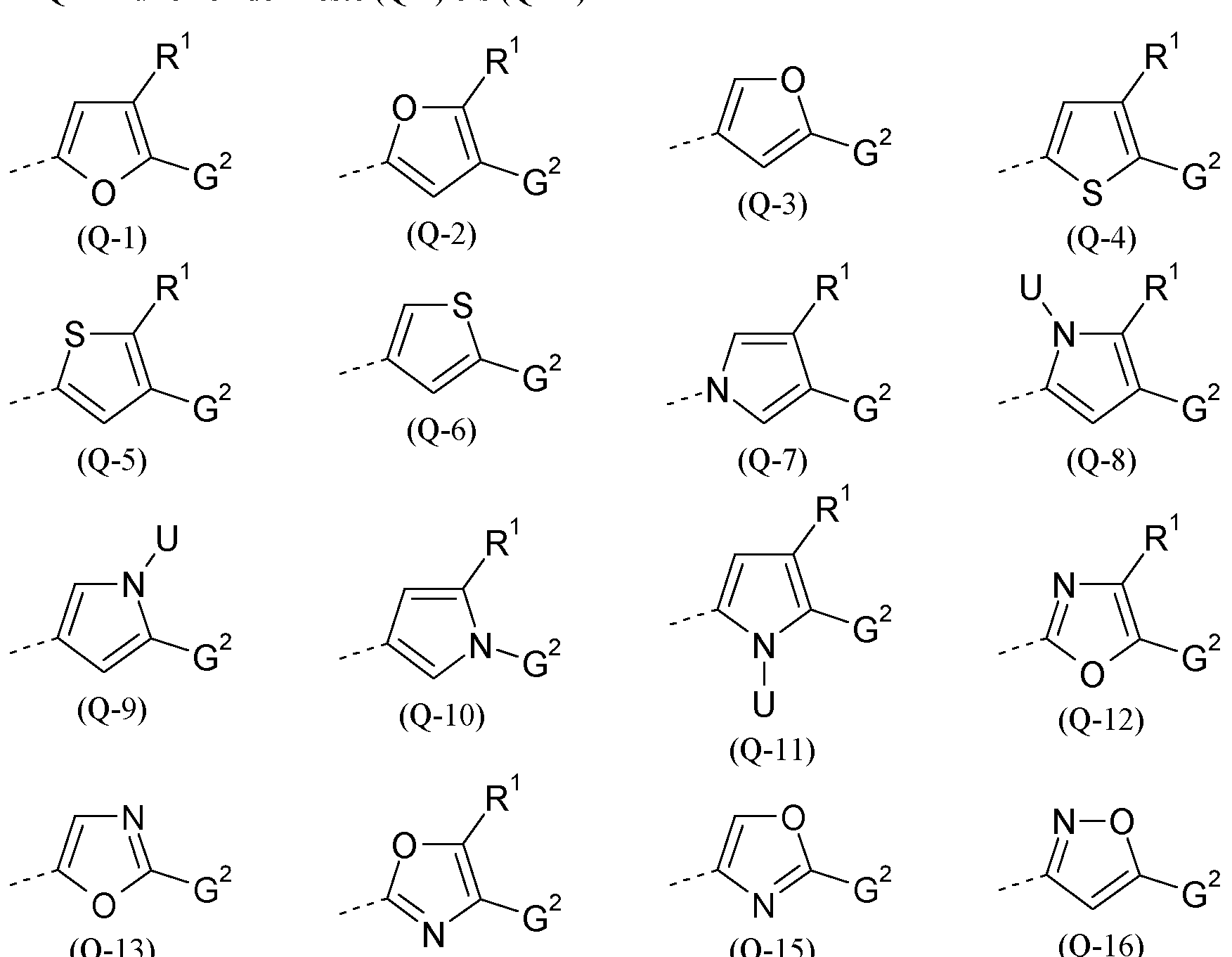
  • R 2 is hydrogen, halogen, cyano, hydroxy, alkyl, haloalkyl, alkoxy, alkoxycarbonyl or cycloalkyl, and wherein in the radicals Q-1, Q-2, Q-3, Q-4, Q-5, Q-6 , Q-7, Q-8, Q-9, Q-11, Q-12, Q-13, Q-14, Q-15, Q-16, Q-17, Q-18, Q-19, Q -20, Q-21, Q-22, Q-23, Q-24, Q-25, Q-27, Q-28, Q-30, Q-31, Q-33, Q-34, Q-35 , Q-36, Q-37, Q-38, Q-39, Q-40, Q-44, Q-45, Q-46, Q-48, Q-49, Q-50, Q-51, Q -52, Q-53, Q-58, Q-61, Q-62 and Q-63
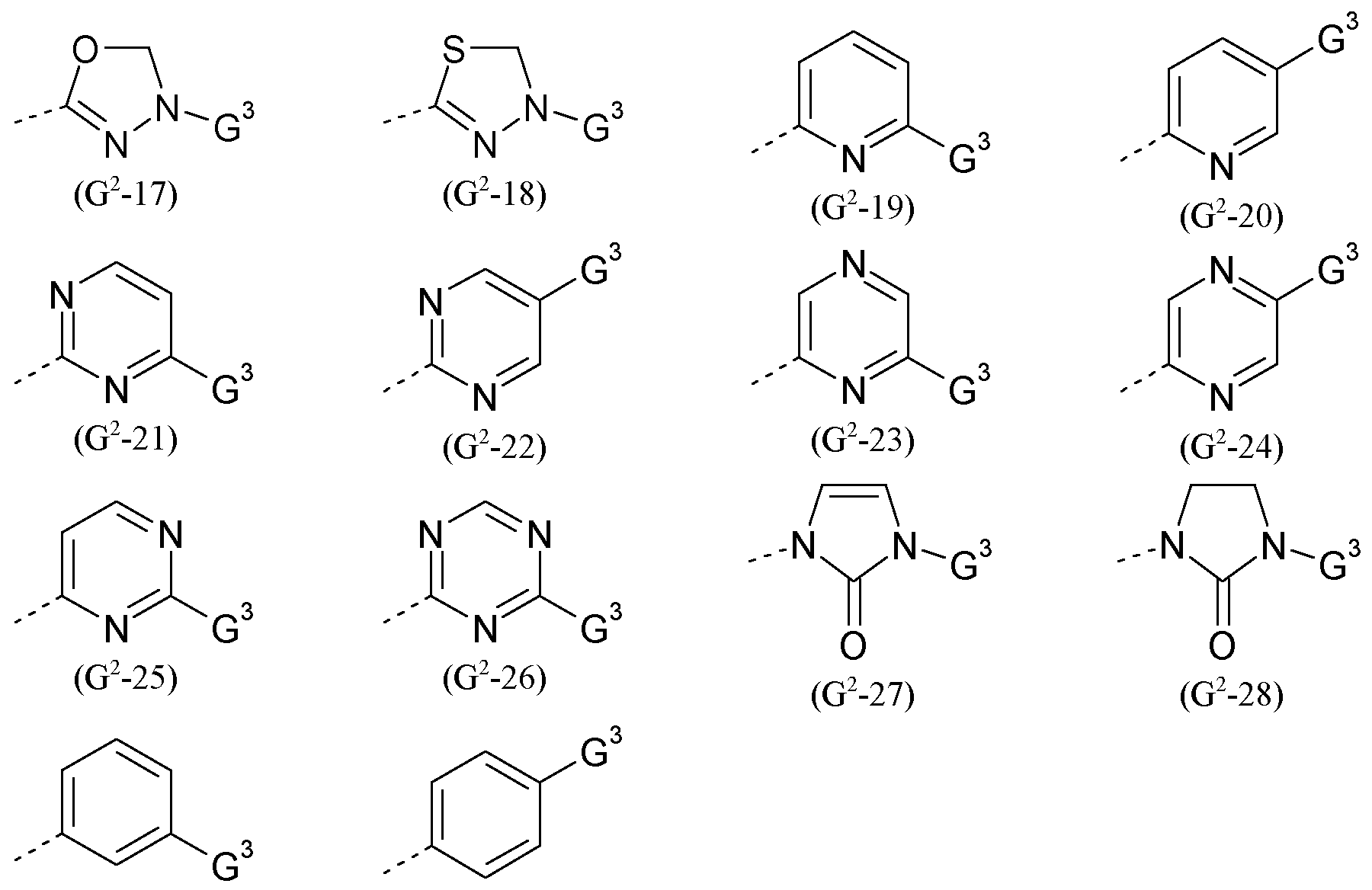
  • G 2 is a radical from the series (G 2 - 1) to (G 2 -30) and in the radicals Q-10, Q-26, Q-29, Q-32, Q-41, Q-42, Q-43, Q-47, Q-54, Q-55, Q-56, Q-57, Q-59, Q-60 and Q-64
  • G 2 is a radical from the series G 2 -2, G 2 -3, G 2 -4, G 2 -5, G 2 -6, G 2 -7, G 2 -9, G 2 -10, G 2 -l 1, G 2 -12, G 2 -13, G 2 -14, G 2 -15, G 2 -16, G 2 -17, G 2 -18, G 2 -19, G 2 -20, G 2 -21, -22 G 2, G 2 -23, -24 G 2, G 2 -25, -26 G 2, G 2-27, G 2 and G 2 -29 -30, where the radicals (G 2 -l) to (G 2 -30) have the following meanings
  • G 3 is a radical selected from halogen, nitro, amino, cyano, alkylamino, haloalkylamino, dialkylamino, alkyl, haloalkyl, optionally substituted and optionally interrupted by one or more heteroatoms saturated or unsaturated cycloalkyl, cycloalkylalkyl, alkoxy, haloalkoxy, alkoxyalkyl, halogenated Alkoxyalkyl, bis (alkoxy) alkyl, bis (haloalkoxy) alkyl, alkoxy (alkylsulfanyl) alkyl, alkoxy (alkylsulfinyl) alkyl, alkoxy (alkylsulfonyl) alkyl, bis (alkylsulfanyl) alkyl, bis (haloalkylsulfanyl) alkyl, bis (hydroxyalkylsulfanyl) alkyl, alkoxycarbonyl,
  • R is a radical from the group consisting of hydrogen, alkyl, haloalkyl, cyanoalkyl, alkoxy, haloalkoxy, alkenyl, alkoxyalkyl, in each case optionally halogen-substituted alkylcarbonyl and alkylsulfonyl, optionally halogen-substituted alkoxycarbonyl, optionally substituted by halogen, alkyl, alkoxy, haloalkyl and cyano Cycloalkylcarbonyl, or represents a cation, such as, for example, a monovalent or divalent metal ion or an ammonium ion which is optionally substituted by alkyl or arylalkyl,
  • R 15 and R 9 independently of one another represent a radical from the series each case optionally substituted alkyl, alkenyl and alkynyl, optionally substituted cycloalkyl, cycloalkylalkyl and cycloalkenyl, in which the rings at least one hetero atom from the series comprising sulfur, oxygen (wherein oxygen atoms are not directly adjacent may each contain) and nitrogen, each optionally substituted aryl, heteroaryl, arylalkyl and heteroarylalkyl and an optionally substituted amino group,
  • R 8 and R 15 together with the NS (0) n group to which they are attached, may also form a saturated or unsaturated and optionally substituted 4- to 8-membered ring containing one or more further heteroatoms selected from the group consisting of sulfur, Oxygen (where oxygen atoms are not allowed to be immediately adjacent) and nitrogen and / or at least one carbonyl group may contain
  • R 17 is a radical from the series in each case optionally substituted alkyl, alkoxy, alkenyl and alkynyl, in each case optionally substituted cycloalkyl, cycloalkylalkyl and cycloalkenyl, in which the rings are at least one heteroatom from the series sulfur, oxygen (oxygen atoms may not be immediately adjacent) and each may contain nitrogen, each optionally substituted aryl, heteroaryl, arylalkyl and heteroarylalkyl and an optionally substituted amino group,
  • R 16 is a radical from the group consisting of hydrogen, in each case optionally substituted alkyl, alkoxy, alkenyl and alkynyl, in each case optionally substituted cycloalkyl, cycloalkylalkyl and cycloalkenyl, in which the rings are at least one heteroatom selected from the group consisting of sulfur, oxygen (oxygen atoms not being directly adjacent may each contain) and nitrogen, each optionally substituted aryl, heteroaryl, arylalkyl and heteroarylalkyl and an optionally substituted amino group,
  • R 8 and R 17 may also together with the NC (X) group to which they are attached form a saturated or unsaturated and optionally substituted 4- to 8-membered ring containing one or more further heteroatoms selected from sulfur, oxygen (where oxygen atoms not be immediately adjacent) and may contain nitrogen and / or at least one carbonyl group,
  • R 10 is hydrogen or alkyl
  • R 8 and R 10 may also together with the N atoms to which they are bonded, be a saturated or unsaturated and optionally substituted 4- to 8-membered ring, the at least one further heteroatom selected from the group sulfur, oxygen (wherein oxygen atoms not immediately adjacent) and may contain nitrogen and / or at least one carbonyl group,
  • R and R in the radical (B1) together with the NS (0) n group to which they are attached can form a saturated or unsaturated and optionally substituted 4- to 8-membered ring which comprises one or more further heteroatoms the series sulfur, oxygen (oxygen atoms may not be immediately adjacent) and nitrogen and / or at least one carbonyl group,
  • R and R may also together with the NS (0) n group to which they are attached form a saturated or unsaturated and optionally substituted 4- to 8-membered ring containing one or more further heteroatoms selected from the group consisting of sulfur, oxygen (where oxygen atoms are not allowed to be immediately adjacent) and can contain nitrogen and / or at least one carbonyl group,
  • R 8 and R 16 may also together with the N-atom to which they are attached form a saturated or unsaturated and optionally substituted 4- to 8-membered ring containing one or more further heteroatoms selected from the group consisting of sulfur and oxygen (where Oxygen atoms may not be immediately adjacent) and nitrogen and / or at least one carbonyl group may contain,
  • L is oxygen or sulfur
  • R and R independently of one another are each an optionally substituted radical from the series alkyl, alkenyl, alkynyl, alkoxy, alkenyloxy, alkynyloxy, cycloalkyl, cycloalkyloxy, cycloalkenyloxy, cycloalkylalkoxy, alkylthio, alkenylthio, phenoxy, phenylthio, benzyloxy, benzylthio, heteroaryloxy, heteroarylthio, Heteroarylalkoxy and heteroarylalkylthio,
  • R and R may also together with the phosphorus atom to which they are attached form a saturated or unsaturated and optionally substituted 5- to 7-membered ring, the or two heteroatoms from the series oxygen (oxygen atoms may not be immediately adjacent) and sulfur may contain and
  • R and R independently of one another each represent an optionally substituted radical from the group consisting of alkyl, alkenyl, alkynyl, phenyl and phenylalkyl,
  • G 1 stands for N or CA 1 .
  • a 1 represents hydrogen, halogen, cyano, nitro, Ci-C 6 alkyl, Ci-C 6 haloalkyl, Ci-C 6 alkoxy, or in each case optionally substituted by halogen, Ci-C 6 alkyl, Ci-C 6 - haloalkyl, Ci-C 6 alkoxy, Ci- C 6 haloalkoxy substituted C 3 -C 6 -cycloalkyl or C 3 -C 6 -cycloalkenyl, in which one or two ring members in each case by a heteroatom from the series nitrogen, oxygen and sulfur may be replaced, wherein two oxygen atoms may not be immediately adjacent.
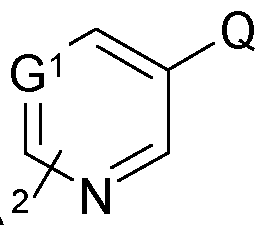
  • a 2 is hydrogen, halogen, cyano, nitro, Ci-C 6 alkyl, Ci-C 6 haloalkyl, Ci-C 6 alkoxy, or in each case optionally substituted by halogen, Ci-C 6 alkyl, Ci-C 6 - haloalkyl, Ci-C 6 alkoxy, Ci- C 6 haloalkoxy substituted C 3 -C 6 -cycloalkyl or C 3 -C 6 -cycloalkenyl, in which one or more ring members in each case by a heteroatom from the series nitrogen, oxygen and sulfur may be replaced, wherein two oxygen atoms may not be immediately adjacent. stands for one of the radicals (Q1) to (Q-64)
  • U is hydrogen, Ci-C 6 alkyl, Ci-C 6 haloalkyl or C 3 -C 6 cycloalkyl.
  • R 1 is 6 alkyl, Ci-C 6 haloalkyl, Ci-C 6 alkoxy or C 3 -C 6 cycloalkyl, hydrogen, halogen, cyano, hydroxy, Ci-C.
  • R 2 is 6 alkyl, Ci-C 6 haloalkyl, Ci-C 6 alkoxy, Ci-C 6 alkoxycarbonyl or C 3 -C 6 cycloalkyl, hydrogen, halogen, cyano, hydroxy, Ci-C.
  • G 2 is a radical from the series (G 2 - 1) to (G 2 -30).
  • G 2 is a radical from the series G 2 -2, G 2 -3, G 2 -4, G 2 -5, G 2 -6, G 2 -7 , G 2 -9, G 2 -10, G 2 -l 1, G 2 -12, G 2 -13, G 2 -14, G 2 -15, G 2 -16, G 2 -17, G 2 - 18, G 2 -19, -20 G 2, G 2 -21, -22 G 2, G 2 -23, -24 G 2, G 2 -25, -26 G 2, G 2 - 27 G 2 - 29 and G 2 -30.
  • radicals (G 2 -l) to (G 2 -30) have the following meanings:
  • G is a radical from the series comprising halogen, nitro, amino, cyano, Ci-C ß alkylamino, Ci-C ß - Halogenalkylamino, di- (Ci-C 6) alkylamino, Ci-C 6 alkyl, Ci- C 6 haloalkyl, optionally substituted by halogen, Ci-C 6 alkyl, Ci-C 6 haloalkyl, Ci-C 6 alkoxy, Ci-C 6 haloalkoxy substituted C 3 -C 6 cycloalkyl, wherein one or two ring members each may be replaced by a heteroatom from the series nitrogen, oxygen and sulfur, wherein two oxygen atoms may not be immediately adjacent, optionally substituted by halogen, Ci-C 6 - alkyl, Ci-C 6 -haloalkyl, Ci-C 6 alkoxy, Ci-C 6 haloalkoxy substituted C 3 -C 6 -
  • Cycloalkenyl wherein one or two ring members may each be replaced by a heteroatom selected from the group of nitrogen, oxygen and sulfur, wherein two oxygen atoms may not be immediately adjacent, C 3 -C 6 cycloalkyl-Ci-C 6 -alkyl, wherein one or two ring members may each be replaced by a heteroatom from the series nitrogen, oxygen and sulfur, where two oxygen atoms may not be immediately adjacent, Ci-C 6 -
  • Ci-C 6 haloalkoxy Ci-C 6 alkoxy-Ci-C 6 alkyl, halogenated Ci-C 6 alkoxy-C 6 - alkyl, bis (Ci-C 6 alkoxy) -ci- C 6 alkyl, bis (C 1 -C 6 haloalkoxy) C 1 -C 6 alkyl, C 1 -C 6 -alkoxy (C 1 -C 6 -alkylsulfanyl) C 1 -C 6 -alkyl, C 1 -C 6 -alkoxy (C 1 -C 6 -alkylsulfinyl) C 1 -C 6 -alkyl, C 1 -C 6 -alkoxy (C 1 -C 6 -alkylsulfonyl) C 1 -C 6 -alkyl, bis (C 1 -C 6 -alkylsulfanyl) ci C 6 alkyl, bis (C 1 -C
  • Oxygen atoms may not be immediately adjacent), C 1 -C 6 -alkylthio, C 1 -C 6 -alkylsulfinyl, C 1 -C 6 -alkylsulfonyl, the heterocyclyl radicals dioxanyl, dioxolanyl, dioxepanyl, dioxocanyl, oxathianyl, oxathiolanyl, oxathiepanyl, oxathiocanyl, dithianyl, dithiolanyl , Dithiepanyl, dithiocanyl, oxathianyloxide, oxathiolanyloxide, oxathiepanyloxide, oxathiocanyloxide, oxathianyl dioxide, oxathiolanyl dioxide, oxathiepanyl dioxide, oxathiocanyl dioxide, morph
  • R 8 stands in which the dashed line marks the bond between G 3 and the adjacent ring in the radicals (G 2 -l) to (G 2 -30).
  • X is oxygen or sulfur
  • n 1 or 2.
  • R 8 represents a radical selected from hydrogen, Ci-C 6 alkyl, Ci-C 6 haloalkyl, cyano-Ci-C 6 - alkyl, Ci-C 6 alkoxy, Ci-C 6 haloalkoxy, C 2 -C 6 alkenyl, Ci-C6 alkoxy-Ci-C 6 -alkyl, optionally halogen-substituted Ci-C 6 alkylcarbonyl and Ci-C 6 alkylsulfonyl, optionally halogen-substituted Ci-C 6 alkoxycarbonyl, optionally halo, Ci-C ß alkyl, Ci-C ß alkoxy, Ci-C ß -Halogenalkyl and cyano substituted C3-C6-cycloalkylcarbonyl, or a cation, such as a monovalent or divalent metal ion or an optionally substituted by C 1 -C 6 -alkyl or aryl-C 1
  • R 9 and R 15 independently represent a radical from the series in each case optionally substituted by halo gen, Ci-C ß alkoxy, Ci-C -haloalkoxy ß, ß Ci-C alkylthio, Ci-C ß haloalkylthio, Ci- C ß - alkylsulfinyl, Ci-C 6 haloalkylsulfinyl, Ci-C 6 alkylsulfonyl, and Ci-C 6 haloalkylsulfonyl-substituted C 6 alkyl, C 2 -C 6 -alkenyl and C 2 -C 6 alkynyl, each optionally gene by halo, Ci-C ß alkyl, Ci-C ß haloalkyl, Ci-C ß alkoxy or Ci-C -haloalkoxy ß-substituted C 3 -C 6 cycloalkyl, C 3 -C 6 -
  • R 15 can also be used together with the NS (0) n group to which they are attached, a saturated or unsaturated and optionally halogen, Ci-C 6 alkyl, Ci-C 6 -haloalkyl, Ci-C 6 - alkoxy , C 1 -C 6 -haloalkoxy-substituted 5- to 7-membered ring which may contain, in particular, one or two further heteroatoms from the group consisting of sulfur, oxygen (oxygen atoms may not be immediately adjacent) and nitrogen and / or at least one carbonyl group
  • R 8 and R 15 may be taken together with the NS (0) n group to which they are attached for
  • R 16 represents a radical from the group hydrogen, in each case optionally substituted by halogen, Ci-C 6 - alkoxy, Ci-C 6 haloalkoxy, Ci-C 6 alkylthio, Ci-C 6 haloalkylthio, Ci-C 6 alkylsulfinyl , Ci-C 6 haloalkylsulfinyl, Ci-C 6 alkylsulfonyl or Ci-6 haloalkylsulfonyl C substituted C 6 alkyl, Ci-C 6 alkoxy, C 2 -C 6 -alkenyl and C 2 -C 6 - alkynyl, each optionally substituted by halo gen, Ci-C ß alkyl, Ci-C ß haloalkyl, Ci-C ß alkoxy or Ci-C -haloalkoxy ß-substituted C 3 -C 6 cycloalkyl, C 3 -C 6 - Cyclo
  • R 8 and R 17 may also be used together with the NC (X) group to which they are attached, a saturated or unsaturated and optionally halogen, Ci-C 6 alkyl, Ci-C 6 -haloalkyl, Ci-C 6 - Alkoxy, Ci-C 6 haloalkoxy substituted 5- to 7-membered ring form, which may contain one or two further heteroatoms from the series sulfur, oxygen (oxygen atoms may not be immediately adjacent) and nitrogen and / or a carbonyl group, in particular
  • R 8 and R 17 may be taken together with the NC (X) group to which they are attached for a residue from the series
  • R 10 is hydrogen or C 1 -C 6 -alkyl.
  • R 8 and R 10 may to which they are bound together with the N atoms, a saturated or unsaturated and optionally substituted by halogen, Ci-C 6 alkyl, Ci-C 6 haloalkyl, Ci-C 6 - alkoxy, C 1 -C 6 -haloalkoxy-substituted 5- to 7-membered ring which may contain one or two further heteroatoms from the group consisting of sulfur, oxygen (where oxygen atoms may not be immediately adjacent) and nitrogen and / or a carbonyl group, in particular R 8 and R 10 together with the NN group to which they are attached are left out of the series
  • R 8 and R 9 in the radical (B-1) can also be used together with the NS (0) n group to which they are attached, a saturated or unsaturated and optionally halogen, C 1 -C 6 -alkyl, C 1 -C 6 - haloalkyl, Ci-C 6 alkoxy, Ci-C form 6 haloalkoxy substituted 5- to 7-membered ring containing one or two heteroatoms from the series comprising sulfur, oxygen (oxygen atoms must not be directly adjacent) and nitrogen and / or at least one and preferably a carbonyl group may contain, in particular R 8 and R 9 may together with the NS (0) n group to which they are attached, stand for a residue from the series
  • R 9 and R 10 can also be used together with the NS (0) n group to which they are attached, a saturated or unsaturated and optionally halogen, Ci-C 6 alkyl, Ci-C 6 haloalkyl, Ci-C 6 - Alkoxy, Ci-C 6 haloalkoxy substituted 5- to 7-membered ring forming one or more other heteroatoms selected from the group sulfur, oxygen (oxygen atoms may not be immediately adjacent) and nitrogen and / or at least one and preferably one
  • R 9 and R 10 may be taken together with the NS (0) n group to which they are attached, for a residue from the series
  • R and R can also, together with the N-atom to which they are attached, a saturated or unsaturated and optionally substituted by halogen, Ci-C 6 alkyl, Ci-C 6 haloalkyl, Ci-C 6 - alkoxy, Ci- C 6 haloalkoxy substituted form 5- to 7-membered ring, which may contain one or more further heteroatoms from the series sulfur, oxygen (oxygen atoms may not be immediately adjacent) and nitrogen and / or at least one and preferably a carbonyl group, in particular For example, R 8 and R 16, together with the N atom to which they are attached, may be left out of the series
  • L stands for oxygen or sulfur.
  • R 11 and R 12 independently represent a substituted each optionally substituted by halogen radical from the group Ci-C 6 alkyl, C 2 -C 6 alkenyl, C 2 -C 6 alkynyl, Ci-C 6 alkoxy, C 2 - C 6 alkenyloxy, C 2 -C 6 alkynyloxy, C 3 -C 6 cycloalkyl, C 3 -C 6 cycloalkyloxy, C 3 -C 6 - cycloalkenyloxy, C 3 -C 6 -Cycloalky-Ci-C 6 -alkoxy, C 1 -C 6 -alkylthio, C 2 -C 6 -alkenylthio, phenoxy, phenylthio, benzyloxy, benzylthio, heteroaryloxy, heteroarylthio, heteroaryl-C 1 -C 6 -alkoxy and heteroaryl-C 1 -C 6 -alkylthio
  • R 11 and R 12 can also together with the phosphorus atom to which they are attached, a saturated or unsaturated and optionally substituted by halogen, Ci-C 6 alkyl, Ci-C 6 - haloalkyl, Ci-C 6 alkoxy, Ci- C 6 haloalkoxy substituted 5- to 7-membered ring containing one or two heteroatoms from the series oxygen (oxygen atoms may not be immediately adjacent) and may contain sulfur, in particular R 11 and R 12 together with the P atom to which they are bound, for the rest
  • R independently represent an optionally halogen-, Ci-C 6 - alkyl, Ci-C 6 haloalkyl, Ci-C 6 alkoxy, Ci-C 6 haloalkoxy substituted radical from the group Ci-C 6 alkyl , C 2 -C 6 alkenyl, C 2 -C 6 alkynyl, phenyl and phenyl-C 1 -C 6 -alkyl.
  • m is 1, 2, 3 or 4.
  • N or CA 1 is hydrogen, halogen, cyano, nitro, Ci-C 4 alkyl, dC 4 haloalkyl, dC 4 -alkoxy or in each case optionally halogen, C 4 alkyl, C haloalkyl, C alkoxy, C - C -haloalkoxy-substituted C 3 -C 6 -cycloalkyl or C 3 -C 6 -cycloalkenyl in which one or two ring members may each be replaced by a heteroatom selected from nitrogen, oxygen and sulfur, with two oxygen atoms not being immediately adjacent is hydrogen, halogen, cyano, nitro, C 1 -C 4 -alkyl, C 1 -C 4 -haloalkyl, C 1 -C 4 -alkoxy or in each case optionally by halogen, C 1 -C 4 -alkoxy or in each case optionally by halogen, C 1 -C 4 -alkoxy or in each case
  • U is hydrogen, Ci-C 4 alkyl, dC 4 haloalkyl or C 3 -C 6 cycloalkyl.
  • R 1 is 4 alkyl, Ci-C4-haloalkyl, Ci-C alkoxy or C 3 -C 6 cycloalkyl, hydrogen, halogen, cyano, hydroxy, Ci-C.
  • R 2 is hydrogen, halogen, cyano, hydroxy, C 1 -C 4 -alkyl, C 1 -C 4 -haloalkyl, C 1 -C 4 -alkoxy, C 1 -C 4 -alkoxycarbonyl or C 3 -C 6 -cycloalkyl.
  • G 2 is a radical from the series (G 2 - 1) to (G 2 -30).
  • Residues Q-10, Q-26, Q-29, Q-32, Q-41, Q-42, Q-43, Q-47, Q-54, Q-55, Q-56, Q-57 , Q-59, Q-60 and Q-64 is a radical from the series G 2 -2, G 2 -3, G 2 -4, G 2 -5, G 2 -6, G 2 -7, G 2 -9, G 2 -10, G 2 -l 1, G 2 -12, G 2 -13, G 2 -14, G 2 -15, G 2 -16, G 2 -17, G 2 -18, G 2 -19, -20 G 2, G 2 -21, -22 G 2, G 2 -23, -24 G 2, G 2 -25, -26 G 2, G 2-27, G 2 -29, and G 2 -30.
  • radicals (G 2 -l) to (G 2 -30) have the following meanings:
  • G is a radical from the series comprising halogen, nitro, amino, cyano, Ci-C 4 alkylamino, Ci-C 4 - Halogenalkylamino, di- (Ci-C4) alkylamino, Ci-C 4 alkyl, Ci- C 4 haloalkyl, optionally substituted by halogen, C 4 alkyl, C haloalkyl, C alkoxy, Ci-C -haloalkoxy-substituted C 3 -C 6 cycloalkyl, wherein one or two ring members in each case by a heteroatom the series nitrogen, oxygen and sulfur may be substituted, wherein two oxygen atoms must not be directly adjacent, optionally substituted by halogen, Ci-C - alkyl, C haloalkyl, C alkoxy, Ci-C -haloalkoxy-substituted C 3 -C 6 -cycloalkenyl, in which one or two ring members may each be replaced by
  • R is a radical from the series consisting of hydrogen, C 1 -C 4 -alkyl and C 1 -C 4 -alkoxy-C 1 -C 4 -alkyl, optionally substituted by halogen, C 1 -C 4 -alkylcarbonyl or C 1 -C -alkylsulfonyl, optionally halogen-substituted Ci-C alkoxycarbonyl optionally gene by halo, Ci-C4-alkyl, Ci-C 4 alkoxy, Ci-C 4 haloalkyl, and cyano-substituted C 3 -Cg- cycloalkylcarbonyl, or a cation, such as a mono- or divalent metal ion or an optionally substituted by Ci-C-alkyl or aryl-Ci-C-alkyl-substituted ammonium ion.
  • R 17 is a radical from the series, in each case optionally substituted by halogen, C 1 -C 4 -alkoxy, C 1 -C 4 -haloalkoxy, C 1 -C 4 -alkylthio, C 1 -C 4 -haloalkylthio, C 1 -C 4 -alkylsulfinyl, C 1 -C 4 -alkyl, Haloalkylsulfinyl, C 1 -C 4 -alkylsulfonyl and C 1 -C 4 -haloalkylsulfonyl-substituted C 1 -C -alkyl, C 2 -C -alkenyl and C 2 -C -alkynyl, in each case optionally by halogen, C 1 -C 4 -alkyl, C 1 -C 4 -haloalkyl , C 1 -C 4 -alkoxy, C 1 -C 4
  • Haloalkylsulfonyl amino, C 1 -C -alkylamino, di (C 1 -C -alkyl) amino, C 1 -C -alkylcarbonylamino, C 1 -C 4 -alkoxycarbonylamino, C 1 -C 4 -alkoxy-C 1 -C 4 -alkyl, C 1 -C 4 -haloalkoxy C 1 -C -alkyl, C 2 -C -alkenyl, C 2 -C -alkynyl, C 3 -C 6 -cycloalkyl-C 1 -C 4 -alkyl, C 1 -C 4 -alkylcarbonyl, C 1 -C 4 -alkoxycarbonyl or aminocarbonyl-substituted aryl, Heteroaryl, aryl-Ci-C-alkyl and heteroaryl-Ci-C-alkyl or for NR'R
  • G 1 is CH or CF
  • a 2 is hydrogen
  • Q is a radical from the series Q-2, Q-12, Q-16, Q-18, Q-25 , Q-26, Q-29, Q-32, Q-38, Q-43 and Q-56, G 2 for G 2 -19 and G 3 for pyrimidyl or dioxanyl.
  • Halogen selected from the group fluorine, chlorine, bromine and iodine, preferably in turn from the series fluorine, chlorine and bromine, aryl (also part of a larger unit such as arylalkyl) selected from the series phenyl, naphthyl, anthryl, phenanthrenyl and stands again preferred for phenyl,
  • Hetaryl (equivalent to heteroaryl, also as part of a larger moiety such as hetarylalkyl) selected from the series furyl, thienyl, pyrrolyl, pyrazolyl, imidazolyl, 1,2,3-triazolyl, 1,2,4-triazolyl, oxazolyl, isoxazolyl , Thiazolyl, isothiazolyl, 1,2,3-oxadiazolyl, 1,2,4-oxadiazolyl, 1,3,4-oxadiazolyl, 1,2,5-oxadiazolyl, 1,2,3-thiadiazolyl, 1,2,4 Thiadiazolyl, 1,3,4-thiadiazolyl, 1,2,5- Thiadiazolyl, pyridyl, pyrimidinyl, pyridazinyl, pyrazinyl, 1,2,3-triazinyl, 1,2,4-triazinyl, 1,3,5-triazinyl, benz
  • Halogen selected from the group fluorine, chlorine, bromine and iodine, preferably again from the series fluorine, chlorine and bromine,
  • Aryl also as part of a larger unit, such as, for example, arylalkyl selected from the group consisting of phenyl, naphthyl, anthryl, phenanthrenyl and in turn preferably represents phenyl,
  • Hetaryl also as part of a larger unit, such as hetarylalkyl selected from the series pyrimidyl, oxadiazolyl, oxazolyl, pyrazinyl, imidazolyl, thiazolyl and furanyl.
  • Halogen selected from the group fluorine, chlorine, bromine and iodine, preferably again from the series fluorine, chlorine and bromine,
  • Hetaryl also as part of a larger unit, such as hetarylalkyl selected from the series pyrimidyl, oxadiazolyl, oxazolyl, pyrazinyl, imidazolyl, thiazolyl and furanyl.
  • Halogen stands for fluorine, chlorine, bromine and iodine, in particular fluorine, chlorine and bromine.
  • Saturated or unsaturated hydrocarbon radicals such as alkyl or alkenyl
  • heteroatoms e.g. in alkoxy, as far as possible, in each case straight-chain or branched.
  • Optionally substituted radicals may be monosubstituted or polysubstituted, wherein in the case of multiple substitutions, the substituents may be identical or different.
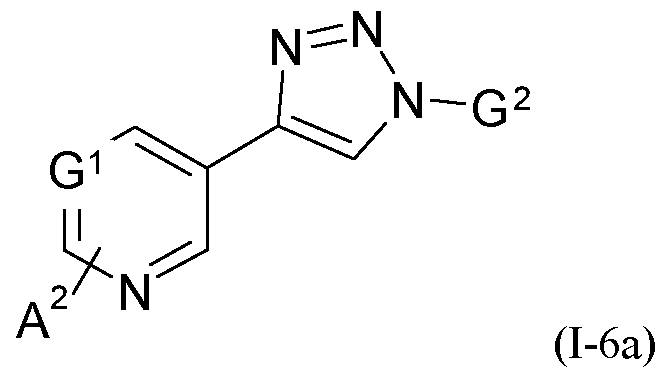
  • the invention relates to compounds of the formula
  • the invention relates to compounds of the formula
  • the invention relates to compounds of the formula
  • the invention relates to compounds of the formula
  • the invention relates to compounds of the formula
  • the invention relates to compounds of the formula
  • the invention relates to compounds of the formula
  • the invention relates to compounds of the formula (I-3b)
  • the invention relates to compounds of the formula
  • the invention relates to compounds of the formula
  • the invention relates to compounds of the formula
  • the invention relates to compounds of the formula
  • the invention relates to compounds of the formula
  • the invention relates to compounds of the formula
  • the invention relates to compounds of the formula
  • the invention relates to compounds of the formula
  • the invention relates to compounds of the formula
  • the invention relates to compounds of the formula (I-7c)
  • the invention relates to compounds of the formula
  • the invention relates to compounds of the formula
  • the invention relates to compounds of the formula
  • the invention relates to compounds of the formula
  • the invention relates to compounds of the formula
  • the invention relates to compounds of the formula (I-7d)
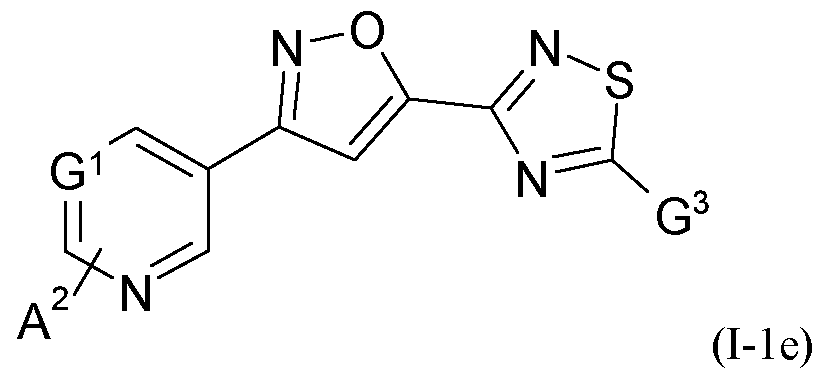
  • the invention relates to compounds of the formula (I-le)
  • the invention relates to compounds of the formula
  • the invention relates to compounds of the formula (I-4e)
  • the invention relates to compounds of the formula
  • the invention relates to compounds of the formula (I-7e)
  • the invention relates to compounds of the formula
  • the invention relates to compounds of the formula (I-4f)
  • the invention relates to compounds of the formula
  • the invention relates to compounds of the formula (I-7f)
  • the invention relates to compounds of the formula (I-Ig)
  • the invention relates to compounds of the formula
  • the invention relates to compounds of the formula (I-4g)
  • the invention relates to compounds of the formula
  • the invention relates to compounds of the formula
  • the invention relates to compounds of the formula (I-3h)
  • the invention relates to compounds of the formula (I-4h)
  • the invention relates to compounds of the formula
  • the invention relates to compounds of the formula (I-7h)
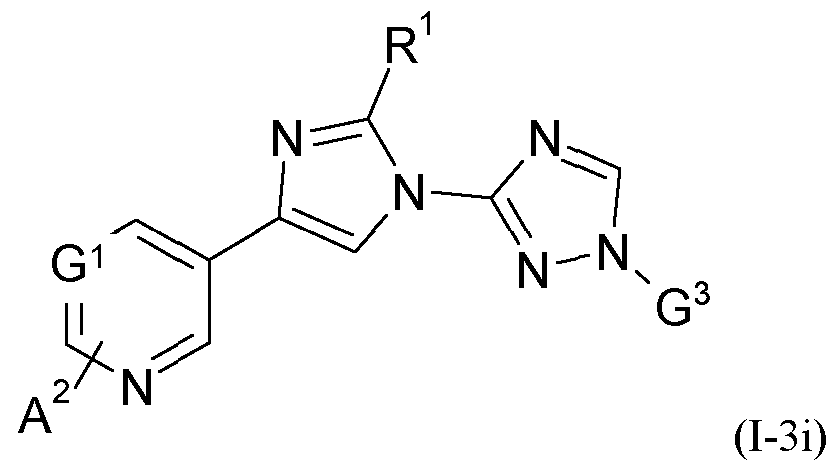
  • the invention relates to compounds of the formula (I-3i)
  • the invention relates to compounds of the formula (I-4i)
  • the invention relates to compounds of the formula
  • the invention relates to compounds of the formula (I-7i)
  • the invention relates to compounds of the formula
  • the invention relates to compounds of the formula
  • the invention relates to compounds of the formula
  • the invention relates to compounds of the formula
  • the invention relates to compounds of the formula (I-lk)
  • the invention relates to compounds of the formula
  • the invention relates to compounds of the formula
  • the invention relates to compounds of the formula (I-7k)
  • the compounds of the formula (I) according to the invention and their acid addition salts and metal salt complexes have good activity, in particular for controlling animal pests, which include arthropods and in particular insects.
  • the compounds of the formula (I) may also be present in different compositions as stereoisomers, ie as geometric and / or optical isomers or mixtures of isomers. Both the pure Stereoisomers as well as any mixtures of these isomers are the subject of this invention, although in general only compounds of the formula (I) are mentioned here.
  • the optically active stereoisomeric forms of the compounds of the formula (I) and salts thereof are used according to the invention.
  • the invention therefore relates to both the pure enantiomers and diastereomers, as well as their mixtures for controlling animal pests, which include arthropods and in particular insects.
  • Suitable salts of the compounds of general formula (I) may be conventional non-toxic salts, i. H. Salts with corresponding bases and salts with added acids.
  • salts with inorganic bases such as alkali metal salts, for example sodium, potassium or cesium salts, alkaline earth metal salts, for example calcium or magnesium salts, ammonium salts, salts with organic bases and with inorganic amines, for example triethylammonium, dicyclohexylammonium, ⁇ , ⁇ '- Dibenzylethylenediammonium, pyridinium, picolinium or ethanolammonium salts, salts with inorganic acids, for example hydrochlorides, hydrobromides, dihydrosulfates, trihydrosulfates, or phosphates, salts with organic carboxylic acids or organic sulfonic acid, for example formates, acetates, trifluoroacetates, maleates, tartrates, methanesul
  • the compounds of the formula (I) can be prepared by one or, if appropriate, also by a plurality of synthesis variants shown in reaction Schemes 1 to 11.
  • reaction Scheme 26 can be represented by reaction Scheme 1, for example.
  • M B (OR) 2 , SnR 3 , ZnX I, Br, I, OTf, OMs
  • the compounds of the formula (A-1) can be obtained by known preparation methods, cf. for example, for Q-4: 3- (5-tributylstannyl-2-thienyl) -pyridine derivatives (Sn (C 4 H 9 ) 3 ; H.-F. Lu et al., Macromolecules 2003, 36, 1543-1552).
  • the compounds of the formula (A-3) are known in some cases or can be obtained by known preparation processes, cf. for example, for Ql: 3- (2-furanyl) -pyridine (DE 2052536); Q4: 3- (2-thienyl) pyridine; Q-6: (3-Thienyl) pyridine (Wynberg, H., et al., J. Org. Chem. 1969, 34, 3175-3178); Q-7: 1- (2-chloro-3-pyridinyl) -1H-pyrroles (US 4,144,343); Q-12: 2- (3-pyridinyl) oxazole (DE 1112076); Q-13: 5- (3-pyridyl) oxazole (N.
  • the compounds of the formula (A-2) are known in some cases or can be obtained by known preparation processes.
  • the compounds of the formula (A-2) represent at the same time representatives of the radicals G 2 ; Examples are: G 2 -3: 2-bromo-4-oxazolecarboxylic acid ethyl ester (KJ Hodgetts, MT Kershaw, Org. Lett. 2002, 4, 2905-2907); G 2 -5: 2-bromo-4-nitro-thiazole (DE 2252070); G 2 -9: 3-bromo-l, 2,4-oxadiazole-5-carboxylic acid ethyl ester (GR Humphrey et al., J. Heterocycl Chem.
  • G 2 -12 3-bromo-5- (methylsulfonyl) -1,2,4-thiadiazole (L. S. Wittenbrook et al., J. Org. Chem., 1973, 38, 465-471): G 2 -12 : 5-bromo-3-methyl-1,2,4-thiadiazole (J. Goerdeler et al, Chem. Ber. 1956, 89, 1534-1543); G 2 -13: 3-chloro-l, 4,5,6-tetrahydro-1-phenyl-pyridazine (HA Dowlatshahi, Synth. Commun. 1987, 17, 1253-1259) and G 2 -16: 3-chloro 4,5-dihydro-1-phenyl-1H-pyrazole (SC Burford et al, EP 127,371).
  • Such coupling fractions are, for example, for the combinations Q-15 with G 2 -19 (compare C. Verrier et al., J. Org. Chem. 2008, 73, 7383-7386); Q-20 to G 2 or G 2 -19 -23 (see FIG. T. Martin et al., Org. Lett. 2008, 10, 2909-2912) described and can be applied in an analogous manner.
  • the compounds of the formula (A-4) or (A-4a) are known in some cases or can be obtained by known preparation processes, cf. for example, Q-26: 3- (1H-imidazol-4-yl) -pyridine hydrochloride (WO 2000/002875), 5- (1H-imidazol-4-yl) -pyrimidine dihydrochloride (WO 2003/004509); Q-29: 2-methyl-5- (1H-pyrazol-4-yl) -pyridines (A.N. Kost et al., Zh.
  • the compounds of the formula (A-2) are known in some cases or can be obtained by known preparation processes.
  • the compounds of the formula (A-2) simultaneously represent representatives of the radicals G 2 , which are mentioned by way of example above. Coupling reactions of this type are, for example, for the combinations Q-26 with G 2 -22 or G 2 -23 (see US 2003/125267); Q-32 with G 2 -19 (see H. Brunner et al., Chem. Ber. 1992, 125, 701-710), Q-32 with G 2 -22 (compare M. Ikeda et al., Chem Bull.
  • the compounds of the formula (A-1) s in d te lw e s e b e k e n e b b. can be obtained in accordance with the manufacturing method described above.
  • the compounds of the formula (A-5) used for the route A are partly known or can be obtained by known preparation processes.
  • the compounds of the formula (A-5) simultaneously represent representatives of the radicals G 2 , which are mentioned by way of example above.
  • the compounds of the formula (A-6) are partially known or known. can be obtained by known production methods, cf.
  • starting compounds with Q-1: 3- (5-bromo-
  • the compounds of the formula (A-7) simultaneously represent representatives of the radicals G 2 , which are mentioned by way of example above, cf.
  • G 2 -2 1-ethyl-3- (4,4,5,5-tetramethyl-l, 3,2-dioxaborolan-2-yl) -LH-pyrazole (WO 2010/075270);
  • G 2 -3 (4-octyl-2-oxazolyl) boronic acid (JP 2005/223238);
  • G 2 -4 2-phenyl-4- (4,4,5,5-tetramethyl-1,3,2-dioxaborolan-2-yl) -oxazole (JP 2007/145806);
  • G 2 -6 2-phenyl-4- (4,4,5,5-tetramethyl-1,3,2-dioxaborolan-2-yl) -thiazole (M. Schnuerch et al, Synthesis 2010, 5, 837- 843) and G 2 - 20: (5-
  • Coupling reactions of this type are, for example, for the combinations Q-1 with G 2 -29 or G 2 -30 (route B: see MA Ismail et al, J.Med.Chem., 2003, 46, 4761-4769); Q-4 with G 2 -5 (see WO 2008/54702 A1, Negishi coupling); Q-5 with G 2 -5 (see US 2009/149517, Suzuki coupling); Q-6 with G 2 -2 (see WO 2009/112845 Al, Stille coupling); Q-13 with G 2 -4 (see E. Flegeau et al., J. Org. Chem.
  • Coupling fractions of this type are described, for example, for the following combinations of the heterocycles Q and a radical G 2 : Q-20 with G 2 -6 (compare J. Gebauer et al., Eur. J. Org. Chem. 2008, 16, 2701 -2704; Stille coupling), Q-48 with G 2 -5 (see US 2004/33970 A1, Stille coupling).
  • X O-SO 2 CF 3 , O-SO 2 CH 3
  • the compounds of the formula (A-6) are partially known or known. can be obtained by known production methods.
  • the compounds of the formula (A-6) simultaneously represent representatives of the radicals Q, which are mentioned by way of example above.
  • the compounds of the formula (A-8) are partially known or known. can be obtained by known production methods.
  • the compounds of the formula (A-8) simultaneously represent representatives of the radicals G 2 , which are mentioned by way of example above. see. for example, starting compounds with G 2 -27: 2,3-dihydro-2-oxo-1H-imidazole-1-carboxylic acid ethyl ester (NJ Leonard, DF Wiemer, J. Amer. Chem. Soc., 1976, 98, 8218-8221) and G 2 -28: 1- (4-chlorophenyl) -2-imidazolidinone (JP 07138258).
  • Coupling reactions of this type are known, for example, for the combinations Q-20 with G 2 -I or G 2 -8 (cf US Pat. No. 6,468,979 B1).
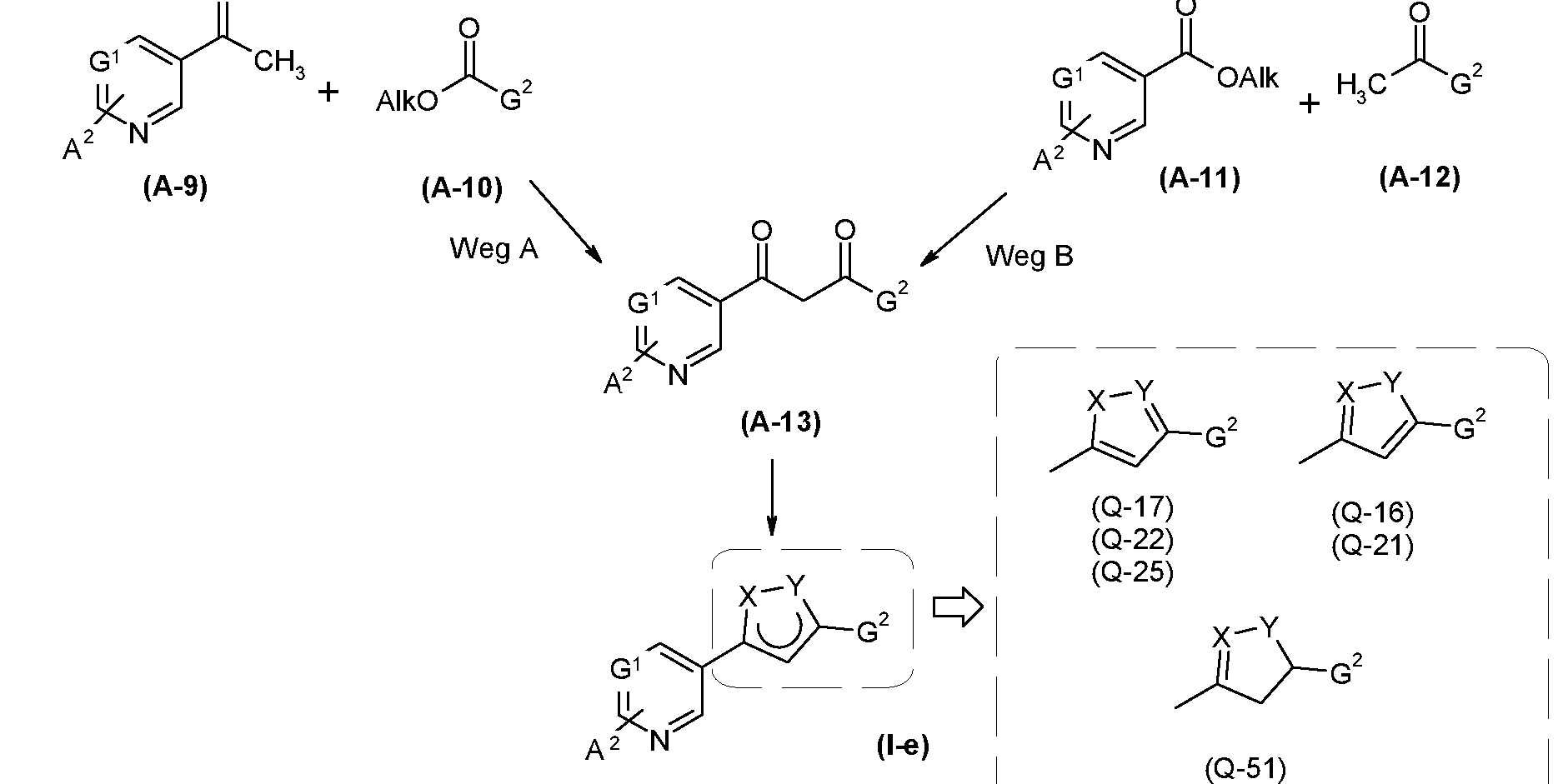
  • the compounds (A-13) can also be prepared by the base-induced reaction of methyl ketones of the formula (A-12) with heterocyclic esters of the formula (A-11) (Route B, see, for example, WO2008 / 4117).
  • the compounds (Ie) may be prepared by the reaction of the diketones (A-13) with o / 'functionalized reagents, for example hydroxylamine (cf. E. Belgodere et al, Heterocycles, 1983, 20, 501-504;. See also Preparation Example A. or hydrazine derivatives (compare MR Giudice et al., Arch. Pharm. 2003, 336, 143-154, see Preparative Example B), optionally in the presence of a suitable acidic reaction auxiliary in a suitable solvent.
  • Suitable acidic reaction auxiliaries are virtually all mineral acids, organic acids or Lewis acids.
  • the mineral acids include preferably hydrohalic acids such as hydrofluoric acid, hydrochloric acid, hydrobromic acid or hydriodic acid and sulfuric acid, phosphoric acid, phosphorous acid, nitric acid and the Lewis acid preferably include aluminum (III) chloride, boron trifluoride or its etherate, titanium (V) chloride and Tin (V) chloride.
  • the organic acids include formic, acetic, propionic, malonic, lactic, oxalic, fumaric, adipic, stearic, tartaric, oleic, methanesulfonic, benzoic, benzenesulfonic or para-toluenesulfonic acids.
  • Acid reaction auxiliaries used are preferably organic acids, for example acetic acid.
  • the compounds of the formula (A-9) are known or known in part. can be obtained by known preparation methods, for 1- (5-fluoro-3-pyridinyl) -ethanone and 1- (5-chloro-3-pyridinyl) -ethanone see e.g. WO 2001/038332.
  • the compounds of the formulas (A-10), (A-11) and (A-12) are also known in part or can be obtained by known preparation processes (see Preparation Example A).
  • hydroxides of lithium, potassium or sodium are used.
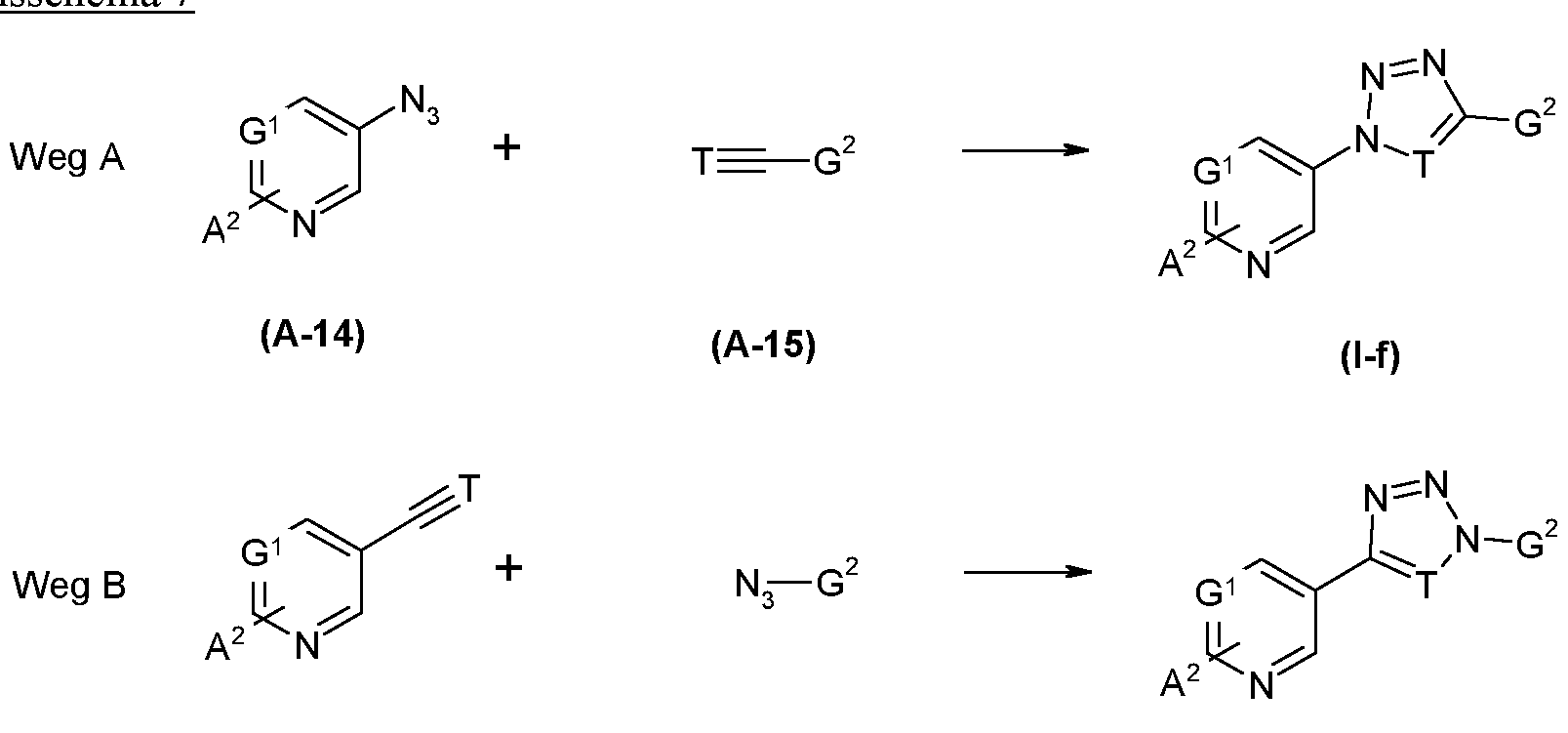
  • Compounds of the general formula (I) in which Q is Q-38, Q-41, Q-47 or Q48 and the radical G 2 is G 2 -2, G 2 -3, G 2 -4, G 2 -5 , G 2 -6, G 2 -7, G 2 -9, G 2 -10, G 2 -ll, G 2 -12, G 2 -19, G 2 -20, G 2 -21, G 2 -22 , G 2 -23, G 2 -24, G 2 -25, G 2 -26, G 2 -29 or G 2 -30 are, for example, according to the reaction scheme 7 representable.
  • Reaction scheme 7 representsable.
  • heterocyclic azides of the formula (A-14) (route A) with unsaturated compounds of the formula (A-15) are prepared by methods known per se (see Preparation Example G) in the presence of transition metal salts, for example copper (II) sulfate.
  • the unsaturated compounds (A-16) can be reacted with heterocyclic or aromatic azides of the formula (A-17) (Route B).
  • the compounds of the formula (A-14) are known in some cases or can be obtained by known preparation processes, for 5-azido-pyrimidine see KD Grimes et al, Synthesis 2010, 9, 1441-1448 and for 3-azido-pyridine see WO 2005/085214).
  • the compounds of the formula (A-15) are in part known or can be obtained by known preparation processes.
  • G 2 -6 4-ethynyl-2-methyl-thiazoles (KC Nicolau et al., Chem. BioChem 2001, 2, 69-75);
  • G 2 -9 3-Ethynyl-5 - [[(3,3,3-trifluoropropyl) thio] methyl] -1,4,4-oxadiazole (WO 2009/028727);
  • G 2 -ll 3-Ethynyl-5 - [[(3,3,3-trifluoropropyl) thio] methyl] -1,4,4-thiadiazole (WO 2009/028727)
  • G 2 -19 2- (6 Ethynylpyridin-2-yl) -pyrimidine (see Preparative Example G, step 2).
  • the compounds of the formulas (A-16) and (A-17) are in part known or can be obtained by known preparation processes.
  • the compounds of formula (A-18) are in part known or can be obtained by known preparation processes, for example 3-pyridinyl-l, 3,4-oxathiazolone see WO 2000/007446.
  • the compounds of the formula (Al 9) are known in some cases or can be obtained by known preparation processes; see. for example, G 2 -20: 5- (2-pyridinyl) -1,3,4-oxathiazol-2-one (NB Islam, H. Kwart, J. Chem. Engineering Data 1985, 30, 507-509); G 2 -24: 2- (2-pyridinyl) -l, 3,4-oxathiazole-2- ⁇ (.. Gezginci MH et al, J. Med Chem 2001, 44, 1560-1563) and G 2 -30: [4- (Trifluoromethyl) phenyl] -1,4,4-oxadiazol-2-one (US 2005/096362).
  • the compounds of the formula (A-la) are known in some cases or can be obtained by the preparation processes described above.
  • the compounds of the formula (A-20) are known in some cases or can be obtained by known preparation processes, for G 2 -13: 3-chloro-1, 4,5,6-tetrahydro-1-phenyl-pyridazine see H.- J-Wang et al, Tetrahedron Lett. 2005, 46, 2631-2634 and for G 2 -16: 3-chloro-4,5-dihydro-1-phenyl-1H-pyrazole see EP 0 127 371.
  • N-protecting group-substituted 2,3-dihydro-l, 3,4-oxazolderivate (I-ka) can be carried out after cleavage of the protective group (PG), the ⁇ -derivatization of (I-kb).
  • Activation reagents which can be used are all reagents which are suitable for the preparation of an amide or hydrazide bond (cf., for example, Houbel-Weyl, Methods of Organic Chemistry, Volume 15/2, Bodansky et al, Peptide Synthesis 2 nd ed. Wiley & Sons, New York 1976) or Gross, Meienhofer, The Peptides: Analysis, Synthesis, Biology (Academy Press, New York 1979).
  • the coupling is with phosphonium reagents such as bis (2-oxo-3-oxazolidinyl) phosphonium chloride (BOP Cl), benzotriazol-l-yl-oxy-tris (dimethylamino-phosphonium) hexafluorophosphate (BOP), benzotriazole-1-yl-tris-pyrrolidino-phosphonium hexafluorophosphate (PyBOB ®), bromo-tris- pyrrolidino-phosphonium hexafluorophospha (PyBroP ®) or Phosphonklarreagenzien such as diethyl cyanophosphonate (DEPC) and diphenylphosphoryl azide (DPPA).
  • a preferred activator for the carboxylic acids of formula (A-21) is, for example, N- (3-dimethylaminopropyl) -N'-ethylcarbodiimide.
  • Suitable substituted protective groups (PG) for amino groups include for example substituted carbamates, amides, ⁇ -alkylamines, N-arylamines, imine derivatives, enamine derivatives, N-sulfenyl derivatives, N-sulfonyl derivatives or N-diarylphosphinyl derivatives (See, Greene TW, Wuts PGW in Protective Groups in Organic Synthesis, John Wiley & Sons, Inc. 1999, Protection for the Amino Group, pp. 494.) Protecting groups of the carbamate type are preferably used.
  • acidic or basic reaction auxiliaries suitable for protective group blocking can be used according to the literature procedure.
  • protective groups for amino groups of the carbamate type preference is given to using acidic reaction auxiliaries.
  • the t-butylcarbamate protecting group for example, mixtures of mineral acids such as hydrochloric, hydrobromic, nitric, sulfuric, phosphoric or organic acids such as benzoic acid, formic acid, acetic acid, trifluoroacetic acid, methanesulfonic acid, benzenesulfonic acid or toluenesulfonic acid and a suitable diluent such as water and / or an organic solvent such as tetrahydrofuran, dioxane, dichloromethane, chloroform, ethyl acetate, ethanol or methanol.
  • the compounds of the formula (A-21) are known in some cases or can be obtained by known preparation processes.
  • Q-1 5- (3-pyridinyl) -2-furan-carboxylic acid (US 3,927,008);
  • Q-4 5- (3-pyridinyl) -2-thiophenecarboxylic acid (WO 2004/013130);
  • Q-1 1-methyl-5- (3-pyridinyl) -1 H -pyrrole-2-carboxylic acid (G.B.D. De Graaff et al., Ree. Travaux Chim.
  • the compounds of the formula (A-21) are known in some cases or can be obtained by the production processes mentioned above.
  • the active compounds according to the invention are suitable for plant tolerance, favorable warm-blooded toxicity and good environmental compatibility for protecting plants and plant organs, for increasing crop yields, improving the quality of the crop and for controlling animal pests, in particular insects, arachnids, helminths, nematodes and molluscs . which are found in agriculture, horticulture, livestock, forestry, gardens and recreational facilities, in supplies and materials, and in the hygiene sector. They can preferably be used as crop protection agents. They are effective against normally sensitive and resistant species as well as against all or individual stages of development.
  • the aforementioned pests include:
  • Anoplura e.g. Damalinia spp., Haematopinus spp., Linognathus spp., Pediculus spp., Trichodectes spp.
  • Eriophyes spp. Hemitarsonemus spp., Hyalomma spp., Ixodes spp., Latrodectus mactans, Metatetranychus spp., Oligonychus spp., Ornithodoros spp., Panonychus spp., Phyllocoptruta oleivora, Polyphagotarsonemus latus, Psoroptes spp., Rhipicephalus spp.
  • Rhizoglyphus spp. Sarcoptes spp., Scorpio maurus, Stenotarsonemus spp., Tarsonemus spp., Tetranychus spp., Vasates lycopersici.
  • Ceuthorhynchus spp. Ceuthorhynchus spp., Cleonus mendicus, Conoderus spp., Cosmopolites spp., Costelytra zealandica, Curculio spp., Cryptorhynchus lapathi, Dermestes spp., Diabrotica spp., Epilachna spp., Faustinus cubae, Gibbium psylloides, Heteronychus arator, Hylamorpha elegans, Hylotrupes bajulus, Hypera postica, Hypothenemus spp., Lachnosterna consanguinea, Leptinotarsa decemlineata, Lissorhoptrus oryzophilus, Lixus spp., Lyctus spp., Meligethes aeneus, Melolontha melolontha, Migdolus spp., Mono
  • helminths e.g. Ancylostoma duodenale, Ancylostoma ceylanicum, Acylostoma braziliensis, Ancylostoma spp., Ascaris lubricoides, Ascaris spp., Brugia malayi, Brugia timori, Bunostomum spp., Chabertia spp., Clonorchis spp., Cooperia spp., Dicrocoelium spp., Dictyocaulus filaria, Diphyllobothrium latum, Dracunculus medinensis, Echinococcus granulosus, Echinococcus multilocularis, Enterobius vermicularis, Faciola spp., Haemonchus spp., Heterakis spp., Hymenolepis nana, Hyostrongulus spp., Loa Loa, Ne
  • protozoa such as Eimeria
  • Eimeria protozoa
  • Sogatella furcifera Sogatodes spp., Stictocephala festina, Tenalaphara malayensis, Tinocallis caryaefoliae, Tomaspis spp., Toxoptera spp., Trialeurodes vaporariorum, Trio za spp., Typhlocyba spp., Unaspis spp., Viteus vitifolii.
  • Hymenoptera e.g. Diprion spp., Hoplocampa spp., Lasius spp., Monomorium pharaonis, Vespa spp.
  • Symphyla e.g. Scutigerella immaculata.
  • Thysanoptera eg Basothrips biformis, Enneothrips flavens, Frankliniella spp., Heliothrips spp., Hercinothrips femoralis, Kakothrips spp., Rhipiphorothrips cruentatus, Scirtothrips spp., Taeniothrips cardamoni, Thrips spp. From the order of Thysanura eg Lepisma saccharina.
  • the plant parasitic nematodes include e.g. Anguina spp., Aphelenchoides spp., Belonoaimus spp., Bursaphelenchus spp., Ditylenchus dipsaci, Globodera spp., Heliocotylenchus spp., Heterodera spp., Longidorus spp., Meloidogyne spp., Pratylenchus spp., Radopholus similis, Rotylenchus spp. Trichodorus spp., Tylenchorhynchus spp., Tylenchulus spp., Tylenchulus semipenetrans, Xiphinema spp.
  • Anguina spp. Aphelenchoides spp., Belonoaimus spp., Bursaphelenchus spp., Ditylenchus dipsaci, Globodera
  • the compounds according to the invention can also be used in certain concentrations or application rates as herbicides, safeners, growth regulators or agents for improving the plant properties, or as microbicides, for example as fungicides, antimycotics, bactericides, viricides (including anti-viral agents) or as anti-MLO agents ( Mycoplasma-like-organism) and RLO (Rickettsia-like-organism). They can also be used as intermediates or precursors for the synthesis of other active ingredients.
  • the active compounds can be converted into the customary formulations, such as solutions, emulsions, wettable powders, water- and oil-based suspensions, powders, dusts, pastes, soluble powders, soluble granules, scattering granules, suspension-emulsion concentrates, active substance-impregnated natural products, active ingredient Impregnated synthetic materials, fertilizers and Feinstverkapselitch in polymeric materials.
  • solutions emulsions, wettable powders, water- and oil-based suspensions, powders, dusts, pastes, soluble powders, soluble granules, scattering granules, suspension-emulsion concentrates, active substance-impregnated natural products, active ingredient Impregnated synthetic materials, fertilizers and Feinstverkapselitch in polymeric materials.
  • formulations are prepared in a known manner, e.g. by mixing the active compounds with extenders, ie liquid solvents and / or solid carriers, if appropriate using surface-active agents, ie emulsifiers and / or dispersants and / or foam-forming agents.
  • extenders ie liquid solvents and / or solid carriers
  • surface-active agents ie emulsifiers and / or dispersants and / or foam-forming agents.
  • Excipients which can be used are those which are suitable for imparting special properties to the composition itself and / or preparations derived therefrom (for example spray liquor, seed dressing), such as certain technical properties and / or specific biological properties.
  • Typical auxiliaries are: extenders, solvents and carriers.
  • Suitable extenders include, for example, water, polar and non-polar organic chemical liquids, for example from the classes of aromatic and non-aromatic hydrocarbons (such as paraffins, alkylbenzenes, alkylnaphthalenes, chlorobenzenes), alcohols and polyols (which may also be substituted, etherified and / or esterified esters (also fats and oils) and (poly) ethers, simple and substituted amines, amides, lactams (such as N-alkylpyrrolidones) and lactones, sulfones and sulfoxides (such as dimethylsulfoxide).
  • aromatic and non-aromatic hydrocarbons such as paraffins, alkylbenzenes, alkylnaphthalenes, chlorobenzenes
  • alcohols and polyols which may also be substituted, etherified and / or esterified esters (also fats and oils) and (poly)
  • organic solvents can also be used as auxiliary solvents.
  • Suitable liquid solvents are essentially: aromatics, such as xylene, toluene, or alkylnaphthalenes, chlorinated aromatics and chlorinated aliphatic hydrocarbons, such as chlorobenzenes, chloroethylenes or methylene chloride, aliphatic hydrocarbons, such as cyclohexane or paraffins, eg petroleum fractions, mineral and vegetable oils , Alcohols such as butanol or glycol and their ethers and esters, ketones such as acetone, methyl ethyl ketone, methyl isobutyl ketone or cyclohexanone, strongly polar solvents such as dimethyl sulfoxide, and water.
  • Suitable solid carriers are: e.g. Ammonium salts and ground natural minerals, such as kaolins, clays, talc, chalk, quartz, attapulgite, montmorillonite or diatomaceous earth, and ground synthetic minerals, such as fumed silica, alumina and silicates, as solid carriers for granules are suitable: e.g. crushed and fractionated natural rocks such as calcite, marble, pumice, sepiolite, dolomite and synthetic granules of inorganic and organic flours and granules of organic material such as paper, sawdust, coconut shells, corn cobs and tobacco stalks; suitable emulsifiers and / or foam formers are: e.g.
  • nonionic and anionic emulsifiers such as polyoxyethylene fatty acid esters, polyoxyethylene fatty alcohol ethers, e.g. Alkylaryl polyglycol ethers, alkylsulfonates, alkyl sulfates, arylsulfonates and protein hydrolysates;
  • suitable dispersants are non-ionic and / or ionic substances, e.g.
  • POE and / or POP ethers from the classes of alcohol POE and / or POP ethers, acid and / or POP-POE esters, alkyl-aryl and / or POP-POE ethers, fatty and / or POP-POE adducts, POE and / or POP polyol derivatives, POE and / or POP sorbitol or sugar adducts, alkyl or aryl sulfates, sulfonates and phosphates or the corresponding PO ether adducts.
  • suitable oligo- or polymers e.g. starting from vinylic monomers, from acrylic acid, from EO and / or PO alone or in combination with e.g.
  • Adhesives such as carboxymethyl cellulose, natural and synthetic powdery, granular or latex polymers such as gum arabic, polyvinyl alcohol, polyvinyl acetate, and natural phospholipids such as cephalins and lecithins and synthetic phospholipids may be used in the formulations.
  • Dyes such as inorganic pigments such as iron oxide, titanium oxide, ferrocyan blue and organic dyes such as alizarin, azo and metal phthalocyanine dyes and trace nutrients such as salts of iron, manganese, boron, copper, cobalt, molybdenum and zinc can be used.
  • Other additives may be fragrances, mineral or vegetable optionally modified oils, waxes and nutrients (also trace nutrients), such as salts of iron, manganese, boron, copper, cobalt, molybdenum and zinc.
  • Stabilizers such as cold stabilizers, preservatives, antioxidants, light stabilizers or other chemical and / or physical stability-improving agents may also be present.
  • the formulations generally contain between 0.01 and 98% by weight of active ingredient, preferably between 0.5 and 90%.
  • the active compounds according to the invention can also be used in admixture with one or more suitable fungicides, bactericides, acaricides, nematicides, insecticides, microbicides, fertilizers, attractants, sterilants, synergists, safeners, semiochemicals and / or plant growth regulators, in order to: eg to widen the spectrum of action, to extend the duration of action, to increase the speed of action, to prevent re-exposure or to prevent the development of resistance.
  • such combinations may enhance plant growth, increase tolerance to high or low temperatures, to dryness or to water or soil salinity, increase flowering efficiency, facilitate cropping and enhance crop yields, accelerate maturity, quality and / or quality Increase the nutritional value of the harvested products, extend the shelf life and / or improve the workability of the harvested products.
  • synergistic effects are obtained by combining the active compounds according to the invention and the mixing partners. the effectiveness of each mixture is greater than the effectiveness of the individual components.
  • the combinations can be used both as seed applications and in pre-tank, tank or finished mixtures.
  • Particularly favorable mixing partners are e.g. the following
  • Insecticides / acaricides / nematicides The active substances mentioned here with their "common name" are known and described, for example, in the Pesticide Handbook ("The Pesticide Manual” 14th Ed., British Crop Protection Council 2006) or searchable on the Internet (eg http: // www .alanwood.net / pesticides).
  • Acetylcholinesterase (AChE) inhibitors such as
  • Carbamates for example alanycarb, aldicarb, bendocarb, benfuracarb, butocarboxime, butoxycarboxim, carbarnyl, carbofuran, carbosulfan, ethiofencarb, fenobucarb, formetanate, furathiocarb, isoprocarb, methylthiocarb, methomyl, metolcarb, oxamyl, pirimicarb, propoxur, thiodicarb, thiofanox , Triazamates, trimethacarb, XMC and xylylcarb; or Organophosphates, eg acephates, azamethiphos, azinphos (-methyl, -ethyl), cadusafos, chloroethoxyfos, chlorfenvinphos, chlormephos, chlorpyrifbs (-methyl), coumaphos, cyanophos, demeton-S-
  • GABA-controlled chloride channel antagonists such as organochlorines, e.g. Chlordane and endosulfan (alpha); or
  • Fiproles phenylpyrazoles
  • Ethiprole e.g. Ethiprole
  • Fipronil e.g. Fipronil
  • Pyrafluprole e.g. Pyrafluprole
  • sodium channel modulators / voltage dependent sodium channel blockers such as pyrethroids, e.g. Acrinathrin, allethrin (d-cis-trans, d-trans), bifenthrin, bioallethrin, bioallethrin-S-cyclopentenyl, bioresmethrin, cycloprothrin, cyfluthrin (beta), cyhalothrin (gamma, lambda), cypermethrin (alpha, beta) , theta, zeta), cyphenothrin [( ⁇ R) trans isomers], deltamethrin, dimefluthrin, empenthrin [(EZ) (li) isomers], esfenvalerates, etofenprox, fenpropathrin, fenvalerates, flucythrinates, flumethrin, Fluvalinate (tau), Halfenprox, Im
  • nicotinergic acetylcholine receptor agonists such as nicotinergic acetylcholine receptor agonists
  • Neonicotinoids e.g. Acetamiprid, clothianidin, dinotefuran, imidacloprid, nitenpyram, thiacloprid, thiamethoxam; or
  • Allosteric acetylcholine receptor modulators such as
  • chloride channel activators such as Avermectins / milbemycins, eg abamectin, emamectin benzoate, lepimectin and milbemectin.
  • Juvenile hormone analogs e.g. Hydroprene, kinoprene, methoprene; or fenoxycarb; Pyriproxyfen.
  • agents with unknown or nonspecific modes of action such as fumigants, e.g. Methyl bromide and other alkyl halides; or chloropicrin; sulfuryl fluoride; Borax; Tartar emetic.
  • mite growth inhibitors e.g. Clofentezine, diflovidazine, hexythiazox, etoxazole.
  • Microbial disruptors of insect intestinal membrane such as Bacillus thuringiensis subspecies israelensis, Bacillus sphaericus, Bacillus thuringiensis subspecies aizawai, Bacillus thuringiensis subspecies kurstaki, Bacillus thuringiensis subspecies tenebrionis, and BT plant proteins, e.g. CrylAb, CrylAc, CrylFa, Cry2Ab, mCry3A, Cry3Ab, Cry3Bb, Cry34 / 35Abl.
  • insect intestinal membrane such as Bacillus thuringiensis subspecies israelensis, Bacillus sphaericus, Bacillus thuringiensis subspecies aizawai, Bacillus thuringiensis subspecies kurstaki, Bacillus thuringiensis subspecies tenebrionis, and BT plant proteins, e.g. CrylAb, CrylAc, C
  • inhibitors of oxidative phosphorylation, ATP disruptors such as diafenthiuron; or
  • Organotin compounds e.g. Azocyclotine, cyhexatin, fenbutatin oxide; or propargite; Tetradifon.
  • Nicotinergic acetylcholine receptor antagonists such as Bensultap, Cartap (hydrochloride), thiocylam, and thiosultap (-sodium).
  • inhibitors of chitin biosynthesis, type 0, such as benzoylureas, e.g. Bistrifluron, chlorofluorazuron, diflubenzuron, flucycloxuron, flufenoxuron, hexaflumuron, lufenuron, novaluron, noviflumuron, teflubenzuron and triflumuron.
  • inhibitors of chitin biosynthesis type 1, such as buprofezin.
  • Moulting agents such as Cyromazine.
  • ecdysone agonists / disruptors such as
  • Diacylhydrazines eg chromafenozide, Halofenozide, Methoxyfenozide and Tebufenozide.
  • Octopaminergic agonists such as amitraz.
  • complex III electron transport inhibitors such as hydramethylnone; acequinocyl; Fluacrypyrim.
  • inhibitors of acetyl-CoA carboxylase such as tetronic acid derivatives, e.g. Spirodiclofen and spiromesifen; or tetramic acid derivatives, e.g. Spirotetramat.
  • Complex IV electron transport inhibitors such as, for example, ph osp h in e, e. B. Aluminum phosphide, calcium phosphide, phosphine, zinc phosphide; or cyanide.
  • ryanodine receptor effectors such as diamides, e.g. Flubendiamide, chlorantraniliprole (Rynaxypyr), cyantraniliprole (Cyazypyr) and 3-bromo-N- ⁇ 2-bromo-4-chloro-6 - [(1-cyclopropylethyl) carbamoyl] phenyl ⁇ -1- (3-chloro-2-yrridin) yl) -lH-pyrazole-5-carboxamide (known from WO2005 / 077934) or methyl 2- [3,5-dibromo-2 - ( ⁇ [3-bromo-1- (3-chloro-2-yl) -LH-pyrazol-5-yl] carbonyl ⁇ amino) benzoyl] -1,2-dimethylhydrazinecarboxylate (known from WO2007 / 043677).
  • diamides e.g. Flubendiamide, chlorantranil
  • drugs with unknown mechanism of action such as azadirachtin, amidoflumet, benzoximate, bifenazate, quinomethionate, cryolites, cyflumetofen, dicofol, fluensulfone (5-chloro-2- [(3,4,4-trifluorobut-3-en-l-yl) sulfonyl] -l, 3-thiazoles), flufenerim, pyridalyl and pyrifluquinazone; furthermore preparations based on Bacillus firmus (1-1582, BioNeem, Votivo) and the following known active compounds
  • a penetration enhancer is additionally added to the crop protection agents for increasing the activity.
  • suitable penetration promoters are substances which promote the availability of the compounds of the formula (I) in the spray coating. These include, for example, mineral or vegetable oils. Suitable oils are all mineral or vegetable, optionally modified, oils which can usually be used in agrochemical compositions. Examples include sunflower oil, rapeseed oil, Olive oil, castor oil, rapeseed oil, corn kernel oil, cottonseed oil and soybean oil or the esters of the said oils. Preference is given to rapeseed oil, sunflower oil and their methyl or ethyl esters, in particular rapeseed oil methyl ester.
  • the concentration of penetration promoter can be varied within a wide range in the agents according to the invention.
  • a formulated crop protection agent it is generally from 1 to 95% by weight, preferably from 1 to 55% by weight, more preferably from 15 to 40% by weight.
  • the concentration is generally between 0.1 and 10 g / l, preferably between 0.5 and 5 g / l.
  • the active compounds according to the invention can furthermore be present in the form of insecticides in their commercial formulations and in the formulations prepared from these formulations in admixture with synergists.
  • Synergists are compounds which increase the effect of the active ingredients without the added synergist itself having to be active.
  • the active compounds according to the invention may furthermore, when used as insecticides in their commercial formulations and in the forms of use prepared from these formulations, be present in mixtures with inhibitors which reduce degradation of the active ingredient after application in the environment of the plant, on the surface of plant parts or in plant tissues ,
  • the active substance content of the application forms prepared from the commercial formulations can vary within wide ranges.
  • the active ingredient concentration of the use forms may be from 0.00000001 up to 95% by weight of active compound, preferably between 0.00001 and 1% by weight.
  • the application is done in a custom forms adapted to the application.
  • plants and parts of plants can be treated.
  • plants are understood as meaning all plants and plant populations, such as desired and undesired wild plants or crop plants (including naturally occurring crop plants).
  • Crop plants can be plants which can be obtained by conventional breeding and optimization methods or by biotechnological and genetic engineering methods or combinations of these methods, including the transgenic plants and including the plant varieties which can or can not be protected by plant breeders' rights.
  • Examples include the important crops, such as cereals (wheat, rice), corn, soybeans, potatoes, sugar beets, tomatoes, peas and other vegetables, cotton, tobacco, rapeseed, and fruit plants (with the fruit apples, pears, citrus fruits and grapes) ,
  • Plant parts are to be understood as meaning all aboveground and underground parts and organs of the plants, such as shoot, leaf, flower and root, by way of example leaves, needles, stems, stems, flowers, fruiting bodies, fruits and seeds and roots, tubers and rhizomes.
  • Part of the crop also includes crops as well vegetative and generative propagation material, such as cuttings, tubers, rhizomes, offshoots and seeds.
  • the treatment according to the invention of the plants and plant parts with the active ingredients is carried out directly or by acting on their environment, habitat or storage space according to the usual treatment methods, e.g. by dipping, spraying, evaporating, atomizing, spreading, brushing, injecting and in propagating material, in particular in seeds, further by single or multilayer coating.
  • plants and their parts can be treated.
  • wild-type or plant species obtained by conventional biological breeding methods such as crossing or protoplast fusion
  • plant cultivars and their parts are treated.
  • transgenic plants and plant cultivars obtained by genetic engineering if appropriate in combination with conventional methods (Genetically Modified Organisms), and parts thereof are treated.
  • the terms "parts” or “parts of plants” or “plant parts” have been explained above. It is particularly preferred according to the invention to treat plants of the respective commercially available or in use plant cultivars. Plant varieties are understood as meaning plants having new traits which have been bred by conventional breeding, by mutagenesis or by recombinant DNA techniques. These can be varieties, biotypes and genotypes.
  • the treatment according to the invention may also give rise to superadditive ("synergistic") effects.
  • superadditive for example, reduced application rates and / or extensions of the spectrum of action and / or an increase in the effect of the substances and agents usable in the invention, better plant growth, increased tolerance to high or low temperatures, increased tolerance to drought or to water or soil salt content, increased flowering power facilitated harvest, acceleration of ripeness, higher crop yields, higher quality and / or higher nutritional value of the harvested products, higher shelf life and / or machinability of the harvested products, which exceed the actual expected effects.
  • the preferred plants or plant varieties to be treated according to the invention to be treated include all plants which, as a result of the genetic engineering modification, obtained genetic material which gives these plants particularly advantageous valuable properties ("traits").
  • traits are better plant growth, increased tolerance to high or low temperatures, increased tolerance to dryness or to bottoms salt, increased flowering, easier harvesting, acceleration of ripeness, higher crop yields, higher quality and / or higher nutritional value of the harvested products , higher Shelf life and / or workability of the harvested products.
  • Further and particularly emphasized examples of such properties are an increased defense of the plants against animal and microbial pests, as against insects, mites, phytopathogenic fungi, bacteria and / or viruses as well as an increased tolerance of the plants against certain herbicidal active substances.
  • transgenic plants are the important crops such as cereals (wheat, rice), corn, soybeans, potatoes, sugar beets, tomatoes, peas and other vegetables, cotton, tobacco, oilseed rape and fruit plants (with the fruits apples, pears, citrus fruits and Grapes), with special emphasis on maize, soya, potato, cotton, tobacco and oilseed rape.
  • Traits which are particularly emphasized are the increased defense of the plants against insects, arachnids, nematodes and snails by toxins produced in the plants, in particular those produced by the genetic material from Bacillus thuringiensis (eg by the genes CrylA (a) , CrylA (b), CrylA (c), CryllA, CrylllA, CryIIIB2, Cry9c Cry2Ab, Cry3Bb and CrylF and combinations thereof) in the plants (hereinafter "Bt plants”). Traits also highlight the increased resistance of plants to fungi, bacteria and viruses by systemic acquired resistance (SAR), systemin, phytoalexins, elicitors and resistance genes and correspondingly expressed proteins and toxins.
  • SAR systemic acquired resistance
  • trasits which are furthermore particularly emphasized are the increased tolerance of the plants to certain herbicidally active compounds, for example imidazolinones, sulfonylureas, glyphosate or phosphinotricin (eg "PAT" gene).
  • herbicidally active compounds for example imidazolinones, sulfonylureas, glyphosate or phosphinotricin (eg "PAT" gene).
  • the genes which confer the desired properties can also occur in combinations with one another in the transgenic plants.
  • Bt plants are maize varieties, cotton varieties, soya bean varieties and potato varieties which are sold under the trade names YIELD GARD ® (for example maize, cotton, soya beans), KnockOut ® (for example maize), StarLink ® (for example maize), Bollgard ® ( cotton), NuCOTN ® (cotton) and NewLeaf ® (potato).
  • herbicide-tolerant plants are maize varieties, cotton varieties and soybean varieties may be mentioned, under the trade names Roundup Ready ® (tolerance to glyphosate, for example maize, cotton, soya bean), Liberty Link ® (tolerance to phosphinotricin, for example oilseed rape), IMI ® (tolerance against imidazolinone) and STS® (tolerance to sulfonylureas eg corn).
  • Roundup Ready ® tolerance to glyphosate, for example maize, cotton, soya bean
  • Liberty Link ® tolerance to phosphinotricin, for example oilseed rape
  • IMI ® tolerance against imidazolinone
  • STS® tolerance to sulfonylureas eg corn
  • Clearfield ® varieties eg corn
  • the listed plants can be treated particularly advantageously according to the invention with the compounds of the general formula (I) or the active substance mixtures according to the invention.
  • the preferred ranges given above for the active compounds or mixtures also apply to the treatment of these plants. Particularly emphasized is the plant treatment with the compounds or mixtures specifically mentioned in the present text.
  • the active compounds of the invention not only against plant, hygiene and storage pests, but also in the veterinary sector against animal parasites (ecto- and endoparasites) such as ticks, leather ticks, mange mites, running mites, flies (stinging and licking), parasitic fly larvae, lice , Hair pieces, featherlings and fleas.
  • animal parasites ecto- and endoparasites
  • Anoplurida e.g. Haematopinus spp., Linognathus spp., Pediculus spp., Phtirus spp., Solenopotes spp.
  • Trimenopon spp. Menopon spp., Trinoton spp., Bovicola spp., Werneckiella spp., Lepikentron spp., Damalina spp., Trichodectes spp., Felicola spp.
  • Nematocerina and Brachycerina e.g. Aedes spp., Anopheles spp., Culex spp., Simulium spp., Eusimulium spp., Phlebotomus spp., Lutzomyia spp., Culicoides spp., Chrysops spp., Hybomitra spp., Atylotus spp., Tabanus spp., Haematopota spp , Philipomyia spp., Braula spp., Musca spp., Hydrotaea spp., Stomoxys spp., Haematobia spp., Morellia spp., Fannia spp., Glossina spp., Calliphora spp., Lucilla spp., Chrysomyia spppp.
  • Actinedida Prostigmata
  • Acaridida Acaridida
  • Acarapis spp. Cheyletiella spp., Ornitrocheyletia spp., Myobia spp., Psorergates spp., Demodex spp., Trombicula spp., Listrophorus spp., Acarus spp., Tyrophagus spp., Caloglyphus spp., Hypodectes spp., Pterolichus spp , Psoroptes spp., Chorioptes spp., Otodectes spp., Sarcoptes spp., Notoedres spp., Knemidocoptes spp., Cytodites spp., Laminosioptes spp.
  • the active compounds of the formula (I) according to the invention are also suitable for controlling arthropods, the livestock, such as cattle, sheep, goats, horses, pigs, donkeys, camels, Buffaloes, rabbits, chickens, turkeys, ducks, geese, bees, other pets such as dogs, cats, caged birds, aquarium fish and so-called experimental animals, such as hamsters, guinea pigs, rats and mice infested.
  • livestock such as cattle, sheep, goats, horses, pigs, donkeys, camels, Buffaloes, rabbits, chickens, turkeys, ducks, geese, bees, other pets such as dogs, cats, caged birds, aquarium fish and so-called experimental animals, such as hamsters, guinea pigs, rats and mice infested.
  • the use of the active compounds according to the invention is carried out in the veterinary sector and in animal husbandry in a known manner by enteral administration in the form of, for example, tablets, capsules, infusions, drenches, granules, pastes, boluses, the feed-through procedure, suppositories, by parenteral administration, as by injections (intramuscular, subcutaneous, intravenous, intraperitoneal, etc.), implants, by nasal application, by dermal application in the form of, for example, diving or bathing (dipping), spraying, pouring (pour-on and spot-on ), washing, powdering and with the aid of active substance-containing moldings, such as collars, ear tags, tail marks, limb bands, holsters, marking devices, etc.
  • enteral administration in the form of, for example, tablets, capsules, infusions, drenches, granules, pastes, boluses, the feed-through procedure, suppositories
  • parenteral administration as
  • the active compounds of the formula (I) as formulations (For example, powders, emulsions, flowable agents) containing the active ingredients in an amount of 1 to 80 wt %, apply directly or after 100 to 10 000 dilutions, or use as a chemical bath.
  • the compounds according to the invention exhibit a high insecticidal activity against insects which destroy industrial materials.
  • insects By way of example and preferably without limiting however, the following insects are mentioned:
  • Hymenoptera such as Sirex juvencus, Urocerus gigas, Urocerus gigas taignus, Urocerus augur;
  • Termites such as Kalotermes flavicollis, Cryptotermes brevis, Heterotermes indicola, Reticulitermes flavipes, Reticulitermes santonensis, Reticulitermes lucifugus, Mastotermes darwiniensis, Zootermopsis nevadensis, Coptotermes formosanus;
  • Bristle tails like Lepisma saccharina.
  • Technical materials in the present context are non-living materials, such as preferably plastics, adhesives, glues, papers and cardboard, leather, wood, wood processing products and paints.
  • the ready-to-use agents may optionally contain further insecticides and optionally one or more fungicides.
  • the compounds according to the invention can be used to protect against fouling of objects, in particular hulls, sieves, nets, structures, quay systems and signal systems, which come into contact with seawater or brackish water.
  • the compounds according to the invention can be used alone or in combinations with other active substances as antifouling agents.
  • the active substances are also suitable for controlling animal pests in household, hygiene and storage protection, in particular of insects, arachnids and mites, which are used in enclosed spaces, such as, for example, apartments, factory halls, offices, vehicle cabins and the like. occurrence. They can be used to control these pests, alone or in combination with other active ingredients and adjuvants in household insecticide products. They are effective against sensitive and resistant species and against all stages of development. These pests include:
  • Scorpionidea e.g. Buthus occitanus.
  • Acarina e.g. Argas persicus, Argas reflexus, Bryobia ssp., Dermanyssus gallinae, Glyciphagus domesticus, Ornithodorus moubat, Rhipicephalus sanguineus, Trombicula alfreddugesi, Neutrombicula autumnalis, Dermatophagoides pteronissimus, Dermatophagoides forinae.
  • Opiliones e.g. Pseudoscorpiones chelifer, Pseudoscorpiones cheiridium, Opiliones phalangium.
  • Diptera e.g. Aedes aegypti, Aedes albopictus, Aedes taeniorhynchus, Anopheles spp., Calliphora erythrocephala, Chrysozona pluvialis, Culex quinquefasciatus, Culex pipiens, Culex tarsalis, Drosophila spp., Fannia canicularis, Musca domestica, Phlebotomus spp., Sarcophaga carnaria, Simulium spp., Stomoxys Calcitrans, Tipula paludosa. From the order of Lepidoptera e.g. Achroia grisella, Galleria mellonella, Plodia interpunctella, Tinea cloacella, Tinea pellionella, Tineola bisselliella.
  • Ctenocephalides canis Ctenocephalides felis, Pulex irritans, Tunga penetrans, Xenopsylla cheopis.
  • Hymenoptera e.g. Camponotus herculeanus, Lasius fuliginosus, Lasius niger, Lasius umbratus, Monomorium pharaonis, Paravespula spp., Tetramorium caespitum.
  • Heteroptera e.g. Cimex hemipterus, Cimex lectularius, Rhodinus prolixus, Triatoma infestans.
  • suitable active ingredients such as phosphoric acid esters, carbamates, pyrethroids, neo-nicotinoids, growth regulators or agents from other known insecticide classes.
  • the application is carried out in aerosols, non-pressurized sprays, eg pump and atomizer sprays, fog machines, foggers, foams, gels, evaporator products with evaporator plates of cellulose or plastic, liquid evaporators, gel and membrane evaporators, propeller-driven Evaporators, energy-less or passive evaporation systems, moth papers, moth sacs and moth gels, as granules or dusts, in straw baits or bait stations.
  • Step 2 2- ⁇ 6- [l -methyl-5- (pyridin-3-yl) -1H-pyrazol-3-yl-pyridin-2-yl] pyrimidine
  • Example D 2- [3- (pyridin-3-yl) -LH-1, 2,4-triazol-1-yl] -6- (trifluoromethyl) pyridine
  • Example F - ⁇ 6- [4- (Pyridin-3-yl) -1H-pyrazol-1-yl] pyridin-2-yl ⁇ pyrimidine
  • Step 1 2- ⁇ 6-f trimethylsilyl) ethynyl] pyridin-2-yl ⁇ pyrimidine
  • Step 3 2- ⁇ - [1- (Pyridin-3-yl) -1H-1,2,3-triazol-4-yl] pyridin-2-yl ⁇ pyrimidine
  • Step 1 3- [4- (4, 4, 5, 5-Tetrameth-1, 3, 2-dioxaborolan-2-yl) -2-furyl] pyridine
  • reaction mixture was filtered through a glass frit filled with silica gel, washed with a mixture of cyclohexane / ethyl acetate and the filtrate concentrated in vacuo on a rotary evaporator. After chromatographic purification, 757 mg (63% of theory) of 3- [4- (4,4,5,5-tetramethyl-1,3,2-dioxaborolan-2-yl) -2-furyl] pyridine were obtained.
  • Step 1 -Amino-5-ethyl-2- (pyridin-3-yl) -2,4-dihydro-3H-1,2,4-triazol-3-one
  • Reaction Step 1 By a mixture of 1.23 g (6.0 mmol) of 3-iodopyridine, 981 mg (5.0 mmol) of 5-methyl-4 - [(4-methylpentan-2-ylidene) amino] - 2,4-dihydro-3H-l, 2,4-triazol-3-one (preparation see EP 511569, WO 1993/004050) and 1.037 g (7.5 mmol) of powdered potassium carbonate in 5 ml of N, N-dimethylformamide A weak argon stream was passed for 20 min. Then 205 mg (1.0 mmol) of copper (I) iodide were added and the mixture heated under inert gas at 150 ° C for two hours.
  • Reaction Step 2 The combined organic phases were concentrated, the residue taken up in 20 ml of ethanol and treated with 3 ml of concentrated hydrochloric acid. The reaction mixture was slowly concentrated on a rotary evaporator under a slight reduced pressure. This process (addition of ethanol and hydrochloric acid, then concentration) was repeated three more times. Thereafter, the residue was taken up in ethyl acetate and adjusted to a pH of 8 to 9 with 5% sodium carbonate solution. Then the organic phase was separated and the aqueous phase was extracted three more times. The combined organic phases were dried and concentrated in vacuo. This gave 470 mg of 4-amino-5-methyl-2- (pyridin-3-yl) -2,4-dihydro-3H-l, 2,4-triazol-3-one as a colorless solid.
  • reaction mixture was made neutral with 30% sodium hydroxide solution and admixed with a few drops of an aqueous sodium bisulfite solution, so that the test with potassium iodide / starch paper is negative. It was extracted several times with ethyl acetate, the combined organic phases were dried with sodium sulfate and concentrated. 253 mg of 5-methyl-2- (pyridin-3-yl) -2,4-dihydro-3H-l, 2,4-triazol-3-one were obtained in the form of a white solid (LC-MS content: 100%). ) used for the follow-up action.
  • both starting materials could be detected by thin layer chromatography. It was mixed with a further 120 mg (0.585 mmol) of copper (I) iodide and heated to 150 ° C for 16 hours. Subsequently, the cooled reaction mixture was concentrated in vacuo, taken up in 30 ml of ethyl acetate and stirred with 0.5 ml of 25% ammonia solution and 2 ml of water. The water was bound by adding sodium sulfate. Filtration and concentration gave 247 mg of a brown viscous oil, which was pre-purified by chromatography on a Combiflash unit (Redisept column, silica 4g, eluent: dichloromethane / methanol).
  • Step 1 2- [- (1,3-Thiazol-2-yl) pyridin-2-yl] pyrimidine
  • Step 2 2- ⁇ - [5- (Pyridin-3-yl) -1,3-thiazol-2-yl] pyridin-2-yl ⁇ pyrimidine
  • Example M 6- [3- (5-Fluoro-3-pyridinyl) -1H-pyrazol-1-yl] - N - [(dimethylamino) sulfonyl] -2-pyridinecarboxylic acid amide
  • Step 1 (E / Z) - - - (Dimethylamino) -1- (5-fluoro-3-pyridinyl) -2-propen-1-one
  • Step 4 6- [3- (5-Fluoro-3-pyridinyl) -1H-pyrazole-1
  • Step 5 6- [3- (5-Fluoro-3-pyridinyl) -1H-pyrazol-1-yl] - N - [(dimethylamino) sulfonyl] -2-pyridinecarboxamide
  • dimethylformamide emulsifier 1.5 parts by weight of dimethylformamide emulsifier: 0.5 part by weight of alkylaryl polyglycol ether
  • active compound preparation 1 part by weight of active compound is mixed with the indicated amounts of solvent and emulsifier, and the concentrate is diluted with emulsifier-containing water to the desired concentration.
  • Chinese cabbage leaf discs (Brassica pekinensis) infested with all stages of the green peach aphid (Myzus persicae) are sprayed with an active compound preparation of the desired concentration.
  • Emulsifier 0.5 part by weight of alkylaryl polyglycol ether
  • active compound preparation 1 part by weight of active compound is mixed with the indicated amounts of solvent and emulsifier, and the concentrate is diluted with emulsifier-containing water to the desired concentration.
  • Bean leaf discs Phaseolus vulgaris
  • etranychus urticae Bean leaf discs infected by all stages of the common spider mite (Tetranychus urticae) are sprayed with an active compound preparation of the desired concentration.

Landscapes

  • Life Sciences & Earth Sciences (AREA)
  • Organic Chemistry (AREA)
  • Chemical & Material Sciences (AREA)
  • Health & Medical Sciences (AREA)
  • Environmental Sciences (AREA)
  • Engineering & Computer Science (AREA)
  • Dentistry (AREA)
  • General Health & Medical Sciences (AREA)
  • Wood Science & Technology (AREA)
  • Zoology (AREA)
  • Plant Pathology (AREA)
  • Pest Control & Pesticides (AREA)
  • Agronomy & Crop Science (AREA)
  • Plural Heterocyclic Compounds (AREA)
  • Agricultural Chemicals And Associated Chemicals (AREA)
  • Pharmaceuticals Containing Other Organic And Inorganic Compounds (AREA)
  • Nitrogen And Oxygen Or Sulfur-Condensed Heterocyclic Ring Systems (AREA)

Abstract

Die vorliegende Anmeldung betrifft neue heterocyclische Verbindungen, Verfahren zu Ihrer Herstellung und ihre Verwendung zur Bekämpfung von tierischen Schädlingen, zu denen auch Arthropoden und insbesondere Insekten zählen.

Description

Neue heterocylische Verbindungen als Schädlingsbekämpfungsmittel
Die vorliegende Anmeldung betrifft neue heterocyclische Verbindungen, Verfahren zu Ihrer Herstellung und ihre Verwendung zur Bekämpfung von tierischen Schädlingen, zu denen auch Arthropoden und insbesondere Insekten zählen.
In WO 2008/028903 A2, WO 2003/077918 A I und WO 2003/029210 A2 werden heterocyclische Verbindungen offenbart, für die pharmazeutische Verwendungen beschrieben werden.
Weitere Heterocyclen, die im Pflanzenschutz verwendet werden können, sind in WO 2009/149858, WO 2010/006713, WO2011/045240 und WO 2011/045224 beschrieben.
Moderne Planzenschutzmittel müssen vielen Anforderungen genügen, beispielsweise in Bezug auf Höhe, Dauer und Breite ihrer Wirkung und möglichen Verwendung. Es spielen Fragen der Toxizität, der Kombinierbarkeit mit anderen Wirkstoffen oder Formulierhilfsmitteln eine Rolle sowie die Frage des Aufwands, der für die Synthese eines Wirkstoffs betrieben werden muss. Ferner können Resistenzen auftreten. Schon aus all diesen Gründen kann die Suche nach neuen Pflanzenschutzmitteln nicht als abgeschlossen betrachtet werden und es besteht ständig Bedarf an neuen Verbindungen mit gegenüber den bekannten Verbindungen zumindest in Bezug auf einzelne Aspekte verbesserten Eigenschaften.
Aufgabe der vorliegenden Erfindung war es, Verbindungen bereitzustellen, durch die das Spektrum der Schädlingsbekämpfungsmittel unter verschiedenen Aspekten verbreitert wird.
Gelöst wird die Aufgabe, sowie weitere nicht explizit genannte Aufgaben, die aus den hierin diskutierten Zusammenhängen ableitbar oder erschließ neue Verbindungen der Formel (I)
Figure imgf000002_0001
worin
G1 für N oder C-A1 steht,
A1 für Wasserstoff, Halogen, Cyano, Nitro, Alkyl, Halogenalkyl, Alkoxy oder gegebenenfalls substituiertes Cycloalkyl oder Cycloalkenyl steht, wobei im Cycloalkylring und im Cycloalkenylring ein oder mehrere Ringglieder jeweils durch ein Heteroatom ersetzt sein können,
A2 für Wasserstoff, Halogen, Cyano, Nitro, Alkyl, Halogenalkyl, Alkoxy oder gegebenenfalls substituiertes Cycloalkyl oder Cycloalkenyl steht, wobei im Cycloalkylring und im Cycloalkenylring ein oder mehrere Ringglieder jeweils durch ein Heteroatom ersetzt sein können,
Q für einen der Reste (Q- 1 ) bis (Q-64)
Figure imgf000003_0001
Figure imgf000004_0001
Figure imgf000004_0002
steht, worin
U für Wasserstoff, Alkyl, Halogenalkyl oder Cycloalkyl steht,
R1 für Wasserstoff, Halogen, Cyano, Hydroxy, Alkyl, Halogenalkyl, Alkoxy oder Cycloalkyl steht,
R2 für Wasserstoff, Halogen, Cyano, Hydroxy, Alkyl, Halogenalkyl, Alkoxy, Alkoxycarbonyl oder Cycloalkyl steht, und wobei in den Resten Q-1, Q-2, Q-3, Q-4, Q-5, Q-6, Q-7, Q-8, Q-9, Q-11, Q-12, Q-13, Q-14, Q-15, Q-16, Q-17, Q-18, Q-19, Q-20, Q-21, Q-22, Q-23, Q-24, Q-25, Q-27, Q-28, Q-30, Q-31, Q-33, Q-34, Q- 35, Q-36, Q-37, Q-38, Q-39, Q-40, Q-44, Q-45, Q-46, Q-48, Q-49, Q-50, Q-51, Q-52, Q-53, Q-58, Q-61, Q-62 und Q-63
G2 für einen Rest aus der Reihe (G2- 1 ) bis (G2-30) steht und in den Resten Q-10, Q-26, Q-29, Q-32, Q-41, Q-42, Q-43, Q-47, Q-54, Q-55, Q-56, Q-57, Q-59, Q- 60 und Q-64
G2 für einen Rest aus der Reihe G2-2, G2-3, G2-4, G2-5, G2-6, G2-7, G2-9, G2-10, G2-l 1, G2-12, G2-13, G2-14, G2-15, G2-16, G2-17, G2-18, G2-19, G2-20, G2-21, G2-22, G2-23, G2-24, G2-25, G2-26, G2- 27, G2-29 und G2-30 steht, wobei die Reste (G2-l) bis (G2-30) die folgenden Bedeutungen haben
Figure imgf000005_0001
(G2-l) (G2-2) (G2-3) (G2-4)
Figure imgf000005_0002
(G2-5) (G2-6) (G2-7) (G2-8)
Figure imgf000005_0003
(G2-9) (G2-10) (G2-l l) (G2-12)
Figure imgf000005_0004
Figure imgf000006_0001
(G2-29) (G2-30) steht, worin die gestrichelte Linie die Bindung zum Heterocyclus in (Q-l) bis (Q-64) markiert,
G3 für einen Rest aus der Reihe Halogen, Nitro, Amino, Cyano, Alkylamino, Halogenalkylamino, Dialkylamino, Alkyl, Halogenalkyl, gegebenenfalls substituiertes und gegebenenfalls durch ein oder mehrere Heteroatome unterbrochenes gesättigtes oder ungesättigtes Cycloalkyl, Cycloalkylalkyl, Alkoxy, Halogenalkoxy, Alkoxyalkyl, halogeniertes Alkoxyalkyl, Bis(alkoxy)alkyl, Bis(halogenalkoxy)alkyl, Alkoxy(alkylsulfanyl)alkyl, Alkoxy (alkyl sulfinyl) alkyl, Alkoxy (alkyl sulfonyl) alkyl, Bis(alkylsulfanyl)alkyl, Bis(halogenalkylsulfanyl)alkyl, Bis(hydroxyalkylsulfanyl)alkyl, Alkoxycarbonyl,
Alkoxycarbonylalkyl, alpha-Hydroxyimino-alkoxycarbonylalkyl, alpha- Alkoxyimino- alkoxycarbonylalkyl, C(X)NRR4 (worin X für Sauerstoff, Schwefel, NR5 oder NOH steht, R3 für Wasserstoff oder Alkyl steht und R4 und R5 unabhängig voneinander für einen Rest aus der Reihe Wasserstoff, Alkyl, Halogenalkyl, Cyanoalkyl, Alkinyl, Cycloalkyl, Cycloalkylalkyl, Alkoxyalkyl, Alkoxycarbonyl, Alkoxycarbonylalkyl, Alkylthioalkyl, Aryl, Arylalkyl und Hetarylalkyl stehen oder R3 und R4 gemeinsam mit dem Stickstoffatom, an das sie gebunden sind, einen Ring bilden, der ein oder mehrere weitere Heteroatome aus der Reihe Stickstoff, Sauerstoff und Schwefel enthalten kann oder R3 und R5 gemeinsam mit den Stickstoffatomen, an die sie gebunden sind, einen Ring bilden), NR6R7 (worin R6 für Wasserstoff oder Alkyl steht und R7 für einen Rest aus der Reihe Wasserstoff, Alkyl, Halogenalkyl, Cyanoalkyl, Alkinyl, Cycloalkyl, Cycloalkylalkyl, Alkoxy, Halogenalkoxy, Alkoxyalkyl, Alkoxycarbonyl, Alkoxycarbonylalkyl, Alkylthioalkyl, Aryl, Arylalkyl oder Hetarylalkyl steht oder R6 und R7 gemeinsam mit dem Stickstoffatom, an das sie gebunden sind, einen Ring bilden, der ein oder mehrere weitere Heteroatome aus der Reihe Stickstoff, Sauerstoff und Schwefel enthalten kann) Alkylthio, Alkylsulfinyl, Alkylsulfonyl, die Heterocyclylreste Dioxanyl, Dioxolanyl, Dioxepanyl, Dioxocanyl, Oxathianyl, Oxathiolanyl, Oxathiepanyl, Oxathiocanyl, Dithianyl, Dithiolanyl,
Dithiepanyl, Dithiocanyl, Oxathianyloxid, Oxathiolanyloxid, Oxathiepanyloxid,
Oxathiocanyloxid, Oxathianyldioxid, Oxathiolanyldioxid, Oxathiepanyldioxid, Oxathiocanyl- dioxid, Morpholinyl, Triazolinonyl, Oxazolinyl, Dihydrooxadiazinyl, Dihydrodioxazinyl, Dihydrooxazolyl, Dihydrooxazinyl und Pyrazolinonyl (welche selbst wiederum substituiert sein können durch Alkyl, Halogenalkyl, Alkoxy und Alkoxyalkyl), Phenyl (welches selbst wiederum substituiert sein kann durch Halogen, Cyano, Nitro, Alkyl und Halogenalkyl), die Heteroarylreste Pyridyl, Pyridyl-N-oxid, Pyrimidyl, Imidazolyl, Pyrazolyl, Oxazolyl, Thiazolyl, Furanyl, Thienyl, Triazolyl, Tetrazolyl, Oxadiazolyl, Thiadiazolyl, Pyrazinyl, Triazinyl, Tetrazinyl und Isochinolinyl (welche selbst wiederum substituiert sein können durch Halogen, Nitro, Alkyl, Halogenalkyl, Alkoxy, Halogenalkoxy, Alkoxyalkyl, Alkylthio, Alkylthioalkyl und Cycloalkyl) und die Heteroarylalkylreste Triazolylalkyl, Pyridylalkyl, Pyrimidylalkyl und Oxadiazolylalkyl (welche selbst wiederum substituiert sein können durch Halogen und Alkyl), oder für einen Rest aus der Reihe (B-l) bis (B-9)
Figure imgf000007_0001
steht, worin die gestrichelte Linie die Bindung zum benachbarten Ring in den Resten (G2-l) bis (G2-30) markiert, für Sauerstoff oder Schwefel steht, n für 1 oder 2 steht,
R für einen Rest aus der Reihe Wasserstoff, Alkyl, Halogenalkyl, Cyanoalkyl, Alkoxy, Halogenalkoxy, Alkenyl, Alkoxyalkyl, jeweils gegebenenfalls durch Halogen substituiertes Alkylcarbonyl und Alkylsulfonyl, gegebenenfalls durch Halogen substituiertes Alkoxycarbonyl, gegebenenfalls durch Halogen, Alkyl, Alkoxy, Halogenalkyl und Cyano substituiertes Cycloalkylcarbonyl steht, oder für ein Kation, wie beispielsweise ein ein- oder zweiwertiges Metallion oder ein gegebenenfalls durch Alkyl oder Arylalkyl substituiertes Ammonium-Ion steht,
R15 und R9 unabhängig voneinander für einen Rest aus der Reihe jeweils gegebenenfalls substituiertes Alkyl, Alkenyl und Alkinyl, jeweils gegebenenfalls substituiertes Cycloalkyl, Cycloalkylalkyl und Cycloalkenyl, in welchen die Ringe mindestens ein Heteroatom aus der Reihe Schwefel, Sauerstoff (wobei Sauerstoffatome nicht unmittelbar benachbart sein dürfen) und Stickstoff enthalten können, jeweils gegebenenfalls substituiertes Aryl, Heteroaryl, Arylalkyl und Heteroarylalkyl und eine gegebenenfalls substituierte Aminogruppe stehen,
R8 und R15 auch zusammen mit der N-S(0)n Gruppe, an die sie gebunden sind, einen gesättigten oder ungesättigten und gegebenenfalls substituierten 4- bis 8-gliedrigen Ring bilden können, der ein oder mehrere weitere Heteroatome aus der Reihe Schwefel, Sauerstoff (wobei Sauerstoffatome nicht unmittelbar benachbart sein dürfen) und Stickstoff und/oder minde stens eine Carbonylgruppe enthalten kann,
R17 für einen Rest aus der Reihe jeweils gegebenenfalls substituiertes Alkyl, Alkoxy, Alkenyl und Alkinyl, jeweils gegebenenfalls substituiertes Cycloalkyl, Cycloalkylalkyl und Cycloalkenyl, in welchen die Ringe mindestens ein Heteroatom aus der Reihe Schwefel, Sauerstoff (wobei Sauerstoffatome nicht unmittelbar benachbart sein dürfen) und Stickstoff enthalten können, jeweils gegebenenfalls substituiertes Aryl, Heteroaryl, Arylalkyl und Heteroarylalkyl und eine gegebenenfalls substituierte Aminogruppe steht,
R16 für einen Rest aus der Reihe Wasserstoff, jeweils gegebenenfalls substituiertes Alkyl, Alkoxy, Alkenyl und Alkinyl, jeweils gegebenenfalls substituiertes Cycloalkyl, Cycloalkylalkyl und Cycloalkenyl, in welchen die Ringe mindestens ein Heteroatom aus der Reihe Schwefel, Sauerstoff (wobei Sauerstoffatome nicht unmittelbar benachbart sein dürfen) und Stickstoff enthalten können, jeweils gegebenenfalls substituiertes Aryl, Heteroaryl, Arylalkyl und Heteroarylalkyl und eine gegebenenfalls substituierte Aminogruppe steht,
R8 und R17 auch zusammen mit der N-C(X) Gruppe, an die sie gebunden sind, einen gesättigten oder ungesättigten und gegebenenfalls substituierten 4- bis 8-gliedrigen Ring bilden können, der ein oder mehrere weitere Heteroatome aus der Reihe Schwefel, Sauerstoff (wobei Sauerstoffatome nicht unmittelbar benachbart sein dürfen) und Stickstoff und/oder minde stens eine Carbonylgruppe enthalten kann,
R10 für Wasserstoff oder Alkyl steht,
R8 und R10 auch gemeinsam mit den N-Atomen an die sie gebunden sind, für einen gesättigten oder ungesättigten und gegebenenfalls substituierten 4- bis 8-gliedrigen Ring stehen können, der mindestens ein weiteres Heteroatom aus der Reihe Schwefel, Sauerstoff (wobei Sauerstoffatome nicht unmittelbar benachbart sein dürfen) und Stickstoff und/oder mindestens eine Carbonylgruppe enthalten kann,
8 9
R und R im Rest (B-l) auch zusammen mit der N-S(0)n-Gruppe, an die sie gebunden sind, einen gesättigten oder ungesättigten und gegebenenfalls substituierten 4- bis 8-gliedrigen Ring bilden können, der ein oder mehrere weitere Heteroatome aus der Reihe Schwefel, Sauerstoff (wobei Sauerstoffatome nicht unmittelbar benachbart sein dürfen) und Stickstoff und/oder mindestens eine Carbonylgruppe enthalten kann,
9 10
R und R auch zusammen mit der N-S(0)n Gruppe, an die sie gebunden sind, einen gesättigten oder ungesättigten und gegebenenfalls substituierten 4- bis 8-gliedrigen Ring bilden können, der ein oder mehrere weitere Heteroatome aus der Reihe Schwefel, Sauerstoff (wobei Sauerstoffatome nicht unmittelbar benachbart sein dürfen) und Stickstoff und/oder minde stens eine Carbonylgruppe enthalten kann,
R8 und R16 auch zusammen mit dem N-Atom, an das sie gebunden sind, einen gesättigten oder ungesättigten und gegebenenfalls substituierten 4- bis 8-gliedrigen Ring bilden können, der ein oder mehrere weitere Heteroatome aus der Reihe Schwefel, Sauerstoff (wobei Sauerstoffatome nicht unmittelbar benachbart sein dürfen) und Stickstoff und/oder minde stens eine Carbonylgruppe enthalten kann,
L für Sauerstoff oder Schwefel steht,
11 12
R und R unabhängig voneinander für einen jeweils gegebenenfalls substituierten Rest aus der Reihe Alkyl, Alkenyl, Alkinyl, Alkoxy, Alkenyloxy, Alkinyloxy, Cycloalkyl, Cycloalkyloxy, Cycloalkenyloxy, Cycloalkylalkoxy, Alkylthio, Alkenylthio, Phenoxy, Phenylthio, Benzyloxy, Benzylthio, Heteroaryloxy, Heteroarylthio, Heteroarylalkoxy und Heteroarylalkylthio stehen,
11 12
R und R auch gemeinsam mit dem Phosphoratom, an das sie gebunden sind, einen gesättigten oder ungesättigten und gegebenenfalls substituierten 5- bis 7-gliedrigen Ring bilden können, der ein oder zwei Heteroatome aus der Reihe Sauerstoff (wobei Sauerstoffatome nicht unmittelbar benachbart sein dürfen) und Schwefel enthalten kann und
13 14
R und R unabhängig voneinander für einen jeweils gegebenenfalls substituierten Rest aus der Reihe Alkyl, Alkenyl, Alkinyl, Phenyl und Phenylalkyl stehen,
Y1 und Y2 unabhängig voneinander für C=0 oder S(0)2 stehen und m für 1, 2, 3 oder 4 steht, sowie Salze, tautomere und/oder isomere Formen und N-Oxide der Verbindungen der Formel (I).
Bevorzugte Substituenten bzw. Bereiche der in den Verbindungen der Formel (I) aufgeführten Reste werden im Folgenden erläutert.
G1 steht für N oder C-A1.
A1 steht für Wasserstoff, Halogen, Cyano, Nitro, Ci-C6-Alkyl, Ci-C6-Halogenalkyl, Ci-C6-Alkoxy oder jeweils gegebenenfalls durch Halogen, Ci-C6-Alkyl, Ci-C6-Halogenalkyl, Ci-C6-Alkoxy, Ci- C6-Halogenalkoxy substituiertes C3-C6-Cycloalkyl oder C3-C6-Cycloalkenyl, in welchen ein oder zwei Ringglieder jeweils durch ein Heteroatom aus der Reihe Stickstoff, Sauerstoff und Schwefel ersetzt sein können, wobei zwei Sauerstoffatome nicht unmittelbar benachbart sein dürfen.
A2 steht für Wasserstoff, Halogen, Cyano, Nitro, Ci-C6-Alkyl, Ci-C6-Halogenalkyl, Ci-C6-Alkoxy oder jeweils gegebenenfalls durch Halogen, Ci-C6-Alkyl, Ci-C6-Halogenalkyl, Ci-C6-Alkoxy, Ci- C6-Halogenalkoxy substituiertes C3-C6-Cycloalkyl oder C3-C6-Cycloalkenyl, in welchen ein oder mehrere Ringglieder jeweils durch ein Heteroatom aus der Reihe Stickstoff, Sauerstoff und Schwefel ersetzt sein können, wobei zwei Sauerstoffatome nicht unmittelbar benachbart sein dürfen. steht für einen der Reste (Q-l) bis (Q-64)
Figure imgf000010_0001
Figure imgf000011_0001
(Q"29)
Figure imgf000011_0002
Figure imgf000012_0001
worin die gestrichelte Linie die Bindung zwischen Q und dem benachbarten Pyridyl- bzw. Pyrimidylring in der Formel (I) markiert.
U steht für Wasserstoff, Ci-C6-Alkyl, Ci-C6-Halogenalkyl oder C3-C6-Cycloalkyl. R1 steht für Wasserstoff, Halogen, Cyano, Hydroxy, Ci-C6-Alkyl, Ci-C6-Halogenalkyl, Ci-C6-Alkoxy oder C3-C6-Cycloalkyl. R2 steht für Wasserstoff, Halogen, Cyano, Hydroxy, Ci-C6-Alkyl, Ci-C6-Halogenalkyl, Ci-C6-Alkoxy, Ci-C6-Alkoxycarbonyl oder C3-C6-Cycloalkyl.
In den Resten Q-1, Q-2, Q-3, Q-4, Q-5, Q-6, Q-7, Q-8, Q-9, Q-11, Q-12, Q-13, Q-14, Q-15, Q-16, Q-17, Q-18, Q-19, Q-20, Q-21, Q-22, Q-23, Q-24, Q-25, Q-27, Q-28, Q-30, Q-31, Q-33, Q-34, Q-35, Q-36, Q- 37, Q-38, Q-39, Q-40, Q-44, Q-45, Q-46, Q-48, Q-49, Q-50, Q-51, Q-52, Q-53, Q-58, Q-61, Q-62 und Q-63 steht
G2 für einen Rest aus der Reihe (G2- 1 ) bis (G2-30) .
In den Resten Q-10, Q-26, Q-29, Q-32, Q-41, Q-42, Q-43, Q-47, Q-54, Q-55, Q-56, Q-57, Q-59, Q-60 und Q-64 steht G2 für einen Rest aus der Reihe G2-2, G2-3, G2-4, G2-5, G2-6, G2-7, G2-9, G2-10, G2-l 1, G2-12, G2-13, G2-14, G2-15, G2-16, G2-17, G2-18, G2-19, G2-20, G2-21, G2-22, G2-23, G2-24, G2-25, G2-26, G2- 27, G2-29 und G2-30.
Die Reste (G2-l) bis (G2-30) haben die folgenden Bedeutungen:
Figure imgf000013_0001
(G2-l) (G2-2) (G2-3) (G2-4)
Figure imgf000013_0002
(G2-5) (G2-6) (G2-7) (G2-8)
Figure imgf000013_0003
(G2-9) (G2-10) (G2-l l) (G2-12)
Figure imgf000013_0004
(G2-17) (G2-18) (G2-19)
Figure imgf000014_0001
(G2-29) (G2-30) worin die gestrichelte Linie die Bindung zwischen G2 und dem benachbarten Heterocyclus in den Resten (Q-l) bis (Q-64) markiert.
G steht für einen Rest aus der Reihe Halogen, Nitro, Amino, Cyano, Ci-Cß-Alkylamino, Ci-Cß- Halogenalkylamino, Di-(Ci-C6)-alkylamino, Ci-C6-Alkyl, Ci-C6-Halogenalkyl, gegebenenfalls durch Halogen, Ci-C6-Alkyl, Ci-C6-Halogenalkyl, Ci-C6-Alkoxy, Ci-C6-Halogenalkoxy substituiertes C3-C6-Cycloalkyl, worin ein oder zwei Ringglieder jeweils durch ein Heteroatom aus der Reihe Stickstoff, Sauerstoff und Schwefel ersetzt sein können, wobei zwei Sauerstoffatome nicht unmittelbar benachbart sein dürfen, gegebenenfalls durch Halogen, Ci-C6- Alkyl, Ci-C6-Halogenalkyl, Ci-C6-Alkoxy, Ci-C6-Halogenalkoxy substituiertes C3-C6-
Cycloalkenyl, worin ein oder zwei Ringglieder jeweils durch ein Heteroatom aus der Reihe Stickstoff, Sauerstoff und Schwefel ersetzt sein können, wobei zwei Sauerstoffatome nicht unmittelbar benachbart sein dürfen, C3-C6-Cycloalkyl-Ci-C6-alkyl, worin ein oder zwei Ringglieder jeweils durch ein Heteroatom aus der Reihe Stickstoff, Sauerstoff und Schwefel ersetzt sein können, wobei zwei Sauerstoffatome nicht unmittelbar benachbart sein dürfen, Ci-C6-
Alkoxy, Ci-C6-Halogenalkoxy, Ci-C6-Alkoxy-Ci-C6-alkyl, halogeniertes Ci-C6-Alkoxy-Ci-C6- alkyl, Bis(Ci-C6-alkoxy)-Ci-C6-alkyl, Bis(Ci-C6-halogenalkoxy)-Ci-C6-alkyl, Ci-C6-Alkoxy(Ci- C6-alkylsulfanyl)-Ci-C6-alkyl, Ci-C6-Alkoxy(Ci-C6-alkylsulfinyl)-Ci-C6-alkyl, Ci-C6-Alkoxy(Ci- C6-alkylsulfonyl)-Ci-C6-alkyl, Bis(Ci-C6-alkylsulfanyl)-Ci-C6-alkyl, Bis(Ci-C6- halogenalkylsulfanyl)-Ci-C6-alkyl, Bis(Ci-C6-hydroxyalkylsulfanyl)-Ci-C6-alkyl, Ci-C6-
Alkoxycarbonyl, Ci-C6-Alkoxycarbonyl-Ci-C6-alkyl, alpha-Hydroxyimino-Ci-C6-alkoxycarbonyl- Ci-C6-alkyl, alpha-Ci-C6-Alkoxyimino-Ci-C6-alkoxycarbonyl-Ci-C6-alkyl, C(X)NR R4 (worin X für Sauerstoff, Schwefel, NR5 oder NOH steht, R3 für Wasserstoff oder Ci-C6-Alkyl steht und R4 und R5 unabhängig voneinander für einen Rest aus der Reihe Wasserstoff, Ci-Cß-Alkyl, Ci-Cß- Halogenalkyl, Cyano-Ci-C6-alkyl, C2-C6-Alkinyl, C3-C6-Cycloalkyl, C3-C6-Cycloalkyl-Ci-C6- alkyl, Ci-C6-Alkoxy-Ci-C6-alkyl, Ci-C6-Alkoxycarbonyl, Ci-C6-Alkoxycarbonyl-Ci-C6-alkyl, Ci- C6-Alkylthio-Ci-C6-alkyl, Aryl, Aryl-Ci-C6-alkyl und Hetaryl-Ci-C6-alkyl stehen oder R3 und R4 gemeinsam mit dem Stickstoffatom, an das sie gebunden sind, einen 4- bis 7-gliedrigen Ring bilden, der ein oder zwei weitere Heteroatome aus der Reihe Stickstoff, Sauerstoff und Schwefel enthalten kann, wobei zwei Sauerstoffatome nicht unmittelbar benachbart sein dürfen, oder R3 und R5 gemeinsam mit den Stickstoffatomen, an die sie gebunden sind, einen 4- bis 7-gliedrigen Ring bilden, der neben den Stickstoffatomen keine weiteren Heteroatome als Ringglieder enthält, NR6R7 (worin R6 für Wasserstoff oder Ci-C6-Alkyl steht und R7 für einen Rest aus der Reihe Wasserstoff, Ci-C6-Alkyl, Ci-C6-Halogenalkyl, Cyano-Ci-C6-alkyl, C2-C6-Alkinyl, C3-C6-
Cycloalkyl, C3-C6-Cycloalkyl-Ci-C6-alkyl, Ci-C6-Alkoxy, Ci-C6-Halogenalkoxy, Ci-C6-Alkoxy- Ci-C6-alkyl, Ci-C6-Alkoxycarbonyl, Ci-C6-Alkoxycarbonyl-Ci-C6-alkyl, Ci-C6-Alkylthio-Ci-C6- alkyl, Aryl, Aryl-Ci-C6-alkyl oder Hetaryl-Ci-C6-alkyl steht oder R6 und R7 gemeinsam mit dem Stickstoffatom, an das sie gebunden sind, einen Ring bilden, der ein oder zwei weitere Heteroatome aus der Reihe Stickstoff, Sauerstoff und Schwefel enthalten kann, wobei zwei
Sauerstoffatome nicht unmittelbar benachbart sein dürfen), Ci-C6-Alkylthio, Ci-C6-Alkylsulfinyl, Ci-C6-Alkylsulfonyl, die Heterocyclylreste Dioxanyl, Dioxolanyl, Dioxepanyl, Dioxocanyl, Oxathianyl, Oxathiolanyl, Oxathiepanyl, Oxathiocanyl, Dithianyl, Dithiolanyl, Dithiepanyl, Dithiocanyl, Oxathianyloxid, Oxathiolanyloxid, Oxathiepanyloxid, Oxathiocanyloxid, Oxathianyldioxid, Oxathiolanyldioxid, Oxathiepanyldioxid, Oxathiocanyldioxid, Morpholinyl,
Triazolinonyl, Oxazolinyl, Dihydrooxadiazinyl, Dihydrodioxazinyl, Dihydrooxazolyl, Dihydrooxazinyl und Pyrazolinonyl (welche selbst wiederum substituiert sein können durch Ci- C6-Alkyl, Ci-C6-Halogenalkyl, Ci-C6-Alkoxy und Ci-C6-Alkoxy-Ci-C6-alkyl), Phenyl (welches selbst wiederum substituiert sein kann durch Halogen, Cyano, Nitro, Ci-C6-Alkyl und Ci-C6- Halogenalkyl), die Heteroarylreste Pyridyl, Pyridyl-N-oxid, Pyrimidyl, Imidazolyl, Pyrazolyl,
Oxazolyl, Thiazolyl, Furanyl, Thienyl, Triazolyl, Tetrazolyl, Oxadiazolyl, Thiadiazolyl, Pyrazinyl, Triazinyl, Tetrazinyl und Isochinolinyl (welche selbst wiederum substituiert sein können durch Halogen, Nitro, Ci-C6-Alkyl, Ci-C6-Halogenalkyl, Ci-C6-Alkoxy, Ci-C6-Halogenalkoxy, Ci-C6- Alkoxy-Ci-C6-alkyl, Ci-C6-Alkylthio, Ci-C6-Alkylthio-Ci-C6-alkyl und C3-C6-Cycloalkyl) und die Heteroarylalkylreste Triazolylalkyl, Pyridylalkyl, Pyrimidylalkyl und Oxadiazolylalkyl (welche selbst wiederum substituiert sein können durch Halogen und Ci-C6-Alkyl), oder G3 steht für einen Rest aus der Reihe (B-l) bis (B-9)
Figure imgf000016_0001
(B-9)
X
,N
R8 steht, in welchen die gestrichelte Linie die Bindung zwischen G3 und dem benachbarten Ring in den Resten (G2-l) bis (G2-30) markiert.
X steht für Sauerstoff oder Schwefel,
n steht für 1 oder 2.
R8 steht für einen Rest aus der Reihe Wasserstoff, Ci-C6-Alkyl, Ci-C6-Halogenalkyl, Cyano-Ci-C6- alkyl, Ci-C6-Alkoxy, Ci-C6-Halogenalkoxy, C2-C6-Alkenyl, Ci-C6-Alkoxy-Ci-C6-alkyl, gegebenenfalls durch Halogen substituiertes Ci-C6-Alkylcarbonyl und Ci-C6-Alkylsulfonyl, gegebenenfalls durch Halogen substituiertes Ci-C6-Alkoxycarbonyl, gegebenenfalls durch Halo gen, Ci-Cß-Alkyl, Ci-Cß-Alkoxy, Ci-Cß-Halogenalkyl und Cyano substituiertes C3-C6- Cycloalkylcarbonyl, oder für ein Kation, wie beispielsweise ein ein- oder zweiwertiges Metallion oder ein gegebenenfalls durch Ci-C6-Alkyl oder Aryl-Ci-C6-alkyl substituiertes Ammonium-Ion. R9 und R15 stehen unabhängig voneinander für einen Rest aus der Reihe jeweils gegebenenfalls durch Halo gen, Ci-Cß-Alkoxy, Ci-Cß-Halogenalkoxy, Ci-Cß-Alkylthio, Ci-Cß-Halogenalkylthio, Ci-Cß- Alkylsulfinyl, Ci-C6-Halogenalkylsulfinyl, Ci-C6-Alkylsulfonyl und Ci-C6-Halogenalkylsulfonyl substituiertes Ci-C6-Alkyl, C2-C6-Alkenyl und C2-C6-Alkinyl, jeweils gegebenenfalls durch Halo gen, Ci-Cß-Alkyl, Ci-Cß-Halogenalkyl, Ci-Cß-Alkoxy oder Ci-Cß-Halogenalkoxy substituiertes C3-C6-Cycloalkyl, C3-C6-Cycloalkyl-Ci-C6-alkyl und C3-C6-Cycloalkenyl, in welchen ein Ringglied durch ein Heteroatom aus der Reihe Schwefel, Sauerstoff (wobei Sauerstoffatome nicht unmittelbar benachbart sein dürfen) und Stickstoff ersetzt sein kann (und dabei insbesondere für
Figure imgf000017_0001
wobei der Pfeil jeweils die Bindung zum S-Atom in den Resten (B-l), (B-2) und (B-6) markiert), jeweils gegebenenfalls durch Halogen, Cyano (auch im Alkylteil), Nitro, Ci-C6-Alkyl, Ci-C6- Halogenalkyl, C3-C6-Cycloalkyl, Ci-C6-Alkoxy, Ci-C6-Halogenalkoxy, Ci-C6-Alkylthio, Ci-C6- Halogenalkylthio, Ci-C6-Alkylsulfinyl, Ci-C6-Halogenalkylsulfinyl, Ci-C6-Alkylsulfonyl, Ci-C6- Halogenalkylsulfonyl, Amino, Ci-C6-Alkylamino, Di(Ci-C6-alkyl)amino, Ci-C6- Alkylcarbonylamino, Ci-C6-Alkoxycarbonylamino, Ci-C6-Alkoxy-Ci-C6-alkyl, Ci-C6- Halogenalkoxy-Ci-C6-alkyl, C2-C6-Alkenyl, C2-C6-Alkinyl, C3-C6-Cycloalkyl-Ci-C6-alkyl, Ci-C6- Alkylcarbonyl, Ci-C6-Alkoxycarbonyl oder Aminocarbonyl substituiertes Aryl, Heteroaryl, Aryl- Ci-C6-alkyl, Heteroaryl-Ci-C6-alkyl oder für NR'R", worin R' und R" unabhängig voneinander für einen Rest aus der Reihe Wasserstoff, Ci-Cß-Alkyl, Ci-Cß-Haloalkyl, C3-Cß-Cycloalkyl, Ci-Cß- Alkoxy, Ci-C6-Alkylcarbonyl und Ci-C6-Alkoxylcarbonyl stehen. und R15 können auch zusammen mit der N-S(0)n Gruppe, an die sie gebunden sind, einen gesättigten oder ungesättigten und gegebenenfalls durch Halogen, Ci-C6-Alkyl, Ci-C6-Halogenalkyl, Ci-C6- Alkoxy, Ci-C6-Halogenalkoxy substituierten 5- bis 7-gliedrigen Ring bilden, der ein oder zwei weitere Heteroatome aus der Reihe Schwefel, Sauerstoff (wobei Sauerstoffatome nicht unmittelbar benachbart sein dürfen) und Stickstoff und/oder mindestens eine Carbonylgruppe enthalten kann, insbesondere können R8 und R15 zusammen mit der N-S(0)n Gruppe, an die sie gebunden sind, für
Figure imgf000017_0002
stehen (worin der Pfeil jeweils die Bindung zum benachbarten Ring in den Resten (G2-l) bis (G2 30) markiert). steht für einen Rest aus der Reihe jeweils gegebenenfalls durch Halogen, Ci-Cß-Alkoxy, Ci-Cß Halogenalkoxy, Ci-C6-Alkylthio, Ci-C6-Halogenalkylthio, Ci-C6-Alkylsulfinyl, Ci-C6 Halogenalkylsulfinyl, Ci-C6-Alkylsulfonyl oder Ci-C6-Halogenalkylsulfonyl substituiertes Ci-C6- Alkyl, Ci-C6-Alkoxy, C2-C6-Alkenyl und C2-C6-Alkinyl, jeweils gegebenenfalls durch Halogen, Ci-C6-Alkyl, Ci-C6-Halogenalkyl, Ci-C6-Alkoxy oder Ci-C6-Halogenalkoxy substituiertes C3-C6- Cycloalkyl, C3-C6-Cycloalkyl-Ci-C6-alkyl und C3-C6-Cycloalkenyl, in welchen ein oder zwei Ringglieder jeweils durch ein Heteroatom aus der Reihe Schwefel, Sauerstoff (wobei Sauerstoffatome nicht unmittelbar benachbart sein dürfen) und Stickstoff ersetzt sein können, jeweils gegebenenfalls durch Halogen, Cyano (auch im Alkylteil), Nitro, Ci-C6-Alkyl, Ci-C6- Halogenalkyl, C3-C6-Cycloalkyl, Ci-C6-Alkoxy, Ci-C6-Halogenalkoxy, Ci-C6-Alkylthio, Ci-C6- Halogenalkylthio, Ci-C6-Alkylsulfinyl, Ci-C6-Halogenalkylsulfinyl, Ci-C6-Alkylsulfonyl, Ci-C6- Halogenalkylsulfonyl, Amino, Ci-C6-Alkylamino, Di(Ci-C6-alkyl)amino, Ci-C6- Alkylcarbonylamino, Ci-C6-Alkoxycarbonylamino, Ci-C6-Alkoxy-Ci-C6-alkyl, Ci-C6- Halogenalkoxy-Ci-C6-alkyl, C2-C6-Alkenyl, C2-C6-Alkinyl, C3-C6-Cycloalkyl-Ci-C6-alkyl, Ci-C6- Alkylcarbonyl, Ci-C6-Alkoxycarbonyl oder Aminocarbonyl substituiertes Aryl, Heteroaryl, Aryl- Ci-C6-alkyl, Heteroaryl-Ci-C6-alkyl oder für NR'R", worin R' und R" unabhängig voneinander jeweils für einen Rest aus der Reihe Wasserstoff, Ci-C6-Alkyl, Ci-C6-Haloalkyl, C3-C6- Cycloalkyl, Ci-C6-Alkoxy, Ci-C6-Alkylcarbonyl und Ci-C6-Alkoxylcarbonyl stehen.
R16 steht für einen Rest aus der Reihe Wasserstoff, jeweils gegebenenfalls durch Halogen, Ci-C6- Alkoxy, Ci-C6-Halogenalkoxy, Ci-C6-Alkylthio, Ci-C6-Halogenalkylthio, Ci-C6-Alkylsulfinyl, Ci-C6-Halogenalkylsulfinyl, Ci-C6-Alkylsulfonyl oder Ci-C6-Halogenalkylsulfonyl substituiertes Ci-C6-Alkyl, Ci-C6-Alkoxy, C2-C6-Alkenyl und C2-C6-Alkinyl, jeweils gegebenenfalls durch Halo gen, Ci-Cß-Alkyl, Ci-Cß-Halogenalkyl, Ci-Cß-Alkoxy oder Ci-Cß-Halogenalkoxy substituiertes C3-C6-Cycloalkyl, C3-C6-Cycloalkyl-Ci-C6-alkyl und C3-C6-Cycloalkenyl, in welchen ein oder zwei Ringglieder jeweils durch ein Heteroatom aus der Reihe Schwefel, Sauerstoff (wobei Sauerstoffatome nicht unmittelbar benachbart sein dürfen) und Stickstoff ersetzt sein können, jeweils gegebenenfalls durch Halogen, Cyano (auch im Alkylteil), Nitro, Ci-C6- Alkyl, Ci-C6-Halogenalkyl, C3-C6-Cycloalkyl, Ci-C6-Alkoxy, Ci-C6-Halogenalkoxy, Ci-C6- Alkylthio, Ci-C6-Halogenalkylthio, Ci-C6-Alkylsulfinyl, Ci-C6-Halogenalkylsulfinyl, Ci-C6- Alkylsulfonyl, Ci-C6-Halogenalkylsulfonyl, Amino, Ci-C6-Alkylamino, Di(Ci-C6-alkyl)amino, Ci-C6-Alkylcarbonylamino, Ci-C6-Alkoxycarbonylamino, Ci-C6-Alkoxy-Ci-C6-alkyl, Ci-C6- Halogenalkoxy-Ci-C6-alkyl, C2-C6-Alkenyl, C2-C6-Alkinyl, C3-C6-Cycloalkyl-Ci-C6-alkyl, Ci-C6- Alkylcarbonyl, Ci-C6-Alkoxycarbonyl oder Aminocarbonyl substituiertes Aryl, Heteroaryl, Aryl- Ci-C6-alkyl, Heteroaryl-Ci-C6-alkyl oder für NR'R", worin R' und R" unabhängig voneinander jeweils für einen Rest aus der Reihe Wasserstoff, Ci-C6-Alkyl, Ci-C6-Haloalkyl, C3-C6- Cycloalkyl, Ci-C6-Alkoxy, Ci-C6-Alkylcarbonyl und Ci-C6-Alkoxylcarbonyl stehen.
R8 und R17 können auch zusammen mit der N-C(X) Gruppe, an die sie gebunden sind, einen gesättigten oder ungesättigten und gegebenenfalls durch Halogen, Ci-C6-Alkyl, Ci-C6-Halogenalkyl, Ci-C6- Alkoxy, Ci-C6-Halogenalkoxy substituierten 5- bis 7-gliedrigen Ring bilden, der ein oder zwei weitere Heteroatome aus der Reihe Schwefel, Sauerstoff (wobei Sauerstoffatome nicht unmittelbar benachbart sein dürfen) und Stickstoff und/oder eine Carbonylgruppe enthalten kann, insbesondere können R8 und R17 zusammen mit der N-C(X) Gruppe, an die sie gebunden sind, für einen Rest aus der Reihe
Figure imgf000019_0001
stehen (worin der Pfeil jeweils die Bindung zum S-Atom im Rest (B-8) markiert). R10 steht für Wasserstoff oder Ci-C6-Alkyl.
R8 und R10 können auch gemeinsam mit den N-Atomen an die sie gebunden sind, für einen gesättigten oder ungesättigten und gegebenenfalls durch Halogen, Ci-C6-Alkyl, Ci-C6-Halogenalkyl, Ci-C6- Alkoxy, Ci-C6-Halogenalkoxy substituierten 5- bis 7-gliedrigen Ring stehen, der ein oder zwei weitere Heteroatome aus der Reihe Schwefel, Sauerstoff (wobei Sauerstoffatome nicht unmittelbar benachbart sein dürfen) und Stickstoff und/oder eine Carbonylgruppe enthalten kann, insbesondere können R8 und R10 zusammen mit der N-N Gruppe, an die sie gebunden sind, für einen Rest aus der Reihe
Figure imgf000019_0002
Figure imgf000019_0003
stehen (worin der Pfeil jeweils die Bindung zum benachbarten Ring in den Resten (G2-l) bis (G2- 30) markiert). R8 und R9 können im Rest (B-1) auch zusammen mit der N-S(0)n Gruppe, an die sie gebunden sind, einen gesättigten oder ungesättigten und gegebenenfalls durch Halogen, Ci-C6-Alkyl, Ci-C6- Halogenalkyl, Ci-C6-Alkoxy, Ci-C6-Halogenalkoxy substituierten 5- bis 7-gliedrigen Ring bilden, der ein oder zwei Heteroatome aus der Reihe Schwefel, Sauerstoff (wobei Sauerstoffatome nicht unmittelbar benachbart sein dürfen) und Stickstoff und/oder mindestens eine und bevorzugt eine Carbonylgruppe enthalten kann, insbesondere können R8 und R9 zusammen mit der N-S(0)n Gruppe, an die sie gebunden sind, für einen Rest aus der Reihe
Figure imgf000020_0001
stehen (worin der Pfeil jeweils die Bindung zur C(X)-Gruppe markiert).
R9 und R10 können auch zusammen mit der N-S(0)n Gruppe, an die sie gebunden sind, einen gesättigten oder ungesättigten und gegebenenfalls durch Halogen, Ci-C6-Alkyl, Ci-C6-Halogenalkyl, Ci-C6- Alkoxy, Ci-C6-Halogenalkoxy substituierten 5- bis 7-gliedrigen Ring bilden, der ein oder mehrere weitere Heteroatome aus der Reihe Schwefel, Sauerstoff (wobei Sauerstoffatome nicht unmittelbar benachbart sein dürfen) und Stickstoff und/oder mindestens eine und bevorzugt eine Carbonylgruppe enthalten kann, insbesondere können R9 und R10 zusammen mit der N-S(0)n Gruppe, an die sie gebunden sind, für einen Rest aus der Reihe
Figure imgf000020_0002
stehen (worin der Pfeil jeweils die Bindung zur C(X)-Gruppe markiert). R und R können auch zusammen mit dem N-Atom, an das sie gebunden sind, einen gesättigten oder ungesättigten und gegebenenfalls durch Halogen, Ci-C6-Alkyl, Ci-C6-Halogenalkyl, Ci-C6- Alkoxy, Ci-C6-Halogenalkoxy substituierten 5- bis 7-gliedrigen Ring bilden, der ein oder mehrere weitere Heteroatome aus der Reihe Schwefel, Sauerstoff (wobei Sauerstoffatome nicht unmittelbar benachbart sein dürfen) und Stickstoff und/oder mindestens eine und bevorzugt eine Carbonylgruppe enthalten kann, insbesondere können R8 und R16 zusammen mit dem N-Atom, an den sie gebunden sind, für einen Rest aus der Reihe
Figure imgf000021_0001
stehen (worin der Pfeil jeweils die Bindung zum S-Atom im Rest (B-7) markiert). L steht für Sauerstoff oder Schwefel.
R11 und R12 stehen unabhängig voneinander für einen jeweils gegebenenfalls durch Halogen substituierten Rest aus der Reihe Ci-C6-Alkyl, C2-C6-Alkenyl, C2-C6-Alkinyl, Ci-C6-Alkoxy, C2- C6-Alkenyloxy, C2-C6-Alkinyloxy, C3-C6-Cycloalkyl, C3-C6-Cycloalkyloxy, C3-C6- Cycloalkenyloxy, C3-C6-Cycloalky-Ci-C6-alkoxy, Ci-C6-Alkylthio, C2-C6-Alkenylthio, Phenoxy, Phenylthio, Benzyloxy, Benzylthio, Heteroaryloxy, Heteroarylthio, Heteroaryl-Ci-C6-alkoxy und Heteroaryl-C i -C6-alkylthio .
R11 und R12 können auch gemeinsam mit dem Phosphoratom, an das sie gebunden sind, einen gesättigten oder ungesättigten und gegebenenfalls durch Halogen, Ci-C6-Alkyl, Ci-C6- Halogenalkyl, Ci-C6-Alkoxy, Ci-C6-Halogenalkoxy substituierten 5- bis 7-gliedrigen Ring bilden, der ein oder zwei Heteroatome aus der Reihe Sauerstoff (wobei Sauerstoffatome nicht unmittelbar benachbart sein dürfen) und Schwefel enthalten kann, insbesondere können R11 und R12 zusammen mit dem P-Atom, an den sie gebunden sind, für den Rest
Figure imgf000021_0002
stehen (worin der Pfeil die Bindung zum N-Atom im Rest (B-3) markiert). und R stehen unabhängig voneinander für einen jeweils gegebenenfalls durch Halogen, Ci-C6- Alkyl, Ci-C6-Halogenalkyl, Ci-C6-Alkoxy, Ci-C6-Halogenalkoxy substituierten Rest aus der Reihe Ci-C6-Alkyl, C2-C6-Alkenyl, C2-C6-Alkinyl, Phenyl und Phenyl-Ci-C6-alkyl.
Y1 und Y2 stehen unabhängig voneinander für C=0 oder S(0)2. m steht für 1, 2, 3 oder 4.
Besonders bevorzugte Substituenten bzw. Bereiche der in den Verbindungen der Formel (I) aufgeführten Reste werden im Folgenden erläutert. steht für N oder C-A1. steht für Wasserstoff, Halogen, Cyano, Nitro, Ci-C4-Alkyl, d-C4-Halogenalkyl, d-C4-Alkoxy oder jeweils gegebenenfalls durch Halogen, d-C4-Alkyl, Ci-C -Halogenalkyl, Ci-C -Alkoxy, Ci- C -Halogenalkoxy substituiertes C3-C6-Cycloalkyl oder C3-C6-Cycloalkenyl, in welchen ein oder zwei Ringglieder jeweils durch ein Heteroatom aus der Reihe Stickstoff, Sauerstoff und Schwefel ersetzt sein können, wobei zwei Sauerstoffatome nicht unmittelbar benachbart sein dürfen, steht für Wasserstoff, Halogen, Cyano, Nitro, Ci-C -Alkyl, Ci-C -Halogenalkyl, Ci-C -Alkoxy oder jeweils gegebenenfalls durch Halogen, Ci-C -Alkyl, Ci-C -Halogenalkyl, Ci-C -Alkoxy, Ci- C -Halogenalkoxy substituiertes C3-C6-Cycloalkyl oder C3-C6-Cycloalkenyl, in welchen ein oder zwei Ringglieder jeweils durch ein Heteroatom aus der Reihe Stickstoff, Sauerstoff und Schwefel ersetzt sein können, wobei zwei Sauerstoffatome nicht unmittelbar benachbart sein dürfen. Q
Figure imgf000022_0001
Figure imgf000023_0001
Figure imgf000023_0002
Figure imgf000024_0001
worin die gestrichelte Linie die Bindung zwischen Q und dem benachbarten Pyridyl- bzw. Pyrimidylring in der Formel (I) markiert.
U steht für Wasserstoff, Ci-C4-Alkyl, d-C4-Halogenalkyl oder C3-C6-Cycloalkyl. R1 steht für Wasserstoff, Halogen, Cyano, Hydroxy, Ci-C4-Alkyl, Ci-C4-Halogenalkyl, Ci-C -Alkoxy oder C3-C6-Cycloalkyl.
R2 steht für Wasserstoff, Halogen, Cyano, Hydroxy, Ci-C -Alkyl, Ci-C -Halogenalkyl, Ci-C -Alkoxy, Ci-C -Alkoxycarbonyl oder C3-C6-Cycloalkyl.
In den Resten Q-1, Q-2, Q-3, Q-4, Q-5, Q-6, Q-7, Q-8, Q-9, Q-11, Q-12, Q-13, Q-14, Q-15, Q-16, Q-17, Q-18, Q-19, Q-20, Q-21, Q-22, Q-23, Q-24, Q-25, Q-27, Q-28, Q-30, Q-31, Q-33, Q-34, Q-35, Q-36, Q- 37, Q-38, Q-39, Q-40, Q-44, Q-45, Q-46, Q-48, Q-49, Q-50, Q-51, Q-52, Q-53, Q-58, Q-61, Q-62 und Q-63 steht
G2 für einen Rest aus der Reihe (G2- 1 ) bis (G2-30) . In den Resten Q-10, Q-26, Q-29, Q-32, Q-41, Q-42, Q-43, Q-47, Q-54, Q-55, Q-56, Q-57, Q-59, Q-60 und Q-64 steht för einen Rest aus der Reihe G2-2, G2-3, G2-4, G2-5, G2-6, G2-7, G2-9, G2-10, G2-l 1, G2-12, G2-13, G2-14, G2-15, G2-16, G2-17, G2-18, G2-19, G2-20, G2-21, G2-22, G2-23, G2-24, G2-25, G2-26, G2- 27, G2-29 und G2-30.
Die Reste (G2-l) bis (G2-30) haben die folgenden Bedeutungen:
Figure imgf000025_0001
(G2-l) (G2-2) (G2-3) (G2-4)
Figure imgf000025_0002
(G2-5) (G2-6) (G2-7) (G -8)
Figure imgf000025_0003
(G2-9) (G2-10) (G2-l l) (G2-12)
Figure imgf000025_0004
Figure imgf000026_0001
-29) (G2-30) worin die gestrichelte Linie die Bindung zwischen G2 und dem benachbarten Heterocyclus in den Resten (Q-l) bis (Q-64) markiert.
G steht für einen Rest aus der Reihe Halogen, Nitro, Amino, Cyano, Ci-C4-Alkylamino, Ci-C4- Halogenalkylamino, Di-(Ci-C4)-alkylamino, Ci-C4-Alkyl, Ci-C4-Halogenalkyl, gegebenenfalls durch Halogen, d-C4-Alkyl, Ci-C -Halogenalkyl, Ci-C -Alkoxy, Ci-C -Halogenalkoxy substituiertes C3-C6-Cycloalkyl, worin ein oder zwei Ringglieder jeweils durch ein Heteroatom aus der Reihe Stickstoff, Sauerstoff und Schwefel ersetzt sein können, wobei zwei Sauerstoffatome nicht unmittelbar benachbart sein dürfen, gegebenenfalls durch Halogen, Ci-C - Alkyl, Ci-C -Halogenalkyl, Ci-C -Alkoxy, Ci-C -Halogenalkoxy substituiertes C3-C6- Cycloalkenyl, worin ein oder zwei Ringglieder jeweils durch ein Heteroatom aus der Reihe Stickstoff, Sauerstoff und Schwefel ersetzt sein können, wobei zwei Sauerstoffatome nicht unmittelbar benachbart sein dürfen, C3-C6-Cycloalkyl-Ci-C -alkyl, worin ein oder zwei Ringglieder jeweils durch ein Heteroatom aus der Reihe Stickstoff, Sauerstoff und Schwefel ersetzt sein können, wobei zwei Sauerstoffatome nicht unmittelbar benachbart sein dürfen, Ci-C - Alkoxy, Ci-C -Halogenalkoxy, Ci-C -Alkoxy-Ci-C -alkyl, halogeniertes Ci-C -Alkoxy-Ci-C - alkyl, Bis(Ci-C -alkoxy)-Ci-C -alkyl, Bis(Ci-C -halogenalkoxy)-Ci-C -alkyl, Ci-C -Alkoxy(Ci- C -alkylsulfanyl)-Ci-C -alkyl, Ci-C -Alkoxy(Ci-C -alkylsulfinyl)-Ci-C -alkyl, Ci-C -Alkoxy(Ci- C -alkylsulfonyl)-Ci-C -alkyl, Bis(Ci-C -alkylsulfanyl)-Ci-C -alkyl, Bis(Ci-C - halogenalkylsulfanyl)-Ci-C -alkyl, Bis(Ci-C -hydroxyalkylsulfanyl)-Ci-C -alkyl, Ci-C - Alkoxycarbonyl, Ci-C -Alkoxycarbonyl-Ci-C -alkyl, alpha-Hydroxyimino-Ci-C -alkoxycarbonyl- Ci-C -alkyl, alpha-Ci-C -Alkoxyimino-Ci-C -alkoxycarbonyl-Ci-C -alkyl, C(X)NR R4 (worin X für Sauerstoff, Schwefel, NR5 oder NOH steht, R3 für Wasserstoff oder Ci-C4-Alkyl steht und R4 und R5 unabhängig voneinander für einen Rest aus der Reihe Wasserstoff, Ci-C4-Alkyl, C1-C4- Halogenalkyl, Cyano-Ci-C -alkyl, C2-C -Alkinyl, C3-C6-Cycloalkyl, C3-C6-Cycloalkyl-Ci-C - alkyl, Ci-C -Alkoxy-Ci-C -alkyl, Ci-C -Alkoxycarbonyl, Ci-C -Alkoxycarbonyl-Ci-C -alkyl, Ci- C -Alkylthio-Ci-C -alkyl, Aryl, Aryl-Ci-C -alkyl und Hetaryl-Ci-C -alkyl stehen oder R3 und R4 gemeinsam mit dem Stickstoffatom, an das sie gebunden sind, einen 4- bis 7-gliedrigen Ring bilden, der ein oder zwei weitere Heteroatome aus der Reihe Stickstoff, Sauerstoff und Schwefel enthalten kann, wobei zwei Sauerstoffatome nicht unmittelbar benachbart sein dürfen, oder R3 und R5 gemeinsam mit den Stickstoffatomen, an die sie gebunden sind, einen 4- bis 7-gliedrigen Ring bilden, der neben den Stickstoffatomen keine weiteren Heteroatome als Ringglieder enthält), NR6R7 (worin R6 für Wasserstoff oder d-C4-Alkyl steht und R7 für einen Rest aus der Reihe Wasserstoff, Ci-C4-Alkyl, Ci-C4-Halogenalkyl, Cyano-Ci-C4-alkyl, C2-C -Alkinyl, C3-C6- Cycloalkyl, C3-C6-Cycloalkyl-Ci-C -alkyl, Ci-C -Alkoxy, Ci-C -Halogenalkoxy, Ci-C -Alkoxy- Ci-C -alkyl, Ci-C -Alkoxycarbonyl, Ci-C -Alkoxycarbonyl-Ci-C -alkyl, Ci-C -Alkylthio-Ci-C - alkyl, Aryl, Aryl-Ci-C -alkyl oder Hetaryl-Ci-C -alkyl steht oder R6 und R7 gemeinsam mit dem Stickstoffatom, an das sie gebunden sind, einen Ring bilden, der ein oder zwei Heteroatome aus der Reihe Stickstoff, Sauerstoff und Schwefel enthalten kann, wobei zwei Sauerstoffatome nicht unmittelbar benachbart sein dürfen), Ci-C -Alkylthio, Ci-C -Alkylsulfinyl, Ci-C -Alkylsulfonyl, die Heterocyclylreste Dioxanyl, Dioxolanyl, Dioxepanyl, Dioxocanyl, Oxathianyl, Oxathiolanyl, Oxathiepanyl, Oxathiocanyl, Dithianyl, Dithiolanyl, Dithiepanyl, Dithiocanyl, Oxathianyloxid, Oxathiolanyloxid, Oxathiepanyloxid, Oxathiocanyloxid, Oxathianyldioxid, Oxathiolanyldioxid, Oxathiepanyldioxid, Oxathiocanyldioxid, Morpholinyl, Triazolinonyl , Oxazo linyl , Dihydrooxadiazinyl, Dihydrodioxazinyl, Dihydrooxazolyl, Dihydrooxazinyl und Pyrazolinonyl (welche selbst wiederum substituiert sein können durch Ci-C -Alkyl, Ci-C -Halogenalkyl, Ci-C - Alkoxy und Ci-C -Alkoxy-Ci-C -alkyl), Phenyl (welches selbst wiederum substituiert sein kann durch Halogen, Cyano, Nitro, Ci-C -Alkyl und Ci-C -Halogenalkyl), die Heteroarylreste Pyridyl, Pyridyl-N-oxid, Pyrimidyl, Imidazolyl, Pyrazolyl, Oxazolyl, Thiazolyl, Furanyl, Thienyl, Triazolyl, Tetrazolyl, Oxadiazolyl, Thiadiazolyl, Pyrazinyl, Triazinyl, Tetrazinyl und Isochinolinyl (welche selbst wiederum substituiert sein können durch Halogen, Nitro, Ci-C - Alkyl, Ci-C -Halogenalkyl, Ci-C -Alkoxy, Ci-C -Halogenalkoxy, Ci-C -Alkoxy-Ci-C -alkyl, Ci- C -Alkylthio, Ci-C -Alkylthio-Ci-C -alkyl und C3-C6-Cycloalkyl) und die Heteroarylalkylreste Triazolylalkyl, Pyridylalkyl, Pyrimidylalkyl und Oxadiazolylalkyl (welche selbst wiederum substituiert sein können durch Halogen und Ci-C -Alkyl), oder G3 steht für einen Rest aus der Reihe
Figure imgf000027_0001
worin der Pfeil die Bindung zwischen G und dem benachbarten Ring in den Resten (G2-l) bis (G2-30) markiert.
X steht für Sauerstoff. n steht für 2. R steht für einen Rest aus der Reihe Wasserstoff, Ci-C4-Alkyl und Ci-C4-Alkoxy-Ci-C4-alkyl, gegebenenfalls durch Halogen substituiertes Ci-C4-Alkylcarbonyl oder Ci-C -Alkylsulfonyl, gegebenenfalls durch Halogen substituiertes Ci-C -Alkoxycarbonyl, gegebenenfalls durch Halo gen, Ci-C4-Alkyl, Ci-C4-Alkoxy, Ci-C4-Halogenalkyl und Cyano substituiertes C3-Cg- Cycloalkylcarbonyl, oder für ein Kation, wie beispielsweise ein ein- oder zweiwertiges Metallion oder ein gegebenenfalls durch Ci-C -Alkyl oder Aryl-Ci-C -alkyl substituiertes Ammonium-Ion.
R17 steht für einen Rest aus der Reihe jeweils gegebenenfalls durch Halogen, Ci-C4-Alkoxy, C1-C4- Halogenalkoxy, Ci-C -Alkylthio, Ci-C -Halogenalkylthio, Ci-C -Alkylsulfinyl, Ci-C - Halogenalkylsulfinyl, Ci-C -Alkylsulfonyl und Ci-C -Halogenalkylsulfonyl substituiertes Ci-C - Alkyl, C2-C -Alkenyl und C2-C -Alkinyl, jeweils gegebenenfalls durch Halogen, Ci-C -Alkyl, Ci- C -Halogenalkyl, Ci-C -Alkoxy, Ci-C -Halogenalkoxy substituiertes C3-C6-Cycloalkyl, C3-C6- Cycloalkyl-Ci-C -alkyl und C3-C -Cycloalkenyl, in welchen ein oder zwei Ringglieder jeweils durch ein Heteroatom aus der Reihe Schwefel, Sauerstoff (wobei Sauerstoffatome nicht unmittelbar benachbart sein dürfen) und Stickstoff ersetzt sein können (und dabei insbesondere für
Figure imgf000028_0001
wobei der Pfeil jeweils die Bindung zur C(X)-Gruppe in dem Rest (B-8) markiert), jeweils gegebenenfalls durch Halogen, Cyano (auch im Alkylteil), Nitro, Ci-C -Alkyl, Ci-C - Halogenalkyl, C3-C6-Cycloalkyl, Ci-C -Alkoxy, Ci-C -Halogenalkoxy, Ci-C -Alkylthio, Ci-C - Halogenalkylthio, Ci-C -Alkylsulfinyl, Ci-C -Halogenalkylsulfinyl, Ci-C -Alkylsulfonyl, Ci-C - Halogenalkylsulfonyl, Amino, Ci-C -Alkylamino, Di(Ci-C -alkyl)amino, Ci-C - Alkylcarbonylamino, Ci-C -Alkoxycarbonylamino, Ci-C -Alkoxy-Ci-C -alkyl, Ci-C - Halogenalkoxy-Ci-C -alkyl, C2-C -Alkenyl, C2-C -Alkinyl, C3-C6-Cycloalkyl-Ci-C -alkyl, Ci-C - Alkylcarbonyl, Ci-C -Alkoxycarbonyl oder Aminocarbonyl substituiertes Aryl, Heteroaryl, Aryl- Ci-C -alkyl und Heteroaryl-Ci-C -alkyl oder für NR' R" , worin R' und R" unabhängig voneinander für einen Rest aus der Reihe Wasserstoff und Ci-C -Alkyl stehen. steht für einen Rest aus der Reihe jeweils gegebenenfalls durch Halogen, Ci-C4-Alkoxy, C1-C4- Halogenalkoxy, Ci-C -Alkylthio, Ci-C -Halogenalkylthio, Ci-C -Alkylsulfinyl, Ci-C - Halogenalkylsulfinyl, Ci-C -Alkylsulfonyl und Ci-C -Halogenalkylsulfonyl substituiertes Ci-C - Alkyl, C2-C -Alkenyl und C2-C -Alkinyl, jeweils gegebenenfalls durch Halogen, Ci-C -Alkyl, Ci- C -Halogenalkyl, Ci-C -Alkoxy, Ci-C -Halogenalkoxy substituiertes C3-C6-Cycloalkyl, C3-C6- Cycloalkyl-Ci-C -alkyl und C3-C -Cycloalkenyl, in welchen ein oder zwei Ringglieder jeweils durch ein Heteroatom aus der Reihe Schwefel, Sauerstoff (wobei Sauerstoffatome nicht unmittelbar benachbart sein dürfen) und Stickstoff ersetzt sein können (und dabei insbesondere für
Figure imgf000029_0001
wobei der Pfeil jeweils die Bindung zum S-Atom in dem Rest (B-l) markiert), jeweils gegebenenfalls durch Halogen, Cyano (auch im Alkylteil), Nitro, Ci-C4-Alkyl, Ci-C - Halogenalkyl, C3-C6-Cycloalkyl, Ci-C4-Alkoxy, Ci-C4-Halogenalkoxy, Ci-C -Alkylthio, C1-C4- Halogenalkylthio, Ci-C4-Alkylsulfinyl, Ci-C -Halogenalkylsulfinyl, Ci-C -Alkylsulfonyl, Ci-C -
Halogenalkylsulfonyl, Amino, Ci-C -Alkylamino, Di(Ci-C -alkyl)amino, Ci-C - Alkylcarbonylamino, Ci-C -Alkoxycarbonylamino, Ci-C -Alkoxy-Ci-C -alkyl, Ci-C - Halogenalkoxy-Ci-C -alkyl, C2-C -Alkenyl, C2-C -Alkinyl, C3-C6-Cycloalkyl-Ci-C -alkyl, Ci-C - Alkylcarbonyl, Ci-C -Alkoxycarbonyl oder Aminocarbonyl substituiertes Aryl, Heteroaryl, Aryl- Ci-C -alkyl und Heteroaryl-Ci-C -alkyl oder für NR'R " , worin R' und R" unabhängig voneinander für einen Rest aus der Reihe Wasserstoff und Ci-C -Alkyl stehen.
In einer hervorgehobenen Gruppe von Verbindungen der Formel (I) steht G1 für CH oder CF, A2 für Wasserstoff, Q für einen Rest aus der Reihe Q-2, Q-12, Q-16, Q-18, Q-25, Q-26, Q-29, Q-32, Q-38, Q- 43 und Q-56, G2 für G2-19 und G3 für Pyrimidyl oder Dioxanyl. Wenn in obigen Definitionen in Ringen Schwefel und/oder Stickstoff vorkommen, wie beispielsweise in Ausdrücken wie„in welchen die Ringe mindestens ein Heteroatom aus der Reihe Schwefel, Sauerstoff (wobei Sauerstoffatome nicht unmittelbar benachbart sein dürfen) und Stickstoff enthalten können" oder „in welchen ein oder zwei Ringglieder jeweils durch ein Heteroatom aus der Reihe Schwefel, Sauerstoff (wobei Sauerstoffatome nicht unmittelbar benachbart sein dürfen) und Stickstoff ersetzt sein können", dann kann der Schwefel gegebenenfalls auch als SO oder S02 vorliegen, der Stickstoff, sofern er nicht als -N= vorliegt, neben NH auch als N-Alkyl (insbesondere N-Ci-C6-Alkyl).
In den bevorzugten Definitionen ist, sofern nichts anderes angegeben ist,
Halogen ausgewählt aus der Reihe Fluor, Chlor, Brom und Iod, bevorzugt wiederum aus der Reihe Fluor, Chlor und Brom, Aryl (auch als Teil einer größeren Einheit, wie beispielsweise Arylalkyl) ausgewählt aus der Reihe Phenyl, Naphthyl, Anthryl, Phenanthrenyl und steht wiederum bevorzugt für Phenyl,
Hetaryl (gleichbedeutend mit Heteroaryl, auch als Teil einer größeren Einheit, wie beispielsweise Hetarylalkyl) ausgewählt aus der Reihe Furyl, Thienyl, Pyrrolyl, Pyrazolyl, Imidazolyl, 1,2,3-Triazolyl, 1,2,4-Triazolyl, Oxazolyl, Isoxazolyl, Thiazolyl, Isothiazolyl, 1,2,3-Oxadiazolyl, 1,2,4-Oxadiazolyl, 1,3,4-Oxadiazolyl, 1,2,5-Oxadiazolyl, 1,2,3-Thiadiazolyl, 1,2,4-Thiadiazolyl, 1,3,4-Thiadiazolyl, 1,2,5- Thiadiazolyl, Pyridyl, Pyrimidinyl, Pyridazinyl, Pyrazinyl, 1,2,3-Triazinyl, 1,2,4-Triazinyl, 1,3,5- Triazinyl, Benzofuryl, Benzisofuryl, Benzothienyl, Benzisothienyl, Indolyl, Isoindolyl, Indazolyl, Benzothiazolyl, Benzisothiazolyl, Benzoxazolyl, Benzisoxazolyl, Benzimidazolyl, 2, 1,3- Benzoxadiazole, Chinolinyl, Isochinolinyl, Cinnolinyl, Phthalazinyl, Chinazolinyl, Chinoxalinyl, Naphthyridinyl, Benzotriazinyl, Purinyl, Pteridinyl und Indolizinyl.
In den besonders bevorzugten Definitionen ist, sofern nichts anderes angegeben ist,
Halogen ausgewählt aus der Reihe Fluor, Chlor, Brom und Iod, bevorzugt wiederum aus der Reihe Fluor, Chlor und Brom,
Aryl (auch als Teil einer größeren Einheit, wie beispielsweise Arylalkyl) ausgewählt aus der Reihe Phenyl, Naphthyl, Anthryl, Phenanthrenyl und steht wiederum bevorzugt für Phenyl,
Hetaryl (auch als Teil einer größeren Einheit, wie beispielsweise Hetarylalkyl) ausgewählt aus der Reihe Pyrimidyl, Oxadiazolyl, Oxazolyl, Pyrazinyl, Imidazolyl, Thiazolyl und Furanyl.
In den ganz besonders bevorzugten Definitionen ist, sofern nichts anderes angegeben ist,
Halogen ausgewählt aus der Reihe Fluor, Chlor, Brom und Iod, bevorzugt wiederum aus der Reihe Fluor, Chlor und Brom,
Hetaryl (auch als Teil einer größeren Einheit, wie beispielsweise Hetarylalkyl) ausgewählt aus der Reihe Pyrimidyl, Oxadiazolyl, Oxazolyl, Pyrazinyl, Imidazolyl, Thiazolyl und Furanyl.
Durch Halogen substituierte Reste, z.B. Haloalkyl (= Halogenalkyl), sind einfach oder mehrfach bis zur maximal möglichen Substituentenzahl halogeniert. Bei mehrfacher Halogenierung können die Halo- genatome gleich oder verschieden sein. Halogen steht dabei für Fluor, Chlor, Brom und Iod, insbesondere für Fluor, Chlor und Brom.
Gesättigte oder ungesättigte Kohlenwasserstoffreste wie Alkyl oder Alkenyl können, auch in Verbindung mit Heteroatomen, wie z.B. in Alkoxy, soweit möglich, jeweils geradkettig oder verzweigt sein.
Gegebenenfalls substituierte Reste können einfach oder mehrfach substituiert sein, wobei bei Mehrfach- Substitutionen die Substituenten gleich oder verschieden sein können.
Die oben aufgeführten allgemeinen oder in Vorzugsbereichen aufgeführten Restedefinitionen bzw. Erläuterungen gelten für die Endprodukte und für die Ausgangsprodukte und Zwischenprodukte entsprechend. Diese Restedefinitionen können untereinander, also auch zwischen den jeweiligen Vorzugsbereichen, beliebig kombiniert werden. Erfindungsgemäß bevorzugt werden Verbindungen der Formel (I), in welchen eine Kombination der vorstehend als bevorzugt aufgeführten Bedeutungen vorliegt.
Erfindungsgemäß besonders bevorzugt werden Verbindungen der Formel (I), in welchen eine Kombination der vorstehend als besonders bevorzugt aufgeführten Bedeutungen vorliegt.
In einer bevorzugten Ausführungs indungen der Formel (I-la)
Figure imgf000031_0001
la)
worin A , G und G die oben angegebene Bedeutung haben.
In einer weiteren bevorzugten Ausführungsform betrifft die Erfindung Verbindungen der Formel
(I-2a)
Figure imgf000031_0002
worin A , G , G und U die oben angegebene Bedeutung haben.
In einer weiteren bevorzugten Ausführungsform betrifft die Erfindung Verbindungen der Formel
(I-3a)
Figure imgf000031_0003
worin A , G , G und R die oben angegebene Bedeutung haben.
In einer weiteren bevorzugten Ausführungsform betrifft die Erfindung Verbindungen der Formel
(I-4a)
Figure imgf000032_0001
worin A , G , G und R die oben angegebene Bedeutung haben.
In einer weiteren bevorzugten Ausführungsform betrifft die Erfindung Verbindungen der Formel
(I-5a)
Figure imgf000032_0002
worin A , G , G und R die oben angegebene Bedeutung haben.
In einer weiteren bevorzugten Ausführungsform betrifft die Erfindung Verbindungen der Formel
(I-6a)
Figure imgf000032_0003
worin A , G und G die oben angegebene Bedeutung haben.
In einer weiteren bevorzugten Ausführungsform betrifft die Erfindung Verbindungen der Formel
(I-7a)
Figure imgf000032_0004
worin A , G und G die oben angegebene Bedeutung haben. In einer weiteren bevorzugten Ausführungsform betrifft die Erfindung Verbindungen der Formel (Mb)
Figure imgf000033_0001
worin A , G und G die oben angegebene Bedeutung haben.
In einer weiteren bevorzugten Ausführungsform betrifft die Erfindung Verbindungen der Formel
(I-2b)
Figure imgf000033_0002
worin A , G , G und U die oben angegebene Bedeutung haben.
In einer weiteren bevorzugten Ausführungsform betrifft die Erfindung Verbindungen der Formel (I-3b)
Figure imgf000033_0003
worin A2, G1, G3 und R1 die oben angegebene Bedeutung haben.
In einer weiteren bevorzugten Ausführungsform betrifft die Erfindung Verbindungen der Formel
(I-4b)
Figure imgf000033_0004
(I-4b) worin A2, G1, G3 und R1 die oben angegebene Bedeutung haben.
In einer weiteren bevorzugten Ausführungsform betrifft die Erfindung Verbindungen der Formel
(I-5b)
Figure imgf000034_0001
worin A2, G1, G3 und R1 die oben angegebene Bedeutung haben.
In einer weiteren bevorzugten Ausführungsform betrifft die Erfindung Verbindungen der Formel
(I-6b)
Figure imgf000034_0002
worin A2, G1 und G3 die oben angegebene Bedeutung haben.
In einer weiteren bevorzugten Ausführungsform betrifft die Erfindung Verbindungen der Formel
(I-7b)
Figure imgf000034_0003
worin A2, G1 und G3 die oben angegebene Bedeutung haben.
In einer weiteren bevorzugten Ausführungsform betrifft die Erfindung Verbindungen der Formel
Figure imgf000034_0004
(I-lc) worin A2, G^nd G3 die oben angegebene Bedeutung haben.
In einer weiteren bevorzugten Ausführungsform betrifft die Erfindung Verbindungen der Formel
(I-2c)
Figure imgf000035_0001
worin A , G , G und U die oben angegebene Bedeutung haben.
In einer weiteren bevorzugten Ausführungsform betrifft die Erfindung Verbindungen der Formel
(I-3c)
Figure imgf000035_0002
worin A2, G1, G3 und R1 die oben angegebene Bedeutung haben.
In einer weiteren bevorzugten Ausführungsform betrifft die Erfindung Verbindungen der Formel
(I-4c)
Figure imgf000035_0003
worin A2, G1, G3 und R1 die oben angegebene Bedeutung haben. In einer weiteren bevorzugten Ausführungsform betrifft die Erfindung Verbindungen der Formel
(I-5c)
Figure imgf000036_0001
worin A2, G1, G3 und R1 die oben angegebene Bedeutung haben.
In einer weiteren bevorzugten Ausführungsform betrifft die Erfindung Verbindungen der Formel
(I-6c)
Figure imgf000036_0002
worin A , G und G die oben angegebene Bedeutung haben.
In einer weiteren bevorzugten Ausführungsform betrifft die Erfindung Verbindungen der Formel (I-7c)
Figure imgf000036_0003
worin A , G und G die oben angegebene Bedeutung haben.
In einer weiteren bevorzugten Ausführungsform betrifft die Erfindung Verbindungen der Formel
(I-ld)
Figure imgf000036_0004
(I-ld) worin A2, G^nd G3 die oben angegebene Bedeutung haben.
In einer weiteren bevorzugten Ausführungsform betrifft die Erfindung Verbindungen der Formel
(I-2d)
Figure imgf000037_0001
worin A , G , G und U die oben angegebene Bedeutung haben.
In einer weiteren bevorzugten Ausführungsform betrifft die Erfindung Verbindungen der Formel
(I-3d)
Figure imgf000037_0002
worin A2, G1, G3 und R1 die oben angegebene Bedeutung haben.
In einer weiteren bevorzugten Ausführungsform betrifft die Erfindung Verbindungen der Formel
(I-4d)
Figure imgf000037_0003
worin A2, G1, G3 und R1 die oben angegebene Bedeutung haben. In einer weiteren bevorzugten Ausführungsform betrifft die Erfindung Verbindungen der Formel
(I-5d)
Figure imgf000038_0001
worin A2, G1, G3 und R1 die oben angegebene Bedeutung haben.
In einer weiteren bevorzugten Ausführungsform betrifft die Erfindung Verbindungen der Formel
(I-6d)
Figure imgf000038_0002
worin A , G und G die oben angegebene Bedeutung haben.
In einer weiteren bevorzugten Ausführungsform betrifft die Erfindung Verbindungen der Formel (I-7d)
Figure imgf000038_0003
worin A , G und G die oben angegebene Bedeutung haben.
In einer weiteren bevorzugten Ausführungsform betrifft die Erfindung Verbindungen der Formel (I-le)
Figure imgf000038_0004
worin A , G und G die oben angegebene Bedeutung haben. In einer weiteren bevorzugten Ausführungsform betrifft die Erfindung Verbindungen der Formel
(I-2e)
Figure imgf000039_0001
worin A , G , G und U die oben angegebene Bedeutung haben.
In einer weiteren bevorzugten Ausführungsform betrifft die Erfindung Verbindungen der Formel
(I-3e)
Figure imgf000039_0002
worin A2, G1, G3 und R1 die oben angegebene Bedeutung haben.
In einer weiteren bevorzugten Ausführungsform betrifft die Erfindung Verbindungen der Formel (I-4e)
Figure imgf000039_0003
worin A2, G1, G3 und R1 die oben angegebene Bedeutung haben. In einer weiteren bevorzugten Ausführungsform betrifft die Erfindung Verbindungen der Formel
(I-5e)
Figure imgf000040_0001
worin A2, G1, G3 und R1 die oben angegebene Bedeutung haben.
In einer weiteren bevorzugten Ausführungsform betrifft die Erfindung Verbindungen der Formel
(I-6e)
Figure imgf000040_0002
worin A2, G1 und G3 die oben angegebene Bedeutung haben.
In einer weiteren bevorzugten Ausführungsform betrifft die Erfindung Verbindungen der Formel (I-7e)
Figure imgf000040_0003
worin A2, G1 und G3 die oben angegebene Bedeutung haben.
In einer weiteren bevorzugten Verbindungen der Formel (I-lf)
Figure imgf000040_0004
-lf)
worin A , G und G die oben angegebene Bedeutung haben. In einer weiteren bevorzugten Ausführungsform betrifft die Erfindung Verbindungen der Formel
(I-2f)
Figure imgf000041_0001
worin A , G , G und U die oben angegebene Bedeutung haben.
In einer weiteren bevorzugten Ausführungsform betrifft die Erfindung Verbindungen der Formel
(I-3f)
Figure imgf000041_0002
worin A2, G1, G3 und R1 die oben angegebene Bedeutung haben.
In einer weiteren bevorzugten Ausführungsform betrifft die Erfindung Verbindungen der Formel (I-4f)
Figure imgf000041_0003
worin A2, G1, G3 und R1 die oben angegebene Bedeutung haben. In einer weiteren bevorzugten Ausführungsform betrifft die Erfindung Verbindungen der Formel
(I-5f)
Figure imgf000042_0001
worin A2, G1, G3 und R1 die oben angegebene Bedeutung haben.
In einer weiteren bevorzugten Ausführungsform betrifft die Erfindung Verbindungen der Formel
(I-6f
Figure imgf000042_0002
worin A2, G1 und G die oben angegebene Bedeutung haben.
In einer weiteren bevorzugten Ausführungsform betrifft die Erfindung Verbindungen der Formel (I-7f)
Figure imgf000042_0003
worin A2, G1 und G3 die oben angegebene Bedeutung haben.
In einer weiteren bevorzugten Ausführungsform betrifft die Erfindung Verbindungen der Formel (I-lg)
Figure imgf000042_0004
worin A , G und G die oben angegebene Bedeutung haben. In einer weiteren bevorzugten Ausführungsform betrifft die Erfindung Verbindungen der Formel
(I-2g)
Figure imgf000043_0001
worin A , G , G und U die oben angegebene Bedeutung haben.
In einer weiteren bevorzugten Ausführungsform betrifft die Erfindung Verbindungen der Formel
(I-3g)
Figure imgf000043_0002
worin A2, G1, G3 und R1 die oben angegebene Bedeutung haben.
In einer weiteren bevorzugten Ausführungsform betrifft die Erfindung Verbindungen der Formel (I-4g)
Figure imgf000043_0003
worin A2, G1, G3 und R1 die oben angegebene Bedeutung haben. In einer weiteren bevorzugten Ausführungsform betrifft die Erfindung Verbindungen der Formel
(I-5g)
Figure imgf000044_0001
worin A2, G1, G3 und R1 die oben angegebene Bedeutung haben.
In einer weiteren bevorzugten Ausführungsform betrifft die Erfindung Verbindungen der Formel
(I-6g)
Figure imgf000044_0002
worin A2, G1, G3 und R1 die oben angegebene Bedeutung haben.
In einer weiteren bevorzugten Ausführungsform betrifft die Erfindung Verbindungen der Formel
(I-7g)
Figure imgf000044_0003
worin A2, G1 und G3 die oben angegebene Bedeutung haben.
In einer weiteren bevorzugten Verbindungen der Formel (I-lh)
Figure imgf000044_0004
-lh)
worin A , G und G die oben angegebene Bedeutung haben. In einer weiteren bevorzugten Ausführungsform betrifft die Erfindung Verbindungen der Formel (I-2h)
Figure imgf000045_0001
worin A2, G1, G3 und U die oben angegebene Bedeutung haben.
In einer weiteren bevorzugten Ausführungsform betrifft die Erfindung Verbindungen der Formel (I-3h)
Figure imgf000045_0002
worin A2, G1, G3 und R1 die oben angegebene Bedeutung haben.
In einer weiteren bevorzugten Ausführungsform betrifft die Erfindung Verbindungen der Formel (I-4h)
Figure imgf000045_0003
worin A2, G1, G3 und R1 die oben angegebene Bedeutung haben. In einer weiteren bevorzugten Ausführungsform betrifft die Erfindung Verbindungen der Formel
(I-5h)
Figure imgf000046_0001
worin A2, G1, G3 und R1 die oben angegebene Bedeutung haben.
In einer weiteren bevorzugten Ausführungsform betrifft die Erfindung Verbindungen der Formel
(I-6h)
Figure imgf000046_0002
worin A , G , G und R die oben angegebene Bedeutung haben.
In einer weiteren bevorzugten Ausführungsform betrifft die Erfindung Verbindungen der Formel (I-7h)
Figure imgf000046_0003
worin A2, G1 und G3 die oben angegebene Bedeutung haben.
In einer weiteren bevorzugten indungen der Formel (I-li)
Figure imgf000046_0004
worin A2, G1 und G3 die oben angegebene Bedeutung haben. In einer weiteren bevorzugten Ausführungsform betrifft die Erfindung Verbindungen der Formel
(I-2i)
Figure imgf000047_0001
worin A , G , G1 und U die oben angegebene Bedeutung haben.
In einer weiteren bevorzugten Ausführungsform betrifft die Erfindung Verbindungen der Formel (I-3i)
Figure imgf000047_0002
worin A2, G1, G1 und R1 die oben angegebene Bedeutung haben.
In einer weiteren bevorzugten Ausführungsform betrifft die Erfindung Verbindungen der Formel (I-4i)
Figure imgf000047_0003
worin A2, G1, G1 und R1 die oben angegebene Bedeutung haben. In einer weiteren bevorzugten Ausführungsform betrifft die Erfindung Verbindungen der Formel
(I-5i)
Figure imgf000048_0001
worin A2, G1, G3 und R1 die oben angegebene Bedeutung haben.
In einer weiteren bevorzugten Ausführungsform betrifft die Erfindung Verbindungen der Formel
(I-6i)
Figure imgf000048_0002
worin A2, G1, G3 und R1 die oben angegebene Bedeutung haben.
In einer weiteren bevorzugten Ausführungsform betrifft die Erfindung Verbindungen der Formel (I-7i)
Figure imgf000048_0003
worin A2, G1 und G3 die oben angegebene Bedeutung haben.
In einer weiteren bevorzugten Verbindungen der Formel (I-lj)
Figure imgf000048_0004
lj)
worin A , G und G die oben angegebene Bedeutung haben. In einer weiteren bevorzugten Ausführungsform betrifft die Erfindung Verbindungen der Formel
(I-2j)
Figure imgf000049_0001
worin A , G , G und U die oben angegebene Bedeutung haben.
In einer weiteren bevorzugten Ausführungsform betrifft die Erfindung Verbindungen der Formel
(I-3j)
Figure imgf000049_0002
worin A2, G1, G3 und R1 die oben angegebene Bedeutung haben.
In einer weiteren bevorzugten Ausführungsform betrifft die Erfindung Verbindungen der Formel
(I-4j)
Figure imgf000049_0003
worin A , G , G und R die oben angegebene Bedeutung haben. In einer weiteren bevorzugten Ausführungsform betrifft die Erfindung Verbindungen der Formel
(I-5j)
Figure imgf000050_0001
worin A , G , G und R die oben angegebene Bedeutung haben.
In einer weiteren bevorzugten Ausführungsform betrifft die Erfindung Verbindungen der Formel
(I-6j)
Figure imgf000050_0002
worin A , G , G und R die oben angegebene Bedeutung haben.
In einer weiteren bevorzugten Ausführungsform betrifft die Erfindung Verbindungen der Formel
(I-7j)
Figure imgf000050_0003
worin A , G und G die oben angegebene Bedeutung haben.
In einer weiteren bevorzugten Ausführungsform betrifft die Erfindung Verbindungen der Formel (I-lk)
Figure imgf000050_0004
worin A , G und G die oben angegebene Bedeutung haben. In einer weiteren bevorzugten Ausführungsform betrifft die Erfindung Verbindungen der Formel
(I-2k)
Figure imgf000051_0001
worin A". G , G und U die oben angegebene Bedeutung haben.
In einer weiteren bevorzugten Ausführungsform betrifft die Erfindung Verbindungen der Formel
(I-3k)
Figure imgf000051_0002
worin A , G , G und R die oben angegebene Bedeutung haben.
In einer weiteren bevorzugten Ausführungsform betrifft die Erfindung Verbindungen der Formel
(I-4k)
Figure imgf000051_0003
worin A , G . G und R die oben angegebene Bedeutung haben. In einer weiteren bevorzugten Ausführungsform betrifft die Erfindung Verbindungen der Formel
(I-5k)
Figure imgf000052_0001
worin A2, G1, G3 und R1 die oben angegebene Bedeutung haben. In einer weiteren bevorzugten Ausführungsform betrifft die Erfindung Verbindungen der Formel
(I-6k)
Figure imgf000052_0002
worin A , G , G und R die oben angegebene Bedeutung haben.
In einer weiteren bevorzugten Ausführungsform betrifft die Erfindung Verbindungen der Formel (I-7k)
Figure imgf000052_0003
worin A , G und G die oben angegebene Bedeutung haben.
Die erfindungsgemäßen Verbindungen der Formel (I) und deren Säureadditionssalze und Metallsalzkomplexe besitzen gute Wirksamkeit, insbesondere zur Bekämpfung von tierischen Schädlingen, zu denen Arthropoden und insbesondere Insekten zählen.
Die Verbindungen der Formel (I) können gegebenenfalls auch in Abhängigkeit von der Art der Substituenten als Stereoisomere, d.h. als geometrische und/oder als optische Isomere oder Isomerengemische vorliegen in unterschiedlichen Zusammensetzungen vorliegen. Sowohl die reinen Stereoisomeren als auch beliebige Gemische dieser Isomeren sind Gegenstand dieser Erfindung, auch wenn hier im Allgemeinen nur von Verbindungen der Formel (I) die Rede ist.
Vorzugsweise werden jedoch die optisch aktiven, stereoisomeren Formen der Verbindungen der Formel (I) und deren Salze erfindungsgemäß verwendet. Die Erfindung betrifft daher sowohl die reinen Enantiomeren und Diastereomeren, als auch deren Gemische zur Bekämpfung von tierischen Schädlingen, zu denen Arthropoden und insbesondere Insekten zählen.
Als geeignete Salze der Verbindungen der allgemeinen Formel (I) können übliche nicht toxische Salze, d. h. Salze mit entsprechenden Basen und Salze mit zugesetzten Säuren genannt werden. Vorzugsweise sind Salze mit anorganischen Basen, wie Alkalimetallsalze, beispielsweise Natrium-, Kalium- oder Cäsiumsalze, Erdalkalimetallsalze, beispielsweise Calzium- oder Magnesiumsalze, Ammoniumsalze, Salze mit organischen Basen sowie mit anorganischen Aminen, beispielsweise Triethylammonium-, Dicyclohexylammonium-, Ν,Ν'-Dibenzylethylendiammonium-, Pyridinium-, Picolinium- oder Ethanolammoniumsalze, Salze mit anorganischen Säuren, beispielsweise Hydrochloride, Hydrobromide, Dihydrosulfate, Trihydrosulfate, oder Phosphate, Salze mit organischen Carbonsäuren oder organischen Sulfosäure, beispielsweise Formiate, Acetate, Trifluoracetate, Maleate, Tartrate, Methansulfonate, Benzolsulfonate oder para-Toluolsulfonate, Salze mit basischen Aminosäuren, beispielsweise Arginate, Aspartate oder Glutamate und Ähnliches zu nennen.
Die Verbindungen der Formel (I) können nach einer oder gegebenenfalls auch nach mehreren in den Reaktionsschemata 1 bis 11 dargestellten Synthesevarianten hergestellt werden.
Verbindungen der Formel (I), in denen der Heterocyclus Q für Q-l, Q-2, Q-3, Q-4, Q-5, Q-6, Q-7, Q-8, Q-9, Q-l l, Q-12, Q-13, Q-14, Q-15, Q-16, Q-17, Q-18, Q-19, Q-20, Q-21, Q-22, Q-23, Q-24, Q-25, Q- 27, Q-28, Q-30, Q-31, Q-32, Q-33, Q-34, Q-35, Q-36, Q-37, Q-38, Q-39, Q-40, Q-44, Q-45, Q-46 oder Q-48 steht, und der Rest G2 beispielsweise für G2-19, G2-20, G2-21, G2-22, G2-23, G2-24, G2-25 und G2-
26 steht, können beispielsweise nach Reaktions Schema 1 dargestellt werden.
Reaktionsschema 1
Figure imgf000053_0001
(l-a)
M = B(OR)2, SnR3, ZnX I, Br, I , OTf, OMs
T = CH, N
(A-1 )
(A-2) Beispielsweise können (Hetero)arylboronsäuren (M = B(OH)3) oder (Hetero)arylboronsäureester (M = B(OR)3) der Formel (A-1) mit den entsprechenden G -substituierten Heteroarylverbindungen der Formel (A-2), die entweder Halogen-substituiert sind (X = Cl, Br, I) oder eine andere geeignete Abgangsgruppe X besitzen (z. B. X = 0-S02CF3, 0-S02CH3), nach allgemein bekannten Methoden (vgl. Chem. Rev. 1995, 95, 2457-2483; Tetrahedron 2002, 58, 9633-9695; Metal-Catalyzed Cross-Coupling Reactions (Eds.: A. de Meijere, F. Diederich), 2nd ed., Wiley-VCH, Weinheim, 2004) in Gegenwart geeigneter Katalysatoren aus der Reihe der Übergangsmetallsalze zu Verbindungen der Formel (I-a) umgesetzt werden.
Die Verbindungen der Formel (A-1) können nach bekannten Herstellungsverfahren erhalten werden, vgl. beispielsweise für Q-4: 3-(5-Tributylstannyl-2-thienyl)-pyridinderivate (Sn(C4H9)3; H.-F. Lu et al. Macromolecules 2003, 36, 1543-1552).
Verbindungen der Formel (A-2) sind teilwei se bekannt bzw . können nach bekannten Herstellungsverfahren erhalten werden, für 2-(6-Brompyridin-2-yl)pyrimidin vgl. z. B. WO 2010/006713, Tetrahedron Letters 2000, 41, 1653-1656. Geeignete Kupplungsreaktionen sind beispielsweise für die folgenden Kombinationen der Heterocyclen Q und einem Rest G2 beschrieben und können in analoger Art und Weise angewendet werden: Q-15 mit G2-19 (vgl. H. Araki et al, Synlett, 2006, 4, 555-558); Q-4 mit G2-22 (vgl. WO2004/13130 AI); Q-6 mit G2-22 (vgl. US 2003/220272 AI); Q-l mit G2-19 (vgl. V. Pomel, J. Med. Chem. 2006, 49, 3857-3871); Q-24 mit G2-19 oder G2-22 (vgl. M. P. Curtis et at, Tetrahedron Lett. 2009, 50, 5479-5481). Entsprechende Kupplungsreaktionen sind auch mit Trialkylzinn-substituierten Heteroarylverbindungen (M = SnR3) beschrieben und können in analoger Art und Weise angewandt werden: Q-23 mit G2-19 (vgl. US 2003/55085 AI); Q-16 mit G2-19 (vgl. Y. Kondo et al, Tetrahedron Lett. 1989, 30, 4249-4250); Q- 48 mit G2-19 (vgl. B. C. Bookser, Tetrahedron Lett. 2000, 41, 2805-2809); Q-12 mit G2-23 (vgl. D. L. Boger et al, J. Med. Chem. 2005, 48, 1849-1856); Q-4 mit G2-19 (vgl. S. W. Thomas et al, J. Am. Chem. Soc. 2006, 128, 16641-16648).
Entsprechende Reaktion mit Trialkylzink-substituierten Heteroarylverbindungen (M = ZnR3) sind ebenfalls bekannt und können in analoger Art und Weise angewandt werden: Q-l mit G2-19 (vgl. US 2008/171754 AI; D. R. Gauthier, Org. Lett. 2004, 4, 375-378).
Verbindungen der Formel (I), in denen Q für Q-l, Q-4, Q-6, Q-7, Q-12, Q-l 3, Q-l 4, Q-15, Q-16, Q-l 7, Q-18, Q-19, Q-20, Q-23, Q-24, Q-25, Q-26, Q-27, Q-28, Q-34, Q-35, Q-36, Q-37, Q-38, Q-39, Q-40, Q- 41, Q-45, Q-46, Q-47, Q-49, Q-50, Q-53, Q-55 oder Q-58 und der Rest G2 für G2-3, G2-5, G2-9, G2-12, G2-13, G2-16, G2-19, G2-20, G2-21, G2-22, G2-23, G2-24, G2-25 und G2-26 steht, sind beispielsweise nach Reaktions Schema 2 darstellbar. Reaktionsschema 2
Figure imgf000055_0001
(A-3) X = Cl, Br, I, OTf, OMs (l-a)
T = CH, N
(A-2)
Beispielsweise können heterocyclische Verbindungen der Formel (A-3) mit den entsprechenden G3- substituierten Heterocyclen der Formel (A-2), die entweder Halogen-substituiert sind (X = Cl, Br, I) oder eine andere geeignete Abgangsgruppe X besitzen (z. B. X = 0-S02CF3, 0-S02CH3), nach bekannten Methoden (I. V. Seregin, V. Gevortgyan, Chem. Soc. Rev. 2007, 36, 1173-1 193 ; G. P. McGlacken, L. M. Bateman, Chem. Soc. Rev. 2009, 38, 2447-2464; D. Alberico, M. E. Scott, M. Lautens, Chem. Rev. 2007, 707, 174-238) in Gegenwart geeigneter Katalysatoren aus der Reihe der Übergangsmetallsalze zu Verbindungen der Formel (I-a) umgesetzt werden (vgl. auch Herstellungsbeispiele, Beispiel E).
Die Verbindungen der Formel (A-3 ) sind teilweise bekannt bzw. können nach bekannten Herstellungsverfahren erhalten werden, vgl. beispielsweise für Q-l : 3-(2-Furanyl)-pyridin (DE 2052536); Q4: 3-(2-Thienyl)pyridin; Q-6: (3-Thienyl)pyridin (H. Wynberg et al, J. Org. Chem. 1969, 34, 3175-3178); Q-7: l-(2-Chlor-3-pyridinyl)-lH-pyrrole (US 4, 144,343); Q-12: 2-(3-Pyridinyl)oxazol (DE 1112076); Q-13: 5-(3-Pyridyl)oxazol (N. Primas et al, Tetrahedron 2009, 65, 6348-6353); Q-14: 2- (3-Pyridinyl)-oxazol (M. Dadkha, B. Prijs, He/v. Chim. Acta 1962, 42, 375-381); Q-15: 2-Butoxy-5-(4- oxazolyl)-pyridin (WO 2003/022821); Q-16: 5-(3-Isoxazolyl)-2-methyl-pyridin (US 2006/287341); Q- 17: 2-Butoxy-5-(5-isoxazolyl)-pyridin (WO 2003/022821); Q-18: 3-(5-Thiazolyl)-pyridin (WO 2000/009480); Q-19: 3-(2-Thiazolyl)pyridin (WO 2010/006713); Q-20: 3-(4-Thiazolyl)-pyridin (EP 0 641 797); Q-23: 2-(lH-Imidazol-l-yl)-2-methyl-pyridin (H. Chen et al, Synthesis 2010, 9, 1505-1511); Q-24: 3-(lH-Pyrazol-l-yl)-pyridin (WO 2005/066162); Q-25: 3-(lH-Pyrazol-3-yl)-pyridin (EP 525879); Q-26: 3-(lH-Imidazol-5-yl)-pyridin (WO 2000/002875); Q-27 und Q-28: 3-Imidazol-2-yl-pyridine (US 2,847,417); Q-34: 3-(l,2,4-Thiazol-5-yl)-pyridin und Q-35: 3-(l,3,4-oxadiazol-2-yl)-pyridin (EP 0 116 515); Q-36: 3-(l,2,4-oxadiazol-3-yl)-pyridin und Q-37: 3-(l,2,4-oxadiazol-5-yl)-pyridin (K. Hemming, Science of Synthesis 2004, 13, 127-184); Q-38: 2-Fluor-5-(lH-l,2,3-triazol-l-yl)-pyridin (WO 2009/129036); Q-39: 2-Ethyl-5-(2H-l,2,3-triazol-2-yl)-pyridin (WO 1997/01552); Q-40: 3-(lH-l,2,4- triazol-yl)-pyridin (M. A. Khan, J. B. Polya, J. Chem. Soc. [Section] C: Organic 1970, 1, 85-91); Q-41 : 3-(lH-l,2,3-triazol-5-yl)-pyridin-hydrochlorid (WO 2009/127669); Q-45: 2-Chlor-5-(l-methyl-lH- l,2,4-triazol-3-yl)pyridin (WO 2009/105500); Q-46: 3-(lH-l,2,4-triazol-5-yl)-pyridin (EP 0 122 693); Q-47: 2-Chlor-5-(2H-tetrazol-5-yl)-pyridin (S. Η. Watterson et al. J. Med. Chem. 2010, 53, 3814-3830); Q-49: 2-(2-Thiazolin-2-yl)-pyridin-dihydrobromid (DD 42938); Q-50: 3-(2-Oxazolin-2-yl)-pyridin (DE 2158615); Q-53: 3-(Phenyl-2-pyrazolin-l-yl)pyridin (R. Huisgen et al, Angew. Chem. 1962, 74, 30); Q- 55: l,3-Dihydro-l-(3-pyridinyl-4H-imidazol-2-on (DE 1965320); Q-57: l,2-Digydro-l-[2[3- (trifluormethyl)-lH-pyrazol-l-yl]-3-3-pyridinyl]-5H-tetrazol-5-on (WO 98/25912) und Q-58: 2-(5- Brom-3-pyridinyl)-2,4-dihydro-5-methyl-3H-pyrazol-3-on (C. Zwart, J. P. Wibaut, Ree. Travaux Chim. Pays-Bas et de la Belgique 1955, 74, 1062-1069).
Die Verbindungen der Formel (A-2) sind teilweise bekannt bzw. können nach bekannten Herstellungsverfahren erhalten werden. Hierbei repräsentieren die Verbindungen der Formel (A-2) gleichzeitig Vertreter der Reste G2; beispielhaft seien genannt: G2-3 : 2-Brom-4-oxazolcarbonsäure- ethylester (K. J. Hodgetts, M. T. Kershaw, Org. Lett. 2002, 4, 2905-2907); G2-5: 2-Brom-4-nitro-thiazol (DE 2252070); G2-9: 3-Brom-l,2,4-oxadiazol-5-carbonsäureethylester (G. R. Humphrey et al., J. Heterocycl. Chem. 1989, 26, 23-24); G2-12: 3-Brom-5-(methylsulfonyl)-l,2,4-thiadiazol (L. S . Wittenbrook et al, J. Org. Chem. 1973, 38, 465-471): G2-12: 5-Brom-3-methyl-l,2,4-thiadiazol (J. Goerdeler et al, Chem. Ber. 1956, 89, 1534-1543); G2-13: 3-Chlor-l,4,5,6-tetrahydro-l-phenyl- pyridazine (H. A. Dowlatshahi, Synth. Commun. 1987, 17, 1253-1259) und G2-16: 3-Chlor-4,5-dihydro- 1-phenyl-lH-pyrazol (S. C. Burford et al, EP 127 371).
Derartige Kupplungsraktionen sind beispielsweise für die Kombinationen Q-15 mit G2-19 (vgl. C. Verrier et al, J. Org. Chem. 2008, 73, 7383-7386); Q-20 mit G2-19 oder G2-23 (vgl. T. Martin et al., Org. Lett. 2008, 10, 2909-2912) beschrieben und können in analoger Art und Weise angewendet werden.
Verbindungen der Formel (I), in denen Q für Q-26, Q-29, Q32, Q-41, Q-42, Q-43, Q-47, Q-55 oder Q- 57 steht und der Rest G2 beispielsweise für G2-19, G2-20, G2-21, G2-22, G2-23, G2-24, G2-25 und G2-26 steht, sind beispielsweise nach Reaktions Schema 3 darstellbar.
Reaktionsschema 3
Figure imgf000056_0001
Figure imgf000056_0002
(A-4a) (l-ba) Zunächst werden G -substituierte Heterocyclen der Formel (A-2), die entweder Halogen-substituiert sind (X = Cl, Br, I) oder eine andere geeignete Abgangsgruppe X besitzen (z. B. X = 0-S02CF3, O- S02CH3), mit den heterocyclischen Verbindungen der Formel (A-4) oder (A-4a) nach bekannten Methoden (Mini-Reviews in Organic Chemistry 2008, 5, 323-330; Molecules 2009, 14, 5169-5178; Pyrazol: Eur. J. Org. Chem. 2004, 4, 695-709) in Gegenwart geeigneter Katalysatoren aus der Reihe der Übergangsmetallsalze zu Verbindungen der Formel (I-b) oder (I-ba) umgesetzt (vgl. auch Herstellungsbeispiele C, D und F).
Die Verbindungen der Formel (A-4) oder (A-4a) sind teilweise bekannt bzw. können nach bekannten Herstellungsverfahren erhalten werden, vgl. beispielsweise Q-26: 3-(lH-Imidazol-4-yl)-pyridin- hydrochlorid (WO 2000/002875), 5-(lH-Imidazol-4-yl)-pyrimidin-dihydrochlorid (WO 2003/004509); Q-29: 2-Methyl-5-(lH-pyrazol-4-yl)-pyridine (A. N. Kost et al, Zh. Obshchei Khim. 1962, 32, 2606- 2612); Q-32: 3-(lH-Pyrazol-3-yl)-pyridine (EP 1 004 592 AI); Q-41/Q-42: 3-(lH-l,2,3-Triazol-4-yl)- pyridine (EP 296 721 A2) Q-43: 3-(lH-l,2,4-Triazol-3-yl)pyridin (J. Org. Chem. 1979, 44, 4160-4164); Q-47: 3-Brom-5-(2H-tetrazol-5-yl)-pyridine-hydrochloride (WO 2010/025553); Q-55: 1,3-Dihydro-l- (3-pyridinyl)-2H-imidazol-2-on, l,3-Dihydro-4-methyl-l-(3-pyridinyl)-2H-imidazol-2-on (DE 1965320) oder Q-57: l,2-Dihydro-l-(3-pyridinyl)-5H-tetrazol-5-on (EP 692 482).
Die Verbindungen der Formel (A-2) sind teilweise bekannt bzw. können nach bekannten Herstellungsverfahren erhalten werden. Hierbei repräsentieren die Verbindungen der Formel (A-2) gleichzeitig Vertreter der Reste G2, die beispielhaft weiter oben genannt sind. Kupplungsreaktionen dieser Art sind beispielsweise für die Kombinationen Q-26 mit G2-22 oder G2-23 (vgl. US 2003/125267); Q-32 mit G2-19 (vgl. H. Brunner et al, Chem. Ber. 1992, 125, 701-710), Q-32 mit G2-22 (vgl. M. Ikeda et al, Chem. Pharm. Bull. 1996, 44, 1700-1706), und Q-47 mit G2-19 (vgl. WO 2010/5572), (vgl. auch Herstellungsbeispiele, Beispiel C) beschrieben und können in analoger Art und Weise angewendet werden:. Darüber hinaus können beispielsweise Verbindungen der Formel (I), in denen Q für Q-l, Q-4, Q-5, Q-6, Q13, Q14, Q-18, Q20 oder Q-48 und der Rest G2 für G2-3, G2-4, G2-5, G2-6, G2-29, G2-30 steht, gemäss Reaktions Schema 4 dargestellt werden. eaktionsschema 4
Figure imgf000058_0001
B(OR)2, SnR3 X = Cl, Br, I, OTf, OMs X = Cl, Br, I, OTf, OMs M = B(OR)2, SnR3
(A-1 ) (A-5) (A-6) (A-7)
Figure imgf000058_0002
(Hetero)arylboronsäuren (M = B (OH)2), (Hetero)arylboronsäureester (M = B(OR)2), Trialkylzinn- substituierte Heteroarylverbindungen (M = SnR3) oder Trialkylzink-substituierte Heteroarylver- bindungen (M = ZnR3) der Formel (A-1) können mit den G -substituierten Heterocyclen der Formel (A- 5), die entweder einen Halogensubstituenten (X = Cl, Br, I) oder eine andere geeignete Abgangsgruppe X (z. B. X = 0-S02CF3, 0-S02CH3) aufweisen, nach bekannten Methoden (Chem. Rev. 1995, 95, 2457- 2483; Tetrahedron 2002, 58, 9633-9695; Metal-Catalyzed Cross-Coupling Reactions (Eds . : A. de Meijere, F. Diederich), 2nd ed., Wiley-VCH, Weinheim, 2004) in Gegenwart geeigneter Katalysatoren aus der Reihe der Übergangsmetallsalze zu Verbindungen der Formel (I-c) umgesetzt werden (Weg A).
Die Verbindungen der Formel (A-1 ) s in d te i lw e i s e b e k annt b zw . k ö nn e n n ach d e n Herstellungsverfahren erhalten werden, die weiter oben beschrieben sind.
Die für den Weg A verwendeten Verbindungen der Formel (A-5) sind teilweise bekannt bzw. können nach bekannten Herstellungsverfahren erhalten werden. Hierbei repräsentieren die Verbindungen der Formel (A-5) gleichzeitig Vertreter der Reste G2, die beispielhaft weiter oben genannt sind.
Die Verbindungen der Formel (A-6) sind teilwei se bekannt bzw . können nach bekannten Herstellungsverfahren erhalten werden, vgl. beispielsweise Ausgangsverbindungen mit Q-l : 3-(5-Brom-
2- füranyl)-pyridin (L. Fisera et al, Coli. Czech. Chem. Commun. 1977, 42, 105-1 1 1); Q-2: 3-(4-Brom-3- furanyl)-pyridin (WO 2005/005435); Q-4: 3-(5-Brom-2-furanyl)-pyridin (M. T. Burger et al, J. Med. Chem. 2006, 49, 1730-1734); Q-5 : 3-(4-Brom-2-thienyl)-pyridin (WO 2005/005435); Q-6: 3-(5-Brom-
3- thienyl)-pyridin (Y. Zhang et al, J. Heterocycl. Chem. 1995, 32, 435-444); Q-16: 3-(5-Chlor-3- isoxazolyl)-pyridin (M. A. El-Badawi et al, Bulg. Chem. Commun. 2008, 40, 70-77); Q-18: 5-(2-Chlor- 5-thiazolyl)-2-methyl-pyridin (WO 2006/135604) and Q-19: 3-(4-Brom-5-methyl-2-thiazolyl)-pyridin (M. Irie, S. Takami, J. Phys. Org. Chem. 2007, 20, 894-899). Die für den Weg B benötigten Verbindungen der Formel (A-7) sind teilweise bekannt bzw. können nach bekannten Herstellungsverfahren erhalten werden. Hierbei repräsentieren die Verbindungen der Formel (A-7) gleichzeitig Vertreter der Reste G2, die beispielhaft weiter oben genannt sind, vgl. beispielsweise Ausgangsverbindungen mit G2-2: l-Ethyl-3-(4,4,5,5-tetramethyl-l,3,2-dioxaborolan-2-yl)-lH-pyrazol (WO 2010/075270); G2-3: (4-Oktyl-2-oxazolyl)-boronsäure (JP 2005/223238); G2-4: 2-Phenyl-4- (4,4,5,5-tetramethyl-l,3,2-dioxaborolan-2-yl)-oxazol (JP 2007/145806); G2-6: 2-Phenyl-4-(4,4,5,5- tetramethyl-l,3,2-dioxaborolan-2-yl)-thiazol (M. Schnuerch et al, Synthesis 2010, 5, 837-843) und G2- 20: (5-Methyl-2-pyridinyl)-boronsäure (WO 2010/018113);
Kupplungsreaktionen dieser Art sind beispielsweise für die Kombinationen Q-1 mit G2-29 oder G2-30 (Weg B: vgl. M. A. Ismail et al, J. Med. Chem. 2003, 46, 4761-4769); Q-4 mit G2-5 (vgl. WO 2008/54702 AI, Negishi-Kupplung); Q-5 mit G2-5 (vgl. US 2009/149517, Suzuki-Kupplung); Q-6 mit G2-2 (vgl. WO 2009/112845 AI, Stille-Kupplung); Q-13 mit G2-4 (vgl. E. Flegeau et al, J. Org. Chem. 2008, 73, 3303-3306, Stille-Kupplung); Q-14 mit G2-3 (vgl. Η. Araki et al, Synlett 2006, 555-558, Suzuki-Kupplung); Q-18 mit G2-6 (vgl. N. F. Langille et al, Org. Lett. 2002, 4, 2485-2488, Stille- Kupplung) beschrieben und können in analoger Weise durchgeführt werden.
Alternativ lassen sich die erfindungsgemäßen Verbindungen (I-c) auch nach Weg B aus (Hetero)arylboronsäuren (M = B(OH)2), (Hetero)arylboronsäureester (M = B(OR)2), Trialkylzinn- substituierte Heteroarylverbindungen (M = SnR3) oder Trialkylzink-substituierte Heteroarylver- bindungen (M = ZnR3) der Formel (A-7) mit den entsprechenden G -substituierten Heterocyclen der Formel (A-6), die entweder einen Halogensubstituenten (X = Cl, Br, I) oder eine andere geeignete Abgangsgruppe X (z. B. X = 0-S02CF3, 0-S02CH3) aufweisen, nach den weiter oben genannten Methoden hergestellen.
Kupplungsraktionen dieser Art sind beispielsweise für die folgenden Kombinationen der Heterocyclen Q und einem Rest G2 beschrieben: Q-20 mit G2-6 (vgl. J. Gebauer et al., Eur. J. Org. Chem. 2008, 16, 2701-2704; Stille-Kupplung), Q-48 mit G2-5 (vgl. US 2004/33970 AI, Stille-Kupplung).
Verbindungen der allgemeinen Formel (I), in denen Q für Q-1, Q-2, Q-4, Q-5, Q-6, Q-16, Q-18, Q-19, Q-20 und der Rest G2 für G2-l, G2-8, G2-27 oder G2-28 steht, sind beispielsweise gemäss Reaktionsschema 5 darstellbar. Reaktionsschema 5
Figure imgf000060_0001
(A-6) (A-8) (l-d)
Beispielsweise können Heterocyclen der Formel (A-6), die entweder einen Halogensubstituenten (X = Cl, Br, I) oder eine andere geeignete Abgangsgruppe X (z. B. X = 0-S02CF3, 0-S02CH3) aufweisen, mit G -substituierten Heterocyclen (A-8) in Gegenwart geeigneter Katalysatoren aus der Reihe der Übergangsmetallsalze zu Verbindungen der Formel (I-d) umgesetzt werden (vgl. auch Reaktionsschema
3).
Die Verbindungen der Formel (A-6) sind teilwei se bekannt bzw . können nach bekannten Herstellungsverfahren erhalten werden. Hierbei repräsentieren die Verbindungen der Formel (A-6) gleichzeitig Vertreter der Reste Q, die beispielhaft weiter oben genannt sind.
Die Verbindungen der Formel (A-8 ) sind teilwei se bekannt bzw . können nach bekannten Herstellungsverfahren erhalten werden. Hierbei repräsentieren die Verbindungen der Formel (A-8) gleichzeitig Vertreter der Reste G2, die beispielhaft weiter oben genannt sind. vgl. beispielsweise Ausgangsverbindungen mit G2-27: 2,3-Dihydro-2-oxo-lH-imidazol-l-carbonsäureethylester (N. J. Leonard, D. F. Wiemer, J. Amer. Chem. Soc. 1976, 98, 8218-8221) und G2-28 : l-(4-Chlorphenyl)-2- imidazolidinon (JP 07138258).
Kupplungsreaktionen dieser Art sind beispielsweise für die Kombinationen Q-20 mit G2-l oder G2-8 bekannt (vgl. US 6,468,979 B l).
Verbindungen der Formel (I), in denen Q für Q-16, Q-17, Q-21, Q-22, ,Q-25, Q-5 1 oder Q-52 und der Rest G2 für G2-2, G2-3, G2-4, G2-5, G2-6, G2-7, G2-8, G2-9, G2-10, G2-l l, G2-12, G2-19, G2-20, G2-21, G2-22, G2-23, G2-24, G2-25, G2-26, G2-29 oder G2-30 steht, sind beispielsweise gemäss Reaktionsschema 6 darstellbar. eaktionsschema 6
Figure imgf000061_0001
Zur Herstellung der erfindungsgemäßen Verbindungen (I-e) werden gemäss einer Ciaisen Kondensationsreaktion (Weg A; vgl. C. R. Hauser, B. E. Hudson, Org. Reactions 1942, 1, 266) Hetarylmethylketone der Formel (A-9) mit den entsprechend substituierten Carbonsäureestern der Formel (A-10) nach an sich bekannten Methoden (vgl. WO 2007/67836, vgl. Herstellungsbeispiel A) in Gegenwart von basischen Reaktionshilfsmitteln zu Verbindungen der Formel (A-13) umgesetzt. Alternativ können die Verbindungen (A-13) auch durch die baseninduzierte Reaktion von Methylketonen der Formel (A-12) mit heterocyclischen Estern der Formel (A-11) hergestellt werden (Weg B; vgl. beispielsweise WO2008/4117). Die erfindungsgemäßen Verbindungen (I-e) können durch die Umsetzung der Diketone (A-13) mit ö/'-funktionalisierten Reagenzien, beispielsweise Hydroxylamin (vgl. E. Belgodere et al, Heterocycles 1983, 20, 501-504; vgl. auch Herstellungsbeispiel A) oder Hydrazin-Derivaten (vgl. M. R. D. Giudice et al, Arch. Pharm. 2003, 336, 143-154; vgl . Herstellungsbeispiel B) gegebenenfalls in Gegenwart eines geeigneten sauren Reaktionshilfsmittels in einem geeignetem Lösungsmittel erhalten werden.
Als saure Reaktionshilfsmittel kommen dabei praktisch alle Mineralsäuren, organische Säuren oder Lewis Säuren in Frage. Zu den Mineralsäuren gehören vorzugsweise Halogenwasserstoffsäuren wie Fluorwasserstoffsäure, Chlorwasser-stoffsäure, Bromwasserstoffsäure oder Iodwasserstoffsäure sowie Schwefelsäure, Phosphorsäure, Phosphorige Säure, Salpetersäure und zu den Lewis Säure gehören vorzugsweise Aluminium(III)-chlorid, Bortrifluorid oder sein Etherat, Titan(V)chlorid und Zinn(V)- chlorid. Zu den organischen Säuren gehören Ameisensäure, Essigsäure, Propionsäure, Malonsäure, Milchsäure, Oxalsäure, Fumarsäure, Adipinsäure, Stearinsäure, Weinsäure, Ölsäure, Methansulfonsäure, Benzoesäure, Benzolsulfonsäure oder para-Toluolsulfonsäure. Bevorzugt werden als saure Reaktionshilfmittel organische Säuren, beispielsweise Essigsäure, verwendet.
Die Verbindungen der Formel (A-9) sind teilweise bekannt bzw . können nach bekannten Herstellungsverfahren erhalten werden, für l-(5-Fluor-3-pyridinyl)-ethanon und l-(5-Chlor-3- pyridinyl)-ethanon siehe z.B. WO 2001/038332.
Die Verbindungen der Formeln (A-10), (A-1 1) und (A- 12) sind ebenfalls teilweise bekannt bzw. können nach bekannten Herstellungsverfahren erhalten werden (vgl. Herstellungsbeispiel A).
Als basische Reaktionshilfsmittel zur Durchführung des erfindungsgemäßen Verfahrens gemäss Reaktionsschema 6 können alle geeigneten Säurebindemittel eingesetzt werden, beispielsweise Amine, insbesondere tertiäre Amine, sowie Alkali- und Erdalkaliverbindungen.
Beispielhaft seien erwähnt die Hydroxide, Hydride, Oxide und Carbonate des Lithiums, Natriums, Kaliums, Magnesiums, Calciums und Bariums, ferner weitere basische Verbindungen wie Amidinbasen oder Guanidinbasen wie 7-Methyl-l,5,7-triaza-bicyclo[4.4.0]dec-5-e n ( M T B D ) ; Diazabicyclo[4.3.0]nonen (DBN), Diazabicyclo[2.2.2]octan (DABCO), 1,8-Diazabicyclo[5.4.0]undecen (DBU), Cyclohexyltetrabutyl-guanidin (CyTBG), Cyclohexyltetramethylguanidin (CyTMG), Ν,Ν,Ν,Ν- Tetramethyl-l,8-naphthalindiamin, Pentamethylpiperidin, tertiäre Amine wie Tri ethyl am in , Trimethylamin, Tribenzylamin, Triisopropylamin, Tributylamin, Tricyclohexylamin, Triamylamin, Trihexylamin, N,N-Dimethylanilin, Ν,Ν-Dimethyl-toluidin, N,N-Dimethyl-p-aminopyridin, N-Methyl- pyrrolidin, N-Methyl-piperidin, N-Methyl-imidazol, N-Methyl-pyrazol, N-Methyl-morpholin, N- Methyl-hexamethylendiamin, Pyridin, 4-Pyrrolidinopyridin, 4-Dimethylamino-pyridin, chinolin, ot- Picolin, ß-Picolin, Isochinolin, Pyrimidin, Acridin, Ν,Ν,Ν',Ν'-Tetramethylendiamin, Ν,Ν',Ν'- Tetraethylendiamin, Chinoxalin, N-Propyl-diisopropylamin, N-Ethyl-diisopropylamin, N,N'-Dimethyl- cyclohexylamin, 2,6-Lutidin, 2,4-Lutidin oder Triethylendiamin.
Vorzugsweise finden Hydroxide des Lithiums, Kaluims oder Natriums Verwendung. Verbindungen der allgemeinen Formel (I), in denen Q für Q-38, Q-41 , Q-47 oder Q48 und der Rest G2 für G2-2, G2-3, G2-4, G2-5, G2-6, G2-7, G2-9, G2-10, G2-l l, G2-12, G2-19, G2-20, G2-21, G2-22, G2-23, G2-24, G2-25, G2-26, G2-29 oder G2-30 steht, sind beispielsweise gemäss Reaktions Schema 7 darstellbar. Reaktionsschema 7
Figure imgf000063_0001
T = CH, N
Zur Herstellung der erfindungsgemäßen Verbindungen (I-f) oder (I-g) werden gemäss einer 1,3- dipolaren Cycloaddition heterocyclische Azide der Formel (A-14) (Weg A) mit ungesättigten Verbindungen der Formel (A-15) nach an sich bekannten Methoden (vgl. Herstellungsbeispiel G) in Gegenwart von Übergangsmetallsalzen, beispielsweise Kupfer(II)-sulfat, umgesetzt. Alternativ können die ungesättigten Verbindungen (A-16) mit heterocyclischen oder aromatischen Aziden der Formel (A- 17) umgesetzt werden (Weg B).
Die Verbindungen der Formel (A-14) sind teilweise bekannt bzw. können nach bekannten Herstellungsverfahren erhalten werden, für 5-Azido-pyrimidin siehe K. D. Grimes et al, Synthesis 2010, 9, 1441-1448 und für 3-Azido-pyridin siehe WO 2005/085214).
Die Verbindungen der Formel (A-15) sind teilweise bekannt bzw. können nach bekannten Herstellungsverfahren erhalten werden. G2-6: 4-Ethynyl-2-methyl-thiazole (K. C. Nicolau et al , ChemBioChem 2001, 2, 69-75); G2-9: 3-Ethynyl-5-[[(3,3,3-trifluor-propyl)thio]methyl]-l,2,4-oxadiazol (WO 2009/028727); G2-l l : 3-Ethynyl-5-[[(3,3,3-trifluorpropyl) thio]methyl]-l,2,4-thiadiazol (WO 2009/028727) und G2-19: 2-(6-Ethinylpyridin-2-yl)-pyrimidin (vgl. Herstellungsbeispiel G, Stufe 2).
Die Verbindungen der Formel (A-16) und (A-17) sind teilweise bekannt bzw. können nach an sich bekannten Herstellungsverfahren erhalten werden.
Verbindungen der allgemeinen Formel (I), in denen Q für Q-21, Q-22, Q-33, Q-34, und der Rest G2 für für G2-2, G2-3, G2-4, G2-5, G2-6, G2-7, G2-9, G2-10, G2-l l, G2-12, G2-19, G2-20, G2-21, G2-22, G2-23, G2-24, G2-25, G2-26, G2-29 oder G2-30 steht, sind beispielsweise gemäss Reaktions Schema 8 darstellbar. eaktionsschema 8
Figure imgf000064_0001
T = CH, N
Zur Herstellung der erfindungsgemäßen Verbindungen (I-h) oder (I-i) können gemäss einer 1,3- dipolaren Cycloaddition 3,4-Oxathiazol-2-one der Formel (A-l 8) (Weg A) mit ungesättigten Verbindungen der Formel (A-15) nach an sich bekannten Methoden (vgl. K. S. A. Vallin et al, J. Org. Chem. 2009, 74, 9328-9336) umgesetzt werden. Alternativ können die ungesättigten Verbindungen (A- 16) mit 3,4-Oxathiazol-2-onen der Formel (A-l 9) umgesetzt werden (Weg B). Mittels thermischer Decarboxylierung enstehen aus den jeweiligen 3,4-Oxathiazol-2-onen in-situ unstabile Nitrilsulfide, die unter 1,3-dipolarer Cycloaddition mit den Verbindungen (A-15) oder (A-16) ragieren. Die Verbindungen der Formeln (A-15) und (A-16) sind teilweise bekannt bzw. können nach den weiter oben geschilderten Herstellungsverfahren erhalten werden (vgl. Herstellungsbeispiel G; Stufe 2).
Die Verbindungen der Formel (A-18) sind teilweise bekannt bzw. können nach bekannten Herstellungsverfahren erhalten werden, für z.B 3-Pyridinyl-l,3,4-oxathiazolon siehe WO 2000/007446.
Die Verbindungen der Formel (A-l 9) sind teilweise bekannt bzw. können nach bekannten Herstellungsverfahren erhalten werden; vgl. beispielsweise G2-20: 5-(2-Pyridinyl)-l,3,4-oxathiazol-2-on (N. B. Islam, H. Kwart, J. Chem. Engineering Data 1985, 30, 507-509); G2-24: 2-(2-Pyridinyl)-l,3,4- oxathiazol-2-οη (M. H. Gezginci et al, J. Med. Chem. 2001, 44, 1560-1563) und G2-30: [4- (Trifluormethyl)phenyl]-l,2,4-oxadiazol-2-on (US 2005/096362).
Verbindungen der allgemeinen Formel (I), in denen Q für Q-l, Q-2, Q-3, Q-4, Q-5, Q-6, Q-7, Q-8, Q-9, Q-10, Q-l 1, Q-12, Q-13, Q-14, Q-15, Q-16, Q-17, Q-18, Q-19, Q-20, Q-21, Q-22, Q-23, Q-24, Q-25, Q- 26, Q-27, Q-28, Q-29, Q-30, Q-31, Q-32, Q-33, Q-34, Q-35, Q-36, Q-37, Q-38, Q-39, Q-40, Q-41, Q-42, Q-43, Q-44, Q-45, Q-46 oder Q-48 steht, und der Rest G2 für G2-13 oder G2-16 steht, sind beispielsweise gemäss Reaktions Schema 9 darstellbar. Reaktionsschema 9
Figure imgf000065_0001
(A-1 a) (A-20) (l-j)
X = Cl, Br, OMs
Zur Herstellung der erfindungsgemäßen Verbindungen (I-j) können die Boronsäurederivate der allgemeinen Formel (A-la) mit den entsprechenden G -substituierten Heterocyclen der Formel (A-20), die entweder Halogen-substituiert sind (X = Cl, Br) oder eine andere geeignete Abgangsgruppe X besitzen (z. B. X = 0-S02CF3, 0-S02CH3), nach bekannten Methoden (Palladium-katalysierte Kreuzkupplung, Suzuki Kupplung) umgesetzt werden (vgl. H.-J- Wang et al, Tetrahedron Lett. 2005, 46, 2631-2634).
Die Verbindungen der Formel (A-la) sind teilweise bekannt bzw. können nach den weiter oben beschriebenen Herstellungsverfahren erhalten werden.
Die Verbindungen der Formel (A-20) sind teilweise bekannt bzw. können nach bekannten Herstellungsverfahren erhalten werden, für G2-13: 3-Chlor-l,4,5,6-tetrahydro-l-phenyl-pyridazin siehe H.-J- Wang et al, Tetrahedron Lett. 2005, 46, 2631-2634 und für G2-16: 3-Chlor-4,5-dihydro-l-phenyl- lH-pyrazol siehe EP 0 127 371.
Verbindungen der allgemeinen Formel (I), in denen Q für Q-1, Q-2, Q-3, Q-4, Q-5, Q-6, Q-7, Q-8, Q-9, Q-10, Q-l l, Q-12, Q-13, Q-14, Q-15, Q-16, Q-17, Q-18, Q-19, Q-20, Q-21, Q-22, Q-23, Q-24, Q-25, Q- 27, Q-28, Q-30, Q-31, Q-33, Q-34, Q-35, Q-36, Q-37, Q-38, Q-39, Q-40, Q-44, Q-45, Q-46, Q-48 oder Q-49 steht, und der Rest G2 für G2-17 oder G2-18 steht, sind beispielsweise gemäss Reaktions Schema 10 darstellbar.
eaktionsschema 10
Figure imgf000066_0001
(l-ka) M.kb) PG = Schutzgruppe
Zur Herstellung der erfindungsgemäßen Verbindungen (I-k) können die heterocyclischen Carbonsäuren der Formel (A-21) mittels bekannter Aktivierungsmethoden in entsprechende G -substituierte oder N- Schutzgruppen-substituierte Carbonsäurehydrazide der Formeln (A-22a) oder (A-22b) überführt werden (PG = Schutzgruppe), die sich anschliessend mit Formaldehyd unter Bildung von 2,3-Dihydro-l,3,4- oxazolderivaten (Y = O) cyclisieren lassen (vgl. G. M. Rosen et al, J. Heterocycl. Chem. 1975, 12, 619- 622). Im Falle der N-Schutzgruppen-substituierten 2,3-Dihydro-l,3,4-oxazolderivate (I-ka) kann nach Abspaltung der Schutzgruppe (PG) die Ν-Derivatisierung von (I-kb) erfolgen. In analoger Weise können G -substituierte Thiocarbonsäurehydrazide in Gegenwart von Formaldehyd zu 2,3-Dihydro-l,3,4- thiadiazolderivaten (Y = S) cyclisieren (vgl. D. M. Evans et al., J. Chem. Soc, Perkin Trans. 1: Organic and Bio-Organic Chem. (1972-1999) 1986, 8, 1499-1505).
Als Aktivierungsreagenzien können alle Reagenzien verwendet werden, die zur Herstellung einer Amid- oder Hydrazidbindung geeignet sind (vgl. z. B. Houbel-Weyl, Methoden der organischen Chemie, Band 15/2; Bodansky et al, Peptide Synthesis 2nd ed. (Wiley & Sons, New York 1976) oder Gross, Meienhofer, The Peptides: Analysis, Synthesis, Biology (Academy Press, New York 1979). Bevorzugt ist die Kupplung mit Phosphoniumreagenzien wie Bis(2-oxo-3-oxazolidinyl)phosphoniumsäurechlorid (BOP-Cl), Benzotriazol-l-yl-oxy-tris(dimethylamino-phosphonium)-hexafluorophosphat (BOP), Benzotriazol- 1 -yl-tris-pyrrolidino-phosphonium-hexafluorophosphat (PyBOB®), Bromo-tris- pyrrolidino-phosphonium-hexafluorophospha (PyBroP®) oder mit Phosphonsäureesterreagenzien, wie Cyanphosphonsäurediethylester (DEPC) und Diphenylphosphorylazid (DPPA). Ein bevorzugtes Aktivierungsmittel für die Carbonsäuren der Formel (A-21) ist beispielsweise N-(3- Dimethylaminopropyl)-N'-ethylcarbodiimid.
Alternativ kann eine Aktivierung auch mittels Säurehalogenidbildung unter Verwendung der allgemein bekannten Methoden erfolgen. Zur Herstellung von Verbindungen der Formel (A-22b) können als geeignete Schutzgruppen (PG) für Aminogruppen beispielsweise substituierte Carbamate, Amide, Ν-Alkylamine, N-Arylamine, Iminderivate, Enaminderivate, N-Sulfenylderivate, N-Sulfonylderivate oder N-Diarylphosphinylderivate verwendet werden (vgl. Greene T. W., Wuts P. G. W. in Protective Groups in Organic Synthesis; John Wiley & Sons, Inc. 1999,„Protection for the Amino Group", S. 494). Bevorzugt werden Schutzgruppen des Carbamat-Typs verwendet.
Im Allgemeinen können zur Schutzgruppendeblockierung geeignete saure oder basische Reaktionshilfsmittel nach literaturbekannter Verfahrensweise verwendet werden. Bei Verwendung von Schutzgruppen für Aminogruppen des Carbamat-Typs werden bevorzugt saure Reaktionshilfsmittel verwendet. Bei Verwendung der t-Butylcarbamat-Schutzgruppe (BOC Gruppe) werden beispielsweise Mischungen von Mineralsäuren wie Salzsäure, Bromwasserstoffsäure, Salpetersäure, Schwefelsäure, Phosphorsäure oder organischen Säuren wie Benzoesäure, Ameisensäure, Essigsäure, Trifluoressigsäure, Methansulfonsäure, Benzolsulfonsäure oder Toluolsulfonsäure und einem geeigneten Verdünnungsmittel wie Wasser und/oder einem organischen Lösungsmittel wie Tetrahydrofuran, Dioxan, Dichlormethan, Chloroform, Essigester, Ethanol oder Methanol verwendet. Bevorzugt sind Mischungen von Salzsäure oder Essigsäure mit Wasser und/oder einem organischen Lösungsmittel wie Essigester
Die Verbindungen der Formel (A-21 ) sind teilweise bekannt bzw. können nach bekannten Herstellungsverfahren erhalten werden. Q-1 : 5-(3-Pyridinyl)-2-füran-carbonsäure (US 3,927,008); Q-4: 5-(3-Pyridinyl)-2-thiophen-carbonsäure (WO 2004/013130); Q-l l : l-Methyl-5-(3-pyridinyl)-lH-pyrrol- 2-carbonsäure (G. B. D. De Graaff et al, Ree. Travaux Chim. Des Pay-Bas 1964, 83, 910-918); Q-13: 5- (3-Pyridinyl)-2-oxazol-carbonsäure Lithiumsalz (1 : 1) (WO 2005/061510); Q-18: 5-(3-Pyridinyl)-2- thiazol-carbonsäure Lithiumsalz (1 : 1) (N. Haginoya et al, Bioorg. Med. Chem. 2004, 12, 5579-5586); Q-21 : 3-(3-Pyridinyl)-5-isothiazol-carbonsäure (WO 2006/104141); Q-23: l-(3-Pyridinyl)-lH-imidazol- 4-carbonsäure (DE 3824658); Q-28: 4-Methyl-2-(3-pyridinyl)-lH-imidazol-carbonsäure (J. C. Yoburn, S. Baskaran, Org. Lett. 2005, 7, 3801-3803) und Q-38: l-(3-Pyridinyl)-lH-l,2,3-triazol-4-carbonsäure (US 2010/160323).
Verbindungen der allgemeinen Formel (I), in denen Q für Q-1, Q-2, Q-3, Q-4, Q-5, Q-6, Q-7, Q-8, Q-9, Q-10, Q-l l, Q-12, Q-13, Q-14, Q-15, Q-16, Q-17, Q-18, Q-19, Q-20, Q-21, Q-22, Q-23, Q-24, Q-25, Q- 27, Q-28, Q-30, Q-31, Q-33, Q-34, Q-35, Q-36, Q-37, Q-38, Q-39, Q-40, Q-44, Q-45, Q-46, Q-48 oder Q-49 steht, und der Rest G2 für G2-14 oder G2-15 steht, sind beispielsweise gemäss Reaktions Schema 1 1 darstellbar.
Reaktionsschema 1 1
Figure imgf000068_0001
Figure imgf000068_0002
(A-25)
(l-la) LG = Abgangsgruppe
Zur Herstellung der erfindungsgemäßen Verbindungen der Formel (I-l) können die heterocyclischen Carbonsäuren der Formel (A-21) mittels bekannter Methoden in entsprechende G -substituierte N-2-LG- ethyl-carbonsäurehydrazide (Y = O) der Formeln (A-24a) oder (A-24b) überführt werden, die sich anschliessend unter Bildung von 2,3-Dihydro-l,3,4-oxazolderivaten (Y = O) cyclisieren lassen (Weg A). Als sogenannte Abgangsgruppe (LG) können beispielsweise Halogene (X = Cl, Br, I) oder eine aktivierte Hydroxygruppe (z. B. 0-S02CF3, 0-S02CH3) genannt werden.
Alternativ (Weg B) können die Carbonsäuren der Formel (A-2 1 ) auch zunächst in di e Carbonsäurehydrazide der Formel (A-25) überführt werden (Y = O), die dann in Gegenwart geeigneter Alkyl-fe-halogenverbindungen, beispielsweise l-Brom-2-fluorethan (vgl. US 5,536,720) zu 2- substituierten 4H-l,3,4-Oxadiazinen (Y = O) der Formel (I-Ia) cyclisieren. In entsprechender Weise können die G -substituierten 4H-1,3,4-Thiadiazine (Y = S) der Formel (I-l) erhalten werden.
Die Verbindungen der Formel (A-21 ) sind teilweise bekannt bzw. können nach den weiter oben genannten Herstellungsverfahren erhalten werden.
Die erfindungsgemäßen Wirkstoffe eignen sich bei guter Pflanzenverträglichkeit, günstiger Warmblüter- toxizität und guter Umweltverträglichkeit zum Schutz von Pflanzen und Pflanzenorganen, zur Steigerung der Ernteerträge, Verbesserung der Qualität des Erntegutes und zur Bekämpfung von tierischen Schädlingen, insbesondere Insekten, Spinnentieren, Helminthen, Nematoden und Mollusken, die in der Landwirtschaft, im Gartenbau, bei der Tierzucht, in Forsten, in Gärten und Freizeiteinrichtungen, im Vorrats- und Materialschutz sowie auf dem Hygienesektor vorkommen. Sie können vorzugsweise als Pflanzenschutzmittel eingesetzt werden. Sie sind gegen normal sensible und resistente Arten sowie gegen alle oder einzelne Entwicklungs Stadien wirksam. Zu den oben erwähnten Schäd- lingen gehören:
Aus der Ordnung der Anoplura (Phthiraptera) z.B. Damalinia spp., Haematopinus spp., Linognathus spp., Pediculus spp., Trichodectes spp..
Aus der Klasse der Arachnida z.B . Acarus siro, Aceria sheldoni, Aculops spp ., Aculus spp., Amblyomma spp., Argas spp., Boophilus spp., Brevipalpus spp., Bryobia praetiosa, Chorioptes spp., Dermanyssus gallinae, Eotetranychus spp., Epitrimerus pyri, Eutetranychus spp., Eriophyes spp., Hemitarsonemus spp., Hyalomma spp., Ixodes spp., Latrodectus mactans, Metatetranychus spp., Oligonychus spp., Ornithodoros spp., Panonychus spp., Phyllocoptruta oleivora, Polyphagotarsonemus latus, Psoroptes spp., Rhipicephalus spp., Rhizoglyphus spp., Sarcoptes spp., Scorpio maurus, Stenotarsonemus spp., Tarsonemus spp., Tetranychus spp., Vasates lycopersici. Aus der Klasse der Bivalva z.B. Dreissena spp..
Aus der Ordnung der Chilopoda z.B. Geophilus spp., Scutigera spp..
Aus der Ordnung der Coleoptera z.B. Acanthoscelides obtectus, Adoretus spp., Agelastica alni, Agriotes spp., Amphimallon solstitialis, Anobium punctatum, Anoplophora spp., Anthonomus spp., Anthrenus spp., Apogonia spp., Atomaria spp., Attagenus spp., Bruchidius obtectus, Bruchus spp., Ceuthorhynchus spp., Cleonus mendicus, Conoderus spp., Cosmopolites spp., Costelytra zealandica, Curculio spp., Cryptorhynchus lapathi, Dermestes spp., Diabrotica spp., Epilachna spp., Faustinus cubae, Gibbium psylloides, Heteronychus arator, Hylamorpha elegans, Hylotrupes bajulus, Hypera postica, Hypo- thenemus spp., Lachnosterna consanguinea, Leptinotarsa decemlineata, Lissorhoptrus oryzophilus, Lixus spp., Lyctus spp., Meligethes aeneus, Melolontha melolontha, Migdolus spp., Monochamus spp., Naupactus xanthographus, Niptus hololeucus, Oryctes rhinoceros, Oryzaephilus surinamensis, Otiorrhynchus sulcatus, Oxycetoniajucunda, Phaedon cochleariae, Phyllophaga spp., Popillia japonica, Premnotrypes spp., Psylliodes chrysocephala, Ptinus spp., Rhizobius ventralis, Rhizopertha dominica, Sitophilus spp., Sphenophorus spp., Sternechus spp., Symphyletes spp., Tenebrio molitor, Tribolium spp., Trogoderma spp., Tychius spp., Xylotrechus spp., Zabrus spp.. Aus der Ordnung der Collembola z.B. Onychiurus armatus.
Aus der Ordnung der Dermaptera z.B. Forficula auricularia.
Aus der Ordnung der Diplopoda z.B. Blaniulus guttulatus.
Aus der Ordnung der Diptera z.B . Aedes spp ., Anopheles spp., Bibio hortulanus, Calliphora erythrocephala, Ceratitis capitata, Chrysomyia spp., Cochliomyia spp., Cordylobia anthropophaga, Culex spp., Cuterebra spp., Dacus oleae, Dermatobia hominis, Drosophila spp ., Fannia spp ., Gastrophilus spp., Hylemyia spp., Hyppobosca spp., Hypoderma spp., Liriomyza spp.. Lucilla spp., Musca spp., Nezara spp., Oestrus spp., Oscinella frit, Pegomyia hyoscyami, Phorbia spp., Stomoxys spp., Tabanus spp., Tannia spp., Tipula paludosa, Wohlfahrtia spp. Aus der Klasse der Gastropoda z.B. Arion spp., Biomphalaria spp., Bulinus spp., Deroceras spp., Galba spp., Lymnaea spp., Oncomelania spp., Succinea spp..
Aus der Klasse der Helminthen z.B. Ancylostoma duodenale, Ancylostoma ceylanicum, Acylostoma braziliensis, Ancylostoma spp., Ascaris lubricoides, Ascaris spp., Brugia malayi, Brugia timori, Bunostomum spp., Chabertia spp., Clonorchis spp., Cooperia spp., Dicrocoelium spp., Dictyocaulus filaria, Diphyllobothrium latum, Dracunculus medinensis, Echinococcus granulosus, Echinococcus multilocularis, Enterobius vermicularis, Faciola spp., Haemonchus spp., Heterakis spp., Hymenolepis nana, Hyostrongulus spp., Loa Loa, Nematodirus spp., Oesophagostomum spp., Opisthorchis spp., Onchocerca volvulus, Ostertagia spp., Paragonimus spp., Schistosomen spp, Strongyloides fuelleborni, Strongyloides stercoralis, Stronyloides spp., Taenia saginata, Taenia solium, Trichinella spiralis, Trichinella nativa, Trichinella britovi, Trichinella nelsoni, Trichinella pseudopsiralis, Trichostrongulus spp., Trichuris trichuria, Wuchereria bancrofti.
Weiterhin lassen sich Protozoen, wie Eimeria, bekämpfen.
Aus der Ordnung der Heteroptera z.B. Anasa tristis, Antestiopsis spp., Blissus spp., Calocoris spp., Campylomma livida, Cavelerius spp., Cimex spp., Creontiades dilutus, Dasynus piperis, Dichelops furcatus, Diconocoris hewetti, Dysdercus spp., Euschistus spp., Eurygaster spp., Heliopeltis spp., Horcias nobilellus, Leptocorisa spp., Leptoglossus phyllopus, Lygus spp., Macropes excavatus, Miridae, Nezara spp., Oebalus spp., Pentomidae, Piesma quadrata, Piezodorus spp., Psallus seriatus, Pseudacysta persea, Rhodnius spp., Sahlbergella singularis, Scotinophora spp., Stephanitis nashi, Tibraca spp., Triatoma spp. Aus der Ordnung der Homoptera z.B. Acyrthosipon spp., Aeneolamia spp., Agonoscena spp., Aleurodes spp., Aleurolobus barodensis, Aleurothrixus spp., Amrasca spp., Anuraphis cardui, Aonidiella spp., Aphanostigma piri, Aphis spp., Arboridia apicalis, Aspidiella spp., Aspidiotus spp., Atanus spp., Aulacorthum solani, Bemisia spp., Brachycaudus helichrysii, Brachycolus spp., Brevicoryne brassicae, Calligypona marginata, Carneocephala fulgida, Ceratovacuna lanigera, Cercopidae, Ceroplastes spp., Chaetosiphon fragaefolii, Chionaspis tegalensis, Chlorita onukii, Chromaphis juglandicola, Chrysomphalus ficus, Cicadulina mbila, Coccomytilus halli, Coccus spp., Cryptomyzus ribis, Dalbulus spp., Dialeurodes spp., Diaphorina spp., Diaspis spp., Doralis spp., Drosicha spp., Dysaphis spp., Dysmicoccus spp., Empoasca spp., Eriosoma spp., Erythroneura spp., Euscelis bilobatus, Geococcus coffeae, Homalodisca coagulata, Hyalopterus arundinis, Icerya spp., Idiocerus spp., Idioscopus spp., Laodelphax striatellus, Lecanium spp., Lepidosaphes spp., Lipaphis erysimi, Macrosiphum spp., Mahanarva fimbriolata, Melanaphis sacchari, Metcalfiella spp., Metopolophium dirhodum, Monellia costalis, Monelliopsis pecanis, Myzus spp., Nasonovia ribisnigri, Nephotettix spp., Nilaparvata lugens, Oncometopia spp., Orthezia praelonga, Parabemisia myricae, Paratrioza spp., Parlatoria spp., Pemphigus spp., Peregrinus maidis, Phenacoccus spp., Phloeomyzus passerinii, Phorodon humuli, Phylloxera spp., Pinnaspis aspidistrae, Planococcus spp., Protopulvinaria pyriformis, Pseudaulacaspis pentagona, Pseudococcus spp., Psylla spp., Pteromalus spp., Pyrilla spp., Quadraspidiotus spp., Quesada gigas, Rastrococcus spp., Rhopalosiphum spp., Saissetia spp., Scaphoides titanus, Schizaphis graminum, Selenaspidus articulatus, Sogata spp., Sogatella furcifera, Sogatodes spp., Stictocephala festina, Tenalaphara malayensis, Tinocallis caryaefoliae, Tomaspis spp., Toxoptera spp., Trialeurodes vaporariorum, Trioza spp., Typhlocyba spp., Unaspis spp., Viteus vitifolii.
Aus der Ordnung der Hymenoptera z.B. Diprion spp., Hoplocampa spp., Lasius spp., Monomorium pharaonis, Vespa spp..
Aus der Ordnung der Isopoda z.B. Armadillidium vulgare, Oniscus asellus, Porcellio scaber.
Aus der Ordnung der Isoptera z.B. Reticulitermes spp., Odontotermes spp..
Aus der Ordnung der Lepidoptera z.B. Acronicta major, Aedia leucomelas, Agrotis spp., Alabama argillacea, Anticarsia spp., Barathra brassicae, Bucculatrix thurberiella, Bupalus piniarius, Cacoecia po- dana, Capua reticulana, Carpocapsa pomonella, Cheimatobia brumata, Chilo spp., Choristoneura fumi- ferana, Clysia ambiguella, Cnaphalocerus spp., Earias insulana, Ephestia kuehniella, Euproctis chrysorr- hoea, Euxoa spp., Feltia spp., Galleria mellonella, Helicoverpa spp., Heliothis spp., Hofmannophila pseudospretella, Homona magnanima, Hyponomeuta padella, Laphygma spp., Lithocolletis blancardella, Lithophane antennata, Loxagrotis albicosta, Lymantria spp., Malacosoma neustria, Mamestra brassicae, Mocis repanda, Mythimna separata, Oria spp., Oulema oryzae, Panolis flammea, Pectinophora gossy- piella, Phyllocnistis citrella, Pieris spp., Plutella xylostella, Prodenia spp., Pseudaletia spp., Pseudoplusia includens, Pyrausta nubilalis, Spodoptera spp., Thermesia gemmatalis, Tinea pellionella, Tineola bisselliella, Tortrix viridana, Trichoplusia spp..
Aus der Ordnung der Orthoptera z.B . Acheta domesticus, Blatta orientalis, Blattella germanica, Gryllotalpa spp., Leucophaea maderae, Locusta spp., Melanoplus spp., Periplaneta americana, Schistocerca gregaria. Aus der Ordnung der Siphonaptera z.B. Ceratophyllus spp., Xenopsylla cheopis.
Aus der Ordnung der Symphyla z.B. Scutigerella immaculata.
Aus der Ordnung der Thysanoptera z.B. Baliothrips biformis, Enneothrips flavens, Frankliniella spp., Heliothrips spp., Hercinothrips femoralis, Kakothrips spp., Rhipiphorothrips cruentatus, Scirtothrips spp., Taeniothrips cardamoni, Thrips spp.. Aus der Ordnung der Thysanura z.B. Lepisma saccharina.
Zu den pflanzenparasitären Nematoden gehören z.B. Anguina spp., Aphelenchoides spp., Belonoaimus spp., Bursaphelenchus spp., Ditylenchus dipsaci, Globodera spp., Heliocotylenchus spp., Heterodera spp., Longidorus spp., Meloidogyne spp., Pratylenchus spp., Radopholus similis, Rotylenchus spp., Trichodorus spp., Tylenchorhynchus spp., Tylenchulus spp., Tylenchulus semipenetrans, Xiphinema spp..
Die erfindungsgemäßen Verbindungen können in bestimmten Konzentrationen bzw. Aufwandmengen auch als Herbizide, Safener, Wachstumsregulatoren oder Mittel zur Verbes serung der Pflanzeneigenschaften, oder als Mikrobizide, beispielsweise als Fungizide, Antimykotika, Bakterizide, Virizide (einschließlich Mittel gegen Viroide) oder als Mittel gegen MLO (Mycoplasma-like-organism) und RLO (Rickettsia-like-organism) verwendet werden. Sie lassen sich auch als Zwischen- oder Vorprodukte für die Synthese weiterer Wirkstoffe einsetzen.
Die Wirkstoffe können in die üblichen Formulierungen überführt werden, wie Lösungen, Emulsionen, Spritzpulver, wasser- und ölbasierte Suspensionen, Pulver, Stäubemittel, Pasten, lösliche Pulver, lösliche Granulate, Streugranulate, Suspensions-Emulsions-Konzentrate, Wirkstoff-imprägnierte Naturstoffe, Wirkstoff-imprägnierte synthetische Stoffe, Düngemittel sowie Feinstverkapselungen in polymeren Stoffen.
Diese Formulierungen werden in bekannter Weise hergestellt, z.B. durch Vermischen der Wirkstoffe mit Streckmitteln, also flüssigen Lösungsmitteln und/oder festen Trägerstoffen, gegebenenfalls unter Verwendung von oberflächenaktiven Mitteln, also Emulgiermitteln und/oder Dispergiermitteln und/oder schaumerzeugenden Mitteln. Die Herstellung der Formulierungen erfolgt entweder in geeigneten Anlagen oder auch vor oder während der Anwendung.
Als Hilfsstoffe können solche Stoffe Verwendung finden, die geeignet sind, dem Mittel selbst oder und/oder davon abgeleitete Zubereitungen (z.B. Spritzbrühen, Saatgutbeizen) besondere Eigenschaften zu verleihen, wie bestimmte technische Eigenschaften und/oder auch besondere biologische Eigenschaften. Als typische Hilfsmittel kommen in Frage: Streckmittel, Lösemittel und Trägerstoffe.
Als Streckmittel eignen sich z.B. Wasser, polare und unpolare organische chemische Flüssigkeiten z.B. aus den Klassen der aromatischen und nicht-aromatischen Kohlenwasserstoffe (wie Paraffine, Alkylbenzole, Alkylnaphthaline, Chlorbenzole), der Alkohole und Polyole (die ggf. auch substituiert, verethert und/oder verestert sein können), der Ketone (wie Aceton, Cyclohexanon), Ester (auch Fette und Öle) und (poly-)Ether, der einfachen und substituierten Amine, Amide, Lactame (wie N- Alkylpyrrolidone) und Lactone, der Sulfone und Sulfoxide (wie Dimethylsysulfoxid). Im Falle der Benutzung von Wasser als Streckmittel können z.B. auch organische Lösemittel als Hilfslösungsmittel verwendet werden. Als flüssige Lösemittel kommen im wesentlichen in Frage: Aromaten, wie Xylol, Toluol, oder Alkylnaphthaline, chlorierte Aromaten und chlorierte aliphatische Kohlenwasserstoffe, wie Chlorbenzole, Chlorethylene oder Methylenchlorid, aliphatische Kohlen- Wasserstoffe, wie Cyclohexan oder Paraffine, z.B. Erdölfraktionen, mineralische und pflanzliche Öle, Alkohole, wie Butanol oder Glykol sowie deren Ether und Ester, Ketone wie Aceton, Methylethylketon, Methylisobutylketon oder Cyclohexanon, stark polare Lösungsmittel, wie Dimethylsulfoxid, sowie Wasser.
Als feste Trägerstoffe kommen in Frage: z.B. Ammoniumsalze und natürliche Gesteinsmehle, wie Kaoline, Tonerden, Talkum, Kreide, Quarz, Attapulgit, Montmorillonit oder Diatomeenerde und synthetische Gesteinsmehle, wie hochdisperse Kieselsäure, Aluminiumoxid und Silikate, als feste Trägerstoffe für Granulate kommen in Frage: z.B. gebrochene und fraktionierte natürliche Gesteine wie Calcit, Marmor, Bims, Sepiolith, Dolomit sowie synthetische Granulate aus anorganischen und organischen Mehlen sowie Granulate aus organischem Material wie Papier, Sägemehl, Kokosnußschalen, Maiskolben und Tabakstengeln; als Emulgier- und/oder schaumerzeugende Mittel kommen in Frage: z.B. nichtionogene und anionische Emulgatoren, wie Polyoxyethylen-Fettsäure-Ester, Polyoxyethylen-Fettalkohol-Ether, z.B. Alkylaryl-polyglykolether, Alkylsulfonate, Alkylsulfate, Arylsulfonate sowie Eiweißhydrolysate; als Dispergiermittel kommen in Frage nicht-ionische und/oder ionische Stoffe, z.B. aus den Klassen der Alkohol-POE- und/oder POP- Ether, Säure- und/oder POP- POE-Ester, Alkyl-Aryl- und/oder POP- POE-Ether, Fett- und/oder POP- POE-Addukte, POE- und/oder POP-Polyol Derivate, POE- und/oder POP-Sorbitan- oder-Zucker- Addukte, Alky- oder Aryl-Sulfate, Sulfonate und Phosphate oder die entsprechenden PO-Ether-Addukte. Ferner geeignete Oligo- oder Polymere, z.B. ausgehend von vinylischen Monomeren, von Acrylsäure, aus EO und/oder PO allein oder in Verbindung mit z.B. (poly-) Alkoholen oder (poly-) Aminen. Ferner können Einsatz finden Lignin und seine Sulfonsäure-Derivate, einfache und modifizierte Cellulosen, aromatische und/oder aliphatische Sulfonsäuren sowie deren Addukte mit Formaldehyd.
Es können in den Formulierungen Haftmittel wie Carboxymethylcellulose, natürliche und synthetische pulvrige, körnige oder latexförmige Polymere verwendet werden, wie Gummiarabicum, Polyvinylalkohol, Polyvinylacetat, sowie natürliche Phospholipide, wie Kephaline und Lecithine und synthetische Phospholipide.
Es können Farbstoffe wie anorganische Pigmente, z.B. Eisenoxid, Titanoxid, Ferrocyanblau und organische Farbstoffe, wie Alizarin-, Azo- und Metallphthalocyaninfarbstoffe und Spurennährstoffe wie Salze von Eisen, Mangan, Bor, Kupfer, Kobalt, Molybdän und Zink verwendet werden. Weitere Additive können Duftstoffe, mineralische oder vegetabile gegebenenfalls modifizierte Öle, Wachse und Nährstoffe (auch Spurennährstoffe), wie Salze von Eisen, Mangan, Bor, Kupfer, Kobalt, Molybdän und Zink sein.
Weiterhin enthalten sein können Stabilisatoren wie Kältestabilisatoren, Konservierungsmittel, Oxidationsschutzmittel, Lichtschutzmittel oder andere die chemische und / oder physikalische Stabilität verbessernde Mittel.
Die Formulierungen enthalten im allgemeinen zwischen 0,01 und 98 Gew.-% Wirkstoff, vorzugsweise zwischen 0,5 und 90 %.
Die erfindungsgemäßen Wirkstoffe können als solche oder in ihren Formulierungen auch in Mischung mit einem oder mehreren geeigneten Fungiziden, Bakteriziden, Akariziden, Nematiziden, Insektiziden, Mikrobiziden, Düngemittel, Lockstoffen, Sterilantien, Synergisten, Safenern, Semiochemicals und/oder Pflanzenwachstumsregulatoren verwendet werden, um so z.B. das Wirkungsspektrum zu verbreitern, die Wirkdauer zu verlängern, die Wirkgeschwindigkeit zu steigern, Repellenz zu verhindern oder Resistenzentwicklungen vorzubeugen . De s weiteren können solche Kombinationen das Pflanzenwachstum verbessern, die Toleranz gegenüber hohen oder niedrigen Temperaturen, gegen Trockenheit oder gegen Wasser- bzw. Bodensalzgehalt erhöhen, die Blühleistung steigern, die Ernte erleichtern und Ernteerträge steigern, die Reife beschleunigen, die Qualität und/oder den Ernährungswert der Ernteprodukte steigern, die Lagerfähigkeit verlängern und/oder die Bearbeitbarkeit der Ernteprodukte verbessern. In der Regel erhält man durch Kombination der erfindungsgemäßen Wirkstoffe und Mischpartnern synergistische Effekte, d.h. die Wirksamkeit der jeweiligen Mischung ist größer als die Wirksamkeit der Einzelkomponenten. Generell können die Kombinationen sowohl als Saatgutanwendungen als auch in Vor-, Tank- oder Fertigmischungen verwendet werden.
Besonders günstige Mischungspartner sind z.B. die folgenden
Insektizide / Akarizide / Nematizide: Die hier mit ihrem „common name" genannten Wirkstoffe sind bekannt und beispielsweise im Pestizidhandbuch („The Pesticide Manual" 14th Ed., British Crop Protection Council 2006) beschrieben oder im Internet recherchierbar (z.B. http://www.alanwood.net/pesticides).
(1) Acetylcholinesterase (AChE) Inhibitoren, wie beispielsweise
Carbamate, z.B. Alanycarb, Aldicarb, Bendiocarb, Benfuracarb, Butocarboxim, Butoxycarboxim, Carb- aryl, Carbofuran, Carbosulfan, Ethiofencarb, Fenobucarb, Formetanate, Furathiocarb, Isoprocarb, Me- thiocarb, Methomyl, Metolcarb, Oxamyl, Pirimicarb, Propoxur, Thiodicarb, Thiofanox, Triazamate, Trimethacarb, XMC und Xylylcarb; oder Organophosphate, z.B. Acephate, Azamethiphos, Azinphos (-methyl, -ethyl), Cadusafos, Chlorethoxyfos, Chlorfenvinphos, Chlormephos, Chlorpyrifbs (-methyl), Coumaphos, Cyanophos, Demeton-S-methyl, Diazinon, Dichlorvos/DDVP, Dicrotophos, Dimethoate, Dimethylvinphos, Disulfoton, EPN, Ethion, Ethoprophos, Famphur, Fenamiphos, Fenitrothion, Fenthion, Fosthiazate, Heptenophos, Isofenphos, Isopropyl O-(methoxyaminothio-phosphoryl) salicylat, Isoxathion, Malathion, Mecarbam, Methamidophos, Methidathion, Mevinphos, Monocrotophos, Naled, Omethoate, Oxydemeton-methyl, Parathion (-methyl), Phenthoate, Phorate, Phosalone, Phosmet, Phosphamidon, Phoxim, Pirimiphos (-methyl), Profenofos, Propetamphos, Prothiofos, Pyraclofos, Pyridaphenthion, Quinalphos, Sulfotep, Tebupirimfos, Temephos, Terbufos, Tetrachlorvinphos, Thiometon, Triazophos, Triclorfon und Vamidothion.
(2) GABA-gesteuerte Chlorid-Kanal-Antagonisten, wie beispielsweise Organochlorine, z.B. Chlordane und Endosulfan (alpha-); oder
Fiprole (Phenylpyrazole), z.B. Ethiprole, Fipronil, Pyrafluprole und Pyriprole.
(3) Natrium-Kanal-Modulatoren / Spannungsabhängige Natrium-Kanal-Blocker, wie beispielsweise Pyrethroide, z.B. Acrinathrin, Allethrin (d-cis-trans, d-trans), Bifenthrin, Bioallethrin, Bioallethrin-S- cyclopentenyl, Bioresmethrin, Cycloprothrin, Cyfluthrin (beta-), Cyhalothrin (gamma-, lambda), Cypermethrin (alpha-, beta-, theta-, zeta-), Cyphenothrin [(\R)-trans -Isomere], Deltamethrin, Dimefluthrin, Empenthrin [(EZ)-( li?)-Isomere], Esfenvalerate, Etofenprox, Fenpropathrin, Fenvalerate, Flucythrinate, Flumethrin, Fluvalinate (tau-), Halfenprox, Imiprothrin, Metofluthrin, Permethrin, Phenothrin [(li?)- trans-Isomer], Prallethrin, Profluthrin, Pyrethrine (pyrethrum), Resmethrin, RU 15525, Silafluofen, Tefluthrin, Tetramethrin [(Ii?)- Isomere], Tralomethrin, Transfluthrin und ZXI 8901 ; oder
DDT; oder Methoxychlor.
(4) Nikotinerge Acetylcholin-Rezeptor-Agonisten, wie beispielsweise
Neonikotinoide, z.B. Acetamiprid, Clothianidin, Dinotefuran, Imidacloprid, Nitenpyram, Thiacloprid, Thiamethoxam; oder
Nikotin.
(5) Allosterische Acetylcholin-Rezeptor-Modulatoren (Agonisten), wie beispielsweise
Spinosyne, z.B. Spinetoram und Spinosad.
(6) Chlorid-Kanal-Aktivatoren, wie beispielsweise Avermectine/Milbemycine, z.B. Abamectin, Emamectin-benzoate, Lepimectin und Milbemectin.
(7) Juvenilhormon-Analoge, z.B. Hydroprene, Kinoprene, Methoprene; oder Fenoxycarb; Pyriproxyfen.
(8) Wirkstoffe mit unbekannten oder nicht spezifischen Wirkmechanismen, wie beispielsweise Begasungsmittel, z.B. Methylbromid und andere Alkylhalogenide; oder Chloropicrin; Sulfurylfluorid; Borax; Brechweinstein.
(9) Selektive Fraßhemmer, z.B. Pymetrozine; oder Flonicamid.
(10) Milbenwachstumsinhibitoren, z.B. Clofentezine, Diflovidazin, Hexythiazox, Etoxazole.
(11) Mikrobielle Disruptoren der Insektendarmmembran, wie beispielsweise Bacillus thuringiensis Subspezies israelensis, Bacillus sphaericus, Bacillus thuringiensis Subspezies aizawai, Bacillus thuringiensis Subspezies kurstaki, Bacillus thuringiensis Subspezies tenebrionis, und BT-Pflanzen- Proteine, z.B. CrylAb, CrylAc, CrylFa, Cry2Ab, mCry3A, Cry3Ab, Cry3Bb, Cry34/35Abl .
(12) Inhibitoren der oxidativen Phosphorylierung, ATP-Disruptoren, wie beispielsweise Diafenthiuron; oder
Organozinnverbindungen, z.B. Azocyclotin, Cyhexatin, Fenbutatin oxide; oder Propargite; Tetradifon.
(13) Entkoppler der oxidativen Phoshorylierung durch Unterbrechung des H-Protongradienten, wie beispielsweise Chlorfenapyr und DNOC.
(14) Nikotinerge Acetylcholin-Rezeptor- Antagonisten, wie beispielsweise Bensultap, Cartap (- Hydrochlorid), Thiocylam, und Thiosultap (-sodium). (15) Inhibitoren der Chitinbiosynthese, Typ 0, wie beispielsweise Benzoylhamstoffe, z.B. Bistrifluron, Chlorfluazuron, Diflubenzuron, Flucycloxuron, Flufenoxuron, Hexaflumuron, Lufenuron, Novaluron, Noviflumuron, Teflubenzuron und Triflumuron.
(16) Inhibitoren der Chitinbiosynthese, Typ 1, wie beispielsweise Buprofezin.
(17) Häutungsstörende Wirkstoffe, wie beispielsweise Cyromazine. (18) Ecdysonagonisten/-disruptoren, wie beispielsweise
Diacylhydrazine, z.B. Chromafenozide, Halofenozide, Methoxyfenozide und Tebufenozide. (19) Oktopaminerge Agonisten, wie beispielsweise Amitraz.
(20) Komplex-III-Elektronentransportinhibitoren, wie beispielsweise Hydramethylnon; Acequinocyl; Fluacrypyrim.
(21) Komplex-I-Elektronentransportinhibitoren, beispielsweise aus der Gruppe der METI-Akarizide, z.B. Fenazaquin, Fenpyroximate, Pyrimidifen, Pyridaben, Tebufenpyrad, Tolfenpyrad; oder
Rotenone (Derris).
(22) Spannungsabhängige Natriumkanal-Blocker, z.B. Indoxacarb; Metaflumizone.
(23) Inhibitoren der Acetyl-CoA-Carboxylase, wie beispielsweise Tetronsäure-Derivate, z.B . Spirodiclofen und Spiromesifen; oder Tetramsäure-Derivate, z.B. Spirotetramat. (24) Komplex-IV-Elektronentransportinhibitoren, wie beispielsw e i s e Ph o sp h in e , z . B . Aluminiumphosphid, Kalziumphosphid, Phosphin, Zinkphosphid; oder Cyanid.
(25) Komplex-II-Elektronentransportinhibitoren, wie beispielsweise Cyenopyrafen.
(28) Ryanodinrezeptor-Effektoren, wie beispielsweise Diamide, z.B. Flubendiamide, Chlorantraniliprole (Rynaxypyr), Cyantraniliprole (Cyazypyr) sowie 3-Brom-N-{2-brom-4-chlor-6-[(l- cyclopropylethyl)carbamoyl]phenyl}-l-(3-chlo yridin-2-yl)-lH-pyrazol-5-carboxamid (bekannt aus WO2005/077934) oder Methyl-2-[3,5-dibrom-2-({[3-brom-l-(3-chlo yridin-2-yl)-lH-pyrazol-5- yl]carbonyl}amino)benzoyl]-l,2-dimethylhydrazincarboxylat (bekannt aus WO2007/043677).
Weitere Wirkstoffe mit unbekanntem Wirkmechanismus, wie beispielsweise Azadirachtin, Amidoflumet, Benzoximate, Bifenazate, Chinomethionat, Cryolite, Cyflumetofen, Dicofol, Fluensulfone (5-chloro-2- [(3,4,4-trifluorobut-3-en-l-yl)sulfonyl]-l,3-thiazole), Flufenerim, Pyridalyl und Pyrifluquinazon; desweiteren Präparate auf Basis von Bacillus firmus (1-1582, BioNeem, Votivo) sowie folgende bekannte wirksame Verbindungen
4-{[(6-Brompyrid-3-yl)methyl](2-fluorethyl)amino}füran-2(5H)-on (bekannt aus WO 2007/115644), 4- {[(6-Fluo yrid-3-yl)methyl](2,2-difluorethyl)amino}furan-2(5H)-on (bekannt aus WO 2007/1 15644), 4-{[(2-Chlor-l,3-thiazol-5-yl)methyl](2-fluorethyl)amino}füran-2(5H)-o n ( b e k a n n t a u s W O 2007/115644), 4-{[(6-Chlo yrid-3-yl)methyl](2-fluorethyl)amino}furan-2(5H)-on (bekannt aus WO 2007/ 115644), 4-{[(6-Chloφyrid-3-yl)methyl](2,2-difluorethyl)amino}furan-2(5H)-on (bekannt aus WO 2007/115644), 4-{[(6-Chlor-5-fluoφyrid-3-yl)methyl](methyl)amino}furan-2(5H)-on (bekannt aus WO 2007/115643), 4-{[(5,6-Dich^yrid-3-yl)methyl](2-fluorethyl)amino}furan-2(5H)-on (bekannt aus WO 2007/115646), 4-{[(6-Chlor-5-fluoφyrid-3-yl)methyl](cyclopropyl)amino}furan-2(5H)-on (bekannt aus WO 2007/115643), 4-{[(6-Chlo yrid-3-yl)methyl](cyclopropyl)amino}furan-2(5H)-on (bekannt aus EP-A-0 539 588), 4-{[(6-Chlo yrid-3-yl)methyl](methyl)amino}furan-2(5H)-on (bekannt aus EP-A-0 539 588), [l-(6-Chlo yridin-3-yl)ethyl](methyl)oxido-λ4-sulfanylidencyanamid (bekannt aus WO 2007/149134) und seine Diastereomere {[(l ?)-l-(6-Chlo yridin-3-yl)ethyl](methyl)oxido- lambda6-sulfanyliden}cyanamid (A) und {[(15)-l-(6-Chloφyridin-3-yl)ethyl](methyl)oxido-lambda6- sulfanyliden}cyanamid (B) (ebenfalls bekannt aus WO 2007/149134) sowie Sulfoxaflor (ebenfalls bekannt aus WO 2007/149134) und seine Diastereomere { ^-l-fö-itrifluoromethy^pyridin-S-y^ethyl}- (^-(methyl)oxido-lambda4-sulfanylidenecyanamid (A1) und { 5^-l-[6-(trifluoromethyl) pyridin-3- yl]ethyl}- 5^-(methyl)oxido-lambda4-sulfanylidenecyanamid (A2), bezeichnet als Diastereomerengruppe A (bekannt aus WO 2010/074747, WO 2010/074751), { ^-l-[6-(trifluoromethyl)pyridin-3-yl]ethyl}- 5^-(methyl)oxido-lambda4-sulfanylidene-cyanamid (B1) und { 5^-l-[6-(trifluoromethyl)pyridin-3- yl]ethyl}-(^-(methyl)oxido-lambda4-sulfanylidenecyanamid (B2), bezeichnet als Diastereomerengruppe B (ebenfalls bekannt aus WO 2010/074747, WO 2010/074751), l l-(4-Chlor-2,6-dimethylphenyl)-12- hydroxy-l,4-dioxa-9-azadispiro[4.2.4.2]tetradec-l l-en-10-on (bekannt aus WO 2006/089633), 3-(4'- Fluor-2,4-dimethylbiphenyl-3-yl)-4-hydroxy-8-oxa-l-azaspiro[4.5]dec-3-en-2-o n ( b e k a n n t a u s WO 2008/067911),
1- [2-fluoro-4-methyl-5-[(2,2,2-trifluoroethyl)sulfinyl]phenyl]-3-(trifluoromethyl)-lH-l,2,4-Triazol-5- amine (bekannt aus WO 2006/043635),
[(3S,4aR, 12R,12aS, 12bS)-3-[(Cyclopropylcarbonyl)oxy]-6, 12-dihydroxy-4, 12b-dimethyl-l l-oxo-9- (pyridin-3-yl)-l,3,4,4a,5,6,6a,12, 12a, 12b-decahydro-2H, l lH-benzo[f]pyrano[4,3-b]chromen-4- yl]methylcyclopropancarboxylat (bekannt aus WO 2006/129714),
2- Cyan-3-(difluormethoxy)-N,N-dimethylbenzolsulfonamid (bekannt aus WO2006/056433),
2-Cyan-3-(difluormethoxy)-N-methylbenzolsulfonamid (bekannt aus WO2006/100288), 2-Cyan-3- (difluormethoxy)-N-ethylbenzolsulfonamid (bekannt aus WO2005/035486), 4-(Difluormethoxy)-N- ethyl-N-methyl-l,2-benzothiazol-3-amin-l, 1-dioxid (bekannt aus WO2007/057407) und
N-[l-(2,3-Dimethylphenyl)-2-(3,5-dimethylphenyl)ethyl]-4,5-dihydro-l,3-thiazol-2-amin (bekannt aus WO2008/104503).
I n e iner bevorzugten Ausführungsform der Erfindung wird den Pflanzenschutzmitteln zur Wirkungssteigerung zusätzlich ein Penetrationsförderer zugegeben. Als Penetrationsförderer kommen beispielsweise auch Substanzen in Betracht, die die Verfügbarkeit der Verbindungen der Formel (I) im Spritzbelag fördern. Dazu gehören beispielsweise mineralische oder vegetabile Öle. Als Öle kommen alle üblicherweise in agrochemischen Mitteln einsetzbaren mineralischen oder vegetabilen - gegebenenfalls modifizierte - Öle in Frage. Beispielhaft genannt seien Sonnenblumenöl, Rapsöl, Olivenöl, Rizinusöl, Rüböl, Maiskernöl, Baumwollsaatöl und Sojabohnenöl oder die Ester der genannten Öle. Bevorzugt sind Rapsöl, Sonnenblumenöl und deren Methyl- oder Ethylester, insbesondere Rapsölmethylester.
Die Konzentration an Penetrationsförderer kann in den erfindungsgemäßen Mitteln in einem weiten Bereich variiert werden. Bei einem formulierten Pflanzenschutzmittel liegt sie im allgemeinen bei 1 bis 95 Gew.-%, bevorzugt bei 1 bis 55 Gew.-%, besonders bevorzugt bei 15 - 40 Gew.-%. In den anwendungsfertigen Mitteln (Spritzbrühen) liegen die Konzentration im allgemeinen zwischen 0, 1 und 10 g/1, bevorzugt zwischen 0,5 und 5 g/1.
Die erfindungsgemäßen Wirkstoffe können ferner beim Einsatz als Insektizide in ihren handelsüblichen Formulierungen sowie in den aus diesen Formulierungen bereiteten Anwendungsformen in Mischung mit Synergisten vorliegen. Synergisten sind Verbindungen, durch die die Wirkung der Wirkstoffe gesteigert wird, ohne daß der zugesetzte Synergist selbst aktiv wirksam sein muß.
Die erfindungsgemäßen Wirkstoffe können ferner beim Einsatz als Insektizide in ihren handelsüblichen Formulierungen sowie in den aus diesen Formulierungen bereiteten Anwendungsformen in Mischungen mit Hemmstoffen vorliegen, die einen Abbau des Wirkstoffes nach Anwendung in der Umgebung der Pflanze, auf der Oberfläche von Pflanzenteilen oder in pflanzlichen Geweben vermindern.
Der Wirkstoffgehalt der aus den handelsüblichen Formulierungen bereiteten Anwendungsformen kann in weiten Bereichen variieren. Die Wirkstoffkonzentration der Anwendungsformen kann von 0,00000001 bis zu 95 Gew. -% Wirkstoff, vorzugsweise zwischen 0,00001 und 1 Gew.-% liegen. Die Anwendung geschieht in einer den Anwendungsformen angepaßten üblichen Weise.
Erfindungsgemäß können alle Pflanzen und Pflanzenteile behandelt werden. Unter Pflanzen werden hierbei alle Pflanzen und Pflanzenpopulationen verstanden, wie erwünschte und unerwünschte Wildpflanzen oder Kulturpflanzen (einschließlich natürlich vorkommender Kulturpflanzen) . Kulturpflanzen können Pflanzen sein, die durch konventionelle Züchtungs- und Optimierungsmethoden oder durch biotechnologische und gentechnologische Methoden oder Kombinationen dieser Methoden erhalten werden können, einschließlich der transgenen Pflanzen und einschließlich der durch Sortenschutzrechte schützbaren oder nicht schützbaren Pflanzensorten. Beispielhaft seien die wichtigen Kulturpflanzen, wie Getreide (Weizen, Reis), Mais, Soja, Kartoffel, Zuckerrüben, Tomaten, Erbsen und andere Gemüsesorten, Baumwolle, Tabak, Raps, sowie Obstpflanzen (mit den Früchten Äpfel, Birnen, Zitrusfrüchten und Weintrauben) genannt. Unter Pflanzenteilen sollen alle oberirdischen und unterirdischen Teile und Organe der Pflanzen, wie Sproß, Blatt, Blüte und Wurzel verstanden werden, wobei beispielhaft Blätter, Nadeln, Stengel, Stämme, Blüten, Fruchtkörper, Früchte und Saatgut sowie Wurzeln, Knollen und Rhizome aufgeführt werden. Zu den Pflanzenteilen gehört auch Erntegut sowie vegetatives und generatives Vermehrungsmaterial, beispielsweise Stecklinge, Knollen, Rhizome, Ableger und Saatgut.
Die erfindungsgemäße Behandlung der Pflanzen und Pflanzenteile mit den Wirkstoffen erfolgt direkt oder durch Einwirkung auf deren Umgebung, Lebensraum oder Lagerraum nach den üblichen Behandlungsmethoden, z.B. durch Tauchen, Sprühen, Verdampfen, Vernebeln, Streuen, Aufstreichen, Injizieren und bei Vermehrungsmaterial, insbesondere bei Saatgut, weiterhin durch ein- oder mehrschichtiges Umhüllen.
Wie bereits oben erwähnt, können erfindungsgemäß alle Pflanzen und deren Teile behandelt werden. In einer bevorzugten Ausführungsform werden wild vorkommende oder durch konventionelle biologische Zuchtmethoden, wie Kreuzung oder Protoplastenfusion erhaltenen Pflanzenarten und Pflanzensorten sowie deren Teile behandelt. In einer weiteren bevorzugten Ausführungsform werden transgene Pflanzen und Pflanzensorten, die durch gentechnologische Methoden gegebenenfalls in Kombination mit konventionellen Methoden erhalten wurden (Genetically Modified Organisms) und deren Teile behandelt. Die Begriffe "Teile" bzw. "Teile von Pflanzen" oder "Pflanzenteile" wurden oben erläutert. Besonders bevorzugt werden erfindungsgemäß Pflanzen der jeweils handelsüblichen oder in Gebrauch befindlichen Pflanzensorten behandelt. Unter Pflanzensorten versteht man Pflanzen mit neuen Eigenschaften ("Traits"), die sowohl durch konventionelle Züchtung, durch Mutagenese oder durch rekombinante DNA-Techniken gezüchtet worden sind. Dies können Sorten, Bio- und Genotypen sein.
Je nach Pflanzenarten bzw. Pflanzensorten, deren Standort und Wachstumsbedingungen (Böden, Klima, Vegetationsperiode, Ernährung) können durch die erfindungsgemäße Behandlung auch überadditive ("synergistische") Effekte auftreten. So sind beispielsweise erniedrigte Aufwandmengen und/oder Erweiterungen des Wirkungsspektrums und/oder eine Verstärkung der Wirkung der erfindungsgemäß verwendbaren Stoffe und Mittel, besseres Pflanzenwachstum, erhöhte Toleranz gegenüber hohen oder niedrigen Temperaturen, erhöhte Toleranz gegen Trockenheit oder gegen Wasser- bzw. Bodensalzgehalt, erhöhte Blühleistung, erleichterte Ernte, Beschleunigung der Reife, höhere Ernteerträge, höhere Qualität und/oder höherer Ernährungswert der Ernteprodukte, höhere Lagerfähigkeit und/oder Bearbeitbarkeit der Ernteprodukte möglich, die über die eigentlich zu erwartenden Effekte hinausgehen.
Zu den bevorzugten erfindungsgemäß zu behandelnden transgenen (gentechnologisch erhaltenen) Pflanzen bzw. Pflanzensorten gehören alle Pflanzen, die durch die gentechnologische Modifikation genetisches Material erhielten, welches diesen Pflanzen besondere vorteilhafte wertvolle Eigenschaften ("Traits") verleiht. Beispiele für solche Eigenschaften sind besseres Pflanzenwachstum, erhöhte Toleranz gegenüber hohen oder niedrigen Temperaturen, erhöhte Toleranz gegen Trockenheit oder gegen Wasser- bzw. Bodensalzgehalt, erhöhte Blühleistung, erleichterte Ernte, Beschleunigung der Reife, höhere Ernteerträge, höhere Qualität und/oder höherer Ernährungswert der Ernteprodukte, höhere Lagerfähigkeit und/oder Bearbeitbarkeit der Ernteprodukte. Weitere und besonders hervorgehobene Beispiele für solche Eigenschaften sind eine erhöhte Abwehr der Pflanzen gegen tierische und mikrobielle Schädlinge, wie gegenüber Insekten, Milben, pflanzenpathogenen Pilzen, Bakterien und/oder Viren sowie eine erhöhte Toleranz der Pflanzen gegen bestimmte herbizide Wirkstoffe. Als Beispiele transgener Pflanzen werden die wichtigen Kulturpflanzen, wie Getreide (Weizen, Reis), Mais, Soja, Kartoffel, Zuckerrüben, Tomaten, Erbsen und andere Gemüsesorten, Baumwolle, Tabak, Raps, sowie Obstpflanzen (mit den Früchten Äpfel, Birnen, Zitrusfrüchten und Weintrauben) erwähnt, wobei Mais, Soja, Kartoffel, Baumwolle, Tabak und Raps besonders hervorgehoben werden. Als Eigenschaften ("Traits") werden besonders hervorgehoben die erhöhte Abwehr der Pflanzen gegen Insekten, Spinnentiere, Nematoden und Schnecken durch in den Pflanzen entstehende Toxine, insbesondere solche, die durch das genetische Material aus Bacillus Thuringiensis (z.B. durch die Gene CrylA(a), CrylA(b), CrylA(c), CryllA, CrylllA, CryIIIB2, Cry9c Cry2Ab, Cry3Bb und CrylF sowie deren Kombinationen) in den Pflanzen erzeugt werden (im folgenden "Bt Pflanzen"). Als Eigenschaften ("Traits") werden auch besonders hervorgehoben die erhöhte Abwehr von Pflanzen gegen Pilze, Bakterien und Viren durch Systemische Akquirierte Resistenz (SAR), Systemin, Phytoalexine, Elicitoren sowie Resistenzgene und entsprechend exprimierte Proteine und Toxine. Als Eigenschaften ("Traits") werden weiterhin besonders hervorgehoben die erhöhte Toleranz der Pflanzen gegenüber bestimmten herbiziden Wirkstoffen, beispielsweise Imidazolinonen, Sulfonylharnstoffen, Glyphosate oder Phosphinotricin (z.B. "PAT"-Gen). Die jeweils die gewünschten Eigenschaften ("Traits") verleihenden Gene können auch in Kombinationen miteinander in den transgenen Pflanzen vorkommen. Als Beispiele für "Bt Pflanzen" seien Maissorten, Baumwollsorten, Sojasorten und Kartoffelsorten genannt, die unter den Handelsbezeichnungen YIELD GARD® (z.B. Mais, Baumwolle, Soja), KnockOut® (z.B. Mais), StarLink® (z.B. Mais), Bollgard® (Baumwolle), Nucotn® (Baumwolle) und NewLeaf® (Kartoffel) vertrieben werden. Als Beispiele für Herbizid-tolerante Pflanzen seien Maissorten, Baumwollsorten und Sojasorten genannt, die unter den Handelsbezeichnungen Roundup Ready® (Toleranz gegen Glyphosate z.B. Mais, Baumwolle, Soja), Liberty Link® (Toleranz gegen Phosphinotricin, z.B. Raps), IMI® (Toleranz gegen Imidazolinone) und STS® (Toleranz gegen Sulfonylharnstoffe z.B. Mais) vertrieben werden. Als Herbizid- resistente (konventionell auf Herbizid-Toleranz gezüchtete) Pflanzen seien auch die unter der Bezeichnung Clearfield® vertriebenen Sorten (z.B. Mais) erwähnt. Selbstverständlich gelten diese Aussagen auch für in der Zukunft entwickelte bzw. zukünftig auf den Markt kommende Pflanzensorten mit diesen oder zukünftig entwickelten genetischen Eigenschaften ("Traits").
Die aufgeführten Pflanzen können besonders vorteilhaft erfindungsgemäß mit den Verbindungen der allgemeinen Formel (I) bzw. den erfindungsgemäßen Wirkstoffmischungen behandelt werden. Die bei den Wirkstoffen bzw. Mischungen oben angegebenen Vorzugsbereiche gelten auch für die Behandlung dieser Pflanzen. Besonders hervorgehoben sei die Pflanzenbehandlung mit den im vorliegenden Text speziell aufgeführten Verbindungen bzw. Mischungen. Die erfindungsgemäßen Wirkstoffe wirken nicht nur gegen Pflanzen-, Hygiene- und Vorratsschädlinge, sondern auch auf dem veterinärmedizinischen Sektor gegen tierische Parasiten (Ekto- und Endoparasiten) wie Schildzecken, Lederzecken, Räudemilben, Laufmilben, Fliegen (stechend und leckend), parasitierende Fliegenlarven, Läuse, Haarlinge, Federlinge und Flöhe. Zu diesen Parasiten gehören:
Aus der Ordnung der Anoplurida z.B. Haematopinus spp., Linognathus spp., Pediculus spp., Phtirus spp., Solenopotes spp..
Aus der Ordnung der Mallophagida und den Unterordnungen Amblycerina sowie Ischnocerina z.B. Trimenopon spp., Menopon spp., Trinoton spp., Bovicola spp., Werneckiella spp., Lepikentron spp., Damalina spp., Trichodectes spp., Felicola spp..
Aus der Ordnung Diptera und den Unterordnungen Nematocerina sowie Brachycerina z.B. Aedes spp., Anopheles spp., Culex spp., Simulium spp., Eusimulium spp., Phlebotomus spp., Lutzomyia spp., Culicoides spp., Chrysops spp., Hybomitra spp., Atylotus spp., Tabanus spp., Haematopota spp., Philipomyia spp., Braula spp., Musca spp., Hydrotaea spp., Stomoxys spp., Haematobia spp., Morellia spp., Fannia spp., Glossina spp., Calliphora spp., Lucilla spp., Chrysomyia spp., Wohlfahrtia spp., Sarcophaga spp., Oestrus spp., Hypoderma spp., Gasterophilus spp., Hippobosca spp., Lipoptena spp., Melophagus spp..
Aus der Ordnung der Siphonapterida z.B. Pulex spp., Ctenocephalides spp. (Ctenocephalides canis, Ctenocephalides felis), Xenopsylla spp., Ceratophyllus spp..
Aus der Ordnung der Heteropterida z.B. Cimex spp., Triatoma spp., Rhodnius spp., Panstrongylus spp.. Aus der Ordnung der Blattarida z.B. Blatta orientalis, Periplaneta americana, Blattela germanica, Supella spp..
Aus der Unterklasse der Acari (Acarina) und den Ordnungen der Meta- sowie Mesostigmata z.B. Argas spp., Ornithodorus spp., Otobius spp., Ixodes spp., Amblyomma spp., Boophilus spp., Dermacentor spp., Haemophysalis spp ., Hyalomma spp., Rhipicephalus spp., Dermanyssus spp., Raillietia spp ., Pneumonyssus spp., Sternostoma spp., Varroa spp..
Aus der Ordnung der Actinedida (Prostigmata) und Acaridida (Astigmata) z.B . Acarapis spp., Cheyletiella spp., Ornithocheyletia spp., Myobia spp., Psorergates spp., Demodex spp., Trombicula spp., Listrophorus spp., Acarus spp., Tyrophagus spp., Caloglyphus spp., Hypodectes spp., Pterolichus spp., Psoroptes spp., Chorioptes spp., Otodectes spp., Sarcoptes spp., Notoedres spp., Knemidocoptes spp., Cytodites spp., Laminosioptes spp..
Die erfindungsgemäßen Wirkstoffe der Formel (I) eignen sich auch zur Bekämpfung von Arthropoden, die landwirtschaftliche Nutztiere, wie z.B. Rinder, Schafe, Ziegen, Pferde, Schweine, Esel, Kamele, Büffel, Kaninchen, Hühner, Puten, Enten, Gänse, Bienen, sonstige Haustiere wie z.B. Hunde, Katzen, Stubenvögel, Aquarienfische sowie sogenannte Versuchstiere, wie z.B. Hamster, Meerschweinchen, Ratten und Mäuse befallen. Durch die Bekämpfung dieser Arthropoden sollen Todesfälle und Leistungsminderungen (bei Fleisch, Milch, Wolle, Häuten, Eiern, Honig usw.) vermindert werden, so daß durch den Einsatz der erfindungsgemäßen Wirkstoffe eine wirtschaftlichere und einfachere Tierhaltung möglich ist.
Die Anwendung der erfindungsgemäßen Wirkstoffe geschieht im Veterinärsektor und bei der Tierhaltung in bekannter Weise durch enterale Verabreichung in Form von beispielsweise Tabletten, Kapseln, Tränken, Drenchen, Granulaten, Pasten, Boli, des feed-through-Verfahrens, von Zäpfchen, durch parenterale Verabreichung, wie zum Beispiel durch Injektionen (intramuskulär, subcutan, intravenös, intraperitonal u.a.), Implantate, durch nasale Applikation, durch dermale Anwendung in Form beispielsweise des Tauchens oder Badens (Dippen), Sprühens (Spray), Aufgießens (Pour-on und Spot-on), des Waschens, des Einpuderns sowie mit Hilfe von wirkstoffhaltigen Formkörpern, wie Halsbändern, Ohrmarken, Schwanzmarken, Gliedmaßenbändern, Halftern, Markierungsvorrichtungen usw. Bei der Anwendung für Vieh, Geflügel, Haustiere etc. kann man die Wirkstoffe der Formel (I) als Formulierungen (beispielsweise Pulver, Emulsionen, fließfähige Mittel), die die Wirkstoffe in einer Menge von 1 bis 80 Gew.-% enthalten, direkt oder nach 100 bis 10 000-facher Verdünnung anwenden oder sie als chemisches Bad verwenden.
Außerdem wurde gefunden, daß die erfindungsgemäßen Verbindungen eine hohe Insektizide Wirkung gegen Insekten zeigen, die technische Materialien zerstören.
Beispielhaft und vorzugsweise - ohne jedoch zu limitieren - seien die folgenden Insekten genannt:
Käfer wie Hylotrupes bajulus, Chlorophorus pilosis, Anobium punctatum, Xestobium rufovillosum, Ptilinus pecticornis, Dendrobium pertinex, Ernobius mollis, Priobium carpini, Lyctus brunneus, Lyctus africanus, Lyctus planicollis, Lyctus linearis, Lyctus pubescens, Trogoxylon aequale, Minthes rugicollis, Xyleborus spec. Tryptodendron spec. Apate monachus, Bostrychus capucins, Heterobostrychus brunneus, Sinoxylon spec. Dinoderus minutus;
Hautflügler wie Sirex juvencus, Urocerus gigas, Urocerus gigas taignus, Urocerus augur;
Termiten wie Kalotermes flavicollis, Cryptotermes brevis, Heterotermes indicola, Reticulitermes flavipes, Reticulitermes santonensis, Reticulitermes lucifügus, Mastotermes darwiniensis, Zootermopsis nevadensis, Coptotermes formosanus;
Borstenschwänze wie Lepisma saccharina. Unter technischen Materialien sind im vorliegenden Zusammenhang nicht-lebende Materialien zu verstehen, wie vorzugsweise Kunststoffe, Klebstoffe, Leime, Papiere und Kartone, Leder, Holz, Holzverarbeitungsprodukte und Anstrichmittel.
Die anwendungsfertigen Mittel können gegebenenfalls noch weitere Insektizide und gegebenenfalls noch ein oder mehrere Fungizide enthalten.
Hinsichtlich möglicher zusätzlicher Zumischpartner sei auf die oben genannten Insektizide und Fungizide verwiesen.
Zugleich können die erfindungsgemäßen Verbindungen zum Schutz vor Bewuchs von Gegenständen, insbesondere von Schiffskörpern, Sieben, Netzen, Bauwerken, Kaianlagen und Signalanlagen, welche mit See- oder Brackwasser in Verbindung kommen, eingesetzt werden.
Weiter können die erfindungsgemäßen Verbindungen allein oder in Kombinationen mit anderen Wirkstoffen als Antifouling-Mittel eingesetzt werden.
Die Wirkstoffe eignen sich auch zur Bekämpfung von tierischen Schädlingen im Haushalts-, Hygiene- und Vorratsschutz, insbesondere von Insekten, Spinnentieren und Milben, die in geschlossenen Räumen, wie beispielsweise Wohnungen, Fabrikhallen, Büros, Fahrzeugkabinen u.ä. vorkommen. Sie können zur Bekämpfung dieser Schädlinge allein oder in Kombination mit anderen Wirk- und Hilfsstoffen in Haushaltsinsektizid-Produkten verwendet werden. Sie sind gegen sensible und resistente Arten sowie gegen alle Entwicklungsstadien wirksam. Zu diesen Schädlingen gehören:
Aus der Ordnung der Scorpionidea z.B. Buthus occitanus. Aus der Ordnung der Acarina z.B. Argas persicus, Argas reflexus, Bryobia ssp., Dermanyssus gallinae, Glyciphagus domesticus, Ornithodorus moubat, Rhipicephalus sanguineus, Trombicula alfreddugesi, Neutrombicula autumnalis, Dermatophagoides pteronissimus, Dermatophagoides forinae.
Aus der Ordnung der Araneae z.B. Aviculariidae, Araneidae.
Aus der Ordnung der Opiliones z.B. Pseudoscorpiones chelifer, Pseudoscorpiones cheiridium, Opiliones phalangium.
Aus der Ordnung der Isopoda z.B. Oniscus asellus, Porcellio scaber.
Aus der Ordnung der Diplopoda z.B. Blaniulus guttulatus, Polydesmus spp..
Aus der Ordnung der Chilopoda z.B. Geophilus spp..
Aus der Ordnung der Zygentoma z.B. Ctenolepisma spp., Lepisma saccharina, Lepismodes inquilinus. Aus der Ordnung der Blattaria z.B. Blatta orientalies, Blattella germanica, Blattella asahinai, Leucophaea maderae, Panchlora spp., Parcoblatta spp., Periplaneta australasiae, Periplaneta americana, Periplaneta brunnea, Periplaneta fuliginosa, Supella longipalpa.
Aus der Ordnung der Saltatoria z.B. Acheta domesticus.
Aus der Ordnung der Dermaptera z.B. Forficula auricularia.
Aus der Ordnung der Isoptera z.B. Kalotermes spp., Reticulitermes spp.
Aus der Ordnung der Psocoptera z.B. Lepinatus spp., Liposcelis spp.
Aus der Ordnung der Coleoptera z.B. Anthrenus spp., Attagenus spp., Dermestes spp., Latheticus oryzae, Necrobia spp., Ptinus spp., Rhizopertha dominica, Sitophilus granarius, Sitophilus oryzae, Sitophilus zeamais, Stegobium paniceum.
Aus der Ordnung der Diptera z.B. Aedes aegypti, Aedes albopictus, Aedes taeniorhynchus, Anopheles spp., Calliphora erythrocephala, Chrysozona pluvialis, Culex quinquefasciatus, Culex pipiens, Culex tarsalis, Drosophila spp., Fannia canicularis, Musca domestica, Phlebotomus spp., Sarcophaga carnaria, Simulium spp., Stomoxys calcitrans, Tipula paludosa. Aus der Ordnung der Lepidoptera z.B. Achroia grisella, Galleria mellonella, Plodia interpunctella, Tinea cloacella, Tinea pellionella, Tineola bisselliella.
Aus der Ordnung der Siphonaptera z.B. Ctenocephalides canis, Ctenocephalides felis, Pulex irritans, Tunga penetrans, Xenopsylla cheopis.
Aus der Ordnung der Hymenoptera z.B. Camponotus herculeanus, Lasius fuliginosus, Lasius niger, Lasius umbratus, Monomorium pharaonis, Paravespula spp., Tetramorium caespitum.
Aus der Ordnung der Anoplura z.B. Pediculus humanus capitis, Pediculus humanus corporis, Pemphigus spp., Phylloera vastatrix, Phthirus pubis.
Aus der Ordnung der Heteroptera z.B. Cimex hemipterus, Cimex lectularius, Rhodinus prolixus, Triatoma infestans. Die Anwendung im Bereich der Haushaltsinsektizide erfolgt allein oder in Kombination mit anderen geeigneten Wirkstoffen wie Phosphorsäureestern, Carbamaten, Pyrethroiden, Neo-nicotinoiden, Wachstumsregulatoren oder Wirkstoffen aus anderen bekannten Insektizidklassen.
Die Anwendung erfolgt in Aerosolen, drucklosen Sprühmitteln, z.B. Pump- und Zerstäubersprays, Nebelautomaten, Foggern, Schäumen, Gelen, Verdampferprodukten mit Verdampferplättchen aus Cellulose oder Kunststoff, Flüssigverdampfern, Gel- und Membranverdampfern, propellergetriebenen Verdampfern, energielosen bzw. passiven Verdampfungssystemen, Mottenpapieren, Mottensäckchen und Mottengelen, als Granulate oder Stäube, in Streuködern oder Köderstationen.
Herstellungsbeispiele
Beispiel A: 2-Brom-6-[3-(pyridin-3-yl)-l,2-oxazol-5-yl]pyridin
Stufe 1: l-
Figure imgf000086_0001
3,71 g (33,0 mmol) Kalium-fert-butanolat wurde zu einer Mischung von 4,00 g (33,0 mmol) 3- Acetopyridin und 7,60 g (33,0 mmol) 6-Brom-2-pyridin-carbonsäureethylester in 100 ml Tetrahydrofuran zugegeben. Die Lösung wurde bei Raumtemperatur gerührt bis eine feste Mischung entstand. Anschliessend wurden 100 ml Wasser und 10 ml Essigsäure zugegeben und danach wurde die wässrige Phase mit Dichlormethan extrahiert. Nach dem Trocknen der vereinigten organischen Phasen über Magnesiumsulfat wurde das Lösungsmittel im Vakuum entfernt. Der verbleibende Rückstand wurde chromatographisch gereinigt (Laufmittel: Cyclohexan / Ethylacetat), der Feststoff anschließend mit Diethylether gewaschen. Man erhielt 6,91 g (69% d. Th.) l-(6-Brom-pyridin-2-yl)-3-(pyridin-3- yl)propan- 1 ,3 -dion.
Masse (m/z) 305,0; 307,0 (M+H)+
Ή-NMR (d6-DMSO): 4,8; 7,41; 7,57-7,61; 7,86-7,89; 7,94-8,01; 8,15-8,17; 8,32-8,39; 8,80-8,81; 9,16- 9, 19 ppm. (Verbindung liegt teilweise in Enol-Form vor).
Stufe 2: : 2-B
Figure imgf000086_0002
Eine Mischung aus 1, 10 g (3,61 mmol) l-(6-Brom-pyridin-2-yl)-3-(pyridin-3-yl)propan-l,3-dion, 0,75 g (10,8 mmol) Hydroxylamin-hydrochlorid und 20 ml Methanol wurde für 90 Minuten unter Rückflusstemparatur gerührt. Anschliessend wurde die Reaktionsmischung auf Raumtemperatur abgekühlt und das Lösungsmittel am Rotationsverdampfer im Vakuum entfernt. Der verbleibende Rückstand wurde in 20 ml 10%iger Natronlauge für eine Stunde unter Rückflusstemperatur gerührt. Danach wurde die Reaktionsmischung abgekühlt, der Feststoff abfiltriert und mittels HPLC gereinigt. Man erhielt 264 mg (24% d. Th.) 2-Brom-6-[3-(pyridin-3-yl)-l,2-oxazol-5-yl]pyridin. HPLC-MS: logP (HCOOH) = 2,23; Masse (m/z): 302,0 (M+H)+;
Ή-NMR (d6-DMSO): 7,58-7,61 (m, 1H), 7,82-7,84 (m, 1H), 7,90 (s, 1H), 7,99-8,02 (m, 1H), 8,06-8,08 (m, 1H), 8,38-8,41 (m, 1H), 8,73-8,74 (m, 1H), 9,20-9,21 ppm (m, 1H).
Beispiel B: 2-{6-[l-Methyl-5-(pyridin-3-yl)-lH-pyrazol-3-yl]pyridin-2-yl}pyrimidin Stufe 1 : 2
Figure imgf000087_0001
4,00 g (13, 1 mmol) l-(6-Brom-pyridin-2-yl)-3-(pyridin-3-yl)propan-l,3-dion wurde in 100 ml Methanol vorgelegt und erwärmt. Danach wurden 1,69 g (36,7 mmol) N-Methyl-hydrazin und 2 ml Essigsäure zugegeben und die Reaktionsmischung 4 Stunden unter Rückflusstemperatur gerührt. Anschliessend wurde das Lösungsmittel im Vakuum am Rotationsverdampfer entfernt und der Rückstand mittels Säulenchromatographie an Silica Gel gereinigt (Laufmittel: Cyclohexan / Ethylacetat). Man erhielt 3,62 g (87% d. Th.) 2-Bromo-6-[l-methyl-5-(pyridin-3-yl)- lH-pyrazol-3-yl]pyridin, das lt. HPLC-MS noch ca. 32 % Regioisomer enthielt.
HPLC-MS: logP (HCOOH) = 1,94; Masse (m/z): 315,0 (M+H)+ Ή-NMR (d6-DMSO): 3,97 (s, 3H), 7,07 (s, 1H), 7,55-7,59 (m, 2H), 7,79-7,83 (m, 1H), 7,96-7,98 (m, 1H), 8,08-8, 1 1 (m, 1H), 8,67-8,68 (m, 1H), 8,85-8,86 ppm (m, 1H);
Regioisomer: HPLC-MS: logP (HCOOH) = 1,67.
Stufe 2: 2-{6-[l-Methyl-5-(pyridin-3-yl)-lH-pyrazol-3-ylJpyridin-2-yljpyrimidin
Figure imgf000087_0002
600 mg (1,90 mmol, enthaltend 32% Regioisomer) 2-Bromo-6-[l-methyl-5-(pyridin-3-yl)-lH-pyrazol- 3-yl]pyridin, 773 mg (2,09 mmol) 2-(Tributylstannyl)pyrimidin, 6,7 mg (38 μιηοΐ) PdCl2, 76 (76 μιηοΐ, 1 M Lösung in Toluol) P(i-Bu)3, 14,5 mg (76 μιηοΐ) Cul und 578 mg (3,81 mmol) CsF wurden in 6 ml N,N-Dimethylformamid vorgelegt. Die Reaktionsmischung wurde 15 Stunden bei 45 °C gerührt. Anschließend wurde eine gesättigte Kaliumfluorid-Lösung zugegeben und die Mischung ca. 18 Stunden bei Raumtemperatur gerührt. Danach wurde die wässrige Phase mit Dichlormethan extrahiert, über Magnesiumsulfat getrocknet und das Lösungsmittel im Vakuum am Rotationsverdampfer entfernt. Der verbleibende Rückstand wurde mittels Silicagel gereinigt und die Regioisomeren wurde mittels HPLC getrennt. Man erhielt 3,62 g (87% d. Th.) 2-{6-[l-Methyl-5-(pyridin-3-yl)-lH-pyrazol-3- yl]pyridin-2-yl}pyrimidin.
HPLC-MS: logP (HCOOH) = 1,26 ; Masse (m/z): 315,1 (M+H)+
Ή-NMR (d6-DMSO): 4,00 (s, 3H), 7,14 (s, 1H), 7,57-7,60 (m, 2H), 8,03-8,06 (m, 1H), 8,10-8,14 (m, 2H), 8,30-8,32 (m, 1H), 8,67-8,69 (m, 1H), 8,88-8,89 (m, 1H), 9,01-9,02 ppm (m, 2H);
Regioisomer: HPLC-MS: logP (HCOOH) = 1, 12. Beispiel C: 2-{6-[4-(Pyridin-3-yl)-lH-imidazol-l-yl]pyridin-2-yl}pyrimidin
Figure imgf000088_0001
500 mg (2,29 mmol) 3-(lH-Imidazol-4-yl)pyridin-dihydrochlorid wurden in 5,4 ml l-Methyl-2- pyrrolidon vorgelegt und mit 951 mg (6,87 mmol) Kaliumcarbonat versetzt. Die Mischung wurde 30 Minuten bei Raumtemperatur gerührt. Danach wurden 541 mg (2,29 mmol) 2-(6-Brompyridin-2-yl)- pyrimidin (Herstellung vgl. WO 2010/006713, Tetrahedron Letters 2000, 41, 1653-1656.) zugegeben und die Reaktionsmischung drei Tage bei 130 °C gerührt. Anschliessend wurde das Lösungsmittel am Rotationsverdampfer im Vakkum entfernt (Wasserbad bei 90 °C) und der Rückstand mittels Säulenchromatographie an Kieselgel gereinigt (Laufmittel: Cyclohexan / Ethyacetat / Methanol). Man erhielt 140 mg (20% d. Th.) 2-{6-[4-(Pyridin-3-yl)-lH-imidazol-l-yl]pyridin-2-yl}pyrimidin. HPLC-MS: logP (HCOOH) = 0,75 ; Masse (m/z): 301,2 (M+H)+
Ή-NMR (d6-DMSO): 7,44-7,47 (m, 1H), 7,62-7,64 (m, 1H), 8,02-8,04 (m, 1H), 8,24-8,28 (m, 2H), 8,39-8,41 (m, 1H), 8,48-8,49 (m, 1H), 8,66-8,67 (m, 1H), 8,73-8,74 (m, 1H), 9,05-9,06 (m, 2H), 9, 12- 9, 13 ppm (m, 1H).
Beispiel D: 2-[3-(pyridin-3-yl)-lH-l,2,4-triazol-l-yl]-6-(trifluoromethyl)pyridin
Figure imgf000088_0002
100 mg (684 μιηοΐ) 3-(lH-l,2,4-Triazol-3-yl)pyridin (Herstellung vgl. J. Org Chem. 1979, 44, 4160- 4164), 124 mg (683 μιηοΐ) 2-Chlor-6-(trifluormethyl)pyridin und 142 mg (1,03 mmol) Kaliumcarbonat wurden in 5 ml N,N-Dimethylformamid vorgelegt und ca. 18 Stunden bei 120 °C gerührt. Nach dem Abkühlen wurde mit Wasser versetzt und dreimal mit Essigsäureethylester extrahiert. Die organischen Phasen wurden mit gesättigter Natriumchlorid Lösung gewaschen, über Natriumsulfat getrocknet, filtriert und eingeengt. Man erhielt 180 mg (90% d. Th.) 2-[3-(Pyridin-3-yl)-lH-l,2,4-triazol-l-yl]-6- (trifluoromethyl)pyridin als weißen Feststoff.
HPLC-MS: logP = 2, 11; Masse (m/z) 292, 1 (M+H)+
Ή-NMR (d6-DMSO) 7,59 (ddd, 1H), 8,02 (d, 1H), 8,29 (d, 1H), 8,42 (t, 1H), 8,47 (dt, 1H), 8,72 (dd, 1H), 9,32 ppm (dd, 1H).
Beispiel E: 2-{6- 2-(Pyridin-3-yl)-l,3-oxazol-5-yl]pyridin-2-yl}pyrimidin
Figure imgf000089_0001
130 mg (0,88 mmol) 2-(3-Pyridinyl)-oxazol (Hei. Chim. Acta 1962, 42, 375-381), 175 mg (0,74 mmol) 2-(6-Brom-2-pyridyl)pyrimidin, 11 mg (0,02 mmol) [(t-Bu)2P(OH)]2PdCl2 (POPd) und 205 mg (1 ,48 mmol) Kaliumcarbonat wurden unter Argon in 5 ml N,N-Dimethylformamid vorgelegt und 16 Stunden bei 120°C gerührt. Zur Aufarbeitung wurde das Reaktionsgemisch im Vakuum eingeengt und das verbleibende Rohprodukt mittels Chromatographie an Kieselgel (Laufmittel: Dichlormethan / Methanol) gereinigt. Man erhielt 126 mg (54 % d. Th.) 2-{6-[2-(Pyridin-3-yl)-l,3-oxazol-5-yl]pyridin-2- yl}pyrimidin. HPLC-MS: logP = 1,39; Masse (m/z): 302, 1 (M+H)+
Ή-NMR (400 MHz, d6-DMSO) 7,62 (m, 2H), 8,08 (m, 1H), 8, 15 (m, 2H), 8,39 (m, 1H), 8,50 (m, 1H), 8,79 (m, 1H), 9,04 (m, 2H), 9,32 ppm (m, 1H).
Beispiel F: -{6-[4-(Pyridin-3-yl)-lH-pyrazol-l-yl]pyridin-2-yl}pyrimidin
Figure imgf000089_0002
0,8 g (5,5mmol) 3-(lH-Pyrazol-4-yl)pyridin (Angew. Chemie, 2006, 118 (8) 1304), 1,3 g (5,5 mmol) 2- (6-Brompyridin-2-yl)pyrimidin (WO 2010/006713), 0,29 g (0,82 mmol) Kupfer-8-Hydroxy-chinolin- Komplex (vgl. Tetrahedron Lett, 2006, 149) und 2,28g (16,5 mmol) Kaliumcarbonat wurden mit DMF versetzt und 16 Stunden unter Argon bei 120 °C gerührt. Anschliessend wurde der gesamte Reaktionsansatz im Vakuum eingeengt. Der Rückstand wurde mit wäßriger Zitronensäure, wäßrigem Natriumchlorid, Essigsäureethylester und verdünnter Natronlauge bis zur alkalischen Reaktion (pH=9) versetzt, viermal mit Essigsäureethylester extrahiert, die vereinigten organischen Phasen mit Natriuumsulfat getrocket und im Vakuum eingeengt. Der Rückstand wurde mittels Chromatographie an Kieselgel (Laufmittel: Cyclohexan/ Aceton) gereinigt. Man erhielt 0,56 g (32 % d. Th.) 2-{6-[4-(Pyridin- 3-yl)- lH-pyrazol- 1 -yl]pyridin-2-yl}pyrimidin
HPLC-MS: logP = 1,04; Masse (m/z): 301, 1 (M+H)+
Ή-NMR (400 MHz, d6-DMSO) 7,45 (, 1H), 7,6 (m, 1H), 8, 1-8,2 (m, 3H), 8,35 (m, 2H), 8,5 (m, 1H), 9,05 (m, 3H), 9, 15 (s, 1H)
Beispiel G: 2-{6-[l-(Pyridin-3-yl)-lH-l,2,3-triazol-4-yl]pyridin-2-yl}pyrimidin
Stufe 1 : 2-{ 6-f Trimethylsilyl)ethinyl]pyridin-2-yl}pyrimidin
Figure imgf000090_0001
1,00 g (3,99 mmol) 2-(6-Brompyridin-2-yl)pyrimidin, 45,5 mg (239 μιηοΐ) Kupfer-(I)iodid und 670 (4,78 mmol) N-Isopropylpropan-2-amin wurden in 15 ml Tetrahydrofuran vorgelegt und im Ultraschallbad unter Argon entgast. Danach wurde das Reaktiongemisch auf 50 °C erhitzt, mit 168 mg (239 μιηοΐ) Dichlor [bis(triphenylphosphoranyl)]palladium versetzt und innerhalb einer Stunde wurden 1,70 ml (12,0 mmol) Ethinyl(trimethyl)silan zugetropft. Danach wurde für weitere zwei Stunden bei 60 °C gerührt. Zur Aufarbeitung wurde das Gemisch auf halbkonzentrierte Natriumchloridlösung gegeben, die Mischung über Celite filtriert und die wässrige Phase mehrmals mit Essigsäureethylester extrahiert. Die vereinigten organischen Phasen wurden über Magnesiumsulfat getrocknet, filtriert, eingeengt und chromatographisch gereinigt. Man erhielt 520 mg (51% d. Th.) 2-{6-[(Trimethylsilyl)ethinyl]pyridin-2- yl}pyrimidin.
HPLC-MS: logP = 3, 11; Masse (m/z) 254, 1 (M+H) Ή-NMR (d6-DMSO) 0,29 (s, 9H), 7,59 (t, 1H), 7,67 (dd, 1H), 8,00 (t, 1H), 8,37 (dd, 1H), 8,99 ppm (d, 2H). Stufe 2: 2-(6-Ethinyl ridin-2-yl)pyrimidin
Figure imgf000091_0001
500 mg (1,97 mmol) 2-{6-[(Trimethylsilyl)ethinyl]pyridin-2-yl}pyrimidin wurden unter Argon in 20 ml Tetrahydrofuran bei -5 °C vorgelegt und mit 2,37 ml (2,37 mmol) einer 1 M Lösung von Ν,Ν,Ν- Tributylbutan-l-amoniumfluorid in Tetrahydrofuran versetzt und für zwei Stunden bei dieser Temperatur gerührt. Zur Aufarbeitung wurde das Reaktionsgemisch über Kieselgel filtriert (Essigsäureethylester), im Vakuum eingeengt und chromatographisch gereinigt. Man erhielt 31 1 mg (87% d. Th.) 2-(6-Ethinylpyridin-2-yl)pyrimidin.
HPLC-MS: logP = 1,05; Masse (m/z) 182,0 (M+H)+ Ή-NMR (d6-DMSO) 4,40 (s, 1H), 7,59 (t, 1H), 7,71 (dd, 1H), 8,02 (t, 1H), 8,38 (d, 1H), 8,99 (d, 2H) ppm.
Stufe 3: 2-{ -[l-(Pyridin-3-yl)-lH-l,2, 3-triazol-4-yl]pyridin-2-yl}pyrimidin
Figure imgf000091_0002
100 mg (833 μιηοΐ) 3-Azidopyridin (Herstellung siehe US 4,775,762, VORSICHT explosiv!) und 151 mg (833 μιηοΐ) 2-(6-Ethinylpyridin-2-yl)pyrimidin wurden in einem Gemisch aus 1 ml Wasser und 1 ml fert-Butanol vorgelegt und mit 16,5 mg (83,3 μιηοΐ) Natriumsalz der Z-Ascorbinsäure und 20,8 mg (83,3 μιηοΐ) Kupfer(II)-sulfat-pentahydrat versetzt und 23 Stunden bei Raumtemperatur gerührt. Anschliessend wurde das Reaktionsgemisch auf Wasser gegeben und mehrfach mit Dichlormethan extrahiert. Danach wurden die abgetrennten organischen Phasen über Magnesiumsulfat getrocknet, filtriert und eingeengt. Nach chromatographischer Reinigung erhielt man 26,0 mg (10% d. Th.) 2-{6-[l- (Pyridin-3 -yl)- 1H- 1 ,2,3-triazol-4-yl]pyridin-2-yl}pyrimidin.
HPLC-MS: logP = 1,39; Masse (m/z): 302,0 (M+H)+
Ή-NMR (d6-DMSO) 7.61 (t, 1H), 7,69 (dd, 1H), 8, 16 (t, 1H), 8,29 (d, 1H), 8,38 (d, 1H), 8,51 (m, 1H), 8,73 (dd, 1H), 9.03 (d, 2H), 9,31 (d, 1H), 9,44 (s, 1H) ppm. Beispiel H: 2-{6-[5-(Pyridin-3-yl)-3-furyl]pyridin-2-yl}pyrimidin
Stufe 1 : 3-[ 4-(4, 4, 5, 5-Tetrameth l-l, 3, 2-dioxaborolan-2-yl)-2-furyl]pyridin
Figure imgf000092_0001
1,00 g (4,46 mmol) 3-(4-Brom-2-furyl)pyridin (Herstellung vgl. WO 2005/005435 AI) wurden unter Argon in einem ausgeheizten Kolben mit 1,25 g (4,91 mmol) 4,4,4',4',5,5,5',5'-Octamethyl-2,2'-bi-l,3,2- dioxaborolan, 1,31 g (13,4 mmol) Kaliumacetat, 182 mg (223 μιηοΐ) l, l'-Bis(diphenylphosphino)- ferrocene]dichloropalladium(II) und 80 ml Dioxan versetzt und für vier Stunden bei 100 °C und anschliessend über Nacht bei Raumtemperatur gerührt. Das Reaktionsgemisch wurde über eine mit Kieselgel gefüllte Glasfritte filtriert, mit einem Gemisch aus Cyclohexan / Ethylacetat gewaschen und das Filtrat im Vakuum am Rotationsverdampfer eingeengt. Nach chromatographischer Reinigung erhielt man 757 mg (63% d. Th.) 3-[4-(4,4,5, 5-Tetramethyl-l, 3,2-dioxaborolan-2-yl)-2-furyl]pyridin.
HPLC-MS: logP = 2,25; Masse (m/z) 272,2 (M+H)+
Ή-NMR (d6-DMSO) 1,29 (s, 12 H), 7,20 (s, 1H), 7,45 (dd, 1H), 8,07 (s, 1H), 8, 10 (m, 1H), 8,49 (dd, 1H), 8,96 (d, 1H) ppm. Stu e 1: 2-{6-[5-(Pyridin-3-yl)-3-furyl]pyridin-2-yl}pyrimidin
Figure imgf000092_0002
400 mg (1,38 mmol) 3-[4-(4,4,5, 5-Tetramethyl-l, 3,2-dioxaborolan-2-yl)-2-furyl]pyridin und 347 mg (1,38 mmol) 2-(6-Brompyridin-2-yl)pyrimidin wurden in 20 ml Dioxan vorgelegt und mit 3,46 ml einer 2 molaren wässrigen Natriumcarbonatlösung versetzt. Das Reaktionsgemisch wurde im Ultraschallbad unter Argon entgast und dann auf Rückflußtemperatur erhitzt, wobei bei 80 °C 48,0 mg (42,0 μπιοΐ) Tetrakis(triphenyl-phosphine)palladium(0) zugegeben wurden. Das Reaktionsgemisch wurde 8 Stunden unter Rückfluß und dann über Nacht bei Raumtemperatur gerührt. Dann wurde die Mischung auf 100 ml Wasser ausgetragen und mit Dichlormethan extrahiert. Die hellgelben organischen Phasen wurden vereinigt, mit 100 ml Wasser gewaschen und anschliessend über MgS04 getrocknet. Danach wurde filtriert und im Vakuum am Rotationsverdampfer eingeengt. Nach chromatographischer Reinigung wurden 206 mg (50% d. Th) 2-{6-[5-(Pyridin-3-yl)-3-furyl]pyridin-2-yl}pyrimidin erhalten.
HPLC-MS: logP = 1,26; Masse (m/z) 301,2 (M+H) Ή-NMR (d6-DMSO) 7,51 (ddd, 1H), 7,61 (t, 1H), 7,77 (s, 1H), 7,94 (dd, 1H), 8,06 (t, 1H), 8,19 (m, 1H), 8,28 (dd, 1H), 8,55 (dd, 1H), 8,57 (d, 1H), 9,03 (s, 1H), 9,04 (s, 1H), 9,05 (dd, 1H) ppm.
Beispiel I: -{6-[3-(Pyridin-3-yl)-lH-pyrazol-l-yl]pyridin-2-yl}pyrimidin
Figure imgf000093_0001
515,5 mg (3,55 mmol) 3-(lH-Pyrazol-3-yl)pyridin (Herstellung vgl. WO 94/29300 AI), 838,5 mg (3,55 mmol) 2-(6-Brompyridin-2-yl)pyrimidin (WO 2010/006713), 28,2 mg (0,35 mmol) Kupfer(II)-oxid, 2,31 g (7, 10 mmol) Cäsiumcarbonat und 276,3 mg (1,06 mmol) Eisen(III)-acetylacetonat wurden mit 10 ml DMF versetzt und 60 Stunden bei 90 °C gerührt. Anschliessend wurde der gesamte Reaktionsansatz auf Raumtemperatur abgekühlt und mit Wasser versetzt. Danach wurde das Reaktionsgemisch mit Essigsäureethylester extrahiert. Die organische Phase wurde abgetrennt, getrocknet und im Vakuum eingeengt. Der Rückstand wurde mittels Chromatographie an Kieselgel gereinigt. Man erhielt 334 g (31,3 % d. Th.) 2-{6-[3-(Pyridin-3-yl)-lH-pyrazol-l-yl]pyridin-2-yl}pyrimidin.
HPLC-MS: logP = 1,20; Masse (m/z) 301,2 (M+H)+
1 C- mit Ή-NMR Entkopplung (CPD) (d6-DMSO) 1 13,6, 121,8, 124,1, 128,3, 133, 1, 140,8, 147, 1, 149,6, 150,8, 153,6 (Pyridin-C), 106,4, 129,2, 150,7 (Pyrazol-C), 121,5, 158,2, 158,2, 162,4 (Pyrimidin- C) ppm.
Beispiel J: 5-Isopropyl-2-(pyridin-3-yl)-4-[6-(pyriniidin-2-yl)pyridin-2-yll-2,4-dihydro-3H- l,2,4-triazol-3-on
Stufe 1 : -Amino-5-ethyl-2-(pyridin-3-yl)-2, 4-dihydro-3H-l, 2, 4-triazol-3-on
Figure imgf000093_0002
Reaktionsschritt 1: Durch eine Mischung aus 1,23 g (6,0 mmol) 3-Iod-pyridin, 981 mg (5,0 mmol) 5- Methyl-4-[(4-methylpentan-2-yliden)amino]-2,4-dihydro-3H-l,2,4-triazol-3-on (Herstellung vgl. EP 511569, WO 1993/004050) und 1,037 g (7,5 mmol) pulverisiertes Kaliumcarbonat in 5 ml N,N- Dimethylformamid wurde für 20 min ein schwacher Argon-Strom geleitet. Dann wurde mit 205 mg (1,0 mmol) Kupfer(I)-iodid versetzt und unter Schutzgas zwei Stunden auf 150 °C erhitzt. Analytisch ließ sich mittels Dünnschichtchromatographie kein Triazolinon-Ausgangsprodukt mehr nachweisen. Der erkaltete Reaktionsansatz wurde unter Rühren mit 5 ml 25 %iger Ammoniaklösung und 10 ml Wasser versetzt, danach wurde dreimal mit je 20 ml Essigsäureethylester extrahiert.
Reaktionsschritt 2: Die vereinigten organischen Phasen wurden eingeengt, der Rückstand in 20 ml Ethanol aufgenommen und mit 3 ml konzentrierter Salzsäure versetzt. Der Reaktionsansatz wurde bei leichtem Unterdruck langsam am Rotationsverdampfer eingeengt. Dieser Vorgang (Versetzen mit Ethanol und Salzsäure, dann Einengen) wurde noch dreimal wiederholt. Danach wurde der Rückstand in Essigsäureethylester aufgenommen und mit 5 %iger Natriumcarbonat-Lösung auf einen pH- Wert von 8 bis 9 eingestellt. Dann wurde die organische Phase abgetrennt und die wässrige Phase noch dreimal extrahiert. Die vereinigten organischen Phasen wurden getrocknet und im Vakuum eingeengt. Man erhielt 470 mg 4-Amino-5-methyl-2-(pyridin-3-yl)-2,4-dihydro-3H-l,2,4-triazol-3-on als farblosen Feststoff.
HPLC-MS: logP = nicht bestimmbar; Masse (m/z) 192, 1 (M+H)+
Ή-NMR (d6-DMSO) 2.25 (s, 3H); 3.36 (br. s, 2H); 7.49-7.51 (m, 1H); 8.23-8.25 (m, 1H); 8.42-8.43 (m, 1H); 9.12 (m, 1H) ppm.
Analog wurden erhalten:
(a) 4-Amino-5-ethyl-2-(pyridin-3-yl)-2, 4-dihydro-3H-l, 2, 4-triazol-3-on aus 5-Ethyl-4-[(4-methyl- pentan-2-yliden)amino]-2,4-dihydro-3H- 1 ,2,4-triazol-3 -on:
HPLC-MS: logP = 0,32; Masse (m/z) 206, 1 (M+H)+ Ή-NMR (d6-DMSO) 1.22-1.25 (t, 3H); 2.62-2.66 (q, 2H); 3.3-3.6 (br. s, 2 H); 7.57 (br. s, 1H); 8.27- 8.28 (m, 1H); 8.4-8.65 (br. s, 1H); 9.1-9.4 (br. s) ppm.
(b) 4-Amino-5-isopropyl-2-(pyridin-3-yl)-2, 4-dihydro-3H-l, 2, 4-triazol-3-on aus 5-Isopropyl-4-[(4- methylpentan-2-yliden)amino] -2,4-dihydro-3H- 1 ,2,4-triazol-3 -on:
HPLC-MS: logP = 0,85; Masse (m/z) 220, 1 (M+H)+ :H-NMR (d6-DMSO) 1.26-1.29 (d, 6H); 3.04-3.1 1 (m, 1H); 5.45 (br. s, 2H); 7.52 (br. s, 1H); 8.22-8.25 (d, 1H); 8.35-8.6 (br. s, 1H); 9.05-9.3 (br. s, 1H). Stufe 2:
Figure imgf000095_0001
3
750 mg (3,923 mmol) 4-Amino-5-methyl-2-(pyridin-3-yl)-2,4-dihydro-3H-l,2,4-triazol-3-on wurden in einer Mischung aus 9 ml Wasser und 3 ml konzentrierter Salzsäure gelöst. Danach wurde bei 5 °C eine Lösung aus 314 mg (4,55 mmol) Natriumnitrit in 1 ml Wasser zugetropft. Anschliessend ließ man das Reaktionsgemisch auf Raumtemperatur kommen und rührte noch 1 Stunde. Der Reaktionsansatz wurde mit 30 %iger Natronlauge neutral gestellt und mit einigen Tropfen einer wässrigen Natriumbisulfit- Lösung versetzt, sodass der Test mit Kaliumiodid/Stärkepapier negativ verläuft. Es wurde mehrmals mit Essigsäureethylester extrahiert, die vereinigten organischen Phasen wurden mit Natriumsulfat getrocknet und eingeengt. Man erhielt 253 mg 5-Methyl-2-(pyridin-3-yl)-2,4-dihydro-3H-l,2,4-triazol-3-on in Form eines weißen Feststoffs (Gehalt LC-MS: 100 %), der für die Folgereaktion verwendet wurde.
HPLC-MS: logP = -0,21; Masse (m/z) 177, 1 (M+H)+
Ή-NMR (d6-DMSO) 2.20 (s, 3H); 7.45-7.48 (dd, 1H); 8.20-8.22 (d, 1H); 8.39-8.40 (d, 1H); 9.08-9.09 (m, 1H); 12.0 (br. s, 1H) ppm. Analog wurden erhalten:
(a) 5-Ethyl-2-(pyridin-3-yl)-2, 4-dihydro-3H-l, 2, 4-triazol-3-on:
HPLC-MS: logP = 0,30; Masse (m/z) 191,1 (M+H)+
Ή-NMR (d6-DMSO) 1, 19-1,23 (t, 3H); 2,52-2,58 (q, 2H); 7,45-7,48 (m, 1H); 8,20-8,23 (m, 1H); 8,40 (br. s, 1H); 9, 10 (br. s); 12,0 (br. s, 1H) ppm. (b) 5-Isopropyl-2-(pyridin-3-yl)-2, 4-dihydro-3H-l, 2, 4-triazol-3-on:
HPLC-MS: logP = 0,71; Masse (m/z) 205, 1 (M+H)
:H-NMR (d6-DMSO) 1, 18-1,28 (d, 6H); 2,82-2,89 (m, 1H); 7,45-7,49 (m, 1H); 8,20-8,23 (m, 1H); 8,39- 8,41 (m, 1H); 9, 10-9, 11 (br. s, 1H); 12,0 (br. s, 1H) ppm. Stufe 3: 5-Isopropyl-2-(pyridin-3-yl)-4-[6-(pyrimidin-2-yl)pyridin-2-yl]-2, 4-dihydro-3H-l ,2, 4-triazol-3-
Figure imgf000096_0001
Durch eine Mischung aus 278 mg (1,359 mmol) 5-Isopropyl-2-(pyridin-3-yl)-2,4-dihydro-3H- 1,2,4- triazol-3-οη (vgl. Stufe 1), 401 mg (1,699 mmol) 2-(6-Brompyridin-2-yl)pyrimidin und 293 mg (2, 12 mmol) pulverisiertem Kaliumcarbonat in 3,2 ml N,N-Dimethylformamid wurde für 20 min ein schwacher Argon-Strom geleitet. Danach wurde das Reaktionsgemisch mit 58,7 mg (0,286 mmol) Kupfer(I)-iodid versetzt und unter Schutzgas 2 Stunden auf 150 °C erhitzt. Analytisch ließen sich mittels Dünnschichtchromatographie noch beide Ausgangsprodukte nachweisen. Es wurde mit weiteren 120 mg (0,585 mmol) Kupfer(I)-iodid versetzt und 16 Stunden auf 150 °C erhitzt. Anschliessend wurde der erkaltete Reaktionsansatz im Vakuum eingeengt, in 30 ml Essigsäureethylester aufgenommen und mit 0,5 ml 25%iger Ammoniak-Lösung und 2 ml Wasser verrührt. Durch Versetzen mit Natriumsulfat wurde das Wasser gebunden. Nach Filtrieren und Einengen wurden 247 mg eines braunen zähflüssigen Öls erhalten, das mittels Chromatographie an einer Combiflash-Anlage (Redisept-Säule, Silica 4g; Eluent: Dichlormethan/Methanol) vorgereinigt wird. Nach erneuter Reinigung mittels HPLC wurden 30 mg 5-Isopropyl-2-(pyridin-3-yl)-4-[6-(pyrimidin-2-yl)pyridin-2-yl]-2,4-dihydro-3H-l,2,4-triazol-3-on (Gehalt LC-MS: 96 %) erhalten.
HPLC-MS: logP = 1,77; Masse (m/z) 360, 1 (M+H)+
Ή-NMR (d6-DMSO) 2,50-2,52 (t, 6H); 3,43-3,47 (m, 1H); 7,56-7,58 (dd, 1H); 7,61-7,63 (t, 1H); 7,94- 7,95 (d, 1H); 8,29-8,33 (m, 2H); 8,49-8,50 (m, 1H); 8,54-8,56 (d, 1H); 9,03 (br. s, 2H); 9, 19 (br. s, 1H) ppm.
Analog wurden erhalten:
(a) 5-Ethyl-2-(pyridin-3-yl)-4-[ 6-(pyrimidin-2-yl)pyridin-2-yl]-2, 4-dihydro-3H-l, 2, 4-triazol-3-on (vgl. Tabelle 1, Beispiel 15) und
(b) 5-Methyl-2-(pyridin-3-yl)-4-[ 6-(pyrimidin-2-yl)pyridin-2-yl]-2, 4-dihydro-3H-l, 2, 4-triazol-3-on (vgl. Tabelle 1, Beispiel 16). Beispiel K: 2-{6-[5-(Pyridin-3-yl)-l,3-thiazol-2-yl]pyridin-2-yl}pyrimidin
Stufe 1: 2-[ -(l,3-Thiazol-2-yl)pyridin-2-yl]pyrimidin
Figure imgf000097_0001
2,69 g (7, 18 mmol) 2-Tributylstannyl-thiazol, 1,69 g (7, 18 mmol) 2-Brom-6-pyrimidyl-pyridin und 0,49 g (0,43 mmol) Tetrakis(triphenylphosphin)palladium wurden in 100 ml Toluol 16 Stunden unter Argon bei 100°C gerührt. Zur Aufarbeitung wurde das Lösungsmittel im Vakuum entfernt, das Rohprodukt in Dichlormethan gelöst und 16 Stunden mit gesättigter Kaliumfluorid-Lösung gerührt, über Celite filtriert und die organische Phase eingeengt. Die weitere Reinigung erfolgte mittels Säulenchromatographie an Kieselgel (Eluent: Cyclohexan / Essigester). Man erhielt 0,93 g (54% d. Th.) 2-[6-(l,3-Thiazol-2- yl)pyridin-2-yl]pyrimidin, das für Folgereaktionen verwendet werden kann.
HPLC-MS: logP = 1,43; Masse (m/z) 241, 1 (M+H)+
^-NMR (DMSO): 7,92 (m, 1H), 8,05 (m, 1H), 8,18 (m, 2H), 8,39 (m, 1H), 8,45 (m, 1H), 9,08(m, 2H) ppm.
Stufe 2: 2-{ -[5-(Pyridin-3-yl)-l , 3-thiazol-2-yl]pyridin-2-yl}pyrimidin
Figure imgf000097_0002
79 mg (0,50 mmol) 3-Brom-pyridin, 120 mg (0,50 mmol) des 2-[6-(l,3-Thiazol-2-yl)pyridin-2- yl]pyrimidins (vgl. Stufe 1), 326 mg (1,0 mmol) Cäsiumcarbonat und 8 mg (0,01 mmol) [(t- Bu)2P(OH)]2PdCl2 ("POPd") wurden in 10 ml NN-Dimethylformamid 16 Stunden bei 120°C unter Argon gerührt. Zur Aufarbeitung wurde das Lösungsmittel im Vakuum entfernt, der Rückstand zwischen Essigsäureethylester und Wasser verteilt, die organische Phase getrocknet, im Vakuum eingeengt und mittels Säulenchromatographie an Kieselgel RP-18 (Eluent: Wasser / Acetonitril / Ameisensäure) gereinigt. Man erhielt 28 mg (18% d. Th.) 2-{6-[5-(Pyridin-3-yl)-l,3-thiazol-2- yl]pyridin-2-yl}pyrimidin.
HPLC-MS: logP = 1,79; Masse (m/z) 318,0 (M+H)
Ή-NMR (DMSO): 7,51 (m, 1H), 7,63 (m, 1H), 8.20 (m, 3H), 8.48 (m, 1H), 8,58 (m, 2H), 9,05 (m, 3H) ppm. Beispiel -{6-[5-(5-Fluor-pyridin-3-yl)-l,3-thiazol-2-yl]pyridin-2-yl}pyrimidin
Figure imgf000098_0001
88 mg (0,50 mmol) 3-Brom-5-fluor-pyridin, 120 mg (0,50 mmol) des 2-[6-(l,3-Thiazol-2-yl)pyridin-2- yl]pyrimidin (vgl. Beispiel K, Stufe 1), 326 mg (1,0 mmol) Cäsiumcarbonat und 8 mg (0,01 mmol) [(t- Bu)2P(OH)]2PdCl2 ("POPd") wurden in 10 ml NN-Dimethylformamid 16 Stunden bei 120°C unter Argon gerührt. Zur Aufarbeitung wurde das Lösungsmittel im Vakuum entfernt, der Rückstand zwischen Essigsäureethylester und Wasser verteilt, die organische Phase getrocknet, im Vakuum eingeengt und mittels Säulenchromatographie an Kieselgel RP-18 (Eluent: Wasser / Acetonitril / Ameisensäure) gereinigt. Man erhielt 11 mg (7% d. Th.) 2-{6-[5-(5-Fluor-pyridin-3-yl)-l,3-thiazol-2- yl]pyridin-2-yl}pyrimidin.
HPLC-MS: logP = 2, 13; Masse (m/z) 336,0 (M+H)+
Ή-NMR (DMSO): 7,63 (m, 1H), 8,20 (m, 1H), 8,29 (m,2H), 8,49 (m, 1H), 8,62 (m, 2H), 8,93 (m, 1H), 9,06 (m, 2H) ppm.
Beispiel M: 6-[3-(5-Fluor-3-pyridinyl)-lH-pyrazol-l-yl]- N-[(dimethylamino)sulfonyl]-2- pyridincarbonsäureamid
Stufe 1 : (E/Z)- -(Dimethylamino)-l-(5-fluor-3-pyridinyl)-2-propen-l-on
Figure imgf000098_0002
5,00 g (35,9 mmol) l-(5-Fluor-3-pyridinyl)-ethanon und 4,70 g (35,9 mmol) NN-Dimethyl-formamid- dimethylacetal wurden in 40 ml DMF vorgelegt und 4 Stunden bei 130 °C gerührt. Danach wurde das überschüssige Lösungsmittel im Vakuum entfernt und der verbleibende Rückstand mit Methyl-fert- butylether verrührt. Man erhielt 5,52 g (79% d. Th.) '£7Z -3-(Dimethylamino)-l-(5-fluor-3-pyridinyl)-2- propen-l-on, das ohne weitere Reinigung für die Ringschlussreaktion verwendet wurde.
HPLC-MS: logP = 0,91; Masse (m/z) 195, 1 (M+H) Stufe 2: 3-(5-Fluor-3
Figure imgf000099_0001
5,52 g (28,4 mmol) '£7Zi-3-(Dimethylamino)-l-(5-fluor-3-pyridinyl)-2-propen-l-on (Herstellung vgl. Stufe 1) wurden in 50 ml Methanol verrührt. Anschliessend wurden 1,42 g (28,4 mmol) Hydrazinhydrat zugetropft und der Reaktionsansatz wurde 48 Stunden bei Raumtemperatur gerührt. Nach dem Einengen im Vakuum erhielt man 4,60 g (99% d. Th.) 3-(5-Fluor-3-pyridinyl)-lH-pyrazol, das ohne weitere Reinigung für die Folgereaktion verwendet wurde.
HPLC-MS: logP = 0,92; Masse (m/z) 164,2 (M+H)+
Stufe 3: 6- -(5-Fluor-3-pyridinyl)-lH-pyrazol-l-yl]-2-pyridinecarbonsäuremethylester
Figure imgf000099_0002
1,88 g (11,5 mmol) 3-(5-Fluor-3-pyridinyl)-lH-pyrazol (Herstellung vgl. Stufe 2), 2,50 g ( 11,5 mmol) 6-Brom-2-pyridincarbonsäuremethylester, 92,0 mg (1, 15 mmol) Kupfer(II)-oxid, 7,54 g (23, 10 mmol) Cäsiumcarbonat, 1,22 g (3,47 mmol) Eisen(III)-acetylacetonat wurden mit 30 ml DMF versetzt und 60 Stunden bei 90 °C gerührt. Anschliessend wurde der gesamte Reaktionsansatz auf Raumtemperatur abgekühlt und mit Wasser versetzt. Danach wurde das Reaktionsgemisch mit Essigsäureethylester extrahiert. Die organische Phase wurde abgetrennt, getrocknet, filtriert und im Vakuum eingeengt. Der Rückstand wurde mittels Chromatographie an Kieselgel gereinigt. Man erhielt 191 mg (5,0 % d. Th.) 6- [3 -(5 -Fluor-3 -pyridinyl)- lH-pyrazol- 1 -yl] -2-pyridinecarbonsäuremethylester .
HPLC-MS: logP = 1,07; Masse (m/z) 299,0 (M+H)+
Ή-NMR (CD3CN) 3,96 (s, 3H), 7,03 (d, 1H), 8,01-8, 13 (m, 3H), 8,29 (dd, 1H), 8,48 (d, 1H), 8,67 (d, 1H), 9,01 (dd, lH) ppm.
Stufe 4: 6-[ 3- 5-Fluor-3-pyridinyl)-lH-pyrazol-l
Figure imgf000099_0003
180 mg (0,60 mmol) 6-[3-(5-Fluor-3-pyridinyl)-lH-pyrazol-l-yl]-2-pyridinecarbonsäuremethyl-ester (Herstellung vgl. Stufe 3) wurden in 3,3 ml Dioxan vorgelegt und untere Rühren mit 0,33 ml Wasser und 178 mg (4,46 mmol) einer 45%igen Natriumhydroxid-Lösung versetzt. Anschliessend wurde das gesamte Reaktionsgemisch 5 Stunden unter Rückflusstemperatur erhitzt. Zur Aufarbeitung wurde das Rektionsgemisch auf Raumtemperatur abgekühlt und das Dioxan im Vakuum abdestilliert. Danach wurde der verbleibende Rückstand mit wenig kaltem Wasser versetzt, mit konzentrierter Salzsäure wurde ein pH-Wert von 3 eingestellt. Der ausgefallene Niederschlag wurde abgetrennt und getrocknet. Man erhielt 121 mg (66,8 % d. Th.) 6-[3-(5-Fluor-3-pyridinyl)-lH-pyrazol-l-yl]-2-pyridinecarbonsäure, die für Folgereaktionen verwendet werden kann.
HPLC-MS: logP = 1,81; Masse (m/z) 285, 1 (M+H)+
Stufe 5: 6-[ 3-(5-Fluor-3-pyridinyl)-lH-pyrazol-l-yl]- N-[ (dimethylamino)sulfonyl]-2- p ridinecarbonsäureamid
Figure imgf000100_0001
110 mg (0,38 mmol) 6-[3-(5-Fluor-3-pyridinyl)-lH-pyrazol-l-yl]-2-pyridinecarbonsäure (Herstel-lung vgl. Stufe 4) wurden in 10 ml Tetrahydrofuran (THF) vorgelegt und unter Rühren mit 94, 1 mg (0,58 mmol) N,N-Carbonylimidazol versetzt. Danach wurde das Reaktionsmisch eine Stunde unter Rückflusstemperatur erhitzt. Nach dem Abkühlen der Reaktionslösung wurden 72,0 mg (0,58 mmol) N,N-Dimethylsulfonamid, gelöst in 6 ml THF, hinzugetropft und 10 Minuten bei Raumtemperatur gerührt. Nach Zugabe von l,8-Diazabicyclo(5.4.0)-undec-7-en wurde die Reaktionsmischung 12 Stunden bei Raumtemperatur weitergerührt. Zur Aufarbeitung wurde das gesamte Reaktionsgemisch im Vakuum eingeengt und der verbleibende Rückstand mit Wasser versetzt. Die wässrige Phase wurde mit Methylenchlorid extrahiert. Die organische Phase wurde verworfen und die wässrige Phase mit konzentrierter Salzsäure angesäuert und nochmals mit Methylenchlorid extrahiert. Nach dem Abtrennen und Trocknen der organischen Phase wurde im Vakuum eingeengt und der verbleibende Rückstand mittels Chromatographie an Kieselgel (Laufmittel: Cyclohexan Aceton) gereinigt. Man erhielt 36 g (23,8 % d. Th.) 6-[3-(5-Fluor-3-pyridinyl)-lH-pyrazol-l-yl]-N-[(dimethylamino)sulfonyl]-2- pyridinecarbonsäureamid.
HPLC-MS: logP = 2.61; Masse (m/z) 391, 1 (M+H)+
1 C- mit Ή-NMR Entkopplung (CPD) (CD3CN) 38,8 (2x CH3), 117,7, 122, 1, 142,2, 147,7 (2-Pyridinyl), 120,5, 131, 1, 138,5, 144,3, 160,3 (5-F-Pyrinin-3-yl), 107,3, 131, 1, 151,2 (lH-Pyrazol-l-yl), 163,2 (C=0) ppm. Die Verbindung liegt gemäss den NMR-Spektren im Gemisch mit einem Dimethylammoniumsalz vor; vgl. 1 C-NMR (CD3CN) 38,6 (2x CH3) ppm, Ή-NMR (CD3CN) 2,57 (s, 2x CH3), 5,05 (br., NH) ppm,
Tabelle 1
Verbindungen der Formel (I)
Figure imgf000101_0001
(I),
worin A2 für Wasserstoff und G1 für CH steht
Figure imgf000101_0002
Figure imgf000102_0001
Figure imgf000103_0001
aHCOOH, b Ή-NMR (DMSO-d6) in ppm, c Ή-NMR (CD3CN) in ppm d Der Pfeil markiert die Bindung zum benachbarten Ring Tabelle 2
Verbindungen der Formel (I)
Figure imgf000104_0001
(I), worin A2 für Wasserstoff und G1 für CF steht
Figure imgf000104_0002
Der Pfeil markiert die Bindung zum benachbarten Ring Biologische Beispiele
Myzus-Test (Spritzbehandlung)
Lösungsmittel 78 Gewichtsteile Aceton
1,5 Gewichtsteile Dimethylformamid Emulgator: 0,5 Gewichtsteile Alkylarylpolyglykolether
Zur Herstellung einer zweckmäßigen Wirkstoffzubereitung vermischt man 1 Gewichtsteil Wirkstoff mit den angegebenen Mengen Lösungsmittel und Emulgator und verdünnt das Konzentrat mit emulgatorhaltigem Wasser auf die gewünschte Konzentration. Chinakohlblattscheiben (Brassica pekinensis), die von allen Stadien der Grünen Pfirsichblattlaus (Myzus persicae) befallen sind, werden mit einer Wirkstoffzubereitung der gewünschten Konzentration gespritzt.
Nach 6 Tagen wird die Wirkung in % bestimmt. Dabei bedeutet 100 %, dass alle Blattläuse abgetötet wurden; 0 % bedeutet, dass keine Blattläuse abgetötet wurden.
Bei diesem Test zeigten z. B. die folgenden Verbindungen der Herstellungsbeispiele Wirkung von 100% bei einer Aufwandmenge von 500 g/ha: 1, 2, 3, 4, 6, 7, 8, 9, 10, 17, 18, 19
Bei diesem Test zeigten z. B. die folgenden Verbindungen der Herstellungsbeispiele Wirkung von 90% bei einer Aufwandmenge von 500 g/ha: 12, 20, 21
Tetranychus-Test; OP-resistent (Spritzbehandlung)
Lösungsmittel: 78,0 Gewichtsteile Aceton
1,5 Gewichtsteile Dimethylformamid
Emulgator : 0,5 Gewichtsteile Alkylarylpolyglykolether
Zur Herstellung einer zweckmäßigen Wirkstoffzubereitung vermischt man 1 Gewichtsteil Wirkstoff mit den angegebenen Mengen Lösungsmittel und Emulgator und verdünnt das Konzentrat mit emulgatorhaltigem Wasser auf die gewünschte Konzentration. Bohnenblattscheiben (Phaseolus vulgaris), die von allen Stadien der Gemeinen Spinnmilbe (Tetranychus urticae) befallen sind, werden mit einer Wirkstoffzubereitung der gewünschten Konzentration gespritzt.
Nach 6 Tagen wird die Wirkung in % bestimmt. Dabei bedeutet 100 %, dass alle Spinnmilben abgetötet wurden; 0 % bedeutet, dass keine Spinnmilben abgetötet wurden.
Bei diesem Test zeigte z. B. die folgende Verbindung der Herstellungsbeispiele eine Wirkung von 100% bei einer Aufwandmenge von 500 g/ha: 7

Claims

Patentansprüche
Verbindungen der Formel (I)
Figure imgf000106_0001
worin
G1 für N oder C-A1 steht,
A1 für Wasserstoff, Halogen, Cyano, Nitro, Alkyl, Halogenalkyl, Alkoxy oder gegebenenfalls substituiertes Cycloalkyl oder Cycloalkenyl steht, wobei im Cycloalkylring und im Cycloalkenylring ein oder mehrere Ringglieder jeweils durch ein Heteroatom ersetzt sein können,
A2 für Wasserstoff, Halogen, Cyano, Nitro, Alkyl, Halogenalkyl, Alkoxy oder gegebenenfalls substituiertes Cycloalkyl oder Cycloalkenyl steht, wobei im Cycloalkylring und im Cycloalkenylring ein oder mehrere Ringglieder jeweils durch ein Heteroatom ersetzt sein können,
der Reste (Q-l) bis (Q-64)
Figure imgf000106_0002
Figure imgf000107_0001
Figure imgf000107_0002
Figure imgf000108_0001
steht, worin
U für Wasserstoff, Alkyl, Halogenalkyl oder Cycloalkyl steht,
R1 für Wasserstoff, Halogen, Cyano, Hydroxy, Alkyl, Halogenalkyl, Alkoxy oder Cycloalkyl steht,
R2 für Wasserstoff, Halogen, Cyano, Hydroxy, Alkyl, Halogenalkyl, Alkoxy, Alkoxycarbonyl oder Cycloalkyl steht, und wobei in den Resten Q-1, Q-2, Q-3, Q-4, Q-5, Q-6, Q-7, Q-8, Q-9, Q-11, Q-12, Q-13, Q-14, Q-15, Q-16, Q-17, Q-18, Q-19, Q-20, Q-21, Q-22, Q-23, Q-24, Q-25, Q-27, Q-28, Q-30, Q-31, Q- 33, Q-34, Q-35, Q-36, Q-37, Q-38, Q-39, Q-40, Q-44, Q-45, Q-46, Q-48, Q-49, Q-50, Q-51, Q-52, Q-53, Q-58, Q-61, Q-62 und Q-63
G2 für einen Rest aus der Reihe (G2- 1 ) bis (G2-30) steht und in den Resten Q-10, Q-26, Q-29, Q-32, Q-41, Q-42, Q-43, Q-47, Q-54, Q-55, Q-56, Q- 57, Q-59, Q-60 und Q-64
G2 för einen Rest aus der Reihe G2-2, G2-3, G2-4, G2-5, G2-6, G2-7, G2-9, G2-10, G2-l 1, G2-12, G2-13, G2-14, G2-15, G2-16, G2-17, G2-18, G2-19, G2-20, G2-21, G2-22, G2-23, G2-24, G2-25, G2-26, G2-27, G2-29 und G2-30 steht, wobei die Reste (G2-l) bis (G2-30) die folgenden Bedeutungen haben
Figure imgf000109_0001
(G2-l) (G2-2) (G2-3) (G2-4)
Figure imgf000109_0002
(G2-5) (G2-6) (G2-7) (G -8)
Figure imgf000109_0003
(G2-9) (G2-10) (G2-l l) (G2-12)
Figure imgf000109_0004
Figure imgf000110_0001
, worin die gestrichelte Linie die Bindung zum Heterocyclus in (Q-l) bis (Q-64) markiert, für einen Rest aus der Reihe Halogen, Nitro, Amino, Cyano, Alkylamino, Halogenalkylamino, Dialkylamino, Alkyl, Halogenalkyl, gegebenenfalls substituiertes und gegebenenfalls durch ein oder mehrere Heteroatome unterbrochenes gesättigtes oder ungesättigtes Cycloalkyl, Cycloalkylalkyl, Alkoxy, Halogenalkoxy, Alkoxyalkyl, halog eni e rte s Alkoxyalkyl , B i s (alkoxy) alkyl , B i s (hal og enalkoxy) alkyl , Alkoxy(alkylsulfanyl)alkyl, Alkoxy(alkylsulfinyl)alkyl, Alkoxy(alkylsulfonyl)alkyl, Bis(alkylsulfanyl)alkyl, Bis(halogenalkylsulfanyl)alkyl, Bis(hydroxyalkylsulfanyl)alkyl, Alkoxycarbonyl, Alkoxycarbonylalkyl, alpha-Hydroxyimino-alkoxycarbonylalkyl, alpha- Alkoxyimino-alkoxycarbonylalkyl, C(X)NR R4 (worin X für Sauerstoff, Schwefel, NR5 oder NOH steht, R3 für Wasserstoff oder Alkyl steht und R4 und R5 unabhängig voneinander für einen Rest aus der Reihe Wasserstoff, Alkyl, Halogenalkyl, Cyanoalkyl, Alkinyl, Cycloalkyl, Cycloalkylalkyl, Alkoxyalkyl, Alkoxycarbonyl, Alkoxycarbonylalkyl, Alkylthioalkyl, Aryl, Arylalkyl und Hetarylalkyl stehen oder R3 und R4 gemeinsam mit dem Stickstoffatom, an das sie gebunden sind, einen Ring bilden, der ein oder mehrere weitere Heteroatome aus der Reihe Stickstoff, Sauerstoff und Schwefel enthalten kann oder R3 und R5 gemeinsam mit den Stickstoffatomen, an die sie gebunden sind, einen Ring bilden), NR6R7 (worin R6 für Wasserstoff oder Alkyl steht und R7 für einen Rest aus der Reihe Wasserstoff, Alkyl, Halogenalkyl, Cyanoalkyl, Alkinyl, Cycloalkyl, Cycloalkylalkyl, Alkoxy, Halogenalkoxy, Alkoxyalkyl, Alkoxycarbonyl, Alkoxycarbonylalkyl, Alkylthioalkyl, Aryl, Arylalkyl oder Hetarylalkyl steht oder R6 und R7 gemeinsam mit dem Stickstoffatom, an das sie gebunden sind, einen Ring bilden, der ein oder mehrere weitere Heteroatome aus der Reihe Stickstoff, Sauerstoff und Schwefel enthalten kann) Alkylthio, Alkylsulfinyl, Alkylsulfonyl, die Heterocyclylreste Dioxanyl, Dioxolanyl, Dioxepanyl, Dioxocanyl, Oxathianyl, Oxathiolanyl, Oxathiepanyl, Oxathiocanyl, Dithianyl, Dithiolanyl, Dithiepanyl, Dithiocanyl, Oxathianyloxid, Oxathiolanyloxid, Oxathiepanyloxid, Oxathiocanyloxid, Oxathianyldioxid, Oxathiolanyldioxid, Oxathiepanyldioxid, Oxathio- canyldioxid, Morpholinyl , Triazolinonyl, Oxazolinyl , Dihydrooxadiazinyl, Dihydrodioxazinyl, Dihydrooxazolyl, Dihydrooxazinyl und Pyrazolinonyl (welche selbst wiederum substituiert sein können durch Alkyl, Halogenalkyl, Alkoxy und Alkoxyalkyl), Phenyl (welches selbst wiederum substituiert sein kann durch Halogen, Cyano, Nitro, Alkyl und Halogenalkyl), die Heteroarylreste Pyridyl, Pyridyl-N-oxid, Pyrimidyl, Imidazolyl, Pyrazolyl, Oxazolyl, Thiazolyl, Furanyl, Thienyl, Triazolyl, Tetrazolyl, Oxadiazolyl, Thiadiazolyl, Pyrazinyl, Triazinyl, Tetrazinyl und Isochinolinyl (welche selbst wiederum substituiert sein können durch Halogen, Nitro, Alkyl, Halogenalkyl, Alkoxy, Halogenalkoxy, Alkoxyalkyl, Alkylthio, Alkylthioalkyl und Cycloalkyl) und die Heteroarylalkylreste Triazolylalkyl, Pyridylalkyl, Pyrimidylalkyl und Oxadiazolylalkyl (welche selbst wiederum substituiert sein können durch Halogen und Alkyl), oder für einen Rest aus der Reihe (B-l) bis (B-9)
Figure imgf000111_0001
steht, worin die gestrichelte Linie die Bindung zum benachbarten Ring in den Resten (G2-l) bis (G2-30) markiert,
X für Sauerstoff oder Schwefel steht,
n für 1 oder 2 steht,
R8 für einen Rest aus der Reihe Wasserstoff, Alkyl, Halogenalkyl, Cyanoalkyl, Alkoxy, Halogenalkoxy, Alkenyl, Alkoxyalkyl, jeweils gegebenenfalls durch Halogen substituiertes Alkylcarbonyl und Alkylsulfonyl, gegebenenfalls durch Halogen substituiertes Alkoxycarbonyl, gegebenenfalls durch Halogen, Alkyl, Alkoxy, Halogenalkyl und Cyano substituiertes Cycloalkylcarbonyl steht, oder für ein Kation, wie beispielsweise ein ein- oder zweiwertiges Metallion oder ein gegebenenfalls durch Alkyl oder Arylalkyl substituiertes Ammonium-Ion steht, R15 und R9 unabhängig voneinander für einen Rest aus der Reihe jeweils gegebenenfalls substituiertes Alkyl, Alkenyl und Alkinyl, jeweils gegebenenfalls substituiertes Cycloalkyl, Cycloalkylalkyl und Cycloalkenyl, in welchen die Ringe mindestens ein Heteroatom aus der Reihe Schwefel, Sauerstoff (wobei Sauerstoffatome nicht unmittelbar benachbart sein dürfen) und Stickstoff enthalten können, jeweils gegebenenfalls substituiertes Aryl,
Heteroaryl, Arylalkyl und Heteroarylalkyl und eine gegebenenfalls substituierte Aminogruppe stehen,
R8 und R15 auch zusammen mit der N-S(0)n Gruppe, an die sie gebunden sind, einen gesättigten oder ungesättigten und gegebenenfalls substituierten 4- bis 8-gliedrigen Ring bilden können, der ein oder mehrere weitere Heteroatome aus der Reihe Schwefel, Sauerstoff (wobei
Sauerstoffatome nicht unmittelbar benachbart sein dürfen) und Stickstoff und/oder mindestens eine Carbonylgruppe enthalten kann,
R17 für einen Rest aus der Reihe jeweils gegebenenfalls substituiertes Alkyl, Alkoxy, Alkenyl und Alkinyl, jeweils gegebenenfalls substituiertes Cycloalkyl, Cycloalkylalkyl und Cycloalkenyl, in welchen die Ringe mindestens ein Heteroatom aus der Reihe Schwefel,
Sauerstoff (wobei Sauerstoffatome nicht unmittelbar benachbart sein dürfen) und Stickstoff enthalten können, jeweils gegebenenfalls substituiertes Aryl, Heteroaryl, Arylalkyl und Heteroarylalkyl und eine gegebenenfalls substituierte Aminogruppe steht,
R16 für einen Rest aus der Reihe Wasserstoff, jeweils gegebenenfalls substituiertes Alkyl, Alkoxy, Alkenyl und Alkinyl, j eweils gegebenenfalls substituiertes Cycloalkyl,
Cycloalkylalkyl und Cycloalkenyl, in welchen die Ringe mindestens ein Heteroatom aus der Reihe Schwefel, Sauerstoff (wobei Sauerstoffatome nicht unmittelbar benachbart sein dürfen) und Stickstoff enthalten können, jeweils gegebenenfalls substituiertes Aryl, Heteroaryl, Arylalkyl und Heteroarylalkyl und eine gegebenenfalls substituierte Aminogruppe steht,
R8 und R17 auch zusammen mit der N-C(X) Gruppe, an die sie gebunden sind, einen gesättigten oder ungesättigten und gegebenenfalls substituierten 4- bis 8-gliedrigen Ring bilden können, der ein oder mehrere weitere Heteroatome aus der Reihe Schwefel, Sauerstoff (wobei Sauerstoffatome nicht unmittelbar benachbart sein dürfen) und Stickstoff und/oder mindestens eine Carbonylgruppe enthalten kann,
R10 für Wasserstoff oder Alkyl steht,
R8 und R10 auch gemeinsam mit den N-Atomen an die sie gebunden sind, für einen gesättigten oder ungesättigten und gegebenenfalls substituierten 4- bis 8-gliedrigen Ring stehen können, der mindestens ein weiteres Heteroatom aus der Reihe Schwefel, Sauerstoff (wobei Sauerstoffatome nicht unmittelbar benachbart sein dürfen) und Stickstoff und/oder mindestens eine Carbonylgruppe enthalten kann,
8 9
R und R im Rest (B-l) auch zusammen mit der N-S(0)n-Gruppe, an die sie gebunden sind, einen gesättigten oder ungesättigten und gegebenenfalls substituierten 4- bis 8-gliedrigen Ring bilden können, der ein oder mehrere weitere Heteroatome aus der Reihe Schwefel, Sauerstoff (wobei Sauerstoffatome nicht unmittelbar benachbart sein dürfen) und Stickstoff und/oder mindestens eine Carbonylgruppe enthalten kann,
9 10
R und R auch zusammen mit der N-S(0)n Gruppe, an die sie gebunden sind, einen gesättigten oder ungesättigten und gegebenenfalls substituierten 4- bis 8-gliedrigen Ring bilden können, der ein oder mehrere weitere Heteroatome aus der Reihe Schwefel, Sauerstoff (wobei Sauerstoffatome nicht unmittelbar benachbart sein dürfen) und Stickstoff und/oder mindestens eine Carbonylgruppe enthalten kann,
R8 und R16 auch zusammen mit dem N-Atom, an das sie gebunden sind, einen gesättigten oder ungesättigten und gegebenenfalls substituierten 4- bis 8-gliedrigen Ring bilden können, der ein oder mehrere weitere Heteroatome aus der Reihe Schwefel, Sauerstoff (wobei Sauerstoffatome nicht unmittelbar benachbart sein dürfen) und Stickstoff und/oder mindestens eine Carbonylgruppe enthalten kann,
L für Sauerstoff oder Schwefel steht,
11 12
R und R unabhängig voneinander für einen jeweils gegebenenfalls substituierten Rest aus der Reihe Alkyl, Alkenyl, Alkinyl, Alkoxy, Alkenyloxy, Alkinyloxy, Cycloalkyl, Cycloalkyloxy, Cycloalkenyloxy, Cycloalkylalkoxy, Alkylthio, Alkenylthio, Phenoxy, Phenylthio, Benzyloxy, Benzylthio, Heteroaryloxy, Heteroarylthio, Heteroarylalkoxy und Heteroarylalkylthio stehen,
11 12
R und R auch gemeinsam mit dem Phosphoratom, an das sie gebunden sind, einen gesättigten oder ungesättigten und gegebenenfalls substituierten 5- bis 7-gliedrigen Ring bilden können, der ein oder zwei Heteroatome aus der Reihe Sauerstoff (wobei Sauerstoffatome nicht unmittelbar benachbart sein dürfen) und Schwefel enthalten kann und
R und R unabhängig voneinander für einen jeweils gegebenenfalls substituierten Rest
Reihe Alkyl, Alkenyl, Alkinyl, Phenyl und Phenylalkyl stehen, Y1 und Y2 unabhängig voneinander für C=0 oder S(0)2 stehen und m für 1, 2, 3 oder 4 steht.
2. Salze, tautomere und/oder isomere Formen und N-Oxide der Verbindungen der Formel (I) gemäß Anspruch 1.
3. Mittel, gekennzeichnet durch einen Gehalt von mindestens einer Verbindung der Formel (I) gemäß Anspruch 1 oder 2.
4. Verfahren zum Bekämpfen von Schädlingen dadurch gekennzeichnet, dass man eine Verbindung der Formel (I) gemäß Anspruch 1 oder 2 oder ein Mittel gemäß Anspruch 3 auf die Schädlinge und/oder ihren Lebensraum einwirken lässt.
PCT/EP2011/068129 2010-10-22 2011-10-17 Neue heterocylische verbindungen als schädlingsbekämpfungsmittel Ceased WO2012052412A1 (de)

Priority Applications (6)

Application Number Priority Date Filing Date Title
CN201180062104.XA CN103270029B (zh) 2010-10-22 2011-10-17 作为农药的杂环化合物
JP2013534284A JP5953308B2 (ja) 2010-10-22 2011-10-17 殺害虫剤としての新規ヘテロ環式化合物
EP11771129.1A EP2630133A1 (de) 2010-10-22 2011-10-17 Neue heterocylische verbindungen als schädlingsbekämpfungsmittel
US13/878,193 US9173396B2 (en) 2010-10-22 2011-10-17 Heterocyclic compounds as pesticides
BR112013009823A BR112013009823A2 (pt) 2010-10-22 2011-10-17 novos compostos heterocíclicos como pesticidas
US14/848,408 US20150373978A1 (en) 2010-10-22 2015-09-09 Novel heterocyclic compounds as pesticides

Applications Claiming Priority (4)

Application Number Priority Date Filing Date Title
US40580210P 2010-10-22 2010-10-22
EP10188470 2010-10-22
US61/405,802 2010-10-22
EP10188470.8 2010-10-22

Related Child Applications (2)

Application Number Title Priority Date Filing Date
US13/878,193 A-371-Of-International US9173396B2 (en) 2010-10-22 2011-10-17 Heterocyclic compounds as pesticides
US14/848,408 Continuation US20150373978A1 (en) 2010-10-22 2015-09-09 Novel heterocyclic compounds as pesticides

Publications (1)

Publication Number Publication Date
WO2012052412A1 true WO2012052412A1 (de) 2012-04-26

Family

ID=43568272

Family Applications (1)

Application Number Title Priority Date Filing Date
PCT/EP2011/068129 Ceased WO2012052412A1 (de) 2010-10-22 2011-10-17 Neue heterocylische verbindungen als schädlingsbekämpfungsmittel

Country Status (6)

Country Link
US (2) US9173396B2 (de)
EP (1) EP2630133A1 (de)
JP (1) JP5953308B2 (de)
CN (1) CN103270029B (de)
BR (1) BR112013009823A2 (de)
WO (1) WO2012052412A1 (de)

Cited By (41)

* Cited by examiner, † Cited by third party
Publication number Priority date Publication date Assignee Title
US8350044B2 (en) 2009-05-05 2013-01-08 Dow Agrosciences, Llc. Pesticidal compositions
WO2013186089A2 (en) 2012-06-14 2013-12-19 Basf Se Pesticidal methods using substituted 3-pyridyl thiazole compounds and derivatives for combating animal pests
US8815271B2 (en) 2010-11-03 2014-08-26 Dow Agrosciences, Llc. Pesticidal compositions and processes related thereto
US9024031B1 (en) 2014-08-19 2015-05-05 Dow Agrosciences Llc Process for the preparation of 3-(3-chloro-1H-pyrazol-1-yl)pyridine
US9029556B1 (en) 2014-07-31 2015-05-12 Dow Argosciences Llc Process for the preparation of 3-(3-chloro-1H-pyrazol-1-yl)pyridine
US9029554B1 (en) 2013-10-17 2015-05-12 Dow Agrosciences Llc Processes for the preparation of pesticidal compounds
US9029555B1 (en) 2014-07-31 2015-05-12 Dow Agrosciences Llc Process for the preparation of 3-(3-chloro-1H-pyrazol-1-yl)pyridine
US9044017B2 (en) 2013-10-17 2015-06-02 Dow Agrosciences Llc Processes for the preparation of pesticidal compounds
US9085552B1 (en) 2014-09-12 2015-07-21 Dow Agrosciences Llc Process for the preparation of 3-(3-chloro-1H-pyrazol-1-yl)pyridine
US9085564B2 (en) 2013-10-17 2015-07-21 Dow Agrosciences Llc Processes for the preparation of pesticidal compounds
US9102655B2 (en) 2013-10-17 2015-08-11 Dow Agrosciences Llc Processes for the preparation of pesticidal compounds
US9102654B2 (en) 2013-10-17 2015-08-11 Dow Agrosciences Llc Processes for the preparation of pesticidal compounds
US9108946B2 (en) 2013-10-17 2015-08-18 Dow Agrosciences Llc Processes for the preparation of pesticidal compounds
WO2015132313A1 (de) * 2014-03-06 2015-09-11 Bayer Cropscience Ag Heterocyclische verbindungen als schädlingsbekämpfungsmittel
US9137998B2 (en) 2013-10-22 2015-09-22 Dow Agrosciences Llc Pesticidal compositions and related methods
US9144241B2 (en) 2013-10-22 2015-09-29 Dow Agrosciences Llc Synergistic pesticidal compositions and related methods
US9149040B2 (en) 2013-10-22 2015-10-06 Dow Agrosciences Llc Synergistic pesticidal compositions and related methods
US9155304B2 (en) 2013-10-22 2015-10-13 Dow Agrosciences Llc Synergistic pesticidal compositions and related methods
US9174962B2 (en) 2013-10-17 2015-11-03 Dow Agrosciences Llc Processes for the preparation of pesticidal compounds
US9199964B1 (en) 2014-07-31 2015-12-01 Dow Agrosciences Llc Process for the preparation of 3-(3-chloro-1H-pyrazol-1-yl)pyridine
US9282739B2 (en) 2012-04-27 2016-03-15 Dow Agrosciences Llc Pesticidal compositions and processes related thereto
US9282740B2 (en) 2013-10-22 2016-03-15 Dow Agrosciences Llc Synergistic pesticidal compositions and related methods
US9295260B2 (en) 2013-10-22 2016-03-29 Dow Agrosciences Llc Pesticidal compositions and related methods
US9295258B2 (en) 2013-10-22 2016-03-29 Dow Agrosciences Llc Synergistic pesticidal compositions and related methods
US9445597B2 (en) 2013-10-22 2016-09-20 Dow Agrosciences Llc Pesticidal compositions and related methods
US9474276B2 (en) 2013-10-22 2016-10-25 Dow Agrosciences Llc Synergistic pesticidal compositions and related methods
US9491944B2 (en) 2013-10-22 2016-11-15 Dow Agrosciences Llc Pesticidal compositions and related methods
US9497966B2 (en) 2013-10-22 2016-11-22 Dow Agrosciences Llc Pesticidal compositions and related methods
US9549560B2 (en) 2013-10-22 2017-01-24 Dow Agrosciences Llc Pesticidal compositions and related methods
US9591857B2 (en) 2012-04-27 2017-03-14 Dow Agrosciences Llc Pesticidal compositions and processes related thereto
US9655365B2 (en) 2011-10-26 2017-05-23 Dow Agrosciences Llc Pesticidal compositions and processes related thereto
US9708288B2 (en) 2012-04-27 2017-07-18 Dow Agrosciences Llc Pesticidal compositions and processes related thereto
US9788546B2 (en) 2013-10-22 2017-10-17 Dow Agrosciences Llc Synergistic pesticidal compositions and related methods
US9788545B2 (en) 2013-10-22 2017-10-17 Dow Agrosciences Llc Synergistic pesticidal compositions and related methods
US9801376B2 (en) 2013-10-22 2017-10-31 Dow Agrosciences Llc Synergistic pesticidal compositions and related methods
US9802899B2 (en) 2012-10-02 2017-10-31 Bayer Cropscience Ag Heterocyclic compounds as pesticides
US9801383B2 (en) 2013-10-22 2017-10-31 Dow Agrosciences Llc Synergistic pesticidal compositions and related methods
US9808008B2 (en) 2013-10-22 2017-11-07 Dow Agrosciences Llc Synergistic pesticidal compositions and related methods
US10100033B2 (en) 2016-12-29 2018-10-16 Dow Agrosciences Llc Processes for the preparation of pesticidal compounds
RU2672880C2 (ru) * 2014-03-07 2018-11-20 Сумитомо Кемикал Компани, Лимитед Конденсированное гетероциклическое соединение и его применение для борьбы с вредителями
US10233155B2 (en) 2016-12-29 2019-03-19 Dow Agrosciences Llc Processes for the preparation of pesticide compounds

Families Citing this family (3)

* Cited by examiner, † Cited by third party
Publication number Priority date Publication date Assignee Title
BR112012027762B1 (pt) * 2010-04-28 2018-06-05 Bayer Intellectual Property Gmbh Derivados de cetoheteroarilpiperidina e - piperazina como fungicidas
BR112018014518B1 (pt) 2016-02-26 2022-06-14 Nihon Nohyaku Co., Ltd Composto heterocíclico condensado ligado ao heterociclo ou sal deste, composição inseticida agrícola e hortícola, método para utilizar a referida composição, e composição para controle de ectoparasitas
WO2020113094A1 (en) 2018-11-30 2020-06-04 Nuvation Bio Inc. Pyrrole and pyrazole compounds and methods of use thereof

Citations (93)

* Cited by examiner, † Cited by third party
Publication number Priority date Publication date Assignee Title
US2847417A (en) 1956-07-13 1958-08-12 Houdry Process Corp Preparation of imidazole compounds
DE1112076B (de) 1957-07-11 1961-08-03 Ciba Geigy Verfahren zur Herstellung von 2-Pyridyl-oxazolen
DE1965320A1 (de) 1968-12-30 1970-07-16 Geigy Ag J R 1-Pyridyl-2-imidazolone und Verfahren zu ihrer Herstellung
DE2052536A1 (de) 1969-10-27 1971-05-06 Union Carbide Corp , New York, N Y (VStA) Verfahren zur Herstellung von 2 Pyndonen und deren Derivaten
DE2252070A1 (de) 1971-10-27 1973-05-10 Syntex Corp Neue thiazolderivate
DE2158615A1 (de) 1971-11-26 1973-05-30 Veba Chemie Ag Verfahren zur herstellung cyclischer imidsaeureester
US3927008A (en) 1973-08-30 1975-12-16 Denis M Bailey 5-(3-Pyridyl)-2-furoic acid
US4144343A (en) 1978-01-04 1979-03-13 Merck & Co., Inc. Heterocycle substituted (3-loweralkylamino-2-R1 O-propoxy)pyridines
EP0116515A1 (de) 1983-01-19 1984-08-22 Ciba-Geigy Ag Schädlingsbekämpfungsmittel
EP0122693A1 (de) 1983-03-08 1984-10-24 Imperial Chemical Industries Plc Antifungische Di(azolyl)propanol-Derivate
EP0127371A2 (de) 1983-05-21 1984-12-05 FISONS plc 1,N-Diaryl-4,5-dihydro-1H-pyrazol-3-amine, diese enthaltende Zusammensetzungen und Verfahren zu ihrer Herstellung
US4775762A (en) 1987-05-11 1988-10-04 The Dow Chemical Company Novel (1H-1,2,3-triazol-1-yl)pyridines
EP0296721A2 (de) 1987-06-24 1988-12-28 H. Lundbeck A/S Heterocyclische Verbindungen
DE3824658A1 (de) 1988-07-15 1990-01-18 Schering Ag N-hetaryl-imidazolderivate
EP0511569A1 (de) 1991-04-30 1992-11-04 Bayer Ag Substituierte Triazolinone
EP0525879A1 (de) 1991-07-26 1993-02-03 Akzo Nobel N.V. Pyrazol-Derivate
WO1993004050A1 (fr) 1991-08-23 1993-03-04 Kuhnt, Dietmar Triazolinones substituees a proprietes herbicides
EP0539588A1 (de) 1990-07-05 1993-05-05 Nippon Soda Co., Ltd. Aminderivat
WO1994029300A1 (fr) 1993-06-07 1994-12-22 Rhone Poulenc Agrochimie Fongicides pyrazoles substitues en position 3 par un heterocycle
EP0641797A1 (de) 1993-07-30 1995-03-08 KATAYAMA SEIYAKUSYO CO. Ltd. Cephem-Derivate und diese enthaltende antimikrobielle Mittel
JPH07138258A (ja) 1993-11-16 1995-05-30 Taiho Yakuhin Kogyo Kk チアゾリジンジオン誘導体又はその塩
EP0692482A2 (de) 1994-07-12 1996-01-17 Nihon Bayer Agrochem K.K. 1-Pyridyltetrazolinon-Derivate
US5536720A (en) 1992-09-09 1996-07-16 Uniroyal Chemical Company, Inc. Pesticidal oxadiazines
WO1997001552A1 (en) 1995-06-26 1997-01-16 Pfizer Research And Development Company, N.V./S.A. Triazole antifungal agents
WO1998025912A1 (en) 1996-12-13 1998-06-18 E.I. Du Pont De Nemours And Company Herbicidal heterocyclic amides
WO2000002875A1 (fr) 1998-07-09 2000-01-20 Hoechst Marion Roussel Procede de preparation du 4-(3-pyridinyl)-1h-imidazole et les intermediaires mis en oeuvre
WO2000007446A1 (de) 1998-08-04 2000-02-17 Ciba Specialty Chemicals Holding Inc. Mikrobizide wirksubstanzen
WO2000009480A1 (en) 1998-08-11 2000-02-24 Daiichi Pharmaceutical Co., Ltd. Novel sulfonyl derivatives
EP1004592A1 (de) 1998-11-24 2000-05-31 Hoechst Marion Roussel Derivate von Erythromycin, ihr Verfahren zur Herstellung, und ihre Verwendung als Arzneimittel
WO2001038332A1 (en) 1999-11-24 2001-05-31 Merck & Co., Inc. Gamma-hydroxy-2-(fluoroalkylaminocarbonyl)-1-piperazinepentanamides as hiv protease inhibitors
US6468979B1 (en) 1998-07-30 2002-10-22 Zambon Group S.P.A. Erythromycin derivatives with antibiotic activity
WO2003004509A2 (en) 2001-07-03 2003-01-16 Chiron Corporation C12 modified erythromycin macrolides and ketolides having antibacterial activity
WO2003022821A1 (en) 2001-09-06 2003-03-20 Taisho Pharmaceutical Co., Ltd. Heterocycle derivative having 20-hete-producing enzyme inhibitory activity
US20030055085A1 (en) 1999-08-19 2003-03-20 Wagenen Bradford Van Heteropolycyclic compounds and their use as metabotropic glutamate receptor antagonists
WO2003029210A2 (en) 2001-10-04 2003-04-10 Merck & Co. Inc. Heteroaryl substituted tetrazole modulators of metabotropic glutamate receptor-5
US20030125267A1 (en) 2001-09-17 2003-07-03 Grant Eugene B. 6-O-carbamate-11,12-lacto-ketolide antimicrobials
WO2003077918A1 (en) 2002-03-12 2003-09-25 Merck & Co., Inc. Di-aryl substituted tetrazole modulators of metabotropic glutamate receptor-5
US20030220272A1 (en) 2001-12-05 2003-11-27 Henninger Todd C. 6-O-acyl ketolide antibacterials
WO2004013130A1 (en) 2002-08-02 2004-02-12 Argenta Discovery Limited Substituted thienyl-hydroxamic acids as histone deacetylase inhibitors
US20040033970A1 (en) 2002-04-30 2004-02-19 Clark Richard F. Antibacterial compounds with improved pharmacokinetic profiles
WO2005005435A1 (en) 2003-07-08 2005-01-20 Astrazeneca Ab Spiro ′1-azabicyclo ′2.2.2!octan-3,5′-oxazolidin -2′-one! derivatives with affinity to the alpha7 nicotinic acetylcholine receptor
WO2005035486A1 (en) 2003-10-02 2005-04-21 Basf Aktiengesellschaft 2-cyanobenzenesulfonamides for combating animal pests
US20050096362A1 (en) 2003-10-31 2005-05-05 Gee-Hong Kuo 4-((Phenoxyalkyl)thio)-phenoxyacetic acids and analogs
WO2005047281A1 (en) * 2003-11-13 2005-05-26 Syngenta Participations Ag Novel herbicides
WO2005061510A1 (en) 2003-12-22 2005-07-07 Astrazeneca Ab Nicotinic acetylcholine receptor ligands
WO2005066162A1 (en) 2003-12-23 2005-07-21 Human Biomolecular Research Institute Synthetic compounds and derivatives as modulators of smoking or nicotine ingestion and lung cancer
JP2005223238A (ja) 2004-02-09 2005-08-18 Konica Minolta Holdings Inc 有機半導体材料及びそれを用いた有機薄膜トランジスタ、電界効果有機薄膜トランジスタ並びにそれらを用いたスイッチング素子
WO2005077934A1 (ja) 2004-02-18 2005-08-25 Ishihara Sangyo Kaisha, Ltd. アントラニルアミド系化合物、それらの製造方法及びそれらを含有する有害生物防除剤
WO2005085214A1 (ja) 2004-03-05 2005-09-15 Banyu Pharmaceutical Co., Ltd ジアリール置換複素5員環誘導体
WO2006043635A1 (ja) 2004-10-20 2006-04-27 Kumiai Chemical Industry Co., Ltd. 3-トリアゾリルフェニルスルフィド誘導体及びそれを有効成分として含有する殺虫・殺ダニ・殺線虫剤
WO2006056433A2 (en) 2004-11-26 2006-06-01 Basf Aktiengesellschaft Novel 2-cyano-3-(halo)alkoxy-benzenesulfonamide compounds for combating animal pests
WO2006089633A2 (de) 2005-02-22 2006-08-31 Bayer Cropscience Ag Spiroketal-substituierte cyclische ketoenole
WO2006100288A2 (en) 2005-03-24 2006-09-28 Basf Aktiengesellschaft 2-cyanobenzenesulfonamide compounds for seed treatment
WO2006104141A1 (ja) 2005-03-29 2006-10-05 Shionogi & Co., Ltd. 3-プロペニルセフェム誘導体
WO2006114213A1 (de) * 2005-04-28 2006-11-02 Bayer Healthcare Ag Dipyridyl-dihydropyrazolone und ihre verwendung 4- (pyridin-3-yl) -2- (pyridin-2-yl) -1,2-dihydro-3h-pyrazol-3-on derivate als spezifische hemmstoffe der hif-prolyl-4-hydroxylasen zur behandlung kardiovaskulärer und hämatologischer erkrankungen
WO2006129714A1 (ja) 2005-06-01 2006-12-07 Meiji Seika Kaisha, Ltd. 害虫防除剤
WO2006135604A2 (en) 2005-06-09 2006-12-21 Merck & Co., Inc. Inhibitors of checkpoint kinases
US20060287341A1 (en) 2005-06-17 2006-12-21 Gang Wu Triazolopyrimidine cannabinoid receptor 1 antagonists
WO2007043677A1 (en) 2005-10-14 2007-04-19 Sumitomo Chemical Company, Limited Hydrazide compound and pesticidal use of the same
WO2007057407A2 (en) 2005-11-21 2007-05-24 Basf Se Insecticidal methods using 3-amino-1,2-benzisothiazole derivatives
JP2007145806A (ja) 2005-09-27 2007-06-14 Sagami Chem Res Center オキサゾール誘導体、それらの製造方法及びそれらを用いたオキサゾリル基導入方法
WO2007067836A2 (en) 2005-12-05 2007-06-14 Boehringer Ingelheim International Gmbh Substituted pyrazole compounds useful as soluble epoxide hydrolase inhibitors
WO2007115646A1 (de) 2006-03-31 2007-10-18 Bayer Cropscience Ag Substituierte enaminocarbonylverbindungen als insektizide
WO2007115644A1 (de) 2006-03-31 2007-10-18 Bayer Cropscience Ag Substituierte enaminocarbonylverbindungen
WO2007115643A1 (de) 2006-03-31 2007-10-18 Bayer Cropscience Ag Substituierte enaminocarbonylverbindungen
WO2007149134A1 (en) 2006-06-23 2007-12-27 Dow Agrosciences Llc A method to control insects resistant to common insecticides
WO2008004117A1 (en) 2006-07-06 2008-01-10 Pfizer Products Inc. Selective azole pde10a inhibitor compounds
WO2008028903A2 (en) 2006-09-04 2008-03-13 Neurosearch A/S Pharmaceutical combinations of a nicotine receptor modulator and a cognitive enhancer
WO2008049864A1 (en) * 2006-10-25 2008-05-02 Neurosearch A/S Oxadiazole and thiadiazole compounds and their use as nicotinic acetylcholine receptor modulators
WO2008054702A1 (en) 2006-10-31 2008-05-08 Schering Corporation Anilinopiperazine derivatives and methods of use thereof
WO2008067911A1 (de) 2006-12-04 2008-06-12 Bayer Cropscience Ag Biphenylsubstituierte spirocyclische ketoenole
US20080171754A1 (en) 2006-12-22 2008-07-17 Millennium Pharmaceuticals, Inc. Certain pyrazoline derivatives with kinase inhibitory activity
WO2008104503A1 (en) 2007-03-01 2008-09-04 Basf Se Pesticidal active mixtures comprising aminothiazoline compounds
WO2008127464A1 (en) * 2007-04-12 2008-10-23 Abbott Laboratories Heterocyclic compounds and their methods of use
WO2009028727A1 (en) 2007-08-31 2009-03-05 Sumitomo Chemical Company, Limited Fluorine-containing organosulfur compound and pesticidal composition comprising the same
US20090149517A1 (en) 2007-12-10 2009-06-11 Ulrich Bothe Novel 2-substituted tiazole-4-carboxamide derivatives, their preparation and use as pharmaceuticals
WO2009105500A1 (en) 2008-02-21 2009-08-27 Schering Corporation Compounds that are erk inhibitors
WO2009112845A1 (en) 2008-03-13 2009-09-17 The University Of Edinburgh Amido-thiophene compounds and their use
WO2009127669A2 (en) 2008-04-15 2009-10-22 Ludwig Institute For Cancer Research Ltd Ido inhibitors and therapeutic uses thereof
WO2009129036A1 (en) 2008-04-14 2009-10-22 Merck & Co., Inc. Substituted cyclopropyl compounds, compositions containing such compounds and methods of treatment
WO2009149135A1 (en) * 2008-06-04 2009-12-10 Abbott Laboratories Bis (hetero ) aryl substituted isoxazoles for use as neuronal nicotinic receptor modulators
WO2009148452A1 (en) * 2008-06-06 2009-12-10 Abbott Laboratories Novel 1,2,4 oxadiazole compounds and methods of use thereof
WO2009149858A1 (de) 2008-06-13 2009-12-17 Bayer Cropscience Ag Neue heteroaromatische amide und thioamide als schädlingsbekämpfungsmittel
WO2010005572A2 (en) 2008-07-09 2010-01-14 The Scripps Research Institute Alpha-keto heterocycles as faah inhibitors
WO2010006713A2 (de) 2008-07-17 2010-01-21 Bayer Cropscience Ag Heterocyclische verbindungen als schädlingsbekämpfungsmittel
WO2010018113A2 (en) 2008-08-15 2010-02-18 F. Hoffmann-La Roche Ag Bi-aryl aminotetralines
WO2010025553A1 (en) 2008-09-08 2010-03-11 Merck Frosst Canada Ltd. Heteroaromatic compounds as inhibitors of stearoyl-coenzyme a delta-9 desaturase
US20100160323A1 (en) 2008-12-23 2010-06-24 Alexander Bischoff NOVEL PIPERAZINE DERIVATIVES AS INHIBITORS OF STEAROYL-CoA DESATURASE
WO2010075270A1 (en) 2008-12-22 2010-07-01 Incyte Corporation 4, 6-disubstituted 2-amino-pyrimidines as histamine h4 receptor modulators
WO2010074747A1 (en) 2008-12-26 2010-07-01 Dow Agrosciences, Llc Stable insecticide compositions and methods for producing same
WO2010074751A1 (en) 2008-12-26 2010-07-01 Dow Agrosciences, Llc Stable sulfoximine-insecticide compositions
WO2011045224A1 (de) 2009-10-12 2011-04-21 Bayer Cropscience Ag 1- (pyrid-3-yl) -pyrazole und 1- (pyrimid-5-yl) -pyrazole als schädlingsbekämpfungsmittel
WO2011045240A1 (de) 2009-10-12 2011-04-21 Bayer Cropscience Ag Amide und thioamide als schädlingsbekämpfungsmittel

Family Cites Families (16)

* Cited by examiner, † Cited by third party
Publication number Priority date Publication date Assignee Title
DE42938C (de) Dr. O. BRAUN in Berlin W., Lützowstr. 60 Riemgetriebe mit Spannrollen und selbstthätiger Ausrückvorrichtung bei Ueberschreitung der vorbestimmten Kraftabgabe
US4089865A (en) 1971-10-27 1978-05-16 Syntex (U.S.A.) Inc. Certain thiazole compounds
AU7553198A (en) * 1997-06-12 1998-12-30 Sumitomo Pharmaceuticals Company, Limited Pyrazole derivatives
DE19725450A1 (de) 1997-06-16 1998-12-17 Hoechst Schering Agrevo Gmbh 4-Haloalkyl-3-heterocyclylpyridine und 4-Haloalkyl-5-heterocyclylpyrimidine, Verfahren zu ihrer Herstellung, sie enthaltende Mittel und ihre Verwendung als Schädlingsbekämpfungsmittel
FI19992686A7 (fi) 1999-12-14 2001-06-15 Nokia Networks Oy Synkronitasasuuntaus
US6372752B1 (en) 2000-02-07 2002-04-16 Genzyme Corporation Inha inhibitors and methods of use thereof
RU15525U1 (ru) 2000-07-04 2000-10-20 Федеральный научно-производственный центр закрытое акционерное общество "Научно-производственный концерн (объединение) "ЭНЕРГИЯ" Электродвигатель постоянного тока
IL158693A0 (en) * 2001-05-09 2004-05-12 Sumitomo Chem Takeda Agro Co Azole compounds, process for preparation of the same and use thereof
CA2461363A1 (en) * 2001-09-26 2003-04-03 Bayer Pharmaceuticals Corporation Substituted 3-pyridyl indoles and indazoles as c17,20 lyase inhibitors
WO2006038100A1 (en) 2004-10-08 2006-04-13 Ranbaxy Laboratories Limited Oxazolidinone derivatives as antimicrobials
US7491738B2 (en) 2005-06-01 2009-02-17 Meiji Seika Kaisha, Ltd. Pest control agents
KR20080066938A (ko) * 2005-10-07 2008-07-17 깃세이 야쿠힌 고교 가부시키가이샤 질소 함유 복소환 화합물 및 그것을 함유하는 의약 조성물
US8530480B2 (en) * 2007-09-04 2013-09-10 The Scripps Research Institute Substituted pyrimidinyl-amines as protein kinase inhibitors
EP2211619A1 (de) * 2007-10-18 2010-08-04 Merck Sharp & Dohme Corp. Substituierte 1,2,4-oxadiazole und analoge davon als cb2-rezeptor-modulatoren zur behandlung von schmerzen sowie atemnot und atemwegserkrankungen
CN102047061A (zh) * 2008-05-30 2011-05-04 福斯特韦勒能源股份公司 通过氧化燃料燃烧发电的方法和系统
BRPI0917693A2 (pt) * 2008-09-02 2016-05-17 Neurosearch As composto derivado de triazol, composição farmacêutica, e, uso de um derivado de triazol

Patent Citations (94)

* Cited by examiner, † Cited by third party
Publication number Priority date Publication date Assignee Title
US2847417A (en) 1956-07-13 1958-08-12 Houdry Process Corp Preparation of imidazole compounds
DE1112076B (de) 1957-07-11 1961-08-03 Ciba Geigy Verfahren zur Herstellung von 2-Pyridyl-oxazolen
DE1965320A1 (de) 1968-12-30 1970-07-16 Geigy Ag J R 1-Pyridyl-2-imidazolone und Verfahren zu ihrer Herstellung
DE2052536A1 (de) 1969-10-27 1971-05-06 Union Carbide Corp , New York, N Y (VStA) Verfahren zur Herstellung von 2 Pyndonen und deren Derivaten
DE2252070A1 (de) 1971-10-27 1973-05-10 Syntex Corp Neue thiazolderivate
DE2158615A1 (de) 1971-11-26 1973-05-30 Veba Chemie Ag Verfahren zur herstellung cyclischer imidsaeureester
US3927008A (en) 1973-08-30 1975-12-16 Denis M Bailey 5-(3-Pyridyl)-2-furoic acid
US4144343A (en) 1978-01-04 1979-03-13 Merck & Co., Inc. Heterocycle substituted (3-loweralkylamino-2-R1 O-propoxy)pyridines
EP0116515A1 (de) 1983-01-19 1984-08-22 Ciba-Geigy Ag Schädlingsbekämpfungsmittel
EP0122693A1 (de) 1983-03-08 1984-10-24 Imperial Chemical Industries Plc Antifungische Di(azolyl)propanol-Derivate
EP0127371A2 (de) 1983-05-21 1984-12-05 FISONS plc 1,N-Diaryl-4,5-dihydro-1H-pyrazol-3-amine, diese enthaltende Zusammensetzungen und Verfahren zu ihrer Herstellung
US4775762A (en) 1987-05-11 1988-10-04 The Dow Chemical Company Novel (1H-1,2,3-triazol-1-yl)pyridines
EP0296721A2 (de) 1987-06-24 1988-12-28 H. Lundbeck A/S Heterocyclische Verbindungen
DE3824658A1 (de) 1988-07-15 1990-01-18 Schering Ag N-hetaryl-imidazolderivate
EP0358595A1 (de) * 1988-07-15 1990-03-14 Schering Aktiengesellschaft N-Hetaryl-imidazolderivate
EP0539588A1 (de) 1990-07-05 1993-05-05 Nippon Soda Co., Ltd. Aminderivat
EP0511569A1 (de) 1991-04-30 1992-11-04 Bayer Ag Substituierte Triazolinone
EP0525879A1 (de) 1991-07-26 1993-02-03 Akzo Nobel N.V. Pyrazol-Derivate
WO1993004050A1 (fr) 1991-08-23 1993-03-04 Kuhnt, Dietmar Triazolinones substituees a proprietes herbicides
US5536720A (en) 1992-09-09 1996-07-16 Uniroyal Chemical Company, Inc. Pesticidal oxadiazines
WO1994029300A1 (fr) 1993-06-07 1994-12-22 Rhone Poulenc Agrochimie Fongicides pyrazoles substitues en position 3 par un heterocycle
EP0641797A1 (de) 1993-07-30 1995-03-08 KATAYAMA SEIYAKUSYO CO. Ltd. Cephem-Derivate und diese enthaltende antimikrobielle Mittel
JPH07138258A (ja) 1993-11-16 1995-05-30 Taiho Yakuhin Kogyo Kk チアゾリジンジオン誘導体又はその塩
EP0692482A2 (de) 1994-07-12 1996-01-17 Nihon Bayer Agrochem K.K. 1-Pyridyltetrazolinon-Derivate
WO1997001552A1 (en) 1995-06-26 1997-01-16 Pfizer Research And Development Company, N.V./S.A. Triazole antifungal agents
WO1998025912A1 (en) 1996-12-13 1998-06-18 E.I. Du Pont De Nemours And Company Herbicidal heterocyclic amides
WO2000002875A1 (fr) 1998-07-09 2000-01-20 Hoechst Marion Roussel Procede de preparation du 4-(3-pyridinyl)-1h-imidazole et les intermediaires mis en oeuvre
US6468979B1 (en) 1998-07-30 2002-10-22 Zambon Group S.P.A. Erythromycin derivatives with antibiotic activity
WO2000007446A1 (de) 1998-08-04 2000-02-17 Ciba Specialty Chemicals Holding Inc. Mikrobizide wirksubstanzen
WO2000009480A1 (en) 1998-08-11 2000-02-24 Daiichi Pharmaceutical Co., Ltd. Novel sulfonyl derivatives
EP1004592A1 (de) 1998-11-24 2000-05-31 Hoechst Marion Roussel Derivate von Erythromycin, ihr Verfahren zur Herstellung, und ihre Verwendung als Arzneimittel
US20030055085A1 (en) 1999-08-19 2003-03-20 Wagenen Bradford Van Heteropolycyclic compounds and their use as metabotropic glutamate receptor antagonists
WO2001038332A1 (en) 1999-11-24 2001-05-31 Merck & Co., Inc. Gamma-hydroxy-2-(fluoroalkylaminocarbonyl)-1-piperazinepentanamides as hiv protease inhibitors
WO2003004509A2 (en) 2001-07-03 2003-01-16 Chiron Corporation C12 modified erythromycin macrolides and ketolides having antibacterial activity
WO2003022821A1 (en) 2001-09-06 2003-03-20 Taisho Pharmaceutical Co., Ltd. Heterocycle derivative having 20-hete-producing enzyme inhibitory activity
US20030125267A1 (en) 2001-09-17 2003-07-03 Grant Eugene B. 6-O-carbamate-11,12-lacto-ketolide antimicrobials
WO2003029210A2 (en) 2001-10-04 2003-04-10 Merck & Co. Inc. Heteroaryl substituted tetrazole modulators of metabotropic glutamate receptor-5
US20030220272A1 (en) 2001-12-05 2003-11-27 Henninger Todd C. 6-O-acyl ketolide antibacterials
WO2003077918A1 (en) 2002-03-12 2003-09-25 Merck & Co., Inc. Di-aryl substituted tetrazole modulators of metabotropic glutamate receptor-5
US20040033970A1 (en) 2002-04-30 2004-02-19 Clark Richard F. Antibacterial compounds with improved pharmacokinetic profiles
WO2004013130A1 (en) 2002-08-02 2004-02-12 Argenta Discovery Limited Substituted thienyl-hydroxamic acids as histone deacetylase inhibitors
WO2005005435A1 (en) 2003-07-08 2005-01-20 Astrazeneca Ab Spiro ′1-azabicyclo ′2.2.2!octan-3,5′-oxazolidin -2′-one! derivatives with affinity to the alpha7 nicotinic acetylcholine receptor
WO2005035486A1 (en) 2003-10-02 2005-04-21 Basf Aktiengesellschaft 2-cyanobenzenesulfonamides for combating animal pests
US20050096362A1 (en) 2003-10-31 2005-05-05 Gee-Hong Kuo 4-((Phenoxyalkyl)thio)-phenoxyacetic acids and analogs
WO2005047281A1 (en) * 2003-11-13 2005-05-26 Syngenta Participations Ag Novel herbicides
WO2005061510A1 (en) 2003-12-22 2005-07-07 Astrazeneca Ab Nicotinic acetylcholine receptor ligands
WO2005066162A1 (en) 2003-12-23 2005-07-21 Human Biomolecular Research Institute Synthetic compounds and derivatives as modulators of smoking or nicotine ingestion and lung cancer
JP2005223238A (ja) 2004-02-09 2005-08-18 Konica Minolta Holdings Inc 有機半導体材料及びそれを用いた有機薄膜トランジスタ、電界効果有機薄膜トランジスタ並びにそれらを用いたスイッチング素子
WO2005077934A1 (ja) 2004-02-18 2005-08-25 Ishihara Sangyo Kaisha, Ltd. アントラニルアミド系化合物、それらの製造方法及びそれらを含有する有害生物防除剤
WO2005085214A1 (ja) 2004-03-05 2005-09-15 Banyu Pharmaceutical Co., Ltd ジアリール置換複素5員環誘導体
WO2006043635A1 (ja) 2004-10-20 2006-04-27 Kumiai Chemical Industry Co., Ltd. 3-トリアゾリルフェニルスルフィド誘導体及びそれを有効成分として含有する殺虫・殺ダニ・殺線虫剤
WO2006056433A2 (en) 2004-11-26 2006-06-01 Basf Aktiengesellschaft Novel 2-cyano-3-(halo)alkoxy-benzenesulfonamide compounds for combating animal pests
WO2006089633A2 (de) 2005-02-22 2006-08-31 Bayer Cropscience Ag Spiroketal-substituierte cyclische ketoenole
WO2006100288A2 (en) 2005-03-24 2006-09-28 Basf Aktiengesellschaft 2-cyanobenzenesulfonamide compounds for seed treatment
WO2006104141A1 (ja) 2005-03-29 2006-10-05 Shionogi & Co., Ltd. 3-プロペニルセフェム誘導体
WO2006114213A1 (de) * 2005-04-28 2006-11-02 Bayer Healthcare Ag Dipyridyl-dihydropyrazolone und ihre verwendung 4- (pyridin-3-yl) -2- (pyridin-2-yl) -1,2-dihydro-3h-pyrazol-3-on derivate als spezifische hemmstoffe der hif-prolyl-4-hydroxylasen zur behandlung kardiovaskulärer und hämatologischer erkrankungen
WO2006129714A1 (ja) 2005-06-01 2006-12-07 Meiji Seika Kaisha, Ltd. 害虫防除剤
WO2006135604A2 (en) 2005-06-09 2006-12-21 Merck & Co., Inc. Inhibitors of checkpoint kinases
US20060287341A1 (en) 2005-06-17 2006-12-21 Gang Wu Triazolopyrimidine cannabinoid receptor 1 antagonists
JP2007145806A (ja) 2005-09-27 2007-06-14 Sagami Chem Res Center オキサゾール誘導体、それらの製造方法及びそれらを用いたオキサゾリル基導入方法
WO2007043677A1 (en) 2005-10-14 2007-04-19 Sumitomo Chemical Company, Limited Hydrazide compound and pesticidal use of the same
WO2007057407A2 (en) 2005-11-21 2007-05-24 Basf Se Insecticidal methods using 3-amino-1,2-benzisothiazole derivatives
WO2007067836A2 (en) 2005-12-05 2007-06-14 Boehringer Ingelheim International Gmbh Substituted pyrazole compounds useful as soluble epoxide hydrolase inhibitors
WO2007115646A1 (de) 2006-03-31 2007-10-18 Bayer Cropscience Ag Substituierte enaminocarbonylverbindungen als insektizide
WO2007115644A1 (de) 2006-03-31 2007-10-18 Bayer Cropscience Ag Substituierte enaminocarbonylverbindungen
WO2007115643A1 (de) 2006-03-31 2007-10-18 Bayer Cropscience Ag Substituierte enaminocarbonylverbindungen
WO2007149134A1 (en) 2006-06-23 2007-12-27 Dow Agrosciences Llc A method to control insects resistant to common insecticides
WO2008004117A1 (en) 2006-07-06 2008-01-10 Pfizer Products Inc. Selective azole pde10a inhibitor compounds
WO2008028903A2 (en) 2006-09-04 2008-03-13 Neurosearch A/S Pharmaceutical combinations of a nicotine receptor modulator and a cognitive enhancer
WO2008049864A1 (en) * 2006-10-25 2008-05-02 Neurosearch A/S Oxadiazole and thiadiazole compounds and their use as nicotinic acetylcholine receptor modulators
WO2008054702A1 (en) 2006-10-31 2008-05-08 Schering Corporation Anilinopiperazine derivatives and methods of use thereof
WO2008067911A1 (de) 2006-12-04 2008-06-12 Bayer Cropscience Ag Biphenylsubstituierte spirocyclische ketoenole
US20080171754A1 (en) 2006-12-22 2008-07-17 Millennium Pharmaceuticals, Inc. Certain pyrazoline derivatives with kinase inhibitory activity
WO2008104503A1 (en) 2007-03-01 2008-09-04 Basf Se Pesticidal active mixtures comprising aminothiazoline compounds
WO2008127464A1 (en) * 2007-04-12 2008-10-23 Abbott Laboratories Heterocyclic compounds and their methods of use
WO2009028727A1 (en) 2007-08-31 2009-03-05 Sumitomo Chemical Company, Limited Fluorine-containing organosulfur compound and pesticidal composition comprising the same
US20090149517A1 (en) 2007-12-10 2009-06-11 Ulrich Bothe Novel 2-substituted tiazole-4-carboxamide derivatives, their preparation and use as pharmaceuticals
WO2009105500A1 (en) 2008-02-21 2009-08-27 Schering Corporation Compounds that are erk inhibitors
WO2009112845A1 (en) 2008-03-13 2009-09-17 The University Of Edinburgh Amido-thiophene compounds and their use
WO2009129036A1 (en) 2008-04-14 2009-10-22 Merck & Co., Inc. Substituted cyclopropyl compounds, compositions containing such compounds and methods of treatment
WO2009127669A2 (en) 2008-04-15 2009-10-22 Ludwig Institute For Cancer Research Ltd Ido inhibitors and therapeutic uses thereof
WO2009149135A1 (en) * 2008-06-04 2009-12-10 Abbott Laboratories Bis (hetero ) aryl substituted isoxazoles for use as neuronal nicotinic receptor modulators
WO2009148452A1 (en) * 2008-06-06 2009-12-10 Abbott Laboratories Novel 1,2,4 oxadiazole compounds and methods of use thereof
WO2009149858A1 (de) 2008-06-13 2009-12-17 Bayer Cropscience Ag Neue heteroaromatische amide und thioamide als schädlingsbekämpfungsmittel
WO2010005572A2 (en) 2008-07-09 2010-01-14 The Scripps Research Institute Alpha-keto heterocycles as faah inhibitors
WO2010006713A2 (de) 2008-07-17 2010-01-21 Bayer Cropscience Ag Heterocyclische verbindungen als schädlingsbekämpfungsmittel
WO2010018113A2 (en) 2008-08-15 2010-02-18 F. Hoffmann-La Roche Ag Bi-aryl aminotetralines
WO2010025553A1 (en) 2008-09-08 2010-03-11 Merck Frosst Canada Ltd. Heteroaromatic compounds as inhibitors of stearoyl-coenzyme a delta-9 desaturase
WO2010075270A1 (en) 2008-12-22 2010-07-01 Incyte Corporation 4, 6-disubstituted 2-amino-pyrimidines as histamine h4 receptor modulators
US20100160323A1 (en) 2008-12-23 2010-06-24 Alexander Bischoff NOVEL PIPERAZINE DERIVATIVES AS INHIBITORS OF STEAROYL-CoA DESATURASE
WO2010074747A1 (en) 2008-12-26 2010-07-01 Dow Agrosciences, Llc Stable insecticide compositions and methods for producing same
WO2010074751A1 (en) 2008-12-26 2010-07-01 Dow Agrosciences, Llc Stable sulfoximine-insecticide compositions
WO2011045224A1 (de) 2009-10-12 2011-04-21 Bayer Cropscience Ag 1- (pyrid-3-yl) -pyrazole und 1- (pyrimid-5-yl) -pyrazole als schädlingsbekämpfungsmittel
WO2011045240A1 (de) 2009-10-12 2011-04-21 Bayer Cropscience Ag Amide und thioamide als schädlingsbekämpfungsmittel

Non-Patent Citations (71)

* Cited by examiner, † Cited by third party
Title
"Metal-Catalyzed Cross-Coupling Reactions", 2004, WILEY-VCH
"The Pesticide Manual", 2006, BRITISH CROP PROTECTION COUNCIL
A. N. KOST ET AL., ZH. OBSHCHEI KHIM., vol. 32, 1962, pages 2606 - 2612
ANGEW. CHEMIE, vol. 118, no. 8, 2006, pages 1304
B. C. BOOKSER, TETRAHEDRON LETT., vol. 41, 2000, pages 2805 - 2809
BODANSKY ET AL.: "Peptide Synthesis", 1976, WILEY & SONS
C. R. HAUSER, B. E. HUDSON, ORG. REACTIONS, vol. 1, 1942, pages 266
C. VERRIER ET AL., J ORG. CHEM., vol. 73, 2008, pages 7383 - 7386
C. ZWART, J. P. WIBAUT, REC. TRAVAUX CHIM. PAYS-BAS ET DE LA BELGIQUE, vol. 74, 1955, pages 1062 - 1069
CHEM. REV., vol. 95, 1995, pages 2457 - 2483
D. ALBERICO, M. E. SCOTT, M. LAUTENS, CHEM. REV., vol. 107, 2007, pages 174 - 238
D. L. BOGER ET AL., J MED. CHEM., vol. 48, 2005, pages 1849 - 1856
D. M. EVANS ET AL., J CHEM. SOC., PERKIN TRANS. 1: ORGANIC AND BIO-ORGANIC CHEM. (1972-1999, vol. 8, 1986, pages 1499 - 1505
E. BELGODERE ET AL., HETEROCYCLES, vol. 20, 1983, pages 501 - 504
E. FLEGEAU ET AL., J ORG. CHEM., vol. 73, 2008, pages 3303 - 3306
G. B. D. DE GRAAFF ET AL., REC. TRAVAUX CHIM. DES PAY-BAS, vol. 83, 1964, pages 910 - 918
G. M. ROSEN ET AL., J HETEROCYCL. CHEM., vol. 12, 1975, pages 619 - 622
G. P. MCGLACKEN, L. M. BATEMAN, CHEM. SOC. REV., vol. 38, 2009, pages 2447 - 2464
G. R. HUMPHREY ET AL., J. HETEROCYCL. CHEM., vol. 26, 1989, pages 23 - 24
GREENE T. W., WUTS P. G. W.: "Protection for the Amino Group", 1999, JOHN WILEY & SONS, INC., article "Protective Groups in Organic Synthesis", pages: 494
GROSS, MEIENHOFER: "The Peptides: Analysis, Synthesis, Biology", 1979, ACADEMY PRESS
H. A. DOWLATSHAHI, SYNTH. COMMUN., vol. 17, 1987, pages 1253 - 1259
H. ARAKI ET AL., SYNLETT, 2006, pages 555 - 558
H. ARAKI ET AL., SYNLETT, vol. 4, 2006, pages 555 - 558
H. BRUNNER ET AL., CHEM. BER., vol. 125, 1992, pages 701 - 710
H. WYNBERG ET AL., J ORG. CHEM., vol. 34, 1969, pages 3175 - 3178
H.-F. LU ET AL., MACROMOLECULES, vol. 36, 2003, pages 1543 - 1552
H.-J- WANG ET AL., TETRAHEDRON LETT., vol. 46, 2005, pages 2631 - 2634
HEL. CHIM. ACTA, vol. 42, 1962, pages 375 - 381
HOUBEL-WEYL, METHODEN DER ORGANISCHEN CHEMIE, vol. 15-2
I. V. SEREGIN, V. GEVORTGYAN, CHEM. SOC. REV., vol. 36, 2007, pages 1173 - 1193
J ORG. CHEM., vol. 44, 1979, pages 4160 - 4164
J. C. YOBURN, S. BASKARAN, ORG. LETT., vol. 7, 2005, pages 3801 - 3803
J. GEBAUER ET AL., EUR. J ORG. CHEM., vol. 16, 2008, pages 2701 - 2704
J. GOERDELER ET AL., CHEM. BER., vol. 89, 1956, pages 1534 - 1543
J. ORG. CHEM., vol. 44, 1979, pages 4160 - 4164
K. C. NICOLAU ET AL., CHEMBIOCHEM, vol. 2, 2001, pages 69 - 75
K. D. GRIMES ET AL., SYNTHESIS, vol. 9, 2010, pages 1441 - 1448
K. HEMMING, SCIENCE OF SYNTHESIS, vol. 13, 2004, pages 127 - 184
K. J. HODGETTS, M. T. KERSHAW, ORG. LETT., vol. 4, 2002, pages 2905 - 2907
K. S. A. VALLIN, J ORG. CHEM., vol. 74, 2009, pages 9328 - 9336
L. FISERA ET AL., COLL. CZECH. CHEM. COMMUN., vol. 42, 1977, pages 105 - 111
L. S. WITTENBROOK ET AL., J ORG. CHEM., vol. 38, 1973, pages 465 - 471
M. A. EL-BADAWI ET AL., BULG. CHEM. COMMUN., vol. 40, 2008, pages 70 - 77
M. A. ISMAIL ET AL., J MED. CHEM., vol. 46, 2003, pages 4761 - 4769
M. DADKHA, B. PRIJS, HELV. CHIM. ACTA, vol. 42, 1962, pages 375 - 381
M. H. GEZGINCI ET AL., J MED. CHEM., vol. 44, 2001, pages 1560 - 1563
M. IKEDA ET AL., CHEM. PHARM. BULL., vol. 44, 1996, pages 1700 - 1706
M. IRIE, S. TAKAMI, J PHYS. ORG. CHEM., vol. 20, 2007, pages 894 - 899
M. P. CURTIS ET AL., TETRAHEDRON LETT., vol. 50, 2009, pages 5479 - 5481
M. R. D. GIUDICE ET AL., ARCH. PHARM., vol. 336, 2003, pages 143 - 154
M. SCHNUERCH ET AL., SYNTHESIS, vol. 5, 2010, pages 837 - 843
M. T. BURGER ET AL., J MED. CHEM., vol. 49, 2006, pages 1730 - 1734
MINI-REVIEWS IN ORGANIC CHEMISTRY, vol. 5, 2008, pages 323 - 330
MOLECULES, vol. 14, 2009, pages 5169 - 5178
N. B. ISLAM, H. KWART, J CHEM. ENGINEERING DATA, vol. 30, 1985, pages 507 - 509
N. F. LANGILLE ET AL., ORG. LETT., vol. 4, 2002, pages 2485 - 2488
N. HAGINOYA ET AL., BIOORG. MED. CHEM., vol. 12, 2004, pages 5579 - 5586
N. J. LEONARD, D. F. WIEMER, J AMER. CHEM. SOC., vol. 98, 1976, pages 8218 - 8221
N. PRIMAS ET AL., TETRAHEDRON, vol. 65, 2009, pages 6348 - 6353
PYRAZOL, EUR. J ORG. CHEM., vol. 4, 2004, pages 695 - 709
R. HUISGEN ET AL., ANGEW. CHEM., vol. 74, 1962, pages 30
S. H. WATTERSON ET AL., J MED. CHEM., vol. 53, 2010, pages 3814 - 3830
S. W. THOMAS ET AL., J AM. CHEM. SOC., vol. 128, 2006, pages 16641 - 16648
T. MARTIN ET AL., ORG. LETT., vol. 10, 2008, pages 2909 - 2912
TETRAHEDRON LETT, 2006, pages 149
TETRAHEDRON LETTERS, vol. 41, 2000, pages 1653 - 1656
TETRAHEDRON, vol. 58, 2002, pages 9633 - 9695
V. POMEL, J MED. CHEM., vol. 49, 2006, pages 3857 - 3871
Y. KONDO ET AL., TETRAHEDRON LETT., vol. 30, 1989, pages 4249 - 4250
Y. ZHANG ET AL., J HETEROCYCL. CHEM., vol. 32, 1995, pages 435 - 444

Cited By (92)

* Cited by examiner, † Cited by third party
Publication number Priority date Publication date Assignee Title
US9357780B2 (en) 2009-05-05 2016-06-07 Dow Agrosciences Llc Pesticidal compositions
US8853246B2 (en) 2009-05-05 2014-10-07 Dow Agrosciences, Llc. Pesticidal compositions
US9006446B2 (en) 2009-05-05 2015-04-14 Dow Agrosciences Llc Pesticidal compositions
US8350044B2 (en) 2009-05-05 2013-01-08 Dow Agrosciences, Llc. Pesticidal compositions
US9422278B2 (en) 2010-11-03 2016-08-23 Dow Agrosciences Llc Pesticidal compositions and processes related thereto
US8815271B2 (en) 2010-11-03 2014-08-26 Dow Agrosciences, Llc. Pesticidal compositions and processes related thereto
US9655365B2 (en) 2011-10-26 2017-05-23 Dow Agrosciences Llc Pesticidal compositions and processes related thereto
US9591857B2 (en) 2012-04-27 2017-03-14 Dow Agrosciences Llc Pesticidal compositions and processes related thereto
US9282739B2 (en) 2012-04-27 2016-03-15 Dow Agrosciences Llc Pesticidal compositions and processes related thereto
US9708288B2 (en) 2012-04-27 2017-07-18 Dow Agrosciences Llc Pesticidal compositions and processes related thereto
WO2013186089A2 (en) 2012-06-14 2013-12-19 Basf Se Pesticidal methods using substituted 3-pyridyl thiazole compounds and derivatives for combating animal pests
US11332448B2 (en) 2012-10-02 2022-05-17 Bayer Cropscience Ag Heterocyclic compounds as pesticides
US10961201B2 (en) 2012-10-02 2021-03-30 Bayer Cropscience Ag Heterocyclic compounds as pesticides
US10689348B2 (en) 2012-10-02 2020-06-23 Bayer Cropscience Ag Heterocyclic compounds as pesticides
US11548854B2 (en) 2012-10-02 2023-01-10 Bayer Cropscience Ag Heterocyclic compounds as pesticides
US9802899B2 (en) 2012-10-02 2017-10-31 Bayer Cropscience Ag Heterocyclic compounds as pesticides
US10435374B2 (en) 2012-10-02 2019-10-08 Bayer Cropscience Ag Heterocyclic compounds as pesticides
US9085564B2 (en) 2013-10-17 2015-07-21 Dow Agrosciences Llc Processes for the preparation of pesticidal compounds
US9670164B2 (en) 2013-10-17 2017-06-06 Dow Agrosciences Llc Processes for the preparation of pesticidal compounds
US9908864B2 (en) 2013-10-17 2018-03-06 Dow Agrosciences Llc Processes for the preparation of pesticidal compounds
US9901095B2 (en) 2013-10-17 2018-02-27 Dow Agrosciences Llc Processes for the preparation of pesticidal compounds
US9862702B2 (en) 2013-10-17 2018-01-09 Dow Agrosciences Llc Processes for the preparation of pesticidal compounds
US10315999B2 (en) 2013-10-17 2019-06-11 Dow Agrosciences Llc Processes for the preparation of pesticidal compounds
US9174962B2 (en) 2013-10-17 2015-11-03 Dow Agrosciences Llc Processes for the preparation of pesticidal compounds
US9796682B2 (en) 2013-10-17 2017-10-24 Dow Agrosciences Llc Processes for the preparation of pesticidal compounds
US9199942B2 (en) 2013-10-17 2015-12-01 Dow Agrosciences Llc Processes for the preparation of pesticidal compounds
US9723839B2 (en) 2013-10-17 2017-08-08 Dow Agrosciences Llc Processes for the preparation of pesticidal compounds
US9126974B2 (en) 2013-10-17 2015-09-08 Dow Agrosciences Llc Processes for the preparation of pesticidal compounds
US9255083B2 (en) 2013-10-17 2016-02-09 Dow Agrosciences Llc Processes for the preparation of pesticidal compounds
US9255082B2 (en) 2013-10-17 2016-02-09 Dow Agrosciences Llc Processes for the preparation of pesticidal compounds
US9260396B2 (en) 2013-10-17 2016-02-16 Dow Agrosciences Llc Processes for the preparation of pesticidal compounds
US9108946B2 (en) 2013-10-17 2015-08-18 Dow Agrosciences Llc Processes for the preparation of pesticidal compounds
US9988356B2 (en) 2013-10-17 2018-06-05 Dow Agrosciences Llc Processes for the preparation of pesticidal compounds
US9670178B2 (en) 2013-10-17 2017-06-06 Dow Agrosciences Llc Processes for the preparation of pesticidal compounds
US9661849B2 (en) 2013-10-17 2017-05-30 Dow Agrosciences Llc Processes for the preparation of pesticidal compounds
US9102654B2 (en) 2013-10-17 2015-08-11 Dow Agrosciences Llc Processes for the preparation of pesticidal compounds
US9102655B2 (en) 2013-10-17 2015-08-11 Dow Agrosciences Llc Processes for the preparation of pesticidal compounds
US9414594B2 (en) 2013-10-17 2016-08-16 Dow Agrosciences Llc Processes for the preparation of pesticidal compounds
US9044017B2 (en) 2013-10-17 2015-06-02 Dow Agrosciences Llc Processes for the preparation of pesticidal compounds
US9029554B1 (en) 2013-10-17 2015-05-12 Dow Agrosciences Llc Processes for the preparation of pesticidal compounds
US9434712B2 (en) 2013-10-17 2016-09-06 Dow Agrosciences Llc Processes for the preparation of pesticidal compounds
US9433215B2 (en) 2013-10-17 2016-09-06 Dow Agrosciences Llc Processes for the preparation of pesticidal compounds
US9580405B2 (en) 2013-10-17 2017-02-28 Dow Agrosciences Llc Processes for the preparation of pesticidal compounds
US9447048B2 (en) 2013-10-17 2016-09-20 Dow Agrosciences Llc Processes for the preparation of pesticidal compounds
US9550751B2 (en) 2013-10-17 2017-01-24 Dow Agrosciences Llc Processes for the preparation of pesticidal compounds
US9540342B2 (en) 2013-10-17 2017-01-10 Dow Agrosciences Llc Processes for the preparation of pesticidal compounds
US9497966B2 (en) 2013-10-22 2016-11-22 Dow Agrosciences Llc Pesticidal compositions and related methods
US9801383B2 (en) 2013-10-22 2017-10-31 Dow Agrosciences Llc Synergistic pesticidal compositions and related methods
USRE48057E1 (en) 2013-10-22 2020-06-23 Dow Agrosciences Llc Pesticidal compositions and related methods
US9491944B2 (en) 2013-10-22 2016-11-15 Dow Agrosciences Llc Pesticidal compositions and related methods
US9549560B2 (en) 2013-10-22 2017-01-24 Dow Agrosciences Llc Pesticidal compositions and related methods
US9474276B2 (en) 2013-10-22 2016-10-25 Dow Agrosciences Llc Synergistic pesticidal compositions and related methods
US9137998B2 (en) 2013-10-22 2015-09-22 Dow Agrosciences Llc Pesticidal compositions and related methods
US9144241B2 (en) 2013-10-22 2015-09-29 Dow Agrosciences Llc Synergistic pesticidal compositions and related methods
US9445597B2 (en) 2013-10-22 2016-09-20 Dow Agrosciences Llc Pesticidal compositions and related methods
US9149040B2 (en) 2013-10-22 2015-10-06 Dow Agrosciences Llc Synergistic pesticidal compositions and related methods
US9808008B2 (en) 2013-10-22 2017-11-07 Dow Agrosciences Llc Synergistic pesticidal compositions and related methods
US9497967B2 (en) 2013-10-22 2016-11-22 Doe AgroSciences LLC Synergistic pesticidal compositions and related methods
US9295258B2 (en) 2013-10-22 2016-03-29 Dow Agrosciences Llc Synergistic pesticidal compositions and related methods
US9155304B2 (en) 2013-10-22 2015-10-13 Dow Agrosciences Llc Synergistic pesticidal compositions and related methods
US9295260B2 (en) 2013-10-22 2016-03-29 Dow Agrosciences Llc Pesticidal compositions and related methods
US9282740B2 (en) 2013-10-22 2016-03-15 Dow Agrosciences Llc Synergistic pesticidal compositions and related methods
US9801376B2 (en) 2013-10-22 2017-10-31 Dow Agrosciences Llc Synergistic pesticidal compositions and related methods
US9788545B2 (en) 2013-10-22 2017-10-17 Dow Agrosciences Llc Synergistic pesticidal compositions and related methods
US9788546B2 (en) 2013-10-22 2017-10-17 Dow Agrosciences Llc Synergistic pesticidal compositions and related methods
TWI647222B (zh) * 2014-03-06 2019-01-11 德商拜耳作物科學股份有限公司 作為殺蟲劑之雜環化合物
US9920017B2 (en) 2014-03-06 2018-03-20 Bayer Cropscience Aktiengesellschaft Heterocyclic compounds as pesticides
WO2015132313A1 (de) * 2014-03-06 2015-09-11 Bayer Cropscience Ag Heterocyclische verbindungen als schädlingsbekämpfungsmittel
RU2672880C2 (ru) * 2014-03-07 2018-11-20 Сумитомо Кемикал Компани, Лимитед Конденсированное гетероциклическое соединение и его применение для борьбы с вредителями
US9029555B1 (en) 2014-07-31 2015-05-12 Dow Agrosciences Llc Process for the preparation of 3-(3-chloro-1H-pyrazol-1-yl)pyridine
US9255081B1 (en) 2014-07-31 2016-02-09 Dow Agrosciences Llc Process for the preparation of 3-(3-chloro-1H-pyrazol-1-yl)pyridine
US9029556B1 (en) 2014-07-31 2015-05-12 Dow Argosciences Llc Process for the preparation of 3-(3-chloro-1H-pyrazol-1-yl)pyridine
US9840490B2 (en) 2014-07-31 2017-12-12 Dow Agrosciences Llc Process for the preparation of 3-(3-chloro-1H-pyrazol-1-yl)pyridine
US9573931B2 (en) 2014-07-31 2017-02-21 Dow Agrosciences Llc Process for the preparation of 3-(3-chloro-1H-pyrazol-1-yl)pyridine
US9611247B2 (en) 2014-07-31 2017-04-04 Dow Agrosciences Llc Process for the preparation of 3-(3-chloro-1H-pyrazol-1-yl)pyridine
US9249122B1 (en) 2014-07-31 2016-02-02 Dow Agrosciences Llc Process for the preparation of 3-(3-chloro-1H-pyrazol-1-yl)pyridine
US10035786B2 (en) 2014-07-31 2018-07-31 Dow Agrosciences Llc Process for the preparation of 3-(3-chloro-1h-pyrazol-1-yl)pyridine
US9199964B1 (en) 2014-07-31 2015-12-01 Dow Agrosciences Llc Process for the preparation of 3-(3-chloro-1H-pyrazol-1-yl)pyridine
US9371310B2 (en) 2014-07-31 2016-06-21 Dow Agrosciences Llc Process for the preparation of 3-(3-chloro-1H-pyrazol-1-yl)pyridine
US9580403B2 (en) 2014-07-31 2017-02-28 Dow Agrosciences Llc Process for the preparation of 3-(3-chloro-1H-pyrazol-1-yl)pyridine
US10005758B2 (en) 2014-08-19 2018-06-26 Dow Agrosciences Llc Process for the preparation of 3-(3-chloro-1H-pyrazol-1-yl)pyridine
US9115115B1 (en) 2014-08-19 2015-08-25 Dow Agrosciences Llc Process for the preparation of 3-(3-chloro-1H-pyrazol-1-yl)pyridine
US9522900B2 (en) 2014-08-19 2016-12-20 Dow Agrosciences Llc Process for the preparation of 3-(3-chloro-1H-pyrazol-1-yl)pyridine
US9809570B2 (en) 2014-08-19 2017-11-07 Dow Agrosciences Llc Process for the preparation of 3-(3-chloro-1H-pyrazol-1-yl)pyridine
US9024031B1 (en) 2014-08-19 2015-05-05 Dow Agrosciences Llc Process for the preparation of 3-(3-chloro-1H-pyrazol-1-yl)pyridine
US9663489B2 (en) 2014-09-12 2017-05-30 Dow Agrosciences Llc Process for the preparation of 3-(3-chloro-1H-pyrazol-1-yl)pyridine
US9422265B2 (en) 2014-09-12 2016-08-23 Dow Agrosciences Llc Process for the preparation of 3-(3-chloro-1H-pyrazol-1-yl)pyridine
US9896430B2 (en) 2014-09-12 2018-02-20 Dow Agrosciences Llc Process for the preparation of 3-(3-CHLORO-1H-pyrazol-1-yl)pyridine
US9085552B1 (en) 2014-09-12 2015-07-21 Dow Agrosciences Llc Process for the preparation of 3-(3-chloro-1H-pyrazol-1-yl)pyridine
US9156813B1 (en) 2014-09-12 2015-10-13 Dow Agrosciences Llc Process for the preparation of 3-(3-chloro-1H-pyrazol-1-yl)pyridine
US10100033B2 (en) 2016-12-29 2018-10-16 Dow Agrosciences Llc Processes for the preparation of pesticidal compounds
US10233155B2 (en) 2016-12-29 2019-03-19 Dow Agrosciences Llc Processes for the preparation of pesticide compounds

Also Published As

Publication number Publication date
EP2630133A1 (de) 2013-08-28
BR112013009823A2 (pt) 2016-07-05
CN103270029B (zh) 2016-01-20
US20150373978A1 (en) 2015-12-31
US20130261141A1 (en) 2013-10-03
CN103270029A (zh) 2013-08-28
JP2013544792A (ja) 2013-12-19
JP5953308B2 (ja) 2016-07-20
US9173396B2 (en) 2015-11-03

Similar Documents

Publication Publication Date Title
US9173396B2 (en) Heterocyclic compounds as pesticides
US9233951B2 (en) Heterocyclic compounds as pesticides
US9688681B2 (en) Heterocyclic compounds as pest control agents
EP2566865B1 (de) Thiazolderivate als schädlingsbekämpfungsmittel
EP2585451B1 (de) Heterocyclische verbindungen als schädlingsbekämpfungsmittel
EP2591674B1 (de) Heterocyclische Verbindungen als Schädlingsbekämpfungsmittel
ES2555260T3 (es) Derivados de diamida de ácido antranílico
EP2582691A1 (de) Anthranilsäurederivate
EP2582695A1 (de) Anthranilsäurediamid-derivate mit zyklischen seitenketten
EP2582693A1 (de) Neue ortho-substituierte arylamid-derivate

Legal Events

Date Code Title Description
121 Ep: the epo has been informed by wipo that ep was designated in this application

Ref document number: 11771129

Country of ref document: EP

Kind code of ref document: A1

REEP Request for entry into the european phase

Ref document number: 2011771129

Country of ref document: EP

WWE Wipo information: entry into national phase

Ref document number: 2011771129

Country of ref document: EP

ENP Entry into the national phase

Ref document number: 2013534284

Country of ref document: JP

Kind code of ref document: A

NENP Non-entry into the national phase

Ref country code: DE

WWE Wipo information: entry into national phase

Ref document number: 13878193

Country of ref document: US

REG Reference to national code

Ref country code: BR

Ref legal event code: B01A

Ref document number: 112013009823

Country of ref document: BR

ENP Entry into the national phase

Ref document number: 112013009823

Country of ref document: BR

Kind code of ref document: A2

Effective date: 20130422