WO2012056674A1 - 芳香族アミン誘導体、及びそれを用いた有機エレクトロルミネッセンス素子。 - Google Patents
芳香族アミン誘導体、及びそれを用いた有機エレクトロルミネッセンス素子。 Download PDFInfo
- Publication number
- WO2012056674A1 WO2012056674A1 PCT/JP2011/005930 JP2011005930W WO2012056674A1 WO 2012056674 A1 WO2012056674 A1 WO 2012056674A1 JP 2011005930 W JP2011005930 W JP 2011005930W WO 2012056674 A1 WO2012056674 A1 WO 2012056674A1
- Authority
- WO
- WIPO (PCT)
- Prior art keywords
- group
- substituted
- unsubstituted
- carbon atoms
- ring
- Prior art date
- Legal status (The legal status is an assumption and is not a legal conclusion. Google has not performed a legal analysis and makes no representation as to the accuracy of the status listed.)
- Ceased
Links
- 0 Bc1ccc(CP(*)(*)OC)cc1 Chemical compound Bc1ccc(CP(*)(*)OC)cc1 0.000 description 2
- LMYKKHIXFMBZPR-FOCLMDBBSA-N CC(C1)C(N(c(cc2)ccc2C#N)c(cc2)ccc2[Si+](C)(C)C)=CC=C1/C=C/c(cc1)ccc1N(c1ccccc1)c1ccccc1 Chemical compound CC(C1)C(N(c(cc2)ccc2C#N)c(cc2)ccc2[Si+](C)(C)C)=CC=C1/C=C/c(cc1)ccc1N(c1ccccc1)c1ccccc1 LMYKKHIXFMBZPR-FOCLMDBBSA-N 0.000 description 1
- WQMOUABMZYBBBR-FMQUCBEESA-N CC1(C)c(cc(cc2)N(c(cc3)ccc3[Si+](C)(C)C)c(ccc(C#N)c3)c3-c3ccccc3)c2-c2c1cc(/C=C/c(cc1)ccc1N(c(cc1)ccc1[Si+](C)(C)C)c(c(-c1ccccc1)c1)ccc1C#N)cc2 Chemical compound CC1(C)c(cc(cc2)N(c(cc3)ccc3[Si+](C)(C)C)c(ccc(C#N)c3)c3-c3ccccc3)c2-c2c1cc(/C=C/c(cc1)ccc1N(c(cc1)ccc1[Si+](C)(C)C)c(c(-c1ccccc1)c1)ccc1C#N)cc2 WQMOUABMZYBBBR-FMQUCBEESA-N 0.000 description 1
- TZRKXYXPXCANBS-CMDGGOBGSA-N CC1(C)c2cc(N(c(cc3)ccc3C#N)c(cc3)ccc3[Si+](C)C)ccc2-c2c1cc(/C=C/c1cc(ccc(N(c(cc3)ccc3C#N)c(cc3)ccc3[Si+](C)(C)C)c3)c3nc1)cc2 Chemical compound CC1(C)c2cc(N(c(cc3)ccc3C#N)c(cc3)ccc3[Si+](C)C)ccc2-c2c1cc(/C=C/c1cc(ccc(N(c(cc3)ccc3C#N)c(cc3)ccc3[Si+](C)(C)C)c3)c3nc1)cc2 TZRKXYXPXCANBS-CMDGGOBGSA-N 0.000 description 1
- KCYLLHVJPREZOV-MDZDMXLPSA-O CCCC1(CCC)c2cc(N(c3ccc(CC[SH+]C)cc3)c(cc3)ccc3C#N)ccc2-c2ccc(/C=C/c(cc3)ccc3N(c(cc3)ccc3C#N)c(cc3)ccc3[Si+](C)(C)C)cc12 Chemical compound CCCC1(CCC)c2cc(N(c3ccc(CC[SH+]C)cc3)c(cc3)ccc3C#N)ccc2-c2ccc(/C=C/c(cc3)ccc3N(c(cc3)ccc3C#N)c(cc3)ccc3[Si+](C)(C)C)cc12 KCYLLHVJPREZOV-MDZDMXLPSA-O 0.000 description 1
- ABWNGDZLNTUEQV-VOTSOKGWSA-N C[Si+](C)c(cc1)ccc1-c(cc1)ccc1N(c(cc1)ccc1C#N)c(cc1)cc2c1cc(/C=C/c(cc1)cc(cc3)c1cc3N(c(cc1)ccc1-c(cc1)ccc1[Si+](C)(C)C)c(cc1)ccc1C#N)cc2 Chemical compound C[Si+](C)c(cc1)ccc1-c(cc1)ccc1N(c(cc1)ccc1C#N)c(cc1)cc2c1cc(/C=C/c(cc1)cc(cc3)c1cc3N(c(cc1)ccc1-c(cc1)ccc1[Si+](C)(C)C)c(cc1)ccc1C#N)cc2 ABWNGDZLNTUEQV-VOTSOKGWSA-N 0.000 description 1
- JPGULGZUZBVJCR-BQYQJAHWSA-N C[SiH-](C)(C)c(cc1)ccc1N(c(cc1)ccc1C#N)c1ccc2-c3ccc(/C=C/c(cc4)ccc4N(c(cc4)ccc4C#N)c(cc4)ccc4[Si+](C)(C)C)cc3Cc2c1 Chemical compound C[SiH-](C)(C)c(cc1)ccc1N(c(cc1)ccc1C#N)c1ccc2-c3ccc(/C=C/c(cc4)ccc4N(c(cc4)ccc4C#N)c(cc4)ccc4[Si+](C)(C)C)cc3Cc2c1 JPGULGZUZBVJCR-BQYQJAHWSA-N 0.000 description 1
- MNESKHIVMCYYED-BQYQJAHWSA-N C[Si](C)(C)c(cc1)ccc1N(c1ccc(/C=C/c(cc2)cc(cc3)c2c(cc2)c3cc2N(c(cc2)ccc2C#N)c(cc2)ccc2[Si+](C)(C)C)cc1)c(cc1)ccc1C#N Chemical compound C[Si](C)(C)c(cc1)ccc1N(c1ccc(/C=C/c(cc2)cc(cc3)c2c(cc2)c3cc2N(c(cc2)ccc2C#N)c(cc2)ccc2[Si+](C)(C)C)cc1)c(cc1)ccc1C#N MNESKHIVMCYYED-BQYQJAHWSA-N 0.000 description 1
- UESSERYYFWCTBU-UHFFFAOYSA-N O=Cc(cc1)ccc1N(c1ccccc1)c1ccccc1 Chemical compound O=Cc(cc1)ccc1N(c1ccccc1)c1ccccc1 UESSERYYFWCTBU-UHFFFAOYSA-N 0.000 description 1
Classifications
-
- H—ELECTRICITY
- H10—SEMICONDUCTOR DEVICES; ELECTRIC SOLID-STATE DEVICES NOT OTHERWISE PROVIDED FOR
- H10K—ORGANIC ELECTRIC SOLID-STATE DEVICES
- H10K85/00—Organic materials used in the body or electrodes of devices covered by this subclass
- H10K85/60—Organic compounds having low molecular weight
- H10K85/631—Amine compounds having at least two aryl rest on at least one amine-nitrogen atom, e.g. triphenylamine
-
- C—CHEMISTRY; METALLURGY
- C07—ORGANIC CHEMISTRY
- C07C—ACYCLIC OR CARBOCYCLIC COMPOUNDS
- C07C255/00—Carboxylic acid nitriles
- C07C255/49—Carboxylic acid nitriles having cyano groups bound to carbon atoms of six-membered aromatic rings of a carbon skeleton
- C07C255/58—Carboxylic acid nitriles having cyano groups bound to carbon atoms of six-membered aromatic rings of a carbon skeleton containing cyano groups and singly-bound nitrogen atoms, not being further bound to other hetero atoms, bound to the carbon skeleton
-
- C—CHEMISTRY; METALLURGY
- C07—ORGANIC CHEMISTRY
- C07D—HETEROCYCLIC COMPOUNDS
- C07D213/00—Heterocyclic compounds containing six-membered rings, not condensed with other rings, with one nitrogen atom as the only ring hetero atom and three or more double bonds between ring members or between ring members and non-ring members
- C07D213/02—Heterocyclic compounds containing six-membered rings, not condensed with other rings, with one nitrogen atom as the only ring hetero atom and three or more double bonds between ring members or between ring members and non-ring members having three double bonds between ring members or between ring members and non-ring members
- C07D213/04—Heterocyclic compounds containing six-membered rings, not condensed with other rings, with one nitrogen atom as the only ring hetero atom and three or more double bonds between ring members or between ring members and non-ring members having three double bonds between ring members or between ring members and non-ring members having no bond between the ring nitrogen atom and a non-ring member or having only hydrogen or carbon atoms directly attached to the ring nitrogen atom
- C07D213/60—Heterocyclic compounds containing six-membered rings, not condensed with other rings, with one nitrogen atom as the only ring hetero atom and three or more double bonds between ring members or between ring members and non-ring members having three double bonds between ring members or between ring members and non-ring members having no bond between the ring nitrogen atom and a non-ring member or having only hydrogen or carbon atoms directly attached to the ring nitrogen atom with hetero atoms or with carbon atoms having three bonds to hetero atoms with at the most one bond to halogen, e.g. ester or nitrile radicals, directly attached to ring carbon atoms
- C07D213/72—Nitrogen atoms
- C07D213/74—Amino or imino radicals substituted by hydrocarbon or substituted hydrocarbon radicals
-
- C—CHEMISTRY; METALLURGY
- C07—ORGANIC CHEMISTRY
- C07F—ACYCLIC, CARBOCYCLIC OR HETEROCYCLIC COMPOUNDS CONTAINING ELEMENTS OTHER THAN CARBON, HYDROGEN, HALOGEN, OXYGEN, NITROGEN, SULFUR, SELENIUM OR TELLURIUM
- C07F7/00—Compounds containing elements of Groups 4 or 14 of the Periodic Table
- C07F7/02—Silicon compounds
- C07F7/08—Compounds having one or more C—Si linkages
- C07F7/0803—Compounds with Si-C or Si-Si linkages
- C07F7/081—Compounds with Si-C or Si-Si linkages comprising at least one atom selected from the elements N, O, halogen, S, Se or Te
-
- C—CHEMISTRY; METALLURGY
- C09—DYES; PAINTS; POLISHES; NATURAL RESINS; ADHESIVES; COMPOSITIONS NOT OTHERWISE PROVIDED FOR; APPLICATIONS OF MATERIALS NOT OTHERWISE PROVIDED FOR
- C09K—MATERIALS FOR MISCELLANEOUS APPLICATIONS, NOT PROVIDED FOR ELSEWHERE
- C09K11/00—Luminescent materials, e.g. electroluminescent or chemiluminescent
- C09K11/06—Luminescent materials, e.g. electroluminescent or chemiluminescent containing organic luminescent materials
-
- H—ELECTRICITY
- H05—ELECTRIC TECHNIQUES NOT OTHERWISE PROVIDED FOR
- H05B—ELECTRIC HEATING; ELECTRIC LIGHT SOURCES NOT OTHERWISE PROVIDED FOR; CIRCUIT ARRANGEMENTS FOR ELECTRIC LIGHT SOURCES, IN GENERAL
- H05B33/00—Electroluminescent light sources
- H05B33/12—Light sources with substantially two-dimensional [2D] radiating surfaces
- H05B33/14—Light sources with substantially two-dimensional [2D] radiating surfaces characterised by the chemical or physical composition or the arrangement of the electroluminescent material, or by the simultaneous addition of the electroluminescent material in or onto the light source
-
- H—ELECTRICITY
- H10—SEMICONDUCTOR DEVICES; ELECTRIC SOLID-STATE DEVICES NOT OTHERWISE PROVIDED FOR
- H10K—ORGANIC ELECTRIC SOLID-STATE DEVICES
- H10K50/00—Organic light-emitting devices
- H10K50/10—OLEDs or polymer light-emitting diodes [PLED]
- H10K50/11—OLEDs or polymer light-emitting diodes [PLED] characterised by the electroluminescent [EL] layers
-
- H—ELECTRICITY
- H10—SEMICONDUCTOR DEVICES; ELECTRIC SOLID-STATE DEVICES NOT OTHERWISE PROVIDED FOR
- H10K—ORGANIC ELECTRIC SOLID-STATE DEVICES
- H10K85/00—Organic materials used in the body or electrodes of devices covered by this subclass
- H10K85/40—Organosilicon compounds, e.g. TIPS pentacene
-
- H—ELECTRICITY
- H10—SEMICONDUCTOR DEVICES; ELECTRIC SOLID-STATE DEVICES NOT OTHERWISE PROVIDED FOR
- H10K—ORGANIC ELECTRIC SOLID-STATE DEVICES
- H10K85/00—Organic materials used in the body or electrodes of devices covered by this subclass
- H10K85/60—Organic compounds having low molecular weight
- H10K85/615—Polycyclic condensed aromatic hydrocarbons, e.g. anthracene
-
- H—ELECTRICITY
- H10—SEMICONDUCTOR DEVICES; ELECTRIC SOLID-STATE DEVICES NOT OTHERWISE PROVIDED FOR
- H10K—ORGANIC ELECTRIC SOLID-STATE DEVICES
- H10K85/00—Organic materials used in the body or electrodes of devices covered by this subclass
- H10K85/60—Organic compounds having low molecular weight
- H10K85/615—Polycyclic condensed aromatic hydrocarbons, e.g. anthracene
- H10K85/626—Polycyclic condensed aromatic hydrocarbons, e.g. anthracene containing more than one polycyclic condensed aromatic rings, e.g. bis-anthracene
-
- H—ELECTRICITY
- H10—SEMICONDUCTOR DEVICES; ELECTRIC SOLID-STATE DEVICES NOT OTHERWISE PROVIDED FOR
- H10K—ORGANIC ELECTRIC SOLID-STATE DEVICES
- H10K85/00—Organic materials used in the body or electrodes of devices covered by this subclass
- H10K85/60—Organic compounds having low molecular weight
- H10K85/649—Aromatic compounds comprising a hetero atom
- H10K85/654—Aromatic compounds comprising a hetero atom comprising only nitrogen as heteroatom
-
- H—ELECTRICITY
- H10—SEMICONDUCTOR DEVICES; ELECTRIC SOLID-STATE DEVICES NOT OTHERWISE PROVIDED FOR
- H10K—ORGANIC ELECTRIC SOLID-STATE DEVICES
- H10K85/00—Organic materials used in the body or electrodes of devices covered by this subclass
- H10K85/60—Organic compounds having low molecular weight
- H10K85/649—Aromatic compounds comprising a hetero atom
- H10K85/657—Polycyclic condensed heteroaromatic hydrocarbons
- H10K85/6572—Polycyclic condensed heteroaromatic hydrocarbons comprising only nitrogen in the heteroaromatic polycondensed ring system, e.g. phenanthroline or carbazole
-
- C—CHEMISTRY; METALLURGY
- C07—ORGANIC CHEMISTRY
- C07C—ACYCLIC OR CARBOCYCLIC COMPOUNDS
- C07C2601/00—Systems containing only non-condensed rings
- C07C2601/06—Systems containing only non-condensed rings with a five-membered ring
- C07C2601/08—Systems containing only non-condensed rings with a five-membered ring the ring being saturated
-
- C—CHEMISTRY; METALLURGY
- C07—ORGANIC CHEMISTRY
- C07C—ACYCLIC OR CARBOCYCLIC COMPOUNDS
- C07C2603/00—Systems containing at least three condensed rings
- C07C2603/02—Ortho- or ortho- and peri-condensed systems
- C07C2603/04—Ortho- or ortho- and peri-condensed systems containing three rings
- C07C2603/06—Ortho- or ortho- and peri-condensed systems containing three rings containing at least one ring with less than six ring members
- C07C2603/10—Ortho- or ortho- and peri-condensed systems containing three rings containing at least one ring with less than six ring members containing five-membered rings
- C07C2603/12—Ortho- or ortho- and peri-condensed systems containing three rings containing at least one ring with less than six ring members containing five-membered rings only one five-membered ring
- C07C2603/18—Fluorenes; Hydrogenated fluorenes
-
- C—CHEMISTRY; METALLURGY
- C09—DYES; PAINTS; POLISHES; NATURAL RESINS; ADHESIVES; COMPOSITIONS NOT OTHERWISE PROVIDED FOR; APPLICATIONS OF MATERIALS NOT OTHERWISE PROVIDED FOR
- C09K—MATERIALS FOR MISCELLANEOUS APPLICATIONS, NOT PROVIDED FOR ELSEWHERE
- C09K2211/00—Chemical nature of organic luminescent or tenebrescent compounds
- C09K2211/10—Non-macromolecular compounds
- C09K2211/1003—Carbocyclic compounds
- C09K2211/1007—Non-condensed systems
-
- C—CHEMISTRY; METALLURGY
- C09—DYES; PAINTS; POLISHES; NATURAL RESINS; ADHESIVES; COMPOSITIONS NOT OTHERWISE PROVIDED FOR; APPLICATIONS OF MATERIALS NOT OTHERWISE PROVIDED FOR
- C09K—MATERIALS FOR MISCELLANEOUS APPLICATIONS, NOT PROVIDED FOR ELSEWHERE
- C09K2211/00—Chemical nature of organic luminescent or tenebrescent compounds
- C09K2211/10—Non-macromolecular compounds
- C09K2211/1003—Carbocyclic compounds
- C09K2211/1011—Condensed systems
-
- C—CHEMISTRY; METALLURGY
- C09—DYES; PAINTS; POLISHES; NATURAL RESINS; ADHESIVES; COMPOSITIONS NOT OTHERWISE PROVIDED FOR; APPLICATIONS OF MATERIALS NOT OTHERWISE PROVIDED FOR
- C09K—MATERIALS FOR MISCELLANEOUS APPLICATIONS, NOT PROVIDED FOR ELSEWHERE
- C09K2211/00—Chemical nature of organic luminescent or tenebrescent compounds
- C09K2211/10—Non-macromolecular compounds
- C09K2211/1003—Carbocyclic compounds
- C09K2211/1014—Carbocyclic compounds bridged by heteroatoms, e.g. N, P, Si or B
-
- C—CHEMISTRY; METALLURGY
- C09—DYES; PAINTS; POLISHES; NATURAL RESINS; ADHESIVES; COMPOSITIONS NOT OTHERWISE PROVIDED FOR; APPLICATIONS OF MATERIALS NOT OTHERWISE PROVIDED FOR
- C09K—MATERIALS FOR MISCELLANEOUS APPLICATIONS, NOT PROVIDED FOR ELSEWHERE
- C09K2211/00—Chemical nature of organic luminescent or tenebrescent compounds
- C09K2211/10—Non-macromolecular compounds
- C09K2211/1018—Heterocyclic compounds
- C09K2211/1025—Heterocyclic compounds characterised by ligands
- C09K2211/1029—Heterocyclic compounds characterised by ligands containing one nitrogen atom as the heteroatom
-
- C—CHEMISTRY; METALLURGY
- C09—DYES; PAINTS; POLISHES; NATURAL RESINS; ADHESIVES; COMPOSITIONS NOT OTHERWISE PROVIDED FOR; APPLICATIONS OF MATERIALS NOT OTHERWISE PROVIDED FOR
- C09K—MATERIALS FOR MISCELLANEOUS APPLICATIONS, NOT PROVIDED FOR ELSEWHERE
- C09K2211/00—Chemical nature of organic luminescent or tenebrescent compounds
- C09K2211/10—Non-macromolecular compounds
- C09K2211/1018—Heterocyclic compounds
- C09K2211/1025—Heterocyclic compounds characterised by ligands
- C09K2211/1088—Heterocyclic compounds characterised by ligands containing oxygen as the only heteroatom
-
- H—ELECTRICITY
- H10—SEMICONDUCTOR DEVICES; ELECTRIC SOLID-STATE DEVICES NOT OTHERWISE PROVIDED FOR
- H10K—ORGANIC ELECTRIC SOLID-STATE DEVICES
- H10K85/00—Organic materials used in the body or electrodes of devices covered by this subclass
- H10K85/60—Organic compounds having low molecular weight
- H10K85/649—Aromatic compounds comprising a hetero atom
- H10K85/655—Aromatic compounds comprising a hetero atom comprising only sulfur as heteroatom
Definitions
- Organic electroluminescence (EL) devices using organic substances are promising for use as solid-state, inexpensive, large-area full-color display devices, and many developments have been made.
- an organic EL element is composed of a light emitting layer and a pair of counter electrodes sandwiching the layer. In light emission, when an electric field is applied between both electrodes, electrons are injected from the cathode side and holes are injected from the anode side. Further, the electrons recombine with holes in the light emitting layer to generate an excited state, and energy is emitted as light when the excited state returns to the ground state.
- Patent Document 1 discloses a styryl compound having a specific terminal aryl group skeleton as an organic EL device material. As a result, the heat resistance, luminous efficiency, lifetime and blue purity of the organic EL element are improved.
- Patent Document 2 discloses a styryl compound having a specific substituent (silyl group) in a terminal aryl group as a material for an organic EL device. As a result, the organic EL element has high luminous efficiency and long life.
- An object of the present invention is to provide a low-voltage (low power consumption) blue light-emitting organic EL device and an aromatic amine derivative for realizing the same.
- a compound represented by the following formula (1) (In the formula, l, m and n are each an integer of 1 to 3.
- Ar 1 to Ar 4 are each independently a substituted or unsubstituted aryl group having 6 to 30 ring carbon atoms, or a substituted or unsubstituted heteroaryl group having 5 to 30 ring atoms.
- Ar 5 , Ar 6 and Ar 7 are each independently a substituted or unsubstituted arylene group having 6 to 30 ring carbon atoms or a substituted or unsubstituted heteroarylene group having 5 to 30 ring atoms, When a plurality of Ar 5 , Ar 6 or Ar 7 are present, each of Ar 5 , Ar 6 or Ar 7 may be the same or different.
- p is an integer of 0 to 2, and when p is 0, Ar 6 and N are a single bond.
- At least one substituent of Ar 1 to Ar 4 is a substituted silyl group, a substituted or unsubstituted alkyl group having 1 to 20 carbon atoms, or a substituted or unsubstituted cycloalkyl group having 3 to 10 carbon atoms.
- at least one substituent of Ar 1 to Ar 4 is a cyano group.
- Two of the Ar 1 to Ar 4 have a substituent; One of the substituents is a substituted silyl group, a substituted or unsubstituted alkyl group having 1 to 20 carbon atoms, or a substituted or unsubstituted cycloalkyl group having 3 to 10 carbon atoms, 2.
- Any two of Ar 1 to Ar 4 are each independently a substituted silyl group, a substituted or unsubstituted alkyl group having 1 to 20 carbon atoms, or a substituted or unsubstituted cycloalkyl group having 3 to 10 carbon atoms. 3.
- Ar 1 and Ar 4 are each independently a substituted silyl group, a substituted or unsubstituted alkyl group having 1 to 20 carbon atoms, or a substituted or unsubstituted cycloalkyl group having 3 to 10 carbon atoms.
- At least one layer of the organic thin film layer is a compound of any one of 1 to 10 alone or An organic electroluminescence element contained as a component of the mixture.
- 14 14 The organic electroluminescence device according to 13, wherein the organic thin film layer containing the compound according to any one of 1 to 10 is a light emitting layer. 15. 15. The organic electroluminescence device according to 13 or 14, wherein the organic thin film layer containing the compound according to any one of 1 to 10 further contains an anthracene derivative represented by the following formula (5).
- Ar 11 and Ar 12 are each independently a substituted or unsubstituted monocyclic group having 5 to 50 ring atoms, a substituted or unsubstituted condensed ring group having 8 to 50 ring atoms, or A group composed of a combination of the monocyclic group and the condensed ring group;
- R 101 to R 108 each independently represents a hydrogen atom, a substituted or unsubstituted monocyclic group having 5 to 50 ring atoms, a substituted or unsubstituted condensed ring group having 8 to 50 ring atoms, and A group composed of a combination of the monocyclic group and the condensed ring group, a substituted or unsubstituted alkyl group having 1 to 50 carbon atoms, a condensed ring group and a group, or a substituted or unsubstituted cyclic group having 3 to 50 carbon atoms.
- a low voltage (low power consumption) blue light emitting organic EL element and an aromatic amine derivative for realizing the same can be provided.
- the aromatic amine derivative of the present invention is a compound represented by the following formula (1).
- l, m and n are each an integer of 1 to 3.
- Ar 1 to Ar 4 are each independently a substituted or unsubstituted aryl group having 6 to 30 ring carbon atoms, or a substituted or unsubstituted heteroaryl group having 5 to 30 ring atoms.
- Ar 5 , Ar 6 and Ar 7 are each independently a substituted or unsubstituted arylene group having 6 to 30 ring carbon atoms or a substituted or unsubstituted heteroarylene group having 5 to 30 ring atoms,
- Ar 5 , Ar 6, and Ar 7 may be the same or different from each other (ie, when there are a plurality of Ar 5 , Ar 6, or Ar 7 , Ar 5 , Ar 6). Or each of Ar 7 may be the same or different.
- p is an integer of 0 to 2, and when p is 0, Ar 6 and N are a single bond.
- At least one substituent of Ar 1 to Ar 4 is a substituted silyl group, a substituted or unsubstituted alkyl group having 1 to 20 carbon atoms, or a substituted or unsubstituted cycloalkyl group having 3 to 10 carbon atoms. And at least one substituent of Ar 1 to Ar 4 is a cyano group.
- At least one of Ar 1 to Ar 4 is a substituted silyl group, a substituted or unsubstituted alkyl group having 1 to 20 carbon atoms, or a substituted or unsubstituted cyclohexane having 3 to 10 carbon atoms.
- Ar 1 to Ar 4 are each independently a substituted or unsubstituted aryl group having 6 to 30 ring carbon atoms.
- the substituted silyl group, alkyl group or cycloalkyl group, and cyano group may be bonded to the same group of Ar 1 to Ar 4 or may be bonded to different groups.
- two of Ar 1 to Ar 4 have a substituent, and one of these substituents is a substituted silyl group, a substituted or unsubstituted alkyl group having 1 to 20 carbon atoms, or a substituted or unsubstituted carbon.
- Ar 1 to Ar 4 all have a substituent, and any two of Ar 1 to Ar 4 are each a substituted silyl group, a substituted or unsubstituted alkyl group having 1 to 20 carbon atoms, or A group having a substituted or unsubstituted cycloalkyl group having 3 to 10 carbon atoms (a substituted or unsubstituted aryl group having 6 to 30 ring carbon atoms, or a substituted or unsubstituted heteroaryl having 5 to 30 ring atoms) And the remaining Ar 1 to Ar 4 are each a group having a cyano group (substituted or unsubstituted aryl group having 6 to 30 ring carbon atoms, or substituted or unsubstituted ring atoms having 5 to 5 atoms). 30 heteroaryl groups).
- Ar 1 and Ar 4 are preferably each independently a substituted silyl group, a substituted or unsubstituted alkyl group having 1 to 20 carbon atoms, or a substituted or unsubstituted cycloalkyl group having 3 to 10 carbon atoms.
- a substituted aryl group having 6 to 30 ring carbon atoms, and Ar 2 and Ar 3 are each independently an aryl group having 6 to 30 ring carbon atoms substituted with a cyano group, and more preferably Ar 1 And Ar 4 are each independently a substituted silyl, a substituted or unsubstituted alkyl group having 1 to 20 carbon atoms, or a phenyl group substituted with a substituted or unsubstituted cycloalkyl group having 3 to 10 carbon atoms, Ar 2 and Ar 3 are each independently a phenyl group substituted with a cyano group.
- Ar 5 , Ar 6 and Ar 7 are each independently a substituted or unsubstituted arylene group having 6 to 30 ring carbon atoms, and more preferably Ar 5 , Ar 6 and Ar 7 7 is each independently a substituted or unsubstituted phenylene group, naphthylene group, biphenylene group or fluorenylene group.
- the “ring-forming carbon” means a carbon atom constituting a saturated ring, an unsaturated ring or an aromatic ring
- the “ring-forming atom” includes a hetero ring (including a saturated ring, an unsaturated ring, and an aromatic ring) ) Is a carbon atom and a hetero atom.
- the aryl group having 6 to 30 ring carbon atoms of Ar 1 to Ar 4 is preferably an aryl group having 6 to 20 ring carbon atoms, and more preferably an aryl group having 6 to 12 ring carbon atoms.
- Specific examples of the aryl group include phenyl, naphthyl, anthryl, phenanthryl, naphthacenyl, pyrenyl, chrysenyl, benzo [c] phenanthryl, benzo [g] chrysenyl, triphenylenyl, fluorenyl, , 9-dimethylfluorenyl group, benzofluorenyl group, dibenzofluorenyl group, biphenylyl group, terphenyl group, fluoranthenyl group, etc., preferably phenyl group, biphenyl group, tolyl group, xylyl Group, a naphthyl group.
- the substituted silyl group possessed by at least one of Ar 1 to Ar 4 includes a substituted or unsubstituted alkylsilyl group having 1 to 20 carbon atoms (including mono-, di- and trialkylsilyl groups) and a substituted or unsubstituted group. And arylsilyl groups having 6 to 30 carbon atoms (including aryldialkylsilyl groups, diarylalkylsilyl groups, and triarylsilyl groups).
- Examples of the substituted or unsubstituted cycloalkyl group having 3 to 10 carbon atoms which at least one of Ar 1 to Ar 4 has include cyclopropyl group, cyclobutyl group, cyclopentyl group, cyclohexyl group, 4-methylcyclohexyl group, adamantyl group, norbornyl Groups and the like.
- the number of ring-forming carbon atoms is preferably 3 to 10, more preferably 3 to 8, and particularly preferably 3 to 6.
- Preferred examples include divalent groups such as a phenyl group, a fluorenyl group, a 9,9-dimethylfluorenyl group, a naphthyl group, a phenanthryl group, a biphenylyl group, a dibenzofluorenyl group, a pyridinyl group, and an isoquinolyl group.
- Ar 1 to Ar 4 are each a group having a substituent (an aryl group having 6 to 30 ring carbon atoms or a heteroaryl group having 5 to 30 ring atoms),
- a compound having a substituted silyl group, a substituted or unsubstituted alkyl group having 1 to 20 carbon atoms, a substituted or unsubstituted cycloalkyl group having 3 to 10 carbon atoms, or a cyano group also corresponds to the compound of the present invention. .
- the anthracene derivative represented by the formula (5) is the following compound.
- Ar 11 and Ar 12 are each independently a substituted or unsubstituted monocyclic group having 5 to 50 ring atoms, or a substituted or unsubstituted condensed ring having 8 to 50 ring atoms.
- R 101 to R 108 each independently represents a hydrogen atom, a substituted or unsubstituted monocyclic ring having 5 to 50 ring atoms, or a group composed of a combination of a monocyclic group and a condensed ring group.
- the monocyclic group is a group composed only of a ring structure having no condensed structure.
- monocyclic groups having 5 to 50 ring atoms include phenyl, biphenyl, terphenyl, and quarter
- An aromatic group such as a phenyl group and a heterocyclic group such as a pyridyl group, pyrazyl group, pyrimidyl group, triazinyl group, furyl group, and thienyl group are preferable.
- a phenyl group, a biphenyl group, and a terphenyl group are preferable.
- the condensed ring group is a group in which two or more ring structures are condensed.
- Specific examples of the condensed ring group having 8 to 50 ring atoms include naphthyl group, phenanthryl group, anthryl group, chrysenyl group.
- alkyl group, the substituted silyl group, the alkoxy group, the aryloxy group, the aralkyl group, the cycloalkyl group, and the halogen atom in the formula (5) include each group of the above formula (1) and “substituted or unsubstituted”. It is the same as the specific example of the substituent in "". Below, only the preferable specific example in Formula (5) is given.
- the anthracene derivative represented by the formula (5) is preferably any of the following anthracene derivatives (A), (B), and (C), and is selected depending on the configuration of the organic EL element to be applied and the required characteristics. .
- Anthracene derivatives which are substituted or unsubstituted condensed ring groups in which Ar 11 and Ar 12 in formula (5) are different (including differences in substitution position) are particularly preferred, and preferred specific examples of the condensed ring are as described above. Of these, naphthyl group, phenanthryl group, benzanthryl group, 9,9-dimethylfluorenyl group, and dibenzofuranyl group are preferable.
- Ar 11 and Ar 12 in Formula (5) are a substituted or unsubstituted monocyclic group having 5 to 50 ring atoms, and the other is a substituted or unsubstituted ring atom having 8 to 8 ring atoms. 50 condensed ring groups.
- Ar 12 is a naphthyl group, phenanthryl group, benzoanthryl group, 9,9-dimethylfluorenyl group, dibenzofuranyl group
- Ar 11 is a phenyl group substituted with a monocyclic group or a condensed ring group. It is a group.
- Ar 12 is a condensed ring group
- Ar 11 is an unsubstituted phenyl group.
- the condensed ring group is particularly preferably a phenanthryl group, a 9,9-dimethylfluorenyl group, a dibenzofuranyl group, or a benzoanthryl group.
- Ar 11 and Ar 12 in formula (5) are each independently a substituted or unsubstituted monocyclic group having 5 to 50 ring atoms.
- both Ar 11 and Ar 12 are substituted or unsubstituted phenyl groups.
- Ar 11 is an unsubstituted phenyl group
- Ar 12 is a monocyclic group
- Ar 11 and Ar 12 are each independently a monocyclic group. In some cases, it may be a phenyl group having a condensed ring group as a substituent.
- a monocyclic group as a substituent is a phenyl group, a biphenyl group, and a condensed ring group is a naphthyl group, a phenanthryl group, a 9,9-dimethylfluorenyl group, a dibenzofuranyl group, or a benzoanthryl group.
- x is an integer from 0 to 1
- y is an integer from 1 to 4
- s is an integer from 0 to 1
- t is an integer from 0 to 3.
- L 1 or Ar 111 is bonded to any one of the 1 to 5 positions of pyrene
- L 2 or Ar 222 is bonded to any of the 6 to 10 positions of pyrene.
- X in the formula (6) is preferably an integer of 0 to 1.
- Y in formula (6) is preferably an integer of 1 to 2.
- s is preferably an integer of 0 to 1.
- T in the formula (6) is preferably an integer of 0 to 2.
- the aryl group of Ar 111 and Ar 222 is the same as each group in the above formula (1).
- a substituted or unsubstituted aryl group having 6 to 20 ring carbon atoms more preferably a substituted or unsubstituted aryl group having 6 to 16 ring carbon atoms, and preferred specific examples of the aryl group include a phenyl group. Naphthyl group, phenanthryl group, fluorenyl group, biphenyl group, anthryl group, pyrenyl group.
- the aromatic amine derivative can be used for the hole injection layer, the hole transport layer, the electron injection layer, and the electron transport layer in addition to the light emitting layer.
- the organic EL element can prevent luminance and lifetime from being reduced due to quenching by forming the organic thin film layer into a multi-layer structure.
- a light emitting material, a doping material, a hole injection material, and an electron injection material can be used in combination.
- the hole injection layer, the light emitting layer, and the electron injection layer may each be formed of two or more layers. In that case, in the case of a hole injection layer, the layer that injects holes from the electrode is a hole injection layer, and the layer that receives holes from the hole injection layer and transports holes to the light emitting layer is a hole transport layer. Call.
- an electron injection layer a layer that injects electrons from an electrode is referred to as an electron injection layer, and a layer that receives electrons from the electron injection layer and transports electrons to a light emitting layer is referred to as an electron transport layer.
- an electron injection layer a layer that injects electrons from an electrode
- an electron transport layer a layer that receives electrons from the electron injection layer and transports electrons to a light emitting layer.
- Each of these layers is selected and used depending on factors such as the energy level of the material, heat resistance, and adhesion to the organic layer or metal electrode.
- Condensed polycyclic aromatic compounds such as pentaphenylcyclopentadiene, fluorene, spirofluorene and their derivatives, organometallic complexes such as tris (8-quinolinolato) aluminum, triarylamine derivatives, styrylamine derivatives, stilbene derivatives, coumarin derivatives , Pyran derivatives, oxazone derivatives, benzothiazole derivatives, benzoxazole derivatives, benzimidazole derivatives, pyrazine derivatives, cinnamic acid ester derivatives, diketopyrrolopyrrole derivatives, Pyrrolidone derivatives, quinacridone derivatives, and the like, but not limited thereto.
- organometallic complexes such as tris (8-quinolinolato) aluminum, triarylamine derivatives, styrylamine derivatives, stilbene derivatives, coumarin derivatives , Pyran derivatives, oxazone derivatives, be
- a hole injection material a compound having the ability to transport holes, the hole injection effect from the anode, the hole injection effect excellent for the light emitting layer or the light emitting material, and the thin film forming ability Is preferred.
- phthalocyanine derivatives naphthalocyanine derivatives, porphyrin derivatives, benzidine-type triphenylamine, diamine-type triphenylamine, hexacyanohexaazatriphenylene, and derivatives thereof, and polyvinylcarbazole, polysilane, conductive polymers, etc. Examples include, but are not limited to, polymer materials.
- a preferred hole transport material that can be used in the organic EL device of the present invention is an aromatic tertiary amine derivative.
- the aromatic tertiary amine derivative include N, N′-diphenyl-N, N′-dinaphthyl-1,1′-biphenyl-4,4′-diamine, N, N, N ′, N′-tetra Biphenyl-1,1′-biphenyl-4,4′-diamine or the like, or an oligomer or polymer having an aromatic tertiary amine skeleton is not limited thereto.
- the electron injecting material a compound having an ability to transport electrons, an electron injecting effect from the cathode, an excellent electron injecting effect for the light emitting layer or the light emitting material, and an excellent thin film forming ability is preferable.
- these electron injection materials further contain a dopant, and more preferably, a dopant typified by an alkali metal is doped in the vicinity of the cathode interface of the second organic layer in order to facilitate the reception of electrons from the cathode.
- the dopant include a donor metal, a donor metal compound, and a donor metal complex. These reducing dopants may be used singly or in combination of two or more.
- the organic EL device of the present invention in the light emitting layer, in addition to at least one selected from the aromatic amine derivatives represented by the formula (1), a light emitting material, a doping material, a hole injecting material, a hole transporting material In addition, at least one of the electron injection materials may be contained in the same layer.
- a protective layer is provided on the surface of the device, or the entire device is protected by silicon oil, resin, etc. Is also possible.
- a material having a work function larger than 4 eV is suitable, and carbon, aluminum, vanadium, iron, cobalt, nickel, tungsten, silver, gold, platinum Palladium, etc. and their alloys, metal oxides such as tin oxide and indium oxide used for ITO substrates and NESA substrates, and organic conductive resins such as polythiophene and polypyrrole are used.
- Suitable conductive materials for the cathode are those having a work function smaller than 4 eV, such as magnesium, calcium, tin, lead, titanium, yttrium, lithium, ruthenium, manganese, aluminum, lithium fluoride, and the like.
- alloys include magnesium / silver, magnesium / indium, lithium / aluminum, and the like, but are not limited thereto.
- the ratio of the alloy is controlled by the temperature of the vapor deposition source, the atmosphere, the degree of vacuum, etc., and is selected to an appropriate ratio. If necessary, the anode and the cathode may be formed of two or more layers.
- Each layer of the organic EL device of the present invention can be formed by applying any one of dry deposition methods such as vacuum deposition, sputtering, plasma and ion plating, and wet deposition methods such as spin coating, dipping and flow coating. Can do.
- the film thickness is not particularly limited, but must be set to an appropriate film thickness. If the film thickness is too thick, a large applied voltage is required to obtain a constant light output, resulting in poor efficiency. If the film thickness is too thin, pinholes and the like are generated, and sufficient light emission luminance cannot be obtained even when an electric field is applied.
- the normal film thickness is suitably in the range of 5 nm to 10 ⁇ m, but more preferably in the range of 10 nm to 0.2 ⁇ m.
- the organic EL material includes a host material and a dopant material, the dopant material is the aromatic amine derivative of the present invention, and the host material is at least one selected from compounds represented by formula (5) Is preferable.
- an appropriate resin or additive may be used for improving the film formability and preventing pinholes in the film.
- Example 1 Aromatic amine derivative D-1 was produced according to the following synthesis scheme.
- FD-MS FD-MS, the ultraviolet absorption maximum wavelength ⁇ max in the toluene solution, and the fluorescence emission maximum wavelength are shown below.
- Example 2 The aromatic amine derivative D-2 was produced according to the following synthesis scheme.
- Example 4 Aromatic amine derivative D-4 was produced according to the following synthesis scheme.
- Example 8 Aromatic amine derivative D-8 was produced according to the following synthetic scheme.
- Example 9 Aromatic amine derivative D-9 was produced according to the following synthetic scheme.
- Example 10 Aromatic amine derivative D-10 was produced according to the following synthesis scheme.
- Example 11 Aromatic amine derivative D-11 was produced according to the following synthesis scheme.
- Example 12 A transparent electrode made of indium tin oxide having a thickness of 120 nm was provided on a glass substrate having a size of 25 mm ⁇ 75 mm ⁇ 1.1 mm. This transparent electrode serves as an anode. Subsequently, the glass substrate was cleaned by irradiating ultraviolet rays and ozone, and then the substrate was placed in a vacuum deposition apparatus. After depositing compound HT-1 to a thickness of 50 nm as a hole injection layer on the anode, N, N, N ′, N′-tetrakis (4-biphenyl) -4 is used as a hole transport layer thereon.
- 4′-benzidine was evaporated to a thickness of 45 nm.
- an anthracene derivative BH-1 as a host material and a compound D-1 as a doping material were co-evaporated at a mass ratio of 25: 5 to form a light-emitting layer having a thickness of 30 nm.
- the compound ET-1 was deposited to a thickness of 25 nm as an electron injection layer.
- lithium fluoride was deposited to a thickness of 1 nm, and then aluminum was deposited to a thickness of 150 nm to produce an organic EL device.
- the aluminum / lithium fluoride serves as a cathode.
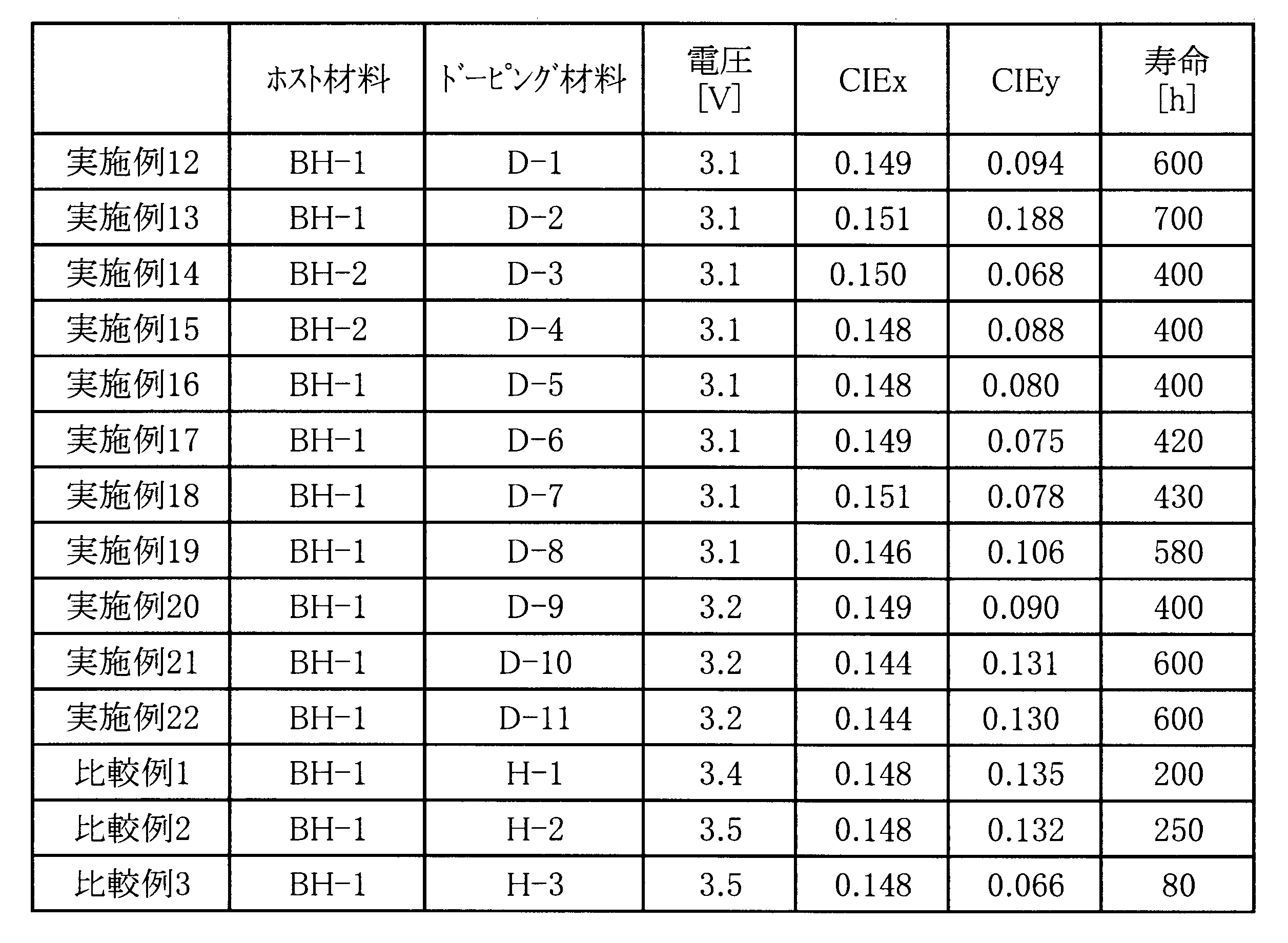
- the aromatic amine derivative of the present invention As can be seen from Table 1, by using the aromatic amine derivative of the present invention, a low voltage organic EL device is realized in a high current region close to practical performance.
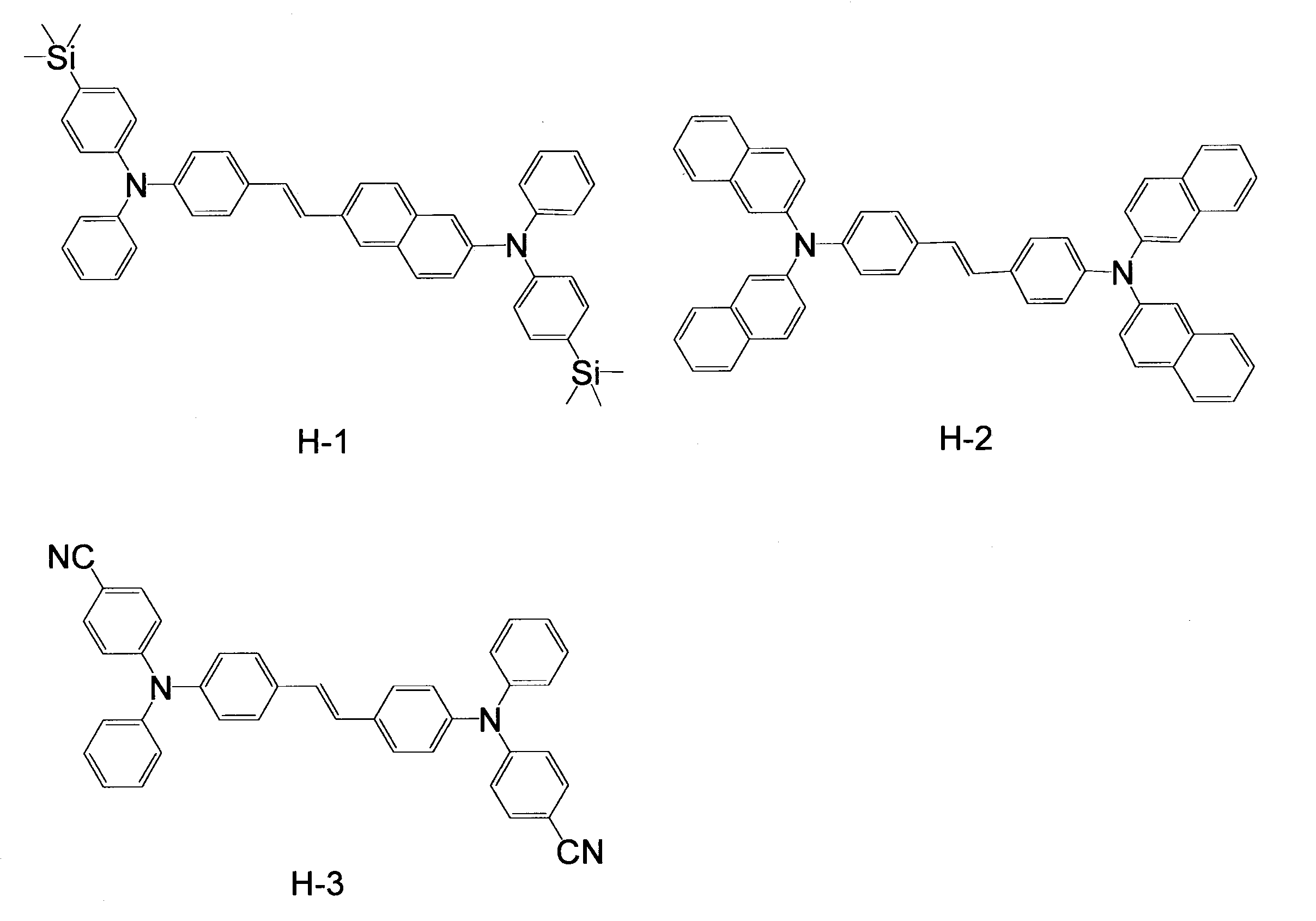
- the compound H-1 having no cyano group and the compound H-3 having no substituted silyl group, alkyl group or cycloalkyl group are more organic EL devices than when the aromatic amine derivative of the present invention is used. Increase the voltage.
- the organic EL device using the aromatic amine derivative of the present invention it is considered that the lifetime of the device is extended apart from the reduction in voltage due to the improved carrier injection property.
- the organic EL device of the present invention can be used for a flat light emitter such as a flat panel display of a wall-mounted television, a copying machine, a printer, a light source such as a backlight of a liquid crystal display or instruments, a display board, a marker lamp, and the like.
- the compound of this invention can be used not only in an organic EL element but in fields, such as an electrophotographic photoreceptor, a photoelectric conversion element, a solar cell, an image sensor.
Landscapes
- Chemical & Material Sciences (AREA)
- Organic Chemistry (AREA)
- Engineering & Computer Science (AREA)
- Materials Engineering (AREA)
- Physics & Mathematics (AREA)
- Spectroscopy & Molecular Physics (AREA)
- Optics & Photonics (AREA)
- Electroluminescent Light Sources (AREA)
- Organic Low-Molecular-Weight Compounds And Preparation Thereof (AREA)
- Low-Molecular Organic Synthesis Reactions Using Catalysts (AREA)
Abstract
Description
1.下記式(1)で表わされる化合物。

Ar1~Ar4は、それぞれ独立に、置換もしくは無置換の環形成炭素数6~30のアリール基、又は置換もしくは無置換の環形成原子数5~30のヘテロアリール基である。
Ar5、Ar6及びAr7は、それぞれ独立に、置換もしくは無置換の環形成炭素数6~30のアリーレン基、又は置換もしくは無置換の環形成原子数5~30のヘテロアリーレン基であり、Ar5、Ar6又はAr7が複数存在する場合、Ar5、Ar6又はAr7のそれぞれは、同じでも異なってもよい。
pは、0~2の整数であり、pが0の場合、Ar6とNの間は単結合である。
但し、Ar1~Ar4の少なくとも1つの置換基は、置換シリル基、置換もしくは無置換の炭素数1~20のアルキル基、又は置換もしくは無置換の炭素数3~10のシクロアルキル基であり、且つAr1~Ar4の少なくとも1つの置換基は、シアノ基である。)
2.前記Ar1~Ar4のうちの2つは置換基を有し、
前記置換基の一方は、置換シリル基、置換もしくは無置換の炭素数1~20のアルキル基、又は置換もしくは無置換の炭素数3~10のシクロアルキル基であり、
他方の置換基はシアノ基である1に記載の化合物。
3.前記Ar1~Ar4のうちいずれか2つが、それぞれ独立に、置換シリル基、置換もしくは無置換の炭素数1~20のアルキル基、又は置換もしくは無置換の炭素数3~10のシクロアルキル基を有する基であり、且つ残りのAr1~Ar4が、それぞれ独立に、シアノ基を有する基である1又は2に記載の化合物。
4.前記Ar1~Ar4が、それぞれ独立に置換もしくは無置換の環形成炭素数6~30のアリール基である1~3のいずれかに記載の化合物。
5.前記Ar1及びAr4が、それぞれ独立に、置換シリル基、置換もしくは無置換の炭素数1~20のアルキル基、又は置換もしくは無置換の炭素数3~10のシクロアルキル基で置換された環形成炭素数6~30のアリール基であり、
前記Ar2及びAr3が、それぞれ独立にシアノ基で置換された環形成炭素数6~30のアリール基である1~4のいずれかに記載の化合物。
6.Ar1及びAr4が、それぞれ独立に、置換シリル基、置換もしくは無置換の炭素数1~20のアルキル基、又は置換もしくは無置換の炭素数3~10のシクロアルキル基で置換されたフェニル基であり、Ar2及びAr3が、それぞれ独立にシアノ基で置換されたフェニル基である1~5のいずれかに記載の化合物。
7.Ar5、Ar6及びAr7が、それぞれ独立に、置換もしくは無置換の環形成炭素数6~30のアリーレン基である1~6のいずれかに記載の化合物。
8.Ar5、Ar6及びAr7が、それぞれ独立に、置換もしくは無置換のフェニレン基、ナフチレン基、ビフェニレン基又はフルオレニレン基である1~7のいずれかに記載の化合物。
9.l=1、m=1及びp=0である1~8のいずれかに記載の化合物。
10.l=1、m=1、n=1及びp=1である1~8のいずれかに記載の化合物。
11.有機エレクトロルミネッセンス素子用発光材料である1~10のいずれか記載の化合物。
12.有機エレクトロルミネッセンス素子用ドーピング材料である1~10のいずれか記載の化合物。
13.陰極と陽極の間に少なくとも発光層を含む1以上の有機薄膜層が挟持されている有機エレクトロルミネッセンス素子において、該有機薄膜層の少なくとも1層が、1~10のいずれか記載の化合物を単独もしくは混合物の成分として含有する有機エレクトロルミネッセンス素子。
14.前記1~10のいずれか記載の化合物を含有する有機薄膜層が発光層である13に記載の有機エレクトロルミネッセンス素子。
15.前記1~10のいずれか記載の化合物を含有する有機薄膜層が、下記式(5)で表わされるアントラセン誘導体をさらに含有する13又は14に記載の有機エレクトロルミネッセンス素子。

R101~R108は、それぞれ独立に、水素原子、置換もしくは無置換の環形成原子数5~50の単環基、置換もしくは無置換の環形成原子数8~50の縮合環基、及び、前記単環基と縮合環基の組合せから構成される基、置換もしくは無置換の炭素数1~50のアルキル基と縮合環基と基、置換もしくは無置換の環形成炭素数3~50のシクロアルキル基、置換もしくは無置換の炭素数1~50のアルコキシ基、置換もしくは無置換の炭素数7~50のアラルキル基、置換もしくは無置換の環形成炭素数6~50のアリールオキシ、置換もしくは無置換のシリル基、ハロゲン原子、シアノ基から選ばれる基である。)

Ar1~Ar4は、それぞれ独立に、置換もしくは無置換の環形成炭素数6~30のアリール基、又は置換もしくは無置換の環形成原子数5~30のヘテロアリール基である。
Ar5、Ar6及びAr7は、それぞれ独立に、置換もしくは無置換の環形成炭素数6~30のアリーレン基、又は置換もしくは無置換の環形成原子数5~30のヘテロアリーレン基であり、l、m及びnがそれぞれ2以上の場合、Ar5、Ar6及びAr7はそれぞれ同じでも異なってもよい(即ち、Ar5、Ar6又はAr7が複数存在する場合、Ar5、Ar6又はAr7のそれぞれは、同じでも異なってもよい。)。
pは、0~2の整数であり、pが0の場合、Ar6とNの間は単結合である。
但し、Ar1~Ar4の少なくとも1つの置換基は、置換シリル基、置換もしくは無置換の炭素数1~20のアルキル基、又は置換もしくは無置換の炭素数3~10のシクロアルキル基であり、且つAr1~Ar4の少なくとも1つの置換基は、シアノ基である。)
好ましくは、Ar1~Ar4のうち2つは置換基を有し、これら置換基の一方が置換シリル基、置換もしくは無置換の炭素数1~20のアルキル基、又は置換もしくは無置換の炭素数3~10のシクロアルキル基であり、他方の置換基がシアノ基である。
尚、「環形成炭素」とは飽和環、不飽和環、又は芳香環を構成する炭素原子を意味し、「環形成原子」とはヘテロ環(飽和環、不飽和環、及び芳香環を含む)を構成する炭素原子及びヘテロ原子を意味する。
アリール基の具体例としては、フェニル基、ナフチル基、アントリル基、フェナントリル基、ナフタセニル基、ピレニル基、クリセニル基、ベンゾ[c]フェナントリル基、ベンゾ[g]クリセニル基、トリフェニレニル基、フルオレニル基、9,9-ジメチルフルオレニル基、ベンゾフルオレニル基、ジベンゾフルオレニル基、ビフェニルイル基、ターフェニル基、フルオランテニル基等が挙げられ、好ましくはフェニル基、ビフェニル基、トリル基、キシリル基、ナフチル基である。
ヘテロアリール基の具体例としては、ピロリル基、ピラジニル基、ピリジニル基、インドリル基、イソインドリル基、イミダゾリル基、フリル基、ベンゾフラニル基、イソベンゾフラニル基、ジベンゾフラニル基、ジベンゾチオフェニル基、キノリル基、イソキノリル基、キノキサリニル基、カルバゾリル基、フェナントリジニル基、アクリジニル基、フェナントロリニル基、フェナジニル基、フェノチアジニル基、フェノキサジニル基、オキサゾリル基、オキサジアゾリル基、フラザニル基、チエニル基、ベンゾチオフェニル基等が挙げられ、好ましくは、ジベンゾフラニル基、ジベンゾチオフェニル基、カルバゾリル基である。
上記炭素数6~30のアリールシリル基は、好ましくは炭素数6~20のアリールシリル基であり、より好ましくは炭素数6~10のアリールシリル基である。アリールシリル基の具体例としては、トリフェニルシリル基、フェニルジメチルシリル基、t-ブチルジフェニルシリル基、トリトリルシリル基、トリキシリルシリル基、トリナフチルシリル基等が挙げられる。
上記炭素数は、1~10が好ましく、1~6がさらに好ましい。中でもメチル基、エチル基、プロピル基、イソプロピル基、n-ブチル基、s-ブチル基、イソブチル基、t-ブチル基、n-ペンチル基、n-ヘキシル基が好ましい。
置換された炭素数1~20のアルキル基としては、例えばフェニルメチル基、フェニルエチル基、フェニルプロピル基(例えば、2-フェニルイソプロピル基)等が好ましい。
また、「置換もしくは無置換の・・・」の「無置換」とは、水素原子が置換していることを意味し、本発明の水素原子には、軽水素、重水素、三重水素が含まれる。
ハロゲン化アルキル基として、フルオロメチル基、ジフルオロメチル基、トリフルオロメチル基、フルオロエチル基、トリフルオロメチルメチル基等が挙げられる。


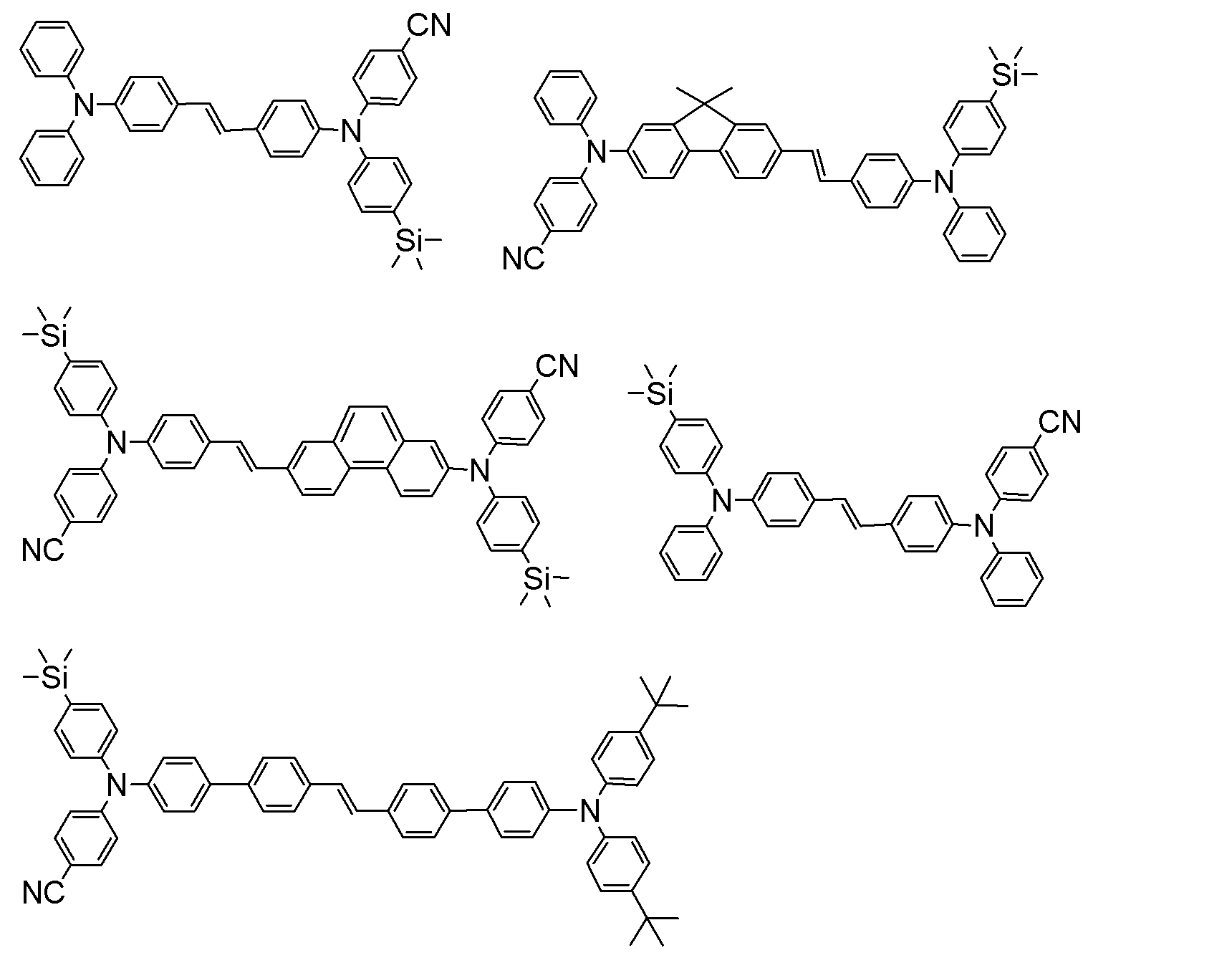


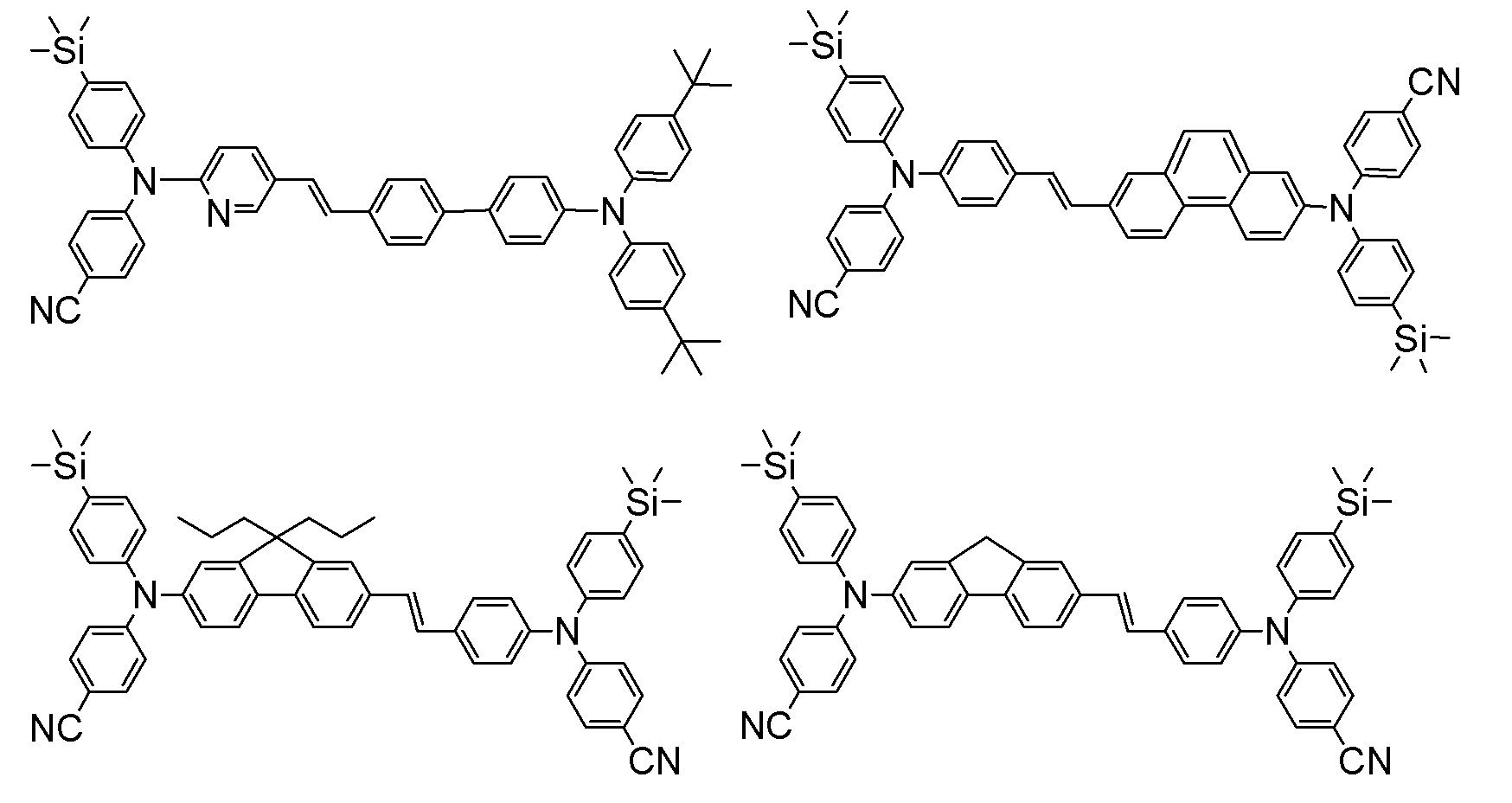


本発明の芳香族アミン誘導体を含む有機薄膜層は、好ましくは発光層であり、当該発光層は本発明の芳香族誘導体のみからなってもよく、ホストとして又はドーパントとして含んでもよい。
式(5)で表されるアントラセン誘導体は、下記化合物である。

環形成原子数5~50の単環基(好ましくは環形成原子数5~30、より好ましくは環形成原子数5~20)として具体的には、フェニル基、ビフェニル基、ターフェニル基、クォーターフェニル基等の芳香族基と、ピリジル基、ピラジル基、ピリミジル基、トリアジニル基、フリル基、チエニル基等の複素環基が好ましい。
中でも、フェニル基、ビフェニル基、ターフェニル基が好ましい。
前記環形成原子数8~50の縮合環基(好ましくは環形成原子数8~30、より好ましくは環形成原子数8~20)として具体的には、ナフチル基、フェナントリル基、アントリル基、クリセニル基、ベンゾアントリル基、ベンゾフェナントリル基、トリフェニレニル基、ベンゾクリセニル基、インデニル基、フルオレニル基、9,9-ジメチルフルオレニル基、ベンゾフルオレニル基、ジベンゾフルオレニル基、フルオランテニル基、ベンゾフルオランテニル基等の縮合芳香族環基や、ベンゾフラニル基、ベンゾチオフェニル基、インドリル基、ジベンゾフラニル基、ジベンゾチオフェニル基、カルバゾリル基、キノリル基、フェナントロリニル基等の縮合複素環基が好ましい。
中でも、ナフチル基、フェナントリル基、アントリル基、9,9-ジメチルフルオレニル基、フルオランテニル基、ベンゾアントリル基、ジベンゾチオフェニル基、ジベンゾフラニル基、カルバゾリル基が好ましい。
当該アントラセン誘導体は、式(5)におけるAr11及びAr12が、それぞれ独立に、置換若しくは無置換の環形成原子数8~50の縮合環基となっている。当該アントラセン誘導体としては、Ar11及びAr12が同一の置換若しくは無置換の縮合環基である場合、及び異なる置換若しくは無置換の縮合環基である場合に分けることができる。
当該アントラセン誘導体は、式(5)におけるAr11及びAr12の一方が置換若しくは無置換の環形成原子数5~50の単環基であり、他方が置換若しくは無置換の環形成原子数8~50の縮合環基となっている。
好ましい形態として、Ar12がナフチル基、フェナントリル基、ベンゾアントリル基、9,9-ジメチルフルオレニル基、ジベンゾフラニル基であり、Ar11が単環基又は縮合環基が置換されたフェニル基である。
好ましい単環基、縮合環基の具体的な基は上述した通りである。
別の好ましい形態として、Ar12が縮合環基であり、Ar11が無置換のフェニル基である。この場合、縮合環基として、フェナントリル基、9,9-ジメチルフルオレニル基、ジベンゾフラニル基、ベンゾアントリル基が特に好ましい。
当該アントラセン誘導体は、式(5)におけるAr11及びAr12が、それぞれ独立に、置換若しくは無置換の環形成原子数5~50の単環基となっている。
好ましい形態として、Ar11、Ar12ともに置換若しくは無置換のフェニル基である。
さらに好ましい形態として、Ar11が無置換のフェニル基であり、Ar12が単環基、縮合環基を置換基として持つフェニル基である場合と、Ar11、Ar12がそれぞれ独立に単環基、縮合環基を置換基として持つフェニル基である場合がある。
前記置換基としての好ましい単環基、縮合環基の具体例は上述した通りである。さらに好ましくは、置換基としての単環基としてフェニル基、ビフェニル基、縮合環基として、ナフチル基、フェナントリル基、9,9-ジメチルフルオレニル基、ジベンゾフラニル基、ベンゾアントリル基である。

L1及びL2は、それぞれ独立に、置換もしくは無置換の環形成炭素数6~30の2価のアリール基又は複素環基を示す。
xは0~1の整数、yは1~4の整数、sは0~1の整数、tは0~3の整数である。
また、L1又はAr111はピレンの1~5位のいずれかに結合し、L2又はAr222はピレンの6~10位のいずれかに結合する。
また、この置換基としては、上記式(1)における「置換もしくは無置換の・・・」における置換基と同様である。L1及びL2の置換基は、好ましくは、炭素数1~20のアルキル基である。
式(6)におけるtは、好ましくは0~2の整数である。
Ar111及びAr222のアリール基は、上記式(1)における各基と同様である。好ましくは、置換もしくは無置換の環形成炭素数6~20のアリール基、より好ましくは、置換もしくは無置換の環形成炭素数6~16のアリール基、アリール基の好ましい具体例としては、フェニル基、ナフチル基、フェナントリル基、フルオレニル基、ビフェニル基、アントリル基、ピレニル基である。
また、正孔注入材料にTCNQ誘導体等の電子受容物質を添加することによりキャリアを増感させることもできる。
芳香族三級アミン誘導体としては、例えば、N,N’-ジフェニル-N,N’-ジナフチル-1,1’-ビフェニル-4,4’-ジアミン、N,N,N’,N’-テトラビフェニル-1,1’-ビフェニル-4,4’-ジアミン等、又はこれらの芳香族三級アミン骨格を有したオリゴマー若しくはポリマーであるが、これらに限定されるものではない。
前記金属錯体化合物としては、例えば、8-ヒドロキシキノリナートリチウム、ビス(8-ヒドロキシキノリナート)亜鉛、トリス(8-ヒドロキシキノリナート)アルミニウム、トリス(8-ヒドロキシキノリナート)ガリウム、ビス(10-ヒドロキシベンゾ[h]キノリナート)ベリリウム、ビス(10-ヒドロキシベンゾ[h]キノリナート)亜鉛等が挙げられるが、これらに限定されるものではない。
好ましい形態として、これらの電子注入材料にさらにドーパントを含有し、陰極からの電子の受け取りを容易にするため、より好ましくは第2有機層の陰極界面近傍にアルカリ金属で代表されるドーパントをドープする。
ドーパントとしては、ドナー性金属、ドナー性金属化合物及びドナー性金属錯体が挙げられ、これら還元性ドーパントは1種単独で使用してもよいし、2種以上を組み合わせて使用してもよい。
このような湿式成膜法に適した溶液として、有機EL材料として本発明の芳香族アミン誘導体と溶媒とを含有する有機EL材料含有溶液を用いることができる。
実施例1
以下の合成スキームに従って、芳香族アミン誘導体D-1を製造した。
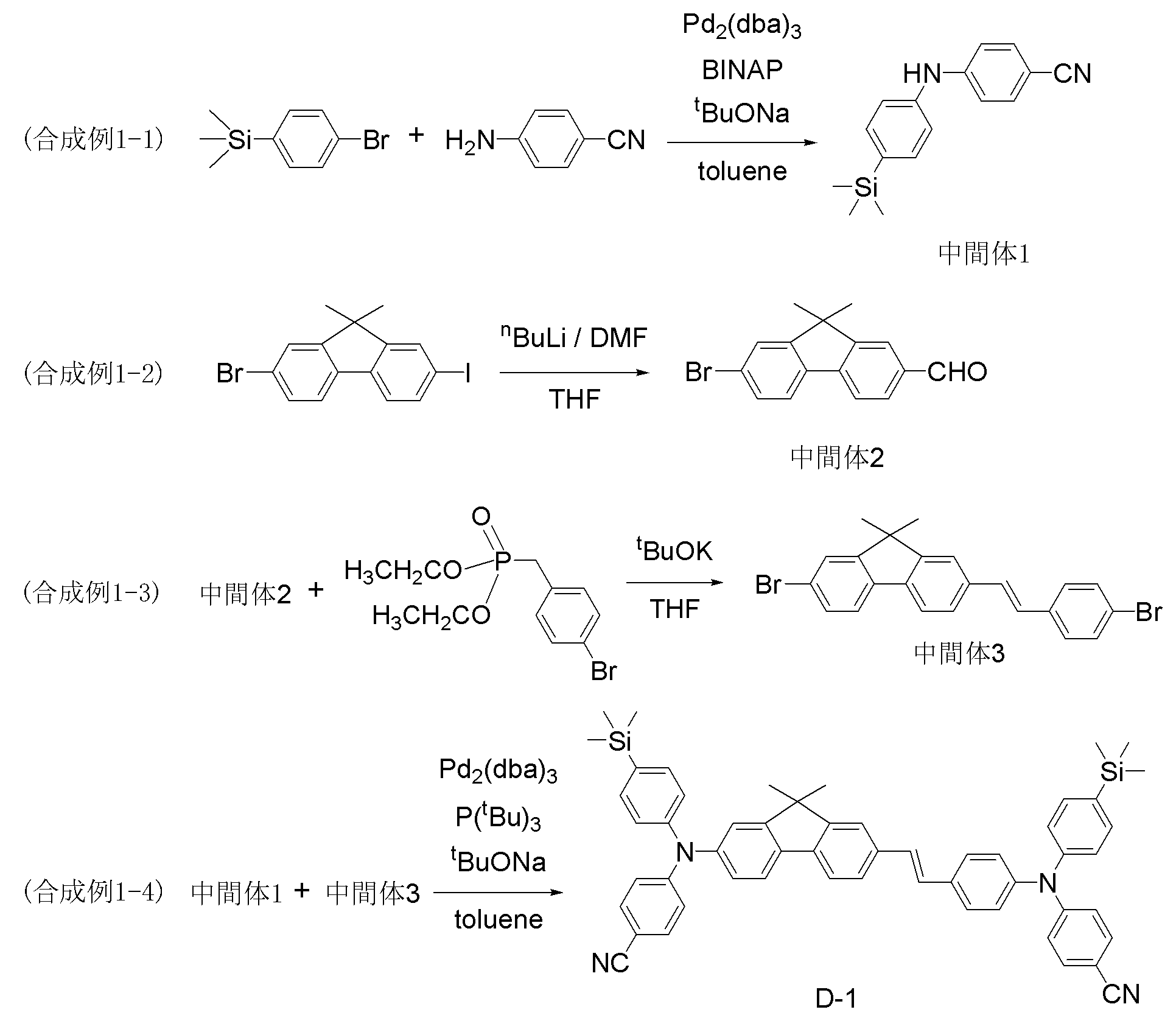
アルゴン気流下、2000mLナスフラスコに、トリス(ジベンジリデンアセトン)ジパラジウム(0)〔Pd2(dba)3〕2.2g、2,2’-ビス(ジフェニルホスフィノ)-1,1’-ビナフチル〔BINAP〕2.9g、1-ブロモ-4-(トリメチルシリル)ベンゼン36g、4-アミノベンゾニトリル37g、ナトリウムtert-ブトキシド30g、及びトルエンを入れ、105℃にて9時間撹拌した。冷却後、反応溶液をセライトろ過し、ろ液を濃縮し、シリカゲルクロマトグラフィー(トルエン)で精製し、減圧乾燥したところ、24gの白色固体を得た。
得られた白色固体を、FD-MS(フィールドディソープションマススペクトル)の分析により、中間体1と同定した。
アルゴン気流下、1000mLのナスフラスコに、2-ブロモ-7-ヨード-9,9-ジメチルフルオレン41.9g、脱水THF300mLを入れ、-65℃に冷却した後、n-ブチルリチウムヘキサン溶液(1.6M)72mLを入れ、30分撹拌した。撹拌後、脱水N,N-ジメチルホルムアミドを25mL滴下した後、徐々に昇温し、室温下4時間撹拌した。
4N塩酸、トルエンを加えて分液、抽出した後、上水、飽和食塩水で有機層を洗浄、硫酸ナトリウムで乾燥し、濃縮して得られた粗生成物をシリカゲルクロマトグラフィー(トルエン)で精製し得られた固体を減圧乾燥したところ、24.4gの白色固体を得た。
得られた白色固体を、FD-MSの分析により、中間体2と同定した。
アルゴン気流下、300mLのナスフラスコに、(4-ブロモベンジル)ホスホン酸ジエチル8.40g 、THF 50mLを入れ、-68℃に冷却し、カリウムtert-ブトキシド 6.16gを入れ、90分撹拌した。続いて、中間体2 6.90g のTHF (60mL)溶液を滴下し、2時間反応した後、撹拌しながら1時間かけて室温まで昇温し、室温にて2時間撹拌した。
上水、トルエンを加えて分液、水層をトルエンで抽出した後、合わせた有機層を上水、飽和食塩水で洗浄し、硫酸ナトリウムで乾燥し、濃縮して得られた固体をトルエンで再結晶して得られた固体を減圧乾燥したところ、7.00gの黄白色固体を得た。FD-MSの分析により、中間体3と同定した。
アルゴン気流下、300mLのナスフラスコに、中間体1を14.1g、中間体3を10.0g、ナトリウムtert-ブトキシド4.25g、トリス(ジベンジリデンアセトン)ジパラジウム(0)〔Pd2(dba)3〕607mg、トリ-tert-ブチルホスフィン447mg、トルエンを入れ、95℃にて8時間撹拌した。冷却後、反応溶液をセライトろ過し、ろ液を濃縮し、得られた租生成物をシリカゲルクロマトグラフィー(トルエン)で精製した。得られたアモルファス状固体を、トルエン/メタノールで再結晶を3回し、減圧乾燥したところ、8.6gの黄白色固体(D-1)を得た。
得られた黄白色固体について、FD-MS、トルエン溶液中の紫外線吸収極大波長λmax、及び蛍光発光極大波長を以下に示す。
FDMS,calcd for C55H52N4Si2=824,found m/z=824(M+)
UV(PhMe);λmax,393nm
FL(PhMe,λex=360nm);λmax,435nm
以下の合成スキームに従って、芳香族アミン誘導体D-2を製造した。

中間体3の合成において、中間体2の代わりにテレフタルアルデヒドを用いた他は同様の反応を実施した。得られた固体を、FD-MSの分析により、中間体4と同定した。
化合物D-1の合成において、中間体3の代わりに中間体4を用いた他は同様の反応を実施し、化合物D-2を得た。得られた化合物について、FD-MS、トルエン溶液中の紫外線吸収極大波長λmax、及び蛍光発光極大波長を以下に示す。
FDMS,calcd for C54H50N4Si2=810,found m/z=810(M+)
UV(PhMe);λmax,404nm
FL(PhMe,λex=380nm);λmax,450nm
以下の合成スキームに従って、芳香族アミン誘導体D-3を製造した。

D-1の合成において、中間体3の代わりに4,4’-ジブロモスチルベンを用いた他は同様の反応を実施し、化合物D-3を得た。得られた化合物について、FD-MS、トルエン溶液中の紫外線吸収極大波長λmax、及び蛍光発光極大波長を以下に示す。
FDMS,calcd for C46H44N4Si2=708,found m/z=708(M+)
UV(PhMe);λmax,386nm
FL(PhMe,λex=360nm);λmax,429nm
以下の合成スキームに従って、芳香族アミン誘導体D-4を製造した。

中間体2の合成において、2-ブロモ-7-ヨード-9,9-ジメチルフルオレンの代わりに2,6-ジブロモナフタレンを用いた他は同様の反応を実施した。得られた固体を、FD-MSの分析により、中間体5と同定した。
中間体3の合成において、中間体2の代わりに中間体5を用いた他は同様の反応を実施した。
得られた固体を、FD-MSの分析により、中間体6と同定した。
化合物D-1の合成において、中間体3の代わりに中間体6を用いた他は同様の反応を実施し、化合物D-4を得た。得られた化合物について、FD-MS、トルエン溶液中の紫外線吸収極大波長λmax、及び蛍光発光極大波長を以下に示す。
FDMS,calcd for C50H46N4Si2=758,found m/z=758(M+)
UV(PhMe);λmax,389nm
FL(PhMe,λex=360nm);λmax,428nm
以下の合成スキームに従って、芳香族アミン誘導体D-5を製造した。

中間体2の合成において、2-ブロモ-7-ヨード-9,9-ジメチルフルオレンの代わりに4,4’-ジブロモビフェニルを用いた他は同様の反応を実施した。得られた固体を、FD-MSの分析により、中間体7と同定した。
中間体3の合成において、中間体2の代わりに中間体7を用いた他は同様の反応を実施した。得られた固体を、FD-MSの分析により、中間体8と同定した。
化合物D-1の合成において、中間体3の代わりに中間体8を用いた他は同様の反応を実施し、化合物D-5を得た。得られた化合物について、FD-MS、トルエン溶液中の紫外線吸収極大波長λmax、及び蛍光発光極大波長を以下に示す。
FDMS,calcd for C52H48N4Si2=784,found m/z=784(M+)
UV(PhMe);λmax,431nm
FL(PhMe,λex=350nm);λmax,373nm
以下の合成スキームに従って、芳香族アミン誘導体D-6を製造した。
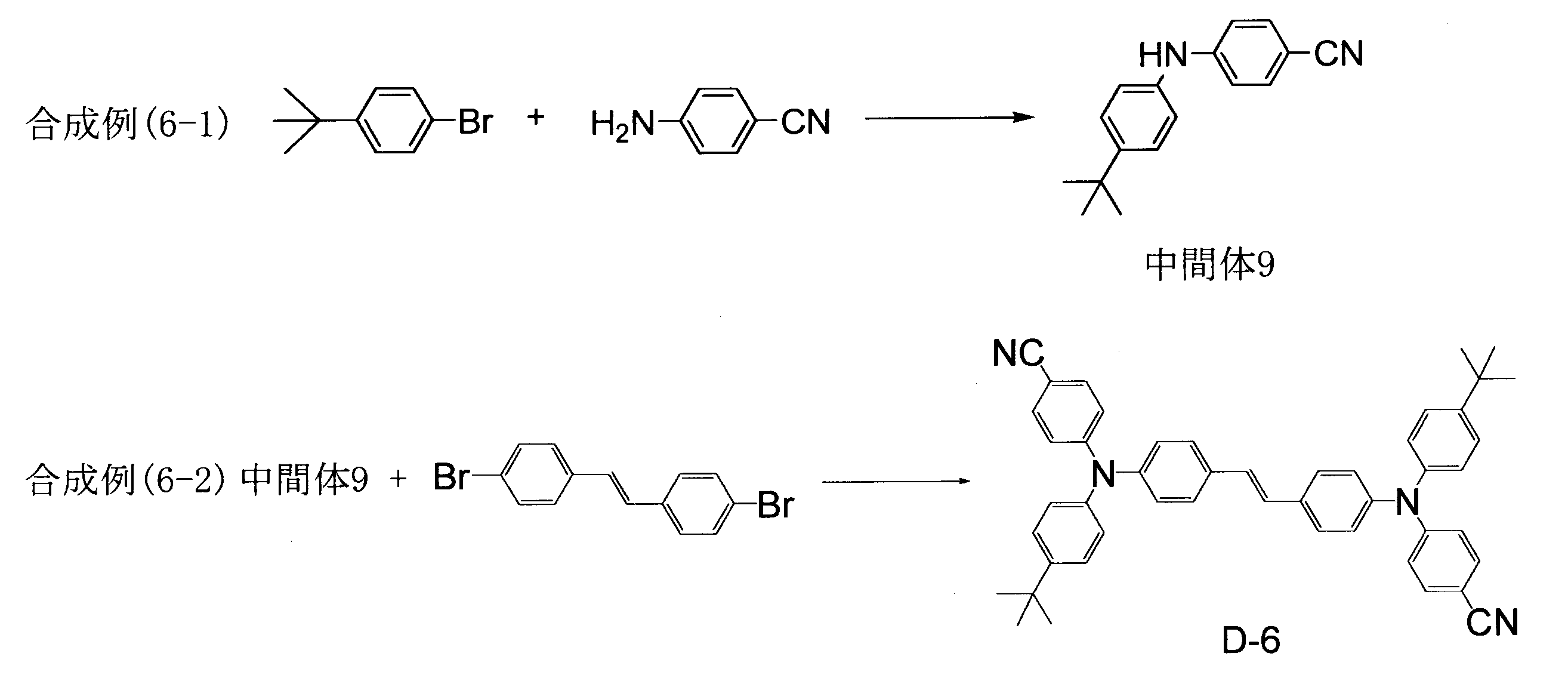
中間体1の合成において、1-ブロモ-4-(トリメチルシリル)ベンゼンの代わりに1-ブロモ-4-tert-ブチルベンゼンを用いた他は同様の反応を実施した。得られた固体を、FD-MSの分析により、中間体9と同定した。
化合物D-1の合成において、中間体1の代わりに中間体9を用い、中間体3の代わりに4,4’-ジブロモスチルベンを用いた他は同様の反応を実施し、化合物D-6を得た。得られた化合物について、FD-MS、トルエン溶液中の紫外線吸収極大波長λmax、及び蛍光発光極大波長を以下に示す。
FDMS, calcd for C48H44N4=676,found m/z=676(M+)
UV(PhMe);λmax,389nm、
FL(PhMe,λex=360nm);λmax,432nm
以下の合成スキームに従って、芳香族アミン誘導体D-7を製造した。

中間体1の合成において、1-ブロモ-4-(トリメチルシリル)ベンゼンの代わりに1-ブロモ-4-イソプロピルベンゼンを用いた他は同様の反応を実施した。得られた固体を、FD-MSの分析により、中間体10と同定した。
化合物D-1の合成において、中間体1の代わりに中間体10を用い、中間体3の代わりに4,4’-ジブロモスチルベンを用いた他は同様の反応を実施し、化合物D-7を得た。得られた化合物について、FD-MS、トルエン溶液中の紫外線吸収極大波長λmax、及び蛍光発光極大波長を以下に示す。
FDMS, calcd for C46H40N4=648,found m/z=648 (M+)
UV(PhMe);λmax,387nm、
FL(PhMe,λex=360nm);λmax,431nm
以下の合成スキームに従って、芳香族アミン誘導体D-8を製造した。

化合物D-1の合成において、中間体1の代わりに中間体10を用いた他は同様の反応を実施し、化合物D-8を得た。得られた化合物について、FD-MS、トルエン溶液中の紫外線吸収極大波長λmax、及び蛍光発光極大波長を以下に示す。
FDMS, calcd for C55H48N4=764,found m/z=764(M+)
UV(PhMe);λmax,395nm、
FL(PhMe,λex=370nm);λmax,437nm
以下の合成スキームに従って、芳香族アミン誘導体D-9を製造した。

中間体3の合成において、中間体2の代わりに4-(N,N-ジフェニルアミノ)ベンズアルデヒドを用いた他は同様の反応を実施した。得られた固体を、FD-MSの分析により、中間体11と同定した。
化合物D-1の合成において、中間体3の代わりに中間体11を用いた他は同様の反応を実施し、化合物D-9を得た。得られた化合物について、FD-MS、トルエン溶液中の紫外線吸収極大波長λmax、及び蛍光発光極大波長を以下に示す。
FDMS, calcd for C42H37N3Si=611,found m/z=611(M+)
UV(PhMe);λmax,389nm、
FL(PhMe,λex=360nm);λmax,432nm
以下の合成スキームに従って、芳香族アミン誘導体D-10を製造した。

中間体3の合成において、(4-ブロモベンジル)ホスホン酸ジエチルの代わりに(4-クロロベンジル)ホスホン酸ジエチルを用いた他は同様の反応を実施した。得られた固体を、FD-MSの分析により、中間体12と同定した。
化合物D-1の合成において、中間体3の代わりに中間体12を用い、中間体1の代わりにジフェニルアミンを用いた他は同様の反応を実施した。得られた固体を、FD-MSの分析により、中間体13と同定した。
化合物D-1の合成において、中間体3の代わりに中間体13を用いた他は同様の反応を実施し、化合物D-10を得た。得られた化合物について、FD-MS、トルエン溶液中の紫外線吸収極大波長λmax、及び蛍光発光極大波長を以下に示す。
FDMS, calcd for C51H45N3Si=727,found m/z=727(M+)
UV(PhMe);λmax,397nm、
FL(PhMe,λex=370nm);λmax,441nm
以下の合成スキームに従って、芳香族アミン誘導体D-11を製造した。

化合物D-1の合成において、中間体3の代わりに中間体12を用いた他は同様の反応を実施した。得られた固体を、FD-MSの分析により、中間体14と同定した。
化合物D-1の合成において、中間体3の代わりに中間体14を用い、中間体1の代わりにジフェニルアミンを用いた他は同様の反応を実施し、化合物D-11を得た。得られた化合物について、FD-MS、トルエン溶液中の紫外線吸収極大波長λmax、及び蛍光発光極大波長を以下に示す。
FDMS, calcd for C51H45N3Si=727,found m/z=727(M+)
UV(PhMe);λmax,396nm、
FL(PhMe,λex=370nm);λmax,440nm
実施例12
25mm×75mm×1.1mmサイズのガラス基板上に、膜厚120nmのインジウムスズ酸化物からなる透明電極を設けた。この透明電極は、陽極として働く。続いて、このガラス基板に紫外線及びオゾンを照射して洗浄したのち、真空蒸着装置にこの基板を設置した。
陽極上に正孔注入層として、化合物HT-1を50nmの厚さに蒸着したのち、その上に正孔輸送層として、N,N,N’,N’-テトラキス(4-ビフェニル)-4,4’-ベンジジンを45nmの厚さに蒸着した。次いで、ホスト材料であるアントラセン誘導体BH-1と、ドーピング材料である化合物D-1とを、質量比25:5で同時蒸着し、厚さ30nmの発光層を形成した。この発光層上に、電子注入層として、化合物ET-1を25nmの厚さに蒸着した。次に、弗化リチウムを1nmの厚さに蒸着し、次いでアルミニウムを150nmの厚さに蒸着し、有機EL素子を作製した。尚、このアルミニウム/弗化リチウムは陰極として働く。

ホスト材料及びドーピング材料について、表1に示す化合物を用いた他は実施例12と同様にして有機EL素子を作製し、評価した。結果を表1に示す。
尚、化合物H-1、H-2及びH-3は、それぞれ下記構造を有する化合物である。
また、本発明の芳香族アミン誘導体を用いた有機EL素子では、キャリア注入性が改善されたことにより、低電圧化とは別に、素子寿命が長くなっているものと考えられる。
この明細書に記載の文献の内容を全てここに援用する。
Claims (15)
- 下記式(1)で表わされる化合物。

Ar1~Ar4は、それぞれ独立に、置換もしくは無置換の環形成炭素数6~30のアリール基、又は置換もしくは無置換の環形成原子数5~30のヘテロアリール基である。
Ar5、Ar6及びAr7は、それぞれ独立に、置換もしくは無置換の環形成炭素数6~30のアリーレン基、又は置換もしくは無置換の環形成原子数5~30のヘテロアリーレン基であり、Ar5、Ar6又はAr7が複数存在する場合、Ar5、Ar6又はAr7のそれぞれは、同じでも異なってもよい。
pは、0~2の整数であり、pが0の場合、Ar6とNの間は単結合である。
但し、Ar1~Ar4の少なくとも1つの置換基は、置換シリル基、置換もしくは無置換の炭素数1~20のアルキル基、又は置換もしくは無置換の炭素数3~10のシクロアルキル基であり、且つAr1~Ar4の少なくとも1つの置換基は、シアノ基である。) - 前記Ar1~Ar4のうちの2つは置換基を有し、
前記置換基の一方は、置換シリル基、置換もしくは無置換の炭素数1~20のアルキル基、又は置換もしくは無置換の炭素数3~10のシクロアルキル基であり、
他方の置換基はシアノ基である請求項1に記載の化合物。 - 前記Ar1~Ar4のうちいずれか2つが、それぞれ独立に、置換シリル基、置換もしくは無置換の炭素数1~20のアルキル基、又は置換もしくは無置換の炭素数3~10のシクロアルキル基を有する基であり、且つ残りのAr1~Ar4が、それぞれ独立に、シアノ基を有する基である請求項1又は2に記載の化合物。
- 前記Ar1~Ar4が、それぞれ独立に置換もしくは無置換の環形成炭素数6~30のアリール基である請求項1~3のいずれかに記載の化合物。
- 前記Ar1及びAr4が、それぞれ独立に、置換シリル基、置換もしくは無置換の炭素数1~20のアルキル基、又は置換もしくは無置換の炭素数3~10のシクロアルキル基で置換された環形成炭素数6~30のアリール基であり、
前記Ar2及びAr3が、それぞれ独立にシアノ基で置換された環形成炭素数6~30のアリール基である請求項1~4のいずれかに記載の化合物。 - Ar1及びAr4が、それぞれ独立に、置換シリル基、置換もしくは無置換の炭素数1~20のアルキル基、又は置換もしくは無置換の炭素数3~10のシクロアルキル基で置換されたフェニル基であり、Ar2及びAr3が、それぞれ独立にシアノ基で置換されたフェニル基である請求項1~5のいずれかに記載の化合物。
- Ar5、Ar6及びAr7が、それぞれ独立に、置換もしくは無置換の環形成炭素数6~30のアリーレン基である請求項1~6のいずれかに記載の化合物。
- Ar5、Ar6及びAr7が、それぞれ独立に、置換もしくは無置換のフェニレン基、ナフチレン基、ビフェニレン基又はフルオレニレン基である請求項1~7のいずれかに記載の化合物。
- l=1、m=1及びp=0である請求項1~8のいずれかに記載の化合物。
- l=1、m=1、n=1及びp=1である請求項1~8のいずれかに記載の化合物。
- 有機エレクトロルミネッセンス素子用発光材料である請求項1~10のいずれか記載の化合物。
- 有機エレクトロルミネッセンス素子用ドーピング材料である請求項1~10のいずれか記載の化合物。
- 陰極と陽極の間に少なくとも発光層を含む1以上の有機薄膜層が挟持されている有機エレクトロルミネッセンス素子において、該有機薄膜層の少なくとも1層が、請求項1~10のいずれかに記載の化合物を単独もしくは混合物の成分として含有する有機エレクトロルミネッセンス素子。
- 前記請求項1~10のいずれか記載の化合物を含有する有機薄膜層が発光層である請求項13に記載の有機エレクトロルミネッセンス素子。
- 前記請求項1~10のいずれか記載の化合物を含有する有機薄膜層が、下記式(5)で表わされるアントラセン誘導体をさらに含有する請求項13又は14に記載の有機エレクトロルミネッセンス素子。
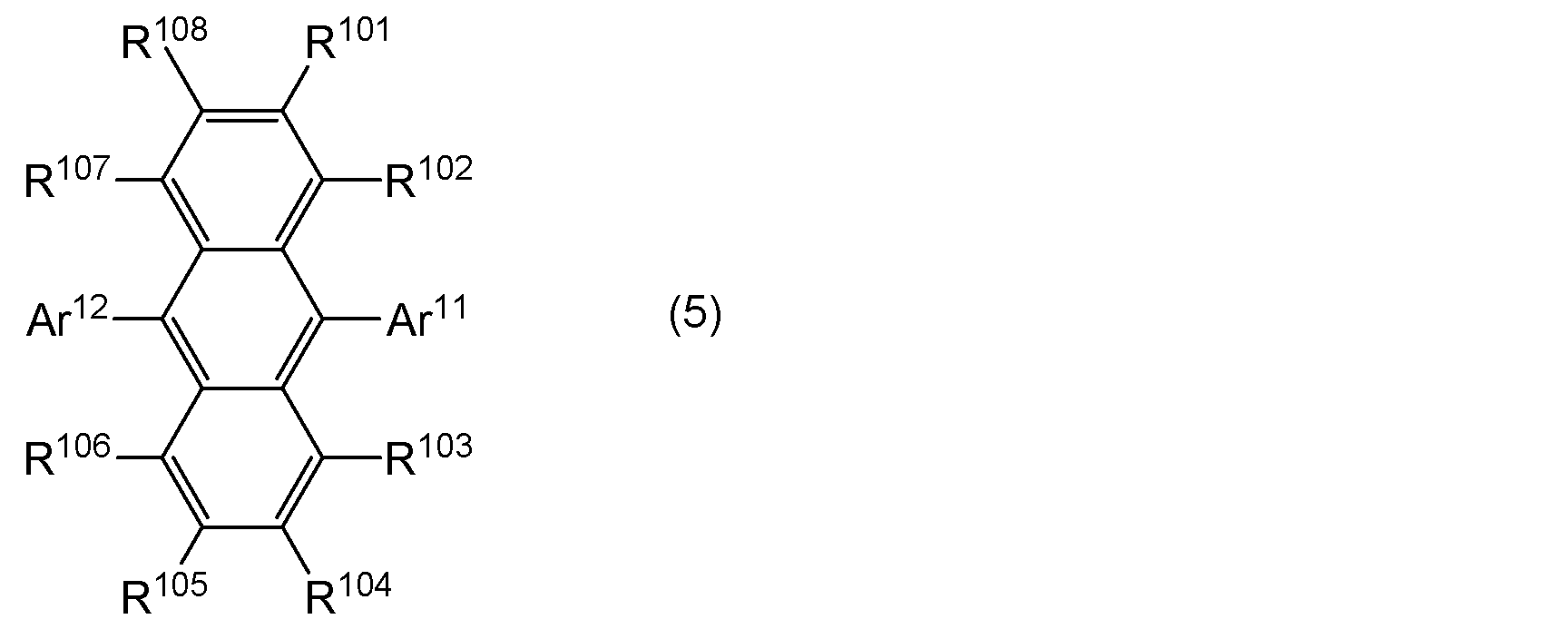
R101~R108は、それぞれ独立に、水素原子、置換もしくは無置換の環形成原子数5~50の単環基、置換もしくは無置換の環形成原子数8~50の縮合環基、及び、前記単環基と縮合環基の組合せから構成される基、置換もしくは無置換の炭素数1~50のアルキル基と縮合環基と基、置換もしくは無置換の環形成炭素数3~50のシクロアルキル基、置換もしくは無置換の炭素数1~50のアルコキシ基、置換もしくは無置換の炭素数7~50のアラルキル基、置換もしくは無置換の環形成炭素数6~50のアリールオキシ、置換もしくは無置換のシリル基、ハロゲン原子、シアノ基から選ばれる基である。)
Priority Applications (4)
| Application Number | Priority Date | Filing Date | Title |
|---|---|---|---|
| US13/389,514 US9269907B2 (en) | 2010-10-25 | 2011-10-24 | Aromatic amine derivative and organic electroluminescence device using the same |
| CN2011800028389A CN102639490A (zh) | 2010-10-25 | 2011-10-24 | 芳香族胺衍生物及使用该衍生物的有机电致发光元件 |
| EP11810980.0A EP2634170A1 (en) | 2010-10-25 | 2011-10-24 | Aromatic amine derivative, and organic electroluminescent element using same |
| JP2011548442A JP5903271B2 (ja) | 2010-10-25 | 2011-10-24 | 芳香族アミン誘導体、及びそれを用いた有機エレクトロルミネッセンス素子。 |
Applications Claiming Priority (4)
| Application Number | Priority Date | Filing Date | Title |
|---|---|---|---|
| JP2010238303 | 2010-10-25 | ||
| JP2010-238303 | 2010-10-25 | ||
| JP2011133558 | 2011-06-15 | ||
| JP2011-133558 | 2011-06-15 |
Publications (1)
| Publication Number | Publication Date |
|---|---|
| WO2012056674A1 true WO2012056674A1 (ja) | 2012-05-03 |
Family
ID=45993421
Family Applications (1)
| Application Number | Title | Priority Date | Filing Date |
|---|---|---|---|
| PCT/JP2011/005930 Ceased WO2012056674A1 (ja) | 2010-10-25 | 2011-10-24 | 芳香族アミン誘導体、及びそれを用いた有機エレクトロルミネッセンス素子。 |
Country Status (7)
| Country | Link |
|---|---|
| US (1) | US9269907B2 (ja) |
| EP (1) | EP2634170A1 (ja) |
| JP (1) | JP5903271B2 (ja) |
| KR (1) | KR20120104085A (ja) |
| CN (1) | CN102639490A (ja) |
| TW (1) | TW201300503A (ja) |
| WO (1) | WO2012056674A1 (ja) |
Cited By (5)
| Publication number | Priority date | Publication date | Assignee | Title |
|---|---|---|---|---|
| WO2013191212A1 (ja) * | 2012-06-20 | 2013-12-27 | 国立大学法人東京工業大学 | 有機エレクトロルミネッセンス素子 |
| WO2014088047A1 (ja) * | 2012-12-05 | 2014-06-12 | 三星ディスプレイ株式▲会▼社 | アミン誘導体、有機発光材料及びそれを用いた有機エレクトロルミネッセンス素子 |
| JP2014131986A (ja) * | 2012-12-05 | 2014-07-17 | Samsung R&D Institute Japan Co Ltd | アミン誘導体、有機発光材料及びそれを用いた有機エレクトロルミネッセンス素子 |
| US9997715B2 (en) | 2014-11-18 | 2018-06-12 | Samsung Display Co., Ltd. | Material for organic electroluminescent device and organic electroluminescent device using the same |
| US10249402B2 (en) | 2012-06-20 | 2019-04-02 | Tokyo Institute Of Technology | C12A7 electride thin film fabrication method and C12A7 electride thin film |
Families Citing this family (5)
| Publication number | Priority date | Publication date | Assignee | Title |
|---|---|---|---|---|
| KR101789858B1 (ko) | 2011-01-14 | 2017-10-25 | 이데미쓰 고산 가부시키가이샤 | 방향족 아민 유도체 및 그것을 이용한 유기 전기발광 소자 |
| CN104744450A (zh) * | 2013-12-26 | 2015-07-01 | 东丽先端材料研究开发(中国)有限公司 | 芳香胺化合物、发光元件材料及发光元件 |
| US20160164012A1 (en) * | 2014-11-28 | 2016-06-09 | Samsung Electronics Co., Ltd. | Organometallic compound and organic light-emitting device including the same |
| JP7087709B2 (ja) * | 2018-06-19 | 2022-06-21 | 京セラドキュメントソリューションズ株式会社 | ビスブタジエン誘導体及びその製造方法、並びに電子写真感光体 |
| WO2022114063A1 (ja) * | 2020-11-27 | 2022-06-02 | 日鉄ケミカル&マテリアル株式会社 | 撮像用光電変換素子用材料 |
Citations (8)
| Publication number | Priority date | Publication date | Assignee | Title |
|---|---|---|---|---|
| JPH07249490A (ja) * | 1994-03-08 | 1995-09-26 | Ricoh Co Ltd | 電界発光素子 |
| WO2007123137A1 (ja) * | 2006-04-18 | 2007-11-01 | Idemitsu Kosan Co., Ltd. | 芳香族アミン誘導体及びそれを用いた有機エレクトロルミネッセンス素子 |
| JP2008133225A (ja) * | 2006-11-29 | 2008-06-12 | Toyo Ink Mfg Co Ltd | インドール誘導体およびその用途 |
| JP2008214332A (ja) * | 2007-02-28 | 2008-09-18 | Sfc Co Ltd | 青色発光化合物およびこれを利用した有機電界発光素子 |
| JP2010065033A (ja) * | 2008-09-04 | 2010-03-25 | Gracel Display Inc | 新規の有機電界発光化合物およびこれを使用する有機電界発光素子 |
| WO2010052852A1 (ja) * | 2008-11-10 | 2010-05-14 | 出光興産株式会社 | 芳香族アミン誘導体及びそれを用いた有機エレクトロルミネッセンス素子 |
| WO2010058995A1 (en) * | 2008-11-21 | 2010-05-27 | Gracel Display Inc. | Electroluminescent device using the electroluminescent compounds |
| JP2010143841A (ja) * | 2008-12-17 | 2010-07-01 | Idemitsu Kosan Co Ltd | 芳香族アミン誘導体及びそれを用いた有機エレクトロルミネッセンス素子 |
Family Cites Families (2)
| Publication number | Priority date | Publication date | Assignee | Title |
|---|---|---|---|---|
| JP2000091074A (ja) | 1998-09-11 | 2000-03-31 | Sony Corp | 有機電界発光素子 |
| JP4838969B2 (ja) | 2000-09-01 | 2011-12-14 | 出光興産株式会社 | 新規スチリル化合物及び有機エレクトロルミネッセンス素子 |
-
2011
- 2011-10-24 EP EP11810980.0A patent/EP2634170A1/en not_active Withdrawn
- 2011-10-24 US US13/389,514 patent/US9269907B2/en not_active Expired - Fee Related
- 2011-10-24 WO PCT/JP2011/005930 patent/WO2012056674A1/ja not_active Ceased
- 2011-10-24 CN CN2011800028389A patent/CN102639490A/zh active Pending
- 2011-10-24 JP JP2011548442A patent/JP5903271B2/ja not_active Expired - Fee Related
- 2011-10-24 KR KR1020117031467A patent/KR20120104085A/ko not_active Ceased
- 2011-10-25 TW TW100138564A patent/TW201300503A/zh unknown
Patent Citations (8)
| Publication number | Priority date | Publication date | Assignee | Title |
|---|---|---|---|---|
| JPH07249490A (ja) * | 1994-03-08 | 1995-09-26 | Ricoh Co Ltd | 電界発光素子 |
| WO2007123137A1 (ja) * | 2006-04-18 | 2007-11-01 | Idemitsu Kosan Co., Ltd. | 芳香族アミン誘導体及びそれを用いた有機エレクトロルミネッセンス素子 |
| JP2008133225A (ja) * | 2006-11-29 | 2008-06-12 | Toyo Ink Mfg Co Ltd | インドール誘導体およびその用途 |
| JP2008214332A (ja) * | 2007-02-28 | 2008-09-18 | Sfc Co Ltd | 青色発光化合物およびこれを利用した有機電界発光素子 |
| JP2010065033A (ja) * | 2008-09-04 | 2010-03-25 | Gracel Display Inc | 新規の有機電界発光化合物およびこれを使用する有機電界発光素子 |
| WO2010052852A1 (ja) * | 2008-11-10 | 2010-05-14 | 出光興産株式会社 | 芳香族アミン誘導体及びそれを用いた有機エレクトロルミネッセンス素子 |
| WO2010058995A1 (en) * | 2008-11-21 | 2010-05-27 | Gracel Display Inc. | Electroluminescent device using the electroluminescent compounds |
| JP2010143841A (ja) * | 2008-12-17 | 2010-07-01 | Idemitsu Kosan Co Ltd | 芳香族アミン誘導体及びそれを用いた有機エレクトロルミネッセンス素子 |
Cited By (17)
| Publication number | Priority date | Publication date | Assignee | Title |
|---|---|---|---|---|
| WO2013191212A1 (ja) * | 2012-06-20 | 2013-12-27 | 国立大学法人東京工業大学 | 有機エレクトロルミネッセンス素子 |
| US12100529B2 (en) | 2012-06-20 | 2024-09-24 | Japan Science And Technology Agency | Metal oxide thin film, organic electroluminescence element including the thin film, solar cell, and thin film fabrication method |
| US10249402B2 (en) | 2012-06-20 | 2019-04-02 | Tokyo Institute Of Technology | C12A7 electride thin film fabrication method and C12A7 electride thin film |
| US9368739B2 (en) | 2012-06-20 | 2016-06-14 | Tokyo Institute Of Technology | Organic electroluminescence element |
| JPWO2013191212A1 (ja) * | 2012-06-20 | 2016-05-26 | 国立大学法人東京工業大学 | 有機エレクトロルミネッセンス素子 |
| JP2014131982A (ja) * | 2012-12-05 | 2014-07-17 | Samsung R&D Institute Japan Co Ltd | アミン誘導体、有機発光材料及びそれを用いた有機エレクトロルミネッセンス素子 |
| JP2014131984A (ja) * | 2012-12-05 | 2014-07-17 | Samsung R&D Institute Japan Co Ltd | アミン誘導体、有機発光材料及びそれを用いた有機エレクトロルミネッセンス素子 |
| JP2014131985A (ja) * | 2012-12-05 | 2014-07-17 | Samsung R&D Institute Japan Co Ltd | アミン誘導体、有機発光材料及びそれを用いた有機エレクトロルミネッセンス素子 |
| JP2014131981A (ja) * | 2012-12-05 | 2014-07-17 | Samsung R&D Institute Japan Co Ltd | アミン誘導体、有機発光材料及びそれを用いた有機エレクトロルミネッセンス素子 |
| JP2014131983A (ja) * | 2012-12-05 | 2014-07-17 | Samsung R&D Institute Japan Co Ltd | アミン誘導体、有機発光材料及びそれを用いた有機エレクトロルミネッセンス素子 |
| JP2014131987A (ja) * | 2012-12-05 | 2014-07-17 | Samsung R&D Institute Japan Co Ltd | アミン誘導体、有機発光材料及びそれを用いた有機エレクトロルミネッセンス素子 |
| US9780317B2 (en) | 2012-12-05 | 2017-10-03 | Samsung Display Co., Ltd. | Amine derivative, organic luminescent material and organic electroluminescent device using the amine derivative or the organic luminescent material |
| JP2018138560A (ja) * | 2012-12-05 | 2018-09-06 | 三星ディスプレイ株式會社Samsung Display Co.,Ltd. | アミン誘導体、有機発光材料及びそれを用いた有機エレクトロルミネッセンス素子 |
| JP2014131986A (ja) * | 2012-12-05 | 2014-07-17 | Samsung R&D Institute Japan Co Ltd | アミン誘導体、有機発光材料及びそれを用いた有機エレクトロルミネッセンス素子 |
| US10629830B2 (en) | 2012-12-05 | 2020-04-21 | Samsung Display Co., Ltd. | Organic electroluminescent device |
| WO2014088047A1 (ja) * | 2012-12-05 | 2014-06-12 | 三星ディスプレイ株式▲会▼社 | アミン誘導体、有機発光材料及びそれを用いた有機エレクトロルミネッセンス素子 |
| US9997715B2 (en) | 2014-11-18 | 2018-06-12 | Samsung Display Co., Ltd. | Material for organic electroluminescent device and organic electroluminescent device using the same |
Also Published As
| Publication number | Publication date |
|---|---|
| US20130221331A1 (en) | 2013-08-29 |
| JPWO2012056674A1 (ja) | 2014-03-20 |
| TW201300503A (zh) | 2013-01-01 |
| JP5903271B2 (ja) | 2016-04-13 |
| KR20120104085A (ko) | 2012-09-20 |
| EP2634170A1 (en) | 2013-09-04 |
| US9269907B2 (en) | 2016-02-23 |
| CN102639490A (zh) | 2012-08-15 |
Similar Documents
| Publication | Publication Date | Title |
|---|---|---|
| CN102232068B (zh) | 芳香族胺衍生物和使用其的有机电致发光元件 | |
| JP5989000B2 (ja) | 芳香族アミン誘導体、有機エレクトロルミネッセンス素子用材料および有機エレクトロルミネッセンス素子 | |
| JP5903271B2 (ja) | 芳香族アミン誘導体、及びそれを用いた有機エレクトロルミネッセンス素子。 | |
| JPWO2010122799A1 (ja) | 芳香族アミン誘導体及びそれを用いた有機エレクトロルミネッセンス素子 | |
| KR20140031213A (ko) | 피렌 유도체, 유기 발광 매체, 및 이들을 포함하는 유기 전계 발광 소자 | |
| CN102239141A (zh) | 芳香族胺衍生物和使用其的有机电致发光元件 | |
| JP5645849B2 (ja) | ピレン誘導体及びそれを用いた有機エレクトロルミネッセンス素子 | |
| JPWO2011077691A1 (ja) | ピレン誘導体を用いた有機エレクトロルミネッセンス素子 | |
| JP5690283B2 (ja) | ピレン誘導体及びそれを用いた有機エレクトロルミネッセンス素子 | |
| WO2013077385A1 (ja) | 芳香族アミン誘導体およびそれを用いた有機エレクトロルミネッセンス素子 |
Legal Events
| Date | Code | Title | Description |
|---|---|---|---|
| WWE | Wipo information: entry into national phase |
Ref document number: 201180002838.9 Country of ref document: CN |
|
| WWE | Wipo information: entry into national phase |
Ref document number: 2011548442 Country of ref document: JP |
|
| ENP | Entry into the national phase |
Ref document number: 20117031467 Country of ref document: KR Kind code of ref document: A |
|
| WWE | Wipo information: entry into national phase |
Ref document number: 2011810980 Country of ref document: EP |
|
| WWE | Wipo information: entry into national phase |
Ref document number: 13389514 Country of ref document: US |
|
| 121 | Ep: the epo has been informed by wipo that ep was designated in this application |
Ref document number: 11810980 Country of ref document: EP Kind code of ref document: A1 |
|
| NENP | Non-entry into the national phase |
Ref country code: DE |