WO2012060102A1 - Corps de silice poreux et microphone optique l'utilisant - Google Patents
Corps de silice poreux et microphone optique l'utilisant Download PDFInfo
- Publication number
- WO2012060102A1 WO2012060102A1 PCT/JP2011/006149 JP2011006149W WO2012060102A1 WO 2012060102 A1 WO2012060102 A1 WO 2012060102A1 JP 2011006149 W JP2011006149 W JP 2011006149W WO 2012060102 A1 WO2012060102 A1 WO 2012060102A1
- Authority
- WO
- WIPO (PCT)
- Prior art keywords
- silica
- ppm
- porous silica
- porous
- signal
- Prior art date
- Legal status (The legal status is an assumption and is not a legal conclusion. Google has not performed a legal analysis and makes no representation as to the accuracy of the status listed.)
- Ceased
Links
Images











Classifications
-
- C—CHEMISTRY; METALLURGY
- C01—INORGANIC CHEMISTRY
- C01B—NON-METALLIC ELEMENTS; COMPOUNDS THEREOF; METALLOIDS OR COMPOUNDS THEREOF NOT COVERED BY SUBCLASS C01C
- C01B33/00—Silicon; Compounds thereof
- C01B33/113—Silicon oxides; Hydrates thereof
- C01B33/12—Silica; Hydrates thereof, e.g. lepidoic silicic acid
- C01B33/16—Preparation of silica xerogels
-
- C—CHEMISTRY; METALLURGY
- C01—INORGANIC CHEMISTRY
- C01B—NON-METALLIC ELEMENTS; COMPOUNDS THEREOF; METALLOIDS OR COMPOUNDS THEREOF NOT COVERED BY SUBCLASS C01C
- C01B33/00—Silicon; Compounds thereof
- C01B33/113—Silicon oxides; Hydrates thereof
- C01B33/12—Silica; Hydrates thereof, e.g. lepidoic silicic acid
-
- H—ELECTRICITY
- H04—ELECTRIC COMMUNICATION TECHNIQUE
- H04R—LOUDSPEAKERS, MICROPHONES, GRAMOPHONE PICK-UPS OR LIKE ACOUSTIC ELECTROMECHANICAL TRANSDUCERS; ELECTRIC HEARING AIDS; PUBLIC ADDRESS SYSTEMS
- H04R23/00—Transducers other than those covered by groups H04R9/00 - H04R21/00
- H04R23/008—Transducers other than those covered by groups H04R9/00 - H04R21/00 using optical signals for detecting or generating sound
Definitions
- the present invention relates to a porous silica material and an optical microphone used as an acoustic propagation medium.
- a low-density porous silica generally called silica aerogel has many pores, and 90% or more of the volume is composed of pores. Further, the skeleton is constituted by connecting spherical silica fine particles of about several nm to several tens of nm. The density and refractive index of the porous silica are small. Moreover, the speed of sound propagating through the porous silica material is smaller than the speed of sound in air of 340 m / s. For this reason, it attracts attention as an acoustic propagation medium in various acoustic devices.
- a silica porous body is manufactured by the following method.
- tetramethoxysilane Tetramethoxysilane: TMOS
- TMOS tetramethoxysilane
- solvent such as ethanol
- the silica porous body is obtained by replacing (drying) the solution in the wet gel with gas.
- Non-Patent Document 1 discloses that since the speed of sound is low, the porous silica is useful as an acoustic matching layer capable of efficiently taking in sound waves. Also disclosed is the relationship between the density of porous silica and the speed of sound. As shown in FIG. 24, the sound speed decreases as the density decreases.
- Patent Document 1 discloses an optical microphone.
- This optical microphone includes a photoacoustic propagation medium section, and detects distortion generated in the photoacoustic propagation medium section using light by taking sound waves into the photoacoustic propagation medium section.
- Patent Document 1 discloses that a porous silica material is suitable as the photoacoustic propagation medium portion.
- the sound velocity decreases as the density of the porous silica material decreases, and the acoustic impedance as the acoustic matching layer decreases, and the distortion in the photoacoustic propagation medium increases. Sensitivity and the like can be improved. However, when the density of the porous silica material is lowered in order to reduce the sound speed, there is a problem that the porous silica material is brittle and easily broken.
- the present invention solves such problems of the prior art, and provides a porous silica material having a density equivalent to that of a conventional porous silica material and having a lower sound velocity than that of the conventional porous material, and an optical microphone using the same.
- the purpose is to do.
- the silica porous body of the present invention is a silica porous body in which silica particles are three-dimensionally connected, and includes a first pore smaller than the mean free path of air and a second pore larger than the first pore. It has a through hole, has a density of 100 kg / m 3 or more and 300 kg / m 3 or less, and an isobutyl group is bonded to silicon of silica constituting the silica particles.
- the porous silica does not contain a methoxy group.
- the silica porous body of the present invention is a silica porous body in which silica particles are three-dimensionally connected, and in 13 C solid state NMR analysis using tetramethylsilane as an external reference, there is no signal at 65 ppm or more and 66 ppm or less, and 24 ppm or more. It has a signal at 27 ppm or less, or has a signal at 65 ppm or more and 66 ppm or less and 24 ppm or more and 27 ppm or less, respectively, and the intensity of the signal of 24 ppm or more and 27 ppm or less is larger than twice the intensity of the signal of 65 ppm or more and 66 ppm or less.
- the optical microphone of the present invention is a receiving unit including the photoacoustic propagation medium unit configured by the porous silica according to any one of the above, and a sound wave enters from a space around the receiving unit, and the photoacoustic propagation
- the light that has been modulated by the sound wave is emitted by emitting light having a wavelength that passes through the porous part and the receiving part that propagates through the medium part, and through the photoacoustic propagation medium part through which the sound wave is propagating.
- a detection unit that detects and outputs a detection signal; and a conversion unit that converts the detection signal into sound pressure and outputs a reception signal.
- the method for producing a porous silica material according to the present invention includes a step of obtaining a sol by mixing tetramethoxysilane and diisobutyldimethoxysilane in a solvent, and a step of obtaining a gel by adding water to the sol and holding it for a predetermined time. And a step of removing the solvent from the gel and drying.
- the tetramethoxysilane and the diisobutyldimethoxysilane are mixed at a mass ratio of 1: 0.4 or more and 1: 1 or less.
- the isobutyl group is bonded to the silica silicon constituting the silica particles, the flexibility of the silicate network is high and the compactness is lowered. For this reason, even if it is the density equivalent to the conventional silica porous body, a silica porous body with a low sound speed is implement
- FIG. 1 It is a typical perspective view which shows the structure of embodiment of the silica porous body by this invention. It is a schematic diagram which shows the cross section of the through-hole of the silica porous body shown in FIG. It is a figure explaining the synthesis
- FIG. 1 is a diagram showing a 13 C-DDMAS-NMR spectrum of a porous silica material of Example 1.
- FIG. 6 is a diagram showing a 13 C-DDMAS-NMR spectrum of a porous silica material of Comparative Example 2.
- FIG. It is a figure which shows the signal position of 13 C-NMR of an isopropoxy group.
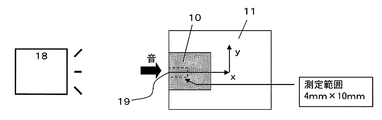
- FIG. 11 shows the structure of the non-contact sound speed measurement system for investigating the sound speed of the porous silica of an Example and a comparative example. In the structure shown in FIG. 11, it is a figure which shows the range of the silica porous body which measured the sound speed.
- FIG. 11 it is a figure which shows the range of the silica porous body which measured the sound speed.
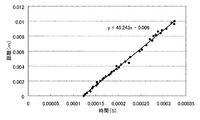
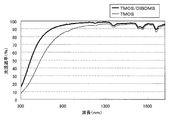
- FIG. 12 is a diagram illustrating an example of a waveform observed from an oscilloscope in the configuration illustrated in FIG. 11. It is a measurement result obtained by the configuration shown in FIG. 11, and is a diagram showing an example of a map displaying a maximum amplitude value. It is a measurement result obtained by the configuration shown in FIG. 11, and is a diagram showing an example of a map displaying the time of the maximum amplitude value. It is a measurement result obtained by the structure shown in FIG. 11, and is a diagram showing an example of a graph for obtaining the sound speed. It is a figure which shows the light transmittance of the silica porous body of Example 1, and the silica porous body of the comparative example 1.
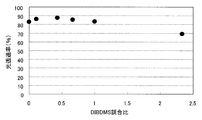
- an Example it is a figure which shows the relationship between the preparation ratio of DIBDMS, and the light transmittance of the obtained silica porous body. In an Example, it is a figure which shows the relationship between the compounding ratio of DIBDMS, and the sound speed of the obtained porous silica. In an Example, it is an experimental result for calculating
- the inventor of the present application has studied in detail the relationship between the structure of a silica porous body and its physical properties. As a result, it was found that the characteristic that the sound velocity is lower than that of air is related to the pore structure of the porous silica.
- DIBDMS diisobutyldimethoxysilane
- FIG. 1 is a diagram schematically showing the structure of the porous silica 5 of the present embodiment.
- the porous silica 5 has a structure in which a plurality of silica particles 6 are three-dimensionally connected.
- the silica particles 6 are considered to be bonded with a predetermined binding energy.
- the silica particles 6 have a spherical shape having a particle diameter of about several nm to several tens of nm.
- the particle diameter of the silica particles 6 is preferably 3.5 nm or more, and in order to have a sound speed of 100 m / s or less, the particle diameter of the silica particles 6 is 8 nm or more.
- the particle diameter of the silica particle 6 is 20 nm or less from a viewpoint of the light transmittance.
- “Particle size” is an average size determined by transmission method using X-ray small angle scattering (manufactured by Rigaku Co., Ltd., sample high-intensity X-ray diffractometer RINT-TTR III) and obtained using analysis software NANO-Solver. It is. In the analysis software NANO-Solver, the scatterer model was a sphere, the particles were SiO 2 , and the matrix was Air.
- FIG. 2 is a schematic cross-sectional view showing a part of the void of the porous silica body 5.
- the voids are continuous in the porous silica 5 and form the through holes 7 as a whole.
- the through hole 7 includes a plurality of cavities 1 (second pores) and a plurality of constricted portions (second pores) 2 located between the cavities 1.
- the hollow portion 1 is a portion having a relatively large inner diameter of the through-hole 7 formed by connecting the silica particles 6 three-dimensionally and randomly, and the constricted portion 2 is a portion having a relatively small inner diameter. is there.
- FIG. 1 is a portion having a relatively large inner diameter of the through-hole 7 formed by connecting the silica particles 6 three-dimensionally and randomly
- the constricted portion 2 is a portion having a relatively small inner diameter. is there.
- the inner diameter L ⁇ b> 2 of the constricted portion 2 is smaller than the inner diameter L ⁇ b> 1 of the cavity portion 1.
- the inner diameter L2 of the constricted portion 2 is smaller than the mean free path of air.
- the “inner diameter” means the pore diameter having the highest abundance ratio in the sample obtained as a result of analysis by the BJH method in the pore distribution measurement described later.
- the sound wave cannot propagate through the air filling the through hole 7 of the porous silica body 5.
- the porous silica material 5 of the present embodiment it is considered that sound waves propagate through the skeleton constituted by the silica particles 6 without propagating the air filling the pores.
- the mean free path of air depends on pressure and temperature.
- “the inner diameter L2 of the constricted part 2 is smaller than the mean free path of air” means that “the inner diameter L2 of the constricted part 2 is smaller than the mean free path of air at the temperature and pressure at which the porous silica material 5 is used. "Means.
- the mean free path of air is about 68 nm. Therefore, the inner diameter L2 of the constricted portion 2 is preferably smaller than 68 nm.
- the optical microphone using the porous silica material 5 of the present embodiment is used at a pressure of 50000 Pa to 120,000 Pa and a temperature range of ⁇ 20 ° C. to 200 ° C., in these pressures and temperature ranges,
- the mean free path of air is greater than about 50 nm and less than or equal to 180 nm.
- the inner diameter L2 of the constriction part 2 is 50 nm or less, it can be used in these temperature and pressure ranges. That is, the inner diameter L2 of the constricted portion 2 of the porous silica body 5 is preferably 50 nm or less.
- the density of the porous silica 5 is preferably 100 kg / cm 3 or more and 300 kg / m 3 or less. When the density is larger than 300 kg / m 3 , it becomes difficult to produce the porous silica 5 having uniform physical properties. On the other hand, when the density is less than 100 kg / cm 3 , the porous silica 5 is brittle and easily broken, making it difficult to ensure sufficient strength.
- the “density” is a ratio of the mass of the porous silica body 5 to the volume of the porous silica body 5.
- the volume of the porous silica 5 includes pores regardless of open pores or closed pores.
- the silica particles 6 of the porous silica 5 are composed of a silica compound in which a part of the siloxane bond is substituted with an isobutyl group. More specifically, this silica compound has a silica (SiO 2 ) skeleton in which a silicate tetrahedron forms a network structure while sharing an oxygen atom with an adjacent silicate tetrahedron, and the silica skeleton An isobutyl group (CH 2 CH (CH 3 ) 2 ) is bonded to silicon (Si).
- silicate network is also referred to as “silicate network”.
- the ratio of the silicon to which the isobutyl group is bonded and the silicon to which the isobutyl group is not bonded is not particularly limited.
- silicon having an isobutyl group bonded thereto and silicon having no isobutyl group bonded thereto is preferably in the range of 1: 2200 to 1: 400.
- 29 Si-NMR analysis can be used.
- Silicon to which no isobutyl group is bonded is bonded to adjacent silicon through oxygen to form a Si—O—Si bond or to a hydroxyl group (OH). It may be combined with an ethoxy group (OCH 2 CH 3 ) derived from the starting material (solvent). Or you may couple
- the silica porous body 5 having such a chemical structure can be synthesized, for example, by using TMOS and DIBDMS as starting materials.
- TMOS and DIBDMS as starting materials.
- FIG. 3 shows a conventional method for producing a porous silica material.
- the conventional silica porous body is produced, for example, using TMOS as a starting material, through a hydrolysis step (S1), a polycondensation step (S2), and a gelation step (S3).
- S1 the methoxy group of TMOS is hydrolyzed, and the hydroxyl group is bonded to silicon.
- the condensation polymerization step (S2) water is desorbed from two silicons having a hydroxyl group by dehydration condensation, and Si—O—Si bonds are formed.
- the OH group of the silicate tetrahedron undergoes a polycondensation reaction with the OH group of the adjacent silicate tetrahedron (S2), so that oxygen is shared and bonded to form a silicate network.
- the gelation step (S3) as the formation of the silicate network proceeds in the entire sol solution, the viscosity of the sol solution becomes higher and the fluidity is lost and gelation occurs.
- TMOS is tetrafunctional
- the above reaction occurs at four methoxy groups. For this reason, it is considered that most of the four methoxy groups are converted to Si—O—Si bonds to form a silicate network with few unreacted groups and small voids.
- the silica particles are dense and hard, and the elastic modulus of the porous silica is estimated to be high.
- the porous silica 5 of the present embodiment uses TMOS and DIBDMS as starting materials.
- a sol is formed by mixing TMOS and DIBDMS in a solvent, water is added to the sol, and the mixture is kept for a predetermined period of time to hydrolyze the alkoxy group of TMOS and DIBDMS, and dehydrated from the hydroxyl group generated by the hydrolysis. Gelation is performed by polymerization and polymerization growth. Thereafter, as in the conventional case, the silica porous body 5 is obtained by removing the solvent from the gel and drying it by supercritical drying. For example, ethanol or the like can be used as the solvent. In addition, the sol-formation is performed, for example, by leaving it at a temperature of 70 ° C. for 24 hours.
- DIBDMS has two methoxy groups and two isobutyl groups, and therefore DIBDMS can contribute to hydrolysis and condensation polymerization. There are only two methoxy groups.
- the isobutyl group of DIBDMS is not hydrolyzed and the condensation polymerization reaction cannot be performed.
- DIBDMS is less likely to cause a condensation polymerization reaction, and gelation proceeds slowly. For this reason, silica particles grow greatly.
- silicon derived from DIBDMS only forms at most two Si—O—Si bonds, and the other two bonds of silicon include The isobutyl group is bonded. That is, an isobutyl group is bonded to a part of silicon constituting the silicate network.
- the silica particles of the porous silica of the present embodiment contain silicon bonded to a sobutyl group, the number of Si—O—Si bonds in the silica network is smaller than that of conventional silica particles, and the silicate network The flexibility is high and the denseness is low. For this reason, the elastic modulus of the porous silica material 5 is lowered, and the sound speed is lowered.
- the silicate network is highly flexible, so that the structure of the porous silica body 5 during drying is prevented from being destroyed. For this reason, the white turbidity of the silica particles due to structural destruction is suppressed, and the porous silica of the present embodiment has a high transmittance. Due to such features, the silica porous body 5 of the present embodiment has a lower sound speed than the conventional silica porous body having the same density. Therefore, it is possible to realize a porous silica material having a density comparable to that of a conventional porous silica material and having a sound velocity smaller than that of the conventional porous material.
- the sound velocity is small and the sound wave attenuation rate is also small.
- the sensitivity of the optical microphone can be improved by reducing the sound speed, and the efficiency of the optical microphone is increased. be able to.
- an alkoxysilane having another substituent such as an alkyl group as a starting material as a substituent that does not form a Si—O—Si bond by hydrolysis, such as an isobutyl group.
- an alkoxysilane having a substituent other than an isobutyl group is used as a starting material, a silica porous body having a smaller sound velocity and a smaller density is obtained as the silica porous body of the present embodiment. I could't.
- the silica particles of the porous silica body 5 of the present embodiment contain silicon having an isobutyl group can be suitably determined by, for example, 13 C solid state NMR analysis.
- the signal of the isobutyl group bonded to silicon in the porous silica 5 of the present embodiment appears at 24 ppm or more and 27 ppm or less.
- Other carbon species having a signal in this region include silicon-bonded isopropoxy groups.
- the isopropoxy group bonded to silicon (O-iPr) has a signal from 65 ppm to 66 ppm
- the isopropoxy group and the silica porous material of the present embodiment are preferably selected depending on the presence or absence of a signal appearing from 65 ppm to 66 ppm.
- An isobutyl group can be distinguished.
- the silica particles have an isobutyl group. ing.
- isopropoxy is also present in the silica particles when there is a signal at 65 ppm or more and 66 ppm or less and 24 ppm or more and 27 ppm or less and the intensity of the signal of 24 ppm or more and 27 ppm or less is twice or more the intensity of the signal of 65 ppm or more and 66 ppm or less. Since more isobutyl groups are contained than groups, it can be identified as the porous silica of the present embodiment.
- Example 1 Production of Porous Silica of Example 1 A porous silica having a size of 10 mm ⁇ 10 mm ⁇ thickness 5 mm was produced by hydrolysis (S1), condensation polymerization (S2), gelation (S3) and drying (S4). did.
- Silicon alkoxides such as TMOS are soluble in alcohol but insoluble in water. For this reason, ethanol functions to uniformly mix TMOS and water in addition to density adjustment.
- the mixing ratio of ethanol is decreased.
- the density is preferably less than 300 kg / m 3 .
- the hydrophobizing solution was prepared by mixing 38 g of dimethyldimethoxysilane (hereinafter referred to as DMDMS), 38 g of ethanol, 2.05 g of water, and 5.55 g of 1N aqueous ammonia.
- DMDMS dimethyldimethoxysilane
- a wet gel was immersed in the prepared hydrophobizing solution and reacted at 70 ° C. overnight.
- the treatment solution was discarded and immersed in fresh ethanol for 24 hours to wash unreacted substances.
- drying was performed by supercritical drying under conditions of 17 MPa and 80 degrees (S4) to obtain a porous silica material as a dry gel.
- S4 supercritical drying under conditions of 17 MPa and 80 degrees
- FIG. 5 shows a nitrogen adsorption isotherm at 77 K of the porous silica material of Example 1 having a density of about 110 kg / m 3 .
- the “nitrogen adsorption isotherm” is a graph obtained by measuring changes in pressure and adsorption amount with a material at a constant temperature (77 K in this experiment).
- the horizontal axis of FIG. 5 shows the relative pressure (P / P 0 ) obtained by dividing the equilibrium pressure by the saturated vapor pressure, and is a value of 0 to 1.
- P / P 0 ⁇ 1 means that the adsorbed gas is condensed in the sample tube. That is, the adsorption isotherm is obtained by measuring the adsorbate density higher than that in the gas phase by the interaction force between the solid and adsorbed molecules acting at a pressure lower than the saturated vapor pressure, and the adsorption and condensation start.
- the vertical axis in FIG. 5 indicates the amount of adsorption, and is represented by the gas volume V 0 / cm 3 (STP) g ⁇ 1 in the standard state (0 ° C., 1 atm).
- the silica porous body was heated to 110 ° C. under vacuum, and then the nitrogen adsorption isotherm was measured using BELSORP-mini II manufactured by Nippon Bell Co., Ltd.
- the A line is a measured value evaluated in the capillary condensation process into the pores of nitrogen gas
- the B line is a measured value evaluated in the evaporation process of liquid nitrogen condensed in the pores.
- the pores of the porous silica have a bowl-shaped structure in which the cavity 1 and the constricted part 2 are connected.
- the BJH method is a widely used analysis method of pore distribution, which was proposed in 1951 by Barrett, Joyner and Halenda.
- FIG. 6 shows the result of calculation by the BJH method obtained from the A line in FIG. 5
- FIG. 7 shows the result of calculation by the BJH method obtained from the B line in FIG. 6 and FIG. 7, the horizontal axis indicates the pore radius, and the vertical axis indicates the pore volume.
- the pore radius obtained from the A line has a distribution centered at about 34 nm. That is, the peak at 34 nm indicates the radius of the pore having the highest abundance ratio in the sample. Therefore, the radius of the pore having the highest abundance ratio in the sample is defined as the radius of the pore of this sample.
- the pore radius determined from the B line has a distribution centered at about 11 nm. Similar to FIG. 6, since 11 nm is the radius of the pore having the highest abundance ratio in the sample, the pore radius determined from the B line is 11 nm.
- the diameter (inner diameter) of the pores is the distribution of the pores, that is, the cavity portion 1 is a pore having a diameter (inner diameter) with a distribution centered at about 68 nm, and is constricted to the cavity portion 1.
- Part 2 was confirmed to be pores having a diameter (inner diameter) with a distribution centered at about 22 nm.
- the pores of the porous silica of Example 1 are pores, they are intermittently separated by a constriction having a pore diameter smaller than the mean free path of air, and sound waves are contained in the pores. It was confirmed that almost no air was propagated. This is one of the major causes of the sound speed of the porous silica material being slower than that of air, and is an important condition for the structure of the porous silica material having a low sound speed.
- 13 C solid state NMR analysis of the porous silica material of Example 1 and Comparative Example 2 was performed.
- the 13 C solid state NMR measurement is an analysis method in which a nucleus in a substance placed in a magnetic field is observed to resonate with an electromagnetic wave having a specific wavelength, and a molecular structure is examined.
- the chemical shift of the NMR signal is a parameter that depends on the electron density distribution near the atom, and reflects the local three-dimensional structure of the molecule. If the chemical shift of the constituent atoms of a molecule is measured, the three-dimensional structure of the molecule can be estimated.
- a VARIAN UNITY INOVA400 equipped with a 7 mm CPMAS probe made by VARIAN was used.
- the measurement was performed at room temperature. It was rotated at a rotation speed of 4 KHz by a magic angle rotation method (abbreviation of Magic Angle Spinning, called MAS).
- MAS magic angle rotation method
- the direction of particles placed in a magnetic field varies, so that there is anisotropy of chemical shift and the signal line width is widened. Therefore, measurement is performed by rotating the sample at a high speed around an axis inclined by 54.7 ° (magic angle) with respect to the direction of the magnetic field. This eliminates anisotropy and sharpens the signal.
- the observation angle is 13 C.
- the observation frequency was 100.567 MHz, and tetramethylsilane was used as a shift reference material by the external reference method, and the concentration was 0 ppm.
- the signal uptake time is 0.05 sec, the observation width is 40 KHz, and the observation center is around 20 ppm.
- the pulse sequence is Dipole decoupling (DD), and the contact time is 4 msec. Observation was performed with a 45 ° pulse for 2.5 ⁇ s. The repetition time of the measurement was 120 sec, and the number of integrations was 2600 times.
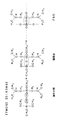
- FIG. 8 is a 13 C-DDMAS-NMR spectrum of the porous silica material of Example 1.
- FIG. The vertical axis in FIG. 8 indicates the signal intensity, and the horizontal axis indicates the chemical shift.
- FIG. 8 also shows the molecular structure belonging to the chemical shift value on the horizontal axis. Hereinafter, the molecular structure belonging to each chemical shift value will be described.
- Signal C and signal A appearing at chemical shifts of 17 ppm to 18 ppm and 60 ppm to 62 ppm are derived from ethoxy groups (OC 2 H 5 groups).
- Signal B appearing at a chemical shift of 24 ppm to 27 ppm is derived from an isobutyl group.
- the signal D appearing in the vicinity of a chemical shift of 49 ppm to 50 ppm is derived from a methoxy group (OCH 3 group).
- the signal E appearing near the chemical shift of 0 ppm is derived from a methyl group (CH 3 group).
- Example 1 the sample of Example 1 in which the measurement was performed is a porous silica material that has undergone washing and drying steps. For this reason, unreacted TMOS and DIBDM, which are starting materials and volatile liquids, DMDMS contained in the hydrophobization treatment liquid, and ethanol as the solvent show a signal stronger than the noise intensity in 13 C-NMR measurement. It is hard to think that it is contained in the sample of Example 1 so that it is observed. For this reason, the possibility that these substances are independently contained in the sample of Example 1 can be excluded.
- the methoxy group signal D appears in the vicinity of a chemical shift of 49 ppm to 50 ppm.
- the methoxy group present in the starting materials TMOS and DIBDMS becomes an OH group by hydrolysis, or further forms a Si—O—Si bond by dehydration condensation, and the silica porous material is observed so that a signal is observed. It can be seen that there is no residue. From the above consideration, it can be presumed that the porous silica of Example 1 has an isobutyl group bonded to the silicon of silica constituting the silica particles.
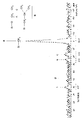
- FIG. 9 is a 13 C-DDMAS-NMR spectrum of the porous silica material of Comparative Example 2.
- Table 2 shows the ratios of functional groups obtained from the signal intensities of 13 C-DDMAS-NMR spectra of Example 1 and Comparative Example 2. Since the number of carbons varies depending on the functional group, the strength standardized by the number of carbons contained in the functional group is shown in 100%. Moreover, since two signals (A, C) are observed in the ethoxy group, the average of the integrated intensities of the two signals was used.
- the silica constituting the silica porous material of Example 1 the isobutyl group is less than the ethoxy group derived from the solvent, and most of the silica bonds are bound by DMDMS by hydrophobic treatment. It is thought that there is. Further, in the silica constituting the silica porous material of Comparative Example 1, it is considered that methoxy groups that are considered to be derived from the starting materials TMOS and DIBDMS are present to the same extent as the ethoxy groups that are derived from the solvent.
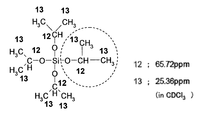
- FIG. 10 shows the chemical shift of the signal of the isopropoxy group disclosed in Non-Patent Document 2.
- isopropoxy groups have signals at 24 ppm to 27 ppm (in FIG. 10, 25.36 ppm, No. 13) and 65 ppm to 66 ppm (in FIG. 10, 65.72 ppm, No. 12).
- the ratio of 24 ppm to 27 ppm signal and 65 ppm to 66 ppm signal is 2: 1.
- Example 1 As shown in FIG. 8, since no signal is observed in the vicinity of 65 ppm to 66 ppm, it can be seen that no isopropoxy group is present in the porous silica.
- isopropyl alcohol is used as the solvent when the porous silica material of the present embodiment is produced, the silica constituted by the silicate network and isopropyl alcohol react, and the isopropoxy group may exist in the porous silica material. Conceivable.
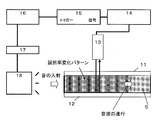
- FIG. 11 is a configuration diagram of a non-contact sound velocity measurement system using a laser Doppler vibrometer (hereinafter abbreviated as LDV). As shown in FIG. 11, the produced porous silica 5 was sandwiched and held by a translucent transparent acrylic plate 11 and a support 12 having a mirror surface on two opposing surfaces other than the surface on which sound waves were incident.
- LDV laser Doppler vibrometer
- Laser light emitted from the head 13 (manufactured by Polytec: OFV353) of LDV14 (manufactured by Polytec: OFV3001) disposed on the transparent acrylic plate 11 side is transmitted through the porous silica 5 and reflected by the mirror surface of the support 12 again.
- the silica porous body 5 is dropped to return to the LDV head 13.
- the LDV head 13 can be moved arbitrarily according to the measurement point of the porous silica material.
- a signal obtained from the LDV 14 was observed with an oscilloscope 15 (manufactured by Tektronix: TDS744A).
- a burst signal composed of one sine wave with a frequency of 40 kHz is generated by a function generator 16 (manufactured by NF: 1930), the generated signal is amplified by a transmission amplifier 17 (manufactured by Pioneer: M-10X), and a tweeter 18 ( A sound wave by a burst signal was oscillated from PT-R4 manufactured by Pioneer. The tweeter 18 was disposed about 210 mm away from the surface on which the sound wave in the silica porous body 5 was incident.
- the burst signal generated from the function generator 16 was also input to the oscilloscope 15 as a trigger.
- FIG. 12 shows the measurement range of the non-contact sound velocity measurement system shown in FIG.
- FIG. 12 is a view of the porous silica 5 viewed from the head 13 side in FIG.
- the sound wave incident center point 19 of the silica porous body 5 is the center point of the sound wave incident surface of the silica porous body 5.
- a direction parallel to the propagation direction of the sound wave is defined as the x direction with the sound wave incident center point 19 as the origin.
- a direction perpendicular to the direction of propagation of the sound wave is defined as the y direction. Measurement was performed by transmitting laser light at a pitch of 0.2 mm within a range of 10 mm in the x direction and ⁇ 2 mm in the y direction from the sound wave incident center point 19.
- the reason why the central portion of the sound wave incident surface is measured is that it is farther from the boundary between the silica porous body 5 and the transparent acrylic 11 than other portions.
- the wave propagating through the porous silica 5 is reflected by the transparent acrylic 11.
- a propagation wave and a reflected wave are mixed, and it is difficult to accurately measure the sound velocity.
- FIG. 13 shows the result of observing the output time waveform measured by the LDV with an oscilloscope 15 at an arbitrary point on the porous silica material 5 when a pulsed sound wave signal is input.
- the horizontal axis indicates the measurement time of the oscilloscope 15, and the vertical axis indicates the amplitude (50-time average value) of the detected signal.
- the time after the burst wave is oscillated from the tweeter 18 can be calculated from the arrival time of the maximum amplitude of the observed signal, and can be converted into the velocity v of the sound wave measured by the head 13.
- the vertical axis can be converted into the amplitude of sound waves.
- FIG. 14 is a diagram in which the maximum amplitude value at each measurement point measured in the measurement range at a pitch of 0.2 mm is mapped.
- sound waves are incident from the left side.
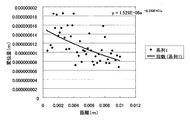
- the magnitude of the maximum amplitude value is represented by color shading.
- the dark portion has a large amplitude value, and the light portion has a small amplitude value. From FIG. 14, it can be seen that the color shading is not dependent on the measurement point (position) and is distributed.
- FIG. 15 is a diagram in which the time when the maximum amplitude value at each measurement point is obtained is mapped. From FIG. 15, the time when the maximum amplitude value is measured is substantially constant in the y-axis direction, and changes as the distance from the tweeter 18 increases in the x-axis direction. From this, it can be seen that the sound wave propagates parallel to the y-axis direction.
- FIG. 16 shows the result of measurement at a 0.2 mm pitch on a straight line parallel to the y axis that is 10 mm away from the sound wave incident center point 19 in the x direction, and the vertical axis represents the distance from the sound wave incident center point 19 to the measurement point.
- the horizontal axis represents the time when the maximum amplitude value was obtained.
- the slope of this graph is the speed of sound.
- the measurement result was approximated by a straight line, and the inclination was obtained. From the inclination, it was found that the sound velocity of the porous silica of Example 1 was about 49 m / s.
- the silica porous body of Example 1 has a smaller sound velocity than the silica porous bodies of Comparative Example 1 and Comparative Example 6 having the same density. As the density decreases, the ratio of the through-holes in the porous silica material increases and becomes brittle. Therefore, the porous silica material of Example 1 has the same density as the conventional porous silica material of Comparative Example 1 and the like.
- the transmittance of Example 1 is higher than that of the porous silica of Comparative Example 1. This is because when the gelled silica solution is replaced with a gas, the silicate network is highly flexible, so that the structure of the porous silica body is prevented from being destroyed during drying, and the white turbidity of the silica particles due to the structure destruction is suppressed. It is thought that it is because it is suppressed.
- the feature of high transmittance is particularly advantageous when the porous silica is used as a photoacoustic propagation medium.
- the porous silica of Example 1 can be suitably used for an optical microphone that takes in sound waves and detects the distortion of the porous silica generated by the sound waves using light.
- the optical microphone using Example 1 is compared with the case of using Comparative Example 1.
- the output is 1.26, and the sensitivity of the optical microphone is improved by about 30%.
- Comparative Examples 4 to 7 are prepared using silane or siloxane having a substituent that does not cause hydrolysis as a starting material. These compounds (Chemical Formula 3) to (Chemical Formula 6) have a substituent that does not cause hydrolysis and a Si—O—Si bond formed thereafter during the production of the porous silica material. It can be said that it has properties similar to DIBDMS. However, the porous silica of Comparative Examples 4 to 7 could not have a lower density and lower sound speed than the porous silica of Example 1. Although the detailed reason is not clear, it is considered that the size (bulkness) and the three-dimensional structure of the substituent that does not cause hydrolysis are related to the formation of a porous silica material having a low density and sound velocity.
- the porous silica of Comparative Example 2 uses TMOS and DIBDMS as starting materials, the density and sound speed are not as small as those of the porous silica of Example 1. Since the 13 C-DDMAS-NMR spectrum shown in FIG. 9 indicates that no signal attributed to isobutyl groups is observed, the reason why the density and speed of sound are not small is the silica particles of the porous silica material of Comparative Example 2. This silicon is considered to be because the isobutyl group is not bonded.
- TMOS and DIBDMS Characteristics of TMOS and DIBDMS and the characteristics of the produced silica porous body
- TMOS and DIBDMS were set to 1: 0, 1: 0.1, 1: 0.4, 1: 1, The mixture was prepared at a ratio of 1: 2.3, a porous silica material was produced by the same method as in Example 1, and the sound speed and light transmittance were measured by the methods described above.
- FIG. 18 shows the relationship between the mixing ratio and the light transmittance.
- FIG. 19 shows the relationship between the blending ratio and the sound speed.
- the mixing ratio of TMOS and DIBDMS is 1: 1 or less, that is, DIBDMS is preferably used at a ratio of 1 or less when TMOS is 1.
- the blending ratio is 0.4 or more, the speed of sound is less than 60 m / s.
- the addition amount of DIBDMS is 10% of TMOS, since the isobutyl group is not bonded to the silica of the porous silica, the blending ratio is 0.4 or more and 2. It can be seen that 3 or less is preferable.
- the mixing ratio of TMOS and DIBDMS is preferably 1: 0.4 or more and 1: 1 or less.
- the attenuation rate of the manufactured sample was measured.
- the attenuation rate was measured with a measurement system in which the speed of sound was obtained using a laser Doppler vibrometer shown in FIG.
- the attenuation rate ⁇ can be expressed by the following equation (6).
- FIG. 20 shows the result of measurement at a 0.2 mm pitch on a straight line parallel to the y axis 10 mm away from the sound wave incident center point 19 in the x direction.
- the vertical axis indicates the maximum amplitude value.
- the measurement result was approximated by an index to determine the attenuation rate ⁇ (Np / m).
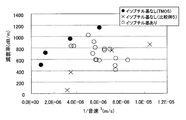
- FIG. 21 shows the relationship between the calculated sound speed and the attenuation rate. As can be seen from FIG.
- the porous silica (shown by ⁇ ) having an isobutyl group produced according to the method of Example 1 shows a tendency that the attenuation rate decreases as the sound speed decreases.
- the silica porous bodies having isobutyl groups produced by Comparative Examples 1 and 5 show a tendency that the attenuation rate increases as the sound speed decreases.
- Attenuation of sound waves in silica includes attenuation due to scattering and attenuation due to absorption.
- the attenuation due to absorption is mainly due to the viscosity of the silica. It is said that the attenuation due to viscosity is proportional to the square of the frequency and inversely proportional to the cube of the sound velocity (edited by the Acoustical Society of Japan, Acoustical Engineering Course 8 Ultrasound (Professor of Tohoku University, Nakamura, P28-29).
- the particle diameter of the porous silica of the present example is preferably 20 nm or less. Since the frequency of the sound wave used for the measurement of the attenuation rate is 40 KHz and the sound speed is 50 m / s to 100 m / s, the wavelength of the sound wave is about 1.25 nm to 2.5 nm. Therefore, under the condition where the attenuation rate is measured, the particle diameter of the porous silica material is sufficiently smaller than the wavelength of the sound wave, and the attenuation due to scattering is considered to be very small. That is, in the porous silica having an isobutyl group produced according to the method of Example 1, it is considered that attenuation due to absorption is a dominant factor rather than attenuation due to scattering.
- FIG. 22 shows the relationship between 1 / (sound speed) 3 and attenuation rate of the porous silica produced by the same method as in Example 1, Comparative Example 1 and Comparative Example 5.
- the attenuation rate is approximately proportional to 1 / (sound speed) 3
- Example 1 In the porous silica produced by the method, the attenuation rate is not proportional to 1 / (sound speed) 3 .
- the porous silica produced by the same method as Comparative Example 1 and Comparative Example 5 has the same physical characteristics as known silica, but the porous silica produced by the method of Example 1 is It is inferred that it has different physical properties from known silica.
- the attenuation rate increases as the sound speed decreases. That is, according to the prior art, when attempting to improve the characteristics of the acoustic device by reducing the sound velocity of the porous silica material, the attenuation of the sound wave increases and the efficiency may decrease. On the other hand, according to the porous silica of the present embodiment, the attenuation rate can be made smaller than that of the conventional case even if the sound speed is low.
- porous silica of the present embodiment when used as an acoustic propagation medium in various acoustic devices such as an optical microphone, a highly sensitive and highly efficient acoustic device is realized. Can do.
- FIG. 23 is a schematic diagram showing a configuration of an embodiment of an optical microphone.
- the optical microphone shown in FIG. 23 includes a reception unit 120, a detection unit 121, and a conversion unit 110.
- the receiving unit 120 receives sound waves propagating through the space around the receiving unit 120 and converts the sound waves into fluctuations in optical characteristics.
- the receiving unit 120 includes a base 103 having a recess 103a and a transparent support plate 107 supported so as to cover the opening of the recess 103a.
- the photoacoustic propagation medium portion 102 made of the porous silica of the first embodiment is disposed.
- the recess 103 a is provided with an acoustic waveguide 106 whose one surface is defined by the upper surface 102 a of the photoacoustic propagation medium unit 102.
- the base 103 is provided with an opening 104 for allowing sound waves to enter the acoustic waveguide 106.
- the detection unit 121 detects a change in optical characteristics generated by the reception unit 120 using light. Specifically, light having a wavelength that passes through the porous silica is emitted and transmitted through the photoacoustic propagation medium unit 102 through which the sound wave propagates, thereby detecting the light modulated by the sound wave.
- the detection unit 121 is, for example, a laser Doppler vibrometer (abbreviated as LDV).
- the sound wave that has propagated in the air propagates in the acoustic waveguide 106 from the opening 104 along the sound wave propagation direction 105.
- the sound wave propagating through the acoustic waveguide 106 is incident on the silica porous body constituting the photoacoustic propagation medium unit 102 from the upper surface 102a of the photoacoustic propagation medium unit 102 along with the propagation, and the photoacoustic propagation medium unit 102 is transmitted. To propagate.
- the laser beam 100 irradiated from the receiving unit 120 toward the photoacoustic propagation medium unit 102 passes through the transparent support plate 107 and the photoacoustic propagation medium unit 102 and is reflected on the bottom surface 103 c of the recess 103 a of the base 103.
- the reflected laser beam 100 is transmitted again through the photoacoustic propagation medium unit 102, emitted from the photoacoustic propagation medium unit 102, and received by the head 108.
- the laser beam 100 passes through the photoacoustic propagation medium unit 102, the density and refractive index of the porous silica constituting the photoacoustic propagation medium unit 102 along with the propagation of the sound wave change. Subject to change.
- the laser beam 100 received by the receiving unit 120 is converted into an electric signal and then output to the detecting unit 121.
- the detection unit 121 processes the electrical signal and outputs the modulation component included in the laser light 100 to the conversion unit 110 as a detection signal.
- the conversion unit 110 converts the detection signal into a sound pressure and outputs a reception signal. The calculation in the conversion unit 110 is as follows.
- the volume V of the porous silica constituting the photoacoustic propagation medium portion expands and contracts, and a volume change ⁇ V occurs. Due to the volume change ⁇ V, the refractive index n of the silica porous body 52 changes by ⁇ n.
- l is the length of the porous silica material in the sound wave propagation direction
- ⁇ l is the displacement of the porous silica material in the sound wave propagation direction due to sound wave propagation
- S indicates the strain of the porous silica material in the sound wave propagation direction.
- the sound pressure P inside the porous silica material can be expressed by Equation (3) by the strain S and the elastic constant E of the porous silica material.
- the elastic constant E can be expressed by the equation (4) using the density ⁇ and the sound velocity C of the porous silica material.
- the sound pressure P inside the porous silica material is the density ⁇ , sound velocity C and refractive index n of the porous silica material, and the displacement output ⁇ L which is an electric signal output from the head 108 or
- the speed output v that is the output of the calculation unit 109 can be expressed by Expression (5).
- the sound pressure P can be measured by using the velocity output v output from the calculation unit 109. Further, from the formula (5), if the sound pressure P is constant, the displacement output ⁇ L increases as the density ⁇ and the sound speed C of the porous silica material decrease. That is, if the sound wave to be detected is constant, the displacement output ⁇ L increases as the density ⁇ and sound velocity C of the porous silica material decrease, and the detection sensitivity of the optical microphone increases.
- the optical microphone of the present embodiment includes the porous silica according to the first embodiment as a photoacoustic propagation medium portion, the sound speed of the photoacoustic propagation medium portion is low. For this reason, the change in the sound pressure that occurs when the sound wave propagates through the photoacoustic propagation medium portion increases, and the amplitude of the output value also increases. Further, the transmittance of the photoacoustic propagation medium portion is high. Therefore, the optical path length L can be increased. For this reason, sound waves can be detected with high sensitivity. Furthermore, the porous silica material according to the first embodiment has a density comparable to that of the conventional porous silica material and has a low sound velocity.
- the value of the speed output v obtained by Equation (5) is compared.
- Table 3 since the density of the porous silica of Example 1 and Comparative Example 1 is equivalent, the refractive index n is considered to be equivalent.
- the speed output v is calculated using the values shown in Table 3 for the optical path length L, the sound pressure is constant, and the density ⁇ and sound speed C are shown in Table 3.
- the output in Comparative Example 1 is 1, the output in Example 1 is 1.26, which shows that the output value is increased by 26% and the sensitivity is improved.
- a laser Doppler vibrometer is used as the detection unit 121, but other detection devices that detect optical fluctuations generated in the photoacoustic propagation medium unit by transmitting through the photoacoustic propagation medium unit, For example, a modulation component included in light may be detected using a laser interferometer or the like. Further, the structure of the receiving unit is not limited to the structure shown in FIG.
- the porous silica of the present invention is suitably used as an acoustic propagation medium for various acoustic devices and photoacoustic devices. It is particularly useful as a photoacoustic propagation medium for an optical microphone.
Landscapes
- Chemical & Material Sciences (AREA)
- Organic Chemistry (AREA)
- Inorganic Chemistry (AREA)
- Physics & Mathematics (AREA)
- Engineering & Computer Science (AREA)
- Acoustics & Sound (AREA)
- Signal Processing (AREA)
- Dispersion Chemistry (AREA)
- Silicon Compounds (AREA)
- Electrostatic, Electromagnetic, Magneto- Strictive, And Variable-Resistance Transducers (AREA)
Abstract
Priority Applications (3)
| Application Number | Priority Date | Filing Date | Title |
|---|---|---|---|
| CN201180040135.5A CN103080008B (zh) | 2010-11-05 | 2011-11-02 | 二氧化硅多孔体及使用其的光学麦克风 |
| JP2012520407A JP5047404B2 (ja) | 2010-11-05 | 2011-11-02 | シリカ多孔体およびこれを用いた光マイクロフォン |
| US13/598,886 US9028788B2 (en) | 2010-11-05 | 2012-08-30 | Porous silica material and optical microphone using the same |
Applications Claiming Priority (2)
| Application Number | Priority Date | Filing Date | Title |
|---|---|---|---|
| JP2010-248223 | 2010-11-05 | ||
| JP2010248223 | 2010-11-05 |
Related Child Applications (1)
| Application Number | Title | Priority Date | Filing Date |
|---|---|---|---|
| US13/598,886 Continuation US9028788B2 (en) | 2010-11-05 | 2012-08-30 | Porous silica material and optical microphone using the same |
Publications (1)
| Publication Number | Publication Date |
|---|---|
| WO2012060102A1 true WO2012060102A1 (fr) | 2012-05-10 |
Family
ID=46024227
Family Applications (1)
| Application Number | Title | Priority Date | Filing Date |
|---|---|---|---|
| PCT/JP2011/006149 Ceased WO2012060102A1 (fr) | 2010-11-05 | 2011-11-02 | Corps de silice poreux et microphone optique l'utilisant |
Country Status (4)
| Country | Link |
|---|---|
| US (1) | US9028788B2 (fr) |
| JP (1) | JP5047404B2 (fr) |
| CN (1) | CN103080008B (fr) |
| WO (1) | WO2012060102A1 (fr) |
Cited By (1)
| Publication number | Priority date | Publication date | Assignee | Title |
|---|---|---|---|---|
| WO2014162671A1 (fr) * | 2013-04-01 | 2014-10-09 | パナソニック株式会社 | Élément acoustico-optique et appareil d'imagerie acoustico-optique |
Families Citing this family (2)
| Publication number | Priority date | Publication date | Assignee | Title |
|---|---|---|---|---|
| US11358414B2 (en) * | 2016-07-26 | 2022-06-14 | Compagnie Generale Des Etablissements Michelin | Tire with a tread sub-layer containing multiple materials |
| CN112429742B (zh) * | 2020-11-30 | 2023-06-23 | 石河子大学 | 一种具有纳米棍和纳米球的二氧化硅纳米微粒及制备方法 |
Citations (2)
| Publication number | Priority date | Publication date | Assignee | Title |
|---|---|---|---|---|
| JPS6118916A (ja) * | 1984-07-06 | 1986-01-27 | Nec Corp | 光マイクロフオン |
| JP2009085868A (ja) * | 2007-10-02 | 2009-04-23 | Panasonic Corp | 光超音波マイクロフォン |
Family Cites Families (4)
| Publication number | Priority date | Publication date | Assignee | Title |
|---|---|---|---|---|
| DE3616133A1 (de) * | 1985-09-25 | 1987-11-19 | Merck Patent Gmbh | Kugelfoermige sio(pfeil abwaerts)2(pfeil abwaerts)-partikel |
| JP3722827B2 (ja) | 2003-04-28 | 2005-11-30 | 松下電器産業株式会社 | 超音波センサ |
| JP2005350519A (ja) | 2004-06-08 | 2005-12-22 | Matsushita Electric Ind Co Ltd | 多孔体およびその製造方法 |
| JP5358570B2 (ja) * | 2007-07-13 | 2013-12-04 | ユニバーシティ・カレッジ・コークーナショナル・ユニバーシティ・オブ・アイルランド,コーク | 微粒子合成方法 |
-
2011
- 2011-11-02 WO PCT/JP2011/006149 patent/WO2012060102A1/fr not_active Ceased
- 2011-11-02 JP JP2012520407A patent/JP5047404B2/ja active Active
- 2011-11-02 CN CN201180040135.5A patent/CN103080008B/zh active Active
-
2012
- 2012-08-30 US US13/598,886 patent/US9028788B2/en active Active
Patent Citations (2)
| Publication number | Priority date | Publication date | Assignee | Title |
|---|---|---|---|---|
| JPS6118916A (ja) * | 1984-07-06 | 1986-01-27 | Nec Corp | 光マイクロフオン |
| JP2009085868A (ja) * | 2007-10-02 | 2009-04-23 | Panasonic Corp | 光超音波マイクロフォン |
Non-Patent Citations (1)
| Title |
|---|
| ZOLTAN DUDAS ET AL.: "Hybrid silica-porphyrin materials with tailored pore sizes", MATERIALS RESEARCH BULLETIN, vol. 45, no. 9, September 2010 (2010-09-01), pages 1150 - 1156, XP027155937 * |
Cited By (1)
| Publication number | Priority date | Publication date | Assignee | Title |
|---|---|---|---|---|
| WO2014162671A1 (fr) * | 2013-04-01 | 2014-10-09 | パナソニック株式会社 | Élément acoustico-optique et appareil d'imagerie acoustico-optique |
Also Published As
| Publication number | Publication date |
|---|---|
| US20120321110A1 (en) | 2012-12-20 |
| US9028788B2 (en) | 2015-05-12 |
| CN103080008A (zh) | 2013-05-01 |
| JP5047404B2 (ja) | 2012-10-10 |
| CN103080008B (zh) | 2015-07-15 |
| JPWO2012060102A1 (ja) | 2014-05-12 |
Similar Documents
| Publication | Publication Date | Title |
|---|---|---|
| El Rassy et al. | NMR and IR spectroscopy of silica aerogels with different hydrophobic characteristics | |
| Monasterio et al. | Effect of addition of silica-and amine functionalized silica-nanoparticles on the microstructure of calcium silicate hydrate (C–S–H) gel | |
| JP5047404B2 (ja) | シリカ多孔体およびこれを用いた光マイクロフォン | |
| Rangelova et al. | Methylcellulose/SiO2 hybrids: sol-gel preparation and characterization by XRD, FTIR and AFM | |
| JP6291493B2 (ja) | 動的核分極のための多孔質構造体、その製造方法及びnmr分析方法 | |
| Maalouli et al. | Comparison of photo-and Cu (I)-catalyzed “click” chemistries for the formation of carbohydrate SPR interfaces | |
| Zhai et al. | Eco-friendly approach for preparation of hybrid silica aerogel via freeze drying method | |
| Mohan et al. | Watching cellulose grow–Kinetic investigations on cellulose thin film formation at the gas–solid interface using a quartz crystal microbalance with dissipation (QCM-D) | |
| JP5174289B1 (ja) | シリカ多孔体の製造方法 | |
| CN108605186B (zh) | 层叠体、超声波收发器和超声波流量计 | |
| JP5313411B1 (ja) | シリカ多孔体および光マイクロフォン | |
| KR101679441B1 (ko) | 비결정성 미세다공성 유기실리케이트 조성물 | |
| JP2005350519A (ja) | 多孔体およびその製造方法 | |
| Kholodkov et al. | Silica-Based Aerogels with Tunable Properties: The Highly Efficient BF3-Catalyzed Preparation and Look inside Their Structure | |
| Zhou et al. | Surface modification of silica aerogels with trimethylchlorosilane in the ambient pressure drying | |
| Merillas et al. | Reaching a near zero radiative heat transfer by the inclusion of modified multiwalled-carbon nanotubes (MWCNTs) in polyurethane-polyisocyanurate aerogels | |
| Mhaisagar et al. | Surface texture modification of spin-coated SiO2 xerogel thin films by TMCS silylation | |
| CN115627003A (zh) | 一种MOF-on-MOF复合膜材料及其制备方法 | |
| Biemmi et al. | Assembly of nanozeolite monolayers on the gold substrates of piezoelectric sensors | |
| Ingale et al. | Physico-chemical properties of silica aerogels prepared from TMOS/MTMS mixtures | |
| Gómez et al. | Low-impedance and low-loss customized materials for air-coupled piezoelectric transducers | |
| Lou et al. | Ultrahigh performance air-coupled transducer based on polyimide aerogel matching layer | |
| Airyn et al. | Preliminary Study on the Modification of Quantum Dots/Geothermal Silica Nanocomposites with Breast Cancer Antibody (MUC-1) | |
| JP4432811B2 (ja) | 多孔体を用いた音響整合層 | |
| CN117920556B (zh) | 一种面相血脑屏障开启的光致超声换能器及其制备方法 |
Legal Events
| Date | Code | Title | Description |
|---|---|---|---|
| WWE | Wipo information: entry into national phase |
Ref document number: 201180040135.5 Country of ref document: CN |
|
| WWE | Wipo information: entry into national phase |
Ref document number: 2012520407 Country of ref document: JP |
|
| 121 | Ep: the epo has been informed by wipo that ep was designated in this application |
Ref document number: 11837756 Country of ref document: EP Kind code of ref document: A1 |
|
| NENP | Non-entry into the national phase |
Ref country code: DE |
|
| 122 | Ep: pct application non-entry in european phase |
Ref document number: 11837756 Country of ref document: EP Kind code of ref document: A1 |