WO2012081065A1 - Structure stratifiée pour utilisation cosmétique - Google Patents
Structure stratifiée pour utilisation cosmétique Download PDFInfo
- Publication number
- WO2012081065A1 WO2012081065A1 PCT/JP2010/007347 JP2010007347W WO2012081065A1 WO 2012081065 A1 WO2012081065 A1 WO 2012081065A1 JP 2010007347 W JP2010007347 W JP 2010007347W WO 2012081065 A1 WO2012081065 A1 WO 2012081065A1
- Authority
- WO
- WIPO (PCT)
- Prior art keywords
- adhesive layer
- layered structure
- hot
- layer
- melt adhesive
- Prior art date
- Legal status (The legal status is an assumption and is not a legal conclusion. Google has not performed a legal analysis and makes no representation as to the accuracy of the status listed.)
- Ceased
Links
Images

Classifications
-
- A—HUMAN NECESSITIES
- A61—MEDICAL OR VETERINARY SCIENCE; HYGIENE
- A61F—FILTERS IMPLANTABLE INTO BLOOD VESSELS; PROSTHESES; DEVICES PROVIDING PATENCY TO, OR PREVENTING COLLAPSING OF, TUBULAR STRUCTURES OF THE BODY, e.g. STENTS; ORTHOPAEDIC, NURSING OR CONTRACEPTIVE DEVICES; FOMENTATION; TREATMENT OR PROTECTION OF EYES OR EARS; BANDAGES, DRESSINGS OR ABSORBENT PADS; FIRST-AID KITS
- A61F13/00—Bandages or dressings; Absorbent pads
- A61F13/02—Adhesive bandages or dressings
- A61F13/023—Adhesive bandages or dressings wound covering film layers without a fluid retention layer
- A61F13/0243—Adhesive bandages or dressings wound covering film layers without a fluid retention layer characterised by the properties of the skin contacting layer, e.g. air-vapor permeability
-
- B—PERFORMING OPERATIONS; TRANSPORTING
- B32—LAYERED PRODUCTS
- B32B—LAYERED PRODUCTS, i.e. PRODUCTS BUILT-UP OF STRATA OF FLAT OR NON-FLAT, e.g. CELLULAR OR HONEYCOMB, FORM
- B32B27/00—Layered products comprising a layer of synthetic resin
Definitions
- the present invention relates to a layered structure for cosmetic use, a method for making the same and a method for naturally concealing a flaw in the skin by attaching the layered structure to the skin.
- U.S. Patent No. 5,942,065 discloses a skin adhesive decal.
- the skin adhesive decal is a combination of a multi-color flexographically printed design on a very thin, flexible, extensible, uniform layer of water resistant material covering a water soluble release layer carried by porous decal paper and a uniform deposit of adhesive covering the design, adapted to hold the design against the skin and protect it from being disrupted.
- the problem in the above-described decal is that, when used to conceal a flaw in the skin, the decal is very visible, the concealing effects of the decal are not sufficient and wrinkles tend to form on the decal after repeated movement of the skin.
- U.S. Patent No. 3,898,357 discloses a decal assembly for decorating fingernails.
- the decal assembly comprises a carrier strip, a series of five spread-apart, graduated, generally ovoid decals consisting essentially of a thin non-self-supporting flexible clear film, a central design formed integrally on said clear film, each decal adapted to cover substantially the surface of a finger or toe nail, said decals being on said carrier strip, a water activated adhesive means on the back of each of the decals temporarily holding the decals on the carrier and adapted to be released therefrom and transferred adherently to a nail by a water-activated adhesive and an aqueous solvent-resistant cellulose adhesive clear layer on top of each decal.
- the problem in this decal is that, when used to conceal a flaw in the skin, the decal is very visible, the concealing effects of the decal are not sufficient and it tends not to smoothly follow deformation of the skin and thus wrinkles form on the decal after repeated movement of the skin.
- the layered structure comprises a substrate and an image forming layer.
- the layered structure is capable of following deformation of the skin to which the layered structure is attached, and the image forming layer allows the color of the layered structure to blend in with the color of the skin surrounding the area to which the layered structure is attached.
- the problem in this layered structure is that, while wrinkles are not easily formed by repeated movement of the skin, the layered structure does not provide an appearance sufficiently similar to that of the skin. Specifically, the surface of the layered structure is unnaturally shiny and thus draws attention to the layered structure when it is used on the skin.
- the object of the present invention is to provide a layered structure for cosmetic use that conceals a flaw in the skin, prevents wrinkles from forming with repeated movement of the skin, has a natural color matching the color of the skin and further provides an appearance closely resembling that of the skin, a method for making the layered structure and a method for naturally concealing a flaw in the skin by attaching the layered structure to the skin.
- the present invention provides a layered structure comprising: - a substrate to be attached to the skin, the substrate being made from a flexible material so as to enable the substrate to follow the deformation of the skin to which the substrate is to be attached; - an image forming layer bearing coloring materials thereon; - a hot-melt adhesive layer on the image forming layer on the side bearing the coloring materials; - a first adhesive layer on a side of the hot-melt adhesive layer opposite to the image forming layer, said first adhesive layer being water soluble; - a water permeable protection layer on a side of said first adhesive layer opposite to the hot-melt adhesive layer; and - particles in the hot-melt adhesive layer or the first adhesive layer.
- the particles When the particles are in the hot-melt adhesive layer, the particles are partially embedded in the hot-melt adhesive layer on the side facing the first adhesive layer; and when the particles are in the first adhesive layer, the particles are partially embedded in the first adhesive layer on the side facing the hot-melt adhesive layer.
- the particles When the layered structure is in use, the particles remain attached to the hot-melt adhesive layer and protrude from the side of the hot-melt adhesive layer opposite to the coloring materials.
- the present invention also provides a method of concealing a flaw in the skin, the method comprising the steps of: - obtaining color image data of an area of the skin having the flaw to be concealed; - retouching the color image data by removing the flaw from the color image; - printing with coloring materials a retouched color image of the skin on the image forming layer of a layered structure comprising: - a substrate to be attached to the skin, the substrate being made from a flexible material so as to enable the substrate to follow the deformation of the skin to which the substrate is to be attached; - an image forming layer bearing coloring materials thereon; - a hot-melt adhesive layer on the image forming layer on the side bearing the coloring materials; - a first adhesive layer on a side of the hot-melt adhesive layer opposite to the image forming layer, said first adhesive layer being water soluble; - a water permeable protection layer on a side of said first adhesive layer opposite to the hot-melt adhesive layer; and - particles in the
- a flaw in the skin can be sufficiently and naturally concealed.
- the present invention can closely follow the movement of the skin and can provide a natural color and appearance to the concealed area, thereby avoiding drawing attention to the concealed area.
- the present invention can also improve the condition of the skin, providing moisturizing, anti-inflammatory, anti-aging and whitening effects etc. for cosmetic, dermatological, dermo-cosmetic or medical purposes.
- the term “cosmetic use” includes uses for so-called cosmetic, dermatological or dermo-cosmetic purposes as well as aesthetic purposes, and post-surgery treatments wherein the layered structure is attached to or set over the skin or the nails.
- the term “dermo-cosmetic” is used to include any area which may belong to either cosmetics or dermatology or any marginal area between cosmetics and dermatology.
- the term “skin” is used to mean skin, mucosa and nails unless otherwise specified or unless it is clear from the context that mucosa and nails are excluded.
- an “uneven” surface shall refer to a surface that has been processed such that irregularities are added to the surface. Any commonly used processes for introducing irregularities may be used, and an example may be, though not limited to, embossing. Conversely, an “even” surface shall refer to a surface that has not been subjected to such a process.
- the inventors propose a layered structure for cosmetic or dermo-cosmetic use, comprising: - a substrate to be attached to the skin, the substrate being made from a flexible material so as to enable the substrate to follow the deformation of the skin to which the substrate is to be attached; - an image forming layer bearing coloring materials thereon; - a hot-melt adhesive layer on the image forming layer on the side bearing the coloring materials; - a first adhesive layer on a side of the hot-melt adhesive layer opposite to the image forming layer, said first adhesive layer being water soluble; - a water permeable protection layer on a side of said first adhesive layer opposite to the hot-melt adhesive layer; and - particles in the hot-melt adhesive layer or the first adhesive layer.
- the flexible material used for the substrate to be attached to the skin preferably comprises an organic resin and an elastomer, for example, a polyurethane, a polyolefin, a polysilicone, or a copolymer made of these monomers, or a polyacrylate, a polyisoprene, a polychloroprene, more preferably a polyurethane resin, or a synthetic rubber.
- the substrate to be attached to the skin provides flexibility while avoiding formation of wrinkles when the skin to which the layered structure is attached is deformed, for example, by facial expressions or bending and extension of the arm.
- a layer of polyurethane elastomer having a glass transition temperature of 0 degree Celcius or lower is preferred.
- the flexibility of the above-described flexible materials may be adjusted as desired by adding one or more of a plasticizer, a stiffener, a hardener and a curative agent.
- the substrate may have a thickness between approximately 2 micrometers and approximately 30 micrometers, preferably between approximately 2 micrometers and approximately 10 micrometers.
- the substrate may be attached to the skin by various means such as a glue, an adhesive, an agglutinant, or other bonding materials on the side to skin. In the case of using an adhesive for the substrate, the thickness is preferably less than 30 micrometers.
- any coloring materials may be used as long as they are compatible with the image forming layer and the method to be used in laying the coloring materials on the image forming layer.
- an ink containing coloring materials made of or containing one or more of an organic dye, an organic pigment or colorant, lake color or lake pigment, an inorganic pigment, carbon black, natural colorant and a pearl pigment in a solution or an emulsion form may be employed.
- the coloring materials are not limited to the above-described examples.
- the coloring materials may be optionally formed on top of a layer of white coloring materials. Any type of white coloring materials may be used as long as they are compatible with the coloring materials, the image forming layer and the method to be used in laying the materials on the image forming layer.
- the image forming layer supports coloring materials laid thereon.
- the image forming layer preferably comprises or is composed of a styrene resin, an epoxy resin or an acrylic resin.
- the image forming layer may further comprises a urethane resin, a polyester resin, or an olefin resin that has flexibility and high adhesiveness.
- the image forming layer may contain or may be made of any other material as long as the material is suitable for bearing the coloring materials and for cosmetic or dermo-cosmetic use. Among these resins, acrylic resins are preferred for their high suitability for printing.
- the image forming layer preferably has strength and hardness as well as thermal resistance necessary to endure the printing process and to retain the coloring materials in position.
- the thickness of the image forming layer is preferably between approximately 0.1 and approximately 5.0 micrometers, more preferably between approximately 0.5 and approximately 3.0 micrometers. These ranges of thicknesses are preferred for easy handling of the layer and the layered structure during manufacture and for clear reproduction of desired colors and patterns.
- the image forming layer may have, as an additional layer, a hardening protection layer (also referred to as a back-up layer in the present application) comprising or consisting of a thermoplastic resin or a UV curable resin to improve resistance and hardness of the image forming layer.
- the image forming layer and its optional protection layer may contain one or more of a film forming additive, a layer stabilizer, a leveling agent, or an anti-foam agent as desired.
- the hot-melt adhesive layer is set on the image forming layer to cover the coloring materials on the image forming layer.
- the hot-melt material may be made of or contains at least a thermoplastic resin.
- the thermoplastic resin may be, for example, a polyurethane elastomer, a urethane resin, an ethylene vinyl acetate copolymer, an ethylene ethyl acrylate copolymer, an acrylic resin, a polyvinyl acetate, a petroleum-based resin, a hydrocarbon resin, polybutadiene, polystyrene, a rosin resin, a terpene resin, a polyamide resin, a vinyl chloride/vinyl acetate copolymer, a styrene resin, or a polyester resin.
- a wax may also be used for the hot-melt adhesive layer, in particular at a low concentration, for improving handling and softness of the layer.
- the wax may be, for example, carnauba wax, candelilla wax, paraffin wax, microcrystalline wax, alpha-olefin maleic anhydride copolymer wax, Fischer-Tropsch wax, montan wax or petrolatum.
- the thickness of the hot-melt adhesive layer is preferably between approximately 0.1 micrometer and approximately 10 micrometers, and more preferably between approximately 1 micrometer and approximately 5 micrometers.
- a polyurethane elastomer, an ethylene vinyl acetate copolymer, ethylene ethyl acrylate, a urethane resin or a polyester resin is preferably used for achieving a better fit on the coloring materials or the image forming layer.
- the hot-melt adhesive layer remains on the coloring materials and the image forming layer during use of the layered structure.
- the first adhesive layer which is water soluble lowers its bonding force when it is wet so that the water permeable protection layer may be removed easily therefrom.
- the first adhesive layer which is water soluble preferably contains or is made of one or more materials selected from dextrin, polyvinyl alcohols, polyvinyl pyrrolidones, pullulan, water soluble cellulose derivatives such as hydroxypropyl cellulose, hydroxypropyl methylcellulose (HPMC), hydroxyethyl cellulose and hydroxymethyl cellulose, polyacrylic amides, polyvinyl methyl ethers, poly(meth)acrylic acids containing polymers, etherized starches and starches.
- dextrin may be, but is not limited to, white dextrin, branched dextrin, cluster dextrin or reduced dextrin.
- the dextrin used in the present invention may be a commercially available product, such as L-SPD (Showa Sangyo Co., Ltd.), Red Ball Dextrin (Nippon Starch Chemical Co., Ltd.), Amycol (Nippon Starch Chemical Co., Ltd.), Dextrin (San-Ei Gen F.F.I., Inc.), Dextrin (Junsei Chemical Co., Ltd.), Pinedex (Matsutani Chemical Industry Co., Ltd.).
- pullulan may be, for example, Pullulan (Hayashibara), and hydroxypropyl methylcellulose may be, for example, Metrose SE-06 (Shin-Etsu Chemical Co., Ltd.).
- the first adhesive layer may contain PEG, a high polymer absorbent, or a porous particle to improve its water retention.
- the thickness of the first adhesive layer which is water soluble is preferably between approximately 1 micrometer and approximately 30 micrometers, and more preferably between approximately 5 micrometers and approximately 20 micrometers.
- the water permeable protection layer protects the layers underneath and may be removed easily when the first adhesive layer is wet and its bonding force is lowered.
- the water permeable protection layer is preferably made from a material which does not dissolve in water and is permeable to water or moisture so that the water or moisture can reach the first adhesive layer.
- the water permeable protection layer may be made from or contain a layer of paper, resin-coated paper or a perforated or porous resin material.
- PPC paper, bond paper or Japanese paper may be used as the water permeable protection layer, though the water permeable protection layer is not limited thereto.
- the thickness of the water permeable protection layer is preferably between approximately 50 and approximately 300 g/m 2 .
- the particles in the hot-melt adhesive layer or the first adhesive layer may be made of or contains a material usually used in cosmetics, in particular polyurethane, silica, an acrylic resin such as poly(methyl methacrylate) (PMMA), a fluorine resin, melamine resin, silicone resin, talc, kaolin, magnesium carbonate, potassium carbonate, titanium oxide or starch etc.
- the particles are preferably made of polyurethane, silica or PMMA.
- the particles When the particles are in the first adhesive layer, they are partially embedded in the first adhesive layer, protruding from the side of the adhesive layer facing the hot-melt adhesive layer. In the case of the particles being in the first adhesive layer, the particles fuse to the hot-melt adhesive layer when the first adhesive layer and hot-melt adhesive layer are adhered together by applying heat and pressure during the preparation of the layered structure. During use of the layered structure, the particles remain attached to the hot-melt adhesive layer whether or not they were originally present in the hot-melt adhesive layer or the first adhesive layer and protrude from the side of the hot-melt adhesive layer opposite to the coloring materials. The presence of these protruding particles produces a matte and natural appearance of the layered structure during use.
- the amount of particles in the hot-melt adhesive layer or the first adhesive layer is preferably between approximately 10% and approximately 50% by weight with respect to the hot-melt adhesive layer, and more preferably between approximately 10% and approximately 40% by weight with respect to the hot-melt adhesive layer.
- the amount of particles is preferably within these ranges, because the hot-melt adhesive layer may separate easily from the image forming layer when there are too many particles, and the desired matte appearance may not be achieved when there are too few particles.
- the particles are preferably spherical.
- the average diameter of the particle is preferably within a range of approximately 0.5 to 20 micrometers, and is more preferably within a range of 1 to 15 micrometers.
- the size of the particles does not need to be exactly the same, though it is preferred that the particles in the hot-melt adhesive layer or the first adhesive layer be approximately of the same size. Since the particles are on the outermost surface of the layered structure during use of the layered structure, it is preferred that the particles have high transparency, though depending on the desired effects, the particles may be made of translucent or opaque materials.
- the surface from which the particles protrude may optionally be made uneven.
- the surface from which the particles protrude may be subjected to a process for adding irregularities. Any commonly used process may be used to create the uneven surface, and an example of this process for adding irregularities may be, but is not limited to, embossing.
- the contacting area of the exposed surface of the layered structure during use can be reduced, resulting in a smaller friction force as compared to an even surface when touched, and thus the layered structure may feel more comfortable and skin-like to the touch.
- the increased irregularities on the surface may help cosmetics such as a liquid foundation, powder foundation or concealer to adhere to the layered structure during use, and may reduce the shininess often caused by the thin film of oil produced by liquid foundations.
- the roughness (due to the irregularities) of the uneven surface may be measured by any method commonly used for measuring roughness. An example of such a method may be, but is not limited to, the Fourier-Transform method.
- the roughness may be at least 3 micrometers, and is preferably 3 to 30 micrometers.
- the contacting area of the surface is not sufficiently reduced, so the layered structure would not be comfortable to the touch, cosmetics would not adhere to the layered structure properly, and the shininess caused by the thin film of oil due to liquid foundations would not be sufficiently reduced.
- the particles When the particles are added to the first adhesive layer, they may be directly added to a coating solution of the first adhesive layer containing water soluble high polymers which, when dried, has a thickness lower than the diameter of the particles.
- a coating solution of the first adhesive layer containing the particles may be applied to a dried thin first adhesive layer not containing the particles such that the particles are partially embedded in the first adhesive layer on the side facing the hot-melt adhesive layer.
- hollow particles may be added to the coating solution of the first adhesive layer so that the particles float to the surface of the first adhesive layer facing the hot-melt layer. All of the above processes result in the particles being partially embedded in the first adhesive layer on the side facing the hot-melt adhesive layer.
- the particles may be added to the hot-melt adhesive layer in a manner similar to the processes described above, though when the particles are added to the hot-melt adhesive layer, the result is the particles being partially embedded in the hot-melt adhesive layer on the side facing the first adhesive layer.
- the first adhesive layer which is water soluble and the hot-melt adhesive layer may be laminated onto the water permeable protection layer by applying layers of respective coating solutions by known coating methods such as gravure coating, offset coating, bar coating and die coating, followed by drying of the layers.
- the first adhesive layer and the hot-melt adhesive layer are subjected to pressure and heat, the two adhesive layers adhere to each other and the particles, if in the first adhesive layer, fuse to the hot-melt adhesive layer.
- the particles are in the hot-melt adhesive layer, they remain attached to the hot-melt adhesive layer and become sandwiched between the first adhesive layer and the hot-melt adhesive layer. Since the first adhesive layer is water soluble, when the layered structure is used, the first adhesive layer is at least partially removed along with the water permeable protection layer while the particles remain attached to the surface of the hot-melt adhesive layer.
- the particles which protrude from the exposed surface of the hot-melt adhesive layer, can create a matte and natural appearance of the layered structure during use, helping the layered structure to blend in with the skin surrounding the area to which the layered structure is attached.
- flaws in the skin can be effectively concealed and the layered structure can achieve an appearance closely resembling that of the surrounding skin, making the layered structure barely visible.
- the flaw in the skin may be a scar, blotch, freckle, fleck, spot, bruise, birth mark or any discoloration visible in the skin.
- the layered structure according to the present invention is not limited to the above-described aspect and may contain one or more layers containing one or more active ingredients such as hydrating agents, anti-inflammatory agents, anti-oxidants, anti-wrinkle ingredients, UV protection agents and healing agents which, when released from the layered structure and absorbed by the skin, achieve cosmetic, dermatological or dermo-cosmetic effects.
- the active ingredient is preferably added to the substrate or an adhesive layer that is in proximity to or in contact with the skin to which the layered structure is attached.
- the layered structure for a cosmetic may further comprise a peelable protection layer set on a side of the layered structure to which the water permeable protection layer is not attached and a second adhesive layer laid between the substrate and the peelable protection layer so as to be made in contact with the skin when the layered structure is in use.
- the second adhesive layer may be an acrylic adhesive layer made of a copolymer containing at least one monomer unit selected from the group of alkyl ester acrylate and alkyl ester methacrylate that have an alkyl group of 8 to 12 carbons at a proportion of at least 70 % by weight.
- the thickness of the second adhesive layer is preferably between approximately 1 and 15 micrometers, preferably between approximately 1 and 12 micrometers, more preferably between approximately 1 and 8 micrometers and most preferably between approximately 1 and 6 micrometers.
- the total thickness of the second adhesive layer and the substrate is preferably less than 30 micrometers and is more preferably between approximately 2 and 20 micrometers.
- the peelable protection film substances commonly called separate paper, released paper or release liners in the field of adhesive tapes may be used.
- the peelable protection film may be a polyethylene terephthalate film with a silicone treated surface or a laminate of paper and polyethylene with a silicone treated surface.
- the second adhesive layer and the peelable protection film are not limited to the above examples.
- the layered structure may further comprise a back-up layer attached to the image forming layer, on a side opposite to a side bearing the coloring materials.
- the back-up layer may be made of an opaque, translucent or transparent material compatible with the method to be employed for laying color materials on the image forming layer. Examples of such materials are paper and synthetic resin materials.
- the back-up layer may provide strength and rigidity to the image forming layer during the process whereat the coloring materials are laid on the image forming layer and after the process.
- the layered structure according to the present invention may further comprise a third adhesive layer between the image forming layer and the substrate to be attached to skin.
- the first adhesive layer which is water soluble requires a smaller force to separate as compared with the third adhesive layer when the first adhesive layer is moistened so that the water permeable protection layer is easily removed without separating the third adhesive layer.
- the third adhesive layer is mainly made of or contains an acrylic resin, an epoxy resin, a ketone resin or a cellulose-based resin. Among these resins, acrylic resins are particularly preferred.
- a polyester resin, a urethane resin or a vinyl chloride-vinyl acetate copolymer resin may also be added.
- the thickness of the third adhesive layer is preferably between approximately 0.05 to 20 micrometers, and more preferably between approximately 0.1 to 5 micrometers.
- the coloring materials may be set on the image forming layer by thermal transfer, ink jet printing, gravure printing, offset printing, silk screen printing, reverse roll coating using a gravure plate or any other conventional method.
- the present invention also provides a method of concealing a flaw in the skin, the method comprising the steps of: - obtaining color image data of an area of the skin, the area of the skin having a flaw to be concealed; - retouching the color image data by removing the flaw from the color image; - printing with the coloring material a retouched color image of the skin on the image forming layer of a layered structure comprising: - a substrate to be attached to the skin, the substrate being made from a flexible material so as to enable the substrate to follow the deformation of the skin to which the substrate is to be attached; - an image forming layer bearing coloring materials thereon; - a hot-melt adhesive layer on the image forming layer on the side bearing the coloring materials; - a first adhesive layer on the side of the hot-melt adhesive layer opposite to the image forming layer; - a water permeable protection layer on the side of the first adhesive layer opposite to the hot-melt adhesive layer; and - particles in the hot-mel
- the color image data of skin may be obtained by using a digital camera.
- the color image data of an area including the flaw to be concealed is preferably obtained.
- the removal of the flaw from the color image may be performed by deleting the data corresponding to the flaw and replacing the data with that of the area in the vicinity of the flaw.
- the above method may further comprise the steps of: - obtaining color image data of the retouched color image and the skin in the vicinity of the retouched color image; - modifying the retouched color image data so that the modified color image appears no different from the skin in the vicinity of the retouched color image; and - printing the modified color image of the skin on the image forming layer with coloring materials.
- the color image When laying the retouched color image on the skin, the color image may be attached to the skin or simply set on the skin for image data capture.
- the retouched color image data may be modified to cancel the differences in color between the retouched color image and the skin in the area other than the flaw.
- the modification may be performed in a manner such that the average in the color space of the retouched color image data and the modified retouched color image data correspond to, or no different from, the image data of the skin in the area other than the flaw.
- the color space may be one of CIE, generic color models such as RGB encoding, the Munsell color system, or the Natural color system. "No different" in this context means that the difference is not substantial, or is negligible or small, for practical cosmetic or medical purposes.
- Fig. 1A is a simplified diagram showing a conventional layered structure during use.
- Fig. 1B is a simplified diagram showing an embodiment of the layered structure according to the present invention during use.
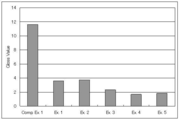
- Fig. 2 is a graph showing the gloss values of the conventional layered structure and layered structures according to embodiments of the present invention.
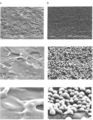
- Fig. 3A shows SEM (scanning electron microscope) photographs of the surface of the conventional hot-melt adhesive layer.
- Fig. 3B shows SEM photographs of the surface of a hot-melt adhesive layer according to an embodiment of the present invention. The photographs were taken at three magnifications (top: x100; middle: x500; bottom: x2000).
- Fig. 1A shows a simplified diagram of a conventional layered structure
- Fig. 1B shows a simplified diagram of a layered structure according to an embodiment of the present invention when used on the skin.
- the hot-melt adhesive layer of the conventional layered structure is not modified in any way, whereas the hot-melt adhesive layer according to the present invention has spherical particles protruding from the surface of the hot-melt adhesive layer on the side opposite to the image forming layer and substrate, which is the outermost surface of the layered structure when attached to the skin.
- a four-layered structure composed of a second peelable protection layer, a third adhesive layer (a back-up layer may be added), an image forming layer and coloring materials (a layer of white coloring materials may be provided between the image forming layer and coloring materials) is prepared.
- Any film can be used as the second peelable protection layer.
- a PET film with a thickness between approximately 2.5 and 200 micrometers is preferred.
- the third adhesive layer be mainly made of or contain an acrylic resin, an epoxy resin, a ketone resin or a cellulose-based resin. Among these resins, acrylic resins are particularly preferred.
- a polyester resin, a urethane resin or a vinyl chloride-vinyl acetate copolymer resin may also be added.
- the thickness of the third adhesive layer is preferably between 0.05 to 20 micrometers, and more preferably between 0.1 to 5 micrometers.
- the image forming layer on the third adhesive layer is preferably made of a styrene resin, epoxy resin or an acrylic resin. If necessary, a urethane resin, polyester resin, olefin resin, or an acrylic resin that has flexibility and high adhesiveness may be added to increase the adhesiveness of the image forming layer. Among these materials, acrylic resins, which are suitable for printing, are preferred.
- the fillers may be made of or contain at least a fluorine based resin, melamine resin, silicone, talc, kaolin, magnesium carbonate, potassium carbonate, titanium oxide, silica or starch.
- the thickness of the image forming layer is preferably between approximately 0.1 and approximately 5.0 micrometers, and more preferably between approximately 0.5 and approximately 3.0 micrometers.
- a back-up layer made of a heat curable resin or a UV curable resin may be placed between the second peelable protection layer and the image forming layer.
- a layer composed of coloring materials and various binders is printed onto the image forming layer. Any conventional coloring materials may be used.
- the binders include vinyl chloride-vinyl acetate copolymer resin, acrylic resins, epoxy resins, urethane resins and polyester resins.
- the thickness of the layer of coloring materials is preferably 0.1 to 20 micrometers.
- a layer composed of white coloring materials and various binders, such as vinyl chloride-vinyl acetate copolymer resin, an acrylic resin, an epoxy resin, urethane resin and polyester resin, may be further printed on the image forming layer beneath the layer of coloring materials.
- the thickness of the white coloring layer is preferably approximately 1 to 30 micrometers to ensure coverage.
- the coloring materials and white coloring materials may be applied to the image forming layer by various printing methods.
- thermal transfer or ink jet printing is preferred as these printing methods allow the skin color to be scanned and digitized so that the same color can be printed onto the image forming layer.
- any other printing methods that would lower the cost of producing the layered structure can be used. In that case, image forming layers pre-printed with several different colors would need to be prepared.
- a three-layered structure composed of a water permeable protection layer, a first adhesive layer which is water soluble and a hot-melt adhesive layer, with particles in the hot-melt adhesive layer or the first adhesive layer, is prepared.
- Any water permeable material may be used as the water permeable protection layer.
- An example of such a material may be, but is not limited to, PPC paper, bond paper or Japanese paper.
- the thickness of the water permeable protection layer is preferably approximately 50 to 300 g/m 2 .
- various water soluble high polymers may be used. Dextrin, pullulan and water soluble cellulose derivatives are the preferred choices and it is particularly preferred that the first adhesive layer be made of dextrin.
- the hot-melt adhesive layer may be made of or contain at least a thermoplastic resin. From the aspect of adhesiveness, a polyurethane elastomer is preferably used. A wax may be optionally added to the hot-melt adhesive layer for improving handling and softness of the layer.
- the particles are preferably made of polyurethane, silica or PMMA and are added to the first adhesive layer such that the particles are partially embedded in the surface of the first adhesive layer facing the hot-melt adhesive layer. Alternatively, the particles may be added to the hot-melt adhesive layer such that the particles are partially embedded in the surface of the hot-melt adhesive layer facing the first adhesive layer.
- the above four-layered and three-layered structures are fused together by applying heat and pressure so that the hot-melt adhesive layer is fused to the image forming layer, covering the coloring materials, and the particles in the first adhesive layer are fused to the hot-melt adhesive layer. If the particles are in the hot-melt adhesive layer, they remain attached to the hot-melt adhesive layer and become sandwiched between the hot-melt adhesive layer and the first adhesive layer.
- the amount of particles fused to the hot-melt adhesive layer which determines the matte appearance of the layered structure during use, can be controlled by adjusting the pressure and heat applied during this process.
- a four-layered structure composed of a carrier layer, a substrate to be attached to the skin, a second adhesive layer and a peelable protection film is prepared.
- the carrier layer is preferably formed from a film made of a thermoplastic resin such as polyurethane, polyethylene, polypropylene, an ionomer, polyamide, polyvinyl chloride, polyvinylidene chloride, an ethylene vinyl acetate copolymer, a thermoplastic polyester, or polytetrafluoroethylene.
- the film is preferably laminated onto a piece of paper, and it is preferred that the carrier layer be thicker or more rigid than the substrate.
- the substrate may be a layer of polyurethane elastomer with a glass transition temperature of 0 degree Celcius or lower.
- the peelable protection film may be a released paper, separate paper or release liner commonly used in the field of adhesive tapes.
- the second peelable protection layer is removed from the above-described seven-layered structure, and the carrier layer is removed from the four-layered structure.
- the now three-layered structure is then applied to the now six-layered structure such that the third adhesive layer is set on the substrate to be attached to the skin.
- a hydrating agent, an anti-inflammatory agent, a UV protection agent, an anti-wrinkle ingredient, an anti-oxidant, a healing agent, or a combination of two or more of these substances may be added to the substrate to be attached to the skin.
- one or more of these substances may be added to the third adhesive layer.
- the layered structure may provide cosmetic, dermatological or dermo-cosmetic effects.
- the protection film is removed from the above-described layered structure including the coloring materials so that the second adhesive layer is exposed and the layered structure can be attached to the skin.
- the water permeable protection layer is moistened so that the water or moisture permeates through the water permeable protection layer and reaches the first adhesive layer which is water soluble. At least a part of the water permeable protection layer is removed from the layered structure with the water permeable protection layer so that the coloring materials are visible from the outside, and the hot-melt adhesive layer, with particles protruding therefrom, is exposed. A portion of the first adhesive layer may or may not remain on the hot-melt adhesive layer after the removal of the water permeable protection layer.
- the amount and balance of the coloring materials are determined so that the layered structure conceals the flaw and appears similar to the skin around the layered structure.
- the amount and balance of the particles protruding from the hot-melt adhesive layer can create a natural matte appearance that further helps the layered structure appear similar to the skin surrounding the layered structure.
- water may be applied to the exposed surface of the hot-melt adhesive layer.
- Cosmetics may then be applied to the surface of the hot-melt adhesive layer, making the layered structure even less visible.
- Examples 1 to 5 and Comparative Example 1 were prepared as follows. (Preparation of a four-layered structure including an image forming layer) A coating solution for a third adhesive layer and a coating solution for an image forming layer as described below were applied by gravure coating in said order to a piece of PET film (second peelable protection layer) having a thickness of 6 micrometers. The layers were dried to produce an image forming layer that can be thermal transfer printed. A concealing layer of a white coloring material with a thickness of 10 micrometers containing acrylic binders was formed on the image forming layer. A layer of skin-colored materials (e.g. L: 60.52, a: 14. 25, b: 21.30) having a thickness of 3 micrometers was then formed on the layer of white coloring material to produce a four-layered structure for Example 1. The same four-layered structures were prepared for Examples 2 to 5 and Comparative Example 1.
- a coating solution for a third adhesive layer and a coating solution for an image forming layer as described below were applied by gravure coating in said order to
- Coating solution for the third adhesive layer (coated so as to achieve 1.5 g/m 2 when dried): Acrylic resin 9.9 parts Polyester resin 0.1 part Toluene 45.0 parts MEK (methyl ethyl ketone) 45.0 parts
- Coating solution for the image forming layer (coated so as to achieve 0.5 g/m 2 when dried): Acrylic resin 9.0 parts Polyester resin 1.0 part Toluene 45.0 parts MEK (methyl ethyl ketone) 45.0 parts
- aqueous dextrin solution was applied by bar coating to a piece of PPC paper commonly used for photocopying such that the dextrin solution forms a layer of water soluble first adhesive layer of 6.0 g/m 2 when dried.
- a coating solution for a hot-melt adhesive layer containing 30 parts by weight (30% by weight) of transparent spherical particles of a cross-linked polyurethane having an average diameter of 7 micrometers (Taimicck Beads UCN-8070CM, manufactured by Dainichiseika Color & Chemicals Mfg.
- Example 4 Similar three-layered structures were prepared for Examples 1 to 3, with the differences that silica particles having an average diameter of 5 micrometers were used for Example 1, PMMA particles having an average diameter of 6 micrometers were used for Example 2, and the amount of the polyurethane particles was 10 % by weight for Example 3.
- the particles were added to the first adhesive layer. Specifically, a thin layer of the aqueous solution for the first adhesive layer was applied to the paper and dried.
- An organic solvent solution for a second adhesive layer containing an acrylic adhesive (a copolymer of 2-ethylhexyl ester acrylate/vinyl acetate/acrylate at 85/11/4 % by weight) was applied by bar coating to one side of a peelable protection film (released paper) so as to form a layer having a thickness of 5 micrometers when dried. The solution was then dried to form the second adhesive layer.
- an acrylic adhesive a copolymer of 2-ethylhexyl ester acrylate/vinyl acetate/acrylate at 85/11/4 % by weight
- a piece of fine paper with an embossed polypropylene surface was used as a carrier layer, onto which a solution for a substrate layer containing a polyether type polyurethane elastomer (Elastollan (registered trademark) ET880 (glass transition temperature: 145 degrees Celcius) from BASF Japan Ltd.) was applied by bar coating so as to form a layer having a thickness of 5 micrometers when dried. The solution was then dried to form the substrate layer.
- a polyether type polyurethane elastomer (Elastollan (registered trademark) ET880 (glass transition temperature: 145 degrees Celcius) from BASF Japan Ltd.)
- a layer having a thickness of 75 micrometers and a size of 100 mm x 100 mm was prepared using the polyurethane elastomer in a manner similar to the preparation of the substrate layer described above. After soaking the layer in water for 24 hours, the degree of swelling was assessed to be 5%.
- the substrate layer disclosed above was attached to the second adhesive layer so as to produce a four-layered structure composed of a carrier layer, substrate, second adhesive layer, peelable protection film for Examples 1 to 5 and Comparative Example 1.
- Step 1 The surface of the coloring material layer of the four-layered structure was set on the surface of the hot-melt adhesive layer of the three-layered structure. A heated roller was then applied to fuse the structures to produce a seven-layered structure.
- Step 2 The carrier layer of the four-layered structure including the substrate was removed.
- Step 3 The second peelable protection layer of the seven-layered structure from Step 1 was removed.
- Step 4 The exposed surface of the third adhesive layer of the now six-layered structure from Step 3 was set on the exposed surface of the substrate of the layered structure from Step 2.
- the structures were then fused by applying pressure and heat so as to produce a final layered structure that is to be attached to the skin.
- the above steps were performed to produce final layered structures for Examples 1 to 5 and Comparative Example 1.
Landscapes
- Health & Medical Sciences (AREA)
- Dermatology (AREA)
- Engineering & Computer Science (AREA)
- Biomedical Technology (AREA)
- Heart & Thoracic Surgery (AREA)
- Vascular Medicine (AREA)
- Life Sciences & Earth Sciences (AREA)
- Animal Behavior & Ethology (AREA)
- General Health & Medical Sciences (AREA)
- Public Health (AREA)
- Veterinary Medicine (AREA)
- Cosmetics (AREA)
Abstract
La présente invention concerne une structure stratifiée pour utilisation cosmétique ou dermo-cosmétique, un procédé pour fabriquer celle-ci et un procédé de dissimulation de défauts dans la peau en attachant la structure stratifiée à la peau. La structure stratifiée comprend un substrat à attacher à la peau, le substrat étant constitué d'un matériau flexible de sorte que la structure stratifiée puisse suivre une déformation de la peau, une couche de formation d'image comportant des matériaux colorants sur celle-ci, une couche d'adhésif à chaud sur le côté de la couche de formation d'image comportant les matériaux colorants, une première couche adhésive hydrosoluble sur le côté de la couche d'adhésif à chaud opposé à la couche de formation d'image, une couche de protection perméable à l'eau sur le côté de la première couche adhésive opposé à la couche d'adhésif à chaud, et des particules dans la couche d'adhésif à chaud ou la première couche adhésive, les particules étant partiellement incorporées dans la couche d'adhésif à chaud ou la première couche adhésive. Lors de l'utilisation de la structure stratifiée, les particules et le côté de la couche d'adhésif à chaud depuis lequel les particules font saillie sont exposés, créant un aspect mat qui réduit la visibilité de la structure stratifiée.
Priority Applications (2)
| Application Number | Priority Date | Filing Date | Title |
|---|---|---|---|
| JP2013526262A JP5826847B2 (ja) | 2010-12-17 | 2010-12-17 | 化粧用の積層構造物 |
| PCT/JP2010/007347 WO2012081065A1 (fr) | 2010-12-17 | 2010-12-17 | Structure stratifiée pour utilisation cosmétique |
Applications Claiming Priority (1)
| Application Number | Priority Date | Filing Date | Title |
|---|---|---|---|
| PCT/JP2010/007347 WO2012081065A1 (fr) | 2010-12-17 | 2010-12-17 | Structure stratifiée pour utilisation cosmétique |
Publications (1)
| Publication Number | Publication Date |
|---|---|
| WO2012081065A1 true WO2012081065A1 (fr) | 2012-06-21 |
Family
ID=44558470
Family Applications (1)
| Application Number | Title | Priority Date | Filing Date |
|---|---|---|---|
| PCT/JP2010/007347 Ceased WO2012081065A1 (fr) | 2010-12-17 | 2010-12-17 | Structure stratifiée pour utilisation cosmétique |
Country Status (2)
| Country | Link |
|---|---|
| JP (1) | JP5826847B2 (fr) |
| WO (1) | WO2012081065A1 (fr) |
Cited By (10)
| Publication number | Priority date | Publication date | Assignee | Title |
|---|---|---|---|---|
| JP2014014580A (ja) * | 2012-07-11 | 2014-01-30 | Duplo Seiko Corp | 創傷被覆材及びその製造方法 |
| WO2015097617A1 (fr) * | 2013-12-27 | 2015-07-02 | L'oreal | Dispositif de transfert pour maquillage de matières kératiniques |
| WO2015097612A1 (fr) * | 2013-12-27 | 2015-07-02 | L'oreal | Dispositif de transfert pour maquiller des matières kératiniques |
| FR3015891A1 (fr) * | 2013-12-27 | 2015-07-03 | Oreal | Ensemble et procede pour le maquillage par transfert des matieres keratiniques |
| CN106061557A (zh) * | 2013-12-27 | 2016-10-26 | 欧莱雅 | 用于化妆角蛋白材料的转移装置 |
| US10265260B2 (en) | 2013-12-27 | 2019-04-23 | L'oreal | Transfer makeup process and related device |
| US10477938B2 (en) | 2013-12-27 | 2019-11-19 | L'oreal | Makeup device comprising a plurality of cosmetic dyes |
| US10532011B2 (en) | 2013-12-27 | 2020-01-14 | L'oreal | Transfer device for making up keratin materials |
| USRE48103E1 (en) * | 2013-03-01 | 2020-07-21 | Panasonic Intellectual Property Management Co., Ltd. | Transfer system |
| US11178955B2 (en) | 2013-12-27 | 2021-11-23 | L'oreal | Transfer device and process for making up keratin materials |
Families Citing this family (3)
| Publication number | Priority date | Publication date | Assignee | Title |
|---|---|---|---|---|
| KR101871839B1 (ko) * | 2014-09-25 | 2018-06-27 | 주식회사 엘지화학 | 미용용 점착 패치 |
| JP6868847B2 (ja) * | 2016-06-29 | 2021-05-12 | パナソニックIpマネジメント株式会社 | 画像処理装置および画像処理方法 |
| WO2020230817A1 (fr) * | 2019-05-16 | 2020-11-19 | 凸版印刷株式会社 | Film mince et feuille de transfert |
Citations (6)
| Publication number | Priority date | Publication date | Assignee | Title |
|---|---|---|---|---|
| US3898357A (en) | 1974-03-18 | 1975-08-05 | Albert C Miller | Methods and decal apparatus for decorating the nails of fingers and toes |
| US5942065A (en) | 1996-05-23 | 1999-08-24 | Internatural Designs, Inc. | Sticker combinable skin adhesive decal and process for making same |
| EP1452156A1 (fr) * | 2003-02-27 | 2004-09-01 | Catherine Dufour | Membrane multicouche flexible adhésive à base de non-tissé et de silicones médicaux |
| EP1914342A1 (fr) * | 2005-06-21 | 2008-04-23 | Kuraray Co., Ltd. | Feuille de papier à grains ressemblant à du cuir dotée d'une excellente résistance aux rayures et à l'abrasion |
| JP2009000373A (ja) | 2007-06-22 | 2009-01-08 | Juki Corp | ミシンの生産管理装置 |
| WO2010086901A1 (fr) * | 2009-01-30 | 2010-08-05 | L'oreal | Structure stratifiée pour usage cosmétique |
Family Cites Families (4)
| Publication number | Priority date | Publication date | Assignee | Title |
|---|---|---|---|---|
| JP3868542B2 (ja) * | 1996-07-12 | 2007-01-17 | 大日本印刷株式会社 | 隠蔽シール |
| JP4601847B2 (ja) * | 2001-03-27 | 2010-12-22 | 大日本印刷株式会社 | 加飾シート及びその製造方法 |
| JP2006299432A (ja) * | 2005-04-15 | 2006-11-02 | Aderans Co Ltd | かつら及びその製造方法 |
| CN101237861A (zh) * | 2005-08-12 | 2008-08-06 | 宝洁公司 | 具有角质组织特性的已涂敷基质 |
-
2010
- 2010-12-17 WO PCT/JP2010/007347 patent/WO2012081065A1/fr not_active Ceased
- 2010-12-17 JP JP2013526262A patent/JP5826847B2/ja not_active Expired - Fee Related
Patent Citations (6)
| Publication number | Priority date | Publication date | Assignee | Title |
|---|---|---|---|---|
| US3898357A (en) | 1974-03-18 | 1975-08-05 | Albert C Miller | Methods and decal apparatus for decorating the nails of fingers and toes |
| US5942065A (en) | 1996-05-23 | 1999-08-24 | Internatural Designs, Inc. | Sticker combinable skin adhesive decal and process for making same |
| EP1452156A1 (fr) * | 2003-02-27 | 2004-09-01 | Catherine Dufour | Membrane multicouche flexible adhésive à base de non-tissé et de silicones médicaux |
| EP1914342A1 (fr) * | 2005-06-21 | 2008-04-23 | Kuraray Co., Ltd. | Feuille de papier à grains ressemblant à du cuir dotée d'une excellente résistance aux rayures et à l'abrasion |
| JP2009000373A (ja) | 2007-06-22 | 2009-01-08 | Juki Corp | ミシンの生産管理装置 |
| WO2010086901A1 (fr) * | 2009-01-30 | 2010-08-05 | L'oreal | Structure stratifiée pour usage cosmétique |
Cited By (19)
| Publication number | Priority date | Publication date | Assignee | Title |
|---|---|---|---|---|
| JP2014014580A (ja) * | 2012-07-11 | 2014-01-30 | Duplo Seiko Corp | 創傷被覆材及びその製造方法 |
| USRE48103E1 (en) * | 2013-03-01 | 2020-07-21 | Panasonic Intellectual Property Management Co., Ltd. | Transfer system |
| FR3015889A1 (fr) * | 2013-12-27 | 2015-07-03 | Oreal | Dispositif pour le maquillage par transfert des matieres keratiniques |
| US10532011B2 (en) | 2013-12-27 | 2020-01-14 | L'oreal | Transfer device for making up keratin materials |
| WO2015097612A1 (fr) * | 2013-12-27 | 2015-07-02 | L'oreal | Dispositif de transfert pour maquiller des matières kératiniques |
| FR3015890A1 (fr) * | 2013-12-27 | 2015-07-03 | Oreal | Dispositif pour le maquillage par transfert des matieres keratiniques |
| CN105873640A (zh) * | 2013-12-27 | 2016-08-17 | 欧莱雅 | 用于化妆角蛋白材料的转移装置 |
| CN105939760A (zh) * | 2013-12-27 | 2016-09-14 | 欧莱雅 | 对角蛋白材料进行化妆的转移装置 |
| CN106061557A (zh) * | 2013-12-27 | 2016-10-26 | 欧莱雅 | 用于化妆角蛋白材料的转移装置 |
| US10265260B2 (en) | 2013-12-27 | 2019-04-23 | L'oreal | Transfer makeup process and related device |
| US10477938B2 (en) | 2013-12-27 | 2019-11-19 | L'oreal | Makeup device comprising a plurality of cosmetic dyes |
| FR3015891A1 (fr) * | 2013-12-27 | 2015-07-03 | Oreal | Ensemble et procede pour le maquillage par transfert des matieres keratiniques |
| WO2015097617A1 (fr) * | 2013-12-27 | 2015-07-02 | L'oreal | Dispositif de transfert pour maquillage de matières kératiniques |
| CN113081861A (zh) * | 2013-12-27 | 2021-07-09 | 欧莱雅 | 对角蛋白材料进行化妆的转移装置 |
| US11178955B2 (en) | 2013-12-27 | 2021-11-23 | L'oreal | Transfer device and process for making up keratin materials |
| US11191340B2 (en) | 2013-12-27 | 2021-12-07 | L'oreal | Transfer device for making up keratin materials |
| US11272777B2 (en) | 2013-12-27 | 2022-03-15 | L'oreal | Transfer device for making up keratin materials |
| US11445801B2 (en) | 2013-12-27 | 2022-09-20 | L'oreal | Transfer device for making up keratin materials |
| CN113081861B (zh) * | 2013-12-27 | 2023-11-07 | 欧莱雅 | 对角蛋白材料进行化妆的转移装置 |
Also Published As
| Publication number | Publication date |
|---|---|
| JP5826847B2 (ja) | 2015-12-02 |
| JP2014501223A (ja) | 2014-01-20 |
Similar Documents
| Publication | Publication Date | Title |
|---|---|---|
| JP5826847B2 (ja) | 化粧用の積層構造物 | |
| JP5677303B2 (ja) | 化粧用積層構造体 | |
| JP4632333B2 (ja) | 化粧用隠蔽シールおよび肌の凹凸及び濃色部分の化粧方法 | |
| JP4672799B2 (ja) | 化粧補助貼付材及び該貼付材を用いた化粧方法 | |
| US6074721A (en) | Temporary tattoo decals | |
| JP3868542B2 (ja) | 隠蔽シール | |
| KR20090091280A (ko) | 표면 상에 색상을 인가하기 위한 용품 및 방법 | |
| CN112384195A (zh) | 皮肤敷贴用膜及转印片材 | |
| US6874421B2 (en) | Ink jet transfer printing process | |
| US20090250164A1 (en) | Methods of Making Articles for Applying Color on Surfaces | |
| CN106061458B (zh) | 遮瑕贴及其制造方法、肌肤美白护肤方法和抗痘护肤方法 | |
| US20100028622A1 (en) | Nonthermal transfer sheet and method for manufacturing the same | |
| JP2015110294A (ja) | 貼付用シート | |
| JP2020074847A (ja) | 肌貼付用フィルム、および、転写シート | |
| US20090252937A1 (en) | Articles for Applying Color on Surfaces | |
| WO2019165244A1 (fr) | Décalcomanies de tatouages temporaires utilisables en tant que dosimètres | |
| WO2013126513A1 (fr) | Décalcomanies dermo-adhésives | |
| US20110174180A1 (en) | Methods of Making Customized Articles for Applying Color on Surfaces | |
| US20030098906A1 (en) | Ink jet transfer printing process | |
| US20020178940A1 (en) | Ink jet transfer printing process | |
| JP2015168626A (ja) | 口唇用貼付材、その使用方法及び製造方法 | |
| JP2012126067A (ja) | 貼付材及び貼付材を用いた貼付方法 | |
| JP2022123555A (ja) | 肌意匠シート製造システム、肌意匠シートの製造方法及び肌意匠シート | |
| KR101829387B1 (ko) | 친환경 인체 필름 및 이의 제조 방법 | |
| WO2026100304A1 (fr) | Feuille stratifiée pour produit cosmétique, ensemble cosmétique, film de support, et procédé d'application d'un film adhésif |
Legal Events
| Date | Code | Title | Description |
|---|---|---|---|
| 121 | Ep: the epo has been informed by wipo that ep was designated in this application |
Ref document number: 10803399 Country of ref document: EP Kind code of ref document: A1 |
|
| ENP | Entry into the national phase |
Ref document number: 2013526262 Country of ref document: JP Kind code of ref document: A |
|
| NENP | Non-entry into the national phase |
Ref country code: DE |
|
| 122 | Ep: pct application non-entry in european phase |
Ref document number: 10803399 Country of ref document: EP Kind code of ref document: A1 |