WO2012099338A2 - Procédé permettant de produire une entrée d'utilisateur, et dispositif utilisant ledit procédé - Google Patents
Procédé permettant de produire une entrée d'utilisateur, et dispositif utilisant ledit procédé Download PDFInfo
- Publication number
- WO2012099338A2 WO2012099338A2 PCT/KR2011/009834 KR2011009834W WO2012099338A2 WO 2012099338 A2 WO2012099338 A2 WO 2012099338A2 KR 2011009834 W KR2011009834 W KR 2011009834W WO 2012099338 A2 WO2012099338 A2 WO 2012099338A2
- Authority
- WO
- WIPO (PCT)
- Prior art keywords
- user input
- hid
- human interface
- interface device
- field
- Prior art date
- Legal status (The legal status is an assumption and is not a legal conclusion. Google has not performed a legal analysis and makes no representation as to the accuracy of the status listed.)
- Ceased
Links
Images





Classifications
-
- G—PHYSICS
- G06—COMPUTING OR CALCULATING; COUNTING
- G06F—ELECTRIC DIGITAL DATA PROCESSING
- G06F13/00—Interconnection of, or transfer of information or other signals between, memories, input/output devices or central processing units
- G06F13/10—Program control for peripheral devices
- G06F13/102—Program control for peripheral devices where the program performs an interfacing function, e.g. device driver
-
- G—PHYSICS
- G06—COMPUTING OR CALCULATING; COUNTING
- G06F—ELECTRIC DIGITAL DATA PROCESSING
- G06F13/00—Interconnection of, or transfer of information or other signals between, memories, input/output devices or central processing units
- G06F13/38—Information transfer, e.g. on bus
- G06F13/42—Bus transfer protocol, e.g. handshake; Synchronisation
- G06F13/4282—Bus transfer protocol, e.g. handshake; Synchronisation on a serial bus, e.g. I2C bus, SPI bus
-
- G—PHYSICS
- G06—COMPUTING OR CALCULATING; COUNTING
- G06F—ELECTRIC DIGITAL DATA PROCESSING
- G06F3/00—Input arrangements for transferring data to be processed into a form capable of being handled by the computer; Output arrangements for transferring data from processing unit to output unit, e.g. interface arrangements
- G06F3/01—Input arrangements or combined input and output arrangements for interaction between user and computer
- G06F3/016—Input arrangements with force or tactile feedback as computer generated output to the user
-
- G—PHYSICS
- G06—COMPUTING OR CALCULATING; COUNTING
- G06F—ELECTRIC DIGITAL DATA PROCESSING
- G06F3/00—Input arrangements for transferring data to be processed into a form capable of being handled by the computer; Output arrangements for transferring data from processing unit to output unit, e.g. interface arrangements
- G06F3/01—Input arrangements or combined input and output arrangements for interaction between user and computer
- G06F3/03—Arrangements for converting the position or the displacement of a member into a coded form
- G06F3/033—Pointing devices displaced or positioned by the user, e.g. mice, trackballs, pens or joysticks; Accessories therefor
- G06F3/038—Control and interface arrangements therefor, e.g. drivers or device-embedded control circuitry
-
- H—ELECTRICITY
- H04—ELECTRIC COMMUNICATION TECHNIQUE
- H04L—TRANSMISSION OF DIGITAL INFORMATION, e.g. TELEGRAPHIC COMMUNICATION
- H04L67/00—Network arrangements or protocols for supporting network services or applications
- H04L67/50—Network services
- H04L67/56—Provisioning of proxy services
- H04L67/565—Conversion or adaptation of application format or content
-
- H—ELECTRICITY
- H04—ELECTRIC COMMUNICATION TECHNIQUE
- H04N—PICTORIAL COMMUNICATION, e.g. TELEVISION
- H04N21/00—Selective content distribution, e.g. interactive television or video on demand [VOD]
- H04N21/40—Client devices specifically adapted for the reception of or interaction with content, e.g. set-top-box [STB]; Operations thereof
- H04N21/41—Structure of client; Structure of client peripherals
- H04N21/4104—Peripherals receiving signals from specially adapted client devices
- H04N21/4126—The peripheral being portable, e.g. PDAs or mobile phones
- H04N21/41265—The peripheral being portable, e.g. PDAs or mobile phones having a remote control device for bidirectional communication between the remote control device and client device
-
- H—ELECTRICITY
- H04—ELECTRIC COMMUNICATION TECHNIQUE
- H04N—PICTORIAL COMMUNICATION, e.g. TELEVISION
- H04N21/00—Selective content distribution, e.g. interactive television or video on demand [VOD]
- H04N21/40—Client devices specifically adapted for the reception of or interaction with content, e.g. set-top-box [STB]; Operations thereof
- H04N21/41—Structure of client; Structure of client peripherals
- H04N21/422—Input-only peripherals, i.e. input devices connected to specially adapted client devices, e.g. global positioning system [GPS]
- H04N21/42204—User interfaces specially adapted for controlling a client device through a remote control device; Remote control devices therefor
Definitions
- the present invention relates to a network for wirelessly connecting a plurality of devices, and more particularly, to a method for transmitting a user input received from a human interface device to a sink device to a source device.
- WLAN is based on radio frequency technology to provide home, business, or specific service area using portable terminals such as personal digital assistants (PDAs), laptop computers, and portable multimedia players (PMPs).
- PDAs personal digital assistants
- PMPs portable multimedia players
- communication in a WLAN according to the IEEE 802.11 standard may be performed in a basic service set (BSS) including an access point (AP) and a distributed system.
- BSS basic service set
- AP access point
- distributed system a basic service set
- P2P wireless communication method for direct connection between devices without an access point (AP) is in progress.
- the user input transmission method delivers a user input received from a human interface device (HID, Human Interface Device) to the source device in the sink device connected to the source device, and receives the user input from the human interface device Doing; Configuring HID user input information comprising a first field indicating the type of the human interface device, a second field indicating the interface type of the human interface device, and a third field comprising a user input received from the human interface device; step; And transmitting the configured HID user input information to the source device.
- HID Human Interface Device
- An apparatus is a sink device for transmitting a user input received from a human interface device to a source device, the user interface unit for receiving a user input from the human interface device; Configuring HID user input information comprising a first field indicating the type of the human interface device, a second field indicating the interface type of the human interface device, and a third field comprising a user input received from the human interface device; Control unit; And a wireless transmitter / receiver for transmitting the configured HID user input information to the source apparatus.
- the user input transmission method may be implemented as a computer-readable recording medium recording a program for execution in a computer.
- the sink device in transmitting a user input received from a human interface device to a source device, may packetize the user input into a format received from the human interface device without additional conversion. By sending to the device, it is possible to reduce the response delay to the user input and at the same time reduce the load on the sink device.
- the user input is transmitted to the source device together with the information about the human interface device, thereby efficiently processing the user input.
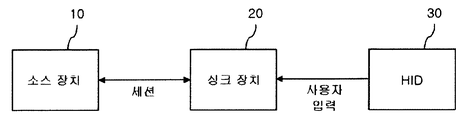
- FIG. 1 is a block diagram briefly illustrating a configuration of a display system according to an exemplary embodiment of the present invention.
- FIG. 2 is a block diagram showing the configuration of devices according to a first embodiment of the present invention.
- FIG. 3 is a block diagram showing the configuration of devices according to a second embodiment of the present invention.
- FIG. 4 is a view showing a user input transmission method according to an embodiment of the present invention.
- 5 to 8 are diagrams illustrating a first embodiment of the configuration of HID user input information.
- FIGS. 9 and 10 are diagrams illustrating a second embodiment of the configuration of HID user input information.
- FIG. 12 is a block diagram illustrating a first embodiment of an operation of a source device, a sink device, and a human interface device for delivering user input.
- FIG. 13 is a diagram illustrating a first embodiment of a format of HID user input information transmitted to a source device.
- FIG. 14 is a block diagram illustrating a second embodiment of an operation of a source device, a sink device, and a human interface device for delivering user input.
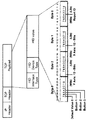
- FIG. 15 is a diagram illustrating a second embodiment of a format of HID user input information transmitted to a source device.
- 16 is a diagram illustrating a third embodiment of a format of HID user input information transmitted to a source device.
- FIG. 17 illustrates a fourth embodiment of a format of HID user input information transmitted to a source device.
- FIG. 18 is a diagram illustrating a fifth embodiment of a format of HID user input information transmitted to a source device.
- FIG. 19 illustrates a sixth embodiment of a format of HID user input information transmitted to a source device.
- 20 is a block diagram illustrating a third embodiment of an operation of a source device, a sink device, and a human interface device for delivering user input.
- FIG. 1 is a block diagram illustrating a simplified configuration of a display system according to an exemplary embodiment of the present invention.
- the illustrated display system may include a source device 10, a sink device 20, and a human interface device 30. have.
- a source device 10 and a sink device 20 form a display group and include multimedia content such as a video or a voice through a session connected to each other. Control signals can be transmitted and received.
- the source device 10 may have a wireless LAN interface for transmitting the multimedia content to the sink device 20 through the connected session, and streaming the multimedia content to the sink device 20 for that purpose.
- the sink device 20 may receive and play multimedia content transmitted from the source device 10 through the connected session.
- the source device 10 and the sink device 20 may be various devices such as a TV, a home theater system, a mobile phone or a tablet PC, and the like, and each device may be one of a source and a sink according to hardware or software functions. It can be separate or support both the role of source and sink.
- the wireless connection between the source device 10 and the sink device 20 may use the 5 GHz frequency band according to the IEEE 802.11ac, which is a WiFi standard, in which case the source device 10 may be operated at a speed of up to 1 Gbps.
- Uncompressed HD (High Definition) video can be streamed.
- the present invention is not limited to the above wireless communication method, and may be implemented using various communication methods, such as using a frequency band of 60 GHz according to the IEEE 802.11ad standard.
- the source device 10 and the sink device 20 belonging to one display group may be connected using a P2P connection method or a Tunneled Direct Link Setup (TDLS) connection method.
- P2P connection method or a Tunneled Direct Link Setup (TDLS) connection method.
- TDLS Tunneled Direct Link Setup
- the source device 10 and the sink device 20 may form a network called a P2P group without an access point (AP) based on the 802.11 WLAN technology to communicate data through a direct link (direct link),
- any one of the source device 10 and the sink device 20 may manage the P2P group by operating similar to the access point AP as a group owner (GO).
- the source device 10 and the sink device 20 may communicate with an infrastructure BSS (Infrastructure BSS) including an access point (AP), a distribution system, and the like, respectively.
- infrastructure BSS infrastructure BSS
- AP access point
- distribution system distribution system
- the source device 10 and the sink device 20 may selectively connect a session by using Tunneled Direct Link Setup (TDLS).
- TDLS Tunneled Direct Link Setup
- the source device 10 and the sink device 20 may have one access point. (AP) to communicate with each other.
- AP access point.
- the human interface device 30 is a device for interfacing with a user, and may convert a user input according to a specific format and transmit it to the sink device 20.
- the human interface device (HID) 30 may be an input device such as a remote controller or various user input devices such as a touch panel, a touch keyboard, motion recognition, a QWERTY remote control, a mouse, a trackball or a joystick.
- a remote controller or various user input devices such as a touch panel, a touch keyboard, motion recognition, a QWERTY remote control, a mouse, a trackball or a joystick.
- USB Universal Serial Bus
- devices may be classified into classes such as a display device, a communication device, an audio device, a mass storage device, or the human interface device according to the nature of the data.
- the human interface device 30 may be a convergence device that is a display device or a communication device such as a smart phone or a tablet PC and can also be used as the human interface device.
- the interface and frame format used by the human interface device 30 may be defined by various standards.
- Infrared interface for TV remote control Bluetooth interface for wireless keyboard or mouse, USB interface for wired interface device or wireless device, Smart phone app.
- a Wi-Fi interface for IP based control through an infrastructure a Zigbee interface used for home appliance or factory automation, or the like may be used as an interface type of the human interface device 30.
- the sink device 20 transmits a user input received from the human interface device 30 to the source device 10, so that the user at the source device 10.
- An operation according to an input (for example, display of a UI) may be executed.
- a session control such as Play, Pause or Audio routing can be defined between the source device 10 and the sink device 20, which can be transmitted and received by the Session Control Action frame.
- the sink device 20 may transfer the action frame type command to the source device 10 using the profile of the HDMI CEC command.
- FIG. 2 is a block diagram showing the configuration of devices according to the first embodiment of the present invention, and shows the configuration of each of the source device 10 and the sink device 20 shown in FIG.
- the source device 10 may include a transmitting / receiving unit 11, a control unit 12, and an AV codec 13, and the sink device 20. May include a transceiver 21, a controller 22, an AV codec 23, and a user interface unit 24.
- the transceivers 11 and 21 include a transport and network layres, and a format determined according to a communication standard for performing a function such as a connection between the source device 10 and the sink device 20. Frames can be transmitted and received.
- the transceiver 11 provided in the source device 10 transmits the multimedia content to the sink device 20 through the connected session using the above-described processes, and the transceiver 21 provided in the sink device 20. May receive the multimedia content transmitted from the source device 10.
- controllers 12 and 22 perform the processes of device discovery, service discovery, device pairing, and the like using information included in frames transmitted and received through the transceivers 11 and 21 to sink the source device 10 and the sink device. Sessions between the 20 can be connected and managed.
- the controllers 12 and 22 may include a MAC layer and a PHY layer, and the MAC / PHY layers may support a communication standard such as 802.11, Wi-Fi Direct, or TDLS.
- the sink device 20 may configure the UI according to UI information received from the source device 10 by itself or in the case of a remote UI, and display the UI on the screen.
- control unit 22 of the sink device 20 may configure a UI using an operating system (OS) and software (SW) and use a display module (not shown) included in or connected to the sink device 20. Can be displayed.
- OS operating system
- SW software
- the AV codecs 13 and 23 may encode or decode multimedia content transmitted and received through a session between the source device 10 and the sink device 20.
- the AV codec 13 included in the source device 10 encodes a video signal and an audio signal to be transmitted to the sink device 20, and the AV codec 23 provided in the sink device 20 is a source.
- the video signal and the audio signal transmitted from the device 10 may be decoded.
- the human interface device 30 may transmit a user input to the sink device 20 using an interface such as Infrared, Bluetooth, USB, Wi-Fi, or Zigbee.
- the sink device 20 may receive a user input from the human interface device 30 through the user interface unit 24.
- the human interface device 30 connected to the sink device 20 cannot communicate with the source device 10, and the sink device 20 is received from the human interface device 30 using the control unit 22.
- UI can be configured or changed according to user input.
- the sink device 20 may transfer information about a user input, which is directly input or received from the human interface device 30, to the source device 10 using an action frame.
- the source device 10 may configure and display the UI on the screen, and transmit the displayed UI together with the multimedia content to the sink device 20 through a session connected to the sink device 20.
- the UI screen composed of OS / SW of the controller 22 is muxed with the multimedia content to be transmitted to the sink device 20, and then transferred to the sink device 20 as one TS. Can be.
- the configured UI screen is delivered to the sink device 20 as a separate TS from the multimedia content, and the sink device 20 overlays the UI screen delivered to the separate TS with the multimedia content. Can be marked on.
- the sink device 20 may convert a user input received from the human interface device 30 into an action frame and transmit the user input to the source device 10 through a user input back channel (UIBC).
- UIBC user input back channel
- the sink device 20 may comprise a converter for parsing user input received from the human interface device 30 to generate an action frame, at the source device 10 side. It may be necessary to define a structure and an interface for parsing an action frame received from the sink device 20 to the OS / SW.
- response delay to the user input is generated by processes such as parsing and transformation at the sink device 20, parsing at the source device 10, and UI encoding for the user input.
- processes such as parsing and transformation at the sink device 20, parsing at the source device 10, and UI encoding for the user input.
- the sink device 20 may packetize the user input received from the human interface device 30 in the format received without a separate conversion and transmit the packet to the source device 10 accordingly.
- the response delay to the user input and the load of the source device 10 and the sink device 20 can be reduced.
- the present invention is not limited thereto, and the source device 10 or the sink 20 is not limited thereto.
- the device 20 may omit some of the components shown in FIG. 2 or 3 or further include additional components depending on the functionality of the device.
- FIG. 4 is a diagram illustrating a user input delivery method according to an embodiment of the present invention, and descriptions of the same as those described with reference to FIGS. 1 to 3 will be omitted below.
- the sink device 20 receives a user input from the human interface device 30 (step S100), and generates HID user input information including the received user input (step S110).
- the HID user input information may include a first field indicating the type of the human interface device 30, a second field indicating the interface type of the human interface device 30, and a user input received from the human interface device 30. It may be configured to include a third field including a.
- the sink device 20 transmits the generated HID user input information to the source device 10 (step S120).
- the HID user input information includes HID command action frames including 'Subelement ID', 'Length', 'HID ID', 'HID interface type', 'HID device type' and 'HID value' fields. It may be configured as.
- the 'Subelement ID' field indicates the type of the corresponding sub element, and the 'Length' field indicates the length of the next fields in the corresponding sub element.
- the position of the 'Length' field may be changed, and when the position is changed in the frame, it may represent the length of the next field from the corresponding position.
- the 'HID ID' field is information for identifying the human interface device 30 and may indicate a globally unique identifier or a locally unique identifier for the human interface device 30. have.
- the 'HID interface type' field indicates the type of interface used by the human interface device 30, and according to the interface type of the human interface device 30, as shown in FIG. 6, infrared, USB, Bluetooth, Zigbee, and Wi-Fi are shown. And CEC (Consumer Electronics Control).
- the HD device type 'field indicates the type of the human interface device 30, and as shown in FIG. 7, any one of a keyboard, a mouse, a touch pad, a joystick, and a motion sensor according to the type of the human interface device 30 is provided. It may have a value corresponding to one.
- the 'HID value' field includes a user input received from the human interface device 30, and may include the user input in a format defined by a standard such as Bluetooth, Zigbee, or USB as shown in FIG. 8. .
- the user input included in the 'HID value' field may have the same format as that of the user input received from the human interface device 30.
- the sink device 20 parses the user input received from the human interface device 30 and converts the user input into another format.
- the sink device 20 receives the 'HID value in the format received from the human interface device 30. Can be included in the 'field.
- the user input included in the 'HID value' field may have a HID format defined in the USB standard.
- the human interface device 30 may transfer information between the USB device and the USB host through a data structure called a report.
- the report transmitted from the USB device to the USB host is called an input report, and the report transmitted from the USB host to the USB device is called an output report.
- a report for setting the way the USB device operates which is called a feature report.
- Data transmission between the human interface device 30 and the device driver is performed through a control pipe, an interrupt in pipe, and an interrupt out pipe. Normally it can be sent through the interrupt input pipe.
- the sink device 20 transmits the user input as HID as the format according to the received USB standard. It may be included in the 'HID value' field of the user input information.
- the format of the user input included in the 'HID value' field may be an input report, an output report, a feature report, and a report descriptor according to the existing USB standard. report descriptor).
- the configuration of the HID user input information as described with reference to FIGS. 5 to 8 is according to an embodiment of the present invention, and the present invention is not limited thereto.
- the present invention is not limited thereto.
- the fields constituting the HID user input information Some may be omitted or new fields may be added.
- the HID user input information transmitted from the sink device 20 to the source device 10 may include 'HID interface type', 'HID device type', and 'HID value' fields. Since they may be the same as those described with reference to FIGS. 5 to 8, a detailed description thereof will be omitted.
- the 'HID interface type' field may indicate 'Usage' and 'HID Interface Type'.
- the first 2 bits of the 'HID interface type' field may be used for the HID user input information. usage), and the remaining 6 bits may include information about the interface type of the human interface device 30.
- 'Usage' in the 'HID interface type' field indicates whether the HID user input information transmitted to the source device 10 includes data or control information according to the value. It may indicate whether or not to include. That is, the 'Usage' may indicate whether the HID user input information is for transferring data according to a user input through the human interface device 30 or for transmitting information about the user input data. .
- the 'Usage' indicates the usage of the 'HID value' field including the user input, and the usage of the 'HID value' field is determined according to the format of the user input received from the human interface device 30. Can be.
- the format of the user input included in the 'HID value' field is input report, output report, feature report, and report according to the existing USB standard.
- the 'Usage' may indicate any one of the formats of the user input as the usage of the 'HID value' field.
- the 'Usage' may not be included in the 'HID interface type' field as shown in FIG. 10 but may be included as a separate field in the HID user input information transmitted from the sink device 20 to the source device 10. have.
- HID user input information configured as an action frame and transmitted from the sink device 20 to the source device 10 as an example, but the present invention is not limited thereto. In addition, it may be delivered to the source device 10 in various ways.
- the sink device 20 does not perform a separate conversion process for the user input received from the human interface device 30, and the source in the received HID format as it is. To the device 10.
- the sink device 20 does not go through a process such as parsing to grasp the user input received from the human interface device 30, that is, the details of the HID command, and instead of the human interface device 30.
- the source device 10 can operate similarly to the direct connection with the human interface device 30.
- FIG. 12 is a diagram for describing a first embodiment of an operation of a source device, a sink device, and a human interface device for delivering user input.
- the source device 10 and the sink device 20 are each an OS / Device Driver for performing device operations, a HID MAC / PHY for processing user input received from the human interface device 30, and It may include a WFD MAC / 802.11 PHY for processing the transmission and reception signals according to the wireless network connection.
- the human interface device 30 includes an application for receiving a command from a user, and a HID MAC / PHY for processing the user command according to a specific standard, for example, USB, Bluetooth, or Zigbee. can do.
- the HID PHY of the sink device 20 may be connected to the HID PHY of the human interface device 30 through a HID interface such as USB, Bluetooth, or Zigbee, and may receive a user input having a HID format.
- a HID interface such as USB, Bluetooth, or Zigbee
- the received user input is processed through the OS / Device Driver of the sink device 20, and the OS / Device Driver does not perform a separate conversion process on the user input received from the human interface device 30.
- the received HID format may be included in the HID user input information according to an embodiment of the present invention and then transmitted to the source device 10 through the 802.11 PHY.
- the WFD MAC of the source device 10 obtains the user input from the HID user input information received from the sink device 20 and transfers the user input to an OS / Device Driver, and the OS / Device Driver receives the obtained user input. It can process the corresponding operation.
- FIG. 13 illustrates a first embodiment of a format of HID user input information transmitted to a source device. A description of the same frame formats as those described with reference to FIGS. 5 through 11 will be omitted below. .
- an action frame for transmitting a user input received from the human interface device 30 to the sink device 20 to the source device 10 may include 'Subelement ID', 'Length', It may include 'HID ID', 'HID interface type', 'HID device type' and 'HID value' fields.
- the human interface device 30 is a USB mouse
- the value of the 'HID ID' field is '0'
- the value of the 'HID device type' field is '1'
- the 'HID interface type' The value of the field may be designated as '1'.
- the 'HID value' field includes the user input received from the human interface device 30 as it is, without undergoing a separate conversion process, in the received HID format, for example, a user included in the 'HID value' field.
- the input may have a format defined in the USB standard as shown in FIG. 13.
- the format of the 'HID value' field shown in FIG. 13 is a format for multibyte numeric values included in reports transmitted by the HID in the existing USB standard.
- the user input received from the human interface device 30 may be encapsulated in an IP packet using TCP / IP and transmitted to the source device 10.
- the sink device 20 packetizes the user input received from the human interface device 30 in the received HID format to generate an IP packet to be transmitted to the source device 10, and converts the generated IP packet into TCP / It may transmit to the source device 10 via the IP.
- FIG. 14 is a block diagram illustrating a second embodiment of an operation of a source device, a sink device, and a human interface device for delivering user input
- FIG. 15 is a diagram illustrating HID user input information transmitted to the source device 10. The second embodiment of the format is shown.
- the sink device 20 receives a user input from the human interface device 30, and the received user input is encapsulated in an IP packet through a TCP / IP block and then TCP / IP. It may be delivered to the source device 10 using the IP.
- the IP packet delivered to the source device 10 may include an IP header, a TCP header, and a TCP payload, and the TCP payload may include HID user input information as described with reference to FIGS. 5 through 11. have.
- HID value 'fields may be included, and the user input received from the human interface device 30 may be included in the HID value field without being converted.
- the IP packet delivered to the source device 10 may be separated through a TCP / IP block so that a user input received from the human interface device 30 to the sink device 20 may be obtained.
- An operation corresponding to may be performed by the application.
- the embodiment of the present invention has been described using the case where the user input received from the human interface device 30 is encapsulated by TCP / IP as an example, but the present invention is not limited thereto. May be encapsulated in RTSP / TCP / IP, UDP / IP or RTP / UDP / IP.
- an IP packet delivered to the source device 10 may be an IP header, a TCP header, an RTSP header, and the like.
- RTSP payload may be included, and the HSP user input information as described with reference to FIGS. 5 through 11 may be included in the RTSP payload.
- the IP packet delivered to the source device 10 includes an IP header, a UDP header, and a UDP payload.
- the UDP payload may include HID user input information as described with reference to FIGS. 5 through 11.
- an IP packet delivered to the source device 10 may be an IP header, a UDP header, or an RTP.
- the header and the RTP payload may be included, and the RTP payload may include HID user input information as described with reference to FIGS. 5 through 11.
- the format of the HID user input information included in the payload portion (ie, TCP Payload, RTSP Payload, UDP Payload, or RTP Payload) may be changed. .
- the HID user input information included in the TCP payload portion of the IP packet transmitted to the source device 10 may be described as' HID interface type ',' HID device type 'and' HID value 'fields may be included, together with information on' Usage 'of the corresponding HID user input information.
- FIG. 20 is a block diagram illustrating a third embodiment of an operation of a source device, a sink device, and a human interface device for delivering user input. Referring to FIGS. 1 to 19 of the device illustrated in FIG. Description of the same as described will be omitted below.
- a new P2P channel for transferring the user input as described above may be allocated between the human interface device 30 and the source device 10.
- the human interface device 30 may configure a P2P channel for transmitting the user input by connecting to the client of the source device 10 that is the owner (GO, Group Owner) of the P2P group when the P2P connection is made. .
- session pairing occurs in a P2P group through a session between the source device 10 and the sink device 20, and the human interface device 30 joins the client to the P2P group ( join to transmit user input as a P2P data frame.
- At least a part of the user delivery method according to the present invention described above may be stored in a computer-readable recording medium that is produced as a program for execution on a computer, and examples of the computer-readable recording medium include ROM, RAM, CD. ROMs, magnetic tapes, floppy disks, optical data storage devices, and the like, as well as those implemented in the form of carrier waves (eg, transmission over the Internet).
- the computer readable recording medium can be distributed over network coupled computer systems so that the computer readable code is stored and executed in a distributed fashion.
- functional programs, codes, and code segments for implementing the method can be easily inferred by programmers in the art to which the present invention belongs.
Landscapes
- Engineering & Computer Science (AREA)
- Theoretical Computer Science (AREA)
- General Engineering & Computer Science (AREA)
- Physics & Mathematics (AREA)
- General Physics & Mathematics (AREA)
- Signal Processing (AREA)
- Human Computer Interaction (AREA)
- Multimedia (AREA)
- Computer Networks & Wireless Communication (AREA)
- Two-Way Televisions, Distribution Of Moving Picture Or The Like (AREA)
- User Interface Of Digital Computer (AREA)
Abstract
La présente invention concerne un procédé permettant de produire une entrée d'utilisateur reçue à partir d'un dispositif d'interface humaine (HID), et à un dispositif utilisant ledit procédé. Le procédé consiste à : recevoir une entrée d'utilisateur à partir d'un HID ; configurer les informations d'entrée d'utilisateur de HID comprenant un premier champ représentant le type du HID, un deuxième champ représentant le type d'interface du HID, et un troisième champ comprenant l'entrée d'utilisateur émanant du dispositif d'interface humaine ; et transmettre les informations d'entrée d'utilisateur de HID configurées à un dispositif source.
Priority Applications (2)
| Application Number | Priority Date | Filing Date | Title |
|---|---|---|---|
| US13/989,343 US9128524B2 (en) | 2011-01-18 | 2011-12-20 | Method for delivering user input, and device using same |
| US14/815,563 US9418023B2 (en) | 2011-01-18 | 2015-07-31 | Method for delivering user input, and device using same |
Applications Claiming Priority (6)
| Application Number | Priority Date | Filing Date | Title |
|---|---|---|---|
| US201161433942P | 2011-01-18 | 2011-01-18 | |
| US61/433,942 | 2011-01-18 | ||
| US201161446499P | 2011-02-25 | 2011-02-25 | |
| US61/446,499 | 2011-02-25 | ||
| US201161538143P | 2011-09-23 | 2011-09-23 | |
| US61/538,143 | 2011-09-23 |
Related Child Applications (2)
| Application Number | Title | Priority Date | Filing Date |
|---|---|---|---|
| US13/989,343 A-371-Of-International US9128524B2 (en) | 2011-01-18 | 2011-12-20 | Method for delivering user input, and device using same |
| US14/815,563 Continuation US9418023B2 (en) | 2011-01-18 | 2015-07-31 | Method for delivering user input, and device using same |
Publications (2)
| Publication Number | Publication Date |
|---|---|
| WO2012099338A2 true WO2012099338A2 (fr) | 2012-07-26 |
| WO2012099338A3 WO2012099338A3 (fr) | 2012-10-11 |
Family
ID=46516191
Family Applications (1)
| Application Number | Title | Priority Date | Filing Date |
|---|---|---|---|
| PCT/KR2011/009834 Ceased WO2012099338A2 (fr) | 2011-01-18 | 2011-12-20 | Procédé permettant de produire une entrée d'utilisateur, et dispositif utilisant ledit procédé |
Country Status (2)
| Country | Link |
|---|---|
| US (2) | US9128524B2 (fr) |
| WO (1) | WO2012099338A2 (fr) |
Cited By (4)
| Publication number | Priority date | Publication date | Assignee | Title |
|---|---|---|---|---|
| WO2014125547A1 (fr) * | 2013-02-13 | 2014-08-21 | Sony Corporation | Appareil de traitement d'informations, procédé de traitement d'informations et système de traitement d'informations |
| WO2015167269A1 (fr) * | 2014-04-29 | 2015-11-05 | 엘지전자 주식회사 | Procédé et dispositif de découverte de service dans un système de communication sans fil |
| WO2017048106A1 (fr) * | 2015-09-16 | 2017-03-23 | 엘지전자(주) | Procédé et appareil de traitement de données reposant sur un dispositif d'interface humaine (hid) à l'aide d'une interface à grande vitesse |
| WO2025058202A1 (fr) * | 2023-09-11 | 2025-03-20 | 삼성전자 주식회사 | Dispositif d'affichage et son procédé de fonctionnement |
Families Citing this family (31)
| Publication number | Priority date | Publication date | Assignee | Title |
|---|---|---|---|---|
| US9198084B2 (en) | 2006-05-26 | 2015-11-24 | Qualcomm Incorporated | Wireless architecture for a traditional wire-based protocol |
| US8811294B2 (en) | 2008-04-04 | 2014-08-19 | Qualcomm Incorporated | Apparatus and methods for establishing client-host associations within a wireless network |
| US9398089B2 (en) | 2008-12-11 | 2016-07-19 | Qualcomm Incorporated | Dynamic resource sharing among multiple wireless devices |
| US9264248B2 (en) | 2009-07-02 | 2016-02-16 | Qualcomm Incorporated | System and method for avoiding and resolving conflicts in a wireless mobile display digital interface multicast environment |
| US9582238B2 (en) | 2009-12-14 | 2017-02-28 | Qualcomm Incorporated | Decomposed multi-stream (DMS) techniques for video display systems |
| WO2012099338A2 (fr) * | 2011-01-18 | 2012-07-26 | 엘지전자 주식회사 | Procédé permettant de produire une entrée d'utilisateur, et dispositif utilisant ledit procédé |
| US9413803B2 (en) * | 2011-01-21 | 2016-08-09 | Qualcomm Incorporated | User input back channel for wireless displays |
| US9787725B2 (en) | 2011-01-21 | 2017-10-10 | Qualcomm Incorporated | User input back channel for wireless displays |
| US10135900B2 (en) | 2011-01-21 | 2018-11-20 | Qualcomm Incorporated | User input back channel for wireless displays |
| US20130013318A1 (en) | 2011-01-21 | 2013-01-10 | Qualcomm Incorporated | User input back channel for wireless displays |
| US9065876B2 (en) | 2011-01-21 | 2015-06-23 | Qualcomm Incorporated | User input back channel from a wireless sink device to a wireless source device for multi-touch gesture wireless displays |
| US8964783B2 (en) * | 2011-01-21 | 2015-02-24 | Qualcomm Incorporated | User input back channel for wireless displays |
| US9503771B2 (en) | 2011-02-04 | 2016-11-22 | Qualcomm Incorporated | Low latency wireless display for graphics |
| US8674957B2 (en) | 2011-02-04 | 2014-03-18 | Qualcomm Incorporated | User input device for wireless back channel |
| US10108386B2 (en) | 2011-02-04 | 2018-10-23 | Qualcomm Incorporated | Content provisioning for wireless back channel |
| US9525998B2 (en) | 2012-01-06 | 2016-12-20 | Qualcomm Incorporated | Wireless display with multiscreen service |
| US9652192B2 (en) * | 2013-01-25 | 2017-05-16 | Qualcomm Incorporated | Connectionless transport for user input control for wireless display devices |
| US9542347B2 (en) * | 2013-03-16 | 2017-01-10 | Intel Corporation | Host interface crossbar for sensor hub |
| US9430414B2 (en) | 2013-03-16 | 2016-08-30 | Intel Corporation | Bus independent platform for sensor hub peripherals to provide coalescing of multiple reports |
| US9197680B2 (en) * | 2013-05-23 | 2015-11-24 | Qualcomm Incorporated | Establishing and controlling audio and voice back channels of a Wi-Fi display connection |
| TWI610221B (zh) * | 2014-06-18 | 2018-01-01 | 緯創資通股份有限公司 | 螢幕播送方法以及使用該方法的系統與裝置 |
| TWI604382B (zh) * | 2014-07-08 | 2017-11-01 | 緯創資通股份有限公司 | 應用程式分享方法以及使用該方法的系統 |
| US20160308917A1 (en) * | 2015-04-20 | 2016-10-20 | Intel Corporation | Sensor input transmission and associated processes |
| US11134114B2 (en) * | 2016-03-15 | 2021-09-28 | Intel Corporation | User input based adaptive streaming |
| US10455632B2 (en) | 2016-11-30 | 2019-10-22 | Microsoft Technology Licensing, Llc | Dynamic identification of network connection preferences |
| US10602557B2 (en) * | 2016-11-30 | 2020-03-24 | Microsoft Technology Licensing, Llc | Discovering and protecting data streams in multi-path communication environments |
| CN111198614A (zh) * | 2020-02-27 | 2020-05-26 | 上海商米科技集团股份有限公司 | 处理人类接口设备的输入内容的方法和装置 |
| KR102832295B1 (ko) * | 2020-03-31 | 2025-07-10 | 엘지전자 주식회사 | 디스플레이 장치 및 그의 동작 방법 |
| CN114089839B (zh) * | 2020-11-26 | 2025-03-25 | 珠海恒宇新科技有限公司 | 蓝牙键盘通讯方法和蓝牙键盘 |
| EP4254166A4 (fr) * | 2021-01-11 | 2024-05-29 | Samsung Electronics Co., Ltd. | Dispositif d'affichage et son procédé de fonctionnement |
| CN121644863A (zh) * | 2024-08-30 | 2026-03-10 | 华为技术有限公司 | 通信的方法和相关设备 |
Family Cites Families (9)
| Publication number | Priority date | Publication date | Assignee | Title |
|---|---|---|---|---|
| KR20050009912A (ko) * | 2003-07-18 | 2005-01-26 | 삼성전자주식회사 | 성능측정 시스템 |
| US8539119B2 (en) | 2004-11-24 | 2013-09-17 | Qualcomm Incorporated | Methods and apparatus for exchanging messages having a digital data interface device message format |
| US8850052B2 (en) * | 2008-09-30 | 2014-09-30 | Apple Inc. | System and method for simplified resource sharing |
| US8296469B2 (en) * | 2008-12-31 | 2012-10-23 | Intel Corporation | Scalable method and apparatus for link with reconfigurable ports |
| JP5367814B2 (ja) * | 2009-05-14 | 2013-12-11 | パナソニック株式会社 | 映像データの伝送方法 |
| JPWO2010140199A1 (ja) * | 2009-06-01 | 2012-11-15 | パナソニック株式会社 | 映像データの伝送方法 |
| KR101732057B1 (ko) * | 2009-11-02 | 2017-05-02 | 삼성전자주식회사 | Av 시스템에서 사용자 입력 백 채널을 제공하는 방법 및 기기 |
| WO2012099338A2 (fr) * | 2011-01-18 | 2012-07-26 | 엘지전자 주식회사 | Procédé permettant de produire une entrée d'utilisateur, et dispositif utilisant ledit procédé |
| US20130173765A1 (en) * | 2011-12-29 | 2013-07-04 | United Video Properties, Inc. | Systems and methods for assigning roles between user devices |
-
2011
- 2011-12-20 WO PCT/KR2011/009834 patent/WO2012099338A2/fr not_active Ceased
- 2011-12-20 US US13/989,343 patent/US9128524B2/en active Active
-
2015
- 2015-07-31 US US14/815,563 patent/US9418023B2/en active Active
Cited By (9)
| Publication number | Priority date | Publication date | Assignee | Title |
|---|---|---|---|---|
| WO2014125547A1 (fr) * | 2013-02-13 | 2014-08-21 | Sony Corporation | Appareil de traitement d'informations, procédé de traitement d'informations et système de traitement d'informations |
| EP3059971A1 (fr) * | 2013-02-13 | 2016-08-24 | Sony Corporation | Appareil de traitement d'informations, procédé de traitement d'informations et système de traitement d'informations |
| US9763279B2 (en) | 2013-02-13 | 2017-09-12 | Sony Corporation | Information processing apparatus, information processing method, and information processing system |
| US10602558B2 (en) | 2013-02-13 | 2020-03-24 | Sony Corporation | Information processing apparatus, method and system for coordinating a maximum multi-touch number in WLAN |
| WO2015167269A1 (fr) * | 2014-04-29 | 2015-11-05 | 엘지전자 주식회사 | Procédé et dispositif de découverte de service dans un système de communication sans fil |
| US10506501B2 (en) | 2014-04-29 | 2019-12-10 | Lg Electronics Inc. | Service discovery method and device in wireless communication system |
| WO2017048106A1 (fr) * | 2015-09-16 | 2017-03-23 | 엘지전자(주) | Procédé et appareil de traitement de données reposant sur un dispositif d'interface humaine (hid) à l'aide d'une interface à grande vitesse |
| US10754537B2 (en) | 2015-09-16 | 2020-08-25 | Lg Electronics Inc. | Method and apparatus for processing human interface device (HID)-based data using high-speed interface |
| WO2025058202A1 (fr) * | 2023-09-11 | 2025-03-20 | 삼성전자 주식회사 | Dispositif d'affichage et son procédé de fonctionnement |
Also Published As
| Publication number | Publication date |
|---|---|
| US20150339244A1 (en) | 2015-11-26 |
| US9418023B2 (en) | 2016-08-16 |
| WO2012099338A3 (fr) | 2012-10-11 |
| US20130246665A1 (en) | 2013-09-19 |
| US9128524B2 (en) | 2015-09-08 |
Similar Documents
| Publication | Publication Date | Title |
|---|---|---|
| WO2012099338A2 (fr) | Procédé permettant de produire une entrée d'utilisateur, et dispositif utilisant ledit procédé | |
| JP6219310B2 (ja) | ワイヤレスディスプレイのためのユーザ入力バックチャネルを介した双方向トンネリング | |
| WO2011062341A1 (fr) | Appareil permettant de commander un dispositif multimédia et procédé permettant de fournir une interface graphique utilisateur | |
| WO2012096546A2 (fr) | Procédé et appareil de transmission d'entrée d'utilisateur de dispositif collecteur à dispositif source dans système de communication direct wi-fi | |
| WO2011056032A2 (fr) | Procédé et appareil de changement de type d'entrée dans un système d'entrée utlisant un dispositif prêt à l'emploi (plug and play) universel | |
| WO2014069758A1 (fr) | Système et procédé de service de rattachement utilisant une communication à courte portée | |
| US10187925B2 (en) | WiFi display compatible network gateway | |
| CN108259572A (zh) | 远端蓝牙装置通信系统及其方法 | |
| WO2013077525A1 (fr) | Procédé de commande et dispositif utilisant ce procédé | |
| WO2011059257A2 (fr) | Appareil d'affichage et procédé de transmission audio à distance | |
| WO2016129966A1 (fr) | Support et dispositif d'enregistrement sur lesquels sont enregistrés un programme pour fournir un contenu de diffusion en direct à faible latence | |
| WO2014163394A1 (fr) | Économie d'énergie pour les transmissions audio/vidéo via une interface câblée | |
| WO2020116852A1 (fr) | Dispositif électronique de réduction de consommation d'énergie dans un réseau basé sur un protocole wi-fi direct, et procédé associé | |
| WO2017119644A1 (fr) | Dispositif électronique et procédé de fonctionnement pour dispositif électronique | |
| WO2014126378A1 (fr) | Procédé et appareil pour la connexion entre un client et un serveur | |
| WO2018032903A1 (fr) | Procédé et terminal de configuration de terminal basé sur une transmission sous protocole de mise en service | |
| KR20170018282A (ko) | 사용자 장치 간의 유선 케이블을 대체하는 고속 무선 통신 방법 | |
| WO2012057545A2 (fr) | Procédé et système de synchronisation de changement de format d'un flux de données audio/vidéo (a/v) dans des systèmes de communication sans fil | |
| WO2017052065A1 (fr) | Dispositif de traitement vidéo, procédé de pilotage d'un dispositif de traitement vidéo, dispositif de relais vidéo, procédé de pilotage d'un dispositif de relais vidéo, et support d'enregistrement lisible par ordinateur | |
| WO2015167269A1 (fr) | Procédé et dispositif de découverte de service dans un système de communication sans fil | |
| WO2010095800A1 (fr) | Système et procédé de service de diffusion locale, et dispositif de transmission sans fil utilisé | |
| JP2018521549A (ja) | 逆方向チャネルオーディオセッションを管理するための技法 | |
| CN101883034A (zh) | 一种用于3c融合的互联设备 | |
| WO2012047026A2 (fr) | Procédé et appareil de fourniture d'un service de réseau externe sur la base d'une visualisation de publicités | |
| WO2020262740A1 (fr) | Dispositif pour émettre des données dans un système audiovisuel (av) sans fil et dispositif pour recevoir des données dans un système av sans fil |
Legal Events
| Date | Code | Title | Description |
|---|---|---|---|
| 121 | Ep: the epo has been informed by wipo that ep was designated in this application |
Ref document number: 11856317 Country of ref document: EP Kind code of ref document: A2 |
|
| WWE | Wipo information: entry into national phase |
Ref document number: 13989343 Country of ref document: US |
|
| NENP | Non-entry into the national phase |
Ref country code: DE |
|
| 122 | Ep: pct application non-entry in european phase |
Ref document number: 11856317 Country of ref document: EP Kind code of ref document: A2 |