WO2012102026A1 - Dispositif d'entrée - Google Patents
Dispositif d'entrée Download PDFInfo
- Publication number
- WO2012102026A1 WO2012102026A1 PCT/JP2012/000436 JP2012000436W WO2012102026A1 WO 2012102026 A1 WO2012102026 A1 WO 2012102026A1 JP 2012000436 W JP2012000436 W JP 2012000436W WO 2012102026 A1 WO2012102026 A1 WO 2012102026A1
- Authority
- WO
- WIPO (PCT)
- Prior art keywords
- piezoelectric element
- input device
- operation position
- tactile sensation
- ultrasonic wave
- Prior art date
- Legal status (The legal status is an assumption and is not a legal conclusion. Google has not performed a legal analysis and makes no representation as to the accuracy of the status listed.)
- Ceased
Links
Images



Classifications
-
- G—PHYSICS
- G06—COMPUTING OR CALCULATING; COUNTING
- G06F—ELECTRIC DIGITAL DATA PROCESSING
- G06F3/00—Input arrangements for transferring data to be processed into a form capable of being handled by the computer; Output arrangements for transferring data from processing unit to output unit, e.g. interface arrangements
- G06F3/01—Input arrangements or combined input and output arrangements for interaction between user and computer
- G06F3/03—Arrangements for converting the position or the displacement of a member into a coded form
- G06F3/041—Digitisers, e.g. for touch screens or touch pads, characterised by the transducing means
-
- G—PHYSICS
- G06—COMPUTING OR CALCULATING; COUNTING
- G06F—ELECTRIC DIGITAL DATA PROCESSING
- G06F3/00—Input arrangements for transferring data to be processed into a form capable of being handled by the computer; Output arrangements for transferring data from processing unit to output unit, e.g. interface arrangements
- G06F3/01—Input arrangements or combined input and output arrangements for interaction between user and computer
- G06F3/03—Arrangements for converting the position or the displacement of a member into a coded form
- G06F3/041—Digitisers, e.g. for touch screens or touch pads, characterised by the transducing means
- G06F3/043—Digitisers, e.g. for touch screens or touch pads, characterised by the transducing means using propagating acoustic waves
-
- G—PHYSICS
- G06—COMPUTING OR CALCULATING; COUNTING
- G06F—ELECTRIC DIGITAL DATA PROCESSING
- G06F2203/00—Indexing scheme relating to G06F3/00 - G06F3/048
- G06F2203/041—Indexing scheme relating to G06F3/041 - G06F3/045
- G06F2203/04101—2.5D-digitiser, i.e. digitiser detecting the X/Y position of the input means, finger or stylus, also when it does not touch, but is proximate to the digitiser's interaction surface and also measures the distance of the input means within a short range in the Z direction, possibly with a separate measurement setup
Definitions
- the present invention relates to an input device.
- Patent Document 2 describes a technique for applying various tactile sensations to skin (for example, a fingertip) using ultrasonic waves.
- a finger, a stylus or the like is in direct contact with the screen, so the screen may be stained with oil or the like, or marks of the stylus may be left on the screen.
- An object of the present invention is to provide an input device capable of noncontactly detecting an operation corresponding to an operation position display displayed on a screen.
- the present invention provides a display unit that displays a plurality of operation positions; A detection unit for non-contactingly detecting an operation on an operation position set in a specific space in front of the input device corresponding to each of the plurality of operation position indications; Have The detection unit is A first piezoelectric element for emitting ultrasonic waves toward a space in front of the input device; A second piezoelectric element that detects the ultrasonic wave oscillated by the first piezoelectric element; A determination unit that determines which operation position has been operated based on the detection result of the second piezoelectric element; Providing an input device characterized by comprising:
- the operation performed on the operation position corresponding to the operation position display displayed on the display unit can be detected in a noncontact manner.
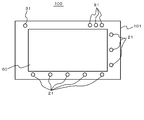
- FIG. 1 is a front view showing a portable terminal device 100 as an input device according to the first embodiment
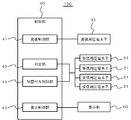
- FIG. 2 is a block diagram of the portable terminal device 100
- FIG. FIG. 1 is a front view showing a portable terminal device 100 as an input device according to the first embodiment
- FIG. 2 is a block diagram of the portable terminal device 100
- FIG. FIG. 1 is a front view showing a portable terminal device 100 as an input device according to the first embodiment
- FIG. 2 is a block diagram of the portable terminal device 100
- FIG. FIG. 1 is a front view showing a portable terminal device 100 as an input device according to the first embodiment
- FIG. 2 is a block diagram of the portable terminal device 100
- FIG. FIG. 1 is a front view showing a portable terminal device 100 as an input device according to the first embodiment
- FIG. 2 is a block diagram of the portable terminal device 100
- FIG. FIG. 1 is a front view showing a portable terminal device 100 as an input device according to the first embodiment
- FIG. 2 is a block diagram
- the mobile terminal device 100 includes a display unit 60 that performs a plurality of operation position displays (for example, operation position displays 61 to 66), and a front surface of the mobile terminal device 100 corresponding to each of the plurality of operation position displays.
- a display unit 60 that performs a plurality of operation position displays (for example, operation position displays 61 to 66), and a front surface of the mobile terminal device 100 corresponding to each of the plurality of operation position displays.
- a first piezoelectric element (oscillating piezoelectric element 31) that oscillates an ultrasonic wave toward a space in front of 100 (for example, a space in the front of the display unit 60) and an ultrasonic wave oscillated by the first piezoelectric element are detected It has a second piezoelectric element (receiving piezoelectric element 21) and a determination unit 42 which determines which operation position has been performed based on the detection result of the second piezoelectric element.
- the mobile terminal device 100 is, for example, a mobile phone, a PDA (Personal Digital Assistant), a small game device, a laptop personal computer, or the like. The details will be described below.
- the mobile terminal device 100 includes a housing 101 and a display unit 60 provided in the housing 101.
- FIG. 1 shows an example in which the portable terminal device 100 is a tablet type
- the portable terminal device 100 may have other forms. That is, the portable terminal device 100 may be a foldable type having the first and second housings foldably connected to each other, or the first and second housings slidably connected to each other. It may be a slide type having a body.
- the display unit 60 is configured of, for example, a liquid crystal display device or the like.
- the display unit 60 displays various types of information on the display screen 60a. These displays include displays of a plurality of operation position displays (for example, operation position displays 61 to 66).
- the display screen 60a is formed, for example, in a rectangular shape.
- the portable terminal device 100 includes an oscillating piezoelectric element 31 for oscillating an ultrasonic wave toward a space in front of the portable terminal 100 and a receiving piezoelectric element 21 for detecting an ultrasonic wave oscillated from the oscillating piezoelectric element 31 (21a , 21b, 21c, and 21d), and a tactile sensation giving piezoelectric element (third piezoelectric element) 81 that oscillates an ultrasonic wave toward the operation position.
- the oscillation piezoelectric element 31, the reception piezoelectric element 21, and the tactile sensation application piezoelectric element 81 are provided at positions near the display unit 60 in the housing 101.
- the portable terminal device 100 has a plurality of at least one of the oscillation piezoelectric element 31 and the reception piezoelectric element 21.
- the mobile terminal device 100 includes, for example, a plurality of receiving piezoelectric elements 21.
- the receiving piezoelectric elements 21 are disposed, for example, at positions corresponding to the four sides of the display screen 60a.
- the mobile terminal device 100 also has, for example, a plurality of tactile sensation providing piezoelectric elements 81.
- the portable terminal device 100 includes a control unit 40 in addition to the oscillation piezoelectric element 31, the reception piezoelectric element 21, the tactile sensation imparting piezoelectric element 81 and the display unit 60.
- the control unit 40 controls the operation of the oscillation control unit 41 that controls the operation of the oscillation piezoelectric element 31, the determination unit 42, the display control unit 43 that controls the operation of the display unit 60, and the tactile sensation application piezoelectric element 81. And a tactile sensation application control unit 44.
- an ultrasonic wave can be oscillated from the oscillation piezoelectric element 31.
- the ultrasonic wave oscillated by the oscillating piezoelectric element 31 is detected by each receiving piezoelectric element 21.
- Each receiving piezoelectric element 21 detects the ultrasonic wave of the frequency oscillated by the oscillating piezoelectric element 31. It is preferable that the resonant frequency of the receiving piezoelectric element 21 match the transmission frequency of the oscillating piezoelectric element 31.
- the detection results of the reception piezoelectric elements 21 are input to the determination unit 42, respectively.
- the determination unit 42 determines which operation position has been operated based on the detection results of the reception piezoelectric elements 21.
- the tactile sensation application control unit 44 controls the tactile sensation application piezoelectric elements 81 to oscillate ultrasonic waves from the tactile sensation application piezoelectric elements 81 toward the operation position, thereby performing an operation (for example, a finger 1 (see FIG. 3). Or a stylus (not shown) or the like).
- the operation position is at a position away from the display screen 60a.
- the operation positions are set, for example, in the spaces in front of the operation position displays 61 to 66, respectively.
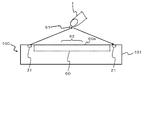
- FIG. 3 shows, as an example, a state in which the operating position 51 corresponding to the operating position display 62 is operated by the finger 1.
- the ultrasonic waves output from the oscillating piezoelectric element 31 are reflected by the finger 1 and then detected by the receiving piezoelectric elements 21, but are reflected toward the receiving piezoelectric elements 21 according to the position of the finger 1.
- the determination part 42 is storing beforehand the detection value by each piezoelectric element 21 for reception as a table for every operation position. Then, the determination unit 42 extracts the operation position corresponding to the detection value of each reception piezoelectric element 21 from the table, and determines that the operation to the operation position is performed.
- the determination unit 42 may determine to which operation position the operation has been performed by calculation using detection values of the reception piezoelectric elements 21.
- the vertical position of the operation position is determined from the ratio between the detection value of the reception piezoelectric element 21a located on the display screen 60a and the detection value of the reception piezoelectric element 21b located below the display screen 60a. Determining the lateral position of the operation position from the ratio of the detection value by the reception piezoelectric element 21c positioned on the left of the display screen 60a to the detection value by the reception piezoelectric element 21d positioned on the right of the display screen 60a
- the operation position may be specified.
- each operation position be located in the same plane, thereby facilitating the operation by the user.
- the distance from the display screen 60a to each operation position is preferably 5 cm or less (more preferably 3 cm or less), whereby the operation can be detected with higher accuracy.
- the tactile sensation application control unit 44 controls the tactile sensation application piezoelectric element 81 to make the finger 1 apply ultrasonic waves. , Give the finger 1 a tactile sensation.
- the value of the phase of the ultrasonic wave oscillated from each tactile sensation applying piezoelectric element 81 (or the value of the relative displacement amount of the phase of the ultrasonic wave oscillated from each tactile sensation applying piezoelectric element 81) is controlled.
- the position at which the finger 1 or the like is given a tactile sensation can be adjusted. Therefore, in the present embodiment, the value of the phase of the ultrasonic wave oscillated from each tactile sense imparting piezoelectric element 81 and the relative displacement amount thereof are controlled so that the tactile sensation can be given at the operation position where the operation is detected.
- a plurality of types of tactile sensations for example, hard tactile sensation and soft tactile sensation
- Texture slippery texture, unevenness texture, etc.
- the control unit 40 executes other processing according to the operation. For example, as shown in FIG. 1, in the operation position displays 61 to 66, an operation position display 61 indicating an operation position (not shown) instructing the activation of the application and an operation indicating the operation position 51 instructing an activation of the address book Position display 62, operation position display 63 indicating an operation position (not shown) instructing an activation of an electronic mail function, operation position display 64 indicating an operation position (not shown) instructing an activation of a camera function, activation of a calculator function An operation position display 65 indicating an operation position (not shown) to be instructed and an operation position display 66 indicating an operation position (not shown) instructing activation of various setting functions are included, and the control unit 40 has these functions. Execute processing according to
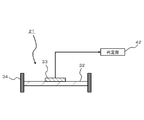
- FIG. 4 is a schematic view of the oscillation piezoelectric element 31. As shown in FIG.
- the oscillating piezoelectric element 31 includes, for example, a sheet-like vibrating member 32, a vibrator 33, and a support member 34.
- the vibrator 33 is, for example, a piezoelectric vibrator, and is attached to one surface of the vibrating member 32.
- the support member 34 supports the edge of the vibrating member 32.
- the support member 34 is fixed to, for example, a circuit board (not shown) or the housing 101 of the mobile terminal device 100.
- the oscillation control unit 41 constitutes an oscillation circuit that vibrates the vibrator 33 by inputting the oscillation signal to the vibrator 33 and causes the vibrator 33 and the vibrating member 32 to oscillate a sound wave.
- the vibrating member 32 vibrates by the vibration generated from the vibrator 33, and oscillates a sound wave having a frequency of, for example, 20 kHz or more.
- the vibrator 33 also oscillates, for example, a sound wave having a frequency of 20 kHz or more when the vibrator 33 vibrates.
- the vibrating member 32 also adjusts the fundamental resonant frequency of the vibrator 33.
- the fundamental resonant frequency of the mechanical oscillator depends on the load weight and the compliance. Since the compliance is mechanical rigidity of the vibrator, controlling the rigidity of the vibrating member 32 can control the fundamental resonance frequency of the vibrator 33.
- the thickness of the vibrating member 32 is preferably 5 ⁇ m or more and 500 ⁇ m or less.
- index which shows rigidity is 1 Gpa or more and 500 GPa or less. If the rigidity of the vibrating member 32 is too low or too high, there is a possibility that the characteristics and reliability of the mechanical vibrator will be impaired.
- the material constituting the vibrating member 32 is not particularly limited as long as it is a material having a high elastic modulus with respect to the vibrator 33 which is a brittle material such as metal or resin, but from the viewpoint of processability and cost Stainless steel is preferable.
- the planar shape of the vibrator 33 is circular.
- the planar shape of the vibrator 33 is not limited to a circle.
- the vibrator 33 is fixed to the vibrating member 32 by an adhesive on the entire surface of the vibrator 33 facing the vibrating member 32. Thus, the entire surface on one side of the vibrator 33 is restrained by the vibrating member 32.
- the oscillation control unit 41 generates an electrical signal to be input to the vibrator 33, that is, a modulation signal in the oscillation piezoelectric element 31.
- the transport wave of the modulation signal is, for example, an ultrasonic wave having a frequency of 20 kHz or more, and specifically, for example, an ultrasonic wave of 100 kHz.
- the oscillation control unit 41 controls the oscillation piezoelectric element 31 so as to obtain a predetermined oscillation output.
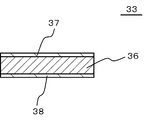
- FIG. 5 is a cross-sectional view showing a layered structure of the vibrator 33 in the thickness direction.
- the vibrator 33 has a piezoelectric body 36, an upper surface electrode 37 and a lower surface electrode 38.
- the piezoelectric body 36 is polarized in the thickness direction.
- the material constituting the piezoelectric body 36 may be either an inorganic material or an organic material as long as it has a piezoelectric effect. However, a material having high electromechanical conversion efficiency, for example, zirconate titanate (PZT) or barium titanate (BaTiO 3 ) is preferable.
- the thickness h1 of the piezoelectric body 36 is, for example, 10 ⁇ m or more and 1 mm or less. If the thickness h1 is less than 10 ⁇ m, there is a possibility that the vibrator 33 may be damaged when the oscillating piezoelectric element 31 is manufactured.
- the thickness h1 is more than 1 mm, the electromechanical conversion efficiency is too low, and there is a possibility that a sufficient magnitude of vibration can not be obtained.
- the reason is that, when the thickness of the vibrator 33 is increased, the electric field strength in the piezoelectric vibrator decreases in inverse proportion.
- the material which comprises the upper surface electrode 37 and the lower surface electrode 38 is not specifically limited, For example, silver and silver / palladium can be used. Silver is used as a low-resistance, general-purpose electrode material, and thus has advantages in manufacturing process and cost. Since silver / palladium is a low resistance material excellent in oxidation resistance, it is advantageous from the viewpoint of reliability.
- the thickness h2 of the upper surface electrode 37 and the lower surface electrode 38 is not particularly limited, but it is preferable that the thickness h2 is 1 ⁇ m or more and 50 ⁇ m or less. If the thickness h2 is less than 1 ⁇ m, it is difficult to form the upper surface electrode 37 and the lower surface electrode 38 uniformly, and as a result, the electromechanical conversion efficiency may be reduced. When the film thickness of the upper surface electrode 37 and the lower surface electrode 38 exceeds 100 ⁇ m, there is a possibility that the upper surface electrode 37 and the lower surface electrode 38 become a constraining surface with respect to the piezoelectric body 36 to lower energy conversion efficiency.
- the vibrator 33 can have an outer diameter of ⁇ 18 mm, an inner diameter of ⁇ 12 mm, and a thickness of 100 ⁇ m. Further, as the upper surface electrode 37 and the lower surface electrode 38, for example, a silver / palladium alloy (weight ratio is, for example, 7: 3) having a thickness of 8 ⁇ m can be used. Further, as the vibrating member 32, phosphor bronze having an outer diameter of ⁇ 20 mm and a thickness of 50 ⁇ m (0.3 mm) can be used.
- the support member 34 functions as a case of the oscillation piezoelectric element 31, and is formed in, for example, a cylindrical (for example, cylindrical) shape with an outer diameter of ⁇ 22 mm and an inner diameter of ⁇ 20 mm.
- FIG. 4 is a schematic view of the receiving piezoelectric element 21. As shown in FIG. 4
- the receiving piezoelectric element 21 is configured in the same manner as the oscillating piezoelectric element 31.
- the vibrators 33 of the receiving piezoelectric elements 21 individually generate electric signals according to the received ultrasonic waves, and output the electric signals to the determination unit 42 (as a detection result of the ultrasonic waves).
- the determination unit 42 determines which operation position has been operated based on the electric signal input from each of the reception piezoelectric elements 21.
- the oscillation piezoelectric element 31 has a function as a speaker for outputting an ultrasonic wave, whereas the reception piezoelectric element 21 functions as a microphone for detecting an ultrasonic wave.
- the piezoelectric element 81 for tactile sense provision and the tactile sense provision control part 44 are also comprised similarly to the piezoelectric element 31 for oscillation, and the oscillation control part 41.
- FIG. 1 the piezoelectric element 81 for tactile sense provision and the tactile sense provision control part 44 are also comprised similarly to the piezoelectric element 31 for oscillation, and the oscillation control part 41.
- the detection unit detects the operation performed on the operation position corresponding to each operation position display by the oscillation control unit 41, the oscillation piezoelectric element 31, the reception piezoelectric element 21 and the determination unit 42 in a noncontact manner. Is configured.
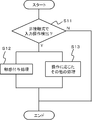
- FIG. 7 is a flowchart showing the flow of the operation of the first embodiment.
- the mobile terminal device 100 repeatedly performs the process of FIG. 7 at predetermined time intervals.
- the user performs an operation on any one of the operation positions (the operation position 51 and the like) indicated by the plurality of operation position displays 61 to 66. That is, the finger 1 is moved to a desired operation position. Then, the detection unit detects the operation (Y in step S11).
- the tactile sensation application control unit 44 performs processing for applying a tactile sensation to the finger 1 (step S12).
- step S13 is performed in parallel with step S12 (or following step S12).
- step S13 other processing (processing except for the processing in step S12) corresponding to the operation is performed. Specifically, for example, processing for activating an application, an address book, an electronic mail function, a camera function, a calculator function, various setting functions, and the like is performed.
- the operation performed on the operation position (the operation position 51 or the like) indicated by the operation position display 61 to 66 displayed on the display unit 60 is detected without contact. can do. Therefore, unlike a touch panel in which a finger, a stylus or the like is brought into direct contact with the screen, it is possible to suppress the screen from being stained with oil or the like, and the trace of the stylus remaining on the screen.
- the operation with respect to the operation positions disposed at a plurality of locations in two dimensions It can be easily detected. More specifically, at least one of the oscillation piezoelectric element 31 and the reception piezoelectric element 21 (for example, the reception piezoelectric element 21) is disposed at a position corresponding to each of the four sides of the display unit 60. By this, it is possible to easily detect the operation with respect to the operation positions which are two-dimensionally arranged at a plurality of places.
- the tactile sensation application piezoelectric element 81 for oscillating ultrasonic waves toward the operation position and the tactile sensation application piezoelectric element 81 the tactile sensation is given to the object (such as the finger 1) operated by the ultrasonic wave.
- a tactile sensation application control unit 44 that performs control Therefore, even when detecting the operation on the display screen 60a in a non-contact manner, it is possible to give the user a touch as if it were touched, and the user can easily recognize that the operation has been performed. .
- the position at which the tactile sensation is provided can be easily adjusted, so that the tactile sensation can be provided at the operation position.
- FIG. 8 is a block diagram of a portable terminal device 100 as an input device according to the second embodiment.
- the tactile sensation is provided using the tactile sensation application piezoelectric element 81
- the second embodiment of the oscillation piezoelectric device 31 and the reception piezoelectric device 21.
- a tactile sensation is provided using at least one piezoelectric element (for example, the receiving piezoelectric element 21). More specifically, by offsetting the timing of detecting an operation using the receiving piezoelectric element 21 and the timing of applying a tactile sense using the receiving piezoelectric element 21 (by time division), the receiving piezoelectric The element 21 can be used both for operation detection and for tactile sensation.
- each reception piezoelectric element 21 oscillates an ultrasonic wave under the control of the tactile sensation application control unit 44, and the ultrasonic wave imparts a tactile sensation to the finger 1 and the like.
- the oscillation piezoelectric element 31 and the reception piezoelectric element 21 a tactile sensation is given to the object (for example, the finger 1) which has been operated by ultrasonic waves. Therefore, the enlargement of the portable terminal device 100 can be suppressed by using the piezoelectric element for detection and the piezoelectric element for providing tactile sensation.
- FIG. 9 is a front view showing a portable terminal device 100 as an input device according to the third embodiment.
- the example in which the receiving piezoelectric element 21 is disposed along each of the four sides of the display unit 60 has been described.
- the third embodiment as shown in FIG. 9, a plurality of receiving piezoelectric elements 21 are arranged along the two sides of the display unit 60, respectively. According to such a third embodiment, the same effect as that of the first embodiment or the second embodiment can be obtained.
- the input device is a portable terminal device.
- the input device may be a stationary device such as an ATM (Automated Teller Machine).
- a plurality of oscillating piezoelectric elements 31 may be provided in the input device.
- the tactile sensation application control unit 44 causes the tactile sensation application piezoelectric element 81 (or the oscillation so that the tactile sensation becomes stronger as the position of the operated object is closer to the surface including the display unit 60 (display screen 60a).
- the piezoelectric element 31 for reception or the piezoelectric element for reception 21) may be controlled.
- the determination unit 42 determines the distance between the object on which the operation is performed and the plane including the display unit 60 (display screen 60a) based on the detection result of the reception piezoelectric element 21. Then, the tactile sensation application control unit 44 controls the tactile sensation application piezoelectric element 81 (or the oscillation piezoelectric element 31 or the reception piezoelectric element 21) such that the closer the determined distance is, the stronger the tactile sensation.
Landscapes
- Engineering & Computer Science (AREA)
- General Engineering & Computer Science (AREA)
- Theoretical Computer Science (AREA)
- Physics & Mathematics (AREA)
- Human Computer Interaction (AREA)
- General Physics & Mathematics (AREA)
- Acoustics & Sound (AREA)
- Position Input By Displaying (AREA)
- User Interface Of Digital Computer (AREA)
Abstract
Ce dispositif d'entrée (par exemple, un dispositif de terminal portable (100)) comporte : une unité d'affichage (60) qui effectue une pluralité d'affichages de position d'actionnement (par exemple, les affichages de position d'actionnement (61-66)) ; et une unité de détection qui détecte sans contact des actionnements à des positions d'actionnement fixées dans un espace spécifique de la surface avant du dispositif d'entrée correspondant à chacun de la pluralité d'affichages de position d'actionnement. L'unité de détection comporte : un premier élément piézoélectrique (élément piézoélectrique oscillant (31)) qui génère une onde ultrasonore oscillante vers l'espace de la surface avant du dispositif d'entrée ; un second élément piézoélectrique (élément piézoélectrique de réception (21)) qui détecte l'onde ultrasonore oscillante générée par le premier élément piézoélectrique ; et une unité de détermination qui, sur la base des résultats de détection du second élément piézoélectrique, détermine si un actionnement à l'une quelconque des positions d'actionnement a été effectué.
Priority Applications (3)
| Application Number | Priority Date | Filing Date | Title |
|---|---|---|---|
| EP12739793.3A EP2669775A4 (fr) | 2011-01-26 | 2012-01-24 | Dispositif d'entrée |
| US13/980,206 US9348442B2 (en) | 2011-01-26 | 2012-01-24 | Input apparatus |
| CN201280006623.9A CN103329080B (zh) | 2011-01-26 | 2012-01-24 | 输入设备 |
Applications Claiming Priority (2)
| Application Number | Priority Date | Filing Date | Title |
|---|---|---|---|
| JP2011-013971 | 2011-01-26 | ||
| JP2011013971A JP5924802B2 (ja) | 2011-01-26 | 2011-01-26 | 入力装置 |
Publications (1)
| Publication Number | Publication Date |
|---|---|
| WO2012102026A1 true WO2012102026A1 (fr) | 2012-08-02 |
Family
ID=46580601
Family Applications (1)
| Application Number | Title | Priority Date | Filing Date |
|---|---|---|---|
| PCT/JP2012/000436 Ceased WO2012102026A1 (fr) | 2011-01-26 | 2012-01-24 | Dispositif d'entrée |
Country Status (5)
| Country | Link |
|---|---|
| US (1) | US9348442B2 (fr) |
| EP (1) | EP2669775A4 (fr) |
| JP (1) | JP5924802B2 (fr) |
| CN (1) | CN103329080B (fr) |
| WO (1) | WO2012102026A1 (fr) |
Cited By (1)
| Publication number | Priority date | Publication date | Assignee | Title |
|---|---|---|---|---|
| JP2019185164A (ja) * | 2018-04-03 | 2019-10-24 | 富士通コンポーネント株式会社 | 触感提示装置 |
Families Citing this family (4)
| Publication number | Priority date | Publication date | Assignee | Title |
|---|---|---|---|---|
| WO2018017210A1 (fr) | 2016-07-22 | 2018-01-25 | Harman International Industries, Incorporated | Système de guidage haptique |
| JP6938426B2 (ja) * | 2018-05-22 | 2021-09-22 | 京セラ株式会社 | 電子機器 |
| JP7561503B2 (ja) * | 2020-03-05 | 2024-10-04 | 太陽誘電株式会社 | 振動発生装置及び電子機器 |
| JP7667558B2 (ja) * | 2021-07-14 | 2025-04-23 | 学校法人同志社 | 非接触センサ装置および非接触センシング方法 |
Citations (3)
| Publication number | Priority date | Publication date | Assignee | Title |
|---|---|---|---|---|
| JPH07282699A (ja) | 1994-03-30 | 1995-10-27 | Whitaker Corp:The | 反射モード超音波接触感応スイッチ |
| JP2003029898A (ja) | 2001-07-16 | 2003-01-31 | Japan Science & Technology Corp | 触覚装置 |
| JP2004537118A (ja) * | 2001-07-22 | 2004-12-09 | トマー・シャリト・アクチボラゲット | コンピュータ化ポータブル携帯型手段 |
Family Cites Families (4)
| Publication number | Priority date | Publication date | Assignee | Title |
|---|---|---|---|---|
| WO1994011844A1 (fr) * | 1992-11-17 | 1994-05-26 | Lectra Systemes | Procede et dispositif d'acquisition et de traitement d'informations graphiques |
| JP3206551B2 (ja) | 1998-06-12 | 2001-09-10 | 株式会社村田製作所 | 振動子およびそれを用いた振動ジャイロ |
| JP3929672B2 (ja) * | 2000-03-10 | 2007-06-13 | 独立行政法人科学技術振興機構 | 弾性波を用いたコンピュータ入出力装置 |
| GB0810179D0 (en) * | 2008-06-04 | 2008-07-09 | Elliptic Laboratories As | Object location |
-
2011
- 2011-01-26 JP JP2011013971A patent/JP5924802B2/ja active Active
-
2012
- 2012-01-24 US US13/980,206 patent/US9348442B2/en not_active Expired - Fee Related
- 2012-01-24 CN CN201280006623.9A patent/CN103329080B/zh not_active Expired - Fee Related
- 2012-01-24 EP EP12739793.3A patent/EP2669775A4/fr not_active Withdrawn
- 2012-01-24 WO PCT/JP2012/000436 patent/WO2012102026A1/fr not_active Ceased
Patent Citations (3)
| Publication number | Priority date | Publication date | Assignee | Title |
|---|---|---|---|---|
| JPH07282699A (ja) | 1994-03-30 | 1995-10-27 | Whitaker Corp:The | 反射モード超音波接触感応スイッチ |
| JP2003029898A (ja) | 2001-07-16 | 2003-01-31 | Japan Science & Technology Corp | 触覚装置 |
| JP2004537118A (ja) * | 2001-07-22 | 2004-12-09 | トマー・シャリト・アクチボラゲット | コンピュータ化ポータブル携帯型手段 |
Non-Patent Citations (1)
| Title |
|---|
| See also references of EP2669775A4 |
Cited By (1)
| Publication number | Priority date | Publication date | Assignee | Title |
|---|---|---|---|---|
| JP2019185164A (ja) * | 2018-04-03 | 2019-10-24 | 富士通コンポーネント株式会社 | 触感提示装置 |
Also Published As
| Publication number | Publication date |
|---|---|
| CN103329080B (zh) | 2016-09-07 |
| US9348442B2 (en) | 2016-05-24 |
| JP2012155526A (ja) | 2012-08-16 |
| EP2669775A4 (fr) | 2016-05-18 |
| EP2669775A1 (fr) | 2013-12-04 |
| JP5924802B2 (ja) | 2016-05-25 |
| US20130285967A1 (en) | 2013-10-31 |
| CN103329080A (zh) | 2013-09-25 |
Similar Documents
| Publication | Publication Date | Title |
|---|---|---|
| JP5343871B2 (ja) | タッチパネル装置、これを含むタッチパネル付き表示装置、及びタッチパネル装置の制御方法 | |
| JP5820846B2 (ja) | 振動デバイス及びそれを利用した電子機器 | |
| JP5597583B2 (ja) | タッチパネル装置及び電子機器 | |
| CN1284070C (zh) | 用于生成反馈的装置 | |
| JP5570640B2 (ja) | 圧電素子および電子機器 | |
| US7616192B2 (en) | Touch device and method for providing tactile feedback | |
| JP5390029B2 (ja) | 電子機器 | |
| JP5822022B2 (ja) | 電子機器、及び駆動制御プログラム | |
| KR20140109292A (ko) | 선형 공진 액추에이터를 구비한 햅틱 디바이스 | |
| WO2015059887A1 (fr) | Dispositif electronique | |
| WO2015045064A1 (fr) | Appareil de commande de pilotage, dispositif électronique et procédé de commande de pilotage | |
| JP5924802B2 (ja) | 入力装置 | |
| KR20210018703A (ko) | 표시 장치 | |
| CN103348704A (zh) | 音频输出设备 | |
| KR20120115159A (ko) | 택타일 피드백 방법 및 장치 | |
| WO2020110737A1 (fr) | Dispositif électronique | |
| US11369995B2 (en) | Method for controlling a mobile device | |
| JP2013020362A (ja) | 入力装置、表示装置、および機器 | |
| JP5956525B2 (ja) | 入力装置 | |
| JP2013012148A (ja) | 触覚提示タッチパネル及び該タッチパネルを使用した電子機器 | |
| JP2016095549A (ja) | 触感呈示装置 | |
| JP2014078050A (ja) | 電子機器 | |
| JP2016095550A (ja) | 触感呈示装置 | |
| JP2015138369A (ja) | 電子機器 |
Legal Events
| Date | Code | Title | Description |
|---|---|---|---|
| 121 | Ep: the epo has been informed by wipo that ep was designated in this application |
Ref document number: 12739793 Country of ref document: EP Kind code of ref document: A1 |
|
| WWE | Wipo information: entry into national phase |
Ref document number: 2012739793 Country of ref document: EP |
|
| WWE | Wipo information: entry into national phase |
Ref document number: 13980206 Country of ref document: US |
|
| NENP | Non-entry into the national phase |
Ref country code: DE |