WO2012102176A1 - Plaque en verre absorbant les rayons thermiques et son procédé de production - Google Patents
Plaque en verre absorbant les rayons thermiques et son procédé de production Download PDFInfo
- Publication number
- WO2012102176A1 WO2012102176A1 PCT/JP2012/051113 JP2012051113W WO2012102176A1 WO 2012102176 A1 WO2012102176 A1 WO 2012102176A1 JP 2012051113 W JP2012051113 W JP 2012051113W WO 2012102176 A1 WO2012102176 A1 WO 2012102176A1
- Authority
- WO
- WIPO (PCT)
- Prior art keywords
- glass plate
- less
- glass
- terms
- jis
- Prior art date
- Legal status (The legal status is an assumption and is not a legal conclusion. Google has not performed a legal analysis and makes no representation as to the accuracy of the status listed.)
- Ceased
Links
Images


Classifications
-
- B—PERFORMING OPERATIONS; TRANSPORTING
- B60—VEHICLES IN GENERAL
- B60J—WINDOWS, WINDSCREENS, NON-FIXED ROOFS, DOORS, OR SIMILAR DEVICES FOR VEHICLES; REMOVABLE EXTERNAL PROTECTIVE COVERINGS SPECIALLY ADAPTED FOR VEHICLES
- B60J1/00—Windows; Windscreens; Accessories therefor
-
- C—CHEMISTRY; METALLURGY
- C03—GLASS; MINERAL OR SLAG WOOL
- C03C—CHEMICAL COMPOSITION OF GLASSES, GLAZES OR VITREOUS ENAMELS; SURFACE TREATMENT OF GLASS; SURFACE TREATMENT OF FIBRES OR FILAMENTS MADE FROM GLASS, MINERALS OR SLAGS; JOINING GLASS TO GLASS OR OTHER MATERIALS
- C03C3/00—Glass compositions
- C03C3/04—Glass compositions containing silica
- C03C3/076—Glass compositions containing silica with 40% to 90% silica, by weight
- C03C3/083—Glass compositions containing silica with 40% to 90% silica, by weight containing aluminium oxide or an iron compound
- C03C3/085—Glass compositions containing silica with 40% to 90% silica, by weight containing aluminium oxide or an iron compound containing an oxide of a divalent metal
- C03C3/087—Glass compositions containing silica with 40% to 90% silica, by weight containing aluminium oxide or an iron compound containing an oxide of a divalent metal containing calcium oxide, e.g. common sheet or container glass
-
- C—CHEMISTRY; METALLURGY
- C03—GLASS; MINERAL OR SLAG WOOL
- C03C—CHEMICAL COMPOSITION OF GLASSES, GLAZES OR VITREOUS ENAMELS; SURFACE TREATMENT OF GLASS; SURFACE TREATMENT OF FIBRES OR FILAMENTS MADE FROM GLASS, MINERALS OR SLAGS; JOINING GLASS TO GLASS OR OTHER MATERIALS
- C03C4/00—Compositions for glass with special properties
- C03C4/02—Compositions for glass with special properties for coloured glass
-
- C—CHEMISTRY; METALLURGY
- C03—GLASS; MINERAL OR SLAG WOOL
- C03C—CHEMICAL COMPOSITION OF GLASSES, GLAZES OR VITREOUS ENAMELS; SURFACE TREATMENT OF GLASS; SURFACE TREATMENT OF FIBRES OR FILAMENTS MADE FROM GLASS, MINERALS OR SLAGS; JOINING GLASS TO GLASS OR OTHER MATERIALS
- C03C4/00—Compositions for glass with special properties
- C03C4/08—Compositions for glass with special properties for glass selectively absorbing radiation of specified wave lengths
-
- B—PERFORMING OPERATIONS; TRANSPORTING
- B60—VEHICLES IN GENERAL
- B60J—WINDOWS, WINDSCREENS, NON-FIXED ROOFS, DOORS, OR SIMILAR DEVICES FOR VEHICLES; REMOVABLE EXTERNAL PROTECTIVE COVERINGS SPECIALLY ADAPTED FOR VEHICLES
- B60J3/00—Antiglare equipment associated with windows or windscreens; Sun visors for vehicles
- B60J3/007—Sunglare reduction by coatings, interposed foils in laminar windows, or permanent screens
Definitions
- the present invention relates to a heat ray absorbing glass plate and a method for producing the same.
- heat ray absorbing glass plates for automobiles those made of soda lime silica glass having a green or blue color tone by containing a coloring component are known.
- the heat ray absorbing glass plate is required to have a low solar transmittance, for example, a 4 mm thickness converted value of solar transmittance (hereinafter also referred to as Te) defined in JIS R 3106 (1998) is 42% or less. It is done.
- the visible light transmittance is high, for example, the 4 mm thickness converted value of the visible light transmittance (A light source, 2 degree visual field) (hereinafter also referred to as Tv) defined in JIS R 3106 (1998) is 70% or more. It is required to be.
- the heat ray absorbing glass plate tends to be preferred to a glass plate having a green color tone, which is a more natural color tone of transmitted light when a passenger views the scenery through the glass plate.
- the heat-absorbing glass plate from the point of suppressing the contamination of impurities in the melting furnace used for the production of glass (that is, varieties change) and the cost, it is possible to reduce the types of coloring components as much as possible, It is desired that the cost of raw materials for coloring components is low.
- Some of the heat-absorbing glass plates of (1) satisfy Te ⁇ 42% (4 mm thickness conversion) and Tv ⁇ 70% (4 mm thickness conversion), but have a blue color tone. It is.
- the type of coloring components such as Cr 2 O 3, CoO many, there is an impurity contamination and cost issues when the matrix replacement.
- Some of the heat-absorbing glass plates of (2) satisfy Te ⁇ 42% (4 mm thickness conversion) and Tv ⁇ 70% (4 mm thickness conversion), but have a blue color tone. It is.
- CoO is contained, even if a small amount of CoO is used, a blue color tone is generated, so that there is a problem that impurities are mixed when the substrate is changed.
- the heat-absorbing glass plates described in Patent Documents 1 and 2 satisfy the conditions of Te ⁇ 42% (4 mm thickness conversion) and Tv ⁇ 70% (4 mm thickness conversion) while the transmitted light has a green color tone. And the number of coloring components was not necessarily small.
- the present invention provides a heat-absorbing glass plate that satisfies both a low solar radiation transmittance and a high visible light transmittance at the same time, has a green tone of transmitted light, and has few kinds of coloring components, and a method for producing the same.
- the heat ray absorbing glass plate of the present invention has a solar radiation transmittance (Te) defined by JIS R 3106 (1998) of 42% or less in terms of a thickness converted to 4 mm, and a visible light transmittance defined by JIS R 3106 (1998) ( Tv) (value under measurement conditions of A light source, 2 field of view) is 70% or more in terms of 4 mm thickness conversion, and the main wavelength of transmitted light defined in JIS Z 8701 (1982) is 492 to 520 nm It is characterized by being essentially composed of soda lime silica glass having the following composition in terms of oxide-based mass percentage.
- SiO 2 65 to 75%, Al 2 O 3 : more than 3% and 6% or less, MgO: 0% or more, less than 2%, CaO: 7-10%, Total iron converted to Fe 2 O 3 : 0.45 to 0.65%, TiO 2 : 0.2 to 0.8%, Substantially free of any one selected from the group consisting of CoO, Cr 2 O 3 , V 2 O 5 and MnO; The ratio of the total iron mass converted to Fe 2 O 3 and the divalent FeO mass exceeds 42% and is 60% or less.
- permeability of JISR3106 (1998) prescription
- JIS R 3106 (1998) prescribed visible light transmittance (value under measurement conditions of A light source, 2 degree visual field) is 70% or more in terms of 4 mm thickness conversion of the glass plate
- the principal wavelength of transmitted light defined in JIS Z 8701 (1982) is 492 to 520 nm
- the heat ray absorbing glass plate of the present invention contains CeO 2 in the range of more than 0% and 3% or less in terms of oxide based mass percentage, and has an ultraviolet transmittance (Tuv) of 12% or less as defined by ISO-9050. It is preferable. When CeO 2 is thus contained, the total iron content converted to Fe 2 O 3 is preferably 0.47 to 0.60%. In the heat ray absorbing glass plate of the present invention, ⁇ 2 —OH is preferably 0.20 to 0.35 mm ⁇ 1 .
- the method for producing a heat-absorbing glass plate of the present invention is the production of soda-lime silica glass that melts and forms a glass raw material.
- SiO 2 65 to 75%
- Al 2 O 3 more than 3% and 6% or less
- MgO 0% or more and less than 2%
- CaO 7-10%
- Total iron converted to Fe 2 O 3 0.45 to 0.65%
- TiO 2 0.2 to 0.8%
- the ratio of the total iron mass converted to Fe 2 O 3 and the divalent FeO mass exceeds 42% and is 60% or less
- the glass after molding is
- the solar radiation transmittance defined in JIS R 3106 (1998) is 42% or less in terms of 4 mm thickness conversion value
- JIS R 3106 Japanese visible light transmittance (value under measurement conditions of A light source, 2 degree visual field) is 70% or more in terms of 4 mm thickness conversion value
- the glass after molding is expressed in mass percentage based on oxide, SiO 2 : 65 to 75%, Al 2 O 3 : more than 3% and 6% or less, MgO: 0% or more, less than 2%, CaO: 7-10%, Na 2 O: 5 to 18% K 2 O: 0 to 5% TiO 2 : 0.2 to 0.8%, 1 and a total iron mass obtained by converting the total iron amount into Fe 2 O 3 and 2 substantially free of any one selected from the group consisting of CoO, Cr 2 O 3 , V 2 O 5 and MnO.
- the ratio of the valence FeO mass is more than 42% and 60% or less
- the glass after molding is
- the solar transmittance according to JIS R 3106 (1998) is 42% or less in terms of a 4 mm thickness converted value of the glass plate
- JIS R 3106 (1998) prescribed visible light transmittance (value under measurement conditions of A light source, 2 degree visual field) is 70% or more in terms of 4 mm thickness conversion of the glass plate
- a heat-absorbing glass plate having a dominant wavelength of transmitted light as defined in JIS Z 8701 (1982) is 492 to 520 nm.
- the term “to” indicating the above numerical range is used in the sense that the numerical values described before and after it are used as the lower limit value and the upper limit value, and unless otherwise specified, “to” is the same in the following specification. Used with meaning.
- the heat-absorbing glass plate of the present invention satisfies the low solar transmittance and the high visible light transmittance at the same time, and the transmitted light has a green color tone, and contains few kinds of coloring components.
- Ce the composition to which Ce is added, it is possible to obtain a heat-absorbing glass plate having a low ultraviolet light transmittance, in which the transmitted light has a green tone while simultaneously satisfying a low solar transmittance and a high visible light transmittance.
- the heat ray absorbing glass plate of the present invention includes magnesium content converted to MgO, total iron content converted to Fe 2 O 3 , TiO 2 content, and total iron content converted to Fe 2 O 3.
- magnesium content converted to MgO total iron content converted to Fe 2 O 3
- TiO 2 content total iron content converted to Fe 2 O 3.
- the total iron content converted to Fe 2 O 3 is 0.45 to 0.65% in terms of mass percentage based on oxide. If the total iron content converted to Fe 2 O 3 is 0.45% or more, Te can be kept low. Te decreases as the total iron content converted to Fe 2 O 3 decreases, but Tv also decreases. If the total iron content converted to Fe 2 O 3 is 0.65% or less, the decrease in Tv can be prevented and 70% (4 mm thickness conversion) or more can be achieved. The preferable range of the total iron content converted to Fe 2 O 3 varies depending on the presence or absence of CeO 2 .
- a glass having a CeO 2 content of 3% by mass or less 0.47 to 0.60% is preferable, 0.49 to 0.58% is more preferable in terms of mass percentage based on the Fe 2 O 3 oxide, and 0 More preferred is 51 to 0.56%. Further, in the glass not containing CeO 2 , 0.55 to 0.64% is preferable, and 0.60 to 0.63% is more preferable.
- the total iron content is expressed as the amount of Fe 2 O 3 according to the standard analysis method, but not all iron present in the glass is present as trivalent iron.
- divalent iron is present in the glass.
- Divalent iron has an absorption peak near a wavelength of 1100 nm
- trivalent iron has an absorption peak near a wavelength of 400 nm. Therefore, when attention is paid to the infrared absorption ability, it is preferable that there is more divalent iron (Fe 2+ ) than trivalent iron (Fe 3+ ). Therefore, in terms of keeping Te low, the ratio of the total iron mass converted to Fe 2 O 3 and the divalent FeO mass (hereinafter, this ratio is also referred to as Redox. That is, Redox (%) ( Represented by 2 + / (Fe 2+ + Fe 3+ )).
- Redox in the heat ray absorbing glass plate of the present invention is more than 42% and 60% or less. If Redox exceeds 42%, Te can be kept low. If Redox is 60% or less, the melting process of the glass raw material does not become complicated, and a heat-absorbing glass plate having a target green color tone can be obtained with the addition amount of Fe 2 O 3 and TiO 2 .
- Redox is preferably 43 to 55%, more preferably 44 to 50%.
- the heat-absorbing glass plate of the present invention is substantially composed of soda-lime silica glass having the following composition in terms of oxide-based mass percentage. SiO 2 : 65 to 75%, Al 2 O 3 : more than 3% and 6% or less, MgO: 0% or more and less than 2%, CaO: 7-10%, Total iron in terms of Fe 2 O 3: 0.45 ⁇ 0.65 %, TiO 2 : 0.2 to 0.8%.
- the heat ray absorbing glass plate of the present invention is substantially composed of soda lime silica glass having the following composition in terms of oxide based mass percentage.
- SiO 2 65 to 75%, Al 2 O 3 : more than 3% and 6% or less, MgO: 0% or more, less than 2%, CaO: 7-10%, Na 2 O: 5 to 18% K 2 O: 0 to 5% Total iron converted to Fe 2 O 3 : 0.45 to 0.65%, TiO 2 : 0.2 to 0.8%.
- the content of SiO 2 is preferably 67 to 73%, more preferably 68 to 71% in terms of mass percentage based on oxide.
- Al 2 O 3 is a component that improves weather resistance. If the content of Al 2 O 3 exceeds 3%, the weather resistance will be good. If the content of Al 2 O 3 is 6% or less, the meltability will be good.
- the content of Al 2 O 3 is preferably 3.1 to 5%, more preferably 3.2 to 4% in terms of oxide based mass percentage.
- MgO is a component that promotes the melting of the glass raw material and improves the weather resistance. If the content of MgO is less than 2%, devitrification becomes difficult. Further, a heat ray absorbing glass plate having an MgO content of less than 2% has a low Te when compared with the same Tv as a heat ray absorbing glass plate having an MgO content of 2% or more. Therefore, if the content of MgO is less than 2%, the heat ray absorptivity can be easily improved without impairing the visible light transmittance.
- the content of MgO is preferably 0 to 1.0%, more preferably 0 to 0.5% in terms of mass percentage based on oxide.
- CaO is a component that promotes the melting of the glass raw material and improves the weather resistance. When the content of CaO is 7% or more, the meltability and weather resistance are good. If the content of CaO is 10% or less, devitrification becomes difficult.
- the content of CaO is preferably 7.5 to 9.5%, more preferably 8 to 9% in terms of mass percentage based on oxide.
- the content of TiO 2 is 0.2 to 0.8% in terms of mass percentage based on oxide. If the content of TiO 2 is 0.2% or more, a heat-absorbing glass plate with the desired green color tone can be obtained by adjusting the amount of Fe 2 O 3 added and the aforementioned Redox. If the content of TiO 2 is 0.8% or less, Tv can be increased.
- the content of TiO 2 is preferably 0.25 to 0.5%, more preferably 0.28 to 0.35% in terms of mass percentage based on oxide.
- the heat ray absorbing glass plate of the present invention may contain SrO in order to promote melting of the glass raw material.
- the content of SrO is preferably 0 to 5%, more preferably 0 to 3% in terms of mass percentage based on oxide. If the SrO content is 5% or less, the melting of the glass raw material can be promoted sufficiently.
- the heat ray absorbing glass plate of the present invention may contain BaO in order to promote melting of the glass raw material.
- the content of BaO is preferably 0 to 5%, more preferably 0 to 3% in terms of mass percentage based on oxide. If the content of BaO is 5% or less, melting of the glass raw material can be sufficiently promoted.
- the heat ray-absorbing glass plate of the present invention in order to facilitate the melting of glass raw materials may contain Na 2 O, K 2 O.
- the total content of Na 2 O and K 2 O is preferably 10 to 18%, more preferably 12 to 17%, and still more preferably 13 to 16% in terms of oxide-based mass percentage. If Na 2 O + K 2 O content of 10% or more, a good meltability. When the content of Na 2 O + K 2 O is 18% or less, the weather resistance is good.
- the content of Na 2 O is preferably 5 to 18%, more preferably 10 to 16%, and further preferably 12 to 15%.
- the content of K 2 O is preferably 0 to 5%, more preferably 0 to 2%, and further preferably 0.5 to 1.5%.
- SnO 2 may be used as a reducing agent or a clarifying agent.
- the SnO 2 content is preferably 0 to 0.5%, more preferably 0 to 0.3%, and even more preferably 0 to 0.1% in terms of mass percentage based on oxide. If the content of SnO 2 is 0.5% or less, the volatilization of SnO 2 is small and the cost can be kept low.
- SO 3 may be used as a fining agent.
- the SO 3 content is preferably 0 to 1%, more preferably 0.02 to 0.5%, and even more preferably 0.05 to 0.2% in terms of mass percentage on the basis of oxide. If the SO 3 content is 1% or less, the SO 2 gas component is unlikely to remain in the glass as bubbles.
- a CeO 2 preferably comprises, as represented by mass percentage range than 3% greater than 0 percent on the oxide basis, 1. More preferably, it is contained in the range of 0 to 2.0%. If the content of CeO 2 is less than 3.0% by mass, ultraviolet absorptivity can be obtained without lowering Tv, and a green color tone can be easily obtained.
- the heat ray absorbing glass plate of the present invention substantially does not contain any one selected from the group consisting of CoO, Cr 2 O 3 , V 2 O 5 and MnO which are typical coloring components.
- any one selected from the group consisting of CoO, Cr 2 O 3 , V 2 O 5 and MnO is substantially not included is one of CoO, Cr 2 O 3 , V 2 O 5 and MnO. It means that it does not contain any seeds or may contain CoO, Cr 2 O 3 , V 2 O 5 and MnO as impurities inevitably mixed in production.
- any one of CoO, Cr 2 O 3 , V 2 O 5 and MnO is not substantially contained, mixing of impurities at the time of substrate replacement can be suppressed, and the cost of the heat ray absorbing glass plate can be suppressed.
- the mixing of impurities at the time of substrate replacement means the following.
- glass may be switched to another glass type (ie, substrate replacement).
- the mixing of impurities at the time of changing the substrate means that, when switching to another glass type, the composition of the glass before switching is mixed into the glass after switching.
- impurities such as CoO, Cr 2 O 3 , V 2 O 5 and MnO are mixed, the color tone of the glass after switching is greatly affected.
- the specific gravity of the heat ray absorbing glass plate of the present invention is preferably 2.49 to 2.55, more preferably 2.50 to 2.53.
- the specific gravity of the heat ray absorbing glass plate of the present invention can be adjusted by adjusting the glass composition.
- the mass ratio of SiO 2 / (MgO + CaO) is preferably 6.0 to 9.0, and more preferably 6.7 to 8.7.
- the mass ratio of SiO 2 / (MgO + CaO + SrO + BaO) is preferably 6.0 to 9.0, and preferably 6.7 to 8.7. Is more preferable.
- Te of the heat ray absorbing glass plate of the present invention is 42% or less, preferably 40% or less.
- Te of the heat ray absorbing glass plate means a value of Te when the plate thickness of the heat ray absorbing glass plate is converted to a thickness of 4 mm. Also referred to as “sales conversion (value)”.
- Te is the solar radiation transmittance calculated by measuring the transmittance with a spectrophotometer according to JIS R 3106 (1998) (hereinafter simply referred to as JIS R 3106).
- Tv of the heat ray absorbing glass plate of the present invention is 70% or more, preferably 71.5% or more.
- the Tv of the heat ray absorbing glass plate means a value of Tv when the thickness of the heat ray absorbing glass plate is converted to a thickness of 4 mm. Also referred to as “sales conversion (value)”.
- Tv is the visible light transmittance calculated by measuring the transmittance with a spectrophotometer in accordance with JIS R 3106. As a coefficient, a standard A light source and a value of a 2-degree visual field are used.
- the Tuv (4 mm thickness conversion) of the heat ray absorbing glass plate of the present invention is preferably 12% or less, and more preferably 10% or less.
- the Tuv of the heat-absorbing glass plate means the value of Tuv when the thickness of the heat-absorbing glass plate is converted into a thickness of 4 mm. Also referred to as “sales conversion (value)”.
- Tuv is an ultraviolet transmittance calculated by measuring the transmittance with a spectrophotometer according to ISO-9050.
- the principal wavelength (Dw) of the transmitted light of the heat ray absorbing glass plate of the present invention is 492 to 520 nm, preferably 492 to 500 nm. If the dominant wavelength is within this range, a heat-absorbing glass plate with the desired green color tone can be obtained.
- the dominant wavelength is calculated by measuring the transmittance with a spectrophotometer according to JIS Z 8701 (1982). As the coefficient, the standard light C and the value of the double field of view are used.
- the heat ray absorbing glass plate of the present invention can be used for both vehicles and buildings, and is particularly suitable as a windshield, side glass and rear glass for automobiles.
- a window glass for automobiles it is used as necessary, such as laminated glass in which a plurality of glass plates are sandwiched between interlayer films, glass obtained by processing flat glass into a curved surface, or glass that has been tempered.
- a multilayer glass for construction it uses as a multilayer glass which consists of two sheets of the heat ray absorption glass plate of this invention, or the heat ray absorption glass plate of this invention, and another glass plate.
- the heat ray absorbing glass plate of the present invention is produced, for example, through the following steps (i) to (v) in order.
- a glass raw material is prepared by mixing silica sand, other glass matrix composition raw materials, coloring component raw materials such as an iron source and a titanium source, a reducing agent, a fining agent, and the like so as to achieve a target glass composition.
- a glass raw material is continuously supplied to a melting kiln, heated to about 1400 ° C. to 1550 ° C. (for example, about 1500 ° C.) with heavy oil or the like, and melted to obtain molten glass.
- the molten glass is clarified, it is formed into a glass plate having a predetermined thickness by a glass plate forming method such as a float method.
- a glass plate forming method such as a float method.
- the cut glass plate may be tempered, processed into a laminated glass, or processed into a multilayer glass.
- glass matrix composition raw material examples include those used as raw materials for ordinary soda lime silica glass, such as silica sand, soda ash, limestone, and feldspar.
- iron source examples include iron powder, iron oxide powder, and bengara.
- titanium source examples include titanium oxide.
- cerium source examples include cerium oxide.
- reducing agent examples include carbon and coke.
- a reducing agent is for adjusting the oxidation of iron in the molten glass so as to achieve the target Redox.
- SnO 2 may be used as a reducing agent or a clarifying agent
- SO 3 may be used as a clarifying agent.
- Beta -OH as an index showing the water content in the heat ray absorbing glass plate of the present invention is preferably 0.20 ⁇ 0.35 mm -1, and more preferably 0.23 ⁇ 0.30mm -1, 0. More preferably, it is 25 to 0.28 mm ⁇ 1 .
- ⁇ 2 -OH is a value obtained by the following equation.
- T 3500 cm -1 is a wave number (wave number) 3500cm transmittance -1 (%)
- T 4000 cm -1 is the transmittance of the wave number 4000cm -1 (%)
- t is The thickness (mm) of the glass plate.
- MgO is 0% or more and less than 2% and the total iron converted to Fe 2 O 3 is 0.45 to 0.65 in terms of mass percentage based on oxide.
- TiO 2 is 0.2 to 0.8%, substantially does not contain any one selected from the group consisting of CoO, Cr 2 O 3 , V 2 O 5 , and MnO, and Redox is 42 %, 60% or less soda lime silica glass, Te ⁇ 42% (4mm thickness conversion) and Tv ⁇ 70% (4mm thickness conversion) satisfying the green color of transmitted light And there are few kinds of coloring components.
- the heat ray absorbing glass of the present invention can easily improve the heat ray absorbing property without lowering the visible light transmittance as compared with a heat ray absorbing glass plate having a MgO content of 2% or more.
- the substrate can be easily changed from the production of the heat-absorbing glass of the present invention to the production of a glass having another composition, and the influence of the color tone can be suppressed with respect to the glass subjected to the substrate substitution.
- Redox (Redox) About the obtained glass plate, Redox was computed using the following Formula from the spectral curve of the glass measured with the spectrophotometer.
- Redox (%) ⁇ log (T 1000 nm /91.4)/(Fe 2 O 3 amount ⁇ t ⁇ 20.79) ⁇ 100
- T 1000 nm is the transmittance of the glass plate with a wavelength 1000 nm (%)
- t is the thickness of the glass plate (cm)
- the visible light transmittance (Tv) defined in JIS R3106 (A light source, a value under measurement conditions of a two-degree visual field) was obtained as a 4 mm thickness converted value.
- the ultraviolet transmittance (Tuv) defined by ISO-9050 was determined in terms of 4 mm thickness.
- ⁇ 2 -OH was calculated from the infrared absorption spectrum curve of the glass measured by FT-IR based on the following formula.
- ⁇ 2 —OH (mm ⁇ 1 ) ⁇ log 10 (T 3500 cm ⁇ 1 / T 4000 cm ⁇ 1 ) / t
- T 3500 cm -1 is the wave number transmittance (wave number) 3500cm -1 (% )
- T 4000 cm -1 is the transmittance of the wave number 4000cm -1 (%)
- t is It is the thickness (mm) of the glass plate.
- Examples 1 to 28 Each raw material was mixed so that the glass composition shown in Tables 1 to 5 was obtained to prepare a glass raw material.
- the glass raw material was put in a crucible and heated to 1500 ° C. in an electric furnace to obtain molten glass.
- Molten glass was poured onto a carbon plate and cooled. Both surfaces of the obtained plate glass were polished to obtain a glass plate having a thickness of 4 mm.
- permeability was measured for every 1 nm using the spectrophotometer (The Perkin Elmer company make, Lambda950), and Te, Tv, Tuv, and Dw were calculated
- the glass was polished to a thickness of 2 mm, and the transmittance of this glass plate was measured every 1 cm ⁇ 1 using FT-IR (Thermo Nicolet Avatar 370, manufactured by Thermo Nicolet), based on the above formula, ⁇ - OH was obtained.
- FT-IR Thermo Nicolet Avatar 370, manufactured by Thermo Nicolet
- the heat ray absorbing glass plates of Examples 1 to 18 and 21 to 28 satisfy Te ⁇ 42% (4 mm thickness conversion) and Tv ⁇ 70% (4 mm thickness conversion) while the transmitted light has a green color tone.
- Te 42%
- Tv 70%
- the transmitted light has a green color tone.
- the Tuv was low.
- Te 4 mm thickness conversion
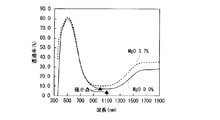
- the glass plate of Example 20 did not contain TiO 2 , the transmitted light had a blue color tone (Dw of 489).
- the transmittance of visible light (wavelength: about 400 to 800 nm) is increased.
- the relationship between Tv and Te did not show a simple tendency with respect to the MgO content.
- the MgO content was 0% or more and less than 2%. It was found that the linear function was different from that of 2% or more and less than 5%, but the linear function was different.
- the heat-absorbing glass plate of the present invention is characterized in that the transmitted light has a green color tone and satisfies the low solar radiation transmittance and the high visible light transmittance at the same time, and there are few types of coloring components included. Therefore, it is useful as a glass plate for vehicles and buildings, and is particularly suitable as a glass plate for automobiles.
- the entire contents of the description, claims, drawings, and abstract of Japanese Patent Application No. 2011-012847 filed on January 25, 2011 are incorporated herein as the disclosure of the present invention. .
Landscapes
- Chemical & Material Sciences (AREA)
- Engineering & Computer Science (AREA)
- Life Sciences & Earth Sciences (AREA)
- Chemical Kinetics & Catalysis (AREA)
- General Chemical & Material Sciences (AREA)
- Geochemistry & Mineralogy (AREA)
- Materials Engineering (AREA)
- Organic Chemistry (AREA)
- Mechanical Engineering (AREA)
- Glass Compositions (AREA)
Abstract
Priority Applications (4)
| Application Number | Priority Date | Filing Date | Title |
|---|---|---|---|
| JP2012554755A JP5867415B2 (ja) | 2011-01-25 | 2012-01-19 | 熱線吸収ガラス板およびその製造方法 |
| CN201280006229.5A CN103328397B (zh) | 2011-01-25 | 2012-01-19 | 热线吸收玻璃板及其制造方法 |
| KR1020137013745A KR20140009219A (ko) | 2011-01-25 | 2012-01-19 | 열선 흡수 유리판 및 그 제조 방법 |
| US13/950,613 US9193621B2 (en) | 2011-01-25 | 2013-07-25 | Heat-absorbing glass plate and process for its production |
Applications Claiming Priority (2)
| Application Number | Priority Date | Filing Date | Title |
|---|---|---|---|
| JP2011-012847 | 2011-01-25 | ||
| JP2011012847 | 2011-01-25 |
Related Child Applications (1)
| Application Number | Title | Priority Date | Filing Date |
|---|---|---|---|
| US13/950,613 Continuation US9193621B2 (en) | 2011-01-25 | 2013-07-25 | Heat-absorbing glass plate and process for its production |
Publications (1)
| Publication Number | Publication Date |
|---|---|
| WO2012102176A1 true WO2012102176A1 (fr) | 2012-08-02 |
Family
ID=46580748
Family Applications (1)
| Application Number | Title | Priority Date | Filing Date |
|---|---|---|---|
| PCT/JP2012/051113 Ceased WO2012102176A1 (fr) | 2011-01-25 | 2012-01-19 | Plaque en verre absorbant les rayons thermiques et son procédé de production |
Country Status (6)
| Country | Link |
|---|---|
| US (1) | US9193621B2 (fr) |
| JP (1) | JP5867415B2 (fr) |
| KR (1) | KR20140009219A (fr) |
| CN (1) | CN103328397B (fr) |
| TW (1) | TW201236994A (fr) |
| WO (1) | WO2012102176A1 (fr) |
Cited By (7)
| Publication number | Priority date | Publication date | Assignee | Title |
|---|---|---|---|---|
| US20150166401A1 (en) * | 2012-09-14 | 2015-06-18 | Asahi Glass Company, Limited | Glass for chemical strengthening and chemical strengthened glass, and manufacturing method of glass for chemical strengthening |
| WO2015163416A1 (fr) * | 2014-04-23 | 2015-10-29 | 旭硝子株式会社 | Plaque de verre coloré, et procédé de fabrication de celle-ci |
| JP2016199457A (ja) * | 2015-04-08 | 2016-12-01 | 旭硝子株式会社 | 合わせ板 |
| JPWO2015163411A1 (ja) * | 2014-04-23 | 2017-04-20 | 旭硝子株式会社 | 熱線吸収ガラス板およびその製造方法 |
| JPWO2015163412A1 (ja) * | 2014-04-23 | 2017-04-20 | 旭硝子株式会社 | 熱線吸収ガラス板およびその製造方法 |
| WO2019124453A1 (fr) * | 2017-12-19 | 2019-06-27 | Agc株式会社 | Plaque de verre |
| WO2024203958A1 (fr) * | 2023-03-29 | 2024-10-03 | Agc株式会社 | Verre |
Families Citing this family (9)
| Publication number | Priority date | Publication date | Assignee | Title |
|---|---|---|---|---|
| CN104080751A (zh) | 2012-01-27 | 2014-10-01 | 旭硝子株式会社 | 着色玻璃板及其制造方法 |
| WO2013111881A1 (fr) | 2012-01-27 | 2013-08-01 | 旭硝子株式会社 | Plaque de verre coloré, et procédé de fabrication de celle-ci |
| JP5999112B2 (ja) | 2012-01-27 | 2016-09-28 | 旭硝子株式会社 | 着色ガラス板およびその製造方法 |
| CN105814001B (zh) * | 2013-12-13 | 2019-06-18 | Agc株式会社 | 紫外线吸收性玻璃物品 |
| CN103771704B (zh) * | 2014-01-21 | 2016-01-27 | 江苏奥蓝工程玻璃有限公司 | 一种透光硬质玻璃材料及其制备方法 |
| JP6589860B2 (ja) * | 2014-05-09 | 2019-10-16 | Agc株式会社 | 熱線吸収ガラス板およびその製造方法 |
| JP6646801B2 (ja) * | 2014-05-09 | 2020-02-14 | Agc株式会社 | 熱線吸収ガラス板およびその製造方法 |
| WO2016148026A1 (fr) * | 2015-03-16 | 2016-09-22 | 旭硝子株式会社 | Article en verre et guide de lumière |
| EA034445B1 (ru) * | 2015-04-23 | 2020-02-07 | ЭйДжиСи Инк. | Поглощающее тепловое и ультрафиолетовое излучения листовое стекло и способ его получения |
Citations (4)
| Publication number | Priority date | Publication date | Assignee | Title |
|---|---|---|---|---|
| JPS60215546A (ja) * | 1984-04-06 | 1985-10-28 | Nippon Sheet Glass Co Ltd | 赤外線吸収ガラス |
| JPH08500811A (ja) * | 1992-12-23 | 1996-01-30 | サン−ゴバン ビトラージュ | 透明板ガラス製造用のガラス組成物 |
| JP2010522686A (ja) * | 2007-03-28 | 2010-07-08 | ピルキントン グループ リミテッド | ガラス組成物 |
| JP2010275144A (ja) * | 2009-05-28 | 2010-12-09 | Asahi Glass Co Ltd | プラズマディスプレイ用近赤外線吸収ガラス、プラズマディスプレイ用ガラス基板およびプラズマディスプレイ用保護板 |
Family Cites Families (9)
| Publication number | Priority date | Publication date | Assignee | Title |
|---|---|---|---|---|
| US4792536A (en) * | 1987-06-29 | 1988-12-20 | Ppg Industries, Inc. | Transparent infrared absorbing glass and method of making |
| US5593929A (en) | 1990-07-30 | 1997-01-14 | Ppg Industries, Inc. | Ultraviolet absorbing green tinted glass |
| BE1015646A3 (fr) * | 2003-08-13 | 2005-07-05 | Glaverbel | Verre a faible transmission lumineuse. |
| CN1329327C (zh) * | 2004-09-11 | 2007-08-01 | 深圳南玻浮法玻璃有限公司 | 对太阳光谱选择性吸收的绿色玻璃 |
| JP5000097B2 (ja) * | 2005-03-22 | 2012-08-15 | 日本板硝子株式会社 | 赤外線吸収グリーンガラス組成物 |
| US7678722B2 (en) * | 2005-07-29 | 2010-03-16 | Ppg Industries Ohio, Inc. | Green glass composition |
| WO2007111079A1 (fr) | 2006-03-27 | 2007-10-04 | Asahi Glass Company, Limited | Procede de fabrication de verre |
| JP2009167018A (ja) | 2006-04-26 | 2009-07-30 | Nippon Sheet Glass Co Ltd | 赤外線吸収ガラス組成物 |
| CN102596839B (zh) * | 2009-10-22 | 2016-02-10 | 旭硝子株式会社 | 热线吸收玻璃板及其制造方法 |
-
2012
- 2012-01-19 WO PCT/JP2012/051113 patent/WO2012102176A1/fr not_active Ceased
- 2012-01-19 JP JP2012554755A patent/JP5867415B2/ja active Active
- 2012-01-19 KR KR1020137013745A patent/KR20140009219A/ko not_active Withdrawn
- 2012-01-19 CN CN201280006229.5A patent/CN103328397B/zh active Active
- 2012-01-20 TW TW101102552A patent/TW201236994A/zh unknown
-
2013
- 2013-07-25 US US13/950,613 patent/US9193621B2/en active Active
Patent Citations (4)
| Publication number | Priority date | Publication date | Assignee | Title |
|---|---|---|---|---|
| JPS60215546A (ja) * | 1984-04-06 | 1985-10-28 | Nippon Sheet Glass Co Ltd | 赤外線吸収ガラス |
| JPH08500811A (ja) * | 1992-12-23 | 1996-01-30 | サン−ゴバン ビトラージュ | 透明板ガラス製造用のガラス組成物 |
| JP2010522686A (ja) * | 2007-03-28 | 2010-07-08 | ピルキントン グループ リミテッド | ガラス組成物 |
| JP2010275144A (ja) * | 2009-05-28 | 2010-12-09 | Asahi Glass Co Ltd | プラズマディスプレイ用近赤外線吸収ガラス、プラズマディスプレイ用ガラス基板およびプラズマディスプレイ用保護板 |
Cited By (15)
| Publication number | Priority date | Publication date | Assignee | Title |
|---|---|---|---|---|
| US20150166401A1 (en) * | 2012-09-14 | 2015-06-18 | Asahi Glass Company, Limited | Glass for chemical strengthening and chemical strengthened glass, and manufacturing method of glass for chemical strengthening |
| US9963378B2 (en) * | 2012-09-14 | 2018-05-08 | Asahi Glass Company, Limited | Glass for chemical strengthening and chemical strengthened glass, and manufacturing method of glass for chemical strengthening |
| US9862636B2 (en) | 2014-04-23 | 2018-01-09 | Asahi Glass Company, Limited | Heat-ray-absorbing glass plate and method for producing same |
| JPWO2015163411A1 (ja) * | 2014-04-23 | 2017-04-20 | 旭硝子株式会社 | 熱線吸収ガラス板およびその製造方法 |
| JPWO2015163412A1 (ja) * | 2014-04-23 | 2017-04-20 | 旭硝子株式会社 | 熱線吸収ガラス板およびその製造方法 |
| JPWO2015163416A1 (ja) * | 2014-04-23 | 2017-04-20 | 旭硝子株式会社 | 着色ガラス板およびその製造方法 |
| US9862637B2 (en) | 2014-04-23 | 2018-01-09 | Asahi Glass Company, Limited | Heat-ray-absorbing glass plate and method for producing same |
| WO2015163416A1 (fr) * | 2014-04-23 | 2015-10-29 | 旭硝子株式会社 | Plaque de verre coloré, et procédé de fabrication de celle-ci |
| US10011521B2 (en) | 2014-04-23 | 2018-07-03 | Asahi Glass Company, Limited | Colored glass plate and method for manufacturing same |
| JP2016199457A (ja) * | 2015-04-08 | 2016-12-01 | 旭硝子株式会社 | 合わせ板 |
| WO2019124453A1 (fr) * | 2017-12-19 | 2019-06-27 | Agc株式会社 | Plaque de verre |
| JPWO2019124453A1 (ja) * | 2017-12-19 | 2020-12-10 | Agc株式会社 | ガラス板 |
| JP7127654B2 (ja) | 2017-12-19 | 2022-08-30 | Agc株式会社 | ガラス板 |
| US11459267B2 (en) | 2017-12-19 | 2022-10-04 | AGC Inc. | Glass plate |
| WO2024203958A1 (fr) * | 2023-03-29 | 2024-10-03 | Agc株式会社 | Verre |
Also Published As
| Publication number | Publication date |
|---|---|
| CN103328397B (zh) | 2016-05-18 |
| US20130306900A1 (en) | 2013-11-21 |
| CN103328397A (zh) | 2013-09-25 |
| KR20140009219A (ko) | 2014-01-22 |
| TW201236994A (en) | 2012-09-16 |
| JPWO2012102176A1 (ja) | 2014-06-30 |
| JP5867415B2 (ja) | 2016-02-24 |
| US9193621B2 (en) | 2015-11-24 |
Similar Documents
| Publication | Publication Date | Title |
|---|---|---|
| JP5867415B2 (ja) | 熱線吸収ガラス板およびその製造方法 | |
| JP5853700B2 (ja) | 熱線吸収ガラス板およびその製造方法 | |
| CN107531556A (zh) | 热线以及紫外线吸收玻璃板、及其制造方法 | |
| JP5999111B2 (ja) | 着色ガラス板およびその製造方法 | |
| EP3141531B1 (fr) | Plaque en verre absorbant les rayons thermiques et son procédé de production | |
| JP5999112B2 (ja) | 着色ガラス板およびその製造方法 | |
| JP5999110B2 (ja) | 着色ガラス板およびその製造方法 | |
| JP6561983B2 (ja) | 熱線吸収ガラス板およびその製造方法 | |
| US9862637B2 (en) | Heat-ray-absorbing glass plate and method for producing same | |
| US9957189B2 (en) | Heat-absorbing glass plate and method for manufacturing same | |
| JP7127654B2 (ja) | ガラス板 |
Legal Events
| Date | Code | Title | Description |
|---|---|---|---|
| 121 | Ep: the epo has been informed by wipo that ep was designated in this application |
Ref document number: 12739484 Country of ref document: EP Kind code of ref document: A1 |
|
| ENP | Entry into the national phase |
Ref document number: 2012554755 Country of ref document: JP Kind code of ref document: A |
|
| ENP | Entry into the national phase |
Ref document number: 20137013745 Country of ref document: KR Kind code of ref document: A |
|
| NENP | Non-entry into the national phase |
Ref country code: DE |
|
| 122 | Ep: pct application non-entry in european phase |
Ref document number: 12739484 Country of ref document: EP Kind code of ref document: A1 |