WO2012102210A1 - Composition de gel et son utilisation - Google Patents
Composition de gel et son utilisation Download PDFInfo
- Publication number
- WO2012102210A1 WO2012102210A1 PCT/JP2012/051250 JP2012051250W WO2012102210A1 WO 2012102210 A1 WO2012102210 A1 WO 2012102210A1 JP 2012051250 W JP2012051250 W JP 2012051250W WO 2012102210 A1 WO2012102210 A1 WO 2012102210A1
- Authority
- WO
- WIPO (PCT)
- Prior art keywords
- gel
- glycyrrhizic acid
- solution
- gel composition
- drug
- Prior art date
- Legal status (The legal status is an assumption and is not a legal conclusion. Google has not performed a legal analysis and makes no representation as to the accuracy of the status listed.)
- Ceased
Links
Images

Classifications
-
- A—HUMAN NECESSITIES
- A61—MEDICAL OR VETERINARY SCIENCE; HYGIENE
- A61K—PREPARATIONS FOR MEDICAL, DENTAL OR TOILETRY PURPOSES
- A61K9/00—Medicinal preparations characterised by special physical form
- A61K9/06—Ointments; Bases therefor; Other semi-solid forms, e.g. creams, sticks, gels
-
- A—HUMAN NECESSITIES
- A61—MEDICAL OR VETERINARY SCIENCE; HYGIENE
- A61K—PREPARATIONS FOR MEDICAL, DENTAL OR TOILETRY PURPOSES
- A61K47/00—Medicinal preparations characterised by the non-active ingredients used, e.g. carriers or inert additives; Targeting or modifying agents chemically bound to the active ingredient
- A61K47/06—Organic compounds, e.g. natural or synthetic hydrocarbons, polyolefins, mineral oil, petrolatum or ozokerite
- A61K47/16—Organic compounds, e.g. natural or synthetic hydrocarbons, polyolefins, mineral oil, petrolatum or ozokerite containing nitrogen, e.g. nitro-, nitroso-, azo-compounds, nitriles, cyanates
- A61K47/18—Amines; Amides; Ureas; Quaternary ammonium compounds; Amino acids; Oligopeptides having up to five amino acids
Definitions
- the present invention relates to a novel gel composition particularly useful as a carrier for sustained-release preparations and uses thereof.
- Subcutaneous administration of a drug reaches its maximum blood concentration immediately after administration, so that its bioavailability is almost 100%, while side effects due to drug absorption at the highest blood concentration are likely to occur, and the action time There is a problem that it is almost as short as intravenous administration. Therefore, there is a particular need for drug release control that maintains a predetermined blood concentration after administration for a predetermined time.
- a sustained-release preparation using a matrix (gel), particularly a biodegradable polymer matrix has been developed.
- the polymer matrix is a polymer matrix (polymer gel) that absorbs a solvent and swells in a three-dimensional network structure that is physically and / or chemically formed by crosslinking of polymer chains.
- a blood concentration profile that maintains sustained drug concentration and drug absorption can be designed.
- a biodegradable polymer for example, a block copolymer of biodegradable polyester and hydrophilic polyethylene glycol has been proposed (Patent Document 1).
- Patent Document 1 a block copolymer of biodegradable polyester and hydrophilic polyethylene glycol has been proposed.
- a microencapsulated preparation in which the anticancer agent leuprorelin is encapsulated in a cross-linked matrix of a copolymer of poly (lactic-co-glycolic acid) (PLGA) of lactic acid and glycolic acid There is Leuprin (registered trademark).
- the present invention provides a gel composition that can easily form a matrix in a non-organic solvent, can be easily encapsulated, and can be used to prepare a sustained-release preparation. The purpose is to do.
- the present inventor has intensively studied a substance that can be applied to a living body and can form a matrix in an aqueous medium as a method capable of preparing a sustained-release preparation at the time of use. It has been found that an aqueous solution containing an acid and a cationic substance can form a matrix (hydrogel). Glycyrrhizic acid is a substance that has been proven intravenously. Gelation at a high concentration is described in the package insert of an injection, but no gel formation at a low concentration has been reported so far. In particular, the above hydrogel exhibits a specific behavior (thixotropy) that exhibits fluidity when a force is applied.
- a gel composition containing a complex of glycyrrhizic acid and a cationic substance (2) The gel composition according to (1), wherein the cationic substance is a nitrogen-containing compound. (3) The gel composition according to (2), wherein the nitrogen-containing compound is at least one selected from the group consisting of thiamine, arginine, glucosamine, histidine, and lysine ethyl ester. (4) The gel composition according to any one of (1) to (3), wherein the molar ratio of the glycyrrhizic acid and the cationic substance is 0.1 to 10. (5) The gel composition according to any one of (1) to (4), wherein the complex is prepared from a homogeneous aqueous solution of glycyrrhizic acid at 1 to 6 ⁇ mol / mL.
- kits for preparing a gel composition according to claim 1 comprising (a) a homogeneous aqueous solution of glycyrrhizic acid and (b) an aqueous solution of a cationic substance as individual elements. (7) The kit according to (6), wherein (a) contains glycyrrhizic acid in an amount of 1 to 6 ⁇ mol / mL.
- a pharmaceutical carrier comprising the gel composition according to any one of (1) to (5) above.
- a gel preparation comprising the carrier of (8) above and an active ingredient.
- the gel is a physical gel that uses intermolecular interactions such as hydrogen bonds, electrostatic interactions, and coordinate bonds as a driving force for crosslinking formation. It is guessed. Specifically, it is presumed that this is caused by forming an ion complex with at least a cationic substance and further forming a hydrogen bond between glycyrrhizic acids or other molecules having a hydroxyl group.
- physical gel formation in low molecular weight compounds that do not have entangled chain structures such as polymers (high molecular weight compounds) is now self-assembled into low molecular weight fibers due to intermolecular interactions.
- the gel composition according to the present invention can prepare a gel easily and simply by mixing an aqueous solution of glycyrrhizic acid and an aqueous solution of a cationic substance. For this reason, the gel can be prepared at the time of use in the medical field. Further, it contains a complex of glycyrrhizic acid that has been confirmed to be applicable to living bodies, and can be used as a gel matrix for encapsulating a drug, that is, a pharmaceutical carrier. In addition, since the drug can be encapsulated in the gel matrix at the time of use, there are few restrictions on the type and number, and the degree of freedom of the drug is extremely high. Furthermore, the gel of the present invention is particularly useful as a carrier for injections because of its specificity that exhibits fluidity when pressurized. The preparation provided by the present invention can realize sustained release of a drug, and can further control the release thereof.
- the gel composition according to the present invention contains a complex of glycyrrhizic acid and a cationic substance.
- This gel can have a plurality of mechanisms depending on the number of functional groups of the cationic substance.
- a cationic substance has a plurality of cationic functional groups
- an ion complex in which two kinds of molecules are connected in a fibrous form is formed by electrostatic interaction between the carboxyl group of glycyrrhizic acid and the cationic functional group Conceivable. It is thought that this ion complex forms a gel by being entangled three-dimensionally.
- an ionic complex of glycyrrhizic acid and a cationic substance forms a fibrous molecular aggregate by hydrogen bonding or hydrophobic interaction, which is entangled three-dimensionally. This is thought to form a gel.
- the gel formed in the present invention is a hydrogel, and can be prepared by mixing (a) a homogeneous aqueous solution of glycyrrhizic acid and (b) an aqueous solution of a cationic substance.
- Glycyrrhizic acid is a substance that has been intravenously administered as a drug and has been recognized for bioapplicability.
- (A) Either glycyrrhizic acid or glycyrrhizinate can be used to prepare a homogeneous aqueous solution of glycyrrhizic acid. Examples of glycyrrhizinate include potassium salt, ammonium salt, sodium salt, and among them, ammonium salt is preferable.
- the aqueous solution (a) is a homogeneous aqueous solution of glycyrrhizic acid, and preferably has a concentration that does not form a gel per se, and preferably has a low viscosity.
- a high-concentration glycyrrhizic acid aqueous solution of 200 mg / mL or more is supposed to gel by itself.
- the aqueous solution of glycyrrhizic acid used as an injection for allergy / liver disease has a concentration of 2 mg / mL and does not contain a gel, but at a high concentration, it is known to exhibit weak self-crosslinking even in an acidic aqueous solution.
- glycyrrhizic acid preparations that gelation may occur when the hot aqueous solution is acidified.
- concentration is too low, it is difficult to produce a gel that is strong enough to be used as a carrier, and therefore a concentration of 1 ⁇ mol / mL or more is preferable.
- the cationic substance is not particularly limited as long as it is compatible with a living body and forms a complex with glycyrrhizic acid to form a gel.
- basic water-soluble vitamins, basic amino acids and amino acid derivatives, amino sugars, aminoglycoside glycosides, vinca alkaloids, pyridonecarboxylic acid synthetic antibacterial drugs, and fine particle carriers such as liposomes and polymer micelles with positive charge Various forms such as are also mentioned.
- a cationic substance usually includes a nitrogen-containing compound, and nitrogen may be contained in any bond form such as ring member nitrogen or chain member nitrogen. A substance having at least one amino group is preferably mentioned.
- (b) as the cationic substance thiamine, arginine, glucosamine, histidine and lysine ethyl ester are preferably mentioned. Substances are more preferred.
- the cationic substance can be contained singly or in combination of two or more.
- the drug (active ingredient) to be included in the preparation is a cationic substance, this can also be referred to as (b).
- the concentration of the aqueous solution of the cationic substance varies depending on the species and is not particularly limited as long as it is a homogeneous aqueous solution, and may be appropriately prepared to such an extent that there is no inconvenience in work such as too high viscosity.
- the ratio of (a) glycyrrhizic acid and (b) cationic substance tends to increase the gel strength as the ratio of (b) cationic substance increases. Therefore, in the present invention, it can be appropriately set according to the desired release control in the final formulation, but usually (a) the molar ratio of (b) cationic substance to glycyrrhizic acid ((b) / (A)) is 0.5-10.
- At least one of the groups capable of molecular interaction with the cationic substance glycyrrhizic acid is a group capable of forming an ion complex with glycyrrhizic acid.
- the cationic substance is thiamine
- two of the N-containing groups in thiamine are ion-bonding and the terminal hydroxyl group is hydrogen-bonding to three COOHs of glycyrrhizic acid.
- This thiamine is necessary as a carrier when the molar ratio, that is, 0.5 mole of thiamine, that is, an ion-binding N-containing group is present in a ratio of 1 mole equivalent or more with respect to the above mole ratio, that is, 1 mole of glycyrrhizic acid, as shown in the examples described later A strong gel.
- the present invention can provide a gel composition preparation kit containing (a) and (b) as individual elements.
- the cationic substance is a thiamine, arginine, glucosamine, histidine, lysine ethyl ester or the like that is not a drug (active ingredient)
- the concentration is usually soluble at room temperature (up to a concentration close to solubility).
- the gel composition according to the present invention comprises components that have been applied to living organisms, and is useful as a carrier, in particular, a gel carrier for pharmaceutical preparations, that is, a matrix for controlling release by encapsulating a drug.
- a gel carrier for pharmaceutical preparations that is, a matrix for controlling release by encapsulating a drug.
- the drug is encapsulated if (a) or (b) the drug is included (dissolved or dispersed) in the aqueous solution before mixing (a) and (b).
- a gel can be formed.
- the drug itself may be contained in either the aqueous solution (a) or (b), or may be contained in one or both.
- the drug is not limited to a single type, and a plurality of types of drugs can be included, and in this case, which aqueous solution (a) or (b) is included is not particularly limited. If the drug is cationic, only it may be used as (b) a cationic substance, or a cationic substance that is not a drug (active ingredient) may be used in combination. As described above, in the present invention, since a gel can be generated without requiring special heating, a preparation can be prepared without giving a heat history to the encapsulated drug, which is extremely useful as a preparation carrier.
- the drug itself is not particularly limited as long as it is generally handled as a pharmaceutical product, and may be a fine particle carrier such as a liposome. Since the preparation according to the present invention can be prepared at the time of use, even a drug with low storage stability in an aqueous solution can be encapsulated, and release control can be performed for a wide range of drugs. From the fluidity of the gel composition according to the present invention, it is suitable for injection and allows controlled release by subcutaneous administration.
- Example 1 Gel formation test 1 The gel formation between glycyrrhizic acid and various cationic substances was investigated. Add 75 mg of monoammonium glycyrrhizinate (molecular weight 839.96) to 15 mL of water and completely dissolve in a 50 ° C. constant temperature bath to prepare a 5 mg / mL (5.95 ⁇ mol / mL) solution, which is diluted 2 times Thus, a 2.5 mg / mL solution was prepared. Each solution prepared here is hereinafter referred to as a glycyrrhizic acid solution.
- Example 2 Gel formation test 2
- the cationic substance of Sample 5 in Example 1 was subjected to a more detailed experiment in which the molar ratio with respect to glycyrrhizic acid was changed.
- 3 g of thiamine chloride hydrochloride was completely dissolved in 4 mL of water and then diluted stepwise to prepare six types (500, 400, 250, 100, 50, 25 mg / mL) of thiamine solutions.
- Example 2 To each 40 ⁇ L of the thiamine solution, 1 mL of the same 5 mg / mL (5.95 ⁇ mol / mL) glycyrrhizic acid solution as in Example 1 was added, and thiamine was used in an amount of 0.5 to 10 mol with respect to 1 mol of glycyrrhizic acid. Except for this, the procedure was the same as in Example 1. About each sample from which thiamine molar ratio differs, what lose
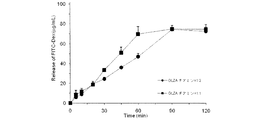
- Example 3 Release Test 1 ⁇ Material> (A) 50 mg of monoammonium glycyrrhizinate (GLZA) was added to 10 mL of water, and a 5 mg / mL (5.95 ⁇ mol / mL) glycyrrhizic acid solution was prepared in the same manner as in Example 1.
- GLZA monoammonium glycyrrhizinate
- FITC-Dex (C) was dissolved in the above-mentioned 100 mg / mL thiamine solution (B) in an amount of 10 mg / mL to prepare a FITC-Dex / thiamine solution.
- FITC-Dex ⁇ Quantification of FITC-Dex>
- the sample collected above was diluted 10 times with PBS to obtain a measurement solution.
- the emission intensity was measured at an excitation wavelength of 490 nm and a fluorescence wavelength of 520 nm using a fluorescence plate reader (Spectra Max Gemini EM), and the FITC-Dex concentration contained in PBS was calculated from a calibration curve.
- Calibration curves were prepared by preparing 720 ⁇ g / mL FITC-Dex / PBS solution (concentrated solution) in which FITC-Dex was dissolved in PBS, and standard solutions of 6 concentrations by serial dilution of concentrated solution with PBS. .
- the result of the release test 1 is shown in FIG.
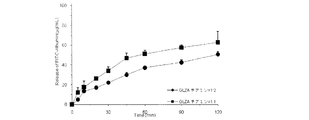
- FIG. 2 shows the results of quantification in the same manner as in Example 3 except that the standard solution for preparing the calibration curve was prepared in a FITC-Dex / PBS concentrated solution at 1.36 mg / mL.
- Example 5 Release test 3 Whether or not the drug to be encapsulated has a higher-order structure such as a protein, the same sustained release as that of a drug without a higher-order structure was observed.
- ⁇ Material> (A) 12 mL of water was added to 60 mg of monoammonium glycyrrhizinate (GLZA), and a 5 mg / mL (5.95 ⁇ mol / mL) glycyrrhizic acid solution was prepared in the same manner as in Example 1.
- ⁇ Gel preparation> 100 mg / mL thiamine solution (B) and FITC-albumin 10 mg / mL aqueous solution (C) were mixed in the same amount of 0.5 mL to prepare a FITC-albumin / thiamine solution.
- FITC-albumin ⁇ Quantification of FITC-albumin>
- the sample collected above was diluted 10 times with PBS to obtain a measurement solution.
- emission intensity was measured at an excitation wavelength of 490 nm and a fluorescence wavelength of 520 nm using a fluorescence plate reader (Spectra Max Gemini EM), and the concentration of FITC-albumin contained in PBS was calculated from a calibration curve.
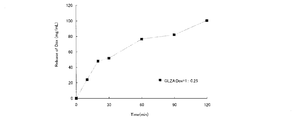
- a calibration curve was prepared using standard solutions of six concentrations prepared by serial dilution of a 10 mg / mL aqueous solution of FITC-albumin and further diluted 10-fold with PBS. The results are shown in FIG.
- FITC-albumin also exhibits a sustained release effect, and it can be confirmed that the gel preparation of the present invention can be controlled even when a drug having a higher-order structure such as a protein is contained. It was.
- Detector UV absorptiometer (measurement wavelength: 254 mm)
- Column Stainless steel tube (inner diameter 4.6 mm, 25 cm length) packed with 5 ⁇ m octadecylsilylated silica gel for liquid chromatography (manufactured by GL Sciences: Inertsil ODS-2)
- Column temperature 40 ° C
- Mobile phase 1.5 g sodium lauryl sulfate / diluted (7 ⁇ 5000) phosphoric acid 500 mL + acetonitrile 500 mL
- Flow rate 1.0 mL / min
- Injection volume 20 ⁇ L ⁇ Calibration curve>
- a 2 mg doxorubicin hydrochloride / mL-PBS solution was serially diluted to prepare 5 types of standard solutions having different concentrations.
Landscapes
- Health & Medical Sciences (AREA)
- Life Sciences & Earth Sciences (AREA)
- Chemical & Material Sciences (AREA)
- General Health & Medical Sciences (AREA)
- Public Health (AREA)
- Veterinary Medicine (AREA)
- Animal Behavior & Ethology (AREA)
- Epidemiology (AREA)
- Medicinal Chemistry (AREA)
- Pharmacology & Pharmacy (AREA)
- Engineering & Computer Science (AREA)
- Oil, Petroleum & Natural Gas (AREA)
- Proteomics, Peptides & Aminoacids (AREA)
- Chemical Kinetics & Catalysis (AREA)
- General Chemical & Material Sciences (AREA)
- Pharmaceuticals Containing Other Organic And Inorganic Compounds (AREA)
- Medicinal Preparation (AREA)
Abstract
La présente invention concerne une composition de gel, qui est apte à former facilement une matrice (gel) dans un solvant non-organique et à encapsuler facilement un médicament à l'intérieur, et qui est apte à former une préparation à libération prolongée au moment de son utilisation. L'invention porte en outre sur l'utilisation de ladite composition de gel. L'invention a également trait à une composition de gel qui contient un complexe d'acide glycyrrhizique et une substance cationique. L'invention concerne également un vecteur pour des préparations, formé de la composition de gel, et une préparation de gel contenant ledit vecteur et un principe actif.
Applications Claiming Priority (2)
| Application Number | Priority Date | Filing Date | Title |
|---|---|---|---|
| JP2011012917 | 2011-01-25 | ||
| JP2011-012917 | 2011-01-25 |
Publications (1)
| Publication Number | Publication Date |
|---|---|
| WO2012102210A1 true WO2012102210A1 (fr) | 2012-08-02 |
Family
ID=46580778
Family Applications (1)
| Application Number | Title | Priority Date | Filing Date |
|---|---|---|---|
| PCT/JP2012/051250 Ceased WO2012102210A1 (fr) | 2011-01-25 | 2012-01-20 | Composition de gel et son utilisation |
Country Status (1)
| Country | Link |
|---|---|
| WO (1) | WO2012102210A1 (fr) |
Cited By (5)
| Publication number | Priority date | Publication date | Assignee | Title |
|---|---|---|---|---|
| WO2015145860A1 (fr) * | 2014-03-28 | 2015-10-01 | テルモ株式会社 | Liquide pour le remplacement in vivo de sang intravasculaire, préparation liquide pour le remplacement in vivo de sang intravasculaire, et seringue préremplie |
| WO2017082121A1 (fr) | 2015-11-12 | 2017-05-18 | テルモ株式会社 | Agent administré par voie topique à libération prolongée |
| JPWO2016152186A1 (ja) * | 2015-03-25 | 2018-01-11 | テルモ株式会社 | ゲル状局所麻酔剤およびそれを用いたゲル状局所麻酔製剤 |
| CN108929358A (zh) * | 2017-05-26 | 2018-12-04 | 北京医院 | 精氨酸甘草甜素及其制备方法和用途 |
| CN116725883A (zh) * | 2023-04-07 | 2023-09-12 | 伊美莱(广州)医疗技术有限公司 | 水凝胶及其制备方法和应用 |
Citations (3)
| Publication number | Priority date | Publication date | Assignee | Title |
|---|---|---|---|---|
| JPH1118696A (ja) * | 1997-07-09 | 1999-01-26 | Toyo Beauty Kk | 含油ゲル状組成物及び水中油型乳化組成物 |
| JP2006169212A (ja) * | 2004-12-20 | 2006-06-29 | Pola Chem Ind Inc | ゲル状組成物 |
| JP2011173862A (ja) * | 2010-02-01 | 2011-09-08 | Lion Corp | 皮膚洗浄料組成物 |
-
2012
- 2012-01-20 WO PCT/JP2012/051250 patent/WO2012102210A1/fr not_active Ceased
Patent Citations (3)
| Publication number | Priority date | Publication date | Assignee | Title |
|---|---|---|---|---|
| JPH1118696A (ja) * | 1997-07-09 | 1999-01-26 | Toyo Beauty Kk | 含油ゲル状組成物及び水中油型乳化組成物 |
| JP2006169212A (ja) * | 2004-12-20 | 2006-06-29 | Pola Chem Ind Inc | ゲル状組成物 |
| JP2011173862A (ja) * | 2010-02-01 | 2011-09-08 | Lion Corp | 皮膚洗浄料組成物 |
Non-Patent Citations (1)
| Title |
|---|
| KENJIRO KOGA ET AL.: "Basic Study on Development of Glycyrrhizin Formulations for Self Administration", IRYO YAKUGAKU, vol. 32, no. 5, 10 May 2006 (2006-05-10), pages 414 - 419 * |
Cited By (8)
| Publication number | Priority date | Publication date | Assignee | Title |
|---|---|---|---|---|
| WO2015145860A1 (fr) * | 2014-03-28 | 2015-10-01 | テルモ株式会社 | Liquide pour le remplacement in vivo de sang intravasculaire, préparation liquide pour le remplacement in vivo de sang intravasculaire, et seringue préremplie |
| JPWO2015145860A1 (ja) * | 2014-03-28 | 2017-04-13 | テルモ株式会社 | 生体血管内血液置換用液体、生体血管内血液置換用液体製剤およびプレフィルドシリンジ |
| US10376601B2 (en) | 2014-03-28 | 2019-08-13 | Terumo Kabushiki Kaisha | In-vivo intravascular blood replacing liquid, in-vivo intravascular blood replacing liquid formulation, and prefilled syringe |
| JPWO2016152186A1 (ja) * | 2015-03-25 | 2018-01-11 | テルモ株式会社 | ゲル状局所麻酔剤およびそれを用いたゲル状局所麻酔製剤 |
| US10517859B2 (en) | 2015-03-25 | 2019-12-31 | Terumo Kabushiki Kaisha | Gel local anesthetic agent and gel local anesthetic preparation using same |
| WO2017082121A1 (fr) | 2015-11-12 | 2017-05-18 | テルモ株式会社 | Agent administré par voie topique à libération prolongée |
| CN108929358A (zh) * | 2017-05-26 | 2018-12-04 | 北京医院 | 精氨酸甘草甜素及其制备方法和用途 |
| CN116725883A (zh) * | 2023-04-07 | 2023-09-12 | 伊美莱(广州)医疗技术有限公司 | 水凝胶及其制备方法和应用 |
Similar Documents
| Publication | Publication Date | Title |
|---|---|---|
| Lee et al. | Long acting injectable formulations: the state of the arts and challenges of poly (lactic-co-glycolic acid) microsphere, hydrogel, organogel and liquid crystal | |
| US7691408B2 (en) | Composition having gelling properties for the prolonged delivery of bioactive substances | |
| ES2204837T3 (es) | Metodo para la preparacion de microesferas que contienen sistemas coloidales. | |
| ES2685743T3 (es) | Procedimiento para la fabricación de nanopartículas cargadas con principio activo | |
| US9750687B2 (en) | Substance-encapsulating vesicle and process for producing the same | |
| US9084727B2 (en) | Methods and compositions for maintaining active agents in intra-articular spaces | |
| Kim et al. | Surgical suture releasing macrophage-targeted drug-loaded nanoparticles for an enhanced anti-inflammatory effect | |
| Aminabhavi et al. | Production of chitosan-based hydrogels for biomedical applications | |
| WO2012102210A1 (fr) | Composition de gel et son utilisation | |
| KR102067490B1 (ko) | 서방성 약물전달용 온도상전이 나노 입자/하이드로젤 복합체 | |
| Andrianov et al. | Microneedles with intrinsic immunoadjuvant properties: microfabrication, protein stability, and modulated release | |
| CN102552215A (zh) | 微囊冻干粉及其制备方法 | |
| US20080008755A1 (en) | Pharmaceutical formulation of cholanic acid-chitosan complex incorporated with hydrophobic anticancer drugs and preparation method thereof | |
| Toledo et al. | Binary medical nanofluids by combination of polymeric Eudragit nanoparticles for vehiculization of tobramycin and resveratrol: Antimicrobial, hemotoxicity and protein corona studies | |
| US9180195B2 (en) | Controlled release gels | |
| Wang et al. | Nanoparticle-hydrogel systems containing platensimycin for local treatment of methicillin-resistant staphylococcus aureus infection | |
| CN1579552A (zh) | 含有聚合物组装胶束的经皮或黏膜给药系统 | |
| Feng et al. | Natural hydrogels applied in photodynamic therapy | |
| Rodríguez-Acosta et al. | Polymer-dendrimer hybrids as carriers of anticancer agents | |
| KR102535343B1 (ko) | 히알루론산 유도체의 교차결합에 의한 약물 서방출성 하이드로겔 | |
| KR100831391B1 (ko) | pH 민감성 이미다졸 그룹을 함유한 키토산 복합체 및 그제조방법 | |
| Menikarachchi et al. | Release behaviour of amoxicillin from chitosan coated liposomes derived from eggs | |
| US20050031650A1 (en) | Composition with gelling properties for the sustained delivery of bioactive substances | |
| Wang et al. | A hybrid thermo-sensitive chitosan gel for sustained release of Meloxicam | |
| Yoshizaki et al. | Sustained drug-releasing systems using temperature-responsive injectable polymers containing liposomes |
Legal Events
| Date | Code | Title | Description |
|---|---|---|---|
| 121 | Ep: the epo has been informed by wipo that ep was designated in this application |
Ref document number: 12739719 Country of ref document: EP Kind code of ref document: A1 |
|
| NENP | Non-entry into the national phase |
Ref country code: DE |
|
| 122 | Ep: pct application non-entry in european phase |
Ref document number: 12739719 Country of ref document: EP Kind code of ref document: A1 |
|
| NENP | Non-entry into the national phase |
Ref country code: JP |