WO2012102444A1 - 계층적 퍼지 추론에 기반한 임상진단 지원방법 및 그 시스템 - Google Patents
계층적 퍼지 추론에 기반한 임상진단 지원방법 및 그 시스템 Download PDFInfo
- Publication number
- WO2012102444A1 WO2012102444A1 PCT/KR2011/005664 KR2011005664W WO2012102444A1 WO 2012102444 A1 WO2012102444 A1 WO 2012102444A1 KR 2011005664 W KR2011005664 W KR 2011005664W WO 2012102444 A1 WO2012102444 A1 WO 2012102444A1
- Authority
- WO
- WIPO (PCT)
- Prior art keywords
- clinical
- fuzzy
- item
- inference
- hierarchical
- Prior art date
- Legal status (The legal status is an assumption and is not a legal conclusion. Google has not performed a legal analysis and makes no representation as to the accuracy of the status listed.)
- Ceased
Links
Images


Classifications
-
- G—PHYSICS
- G06—COMPUTING OR CALCULATING; COUNTING
- G06N—COMPUTING ARRANGEMENTS BASED ON SPECIFIC COMPUTATIONAL MODELS
- G06N5/00—Computing arrangements using knowledge-based models
- G06N5/04—Inference or reasoning models
- G06N5/048—Fuzzy inferencing
-
- E—FIXED CONSTRUCTIONS
- E05—LOCKS; KEYS; WINDOW OR DOOR FITTINGS; SAFES
- E05B—LOCKS; ACCESSORIES THEREFOR; HANDCUFFS
- E05B63/00—Locks or fastenings with special structural characteristics
- E05B63/16—Locks or fastenings with special structural characteristics with the handles on opposite sides moving independently
-
- G—PHYSICS
- G06—COMPUTING OR CALCULATING; COUNTING
- G06N—COMPUTING ARRANGEMENTS BASED ON SPECIFIC COMPUTATIONAL MODELS
- G06N7/00—Computing arrangements based on specific mathematical models
- G06N7/02—Computing arrangements based on specific mathematical models using fuzzy logic
-
- G—PHYSICS
- G16—INFORMATION AND COMMUNICATION TECHNOLOGY [ICT] SPECIALLY ADAPTED FOR SPECIFIC APPLICATION FIELDS
- G16H—HEALTHCARE INFORMATICS, i.e. INFORMATION AND COMMUNICATION TECHNOLOGY [ICT] SPECIALLY ADAPTED FOR THE HANDLING OR PROCESSING OF MEDICAL OR HEALTHCARE DATA
- G16H50/00—ICT specially adapted for medical diagnosis, medical simulation or medical data mining; ICT specially adapted for detecting, monitoring or modelling epidemics or pandemics
- G16H50/20—ICT specially adapted for medical diagnosis, medical simulation or medical data mining; ICT specially adapted for detecting, monitoring or modelling epidemics or pandemics for computer-aided diagnosis, e.g. based on medical expert systems
-
- G—PHYSICS
- G16—INFORMATION AND COMMUNICATION TECHNOLOGY [ICT] SPECIALLY ADAPTED FOR SPECIFIC APPLICATION FIELDS
- G16H—HEALTHCARE INFORMATICS, i.e. INFORMATION AND COMMUNICATION TECHNOLOGY [ICT] SPECIALLY ADAPTED FOR THE HANDLING OR PROCESSING OF MEDICAL OR HEALTHCARE DATA
- G16H70/00—ICT specially adapted for the handling or processing of medical references
- G16H70/60—ICT specially adapted for the handling or processing of medical references relating to pathologies
-
- G—PHYSICS
- G16—INFORMATION AND COMMUNICATION TECHNOLOGY [ICT] SPECIALLY ADAPTED FOR SPECIFIC APPLICATION FIELDS
- G16Z—INFORMATION AND COMMUNICATION TECHNOLOGY [ICT] SPECIALLY ADAPTED FOR SPECIFIC APPLICATION FIELDS, NOT OTHERWISE PROVIDED FOR
- G16Z99/00—Subject matter not provided for in other main groups of this subclass
Definitions
- the present invention relates to a method and system for supporting clinical diagnosis, and to a method for supporting clinical diagnosis based on fuzzy inference technology for minimizing the number of error classification patterns in an intermediate layer for improving the classification capability of hierarchical fuzzy inference. And to the system.
- the design of a fuzzy system is generally in a time-consuming activity related to knowledge generation, the reduction of the total number of rules, and the modification of related parameters. All of this affects the accuracy and comprehension of the fuzzy system.
- Hierarchical fuzzy systems yield results that are convinced that they are useful for overcoming computational explosion problems in standard fuzzy systems, and also include advanced approaches for optimizing parameters in nonlinear processes.
- An object of the present invention for solving the above problems is to provide a schema of a hierarchical fuzzy classification system based on statistical characteristics. Another object of the present invention is to provide a method and a system for minimizing the number of misclassification patterns in an intermediate layer to improve the classification capability of a hierarchical fuzzy classification system.
- a first aspect of the present invention for solving the above-mentioned problems is (a) extracting test data of a plurality of test items for each of a plurality of patients from each test item database; (b) selecting a feature from inspection data of each inspection item; (c) hierarchical fuzzy inference of the inspection data for which the feature is selected for each item; (d) extracting the test findings for each disease based on the fuzzy inferred output value for each item; And (e) comprehensively evaluating clinically based on each finding.
- the test item is preferably a blood test, urine test and radiological reading test
- the step (b) the step of marking the clinical diagnostic results for each test data; And calculating a cut-off value for determining a clinical diagnosis for each test item.
- the step (c) is a hierarchical input / output structure of a plurality of fuzzy systems, in which a new input is inputted with an output of one fuzzy system and another inspection data for inputting inspection data of each inspection item.
- the input of the purge system may be at least three or more.
- the step (c) may further include: performing fuzzy space partitioning on input data of inspection data of each inspection item in each purge system; And generating clinical diagnosis knowledge from the divided data, wherein the division of the fuzzy space is divided into a normal group and an abnormal group through a statistical distribution of the test data. It is desirable to.
- the generation of the clinical diagnostic knowledge the step of generating a first clinical diagnostic knowledge from the divided data; And generating a second clinical diagnosis knowledge applied to a fuzzy system for each layer by applying an algorithm for avoiding collision between the first clinical diagnosis knowledge.
- Step (e) comprises the steps of: extracting clinical features and criteria presented in each inference layer; Extracting an abnormal case from the data of each inference layer; And making comprehensive clinical inferences based on the features, criteria, and abnormal cases.
- the second aspect of the present invention provides a method for performing the above-described method, comprising: an inspection database storing at least one inspection data according to a plurality of items; A preprocessor for selecting the feature data for each item from the database; A fuzzy inference unit that performs hierarchical fuzzy inference by inputting the feature data of each item; And a comprehensive evaluation unit for comprehensive clinical evaluation based on the test findings for each item extracted through the fuzzy inference.
- the comprehensive evaluation unit it is preferable to provide a characteristic and clinical criteria through the output value of each inference layer, it is preferable to extract the abnormal case through the output value of each inference layer.
- the present invention provides hierarchical and comprehensive clinical inference results using hierarchical fuzzy inference technology, thereby providing a method of inferring the most suitable disease by identifying the state of emergency patients.
- the accuracy can be improved.
- the main parameters, clinical criteria, and optimized knowledge for differential diagnosis by disease are provided.
- FIG. 1 is a flow diagram and block diagram of a method for supporting clinical diagnosis based on hierarchical fuzzy inference according to the present invention
- FIG. 2 is a block diagram of a hierarchical fuzzy system applied to a method for supporting clinical diagnosis according to the present invention
- WBC input variable leukocyte
- FIG. 4 is a view showing an example of fuzzy space division of a leukocyte test item by applying the method according to the present invention
- FIG. 5 is a diagram showing an example of input variable leukocyte and red blood cell 2-variable fuzzy spatial division by applying the method according to the present invention
- FIG. 6 is a diagram illustrating an example of dividing a fuzzy space of an input variable of a next layer by using fuzzy inference results of a previous layer in a method applied to the present invention.
- FIG. 7 is a schematic diagram showing a fuzzy function generated from the fuzzy inference result of the previous layer applied to the present invention.
- the clinical support diagnosis method includes the steps of: (a) extracting test data of a plurality of test items for each of a plurality of patients from each test item database; (b) selecting a feature from inspection data of each inspection item; (c) hierarchical fuzzy inference of the inspection data for which the feature is selected for each item; (d) extracting the test findings for each disease based on the fuzzy inferred output value for each item; And (e) comprehensively assessing clinically based on each finding.
- a system for performing the above method comprising: an inspection database storing at least one inspection data according to a plurality of items; A preprocessor for selecting the feature data for each item from the database; A fuzzy inference unit that performs hierarchical fuzzy inference by inputting the feature data of each item; And a comprehensive evaluation unit for comprehensive clinical evaluation based on the test findings for each item extracted through the fuzzy inference.
- the data input in step (a) is composed of test data of a plurality of patients, and test data of each patient is composed of a plurality of test items, and a clinical diagnosis of each patient is determined.
- test data of a plurality of patients are classified and sorted by test items, the clinical diagnosis results are marked on each test data, and the characteristics are selected.
- the test data of a plurality of patients are classified and sorted by the test item.
- urine tests include a number of test items such as urine color, albumin levels, white blood cells, and red blood cells.
- whole blood cell test items white blood cell count, red blood cell count, hemoglobin level, etc.
- arterial blood test items sodium, potassium, amylase level, etc.
- basic test items for inpatients calcium, glucose, protein, Cholesterol level, etc.
- the radiological findings are aligned with important reading parameters for the diagnosis of disease in each clinical division such as chest X-ray, CT, and MRI.
- test data of a plurality of test items for each of the plurality of patients is input, the test data are classified according to the test items, sorted according to the size of the value, and the clinical diagnosis results are marked on the test data.
- the test data are classified according to the test items, sorted according to the size of the value, and the clinical diagnosis results are marked on the test data.
- the clinical support system evaluates the suitability for determining the clinical diagnosis. That is, for each test data included in the overlapping area, a separability degree indicating the degree of separation that can be separated for each clinical diagnosis result is calculated, and the sum of the separability degree is calculated to determine the test item according to the test data. Determine fitness indicating how well suited to the clinical diagnosis decision.
- the suitability for clinical diagnosis can be calculated for all test items, and the ranking of test items for the clinical diagnosis can be determined based on the calculated fitness.
- the clinical support system calculates a cutoff value for determining a clinical diagnosis result for each test item.
- the cut off value is a weighted average value of the values of the inspection data in the overlap region.
- a feature or a rule pattern for clinical diagnosis may be generated through the test items. This is the step of selecting a feature in step (b). Also known as the pretreatment step.
- Equation 1 the degree of redundancy of the overlapped region is calculated and a feature is selected through this, and the degree of redundancy is represented by Equation 1 below.
- Equation 1 h (x ij ) denotes the frequency of unique attribute values included in the j th class (normal group or abnormal group) in the i th attribute, and s represents the total number of such attribute values. At this time, it represents the relative degree of possible separation of attribute values in the N j overlap region, and has a value of N j ⁇ [0,1].
- FIG. 1 shows the structure of the n input metrological purge system (HFCS)
- Figure 2 shows the substructure of the j th purge system in the hierarchical purge system (HFCS).
- a 1 , a 2 , a 3 , . , a n mean an input variable, and the urine test item or blood test item or radiographic findings become one input variable. .
- urine test items include numerous test items such as urine color, albumin level, white blood cell count, and red blood cell count.
- whole blood cell test items white blood cell count, red blood cell count, hemoglobin level, etc.
- arterial gas blood test items sodium, potassium, amylase levels, etc.
- basic test items for inpatients calcium, glucose, protein
- radiological findings include important reading parameters for the diagnosis of disease in each clinical division such as chest X-ray, CT, and MRI.
- the test results and findings of these three major (urine, blood and radiation) test items are input to the hierarchical fuzzy inference system of the present invention.
- y 1 , y 2 ,, ..., y n-1 denote output values of respective layers.
- a 1 and a 2 are the white blood cell count and the red blood cell count
- a 3 is the urine.
- a color, a 4 may be defined as albumin variables
- y 1 are the results inferred in white blood cells and red blood cell levels
- y 2 indicates the results deduced from the inference result value and the albumin level values of y 1. Therefore, the final output value y 3 can be interpreted as the result of inference combining all four test items (white blood cell, red blood cell, urine color, albumin).
- the hierarchical fuzzy inference system applied to the present invention is formed by continuously generating a fuzzy system for inputting the inspection data of each inspection item as input and another inspection data for a new input.
- the output value outputs the sum of all the inputs.
- the hierarchical fuzzy inference step is a hierarchical input / output structure of a plurality of fuzzy systems, in which an output of one fuzzy system and another inspection data are input as inspection data of each inspection item. An output value is generated as an input, but the input of the purge system is preferably at least three or more.
- the present invention is different from the method of providing the result of the inference step by step through the case of simply inputting the information and keyword-mapped case from the existing accumulated clinical database. Because it automatically constructs clinical knowledge from urine, blood tests, and radiographic reading results, it is possible to infer problems with conventional keyword search or mapping methods (in cases of disease, diagnostic information, and treatment when there is no case corresponding to the clinical database). Results cannot be provided), and a stepwise approximation can be made.
- the present invention in each of the purge system, the step of fuzzy space partitioning the input value of the inspection data of each inspection item; And generating clinical diagnostic knowledge from the divided data.
- the finding of this domain is the first step of fuzzy spatial partitioning, which is to extract the internal section of the data attribute values.
- the second step of fuzzy space partitioning is to detect overlapping regions between the extracted internal sections.
- An overlapping region O j [o j Lj , o j Uj ] between the extracted internal sections represents a lower limit and an upper bound between all overlapping areas.
- the spatial division P j of the j-th input variable determines the number of values obtained by dividing the difference of the minimum value from the maximum value of the leukocyte domain by ⁇ ⁇ ⁇ j ( ⁇ > 0) as the fuzzy space division number.
- the standard deviation value ⁇ j for the entire data of the leukocyte item means that the number of fuzzy spatial divisions of the leukocyte item is determined according to the variable ⁇ .
- [Equation 3] is a fuzzy as shown in FIG. 4 using the spatial partition number P j of the leukocyte item determined in [Equation 2] and the lower limit o j Lj and the upper limit o j Uj of the overlapping region determined in [Equation 3].
- Space division can be done.
- 4 is a diagram showing an example of fuzzy space division of a leukocyte test item by applying the method according to the present invention.
- the second step of the fuzzy inference step is to perform the generation of new clinical diagnostic knowledge based on the fuzzy space partitioning.
- 5 is a diagram showing an example of fuzzy spatial division of input variables leukocytes and red blood cells by applying the method according to the present invention.
- ⁇ A, B ⁇ means the frequency of occurrence (B) of the rule corresponding to the maximum goodness of fit (calculated from [Equation 4] and [Equation 5]), respectively.
- Knowledge R2 collides with knowledge R5 of abnormal group.
- [Table 1] is used in the present invention.
- [Table 1] is a table showing a conflict rule resolution strategy applied in the present invention.
- Fuzzy System 1 candidate rules of Fuzzy System 1, Fuzzy System 2, ..., Fuzzy System n-1 are generated in FIG. 2.
- rule generation in the Fuzzy System n-1 module is generated using the outputs of the previous stage (ie, Fuzzy System 1's inference result in Fuzzy System 2), taking into account all input values. By inferring, there is an effect that can lower the error rate.
- the fuzzy spatial partitioning of the next layer is readjusted, and the method consists of two steps.
- FIG. 6 is a diagram illustrating an example of dividing a fuzzy space of an input variable of a next layer by using fuzzy inference results of a previous layer by the method applied to the present invention.
- the first step of fuzzy spatial partitioning is to find the boundary point of the fuzzy spatial partitioning from the fuzzy inference result of the previous layer.
- ⁇ j is the standard deviation of the resultant value obtained by the following [Equation 6].
- FIG. 7 is a schematic diagram showing a fuzzy function generated from the fuzzy inference result of the previous layer applied to the present invention. As shown in Fig. 7, the second step is to create a new fuzzy function based on the boundary point found in the first step.
- the parameter of the fuzzy function is readjusted from the fuzzy inference result of the previous layer, and the process is repeated until all input values applied in the hierarchical fuzzy inference system (HFCS) according to the present invention are used. .
- HFCS hierarchical fuzzy inference system
- HFCS hierarchical fuzzy inference system
- Tables 3 and 4 show the average classification accuracy rates tested during 10-fold CV (cross validation).
- 'Avg ⁇ Sd' represents the average predictive performance of each classification method for five datasets.
- 'P' is the number of fuzzy space partitions and 'L i ' is the angle of HFCS. It represents the average number of rules in the hierarchy.
- the present invention provides hierarchical and comprehensive clinical inference results using hierarchical fuzzy inference technology, thereby providing a method of inferring the most suitable disease by identifying the state of emergency patients.
- the accuracy can be improved.
- the present invention relates to a method and system for supporting clinical diagnosis based on fuzzy reasoning technology that minimizes the number of error classification patterns in an intermediate layer for improving the classification ability of hierarchical fuzzy inference.
- Industrial applicability because it provides a scheme of a hierarchical fuzzy classification system and a method and system for minimizing the number of misclassification patterns in the intermediary to improve the classification capability of the hierarchical fuzzy classification system. There is this.
Landscapes
- Engineering & Computer Science (AREA)
- Health & Medical Sciences (AREA)
- Theoretical Computer Science (AREA)
- Software Systems (AREA)
- Medical Informatics (AREA)
- Public Health (AREA)
- General Health & Medical Sciences (AREA)
- Data Mining & Analysis (AREA)
- Biomedical Technology (AREA)
- General Physics & Mathematics (AREA)
- Physics & Mathematics (AREA)
- Primary Health Care (AREA)
- Epidemiology (AREA)
- Evolutionary Computation (AREA)
- Fuzzy Systems (AREA)
- Computing Systems (AREA)
- Automation & Control Theory (AREA)
- General Engineering & Computer Science (AREA)
- Mathematical Physics (AREA)
- Artificial Intelligence (AREA)
- Computational Linguistics (AREA)
- Pathology (AREA)
- Databases & Information Systems (AREA)
- Computational Mathematics (AREA)
- Algebra (AREA)
- Mathematical Analysis (AREA)
- Mathematical Optimization (AREA)
- Pure & Applied Mathematics (AREA)
- Molecular Biology (AREA)
- Life Sciences & Earth Sciences (AREA)
- Structural Engineering (AREA)
- Medical Treatment And Welfare Office Work (AREA)
- Business, Economics & Management (AREA)
- Tourism & Hospitality (AREA)
- Child & Adolescent Psychology (AREA)
- Economics (AREA)
- Human Resources & Organizations (AREA)
- Marketing (AREA)
- Strategic Management (AREA)
- General Business, Economics & Management (AREA)
Abstract
본 발명은 계층적 퍼지추론을 기반한 임상진단 지원방법 및 시스템에 관한 것으로, a) 다수의 환자 각각에 대한 다수의 검사 항목의 검사 데이터를 각 검사항목 데이터 베이스로부터 추출하는 단계; (b) 상기 각 검사 항목의 검사 데이터에서 특징을 선택하는 단계; (c) 상기 특징이 선택된 검사 데이터를 각 항목별로 계층적 퍼지 추론하는 단계; (d) 상기 각 항목별로 상기 퍼지 추론한 출력값을 바탕으로 질환별 상기 검사 소견을 추출하는 단계; 및 (e) 상기 각 소견을 바탕으로 종합적으로 임상 평가하는 단계를 포함하는 것을 특징으로 한다. 이와 같은 본 발명을 제공하면, 그리고, 응급실 등에 내원 한 환자들의 임상정보(혈액, 소변, 방사선 결과 등)를 계층별 추론 결과와 종합적인 추론 결과를 토대로, 질환별 감별진단을 위한 주요 파라미터, 임상적 기준 및 최적화된 지식을 제공함으로써, 응급환자 등의 추론 가능한 질환을 유추할 수 있으며 의대생을 비롯한 의료진의 교육 및 훈련에 도움을 줄 수 임상 진단지원 방법 및 시스템을 제공하게 된다.
Description
본 발명은 임상진단 지원방법 및 그 시스템에 관한 것으로, 계층적 퍼지 추론의 분류 능력을 개선하기 위한 매개층(intermediate layer)에서의 오류분류 패턴의 수를 최소화하는 퍼지추론 기술에 기반한 임상진단 지원방법 및 그 시스템에 관한 것이다.
퍼지 시스템의 설계는 일반적으로 지식 생성에 관련된 시간 소비 활동성(a time-consuming activity)과, 전체 규칙수의 줄임, 관련 파라미터 변형에 있다. 이 모든 것들은 퍼지 시스템의 정확성 및 이해력에 영향을 미친다.
최근에, 연습(즉 훈련) 데이터로부터 퍼지 규칙을 자동 생성할 수 있는 다양한 접근들이 제안되어 왔으며, 대표적인 방법들로는 휴리스틱 접근, neuro-fuzzy 접근, genetic 접근, '차원의 저주’(curse of dimensionality)의 문제를 극복하기 위한 계층적 접근 등이 있다.
대부분의 표준 퍼지 시스템(SFs)의 경우에는 입력변수의 수(즉 차원)가 증가할수록 생성 가능한 후보 퍼지규칙의 수가 지수적으로 증가하는 문제점을 가지고 있기 때문에, neural network와 genetic 알고리즘과 같은 추가적인 학습기술들이 필요할 뿐만 아니라 분류 혹은 추론을 위한 지식베이스를 구축하는데 오랜 시간이 소요되는 문제점을 가진다.
계층형 퍼지 시스템에서의 비선형 함수의 근사화 능력들을 포함하는 다양한 관련 연구들이 수행되어져 왔다. 계층적 퍼지 시스템은 표준 퍼지 시스템에서 계산량의 폭발 문제를 극복하기에 유용하다는 것을 확신하는 결과들을 가져오고, 비선형 과정들에서의 파라미터를 최적화하기 위한 진일보한 접근방법들을 역시 포함한다.
그러나, 계층형 퍼지 스시템의 주요한 문제는 매개층에서의 결과들이 이전층의 결과와 차후층의 입력값들이 다음 계층들에 대한 변수로서 맵핑될 때 물리적인 의미를 포함하지 않는다는 것이다. 그러므로, 이러한 문제를 줄이기 위해서 계층형 퍼지 시스템에서 중간층과 관련된 규칙의 수를 줄이기 위한 규칙 기반 모습을 묘사해야 하는 문제점이 있다.
상술한 문제를 해결하기 위한 본 발명의 과제는 통계적 특성에 기초한 계층적 퍼지 분류 시스템의 스키마(scheme)를 제공하고자 함이다. 또한, 계층형 퍼지 분류 시스템의 분류 능력을 개선하는 매개층에서의 오분류 패턴의 수를 최소화하는 방법 및 그 시스템을 제공하고자 함에 있다.
상술한 문제를 해결하기 위한 본 발명의 제1 특징은 (a) 다수의 환자 각각에 대한 다수의 검사 항목의 검사 데이터를 각 검사항목 데이터 베이스로부터 추출하는 단계; (b) 상기 각 검사 항목의 검사 데이터에서 특징을 선택하는 단계; (c) 상기 특징이 선택된 검사 데이터를 각 항목별로 계층적 퍼지 추론하는 단계; (d) 상기 각 항목별로 상기 퍼지 추론한 출력값을 바탕으로 질환별 상기 검사 소견을 추출하는 단계; 및 (e) 상기 각 소견을 바탕으로 종합적으로 임상 평가하는 단계를 포함한다.
여기서, 상기 검사 항목은, 혈액검사, 소변검사 및 방사선 판독 검사인 것이 바람직하고, 상기 (b) 단계는, 상기 각 검사 데이터에 대한 임상진단 결과를 표식하는 단계; 및 상기 검사 항목별로 임상진단 결정을 위한 컷 오프(cut-off) 값을 산출하는 단계인 것이 바람직하다.
또한, 바람직하게는 상기 (c) 단계는, 복수개의 퍼지 시스템의 계층적 입출력 구조로서, 상기 각 검사 항목의 검사 데이터를 입력으로 하는 하나의 퍼지 시스템의 출력과 또 다른 검사 데이터를 입력을 새로운 입력으로 하여 출력값을 생성하되, 상기 퍼지 시스템의 입력은 적어도 3개 이상인 것일 수 있다.
또한, 상기 (c) 단계는, 상기 각 퍼지 시스템에서, 상기 각 검사 항목의 검사 데이터를 입력값을 퍼지 공간 분할하는 단계; 및 상기 분할된 데이터로부터 임상진단 지식을 생성하는 단계를 포함하는 것이 바람직하고, 상기 퍼지 공간의 분할은 상기 검사 데이터의 통계적 분포를 통해, 정상군(Normal Group)과 비정상군(Abnormal Group)으로 분할하는 것이 바람직하다.
또한, 상기 임상진단 지식의 생성은, 상기 분할된 데이터로부터 제1차 임상진단 지식을 생성하는 단계; 및 상기 제1차 임상진단 지식 간 충돌을 회피하기 위한 알고리즘 적용하여 각 계층별 퍼지 시스템에 적용되는 제2차 임상진단 지식을 생성하는 단계를 포함하는 것이 바람직하다.
더하여. 상기 (e) 단계는, 상기 각 추론 계층에서 제시된 임상적 특징 및 기준을 추출하는 단계; 상기 각 추론 계층의 데이터로부터 이상 케이스(case)를 추출하는 단계; 및 상기 특징, 기준 및 이상 케이스를 바탕으로 종합적인 임상적 추론을 하는 단계를 포함하는 것이 바람직하다.
그리고, 본 발명의 제2 특징은 상술한 방법을 수행하기 위한 것으로, 복수개의 항목에 따라 적어도 하나의 검사 데이터를 저장한 검사 데이터 베이스; 상기 데이터 베이스로부터 상기 각 항목별 특징 데이터를 선택하기 위한 전처리부; 상기 각 항목별 특징 데이터를 입력으로 하여 계층적 퍼지 추론을 수행하는 퍼지 추론부; 및 상기 퍼지추론을 통해 추출된 각 항목별 검사 소견을 바탕으로 종합적으로 임상 평가하는 종합 평가부를 포함한다.
여기서, 상기 종합 평가부는, 각 추론 계층의 출력값을 통해 특징 및 임상적 기준을 제공하는 것이 바람직하고, 각 추론 계층의 출력값을 통해 이상 케이스를 추출하는 것이 바람직하다.
이와 같이 본 발명을 제공하게 되면, 계층적 퍼지 추론 기술을 이용하여 계층별 및 종합적인 임상 추론결과를 제공함으로써, 응급 환자의 상태를 파악하여 가장 적합한 질환을 유추할 수 있는 방법을 제공하게 된다. 또한, 이 모든 지식이 병원 정보시스템 내에 수년 혹은 수십 년간 누적된 정보를 근거로 추론 결과를 제공하기 때문에 정확률을 높일 수 있다는 장점이 있다.
그리고, 응급실 등에 내원 한 환자들의 임상정보(혈액, 소변, 방사선 결과 등)를 계층별 추론 결과와 종합적인 추론 결과를 토대로, 질환별 감별진단을 위한 주요 파라미터, 임상적 기준 및 최적화된 지식을 제공함으로써, 응급환자 등의 추론 가능한 질환을 유추할 수 있으며, 의대생을 비롯한 의료진의 교육 및 훈련에 도움을 줄 수 임상 진단지원 방법 및 시스템을 제공하게 된다.
도 1은 본 발명에 따른 계층적 퍼지 추론에 기반한 임상진단 지원방법의 흐름 및 블록 다이어그램을 나타낸 도면,
도 2는 본 발명에 따른 임상진단 지원방법에 적용되는 계층적 퍼지 시스템의 블록 다이어그램을 나타낸 도면,
도 3은 입력변수 백혈구(WBC)에서 정상군(Normal Group)과 비정상군(Abnormal Group)의 데이터 분포의 예를 나타낸 그래프,
도 4는 본 발명에 따른 방법을 적용하여 백혈구 검사항목의 퍼지 공간 분할의 예를 나타낸 도면,
도 5는 본 발명에 따른 방법을 적용하여 입력변수 백혈구 및 적혈구 2변수 퍼지 공간분할의 예를 나타낸 도면,
도 6은 본 발명에 적용된 방법으로 이전 계층의 퍼지추론 결과들을 활용하여 다음 계층의 입력변수의 퍼지 공간을 분할한 예를 나타낸 도면,
도 7은 본 발명에 적용되는 이전 계층의 퍼지 추론 결과로부터 생성되는 퍼지 함수를 나타낸 모식도이다.
도 1은 본 발명에 따른 계층적 퍼지 추론에 기반한 임상진단 지원방법의 흐름 및 블록 다이어그램을 나타낸 도면이다. 도 1에 나타낸 바와 같이, 본 발명에 따른 임상지원 진단방법은 (a) 다수의 환자 각각에 대한 다수의 검사 항목의 검사 데이터를 각 검사항목 데이터 베이스로부터 추출하는 단계; (b) 상기 각 검사 항목의 검사 데이터에서 특징을 선택하는 단계; (c) 상기 특징이 선택된 검사 데이터를 각 항목별로 계층적 퍼지 추론하는 단계; (d) 상기 각 항목별로 상기 퍼지 추론한 출력값을 바탕으로 질환별 상기 검사 소견을 추출하는 단계; 및 (e) 상기 각 소견을 바탕으로 종합적으로 임상 평가하는 단계를 포함하여 구성한다.
그리고, 본 발명에 따른 또 다른 발명으로서, 상술한 방법을 수행하기 위한 시스템으로서, 복수개의 항목에 따라 적어도 하나의 검사 데이터를 저장한 검사 데이터 베이스; 상기 데이터 베이스로부터 상기 각 항목별 특징 데이터를 선택하기 위한 전처리부; 상기 각 항목별 특징 데이터를 입력으로 하여 계층적 퍼지 추론을 수행하는 퍼지 추론부; 및 상기 퍼지추론을 통해 추출된 각 항목별 검사 소견을 바탕으로 종합적으로 임상 평가하는 종합 평가부를 포함한다.
도 1을 참조하면, 상기 (a) 단계 입력되는 데이터는 다수의 환자의 검사 데이터로 구성되며, 각 환자에 대한 검사 데이터는 다수의 검사 항목으로 구성되며, 각 환자에 대한 임상진단 결정된 상태이다.
이와 같은 병원정보 시스템의 검사 데이터 베이스를 통해 다수 환자의 검사 데이터를 검사 항목별로 분류하여 정렬하고, 각 검사 데이터에 임상진단 결과를 표식하고, 특징을 선택한다.
특징의 선택방법을 구체적으로 살펴보면, 다수의 환자의 검사 데이터를 검사 항목별로 분류하여 정렬한다. 예를 들어, (I) 소변검사 항목으로는 뇨색(color), 알부빈(albumin) 수치, 백혈구(white blood cell) 수, 적혈구(red blood cell) 수 등과 같은 수많은 검사항목들이 있으며, (II) 혈액검사의 경우, 전혈구 검사항목 (백혈구 수, 적혈구 수, 헤모글로빈 수치 등), 동맥가스혈 검사항목 (나트륨, 칼륨, 아밀라아제 수치 등), 입원환자에 대한 기본검사항목 (칼슘, 글루코스, 단백질, 콜레스테롤 수치 등) 등이 있으며, (III) 방사선 검사소견 항목으로는 흉부 X-선, CT, MRI 등 각 임상 분과별 질환 진단을 위한 중요 리딩 파라미터들을 정렬한다.
상기한 바와 같이 다수의 환자 각각에 대한 다수의 검사 항목의 검사 데이터를 입력받아 검사 항목별로 분류하여 값의 크기에 따라 정렬하여 각각 검사 데이터에 임상진단 결과를 표식하면, 상기 임상진단 결과가 충첩되는 영역이 존재한다.
상기 중첩되는 영역을 토대로 임상지원 시스템은 상기 임상진단 결정을 위한 적합도를 평가한다. 즉, 중첩영역에 포함되는 다수의 검사 데이터 각각에 대해 임상진단 결과별로 분리될 수 있는 정도를 나타내는 분리가능정도를 산출하고, 상기 분리가능정도의 합을 산출하여 해당 검사 데이터에 따른 검사 항목이 상기 임상진단 결정을 위해 어는 정도 적합한지를 나타내는 적합도를 결정한다.
이러한 과정을 통해 모든 검사 항목에 대해 임상진단 결정에 대한 적합도를 산출하고, 그 산출된 적합도를 토대로 해당 임상진단 결정을 위함 검사 항목 순위를 결정할 수 있다. 그리고 상기 검사 항목별 적합도가 결정되면, 상기 임상지원 시스템은 상기 검사 항목별 임상진단 결과를 결정하기 위한 컷 오프 값을 산출한다. 상기 컷 오프 값은 중첩 영역내에서 검사 데이터의 값의 가중치 평균값이다.
상기한 바와 같이 검사 항목별 적합도와 검사 항목별 컷 오프 값이 결정되면, 상기 검사 항목들을 통한 임상진단 결정을 위한 특징 또는 규칙패턴을 생성할 수 있다. 이것이 상기 (b) 단계에서 특징을 선택하는 단계이다. 전처리 단계라고도 한다.
여기서, 상기 중첩영역의 중복도(degree of redundancy)를 산출하고, 이를 통해 특징을 선택하게 되는데, 중복도(degree of redundancy)는 이하 [수학식 1]과 같이 나타낸다.
[규칙 제91조에 의한 정정 21.10.2011]
수학식 1 
수학식 1
상기 [수학식 1]에서 h(xij)는 i번째 속성에서 j번째 클래스(정상군 혹은 비정상군)에 포함된 유일한 속성값들의 빈도수를 의미하고, s는 이러한 속성값의 전체 수를 나타낸다. 이때 Nj 중첩영역에서 속성값들의 상대적인 분리 가능성 정도를 나타내고, Nj∈[0,1]의 값을 가진다.
이처럼 (b) 단계에서 (b) 상기 각 검사 항목의 검사 데이터에서 특징을 선택한 후, (c) 단계에서 상기 특징이 선택된 검사 데이터를 각 항목별로 계층적 퍼지 추론하게 되는데, 도 2는 본 발명에 따른 임상진단 지원방법에 적용되는 계층적 퍼지추론 시스템의 블록 다이어그램을 나타낸 도면이다. 도 1 (a)는 n개의 입력 계측적 퍼지 시스템(HFCS)의 구조를 나타낸 것이고, 도 2(b)는 계층적 퍼지 시스템(HFCS)에서 j번째 퍼지 시스템의 하부구조를 나타낸다.
도 2에 나타낸 바와 같이, a1, a2, a3, ....., an 은 입력변수를 의미하고, 소변검사 항목 또는 혈액검사 항목 또는 방사선 검사 소견 항목들이 하나의 입력변수가 된다.
상술한 바와 같이, (I) 소변검사 항목으로는 뇨색(color), 알부빈(albumin) 수치, 백혈구(white blood cell) 수, 적혈구(red blood cell) 수와 같은 수많은 검사항목들이 있으며, (II) 혈액검사의 경우, 전혈구 검사항목 (백혈구 수, 적혈구 수, 헤모글로빈 수치 등), 동맥가스혈 검사항목 (나트륨, 칼륨, 아밀라아제 수치 등), 입원환자에 대한 기본검사항목 (칼슘, 글루코스, 단백질, 콜레스테롤 수치 등) 등이 있으며, (III) 방사선 검사소견 항목으로는 흉부 X-선, CT, MRI 등 각 임상 분과별 질환 진단을 위한 중요 리딩 파라미터들이 있다. 이들 주요 3가지(소변, 혈액 및 방사선) 검사항목들의 검사결과 및 소견들이 본 발명의 계층적 퍼지추론 시스템의 입력값이 된다.
도 2에서 y1, y2,,...., yn-1 은 각 계층의 출력결과 값을 의미한다. 예를 들어, 4가지 소변검사 항목(뇨색상, 백혈구 수, 적혈구 수, 알부민)만으로 의사 결정을 위한 계층형 추론을 수행한다면, a1 과 a2는 백혈구 수와 적혈구 수를, a3는 뇨 색상을, a4는 알부민 변수라고 정의할 수 있으며, y1은 백혈구와 적혈구 수치로 추론된 결과값을, y2는 y1의 추론결과값과 알부민 수치 값들로부터 추론된 결과값을 의미합니다. 따라서 최종 출력값인 y3는 이들 4가지 검사항목(백혈구, 적혈구, 뇨 색상, 알부민)을 모두 종합한 추론결과로 해석할 수 있다.
이처럼 본 발명에 적용되는 계층적 퍼지추론 시스템은, 상기 각 검사 항목의 검사 데이터를 입력으로 하는 하나의 퍼지 시스템의 출력과 또 다른 검사 데이터를 새로운 입력을호 하는 퍼지시스템을 계속 생성하여 형성된 것으로, 그 출력값이 상기 입력들이 모두 종합한 값을 출력으로 한다.
그리고, 도 2에 나타낸 바와 같이, 계층적 퍼지 추론하는 단계는, 복수개의 퍼지 시스템의 계층적 입출력 구조로서, 상기 각 검사 항목의 검사 데이터를 입력으로 하는 하나의 퍼지 시스템의 출력과 또 다른 검사 데이터를 입력으로 출력값을 생성하되, 상기 퍼지 시스템의 입력은 적어도 3개 이상인 것이 바람직하다.
즉, 본 발명은 종래의 단순히 입력된 정보와 기존의 누적된 임상 데이터베이스로부터 키워드 매핑된 사례를 통해서 추론결과를 단계적으로 제공하는 방법과 달리, 병원내의 임상 데이터베이스의 질환별 RAW 데이터(기본 임상검사 - 소변, 혈액검사 및 방사선 검사 리딩 결과 등)로부터 임상지식을 자동구성하기 때문에, 종래의 키워드 검색 혹은 매핑 방법으로의 문제점(임상 데이터베이스에 대응된 사례가 없을 경우에 질환, 진단정보 및 치료법에 대한 추론결과를 제공할 수 없음)이 발생되지 않으며, 단계적인 형태의 근사 추론이 가능하다.
또한 본 발명은 도 2에 나타낸 바와 같이, 상기 각 퍼지 시스템에서, 상기 각 검사 항목의 검사 데이터를 입력값을 퍼지 공간 분할하는 단계; 및 상기 분할된 데이터로부터 임상진단 지식을 생성하는 단계를 포함한다.
도 3은 입력변수 백혈구(WBC)에서 정상군(Normal Group)과 비정상군(Abnormal Group)의 데이터 분포를 나타낸 그래프이다. 도 3 나타낸 바와 같이, MIN은 입력변수 WBC의 최소값, MAX는 최대값을 나타내고, 이 변수의 도메인은 Dj=[min(aj), max(aj)]와 같이 나타낼 수 있다.
이 도메인의 찾는 단계는 퍼지 공간 분할의 제1 단계로서, 데이터 속성값들의 내부구간을 추출하는 단계이다. j번째 속성 aj의 도메인 Dj=[min(aj), max(aj)]과 임의의 클래스에 대응하는 j번째 속성의 속성값들의 내부구간 Ijk∈ck 들을 추출한다.
퍼지 공간 분할의 2번째 단계는 추출된 내부구간들 사이의 중첩영역을 검출하는 단계이다. 상기 추출된 내부구간들 사이에서 중첩영역(overlapping region) Oj=[oj
Lj , oj
Uj] 는 모든 중첩된 영역들 사이에서 하한(lower)과 상한 경계(upper bound)를 나타낸다.
그리고 최종적으로 입력변수 WBC 퍼지 공간 분할(fuzzy partitioning)식은 [수학식 2]와 같다.
수학식 2 
여기서 j번째 입력변수(즉 백혈구 항목)의 공간 분할 Pj는 백혈구의 도메인의 최대값에서 최소값의 차를 α×σj(α>0)로 나눈 값의 수를 퍼지 공간분할 수로 결정한다. 다시 말해서, 백혈구 항목의 전체 데이터에 대한 표준편차 값 σj은 가변적인 α의 값에 따라 백혈구 항목의 퍼지 공간분할 수가 결정되는 것을 의미한다.
수학식 3 
[수학식 3]은 [수학식 2]에서 결정된 백혈구 항목의 공간분할 수 Pj와 [수학식 3]에서 결정된 중첩영역의 하한값 oj
Lj 과 상한값 oj
Uj]을 이용하여 도 4와 같은 퍼지공간 분할을 할 수 있다. 도 4는 본 발명에 따른 방법을 적용하여 백혈구 검사항목의 퍼지 공간분할의 예를 나타낸 도면이다.
퍼지 추론 단계의 두번째 단계는 퍼지 공간 분할 후, 이를 바탕으로 새로운 임상진단 지식을 생성(Rule generation)하는 단계를 수행한다. 도 5는 본 발명에 따른 방법을 적용하여 입력변수 백혈구 및 적혈구의 퍼지 공간분할의 예를 나타낸 도면이다.
도 5에 나타낸 바와 같이, Rule 1: WBC is normal, RBC is normal 규칙의 형식은 의 조건부에 해당한다. 정상군과 비정상군의 수치 데이터가 입력되어, 다음과 같은 후보규칙 패턴이 생성된다고 가정한다.
수학식 4 
수학식 5 
<정상군>
R1: If WBC is normal and RBC is normal Then output is normal {0.90, sup=20}
R2: If WBC is normal and RBC is abnormal Then output is normal {0.8, sup=10}
<비정상군>
R3: If WBC is abnormal and RBC is abnormal Then output is abnormal {1.0, sup=15}
R4: If WBC is abnormal and RBC is normal Then output is abnormal {0.6, 7}
R5: If WBC is normal and RBC is abnormal Then output is abnormal {0.8, sup=3}
상기와 같은 규칙 패턴에서, {A, B}는 각각 최대 적합도([수학식 4] 및 [수학식 5]로부터 계산됨)와 대응된 규칙의 발생빈도 수(B)를 의미하고, 정상군의 지식 R2와 비정상군의 지식 R5가 서로 충돌된다. 이를 해결하기 위해서 본 발명에서는 [표 1]을 사용한다. [표 1]은 본 발명에서 적용되는 충돌 규칙 해결 전략을 나타낸 표이다.
[규칙 제91조에 의한 정정 21.10.2011]
표 1 
표 1
상기 [표 1]의 서로 다른 두 그룹들 간의 충돌 규칙의 경우, 정상군의 지식 R2는 최대 적합도에서 , 발생 빈도수에서 α〉β을 만족하기 때문에 후보 규칙패턴 If WBC is normal and RBC is abnormal Then output is normal {0.8, sup=10}으로 결정된다.
이와 같은 방법으로 도 2에서 Fuzzy System 1, Fuzzy System 2, ..., Fuzzy System n-1까지의 후보규칙들을 생성하게 된다. 단지 Fuzzy System 2에서 Fuzzy System n-1 모듈에서의 규칙생성은 이전 단계의 출력들 (즉 Fuzzy System 2의 경우에는 Fuzzy System 1의 추론결과 값)을 이용하여 생성하게 되어 모든 입력값들을 종합적으로 고려하여 추론하게 됨으로써, 오진율을 낮출 수 있는 효과가 있다.
그리고, 본 발명에서는 다음 계층의 퍼지 공간 분할을 재조정하게 되는데, 그 방법은 2단계로 구성된다.
도 6은 본 발명에 적용된 방법으로 이전 계층의 퍼지추론 결과들을 활용하여 다음 계층의 입력변수의 퍼지 공간을 분할한 예를 나타낸 도면이다. 도 6에 나타낸 바와 같이, 퍼지 공간 분할의 첫 번째 단계는 이전 계층의 퍼지 추론 결과로부터 퍼지 공간 분할의 경계점을 찾는 것이다.
여기서, τj 는 다음의 [수학식 6]에서 얻어지는 결과값의 표준 편차이다.
[규칙 제91조에 의한 정정 21.10.2011]
수학식 6 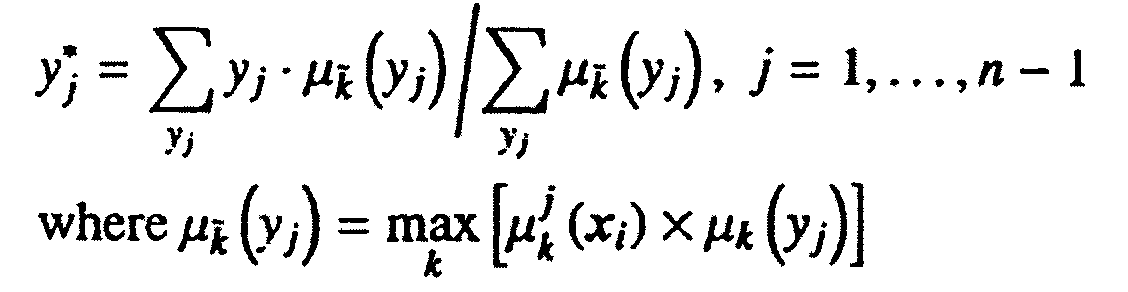
수학식 6
도 7은 본 발명에 적용되는 이전 계층의 퍼지 추론 결과로부터 생성되는 퍼지 함수를 나타낸 모식도이다. 도 7에 나타낸 바와 같이, 두번째 단계는 첫 번째 단계에서 발견된 경계점에 기반한 새로운 퍼지 함수를 생성하는 것이다.
이처럼 본 발명에서는 이전 계층(layer)의 퍼지 추론 결과로부터 퍼지 함수의 파라미터를 재조정하게 되는데, 이 과정은 본 발명에 따른 계층적 퍼지추론 시스템(HFCS)에서 적용하는 모든 입력 값들이 사용될 때까지 반복된다.
실험결과
본 발명에서 제안된 계층적 퍼지 추론 시스템(HFCS)의 효과를 보여주기 위해, 종래의 3가지 형태의 분류 방법(statistical classifiers, SVMs with three kernel functions, and fuzzy rule learning methods with rules weights) 및 제안된 방법에 대한 실험이 잘 알려진 5가지 데이터셋(Haverman' survival, Blood transfusion service center, New thyroid disease, Pima Indians diabetes, and Wisconsin breast cancer original)에서 수행되었다.
이와 같은 데이터 셋의 주요 특징은 [표 2]에 나타내었다. 각 데이터 셋은 랜덤하게 10개의 그룹으로 분리하고, 각 항목의 샘플들은 각 그룹에 일정하게 지정된다. 10-fold CV( cross validation) 및 제안된 HFCS의 입력 조합들은 [수학식 1]에 의해 계산되는 중복도(degree of redundancy)에 따라 결정된다.
[규칙 제91조에 의한 정정 21.10.2011]
표 2 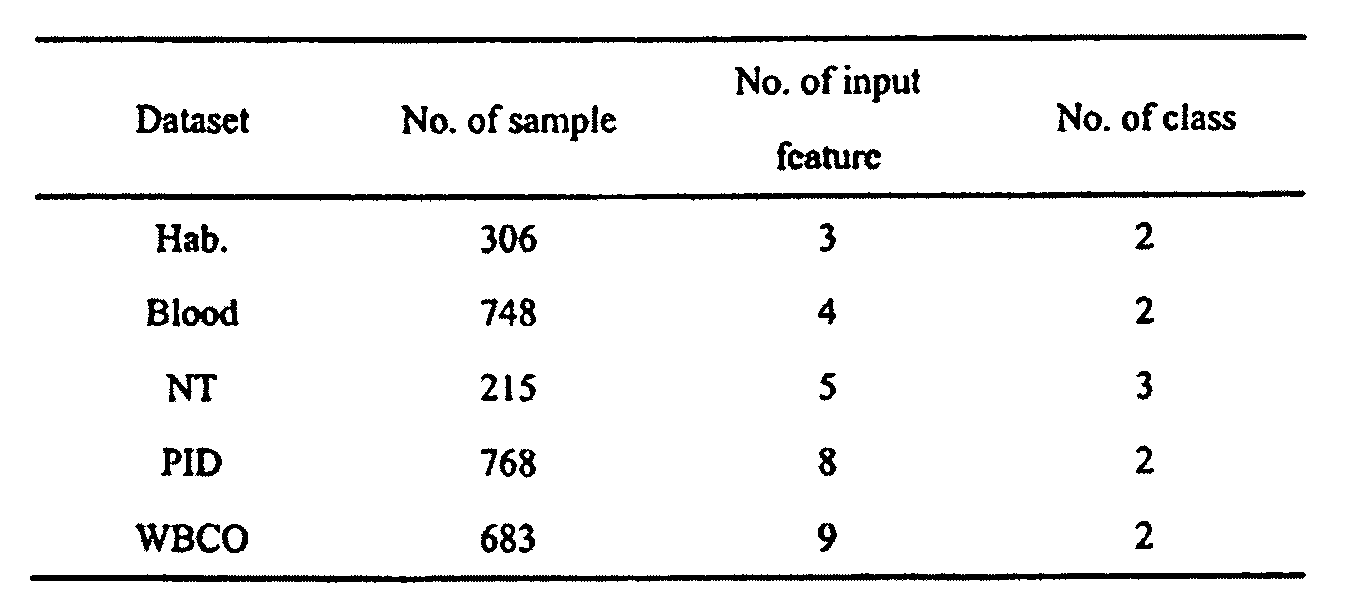
표 2
[표 3] 및 [표 4]는 10-fold CV( cross validation)동안 실험된 평균 분류 정확률을 나타낸다.
[규칙 제91조에 의한 정정 21.10.2011]
표 3 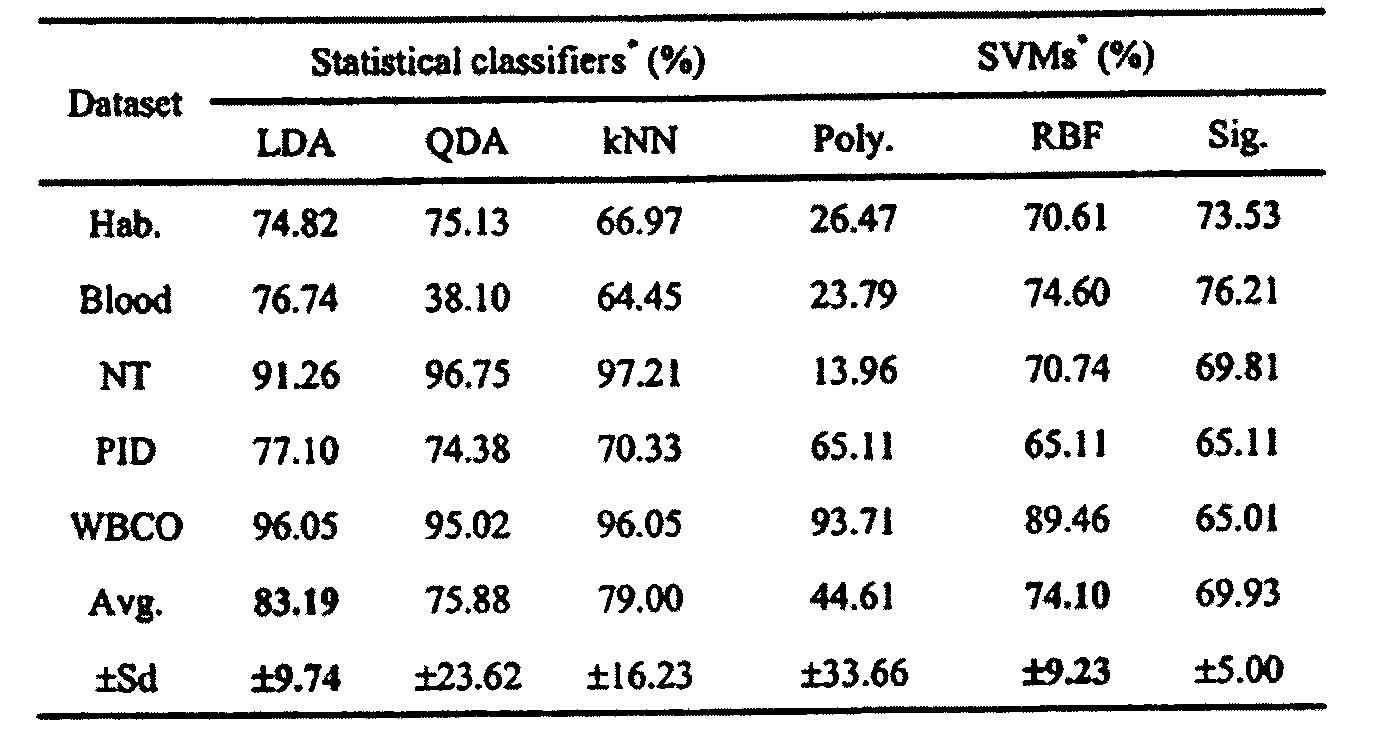
표 3
[규칙 제91조에 의한 정정 21.10.2011]
표 4 
표 4
[표 3] 및 [표 4]에서 SVMs의 파라미터 값들은(i.e., kernel types: Polynomial, RBF, and Sigmoid functions; c: 1000; eps: 0.001; degree(d): 10; gamma(g): 1.0; coef0(r): 1.0; nu(n): 0.5; p: 1.0; and shrinking(h): 0.0) KEEL Ver 1.2에 의해 제공되는 디폴트 값들이다.
여기서 'Avg±Sd'는 5개의 데이터셋에 대한 각 분류 방법의 평균 예측성능(performance)를 나타내고, [표 4]에서 'P'는 퍼지 공간 분할의 수이고, 'Li'는 HFCS의 각 계층에서의 평균 규칙 수를 나타낸다.
[표 4]에서 제안된 본 발명에 따른 HFCS의 분류 예측성능은 파라미터 α기 1.27, 1.62, 0.9, 1.3 및 1.2로 업데이트 됐을 때 최대임을 알 수 있다. 게다가, 비록, 퍼지 규칙 학습 방법들 사이의 최대 분류 예측성능을 갖는 퍼지 슬래이브(P=2) 보다 분류 정확률이 조금 낮지만, 퍼지 공간 분할의 다른 수를 갖는 본 발명에 따른 HFCS는 5개의 데이터 셋에 대한 종래의 3개의 분류방법보다 더 나은 평균 테스팅 예측성능을 산출함을 알 수 있었다. 이러한 결과들은 본 발명에서 적용되는 HFCS의 예측성능이 중첩영역에서 정의된 퍼지 공간 분할의 수와 밀접하게 관련돼 있음을 나타낸다.
이와 같이 본 발명을 제공하게 되면, 계층적 퍼지 추론 기술을 이용하여 계층별 및 종합적인 임상 추론결과를 제공함으로써, 응급 환자의 상태를 파악하여 가장 적합한 질환을 유추할 수 있는 방법을 제공하게 된다. 또한, 이 모든 지식이 병원 정보시스템 내에 수년 혹은 수십 년간 누적된 정보를 근거로 추론 결과를 제공하기 때문에 정확률을 높일 수 있다는 장점이 있다.
그리고, 응급실 등에 내원한 환자들의 임상정보(혈액, 소변, 방사선 결과 등)를 계층별 추론 결과와 종합적인 추론 결과를 토대로, 질환별 감별진단을 위한 주요 파라미터, 임상적 기준 및 최적화된 지식을 제공함으로써, 응급환자 등의 추론 가능한 질환을 유추할 수 있으며, 의대생을 비롯한 의료진의 교육 및 훈련에 도움을 줄 수 임상 진단지원 방법 및 시스템을 제공하게 된다.
이상의 설명에서 본 발명은 특정의 실시 예와 관련하여 도시 및 설명하였지만, 특허청구범위에 의해 나타난 발명의 사상 및 영역으로부터 벗어나지 않는 한도 내에서 다양한 개조 및 변화가 가능 하다는 것을 당 업계에서 통상의 지식을 가진 자라면 누구나 쉽게 알 수 있을 것이다.
본 발명은 계층적 퍼지 추론의 분류 능력을 개선하기 위한 매개층(intermediate layer)에서의 오류분류 패턴의 수를 최소화하는 퍼지추론 기술에 기반한 임상진단 지원방법 및 그 시스템에 관한 것으로, 통계적 특성에 기초한 계층적 퍼지 분류 시스템의 스키마(scheme)를 제공하고, 계층형 퍼지 분류 시스템의 분류 능력을 개선하는 매개층에서의 오분류 패턴의 수를 최소화하는 방법 및 그 시스템을 제공하고자 하기 때문에 산업상 이용가능성이 있다.
Claims (11)
- (a) 다수의 환자 각각에 대한 다수의 검사 항목의 검사 데이터를 각 검사항목 데이터 베이스로부터 추출하는 단계;(b) 상기 각 검사 항목의 검사 데이터에서 특징을 선택하는 단계;(c) 상기 특징이 선택된 검사 데이터를 각 항목별로 계층적 퍼지 추론하는 단계;(d) 상기 각 항목별로 상기 퍼지 추론한 출력값을 바탕으로 질환별 상기 검사 소견을 추출하는 단계; 및(e) 상기 각 소견을 바탕으로 종합적으로 임상 평가하는 단계를 포함하는 것을 특징으로 하는 계층적 퍼지 추론에 기반한 임상지원 진단방법.
- 제1항에 있어서,상기 검사 항목은,혈액검사, 소변검사 및 방사선 판독 검사인 것을 특징으로 계층적 퍼지 추론에 기반한 임상지원 진단방법.
- 제1항에 있어서,상기 (b) 단계는,상기 각 검사 데이터에 대한 임상진단 결과를 표식하는 단계; 및상기 검사 항목별로 임상진단 결정을 위한 컷 오프(cut-off) 값을 산출하는 단계인 것을 특징으로 하는 계층적 퍼지 추론에 기반한 임상지원 진단방법.
- 제1항 내지 제3항 중 어느 한 항에 있어서,상기 (c) 단계는,복수개의 퍼지 시스템의 계층적 입출력 구조로서,상기 각 검사 항목의 검사 데이터를 입력으로 하는 하나의 퍼지 시스템의 출력과 또 다른 검사 데이터를 입력을 새로운 입력으로 하여 출력값을 생성하되,상기 퍼지 시스템의 입력은 적어도 3개 이상인 것을 특징으로 하는 계층적 퍼지 추론에 기반한 임상지원 진단방법.
- 제4항에 있어서,상기 (c) 단계는,상기 각 퍼지 시스템에서,상기 각 검사 항목의 검사 데이터를 입력값을 퍼지 공간 분할하는 단계; 및상기 분할된 데이터로부터 임상진단 지식을 생성하는 단계를 포함하는 것을 특징으로 하는 계층적 퍼지 추론에 기반한 임상지원 진단방법.
- 제5항에 있어서,상기 퍼지 공간의 분할은 상기 검사 데이터의 통계적 분포를 통해, 정상군(Normal Group)과 비정상군(Abnormal Group)으로 분할하는 것을 특징으로 하는 계층적 퍼지 추론에 기반한 임상지원 진단방법.
- 제4항에 있어서,상기 임상진단 지식의 생성은,상기 분할된 데이터로부터 제1차 임상진단 지식을 생성하는 단계; 및상기 제1차 임상진단 지식 간 충돌을 회피하기 위한 알고리즘 적용하여 각 계층별 퍼지 시스템에 적용되는 제2차 임상진단 지식을 생성하는 단계를 포함하는 것을 특징으로 하는 계층적 퍼지 추론에 기반한 임상지원 진단방법.
- 제7항에 있어서,상기 (e) 단계는,상기 각 추론 계층에서 제시된 임상적 특징 및 기준을 추출하는 단계;상기 각 추론 계층의 데이터로부터 이상 케이스(case)를 추출하는 단계; 및상기 특징, 기준 및 이상 케이스를 바탕으로 종합적인 임상적 추론을 하는 단계를 포함하는 것을 특징으로 하는 계층적 퍼지 추론에 기반한 임상지원 진단방법.
- 제1항 내지 제3항 중 어느 한 항의 방법을 수행하기 위한 것으로,복수개의 항목에 따라 적어도 하나의 검사 데이터를 저장한 검사 데이터 베이스;상기 데이터 베이스로부터 상기 각 항목별 특징 데이터를 선택하기 위한 전처리부;상기 각 항목별 특징 데이터를 입력으로 하여 계층적 퍼지 추론을 수행하는 퍼지 추론부; 및상기 퍼지추론을 통해 추출된 각 항목별 검사 소견을 바탕으로 종합적으로 임상 평가하는 종합 평가부를 포함하는 것을 특징으로 하는 계층적 퍼지 추론을 이용하는 임상지원 진단 시스템.
- 제9항에 있어서,상기 종합 평가부는,각 추론 계층의 출력값을 통해 특징 및 임상적 기준을 제공하는 것을 특징으로 하는 계층적 퍼지 추론을 이용하는 임상지원 진단 시스템.
- 제9항에 있어서,각 추론 계층의 출력값을 통해 이상 케이스를 추출하는 것을 특징으로 하는 계층적 퍼지 추론을 이용하는 임상지원 진단 시스템.
Priority Applications (1)
| Application Number | Priority Date | Filing Date | Title |
|---|---|---|---|
| US13/988,346 US9195948B2 (en) | 2011-01-26 | 2011-08-01 | Clinical diagnosis support method and system based on hierarchical fuzzy inference technology |
Applications Claiming Priority (2)
| Application Number | Priority Date | Filing Date | Title |
|---|---|---|---|
| KR10-2011-0007873 | 2011-01-26 | ||
| KR1020110007873A KR101212714B1 (ko) | 2011-01-26 | 2011-01-26 | 계층적 퍼지 추론에 기반한 임상진단 지원방법 및 그 시스템 |
Publications (1)
| Publication Number | Publication Date |
|---|---|
| WO2012102444A1 true WO2012102444A1 (ko) | 2012-08-02 |
Family
ID=46580999
Family Applications (1)
| Application Number | Title | Priority Date | Filing Date |
|---|---|---|---|
| PCT/KR2011/005664 Ceased WO2012102444A1 (ko) | 2011-01-26 | 2011-08-01 | 계층적 퍼지 추론에 기반한 임상진단 지원방법 및 그 시스템 |
Country Status (3)
| Country | Link |
|---|---|
| US (1) | US9195948B2 (ko) |
| KR (1) | KR101212714B1 (ko) |
| WO (1) | WO2012102444A1 (ko) |
Cited By (2)
| Publication number | Priority date | Publication date | Assignee | Title |
|---|---|---|---|---|
| DE102014016601A1 (de) | 2014-11-11 | 2016-05-12 | Schott Ag | Bauteil mit Bauteilverstärkung und Durchführung |
| CN110517765A (zh) * | 2019-07-15 | 2019-11-29 | 中南大学 | 一种基于模糊推理逻辑的前列腺癌大数据辅助决策方法及系统构建方法 |
Families Citing this family (15)
| Publication number | Priority date | Publication date | Assignee | Title |
|---|---|---|---|---|
| US10068060B2 (en) | 2012-08-16 | 2018-09-04 | Ginger.io, Inc. | Method for modeling behavior and psychotic disorders |
| US10740438B2 (en) | 2012-08-16 | 2020-08-11 | Ginger.io, Inc. | Method and system for characterizing and/or treating poor sleep behavior |
| US10276260B2 (en) | 2012-08-16 | 2019-04-30 | Ginger.io, Inc. | Method for providing therapy to an individual |
| EP2884888A4 (en) | 2012-08-16 | 2016-04-20 | Ginger Io Inc | METHOD FOR MODELING BEHAVIORAL AND HEALTH CHANGES |
| US10741285B2 (en) | 2012-08-16 | 2020-08-11 | Ginger.io, Inc. | Method and system for providing automated conversations |
| US10748645B2 (en) | 2012-08-16 | 2020-08-18 | Ginger.io, Inc. | Method for providing patient indications to an entity |
| US10068670B2 (en) | 2012-08-16 | 2018-09-04 | Ginger.io, Inc. | Method for modeling behavior and depression state |
| US10650920B2 (en) | 2012-08-16 | 2020-05-12 | Ginger.io, Inc. | Method and system for improving care determination |
| US10265028B2 (en) | 2012-08-16 | 2019-04-23 | Ginger.io, Inc. | Method and system for modeling behavior and heart disease state |
| KR101955526B1 (ko) * | 2017-04-26 | 2019-03-08 | 한국과학기술원 | 혈액종합검사 소견 생성 방법 및 시스템 |
| CN109920503A (zh) * | 2019-02-26 | 2019-06-21 | 北京五岳鑫信息技术股份有限公司 | 一种体检信息处理方法及装置 |
| US11710576B2 (en) | 2021-05-24 | 2023-07-25 | OrangeDot, Inc. | Method and system for computer-aided escalation in a digital health platform |
| US12292912B2 (en) | 2022-03-25 | 2025-05-06 | OrangeDot, Inc. | Method and system for intent-based action recommendations and/or fulfillment in a messaging platform |
| WO2023183914A1 (en) | 2022-03-25 | 2023-09-28 | OrangeDot, Inc. | Method and system for automatically determining responses in a messaging platform |
| EP4500362A4 (en) | 2022-05-11 | 2026-04-08 | Orangedot Inc | METHOD AND SYSTEM FOR AUTOMATICALLY PRIORITIZING CONTENT PROVIDED TO A USER |
Citations (4)
| Publication number | Priority date | Publication date | Assignee | Title |
|---|---|---|---|---|
| JPH05289880A (ja) * | 1992-04-08 | 1993-11-05 | Omron Corp | ファジィ知識抽出装置並びにファジィ知識詳細化/簡略化装置及びファジィ推論装置 |
| JPH06102907A (ja) * | 1992-09-21 | 1994-04-15 | Toshiba Corp | 階層型ファジィ制御方法 |
| JPH07134651A (ja) * | 1993-11-09 | 1995-05-23 | Omron Corp | ファジィ推論装置 |
| JPH07302202A (ja) * | 1994-04-29 | 1995-11-14 | Internatl Business Mach Corp <Ibm> | ファジー論理エンティティ動作プロファイルを決定するシステム及び方法 |
Family Cites Families (8)
| Publication number | Priority date | Publication date | Assignee | Title |
|---|---|---|---|---|
| JP3129932B2 (ja) * | 1995-05-16 | 2001-01-31 | シャープ株式会社 | ファジィ・ニューラルネットワーク装置およびその学習方法 |
| US8346482B2 (en) * | 2003-08-22 | 2013-01-01 | Fernandez Dennis S | Integrated biosensor and simulation system for diagnosis and therapy |
| WO2007054841A1 (en) * | 2005-11-08 | 2007-05-18 | Koninklijke Philips Electronics, N.V. | Method for detecting critical trends in multi-parameter patient monitoring and clinical data using clustering |
| CN101365378A (zh) * | 2005-11-29 | 2009-02-11 | 风险获利有限公司 | 根据残差监测人体健康 |
| EP2245568A4 (en) * | 2008-02-20 | 2012-12-05 | Univ Mcmaster | EXPERIMENTAL SYSTEM FOR DETERMINING THE RESPONSE OF PATIENTS TO TREATMENT |
| RU2015123307A (ru) * | 2008-03-26 | 2015-11-27 | Теранос, Инк. | Способ и система для прогнозирования клинических исходов |
| EP2303376B1 (en) * | 2008-05-28 | 2016-03-30 | Oridion Medical 1987 Ltd. | Endotracheal tube for monitoring co2 |
| EP2596132A4 (en) * | 2010-07-23 | 2013-12-18 | Harvard College | METHOD FOR DETECTING SIGNS FOR ILLNESS OR SUFFERING IN BODY FLUIDS |
-
2011
- 2011-01-26 KR KR1020110007873A patent/KR101212714B1/ko not_active Expired - Fee Related
- 2011-08-01 US US13/988,346 patent/US9195948B2/en not_active Expired - Fee Related
- 2011-08-01 WO PCT/KR2011/005664 patent/WO2012102444A1/ko not_active Ceased
Patent Citations (4)
| Publication number | Priority date | Publication date | Assignee | Title |
|---|---|---|---|---|
| JPH05289880A (ja) * | 1992-04-08 | 1993-11-05 | Omron Corp | ファジィ知識抽出装置並びにファジィ知識詳細化/簡略化装置及びファジィ推論装置 |
| JPH06102907A (ja) * | 1992-09-21 | 1994-04-15 | Toshiba Corp | 階層型ファジィ制御方法 |
| JPH07134651A (ja) * | 1993-11-09 | 1995-05-23 | Omron Corp | ファジィ推論装置 |
| JPH07302202A (ja) * | 1994-04-29 | 1995-11-14 | Internatl Business Mach Corp <Ibm> | ファジー論理エンティティ動作プロファイルを決定するシステム及び方法 |
Cited By (3)
| Publication number | Priority date | Publication date | Assignee | Title |
|---|---|---|---|---|
| DE102014016601A1 (de) | 2014-11-11 | 2016-05-12 | Schott Ag | Bauteil mit Bauteilverstärkung und Durchführung |
| EP3187472A1 (de) | 2014-11-11 | 2017-07-05 | Schott AG | Bauteil mit bauteilverstärkung und durchführung |
| CN110517765A (zh) * | 2019-07-15 | 2019-11-29 | 中南大学 | 一种基于模糊推理逻辑的前列腺癌大数据辅助决策方法及系统构建方法 |
Also Published As
| Publication number | Publication date |
|---|---|
| US20130246330A1 (en) | 2013-09-19 |
| KR101212714B1 (ko) | 2013-01-22 |
| US9195948B2 (en) | 2015-11-24 |
| KR20120086559A (ko) | 2012-08-03 |
Similar Documents
| Publication | Publication Date | Title |
|---|---|---|
| WO2012102444A1 (ko) | 계층적 퍼지 추론에 기반한 임상진단 지원방법 및 그 시스템 | |
| Si et al. | RETRACTED ARTICLE: Picture fuzzy set-based decision-making approach using Dempster–Shafer theory of evidence and grey relation analysis and its application in COVID-19 medicine selection | |
| Undru et al. | Integrating artificial intelligence for clinical and laboratory diagnosis–a review | |
| Soufi et al. | Decision support system for triage management: A hybrid approach using rule-based reasoning and fuzzy logic | |
| O'Keeffe et al. | Prediction of failure to survive following in-hospital cardiopulmonary resuscitation: comparison of two predictive instruments | |
| Rana et al. | Advancements in healthcare services using deep learning techniques | |
| WO2020111378A1 (ko) | 질환 진단 보조를 위한 데이터 분석 방법 및 시스템 | |
| Sullivan et al. | Incidental findings in low‐resource settings | |
| Shoaib et al. | Hybrid classification structures for automatic COVID-19 detection | |
| WO2022103134A1 (ko) | 질병 통합 진단 시스템 및 동작 방법 | |
| Thakoor et al. | Strategies to improve convolutional neural network generalizability and reference standards for glaucoma detection from OCT scans | |
| Shenoy et al. | CovXR: automated detection of COVID-19 pneumonia in chest X-rays through machine learning | |
| Muneeza et al. | Multicriteria group decision making for COVID-19 testing facility based on picture cubic fuzzy aggregation information | |
| Karaddi et al. | Classification of lung disorders in chest multi-modal images using hyper-Parameter tuning and modified ResNet50 | |
| Stempsey | Applying medical knowledge: Diagnosing disease | |
| Narteni et al. | Explainable artificial intelligence for cough-related quality of life impairment prediction in asthmatic patients | |
| Rajendran et al. | Prescreening and triage of COVID-19 patients through chest X-ray images using deep learning model | |
| Kassylkassova et al. | Automated pneumonia diagnosis using a 2D deep convolutional neural network with chest X-ray images | |
| Odeh et al. | Explaining transfer learning models for the detection of COVID-19 on X-ray lung images | |
| Tengjongdee et al. | Comparative Analysis of Deep Learning Networks for COVID-19 and Pneumonia Identification: Grad-CAM Visualization of Chest X-Ray Images | |
| Nguyen et al. | Design of a medical expert system for consulting tuberculosis diagnosis in vietnam rural areas | |
| Singhal et al. | Transforming Alzheimer’s diagnosis: ADNet deep learning with explainable AI framework | |
| AbdulQader et al. | Classification of COVID-19 from CT chest images using convolutional wavelet neural network | |
| Feng et al. | Unknown disease outbreaks detection: a pilot study on feature-based knowledge representation and reasoning model | |
| Gupta et al. | Detection of covid using deep learning: a review |
Legal Events
| Date | Code | Title | Description |
|---|---|---|---|
| 121 | Ep: the epo has been informed by wipo that ep was designated in this application |
Ref document number: 11857018 Country of ref document: EP Kind code of ref document: A1 |
|
| WWE | Wipo information: entry into national phase |
Ref document number: 13988346 Country of ref document: US |
|
| NENP | Non-entry into the national phase |
Ref country code: DE |
|
| 122 | Ep: pct application non-entry in european phase |
Ref document number: 11857018 Country of ref document: EP Kind code of ref document: A1 |