WO2012104206A1 - 9-[4-(3-chlor-2-fluor-phenylamino)-7-methoxy-chinazolin-6- yloxy]-1,4-diaza-spiro[5.5]undecan-5-on dimaleat, dessen verwendung als arzneimittel und dessen herstellung - Google Patents
9-[4-(3-chlor-2-fluor-phenylamino)-7-methoxy-chinazolin-6- yloxy]-1,4-diaza-spiro[5.5]undecan-5-on dimaleat, dessen verwendung als arzneimittel und dessen herstellung Download PDFInfo
- Publication number
- WO2012104206A1 WO2012104206A1 PCT/EP2012/051298 EP2012051298W WO2012104206A1 WO 2012104206 A1 WO2012104206 A1 WO 2012104206A1 EP 2012051298 W EP2012051298 W EP 2012051298W WO 2012104206 A1 WO2012104206 A1 WO 2012104206A1
- Authority
- WO
- WIPO (PCT)
- Prior art keywords
- formula
- compound
- optionally
- reaction
- tautomers
- Prior art date
- Legal status (The legal status is an assumption and is not a legal conclusion. Google has not performed a legal analysis and makes no representation as to the accuracy of the status listed.)
- Ceased
Links
- NMYPXQUWTMKPJM-GASCZTMLSA-N COc(c(O[C@H](CC1)CC[C@H]1C(NCC[N-2])=O)c1)cc2c1c(Nc1cccc(Cl)c1F)ncn2 Chemical compound COc(c(O[C@H](CC1)CC[C@H]1C(NCC[N-2])=O)c1)cc2c1c(Nc1cccc(Cl)c1F)ncn2 NMYPXQUWTMKPJM-GASCZTMLSA-N 0.000 description 1
Classifications
-
- C—CHEMISTRY; METALLURGY
- C07—ORGANIC CHEMISTRY
- C07D—HETEROCYCLIC COMPOUNDS
- C07D241/00—Heterocyclic compounds containing 1,4-diazine or hydrogenated 1,4-diazine rings
- C07D241/36—Heterocyclic compounds containing 1,4-diazine or hydrogenated 1,4-diazine rings condensed with carbocyclic rings or ring systems
- C07D241/38—Heterocyclic compounds containing 1,4-diazine or hydrogenated 1,4-diazine rings condensed with carbocyclic rings or ring systems with only hydrogen or carbon atoms directly attached to the ring nitrogen atoms
-
- A—HUMAN NECESSITIES
- A61—MEDICAL OR VETERINARY SCIENCE; HYGIENE
- A61K—PREPARATIONS FOR MEDICAL, DENTAL OR TOILETRY PURPOSES
- A61K31/00—Medicinal preparations containing organic active ingredients
- A61K31/33—Heterocyclic compounds
- A61K31/395—Heterocyclic compounds having nitrogen as a ring hetero atom, e.g. guanethidine or rifamycins
- A61K31/495—Heterocyclic compounds having nitrogen as a ring hetero atom, e.g. guanethidine or rifamycins having six-membered rings with two or more nitrogen atoms as the only ring heteroatoms, e.g. piperazine or tetrazines
- A61K31/505—Pyrimidines; Hydrogenated pyrimidines, e.g. trimethoprim
- A61K31/517—Pyrimidines; Hydrogenated pyrimidines, e.g. trimethoprim ortho- or peri-condensed with carbocyclic ring systems, e.g. quinazoline, perimidine
-
- A—HUMAN NECESSITIES
- A61—MEDICAL OR VETERINARY SCIENCE; HYGIENE
- A61P—SPECIFIC THERAPEUTIC ACTIVITY OF CHEMICAL COMPOUNDS OR MEDICINAL PREPARATIONS
- A61P1/00—Drugs for disorders of the alimentary tract or the digestive system
-
- A—HUMAN NECESSITIES
- A61—MEDICAL OR VETERINARY SCIENCE; HYGIENE
- A61P—SPECIFIC THERAPEUTIC ACTIVITY OF CHEMICAL COMPOUNDS OR MEDICINAL PREPARATIONS
- A61P1/00—Drugs for disorders of the alimentary tract or the digestive system
- A61P1/04—Drugs for disorders of the alimentary tract or the digestive system for ulcers, gastritis or reflux esophagitis, e.g. antacids, inhibitors of acid secretion, mucosal protectants
-
- A—HUMAN NECESSITIES
- A61—MEDICAL OR VETERINARY SCIENCE; HYGIENE
- A61P—SPECIFIC THERAPEUTIC ACTIVITY OF CHEMICAL COMPOUNDS OR MEDICINAL PREPARATIONS
- A61P11/00—Drugs for disorders of the respiratory system
-
- A—HUMAN NECESSITIES
- A61—MEDICAL OR VETERINARY SCIENCE; HYGIENE
- A61P—SPECIFIC THERAPEUTIC ACTIVITY OF CHEMICAL COMPOUNDS OR MEDICINAL PREPARATIONS
- A61P11/00—Drugs for disorders of the respiratory system
- A61P11/06—Antiasthmatics
-
- A—HUMAN NECESSITIES
- A61—MEDICAL OR VETERINARY SCIENCE; HYGIENE
- A61P—SPECIFIC THERAPEUTIC ACTIVITY OF CHEMICAL COMPOUNDS OR MEDICINAL PREPARATIONS
- A61P13/00—Drugs for disorders of the urinary system
- A61P13/08—Drugs for disorders of the urinary system of the prostate
-
- A—HUMAN NECESSITIES
- A61—MEDICAL OR VETERINARY SCIENCE; HYGIENE
- A61P—SPECIFIC THERAPEUTIC ACTIVITY OF CHEMICAL COMPOUNDS OR MEDICINAL PREPARATIONS
- A61P17/00—Drugs for dermatological disorders
- A61P17/06—Antipsoriatics
-
- A—HUMAN NECESSITIES
- A61—MEDICAL OR VETERINARY SCIENCE; HYGIENE
- A61P—SPECIFIC THERAPEUTIC ACTIVITY OF CHEMICAL COMPOUNDS OR MEDICINAL PREPARATIONS
- A61P35/00—Antineoplastic agents
-
- A—HUMAN NECESSITIES
- A61—MEDICAL OR VETERINARY SCIENCE; HYGIENE
- A61P—SPECIFIC THERAPEUTIC ACTIVITY OF CHEMICAL COMPOUNDS OR MEDICINAL PREPARATIONS
- A61P37/00—Drugs for immunological or allergic disorders
- A61P37/02—Immunomodulators
-
- A—HUMAN NECESSITIES
- A61—MEDICAL OR VETERINARY SCIENCE; HYGIENE
- A61P—SPECIFIC THERAPEUTIC ACTIVITY OF CHEMICAL COMPOUNDS OR MEDICINAL PREPARATIONS
- A61P37/00—Drugs for immunological or allergic disorders
- A61P37/08—Antiallergic agents
-
- A—HUMAN NECESSITIES
- A61—MEDICAL OR VETERINARY SCIENCE; HYGIENE
- A61P—SPECIFIC THERAPEUTIC ACTIVITY OF CHEMICAL COMPOUNDS OR MEDICINAL PREPARATIONS
- A61P43/00—Drugs for specific purposes, not provided for in groups A61P1/00-A61P41/00
-
- C—CHEMISTRY; METALLURGY
- C07—ORGANIC CHEMISTRY
- C07D—HETEROCYCLIC COMPOUNDS
- C07D239/00—Heterocyclic compounds containing 1,3-diazine or hydrogenated 1,3-diazine rings
- C07D239/70—Heterocyclic compounds containing 1,3-diazine or hydrogenated 1,3-diazine rings condensed with carbocyclic rings or ring systems
-
- C—CHEMISTRY; METALLURGY
- C07—ORGANIC CHEMISTRY
- C07D—HETEROCYCLIC COMPOUNDS
- C07D403/00—Heterocyclic compounds containing two or more hetero rings, having nitrogen atoms as the only ring hetero atoms, not provided for by group C07D401/00
- C07D403/02—Heterocyclic compounds containing two or more hetero rings, having nitrogen atoms as the only ring hetero atoms, not provided for by group C07D401/00 containing two hetero rings
- C07D403/12—Heterocyclic compounds containing two or more hetero rings, having nitrogen atoms as the only ring hetero atoms, not provided for by group C07D401/00 containing two hetero rings linked by a chain containing hetero atoms as chain links
Definitions
- the present invention relates to the compound of the formula (I)
- Quinazoline derivatives are known in the art as drugs, for example, for the treatment of tumors as well as diseases of the lung and the respiratory tract. Processes for the preparation of quinazoline derivatives are described in
- WO03082290 and WO07068552 discloses the base (compound (II)) of the dimaleate salt of the invention (compound (I)).
- the compound provided in the present invention is intended to meet the physical and chemical stability and other properties such as crystalline stability, absence of polymorphism, and low hygroscopicity, especially in the absence of polymorphism, to a drug.
- Table 1 X-ray reflections up to 30 ° 2 ⁇ including intensities (normalized) of the compound (I)
- the present invention achieves the above-mentioned objects by providing the compound of the formula (I) which is highly crystalline, has low hygroscopicity and low polymorphicity, in particular for oral administration, its pharmaceutical formulation and the synthesis process described below.
- Crystalline stability in the context of the present invention is understood to mean that X-ray powder diagrams of the compound of the formula (I) have sharp reflections with high intensity up to the upper 2 ⁇ range, preferably up to 20-40 ° 2 ⁇ .
- low hygroscopicity means that in sorption experiments of the compound of the formula (I) a water absorption of less than 1% in the investigated air humidity range of 10-90% is observed.
- low polymorphism means that after recrystallization from various solvents of the compound of formula (I) a maximum of 5 other crystal modifications, preferably a maximum of 3 other crystal modifications, more preferably no other crystal modifications, are obtained.
- the invention relates to a compound of the formula (I)
- Another object of the invention is the above-mentioned compound for use as a medicament, preferably for the treatment of inflammatory or allergic diseases of the respiratory tract, particularly preferably for the treatment of chronic obstructive bronchitis (COPD) and / or chronic bronchitis.
- COPD chronic obstructive bronchitis
- the compound of formula (I) which is a disease selected from the group consisting of acute bronchitis, bronchitis due to bacterial or viral infection or fungi or helminths, allergic bronchitis, toxic bronchitis, asthma (intrinsic or allergic), pediatric asthma, bronchiectasis, allergic alveolitis, allergic or non-allergic rhinitis, chronic sinusitis, cystic fibrosis or cystic fibrosis, alpha-1-antitrypsin deficiency, cough, emphysema, interstitial lung disease, alveolitis, hyperrespiratory tract, nasal polyps, pulmonary edema , Pneumonitis due to different causes such as radiation-induced or by aspiration or infectious, collagenoses such as lupus eryth, systemic scleroderma, sarcoidosis and M.
- acute bronchitis bronchitis due to bacterial or viral infection or fungi
- Boeck as well as for the treatment of exacerbations in asthma and COPD, the viral, bacterial or other causes, for the treatment of viral or bacterial infections of the respiratory or lungs.
- Another object of the invention is a process for the stereoselective preparation of the compound of formula (I), optionally in the form of their tautomers, solvates or hydrates:
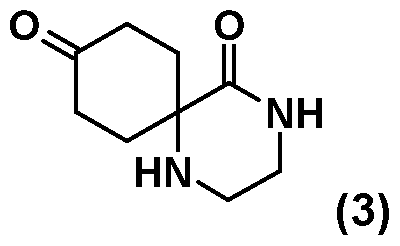
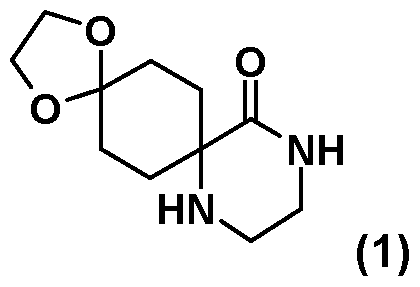
- the invention further provides a process for the stereoselective preparation of the compound of the formula (I), if appropriate in the form of its tautomers, solvates or hydrates, comprising the process steps (A) to (M),
- process step (G) is particularly preferred.
- process step (I) is particularly preferred.
- Another object of the invention is the intermediate of formula (6), optionally in the form of their tautomers, solvates or hydrates.
- Another object of the invention is the intermediate of formula (7), optionally in the form of their tautomers, solvates or hydrates.
- Another object of the invention is the intermediate of formula (8), optionally in the form of their tautomers, solvates or hydrates.
- Another object of the invention is the intermediate of formula (9), optionally in the form of their tautomers, solvates or hydrates.
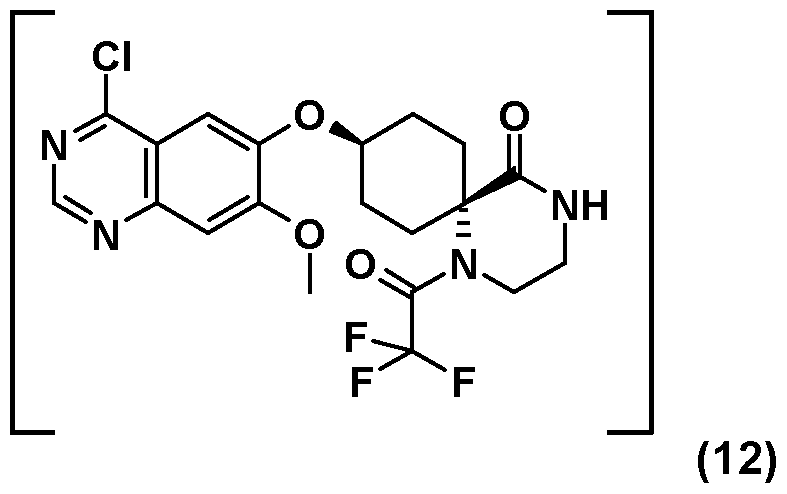
- Another object of the invention is the intermediate of formula (11) or (11A), optionally in the form of their tautomers, solvates or hydrates.
- Another object of the invention is a pharmaceutical composition containing a compound of formula (I). Preference is given to an orally administrable pharmaceutical composition comprising a compound of the formula (I).
- Another object of the invention are drug combinations containing in addition to a compound of formula (I) according to claim 1 as another active ingredient one or more compounds selected from the classes of betamimetics, anticholinergics, corticosteroids, PDE4 inhibitors, LTD4 receptor antagonists , LTB4 receptor antagonists, inhibitors of MAP kinases, bradykinin receptor antagonists, endothelin receptor antagonists, CXCR1 and / or CXCR2 receptor antagonists, and cough, or two or three combinations thereof.
- benzyltriethylammonium chloride / NaOH tetrabutylammonium chloride / KOH
- benzyltriethylammonium chloride / KOH tetrabutylammonium chloride / NaOH
- alkoxide bases selected from the group consisting of NaO'Bu, KO'Bu and NaOEt, carbonate bases selected from the group consisting of Cs 2 C0 3 , K 2 C0 3 , Li 2 C0 3 and Na 2 C0 3, particularly preferably sodium ;
- D in addition to di-tert-butyl dicarbonate and DMAP (4- (dimethylamino) pyridine): preferably K 2 C0 3 , Cs 2 C0 3 , Li 2 C0 3 and Na 2 C0 3 , particularly preferably K 2 C0 3 ;
- trifluoroacetic anhydride in addition to trifluoroacetic anhydride: preferably triethylamine, Hünigbase, N-methylmorpholine and N, N
- Diethylaniline especially preferably triethylamine
- catalysts preferably selected from the group consisting of Pd / C and
- Pd (OH) 2 more preferably Pd / C;
- Triphenylphosphine (in combination);
- HBr especially preferably HCl
- L preferably ethanolamine, ammonia and Ba (OH) 2 , especially preferred
- N preferably N-chlorosuccinimide / triphenylphosphine (in combination), HCl,
- HOAc HOAc, dioxane, H 2 O and aqueous solutions of the following solvents selected from the group consisting of EtOH, THF, iPrOH, MeOH, NMP (N-methyl-2-pyrrolidone) and DMF (dimethylformamide);
- C ACN (CH 3 CN), EtOH, MeOH, iPrOH, H 2 O, THF and NMP; D: ACN, EtOH and NMP;
- A preferably -15 to 40 ° C, more preferably 0 to 20 ° C;
- B preferably 0 to 100 ° C, more preferably 75 to 100 ° C;
- E preferably 0 to 40 ° C, more preferably 0 to 15 ° C;
- F preferably -10 to 60 ° C, more preferably 0 to 35 ° C;
- G preferably 10 to 65 ° C, particularly preferably 45 to 60 ° C;
- H preferably 20 to 85 ° C, more preferably 70 to 85 ° C;
- I preferably 20 to 100 ° C, more preferably 70 to 95 ° C;
- J preferably 20 to 100 ° C, more preferably 50 to 85 ° C;
- K preferably 20 to 100 ° C, particularly preferably 50 to 85 ° C;
- L preferably 50 to 80 ° C, more preferably 70 to 80 ° C;
- M preferably 0 to 75 ° C, particularly preferably 0 to 70 ° C.
- N preferably 20 to 100 ° C, particularly preferably 50 to 85 ° C;
- O preferably 50 to 100 ° C, more preferably 70 to 80 ° C;
- Boc used in the above formulas means teriary butyl carbamate and means benzyloxycarbonyl.
- the phases are separated and the aqueous phase is extracted with 20 L dichloromethane.
- the combined organic phases are concentrated by distillation. After 72 L of solvent are distilled off, 48 L of isopropanol are added to the suspension and then distilled off further 30 L of solvent. After cooling to 3 ° C, the precipitate is filtered off and washed twice with 7.5 L cold isopropanol. After drying at 50 ° C in vacuo to give 6144 g of product.
- the organic phase is separated and diluted with 27.5 L of methyl-tetrahydrofuran. There are distilled off 55 L of solvent. Then 15 L of methyl-tetrahydrofuran are added and 15 L of solvent distilled off. Subsequently, 20 L of methyl-tetrahydrofuran are added and 20 L of solvent distilled off. Subsequently, 20 L of methyl tetrahydrofuran are added and distilled off 20 L of solvent. The residue containing the product will be further reacted directly in the next stage.
- the precipitate is removed by centrifugation and washed with 10 L of a 2: 1 mixture of water and methanol and then with 10 L of water. After drying at 55 ° C in a convection oven to obtain 5299 g of product as a cis- / trans mixture.
- This crude product is suspended in 70 L of toluene. Subsequently, 500 ml of solvent are distilled off and then 10 L of toluene added. The solution is cooled and seeded at 52 ° C with product. After 3 h at 1 ° C, the precipitate is removed by centrifugation and washed with 8 L of cold toluene. After drying at 55 ° C in vacuo to obtain 4398 g of product, which still contains about 4% trans product.
- the dropping funnel is rinsed with 4 L tetrahydrofuran and in vacuo, 30 L of solvent are distilled off. Subsequently, during the continuous addition of 60 l of ethanol, a further 30 l of solvent are distilled off under atmospheric pressure. It is inoculated with product and allowed to cool slowly to RT. After 19 h, the precipitate is filtered off and washed with 15 L of ethanol. After drying at 50 ° C in vacuo, 4710 g of product.
- Thermoanalysis equipment A DSC 822 from Mettler Toldeo is used. The following measurement parameters are used: heating rate: 10 K / min; Crucible type: perforated aluminum crucible; Atmosphere: N 2 , 80 ml / min flow rate; typical weights: 3 -10 mg.
- the following measurement parameters are used: heating rate: 10 K / min; Crucible type: open alumina crucible; Atmosphere: N 2 , 20 ml / min Flow rate typical weights: 15 - 25 mg.
- the melting point of compound (I) can be seen from the DSC / TG diagram of Figure 2 in the appendix.
- EGF-R mediated signal transduction may be e.g. with cells expressing human EGF-R and whose survival and proliferation depends on stimulation by EGF or TGF-alpha, respectively.
- a murine hematopoietic cell line is genetically engineered to express functional human EGF-R. The proliferation of this cell line can therefore be stimulated by EGF.
- the cells are cultured in RPM 1/1640 medium. Proliferation is stimulated with 20 ng / ml human EGF (Promega).
- DMSO dimethyl sulfoxide
- the maximum DMSO concentration is 1%. The cultures are incubated for 48 hours at 37 ° C.
- the relative cell number is determined using the Cell Titer 96TM AQueous Non-Radioactive Cell Proliferation Assay (Promega) in O.D. Units measured. The relative cell count is calculated as a percentage of the control and the drug concentration, which inhibits the proliferation of the cells to 50% (IC50) derived.
- the compound of formula (I) is characterized by a variety of therapeutic applications. Worth mentioning are those applications for which the compound of the formula (I) according to the invention, due to their pharmaceutical activity as a tyrosine kinase inhibitor can preferably be used.
- tyrosine kinases As shown by the example of the human EGF receptor, and is therefore useful for the treatment of pathophysiological processes that are caused by hyperfunction of tyrosine kinases.
- pathophysiological processes that are caused by hyperfunction of tyrosine kinases.
- tyrosine kinases e.g. benign or malignant tumors, in particular tumors of epithelial and neuro-epithelial origin, metastasis and the abnormal proliferation of vascular endothelial cells (neoangiogenesis).
- the compound (I) according to the invention is also useful for the prevention and treatment of respiratory and pulmonary diseases associated with increased or altered mucus production resulting from stimulation of tyrosine kinases.
- respiratory and pulmonary diseases associated with increased or altered mucus production resulting from stimulation of tyrosine kinases.
- inflammatory diseases of the respiratory tract such as chronic bronchitis, chronic obstructive bronchitis, asthma, bronchiectasis, allergic or non-allergic rhinitis or sinusitis, cystic fibrosis, a1-antitrypsin deficiency, or for cough, emphysema, pulmonary fibrosis and hyper-reactive airways.
- the compound (I) is also suitable for the treatment of diseases of the gastrointestinal tract and the bile ducts and bladder associated with impaired activity of the tyrosine kinases, e.g. in chronic inflammatory disorders, such as cholecystitis, Crohn's disease, ulcerative colitis, and ulcers in the gastrointestinal tract, or as they occur in disorders of the gastrointestinal tract associated with increased secretion, such as M. Menetrier, secreting adenomas and protein loss syndromes.
- diseases of the gastrointestinal tract and the bile ducts and bladder associated with impaired activity of the tyrosine kinases e.g. in chronic inflammatory disorders, such as cholecystitis, Crohn's disease, ulcerative colitis, and ulcers in the gastrointestinal tract, or as they occur in disorders of the gastrointestinal tract associated with increased secretion, such as M. Menetrier, secreting adenomas and protein loss syndromes.
- the compound (I) can be used for the treatment of other diseases caused by aberrant function of tyrosine kinases, e.g. epidermal hyperproliferation (psoriasis), benign prostatic hyperplasia (BPH),
- psoriasis epidermal hyperproliferation
- BPH benign prostatic hyperplasia
- the compound of the formula (I) can be used alone or in combination with other active substances. These combinations can be administered either simultaneously or sequentially.
- the compound of formula (I) may also be used in combination with W, wherein W represents a pharmacologically active agent and is (for example) selected from the group consisting of
- Betamimetics anticholinergics, corticosteroids, PDE4 inhibitors, LTD4 receptor (CysLTI, CysLT2, CysLT3) antagonists, LTB4 receptor (BLT1, BLT2) antagonists, inhibitors of MAP kinases such as p38, ERK1, ERK2, JNK1, JNK2, JNK3 or SAP, bradykinin (BK1, BK2) receptor antagonists, endothelin receptor antagonists, CXCR1 and / or CXCR2 receptor antagonists, and anti-cough agents.
- two- or three-fold combinations of W with the compounds of formula (I) can be combined. Exemplary combinations of W with the compound of formula 1 would be:
- W represents a betamimetic combined with an anticholinergic
- Corticosteroid, PDE4 inhibitor, EGFR inhibitor or LTD4 receptor antagonist, W represents an anticholinergic, combined with a betamimetic
- W represents a corticosteroid combined with a PDE4 inhibitor, EGFR inhibitor or LTD4 receptor antagonist
- W represents a PDE4 inhibitor combined with an EGFR inhibitor or LTD4 receptor antagonist
- W is an EGFR inhibitor combined with an anticholinergic agent.
- Preferred betamimetics are compounds which are selected from the group consisting of arformoterol, carmerol, formoterol, indacaterol, salmeterol, albuterols, bambuterol, bitolterol, broxaterol, carbuterol, clenbuterol, fenoterol, hexoprenaline, ibuterol, isoetharine, isoprenaline , Levosalbutamol,
- the acid addition salts of the betamimetics are selected from the group consisting of hydrochloride, hydrobromide, hydroiodide, hydrosulfate, hydrophosphate, hydromethanesulfonate, hydronitrate, hydromaleate, hydroacetate, hydrocitrate, hydrofumarate, hydrotartrate, hydroxalate, hydrosuccinate, hydrobenzoate and hydro-p-toluenesulfonate ,
- Preferred anticholinergic compounds are compounds which are selected from the group consisting of: tiotropium salts, preferably the bromide salt, oxitropium salts, preferably the bromide salt, flutropium salts, preferably the bromide salt, ipratropium salts, preferably the bromide salt, aclidinium salts, preferably the bromide salt, glycopyrronium salts, preferably the bromide salt, trospium salts, preferably the chloride salt, tolterodine, (3R) -1-phenethyl-3- (9H-xanthene-9-carbonyloxy) -1-azoniabicyclo [2.2.2] octane salts.
- tiotropium salts preferably the bromide salt, oxitropium salts, preferably the bromide salt, flutropium salts, preferably the bromide salt, ipratropium salts, preferably the bromide salt, aclidinium salts, preferably
- the cations are the pharmacologically active ingredients.
- the abovementioned salts may preferably contain chloride, bromide, iodide, sulfate, phosphate, methanesulfonate, nitrate, maleate, acetate, citrate, fumarate, tartrate, oxalate, Succinate, benzoate or p-toluenesulfonate, with chloride, bromide, iodide, sulfate, methanesulfonate or p-toluenesulfonate are preferred as counterions.
- the chlorides, bromides, iodides and methanesulfonates are particularly preferred. Further named compounds are:
- Tetrafluorobenzilic acid copoprene methobromide 4,4'-difluorobenzilic acid-tropol ester methobromide, 4,4'-difluorobenzilic acid copoprene-methobromide, 3,3'-difluorobenzilic acid-tropol ester-methobromide, 3,3'-difluorobenzilic acid-co-ester methobromide, 9-hydroxy-fluorene-9-carboxylic acid-tropol ester Methobromide, 9-fluoro-fluoren-9-carboxylic acid-tropol ester-methobromide, 9-hydroxy-fluorene-9-carboxylic acid-co-ester methobromide, 9-fluoro-fluoren-9-carboxylic acid-co-ester methobromide, 9-fluoro-fluoren-9-carboxylic acid-co-
- the abovementioned compounds can also be used in the context of the present invention as
- Preferred corticosteroids are compounds selected from the group consisting of: beclomethasone, betamethasone, budesonide, butixocort, ciclesonide, deflazacort, dexamethasone, etiprednol, flunisolide, fluticasone, loteprednol, mometasone, prednisolone, prednisone, rofleponide, triamcinolone, Tipredanes and pregna-1,4-diene-3,20-diones, 6-fluoro-11-hydroxy-16, 17 - [(1-methylethylidenes) bis (oxy)] - 21 - [[4 - [(nitrooxy) methyl] benzoyl] oxy] -, (6-alpha, 11-beta, 16-alpha) - (9CI) (NCX-1024), 16,17-butylidenedioxy-6,9-difluoro-11-hydroxy-17- (methylthio
- any reference to steroids includes reference to their optional salts or derivatives, hydrates or solvates.
- Examples of possible salts and derivatives of steroids may be: alkali metal salts, such as, for example, sodium or potassium salts, sulphobenzoates, phosphates, isonicotinates, acetates, dichloroacetates, propionates,
- Preferred PDE4 inhibitors are compounds selected from the group consisting of enprofylline, theophylline, roflumilast, ariflo (cilomilast), tofimilast pumafentrin, lirimilast, apremilast, arofylline, atizoram, oglemilast, tetomilast, and
- Acid addition salts selected from the group consisting of hydrochloride, hydrobromide, hydroiodide, hydrosulfate, hydrophosphate, hydromethanesulfonate, hydronitrate, hydromaleate, hydroacetate, hydrocitrate, hydrofumarate, hydro tartrate, hydroxalate, hydrosuccinate, hydrobenzoate and hydro-p-toluenesulfonate are preferred according to the invention.
- acid addition salts are selected from the group consisting of hydrochloride, hydrobromide, hydroiodide, hydrosulfate, hydrophosphate, hydromethanesulfonate, hydronitrate, hydromaleate, hydroacetate, hydrocitrate,
- Hydrofumarate hydrotartrate, hydrooxalate, hydrosuccinate, hydrobenzoate and hydro-p-toluenesulfonate.
- Preferred LTD4 receptor antagonists here are compounds which are selected from the group consisting of montelukast, pranlukast, zafirlukast and (E) -8- [2- [4- [4- (4-fluorophenyl) butoxy] phenyl] ethenyl] -2- (1H-tetrazol-5-yl) - 4H-1-benzopyran-4-one (MEN-91507), 4- [6-acetyl-3- [3- (4-acetyl-3-hydroxy-2-propylphenylthio) propoxy] -2-propylphenoxy] -butyric acid ( MN-001), 1 - (((R) - (3- (2- (6,7-Difluoro-2-quinolinyl) ethenyl) phenyl) -3- (2- (2-hydroxy-2-propyl) phenyl ) thio) methylcyclopropane-acetic acid, 1 -
- Acid addition salts selected from the group consisting of hydrochloride, hydrobromide, hydroiodide, hydrosulfate, hydrophosphate, hydromethanesulfonate, hydronitrate, hydromaleate, hydroacetate, hydrocitrate, hydrofumarate, hydro tartrate, hydroxalate, hydrosuccinate, hydrobenzoate and hydro-p-toluenesulfonate are preferred according to the invention.
- alkali metal salts such as, for example, sodium or potassium salts, alkaline earth salts, sulfobenzoates, phosphates, isonicotinates, acetates, propionates, dihydrogen phosphates, palmitates, pivalates or else furoate.
- MAP kinase inhibitors compounds which are selected from the group consisting of:
- Bentamapimod (AS-602801), doramapimod (BIRB-796), 5-carbamoyl indoles (SD-169),, 6 - [(aminocarbonyl) (2,6-difluorophenyl) amino] -2- (2,4-difluorophenyl) - 3-Pyridinecarboxamides (VX-702), alpha- [2 - [[2- (3-pyridinyl) ethyl] amino] -4-pyrimidinyl] -2-benzothiazole acetonitriles (AS-601245), 9,12-epoxy-1H -diindolo [1,2,3-fg: 3 ', 2', 1 '- kl] pyrrolo [3,4-i] [1,6] benzodiazocine-10-carboxylic acid (CEP-1347), 4- [3 - (4-chlorophenyl) - 5- (1-methyl-4-piperidinyl
- Preferred bradykinin receptor antagonists are compounds which are selected from the group consisting of icatibant and 1-piperazinepentanaminium, delta-amino-4 - [[4 - [[[2,4-dichloro-3 - [[(2 , 4-dimethyl-8-quinolinyl) oxy] methyl] phenyl] sulfonyl] amino] tetrahydro-2H-pyran-4-yl] carbonyl] -N, N, N- trimethyl- ⁇ - ⁇ -, chlorides, hydrochlorides (1: 1: 1), (deltaS) - (MEN-16132), optionally in the form of their racemates, enantiomers, diastereomers and optionally in the form of their pharmacologically acceptable acid addition salts, prodrugs, solvates or hydrates.
- Preferred endothelin antagonists are compounds which are selected from the group consisting of Actelion-1, ambrisentan, sitaxsentan, N- (2-acetyl-4,6-dimethylphenyl) -3 - [[(4-chloro-3 -methyl-5-isoxazolyl) -amino] sulfonyl] -2-thiophenecarboxamide (TBC-3214) and bosentan, optionally in the form of their racemates, enantiomers, diastereomers and optionally in the form of their pharmacologically acceptable acid addition salts, prodrugs, solvates or hydrates.
- Substances used against coughing are preferably compounds which are selected from the group consisting of hydrocodone, caramiphene, carbetipentane and dextramethorphan, optionally in the form of their racemates, enantiomers, diastereomers and optionally in the form of their pharmacologically acceptable acid addition salts, prodrugs, solvates or hydrates ,
- compounds are preferably used here, such as e.g. 3 - [[3- [(dimethylamino) carbonyl] -2-hydroxyphenyl] amino] -4 - [[(R) -1- (5-methylfuran-2-yl) propyl] amino] cyclobut-3-ene-1 , 2-dione (SCH-527123),
- Betamimetics anticholinergics, corticosteroids, PDE4 inhibitors, LTB4 (BLT1, BLT2) receptor antagonists, LTD4 (CysLTI, CysLT2, CysLT3) receptor antagonists, inhibitors of MAP kinases such as p38, ERK1, ERK2, JNK1, JNK2, JNK3 or SAP, Bradykinin receptor antagonists, endothelin receptor antagonists, cough suppressants, CXCR1 and / or CXCR2 receptor antagonists also selected from the group consisting of hydrochloride, hydrobromide, hydroiodide, hydrosulfate, hydrophosphate, hydromethanesulfonate, hydronitrate, hydromaleate, hydroacetate, hydrocitrate, Hydrofumarate, hydrotartrate, hydrooxalate, hydrosuccinate, hydrobenzoate and hydro-p-toluenesulfonate.
- LTB4 BLT1, BLT2 receptor antagonists
- LTD4 CysLTI,
- the compound of the invention may be administered orally, transdermally, by inhalation, parenterally or sublingually.
- the compound of the invention is present as active ingredients in conventional dosage forms, for example in compositions consisting essentially of an inert pharmaceutical carrier and an effective dose of the active ingredient, such as tablets, dragees, capsules, wafers, powders, solutions, suspensions, emulsions , Syrups, suppositories, transdermal systems etc.
- An effective dose of the compound according to the invention is between 0.1 and 5000, preferably between 1 and 500, more preferably between 5-300 mg / dose when administered orally, for intravenous, subcutaneous or intramuscular administration 0.001 and 50, preferably between 0, 1 and 10 mg / dose.
- solutions according to the invention are suitable which contain 0.01 to 1, 0, preferably 0, 1 to 0.5% active ingredient.
- active ingredient for inhalative administration, the use of powders, ethanolic or aqueous solutions is preferred.
- the compound according to the invention it is possible to use the compound according to the invention as an infusion solution, preferably in a physiological saline solution or nutrient salt solution.
- the compound according to the invention can be used alone or in combination with other active compounds according to the invention, if appropriate also in combination with other pharmacologically active active substances.
- Suitable application forms are, for example, tablets, capsules, suppositories, solutions, juices, emulsions or dispersible powders.
- Corresponding tablets may be prepared, for example, by mixing the active ingredient (s) with known excipients, for example inert diluents such as calcium carbonate, calcium phosphate or milk sugar, disintegrants such as corn starch or alginic acid, binders such as starch or gelatin, lubricants such as magnesium stearate or talc, and / or agents to obtain the depot effect, such as carboxymethyl cellulose, cellulose acetate phthalate, or polyvinyl acetate.
- excipients for example inert diluents such as calcium carbonate, calcium phosphate or milk sugar, disintegrants such as corn starch or alginic acid, binders such as starch or gelatin, lubricants such as magnesium stearate or talc, and / or agents to obtain the depot effect, such as carboxymethyl cellulose, cellulose acetate phthalate, or polyvinyl acetate.
- excipients for example inert dil
- dragees can be prepared by coating cores produced analogously to the tablets with agents customarily used in tablet coatings, for example Kollidon or shellac, gum arabic, talc, titanium dioxide or sugar.
- the core can also consist of several layers.
- Drageum cover to achieve a depot effect consist of several layers wherein the above mentioned in the tablets excipients can be used.
- Juices of the active compounds or active substance combinations according to the invention may additionally contain a sweetener, such as saccharin, cyclamate, glycerol or sugar, as well as a taste-improving agent, e.g. Flavorings such as vanillin or orange extract. They may also contain suspending aids or thickening agents, such as sodium carboxymethylcellulose, wetting agents, for example condensation products of fatty alcohols with ethylene oxide, or protective agents, such as p-hydroxybenzoates.
- a sweetener such as saccharin, cyclamate, glycerol or sugar
- a taste-improving agent e.g. Flavorings such as vanillin or orange extract.
- suspending aids or thickening agents such as sodium carboxymethylcellulose, wetting agents, for example condensation products of fatty alcohols with ethylene oxide, or protective agents, such as p-hydroxybenzoates.
- Injection solutions are prepared in the usual manner, e.g. with the addition of preservatives, such as p-hydroxybenzoates, or stabilizers, such as alkali metal salts of
- Ethylenediaminetetraacetic acid prepared and filled into injection vials or ampoules.
- the capsules containing one or more active ingredients or drug combinations can be prepared, for example, by mixing the active ingredients with inert carriers, such as lactose or sorbitol, and encapsulating them in gelatine capsules.
- inert carriers such as lactose or sorbitol
- Suitable suppositories can be prepared, for example, by mixing with suitable carriers, such as neutral fats or polyethylene glycol or its derivatives.
- the compound of the invention is generally used in warm-blooded mammals, especially in humans, in dosages of 0.01-100 mg / kg body weight, preferably at 0.1-15 mg / kg.
- this can be carried out, for example, with one or more customary inert carriers and / or diluents, for example corn starch, lactose, cane sugar, microcrystalline cellulose, magnesium stearate, polyvinylpyrrolidone, citric acid, tartaric acid, water, water / ethanol, water / glycerol, water / sorbitol, water / polyethylene glycol, Propylene glycol, stearyl alcohol, carboxymethyl cellulose or fatty substances such as hard fat or their suitable mixtures in common pharmaceutical preparations such as tablets, dragees, capsules, powders, suspensions, solutions, sprays or suppositories are incorporated.
- customary inert carriers and / or diluents for example corn starch, lactose,
- 1 drag core contains:
- the active substance is mixed with calcium phosphate, corn starch, polyvinylpyrrolidone,
- Hydroxypropylmethylcellulose and half of the stated amount of magnesium stearate mixed On a tableting machine compacts are produced with a diameter of about 13 mm, these are ground on a suitable machine through a sieve with 1.5 mm mesh size and mixed with the remaining amount of magnesium stearate. This granulate is pressed on a tabletting machine into tablets of the desired shape.
- stamp 9 mm, curved
- the coated dragee cores are coated with a film consisting essentially of hydroxypropylmethylcellulose.
- the finished film dragees are shined with beeswax.
- 1 tablet contains:
- Active ingredient, lactose and starch are mixed and moistened uniformly with an aqueous solution of polyvinylpyrrolidone. After sieving the moist mass (2.0 mm mesh size) and drying in a tray drying oven at 50 ° C is again sieved (1.5 mm mesh) and the lubricant mixed. The ready-to-use mixture is processed into tablets.
- Diameter 10 mm, biplan with facet on both sides
- 1 tablet contains: Active substance 150.0 mg
- the active substance mixed with milk sugar, corn starch and silicic acid is moistened with a 20% strength aqueous solution of polyvinylpyrrolidone and beaten through a sieve with a 1.5 mm mesh size.
- the granules dried at 45 ° C are again rubbed through the same sieve and mixed with the stated amount of magnesium stearate. From the mixture tablets are pressed.
- 1 capsule contains:
- Corn starch drink about 180.0 mg
- the active ingredient is mixed with the excipients, passed through a sieve of 0.75 mm mesh size and mixed homogeneously in a suitable device.
- the final mixture is filled into size 1 hard gelatin capsules. Capsule filling: approx. 320 mg
- Capsule shell hard gelatin capsule size 1.
- 1 suppository contains:
- Polyethylene glycol 1500 550.0 mg
- the active substance After melting the suppository mass, the active substance is homogeneously divided therein and the melt is poured into pre-cooled molds.
- Distilled water is heated to 70 ° C.
- p-hydroxybenzoic acid methyl ester and propyl ester and also glycerol and carboxymethylcellulose sodium salt are dissolved with stirring. It is cooled to room temperature and added with stirring, the active ingredient and dispersed homogeneously. After addition and dissolution of the sugar, the sorbitol solution and the aroma, the suspension is evacuated to vent with stirring.
- 5 ml of suspension contain 50 mg of active substance.
- the active substance is dissolved in the required amount of 0.01N HCl, rendered isotonic with sodium chloride, sterile-filtered and filled into 2 ml ampoules.
- the active substance is dissolved in the required amount of 0.01N HCl, rendered isotonic with sodium chloride, sterile-filtered and filled into 10 ml ampoules.
Landscapes
- Chemical & Material Sciences (AREA)
- Organic Chemistry (AREA)
- Health & Medical Sciences (AREA)
- Veterinary Medicine (AREA)
- Medicinal Chemistry (AREA)
- Pharmacology & Pharmacy (AREA)
- Life Sciences & Earth Sciences (AREA)
- Animal Behavior & Ethology (AREA)
- General Health & Medical Sciences (AREA)
- Public Health (AREA)
- Nuclear Medicine, Radiotherapy & Molecular Imaging (AREA)
- General Chemical & Material Sciences (AREA)
- Chemical Kinetics & Catalysis (AREA)
- Engineering & Computer Science (AREA)
- Bioinformatics & Cheminformatics (AREA)
- Pulmonology (AREA)
- Immunology (AREA)
- Urology & Nephrology (AREA)
- Dermatology (AREA)
- Epidemiology (AREA)
- Pharmaceuticals Containing Other Organic And Inorganic Compounds (AREA)
- Nitrogen Condensed Heterocyclic Rings (AREA)
- Plural Heterocyclic Compounds (AREA)
- Medicines That Contain Protein Lipid Enzymes And Other Medicines (AREA)
Abstract
Description







Claims


Priority Applications (16)
| Application Number | Priority Date | Filing Date | Title |
|---|---|---|---|
| MA36143A MA34845B1 (fr) | 2011-02-01 | 2012-01-27 | Dimaléate de 9-[4-(3-chloro-2- fluoro-phénylamino) -7-méthoxy-quinazoline-6-yloxy]-1,4-diazaspiro[5.5]undécane-5-one, son utilisation en tant que medicament et sa fabrication |
| AP2013006989A AP3531A (en) | 2011-02-01 | 2012-01-27 | 9-[4-(3-chlor-2-fluor-phenylamino)-7-methoxy-quinazolin-6-yloxy]-1,4-diaza-spiro[5.5]undecan-5-one dimaleate, use thereof as a drug, and production thereof |
| KR1020137023135A KR20140011330A (ko) | 2011-02-01 | 2012-01-27 | 9-[4-(3-클로르-2-플루오르-페닐아미노)-7-메톡시-퀴나졸린-6-일옥시]-1,4-디아자-스피로[5.5]운데칸-5-온 디말레에이트, 이의 약물로서의 용도, 및 이의 제조 |
| BR112013019416A BR112013019416A2 (pt) | 2011-02-01 | 2012-01-27 | dimaleato de 9-[4-(3-cloro-2-flúor-fenilamino)-7-metóxi-quinazolin-6ilóxi]-1,4-diaza-espiro[5.5]undecan-5-ona, seu uso como medicamento e sua produção |
| SG2013057880A SG192216A1 (en) | 2011-02-01 | 2012-01-27 | 9-[4-(3-chlor-2-fluor-phenylamino)-7-methoxy-quinazolin-6-yloxy]-1,4-diaza-spiro[5.5]undecan-5-one dimaleate, use thereof as a drug, and production thereof |
| PH1/2013/501599A PH12013501599A1 (en) | 2011-02-01 | 2012-01-27 | 9-[4-(3-chlor-2-fluor-phenylamino)-7-methoxy-quinazolin-6-yloxy]-1,4-diazaspiro[5.5]undecan-5-one dimaleate, use thereof as a drug, and production thereof |
| JP2013552160A JP2014504619A (ja) | 2011-02-01 | 2012-01-27 | 9−[4−(3−クロロ−2−フルオロ−フェニルアミノ)−7−メトキシ−キナゾリン−6−イルオキシ]−1,4−ジアザ−スピロ[5.5]ウンデカン−5−オンジマレアート、その医薬としての使用及びその製造方法 |
| EA201300872A EA023573B1 (ru) | 2011-02-01 | 2012-01-27 | Дималеат 9-[4-(3-хлор-2-фторфениламино)-7-метоксихиназолин-6-илокси]-1,4-диазаспиро[5.5]ундекан-5-она, его применение в качестве лекарственного средства и его получение |
| AU2012213556A AU2012213556A1 (en) | 2011-02-01 | 2012-01-27 | 9-[4-(3-chlor-2-fluor-phenylamino)-7-methoxy-quinazolin-6-yloxy]-1,4-diaza-spiro[5.5]undecan-5-one dimaleate, use thereof as a drug, and production thereof |
| MX2013008870A MX2013008870A (es) | 2011-02-01 | 2012-01-27 | Dimaleato de 9-[4-(3-cloro-2-fluoro-fenilamino)-7-metoxi-quinazoli n-6-iloxi]-1,4-diaza-espiro[5.5]undecan-5-ona, su uso como medicamento y su preparacion. |
| CA2826193A CA2826193A1 (en) | 2011-02-01 | 2012-01-27 | 9-[4-(3-chloro-2-fluoro-phenylamino)-7-methoxy-quinazoline-6-yloxy]-1,4-diaza-spiro[5.5]undecane-5-one dimaleate, use thereof as a medicament, and method for the production thereof |
| CN201280016804.XA CN103608336A (zh) | 2011-02-01 | 2012-01-27 | 9-[4-(3-氯-2-氟-苯基氨基)-7-甲氧基-喹唑啉-6-基氧基]-1,4-二氮杂-螺[5.5]十一烷-5-酮二马来酸盐、其作为药物的用途及其制备方法 |
| EP12702480.0A EP2670736B1 (de) | 2011-02-01 | 2012-01-27 | 9-[4-(3-chlor-2-fluor-phenylamino)-7-methoxy-chinazolin-6- yloxy]-1,4-diaza-spiro[5.5]undecan-5-on dimaleat, dessen verwendung als arzneimittel und dessen herstellung |
| NZ613917A NZ613917B2 (en) | 2011-02-01 | 2012-01-27 | 9-[4-(3-chlor-2-fluor-phenylamino)-7-methoxy-quinazolin-6-yloxy]-1,4-diazaspiro[5.5]undecan-5-one dimaleate, use thereof as a drug, and production thereof |
| IL227534A IL227534A0 (en) | 2011-02-01 | 2013-07-18 | 9-[4-(3-chloro-2-fluoro-phenylamino)-7-methoxy-quinazoline-6-yloxy]-4,1-diazaspiro[5.5]andeco-5-one dimlate, its use as a drug and its production |
| TNP2013000323A TN2013000323A1 (en) | 2011-02-01 | 2013-07-29 | 9-[4-(3-chlor-2-fluor-phenylamino)-7-methoxy-quinazolin-6-yloxy]-1,4-diaza-spiro[5.5]undecan-5-one dimaleate, use thereof as a drug, and production thereof |
Applications Claiming Priority (2)
| Application Number | Priority Date | Filing Date | Title |
|---|---|---|---|
| EP11152895 | 2011-02-01 | ||
| EP11152895.6 | 2011-02-01 |
Publications (2)
| Publication Number | Publication Date |
|---|---|
| WO2012104206A1 true WO2012104206A1 (de) | 2012-08-09 |
| WO2012104206A9 WO2012104206A9 (de) | 2013-11-21 |
Family
ID=43896655
Family Applications (1)
| Application Number | Title | Priority Date | Filing Date |
|---|---|---|---|
| PCT/EP2012/051298 Ceased WO2012104206A1 (de) | 2011-02-01 | 2012-01-27 | 9-[4-(3-chlor-2-fluor-phenylamino)-7-methoxy-chinazolin-6- yloxy]-1,4-diaza-spiro[5.5]undecan-5-on dimaleat, dessen verwendung als arzneimittel und dessen herstellung |
Country Status (24)
| Country | Link |
|---|---|
| US (2) | US8853225B2 (de) |
| EP (1) | EP2670736B1 (de) |
| JP (1) | JP2014504619A (de) |
| KR (1) | KR20140011330A (de) |
| CN (1) | CN103608336A (de) |
| AP (1) | AP3531A (de) |
| AR (1) | AR085056A1 (de) |
| AU (1) | AU2012213556A1 (de) |
| BR (1) | BR112013019416A2 (de) |
| CA (1) | CA2826193A1 (de) |
| CL (1) | CL2013002031A1 (de) |
| CO (1) | CO6781555A2 (de) |
| EA (1) | EA023573B1 (de) |
| EC (1) | ECSP13012847A (de) |
| GE (1) | GEP20156423B (de) |
| IL (1) | IL227534A0 (de) |
| MA (1) | MA34845B1 (de) |
| MX (1) | MX2013008870A (de) |
| PE (1) | PE20141012A1 (de) |
| PH (1) | PH12013501599A1 (de) |
| SG (1) | SG192216A1 (de) |
| TN (1) | TN2013000323A1 (de) |
| UY (1) | UY33889A (de) |
| WO (1) | WO2012104206A1 (de) |
Cited By (5)
| Publication number | Priority date | Publication date | Assignee | Title |
|---|---|---|---|---|
| WO2013117568A1 (de) | 2012-02-09 | 2013-08-15 | Boehringer Ingelheim International Gmbh | Verfahren zur stereoselektiven synthese von 1,4-geschützten 9-hydroxy-5-oxo-1,4-diaza-spiro [5.5] undecane |
| WO2014012859A1 (en) * | 2012-07-19 | 2014-01-23 | Boehringer Ingelheim International Gmbh | Fumaric acid salt of 9-[4-(3-chloro-2-fluoro-phenylamino)-7-methoxy- chinazolin-6-yloxy]-1,4-diaza-spiro[5.5]undecan-5-one, its use as medicament and the preparation thereof |
| US8658790B2 (en) | 2009-08-06 | 2014-02-25 | Boehringer Ingelheim International Gmbh | Stereoselective synthesis of bicyclic heterocycles |
| US8853225B2 (en) | 2011-02-01 | 2014-10-07 | Boehringer Ingelheim International Gmbh | 9-[4-(3-chloro-2-fluoro-phenylamino)-7-methoxy-quinazoline-6-yloxy]-1,4-diaza-spiro[5.5] undecane-5-one dimaleate, use thereof as a medicament and method for the production thereof |
| CN104710407A (zh) * | 2013-12-12 | 2015-06-17 | 天津合美医药科技有限公司 | 喹唑啉衍生物 |
Families Citing this family (5)
| Publication number | Priority date | Publication date | Assignee | Title |
|---|---|---|---|---|
| CN105017164A (zh) * | 2015-08-25 | 2015-11-04 | 佛山市赛维斯医药科技有限公司 | 含新型苯并喹唑啉和邻位氯结构的酪氨酸激酶抑制剂及用途 |
| CN105130913A (zh) * | 2015-08-25 | 2015-12-09 | 佛山市赛维斯医药科技有限公司 | 一类多取代的苯并喹唑啉类酪氨酸激酶抑制剂及用途 |
| CN109503579A (zh) * | 2018-12-17 | 2019-03-22 | 天津药明康德新药开发有限公司 | 叔丁基-1-甲基-5-氧亚基三氮杂螺[5.5]十一烷-9-甲酸基酯的制备方法 |
| CN109485648A (zh) * | 2018-12-17 | 2019-03-19 | 无锡合全药业有限公司 | 叔丁基-1-甲基-5-氧亚基三氮杂螺[5.5]十一烷-8-甲酸基酯的制备方法 |
| CN109608470A (zh) * | 2018-12-17 | 2019-04-12 | 上海药明康德新药开发有限公司 | 叔丁基-9-氧亚基-2,5,8-三氮杂螺[3.5]壬烷-2-甲酸基酯的合成方法 |
Citations (5)
| Publication number | Priority date | Publication date | Assignee | Title |
|---|---|---|---|---|
| WO2003082290A1 (de) | 2002-03-30 | 2003-10-09 | Boehringer Ingelheim Pharma Gmbh & Co. Kg | 4- ( n-phenylamino ) -chinazoline/chinoline als tyrosinkinaseinhibitoren |
| WO2007068552A1 (de) | 2005-12-12 | 2007-06-21 | Boehringer Ingelheim International Gmbh | Bicyclische heterocyclen, diese verbindungen enthaltende arzneimittel, deren verwendung und verfahren zu ihrer herstellung |
| WO2009098061A1 (de) | 2008-02-07 | 2009-08-13 | Boehringer Ingelheim International Gmbh | Spirocyclische heterocyclen, diese verbindungen enthaltende arzneimittel, deren verwendung und verfahren zu ihrer herstellung |
| WO2010026029A1 (en) * | 2008-09-03 | 2010-03-11 | Boehringer Ingelheim International Gmbh | Use of quinazoline derivatives for the treatment of viral diseases |
| EP2289881A1 (de) * | 2009-08-06 | 2011-03-02 | Boehringer Ingelheim International GmbH | Verfahren zur stereoselektiven Synthese bicyclischer Heterocyclen |
Family Cites Families (4)
| Publication number | Priority date | Publication date | Assignee | Title |
|---|---|---|---|---|
| TW200813014A (en) | 2002-03-28 | 2008-03-16 | Astrazeneca Ab | Quinazoline derivatives |
| CA2581150A1 (en) | 2004-09-17 | 2006-03-30 | Osi Pharmaceuticals, Inc. | (spirocyclylamido) aminothiophene compounds as c-kit proto- oncogene inhibitors |
| TWI421070B (zh) | 2007-10-26 | 2014-01-01 | Japan Tobacco Inc | 螺化合物及其醫藥用途 |
| GEP20156423B (en) | 2011-02-01 | 2016-01-11 | Boehringer Ingelheim Int | 9-[4-(3-chlor-2-fluorphenylamino)-7-methoxy- quinazolin-6-yloxy]-1,4-diaza-spiro[5.5]undecan-5-one dimaleate, usage thereas drug, and production thereof |
-
2012
- 2012-01-27 GE GEAP201213210A patent/GEP20156423B/en unknown
- 2012-01-27 PH PH1/2013/501599A patent/PH12013501599A1/en unknown
- 2012-01-27 CA CA2826193A patent/CA2826193A1/en not_active Abandoned
- 2012-01-27 PE PE2013001723A patent/PE20141012A1/es not_active Application Discontinuation
- 2012-01-27 SG SG2013057880A patent/SG192216A1/en unknown
- 2012-01-27 KR KR1020137023135A patent/KR20140011330A/ko not_active Withdrawn
- 2012-01-27 AU AU2012213556A patent/AU2012213556A1/en not_active Abandoned
- 2012-01-27 EP EP12702480.0A patent/EP2670736B1/de active Active
- 2012-01-27 CN CN201280016804.XA patent/CN103608336A/zh active Pending
- 2012-01-27 US US13/359,807 patent/US8853225B2/en active Active
- 2012-01-27 MA MA36143A patent/MA34845B1/fr unknown
- 2012-01-27 JP JP2013552160A patent/JP2014504619A/ja active Pending
- 2012-01-27 EA EA201300872A patent/EA023573B1/ru not_active IP Right Cessation
- 2012-01-27 MX MX2013008870A patent/MX2013008870A/es not_active Application Discontinuation
- 2012-01-27 WO PCT/EP2012/051298 patent/WO2012104206A1/de not_active Ceased
- 2012-01-27 AP AP2013006989A patent/AP3531A/xx active
- 2012-01-27 BR BR112013019416A patent/BR112013019416A2/pt not_active IP Right Cessation
- 2012-01-31 AR ARP120100317A patent/AR085056A1/es unknown
- 2012-02-01 UY UY0001033889A patent/UY33889A/es unknown
-
2013
- 2013-07-12 CL CL2013002031A patent/CL2013002031A1/es unknown
- 2013-07-18 IL IL227534A patent/IL227534A0/en unknown
- 2013-07-29 TN TNP2013000323A patent/TN2013000323A1/fr unknown
- 2013-08-01 CO CO13183058A patent/CO6781555A2/es not_active Application Discontinuation
- 2013-08-21 EC ECSP13012847 patent/ECSP13012847A/es unknown
-
2014
- 2014-08-28 US US14/471,147 patent/US8906931B1/en active Active
Patent Citations (5)
| Publication number | Priority date | Publication date | Assignee | Title |
|---|---|---|---|---|
| WO2003082290A1 (de) | 2002-03-30 | 2003-10-09 | Boehringer Ingelheim Pharma Gmbh & Co. Kg | 4- ( n-phenylamino ) -chinazoline/chinoline als tyrosinkinaseinhibitoren |
| WO2007068552A1 (de) | 2005-12-12 | 2007-06-21 | Boehringer Ingelheim International Gmbh | Bicyclische heterocyclen, diese verbindungen enthaltende arzneimittel, deren verwendung und verfahren zu ihrer herstellung |
| WO2009098061A1 (de) | 2008-02-07 | 2009-08-13 | Boehringer Ingelheim International Gmbh | Spirocyclische heterocyclen, diese verbindungen enthaltende arzneimittel, deren verwendung und verfahren zu ihrer herstellung |
| WO2010026029A1 (en) * | 2008-09-03 | 2010-03-11 | Boehringer Ingelheim International Gmbh | Use of quinazoline derivatives for the treatment of viral diseases |
| EP2289881A1 (de) * | 2009-08-06 | 2011-03-02 | Boehringer Ingelheim International GmbH | Verfahren zur stereoselektiven Synthese bicyclischer Heterocyclen |
Non-Patent Citations (1)
| Title |
|---|
| KUMAR L ET AL: "Salt selection in drug development", PHARMACEUTICAL TECHNOLOGY, ADVANSTAR COMMUNICATIONS,INC, US, vol. 32, no. 3, 1 March 2008 (2008-03-01), pages 128 - 146, XP008127365, ISSN: 1543-2521 * |
Cited By (14)
| Publication number | Priority date | Publication date | Assignee | Title |
|---|---|---|---|---|
| US8993753B2 (en) | 2009-08-06 | 2015-03-31 | Boehringer Ingelheim International Gmbh | Stereoselective synthesis of bicyclic heterocycles |
| US8658790B2 (en) | 2009-08-06 | 2014-02-25 | Boehringer Ingelheim International Gmbh | Stereoselective synthesis of bicyclic heterocycles |
| US8853225B2 (en) | 2011-02-01 | 2014-10-07 | Boehringer Ingelheim International Gmbh | 9-[4-(3-chloro-2-fluoro-phenylamino)-7-methoxy-quinazoline-6-yloxy]-1,4-diaza-spiro[5.5] undecane-5-one dimaleate, use thereof as a medicament and method for the production thereof |
| US8906931B1 (en) | 2011-02-01 | 2014-12-09 | Boehringer Ingelheim International Gmbh | 9-[4-(3-chloro-2-fluoro-phenylamino-7-methoxy-quinazoline-6-yloxy]-1,4-diaza-spiro[5.5]undecane-5-one dimaleate, use thereof as a medicament and method for the production thereof |
| US8629146B2 (en) | 2012-02-09 | 2014-01-14 | Boehringer Ingelheim International Gmbh | Method for stereoselective synthesis of bicyclic heterocyclic compounds |
| WO2013117568A1 (de) | 2012-02-09 | 2013-08-15 | Boehringer Ingelheim International Gmbh | Verfahren zur stereoselektiven synthese von 1,4-geschützten 9-hydroxy-5-oxo-1,4-diaza-spiro [5.5] undecane |
| WO2014012859A1 (en) * | 2012-07-19 | 2014-01-23 | Boehringer Ingelheim International Gmbh | Fumaric acid salt of 9-[4-(3-chloro-2-fluoro-phenylamino)-7-methoxy- chinazolin-6-yloxy]-1,4-diaza-spiro[5.5]undecan-5-one, its use as medicament and the preparation thereof |
| US9309228B2 (en) | 2012-07-19 | 2016-04-12 | Boehringer Ingelheim International Gmbh | Fumaric acid salt of 9-[4-(3-chloro-2-fluoro-phenylamino)-7-methoxy-quinazolin-6-yloxy]-1,4-diaza-spiro[5.5]undecan-5-one, its use as a medicament and the preparation thereof |
| KR101847757B1 (ko) | 2013-12-12 | 2018-05-28 | 톈진 헤메이 파마슈티칼 사이-테크 캄파니 리미티드 | 퀴나졸린 유도체 |
| WO2015085654A1 (zh) * | 2013-12-12 | 2015-06-18 | 天津合美医药科技有限公司 | 喹唑啉衍生物 |
| JP2016540020A (ja) * | 2013-12-12 | 2016-12-22 | 天津合美医薬科技有限公司 | キナゾリン誘導体 |
| US9840494B2 (en) | 2013-12-12 | 2017-12-12 | Tianjin Hemay Oncology Pharmaceutical Co., Ltd. | Quinazoline derivative |
| CN104710407A (zh) * | 2013-12-12 | 2015-06-17 | 天津合美医药科技有限公司 | 喹唑啉衍生物 |
| CN109265441A (zh) * | 2013-12-12 | 2019-01-25 | 天津和美奥康医药科技有限公司 | 喹唑啉衍生物 |
Also Published As
| Publication number | Publication date |
|---|---|
| CN103608336A (zh) | 2014-02-26 |
| ECSP13012847A (es) | 2014-09-30 |
| US20130030003A1 (en) | 2013-01-31 |
| MX2013008870A (es) | 2013-08-14 |
| AP2013006989A0 (en) | 2013-07-31 |
| EP2670736A1 (de) | 2013-12-11 |
| US8906931B1 (en) | 2014-12-09 |
| KR20140011330A (ko) | 2014-01-28 |
| UY33889A (es) | 2012-08-31 |
| GEP20156423B (en) | 2016-01-11 |
| EA023573B1 (ru) | 2016-06-30 |
| MA34845B1 (fr) | 2014-01-02 |
| CL2013002031A1 (es) | 2013-12-27 |
| TN2013000323A1 (en) | 2015-01-20 |
| CO6781555A2 (es) | 2013-10-31 |
| AR085056A1 (es) | 2013-08-07 |
| JP2014504619A (ja) | 2014-02-24 |
| NZ613917A (en) | 2015-08-28 |
| AU2012213556A1 (en) | 2013-08-22 |
| AP3531A (en) | 2016-01-13 |
| PE20141012A1 (es) | 2014-09-10 |
| IL227534A0 (en) | 2013-09-30 |
| US20140371226A1 (en) | 2014-12-18 |
| PH12013501599A1 (en) | 2019-03-22 |
| WO2012104206A9 (de) | 2013-11-21 |
| BR112013019416A2 (pt) | 2019-09-24 |
| EA201300872A1 (ru) | 2014-01-30 |
| CA2826193A1 (en) | 2012-08-09 |
| US8853225B2 (en) | 2014-10-07 |
| EP2670736B1 (de) | 2017-03-15 |
| SG192216A1 (en) | 2013-09-30 |
Similar Documents
| Publication | Publication Date | Title |
|---|---|---|
| EP2670736B1 (de) | 9-[4-(3-chlor-2-fluor-phenylamino)-7-methoxy-chinazolin-6- yloxy]-1,4-diaza-spiro[5.5]undecan-5-on dimaleat, dessen verwendung als arzneimittel und dessen herstellung | |
| EP2313398A1 (de) | Cyclohexyloxy-substituierte heterocyclen, diese verbindungen enthaltende arzneimittel, deren verwendung und verfahren zu ihrer herstellung | |
| EP2245026B1 (de) | Spirocyclische heterocyclen, diese verbindungen enthaltende arzneimittel, deren verwendung und verfahren zu ihrer herstellung | |
| EP2539323B3 (de) | Verbindungen als Bradykinin-B1-Antagonisten | |
| EP2606042B1 (de) | Disubstituierte tetrahydofuranyl-verbindungen als antagonisten des bradykinin-b1-rezeptors | |
| EP2313397B1 (de) | Cyclohexyloxy-substituierte heterocyclen, diese verbindungen enthaltende arzneimittel, deren verwendung und verfahren zu ihrer herstellung | |
| EP2606043B1 (de) | Pyridazinderivative als bradykinin b1 rezeptor antagonsiten | |
| EP2414338A1 (de) | Salze und hydrate des 4 -[(3-chlor-4-fluor-phenyl)amino]-6-(cis-4-{n-[(morph-1-olin-4-yl)carbonyl]-n-methyl-amino}-cyclohexan-1-yloxy)-7-methoxy-chinazolins, deren verwendung als arzneimittel und deren herstellung | |
| EP2875020B1 (de) | Verfahren zur herstellung von einem fumarsäuresalz von 9- [4- (3-chlor-2-fluor-phenylamino)-7-methoxy-chinazolin-6-yloxy]-1,4-diaza-spiro[5.5]undecan-5-on | |
| OA16485A (en) | 9-[4-(3-chlor-2-fluor-phenylamino)-7methoxy-quinazolin-6-yloxy]-1,4-diazaspiro[5.5]undecan-5-one dimaleate, use thereof as a drug, and production thereof. | |
| HK1190719A (en) | 9-[4-(3-chlor-2-fluor-phenylamino)-7-methoxy-quinazolin-6-yloxy]-1,4-diaza-spiro[5.5]undecan-5-one dimaleate, use thereof as a drug, and production thereof | |
| TW201247653A (en) | 9-[4-(3-chloro-2-fluoro-phenylamino)-7-methoxy-quinazoline-6-yloxy]-1,4-diaza-spiro[5.5]undecane-5-one dimaleate, use thereof as a medicament and method for the production thereof | |
| NZ613917B2 (en) | 9-[4-(3-chlor-2-fluor-phenylamino)-7-methoxy-quinazolin-6-yloxy]-1,4-diazaspiro[5.5]undecan-5-one dimaleate, use thereof as a drug, and production thereof |
Legal Events
| Date | Code | Title | Description |
|---|---|---|---|
| 121 | Ep: the epo has been informed by wipo that ep was designated in this application |
Ref document number: 12702480 Country of ref document: EP Kind code of ref document: A1 |
|
| REEP | Request for entry into the european phase |
Ref document number: 2012702480 Country of ref document: EP |
|
| WWE | Wipo information: entry into national phase |
Ref document number: 2013002031 Country of ref document: CL Ref document number: 2012702480 Country of ref document: EP |
|
| WWE | Wipo information: entry into national phase |
Ref document number: 12013501599 Country of ref document: PH |
|
| ENP | Entry into the national phase |
Ref document number: 2826193 Country of ref document: CA Ref document number: 2013552160 Country of ref document: JP Kind code of ref document: A |
|
| WWE | Wipo information: entry into national phase |
Ref document number: 001723-2013 Country of ref document: PE Ref document number: MX/A/2013/008870 Country of ref document: MX |
|
| NENP | Non-entry into the national phase |
Ref country code: DE |
|
| WWE | Wipo information: entry into national phase |
Ref document number: DZP2013000488 Country of ref document: DZ Ref document number: 1301004252 Country of ref document: TH Ref document number: 15101543 Country of ref document: CO Ref document number: 13183058 Country of ref document: CO |
|
| ENP | Entry into the national phase |
Ref document number: 2012213556 Country of ref document: AU Date of ref document: 20120127 Kind code of ref document: A |
|
| WWE | Wipo information: entry into national phase |
Ref document number: A201310447 Country of ref document: UA |
|
| ENP | Entry into the national phase |
Ref document number: 20137023135 Country of ref document: KR Kind code of ref document: A |
|
| WWE | Wipo information: entry into national phase |
Ref document number: 13210 Country of ref document: GE Ref document number: 201300872 Country of ref document: EA |
|
| REG | Reference to national code |
Ref country code: BR Ref legal event code: B01A Ref document number: 112013019416 Country of ref document: BR |
|
| ENP | Entry into the national phase |
Ref document number: 112013019416 Country of ref document: BR Kind code of ref document: A2 Effective date: 20130730 |