WO2012104936A1 - Procédé de culture de cellules souches pluripotentes humaines - Google Patents
Procédé de culture de cellules souches pluripotentes humaines Download PDFInfo
- Publication number
- WO2012104936A1 WO2012104936A1 PCT/JP2011/004691 JP2011004691W WO2012104936A1 WO 2012104936 A1 WO2012104936 A1 WO 2012104936A1 JP 2011004691 W JP2011004691 W JP 2011004691W WO 2012104936 A1 WO2012104936 A1 WO 2012104936A1
- Authority
- WO
- WIPO (PCT)
- Prior art keywords
- medium
- stem cells
- pluripotent stem
- cells
- supplement
- Prior art date
- Legal status (The legal status is an assumption and is not a legal conclusion. Google has not performed a legal analysis and makes no representation as to the accuracy of the status listed.)
- Ceased
Links
Images



Classifications
-
- C—CHEMISTRY; METALLURGY
- C12—BIOCHEMISTRY; BEER; SPIRITS; WINE; VINEGAR; MICROBIOLOGY; ENZYMOLOGY; MUTATION OR GENETIC ENGINEERING
- C12N—MICROORGANISMS OR ENZYMES; COMPOSITIONS THEREOF; PROPAGATING, PRESERVING, OR MAINTAINING MICROORGANISMS; MUTATION OR GENETIC ENGINEERING; CULTURE MEDIA
- C12N5/00—Undifferentiated human, animal or plant cells, e.g. cell lines; Tissues; Cultivation or maintenance thereof; Culture media therefor
- C12N5/06—Animal cells or tissues; Human cells or tissues
- C12N5/0602—Vertebrate cells
- C12N5/0603—Embryonic cells ; Embryoid bodies
- C12N5/0606—Pluripotent embryonic cells, e.g. embryonic stem cells [ES]
-
- C—CHEMISTRY; METALLURGY
- C12—BIOCHEMISTRY; BEER; SPIRITS; WINE; VINEGAR; MICROBIOLOGY; ENZYMOLOGY; MUTATION OR GENETIC ENGINEERING
- C12N—MICROORGANISMS OR ENZYMES; COMPOSITIONS THEREOF; PROPAGATING, PRESERVING, OR MAINTAINING MICROORGANISMS; MUTATION OR GENETIC ENGINEERING; CULTURE MEDIA
- C12N5/00—Undifferentiated human, animal or plant cells, e.g. cell lines; Tissues; Cultivation or maintenance thereof; Culture media therefor
- C12N5/06—Animal cells or tissues; Human cells or tissues
- C12N5/0602—Vertebrate cells
- C12N5/0696—Artificially induced pluripotent stem cells, e.g. iPS
-
- C—CHEMISTRY; METALLURGY
- C12—BIOCHEMISTRY; BEER; SPIRITS; WINE; VINEGAR; MICROBIOLOGY; ENZYMOLOGY; MUTATION OR GENETIC ENGINEERING
- C12N—MICROORGANISMS OR ENZYMES; COMPOSITIONS THEREOF; PROPAGATING, PRESERVING, OR MAINTAINING MICROORGANISMS; MUTATION OR GENETIC ENGINEERING; CULTURE MEDIA
- C12N2500/00—Specific components of cell culture medium
- C12N2500/05—Inorganic components
- C12N2500/10—Metals; Metal chelators
- C12N2500/20—Transition metals
- C12N2500/24—Iron; Fe chelators; Transferrin
- C12N2500/25—Insulin-transferrin; Insulin-transferrin-selenium
-
- C—CHEMISTRY; METALLURGY
- C12—BIOCHEMISTRY; BEER; SPIRITS; WINE; VINEGAR; MICROBIOLOGY; ENZYMOLOGY; MUTATION OR GENETIC ENGINEERING
- C12N—MICROORGANISMS OR ENZYMES; COMPOSITIONS THEREOF; PROPAGATING, PRESERVING, OR MAINTAINING MICROORGANISMS; MUTATION OR GENETIC ENGINEERING; CULTURE MEDIA
- C12N2500/00—Specific components of cell culture medium
- C12N2500/30—Organic components
- C12N2500/44—Thiols, e.g. mercaptoethanol
-
- C—CHEMISTRY; METALLURGY
- C12—BIOCHEMISTRY; BEER; SPIRITS; WINE; VINEGAR; MICROBIOLOGY; ENZYMOLOGY; MUTATION OR GENETIC ENGINEERING
- C12N—MICROORGANISMS OR ENZYMES; COMPOSITIONS THEREOF; PROPAGATING, PRESERVING, OR MAINTAINING MICROORGANISMS; MUTATION OR GENETIC ENGINEERING; CULTURE MEDIA
- C12N2500/00—Specific components of cell culture medium
- C12N2500/30—Organic components
- C12N2500/46—Amines, e.g. putrescine
-
- C—CHEMISTRY; METALLURGY
- C12—BIOCHEMISTRY; BEER; SPIRITS; WINE; VINEGAR; MICROBIOLOGY; ENZYMOLOGY; MUTATION OR GENETIC ENGINEERING
- C12N—MICROORGANISMS OR ENZYMES; COMPOSITIONS THEREOF; PROPAGATING, PRESERVING, OR MAINTAINING MICROORGANISMS; MUTATION OR GENETIC ENGINEERING; CULTURE MEDIA
- C12N2501/00—Active agents used in cell culture processes, e.g. differentation
- C12N2501/998—Proteins not provided for elsewhere
Definitions
- the present invention relates to a method for culturing human pluripotent stem cells while maintaining an undifferentiated state, and a kit therefor, and more specifically, human pluripotency in a first medium in which an activin-containing supplement is added to a basal medium for pluripotent stem cells.
- the first medium is replaced with a second medium obtained by adding an activin-free supplement to a basal medium for pluripotent stem cells to culture human pluripotent stem cells.
- Step (b) and step (c) of subculturing human pluripotent stem cells in the first medium are repeated as (a) (b) (c) (b) (c).
- the present invention relates to a method for culturing human pluripotent stem cells while maintaining an undifferentiated state and a kit for the same.
- pluripotent stem cells such as ES cells can be differentiated into various tissues
- application to elucidation models of tissue differentiation processes and regenerative medicine is considered.
- a pluripotent stem cell culture method provided (for example, see Patent Document 1), a medium for maintaining pluripotency of mesenchymal stem cells characterized by containing TGF- ⁇ (for example, see Patent Document 2), stem cells Basal media that allow serum-free primary and subculture of 5-10% pannexin, 1-100 ng / mL bFGF, 1-100 ng / mL PDGF, A serum-free medium (for example, refer to Patent Document 3) obtained by mixing 100 ng / mL EGF and 1-1000 ⁇ g / mL vitamin C, polyvinyl alcohol (PVA) in the absence of feeder cells, and A method for maintaining embryonic stem cells (see, for example, Patent Document 4) characterized by suspension culture of embryonic stem cells in a serum-free medium
- the present inventors have provided a medium for serum-free medium in which ES cells can be cultured for a long period of time while maintaining undifferentiation under serum-free conditions without using feeder cells in a type I collagen-coated flask.
- a basal medium for producing such a medium see, for example, Patent Document 9
- Preparing primate embryonic stem cells with a cell culture medium supplemented with ii), and ii) the primate embryonic stem cells The step of maintaining an undifferentiated state, more composed, in cell culture conditions without feeder cells and serum, we have developed a method for maintaining the primate embryonic stem
- human ES cells can be maintained and cultured when they are coated with type I collagen using Shef human ES cells and the HUES-1 strain, and HEPES is added to a serum-free medium. It has been confirmed that, when added, it has an adverse effect on the maintenance of human ES cells (see, for example, Non-Patent Document 2) and assists the action of FGF-2 that promotes the proliferation of ES cells. It has been reported that even when heparin is added in the absence of FGF-2, the proliferative action of ES cells is promoted (see, for example, Non-Patent Document 3). When activin is added, ERK (extracellular signal-regulated protein kinases) is produced.
- ERK extracellular signal-regulated protein kinases
- Non-Patent Document 5 the basic culture methods for human ES cells are summarized (for example, see Non-Patent Document 5).
- An object of the present invention is to provide a method for culturing human pluripotent stem cells while maintaining an undifferentiated state, which is more efficient than conventional methods, and a kit for the same.
- pluripotent stem cells such as ES cells for a long period of time
- Proliferating pluripotent stem cells in these media Death may occur at a high frequency or pluripotency may be lost in the culture process, often relying on the intuition and know-how of the experimenter, which is not impossible but requires advanced culture techniques It was.
- conventional media usually contain animal-derived raw materials.
- animal-derived raw materials For example, the use of bovine serum albumin, porcine-derived type I collagen and the like has a problem in that the supply amount is limited and the cost is high. It was.
- animal-derived raw materials are usually non-heated preparations, there is a possibility of prion causing viral bovine spongiform encephalopathy (BSE), pathogens such as viruses, and the presence of foreign components. It has been considered that this is one of the causes of lowering the probability of culturing while maintaining the undifferentiated state, because there is a problem in sex, and variation occurs between lots of the produced medium.
- BSE viral bovine spongiform encephalopathy
- the present inventors can replace or delete animal-derived components to culture pluripotent stem cells that are highly safe and that do not vary from lot to lot while maintaining an undifferentiated state.
- Attempts have been made to prepare
- the component of the recombinant may have a structure different from that of a conventional animal-derived component, Since it has been known that immunogenicity may be different from conventional animal-derived raw materials, each component has been carefully examined.
- the present inventors have continued to study components that further increase the undifferentiated maintenance rate of pluripotent stem cells.
- a protein kinase C inhibitor is added to the medium, the cells have a higher probability of being undifferentiated. Maintained, and the need to mechanically remove some differentiated cells is almost eliminated.
- the present inventors have completed the method for culturing human pluripotent stem cells of the present invention.
- the present invention provides [1] (a) a step of culturing human pluripotent stem cells in a first medium obtained by adding an activin-containing supplement to a basal medium for pluripotent stem cells; (b) Culturing human pluripotent stem cells by replacing with a second medium in which activin-free supplement is added to the basal medium for pluripotent stem cells; (c) substituting the human pluripotent stem cells to the first medium; Subculturing; (a) after step (a), (b) and (c) steps are sequentially repeated, a method for culturing human pluripotent stem cells while maintaining an undifferentiated state, [2]
- the supplement is characterized by comprising fibronectin, insulin, transferrin, 2-mercaptoethanol, 2-ethanolamine, sodium selenite, and oleic acid conjugated albumin
- the present invention also provides [7] a kit for culturing human pluripotent stem cells while maintaining an undifferentiated state, comprising an activin-containing supplement, an activin-free supplement, and a basal medium component for human pluripotent stem cells.
- kits according to [7] above, wherein the supplement comprises fibronectin, insulin, transferrin, 2-mercaptoethanol, 2-ethanolamine, sodium selenite, and oleic acid-conjugated albumin, [9] The kit according to [7] or [8] above, wherein fibronectin is added to the supplement, [10] Further, the protein kinase C inhibitor is included in the supplement.
- basal medium [7] to [7] above, which is a chemically synthesized medium containing the above sugar, one or two or more inorganic salts, one or two or more amino acids, one or two or more vitamins, and trace components.
- human pluripotent stem cells can be cultured and expanded while maintaining an undifferentiated state, and the pluripotent stem cells maintaining such an undifferentiated state are treated under appropriate conditions.
- the cells can be differentiated into the target cells.
- FIG. 3 shows micrographs of cells at the 1st to 6th passages of ES cell strain H9 (WA09) cultured by the method of the present invention. It is a figure which shows the expression of the undifferentiation / differentiation marker in the 5th passage of ES cell H9 strain
- SSEA-3, SSEA-4, TRA-2-54, TRA-1-60, TRA-1-80 and CD90 show expression of undifferentiated markers
- SSEA-1, CD105, CD56 and A2B5 show expression of differentiation markers Indicates.
- the state of cells when 0, 20, 40, 80, 160, 320 ⁇ g / well of fibronectin is added to the medium and cultured by the method of the present invention is shown.
- the situation of cells cultured in medium supplemented with 0, 1, 2.5, 5, 10 ⁇ M myristoylated protein kinase C peptide inhibitor is shown.
- pluripotent stem cells are cultured in a first medium in which an activin-containing supplement is added to a basal medium for pluripotent stem cells.
- B culturing human pluripotent stem cells by replacing the first medium with a second medium in which activin-free supplement is added to a basal medium for pluripotent stem cells;
- the step of subculturing human pluripotent stem cells in the first medium is not particularly limited as long as it is a method in which (b) and (c) are sequentially repeated after step (a).
- the kit for culturing human pluripotent stem cells while maintaining the undifferentiated state is not particularly limited as long as it is a kit comprising a supplement and a basal medium component for pluripotent stem cells.
- Is fine Can culturing refers to a state in which water is added to "medium components".
- “maintaining an undifferentiated state” here means a state in which the self-replicating ability is maintained and the characteristics of the pluripotent cell are maintained such that it has the ability to differentiate into all types of cells existing in the living body.
- pluripotent stem cells are targeted, and pluripotent stem cells are isolated from embryonic stem cells (embryonic stem cells: ES cells) or embryonic primordial germ cells.
- embryonic stem cells embryonic stem cells: ES cells
- embryonic primordial germ cells embryonic primordial germ cells.
- Embryonic germ cells EG cells
- germline stem cells germline stem cells: GS cells
- stem cells derived from bone marrow such as iliac bone marrow and jaw bone marrow
- mesenchymal stem cells such as stem cells derived from adipose tissue
- bodies such as skin cells
- iPS cells induced pluripotent stem cell
- human ES cell H9 strain WA09
- human ES cell H1 (WA01) strain National Stem Cell bank, WISC Bank
- KhES-1, KhES-2 and KhES-3 All are the Center for Stem Cell Research, Kyoto University Research Institute
- human ES cells such as HES3, HES4 and HES6 (National6Stem Cell bank, Monash University), Oct3 / 4 gene, Klf4 gene, C-Myc gene and IPS cells obtained by introducing the Sox2 gene (RIKEN BioResource Center, Kyoto University), Tic (JCRB1331 strain), Dotcom (JCRB1327 strain), Squeaky (JCRB1329 strain), Toe (JCRB1338 strain), Lollipop (JCRB1336 strain) ) (Growth Medical Center, Pharmaceutical Base Research Center for Intractable Diseases and Disease Resources, JCRB Cell Bank), UTA-1 and UTA-1-SF-2-2 strains (all from the University of Tokyo), Oct3 / 4 gene,
- the basal medium for pluripotent stem cells used in the present invention is not particularly limited as long as it is a medium capable of culturing human pluripotent stem cells while maintaining the undifferentiated state by adding the supplement of the present invention.
- a chemically synthesized medium is preferable because it is easy and prevents variation from lot to lot.
- One or more types of sugar (s), one or more types of inorganic salts (s), one or more types of amino acids ( Class) preferably contains 1 or 2 or more types of vitamin (s) and 1 or 2 or more types of trace component (s), and optionally contains antibiotics such as kanamycin for use in drug susceptibility testing You can also.
- saccharide examples include monosaccharides such as glucose, lactose, mannose, fructose, and galactose, and disaccharides such as sucrose, maltose, and lactose, among which glucose is particularly preferable.
- monosaccharides such as glucose, lactose, mannose, fructose, and galactose
- disaccharides such as sucrose, maltose, and lactose, among which glucose is particularly preferable.
- glucose is particularly preferable.
- One or a combination of two or more can also be added.
- the inorganic salts include calcium chloride, calcium nitrate, copper sulfate pentahydrate, iron (III) nitrate nonahydrate, iron (II) sulfate heptahydrate, magnesium chloride hexahydrate. , Magnesium sulfate, potassium chloride, sodium chloride, disodium hydrogen phosphate, disodium hydrogen phosphate dihydrate, sodium dihydrogen phosphate, sodium dihydrogen phosphate dihydrate, zinc sulfate heptahydrate
- any inorganic salt or a combination thereof can be used as long as it is a component that advantageously acts to maintain the undifferentiated state of pluripotent stem cells. it can.
- amino acids include alanine, arginine, asparagine, aspartic acid, cystine, cysteine, glutamine, glycine, histidine, glutamic acid, hydroxyproline, isoleucine, leucine, lysine, methionine, phenylalanine, proline, serine, threonine.
- amino acid (s) selected from, tryptophan, tyrosine, valine, etc., preferably L-amino acids and their derivatives and their salts and their hydrates Can do.
- the arginine include arginine derivatives such as L-arginine hydrochloride and L-arginine monohydrochloride.
- aspartic acid examples include L-aspartic acid sodium salt monohydrate, L-asparagine.
- Derivatives of aspartic acid such as acid monohydrate, potassium L-aspartate, magnesium L-aspartate, and the like
- cysteine examples include L-cysteine dihydrochloride and L-cysteine hydrochloride monohydrate
- Derivatives of cysteine such as L-lysine hydrochloride and derivatives of lysine such as L-lysine hydrochloride
- glutamic acid can include derivatives of glutamine such as L-glutamic acid monosodium salt
- asparagine examples include derivatives of asparagine such as L-asparagine monohydrate.
- tyrosine examples include derivatives of tyrosine such as L-tyrosine disodium dihydrate
- histidine examples include derivatives of histidine such as histidine hydrochloride and histidine hydrochloride monohydrate.
- the lysine examples include lysine derivatives such as L-lysine hydrochloride.
- vitamins include one or two selected from ascorbic acid, biotin, choline, folic acid, inositol, niacin, pantothenic acid, pyridoxine, riboflavin, thiamine, vitamin B12, and paraaminobenzoic acid (PABA). Mention may be made of more than one type of vitamin (s) and derivatives of each of these components and their salts and their hydrates.
- ascorbic acid includes ascorbic acid 2-phosphate ester, magnesium ascorbate phosphate, sodium ascorbate sulfate, ascorbyl aminopropyl phosphate, sodium ascorbate phosphate, etc.
- examples of choline include derivatives of choline such as choline chloride, and niacin includes derivatives of niacin such as nicotinic acid, nicotinic acid amide, and nicotinic alcohol.
- examples of pantothenic acid include derivatives of pantothenic acid such as calcium pantothenate, sodium pantothenate, and panthenol.
- Examples of pyridoxine include pyridoxine hydrochloride, pyridoxal hydrochloride, pyridoxal phosphate, and pyridoxal phosphate.
- thiamine derivatives such as thiamine hydrochloride, thiamine nitrate, bisthiamine nitrate, thiamine dicetyl sulfate, fursultiamine hydrochloride, octothiamine, benfotiamine and the like.
- the said ascorbic acid is added.
- the trace component is preferably a component that advantageously acts to maintain the undifferentiated state of pluripotent stem cells, such as glutathione, hypoxanthine, lipoic acid, linolenic acid, phenol red, putrescine, pyruvate, thymidine, NaHCO3. 3 and the like, derivatives thereof such as components and derivatives thereof and salts thereof, and hydrates thereof which are usually used as medium components, for example, putrescine dihydrochloride, sodium pyruvate and the like can be mentioned.
- pluripotent stem cells such as glutathione, hypoxanthine, lipoic acid, linolenic acid, phenol red, putrescine, pyruvate, thymidine, NaHCO3. 3 and the like, derivatives thereof such as components and derivatives thereof and salts thereof, and hydrates thereof which are usually used as medium components, for example, putrescine dihydrochloride, sodium pyruvate and the like
- basal medium for human pluripotent stem cells include known chemical synthesis such as commercially available Dulbecco's modified Eagle medium (DMEM), minimum essential medium (MEM), Eagle basal medium (BME), RPMI 1640 medium, F12 medium, etc.
- a medium such as a medium, a medium in which any two or more of these mediums such as a DMEM / F12 medium (a medium in which DMEM and F12 medium are mixed at a ratio of 1: 1), and the like ascorbine Examples include a medium supplemented with an acid, preferably ascorbic acid 2-phosphate ester.
- a basal medium having the composition shown in Table 1 above hereinafter referred to as “hESF-grow medium”. Can also be suitably exemplified.
- the concentration (content) of each of the above-mentioned medium components is as follows.
- a concentration within the range of 0 to 200 preferably a concentration within the range of 40 to 160, more preferably a concentration within the range of 80 to 120, and even more preferably a concentration within the range of 90 to 110 can be exemplified.
- a concentration of 0 to 100 mg / L, preferably 20 to 80 mg / L, more preferably 40 to 60 mg / L, even more preferably 45 to 55 mg / L is suitable. Can be exemplified.
- any supplement can be used as long as it becomes a medium capable of culturing human pluripotent stem cells while maintaining undifferentiation by adding to the basal medium for pluripotent stem cells.
- Specific examples include those containing components such as fibronectin, insulin, transferrin, 2-mercaptoethanol, 2-ethanolamine, selenium, FGF-2, oleic acid-conjugated albumin, and protein kinase C inhibitor. can do.
- the supplement which consists of 1 or 2 or more of the said component may be fractionated into plurality, and can also be put together as one supplement containing many said components.
- the first medium used in the method of the present invention is not particularly limited as long as it can culture human pluripotent stem cells by adding an activin-containing supplement to the basal medium for pluripotent stem cells.
- the second medium used in the method of the present invention is not particularly limited as long as it can culture human pluripotent stem cells by adding an activin-free supplement to the basal medium for pluripotent stem cells.
- the activin-containing supplement is not particularly limited as long as it is a supplement containing activin, but preferably contains fibronectin.
- Examples of the supplement include supplements containing one or more components selected from fibronectin, insulin, transferrin, 2-mercaptoethanol, 2-ethanolamine, selenium, FGF-2, albumin, oleic acid, and protein kinase C inhibitor.
- a supplement comprising: a combination of: insulin, transferrin, 2-mercaptoethanol, 2-ethanolamine, selenium, FGF-2, albumin, oleic acid, protein kinase C inhibitor; Can be mentioned.
- preferable examples include supplements containing fibronectin, insulin, transferrin, 2-mercaptoethanol, 2-ethanolamine, selenium, FGF-2, albumin, and oleic acid, and supplements further containing a protein kinase C inhibitor. be able to.
- fibronectin is used as a component constituting a supplement to be added to the basal medium for pluripotent stem cells so as to coat the inside of the culture container in order to enhance the adhesion between the cells and the culture container.
- it can be added to the basal medium together with other supplement components without coating the inside of the culture vessel.
- activin; and the above-mentioned supplement excluding fibronectin are added to the basal medium, whereby the first medium (hereinafter also referred to as “first medium I”) is obtained.
- fibronectin can be prepared, after coating fibronectin on the culture vessel, and with activin; including insulin, transferrin, 2-mercaptoethanol, 2-ethanolamine, selenium, FGF-2, albumin, and oleic acid; It is preferable to prepare the first medium I by adding the combination to the basal medium, and more preferably a protein kinase C inhibitor is added.
- a first medium hereinafter also referred to as “first medium II” is prepared by adding both activin and the above supplement to the basal medium. can do.
- the second medium is prepared by coating fibronectin on the inside of the culture vessel and then adding the above-mentioned supplement excluding fibronectin to the basal medium to prepare a second medium (hereinafter also referred to as “second medium I”).
- second medium I can be added by adding insulin, transferrin, 2-mercaptoethanol, 2-ethanolamine, selenium, FGF-2, albumin, and oleic acid. It is preferable to prepare, and more preferably a protein kinase C inhibitor added.
- a second medium (hereinafter also referred to as “second medium II”) can be prepared by adding the above supplement to the basal medium.
- the second medium II is prepared by adding ethanolamine, selenium, FGF-2, albumin and oleic acid to the basal medium and further added with a protein kinase C inhibitor More preferred.
- the first medium I is used, the second medium I is preferably used.
- the second medium II is preferably used.
- Each component constituting the activin-containing supplement and / or activin-free supplement is preferably an animal product-free grade, and the animal product-free grade component is not an animal-derived component but is similar to an animal-derived component.
- Recombinant (recombinant) proteins, chemically synthesized products, plant-derived components, etc. that are artificially prepared and purified by genetic recombination technology, and have a tag as the above-mentioned recombinant protein. Proteins that are not structurally identical to animal-derived components, such as those, can be included, and chemically synthesized products can include derivatives and their salts and hydrates thereof.
- the fibronectin is known as a kind of extracellular matrix (extracellular tramatrix: ECM), naturally derived fibronectin such as porcine-derived fibronectin, bovine-derived fibronectin, human-derived fibronectin, and animal product free grade fibronectin. Examples thereof include fibronectin, which is a gene recombinant such as a type, a pig type, and a human type.
- ECM extracellular tramatrix
- naturally derived fibronectin such as porcine-derived fibronectin, bovine-derived fibronectin, human-derived fibronectin, and animal product free grade fibronectin.
- fibronectin which is a gene recombinant such as a type, a pig type, and a human type.
- a solution containing fibronectin in the culture vessel is, for example, 0.5 to 5 ⁇ g / cm 2 , preferably 1 to 3 ⁇ g / cm 2 , and more preferably. Is added to a concentration of 1.5 to 2.5 ⁇ g / cm 2 and is not dried at 1 to 12 hours, preferably 2 to 8 hours, more preferably 3 to 5 hours, for example at 37 ° C.
- the solution can be removed by aspiration immediately before seeding the pluripotent stem cells, and the basal medium for pluripotent stem cells is activated on the coated fibronectin.
- the basal medium for pluripotent stem cells is activated on the coated fibronectin.
- the concentration is 1.0 to 100 ⁇ g / mL, preferably 5 to 75 ⁇ g / mL, preferably 10 to 50 ⁇ g / mL, more preferably 25 to 45 ⁇ g / mL.
- the first medium and / or the second medium used in the present invention is added to the basal medium for human pluripotent stem cells. Can be prepared.
- the insulin examples include naturally-derived insulin such as porcine-derived insulin, bovine-derived insulin and human-derived insulin, and animal product free grade insulin such as bovine, porcine, or human-type recombinant insulin.
- human-type recombinant insulin recombinant human insulin
- the first medium and / or the second medium used in the present invention It can be prepared.
- transferrin examples include naturally occurring transferrin such as porcine-derived transferrin, bovine-derived transferrin, and human-derived transferrin, and animal product-free grade insulin such as bovine, porcine, or human-type recombinant transferrin.
- human-type recombinant transferrin recombinant human transferrin
- iron-containing apo-type transferrin is more preferable than hol-type transferrin bound to iron.
- 0.1 to 50 ⁇ g / mL preferably 1 to 20 ⁇ g / mL, more preferably 2 to 10 ⁇ g / mL, and even more preferably 3 to 7 ⁇ g / mL.
- Chibin as a constituent of-free supplements, and added to the basal medium for the human pluripotent stem cells can be prepared a first medium and / or the second medium used in the present invention.
- a chemically synthesized product synthesized by a conventional method can be suitably exemplified as an animal product free grade. 1 to 20 ⁇ M, preferably 5 to 15 ⁇ M, more preferably 7.5 to 12.2.
- the basal medium for human pluripotent stem cells as a component of the activin-containing supplement and / or activin-free supplement to a final concentration of 5 ⁇ M, more preferably 9-11 ⁇ M
- the first medium and / or the second medium used in the above can be prepared.
- ethanolamine a chemically synthesized product synthesized by a conventional method, also called 2-aminoethanol or monoethanolamine, can be suitably exemplified as an animal product free grade. 1 to 20 ⁇ M, preferably 5 to 15 ⁇ M As a component of the activin-containing supplement and / or activin-free supplement, the final concentration of 7.5 to 12.5 ⁇ M, more preferably 9 to 11 ⁇ M is more preferable.
- the basal medium the first medium and / or the second medium used in the present invention can be prepared.
- the selenium can include selenium and its derivatives and their salts and hydrates thereof, and is chemically synthesized by ordinary methods, such as selenate, sodium selenate, sodium selenite, sodium hydrogen selenite, etc. Can be exemplified as an animal product free grade, and the activin is adjusted so that the final concentration is 1 to 40 ⁇ M, preferably 10 to 30 ⁇ M, more preferably 15 to 25 ⁇ M, and still more preferably 18 to 22 ⁇ M in terms of sodium selenate.
- Preparing the first medium and / or the second medium used in the present invention by adding to the basal medium for human pluripotent stem cells as a component of the supplement containing and / or the activin-free supplement Can do.
- FGF-2 as a basic fibroblast growth factor (FibroblastFiGrowth Factor-2) also known as bFGF, natural origin such as swine-derived FGF-2, bovine-derived FGF-2, human-derived FGF-2, etc.
- FibroblastFiGrowth Factor-2 also known as bFGF
- natural origin such as swine-derived FGF-2, bovine-derived FGF-2, human-derived FGF-2, etc.
- FGF-2 and animal product free grade FGF-2 may include recombinant human FGF-2, such as bovine, porcine or human recombinants, particularly human recombinants FGF-2 (recombinant human FGF-2 (rhFGF-2)) can be suitably exemplified, and 0.1 to 50 ng / mL, preferably 1 to 20 ng / mL, more preferably 3 to 7 ng / mL, As a component of the activin-containing supplement and / or activin-free supplement, preferably at a final concentration of 4 to 6 ng / mL, By adding the preparative pluripotent stem cell basal medium for, it can be prepared a first medium and / or the second medium used in the present invention.
- human FGF-2 recombinant human FGF-2
- the oleic acid examples include plant-derived oleic acid and oleic acid chemically synthesized by a conventional method. 0.1 to 50 ⁇ g / mL, preferably 5 to 15 ⁇ g / mL, more preferably 7.5 to Added to the basal medium for human pluripotent stem cells as a component of the activin-containing supplement and / or activin-free supplement to a final concentration of 11.5 ⁇ g / mL, more preferably 9-10 ⁇ g / mL Thus, the first medium and / or the second medium used in the present invention can be prepared.
- albumin examples include naturally-derived albumin such as ovalbumin, porcine-derived albumin, bovine-derived albumin, and human-derived albumin, and animal product free grade albumin such as bovine, porcine, or human-type recombinants.
- examples thereof include albumin and the like, and human type recombinant albumin (recombinant human albumin (rHSA)) can be preferably exemplified, and is 0.1 to 5 mg / mL, preferably 0.5 to 2.
- rHSA recombinant human albumin
- One of the above activin-containing supplements and / or activin-free supplements to a final concentration of 5 mg / mL, more preferably 0.75 to 1.5 mg / mL, and still more preferably 0.9 to 1.1 mg / mL.
- an albumin and an oleic acid can be prepared. It is desirable to add in the form of a complex, that is, as oleic acid-conjugated albumin.
- protein kinase C inhibitor examples include peptides and compounds capable of inhibiting protein kinase C.
- myristoylated protein kinase C peptide inhibitor manufactured by Promega
- staurosporine or The staurosporine derivative calphostin 4′-N-benzoylstaurosporine
- bisindolylmaleimides such as bisindolylmaleimide I, isoquinolinesulfonyl) -2-methylpiperazine dihydrochloride (H-7), N- [2- (methylamino) ethyl] -5-isoquinolinesulfonamide (H-8), N- (2-aminoethyl) -5-isoquinolinesulfonamide (H-9) and the like can be exemplified.
- the myristoylated protein kinase C peptide inhibitor (Promega) Is used as a component of the activin-containing supplement or activin-free supplement so that the concentration is 0.5 to 5 ⁇ M, preferably 1 to 2.5 ⁇ M.
- the maintenance rate of undifferentiated human pluripotent stem cells can be further increased.
- activins high homology is maintained in vertebrates such as humans, rats, mice, Xenopus, zebrafish and the like, and there are families such as activin A, activin B, activin AB, activin C and the like.
- an animal product free grade activin there can be mentioned a human-type recombinant activin and the like.
- a recombinant human activin A is preferably exemplified among human-type recombinant activins.
- One of the above activin-containing supplements to a final concentration of 1 to 40 ng / mL, preferably 1 to 30 ng / mL, more preferably 1 to 10 ng / mL, and even more preferably 1 to 3 ng / mL.
- the above-mentioned basal medium for human pluripotent stem cells The addition can be prepared a first culture medium used in the present invention.
- the step (a) is a step of seeding and culturing human pluripotent stem cells in a first medium obtained by adding the activin-containing supplement to the basal medium for pluripotent stem cells, and is cryopreserved at a supply destination.
- the pluripotent stem cells are preferably cultured after preparation by a known method.
- Examples of the preparation method include release in EDTA dissolved in Dulbecco's Ca 2+ and Mg 2+ -free phosphate buffered saline, or trypsin, recombinant trypsin, trypsin / EDTA, collagenase, collagenase / trypsin , Dispase, actase, or mechanically exfoliate and collect the released cells in the first medium (solution) to prepare a cell suspension.
- the cell suspension is about 300-1000 rpm.
- a method of re-preparing the cell suspension one or more times, or on a gelatin-coated plate with fetal calf serum, DMEM or DM / F12, KSR (KnockOut Serum Replacement, GIBCO), L-glutamine, 2-mercaptoethanol, non-essential amino acid (s), and bFGF Charging the medium, and / or support cells (feeder cells) may be a method of culturing under the coexistence.
- the first medium in which the first passage human pluripotent stem cells are cultured is replaced with a second medium supplemented with an activin-free supplement.
- This is a step of culturing human pluripotent stem cells, and the timing of the medium exchange from the first medium to the second medium is 36 to 84 hours after the start of the culture in the first medium, preferably 48 to 72. Examples thereof include those within the time, more preferably 54 to 66 hours, particularly preferably 57 to 63 hours.
- medium exchange can be performed by a conventional method.
- Cells of the first passage cultured in the second medium in step (b) can be cultured while changing the medium to the second medium one or more times as necessary.
- the first medium is inoculated and passage culture is performed.
- Cells that have been cultured by passage become cells at the second passage, and the passage time is 1 to 20 days after the replacement of the medium from the first medium to the second medium, preferably 3 to 15
- the treatment is performed on a day, more preferably 4 to 6 days, depending on the state of the cultured cells, it is 55 to 95% confluent, preferably 65 to 85% confluent, more preferably 67 to 73.
- the period of medium exchange from the second medium to the second medium is performed every 6 hours to 9 days, preferably every 12 hours to 5 days, more preferably every 18 hours to 2 days, and particularly preferably every 24 hours. Can be illustrated.
- step (b) and step (c) are repeated. That is, the second passage cell that has been subcultured to the first medium needs to be replaced with the second medium again at the first medium exchange. Human pluripotent stem cells cultured in the above medium need to be subcultured and cultured again in the first medium while substituting the medium in the second medium. The passaged cell becomes the third passage cell.
- the pluripotent stem cell is obtained by repeating the two steps of the exchange from the first medium to the second medium and the passage to the first medium in order, While increasing one by one, the culture can be continued while maintaining the undifferentiated state.
- a method using trypsin As a subculturing method when subculturing the human pluripotent stem cells, a method using trypsin, a method using trypsin / EDTA, a method using a mixed solution of trypsin / collagenase / calcium, or dispase is used.
- Known methods such as a method, a method using collagenase, and a method of cutting out cultured cells as a small population of 100 to several hundred cells using a thin tip such as an injection needle or a plastic pasteur under a microscope. Specifically, after removing the medium in the culture vessel by aspiration, etc., 1 unit / mL dispase is allowed to act at 37 ° C.
- the pluripotent stem cell cultured by the method of the present invention is 1 to 20%, preferably 3 to 3 at 33 to 40 ° C., preferably 34 to 39 ° C., particularly preferably 37 ° C. in any of the above steps.
- it is preferably cultured under a high humidity of 75% or more, preferably 85% or more, more preferably 95%, particularly preferably 100%. .
- the cells cultured by the method of the present invention are cells maintaining undifferentiation, detection of expression of undifferentiation markers using antibodies against various markers (proteins) and / Or a method of judging by non-detection of the expression of differentiation markers, a method of judging by detecting the expression of various markers (genes), a method of observing the morphological characteristics of cells, or a specific differentiation-inducing factor
- a method for determining whether or not the ability to differentiate into the cells can be demonstrated.
- the undifferentiated and / or differentiation marker at the protein level When confirming the expression of the undifferentiated and / or differentiation marker at the protein level, it can be confirmed by flow cytometry, immunostaining, ELISA, etc. using the specific antibody of each marker. Expression of the marker Can be confirmed at the gene level by RT-PCR using a specific primer pair, Northern blotting using a specific probe, etc. of each marker gene.
- cells cultured by the method of the present invention were trypsinized in a PBS solution containing trypsin / EDTA for 30 minutes in 1 mL of 10% goat serum.
- an anti-mouse antibody of the marker protein of interest After suspension, it is centrifuged and then incubated with an anti-mouse antibody of the marker protein of interest for 30 hours, after which the cultured cells are washed three times with PBS containing 1% goat serum, and AlexaFluor-conjugated goat anti-goat
- An example is a method of reacting with a mouse IgG antibody for 30 minutes, washing 3 times with PBS containing 1% goat serum, and determining resuspended cells using an appropriate flow cytometry instrument.
- cells cultured by the method of the present invention are fixed with 4% paraformaldehyde (PFA) in PBS, washed with PBS several times, Triton X, etc. After increasing the permeability of cultured cells with 10% goat serum and blocking, immunostain with the target marker protein mouse antibody, reacted with AlexaFluor-labeled goat anti-mouse IgG, and determined by fluorescence microscopy A method can be illustrated.
- PFA paraformaldehyde
- alkaline phosphatase staining in which alkaline phosphatase is visualized using an appropriate kit such as FastRed substrate kit (manufactured by Sigma), which is fixed for 5 minutes and washed, can be exemplified.
- the method of observing and confirming the morphological characteristics of the cells is that the boundary between the cells is unclear, the cells have almost no nuclei and almost no cytoplasm, and the outline of the cell population (colony) is clear and round.
- the undifferentiated state is maintained with the indication that there are many colonies with slightly elevated cells and that no fibroblast-like cells or nerve-like cells appear from the margin of the colonies. Can be determined.
- BMP4 bone morphogenetic factor 4
- a method for determining whether or not cells cultured by the method of the present invention maintain undifferentiation depending on whether or not the ability to differentiate into specific cells can be exhibited by stimulation with the specific differentiation-inducing factor For example, when bone morphogenetic factor 4 (BMP4) is added to the medium, a method for determining that undifferentiation is maintained when the cells differentiate into epithelial cells can be mentioned.
- BMP4 bone morphogenetic factor 4
- the culture container used in the maintenance culture method of the present invention is not particularly limited as long as it is a container capable of maintaining and culturing the pluripotent stem cells used in the present invention.
- flasks, tissue culture flasks, dishes, petri dishes examples include tissue culture dishes, multi dishes, microplates, microwell plates, petri dishes, tubes, trays, culture bags, and the like.
- the present invention provides a kit for culturing human pluripotent stem cells while maintaining an undifferentiated state.
- the kit of the present invention comprises an activin-containing supplement, an activin-free supplement, and a basal medium component for human pluripotent stem cells, and the components constituting each composition are individually or partially packaged Including mixing and packaging two or more compositions.
- the kit for culturing human pluripotent stem cells further detects an antibody against undifferentiated and / or differentiation marker protein and an undifferentiated and / or differentiation marker gene for determining the undifferentiation of human pluripotent stem cells. Primers, probes, and the like can also be included.
- ES cell lines and iPS cell lines which are pluripotent stem cells used in the examples, were distributed according to government guidelines and used for experiments. Other cell lines are also stored at the National Institute of Biomedical Innovation and can be distributed under certain conditions.
- the human ES cell line KhES-1 had the strongest adhesion ability for laminin and fibronectin, and the adhesion ability of collagen and ceratin was weak regardless of the concentration (see FIG. 1 (a)).
- bovine albumin Bovine serum albumin: BSA
- BSA Bovine serum albumin
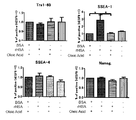
- ES cells when bovine albumin or recombinant human albumin (manufactured by rHSA Millipore) and / or oleic acid are added using undifferentiated markers SSEA-4, TRA-1-60, Nanog and differentiation marker SSEA-1 We decided to examine how the maintenance of the undifferentiated state is affected. When oleic acid and albumin were added, they were added in the form of oleic acid-conjugated albumin.
- BSA and oleic acid are replaced with oleic acid-conjugated BSA (medium condition 1), rHSA alone (medium condition 2), oleic acid-conjugated rHSA (medium condition 3), and the hESF9 medium.
- the H9 strain (WA09) was cultured using a medium to which none of BSA, rHSA, and oleic acid was added as a negative control (medium condition 4).
- the cultured H9 strain (WA09) was subcultured for 1 passage in hESF9 medium, fluorescent immunostaining was performed, and the positive rate of the expressed cells was analyzed.
- the cells were fixed with 4% paraformaldehyde (PFA) in PBS at room temperature for 15 minutes, blocked with bovine serum, then anti-SSEA-4 antibody (Abcam) and AlexaFluor-labeled anti-mouse IgG (Invitrogen) Using anti-TRA-1-60 antibody (Abcam) and AlexaFluor-labeled anti-mouse IgM (manufactured by Invitrogen), anti-SSEA-1 antibody (manufactured by Abcam) and AlexaFluor-labeled anti-mouse IgM (manufactured by Invitrogen) After immunostaining and blocking with bovine serum containing Triton X, immunostaining was performed with anti-Nanog antibody (manufactured by Cell Signaling) and anti-OCT4 antibody (manufactured by Santa Cruz), and AlexaFluor labeled secondary It reacted with the antibody and observed under a fluorescence microscope.
- PFA para
- the H9 strain (WA09) cultured cells at the third passage were confirmed by fluorescent immunostaining using undifferentiated markers SSEA-4, Tra1-60, Nanog, and differentiation markers SSEA-1.
- cryopreserved H9 strain (WA09) is a 0.1% gelatin (Embryomax, Millipore) coated flask (Corning) and Dulbecco's modified Eagle medium containing 10% fetal calf serum. Then, mouse embryo-derived fibroblasts (Millipore) whose cell growth was stopped with mitomycin C were seeded as feeder cells, 1 mM L-glutamine (21-51-016, GIBCO), 0.
- the solution was aspirated and removed immediately before cell seeding, and (2) 10 ⁇ g / mL recombinant human insulin (19278-5ML, Sigma), (3) 5 ⁇ g / mL recombinant human transferrin (apo) ( (T 2252, Sigma), (4) 10 ⁇ M 2-mercaptoethanol (M 7522, Sigma), (5) 10 ⁇ M 2-ethanolamine (E 0135, Sigma), (6) 20 nM Sodium selenate (S 9133, manufactured by Sigma), (7) 9.4 ⁇ g / mL oleic acid (O-1383-5G, manufactured by Sigma) to 1 mg / mL recombinant human albumin Combined rHSA-conjugated oleic acid, (8) 8 ng / mL basic FGF (manufactured by Katayama Kagaku Co., Ltd.), a supplement consisting of 8 factors, and 2 ng / mL activin (N-338 AC / CF, manufactured by R & D
- the H9 strain (WA09) maintained in the KSR-supplemented medium is removed, and after the medium is allowed to act, 1 unit / mL dispase is allowed to act at 37 ° C. for 2 minutes, and then the dispase is removed.
- the medium solution collect the cell population using a scraper or the like, centrifuge at 300 rpm for 1 minute, disperse in the solution in the first medium, centrifuge again, disperse in the first medium, The first passage culture was started.
- the medium was replaced with the second medium. Further, every 24 hours, the medium was changed to the second medium three times, and the medium of the cultured H9 strain (WA09) was cultured on the third day after the medium change from the first medium to the second medium. 1 unit / mL dispase was allowed to act at 37 ° C. for 2 minutes, and then the dispase was removed, and the cell population was collected with the above-mentioned first medium solution of the present invention using a scraper or the like at 300 rpm.
- the mixture was dispersed with the first medium solution, centrifuged again, and then dispersed into the first medium to transfer (passage), and the second passage culture was performed.
- the passage at the second passage is on the 3rd and 4th days, and after that, the passage is on the 5th day.
- the second passage H9 strain (WA09) subcultured to the first medium was replaced with a second medium 60 hours after the start of the culture in the first medium. After the medium was changed 5 times with the second medium, on the 5th day after the medium change from the first medium to the second medium, the medium was subcultured to the first medium again, and the third culture was performed. Thereafter, the steps of subculture to the first medium and medium exchange to the second medium were repeated, and the culture was continued.
- FIG. 6 is a photograph of cells in the 1st to 6th passages of H9 strain (WA09) cultured cells cultured by the above method, observed under a phase contrast microscope.
- the cell-cell boundary which is a characteristic of undifferentiated cells, is unclear, the cells have almost no nucleus and almost no cytoplasm, and the outline of the cell population (colony) is round and clear.
- colony the outline of the cell population
- H9 strain (WA09) cultured cells obtained by culturing the H9 strain (WA09) by the above method SSEA-3, SSEA-4, TRA-2-54, TRA-1-60, TRA-1-80, And CD90 (manufactured by BD), SSEA-1, CD105 (manufactured by BD), CD56 (manufactured by BD), and A2B5 (manufactured by Millipore) as differentiation markers, and the flow cytometry method for undifferentiation.
- HLA-abc manufactured by BD was used to confirm whether the cells were derived from human.
- H9 strain (WA09) cultured cells at the fifth passage the cells on the fifth day from the last passage were dispersed in a PBS solution containing trypsin / EDTA, and the cells were treated with 1 mL of 10% bovine serum (high clone). And then centrifuged for 30 minutes, and then incubated with each marker mouse antibody (Abcam) for 30 minutes.
- the cultured cells were washed 3 times with PBS containing 1% bovine serum and reacted with AlexaFluor-conjugated anti-rat IgM, goat anti-mouse IgG, IgM antibody (Invitrogen) for 15 minutes.
- the cultured cells were washed three times with PBS containing 1% bovine serum, and the resuspended cells were analyzed using a BD FACSCanto TM flow cytometer (BD, NJ USA). The results are shown in FIG.
- the fibronectin-containing first medium and the fibronectin-containing second medium are replaced with the fibronectin-containing first medium and the second medium described in the fibronectin coating section, and the fibronectin concentration is changed.
- the cells were cultured in the same manner as the fibronectin coating except that the cells were cultured in each well.
- the area of 1 well of the used plate was 9.6 cm 2 , and 3 mL of the medium was added.
- FIG. 8 shows a photomicrograph after passage of the cultured cells of the strain H9 (WA09) to a serum-free medium. From the appearance of the cells, it was judged that undifferentiation was most maintained when 80 ⁇ g / well of fibronectin was added. It was confirmed that fibronectin is effective in the method of the present invention even if it is added to the basal medium together with other supplement components instead of coating the culture vessel. From these results, it was confirmed that the human pluripotent stem cells maintained undifferentiated state even after repeated passage by using the culture method of the present invention.
- the human iPS cell Tic strain (JCRB1331) was dispersed in the first medium containing the protein kinase C inhibitor and cultured. Sixty hours after the start of cultivation of the Tic strain, the medium was replaced with the second medium containing the protein kinase C inhibitor. Furthermore, the medium was changed twice every 24 hours, and fixed with 4.5 mM citric acid, 2.25 mM sodium citrate, 3 mM sodium chloride, 65% methanol and 4% paraformaldehyde for 5 minutes on the 4th day after the start of the culture. Thereafter, alkaline phosphatase staining was performed using a FastRed substrate kit (manufactured by Sigma) according to the manufacturer's guidelines. The results are shown in FIG.
- FIG. 1 A photograph on the fourth day after the start of the cultivation of the Tic strain is shown in FIG.
- PLC myristoylated protein kinase C
Landscapes
- Health & Medical Sciences (AREA)
- Life Sciences & Earth Sciences (AREA)
- Engineering & Computer Science (AREA)
- Biomedical Technology (AREA)
- Genetics & Genomics (AREA)
- Zoology (AREA)
- Organic Chemistry (AREA)
- Biotechnology (AREA)
- Chemical & Material Sciences (AREA)
- Bioinformatics & Cheminformatics (AREA)
- Wood Science & Technology (AREA)
- Developmental Biology & Embryology (AREA)
- Reproductive Health (AREA)
- Gynecology & Obstetrics (AREA)
- Microbiology (AREA)
- Cell Biology (AREA)
- Biochemistry (AREA)
- General Engineering & Computer Science (AREA)
- General Health & Medical Sciences (AREA)
- Transplantation (AREA)
- Micro-Organisms Or Cultivation Processes Thereof (AREA)
Abstract
Priority Applications (5)
| Application Number | Priority Date | Filing Date | Title |
|---|---|---|---|
| AU2011358083A AU2011358083B2 (en) | 2011-01-31 | 2011-08-24 | Method for culturing human pluripotent stem cells |
| SG2013056593A SG192128A1 (en) | 2011-01-31 | 2011-08-24 | Method for culturing human pluripotent stem cells |
| EP11857898.8A EP2671945A4 (fr) | 2011-01-31 | 2011-08-24 | Procédé de culture de cellules souches pluripotentes humaines |
| CA2825070A CA2825070A1 (fr) | 2011-01-31 | 2011-08-24 | Procede de culture de cellules souches pluripotentes humaines |
| US13/982,127 US20130309768A1 (en) | 2011-01-31 | 2011-08-24 | Method for culturing human pluripotent stem cells |
Applications Claiming Priority (4)
| Application Number | Priority Date | Filing Date | Title |
|---|---|---|---|
| JP2011019109 | 2011-01-31 | ||
| JP2011-019109 | 2011-01-31 | ||
| JP2011115150A JP6148429B2 (ja) | 2011-01-31 | 2011-05-23 | ヒト多能性幹細胞の培養方法 |
| JP2011-115150 | 2011-05-23 |
Publications (1)
| Publication Number | Publication Date |
|---|---|
| WO2012104936A1 true WO2012104936A1 (fr) | 2012-08-09 |
Family
ID=46602184
Family Applications (1)
| Application Number | Title | Priority Date | Filing Date |
|---|---|---|---|
| PCT/JP2011/004691 Ceased WO2012104936A1 (fr) | 2011-01-31 | 2011-08-24 | Procédé de culture de cellules souches pluripotentes humaines |
Country Status (7)
| Country | Link |
|---|---|
| US (1) | US20130309768A1 (fr) |
| EP (1) | EP2671945A4 (fr) |
| JP (1) | JP6148429B2 (fr) |
| AU (1) | AU2011358083B2 (fr) |
| CA (1) | CA2825070A1 (fr) |
| SG (1) | SG192128A1 (fr) |
| WO (1) | WO2012104936A1 (fr) |
Cited By (8)
| Publication number | Priority date | Publication date | Assignee | Title |
|---|---|---|---|---|
| WO2014119219A1 (fr) * | 2013-01-31 | 2014-08-07 | 味の素株式会社 | Méthode de culture pour une prolifération stable indifférenciée de cellules souches pluripotentes |
| WO2014192938A1 (fr) * | 2013-05-30 | 2014-12-04 | 味の素株式会社 | Milieu de culture de cellules souches |
| WO2016088243A1 (fr) * | 2014-12-05 | 2016-06-09 | 株式会社ニコン | Dispositif de détermination, système d'observation, procédé d'observation, programme associé, procédé de fabrication de cellule, et cellule |
| WO2018047941A1 (fr) * | 2016-09-08 | 2018-03-15 | 協和発酵バイオ株式会社 | Milieu servant à la culture de cellules souches, méthode servant à la culture de cellules souches, promoteur de la croissance de cellules souches, et composition cellulaire et méthode servant à produire ladite culture de cellules souches |
| JP2021126065A (ja) * | 2020-02-12 | 2021-09-02 | 株式会社カネカ | 細胞凝集促進剤 |
| CN114410569A (zh) * | 2021-03-11 | 2022-04-29 | 青海大学 | 一种青海湖裸鲤鳃细胞系构建方法 |
| CN115103903A (zh) * | 2019-09-19 | 2022-09-23 | 西北大学 | 用于人诱导型多能干细胞的具成本效益的培养基和操作方案 |
| WO2023065384A1 (fr) * | 2021-10-22 | 2023-04-27 | 中国医学科学院生物医学工程研究所 | Milieu de culture pour cellule souche mésenchymateuse humaine |
Families Citing this family (16)
| Publication number | Priority date | Publication date | Assignee | Title |
|---|---|---|---|---|
| JP2016073323A (ja) * | 2011-01-31 | 2016-05-12 | 協和発酵バイオ株式会社 | ヒト多能性幹細胞の培養方法 |
| CN103797110B (zh) | 2011-07-12 | 2017-08-25 | 食品安全测试系统公司 | 沙门氏菌和大肠杆菌的培养基和培养方法以及用于检测沙门氏菌和大肠杆菌的方法 |
| JP6232638B2 (ja) * | 2013-06-24 | 2017-11-22 | 国立研究開発法人医薬基盤・健康・栄養研究所 | 肝前駆細胞増殖用培地 |
| CN104498429B (zh) * | 2014-12-12 | 2017-08-11 | 中国水产科学研究院长江水产研究所 | 一种等渗透压平衡培养液 |
| JP7088005B2 (ja) * | 2016-05-26 | 2022-06-21 | 株式会社ニコン | 神経幹細胞の製造方法、培地、サプリメント、サプリメントセット、培地キット、及び細胞培養装置 |
| US11697796B2 (en) | 2017-01-23 | 2023-07-11 | Stemcell Technologies Canada Inc. | Media and methods for enhancing the survival and proliferation of stem cells |
| KR102448428B1 (ko) | 2017-01-27 | 2022-09-30 | 가부시키가이샤 가네카 | 내배엽계 세포 집단, 및 다능성 세포로부터 3배엽 중 어느 하나의 세포 집단을 제조하는 방법 |
| JP6913694B2 (ja) * | 2017-05-31 | 2021-08-04 | プロモセル・ゲー・エム・ベー・ハー | 多能性幹細胞のための培養培地 |
| CN108865987A (zh) * | 2018-07-20 | 2018-11-23 | 深圳市第二人民医院 | 一种人关节液间充质干细胞用的培养基及其制备方法 |
| JP7231355B2 (ja) * | 2018-08-22 | 2023-03-01 | 日機装株式会社 | 細胞培養方法および細胞培養装置 |
| EP3858980A4 (fr) * | 2018-09-28 | 2021-12-08 | Ajinomoto Co., Inc. | Additif de culture, milieu de culture et procédé de culture pour cellules animales |
| WO2021174201A1 (fr) * | 2020-02-28 | 2021-09-02 | The Trustees Of The University Of Pennsylvania | Milieu de culture tissulaire pour la survie et la prise de greffe d'îlots pancréatiques humains |
| CN112229696A (zh) * | 2020-10-23 | 2021-01-15 | 杭州联科生物技术股份有限公司 | 一种固定破膜剂及其制备方法 |
| JPWO2022124298A1 (fr) | 2020-12-07 | 2022-06-16 | ||
| US20240034987A1 (en) * | 2020-12-09 | 2024-02-01 | Trustees Of Tufts College | Supplemented serum-free media for cultured meat production |
| AU2023338635A1 (en) * | 2022-09-09 | 2025-04-03 | Northwestern University | Minimal essential media for the culture of human induced pluripotent stem cells |
Citations (11)
| Publication number | Priority date | Publication date | Assignee | Title |
|---|---|---|---|---|
| JPH08508891A (ja) | 1993-06-18 | 1996-09-24 | アムジエン・インコーポレーテツド | 細胞の長期増殖及び発生用培地 |
| JP2005013152A (ja) | 2003-06-27 | 2005-01-20 | Asahi Kasei Corp | 細胞分化抑制剤及びこれを用いた細胞培養方法、培養液、培養された細胞 |
| WO2005063968A1 (fr) | 2003-12-26 | 2005-07-14 | Gs Platz Co Ltd | Milieu de base pour la culture de cellules es |
| JP2006180763A (ja) | 2004-12-27 | 2006-07-13 | Asahi Kasei Corp | 組織幹細胞増殖剤 |
| JP2007228815A (ja) | 2006-02-27 | 2007-09-13 | Gifu Univ | 胚性幹細胞の維持方法 |
| JP2007528226A (ja) * | 2004-03-10 | 2007-10-11 | リージェンツ オブ ザ ユニヴァーシティ オブ カリフォルニア | 胚幹細胞の増殖用組成物および方法 |
| JP2008148643A (ja) | 2006-12-19 | 2008-07-03 | Olympus Corp | 無血清培地および幹細胞の培養方法 |
| JP2009542247A (ja) | 2006-07-12 | 2009-12-03 | ユニヴァーシティー オヴ シェフィールド | 細胞増殖培地 |
| JP2010094062A (ja) | 2008-10-15 | 2010-04-30 | Saitama Medical Univ | 間葉系幹細胞の多分化能維持用培地、培養方法、及び分化方法 |
| JP2010166901A (ja) | 2008-12-24 | 2010-08-05 | Institute Of Physical & Chemical Research | 卵膜由来細胞の細胞外マトリクスを用いた多能性幹細胞の培養方法 |
| JP2010193910A (ja) | 2010-06-14 | 2010-09-09 | Mitsubishi Heavy Ind Ltd | 多能性幹細胞の培養方法、多能性幹細胞の培養システム、及び多能性幹細胞培養装置 |
Family Cites Families (13)
| Publication number | Priority date | Publication date | Assignee | Title |
|---|---|---|---|---|
| EP0567886A3 (fr) * | 1992-04-21 | 1994-11-02 | Kurashiki Boseki Kk | Composition pour une couche pour la culture de cellules adhésives animales et procédé de culture des cellules dans un milieu sans sérum. |
| JP4402249B2 (ja) * | 2000-03-31 | 2010-01-20 | 正仁 田谷 | 細胞培養方法、細胞培養装置及び記録媒体 |
| AU2003303071B2 (en) * | 2002-12-16 | 2009-04-23 | Technion Research & Development Foundation Ltd. | Methods of preparing feeder cells-free, xeno-free human embryonic stem cells and stem cell cultures prepared using same |
| US20060281136A1 (en) * | 2003-05-20 | 2006-12-14 | Shinichi Nishikawa | Preparation of endodermal stem cells |
| US8597947B2 (en) * | 2004-12-29 | 2013-12-03 | Hadasit Medical Research Services & Development Limited | Undifferentiated stem cell culture systems |
| WO2006088867A2 (fr) * | 2005-02-15 | 2006-08-24 | Medistem Laboratories, Incorporated | Procede pour l'expansion de cellules souches |
| WO2007002210A2 (fr) * | 2005-06-20 | 2007-01-04 | Bresagen, Inc. | Compositions de culture de cellules souches embryonnaires et methodes d’utilisation de celles-ci |
| GB0622394D0 (en) * | 2006-11-09 | 2006-12-20 | Univ Cambridge Tech | Differentiation of pluripotent cells |
| EP2088190A4 (fr) * | 2006-11-09 | 2011-01-05 | Japan Government | Procédé destiné à la culture et au passage d'une cellule souche embryonnaire de primate, et procédé destiné à induire la différenciation de la cellule souche embryonnaire |
| US9428728B2 (en) * | 2006-11-21 | 2016-08-30 | Coorstek Kk | Carrier for undifferentiated cell culture and subculture method thereof |
| KR101720961B1 (ko) * | 2009-02-27 | 2017-03-29 | 셀룰러 다이내믹스 인터내셔널, 인코포레이티드 | 다능성 세포의 분화 |
| CN102666853B (zh) * | 2009-10-28 | 2014-12-03 | 财团法人日本健康科学振兴财团 | 由干细胞向肝细胞的分化诱导方法 |
| FI20096288A0 (fi) * | 2009-12-04 | 2009-12-04 | Kristiina Rajala | Formulations and methods for culturing stem cells |
-
2011
- 2011-05-23 JP JP2011115150A patent/JP6148429B2/ja active Active
- 2011-08-24 CA CA2825070A patent/CA2825070A1/fr not_active Abandoned
- 2011-08-24 EP EP11857898.8A patent/EP2671945A4/fr not_active Withdrawn
- 2011-08-24 SG SG2013056593A patent/SG192128A1/en unknown
- 2011-08-24 WO PCT/JP2011/004691 patent/WO2012104936A1/fr not_active Ceased
- 2011-08-24 AU AU2011358083A patent/AU2011358083B2/en not_active Expired - Fee Related
- 2011-08-24 US US13/982,127 patent/US20130309768A1/en not_active Abandoned
Patent Citations (11)
| Publication number | Priority date | Publication date | Assignee | Title |
|---|---|---|---|---|
| JPH08508891A (ja) | 1993-06-18 | 1996-09-24 | アムジエン・インコーポレーテツド | 細胞の長期増殖及び発生用培地 |
| JP2005013152A (ja) | 2003-06-27 | 2005-01-20 | Asahi Kasei Corp | 細胞分化抑制剤及びこれを用いた細胞培養方法、培養液、培養された細胞 |
| WO2005063968A1 (fr) | 2003-12-26 | 2005-07-14 | Gs Platz Co Ltd | Milieu de base pour la culture de cellules es |
| JP2007528226A (ja) * | 2004-03-10 | 2007-10-11 | リージェンツ オブ ザ ユニヴァーシティ オブ カリフォルニア | 胚幹細胞の増殖用組成物および方法 |
| JP2006180763A (ja) | 2004-12-27 | 2006-07-13 | Asahi Kasei Corp | 組織幹細胞増殖剤 |
| JP2007228815A (ja) | 2006-02-27 | 2007-09-13 | Gifu Univ | 胚性幹細胞の維持方法 |
| JP2009542247A (ja) | 2006-07-12 | 2009-12-03 | ユニヴァーシティー オヴ シェフィールド | 細胞増殖培地 |
| JP2008148643A (ja) | 2006-12-19 | 2008-07-03 | Olympus Corp | 無血清培地および幹細胞の培養方法 |
| JP2010094062A (ja) | 2008-10-15 | 2010-04-30 | Saitama Medical Univ | 間葉系幹細胞の多分化能維持用培地、培養方法、及び分化方法 |
| JP2010166901A (ja) | 2008-12-24 | 2010-08-05 | Institute Of Physical & Chemical Research | 卵膜由来細胞の細胞外マトリクスを用いた多能性幹細胞の培養方法 |
| JP2010193910A (ja) | 2010-06-14 | 2010-09-09 | Mitsubishi Heavy Ind Ltd | 多能性幹細胞の培養方法、多能性幹細胞の培養システム、及び多能性幹細胞培養装置 |
Non-Patent Citations (10)
| Title |
|---|
| BEATTIE, G.M. ET AL.: "Activin A maintains pluripotency of human embryonic stem cells in the absence of feeder layers.", STEM CELLS, vol. 23, no. 4, April 2005 (2005-04-01), pages 489 - 95, XP008130459 * |
| IN VITRO CELL.DEV. BIOL.- ANIMAL, vol. 46, 2010, pages 573 - 576 |
| NAT BIOTECHNOL, vol. 26, 2008, pages 101 - 106 |
| NATURE, vol. 456, 2008, pages 344 - 9 |
| PNAS, vol. 105, no. 36, pages 13409 - 13414 |
| PROC NATL ACAD SCI USA., vol. 95, 1998, pages 13726 - 31 |
| See also references of EP2671945A4 * |
| STEM CELL RES., 2010 |
| TISS. CULT. RES COMMUN., vol. 27, 2008, pages 139 - 147 |
| VALLIER, L. ET AL.: "Activin/Nodal and FGF pathways cooperate to maintain pluripotency of human embryonic stem cells.", J. CELL SCI., vol. 118, no. 19, 1 October 2005 (2005-10-01), pages 4495 - 509, XP002472619 * |
Cited By (18)
| Publication number | Priority date | Publication date | Assignee | Title |
|---|---|---|---|---|
| US10662411B2 (en) | 2013-01-31 | 2020-05-26 | Ajinomoto Co., Inc. | Culture method for stable proliferation of pluripotent stem cell while maintaining undifferentiated state |
| KR102211266B1 (ko) * | 2013-01-31 | 2021-02-04 | 아지노모토 가부시키가이샤 | 다능성 줄기 세포의 안정한 미분화 유지 증식을 실시하기 위한 배양 방법 |
| KR20150110807A (ko) * | 2013-01-31 | 2015-10-02 | 아지노모토 가부시키가이샤 | 다능성 줄기 세포의 안정한 미분화 유지 증식을 실시하기 위한 배양 방법 |
| US10745669B2 (en) | 2013-01-31 | 2020-08-18 | Ajinomoto Co., Ltd. | Culture method for stable proliferation of pluripotent stem cell while maintaining undifferentiated state |
| EP2952579A4 (fr) * | 2013-01-31 | 2016-07-20 | Ajinomoto Kk | Méthode de culture pour une prolifération stable indifférenciée de cellules souches pluripotentes |
| JPWO2014119219A1 (ja) * | 2013-01-31 | 2017-01-26 | 味の素株式会社 | 多能性幹細胞の安定した未分化維持増殖を行うための培養方法 |
| WO2014119219A1 (fr) * | 2013-01-31 | 2014-08-07 | 味の素株式会社 | Méthode de culture pour une prolifération stable indifférenciée de cellules souches pluripotentes |
| WO2014192938A1 (fr) * | 2013-05-30 | 2014-12-04 | 味の素株式会社 | Milieu de culture de cellules souches |
| US11859205B2 (en) | 2013-05-30 | 2024-01-02 | Ajinomoto Co., Inc. | Medium for culturing stem cells |
| WO2016088243A1 (fr) * | 2014-12-05 | 2016-06-09 | 株式会社ニコン | Dispositif de détermination, système d'observation, procédé d'observation, programme associé, procédé de fabrication de cellule, et cellule |
| JPWO2018047941A1 (ja) * | 2016-09-08 | 2019-07-11 | 協和発酵バイオ株式会社 | 幹細胞培養用培地、幹細胞の培養方法、幹細胞の増殖促進剤、並びに細胞組成物およびその製造方法 |
| WO2018047941A1 (fr) * | 2016-09-08 | 2018-03-15 | 協和発酵バイオ株式会社 | Milieu servant à la culture de cellules souches, méthode servant à la culture de cellules souches, promoteur de la croissance de cellules souches, et composition cellulaire et méthode servant à produire ladite culture de cellules souches |
| CN115103903A (zh) * | 2019-09-19 | 2022-09-23 | 西北大学 | 用于人诱导型多能干细胞的具成本效益的培养基和操作方案 |
| JP2021126065A (ja) * | 2020-02-12 | 2021-09-02 | 株式会社カネカ | 細胞凝集促進剤 |
| JP7518628B2 (ja) | 2020-02-12 | 2024-07-18 | 株式会社カネカ | 細胞凝集促進剤 |
| CN114410569A (zh) * | 2021-03-11 | 2022-04-29 | 青海大学 | 一种青海湖裸鲤鳃细胞系构建方法 |
| CN114410569B (zh) * | 2021-03-11 | 2023-12-19 | 青海大学 | 一种青海湖裸鲤鳃细胞系构建方法 |
| WO2023065384A1 (fr) * | 2021-10-22 | 2023-04-27 | 中国医学科学院生物医学工程研究所 | Milieu de culture pour cellule souche mésenchymateuse humaine |
Also Published As
| Publication number | Publication date |
|---|---|
| SG192128A1 (en) | 2013-08-30 |
| JP2012175962A (ja) | 2012-09-13 |
| JP6148429B2 (ja) | 2017-06-14 |
| EP2671945A4 (fr) | 2014-11-19 |
| EP2671945A1 (fr) | 2013-12-11 |
| US20130309768A1 (en) | 2013-11-21 |
| AU2011358083A1 (en) | 2013-08-01 |
| CA2825070A1 (fr) | 2012-08-09 |
| AU2011358083B2 (en) | 2016-04-21 |
Similar Documents
| Publication | Publication Date | Title |
|---|---|---|
| JP6148429B2 (ja) | ヒト多能性幹細胞の培養方法 | |
| CN103060264B (zh) | 一种干细胞培养基及其应用和干细胞培养方法 | |
| US9321995B2 (en) | Stem cell culture medium and its applications as well as a stem cell culture method | |
| EP2840132B1 (fr) | Procédé pour produire par génie génétique des muscles cardiaques (EHM) | |
| EP3207122B1 (fr) | Generation de keratinocytes a partir de cellules souches pluripotentes et entretien de cultures de keratinocytes | |
| US20100081200A1 (en) | Formulations and methods for culturing stem cells | |
| CN102906247A (zh) | 用于培养干细胞的制剂和方法 | |
| CN103857789A (zh) | 制备间充质干细胞基础培养基和利用间充质干细胞基础培养基制备细胞治疗产品的方法及用该培养基得到的分化产品 | |
| US11518982B2 (en) | Method for manufacturing mesenchymal cell line derived from vertebrate animal adipose tissue | |
| WO2021185198A1 (fr) | Milieu de culture de cellules souches mésenchymateuses exempt de sérum et de composants hétérologues et utilisation associée | |
| CN104662148A (zh) | 含有间充质干细胞的条件培养基的角膜内皮细胞培养用培养基 | |
| JP6981403B2 (ja) | 神経分化能を亢進させる神経幹細胞用培地 | |
| US11697798B2 (en) | Enhanced differentiation and maturation of pluripotent stem cell-derived myogenic cells | |
| WO2016035816A1 (fr) | Procédé pour induire la différenciation de cellules souches pluripotentes en cardiomyocytes, et additif pour milieu de culture, régulateur de l'induction de la différenciation, milieu de culture, kit de préparation de milieu de culture, et kit pour induire la différenciation de cellules souches pluripotentes en cardiomyocytes convenant pour ledit procédé | |
| EP3467103B1 (fr) | Procédé de production de cellules souches neurales, milieu, complément, jeu de compléments, kit de milieu, et dispositif de culture de cellules | |
| JP2016073323A (ja) | ヒト多能性幹細胞の培養方法 | |
| JP2019134682A (ja) | 肝幹細胞様細胞の調製方法 | |
| JP2023531963A (ja) | 多能性細胞懸濁物を培養するための方法及び組成物 | |
| JP6232638B2 (ja) | 肝前駆細胞増殖用培地 | |
| JP2020129970A (ja) | 多能性幹細胞を培養するための組成物及び方法 | |
| Posung | Study of Vero Cell Attachment and Growth in A Modified Serum-Free Medium (SFM01-M) Supplementing with Different Concentrations of Vitamin C | |
| HONGISTO | Fibroblast Feeder Cells in Human Pluripotent Stem Cell Culture and Retinal Differentiation | |
| Rajala | Development of Human Stem Cell Culture Conditions for Clinical Cell Therapy |
Legal Events
| Date | Code | Title | Description |
|---|---|---|---|
| 121 | Ep: the epo has been informed by wipo that ep was designated in this application |
Ref document number: 11857898 Country of ref document: EP Kind code of ref document: A1 |
|
| ENP | Entry into the national phase |
Ref document number: 2825070 Country of ref document: CA |
|
| REEP | Request for entry into the european phase |
Ref document number: 2011857898 Country of ref document: EP |
|
| WWE | Wipo information: entry into national phase |
Ref document number: 2011857898 Country of ref document: EP |
|
| WWE | Wipo information: entry into national phase |
Ref document number: 13982127 Country of ref document: US |
|
| NENP | Non-entry into the national phase |
Ref country code: DE |
|
| ENP | Entry into the national phase |
Ref document number: 2011358083 Country of ref document: AU Date of ref document: 20110824 Kind code of ref document: A |