WO2012105027A1 - Dispositif de protection d'occupant - Google Patents
Dispositif de protection d'occupant Download PDFInfo
- Publication number
- WO2012105027A1 WO2012105027A1 PCT/JP2011/052285 JP2011052285W WO2012105027A1 WO 2012105027 A1 WO2012105027 A1 WO 2012105027A1 JP 2011052285 W JP2011052285 W JP 2011052285W WO 2012105027 A1 WO2012105027 A1 WO 2012105027A1
- Authority
- WO
- WIPO (PCT)
- Prior art keywords
- vehicle body
- airbag
- protection device
- vehicle
- occupant protection
- Prior art date
- Legal status (The legal status is an assumption and is not a legal conclusion. Google has not performed a legal analysis and makes no representation as to the accuracy of the status listed.)
- Ceased
Links
Images




Classifications
-
- B—PERFORMING OPERATIONS; TRANSPORTING
- B60—VEHICLES IN GENERAL
- B60R—VEHICLES, VEHICLE FITTINGS, OR VEHICLE PARTS, NOT OTHERWISE PROVIDED FOR
- B60R21/00—Arrangements or fittings on vehicles for protecting or preventing injuries to occupants or pedestrians in case of accidents or other traffic risks
- B60R21/02—Occupant safety arrangements or fittings, e.g. crash pads
- B60R21/16—Inflatable occupant restraints or confinements designed to inflate upon impact or impending impact, e.g. air bags
- B60R21/23—Inflatable members
- B60R21/231—Inflatable members characterised by their shape, construction or spatial configuration
- B60R21/2334—Expansion control features
- B60R21/2338—Tethers
-
- B—PERFORMING OPERATIONS; TRANSPORTING
- B60—VEHICLES IN GENERAL
- B60R—VEHICLES, VEHICLE FITTINGS, OR VEHICLE PARTS, NOT OTHERWISE PROVIDED FOR
- B60R21/00—Arrangements or fittings on vehicles for protecting or preventing injuries to occupants or pedestrians in case of accidents or other traffic risks
- B60R21/02—Occupant safety arrangements or fittings, e.g. crash pads
- B60R21/16—Inflatable occupant restraints or confinements designed to inflate upon impact or impending impact, e.g. air bags
- B60R21/23—Inflatable members
- B60R21/231—Inflatable members characterised by their shape, construction or spatial configuration
- B60R21/232—Curtain-type airbags deploying mainly in a vertical direction from their top edge
-
- B—PERFORMING OPERATIONS; TRANSPORTING
- B60—VEHICLES IN GENERAL
- B60R—VEHICLES, VEHICLE FITTINGS, OR VEHICLE PARTS, NOT OTHERWISE PROVIDED FOR
- B60R21/00—Arrangements or fittings on vehicles for protecting or preventing injuries to occupants or pedestrians in case of accidents or other traffic risks
- B60R21/02—Occupant safety arrangements or fittings, e.g. crash pads
- B60R21/16—Inflatable occupant restraints or confinements designed to inflate upon impact or impending impact, e.g. air bags
- B60R21/23—Inflatable members
- B60R21/231—Inflatable members characterised by their shape, construction or spatial configuration
- B60R21/2334—Expansion control features
- B60R21/2338—Tethers
- B60R2021/23386—External tether means
- B60R2021/23388—External tether means having ends which are movable or detachable during deployment
Definitions
- the present invention relates to an occupant protection device, and more particularly to an occupant protection device that protects a vehicle occupant by inflating an airbag.
- Patent Document 1 discloses an apparatus for deploying an airbag from above to below along a side window portion of a vehicle body.
- the supported portion at the lower end on the front side of the airbag body and the support position of the front pillar are connected by a strap.
- the strap is stored along the front pillar in a state where the airbag body is folded and stored in the roof side portion.
- the supported portion moves from the initial position to the deployed position.
- the separation dimension between the support position and the deployment position in the unfolded state is arranged to be substantially equal to the separation dimension between the support position and the initial position in the storage state.
- the strap is coupled to the lower portion of the airbag body, and is disposed so as to be inclined upward toward the support position in the deployed state.
- the airbag is connected to the vehicle body by the strap, but the vehicle body may be deformed in the event of a collision. For this reason, there is room for improvement in that the inflated airbag is fixed at a desired position.
- the present invention has been made in consideration of such circumstances, and an object of the present invention is to provide an occupant protection device capable of protecting an occupant more effectively.
- the present invention is an occupant protection device that protects a vehicle occupant by inflating an airbag, and includes a connection unit that connects the airbag and the vehicle body, and the connection unit is provided between the airbag and the vehicle body. It is an occupant protection device having a slack prevention mechanism that reduces slack.
- the connecting unit that connects the air bag and the vehicle body reduces slack between the air bag and the vehicle body.
- the slack preventing mechanism can draw the air bag and the vehicle body together in accordance with the amount of slack generated between the air bag and the vehicle body due to deformation of the vehicle body.
- the slack prevention mechanism pulls the airbag and the vehicle body together according to the amount of looseness generated between the airbag and the vehicle body due to the deformation of the vehicle body. For this reason, even when a slack is generated between the airbag and the vehicle body due to the deformation of the vehicle body caused at the time of the collision, the airbag is changed according to the amount of looseness generated between the airbag and the vehicle body due to the deformation of the vehicle body. And the vehicle body are attracted to each other, and the passenger can be more effectively protected.
- the tension generation source that generates the tension that reduces the slack between the airbag and the vehicle body of the slack prevention mechanism is the rear cover of the vehicle body, rather than the canopy of the cabin of the vehicle body, the portion where the airbag and the vehicle body are connected. It can be assumed that it is installed in any one of the parts and the instrument panel reinforcement.
- the tension generation source that generates the tension that reduces the slackness between the airbag and the vehicle body of the slack prevention mechanism is from the canopy of the compartment of the vehicle body, the portion where the airbag and the vehicle body are connected. Is also installed either in the rear part of the vehicle body or in the instrument panel reinforcement. Since the canopies and the like of these passenger compartments are parts that undergo relatively little deformation even during a collision, the passengers can be more effectively protected while preventing the influence of deformation due to the collision.
- the airbag can be inflated and deployed along the side wall of the vehicle interior.
- the airbag is inflated and deployed along the side wall in the vehicle interior of the vehicle.
- Such an airbag is effective for protecting an occupant when a vehicle collides with an obstacle in a lateral direction or an obliquely forward direction.
- the airbag and the vehicle body are firmly connected regardless of the deformation of the vehicle and the airbag is deployed at a predetermined position. Therefore, the occupant protection device provided with the slack preventing mechanism of the present invention is particularly effective when the airbag is inflated and deployed along the side wall of the vehicle interior of the vehicle.
- the connecting unit includes a tether strap that connects the front side of the airbag and the front pillar of the vehicle, a tether strap that connects the rear side of the airbag and the center pillar of the airbag, and a rear side of the airbag. It has at least one of tether straps that connect the rear pillars of the vehicle body, and the loosening prevention mechanism can generate tension by pulling the tether straps toward the vehicle body side.
- the connection unit includes a tether strap that connects the front side of the airbag to the front pillar of the vehicle, a tether strap that connects the rear side of the airbag and the center pillar of the airbag, and the airbag. It has at least one of a tether strap that connects the rear side of the vehicle body and the rear pillar of the vehicle body, and the loosening prevention mechanism generates tension by pulling the tether strap toward the vehicle body side. For this reason, the passenger
- the slack prevention mechanism can generate tension between the airbag and the vehicle body in advance.
- the slack prevention mechanism generates tension between the airbag and the vehicle body in advance. For this reason, even when deformation occurs in the vehicle body due to the collision, loosening between the airbag and the vehicle body can be effectively prevented.
- the loosening prevention mechanism can generate a tension between the airbag and the vehicle body when the vehicle collides.
- the loosening prevention mechanism generates tension between the airbag and the vehicle body when the vehicle collides. For this reason, loosening between the airbag and the vehicle body caused by the deformation of the vehicle body at the time of a collision can be effectively prevented.
- the loosening prevention mechanism can reduce the distance between the airbag and the vehicle body, and once the distance between the airbag and the vehicle body is reduced, the distance between the airbag and the vehicle body cannot be increased. It can be made impossible.
- the loosening prevention mechanism can reduce the distance between the airbag and the vehicle body, and after reducing the distance between the airbag and the vehicle body, the distance between the airbag and the vehicle body is reduced. It is impossible to increase it. For this reason, even if slack occurs between the airbag and the vehicle body due to the deformation of the vehicle body due to the collision, the distance between the airbag and the vehicle body once reduced does not return to the original, so the slack is more effectively removed. Can be prevented.
- the occupant protection device of the present invention can protect the occupant more effectively.
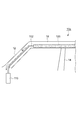
- an occupant protection device 10 a includes an A pillar (front pillar) 12, B that configures a curtain shield airbag 100 as a side wall of a vehicle compartment when a vehicle collides. It expands along the pillar (center pillar) 14, the C pillar (rear pillar) 16 and the roof side reinforcement 18 while being expanded.
- the deployed curtain shield airbag (CSA) 100 protects the passengers seated in the front seat 22 and the rear seat 24 from impacts from the side and diagonally forward of the vehicle.
- the curtain shield airbag 100 is normally folded and stored along the roof side reinforcement 18 at the vehicle canopy side end.
- a tether strap 102 for connecting the curtain shield airbag 100 and the vehicle body extends from the side end of the curtain shield airbag 100 along the A pillar 12.
- the lower end portion of the tether strap 102 is installed at the lower portion of the A pillar 12 and is connected to a pretensioner 110 that pulls the tether strap 102 with a force such as explosives when the vehicle collides.
- the pretensioner 110 applies tension to the tether strap 102 to reduce the slack.
- the tether strap 102 and the pretensioner 110 constitute a connecting unit in the present invention.
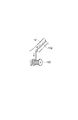
- the pretensioner 110 may be replaced with a retractor 120 with a reverse rotation prevention mechanism.
- the retractor 120 with the reverse rotation prevention mechanism winds the tether strap 102 with a reel in advance and applies a tension.
- the retractor 120 with the reverse rotation prevention mechanism winds up with the reel as much as the tether strap 102 is slackened.
- the retractor 120 with a reverse rotation prevention mechanism prevents the tether strap 102 once wound around the reel from returning to its original length by preventing the reel from rotating backward by a ratchet mechanism or the like.
- the retractor 120 with the reverse rotation prevention mechanism can keep the tether strap 102 at an appropriate length while preventing the tether strap 102 from being broken due to excessive tension at the time of collision.
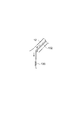
- the pretensioner 110 may be replaced with a spring mechanism 130.
- the spring mechanism 130 applies tension to the tether strap 102 with a spring in advance.
- the spring mechanism 130 reduces the slackness of the tether strap 102 due to the tension of the spring when the tether strap 102 is slackened at the time of collision.
- the spring mechanism 130 has a simple structure and can prevent the tether strap 102 from being broken due to an impact at the time of collision.
- the operation of the occupant protection device 10a of the present embodiment will be described.
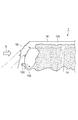
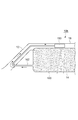
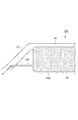
- the A pillar 12 may be deformed by the impact S, and the tether strap 102 may be slack.
- the pretensioner 110 applies tension to the tether strap 102 at the time of collision, and prevents the tether strap 102 from slackening. Therefore, the deployed curtain shield airbag 100 is firmly connected to the vehicle body by the tether strap 102 even if the vehicle body is deformed, and can protect the occupant at a predetermined position.
- the tether strap 102 is fixed to the vehicle body by a tether strap fixing portion 150. Therefore, as shown in FIG. 7, when the A pillar 12 is deformed by the impact S, the tether strap 102 may be loosened.
- the tether strap 102 that connects the curtain shield airbag 100 and the vehicle body of the vehicle
- a pretensioner 110 for reducing slack between the shield airbag 100 and the vehicle body is provided. For this reason, even when a slack occurs between the curtain shield airbag 100 and the vehicle body due to the deformation of the vehicle body that occurs at the time of the collision, the pretensioner 110 reduces the slack between the curtain shield airbag 100 and the vehicle body. Therefore, the passenger can be protected more effectively.
- the pretensioner 110, the retractor 120 with the reverse rotation prevention mechanism, and the spring mechanism 130 are provided in accordance with the amount of looseness generated between the curtain shield airbag 100 and the vehicle body due to the deformation of the vehicle body.
- the curtain shield airbag 100 and the vehicle body are drawn together. For this reason, even when a slack occurs between the curtain shield airbag 100 and the vehicle body due to the deformation of the vehicle body that occurs at the time of the collision, the slackness that occurs between the curtain shield airbag 100 and the vehicle body due to the deformation of the vehicle body.
- the curtain shield airbag 100 and the vehicle body are attracted to each other according to the amount, and the passenger can be more effectively protected.
- the pretensioner 110 generates a tension between the curtain shield airbag 100 and the vehicle body when the vehicle collides. For this reason, loosening between the curtain shield airbag 100 and the vehicle body caused by deformation of the vehicle body at the time of a collision can be effectively prevented, and the response is excellent.
- the retractor 120 with the reverse rotation prevention mechanism and the spring mechanism 130 generate tension between the curtain shield airbag 100 and the vehicle body in advance. For this reason, even when deformation occurs in the vehicle body due to the collision, loosening between the curtain shield airbag 100 and the vehicle body can be effectively prevented. Further, it is possible to prevent the tether strap 102 from being broken by an impact.
- the retractor 120 with the reverse rotation prevention mechanism can reduce the distance between the curtain shield airbag 100 and the vehicle body, and once reduces the distance between the curtain shield airbag 100 and the vehicle body. After this, it is impossible to increase the distance between the curtain shield airbag 100 and the vehicle body. For this reason, even when a slack occurs between the curtain shield airbag 100 and the vehicle body due to deformation of the vehicle body due to a collision, the distance between the curtain shield airbag 100 and the vehicle body once reduced does not return to the original. Sag can be prevented more effectively.
- the curtain shield airbag 100 is inflated and deployed along the side wall of the vehicle interior of the vehicle.
- a curtain shield airbag 100 is effective for protecting an occupant when a vehicle collides with an obstacle in a lateral direction or an obliquely forward direction.
- the curtain shield airbag 100 and the vehicle body are firmly connected regardless of the deformation of the vehicle, and the curtain shield airbag 100 is deployed at a predetermined position. Need to be. Therefore, the occupant protection device 10a provided with the pretensioner 110 of the present invention is particularly effective when the airbag is inflated and deployed along the side wall in the vehicle interior of the vehicle, such as the curtain shield airbag 100.
- the pretensioner 110 has a tether strap 102 that connects the front side of the curtain shield airbag 100 to the vehicle body and the A pillar of the vehicle body, and the pretensioner 110 pulls the tether strap 102 toward the vehicle body. To generate tension. For this reason, the occupant can be protected more effectively by reducing the looseness between the A-pillar 12 of the vehicle body and the curtain shield airbag 100.
- the tether strap 102 that connects the rear side of the curtain shield airbag 100 to the B pillar 14 of the vehicle body, or the rear side of the curtain shield airbag 100 and the C pillar 16 of the vehicle body is connected.
- the pretensioner 110 may include the tether strap 102 and generate tension by pulling the tether strap 102 toward the vehicle body. Thereby, the looseness between the B-pillar 14 or C-pillar 16 of the vehicle body and the curtain shield airbag 100 can be reduced, and the occupant can be protected more effectively.
- the pretensioner 110 is provided on the roof side reinforcement 18 at the rear of the A pillar 12 where the tether strap 102 and the vehicle body are connected. Also in this embodiment, it is possible to replace the pretensioner 110 with the retractor 120 with the reverse rotation prevention mechanism and the spring mechanism 130.
- the pretensioner 110 that generates tension that reduces the slack between the curtain shield airbag 100 and the vehicle body is more vehicle body than the A pillar 12 to which the curtain shield airbag 100 and the vehicle body are coupled.
- the rear side of the canopy is installed on the roof side reinforcement 18 of the canopy. Since the roof side reinforcement 18 is a portion that undergoes relatively little deformation even at the time of a collision, the occupant can be more effectively protected while preventing the influence of the deformation due to the collision.
- the pretensioner 110 is installed in the instrument panel reinforcement 20. Also in this embodiment, the pretensioner 110 can be replaced with the retractor 120 with the reverse rotation prevention mechanism and the spring mechanism 130.
- the pretensioner 110 that generates a tension that reduces the slack between the curtain shield airbag 100 and the vehicle body is installed in the instrument panel reinforcement 20.
- the instrument panel reinforcement 20 is a part that is relatively less deformed even at the time of a collision, and thus can protect the occupant more effectively while preventing the influence of the deformation due to the collision.
- the present invention is not limited to the above-described embodiments, and various modifications can be made.
- the aspect of connecting the A pillar 12 and the front end portion of the curtain shield airbag 100 has been mainly described.
- the technique of the above embodiment uses the rear end portion of the curtain shield airbag 100 as the B end.
- the present invention can be similarly applied when connecting to the pillar 14 or the C pillar 16.
- the occupant protection device of the present invention can protect the occupant more effectively.
Landscapes
- Engineering & Computer Science (AREA)
- Mechanical Engineering (AREA)
- Air Bags (AREA)
Abstract
Un dispositif de protection d'occupant (10a) destiné à protéger un occupant se trouvant dans le véhicule grâce au gonflage d'un coussin gonflable de protection du type rideau (100). Une bride d'attache (102) servant à relier le coussin gonflable de protection du type rideau (100) et la carrosserie de véhicule comporte un prétendeur (110) destiné à réduire le jeu entre le coussin gonflable de protection du type rideau (100) et la carrosserie de véhicule. Même s'il y a du jeu entre le coussin gonflable de protection du type rideau (100) et la carrosserie de véhicule en raison de la déformation de la carrosserie de véhicule qui survient lors d'une collision, le prétendeur (110) réduit le jeu entre le coussin gonflable de protection du type rideau (100) et la carrosserie de véhicule, et en conséquence, l'occupant est plus efficacement protégé.
Priority Applications (1)
| Application Number | Priority Date | Filing Date | Title |
|---|---|---|---|
| PCT/JP2011/052285 WO2012105027A1 (fr) | 2011-02-03 | 2011-02-03 | Dispositif de protection d'occupant |
Applications Claiming Priority (1)
| Application Number | Priority Date | Filing Date | Title |
|---|---|---|---|
| PCT/JP2011/052285 WO2012105027A1 (fr) | 2011-02-03 | 2011-02-03 | Dispositif de protection d'occupant |
Publications (1)
| Publication Number | Publication Date |
|---|---|
| WO2012105027A1 true WO2012105027A1 (fr) | 2012-08-09 |
Family
ID=46602268
Family Applications (1)
| Application Number | Title | Priority Date | Filing Date |
|---|---|---|---|
| PCT/JP2011/052285 Ceased WO2012105027A1 (fr) | 2011-02-03 | 2011-02-03 | Dispositif de protection d'occupant |
Country Status (1)
| Country | Link |
|---|---|
| WO (1) | WO2012105027A1 (fr) |
Citations (12)
| Publication number | Priority date | Publication date | Assignee | Title |
|---|---|---|---|---|
| JPH05193430A (ja) * | 1991-11-22 | 1993-08-03 | Takata Kk | 自動車の乗員頭部の保護装置 |
| DE19519297A1 (de) * | 1994-06-03 | 1995-12-07 | Volkswagen Ag | Sicherheitseinrichtung für ein Fahrzeug |
| JPH09175303A (ja) * | 1995-12-22 | 1997-07-08 | Toyoda Gosei Co Ltd | 乗員保護装置 |
| JPH10315893A (ja) * | 1997-05-15 | 1998-12-02 | Toyota Motor Corp | 自動車用乗員保護装置 |
| GB2327066A (en) * | 1997-07-09 | 1999-01-13 | Autoliv Dev | Improvements in or relating to an air-bag |
| JPH11124002A (ja) * | 1997-08-20 | 1999-05-11 | Takata Kk | 自動車用安全装置 |
| JP2001171466A (ja) * | 1999-12-06 | 2001-06-26 | Trw Occupant Restraint Syst Gmbh & Co Kg | 自動車用側方衝撃保護システム |
| JP2002520220A (ja) * | 1998-07-16 | 2002-07-09 | ティーアールダブリュー・オキュパント・リストレイント・システムズ・ゲーエムベーハー・ウント・コンパニー・カーゲー | 車両の拘束モジュール |
| JP2006096159A (ja) * | 2004-09-29 | 2006-04-13 | Toyoda Gosei Co Ltd | 乗員拘束装置 |
| JP2006103411A (ja) * | 2004-10-01 | 2006-04-20 | Toyoda Gosei Co Ltd | 乗員拘束装置 |
| JP2006123687A (ja) * | 2004-10-28 | 2006-05-18 | Toyoda Gosei Co Ltd | 乗員拘束装置 |
| JP2006315486A (ja) * | 2005-05-11 | 2006-11-24 | Toyoda Gosei Co Ltd | 乗員拘束装置 |
-
2011
- 2011-02-03 WO PCT/JP2011/052285 patent/WO2012105027A1/fr not_active Ceased
Patent Citations (12)
| Publication number | Priority date | Publication date | Assignee | Title |
|---|---|---|---|---|
| JPH05193430A (ja) * | 1991-11-22 | 1993-08-03 | Takata Kk | 自動車の乗員頭部の保護装置 |
| DE19519297A1 (de) * | 1994-06-03 | 1995-12-07 | Volkswagen Ag | Sicherheitseinrichtung für ein Fahrzeug |
| JPH09175303A (ja) * | 1995-12-22 | 1997-07-08 | Toyoda Gosei Co Ltd | 乗員保護装置 |
| JPH10315893A (ja) * | 1997-05-15 | 1998-12-02 | Toyota Motor Corp | 自動車用乗員保護装置 |
| GB2327066A (en) * | 1997-07-09 | 1999-01-13 | Autoliv Dev | Improvements in or relating to an air-bag |
| JPH11124002A (ja) * | 1997-08-20 | 1999-05-11 | Takata Kk | 自動車用安全装置 |
| JP2002520220A (ja) * | 1998-07-16 | 2002-07-09 | ティーアールダブリュー・オキュパント・リストレイント・システムズ・ゲーエムベーハー・ウント・コンパニー・カーゲー | 車両の拘束モジュール |
| JP2001171466A (ja) * | 1999-12-06 | 2001-06-26 | Trw Occupant Restraint Syst Gmbh & Co Kg | 自動車用側方衝撃保護システム |
| JP2006096159A (ja) * | 2004-09-29 | 2006-04-13 | Toyoda Gosei Co Ltd | 乗員拘束装置 |
| JP2006103411A (ja) * | 2004-10-01 | 2006-04-20 | Toyoda Gosei Co Ltd | 乗員拘束装置 |
| JP2006123687A (ja) * | 2004-10-28 | 2006-05-18 | Toyoda Gosei Co Ltd | 乗員拘束装置 |
| JP2006315486A (ja) * | 2005-05-11 | 2006-11-24 | Toyoda Gosei Co Ltd | 乗員拘束装置 |
Similar Documents
| Publication | Publication Date | Title |
|---|---|---|
| US7441796B2 (en) | Airbag system | |
| JP6386361B2 (ja) | 車両用カーテンエアバッグを収納したルーフヘッドライニング構造 | |
| WO2010089847A1 (fr) | Dispositif de coussin de sécurité gonflable permettant de protéger la tête dans une voiture | |
| JP2011148431A (ja) | 後突用エアバッグ装置 | |
| US11148633B2 (en) | Vehicle airbag device | |
| US7234728B2 (en) | Airbag system | |
| WO2012147490A1 (fr) | Dispositif de rideau gonflable | |
| JP5163309B2 (ja) | 車両の内装構造 | |
| JP6872373B2 (ja) | エアバッグ | |
| JP5988611B2 (ja) | エアバッグ装置 | |
| JP6577298B2 (ja) | エアバッグ装置 | |
| JP6420157B2 (ja) | エアバッグ | |
| JP2008137458A (ja) | エアバッグ装置 | |
| JP2011218994A (ja) | 車両用カーテンエアバッグ装置 | |
| JP2010083240A (ja) | エアバッグ及びエアバッグ装置 | |
| JP5217847B2 (ja) | 車両の遮蔽部材の取付け構造 | |
| JP5151867B2 (ja) | カーテンエアバッグを備えた車両の内装構造 | |
| JP2008195190A (ja) | 車両用エアバッグ装置 | |
| KR100831438B1 (ko) | 자동차용 커튼에어백의 전개 유도장치 | |
| JP6329051B2 (ja) | エアバッグ装置 | |
| JP2007076517A (ja) | 頭部保護エアバッグ装置 | |
| JP5034552B2 (ja) | カーテンエアバッグ装置を備えた車両の後部構造 | |
| JP6580480B2 (ja) | カーテンエアバッグ装置 | |
| KR102928637B1 (ko) | 차량용 루프에어백 장치 | |
| JP5092448B2 (ja) | カーテンエアバッグ装置を備えた車両の後部構造 |
Legal Events
| Date | Code | Title | Description |
|---|---|---|---|
| 121 | Ep: the epo has been informed by wipo that ep was designated in this application |
Ref document number: 11857834 Country of ref document: EP Kind code of ref document: A1 |
|
| NENP | Non-entry into the national phase |
Ref country code: DE |
|
| 122 | Ep: pct application non-entry in european phase |
Ref document number: 11857834 Country of ref document: EP Kind code of ref document: A1 |
|
| NENP | Non-entry into the national phase |
Ref country code: JP |