WO2012105215A1 - Dispositif de commande de véhicule - Google Patents
Dispositif de commande de véhicule Download PDFInfo
- Publication number
- WO2012105215A1 WO2012105215A1 PCT/JP2012/000560 JP2012000560W WO2012105215A1 WO 2012105215 A1 WO2012105215 A1 WO 2012105215A1 JP 2012000560 W JP2012000560 W JP 2012000560W WO 2012105215 A1 WO2012105215 A1 WO 2012105215A1
- Authority
- WO
- WIPO (PCT)
- Prior art keywords
- control
- vehicle
- control device
- external
- external control
- Prior art date
- Legal status (The legal status is an assumption and is not a legal conclusion. Google has not performed a legal analysis and makes no representation as to the accuracy of the status listed.)
- Ceased
Links
Images


Classifications
-
- H—ELECTRICITY
- H04—ELECTRIC COMMUNICATION TECHNIQUE
- H04W—WIRELESS COMMUNICATION NETWORKS
- H04W12/00—Security arrangements; Authentication; Protecting privacy or anonymity
- H04W12/06—Authentication
-
- B—PERFORMING OPERATIONS; TRANSPORTING
- B60—VEHICLES IN GENERAL
- B60R—VEHICLES, VEHICLE FITTINGS, OR VEHICLE PARTS, NOT OTHERWISE PROVIDED FOR
- B60R16/00—Electric or fluid circuits specially adapted for vehicles and not otherwise provided for; Arrangement of elements of electric or fluid circuits specially adapted for vehicles and not otherwise provided for
- B60R16/02—Electric or fluid circuits specially adapted for vehicles and not otherwise provided for; Arrangement of elements of electric or fluid circuits specially adapted for vehicles and not otherwise provided for electric constitutive elements
-
- H—ELECTRICITY
- H04—ELECTRIC COMMUNICATION TECHNIQUE
- H04L—TRANSMISSION OF DIGITAL INFORMATION, e.g. TELEGRAPHIC COMMUNICATION
- H04L12/00—Data switching networks
- H04L12/28—Data switching networks characterised by path configuration, e.g. LAN [Local Area Networks] or WAN [Wide Area Networks]
- H04L12/2803—Home automation networks
- H04L12/2816—Controlling appliance services of a home automation network by calling their functionalities
- H04L12/2818—Controlling appliance services of a home automation network by calling their functionalities from a device located outside both the home and the home network
-
- H—ELECTRICITY
- H04—ELECTRIC COMMUNICATION TECHNIQUE
- H04L—TRANSMISSION OF DIGITAL INFORMATION, e.g. TELEGRAPHIC COMMUNICATION
- H04L67/00—Network arrangements or protocols for supporting network services or applications
- H04L67/01—Protocols
- H04L67/12—Protocols specially adapted for proprietary or special-purpose networking environments, e.g. medical networks, sensor networks, networks in vehicles or remote metering networks
- H04L67/125—Protocols specially adapted for proprietary or special-purpose networking environments, e.g. medical networks, sensor networks, networks in vehicles or remote metering networks involving control of end-device applications over a network
-
- H—ELECTRICITY
- H04—ELECTRIC COMMUNICATION TECHNIQUE
- H04L—TRANSMISSION OF DIGITAL INFORMATION, e.g. TELEGRAPHIC COMMUNICATION
- H04L9/00—Cryptographic mechanisms or cryptographic arrangements for secret or secure communications; Network security protocols
- H04L9/32—Cryptographic mechanisms or cryptographic arrangements for secret or secure communications; Network security protocols including means for verifying the identity or authority of a user of the system or for message authentication, e.g. authorization, entity authentication, data integrity or data verification, non-repudiation, key authentication or verification of credentials
- H04L9/3226—Cryptographic mechanisms or cryptographic arrangements for secret or secure communications; Network security protocols including means for verifying the identity or authority of a user of the system or for message authentication, e.g. authorization, entity authentication, data integrity or data verification, non-repudiation, key authentication or verification of credentials using a predetermined code, e.g. password, passphrase or PIN
-
- G—PHYSICS
- G07—CHECKING-DEVICES
- G07C—TIME OR ATTENDANCE REGISTERS; REGISTERING OR INDICATING THE WORKING OF MACHINES; GENERATING RANDOM NUMBERS; VOTING OR LOTTERY APPARATUS; ARRANGEMENTS, SYSTEMS OR APPARATUS FOR CHECKING NOT PROVIDED FOR ELSEWHERE
- G07C2205/00—Indexing scheme relating to group G07C5/00
- G07C2205/02—Indexing scheme relating to group G07C5/00 using a vehicle scan tool
-
- H—ELECTRICITY
- H04—ELECTRIC COMMUNICATION TECHNIQUE
- H04L—TRANSMISSION OF DIGITAL INFORMATION, e.g. TELEGRAPHIC COMMUNICATION
- H04L12/00—Data switching networks
- H04L12/28—Data switching networks characterised by path configuration, e.g. LAN [Local Area Networks] or WAN [Wide Area Networks]
- H04L12/40—Bus networks
- H04L2012/40208—Bus networks characterized by the use of a particular bus standard
- H04L2012/40215—Controller Area Network CAN
-
- H—ELECTRICITY
- H04—ELECTRIC COMMUNICATION TECHNIQUE
- H04L—TRANSMISSION OF DIGITAL INFORMATION, e.g. TELEGRAPHIC COMMUNICATION
- H04L12/00—Data switching networks
- H04L12/28—Data switching networks characterised by path configuration, e.g. LAN [Local Area Networks] or WAN [Wide Area Networks]
- H04L12/40—Bus networks
- H04L2012/40267—Bus for use in transportation systems
- H04L2012/40273—Bus for use in transportation systems the transportation system being a vehicle
-
- H—ELECTRICITY
- H04—ELECTRIC COMMUNICATION TECHNIQUE
- H04L—TRANSMISSION OF DIGITAL INFORMATION, e.g. TELEGRAPHIC COMMUNICATION
- H04L2209/00—Additional information or applications relating to cryptographic mechanisms or cryptographic arrangements for secret or secure communication H04L9/00
- H04L2209/84—Vehicles
-
- H—ELECTRICITY
- H04—ELECTRIC COMMUNICATION TECHNIQUE
- H04L—TRANSMISSION OF DIGITAL INFORMATION, e.g. TELEGRAPHIC COMMUNICATION
- H04L63/00—Network architectures or network communication protocols for network security
- H04L63/08—Network architectures or network communication protocols for network security for authentication of entities
- H04L63/0884—Network architectures or network communication protocols for network security for authentication of entities by delegation of authentication, e.g. a proxy authenticates an entity to be authenticated on behalf of this entity vis-à-vis an authentication entity
Definitions
- the present invention relates to a control device for a vehicle, and more particularly to a control device for a vehicle capable of controlling a motion control device for a vehicle using an external control device.
- on-vehicle devices of the above-mentioned car there are various electric actuators used for an engine, a suspension, a brake, etc. as contributing to the motion of the vehicle, and an audio device and a combination meter device as not contributing to the motion of the vehicle. And key devices. They are controlled by respective corresponding control devices (some of which are integrated with in-vehicle devices), and the respective control devices can communicate by the above-mentioned CAN.
- the control device for controlling the electric actuator as described above breaks down, it becomes difficult for the vehicle to travel well, so it is preferable to be able to easily diagnose whether the vehicle is operating normally.
- the thing of the said patent document 1 connects a recording device, collects data in the recording device, and analyzes it, the DLC (vehicle diagnostic coupler) which can connect the cable connector of an external diagnostic machine can be used on the vehicle side Provided in In addition, the motor vehicle which connected the external diagnostic machine at the time of a diagnosis and performed various diagnostic items is known.
- the characteristics of the in-vehicle devices can be changed in accordance with the driver's needs.
- the characteristics of the in-vehicle device can be appropriately changed by using the external control device connectable to the DLC and enabling the external control device to control the in-vehicle device.
- the control device for controlling the in-vehicle device Vehicle control apparatus comprising: a vehicle comprising (12 to 18) and an interface device (3) connected to the control device; and an external control device (1) accessible to the control device via the interface device
- Signal generation means (1b), and external communication means (1a, 5. 31) for transmitting the external authentication code and the external control signal to the interface device.
- the vehicle collates the external authentication code with the internal authentication code, and the internal authentication code generating means (3c) for generating an internal authentication code for permitting access to the control device, and the collation result is correct And access permission means (3b) for permitting control of the control device by the external control signal.
- the interface device by using, for example, a well-known DLC (vehicle diagnostic coupler) as the interface device, connection between the control device on the vehicle side and the external control device is facilitated, and comparison between the external authentication code and the internal authentication code is performed. Only when the result is correct, since the control of the control device is permitted by the external control signal from the external control device connected via the interface device, illegal access is prohibited. In this way, it is possible to control the on-vehicle equipment of the vehicle by the authorized control signal from the outside that has been authenticated.
- DLC vehicle diagnostic coupler
- the external control device may include a portable device in which a predetermined application is incorporated.
- a portable device such as a mobile phone can be used as an external control device connected to a vehicle, and such a portable device can easily incorporate an application for controlling an on-vehicle device and is special Since a commercially available portable device can be used without preparing a suitable device, the convenience is high.
- the external authentication code may be provided to the portable device from a server. According to this, by collating the external authentication code acquired from the server with the internal authentication code of the vehicle, it can be confirmed that the control is performed by the application acquired from the authorized server, and external control by the authorized user is permitted without any problem. It can.
- control device performs in advance a first control mode in which control of the in-vehicle device is performed based on the external control signal, when control of the control device by the external control signal is permitted by the access permission means. It is preferable to have a second control mode for controlling the in-vehicle device based on the set predetermined control. According to this, when the collation result between the external control signal and the internal control signal is correct, it is possible to change the on-vehicle device to the control from the outside, and in the other cases, it is normal Control can be performed, abnormal control can be prevented, and deterioration of existing (for example, initial setting) control characteristics can be prevented.
- control device has communication state determination means (14b) for determining the communication state between the interface device and the external communication means, and the communication state determination means determines that the communication state is abnormal. In this case, it is preferable to invalidate the first control mode. According to this, when normal control by the external control device can not be performed due to a communication abnormality due to a load fluctuation of the external control device or a delay in code authentication, etc., normal control by the existing control characteristics is performed. This can prevent erroneous control due to the loss of communication state from being implemented.
- the vehicle includes in-vehicle devices that contribute to the motion of the vehicle and in-vehicle devices that do not contribute to the motion of the vehicle, and the control device determines that the communication state is abnormal by the communication state determination unit. It is preferable to suppress control on the in-vehicle device that contributes to the motion of the vehicle in the first control mode based on the external control signal.
- the magnitude of the control (drive) amount for the on-vehicle device contributing to the motion of the vehicle can be reduced, or the control amount (drive By reducing the amount of change in amount), it is possible to suppress a sudden change in the control operation of the in-vehicle device that contributes to the movement of the vehicle.
- the vehicle includes in-vehicle devices that contribute to the motion of the vehicle and in-vehicle devices that do not contribute to the motion of the vehicle, and the access permission means controls the in-vehicle devices that the external control signal does not contribute to the motion of the vehicle.
- the access permission means controls the in-vehicle devices that the external control signal does not contribute to the motion of the vehicle.
- control unit stores the external control signal or a storage unit (14d) that stores a reception signal corresponding to the external control signal, and a transmission unit that transmits the storage information stored in the storage unit to the external control unit.
- the external control device may include server transmission means for transmitting the stored information transmitted from the transmission means to an external server. According to this, it is possible to store a record (log) of control contents and signal transfer by the external control device, and transmit the record to an external server to store the stored information in the external server. As a result, diagnosis at the time of abnormality can be easily performed.
- the control means may store the new control data in the storage means when the external control signal includes new control data for the second control mode. According to this, with respect to the control in the second control mode, the function can be easily updated or corrected.
- the vehicle may have a plurality of the in-vehicle devices and the control device, and the access permission unit may simultaneously perform access to the plurality of control devices by the external control signal when the comparison result is correct. It is good to allow According to this, simultaneous access to a plurality of control devices can be enabled by one check for one authentication code, and convenience can be improved, and the load of communication and calculation can be reduced.
- one of the control devices is provided to perform a plurality of controls, and the access granting means individually grants the plurality of controls to the one control device.
- the control device has a plurality of functions (for example, ABS, automatic brake, yaw moment control)
- a part of the plurality of functions is limited by giving an authentication level to each of them. It can be made controllable by the state.
- a vehicle control device having a vehicle including a control device for controlling in-vehicle devices and an interface device connected to the control device, and an external control device capable of accessing the control device via the interface device.
- the external control device includes external control signal generation means for generating an external control signal for controlling the control device, and external communication means for transmitting the external control signal to the interface device;
- Load condition determination means for determining the load condition of the control device, and access restriction for limiting control of the control device by the external control signal when the load condition determination means determines that the load of the external control device is large It is good to have means (1-3). According to this, since the external control device limits control of the control device when occurrence of load increase or load increase is predicted when simultaneously controlling a plurality of control devices, communication response time due to load increase can be reduced. It is possible to suppress the occurrence of delay and error increase.
- external control is performed on the control of each in-vehicle device of the vehicle provided with a plurality of control devices by collating the authentication code with the control device, for example, in thread units.
- the CPU of the on-board controller uses the CPU with the minimum necessary capacity, and the driver's various needs to perform control different from the existing control by the controller are processed.
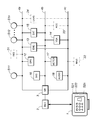
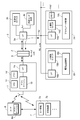
- FIG. 1 is a view showing an example of the external communication procedure of the on-vehicle control system to which the present invention is applied.
- the gateway device 3 is connected to a known vehicle diagnostic DLC coupler 2 connectable to a connector (not shown) coupled to the cable end of the external control device 1, and the gateway device 3 is multiplexed for use in CAN.
- the communication lines 4a, 4b and 4c are connected, and the control devices 12 to 18 corresponding to the on-vehicle devices (not shown) are connected to the multiplex communication lines 4a, 4b and 4c.
- each sensor such as yaw sensor, acceleration sensor (plural) or wheel speed sensor (plural) as momentum sensor, steering angle sensor, accelerator pedal sensor, brake pedal sensor, shift position sensor as operation detection sensor, etc.
- S11 ⁇ S12 ⁇ S1 n are connected.
- a camera, an acceleration sensor, a touch sensor, a GPS, etc. are built in the external control device 1, the information of each of the sensors S21, S22,..., S2n can also be used for control.
- the control devices 12 to 18 and 21 to 24 control the movement of the vehicle body, display of instruments, etc. independently or in coordination based on the signals from the sensors S11 to S1 n provided in the vehicle.
- the controller 12 performs electric power steering control
- the controller 13 performs engine control
- the controller 14 performs anti-slip control
- the controller 15 performs electronic shift control
- the controller 16 is an auxiliary restraint device. Control may be performed.
- These controllers 12 to 16 include, for example, an electric brake cylinder for generating a brake fluid pressure, an electric pump and a solenoid valve for controlling a four wheel brake fluid pressure, an electric motor for driving a steering rack, and an electric throttle for drive by wire. It is an electric actuator such as a valve, and controls an on-vehicle device that contributes to the motion of the vehicle.
- control device 17 may control a combination meter
- control device 18 may control an audio device
- these control devices 17 and 18 control on-vehicle devices that do not contribute to the motion of the vehicle
- Each of these control devices 12 to 18 may be packaged integrally with the corresponding on-vehicle devices, and perform control by mutually exchanging data by CAN.
- the external control device 1 may be a portable terminal having a network function etc. in addition to a portable telephone function as a portable device, for example, and a cable having a connector 5 constituting an external communication means connected to the DLC coupler 2 can be connected It has become.
- an interface unit 1a constituting an external communication unit capable of communicating with the gateway device 3
- application control connected to the interface unit 1a as an external authentication code generation unit and an external control signal generation unit
- a unit 1b a CPU 1c that controls these and other functions, and a memory unit 1d are provided inside the external control device 1.
- the external control device 1 can be connected to a known service provider 6 on the network by the network function, and can also be connected to a server 7 that can manage the control system.
- the service provider 6 functions as a window that directly or indirectly provides access to content data in the server.
- the service provider 6 is provided with an application supply unit 6a for keeping the applications for controlling the control devices 12 to 18 available for sale (provide) via the network.
- the server 7 includes an authentication code information providing unit 7a that provides an authentication code ID2 that authenticates that the application is legitimate, and an additional information unit that provides, for example, information related to car navigation to support comfortable running of the vehicle. 7b etc. are provided.
- an interface unit 14a as transmission means connected to the multiplex communication line 4a and an interface unit 14a of the control device 14 are provided inside each of the control devices 12-16.
- a main control logic unit 14b that performs main control and as communication state determination means, and an actuator control unit 14c that drives and controls an electric actuator to be controlled are provided.
- control device 18 As shown in the figure, inside the control unit 18, an interface control unit 18a connected to the multiplex communication line 4a, a main control logic unit 18b for performing main control of the control unit 18, a switch to be controlled, An electric circuit control unit 18c that controls the image processing circuit is provided.
- the application control unit 1 b of the external control device 1 installs (incorporates) an application (including an authentication code ID 2) purchased and downloaded from the service provider 6.
- the service provider 6 and the server 7 can communicate with each other to allow, for example, an application that permits access to each of the control devices 12 to 18 or that can directly change the control content of each control device. From the application (the transmission information from the application to each control device 12 to 18 (transmission information from the application to each control device 12 to 18 and the information acquired by the application from each control device 12 to 18) is received by the server 7 Can be configured to manage.
- the connector 5 of the external control device 1 is first Connect to the DLC coupler 2 Then, when an application is activated by operating a key (in the case of a touch panel) on the display of the external control device 1, a signal of the signal is shown between the external control device 1 and the gateway device 3 as shown by the solid arrow in FIG. Delivery is done.
- the control flow of the external control device 1 is shown in FIG. 3 by steps S101-111, the control flow of the gateway device 3 is shown by steps S201-208, and the control device 14 is controlled as a representative example of the control devices 12-18 21-24.
- the flow is shown by steps S301 to S309.
- the control mode is a control mode in which control by the external control device 1 is performed, and a first control mode that can be freely set to some extent by an application, and an initial (factory default) control mode set in advance. And a second control mode for performing basic control.
- the external control device 1 first acquires program data in step S101.
- processing of authentication in a general-purpose protocol is performed using a known encryption technique or the like as communication connection in two directions.
- wired connection is used, and in the example of FIG. 5 described later, wireless connection is used, and this device can cope with both wired and wireless connection. Therefore, the communication connection process in each of the steps S102 and S201 may perform authentication at the time of wireless connection, and in the case of wired connection, the process may be ignored as authentication unnecessary and the process may proceed to the next step.
- step S103 in the external control device 1 an external control program by the installed application is started, and in the next step S104, a thread in program processing is generated.
- the external control device 1 generates a thread each time the application control unit 1b accesses the control function to the control device 14, and generates a security key Ky2 corresponding to the thread.
- the request message RS is transmitted.
- the gateway 3 receives the request message RS, generates a security code in step S202, and transmits it as a key request signal. Further, the authentication code generation unit 3c generates a security key Ky1 as an authentication code.
- the external control device 1 receives the key request signal, and in step S106 the security key Ky2 generated as an authentication code from the security code from the gateway device 3 and the encryption constant of the application is Send by
- step S203 in the gateway device 3 the security key Ky1 and the received security key Ky2 are collated, and if the collation result is correct, a signal for permitting control by the external control device 1 is transmitted. If it is determined that the security key Ky2 is invalid, the control permission signal is not transmitted, and the process does not proceed to step S204.
- step S107 following step S106 in the external control device 1 the control signal code is transmitted based on the internal calculation, and control by the external control device 1 is started.
- the calculation of the security key Ky2 in the external control device 1 it is preferable to be able to change for each external control (each program ID) by the application. For example, it is possible to register the constant used for the calculation of the security key Ky2 in the file of the application in association with each program ID.
- step S204 in the gateway device 3 based on the control signal code from the external control device 1, a control signal for controlling the control device 14 in the first control mode is transmitted.
- step S205 it is determined whether a predetermined time has elapsed.
- the start of the predetermined time may be, for example, from the start of transmission of the control signal in step S204, which is performed from the start of control. If it is determined in step S205 that the predetermined time has elapsed, the process proceeds to step S206.
- the authentication code generation unit 3c generates a security key Ky1 as an authentication code and transmits a key update request.
- step S108 following step S107 in the external control device 1, it is determined whether there is a key update request from the gateway device 3. If there is a key update request, the process proceeds to step S109, where the security key Ky2 is updated, and the process returns to step S106. As described above, by forcibly updating the security key Ky2 in a predetermined time from the start of control, it is possible to always perform control in an authorized normal state. If there is no key update request, the process proceeds to step S110.
- the controller 14 diagnoses the sensor state related to control and diagnoses the actuator in step S301, and determines in the next step S302 whether or not the actuator can be controlled. If it is possible to control, the process proceeds to step S303.
- step S303 the second control mode is started, and in the next step S304, control in the second control mode is performed based on sensor signals and the like from the respective sensors S11,..., S1n, S21,. Run.
- the second control mode may be stored in the memory unit 14d provided in the control device 14 as storage means, and is not rewritten by a control signal code described later, and is set in advance.
- Basic control may be performed in an initial (factory default) control mode.
- step S305 it is determined whether or not the external signal from the external control device 1 can be prioritized. If the external signal is not prioritized, the present routine is ended.
- control for a specific control target for example, as shown in FIG. 4, a map in which device priority and control signal priority are set for the control target is prepared, and priority control is performed. It can be decided.
- the device priority is prioritized by the gateway (second control mode), and the external device (first control mode) is low priority, and control signals that simultaneously compete from the internal device including the gateway and the external device When is input, priority is given to the internal device.
- control instruction code control signal
- control signal control signal
- some high-level control instructions are not executed even if they are input from an external device ("not executable" in FIG. 4).
- execution is possible only when the upper control instruction is not executed.
- step S305 If it is determined in step S305 that the external signal is prioritized, the process proceeds to step S306, where the first control mode for the control device 14 by the main control logic unit 3b is started, and in the next step S307, for example, the external control device Control is executed based on the calculations performed in step S107 and the external sensors S21,.
- the external control device 1 is provided with an acceleration sensor, a touch panel, an operation button, a camera, a GPS, etc., such information, if an electronic money function is provided, Electronic money information can be used for control.
- control device 14 is a device (VSA) capable of appropriately controlling a plurality of functions of ABS, automatic brake, and yaw moment control, the front / rear ratio of the braking force, the valve opening ratio to the accelerator operation amount, etc. Can be freely set and controlled by the external control device 1.
- VSA device
- the setting and control from the outside can also be similarly performed on in-vehicle devices using electric actuators that contribute to the motion of other vehicles, but the control range is that the motion of the vehicle largely deviates from the initial setting. It is needless to say that the range is not
- step S308 it is determined whether to switch to internal control (second control mode). If not switched, the process returns to step S306 to continue control in the first control mode.
- the case of switching is, for example, a case where normal control by the external control device 1 can not be performed due to a communication abnormality caused by a load fluctuation of the external control device 1 or a delay of code authentication. This constitutes a load status determination means.
- step S309 the transition mode for transitioning to the second control mode is executed, and the routine in the control device 14 is ended.
- the first control mode it is preferable to return to the second control mode gently or to stop the control.
- step S110 in the external control device 1 it is determined whether the load of the communication environment has increased to a predetermined upper limit value or more or the control has ended, and it does not reach until it is determined that the load increases. If the control has not ended, the process returns to step S104 to continue the control. If the load increases, or if it is determined that the control has ended, the process proceeds to step S111, where the control ends and communication disconnection processing is performed, and the control in the external control device 14 is forcibly ended.
- the load increase determination is not limited to the case where the load actually increases, but may include the case where the load is predicted to be equal to or higher than the upper limit value. Further, at the end of the control, when a plurality of control devices 12 to 18 and 21 to 24 are simultaneously controlled, a part of the control devices, a single control device is performing a plurality of complicated controls. May end each control of that part.
- step S207 following step S206 in the gateway device 3, it is determined whether the control state is abnormal (NG). If it is determined that the control value is not abnormal, the process returns to step S203 to continue the control, and for example, if it is determined that the control value is abnormal such that the control value exceeds an allowable range, the process proceeds to step S208. In step S208, the control of this routine is forcibly canceled.
- the control prohibition / suppression control in the steps S110 and S207 may be provided on the application in the external control device 1 or the control program in the gateway device 3 as an access restriction means. Further, as the load increase, at the time of a telephone call or an incoming call by a voice telephone, at the time of moving image reproduction, or at the same time, plural simultaneous control of the control devices 12-18 21-24, and the like.
- the above-mentioned control prohibition / suppression is performed when the occurrence of a load increase or a load increase is predicted in those cases, or when a delay in communication response time with the gateway 3 or an error increase occurs. In addition, in the case where multiple simultaneous control of the control device is performed, only a part of control stop or suppression may be performed.
- simultaneous access to a plurality of control devices can be enabled by one check for one security key Key1 (authentication code).
- FIG. 2 shows the control device 14 as a representative, if the verification between the security keys Key1 and Key2 is verified as correct, the external control for the other control devices should be verified again. Can be made possible. Thereby, the convenience can be improved, and the load of communication and calculation can be reduced.
- the signal contents of the external control device 1 are stored in response to the request from the external control device 1 Can be sent to one.
- the control content by the external control device 1 and the record (log) of signal transfer can be stored, and the record is transmitted to the external server 7 through the external control device 1 and stored in the server 7 Can be
- the information can be used for diagnosis at the time of abnormality, and failure diagnosis can be performed easily and promptly.
- Communication can be performed between the external control device 1 and the server 7.
- the server 7 is provided with the authentication code information providing unit 7a, the additional information unit 7b, and the like, and the server 7 transmits data for an application, and the application control unit of the external control device 1 accordingly.
- a thread is generated, a security key Ky2 is calculated, and a control operation is performed to generate a control signal (communication code) code.
- Control / diagnosis data and other necessary information may be transmitted from the external control device 1 to the server 7.
- a record (log) of control content and signal transfer can be stored and stored in the server 7. For example, failure diagnosis is performed by comparing with data stored in the server 7 at the time of abnormality. Can be done easily.
- FIG. 2 shows an example in which the connector 5 and the DLC coupler 2 are connected by wire connection
- the external device 1 and the gateway device 3 may be connected wirelessly, and the example will be described with reference to FIG. Explain.
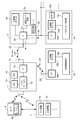
- FIG. 5 about the part similar to the above, the same code
- the external control device 1 is provided with an antenna 31 as external communication means, and the gateway device 3 is also provided with an antenna 32. Further, the control device 18 which does not contribute to the driving of the vehicle is also provided with the antenna 33. Communication between the external control device 1 and the gateway device 3 can be bidirectionally connected by performing authentication using a known encryption technique or the like. At this time, although the authentication method of this communication is arbitrary, if the same collation as the above-mentioned embodiment is required, the external control is not executed regardless of the establishment of the authentication in the communication. Preferably, at least one of the probability of the communication and the execution of the control signal is limited by a key unique to each vehicle.
- control signal code may be directly transmitted from the external control device 1 to the control device 14 regardless of the gateway device 3 by direct communication between the antennas 31 and 33.
- general purpose antennas can be used for communication antennas and signal processing devices.
- the virtual area 3 d can be provided in the gateway device 3, and by controlling the control device 14 via the virtual area 3 d, the influence of the load generated on the input / output processing from the external control device 1 Can be prevented from reaching other control devices.
- the virtual area 3d may be configured to have, for example, only the above-described authentication and transmission / reception functions, but may substitute at least a part of the arithmetic function by the external control device 1.
- the gateway device 3 can be made to function as a backup for the control devices 12-18 21-24, or be used for mutual monitoring.
- the display function and the input function can be substituted by the display 1a of the external control device 1 and the sensors S21.
- Similar functions can be expanded or substituted by providing an application corresponding to the external control device 1 instead of 24.
- by controlling the motion of the vehicle directly from the outside via the control device it becomes possible to respond to adjustments and function additions corresponding to the user's preference, while ensuring the occurrence of vehicle behavior that affects safety. Can be prevented.
- External control device (portable device, access control means) 1a Interface unit (external communication means) 1b Application control unit (external authentication code generation means / external control signal generation means) 3 Gateway Device (Interface Device / Access Restriction Means) 3b Main control logic part (access permission means) 3c Authentication Code Generator (Internal Authentication Code Generator) 5 connector (external communication means) 12 to 18 Control device 14a interface unit (transmission means) 14b Main control logic unit (communication state judgment means) 14d Memory unit (storage means) 31 antenna (external communication means)
Landscapes
- Engineering & Computer Science (AREA)
- Computer Networks & Wireless Communication (AREA)
- Signal Processing (AREA)
- Computer Security & Cryptography (AREA)
- Automation & Control Theory (AREA)
- Health & Medical Sciences (AREA)
- Computing Systems (AREA)
- General Health & Medical Sciences (AREA)
- Medical Informatics (AREA)
- Mechanical Engineering (AREA)
- Mobile Radio Communication Systems (AREA)
- Small-Scale Networks (AREA)
Abstract
L'invention a pour but de permettre la modification des caractéristiques de commande d'un appareil dans un véhicule au moyen d'un dispositif de commande externe et de donner une crédibilité à des données de celui-ci. A cet effet, selon l'invention, au niveau d'un dispositif de passerelle (3) sur un côté dans un véhicule, une unité de génération de code d'authentification (3c) qui génère une clé de sécurité (Ky1) est prévue, et au niveau d'un dispositif de commande externe (1), une unité de commande d'application (1b) qui génère la clé de sécurité (Ky1) est prévue. Dans le cas d'une connexion avec le dispositif de commande externe, les clés sont toutes les deux vérifiées par une unité de logique de commande principale (3b) du dispositif de passerelle, et lorsqu'elles sont authentifiées, une commande à l'aide d'une application du dispositif de commande externe est autorisée. Par exemple, à l'aide d'un coupleur de diagnostic de véhicule (DLC) connu, un dispositif de commande côté véhicule et le dispositif de commande externe sont facilement connectés l'un à l'autre, et seulement dans le cas où le résultat d'authentification est correct, la commande du dispositif de commande est autorisée par un signal de commande externe. Par conséquent, un accès non justifié est empêché, et il est possible d'effectuer une commande par rapport à un appareil dans un véhicule d'un véhicule au moyen d'un signal de commande autorisé.
Priority Applications (1)
| Application Number | Priority Date | Filing Date | Title |
|---|---|---|---|
| US13/981,167 US9457740B2 (en) | 2011-01-31 | 2012-01-30 | Vehicle control system |
Applications Claiming Priority (2)
| Application Number | Priority Date | Filing Date | Title |
|---|---|---|---|
| JP2011-018858 | 2011-01-31 | ||
| JP2011018858 | 2011-01-31 |
Publications (1)
| Publication Number | Publication Date |
|---|---|
| WO2012105215A1 true WO2012105215A1 (fr) | 2012-08-09 |
Family
ID=46602441
Family Applications (1)
| Application Number | Title | Priority Date | Filing Date |
|---|---|---|---|
| PCT/JP2012/000560 Ceased WO2012105215A1 (fr) | 2011-01-31 | 2012-01-30 | Dispositif de commande de véhicule |
Country Status (2)
| Country | Link |
|---|---|
| US (1) | US9457740B2 (fr) |
| WO (1) | WO2012105215A1 (fr) |
Cited By (5)
| Publication number | Priority date | Publication date | Assignee | Title |
|---|---|---|---|---|
| JP2014038188A (ja) * | 2012-08-15 | 2014-02-27 | Denso Corp | 車両用音声制御装置 |
| JP2018042256A (ja) * | 2017-10-12 | 2018-03-15 | Kddi株式会社 | システム及び管理方法 |
| CN109819049A (zh) * | 2019-02-28 | 2019-05-28 | 钛马信息网络技术有限公司 | 远程控制车辆的方法、系统及装置 |
| CN111142509A (zh) * | 2018-10-17 | 2020-05-12 | 现代自动车株式会社 | 车辆、服务器、车辆控制方法和服务器控制方法 |
| WO2022085410A1 (fr) * | 2020-10-20 | 2022-04-28 | 株式会社オートネットワーク技術研究所 | Dispositif embarqué, système de communication embarqué et procédé de commande de synchronisation |
Families Citing this family (8)
| Publication number | Priority date | Publication date | Assignee | Title |
|---|---|---|---|---|
| DE102012206745A1 (de) * | 2012-04-24 | 2013-10-24 | Mtu Friedrichshafen Gmbh | Verfahren zum Betrieb einer Brennkraftmaschine, Brennkraftmaschine und Wartungssystem für eine Brennkraftmaschine, selbstausführbares Computerprogrammprodukt und nichtflüchtiges Speichermedium |
| JP6172090B2 (ja) | 2014-08-27 | 2017-08-02 | 株式会社デンソー | 中継装置 |
| CN104822127A (zh) * | 2015-03-09 | 2015-08-05 | 中国科学院信息工程研究所 | 一种蓝牙设备及其数据通道实时管控方法和系统 |
| US10013816B2 (en) * | 2015-03-27 | 2018-07-03 | Drew Technologies, Inc. | Vehicle diagnostic system and method |
| KR102057661B1 (ko) * | 2016-04-08 | 2019-12-19 | 허스크바르나 에이비 | 지능형 급수 시스템 |
| CN110517118A (zh) * | 2019-08-30 | 2019-11-29 | 彭小权 | 一种可拆卸共享装置 |
| CN110614965A (zh) * | 2019-09-24 | 2019-12-27 | 彭小权 | 一种辅助驾驶扩展装置 |
| CN115604322B (zh) * | 2022-08-30 | 2024-11-15 | 重庆长安汽车股份有限公司 | 一种智能座舱域控制器及其控制方法、一种车辆 |
Citations (3)
| Publication number | Priority date | Publication date | Assignee | Title |
|---|---|---|---|---|
| JP2008090603A (ja) * | 2006-10-02 | 2008-04-17 | Sumitomo Electric Ind Ltd | 路車間通信システム及び方法とこれに用いる光ビーコン、車載機及び車両 |
| JP2009225385A (ja) * | 2008-03-19 | 2009-10-01 | Nec Corp | 接続制御装置 |
| WO2009147734A1 (fr) * | 2008-06-04 | 2009-12-10 | 株式会社ルネサステクノロジ | Véhicule, dispositif d’entretien, système et procédé de service d’entretien |
Family Cites Families (13)
| Publication number | Priority date | Publication date | Assignee | Title |
|---|---|---|---|---|
| US5787367A (en) * | 1996-07-03 | 1998-07-28 | Chrysler Corporation | Flash reprogramming security for vehicle computer |
| US7068147B2 (en) * | 1999-12-07 | 2006-06-27 | Denso Corporation | Control information rewriting system |
| DE10002204B4 (de) * | 2000-01-19 | 2013-10-02 | Robert Bosch Gmbh | Verfahren zum Schutz eines Mikrorechners eines Steuergeräts gegen Manipulation eines Programmes und Vorrichtung zur Durchführung des Verfahrens |
| DE10022422A1 (de) * | 2000-05-09 | 2001-11-15 | Bosch Gmbh Robert | Verfahren zum Zugriff auf ein Gerät eines Kommunikationsnetzes in einem Kraftfahrzeug durch ein externes Gerät und Gateway |
| US7636859B2 (en) * | 2001-01-04 | 2009-12-22 | Cummins Inc. | System and method for authorizing transfer of software into embedded systems |
| US6701233B2 (en) * | 2001-06-01 | 2004-03-02 | Actron Manufacturing Company | Scan tool with dropped communications detection and recovery and improved protocol selection |
| US20060041337A1 (en) * | 2004-08-19 | 2006-02-23 | Augsburger Brett N | Web-enabled engine reprogramming |
| JP2006182138A (ja) | 2004-12-27 | 2006-07-13 | Toyota Motor Corp | データ記録システム |
| JP2008059450A (ja) * | 2006-09-01 | 2008-03-13 | Denso Corp | 車両情報書換えシステム |
| JP4720781B2 (ja) * | 2007-05-07 | 2011-07-13 | 株式会社デンソー | 車両制御装置のデータ書換システム |
| JP4557042B2 (ja) * | 2008-04-23 | 2010-10-06 | 株式会社デンソー | 電子制御装置、及び車両制御システム |
| JP4722194B2 (ja) * | 2009-04-13 | 2011-07-13 | 本田技研工業株式会社 | 車両のための書き換えシステム |
| US8863256B1 (en) * | 2011-01-14 | 2014-10-14 | Cisco Technology, Inc. | System and method for enabling secure transactions using flexible identity management in a vehicular environment |
-
2012
- 2012-01-30 US US13/981,167 patent/US9457740B2/en not_active Expired - Fee Related
- 2012-01-30 WO PCT/JP2012/000560 patent/WO2012105215A1/fr not_active Ceased
Patent Citations (3)
| Publication number | Priority date | Publication date | Assignee | Title |
|---|---|---|---|---|
| JP2008090603A (ja) * | 2006-10-02 | 2008-04-17 | Sumitomo Electric Ind Ltd | 路車間通信システム及び方法とこれに用いる光ビーコン、車載機及び車両 |
| JP2009225385A (ja) * | 2008-03-19 | 2009-10-01 | Nec Corp | 接続制御装置 |
| WO2009147734A1 (fr) * | 2008-06-04 | 2009-12-10 | 株式会社ルネサステクノロジ | Véhicule, dispositif d’entretien, système et procédé de service d’entretien |
Cited By (6)
| Publication number | Priority date | Publication date | Assignee | Title |
|---|---|---|---|---|
| JP2014038188A (ja) * | 2012-08-15 | 2014-02-27 | Denso Corp | 車両用音声制御装置 |
| JP2018042256A (ja) * | 2017-10-12 | 2018-03-15 | Kddi株式会社 | システム及び管理方法 |
| CN111142509A (zh) * | 2018-10-17 | 2020-05-12 | 现代自动车株式会社 | 车辆、服务器、车辆控制方法和服务器控制方法 |
| CN109819049A (zh) * | 2019-02-28 | 2019-05-28 | 钛马信息网络技术有限公司 | 远程控制车辆的方法、系统及装置 |
| CN109819049B (zh) * | 2019-02-28 | 2021-12-14 | 钛马信息网络技术有限公司 | 远程控制车辆的方法、系统及装置 |
| WO2022085410A1 (fr) * | 2020-10-20 | 2022-04-28 | 株式会社オートネットワーク技術研究所 | Dispositif embarqué, système de communication embarqué et procédé de commande de synchronisation |
Also Published As
| Publication number | Publication date |
|---|---|
| US20130304277A1 (en) | 2013-11-14 |
| US9457740B2 (en) | 2016-10-04 |
Similar Documents
| Publication | Publication Date | Title |
|---|---|---|
| US9457740B2 (en) | Vehicle control system | |
| JP7231559B2 (ja) | 異常検知電子制御ユニット、車載ネットワークシステム及び異常検知方法 | |
| US9560061B2 (en) | Motor vehicle with a driving behavior which can be modified at a later stage using an application program | |
| US20210237668A1 (en) | On-board communication device, on-board communication system, and specific processing prohibition method for a vehicle | |
| US20150358329A1 (en) | Access restriction device, on-board communication system and method for communication restriction | |
| JP5472466B2 (ja) | 車両用電子制御装置 | |
| JP2008523743A (ja) | 車両内の少なくとも一つのモバイル端末の、アップデート装置を利用した利用システム | |
| CN110268681A (zh) | 车载网关装置和通信切断方法 | |
| WO2014083775A1 (fr) | Dispositif d'actualisation de programme monté dans un véhicule | |
| US12255757B2 (en) | Relay device system | |
| KR20220154215A (ko) | 차량의 모바일 제어 | |
| CN108216080B (zh) | 使用移动设备对机动系统进行安全控制 | |
| CN109308065B (zh) | 根据性能产品探测的车辆校准 | |
| CN113474739B (zh) | 控制装置和接管控制方法 | |
| CN117615939A (zh) | 车辆系统 | |
| WO2016116976A1 (fr) | Procédé de mise à jour de règle de détection d'irrégularité, unité de commande électronique de détection d'irrégularité et système de réseau à bord | |
| JP2025172889A (ja) | ソフトウェア更新装置、ソフトウェア更新方法及びソフトウェア更新処理プログラム | |
| WO2013051122A1 (fr) | Système de réseau dans un véhicule | |
| US20250181773A1 (en) | In-vehicle system, electronic control device, access authorization policy update method, and storage medium storing program | |
| EP3334198B1 (fr) | Commande sécurisée de systèmes automobiles à l'aide de dispositifs mobiles | |
| CN118944998A (zh) | 用于休闲车的安全多总线控制系统 | |
| JP2021147008A (ja) | 車両制御装置 | |
| CN118233129A (zh) | Ecu布局的决定方法 | |
| JP7491362B2 (ja) | セキュリティシステム、車両、セキュリティ装置および正当性判断方法 | |
| Dürrwang et al. | Security hardening with plausibility checks for automotive ECUs |
Legal Events
| Date | Code | Title | Description |
|---|---|---|---|
| 121 | Ep: the epo has been informed by wipo that ep was designated in this application |
Ref document number: 12741659 Country of ref document: EP Kind code of ref document: A1 |
|
| WWE | Wipo information: entry into national phase |
Ref document number: 13981167 Country of ref document: US |
|
| NENP | Non-entry into the national phase |
Ref country code: DE |
|
| 122 | Ep: pct application non-entry in european phase |
Ref document number: 12741659 Country of ref document: EP Kind code of ref document: A1 |
|
| NENP | Non-entry into the national phase |
Ref country code: JP |