WO2012105731A1 - Copper alloy material for seawater and method for preparing same - Google Patents
Copper alloy material for seawater and method for preparing same Download PDFInfo
- Publication number
- WO2012105731A1 WO2012105731A1 PCT/KR2011/003449 KR2011003449W WO2012105731A1 WO 2012105731 A1 WO2012105731 A1 WO 2012105731A1 KR 2011003449 W KR2011003449 W KR 2011003449W WO 2012105731 A1 WO2012105731 A1 WO 2012105731A1
- Authority
- WO
- WIPO (PCT)
- Prior art keywords
- seawater
- alloy material
- copper alloy
- weight
- copper
- Prior art date
- Legal status (The legal status is an assumption and is not a legal conclusion. Google has not performed a legal analysis and makes no representation as to the accuracy of the status listed.)
- Ceased
Links
Images

Classifications
-
- C—CHEMISTRY; METALLURGY
- C22—METALLURGY; FERROUS OR NON-FERROUS ALLOYS; TREATMENT OF ALLOYS OR NON-FERROUS METALS
- C22C—ALLOYS
- C22C9/00—Alloys based on copper
- C22C9/04—Alloys based on copper with zinc as the next major constituent
-
- C—CHEMISTRY; METALLURGY
- C22—METALLURGY; FERROUS OR NON-FERROUS ALLOYS; TREATMENT OF ALLOYS OR NON-FERROUS METALS
- C22F—CHANGING THE PHYSICAL STRUCTURE OF NON-FERROUS METALS AND NON-FERROUS ALLOYS
- C22F1/00—Changing the physical structure of non-ferrous metals or alloys by heat treatment or by hot or cold working
- C22F1/08—Changing the physical structure of non-ferrous metals or alloys by heat treatment or by hot or cold working of copper or alloys based thereon
Definitions
- the present invention relates to a copper alloy material for use in the seawater, a method for preparing the same and a structure manufactured from the same for use in the seawater. More specifically, the present invention relates to a copper alloy material for use in the seawater comprising 25% to 40% by weight of zinc (Zn), 0.5% to 10% by weight of manganese (Mn), 0.1% to 5% by weight of nickel (Ni) and the remainder of copper (Cu), a method for preparing the same and a structure manufactured from the same for use in the seawater.
- the copper alloy material for use in the seawater further comprises, in an amount of 1% by weight or less, at least one element selected from the group consisting of Sn, Al, Si, Co, Fe, P, Mg, Pb and Ca.
- an aquaculture net made of iron hereinafter, referred to as an iron net
- an aquaculture net made of a chemical fiber hereinafter, referred to as a chemical fiber net
- marine organisms such as shellfish or algae are readily adhered to the net and the mesh of the net is clogged, causing a deterioration in flow of tidewater, thus limiting supply of oxygen or water-in nutrients to the farm, and thus causing a deterioration in production efficiency and aquaculture yield.
- the aquaculture net requires superior strength, since it should be resilient to certain unforeseen circumstances such as tides of seawater and typhoons.
- the chemical fiber net has a disadvantage of low strength, as compared to the metal net.
- metal nets require sufficient corrosion resistance to seawater, since they are inevitably exposed to ionic components such as salts present in the seawater.
- conventional metal nets are readily corroded by seawater.
- other metal nets made of a metal-containing material have economic efficiency problems due to high cost. For this reason, metal nets are preferably made of a material which can be manufactured at a low cost.
- Aquaculture nets made of a copper alloy material under recently developed under such a circumference can prevent adhesion of marine organisms thereto due to anti-fouling property derived from silver and copper ions, thus reducing clogging the mesh of the aquaculture net and thereby somewhat solving the high-cost problem caused by deterioration in production efficiency or yield of cultured fish.
- copper alloys which satisfy the requirements of sufficient strength, corrosion resistance to seawater and anti-fouling property and are made of a cheap material.
- Korean Laid-open Patent Publication No. 1993-0019841 discloses a copper alloy material based on Cu-Al-Ni, which has an insufficient strength for use as a structure for use in the seawater, and low economic efficiency, due to use of relatively expensive nickel (Ni).
- Korean Laid-open Patent Publication No. 1999-002539 discloses a copper alloy material based on Cu-Al-Zn-Mn-Fe in which aluminum is present in an amount of 5% to 5.3% by weight and zinc is present in an amount of 10% to 20% by weight, thus making it difficult to secure sufficient processability, and in which iron is present in an amount of 2% to 4% by weight, thus making it difficult to secure sufficient corrosion resistance.
- An object of the present invention devised to solve the problem lies on a copper alloy material for use in the seawater which has superior mechanical properties including sufficient strength, superior ductility and low brittleness, and exhibits high corrosion resistance to seawater and anti-fouling property.
- Another object of the present invention devised to solve the problem lies on a method for preparing the copper alloy material and a structure for use in the seawater manufactured by the copper alloy material.
- the object of the present invention can be achieved by providing a copper alloy material for use in the seawater comprising 25% to 40% by weight of zinc (Zn), 0.5% to 10% by weight of manganese (Mn), 0.1% to 5% by weight of nickel (Ni) and the remainder of copper (Cu).
- the copper alloy material further comprises, in an amount of 1% by weight or less, at least one element selected from the group consisting of Sn, Al, Si, Co, Fe, P, Mg, Pb and Ca.
- a method for preparing a copper alloy material for seawater comprising: producing an ingot comprising 25% to 40% by weight of zinc (Zn), 0.5% to 10% by weight of manganese (Mn), 0.1% to 5% by weight of nickel (Ni) and the remainder of copper (Cu); annealing the ingot at 600°C to 900°C for 30 minutes to 12 hours, followed by hot extruding and drawing; quenching the resulting product, followed by cold drawing; annealing the resulting product at 500°C to 800°C for 30 minutes to 12 hours; and cold drawing the resulting product.
- the copper alloy material may further comprise, in an amount of 1% by weight or less, at least one element selected from the group consisting of Sn, Al, Si, Co, Fe, P, Mg, Pb and Ca.
- Final cold drawing ratio may be 10% to 90%.
- a structure for seawater manufactured from a copper alloy material for seawater comprising 25% to 40% by weight of zinc (Zn), 0.5% to 10% by weight of manganese (Mn), 0.1% to 5% by weight of nickel (Ni) and the remainder of copper (Cu).
- the structure for seawater may be an aquaculture net.
- the present invention provides a copper alloy material for seawater which has superior mechanical properties and exhibits superior high anti-fouling property and corrosion resistance to seawater. Further, the present invention provides a method for preparing the copper alloy material.
- FIG. 1 shows results observed with an optical microscope after dezincification test using, as samples, copper alloy specimens of Examples and Comparative Examples according to the present invention.
- FIGS. 2 and 3 show results of seawater immersion test using, as samples, copper alloy material specimens of Examples and Comparative Examples according to the present invention.
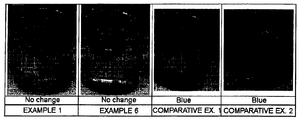
- FIG. 2 is an image showing variation in the seawater, caused by copper ions eluted from copper alloys after immersion for 20 days.
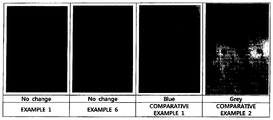
- FIG. 3 shows color observation results of specimens after immersion for 20 days.
- Example #1 means test results of the sample prepared in Example 1
- Example #6 means test results of the sample prepared in Example 6
- Comparative Example #1 means test results for the sample of Comparative Example 1
- Comparative Example #2 means test results for the sample of Comparative Example 2.
- copper alloy material for seawater or “copper alloy material for use in the seawater,” as used herein, refers to a copper alloy material which is partially or entirely immersed in the seawater for a long period and, for example, a fish net for aquaculture.
- the present invention is directed to a copper alloy material for seawater comprising 25% to 40% by weight of zinc (Zn), 0.5% to 10% by weight of manganese (Mn), 0.1% to 5% by weight of nickel (Ni) and the remainder of copper (Cu).
- zinc (Zn) is present in an amount of 25% to 40% by weight, based on the weight of the copper alloy material.
- Zinc improves the strength and hardness of the copper alloy material obtained by alloying a copper metal and enhances heat resistance.
- the second phase, beta ( ⁇ ) phase when zinc is less than 25% by weight, sufficient hardness cannot be secured and economic efficiency decreases due to an increased amount of copper with respect to zinc, and when zinc exceeds 40% by weight, the second phase, beta ( ⁇ ) phase, indicating brittleness of materials in the obtained copper alloy material, increases and ductility is thus deteriorated, thus causing problems, such as cracking during processing.
- zinc is preferably present in an amount of 35% to 40% by weight.
- manganese (Mn) is present in an amount of 0.5% to 10% by weight, based on the weight of the copper alloy material.
- the second phase, beta ( ⁇ ) phase increases and ductility is thus deteriorated, as the content of zinc in the copper alloy material increases.
- manganese reduces deterioration in ductility.
- the content of manganese is less than 0.5% by weight, reduction of ductility through addition of manganese is insufficient, and when the content exceeds 10% by weight, the materials are brittle.
- nickel is present in an amount of 0.1% to 5% by weight, based on the weight of the copper alloy material. Nickel improves hardness of the obtained copper alloy material. When the content of nickel is less than 0.1% by weight, hardness is not sufficiently improved, and when the content of nickel exceeds 5% by weight, hardness improvement is slowed. Although nickel is added in an amount of 5% by weight or higher, considerable improvement in hardness cannot be obtained. Accordingly, as the amount of nickel increases, economic efficiency is considerably deteriorated.
- copper (Cu) is a main component.
- the copper is present in an amount of the remainder, except for which the afore-mentioned other components are present in amounts defined above.
- the copper alloy material for seawater may further comprise, in an amount of 1% by weight or less, at least one element selected from the group consisting of Sn, Al, Si, Co, Fe, P, Mg, Pb and Ca.
- the copper content is decreased in an amount corresponding to the content of the further added element.
- the further added element exhibits effects, comparable to the copper alloy material of the present invention, without causing in deterioration in hardness and softening resistance of the copper alloy material and having a negative effect on corrosion resistance to seawater and eluted amount of ions.
- the copper alloy material may further comprise trace impurities in an amount that does not effect characteristics of the copper alloy material.
- the copper alloy material for seawater may further comprise trace impurities of at least one selected from the group consisting of As, Ti, S, Cr, Nb and Sb of 0.1% by weight.
- the impurities may be added during a general process for preparing a copper alloy material and are present in trace amounts, thus having no great effect on the properties of the copper alloy material.
- the copper alloy material in accordance with the present invention exhibits considerably improved corrosion resistance to seawater when a structure for seawater made of the copper alloy material is used in the seawater, compared with a conventional copper alloy material in which a corrosion promoter is readily produced by seawater.
- the eluted amount of copper ions in the copper alloy material should be 60% or higher, based on the eluted amount of copper ions of pure copper, in order to impart sufficient anti-fouling property to the structure for seawater manufactured from the copper alloy material.
- the eluted amount of copper ions of copper alloy material is 60% or less of the eluted amount of copper ions of pure copper, the pollution prevention effects cannot be sufficiently realized.
- the amount of copper ions eluted from the copper alloy material in the seawater should be 415.8 mg/m2/day or more, in order to secure sufficient antibacterial properties, since the amount of copper ions eluted from pure copper in the seawater is about 693 mg/m2/day.
- the copper alloy material in accordance with the present invention exhibits an amount of eluted copper ions which is 60% or more of copper ions eluted from pure copper.
- the strength of the copper alloy material according to the present invention may be evaluated in terms of hardness and softening resistance.
- the hardness of the copper alloy material may vary depending on the percentage reduction in thickness after annealed in the preparation process.
- the copper alloy material according to the present invention has a hardness ranging from 120 to 160 Hv when processed at a percentage reduction in thickness of about 10% to 30%, immediately after annealing. Within the range defined above, the copper alloy material has a sufficient strength required for the structure for sea water such as aquaculture nets.
- the softening resistance may be evaluated from a hardness measured after the copper alloy material is reduced in thickness to at most 70% due to an increased processing ratio, placed in a annealing furnace at 400°C and maintained for 30 minutes. The hardness should be within a range from about 95 to about 120 Hv.
- the copper alloy material for seawater according to the present invention is prepared by the method comprising: producing an ingot from 25% to 40% by weight of zinc (Zn), 0.5% to 10% by weight of manganese (Mn), 0.1% to 5% by weight of nickel (Ni) and the remainder of copper (Cu); annealing the ingot at 600°C to 900°C for 30 minutes to 12 hours, followed by hot extruding and drawing; quenching the resulting product to room temperature, followed by cold drawing; annealing the resulting product at 500°C to 800°C for 30 minutes to 12 hours; and cold drawing the resulting product.
- Zn zinc
- Mn manganese
- Ni nickel
- Cu copper
- an ingot is produced by mold casting 25% to 40% by weight of zinc (Zn), 0.5% to 10% by weight of manganese (Mn), 0.1% to 5% by weight of nickel (Ni), and the remainder of copper (Cu).
- the ingot may further comprise 1% by weight or less of at least one selected from the group consisting of Sn, Al, Si, Co, Fe, P, Mg, Pb and Ca.
- the ingot thus obtained is annealed in a continuous annealing furnace at a temperature of 600°C to 900°C for 30 minutes to 12 hours, hot-extruded and drawn in a linear or rod shape.
- a continuous annealing furnace at a temperature of 600°C to 900°C for 30 minutes to 12 hours, hot-extruded and drawn in a linear or rod shape.
- the annealing is performed at 600°C or lower, sufficient effects of annealing cannot be obtained, recrystallization in the metal structure is difficult and excessive hot load occurs.
- the annealing is performed at 900°C or higher, coarse structures are formed and abnormal structures are thus produced in the metal structure.
- the annealing is performed for 30 minutes or less, softening of metal structures is not sufficient, and when the annealing is performed for 12 hours, disadvantageously, metal structures are excessively softened and production efficiency is deteriorated.
- the annealed product is quenched to room temperature of about 21°C to about 30°C and is then cold drawn.
- the resulting product is annealed at 500°C to 800°C for 30 minutes to 12 hours.
- the annealing may be carried out in a bell or batch annealing furnace.
- the annealing temperature ranges from 500°C to 800°C, since the product annealed once in the previous step is recrystallized at a relatively low temperature.
- annealing is performed at 500°C or lower, recrystallization in the metal structure is disadvantageously difficult, and when the annealing is performed at 800°C or higher, coarse structures are grown, abnormal structures are thus generated, and production efficiency is deteriorated to the excessively high temperature.
- the annealing is performed for 30 minutes or less, softening of metal structures is not sufficient, and when annealing is performed for 12 hours or longer, disadvantageously, metal structures are excessively softened and production efficiency is deteriorated.
- the resulting product is cold drawn.
- a drawing ratio ranges from 10% to 90%.
- the drawing ratio is lower than 10%, sufficient mechanical strength cannot be secured, and when the drawing ratio exceeds 90%, a percentage cold reduction in thickness disadvantageously reaches a limit due to the excessive processing ratio.
- the annealing and cold drawing steps may be repeated.
- an ingot with a chemical composition shown in the following Table 1 was prepared and annealed at 600°C for 6 hours, hot-extruded and drawn to a thickness of 1.5 mm.
- the resulting product was quenched to room temperature, cold-drawn and annealed at 600°C for one hour.
- the resulting specimen was cut and then cold drawn at a percentage reduction in thickness of at most 30% after immediately annealing, to obtain a final sample.
- the sample of Comparative Example 1 was a brass product (UR30) commercially available from Mitsubishi (Japan) and the sample of Comparative Example 2 was a brass (alloy of copper and zinc in a ratio of 6:4), and the sample of Comparative Example 3 was pure copper.
- the material subjected to reduction in thickness at an increased processing ratio that is, at a percentage (at most 70%) was placed in a furnace at 400°C, held for 30 minutes and removed.
- the decrease in hardness of the material was measured using a micro Vickers hardness tester. The results are shown in Table 2. As can be seen from Table 2, the samples of Examples 1 to 14 fall within the range of about 98 to 119 Hv.
- KS D9502 salt water spray test was performed to evaluate corrosion resistance to seawater and salt water prepared by dissolving sodium chloride in distilled water was used.
- the specimens were placed in a salt water spray tester, sprayed for 24 hours at an interval of several hours and removed. Corrosion of the specimen was observed. The results are shown in Table 2. The notation is based on ⁇ : good, ⁇ : insufficient and X: bad, in accordance with a naked eye examination standard.
- the respective specimens were immersed in a beaker containing 200 ml of seawater for 24 hours and the amount of eluted copper ions was measured. The results are shown in Table 2.
- the amount of eluted copper ions was 693 mg/m2/day and 60% of the amount of eluted copper ions was 415.8 mg/m2/day.
- 60% of the amount of eluted copper ions for pure copper was 415.8 mg/m2/day or more, which indicates that the samples can provide sufficient anti-bioattachment.
- Example 1 to 14 exhibited considerably superior dezincification and good corrosion resistance to seawater, as compared to the samples of Comparative Examples 1 to 3. Further, in the samples of Examples 1 to 14, 60% of the amount of eluted copper ions for pure copper was 415.8 mg/m2/day or more, which indicates that the samples satisfy the requirements for anti-bioattachment.
- FIG. 3 shows color observation results of specimens after immersed for 20 days. As can be seen from FIG. 3, the sample of Example 1 and the sample of Example 6 were not greatly varied, as compared to prior to immersion, while the sample of Comparative Example 1 turned blue and the sample of Comparative Example 2 was partially corroded and turned gray.
Landscapes
- Chemical & Material Sciences (AREA)
- Mechanical Engineering (AREA)
- Organic Chemistry (AREA)
- Metallurgy (AREA)
- Engineering & Computer Science (AREA)
- Materials Engineering (AREA)
- Crystallography & Structural Chemistry (AREA)
- Physics & Mathematics (AREA)
- Thermal Sciences (AREA)
- Farming Of Fish And Shellfish (AREA)
- Agricultural Chemicals And Associated Chemicals (AREA)
- Preventing Corrosion Or Incrustation Of Metals (AREA)
- Extrusion Of Metal (AREA)
Abstract
Description
| TYPE | SampleNo. | Alloy composition (% by weight) | ||||
| Cu | Zn | Mn | Ni | Others | ||
| Examples | 1 | Remainder | 36 | 3 | 1 | - |
| 2 | Remainder | 36 | 3 | 0.1 | - | |
| 3 | Remainder | 36 | 3 | 3 | - | |
| 4 | Remainder | 36 | 0.5 | 1 | - | |
| 5 | Remainder | 36 | 6 | 1 | - | |
| 6 | Remainder | 25 | 3 | 1 | - | |
| 7 | Remainder | 36 | 3 | 1 | Sn 0.2 | |
| 8 | Remainder | 36 | 3 | 1 | Al 0.1 | |
| 9 | Remainder | 36 | 3 | 1 | Co 0.2 | |
| 10 | remainder | 36 | 3 | 1 | Fe O.2 | |
| 11 | remainder | 36 | 3 | 1 | P 0.04 | |
| 12 | remainder | 36 | 3 | 1 | Mg 0.05 | |
| 13 | remainder | 36 | 3 | 1 | Pb 0.03 | |
| 14 | remainder | 36 | 3 | 1 | Ca 0.1 | |
| Comparative Examples | 1 | remainder | 35 | - | 0.4 | Sn 0.6 |
| 2 | remainder | 40 | - | - | ||
| 3 | 100 | - | - | - | - | |
| TYPE | SampleNo. | Hardness(Hv) | Softening resistance (Hv)(heating at 400℃ for 30 min) | Dezincification (thickness, ㎛) | Corrosion resistance to seawater | Amount of eluted ions (mg/㎡/day) |
| Examples | 1 | 138 | 100 | 161 | ○ | 489 |
| 2 | 136 | 103 | 163 | ○ | 465 | |
| 3 | 143 | 108 | 79 | ○ | 457 | |
| 4 | 122 | 98 | 120 | ○ | 456 | |
| 5 | 147 | 128 | 327 | ○ | 446 | |
| 6 | 139 | 119 | 101 | ○ | 497 | |
| 7 | 140 | 110 | 170 | ○ | 480 | |
| 8 | 141 | 103 | 175 | ○ | 459 | |
| 9 | 137 | 105 | 183 | ○ | 460 | |
| 10 | 138 | 107 | 204 | ○ | 472 | |
| 11 | 136 | 105 | 200 | ○ | 493 | |
| 12 | 140 | 101 | 197 | ○ | 470 | |
| 13 | 135 | 100 | 230 | ○ | 480 | |
| 14 | 138 | 103 | 221 | ○ | 469 | |
| Comparative Examples | 1 | 140 | 111 | 427 | ○ | 486 |
| 2 | 126 | 85 | 716 | △ | 420 | |
| 3 | 110 | 70 | - | - | 693 |
Claims (7)
- A copper alloy material for seawater comprising 25% to 40% by weight of zinc (Zn), 0.5% to 10% by weight of manganese (Mn), 0.1% to 5% by weight of nickel (Ni) and the remainder of copper (Cu).
- The copper alloy material according to claim 1, wherein the copper alloy material further comprises, in an amount of 1% by weight or less, at least one element selected from the group consisting of Sn, Al, Si, Co, Fe, P, Mg, Pb and Ca.
- A method for preparing a copper alloy material for seawater comprising:producing an ingot from 25% to 40% by weight of zinc (Zn), 0.5% to 10% by weight of manganese (Mn), 0.1% to 5% by weight of nickel (Ni) and the remainder of copper (Cu);annealing the ingot at 600°C to 900℃ for 30 minutes to 12 hours, followed by hot extruding and drawing;quenching the resulting product to room temperature, followed by cold drawing;annealing the resulting product at 500℃ to 800℃ for 30 minutes to 12 hours; andcold drawing the resulting product.
- The method according to claim 3, wherein the copper alloy material further comprises, in an amount of 1% by weight or less, at least one element selected from the group consisting of Sn, Al, Si, Co, Fe, P, Mg, Pb and Ca.
- The method according to claim 3 or 4, wherein a final drawing ratio is 10% to 90%.
- A structure for seawater manufactured from the copper alloy material for seawater according to claim 1 or 2.
- The structure according to claim 6, wherein the structure for seawater is an aquaculture net.
Priority Applications (4)
| Application Number | Priority Date | Filing Date | Title |
|---|---|---|---|
| EP11857456.5A EP2670875B1 (en) | 2011-02-01 | 2011-05-11 | Copper alloy material for seawater and method for preparing same |
| JP2013552452A JP5911891B2 (en) | 2011-02-01 | 2011-05-11 | Copper alloy material for seawater and method for producing the same |
| AU2011357615A AU2011357615A1 (en) | 2011-02-01 | 2011-05-11 | Copper alloy material for seawater and method for preparing same |
| CN2011800664967A CN103403201A (en) | 2011-02-01 | 2011-05-11 | Copper alloy material for seawater and method for preparing same |
Applications Claiming Priority (2)
| Application Number | Priority Date | Filing Date | Title |
|---|---|---|---|
| KR10-2011-0009997 | 2011-02-01 | ||
| KR1020110009997A KR101260912B1 (en) | 2011-02-01 | 2011-02-01 | Copper alloy for sea water and method of producing same |
Publications (1)
| Publication Number | Publication Date |
|---|---|
| WO2012105731A1 true WO2012105731A1 (en) | 2012-08-09 |
Family
ID=46602924
Family Applications (1)
| Application Number | Title | Priority Date | Filing Date |
|---|---|---|---|
| PCT/KR2011/003449 Ceased WO2012105731A1 (en) | 2011-02-01 | 2011-05-11 | Copper alloy material for seawater and method for preparing same |
Country Status (7)
| Country | Link |
|---|---|
| EP (1) | EP2670875B1 (en) |
| JP (1) | JP5911891B2 (en) |
| KR (1) | KR101260912B1 (en) |
| CN (1) | CN103403201A (en) |
| AU (1) | AU2011357615A1 (en) |
| CL (1) | CL2013002197A1 (en) |
| WO (1) | WO2012105731A1 (en) |
Families Citing this family (15)
| Publication number | Priority date | Publication date | Assignee | Title |
|---|---|---|---|---|
| KR102181051B1 (en) * | 2013-10-21 | 2020-11-19 | 주식회사 대창 | A improved durability structure for catching anchovies |
| KR101519075B1 (en) * | 2013-12-03 | 2015-05-21 | (주)신동 | Electromagnetic wave shielding Fe-Cu wire, rod and Manufacturing method for the same |
| CN103757480B (en) * | 2014-01-10 | 2016-05-11 | 滁州学院 | Complicated cupronickel alloy material of a kind of seawater corrosion resistance and preparation method thereof |
| CN103740977B (en) * | 2014-01-16 | 2016-01-20 | 九星控股集团有限公司 | A kind of corrosion-resistant White Copper Tubes and preparation method thereof |
| CN105018782B (en) * | 2015-07-23 | 2017-09-26 | 宁波博威合金板带有限公司 | A kind of copper alloy of the silicon containing cobalt |
| CN106119746B (en) * | 2016-07-30 | 2018-10-30 | 山西晋投玄武岩开发有限公司 | A kind of corrosion-resistant basalt fibre enhancing copper-base alloy composite material |
| CN106191519B (en) * | 2016-08-15 | 2018-06-01 | 北京金鹏振兴铜业有限公司 | Hexa-atomic complex brass alloy |
| WO2018088721A1 (en) * | 2016-11-08 | 2018-05-17 | 주식회사 대창 | Copper alloy for culture fish net having improved corrosion resistance and method for manufacturing same copper alloy |
| KR101796191B1 (en) | 2017-01-17 | 2017-11-09 | 주식회사 풍산 | Copper alloy with excellent antibiosis, discoloration-resistance and formability, and method for producing same |
| CN107460367B (en) * | 2017-08-29 | 2019-08-09 | 河南科技大学 | Copper alloy resistant to corrosion and wear in seawater containing sand and preparation method thereof |
| KR102616847B1 (en) * | 2019-03-27 | 2023-12-26 | 주식회사 대창 | Copper alloy wire for fish farming net |
| CN110863123A (en) * | 2019-11-29 | 2020-03-06 | 常熟市常氏瓶钳有限公司 | Copper alloy formula for manufacturing bottle tongs |
| KR102265115B1 (en) * | 2021-02-24 | 2021-06-15 | 주식회사 풍산 | Cu-Zn based alloy material with excellent corrosion resistance and discoloration resistance and method of producing same |
| CN114107728B (en) * | 2021-10-11 | 2023-03-24 | 中铝洛阳铜加工有限公司 | Marine corrosion-resistant copper alloy material for deep and distant marine aquaculture |
| CN118086716B (en) * | 2024-04-22 | 2024-07-16 | 中铝科学技术研究院有限公司 | Copper alloy wire for marine culture, preparation method and application thereof |
Citations (5)
| Publication number | Priority date | Publication date | Assignee | Title |
|---|---|---|---|---|
| US4631171A (en) * | 1985-05-16 | 1986-12-23 | Handy & Harman | Copper-zinc-manganese-nickel alloys |
| KR19990002539A (en) * | 1997-06-20 | 1999-01-15 | 민병권 | Copper alloy composition with excellent weather resistance and seawater corrosion resistance |
| KR20000077017A (en) * | 1999-05-05 | 2000-12-26 | 올린 코포레이션 | Copper alloy with a golden visual appearance |
| US20090022620A1 (en) * | 2007-06-28 | 2009-01-22 | Kai Weber | Copper-zinc alloy, production method and use |
| US20100061884A1 (en) * | 2008-09-10 | 2010-03-11 | Pmx Industries Inc. | White-colored copper alloy with reduced nickel content |
Family Cites Families (12)
| Publication number | Priority date | Publication date | Assignee | Title |
|---|---|---|---|---|
| GB868276A (en) | 1958-10-18 | 1961-05-17 | Eugen Vaders | Improvements in or relating to bearing metal alloys |
| US3778236A (en) * | 1972-03-29 | 1973-12-11 | Olin Corp | Plated copper base alloy article |
| JPS5952223B2 (en) * | 1979-04-23 | 1984-12-18 | 三菱マテリアル株式会社 | Copper alloy for aquaculture cages |
| JPS59159957A (en) | 1983-02-28 | 1984-09-10 | Mitsubishi Metal Corp | High-strength cu alloy with superior resistance to corrosion due to sea water and superior hot workability |
| JPS63100144A (en) * | 1986-05-23 | 1988-05-02 | Nippon Mining Co Ltd | Copper alloy excellent in corrosion resistance |
| JPS63213628A (en) * | 1987-03-02 | 1988-09-06 | Nippon Mining Co Ltd | Copper alloy for fuse |
| JPH06184679A (en) * | 1992-12-18 | 1994-07-05 | Mitsui Mining & Smelting Co Ltd | Copper alloy for electrical parts |
| JP3311606B2 (en) | 1996-10-15 | 2002-08-05 | 三宝伸銅工業株式会社 | Copper-based alloy |
| JP3280250B2 (en) * | 1996-11-26 | 2002-04-30 | 三宝伸銅工業株式会社 | Fish culture nets and fish culture cages |
| DE19802246C1 (en) * | 1998-01-22 | 1999-07-29 | Wieland Werke Ag | Use of a copper-zinc-nickel-manganese-aluminum alloy |
| WO2006016442A1 (en) | 2004-08-10 | 2006-02-16 | Sanbo Shindo Kogyo Kabushiki Kaisha | Copper-base alloy casting with refined crystal grains |
| DE102009032371A1 (en) * | 2009-07-08 | 2011-01-13 | Berkenhoff Gmbh | Additional material for soldering steel sheets |
-
2011
- 2011-02-01 KR KR1020110009997A patent/KR101260912B1/en not_active Ceased
- 2011-05-11 CN CN2011800664967A patent/CN103403201A/en active Pending
- 2011-05-11 WO PCT/KR2011/003449 patent/WO2012105731A1/en not_active Ceased
- 2011-05-11 JP JP2013552452A patent/JP5911891B2/en not_active Expired - Fee Related
- 2011-05-11 EP EP11857456.5A patent/EP2670875B1/en not_active Not-in-force
- 2011-05-11 AU AU2011357615A patent/AU2011357615A1/en not_active Abandoned
-
2013
- 2013-07-31 CL CL2013002197A patent/CL2013002197A1/en unknown
Patent Citations (5)
| Publication number | Priority date | Publication date | Assignee | Title |
|---|---|---|---|---|
| US4631171A (en) * | 1985-05-16 | 1986-12-23 | Handy & Harman | Copper-zinc-manganese-nickel alloys |
| KR19990002539A (en) * | 1997-06-20 | 1999-01-15 | 민병권 | Copper alloy composition with excellent weather resistance and seawater corrosion resistance |
| KR20000077017A (en) * | 1999-05-05 | 2000-12-26 | 올린 코포레이션 | Copper alloy with a golden visual appearance |
| US20090022620A1 (en) * | 2007-06-28 | 2009-01-22 | Kai Weber | Copper-zinc alloy, production method and use |
| US20100061884A1 (en) * | 2008-09-10 | 2010-03-11 | Pmx Industries Inc. | White-colored copper alloy with reduced nickel content |
Also Published As
| Publication number | Publication date |
|---|---|
| JP5911891B2 (en) | 2016-04-27 |
| EP2670875A4 (en) | 2014-08-13 |
| JP2014506627A (en) | 2014-03-17 |
| CN103403201A (en) | 2013-11-20 |
| EP2670875B1 (en) | 2016-11-02 |
| KR20120088978A (en) | 2012-08-09 |
| AU2011357615A1 (en) | 2013-08-01 |
| CL2013002197A1 (en) | 2014-02-28 |
| EP2670875A1 (en) | 2013-12-11 |
| KR101260912B1 (en) | 2013-05-06 |
Similar Documents
| Publication | Publication Date | Title |
|---|---|---|
| EP2670875B1 (en) | Copper alloy material for seawater and method for preparing same | |
| CA2416574C (en) | Silver containing copper alloy | |
| US9702027B2 (en) | Copper alloy | |
| JP7374904B2 (en) | copper-zinc alloy | |
| WO2013022144A1 (en) | Copper alloy material for continuous casting mold and process for producing same | |
| CN118086716B (en) | Copper alloy wire for marine culture, preparation method and application thereof | |
| KR20160025786A (en) | Copper alloy for use in sea water with high abrasion resistance, method for producing the same and sea water structrue made therefrom | |
| CN111118336B (en) | Corrosion-resistant high-elasticity copper alloy plug bush material and preparation method thereof | |
| CN117431425A (en) | A kind of copper alloy material for deep sea culture and its preparation method | |
| EP1759026B1 (en) | Corrosion-resistant copper alloy and use thereof | |
| WO2018088721A1 (en) | Copper alloy for culture fish net having improved corrosion resistance and method for manufacturing same copper alloy | |
| KR101796191B1 (en) | Copper alloy with excellent antibiosis, discoloration-resistance and formability, and method for producing same | |
| CN114107728A (en) | Marine corrosion-resistant copper alloy material for deep and distant marine aquaculture | |
| KR102452654B1 (en) | Alloy material with antibacterial activity | |
| US11172659B2 (en) | Wire material consisting of a copper alloy, mesh and breeding cage for aquaculture | |
| CN105603250B (en) | Seawater corrosion-resistant copper alloy and preparation method thereof | |
| KR100219963B1 (en) | Copper alloy with weatherproof | |
| WO2011155648A1 (en) | Discoloration-resistant white copper alloy for manufacturing a coin | |
| CN115433850A (en) | Corrosion-resistant and bacteriostatic copper alloy material for deep open sea aquaculture and processing technology thereof | |
| DE102007015442B4 (en) | Use of a corrosion-resistant copper alloy | |
| US11578388B2 (en) | Lead-free copper-zinc alloy that can withstand the marine environment | |
| JPH03104845A (en) | Manufacture of high strength phosphor bronze having good bendability | |
| CN105671360B (en) | A kind of copper alloy of seawater corrosion resistance containing zirconium and preparation method thereof | |
| CN118086717A (en) | Corrosion-resistant brass alloy, and preparation method and application thereof | |
| JPH01136945A (en) | Corrosion-resistant and soil-resistant copper alloy in sea water |
Legal Events
| Date | Code | Title | Description |
|---|---|---|---|
| 121 | Ep: the epo has been informed by wipo that ep was designated in this application |
Ref document number: 11857456 Country of ref document: EP Kind code of ref document: A1 |
|
| REEP | Request for entry into the european phase |
Ref document number: 2011857456 Country of ref document: EP |
|
| WWE | Wipo information: entry into national phase |
Ref document number: 2011857456 Country of ref document: EP |
|
| ENP | Entry into the national phase |
Ref document number: 2013552452 Country of ref document: JP Kind code of ref document: A |
|
| WWE | Wipo information: entry into national phase |
Ref document number: 2013002197 Country of ref document: CL |
|
| ENP | Entry into the national phase |
Ref document number: 2011357615 Country of ref document: AU Date of ref document: 20110511 Kind code of ref document: A |
|
| NENP | Non-entry into the national phase |
Ref country code: DE |