WO2012108377A1 - 製パン練り込み用可塑性乳化油脂組成物 - Google Patents
製パン練り込み用可塑性乳化油脂組成物 Download PDFInfo
- Publication number
- WO2012108377A1 WO2012108377A1 PCT/JP2012/052602 JP2012052602W WO2012108377A1 WO 2012108377 A1 WO2012108377 A1 WO 2012108377A1 JP 2012052602 W JP2012052602 W JP 2012052602W WO 2012108377 A1 WO2012108377 A1 WO 2012108377A1
- Authority
- WO
- WIPO (PCT)
- Prior art keywords
- oil
- mass
- bread
- fat
- plastic emulsified
- Prior art date
- Legal status (The legal status is an assumption and is not a legal conclusion. Google has not performed a legal analysis and makes no representation as to the accuracy of the status listed.)
- Ceased
Links
Classifications
-
- A—HUMAN NECESSITIES
- A21—BAKING; EDIBLE DOUGHS
- A21D—TREATMENT OF FLOUR OR DOUGH FOR BAKING, e.g. BY ADDITION OF MATERIALS; BAKING; BAKERY PRODUCTS
- A21D2/00—Treatment of flour or dough by adding materials thereto before or during baking
- A21D2/08—Treatment of flour or dough by adding materials thereto before or during baking by adding organic substances
- A21D2/14—Organic oxygen compounds
- A21D2/16—Fatty acid esters
-
- A—HUMAN NECESSITIES
- A21—BAKING; EDIBLE DOUGHS
- A21D—TREATMENT OF FLOUR OR DOUGH FOR BAKING, e.g. BY ADDITION OF MATERIALS; BAKING; BAKERY PRODUCTS
- A21D2/00—Treatment of flour or dough by adding materials thereto before or during baking
- A21D2/08—Treatment of flour or dough by adding materials thereto before or during baking by adding organic substances
- A21D2/14—Organic oxygen compounds
- A21D2/18—Carbohydrates
- A21D2/183—Natural gums
-
- A—HUMAN NECESSITIES
- A23—FOODS OR FOODSTUFFS; TREATMENT THEREOF, NOT COVERED BY OTHER CLASSES
- A23D—EDIBLE OILS OR FATS, e.g. MARGARINES, SHORTENINGS OR COOKING OILS
- A23D7/00—Edible oil or fat compositions containing an aqueous phase, e.g. margarines
- A23D7/005—Edible oil or fat compositions containing an aqueous phase, e.g. margarines characterised by ingredients other than fatty acid triglycerides
- A23D7/0053—Compositions other than spreads
-
- A—HUMAN NECESSITIES
- A23—FOODS OR FOODSTUFFS; TREATMENT THEREOF, NOT COVERED BY OTHER CLASSES
- A23D—EDIBLE OILS OR FATS, e.g. MARGARINES, SHORTENINGS OR COOKING OILS
- A23D7/00—Edible oil or fat compositions containing an aqueous phase, e.g. margarines
- A23D7/01—Other fatty acid esters, e.g. phosphatides
- A23D7/011—Compositions other than spreads
Definitions
- the present invention relates to a plastic emulsified fat and oil composition for kneading bread, and more specifically, it is possible to obtain a bread dough having good physical properties even when flour having a high ash content such as second-class flour is used. Relates to a plastic emulsified fat and oil composition for kneading bread, which can obtain bread having the same quality as bread using wheat flour having a low ash content.
- Flour used for breadmaking is mainly made by pulverizing the endosperm portion of the wheat grain into fine powder, but the endosperm portion is firmly bound to the germ and the outer skin, so it is very difficult to separate it. difficult. Therefore, when commercializing wheat flour, the wheat grain is first crushed and separated into an endosperm part and a part containing the outer skin and germ, and the endosperm part is made into flour as it is, and the part containing the outer skin and germ is Further, wheat flour is obtained in the same manner from the endosperm portion obtained by several pulverization and separation steps, and pulverization / separation work is carried out until most of the outer skin and germ are finally removed.
- the flour obtained in the first separation is less contaminated with germs and husks, and the flour obtained in the later separation becomes flour with more husks and germs. Since the outer skin and germ contain a lot of impurities other than starch and gluten protein, the resulting wheat flour also has a high ash content, a dull color, high enzyme activity leading to quality degradation, and an average particle size. It is coarse and has a high content of damaged starch granules.
- the flour obtained in the first separation i.e., the flour mainly obtained from the subsequent separation, i.e., the flour obtained in the second separation
- the appearance of the baked bread had a problem that the crust had a reddish brown color, the volume was small, the inner phase was rough and uneven, the color was dull, the flavor was bad, such as stuffy smell, and aging was fast.
- the flour obtained in the subsequent separation has a lot of damaged starch, so the dough is easy to stick, and the resulting gluten is also highly elastic, low in viscosity and brittle, so the dough has poor extensibility. There was a problem that was difficult to handle.
- such a high ash content wheat flour obtained by subsequent separation is called second-class flour and has a problem that it cannot be used for breadmaking, especially for the production of high-quality bread that values the flavor. It was.
- Patent Documents 3 and 4 As another method for modifying wheat flour, a method using a fraction of wheat flour has been proposed (see, for example, Patent Documents 3 and 4).
- these methods are inventions in which flour containing a large amount of ash, such as second-class flour, is added to normal wheat flour and used in a specific range, and it is said that good bread is obtained using second-grade flour itself. It was not an invention, and the bread dough and bread obtained were also inferior to bread dough and bread obtained only from flour with a low ash content.
- the physical properties of the bread dough can be improved to some extent, but a sufficiently good quality bread dough and bread could not be obtained.
- glucomannan which is the main component of polysaccharides contained in various bread-making ingredients such as konjac koji
- Glucomannan has properties such as high viscosity, high water retention and gel-forming ability, and when used in breads, it is expected to have effects such as prevention of aging due to improved water retention and the provision of a moist feeling.
- an object of the present invention is to obtain bread dough having good physical properties even when flour with a high ash content is used, and furthermore, bread having a quality equivalent to that of bread using flour with a low ash content. Is to provide a plastic fat composition for bread kneading.
- the present invention has been made based on the above findings, and provides a plastic emulsified oil composition for kneading bread, characterized in that the aqueous phase contains glucomannan and glycerin monofatty acid ester.
- the present invention also provides a bread dough characterized by using the above-mentioned plastic emulsified oil composition for kneading bread. Further, the present invention is a method for producing the above-mentioned plastic emulsified oil composition for kneading bread, wherein the oil phase and an aqueous phase or oil-in-water emulsion containing glucomannan and glycerin monofatty acid ester are uniformly formed.
- a method for producing a plastic emulsified oil composition for kneading bread is characterized in that it is mixed with the above.
- the plastic emulsified oil composition for kneading bread according to the present invention when using the plastic emulsified oil composition for kneading bread according to the present invention, even if a flour with a high ash content such as second-class flour is used, the resulting bread dough has no stickiness and good extensibility.
- the bread obtained using the bread dough has an appearance with a good crust and a large volume, the inner phase is uniform in the vertical direction, the color tone of the inner phase is improved, and the odor It has no good flavor, has a good texture, crispness, and excellent aging resistance.
- the plastic emulsified fat / oil composition for bread kneading of the present invention contains (1) glucomannan and (2) glycerin monofatty acid ester in the aqueous phase.
- glucomannan is contained in edible konjac tubers and is a complex polysaccharide (hardly digestible polysaccharide) in which D-glucose and D-mannose are linked together by ⁇ -1,4 bonds in a molar ratio of approximately 1: 1.6. is there. Its molecular weight is about 1 million to 2 million, although it varies depending on the production area and variety. Its physical properties are excellent in water affinity and very high water retention. Further, glucomannan has been conventionally used as a thickening stabilizer and is known to have a particularly high viscosity among the thickening stabilizers.
- the content of (1) glucomannan in the plastic emulsified oil composition for kneading bread according to the present invention is preferably 0.01 to 2.1% by mass based on the plastic emulsified oil composition. Is more preferably from 1.1 to 1.1% by mass, and most preferably from 0.04 to 0.4% by mass. If the content is less than 0.01% by mass, the effect of the present invention is very small, which is not preferable. On the other hand, when the content is more than 2.1% by mass, the finally obtained bread is not preferable because it has a sticky and sticky texture.
- the (1) glucomannan is preferably contained in an amount of 0.021 to 15% by mass, and 0.04 to 10% by mass based on the aqueous phase. More preferably, the content is 0.1 to 5% by mass.
- the content based on the aqueous phase is less than 0.021% by mass, the glucomannan content in the plastic emulsified oil composition is also kept low, and the effect of the present invention becomes very weak.
- the content based on the aqueous phase is more than 15% by mass, the viscosity becomes too high and the production of margarine becomes difficult.
- the amount of water phase (% by mass) in the plastic emulsified oil composition for kneading bread can be measured by the following method. First, a plastic emulsified fat / oil composition for kneading bread is heated to 60 to 65 ° C. and completely dissolved. Thereafter, the oil phase is separated from the dissolved emulsified oil / fat composition, and the remaining amount is defined as the water phase amount (% by mass).
- said aqueous phase means what is comprised from water and a water-soluble component.
- a glucomannan-containing substance such as purified glucomannan, konjac powder or simply purified konjac powder is used.
- these glucomannan-containing materials are used to satisfy the glucomannan content described above.
- the glucomannan purity of these glucomannan-containing substances is preferably 50% by mass or more, and more preferably 60% by mass or more. In the case of konjac powder or the like having a purity of glucomannan of less than 50% by mass, the taste remains and the flavor is liable to be impaired.
- impurity components other than glucomannan in the glucomannan-containing substance include starches, oxalic acid, and potassium oxalate, and other ash contents such as calcium, potassium, sodium, magnesium, and phosphorus. .
- emulsifiers such as glycerin monofatty acid ester strongly bind to starch in bread dough to form a complex, thereby suppressing starch swelling.
- a solid gluten structure with good extensibility is formed by using excess water for the generation of the gluten structure.
- an emulsifier is used for the purpose of improving the physical properties of bread dough, increasing the volume of bread obtained, and obtaining a soft texture.
- wheat flour with a high ash content is used, the ratio of gliadin is high and the elasticity is strong, so even if a large amount of water is supplied, a good gluten structure cannot be obtained.
- glycerol mono fatty acid ester used in the present invention known glycerol mono fatty acid esters can be used.
- the fatty acid of the glycerin monofatty acid ester can be either a saturated fatty acid or an unsaturated fatty acid, but a saturated fatty acid is preferred in that the effect of the present invention is increased.
- the chain length of the fatty acid is not limited, but is preferably 8 to 26, more preferably 12 to 24, and still more preferably 16 to 22.
- the present invention is characterized in that the glycerin monofatty acid ester is contained not in the oil phase but in the water phase.
- the glycerin monofatty acid ester may be contained not only in the aqueous phase but also in the oil phase.
- an aqueous dispersion type glycerin monofatty acid ester In order to stably disperse the glycerin monofatty acid ester in the aqueous phase, it is preferable to use an aqueous dispersion type glycerin monofatty acid ester.
- the water-dispersed glycerin monofatty acid ester include powdered glycerin monofatty acid ester formed by forming a complex with a polymer substance such as sodium caseinate in an aqueous solution and then spray-dried, or a thin piece with a hydrophilic group facing outward Hydrate type glycerin monofatty acid ester having a wormlike micelle structure can be mentioned.
- the glycerin monofatty acid ester can be a hydrate type.
- an organic acid such as citric acid or malic acid
- an inorganic acid salt such as sodium phosphate
- an organic acid salt such as sodium citrate, or the like.
- the content of the (2) glycerin monofatty acid ester in the plastic emulsified fat and oil composition for bread kneading of the present invention is preferably 0.5 to 14% by mass based on the plastic emulsified oil and fat composition in the aqueous phase, and more preferably The amount is preferably 1.0 to 9.5% by mass, and most preferably 2.0 to 5.5% by mass.
- the content is less than 0.5% by mass, the effect of the present invention cannot be sufficiently obtained, and when the content is more than 14% by mass, the taste derived from the emulsifier is felt, which is not preferable.
- the content (% by mass, based on the plastic emulsified oil composition) of the glycerin monofatty acid ester in the aqueous phase of the plastic emulsified oil composition for kneading bread can be measured by the following method. First, a plastic emulsified fat composition for kneading bread is completely dissolved at 60 to 65 ° C, the oil phase is separated from the dissolved emulsified fat composition and only the aqueous phase portion is completely dried at 100 to 110 ° C. . The lipid component contained in the dried aqueous phase portion is analyzed by gas chromatography, and the monoglyceride is quantified.
- the content of (2) glycerin monofatty acid ester in the aqueous phase is preferably 1 to 50% by mass, more preferably 5%, based on the aqueous phase. It is ⁇ 45 mass%, most preferably 10 to 40 mass%.
- the content of the (2) glycerin monofatty acid ester is less than 1% by mass, the effect of the present invention is poor.
- it exceeds 50% by mass the viscosity becomes too high and the emulsification stability tends to be lowered, and the texture of the resulting bread may become sticky or poorly melted in the mouth.
- the content of the glycerin monofatty acid ester in the plastic emulsified fat composition for bread kneading of the present invention is preferably 0.1 to 15 % By weight, more preferably 1.5 to 10% by weight, most preferably 2 to 7% by weight.
- the glycerin monofatty acid ester is contained within this range, bread having a good moist feeling can be obtained more reliably.
- glucomannan and glycerin monofatty acid ester in the aqueous phase, but it is presumed as follows.
- glycerin monofatty acid ester is generally excellent in anti-aging effect, it has the disadvantage that its dispersibility in water is poor and its performance is hardly exhibited.
- the glycerin monofatty acid ester can be effectively acted in the aqueous phase by containing the glycerin monofatty acid ester together with the glucomannan, and the various functions of the glucomannan can be maximized. It is considered that the effect of the present invention is exhibited.
- the plastic emulsified fat / oil composition for kneading bread according to the present invention contains fat / oil.
- the fats and oils include palm oil, palm kernel oil, coconut oil, corn oil, cottonseed oil, soybean oil, rapeseed oil, rice oil, sunflower oil, safflower oil, olive oil, canola oil, beef fat, milk fat, pork fat,
- examples include various vegetable oils and animal fats and oils such as cacao butter, fish oil and whale oil, and processed oils and fats that have been subjected to one or more treatments selected from hydrogenation, fractionation and transesterification. These fats and oils can be used alone or in combination of two or more.
- the plastic emulsified fat / oil composition for kneading bread according to the present invention preferably contains ⁇ -type oil / fat crystals directly in the oil phase. If it does not contain ⁇ -type oil / fat crystals directly, it may be difficult to obtain a plastic emulsified oil / fat composition having good crystal stability, and kneading may be insufficient during bread making. However, in the present invention, as long as it contains a ⁇ -type oil crystal, it may contain an oil crystal that is not a direct ⁇ -type oil crystal, for example, a ⁇ prime type oil crystal.
- the above-mentioned direct ⁇ -type fat and oil crystal means that when the fat and oil crystal is melted, cooled, and crystallized, it does not pass through the metastable ⁇ prime type from the ⁇ -type crystal that is unstable in terms of thermal energy, It is a fat crystal that directly transfers to the most stable ⁇ -type crystal.
- the crystallization condition may be any crystallization condition and does not require special heat treatment such as tempering.
- the fat crystal is directly ⁇ type
- the fat crystal is held at 0 ° C. for 30 minutes and then held at 5 ° C. for 30 minutes.
- the method for confirming that the oil-and-fat crystal obtained is a ⁇ -type crystal.
- Examples of a method for confirming that the oil crystal is a ⁇ -type crystal include, for example, a method of measuring a short face distance as follows in X-ray diffraction measurement. Specifically, the fat and oil crystals were measured when the short face spacing was measured in the range of 2 ⁇ : 17 to 26 degrees and showed a strong diffraction peak corresponding to the face spacing of 4.5 to 4.7 angstroms. The crystal is judged to be a ⁇ -type crystal. When measuring with higher accuracy, measure the short face distance in the range of 2 ⁇ : 17 to 26 degrees, and the peak intensity (peak peak) having the maximum value in the range corresponding to the face distance of 4.5 to 4.7 angstroms.
- peak intensity 2 having the maximum value in the range corresponding to the intensity 1) and 4.2 to 4.3 angstrom spacing is taken, and the ratio of peak intensity 1 / peak intensity 2 is 1.3 or more, preferably Is determined to be ⁇ -type crystal when it is 1.7 or more, more preferably 2.2 or more, and most preferably 2.5 or more.
- the packing state of the triglyceride molecule in the direct ⁇ -type oil crystal is a two-chain structure.
- the method for confirming that the oil-and-fat crystal has a two-chain structure include a method by X-ray diffraction measurement. Specifically, when the oil crystal is measured in the range of 2 ⁇ : 0 to 8 degrees and shows a diffraction peak corresponding to 40 to 50 angstroms, the oil crystal takes a double chain length structure.
- the content of the direct ⁇ -type oil / fat crystal is preferably 5% by mass or more, more preferably 5 to 50% by mass based on the oil phase in the oil phase. %, More preferably 5 to 30% by mass, most preferably 5 to 20% by mass.
- a ⁇ -type crystal having a size exceeding 20 ⁇ m over time when the content of the direct ⁇ -type fat and oil crystal is less than 5% by mass in the oil phase of the plastic emulsified fat and oil composition for bread kneading of the present invention. Are likely to appear and tend to become harder over time.
- said oil phase refers to what added the emulsifier, the coloring agent, antioxidant, the flavoring agent, the seasoning etc. to fats and oils as needed.
- the fats and oils described above include fats extracted from food materials such as dairy products, fruits, fruit juices, coffee, nut paste, spices, cacao mass, cocoa powder, cereals, beans, vegetables, meats, and seafood. It is.
- the fats and oils described above include fats and oils containing S 1 MS 2 described later. And those listed as fats and oils containing MS 3 M.
- Examples of direct ⁇ -type oil and fat crystals in the present invention will be given.
- triglyceride represented by S 1 MS 2 (S 1 and S 2 are saturated fatty acids, M represents a monounsaturated fatty acid) (hereinafter referred to as S 1 MS 2 ).
- MS 3 M a compound crystal composed of triglyceride represented by MS 3 M (S 3 represents a saturated fatty acid and M represents a monounsaturated fatty acid).
- the above compound crystal composed of S 1 MS 2 and MS 3 M is as if it is a single triglyceride molecule when one S 1 MS 2 molecule and another MS 3 M1 molecule having different structures are mixed. It shows crystallization behavior. Compound crystals are also called intermolecular compounds.
- S 1 and S 2 and MS 3 M S 3 of the above S 1 MS 2 is preferably a saturated fatty acid of 16 or more carbon atoms, more preferably, palmitic acid, stearic acid, arachidic acid, is behenic acid .
- S 1 , S 2 and S 3 are most preferably the same saturated fatty acid.
- M of S 1 MS 2 and M of MS 3 M are preferably monounsaturated fatty acids having 16 or more carbon atoms, more preferably monounsaturated fatty acids having 18 or more carbon atoms, and most preferably oleic acid. .
- the compound crystal composed of S 1 MS 2 and MS 3 M is preferably 5% by mass in the oil phase of the plastic emulsified fat / oil composition. % Or more, more preferably 5 to 50% by mass, further preferably 5 to 30% by mass, and most preferably 5 to 20% by mass. Note that in bread kneading lump for plastic emulsified oil composition of the present invention, the content of the compound crystal composed of the above S 1 MS 2 and MS 3 M, of S 1 MS 2 and MS 3 M, lesser It can be regarded as twice the content of.
- the content of S 1 MS 2 is preferably 2.5% by mass or more, more preferably 2.% by mass, based on the oil phase. 5 to 25% by mass, more preferably 2.5 to 15% by mass, most preferably 2.5 to 10% by mass, and the content of MS 3 M is preferably 2.5% by mass or more, more It is preferably 2.5 to 25% by mass, more preferably 2.5 to 15% by mass, and most preferably 2.5 to 10% by mass.
- S 1 MS 2 and MS 3 M have a mole number of S 1 MS 2 / a mole number of MS 3 M, preferably 0.4 to 7 More preferably, the content is 0.8 to 5.
- S 1 it may be used by mixing fats and oils comprising the fat and MS 3 M containing MS 2.
- Examples of the fat containing S 1 MS 2 include palm oil refined by distillation, usually refined palm oil, cacao butter, shea fat, mango kernel oil, monkey fat, iripe fat, kokum fat, duper fat, Various vegetable oils and fats such as Muller fat, Fulcula fat and Chinese tallow, processed oils and fats obtained by separating these various vegetable oils and fats, transesterified oils described below, and processed oils and fats obtained by separating the transesterified oils can be used. In this invention, 1 type, or 2 or more types chosen from these can be used.
- transesterified oil palm oil refined by distillation, usually refined palm oil, palm kernel oil, palm oil, corn oil, olive oil, cottonseed oil, soybean oil, rapeseed oil, rice oil, sunflower oil, safflower oil Beef fat, milk fat, pork fat, cacao butter, shea fat, mango kernel oil, monkey fat, iripe fat, fish oil, whale oil and other animal and vegetable fats and oils, and these various animal and vegetable fats and oils were hydrogenated and / or separated as necessary.
- transesterified oils produced using processed oils and fats, fatty acids and fatty acid lower alcohol esters obtained later.
- fats and oils containing said MS 3 M for example, pork fat, pork fat fractionation oil, transesterification oil described below can be used, and in the present invention, one or two kinds selected from these are used.
- transesterified oil palm oil refined by distillation, usually refined palm oil, palm kernel oil, palm oil, corn oil, olive oil, cottonseed oil, soybean oil, rapeseed oil, rice oil, sunflower oil, safflower oil Beef fat, milk fat, pork fat, cacao butter, shea fat, mango kernel oil, monkey fat, iripe fat, fish oil, whale oil and other animal and vegetable fats and oils, and these various animal and vegetable fats and oils were hydrogenated and / or separated as necessary.
- transesterified oils produced using processed oils and fats, fatty acids and fatty acid lower alcohol esters obtained later.
- Fats and oils comprising the S 1 MS 2 above, the oil phase of the bread batter included for plastic emulsified oil composition of the present invention, in the oil phase reference S 1 MS 2 is preferably 2.5 mass% or more, more preferably Is contained in an amount of 2.5 to 25% by mass, more preferably 2.5 to 15% by mass, and most preferably 2.5 to 10% by mass.
- Fats containing the above-described MS 3 M, the oil phase of the bread batter included for plastic emulsified oil composition of the present invention, in the oil phase reference MS 3 M is preferably 2.5 mass% or more, more preferably 2 0.5 to 25% by mass, more preferably 2.5 to 15% by mass, and most preferably 2.5 to 10% by mass.
- the triglyceride composition of the oil phase of a certain plastic emulsified oil / fat composition is analyzed, and the content of triglycerides, such as S 1 MS 2 and MS 3 M, directly into ⁇ -type oil / fat crystals in the oil phase
- the triglyceride that directly forms ⁇ -type fat and oil crystals is contained in the oil phase, and preferably the content of the triglyceride is within the above range.
- a method for confirming that a type of oil crystal is contained.
- the oil phase contains a triglyceride that directly becomes ⁇ -type oil crystals, for example, oil containing S 1 MS 2 and MS 3 M, preferably S Examples include a method of confirming that 1 MS 2 and MS 3 M are blended in the oil phase so as to have a content within the above range.
- the oil-fat crystals of the oil phase of the plastic emulsified oil-fat composition are fine crystals
- the oil phase is completely melted at 70 ° C. and then held at 0 ° C. for 30 minutes.
- the oil crystal obtained when held at 5 ° C. for 7 days is a ⁇ -type crystal having a two-chain structure, it can be confirmed that it directly contains ⁇ -type oil crystal.
- the fine crystals refer to fat and oil crystals having a size of preferably 20 ⁇ m or less, more preferably 10 ⁇ m or less, and most preferably 3 ⁇ m or less. The said size shows the length of the largest site
- the fat crystal obtained when held at 5 ° C. for 7 days is a ⁇ -type crystal having a two-chain structure, but the fat crystal obtained when held at 5 ° C. for four days is a two-chain structure.
- the oil-and-fat crystal obtained when held at 5 ° C. for 1 day is more preferably a ⁇ -type crystal having a two-chain structure, and obtained when held at 5 ° C. for 1 hour.
- the obtained fat crystal is a ⁇ -type crystal having a two-chain structure, and it is most preferable that the fat crystal obtained when held at 5 ° C. for 30 minutes is a ⁇ -type crystal having a two-chain structure.
- the obtained oil-fat crystal has a two chain length structure. It becomes a ⁇ -type crystal.
- the short face spacing is measured as follows. Can be judged. Specifically, the fat and oil crystals were measured when the short face spacing was measured in the range of 2 ⁇ : 17 to 26 degrees and showed a strong diffraction peak corresponding to the face spacing of 4.5 to 4.7 angstroms. The crystal is judged to be a ⁇ -type crystal. When measuring with higher accuracy, measure the short face distance in the range of 2 ⁇ : 17 to 26 degrees, and the peak intensity (peak peak) having the maximum value in the range corresponding to the face distance of 4.5 to 4.7 angstroms.
- peak intensity 2 having the maximum value in the range corresponding to the intensity 1) and 4.2 to 4.3 angstrom spacing is taken, and the ratio of peak intensity 1 / peak intensity 2 is 1.3 or more, preferably Is determined to be ⁇ -type crystal when it is 1.7 or more, more preferably 2.2 or more, and most preferably 2.5 or more.
- the oil-phase fat crystal of the plastic emulsified fat-and-oil composition for kneading bread according to the present invention has a triglyceride molecule packing state of a two-chain structure.
- a method for confirming this double chain length structure for example, a method by X-ray diffraction measurement may be mentioned. Specifically, when the oil crystal is measured in the range of 2 ⁇ : 0 to 8 degrees and shows a diffraction peak corresponding to 40 to 50 angstroms, the oil crystal takes a double chain length structure.
- the content (% by mass, based on oil phase) of the compound crystal composed of S 1 MS 2 and MS 3 M in the oil phase of the plastic emulsified fat composition for kneading bread should be measured by the following method. Can do. The content of the compound crystal measured by the following method is regarded as the content (mass%, oil phase standard) of ⁇ -type oil crystal directly in the oil phase of the plastic emulsified oil composition for bread kneading. Can do. First, a plastic emulsified fat / oil composition for kneading bread is heated to 60 to 65 ° C. and completely dissolved. Thereafter, the oil phase is separated from the dissolved emulsified oil composition.
- the amount (% by mass) of the oil phase in the plastic emulsified oil composition for kneading bread can be measured by the following method. First, a plastic emulsified fat / oil composition for kneading bread is heated to 60 to 65 ° C. and completely dissolved. Then, an oil phase is isolate
- the plastic emulsified oil composition for kneading bread according to the present invention does not substantially contain trans acid.
- Hydrogenation is a typical method for raising the melting point of fats and oils, but hydrogenated fats and oils, except for completely hydrogenated fats and oils, usually contain about 10 to 50% by mass of trans acid in the constituent fatty acids.
- trans acid there is almost no trans acid in natural fats and oils, and only 10% by mass or less is contained in ruminant-derived fats and oils.
- oil compositions that have not been subjected to chemical treatment, particularly hydrogenation that is, oil compositions that are substantially free of trans acid and have an appropriate consistency have been required.
- trans acid is preferably less than 10% by mass, more preferably 5% by mass or less, more preferably 3% by mass in the total constituent fatty acids of the plastic emulsified oil / fat composition. % Or less, most preferably 1% by mass or less.
- the fat content is preferably 51 to 94% by mass, more preferably 55 to 90% by mass, and still more preferably 60 to 85% by mass based on the composition. It is. If the fat content is less than 51% by mass, the ease of kneading into bread dough (mixability) when added to bread dough may deteriorate, and the extensibility of the resulting bread dough may deteriorate, In that case, the volume of bread obtained may decrease, and the internal phase, texture, and aging resistance may also deteriorate.
- the fat content includes the fats and oils contained in the auxiliary raw materials. To do.
- the water content in the plastic emulsified oil composition for kneading bread according to the present invention is preferably 5 to 48% by mass, more preferably 9 to 44% by mass, and still more preferably 14 to 39% by mass based on the composition.
- the water content is less than 5% by mass based on the composition, it may be difficult to stably mix the (1) glucomannan and (2) glycerin monofatty acid ester. .
- the bread dough tends to dry out, so the volume of the resulting bread will decrease, and the texture and aging resistance may also deteriorate.
- moisture content is used for the plastic emulsification oil-fat composition for bread kneading
- the plastic emulsified fat and oil composition for bread kneading of the present invention preferably takes a water-in-oil emulsified form.
- the water-in-oil emulsified form means that the water phase is dispersed in the continuous oil phase. That is, it is preferable that the oil and fat composition contains water more than the water required for swelling of glucomannan.
- the water-in-oil type referred to in the present invention includes an oil-in-water type.
- the plastic emulsified oil composition for kneading bread according to the present invention does not contain a proteolytic enzyme.
- the gluten in the bread dough obtained as described above is characterized by strong elasticity and brittleness. Therefore, in order to obtain a good gluten structure, a method of once partially degrading the gluten structure using a proteolytic enzyme is generally performed.
- the proteolytic enzyme also partially decomposes the preferable gluten structure necessary for the shape retention after baking, so that it tends to cause a problem that it loses its shape after baking or during toasting.
- proteolytic enzymes the commercial name is “Sumiteam LPL” (Shin Nihon Chemical Industry), the product name “Protease A“ Amano ”(Amano Enzyme), the product name“ Denateam AP ”(Nagase ChemteX), Examples include the name “Pantidase P” (Yakult Pharmaceutical Co., Ltd.), the trade name “PTN” (Novozymes Japan), and the trade name “Nutrase” (Novozymes Japan).
- the plastic emulsified fat / oil composition for kneading bread according to the present invention may use other raw materials other than the above, which can be used in general plastic emulsified fat / oil compositions for kneading bread.
- the other raw materials include enzymes other than proteolytic enzymes such as ⁇ -amylase, maltogenic ⁇ -amylase, ⁇ -amylase, isoamylase and glucoamylase, thickening polysaccharides other than glucomannan, glycerin monofatty acid ester Other emulsifiers, starches, oxidizing agents, amino acids, salting agents such as sodium chloride and potassium chloride, acidulants such as acetic acid, lactic acid and gluconic acid, milk, condensed milk, skimmed milk powder, whey minerals, casein, whey powder, milk Milk and dairy products such as fat globule membrane protein, butter, cream, natural cheese, processed cheese, fermented milk, sugars, sugar alcohols, sweeteners such as stevia and aspartame, coloring such as ⁇ -carotene, caramel, and red yeast rice pigment , Antioxidants such as tocopherol and tea extract, plant protein eggs such as wheat protein and soybean protein, and
- the total is preferably 30% by mass or less, more preferably Is used within a range of 10% by mass or less.
- the plastic emulsified fat and oil composition for kneading bread according to the present invention can be obtained by uniformly mixing an oil phase and an aqueous phase or oil-in-water emulsion containing glucomannan and glycerin monofatty acid ester.
- the oil phase is obtained by adding oil-soluble ingredients as other ingredients to fats and oils as necessary.
- the aqueous phase is obtained by adding the water-soluble component (1) glucomannan and (2) glycerin monofatty acid ester and other components as necessary to water.
- the above components (1) and (2) are dissolved in water, it is preferable to dissolve them in two stages, first dissolving the component (1) and then dissolving the component (2). This is because adding component (1) later is not preferable because it takes too much time to hydrate.
- the plastic emulsified oil composition for kneading bread according to the present invention is an oil-in-water oil-in-oil type
- an oil-in-water type is prepared by previously adding and mixing a part of the oil phase to the water phase according to a conventional method. Leave as an emulsion.
- the oil phase of the oil-in-water emulsion (the innermost phase of the oil-in-water emulsion-in-oil composition) has the same composition as the oil phase used later (the outermost phase of the oil-in-water emulsion-in-oil composition). It may be a different composition.
- the mixing of the oil phase and the water phase or the oil-in-water emulsion may be performed in accordance with a conventional method as long as it can be uniformly mixed.
- the preferred method for producing the plastic emulsified oil composition for kneading bread according to the present invention will be further described taking the case of a water-in-oil emulsion as an example.
- an oil phase and an aqueous phase are prepared as described above.
- the oil phase is dissolved, the water phase is added thereto, mixed and emulsified to obtain a preliminary emulsion.
- this preliminary emulsion is sterilized as necessary.
- the sterilization method may be a batch type in a tank, or a continuous type using a plate type heat exchanger or a scraping type heat exchanger.
- the preliminary emulsified product is cooled and crystallized to obtain the plastic emulsified oil / fat composition for bread kneading of the present invention.
- the cooling rate is preferably ⁇ 0.5 ° C./min or more, more preferably ⁇ 5 ° C./min or more.
- rapid cooling is preferable to slow cooling.
- the equipment to be cooled include a closed continuous tube cooler, for example, a margarine manufacturing machine such as a botator, a combinator, and a perfector, a plate heat exchanger, and the like, and an open type diacooler and a compressor. Combinations are also included. Further, nitrogen, air, or the like may be included in any of the steps when producing the plastic emulsified oil composition for kneading bread according to the present invention.
- the plastic emulsified fat and oil composition for bread kneading containing a proteolytic enzyme by the following method.
- a first aqueous phase or oil-in-water emulsion containing a glycerin monofatty acid ester and a second aqueous phase or oil-in-water emulsion containing a proteolytic enzyme are prepared, and the oil phase and the first aqueous phase Alternatively, it is mixed with an oil-in-water emulsion and cooled and plasticized, and the second water phase or oil-in-water emulsion is mixed with the obtained plastic emulsified oil composition.
- the first aqueous phase or oil-in-water emulsion and the second aqueous phase or oil-in-water emulsion may have the same composition for components other than glycerin monofatty acid ester and proteolytic enzyme, May be different.
- the plastic emulsified fat and oil composition for kneading bread comprises a mountain-shaped bread, a square-shaped bread, a cupe bread, a variety red, a roll bread, a sweet bread, a sweet roll, a Danish pastry, a bun, a brioche, a muffin, a bagel, a scone, and an English muffin. , Doughnuts, pizza, steamed bread, waffles and other various dough.
- the bread dough of the present invention is a bread dough using the plastic emulsified oil composition for kneading bread according to the present invention.
- the amount of the plastic emulsified oil composition for kneading bread according to the present invention in the bread dough of the present invention is the same as that of the conventional plastic oil composition for kneading bread, and varies depending on the type of bread, but is included in the bread dough.
- the amount is preferably 2 to 30 parts by mass, more preferably 4 to 20 parts by mass with respect to 100 parts by mass of the flour.
- the above flours include wheat flour (light flour, medium flour, semi-strong flour, strong flour), wheat germ, whole grain flour, wheat bran, durum flour, barley flour, rice flour, rye flour, rye whole grain flour, soybean flour, barley flour, etc. 1 type, or 2 or more types selected from these can be used.
- wheat flour is preferably used in flours of 50% by mass or more, more preferably 80% by mass or more, and still more preferably 100% by mass.
- gluten When using flours other than wheat flour, it is preferable to add gluten separately.
- the amount added is such that the protein content is preferably 5 to 20% by mass, more preferably 10 to 18% by mass, based on the total amount of flour and gluten.
- any flour ash content can be used, and even if the ash content is 0.45% by mass or more.
- a high ash content flour is not suitable for bread dough, particularly bread dough, but by using the plastic emulsified oil composition for kneading bread of the present invention, the ash content is 0.
- a bread having the same quality as that of general wheat flour of less than 45% by mass can be obtained.
- other raw materials that can be used as general bread-making materials can be used as necessary.
- the other raw materials include water, fats and oils, yeast, sugars and sweeteners, thickening stabilizers, coloring agents, antioxidants, dextrin, milk and dairy products, cheeses, distilled liquor, brewed liquor, and various liqueurs.
- Emulsifiers, swelling agents, inorganic salts, salt, baking powder, yeast food, cacao and cacao products, coffee and coffee products, herbs, beans, proteins, preservatives, bitters, acidulants, pH adjusters, shelf life improvers examples include fruits, fruit juices, jams, fruit sauces, seasonings, spices, fragrances, various food materials and food additives.
- the water is preferably 30 to 100 parts by mass in total with respect to 100 parts by mass of the above flour, more preferably Is used in the range of 30 to 70 parts by mass.
- the water is preferably 30 to 100 parts by mass in total with respect to 100 parts by mass of the above flour, more preferably Is used in the range of 30 to 70 parts by mass.
- the water is preferably 30 to 100 parts by mass in total with respect to 100 parts by mass of the above flour, more preferably Is used in the range of 30 to 70 parts by mass.
- it uses in the range used as 100 mass parts or less in total with respect to 100 mass parts of the said flour, More preferably, it is 50 mass parts or less.
- the bread dough of the present invention can be produced by kneading the plastic emulsified oil composition for kneading bread of the present invention into the dough.
- the bread dough of the present invention can adopt any bread-making method conventionally used as a bread-making method, such as a medium seed method, a straight rice bran method, a liquid seed method, a medium noodle method, and a hot water seed method.
- the bread dough of this invention when manufacturing the bread dough of this invention by a medium seed
- the bread dough of the present invention can be divided and molded as appropriate, and bread can be obtained by heat treatment after taking a proof, a retard, and a rest as necessary.
- the above molding may be performed in any shape, and mold filling may be performed. These moldings may be performed manually or fully automatically using a continuous line. Examples of the heat treatment include baking, steaming, and frying. Two or more of these heat treatments may be used in combination. Further, the obtained bread can be refrigerated or frozen, or heated in a microwave after the storage.
- Example 1 ⁇ Production of plastic emulsified oil / fat composition 1> 60% tocopherol 0.01 parts by mass, glycerin monopalmitic acid ester 1 to 68.47 parts by mass of the mixed fats and oils obtained by uniformly mixing 80 parts by mass of random transesterified fat and oil of palm olein (iodine number 56) and 20 parts by mass of soybean oil The oil phase obtained by adding, mixing and dissolving 0.5 parts by mass and 0.02 parts by mass of the fragrance was kept at 60 ° C.
- a glucomannan-containing substance (the purity of glucomannan is 70% by mass, and the remaining impurities are starches, oxalic acid, potassium oxalate, etc.). 1 part by mass was added and dissolved, and the temperature was adjusted to 60 ° C.
- 3.0 parts by mass of glycerin monopalmitate as component (2) was added and dispersed, and then the aqueous phase 1 was obtained by adjusting the pH to 4 using citric acid while maintaining the temperature at 60 ° C. .
- the aqueous phase 1 was added to the oil phase and mixed and emulsified to obtain a pre-emulsion, and then subjected to rapid plasticization using a combinator.
- the solution was further cooled to 15 ° C., and here, 3.92 parts by mass of water, a liquid preparation of proteolytic enzyme (manufactured by Novozymes Japan, trade name: Neutase, the pure protein content of the enzyme was 30% by mass) 0.08
- Aqueous phase 2 prepared by mixing parts by mass was added and uniformly mixed with an in-line mixer to obtain a water-in-oil type plastic emulsified oil composition 1 for bread kneading of the present invention.
- the SMS content was 7.5% by mass and the MSM content was 6.5% by mass based on the oil phase.
- Example 2 ⁇ Production of plastic emulsified oil / fat composition 2> 60% tocopherol 0.01 parts by mass, glycerin monopalmitic acid ester 1 to 68.47 parts by mass of the mixed fats and oils obtained by uniformly mixing 80 parts by mass of random transesterified fat and oil of palm olein (iodine number 56) and 20 parts by mass of soybean oil
- the oil phase obtained by adding, mixing and dissolving 0.5 parts by mass and 0.02 parts by mass of the fragrance was kept at 60 ° C.
- 0.1 part by mass of a glucomannan-containing substance as component (1) was added to and dissolved in 26.9 parts by mass of water, and the temperature was adjusted to 60 ° C.
- 3.0 parts by mass of glycerin monopalmitate as component (2) was added and dispersed, and then the pH was adjusted to 4 with citric acid while maintaining the temperature at 60 ° C. to obtain an aqueous phase.
- the aqueous phase is added to the oil phase and mixed and emulsified to prepare a pre-emulsion, which is then subjected to rapid plasticization using a combinator, and the water-in-oil type plastic emulsified oil / fat composition 2 for bread kneading of the present invention is obtained. Obtained.
- the SMS content was 7.5% by mass and the MSM content was 6.5% by mass based on the oil phase.
- Example 3 ⁇ Production of plastic emulsified oil / fat composition 3>
- Example 4 ⁇ Production of plastic emulsified oil / fat composition 4> This is the same method as in ⁇ Production of plastic emulsified oil / fat composition 2> except that water is 24.60 parts by mass, glycerin monopalmitate is 5.0 parts by mass, and the glucomannan-containing substance is 0.40 parts by mass.
- the plastic emulsified oil / fat composition 4 for bread kneading of the invention was obtained.
- Example 5 ⁇ Production of plastic emulsified oil / fat composition 5>
- Example 6 ⁇ Production of plastic emulsified oil / fat composition 6>
- Example 7 ⁇ Production of plastic emulsified oil / fat composition 7>
- Example 8 ⁇ Production of plastic emulsified oil / fat composition 8>
- Example 9 ⁇ Production of plastic emulsified oil / fat composition 9>
- Product 9 was obtained.
- Example 10 ⁇ Production of plastic emulsified oil / fat composition 10>
- Product 10 was obtained.
- Example 11 ⁇ Production of plastic emulsified oil / fat composition 11> To 60.47 parts by mass of mixed fats and oils obtained by uniformly mixing 95 parts by mass of a random transesterified oil and fat of palm olein (iodine value 65) and 5 parts by mass of palm stearin, 0.01 parts by mass of 60% tocopherol, glycerin monopalmitate 1 The oil phase obtained by adding, mixing and dissolving 0.5 parts by mass and 0.02 parts by mass of the fragrance was kept at 60 ° C. On the other hand, 0.1 part by mass of a glucomannan-containing substance as component (1) was added to and dissolved in 26.9 parts by mass of water, and the temperature was adjusted to 60 ° C.
- a glucomannan-containing substance as component (1) was added to and dissolved in 26.9 parts by mass of water, and the temperature was adjusted to 60 ° C.
- glycerin monopalmitate as component (2) was added and dispersed, and then the pH was adjusted to 4 with citric acid while maintaining the temperature at 60 ° C. to obtain an aqueous phase.
- the aqueous phase is mixed and emulsified into the oil phase to prepare a pre-emulsion, which is then subjected to quench plasticization using a combinator, and the water-in-oil type plastic emulsified oil / fat composition 11 for bread kneading of the present invention is obtained. Obtained.
- the SMS content was 7.1 mass% and the MSM content was 7.0 mass%, based on the oil phase.
- Example 12 ⁇ Production of plastic emulsified oil / fat composition 12> To 68.47 parts by mass of mixed fat and oil in which 80 parts by mass of palm oil and 20 parts by mass of soybean oil were uniformly mixed, 0.01 part by mass of 60% tocopherol, 1.5 parts by mass of glycerin monopalmitate and 0.02 part by mass of fragrance The oil phase added, mixed, and dissolved was kept at 60 ° C. On the other hand, 0.1 part by mass of a glucomannan-containing substance as component (1) was added to and dissolved in 26.9 parts by mass of water, and the temperature was adjusted to 60 ° C.
- glycerin monopalmitate as component (2) was added and dispersed, and then the pH was adjusted to 4 with citric acid while maintaining the temperature at 60 ° C. to obtain an aqueous phase.
- the aqueous phase is mixed and emulsified into the oil phase to prepare a pre-emulsion, followed by rapid plasticization using a combinator, and the water-in-oil type plastic emulsified oil / fat composition 12 for bread kneading of the present invention is obtained. Obtained.
- the SMS content was 19.9% by mass and the MSM content was 1.3% by mass based on the oil phase.
- plastic emulsified oil / fat composition 14 for kneading bread is prepared in the same manner as in ⁇ Production of plastic emulsified oil / fat composition 2> except that xanthan gum is changed to 0.1 part by mass instead of 0.1 part by mass of the glucomannan-containing substance. Obtained.
- a glucomannan-containing substance as component (1) was added to and dissolved in 26.9 parts by mass of water, and the temperature was adjusted to 60 ° C. Furthermore, the pH was adjusted to 4 using citric acid to obtain an aqueous phase.
- the aqueous phase was mixed and emulsified with the oil phase to prepare a pre-emulsion, followed by rapid plasticization using a combinator to obtain a water-in-oil type plastic emulsified fat composition 16 for kneading bread.
- the SMS content was 7.5% by mass and the MSM content was 6.5% by mass based on the oil phase.
- the pH was adjusted to 4 using citric acid to obtain an aqueous phase.
- the aqueous phase was added to the oil phase and mixed and emulsified to prepare a pre-emulsion, followed by quenching plasticization using a combinator to obtain a water-in-oil type plastic emulsified fat composition 17 for kneading bread.
- the SMS content was 7.5% by mass and the MSM content was 6.5% by mass based on the oil phase.
- Example 13 ⁇ Production of Plastic Emulsified Oil Composition 18> This is the same method as in ⁇ Production of plastic emulsified oil composition 2> except that 24.45 parts by mass of water, 5.0 parts by mass of glycerin monopalmitate, and 0.55 parts by mass of the glucomannan-containing substance are used. Inventive plastic emulsified oil composition 18 for bread kneading was obtained.
- Example 14 ⁇ Production of plastic emulsified oil / fat composition 19> This is the same method as in ⁇ Production of plastic emulsified oil composition 2> except that 23.5 parts by mass of water, 5.0 parts by mass of glycerin monopalmitate, and 1.5 parts by mass of the glucomannan-containing substance are used.
- the plastic emulsified oil / fat composition 19 for bread kneading of the invention was obtained.
- Example 15 ⁇ Production of plastic emulsified oil / fat composition 20>
- Product 20 was obtained.
- Example 1 it was confirmed by the following method that the obtained plastic emulsified oil / fat composition 1 contained glycerin monopalmitate in the aqueous phase.
- the plastic emulsified oil / fat composition 1 was completely dissolved at 60 to 65 ° C.
- the oil phase was separated from the dissolved emulsified oil / fat composition 1, and only the aqueous phase portion was completely dried at 100 to 110 ° C.
- the presence of glycerin monopalmitate in the aqueous phase was confirmed by analyzing the lipid component contained in the dried aqueous phase portion by gas chromatography. The same confirmation was performed in Examples 2 to 15.
- the dough that has been subjected to the medium seed fermentation is again put into the mixer bowl, and further 30 parts by weight of strong flour (imported wheat flour, protein content 13.0% by weight, ash content 0.52% by weight), 5 parts by weight of white sucrose, skim milk powder 2 parts by mass, 1.5 parts by mass of sodium chloride and 25 parts by mass of water were added, and the mixture was mixed for 3 minutes at low speed and 3 minutes at medium speed.
- strong flour imported wheat flour, protein content 13.0% by weight, ash content 0.52% by weight
- white sucrose white sucrose
- skim milk powder 2 parts by mass 1.5 parts by mass of sodium chloride and 25 parts by mass of water
- 8 parts by mass of a plastic emulsified fat and oil composition for kneading bread was added, and using a hook, mixing was performed for 3 minutes at low speed, 3 minutes at medium speed, and 1 minute at high speed to obtain a bread dough.
- the kneading temperature of the resulting bread dough was 28 ° C.
- 230 g was divided and rounded.
- mold it mold 6 pieces into a U-shaped Pullman mold, take a proof at 38 ° C and relative humidity of 85% for 50 minutes, and then set it to 200 ° C.
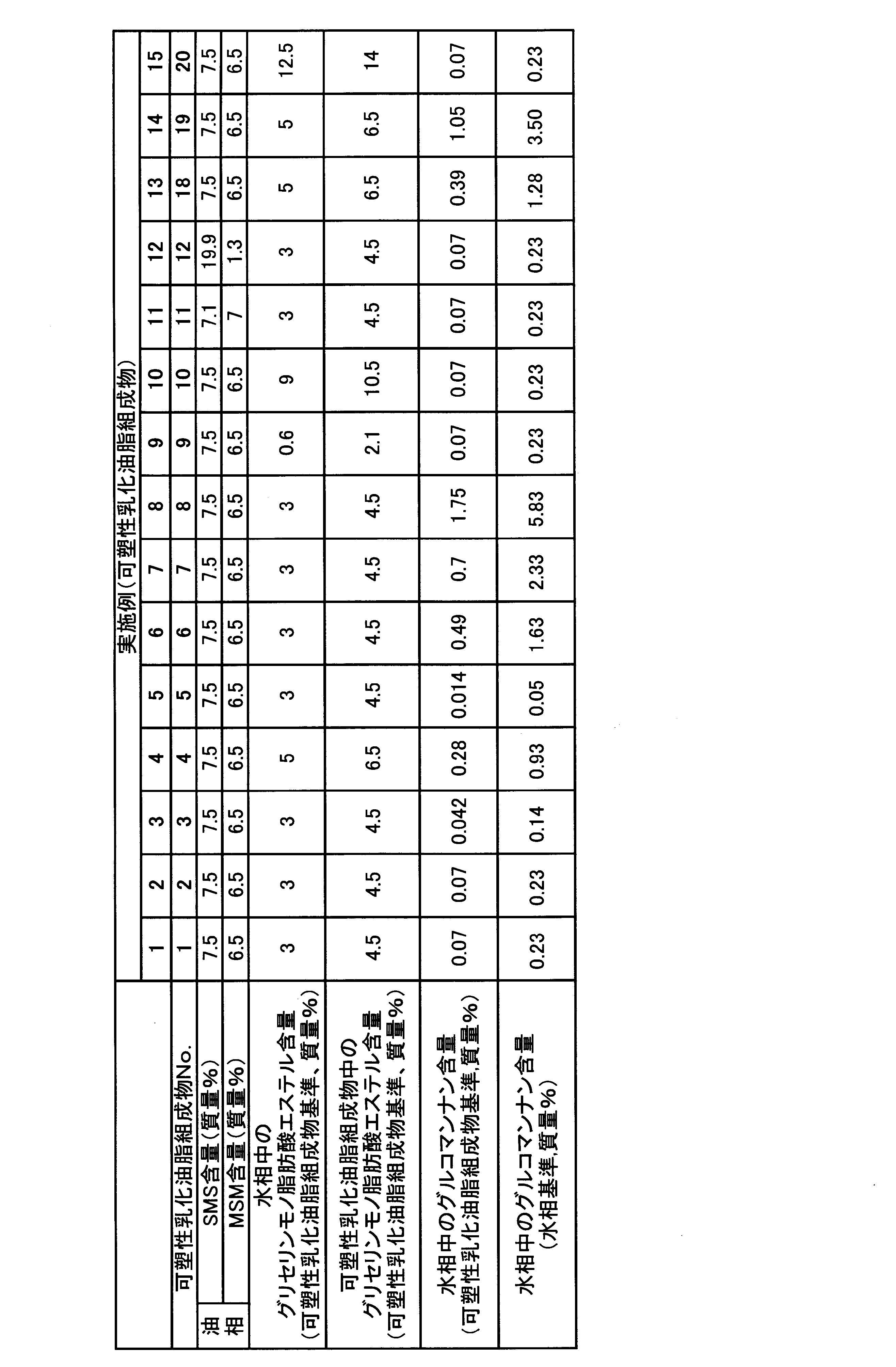
- the plastic emulsified fat and oil composition for bread kneading used in each of the usage examples and comparative usage examples is shown in Tables 2-1 and 2-2.
- the resulting bread dough has no stickiness and extends even when flour with a high ash content is used.
- the bread obtained using the bread dough has a uniform inner phase, a uniform hue, a good hue, no stuffy odor, a good flavor, soft and good texture, It can be seen that it has crispness and excellent aging resistance.
Landscapes
- Life Sciences & Earth Sciences (AREA)
- Chemical & Material Sciences (AREA)
- Engineering & Computer Science (AREA)
- Food Science & Technology (AREA)
- Oil, Petroleum & Natural Gas (AREA)
- Polymers & Plastics (AREA)
- Health & Medical Sciences (AREA)
- Molecular Biology (AREA)
- Bakery Products And Manufacturing Methods Therefor (AREA)
- Edible Oils And Fats (AREA)
Abstract
Description
また、このような灰分含量の高い、後の分離で得られた小麦粉は、2等粉と称され、製パン用、特に風味を大切にする高級なパンの製造には使用できないという問題があった。
そのような小麦粉改質方法の一つとして、小麦粉を湿熱処理する方法が提案されている(例えば特許文献1参照)。しかし、この方法では、澱粉に起因する問題は解決可能であるが、灰分に起因する問題を解決することができず、そのため、良好な品質のパン生地やパンを得ることはできなかった。
また、本発明は、上記製パン練り込み用可塑性乳化油脂組成物を製造する方法であって、油相と、グルコマンナン及びグリセリンモノ脂肪酸エステルを含有する水相又は水中油型乳化物とを均一に混合することを特徴とする製パン練り込み用可塑性乳化油脂組成物の製造方法を提供するものである。
本発明の製パン練り込み用可塑性乳化油脂組成物は、水相中に(1)グルコマンナン及び(2)グリセリンモノ脂肪酸エステルを含有する。
グルコマンナンは食用コンニャクの塊茎に含まれ、D-グルコースとD-マンノースがほぼ1:1.6のモル比でβ-1,4結合により多数結合した複合多糖類(難消化性多糖類)である。その分子量は産地や品種等によって異なるものの、約100万~200万である。その物性は、水との親和性に優れ保水力が非常に高い。また、グルコマンナンは、従来増粘安定剤として用いられており、増粘安定剤の中でも特に粘度が高いことが知られている。
まず、製パン練り込み用可塑性乳化油脂組成物を60~65℃に加熱し完全に溶解させる。その後、溶解した上記乳化油脂組成物から油相を分離し、残りの量を上記水相量(質量%)とする。
尚、上記の水相とは、水及び水溶性成分から構成されるものをいう。
通常の製パン時には、グリセリンモノ脂肪酸エステルをはじめとする乳化剤は、パン生地中で澱粉と強く結合して複合体を形成することで澱粉の膨潤を抑制する。その結果として、余分となった水がグルテン構造の生成に使われることでしっかりとした伸展性良好なグルテン構造が形成される。このように、乳化剤は、パン生地の物性の改良や、得られるパンの体積の増大やソフトな食感を得ることを目的として使用される。しかし、灰分含量の高い小麦粉を使用した場合は、グリアジンの比率が高く、弾性が強いため、水分をたとえ多く供給したとしても良好なグルテン構造が得られない。
上記グリセリンモノ脂肪酸エステルは油溶性であるため、通常、乳化油脂組成物中では油相中に溶解して使用される。しかし、本発明においては、グリセリンモノ脂肪酸エステルを水相中に含有させないとグルコマンナンとの相乗効果が得られない。
まず、製パン練り込み用可塑性乳化油脂組成物を60~65℃で完全に溶解させ、溶解した該乳化油脂組成物から油相を分離し水相部分だけを100~110℃で完全に乾燥させる。乾燥した水相部分に含まれる脂質成分をガスクロマトグラフィーで分析し、モノグリセリドを定量する。
グリセリンモノ脂肪酸エステルは一般に老化防止効果に優れるものの、水への分散性が悪く、性能を発揮しにくいという欠点を有する。本発明では、グリセリンモノ脂肪酸エステルをグルコマンナンと共に水相に含有させることで、水相中においてもグリセリンモノ脂肪酸エステルが効果的に作用することができ、さらにグルコマンナンが有する多様な機能が最大限に引き出され本発明の効果が発揮されると考えられる。
但し、本発明においては、直接β型の油脂結晶を含有していれば、直接β型の油脂結晶でない油脂結晶、例えばβプライム型の油脂結晶を含有していても良い。
具体的には、油脂結晶について、短面間隔を2θ:17~26度の範囲で測定し、4.5~4.7オングストロームの面間隔に対応する強い回折ピークを示した場合に、該油脂結晶はβ型結晶であると判断する。さらにより高い精度で測定する場合は、短面間隔を2θ:17~26度の範囲で測定し、4.5~4.7オングストロームの面間隔に対応する範囲に最大値を有するピーク強度(ピーク強度1)及び4.2~4.3オングストロームの面間隔に対応する範囲に最大値を有するピーク強度(ピーク強度2)をとり、ピーク強度1/ピーク強度2の比が1.3以上、好ましくは1.7以上、より好ましくは2.2以上、最も好ましくは2.5以上となった場合にβ型結晶であると判断する。
具体的には、油脂結晶について、長面間隔を2θ:0~8度の範囲で測定し、40~50オングストロームに相当する回折ピークを示した場合に、該油脂結晶は2鎖長構造をとっていると判断する。
尚、上記の油相とは、油脂に、必要に応じて、乳化剤、着色料、酸化防止剤、着香料、調味料等を添加したものを指す。また、上記の油脂には、乳製品、果実、果汁、コーヒー、ナッツペースト、香辛料、カカオマス、ココアパウダー、穀類、豆類、野菜類、肉類、魚介類等の食品素材から抽出される脂肪分も含まれる。更に、上記の油脂には、製パン練り込み用可塑性乳化油脂組成物に含まれる油脂として上記で挙げた各種植物油脂、動物油脂及び加工油脂等のほか、後述するS1MS2を含有する油脂及びMS3Mを含有する油脂として挙げるものが含まれる。
上記の直接β型の油脂結晶の例としては、S1MS2(S1及びS2は飽和脂肪酸、Mはモノ不飽和脂肪酸を表す)で表されるトリグリセリド(以下S1MS2とする)と、MS3M(S3は飽和脂肪酸、Mはモノ不飽和脂肪酸を表す)で表されるトリグリセリド(以下MS3Mとする)とからなるコンパウンド結晶が挙げられる。
上記のS1MS2とMS3Mとからなるコンパウンド結晶とは、構造の異なるS1MS21分子とMS3M1分子とが混合された際、あたかも単一のトリグリセリド分子であるかの如き結晶化挙動を示すものである。コンパウンド結晶は分子間化合物とも呼ばれる。
また、上記のS1MS2のM及びMS3MのMは、好ましくは炭素数16以上のモノ不飽和脂肪酸、さらに好ましくは炭素数18以上のモノ不飽和脂肪酸、最も好ましくはオレイン酸である。
尚、本発明の製パン練り込み用可塑性乳化油脂組成物において、上記のS1MS2とMS3Mとからなるコンパウンド結晶の含有量は、S1MS2とMS3Mのうち、少ない方の含有量の2倍とみなすことができる。
上記のエステル交換油としては、蒸留により精製したパーム油、通常精製したパーム油、パーム核油、ヤシ油、コーン油、オリーブ油、綿実油、大豆油、ナタネ油、米油、ヒマワリ油、サフラワー油、牛脂、乳脂、豚脂、カカオバター、シア脂、マンゴー核油、サル脂、イリッペ脂、魚油、鯨油等の各種動植物油脂、これらの各種動植物油脂を必要に応じて水素添加及び/又は分別した後に得られる加工油脂、脂肪酸、脂肪酸低級アルコールエステルを用いて製造したエステル交換油が挙げられる。
上記のエステル交換油としては、蒸留により精製したパーム油、通常精製したパーム油、パーム核油、ヤシ油、コーン油、オリーブ油、綿実油、大豆油、ナタネ油、米油、ヒマワリ油、サフラワー油、牛脂、乳脂、豚脂、カカオバター、シア脂、マンゴー核油、サル脂、イリッペ脂、魚油、鯨油等の各種動植物油脂、これらの各種動植物油脂を必要に応じて水素添加及び/又は分別した後に得られる加工油脂、脂肪酸、脂肪酸低級アルコールエステルを用いて製造したエステル交換油が挙げられる。
まず、第1の方法として、ある可塑性乳化油脂組成物の油相のトリグリセリド組成を分析し、直接β型の油脂結晶となるトリグリセリド、例えばS1MS2及びMS3Mの油相中の含有量を測定し、直接β型の油脂結晶となるトリグリセリドが油相中に含有されていること、好ましくはその含有量が前記範囲内にあることを確認することにより、可塑性乳化油脂組成物が直接β型の油脂結晶を含有していることを確認する方法が挙げられる。
上記の第3の方法において、ある可塑性乳化油脂組成物中の直接β型の油脂結晶の含有量が多いほど、5℃での保持時間が短くても、得られる油脂結晶が2鎖長構造のβ型結晶となる。
具体的には、油脂結晶について、短面間隔を2θ:17~26度の範囲で測定し、4.5~4.7オングストロームの面間隔に対応する強い回折ピークを示した場合に、該油脂結晶はβ型結晶であると判断する。さらにより高い精度で測定する場合は、短面間隔を2θ:17~26度の範囲で測定し、4.5~4.7オングストロームの面間隔に対応する範囲に最大値を有するピーク強度(ピーク強度1)及び4.2~4.3オングストロームの面間隔に対応する範囲に最大値を有するピーク強度(ピーク強度2)をとり、ピーク強度1/ピーク強度2の比が1.3以上、好ましくは1.7以上、より好ましくは2.2以上、最も好ましくは2.5以上となった場合にβ型結晶であると判断する。
具体的には、油脂結晶について、長面間隔を2θ:0~8度の範囲で測定し、40~50オングストロームに相当する回折ピークを示した場合に、該油脂結晶は2鎖長構造をとっていると判断する。
まず、製パン練り込み用可塑性乳化油脂組成物を60~65℃に加熱し完全に溶解させる。その後、溶解した上記乳化油脂組成物から油相を分離する。得られた油相について、さらに高速液体クロマトグラフィー等でトリグリセリドを定量すると共にその組成を分析し、該トリグリセリドに含まれるS1MS2及びMS3Mのそれぞれの含有量を得る。S1MS2の含有量及びMS3Mの含有量のうち、少ない方の2倍量をS1MS2とMS3Mとからなるコンパウンド結晶の含有量とする。
ここで、製パン練り込み用可塑性乳化油脂組成物における油相量(質量%)は、以下の方法によって測定することができる。
まず、製パン練り込み用可塑性乳化油脂組成物を60~65℃に加熱し完全に溶解させる。その後、溶解した上記乳化油脂組成物から油相を分離し、その量を上記油相量(質量%)とする。
本発明の製パン練り込み用可塑性乳化油脂組成物は、油相と、グルコマンナン及びグリセリンモノ脂肪酸エステルを含有する水相又は水中油型乳化物とを均一に混合することにより得ることができる。
先ず、上述のようにして、油相と水相をそれぞれ用意する。次に、上記油相を溶解し、そこへ上記水相を加え、混合乳化し予備乳化物を得る。そして次に、この予備乳化物を必要に応じて殺菌処理する。殺菌方法は、タンクでのバッチ式でも、プレート型熱交換機や掻き取り式熱交換機を用いた連続式でも構わない。
冷却する機器としては、密閉型連続式チューブ冷却機、例えば、ボテーター、コンビネーター、パーフェクター等のマーガリン製造機やプレート型熱交換機等が挙げられ、また、開放型のダイアクーラーとコンプレクターとの組み合わせも挙げられる。
また、本発明の製パン練り込み用可塑性乳化油脂組成物を製造する際の何れかの工程で、窒素、空気等を含気させてもよい。
グリセリンモノ脂肪酸エステルを含有する第1の水相又は水中油型乳化物と、タンパク質分解酵素を含有する第2の水相又は水中油型乳化物とを用意し、油相と第1の水相又は水中油型乳化物とを混合、冷却可塑化させ、得られた可塑性乳化油脂組成物に、第2の水相又は水中油型乳化物を混合する。尚、第1の水相又は水中油型乳化物及び第2の水相又は水中油型乳化物は、その組成が、グリセリンモノ脂肪酸エステル及びタンパク分解酵素以外の成分について同じであってもよく、異なっていてもよい。
本発明のパン生地は、本発明の製パン練り込み用可塑性乳化油脂組成物を使用したパン生地である。
本発明のパン生地における本発明の製パン練り込み用可塑性乳化油脂組成物の使用量は、従来の製パン練り込み用可塑性油脂組成物と同様であり、パンの種類によっても異なるが、パン生地に含まれる穀粉類100質量部に対し、好ましくは2~30質量部、より好ましくは4~20質量部である。
本発明のパン生地は、本発明の製パン練り込み用可塑性乳化油脂組成物を生地に練り込むことにより、製造することができる。
本発明のパン生地は、中種法、直捏法、液種法、中麺法、湯種法等、従来から製パン法として使用されているあらゆる製パン法を採ることができる。尚、本発明のパン生地を中種法で製造する場合は、本発明の製パン練り込み用可塑性乳化油脂組成物を中種生地及び/又は本捏生地に練り込むことにより製造することができる。
また、得られた本発明のパン生地は、冷蔵、冷凍保存することが可能である。
上記成形は、どのような形状に成形してもよく、型詰めを行っても構わない。これらの成形は、手作業で行っても、連続ラインを用いて全自動で行っても構わない。
上記加熱処理としては、焼成、蒸し、フライ等を挙げることができる。尚、これらのうちの2種以上の加熱処理を併用してもよい。
また、得られたパンを、冷蔵、冷凍保存したり、該保存後に電子レンジ加熱することも可能である。
下記実施例1~15及び比較例1~5においては、本発明の製パン練り込み用可塑性乳化油脂組成物及び比較用の製パン練り込み用可塑性乳化油脂組成物をそれぞれ製造し、下記使用例1~16及び比較使用例1~5においては、これらの製パン練り込み用可塑性乳化油脂組成物をそれぞれ用いてパン生地を製造し、該パン生地からパンを焼成し、得られたパンの評価を行った。パン生地の製造に際し、使用例1~15及び比較使用例1~5においては灰分含量の高い小麦粉を使用し、使用例16においては灰分含量の低い小麦粉を使用した。
尚、以下の実施例等において、Sは飽和脂肪酸、Mはモノ不飽和脂肪酸を表す。
<可塑性乳化油脂組成物1の製造>
パームオレイン(ヨウ素価56)のランダムエステル交換油脂80質量部及び大豆油20質量部を均一に混合した混合油脂68.47質量部に、60%トコフェロール0.01質量部、グリセリンモノパルミチン酸エステル1.5質量部及び香料0.02質量部を、添加、混合、溶解した油相を60℃に保温した。
一方、水22.9質量部に、(1)成分としてグルコマンナン含有物質(グルコマンナンの純度が70質量%、残部の不純物は、澱粉類、シュウ酸、シュウ酸カリウム等、以下同じ)0.1質量部を添加、溶解させ、60℃に調温した。ここに(2)成分としてグリセリンモノパルミチン酸エステル3.0質量部を添加し分散させた後、60℃に保ったまま、クエン酸を用いてpHを4に調整して水相1を得た。
さらに15℃まで冷却し、ここに、水3.92質量部、タンパク質分解酵素の液体製剤(ノボザイムズジャパン社製、商品名:ニュートラーゼ、酵素の純タンパク質含量は30質量%)0.08質量部を混合して調製した水相2を添加し、インラインミキサーで均一に混合し、油中水型の本発明の製パン練り込み用可塑性乳化油脂組成物1を得た。
得られた可塑性乳化油脂組成物1の油相中において、油相基準でSMSの含有量は7.5質量%で、MSMの含有量は6.5質量%であった。
<可塑性乳化油脂組成物2の製造>
パームオレイン(ヨウ素価56)のランダムエステル交換油脂80質量部及び大豆油20質量部を均一に混合した混合油脂68.47質量部に、60%トコフェロール0.01質量部、グリセリンモノパルミチン酸エステル1.5質量部及び香料0.02質量部を、添加、混合、溶解した油相を60℃に保温した。
一方、水26.9質量部に、(1)成分としてグルコマンナン含有物質0.1質量部を添加、溶解させ、60℃に調温した。ここに(2)成分としてグリセリンモノパルミチン酸エステル3.0質量部を添加し分散させた後、60℃に保ったまま、クエン酸を用いてpHを4に調整して水相を得た。
得られた可塑性乳化油脂組成物2の油相中において、油相基準で、SMSの含有量は7.5質量%で、MSMの含有量は6.5質量%であった。
<可塑性乳化油脂組成物3の製造>
水を26.94質量部、グルコマンナン含有物質を0.06質量部とした以外は<可塑性乳化油脂組成物2の製造>と同様の方法で本発明の製パン練り込み用可塑性乳化油脂組成物3を得た。
<可塑性乳化油脂組成物4の製造>
水を24.60質量部、グリセリンモノパルミチン酸エステルを5.0質量部、グルコマンナン含有物質を0.40質量部とした以外は<可塑性乳化油脂組成物2の製造>と同様の方法で本発明の製パン練り込み用可塑性乳化油脂組成物4を得た。
<可塑性乳化油脂組成物5の製造>
水を26.98質量部、グルコマンナン含有物質を0.02質量部とした以外は<可塑性乳化油脂組成物2の製造>と同様の方法で本発明の製パン練り込み用可塑性乳化油脂組成物5を得た。
<可塑性乳化油脂組成物6の製造>
水を26.30質量部、グルコマンナン含有物質を0.70質量部とした以外は<可塑性乳化油脂組成物2の製造>と同様の方法で本発明の製パン練り込み用可塑性乳化油脂組成物6を得た。
<可塑性乳化油脂組成物7の製造>
水を26.00質量部、グルコマンナン含有物質を1.00質量部とした以外は<可塑性乳化油脂組成物2の製造>と同様の方法で本発明の製パン練り込み用可塑性乳化油脂組成物7を得た。
<可塑性乳化油脂組成物8の製造>
水を24.50質量部、グルコマンナン含有物質を2.50質量部とした以外は<可塑性乳化油脂組成物2の製造>と同様の方法で本発明の製パン練り込み用可塑性乳化油脂組成物8を得た。
<可塑性乳化油脂組成物9の製造>
水を29.30質量部、グリセリンモノパルミチン酸エステルを0.6質量部とした以外は<可塑性乳化油脂組成物2の製造>と同様の方法で本発明の製パン練り込み用可塑性乳化油脂組成物9を得た。
<可塑性乳化油脂組成物10の製造>
水を20.90質量部、グリセリンモノパルミチン酸エステルを9.0質量部とした以外は<可塑性乳化油脂組成物2の製造>と同様の方法で本発明の製パン練り込み用可塑性乳化油脂組成物10を得た。
<可塑性乳化油脂組成物11の製造>
パームオレイン(ヨウ素価65)のランダムエステル交換油脂95質量部及びパームステアリン5質量部を均一に混合した混合油脂68.47質量部に、60%トコフェロール0.01質量部、グリセリンモノパルミチン酸エステル1.5質量部及び香料0.02質量部を、添加、混合、溶解した油相を60℃に保温した。
一方、水26.9質量部に、(1)成分としてグルコマンナン含有物質0.1質量部を添加、溶解させ、60℃に調温した。ここに(2)成分としてグリセリンモノパルミチン酸エステル3.0質量部を添加し分散させた後、60℃に保ったまま、クエン酸を用いてpHを4に調整して水相を得た。
上記油相に上記水相を加え混合乳化し予備乳化物とした後、コンビネーターを用いて急冷可塑化を行い、油中水型の本発明の製パン練り込み用可塑性乳化油脂組成物11を得た。
得られた可塑性乳化油脂組成物11の油相中において、油相基準で、SMSの含有量は7.1質量%で、MSMの含有量は7.0質量%であった。
<可塑性乳化油脂組成物12の製造>
パーム油80質量部及び大豆油20質量部を均一に混合した混合油脂68.47質量部に、60%トコフェロール0.01質量部、グリセリンモノパルミチン酸エステル1.5質量部及び香料0.02質量部を、添加、混合、溶解した油相を60℃に保温した。
一方、水26.9質量部に、(1)成分としてグルコマンナン含有物質0.1質量部を添加、溶解させ、60℃に調温した。ここに(2)成分としてグリセリンモノパルミチン酸エステル3.0質量部を添加し分散させた後、60℃に保ったまま、クエン酸を用いてpHを4に調整して水相を得た。
上記油相に上記水相を加え混合乳化し予備乳化物とした後、コンビネーターを用いて急冷可塑化を行い、油中水型の本発明の製パン練り込み用可塑性乳化油脂組成物12を得た。
得られた可塑性乳化油脂組成物12の油相中において、油相基準で、SMSの含有量は19.9質量%で、MSMの含有量は1.3質量%であった。
<可塑性乳化油脂組成物13の製造>
グルコマンナン含有物質0.1質量部を0.0質量部とし、水を27質量部とした以外は<可塑性乳化油脂組成物2の製造>と同様の方法で製パン練り込み用可塑性乳化油脂組成物13を得た。
<可塑性乳化油脂組成物14の製造>
グルコマンナン含有物質0.1質量部に代えてキサンタンガムを0.1質量部とした以外は<可塑性乳化油脂組成物2の製造>と同様の方法で製パン練り込み用可塑性乳化油脂組成物14を得た。
<可塑性乳化油脂組成物15の製造>
グルコマンナン含有物質0.1質量部に代えてアルギン酸ナトリウムを0.1質量部とした以外は<可塑性乳化油脂組成物2の製造>と同様の方法で製パン練り込み用可塑性乳化油脂組成物15を得た。
<可塑性乳化油脂組成物16の製造>
パームオレイン(ヨウ素価56)のランダムエステル交換油脂80質量部及び大豆油20質量部を均一に混合した混合油脂68.47質量部に、60%トコフェロール0.01質量部、グリセリンモノパルミチン酸エステル1.5質量部、コハク酸モノグリセリン脂肪酸エステル3.0質量部及び香料0.02質量部を、添加、混合、溶解した油相を60℃に保温した。
一方、水26.9質量部に、(1)成分としてグルコマンナン含有物質0.1質量部を添加、溶解させ、60℃に調温した。さらに、クエン酸を用いてpHを4に調整して水相を得た。
上記油相に上記水相を加え混合乳化し予備乳化物とした後、コンビネーターを用いて急冷可塑化を行い、油中水型の製パン練り込み用可塑性乳化油脂組成物16を得た。
得られた可塑性乳化油脂組成物16の油相中において、油相基準で、SMSの含有量は7.5質量%で、MSMの含有量は6.5質量%であった。
<可塑性乳化油脂組成物17の製造>
パームオレイン(ヨウ素価56)のランダムエステル交換油脂80質量部及び大豆油20質量部を均一に混合した混合油脂68.47質量部に、60%トコフェロール0.01質量部、グリセリンモノパルミチン酸エステル4.5質量部及び香料0.02質量部を、添加、混合、溶解した油相を60℃に保温した。
一方、水26.9質量部に、(1)成分としてグルコマンナン含有物質0.1質量部を添加、溶解させ、60℃に調温した。さらに、クエン酸を用いてpHを4に調整して水相を得た。
上記油相に上記水相を加え混合乳化し予備乳化物とした後、コンビネーターを用いて急冷可塑化を行い、油中水型の製パン練り込み用可塑性乳化油脂組成物17を得た。
得られた可塑性乳化油脂組成物17の油相中において、油相基準で、SMSの含有量は7.5質量%で、MSMの含有量は6.5質量%であった。
<可塑性乳化油脂組成物18の製造>
水を24.45質量部、グリセリンモノパルミチン酸エステルを5.0質量部、グルコマンナン含有物質を0.55質量部とした以外は<可塑性乳化油脂組成物2の製造>と同様の方法で本発明の製パン練り込み用可塑性乳化油脂組成物18を得た。
<可塑性乳化油脂組成物19の製造>
水を23.5質量部、グリセリンモノパルミチン酸エステルを5.0質量部、グルコマンナン含有物質を1.5質量部とした以外は<可塑性乳化油脂組成物2の製造>と同様の方法で本発明の製パン練り込み用可塑性乳化油脂組成物19を得た。
<可塑性乳化油脂組成物20の製造>
水を17.4質量部、グリセリンモノパルミチン酸エステルを12.5質量部とした以外は<可塑性乳化油脂組成物2の製造>と同様の方法で本発明の製パン練り込み用可塑性乳化油脂組成物20を得た。
まず、可塑性乳化油脂組成物1を60~65℃で完全に溶解させ、溶解した該乳化油脂組成物1から油相を分離し水相部分だけを100~110℃で完全に乾燥させた。その後、乾燥した水相部分中に含まれる脂質成分をガスクロマトグラフィーで分析することにより、水相中のグリセリンモノパルミチン酸エステルの存在を確認した。実施例2~15においても同様の確認を行った。
<プルマン型食パンの配合・製法>
強力粉(輸入小麦粉、タンパク質含量13.0質量%、灰分0.52質量%)70質量部、生イースト2質量部、イーストフード0.1質量部及び水40質量部をミキサーボウルに投入し、フックを使用し、低速で2分、中速で2分混合し、中種生地を得た。捏ね上げ温度は24℃であった。この中種生地を生地ボックスに入れ、温度28℃、相対湿度85%の恒温室で、4時間中種醗酵を行なった。終点温度は29℃であった。
この中種醗酵の終了した生地を再びミキサーボウルに投入し、更に、強力粉(輸入小麦粉、タンパク質含量13.0質量%、灰分0.52質量%)30質量部、上白糖5質量部、脱脂粉乳2質量部、食塩1.5質量部及び水25質量部を添加し、低速で3分、中速で3分本捏ミキシングした。ここで、製パン練り込み用可塑性乳化油脂組成物8質量部を投入し、フックを使用し、低速で3分、中速で3分、高速で1分ミキシングを行ない、食パン生地を得た。得られた食パン生地の捏ね上げ温度は28℃であった。
ここで、フロアタイムを20分とった後、230gに分割・丸目を行なった。次いで、ベンチタイムを20分とった後、 モルダー成形し、6本をU字にして3斤型プルマン型に入れ、38℃、相対湿度85%で50分ホイロをとった後、200℃に設定した固定窯に入れ40分焼成してプルマン型食パンを得た。
尚、各使用例、比較使用例で使用した製パン練り込み用可塑性乳化油脂組成物は表2-1及び2-2に示した。
強力粉(輸入小麦粉)に代えて、強力粉(商品名:カメリア、日清製粉製、タンパク質含量11.8質量%、灰分0.37質量%)を用いた以外は使用例1と同様にしてプルマン型食パンを得た。
・生地作業性
◎:べとつきもなく伸展性もよく、極めて良好な作業性であった。
○:良好な作業性であった。
△:ややべとつきが感じられるか、又は、やや伸展性が悪く、若干劣る作業性であった。×:べとつきがあるか、又は、伸展性が悪く、作業性が劣るものであった。
・外観(着色)
◎:きわめて良好
○:良好
△:ややくすんだ焼き色である。
×:赤茶けた色である。
・外観(体積)
◎:体積が大きく、細い均一なホワイトラインを有し、上面の4隅の角もしっかり出たプルマンブレッドである。
○:体積が大きく、ホワイトラインを有し、上面の4隅の角もしっかり出たプルマンブレッドである。
△:体積がやや小さく、明瞭なホワイトラインがなく、上面の4隅の角も丸いプルマンブレッドであった。
×:体積が小さいため、上面が平らにならず、曲面であるプルマンブレッドである。
・外観(保型性)
◎:腰折れは全く見られなかった。
○:若干の焼き細りはあるが、腰折れは見られなかった。
△:若干の腰折れが見られた。
×:激しい腰折れが見られた。
◎:気泡膜が薄く、均一で、タテ目である。
○:気泡膜が薄く、均一である。
△:不均一で、やや目が詰まっている。
×:気泡膜が厚く、不均一で、目が詰まっている。
・内相(色相)
◎:光沢のある白色であり、きわめて良好
○:ほぼ白色であり良好
△:ややくすんだ色である。
×:暗くくすんだ色である。
・風味
◎:きわめて良好
○:良好
△:エグ味がありムレ臭がある。
×:エグ味がありムレ臭が激しい。
◎:きわめて良好
○:良好
△:やや悪い
×:悪い
・食感(ソフト性)
◎:きわめて良好
○:良好
△:やや悪い
×:悪い
・食感(歯切れ)
◎:きわめて良好
○:良好
△:ややねちゃつく
×:ねちゃつきが激しい
◎:ソフトで歯切れも良好である。
○:ソフトである。
△:硬い食感でありやや悪い。
×:硬い食感でヒキが強く極めて悪い。
・2日後にトーストした際の形状
◎:形状の変化がなく極めて良好である。
○:形状にわずかな歪みが見られる。
△:形状に歪みがみられる。
×:形状が大きく湾曲し、極めて悪い。


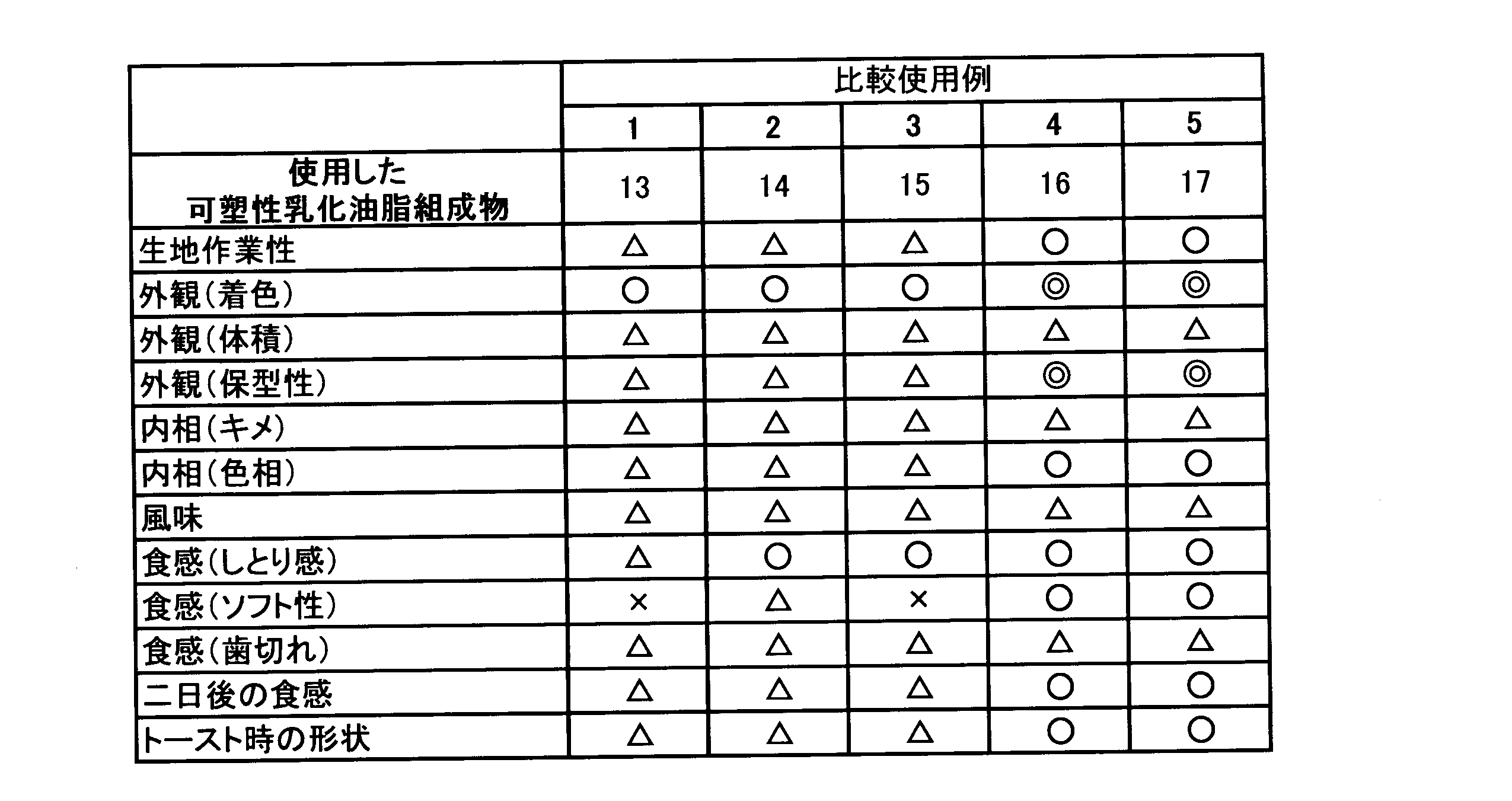
これに対して、表2-2の結果から、水相中に(1)グルコマンナン及び(2)グリセリンモノ脂肪酸エステルの一つでも欠けた製パン練り込み用可塑性乳化油脂組成物を使用すると、製パン作業性とパンの品質の全てを満足するものにならないことがわかる。
Claims (10)
- 水相中にグルコマンナン及びグリセリンモノ脂肪酸エステルを含有することを特徴とする製パン練り込み用可塑性乳化油脂組成物。
- 上記グルコマンナンの含有量が0.01~2.1質量%である、請求項1記載の製パン練り込み用可塑性乳化油脂組成物。
- 上記グルコマンナンとして、該グルコマンナンの純度が50質量%以上であるグルコマンナン含有物質を含有する、請求項1又は2記載の製パン練り込み用可塑性乳化油脂組成物。
- 上記水相中における上記モノグリセリン脂肪酸エステルの含有量が、可塑性乳化油脂組成物基準で0.5~14質量%である、請求項1~3のいずれか一項記載の製パン練り込み用可塑性乳化油脂組成物。
- 油相中に直接β型の油脂結晶を含有する請求項1~4のいずれか一項記載の製パン練り込み用可塑性乳化油脂組成物。
- 上記直接β型の油脂結晶を油相中に、油相基準で5~50質量%含有する請求項5記載の製パン練り込み用可塑性乳化油脂組成物。
- タンパク質分解酵素を含有しない請求項1~6のいずれか一項記載の製パン練り込み用可塑性乳化油脂組成物。
- 請求項1~7のいずれか一項に記載の製パン練り込み用可塑性乳化油脂組成物を使用したことを特徴とするパン生地。
- 灰分0.45質量%以上の小麦粉を使用した請求項8記載のパン生地。
- 請求項1~7のいずれか一項に記載の製パン練り込み用可塑性乳化油脂組成物を製造する方法であって、油相と、グルコマンナン及びグリセリンモノ脂肪酸エステルを含有する水相又は水中油型乳化物とを均一に混合することを特徴とする製パン練り込み用可塑性乳化油脂組成物の製造方法。
Priority Applications (3)
| Application Number | Priority Date | Filing Date | Title |
|---|---|---|---|
| CN201280004255.4A CN103269600B (zh) | 2011-02-10 | 2012-02-06 | 制面包揉捏用可塑性乳化油脂组合物 |
| SG2013049077A SG191752A1 (en) | 2011-02-10 | 2012-02-06 | Plastic emulsified oil and fat composition for kneading bread |
| JP2012556870A JP5964250B2 (ja) | 2011-02-10 | 2012-02-06 | 油中水型である製パン練り込み用可塑性乳化油脂組成物 |
Applications Claiming Priority (2)
| Application Number | Priority Date | Filing Date | Title |
|---|---|---|---|
| JP2011-027173 | 2011-02-10 | ||
| JP2011027173 | 2011-02-10 |
Publications (1)
| Publication Number | Publication Date |
|---|---|
| WO2012108377A1 true WO2012108377A1 (ja) | 2012-08-16 |
Family
ID=46638592
Family Applications (1)
| Application Number | Title | Priority Date | Filing Date |
|---|---|---|---|
| PCT/JP2012/052602 Ceased WO2012108377A1 (ja) | 2011-02-10 | 2012-02-06 | 製パン練り込み用可塑性乳化油脂組成物 |
Country Status (5)
| Country | Link |
|---|---|
| JP (1) | JP5964250B2 (ja) |
| CN (1) | CN103269600B (ja) |
| MY (1) | MY163928A (ja) |
| SG (2) | SG10201502168YA (ja) |
| WO (1) | WO2012108377A1 (ja) |
Cited By (3)
| Publication number | Priority date | Publication date | Assignee | Title |
|---|---|---|---|---|
| JP2015198610A (ja) * | 2014-04-08 | 2015-11-12 | 株式会社Adeka | 湯種用油脂組成物 |
| JP2017209038A (ja) * | 2016-05-24 | 2017-11-30 | 株式会社Adeka | ベーカリー用可塑性油中水型乳化油脂組成物 |
| EP3476224A1 (en) * | 2017-10-27 | 2019-05-01 | Generale Biscuit | Non fat bloom comestible product |
Families Citing this family (1)
| Publication number | Priority date | Publication date | Assignee | Title |
|---|---|---|---|---|
| CN108566994A (zh) * | 2017-07-21 | 2018-09-25 | 天津南侨食品有限公司 | 一种高保湿面包用烘焙油脂组合物及其制备方法 |
Citations (4)
| Publication number | Priority date | Publication date | Assignee | Title |
|---|---|---|---|---|
| JP2004180639A (ja) * | 2002-12-06 | 2004-07-02 | Sakura Foods:Kk | 食品用の耐熱性保形剤 |
| JP2005000124A (ja) * | 2003-06-13 | 2005-01-06 | Nippon Shokuhin Kako Co Ltd | 複合菓子類又は複合パン類の製造方法 |
| JP2006230215A (ja) * | 2005-02-22 | 2006-09-07 | Taiyo Yushi Kk | 水中油型乳化油脂組成物 |
| JP2006320207A (ja) * | 2005-05-17 | 2006-11-30 | Ozawa Shokuhin:Kk | 多加水パン用有形水及びこれを用いた多加水パンの製造方法 |
Family Cites Families (4)
| Publication number | Priority date | Publication date | Assignee | Title |
|---|---|---|---|---|
| JP2761669B2 (ja) * | 1990-04-18 | 1998-06-04 | 鐘淵化学工業株式会社 | 油脂混合物及びその製造方法 |
| JP2902763B2 (ja) * | 1990-10-04 | 1999-06-07 | 旭電化工業株式会社 | 練り込み用油中水型乳化油脂組成物 |
| CA2188331A1 (en) * | 1995-10-19 | 1997-04-20 | Timothy J. Young | Bakery shortening substitute, bakery products containing the same, and preparation method |
| JP3621029B2 (ja) * | 2000-07-26 | 2005-02-16 | 旭電化工業株式会社 | 可塑性油脂組成物 |
-
2012
- 2012-02-06 CN CN201280004255.4A patent/CN103269600B/zh active Active
- 2012-02-06 MY MYPI2013002179A patent/MY163928A/en unknown
- 2012-02-06 JP JP2012556870A patent/JP5964250B2/ja active Active
- 2012-02-06 SG SG10201502168YA patent/SG10201502168YA/en unknown
- 2012-02-06 SG SG2013049077A patent/SG191752A1/en unknown
- 2012-02-06 WO PCT/JP2012/052602 patent/WO2012108377A1/ja not_active Ceased
Patent Citations (4)
| Publication number | Priority date | Publication date | Assignee | Title |
|---|---|---|---|---|
| JP2004180639A (ja) * | 2002-12-06 | 2004-07-02 | Sakura Foods:Kk | 食品用の耐熱性保形剤 |
| JP2005000124A (ja) * | 2003-06-13 | 2005-01-06 | Nippon Shokuhin Kako Co Ltd | 複合菓子類又は複合パン類の製造方法 |
| JP2006230215A (ja) * | 2005-02-22 | 2006-09-07 | Taiyo Yushi Kk | 水中油型乳化油脂組成物 |
| JP2006320207A (ja) * | 2005-05-17 | 2006-11-30 | Ozawa Shokuhin:Kk | 多加水パン用有形水及びこれを用いた多加水パンの製造方法 |
Cited By (9)
| Publication number | Priority date | Publication date | Assignee | Title |
|---|---|---|---|---|
| JP2015198610A (ja) * | 2014-04-08 | 2015-11-12 | 株式会社Adeka | 湯種用油脂組成物 |
| JP2017209038A (ja) * | 2016-05-24 | 2017-11-30 | 株式会社Adeka | ベーカリー用可塑性油中水型乳化油脂組成物 |
| EP3476224A1 (en) * | 2017-10-27 | 2019-05-01 | Generale Biscuit | Non fat bloom comestible product |
| WO2019081745A1 (en) | 2017-10-27 | 2019-05-02 | Generale Biscuit | EDIBLE PRODUCT WITHOUT WHITENING |
| JP2020534846A (ja) * | 2017-10-27 | 2020-12-03 | ジェネラル ビスケット | ブルーミングしない可食製品 |
| JP7083019B2 (ja) | 2017-10-27 | 2022-06-09 | ジェネラル ビスケット | ブルーミングしない可食製品 |
| EP3700345B1 (en) * | 2017-10-27 | 2024-03-27 | Generale Biscuit | Non-bloom comestible product |
| EP4342301A2 (en) | 2017-10-27 | 2024-03-27 | Generale Biscuit | Non-bloom comestible product |
| EP4342301A3 (en) * | 2017-10-27 | 2024-11-06 | Generale Biscuit | Non-bloom comestible product |
Also Published As
| Publication number | Publication date |
|---|---|
| SG10201502168YA (en) | 2015-05-28 |
| CN103269600A (zh) | 2013-08-28 |
| JPWO2012108377A1 (ja) | 2014-07-03 |
| CN103269600B (zh) | 2014-12-24 |
| SG191752A1 (en) | 2013-08-30 |
| MY163928A (en) | 2017-11-15 |
| JP5964250B2 (ja) | 2016-08-03 |
Similar Documents
| Publication | Publication Date | Title |
|---|---|---|
| JP5231291B2 (ja) | 製パン練り込み用油中水型乳化油脂組成物を使用したパン生地 | |
| JP5153610B2 (ja) | 穀粉含有生地及びその製造方法 | |
| JP6721392B2 (ja) | 製パン練り込み用油脂組成物 | |
| JP4707694B2 (ja) | 小麦生胚芽粉末を含む焼き菓子用穀粉及びこれを使用した焼き菓子 | |
| JP5886006B2 (ja) | 製パン練り込み用乳化油脂組成物 | |
| JP7341036B2 (ja) | 全粒粉パン及びその製造方法 | |
| JP6746203B2 (ja) | ベーカリー用可塑性油中水型乳化油脂組成物 | |
| JP5964250B2 (ja) | 油中水型である製パン練り込み用可塑性乳化油脂組成物 | |
| JP2011087513A (ja) | 製パン改良材 | |
| JP5214536B2 (ja) | フラワーペースト類 | |
| JP6680667B2 (ja) | 小麦ふすま素材およびこれを用いたパン類の製造方法 | |
| JP2009201468A (ja) | ベーカリー製品用湯種生地、及び該湯種生地を用いたベーカリー製品 | |
| JP7257734B2 (ja) | ベーカリー用可塑性油中水型乳化油脂組成物 | |
| JP2012130278A (ja) | スポンジケーキ類の製造方法 | |
| JP2010075138A (ja) | パン生地 | |
| JP6599091B2 (ja) | 製パン練り込み用油脂組成物 | |
| JP2021036865A (ja) | ベーカリー用油脂組成物 | |
| JP2011244777A (ja) | 食パン類の製造方法 | |
| JP5859292B2 (ja) | チルドパンの製造方法 | |
| JP4493471B2 (ja) | フラワーペースト又はカスタード | |
| JP2016202141A (ja) | 食物繊維を含有するパン用生地及びパン | |
| JP2016111985A (ja) | 可塑性油脂組成物 | |
| JP2011092158A (ja) | クリーム組成物及びその製造方法 | |
| JP5460433B2 (ja) | フラワーペースト類 | |
| JP2013215163A (ja) | パン生地及びパン類 |
Legal Events
| Date | Code | Title | Description |
|---|---|---|---|
| 121 | Ep: the epo has been informed by wipo that ep was designated in this application |
Ref document number: 12744474 Country of ref document: EP Kind code of ref document: A1 |
|
| ENP | Entry into the national phase |
Ref document number: 2012556870 Country of ref document: JP Kind code of ref document: A |
|
| WWE | Wipo information: entry into national phase |
Ref document number: 1301004428 Country of ref document: TH |
|
| NENP | Non-entry into the national phase |
Ref country code: DE |
|
| 122 | Ep: pct application non-entry in european phase |
Ref document number: 12744474 Country of ref document: EP Kind code of ref document: A1 |