WO2012108385A1 - Procédé pour la production de composé de bisphénol - Google Patents
Procédé pour la production de composé de bisphénol Download PDFInfo
- Publication number
- WO2012108385A1 WO2012108385A1 PCT/JP2012/052623 JP2012052623W WO2012108385A1 WO 2012108385 A1 WO2012108385 A1 WO 2012108385A1 JP 2012052623 W JP2012052623 W JP 2012052623W WO 2012108385 A1 WO2012108385 A1 WO 2012108385A1
- Authority
- WO
- WIPO (PCT)
- Prior art keywords
- compound
- bisphenol
- reaction
- phenol
- strong acid
- Prior art date
- Legal status (The legal status is an assumption and is not a legal conclusion. Google has not performed a legal analysis and makes no representation as to the accuracy of the status listed.)
- Ceased
Links
Images



Classifications
-
- C—CHEMISTRY; METALLURGY
- C07—ORGANIC CHEMISTRY
- C07C—ACYCLIC OR CARBOCYCLIC COMPOUNDS
- C07C37/00—Preparation of compounds having hydroxy or O-metal groups bound to a carbon atom of a six-membered aromatic ring
- C07C37/11—Preparation of compounds having hydroxy or O-metal groups bound to a carbon atom of a six-membered aromatic ring by reactions increasing the number of carbon atoms
- C07C37/20—Preparation of compounds having hydroxy or O-metal groups bound to a carbon atom of a six-membered aromatic ring by reactions increasing the number of carbon atoms using aldehydes or ketones
-
- C—CHEMISTRY; METALLURGY
- C07—ORGANIC CHEMISTRY
- C07B—GENERAL METHODS OF ORGANIC CHEMISTRY; APPARATUS THEREFOR
- C07B61/00—Other general methods
-
- C—CHEMISTRY; METALLURGY
- C07—ORGANIC CHEMISTRY
- C07C—ACYCLIC OR CARBOCYCLIC COMPOUNDS
- C07C39/00—Compounds having at least one hydroxy or O-metal group bound to a carbon atom of a six-membered aromatic ring
- C07C39/12—Compounds having at least one hydroxy or O-metal group bound to a carbon atom of a six-membered aromatic ring polycyclic with no unsaturation outside the aromatic rings
- C07C39/15—Compounds having at least one hydroxy or O-metal group bound to a carbon atom of a six-membered aromatic ring polycyclic with no unsaturation outside the aromatic rings with all hydroxy groups on non-condensed rings, e.g. phenylphenol
- C07C39/16—Bis-(hydroxyphenyl) alkanes; Tris-(hydroxyphenyl)alkanes
Definitions
- the present invention relates to a method for producing a bisphenol compound. More specifically, in a method for producing a bisphenol compound from a phenol compound and a carbonyl compound in the presence of a cation exchanger having a strong acid group and 2- (2-mercaptoethyl) pyridine, the reaction raw material contains water at a specific concentration.
- the present invention relates to a method for producing a bisphenol compound.
- a bisphenol compound is generally produced by a condensation reaction between a phenol compound and a carbonyl compound in the presence of an acidic catalyst.
- an acidic catalyst a mineral acid such as hydrochloric acid is also used, but industrially, a cation exchange resin having an acidic group such as sulfonic acid is widely used from the viewpoint of corrosion of the apparatus by the catalyst and cost.
- a compound containing a thiol group or a protected thiol group (hereinafter sometimes abbreviated as “thiol compound”) may be allowed to react with a catalyst.
- thiol compound a compound containing a thiol group or a protected thiol group
- the co-catalyst thiol compound coexists with the catalyst as follows: (1) a method in which the thiol compound is added to the reaction raw material and supplied; and (2) a functional group capable of binding to a sulfonic acid group such as an amino group.
- a sulfonic acid group of a sulfonic acid type cation exchange resin is modified with a thiol compound (for example, aminoalkanethiol compound, pyridinealkanethiol compound, etc.) contained.
- the method of modifying the sulfonic acid type cation exchange resin with the thiol compound of (2) does not mix the thiol compound into the reaction product, and therefore the method of adding the thiol compound of (1) to the reaction raw material.
- Various compounds such as aminoalkanethiol compounds and pyridinealkanethiol compounds are known as thiol compounds that can be used to modify the sulfonic acid type cation exchange resin.
- the concentration of water contained in the reaction raw material is 0.2% by weight or more in the presence of a strongly acidic cation exchange resin catalyst. Then, since the conversion rate of the carbonyl compound which is a raw material falls, it is disclosed that it is unpreferable (refer patent document 1). In this document, it is described that it is preferable that water does not exist in the reaction system, and when the concentration is changed, the influence on impurities other than the produced bisphenol compound is not studied at all.
- the reaction is carried out in the presence of a strongly acidic ion exchange resin catalyst modified with an alkyl-SH group such as cysteamine.
- a strongly acidic ion exchange resin catalyst modified with an alkyl-SH group such as cysteamine.
- the amount of water in the reaction raw material is adjusted by adjusting the amount of water in the presence of a strongly acidic ion exchange resin catalyst modified with a 4-pyridylethyl mercaptan compound. It is disclosed that the selectivity of '-bisphenol A is controlled (see Patent Document 3). Further, it is disclosed that the amount of water present in the reaction system is preferably 1 to 5% by weight of the feed solution. However, when such water is added to the reaction system, there is a problem that the reaction activity is remarkably lowered, and further, this document does not discuss any by-products generated during the production of the bisphenol compound.
- An object of the present invention is to solve the above-mentioned problems, and reacting a phenol compound and a carbonyl compound in the presence of a cation exchanger having a strong acid group and 2- (2-mercaptoethyl) pyridine.
- the object is to provide an industrially advantageous method capable of efficiently producing the desired bisphenol compound with high selectivity while suppressing the formation of by-products. is there.
- the strong acid cation exchange resin catalyst modified with 2- (2-mercaptoethyl) pyridine used for the synthesis of bisphenol compound is a strong acid cation exchange resin catalyst modified with 4- (2-mercaptoethyl) pyridine.
- the initial activity is almost equal or inferior, but it is known to produce a bisphenol compound with high selectivity while maintaining a high conversion rate over a long period of time (patent) (Ref. 4).
- pattern a long period of time
- the present inventors produce a bisphenol compound using a strong acid cation exchange resin catalyst modified with 2- (2-mercaptoethyl) pyridine
- the water concentration in the reaction raw material is determined by converting the acetone conversion rate.
- the present inventors have found that a bisphenol compound can be produced with high selectivity by increasing a minute amount such that the concentration does not reach a greatly decreasing concentration.
- the present invention has been made based on these findings.
- the present invention provides the following.
- a method for producing a bisphenol compound in which a phenol compound and a carbonyl compound are reacted in the presence of a cation exchanger having a strong acid group and 2- (2-mercaptoethyl) pyridine, the phenol compound and the carbonyl compound A process for producing a bisphenol compound, characterized in that the concentration of water in the reaction raw material containing 0.05 to 0.05% by weight.
- the cation exchanger having a strong acid group and the 2- (2-mercaptoethyl) pyridine at least a part of the strong acid group of the cation exchanger having a strong acid group is 2- (2-mercaptoethyl).
- the cation exchanger having a strong acid group and the modified strong acid cation exchanger having a particle size of 30 to 650 ⁇ m account for 50% or more of the total [1] to [3 ]
- the manufacturing method of the bisphenol compound in any one of.
- the method of the present invention when a phenol compound and a carbonyl compound are reacted in the presence of a cation exchanger having a strong acid group and 2- (2-mercaptoethyl) pyridine, 0.05 wt.
- a cation exchanger having a strong acid group and 2- (2-mercaptoethyl) pyridine 0.05 wt.
- the indane compound here refers to p-isopropenylphenol cyclic dimer and isomers thereof.
- a bisphenol compound can be continuously produced stably at a high conversion rate and high selectivity over a long period of time, which is extremely advantageous industrially.
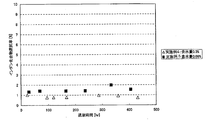
- FIG. 6 is a graph showing the relationship between the water content in the initial phenol solution and the acetone conversion when the reaction is carried out using a 2- (2-mercaptoethyl) pyridine-modified strong acidic cation exchange resin catalyst. Relationship between water content in initial phenol solution and total selectivity of bisphenol and 2,4 'isomer when reacted with 2- (2-mercaptoethyl) pyridine modified strongly acidic cation exchange resin catalyst catalyst It is a graph which shows. 3 is a graph showing the relationship between the water content in the initial phenol solution and the indane compound selectivity when the 2- (2-mercaptoethyl) pyridine-modified strong acidic cation exchange resin catalyst is used for the reaction.
- the present invention relates to a process for producing a bisphenol compound in which a phenol compound and a carbonyl compound are reacted in the presence of a cation exchanger having a strong acid group and 2- (2-mercaptoethyl) pyridine.
- a method for producing a bisphenol compound, characterized in that the concentration of water in the reaction raw material containing the compound is 0.05 to 0.5% by weight hereinafter sometimes referred to as “the production method of the present invention”) .
- the bisphenol compound is produced by a condensation reaction between a phenol compound and a carbonyl compound.
- a phenol compound means a compound having phenol as a partial structure.
- the condensation reaction between a phenol compound and a carbonyl compound it is understood that the strong ortho-para orientation of the phenolic hydroxyl group, in particular the para orientation, is used. Therefore, the phenol compound used is a substituent at the ortho or para position.
- the bisphenol compound which is a condensation reaction product is generally preferably a 4,4′-bisphenol compound from the viewpoint of its use, and from this point, a phenol compound having no substituent at the para position is preferable.
- the substituent does not inhibit the ortho-para orientation of the phenolic hydroxyl group, and the use of the resulting bisphenol compound as long as it does not sterically hinder the condensation position of the carbonyl compound. It may be arbitrary depending on the physical properties. Typical examples of the substituent include a lower alkyl group having 1 to 4 carbon atoms. Moreover, the compound of the same substitution position can be used also about the phenol compound which substituted halogen atoms, such as a fluorine atom, a chlorine atom, and a bromine atom, instead of this substituent. The number of substituents may be one or more.
- the phenol compound examples include phenol (unsubstituted phenol), o-cresol, m-cresol, 2,5-xylenol, 2,6-xylenol, 2,3,6-trimethylphenol, Examples include 2,6-di-tert-butylphenol, o-chlorophenol, m-chlorophenol, 2,5-dichlorophenol, and 2,6-dichlorophenol. Of these, phenol is particularly preferred. Although the manufacturing method of the said phenol compound has a well-known method used normally, the phenol compound collect
- the above-mentioned phenolic compound (excluding the phenolic compound recovered within the bisphenol production process described later) can be used as it is as long as it has a high purity, but generally it is preferably used after purification.
- the method for purifying the phenol compound is not particularly limited.
- the phenol compound is reacted with an acidic catalyst such as a general cation exchanger having a strong acid group at 40 to 110 ° C. and contained in the phenol compound.
- an acidic catalyst such as a general cation exchanger having a strong acid group at 40 to 110 ° C.
- a method of removing heavy components by distilling after the impurities to be heavy are distilled.
- the purified phenol compound is used as it is, but when water is contained in the phenol compound, it is generally preferable to use it after removing the water.
- the carbonyl compound used in the production method of the present invention is not particularly limited, and specific examples include ketones having about 3 to 10 carbon atoms such as acetone, methyl ethyl ketone, diethyl ketone, methyl isobutyl ketone, cyclohexanone, and acetophenone, And aldehydes having about 1 to 6 carbon atoms such as formaldehyde, acetaldehyde, propionaldehyde and butyraldehyde. Of these, acetone is preferred.
- bisphenol A useful as a raw material for polycarbonate resin and the like can be obtained, which is particularly preferable.
- Examples of the method for producing the carbonyl compound include known methods that are generally used, and a carbonyl compound recovered in a bisphenol production process, which will be described in detail later, can also be used.
- the molar ratio of the phenol compound and carbonyl compound used as a raw material for the condensation reaction is usually 10 to 40 mol, preferably 12 to 25 mol, with respect to 1 mol of the carbonyl compound.
- the molar ratio of the phenol compound and carbonyl compound used as a raw material for the condensation reaction is usually 10 to 40 mol, preferably 12 to 25 mol, with respect to 1 mol of the carbonyl compound.
- a cation exchanger having a strong acid group or a cation exchanger having a strong acid group obtained by modifying a part of the strong acid group with 2- (2-mercaptoethyl) pyridine is used as the acidic catalyst.
- the cation exchanger having a strong acid group subjected to this modification is obtained by introducing a strong acid group such as a sulfonic acid group into a commonly used cation exchanger.
- the exchange capacity (amount of strong acid group) as the cation exchanger having a strong acid group is usually 0.5 meq / mL or more, preferably 1.0 meq / mL or more per unit volume of the resin in the water state.
- it is usually 3.0 meq / mL or less, preferably 2.0 meq / mL or less.
- a dry resin it is usually 1.0 meq / g or more per unit weight, preferably 2.0 meq / g or more, and usually 6.0 meq / g or less, preferably 5.5 meq / g or less. is there.
- it is usually 0.5 meq / g or more, preferably 1.0 meq / g or more, while usually 3.0 meq / g or less, preferably 2.0 meq / g. It is as follows. If this exchange capacity is too low, the catalytic activity is insufficient, and a cation exchanger having an excessively high exchange capacity is difficult to produce.
- the exchange capacity of the cation exchanger having a strong acid group is, for example, “Diaion, Ion Exchange Resin / Synthetic Adsorbent Manual 1” (Mitsubishi Chemical Corporation, revised 4th edition, issued on October 31, 2007, 133). ⁇ Page 135) or a method according to this method.
- the main form of the cation exchanger having a strong acid group used here includes a gel type and a porous type (porous type, high porous type, or macroporous type), and the bisphenol compound of the present invention. From the viewpoint of production cost, a gel type is preferable.
- a porous type (a porous type, a high porous type, or a macroporous type) is also preferable from the viewpoint of ensuring substance diffusibility, resin durability, and strength.
- the gel type includes a simple gel type copolymer and an expanded network type gel copolymer, both of which can be used.
- the porous type is a porous copolymer, which can be used with any surface area, porosity, average pore diameter and the like.
- a method for preparing a cation exchanger having a gel-type or porous-type strong acid group a conventionally known method can be used.
- the size of the cation exchanger having a strong acid group used in the production method of the present invention (hereinafter sometimes referred to as “catalyst beads”) and the modified strong acid cation exchanger described below has an average particle size of Usually, it exists in the range of 0.2 mm or more and 2.0 mm or less, and a particle size distribution uniformity is 1.6 or less normally, Preferably it is 1.5 or less.
- the catalyst beads used in the present invention and the modified strong acid cation exchanger described below are 50% or more of the whole, preferably 60% or more, more preferably 80% or more, most preferably 90% or more has a particle size of 30 to 650 ⁇ m.
- the catalyst beads may be produced by any method as long as the catalyst beads having the size described above can be produced.
- the following is a copolymerization reaction of a polymerizable monomer containing a styrene monomer and a crosslinkable monomer.
- the gel type catalyst beads obtained in the above will be described in detail as an example.
- the styrenic monomer that is a raw material for the gel-type catalyst beads is a monomer having an arbitrary substituent in a range that does not impair the function as an ion exchange resin on styrene or a benzene ring of styrene or a vinyl group of styrene, Polymers such as polyesters, polycarbonates, polyamides, polyolefins, poly (meth) acrylic acid esters, polyethers, polystyrenes, and macromonomers in which the ends of oligomers have a styryl structure may also be used.
- “(meth) acryl” means “acryl” and “methacryl”. The same applies to “(meth) acryloyl” described later.
- the styrene monomer is preferably a monomer represented by the following formula (1).
- X 1 , X 2 and X 3 are each a hydrogen atom, an alkyl group, an aryl group, an alkoxy group, a halogen atom, an alkylsilyloxy group, a nitro group or a nitrile group, and Y is a hydrogen atom.
- styrene have 1 to 4 carbon atoms.
- styrene substituted with an alkyl group or a halogen atom Of these, styrene is most preferable as the styrene monomer.
- these styrene-type monomers may be used individually by 1 type, and 2 or more types may be mixed and used for them.
- the crosslinkable monomer is a compound having two or more carbon-carbon double bonds copolymerizable with the styrene monomer in the molecule.
- polyvinylbenzene such as divinylbenzene and trivinylbenzene, divinyltoluene and the like
- Two or more benzene rings such as alkyldivinylbenzene, bis (vinylphenyl), bis (vinylphenyl) methane, bis (vinylphenyl) ethane, bis (vinylphenyl) propane, and bis (4-vinylphenyl) sulfone
- Polymers such as polyester, polycarbonate, polyamide, polyolefin, poly (meth) acrylic ester, polyether, polystyrene, etc. Polymeric carbon-carbon double bonds such as styryl structure at both ends of the oligomer and (meth) acrylic structure It may be a macromonomer having Among these, divinylbenzene is preferable as the crosslinkable monomer. Depending on the divinylbenzene, ethylvinylbenzene (ethylstyrene) may be produced as a by-product when it is produced, and this divinylbenzene may be used in the present invention. can do. These crosslinkable monomers may be used individually by 1 type, and 2 or more types may be mixed and used for them.
- the polymerizable monomer for producing the gel-type catalyst beads includes the styrenic monomer and the crosslinkable monomer, but additionally contains other monomers that can be polymerized therewith as necessary. Also good.
- Specific examples of such polymerizable monomers include polycyclic aromatic skeletons such as naphthalene, anthracene, and phenanthrene, such as vinylnaphthalene and vinylanthracene.
- Vinyl monomers such as methyl acrylate, ethyl acrylate, methyl methacrylate, and ethyl methacrylate; diene hydrocarbon compounds such as butadiene and isoprene; ⁇ -olefins such as 1-pentene and 1-hexene ; (Meth) acrylonitrile and the like. These may be used alone or in combination of two or more.
- the amount used is usually 50 mol% or less with respect to the styrene monomer, preferably It is 20 mol% or less, and particularly preferably 10 mol% or less. If the amount of the third monomer used is too large, the amount of strong acid groups per unit weight that can be introduced into the resulting copolymer decreases, and the desired catalytic activity may not be obtained.
- the degree of crosslinking of the gel-type beads which are a copolymer obtained by polymerizing a polymerizable monomer containing a styrene monomer and a crosslinking monomer, is preferably 1% or more, more preferably 2% or more, and preferably 8% or less. 5% or less is more preferable.
- the degree of cross-linking here refers to the concentration of the cross-linkable monomer in the polymerizable monomer to be subjected to polymerization on the weight basis, and is the same as the definition used in this field.
- the degree of crosslinking is too small, it will be difficult to maintain the strength of the resulting catalyst beads and modified strong acid type cation exchanger, and when used as a catalyst, the phenolic compound or phenolic compound and water will be used before use. Swelling or shrinking when conditioning by contacting with a liquid mixture or the like causes crushing of catalyst beads and modified strong acid type cation exchanger, etc., which is not preferable.
- the degree of crosslinking is too large, the resulting catalyst beads and modified strong acid type cation exchanger will not easily swell, so that diffusion resistance in the catalyst beads and modified strong acid type cation exchanger will easily occur, and catalytic activity will be increased. This is not preferable because it causes a significant decrease in.
- the copolymerization reaction of a polymerizable monomer containing a styrene monomer and a crosslinkable monomer can be performed based on a known technique using a radical polymerization initiator.
- a radical polymerization initiator one or more of benzoyl peroxide, lauroyl peroxide, t-butyl hydroperoxide, azobisisobutyronitrile and the like are used.
- the weight of the polymerizable monomer (total monomer) Weight) to 0.05 wt% or more and 5 wt% or less.
- the polymerization mode is not particularly limited, and can be carried out in various modes such as solution polymerization, emulsion polymerization, suspension polymerization, etc.
- a sieve is used in order to keep the uniformity coefficient and average particle size described below within a specified range. It is also possible to classify by.
- the well-known method of obtaining the spherical copolymer of a uniform particle size is applied suitably. For example, prior to polymerization, a method is known in which an oil-in-water dispersion in which monomer-containing droplets of uniform particle size are dispersed in a separate apparatus is prepared, and this dispersion is charged into a polymerization vessel and polymerized.
- a nozzle plate having an upwardly formed ejection hole is provided at the bottom of a water-filled container, and the monomer-containing liquid is supplied into the water through this ejection hole.
- a method of dispersing the monomer-containing droplets in water for example, see Japanese Patent Application Laid-Open No. 2003-252908 and Japanese Patent No. 3899786) can be used. This method is employed in the embodiments described later.
- the polymerization temperature in the copolymerization reaction is usually room temperature (about 18 to 25 ° C.) or higher, preferably 40 ° C. or higher, more preferably 70 ° C. or higher, usually 250 ° C. or lower, preferably 150 ° C. or lower, more preferably. Is 140 ° C. or lower. If the polymerization temperature is too high, depolymerization occurs at the same time, and the degree of polymerization completion is reduced. If the polymerization temperature is too low, the degree of polymerization completion will be insufficient.
- the polymerization atmosphere can be carried out under air or an inert gas, and nitrogen, carbon dioxide, argon or the like can be used as the inert gas.
- the method for introducing strong acid groups into the gel-type beads, which are copolymers obtained by the above copolymerization reaction is not particularly limited, and can be performed according to a conventional method.
- the strong acid group is preferably a sulfonic acid group, and the method of introducing a sulfonic acid group (sulfonation) is, for example, in the absence of an organic solvent, or benzene, toluene, xylene, nitrobenzene, chlorobenzene, tetrachloromethane.
- the gel-type beads as a copolymer are reacted with a sulfonating agent such as sulfuric acid, chlorosulfonic acid or fuming sulfuric acid.
- a sulfonating agent such as sulfuric acid, chlorosulfonic acid or fuming sulfuric acid.
- an organic solvent and a sulfonating agent all may be used individually by 1 type, and 2 or more types may be mixed and used for them.
- the reaction temperature at this time is usually about 0 to 150 ° C., and is appropriately selected according to the sulfonating agent and the organic solvent to be used.
- the cation exchanger having a strong acid group is obtained by separating the gel-type beads into which the strong acid group has been introduced by washing, isolation or the like according to a conventional method.
- the catalyst beads contained therein or the modified strong acid type cation exchanger described below has a particle size of 30 to 600 ⁇ m. Those that occupy 50% or more are preferably used.
- the catalyst beads or the modified strong acid cation exchanger described below has a particle size of 30 to 650 ⁇ m is 50% or more of the total, excellent performance in terms of catalyst activity and desired bisphenol compound selectivity Is obtained.
- the catalyst beads or the modified strong acid type cation exchanger described below has a particle size of 30 to 650 ⁇ m is less than 50% of the total, the catalyst activity is lowered due to diffusion resistance in the catalyst particles. At the same time, the sequential reaction within the catalyst particles causes a decrease in selectivity.
- the average particle size of the catalyst beads used in the production method of the present invention or the modified strong acid cation exchanger described below is smaller than 100 ⁇ m, it is necessary to remarkably increase the supply pressure of the raw material to the catalyst layer. Since the force applied to the catalyst increases and the catalyst particles are easily worn and refined, the life of the catalyst packed layer is shortened. In addition, when the raw material supply pressure is increased, the amount of energy consumption is increased and the economic efficiency of the process is deteriorated. Therefore, the average particle size is preferably 100 ⁇ m or more, and the pressure in the catalyst packed bed when used in the fixed bed flow system Since the loss can be suppressed to a low level, the average particle size is more preferably 300 ⁇ m or more.
- the particle size uniformity coefficient of the catalyst beads or the modified strong acid cation exchanger described below is 1.10 or less, the pressure loss in the catalyst packed bed when used in a fixed bed flow system is low. Can be suppressed. Therefore, when using it on a fixed bed, it is preferable that the uniformity coefficient is 1.05 or less because the same effect is further improved.
- the uniformity coefficient is greater than 1.10, it is necessary to remarkably increase the supply pressure of the raw material to the catalyst layer, the force applied to the catalyst particles is increased, and the catalyst particles are likely to be worn and refined. The life of the catalyst packed bed is shortened. Further, when the raw material supply pressure is increased, the energy consumption is increased correspondingly, and the economic efficiency of the process is deteriorated.
- the average particle size and the particle size distribution uniformity referred to in this specification for the resin are expressed by the following formulas described in Diaion Manual 1 (Mitsubishi Chemical Corporation, 4th edition, 2007, pages 140 to 142). It is defined by the calculated value.
- Average particle diameter diameter corresponding to 50% of the cumulative volume of resin
- Uniformity coefficient diameter corresponding to the cumulative volume on the large particle side corresponding to 40% / diameter corresponding to the cumulative volume on the large particle side corresponding to 90% It can also be used as the value of the sieving method by converting the measured value obtained by using a method other than the centrifugal sedimentation method, Coulter method, image analysis method, laser diffraction scattering method and the like.
- the reaction is carried out in the presence of the catalyst beads and the co-catalyst 2- (2-mercaptoethyl) pyridine.
- 2- (2-mercaptoethyl) pyridine is a compound in which the 2-position of the pyridine ring is substituted with a mercaptoethyl group.
- the 2- (2-mercaptoethyl) pyridine is represented by a commercially available product or a method described in JP-A No. 2002-003475, JP-A No. 2002-220373, JP-A No. 2005-170820, and the like. Any of those produced according to known methods may be used.
- the catalyst beads and the co-catalyst 2- (2-mercaptoethyl) pyridine may be present individually in the reaction system, or at least a part of the catalyst beads is 2 It is also preferable to use a compound protected by-(2-mercaptoethyl) pyridine (sometimes referred to as “modified strong acid type cation exchanger” in the present specification) in the reaction system.
- a method for protecting the strong acid group of the catalyst beads with 2- (2-mercaptoethyl) pyridine is a known method, for example, according to a method disclosed in JP-A-11-246458, water, alcohol, A solution in which 2- (2-mercaptoethyl) pyridine is dissolved in a solvent such as ketone, ether and phenol, or 2- (2-mercaptoethyl) pyridine not diluted with the solvent is directly dispersed in the solvent. It is performed by a method of mixing and stirring by a method such as dropping to the catalyst beads.
- a part of the strong acid group of the cation exchanger having a strong acid group reacts (neutralizes) with the thiol compound and is denatured by ionic bonding.
- the modified strong acid type cation exchanger one in which 3 to 30%, preferably 3 to 20%, of the strong acid group is protected with 2- (2-mercaptoethyl) pyridine is used.
- the catalyst beads and the modified strong acid type cation exchanger become an obstacle to the reaction when moisture remains in the resin, and the present invention adjusts the moisture concentration in the reaction raw material. Since it is characteristic to carry out, it is preferable to remove the water
- the catalyst beads and 2- (2-mercaptoethyl) pyridine or the modified strong acid cation exchanger are charged into a reactor, and a phenol compound and a carbonyl compound are supplied to the reactor. These are reacted to produce a bisphenol compound.
- the phenol compound and the carbonyl compound may be reacted in the modified strong acid type cation exchanger or in a reactor packed with the catalyst beads and 2- (2-mercaptoethyl) pyridine as an acidic catalyst.
- a cation exchanger having a strong acid group filled with a screen or the like provided at least in either the upper part or the lower part of the apparatus, if necessary, or The modified strong acid cation exchanger may be allowed to flow only through the reaction solution without flowing out of the apparatus.
- the reaction solution may flow from the upper part to the lower part of the apparatus (down flow type) or may flow from the lower part to the upper part of the apparatus (up flow type).
- a phenol compound and a carbonyl compound are continuously or batchwise supplied to a reactor packed with a modified strong acid cation exchanger or the catalyst beads and 2- (2-mercaptoethyl) pyridine as an acidic catalyst.
- a reaction system a batch system is also known, but by reacting continuously, a bisphenol compound can be produced more efficiently than when the reaction is performed in a batch system.
- the phenol compound and the carbonyl compound may be supplied separately to the reactor, or may be mixed and supplied.
- the mixing ratio of the phenol compound and the carbonyl compound is as described above.
- the concentration of water in all the reaction raw materials is adjusted to 0.05 to 0.5% by weight.
- the concentration of the water is more preferably 0.1 to 0.3% by weight, and most preferably 0.15 to 0.25% by weight.
- a method of adding an appropriate amount of water using a raw material not containing water is preferable.
- it is desirable to remove moisture in the phenol compound as a raw material before the reaction. Examples of the method for removing water include azeotropic distillation as described in the method for producing a phenol compound. Even when a raw material containing water is used, water can be added and used so that the water concentration of the raw material becomes the above concentration.
- the reaction temperature is usually performed at a temperature at which the reaction solution can exist in a liquid state without solidifying.
- the phenol compound is phenol, it is preferably 40 ° C. or higher, 50 ° C. or higher, more preferably 60 ° C. or higher.
- the higher the reaction temperature, the more advantageous the reaction rate, but the maximum temperature in the reactor is preferably 120 from the viewpoint of the heat resistance temperature of the cation exchanger having a strong acid group or the modified strong acid type cation exchanger. It is desirable to carry out the reaction under the conditions of not higher than 100 ° C., more preferably not higher than 100 ° C., still more preferably not higher than 90 ° C.
- the strong acid group such as a sulfonic acid group is eliminated due to partial decomposition even at a temperature lower than the heat resistance temperature of the cation exchanger having the strong acid group or the modified strong acid cation exchanger. From such a viewpoint, the lowest possible temperature is preferable, but if the temperature is too low, the produced bisphenol compound may solidify.
- the reaction time varies depending on conditions such as the amount of catalyst used, reaction temperature, etc., in the method of performing the reaction continuously, it is usually based on LHSV (liquid hydrated catalyst beads or modified strong acid type cation exchange resin as a standard. - hourly space velocity) is performed in 0.05 ⁇ 20 hr -1, preferably at LHSV0.2 ⁇ 10hr -1. In the batch reaction, the reaction is performed in about 0.1 to 20 hours. In addition to a large excess of phenol, the reaction solution produced by the above method contains unreacted raw materials, impurities generated during the reaction, etc., so the target bisphenol compound is extracted from these solutions. It is necessary to take it out.
- the method for separating and purifying the bisphenol compound as the target substance from the reaction mixture is not particularly limited, and is performed according to a known method. The case where the target substance is bisphenol A will be described below as an example.
- the reaction mixture obtained by the reaction is separated into a component containing bisphenol A and phenol and a low-boiling component containing water, unreacted acetone, etc. produced as a by-product in the reaction (hereinafter referred to as this).
- low boiling point component separation step is preferably performed by a method of separating the low boiling point component by distillation under reduced pressure, and the low boiling point component may contain phenol or the like.
- the component containing bisphenol A and phenol can adjust the concentration of bisphenol A to a desired concentration by removing phenol by distillation or adding phenol as necessary.
- the phenol compound such as phenol recovered by the distillation or the like can be recycled and used as a raw material for the bisphenol compound production method.
- a phenol solution obtained by separating a target bisphenol compound from a reaction product liquid (a method of solidifying a bisphenol compound described below by crystallization and solid-liquid separation in a solid-liquid separation step)
- this liquid is generally called “mother liquor”, but there are other methods such as distillation, which are not limited thereto.
- the phenol compound purified as described above should be used as a cleaning solution for the crystals obtained in the solid-liquid separation step described below, and recycled to the reactor together with the mother liquor in a desired manner depending on the process. You can also.
- the phenol compound is phenol
- a solution containing at least one of bisphenol A, 2,4′-isomer, and p-isopropylphenol is supplied to the reactor as a recycling liquid containing phenol.
- the amount is usually 0.3 to 20 parts by weight of bisphenol A per 100 parts by weight of phenol.
- the 2,4'-isomer is usually 0.3 to 10 parts by weight with respect to 100 parts by weight of phenol.
- p-isopropylphenol is usually 0.1 to 1.0 part by weight per 100 parts by weight of phenol.
- the total amount of bisphenol A, 2,4'-isomer and p-isopropylphenol is usually 1 to 35 parts by weight per 100 parts by weight of phenol.
- the amount is usually 0.3 to 10 parts by weight with respect to 100 parts by weight of phenol.
- the total amount of bisphenol A, 2,4'-isomer, p-isopropylphenol, and other structurally unknown substances is usually 1 to 45 parts by weight based on 100 parts by weight of phenol.
- concentration of these compounds with respect to phenol is to be lower than this lower limit, an additional purification step is required, which is not preferable. If these compounds are contained in excess of the upper limit with respect to phenol, bisphenol A, 2,4′-isomer, and adduct of bisphenol A and phenol precipitate as crystals in the reaction system, and the operation is continued. May become difficult. Moreover, when manufacturing bisphenol A as a product, refinement
- the low boiling point component obtained in the low boiling point component separation step separates and recovers unreacted acetone by the acetone circulation step, and circulates the collected acetone (hereinafter sometimes referred to as recovered acetone) to the reaction step. Can do.
- the recovered acetone contains a trace amount of lower alcohol as an impurity.
- the lower alcohol means an alcohol having 1 to 8 carbon atoms, and is typically methanol.
- the methanol concentration in the total acetone including unreacted acetone and recovered acetone supplied to the reaction step is desirably 1,000 ppm or less, preferably 500 ppm or less, more preferably 300 ppm or less.
- the reaction mixture obtained by the reaction through the low boiling point component separation step is subjected to a crystallization step for obtaining a slurry containing crystals of an adduct of bisphenol A and phenol.
- concentration of bisphenol A which is a component containing bisphenol A and phenol used in the crystallization step, is preferably 10 to 40% from the viewpoint of ease of handling of the resulting slurry.
- crystallization method a method of directly cooling a component containing bisphenol A and phenol, a method of cooling by mixing other solvent such as water and evaporating the solvent, and further removing phenol and concentrating.
- crystallization may be performed once or twice or more.
- the slurry obtained in the crystallization step is subjected to solid-liquid separation into adduct crystals and mother liquor by vacuum filtration, pressure filtration, centrifugal filtration, etc., and the adduct crystals of bisphenol A and phenol are recovered ( Hereinafter, this may be referred to as a “solid-liquid separation step”).
- bisphenol A crystals can also be obtained directly by crystallization.
- high purity molten bisphenol A is obtained.
- the removed phenol is purified as desired, and can be used for reaction, washing of crystals of the adduct obtained in the solid-liquid separation step, and the like.
- the obtained high purity molten bisphenol A is solidified in the granulation step.
- a method of obtaining small spherical bisphenol A prills by injecting molten bisphenol A from a nozzle and bringing it into contact with a cooling gas is simple and preferred.
- At least a part of the mother liquor separated in the solid-liquid separation step can be treated in the impurity treatment step.
- it is economical to mix an alkali or acid, heat and then distill to separate light and heavy components, and use the light component for the reaction after recombination treatment with an acid catalyst or the like.
- it is preferable.
- by purging the heavy component out of the system accumulation of impurities can be prevented and the purity of the product can be improved.
- the recovery rate of bisphenol A can also be improved by crystallization after isomerization of at least a part of the mother liquor using an acid catalyst.
- the 2,4-isomer contained in the mother liquor can be recovered as bisphenol A by a method such as isomerization, but impurities such as indane compounds are difficult to recover as bisphenol A once produced. Can only be removed by purging.
- impurities such as indane compounds are difficult to recover as bisphenol A once produced. Can only be removed by purging.
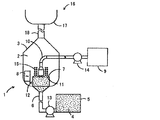
- Example 1 (1) Production of copolymer (gel-type beads) Using a droplet production apparatus and a polymerization reaction apparatus with an underwater speaker attached as a vibration apparatus shown in FIG. Hereinafter, it may be referred to as “copolymer”).
- the droplet manufacturing apparatus 1 includes a droplet manufacturing tank 3 that holds an aqueous medium 2 that forms a continuous phase, a hydrophobic liquid storage tank 5 that holds a hydrophobic liquid 4 that is immiscible with the aqueous medium 2, and a hydrophobic liquid storage tank.
- a hydrophobic liquid supply pipe 6 for supplying the hydrophobic liquid 4 stored in 5 to the droplet production tank 3.
- the droplet manufacturing apparatus 1 is in contact with the aqueous medium 2 and includes a nozzle member 7 having an ejection hole 11 for ejecting the hydrophobic liquid 4 supplied from the hydrophobic liquid supply pipe 6, and the inside of the droplet manufacturing tank 3.
- An underwater speaker (underwater acoustic device) 8 which is a vibration means for mechanically vibrating the aqueous medium 2, an aqueous medium storage tank 9 for storing the aqueous medium 2, and the aqueous medium 2 stored in the aqueous medium storage tank 9.
- an aqueous medium supply pipe 10 for supplying the liquid to the droplet production tank 3.
- reference numeral 12 denotes a hydrophobic liquid ejection storage tank
- reference numerals 13 and 14 denote a supply pump for the hydrophobic liquid and the aqueous medium, respectively.
- the polymerization reaction device 16 in FIG. 1 is a polymerization in which the droplet 15 in the droplet production tank 3 of the droplet production device 1 is transferred together with the aqueous medium 2 and the polymerization reaction is performed without coalescing and crushing the droplet 15. It has a reaction tank 17 and a hydrophobic liquid droplet transfer pipe 18 that transfers the liquid droplet 15 from the droplet production tank 3 together with the aqueous medium 2 to the polymerization reaction tank 17 without fusing and crushing.
- the droplet is transferred from the hydrophobic liquid storage tank 5 through the hydrophobic liquid supply pipe 6 to the aqueous medium 2 that is held in the droplet manufacturing tank 3 to form a continuous phase.
- the hydrophobic liquid 4 can be ejected from the ejection holes 11 provided in the nozzle member 7 to form an ejection flow of the hydrophobic liquid 4.
- the aqueous medium 2 side is vibrated by, for example, an underwater speaker 8 to break the jet flow into droplets 15 of a hydrophobic liquid having a uniform particle diameter, and the aqueous medium storage tank 9
- a flow of the aqueous medium 2 can be formed in the droplet production tank 3 by supplying the aqueous medium 2 stored in the droplet production tank 3 by the supply pump 14.
- the droplet 15 of the hydrophobic liquid thus made can be moved.
- a hydrophobic liquid ejection storage tank 12 exists in the lower part inside the droplet production tank 3, and a nozzle having an ejection hole 11 that opens toward the aqueous medium 2 and ejects the hydrophobic liquid 4 in the upper part thereof.
- a member 7 is attached.
- the hydrophobic liquid 4 supplied by the supply pump 13 from the hydrophobic liquid storage tank 5 through the hydrophobic liquid supply pipe 6 is stored in the liquid discharge storage tank 12, and the ejection holes provided in the nozzle member 7. 11 is ejected straight upward.
- a plurality of ejection holes 11 for the hydrophobic liquid 4 are arranged in the nozzle member 7 at a predetermined interval.
- the diameter of the ejection hole 11 is set according to a desired droplet size. Since the droplet production tank 3 is connected to the polymerization reaction tank 17 by a droplet transfer pipe 18, droplet production formed by supplying the aqueous medium 2 from the aqueous medium storage tank 9 into the droplet production tank 3. Due to the flow of the aqueous medium 2 in the tank 3, the hydrophobic liquid droplets 15 produced in the droplet production tank 3 are continuously transferred to the polymerization reaction tank 17 together with the aqueous medium 2 and used for the polymerization reaction. .
- an aqueous solution containing 0.05% by weight of polyvinyl alcohol was filled from the aqueous medium storage tank 9 into the droplet production tank 3 and the polymerization reaction tank 17.
- the polyvinyl alcohol aqueous solution was heated to 40 ° C. and held until the polymerization reaction started.
- the generated droplets 15 were transferred to the polymerization reaction tank 17 along with the flow of the aqueous medium 2.
- the mixture is polymerized by heating at 75 ° C. for 8 hours while stirring at a rotation speed that does not coalesce or crush the droplets 15 in the polymerization reaction tank 17 (crosslinking degree 4%). It was.
- the obtained copolymer slurry was subjected to solid-liquid separation using a centrifuge, and recovered without containing a polyvinyl alcohol aqueous solution.
- the obtained copolymer was spherical particles having an average particle diameter of 0.29 mm and a uniformity coefficient of 1.02.
- the average particle size and uniformity coefficient of this copolymer are “Diaion, Ion Exchange Resin / Synthetic Adsorbent Manual 1” (Mitsubishi Chemical Corporation, 4th revised edition, published on October 31, 2007, pages 140 to 141). ) was calculated from the particle size distribution measured by the sieving method described in the following formula.
- Average particle diameter diameter corresponding to 50% of the cumulative volume of resin
- Uniformity coefficient diameter corresponding to the cumulative volume on the large particle side corresponding to 40% / diameter corresponding to the cumulative volume on the large particle side corresponding to 90%
- the exchange capacity, average particle size, uniformity coefficient, and catalyst bead content with a particle size of 30 to 650 ⁇ m were determined for the strongly acidic cation exchange resin obtained, and the results are shown in Table 1.
- the content of catalyst beads having a particle size of 30 to 650 ⁇ m was calculated from the particle size distribution obtained by the sieving method as in the case of the copolymer.
- the modification rate is determined by the amount of the strongly acidic cation exchange resin used for modification, the amount of the modifier (2- (2-mercaptoethyl) pyridine) added, and the sulfone in the strongly acidic cation exchange resin determined by titration. It calculated
- the amount of the sulfonic acid group in the strongly acidic cation exchange resin corresponds to the exchange capacity.
- Modification rate (%) [(number of moles of added cocatalyst (mmol)) / [(amount of sulfonic acid group in gel-type strongly acidic cation exchange resin (meq / g-wet state) ⁇ used for modification) Weight of gel-type strongly acidic cation exchange resin (g-wet state)]] ⁇ 100
- the reaction solution was collected 5 hours after the start of the reaction. Moreover, each composition density
- Example 2 In the production of (4) bisphenol compound in Example 1, the reaction was carried out in the same manner as in Example 1 except that the water content in the reaction raw material was changed to 0.2% by weight. Rate, the total selectivity of bisphenol A and the 2,4 ′ isomer, and the selectivity of the indane compound. The results are shown in Table 2.
- Example 3 In the production of the bisphenol compound of Example 1 (4), the water content in the reaction raw material was changed to 0.2% by weight, and the amount of phenol with respect to acetone was 13 times in molar ratio, which was the same as Example 1. In the same manner as in Example 1, the acetone conversion rate, the total selectivity of bisphenol A and the 2,4 ′ isomer, and the selectivity of the indane compound were determined. The results are shown in Table 2.
- Example 3 Production of bisphenol compound
- 2- (2-mercaptoethyl) pyridine-modified strong acid type cation exchange resin 4- (2-mercaptoethyl) pyridine-modified strong acid type cation obtained above was used.
- an ion exchange resin the reaction is carried out in the same manner as in Example 1.
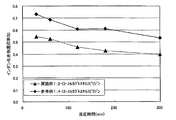
- the acetone conversion, the total selectivity of bisphenol A and the 2,4 ′ isomer, and the selectivity of the indane compound are determined. Asked. The results are shown in Table 3 and FIG. As is apparent from FIG.
- the catalyst modified with 2- (2-mercaptoethyl) pyridine is more indane compound than the catalyst modified with 4- (2-mercaptoethyl) pyridine.
- the selectivity was low, and from Table 2, it was found that the water concentration in the reaction raw material was 0.2% by weight or more, and in particular, the effect of suppressing the formation of indane compounds was high.
- Example 4 2- (2-Mercaptoethyl) pyridine-modified strongly acidic cation exchange resin catalyst (modified rate: 17.2%) 7 prepared in the same manner as in Example 1 using the gel-type catalyst beads produced in Example 1 5 mL was packed in a stainless steel column having an inner diameter of 1 cm and a total length of 44 cm. Phenol at 60 ° C.
- Example 5 In the same manner as in Example 1 except that a gel type strongly acidic cation exchange resin (trade name: Diaion (registered trademark) SK104) manufactured by Mitsubishi Chemical Corporation was used as the gel type catalyst beads. 7.5 mL of the prepared 2- (2-mercaptoethyl) pyridine-modified strong acidic cation exchange resin catalyst (modification rate 15.8%) was packed in a stainless steel column having an inner diameter of 1 cm and a total length of 44 cm. Phenol at 60 ° C.
- a gel type strongly acidic cation exchange resin trade name: Diaion (registered trademark) SK104
- Example 6 2- (2-mercaptoethyl) pyridine-modified strongly acidic cation exchange resin catalyst (modified rate 16%) 3 g-wet prepared in the same manner as in Example 1 using the gel-type catalyst beads produced in Example 1 The state was filled in a glass column with a jacket having an inner diameter of 1 cm and a total length of 10 cm, and hot water at 70 ° C. was circulated through the jacket part. Phenol at 70 ° C. was passed through the top of the reactor filled with the catalyst at 1.5 mL / min for 1.5 hours to completely replace the moisture in the catalyst with phenol, and then phenol with a water content of 0.43% by weight.
- Example 7 In Example 6, the reaction was conducted in the same manner as in Example 6 except that a phenol / acetone mixed solution (phenol / acetone molar ratio 13) having a water content of 0.07% by weight was used. The total selectivity of bisphenol A and the 2,4 ′ isomer and the selectivity (%) of the indane compound were calculated. The results are shown in Table 4.
- Example 6 the reaction was carried out in the same manner as in Example 6 except that a phenol / acetone mixed solution (phenol / acetone molar ratio 13) having a water content of 0.03% by weight was used. The total selectivity of bisphenol A and the 2,4 ′ isomer and the selectivity (%) of the indane compound were calculated. The results are shown in Table 4.
- Example 2 Using the gel-type catalyst beads used in Example 5, a 4- (2-mercaptoethyl) pyridine-modified strongly acidic cation exchange resin catalyst (modification rate 15%) prepared in the same manner as in Example 5, In Example 6, the reaction was performed in the same manner as in Example 6 except that a phenol / acetone mixed solution (phenol / acetone molar ratio 13) having a water content of 0.06% by weight was used. The total selectivity of bisphenol A and the 2,4 ′ isomer and the selectivity (%) of the indane compound were calculated. The results are shown in Table 4.
- Example 8 Using the gel-type catalyst beads produced in Example 1, a 2- (2-mercaptoethyl) pyridine-modified strong acidic cation exchange resin catalyst (modification rate 5%) prepared in the same manner as in Example 1, In Example 6, the reaction was carried out in the same manner as in Example 6 except that a phenol / acetone mixed solution (phenol / acetone molar ratio of 13) having a water content of 0.05% by weight was used. The total selectivity of bisphenol A and the 2,4 ′ isomer and the selectivity (%) of the indane compound were calculated. The results are shown in Table 4.
- Example 9 In Example 6, the reaction was conducted in the same manner as in Example 6 except that a phenol / acetone mixed solution (phenol / acetone molar ratio 25) having a water content of 0.05% by weight was used. The total selectivity of bisphenol A and the 2,4 ′ isomer and the selectivity (%) of the indane compound were calculated. The results are shown in Table 5.
- Example 6 the reaction was carried out in the same manner as in Example 6 except that a phenol / acetone mixed solution (phenol / acetone molar ratio 7) having a water content of 0.07% by weight was used.
- the total selectivity of bisphenol A and the 2,4 ′ isomer and the selectivity (%) of the indane compound were calculated.
- the results are shown in Table 5. As is apparent from Table 5, it was found that when the phenol / acetone ratio was 10 or less, the acetone conversion rate was lowered and the selectivity of the indane compound was also raised.
- Example 10 In Example 6, 75 ° C. warm water was passed through the jacket portion, and a phenol / acetone mixed solution (phenol / acetone molar ratio 13) having a water content of 0.43% by weight was added from the top of the reactor at 75 ° C. at 3 mL / min. The reaction was carried out in the same manner as in Example 6 except that the reaction was carried out continuously by downflow. As in Example 6, the conversion of acetone and the sum of bisphenol A and 2,4 ′ isomer were obtained. And the selectivity (%) of the indane compound were calculated. The results are shown in Table 6.
- Example 11 In Example 6, 80 ° C. warm water was circulated through the jacket portion, and a phenol / acetone mixed solution (phenol / acetone molar ratio 13) having a water content of 0.43% by weight was added from the top of the reactor at 80 ° C. at 3 mL / min. The reaction was carried out in the same manner as in Example 6 except that the reaction was carried out continuously by downflow. As in Example 6, the conversion of acetone and the sum of bisphenol A and 2,4 ′ isomer were obtained. And the selectivity (%) of the indane compound were calculated. The results are shown in Table 6. As is clear from Table 6, it was found that even when the reaction temperature was 75 ° C. and 80 ° C., the selectivity of the indane compound was not affected as compared with the case of reaction at 70 ° C.
Landscapes
- Chemical & Material Sciences (AREA)
- Organic Chemistry (AREA)
- Chemical Kinetics & Catalysis (AREA)
- Organic Low-Molecular-Weight Compounds And Preparation Thereof (AREA)
- Low-Molecular Organic Synthesis Reactions Using Catalysts (AREA)
Abstract
Priority Applications (4)
| Application Number | Priority Date | Filing Date | Title |
|---|---|---|---|
| JP2012556876A JP6184696B2 (ja) | 2011-02-07 | 2012-02-06 | ビスフェノール化合物の製造方法 |
| KR1020137018572A KR20130112927A (ko) | 2011-02-07 | 2012-02-06 | 비스페놀 화합물의 제조 방법 |
| KR1020157022606A KR20150100963A (ko) | 2011-02-07 | 2012-02-06 | 비스페놀 화합물의 제조 방법 |
| CN201280006554.1A CN103328426B (zh) | 2011-02-07 | 2012-02-06 | 双酚化合物的制备方法 |
Applications Claiming Priority (2)
| Application Number | Priority Date | Filing Date | Title |
|---|---|---|---|
| JP2011-023934 | 2011-02-07 | ||
| JP2011023934 | 2011-02-07 |
Publications (1)
| Publication Number | Publication Date |
|---|---|
| WO2012108385A1 true WO2012108385A1 (fr) | 2012-08-16 |
Family
ID=46638600
Family Applications (1)
| Application Number | Title | Priority Date | Filing Date |
|---|---|---|---|
| PCT/JP2012/052623 Ceased WO2012108385A1 (fr) | 2011-02-07 | 2012-02-06 | Procédé pour la production de composé de bisphénol |
Country Status (5)
| Country | Link |
|---|---|
| JP (1) | JP6184696B2 (fr) |
| KR (2) | KR20130112927A (fr) |
| CN (1) | CN103328426B (fr) |
| TW (1) | TWI466858B (fr) |
| WO (1) | WO2012108385A1 (fr) |
Cited By (3)
| Publication number | Priority date | Publication date | Assignee | Title |
|---|---|---|---|---|
| JPWO2020184182A1 (fr) * | 2019-03-14 | 2020-09-17 | ||
| JP2021502348A (ja) * | 2017-11-10 | 2021-01-28 | ディディピー スペシャリティ エレクトロニック マテリアルズ ユーエス インコーポレーテッド | 触媒反応の方法 |
| WO2022145366A1 (fr) | 2020-12-28 | 2022-07-07 | 三菱ケミカル株式会社 | Procédé de production de bisphénol a et procédé de production de résine de polycarbonate |
Citations (3)
| Publication number | Priority date | Publication date | Assignee | Title |
|---|---|---|---|---|
| JPH10212257A (ja) * | 1997-01-29 | 1998-08-11 | Chiyoda Corp | ビスフェノールaの製造方法 |
| JPH10251179A (ja) * | 1997-03-10 | 1998-09-22 | Chiyoda Corp | ビスフェノールaの製造方法 |
| JP2010189380A (ja) * | 2009-01-22 | 2010-09-02 | Mitsubishi Chemicals Corp | ビスフェノール化合物の製造方法 |
Family Cites Families (1)
| Publication number | Priority date | Publication date | Assignee | Title |
|---|---|---|---|---|
| EP2390243B1 (fr) * | 2009-01-22 | 2020-07-08 | Mitsubishi Chemical Corporation | Procédé de préparation de bisphénol |
-
2012
- 2012-02-06 CN CN201280006554.1A patent/CN103328426B/zh active Active
- 2012-02-06 KR KR1020137018572A patent/KR20130112927A/ko not_active Ceased
- 2012-02-06 JP JP2012556876A patent/JP6184696B2/ja active Active
- 2012-02-06 KR KR1020157022606A patent/KR20150100963A/ko not_active Withdrawn
- 2012-02-06 WO PCT/JP2012/052623 patent/WO2012108385A1/fr not_active Ceased
- 2012-02-07 TW TW101103895A patent/TWI466858B/zh active
Patent Citations (3)
| Publication number | Priority date | Publication date | Assignee | Title |
|---|---|---|---|---|
| JPH10212257A (ja) * | 1997-01-29 | 1998-08-11 | Chiyoda Corp | ビスフェノールaの製造方法 |
| JPH10251179A (ja) * | 1997-03-10 | 1998-09-22 | Chiyoda Corp | ビスフェノールaの製造方法 |
| JP2010189380A (ja) * | 2009-01-22 | 2010-09-02 | Mitsubishi Chemicals Corp | ビスフェノール化合物の製造方法 |
Cited By (9)
| Publication number | Priority date | Publication date | Assignee | Title |
|---|---|---|---|---|
| JP2021502348A (ja) * | 2017-11-10 | 2021-01-28 | ディディピー スペシャリティ エレクトロニック マテリアルズ ユーエス インコーポレーテッド | 触媒反応の方法 |
| JP2024014896A (ja) * | 2017-11-10 | 2024-02-01 | ディディピー スペシャルティ エレクトロニック マテリアルズ ユーエス,エルエルシー | 触媒反応の方法 |
| JPWO2020184182A1 (fr) * | 2019-03-14 | 2020-09-17 | ||
| WO2020184182A1 (fr) * | 2019-03-14 | 2020-09-17 | 三菱ケミカル株式会社 | Composition de bisphénol et résine de polycarbonate |
| JP7435588B2 (ja) | 2019-03-14 | 2024-02-21 | 三菱ケミカル株式会社 | ビスフェノール組成物及びポリカーボネート樹脂 |
| JP2024056799A (ja) * | 2019-03-14 | 2024-04-23 | 三菱ケミカル株式会社 | ビスフェノール組成物及びポリカーボネート樹脂 |
| US12522696B2 (en) | 2019-03-14 | 2026-01-13 | Mitsubishi Chemical Corporation | Bisphenol composition and polycarbonate resin |
| JP7803356B2 (ja) | 2019-03-14 | 2026-01-21 | 三菱ケミカル株式会社 | ビスフェノール組成物及びポリカーボネート樹脂 |
| WO2022145366A1 (fr) | 2020-12-28 | 2022-07-07 | 三菱ケミカル株式会社 | Procédé de production de bisphénol a et procédé de production de résine de polycarbonate |
Also Published As
| Publication number | Publication date |
|---|---|
| CN103328426A (zh) | 2013-09-25 |
| TW201240959A (en) | 2012-10-16 |
| JP6184696B2 (ja) | 2017-08-23 |
| CN103328426B (zh) | 2016-04-06 |
| KR20130112927A (ko) | 2013-10-14 |
| TWI466858B (zh) | 2015-01-01 |
| KR20150100963A (ko) | 2015-09-02 |
| JPWO2012108385A1 (ja) | 2014-07-03 |
Similar Documents
| Publication | Publication Date | Title |
|---|---|---|
| US5475154A (en) | Method for producing high-purity bisphenols | |
| EP2390243B1 (fr) | Procédé de préparation de bisphénol | |
| JPH08509466A (ja) | 高純度及び超高純度ビスフェノールaの製造のための新規な方法 | |
| JP6184696B2 (ja) | ビスフェノール化合物の製造方法 | |
| JP5332846B2 (ja) | ビスフェノール化合物製造用強酸性イオン交換樹脂触媒及び、それを用いたビスフェノール化合物の製造方法 | |
| JP5363532B2 (ja) | 多反応二官能性ポリマー系触媒 | |
| WO2011055819A1 (fr) | Catalyseur pour la production d'un composé bisphénol et procédé de fabrication d'un composé bisphénol | |
| JP4312761B2 (ja) | ビスフェノールaの製造方法 | |
| JP5668562B2 (ja) | ビスフェノールaの製造方法 | |
| JP2008273951A (ja) | ビスフェノール化合物の製造方法、及び陽イオン交換樹脂触媒 | |
| JP5471392B2 (ja) | ピリジルエタンチオール化合物の製造方法 | |
| JP5810405B2 (ja) | ビスフェノール化合物の製造方法 | |
| JP2010119995A (ja) | ビスフェノール化合物製造用触媒及びその製造方法、並びにビスフェノール化合物の製造方法 | |
| JP2022022811A (ja) | ビスフェノール化合物の製造方法 | |
| JP2009263309A (ja) | 縮合反応方法 | |
| JP2013202458A (ja) | ビスフェノール化合物の製造方法 | |
| JP2011115758A (ja) | 酸性触媒の製造方法 | |
| JP2011098301A (ja) | カチオン交換樹脂及びビスフェノール化合物の製造方法 | |
| JP2011121898A (ja) | ピリジルエタンチオール化合物の製造方法 |
Legal Events
| Date | Code | Title | Description |
|---|---|---|---|
| WWE | Wipo information: entry into national phase |
Ref document number: 201280006554.1 Country of ref document: CN |
|
| 121 | Ep: the epo has been informed by wipo that ep was designated in this application |
Ref document number: 12744964 Country of ref document: EP Kind code of ref document: A1 |
|
| ENP | Entry into the national phase |
Ref document number: 20137018572 Country of ref document: KR Kind code of ref document: A |
|
| ENP | Entry into the national phase |
Ref document number: 2012556876 Country of ref document: JP Kind code of ref document: A |
|
| NENP | Non-entry into the national phase |
Ref country code: DE |
|
| WWE | Wipo information: entry into national phase |
Ref document number: 1301004395 Country of ref document: TH |
|
| 122 | Ep: pct application non-entry in european phase |
Ref document number: 12744964 Country of ref document: EP Kind code of ref document: A1 |