WO2012108685A2 - Method and apparatus for allocating an ack/nack resource, and method for transmitting an ack/nack signal using same - Google Patents
Method and apparatus for allocating an ack/nack resource, and method for transmitting an ack/nack signal using same Download PDFInfo
- Publication number
- WO2012108685A2 WO2012108685A2 PCT/KR2012/000922 KR2012000922W WO2012108685A2 WO 2012108685 A2 WO2012108685 A2 WO 2012108685A2 KR 2012000922 W KR2012000922 W KR 2012000922W WO 2012108685 A2 WO2012108685 A2 WO 2012108685A2
- Authority
- WO
- WIPO (PCT)
- Prior art keywords
- transmission
- resource
- ari
- transmitted
- terminal
- Prior art date
- Legal status (The legal status is an assumption and is not a legal conclusion. Google has not performed a legal analysis and makes no representation as to the accuracy of the status listed.)
- Ceased
Links
Images




Classifications
-
- H—ELECTRICITY
- H04—ELECTRIC COMMUNICATION TECHNIQUE
- H04L—TRANSMISSION OF DIGITAL INFORMATION, e.g. TELEGRAPHIC COMMUNICATION
- H04L1/00—Arrangements for detecting or preventing errors in the information received
- H04L1/12—Arrangements for detecting or preventing errors in the information received by using return channel
- H04L1/16—Arrangements for detecting or preventing errors in the information received by using return channel in which the return channel carries supervisory signals, e.g. repetition request signals
- H04L1/18—Automatic repetition systems, e.g. Van Duuren systems
- H04L1/1829—Arrangements specially adapted for the receiver end
- H04L1/1861—Physical mapping arrangements
-
- H—ELECTRICITY
- H04—ELECTRIC COMMUNICATION TECHNIQUE
- H04L—TRANSMISSION OF DIGITAL INFORMATION, e.g. TELEGRAPHIC COMMUNICATION
- H04L5/00—Arrangements affording multiple use of the transmission path
- H04L5/003—Arrangements for allocating sub-channels of the transmission path
- H04L5/0053—Allocation of signalling, i.e. of overhead other than pilot signals
- H04L5/0055—Physical resource allocation for ACK/NACK
-
- H—ELECTRICITY
- H04—ELECTRIC COMMUNICATION TECHNIQUE
- H04W—WIRELESS COMMUNICATION NETWORKS
- H04W52/00—Power management, e.g. Transmission Power Control [TPC] or power classes
- H04W52/04—Transmission power control [TPC]
- H04W52/54—Signalisation aspects of the TPC commands, e.g. frame structure
-
- H—ELECTRICITY
- H04—ELECTRIC COMMUNICATION TECHNIQUE
- H04W—WIRELESS COMMUNICATION NETWORKS
- H04W72/00—Local resource management
- H04W72/04—Wireless resource allocation
- H04W72/044—Wireless resource allocation based on the type of the allocated resource
- H04W72/0446—Resources in time domain, e.g. slots or frames
Definitions
- the present invention relates to wireless communication, and more particularly, to a wireless communication system supporting multiple carriers.
- Wireless communication systems generally use one bandwidth for data transmission.
- second generation wireless communication systems use a bandwidth of 200 KHz-1.25 MHz
- third generation wireless communication systems use a bandwidth of 5 MHz-10 MHz.
- LTE Long Term Evolution
- 3GPP 3rd Generation Partnership Project
- An object of the present invention is to provide a method for effectively allocating a transmission resource for transmitting an ACK / NACK signal for a single carrier in a single carrier (TDD) single carrier system.
- An object of the present invention is to provide a method for effectively allocating transmission resources when a UE transmits a HARQ ACK / NACK response by applying SORTD in a single carrier (TDD) single carrier system. do.
- An object of the present invention is to provide a preliminary method for transmitting a HARQ signal by a terminal when HARQ transmission is difficult to be performed in a manner set between the terminal and the base station.
- the present invention relates to a resource allocation method of a base station in a time division duplex (TDD) system using a single carrier, and according to this, uplink control to which Discrete Fourier Transform-Spreading-Orthogonal Frequency-Division Multiplexing (DFT-S-OFDM) is applied.
- DFT-S-OFDM Discrete Fourier Transform-Spreading-Orthogonal Frequency-Division Multiplexing
- the resource mapping table may be configured to transmit the same number of transmission resources as the number of transmission antennas of the terminal by the resource indicator.
- the present invention also relates to a method for transmitting a HARQ response signal of a terminal in a TDD (Time Division Duplex) system using a single carrier, and accordingly, according to Discrete Fourier Transform-Spreading-Orthogonal Frequency-Division Multiplexing ) Acquires a transmission resource indicated by the resource indicator as a transmission resource to be used for transmission of the uplink control channel on a resource mapping table configured of a resource of an uplink control channel format to which the base station is applied, and uses the obtained transmission resource to transmit a HARQ response signal to the base station.
- the resource indicator is transmitted from the base station using a power control field transmitted on the control channel of the downlink subframe, and the resource mapping table allocates the same number of transmission resources as the number of transmit antennas of the terminal by the resource indicator. It may be configured to.
- the present invention relates to a method of transmitting a HARQ signal of a terminal, the method comprising: determining whether a resource allocation indicator for allocating a transmission resource to a downlink subframe associated with an uplink subframe to transmit the HARQ signal is received; If it is determined that the resource allocation indicator has not been received, when dynamic scheduling is applied, resources are allocated based on the control channel element index on the control channel in the received downlink subframe, and static scheduling is applied. If so, the step of allocating resources indicated by the resource allocation indicator transmitted on the downlink control channel with the static scheduling enabled and transmitting the HARQ signal using the allocated resources.
- the resource allocation indicator when receiving a resource allocation indicator for allocating the transmission resources to the downlink subframe associated with the uplink subframe to transmit the HARQ signal, the resource allocation indicator may be allocated to transmit the HARQ signal.
- the step of allocating a resource may include determining whether to transmit a HARQ signal by applying SORTD even if a resource allocation indicator for allocating a transmission resource is received in a downlink subframe associated with an uplink subframe to which the HARQ signal is to be transmitted. In addition, if it is determined that the SORTD is applied, a plurality of transmission resources may be allocated, and when using a single antenna that does not apply the SORTD, one transmission resource may be allocated.
- whether to apply the SORTD is pre-set between the terminal and the base station, or information for determining whether to apply the SORTD may be sheared from the base station to the terminal through higher layer signaling.
- the HARQ signal is transmitted in the same transmission method as that of transmitting a HARQ signal.
- the HARQ signal transmission step when the resource allocation indicator for allocating a transmission resource to a downlink subframe associated with an uplink subframe to transmit the HARQ signal is received, the HARQ signal may be allocated. The HARQ signal may be transmitted in the same transmission method as that of transmitting.
- the resource allocated by the UE may be PUCCH format 1a or PUCCH format 1b.
- the method may further include performing time domain bundling and / or spatial bundling when the HARQ signal to be transmitted exceeds a size that can be transmitted through the allocated resource.
- the method may further include performing time domain bundling and / or spatial bundling.
- the present invention provides a method for allocating an HARQ resource of a base station, when the terminal does not receive a resource allocation indicator for allocating a transmission resource to a downlink subframe associated with an uplink subframe to transmit the HARQ signal, the terminal receives the HARQ signal.
- the resource to be explicitly allocated may be allocated by a resource allocation indicator transmitted by utilizing a bit to be used in a transmission power control command transmitted on a control channel for activating static scheduling.
- the transmission resources may be allocated the required number according to the HARQ transmission scheme of the terminal, the HARQ transmission scheme of the terminal, resource allocation indicator for allocating the transmission resources to the downlink subframe associated with the uplink subframe to transmit the HARQ signal It may be the same as the transmission method when the terminal receives.
- a transmission resource for transmitting an ACK / NACK signal for a single carrier can be effectively allocated.
- radio resources can be effectively utilized by dedicating resources allocated to control signals that are redundantly transmitted.
- a transmission resource can be effectively allocated.
- the terminal may transmit the HARQ signal to the base station through a preliminary method.
- FIG. 1 illustrates uplink-downlink configuration 5 in a TDD system using a single carrier.
- FIG. 2 illustrates uplink-downlink configuration 1 in a TDD system using a single carrier.
- FIG. 3 schematically illustrates an example of specifying a downlink subframe for transmitting ARI in uplink-downlink configuration 2 in a TDD system using a single carrier.
- FIG. 4 schematically illustrates an example of configuring an ARI window for uplink-downlink configuration 0 in a TDD system using a single carrier.
- FIG. 5 schematically illustrates an example of configuring an ARI window for uplink-downlink configuration 1 in a TDD system using a single carrier.
- FIG. 6 is a diagram schematically illustrating an example of performing time domain bundling to transmit an HARQ ACK / NACK signal using PUCCH format 1b.
- FIG. 7 is a diagram schematically illustrating an example of performing spatial bundling and time domain bundling to transmit an HARQ ACK / NACK signal using PUCCH format 1a.
- FIG. 8 is a diagram schematically illustrating an example of a normal mode when an SPS is activated.
- FIG. 9 is a diagram schematically illustrating an example in which a contrast mode is applied by only transmitting major carriers in which an SPS is transmitted in one downlink subframe.
- FIG. 10 is a diagram schematically illustrating a contrast mode applied when there is a subframe and / or a component carrier on which dynamic scheduling is performed.
- FIG. 11 is a diagram schematically illustrating an example in which a resource allocation scheme may be maintained.
- FIG. 12 is a flowchart schematically illustrating an operation of a base station in a TDD system using a single carrier to which the present invention is applied.
- FIG. 13 is a flowchart schematically illustrating an operation of a terminal in a TDD system using a single carrier, to which the present invention is applied.
- FIG. 14 is a diagram schematically illustrating an operation of a terminal when a contrast mode is applied according to the present invention.
- 15 is a block diagram schematically illustrating an example of a configuration of a base station and a terminal in a system to which the present invention is applied.
- CDMA Code Division Multiple Access
- TDMA Time Division Multiple Access
- FDMA Frequency Division Multiple Access
- OFDMA Orthogonal Frequency Division Multiple Access
- SC-FDMA Single Carrier-FDMA
- OFDM-FDMA OFDM-TDMA
- various multiple access schemes such as OFDM-CDMA may be used.
- CA Carrier Aggregation
- the number of carriers aggregated between the downlink and the uplink may be set differently, and the size (ie, bandwidth) of the component carriers may be different.
- Each component carrier may have a control channel such as a PDCCH, which will be described later, and may or may not be adjacent to each other.
- the terminal may support one or more carriers according to performance.
- the CC may be divided into a Primary Component Carrier (PCC) and a Secondary Component Carrier (SCC) according to activation.
- PCC Primary Component Carrier
- SCC Secondary Component Carrier
- the major carriers are always active carriers, and the subcarrier carriers are carriers that are activated / deactivated according to specific conditions. Activation refers to the transmission or reception of traffic data being made or in a ready state.
- the CA environment refers to a system supporting multi-component carriers (carrier aggregation).
- a physical downlink control channel may transmit allocation information for resources of other carriers as well as resource allocation in a carrier to which the corresponding PDCCH belongs.
- the message transmitted on the PDCCH includes a transmission power control (TPC) for controlling uplink transmission power.
- TPC transmission power control
- the PDCCH of each carrier may transmit a TPC command for a physical uplink control channel (PUCCH) of the same uplink component carrier.
- PUCCH physical uplink control channel
- bits allocated to overlapping TPC fields may be used for transmission of other control information, for example, ACK / NACK resource allocation information.
- the terminal receiving the downlink data from the base station transmits an ACK (ACKnowledgement) / NACK (Not-ACKnowledgement) response to the base station after a predetermined time elapses or at a certain timing.
- the downlink data may be transmitted on the PDSCH indicated by the PDCCH.
- a hybrid automatic repeat request (HARQ) signal for downlink data may be transmitted on the PUCCH.
- the HARQ ACK / NACK signal becomes ACK information when the downlink data is successfully decoded, and becomes NACK information when the decoding of the downlink data fails.
- the base station may retransmit the downlink data up to a maximum number of retransmissions.
- SORTD Spatial Orthogonal Resource Transmit Diversity
- SORTD may also be applied to each PUCCH format.
- PUCCH is not only the location of the physical resource block to which the HARQ ACK / NACK signal is transmitted, but also the CS amount ⁇ (n s of the base sequence). , l) and orthogonal sequence index n OC (n s ).
- the resource index n (1) PUCCH for the HARQ ACK / NACK signal can be obtained as shown in Table 1 below.
- the resource index n (1) PUCCH is a parameter for determining the physical RB index n PRB , the CS amount ⁇ (n s , l) of the base sequence, and the orthogonal sequence index n OC (n s ).
- the HARQ ACK / NACK signal for the PDSCH transmitted in the nth subframe is the first control channel element (CCE) index n CCE of the PDCCH transmitted in the nth subframe and the higher layer signaling. is transmitted in the n + 4th subframe using resource index n (1) PUCCH , which is the sum of the value N (1) PUCCH obtained through signaling) or a separate control channel.
- N (1) PUCCH is the total number of PUCCH format 1 / 1a / 1b resources required for Semi-Persistent Scheduling (SPS) transmission and Service Request (SR) transmission.
- SPS Semi-Persistent Scheduling
- SR Service Request
- the physical RB index n PRB is determined by the resource index n (1) PUCCH . This is shown in Equation 1 below.
- the physical RB index n PRB is determined according to the resource index n (1) PUCCH , and the PUCCH corresponding to each m is frequency hopping in units of slots.
- HARQ ACK / NACK signals for a plurality of downlink component carriers are transmitted through one uplink component carrier.
- one bit of an ACK / NACK signal is transmitted per one codeword (CW).
- the HARQ ACK / NACK signal for the downlink is transmitted on the PUCCH.
- the base station may implicitly allocate the ACK / NACK resource index.
- Implicitly allocating an ACK / NACK resource index means that the base station allocates a resource index calculated by using n CCE , which means a number of CCEs , as a parameter among at least one CCE constituting the PDCCH of CC # a.
- n CCE which means a number of CCEs , as a parameter among at least one CCE constituting the PDCCH of CC # a.
- n CCE which means a number of CCEs
- the base station may also assign the resource index explicitly.
- the fact that the base station explicitly allocates the resource index to the terminal means that the resource index of the PUCCH dedicated to the specific terminal is allocated to the terminal through a separate resource allocation indicator from the base station without depending on n CCE . .
- the separate resource allocation indicator from the base station includes signaling from an upper layer or a physical layer.
- the resource allocation indicator may be included in the PDCCH as control information or system information. In the present specification, in response to the explicit resource index allocation of the base station, it is expressed as 'explicit resource index acquisition' from the perspective of the terminal.
- the base station may use 2 bits to transmit the ACK / NACK Resource Indicator (ARI, hereinafter referred to as "ARI") to be used for transmitting the TPC command.
- ARI is an indicator for explicitly allocating a resource to be used when the terminal transmits a HARQ ACK / NACK signal for downlink.
- the TPC field of the PDCCH corresponding to the PDSCH on the major carrier may be used as a TPC command
- the TPC field of the PDCCH corresponding to the PDSCH on the subcarrier may be used as the ARI.
- a TPC field transmitted on a PDCCH of a specific downlink subframe is used as a TPC command
- a bit to be allocated to a TPC field on a PDCCH of another downlink subframe is used.
- ARI can be sent.
- the ARI mapping table for allocating resources to the ARI may be transmitted to the terminal in advance by higher layer signaling.
- the ARI mapping table consists of the values indicated by the ARI and the ACK / NACK transmission resources allocated accordingly.
- the number of HARQ ACK / NACK transmission resources required to configure the ARI mapping table is a transmission mode for the number of component carriers configured through RRC and the number of codewords for each component carrier in a subframe, HARQ It may be determined through the type of the PUCCH format for transmitting the ACK / NACK signal.
- the number of downlink subframes associated with an uplink subframe may be determined according to the type of PUCCH format for transmitting HARQ ACK / NACK signals.
- the ARI mapping table can be configured differently according to the number of ACK / NACK transmission resources corresponding to four values that can be represented by a 2-bit ARI. The explicitly allocated resource set and the corresponding ARI value are determined by higher layer signaling. It may be delivered to the terminal in advance.
- Table 2 shows an embodiment of the ARI mapping table used in the present invention.
- each N k is a set of resources (for example, ⁇ n ⁇ and n are transmission resources) having one transmission resource that does not overlap each other, and through ARI
- each N k is a resource set (e.g. ⁇ n1, n2 ⁇ ) having two transmission resources as elements.
- the resource set indicated by the ARI on the ARI mapping table is allocated to the terminal. For example, when the value of the ARI is '01', transmission resources of resource set N 2 are allocated.
- HARQ ACK / NACK response of 4 bits or less can transmit the HARQ ACK / NACK signal through the PUCCH format 1b using the channel selection.
- the channel selection allocates HARQ ACK / NACK resources for downlink by using a table that maps a message to be transmitted, a resource to be used for transmission of the message, and a modulation symbol.
- the channel selection table may be composed of a combination of a plurality of resource indexes and modulation symbols of the ACK / NACK signal. Since a channel selection can allocate resources necessary for transmitting a signal of up to 4 bits, for an ACK / NACK signal having 4 bits or less, the channel selection table is set according to the value of the number of bits (M) required for transmitting the ACK / NACK signal. Can be configured.
- the terminal may allocate an ACK / NACK resource and transmit a symbol by using the channel selection table.
- the format of the table used for channel selection may be delivered to the terminal and the base station in advance by higher layer signaling.
- the terminal may explicitly obtain an ACK / NACK resource index for constructing a table used for channel selection.
- Table 3 is an example of a table for channel selection when the M value (the number of HARQ ACK / NACK signals to be transmitted as one symbol value) is three.
- HARQ-ACK (0) ⁇ HARQ-ACK (3) is an ACK / NACK type for the codeword to determine whether or not normally received (decoded).
- n (1) PUCCH is a HARQ ACK / NACK resource to be used for transmission using PUCCH format 1b.
- each ACK / NACK resource constituting the table for channel selection for example, ⁇ n (1) PUCCH, 0 , n (1) PUCCH, 1 , n (1) PUCCH, 2 ⁇ in Table 3 are as described above. Likewise implicitly or explicitly allocated transmission resources.
- b (0) b (1) is a QPSK symbol of an ACK / NACK signal to be transmitted.
- N / A that is, in the case of DTX (Discontinuous Transmission)
- the UE transmits a HARQ ACK / NACK signal. Do not send an ACK / NACK response in the transmitting subframe.
- the UE When the UE allocates a resource using channel selection, the UE transmits a corresponding transmission symbol using an ACK / NACK transmission resource (n (1) PUCCH ) mapped to an ACK / NACK type corresponding to a decoding result of received PDSCHs.
- b (0), b (1)) are transmitted on the PUCCH.
- the value (1,1) of the corresponding symbol (b (0), b (1)) using ACK / NACK resource n (1) PUCCH, 1 ) Is transmitted on the PUCCH.
- the uplink transmission and the downlink transmission may use a time division duplex (TDD) scheme that is transmitted using different times, or may use a frequency division duplex (FDD) scheme that is transmitted using different frequencies.
- TDD time division duplex
- FDD frequency division duplex
- uplink transmission and downlink transmission are always distinguished in time based on one cell.
- the base station and the terminal repeat the switching between the transmission mode and the reception mode.
- a special subframe may be provided to provide a guard time for mode switching between transmission and reception.
- Table 4 shows configuration of uplink and downlink in TDD mode.
- the base station and the terminal performs uplink and downlink transmission through seven possible downlink / uplink frame settings.
- 'D' represents a downlink subframe
- 'U' represents an uplink subframe
- 'S' represents the special subframe described above.
- the UE transmits HARQ ACK / NACK for the PDSCH received in subframe n-4 in subframe n.
- the UE transmits HARQ ACK / NACK for the PDSCH received in subframe (s) n-k in uplink subframe n.
- k is an element of K
- K may be defined by Table 5.
- subframes in which numbers are written are subframes for performing uplink transmission.
- the HARQ ACK / ANCK signal for the downlink subframe may be transmitted through an uplink subframe associated with the downlink subframe.
- the TPC may be transmitted on the PDCCH for power control of the same uplink PUCCH. Therefore, for one PUCCH, an ARI can be transmitted by using bits to be allocated to overlapping TPC fields, and a table for channel selection is constructed using ACK / NACK resources obtained implicitly or explicitly, and using the HARQ An ACK / NACK signal may be transmitted.
- the plurality of HARQ ACK / NACK signals may be bundled by a logical product operation. That is, when all HARQ ACK / NACK information for the downlink component carrier or the downlink subframe to be bundled is ACK, the ACK may be transmitted as a HARQ ACK / NACK signal representing the bundled ACK / NACK signal. When HARQ ACK / NACK information on at least one CC or subframe is NACK, NACK may be transmitted as a HARQ ACK / NACK signal representing a bundled ACK / NACK signal. In addition, when HARQ ACK / NACK information for at least one CC or subframe is DTX, the DTX may be transmitted as a HARQ ACK / NACK signal representing the bundled ACK / NACK signal.
- PUCCH format 3 may be used.
- PUCCH format 3 is a PUCCH format to which Discrete Fourier Transform-Spreading-Orthogonal Frequency-Division Multiplexing (DFT-S-OFDM) is applied, and uses DFT-IFFT and block-spreading.
- DFT-S-OFDM Discrete Fourier Transform-Spreading-Orthogonal Frequency-Division Multiplexing
- block-spreading DFT-IFFT and block-spreading.
- up to 10 bits of information in FDD and up to 20 bits of information in TDD are used as HARQ ACK / NACK signals.
- HARQ ACK / NACK signals having a maximum length of 20 bits can be transmitted. Therefore, even in the uplink-downlink configuration 5, HARQ ACK / NACK signals can be multiplexed and transmitted. . Even when the payload size of up to 20 bits is exceeded, ACK / NACK signals may be transmitted through spatial bundling.
- a single carrier for TDD (TDD) using a single carrier may be a CA or TDD system in which a transmission is performed between a base station and a base station that do not support a CA (Carrier Aggregation) environment.
- CA Carrier Aggregation
- a method of explicitly allocating a resource of PUCCH format 3 through higher layer signaling such as RRC may be considered.
- the base station fixedly allocates a predetermined transmission resource through higher layer signaling such as RRC, and the terminal may transmit a HARQ ACK / NACK signal by using the same.
- the base station can allocate resources in a fixed manner.
- the base station explicitly allocates resources through higher layer signaling according to the number of transmit antennas applying SORTD. For example, in the case of using two transmit antennas, the base station may allocate two resources of PUCCH format 3 through higher layer signaling, and in the present embodiment, the transmission resources allocated to specific terminals are fixed to specific resources. .
- resources of PUCCH format 3 of an uplink subframe associated with a downlink subframe are allocated using a resource indicator, for example, an ACK / NACK Resource Indicator (ARI). You can think of how to do it.
- a resource indicator for example, an ACK / NACK Resource Indicator (ARI).
- the base station may transmit the ARI by dedicating bits to be allocated to the TPC field transmitted on the PDCCH of the downlink subframe associated with the uplink subframe. From now on , unless otherwise stated, the expression “dedicate a bit to be allocated to a TPC field" is referred to as "using a TPC field”. Also, from now on, the ARI transmitted on the PDCCH of the downlink subframe herein is an ARI transmitted using the TPC field unless otherwise specified.
- the UE may use the resource indicated by the ARI as a resource of PUCCH format 3 for transmitting HARQ ACK / NACK signals in an uplink subframe associated with a downlink subframe in which the ARI is transmitted.
- the UE may transmit a HARQ ACK / NACK signal using one PUCCH format 3 resource. Therefore, when one ACK / NACK transmission resource described above is required (Table 2), an ARI mapping table may be configured with a resource of PUCCH format 3. The base station may configure the ARI to indicate a resource of one PUCCH format 3 on the ARI mapping table.
- SORTD may be applied by allocating a plurality of transmission resources through an ARI.
- a plurality of transmission resources may be allocated corresponding to the number of transmission antennas to which SORTD is applied.
- the second case of applying the SORTD to transmit antennas, and assigns the two transmission resources by ARI Correspondingly, if two ACK / NACK transmission resource the ARI mapping table is required (the N k two transmission in Table 2 If you have a resource as an element).
- the base station may transmit an indication to the terminal through higher layer signaling such as RRC signaling.
- an uplink subframe and a downlink subframe mean a scheduled subframe.
- the TPC field on the PDCCH transmitted in at least one downlink subframe is used as a TPC command.
- An ARI may be transmitted using a TPC field on a PDCCH transmitted in at least one subframe among the remaining downlink subframes.
- the resource indicated by the ARI may be allocated as a resource of PUCCH format 3 for transmitting HARQ ACK / NACK signals through an uplink subframe associated with a downlink subframe in which the ARI is transmitted.
- FIG. 1 illustrates uplink-downlink configuration 5 in a TDD system using a single carrier.
- subframe # 9 of frame # 0 and subframes 0, 1, 3, 4, 5, 6, 7, and 8 of frame # 1 are DL subframes. It is associated with an uplink subframe (subframe 2) of frame # 2.
- any one of downlink subframes (subframe 9 of frame # 0 and 0, 1, 3, 4, 5, 6, 7, 8 subframes of frame # 1) associated with the uplink subframe may be used as a TPC command for power control of the PUCCH transmitted in the uplink subframe (subframe # 2 of frame # 2).
- the base station determines downlink subframes (subframe 9 of frame # 0 and 0, 1, 3, 4, 5, and 6 of frame # 1) associated with the uplink subframe (subframe 2 of frame # 2). , 7, 8 subframes), ARI may be transmitted using a TPC field of a PDCCH transmitted on a subframe other than the subframe in which the TPC command is transmitted.
- the TPC field of a downlink subframe having a value of Downlink Assignment Indicator (DAI) equal to 0 may transmit a TPC command, and may transmit an ARI using another TPC field of another downlink subframe.
- Downlink Assignment Indicator (DAI) is a 2-bit message transmitted on a PDCCH.
- a subframe in which a corresponding subframe is assigned to a single uplink subframe and assigned to a subframe among the downlink subframes scheduled for the second time Indicates whether or not it is a frame.
- the PUCCH transmission power can be adaptively adjusted. For example, in FIG.
- the base station may transmit the ARI using the TPC field transmitted on the PDCCH in the remaining downlink subframes other than the subframe 9 of the frame # 0.
- a TPC command may be transmitted in a TPC field of a downlink subframe closest to the associated uplink subframe. This is because the most recent channel state may be reflected with respect to the uplink transmission time.
- the values indicated by the ARI transmitted in the downlink subframe associated with one uplink subframe may be set to the same value.
- a UE using a multi-antenna system By transmitting ARI using a TPC field in a downlink subframe other than a downlink subframe that transmits a TPC command, by allocating a plurality of transmission resources through the ARI, a UE using a multi-antenna system applies SORTD to HARQ ACK. It is also possible to transmit a / NACK signal.
- SORTD When SORTD is applied, a plurality of transmission resources may be allocated corresponding to the number of transmission antennas. For example, the second case of applying the SORTD to transmit antennas, and assigns the two transmission resources by ARI, Correspondingly, if two ACK / NACK transmission resource the ARI mapping table is required (the N k two transmission in Table 2 If you have a resource as an element).
- all of the values indicated by the ARIs transmitted in the downlink subframes associated with one uplink subframe may be set to the same value. You can also do that.
- SORTD is applied using two transmit antennas, and when three or more downlink subframes are associated with one uplink subframe, a TPC command is transmitted to a TPC field of a subframe having DAI of 0, and the DAI is Allocates a transmission resource for the first antenna with an ARI transmitted using a TPC field of a subframe of 1, and allocates a transmission resource for a second antenna with an ARI transmitted using the TPC field of a subframe with a DAI of 2. You can do that.
- the conventionally received TPC command may be reused for the PUCCH transmission of the uplink subframe, or the currently configured PUCCH
- the transmission power can be maintained. For example, if the conventionally received TPC command was a command to lower the transmission power by 1 dB, when the TPC command is lost in the transmission process, the terminal may reuse the conventional TPC command to lower the transmission power of the PUCCH by 1 dB. In addition, instead of lowering the transmission power of the PUCCH by 1 dB, the terminal may maintain the transmission power of the currently set PUCCH as it is.
- the PDCCH of the downlink subframe in which the TPC command for the uplink subframe is transmitted is missed, whether to reuse the conventional TPC command or maintain the currently set PUCCH transmission power through higher layer signaling such as RRC It may be determined or may be set in advance in the terminal.
- SORTD can be applied even when the TDC command does not receive the PDCCH transmitted. In this case, there is no difference from the above-described application method of SORTD except for reusing the previously received TPC command or maintaining the currently set transmission power.
- the UE When the PDCCH of the downlink subframe in which the TPC command for the uplink subframe is transmitted is received, but the ARI which allocates the resource of PUCCH format 3 does not receive the PDCCH of the downlink subframe, the UE transmits a transmission resource. Can be implicitly assigned.
- the UE switches the transmission mode to transmit the ACK / NACK signals by bundling the codewords in the time domain for each codeword or by multiplexing HARQ ACK / NACK signals by using a channel selection or the like, and uses an implicitly allocated transmission resource.
- HARQ ACK / ANCK signal can be transmitted.
- the UE receives SORTD. It can be applied to transmit the HARQ ACK / NACK signal.
- the UE in the case of applying SORTD using two transmission antennas, the UE, as described above with respect to Table 1, the first Control Channel Element (CCE) index n CCE of the PDCCH transmitted in the received subframe and the following.
- CCE Control Channel Element
- Two transmission resources may be implicitly allocated based on the CCE index n CCE +1. Therefore, the UE can apply SORTD through the two transmission resources obtained.
- the UE may perform HARQ response even with an implicitly allocated transmission resource by performing bundling for each codeword in the time domain as needed.
- one downlink subframe is associated with an uplink subframe, as shown in uplink-downlink configuration 0, 1, or 6 of Table 5, the corresponding uplink subframe is originally associated with one downlink subframe. In addition to the present case, only one downlink subframe is scheduled for an uplink subframe associated with the plurality of downlink subframes.
- a TPC command may be transmitted in a TPC field transmitted on the PDCCH of this downlink subframe. Accordingly, the terminal can continuously adjust the uplink transmission power adaptively.
- FIG. 2 illustrates uplink-downlink configuration 1 in a TDD system using a single carrier.
- two downlink subframes of frame # 0 are associated with subframe # 2, which is an uplink subframe of frame # 1
- frame # 0 is assigned to subframe # 3, which is an uplink subframe of frame # 1.
- One downlink subframe of is associated.
- resources may be allocated according to the resource allocation method of PUCCH format 3 described above when "uplink subframe is associated with two or more downlink subframes”. have.
- PUCCH transmission power may be controlled according to a TPC command transmitted in a TPC field on PDCCH of subframe # 9 of frame # 0.
- the UE switches the transmission mode to bundle and transmit the ACK / NACK signals in the time domain or multiplexes the HARQ ACK / NACK signals by using a channel selection or the like, and implicitly allocates transmission resources to receive the HARQ ACK. / NACK signal can be transmitted.
- the UE may transmit a HARQ ACK / NACK signal by applying SORTD.
- the UE in the case of applying SORTD using two transmission antennas, the UE, as described above with respect to Table 1, the first Control Channel Element (CCE) index n CCE of the PDCCH transmitted in the received subframe and the following.
- CCE Control Channel Element
- Two transmission resources may be implicitly allocated based on the CCE index n CCE +1. Therefore, the UE can apply SORTD through the two transmission resources obtained. In this case, the UE may perform HARQ response even with implicitly allocated transmission resources by performing bundling in the time domain as needed.
- the base station may transmit the ARI using the TPC field without transmitting the TPC command in the TPC field transmitted on the PDCCH of one downlink subframe associated with the uplink subframe.
- the UE may reuse the previously received TPC command for PUCCH transmission of the uplink subframe or maintain transmission power of the currently set PUCCH. Whether to reuse the conventional TPC command or maintain the currently set PUCCH transmission power may be determined through higher layer signaling such as RRC, or may be preset in the terminal. For example, in FIG. 2, assuming that an ARI using a TPC field is transmitted in subframe 9 of frame # 0, the UE may transmit subframe 5 of frame # 0 or PUCCH for subframe # 3 of frame # 1. The TPC command received in subframe 6 can be reused. In addition, the UE may transmit the PUCCH in the third subframe of the frame # 1 with the transmission power used to transmit the PUCCH in the second subframe of the frame # 1.
- a terminal using a transmission antenna may apply SORTD to transmit a HARQ ACK / NACK signal.
- whether to transmit a TPC command or an ARI in the TPC field of this downlink subframe may be predetermined between the terminal and the base station, It may be delivered to the terminal through higher layer signaling.
- the ARI may be transmitted using a TPC field on the PDCCH only in a specific downlink subframe.
- a downlink subframe capable of transmitting ARI in each frame may be configured.
- the UE may transmit a HARQ ACK / NACK signal using a resource of PUCCH format 3 indicated by the received ARI until the ARI is transmitted in the next frame. Accordingly, resources of PUCCH format 3 may be semi-dynamically allocated every frame.
- one or more subframes capable of transmitting ARI may be specified for each frame. That is, depending on the channel environment or the load of the network system, the period of ARI transmission is set to 5ms, 10ms, etc., or the index of subframes dedicated to ARI transmission is set to subframe 1, subframe 3, and the like. By doing so, it is possible to specify a downlink subframe for transmitting the ARI.
- Setting of an ARI transmission period or setting of a dedicated subframe index may be performed through RRC signaling or the like.
- FIG. 3 schematically illustrates an example of specifying a downlink subframe for transmitting ARI in uplink-downlink configuration 2 in a TDD system using a single carrier.
- the ARI is transmitted in subframes 0 and 5 specified in each frame. 3 may also be regarded as a case in which the ARI is transmitted every 5ms.
- a window to which an ARI transmitted on a PDCCH of a specific downlink subframe is applied may be set, and resources of a PUCCH format 3 may be allocated to an uplink subframe located in the window using the same ARI.
- the ARI window may be set for each ARI transmitted on the PDCCH of the downlink subframe.
- the ARI window may be configured only for the ARI transmitted on the PDCCH of a specific downlink subframe.
- the downlink subframe for transmitting the ARI may be specified, and the length of the ARI window to which the ARI transmitted in the corresponding downlink subframe is applied may be set according to the transmission interval or transmission period of the ARI.
- the ARI transmission interval or transmission period and the length of the ARI window may be preset between the terminal and the base station or may be delivered to the terminal through RRC signaling.
- FIG. 4 schematically illustrates an example of configuring an ARI window for uplink-downlink configuration 0 in a TDD system using a single carrier.
- the ARI is transmitted in downlink subframe 0, which is associated with subframe 4 that is an uplink subframe.
- the transmission period of the ARI is set to 10 ms.
- the uplink subframes other than the uplink subframes (subframes 3 and 8) that do not transmit the HARQ ACK / NACK signal for the downlink transmission are in the PUCCH format 3 indicated by the ARI of the ARI window to which they belong.
- the HARQ ACK / NACK signal may be transmitted using the resource.
- FIG. 5 schematically illustrates an example of configuring an ARI window for uplink-downlink configuration 1 in a TDD system using a single carrier.
- the ARI windows for ARIs transmitted on the PDCCH of each downlink subframe may be configured to overlap in time.
- an ARI window that is applied first may be designated for an uplink subframe located in a place where a plurality of ARI windows overlap.
- an ARI transmitted through a specific subframe may be set to be applied first, or a new ARI window may be applied first in time.
- the method of selecting an ARI window to be applied first may be preset between the terminal and the base station or may be delivered to the terminal through RRC signaling.
- HARQ ACK / NACK signal transmission may be performed using a resource of PUCCH format 3 indicated by ARI 2 in subframe 3 of frame # 1 of FIG. 5.
- the terminal using the multiple transmit antenna can be applied to SORTD to transmit the HARQ ACK / NACK signal.
- a resource of PUCCH format 3 for HARQ ACK / NACK signal transmission may be allocated to an uplink subframe.
- a method of transmitting a TPC command may be considered as a TPC field transmitted in one downlink subframe.
- the terminal may be implicitly allocated a transmission resource.
- the UE switches the transmission mode to transmit the ACK / NACK signals by bundling the codewords in the time domain for each codeword or by multiplexing HARQ ACK / NACK signals by using a channel selection or the like, and uses an implicitly allocated transmission resource.
- HARQ ACK / ANCK signal can be transmitted.
- the UE even though the PDCCH of the downlink subframe in which the TPC command for the uplink subframe is transmitted is received, even if the PDCCH of the downlink subframe in which the ARI for allocating the resources of PUCCH format 3 is not received, the UE As described above, the HARQ ACK / NACK signal may be transmitted by applying SORTD.
- the HARQ ACK / NACK resource may be allocated to the uplink-downlink configuration 1 to the configuration 5 through the above-described various methods.
- a codebook size of PUCCH format 3 to be used needs to be determined in order to accurately transmit and receive data between a terminal and a base station.
- up to 6 bits of HARQ ACK / NACK signals may be transmitted in one UL subframe. That is, HARQ ACK / NACK signals for subframes 1, 5, and 6 of the previous frame are transmitted to subframe 2, which is an uplink subframe. In this case, if two codewords are transmitted to subframes 1, 5, and 6, which are downlink subframes, up to 6 bits of HARQ ACK / NACK signals are transmitted.
- subframes 1, 5, and 6 may be scheduled, and only one codeword may be transmitted in a downlink subframe.
- HARQ ACK / NACK signals for up to two downlink subframes are transmitted to subframes 3 and 4, which are uplink subframes, respectively.
- the codebook size is the maximum HARQ that can be transmitted through one uplink subframe according to the number of codewords transmitted in the uplink-downlink configuration and the downlink subframe, that is, the downlink transmission mode. It may be determined by the number of bits of the ACK / NACK signal.
- the NACK signal may be transmitted to fill the codebook size.
- the base station always processes bits having a predetermined size as HARQ ACK / NACK signals among the signals transmitted on the PUCCH in PUCCH format 3 according to an uplink-downlink configuration and a downlink transmission mode defined between the UE. can do.
- an ARI may be transmitted using a TPC field transmitted on a PDCCH activating the SPS.
- the base station may allocate a transmission resource to be used for the terminal to transmit the HARQ ACK / NACK response on the PUCCH through the ARI.
- SORTD may be applied to the HARQ ACK / NACK response signal transmission of the terminal.
- the base station can transmit the HARQ ACK / NACK signal by applying the SORTD by transmitting an ARI that allocates two transmission resources by using the TPC field transmitted on the PDCCH of the major carrier.
- the base station transmits an ARI that allocates one transmission resource by using a TPC field transmitted on a PDCCH of a major carrier and another by using a TPC field transmitted on a PDCCH of a subcarrier to which SPS is not applied.
- the terminal may be configured to transmit a HARQ ACK / NACK signal by applying SORTD.
- a transmission scheme that the terminal uses for HARQ ACK / NACK transmission is transmitted from the base station to the terminal through higher layer signaling.
- a PUCCH format, a resource allocation scheme, whether to apply SORTD, etc. used by a UE to transmit an HARQ ACK / NACK signal are transmitted from the base station to the UE through higher layer signaling.
- the fallback mode is a HARQ ACK / NACK signal in PUCCH format 3 according to a predetermined method between the terminal and the base station or a method indicated by the base station through higher layer signaling (hereinafter, referred to as 'normal mode').
- 'normal mode' a HARQ ACK / NACK signal in PUCCH format 3 according to a predetermined method between the terminal and the base station or a method indicated by the base station through higher layer signaling (hereinafter, referred to as 'normal mode').
- 'normal mode' higher layer signaling
- a normal mode is determined correspondingly, but when one component carrier is scheduled only in one downlink subframe, a contrast mode is applied.
- a normal mode is defined such that a TPC command is transmitted in a TPC field of a major carrier and an ARI is transmitted using a TPC field of a subcarrier, but only a major carrier is scheduled or only a minor carrier is received.
- Contrast mode can also be applied. That is, the contrast mode may also be predetermined between the terminal and the base station, and information about the contrast mode may be transmitted from the base station to the terminal through higher layer signaling.
- PUCCH format 1a / 1b may be used instead of PUCCH format 3 as a transmission format.
- spatial bundling may be performed for signal transmission of 1 bit.
- the normal mode was a method of transmitting a HARQ response signal in PUCCH format 3 by applying a single antenna or SORTD, but when a plurality of subframes are received only by major carriers (DAI> 1)
- the HARQ response signal is transmitted based on the control channel element (CCE) index n CCE for the PDCCH of the received downlink subframe.
- CCE control channel element
- PUCCH format 1a / 1b may be used instead of PUCCH format 3 as a transmission format.
- bundling may be required. In bundling, only time domain bundling may be performed in consideration of a size of a signal to be transmitted, or time bundling and spatial bundling may be performed together.
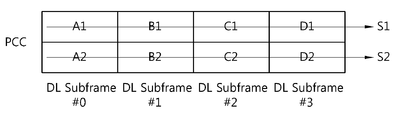
- FIG. 6 is a diagram schematically illustrating an example of performing time domain bundling to transmit an HARQ ACK / NACK signal using PUCCH format 1b.
- FIG. 6 for convenience of description, four downlink subframes associated with one uplink subframe are transmitted using only a small carrier and 2CW is transmitted in each downlink subframe as an example.
- the number of subframes is a number according to a received order for a downlink subframe associated with one uplink subframe.
- a 1-bit bundled signal S1 may be obtained by time-domain ACK / NACK signals A1, B1, C1, and D1 for each downlink subframe of a major carrier.
- ACK / NACK signals A2, B2, C2, and D2 for each downlink subframe of a major carrier may be time-domain-bundled to obtain a 1-bit bundled signal S2.
- the UE may transmit the 2 bit signal S1S2 by applying SORTD using a transmission resource of PUCCH format 1b implicitly allocated through the PDCCH received in the last or other subframe.
- FIG. 7 is a diagram schematically illustrating an example of performing spatial bundling and time domain bundling to transmit an HARQ ACK / NACK signal using PUCCH format 1a.
- four downlink subframes associated with one uplink subframe are transmitted only as major carriers, and 2CW is transmitted in each downlink subframe as an example.
- the number of subframes is a number according to a received order for a downlink subframe associated with one uplink subframe.
- spatial bundling may be performed for each subframe to obtain bundled ACK / NACK signals B, C, and D.
- time-domain bundling of the ACK / NACK signals A, B, C, and D may provide one-bit bundled ACK / NACK signal S.
- the UE may transmit by applying SORTD by using two resources of PUCCH format 1a, which is implicitly allocated the 1-bit ACK / NACK signal S.
- channel selection may be used as the contrast mode.
- a transmission resource required may be implicitly allocated as shown in Table 1.
- the transmission mode in contrast mode is independent of the transmission mode in normal mode.
- the transmission mode of the contrast mode may be set independently of the transmission mode of the normal mode. For example, when the HARQ response signal is transmitted through a single antenna in the normal mode, in contrast mode, the HARQ response signal is transmitted using SORTD or the HARQ response signal is transmitted through a single antenna without considering the transmission mode of the normal mode. Can be set. Also, even when the HARQ response signal is transmitted by applying SORTD in the normal mode, in contrast mode, the HARQ response signal is transmitted by applying the SORTD or the HARQ response signal is transmitted through a single antenna without considering the transmission mode of the normal mode. Can be set to
- PUCCH format 1a or PUCCH format 1b may be used and bundling may be required.
- Transmission resources for transmitting HARQ ACK / NACK signals in PUCCH format 1a and PUCCH 1b are implicitly allocated as shown in Table 1 based on the control channel element (CCE) index n CCE for the PDCCH of the received downlink subframe. Can be.
- CCE control channel element
- the contrast mode When the contrast mode is applied, it may be set to use only a transmission method using a single antenna as a transmission method of the HARQ response signal.
- PUCCH format 1a or PUCCH format 1b may be used and bundling may be required.
- Transmission resources for transmitting HARQ ACK / NACK signals in PUCCH format 1a and PUCCH 1b are implicitly allocated as shown in Table 1 based on the control channel element (CCE) index n CCE for the PDCCH of the received downlink subframe. Can be.
- CCE control channel element
- Contrast mode can also be considered when the SPS is active. Since the SPS is applied only to the major carriers, the allocation of transmission resources by dynamic scheduling may be applied to the subcarrier, and the dynamic scheduling may be applied to the minor carriers in the subframe to which the SPS is not applied.
- FIG. 8 is a diagram schematically illustrating an example of a normal mode when an SPS is activated.
- FIG. 8 illustrates a configuration in which four downlink subframes are associated with one uplink subframe as an example.
- an "X" indicates that an element carrier is not scheduled or lost during transmission in a corresponding subframe.
- SPS is applied to major carriers of subframe # 0.
- the HARQ ACK / NACK signal for the downlink subframes and the component carriers of FIG. 8 may be transmitted through one component carrier of the associated uplink subframe.
- transmission resources may be allocated through an ARI dedicated TPC field transmitted on PUCCH in a subframe to which dynamic scheduling is applied.
- the contrast mode may be applied when only a target to which the SPS is applied is received. For example, in the case where downlink transmission is performed only on a major carrier in a downlink subframe to which an SPS is applied, that is, when a downlink subframe or component carrier in which dynamic scheduling is performed is not transmitted, a contrast mode may be applied.
- FIG. 9 is a diagram schematically illustrating an example in which a contrast mode is applied by only transmitting major carriers in which an SPS is transmitted in one downlink subframe.
- a contrast mode is applied by only transmitting major carriers in which an SPS is transmitted in one downlink subframe.
- FIG. 9 for convenience of description, a case where four downlink subframes are associated with one uplink subframe will be described as an example.
- the transmission mode of the contrast mode may be set the same as the transmission mode of the normal mode or may be set independently of the transmission mode of the normal mode.
- the transmission mode of the contrast mode may be set to be always transmitted using a single antenna.
- the setting of the contrast mode may be made together with the setting of the normal mode.
- the contrast mode can be distinguished from the normal mode in which the HARQ ACK / NACK signal is transmitted in the PUCCH format 3 according to the transmission scheme as follows.
- the contrast mode is a method of transmitting a HARQ response signal by applying the SORTD
- SPS activation is performed by the PDCCH of the downlink subframe to which the SPS is applied.
- the base station may transmit to the terminal an ARI that allocates two transmission resource indexes to be used in the contrast mode by using the TPC field transmitted on the PDCCH for activating the SPS.
- the UE may apply SORTD in the contrast mode to two transmission resources indicated by the ARI received on the PDCCH activating the SPS.
- the base station allocates one transmission resource index (n PUCCH, 1 ) to be used in the contrast mode by transmitting the ARI by using the TPC field transmitted on the PDCCH for activating the SPS, and the second transmission resource index (n PUCCH, 2 ) may be allocated based on a transmission resource index n PUCCH, 1 allocated to the ARI, for example, n PUCCH, 1 +1.
- the UE may receive one transmission resource through the ARI received on the PDCCH activating the SPS, and may additionally allocate another transmission resource based on the transmission resource allocated through the ARI to apply SORTD. .
- the transmission resources allocated based on the transmission resources allocated through the ARI and the transmission resources allocated through the ARI may be transmission resources of PUCCH format 1a / 1b, transmission resources of PUCCH format 3, or spatial bundling. This may be done.
- an ARI for allocating a transmission resource to be used in the contrast mode can be transmitted to the UE by using the TPC field transmitted on the PDCCH for activating the SPS.
- the ARI can allocate one transmission resource. have.
- PUCCH format 1a is used to transmit the HARQ ACK / NACK signal
- spatial bundling may be performed.
- the HARQ ACK / NACK signal may be transmitted in the PUCCH format 1b using the channel selection.
- FIG. 10 is a diagram schematically illustrating a contrast mode applied when there is a subframe and / or a component carrier on which dynamic scheduling is performed.
- FIG. 10 illustrates a case where four downlink subframes are associated with one uplink subframe for convenience of description.
- the component carrier of subframe # 2 to which dynamic scheduling is applied is transmitted to the terminal.
- the ARI transmitted on the PDCCH for activating the SPS is the same as the contrast mode when only the target to which the above-described SPS is applied is transmitted.
- the transmission resource may be allocated through.
- bundling may be required when transmitting a HARQ ACK / NACK signal in PUCCH format 1a / 1b.
- the resource allocation method in the normal mode can be maintained.
- FIG. 11 is a diagram schematically illustrating an example in which a resource allocation scheme may be maintained.
- a resource allocation scheme may be maintained.
- FIG. 11 for convenience of description, a case where four downlink subframes are associated with one uplink subframe will be described as an example.
- a TPC field transmitted on a PDCCH in downlink subframe # 1 is used to transmit a TPC command
- a TPC field transmitted on a PDCCH in downlink subframe # 3 is used to transmit an ARI.
- the terminal may maintain the resource allocation method in the normal mode by receiving these two subframes.
- the PUCCH transmit power does not need to newly transmit a TPC command such as maintaining the current transmit power
- the ARIs are transmitted using the TPC field of the downlink subframe, the ARI is received. Resource allocation in the normal mode may be maintained.
- FIG. 12 is a flowchart schematically illustrating an operation of a base station in a TDD system using a single carrier to which the present invention is applied.
- the base station determines an uplink HARQ response method with the terminal (S1210).
- the base station determines how the HARQ response transmitted by the terminal is configured and transmitted. For example, the base station may determine whether to transmit a HARQ ACK / NACK signal by applying the PUCCH format, resource allocation method, SORTD terminal. At this time, the base station may determine the UL-DL configuration to match the configuration.
- the information about the HARQ ACK / NACK response method thus determined may be delivered to the terminal through higher layer signaling. However, this information may be predetermined between the base station and the terminal.
- the base station configures the ARI according to the determined HARQ response method (S1220).
- the base station configures the ARI to indicate a transmission resource of PUCCH format 3 to be used by the terminal.
- a plurality of transmission resources may be allocated through the ARI according to the transmission antenna to which the SORTD is applied in the terminal.
- the base station transmits the configured ARI through the downlink control channel (S1230).
- the ARI is transmitted using the TPC field of the PDCCH. Which subframe is to be transmitted, whether to transmit the ARI fixedly, according to a certain period, whether to transmit the ARI in a subframe of DAI ⁇ 0 according to a specific rule, as previously described, follow the method.
- the base station receives a HARQ response transmitted by the terminal according to the determined HARQ response scheme as a transmission resource allocated through the ARI (S1240).
- FIG. 13 is a flowchart schematically illustrating an operation of a terminal in a TDD system using a single carrier, to which the present invention is applied.
- the terminal receives downlink subframes (S1310).
- the UE acquires the ARI transmitted on the control channel in the received downlink subframe (S1320).
- the terminal may acquire the ARI in a predetermined subframe according to a method predetermined in the base station.
- the terminal receives a transmission resource of PUCCH format 3 through the received ARI (S1330).
- the terminal is allocated a transmission resource indicated by the ARI on the ARI mapping table.
- the terminal transmits an HARQ response by using the allocated transmission resource (S1340).
- the UE may multiplex and transmit HARQ response signals of up to 20 bits.
- FIG. 14 is a flowchart schematically illustrating an operation of a terminal when a contrast mode is applied according to the present invention.
- the terminal determines whether an ARI for allocating resources is received in a normal mode (S1410).
- a transmission resource indicated by the received ARI may be allocated (S1420).
- contrast mode may be applied.
- the terminal may determine whether SORTD is applied (S1430). Depending on whether SORTD is applied, the number of transmission resources to be obtained may vary.
- the terminal may acquire a plurality of transmission resources (S1440).
- the terminal may acquire one transmission resource (S1450).
- the transmission resource may be allocated implicitly or explicitly.
- the UE may determine whether a plurality of downlink subframes have been transmitted (S1660). When a plurality of downlink subframes are received and the payload size of the HARQ ACK / NACK signal to be transmitted increases, bundling may be required.
- the terminal may transmit the HARQ ACK / NACK signal using the contrast mode (S1480).
- 15 is a block diagram schematically illustrating an example of a configuration of a base station and a terminal in a system to which the present invention is applied.
- the terminal 1500 may include a transceiver 1510, a storage 1520, and a controller 1530.
- the base station 1540 may include a transceiver 1550, a storage 1560, and a controller 1570.
- the terminal 1500 transmits and receives necessary information through the transceiver 1510.
- the transceiver 1510 may include multiple antennas, in which case the terminal 1500 may apply SORTD.
- the storage unit 1520 stores information necessary for the terminal 1500 to perform wireless communication on a network. For example, the storage unit 1520 may configure an uplink-downlink (UL-DL) between a base station and a terminal, an ARI mapping table, an ARI transmission subframe, a priority between ARI windows, and a TPC transmitted in a corresponding downlink subframe. Information on whether an ARI or a TPC command is transmitted may be stored in the field, and control information transmitted through RRC signaling may be stored.
- the storage unit 1520 may store an ARI mapping table that allocates the transmission resources according to the number of transmission antennas to which the SORTD is applied.
- the storage unit 1520 may store settings of a normal mode and a contrast mode for HARQ ACK / NACK signal transmission.
- the controller 1530 may be connected to the transceiver 1510 and the storage 1520 to control them.
- the controller 1530 may transmit a HARQ ACK / NACK signal to the base station through the transceiver 1510 in an uplink subframe to which the resource is allocated by using the resource determined by the resource determiner 1540.
- the control unit 1530 acquires the resources of the PUCCH format 3 indicated by the received ARI on the ARI mapping table stored in the storage unit 1520 and transmits the HARQ ACK.
- the resource to be used for transmitting the / NACK signal can be determined.
- the controller 1530 acquires the resources of the PUCCH format 1a / 1b based on the first CCE of the PDCCH received on the downlink subframe
- the resource to be used for transmitting the HARQ ACK / NACK signal can be determined.
- the controller 1530 may acquire the allocated resource and determine a resource to be used for transmitting an ACK / NACK signal.
- the controller 1530 may determine whether the normal mode may be applied, and when the normal mode cannot be applied to the HARQ ACK / NACK signal transmission, the controller 1530 may determine to apply the contrast mode and perform a necessary procedure.
- the base station 1540 may transmit and receive necessary information through the transceiver 1550.
- the transceiver 1550 may include multiple antennas and support SORTD.
- the storage unit 1560 stores information necessary for the base station 1540 to perform wireless communication on the network.
- the storage unit 1560 may include a downlink-uplink configuration, an ARI mapping table, an ARI transmission subframe, a priority between the ARI windows, and a TPC transmitted in the corresponding downlink subframe, which may be preset between the base station and the terminal.
- Information on whether an ARI is transmitted or a TPC command may be stored in the field, and control information transmitted through RRC signaling may be stored.
- the controller 1570 may be connected to the transceiver 1550 and the storage 1560 to control them.
- the controller 1570 may transmit information regarding allocation of HARQ ACK / NACK resources such as ARI to the terminal through the transceiver 1550.
- the controller 1570 may allow the ARI to be transmitted using the TPC field transmitted on the PDCCH of the downlink subframe.
- the controller 1570 may transmit the RRC signaling related to resource allocation to the terminal through the transceiver 1550.
- the controller 1570 may determine whether to use PUCCH format 1a / 1b or PUCCH format 3 for an uplink subframe associated with a downlink subframe to be transmitted.
- the controller 1570 may allocate a resource used to transmit the HARQ ACK / NACK signal on the PUCCH according to the PUCCH format. If it is determined that the PUCCH format 3 is to be used, the controller 1570 may configure an ARI used to allocate a resource of the PUCCH format 3.
- the controller 1570 may also determine whether to apply the SORTD. If it is determined to apply the SORTD, the controller 1570 may configure an ARI mapping table and an ARI for applying the SORTD.
Landscapes
- Engineering & Computer Science (AREA)
- Signal Processing (AREA)
- Computer Networks & Wireless Communication (AREA)
- Mobile Radio Communication Systems (AREA)
Abstract
Description
본 발명은 무선 통신에 관한 것으로서, 더 구체적으로는 다중 반송파를 지원하는 무선 통신 시스템에 관한 것이다.The present invention relates to wireless communication, and more particularly, to a wireless communication system supporting multiple carriers.
무선 통신 시스템은 일반적으로 데이터 송신을 위해 하나의 대역폭을 이용한다. 예를 들어, 2세대 무선 통신 시스템은 200 KHz ~ 1.25 MHz의 대역폭을 사용하고, 3세대 무선 통신 시스템은 5 MHz ~ 10 MHz의 대역폭을 사용한다. 증가하는 송신 용량을 지원하기 위해, 최근의 3GPP(3rd Generation Partnership Project)의 LTE(Long Term Evolution) 또는 IEEE 802.16m은 20 MHz 또는 그 이상까지 계속 그 대역폭을 확장하고 있다. 송신 용량을 높이기 위해서 대역폭을 늘리는 것은 필수적이라 할 수 있지만, 전 세계적으로 일부 지역을 제외하고는 큰 대역폭의 주파수 할당이 용이하지 않다.Wireless communication systems generally use one bandwidth for data transmission. For example, second generation wireless communication systems use a bandwidth of 200 KHz-1.25 MHz, and third generation wireless communication systems use a bandwidth of 5 MHz-10 MHz. In order to support increasing transmission capacity, the recent Long Term Evolution (LTE) or IEEE 802.16m of the 3rd Generation Partnership Project (3GPP) continues to expand its bandwidth to 20 MHz or more. Increasing bandwidth is essential to increase transmission capacity, but frequency allocation of large bandwidths is not easy except in some regions of the world.
본 발명은 TDD(Time Division Duplex) 방식의 단일 반송파(single carrier) 시스템에서, 단일 반송파에 대한 ACK/NACK 신호를 전송하기 위한 전송 자원을 효과적으로 할당하는 방법을 제공하는 것을 목적으로 한다.An object of the present invention is to provide a method for effectively allocating a transmission resource for transmitting an ACK / NACK signal for a single carrier in a single carrier (TDD) single carrier system.
본 발명은 TDD(Time Division Duplex) 방식의 단일 반송파(single carrier) 시스템에서, 단말이 SORTD를 적용하여 HARQ ACK/NACK 응답을 전송하는 경우에, 전송 자원을 효과적으로 할당하는 방법을 제공하는 것을 목적으로 한다.An object of the present invention is to provide a method for effectively allocating transmission resources when a UE transmits a HARQ ACK / NACK response by applying SORTD in a single carrier (TDD) single carrier system. do.
본 발명은 단말과 기지국 사이에 설정된 방식으로 HARQ 전송이 이루어지기 어려운 경우에, 단말이 HARQ 신호를 전송하는 예비적인 방법을 제공하는 것을 목적으로 한다.An object of the present invention is to provide a preliminary method for transmitting a HARQ signal by a terminal when HARQ transmission is difficult to be performed in a manner set between the terminal and the base station.
본 발명은 단일 반송파를 이용하는 TDD(Time Division Duplex) 시스템에 있어서 기지국의 자원 할당 방법에 관한 것으로서, 이에 의하면 DFT-S-OFDM(Discrete Fourier Transform - Spreading - Orthogonal Frequency-Division Multiplexing)이 적용된 상향 링크 제어 채널 포맷의 자원으로 구성된 자원 매핑 테이블상에서 자원 지시자가 지시하는 전송 자원을 상향 링크 제어 채널의 전송에 사용할 전송 자원으로서 할당하되, 자원 지시자는 하향링크 서브프레임의 제어 채널상으로 전송되는 전력 제어 필드를 이용하여 단말에 전송하고, 자원 매핑 테이블은 단말의 전송 안테나 개수와 동일한 개수의 전송 자원이 자원 지시자에 의해 할당되도록 구성될 수 있다. The present invention relates to a resource allocation method of a base station in a time division duplex (TDD) system using a single carrier, and according to this, uplink control to which Discrete Fourier Transform-Spreading-Orthogonal Frequency-Division Multiplexing (DFT-S-OFDM) is applied. On the resource mapping table composed of the resources of the channel format, a transmission resource indicated by the resource indicator is allocated as a transmission resource to be used for transmission of the uplink control channel, and the resource indicator identifies a power control field transmitted on the control channel of the downlink subframe. The resource mapping table may be configured to transmit the same number of transmission resources as the number of transmission antennas of the terminal by the resource indicator.
본 발명은 또한, 단일 반송파를 이용하는 TDD(Time Division Duplex) 시스템에 있어서, 단말의 HARQ 응답 신호 전송 방법에 관한 것으로서, 이에 의하면, DFT-S-OFDM(Discrete Fourier Transform - Spreading - Orthogonal Frequency-Division Multiplexing)이 적용된 상향 링크 제어 채널 포맷의 자원으로 구성된 자원 매핑 테이블상에서 자원 지시자가 지시하는 전송 자원을 상향 링크 제어 채널의 전송에 사용할 전송 자원으로서 획득하고, 획득한 전송 자원을 이용하여 HARQ 응답 신호를 기지국으로 전송하되, 자원 지시자는 하향링크 서브프레임의 제어 채널상으로 전송되는 전력 제어 필드를 이용하여 기지국으로부터 전송되고, 자원 매핑 테이블은 단말의 전송 안테나 개수와 동일한 개수의 전송 자원이 자원 지시자에 의해 할당되도록 구성될 수 있다.The present invention also relates to a method for transmitting a HARQ response signal of a terminal in a TDD (Time Division Duplex) system using a single carrier, and accordingly, according to Discrete Fourier Transform-Spreading-Orthogonal Frequency-Division Multiplexing ) Acquires a transmission resource indicated by the resource indicator as a transmission resource to be used for transmission of the uplink control channel on a resource mapping table configured of a resource of an uplink control channel format to which the base station is applied, and uses the obtained transmission resource to transmit a HARQ response signal to the base station. The resource indicator is transmitted from the base station using a power control field transmitted on the control channel of the downlink subframe, and the resource mapping table allocates the same number of transmission resources as the number of transmit antennas of the terminal by the resource indicator. It may be configured to.
본 발명은 단말의 HARQ 신호 전송 방법에 관한 것으로서, HARQ 신호를 전송할 상향링크 서브프레임에 연관된 하향링크 서브프레임으로 전송 자원을 할당하는 자원 할당 지시자를 수신하였는지 판단하는 단계; 판단 결과, 자원 할당 지시자를 수신하지 못하였으면, 동적 스케줄링이 적용되는 경우에는 수신한 하향링크 서브프레임에서 제어 채널상의 제어 채널 요소(Control Channel Element) 인덱스를 기반으로 자원을 할당받고, 정적 스케줄링이 적용되는 경우에는 정적 스케줄링을 활성화한 하향링크 제어 채널상으로 전송된 자원 할당 지시자가 지시하는 자원을 할당 받는 단계 및 할당 받은 자원을 이용하여 HARQ 신호를 전송하는 단계를 포함한다. The present invention relates to a method of transmitting a HARQ signal of a terminal, the method comprising: determining whether a resource allocation indicator for allocating a transmission resource to a downlink subframe associated with an uplink subframe to transmit the HARQ signal is received; If it is determined that the resource allocation indicator has not been received, when dynamic scheduling is applied, resources are allocated based on the control channel element index on the control channel in the received downlink subframe, and static scheduling is applied. If so, the step of allocating resources indicated by the resource allocation indicator transmitted on the downlink control channel with the static scheduling enabled and transmitting the HARQ signal using the allocated resources.
이때, 판단 결과, HARQ 신호를 전송할 상향링크 서브프레임에 연관된 하향링크 서브프레임으로 전송 자원을 할당하는 자원 할당 지시자를 수신한 경우에는, 자원 할당 지시자가 지시하는 자원을 할당 받아 HARQ 신호를 전송할 수도 있다.At this time, when the determination result, when receiving a resource allocation indicator for allocating the transmission resources to the downlink subframe associated with the uplink subframe to transmit the HARQ signal, the resource allocation indicator may be allocated to transmit the HARQ signal. .
자원을 할당 받는 단계는, HARQ 신호를 전송할 상향링크 서브프레임에 연관된 하향링크 서브프레임으로 전송 자원을 할당하는 자원 할당 지시자를 수신하지 못한 경우에도, HARQ 신호를 SORTD를 적용하여 전송하는지를 판단하는 단계를 더 포함할 수 있으며, SORTD를 적용하는 것으로 판단한 경우에는 복수의 전송 자원을 할당 받고, SORTD를 적용하지 않는 단일 안테나를 이용하는 경우에는 하나의 전송 자원을 할당 받을 수 있다.The step of allocating a resource may include determining whether to transmit a HARQ signal by applying SORTD even if a resource allocation indicator for allocating a transmission resource is received in a downlink subframe associated with an uplink subframe to which the HARQ signal is to be transmitted. In addition, if it is determined that the SORTD is applied, a plurality of transmission resources may be allocated, and when using a single antenna that does not apply the SORTD, one transmission resource may be allocated.
이때, SORTD 적용 여부가 단말과 기지국 사이에 미리 설정되어 있거나, SORTD 적용 여부를 판단하기 위한 정보가 상위 계층 시그널링을 통해서 기지국으로부터 단말에 전단될 수도 있다. At this time, whether to apply the SORTD is pre-set between the terminal and the base station, or information for determining whether to apply the SORTD may be sheared from the base station to the terminal through higher layer signaling.
동적 스케줄링이 적용되는 경우로서, SORTD를 적용하는 경우에는 수신한 하향링크 서브프레임에서 제어 채널상의 두 제어 채널 요소로부터 획득한 제어 채널 인덱스들을 기반으로 두 개의 자원을 할당 받으며, 정적 스케줄링이 적용되는 경우에는 상기 정적 스케줄링을 활성화한 하향링크 제어 채널상으로 전송된 자원 할당 지시자가 지시하는 두 개의 자원을 할당 받을 수 있다.When dynamic scheduling is applied, when SORTD is applied, two resources are allocated based on control channel indices obtained from two control channel elements on a control channel in a received downlink subframe, and when static scheduling is applied. Two resources indicated by the resource allocation indicator transmitted on the downlink control channel with the static scheduling enabled may be allocated.
또한, 자원을 할당 받는 단계에서는, HARQ 신호를 전송할 상향링크 서브프레임에 연관된 하향링크 서브프레임으로 전송 자원을 할당하는 자원 할당 지시자를 수신한 경우에 HARQ 신호를 전송하는 방식과 동일한 전송 방식으로 HARQ 신호를 전송하기 위해 필요한 개수의 자원을 할당 받을 수도 있고, HARQ 신호 전송 단계에서는, HARQ 신호를 전송할 상향링크 서브프레임에 연관된 하향링크 서브프레임으로 전송 자원을 할당하는 자원 할당 지시자를 수신한 경우에 HARQ 신호를 전송하는 방식과 동일한 전송 방식으로 HARQ 신호를 전송할 수도 있다.Further, in the step of allocating a resource, when a resource allocation indicator for allocating a transmission resource to a downlink subframe associated with an uplink subframe to transmit the HARQ signal is received, the HARQ signal is transmitted in the same transmission method as that of transmitting a HARQ signal. In the HARQ signal transmission step, when the resource allocation indicator for allocating a transmission resource to a downlink subframe associated with an uplink subframe to transmit the HARQ signal is received, the HARQ signal may be allocated. The HARQ signal may be transmitted in the same transmission method as that of transmitting.
HARQ 신호를 전송할 상향링크 서브프레임에 연관된 하향링크 서브프레임으로 전송 자원을 할당하는 자원 할당 지시자를 수신하지 못한 경우에 단말이 할당 받는 자원은, PUCCH 포맷 1a 또는 PUCCH 포맷 1b일 수 있다.If a resource allocation indicator for allocating a transmission resource to a downlink subframe associated with an uplink subframe to transmit the HARQ signal is not received, the resource allocated by the UE may be PUCCH format 1a or PUCCH format 1b.
또한, 전송할 HARQ 신호가 상기 할당 받은 자원으로 전송할 수 있는 크기를 넘는 경우에는 시간 영역 번들링 및/또는 스파셜 번들링을 수행하는 단계를 더 포함할 수 있다.The method may further include performing time domain bundling and / or spatial bundling when the HARQ signal to be transmitted exceeds a size that can be transmitted through the allocated resource.
또한, 복수의 하향링크 서브프레임이 수신된 경우에는 시간 영역 번들링 및/또는 스파셜 번들링을 수행하는 단계를 더 포함할 수 있다.In addition, when a plurality of downlink subframes is received, the method may further include performing time domain bundling and / or spatial bundling.
한편, 본 발명은 기지국의 HARQ 자원 할당 방법으로서, HARQ 신호를 전송할 상향링크 서브프레임에 연관된 하향링크 서브프레임으로 전송 자원을 할당하는 자원 할당 지시자를 단말이 수신하지 못한 경우에, 단말이 HARQ 신호를 전송하는데 사용할 전송 자원을 할당하는 방법을 설정하는 단계 및 설정된 방법에 따라서, 동적 스케줄링이 적용되는 경우에는 전송 자원을 묵시적으로 할당하고 또는 정적 스케줄링이 적용되는 경우에는 전송 자원을 명시적으로 할당하는 단계를 포함하며, 명시적으로 할당하는 자원은, 정적 스케줄링을 활성화하는 제어 채널상으로 전송되는 전송 전력 제어 명령에 이용될 비트를 활용하여 전송되는 자원 할당 지시자에 의해 할당되도록 할 수 있다.Meanwhile, the present invention provides a method for allocating an HARQ resource of a base station, when the terminal does not receive a resource allocation indicator for allocating a transmission resource to a downlink subframe associated with an uplink subframe to transmit the HARQ signal, the terminal receives the HARQ signal. Setting a method of allocating a transmission resource to be used for transmission and, according to the set method, implicitly allocating transmission resources when dynamic scheduling is applied or explicitly allocating transmission resources when static scheduling is applied. The resource to be explicitly allocated may be allocated by a resource allocation indicator transmitted by utilizing a bit to be used in a transmission power control command transmitted on a control channel for activating static scheduling.
이때, 전송 자원은 단말의 HARQ 전송 방식에 따라 필요한 개수를 할당할 수 있으며, 단말의 HARQ 전송 방식은, HARQ 신호를 전송할 상향링크 서브프레임에 연관된 하향링크 서브프레임으로 전송 자원을 할당하는 자원 할당 지시자를 단말이 수신한 경우의 전송 방식과 동일할 수 있다.In this case, the transmission resources may be allocated the required number according to the HARQ transmission scheme of the terminal, the HARQ transmission scheme of the terminal, resource allocation indicator for allocating the transmission resources to the downlink subframe associated with the uplink subframe to transmit the HARQ signal It may be the same as the transmission method when the terminal receives.
본 발명에 의하면, TDD(Time Division Duplex) 방식의 단일 반송파(single carrier) 시스템에서, 단일 반송파에 대한 ACK/NACK 신호를 전송하기 위한 전송 자원을 효과적으로 할당할 수 있다.According to the present invention, in a single carrier (TDD) single carrier system, a transmission resource for transmitting an ACK / NACK signal for a single carrier can be effectively allocated.
본 발명에 의하면, TDD(Time Division Duplex) 방식의 단일 반송파(single carrier) 시스템에서, 중복 전달되는 제어 신호에 할당되는 자원을 전용(轉用)하여 무선 자원을 효과적으로 이용할 수 있다.According to the present invention, in a single carrier system using a time division duplex (TDD) system, radio resources can be effectively utilized by dedicating resources allocated to control signals that are redundantly transmitted.
본 발명에 의하면, TDD(Time Division Duplex) 방식의 단일 반송파(single carrier) 시스템에서, 단말이 SORTD를 적용하여 HARQ ACK/NACK 응답을 전송하는 경우에, 전송 자원을 효과적으로 할당할 수 있다.According to the present invention, in a single carrier system using a time division duplex (TDD) scheme, when a terminal transmits a HARQ ACK / NACK response by applying SORTD, a transmission resource can be effectively allocated.
본 발명에 의하면, 단말과 기지국 사이에 설정된 방식으로 HARQ 전송이 이루어지기 어려운 경우에, 예비적인 방법을 통해 단말이 HARQ 신호를 기지국에 전송할 수 있다.According to the present invention, when HARQ transmission is difficult to be performed in a manner set between the terminal and the base station, the terminal may transmit the HARQ signal to the base station through a preliminary method.
도 1은 단일 반송파를 이용하는 TDD 시스템에서, 상향링크-하향링크 설정 5를 도시한 것이다. FIG. 1 illustrates uplink-
도 2는 단일 반송파를 사용하는 TDD 시스템에서, 상향링크-하향링크 설정 1을 도시한 것이다. FIG. 2 illustrates uplink-
도 3은 단일 반송파를 사용하는 TDD 시스템에서, 상향링크-하향링크 설정 2에 대하여, ARI를 전송하는 하향링크 서브프레임을 특정하는 일 예를 개략적으로 도시한 것이다. FIG. 3 schematically illustrates an example of specifying a downlink subframe for transmitting ARI in uplink-
도 4는 단일 반송파를 사용하는 TDD 시스템에서, 상향링크-하향링크 설정 0에 대하여 ARI 윈도우를 설정하는 일 예를 개략적으로 도시한 것이다. FIG. 4 schematically illustrates an example of configuring an ARI window for uplink-
도 5는 단일 반송파를 사용하는 TDD 시스템에서, 상향링크-하향링크 설정 1에 대하여 ARI 윈도우를 설정하는 일 예를 개략적으로 도시한 것이다.FIG. 5 schematically illustrates an example of configuring an ARI window for uplink-
도 6은 PUCCH 포맷 1b를 이용하여 HARQ ACK/NACK 신호를 전송하기 위해, 시간 영역 번들링을 수행하는 일 예를 개략적으로 설명하는 도면이다.FIG. 6 is a diagram schematically illustrating an example of performing time domain bundling to transmit an HARQ ACK / NACK signal using PUCCH format 1b.
도 7은 PUCCH 포맷 1a를 이용하여 HARQ ACK/NACK 신호를 전송하기 위해, 스파셜 번들링과 시간 영역 번들링을 수행하는 일 예를 개략적으로 설명하는 도면이다.FIG. 7 is a diagram schematically illustrating an example of performing spatial bundling and time domain bundling to transmit an HARQ ACK / NACK signal using PUCCH format 1a.
도 8은 SPS가 활성화된 경우의 정상 모드에 관한 일 예를 개략적으로 설명하는 도면이다.8 is a diagram schematically illustrating an example of a normal mode when an SPS is activated.
도 9는 하나의 하향링크 서브프레임에서 SPS가 전송되는 주요소 반송파의 전송만 이루어져 대비 모드가 적용되는 일 예를 개략적으로 설명하는 도면이다. FIG. 9 is a diagram schematically illustrating an example in which a contrast mode is applied by only transmitting major carriers in which an SPS is transmitted in one downlink subframe.
도 10은 동적 스케줄링이 이루어지는 서브프레임 및/또는 요소 반송파가 존재하는 경우에 적용되는 대비 모드를 개략적으로 설명하는 도면이다. FIG. 10 is a diagram schematically illustrating a contrast mode applied when there is a subframe and / or a component carrier on which dynamic scheduling is performed.
도 11은 자원 할당 방식이 유지될 수 있는 일 예를 개략적으로 설명하는 도면이다.11 is a diagram schematically illustrating an example in which a resource allocation scheme may be maintained.
도 12는 본 발명이 적용되는, 단일 반송파를 사용하는 TDD 시스템에서 기지국의 동작을 개략적으로 설명하는 순서도이다.12 is a flowchart schematically illustrating an operation of a base station in a TDD system using a single carrier to which the present invention is applied.
도 13은 본 발명이 적용되는, 단일 반송파를 사용하는 TDD 시스템에서 단말의 동작을 개략적으로 설명하는 순서도이다.13 is a flowchart schematically illustrating an operation of a terminal in a TDD system using a single carrier, to which the present invention is applied.
도 14는 본 발명에 따라서 대비모드가 적용되는 경우에 단말의 동작을 개략적으로 설명하는 도면이다. 14 is a diagram schematically illustrating an operation of a terminal when a contrast mode is applied according to the present invention.
도 15는 본 발명이 적용되는 시스템에서 기지국과 단말의 구성의 일 예를 개략적으로 도시한 블록도이다.15 is a block diagram schematically illustrating an example of a configuration of a base station and a terminal in a system to which the present invention is applied.
이하, 본 명세서에서는 일부 실시예들을 예시적인 도면을 통해 상세하게 설명한다. 본 명세서의 실시예를 설명함에 있어, 관련된 공지 구성 또는 기능에 대한 구체적인 설명이 본 명세서의 요지를 흐릴 수 있다고 판단되는 경우에는 그 상세한 설명은 생략한다.Hereinafter, some embodiments will be described in detail with reference to the accompanying drawings. In describing the embodiments of the present specification, when it is determined that a detailed description of a related well-known configuration or function may obscure the gist of the present specification, the detailed description thereof will be omitted.
무선 통신 시스템에 적용되는 다중 접속 기법에는 제한이 없다. CDMA(Code Division Multiple Access), TDMA(Time Division Multiple Access), FDMA(Frequency Division Multiple Access), OFDMA(Orthogonal Frequency Division Multiple Access), SC-FDMA(Single Carrier-FDMA), OFDM-FDMA, OFDM-TDMA, OFDM-CDMA와 같은 다양한 다중 접속 기법을 사용할 수 있다. There is no limitation on the multiple access scheme applied to the wireless communication system. Code Division Multiple Access (CDMA), Time Division Multiple Access (TDMA), Frequency Division Multiple Access (FDMA), Orthogonal Frequency Division Multiple Access (OFDMA), Single Carrier-FDMA (SC-FDMA), OFDM-FDMA, OFDM-TDMA For example, various multiple access schemes such as OFDM-CDMA may be used.
반송파 집성(Carrier Aggregation, 이하 ‘CA’라 함)은 복수의 반송파를 지원하는 것으로서, 스펙트럼 집성(spectrum aggregation) 또는 대역폭 집성(bandwidth aggregation)이라고도 한다. Carrier Aggregation (hereinafter, referred to as CA) supports a plurality of carriers, and is also referred to as spectrum aggregation or bandwidth aggregation.
하향링크와 상향링크 간에 집성되는 반송파들의 수는 다르게 설정될 수 있으며, 요소 반송파들의 크기(즉, 대역폭)는 서로 다를 수 있다. 각 요소 반송파들은 후술하는 PDCCH 등과 같은 제어 채널을 가질 수 있으며, 서로 인접할 수도 있고, 인접하지 않을 수도 있다. 단말은 성능에 따라 하나 또는 그 이상의 반송파를 지원할 수 있다. The number of carriers aggregated between the downlink and the uplink may be set differently, and the size (ie, bandwidth) of the component carriers may be different. Each component carrier may have a control channel such as a PDCCH, which will be described later, and may or may not be adjacent to each other. The terminal may support one or more carriers according to performance.
요소 반송파는 활성화 여부에 따라 주요소 반송파(Primary Component Carrier: PCC)와 부요소 반송파(Secondary Component Carrier: SCC)로 나뉠 수 있다. 주요소 반송파는 항상 활성화되어 있는 반송파이고, 부요소 반송파는 특정 조건에 따라 활성화/비활성화되는 반송파이다. 활성화는 트래픽 데이터의 송신 또는 수신이 행해지거나 준비 상태(ready state)에 있는 것을 말한다. The CC may be divided into a Primary Component Carrier (PCC) and a Secondary Component Carrier (SCC) according to activation. The major carriers are always active carriers, and the subcarrier carriers are carriers that are activated / deactivated according to specific conditions. Activation refers to the transmission or reception of traffic data being made or in a ready state.
이하에서, CA 환경이라 함은 다중 요소 반송파(반송파 집성)을 지원하는 시스템을 말한다. Hereinafter, the CA environment refers to a system supporting multi-component carriers (carrier aggregation).
반송파 집성에 있어서 PDCCH(Physical Downlink Control Channel)는 해당 PDCCH가 속한 반송파 내의 자원 할당뿐만 아니라 다른 반송파의 자원에 대해서도 할당 정보를 전송할 수 있다. In carrier aggregation, a physical downlink control channel (PDCCH) may transmit allocation information for resources of other carriers as well as resource allocation in a carrier to which the corresponding PDCCH belongs.
PDCCH상으로 전달되는 메시지는 상향링크 전송 전력을 제어하는 전송 전력 제어(TPC: Transmission Power Control)를 포함한다. The message transmitted on the PDCCH includes a transmission power control (TPC) for controlling uplink transmission power.
반송파 집성 환경에서, 각 반송파의 PDCCH는 동일한 상향링크 요소 반송파의 PUCCH(Physical Uplink Control Channel)에 대한 TPC 명령을 전송할 수 있다. 복수의 하향링크 그랜트 전송으로 인해 하나의 PUCCH에 대한 TPC가 복수 개 존재하게 될 경우, 중복되는 TPC 필드에 할당된 비트를 다른 제어 정보, 예컨대 ACK/NACK 자원 할당 정보의 전송에 사용할 수 있다.In a carrier aggregation environment, the PDCCH of each carrier may transmit a TPC command for a physical uplink control channel (PUCCH) of the same uplink component carrier. When there are a plurality of TPCs for one PUCCH due to a plurality of downlink grant transmissions, bits allocated to overlapping TPC fields may be used for transmission of other control information, for example, ACK / NACK resource allocation information.
기지국으로부터 하향링크 데이터를 수신한 단말은 일정 시간이 경과한 후에, 또는 일정한 타이밍에 ACK(ACKnowledgement)/NACK(Not-ACKnowledgement) 응답을 기지국에 전송한다. 하향링크 데이터는 PDCCH에 의해 지시되는 PDSCH상으로 전송될 수 있다. 하향링크 데이터에 대한 HARQ(Hybrid Automatic Repeat request) 신호는 PUCCH상으로 전송될 수 있다. HARQ ACK/NACK 신호는 상기 하향링크 데이터가 성공적으로 디코딩되면 ACK 정보가 되고, 상기 하향링크 데이터의 디코딩에 실패하면 NACK 정보가 된다. 기지국은 NACK 정보가 수신되면, 최대 재전송 횟수까지 상기 하향링크 데이터를 재전송할 수 있다. The terminal receiving the downlink data from the base station transmits an ACK (ACKnowledgement) / NACK (Not-ACKnowledgement) response to the base station after a predetermined time elapses or at a certain timing. The downlink data may be transmitted on the PDSCH indicated by the PDCCH. A hybrid automatic repeat request (HARQ) signal for downlink data may be transmitted on the PUCCH. The HARQ ACK / NACK signal becomes ACK information when the downlink data is successfully decoded, and becomes NACK information when the decoding of the downlink data fails. When the NACK information is received, the base station may retransmit the downlink data up to a maximum number of retransmissions.
한편, 다중 안테나 시스템에서는 동일한 변조 심볼을 서로 다른 안테나를 통해, 서로 다른 전송 자원을 이용하여 전송되는 SORTD(Spatial Orthogonal Resource Transmit Diversity)가 적용될 수 있다. SORTD는 PUCCH 포맷 각각에 대하여도 적용될 수 있다.On the other hand, in a multi-antenna system, SORTD (Spatial Orthogonal Resource Transmit Diversity) transmitted through different antennas and using different transmission resources may be applied. SORTD may also be applied to each PUCCH format.
PUCCH 포맷 1/1a/1b의 전송을 위한 자원인 자원 인덱스(Resource Index) n(1)
PUCCH는 HARQ ACK/NACK 신호가 전송되는 물리적인 자원 블록의 위치뿐만 아니라 기본 시퀀스의 CS 양 α(ns,l) 및 직교 시퀀스 인덱스 nOC(ns)를 결정하기 위해 사용된다. 그리고, HARQ ACK/NACK 신호를 위한 자원 인덱스 n(1)
PUCCH는 다음의 표 1과 같이 구할 수 있다. 자원 인덱스 n(1)
PUCCH는 물리적인 RB 인덱스 nPRB, 기본 시퀀스의 CS 양 α(ns,l) 및 직교 시퀀스 인덱스 nOC(ns) 등을 결정하는 파라미터이다.Resource Index that is a resource for transmission of
<표 1>TABLE 1

즉, 표 1에 의하면 n 번째 서브프레임에서 전송되는 PDSCH에 대한 HARQ ACK/NACK 신호가 상기 n 번째 서브프레임에서 전송되는 PDCCH의 첫 번째 CCE(Control Channel Element) 인덱스 nCCE와 상위 계층 시그널링(higher layer signaling) 또는 별도의 제어 채널을 통해 얻은 값 N(1)
PUCCH의 합인 자원 인덱스 n(1)
PUCCH를 이용하여 n+4 번째 서브프레임에서 전송된다. N(1)
PUCCH는 반정적 스케줄링(Semi-Persistent Scheduling: SPS) 전송과 SR(Service Request) 전송에 필요한 PUCCH format 1/1a/1b 자원의 총 개수이다. 반정적 스케줄링 전송과 SR 전송은 해당 PDSCH 전송을 가리키는 PDCCH가 존재하지 않기 때문에 기지국이 n(1)
PUCCH를 명시적으로(explicitly) 단말에게 알려준다. That is, according to Table 1, the HARQ ACK / NACK signal for the PDSCH transmitted in the nth subframe is the first control channel element (CCE) index n CCE of the PDCCH transmitted in the nth subframe and the higher layer signaling. is transmitted in the n + 4th subframe using resource index n (1) PUCCH , which is the sum of the value N (1) PUCCH obtained through signaling) or a separate control channel. N (1) PUCCH is the total number of
HARQ ACK/NACK 신호 및/또는 SR이 PUCCH 포맷 1/1a/1b를 통해 전송될 때, 자원 인덱스 n(1)
PUCCH에 의해 물리적인 RB 인덱스 nPRB가 결정된다. 이는 다음의 수학식 1과 같다.When the HARQ ACK / NACK signal and / or the SR are transmitted through the
<수학식 1><

따라서, 자원 인덱스 n(1) PUCCH에 따라 물리적인 RB 인덱스 nPRB가 결정되고, 각 m에 대응하는 PUCCH는 슬롯 단위로 주파수 도약(hopping)된다. Accordingly, the physical RB index n PRB is determined according to the resource index n (1) PUCCH , and the PUCCH corresponding to each m is frequency hopping in units of slots.
반송파 집성(CA: Carrier Aggregation) 환경에서, 다수의 하향링크 요소 반송파에 대한 HARQ ACK/NACK 신호는 하나의 상향링크 요소 반송파를 통해 전송된다. 이때, 하나의 코드워드(CW)당 1 비트의 ACK/NACK 신호가 전송된다.In a carrier aggregation (CA) environment, HARQ ACK / NACK signals for a plurality of downlink component carriers are transmitted through one uplink component carrier. In this case, one bit of an ACK / NACK signal is transmitted per one codeword (CW).
하향링크에 대한 HARQ ACK/NACK 신호는 PUCCH상으로 전송된다. The HARQ ACK / NACK signal for the downlink is transmitted on the PUCCH.
HARQ ACK/NACK 신호의 전송을 위해, 기지국은 ACK/NACK 자원 인덱스를 묵시적(implicit)으로 할당할 수 있다. 기지국이 ACK/NACK 자원 인덱스를 묵시적으로 할당한다는 것은, CC#a의 PDCCH를 구성하는 적어도 하나의 CCE 중에서 CCE의 번호를 의미하는 nCCE을 파라미터로 하여 계산된 자원 인덱스를 할당함을 의미한다. 본 명세서에서는 기지국의 묵시적인 자원 인덱스 할당에 대응하여, 단말의 관점에서는 이를 ‘묵시적인 자원 인덱스 획득’으로 표현한다.For transmission of the HARQ ACK / NACK signal, the base station may implicitly allocate the ACK / NACK resource index. Implicitly allocating an ACK / NACK resource index means that the base station allocates a resource index calculated by using n CCE , which means a number of CCEs , as a parameter among at least one CCE constituting the PDCCH of CC # a. In the present specification, in response to the implicit resource index allocation of the base station, it is expressed as 'implicit resource index acquisition' from the perspective of the terminal.
기지국은 또한 자원 인덱스를 명시적(Explicit)으로 할당할 수도 있다. 기지국이 자원 인덱스를 명시적으로 단말에 할당한다는 것은, nCCE에 의존하지 않고 기지국으로부터 별도의 자원 할당 지시자 등을 통해 특정 단말에 전용되는(dedicated) PUCCH의 자원 인덱스를 단말에 할당함을 의미한다. 이때 기지국으로부터의 별도의 자원 할당 지시자는 상위 계층 또는 물리 계층으로부터의 시그널링 등을 포함한다. 또한, 자원 할당 지시자는 PDCCH에 제어 정보 또는 시스템 정보로서 포함될 수도 있다. 본 명세서에서는 기지국의 명시적인 자원 인덱스 할당에 대응하여, 단말의 관점에서는 이를 ‘명시적인 자원 인덱스 획득’으로 표현한다.The base station may also assign the resource index explicitly. The fact that the base station explicitly allocates the resource index to the terminal means that the resource index of the PUCCH dedicated to the specific terminal is allocated to the terminal through a separate resource allocation indicator from the base station without depending on n CCE . . In this case, the separate resource allocation indicator from the base station includes signaling from an upper layer or a physical layer. In addition, the resource allocation indicator may be included in the PDCCH as control information or system information. In the present specification, in response to the explicit resource index allocation of the base station, it is expressed as 'explicit resource index acquisition' from the perspective of the terminal.
기지국은 TPC 명령을 전송하는데 사용할 2 비트를 ACK/NACK 자원 지시자(ACK/NACK Resource Indicator: ARI, 이하 'ARI'라 함)를 전송하는데 이용할 수 있다. ARI는 단말이 하향링크에 대한 HARQ ACK/NACK 신호를 전송할 때 사용할 자원을 명시적으로 할당하기 위한 지시자이다. The base station may use 2 bits to transmit the ACK / NACK Resource Indicator (ARI, hereinafter referred to as "ARI") to be used for transmitting the TPC command. The ARI is an indicator for explicitly allocating a resource to be used when the terminal transmits a HARQ ACK / NACK signal for downlink.
CA 환경에서, 주요소 반송파상의 PDSCH에 대응하는 PDCCH의 TPC 필드는 TPC 명령으로 이용하고, 부요소 반송파상의 PDSCH에 대응하는 PDCCH의 TPC 필드를 ARI로 이용할 수 있다. 단일 반송파(Single Carrier)를 사용하는 TDD의 경우에도, 특정 하향링크 서브프레임의 PDCCH상으로 전송되는 TPC 필드는 TPC 명령으로 이용하고, 다른 하향링크 서브프레임의 PDCCH상으로는 TPC 필드에 할당될 비트를 이용하여 ARI를 전송할 수 있다.In the CA environment, the TPC field of the PDCCH corresponding to the PDSCH on the major carrier may be used as a TPC command, and the TPC field of the PDCCH corresponding to the PDSCH on the subcarrier may be used as the ARI. Even in a TDD using a single carrier, a TPC field transmitted on a PDCCH of a specific downlink subframe is used as a TPC command, and a bit to be allocated to a TPC field on a PDCCH of another downlink subframe is used. ARI can be sent.
ARI로 자원을 할당하기 위한 ARI 매핑 테이블의 정보는 상위 계층 시그널링에 의해 미리 단말에 전송될 수 있다. ARI 매핑 테이블은 ARI가 지시하는 값과 그에 따라 할당되는 ACK/NACK 전송 자원으로 구성된다. Information of the ARI mapping table for allocating resources to the ARI may be transmitted to the terminal in advance by higher layer signaling. The ARI mapping table consists of the values indicated by the ARI and the ACK / NACK transmission resources allocated accordingly.
CA 환경에서, ARI 매핑 테이블을 구성하기 위해 필요한 HARQ ACK/NACK 전송 자원의 수는 RRC를 통해서 구성되는 요소 반송파의 수와 서브프레임에서 각 요소 반송파별로 몇 개의 코드워드를 전송할 것인지에 관한 전송 모드, HARQ ACK/NACK 신호를 전송할 PUCCH 포맷의 종류 등을 통해서 결정될 수 있다. 또한, 단일 반송파를 사용하는 TDD의 경우에는 상향링크 서브프레임에 연관된 하향링크 서브프레임의 개수, HARQ ACK/NACK 신호를 전송할 PUCCH 포맷의 종류 등에 의해 결정될 수 있다. ARI 매핑 테이블은 2 비트의 ARI가 표현할 수 있는 4 가지 값에 대응하는 ACK/NACK 전송 자원의 수에 따라서 달리 구성될 수 있으며 명시적으로 할당된 자원 집합과 이에 대응하는 ARI 값은 상위 계층 시그널링에 의해 단말에 미리 전달되어 있을 수 있다. In a CA environment, the number of HARQ ACK / NACK transmission resources required to configure the ARI mapping table is a transmission mode for the number of component carriers configured through RRC and the number of codewords for each component carrier in a subframe, HARQ It may be determined through the type of the PUCCH format for transmitting the ACK / NACK signal. In addition, in case of TDD using a single carrier, the number of downlink subframes associated with an uplink subframe may be determined according to the type of PUCCH format for transmitting HARQ ACK / NACK signals. The ARI mapping table can be configured differently according to the number of ACK / NACK transmission resources corresponding to four values that can be represented by a 2-bit ARI. The explicitly allocated resource set and the corresponding ARI value are determined by higher layer signaling. It may be delivered to the terminal in advance.
표 2는 본 발명에 이용되는 ARI 매핑 테이블의 일 구현예를 나타낸 것이다.Table 2 shows an embodiment of the ARI mapping table used in the present invention.
<표 2>TABLE 2

표 2는 본 발명의 용이한 설명을 위해 편의상 구성한 ARI 매핑 테이블로서, 본 발명에 따른 ARI 매핑 테이블은 본 발명의 기술적 사상 내에서 다양한 방법으로 구성될 수 있다. 자원 집합 Nk (K=1, 2, 3, 4)는 ARI를 통해서 할당하고자 하는 전송 자원의 개수와 동일한 개수의 자원을 원소로 하는 자원 집합이다. 예컨대, ARI를 통하여 하나의 전송 자원을 할당하는 경우에, 각 Nk는 서로 중복되지 않는 하나의 전송 자원을 원소로 가지는 자원 집합(예컨대, {n},n은 전송 자원)이며, ARI를 통하여 두 개의 전송 자원을 할당하는 경우에, 각 Nk는 서로 중복되지 않는 두 개의 전송 자원을 원소로 가지는 자원 집합 (예컨대. {n1, n2})이다. Table 2 is an ARI mapping table configured for convenience of description of the present invention, the ARI mapping table according to the present invention can be configured in various ways within the spirit of the present invention. The resource set N k ( K = 1, 2, 3, 4) is a resource set whose elements are the same number of resources as the number of transmission resources to be allocated through the ARI. For example, in the case of allocating one transmission resource through ARI, each N k is a set of resources (for example, {n} and n are transmission resources) having one transmission resource that does not overlap each other, and through ARI In the case of allocating two transmission resources, each N k is a resource set (e.g. {n1, n2}) having two transmission resources as elements.
이때, ARI 매핑 테이블상에서 ARI가 지시하는 자원 집합이 단말에 할당된다. 예컨대, ARI의 값이 ‘01’인 경우에는, 자원 집합 N2의 전송 자원이 할당된다. At this time, the resource set indicated by the ARI on the ARI mapping table is allocated to the terminal. For example, when the value of the ARI is '01', transmission resources of resource set N 2 are allocated.
한편, 4 비트 이하의 HARQ ACK/NACK 응답에 대하여는 채널 셀렉션을 이용한 PUCCH 포맷 1b를 통해서 HARQ ACK/NACK 신호를 전송할 수 있다. On the other hand, HARQ ACK / NACK response of 4 bits or less can transmit the HARQ ACK / NACK signal through the PUCCH format 1b using the channel selection.
채널 셀렉션은 전송할 메시지와 해당 메시지의 전송에 사용할 자원과 변조 심볼을 매핑해주는 테이블을 이용하여 하향링크에 대한 HARQ ACK/NACK 자원을 할당한다. 채널 셀렉션 테이블은 복수의 자원 인덱스와 ACK/NACK 신호의 변조 심볼의 조합으로 구성될 수 있다. 채널 셀렉션을 통해서 최대 4 비트의 신호 전송에 필요한 자원을 할당할 수 있으므로, 4 비트 이하의 ACK/NACK 신호에 대하여는 ACK/NACK 신호를 전송하는데 필요한 비트 수(M)의 값에 따라서 채널 셀렉션 테이블을 구성할 수 있다. 단말은 채널 셀렉션 테이블을 이용하여 ACK/NACK 자원을 할당하고 심볼을 전송할 수 있다.The channel selection allocates HARQ ACK / NACK resources for downlink by using a table that maps a message to be transmitted, a resource to be used for transmission of the message, and a modulation symbol. The channel selection table may be composed of a combination of a plurality of resource indexes and modulation symbols of the ACK / NACK signal. Since a channel selection can allocate resources necessary for transmitting a signal of up to 4 bits, for an ACK / NACK signal having 4 bits or less, the channel selection table is set according to the value of the number of bits (M) required for transmitting the ACK / NACK signal. Can be configured. The terminal may allocate an ACK / NACK resource and transmit a symbol by using the channel selection table.
채널 셀렉션에 사용되는 테이블의 포맷은 상위 계층 시그널링에 의해 미리 단말과 기지국에 전달될 수 있다. 단말은 명시적 묵시적으로 채널 셀렉션에 사용되는 테이블을 구성하기 위한 ACK/NACK 자원 인덱스를 얻을 수 있다.The format of the table used for channel selection may be delivered to the terminal and the base station in advance by higher layer signaling. The terminal may explicitly obtain an ACK / NACK resource index for constructing a table used for channel selection.
표 3은 M 값(하나의 심볼 값으로 전송하고자 하는 HARQ ACK/NACK 신호의 개수)가3인 경우의 채널 셀렉션을 위한 테이블의 일 예이다.Table 3 is an example of a table for channel selection when the M value (the number of HARQ ACK / NACK signals to be transmitted as one symbol value) is three.
<표 3>TABLE 3

표 3에서, HARQ-ACK(0)~HARQ-ACK(3)는 정상적으로 수신(디코딩)되었는지 판단하여야 할 코드워드에 대한 ACK/NACK 유형이다. In Table 3, HARQ-ACK (0) ~ HARQ-ACK (3) is an ACK / NACK type for the codeword to determine whether or not normally received (decoded).
n(1) PUCCH는 PUCCH 포맷 1b를 이용하여 전송에 사용할 HARQ ACK/NACK 자원이다. 이때, 채널 셀렉션을 위한 테이블을 구성하는 각 ACK/NACK 자원, 예컨대, 표 3에서 {n(1) PUCCH,0, n(1) PUCCH,1, n(1) PUCCH,2}은 상술한 바와 같이 묵시적으로 또는 명시적으로 할당받은 전송 자원들이다. n (1) PUCCH is a HARQ ACK / NACK resource to be used for transmission using PUCCH format 1b. In this case, each ACK / NACK resource constituting the table for channel selection, for example, {n (1) PUCCH, 0 , n (1) PUCCH, 1 , n (1) PUCCH, 2 } in Table 3 are as described above. Likewise implicitly or explicitly allocated transmission resources.
b(0)b(1)는 전송할 ACK/NACK 신호의 QPSK 심볼이다. b(0),b(1)의 값이 N/A에 매핑되는 경우, 즉 DTX(Discontinuous Transmission)의 경우는, 예컨대 단말이 PDCCH를 수신하지 못한 경우 등에 해당하므로 단말은 HARQ ACK/NACK 신호를 전송하는 서브프레임에서 ACK/NACK 응답을 보내지 않는다.b (0) b (1) is a QPSK symbol of an ACK / NACK signal to be transmitted. When the values of b (0) and b (1) are mapped to N / A, that is, in the case of DTX (Discontinuous Transmission), for example, when the UE does not receive the PDCCH, the UE transmits a HARQ ACK / NACK signal. Do not send an ACK / NACK response in the transmitting subframe.
단말은 채널 셀렉션을 이용하여 자원을 할당할 때, 수신한 PDSCH들의 디코딩 결과에 대응하는 ACK/NACK 유형에 매핑되는 ACK/NACK 전송 자원(n(1) PUCCH)을 이용하여, 해당하는 전송 심볼(b(0),b(1))을 PUCCH상으로 전송한다. 예컨대, 전송할 ACK/NACK 신호의 유형이 모두 ACK일 때는, ACK/NACK 자원 n(1) PUCCH,1을 이용하여, 해당하는 심볼(b(0),b(1))의 값 (1,1)을 PUCCH 상으로 전송한다. When the UE allocates a resource using channel selection, the UE transmits a corresponding transmission symbol using an ACK / NACK transmission resource (n (1) PUCCH ) mapped to an ACK / NACK type corresponding to a decoding result of received PDSCHs. b (0), b (1)) are transmitted on the PUCCH. For example, when all types of ACK / NACK signals to be transmitted are ACK, the value (1,1) of the corresponding symbol (b (0), b (1)) using ACK / NACK resource n (1) PUCCH, 1 ) Is transmitted on the PUCCH.
상향링크 전송 및 하향링크 전송은 서로 다른 시간을 사용하여 전송되는 TDD(Time Division Duplex) 방식이 사용될 수 있고, 또는 서로 다른 주파수를 사용하여 전송되는 FDD(Frequency Division Duplex) 방식이 사용될 수 있다.The uplink transmission and the downlink transmission may use a time division duplex (TDD) scheme that is transmitted using different times, or may use a frequency division duplex (FDD) scheme that is transmitted using different frequencies.
FDD의 경우에는 상향링크 전송에 이용되는 반송파와 하향링크 전송에 이용되는 반송파 주파수가 각각 존재하여, 셀 내에서 상향링크 전송과 하향링크 전송이 동시에 수행될 수 있다. In the case of FDD, there are carrier frequencies used for uplink transmission and carrier frequencies used for downlink transmission, respectively, so that uplink transmission and downlink transmission can be simultaneously performed in a cell.
TDD의 경우, 하나의 셀을 기준으로 상향링크 전송과 하향링크 전송이 항상 시간적으로 구분된다. 기지국과 단말은 송신 모드와 수신 모드 사이에서 전환을 반복하게 된다. TDD의 경우, 특수 서브프레임(Special Subframe)을 두어 송신과 수신 사이의 모드 전환을 위한 보호 구간(guard time)을 제공할 수 있다. In the case of TDD, uplink transmission and downlink transmission are always distinguished in time based on one cell. The base station and the terminal repeat the switching between the transmission mode and the reception mode. In the case of TDD, a special subframe may be provided to provide a guard time for mode switching between transmission and reception.
표 4는 TDD 모드에서 상향링크와 하향링크의 설정을 나타낸다.Table 4 shows configuration of uplink and downlink in TDD mode.
<표 4>TABLE 4

표 4에서와 같이, 기지국과 단말은 7 가지의 가능한 하향링크/상향링크 프레임 설정을 통해서 상향링크 및 하향링크 전송을 수행한다. 10 개의 서브프레임으로 구성되는 프레임 구조에서, ‘D’는 하향링크(downlink) 서브프레임, ‘U’는 상향링크(uplink) 서브프레임을 나타낸다. ‘S’는 상술한 특별 서브프레임(special subframe)을 나타낸다. As shown in Table 4, the base station and the terminal performs uplink and downlink transmission through seven possible downlink / uplink frame settings. In a frame structure composed of 10 subframes, 'D' represents a downlink subframe and 'U' represents an uplink subframe. 'S' represents the special subframe described above.
한편, FDD의 경우, 단말은 서브프레임 n-4에서 수신한 PDSCH에 대한 HARQ ACK/NACK을 서브프레임 n에서 전송한다. Meanwhile, in the case of FDD, the UE transmits HARQ ACK / NACK for the PDSCH received in subframe n-4 in subframe n.
TDD의 경우, 단말은 서브프레임(들) n-k에서 수신한 PDSCH에 대한 HARQ ACK/NACK을 상향링크 서브프레임 n에서 전송한다. 이때, k는 K의 요소이며, K는 표 5에 의해 정의될 수 있다. In the case of TDD, the UE transmits HARQ ACK / NACK for the PDSCH received in subframe (s) n-k in uplink subframe n. In this case, k is an element of K, K may be defined by Table 5.
<표 5>TABLE 5

표 5에서 숫자가 기입된 서브프레임들은 상향링크 전송을 수행하는 서브프레임이다. In Table 5, subframes in which numbers are written are subframes for performing uplink transmission.
표 5에 나타난 바와 같이, 하향링크 서브프레임에 대한 HARQ ACK/ANCK 신호는 하향링크 서브프레임이 연관된 상향링크 서브프레임을 통해서 전송될 수 있다.As shown in Table 5, the HARQ ACK / ANCK signal for the downlink subframe may be transmitted through an uplink subframe associated with the downlink subframe.
단일 반송파(SC: Single Carrier)를 이용하는 TDD 시스템의 경우에도, 표 5를 참조하면, 상향링크-하향링크 설정 중 설정 0과 6을 제외한 나머지 설정들에서는, 둘 이상의 하향링크 서브프레임이 하나의 상향링크 서브프레임에 연관되어 있는 것을 확인할 수 있다. 이 경우에, 동일한 상향링크 서브프레임에 연관된 하향링크 서브프레임들에서는 동일한 상향링크 PUCCH의 전력 제어를 위하여 PDCCH상으로 TPC를 각각 전송할 수 있다. 따라서, 하나의 PUCCH에 대하여, 중복되는 TPC 필드에 할당될 비트를 활용하여 ARI를 전송할 수 있으며, 묵시적 또는 명시적으로 획득한 ACK/NACK 자원으로 채널 셀렉션을 위한 테이블을 구성하고, 이를 이용하여 HARQ ACK/NACK 신호를 전송할 수 있다.Even in the case of a TDD system using a single carrier (SC), referring to Table 5, in the remaining configurations except for
한편, 표 5를 참조하면, 상향링크-하향링크 설정 5의 경우와 같이 많은 하향링크 서브프레임에 대한 HARQ ACK/NACK 신호를 하나의 상향링크 서브프레임으로 전송해야 하는 경우에, 개별 하향링크 서브프레임에 대한 HARQ ACK/NACK 심볼을 전송하기 위해서는 많은 전송 비트가 요구된다. 예컨대, 각 하향링크 서브프레임당 2 코드워드가 전송된다고 할 때, 각 하향링크 서브프레임에 대한 HARQ ACK/NACK 신호를 전송하기 위해서는 최대 18비트가 필요하다. 따라서, 각 하향링크 서브프레임에 대한 ACK/NACK 신호를 시간 도메인 번들링(time domain Bundling)하여 전송하는 방법을 고려할 수 있다. Meanwhile, referring to Table 5, when the HARQ ACK / NACK signals for many downlink subframes need to be transmitted in one uplink subframe as in the case of uplink-
복수의 HARQ ACK/NACK 신호는 논리곱(logical product) 연산에 의해 번들링될 수 있다. 즉, 번들링하려는 하향링크 요소 반송파나 하향링크 서브프레임에 대한 HARQ ACK/NACK 정보가 전부 ACK인 경우에, 번들링된 ACK/NACK 신호를 대표하는 HARQ ACK/NACK 신호로 ACK를 전송할 수 있다. 적어도 하나의 요소 반송파 또는 서브프레임에 대한 HARQ ACK/NACK 정보가 NACK인 경우에는, 번들링된 ACK/NACK 신호를 대표하는 HARQ ACK/NACK 신호로 NACK를 전송할 수 있다. 또한, 적어도 하나의 요소 반송파 또는 서브프레임에 대한 HARQ ACK/NACK 정보가 DTX인 경우에는, 번들링된 ACK/NACK 신호를 대표하는 HARQ ACK/NACK 신호로 DTX를 전송할 수 있다. The plurality of HARQ ACK / NACK signals may be bundled by a logical product operation. That is, when all HARQ ACK / NACK information for the downlink component carrier or the downlink subframe to be bundled is ACK, the ACK may be transmitted as a HARQ ACK / NACK signal representing the bundled ACK / NACK signal. When HARQ ACK / NACK information on at least one CC or subframe is NACK, NACK may be transmitted as a HARQ ACK / NACK signal representing a bundled ACK / NACK signal. In addition, when HARQ ACK / NACK information for at least one CC or subframe is DTX, the DTX may be transmitted as a HARQ ACK / NACK signal representing the bundled ACK / NACK signal.
하지만, 번들링을 사용하더라도 전송할 HARQ ACK/NACK 응답이 4 비트를 넘는 경우 또는 번들링을 하지 않고 HARQ ACK/NACK 신호를 다중화하여 전송하고자 하는 경우가 있을 수 있다. However, even when bundling is used, there may be a case where a HARQ ACK / NACK response to be transmitted exceeds 4 bits or a multiplexing HARQ ACK / NACK signal is performed without bundling.
이와 관련하여, PUCCH 포맷 3을 사용할 수 있다. PUCCH 포맷 3는 DFT-S-OFDM(Discrete Fourier Transform - Spreading - Orthogonal Frequency-Division Multiplexing)이 적용된 PUCCH 포맷으로서, DFT-IFFT와 블록-확산(Block-spreading)을 사용한다. PUCCH 포맷 3을 이용하여 HARQ ACK/NACK 신호를 전송하는 경우에는, 하나의 ACK/NACK 자원으로, FDD의 경우 최대 10 비트의 정보까지, TDD의 경우 최대 20 비트의 정보까지 HARQ ACK/NACK 신호로 전송할 수 있다. In this regard,
단일 반송파를 이용하는 TDD 시스템에서도 PUCCH 포맷 3을 이용하면, 최대 20 비트 길이의 HARQ ACK/NACK 신호를 전송할 수 있으므로, 상향링크-하향링크 설정 5의 경우도 HARQ ACK/NACK 신호를 다중화하여 전송할 수 있다. 최대 20비트의 페이로드 사이즈를 초과하게 되는 경우에도, 스파셜 번들링(spatial bundling)을 통해 ACK/NACK 신호를 전송할 수 있다.Even in a TDD system using a single carrier, if the
하지만, CA 환경과 달리, 하향링크에서 단일 반송파를 이용하는 TDD(Time Division Duplex)의 경우에 PUCCH 포맷 3으로 HARQ ACK/NACK 신호를 전송하기 위해, 전송 자원을 어떻게 할당할 것인지가 문제된다. 본 발명에서 단일 반송파를 이용하는 TDD(single carrier for TDD)의 경우는 CA(Carrier Aggregation) 환경을 지원하지 못하는(non-CA capable) 단말과 기지국 사이에서 전송이 이루어지는 TDD 시스템의 경우나 단말은 CA 환경을 지원하지만 단말과 기지국 사이에서 단일 반송파를 이용하여 전송이 이루어지는 TDD 시스템의 경우를 포함한다.However, unlike a CA environment, in case of a time division duplex (TDD) using a single carrier in downlink, how to allocate a transmission resource to transmit a HARQ ACK / NACK signal in
이하, 본 발명이 적용되는 단일 반송파를 사용하는 TDD 시스템에 대하여, HARQ ACK/NACK 신호 전송을 위해 PUCCH 포맷 3의 자원을 할당하는 방법을 설명한다.Hereinafter, a method of allocating a resource of
<자원의 고정 할당><Fixed allocation of resources>
PUCCH 포맷 3의 자원을 RRC 등의 상위 계층 시그널링을 통해 명시적으로 할당하는 방법(fixed allocation)을 생각할 수 있다. 기지국은 RRC 등의 상위 계층 시그널링을 통해 미리 정해진 전송 자원을 고정적으로 할당하고, 단말은 이를 이용하여 HARQ ACK/NACK 신호를 전송할 수 있다.A method of explicitly allocating a resource of
SORTD를 적용하는 경우에도, 기지국은 자원을 고정적으로 할당할 수 있다. 기지국은 SORTD를 적용하는 전송 안테나의 개수에 따라서 상위 계층 시그널링을 통해 자원을 명시적으로 할당한다. 예컨대, 2개의 전송 안테나를 사용하는 경우에, 기지국은 상위 계층 시그널링을 통해 PUCCH 포맷 3의 자원을 2개 할당할 수 있으며, 본 실시예의 경우에 특정 단말에 할당되는 전송 자원은 특정 자원으로 고정된다.Even when SORTD is applied, the base station can allocate resources in a fixed manner. The base station explicitly allocates resources through higher layer signaling according to the number of transmit antennas applying SORTD. For example, in the case of using two transmit antennas, the base station may allocate two resources of
<자원 지시자를 이용한 자원의 할당><Allocating Resources Using Resource Indicators>
단일 반송파를 이용하는 TDD 시스템에서, HARQ ACK/NACK 신호 전송을 위하여, 하향링크 서브프레임에 연관된 상향링크 서브프레임의 PUCCH 포맷 3의 자원을 자원 지시자, 예컨대 ARI(ACK/NACK Resource Indicator)를 사용하여 할당하는 방법을 생각할 수 있다. In a TDD system using a single carrier, in order to transmit HARQ ACK / NACK signals, resources of
기지국은 상향링크 서브프레임에 연관된 하향링크 서브프레임의 PDCCH상으로 전송되는 TPC 필드에 할당될 비트를 전용(轉用)하여 ARI를 전송할 수 있다. 지금부터, 특별한 언급이 없는 한, 본 명세서에서는 “TPC 필드에 할당될 비트를 전용”하는 것을 “TPC 필드를 이용”한다고 표현한다. 또한 지금부터, 본 명세서에서 하향링크 서브프레임의 PDCCH상으로 전송되는 ARI는, 특별한 언급이 없는 한, TPC 필드를 이용하여 전송되는 ARI이다. The base station may transmit the ARI by dedicating bits to be allocated to the TPC field transmitted on the PDCCH of the downlink subframe associated with the uplink subframe. From now on , unless otherwise stated, the expression "dedicate a bit to be allocated to a TPC field" is referred to as "using a TPC field". Also, from now on, the ARI transmitted on the PDCCH of the downlink subframe herein is an ARI transmitted using the TPC field unless otherwise specified.
단말은 ARI가 지시하는 자원을 해당 ARI가 전송된 하향링크 서브프레임에 연관된 상향링크 서브프레임에서 HARQ ACK/NACK 신호를 전송하기 위한 PUCCH 포맷 3의 자원으로 사용할 수 있다. The UE may use the resource indicated by the ARI as a resource of
단일 반송파를 이용하는 TDD 시스템에서, 단말은 하나의 PUCCH 포맷 3의 자원을 이용하여 HARQ ACK/NACK 신호를 전송할 수 있다. 따라서, 상술한 하나의 ACK/NACK 전송 자원이 필요한 경우(표 2)와 같이 PUCCH 포맷 3의 자원으로 ARI 매핑 테이블이 구성될 수 있다. 기지국은 ARI 매핑 테이블상의 한 PUCCH 포맷 3의 자원을 지시하도록 ARI를 구성할 수 있다. In a TDD system using a single carrier, the UE may transmit a HARQ ACK / NACK signal using one
단일 반송파를 이용하는 TDD 시스템에서 PUCCH 포맷 3으로 HARQ ACK/NACK 신호를 전송하는 경우에도, 복수의 전송 자원을 ARI를 통하여 할당함으로써 SORTD를 적용할 수 있다. 이때, SORTD가 적용되는 전송 안테나의 개수에 대응하여 복수의 전송 자원이 할당될 수 있다. 예컨대, 2개의 전송 안테나로 SORTD를 적용하는 경우에는 ARI로 2개의 전송 자원을 할당하며, 이에 대응하여 ARI 매핑 테이블을 두 개의 ACK/NACK 전송 자원이 필요한 경우(표 2에서 Nk가 두 개의 전송 자원을 원소로 갖는 경우)와 같이 구성할 수 있다. Even when transmitting a HARQ ACK / NACK signal in
단말이 SORTD를 적용하여 상향링크 전송을 수행할 것인지에 관해서, 기지국은 RRC 시그널링 등의 상위 계층 시그널링으로 단말에 지시를 전달할 수 있다. As to whether the terminal performs uplink transmission by applying SORTD, the base station may transmit an indication to the terminal through higher layer signaling such as RRC signaling.
상향링크 서브프레임에 2 개 이상의 하향링크 서브프레임이 연관된 경우When two or more downlink subframes are associated with an uplink subframe
여기서, 상향링크 서브프레임에 둘 이상의 하향링크 서브프레임이 연관된 경우라 함은, 상향링크 서브프레임에 연관된 하향링크 서브프레임 중에서 적어도 둘 이상이 스케줄링된 경우를 의미한다. 따라서, 본 발명에서, 상향링크 서브프레임과 하향링크 서브프레임은 스케줄링된 서브프레임을 의미한다. Here, the case in which two or more downlink subframes are associated with an uplink subframe means that at least two or more of downlink subframes associated with the uplink subframe are scheduled. Accordingly, in the present invention, an uplink subframe and a downlink subframe mean a scheduled subframe.
상향링크 서브프레임에 연관된 하향링크 서브프레임들 중에서, 적어도 하나의 하향링크 서브프레임으로 전송되는 PDCCH상의 TPC 필드는 TPC 명령으로 사용한다. 나머지 하향링크 서브프레임 중에서 적어도 하나의 서브프레임으로 전송되는 PDCCH상의 TPC 필드를 이용하여 ARI를 전송할 수 있다. ARI가 지시하는 자원은, ARI가 전송된 하향링크 서브프레임과 연관된 상향링크 서브프레임을 통해서 HARQ ACK/NACK 신호를 전송하기 위한 PUCCH 포맷 3의 자원으로 할당될 수 있다.Among the downlink subframes associated with the uplink subframe, the TPC field on the PDCCH transmitted in at least one downlink subframe is used as a TPC command. An ARI may be transmitted using a TPC field on a PDCCH transmitted in at least one subframe among the remaining downlink subframes. The resource indicated by the ARI may be allocated as a resource of
도 1은 단일 반송파를 이용하는 TDD 시스템에서, 상향링크-하향링크 설정 5를 도시한 것이다. FIG. 1 illustrates uplink-
도 1을 참조하면, 상향링크-하향링크 설정 5에서 프레임 #0의 9번 서브프레임과 프레임 #1의 0, 1, 3, 4, 5, 6, 7, 8 서브프레임들은 하향링크 서브프레임으로서 프레임 #2의 상향링크 서브프레임(2번 서브프레임)과 연관된다. 이때, 상향링크 서브프레임과 연관된 하향링크 서브프레임들(프레임 #0의 9번 서브프레임과 프레임 #1의 0, 1, 3, 4, 5, 6, 7, 8 서브프레임들) 중 어느 하나의 서브프레임으로 전송되는 PDCCH상의 TPC 필드가 상향링크 서브프레임(프레임 #2의 2번 서브프레임)으로 전송되는 PUCCH의 전력 제어를 위한 TPC 명령으로 사용될 수 있다. 그리고, 기지국은 상량링크 서브프레임(프레임 #2의 2번 서브프레임)과 연관된 하향링크 서브프레임들(프레임 #0의 9번 서브프레임과 프레임 #1의 0, 1, 3, 4, 5, 6, 7, 8 서브프레임들) 중에서, TPC 명령이 전송된 서브프레임 이외의 서브프레임상으로 전송되는 PDCCH의 TPC 필드를 이용하여 ARI를 전송할 수 있다.Referring to FIG. 1, in uplink-
바람직하게는, DAI(Downlink Assignment Indicator)의 값이 0인 하향링크 서브프레임의 TPC 필드는 TPC 명령을 전송하고, 그 외의 하향링크 서브프레임의 TPC 필드를 이용하여 ARI를 전송할 수 있다. DAI(Downlink Assignment Indicator)는 PDCCH상으로 전송되는 2 비트의 메시지로서, TDD의 경우에 해당 서브프레임이 하나의 상향링크 서브프레임에 연관되어 스케줄링된 하향링크 서브프레임 중에 몇 번째 배치(assignment)된 서브프레임인지를 나타낸다. 이를 통해서, PUCCH 전송 전력을 적응적으로 조정할 수 있다. 예컨대, 도 1에서, 프레임 #2의 2번 서브프레임에서 전송되는 PUCCH에 대한 TPC 명령을 프레임 #0의 9번 서브프레임(DAI=0)에서 TPC 필드를 통해 전송할 수 있다. 이때, 기지국은 프레임 #0의 9번 서브프레임을 제외한 나머지 연관된 하향링크 서브프레임들에서 PDCCH상으로 전송되는 TPC 필드를 이용하여 ARI를 전송할 수 있다. Preferably, the TPC field of a downlink subframe having a value of Downlink Assignment Indicator (DAI) equal to 0 may transmit a TPC command, and may transmit an ARI using another TPC field of another downlink subframe. Downlink Assignment Indicator (DAI) is a 2-bit message transmitted on a PDCCH. In the case of TDD, a subframe in which a corresponding subframe is assigned to a single uplink subframe and assigned to a subframe among the downlink subframes scheduled for the second time Indicates whether or not it is a frame. Through this, the PUCCH transmission power can be adaptively adjusted. For example, in FIG. 1, a TPC command for PUCCH transmitted in
또한, 연관된 상향링크 서브프레임에 가장 가까운 하향링크 서브프레임의 TPC 필드로 TPC 명령을 전송할 수도 있다. 상향링크 전송 시점에 대하여 가장 최근의 채널 상태가 반영되어 있을 수 있기 때문이다.In addition, a TPC command may be transmitted in a TPC field of a downlink subframe closest to the associated uplink subframe. This is because the most recent channel state may be reflected with respect to the uplink transmission time.
상술한 각 경우에서, 하나의 상향링크 서브프레임에 연관된 하향링크 서브프레임으로 전송되는 ARI가 지시하는 값은 모두 동일한 값으로 설정할 수 있다.In each case described above, the values indicated by the ARI transmitted in the downlink subframe associated with one uplink subframe may be set to the same value.
TPC 명령을 전송하는 하향링크 서브프레임 이외의 하향링크 서브프레임에서 TPC 필드를 이용하여 ARI를 전송하면서, ARI를 통해 복수의 전송 자원을 할당함으로써, 다중 안테나 시스템을 이용하는 단말이 SORTD를 적용하여 HARQ ACK/NACK 신호를 전송하도록 할 수도 있다. SORTD를 적용하는 경우에는, 전송 안테나의 개수에 대응하여 복수의 전송 자원을 할당할 수 있다. 예컨대, 2개의 전송 안테나로 SORTD를 적용하는 경우에는 ARI로 2개의 전송 자원을 할당하며, 이에 대응하여 ARI 매핑 테이블을 두 개의 ACK/NACK 전송 자원이 필요한 경우(표 2에서 Nk가 두 개의 전송 자원을 원소로 갖는 경우)와 같이 구성할 수 있다. By transmitting ARI using a TPC field in a downlink subframe other than a downlink subframe that transmits a TPC command, by allocating a plurality of transmission resources through the ARI, a UE using a multi-antenna system applies SORTD to HARQ ACK. It is also possible to transmit a / NACK signal. When SORTD is applied, a plurality of transmission resources may be allocated corresponding to the number of transmission antennas. For example, the second case of applying the SORTD to transmit antennas, and assigns the two transmission resources by ARI, Correspondingly, if two ACK / NACK transmission resource the ARI mapping table is required (the N k two transmission in Table 2 If you have a resource as an element).
이때, 하나의 상향링크 서브프레임에 연관된 하향링크 서브프레임으로 전송되는 ARI가 지시하는 값은 모두 동일한 값으로 설정할 수도 있고, 각 ARI가 지시하는 값을 달리하여 각 ARI가 필요한 전송 자원의 일부씩을 할당하도록 할 수도 있다. 예컨대, 두 개의 전송 안테나를 이용하여 SORTD를 적용하며, 하나의 상향링크 서브프레임에 3 이상의 하향링크 서브프레임이 연관된 경우에, DAI가 0인 서브프레임의 TPC 필드로 TPC 명령을 전송하고, DAI가 1인 서브프레임의 TPC 필드를 이용하여 전송된 ARI로 제1 안테나에 대한 전송 자원을 할당하며, DAI가 2인 서브프레임의 TPC 필드를 이용하여 전송된 ARI로 제2 안테나에 대한 전송 자원을 할당하도록 할 수 있다.In this case, all of the values indicated by the ARIs transmitted in the downlink subframes associated with one uplink subframe may be set to the same value. You can also do that. For example, SORTD is applied using two transmit antennas, and when three or more downlink subframes are associated with one uplink subframe, a TPC command is transmitted to a TPC field of a subframe having DAI of 0, and the DAI is Allocates a transmission resource for the first antenna with an ARI transmitted using a TPC field of a subframe of 1, and allocates a transmission resource for a second antenna with an ARI transmitted using the TPC field of a subframe with a DAI of 2. You can do that.
하향링크 서브프레임 내의 PDCCH가 유실(missing)되는 경우 - 대비 If PDCCH in a Downlink Subframe Is Missing-Contrast 모mother 드(fallback mode)Fallback mode
상향링크 서브프레임에 대한 TPC 명령이 전송되는 하향링크 서브프레임의 PDCCH를 수신하지 못한(missing) 경우에는, 해당 상향링크 서브프레임의 PUCCH 전송을 위해서 종래 수신했던 TPC 명령을 재사용하거나, 현재 설정된 PUCCH의 전송 전력을 유지할 수 있다. 예컨대, 종래 수신했던 TPC 명령이 전송 전력을 1dB 낮추라는 명령이었다면, TPC 명령이 전송 과정에서 유실된 경우에 단말은 종래의 TPC 명령을 재사용하여, PUCCH의 전송 전력을 1dB 낮출 수 있다. 또한, 단말은, PUCCH의 전송 전력을 1dB 낮추는 대신에, 현재 설정되어 있는 PUCCH의 전송 전력을 그대로 유지할 수도 있다. 상향링크 서브프레임에 대한 TPC 명령이 전송되는 하향링크 서브프레임의 PDCCH를 수신하지 못한(missing) 경우, 종래의 TPC 명령을 재사용할지, 현재 설정된 PUCCH 전송 전력을 유지할지는 RRC 등 상위 계층 시그널링 등을 통해 정해질 수도 있고, 단말에 미리 설정되어 있을 수도 있다. If the PDCCH of the downlink subframe in which the TPC command for the uplink subframe is transmitted is missed, the conventionally received TPC command may be reused for the PUCCH transmission of the uplink subframe, or the currently configured PUCCH The transmission power can be maintained. For example, if the conventionally received TPC command was a command to lower the transmission power by 1 dB, when the TPC command is lost in the transmission process, the terminal may reuse the conventional TPC command to lower the transmission power of the PUCCH by 1 dB. In addition, instead of lowering the transmission power of the PUCCH by 1 dB, the terminal may maintain the transmission power of the currently set PUCCH as it is. If the PDCCH of the downlink subframe in which the TPC command for the uplink subframe is transmitted is missed, whether to reuse the conventional TPC command or maintain the currently set PUCCH transmission power through higher layer signaling such as RRC It may be determined or may be set in advance in the terminal.
TPC 명령이 전송되는 PDCCH를 수신하지 못한 경우도, SORTD를 적용할 수 있다. 이 경우에, 이전에 수신했던 TPC 명령을 재사용하거나 현재 설정된 전송 전력을 유지한다는 점 외에는 상술한 SORTD의 적용 방법과 차이가 없다.SORTD can be applied even when the TDC command does not receive the PDCCH transmitted. In this case, there is no difference from the above-described application method of SORTD except for reusing the previously received TPC command or maintaining the currently set transmission power.
상향링크 서브프레임에 대한 TPC 명령이 전송되는 하향링크 서브프레임의 PDCCH는 수신하였으나, PUCCH 포맷 3의 자원을 할당하는 ARI가 전송되는 하향링크 서브프레임의 PDCCH를 수신하지 못한 경우에, 단말은 전송 자원을 묵시적으로 할당 받을 수 있다. 단말은, ACK/NACK 신호들을 시간 영역에서 코드워드 별로 번들링하여 전송하거나 채널 셀렉션 등을 이용해 HARQ ACK/NACK 신호들을 다중화(multiplexing)하여 전송하도록 전송 모드를 전환하고, 묵시적으로 할당 받은 전송 자원을 이용하여 HARQ ACK/ANCK 신호를 전송할 수 있다. When the PDCCH of the downlink subframe in which the TPC command for the uplink subframe is transmitted is received, but the ARI which allocates the resource of
상향링크 서브프레임에 대한 TPC 명령이 전송되는 하향링크 서브프레임의 PDCCH는 수신하였으나, PUCCH 포맷 3의 자원을 할당하는 ARI가 전송되는 하향링크 서브프레임의 PDCCH를 수신하지 못한 경우에도, 단말은 SORTD를 적용하여 HARQ ACK/NACK 신호를 전송할 수 있다. Although the PDCCH of the downlink subframe in which the TPC command for the uplink subframe is transmitted is received, even when the ARI which allocates the resource of
예컨대, 2개의 전송 안테나를 사용하여 SORTD를 적용하는 경우에, 단말은 표 1에 관하여 상술한 바와 같이, 수신한 서브프레임에서 전송된 PDCCH의 첫 번째 CCE(Control Channel Element) 인덱스 nCCE와 그 다음 CCE 인덱스 nCCE+1를 기반으로 2개의 전송 자원을 묵시적으로 할당 받을 수 있다. 따라서, 단말은 획득한 두 전송 자원을 통해 SORTD를 적용할 수 있다. 이 경우, 단말은 필요에 따라서 시간 영역에서의 코드워드 별로 번들링을 수행함으로써, 묵시적으로 할당받은 전송 자원으로도 HARQ 응답을 수행할 수 있다.For example, in the case of applying SORTD using two transmission antennas, the UE, as described above with respect to Table 1, the first Control Channel Element (CCE) index n CCE of the PDCCH transmitted in the received subframe and the following. Two transmission resources may be implicitly allocated based on the CCE index n CCE +1. Therefore, the UE can apply SORTD through the two transmission resources obtained. In this case, the UE may perform HARQ response even with an implicitly allocated transmission resource by performing bundling for each codeword in the time domain as needed.
상향링크 서브프레임에 하나의 하향링크 서브프레임이 연관된 경우When one downlink subframe is associated with an uplink subframe
상향링크 서브프레임에 하나의 하향링크 서브프레임이 연관된 경우는, 표 5의 상향링크-하향링크 설정 0, 1 또는 6에서 볼 수 있듯이 해당 상향링크 서브프레임이 원래 하나의 하향링크 서브프레임과 연관되어 있는 경우뿐만 아니라, 복수의 하향링크 서브프레임과 연관된 상향링크 서브프레임에 대하여 하나의 하향링크 서브프레임만 스케줄링된 경우를 포함한다.When one downlink subframe is associated with an uplink subframe, as shown in uplink-
상향링크 서브프레임이 하나의 하향링크 서브프레임과 연관된 경우에, 이 하나의 하향링크 서브프레임의 PDCCH로 전송되는 TPC 필드로 TPC 명령을 전송할 수 있다. 따라서, 단말은 상향링크 전송 전력을 계속해서 적응적으로 조정할 수 있다.When an uplink subframe is associated with one downlink subframe, a TPC command may be transmitted in a TPC field transmitted on the PDCCH of this downlink subframe. Accordingly, the terminal can continuously adjust the uplink transmission power adaptively.
도 2는 단일 반송파를 사용하는 TDD 시스템에서, 상향링크-하향링크 설정 1을 도시한 것이다. 도 2를 참조하면, 프레임 #1의 상향링크 서브프레임인 2번 서브프레임에는 프레임 #0의 하향링크 서브프레임 두 개가 연관되고, 프레임 #1의 상향링크 서브프레임인 3번 서브프레임에는 프레임 #0의 하향링크 서브프레임 하나가 연관되어 있다.FIG. 2 illustrates uplink-
이때, 프레임 #1의 2번 서브프레임으로 전송되는 PUCCH에 대하여는 앞서 설명한 ‘상향링크 서브프레임에 2 개 이상의 하향링크 서브프레임이 연관된 경우’의 PUCCH 포맷 3의 자원 할당 방법에 따라서 자원을 할당할 수 있다. In this case, with respect to the PUCCH transmitted in
프레임 #1의 3번 서브프레임에 대하여는, 프레임 #0의 9번 서브프레임의 PDCCH상으로 TPC 필드로 전송된 TPC 명령에 따라서 PUCCH 전송 전력을 제어할 수 있다. 이때, 단말은, ACK/NACK 신호들을 시간 영역에서 번들링하여 전송하거나 채널 셀렉션 등을 이용해 HARQ ACK/NACK 신호들을 다중화(multiplexing)하여 전송하도록 전송 모드를 전환하고, 묵시적으로 전송 자원을 할당 받아 HARQ ACK/NACK 신호를 전송할 수 있다. For
상향링크 서브프레임이 하나의 하향링크 서브프레임과 연관되고, 이 하향링크 서브프레임으로 TPC 명령이 전송된 경우에도, 단말은 SORTD를 적용하여 HARQ ACK/NACK 신호를 전송할 수 있다. Even if an uplink subframe is associated with one downlink subframe and a TPC command is transmitted in the downlink subframe, the UE may transmit a HARQ ACK / NACK signal by applying SORTD.
예컨대, 2개의 전송 안테나를 사용하여 SORTD를 적용하는 경우에, 단말은 표 1에 관하여 상술한 바와 같이, 수신한 서브프레임에서 전송된 PDCCH의 첫 번째 CCE(Control Channel Element) 인덱스 nCCE와 그 다음 CCE 인덱스 nCCE+1를 기반으로 2개의 전송 자원을 묵시적으로 할당 받을 수 있다. 따라서, 단말은 획득한 두 전송 자원을 통해 SORTD를 적용할 수 있다. 이 경우, 단말은 필요에 따라서 시간 영역에서의 번들링을 수행함으로써, 묵시적으로 할당 받은 전송 자원으로도 HARQ 응답을 수행할 수 있다..For example, in the case of applying SORTD using two transmission antennas, the UE, as described above with respect to Table 1, the first Control Channel Element (CCE) index n CCE of the PDCCH transmitted in the received subframe and the following. Two transmission resources may be implicitly allocated based on the CCE index n CCE +1. Therefore, the UE can apply SORTD through the two transmission resources obtained. In this case, the UE may perform HARQ response even with implicitly allocated transmission resources by performing bundling in the time domain as needed.
또한, 기지국은 상향링크 서브프레임에 연관된 하나의 하향링크 서브프레임의 PDCCH상으로 전송되는 TPC 필드로 TPC 명령을 전송하지 않고, TPC 필드를 이용하여 ARI를 전송할 수도 있다. In addition, the base station may transmit the ARI using the TPC field without transmitting the TPC command in the TPC field transmitted on the PDCCH of one downlink subframe associated with the uplink subframe.
이때, 단말은 해당 상향링크 서브프레임의 PUCCH 전송을 위해서 종래 수신했던 TPC 명령을 재사용하거나, 현재 설정된 PUCCH의 전송 전력을 유지할 수 있다. 종래의 TPC 명령을 재사용할지, 현재 설정된 PUCCH 전송 전력을 유지할지는 RRC 등 상위 계층 시그널링 등을 통해 정해질 수도 있고, 단말에 미리 설정되어 있을 수도 있다. 예컨대, 도 2에서, TPC 필드를 이용한 ARI가 프레임 #0의 9번 서브프레임으로 전송되었다고 가정하면, 단말은 프레임 #1의 3번 서브프레임의 PUCCH 전송을 위해서 프레임 #0의 5번 서브프레임 또는 6번 서브프레임에서 수신한 TPC 명령을 재사용할 수 있다. 또한, 단말은 프레임 #1의 2번 서브프레임에서 PUCCH 전송에 사용한 전송 전력으로 프레임 #1의 3번 서브프레임에서 PUCCH를 전송할 수도 있다. In this case, the UE may reuse the previously received TPC command for PUCCH transmission of the uplink subframe or maintain transmission power of the currently set PUCCH. Whether to reuse the conventional TPC command or maintain the currently set PUCCH transmission power may be determined through higher layer signaling such as RRC, or may be preset in the terminal. For example, in FIG. 2, assuming that an ARI using a TPC field is transmitted in
한편, 상향링크 서브프레임에 하나의 하향링크 서브프레임이 연관된 경우에도, TPC 필드를 이용하여 ARI가 전송된다면, 상술한 바와 같이, 단말에 전달되는 ARI를 통해 복수의 전송 자원이 할당되도록 함으로써, 다중 전송 안테나를 사용하는 단말이 SORTD를 적용하여 HARQ ACK/NACK 신호를 전송하도록 할 수 있다. Meanwhile, even when one downlink subframe is associated with an uplink subframe, if the ARI is transmitted using the TPC field, as described above, a plurality of transmission resources are allocated through the ARI transmitted to the terminal. A terminal using a transmission antenna may apply SORTD to transmit a HARQ ACK / NACK signal.
상향링크 서브프레임에 하나의 하향링크 서브프레임이 연관된 경우에, 이 하나의 하향링크 서브프레임의 TPC 필드로 TPC 명령을 전송할 것인지 혹은 ARI를 전송할 것인지는 단말과 기지국 사이에 미리 정해져 있을 수도 있고, 기지국으로부터 상위 계층 시그널링을 통해 단말에 전달될 수도 있다.When one downlink subframe is associated with an uplink subframe, whether to transmit a TPC command or an ARI in the TPC field of this downlink subframe may be predetermined between the terminal and the base station, It may be delivered to the terminal through higher layer signaling.
ARI를 전송하는 하향링크 서브프레임의 고정Fixed downlink subframe transmitting ARI
각 프레임마다 특정한 하향링크 서브프레임에서만 PDCCH상의 TPC 필드를 이용하여 ARI를 전송하게 할 수도 있다. 예컨대, 표 5의 각 상향링크-하향링크 설정에 대하여, 각 프레임에서 ARI를 전송할 수 있는 하향링크 서브프레임을 설정할 수 있다. 이 경우에, 단말은 다음 프레임에서 ARI가 전송되기 전까지, 수신한 ARI가 지시하는 PUCCH 포맷 3의 자원을 이용하여 HARQ ACK/NACK 신호를 전송할 수 있다. 따라서, 매 프레임마다 PUCCH 포맷 3의 자원을 반-동적(semi-dynamic)으로 할당할 수 있다. In each frame, the ARI may be transmitted using a TPC field on the PDCCH only in a specific downlink subframe. For example, for each uplink-downlink configuration of Table 5, a downlink subframe capable of transmitting ARI in each frame may be configured. In this case, the UE may transmit a HARQ ACK / NACK signal using a resource of
이 경우에, ARI를 전송할 수 있는 서브프레임을 프레임마다 하나 이상 특정할 수도 있다. 즉, 채널 환경이나 네트워크 시스템의 부하 등에 따라서, ARI를 전송하는 주기를 5ms, 10ms 등으로 설정하거나 ARI 전송에 전용(專用)되는 서브프레임의 인덱스를 1번 서브프레임, 3번 서브프레임 등으로 설정함으로써 ARI를 전송하는 하향링크 서브프레임을 특정할 수 있다. In this case, one or more subframes capable of transmitting ARI may be specified for each frame. That is, depending on the channel environment or the load of the network system, the period of ARI transmission is set to 5ms, 10ms, etc., or the index of subframes dedicated to ARI transmission is set to
ARI 전송 주기의 설정 또는 전용 서브프레임 인덱스의 설정은 RRC 시그널링 등을 통해 이루어질 수 있다.Setting of an ARI transmission period or setting of a dedicated subframe index may be performed through RRC signaling or the like.
도 3은 단일 반송파를 사용하는 TDD 시스템에서, 상향링크-하향링크 설정 2에 대하여, ARI를 전송하는 하향링크 서브프레임을 특정하는 일 예를 개략적으로 도시한 것이다. 도 3을 참조하면, ARI는 각 프레임당 특정된 0번 서브프레임과 5번 서브프레임에서 전송된다. 도 3에 도시된 경우를, 5ms 주기로 ARI가 전송되는 경우로도 볼 수 있다.FIG. 3 schematically illustrates an example of specifying a downlink subframe for transmitting ARI in uplink-
한편, ARI를 전송하는 하향링크 서브프레임이 고정된 경우에도, 단말에 전달되는 ARI를 통해 복수의 전송 자원이 할당되도록 함으로써, 다중 전송 안테나를 사용하는 단말이 SORTD를 적용하여 HARQ ACK/NACK 신호를 전송하도록 할 수 있다.Meanwhile, even when the downlink subframe transmitting the ARI is fixed, a plurality of transmission resources are allocated through the ARI transmitted to the terminal, so that the terminal using the multi-transmission antenna applies a SORTD to transmit a HARQ ACK / NACK signal. Can be sent.
ARI 윈도우(window)의 이용Use of ARI windows
특정 하향링크 서브프레임의 PDCCH상으로 전송된 ARI가 적용되는 윈도우를 설정하고, 이 윈도우 내에 위치하는 상향링크 서브프레임에 대하여는 동일한 ARI를 이용하여 PUCCH 포맷 3의 자원을 할당할 수 있다. A window to which an ARI transmitted on a PDCCH of a specific downlink subframe is applied may be set, and resources of a
ARI 윈도우는 하향링크 서브프레임의 PDCCH상으로 전송되는 ARI마다 설정될 수 있다. 또한, 특정 하향링크 서브프레임의 PDCCH상으로 전송되는 ARI에 대해서만 ARI 윈도우가 설정될 수도 있다. ARI를 전송하는 하향링크 서브프레임을 특정하고, 해당 하향링크 서브프레임으로 전송된 ARI가 적용되는 ARI 윈도우의 길이를 ARI의 전송 간격 또는 전송 주기에 맞춰 설정할 수도 있다. ARI 전송 간격 또는 전송 주기와 ARI 윈도우의 길이는 단말과 기지국 사이에 미리 설정되어 있을 수도 있고, RRC 시그널링을 통해서 단말에 전달될 수도 있다. The ARI window may be set for each ARI transmitted on the PDCCH of the downlink subframe. In addition, the ARI window may be configured only for the ARI transmitted on the PDCCH of a specific downlink subframe. The downlink subframe for transmitting the ARI may be specified, and the length of the ARI window to which the ARI transmitted in the corresponding downlink subframe is applied may be set according to the transmission interval or transmission period of the ARI. The ARI transmission interval or transmission period and the length of the ARI window may be preset between the terminal and the base station or may be delivered to the terminal through RRC signaling.
도 4는 단일 반송파를 사용하는 TDD 시스템에서, 상향링크-하향링크 설정 0에 대하여 ARI 윈도우를 설정하는 일 예를 개략적으로 도시한 것이다. 도 4에 도시된 일 예를 참조하면, ARI는 상향링크 서브프레임인 4번 서브프레임에 연관된 0번 하향링크 서브프레임으로 전송된다. 도 4의 경우에, ARI의 전송 주기는 10ms로 설정되어 있다. 하향링크 전송에 대한 HARQ ACK/NACK 신호를 전송하지 않는 상향링크 서브프레임(3번 서브프레임 및 8번 서브프레임)을 제외한 상향링크 서브프레임은 자신이 속하는 ARI 윈도우의 ARI가 지시하는 PUCCH 포맷 3의 자원을 이용하여 HARQ ACK/NACK 신호를 전송할 수 있다.FIG. 4 schematically illustrates an example of configuring an ARI window for uplink-
도 5는 단일 반송파를 사용하는 TDD 시스템에서, 상향링크-하향링크 설정 1에 대하여 ARI 윈도우를 설정하는 일 예를 개략적으로 도시한 것이다.FIG. 5 schematically illustrates an example of configuring an ARI window for uplink-
각 하향링크 서브프레임의 PDCCH상으로 전송되는 ARI들에 대한 ARI 윈도우는 시간적으로 중복되게 설정될 수 있다. 이 경우에 복수의 ARI 윈도우가 중복되는 곳에 위치하는 상향링크 서브프레임에 대해서는 우선 적용되는 ARI 윈도우를 지정할 수 있다. 예컨대, 특정 서브프레임을 통해 전송된 ARI를 우선 적용하는 것으로 설정할 수도 있고, 시간적으로 새로운 ARI 윈도우를 우선 적용할 수도 있다. 우선 적용하는 ARI 윈도우를 선택하는 방법은 단말과 기지국 사이에 미리 설정되어 있을 수도 있고, RRC 시그널링을 통해서 단말에 전달될 수도 있다.The ARI windows for ARIs transmitted on the PDCCH of each downlink subframe may be configured to overlap in time. In this case, an ARI window that is applied first may be designated for an uplink subframe located in a place where a plurality of ARI windows overlap. For example, an ARI transmitted through a specific subframe may be set to be applied first, or a new ARI window may be applied first in time. The method of selecting an ARI window to be applied first may be preset between the terminal and the base station or may be delivered to the terminal through RRC signaling.
시간적으로 새로운 ARI 윈도우가 우선 적용된다고 했을 경우에, 도 5의 프레임 #1의 3번 서브프레임에서는 ARI 2에서 지시하는 PUCCH 포맷 3의 자원을 이용하여 HARQ ACK/NACK 신호 전송이 이루어질 수 있다.When a new ARI window is applied first in time, HARQ ACK / NACK signal transmission may be performed using a resource of
한편, ARI 윈도우를 이용하는 경우에도, 단말에 전달되는 ARI를 통해 복수의 전송 자원이 할당되도록 함으로써, 다중 전송 안테나를 사용하는 단말이 SORTD를 적용하여 HARQ ACK/NACK 신호를 전송하도록 할 수 있다.On the other hand, even when using the ARI window, by transmitting a plurality of transmission resources through the ARI delivered to the terminal, the terminal using the multiple transmit antenna can be applied to SORTD to transmit the HARQ ACK / NACK signal.
상향링크-하향링크 설정의 고려- 자원 할당 방식Consideration of Uplink-Downlink Configuration- Resource Allocation Method
표 5의 각 상향링크-하향링크 설정을 고려하여, 상향링크 서브프레임에 대하여 HARQ ACK/NACK 신호 전송을 위한 PUCCH 포맷 3의 자원을 할당할 수 있다.In consideration of each uplink-downlink configuration of Table 5, a resource of
예컨대, 상향링크-하향링크 설정 0, 설정 1 및 설정 6의 경우에는 하나의 하향링크 서브프레임과만 연관된 상향링크 서브프레임이 있다. 따라서, 이 경우에는 다른 하향링크-상향링크 설정들과는 다른 방법으로 PUCCH 포맷 3의 자원을 할당하는 것을 생각할 수 있다. 즉, 하나의 하향링크 서브프레임에서 전송되는 TPC 필드로는 TPC 명령을 전송하는 방법을 고려할 수 있다. 이 경우에, 단말은 전송 자원을 묵시적으로 할당 받을 수 있다. 단말은, ACK/NACK 신호들을 시간 영역에서 코드워드 별로 번들링하여 전송하거나 채널 셀렉션 등을 이용해 HARQ ACK/NACK 신호들을 다중화(multiplexing)하여 전송하도록 전송 모드를 전환하고, 묵시적으로 할당 받은 전송 자원을 이용하여 HARQ ACK/ANCK 신호를 전송할 수 있다. For example, in the case of uplink-
이처럼, 상향링크 서브프레임에 대한 TPC 명령이 전송되는 하향링크 서브프레임의 PDCCH는 수신하였으나, PUCCH 포맷 3의 자원을 할당하는 ARI가 전송되는 하향링크 서브프레임의 PDCCH를 수신하지 못한 경우에도, 단말은 SORTD를 적용하여 HARQ ACK/NACK 신호를 전송할 수 있음은 상술한 바와 같다.As such, even though the PDCCH of the downlink subframe in which the TPC command for the uplink subframe is transmitted is received, even if the PDCCH of the downlink subframe in which the ARI for allocating the resources of
한편, 상향링크-하향링크 설정 1 내지 설정 5에 대해서는 상술한 다양한 방법을 통해서, HARQ ACK/NACK 자원을 할당할 수 있다.Meanwhile, the HARQ ACK / NACK resource may be allocated to the uplink-
상향링크-하향링크 설정의 고려- 코드북 사이즈(codebook size)Considering Uplink-Downlink Configuration- Codebook Size
본 발명이 적용되는 단일 반송파를 이용한 TDD 시스템에서도, 단말과 기지국 사이에서 정확한 데이터 송수신이 이루어지기 위해, 사용하는 PUCCH 포맷 3의 코드북 사이즈(codebook size)가 결정될 필요가 있다. Even in a TDD system using a single carrier to which the present invention is applied, a codebook size of
예컨대, 표 5를 참조하면, 상향링크-하향링크 설정(UL-DL Configuration) 3의 경우에는, 하나의 상향링크 서브프레임으로 최대 6 비트의 HARQ ACK/NACK 신호가 전송될 수 있다. 즉, 상향링크 서브프레임인 2번 서브프레임으로, 이전 프레임의 1번, 5번, 6번 서브프레임에 대한 HARQ ACK/NACK 신호가 전송된다. 이때, 하향링크 서브프레임인 1번, 5번, 6번 서브프레임으로 각각 2 코드워드씩 전송된다면, 최대 6 비트의 HARQ ACK/NACK 신호가 전송된다. For example, referring to Table 5, in case of UL-
하지만, 이 경우에도, 1번, 5번, 6번 서브프레임 중 일부만 스케줄링될 수도 있고, 하향링크 서브프레임으로 1 코드워드만 전송될 수도 있다. 또한, 상향링크 서브프레임인 3번과 4번 서브프레임으로는 각각 최대 2개의 하향링크 서브프레임에 대한 HARQ ACK/NACK 신호가 전송되게 된다. However, even in this case, only some of
따라서, 단말과 기지국 사이에서, 단말이 PUCCH 포맷 3을 이용하여 HARQ ACK/NACK 신호를 전송할 때 사용하는 비트 수(코드북 사이즈)를 정할 필요가 있다.Therefore, between the terminal and the base station, it is necessary to determine the number of bits (codebook size) that the terminal uses when transmitting a HARQ ACK / NACK signal using
앞서 예에서 설명한 바와 같이, 코드북 사이즈는 상향링크-하향링크 설정과 하향링크 서브프레임으로 전송되는 코드워드의 수, 즉 하향링크 전송 모드에 따라서, 하나의 상향링크 서브프레임을 통해 전송할 수 있는 최대 HARQ ACK/NACK 신호의 비트 수로 결정될 수 있다.As described in the foregoing example, the codebook size is the maximum HARQ that can be transmitted through one uplink subframe according to the number of codewords transmitted in the uplink-downlink configuration and the downlink subframe, that is, the downlink transmission mode. It may be determined by the number of bits of the ACK / NACK signal.
예를 들어, 상향링크-하향링크 설정 3의 경우에, 상향링크 서브프레임인 2번 서브프레임에 연관되어 2개의 하향링크 서브프레임만 스케줄링되었다면, 스케줄링되지 않은 하향링크 서브프레임에 대해서는 NACK 신호를 전송하여 코드북 사이즈를 채울 수 있다. 또한, 상향링크-하향링크 설정 3에서 3번 서브프레임으로 HARQ ACK/NACK 신호를 전송하는 경우에도, 연관된 두 개의 하향링크 서브프레임에 대한 HARQ ACK/NACK 신호 외에, 나머지 PUCCH 포맷 3의 비트 수에 대해서는 코드북 사이즈를 채우기 위해 NACK 신호를 전송할 수 있다. For example, in the case of uplink-
따라서, 기지국은, 단말과의 사이에서 정해진 상향링크-하향링크 설정과 하향링크 전송 모드에 따라서, PUCCH 포맷 3의 PUCCH상으로 전송되는 신호들 중에서 항상 정해진 크기의 비트를 HARQ ACK/NACK 신호로서 처리할 수 있다.Accordingly, the base station always processes bits having a predetermined size as HARQ ACK / NACK signals among the signals transmitted on the PUCCH in
CA 환경에서 SPS(Semi-Persistent Scheduling)가 적용되는 경우에도, SPS를 활성화시키는 PDCCH상으로 전송되는 TPC 필드를 이용하여 ARI를 전송할 수 있다. 이때, 기지국은 ARI를 통하여 단말이 PUCCH상으로 HARQ ACK/NACK 응답을 전송하는데 사용할 전송 자원을 할당할 수 있다. Even when Semi-Persistent Scheduling (SPS) is applied in a CA environment, an ARI may be transmitted using a TPC field transmitted on a PDCCH activating the SPS. At this time, the base station may allocate a transmission resource to be used for the terminal to transmit the HARQ ACK / NACK response on the PUCCH through the ARI.
SPS를 적용하는 경우에도, 단말의 HARQ ACK/NACK 응답 신호 전송에 SORTD를 적용할 수 있다. 예컨대, 기지국은 주요소 반송파의 PDCCH상으로 전송되는 TPC 필드를 이용하여 두 개의 전송 자원을 할당하는 ARI를 전송함으로써, 단말이 SORTD를 적용하여 HARQ ACK/NACK 신호를 전송하도록 할 수 있다. 또한, 기지국은 주요소 반송파의 PDCCH상으로 전송되는 TPC 필드를 이용하여 하나의 전송 자원을 할당하는 ARI를 전송하고, SPS가 적용되지 않는 부요소 반송파의 PDCCH상으로 전송되는 TPC 필드를 이용하여 또 다른 전송 자원을 할당하는 ARI를 전송함으로써, 단말이 SORTD를 적용하여 HARQ ACK/NACK 신호를 전송하도록 할 수도 있다.Even when the SPS is applied, SORTD may be applied to the HARQ ACK / NACK response signal transmission of the terminal. For example, the base station can transmit the HARQ ACK / NACK signal by applying the SORTD by transmitting an ARI that allocates two transmission resources by using the TPC field transmitted on the PDCCH of the major carrier. In addition, the base station transmits an ARI that allocates one transmission resource by using a TPC field transmitted on a PDCCH of a major carrier and another by using a TPC field transmitted on a PDCCH of a subcarrier to which SPS is not applied. By transmitting an ARI for allocating transmission resources, the terminal may be configured to transmit a HARQ ACK / NACK signal by applying SORTD.
한편, 단말이 HARQ ACK/NACK 전송을 위해 사용할 전송 방식은 기지국에서 상위 계층 시그널링을 통해 단말에 전달된다. 예컨대, 단말이 HARQ ACK/NACK 신호를 전송하는데 사용하는 PUCCH 포맷, 자원의 할당 방식, SORTD를 적용할 것인지 여부 등이 기지국에서 상위 계층 시그널링을 통해 단말에 전달된다. Meanwhile, a transmission scheme that the terminal uses for HARQ ACK / NACK transmission is transmitted from the base station to the terminal through higher layer signaling. For example, a PUCCH format, a resource allocation scheme, whether to apply SORTD, etc. used by a UE to transmit an HARQ ACK / NACK signal are transmitted from the base station to the UE through higher layer signaling.
하지만, 이 경우에 기지국에서 상위 계층 시그널링을 통해 단말에 전달된 방식에 따라서 단말이 HARQ ACK/NACK 신호를 전송할 수 없는 경우에 HARQ ACK/NACK 신호를 전송하는 방식으로서 대비(fallback) 모드를 어떻게 정할 것인지가 문제된다.However, in this case, when the UE cannot transmit the HARQ ACK / NACK signal according to the method transmitted from the base station to the UE through higher layer signaling, how to determine the fallback mode as a method of transmitting the HARQ ACK / NACK signal. It matters.
본 발명에서 대비(fallback) 모드는 단말과 기지국 사이에 미리 정해진 방식 또는 상위 계층 시그널링을 통해서 기지국이 지시한 방식(이하, '정상 모드'라 함)에 따라서 PUCCH 포맷 3으로 HARQ ACK/NACK 신호를 전송하지 않고, 다른 방식 예컨대, 다른 PUCCH 포맷, 다른 자원 할당 방식 및/또는 다른 전송 방식 등을 이용하여 단말이 HARQ ACK/NACK 신호를 전송하는 것을 의미한다. In the present invention, the fallback mode is a HARQ ACK / NACK signal in
예를 들어, TDD의 CA 환경에서, 단말에 대하여 복수의 요소 반송파가 설정되고, 그에 대응하여 정상 모드가 정해져 있었지만, 하나의 하향링크 서브프레임에서만 하나의 요소 반송파가 스케줄링 될 때, 대비 모드가 적용될 수 있다. 또한, TDD의 CA 환경에서, 주요소 반송파의 TPC 필드로는 TPC 명령이 전송되고 부요소 반송파의 TPC 필드를 이용하여 ARI를 전송하도록 정상 모드가 정해져 있었으나, 주요소 반송파만 스케줄링 되거나 주요소 반송파만 수신된 경우에도 대비 모드가 적용될 수 있다. 즉, 대비 모드 역시 단말과 기지국 사이에 미리 정해져 있을 수 있으며, 대비 모드에 관한 정보가 기지국에서 상위 계층 시그널링을 통해 단말에 전해질 수도 있다. For example, in a CA environment of TDD, a plurality of component carriers are configured for a terminal and a normal mode is determined correspondingly, but when one component carrier is scheduled only in one downlink subframe, a contrast mode is applied. Can be. In addition, in the CA environment of the TDD, a normal mode is defined such that a TPC command is transmitted in a TPC field of a major carrier and an ARI is transmitted using a TPC field of a subcarrier, but only a major carrier is scheduled or only a minor carrier is received. Contrast mode can also be applied. That is, the contrast mode may also be predetermined between the terminal and the base station, and information about the contrast mode may be transmitted from the base station to the terminal through higher layer signaling.
<대비 모드 - 동적 스케줄링의 경우/PDCCH로 SPS가 해제시키는 경우>Contrast mode-for dynamic scheduling / when SPS releases by PDCCH>
대비 모드의 전송 방식을 정상 모드의 전송 방식과 동일하게 설정하는 방식Method of setting the transmission mode of the contrast mode the same as the transmission method of the normal mode
(1) 정상 모드가 단일 안테나 또는 SORTD를 적용하여 PUCCH 포맷 3으로 HARQ 응답 신호를 전송하는 방식이었으나, 주요소 반송파로만 하나의 서브프레임이 수신된 경우(DAI=1)(1) In the normal mode, a HARQ response signal is transmitted in
이 경우, 전송 포맷으로 PUCCH 포맷 3 대신 PUCCH 포맷 1a/1b 등을 이용할 수 있다. In this case, PUCCH format 1a / 1b may be used instead of
이때, 주요소 반송파로 2CW가 전송되고, HARQ ACK/NACK 신호의 전송을 위해 PUCCH 포맷 1a가 이용된다면, 1 비트의 신호 전송을 위해 스파셜 번들링을 수행할 수도 있다.In this case, if 2CW is transmitted as a major carrier and PUCCH format 1a is used to transmit HARQ ACK / NACK signals, spatial bundling may be performed for signal transmission of 1 bit.
(2) 정상 모드가 단일 안테나 또는 SORTD를 적용하여 PUCCH 포맷 3으로 HARQ 응답 신호를 전송하는 방식이었으나, 주요소 반송파로만 복수의 서브프레임이 수신된 경우(DAI>1)(2) The normal mode was a method of transmitting a HARQ response signal in
ARI를 전송하는 부요소 반송파 혹은 서브프레임이 스케줄링 되지 않거나, 유실(missing)된 경우에, 수신한 하향링크 서브프레임의 PDCCH에 대한 CCE(Control Channel Element) 인덱스 nCCE를 기반으로 HARQ 응답 신호를 전송할 전송 자원을 묵시적으로 할당받을 수 있다. 예컨대, DAI=1인 서브프레임의 PDCCH를 기반으로, 표 1에서와 같이 nCCE를 통하여 전송 자원을 할당 받을 수 있, SORTD를 적용하는 경우에는, 각각의 안테나에 대하여 묵시적으로 자원을 할당 받을 수 있다.If the sub-carrier or subframe that transmits the ARI is unscheduled or missing, the HARQ response signal is transmitted based on the control channel element (CCE) index n CCE for the PDCCH of the received downlink subframe. The transmission resource may be allocated implicitly. For example, based on the PDCCH of the subframe with DAI = 1, transmission resources may be allocated through n CCE as shown in Table 1, and when SORTD is applied, resources may be implicitly allocated to each antenna. have.
이때, 전송 포맷으로는 PUCCH 포맷 3 대신 PUCCH 포맷 1a/1b 등을 이용할 수 있다. In this case, PUCCH format 1a / 1b may be used instead of
대비 모드로 HARQ ACK/NACK 신호를 전송하기 위해서는 번들링이 필요할 수 있다. 번들링은, 전송할 신호의 사이즈 등을 고려하여, 시간 영역 번들링(Time Domain Bundling)만을 수행할 수도 있고, 시간 영역 번들링과 스파셜 번들링(Spatial Bundling)을 함께 수행할 수도 있다. In order to transmit the HARQ ACK / NACK signal in the contrast mode, bundling may be required. In bundling, only time domain bundling may be performed in consideration of a size of a signal to be transmitted, or time bundling and spatial bundling may be performed together.
도 6은 PUCCH 포맷 1b를 이용하여 HARQ ACK/NACK 신호를 전송하기 위해, 시간 영역 번들링을 수행하는 일 예를 개략적으로 설명하는 도면이다. 도 6에서는 설명의 편의를 위해, 하나의 상향링크 서브프레임에 연관된 4개의 하향링크 서브프레임이 주요소 반송파만으로 전송되며, 각 하향링크 서브프레임에서 2CW가 전송되는 경우를 예로서 설명하고 있다. 도 6에서 서브프레임의 번호는 하나의 상향링크 서브프레임에 연관된 하향링크 서브프레임에 대하여 수신한 순서에 따른 번호이다.FIG. 6 is a diagram schematically illustrating an example of performing time domain bundling to transmit an HARQ ACK / NACK signal using PUCCH format 1b. In FIG. 6, for convenience of description, four downlink subframes associated with one uplink subframe are transmitted using only a small carrier and 2CW is transmitted in each downlink subframe as an example. In FIG. 6, the number of subframes is a number according to a received order for a downlink subframe associated with one uplink subframe.
도 6을 참조하면, 주요소 반송파의 각 하향링크 서브프레임에 대한 ACK/NACK 신호 A1, B1, C1, D1을 시간 영역 번들링하여 1 비트의 번들링된 신호 S1을 얻을 수 있다. 마찬가지로, 주요소 반송파의 각 하향링크 서브프레임에 대한 ACK/NACK 신호 A2, B2, C2, D2를 시간 영역 번들링하여, 1 비트의 번들링된 신호 S2를 얻을 수 있다. 단말은 2 비트의 신호 (S1S2)를 마지막 또는 그 외 다른 서브프레임에서 수신한 PDCCH를 통해서 묵시적으로 할당 받은 PUCCH 포맷 1b의 전송 자원을 이용해서 SORTD를 적용하여 전송할 수 있다.Referring to FIG. 6, a 1-bit bundled signal S1 may be obtained by time-domain ACK / NACK signals A1, B1, C1, and D1 for each downlink subframe of a major carrier. Similarly, ACK / NACK signals A2, B2, C2, and D2 for each downlink subframe of a major carrier may be time-domain-bundled to obtain a 1-bit bundled signal S2. The UE may transmit the 2 bit signal S1S2 by applying SORTD using a transmission resource of PUCCH format 1b implicitly allocated through the PDCCH received in the last or other subframe.
도 7은 PUCCH 포맷 1a를 이용하여 HARQ ACK/NACK 신호를 전송하기 위해, 스파셜 번들링과 시간 영역 번들링을 수행하는 일 예를 개략적으로 설명하는 도면이다. 도 7에서는 설명의 편의를 위해, 하나의 상향링크 서브프레임에 연관된 4개의 하향링크 서브프레임이 주요소 반송파로만 전송되며, 각 하향링크 서브프레임에서 2CW가 전송되는 경우를 예로서 설명하고 있다. 도 7에서 서브프레임의 번호는 하나의 상향링크 서브프레임에 연관된 하향링크 서브프레임에 대하여 수신한 순서에 따른 번호이다.FIG. 7 is a diagram schematically illustrating an example of performing spatial bundling and time domain bundling to transmit an HARQ ACK / NACK signal using PUCCH format 1a. In FIG. 7, for convenience of description, four downlink subframes associated with one uplink subframe are transmitted only as major carriers, and 2CW is transmitted in each downlink subframe as an example. In FIG. 7, the number of subframes is a number according to a received order for a downlink subframe associated with one uplink subframe.
도 7을 참조하면, 우선 각 서브프레임별로 스파셜 번들링을 수행하여, 번들링된 ACK/NACK 신호 B, C, D를 얻을 수 있다. 이어서, ACK/NACK 신호 A, B, C, D를 시간 영역 번들링하여 1 비트의 번들링된 ACK/NACK 신호 S를 얻을 수 있다. 단말은 1 비트의 ACK/NACK 신호 S를 묵시적으로 할당 받은 PUCCH 포맷 1a의 두 자원을 이용해서, SORTD를 적용하여 전송할 수 있다.Referring to FIG. 7, first, spatial bundling may be performed for each subframe to obtain bundled ACK / NACK signals B, C, and D. Subsequently, time-domain bundling of the ACK / NACK signals A, B, C, and D may provide one-bit bundled ACK / NACK signal S. FIG. The UE may transmit by applying SORTD by using two resources of PUCCH format 1a, which is implicitly allocated the 1-bit ACK / NACK signal S.
한편, 단일 안테나 전송의 경우는, 대비 모드로서 채널 셀렉션을 이용할 수도 있다. 채널 셀렉션을 이용하는 경우에 필요한 전송 자원은 표 1에서와 같이 묵시적으로 할당받을 수 있다. On the other hand, in the case of single antenna transmission, channel selection may be used as the contrast mode. In case of using the channel selection, a transmission resource required may be implicitly allocated as shown in Table 1.
대비 모드의 전송 방식을 정상 모드의 전송 방식과는 독립적으로 The transmission mode in contrast mode is independent of the transmission mode in normal mode. 설정하는 To set 경우Occation
대비 모드의 전송 방식을 정상 모드의 전송 방식과는 독립적으로 설정할 수도 있다. 예컨대, 정상 모드에서 단일 안테나를 통하여 HARQ 응답 신호를 전송한 경우에 대비 모드에서는 정상 모드의 전송 방식을 고려하지 않고, SORTD를 적용하여 HARQ 응답 신호를 전송하거나 단일 안테나를 통해 HARQ 응답 신호를 전송하도록 설정할 수 있다. 또한, 정상 모드에서 SORTD를 적용하여 HARQ 응답 신호를 전송한 경우에도, 대비 모드에서는 정상 모드의 전송 방식을 고려하지 않고, SORTD를 적용하여 HARQ 응답 신호를 전송하거나 단일 안테나를 통해 HARQ 응답 신호를 전송하도록 설정할 수 있다.The transmission mode of the contrast mode may be set independently of the transmission mode of the normal mode. For example, when the HARQ response signal is transmitted through a single antenna in the normal mode, in contrast mode, the HARQ response signal is transmitted using SORTD or the HARQ response signal is transmitted through a single antenna without considering the transmission mode of the normal mode. Can be set. Also, even when the HARQ response signal is transmitted by applying SORTD in the normal mode, in contrast mode, the HARQ response signal is transmitted by applying the SORTD or the HARQ response signal is transmitted through a single antenna without considering the transmission mode of the normal mode. Can be set to
이 경우에도, 대비 모드에서 HARQ ACK/NACK 신호를 전송하기 위해, PUCCH 포맷 1a나 PUCCH 포맷 1b를 이용할 수 있으며, 번들링이 필요할 수 있다.Even in this case, in order to transmit the HARQ ACK / NACK signal in the contrast mode, PUCCH format 1a or PUCCH format 1b may be used and bundling may be required.
PUCCH 포맷 1a와 PUCCH 1b로 HARQ ACK/NACK 신호를 전송하기 위한 전송 자원은 수신한 하향링크 서브프레임의 PDCCH에 대한 CCE(Control Channel Element) 인덱스 nCCE를 기반으로 표 1에서와 같이 묵시적으로 할당받을 수 있다. Transmission resources for transmitting HARQ ACK / NACK signals in PUCCH format 1a and PUCCH 1b are implicitly allocated as shown in Table 1 based on the control channel element (CCE) index n CCE for the PDCCH of the received downlink subframe. Can be.
대비 모드의 전송 방식을 단일 안테나 전송 방식으로 설정하는 경우When setting the transmission mode of the contrast mode to the single antenna transmission method
대비 모드가 적용되는 경우에는 HARQ 응답 신호의 전송 방식으로서, 단일 안테나를 이용한 전송 방식만 이용하도록 설정할 수도 있다.When the contrast mode is applied, it may be set to use only a transmission method using a single antenna as a transmission method of the HARQ response signal.
따라서, 대비 모드에서 HARQ ACK/NACK 신호를 전송하기 위해, PUCCH 포맷 1a나 PUCCH 포맷 1b를 이용할 수 있으며, 번들링이 필요할 수 있다.Accordingly, in order to transmit the HARQ ACK / NACK signal in the contrast mode, PUCCH format 1a or PUCCH format 1b may be used and bundling may be required.
PUCCH 포맷 1a와 PUCCH 1b로 HARQ ACK/NACK 신호를 전송하기 위한 전송 자원은 수신한 하향링크 서브프레임의 PDCCH에 대한 CCE(Control Channel Element) 인덱스 nCCE를 기반으로 표 1에서와 같이 묵시적으로 할당받을 수 있다. Transmission resources for transmitting HARQ ACK / NACK signals in PUCCH format 1a and PUCCH 1b are implicitly allocated as shown in Table 1 based on the control channel element (CCE) index n CCE for the PDCCH of the received downlink subframe. Can be.
<대비 모드 - SPS가 활성화되어 있는 경우><Contrast mode-if SPS is enabled>
SPS가 활성화 되어 있는 경우에 대하여도 대비 모드를 고려할 수 있다. SPS는 주요소 반송파에만 적용되므로, 부요소 반송파에 대해서는 동적 스케줄링에 의한 전송 자원의 할당이 적용될 수 있고, SPS가 적용되지 않는 서브프레임에서는 주요소 반송파에 대해서도 동적 스케줄링이 적용될 수 있다. Contrast mode can also be considered when the SPS is active. Since the SPS is applied only to the major carriers, the allocation of transmission resources by dynamic scheduling may be applied to the subcarrier, and the dynamic scheduling may be applied to the minor carriers in the subframe to which the SPS is not applied.
도 8은 SPS가 활성화된 경우의 정상 모드에 관한 일 예를 개략적으로 설명하는 도면이다. 설명의 편의를 위해, 도 8에서는 하나의 상향링크 서브프레임에 4개의 하향링크 서브프레임이 연관되는 설정을 예로서 설명하고 있다. 도 8에서 "X" 표시는 해당 서브프레임에서 요소 반송파가 스케줄링 되지 않았거나 전송 중에 유실되었음을 나타낸다. 도 8을 참조하면, 서브프레임 #0의 주요소 반송파에 대해서는 SPS가 적용되고 있다.8 is a diagram schematically illustrating an example of a normal mode when an SPS is activated. For convenience of description, FIG. 8 illustrates a configuration in which four downlink subframes are associated with one uplink subframe as an example. In FIG. 8, an "X" indicates that an element carrier is not scheduled or lost during transmission in a corresponding subframe. Referring to FIG. 8, SPS is applied to major carriers of
정상 모드의 경우에, 도 8의 하향링크 서브프레임들과 요소 반송파들에 대한 HARQ ACK/NACK 신호는, 연관된 상향링크 서브프레임의 한 요소 반송파를 통해서 전송될 수 있다. 정상 모드에서 PUCCH 포맷 3으로 HARQ ACK/NACK 신호가 전송되는 경우에, 전송 자원은 동적 스케줄링이 적용되는 서브프레임에서 PUCCH상으로 전송되는 TPC 필드를 전용한 ARI를 통해서 할당될 수 있다. In the normal mode, the HARQ ACK / NACK signal for the downlink subframes and the component carriers of FIG. 8 may be transmitted through one component carrier of the associated uplink subframe. In the case where a HARQ ACK / NACK signal is transmitted in
정상 모드와 달리, SPS가 적용되는 대상만 수신된 경우에 대비 모드가 적용될 수 있다. 예컨대 SPS가 적용되는 하향링크 서브프레임에서 주요소 반송파로만 하향링크 전송이 이루어진 경우, 즉 동적 스케줄링이 이루어지는 하향링크 서브프레임이나 요소 반송파가 전송되지 않은 경우에, 대비 모드가 적용될 수 있다. Unlike the normal mode, the contrast mode may be applied when only a target to which the SPS is applied is received. For example, in the case where downlink transmission is performed only on a major carrier in a downlink subframe to which an SPS is applied, that is, when a downlink subframe or component carrier in which dynamic scheduling is performed is not transmitted, a contrast mode may be applied.
도 9는 하나의 하향링크 서브프레임에서 SPS가 전송되는 주요소 반송파의 전송만 이루어져 대비 모드가 적용되는 일 예를 개략적으로 설명하는 도면이다. 도 9에서는 설명의 편의를 위해, 하나의 상향링크 서브프레임에 네 개의 하향링크 서브프레임이 연관된 경우를 예로서 설명한다. FIG. 9 is a diagram schematically illustrating an example in which a contrast mode is applied by only transmitting major carriers in which an SPS is transmitted in one downlink subframe. In FIG. 9, for convenience of description, a case where four downlink subframes are associated with one uplink subframe will be described as an example.
대비 모드의 전송 방식은 정상 모드의 전송 방식과 동일하게 설정될 수도 있고 정상 모드의 전송 방식과는 독립적으로 설정될 수도 있다. 또한, 대비 모드의 전송 방식은 항상 단일 안테나를 이용하여 전송되도록 설정될 수도 있다. 대비 모드의 설정은 정상 모드의 설정과 함께 이루어질 수도 있다.The transmission mode of the contrast mode may be set the same as the transmission mode of the normal mode or may be set independently of the transmission mode of the normal mode. In addition, the transmission mode of the contrast mode may be set to be always transmitted using a single antenna. The setting of the contrast mode may be made together with the setting of the normal mode.
따라서, PUCCH 포맷 3으로 HARQ ACK/NACK 신호를 전송하는 정상 모드에 대하여, 대비 모드를 전송 방식에 따라서, 아래와 같이 구별할 수 있다. Accordingly, the contrast mode can be distinguished from the normal mode in which the HARQ ACK / NACK signal is transmitted in the
(1) 대비 모드가 SORTD를 적용하여 HARQ 응답 신호를 전송하는 방식인 경우(1) When the contrast mode is a method of transmitting a HARQ response signal by applying the SORTD
하나의 하향링크 서브프레임에서 SPS가 전송되는 주요소 반송파의 전송만 이루어진 경우이므로, 이 주요소 반송파에 대한 HARQ ACK/NACK 신호를 SORTD로 전송하기 위한 전송 자원의 할당이 필요하다.Since only a small carrier with SPS is transmitted in one downlink subframe, transmission resource allocation for transmitting a HARQ ACK / NACK signal to the SORTD is required.
SPS 활성화는 SPS가 적용되는 하향링크 서브프레임의 PDCCH에 의해 이루어진다. SPS activation is performed by the PDCCH of the downlink subframe to which the SPS is applied.
기지국은 SPS를 활성화시키는 PDCCH상으로 전송되는 TPC 필드를 이용하여 대비 모드에서 이용할 전송 자원 인덱스를 두 개 할당하는 ARI를 단말에 전송할 수 있다. 단말은 SPS를 활성화시키는 PDCCH상으로 수신한 ARI가 지시하는 두 전송 자원으로 대비 모드에서 SORTD를 적용할 수 있다.The base station may transmit to the terminal an ARI that allocates two transmission resource indexes to be used in the contrast mode by using the TPC field transmitted on the PDCCH for activating the SPS. The UE may apply SORTD in the contrast mode to two transmission resources indicated by the ARI received on the PDCCH activating the SPS.
또한, 기지국은 SPS를 활성화시키는 PDCCH상으로 전송되는 TPC 필드를 이용하여 ARI를 전송함으로써 대비 모드에서 이용할 하나의 전송 자원 인덱스(nPUCCH,1)를 할당하고, 두 번째 전송 자원 인덱스(nPUCCH,2)는 ARI로 할당된 전송 자원 인덱스(nPUCCH,1)를 기반으로, 예컨대 nPUCCH,1+1과 같이 할당할 수 있다. 단말은 SPS를 활성화시키는 PDCCH상으로 수신한 ARI를 통해 하나의 전송 자원을 할당 받고, 상술한 바와 같이 ARI를 통해 할당 받은 전송 자원을 기반으로 다른 전송 자원을 추가로 할당 받아 SORTD를 적용할 수 있다. In addition, the base station allocates one transmission resource index (n PUCCH, 1 ) to be used in the contrast mode by transmitting the ARI by using the TPC field transmitted on the PDCCH for activating the SPS, and the second transmission resource index (n PUCCH, 2 ) may be allocated based on a transmission resource index n PUCCH, 1 allocated to the ARI, for example, n PUCCH, 1 +1. The UE may receive one transmission resource through the ARI received on the PDCCH activating the SPS, and may additionally allocate another transmission resource based on the transmission resource allocated through the ARI to apply SORTD. .
이때, ARI를 통해서 할당되는 전송 자원과 ARI를 통해서 할당된 전송 자원을 기반으로 할당되는 전송 자원은 PUCCH 포맷 1a/1b의 전송 자원일 수도 있고, PUCCH 포맷 3의 전송 자원일 수도 있으며, 스파셜 번들링이 수행될 수도 있다.In this case, the transmission resources allocated based on the transmission resources allocated through the ARI and the transmission resources allocated through the ARI may be transmission resources of PUCCH format 1a / 1b, transmission resources of
(2) 대비 모드가 단일 안테나를 이용하여 HARQ 응답 신호를 전송하는 경우(2) When the contrast mode transmits a HARQ response signal using a single antenna
하나의 하향링크 서브프레임에서 SPS가 전송되는 주요소 반송파의 전송만 이루어진 경우이므로, 이 주요소 반송파에 대한 HARQ ACK/NACK 신호를 단일 안테나로 전송하기 위한 전송 자원의 할당이 필요하다.Since only a small carrier with SPS is transmitted in one downlink subframe, transmission resource allocation for transmitting a HARQ ACK / NACK signal for the small carrier is required.
따라서, 상술한 바와 같이, SPS를 활성화시키는 PDCCH상으로 전송되는 TPC 필드를 이용하여 대비 모드에서 이용될 전송 자원을 할당하는 ARI를 단말에 전송할 수 있고, 이때 ARI는 하나의 전송 자원을 할당할 수 있다.Accordingly, as described above, an ARI for allocating a transmission resource to be used in the contrast mode can be transmitted to the UE by using the TPC field transmitted on the PDCCH for activating the SPS. In this case, the ARI can allocate one transmission resource. have.
이때 HARQ ACK/NACK 신호의 전송을 위해 PUCCH 포맷 1a가 이용된다면 스파셜 번들링을 수행할 수도 있다. 또한, 채널 셀렉션을 이용한 PUCCH 포맷 1b로 HARQ ACK/NACK 신호를 전송할 수도 있다.In this case, if PUCCH format 1a is used to transmit the HARQ ACK / NACK signal, spatial bundling may be performed. In addition, the HARQ ACK / NACK signal may be transmitted in the PUCCH format 1b using the channel selection.
도 10은 동적 스케줄링이 이루어지는 서브프레임 및/또는 요소 반송파가 존재하는 경우에 적용되는 대비 모드를 개략적으로 설명하는 도면이다. 도 10은 설명의 편의를 위해 하나의 상향링크 서브프레임에 네 개의 하향링크 서브프레임이 연관된 경우를 예로서 설명하고 있다.FIG. 10 is a diagram schematically illustrating a contrast mode applied when there is a subframe and / or a component carrier on which dynamic scheduling is performed. FIG. 10 illustrates a case where four downlink subframes are associated with one uplink subframe for convenience of description.
도 10을 참조하면, SPS가 적용되는 서브프레임 #0의 요소 반송파 외에 동적 스케줄링이 적용되는 서브프레임 #2의 요소 반송파가 단말에 전송된다. Referring to FIG. 10, in addition to the component carrier of
이때, 서브프레임 #2로 전송되는 PDCCH상의 TPC 필드로 TPC 명령이 전송되는 경우에는, 상술한 SPS가 적용되는 대상만 전송된 경우의 대비 모드와 동일하게, SPS를 활성화하는 PDCCH상으로 전송된 ARI를 통해 전송 자원이 할당될 수 있다.In this case, when the TPC command is transmitted to the TPC field on the PDCCH transmitted in
다만, 여기서는 둘 이상의 하향링크 서브프레임이 수신되므로, PUCCH 포맷 1a/1b로 HARQ ACK/NACK 신호를 전송하는 경우에는 번들링이 필요할 수 있다.However, in this case, since two or more downlink subframes are received, bundling may be required when transmitting a HARQ ACK / NACK signal in PUCCH format 1a / 1b.
한편, 동적 스케줄링이 적용되는 서브프레임을 통해서 ARI를 수신한 경우에는, 정상 모드의 자원 할당 방식을 유지할 수 있다. On the other hand, when the ARI is received through a subframe to which dynamic scheduling is applied, the resource allocation method in the normal mode can be maintained.
도 11은 자원 할당 방식이 유지될 수 있는 일 예를 개략적으로 설명하는 도면이다. 도 11에서는 설명의 편의를 위해 하나의 상향링크 서브프레임에 4개의 하향링크 서브프레임이 연관된 경우를 예로서 설명한다.11 is a diagram schematically illustrating an example in which a resource allocation scheme may be maintained. In FIG. 11, for convenience of description, a case where four downlink subframes are associated with one uplink subframe will be described as an example.
도 11을 참조하면, 하향링크 서브프레임 #1에서 PDCCH상으로 전송되는 TPC 필드는 TPC 명령을 전송하는데 이용하고, 하향링크 서브프레임 #3에서 PDCCH상으로 전송되는 TPC 필드는 ARI를 전송하는데 이용된 경우에, 단말은 이 두 서브프레임을 수신함으로써, 정상 모드의 자원 할당 방법을 유지할 수 있다. 참고로, 도 10의 경우에서도, PUCCH 전송 전력은 현재의 전송 전력을 유지하는 등 새롭게 TPC 명령을 전달할 필요가 없는 경우에 하향링크 서브프레임의 TPC 필드를 이용하여 ARI들을 전송하였다면, 이 ARI를 수신했을 때 정상 모드의 자원 할당 방법을 유지할 수도 있다.Referring to FIG. 11, a TPC field transmitted on a PDCCH in
도 12는 본 발명이 적용되는, 단일 반송파를 사용하는 TDD 시스템에서 기지국의 동작을 개략적으로 설명하는 순서도이다.12 is a flowchart schematically illustrating an operation of a base station in a TDD system using a single carrier to which the present invention is applied.
기지국은 단말과의 사이에서 상향링크 HARQ 응답 방법을 결정한다(S1210). 기지국은 단말이 전송하는 HARQ 응답이 어떤 방법에 따라 구성되고 전송될 것인지를 결정한다. 예컨대, 기지국은 PUCCH 포맷, 자원 할당 방법, 단말이 SORTD를 적용하여 HARQ ACK/NACK 신호를 전송하도록 할 것인지 등을 결정할 수 있다. 이때, 기지국은 UL-DL 설정을 살펴서 설정에 부합하는 결정을 할 수 있다. The base station determines an uplink HARQ response method with the terminal (S1210). The base station determines how the HARQ response transmitted by the terminal is configured and transmitted. For example, the base station may determine whether to transmit a HARQ ACK / NACK signal by applying the PUCCH format, resource allocation method, SORTD terminal. At this time, the base station may determine the UL-DL configuration to match the configuration.
이렇게 결정한 HARQ ACK/NACK 응답 방법에 관한 정보는 상위 계층 시그널링을 통해서 단말에 전달될 수 있다. 다만, 이 정보들은 기지국과 단말 사이에 미리 정해져 있을 수도 있다.The information about the HARQ ACK / NACK response method thus determined may be delivered to the terminal through higher layer signaling. However, this information may be predetermined between the base station and the terminal.
기지국은 결정된 HARQ 응답 방법에 따라서 ARI를 구성한다(S1220). 기지국은 단말이 사용할 PUCCH 포맷 3의 전송 자원을 지시하도록 ARI를 구성한다. SORTD를 적용하는 경우에는, 단말에서 SORTD가 적용되는 전송 안테나에 따라서 복수의 전송 자원이 ARI를 통해서 할당될 수 있다. The base station configures the ARI according to the determined HARQ response method (S1220). The base station configures the ARI to indicate a transmission resource of
기지국은 구성된 ARI를 하향링크 제어채널을 통해서 전송한다(S1230). ARI는 PDCCH의 TPC 필드를 이용하여 전송된다. 어떤 서브프레임에서 ARI가 전송될지, ARI를 고정적으로 전송할 것인지, 일정한 주기에 따라서 전송할 것인지, 특정한 규칙에 따라서 예컨대 DAI≠0인 서브프레임에서 ARI를 전송할 것인지 등은 상술한 바와 같이, 기지국에서 미리 결정한 방법에 따른다. The base station transmits the configured ARI through the downlink control channel (S1230). The ARI is transmitted using the TPC field of the PDCCH. Which subframe is to be transmitted, whether to transmit the ARI fixedly, according to a certain period, whether to transmit the ARI in a subframe of DAI ≠ 0 according to a specific rule, as previously described, Follow the method.
기지국은 ARI를 통해 할당된 전송 자원으로, 상기 결정된 HARQ 응답 방식에 따라서 단말이 전송한 HARQ 응답을 수신한다(S1240).The base station receives a HARQ response transmitted by the terminal according to the determined HARQ response scheme as a transmission resource allocated through the ARI (S1240).
도 13은 본 발명이 적용되는, 단일 반송파를 사용하는 TDD 시스템에서 단말의 동작을 개략적으로 설명하는 순서도이다. 13 is a flowchart schematically illustrating an operation of a terminal in a TDD system using a single carrier, to which the present invention is applied.
단말은 하향링크 서브프레임들을 수신한다(S1310). The terminal receives downlink subframes (S1310).
단말은 수신한 하향링크 서브프레임에서 제어 채널상으로 전송된 ARI를 획득한다(S1320). The UE acquires the ARI transmitted on the control channel in the received downlink subframe (S1320).
단말은 기지국에서 미리 결정된 방법에 따라서, 정해진 서브프레임에서 ARI를 획득할 수 있다. The terminal may acquire the ARI in a predetermined subframe according to a method predetermined in the base station.
단말은 수신한 ARI를 통해서 PUCCH 포맷 3의 전송 자원을 할당 받는다(S1330). 단말은 ARI가 ARI 매핑 테이블상에서 지시하는 전송 자원을 할당 받는다. The terminal receives a transmission resource of
단말은 할당받은 전송 자원을 이용하여 HARQ 응답을 전송한다(S1340). ARI를 통하여 PUCCH 포맷 3의 전송 자원을 할당 받은 경우에, 단말은 20 비트까지의 HARQ 응답 신호를 다중화하여 전송할 수 있다.The terminal transmits an HARQ response by using the allocated transmission resource (S1340). When a transmission resource of
도 14는 본 발명에 따라서 대비 모드가 적용되는 경우에 단말의 동작을 개략적으로 설명하는 순서도이다.14 is a flowchart schematically illustrating an operation of a terminal when a contrast mode is applied according to the present invention.
도 14를 참조하면, 단말은 정상 모드에서 자원을 할당하는 ARI를 수신하였는지를 판단한다(S1410). Referring to FIG. 14, the terminal determines whether an ARI for allocating resources is received in a normal mode (S1410).
ARI를 수신한 경우에는, 수신한 ARI가 지시하는 전송 자원을 할당받을 수 있다(S1420). If the ARI is received, a transmission resource indicated by the received ARI may be allocated (S1420).
ARI를 수신하지 못 한 경우에는 대비 모드가 적용될 수 있다. If ARI is not received, contrast mode may be applied.
단말은, ARI를 수신하지 못한 경우에, 즉, 대비 모드에서, SORTD가 적용되는지를 판단할 수 있다(S1430). SORTD가 적용되는지에 따라서, 획득해야 하는 전송 자원의 수가 달라질 수 있다.When the terminal does not receive the ARI, that is, in the contrast mode, the terminal may determine whether SORTD is applied (S1430). Depending on whether SORTD is applied, the number of transmission resources to be obtained may vary.
SORTD가 적용되는 경우에 단말은 복수의 전송 자원을 획득할 수 있다(S1440).When SORTD is applied, the terminal may acquire a plurality of transmission resources (S1440).
SORTD가 적용되지 않고, 단일 안테나를 이용하는 경우에 단말은 하나의 전송 자원을 획득할 수 있다(S1450). If SORTD is not applied and a single antenna is used, the terminal may acquire one transmission resource (S1450).
이때 전송 자원은 묵시적으로 할당될 수도 있고, 명시적으로 할당될 수도 있다.In this case, the transmission resource may be allocated implicitly or explicitly.
단말은 복수의 하향링크 서브프레임이 전송되었는지를 판단할 수 있다(S1660). 복수의 하향링크 서브프레임이 수신되어 전송할 HARQ ACK/NACK 신호의 페이로드 사이즈가 증가하는 경우에는 번들링이 필요할 수 있다. The UE may determine whether a plurality of downlink subframes have been transmitted (S1660). When a plurality of downlink subframes are received and the payload size of the HARQ ACK / NACK signal to be transmitted increases, bundling may be required.
이어 단말은 HARQ ACK/NACK 신호를 대비 모드를 이용해서 전송할 수 있다(S1480).Subsequently, the terminal may transmit the HARQ ACK / NACK signal using the contrast mode (S1480).
도 15는 본 발명이 적용되는 시스템에서 기지국과 단말의 구성의 일 예를 개략적으로 도시한 블록도이다.15 is a block diagram schematically illustrating an example of a configuration of a base station and a terminal in a system to which the present invention is applied.
단말(1500)은 송수신부(1510), 저장부(1520), 제어부(1530)를 포함할 수 있다. 기지국(1540)은 송수신부(1550), 저장부(1560), 제어부(1570)를 포함할 수 있다.The terminal 1500 may include a
단말(1500)은 송수신부(1510)를 통해서 필요한 정보를 송수신한다. 송수신부(1510)는 다중 안테나를 포함할 수 있으며, 이 경우에 단말(1500)은 SORTD를 적용할 수 있다. The terminal 1500 transmits and receives necessary information through the
저장부(1520)는 단말(1500)이 네트워크 상에서 무선 통신을 수행할 수 있도록 필요한 정보를 저장한다. 예컨대, 저장부(1520)는 기지국과 단말 사이의 상향링크-하향링크(UL-DL) 설정, ARI 매핑 테이블, ARI 전송 서브프레임, ARI 윈도우 사이의 우선 순위, 해당 하향링크 서브프레임에서 전송되는 TPC 필드로 ARI가 전송되는지 TPC 명령이 전송되는지 등에 관한 정보를 저장할 수 있고, RRC 시그널링 등을 통해서 전달된 제어 정보를 저장할 수도 있다. ARI로 전송 자원을 할당하고 SORTD가 적용되는 경우에, 저장부(1520)는 SORTD가 적용되는 전송 안테나의 개수에 맞춰 전송 자원을 할당하는 ARI 매핑 테이블을 저장할 수 있다. 또한, 저장부(1520)는 HARQ ACK/NACK 신호 전송에 대한 정상 모드와 대비 모드의 설정을 저장할 수 있다.The
제어부(1530)는 송수신부(1510), 저장부(1520)와 연결되어 이들을 제어할 수 있다. 제어부(1530)는 자원 결정부(1540)가 결정한 자원을 이용하여, 자원이 할당된 상향링크 서브프레임에서 HARQ ACK/NACK 신호를 송수신부(1510)를 통해 기지국으로 전송할 수 있다.The
제어부(1530)는 HARQ ACK/NACK 신호 전송을 위해 PUCCH 포맷 3의 자원을 사용하는 경우에는 수신한 ARI가 저장부(1520)에 저장된 ARI 매핑 테이블상에서 지시하는 PUCCH format 3의 자원을 획득하여 HARQ ACK/NACK 신호를 전송하는데 사용할 자원을 결정할 수 있다. 제어부(1530)는 HARQ ACK/NACK 신호 전송을 위해 PUCCH 포맷 1a/1b의 자원을 사용하는 경우에는 하향링크 서브프레임상으로 수신한 PDCCH의 첫 번째 CCE를 기반으로 PUCCH 포맷 1a/1b의 자원을 획득하여 HARQ ACK/NACK 신호를 전송하는데 사용할 자원을 결정할 수 있다. 제어부(1530)는 RRC 시그널링 등을 통해 명시적으로 자원이 할당되는 경우에는, 할당된 자원을 획득하여 ACK/NACK 신호를 전송하는데 사용할 자원을 결정할 수도 있다.When using the
또한, 제어부(1530)는 정상 모드가 적용될 수 있는지를 판단하여, HARQ ACK/NACK 신호 전송에 대해 정상 모드가 적용될 수 없는 경우에는 대비 모드를 적용하도록 결정하고, 필요한 절차를 수행할 수 있다.In addition, the
기지국(1540)은 송수신부(1550)를 통해서 필요한 정보를 송수신할 수 있다. 송수신부(1550)은 다중 안테나를 포함하여, SORTD를 지원할 수 있다. The
저장부(1560)는 기지국(1540)이 네트워크 상에서 무선 통신을 수행할 수 있도록 필요한 정보를 저장한다. 예컨대, 저장부(1560)는 기지국과 단말 사이에 미리 설정될 수 있는 하향링크-상향링크 설정, ARI 매핑 테이블, ARI 전송 서브프레임, ARI 윈도우 사이의 우선 순위, 해당 하향링크 서브프레임에서 전송되는 TPC 필드로 ARI가 전송되는지 TPC 명령이 전송되는지 등에 관한 정보를 저장할 수 있고, RRC 시그널링 등을 통해서 전달되는 제어 정보를 저장할 수도 있다.The
제어부(1570)는 송수신부(1550), 저장부(1560)와 연결되어 이들을 제어할 수 있다. 제어부(1570)는 ARI와 같은 HARQ ACK/NACK 자원의 할당에 관한 정보를 송수신부(1550)를 통해서 단말에 전송할 수 있다. 제어부(1570)는 하향링크 서브프레임의 PDCCH상으로 전송되는 TPC 필드를 이용하여 ARI가 전송되도록 할 수 있다. 또한, 제어부(1570)는 자원 할당과 관계된 RRC 시그널링을 송수신부(1550)를 통해서 단말에 전송할 수 있다.The
제어부(1570)는 전송하는 하향링크 서브프레임에 연관된 상향링크 서브프레임에 대하여 PUCCH 포맷 1a/1b를 사용할지 PUCCH 포맷 3을 사용할지를 결정할 수 있다. The
제어부(1570)는 PUCCH 포맷에 따라, PUCCH상으로 HARQ ACK/NACK 신호를 전송하는데 사용되는 자원을 할당할 수 있다. PUCCH 포맷 3을 사용하는 것으로 결정한 경우에, 제어부(1570)는 PUCCH 포맷 3의 자원을 할당하는데 이용되는 ARI를 구성할 수 있다.The
제어부(1570)는 또한, SORTD를 적용하도록 할 것인지를 결정할 수 있다. SORTD를 적용하기로 결정한 경우에, 제어부(1570)는 SORTD를 적용하기 위한 ARI 매핑 테이블과 ARI를 구성할 수 있다.The
상술한 예시적인 시스템에서, 방법들은 일련의 단계 또는 블록으로써 순서도를 기초로 설명되고 있지만, 본 발명은 단계들의 순서에 한정되는 것은 아니며, 어떤 단계는 상술한 바와 다른 단계와 다른 순서로 또는 동시에 발생할 수 있다. 또한, 당업자라면 순서도에 나타낸 단계들이 배타적이지 않고, 다른 단계가 포함되거나 순서도의 하나 또는 그 이상의 단계가 본 발명의 범위에 영향을 미치지 않고 삭제될 수 있음을 이해할 수 있을 것이다. In the exemplary system described above, the methods are described based on a flowchart as a series of steps or blocks, but the invention is not limited to the order of steps, and certain steps may occur in a different order or concurrently with other steps than those described above. Can be. In addition, those skilled in the art will appreciate that the steps shown in the flowcharts are not exclusive and that other steps may be included or one or more steps in the flowcharts may be deleted without affecting the scope of the present invention.
상술한 실시예들은 다양한 양태의 예시들을 포함한다. 다양한 양태들을 나타내기 위한 모든 가능한 조합을 기술할 수는 없지만, 해당 기술 분야의 통상의 지식을 가진 자는 다른 조합이 가능함을 인식할 수 있을 것이다. 따라서, 본 발명은 이하의 특허청구범위 내에 속하는 모든 다른 교체, 수정 및 변경을 포함한다고 할 것이다.The above-described embodiments include examples of various aspects. While not all possible combinations may be described to represent the various aspects, one of ordinary skill in the art will recognize that other combinations are possible. Accordingly, the invention is intended to embrace all other replacements, modifications and variations that fall within the scope of the following claims.
Claims (20)
PUCCH(Physical Uplink Control Channel) 포맷 3의 자원으로 구성된 자원 매핑 테이블상에서 ARI(Ack/nack Resource Indicator)가 지시하는 전송 자원을 상기 PUCCH의 전송에 사용할 전송 자원으로서 할당하되,
상기 ARI는 PDCCH(Physical Downlink Control Channel)상으로 전송되는 TPC(Transmit Power Control) 필드를 이용하여 상기 단말에 전송하고,
상기 자원 매핑 테이블은 상기 단말의 전송 안테나 개수와 동일한 개수의 전송 자원이 상기 ARI에 의해 할당되도록 구성되는 것을 특징으로 하는 기지국의 자원 할당 방법.In a time division duplex (TDD) system using a single carrier,
On the resource mapping table composed of resources of Physical Uplink Control Channel (PUCCH) format 3, a transmission resource indicated by an ACK (Ack / nack Resource Indicator) is allocated as a transmission resource to be used for transmission of the PUCCH,
The ARI is transmitted to the terminal using a transmit power control (TPC) field transmitted on a physical downlink control channel (PDCCH),
The resource mapping table is a resource allocation method of a base station characterized in that the same number of transmission resources as the number of transmission antennas of the terminal is allocated by the ARI.
DAI 값이 0이 아닌 하향링크 서브프레임의 TPC 필드는 ARI를 전송하는데 이용하는 것을 특징으로 하는 기지국의 자원 할당 방법.The TPC field of a downlink subframe having a Downlink Assignment Indicator (DAI) value of 0 is used to transmit a TPC command.
The TPC field of a downlink subframe whose DAI value is not 0 is used for transmitting an ARI.
PUCCH(Physical Uplink Control Channel) 포맷 3의 자원으로 구성된 자원 매핑 테이블상에서 ARI(Ack/nack Resource Indicator)가 지시하는 전송 자원을 상기 PUCCH의 전송에 사용할 전송 자원으로서 획득하고,
상기 획득한 전송 자원을 이용하여 HARQ(Hybrid Automatic Repeat reQuest) 응답 신호를 기지국으로 전송하되,
상기 ARI는 PDCCH(Physical Downlink Control Channel)상으로 전송되는 TPC(Transmit Power Control) 필드를 이용하여 기지국으로부터 전송되고,
상기 자원 매핑 테이블은 단말의 전송 안테나 개수와 동일한 개수의 전송 자원이 상기 ARI에 의해 할당되도록 구성되는 것을 특징으로 하는 단말의 HARQ 응답 신호 전송 방법.In a time division duplex (TDD) system using a single carrier,
Acquire a transmission resource indicated by an ACK (Ack / nack Resource Indicator) on a resource mapping table composed of resources of Physical Uplink Control Channel (PUCCH) format 3 as a transmission resource for transmission of the PUCCH,
By using the obtained transmission resources to transmit a HARQ (Hybrid Automatic Repeat reQuest) response signal to the base station,
The ARI is transmitted from a base station using a transmit power control (TPC) field transmitted on a physical downlink control channel (PDCCH),
The resource mapping table is a method of transmitting a HARQ response signal of a terminal, characterized in that the same number of transmission resources as the number of transmission antennas of the terminal is allocated by the ARI.
DAI 값이 0이 아닌 하향링크 서브프레임의 TPC 필드로부터는 ARI를 획득하는 것을 특징으로 하는 단말의 HARQ 응답 신호 전송 방법.The method of claim 6, wherein a TPC command is obtained from a TPC field of a downlink subframe having a downlink assignment indicator (DAI) value of 0,
The method of transmitting HARQ response signal of a terminal, characterized in that to obtain an ARI from a TPC field of a downlink subframe whose DAI value is not zero.
상기 할당 받은 자원은 PUCCH 포맷 1a 또는 PUCCH 포맷 1b인 것을 것을 특징으로 하는 단말의 HARQ 신호 전송 방법.10. The method of claim 6, if the ARI is not received, when dynamic scheduling is applied, resources are allocated based on a control channel element index on a control channel in a received downlink subframe, and static scheduling is performed. If applied, the resource indicated by the resource allocation indicator transmitted on the downlink control channel with the static scheduling is activated,
The allocated resource is a method of transmitting a HARQ signal, characterized in that the PUCCH format 1a or PUCCH format 1b.
단말의 전송 자원을 할당하는 제어부를 포함하며,
상기 제어부는,
PUCCH(Physical Uplink Control Channel) 포맷 3의 자원으로 구성된 자원 매핑 테이블상에서 ARI(Ack/nack Resource Indicator)가 지시하는 전송 자원을 상기 PUCCH의 전송에 사용할 전송 자원으로서 할당하되,
PDCCH(Physical Downlink Control Channel)상으로 전송되는 TPC(Transmit Power Control) 필드를 이용하여 상기 ARI를 상기 단말에 전송하고,
상기 단말의 전송 안테나 개수와 동일한 개수의 전송 자원이 상기 ARI에 의해 할당되도록 상기 자원 매핑 테이블을 구성하며,
DAI(Downlink Assignment Indicator) 값이 0인 하향링크 서브프레임의 TPC 필드를 전력 제어 명령(TPC command)의 전송에 이용하고,
DAI 값이 0이 아닌 하향링크 서브프레임의 TPC 필드를 ARI의 전송에 이용하는 것을 특징으로 하는 기지국.Transmitting and receiving unit for transmitting and receiving a signal; And
It includes a control unit for allocating the transmission resources of the terminal,
The control unit,
On the resource mapping table composed of resources of Physical Uplink Control Channel (PUCCH) format 3, a transmission resource indicated by an ACK (Ack / nack Resource Indicator) is allocated as a transmission resource to be used for transmission of the PUCCH,
Transmitting the ARI to the terminal using a transmit power control (TPC) field transmitted on a physical downlink control channel (PDCCH),
Configure the resource mapping table so that the same number of transmission resources as the number of transmission antennas of the terminal are allocated by the ARI,
A TPC field of a downlink subframe having a Downlink Assignment Indicator (DAI) value of 0 is used for transmission of a power control command.
A base station, characterized in that the TPC field of a downlink subframe whose DAI value is not 0 is used for transmission of an ARI.
HARQ(Hybrid Automatic Repeat reQuest) 응답 신호의 전송을 제어하는 제어부를 포함하며,
상기 제어부는,
PUCCH(Physical Uplink Control Channel) 포맷 3의 자원으로 구성된 자원 매핑 테이블상에서 ARI(Ack/nack Resource Indicator)가 지시하는 전송 자원을 상기 PUCCH의 전송에 사용할 전송 자원으로서 획득하고,
상기 획득한 전송 자원을 이용하여 HARQ 응답 신호를 기지국으로 전송하되,
상기 ARI는 PDCCH(Physical Downlink Control Channel)상으로 전송되는 TPC(Transmit Power Control) 필드를 통해서 기지국으로부터 전송되고,
상기 자원 매핑 테이블은 상기 단말의 전송 안테나 개수와 동일한 개수의 전송 자원이 상기 ARI에 의해 할당되도록 구성되는 것을 특징으로 하는 단말.Transmitting and receiving unit for transmitting and receiving a signal; And
It includes a control unit for controlling the transmission of the hybrid automatic repeat reQuest (HARQ) response signal,
The control unit,
Acquire a transmission resource indicated by an ACK (Ack / nack Resource Indicator) on a resource mapping table composed of resources of Physical Uplink Control Channel (PUCCH) format 3 as a transmission resource to be used for transmission of the PUCCH,
The HARQ response signal is transmitted to the base station using the obtained transmission resource,
The ARI is transmitted from a base station through a transmit power control (TPC) field transmitted on a physical downlink control channel (PDCCH),
The resource mapping table is a terminal, characterized in that configured to be allocated by the ARI the same number of transmission resources as the number of transmit antennas of the terminal.
DAI(Downlink Assignment Indicator) 값이 0인 하향링크 서브프레임의 TPC 필드로부터는 전력 제어 명령(TPC Command)을 획득하고,
DAI 값이 0이 아닌 하향링크 서브프레임의 TPC 필드로부터는 ARI를 획득하는 것을 특징으로 하는 단말.The method of claim 18, wherein the control unit
A TPC command is obtained from a TPC field of a downlink subframe having a Downlink Assignment Indicator (DAI) value of 0.
UE, characterized in that to obtain an ARI from the TPC field of the downlink subframe whose DAI value is not zero.
상기 전력 제어 명령을 수신하지 못한 경우에는 현재 설정된 상향링크 전송 전력으로 PUCCH 전송을 수행하는 것을 특징으로 하는 단말.The method of claim 18, wherein the control unit,
If the power control command is not received, the terminal characterized in that to perform PUCCH transmission at the currently set uplink transmission power.
Applications Claiming Priority (4)
| Application Number | Priority Date | Filing Date | Title |
|---|---|---|---|
| KR10-2011-0012097 | 2011-02-10 | ||
| KR1020110012097A KR20120091960A (en) | 2011-02-10 | 2011-02-10 | Method and apparatus for allocating ack/nack resource and ack/nack signal transmitting method using the same |
| KR1020110017457A KR20120097907A (en) | 2011-02-25 | 2011-02-25 | Method and apparatus for harq resource allocation and harq transmission |
| KR10-2011-0017457 | 2011-02-25 |
Publications (2)
| Publication Number | Publication Date |
|---|---|
| WO2012108685A2 true WO2012108685A2 (en) | 2012-08-16 |
| WO2012108685A3 WO2012108685A3 (en) | 2012-11-22 |
Family
ID=46639057
Family Applications (1)
| Application Number | Title | Priority Date | Filing Date |
|---|---|---|---|
| PCT/KR2012/000922 Ceased WO2012108685A2 (en) | 2011-02-10 | 2012-02-08 | Method and apparatus for allocating an ack/nack resource, and method for transmitting an ack/nack signal using same |
Country Status (1)
| Country | Link |
|---|---|
| WO (1) | WO2012108685A2 (en) |
Cited By (4)
| Publication number | Priority date | Publication date | Assignee | Title |
|---|---|---|---|---|
| US9157800B2 (en) | 2013-01-15 | 2015-10-13 | Chemimage Technologies Llc | System and method for assessing analytes using conformal filters and dual polarization |
| CN108353402A (en) * | 2015-11-05 | 2018-07-31 | 株式会社Ntt都科摩 | User terminal, wireless base station, and wireless communication method |
| CN108353312A (en) * | 2015-11-05 | 2018-07-31 | 株式会社Ntt都科摩 | User terminal, wireless base station and wireless communications method |
| CN108566265A (en) * | 2012-09-26 | 2018-09-21 | 交互数字专利控股公司 | Dynamic TDD uplink/downlink configuration methods |
Family Cites Families (4)
| Publication number | Priority date | Publication date | Assignee | Title |
|---|---|---|---|---|
| KR100984819B1 (en) * | 2005-10-07 | 2010-10-04 | 인터디지탈 테크날러지 코포레이션 | Method and system for providing control information to support high speed downlink and uplink |
| KR20090030562A (en) * | 2007-09-20 | 2009-03-25 | 엘지전자 주식회사 | Packet Transmission Method for Resource Allocation in Broadband Wireless Access System |
| US9036564B2 (en) * | 2008-03-28 | 2015-05-19 | Qualcomm Incorporated | Dynamic assignment of ACK resource in a wireless communication system |
| KR20100117045A (en) * | 2009-04-23 | 2010-11-02 | 엘지전자 주식회사 | Method and apparatus of performing harq in multiple carrier system |
-
2012
- 2012-02-08 WO PCT/KR2012/000922 patent/WO2012108685A2/en not_active Ceased
Cited By (9)
| Publication number | Priority date | Publication date | Assignee | Title |
|---|---|---|---|---|
| CN108566265A (en) * | 2012-09-26 | 2018-09-21 | 交互数字专利控股公司 | Dynamic TDD uplink/downlink configuration methods |
| CN108566265B (en) * | 2012-09-26 | 2021-04-23 | 交互数字专利控股公司 | Dynamic TDD uplink/downlink configuration method |
| US11671233B2 (en) | 2012-09-26 | 2023-06-06 | Interdigital Patent Holdings, Inc. | Methods for dynamic uplink/downlink configuration |
| US12231374B2 (en) | 2012-09-26 | 2025-02-18 | Interdigital Patent Holdings, Inc. | Methods for dynamic uplink/downlink configuration |
| US9157800B2 (en) | 2013-01-15 | 2015-10-13 | Chemimage Technologies Llc | System and method for assessing analytes using conformal filters and dual polarization |
| CN108353402A (en) * | 2015-11-05 | 2018-07-31 | 株式会社Ntt都科摩 | User terminal, wireless base station, and wireless communication method |
| CN108353312A (en) * | 2015-11-05 | 2018-07-31 | 株式会社Ntt都科摩 | User terminal, wireless base station and wireless communications method |
| CN108353312B (en) * | 2015-11-05 | 2021-08-24 | 株式会社Ntt都科摩 | User terminal, wireless base station, and wireless communication method |
| CN108353402B (en) * | 2015-11-05 | 2022-09-20 | 株式会社Ntt都科摩 | User terminal and wireless communication method |
Also Published As
| Publication number | Publication date |
|---|---|
| WO2012108685A3 (en) | 2012-11-22 |
Similar Documents
| Publication | Publication Date | Title |
|---|---|---|
| US12402200B2 (en) | Apparatus and method for transmitting uplink control information through a physical uplink control channel | |
| US11652598B2 (en) | Method and apparatus for transmitting signals in wireless communication system | |
| US9736826B2 (en) | Method for transmitting control information and a device therefor | |
| KR102588473B1 (en) | Apparatus and method for dynamic resource allocation for uplink control channel | |
| JP5827311B2 (en) | Method for transmitting control information and apparatus therefor | |
| KR101752429B1 (en) | Method and apparatus for transmitting control information | |
| US9497011B2 (en) | Carrier aggregation feedback method, device and system for different TDD uplink/downlink configurations | |
| US10841046B2 (en) | Method for signal transmission, and apparatus therefor | |
| US20140036856A1 (en) | Apparatus and method for transceiving a control signal in a communication system | |
| JP2018506895A (en) | Method for transmitting control information and apparatus therefor | |
| KR101470266B1 (en) | Method for transmitting uplink response signals, base station, mobile station and communication system | |
| WO2012108685A2 (en) | Method and apparatus for allocating an ack/nack resource, and method for transmitting an ack/nack signal using same | |
| WO2015085477A1 (en) | Flexible harq timing | |
| KR102588474B1 (en) | Apparatus and method for simultaneous transmission of uplink acknowledgment information and periodic channel state information | |
| KR20120097907A (en) | Method and apparatus for harq resource allocation and harq transmission | |
| KR20120091960A (en) | Method and apparatus for allocating ack/nack resource and ack/nack signal transmitting method using the same |
Legal Events
| Date | Code | Title | Description |
|---|---|---|---|
| 121 | Ep: the epo has been informed by wipo that ep was designated in this application |
Ref document number: 12744831 Country of ref document: EP Kind code of ref document: A2 |
|
| NENP | Non-entry into the national phase |
Ref country code: DE |
|
| 122 | Ep: pct application non-entry in european phase |
Ref document number: 12744831 Country of ref document: EP Kind code of ref document: A2 |