WO2012111086A1 - Élément coulissant - Google Patents
Élément coulissant Download PDFInfo
- Publication number
- WO2012111086A1 WO2012111086A1 PCT/JP2011/053119 JP2011053119W WO2012111086A1 WO 2012111086 A1 WO2012111086 A1 WO 2012111086A1 JP 2011053119 W JP2011053119 W JP 2011053119W WO 2012111086 A1 WO2012111086 A1 WO 2012111086A1
- Authority
- WO
- WIPO (PCT)
- Prior art keywords
- base fabric
- brush
- layer
- sliding contact
- contact member
- Prior art date
- Legal status (The legal status is an assumption and is not a legal conclusion. Google has not performed a legal analysis and makes no representation as to the accuracy of the status listed.)
- Ceased
Links
Images



Classifications
-
- A—HUMAN NECESSITIES
- A46—BRUSHWARE
- A46D—MANUFACTURE OF BRUSHES
- A46D1/00—Bristles; Selection of materials for bristles
- A46D1/02—Bristles details
- A46D1/0207—Bristles characterised by the choice of material, e.g. metal
-
- A—HUMAN NECESSITIES
- A46—BRUSHWARE
- A46B—BRUSHES
- A46B3/00—Brushes characterised by the way in which the bristles are fixed or joined in or on the brush body or carrier
- A46B3/16—Brushes characterised by the way in which the bristles are fixed or joined in or on the brush body or carrier by wires or other anchoring means, specially for U-shaped bristle tufts
-
- A—HUMAN NECESSITIES
- A47—FURNITURE; DOMESTIC ARTICLES OR APPLIANCES; COFFEE MILLS; SPICE MILLS; SUCTION CLEANERS IN GENERAL
- A47L—DOMESTIC WASHING OR CLEANING; SUCTION CLEANERS IN GENERAL
- A47L9/00—Details or accessories of suction cleaners, e.g. mechanical means for controlling the suction or for effecting pulsating action; Storing devices specially adapted to suction cleaners or parts thereof; Carrying-vehicles specially adapted for suction cleaners
- A47L9/02—Nozzles
- A47L9/06—Nozzles with fixed, e.g. adjustably fixed brushes or the like
- A47L9/0606—Nozzles with fixed, e.g. adjustably fixed brushes or the like rigidly anchored brushes, combs, lips or pads
- A47L9/0613—Nozzles with fixed, e.g. adjustably fixed brushes or the like rigidly anchored brushes, combs, lips or pads with means specially adapted for picking up threads, hair or the like, e.g. brushes, combs, lint pickers or bristles pads
-
- A—HUMAN NECESSITIES
- A46—BRUSHWARE
- A46B—BRUSHES
- A46B2200/00—Brushes characterized by their functions, uses or applications
- A46B2200/30—Brushes for cleaning or polishing
- A46B2200/3033—Household brush, i.e. brushes for cleaning in the house or dishes
Definitions
- the present invention relates to a sliding contact member that is used while being slid relative to an object.
- a brush is attached near the opening for collecting dust.
- the brush is usually formed of a velor material in which a large number of pile yarns are raised on a base fabric.
- the brush is affixed to the suction tool using double-sided tape.
- a problem that it takes time to apply the brush, and it is difficult to reapply the brush when the brush is attached with a deviation from a predetermined position.
- Patent Document 1 a configuration in which a brush plate is detachable from a suction tool is known (for example, Patent Document 1). According to this structure, the brush board which stuck the bristles to the resin board is inserted in the hole provided in the suction tool.
- An object of the present invention is to provide a sliding contact member that can be efficiently manufactured while ensuring rigidity.
- a sliding contact member that is used while being slid with respect to an object.
- the sliding contact member consists of a velor material in which pile yarn slidingly contacting an object is raised on the base fabric, a coating layer covering the surface of the base fabric opposite to the pile yarn, and welding to the coating layer to reinforce the base fabric. And a reinforcing layer.
- the covering layer is formed of a material containing a thermoplastic resin material similar to the thermoplastic resin material included in the reinforcing layer.
- the covering layer is formed of a material including a thermoplastic resin material similar to the thermoplastic resin material included in the reinforcing layer. For this reason, the thermoplastic resin material contained in the coating layer and the reinforcing layer is melted and mixed by applying heat. For this reason, the reinforcing layer can be easily and firmly welded to the coating layer. Therefore, it becomes possible to manufacture efficiently while ensuring rigidity.
- “same” refers to the same type of thermoplastic resin material. That is, it means the relationship of the thermoplastic resin material that continues to weld without being peeled even when the sliding member moves while sliding on the object.
- At least the base fabric is preferably formed of a material containing a thermoplastic resin material similar to the thermoplastic resin material contained in the coating layer.
- thermoplastic resin material of the same type contained in the base fabric, the covering layer, and the reinforcing layer is melted and mixed by the heat when the reinforcing layer is welded to the covering layer. For this reason, a base fabric, a coating layer, and a reinforcement layer can be welded easily and firmly.
- the pile yarn is preferably formed of a material containing polyamide
- the base fabric, the covering layer, and the reinforcing layer are preferably formed of a material containing polypropylene.
- the pile yarn is formed of a material containing polyamide having excellent wear resistance. For this reason, the durability of the pile yarn that is in sliding contact with the object is improved.
- the base fabric, the covering layer, and the reinforcing layer are formed of a material containing polypropylene having a melting point lower than that of polyamide. For this reason, compared with the case where a base fabric, a coating layer, and a reinforcement layer are formed with the material containing polyamide, a base fabric, a coating layer, and a reinforcement layer can be welded easily.
- the material forming the reinforcing layer contains at least one of talc and glass. According to the said structure, the rigidity of a reinforcement layer improves.
- a sliding contact member is attached to the suction tool for vacuum cleaners. According to the said structure, a suction tool can be smoothly slid with respect to a to-be-cleaned surface at the time of use of a vacuum cleaner.
- FIG. 3 is a cross-sectional view taken along line 3-3 in FIG.
- FIG. 4 is a cross-sectional view taken along line 4-4 of FIG.
- the sliding contact member of the present invention is embodied as a brush attached to a suction tool for a vacuum cleaner
- the sliding contact member of the present invention it will be described below with the short direction of the suction tool 11 as the vertical direction and the long direction as the horizontal direction.
- the suction tool 11 has a rectangular shape when viewed from the bottom.
- a recess 13 extending in the lateral direction is formed on the bottom surface 12 of the suction tool 11.
- the recess 13 is located at the center of the suction tool 11 in the vertical direction.
- a rectangular suction port 14 for sucking dust and the like is formed in the center in the lateral direction of the recess 13.
- a connection pipe 15 communicating with the suction port 14 is rotatably connected to the suction tool 11.
- the connection pipe 15 is connected to the main body (not shown) of the vacuum cleaner on the side opposite to the suction tool 11.
- insertion ports 16 are formed on both sides of the bottom surface 12 of the suction tool 11 that sandwich the suction port 14 in the vertical direction.
- the four insertion openings 16 are arranged so as to form a pair with an interval in the vertical direction and the horizontal direction.
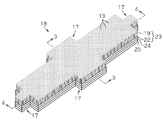
- the brush 18 as a sliding contact member has four insertion portions 17 to be inserted into the insertion ports 16 of the suction tool 11.
- the insertion portion 17 of the brush 18 is provided at a position corresponding to the insertion port 16 of the suction tool 11. For this reason, the brush 18 is attached to the suction tool 11 by inserting the insertion portion 17 of the brush 18 into the insertion port 16 of the suction tool 11.
- the brush 18 has a substantially rectangular plate shape having four side edges. In the center of each side edge of the brush 18, the insertion part 17 is each protruding. The width of the insertion portion 17 provided on the side edge extending in the vertical direction of the brush 18 is wider than that of the insertion portion 17 provided on the side edge extending in the horizontal direction of the brush 18.
- the brush 18 is formed by laminating and welding a velor material 23 made of a pile fabric, a covering layer 24 and a reinforcing layer 25.
- the velor material 23 has a plurality of pile yarns 19 that are in sliding contact with the floor surface F as an object.
- the pile yarn 19 is pile woven so as to be raised on the base fabric 22.
- the covering layer 24 is provided so as to cover the surface of the base fabric 22 opposite to the pile yarn 19.
- the reinforcing layer 25 is welded to the covering layer 24 in order to reinforce the base fabric 22.
- the pile yarn 19 is made of polyamide yarn having excellent resilience and wear resistance.
- the base fabric 22 a plain weave of warp 20 and weft 21 is employed. Polypropylene yarns are used for the warp yarns 20 and the weft yarns 21.
- the covering layer 24 is formed by a coating agent applied to the base fabric 22.
- a coating agent consists of an emulsion which has as a main component polypropylene which is 1 type of a thermoplastic resin material.
- the coating agent penetrates between the warp 20 and the weft 21 of the base fabric 22. Thereby, the base ends of the warp yarn 20, the weft yarn 21, and the pile yarn 19 are firmly held by the coating agent. For this reason, fraying of the warp yarn 20, the weft yarn 21, and the pile yarn 19 is suppressed.
- the reinforcing layer 25 is made of hard polypropylene containing talc.
- the velor material 23 is formed.
- the coating layer 24 is formed.
- the coating layer 24 is formed by applying a coating agent to the surface of the base fabric 22 opposite to the pile yarn 19 and drying it.
- the reinforcing layer 25 is formed on the covering layer 24.
- the reinforcing layer 25 is formed by extruding molten polypropylene containing talc into a strip shape on the coating layer 24 by a well-known T-die method.
- the main component of the covering layer 24 and the warp yarn 20 and the weft yarn 21 constituting the base fabric 22 are both the same polypropylene as the material forming the reinforcing layer 25.
- the reinforcement layer 25, the coating layer 24, and the base fabric 22 are melted and mixed by the heat of the molten polypropylene.
- the molten reinforcing layer 25, coating layer 24, and base fabric 22 are cooled and solidified, they are welded together and integrated.
- the brush 18 shown in FIG. 2 is completed.
- the step of forming the covering layer 24 on the surface of the base fabric 22 opposite to the pile yarn 19 and the step of forming the reinforcing layer 25 on the covering layer 24 are performed continuously, The brush 18 can be manufactured efficiently.
- the brush 18 attached to the suction tool 11 is secured by the reinforcing layer 25. For this reason, it becomes difficult for the brush 18 to fall off the suction tool 11 when the vacuum cleaner is used.
- the suction tool 11 While the vacuum cleaner is in operation, the suction tool 11 is moved on the floor surface F while being reciprocated in the vertical direction. At this time, the air inside the suction port 14 is sucked into the main body (not shown) of the electric vacuum cleaner via the connection pipe 15. Then, dust such as dust, dust, and hair on the floor surface F is sucked into the main body of the vacuum cleaner from the suction port 14 together with air.
- the brush 18 is slid on the floor surface F as the suction tool 11 moves.
- dust at a position protruding from the suction port 14 is captured by the pile yarn 19.
- the dust captured by the pile yarn 19 is sucked into the vacuum cleaner by the suction force of the vacuum cleaner.
- the floor surface F is efficiently cleaned by the electric vacuum cleaner.
- the coating layer 24 of the brush 18 is formed of a material containing polypropylene as a main component.
- the main component forming the covering layer 24 is the same as the material forming the reinforcing layer 25.
- the reinforcing layer 25 can be easily and firmly welded to the coating layer 24. Therefore, the brush 18 can be efficiently manufactured while ensuring the rigidity of the brush 18.
- the velor material 23 of the brush 18 includes a base fabric 22 composed of warps 20 and wefts 21.
- the material of the warp yarn 20 and the weft yarn 21 is made of polypropylene, as is the material contained in the coating layer 24.
- the base fabric 22, the covering layer 24, and the reinforcing layer 25 are melted and mixed by heat generated when the reinforcing layer 25 is welded to the covering layer 24.
- the base fabric 22, the coating layer 24, and the reinforcement layer 25 can be welded easily and firmly.
- the velor material 23 has a plurality of pile yarns 19 that are in sliding contact with the floor surface F.
- the base fabric 22, the covering layer 24, and the reinforcing layer 25 are formed of a material containing polypropylene having a melting point lower than that of polyamide. For this reason, compared with the case where the base fabric 22, the coating layer 24, and the reinforcing layer 25 are made of a material containing polyamide, the base fabric 22, the coating layer 24, and the reinforcing layer 25 can be easily welded to each other.
- the polypropylene forming the reinforcing layer 25 contains talc. For this reason, the rigidity of the reinforcing layer 25 is improved, and the rigidity of the brush 18 is improved. As a result, it is difficult for the brush 18 to fall off the suction tool 11.
- a brush 18 is attached to the bottom surface 12 of the suction tool 11. For this reason, the brush 18 is slid on the floor surface F with the movement of the suction tool 11 when using the vacuum cleaner. Therefore, since the suction tool 11 slides smoothly with respect to the floor surface F, the operation force for moving the suction tool 11 on the floor surface F can be reduced.
- the above embodiment may be modified as follows.
- the pile yarn 19 of the brush 18 may be tilted in one longitudinal direction. That is, the brush 18 may be attached to the suction tool 11 with the pile yarn 19 inclined to the suction port 14. In this case, when the vacuum cleaner is used, the dust at a position protruding from the suction port 14 can be effectively captured by the pile yarn 19.
- the base fabric 22, the covering layer 24, and the reinforcing layer 25 may be formed of a thermoplastic resin material other than polypropylene, specifically, a material containing polyethylene, polystyrene, polyvinyl chloride, polyamide, or the like.
- the base fabric 22, the covering layer 24, and the reinforcing layer 25 are not necessarily formed of the same material. That is, if the base fabric 22, the covering layer 24, and the reinforcing layer 25 are all made of the same type of thermoplastic resin, different derivatives can be included. In this case, the combination of the thermoplastic resins included in the base fabric 22, the covering layer 24, and the reinforcing layer 25 needs to be a combination of materials that have durability when using the brush 18 and can be welded.
- the pile yarn 19 may be formed of a synthetic resin other than polyamide, specifically, polyethylene, polystyrene, polyvinyl chloride, polypropylene or the like.
- the material forming the reinforcing layer 25 may include glass instead of talc, or may include both talc and glass.
- the material of the base fabric 22 may not be a material containing a thermoplastic resin similar to the thermoplastic resin contained in the covering layer 24 or the reinforcing layer 25.
- the brush 18 may be a brush that is in sliding contact with the peripheral surface of the photosensitive drum of the image forming apparatus. That is, the brush 18 may be a charging brush that charges the photosensitive drum, a static elimination brush that removes charges from the charged photosensitive drum, or a cleaning brush that scrapes off toner adhering to the peripheral surface of the photosensitive drum.
- the brush 18 may be a filter cleaning brush provided in a filter cleaning device.
- the pile yarn 19 of the brush 18 is in sliding contact with the surface of a filter such as an air conditioner or a ventilation fan as an object. In this state, by moving the brush 18 along the surface of the filter, dust or the like adhering to the surface of the filter is scraped off and removed by the brush 18.
Landscapes
- Engineering & Computer Science (AREA)
- Mechanical Engineering (AREA)
- Nozzles For Electric Vacuum Cleaners (AREA)
- Brushes (AREA)
Abstract
La présente invention concerne une brosse (18), destinée à coulisser et à se déplacer le long d'une face de sol (F) durant l'utilisation, et qui est pourvue : d'un matériau de type velours (23) dans lequel des fils de velours (19) s'élèvent sur un tissu de base (22), lesdits fils de velours (19) devant coulisser le long de la face de sol (F) ; d'une couche de revêtement (24) qui recouvre la surface du tissu de base (22) en face des fils de velours (19) ; et d'une couche de renfort (25) qui est soudée à la couche de revêtement (24) pour renforcer le tissu de base (22). La couche de revêtement (24) est formée d'un matériau qui contient du polypropylène qui est identique au matériau de la couche de renfort (25).
Priority Applications (2)
| Application Number | Priority Date | Filing Date | Title |
|---|---|---|---|
| JP2012557694A JPWO2012111086A1 (ja) | 2011-02-15 | 2011-02-15 | 摺接部材 |
| PCT/JP2011/053119 WO2012111086A1 (fr) | 2011-02-15 | 2011-02-15 | Élément coulissant |
Applications Claiming Priority (1)
| Application Number | Priority Date | Filing Date | Title |
|---|---|---|---|
| PCT/JP2011/053119 WO2012111086A1 (fr) | 2011-02-15 | 2011-02-15 | Élément coulissant |
Publications (1)
| Publication Number | Publication Date |
|---|---|
| WO2012111086A1 true WO2012111086A1 (fr) | 2012-08-23 |
Family
ID=46672051
Family Applications (1)
| Application Number | Title | Priority Date | Filing Date |
|---|---|---|---|
| PCT/JP2011/053119 Ceased WO2012111086A1 (fr) | 2011-02-15 | 2011-02-15 | Élément coulissant |
Country Status (2)
| Country | Link |
|---|---|
| JP (1) | JPWO2012111086A1 (fr) |
| WO (1) | WO2012111086A1 (fr) |
Citations (3)
| Publication number | Priority date | Publication date | Assignee | Title |
|---|---|---|---|---|
| JPS6286152U (fr) * | 1985-11-20 | 1987-06-02 | ||
| JP2002101954A (ja) * | 2000-09-29 | 2002-04-09 | Matsushita Electric Ind Co Ltd | ブラシ |
| JP2009261806A (ja) * | 2008-04-29 | 2009-11-12 | Kowa Co Ltd | 回転ロータ及び電気掃除機用吸込具 |
-
2011
- 2011-02-15 JP JP2012557694A patent/JPWO2012111086A1/ja active Pending
- 2011-02-15 WO PCT/JP2011/053119 patent/WO2012111086A1/fr not_active Ceased
Patent Citations (3)
| Publication number | Priority date | Publication date | Assignee | Title |
|---|---|---|---|---|
| JPS6286152U (fr) * | 1985-11-20 | 1987-06-02 | ||
| JP2002101954A (ja) * | 2000-09-29 | 2002-04-09 | Matsushita Electric Ind Co Ltd | ブラシ |
| JP2009261806A (ja) * | 2008-04-29 | 2009-11-12 | Kowa Co Ltd | 回転ロータ及び電気掃除機用吸込具 |
Also Published As
| Publication number | Publication date |
|---|---|
| JPWO2012111086A1 (ja) | 2014-07-03 |
Similar Documents
| Publication | Publication Date | Title |
|---|---|---|
| JP6924280B2 (ja) | 二重清掃ローラを備えるロボット掃除機 | |
| US9072420B2 (en) | Cleaning tool | |
| KR101269100B1 (ko) | 청소시트 | |
| JP6058383B2 (ja) | ブラシ及び電気掃除機用の回転ブラシ | |
| JP2004208940A (ja) | 清掃用シート | |
| JP6403153B2 (ja) | 払拭体再生用敷物、集塵装置及び集塵方法 | |
| US20120192371A1 (en) | 3d dusting sheet and method for manufacturing the same | |
| JP5171347B2 (ja) | 清掃用具 | |
| JP5834073B2 (ja) | 摺接部材 | |
| JP6396086B2 (ja) | ブラシ及び回転ブラシ | |
| JP2011041736A (ja) | 清掃シート | |
| JPH09224896A (ja) | 拭き掃除具 | |
| WO2012111086A1 (fr) | Élément coulissant | |
| JP6162528B2 (ja) | ブラシ | |
| JP5566678B2 (ja) | ブラシ | |
| JP2007228990A (ja) | 電気掃除機用の回転ブラシ | |
| CN217137959U (zh) | 适用于可自动更换拖布的清洁机器人的一次性拖布 | |
| JP5657525B2 (ja) | 清掃用具、清掃体 | |
| US20210330152A1 (en) | Brush and rotating brush | |
| JP2016158778A (ja) | ブラシ及び回転ブラシ | |
| JP3801280B2 (ja) | 清掃具 | |
| JP5588431B2 (ja) | 清掃用具、清掃体 | |
| JP5503640B2 (ja) | 清掃用具、清掃体 | |
| JP5722707B2 (ja) | ブラシ | |
| JP2006153445A (ja) | 空気調和機 |
Legal Events
| Date | Code | Title | Description |
|---|---|---|---|
| 121 | Ep: the epo has been informed by wipo that ep was designated in this application |
Ref document number: 11858812 Country of ref document: EP Kind code of ref document: A1 |
|
| ENP | Entry into the national phase |
Ref document number: 2012557694 Country of ref document: JP Kind code of ref document: A |
|
| NENP | Non-entry into the national phase |
Ref country code: DE |
|
| 122 | Ep: pct application non-entry in european phase |
Ref document number: 11858812 Country of ref document: EP Kind code of ref document: A1 |