WO2012114742A1 - Récipient en résine et procédé de fabrication d'un récipient en résine - Google Patents
Récipient en résine et procédé de fabrication d'un récipient en résine Download PDFInfo
- Publication number
- WO2012114742A1 WO2012114742A1 PCT/JP2012/001205 JP2012001205W WO2012114742A1 WO 2012114742 A1 WO2012114742 A1 WO 2012114742A1 JP 2012001205 W JP2012001205 W JP 2012001205W WO 2012114742 A1 WO2012114742 A1 WO 2012114742A1
- Authority
- WO
- WIPO (PCT)
- Prior art keywords
- resin
- resin container
- hollow molded
- molded body
- main body
- Prior art date
- Legal status (The legal status is an assumption and is not a legal conclusion. Google has not performed a legal analysis and makes no representation as to the accuracy of the status listed.)
- Ceased
Links
Images


Classifications
-
- B—PERFORMING OPERATIONS; TRANSPORTING
- B65—CONVEYING; PACKING; STORING; HANDLING THIN OR FILAMENTARY MATERIAL
- B65D—CONTAINERS FOR STORAGE OR TRANSPORT OF ARTICLES OR MATERIALS, e.g. BAGS, BARRELS, BOTTLES, BOXES, CANS, CARTONS, CRATES, DRUMS, JARS, TANKS, HOPPERS, FORWARDING CONTAINERS; ACCESSORIES, CLOSURES, OR FITTINGS THEREFOR; PACKAGING ELEMENTS; PACKAGES
- B65D1/00—Rigid or semi-rigid containers having bodies formed in one piece, e.g. by casting metallic material, by moulding plastics, by blowing vitreous material, by throwing ceramic material, by moulding pulped fibrous material or by deep-drawing operations performed on sheet material
- B65D1/02—Bottles or similar containers with necks or like restricted apertures, designed for pouring contents
- B65D1/0207—Bottles or similar containers with necks or like restricted apertures, designed for pouring contents characterised by material, e.g. composition, physical features
- B65D1/0215—Bottles or similar containers with necks or like restricted apertures, designed for pouring contents characterised by material, e.g. composition, physical features multilayered
-
- B—PERFORMING OPERATIONS; TRANSPORTING
- B65—CONVEYING; PACKING; STORING; HANDLING THIN OR FILAMENTARY MATERIAL
- B65D—CONTAINERS FOR STORAGE OR TRANSPORT OF ARTICLES OR MATERIALS, e.g. BAGS, BARRELS, BOTTLES, BOXES, CANS, CARTONS, CRATES, DRUMS, JARS, TANKS, HOPPERS, FORWARDING CONTAINERS; ACCESSORIES, CLOSURES, OR FITTINGS THEREFOR; PACKAGING ELEMENTS; PACKAGES
- B65D1/00—Rigid or semi-rigid containers having bodies formed in one piece, e.g. by casting metallic material, by moulding plastics, by blowing vitreous material, by throwing ceramic material, by moulding pulped fibrous material or by deep-drawing operations performed on sheet material
-
- B—PERFORMING OPERATIONS; TRANSPORTING
- B29—WORKING OF PLASTICS; WORKING OF SUBSTANCES IN A PLASTIC STATE IN GENERAL
- B29C—SHAPING OR JOINING OF PLASTICS; SHAPING OF MATERIAL IN A PLASTIC STATE, NOT OTHERWISE PROVIDED FOR; AFTER-TREATMENT OF THE SHAPED PRODUCTS, e.g. REPAIRING
- B29C45/00—Injection moulding, i.e. forcing the required volume of moulding material through a nozzle into a closed mould; Apparatus therefor
- B29C45/14—Injection moulding, i.e. forcing the required volume of moulding material through a nozzle into a closed mould; Apparatus therefor incorporating preformed parts or layers, e.g. injection moulding around inserts or for coating articles
-
- B—PERFORMING OPERATIONS; TRANSPORTING
- B29—WORKING OF PLASTICS; WORKING OF SUBSTANCES IN A PLASTIC STATE IN GENERAL
- B29C—SHAPING OR JOINING OF PLASTICS; SHAPING OF MATERIAL IN A PLASTIC STATE, NOT OTHERWISE PROVIDED FOR; AFTER-TREATMENT OF THE SHAPED PRODUCTS, e.g. REPAIRING
- B29C49/00—Blow-moulding, i.e. blowing a preform or parison to a desired shape within a mould; Apparatus therefor
- B29C49/02—Combined blow-moulding and manufacture of the preform or the parison
- B29C49/06—Injection blow-moulding
-
- B—PERFORMING OPERATIONS; TRANSPORTING
- B29—WORKING OF PLASTICS; WORKING OF SUBSTANCES IN A PLASTIC STATE IN GENERAL
- B29C—SHAPING OR JOINING OF PLASTICS; SHAPING OF MATERIAL IN A PLASTIC STATE, NOT OTHERWISE PROVIDED FOR; AFTER-TREATMENT OF THE SHAPED PRODUCTS, e.g. REPAIRING
- B29C69/00—Combinations of shaping techniques not provided for in a single one of main groups B29C39/00 - B29C67/00, e.g. associations of moulding and joining techniques; Apparatus therefore
-
- B—PERFORMING OPERATIONS; TRANSPORTING
- B29—WORKING OF PLASTICS; WORKING OF SUBSTANCES IN A PLASTIC STATE IN GENERAL
- B29D—PRODUCING PARTICULAR ARTICLES FROM PLASTICS OR FROM SUBSTANCES IN A PLASTIC STATE
- B29D22/00—Producing hollow articles
- B29D22/003—Containers for packaging, storing or transporting, e.g. bottles, jars, cans, barrels, tanks
-
- B—PERFORMING OPERATIONS; TRANSPORTING
- B65—CONVEYING; PACKING; STORING; HANDLING THIN OR FILAMENTARY MATERIAL
- B65D—CONTAINERS FOR STORAGE OR TRANSPORT OF ARTICLES OR MATERIALS, e.g. BAGS, BARRELS, BOTTLES, BOXES, CANS, CARTONS, CRATES, DRUMS, JARS, TANKS, HOPPERS, FORWARDING CONTAINERS; ACCESSORIES, CLOSURES, OR FITTINGS THEREFOR; PACKAGING ELEMENTS; PACKAGES
- B65D1/00—Rigid or semi-rigid containers having bodies formed in one piece, e.g. by casting metallic material, by moulding plastics, by blowing vitreous material, by throwing ceramic material, by moulding pulped fibrous material or by deep-drawing operations performed on sheet material
- B65D1/02—Bottles or similar containers with necks or like restricted apertures, designed for pouring contents
- B65D1/0207—Bottles or similar containers with necks or like restricted apertures, designed for pouring contents characterised by material, e.g. composition, physical features
-
- B—PERFORMING OPERATIONS; TRANSPORTING
- B65—CONVEYING; PACKING; STORING; HANDLING THIN OR FILAMENTARY MATERIAL
- B65D—CONTAINERS FOR STORAGE OR TRANSPORT OF ARTICLES OR MATERIALS, e.g. BAGS, BARRELS, BOTTLES, BOXES, CANS, CARTONS, CRATES, DRUMS, JARS, TANKS, HOPPERS, FORWARDING CONTAINERS; ACCESSORIES, CLOSURES, OR FITTINGS THEREFOR; PACKAGING ELEMENTS; PACKAGES
- B65D23/00—Details of bottles or jars not otherwise provided for
- B65D23/02—Linings or internal coatings
-
- B—PERFORMING OPERATIONS; TRANSPORTING
- B29—WORKING OF PLASTICS; WORKING OF SUBSTANCES IN A PLASTIC STATE IN GENERAL
- B29C—SHAPING OR JOINING OF PLASTICS; SHAPING OF MATERIAL IN A PLASTIC STATE, NOT OTHERWISE PROVIDED FOR; AFTER-TREATMENT OF THE SHAPED PRODUCTS, e.g. REPAIRING
- B29C45/00—Injection moulding, i.e. forcing the required volume of moulding material through a nozzle into a closed mould; Apparatus therefor
- B29C45/16—Making multilayered or multicoloured articles
- B29C2045/1601—Making multilayered or multicoloured articles the injected materials not being adhered or bonded to each other
-
- B—PERFORMING OPERATIONS; TRANSPORTING
- B29—WORKING OF PLASTICS; WORKING OF SUBSTANCES IN A PLASTIC STATE IN GENERAL
- B29C—SHAPING OR JOINING OF PLASTICS; SHAPING OF MATERIAL IN A PLASTIC STATE, NOT OTHERWISE PROVIDED FOR; AFTER-TREATMENT OF THE SHAPED PRODUCTS, e.g. REPAIRING
- B29C49/00—Blow-moulding, i.e. blowing a preform or parison to a desired shape within a mould; Apparatus therefor
- B29C49/02—Combined blow-moulding and manufacture of the preform or the parison
- B29C2049/023—Combined blow-moulding and manufacture of the preform or the parison using inherent heat of the preform, i.e. 1 step blow moulding
-
- B—PERFORMING OPERATIONS; TRANSPORTING
- B29—WORKING OF PLASTICS; WORKING OF SUBSTANCES IN A PLASTIC STATE IN GENERAL
- B29C—SHAPING OR JOINING OF PLASTICS; SHAPING OF MATERIAL IN A PLASTIC STATE, NOT OTHERWISE PROVIDED FOR; AFTER-TREATMENT OF THE SHAPED PRODUCTS, e.g. REPAIRING
- B29C49/00—Blow-moulding, i.e. blowing a preform or parison to a desired shape within a mould; Apparatus therefor
- B29C49/42—Component parts, details or accessories; Auxiliary operations
- B29C49/48—Moulds
- B29C2049/4879—Moulds characterised by mould configurations
- B29C2049/4887—Mould halves consisting of an independent neck and main part
-
- B—PERFORMING OPERATIONS; TRANSPORTING
- B29—WORKING OF PLASTICS; WORKING OF SUBSTANCES IN A PLASTIC STATE IN GENERAL
- B29C—SHAPING OR JOINING OF PLASTICS; SHAPING OF MATERIAL IN A PLASTIC STATE, NOT OTHERWISE PROVIDED FOR; AFTER-TREATMENT OF THE SHAPED PRODUCTS, e.g. REPAIRING
- B29C49/00—Blow-moulding, i.e. blowing a preform or parison to a desired shape within a mould; Apparatus therefor
- B29C49/42—Component parts, details or accessories; Auxiliary operations
- B29C49/58—Blowing means
- B29C2049/5806—Means for fixing the blowing means with the mould
-
- B—PERFORMING OPERATIONS; TRANSPORTING
- B29—WORKING OF PLASTICS; WORKING OF SUBSTANCES IN A PLASTIC STATE IN GENERAL
- B29C—SHAPING OR JOINING OF PLASTICS; SHAPING OF MATERIAL IN A PLASTIC STATE, NOT OTHERWISE PROVIDED FOR; AFTER-TREATMENT OF THE SHAPED PRODUCTS, e.g. REPAIRING
- B29C45/00—Injection moulding, i.e. forcing the required volume of moulding material through a nozzle into a closed mould; Apparatus therefor
- B29C45/16—Making multilayered or multicoloured articles
-
- B—PERFORMING OPERATIONS; TRANSPORTING
- B29—WORKING OF PLASTICS; WORKING OF SUBSTANCES IN A PLASTIC STATE IN GENERAL
- B29K—INDEXING SCHEME ASSOCIATED WITH SUBCLASSES B29B, B29C OR B29D, RELATING TO MOULDING MATERIALS OR TO MATERIALS FOR MOULDS, REINFORCEMENTS, FILLERS OR PREFORMED PARTS, e.g. INSERTS
- B29K2995/00—Properties of moulding materials, reinforcements, fillers, preformed parts or moulds
- B29K2995/0018—Properties of moulding materials, reinforcements, fillers, preformed parts or moulds having particular optical properties, e.g. fluorescent or phosphorescent
- B29K2995/0026—Transparent
-
- B—PERFORMING OPERATIONS; TRANSPORTING
- B29—WORKING OF PLASTICS; WORKING OF SUBSTANCES IN A PLASTIC STATE IN GENERAL
- B29L—INDEXING SCHEME ASSOCIATED WITH SUBCLASS B29C, RELATING TO PARTICULAR ARTICLES
- B29L2031/00—Other particular articles
- B29L2031/712—Containers; Packaging elements or accessories, Packages
- B29L2031/7158—Bottles
-
- B—PERFORMING OPERATIONS; TRANSPORTING
- B65—CONVEYING; PACKING; STORING; HANDLING THIN OR FILAMENTARY MATERIAL
- B65D—CONTAINERS FOR STORAGE OR TRANSPORT OF ARTICLES OR MATERIALS, e.g. BAGS, BARRELS, BOTTLES, BOXES, CANS, CARTONS, CRATES, DRUMS, JARS, TANKS, HOPPERS, FORWARDING CONTAINERS; ACCESSORIES, CLOSURES, OR FITTINGS THEREFOR; PACKAGING ELEMENTS; PACKAGES
- B65D2565/00—Wrappers or flexible covers; Packaging materials of special type or form
- B65D2565/38—Packaging materials of special type or form
- B65D2565/381—Details of packaging materials of special type or form
- B65D2565/385—Details of packaging materials of special type or form especially suited for or with means facilitating recycling
Definitions
- the present invention relates to a resin container and a method for manufacturing the resin container.
- a resin container As a container for storing a liquid material having fluidity such as lotion, chemicals or beverages, a resin container has been proposed in which a molten resin is injected outside a resin hollow molded body to mold a resin sheathing body.
- Patent Document 1 Japanese Utility Model Publication No. 52-159860 describes a synthetic resin double container. This container is formed by injection-molding an outer surface layer made of a highly transparent material such as polyester or AS resin (Acrylonitrile Stylene Co-Polymer) on the outer surface of a polypropylene inner casing.
- AS resin Adroylonitrile Stylene Co-Polymer
- a hollow molded body made of a first resin material having a mouth and neck part and a bottomed cylindrical body part, and a resin exterior made of a second resin material and embedded in the body part in a non-fixed manner.
- a resin container characterized in that a frosted portion subjected to a frost treatment is formed on at least a part of the main body.
- the main body of the hollow molded body is embedded in the resin sheathing body in a non-fixed manner.
- the resin exterior body can be separated from the hollow molded body without force, and the separated resin exterior body can be easily recycled.
- a resin container that can be separated and recycled can be provided.
- a resin container that can be separated and recycled can be provided.
- FIG. 1A is a cross-sectional view showing the entire resin container.
- FIG. 1B is an enlarged view of a portion A in FIG. 1A.
- FIG. 2A is a cross-sectional view showing a process of housing the hollow molded body in the mold.
- FIG. 2B is a cross-sectional view showing a state where the hollow molded body is accommodated in the mold. It is sectional drawing which shows the process of inject
- FIG. 1A and 1B are diagrams illustrating a configuration of a resin container 100 according to the first embodiment.
- FIG. 1A is a cross-sectional view showing the entire resin container 100.
- FIG. 1B is an enlarged cross-sectional view of part A of FIG. 1A.
- the resin container 100 includes a hollow molded body 10 and a resin sheathing body 30.
- the hollow molded body 10 has a mouth-and-neck portion 20 and a bottomed cylindrical main body portion 12 and is made of a first resin material.
- the resin sheathing body 30 is made of a second resin material.
- the main body 12 of the hollow molded body 10 is embedded in a non-fixed manner. At least a part of the main body portion 12 of the hollow molded body 10 is formed with a frost treatment portion 122 subjected to a frost treatment. Details will be described below.
- the resin container 100 includes a hollow molded body 10, a resin sheathing body 30, and a cap portion 40.
- the hollow molded body 10 has a bottomed cylindrical main body portion 12 and a mouth-and-neck portion 20. Contents can be accommodated in the main body portion 12 and the mouth and neck portion 20 of the hollow molded body 10.
- the contents are not particularly limited, and may be liquid, gas, or solid, for example, cosmetics, drugs, or beverages. That is, the resin container 100 of this embodiment can be exemplified by a cosmetic container that is used by housing cosmetics inside the hollow molded body 10.
- the cosmetics to be accommodated include liquid basic cosmetics such as skin lotion and cosmetic liquid, and liquid makeup cosmetics such as liquid foundation.
- the cosmetics being liquid means having fluidity, and includes low-viscosity liquids as well as high-viscosity suspensions and pastes.
- the mouth-and-neck part 20 is formed in a cylindrical shape having a smaller diameter than the main body part 12, for example.
- the cap part 40 is attached to the mouth / neck part 20 to seal the hollow molded body 10.
- the hollow molded body 10 is formed of a material having chemical resistance.
- the first resin material of the hollow molded body 10 include polyolefin resins such as polyethylene or polypropylene; polyethylene terephthalate (PET), amorphous polyethylene terephthalate (PETG), polytrimethylene terephthalate (PTT), polybutylene terephthalate ( PBT), polycyclohexane dimethyl terephthalate (PCT), copolymer of PET and PCT (PCTG), copolymer of PCT and polycyclohexanedimethylene isophthalate (PCTA) or polyethylene naphthalate (PEN), etc.
- PET polyethylene terephthalate
- PETG polytrimethylene terephthalate
- PBT polybutylene terephthalate
- PCT polycyclohexane dimethyl terephthalate
- PCTA copolymer of PET and PCT
- PCTA polycyclohexanedimethylene isophthalate
- Polyester Acrylic resin; Styrenic resin such as styrene / acrylonitrile copolymer resin or styrene / methyl methacrylate copolymer resin; Cycloolefin polymer; Polycarbonate DOO, polyamides; ionomer resins; polyacrylonitrile (PAN); can be used or polyoxymethylene (POM); ethylene vinyl alcohol copolymers (EVOH).
- Styrenic resin such as styrene / acrylonitrile copolymer resin or styrene / methyl methacrylate copolymer resin
- Cycloolefin polymer Polycarbonate DOO, polyamides; ionomer resins; polyacrylonitrile (PAN); can be used or polyoxymethylene (POM); ethylene vinyl alcohol copolymers (EVOH).
- the hollow molded body 10 may be made of the same first resin material as a whole, or may be made of a different resin material for each part. That is, the first resin material may be a single type of resin material or may conceptually include a plurality of types of resin materials.
- the first resin material is preferably a polyolefin-based resin, and more preferably polyethylene or polypropylene from the viewpoint of good chemical resistance. From the viewpoint of relatively high melting temperature, polyester and polyamide are preferred. This is because the resin outer package 30 is formed by overmolding a high-temperature molten resin on the outer surface of the hollow molded product 10 set in the mold. By using the same material as the resin exterior body 30 described below, a synergistic effect with the resin exterior body 30 can be obtained, and the high-quality feeling, aesthetics, and aesthetics of the resin container 100 can be enhanced.
- the surface of the main body 12 is provided with a frost processing section 122 that has been subjected to frost processing.
- the frost processing unit 122 refers to an area that is frosted in the main body unit 12.
- the “frosting process” refers to a process of forming minute irregularities on the surface of a substrate such as a resin so that visible light is scattered.
- the frost processing unit 122 may extend over the entire main body 12 or may be a part of the main body 12.
- the surface of the frost processing unit 122 has a surface roughness Ra of 0.4 ⁇ m or more and 1.2 ⁇ m or less, for example.
- the surface roughness Ra can be measured based on JIS B 0601: 2001.
- the frosting process can be a mechanical frosting process such as a blasting process or a sanding process for a part or all of the main body 12, or a chemical frosting process using a processing solution such as an acid. .
- the frost processing unit 122 may be formed by forming a texture on the inner surface of a mold used for blow molding of the main body 12 and transferring the texture to the outer surface of the main body 12.
- fine unevenness can be formed on the surface of the main body portion 12 by multi-layer blow molding of a plurality of polyolefins whose melt index and swell ratio change rate are adjusted to a predetermined value to give a frost feeling to the whole (Patent Document 2). 3).
- the main body 12 of the hollow molded body 10 is embedded in the resin sheathing body 30 in a non-fixed manner. As will be described later, such a form can be obtained by overmolding the resin sheathing body 30 outside the main body portion 12 of the hollow molded body 10.
- non-adhesion means that when the resin outer package 30 is broken as necessary and the main body 12 of the hollow molded body 10 is exposed, it can be separated by hand without using a special instrument. State. Even if there is a portion where a part of the hollow molded body 10 is fixed to the resin sheathing body 30, it includes a state in which it can be easily separated substantially as a whole. Furthermore, in a state where the hollow molded body 10 is exposed, a state where the hollow molded body 10 is peeled off by its own weight or a state where it can be removed without applying force is preferable.
- “embedding” refers to a state in which the entire body 12 including the shoulder 14 is protected by the resin sheathing 30 in the hollow molded body 10. However, an opening (not shown) smaller than the mouth-and-neck part 20 and the main body part 12 may be exposed to the extent that the hollow molded body 10 does not fall off.
- the resin outer package 30 is made of a second resin material.
- the second resin material may be the same material as the first resin material, or may be a different material.
- a material having excellent chemical resistance may be selected as the first resin material of the hollow molded body 10, and a different material having excellent physical strength such as scratch resistance may be selected as the second resin material of the resin outer package 30.
- the second resin material is preferably a recyclable material having visible light permeability, shape stability, excellent physical strength, and the like.
- Polyolefin resin such as polypropylene; ionomer resin; acrylic resin; polyester resin; styrene / acrylonitrile copolymer resin, styrene / methyl methacrylate copolymer resin or acrylonitrile / butadiene / styrene copolymer resin
- Styrenic resins such as (ABS); polycarbonate; polyurethane; or polyvinyl chloride resin
- ionomer resin or polyester resin more preferably polyester resin can be used.
- polyester resin examples include polyethylene terephthalate (PET), amorphous polyethylene terephthalate (PETG), polycyclohexane dimethyl terephthalate (PCT), a copolymer of PET and PCT (PCTG), and PCT.
- a copolymer (PCTA) with polycyclohexanedimethylene isophthalate is preferred.
- the resin outer package 30 is formed of a material having visible light permeability, the frosted portion 122 of the hollow molded body 10 can be visually recognized through the resin outer package 30. Thereby, a high-class feeling can be brought out. Further, since the resin sheathing body 30 is formed of a recyclable material, only the resin sheathing body 30 that is not in contact with chemicals or the like can be separated and recycled.
- the resin container 100 has a gap V between the surface of the frosted main body 12 (frosting part 122) and the resin sheathing body 30.
- the resin outer package 30 is not fixed to the hollow molded body 10 at least in the frost processing section 122.
- the “void” may be a space between at least a part of the surface of the frosted main body 12 and the resin outer package 30.
- the space V may exist between the entire outer surface of the main body 12 of the hollow molded body 10 and the resin sheathing body 30, or may exist only in a part thereof.
- the hollow molded body 10 and the resin sheathing body 30 have correspondingly shaped irregularities formed on both sides facing each other with the gap V therebetween.
- irregularities having shapes corresponding to each other are formed on the surface of the frost processing unit 122 and the inner surface of the resin outer package 30 facing the surface.
- the “corresponding shape” means a state in which a convex portion (or concave portion) is formed at a position facing the concave portion (or convex portion) on the other side.
- the positions and depths of the tops of the concaves and convexes on both sides may be the same as or different from each other.
- the convex part formed in the surface of the main-body part 12 of the hollow molded object 10 is formed in the part of the opposing position a of FIG. 1B.
- a concave portion formed in the main body portion 12 of the hollow molded body 10 and shallower than the height of the convex portion is formed at a corresponding position on the inner surface of the resin sheathing body 30.
- the recessed part formed in the surface of the main-body part 12 of the hollow molded object 10 is formed in the part of the opposing position b of FIG. 1B.
- a convex portion that is formed on the main body portion 12 of the hollow molded body 10 and is lower than the depth of the concave portion is formed.
- the unevenness formed on the inner surface of the resin sheathing body 30 is smaller than the unevenness formed on the surface of the frosted portion 122.
- the small unevenness means that the average value of the depth of the back part of the concave part and the height of the top part of the convex part is small.
- corrugation may fit and airtightly adhere
- the void V is surely interposed at the interface between the hollow molded body 10 and the resin outer package 30 so that the non-fixed state is maintained.
- the hollow molded body 10 and the resin outer package 30 are formed by frost processing of the surface of the hollow molded body 10 as another effect due to the formation of irregularities corresponding to each other on both surfaces facing each other across the gap V. That is, light scattering can be clearly seen from the outside of the resin outer package. For this reason, a high-quality frosted glass pattern hollow molded body can be confirmed from the outside of the resin container, and the design and design can be improved. Since the size of the unevenness formed in the hollow molded body 10 and the resin outer package 30 is different from each other, a gap V is surely interposed at the interface between the hollow molded body 10 and the resin outer package 30 and visible light is visible. Scatter well. For this reason, the designability and designability like frosted glass can be realized with high yield.
- the shape of the hollow molded body 10 is not particularly limited, but in the present embodiment, a bottle shape having a shoulder portion 14 that expands from the mouth-and-neck portion 20 to the main body portion 12 is exemplified.
- the shoulder portion 14 of this embodiment is not orthogonal to the axial direction of the mouth-and-neck portion 20, but is inclined obliquely. Smoothly continuous from the mouth and neck 20 to the shoulder 14 and from the shoulder 14 to the main body 12. Accordingly, the hollow molded body 10 of the present embodiment has a shoulder bottle shape.
- the frost processing part 122 is formed at least on the surface of the shoulder part.
- the resin sheathing body 30 is vertically cut in two along the axial center of the mouth-and-neck portion 20.
- the mouth / neck portion 20 is grasped by hand, and the main body portion 12 is raised from the resin outer body 30 and peeled off.
- the bottom portion 16 serves as a fulcrum
- the shoulder portion 14 that is the bending point of the resin container 100 serves as an action point. Since the shoulder portion 14 serving as the action point is frosted, the resin sheathing body 30 can be separated from the hollow molded body 10 without force.
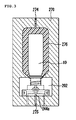
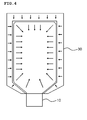
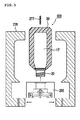
- FIGS. 2A to 5 are cross-sectional views showing a method of manufacturing a resin container according to the first embodiment.
- This manufacturing method includes a holding step and an overmolding step.
- the holding step the mouth neck portion 20 of the hollow molded body 10 made of the first resin material is locked and held in the mold 270.
- the hollow molded body 10 has the mouth-and-neck portion 20 and the bottomed cylindrical main body portion 12, and at least a part of the main body portion 12 is formed with a frost processing portion 122 that has been frosted.
- a fluid is filled into the hollow interior of the hollow molded body 10 from the neck and neck portion 20 to apply an internal pressure exceeding the atmospheric pressure.
- the resin exterior body 30 is molded by filling the molten resin 276 of the second resin material between the outside of the main body 12 and the mold 270.
- the resin outer package 30 and the main body 12 are not fixed due to thermal shrinkage of the hollow molded body 10. Details will be described below.
- a hollow molded body 10 having a bottomed cylindrical main body portion 12 and a mouth-and-neck portion 20 and made of a first resin material such as polyolefin is prepared.
- a frost treatment portion 122 that has been subjected to a frost treatment in advance is formed on the surface of the main body portion 12 of the hollow molded body 10.
- the mouth neck portion 20 of the hollow molded body 10 faces vertically downward, and the mouth neck portion 20 of the hollow molded body 10 is locked to the mouth mold 202. Thereby, the hollow molded body 10 is held in the mold 270.
- the mouth part mold 202 is provided with flow paths 244a, 244b, 244c and a conduit 275 for flowing fluid.
- the split molds 271 and 272 are opposed and combined with each other.
- the cavity 273 is formed inside the mold 270 and the main body 12 of the hollow molded body 10 is accommodated.
- a resin inflow passage 274 for supplying the molten resin 276 is provided on the upper portion of the cavity 273 of the mold 270 so as to communicate with the outside.
- the molten resin 276 is filled into the cavity 273 between the outside of the main body 12 and the mold 270 through the resin inflow passage 274 (overmolding process).
- the second resin material (molten resin 276) is, for example, a polyester resin.
- the resin material (molten resin 276) of the resin outer package 30 is preferably a material having a faster solidification rate than the polyolefin resin material (first resin material) of the hollow molded body 10.
- the method for comparing the solidification rates of the second resin material and the first resin material is not particularly limited. Generally, a resin material having a high freezing point has a high solidification rate. Therefore, the second resin material and the first resin are based on the level of the freezing point. The solidification rate with the material may be compared. That is, the second resin material is preferably a material having a higher freezing point than the first resin material.
- the molten resin 276 flowing into the cavity 273 is filled into the cavity 273 while pressing the hollow molded body 10 in the direction of gravity.
- a fluid is supplied into the hollow molded body 10 through the pipe 275 and the flow path 244a provided in the mouth mold 202.
- the hollow molded body 10 is filled with fluid from the neck 20 and an internal pressure exceeding the atmospheric pressure is applied.
- the fluid may be a gas or a liquid, and the material is not limited.
- the fluid is, for example, pressurized air.
- the atmospheric pressure is, for example, atmospheric pressure.
- the molten resin 276 is filled so as to follow the unevenness formed on the surface of the frost treatment part 122 of the thermally expanded hollow molded body 10.
- the molten resin 276, which is polyester has poor wettability with respect to the hollow hollow molded body 10 made of polyolefin, and does not easily enter the minute unevenness of the frosted portion 122.
- the inner surface of the molten resin 276 facing the frost processing section 122 does not have a shape that completely matches the surface of the frost processing section 122 but is cured and aggregated. Thereby, unevenness smaller than the surface of the frost processing part 122 is formed.
- the molten resin 276 that becomes the resin sheathing body 30 starts to be cured by cooling the mold 270 to be equal to or lower than the freezing point of the polyester.
- the curing of the molten resin 276 here means that at least the inner side where the molten resin 276 is in contact with the hollow molded body 10 is cured. Therefore, at this time, the entire molten resin 276 may not be cured. Thereafter, the hollow molded body 10 is thermally contracted.
- “after that” includes the case where the hollow molded body 10 is thermally contracted simultaneously with the curing of the molten resin 276. Further, the heat shrinkage of the hollow molded body 10 may start from the time when the molten resin 276 is uncured.
- Polyester resin materials generally have a faster solidification rate and slower crystallization rates than polyolefin resin materials.
- the second resin material (molten resin 276) of the present embodiment a material having a higher freezing point and a slower crystallization rate than the first resin material of the hollow molded body 10 can be selected.
- the resin sheathing body 30 is solidified before the hollow molded body 10, but the resin sheathing body 30 is not easily crystallized or is not crystallized, so that the thickness dimension is not easily contracted.
- the first resin material of the hollow molded body 10 whose outer surface is warmed by the molten resin 276 at the time of overmolding, the outer surface is crystallized and the thickness dimension shrinks.
- produces between the hollow molded object 10 and the resin exterior body 30, and both peel finely.
- the resin outer package 30 does not follow the thermal shrinkage of the hollow molded body 10 because the resin outer package 30 has already been solidified.
- the adhesiveness in the frost processing part 122 is reduced due to the quantitative and temporal differences in shrinkage deformation between the resin outer package 30 (molten resin 276) and the hollow molded body 10.
- polyester resins have poor wettability with polyolefins. By synergistically exhibiting these actions, the molten resin 276 to be the resin outer package 30 and the hollow molded body 10 can be made non-fixed.
- the molten resin 276 is cured to form the resin outer package 30.
- the mold 270 is removed, and the runner 277 formed in the resin inflow passage 274 is cut. In this way, the resin container 100 according to the first embodiment is obtained.
- the resin outer package 30 is in sliding contact with the hollow molded body 10.
- Sliding contact means contacting in a slidable manner.
- the hollow molded body 10 can be separated from the resin outer package 30 without substantially applying external force. That means. Specifically, it is preferable that this can be separated from the resin sheathing body 30 by its own weight.
- the main body 12 of the hollow molded body 10 is embedded in the resin sheathing body 30 in a non-fixed manner.
- the resin exterior body 30 can be separated from the hollow molded body 10 without force.
- the resin outer package 30 is made of polyester, it can be recycled after separation. As described above, the resin container 100 that can be separated and recycled can be provided.
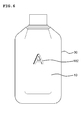
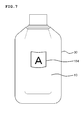
- FIG. 6 is a cross-sectional view showing the configuration of the resin container 100 according to the second embodiment.
- the second embodiment is different from the first embodiment except that the surface of the frost processing unit 122 is provided with characters or figures printed, stamped or stamped between the main body 12 and the resin sheathing body 30. This is the same as the embodiment. Details will be described below.
- the resin container 100 includes a character or a figure printed, stamped, or stamped on the surface of the frost processing unit 122 between the main body 12 and the resin exterior body 30. It has.
- a stamp character 182 “A” is formed on the surface of the frost processing unit 122.
- the stamp character 182 may be on the surface of the frost processing unit 122, and the position thereof is not limited.
- the manufacturing method of the resin container 100 which concerns on 2nd Embodiment is except the point which performs an overmolding process in the state which printed or stamped or stamped the character or the figure on the surface of the frost process part 122. This is the same as in the first embodiment.
- the same effect as that of the first embodiment can be obtained. Furthermore, the surface of the frost process part 122 can be provided with the character or figure printed, stamped or stamped. Thereby, even if it passes through the transparent resin exterior body 30, visibility can be raised by having a character or a figure on the surface of the frost process part 122. FIG.
- the total light transmittance of the resin material of the resin outer package 30 can be 80% or more. Thereby, a hologram-like visual effect is exhibited such that printing or the like applied to the surface of the hollow molded body 10 is clearly lifted through the resin outer package 30.
- the thickness of the resin outer package 30 is not particularly limited, but can be 1 mm or more and 10 mm or less. As a result, the above-mentioned hologram-like visual effect is remarkably exhibited.
- the frost treatment unit 122 is formed simultaneously with the injection molding of the resin outer package 30, there is a possibility that characters or figures disappear due to the injection molding or it cannot be molded into a desired shape.
- printing, stamping or stamping is performed in advance before the overmolding process. Thereby, even if it is the frost process part 122, a character or a figure does not disappear.
- the frost treatment is performed, even a polyolefin that is difficult to process such as printing can be processed relatively easily.
- FIG. 7 is a cross-sectional view illustrating a configuration of a resin container 100 according to the third embodiment.
- the third embodiment is the same as the first embodiment except that a film or a cloth is provided between the main body portion 12 and the resin sheathing body 30. Details will be described below.
- the resin container 100 includes a film or cloth between the main body 12 of the hollow molded body 10 and the resin exterior body 30.
- a film 184 is provided in a region including at least a part of the frost processing unit 122 between the main body 12 and the resin sheathing body 30. Furthermore, it is preferable that the entire film 184 is in contact with the frost processing unit 122.
- the film 184 Since the film 184 is heated by the molten resin 276 in the overmolding process, the film 184 preferably has heat resistance at about the temperature of the molten resin 276. Specifically, the melting point of the film 184 is preferably 200 ° C. or higher, for example.
- the film 184 On the film 184, characters or figures are printed. For example, the letter “A” is printed on the surface of the film 184.
- An adhesive is applied to the side of the film 184 attached to the main body 12. Thereby, the film 184 can be easily bonded to the surface of the hollow molded body 10.
- the manufacturing method of the resin container 100 according to the third embodiment is the same as that of the first embodiment except that an overmolding process is performed in a state where a film or cloth is attached to the surface of the main body 12. .
- a film 184 is previously applied to an area including at least a part of the frost processing part 122 on the surface of the main body part 12. Thereby, in the overmolding process, the molten resin 276 is formed with irregularities corresponding to the shape of the film 184.
- a film or cloth can be provided between the main body portion 12 of the hollow molded body 10 and the resin sheathing body 30.
- the resin exterior body 30 is transparent, it can visually recognize a film or cloth favorably. If characters or figures are printed on a film or cloth, the beauty can be easily produced.
- a film 184 is provided in a region including at least a part of the frost processing portion 122 between the main body portion 12 and the resin sheathing body 30. Thereby, a film or cloth can be easily peeled from the hollow molded body 10 at the time of recycling.
- a resin container made of polyester (2) The resin container according to (1), wherein a gap is provided between the frosted surface and the resin outer package. (3) The resin container according to the above (2), wherein corresponding concavities and convexities are formed on both surfaces facing each other across the gap.
- the inner surface of the resin outer package facing the frost-treated portion has unevenness smaller than the surface of the frost-treated portion.
- the overmolding step is performed in a state where characters or figures are printed, stamped, or stamped on the surface of the frost-treated portion.
- the manufacturing method of the resin container to perform.
Landscapes
- Engineering & Computer Science (AREA)
- Mechanical Engineering (AREA)
- Ceramic Engineering (AREA)
- Manufacturing & Machinery (AREA)
- Details Of Rigid Or Semi-Rigid Containers (AREA)
- Blow-Moulding Or Thermoforming Of Plastics Or The Like (AREA)
- Containers Having Bodies Formed In One Piece (AREA)
- Laminated Bodies (AREA)
- Casting Or Compression Moulding Of Plastics Or The Like (AREA)
Abstract
Priority Applications (4)
| Application Number | Priority Date | Filing Date | Title |
|---|---|---|---|
| US13/984,138 US20130313217A1 (en) | 2011-02-23 | 2012-02-22 | Resin container and resin container manufacturing method |
| KR1020137023319A KR20130103634A (ko) | 2011-02-23 | 2012-02-22 | 수지용기 및 수지용기의 제조방법 |
| JP2012548280A JP5160701B2 (ja) | 2011-02-23 | 2012-02-22 | 樹脂容器及び樹脂容器の製造方法 |
| CN201280010428.3A CN103402738B (zh) | 2011-02-23 | 2012-02-22 | 树脂容器及树脂容器的制造方法 |
Applications Claiming Priority (2)
| Application Number | Priority Date | Filing Date | Title |
|---|---|---|---|
| JP2011-037635 | 2011-02-23 | ||
| JP2011037635 | 2011-02-23 |
Publications (1)
| Publication Number | Publication Date |
|---|---|
| WO2012114742A1 true WO2012114742A1 (fr) | 2012-08-30 |
Family
ID=46720534
Family Applications (1)
| Application Number | Title | Priority Date | Filing Date |
|---|---|---|---|
| PCT/JP2012/001205 Ceased WO2012114742A1 (fr) | 2011-02-23 | 2012-02-22 | Récipient en résine et procédé de fabrication d'un récipient en résine |
Country Status (5)
| Country | Link |
|---|---|
| US (1) | US20130313217A1 (fr) |
| JP (1) | JP5160701B2 (fr) |
| KR (1) | KR20130103634A (fr) |
| CN (1) | CN103402738B (fr) |
| WO (1) | WO2012114742A1 (fr) |
Cited By (3)
| Publication number | Priority date | Publication date | Assignee | Title |
|---|---|---|---|---|
| JP2014240288A (ja) * | 2013-06-12 | 2014-12-25 | ▲徳▼晉(香港)控股有限公司 | 多層構造を有するびん及びその製造工程 |
| JP2016501143A (ja) * | 2012-11-13 | 2016-01-18 | ハイネケン サプライ チェーン ベー.フェー.Heineken Supply Chain B.V. | 容器、プリフォームアセンブリ及び容器を形成するための方法及び装置 |
| JP2019069808A (ja) * | 2017-10-11 | 2019-05-09 | 大日本印刷株式会社 | 複合容器およびこの製造方法、ならびに複合容器の製造方法に用いる金型 |
Families Citing this family (20)
| Publication number | Priority date | Publication date | Assignee | Title |
|---|---|---|---|---|
| EP2801281B1 (fr) | 2013-05-07 | 2016-07-27 | The Procter and Gamble Company | Produit de soins de beauté |
| US9630747B2 (en) * | 2015-05-01 | 2017-04-25 | William Thomas SMITH | Container for providing aromatic sampling and visualization of contents |
| US10384834B2 (en) | 2015-05-01 | 2019-08-20 | William Thomas SMITH | Container for providing aromatic sampling and visualization of contents |
| USD1103478S1 (en) | 2017-06-16 | 2025-11-25 | All Plastic, Inc. | Display jar |
| USD839476S1 (en) | 2017-06-16 | 2019-01-29 | Sam Whetsel | Display jar |
| CA3076881A1 (fr) * | 2017-10-06 | 2019-04-11 | Kikkoman Corporation | Bouteille multicouche en resine synthetique |
| EP3470195B1 (fr) | 2017-10-12 | 2026-04-29 | The Procter & Gamble Company | Article moulé par soufflage comportant des effets visuels, préforme, procédé |
| US11046473B2 (en) | 2018-07-17 | 2021-06-29 | The Procter And Gamble Company | Blow molded article with visual effects |
| USD904185S1 (en) | 2018-08-10 | 2020-12-08 | All Plastic, Inc. | Container |
| USD902718S1 (en) | 2018-08-10 | 2020-11-24 | All Plastic, Inc. | Container lid |
| USD887843S1 (en) | 2018-08-10 | 2020-06-23 | All Plastic Inc. | Container lid |
| USD902028S1 (en) | 2018-08-10 | 2020-11-17 | All Plastic, Inc. | Container |
| USD891253S1 (en) | 2018-10-05 | 2020-07-28 | All Plastic, Inc. | Container |
| WO2020081114A1 (fr) * | 2018-10-19 | 2020-04-23 | The Procter & Gamble Company | Article moulé par soufflage à éléments repoussés |
| USD930471S1 (en) | 2018-11-09 | 2021-09-14 | All Plastic, Inc. | Lid for container |
| USD920782S1 (en) | 2018-11-09 | 2021-06-01 | All Plastic, Inc. | Lid for container |
| USD923475S1 (en) | 2018-11-09 | 2021-06-29 | All Plastic, Inc. | Lid for container |
| USD922870S1 (en) | 2018-11-09 | 2021-06-22 | All Plastic, Inc. | Lid for container |
| CN113661037B (zh) | 2019-04-11 | 2023-10-13 | 宝洁公司 | 具有视觉效果的吹塑制品 |
| WO2021142194A1 (fr) | 2020-01-08 | 2021-07-15 | The Procter & Gamble Company | Article multicouche moulé par soufflage avec gradient de couleur |
Citations (4)
| Publication number | Priority date | Publication date | Assignee | Title |
|---|---|---|---|---|
| JPH04267727A (ja) * | 1991-02-05 | 1992-09-24 | Keisuke Ito | 多層成形容器及びその製造方法 |
| JPH06239332A (ja) * | 1991-04-17 | 1994-08-30 | Keisuke Ito | 多層容器 |
| JPH09156625A (ja) * | 1995-12-07 | 1997-06-17 | Fukai Kogyo Kk | ペットボトル |
| JP2001072037A (ja) * | 1999-08-31 | 2001-03-21 | Sekisui Plastics Co Ltd | 二重容器とその製造方法 |
Family Cites Families (6)
| Publication number | Priority date | Publication date | Assignee | Title |
|---|---|---|---|---|
| JPS58169036U (ja) * | 1982-05-06 | 1983-11-11 | 紀伊産業株式会社 | 合成樹脂製の容器 |
| JPH072347B2 (ja) * | 1987-07-24 | 1995-01-18 | 中山工業株式会社 | シ−トの合成樹脂成形品への接着方法 |
| ES2207446T3 (es) * | 2000-04-12 | 2004-06-01 | Loparex Inc. | Sustratos estructurados y recubiertos de poliolefina y procedimiento para su preparacion. |
| US20020175136A1 (en) * | 2001-05-23 | 2002-11-28 | Bouix Herve F. | Plastic over-molded bottle |
| JP2009543732A (ja) * | 2006-07-19 | 2009-12-10 | 三井・デュポンポリケミカル株式会社 | 合成樹脂中空体 |
| JP2010042685A (ja) * | 2009-11-18 | 2010-02-25 | Du Pont Mitsui Polychem Co Ltd | 樹脂容器 |
-
2012
- 2012-02-22 WO PCT/JP2012/001205 patent/WO2012114742A1/fr not_active Ceased
- 2012-02-22 KR KR1020137023319A patent/KR20130103634A/ko not_active Ceased
- 2012-02-22 US US13/984,138 patent/US20130313217A1/en not_active Abandoned
- 2012-02-22 CN CN201280010428.3A patent/CN103402738B/zh not_active Expired - Fee Related
- 2012-02-22 JP JP2012548280A patent/JP5160701B2/ja active Active
Patent Citations (4)
| Publication number | Priority date | Publication date | Assignee | Title |
|---|---|---|---|---|
| JPH04267727A (ja) * | 1991-02-05 | 1992-09-24 | Keisuke Ito | 多層成形容器及びその製造方法 |
| JPH06239332A (ja) * | 1991-04-17 | 1994-08-30 | Keisuke Ito | 多層容器 |
| JPH09156625A (ja) * | 1995-12-07 | 1997-06-17 | Fukai Kogyo Kk | ペットボトル |
| JP2001072037A (ja) * | 1999-08-31 | 2001-03-21 | Sekisui Plastics Co Ltd | 二重容器とその製造方法 |
Cited By (9)
| Publication number | Priority date | Publication date | Assignee | Title |
|---|---|---|---|---|
| JP2016501143A (ja) * | 2012-11-13 | 2016-01-18 | ハイネケン サプライ チェーン ベー.フェー.Heineken Supply Chain B.V. | 容器、プリフォームアセンブリ及び容器を形成するための方法及び装置 |
| EP2920080B1 (fr) | 2012-11-13 | 2017-08-02 | Heineken Supply Chain B.V. | Récipient, ensemble préforme, et procédé de formation de récipients |
| AU2018204654B2 (en) * | 2012-11-13 | 2020-01-30 | Heineken Supply Chain B.V. | Container, preform assembly and method and apparatus for forming containers |
| US10710771B2 (en) | 2012-11-13 | 2020-07-14 | Heineken Supply Chain B.V. | Container, preform assembly and method and apparatus for forming containers |
| EP2920080B2 (fr) † | 2012-11-13 | 2020-11-25 | Heineken Supply Chain B.V. | Récipient, ensemble préforme, et procédé de formation de récipients |
| US11667435B2 (en) | 2012-11-13 | 2023-06-06 | Heineken Supply Chain B.V. | Container, preform assembly and method and apparatus for forming containers |
| JP2014240288A (ja) * | 2013-06-12 | 2014-12-25 | ▲徳▼晉(香港)控股有限公司 | 多層構造を有するびん及びその製造工程 |
| JP2019069808A (ja) * | 2017-10-11 | 2019-05-09 | 大日本印刷株式会社 | 複合容器およびこの製造方法、ならびに複合容器の製造方法に用いる金型 |
| JP7446701B2 (ja) | 2017-10-11 | 2024-03-11 | 大日本印刷株式会社 | 複合容器およびこの製造方法、ならびに複合容器の製造方法に用いる金型 |
Also Published As
| Publication number | Publication date |
|---|---|
| CN103402738B (zh) | 2015-07-01 |
| KR20130103634A (ko) | 2013-09-23 |
| US20130313217A1 (en) | 2013-11-28 |
| JP5160701B2 (ja) | 2013-03-13 |
| JPWO2012114742A1 (ja) | 2014-07-07 |
| CN103402738A (zh) | 2013-11-20 |
Similar Documents
| Publication | Publication Date | Title |
|---|---|---|
| JP5160701B2 (ja) | 樹脂容器及び樹脂容器の製造方法 | |
| JP5261560B2 (ja) | 合成樹脂中空体 | |
| CN101663149B (zh) | 具有袋锚固位置的一体吹塑内装袋容器:用于生产出该内装袋容器的方法:以及该内装袋容器的模具 | |
| JP4636373B2 (ja) | 合成樹脂製容器 | |
| TW202026126A (zh) | 複合容器、複合容器之製造方法、及吹塑成形模 | |
| US8795566B2 (en) | Method for producing a multilayered preform and a preform | |
| EP2735426B1 (fr) | Procédé de fabrication d'un produit soufflé et injecté | |
| JP5828386B2 (ja) | 加飾合成樹脂成形品の製造方法 | |
| EP2655198B1 (fr) | Récipient ayant une surface texturée étiquetée | |
| JP7446701B2 (ja) | 複合容器およびこの製造方法、ならびに複合容器の製造方法に用いる金型 | |
| JP5365466B2 (ja) | インナーシール封鎖型注出口付き延伸ブロー成形容器 | |
| JP7108972B2 (ja) | 複合容器の製造方法、ブロー成形型、ブロー成形用転写シート、および複合容器 | |
| JPH11192656A (ja) | 多層プリフォーム、その成形方法及び多層ボトル | |
| JP7723436B2 (ja) | ボトル容器およびボトル容器の製造方法 | |
| JP7281115B2 (ja) | 複合容器の製造方法、ブロー成形型、ブロー成形用転写シート、および複合容器 | |
| JP2012076302A (ja) | 表面シートを用いたインサート成形用金型及び成形物の製造方法 | |
| CN1754677A (zh) | 复合材料模内成型制品及其制法与标签 | |
| JP4115258B2 (ja) | 樹脂成形体の製造方法 | |
| JP7391491B2 (ja) | 複合容器およびその製造方法、ならびに複合プリフォームおよびその製造方法 | |
| JP2025011674A (ja) | プリフォーム、複合プリフォーム、容器本体および複合容器 | |
| JP2024013087A (ja) | 複合容器および複合容器の製造方法 | |
| KR20190019149A (ko) | 복합 프리폼 및 그 제조 방법, 복합 용기 및 그 제조 방법, 그리고 열수축성 플라스틱제 부재 |
Legal Events
| Date | Code | Title | Description |
|---|---|---|---|
| 121 | Ep: the epo has been informed by wipo that ep was designated in this application |
Ref document number: 12749977 Country of ref document: EP Kind code of ref document: A1 |
|
| WWE | Wipo information: entry into national phase |
Ref document number: 2012548280 Country of ref document: JP |
|
| WWE | Wipo information: entry into national phase |
Ref document number: 13984138 Country of ref document: US |
|
| NENP | Non-entry into the national phase |
Ref country code: DE |
|
| ENP | Entry into the national phase |
Ref document number: 20137023319 Country of ref document: KR Kind code of ref document: A |
|
| 122 | Ep: pct application non-entry in european phase |
Ref document number: 12749977 Country of ref document: EP Kind code of ref document: A1 |