WO2012115038A1 - 光学ガラス、プレス成形用ガラス素材および光学素子 - Google Patents
光学ガラス、プレス成形用ガラス素材および光学素子 Download PDFInfo
- Publication number
- WO2012115038A1 WO2012115038A1 PCT/JP2012/053962 JP2012053962W WO2012115038A1 WO 2012115038 A1 WO2012115038 A1 WO 2012115038A1 JP 2012053962 W JP2012053962 W JP 2012053962W WO 2012115038 A1 WO2012115038 A1 WO 2012115038A1
- Authority
- WO
- WIPO (PCT)
- Prior art keywords
- glass
- optical
- refractive index
- less
- upper limit
- Prior art date
- Legal status (The legal status is an assumption and is not a legal conclusion. Google has not performed a legal analysis and makes no representation as to the accuracy of the status listed.)
- Ceased
Links
Images
Classifications
-
- C—CHEMISTRY; METALLURGY
- C03—GLASS; MINERAL OR SLAG WOOL
- C03C—CHEMICAL COMPOSITION OF GLASSES, GLAZES OR VITREOUS ENAMELS; SURFACE TREATMENT OF GLASS; SURFACE TREATMENT OF FIBRES OR FILAMENTS MADE FROM GLASS, MINERALS OR SLAGS; JOINING GLASS TO GLASS OR OTHER MATERIALS
- C03C3/00—Glass compositions
- C03C3/04—Glass compositions containing silica
- C03C3/062—Glass compositions containing silica with less than 40% silica by weight
- C03C3/064—Glass compositions containing silica with less than 40% silica by weight containing boron
-
- G—PHYSICS
- G02—OPTICS
- G02B—OPTICAL ELEMENTS, SYSTEMS OR APPARATUS
- G02B1/00—Optical elements characterised by the material of which they are made; Optical coatings for optical elements
- G02B1/02—Optical elements characterised by the material of which they are made; Optical coatings for optical elements made of crystals, e.g. rock-salt, semi-conductors
-
- C—CHEMISTRY; METALLURGY
- C03—GLASS; MINERAL OR SLAG WOOL
- C03C—CHEMICAL COMPOSITION OF GLASSES, GLAZES OR VITREOUS ENAMELS; SURFACE TREATMENT OF GLASS; SURFACE TREATMENT OF FIBRES OR FILAMENTS MADE FROM GLASS, MINERALS OR SLAGS; JOINING GLASS TO GLASS OR OTHER MATERIALS
- C03C3/00—Glass compositions
- C03C3/12—Silica-free oxide glass compositions
- C03C3/16—Silica-free oxide glass compositions containing phosphorus
- C03C3/21—Silica-free oxide glass compositions containing phosphorus containing titanium, zirconium, vanadium, tungsten or molybdenum
Definitions
- the present invention relates to an optical glass, a glass material for press molding, and an optical element.
- a high-dispersion glass having an extremely high refractive index that has a refractive index nd of 2.02 or more and an Abbe number of 19 or less is effective.
- the characteristics required for optical glass include optical characteristics required by users such as camera designers, for example, refractive index characteristics and transmittance characteristics.
- Optical glass as an industrial product is manufactured with high productivity. For this purpose, it is indispensable to increase the mechanical characteristics that determine the scratch resistance in the conveyance of the glass production process to a certain level.
- the glass surface of the optical element is formed by polishing
- the glass surface is removed with elastic strain, plastic strain, crack generation, and the like by machining such as cutting and grinding.
- a smooth optical functional surface is formed by a polishing process and a chemical etching process with a small amount of surface removal.
- the mechanical strength of the optical glass is too low, the surface damage in the cutting or grinding process becomes excessive, and scratches that cannot be removed in the polishing process remain on the optical surface.
- the polishing process where the amount of surface removal is relatively small and in the ultrasonic cleaning process for cleaning the glass, the glass is soft, so it is possible to perform a slight mechanical action such as rolling of coarse abrasive grains and ultrasonic cavitation.
- the possibility of scratches on the lens surface, such as scratches increases. From the above, the glass subjected to the polishing process needs to have high mechanical strength.
- the preform polishing step can be omitted, but when the preform is washed or transported and aligned to the press mold.
- the number of processes in which the preform surface comes into contact with a cleaning jig, a conveying device, a positioning device, etc. increases.
- the possibility of physical scratches occurring on the preform surface increases.
- the preform having scratches as described above is precision press-molded, part or all of the scratches remain on the optical functional surface of the optical element.
- it is used in these processes when glass with an optical function surface is formed into a lens product through slow cooling, cleaning, centering, film formation, and inspection processes, regardless of the polishing process or precision press molding process. Contact with the instrument may damage the optically functional surface.
- the present invention solves the above problems and has mechanical properties suitable for the manufacture of high-quality optical elements while having high refractive index and high dispersion characteristics with a refractive index nd of 2.02 or more and an Abbe number ⁇ d of 19.0 or less.
- An object is to provide an optical glass. Furthermore, the objective of this invention is providing the glass raw material for press molding and optical element which consist of this optical glass. In addition, the objective of this invention is providing the manufacturing method of the glass raw material for press molding from this optical glass.
- the present invention provides the following means as means for solving the above problems.
- [7] [1] A method for producing a glass material for press molding comprising a step of machining the optical glass according to any one of [4]. [8] The manufacturing method of the optical element which has the process of press-molding the glass raw material for press molding as described in [5]. [6] [1] A method for producing an optical element comprising a step of machining the optical glass according to any one of [4].
- an optical glass having mechanical characteristics suitable for manufacturing a high-quality optical element while having a high refractive index and high dispersion characteristic with a refractive index nd of 2.02 or more and an Abbe number ⁇ d of 19.0 or less. be able to. Furthermore, according to this invention, the glass raw material for press molding and optical element which consist of said optical glass can be provided.
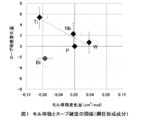
- FIG. 1 is a graph showing the change in molar volume and Knoop hardness when Ti, Nb, W, P, and Bi are substituted by 1 cation% of these cation components based on P.
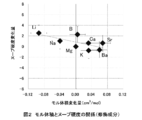
- FIG. 2 is a graph showing the amount of change in molar volume and Knoop hardness when Li, Na, K, B, Mg, Ca, Sr, and Ba are substituted by 1 cation% of these cation components with respect to Mg. It is.
- the present inventor made extensive studies on the above-mentioned problems, and obtained the following knowledge. Classifying the glass components necessary for realizing a high refractive index optical glass from the viewpoint of the properties that each component imparts to the glass, the high refractive index and high dispersion imparting component that imparts the desired optical properties to the glass, promoting glass formation However, it can be classified as a glass network forming component that lowers the refractive index and a modifying component that improves the solubility of the glass but slightly lowers the refractive index.
- High refractive index and high dispersion glass needs to introduce a large amount of high refractive index and high dispersion components such as Bi, Ti, W, and Nb as glass components.
- high refractive index and high dispersion components such as Bi, Ti, W, and Nb as glass components.
- Bi high refractive index and high dispersion components
- Ti titanium, W, and Nb
- Nb high refractive index and high dispersion components
- elements such as Bi and P are present as cations in the glass, and a plurality of anions such as oxygen ions and fluorine ions are coordinated according to their valence, and some ions
- the groups are cross-linked by ion groups having opposite charges, or specific ion groups terminate the bond.
- there may be a few ion groups such as H 2 O, OH ⁇ , CO 3 ⁇ and SO 4 2 ⁇ in the structure, but the main structure is thought to consist of a combination of cations and anions. . Therefore, it can be considered that the structural unit of the glass structure is composed of a set of chemical bonds such as Bi—O, Bi—F, Bi— (SO 4 ) and the like.
- the bonding state in the glass is a factor that determines the mechanical strength of the glass.
- the substitution of the cation M 2 having a cation M 1 and the valence n 2 with the valence n 1 is reduce the density of the average n 1 pieces of M 1 -O bond in the glass when the glass is an oxide Average n 2 M 2 -Os.
- P having a large occupied volume of glass network forming components is replaced with B having a smaller occupied volume, or K having a large ionic radius among alkali metal components is replaced with Na or Li having a smaller ionic radius.
- W having a large ionic radius with Ti having a smaller ionic radius the hardness increases as the molar volume decreases.
- the hardness also increases by replacing Na, which is an alkali metal component, with B, which is a network-forming component, or Nb, which is a network-forming component having a high refractive index.
- the BiO polyhedral structure is distorted, for example, the interatomic distance in a specific direction is long and the bond angle is large, and a so-called stereochemically active chemical state is obtained. Due to the above-mentioned characteristics peculiar to heavy elements, when Bi is introduced into glass, the number of elements contained in the unit volume is increased due to the effect of distortion of the BiO polyhedron, and the molar volume is decreased. It can be considered that, due to the expansion of the interatomic distance accompanied by the existence, a bond with less energy required to break the bond, that is, a bond that does not contribute to an increase in mechanical strength is formed.
- FIG. 1 shows the amount of change in molar volume and Knoop hardness when 1 cation% of each cation is substituted with each other.
- Knoop hardness is an index indicating the indentation hardness of glass in the same manner as Vickers hardness. In general glass, a material that is relatively hard and easily cracked, such as optical glass, has a small dent crack and a small variation in test results. Therefore, in the present invention, the hardness of the glass is evaluated by Knoop hardness.
- the optical glass of the present invention completed based on the above knowledge is an oxide glass, In cation% display, 14 to 36% of P 5+ , Bi 3+ 12-34 %, Nb 5+ 12-34 %, Ti 4+ 5-20 %, 0 to 22% for W 6+ Including
- the total content of Bi 3+ , Nb 5+ , Ti 4+ and W 6+ is 50% or more,
- the Knoop hardness is 370 or more
- the refractive index nd is 2.02 or more
- the Abbe number ⁇ d is 19.0 or less.
- the optical glass of the present invention has a mechanical strength suitable for the production of glass products made of optical glass while having an ultra-high refractive index and high dispersion characteristic with a refractive index nd of 2.02 or more and an Abbe number ⁇ d of 19.0 or less.
- the unit of Knoop hardness is MPa, but in the technical field to which the present invention pertains, it is customary to omit the Knoop hardness unit, and therefore the Knoop hardness unit is also omitted in the present invention.
- the optical glass of the present invention is basically an oxide glass, and O 2 ⁇ is the main component of an anion.
- the content of O 2 ⁇ may be considered with reference to 90 to 100 anion%. If the content of O 2 ⁇ is within the above range, F ⁇ , Cl ⁇ , Br ⁇ , I ⁇ , S 2 ⁇ , Se 2 ⁇ , N 3 ⁇ , NO 3 ⁇ , or SO 4 may be used as the other anion component. 2- and the like may be contained. In that case, the total content of F ⁇ , Cl ⁇ , Br ⁇ , I ⁇ , S 2 ⁇ , Se 2 ⁇ , N 3 ⁇ , NO 3 ⁇ and SO 4 2 ⁇ is, for example, 0 to 10 anion%. be able to.
- the content of O 2 ⁇ may be more than 95 anions, 98 anions or 99 anions, 99.5 anions or more, or 100 anions.
- the cation component of the optical glass of the present invention will be described.
- the cation component content and the total content are expressed as cation%.
- P 5+ is a glass network forming component and forms a highly covalent P—O bond in oxide glass, contributing to diversification of bond distances between ions, and thermally stabilizing the glass state. Has an effect.
- it is a component that maintains the mechanical strength of the glass by forming a cross-linking bond with Ti, Nb, W, etc. via oxygen or the like.
- the glass structure tends to be sparse compared with Ti, Nb, and W, so that it works to lower the hardness when compared with Ti, Nb, and W.
- the content of P 5+ is set to 14 to 36%. From the top to obtain the effect of introducing the P 5+, preferable lower limit is 18% of the content of P 5+, more preferable lower limit is 20%, and more preferable lower limit is 22%, yet more preferably 24%, even more preferred lower limit is 26 %.
- the preferable upper limit of the P 5+ content is 31%, the more preferable upper limit is 30%, the still more preferable upper limit is 29%, and the more preferable upper limit is 28%.
- P 5+ also has an effect of facilitating the production of high-quality optical glass by lowering the liquidus temperature and increasing the viscosity at the liquidus temperature by improving the thermal stability of the glass.
- Bi 3+ is an essential component for obtaining a high refractive index and high dispersion glass, and functions to improve the thermal stability of the glass by containing an appropriate amount. Moreover, it has the effect
- the Bi—O bond is formed in the glass and the oxygen polyhedron is distorted, the ion filling rate is improved.
- the Bi polarizability is increased by the presence of the inner shell electron of Bi itself. -O bond is weakened. For this reason, it functions to reduce the hardness among the high refractive index components.
- the content of Bi 3+ becomes difficult to obtain effects of introducing the Bi 3+ is less than 12%, the thermal stability when the content of Bi 3+ exceeds 34% is decreased, liquidus temperature is increased However, it tends to decrease the viscosity at the liquidus temperature, which is not preferable from the viewpoint of obtaining high-quality optical glass. Further, the glass is colored yellow or brown, and the absorption edge in the spectral transmittance characteristic becomes longer. Therefore, the Bi 3+ content is set to 12 to 34%.
- preferable lower limit is 14% of the content of Bi 3+, and more preferable lower limit is 16%, and more preferable lower limit is 18%, yet more preferably 20%, even more preferred lower limit is 22% A still more preferred lower limit is 23%, and a still more preferred lower limit is 24%.
- the preferable upper limit of the Bi 3+ content is 32%, the more preferable upper limit is 30%, the still more preferable upper limit is 29%, the more preferable upper limit is 28%, and the still more preferable upper limit is 27%, and an even more preferred upper limit is 26%.
- Nb 5+ is a component that works to make the glass have a high refractive index and a high dispersion, and is a component that forms a strong Nb—O bond next to Ti 4+ to increase the strength of the glass. Since it falls, the glass strength improvement effect by introducing Nb 5+ is inferior to Ti 4+ . Further, coexistence with Bi 3+ and Ti 4+ serves to maintain the thermal stability of the glass. Furthermore, it functions to increase the chemical durability of the glass and increase the mechanical strength of the glass.
- Nb 5+ content is difficult to get enough to be less than 12% the effect of introducing the Nb 5+, when the content of Nb 5+ is more than 34%, reduces the thermal stability of the glass, The liquidus temperature rises remarkably and the viscosity at the liquidus temperature decreases, making it difficult to produce high quality optical glass. Further, although not as much as Bi 3+ , Ti 4+ , and W 6+ , the introduction of Nb 5+ shows a tendency that the absorption edge in the spectral transmittance characteristic is slightly longer.
- preferable lower limit is 14% of the content of Nb 5+, and more preferable lower limit is 16%, and more preferable lower limit is 17%, yet more preferably 18%, even more preferred lower limit is 19% It is.
- the preferable upper limit of the Nb 5+ content is 30%, the more preferable upper limit is 27%, the further preferable upper limit is 25%, the more preferable upper limit is 24%, and still more preferable.
- the upper limit is 23%, and an even more preferable upper limit is 22%.
- Ti 4+ is a high refractive index and high dispersion imparting component together with Bi 3+ , Nb 5+ and W 3+. However, since Ti 4+ forms a strong Ti—O bond and increases the ion filling rate, Of these, the ability to increase the strength of glass is strongest. In addition to improving the chemical durability of glass, coexisting with Bi 3+ and Nb 5+ enhances the thermal stability of the glass. However, excessive introduction increases the melting temperature and degrades the solubility. Or the glass is colored. When the content of Ti 4+ is less than 5%, it is difficult to obtain a sufficient effect of introducing Ti 4+ , and when the content of Ti 4+ exceeds 20%, the thermal stability is lowered and the crystallization tendency is increased.
- the liquidus temperature is remarkably increased and the viscosity at the liquidus temperature is lowered, making it difficult to produce high-quality optical glass.
- the absorption edge in the spectral transmittance characteristic has a longer wavelength, and the glass tends to be colored brown. Therefore, the content of Ti 4+ is set to 5 to 20%.
- the preferable lower limit of the content of Ti 4+ is 6%, the more preferable lower limit is 7%, and the further preferable lower limit is 8%.
- the preferable upper limit of the content of Ti 4+ is 15%, and the more preferable upper limit is 13%, a more preferred upper limit is 12%, a more preferred upper limit is 11%, and a still more preferred upper limit is 10%.
- W 6+ is a glass high refractive index high dispersion, the chemical durability of the glass, but serves to increase the mechanical strength, since the ions of the filling factor than Nb 5+ is lowered, the glass strength due to W 6+ introduced Since the improvement effect is inferior to Ti 4+ and Nb 5+ , W 6+ is an optional component in the present invention.
- W 6+ exceeds 22%, the thermal stability of the glass decreases, the crystallization tendency increases, and the absorption edge in the spectral transmittance characteristics of the glass becomes longer and colored. Therefore, the content of W 6+ is 0 to 22%.
- Bi 3+ , Nb 5+ , Ti 4+ and W 6+ within the above ranges, Bi 3+ , Nb 5+ , Ti 4+ and W 6+ and The total content of W 6+ is 50% or more.
- a preferable lower limit of the total content of Bi 3+ , Nb 5+ , Ti 4+ and W 6+ is 55%, a more preferable lower limit is 57%, a further preferable lower limit is 58%, a more preferable lower limit is 60%, and a still more preferable lower limit is 62%.
- a still more preferred lower limit is 63%, a still more preferred lower limit is 64%, and a particularly preferred lower limit is 65%.
- the total content of Bi 3+ , Nb 5+ , Ti 4+ and W 6+ is preferably 90% or less, and 80% or less. Is more preferable, and 70% or less is more preferable.
- high refractive index is highly dispersed imparting components Bi 3+, Nb 5+, Ti 4+ and W smallest Bi 3+ strength improving effect of the glass in the 6+ high refractive index and high dispersion It is preferred to limit the proportion of the imparting component.
- the cation ratio (Bi 3+ / (Bi 3+ + Nb 5+ + Ti 4+ ) of the content of Bi 3+ to the total content of Bi 3+ , Nb 5+ , Ti 4+ and W 6+ (Bi 3+ + Nb 5+ + Ti 4+ + W 6+ ) + W 6+ ) is preferably 0.6 or less, and the lower limit of the ratio is preferably 0.25, and if the ratio exceeds 0.6, the viscosity of the glass decreases and the thermal stability of the glass decreases. It tends to cause devitrification, and the mechanical strength of the glass also decreases, and the absorption edge of the glass tends to shift to the longer wavelength side, and the visible light transmission tends to deteriorate.
- the ratio (Bi 3+ / (Bi 3+ + Nb 5+ + Ti 4+ + W 6+ ) is preferably 0.55, more preferably 0.5, even more preferably 0.45, even more preferably 0.42, even more preferably 0.40, even more preferably 0.38, and more preferably 0.25.
- the preferred lower limit is 0.28, the more preferred lower limit is 0.30, the more preferred lower limit is 0.32, the still more preferred lower limit is 0.34, and the particularly preferred lower limit is 0.36.
- the cation ratio of the content of Ti 4+ to the total content of Bi 3+ , Nb 5+ , Ti 4+ and W 6+ is preferably 0.03 to 0.33.
- the ratio is less than 0.03, the refractive index per density of the glass decreases, and the high dispersion characteristics decrease, and the glass tends to increase the liquidus temperature or decrease the viscosity.
- Ratio (Ti 4+ / (Bi 3+ + N (b 5+ + Ti 4+ + W 6+ ) is preferably 0.05, more preferably 0.08, even more preferably 0.10, even more preferably 0.12, even more preferably 0.14, and even more preferably 0.16.
- a more preferred upper limit is 0.30, a further preferred upper limit is 0.25, a still more preferred upper limit is 0.22, and a still more preferred upper limit is 0.20, wherein increasing the cation ratio is also preferred from the viewpoint of improving the strength of the glass.
- the cation ratio of the total content of Ti 4+ and Nb 5+ to the total content of Bi 3+ , Nb 5+ , Ti 4+ and W 6+ ( Ti 4+ + Nb 5+ ) / (Bi 3+ + Nb 5+ + Ti 4+ + W 6+ ) is preferably 0.375 to 0.70.
- the preferred lower limit of Ti 4+ + Nb 5+ ) / (Bi 3+ + Nb 5+ + Ti 4+ + W 6+ ) is 0.40, the more preferred lower limit is 0.42, the still more preferred lower limit is 0.44, the more preferred lower limit is 0.45, and the still more preferred lower limit is 0.46.
- the upper limit is 0.65, the more preferable upper limit is 0.60, the still more preferable upper limit is 0.55, the still more preferable upper limit is 0.53, and the still more preferable upper limit is 0.50.
- each arbitrary component in this invention is good also considering those content as zero, and good also as more than 0%.
- the alkali metal component is an optional component, the smaller the ionic radius, the greater the effect of tightening the structure and the greater the hardness. Therefore, in order to increase the hardness, it is preferable to introduce Na + from K + and Li + from Na + . . In particular, K + tends to lower the hardness.
- Li + improves the meltability, lowers the melting temperature, shortens the absorption edge in the spectral transmittance characteristics, suppresses the reduction of the high refractive index component during glass melting, and suppresses coloring. Work. Furthermore, since it functions to increase the hardness in the alkali metal component, it can be introduced as long as the object of the present invention is not impaired. However, if the Li + content exceeds 7%, the refractive index decreases, and the thermal stability and the viscosity at the liquidus temperature tend to decrease. Therefore, the Li + content should be 0-7%. Is preferred.
- a more preferable range of the content of Li + is 0 to 5%, a further preferable range is 0 to 4%, a more preferable range is 0 to 3%, a still more preferable range is 0 to 2%, and an even more preferable range is 0 to It is 1% and does not need to be contained. Since Li + has a smaller ionic radius than other alkali metal components Na + and K + , the function of lowering the refractive index is relatively weak among the alkali metal components due to the tightening effect of the glass structure.
- Na + improves the meltability, lowers the melting temperature without shortening the thermal stability of the glass, shortens the absorption edge in the spectral transmittance characteristics, and increases the above-mentioned high refraction during glass melting. It functions to suppress reduction of the rate-increasing component and to suppress coloring. In addition, although the viscosity at the liquidus temperature is slightly reduced, it also functions to lower the liquidus temperature. However, when the Na + content exceeds 20%, the refractive index decreases, and the thermal stability and the viscosity at the liquidus temperature tend to decrease. Therefore, the Na + content should be 0 to 20%. Is preferred.
- the upper limit of the Na + content is preferably 18%, 16%, 14%, 12%, 10%, 8%, 7%, 6%, 5% in this order, and the most preferable upper limit is 4%. Since Na + has an ionic radius between Li + and K + , the function of lowering the Knoop hardness and the function of lowering the refractive index are larger than Li + and smaller than K + .
- the preferable lower limit of the Na + content is 0.1%, the more preferable lower limit is 0.5%, the still more preferable lower limit is 1%, the more preferable lower limit is 2%, and the still more preferable lower limit is 3%.
- K + also functions to improve the meltability and lower the melting temperature.
- the wavelength of the absorption edge in the spectral transmittance characteristics is shortened, and the reduction of the high refractive index component during glass melting is suppressed and coloring is also suppressed.
- the thermal stability is improved and the liquidus temperature is lowered.
- the K + content exceeds 10%, the refractive index decreases, and the thermal stability and the viscosity at the liquidus temperature tend to decrease.
- the K + content is preferably 0 to 10%.
- the more preferable upper limit of the content of K + is 7%, the more preferable upper limit is 5%, the more preferable upper limit is 4%, the still more preferable upper limit is 3%, the still more preferable upper limit is 2%, and the particularly preferable upper limit is 1%. Yes, it does not have to be included.
- the total content of Li + , Na + and K + is in the range of 0 to 20% in order to suppress a decrease in viscosity at the liquidus temperature and to suppress coloring of the glass due to reduction of the high refractive index component. It is preferable to make it.
- a preferred upper limit of the total content of Li + , Na + and K + is 15%, a more preferred upper limit is 12%, a further preferred upper limit is 10%, a more preferred upper limit is 7%, a still more preferred upper limit is 5%, and still more A preferred upper limit is 4%, and a particularly preferred upper limit is 3%.
- an alkali metal component within the above range, in which case Li + , Na A preferable lower limit of the total content of + and K + is 1%, and a more preferable lower limit is 2%.
- B 3+ and / or an alkaline earth metal component may be contained. The content of B 3+ will be described later.
- Alkali metal components and alkaline earth metal components break covalent bonds such as O—P—O—Nb—O, but instead share as O—P—O—Na.
- O—P—O—Nb—O In order to terminate the bond, it serves to reduce the viscosity of the glass melt.
- the degree of termination of the glass structure can be roughly expressed by the product of the number of moles of the modifying component and the valence. The smaller this value, the higher the viscosity of the glass in the melt state at the same temperature. Therefore, the total content of the alkali metal component and the alkaline earth metal component (R 2 O + R′O: where R 2 O is the total amount of the alkali metal component based on the oxide, and R′O is the total of the alkaline earth metal component.
- R ′ Mg, Ca, Sr, Ba
- R ′ Mg, Ca, Sr, Ba
- R ′ Mg, Ca, Sr, Ba
- the total amount of the alkali metal component and the alkaline earth metal component based on the oxide can be 0 mol%. However, if the total amount of the alkali metal component or alkaline earth metal component is too small, it becomes difficult to suppress coloring due to reduction of easily reduced ions such as Ti, Nb, Bi, and W.
- the total amount of the metal component or alkaline earth metal component is preferably 0.5 mol% or more, more preferably 1 mol% or
- the thermal stability of the glass is improved while maintaining the optical properties, and at the liquidus temperature to increase the viscosity, from the top to improve the moldability of the glass, Li + 7 percent content of less than 20% of the content of Na +, while the content of K + is 10% or less, Li +,
- the cation ratio of the content of Na + to the total content of Na + and K + ((Li + + Na + ) / (Li + + Na + + K + )) is preferably 0.2 to 1.
- the more preferable range of the cation ratio ((Li + + Na + ) / (Li + + Na + + K + )) is 0.5 to 1, more preferably 0.7 to 1, more preferably 0.8 to 1, and still more preferably 0.85. ⁇ 1, even more preferred range is 0.9 to 1, even more preferred range is 0.95 to 1, and can be 1.
- B 3+ has the effect of increasing the hardness more than the alkali metal component or the like by introducing an appropriate amount. It also improves the thermal stability of the glass, lowers the liquidus temperature, and increases the viscosity at the liquidus temperature.
- the B 3+ content is preferably 0 to 20%.
- a preferred lower limit for the content of B 3+ is 1%, a more preferred lower limit is 2%, a still more preferred lower limit is 3%, a still more preferred lower limit is 4%, and a still more preferred lower limit is 5%.
- a preferred upper limit for the content of B 3+ is 18%, a more preferred upper limit is 16%, a still more preferred upper limit is 14%, a still more preferred upper limit is 13%, a still more preferred upper limit is 12%, a still more preferred upper limit is 10%, An even more preferred upper limit is 9%, a particularly preferred upper limit is 8%, and a most preferred upper limit is 7%.
- Si 4+ While that serve to raise good liquidus viscosity of the glass which lowers the refractive index, excessive introduction because it causes phase separation of the raised or glass liquidus temperature of the glass, the content of Si 4+
- the upper limit is preferably 5%, more preferably 3%, still more preferably 2%, still more preferably 1.5%, and still more preferably 1.2%.
- the lower limit of the content of Si 4+ is 0%, the preferred lower limit is more than 0%, the more preferred lower limit is 0.1%, the still more preferred lower limit is 0.2%, the still more preferred lower limit is 0.3%, the still more preferred lower limit is 0.4%, and more A more preferred lower limit is 0.5%.
- Si 4+ is mainly introduced by an ordinary oxide raw material, it can be mixed from a crucible made of a material mainly composed of SiO 2 .
- Alkaline earth metal components are also optional components, but the hardness increases as the ionic radius decreases.
- Ba 2+ is a component that tends to lower the hardness as compared with Mg 2+ , Ca 2+ , and Sr 2+ .
- Ba 2+ suppresses the crystallization of the glass and contributes to the stabilization of the glass, so that it can contain a large amount of Ti 4+ and the like accordingly. Therefore, Ba 2+ is a component that indirectly contributes to maintaining and increasing the hardness only when a large amount of Ti 4+ or Nb 5+ is contained.
- Ba 2+ improves the thermal stability of the glass, increases the viscosity at the liquidus temperature, improves the meltability, shortens the absorption edge in the spectral transmittance characteristic, and reduces the refractive index component to reduce the glass. It works to suppress the coloring of.
- the content of Ba 2+ A range of 0 to 15% is preferable.
- the upper limit of the Ba 2+ content is preferably 12%, more preferably 9%, still more preferably 6%, still more preferably 0 to 4%, still more preferably 0 to 3%.
- a preferred lower limit for the Ba 2+ content is 0%, a more preferred lower limit is 0.2%, a still more preferred lower limit is 0.5%, a still more preferred lower limit is 1.0%, and a still more preferred lower limit is 2.0%. From the standpoint of realizing the required optical characteristics, Ba 2+ may not be contained.
- the total content of K + and Ba 2+ that acts to lower the hardness is preferably 16% or less, more preferably 14% or less, and still more preferably Is 12% or less, more preferably 10% or less, even more preferably 8% or less, still more preferably 6% or less, and most preferably 4% or less.
- the total content of K + , Ba 2+ and B 3+ is 22%.
- it is preferably 18% or less, more preferably 15% or less, still more preferably 12% or less, still more preferably 10% or less, still more preferably 8% or less, and most preferably 6% or less.
- it is preferably 18% or less, more preferably 15% or less, still more preferably 12% or less, still more preferably 10% or less, still more preferably 8% or less, and most preferably 6% or less.
- P 5+ , Bi 3+ , Nb 5+ , Ti 4+ , W 6+ , Li + , Na + , K + , B 3+ are maintained while maintaining a refractive index nd of 2.02 or more and suppressing a decrease in viscosity at the liquidus temperature.
- the total content of Si 4+ and Ba 2+ is preferably 90 to 100%, more preferably 95 to 100%, still more preferably 98 to 100%, and more preferably 99 to 100%. Is more preferable. The total content may be 100%.
- the total content of P 5+ , Bi 3+ , Nb 5+ , Ti 4+ , W 6+ , Li + , Na + , K + , B 3+ and Si 4+ is preferably 90 to 100%. 95 to 100% is more preferable, 98 to 100% is more preferable, and 99 to 100% is still more preferable.
- the total content may be 100%.
- components that can be introduced in addition to the cationic component include Sr 2+ , Ca 2+ , Mg 2+ , Zn 2+ , and Al 3+ .
- Sr 2+ , Ca 2+ , Mg 2+ , and Zn 2+ all have a function of increasing the solubility of the glass, but have a function of lowering the refractive index. Therefore, Sr 2+ , Ca 2+ , Mg 2+ , Zn 2+ Each content is preferably in the range of 0 to 5%, more preferably in the range of 0 to 3%, still more preferably in the range of 0 to 2%, and in the range of 0 to 1%. More preferably. Note that Sr 2+ , Ca 2+ , Mg 2+ , and Zn 2+ may not be contained.
- the content of Al 3+ is preferably in the range of 0 to 5%, preferably in the range of 0 to 3%. Is more preferably 0 to 2%, and still more preferably 0 to 1%.
- a clarifier such as Sb 2 O 3 or SnO 2 may be added as an additive.
- Various salts composed of a highly polar anion and a cation as its counter ion may be added.
- Sb 2 O 3 preferred is Sb 2 O 3 .
- the externally added amount of Sb 2 O 3 by mass ratio be in the range of 0 to 10,000 ppm.
- the extra split addition amount by mass ratio is the addition amount shown by the ratio on the basis of the mass of a glass component.
- Sb 2 O 3 functions to make the above-described high refractive index component into an oxidized state and stabilize this oxidized state during glass melting.
- the external addition amount exceeds 10,000 ppm, the glass tends to be colored due to light absorption of Sb itself.
- the preferable upper limit of the external addition amount of Sb 2 O 3 is 5000 ppm, the more preferable upper limit is 2000 ppm, the more preferable upper limit is 1100 ppm, the more preferable upper limit is 900 ppm, and the more preferable upper limit is 600 ppm, a preferable lower limit is 100 ppm, a more preferable lower limit is 200 ppm, and a further preferable lower limit is 300 ppm.
- Sb is an additive, the addition amount was shown by the value converted into oxide unlike the glass component.
- the optical glass of the present invention it is desirable that Pb, As, Cd, Te, Tl, and Se cations are not contained or added in consideration of environmental load.
- V, Cr, Mn, Fe, Co, Ni, Cu, Pr, Nd, Eu, Tb, Ho, and Er cations are all contained in the glass because it colors glass or generates fluorescence when irradiated with ultraviolet light. It is desirable not to add. However, the inclusion and addition of the above does not exclude even mixing as impurities derived from the glass raw material or the glass melting step.
- Ga 3+ , Lu 3+ , In 3+ , Ge 4+ , and Hf 4+ may be contained in small amounts, but these components do not provide a significant effect and are all expensive components. Accordingly, the content is preferably in the range of 0 to 2%, more preferably in the range of 0 to 1%, further preferably 0% or more and less than 0.5%, and 0% or more and 0.1%. It is more preferable to make it less than, and it is desirable not to contain it from the viewpoint of suppressing the manufacturing cost of glass.
- cations that are not specified in the description of the optical glass of the present invention may not be contained, that is, 0%. However, the inclusion and addition of the above do not exclude even mixing as impurities derived from the glass raw material or the glass melting step.
- the optical glass of the present invention has a refractive index nd of 2.02 or more and an Abbe number ⁇ d of 19.0 or less.
- the optical glass of the present invention has an ultra-high refractive index and a high dispersion characteristic, and thus is suitable as a material of an optical element for constituting a compact optical system with a high zoom ratio and a wide angle.
- the refractive index nd is preferably more than 2.05, more preferably 2.06 or more, and 2.07. More preferably, it is more preferably 2.08 or more, and even more preferably 2.09 or more.
- a preferable upper limit of the Abbe number ⁇ d is 18.5, a more preferable upper limit is 18.1, a further preferable upper limit is 17.7, a still more preferable upper limit is 17.4, a still more preferable upper limit is 17.2, and a further preferable upper limit is 17.1.
- the upper limit of the refractive index nd and the lower limit of the Abbe number ⁇ d are naturally determined depending on the composition range, and thus are not particularly limited.
- the upper limit of the refractive index nd can be 3.0 and the lower limit of the Abbe number ⁇ d can be 5 respectively.
- the viscosity at the liquidus temperature tends to decrease as the refractive index nd increases and the Abbe number ⁇ d decreases, so the upper limit of the refractive index nd and the lower limit of the Abbe number ⁇ d within the aforementioned glass composition range, the viscosity at the liquidus temperature is determined within a range of 1 dPa ⁇ s or more.
- the Knoop hardness of the optical glass of the present invention is 370 or more from the viewpoint of preventing the bismuth-phosphate based high refractive index and high dispersion optical glass from being scratched during machining or handling.
- the glass having a Knoop hardness of less than 370 has a problem of scratching during mechanical processing such as grinding, polishing, and cutting, and handling of glass articles. By setting the Knoop hardness within the above range, the above-mentioned scratch can be prevented.
- the preferred range of Knoop hardness in the present invention is 375 or more, the more preferred range is 380 or more, the still more preferred range is 385 or more, the still more preferred range is 390 or more, the still more preferred range is 395 or more, the still more preferred range is 400 or more, A more preferred range is 405 or more, an even more preferred range is 410 or more, a particularly preferred range is 415 or more, and a most preferred range is 420 or more.
- the upper limit of Knoop hardness is not particularly limited, and is preferably higher from the viewpoint of avoiding the problem of scratching. However, since there is a limitation due to the glass composition and a limitation due to the refractive index and the Abbe number, the Knoop hardness is, for example, approximately 600, preferably 500 or less.
- the degree of wear of the optical glass of the present invention is 300 or less from the viewpoint of suppressing scratching during polishing of the high refractive index and high dispersion optical glass and improving the controllability of the polishing process.
- the degree of wear of the optical glass of the present invention is 300 or less from the viewpoint of suppressing scratching during polishing of the high refractive index and high dispersion optical glass and improving the controllability of the polishing process.
- scratches in the polishing process become prominent in addition to scratches during machining such as grinding and cutting, and handling of glass articles.
- a polishing agent with high polishing efficiency it will be difficult to polish while controlling the curvature of the lens, and it will be necessary to polish over time with a zirconium oxide abrasive that has reduced polishing properties. Efficiency is reduced.
- the preferred range of the degree of wear is 280 or less, the more preferred range is 270 or less, the still more preferred range is 260 or less, the still more preferred range is 250 or less, the still more preferred range is 240 or less, the still more preferred range is 230 or less, A more preferred range is 220 or less, an even more preferred range is 210 or less, and a particularly preferred range is 200 or less.
- the lower limit of the degree of wear is not particularly limited, but even if the degree of wear is too small, the time for polishing and removing the same volume of glass is increased and the productivity is lowered. For example, it is 10 or more, preferably 30 or more, and more preferably 50 or more.
- the glass composition having the desired Knoop hardness can be determined in consideration of the influence of each composition on the Knoop hardness shown in FIGS. For example, if the desired Knoop hardness is determined using the glass of Example 1 as a reference (start), the glass composition of Example 1 and the effects of each composition on the Knoop hardness shown in FIGS. Thus, the glass composition can be determined.
- Knoop hardness 406 of the glass of Example 1 when it is desired to further increase the Knoop hardness 406 of the glass of Example 1, for example, when the components shown in FIG. 1 are changed, the Knoop hardness acts on the basis of P (see FIG. By replacing Ti with a large Knoop hardness change rate on the vertical axis of 1 with W having a small value, for example, a glass with a high Knoop hardness can be obtained.
- Ti 4+ 12 mol% in Example 1 a W 6+ 12 mol%, and 16 mol% Increase 4 mol% of Ti 4+, when the 8 mol% to reduce the W 6+ 4 mol%, Knoop hardness increases by 11 to give 417 glass (see Example 2).
- the components shown in FIG. 1 when the components shown in FIG.
- liquidus temperature In the optical glass of the present invention, one having a viscosity at a liquidus temperature of 1 dPa ⁇ s or more is preferable from the viewpoint of obtaining good moldability.
- the liquidus temperature tends to increase with increasing the refractive index and the dispersion of the glass, and tends to be a high temperature of 940 ° C. or higher.
- An increase in the liquidus temperature brings about an increase in the melting temperature and the molding temperature in order to prevent devitrification during glass production. As a result, the viscosity of the glass at the time of molding is remarkably lowered, striae occur, and the optical homogeneity is remarkably deteriorated.
- optical glass even when the liquidus temperature rises with high refractive index and high dispersion, by increasing the viscosity value per temperature, the occurrence of striae at the time of glass forming is suppressed, and excellent optical properties are achieved.
- a high-quality optical glass having homogeneity can be provided.
- the preferred range of the viscosity at the liquidus temperature is 1.0 dPa ⁇ s or more, the more preferred range is 1.4 dPa ⁇ s or more, the still more preferred range is 1.7 dPa ⁇ s or more, and the more preferred range is 2.0 dPa ⁇ s or more, more A more preferred range is 2.2 dPa ⁇ s or more, an even more preferred range is 2.5 dPa ⁇ s or more, an even more preferred range is 2.7 dPa ⁇ s or more, a particularly preferred range is 3.0 dPa ⁇ s or more, and a most preferred range is 3.2 dPa ⁇ s. That's it.
- the upper limit of the viscosity at the liquidus temperature is not particularly limited, but can be considered with 20 dPa ⁇ s as a guide. However, even if the viscosity at the liquidus temperature is excessively increased, problems such as a decrease in refractive index may occur. Therefore, the upper limit of the viscosity at the liquidus temperature is preferably 10 dPa ⁇ s, preferably 7 dPa ⁇ s. It is more preferable.
- the preferable range of the liquidus temperature in the present invention is a range of 1100 ° C. or less. More preferably, it is preferably 1050 ° C. or lower, further 1030 ° C. or lower, 1020 ° C. or lower, 1000 ° C. or lower, 990 ° C. or lower, 980 ° C. or lower, 970 ° C. or lower, and 960 ° C. or lower in this order.
- the liquidus temperature in the present invention is a range of 1100 ° C. or less. More preferably, it is preferably 1050 ° C. or lower, further 1030 ° C. or lower, 1020 ° C. or lower, 1000 ° C. or lower, 990 ° C. or lower, 980 ° C. or lower, 970 ° C. or lower, and 960 ° C. or lower in this order.
- the lower limit of the liquidus temperature can be considered at 800 ° C. or more, more preferably 900 ° C. or more from the viewpoint of containing a high refractive index component having a high melting point, and 940 ° C. is considered as a guide as described above. You can also.
- the specific gravity in the present invention is defined by the specific gravity of the glass obtained at a slow cooling rate of ⁇ 30 ° C./hr.
- the amount of change in the specific gravity relative to the cooling rate is the increase in specific gravity when the cooling rate is 1/10. Is 0.005 to 0.06%, more preferably 0.01 to 0.04%. Therefore, depending on the cooling rate of the glass, the following numerical range can be adjusted to a cooling rate of ⁇ 30 ° C./hour.
- the preferred upper limit of specific gravity is 6.0, the more preferred upper limit is 5.7, the still more preferred upper limit is 5.5, the more preferred upper limit is 5.4, and the still more preferred upper limit is 5.3.
- the preferred lower limit is not particularly limited, but if the specific gravity is excessively lowered, problems such as a decrease in refractive index may occur, so the preferred lower limit of specific gravity is 3.0, the more preferred lower limit is 4.0, and the more preferred lower limit is 4.5, A more preferred lower limit is 4.8, and a still more preferred lower limit is 5.0.
- the optical glass of the present invention is an ultra-high refractive index and high dispersion glass, it also has a transmittance characteristic suitable as a material for an optical element used in an imaging optical system of a digital imaging apparatus.
- the spectral transmittance of the optical glass decreases as the transmission wavelength is shorter, so there is a relationship of ⁇ 70> ⁇ 5 between ⁇ 70 and ⁇ 5.
- the specific wavelength in most optical glasses is 400 nm or less, that is, in the ultraviolet region, and ⁇ 70 and ⁇ 5, which indicate a decrease in transmittance, are wavelengths in the ultraviolet region, so a decrease in visible light transmittance has not been a problem.
- ⁇ 70 In the development of high-dispersion lens materials, that is, the development of high-dispersion optical glass, ⁇ 70 is often in the visible region with a wavelength of 400 nm or more because of the relationship of ⁇ 70> ⁇ 5. As a result, the glass is colored yellow to brown. For this reason, importance has first been placed on shortening the wavelength of ⁇ 70, that is, reducing coloration. High-dispersion lens materials for digital cameras have also taken this trend, and priority is given to shortening the wavelength of ⁇ 70.
- ultra-high refractive index and high dispersion glass the short wavelength absorption edge in the light transmission region becomes longer than that of medium refractive index and medium low dispersion glass, and ⁇ 5 is also present in the visible region in addition to ⁇ 70. Therefore, in order to increase the transmittance of visible light, it is very important to shorten the wavelength of ⁇ 5 as well as the wavelength of ⁇ 70.
- ultra-high refractive index and high dispersion glass made for the purpose of reducing coloring mainly shortened the wavelength of ⁇ 70, so that it was not sufficient to shorten the wavelength of ⁇ 5. In this way, when using an image sensor in which the wavelength of ⁇ 5 is not sufficiently shortened, the limit wavelength incident on the image sensor becomes longer, and purple information and blue information are lost from the image information, and color reproducibility is degraded. It will be.
- a digital camera can electronically correct the color balance by digitally processing the image signal. Therefore, even if some wavelength information is lost, it is possible to reproduce a certain amount of color by guiding the light to the image sensor while maintaining the intensity ratio of the three primary colors such as blue, green, and red. Become. However, if the light transmittance of some of the three primary colors is significantly reduced and the intensity ratio cannot be maintained, color reproduction by electronic correction becomes difficult.
- the preferred glass of the optical glass of the present invention is made by paying attention to shortening the wavelength of ⁇ 5, so that while maintaining good color reproducibility, taking advantage of the ultra-high refractive index and high dispersion characteristics of the imaging optical system. Enables high functionality and compactness.
- each module is provided with various vibration-proof mechanisms, and is designed so that the frequency of various vibrations does not exceed the primary resonance point F0 (Hz) obtained from the resonance frequency of the module.
- F0 the primary resonance point
- the camera lens is precisely driven by an actuator or the like.
- an increase in the mass of the drive unit is not preferable because it increases the load on the mechanism unit for driving and positioning the mechanism unit and increases power consumption. .
- the molecular refraction of glass is an anion having a high polarizability among ions, that is, an oxygen ion or a fluorine ion.
- anions are mainly oxygen ions.
- the degree of filling of the anion is determined by the ionic radius, valence, coordination number, outer electron arrangement, etc. of the cation that is the partner of the anion. Therefore, the ionic radius, valence, coordination number, outer electron arrangement, etc. of the cation affect the refractive index.
- Ta and Nb have a higher valence than La, which is a typical high refractive index component of optical glass. Therefore, the refractive index can be increased by replacing La with Ta or Nb.
- W has a higher valence than Ta and is an effective component for increasing the refractive index.
- the valence of Bi is the same as that of La, its high polarizability contributes to a higher refractive index, and the effect of increasing the refractive index per unit cation% is greater than that of Nb or W.
- Ti is an element that is not sufficiently filled with oxygen ions compared to Ta and Nb, but has strong absorption (ultraviolet absorption) at a specific wavelength, and therefore has a specific refractive index (for example, the refractive index of f-line and g-line).
- the refractive index in the blue to ultraviolet region) can be increased.
- the mass of the Ti atom itself is small, the effect of increasing the refractive index without increasing the density of the glass is great.
- Nb is a component that can increase the refractive index without increasing the density of glass because the mass of Nb itself is smaller than that of W or Bi, although not as much as Ti. Moreover, since ultraviolet absorption appears at a specific wavelength when introduced into glass, it is a component that can increase the refractive index of the specific wavelength and achieve high dispersion. Nb is slightly disadvantageous in that it suppresses the increase in density due to its large mass compared with Ti, but it is an advantageous component for obtaining good transmittance characteristics. Furthermore, Bi, Nb, Ti, and W coexist as glass components to lower the liquidus temperature and increase the stability of the glass, thereby contributing to the improvement of the production stability.
- an optical glass that suppresses an increase in density that is, an increase in specific gravity while being a high refractive index and high dispersion glass.
- the optical glass of the present invention can be produced by a melting method.
- the compound raw materials corresponding to each component are weighed so as to obtain a glass having a required composition, mixed well to prepare a preparation raw material, and the preparation raw material is put in a crucible and stirred at 1100 to 1200 ° C. for 0.5 to 4 hours.
- the glass melt is poured into a predetermined container, cooled and pulverized to obtain cullet.
- the melting temperature may be lower than the liquid phase temperature LT to 1100 ° C, preferably lower than the liquid phase temperature LT + 20 ° C to 1050 ° C. it can.
- this cullet was put into a precious metal crucible, heated to a liquidus temperature LT to 1200 ° C., stirred and melted.
- the molten glass is clarified at a liquidus temperature of LT to 1200 ° C. over 0.5 to 6 hours.
- the glass temperature is changed from the clarification temperature to the liquidus temperature LT to 1100 ° C, preferably the liquidus temperature LT to 1080 ° C, more preferably the liquidus temperature LT to 1050 ° C, more preferably the liquidus temperature LT to 1020 ° C, More preferably, after the liquid phase temperature has been lowered to LT to 1000 ° C., molten glass is allowed to flow out from a pipe connected to the bottom of the crucible, or cast into a mold and molded to obtain an optical glass.
- the temperature conditions and the time required for each step can be adjusted as appropriate. It is also possible to produce a plurality of types of cullet having different optical characteristics by the above-described method, prepare these cullets so as to obtain the required optical characteristics, melt, clarify, and mold them to produce an optical glass.
- the glass material for press molding of the present invention (hereinafter referred to as glass material) comprises the optical glass of the present invention.
- the glass material is formed by heating, melting, and molding a glass material prepared so as to obtain the optical glass of the present invention.
- the glass molded body thus produced is processed to produce a glass material corresponding to the amount of one press-formed product.
- a known method for producing a glass material for press molding from molten glass can be applied. For example, molten glass is cast into a mold, formed into a plate shape or block shape, annealed, and then machined, that is, cut, ground, or polished, to obtain a glass material with no scratches on the surface.
- the glass material of the present invention is made of glass having a high Knoop hardness, it is difficult to be scratched during processing and handling as a glass material, so that scratches on the surface of the glass material are applied to the optical element surface after press molding, particularly the optical functional surface. It is preferable as a glass material for precision press molding that tends to remain.
- machining that is, grinding and polishing, on a press-molded product after press molding, it is possible to manufacture a press-molded product that is hardly damaged by machining.
- the optical element of the present invention comprises the optical glass of the present invention.
- Specific examples include aspherical lenses, spherical lenses, or lenses such as plano-concave lenses, plano-convex lenses, biconcave lenses, biconvex lenses, convex meniscus lenses, concave meniscus lenses, various lenses such as micro lenses, lens arrays, and lenses with diffraction gratings. , Prisms, prisms with lens functions, and the like.
- an antireflection film, a wavelength selective partial reflection film, or the like may be provided on the surface.
- the optical element of the present invention is made of glass having an ultra-high refractive index and high dispersion characteristics, it can be favorably corrected by combining with an optical element made of other glass. Furthermore, since glass with high Knoop hardness is used, handling is easy because it is not easily damaged. Further, it is difficult to be damaged when the optical element is fixed. In lens centering, there is a feature that even if the lens surface is sandwiched and fixed from both sides, it is difficult to be damaged.
- the optical glass of the present invention is also effective for increasing the zoom ratio, wide angle, and compactness of the imaging optical system.
- the optical element can be reduced in weight, and it is effective in preventing the deviation of the focal position with respect to vibration. Furthermore, the use of glass with a shorter absorption edge in the spectral transmittance characteristics can prevent loss of image information in the visible short wavelength region, and is also effective in improving the color reproducibility of digital imaging devices. .
- the optical element of the present invention includes an imaging optical system of various cameras such as a digital still camera, a digital video camera, a surveillance camera, and an in-vehicle camera, an optical element that guides a light beam for writing and reading data on an optical recording medium such as a DVD and a CD,
- an optical pickup lens or a collimator lens For example, it is also suitable for an optical pickup lens or a collimator lens. It is also suitable as an optical element for optical communication.
- the above optical element is a method of processing the optical glass of the present invention and polishing the surface, heating and press-molding the glass material for press molding of the present invention to produce an optical element blank, and grinding and polishing the optical element blank It can be manufactured by a known method such as a method of heating, a method of heating and precision press molding the glass material for press molding of the present invention to form an optical element.
- a known method such as a method of heating, a method of heating and precision press molding the glass material for press molding of the present invention to form an optical element.
- the problem of productivity reduction due to scratching can be solved by using glass that is not easily scratched on the surface even though it is a glass article made of high refractive index and high dispersion optical glass.
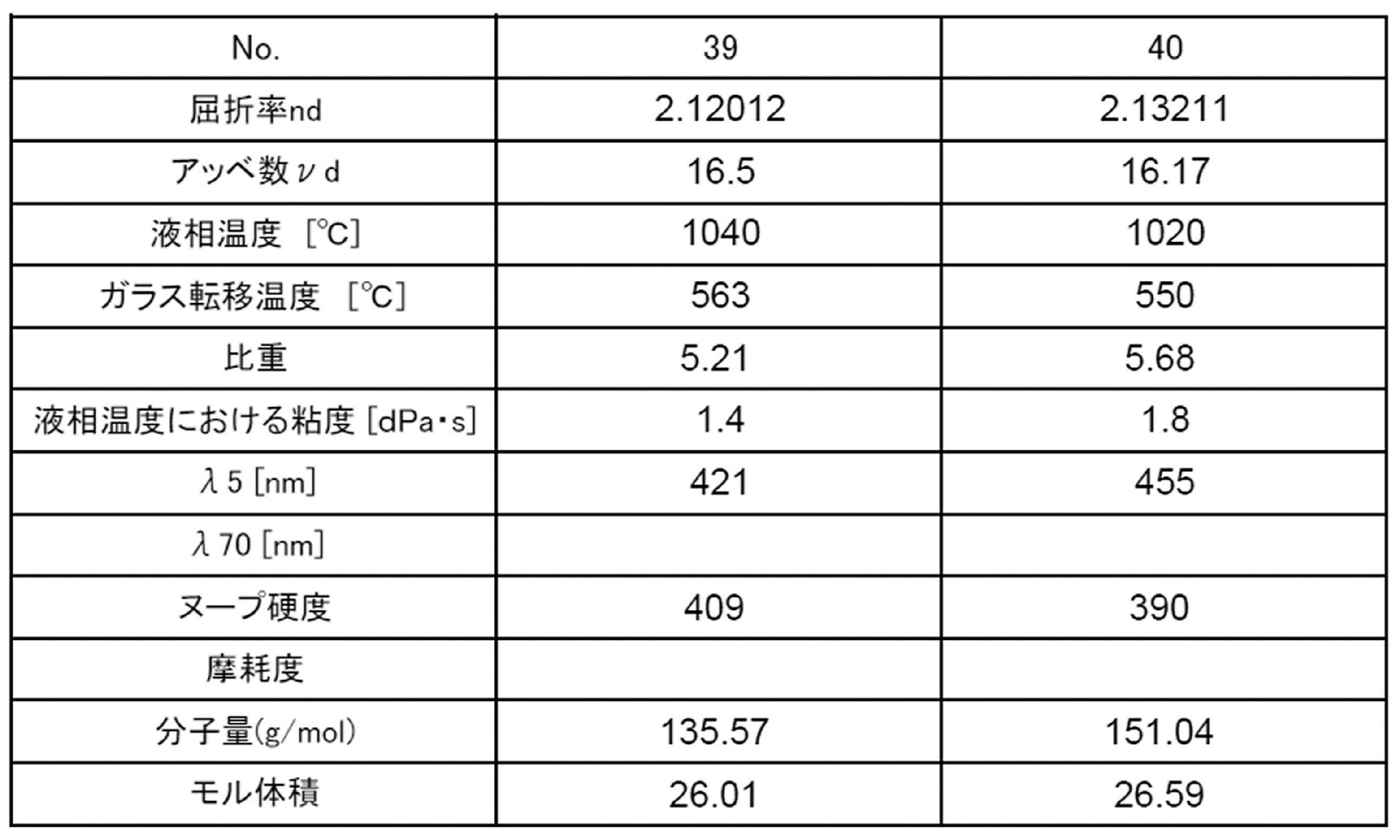
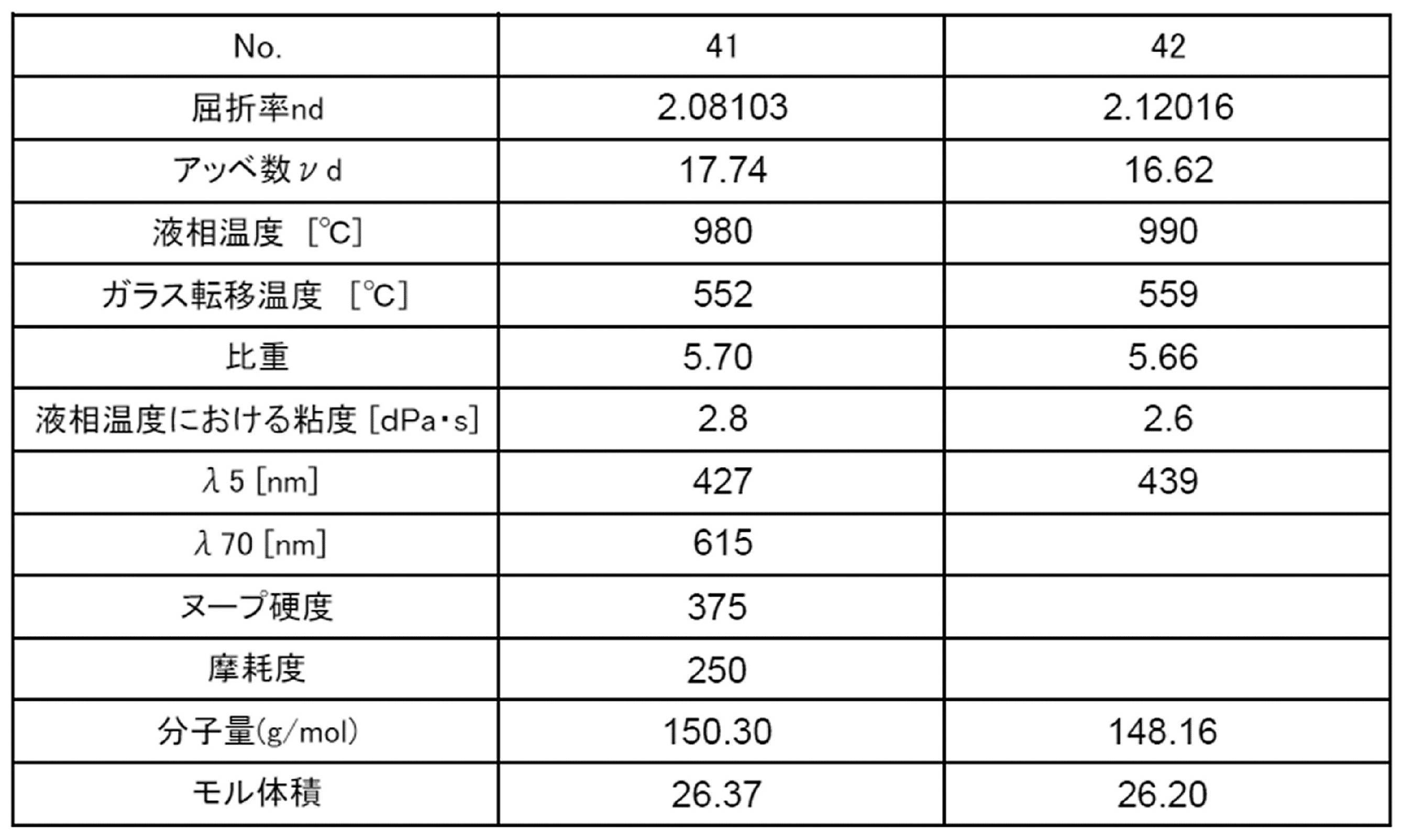
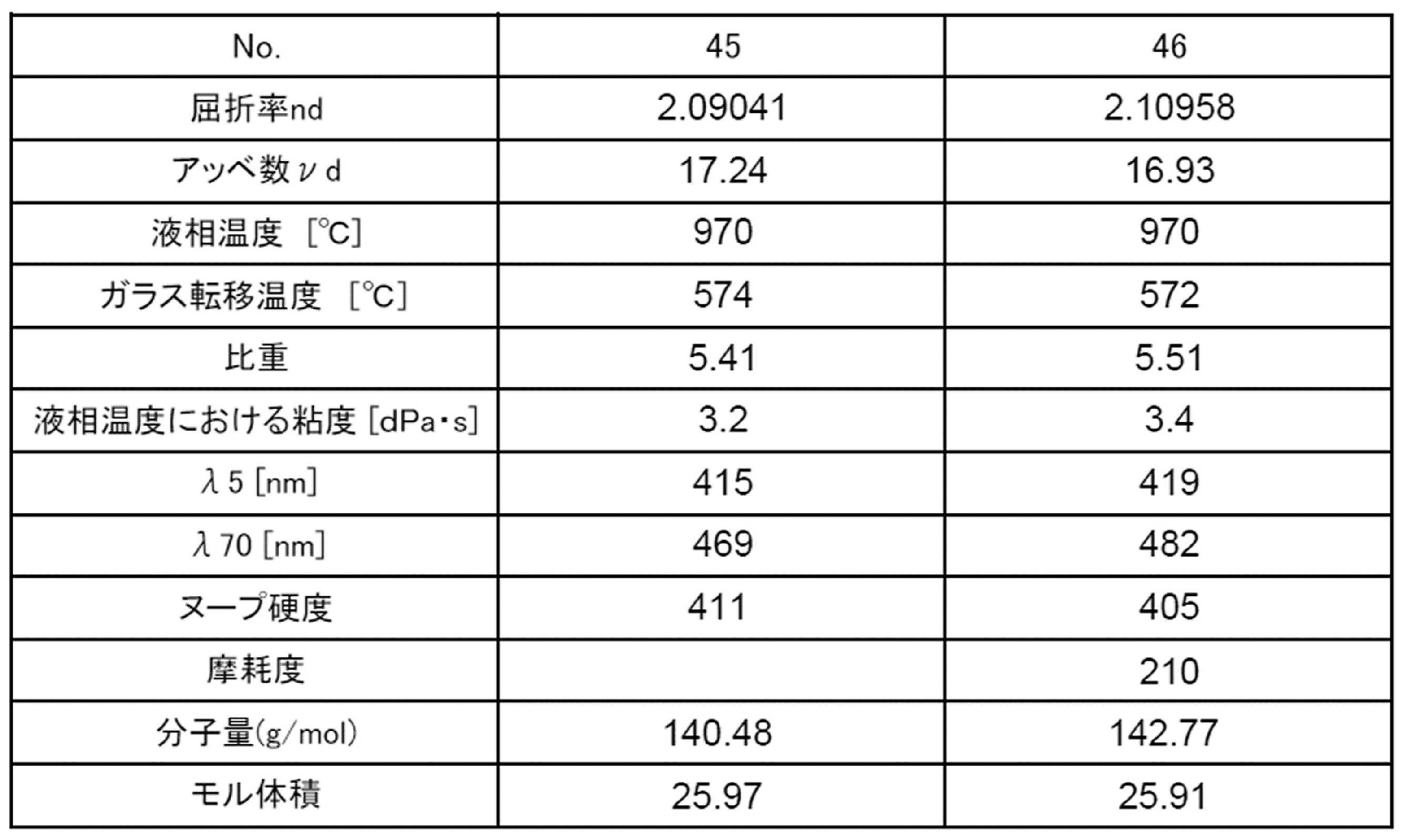
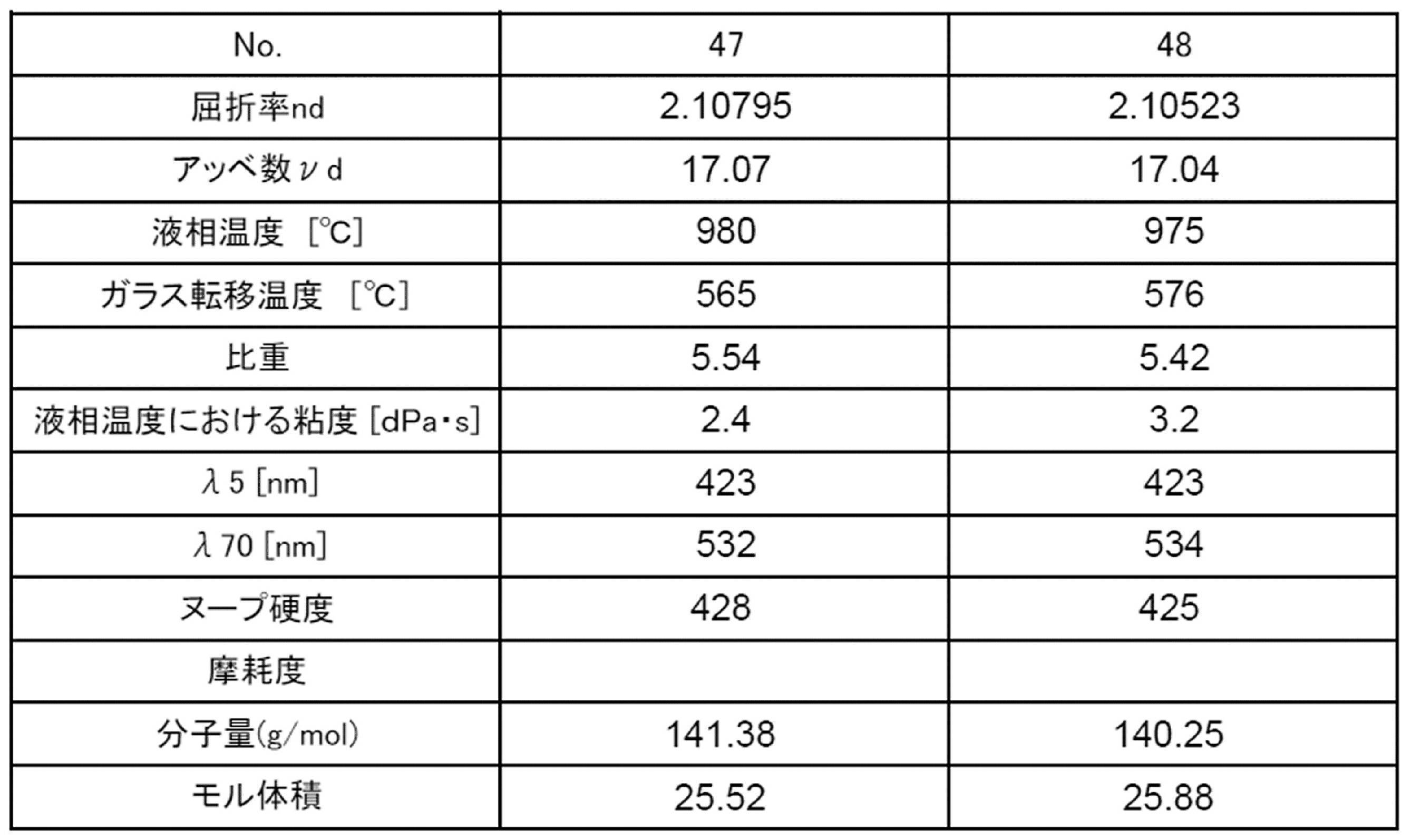
- Example 1 No. shown in Table 1 The compound raw materials corresponding to each component were weighed so as to obtain a glass having a composition of 1 to 51, and mixed well to obtain a blended raw material.
- the glass composition shown in Table 1 is based on the value of cation% display, and the values of mol% display and mass% display are values converted from cation% display.
- the blended raw material was placed in a crucible and dissolved at 1100 ° C. to 1200 ° C. with stirring for 2 to 5 hours, then rapidly cooled and pulverized to obtain cullet.
- the cullet was put into a noble metal crucible, heated to 1000 ° C. to 1100 ° C., stirred and melted.
- the molten glass was clarified at 1000 ° C. to 1100 ° C. over 2 to 6 hours. After clarification, the temperature of the glass was lowered from the clarification temperature to a liquidus temperature of LT to 1050 ° C., and then molten glass was poured out from a pipe connected to the bottom of the crucible or cast into a mold to form a glass block.
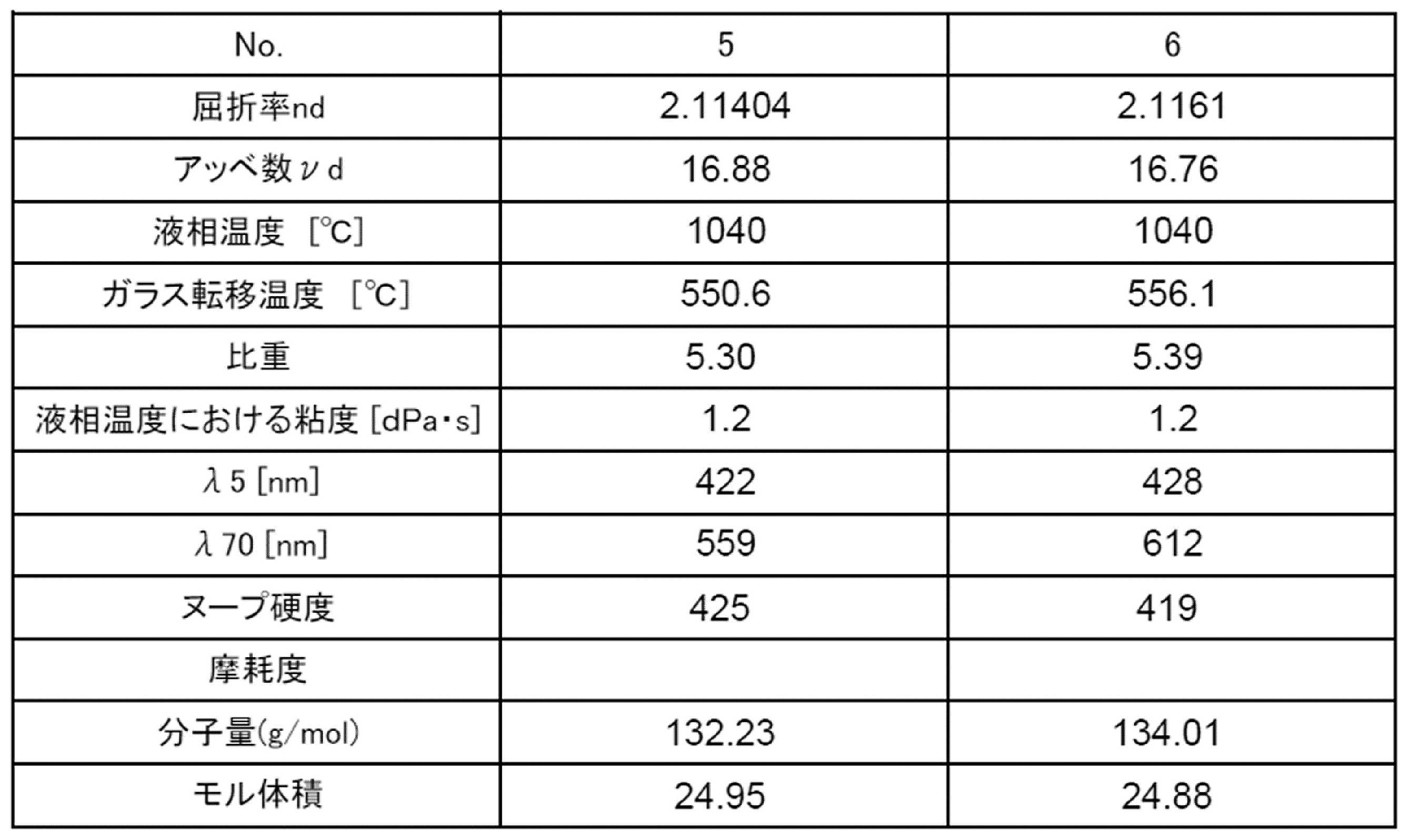
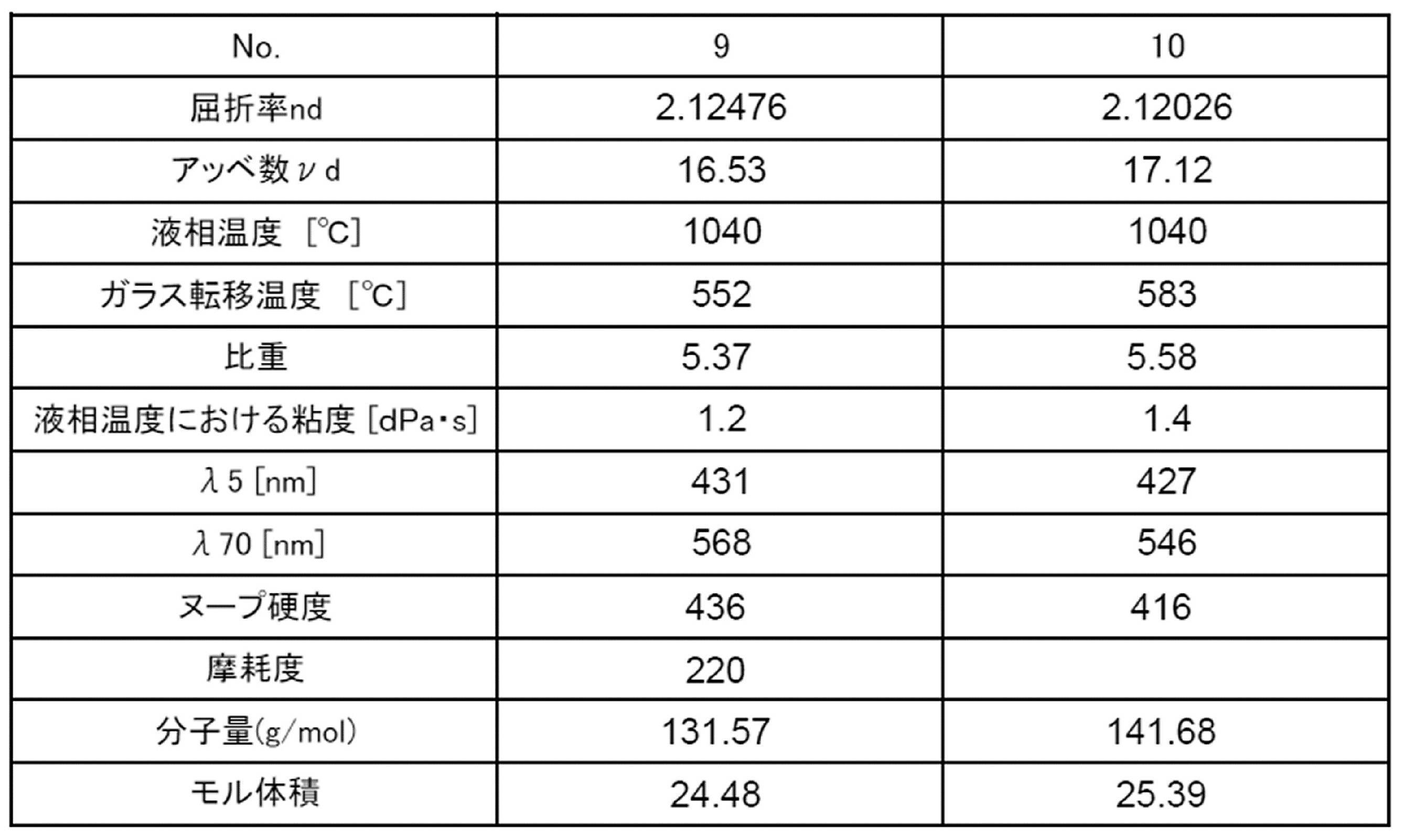
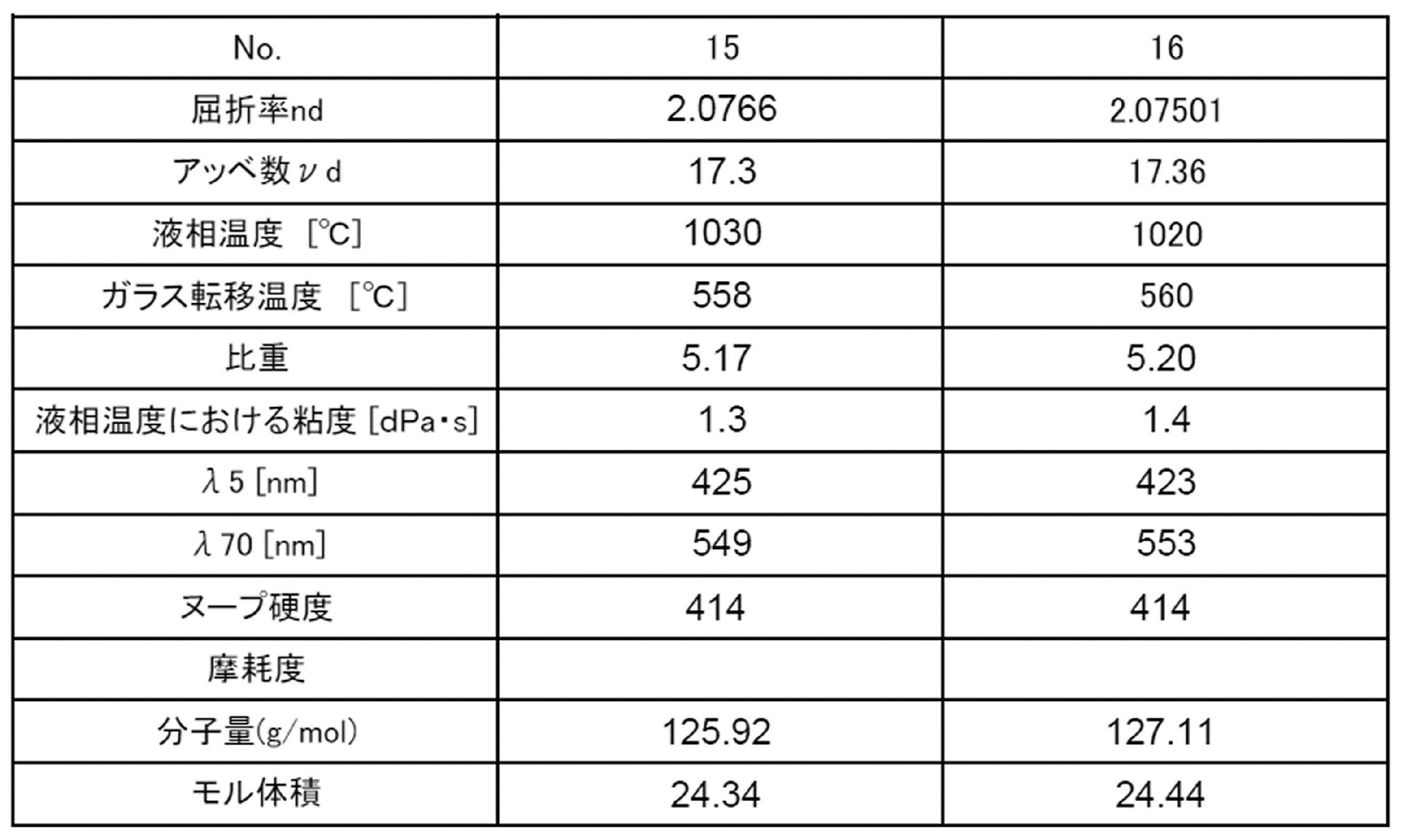
- Obtained optical glass No. for 1 to 51, the refractive index nd, Abbe number ⁇ d, Knoop hardness, abrasion degree, liquidus temperature, viscosity at the liquidus temperature, glass transition temperature, specific gravity, ⁇ 70, ⁇ 5 were measured as follows. Note that a blank indicates that no measurement has been performed.
- Wear degree F A sample with a measuring area of 9 cm 2 is held at a fixed position of 80 mm from the center of a flat plate made of cast iron that rotates horizontally at 60 rpm, and a lapping solution in which 20 ml of water is added to 10 g of alumina abrasive grains having an average particle diameter of 20 ⁇ m. Supply uniformly for minutes, wrap under a load of 9.807 N, weigh the sample mass before and after the lap and determine the wear mass m. Similarly, by measuring the wear mass m o Japanese standard samples stipulated by Optical Glass Industrial Standard (BSC7), it is calculated by the following equation.
- Viscosity at liquid phase temperature LT and liquid phase temperature A glass sample is placed in a furnace heated to a predetermined temperature and held for 2 hours. After cooling, the inside of the glass is observed with a 100-fold optical microscope to check for crystals From this, the liquidus temperature was determined. Viscosity Viscosity was measured by a viscosity measuring method using JIS standard Z8803, a coaxial double cylindrical rotational viscometer.
- Glass transition temperature Tg The glass transition temperature was measured from the endothermic curve when the temperature of the solid glass was raised using a differential scanning calorimeter DSC3300SA. The Tg using this measurement shows a correspondence relationship with the glass transition temperature Tg measured based on the Japan Optical Glass Industry Association Standard JOGIS-08. The measurement results are shown in Table 1. (6) Specific gravity Measured based on Japan Optical Glass Industry Association Standard JOGIS-05. The measurement results are shown in Table 1. (7) ⁇ 70, ⁇ 5 ⁇ 70 and ⁇ 5 were measured as follows. Spectral transmittances in a wavelength range from 280 nm to 700 nm are measured using glass samples having a plane parallel to each other and optically polished having a thickness of 10 mm.
- the spectral transmittance is calculated by B / A by measuring the intensity B of a light beam incident on an optically polished plane perpendicular to one plane and exiting from the other plane. Therefore, the spectral transmittance includes a reflection loss of light rays on the sample surface.
- the wavelength at which the spectral transmittance is 70% is ⁇ 70, and the wavelength at which the spectral transmittance is 5% is ⁇ 5.
- the measurement results are shown in Table 1.
- the molecular weight and molar volume were calculated as follows.
- the sum of (y / x) is defined as the unit molecular weight (g / mol) of the cation-based oxide unit MO y / x .
- the sum of ⁇ unit molecular weight of oxide unit MO y / x (g / mol) ⁇ content of each cation (cation%) ⁇ / 100 is the molecular weight (g / mol).
- the molar volume is the molar volume (cm 3 / mol) obtained by dividing the above molecular weight (g / mol) by the specific gravity plus the density unit [g / cm 3 ]. That is, the molecular volume (g / mol) divided by the density at room temperature (g / cm 3 ) is the molar volume (cm 3 / mol).
- Example 2 In the same manner as in Example 1, optical glass no. The glass raw material was heated, melted, clarified and homogenized so as to obtain 1 to 51, and the obtained molten glass was poured into a mold and rapidly cooled to form glass black. Next, after annealing the glass block, it was cut and ground to produce a glass material for press molding.
- Example 3 The glass material for press molding produced in Example 2 was heated and softened, and was press-molded by a known method using a press mold to produce optical element blanks such as a lens blank and a prism blank.
- the obtained optical element blank is subjected to precision annealing, and after adjusting the refractive index so as to have a required refractive index, it is finished into a lens or a prism by a known grinding and polishing method.
- abrasive grains such as cerium oxide and zirconium oxide can be used.
- Example 4 the surface of the glass material for press molding produced in Example 2 was polished to obtain a glass material for press molding (preform) for precision press molding.
- preform glass material for press molding
- the preform was heated and precision press molded to obtain an aspheric lens.
- Precision press molding was performed by a known method.
- An aspheric lens obtained by precision press molding was sandwiched from both sides, and centering was performed by a known method to produce a centering lens.
- the optical functional surface of the obtained lens was inspected, no scratches were observed, and no scratches were observed in the portions sandwiched during the centering process. In this way, high-quality optical elements can be provided with high productivity.
- Example 5 In the same manner as in Example 1, optical glass no. The glass raw material was heated, melted, clarified and homogenized so as to obtain 1 to 51, and the obtained molten glass was poured into a mold and rapidly cooled to form glass black. Next, the glass block was annealed, and then cut, ground, and polished to produce optical elements such as a spherical lens and a prism. In the polishing, abrasive grains such as cerium oxide and zirconium oxide can be used.
- the optical element of this embodiment enables good chromatic aberration correction when combined with an optical element made of low dispersion glass. In addition, it is effective for improving the performance and compactness of various optical devices including imaging devices.
- Comparative Example 2 When the glass which reproduces the composition described in Patent Document 2 obtained in Comparative Example 1 is ground and polished to be processed into a lens shape, the surface corresponding to the optical function surface is scratched and cannot be used as a lens. It was a thing. From this result, even if the preform was produced by grinding and polishing using the glass of Comparative Example 1, the preform surface was damaged, and even if precision press molding could be performed using such a preform, the preform was produced. It is clear that the scratches of time remain on the surface of the precision press-molded product.
Landscapes
- Chemical & Material Sciences (AREA)
- Materials Engineering (AREA)
- Engineering & Computer Science (AREA)
- Chemical Kinetics & Catalysis (AREA)
- General Chemical & Material Sciences (AREA)
- Geochemistry & Mineralogy (AREA)
- Life Sciences & Earth Sciences (AREA)
- Organic Chemistry (AREA)
- Physics & Mathematics (AREA)
- Crystallography & Structural Chemistry (AREA)
- General Physics & Mathematics (AREA)
- Optics & Photonics (AREA)
- Glass Compositions (AREA)
Abstract
Description
一方で、光学ガラスに求められる特性としては、カメラ設計者等、使用者から求められる光学特性、たとえば屈折率特性や透過率特性が挙げられるが、工業製品としての光学ガラスを生産性よく製造するためには、ガラスの製造工程の搬送における耐擦傷性を決定する機械的特性を一定の水準に高めることが不可欠となる。
ここで光学ガラスの機械的強度が小さすぎると、切削や研削工程での表面の損傷が激し過ぎて、研磨工程で除去できないような傷が光学面に残存してしまう。または表面の除去量が相対的に小さい研磨工程や、ガラスを洗浄する超音波洗浄工程においても、ガラスが軟らかいために、粗大な砥粒の転がりや、超音波のキャビテーションといったわずかな機械的作用で傷が発生するなど、レンズ表面に傷がつく可能性が高まる。以上のことから、研磨工程を経るガラスでは機械的強度が高いことが必要となる。
更に、研磨工程・精密プレス成形工程によらず、光学機能面を形成したガラスを徐冷・洗浄・芯取り・成膜・検査工程と経てレンズ製品とする際にも、これらの工程に用いられる器具との接触によって、光学機能面に傷がつくことがある。
本発明は、上記問題を解決し、屈折率ndが2.02以上、アッベ数νdが19.0以下の高屈折率高分散特性を有しながら、高品質の光学素子の製造に適した機械的特性を有する光学ガラスを提供することを目的とする。さらに本発明の目的は、この光学ガラスからなるプレス成形用ガラス素材及び光学素子を提供することにある。加えて、本発明の目的は、この光学ガラスからのプレス成形用ガラス素材の製造方法を提供することにある。
[1]
酸化物ガラスであって、
カチオン%表示にて、
P5+を14~36%、
Bi3+を12~34%、
Nb5+を12~34%、
Ti4+を5~20%、
W6+を0~22%
含み、
Bi3+、Nb5+、Ti4+およびW6+の合計含有量が50%以上、
ヌープ硬度が370以上、屈折率ndが2.02以上、アッベ数νdが19.0以下であることを特徴とする光学ガラス。
[2]
K+およびBa2+の合計含有量が16%以下である[1]に記載の光学ガラス。
[3]
K+、Ba2+およびB3+の合計含有量を22%以下である[1]または[2]に記載の光学ガラス。
[4]
Bi3+、Nb5+、Ti4+およびW6+の合計含有量(Bi3++Nb5++Ti4++W6+)に対するBi3+の含有量のカチオン比(Bi3+/(Bi3++Nb5++Ti4++W6+)が0.6以下である[1]~[3]のいずれかに記載の光学ガラス。
[5]
[1]~[4]のいずれかに記載の光学ガラスからなるプレス成形用ガラス素材。
[6]
[1]~[4]のいずれかに記載の光学ガラスからなる光学素子。
[7]
[1]~[4]のいずれかに記載の光学ガラスを機械加工する工程を備えるプレス成形用ガラス素材の製造方法。
[8]
[5]に記載のプレス成形用ガラス素材をプレス成形する工程を有する光学素子の製造方法。
[6]
[1]~[4]のいずれかに記載の光学ガラスを機械加工する工程を備える光学素子の製造方法。
高屈折率光学ガラスを実現するために必要なガラス成分を、各成分がガラスに与える特性の観点から分類すると、ガラスに所望の光学特性を付与する高屈折率高分散付与成分、ガラス形成を促進するが屈折率を低くするガラスネットワーク形成成分、およびガラスの溶解性を向上させるが屈折率をやや低くする修飾成分のように分類することができる。
ところで、ガラス材料の硬さを分類すると、押しこみ深さ、引っ掻き深さ、砥石研削硬さ、摩耗硬さの4種類が挙げられる。ヌープ硬度は、ビッカース硬度と同様にガラスの押し込み硬さを示す指標である。ガラス全般において、光学ガラスのように比較的硬く割れやすい材料では、くぼみのクラックは小さく、試験結果のばらつきが少ないとされている。そのため本発明において、ガラスの硬度はヌープ硬度により評価することとする。
カチオン%表示にて、
P5+を14~36%、
Bi3+を12~34%、
Nb5+を12~34%、
Ti4+を5~20%、
W6+を0~22%
含み、
Bi3+、Nb5+、Ti4+およびW6+の合計含有量が50%以上、
ヌープ硬度が370以上、屈折率ndが2.02以上、アッベ数νdが19.0以下であることを特徴とする。
なおヌープ硬度の単位はMPaであるが、本発明が属する技術分野においてヌープ硬度の単位を省略する慣例になっていることから、本発明においてもヌープ硬度の単位を省略することとする。
本発明の光学ガラスは基本的に酸化物ガラスであり、O2-がアニオンの主成分である。O2-の含有量は90~100アニオン%を目安として考えればよい。O2-の含有量が上記範囲内であれば、他のアニオン成分としてF-、Cl-、Br-、I-、S2-、Se2-、N3-、NO3 -、あるいはSO4 2-などを含有させてもよい。その場合、F-、Cl-、Br-、I-、S2-、Se2-、N3-、NO3 -およびSO4 2-の合計含有量は、例えば、0~10アニオン%とすることができる。O2-の含有量を95アニオン%超あるいは98アニオン%超あるいは99アニオン%超としてもよいし、99.5アニオン%以上あるいは100アニオン%としてもよい。
P5+は、ガラスネットワーク形成成分であり、酸化物ガラス中で共有結合性の高いP-O結合を形成してイオン間の結合距離の多様化に寄与し、ガラス状態を熱的に安定化させる効果を有する。またTi、Nb、Wらと酸素等を介した架橋結合を形成することでガラスの機械的強度を維持する成分である。一方でTi、Nb、Wと比較するとガラスの構造を疎にする傾向があるため、Ti、Nb、Wと比較すると硬度を低下させる働きをする。P5+の含有量が14%未満であると、前記効果を得ることが困難となり、P5+の含有量が36%を越えると屈折率が低下し、ガラスの結晶化傾向が増大する傾向を示すため、P5+の含有量を14~36%とする。上記P5+の導入効果を得る上から、P5+の含有量の好ましい下限は18%、より好ましい下限は20%、さらに好ましい下限は22%、一層好ましい下限は24%、より一層好ましい下限は26%である。一方、高屈折率を維持する上からP5+の含有量の好ましい上限は31%、より好ましい上限は30%、さらに好ましい上限は29%、一層好ましい上限は28%である。
なお、P5+には、ガラスの熱的安定性改善によって、液相温度を低下させるとともに液相温度における粘度を上昇させ、高品質な光学ガラスの生産を容易にする効果もある。
Na+は、ガラスの熱的安定性を大きく損なうことなしに、溶融性を改善し、溶融温度を低下させ、分光透過率特性における吸収端を短波長化するとともに、ガラス溶融中における上記高屈折率化成分の還元を抑制し、着色を抑制する働きをする。また、液相温度における粘度をやや低下させるものの、液相温度を低下させる働きもする。しかし、Na+の含有量が20%を超えると屈折率が低下し、熱的安定性、液相温度における粘度も低下する傾向を示すため、Na+の含有量を0~20%とすることが好ましい。Na+の含有量の上限については、18%、16%、14%、12%、10%、8%、7%、6%、5%の順に好ましく、最も好ましい上限は4%である。Na+は、イオン半径がLi+とK+の間にあるため、ヌープ硬度を低下させる働き、および屈折率を低下させる働きはLi+よりも大きく、K+よりは小さい。Na+の含有量の好ましい下限は0.1%、より好ましい下限は0.5%、さらに好ましい下限は1%、一層好ましい下限は2%、より一層好ましい下限は3%である。
上記カチオン成分以外に導入可能な成分としては、Sr2+、Ca2+、Mg2+、Zn2+、Al3+等がある。このうち、Sr2+、Ca2+、Mg2+、Zn2+はいずれもガラスの溶解性を高める働きがあるものの、屈折率を低下させる働きがあるため、Sr2+、Ca2+、Mg2+、Zn2+の含有量はそれぞれ0~5%の範囲とすることが好ましく、0~3%の範囲とすることがより好ましく、0~2%の範囲とすることがさらに好ましく、0~1%の範囲とすることが一層好ましい。なお、Sr2+、Ca2+、Mg2+、Zn2+を含有させなくてもよい。
その他、添加剤としてSb2O3やSnO2などのような清澄剤を添加しても良い。また、ガラスの清澄性や、ガラスとるつぼ材料との親和性を制御するために、NO3 -、CO3 -、SO4 2-、F-、Cl-、Br-、I-などのような分極性の高い陰イオンとその対イオンである陽イオンから構成される各種の塩などを添加してもよい。
本発明の光学ガラスの屈折率ndは2.02以上、アッベ数νdは19.0以下である。このように本発明の光学ガラスは、超高屈折率高分散特性を備えているため、高ズーム比、広角、コンパクトな光学系を構成するための光学素子の材料として好適である。なお、光学系の高機能化、コンパクト化により有効な光学素子に用いられる光学ガラスを提供するという観点から、屈折率ndが2.05超であることが好ましく、2.06以上であることがより好ましく、2.07以上であることがさらに好ましく、2.08以上であることが一層好ましく、2.09以上であることがより一層好ましい。アッベ数νdの好ましい上限は18.5、より好ましい上限は18.1、さらに好ましい上限は17.7、一層好ましい上限は17.4、より一層好ましい上限は17.2、さらに好ましい上限は17.1である。
上記のようにビスマス-リン酸系の高屈折率高分散光学ガラスの機械加工や取り扱い時の加傷を防止する観点から、本発明の光学ガラスのヌープ硬度は370以上である。ヌープ硬度が370未満であるガラスでは、前述のように研削、研磨、切削などの機械加工時やガラス物品の取り扱い時の加傷が問題となる。ヌープ硬度を上記範囲にすることにより上記加傷を防止することができる。本発明におけるヌープ硬度の好ましい範囲は375以上、より好ましい範囲は380以上、さらに好ましい範囲は385以上、一層好ましい範囲は390以上、より一層好ましい範囲は395以上、さらに一層好ましい範囲は400以上、なお一層好ましい範囲は405以上、さらになお一層好ましい範囲は410以上、特に好ましい範囲は415以上、最も好ましい範囲は420以上である。一方、ヌープ硬度の上限については特に制限はなく、加傷の問題を回避するという観点のみからは高い方が好ましい。しかし、ガラス組成による制限と屈折率及びアッベ数による制限もあることから、ヌープ硬度は、最大でも、例えば、600程度であり、500以下であることが好ましい。
また、高屈折率高分散光学ガラスの研磨加工時の加傷を抑制し、研磨加工の制御性を高める観点から、本発明の光学ガラスの摩耗度は300以下である。摩耗度が300を超えるガラスでは、前述のように研削、切削などの機械加工時やガラス物品の取り扱い時の加傷に加え、研磨工程における加傷が顕著になるため、酸化セリウムをはじめとする研磨効率の高い研磨剤を使用すると、レンズの曲率を制御しながら研磨を行うことが困難になり、研磨性を低下させた酸化ジルコニウム研磨剤などにより時間をかけて研磨する必要があるため、研磨効率が低下する。本発明における摩耗度の好ましい範囲は280以下、より好ましい範囲は270以下、さらに好ましい範囲は260以下、一層好ましい範囲は250以下、より一層好ましい範囲は240以下、さらに一層好ましい範囲は230以下、なお一層好ましい範囲は220以下、さらになお一層好ましい範囲は210以下、特に好ましい範囲は200以下である。一方、摩耗度の下限については特に制限はないが、摩耗度が小さすぎても同一体積のガラスを研磨除去するための時間が増大して生産性が低下するため、摩耗度は、最小でも、例えば10以上であり、好ましくは30以上であり、より好ましくは50以上であることが好ましい。
本発明の光学ガラスにおいて、良好な成形性を得る上から液相温度における粘度が1dPa・s以上であるものが好ましい。液相温度は、ガラスの高屈折率高分散化に伴い上昇傾向を示し、940℃以上の高温になりやすい。液相温度の上昇は、ガラス製造時の失透を防止するために溶融温度、成形温度の上昇をもたらす。その結果、成形時のガラスの粘性が著しく低下し、脈理が生じ、光学的均質性が著しく悪化してしまう。上記好ましい光学ガラスによれば、高屈折率高分散化に伴い液相温度が上昇しても、温度あたりの粘性値を高めることにより、ガラス成形時の脈理発生を抑制し、優れた光学的均質性を有する高品質な光学ガラスを提供することができる。
本発明の光学ガラスは超高屈折率高分散ガラスでありながら、デジタル式撮像装置の撮像光学系に用いられる光学素子の材料として好適な透過率特性をも備えている。
近年、撮像レンズ、特に携帯撮像機器搭載のレンズ、車載カメラ用レンズやピックアップレンズのように、レンズが小型化する傾向にあるが、こうしたレンズでは、CCDなどの撮像素子や、読み取り媒体に対する焦点位置のずれを小さくする必要がある。このため、それぞれのモジュールは各種の防振機構を備え、様々な振動の周波数がモジュールの共振周波数から得られる一次共振点F0(Hz)を超えないよう設計されている。
ところが一次共振点F0は、モジュールの質量mの平方根√mに反比例するため、モジュールの重量が大きくなるとF0が減少してしまい、追加の防振機構が必要となり好ましくない。
また、カメラレンズはアクチュエータ等により精密な駆動を行うが、その駆動部の質量が増すことは機構部の駆動や位置決めにかかる機構部への負荷を増加させて消費電力を増加させるので、好ましくない。
したがって、高屈折率高分散化成分としてどのような元素を用いるか、各成分の成分比の決定は、ガラスの製造安定性、透過率特性、密度あるいは比重を考慮しながら行うことが望まれる。
さらに、Bi、Nb、Ti、Wはガラス成分として共存することにより液相温度を低下させ、ガラスの安定性を増大させることから製造安定性の改善に寄与する。
こうした点を総合的に考慮し、所要の光学特性、ヌープ硬度が得られる範囲で組成を調整することにより高屈折率高分散ガラスでありながら密度の増大、すなわち比重の増大を抑制した光学ガラスを得ることができる。
本発明の光学ガラスは、溶融法により製造することができる。
例えば、所要の組成を有するガラスとなるように各成分に対応する化合物原料を秤量し、十分混合して調合原料とし、調合原料をルツボに入れて1100~1200℃で攪拌しながら0.5~4時間溶解を行った後、ガラス融液を所定の容器に流し出し、冷却、粉砕して、カレットを得る。ガラスの還元成分の還元を制御するため、溶解温度を調合原料の投入温度よりも低い液相温度LT~1100℃の間、好ましくは液相温度LT+20℃~1050℃の間とすることもできる。
また、光学特性が異なる複数種のカレットを上述の方法で作製し、これらカレットを所要の光学特性が得られるように調合して溶融、清澄、成形し、光学ガラスを作製することもできる。
本発明のプレス成形用ガラス素材(以下、ガラス素材という)は、上記本発明の光学ガラスからなる。ガラス素材は、まず、本発明の光学ガラスが得られるように調合したガラス原料を加熱、溶融し、成形する。このようにして作製したガラス成形体を加工し、プレス成形品1個分の量に相当するガラス素材を作製する。このような方法以外でも溶融ガラスからプレス成形用ガラス素材を作る公知の方法を適用することができる。例えば、溶融ガラスを型に鋳込んで板状あるいはブロック状に成形し、アニールした後、機械加工、すなわち切断、研削、研磨を行って表面に傷のないガラス素材を得ることができる。
またプレス成形後にプレス成形品に機械加工、すなわち研削、研磨を行い光学素子を作製する場合にも、機械加工によって加傷しにくいプレス成形品の製造を可能とする。
本発明の光学素子は、上記本発明の光学ガラスからなる。
具体例としては、非球面レンズ、球面レンズ、あるいは平凹レンズ、平凸レンズ、両凹レンズ、両凸レンズ、凸メニスカスレンズ、凹メニスカスレンズなどのレンズ、マイクロレンズ、レンズアレイ、回折格子付きレンズなどの各種レンズ、プリズム、レンズ機能付きプリズムなどを例示することができる。表面には必要に応じて反射防止膜や波長選択性のある部分反射膜などを設けてもよい。
また、本発明の光学ガラスは撮像光学系を高ズーム比化、広角化、コンパクト化する上でも有効である。
さらに、超高屈折率高分散特性を備えながら、比重増大が抑えられたガラスを用いているため、光学素子の軽量化が可能となり、振動に対する焦点位置のズレ防止にも有効である。
さらに、分光透過率特性における吸収端を短波長化されたガラスの使用により、可視短波長域の画像情報の欠落を防止することができ、デジタル式撮像装置の色再現性改善にも有効である。
表1に示すNo.1~51の組成を有するガラスとなるように各成分に対応する化合物原料を秤量し、十分混合して調合原料とした。なお、表1に示すガラス組成は、カチオン%表示の値が基準であり、モル%表示、質量%表示の値はいずれもカチオン%表示を換算した値である。
次に調合原料を坩堝に入れて1100℃~1200℃で攪拌しながら2~5時間溶解を行った後、急冷、粉砕して、カレットを得た。
次にこのカレットを貴金属製坩堝に投入し、1000℃~1100℃に加熱し、攪拌して、溶融した。次いで、1000℃~1100℃で2~6時間かけて溶融ガラスを清澄した。清澄後、ガラスの温度を清澄温度から液相温度LT~1050℃に降温した後、坩堝底部に接続したパイプから溶融ガラスを流出させ、あるいは鋳型に鋳込んでガラスブロックに成形した。
日本光学硝子工業会規格JOGIS-01に基づいて測定した。測定結果を表1に示す。
(2)ヌープ硬度
日本光学硝子工業会規格JOGIS-09に準じて実施した。厚さ2mm~20mmの両面研磨されたガラスサンプルに対しKnoop圧子を押し込み、その圧痕の大きさから光学硝子のヌープ硬度を測定した。測定結果を表1に示す。
(3)摩耗度FA
測定面積が9cm2の試料を、水平に毎分60回転する鋳鉄製平面皿の中心より80mmの定位置に保持し、平均粒径20μmのアルミナ砥粒10gに水20mlを添加したラップ液を5分間一様に供給し、9.807Nの荷重をかけてラップし、ラップ前後の試料質量を秤量して摩耗質量mを求める。同様にして、日本光学硝子工業会規格で定められた標準試料(BSC7)の摩耗質量moを測定し、次式により算出する。
FA=[(m/d)/(mo/do)]×100
ここで、dは試料の比重、doは標準試料(BSC7)の比重である。
(4)液相温度LTおよび液相温度における粘度
ガラス試料を所定温度に加熱された炉内に入れて2時間保持し、冷却後、ガラス内部を100倍の光学顕微鏡で観察し、結晶の有無から液相温度を決定した。粘度JIS規格 Z8803、共軸二重円筒形回転粘度計による粘度測定方法により粘度を測定した。
(5)ガラス転移温度Tg
ガラス転移温度は示差走査型熱量計DSC3300SAを用いて固体状態のガラスを昇温したときの吸熱カーブから測定した。この測定を用いたTgは日本光学硝子工業会規格JOGIS-08に基づいて測定したガラス転移温度Tgと対応関係を示す。測定結果を表1に示す。
(6)比重
日本光学硝子工業会規格JOGIS-05に基づいて測定した。測定結果を表1に示す。
(7)λ70、λ5
λ70、λ5は次のようにして測定した。厚さ10mmの互いに平行かつ光学研磨された平面を有するガラス試料を用い、波長280nmから700nmまでの波長域における分光透過率を測定する。分光透過率は、光学研磨された一方の平面に垂直に強度Aの光線を入射し、他方の平面から出射する光線の強度Bを測定し、B/Aによって算出される。したがって、分光透過率には試料表面における光線の反射損失も含まれる。分光透過率が70%になる波長がλ70であり、分光透過率が5%になる波長がλ5である。測定結果を表1に示す。
(8)分子量
陽イオンMと陰イオン(ここでは酸素)の構成比がそれぞれX:Yである酸化物 MxOyについて、Mの分子量×1と、陰イオン(ここでは酸素)の分子量×(y/x)の合計を、陽イオンベースの酸化物単位MOy/xの単位分子量(g/モル)とする。各元素について、{酸化物単位MOy/xの単位分子量(g/モル)×それぞれの陽イオンの含有量(カチオン%)}/100を足し合わせたものが分子量(g/モル)になる。
モル体積は、上記分子量(g/モル)を比重に密度の単位[g/cm3]をつけた量で割ったものがモル体積(cm3/モル)である。すなわち、分子量(g/モル)を室温における密度(g/cm3)で割ったものがモル体積(cm3/モル)である。

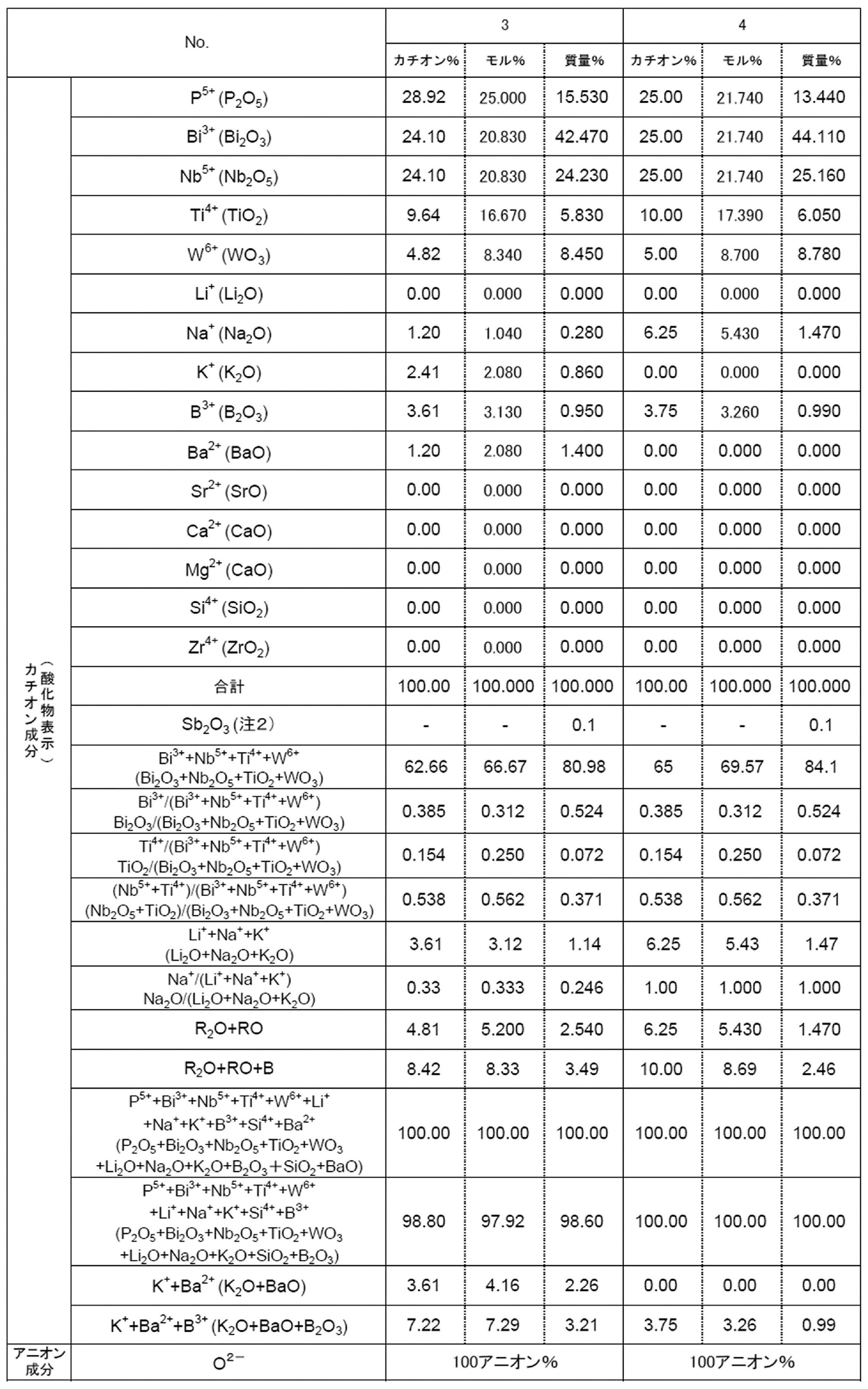


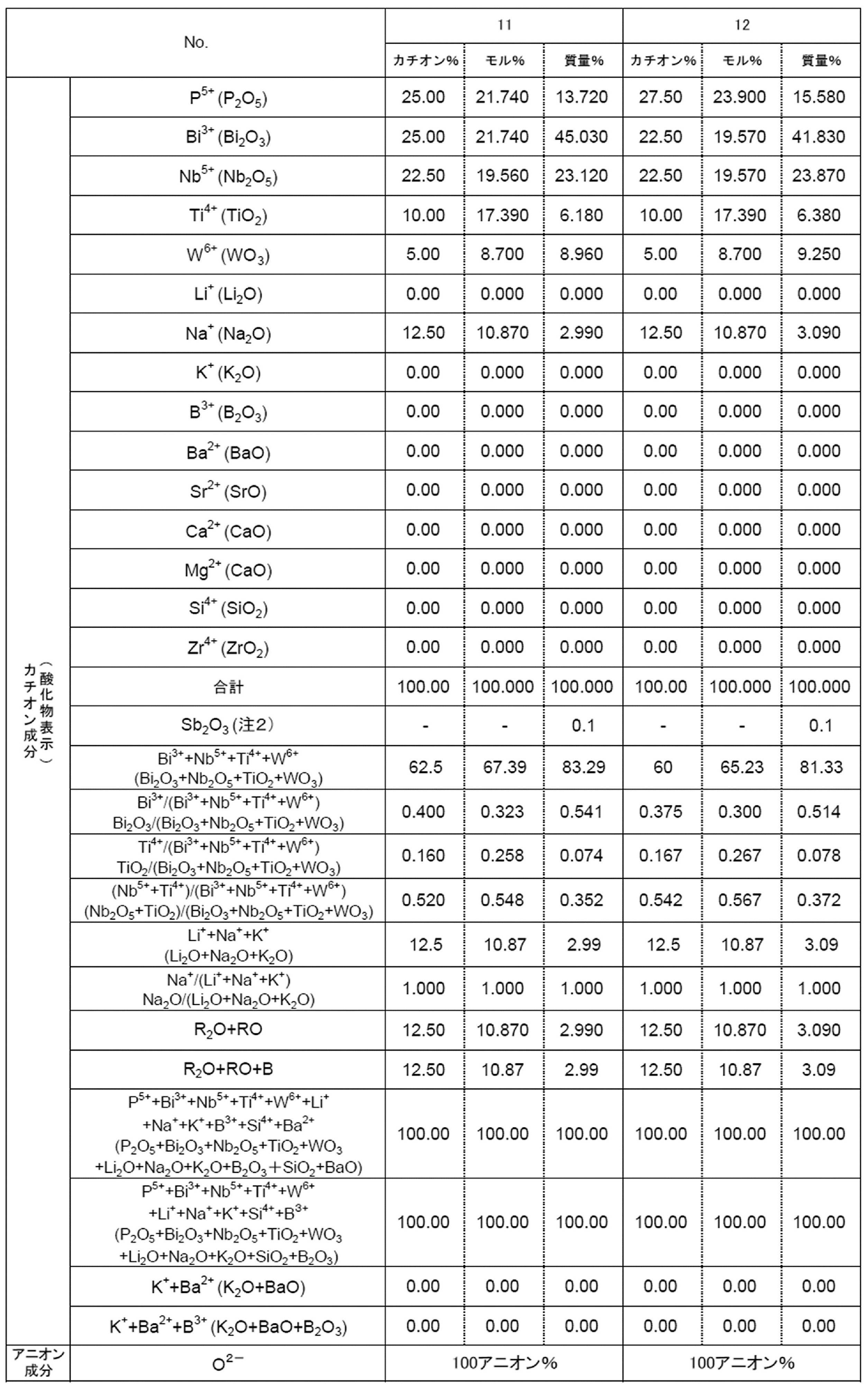


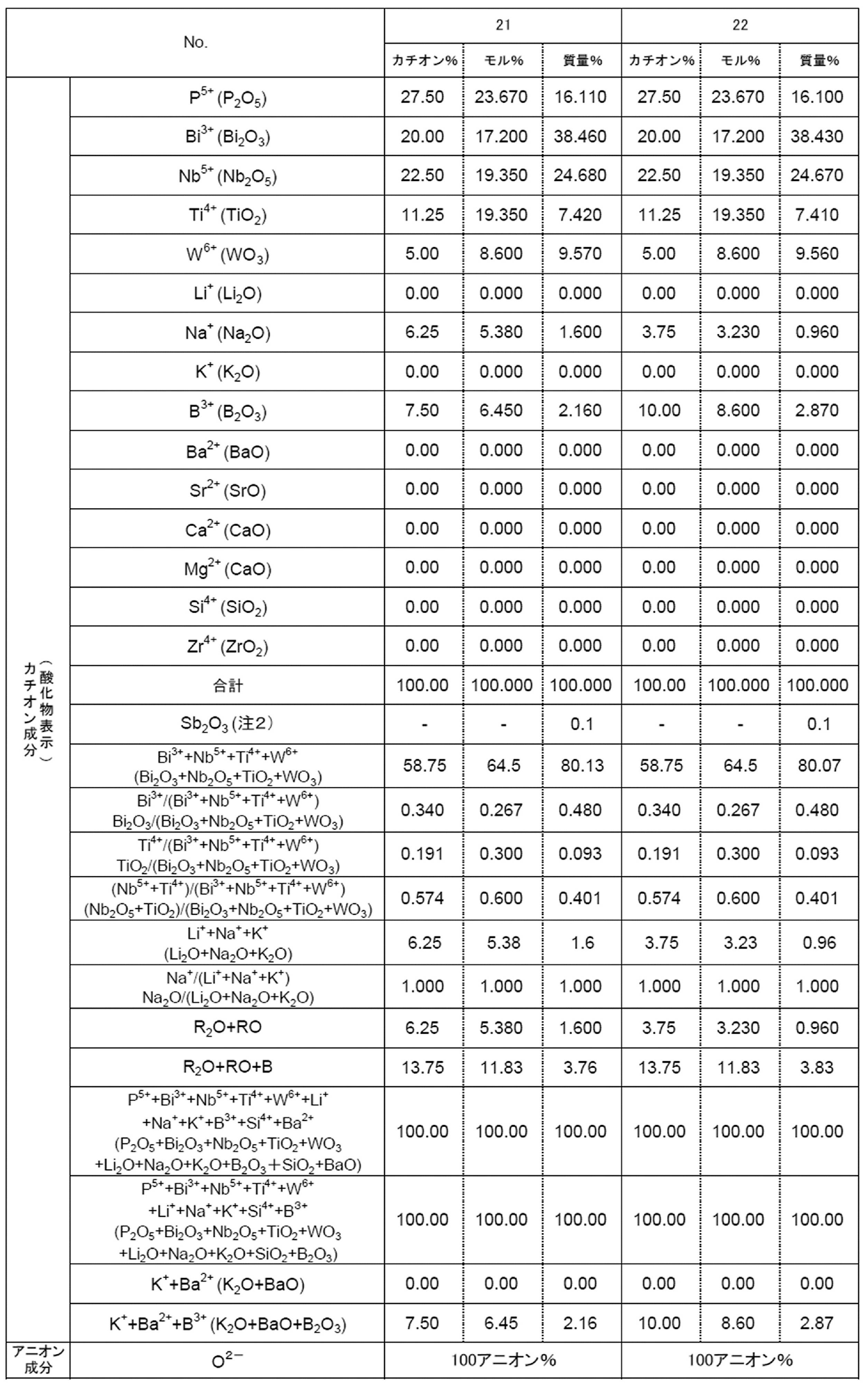


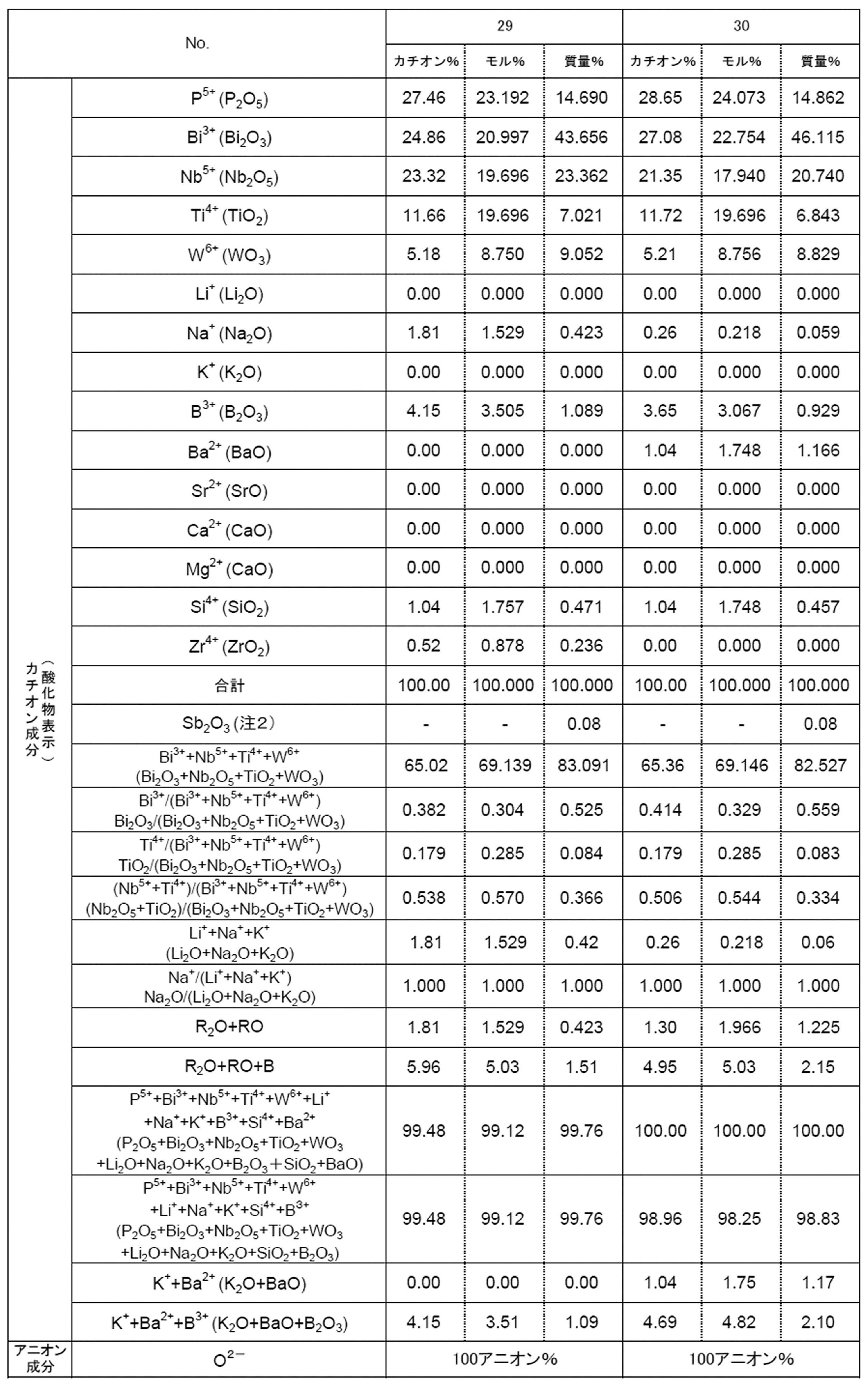
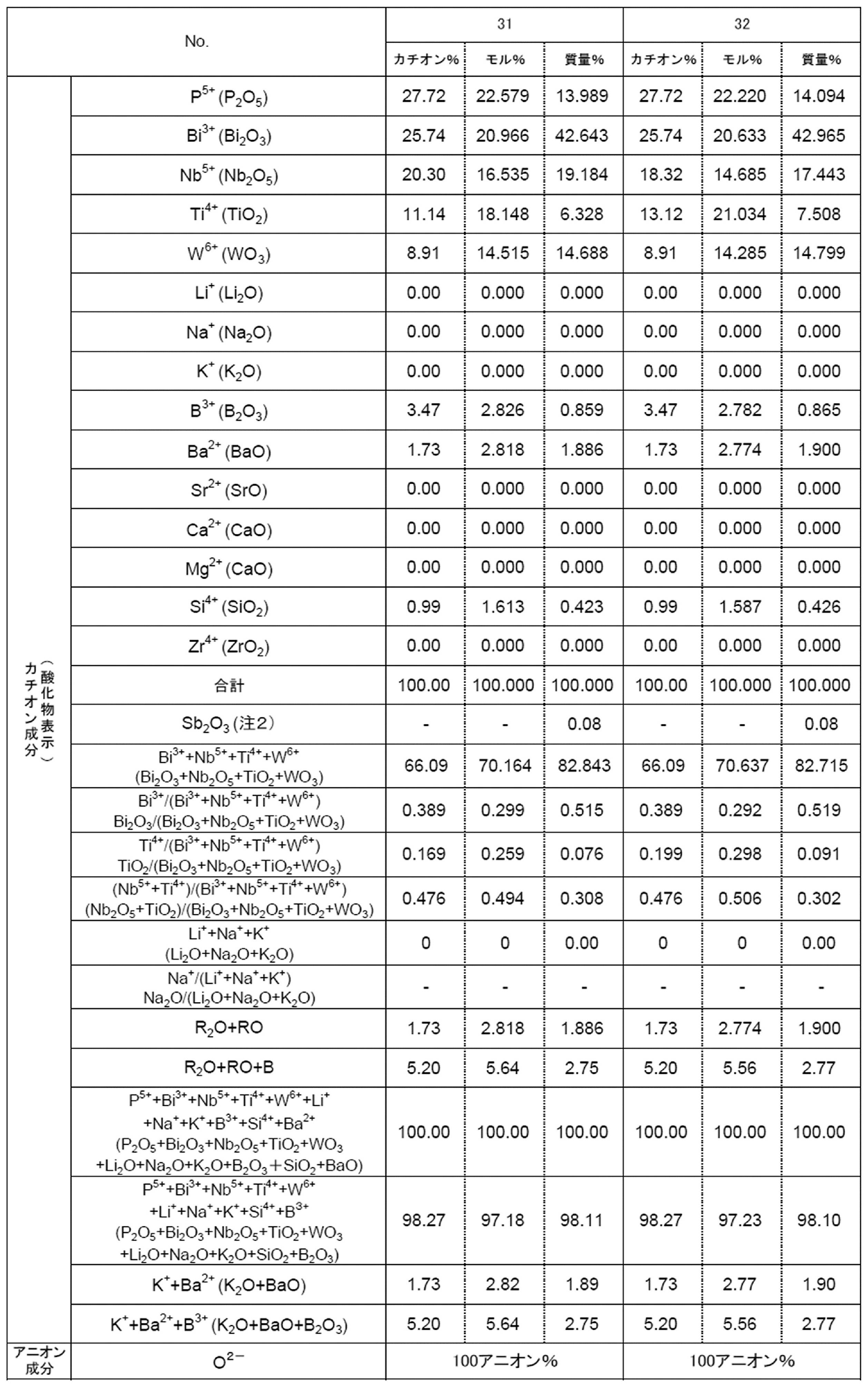

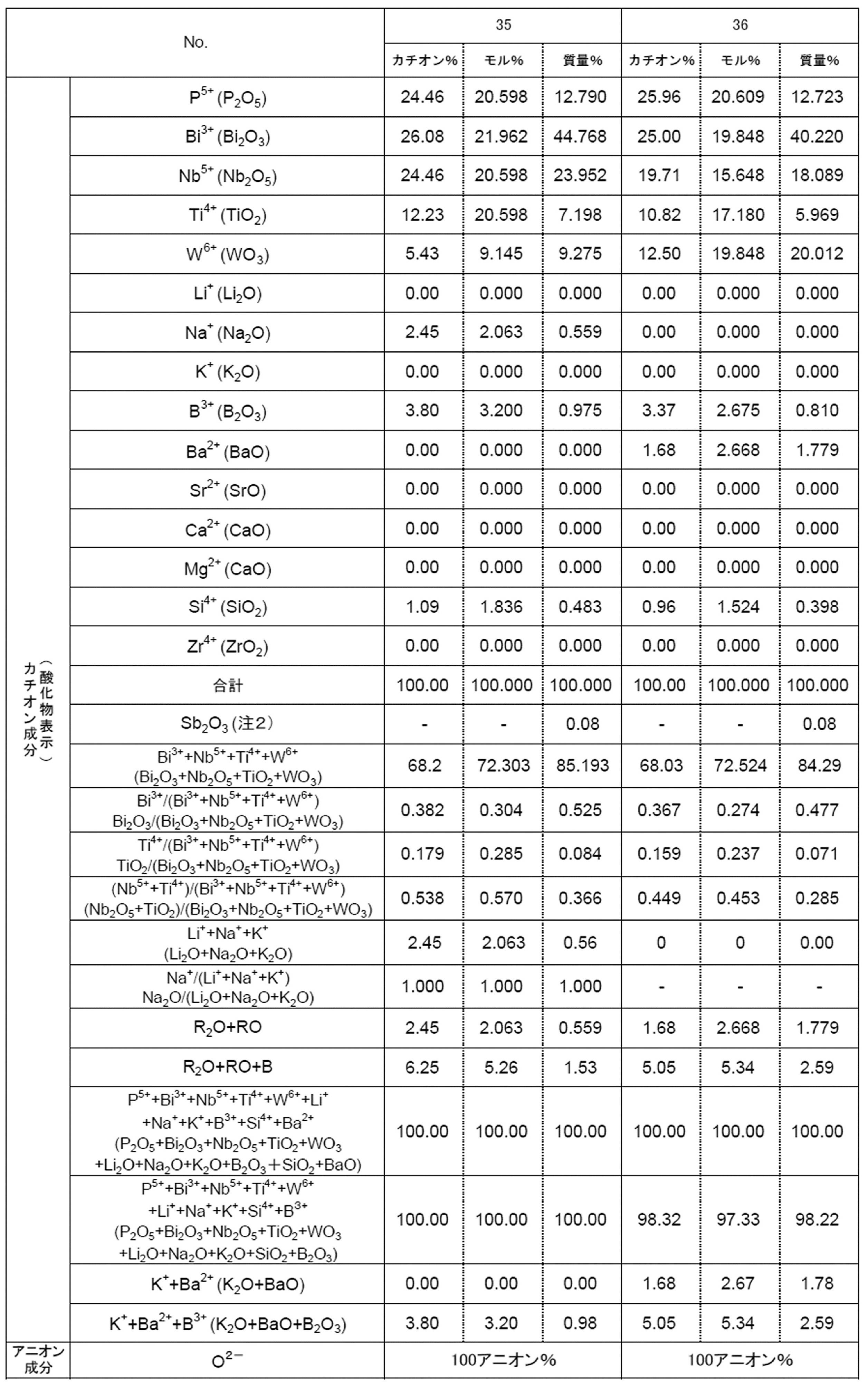


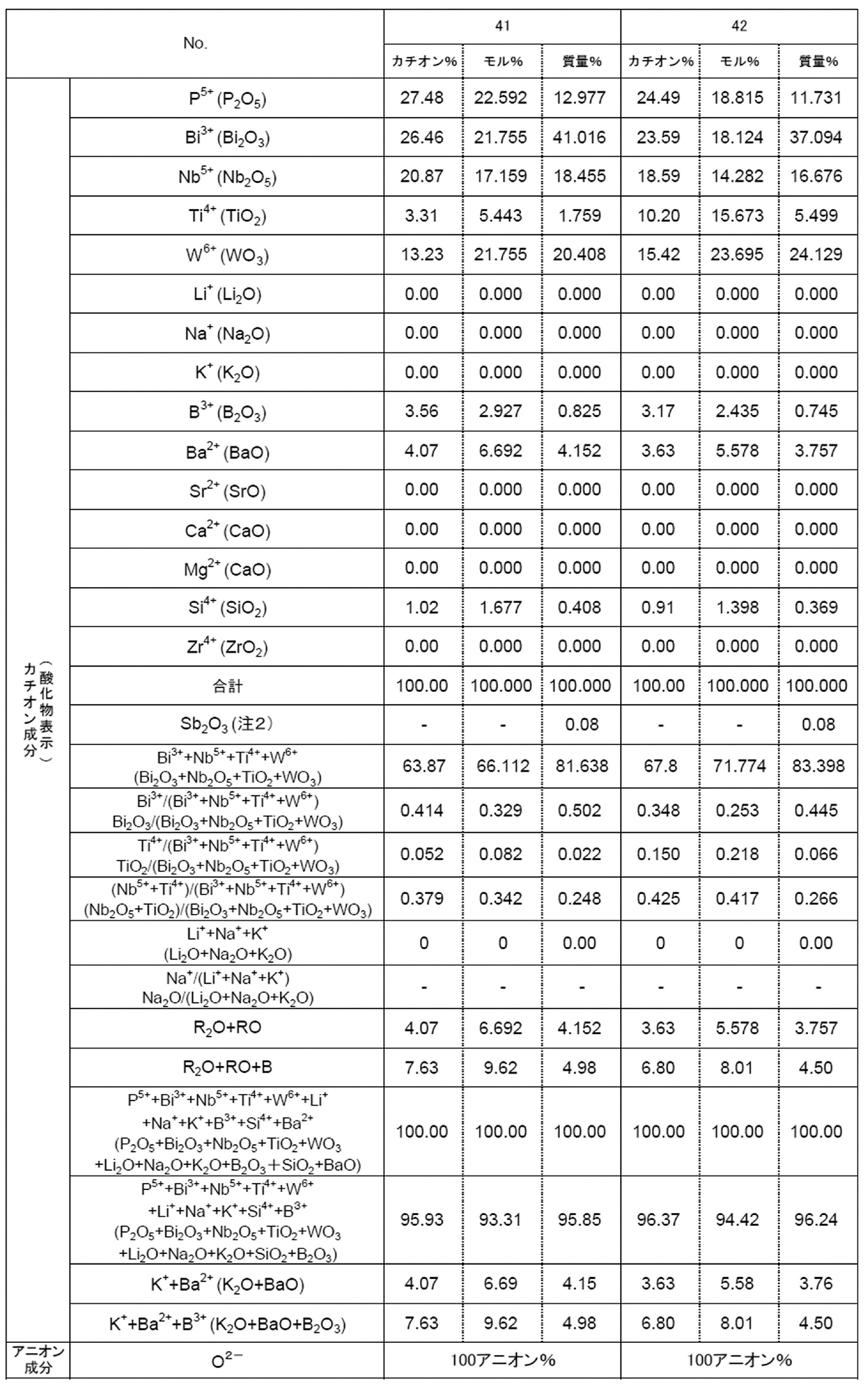






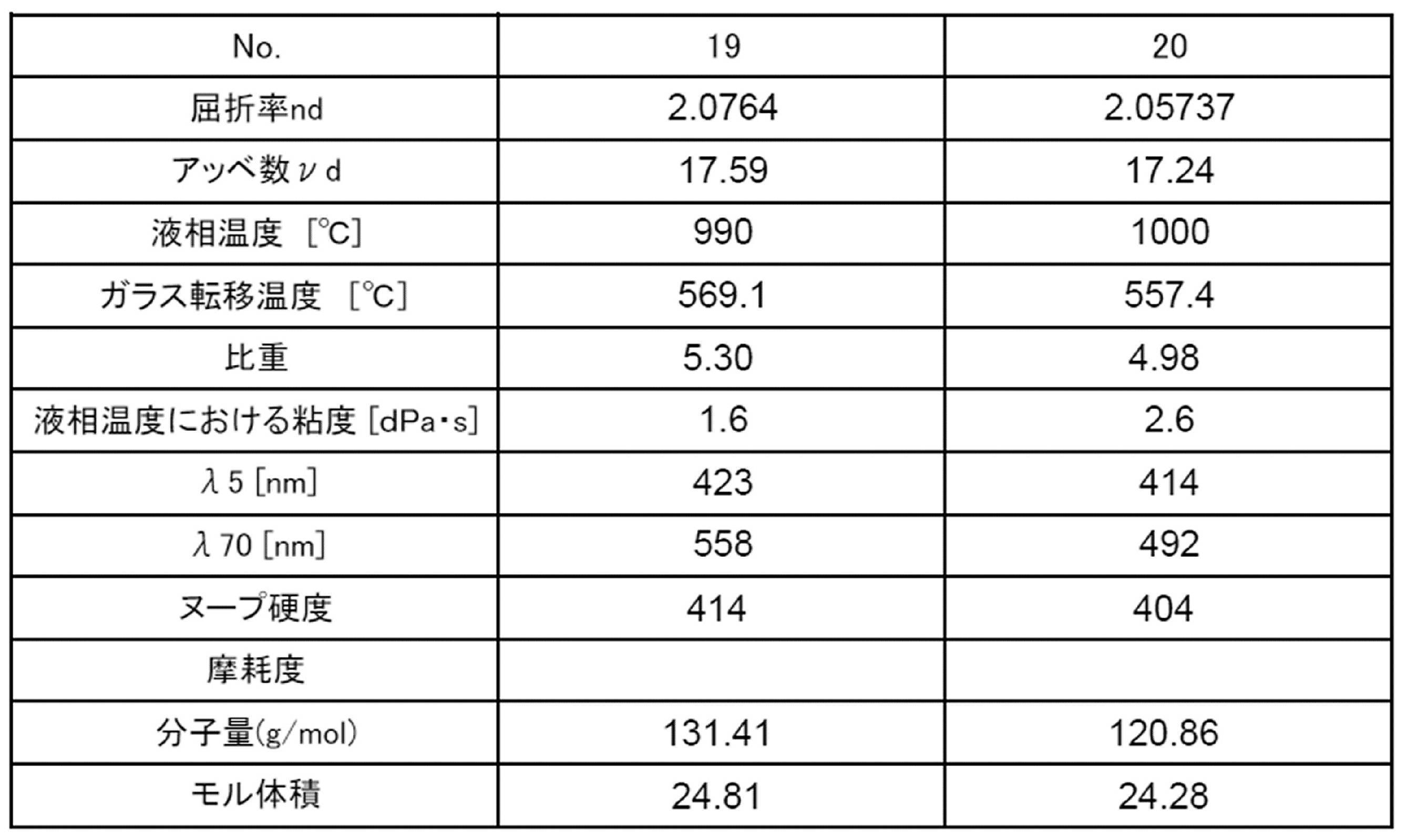

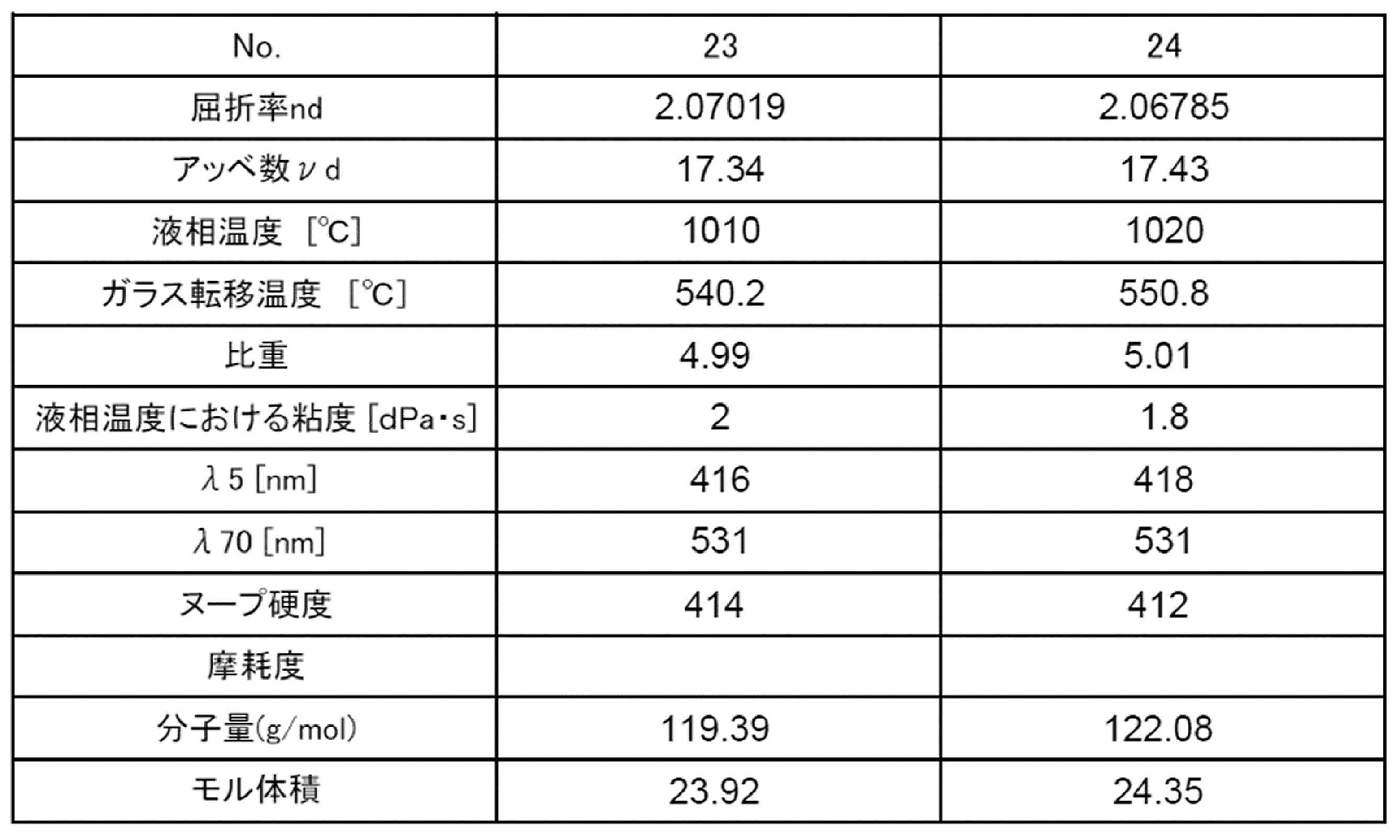

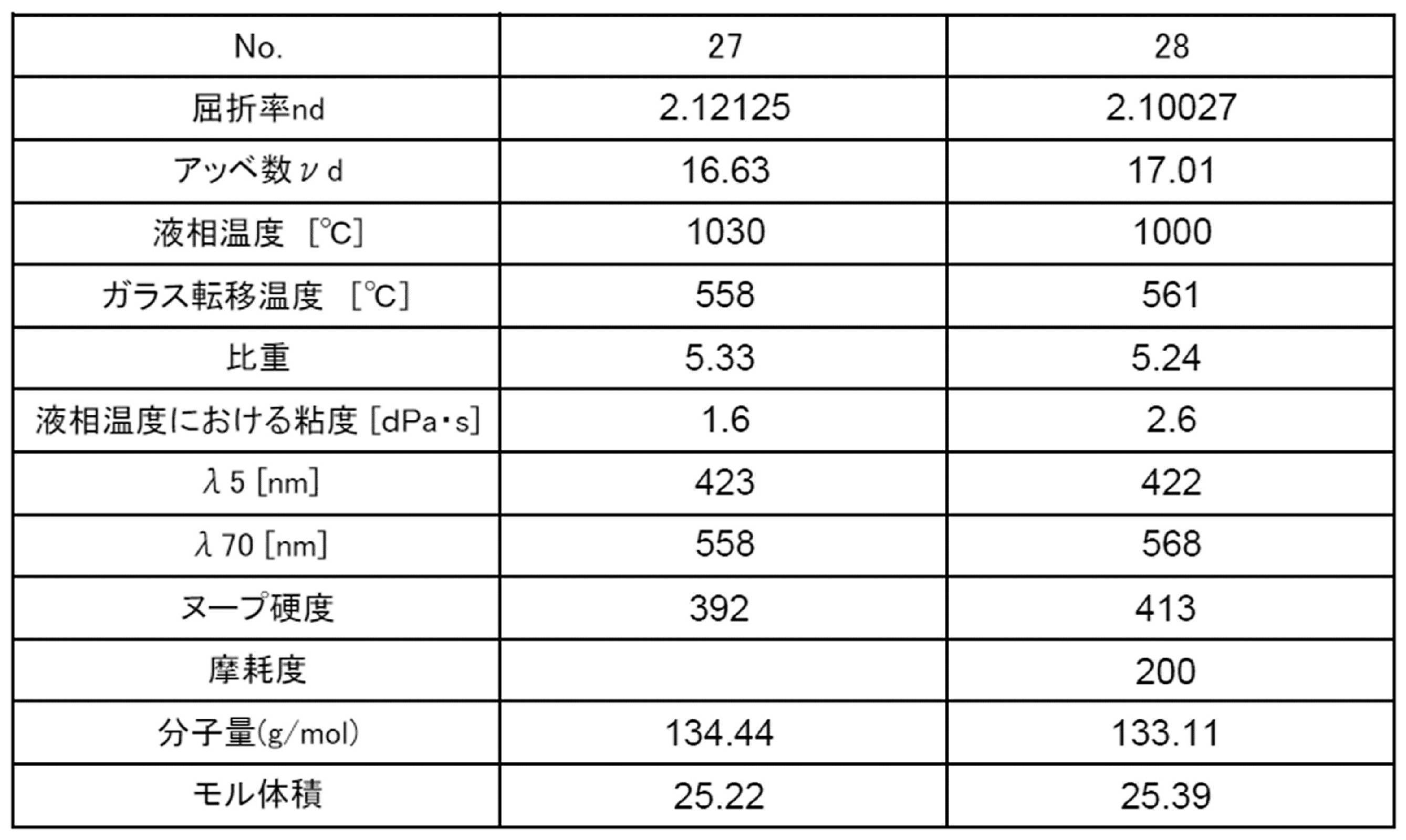


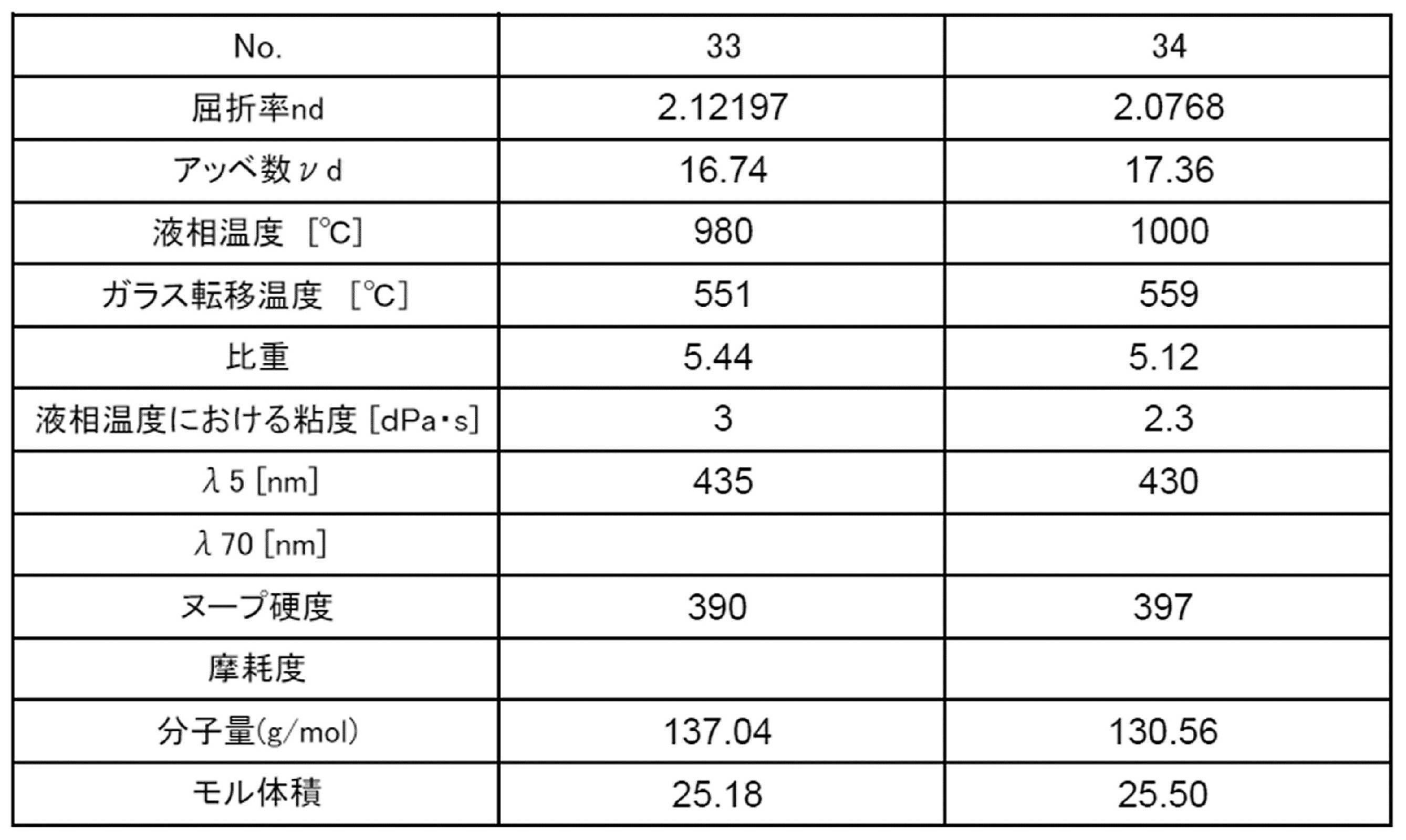





(注2)Sb2O3は質量%表示による外割り添加量のみを表示する。
特許文献2の実施例3の組成を有するガラスを再現し、ヌープ硬度を測定したところ、ヌープ硬度の値は346であった。また、屈折率ndの測定値は2.017、アッベ数νdの測定値は19.3であった。
実施例1と同様にして光学ガラスNo.1~51が得られるようにガラス原料を加熱、溶融、清澄、均質化し、得られた溶融ガラスを鋳型に流し込んで急冷し、ガラスブラックに成形した。次にガラスブロックをアニールした後、切断、研削してプレス成形用ガラス素材を作製した。
実施例2において作製したプレス成形用ガラス素材を加熱、軟化し、プレス成形型を用いて公知の方法によりプレス成形し、レンズブランク、プリズムブランクなどの光学素子ブランクを作製した。
得られた光学素子ブランクは精密アニールが施され、所要の屈折率になるよう屈折率の精密調整を行った後、公知の研削、研磨法によりレンズやプリズムに仕上げる。研磨では、酸化セリウム、酸化ジルコニウムなどの砥粒を用いることができる。得られたレンズ、プリズムの光学機能面を検査したところ、加傷は認められなかった。このようにして高品質の光学素子を高い生産性のもとに提供することができる。
次に実施例2において作製したプレス成形用ガラス素材の表面を研磨して精密プレス成形用のプレス成形用ガラス素材(プリフォーム)とした。プリフォーム表面を検査したところ、加傷は認められなかった。このプリフォームを加熱、精密プレス成形して非球面レンズを得た。精密プレス成形は公知の方法で行った。精密プレス成形で得た非球面レンズを両側から挟持し、公知の方法により芯取り加工を行って芯取りレンズを作製した。得られたレンズの光学機能面を検査したところ、加傷は認められず、芯取り加工時に挟持した箇所にも傷は認められなかった。このようにして高品質の光学素子を高い生産性のもとに提供することができる。
実施例1と同様にして光学ガラスNo.1~51が得られるようにガラス原料を加熱、溶融、清澄、均質化し、得られた溶融ガラスを鋳型に流し込んで急冷し、ガラスブラックに成形した。次にガラスブロックをアニールした後、切断、研削、研磨して球面レンズ、プリズムなどの光学素子を作製した。研磨では、酸化セリウム、酸化ジルコニウムなどの砥粒を用いることができる。
得られたレンズを用いて撮像光学系を構成したところ、色再現性のよい撮像装置を得ることができた。
また、得られたレンズを用いて携帯電話搭載の撮像ユニットや光ピックアップユニットを作製したところ、振動に対して焦点位置ズレの極めて少ないユニットを得ることができた。
比較例1において得られた特許文献2に記載の組成を再現したガラスを研削、研磨してレンズ形状に加工したところ、光学機能面に相当する面に加傷が認められ、レンズとしては使用できないものであった。この結果から、比較例1のガラスを用いて研削、研磨によってプリフォームを作製したとしてもプリフォーム表面が傷つき、仮にこのようなプリフォームを用いて精密プレス成形ができたとしても、プリフォーム作製時の傷が精密プレス成形品の表面に残存することは明らかである。
Claims (15)
- 酸化物ガラスであって、
カチオン%表示にて、
P5+を14~36%、
Bi3+を12~34%、
Nb5+を12~34%、
Ti4+を5~20%、
W6+を0~22%
含み、
Bi3+、Nb5+、Ti4+およびW6+の合計含有量が50%以上、
ヌープ硬度が370以上、屈折率ndが2.02以上、アッベ数νdが19.0以下であることを特徴とする光学ガラス。 - K+およびBa2+の合計含有量が16%以下である請求項1に記載の光学ガラス。
- K+、Ba2+およびB3+の合計含有量を22%以下である請求項1または2に記載の光学ガラス。
- Bi3+、Nb5+、Ti4+およびW6+の合計含有量(Bi3++Nb5++Ti4++W6+)に対するBi3+の含有量のカチオン比(Bi3+/(Bi3++Nb5++Ti4++W6+)が0.6以下である請求項1または2に記載の光学ガラス。
- 酸化物ガラスであって、
カチオン%表示にて、
P5+を14~36%、
Bi3+を12~34%、
Nb5+を12~34%、
Ti4+を5~20%、
W6+を0~22%
含み、
Bi3+、Nb5+、Ti4+およびW6+の合計含有量が50%以上、
ヌープ硬度が370以上、屈折率ndが2.02以上、アッベ数νdが19.0以下である光学ガラスからなるプレス成形用ガラス素材。 - K+およびBa2+の合計含有量が16%以下である請求項5に記載のプレス成形用ガラス素材。
- K+、Ba2+およびB3+の合計含有量を22%以下である請求項5または6に記載のプレス成形用ガラス素材。
- Bi3+、Nb5+、Ti4+およびW6+の合計含有量(Bi3++Nb5++Ti4++W6+)に対するBi3+の含有量のカチオン比(Bi3+/(Bi3++Nb5++Ti4++W6+)が0.6以下である請求項5または6に記載のプレス成形用ガラス素材。
- 酸化物ガラスであって、
カチオン%表示にて、
P5+を14~36%、
Bi3+を12~34%、
Nb5+を12~34%、
Ti4+を5~20%、
W6+を0~22%
含み、
Bi3+、Nb5+、Ti4+およびW6+の合計含有量が50%以上、
ヌープ硬度が370以上、屈折率ndが2.02以上、アッベ数νdが19.0以下である光学ガラスからなる光学素子。 - K+およびBa2+の合計含有量が16%以下である請求項9に記載の光学素子。
- K+、Ba2+およびB3+の合計含有量を22%以下である請求項8または9に記載の光学素子。
- Bi3+、Nb5+、Ti4+およびW6+の合計含有量(Bi3++Nb5++Ti4++W6+)に対するBi3+の含有量のカチオン比(Bi3+/(Bi3++Nb5++Ti4++W6+)が0.6以下である請求項8または9に記載の光学素子。
- 酸化物ガラスであって、
カチオン%表示にて、
P5+を14~36%、
Bi3+を12~34%、
Nb5+を12~34%、
Ti4+を5~20%、
W6+を0~22%
含み、
Bi3+、Nb5+、Ti4+およびW6+の合計含有量が50%以上、
ヌープ硬度が370以上、屈折率ndが2.02以上、アッベ数νdが19.0以下である光学ガラスを機械加工する工程を備えるプレス成形用ガラス素材の製造方法。 - 請求項13に記載のプレス成形用ガラス素材をプレス成形する工程を有する光学素子の製造方法。
- 酸化物ガラスであって、
カチオン%表示にて、
P5+を14~36%、
Bi3+を12~34%、
Nb5+を12~34%、
Ti4+を5~20%、
W6+を0~22%
含み、
Bi3+、Nb5+、Ti4+およびW6+の合計含有量が50%以上、
ヌープ硬度が370以上、屈折率ndが2.02以上、アッベ数νdが19.0以下である光学ガラスを機械加工する工程を備える光学素子の製造方法。
Priority Applications (3)
| Application Number | Priority Date | Filing Date | Title |
|---|---|---|---|
| KR1020127027018A KR20140008994A (ko) | 2011-02-23 | 2012-02-20 | 광학 유리, 프레스 성형용 유리 소재 및 광학 소자 |
| CN201280001135.9A CN102858702B (zh) | 2011-02-23 | 2012-02-20 | 光学玻璃、模压成型用玻璃坯料和光学元件 |
| EP12749495.3A EP2543645A4 (en) | 2011-02-23 | 2012-02-20 | OPTICAL GLASS, GLASS MATERIAL FOR PRESSURE FORMING, AND OPTICAL ELEMENT |
Applications Claiming Priority (2)
| Application Number | Priority Date | Filing Date | Title |
|---|---|---|---|
| JP2011037349A JP5543395B2 (ja) | 2011-02-23 | 2011-02-23 | 光学ガラス、プレス成形用ガラス素材および光学素子 |
| JP2011-037349 | 2011-02-23 |
Publications (1)
| Publication Number | Publication Date |
|---|---|
| WO2012115038A1 true WO2012115038A1 (ja) | 2012-08-30 |
Family
ID=46720815
Family Applications (1)
| Application Number | Title | Priority Date | Filing Date |
|---|---|---|---|
| PCT/JP2012/053962 Ceased WO2012115038A1 (ja) | 2011-02-23 | 2012-02-20 | 光学ガラス、プレス成形用ガラス素材および光学素子 |
Country Status (6)
| Country | Link |
|---|---|
| US (1) | US8716157B2 (ja) |
| EP (1) | EP2543645A4 (ja) |
| JP (1) | JP5543395B2 (ja) |
| KR (1) | KR20140008994A (ja) |
| CN (1) | CN102858702B (ja) |
| WO (1) | WO2012115038A1 (ja) |
Cited By (3)
| Publication number | Priority date | Publication date | Assignee | Title |
|---|---|---|---|---|
| WO2017006998A1 (ja) * | 2015-07-07 | 2017-01-12 | Hoya株式会社 | ガラス、光学ガラス、リン酸塩光学ガラス、研磨用ガラス素材、プレス成形用ガラス素材および光学素子 |
| CN110467346A (zh) * | 2018-05-10 | 2019-11-19 | Hoya株式会社 | 光学玻璃和光学元件 |
| US11319243B2 (en) | 2018-01-17 | 2022-05-03 | Corning Incorporated | High refractive index optical borate glass |
Families Citing this family (14)
| Publication number | Priority date | Publication date | Assignee | Title |
|---|---|---|---|---|
| JP5260623B2 (ja) | 2010-09-30 | 2013-08-14 | Hoya株式会社 | 光学ガラス、プレス成形用ガラス素材および光学素子 |
| CN103086590B (zh) * | 2011-11-02 | 2015-10-21 | 富泰华工业(深圳)有限公司 | 雾面玻璃制造方法 |
| CN105271713B (zh) | 2012-06-22 | 2017-10-27 | Hoya株式会社 | 玻璃、光学玻璃、模压成型用玻璃坯料和光学元件 |
| JP6116859B2 (ja) * | 2012-10-31 | 2017-04-19 | 株式会社オハラ | 光学ガラス、プリフォーム及び光学素子 |
| USD762673S1 (en) | 2014-12-31 | 2016-08-02 | Samsung Electronics Co., Ltd. | Display screen or portion thereof with animated graphical user interface |
| WO2020117651A1 (en) * | 2018-12-07 | 2020-06-11 | Corning Incorporated | High-refractive index phosphate glass |
| JP7530034B2 (ja) * | 2019-04-05 | 2024-08-07 | 日本電気硝子株式会社 | 装飾用ガラス物品 |
| CN113387567B (zh) * | 2020-03-13 | 2022-03-18 | 包头稀土研究院 | 红色荧光玻璃及其制备方法 |
| JP2024505204A (ja) | 2021-01-22 | 2024-02-05 | コーニング インコーポレイテッド | カルシウム含有高屈折率リン酸塩ガラス |
| JP2024505205A (ja) | 2021-01-22 | 2024-02-05 | コーニング インコーポレイテッド | 高い屈折率と低い密度を有するリン酸塩ガラス |
| WO2022159275A1 (en) | 2021-01-22 | 2022-07-28 | Corning Incorporated | Phosphate glasses with high refractive index and reduced dispersion |
| US12515982B2 (en) | 2021-03-19 | 2026-01-06 | Corning Incorporated | High-index borate glasses |
| US20230202917A1 (en) * | 2021-12-28 | 2023-06-29 | Hoya Corporation | Glass |
| EP4476184A1 (en) | 2022-03-25 | 2024-12-18 | Corning Incorporated | High-index high-dispersion phosphate glasses containing bismuth oxide |
Citations (3)
| Publication number | Priority date | Publication date | Assignee | Title |
|---|---|---|---|---|
| JP2006111499A (ja) | 2004-10-15 | 2006-04-27 | Hoya Corp | 光学ガラス、精密プレス成形用プリフォーム及びその製造方法、光学素子及びその製造方法 |
| JP2007015904A (ja) | 2005-07-11 | 2007-01-25 | Konica Minolta Opto Inc | 光学ガラス及び光学素子 |
| JP2010275182A (ja) * | 2009-04-27 | 2010-12-09 | Asahi Glass Co Ltd | 光学ガラス |
Family Cites Families (11)
| Publication number | Priority date | Publication date | Assignee | Title |
|---|---|---|---|---|
| EP1468974A3 (en) * | 2003-04-17 | 2004-12-01 | Hoya Corporation | Optical glass; press-molding preform and method of manufacturing same; and optical element and method of manufacturing same |
| CN1576252B (zh) * | 2003-06-30 | 2010-04-28 | Hoya株式会社 | 精密加压成形用预成形体、光学元件及各自的制备方法 |
| JP4065856B2 (ja) * | 2004-01-23 | 2008-03-26 | Hoya株式会社 | 光学ガラス、プレス成形用被成形ガラス体、光学素子およびその製造方法 |
| JP4677193B2 (ja) * | 2004-02-26 | 2011-04-27 | 株式会社住田光学ガラス | 精密プレス成形用光学ガラス |
| DE102005039172B3 (de) * | 2005-08-17 | 2007-04-26 | Schott Ag | Blei- und arsenfreies optisches Niobphosphatglas sowie dessen Verwendung |
| DE102007008300B4 (de) * | 2006-08-12 | 2011-08-25 | Schott Ag, 55122 | Bleifreies optisches Glas der Schwerflint- und Lanthanschwerflintlage sowie dessen Herstellung und Verwendung |
| JP5014323B2 (ja) * | 2008-12-26 | 2012-08-29 | Hoya株式会社 | 光学ガラス、精密プレス成形用プリフォーム及びその製造方法、光学素子及びその製造方法 |
| KR101653431B1 (ko) * | 2009-01-26 | 2016-09-01 | 아사히 가라스 가부시키가이샤 | 유리 조성물 및 기판 상에 그것을 구비하는 부재 |
| JP5531967B2 (ja) * | 2009-01-26 | 2014-06-25 | 旭硝子株式会社 | 有機led素子の散乱層用ガラス及び有機led素子 |
| JP5260623B2 (ja) * | 2010-09-30 | 2013-08-14 | Hoya株式会社 | 光学ガラス、プレス成形用ガラス素材および光学素子 |
| JP5840531B2 (ja) * | 2011-04-28 | 2016-01-06 | Hoya株式会社 | ガラスの製造方法、プレス成形用ガラス素材の製造方法及び光学素子の製造方法 |
-
2011
- 2011-02-23 JP JP2011037349A patent/JP5543395B2/ja active Active
-
2012
- 2012-02-20 CN CN201280001135.9A patent/CN102858702B/zh active Active
- 2012-02-20 EP EP12749495.3A patent/EP2543645A4/en not_active Withdrawn
- 2012-02-20 KR KR1020127027018A patent/KR20140008994A/ko not_active Withdrawn
- 2012-02-20 WO PCT/JP2012/053962 patent/WO2012115038A1/ja not_active Ceased
- 2012-02-23 US US13/403,696 patent/US8716157B2/en active Active
Patent Citations (3)
| Publication number | Priority date | Publication date | Assignee | Title |
|---|---|---|---|---|
| JP2006111499A (ja) | 2004-10-15 | 2006-04-27 | Hoya Corp | 光学ガラス、精密プレス成形用プリフォーム及びその製造方法、光学素子及びその製造方法 |
| JP2007015904A (ja) | 2005-07-11 | 2007-01-25 | Konica Minolta Opto Inc | 光学ガラス及び光学素子 |
| JP2010275182A (ja) * | 2009-04-27 | 2010-12-09 | Asahi Glass Co Ltd | 光学ガラス |
Non-Patent Citations (2)
| Title |
|---|
| K. BALASUBRAMANIAN: "Relativistic Effects in Chemistry Part A", 1997, JOHN WILEY & SONS |
| See also references of EP2543645A4 |
Cited By (7)
| Publication number | Priority date | Publication date | Assignee | Title |
|---|---|---|---|---|
| WO2017006998A1 (ja) * | 2015-07-07 | 2017-01-12 | Hoya株式会社 | ガラス、光学ガラス、リン酸塩光学ガラス、研磨用ガラス素材、プレス成形用ガラス素材および光学素子 |
| JP2020019710A (ja) * | 2015-07-07 | 2020-02-06 | Hoya株式会社 | ガラス、光学ガラス、リン酸塩光学ガラス、研磨用ガラス素材、プレス成形用ガラス素材および光学素子 |
| JP2022028819A (ja) * | 2015-07-07 | 2022-02-16 | Hoya株式会社 | ガラス、光学ガラス、リン酸塩光学ガラスおよび光学素子 |
| JP7543240B2 (ja) | 2015-07-07 | 2024-09-02 | Hoya株式会社 | ガラス、光学ガラス、リン酸塩光学ガラスおよび光学素子 |
| US11319243B2 (en) | 2018-01-17 | 2022-05-03 | Corning Incorporated | High refractive index optical borate glass |
| CN110467346A (zh) * | 2018-05-10 | 2019-11-19 | Hoya株式会社 | 光学玻璃和光学元件 |
| CN110467346B (zh) * | 2018-05-10 | 2021-11-19 | Hoya株式会社 | 光学玻璃和光学元件 |
Also Published As
| Publication number | Publication date |
|---|---|
| EP2543645A1 (en) | 2013-01-09 |
| CN102858702A (zh) | 2013-01-02 |
| KR20140008994A (ko) | 2014-01-22 |
| US20120238433A1 (en) | 2012-09-20 |
| JP5543395B2 (ja) | 2014-07-09 |
| EP2543645A4 (en) | 2014-01-08 |
| US8716157B2 (en) | 2014-05-06 |
| JP2012171848A (ja) | 2012-09-10 |
| CN102858702B (zh) | 2017-06-13 |
Similar Documents
| Publication | Publication Date | Title |
|---|---|---|
| JP5543395B2 (ja) | 光学ガラス、プレス成形用ガラス素材および光学素子 | |
| JP5260623B2 (ja) | 光学ガラス、プレス成形用ガラス素材および光学素子 | |
| JP6069217B2 (ja) | 光学ガラス、プレス成形用ガラス素材、ならびに光学素子およびその製造方法 | |
| JP5856509B2 (ja) | 光学ガラス、プレス成形用ガラス素材、および光学素子とその製造方法 | |
| JP2008137877A (ja) | 光学ガラスおよび光学素子 | |
| KR100933227B1 (ko) | 유리 조성물 | |
| JP2010248057A (ja) | 光学ガラス、ならびにプレス成形用ガラス素材、光学素子ブランク、光学素子およびそれらの製造方法 | |
| JP5444490B2 (ja) | 光学ガラス、プレス成形用ガラス素材および光学素子 | |
| KR101660625B1 (ko) | 광학 유리 및 그 이용 | |
| TWI838410B (zh) | 光學玻璃、壓製成形用玻璃原材料、光學元件坯料及光學元件 | |
| JP7450105B2 (ja) | 光学ガラス、プレス成形用ガラス素材、光学素子ブランクおよび光学素子 | |
| TWI887211B (zh) | 光學玻璃、壓製成形用玻璃原材料、光學元件坯料及光學元件 | |
| WO2012029563A1 (ja) | 光学ガラス | |
| JP2014009113A (ja) | 光学ガラスおよびその利用 | |
| JP2014009112A (ja) | 光学ガラスおよびその利用 | |
| WO2017002956A1 (ja) | 光学ガラスおよび光学素子 | |
| CN120677131A (zh) | 光学玻璃及光学元件 | |
| TW202513494A (zh) | 光學玻璃和光學元件 |
Legal Events
| Date | Code | Title | Description |
|---|---|---|---|
| WWE | Wipo information: entry into national phase |
Ref document number: 201280001135.9 Country of ref document: CN |
|
| WWE | Wipo information: entry into national phase |
Ref document number: 2012749495 Country of ref document: EP |
|
| ENP | Entry into the national phase |
Ref document number: 20127027018 Country of ref document: KR Kind code of ref document: A |
|
| 121 | Ep: the epo has been informed by wipo that ep was designated in this application |
Ref document number: 12749495 Country of ref document: EP Kind code of ref document: A1 |
|
| NENP | Non-entry into the national phase |
Ref country code: DE |
|
| WWE | Wipo information: entry into national phase |
Ref document number: 1201005578 Country of ref document: TH |