WO2012115038A1 - Verre optique, matériau de verre pour formage sous pression, et élément optique - Google Patents
Verre optique, matériau de verre pour formage sous pression, et élément optique Download PDFInfo
- Publication number
- WO2012115038A1 WO2012115038A1 PCT/JP2012/053962 JP2012053962W WO2012115038A1 WO 2012115038 A1 WO2012115038 A1 WO 2012115038A1 JP 2012053962 W JP2012053962 W JP 2012053962W WO 2012115038 A1 WO2012115038 A1 WO 2012115038A1
- Authority
- WO
- WIPO (PCT)
- Prior art keywords
- glass
- optical
- refractive index
- less
- upper limit
- Prior art date
- Legal status (The legal status is an assumption and is not a legal conclusion. Google has not performed a legal analysis and makes no representation as to the accuracy of the status listed.)
- Ceased
Links
Images
Classifications
-
- C—CHEMISTRY; METALLURGY
- C03—GLASS; MINERAL OR SLAG WOOL
- C03C—CHEMICAL COMPOSITION OF GLASSES, GLAZES OR VITREOUS ENAMELS; SURFACE TREATMENT OF GLASS; SURFACE TREATMENT OF FIBRES OR FILAMENTS MADE FROM GLASS, MINERALS OR SLAGS; JOINING GLASS TO GLASS OR OTHER MATERIALS
- C03C3/00—Glass compositions
- C03C3/04—Glass compositions containing silica
- C03C3/062—Glass compositions containing silica with less than 40% silica by weight
- C03C3/064—Glass compositions containing silica with less than 40% silica by weight containing boron
-
- G—PHYSICS
- G02—OPTICS
- G02B—OPTICAL ELEMENTS, SYSTEMS OR APPARATUS
- G02B1/00—Optical elements characterised by the material of which they are made; Optical coatings for optical elements
- G02B1/02—Optical elements characterised by the material of which they are made; Optical coatings for optical elements made of crystals, e.g. rock-salt, semi-conductors
-
- C—CHEMISTRY; METALLURGY
- C03—GLASS; MINERAL OR SLAG WOOL
- C03C—CHEMICAL COMPOSITION OF GLASSES, GLAZES OR VITREOUS ENAMELS; SURFACE TREATMENT OF GLASS; SURFACE TREATMENT OF FIBRES OR FILAMENTS MADE FROM GLASS, MINERALS OR SLAGS; JOINING GLASS TO GLASS OR OTHER MATERIALS
- C03C3/00—Glass compositions
- C03C3/12—Silica-free oxide glass compositions
- C03C3/16—Silica-free oxide glass compositions containing phosphorus
- C03C3/21—Silica-free oxide glass compositions containing phosphorus containing titanium, zirconium, vanadium, tungsten or molybdenum
Definitions
- the present invention relates to an optical glass, a glass material for press molding, and an optical element.
- a high-dispersion glass having an extremely high refractive index that has a refractive index nd of 2.02 or more and an Abbe number of 19 or less is effective.
- the characteristics required for optical glass include optical characteristics required by users such as camera designers, for example, refractive index characteristics and transmittance characteristics.
- Optical glass as an industrial product is manufactured with high productivity. For this purpose, it is indispensable to increase the mechanical characteristics that determine the scratch resistance in the conveyance of the glass production process to a certain level.
- the glass surface of the optical element is formed by polishing
- the glass surface is removed with elastic strain, plastic strain, crack generation, and the like by machining such as cutting and grinding.
- a smooth optical functional surface is formed by a polishing process and a chemical etching process with a small amount of surface removal.
- the mechanical strength of the optical glass is too low, the surface damage in the cutting or grinding process becomes excessive, and scratches that cannot be removed in the polishing process remain on the optical surface.
- the polishing process where the amount of surface removal is relatively small and in the ultrasonic cleaning process for cleaning the glass, the glass is soft, so it is possible to perform a slight mechanical action such as rolling of coarse abrasive grains and ultrasonic cavitation.
- the possibility of scratches on the lens surface, such as scratches increases. From the above, the glass subjected to the polishing process needs to have high mechanical strength.
- the preform polishing step can be omitted, but when the preform is washed or transported and aligned to the press mold.
- the number of processes in which the preform surface comes into contact with a cleaning jig, a conveying device, a positioning device, etc. increases.
- the possibility of physical scratches occurring on the preform surface increases.
- the preform having scratches as described above is precision press-molded, part or all of the scratches remain on the optical functional surface of the optical element.
- it is used in these processes when glass with an optical function surface is formed into a lens product through slow cooling, cleaning, centering, film formation, and inspection processes, regardless of the polishing process or precision press molding process. Contact with the instrument may damage the optically functional surface.
- the present invention solves the above problems and has mechanical properties suitable for the manufacture of high-quality optical elements while having high refractive index and high dispersion characteristics with a refractive index nd of 2.02 or more and an Abbe number ⁇ d of 19.0 or less.
- An object is to provide an optical glass. Furthermore, the objective of this invention is providing the glass raw material for press molding and optical element which consist of this optical glass. In addition, the objective of this invention is providing the manufacturing method of the glass raw material for press molding from this optical glass.
- the present invention provides the following means as means for solving the above problems.
- [7] [1] A method for producing a glass material for press molding comprising a step of machining the optical glass according to any one of [4]. [8] The manufacturing method of the optical element which has the process of press-molding the glass raw material for press molding as described in [5]. [6] [1] A method for producing an optical element comprising a step of machining the optical glass according to any one of [4].
- an optical glass having mechanical characteristics suitable for manufacturing a high-quality optical element while having a high refractive index and high dispersion characteristic with a refractive index nd of 2.02 or more and an Abbe number ⁇ d of 19.0 or less. be able to. Furthermore, according to this invention, the glass raw material for press molding and optical element which consist of said optical glass can be provided.
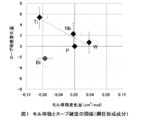
- FIG. 1 is a graph showing the change in molar volume and Knoop hardness when Ti, Nb, W, P, and Bi are substituted by 1 cation% of these cation components based on P.
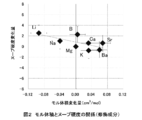
- FIG. 2 is a graph showing the amount of change in molar volume and Knoop hardness when Li, Na, K, B, Mg, Ca, Sr, and Ba are substituted by 1 cation% of these cation components with respect to Mg. It is.
- the present inventor made extensive studies on the above-mentioned problems, and obtained the following knowledge. Classifying the glass components necessary for realizing a high refractive index optical glass from the viewpoint of the properties that each component imparts to the glass, the high refractive index and high dispersion imparting component that imparts the desired optical properties to the glass, promoting glass formation However, it can be classified as a glass network forming component that lowers the refractive index and a modifying component that improves the solubility of the glass but slightly lowers the refractive index.
- High refractive index and high dispersion glass needs to introduce a large amount of high refractive index and high dispersion components such as Bi, Ti, W, and Nb as glass components.
- high refractive index and high dispersion components such as Bi, Ti, W, and Nb as glass components.
- Bi high refractive index and high dispersion components
- Ti titanium, W, and Nb
- Nb high refractive index and high dispersion components
- elements such as Bi and P are present as cations in the glass, and a plurality of anions such as oxygen ions and fluorine ions are coordinated according to their valence, and some ions
- the groups are cross-linked by ion groups having opposite charges, or specific ion groups terminate the bond.
- there may be a few ion groups such as H 2 O, OH ⁇ , CO 3 ⁇ and SO 4 2 ⁇ in the structure, but the main structure is thought to consist of a combination of cations and anions. . Therefore, it can be considered that the structural unit of the glass structure is composed of a set of chemical bonds such as Bi—O, Bi—F, Bi— (SO 4 ) and the like.
- the bonding state in the glass is a factor that determines the mechanical strength of the glass.
- the substitution of the cation M 2 having a cation M 1 and the valence n 2 with the valence n 1 is reduce the density of the average n 1 pieces of M 1 -O bond in the glass when the glass is an oxide Average n 2 M 2 -Os.
- P having a large occupied volume of glass network forming components is replaced with B having a smaller occupied volume, or K having a large ionic radius among alkali metal components is replaced with Na or Li having a smaller ionic radius.
- W having a large ionic radius with Ti having a smaller ionic radius the hardness increases as the molar volume decreases.
- the hardness also increases by replacing Na, which is an alkali metal component, with B, which is a network-forming component, or Nb, which is a network-forming component having a high refractive index.
- the BiO polyhedral structure is distorted, for example, the interatomic distance in a specific direction is long and the bond angle is large, and a so-called stereochemically active chemical state is obtained. Due to the above-mentioned characteristics peculiar to heavy elements, when Bi is introduced into glass, the number of elements contained in the unit volume is increased due to the effect of distortion of the BiO polyhedron, and the molar volume is decreased. It can be considered that, due to the expansion of the interatomic distance accompanied by the existence, a bond with less energy required to break the bond, that is, a bond that does not contribute to an increase in mechanical strength is formed.
- FIG. 1 shows the amount of change in molar volume and Knoop hardness when 1 cation% of each cation is substituted with each other.
- Knoop hardness is an index indicating the indentation hardness of glass in the same manner as Vickers hardness. In general glass, a material that is relatively hard and easily cracked, such as optical glass, has a small dent crack and a small variation in test results. Therefore, in the present invention, the hardness of the glass is evaluated by Knoop hardness.
- the optical glass of the present invention completed based on the above knowledge is an oxide glass, In cation% display, 14 to 36% of P 5+ , Bi 3+ 12-34 %, Nb 5+ 12-34 %, Ti 4+ 5-20 %, 0 to 22% for W 6+ Including
- the total content of Bi 3+ , Nb 5+ , Ti 4+ and W 6+ is 50% or more,
- the Knoop hardness is 370 or more
- the refractive index nd is 2.02 or more
- the Abbe number ⁇ d is 19.0 or less.
- the optical glass of the present invention has a mechanical strength suitable for the production of glass products made of optical glass while having an ultra-high refractive index and high dispersion characteristic with a refractive index nd of 2.02 or more and an Abbe number ⁇ d of 19.0 or less.
- the unit of Knoop hardness is MPa, but in the technical field to which the present invention pertains, it is customary to omit the Knoop hardness unit, and therefore the Knoop hardness unit is also omitted in the present invention.
- the optical glass of the present invention is basically an oxide glass, and O 2 ⁇ is the main component of an anion.
- the content of O 2 ⁇ may be considered with reference to 90 to 100 anion%. If the content of O 2 ⁇ is within the above range, F ⁇ , Cl ⁇ , Br ⁇ , I ⁇ , S 2 ⁇ , Se 2 ⁇ , N 3 ⁇ , NO 3 ⁇ , or SO 4 may be used as the other anion component. 2- and the like may be contained. In that case, the total content of F ⁇ , Cl ⁇ , Br ⁇ , I ⁇ , S 2 ⁇ , Se 2 ⁇ , N 3 ⁇ , NO 3 ⁇ and SO 4 2 ⁇ is, for example, 0 to 10 anion%. be able to.
- the content of O 2 ⁇ may be more than 95 anions, 98 anions or 99 anions, 99.5 anions or more, or 100 anions.
- the cation component of the optical glass of the present invention will be described.
- the cation component content and the total content are expressed as cation%.
- P 5+ is a glass network forming component and forms a highly covalent P—O bond in oxide glass, contributing to diversification of bond distances between ions, and thermally stabilizing the glass state. Has an effect.
- it is a component that maintains the mechanical strength of the glass by forming a cross-linking bond with Ti, Nb, W, etc. via oxygen or the like.
- the glass structure tends to be sparse compared with Ti, Nb, and W, so that it works to lower the hardness when compared with Ti, Nb, and W.
- the content of P 5+ is set to 14 to 36%. From the top to obtain the effect of introducing the P 5+, preferable lower limit is 18% of the content of P 5+, more preferable lower limit is 20%, and more preferable lower limit is 22%, yet more preferably 24%, even more preferred lower limit is 26 %.
- the preferable upper limit of the P 5+ content is 31%, the more preferable upper limit is 30%, the still more preferable upper limit is 29%, and the more preferable upper limit is 28%.
- P 5+ also has an effect of facilitating the production of high-quality optical glass by lowering the liquidus temperature and increasing the viscosity at the liquidus temperature by improving the thermal stability of the glass.
- Bi 3+ is an essential component for obtaining a high refractive index and high dispersion glass, and functions to improve the thermal stability of the glass by containing an appropriate amount. Moreover, it has the effect
- the Bi—O bond is formed in the glass and the oxygen polyhedron is distorted, the ion filling rate is improved.
- the Bi polarizability is increased by the presence of the inner shell electron of Bi itself. -O bond is weakened. For this reason, it functions to reduce the hardness among the high refractive index components.
- the content of Bi 3+ becomes difficult to obtain effects of introducing the Bi 3+ is less than 12%, the thermal stability when the content of Bi 3+ exceeds 34% is decreased, liquidus temperature is increased However, it tends to decrease the viscosity at the liquidus temperature, which is not preferable from the viewpoint of obtaining high-quality optical glass. Further, the glass is colored yellow or brown, and the absorption edge in the spectral transmittance characteristic becomes longer. Therefore, the Bi 3+ content is set to 12 to 34%.
- preferable lower limit is 14% of the content of Bi 3+, and more preferable lower limit is 16%, and more preferable lower limit is 18%, yet more preferably 20%, even more preferred lower limit is 22% A still more preferred lower limit is 23%, and a still more preferred lower limit is 24%.
- the preferable upper limit of the Bi 3+ content is 32%, the more preferable upper limit is 30%, the still more preferable upper limit is 29%, the more preferable upper limit is 28%, and the still more preferable upper limit is 27%, and an even more preferred upper limit is 26%.
- Nb 5+ is a component that works to make the glass have a high refractive index and a high dispersion, and is a component that forms a strong Nb—O bond next to Ti 4+ to increase the strength of the glass. Since it falls, the glass strength improvement effect by introducing Nb 5+ is inferior to Ti 4+ . Further, coexistence with Bi 3+ and Ti 4+ serves to maintain the thermal stability of the glass. Furthermore, it functions to increase the chemical durability of the glass and increase the mechanical strength of the glass.
- Nb 5+ content is difficult to get enough to be less than 12% the effect of introducing the Nb 5+, when the content of Nb 5+ is more than 34%, reduces the thermal stability of the glass, The liquidus temperature rises remarkably and the viscosity at the liquidus temperature decreases, making it difficult to produce high quality optical glass. Further, although not as much as Bi 3+ , Ti 4+ , and W 6+ , the introduction of Nb 5+ shows a tendency that the absorption edge in the spectral transmittance characteristic is slightly longer.
- preferable lower limit is 14% of the content of Nb 5+, and more preferable lower limit is 16%, and more preferable lower limit is 17%, yet more preferably 18%, even more preferred lower limit is 19% It is.
- the preferable upper limit of the Nb 5+ content is 30%, the more preferable upper limit is 27%, the further preferable upper limit is 25%, the more preferable upper limit is 24%, and still more preferable.
- the upper limit is 23%, and an even more preferable upper limit is 22%.
- Ti 4+ is a high refractive index and high dispersion imparting component together with Bi 3+ , Nb 5+ and W 3+. However, since Ti 4+ forms a strong Ti—O bond and increases the ion filling rate, Of these, the ability to increase the strength of glass is strongest. In addition to improving the chemical durability of glass, coexisting with Bi 3+ and Nb 5+ enhances the thermal stability of the glass. However, excessive introduction increases the melting temperature and degrades the solubility. Or the glass is colored. When the content of Ti 4+ is less than 5%, it is difficult to obtain a sufficient effect of introducing Ti 4+ , and when the content of Ti 4+ exceeds 20%, the thermal stability is lowered and the crystallization tendency is increased.
- the liquidus temperature is remarkably increased and the viscosity at the liquidus temperature is lowered, making it difficult to produce high-quality optical glass.
- the absorption edge in the spectral transmittance characteristic has a longer wavelength, and the glass tends to be colored brown. Therefore, the content of Ti 4+ is set to 5 to 20%.
- the preferable lower limit of the content of Ti 4+ is 6%, the more preferable lower limit is 7%, and the further preferable lower limit is 8%.
- the preferable upper limit of the content of Ti 4+ is 15%, and the more preferable upper limit is 13%, a more preferred upper limit is 12%, a more preferred upper limit is 11%, and a still more preferred upper limit is 10%.
- W 6+ is a glass high refractive index high dispersion, the chemical durability of the glass, but serves to increase the mechanical strength, since the ions of the filling factor than Nb 5+ is lowered, the glass strength due to W 6+ introduced Since the improvement effect is inferior to Ti 4+ and Nb 5+ , W 6+ is an optional component in the present invention.
- W 6+ exceeds 22%, the thermal stability of the glass decreases, the crystallization tendency increases, and the absorption edge in the spectral transmittance characteristics of the glass becomes longer and colored. Therefore, the content of W 6+ is 0 to 22%.
- Bi 3+ , Nb 5+ , Ti 4+ and W 6+ within the above ranges, Bi 3+ , Nb 5+ , Ti 4+ and W 6+ and The total content of W 6+ is 50% or more.
- a preferable lower limit of the total content of Bi 3+ , Nb 5+ , Ti 4+ and W 6+ is 55%, a more preferable lower limit is 57%, a further preferable lower limit is 58%, a more preferable lower limit is 60%, and a still more preferable lower limit is 62%.
- a still more preferred lower limit is 63%, a still more preferred lower limit is 64%, and a particularly preferred lower limit is 65%.
- the total content of Bi 3+ , Nb 5+ , Ti 4+ and W 6+ is preferably 90% or less, and 80% or less. Is more preferable, and 70% or less is more preferable.
- high refractive index is highly dispersed imparting components Bi 3+, Nb 5+, Ti 4+ and W smallest Bi 3+ strength improving effect of the glass in the 6+ high refractive index and high dispersion It is preferred to limit the proportion of the imparting component.
- the cation ratio (Bi 3+ / (Bi 3+ + Nb 5+ + Ti 4+ ) of the content of Bi 3+ to the total content of Bi 3+ , Nb 5+ , Ti 4+ and W 6+ (Bi 3+ + Nb 5+ + Ti 4+ + W 6+ ) + W 6+ ) is preferably 0.6 or less, and the lower limit of the ratio is preferably 0.25, and if the ratio exceeds 0.6, the viscosity of the glass decreases and the thermal stability of the glass decreases. It tends to cause devitrification, and the mechanical strength of the glass also decreases, and the absorption edge of the glass tends to shift to the longer wavelength side, and the visible light transmission tends to deteriorate.
- the ratio (Bi 3+ / (Bi 3+ + Nb 5+ + Ti 4+ + W 6+ ) is preferably 0.55, more preferably 0.5, even more preferably 0.45, even more preferably 0.42, even more preferably 0.40, even more preferably 0.38, and more preferably 0.25.
- the preferred lower limit is 0.28, the more preferred lower limit is 0.30, the more preferred lower limit is 0.32, the still more preferred lower limit is 0.34, and the particularly preferred lower limit is 0.36.
- the cation ratio of the content of Ti 4+ to the total content of Bi 3+ , Nb 5+ , Ti 4+ and W 6+ is preferably 0.03 to 0.33.
- the ratio is less than 0.03, the refractive index per density of the glass decreases, and the high dispersion characteristics decrease, and the glass tends to increase the liquidus temperature or decrease the viscosity.
- Ratio (Ti 4+ / (Bi 3+ + N (b 5+ + Ti 4+ + W 6+ ) is preferably 0.05, more preferably 0.08, even more preferably 0.10, even more preferably 0.12, even more preferably 0.14, and even more preferably 0.16.
- a more preferred upper limit is 0.30, a further preferred upper limit is 0.25, a still more preferred upper limit is 0.22, and a still more preferred upper limit is 0.20, wherein increasing the cation ratio is also preferred from the viewpoint of improving the strength of the glass.
- the cation ratio of the total content of Ti 4+ and Nb 5+ to the total content of Bi 3+ , Nb 5+ , Ti 4+ and W 6+ ( Ti 4+ + Nb 5+ ) / (Bi 3+ + Nb 5+ + Ti 4+ + W 6+ ) is preferably 0.375 to 0.70.
- the preferred lower limit of Ti 4+ + Nb 5+ ) / (Bi 3+ + Nb 5+ + Ti 4+ + W 6+ ) is 0.40, the more preferred lower limit is 0.42, the still more preferred lower limit is 0.44, the more preferred lower limit is 0.45, and the still more preferred lower limit is 0.46.
- the upper limit is 0.65, the more preferable upper limit is 0.60, the still more preferable upper limit is 0.55, the still more preferable upper limit is 0.53, and the still more preferable upper limit is 0.50.
- each arbitrary component in this invention is good also considering those content as zero, and good also as more than 0%.
- the alkali metal component is an optional component, the smaller the ionic radius, the greater the effect of tightening the structure and the greater the hardness. Therefore, in order to increase the hardness, it is preferable to introduce Na + from K + and Li + from Na + . . In particular, K + tends to lower the hardness.
- Li + improves the meltability, lowers the melting temperature, shortens the absorption edge in the spectral transmittance characteristics, suppresses the reduction of the high refractive index component during glass melting, and suppresses coloring. Work. Furthermore, since it functions to increase the hardness in the alkali metal component, it can be introduced as long as the object of the present invention is not impaired. However, if the Li + content exceeds 7%, the refractive index decreases, and the thermal stability and the viscosity at the liquidus temperature tend to decrease. Therefore, the Li + content should be 0-7%. Is preferred.
- a more preferable range of the content of Li + is 0 to 5%, a further preferable range is 0 to 4%, a more preferable range is 0 to 3%, a still more preferable range is 0 to 2%, and an even more preferable range is 0 to It is 1% and does not need to be contained. Since Li + has a smaller ionic radius than other alkali metal components Na + and K + , the function of lowering the refractive index is relatively weak among the alkali metal components due to the tightening effect of the glass structure.
- Na + improves the meltability, lowers the melting temperature without shortening the thermal stability of the glass, shortens the absorption edge in the spectral transmittance characteristics, and increases the above-mentioned high refraction during glass melting. It functions to suppress reduction of the rate-increasing component and to suppress coloring. In addition, although the viscosity at the liquidus temperature is slightly reduced, it also functions to lower the liquidus temperature. However, when the Na + content exceeds 20%, the refractive index decreases, and the thermal stability and the viscosity at the liquidus temperature tend to decrease. Therefore, the Na + content should be 0 to 20%. Is preferred.
- the upper limit of the Na + content is preferably 18%, 16%, 14%, 12%, 10%, 8%, 7%, 6%, 5% in this order, and the most preferable upper limit is 4%. Since Na + has an ionic radius between Li + and K + , the function of lowering the Knoop hardness and the function of lowering the refractive index are larger than Li + and smaller than K + .
- the preferable lower limit of the Na + content is 0.1%, the more preferable lower limit is 0.5%, the still more preferable lower limit is 1%, the more preferable lower limit is 2%, and the still more preferable lower limit is 3%.
- K + also functions to improve the meltability and lower the melting temperature.
- the wavelength of the absorption edge in the spectral transmittance characteristics is shortened, and the reduction of the high refractive index component during glass melting is suppressed and coloring is also suppressed.
- the thermal stability is improved and the liquidus temperature is lowered.
- the K + content exceeds 10%, the refractive index decreases, and the thermal stability and the viscosity at the liquidus temperature tend to decrease.
- the K + content is preferably 0 to 10%.
- the more preferable upper limit of the content of K + is 7%, the more preferable upper limit is 5%, the more preferable upper limit is 4%, the still more preferable upper limit is 3%, the still more preferable upper limit is 2%, and the particularly preferable upper limit is 1%. Yes, it does not have to be included.
- the total content of Li + , Na + and K + is in the range of 0 to 20% in order to suppress a decrease in viscosity at the liquidus temperature and to suppress coloring of the glass due to reduction of the high refractive index component. It is preferable to make it.
- a preferred upper limit of the total content of Li + , Na + and K + is 15%, a more preferred upper limit is 12%, a further preferred upper limit is 10%, a more preferred upper limit is 7%, a still more preferred upper limit is 5%, and still more A preferred upper limit is 4%, and a particularly preferred upper limit is 3%.
- an alkali metal component within the above range, in which case Li + , Na A preferable lower limit of the total content of + and K + is 1%, and a more preferable lower limit is 2%.
- B 3+ and / or an alkaline earth metal component may be contained. The content of B 3+ will be described later.
- Alkali metal components and alkaline earth metal components break covalent bonds such as O—P—O—Nb—O, but instead share as O—P—O—Na.
- O—P—O—Nb—O In order to terminate the bond, it serves to reduce the viscosity of the glass melt.
- the degree of termination of the glass structure can be roughly expressed by the product of the number of moles of the modifying component and the valence. The smaller this value, the higher the viscosity of the glass in the melt state at the same temperature. Therefore, the total content of the alkali metal component and the alkaline earth metal component (R 2 O + R′O: where R 2 O is the total amount of the alkali metal component based on the oxide, and R′O is the total of the alkaline earth metal component.
- R ′ Mg, Ca, Sr, Ba
- R ′ Mg, Ca, Sr, Ba
- R ′ Mg, Ca, Sr, Ba
- the total amount of the alkali metal component and the alkaline earth metal component based on the oxide can be 0 mol%. However, if the total amount of the alkali metal component or alkaline earth metal component is too small, it becomes difficult to suppress coloring due to reduction of easily reduced ions such as Ti, Nb, Bi, and W.
- the total amount of the metal component or alkaline earth metal component is preferably 0.5 mol% or more, more preferably 1 mol% or
- the thermal stability of the glass is improved while maintaining the optical properties, and at the liquidus temperature to increase the viscosity, from the top to improve the moldability of the glass, Li + 7 percent content of less than 20% of the content of Na +, while the content of K + is 10% or less, Li +,
- the cation ratio of the content of Na + to the total content of Na + and K + ((Li + + Na + ) / (Li + + Na + + K + )) is preferably 0.2 to 1.
- the more preferable range of the cation ratio ((Li + + Na + ) / (Li + + Na + + K + )) is 0.5 to 1, more preferably 0.7 to 1, more preferably 0.8 to 1, and still more preferably 0.85. ⁇ 1, even more preferred range is 0.9 to 1, even more preferred range is 0.95 to 1, and can be 1.
- B 3+ has the effect of increasing the hardness more than the alkali metal component or the like by introducing an appropriate amount. It also improves the thermal stability of the glass, lowers the liquidus temperature, and increases the viscosity at the liquidus temperature.
- the B 3+ content is preferably 0 to 20%.
- a preferred lower limit for the content of B 3+ is 1%, a more preferred lower limit is 2%, a still more preferred lower limit is 3%, a still more preferred lower limit is 4%, and a still more preferred lower limit is 5%.
- a preferred upper limit for the content of B 3+ is 18%, a more preferred upper limit is 16%, a still more preferred upper limit is 14%, a still more preferred upper limit is 13%, a still more preferred upper limit is 12%, a still more preferred upper limit is 10%, An even more preferred upper limit is 9%, a particularly preferred upper limit is 8%, and a most preferred upper limit is 7%.
- Si 4+ While that serve to raise good liquidus viscosity of the glass which lowers the refractive index, excessive introduction because it causes phase separation of the raised or glass liquidus temperature of the glass, the content of Si 4+
- the upper limit is preferably 5%, more preferably 3%, still more preferably 2%, still more preferably 1.5%, and still more preferably 1.2%.
- the lower limit of the content of Si 4+ is 0%, the preferred lower limit is more than 0%, the more preferred lower limit is 0.1%, the still more preferred lower limit is 0.2%, the still more preferred lower limit is 0.3%, the still more preferred lower limit is 0.4%, and more A more preferred lower limit is 0.5%.
- Si 4+ is mainly introduced by an ordinary oxide raw material, it can be mixed from a crucible made of a material mainly composed of SiO 2 .
- Alkaline earth metal components are also optional components, but the hardness increases as the ionic radius decreases.
- Ba 2+ is a component that tends to lower the hardness as compared with Mg 2+ , Ca 2+ , and Sr 2+ .
- Ba 2+ suppresses the crystallization of the glass and contributes to the stabilization of the glass, so that it can contain a large amount of Ti 4+ and the like accordingly. Therefore, Ba 2+ is a component that indirectly contributes to maintaining and increasing the hardness only when a large amount of Ti 4+ or Nb 5+ is contained.
- Ba 2+ improves the thermal stability of the glass, increases the viscosity at the liquidus temperature, improves the meltability, shortens the absorption edge in the spectral transmittance characteristic, and reduces the refractive index component to reduce the glass. It works to suppress the coloring of.
- the content of Ba 2+ A range of 0 to 15% is preferable.
- the upper limit of the Ba 2+ content is preferably 12%, more preferably 9%, still more preferably 6%, still more preferably 0 to 4%, still more preferably 0 to 3%.
- a preferred lower limit for the Ba 2+ content is 0%, a more preferred lower limit is 0.2%, a still more preferred lower limit is 0.5%, a still more preferred lower limit is 1.0%, and a still more preferred lower limit is 2.0%. From the standpoint of realizing the required optical characteristics, Ba 2+ may not be contained.
- the total content of K + and Ba 2+ that acts to lower the hardness is preferably 16% or less, more preferably 14% or less, and still more preferably Is 12% or less, more preferably 10% or less, even more preferably 8% or less, still more preferably 6% or less, and most preferably 4% or less.
- the total content of K + , Ba 2+ and B 3+ is 22%.
- it is preferably 18% or less, more preferably 15% or less, still more preferably 12% or less, still more preferably 10% or less, still more preferably 8% or less, and most preferably 6% or less.
- it is preferably 18% or less, more preferably 15% or less, still more preferably 12% or less, still more preferably 10% or less, still more preferably 8% or less, and most preferably 6% or less.
- P 5+ , Bi 3+ , Nb 5+ , Ti 4+ , W 6+ , Li + , Na + , K + , B 3+ are maintained while maintaining a refractive index nd of 2.02 or more and suppressing a decrease in viscosity at the liquidus temperature.
- the total content of Si 4+ and Ba 2+ is preferably 90 to 100%, more preferably 95 to 100%, still more preferably 98 to 100%, and more preferably 99 to 100%. Is more preferable. The total content may be 100%.
- the total content of P 5+ , Bi 3+ , Nb 5+ , Ti 4+ , W 6+ , Li + , Na + , K + , B 3+ and Si 4+ is preferably 90 to 100%. 95 to 100% is more preferable, 98 to 100% is more preferable, and 99 to 100% is still more preferable.
- the total content may be 100%.
- components that can be introduced in addition to the cationic component include Sr 2+ , Ca 2+ , Mg 2+ , Zn 2+ , and Al 3+ .
- Sr 2+ , Ca 2+ , Mg 2+ , and Zn 2+ all have a function of increasing the solubility of the glass, but have a function of lowering the refractive index. Therefore, Sr 2+ , Ca 2+ , Mg 2+ , Zn 2+ Each content is preferably in the range of 0 to 5%, more preferably in the range of 0 to 3%, still more preferably in the range of 0 to 2%, and in the range of 0 to 1%. More preferably. Note that Sr 2+ , Ca 2+ , Mg 2+ , and Zn 2+ may not be contained.
- the content of Al 3+ is preferably in the range of 0 to 5%, preferably in the range of 0 to 3%. Is more preferably 0 to 2%, and still more preferably 0 to 1%.
- a clarifier such as Sb 2 O 3 or SnO 2 may be added as an additive.
- Various salts composed of a highly polar anion and a cation as its counter ion may be added.
- Sb 2 O 3 preferred is Sb 2 O 3 .
- the externally added amount of Sb 2 O 3 by mass ratio be in the range of 0 to 10,000 ppm.
- the extra split addition amount by mass ratio is the addition amount shown by the ratio on the basis of the mass of a glass component.
- Sb 2 O 3 functions to make the above-described high refractive index component into an oxidized state and stabilize this oxidized state during glass melting.
- the external addition amount exceeds 10,000 ppm, the glass tends to be colored due to light absorption of Sb itself.
- the preferable upper limit of the external addition amount of Sb 2 O 3 is 5000 ppm, the more preferable upper limit is 2000 ppm, the more preferable upper limit is 1100 ppm, the more preferable upper limit is 900 ppm, and the more preferable upper limit is 600 ppm, a preferable lower limit is 100 ppm, a more preferable lower limit is 200 ppm, and a further preferable lower limit is 300 ppm.
- Sb is an additive, the addition amount was shown by the value converted into oxide unlike the glass component.
- the optical glass of the present invention it is desirable that Pb, As, Cd, Te, Tl, and Se cations are not contained or added in consideration of environmental load.
- V, Cr, Mn, Fe, Co, Ni, Cu, Pr, Nd, Eu, Tb, Ho, and Er cations are all contained in the glass because it colors glass or generates fluorescence when irradiated with ultraviolet light. It is desirable not to add. However, the inclusion and addition of the above does not exclude even mixing as impurities derived from the glass raw material or the glass melting step.
- Ga 3+ , Lu 3+ , In 3+ , Ge 4+ , and Hf 4+ may be contained in small amounts, but these components do not provide a significant effect and are all expensive components. Accordingly, the content is preferably in the range of 0 to 2%, more preferably in the range of 0 to 1%, further preferably 0% or more and less than 0.5%, and 0% or more and 0.1%. It is more preferable to make it less than, and it is desirable not to contain it from the viewpoint of suppressing the manufacturing cost of glass.
- cations that are not specified in the description of the optical glass of the present invention may not be contained, that is, 0%. However, the inclusion and addition of the above do not exclude even mixing as impurities derived from the glass raw material or the glass melting step.
- the optical glass of the present invention has a refractive index nd of 2.02 or more and an Abbe number ⁇ d of 19.0 or less.
- the optical glass of the present invention has an ultra-high refractive index and a high dispersion characteristic, and thus is suitable as a material of an optical element for constituting a compact optical system with a high zoom ratio and a wide angle.
- the refractive index nd is preferably more than 2.05, more preferably 2.06 or more, and 2.07. More preferably, it is more preferably 2.08 or more, and even more preferably 2.09 or more.
- a preferable upper limit of the Abbe number ⁇ d is 18.5, a more preferable upper limit is 18.1, a further preferable upper limit is 17.7, a still more preferable upper limit is 17.4, a still more preferable upper limit is 17.2, and a further preferable upper limit is 17.1.
- the upper limit of the refractive index nd and the lower limit of the Abbe number ⁇ d are naturally determined depending on the composition range, and thus are not particularly limited.
- the upper limit of the refractive index nd can be 3.0 and the lower limit of the Abbe number ⁇ d can be 5 respectively.
- the viscosity at the liquidus temperature tends to decrease as the refractive index nd increases and the Abbe number ⁇ d decreases, so the upper limit of the refractive index nd and the lower limit of the Abbe number ⁇ d within the aforementioned glass composition range, the viscosity at the liquidus temperature is determined within a range of 1 dPa ⁇ s or more.
- the Knoop hardness of the optical glass of the present invention is 370 or more from the viewpoint of preventing the bismuth-phosphate based high refractive index and high dispersion optical glass from being scratched during machining or handling.
- the glass having a Knoop hardness of less than 370 has a problem of scratching during mechanical processing such as grinding, polishing, and cutting, and handling of glass articles. By setting the Knoop hardness within the above range, the above-mentioned scratch can be prevented.
- the preferred range of Knoop hardness in the present invention is 375 or more, the more preferred range is 380 or more, the still more preferred range is 385 or more, the still more preferred range is 390 or more, the still more preferred range is 395 or more, the still more preferred range is 400 or more, A more preferred range is 405 or more, an even more preferred range is 410 or more, a particularly preferred range is 415 or more, and a most preferred range is 420 or more.
- the upper limit of Knoop hardness is not particularly limited, and is preferably higher from the viewpoint of avoiding the problem of scratching. However, since there is a limitation due to the glass composition and a limitation due to the refractive index and the Abbe number, the Knoop hardness is, for example, approximately 600, preferably 500 or less.
- the degree of wear of the optical glass of the present invention is 300 or less from the viewpoint of suppressing scratching during polishing of the high refractive index and high dispersion optical glass and improving the controllability of the polishing process.
- the degree of wear of the optical glass of the present invention is 300 or less from the viewpoint of suppressing scratching during polishing of the high refractive index and high dispersion optical glass and improving the controllability of the polishing process.
- scratches in the polishing process become prominent in addition to scratches during machining such as grinding and cutting, and handling of glass articles.
- a polishing agent with high polishing efficiency it will be difficult to polish while controlling the curvature of the lens, and it will be necessary to polish over time with a zirconium oxide abrasive that has reduced polishing properties. Efficiency is reduced.
- the preferred range of the degree of wear is 280 or less, the more preferred range is 270 or less, the still more preferred range is 260 or less, the still more preferred range is 250 or less, the still more preferred range is 240 or less, the still more preferred range is 230 or less, A more preferred range is 220 or less, an even more preferred range is 210 or less, and a particularly preferred range is 200 or less.
- the lower limit of the degree of wear is not particularly limited, but even if the degree of wear is too small, the time for polishing and removing the same volume of glass is increased and the productivity is lowered. For example, it is 10 or more, preferably 30 or more, and more preferably 50 or more.
- the glass composition having the desired Knoop hardness can be determined in consideration of the influence of each composition on the Knoop hardness shown in FIGS. For example, if the desired Knoop hardness is determined using the glass of Example 1 as a reference (start), the glass composition of Example 1 and the effects of each composition on the Knoop hardness shown in FIGS. Thus, the glass composition can be determined.
- Knoop hardness 406 of the glass of Example 1 when it is desired to further increase the Knoop hardness 406 of the glass of Example 1, for example, when the components shown in FIG. 1 are changed, the Knoop hardness acts on the basis of P (see FIG. By replacing Ti with a large Knoop hardness change rate on the vertical axis of 1 with W having a small value, for example, a glass with a high Knoop hardness can be obtained.
- Ti 4+ 12 mol% in Example 1 a W 6+ 12 mol%, and 16 mol% Increase 4 mol% of Ti 4+, when the 8 mol% to reduce the W 6+ 4 mol%, Knoop hardness increases by 11 to give 417 glass (see Example 2).
- the components shown in FIG. 1 when the components shown in FIG.
- liquidus temperature In the optical glass of the present invention, one having a viscosity at a liquidus temperature of 1 dPa ⁇ s or more is preferable from the viewpoint of obtaining good moldability.
- the liquidus temperature tends to increase with increasing the refractive index and the dispersion of the glass, and tends to be a high temperature of 940 ° C. or higher.
- An increase in the liquidus temperature brings about an increase in the melting temperature and the molding temperature in order to prevent devitrification during glass production. As a result, the viscosity of the glass at the time of molding is remarkably lowered, striae occur, and the optical homogeneity is remarkably deteriorated.
- optical glass even when the liquidus temperature rises with high refractive index and high dispersion, by increasing the viscosity value per temperature, the occurrence of striae at the time of glass forming is suppressed, and excellent optical properties are achieved.
- a high-quality optical glass having homogeneity can be provided.
- the preferred range of the viscosity at the liquidus temperature is 1.0 dPa ⁇ s or more, the more preferred range is 1.4 dPa ⁇ s or more, the still more preferred range is 1.7 dPa ⁇ s or more, and the more preferred range is 2.0 dPa ⁇ s or more, more A more preferred range is 2.2 dPa ⁇ s or more, an even more preferred range is 2.5 dPa ⁇ s or more, an even more preferred range is 2.7 dPa ⁇ s or more, a particularly preferred range is 3.0 dPa ⁇ s or more, and a most preferred range is 3.2 dPa ⁇ s. That's it.
- the upper limit of the viscosity at the liquidus temperature is not particularly limited, but can be considered with 20 dPa ⁇ s as a guide. However, even if the viscosity at the liquidus temperature is excessively increased, problems such as a decrease in refractive index may occur. Therefore, the upper limit of the viscosity at the liquidus temperature is preferably 10 dPa ⁇ s, preferably 7 dPa ⁇ s. It is more preferable.
- the preferable range of the liquidus temperature in the present invention is a range of 1100 ° C. or less. More preferably, it is preferably 1050 ° C. or lower, further 1030 ° C. or lower, 1020 ° C. or lower, 1000 ° C. or lower, 990 ° C. or lower, 980 ° C. or lower, 970 ° C. or lower, and 960 ° C. or lower in this order.
- the liquidus temperature in the present invention is a range of 1100 ° C. or less. More preferably, it is preferably 1050 ° C. or lower, further 1030 ° C. or lower, 1020 ° C. or lower, 1000 ° C. or lower, 990 ° C. or lower, 980 ° C. or lower, 970 ° C. or lower, and 960 ° C. or lower in this order.
- the lower limit of the liquidus temperature can be considered at 800 ° C. or more, more preferably 900 ° C. or more from the viewpoint of containing a high refractive index component having a high melting point, and 940 ° C. is considered as a guide as described above. You can also.
- the specific gravity in the present invention is defined by the specific gravity of the glass obtained at a slow cooling rate of ⁇ 30 ° C./hr.
- the amount of change in the specific gravity relative to the cooling rate is the increase in specific gravity when the cooling rate is 1/10. Is 0.005 to 0.06%, more preferably 0.01 to 0.04%. Therefore, depending on the cooling rate of the glass, the following numerical range can be adjusted to a cooling rate of ⁇ 30 ° C./hour.
- the preferred upper limit of specific gravity is 6.0, the more preferred upper limit is 5.7, the still more preferred upper limit is 5.5, the more preferred upper limit is 5.4, and the still more preferred upper limit is 5.3.
- the preferred lower limit is not particularly limited, but if the specific gravity is excessively lowered, problems such as a decrease in refractive index may occur, so the preferred lower limit of specific gravity is 3.0, the more preferred lower limit is 4.0, and the more preferred lower limit is 4.5, A more preferred lower limit is 4.8, and a still more preferred lower limit is 5.0.
- the optical glass of the present invention is an ultra-high refractive index and high dispersion glass, it also has a transmittance characteristic suitable as a material for an optical element used in an imaging optical system of a digital imaging apparatus.
- the spectral transmittance of the optical glass decreases as the transmission wavelength is shorter, so there is a relationship of ⁇ 70> ⁇ 5 between ⁇ 70 and ⁇ 5.
- the specific wavelength in most optical glasses is 400 nm or less, that is, in the ultraviolet region, and ⁇ 70 and ⁇ 5, which indicate a decrease in transmittance, are wavelengths in the ultraviolet region, so a decrease in visible light transmittance has not been a problem.
- ⁇ 70 In the development of high-dispersion lens materials, that is, the development of high-dispersion optical glass, ⁇ 70 is often in the visible region with a wavelength of 400 nm or more because of the relationship of ⁇ 70> ⁇ 5. As a result, the glass is colored yellow to brown. For this reason, importance has first been placed on shortening the wavelength of ⁇ 70, that is, reducing coloration. High-dispersion lens materials for digital cameras have also taken this trend, and priority is given to shortening the wavelength of ⁇ 70.
- ultra-high refractive index and high dispersion glass the short wavelength absorption edge in the light transmission region becomes longer than that of medium refractive index and medium low dispersion glass, and ⁇ 5 is also present in the visible region in addition to ⁇ 70. Therefore, in order to increase the transmittance of visible light, it is very important to shorten the wavelength of ⁇ 5 as well as the wavelength of ⁇ 70.
- ultra-high refractive index and high dispersion glass made for the purpose of reducing coloring mainly shortened the wavelength of ⁇ 70, so that it was not sufficient to shorten the wavelength of ⁇ 5. In this way, when using an image sensor in which the wavelength of ⁇ 5 is not sufficiently shortened, the limit wavelength incident on the image sensor becomes longer, and purple information and blue information are lost from the image information, and color reproducibility is degraded. It will be.
- a digital camera can electronically correct the color balance by digitally processing the image signal. Therefore, even if some wavelength information is lost, it is possible to reproduce a certain amount of color by guiding the light to the image sensor while maintaining the intensity ratio of the three primary colors such as blue, green, and red. Become. However, if the light transmittance of some of the three primary colors is significantly reduced and the intensity ratio cannot be maintained, color reproduction by electronic correction becomes difficult.
- the preferred glass of the optical glass of the present invention is made by paying attention to shortening the wavelength of ⁇ 5, so that while maintaining good color reproducibility, taking advantage of the ultra-high refractive index and high dispersion characteristics of the imaging optical system. Enables high functionality and compactness.
- each module is provided with various vibration-proof mechanisms, and is designed so that the frequency of various vibrations does not exceed the primary resonance point F0 (Hz) obtained from the resonance frequency of the module.
- F0 the primary resonance point
- the camera lens is precisely driven by an actuator or the like.
- an increase in the mass of the drive unit is not preferable because it increases the load on the mechanism unit for driving and positioning the mechanism unit and increases power consumption. .
- the molecular refraction of glass is an anion having a high polarizability among ions, that is, an oxygen ion or a fluorine ion.
- anions are mainly oxygen ions.
- the degree of filling of the anion is determined by the ionic radius, valence, coordination number, outer electron arrangement, etc. of the cation that is the partner of the anion. Therefore, the ionic radius, valence, coordination number, outer electron arrangement, etc. of the cation affect the refractive index.
- Ta and Nb have a higher valence than La, which is a typical high refractive index component of optical glass. Therefore, the refractive index can be increased by replacing La with Ta or Nb.
- W has a higher valence than Ta and is an effective component for increasing the refractive index.
- the valence of Bi is the same as that of La, its high polarizability contributes to a higher refractive index, and the effect of increasing the refractive index per unit cation% is greater than that of Nb or W.
- Ti is an element that is not sufficiently filled with oxygen ions compared to Ta and Nb, but has strong absorption (ultraviolet absorption) at a specific wavelength, and therefore has a specific refractive index (for example, the refractive index of f-line and g-line).
- the refractive index in the blue to ultraviolet region) can be increased.
- the mass of the Ti atom itself is small, the effect of increasing the refractive index without increasing the density of the glass is great.
- Nb is a component that can increase the refractive index without increasing the density of glass because the mass of Nb itself is smaller than that of W or Bi, although not as much as Ti. Moreover, since ultraviolet absorption appears at a specific wavelength when introduced into glass, it is a component that can increase the refractive index of the specific wavelength and achieve high dispersion. Nb is slightly disadvantageous in that it suppresses the increase in density due to its large mass compared with Ti, but it is an advantageous component for obtaining good transmittance characteristics. Furthermore, Bi, Nb, Ti, and W coexist as glass components to lower the liquidus temperature and increase the stability of the glass, thereby contributing to the improvement of the production stability.
- an optical glass that suppresses an increase in density that is, an increase in specific gravity while being a high refractive index and high dispersion glass.
- the optical glass of the present invention can be produced by a melting method.
- the compound raw materials corresponding to each component are weighed so as to obtain a glass having a required composition, mixed well to prepare a preparation raw material, and the preparation raw material is put in a crucible and stirred at 1100 to 1200 ° C. for 0.5 to 4 hours.
- the glass melt is poured into a predetermined container, cooled and pulverized to obtain cullet.
- the melting temperature may be lower than the liquid phase temperature LT to 1100 ° C, preferably lower than the liquid phase temperature LT + 20 ° C to 1050 ° C. it can.
- this cullet was put into a precious metal crucible, heated to a liquidus temperature LT to 1200 ° C., stirred and melted.
- the molten glass is clarified at a liquidus temperature of LT to 1200 ° C. over 0.5 to 6 hours.
- the glass temperature is changed from the clarification temperature to the liquidus temperature LT to 1100 ° C, preferably the liquidus temperature LT to 1080 ° C, more preferably the liquidus temperature LT to 1050 ° C, more preferably the liquidus temperature LT to 1020 ° C, More preferably, after the liquid phase temperature has been lowered to LT to 1000 ° C., molten glass is allowed to flow out from a pipe connected to the bottom of the crucible, or cast into a mold and molded to obtain an optical glass.
- the temperature conditions and the time required for each step can be adjusted as appropriate. It is also possible to produce a plurality of types of cullet having different optical characteristics by the above-described method, prepare these cullets so as to obtain the required optical characteristics, melt, clarify, and mold them to produce an optical glass.
- the glass material for press molding of the present invention (hereinafter referred to as glass material) comprises the optical glass of the present invention.
- the glass material is formed by heating, melting, and molding a glass material prepared so as to obtain the optical glass of the present invention.
- the glass molded body thus produced is processed to produce a glass material corresponding to the amount of one press-formed product.
- a known method for producing a glass material for press molding from molten glass can be applied. For example, molten glass is cast into a mold, formed into a plate shape or block shape, annealed, and then machined, that is, cut, ground, or polished, to obtain a glass material with no scratches on the surface.
- the glass material of the present invention is made of glass having a high Knoop hardness, it is difficult to be scratched during processing and handling as a glass material, so that scratches on the surface of the glass material are applied to the optical element surface after press molding, particularly the optical functional surface. It is preferable as a glass material for precision press molding that tends to remain.
- machining that is, grinding and polishing, on a press-molded product after press molding, it is possible to manufacture a press-molded product that is hardly damaged by machining.
- the optical element of the present invention comprises the optical glass of the present invention.
- Specific examples include aspherical lenses, spherical lenses, or lenses such as plano-concave lenses, plano-convex lenses, biconcave lenses, biconvex lenses, convex meniscus lenses, concave meniscus lenses, various lenses such as micro lenses, lens arrays, and lenses with diffraction gratings. , Prisms, prisms with lens functions, and the like.
- an antireflection film, a wavelength selective partial reflection film, or the like may be provided on the surface.
- the optical element of the present invention is made of glass having an ultra-high refractive index and high dispersion characteristics, it can be favorably corrected by combining with an optical element made of other glass. Furthermore, since glass with high Knoop hardness is used, handling is easy because it is not easily damaged. Further, it is difficult to be damaged when the optical element is fixed. In lens centering, there is a feature that even if the lens surface is sandwiched and fixed from both sides, it is difficult to be damaged.
- the optical glass of the present invention is also effective for increasing the zoom ratio, wide angle, and compactness of the imaging optical system.
- the optical element can be reduced in weight, and it is effective in preventing the deviation of the focal position with respect to vibration. Furthermore, the use of glass with a shorter absorption edge in the spectral transmittance characteristics can prevent loss of image information in the visible short wavelength region, and is also effective in improving the color reproducibility of digital imaging devices. .
- the optical element of the present invention includes an imaging optical system of various cameras such as a digital still camera, a digital video camera, a surveillance camera, and an in-vehicle camera, an optical element that guides a light beam for writing and reading data on an optical recording medium such as a DVD and a CD,
- an optical pickup lens or a collimator lens For example, it is also suitable for an optical pickup lens or a collimator lens. It is also suitable as an optical element for optical communication.
- the above optical element is a method of processing the optical glass of the present invention and polishing the surface, heating and press-molding the glass material for press molding of the present invention to produce an optical element blank, and grinding and polishing the optical element blank It can be manufactured by a known method such as a method of heating, a method of heating and precision press molding the glass material for press molding of the present invention to form an optical element.
- a known method such as a method of heating, a method of heating and precision press molding the glass material for press molding of the present invention to form an optical element.
- the problem of productivity reduction due to scratching can be solved by using glass that is not easily scratched on the surface even though it is a glass article made of high refractive index and high dispersion optical glass.
- Example 1 No. shown in Table 1 The compound raw materials corresponding to each component were weighed so as to obtain a glass having a composition of 1 to 51, and mixed well to obtain a blended raw material.
- the glass composition shown in Table 1 is based on the value of cation% display, and the values of mol% display and mass% display are values converted from cation% display.
- the blended raw material was placed in a crucible and dissolved at 1100 ° C. to 1200 ° C. with stirring for 2 to 5 hours, then rapidly cooled and pulverized to obtain cullet.
- the cullet was put into a noble metal crucible, heated to 1000 ° C. to 1100 ° C., stirred and melted.
- the molten glass was clarified at 1000 ° C. to 1100 ° C. over 2 to 6 hours. After clarification, the temperature of the glass was lowered from the clarification temperature to a liquidus temperature of LT to 1050 ° C., and then molten glass was poured out from a pipe connected to the bottom of the crucible or cast into a mold to form a glass block.
- Obtained optical glass No. for 1 to 51, the refractive index nd, Abbe number ⁇ d, Knoop hardness, abrasion degree, liquidus temperature, viscosity at the liquidus temperature, glass transition temperature, specific gravity, ⁇ 70, ⁇ 5 were measured as follows. Note that a blank indicates that no measurement has been performed.
- Wear degree F A sample with a measuring area of 9 cm 2 is held at a fixed position of 80 mm from the center of a flat plate made of cast iron that rotates horizontally at 60 rpm, and a lapping solution in which 20 ml of water is added to 10 g of alumina abrasive grains having an average particle diameter of 20 ⁇ m. Supply uniformly for minutes, wrap under a load of 9.807 N, weigh the sample mass before and after the lap and determine the wear mass m. Similarly, by measuring the wear mass m o Japanese standard samples stipulated by Optical Glass Industrial Standard (BSC7), it is calculated by the following equation.
- Viscosity at liquid phase temperature LT and liquid phase temperature A glass sample is placed in a furnace heated to a predetermined temperature and held for 2 hours. After cooling, the inside of the glass is observed with a 100-fold optical microscope to check for crystals From this, the liquidus temperature was determined. Viscosity Viscosity was measured by a viscosity measuring method using JIS standard Z8803, a coaxial double cylindrical rotational viscometer.
- Glass transition temperature Tg The glass transition temperature was measured from the endothermic curve when the temperature of the solid glass was raised using a differential scanning calorimeter DSC3300SA. The Tg using this measurement shows a correspondence relationship with the glass transition temperature Tg measured based on the Japan Optical Glass Industry Association Standard JOGIS-08. The measurement results are shown in Table 1. (6) Specific gravity Measured based on Japan Optical Glass Industry Association Standard JOGIS-05. The measurement results are shown in Table 1. (7) ⁇ 70, ⁇ 5 ⁇ 70 and ⁇ 5 were measured as follows. Spectral transmittances in a wavelength range from 280 nm to 700 nm are measured using glass samples having a plane parallel to each other and optically polished having a thickness of 10 mm.
- the spectral transmittance is calculated by B / A by measuring the intensity B of a light beam incident on an optically polished plane perpendicular to one plane and exiting from the other plane. Therefore, the spectral transmittance includes a reflection loss of light rays on the sample surface.
- the wavelength at which the spectral transmittance is 70% is ⁇ 70, and the wavelength at which the spectral transmittance is 5% is ⁇ 5.
- the measurement results are shown in Table 1.
- the molecular weight and molar volume were calculated as follows.
- the sum of (y / x) is defined as the unit molecular weight (g / mol) of the cation-based oxide unit MO y / x .
- the sum of ⁇ unit molecular weight of oxide unit MO y / x (g / mol) ⁇ content of each cation (cation%) ⁇ / 100 is the molecular weight (g / mol).
- the molar volume is the molar volume (cm 3 / mol) obtained by dividing the above molecular weight (g / mol) by the specific gravity plus the density unit [g / cm 3 ]. That is, the molecular volume (g / mol) divided by the density at room temperature (g / cm 3 ) is the molar volume (cm 3 / mol).
- Example 2 In the same manner as in Example 1, optical glass no. The glass raw material was heated, melted, clarified and homogenized so as to obtain 1 to 51, and the obtained molten glass was poured into a mold and rapidly cooled to form glass black. Next, after annealing the glass block, it was cut and ground to produce a glass material for press molding.
- Example 3 The glass material for press molding produced in Example 2 was heated and softened, and was press-molded by a known method using a press mold to produce optical element blanks such as a lens blank and a prism blank.
- the obtained optical element blank is subjected to precision annealing, and after adjusting the refractive index so as to have a required refractive index, it is finished into a lens or a prism by a known grinding and polishing method.
- abrasive grains such as cerium oxide and zirconium oxide can be used.
- Example 4 the surface of the glass material for press molding produced in Example 2 was polished to obtain a glass material for press molding (preform) for precision press molding.
- preform glass material for press molding
- the preform was heated and precision press molded to obtain an aspheric lens.
- Precision press molding was performed by a known method.
- An aspheric lens obtained by precision press molding was sandwiched from both sides, and centering was performed by a known method to produce a centering lens.
- the optical functional surface of the obtained lens was inspected, no scratches were observed, and no scratches were observed in the portions sandwiched during the centering process. In this way, high-quality optical elements can be provided with high productivity.
- Example 5 In the same manner as in Example 1, optical glass no. The glass raw material was heated, melted, clarified and homogenized so as to obtain 1 to 51, and the obtained molten glass was poured into a mold and rapidly cooled to form glass black. Next, the glass block was annealed, and then cut, ground, and polished to produce optical elements such as a spherical lens and a prism. In the polishing, abrasive grains such as cerium oxide and zirconium oxide can be used.
- the optical element of this embodiment enables good chromatic aberration correction when combined with an optical element made of low dispersion glass. In addition, it is effective for improving the performance and compactness of various optical devices including imaging devices.
- Comparative Example 2 When the glass which reproduces the composition described in Patent Document 2 obtained in Comparative Example 1 is ground and polished to be processed into a lens shape, the surface corresponding to the optical function surface is scratched and cannot be used as a lens. It was a thing. From this result, even if the preform was produced by grinding and polishing using the glass of Comparative Example 1, the preform surface was damaged, and even if precision press molding could be performed using such a preform, the preform was produced. It is clear that the scratches of time remain on the surface of the precision press-molded product.
Landscapes
- Chemical & Material Sciences (AREA)
- Geochemistry & Mineralogy (AREA)
- Life Sciences & Earth Sciences (AREA)
- Engineering & Computer Science (AREA)
- Chemical Kinetics & Catalysis (AREA)
- General Chemical & Material Sciences (AREA)
- Materials Engineering (AREA)
- Organic Chemistry (AREA)
- Physics & Mathematics (AREA)
- General Physics & Mathematics (AREA)
- Optics & Photonics (AREA)
- Crystallography & Structural Chemistry (AREA)
- Glass Compositions (AREA)
Abstract
Priority Applications (3)
| Application Number | Priority Date | Filing Date | Title |
|---|---|---|---|
| KR1020127027018A KR20140008994A (ko) | 2011-02-23 | 2012-02-20 | 광학 유리, 프레스 성형용 유리 소재 및 광학 소자 |
| CN201280001135.9A CN102858702B (zh) | 2011-02-23 | 2012-02-20 | 光学玻璃、模压成型用玻璃坯料和光学元件 |
| EP12749495.3A EP2543645A4 (fr) | 2011-02-23 | 2012-02-20 | Verre optique, matériau de verre pour formage sous pression, et élément optique |
Applications Claiming Priority (2)
| Application Number | Priority Date | Filing Date | Title |
|---|---|---|---|
| JP2011037349A JP5543395B2 (ja) | 2011-02-23 | 2011-02-23 | 光学ガラス、プレス成形用ガラス素材および光学素子 |
| JP2011-037349 | 2011-02-23 |
Publications (1)
| Publication Number | Publication Date |
|---|---|
| WO2012115038A1 true WO2012115038A1 (fr) | 2012-08-30 |
Family
ID=46720815
Family Applications (1)
| Application Number | Title | Priority Date | Filing Date |
|---|---|---|---|
| PCT/JP2012/053962 Ceased WO2012115038A1 (fr) | 2011-02-23 | 2012-02-20 | Verre optique, matériau de verre pour formage sous pression, et élément optique |
Country Status (6)
| Country | Link |
|---|---|
| US (1) | US8716157B2 (fr) |
| EP (1) | EP2543645A4 (fr) |
| JP (1) | JP5543395B2 (fr) |
| KR (1) | KR20140008994A (fr) |
| CN (1) | CN102858702B (fr) |
| WO (1) | WO2012115038A1 (fr) |
Cited By (3)
| Publication number | Priority date | Publication date | Assignee | Title |
|---|---|---|---|---|
| WO2017006998A1 (fr) * | 2015-07-07 | 2017-01-12 | Hoya株式会社 | Verre, verre optique, verre optique au phosphate, procédé de polissage du verre, matériau de verre pour le procédé presse par voie humide, et élément optique |
| CN110467346A (zh) * | 2018-05-10 | 2019-11-19 | Hoya株式会社 | 光学玻璃和光学元件 |
| US11319243B2 (en) | 2018-01-17 | 2022-05-03 | Corning Incorporated | High refractive index optical borate glass |
Families Citing this family (14)
| Publication number | Priority date | Publication date | Assignee | Title |
|---|---|---|---|---|
| JP5260623B2 (ja) | 2010-09-30 | 2013-08-14 | Hoya株式会社 | 光学ガラス、プレス成形用ガラス素材および光学素子 |
| CN103086590B (zh) * | 2011-11-02 | 2015-10-21 | 富泰华工业(深圳)有限公司 | 雾面玻璃制造方法 |
| JP6270350B2 (ja) | 2012-06-22 | 2018-01-31 | Hoya株式会社 | ガラスおよび光学素子の製造方法 |
| JP6116859B2 (ja) * | 2012-10-31 | 2017-04-19 | 株式会社オハラ | 光学ガラス、プリフォーム及び光学素子 |
| USD762673S1 (en) | 2014-12-31 | 2016-08-02 | Samsung Electronics Co., Ltd. | Display screen or portion thereof with animated graphical user interface |
| CN113165952A (zh) | 2018-12-07 | 2021-07-23 | 康宁股份有限公司 | 高折射率磷酸盐玻璃 |
| JP7530034B2 (ja) * | 2019-04-05 | 2024-08-07 | 日本電気硝子株式会社 | 装飾用ガラス物品 |
| CN113387567B (zh) * | 2020-03-13 | 2022-03-18 | 包头稀土研究院 | 红色荧光玻璃及其制备方法 |
| EP4281420A1 (fr) | 2021-01-22 | 2023-11-29 | Corning Incorporated | Verres phosphatés à indice de réfraction élevé et à faible densité |
| JP2024505204A (ja) | 2021-01-22 | 2024-02-05 | コーニング インコーポレイテッド | カルシウム含有高屈折率リン酸塩ガラス |
| JP2024504373A (ja) | 2021-01-22 | 2024-01-31 | コーニング インコーポレイテッド | 屈折率が高い低分散のリン酸塩ガラス |
| US12515982B2 (en) | 2021-03-19 | 2026-01-06 | Corning Incorporated | High-index borate glasses |
| US20230202917A1 (en) * | 2021-12-28 | 2023-06-29 | Hoya Corporation | Glass |
| WO2023183142A1 (fr) | 2022-03-25 | 2023-09-28 | Corning Incorporated | Verres phosphatés à haut indice et à haute dispersion contenant de l'oxyde de bismuth |
Citations (3)
| Publication number | Priority date | Publication date | Assignee | Title |
|---|---|---|---|---|
| JP2006111499A (ja) | 2004-10-15 | 2006-04-27 | Hoya Corp | 光学ガラス、精密プレス成形用プリフォーム及びその製造方法、光学素子及びその製造方法 |
| JP2007015904A (ja) | 2005-07-11 | 2007-01-25 | Konica Minolta Opto Inc | 光学ガラス及び光学素子 |
| JP2010275182A (ja) * | 2009-04-27 | 2010-12-09 | Asahi Glass Co Ltd | 光学ガラス |
Family Cites Families (11)
| Publication number | Priority date | Publication date | Assignee | Title |
|---|---|---|---|---|
| EP1468974A3 (fr) * | 2003-04-17 | 2004-12-01 | Hoya Corporation | Verre optique, préforme à moulage et méthode de sa production et élément optique et méthode de sa production |
| US7994082B2 (en) * | 2003-06-30 | 2011-08-09 | Hoya Corporation | Preforms for precision press molding, optical elements, and methods of manufacturing the same |
| JP4065856B2 (ja) * | 2004-01-23 | 2008-03-26 | Hoya株式会社 | 光学ガラス、プレス成形用被成形ガラス体、光学素子およびその製造方法 |
| JP4677193B2 (ja) * | 2004-02-26 | 2011-04-27 | 株式会社住田光学ガラス | 精密プレス成形用光学ガラス |
| DE102005039172B3 (de) * | 2005-08-17 | 2007-04-26 | Schott Ag | Blei- und arsenfreies optisches Niobphosphatglas sowie dessen Verwendung |
| DE102007008300B4 (de) * | 2006-08-12 | 2011-08-25 | Schott Ag, 55122 | Bleifreies optisches Glas der Schwerflint- und Lanthanschwerflintlage sowie dessen Herstellung und Verwendung |
| JP5014323B2 (ja) * | 2008-12-26 | 2012-08-29 | Hoya株式会社 | 光学ガラス、精密プレス成形用プリフォーム及びその製造方法、光学素子及びその製造方法 |
| WO2010084922A1 (fr) * | 2009-01-26 | 2010-07-29 | 旭硝子株式会社 | Verre pour une couche de diffusion d'un dispositif de del organique, et dispositif de del organique |
| KR101653431B1 (ko) * | 2009-01-26 | 2016-09-01 | 아사히 가라스 가부시키가이샤 | 유리 조성물 및 기판 상에 그것을 구비하는 부재 |
| JP5260623B2 (ja) * | 2010-09-30 | 2013-08-14 | Hoya株式会社 | 光学ガラス、プレス成形用ガラス素材および光学素子 |
| JP5840531B2 (ja) * | 2011-04-28 | 2016-01-06 | Hoya株式会社 | ガラスの製造方法、プレス成形用ガラス素材の製造方法及び光学素子の製造方法 |
-
2011
- 2011-02-23 JP JP2011037349A patent/JP5543395B2/ja active Active
-
2012
- 2012-02-20 EP EP12749495.3A patent/EP2543645A4/fr not_active Withdrawn
- 2012-02-20 CN CN201280001135.9A patent/CN102858702B/zh active Active
- 2012-02-20 KR KR1020127027018A patent/KR20140008994A/ko not_active Withdrawn
- 2012-02-20 WO PCT/JP2012/053962 patent/WO2012115038A1/fr not_active Ceased
- 2012-02-23 US US13/403,696 patent/US8716157B2/en active Active
Patent Citations (3)
| Publication number | Priority date | Publication date | Assignee | Title |
|---|---|---|---|---|
| JP2006111499A (ja) | 2004-10-15 | 2006-04-27 | Hoya Corp | 光学ガラス、精密プレス成形用プリフォーム及びその製造方法、光学素子及びその製造方法 |
| JP2007015904A (ja) | 2005-07-11 | 2007-01-25 | Konica Minolta Opto Inc | 光学ガラス及び光学素子 |
| JP2010275182A (ja) * | 2009-04-27 | 2010-12-09 | Asahi Glass Co Ltd | 光学ガラス |
Non-Patent Citations (2)
| Title |
|---|
| K. BALASUBRAMANIAN: "Relativistic Effects in Chemistry Part A", 1997, JOHN WILEY & SONS |
| See also references of EP2543645A4 |
Cited By (7)
| Publication number | Priority date | Publication date | Assignee | Title |
|---|---|---|---|---|
| WO2017006998A1 (fr) * | 2015-07-07 | 2017-01-12 | Hoya株式会社 | Verre, verre optique, verre optique au phosphate, procédé de polissage du verre, matériau de verre pour le procédé presse par voie humide, et élément optique |
| JP2020019710A (ja) * | 2015-07-07 | 2020-02-06 | Hoya株式会社 | ガラス、光学ガラス、リン酸塩光学ガラス、研磨用ガラス素材、プレス成形用ガラス素材および光学素子 |
| JP2022028819A (ja) * | 2015-07-07 | 2022-02-16 | Hoya株式会社 | ガラス、光学ガラス、リン酸塩光学ガラスおよび光学素子 |
| JP7543240B2 (ja) | 2015-07-07 | 2024-09-02 | Hoya株式会社 | ガラス、光学ガラス、リン酸塩光学ガラスおよび光学素子 |
| US11319243B2 (en) | 2018-01-17 | 2022-05-03 | Corning Incorporated | High refractive index optical borate glass |
| CN110467346A (zh) * | 2018-05-10 | 2019-11-19 | Hoya株式会社 | 光学玻璃和光学元件 |
| CN110467346B (zh) * | 2018-05-10 | 2021-11-19 | Hoya株式会社 | 光学玻璃和光学元件 |
Also Published As
| Publication number | Publication date |
|---|---|
| US8716157B2 (en) | 2014-05-06 |
| KR20140008994A (ko) | 2014-01-22 |
| EP2543645A4 (fr) | 2014-01-08 |
| CN102858702B (zh) | 2017-06-13 |
| EP2543645A1 (fr) | 2013-01-09 |
| JP5543395B2 (ja) | 2014-07-09 |
| JP2012171848A (ja) | 2012-09-10 |
| CN102858702A (zh) | 2013-01-02 |
| US20120238433A1 (en) | 2012-09-20 |
Similar Documents
| Publication | Publication Date | Title |
|---|---|---|
| JP5543395B2 (ja) | 光学ガラス、プレス成形用ガラス素材および光学素子 | |
| JP5260623B2 (ja) | 光学ガラス、プレス成形用ガラス素材および光学素子 | |
| JP6069217B2 (ja) | 光学ガラス、プレス成形用ガラス素材、ならびに光学素子およびその製造方法 | |
| JP5856509B2 (ja) | 光学ガラス、プレス成形用ガラス素材、および光学素子とその製造方法 | |
| JP5926479B2 (ja) | 光学ガラス、プレス成形用ガラスゴブおよび光学素子 | |
| JP2008137877A (ja) | 光学ガラスおよび光学素子 | |
| KR100933227B1 (ko) | 유리 조성물 | |
| JP2010248057A (ja) | 光学ガラス、ならびにプレス成形用ガラス素材、光学素子ブランク、光学素子およびそれらの製造方法 | |
| JP5444490B2 (ja) | 光学ガラス、プレス成形用ガラス素材および光学素子 | |
| KR101660625B1 (ko) | 광학 유리 및 그 이용 | |
| TWI838410B (zh) | 光學玻璃、壓製成形用玻璃原材料、光學元件坯料及光學元件 | |
| JP7450105B2 (ja) | 光学ガラス、プレス成形用ガラス素材、光学素子ブランクおよび光学素子 | |
| TWI887211B (zh) | 光學玻璃、壓製成形用玻璃原材料、光學元件坯料及光學元件 | |
| WO2012029563A1 (fr) | Verre optique | |
| JP2014009113A (ja) | 光学ガラスおよびその利用 | |
| JP2014009112A (ja) | 光学ガラスおよびその利用 | |
| WO2017002956A1 (fr) | Verre optique et élément optique | |
| CN120677131A (zh) | 光学玻璃及光学元件 | |
| TW202513494A (zh) | 光學玻璃和光學元件 |
Legal Events
| Date | Code | Title | Description |
|---|---|---|---|
| WWE | Wipo information: entry into national phase |
Ref document number: 201280001135.9 Country of ref document: CN |
|
| WWE | Wipo information: entry into national phase |
Ref document number: 2012749495 Country of ref document: EP |
|
| ENP | Entry into the national phase |
Ref document number: 20127027018 Country of ref document: KR Kind code of ref document: A |
|
| 121 | Ep: the epo has been informed by wipo that ep was designated in this application |
Ref document number: 12749495 Country of ref document: EP Kind code of ref document: A1 |
|
| NENP | Non-entry into the national phase |
Ref country code: DE |
|
| WWE | Wipo information: entry into national phase |
Ref document number: 1201005578 Country of ref document: TH |