WO2012115146A1 - ガスバリア層を形成するための塗料組成物、ガスバリア性フィルム、およびガスバリア性フィルムの製造方法 - Google Patents
ガスバリア層を形成するための塗料組成物、ガスバリア性フィルム、およびガスバリア性フィルムの製造方法 Download PDFInfo
- Publication number
- WO2012115146A1 WO2012115146A1 PCT/JP2012/054266 JP2012054266W WO2012115146A1 WO 2012115146 A1 WO2012115146 A1 WO 2012115146A1 JP 2012054266 W JP2012054266 W JP 2012054266W WO 2012115146 A1 WO2012115146 A1 WO 2012115146A1
- Authority
- WO
- WIPO (PCT)
- Prior art keywords
- gas barrier
- film
- resin
- compound
- layer
- Prior art date
- Legal status (The legal status is an assumption and is not a legal conclusion. Google has not performed a legal analysis and makes no representation as to the accuracy of the status listed.)
- Ceased
Links
- 0 CCI(*C(C)(C*)CC(CO1)OC1=O)C1CC1 Chemical compound CCI(*C(C)(C*)CC(CO1)OC1=O)C1CC1 0.000 description 4
- MLCPQYRYRCRICV-UHFFFAOYSA-N O=C1OC(CN(CC(CO2)OC2=O)c2ccc(Cc(cc3)ccc3N(CC(CO3)OC3=O)CC(CO3)OC3=O)cc2)CO1 Chemical compound O=C1OC(CN(CC(CO2)OC2=O)c2ccc(Cc(cc3)ccc3N(CC(CO3)OC3=O)CC(CO3)OC3=O)cc2)CO1 MLCPQYRYRCRICV-UHFFFAOYSA-N 0.000 description 1
- OMTGEYRFZVMICV-UHFFFAOYSA-N O=C1OC(COC(CC2)CCC2OCC(CO2)OC2=O)CO1 Chemical compound O=C1OC(COC(CC2)CCC2OCC(CO2)OC2=O)CO1 OMTGEYRFZVMICV-UHFFFAOYSA-N 0.000 description 1
Images


Classifications
-
- B—PERFORMING OPERATIONS; TRANSPORTING
- B29—WORKING OF PLASTICS; WORKING OF SUBSTANCES IN A PLASTIC STATE IN GENERAL
- B29C—SHAPING OR JOINING OF PLASTICS; SHAPING OF MATERIAL IN A PLASTIC STATE, NOT OTHERWISE PROVIDED FOR; AFTER-TREATMENT OF THE SHAPED PRODUCTS, e.g. REPAIRING
- B29C48/00—Extrusion moulding, i.e. expressing the moulding material through a die or nozzle which imparts the desired form; Apparatus therefor
- B29C48/03—Extrusion moulding, i.e. expressing the moulding material through a die or nozzle which imparts the desired form; Apparatus therefor characterised by the shape of the extruded material at extrusion
- B29C48/09—Articles with cross-sections having partially or fully enclosed cavities, e.g. pipes or channels
- B29C48/10—Articles with cross-sections having partially or fully enclosed cavities, e.g. pipes or channels flexible, e.g. blown foils
-
- B—PERFORMING OPERATIONS; TRANSPORTING
- B05—SPRAYING OR ATOMISING IN GENERAL; APPLYING FLUENT MATERIALS TO SURFACES, IN GENERAL
- B05D—PROCESSES FOR APPLYING FLUENT MATERIALS TO SURFACES, IN GENERAL
- B05D5/00—Processes for applying liquids or other fluent materials to surfaces to obtain special surface effects, finishes or structures
-
- B—PERFORMING OPERATIONS; TRANSPORTING
- B29—WORKING OF PLASTICS; WORKING OF SUBSTANCES IN A PLASTIC STATE IN GENERAL
- B29C—SHAPING OR JOINING OF PLASTICS; SHAPING OF MATERIAL IN A PLASTIC STATE, NOT OTHERWISE PROVIDED FOR; AFTER-TREATMENT OF THE SHAPED PRODUCTS, e.g. REPAIRING
- B29C48/00—Extrusion moulding, i.e. expressing the moulding material through a die or nozzle which imparts the desired form; Apparatus therefor
- B29C48/03—Extrusion moulding, i.e. expressing the moulding material through a die or nozzle which imparts the desired form; Apparatus therefor characterised by the shape of the extruded material at extrusion
- B29C48/07—Flat, e.g. panels
- B29C48/08—Flat, e.g. panels flexible, e.g. films
-
- B—PERFORMING OPERATIONS; TRANSPORTING
- B29—WORKING OF PLASTICS; WORKING OF SUBSTANCES IN A PLASTIC STATE IN GENERAL
- B29C—SHAPING OR JOINING OF PLASTICS; SHAPING OF MATERIAL IN A PLASTIC STATE, NOT OTHERWISE PROVIDED FOR; AFTER-TREATMENT OF THE SHAPED PRODUCTS, e.g. REPAIRING
- B29C48/00—Extrusion moulding, i.e. expressing the moulding material through a die or nozzle which imparts the desired form; Apparatus therefor
- B29C48/16—Articles comprising two or more components, e.g. co-extruded layers
- B29C48/18—Articles comprising two or more components, e.g. co-extruded layers the components being layers
-
- B—PERFORMING OPERATIONS; TRANSPORTING
- B32—LAYERED PRODUCTS
- B32B—LAYERED PRODUCTS, i.e. PRODUCTS BUILT-UP OF STRATA OF FLAT OR NON-FLAT, e.g. CELLULAR OR HONEYCOMB, FORM
- B32B27/00—Layered products comprising a layer of synthetic resin
- B32B27/40—Layered products comprising a layer of synthetic resin comprising polyurethanes
-
- C—CHEMISTRY; METALLURGY
- C07—ORGANIC CHEMISTRY
- C07D—HETEROCYCLIC COMPOUNDS
- C07D317/00—Heterocyclic compounds containing five-membered rings having two oxygen atoms as the only ring hetero atoms
- C07D317/08—Heterocyclic compounds containing five-membered rings having two oxygen atoms as the only ring hetero atoms having the hetero atoms in positions 1 and 3
- C07D317/10—Heterocyclic compounds containing five-membered rings having two oxygen atoms as the only ring hetero atoms having the hetero atoms in positions 1 and 3 not condensed with other rings
- C07D317/32—Heterocyclic compounds containing five-membered rings having two oxygen atoms as the only ring hetero atoms having the hetero atoms in positions 1 and 3 not condensed with other rings with hetero atoms or with carbon atoms having three bonds to hetero atoms with at the most one bond to halogen, e.g. ester or nitrile radicals, directly attached to ring carbon atoms
- C07D317/34—Oxygen atoms
- C07D317/36—Alkylene carbonates; Substituted alkylene carbonates
-
- C—CHEMISTRY; METALLURGY
- C08—ORGANIC MACROMOLECULAR COMPOUNDS; THEIR PREPARATION OR CHEMICAL WORKING-UP; COMPOSITIONS BASED THEREON
- C08G—MACROMOLECULAR COMPOUNDS OBTAINED OTHERWISE THAN BY REACTIONS ONLY INVOLVING UNSATURATED CARBON-TO-CARBON BONDS
- C08G71/00—Macromolecular compounds obtained by reactions forming a ureide or urethane link, otherwise, than from isocyanate radicals in the main chain of the macromolecule
- C08G71/04—Polyurethanes
-
- C—CHEMISTRY; METALLURGY
- C08—ORGANIC MACROMOLECULAR COMPOUNDS; THEIR PREPARATION OR CHEMICAL WORKING-UP; COMPOSITIONS BASED THEREON
- C08J—WORKING-UP; GENERAL PROCESSES OF COMPOUNDING; AFTER-TREATMENT NOT COVERED BY SUBCLASSES C08B, C08C, C08F, C08G or C08H
- C08J5/00—Manufacture of articles or shaped materials containing macromolecular substances
- C08J5/18—Manufacture of films or sheets
-
- C—CHEMISTRY; METALLURGY
- C08—ORGANIC MACROMOLECULAR COMPOUNDS; THEIR PREPARATION OR CHEMICAL WORKING-UP; COMPOSITIONS BASED THEREON
- C08J—WORKING-UP; GENERAL PROCESSES OF COMPOUNDING; AFTER-TREATMENT NOT COVERED BY SUBCLASSES C08B, C08C, C08F, C08G or C08H
- C08J7/00—Chemical treatment or coating of shaped articles made of macromolecular substances
- C08J7/04—Coating
- C08J7/0427—Coating with only one layer of a composition containing a polymer binder
-
- C—CHEMISTRY; METALLURGY
- C08—ORGANIC MACROMOLECULAR COMPOUNDS; THEIR PREPARATION OR CHEMICAL WORKING-UP; COMPOSITIONS BASED THEREON
- C08J—WORKING-UP; GENERAL PROCESSES OF COMPOUNDING; AFTER-TREATMENT NOT COVERED BY SUBCLASSES C08B, C08C, C08F, C08G or C08H
- C08J7/00—Chemical treatment or coating of shaped articles made of macromolecular substances
- C08J7/04—Coating
- C08J7/043—Improving the adhesiveness of the coatings per se, e.g. forming primers
-
- C—CHEMISTRY; METALLURGY
- C08—ORGANIC MACROMOLECULAR COMPOUNDS; THEIR PREPARATION OR CHEMICAL WORKING-UP; COMPOSITIONS BASED THEREON
- C08J—WORKING-UP; GENERAL PROCESSES OF COMPOUNDING; AFTER-TREATMENT NOT COVERED BY SUBCLASSES C08B, C08C, C08F, C08G or C08H
- C08J7/00—Chemical treatment or coating of shaped articles made of macromolecular substances
- C08J7/04—Coating
- C08J7/048—Forming gas barrier coatings
-
- C—CHEMISTRY; METALLURGY
- C09—DYES; PAINTS; POLISHES; NATURAL RESINS; ADHESIVES; COMPOSITIONS NOT OTHERWISE PROVIDED FOR; APPLICATIONS OF MATERIALS NOT OTHERWISE PROVIDED FOR
- C09D—COATING COMPOSITIONS, e.g. PAINTS, VARNISHES OR LACQUERS; FILLING PASTES; CHEMICAL PAINT OR INK REMOVERS; INKS; CORRECTING FLUIDS; WOODSTAINS; PASTES OR SOLIDS FOR COLOURING OR PRINTING; USE OF MATERIALS THEREFOR
- C09D175/00—Coating compositions based on polyureas or polyurethanes; Coating compositions based on derivatives of such polymers
- C09D175/04—Polyurethanes
-
- C—CHEMISTRY; METALLURGY
- C09—DYES; PAINTS; POLISHES; NATURAL RESINS; ADHESIVES; COMPOSITIONS NOT OTHERWISE PROVIDED FOR; APPLICATIONS OF MATERIALS NOT OTHERWISE PROVIDED FOR
- C09D—COATING COMPOSITIONS, e.g. PAINTS, VARNISHES OR LACQUERS; FILLING PASTES; CHEMICAL PAINT OR INK REMOVERS; INKS; CORRECTING FLUIDS; WOODSTAINS; PASTES OR SOLIDS FOR COLOURING OR PRINTING; USE OF MATERIALS THEREFOR
- C09D175/00—Coating compositions based on polyureas or polyurethanes; Coating compositions based on derivatives of such polymers
- C09D175/04—Polyurethanes
- C09D175/08—Polyurethanes from polyethers
-
- C—CHEMISTRY; METALLURGY
- C09—DYES; PAINTS; POLISHES; NATURAL RESINS; ADHESIVES; COMPOSITIONS NOT OTHERWISE PROVIDED FOR; APPLICATIONS OF MATERIALS NOT OTHERWISE PROVIDED FOR
- C09D—COATING COMPOSITIONS, e.g. PAINTS, VARNISHES OR LACQUERS; FILLING PASTES; CHEMICAL PAINT OR INK REMOVERS; INKS; CORRECTING FLUIDS; WOODSTAINS; PASTES OR SOLIDS FOR COLOURING OR PRINTING; USE OF MATERIALS THEREFOR
- C09D175/00—Coating compositions based on polyureas or polyurethanes; Coating compositions based on derivatives of such polymers
- C09D175/04—Polyurethanes
- C09D175/12—Polyurethanes from compounds containing nitrogen and active hydrogen, the nitrogen atom not being part of an isocyanate group
-
- B—PERFORMING OPERATIONS; TRANSPORTING
- B29—WORKING OF PLASTICS; WORKING OF SUBSTANCES IN A PLASTIC STATE IN GENERAL
- B29C—SHAPING OR JOINING OF PLASTICS; SHAPING OF MATERIAL IN A PLASTIC STATE, NOT OTHERWISE PROVIDED FOR; AFTER-TREATMENT OF THE SHAPED PRODUCTS, e.g. REPAIRING
- B29C48/00—Extrusion moulding, i.e. expressing the moulding material through a die or nozzle which imparts the desired form; Apparatus therefor
- B29C48/16—Articles comprising two or more components, e.g. co-extruded layers
- B29C48/18—Articles comprising two or more components, e.g. co-extruded layers the components being layers
- B29C48/21—Articles comprising two or more components, e.g. co-extruded layers the components being layers the layers being joined at their surfaces
-
- B—PERFORMING OPERATIONS; TRANSPORTING
- B29—WORKING OF PLASTICS; WORKING OF SUBSTANCES IN A PLASTIC STATE IN GENERAL
- B29C—SHAPING OR JOINING OF PLASTICS; SHAPING OF MATERIAL IN A PLASTIC STATE, NOT OTHERWISE PROVIDED FOR; AFTER-TREATMENT OF THE SHAPED PRODUCTS, e.g. REPAIRING
- B29C48/00—Extrusion moulding, i.e. expressing the moulding material through a die or nozzle which imparts the desired form; Apparatus therefor
- B29C48/25—Component parts, details or accessories; Auxiliary operations
- B29C48/30—Extrusion nozzles or dies
-
- B—PERFORMING OPERATIONS; TRANSPORTING
- B29—WORKING OF PLASTICS; WORKING OF SUBSTANCES IN A PLASTIC STATE IN GENERAL
- B29C—SHAPING OR JOINING OF PLASTICS; SHAPING OF MATERIAL IN A PLASTIC STATE, NOT OTHERWISE PROVIDED FOR; AFTER-TREATMENT OF THE SHAPED PRODUCTS, e.g. REPAIRING
- B29C48/00—Extrusion moulding, i.e. expressing the moulding material through a die or nozzle which imparts the desired form; Apparatus therefor
- B29C48/25—Component parts, details or accessories; Auxiliary operations
- B29C48/30—Extrusion nozzles or dies
- B29C48/305—Extrusion nozzles or dies having a wide opening, e.g. for forming sheets
-
- C—CHEMISTRY; METALLURGY
- C08—ORGANIC MACROMOLECULAR COMPOUNDS; THEIR PREPARATION OR CHEMICAL WORKING-UP; COMPOSITIONS BASED THEREON
- C08J—WORKING-UP; GENERAL PROCESSES OF COMPOUNDING; AFTER-TREATMENT NOT COVERED BY SUBCLASSES C08B, C08C, C08F, C08G or C08H
- C08J2375/00—Characterised by the use of polyureas or polyurethanes; Derivatives of such polymers
- C08J2375/04—Polyurethanes
-
- C—CHEMISTRY; METALLURGY
- C08—ORGANIC MACROMOLECULAR COMPOUNDS; THEIR PREPARATION OR CHEMICAL WORKING-UP; COMPOSITIONS BASED THEREON
- C08J—WORKING-UP; GENERAL PROCESSES OF COMPOUNDING; AFTER-TREATMENT NOT COVERED BY SUBCLASSES C08B, C08C, C08F, C08G or C08H
- C08J2475/00—Characterised by the use of polyureas or polyurethanes; Derivatives of such polymers
- C08J2475/04—Polyurethanes
-
- Y—GENERAL TAGGING OF NEW TECHNOLOGICAL DEVELOPMENTS; GENERAL TAGGING OF CROSS-SECTIONAL TECHNOLOGIES SPANNING OVER SEVERAL SECTIONS OF THE IPC; TECHNICAL SUBJECTS COVERED BY FORMER USPC CROSS-REFERENCE ART COLLECTIONS [XRACs] AND DIGESTS
- Y10—TECHNICAL SUBJECTS COVERED BY FORMER USPC
- Y10T—TECHNICAL SUBJECTS COVERED BY FORMER US CLASSIFICATION
- Y10T428/00—Stock material or miscellaneous articles
- Y10T428/13—Hollow or container type article [e.g., tube, vase, etc.]
- Y10T428/131—Glass, ceramic, or sintered, fused, fired, or calcined metal oxide or metal carbide containing [e.g., porcelain, brick, cement, etc.]
- Y10T428/1317—Multilayer [continuous layer]
- Y10T428/1321—Polymer or resin containing [i.e., natural or synthetic]
-
- Y—GENERAL TAGGING OF NEW TECHNOLOGICAL DEVELOPMENTS; GENERAL TAGGING OF CROSS-SECTIONAL TECHNOLOGIES SPANNING OVER SEVERAL SECTIONS OF THE IPC; TECHNICAL SUBJECTS COVERED BY FORMER USPC CROSS-REFERENCE ART COLLECTIONS [XRACs] AND DIGESTS
- Y10—TECHNICAL SUBJECTS COVERED BY FORMER USPC
- Y10T—TECHNICAL SUBJECTS COVERED BY FORMER US CLASSIFICATION
- Y10T428/00—Stock material or miscellaneous articles
- Y10T428/13—Hollow or container type article [e.g., tube, vase, etc.]
- Y10T428/1352—Polymer or resin containing [i.e., natural or synthetic]
-
- Y—GENERAL TAGGING OF NEW TECHNOLOGICAL DEVELOPMENTS; GENERAL TAGGING OF CROSS-SECTIONAL TECHNOLOGIES SPANNING OVER SEVERAL SECTIONS OF THE IPC; TECHNICAL SUBJECTS COVERED BY FORMER USPC CROSS-REFERENCE ART COLLECTIONS [XRACs] AND DIGESTS
- Y10—TECHNICAL SUBJECTS COVERED BY FORMER USPC
- Y10T—TECHNICAL SUBJECTS COVERED BY FORMER US CLASSIFICATION
- Y10T428/00—Stock material or miscellaneous articles
- Y10T428/26—Web or sheet containing structurally defined element or component, the element or component having a specified physical dimension
- Y10T428/263—Coating layer not in excess of 5 mils thick or equivalent
-
- Y—GENERAL TAGGING OF NEW TECHNOLOGICAL DEVELOPMENTS; GENERAL TAGGING OF CROSS-SECTIONAL TECHNOLOGIES SPANNING OVER SEVERAL SECTIONS OF THE IPC; TECHNICAL SUBJECTS COVERED BY FORMER USPC CROSS-REFERENCE ART COLLECTIONS [XRACs] AND DIGESTS
- Y10—TECHNICAL SUBJECTS COVERED BY FORMER USPC
- Y10T—TECHNICAL SUBJECTS COVERED BY FORMER US CLASSIFICATION
- Y10T428/00—Stock material or miscellaneous articles
- Y10T428/26—Web or sheet containing structurally defined element or component, the element or component having a specified physical dimension
- Y10T428/269—Web or sheet containing structurally defined element or component, the element or component having a specified physical dimension including synthetic resin or polymer layer or component
-
- Y—GENERAL TAGGING OF NEW TECHNOLOGICAL DEVELOPMENTS; GENERAL TAGGING OF CROSS-SECTIONAL TECHNOLOGIES SPANNING OVER SEVERAL SECTIONS OF THE IPC; TECHNICAL SUBJECTS COVERED BY FORMER USPC CROSS-REFERENCE ART COLLECTIONS [XRACs] AND DIGESTS
- Y10—TECHNICAL SUBJECTS COVERED BY FORMER USPC
- Y10T—TECHNICAL SUBJECTS COVERED BY FORMER US CLASSIFICATION
- Y10T428/00—Stock material or miscellaneous articles
- Y10T428/31504—Composite [nonstructural laminate]
- Y10T428/31551—Of polyamidoester [polyurethane, polyisocyanate, polycarbamate, etc.]
Definitions
- the present invention relates to a coating composition for forming a gas barrier layer, a film having a gas barrier property (gas barrier film), and a method for producing a gas barrier film. More specifically, for forming a gas barrier layer on various substrates for the purpose of providing anticorrosion and gas barrier properties, and a gas barrier film having an excellent gas barrier function that can be widely used for packaging materials such as foods, pharmaceuticals, cosmetics, and daily necessities.
- the present invention relates to a technology for forming a gas barrier layer that can be used in a wide range of industrial fields for coating, and is superior in terms of dealing with environmental problems as compared with existing materials.
- gas barrier materials and packaging materials using the same are already well known.
- gas barrier films are mainly used for the purpose of protecting the contents, and various packaging materials such as for food packaging and pharmaceutical packaging. Furthermore, it is widely used even in the industrial material field.
- the aluminum vapor deposition film is mentioned as the material which shows the most excellent oxygen gas barrier property, since this film is opaque unlike a resin film, there exists a problem that the contents cannot be seen.
- typical resin materials exhibiting gas barrier properties include ethylene-vinyl alcohol copolymer resin (hereinafter abbreviated as EVOH) and vinylidene chloride resin (hereinafter abbreviated as PVDC).
- EVOH Since the above EVOH is excellent in hot melt moldability, it is processed and used as a single layer film by melt extrusion molding or a multilayer film by coextrusion with a resin such as polypropylene.
- EVOH has a drawback that it is easy to absorb moisture and the gas barrier property is lowered under high humidity.
- EVOH since EVOH is difficult to dissolve in an organic solvent, its use is limited in that a film cannot be produced by a coating method.
- PVDC is a resin that is less dependent on the humidity of the gas barrier than EVOH and can be molded by a coating method.
- the coating method has a merit in that the production apparatus is simpler than the coextrusion method, and a film can be obtained at a relatively low cost.
- PVDC has almost no hygroscopicity and exhibits a good gas barrier property even under high humidity, so that it can be applied to various substrates for coating regardless of moisture permeability.
- Various films of the PVDC coat manufactured by the method as described above are used as food packaging materials mainly for foods containing a lot of moisture.
- the film which laminated the PVDC film is utilized as a gas barrier packaging material of various foodstuffs regardless of a dry substance and a hydrated substance.
- the packaging material formed using PVDC has the following problems.
- the packaging material is discarded as household waste after being used, but it is pointed out that chlorine gas causes acid rain during incineration because PVDC contains chlorine.
- combustion produces harmful gas, and incineration at a particularly low temperature is the cause of generation of organochlorine compounds, which are considered to be highly carcinogenic. For these reasons, the transition to other materials is strongly desired.
- polyvinyl alcohol (PVA) film is well known as another gas barrier material that does not generate an organic chlorine compound, and a film coated with a PVA resin that dissolves in water has been put on the market. Since PVA is easy to absorb moisture like EVOH, a film formed from PVA shows a very excellent oxygen gas barrier property in a low humidity state. However, when the relative humidity exceeds 60%, The gas barrier property deteriorates rapidly, and it is considered that the practicality is poor in such an environment. For this reason, replacement is progressing only for limited applications.
- Patent Document 1 crosslinking by methacrylic acid
- Patent Document 2 introduction of a second component such as addition of acrylic acid
- Patent Document 3 a method of giving a crosslinked structure by heat treatment after film formation
- it has not yet been widely used as a material for replacing PVDC, such as heat treatment required for film production.
- Patent Document 6 Although the use of the above-mentioned polyurethane resin as an emulsion has been devised (Patent Document 6), since a water-based coating cannot be directly applied as a solvent-based coating system, it does not replace the PVDC coat. .
- Other gas barrier films include aluminum-deposited films that are widely used mainly for snacks. However, as described above, in this case, the contents become invisible, so that a transparent film is preferable in some applications, and this is often a drawback.
- Patent Literature 5 a polyurethane resin having gas barrier properties and a gas barrier film containing the same (Patent Literature 5) and a gas barrier laminated stretched film using a polyurethane-based thermoplastic elastomer (Patent Literature 9) have been proposed.
- these are all thermoplastic resins they are not suitable for coating compositions.
- these resins do not have adhesiveness to the base material, when they are used for packaging materials such as foods and pharmaceuticals that require gas barrier properties, these gas barriers are applied to conventional ordinary films.
- a film layer is laminated
- the above-mentioned materials are not only disadvantageous in the manufacturing cost of the laminated film and the work process in the lamination, but there is a concern about the influence on the environment due to the increase in waste that has been regarded as a problem in recent years.
- Japanese Patent Laid-Open No. 7-10283 Japanese Patent No. 3801319 Japanese Patent No. 3499850 Japanese Patent No. 3580331 JP 2001-98047 A JP 2005-139435 A Japanese Patent Publication No. 7-91367 Japanese Patent Publication No. 7-91368 JP-A-7-112518
- the object of the present invention has been used as a material for a film (coating) exhibiting gas barrier properties and a coating composition for forming a gas barrier layer on a substrate.
- the first invention of the present invention is a coating composition for forming a gas barrier layer exhibiting gas barrier properties, wherein the gas barrier layer has the following general formula (1) having two or more five-membered cyclic carbonate groups. And a compound having two or more amino groups (component B) and a hydroxy polyurethane resin obtained by reacting at a functional group equivalent ratio of 0.8 to 1.25 defined by the following formula: It is the coating composition characterized by comprising so that it may be formed as a main component.
- X 1 represents any of O, N or NR 2
- R 2 represents hydrogen or an alkyl group having 1 to 3 carbon atoms
- a represents X 1 represents O or NR 2.
- R 1 is aliphatic.
- It is a hydrocarbon or an aromatic hydrocarbon, and O and / or N may be contained in the structure thereof.
- the number of functional groups in the above formula is the number of cyclic carbonate structures or amino groups in each molecule of the carbonate compound and the amine compound.
- carbon dioxide is used as a raw material for forming a —CO—O— bond in the five-membered cyclic carbonate group, and the carbon barrier is formed in the gas barrier layer formed by the composition.
- the derived carbon dioxide is contained in an amount of 1 to 30% by mass; the compound having an amino group (component B) contains at least one of meta-xylenediamine and 1,3-bis (aminomethyl) cyclohexane. Can be mentioned.
- the first invention of the present invention is a gas barrier film comprising a single layer or multiple layers having a gas barrier layer formed of any of the coating compositions described above, and has a thickness of 0.1 to 200 ⁇ m.
- the gas barrier layer has an oxygen permeability of 50 ml / m 2 ⁇ 24 h ⁇ atm or less at a humidity of 0% to 90% under the condition of a temperature of 23 ° C.
- the first invention of the present invention is a method for producing a gas barrier film as another embodiment, wherein the film comprises a single layer or multiple layers, and at least one layer constituting the film is a gas barrier layer exhibiting gas barrier properties.
- the compound (component A) represented by the above general formula (1) having two or more five-membered cyclic carbonate groups and the compound (component B) having two or more amino groups are functional groups defined by the following formula
- a gas barrier layer is formed by applying a coating composition that becomes a hydroxy polyurethane resin by reacting at a group equivalent ratio of 0.8 to 1.25 to the substrate surface or the release paper surface, and then heating as necessary.
- a method for producing a gas barrier film is provided. (The number of functional groups in the above formula is the number of cyclic carbonate structures or amino groups in each molecule of the carbonate compound and the amine compound.)
- a preferable embodiment of the method for producing a gas barrier film includes that the compound having an amino group (component B) contains at least one of metaxylenediamine and 1,3-bis (aminomethyl) cyclohexane. .
- the film is composed of a single layer or multiple layers, at least one layer constituting the film is a layer exhibiting a gas barrier property, and the layer exhibiting the gas barrier property is at least represented by the following general formula: (2-1) to (2-4) are formed by a film of a polymer resin having any one of the chemical structures represented by (2-4) in the repeating unit of the polymer main chain, and the polymer resin comprises A gas barrier film characterized by being a polyhydroxyurethane resin obtained by adding a compound having a five-membered cyclic carbonate and an amine compound having two or more amino groups as monomer units, and adding these monomer units. provide.
- X and Y represent a chemical structure composed of a hydrocarbon or an aromatic hydrocarbon derived from the monomer unit, in which an oxygen atom, Nitrogen atoms and sulfur atoms may be included.
- the layer showing the gas barrier property is 0.1 to 100 ⁇ m, and the oxygen permeability of the film is 50 ml / m 2 ⁇ 24 h under any temperature of 0 to 90% under the condition of a temperature of 23 ° C. ⁇ Below atm.
- the polyhydroxyurethane resin has a weight average molecular weight of 10,000 to 100,000 and a hydroxyl value of 180 to 350 mgKOH / g.
- the mass of the polyhydroxyurethane resin in which the five-membered cyclic carbonate compound is synthesized using carbon dioxide as one of raw materials and the five-membered cyclic carbonate compound is obtained as a monomer unit.
- the carbon dioxide-derived —O—CO— bond accounts for 1 to 30% by mass of
- the second invention of the present invention is a method for producing the gas barrier film according to any of the above as another embodiment, wherein the polyhydroxyurethane resin of the present invention mentioned above is dissolved in an organic solvent.
- a method for producing a gas barrier film characterized in that a resin layer having a gas barrier property containing a polyhydroxyurethane resin is formed on a substrate by coating the substrate in a state and volatilizing a volatile component. To do.
- the second invention of the present invention is a method for producing the gas barrier film according to any one of the above as another embodiment, and the melt extrusion molding using the polyhydroxyurethane resin of the present invention mentioned above.
- a method for producing a gas barrier film characterized in that a resin layer having gas barrier properties containing the polyhydroxyurethane resin is formed as at least one of the layers constituting the film.
- a coating composition capable of forming a gas barrier layer mainly composed of a hydroxy polyurethane resin that can be synthesized using carbon dioxide as one of the raw materials, and the gas barrier layer is coated with the composition.
- the gas barrier layer can be formed by a simple method of curing, and the formed gas barrier layer is less dependent on humidity and has a high barrier property, so that it is useful for various applications. Enables the provision of films.
- the polyhydroxyurethane layer as the gas barrier layer is formed by a simple method of applying and curing a coating composition containing a cyclic carbonate compound and an amine compound, so that it can be applied to various substrates.
- the gas barrier property is imparted to various base materials, and the surface modification is enabled.
- the coating composition provided by the first invention of the present invention can use carbon dioxide as a raw material, it is possible to provide a technology that contributes to resource saving and environmental protection.
- the second invention of the present invention by using a resin layer of polyhydroxyurethane resin, which can be synthesized using carbon dioxide as one of the raw materials, as a gas barrier layer, there is little dependency on humidity and high barrier properties.
- a gas barrier film is provided. Furthermore, since any molding method of the melt molding method and the coating method can be applied to the production of the gas barrier film, according to the present invention, a useful gas barrier film can be obtained by a simple method. A method for producing a gas barrier film is provided. Furthermore, the effect of the gas barrier film provided by the present invention has the advantage that no harmful gas is generated during combustion in the disposal process, etc., compared with the PVDC resin currently manufactured by the coating method and generally used. Furthermore, since carbon dioxide can be used as a raw material for the production, the technical effect of the present invention obtained by substituting the conventional PVDC resin and the like includes the effect of conserving resources and protecting the environment. It is extremely large.
- FIG. 5 shows an IR spectrum of AI obtained in Production Example 1.
- FIG. 5 shows the differential molecular weight distribution of the substance obtained by manufacture example 1.
- a compound represented by the following general formula (1) having at least two 5-membered cyclic carbonate groups (component A) and a compound having at least two amino groups (component B) are functional groups.
- the reaction is carried out at an equivalence ratio of 0.8 to 1.25 to form a gas barrier layer mainly composed of a hydroxy polyurethane resin.
- X 1 represents any of O, N or NR 2
- R 2 represents hydrogen or an alkyl group having 1 to 3 carbon atoms
- a represents X 1 represents O or NR 2.
- R 1 is aliphatic. (It is a hydrocarbon or an aromatic hydrocarbon, and O and / or N may be contained in the structure thereof.)
- the hydroxy polyurethane resin characterizing the present invention contains at least two cyclic carbonate compounds (component A) (hereinafter simply referred to as cyclic carbonate compounds) having at least two five-membered cyclic carbonate groups represented by the general formula (1). It can be obtained by reacting a compound having one amino group (component B) with a functional group equivalent ratio in the range of 0.8 to 1.25.
- component A cyclic carbonate compounds
- the gas barrier layer characterizing the present invention is mainly composed of a hydroxypolyurethane resin obtained by reacting a specific component A and component B, but the reaction that forms the basis of the film forming the barrier layer is:
- One cyclic carbonate group reacts with one amino group
- the reaction ratio of component A and component B is such that the relative ratio of carbonate group and amino group contained in each compound is 1.0 (equivalent). It is the most basic coating film forming condition.
- the relative ratio between the two does not necessarily need to be 1.0, and a film can be formed even when one of them is excessive.
- the range in which the film can be satisfactorily formed is 0.8 to 1.25 in terms of functional group equivalent ratio.
- the functional group equivalent ratio in the present invention is the same concept as the molar equivalent ratio of functional groups, and is calculated by the following formula.
- the calculation method when two or more kinds of cyclic carbonate compounds or amine compounds are used is the weighted average of the total weight of the total composition, with the mass of each compound of the numerator and denominator as the total value of the mass of all compounds. It is calculated by making it a value.
- the functional group number in a following formula is the number of the cyclic carbonate structure or amino group which a cyclic carbonate compound and an amine compound have in each 1 molecule. A specific calculation method will be described later.
- the above-mentioned cyclic carbonate compound characterizing the present invention is preferably obtained by a reaction between an epoxy compound and carbon dioxide, and specifically obtained as follows.
- an epoxy compound as a raw material is reacted in the presence of a catalyst at a temperature of 0 ° C. to 160 ° C. in a carbon dioxide atmosphere pressurized to about atmospheric pressure to about 1 MPa for 4 to 24 hours.
- a cyclic carbonate compound in which carbon dioxide is immobilized at the ester site can be obtained.
- the gas barrier layer mainly composed of the hydroxy polyurethane resin formed by the resin composition of the present invention has carbon dioxide in the layer. Has an immobilized —O—CO— bond.
- a cyclic carbonate compound having —O—CO— bond carbon dioxide fixation amount derived from carbon dioxide, 1-30% by mass of the gas barrier layer formed by the coating composition of the present invention is used.
- Carbon dioxide can be contained in a range. From the standpoint of effective use of carbon dioxide, the carbon dioxide content should be as high as possible.
- Examples of the catalyst used in the reaction for obtaining the cyclic carbonate compound from the epoxy compound and carbon dioxide described above include halogenation such as lithium chloride, lithium bromide, lithium iodide, sodium chloride, sodium bromide and sodium iodide. Salts and quaternary ammonium salts are preferred.
- the amount used is 1 to 50 parts by mass, preferably 1 to 20 parts by mass, per 100 parts by mass of the raw material epoxy compound.
- triphenylphosphine or the like may be used at the same time in order to improve the solubility of salts serving as these catalysts.
- the reaction between the epoxy compound and carbon dioxide can be performed in the presence of an organic solvent.
- organic solvent any organic solvent can be used as long as it dissolves the aforementioned catalyst.
- amide solvents such as N, N-dimethylformamide, dimethyl sulfoxide, dimethylacetamide, N-methyl-2-pyrrolidone, alcohol solvents such as methanol, ethanol, propanol, ethylene glycol, propylene glycol, Ether solvents such as ethylene glycol monomethyl ether, ethylene glycol dimethyl ether, propylene glycol methyl ether, diethylene glycol monomethyl ether, diethylene glycol dimethyl ether, and tetrahydrofuran are preferable organic solvents.
- the structure of the cyclic carbonate compound that can be used in the present invention is not particularly limited, and any structure having two or more cyclic carbonate groups in one molecule can be used. More preferably, the use of a compound having three or more cyclic carbonate groups is industrially advantageous in that the formation time of the cured film can be shortened.
- a compound that is liquid at room temperature is preferable because it makes it easy to prepare the coating composition of the present invention without using a solvent.
- the main skeleton of the compound to which the cyclic carbonate group is bonded for example, those having an aromatic skeleton, and aliphatic, alicyclic and heterocyclic cyclic carbonates can be used.
- the structure of the bond part of the main skeleton and the cyclic carbonate group can be any structure of an ether bond, an ester bond, and a tertiary amine bond. Examples of compounds that can be used in the present invention are shown below.
- Examples of the cyclic carbonate compound having an aliphatic skeleton that can be used in the present invention include the following compounds.
- Examples of the cyclic carbonate compound having an aromatic skeleton that can be used in the present invention include the following compounds.
- Examples of the alicyclic and heterocyclic cyclic carbonate compounds that can be used in the coating composition of the present invention include the following compounds.
- these cyclic carbonate compounds used in the present invention are synthesized from an epoxy compound as described above, the carbon dioxide immobilization reaction is insufficient, and a compound in which an epoxy group remains partially or a raw material is used. It may be obtained in a state where a certain epoxy compound is mixed.
- the coating composition of the present invention it is possible to use even a cyclic carbonate compound in a state where an epoxy compound is mixed, and further, an epoxy compound as a raw material is added later to form a coating composition. Even if it is made, a good gas barrier layer can be formed.
- the ratio of the cyclic carbonate compound is reduced to the epoxy compound. It is preferable that it is 50% or more by mass with respect to the total amount.
- Any conventionally known amine compound can be used as the component component of the polyhydroxyurethane resin characterizing the present invention, which is used together with the above cyclic carbonate compound.
- Preferred examples include ethylenediamine, diethylenetriamine, dipropylenetriamine, triethylenetetramine, tetraethylenepentamine, 1,3-diaminopropane, 1,4-diaminobutane, 1,6-diaminohexane, and 1,8-diamino.
- Chain aliphatic polyamines such as octane, 1,10-diaminodecane, 1,12-diaminododecane, isophoronediamine, norbornanediamine, 1,6-cyclohexanediamine, piperazine, 2,5-diaminopyridine, 4,4'- Cycloaliphatic polyamines such as diaminodicyclohexylmethane and 1,3-bis (aminomethyl) cyclohexane, aliphatic polyamines having aromatic rings such as xylylenediamine, and aromatic polyamines such as metaphenylenediamine and diaminodiphenylmethane Min, and the like.
- ethylene oxide adducts and propylene oxide adducts of these compounds are also preferred compounds.
- metaxylenediamine or 1,3-bis (aminomethyl) cyclohexane is particularly preferred.
- the coating composition of the present invention is characterized in that it can form a gas barrier layer mainly composed of a hydroxypolyurethane resin obtained by the reaction of a cyclic carbonate compound and an amine compound as described above.
- the polyhydroxyurethane resin has a five-membered cyclic carbonate structure in component A (in the present invention, this is referred to as a five-membered cyclic carbonate group, but is hereinafter also referred to simply as a carbonate group).
- An amino group is produced by the following addition reaction.
- the hydroxypolyurethane resin characterizing the present invention has two types of hydroxyurethane structures including a urethane bond and a hydroxyl group close to this produced by an addition reaction between a carbonate group and an amino group. It has at least any one of these. And these hydroxy urethane structural parts become an important part when the membrane
- Such a chemical structure is a structure that cannot be obtained by the reaction of an isocyanate compound and a polyol compound, which is a common polyurethane production method, and this point can be said to characterize the present invention.
- the coating composition of the present invention it is possible to provide a gas barrier film composed of a single layer or a multilayer having a gas barrier layer formed of a hydroxy polyurethane resin characterizing the present invention.
- the gas barrier film has a gas barrier layer thickness of 0.1 to 200 ⁇ m and an oxygen permeability of the layer of 50 ml at any temperature of 0% to 90% at a temperature of 23 ° C. / M 2 ⁇ 24h ⁇ atm or less, high gas barrier property is realized.
- the gas barrier layer (hereinafter also referred to as polyhydroxyurethane layer) formed of the hydroxyurethane resin formed by the coating composition of the present invention contains an additive as necessary, and the polyhydroxyurethane layer is added by the additive. You may make it give another function to.
- the coating composition of the present invention includes, for example, antioxidants (hindered phenols, phosphites, thioethers, etc.), light stabilizers (hindered amines, etc.), ultraviolet absorbers (benzophenones, benzotriazoles). Etc.), a gas discoloration stabilizer (such as hydrazine), a hydrolysis inhibitor (such as carbodiimide), a metal deactivator, and the like can be used alone or in combination of two or more.
- the above-mentioned polyhydroxyurethane layer may be a resin layer in which other resins are mixed within a range not impairing the barrier property, and therefore, the coating composition of the present invention contains a resin other than the hydroxyurethane resin. May be.
- the resin in this case is not particularly limited.
- polyester elastomer polyamide elastomer, styrene elastomer (SBS, SEBS, maleic acid-modified SEBS, etc.), olefin elastomer (EPR, EPDM, etc.), styrene Use resins (PS, HIPS, AS, ABS, AES, etc.), chlorinated resins (PVC, chlorinated polyethylene, etc.), olefin resins (PE, PP, EVA, etc.), ester resins, amide resins, etc. Can do.
- the polyhydroxyurethane layer characterizing the present invention may be formed by using various cross-linking reactions utilizing a part of the hydroxyl group and other chemical structures. Therefore, you may add the crosslinking agent as mentioned below to the coating composition of this invention.
- any crosslinking agent that can react with a hydroxyl group can be used.
- urea resin, melamine resin, epoxy resin, polyisocyanate, acid anhydride and the like are preferable.
- the polyhydroxyurethane layer constituting the gas barrier film of the present invention may be formed as a single layer, or may be laminated with a base material or the like to form a multilayer body.
- the substrate constituting the laminate is not particularly limited and may be, for example, plastic, paper, cloth, metal, ceramics, etc., and the coating composition of the present invention comprises these materials.
- a film having a gas barrier property can be formed on the substrate surface with good adhesion.
- the type of resin that can be used is not particularly limited, and any polymer material conventionally used as a packaging material can be used.
- any polymer material conventionally used as a packaging material can be used.
- polyolefin resins such as polyethylene, polypropylene and polystyrene
- polyester resins such as polyethylene terephthalate and polylactic acid
- polyamide resins such as nylon 6 and nylon 66
- these polymer materials can contain additives such as known antistatic agents, ultraviolet absorbers, plasticizers, lubricants, and colorants, if necessary.
- These resin films may be unstretched films, uniaxial or biaxially oriented films, or may be subjected to surface treatment such as corona discharge.
- the thickness of these resin films is preferably 1 to 200 ⁇ m, more preferably 5 to 150 ⁇ m.
- the resin film used as these substrates may be a single layer film or a multilayer film, and a film on which a metal oxide such as aluminum or a metal oxide such as silica is deposited can also be used.
- the coating composition of the present invention comprising the above-mentioned cyclic carbonate compound and amine compound as essential components is applied to the substrate surface or release paper surface, and if necessary, it is then heated to easily form the gas barrier layer.
- a polyhydroxyurethane layer can be formed.
- application of the coating composition of the present invention to the substrate can be performed by a known application apparatus such as a gravure coater, knife coater, reverse coater, bar coater, spray coater, slit coater, etc.
- a method of applying with a brush or spatula can also be used.
- a curing reaction between a carbonate compound and an amine compound proceeds to form a hydroxyurethane layer even at room temperature.
- the coating may be heated as necessary after application. Accordingly, preferable curing conditions are 0 ° C. to 200 ° C., and more preferable conditions include heating in the range of 60 ° C. to 120 ° C.
- the coating composition can contain the catalyst which accelerates
- a catalyst include basic catalysts such as triethylamine, tributylamine, diazabicycloundecene (DBU) triethylenediamine (DABCO), pyridine, and Lewis acid catalysts such as tetrabutyltin and dibutyltin dilaurate.
- DBU diazabicycloundecene
- DABCO diazabicycloundecene
- pyridine pyridine
- Lewis acid catalysts such as tetrabutyltin and dibutyltin dilaurate.
- a preferable use amount of these catalysts is 0.01 to 10 parts by mass with respect to the total amount (100 parts by mass) of the carbonate compound and the amine compound to be used.
- the method for producing a gas barrier film of the present invention can be carried out in a form that does not contain an organic solvent by selecting a liquid compound as the carbonate compound and the amine compound, but if necessary, a solvent is contained. You can also.
- amide solvents such as N, N-dimethylformamide, dimethyl sulfoxide, dimethylacetamide, N-methyl-2-pyrrolidone, alcohol solvents such as methanol, ethanol, propanol, ethylene glycol, propylene glycol, ethylene glycol monomethyl ether
- examples of usable organic solvents include ether solvents such as ethylene glycol dimethyl ether, propylene glycol methyl ether, diethylene glycol monomethyl ether, diethylene glycol dimethyl ether, and tetrahydrofuran.
- a leveling agent or an antifoaming agent is used. It can be performed by adding.
- the kind of these additives is not particularly limited and can be used as long as it does not impair the gas barrier properties.
- the preferable addition amount is about 1 to 10% by mass with respect to the mass of the hydroxyurethane resin layer. is there.
- the gas barrier film of the present invention is characterized in that a layer comprising a specific polyhydroxyurethane resin is provided as at least one of the layers constituting the film.
- the polyhydroxyurethane resin characterizing the present invention has at least one of the chemical structures represented by the following general formulas (2-1) to (2-4) in the repeating unit of the polymer main chain.
- X and Y represent a chemical structure composed of a hydrocarbon or an aromatic hydrocarbon derived from the monomer unit, in which an oxygen atom, Nitrogen atoms and sulfur atoms may be included.
- the resin comprises, as monomer units, compound A having at least two five-membered cyclic carbonates (hereinafter simply referred to as cyclic carbonates) in one molecule and compound B having at least two amino groups in one molecule.
- cyclic carbonates five-membered cyclic carbonates
- compound B having at least two amino groups in one molecule.
- the polymer resin obtained by the following polyaddition reaction has four chemical structures represented by the following formulas (2-1) to (2-4), and these are considered to exist at random.
- X and Y represent a chemical structure composed of a hydrocarbon or an aromatic hydrocarbon derived from the monomer unit, in which an oxygen atom, Nitrogen atoms and sulfur atoms may be included.
- the polyhydroxyurethane resin characterizing the present invention is characterized by having a chemical structure having a urethane bond and a hydroxyl group in the main chain. It is impossible to obtain a structure having a hydroxyl group in the main chain from an isocyanate compound and a polyol compound, which are methods for producing a polyurethane resin that has been industrially used in the past.
- Polyurethane resin is a resin having a novel structure that is clearly distinguished.
- a resin having a structure having a polar functional group in the main chain is considered advantageous for the gas barrier property of the resin.
- the hydroxyl group in the main chain greatly contributes to the provision of the gas barrier property. ing.
- polyethylene which is a structure obtained by removing hydroxyl groups from EVOH, does not have gas barrier properties.
- a film having a layer containing a polyhydroxyurethane resin hereinafter referred to as a polyhydroxyurethane resin layer
- the gas barrier property is considered to be due to the fact that the polyhydroxyurethane resin has a chemical structure in which a hydroxyl group is introduced into the main chain.
- the polyhydroxyurethane resin characterizing the present invention having the above structure preferably has a weight average molecular weight of 10,000 to 100,000 from the viewpoint of film strength and processability.
- the number of hydroxyl groups in the resin structure is considered to be a factor that affects the gas barrier property.
- the hydroxyl value (JIS K1557) representing the amount of hydroxyl groups in the resin is in the range of 180 to 350 mgKOH / g. Preferably, the range is 270 to 350 mgKOH / g.
- These hydroxyl values are determined by the molecular weight of the cyclic carbonate and amine compound used as raw materials. It adjusts by selecting a suitable combination from the usable compounds mentioned later.
- the performance of the gas barrier film of the present invention is preferably 50 ml / m 2 ⁇ 24 h ⁇ atm or less at a relative humidity where the oxygen permeability is 90% or less. Moreover, if the polyhydroxyurethane resin layer is thicker, the gas barrier property is higher. Conversely, the thinner the gas barrier property is, the lower the gas barrier property is. The range of 1 to 100 ⁇ m is preferable. A more preferable thickness of the polyhydroxyurethane resin layer is 10 to 50 ⁇ m.
- the polyhydroxyurethane resin characterizing the present invention is obtained from a cyclic carbonate compound and an amine compound, and the cyclic carbonate compound used here is preferably obtained by a reaction between an epoxy compound and carbon dioxide. .
- a polyhydroxyurethane resin characterizing the present invention using a cyclic carbonate compound obtained as follows. For example, an epoxy compound as a raw material is reacted in the presence of a catalyst at a temperature of 0 ° C. to 160 ° C. in a carbon dioxide atmosphere pressurized to about atmospheric pressure to about 1 MPa for 4 to 24 hours. As a result, a cyclic carbonate compound in which carbon dioxide is immobilized at the ester site can be obtained.
- the obtained polyurethane resin has a —O—CO— bond in which carbon dioxide is immobilized in its structure. It becomes.
- the content of —O—CO— bonds (carbon dioxide immobilization amount) derived from carbon dioxide in the polyurethane resin should be as high as possible from the standpoint of effective use of carbon dioxide.
- carbon dioxide can be contained in the range of 1 to 30% by mass in the structure of the polyhydroxyurethane resin used in the present invention. That is, the above-mentioned polyhydroxyurethane resin means that 1 to 30% by mass of the mass is a resin in which —O—CO— bonds derived from carbon dioxide as a raw material occupy.
- the same catalyst as mentioned in the first invention can be used in the same manner.
- the reaction between the epoxy compound and carbon dioxide can be carried out in the presence of an organic solvent, but any organic solvent that dissolves the catalyst can be used. Specifically, the same ones as mentioned in the first invention described above can be used.
- the structure of the cyclic carbonate compound that can be used in the present invention is not particularly limited, and any structure having two or more cyclic carbonate structures in one molecule can be used.
- any structure having two or more cyclic carbonate structures in one molecule can be used.
- those having a benzene skeleton, an aromatic polycyclic skeleton, a condensed polycyclic aromatic skeleton, or any of aliphatic and alicyclic cyclic carbonates can be used. Examples of usable compounds are shown below.
- R in the following formulas represents H or CH 3 .
- Examples of the aliphatic or alicyclic cyclic carbonate include the following compounds.
- R in the following formulas represents H or CH 3 .
- the polyfunctional amine compound used for the reaction with the cyclic carbonate compound as listed above any conventionally known one can be used.
- Preferred examples include ethylenediamine, 1,3-diaminopropane, 1,4-diaminobutane, 1,6-diaminohexane, 1,8-diaminooctane, 1,10-diaminodecane, and 1,12-diaminododecane.
- Chain aliphatic polyamines such as isophoronediamine, norbornanediamine, 1,6-cyclohexanediamine, piperazine, cycloaliphatic polyamines such as 2,5-diaminopyridine, aliphatic polyamines having aromatic rings such as xylylenediamine, meta Examples include aromatic polyamines such as phenylenediamine and diaminodiphenylmethane.
- the method for producing the polyhydroxyurethane resin used in the present invention is not particularly limited, but can be obtained by the following method, for example. That is, it can be obtained by mixing a cyclic carbonate compound and an amine compound as described above in the presence or absence of a solvent and reacting at a temperature of 40 to 200 ° C. for 4 to 24 hours.
- any organic solvent that is inert to the raw material to be used and the obtained polyhydroxyurethane resin can be used.
- examples of preferred ones include methyl ethyl ketone, methyl-n-propyl ketone, methyl isobutyl ketone, diethyl ketone, methyl formate, ethyl formate, propyl formate, methyl acetate, ethyl acetate, butyl acetate, acetone, cyclohexanone, tetrahydrofuran, dioxane, toluene, Xylene, dimethylformamide, dimethyl sulfoxide, perchlorethylene, trichloroethylene, methanol, ethanol, propanol, ethylene glycol, propylene glycol, ethylene glycol monomethyl ether, ethylene glycol dimethyl ether, propylene glycol methyl ether, diethylene glycol monomethyl ether, diethylene glycol diethylene glycol diethylene glycol di
- the production of the polyhydroxyurethane resin used in the present invention can be carried out without using a catalyst, but in order to accelerate the reaction, it should be carried out in the presence of a catalyst as listed below.
- a catalyst as listed below.
- basic catalysts such as triethylamine, tributylamine, diazabicycloundecene (DBU) triethylenediamine (DABCO), pyridine, and Lewis acid catalysts such as tetrabutyltin and dibutyltin dilaurate can be used.
- a preferable use amount of these catalysts is 0.01 to 10 parts by mass with respect to the total amount (100 parts by mass) of the carbonate compound and the amine compound to be used.
- the polyhydroxyurethane resin used in the present invention may be added with additives as necessary.
- additives for example, antioxidants (hindered phenols, phosphites, thioethers, etc.), light stabilizers (hindered amines, etc.), UV absorbers (benzophenones, benzotriazoles, etc.), gas discoloration stabilizers (hydrazine, etc. ), Hydrolysis inhibitors (such as carbodiimide), metal deactivators, and the combination of two or more of these.
- the polyhydroxyurethane resin that characterizes the present invention can be cross-linked by various cross-linking agents by utilizing a part of the hydroxyl group in the structure of the resin at the time of forming the film (resin layer), if necessary.
- Any crosslinking agent that reacts with a hydroxyl group can be used.
- urea resin, melamine resin, epoxy resin, polyisocyanate, acid anhydride and the like are preferable.
- the film of the present invention may be formed of a single layer, but can also be a multilayer film laminated in combination with a layer made of other resin.
- the polyhydroxyurethane resin layer can be an outer layer or an intermediate layer sandwiched between other resin layers. In either case, a gas barrier film can be formed.
- the resin that can be used as a material for forming other layers used together with the polyhydroxyurethane resin layer is not particularly limited, and all the polymer materials conventionally used as packaging materials can be used. is there. Examples thereof include polyolefin resins such as polyethylene, polypropylene and polystyrene, polyester resins such as polyethylene terephthalate and polylactic acid, polyamide resins such as nylon 6 and nylon 66, other polyimides, and copolymers of these resins. . In addition, these polymer materials can contain additives such as known antistatic agents, ultraviolet absorbers, plasticizers, lubricants, and colorants, if necessary.
- the method for producing the gas barrier film of the present invention in which the gas barrier film of the present invention is produced using the polyhydroxyurethane resin characterizing the present invention (hereinafter simply referred to as polyhydroxyurethane resin), will be described.
- polyhydroxyurethane resin characterizing the present invention
- it can be obtained by any method of melt molding a polyhydroxyurethane resin or a method of forming a polyhydroxyurethane resin layer on a substrate by a coating method from a solution state. it can.
- a film composed of a single layer can be obtained by an inflation method or T-die method using the resin at a temperature in the range of 100 to 250 ° C.
- the following various methods can be used.
- Polyhydroxyurethane on a layer made of other resin by a method of simultaneously obtaining a multilayer film by coextrusion method using polyhydroxyurethane resin and another resin, or by melt lamination method
- Other resin layers can be provided by a melt lamination method on the method of forming the resin layer or, conversely, on the top or bottom of the polyhydroxyurethane resin layer obtained as a single layer film.
- the film of the present invention is obtained by providing a polyhydroxyurethane resin layer on a substrate by a coating method, specifically, the following methods are mentioned.
- the film of the present invention can be obtained by coating the film as a substrate with a bar coater, spray coater, slit coater or the like and volatilizing the solvent.
- the film When using a resin film for the other resin layer laminated with the polyhydroxyurethane resin layer in the case of a multilayer film, the film may be an unstretched film, a uniaxial or biaxially oriented film, Further, surface treatment such as corona discharge may be applied.
- the thickness of these films is preferably 1 to 200 ⁇ m, more preferably 5 to 150 ⁇ m.
- the resin film may be a single layer film or a multilayer film, and a film on which a metal oxide such as aluminum or a metal oxide such as silica is deposited can also be used.
- the gas barrier film of the present invention obtained as described above is useful as, for example, a gas barrier packaging material or packaging film applicable to various applications.
- the “functional group equivalent ratio” between the cyclic carbonate compound and the amine compound used in each reaction is a value calculated as follows using the following formula. Since the “number of functional groups ⁇ molecular weight of carbonate compound” of the cyclic carbonate compound required in the above formula is an index indicating the molar equivalent of carbonate group per 1 g of carbonate compound, this is defined as “carbonate equivalent”. Measured by the following measurement method. The reason for this is that the cyclic carbonate compound synthesized from the epoxy compound and carbon dioxide used in the examples is obtained as a mixture having different numbers of carbonate groups in one molecule. In addition, there is no this problem about an amine compound, and a molar equivalent can be calculated
- carbonate equivalent (unit eq / g). That is, the carbonate equivalent can be determined by [amount of n-hexylamine reacted with 1 g of carbonate compound (g) /101.19 (unit eq / g)].
- reaction solution was diluted with 200 parts of ethyl acetate, transferred to a separatory funnel, and washed 4 times with brine to remove N-methyl-2-pyrrolidone and sodium iodide.
- washed ethyl acetate layer was transferred to an evaporator, and ethyl acetate was removed under reduced pressure. As a result, 97 parts of a transparent liquid compound (yield 72%) was obtained.
- FIG. 1 shows an IR spectrum measured for MY0510 used as a raw material
- FIG. 2 shows an IR spectrum measured for the obtained substance.
- FIG. 3 shows the differential molecular weight distribution of MY0510 used as a raw material
- FIG. 4 shows the differential molecular weight distribution of the obtained substance.
- the obtained substance was a compound having a structure represented by the following formula in which a cyclic carbonate group was introduced by the reaction of an epoxy group and carbon dioxide. This was designated as A-1.
- the carbonate equivalent of this compound A-1 was measured by the method described above, and was 0.0069 eq / g, and the proportion of the component derived from carbon dioxide in the compound A-1 was 30.4%. calculated.
- N, N, N ′, N′-tetraglycidyl-1,3-benzenedi (methanamine) is referred to as tetraglycidylxylenediamine.
- carbon dioxide was continuously blown in with stirring, and the reaction was performed at 100 ° C. for 10 hours.
- MEK methyl ethyl ketone
- 83 g of toluene were added and taken out.
- the solution taken out was transferred to a separatory funnel and washed four times with brine to remove the catalyst. Thereafter, the solvent was evaporated by an evaporator to obtain 125 g (yield 84%) of an oily compound.
- Example 1 100.0 parts of Compound A-1 obtained in Production Example 1, 45.6 parts of metaxylenediamine (manufactured by Mitsubishi Gas Chemical Co., Inc., abbreviated as MXDA in the table), and 145.5 parts of ethyl acetate
- the coating solution which is the coating composition of a present Example was obtained by producing the solution containing, adding 0.7 parts of surface conditioners (Brand name: BYK349, the Big Chemie company make), and stirring well. This solution was applied to a release paper with a bar coater No. The single film which consists of this coating solution was created by making it apply
- the obtained film showed favorable gas-barrier property so that it may mention later. Furthermore, the ratio for which the component derived from the carbon dioxide in the hydroxy polyurethane resin which comprises this film occupied was 21.0% (calculated value). Further, the functional group equivalent ratio of carbonate compound / amino compound in the above reaction was 1.0.
- Example 2 100.0 parts of Compound A-2 obtained in Production Example 2, 51.0 parts of meta-xylenediamine (manufactured by Mitsubishi Gas Chemical Co., Inc.), surface conditioner (BYK349, BYK349) 0.8
- the coating solution which is the coating composition of a present Example was obtained by adding a part and stirring well. This solution was applied to a release paper with a bar coater No.
- a single film made of the coating solution was prepared. The film was transparent and the thickness was 20 ⁇ m.
- the ratio for which the component derived from a carbon dioxide accounts in this barrier coating film was 21.7% (calculated value).
- the functional group equivalent ratio of carbonate compound / amino compound in the above reaction was 1.0.
- Example 3 100.0 parts of compound A-2 obtained in Production Example 2 and 53.0 parts of 1,3-bisaminomethylcyclohexane (Mitsubishi Gas Chemical Co., Ltd., abbreviated as 13BAC in the table), surface conditioning By adding 0.8 parts of an agent (Bik Chemie, trade name: BYK349) and stirring well, a coating solution which is a coating composition of this example was obtained. This solution was applied to a release paper with a bar coater No. In the same manner as in Example 1, a single film made of the coating solution was prepared. The film was transparent and the thickness was 20 ⁇ m. Moreover, the ratio for which the component derived from a carbon dioxide accounts in this barrier coating film was 21.4% (calculated value). Further, the functional group equivalent ratio of carbonate compound / amino compound in the above reaction was 1.0.
- Example 4 A solution containing 100.0 parts of Compound A-3 obtained in Production Example 3, 36.7 parts of metaxylenediamine (manufactured by Mitsubishi Gas Chemical Co., Inc.), and 136.7 parts of ethyl acetate was prepared. By adding 0.7 parts of a regulator (BIC Chemie, trade name: BYK349) and stirring well, a coating solution which is a coating composition of this example was obtained. In the same manner as in Example 1, it was applied to a release paper to prepare a single film made of the coating solution. The film was transparent and the thickness was 20 ⁇ m. Moreover, the ratio for which the component derived from a carbon dioxide accounts in this barrier coating film was 17.3% (calculated value). Further, the functional group equivalent ratio of carbonate compound / amino compound in the above reaction was 1.0.
- Example 5 100.0 parts of compound A-2 obtained in Production Example 2, 35.7 parts of metaxylenediamine (manufactured by Mitsubishi Gas Chemical Co., Inc.), hexamethylenediamine (manufactured by Asahi Kasei Corporation, in the table, Prepare a solution containing 13.0 parts of HMDA and 148.7 parts of ethyl acetate, add 0.7 part of a surface conditioner (BIC Chemie, trade name: BYK349), and stir well. Thus, a coating solution which is a coating composition of this example was obtained. The solution was applied to release paper in the same manner as in Example 1 to prepare a single film made of the coating solution. The film was transparent and the thickness was 20 ⁇ m. Moreover, the ratio for which the component derived from a carbon dioxide accounts in this barrier coating film was 22.1% (calculated value). Further, the functional group equivalent ratio of carbonate compound / amino compound in the above reaction was 1.0.
- Example 6 To a mixture of 50.0 parts of compound A-2 obtained in Production Example 2 and 25.4 parts of metaxylenediamine (manufactured by Mitsubishi Gas Chemical Co., Inc.), tetraglycidylxylenediamine having an epoxy equivalent of 90 (trade name: A solution containing 50.0 parts of TETRAD-X, manufactured by Mitsubishi Gas Chemical Co., Ltd., 18.9 parts of metaxylenediamine (manufactured by Mitsubishi Gas Chemical Co., Ltd.), and 163.5 parts of ethyl acetate was prepared. Further, 0.8 part of a surface conditioner (BYK349, manufactured by BYK Chemie) was added and stirred well to obtain a coating solution which is a coating composition of this example.
- a surface conditioner BYK349, manufactured by BYK Chemie
- the solution was applied to release paper in the same manner as in Example 1 to prepare a single film made of the coating solution.
- the obtained film was transparent and the thickness was 20 ⁇ m.
- the ratio for which the component derived from a carbon dioxide accounts in this barrier coating film was 11.3% (calculated value).
- the functional group equivalent ratio of carbonate compound / amino compound in the above reaction was 1.01.
- Example 7 From the release paper, a 23 ⁇ m thick PET film (trade name: Lumirror, manufactured by Toray Industries, Inc., oxygen permeability; 23 ° C./35%: 71.3 ml / m 2 ⁇ 24 h ⁇ atm, 23 ° C./65% : 53.5 ml / m 2 ⁇ 24 h ⁇ atm, 23 ° C / 90%: 50.2 ml / m 2 ⁇ 24 h ⁇ atm), except that a composite film was used, and the coating (barrier layer) was the same as in Example 1. ) was formed. The obtained film was transparent, and the thickness of the barrier layer formed on the substrate was 20 ⁇ m.
- Example 8 From the release paper, the stretched polypropylene film (trade name: Treffan, manufactured by Toray Industries, Inc., oxygen permeability; 23 ° C / 35%: 641.5 ml / m 2 ⁇ 24 h ⁇ atm, 23 ° C / 65%: 555.2 ml / m 2 ⁇ 24 h ⁇ atm, 23 ° C./90%: 542.2 ml / m 2 ⁇ 24 h ⁇ atm, abbreviated as OPP in the table) 1 was used to form a film (barrier layer). The obtained film was transparent, and the thickness of the barrier layer formed on the substrate was 20 ⁇ m.
- Treffan oxygen permeability
- 23 ° C / 35% 641.5 ml / m 2 ⁇ 24 h ⁇ atm
- 23 ° C / 65% 555.2 ml / m 2 ⁇ 24 h ⁇ atm
- 23 ° C./90% 542.2 ml /
- ⁇ Comparative Example 1 100.0 parts of tetraglycidylxylenediamine (trade name: TETRAD-X, manufactured by Mitsubishi Gas Chemical Co., Ltd.) having an epoxy equivalent of 90, 76.0 parts of metaxylenediamine (manufactured by Mitsubishi Gas Chemical Co., Ltd.), surface conditioner A coating solution was obtained by adding 0.9 parts (BYK349, manufactured by Big Chemie) and stirring well. The obtained coating solution was applied onto release paper in the same manner as in Example 1 to try to prepare a cured coating film. However, the film was hard and brittle and cracked before measurement, so that oxygen permeability could not be measured.
- ⁇ Comparative Example 2 100.0 parts of tetraglycidylxylenediamine (trade name: TETRAD-X, manufactured by Mitsubishi Gas Chemical Co., Ltd.) having an epoxy equivalent of 90, 76.0 parts of metaxylenediamine (manufactured by Mitsubishi Gas Chemical Co., Ltd.), and ethyl acetate
- a solution containing 176.0 parts was prepared, and 0.9 part of a surface conditioner (BYK349, manufactured by BYK Chemie) was added and stirred well to obtain a coating solution.
- This solution was applied to a 23 ⁇ m thick PET film similar to that used in Example 7 with a bar coater no.
- a single film was prepared by coating at 30 and curing reaction at 80 ° C. for 12 hours. The film was light yellow and transparent, and the thickness of the barrier layer was 20 ⁇ m.
- glycerol polyglycidyl ether trade name: Denacol EX-313, manufactured by Nagase Che
- ⁇ Comparative example 4> A film was formed in the same manner as in Comparative Example 2 except that the base material was changed from a PET film to a stretched polypropylene film having a thickness of 60 ⁇ m (trade name: Treffan, manufactured by Toray Industries, Inc.). The film was light yellow and transparent, and the thickness of the barrier layer was 20 ⁇ m.
- Comparative Example 5 A film was formed in the same manner as in Comparative Example 3 except that the base material was changed from a PET film to a stretched polypropylene film having a thickness of 60 ⁇ m (trade name: Treffan, manufactured by Toray Industries, Inc.). The film was light yellow and transparent, and the thickness of the barrier layer was 20 ⁇ m.
- the base material was changed from a PET film to a stretched polypropylene film having a thickness of 60 ⁇ m (trade name: Treffan, manufactured by Toray Industries, Inc.).
- the film was light yellow and transparent, and the thickness of the barrier layer was 20 ⁇ m.
- compositions of the above production examples and comparative examples are summarized in Table 1.
- the films of the examples had excellent gas barrier properties with low oxygen permeability at any humidity.
- the resulting film is flexible, so it can be used as a single film, while having excellent adhesion to other substrates. Therefore, it was confirmed that it could be easily used as a barrier material composed of multiple layers.
- the production method for producing a multilayer material having excellent gas barrier properties is also simple.
- the greatest feature of the present invention is that a urethane compound having excellent adhesive strength but poor gas barrier properties has a barrier property. It is brought about for the first time by a polyhydroxyurethane resin obtained from a cyclic carbonate compound and an amine compound which are essential components.
- the carbonate compound which is an essential component in the coating composition of the present invention, has carbon dioxide immobilized at a high concentration as part of its chemical structure, the resulting film is also a film in which carbon dioxide is immobilized. Become. This proves that the material provided by the present invention is industrially useful as a gas barrier coating corresponding to environmental problems.
- this powder was confirmed to be a compound having a structure represented by the following formula into which a cyclic carbonate group was introduced by the reaction of an epoxy group and carbon dioxide. This was abbreviated as IA.
- the proportion of components derived from carbon dioxide in the chemical structure of IA was 20.5% (calculated value).
- Example 2-1 In a reaction vessel equipped with a stirrer and a reflux opening having an air opening, 100 parts of Compound IA obtained in Production Example 2-1 and 27.1 parts of hexamethylenediamine (manufactured by Asahi Kasei Chemicals Corporation) Further, 127 parts of N, N-dimethylformamide was added as a reaction solvent, and the reaction was carried out for 24 hours while stirring at a temperature of 100 ° C. The solution after the reaction was poured into methanol to precipitate a product, which was collected by filtration and then dried at 80 ° C. for 24 hours to obtain a polyurethane resin.
- hexamethylenediamine manufactured by Asahi Kasei Chemicals Corporation
- FIG. 5 shows an IR spectrum of the obtained polyhydroxyurethane resin.
- FIG. 6 shows an NMR chart of the resin, and
- FIG. 7 shows a GPC elution curve of the resin.
- the resin obtained above was made of a polyhydroxyurethane resin having a thickness of 50 ⁇ m using a ⁇ 20 mm single screw extruder equipped with a T-die under conditions of a cylinder temperature of 160 ° C., a roll temperature of 30 ° C., and a winding speed of 1 m / min.
- a film consisting of a single layer was prepared.
- Example 2 using 100 parts of Compound IA obtained in Production Example 2-1, 17.3 parts of 1,3-diaminopropane (manufactured by Guangei Chemical Industry Co., Ltd.) and 117 parts of N, N-dimethylformamide A polyurethane resin was obtained by reacting in the same manner as in -1.
- the results of IR analysis of the obtained resin were the same as in Example 2-1, the hydroxyl equivalent was 221 mgKOH / g, and the weight average molecular weight by GPC measurement was 42,000 (polystyrene conversion).
- a film composed of a single layer of polyhydroxyurethane resin having a thickness of 50 ⁇ m was prepared from the obtained resin using the same apparatus and conditions as in Example 2-1.
- Example 2-1 was conducted using 100 parts of Compound IA obtained in Production Example 2-1, 31.8 parts of metaxylylenediamine (manufactured by Mitsubishi Gas Chemical Co., Inc.), and 132 parts of N, N-dimethylformamide. The same reaction was performed to obtain a polyurethane resin. The results of IR analysis of the obtained resin were the same as in Example 2-1, the hydroxyl equivalent was 195 mgKOH / g, and the weight average molecular weight by GPC measurement was 31,000 (polystyrene conversion). Then, a film composed of a single layer of polyhydroxyurethane resin having a thickness of 50 ⁇ m was prepared from the obtained resin using the same apparatus and conditions as in Example 2-1.
- Example 2-4 Compound IB obtained in Production Example 2-2 was reacted in the same manner as Example 2-1 using 100 parts of hexamethylenediamine (manufactured by Asahi Kasei Chemicals Corporation) and 137 parts of N, N-dimethylformamide. Thus, a polyurethane resin was obtained.
- the results of IR analysis of the obtained resin were the same as in Example 2-1, the hydroxyl equivalent weight was 258 mgKOH / g, and the weight average molecular weight by GPC measurement was 35,000 (polystyrene conversion). Then, a film composed of a single layer of polyhydroxyurethane resin having a thickness of 50 ⁇ m was prepared from the obtained resin using the same apparatus and conditions as in Example 2-1.
- Example 2 using 100 parts of Compound IB obtained in Production Example 2-2, 23.6 parts of 1,3-diaminopropane (manufactured by Guangei Chemical Industry Co., Ltd.) and 124 parts of N, N-dimethylformamide -1 was reacted in the same manner to obtain a polyurethane resin.
- the results of IR analysis of the obtained resin were the same as in Example 2-1, the hydroxyl equivalent was 289 mgKOH / g, and the weight average molecular weight by GPC measurement was 31,000 (polystyrene conversion). Then, a film having a thickness of 50 ⁇ m was prepared from the obtained resin using the same apparatus and conditions as in Example 2-1.
- Example 2-6 70 parts of Compound IA obtained in Production Example 2-1, 30 parts of Compound IC obtained in Production Example 2-3, 28.6 parts of hexamethylene diamine (manufactured by Asahi Kasei Chemicals Corporation), N, A polyurethane resin was obtained by reacting in the same manner as in Example 2-1 using 129 parts of N-dimethylformamide.
- the results of IR analysis of the obtained resin were the same as in Example 2-1, the hydroxyl equivalent was 211 mgKOH / g, and the weight average molecular weight by GPC measurement was 30,000 (polystyrene conversion). Then, a film composed of a single layer of polyhydroxyurethane resin having a thickness of 50 ⁇ m was prepared from the obtained resin using the same apparatus and conditions as in Example 2-1.
- Example 2-7 A polyurethane resin is prepared by reacting Compound ID obtained in Production Example 2-4 with 100 parts, 23 parts of ethylenediamine (manufactured by Tosoh Corporation) and 123 parts of N, N-dimethylformamide in the same manner as in Example 2-1. Got.
- the results of IR analysis of the obtained resin were the same as in Example 2-1, the hydroxyl equivalent was 348 mgKOH / g, and the weight average molecular weight by GPC measurement was 22,000 (polystyrene conversion).
- a film composed of a single layer of polyhydroxyurethane resin having a thickness of 50 ⁇ m was prepared from the obtained resin using the same apparatus and conditions as in Example 2-1.
- Example 2-8> A multilayer sheet was molded by coextrusion using a multilayer film molding apparatus composed of three extruders, a feed block, and a T die. Specifically, the polyhydroxyurethane resin obtained in Example 2-1 was used for the A layer, and the polypropylene resin (trade name: FY-6C, manufactured by Nippon Polypro Co., Ltd.) was used for the B layer. Multilayer sheet by co-extrusion using three extruders using a modified polypropylene resin (trade name: Modic F534A, manufactured by Mitsubishi Chemical Corporation) for an adhesive layer formed between two layers of layer B and layer B was molded.
- a modified polypropylene resin trade name: Modic F534A, manufactured by Mitsubishi Chemical Corporation
- the measured value of the film thickness of the entire film was 150 ⁇ m.
- a layer was peeled using the cutter and the thickness was measured, it was 50 micrometers.
- Example 2-9 The polyhydroxyurethane resin obtained in Example 1 was dissolved in tetrahydrofuran to prepare a resin solution having a concentration of 30%. And the obtained resin solution was apply
- the solution after the reaction was poured into methanol to precipitate a product, which was collected by filtration and dried at 80 ° C. for 24 hours to obtain a polyurethane resin.
- the weight average molecular weight by GPC measurement of the obtained resin was 42,000 (polystyrene conversion).
- the polyurethane resin obtained in this comparative example is a normal polyurethane resin having no hydroxyl group.
- a film composed of a single layer of a urethane resin having a thickness of 50 ⁇ m was prepared using the same apparatus and conditions as in Example 2-1, and this was used. .
- ⁇ Comparative Example 2-2> a 30% aqueous solution of a completely saponified polyvinyl alcohol resin (trade name: PVA-105, manufactured by Kuraray Co., Ltd.) was prepared and coated on release paper with a bar coater No. 40, and the temperature was kept at 70 ° C. Then, the solvent was dried to prepare a film, which was used. The film thickness was 20 ⁇ m. In this case, the PVA-105 powder was used as it was for the evaluation of the resin, and the film evaluation was performed on the prepared film.
- a completely saponified polyvinyl alcohol resin trade name: PVA-105, manufactured by Kuraray Co., Ltd.
- an ethylene vinyl alcohol copolymer resin (trade name: PVA-105, manufactured by Kuraray Co., Ltd.) having an ethylene content of 32 mol% was used, and a film having a thickness of 50 ⁇ m was formed in the same manner as in Example 1. Created and used. The resin was evaluated using the F-104B pellet as it was, and the film evaluation was performed on the prepared film.
- Example 2-4 ⁇ Comparative Example 2-4>
- the polypropylene resin (trade name: FY-6C, manufactured by Nippon Polypro Co., Ltd.) used in Example 2-8 and a monolayer film prepared as follows was used.
- Film production using the above polypropylene resin was carried out using a ⁇ 20 mm single-screw extruder equipped with a T die under conditions of a cylinder temperature of 190 ° C., a roll temperature of 30 ° C., and a winding speed of 1 m / min. The thickness of the obtained film was 100 ⁇ m.
- melt flow rate (MFR) at 150 ° C. was measured according to JIS K-7210, and the value (g / 10 min) was used as the evaluation value.
- a resin that did not melt and could not be measured was described as “not flowing”.
- the measurement was performed with a melt flow indexer (manufactured by Takara Industries, Ltd., L202 type).
- the oxygen transmission rate was measured in accordance with JIS K-7126, and this was used as the evaluation value of gas barrier properties. That is, it can be judged that the lower the value, the better the gas barrier property. Specifically, using an oxygen permeability measuring device (manufactured by MOCON, OX-TRAN 2 / 21ML), each constant temperature and humidity condition at a temperature of 23 ° C., a humidity of 30%, a humidity of 65%, and a humidity of 90% Below, the oxygen transmission rate was measured.
- the polyhydroxyurethane resin film (resin layer) that characterizes the present invention used in the examples is not affected by the humidity. It was confirmed that excellent gas barrier properties and transparency were exhibited.
- the oxygen permeability was improved to a fraction of that of the polyurethane resin having a structure having no hydroxyl group in Comparative Example 2-1.
- This clearly shows that the effect of improving the gas barrier property of the resin layer formed of the polyhydroxyurethane resin used in the Examples is contributed by a unique chemical structure having a hydroxyl group of the resin.
- this unique chemical structure is derived from the raw material carbon dioxide, the polyhydroxyurethane resin used in the examples is an excellent environmental response that is not found in existing resins as a resin made from carbon dioxide. It has sex.
- the polyhydroxyurethane resin used in the examples is still used as a material for gas barrier films. Unlike PVA and EVOH, it can be dissolved in an organic solvent and has excellent heat melting properties, so that it is excellent in terms of workability. For this reason, as described in Table 2-2, a multilayer film can be produced by either the melt molding method or the coating method. Furthermore, it was confirmed that any of the multilayer films obtained in such a manner exhibits excellent gas barrier properties.
Landscapes
- Chemical & Material Sciences (AREA)
- Organic Chemistry (AREA)
- Engineering & Computer Science (AREA)
- Chemical Kinetics & Catalysis (AREA)
- Medicinal Chemistry (AREA)
- Polymers & Plastics (AREA)
- Health & Medical Sciences (AREA)
- Materials Engineering (AREA)
- Life Sciences & Earth Sciences (AREA)
- Wood Science & Technology (AREA)
- Mechanical Engineering (AREA)
- Manufacturing & Machinery (AREA)
- Paints Or Removers (AREA)
- Laminated Bodies (AREA)
- Polyurethanes Or Polyureas (AREA)
Abstract
Description
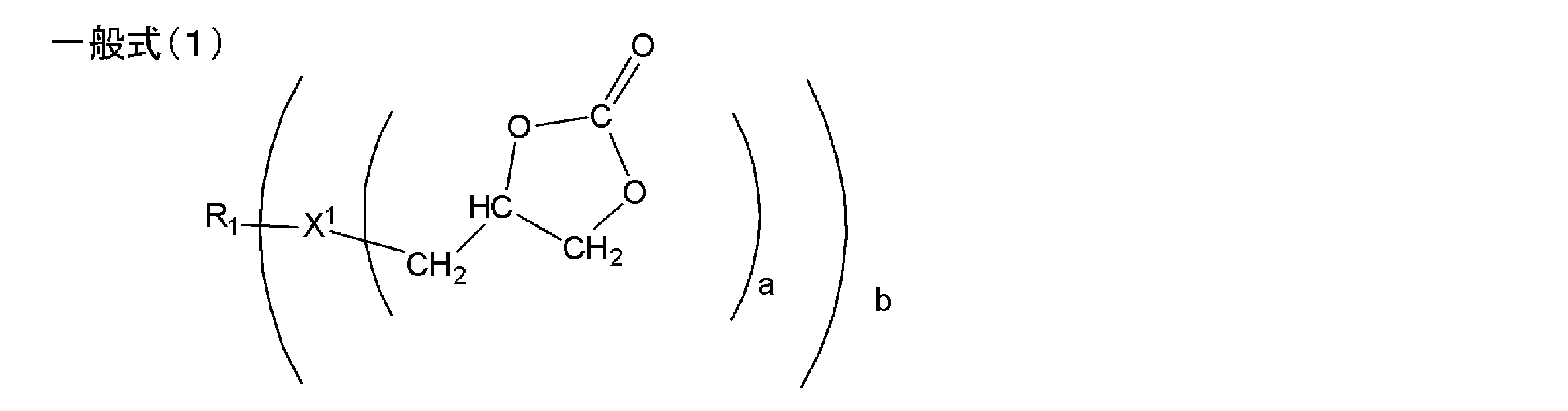


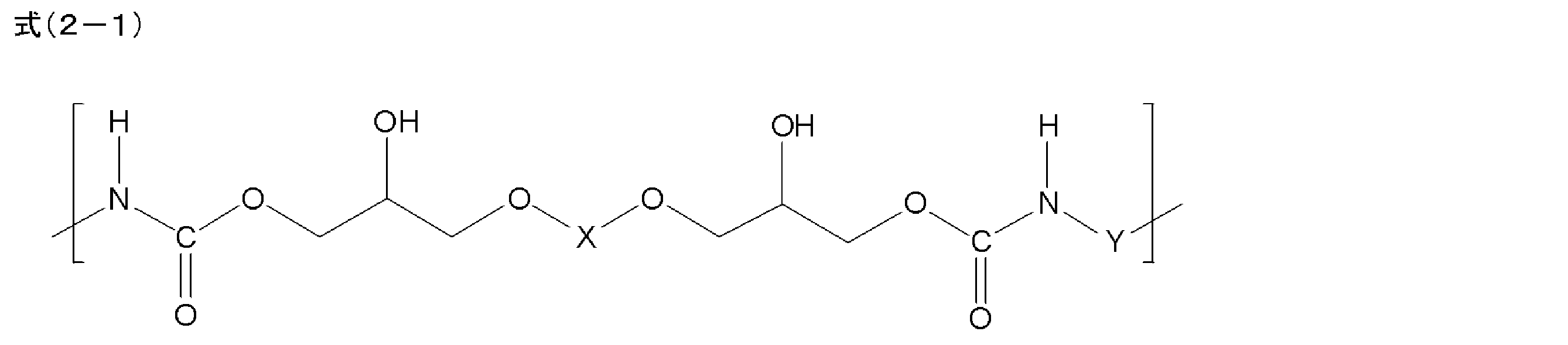
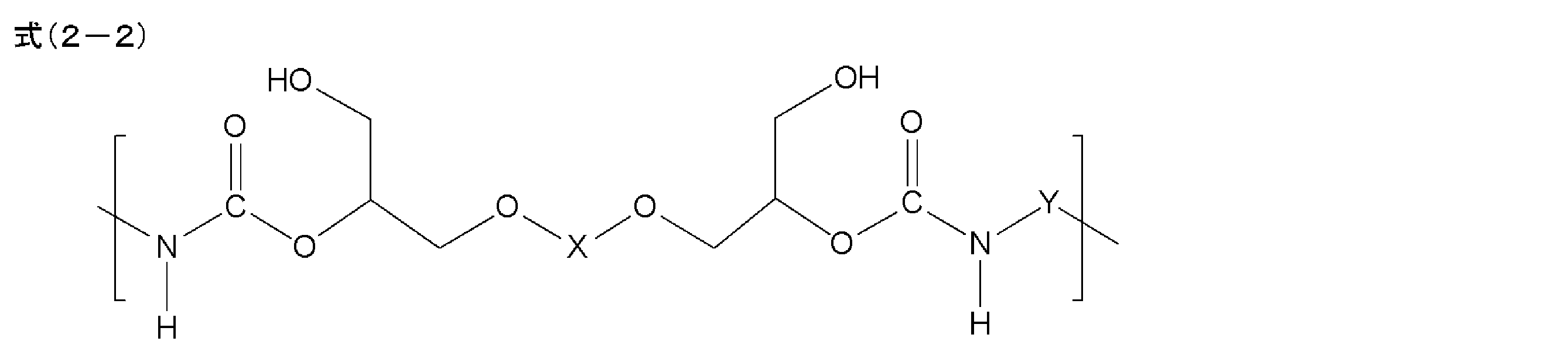

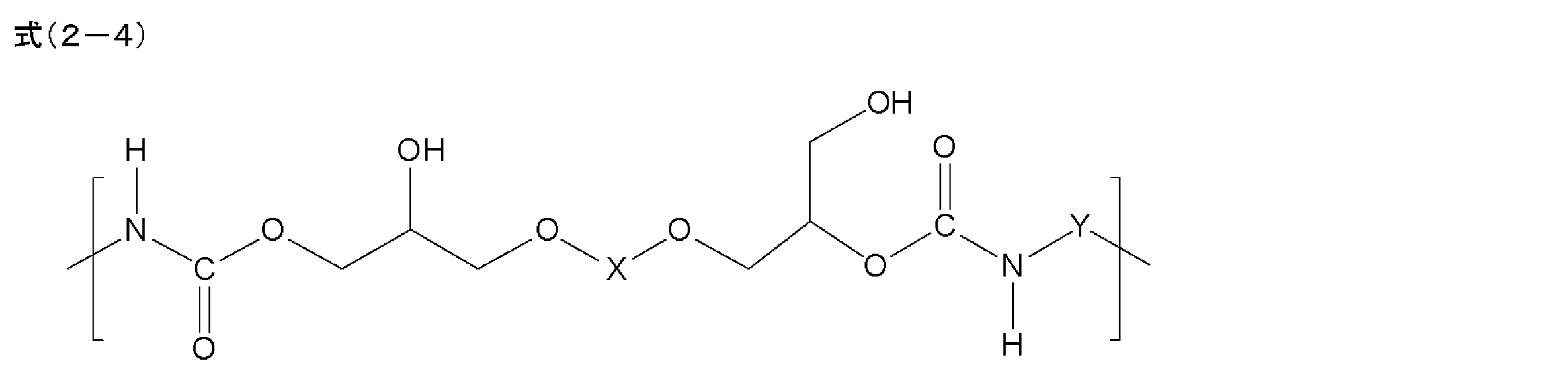
まず、本発明の第1発明を特徴づける塗料組成物について説明する。該塗料組成物は、少なくとも2つの五員環環状カーボネート基を有する下記一般式(1)で示される化合物(成分A)と、少なくとも2つのアミノ基を有する化合物(成分B)とが、官能基当量比0.8~1.25で反応して、ヒドロキシポリウレタン樹脂を主成分とするガスバリア層が形成されるものであることを特徴とする。


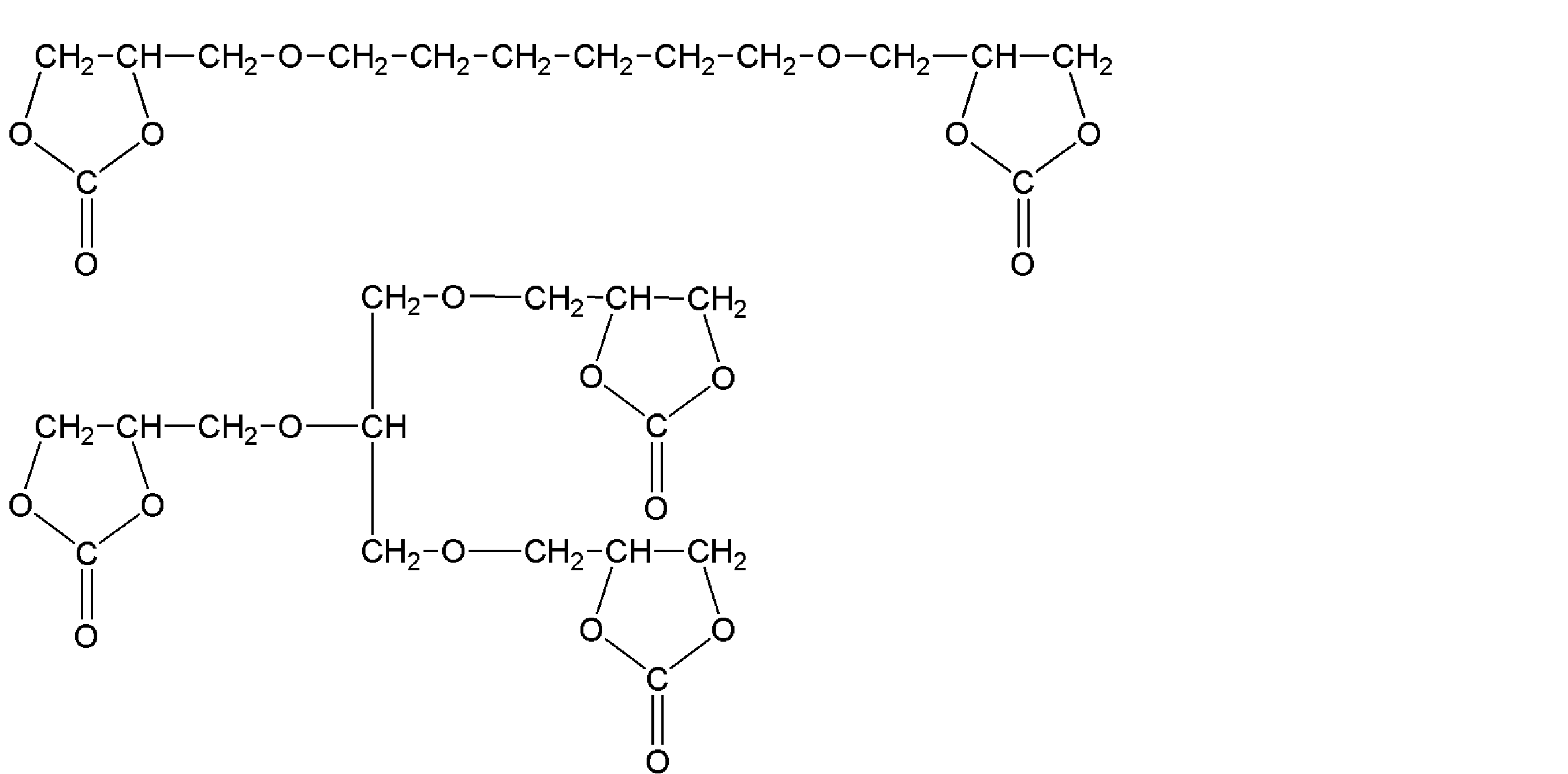
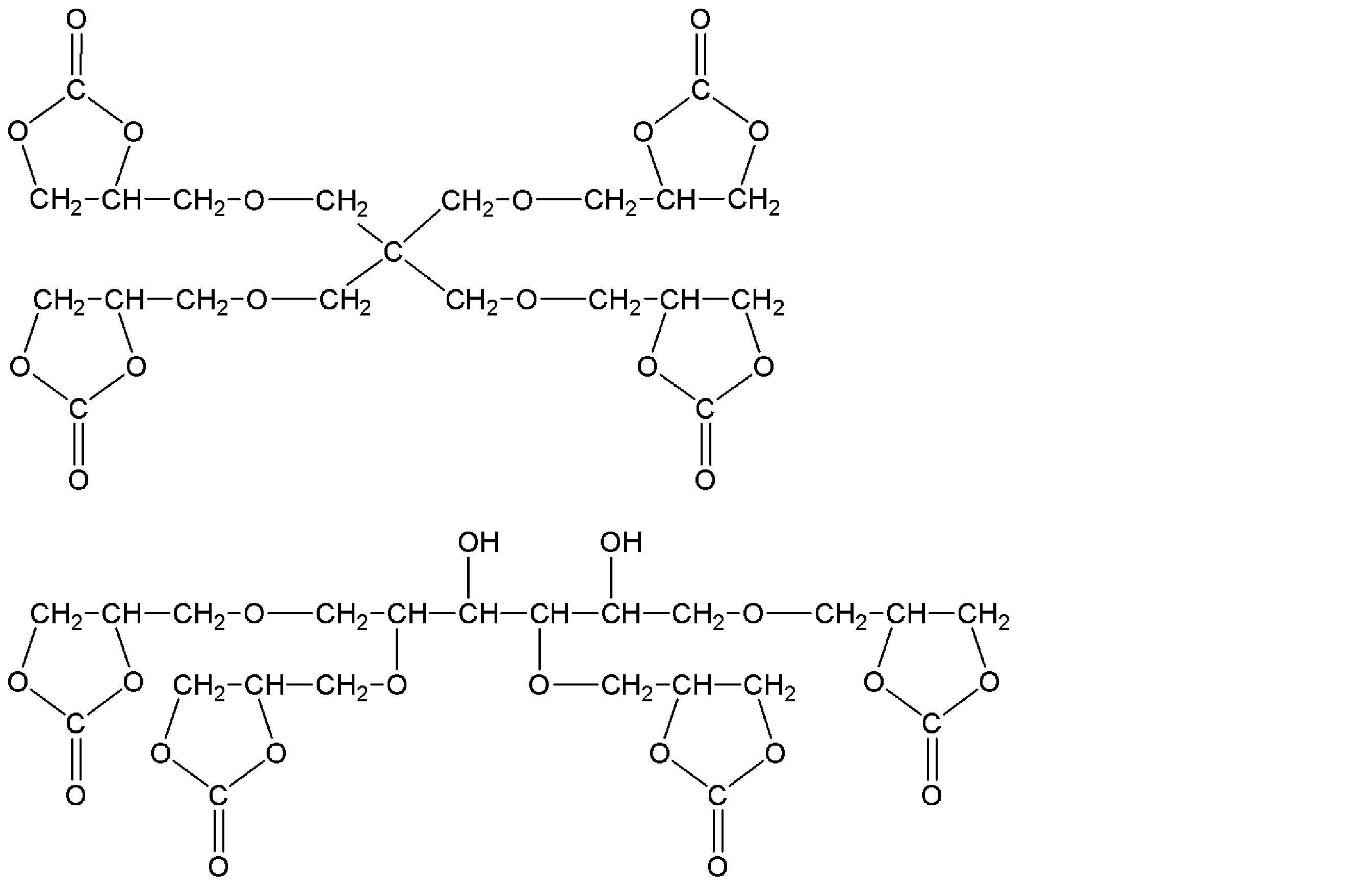


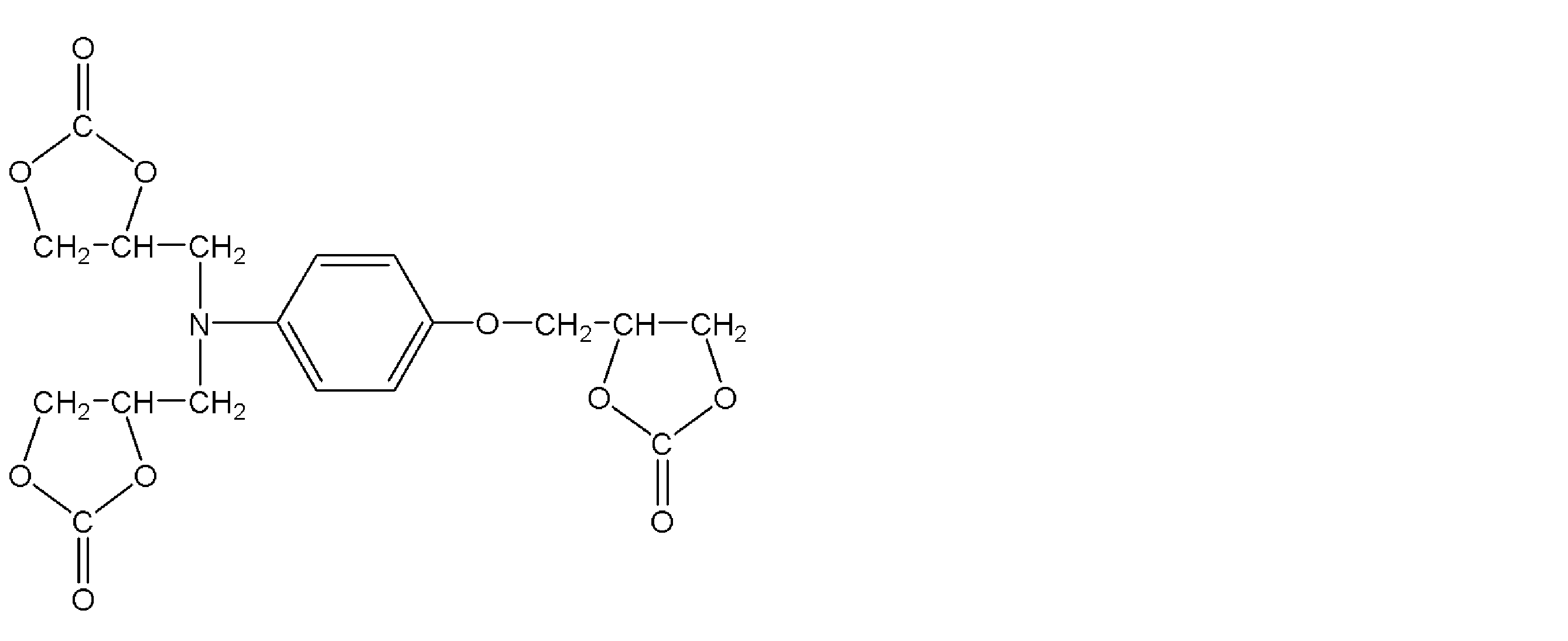
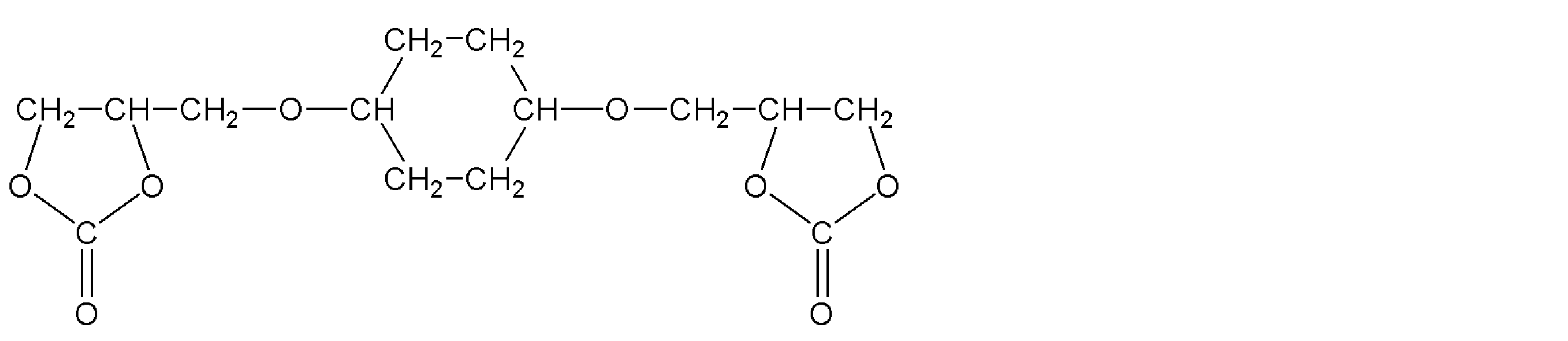

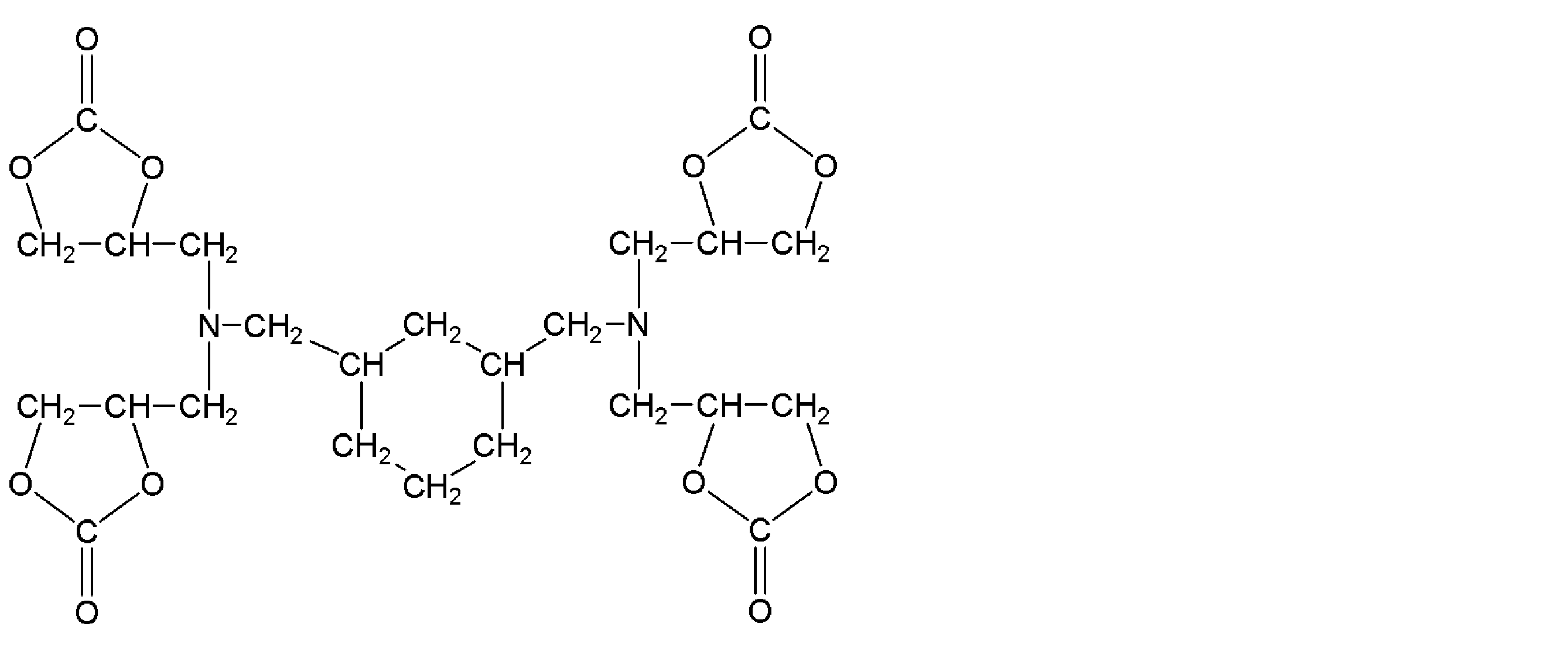
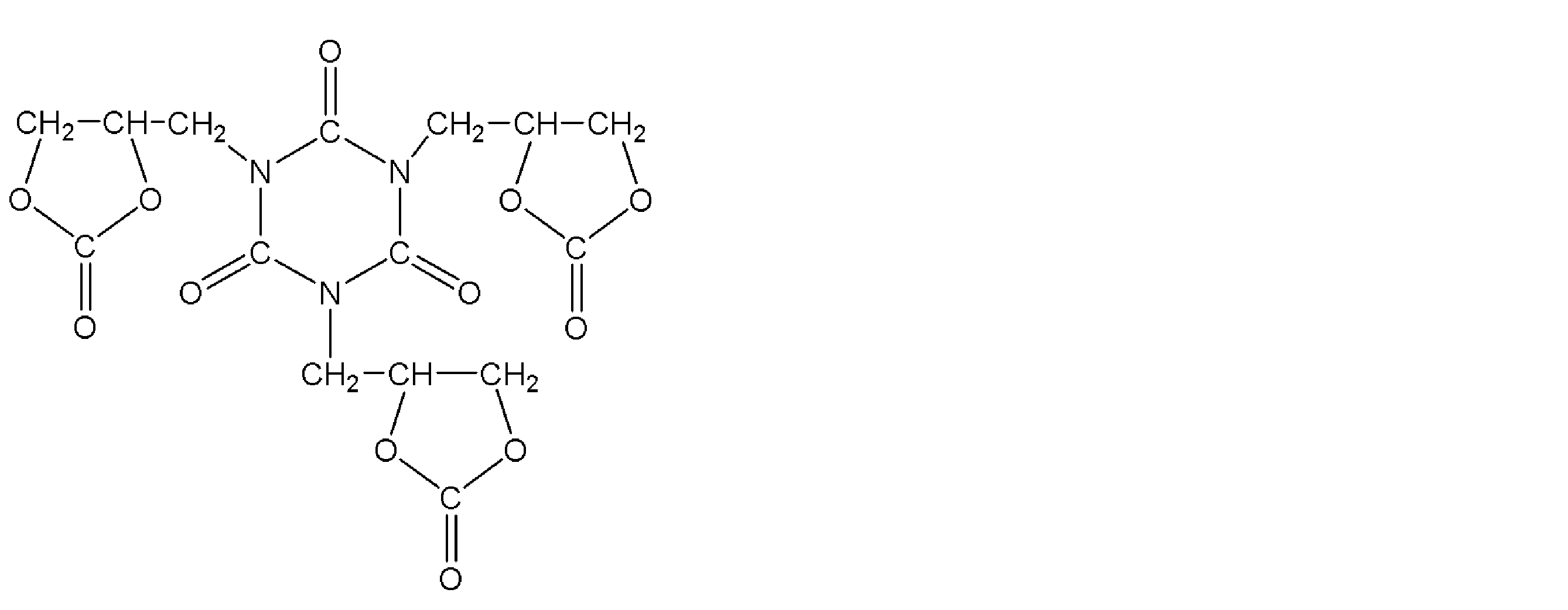
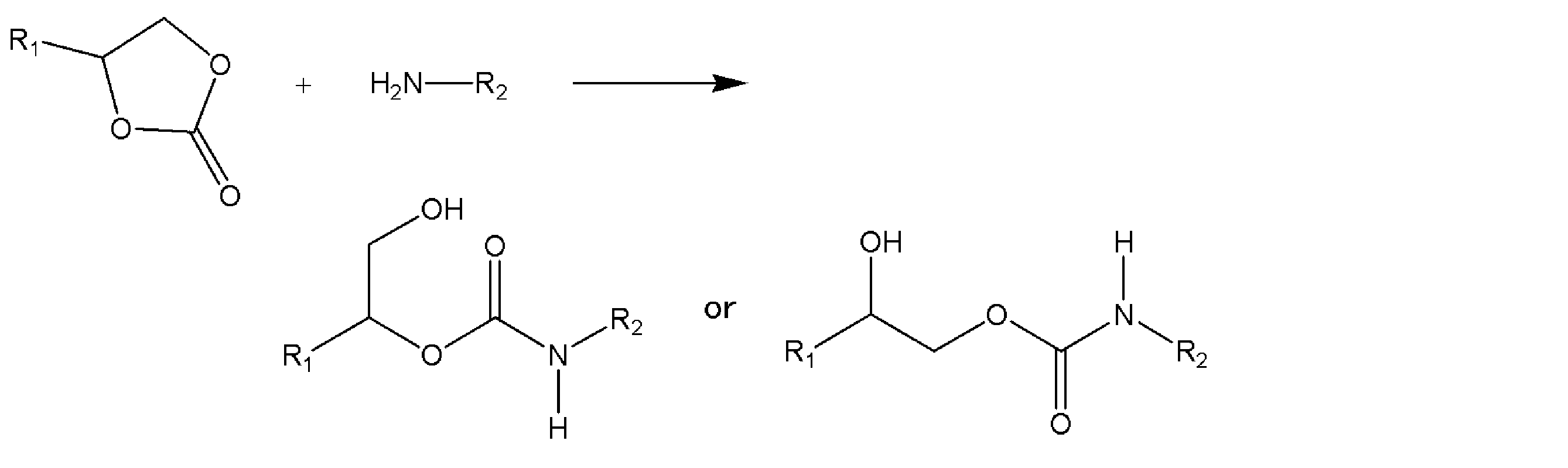
次に、本発明の第2発明について詳細に説明する。本発明のガスバリア性フィルムは、特有のポリヒドロキシウレタン樹脂を含んでなる層が、フィルムを構成する層の少なくとも1つの層として設けられていることを特徴とする。本発明を特徴づけるポリヒドロキシウレタン樹脂は、少なくとも、下記一般式(2-1)~(2-4)で示される化学構造のいずれか1つを高分子主鎖の繰り返し単位に有する。
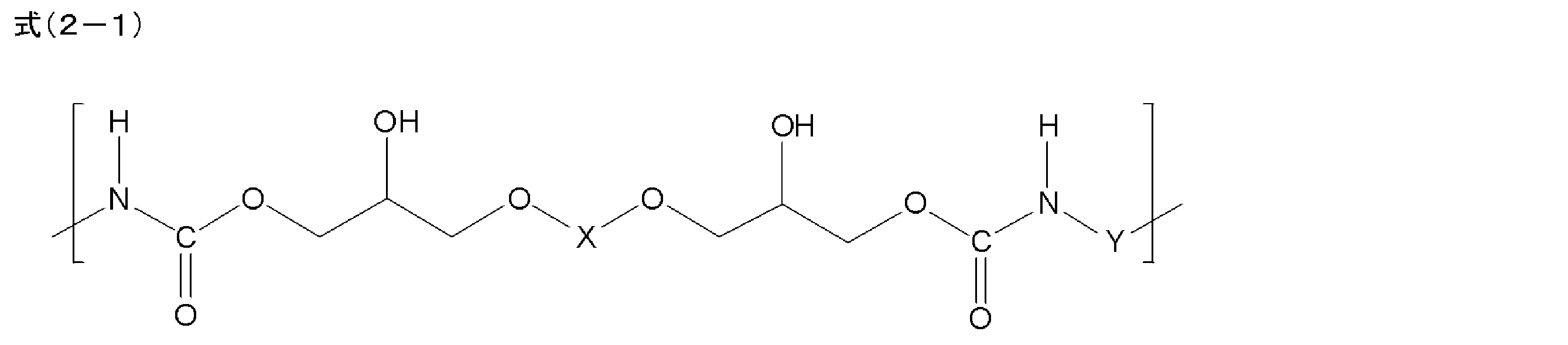
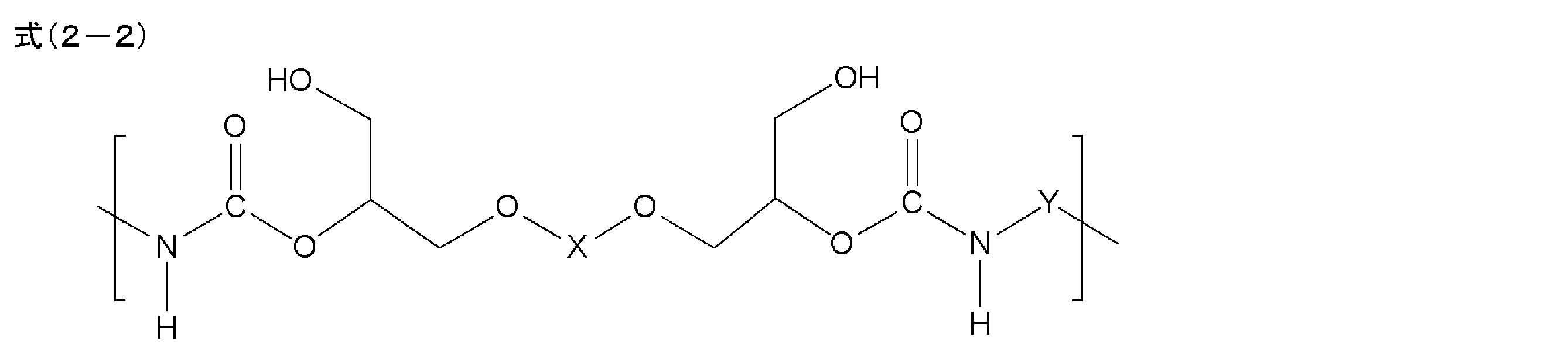
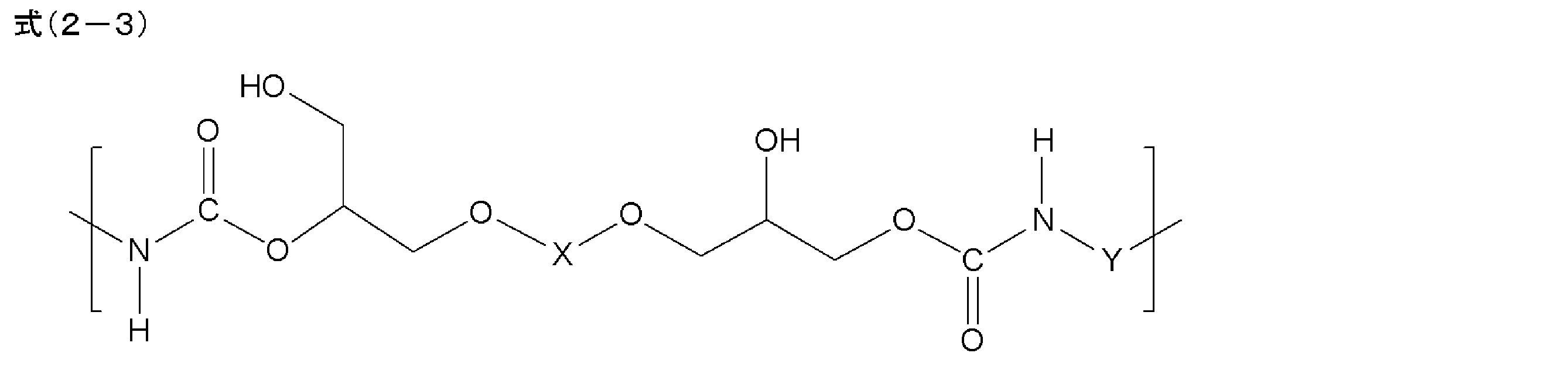


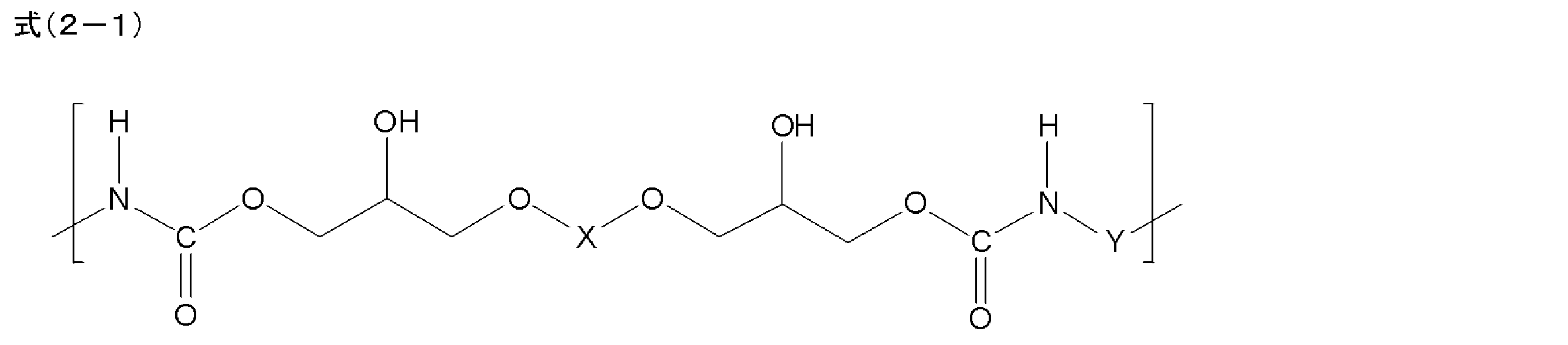













以下、第1発明の実施例等について説明するが、まず、第1発明において規定している「官能基当量比」と、「化合物中の二酸化炭素含有量」の求め方について説明する。
以下において、それぞれの反応に使用した環状カーボネート化合物とアミン化合物との「官能基当量比」は、下記式を用い、下記のようにして算出した値である。

また、各実施例で使用したカーボネート基中の-O-CO-結合は、二酸化炭素に由来するものであることより、上記で得た「カーボネート当量」から、カーボネート化合物中の二酸化炭素含有量を算出できる。すなわち、二酸化炭素含有量(%)は、[カーボネート当量(eq/g)×44(=CO2分子量)×100]で求めることができる。以下、二酸化炭素含有量は上記のようにして計算で求めた。
エポキシ当量100のパラ-アミノフェノール型エポキシ樹脂(商品名:MY0510、ハンツマン社製、以下、MY0510と略記)100部と、ヨウ化ナトリウム(和光純薬工業(株)製)20部と、N-メチル-2-ピロリドン150部とを、撹拌装置及び大気解放口のある還流器を備えた反応容器内に仕込んだ。次いで、撹拌しながら二酸化炭素を連続して吹き込み、100℃にて10時間の反応を行った。その後、得られた反応液を200部の酢酸エチルで希釈した後、分液ロートに移し、食塩水にて4回洗浄を行って、N-メチル-2-ピロリドン及びヨウ化ナトリウムを除去した。次に、洗浄後の酢酸エチル層をエバポレーターに移し、酢酸エチルを減圧除去したところ、透明液体化合物97部(収率72%)が得られた。
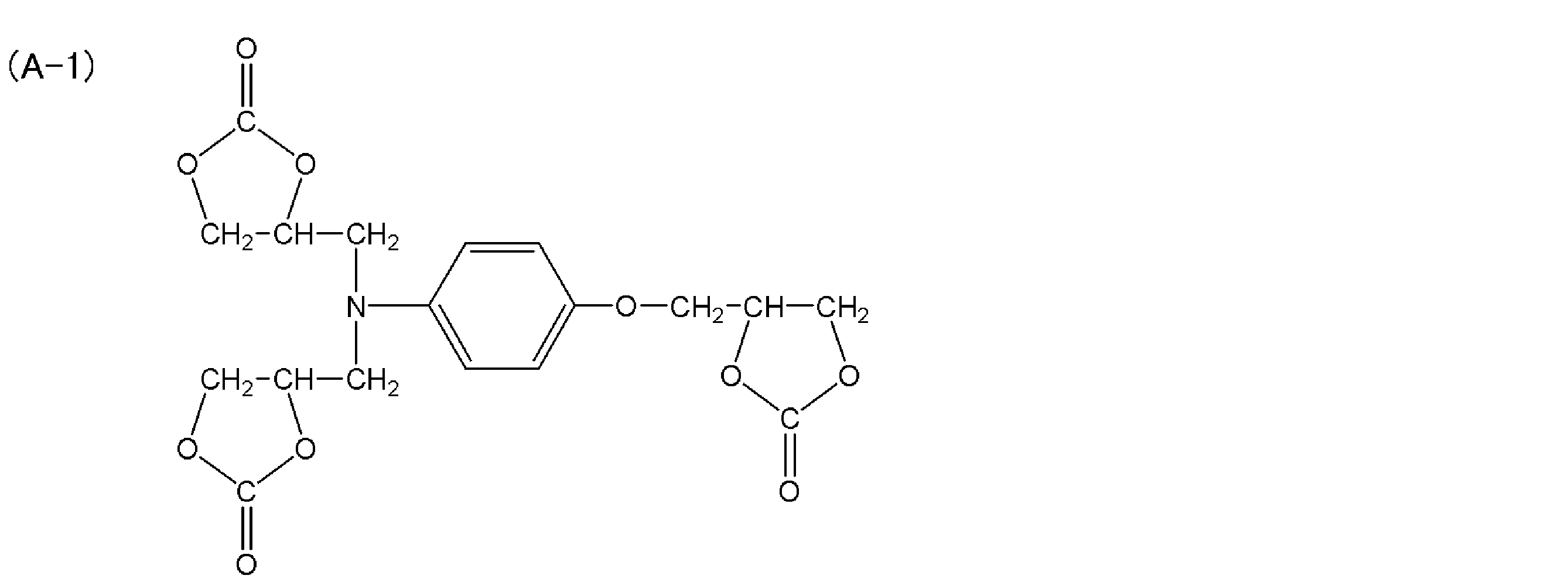
エポキシ当量90のN,N,N’,N’-テトラグリシジル-1,3-ベンゼンジ(メタンアミン)(商品名:TETRAD-X、三菱瓦斯化学(株)製)100部と、ヨウ化ナトリウム(和光純薬工業(株)製)20部と、N-メチル-2-ピロリドン150部とを、撹拌装置及び大気解放口のある還流器を備えた反応容器内に仕込んだ。以下、N,N,N’,N’-テトラグリシジル-1,3-ベンゼンジ(メタンアミン)をテトラグリシジルキシレンジアミンと称す。次いで、撹拌しながら二酸化炭素を連続して吹き込み、100℃にて10時間の反応を行った。反応終了後の溶液にメチルエチルケトン(以下、MEKと略記)166gとトルエン83gを加え取出した。取出した溶液を分液ロートに移し、食塩水にて4回の洗浄を行って触媒を除去した。更に、その後、エバポレーターにて溶剤を蒸発させ、オイル状の化合物125g(収率84%)を得た。
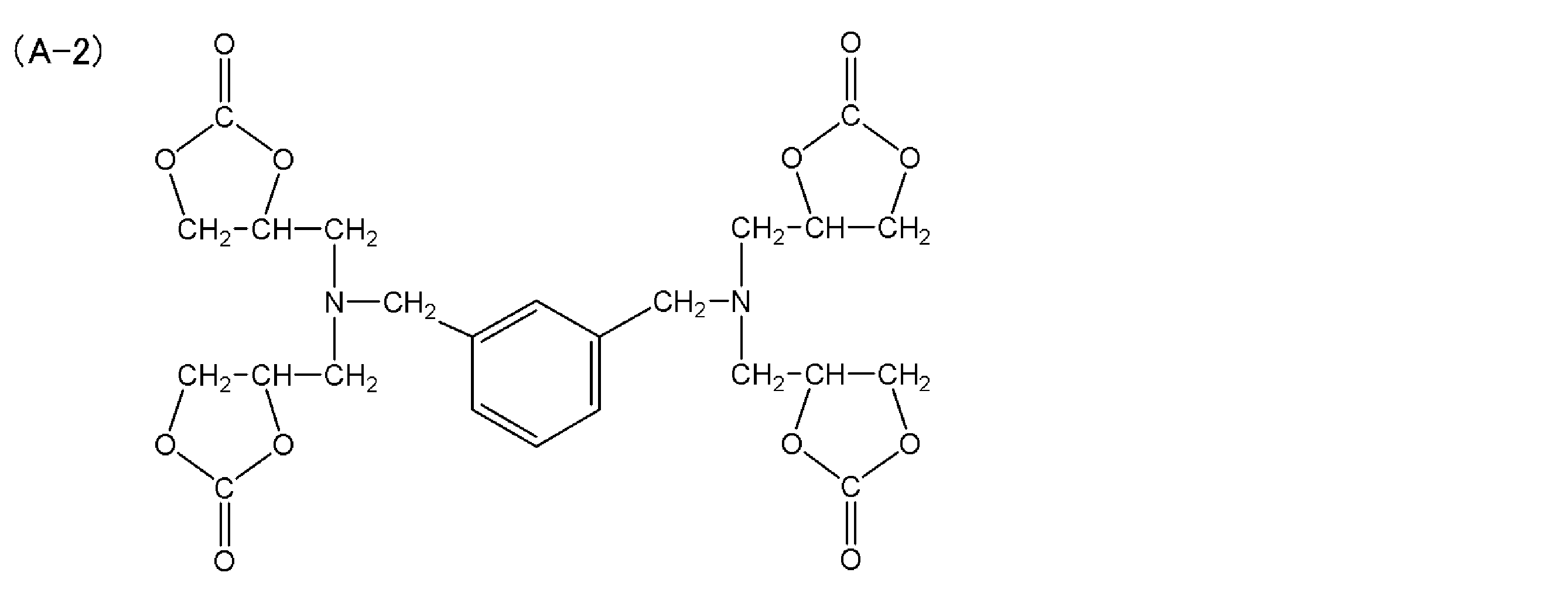
エポキシ当量142のグリセロールポリグリシジルエーテル(商品名:デナコールEX-313、ナガセケムテックス(株)製)100部と、ヨウ化ナトリウム(和光純薬工業(株)製)20部と、N-メチル-2-ピロリドン150部とを、撹拌装置及び大気解放口のある還流器を備えた反応容器内に仕込んだ。次いで、撹拌しながら二酸化炭素を連続して吹き込み、100℃にて10時間の反応を行った。反応終了後、エバポレーターにて溶剤を蒸発させ、オイル状の化合物132部(収率99.9%)を得た。

製造例1で得た化合物A-1を100.0部と、メタキシレンジアミン(三菱瓦斯化学(株)製、表中は、MXDAと略記)を45.6部、酢酸エチルを145.5部含む溶液を作製し、表面調整剤(商品名:BYK349、ビック・ケミー社製)0.7部を加え、よく攪拌することによって本実施例の塗料組成物である塗料溶液を得た。この溶液を離型紙にバーコーターNo.30にて塗布し、その後、80℃で12時間硬化反応させることによって、該塗料溶液よりなる単独フィルムを作成した。得られたフィルムは透明であり、その厚みは20μmであった。また、得られたフィルムは、後述するように良好なガスバリア性を示すものであることを確認した。更に、このフィルムを構成しているヒドロキシポリウレタン樹脂中における二酸化炭素由来の成分が占める割合は、21.0%であった(計算値)。また、上記反応におけるカーボネート化合物/アミノ化合物の官能基当量比は、1.0であった。
製造例2で得た化合物A-2を100.0部と、メタキシレンジアミン(三菱瓦斯化学(株)製)を51.0部、表面調整剤(ビック・ケミー社製、BYK349)0.8部を加え、よく攪拌することにより、本実施例の塗料組成物である塗料溶液を得た。この溶液を離型紙にバーコーターNo.15で塗布し、実施例1と同様にして、該塗料溶液よりなる単独フィルムを作成した。フィルムは透明であり、厚みは20μmであった。また、このバリア塗膜中に二酸化炭素由来の成分が占める割合は、21.7%であった(計算値)。また、上記反応におけるカーボネート化合物/アミノ化合物の官能基当量比は、1.0であった。
製造例2で得た化合物A-2を100.0部と、1,3-ビスアミノメチルシクロヘキサン(三菱瓦斯化学(株)製、表中は、13BACと略記)を53.0部、表面調整剤(ビック・ケミー社製、商品名:BYK349)0.8部を加え、よく攪拌することにより、本実施例の塗料組成物である塗料溶液を得た。この溶液を離型紙にバーコーターNo.15で塗布し、実施例1と同様にして、該塗料溶液よりなる単独フィルムを作成した。フィルムは透明であり、厚みは20μmであった。また、このバリア塗膜中に二酸化炭素由来の成分が占める割合は、21.4%であった(計算値)。また、上記反応におけるカーボネート化合物/アミノ化合物の官能基当量比は、1.0であった。
製造例3で得た化合物A-3を100.0部と、メタキシレンジアミン(三菱瓦斯化学(株)製)を36.7部と、酢酸エチルを136.7部含む溶液を作製し、表面調整剤(ビック・ケミー社製、商品名:BYK349)0.7部を加え、よく攪拌することにより、本実施例の塗料組成物である塗料溶液を得た。実施例1と同様にして離型紙に塗布し、該塗料溶液よりなる単独フィルムを作成した。フィルムは透明であり、厚みは20μmであった。また、このバリア塗膜中に二酸化炭素由来の成分が占める割合は、17.3%であった(計算値)。また、上記反応におけるカーボネート化合物/アミノ化合物の官能基当量比は、1.0であった。
製造例2で得た化合物A-2を100.0部と、メタキシレンジアミン(三菱瓦斯化学(株)製)を35.7部と、ヘキサメチレンジアミン(旭化成(株)製、表中は、HMDAと略記)を13.0部と、酢酸エチルを148.7部含む溶液を作製し、表面調整剤(ビック・ケミー社製、商品名:BYK349)0.7部を加え、よく攪拌することにより、本実施例の塗料組成物である塗料溶液を得た。該溶液を実施例1と同様に離型紙に塗布し、該塗料溶液よりなる単独フィルムを作成した。フィルムは透明であり、厚みは20μmであった。また、このバリア塗膜中に二酸化炭素由来の成分が占める割合は、22.1%であった(計算値)。また、上記反応におけるカーボネート化合物/アミノ化合物の官能基当量比は、1.0であった。
製造例2で得た化合物A-2を50.0部とメタキシレンジアミン(三菱瓦斯化学(株)製)25.4部を混合したものに、エポキシ当量90のテトラグリシジルキシレンジアミン(商品名:TETRAD-X、三菱瓦斯化学(株)製)50.0部と、メタキシレンジアミン(三菱瓦斯化学(株)製)を18.9部と、酢酸エチルを163.5部含む溶液を作製し、更に表面調整剤(ビック・ケミー社製、BYK349)0.8部を加え、よく撹拌することにより、本実施例の塗料組成物である塗料溶液を得た。該溶液を実施例1と同様に離型紙に塗布し、該塗料溶液よりなる単独フィルムを作成した。得られたフィルムは透明であり、厚みは20μmであった。また、このバリア塗膜中に二酸化炭素由来の成分が占める割合は、11.3%であった(計算値)。また、上記反応におけるカーボネート化合物/アミノ化合物の官能基当量比は、1.01であった。
基材を離型紙から、23μm厚のPETフィルム(商品名:ルミラー、東レ(株)製、酸素透過性;23℃/35%:71.3ml/m2・24h・atm、23℃/65%:53.5ml/m2・24h・atm、23℃/90%:50.2ml/m2・24h・atm)に代え、複合フィルムとした以外は実施例1と同じ方法で、皮膜(バリア層)を形成した。得られたフィルムは透明であり、基材上に形成したバリア層の厚みは20μmであった。
基材を離型紙から、60μm厚の延伸ポリプロピレンフィルム(商品名:トレファン、東レ(株)製、酸素透過性;23℃/35%:641.5ml/m2・24h・atm、23℃/65%:555.2ml/m2・24h・atm、23℃/90%:542.2ml/m2・24h・atm、表中は、OPPと略記)に代え、複合フィルムとした以外は実施例1と同じ方法で、皮膜(バリア層)を形成した。得られたフィルムは透明であり、基材上に形成したバリア層の厚みは20μmであった。
エポキシ当量90のテトラグリシジルキシレンジアミン(商品名:TETRAD-X、三菱瓦斯化学(株)製)100.0部と、メタキシレンジアミン(三菱瓦斯化学(株)製)76.0部、表面調整剤(ビック・ケミー社製、BYK349)0.9部を加え、よく攪拌することにより塗料溶液を得た。得られた塗料溶液を実施例1と同様に離型紙上に塗布し硬化塗膜の作成を試みた。しかし、皮膜は硬く脆い物であり測定前に割れてしまい、酸素透過性の測定を行うことができなかった。
エポキシ当量90のテトラグリシジルキシレンジアミン(商品名:TETRAD-X、三菱瓦斯化学(株)製)100.0部と、メタキシレンジアミン(三菱瓦斯化学(株)製)76.0部と、酢酸エチル176.0部を含む溶液を作製し、表面調整剤(ビック・ケミー社製、BYK349)0.9部を加え、よく攪拌することにより、塗料溶液を得た。この溶液を実施例7で使用したものと同様の23μ厚のPETフィルムにバーコーターNo.30にて塗布し80℃で12時間硬化反応させることにより単独フィルムを作成した。フィルムは淡黄色透明であり、バリア層の厚みは20μmであった。
エポキシ当量142のグリセロールポリグリシジルエーテル(商品名:デナコールEX-313、ナガセケムテックス(株)製)100.0部と、メタキシレンジアミン(三菱瓦斯化学(株)製)48.2部と、酢酸エチル148.2部を含む溶液を作製し、表面調整剤(ビック・ケミー社製、BYK349)0.7部を加え、よく攪拌することにより、塗料溶液を得た。この溶液を実施例7で使用したものと同様の23μ厚のPETフィルムにバーコーターNo.30にて塗布し、80℃で12時間硬化反応させることにより単独フィルムを作成した。フィルムは淡黄色透明であり、バリア層の厚みは20μmであった。
基材をPETフィルムから60μm厚の延伸ポリプロピレンフィルム(商品名:トレファン、東レ(株)製)に代えた以外は比較例2と同じ方法で皮膜を形成した。フィルムは淡黄色透明であり、バリア層の厚みは20μmであった。
基材をPETフィルムから60μm厚の延伸ポリプロピレンフィルム(商品名:トレファン、東レ(株)製)に代えた以外は比較例3と同じ方法で皮膜を形成した。フィルムは淡黄色透明であり、バリア層の厚みは20μmであった。

実施例及び比較例で得られた各フィルム(特に皮膜)について、下記の方法及び基準で評価した。評価結果を表2にまとめて示した。
二酸化炭素含有量は、各塗料をコートして得られたバリア皮膜の化学構造中における、原料の二酸化炭素由来のセグメントの質量%を算出して求めた。具体的には、製造例から得られた化合物A-1~3を合成する際に使用した、モノマーに対して含まれる二酸化炭素の理論量から算出した計算値で示した。例えば、実施例1の場合には、使用した化合物A-1の二酸化炭素由来の成分は30.4%であり、これより実施例1のポリヒドロキシウレタン中の二酸化炭素濃度は(100部×30.4%)/145.6全量=20.9質量%となる。
酸素透過率測定装置(モダンコントロール社製、OX-TRAN2/21HL)を使用して、それぞれのフィルムの酸素透過率を23℃、相対湿度35%、65%、90%の条件下で測定し、形成した皮膜のバリア層の酸素透過係率Pを以下の式(1)を用いて計算した。
上記式(1)中の記号は、それぞれ下記を示す。
R1;コーティングを施したプラスチックフィルムの酸素透過率(ml/m2・day・MPa)
R2;基材フィルムの酸素透過率(ml/m2・day・MPa)
P;バリア層の酸素透過率(ml/m2・day・MPa)
塗膜に1mm2のクロスカットを100個入れ、ニチバン製、セロハンテープをその上に貼り付け指で強く押し付けた後、90°方向に急速に剥離し、残存した塗膜の個数により4段階評価(◎:100、○:80~99、△50~79、×0~49)した。(◎、○)を接着性良好とした。
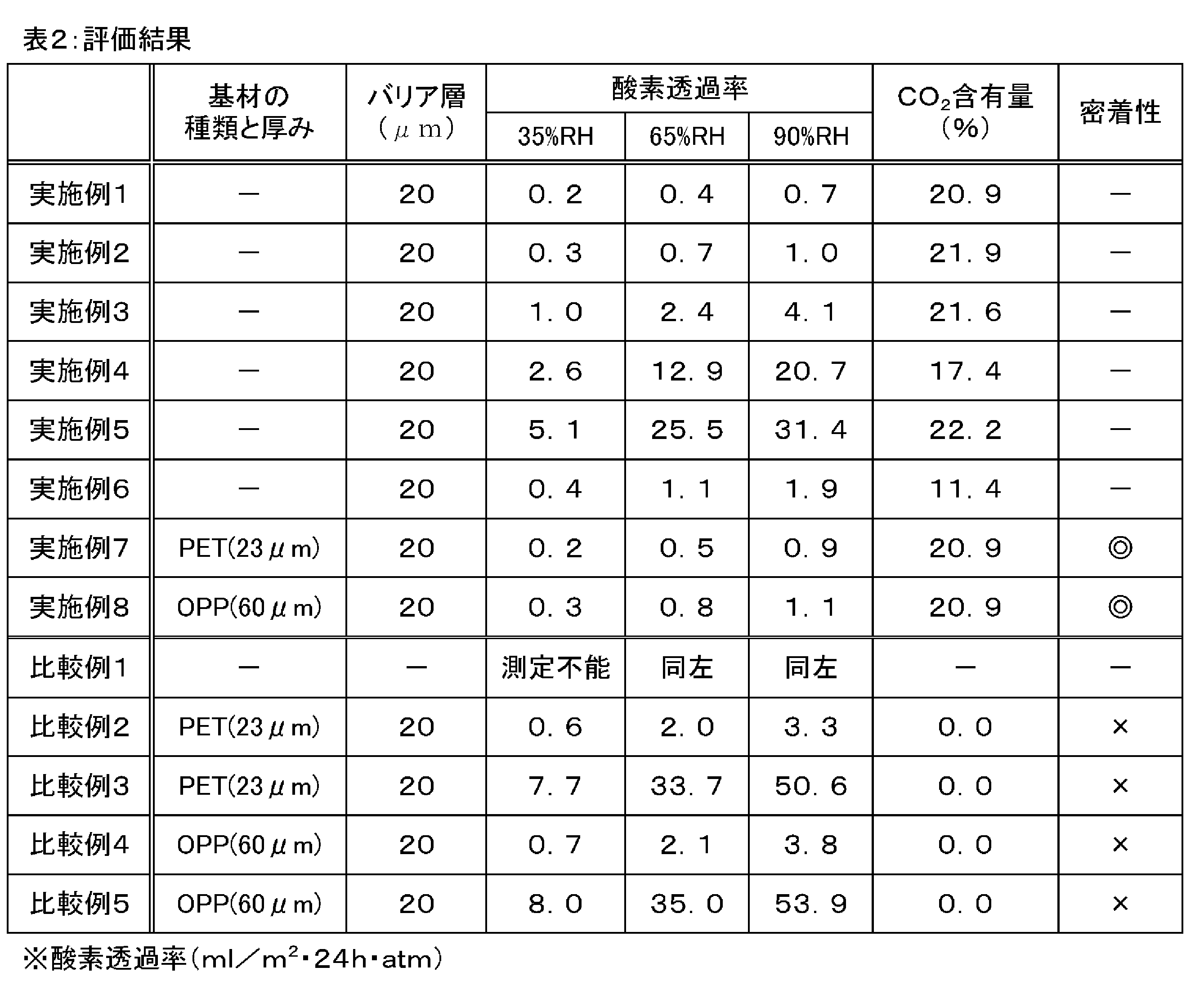
以下、第2発明の実施例等について説明するが、第2発明において規定している「二酸化炭素含有量」の求め方は、第1発明で説明したのと同様である。
エポキシ当量192のビスフェノールAジグリシジルエーテル(商品名:jER828、ジャパンエポキシレジン(株)製)100部と、ヨウ化ナトリウム(和光純薬工業(株)製)20部と、N-メチル-2-ピロリドン100部とを、撹拌装置及び大気開放口のある還流器を備えた反応容器内に仕込んだ。次いで、撹拌しながら二酸化炭素を連続して吹き込み、100℃にて10時間反応を行った。そして、反応終了後の溶液に、イソプロパノール1,400部を加え、反応物を白色の沈殿として析出させ、濾別した。得られた沈殿物をトルエンにて再結晶を行い、白色の粉末52部を得た(収率42%)。

エポキシ化合物に、エポキシ当量115のハイドロキノンジグリシジルエーテル(商品名:デナコールEX203、ナガセケムテックス(株)製)を用いた以外は、製造例1と同様の方法で、下記式で表わされる構造の環状カーボネート化合物(I-B)を合成した。得られたI-Bは、白色の結晶であり、融点は141℃であった。収率は55%であり、IR分析の結果は、I-Aと同様であり、HPLC分析による純度は97%であった。I-Bの化学構造中に二酸化炭素由来の成分が占める割合は、28.0%であった(計算値)。

エポキシ化合物に、エポキシ当量138のネオペンチルグリコールジグリシジルエーテル(商品名:デナコールEX-211、ナガセケムテックス(株)製)100部と、ヨウ化ナトリウム(和光純薬工業(株)製)20部と、N-メチル-2-ピロリドン100部とを、撹拌装置及び大気開放口のある還流器を備えた反応容器内に仕込んだ。次いで、撹拌しながら二酸化炭素を連続して吹き込み、100℃にて10時間反応を行った。反応終了後の溶液を1,000mlの蒸留水中に展開し、沈降した単黄色の液状物質を回収した。その後、回収した液状物質をオーブンで乾燥させ、下記式で表わされる環状カーボネート化合物(I-C)を得た。収率は92%であり、IR分析の結果は、I-Aと同様であり、HPLC分析による純度は97%であった。I-Cの化学構造中に、二酸化炭素由来の成分の占める割合は、24.2%であった(計算値)。
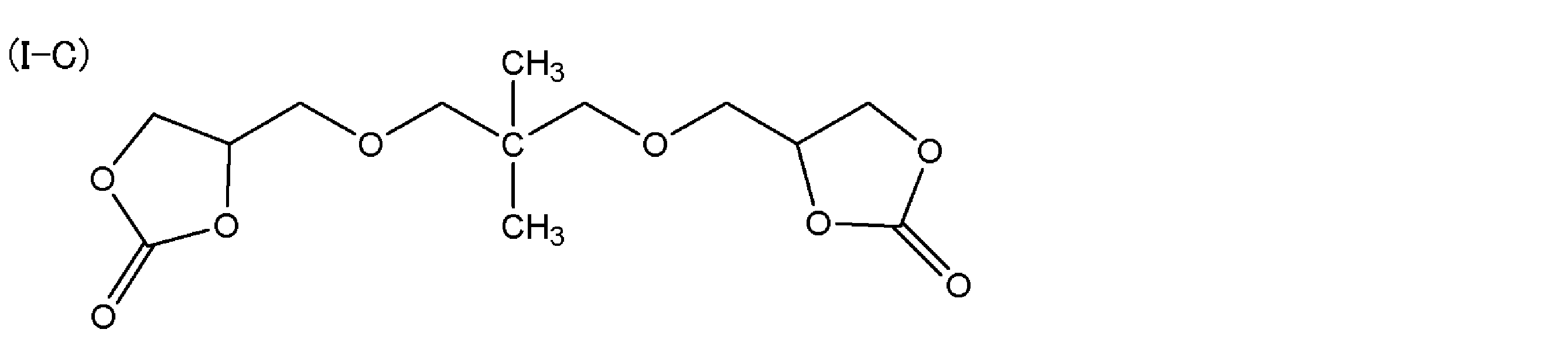
エポキシ化合物に、エポキシ当量113のエチレングリコールジグリシジルエーテル(商品名:デナコールEX-810、ナガセケムテックス(株)製)100部と、ヨウ化ナトリウム(和光純薬工業(株)製)20部と、N-メチル-2-ピロリドン100部とを、撹拌装置及び大気開放口のある還流器を備えた反応容器内に仕込んだ。次いで、撹拌しながら二酸化炭素を連続して吹き込み、100℃にて10時間反応を行った。反応終了後の溶液を、200部の酢酸エチルで希釈した後、分液ロートに移し、食塩水にて4回洗浄を行い、N-メチル-2-ピロリドン及びヨウ化ナトリウムを除去した。その後、酢酸エチル層をエバポレータに移し、酢酸エチルを減圧留去し、透明なオイル状物質として、下記式で表わされる環状カーボネート化合物(I-D)を得た。収率は69%であり、IR分析の結果は、I-Aと同様であり、HPLC分析による純度は95%であった。I-Dの化学構造中に、二酸化炭素由来の成分の占める割合は、33.6%であった(計算値)。

撹拌装置及び大気開放口のある還流器を備えた反応容器内に、製造例2-1で得た化合物I-Aを100部、ヘキサメチレンジアミン(旭化成ケミカルズ(株)製)27.1部、更に、反応溶媒としてN,N-ジメチルホルムアミド127部を加え、100℃の温度で撹拌しながら、24時間の反応を行った。反応後の溶液を、メタノール中に注ぎ、生成物を析出させ、これを濾別し回収し、その後、80℃で24時間乾燥させることにより、ポリウレタン樹脂を得た。得られた樹脂をIRにて分析したところ、1,760cm-1付近にウレタン結合のカルボニル基由来の吸収が確認された。1H-NMR分析(ブルカー社製装置;溶媒DMSO-d6、温度120℃、標準TMS)の結果から、環状カーボネートとアミンとの付加反応が環状カーボネートの2種類の開裂に由来する結合のいずれの存在も確認され、意図した構造のポリヒドロキシウレタン樹脂が合成できていることが確認できた。また、得られた樹脂の水酸基当量は204mgKOH/gであり、更に、該樹脂の、DMFを移動相としたGPC測定(東ソー(株)製、GPC-8220;カラムSuper AW2500+AW3000+AW4000+AW5000;以下の実施例も同様)による重量平均分子量は、43,000(ポリスチレン換算)であった。図5に、得られたポリヒドロキシウレタン樹脂のIRスペクトルを示した。また、図6に、該樹脂のNMRチャートを示し、図7に、該樹脂のGPC溶出曲線を示した。
製造例2-1で得た化合物I-Aを100部、1,3-ジアミノプロパン(広栄化学工業(株)製)17.3部、N,N-ジメチルホルムアミド117部を用い、実施例2-1と同様に反応させてポリウレタン樹脂を得た。得られた樹脂のIR分析の結果は実施例2-1と同様であり、その水酸基当量は221mgKOH/gであり、GPC測定による重量平均分子量は42,000(ポリスチレン換算)であった。そして、得られた樹脂から、実施例2-1と同様の装置及び条件により、厚さ50μmのポリヒドロキシウレタン樹脂の単独層からなるフィルムを作成した。
製造例2-1で得た化合物I-Aを100部、メタキシリレンジアミン(三菱瓦斯化学(株)製)31.8部、N,N-ジメチルホルムアミド132部を用い、実施例2-1同様に反応させてポリウレタン樹脂を得た。得られた樹脂のIR分析の結果は、実施例2-1と同様であり、その水酸基当量は195mgKOH/gであり、GPC測定による重量平均分子量は31,000(ポリスチレン換算)であった。そして、得られた樹脂から、実施例2-1と同様の装置及び条件により、厚さ50μmのポリヒドロキシウレタン樹脂の単独層からなるフィルムを作成した。
製造例2-2で得た化合物I-Bを100部、ヘキサメチレンジアミン(旭化成ケミカルズ(株)製)37部、N,N-ジメチルホルムアミド137部を用い、実施例2-1同様に反応させてポリウレタン樹脂を得た。得られた樹脂のIR分析の結果は、実施例2-1と同様であり、その水酸基当量は258mgKOH/gであり、GPC測定による重量平均分子量は35,000(ポリスチレン換算)であった。そして、得られた樹脂から、実施例2-1と同様の装置及び条件により、厚さ50μmのポリヒドロキシウレタン樹脂の単独層からなるフィルムを作成した。
製造例2-2で得た化合物I-Bを100部、1,3-ジアミノプロパン(広栄化学工業(株)製)23.6部、N,N-ジメチルホルムアミド124部を用い、実施例2-1同様に反応させポリウレタン樹脂を得た。得られた樹脂のIR分析の結果は、実施例2-1と同様であり、水酸基当量は289mgKOH/gであり、GPC測定による重量平均分子量は31,000(ポリスチレン換算)であった。そして、得られた樹脂から、実施例2-1と同様の装置及び条件により、厚さ50μmのフィルムを作成した。
製造例2-1で得た化合物I-Aを70部、製造例2-3で得た化合物I-Cを30部、ヘキサメチレンジアミン(旭化成ケミカルズ(株)製)28.6部、N,N-ジメチルホルムアミド129部を用い、実施例2-1同様に反応させてポリウレタン樹脂を得た。得られた樹脂のIR分析の結果は、実施例2-1と同様であり、その水酸基当量は211mgKOH/gであり、GPC測定による重量平均分子量は30,000(ポリスチレン換算)であった。そして、得られた樹脂から、実施例2-1と同様の装置及び条件により、厚さ50μmのポリヒドロキシウレタン樹脂の単独層からなるフィルムを作成した。
製造例2-4で得た化合物I-Dを100部、エチレンジアミン(東ソー(株)製)23部、N,N-ジメチルホルムアミド123部を用い、実施例2-1同様に反応させてポリウレタン樹脂を得た。得られた樹脂のIR分析の結果は、実施例2-1と同様であり、その水酸基当量は348mgKOH/gであり、GPC測定による重量平均分子量は22,000(ポリスチレン換算)であった。そして、得られた樹脂から、実施例2-1と同様の装置及び条件により、厚さ50μmのポリヒドロキシウレタン樹脂の単独層からなるフィルムを作成した。
3台の押出機とフィードブロック、Tダイとからなる多層フィルム成型装置により、下記のようにして共押出によって多層シートを成型した。具体的には、A層用として実施例2-1で得られたポリヒドロキシウレタン樹脂を用い、B層用としてポリプロピレン樹脂(商品名:FY-6C、日本ポリプロ(株)製)を用い、A層とB層の2層間に形成する接着層用として変性ポリプロピレン樹脂(商品名:モディックF534A、三菱化学(株)製)を使用して、3台の押出機を用いての共押出によって多層シートを成型した。各フィードブロックの温度は全て190℃で行い、各層の厚みはA層/接着層/B層=50μm/10μm/90μmになるように調整した。フィルム全体の膜厚の実測値は150μmであった。また、カッターを使用してA層を剥離し、その厚みを測定したところ50μmであった。
実施例1で得られたポリヒドロキシウレタン樹脂をテトラヒドロフランに溶解させ、濃度30%の樹脂溶液を作成した。そして、得られた樹脂溶液を、表面にコロナ処理を施した厚さ30μmのポリエチレンフィルム(東洋紡績(株)製、リックスフィルム L6120(商品名))に、40番のバーコーターにて塗布した。その後、70℃のオーブンにて10分間加熱し、溶剤を揮発させて、ポリエチレン層の上にポリヒドロキシウレタン樹脂層が形成した複層フィルムを作成した。フィルム全体の厚みを測定したところ45μmであった。このことより、基材であるポリエチレンフィルム上に形成されたポリヒドロキシウレタン樹脂層の厚みは20μmであることがわかった。
撹拌装置及び大気開放口のある還流器を備えた反応容器内に、水酸基価358.3のジヒドロキシエチルビスフェノールA(商品名:AE-2、明成化学工業(株)製)100部と、ヘキサメチレンジイソシアネート53.8部(旭化成ケミカルズ(株)製)53.8部とを仕込んだ。そして、更に、反応溶剤としてN,N-ジメチルホルムアミドを358.9部、触媒としてジブチル錫ジラウレートの0.003部を加え、100℃の温度で撹拌しながら、24時間の反応を行った。反応後の溶液を、メタノール中に注ぎ、生成物を析出させ、これを濾別し回収し、80℃で24時間乾燥させることによりポリウレタン樹脂を得た。得られた樹脂のGPC測定による重量平均分子量は42,000(ポリスチレン換算)であった。また、本比較例で得られたポリウレタン樹脂は、水酸基を有さない通常のポリウレタン樹脂である。更に、本比較例では、上記で得たポリウレタン樹脂を用いて、実施例2-1と同様の装置及び条件によって、厚さ50μmのウレタン樹脂の単独層からなるフィルムを作成し、これを用いた。
本比較例では、完全ケン化型ポリビニルアルコール樹脂(商品名:PVA-105、クラレ(株)製)の30%水溶液を作成し、バーコーター40番にて離型紙上にコーティングし、70℃にて溶剤を乾燥させてフィルムを作成し、これを用いた。フィルムの厚みは20μmであった。この場合における樹脂の評価はPVA-105のパウダーをそのまま使用し、フィルム評価は作成したフィルムにて行った。
本比較例では、エチレン含有量32モル%のエチレンビニルアルコール共重合樹脂(商品名:PVA-105、クラレ(株)製)を使用し、実施例1と同様の手法によって厚さ50μmのフィルムを作成し、これを用いた。樹脂の評価はF-104Bのペレットをそのまま使用し、フィルム評価は作成したフィルムにて行った。
本比較例では、実施例2-8で使用したポリプロピレン樹脂(商品名:FY-6C、日本ポリプロ(株)製)を用い、下記のようにして単層フィルムを作成したものを使用した。上記ポリプロピレン樹脂を用いてのフィルムの作成は、Tダイを取り付けたφ20mm単軸押出機にて、シリンダー温度190℃、ロール温度30℃、巻き取り速度1m/分の条件で行った。得られたフィルムの厚さは100μmであった。
本比較例では、実施例2-9で基材として使用した30μm厚のポリエチレンフィルムをそのまま使用した。
上記実施例2-1~2-9及び比較例2-1~2-3で得られた樹脂、或いは樹脂から成型したフィルムについて性能を評価した。評価及びその方法は、以下の試験項目及び方法によるものである。各実施例で得られたポリヒドロキシウレタン樹脂の特性値と単層フィルムの評価結果を表2-1-1にまとめて示し、該樹脂を用いて得た多層フィルムとしての評価結果を表2-2中に示した。比較例2-1~2-3についても、使用した樹脂の特性値と、該樹脂の単層フィルムの評価結果を表2-1-2にまとめて示した。また、比較例2-4、2-5の従来のフィルムの物性を表2-2中に合わせて示した。
二酸化炭素含有量は、使用したポリウレタン樹脂の化学構造中における、原料の二酸化炭素由来のセグメントの質量%を算出して求めた。具体的には、ポリウレタン樹脂の合成反応に使用した、化合物I-A~Dを合成する際に使用した、モノマーに対して含まれる二酸化炭素の理論量から算出した計算値で示した。例えば、実施例2-1の場合には、使用した化合物I-Aの二酸化炭素由来の成分量は20.5%、であり、これより実施例2-1のポリウレタン中の二酸化炭素濃度は(100部×20.5%)/117.3全量=17.5質量%となる。
実施例記載の測定装置及び条件にて測定した。
各樹脂について、系統が異なるN,N-ジメチルホルムアミドとテトラヒドロフランの2種類の溶剤への溶解性を、それぞれ測定した。いずれの溶剤へも溶解した場合を○、1種類の溶剤に溶解した場合を△、いずれの溶剤にも溶解しない場合を×とした。溶解条件は、固形分10%、23℃にて判定した。
各樹脂について、水に対する溶解性を測定した。固形分10%、23℃にて溶解させ、完全に溶解した物を○、溶解しないものを×と評価した。
各樹脂について、JIS K-7210に準拠して150℃におけるメルトフローレート(MFR)を測定し、その値(g/10分)を評価値とした。樹脂が溶融せず、測定が行えなかったものについては、「流動せず」と記載した。測定は、メルトフローインデクサー(タカラ工業(株)製、L202型)にて行った。
各樹脂について、JIS K-0070に準拠した滴定法により水酸基価を測定し、樹脂1gあたりの水酸基の含有量を、KOHのmg当量で表した。なお、単位はmgKOH/gである。
各フィルムの厚みは、精密厚み測定器((株)尾崎製作所製)を使用して実測した。
各フィルムの破断点強度は、JIS K-6251に準拠して、オートグラフ(商品名:AGS-J、島津製作所(株)製)を使用した測定法によって、室温(25℃)での破断強度を測定した。
各フィルムについて、JIS K-7105に準拠して、いずれもヘイズメーター(スガ試験機(株)製、HZ-1)により測定した。ヘイズメーターで測定される全ての光量が全光線透過率であり、全光線透過率に対する拡散透過光の割合がヘイズである。
ヘイズ(%)=拡散透過率(%)÷全光線透過率(%)
各フィルムについて、JIS K-7126に準拠して酸素の透過率を測定し、これをガスバリア性の評価値とした。すなわち、この値が低いほどガスバリア性に優れると判断できる。具体的には、酸素透過率測定装置(MOCON社製、OX-TRAN 2/21ML)を使用して、温度23℃で、湿度30%、湿度65%、湿度90%とした各恒温恒湿条件下にて、酸素透過率を測定した。


以上の通り、本発明の第1発明によれば、環状カーボネート化合物とアミン化合物を原料とするポリヒドロキシウレタン樹脂をガスバリア層として用いることで、従来の技術では得られなかった環境問題への対応に優れたガスバリア性材料を得ることができ、また、本発明を特徴づけるポリヒドロキシウレタン樹脂によれば、簡易な方法でガスバリア層を形成させることができき、かつ、基材への密着性にも優れることから種々の基材と組み合わせたガスバリア材料への応用が期待できる。本発明を特徴づけるポリヒドロキシウレタン樹脂は、その原料に二酸化炭素を使用することができるものであるので、地球環境保護の面からも期待される技術である。
以上の通り、本発明によれば、環状カーボネート化合物とアミン化合物を原料とするポリヒドロキシウレタン樹脂をガスバリア層として用いることで、従来の技術では得られなかった、湿度依存性が少なく、焼却時に有害ガスを発生させるハロゲン化合物を含まない、優れたガスバリア性フィルムを得ることができる。また、フィルムの製造においては、溶融成型法及びコーティング法のいずれも適用可能であり、その加工性に優れ、工業的に有用である。更に、本発明を特徴づけるポリヒドロキシウレタン樹脂は、その原料に二酸化炭素を使用することができるものであるので、地球環境保護の面からも期待される技術である。
Claims (12)
- ガスバリア性を示すガスバリア層を形成するための塗料組成物であって、
該ガスバリア層が、2以上の五員環環状カーボネート基を有する下記一般式(1)で示される化合物(成分A)と、2以上のアミノ基を有する化合物(成分B)とを、下記式で定義される官能基当量比0.8~1.25で反応させてなるヒドロキシポリウレタン樹脂を主成分として形成されるように構成したことを特徴とする塗料組成物。
(一般式(1)中、X1は、O、N又はNR2のいずれかを表し、該R2は水素または炭素数1~3のアルキル基であり、aは、X1がO又はNR2の場合は1であり、X1がNの場合は2である。bは、a×b=2以上となる1以上の整数である。一般式(1)中、R1は、脂肪族炭化水素か芳香族炭化水素であり、かつ、その構造中に、O及び/又はNを含んでもよい。)
(上記式中の官能基数とは、カーボネート化合物とアミン化合物がそれぞれの1分子中に有する環状カーボネート構造またはアミノ基の個数である。)
- 前記五員環環状カーボネート基中の-CO-O-結合の形成原料に二酸化炭素が用いられており、組成物によって形成されるガスバリア層中に、該二酸化炭素に由来する二酸化炭素が1~30質量%含まれることとなる請求項1に記載の塗料組成物。
- 前記アミノ基を有する化合物(成分B)が、メタキシレンジアミン又は1,3-ビス(アミノメチル)シクロヘキサンの少なくともどちらか一方を含む請求項1又は2に記載の塗料組成物。
- 請求項1~3のいずれか1項に記載の塗料組成物によって形成されたガスバリア層を有する単独層或いは多層からなるガスバリア性フィルムであって、その厚みが0.1~200μmであり、かつ、上記ガスバリア層の酸素透過率が、温度23℃の条件で、0%~90%のいずれの湿度下においても50ml/m2・24h・atm以下であることを特徴とするガスバリア性フィルム。
- フィルムが単独層或いは多層からなり、該フィルムを構成する少なくとも1つの層がガスバリア性を示すガスバリア層であるガスバリア性フィルムの製造方法であって、
2以上の五員環環状カーボネート基を有する下記一般式(1)で示される化合物(成分A)と、2以上のアミノ基を有する化合物(成分B)とが、下記式で定義される官能基当量比0.8~1.25で反応してヒドロキシポリウレタン樹脂となる塗料組成物を、基材表面又は離型紙表面に塗布し、その後、必要に応じて加熱することでガスバリア層を形成することを特徴とするガスバリア性フィルムの製造方法。
(一般式(1)中、X1は、O、N又はNR2のいずれかを表し、該R2は水素または炭素数1~3のアルキル基であり、aは、X1がO又はNR2の場合は1であり、X1がNの場合は2である。bは、a×b=2以上となる1以上の整数である。一般式(1)中、R1は、脂肪族炭化水素か芳香族炭化水素であり、かつ、その構造中に、O及び/又はNを含んでもよい。)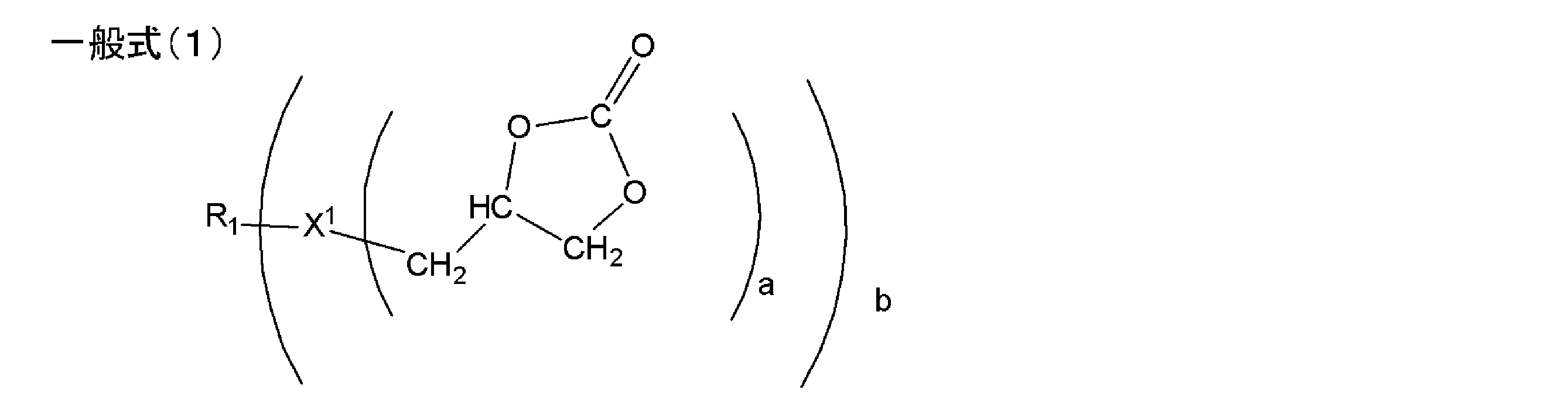
(上記式中の官能基数とは、カーボネート化合物とアミン化合物がそれぞれの1分子中に有する環状カーボネート構造またはアミノ基の個数である。)
- 前記アミノ基を有する化合物(成分B)が、メタキシレンジアミン又は1,3-ビス(アミノメチル)シクロヘキサンの少なくともどちらか一方を含む請求項5に記載のガスバリア性フィルムの製造方法。
- フィルムが単独層或いは多層からなり、該フィルムを構成する少なくとも1つの層がガスバリア性を示す層であり、
該ガスバリア性を示す層が、少なくとも、下記一般式(2-1)~(2-4)で示される化学構造のいずれか1つを高分子主鎖の繰り返し単位に有する高分子樹脂の皮膜によって形成されており、該高分子樹脂が、2以上の五員環環状カーボネートを有する化合物と、2以上のアミノ基を有するアミン化合物とをモノマー単位とし、これらモノマー単位の付加反応により得られるポリヒドロキシウレタン樹脂であることを特徴とするガスバリア性フィルム。
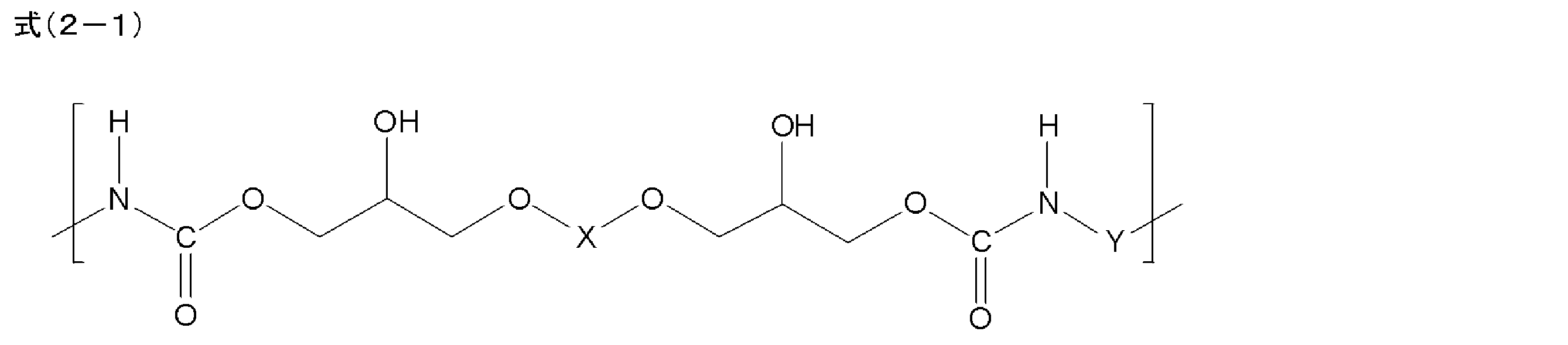
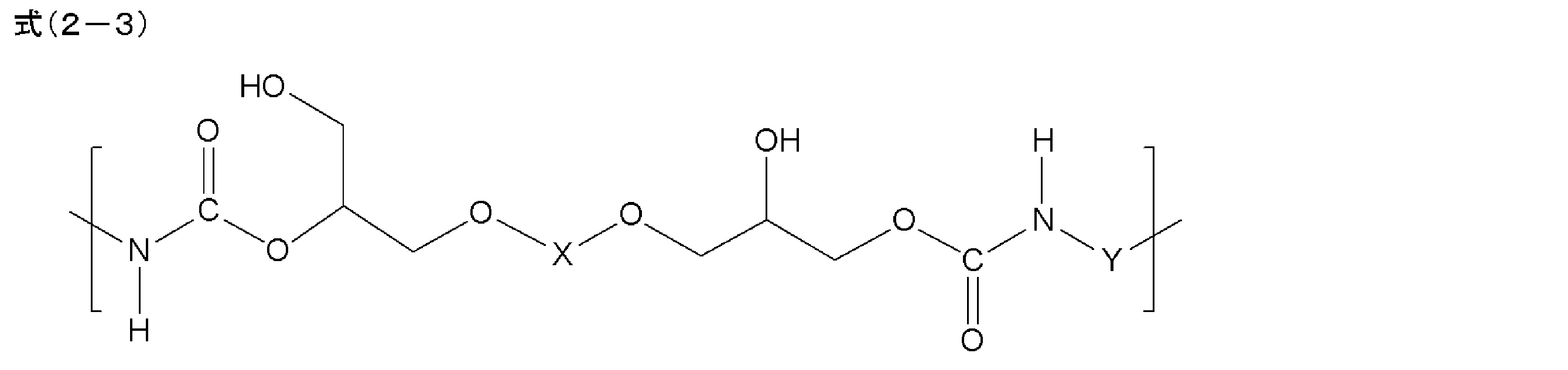 [但し、式(2-1)~(2-4)中のX、Yは、そのモノマー単位由来の炭化水素または芳香族炭化水素からなる化学構造を示し、該構造中には、酸素原子、窒素原子及び硫黄原子を含んでもよい。]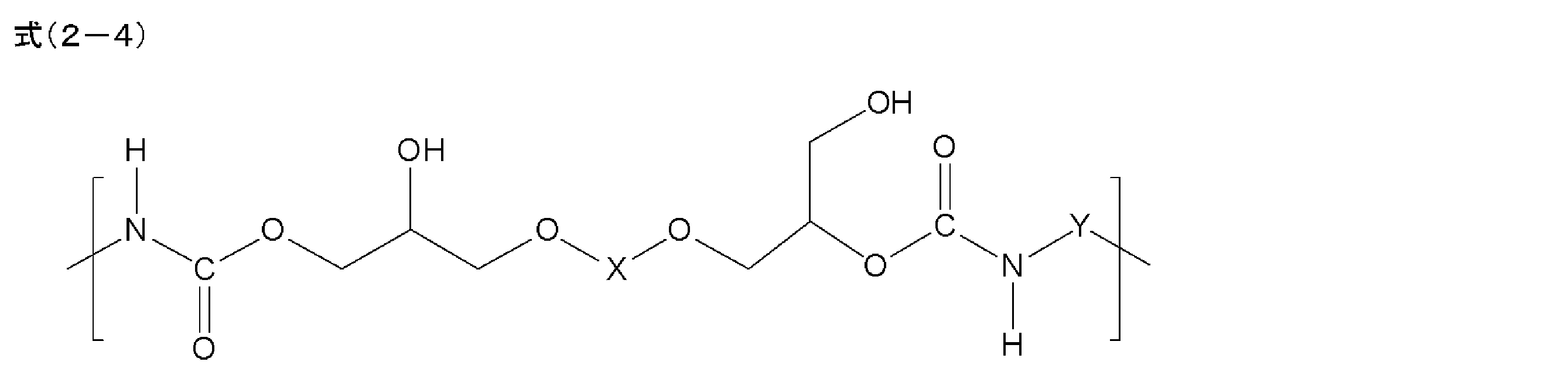
- 前記ガスバリア性を示す層の厚みが0.1~100μmであり、かつ、フィルムの酸素透過率が、温度23℃の条件で、0~90%のいずれの湿度下においても50ml/m2・24h・atm以下である請求項7に記載のガスバリア性フィルム。
- 前記ポリヒドロキシウレタン樹脂の重量平均分子量が10,000~100,000であり、かつ、その水酸基価が180~350mgKOH/gである請求項7または8に記載のガスバリア性フィルム。
- 前記五員環環状カーボネート化合物が、原材料の1つに二酸化炭素を用いて合成されたものであり、かつ、該五員環環状カーボネート化合物をモノマー単位として得た前記ポリヒドロキシウレタン樹脂の質量のうちの1~30質量%を、該二酸化炭素由来の-O-CO-結合が占める請求項7~9のいずれか1項に記載のガスバリア性フィルム。
- 請求項7~10のいずれか1項に記載のガスバリア性フィルムを製造する方法であって、
請求項7に記載のポリヒドロキシウレタン樹脂を有機溶剤に溶解した状態で基材上に塗布し、揮発成分を揮発させることによって、基材上に、ポリヒドロキシウレタン樹脂を含むガスバリア性を有する樹脂層を形成することを特徴とするガスバリア性フィルムの製造方法。 - 請求項7~10のいずれか1項に記載のガスバリア性フィルムを製造する方法であって、
請求項7に記載のポリヒドロキシウレタン樹脂を用い、溶融押出成形法により、上記ポリヒドロキシウレタン樹脂を含むガスバリア性を有する樹脂層を、フィルムを構成する層の少なくとも一つとして形成することを特徴とするガスバリア性フィルムの製造方法。
Priority Applications (6)
| Application Number | Priority Date | Filing Date | Title |
|---|---|---|---|
| US14/000,053 US9540537B2 (en) | 2011-02-24 | 2012-02-22 | Coating composition for forming gas barrier layer, gas barrier film, and method for producing gas barrier film |
| EP15151394.2A EP2865725B1 (en) | 2011-02-24 | 2012-02-22 | Coating composition for forming gas barrier layer, gas barrier film, and method for producing gas barrier film |
| KR1020137024970A KR101536846B1 (ko) | 2011-02-24 | 2012-02-22 | 가스 배리어층을 형성하기 위한 도료 조성물, 가스 배리어성 필름, 및 가스 배리어성 필름의 제조방법 |
| KR1020147033671A KR101521072B1 (ko) | 2011-02-24 | 2012-02-22 | 가스 배리어층을 형성하기 위한 도료 조성물, 가스 배리어성 필름, 및 가스 배리어성 필름의 제조방법 |
| EP12749523.2A EP2679644B1 (en) | 2011-02-24 | 2012-02-22 | Coating composition for forming gas barrier layer, gas barrier film, and method for producing gas barrier film |
| CN201280009610.7A CN103380183B (zh) | 2011-02-24 | 2012-02-22 | 用于形成气体阻隔层的涂料组合物、气体阻隔性薄膜以及气体阻隔性薄膜的制造方法 |
Applications Claiming Priority (4)
| Application Number | Priority Date | Filing Date | Title |
|---|---|---|---|
| JP2011-038977 | 2011-02-24 | ||
| JP2011038977A JP5604329B2 (ja) | 2011-02-24 | 2011-02-24 | ガスバリア性フィルムおよび該ガスバリア性フィルムの製造方法 |
| JP2011107262A JP5795874B2 (ja) | 2011-05-12 | 2011-05-12 | 塗料組成物、ガスバリア性フィルム及びガスバリア性フィルムの製造方法 |
| JP2011-107262 | 2011-05-12 |
Publications (1)
| Publication Number | Publication Date |
|---|---|
| WO2012115146A1 true WO2012115146A1 (ja) | 2012-08-30 |
Family
ID=46720922
Family Applications (1)
| Application Number | Title | Priority Date | Filing Date |
|---|---|---|---|
| PCT/JP2012/054266 Ceased WO2012115146A1 (ja) | 2011-02-24 | 2012-02-22 | ガスバリア層を形成するための塗料組成物、ガスバリア性フィルム、およびガスバリア性フィルムの製造方法 |
Country Status (5)
| Country | Link |
|---|---|
| US (1) | US9540537B2 (ja) |
| EP (2) | EP2865725B1 (ja) |
| KR (2) | KR101521072B1 (ja) |
| CN (1) | CN103380183B (ja) |
| WO (1) | WO2012115146A1 (ja) |
Cited By (7)
| Publication number | Priority date | Publication date | Assignee | Title |
|---|---|---|---|---|
| JP2012236925A (ja) * | 2011-05-12 | 2012-12-06 | Dainichiseika Color & Chem Mfg Co Ltd | 塗料組成物、ガスバリア性フィルム及びガスバリア性フィルムの製造方法 |
| JP2014096514A (ja) * | 2012-11-12 | 2014-05-22 | Dainichiseika Color & Chem Mfg Co Ltd | 太陽電池モジュール用バックシート |
| JP2014099531A (ja) * | 2012-11-15 | 2014-05-29 | Dainichiseika Color & Chem Mfg Co Ltd | 太陽電池モジュール用バックシート |
| WO2015061309A1 (en) * | 2013-10-21 | 2015-04-30 | Ppg Industries Ohio, Inc. | Container coating compositions |
| JP2016216680A (ja) * | 2015-05-25 | 2016-12-22 | 大日精化工業株式会社 | ガスバリア性コーティング剤及びこれを用いたガスバリア性フィルム |
| JP2017145278A (ja) * | 2016-02-15 | 2017-08-24 | 大日精化工業株式会社 | ポリヒドロキシウレタン樹脂及びこれを用いたガスバリア性コーティング剤及びこれを用いたガスバリア性フィルム |
| WO2020004185A1 (ja) * | 2018-06-28 | 2020-01-02 | 積水化学工業株式会社 | 環状カーボネート置換プロピルカテコール、環状カーボネート置換プロピルカテコールの製造方法、環状カーボネート置換プロピルカテコールを含む樹脂組成物及び樹脂硬化物 |
Families Citing this family (15)
| Publication number | Priority date | Publication date | Assignee | Title |
|---|---|---|---|---|
| US9795756B2 (en) | 2012-12-04 | 2017-10-24 | Mallinckrodt Hospital Products IP Limited | Cannula for minimizing dilution of dosing during nitric oxide delivery |
| CN108355215B (zh) | 2012-12-04 | 2022-03-25 | 马林克罗特医疗产品知识产权公司 | 用于在氧化氮递送期间对给药的稀释最小化的套管 |
| CN106459658B (zh) * | 2014-04-25 | 2019-04-23 | 宣伟投资管理有限公司 | 多环碳酸酯化合物以及由其形成的聚合物 |
| CN106255723B (zh) * | 2014-04-25 | 2019-03-22 | 宣伟投资管理有限公司 | 多环碳酸酯化合物以及由其形成的聚合物和组合物 |
| JP6224529B2 (ja) * | 2014-06-04 | 2017-11-01 | 大日精化工業株式会社 | ポリヒドロキシウレタンの製造方法 |
| JP6563242B2 (ja) * | 2015-03-31 | 2019-08-21 | 大日精化工業株式会社 | ポリヒドロキシウレタン樹脂の水分散体、水分散体の製造方法及び該水分散体を用いてなるガスバリア性フィルム |
| WO2018084102A1 (ja) * | 2016-11-02 | 2018-05-11 | 大日精化工業株式会社 | ポリヒドロキシウレタン樹脂の水分散体、該水分散体の製造方法、該水分散体を用いてなるガスバリア性樹脂フィルム、粘土鉱物含有のポリヒドロキシウレタン樹脂水分散体組成物、該組成物を用いてなるガスバリア性コーティング剤及びガスバリア性樹脂フィルム |
| WO2019190409A1 (en) | 2018-03-29 | 2019-10-03 | Agency For Science, Technology And Research | A compound, a reaction product of said compound and production methods thereof |
| KR102816818B1 (ko) * | 2018-08-23 | 2025-06-05 | 도레이 카부시키가이샤 | 수지 필름, 적층체, 및 적층체의 제조 방법 |
| US11822117B2 (en) * | 2019-10-08 | 2023-11-21 | Corning Incorporated | Primary coating compositions with improved microbending performance |
| JP7263547B2 (ja) * | 2019-11-20 | 2023-04-24 | 大日精化工業株式会社 | ガスバリア性フィルム及び複合樹脂組成物 |
| WO2021124856A1 (ja) * | 2019-12-20 | 2021-06-24 | 日東電工株式会社 | 粘着シート |
| JP6899941B1 (ja) * | 2020-03-31 | 2021-07-07 | 大日精化工業株式会社 | 接着剤用樹脂組成物、接着剤、及び接着構造体 |
| MX2022014279A (es) | 2020-05-12 | 2022-12-07 | Nanometics Llc D B A Phd Biosciences | Elastomeros de poliuretano sin isocianato y composiciones que comprenden dichos elastomeros. |
| JP7468821B2 (ja) * | 2022-03-16 | 2024-04-16 | 王子ホールディングス株式会社 | バリア性積層体及び包装袋 |
Citations (17)
| Publication number | Priority date | Publication date | Assignee | Title |
|---|---|---|---|---|
| JPS57202317A (en) * | 1981-06-09 | 1982-12-11 | Dainippon Ink & Chem Inc | Curable resin composition |
| JPH0625409A (ja) * | 1992-04-14 | 1994-02-01 | Kyowa Hakko Kogyo Co Ltd | ウレタン基含有重合体 |
| JPH0710283A (ja) | 1993-06-22 | 1995-01-13 | Sanyo Special Steel Co Ltd | 円柱状または円筒状材料の自動整列投入装置 |
| JPH07112518A (ja) | 1993-10-18 | 1995-05-02 | Teijin Ltd | 積層延伸フイルム |
| JPH0791368B2 (ja) | 1988-02-04 | 1995-10-04 | ピーピージー インダストリイズ,インコーポレイテッド | ガス透過性の低いバリアー材料 |
| JPH0791367B2 (ja) | 1988-02-04 | 1995-10-04 | ピーピージー インダストリイズ,インコーポレイテッド | 非ゲル化ポリアミン―ポリエポキシド樹脂 |
| JPH07316493A (ja) * | 1993-12-24 | 1995-12-05 | Hoechst Ag | 二成分系液状塗料 |
| JP2001098047A (ja) | 1999-07-27 | 2001-04-10 | Takeda Chem Ind Ltd | ガスバリア性ポリウレタン樹脂及びこれを含むガスバリア性フィルム |
| JP2003327854A (ja) * | 2002-05-09 | 2003-11-19 | Japan Paint Manufacturers Association | 水性硬化性樹脂組成物 |
| JP3489850B2 (ja) | 1993-03-30 | 2004-01-26 | 株式会社クラレ | ガスバリアー性材料 |
| JP3580331B2 (ja) | 1995-10-11 | 2004-10-20 | 三菱瓦斯化学株式会社 | 共重合ポリアミド |
| JP2005139435A (ja) | 2003-10-15 | 2005-06-02 | Mitsui Takeda Chemicals Inc | 水性ポリウレタン樹脂組成物及び積層フィルム |
| JP3801319B2 (ja) | 1996-12-27 | 2006-07-26 | 株式会社クレハ | 樹脂組成物及びそれからなるガスバリヤー性フィルム |
| JP2007291157A (ja) * | 2006-04-21 | 2007-11-08 | Kansai Paint Co Ltd | 水性樹脂組成物及びこれを含む塗料組成物 |
| JP2008285539A (ja) * | 2007-05-16 | 2008-11-27 | Konishi Co Ltd | 硬化性樹脂組成物 |
| JP2011105827A (ja) * | 2009-11-16 | 2011-06-02 | Dainichiseika Color & Chem Mfg Co Ltd | 印刷インキバインダー |
| WO2012026338A1 (ja) * | 2010-08-26 | 2012-03-01 | 大日精化工業株式会社 | 自己架橋型ポリシロキサン変性ポリヒドロキシポリウレタン樹脂、該樹脂を含む樹脂材料、該樹脂の製造方法、該樹脂を用いてなる擬革及び熱可塑性ポリオレフィン表皮材 |
Family Cites Families (19)
| Publication number | Priority date | Publication date | Assignee | Title |
|---|---|---|---|---|
| US2522680A (en) | 1949-07-20 | 1950-09-19 | American Cyanamid Co | Polymerizable dioxolane compound, products prepared therefrom, and methods of preparation |
| US3072613A (en) * | 1957-08-20 | 1963-01-08 | Union Carbide Corp | Multiple cyclic carbonate polymers |
| US3084140A (en) * | 1957-10-31 | 1963-04-02 | Dow Chemical Co | Polyhydroxyurethanes |
| DE3529263A1 (de) | 1985-08-16 | 1987-02-19 | Hoechst Ag | Verfahren zur herstellung von 2-oxo-1,3-dioxolanen |
| EP0296098A3 (en) | 1987-06-16 | 1989-08-23 | W.R. Grace & Co.-Conn. | Crosslinked polyurethane emulsion, process and prepolymer for its production and process for forming coatings from said emulsion |
| DE3723782A1 (de) * | 1987-07-16 | 1989-01-26 | Dainippon Ink & Chemicals | Verfahren zur herstellung von cyclocarbonatverbindungen |
| JP3100977B2 (ja) | 1990-11-20 | 2000-10-23 | 根上工業株式会社 | ポリウレタンビーズの製造方法 |
| US5175231A (en) | 1992-04-17 | 1992-12-29 | Fiber-Cote Corporation | Urethane oligomers and polyurethanes |
| JP3042948B2 (ja) | 1993-09-28 | 2000-05-22 | 大日精化工業株式会社 | 吸水性ポリウレタンゲル微粒子及びその製造方法 |
| US6120905A (en) * | 1998-06-15 | 2000-09-19 | Eurotech, Ltd. | Hybrid nonisocyanate polyurethane network polymers and composites formed therefrom |
| JP3840347B2 (ja) * | 1999-05-11 | 2006-11-01 | 財団法人化学技術戦略推進機構 | 新規なポリヒドロキシウレタンの製造方法 |
| JP4185648B2 (ja) | 2000-03-28 | 2008-11-26 | 株式会社東京自働機械製作所 | ターレット形包装装置 |
| AU2002337780A1 (en) * | 2001-10-01 | 2003-04-14 | Eurotech, Ltd. | Preparation of oligomeric cyclocarbonates and their use in ionisocyanate or hybrid nonisocyanate polyurethanes |
| JP4539814B2 (ja) | 2003-11-20 | 2010-09-08 | 日本ゼオン株式会社 | 粉体成形用熱可塑性ポリウレタン樹脂組成物及びその製造方法 |
| JP4400306B2 (ja) * | 2004-05-20 | 2010-01-20 | 日立化成工業株式会社 | 感光性樹脂組成物、これを用いた感光性エレメント、レジストパターンの形成方法及びプリント配線板の製造方法 |
| JP2006009001A (ja) | 2004-05-26 | 2006-01-12 | Japan Paint Manufacturers Association | ポリヒドロキシウレタンの製造方法 |
| JP2007297544A (ja) * | 2006-05-01 | 2007-11-15 | Dai Ichi Kogyo Seiyaku Co Ltd | ポリヒドロキシウレタンの製造方法及びポリヒドロキシウレタン水分散体 |
| JP4994116B2 (ja) | 2007-05-25 | 2012-08-08 | 三井化学株式会社 | 水性ウレタン樹脂 |
| EP2277954A1 (en) * | 2008-04-18 | 2011-01-26 | Mitsui Chemicals, Inc. | Gas barrier composition, coating film, method for producing the gas barrier composition, method for producing the coating film, and multilayer body |
-
2012
- 2012-02-22 EP EP15151394.2A patent/EP2865725B1/en active Active
- 2012-02-22 WO PCT/JP2012/054266 patent/WO2012115146A1/ja not_active Ceased
- 2012-02-22 KR KR1020147033671A patent/KR101521072B1/ko active Active
- 2012-02-22 US US14/000,053 patent/US9540537B2/en active Active
- 2012-02-22 CN CN201280009610.7A patent/CN103380183B/zh active Active
- 2012-02-22 EP EP12749523.2A patent/EP2679644B1/en active Active
- 2012-02-22 KR KR1020137024970A patent/KR101536846B1/ko active Active
Patent Citations (17)
| Publication number | Priority date | Publication date | Assignee | Title |
|---|---|---|---|---|
| JPS57202317A (en) * | 1981-06-09 | 1982-12-11 | Dainippon Ink & Chem Inc | Curable resin composition |
| JPH0791368B2 (ja) | 1988-02-04 | 1995-10-04 | ピーピージー インダストリイズ,インコーポレイテッド | ガス透過性の低いバリアー材料 |
| JPH0791367B2 (ja) | 1988-02-04 | 1995-10-04 | ピーピージー インダストリイズ,インコーポレイテッド | 非ゲル化ポリアミン―ポリエポキシド樹脂 |
| JPH0625409A (ja) * | 1992-04-14 | 1994-02-01 | Kyowa Hakko Kogyo Co Ltd | ウレタン基含有重合体 |
| JP3489850B2 (ja) | 1993-03-30 | 2004-01-26 | 株式会社クラレ | ガスバリアー性材料 |
| JPH0710283A (ja) | 1993-06-22 | 1995-01-13 | Sanyo Special Steel Co Ltd | 円柱状または円筒状材料の自動整列投入装置 |
| JPH07112518A (ja) | 1993-10-18 | 1995-05-02 | Teijin Ltd | 積層延伸フイルム |
| JPH07316493A (ja) * | 1993-12-24 | 1995-12-05 | Hoechst Ag | 二成分系液状塗料 |
| JP3580331B2 (ja) | 1995-10-11 | 2004-10-20 | 三菱瓦斯化学株式会社 | 共重合ポリアミド |
| JP3801319B2 (ja) | 1996-12-27 | 2006-07-26 | 株式会社クレハ | 樹脂組成物及びそれからなるガスバリヤー性フィルム |
| JP2001098047A (ja) | 1999-07-27 | 2001-04-10 | Takeda Chem Ind Ltd | ガスバリア性ポリウレタン樹脂及びこれを含むガスバリア性フィルム |
| JP2003327854A (ja) * | 2002-05-09 | 2003-11-19 | Japan Paint Manufacturers Association | 水性硬化性樹脂組成物 |
| JP2005139435A (ja) | 2003-10-15 | 2005-06-02 | Mitsui Takeda Chemicals Inc | 水性ポリウレタン樹脂組成物及び積層フィルム |
| JP2007291157A (ja) * | 2006-04-21 | 2007-11-08 | Kansai Paint Co Ltd | 水性樹脂組成物及びこれを含む塗料組成物 |
| JP2008285539A (ja) * | 2007-05-16 | 2008-11-27 | Konishi Co Ltd | 硬化性樹脂組成物 |
| JP2011105827A (ja) * | 2009-11-16 | 2011-06-02 | Dainichiseika Color & Chem Mfg Co Ltd | 印刷インキバインダー |
| WO2012026338A1 (ja) * | 2010-08-26 | 2012-03-01 | 大日精化工業株式会社 | 自己架橋型ポリシロキサン変性ポリヒドロキシポリウレタン樹脂、該樹脂を含む樹脂材料、該樹脂の製造方法、該樹脂を用いてなる擬革及び熱可塑性ポリオレフィン表皮材 |
Non-Patent Citations (1)
| Title |
|---|
| See also references of EP2679644A4 |
Cited By (8)
| Publication number | Priority date | Publication date | Assignee | Title |
|---|---|---|---|---|
| JP2012236925A (ja) * | 2011-05-12 | 2012-12-06 | Dainichiseika Color & Chem Mfg Co Ltd | 塗料組成物、ガスバリア性フィルム及びガスバリア性フィルムの製造方法 |
| JP2014096514A (ja) * | 2012-11-12 | 2014-05-22 | Dainichiseika Color & Chem Mfg Co Ltd | 太陽電池モジュール用バックシート |
| JP2014099531A (ja) * | 2012-11-15 | 2014-05-29 | Dainichiseika Color & Chem Mfg Co Ltd | 太陽電池モジュール用バックシート |
| WO2015061309A1 (en) * | 2013-10-21 | 2015-04-30 | Ppg Industries Ohio, Inc. | Container coating compositions |
| US9464209B2 (en) | 2013-10-21 | 2016-10-11 | Ppg Industries Ohio, Inc. | Container coating compositions |
| JP2016216680A (ja) * | 2015-05-25 | 2016-12-22 | 大日精化工業株式会社 | ガスバリア性コーティング剤及びこれを用いたガスバリア性フィルム |
| JP2017145278A (ja) * | 2016-02-15 | 2017-08-24 | 大日精化工業株式会社 | ポリヒドロキシウレタン樹脂及びこれを用いたガスバリア性コーティング剤及びこれを用いたガスバリア性フィルム |
| WO2020004185A1 (ja) * | 2018-06-28 | 2020-01-02 | 積水化学工業株式会社 | 環状カーボネート置換プロピルカテコール、環状カーボネート置換プロピルカテコールの製造方法、環状カーボネート置換プロピルカテコールを含む樹脂組成物及び樹脂硬化物 |
Also Published As
| Publication number | Publication date |
|---|---|
| US9540537B2 (en) | 2017-01-10 |
| US20130323491A1 (en) | 2013-12-05 |
| EP2679644A4 (en) | 2014-07-23 |
| EP2865725A2 (en) | 2015-04-29 |
| CN103380183A (zh) | 2013-10-30 |
| KR101536846B1 (ko) | 2015-07-14 |
| KR101521072B1 (ko) | 2015-05-15 |
| EP2865725B1 (en) | 2018-09-26 |
| KR20150002890A (ko) | 2015-01-07 |
| CN103380183B (zh) | 2016-03-23 |
| EP2865725A3 (en) | 2015-05-27 |
| KR20130126988A (ko) | 2013-11-21 |
| EP2679644A1 (en) | 2014-01-01 |
| EP2679644B1 (en) | 2019-05-01 |
Similar Documents
| Publication | Publication Date | Title |
|---|---|---|
| KR101521072B1 (ko) | 가스 배리어층을 형성하기 위한 도료 조성물, 가스 배리어성 필름, 및 가스 배리어성 필름의 제조방법 | |
| JP5604329B2 (ja) | ガスバリア性フィルムおよび該ガスバリア性フィルムの製造方法 | |
| JP5795874B2 (ja) | 塗料組成物、ガスバリア性フィルム及びガスバリア性フィルムの製造方法 | |
| US6861147B2 (en) | Gas barrier film having excellent flexibility | |
| JP5277233B2 (ja) | 熱可塑性ポリヒドロキシウレタンの製造方法 | |
| JP6050726B2 (ja) | 粘土鉱物含有ポリヒドロキシウレタン樹脂組成物の製造方法、粘土鉱物含有ポリヒドロキシウレタン樹脂組成物及び該組成物を用いたガスバリア性フィルム | |
| US20020120063A1 (en) | Composition for coating having a gas barrier property,coating and coated film having a gas barrier property used the same | |
| JP6912012B2 (ja) | エポキシ樹脂組成物、ガスバリア性フィルム及び積層体 | |
| JP2017014417A (ja) | ポリヒドロキシウレタン樹脂、該樹脂を含有するポリヒドロキシウレタン樹脂組成物及び接着剤 | |
| JP6294220B2 (ja) | 樹脂組成物及びリチウムイオン電池用外装体 | |
| JP4314916B2 (ja) | ガスバリア性コートフィルム | |
| JP7528941B2 (ja) | ガスバリア性包装材 | |
| JP2005111983A (ja) | ガスバリア性積層フィルム | |
| JP2014218539A (ja) | イソシアネート変性ポリヒドロキシウレタン樹脂、ラミネート用接着剤、ラミネートフィルム及びコートフィルム | |
| JP6934349B2 (ja) | ポリヒドロキシウレタン樹脂組成物、該組成物を用いたガスバリア性コーティング剤及びガスバリア性フィルム | |
| JP7066664B2 (ja) | ポリヒドロキシウレタン樹脂及びポリヒドロキシウレタン樹脂の製造方法 | |
| JP6960422B2 (ja) | 接着剤組成物及び積層体 | |
| JP2019137800A (ja) | 匂い透過抑制用樹脂組成物、匂い透過抑制性フィルム、及び包装容器 | |
| JP2003300271A (ja) | 耐屈曲性に優れたガスバリア性積層フィルム | |
| JP6994476B2 (ja) | ガスバリア性フィルム及びポリヒドロキシウレタン樹脂-澱粉ハイブリッド組成物 | |
| JP6321578B2 (ja) | ガスバリア性コーティング剤及びこれを用いたガスバリア性フィルム | |
| JP5051030B2 (ja) | ガスバリア性積層体 | |
| JP4867574B2 (ja) | ガスバリアフィルム及びその製造方法 | |
| JP2003300279A (ja) | 耐屈曲性に優れたアルミニウム箔積層フィルム | |
| JP5584999B2 (ja) | ガスバリアコートフィルム及びその製造方法 |
Legal Events
| Date | Code | Title | Description |
|---|---|---|---|
| WWE | Wipo information: entry into national phase |
Ref document number: 201280009610.7 Country of ref document: CN |
|
| 121 | Ep: the epo has been informed by wipo that ep was designated in this application |
Ref document number: 12749523 Country of ref document: EP Kind code of ref document: A1 |
|
| WWE | Wipo information: entry into national phase |
Ref document number: 2012749523 Country of ref document: EP |
|
| WWE | Wipo information: entry into national phase |
Ref document number: 14000053 Country of ref document: US |
|
| NENP | Non-entry into the national phase |
Ref country code: DE |
|
| ENP | Entry into the national phase |
Ref document number: 20137024970 Country of ref document: KR Kind code of ref document: A |