WO2012118268A2 - Système de traitement multifil utilisant une machine virtuelle multiple, et procédé associé - Google Patents
Système de traitement multifil utilisant une machine virtuelle multiple, et procédé associé Download PDFInfo
- Publication number
- WO2012118268A2 WO2012118268A2 PCT/KR2011/009483 KR2011009483W WO2012118268A2 WO 2012118268 A2 WO2012118268 A2 WO 2012118268A2 KR 2011009483 W KR2011009483 W KR 2011009483W WO 2012118268 A2 WO2012118268 A2 WO 2012118268A2
- Authority
- WO
- WIPO (PCT)
- Prior art keywords
- actor
- function call
- thread
- stack
- virtual machine
- Prior art date
- Legal status (The legal status is an assumption and is not a legal conclusion. Google has not performed a legal analysis and makes no representation as to the accuracy of the status listed.)
- Ceased
Links
Images


Classifications
-
- G—PHYSICS
- G06—COMPUTING OR CALCULATING; COUNTING
- G06F—ELECTRIC DIGITAL DATA PROCESSING
- G06F9/00—Arrangements for program control, e.g. control units
- G06F9/06—Arrangements for program control, e.g. control units using stored programs, i.e. using an internal store of processing equipment to receive or retain programs
- G06F9/44—Arrangements for executing specific programs
- G06F9/448—Execution paradigms, e.g. implementations of programming paradigms
- G06F9/4482—Procedural
-
- G—PHYSICS
- G06—COMPUTING OR CALCULATING; COUNTING
- G06F—ELECTRIC DIGITAL DATA PROCESSING
- G06F9/00—Arrangements for program control, e.g. control units
- G06F9/06—Arrangements for program control, e.g. control units using stored programs, i.e. using an internal store of processing equipment to receive or retain programs
- G06F9/30—Arrangements for executing machine instructions, e.g. instruction decode
- G06F9/38—Concurrent instruction execution, e.g. pipeline or look ahead
- G06F9/3885—Concurrent instruction execution, e.g. pipeline or look ahead using a plurality of independent parallel functional units
- G06F9/3888—Concurrent instruction execution, e.g. pipeline or look ahead using a plurality of independent parallel functional units controlled by a single instruction for multiple threads [SIMT] in parallel
-
- G—PHYSICS
- G06—COMPUTING OR CALCULATING; COUNTING
- G06F—ELECTRIC DIGITAL DATA PROCESSING
- G06F9/00—Arrangements for program control, e.g. control units
- G06F9/06—Arrangements for program control, e.g. control units using stored programs, i.e. using an internal store of processing equipment to receive or retain programs
- G06F9/44—Arrangements for executing specific programs
- G06F9/455—Emulation; Interpretation; Software simulation, e.g. virtualisation or emulation of application or operating system execution engines
- G06F9/45504—Abstract machines for programme code execution, e.g. Java virtual machine [JVM], interpreters, emulators
-
- G—PHYSICS
- G06—COMPUTING OR CALCULATING; COUNTING
- G06F—ELECTRIC DIGITAL DATA PROCESSING
- G06F9/00—Arrangements for program control, e.g. control units
- G06F9/06—Arrangements for program control, e.g. control units using stored programs, i.e. using an internal store of processing equipment to receive or retain programs
- G06F9/44—Arrangements for executing specific programs
- G06F9/455—Emulation; Interpretation; Software simulation, e.g. virtualisation or emulation of application or operating system execution engines
- G06F9/45533—Hypervisors; Virtual machine monitors
- G06F9/45558—Hypervisor-specific management and integration aspects
-
- G—PHYSICS
- G06—COMPUTING OR CALCULATING; COUNTING
- G06F—ELECTRIC DIGITAL DATA PROCESSING
- G06F9/00—Arrangements for program control, e.g. control units
- G06F9/06—Arrangements for program control, e.g. control units using stored programs, i.e. using an internal store of processing equipment to receive or retain programs
- G06F9/46—Multiprogramming arrangements
- G06F9/461—Saving or restoring of program or task context
-
- G—PHYSICS
- G06—COMPUTING OR CALCULATING; COUNTING
- G06F—ELECTRIC DIGITAL DATA PROCESSING
- G06F9/00—Arrangements for program control, e.g. control units
- G06F9/06—Arrangements for program control, e.g. control units using stored programs, i.e. using an internal store of processing equipment to receive or retain programs
- G06F9/46—Multiprogramming arrangements
- G06F9/48—Program initiating; Program switching, e.g. by interrupt
- G06F9/4806—Task transfer initiation or dispatching
- G06F9/4843—Task transfer initiation or dispatching by program, e.g. task dispatcher, supervisor, operating system
- G06F9/485—Task life-cycle, e.g. stopping, restarting, resuming execution
-
- G—PHYSICS
- G06—COMPUTING OR CALCULATING; COUNTING
- G06F—ELECTRIC DIGITAL DATA PROCESSING
- G06F9/00—Arrangements for program control, e.g. control units
- G06F9/06—Arrangements for program control, e.g. control units using stored programs, i.e. using an internal store of processing equipment to receive or retain programs
- G06F9/46—Multiprogramming arrangements
- G06F9/54—Interprogram communication
- G06F9/544—Buffers; Shared memory; Pipes
-
- G—PHYSICS
- G06—COMPUTING OR CALCULATING; COUNTING
- G06F—ELECTRIC DIGITAL DATA PROCESSING
- G06F9/00—Arrangements for program control, e.g. control units
- G06F9/06—Arrangements for program control, e.g. control units using stored programs, i.e. using an internal store of processing equipment to receive or retain programs
- G06F9/44—Arrangements for executing specific programs
- G06F9/455—Emulation; Interpretation; Software simulation, e.g. virtualisation or emulation of application or operating system execution engines
- G06F9/45533—Hypervisors; Virtual machine monitors
- G06F9/45558—Hypervisor-specific management and integration aspects
- G06F2009/45562—Creating, deleting, cloning virtual machine instances
-
- G—PHYSICS
- G06—COMPUTING OR CALCULATING; COUNTING
- G06F—ELECTRIC DIGITAL DATA PROCESSING
- G06F9/00—Arrangements for program control, e.g. control units
- G06F9/06—Arrangements for program control, e.g. control units using stored programs, i.e. using an internal store of processing equipment to receive or retain programs
- G06F9/44—Arrangements for executing specific programs
- G06F9/455—Emulation; Interpretation; Software simulation, e.g. virtualisation or emulation of application or operating system execution engines
- G06F9/45533—Hypervisors; Virtual machine monitors
- G06F9/45558—Hypervisor-specific management and integration aspects
- G06F2009/4557—Distribution of virtual machine instances; Migration and load balancing
Definitions
- the present invention relates to a multi-threaded processing system using a multi-virtual machine and a method thereof, and more particularly, to a multi-threaded using a virtual machine (VM) that does not support multi-thread.
- VM virtual machine
- the present invention relates to a system capable of implementing an actor system capable of processing a method and a method of providing the same.
- script languages are widely used for various reasons, such as easy modification and testing, and simplicity of coding.
- scripting languages there may be scripting languages that do not support multi-threading. If you do not use multi-threaded, you will not be able to take advantage of multi-core environments. Therefore, in order to implement a system using a predetermined multicore environment using only a script language that does not support multithreading or in conjunction with another language, it is necessary to use several script VMs that are independent of each other.
- parallel computing may be used to implement a computing system that requires a large amount of data processing.
- an object-based system such as an actor system
- Korean patent application Application No. 10-2009-0104500, "Data processing method and system for preventing deadlock", filed by the applicant
- the technical spirit and contents described in the prior application may be included as a reference of the present specification.
- An actor system may require an environment (eg, a multicore environment) that supports multithreading to perform large amounts of data processing. Therefore, to implement such an actor system using a scripting language as described above, it may be required to be able to use multiple script VMs.
- environment eg, a multicore environment
- the technical problem to be achieved by the present invention is to provide a technical idea that can implement an object-based system (eg, actor system) using a script language that does not support multi-thread.
- object-based system eg, actor system
- an object-based system eg, an actor system
- a scripter language uses such a scripter language provides a technical idea of using a plurality of VMs to perform multithreading.
- a first function call assigned to a first virtual machine (VM) to process a first thread is a first function call (function). call), inserting first stack information corresponding to the first function call to the first thread and the first stack corresponding to the first VM to make the first function call, allocating to the first VM.
- a lock of the first VM is released and a second VM to which the second actor is allocated is locked in order for the first actor to make the first function call. It may further include.
- the multi-thread processing method using the multi-virtual machine may further include performing the processing corresponding to the first stack information when the first function call is completed before the second function call is completed. can do.
- At least one of the first function call or the second function call may be at least one of a read call or an event call.
- the function call may be at least one of a read call or an event call to a second actor allocated to a second VM different from the first VM.
- the multi-thread processing system using the multi-virtual machine releases the lock of the first VM and locks the second VM in order to process the function call. It may include.
- the multi-thread processing method using the multi-virtual machine may be stored in a computer-readable recording medium recording a program.
- the multi-threaded processing system using a multi-virtual machine for solving the technical problem generates a plurality of VMs, a stack module for allocating a stack for each VM to a thread when a predetermined thread is generated, and a plurality of actors. And an actor module for managing and assigning each of the plurality of actors to any one of the plurality of VMs, and when a first actor of any one of the plurality of actors makes a function call to process a predetermined thread, And a control module for determining a stack corresponding to the first VM to which the thread and the first actor are allocated, and inserting stack information corresponding to the function call into the determined stack.
- the function call may be at least one of a read call or an event call to a second actor allocated to a second VM different from the first VM, wherein the control module is configured to process the function call.
- the first VM can be unlocked and the second VM can be locked.
- the multi-threaded processing system and method using the multi-virtual machine according to the present invention have an effect that a dead lock does not occur when performing a function call (eg, a read call) between actors.
- a function call eg, a read call
- the system performance can be improved.
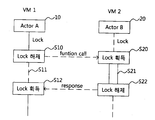
- FIG. 1 is a diagram illustrating a lock setting method for communication between actors allocated to different VMs in a multi-threaded processing system using a multi-virtual machine according to an embodiment of the present invention.
- FIG. 2 is a diagram illustrating a problem that may occur when one stack is used for each VM while using a lock setting method according to a multi-thread processing method using a multi-virtual machine according to an embodiment of the present invention.
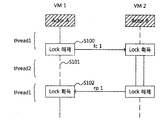
- FIG. 3 is a diagram illustrating an example of performing communication between actors allocated to different VMs according to a multi-thread processing method using a multi-virtual machine according to an embodiment of the present invention.
- FIG. 4 is a view for explaining a change in the VM stack according to the conventional method when performing the communication as shown in FIG.
- FIG. 5 is a diagram for describing a change in a stack according to a multi-thread processing method using a multi-virtual machine according to an embodiment of the present invention when performing communication as shown in FIG. 3.
- FIG. 6 is a diagram illustrating another example of performing communication between actors allocated to different VMs according to a multi-thread processing method using a multi-virtual machine according to an embodiment of the present invention.
- FIG. 7 is a diagram for describing a process of changing a stack according to a multi-thread processing method using a multi-virtual machine according to an embodiment of the present invention in the situation shown in FIG. 6.
- FIG. 8 is a view showing a schematic configuration of a multi-threaded processing system using a multi-virtual machine according to an embodiment of the present invention.
- the component when one component 'transmits' data to another component, the component may directly transmit the data to the other component, or through at least one other component. Means that the data may be transmitted to the other component.
- FIG. 1 is a diagram illustrating a lock setting method for communication between actors allocated to different VMs in a multi-threaded processing system using a multi-virtual machine according to an embodiment of the present invention.
- a multi-threaded processing system using a multi-virtual machine provides a plurality of VMs (eg, VM 1 and VM 2).
- Each of the VMs eg, VM 1, VM 2
- a given VM eg, VM1 may correspond to a plurality of actors. However, multiple actors (or threads) cannot use a single VM at the same time. This is because the VM (eg VM 1) does not support multithreading.
- the multi-threaded processing system using the multi-virtual machine may be implemented to support multi-threading using a plurality of VMs (for example, VM 1 and VM 2) as described above.
- VMs for example, VM 1 and VM 2
- each of the VMs may use only one actor (eg, 10 or 20) at a specific time. Therefore, when the actor 10 uses VM 1 as shown in FIG. 1, the actor 1 may be locked to prevent other actors or other threads from using the VM 1.
- VM 1 needs to communicate with another actor (for example, Actor B, 20) while performing a predetermined operation or function using the VM 1.
- another actor for example, Actor B, 20
- various function calls such as events or read calls may be the case.
- the actor (eg, 10) that calls the function is assigned to the VM (e.g., 20) to which the actor to be called is assigned ( For example, it may be necessary to acquire the lock of VM 2) (S20).
- the VM eg, VM 2
- the issue may be whether the actor making the function call (eg, 10) should keep holding or unlocking the VM (eg, VM 1).
- an actor eg, 10 making a function call releases a lock of its VM (eg, VM 1) (S10) and receives a function call.
- the actor eg, 20
- the actor may acquire a lock of the VM (eg, VM 2) (S20).
- the VM becomes available to other actors or threads until a response to the function call is received (S11), thereby increasing the efficiency of the system. .
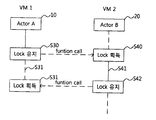
- a predetermined actor 10 may make a predetermined first function call to another actor 20 while maintaining a lock of its VM (eg, VM 1). Then, the actor 20 may acquire a lock of its VM (eg, VM 2) (S40). At this time, the actor 20 makes a second function call to the actor 10 at substantially the same time as the first function call, or the actor 20 uses a predetermined VM (eg, VM 2) to perform a predetermined operation. In operation S41, before outputting the response corresponding to the first function call to the actor 10, a predetermined second function call may be made to the actor 10 (S42).
- VM eg, VM 2
- the VM of the actor 10 (e.g., VM 1) is locked by the actor 20 again when the lock is held by the actor 10, i.e., the response corresponding to the first function call is received. It is acquired (S31) is a dead lock state in which the two actors wait only for a response to each other.
- an actor making a function call may be implemented to unlock the VM and make a function call.
- an actor (eg, 20) who has received the function call may acquire a lock of his or her VM (eg, VM 2) (S20) and perform an operation corresponding to the function call ( S21).
- the user may unlock the VM (eg, VM 2) again (S22) and transmit a response corresponding to the function call to the actor (eg, 10).
- the response corresponding to the function call is also the same as the function call, and the actor responding (eg, 20) unlocks its VM (eg, VM 2) (S22), and receives the response (eg, 10) may acquire (S12) a lock of its VM (eg, VM 1). Then, the received actor (eg, 10) may receive the response result and perform a predetermined operation.
- an unexpected stack error may occur when one stack is used for each VM. error) may occur. This will be described with reference to FIG. 2.
- FIG. 2 is a diagram illustrating a problem that may occur when one stack is used for each VM.
- FIG. 2A illustrates an actor making a function call according to an embodiment of the present invention as described with reference to FIG. 1A. It can be implemented to release the lock.
- the first actor 10 and the third actor 30 may be allocated to VM 1, and the second actor 20 may be allocated to VM 2.
- the first actor 10 performs a predetermined operation while having a lock of its VM (for example, VM 1), releases the lock (S50), and makes a predetermined first function call to the second actor ( 20). Then, the second actor 20 acquires a lock of its VM (eg, VM 2) (S60), and performs an operation corresponding to the first function call using its VM (eg, VM 2). When the operation is completed, the lock may be released (S61), and a response corresponding to the first function call may be transmitted to the first actor 10 (S54).
- VM for example, VM 1
- the first actor 10 locks its VM (eg, VM 1).
- another actor eg, third actor 30
- another thread may use the VM (eg, VM 1).
- the third actor 30 acquires the lock of the VM (eg, VM 1) by a predetermined event call (S51).
- a predetermined operation may be performed.
- the third actor 30 may unlock its VM (eg, VM 1) (S53) and make the second function call to another actor.
- a stack error may occur in the stack corresponding to VM 1. This is described with reference to FIG. 2B.
- the first actor 10 when the first actor 10 acquires a lock of its VM (eg, VM 1) and performs a predetermined operation and makes a first function call (S50), the first actor 10 ) Inserts information on the operation, that is, first stack information, into the stack Stack_VM 1.
- the first stack information may be defined as stack information corresponding to the first function call.
- the first stack information may be fetched from the stack Stack_VM 1 to continue the original operation.
- the third actor 30 acquires the lock of the VM 1, and the third actor 30 acquires another predetermined VM.
- the VM 1 to which the third actor 30 is allocated has the second stack information corresponding to the second function call in the stack Stack_VM 1.
- the first actor 10 has its own VM (for example, a VM).
- the stack information (ie, the second stack information) existing on the top of the stack Stack_VM 1 corresponding to 1) is extracted. Since the extracted stack information (ie, the second stack information) is the operation performed by the third actor 30, the stack information corresponding to the operation performed by the third actor 30 is eventually performed by the first actor 10. Will cause an error.
- This stack error is a situation in which a certain actor performs a function call in a specific VM, and another function call in another specific VM performs another function call in the specific VM before the function call is completed. Can occur.
- the multi-thread processing system and method using the multi-virtual machine according to an embodiment of the present invention solves this problem by providing a stack corresponding to each VM per thread, rather than maintaining one stack for each VM as described above.
- FIG. 3 is a diagram illustrating an example of performing communication between actors allocated to different VMs according to a multi-thread processing method using a multi-virtual machine according to an embodiment of the present invention.
- the first actor 10 performs a predetermined operation (processing of data) by using a lock of its VM (eg, VM 1), and then assigns the first actor 10 to another VM (eg, VM 2).
- a predetermined function call may be performed to communicate with the two actors 20.
- the function call may mean any type of message call capable of requesting predetermined information from actors allocated to different VMs such as an event call or a read call, or requesting a predetermined action and waiting for a response.
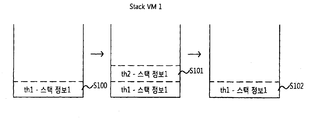
- the first actor 10 may release its lock as described above for the function call (S100) and allow the second actor 20 to acquire a lock of its VM (eg, VM 2). have. Then, after performing the operation corresponding to the function call, the second actor 20 may release its lock and transmit a response corresponding to the function call to the first actor 10. Then, the first actor 10 may again acquire a lock of its VM (eg, VM 1) (S102). In this manner, the first actor 10 may make the function call and then process a series of data processing processes that receive a response corresponding to the function call as one thread (thread 1).
- VM eg, VM 1
- the VM of the first actor 10 (eg, VM) by a predetermined actor. 1) may be available to other actors.
- a process of performing a specific operation or data processing by using the VM by a predetermined actor may be defined as another thread (thread 2).
- a predetermined function call may be performed while thread 2 is being processed, and the function call performed in thread 2 is completed before the function call performed in thread 1 is completed.
- the change of the stack Stack_VM 1 corresponding to the VM 1 may be as shown in FIG. 4.
- FIG. 4 is a view for explaining a change in the VM stack according to the conventional method when performing the communication as shown in FIG.
- the stack information th1_stack information 1 corresponding to the first function call of the thread 1 is located at the top, and when the first actor 10 acquires the lock ( S102)
- the stack information th1_stack information 1 may be used normally.
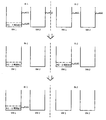
- the multi-thread processing method using the multi-virtual machine according to the embodiment of the present invention may use the method as shown in FIG. 5.
- FIG. 5 is a diagram for describing a change in a stack according to a multi-thread processing method using a multi-virtual machine according to an embodiment of the present invention when performing communication as shown in FIG. 3.
- stack information th1_stack information 1
- th1_stack information 1 corresponding to the first function call
- Is allocated to the thread 1 and the first actor 10 is inserted into the stack st11 corresponding to the allocated VM 1. That is, unlike FIG. 4, a multi-threaded processing system using a multi-virtual machine according to an embodiment of the present invention to insert predetermined stack information (th1_stack information 1) into a stack corresponds to a thread and a VM.
- the first stack may be determined, and the stack information th1_stack information 1 may be inserted into the determined stack.
- the predetermined stack information (th2_stack information 1) corresponding to the function call is the thread 2 And a stack st21 corresponding to the VM 1.
- the thread is inserted into the stack st21.
- Stack information th2_stack information 1 is extracted from the stack st21.
- the multi-thread processing system using the multi-virtual machine searches for the stack in which the stack information th1_stack information 1 is stored, and the retrieved stack (
- the stack information th1_stack information 1 may be extracted from St11).
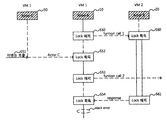
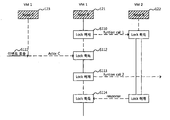
- FIG. 6 illustrates another example of performing communication between actors allocated to different VMs according to a multi-thread processing method using a multi-virtual machine according to an embodiment of the present invention
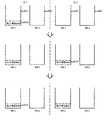
- FIG. 7 illustrates the present invention in the situation shown in FIG. A diagram illustrating a process of changing a stack according to a multi-thread processing method using a multi-virtual machine according to an embodiment of the present disclosure.
- the first actor 121 and the third actor 123 are located in VM 1.
- the second actor 122 may be assigned to VM 2.
- the first actor 121 performs a predetermined operation with the lock of its VM (eg, VM 1), releases the lock, and transfers the predetermined first function call to the second actor 122. It may be (S110). Then, the second actor 122 acquires a lock of its VM (eg, VM 2), performs an operation corresponding to the first function call using its VM (eg, VM 2), and operates When the lock is completed, the lock may be released and a response corresponding to the first function call may be transmitted to the first actor 121 (S54).
- VM eg, VM 1
- the second actor 122 acquires a lock of its VM (eg, VM 2), performs an operation corresponding to the first function call using its VM (eg, VM 2), and operates
- the lock may be released and a response corresponding to the first function call may be transmitted to the first actor 121 (S54).
- the predetermined third actor 123 may acquire the lock of the VM 1 (S112). .
- the third actor 123 may acquire the lock of the VM 1 by a predetermined event call 111 or a function call (S112).
- the third actor 123 After acquiring the lock of the VM 1, the third actor 123 performs a predetermined operation and releases the lock of its VM (eg, VM 1) (S113) and transfers the second function call to another actor. can do.
- the second function call may be performed before the first function call is completed, that is, before a response to the first function call comes.
- the first actor 121 receives a response corresponding to the first function call from the second actor 122, and again, of the VM (eg, VM 1) of the first actor 121. Obtain a lock.
- the VM eg, VM 1
- a series of processes in which the first actor 121 performs a first function call and receives a response from the second actor 122 may be one thread (thread 1), and the third actor 123 ) May be another thread (thread 2) of obtaining a lock of the VM 1 and making a second function call.
- stacks corresponding to each of the VMs st11, st12, st21, and st22 are maintained for each thread. Can be.
- the multi-thread processing system using the multi-virtual machine is a thread corresponding to the first function call (that is, The stack st11 corresponding to the thread 1) and the VM VM 1 may be determined (searched), and the first stack information corresponding to the first function call may be inserted into the determined stack st11.
- a thread ie, thread 2
- a VM corresponding to the second function call are included. That is, the stack st21 corresponding to VM1 may be determined.
- the second stack information corresponding to the second function call may be inserted into the determined stack st21.
- the multi-threaded processing system using the multi-virtual machine stacks corresponding to the current thread and VM.
- Stack information ie, first stack information located at the top of the st11 may be extracted.
- each thread maintains a stack for each VM, thereby preventing a stack error that may occur when a function call is executed by different actors.
- the maximum number of stacks may be limited to the number of threads x the number of VMs.
- FIG. 8 is a view showing a schematic configuration of a multi-threaded processing system using a multi-virtual machine according to an embodiment of the present invention.
- a multi-threaded processing system 100 using a multi-virtual machine may include a control module 110, an actor module 120, a stack module 130, and a plurality of VMs ( 140).
- the plurality of VMs 140 may include at least VM 1 141 and VM N 142.
- the multi-threaded processing system 100 using the multi-virtual machine uses a predetermined script language and / or a predetermined other language that does not support multi-threading as described above. Massively Multiplayer Online Games), etc.).
- the VMs 140 may refer to a predetermined virtual machine implemented in the scripting language. Therefore, according to the technical spirit of the present invention, it may be possible to implement a system suitable for a predetermined environment (eg, a multicore environment) requiring multithreading while using the scripting language.
- a module may mean a functional and structural combination of hardware for performing the technical idea of the present invention and software for driving the hardware.
- the module may mean a logical unit of a predetermined code and a hardware resource for performing the predetermined code, and does not necessarily mean a physically connected code or a kind of hardware. Can be easily inferred by the average expert in the art.
- the module refers to a combination of hardware and software that performs the functions defined herein and does not mean a specific physical configuration.
- the multi-threaded processing system 100 using the multi-virtual machine may mean a logical configuration having hardware resources and / or software necessary for implementing the technical idea of the present invention. It does not mean a physical component or a device.
- the multi-threaded processing system 100 using the multi-virtual machine may mean a logical combination of hardware and / or software provided to implement the technical idea of the present invention. By installing and performing each function, it may be implemented as a set of logical configurations for implementing the technical idea of the present invention.
- the multi-threaded processing system 100 using the multi-virtual machine may mean a set of components separately implemented for each function or role for implementing the technical idea of the present invention.
- each of the control module 110, the actor module 120, the stack module 130, and / or the VMs 140 may be located on different physical devices or on the same physical device. It may be.
- a combination of software and / or hardware configuring each of the control module 110, the actor module 120, the stack module 130, and / or the VMs 140 may also be combined with each other. Configurations located in different physical devices and components located in different physical devices may be organically combined with each other to implement each of the modules.
- the control module 110 may include other components (eg, the actor module 120, the stack module 130, and / or the VMs 140) included in the multi-threaded processing system 100 using the multi-virtual machine. ) And / or resources.
- control module 110 may control function calls of specific actors as described above. That is, it is possible to control unlocking and / or locking acquisition of a given VM performed by a function call of a specific actor.
- the actor module 120 may create and manage each of a plurality of actors. In addition, when a specific actor is created, the actor module 120 may assign the generated actor to any one of the plurality of VMs 140.
- Each of the actors created and managed by the actor module 120 may modify its state as an active object, communicate with other actors, or create a new actor, as disclosed in an earlier application. It may also contain information about a series of processing processes, that is, threads.
- the stack module 130 may allocate a stack corresponding to the plurality of VMs 140 to each thread and maintain the stack. Therefore, the stack maintained by the stack module 130 may be the number of threads x the number of VMs. Since the data structure of the stack and data input / output using the same are well known in the computer science, a detailed description thereof will be omitted.
- the control module 110 determines what the stack corresponding to the thread and VM corresponding to the function call is.
- the stack module 130 may be controlled to insert stack information corresponding to the function call into the determined stack.
- control module 110 may release the lock of the actor's own VM that made the function call, and control to acquire the lock of the actor's VM that has received the function call. This prevents deadlock as described in FIG. 1B and improves the performance of the system.
- the multi-thread processing method using a multi-virtual machine can be implemented as computer-readable code on a computer-readable recording medium.
- Computer-readable recording media include all kinds of recording devices that store data that can be read by a computer system. Examples of computer-readable recording media include ROM, RAM, CD-ROM, magnetic tape, hard disk, floppy disk, optical data storage, and the like, as well as carrier wave (e.g., transmission over the Internet). It also includes implementations.
- the computer readable recording medium can also be distributed over network coupled computer systems so that the computer readable code is stored and executed in a distributed fashion. And functional programs, codes and code segments for implementing the present invention can be easily inferred by programmers in the art to which the present invention belongs.
- the present invention can be applied to an object-based multi-scheduled system.
Landscapes
- Engineering & Computer Science (AREA)
- Software Systems (AREA)
- Theoretical Computer Science (AREA)
- Physics & Mathematics (AREA)
- General Engineering & Computer Science (AREA)
- General Physics & Mathematics (AREA)
- Stored Programmes (AREA)
- Telephonic Communication Services (AREA)
Abstract
La présente invention concerne un système de traitement multifil utilisant une machine virtuelle multiple, ainsi qu'un procédé associé. Le procédé qui est destiné au traitement multifil et qui utilise la machine virtuelle multiple consiste : lorsqu'un premier appel de fonction est transmis à un deuxième acteur par un premier acteur affecté à une première machine virtuelle afin de traiter un premier fil, à introduire des premières informations de pile qui correspondent au premier appel de fonction dans une première pile correspondant au premier fil et à la première machine virtuelle afin de transmettre le premier appel de fonction ; à transmettre un second appel de fonction avant la fin du premier appel de fonction afin qu'un troisième acteur affecté à la première machine virtuelle puisse traiter un second fil ; et à introduire des secondes informations de pile qui correspondent au second appel de fonction dans une seconde pile correspondant au second fil et à la première machine virtuelle afin de transmettre le second appel de fonction.
Applications Claiming Priority (2)
| Application Number | Priority Date | Filing Date | Title |
|---|---|---|---|
| KR10-2011-0017732 | 2011-02-28 | ||
| KR1020110017732A KR101191727B1 (ko) | 2011-02-28 | 2011-02-28 | 멀티 버추얼 머신을 이용한 멀티 쓰레드 처리시스템 및 그 방법 |
Publications (2)
| Publication Number | Publication Date |
|---|---|
| WO2012118268A2 true WO2012118268A2 (fr) | 2012-09-07 |
| WO2012118268A3 WO2012118268A3 (fr) | 2012-10-26 |
Family
ID=46758345
Family Applications (1)
| Application Number | Title | Priority Date | Filing Date |
|---|---|---|---|
| PCT/KR2011/009483 Ceased WO2012118268A2 (fr) | 2011-02-28 | 2011-12-08 | Système de traitement multifil utilisant une machine virtuelle multiple, et procédé associé |
Country Status (2)
| Country | Link |
|---|---|
| KR (1) | KR101191727B1 (fr) |
| WO (1) | WO2012118268A2 (fr) |
Cited By (2)
| Publication number | Priority date | Publication date | Assignee | Title |
|---|---|---|---|---|
| CN109933411A (zh) * | 2019-03-31 | 2019-06-25 | 山东超越数控电子股份有限公司 | 一种在线修改虚拟机内部配置系统及方法 |
| CN110245005A (zh) * | 2019-06-21 | 2019-09-17 | 中国人民解放军陆军工程大学 | 一种云训练平台 |
Families Citing this family (1)
| Publication number | Priority date | Publication date | Assignee | Title |
|---|---|---|---|---|
| KR102110760B1 (ko) * | 2018-08-07 | 2020-05-15 | 매트릭스테크 주식회사 | 멀티 쓰레드 기반의 3차원 모델링 데이터 처리 장치 및 이의 동작 방법 |
Family Cites Families (5)
| Publication number | Priority date | Publication date | Assignee | Title |
|---|---|---|---|---|
| WO2006128062A2 (fr) * | 2005-05-25 | 2006-11-30 | Terracotta, Inc. | Mise en antememoire de base de donnees de requetes et de procedures stockees utilisant des fonctions assurees par la base de donnees pour l'analyse de dependances et des mises a jour de bases de donnees detectees pour l'invalidation |
| KR100846451B1 (ko) * | 2006-12-12 | 2008-07-16 | 한국전자통신연구원 | 멀티 쓰레드 기반 센서 운영체제 환경에서의 스택 할당방법 |
| JP4197733B2 (ja) | 2008-02-04 | 2008-12-17 | 株式会社東芝 | 自動分散処理システム |
| US20100031252A1 (en) | 2008-07-29 | 2010-02-04 | Compuware Corporation | Method And System For Monitoring The Performance Of An Application And At Least One Storage Device For Storing Code Which Performs The Method |
| KR101080845B1 (ko) | 2009-10-30 | 2011-11-07 | (주)지노게임즈 | 교착 상태의 방지를 위한 데이터 처리 방법 및 시스템 |
-
2011
- 2011-02-28 KR KR1020110017732A patent/KR101191727B1/ko active Active
- 2011-12-08 WO PCT/KR2011/009483 patent/WO2012118268A2/fr not_active Ceased
Cited By (4)
| Publication number | Priority date | Publication date | Assignee | Title |
|---|---|---|---|---|
| CN109933411A (zh) * | 2019-03-31 | 2019-06-25 | 山东超越数控电子股份有限公司 | 一种在线修改虚拟机内部配置系统及方法 |
| CN109933411B (zh) * | 2019-03-31 | 2021-03-30 | 山东超越数控电子股份有限公司 | 一种在线修改虚拟机内部配置系统及方法 |
| CN110245005A (zh) * | 2019-06-21 | 2019-09-17 | 中国人民解放军陆军工程大学 | 一种云训练平台 |
| CN110245005B (zh) * | 2019-06-21 | 2021-05-25 | 中国人民解放军陆军工程大学 | 一种云训练平台 |
Also Published As
| Publication number | Publication date |
|---|---|
| KR101191727B1 (ko) | 2012-11-21 |
| WO2012118268A3 (fr) | 2012-10-26 |
| KR20120098051A (ko) | 2012-09-05 |
Similar Documents
| Publication | Publication Date | Title |
|---|---|---|
| US9213529B2 (en) | Optimizing just-in-time compiling for a java application executing on a compute node | |
| WO2011053038A2 (fr) | Procédé et système de traitement de données pour prévenir un blocage | |
| US7697443B2 (en) | Locating hardware faults in a parallel computer | |
| US20090271784A1 (en) | Executing A Distributed Java Application On A Plurality Of Compute Nodes | |
| WO2021107179A1 (fr) | Procédé et dispositif de génération automatique de code de réglage de logiciel d'application basé sur autosar | |
| WO2012044015A2 (fr) | Procédé et appareil pour l'affectation dynamique des ressources d'unités de traitement | |
| JP3745652B2 (ja) | 並列処理コンピューティング・システムにおいてメモリを割り振るための方法 | |
| WO2016064158A1 (fr) | Processeur reconfigurable et procédé d'exploitation associé | |
| US20090125611A1 (en) | Sharing loaded java classes among a plurality of nodes | |
| WO2013133586A1 (fr) | Procédé et appareil de reprise sur préemption d'entité maintenant un verrou | |
| WO2012173355A2 (fr) | Dispositif et procédé pour exécuter des fichiers de tâche dans un serveur de jeu | |
| EP3756092A1 (fr) | Appareil et procédé de gestion d'une ressource partageable dans un processeur multicoeur | |
| WO2013027923A1 (fr) | Système d'établissement d'une politique de machine virtuelle, procédé d'établissement d'une politique de machine virtuelle et procédé de fourniture d'une politique de machine virtuelle dans un système serveur d'informatique en nuage | |
| WO2012118268A2 (fr) | Système de traitement multifil utilisant une machine virtuelle multiple, et procédé associé | |
| WO2021210880A1 (fr) | Procédé et appareil d'attribution de ressources à une machine virtuelle | |
| WO2018216920A1 (fr) | Dispositif de fourniture d'un document type feuille de calcul à base de multiples fils et son procédé de fonctionnement | |
| WO2021132904A1 (fr) | Système sur puce exploitant de multiples cpu de différents types, et son procédé de fonctionnement | |
| WO2020222407A1 (fr) | Système et procédé de plateforme de gestion d'apprentissage automatique | |
| US8176491B1 (en) | Fast synchronization of simple synchronized methods | |
| CN101349974B (zh) | 一种分布式系统中提高多核cpu处理能力的方法 | |
| EP3762827A1 (fr) | Méthode et appareil de gestion des services de grains dans le système multi-coeur | |
| WO2013180359A1 (fr) | Procédé d'automatisation du paramétrage initial d'une machine virtuelle, et procédé de réalisation du service d'automatisation de paramétrage initial d'une machine virtuelle | |
| WO2024122728A1 (fr) | Procédé de communication some/ip basé sur arinc 653, et dispositif informatique pour sa réalisation | |
| WO2023101094A1 (fr) | Procédé d'application d'un système d'exploitation basé sur l'arinc pour une plateforme de véhicule | |
| WO2024117342A1 (fr) | Système de machine virtuelle et procédé de fourniture de machine virtuelle l'utilisant |
Legal Events
| Date | Code | Title | Description |
|---|---|---|---|
| 121 | Ep: the epo has been informed by wipo that ep was designated in this application |
Ref document number: 11859976 Country of ref document: EP Kind code of ref document: A2 |
|
| NENP | Non-entry into the national phase |
Ref country code: DE |
|
| 32PN | Ep: public notification in the ep bulletin as address of the adressee cannot be established |
Free format text: NOTING OF LOSS OF RIGHTS PURSUANT TO RULE 112(1) EPC (EPO FORM 1205N DATED 12/12/2013) |
|
| 122 | Ep: pct application non-entry in european phase |
Ref document number: 11859976 Country of ref document: EP Kind code of ref document: A2 |