WO2012118311A2 - Procédé de transmission et de réception de données dans un système de communication sans fil, et appareil correspondant - Google Patents
Procédé de transmission et de réception de données dans un système de communication sans fil, et appareil correspondant Download PDFInfo
- Publication number
- WO2012118311A2 WO2012118311A2 PCT/KR2012/001460 KR2012001460W WO2012118311A2 WO 2012118311 A2 WO2012118311 A2 WO 2012118311A2 KR 2012001460 W KR2012001460 W KR 2012001460W WO 2012118311 A2 WO2012118311 A2 WO 2012118311A2
- Authority
- WO
- WIPO (PCT)
- Prior art keywords
- user equipment
- base station
- cooperative
- information
- candidate
- Prior art date
- Legal status (The legal status is an assumption and is not a legal conclusion. Google has not performed a legal analysis and makes no representation as to the accuracy of the status listed.)
- Ceased
Links
Images




Classifications
-
- H—ELECTRICITY
- H04—ELECTRIC COMMUNICATION TECHNIQUE
- H04W—WIRELESS COMMUNICATION NETWORKS
- H04W76/00—Connection management
- H04W76/10—Connection setup
- H04W76/15—Setup of multiple wireless link connections
-
- H—ELECTRICITY
- H04—ELECTRIC COMMUNICATION TECHNIQUE
- H04B—TRANSMISSION
- H04B7/00—Radio transmission systems, i.e. using radiation field
- H04B7/02—Diversity systems; Multi-antenna system, i.e. transmission or reception using multiple antennas
- H04B7/022—Site diversity; Macro-diversity
- H04B7/026—Co-operative diversity, e.g. using fixed or mobile stations as relays
-
- H—ELECTRICITY
- H04—ELECTRIC COMMUNICATION TECHNIQUE
- H04W—WIRELESS COMMUNICATION NETWORKS
- H04W48/00—Access restriction; Network selection; Access point selection
- H04W48/16—Discovering, processing access restriction or access information
-
- H—ELECTRICITY
- H04—ELECTRIC COMMUNICATION TECHNIQUE
- H04W—WIRELESS COMMUNICATION NETWORKS
- H04W48/00—Access restriction; Network selection; Access point selection
- H04W48/08—Access restriction or access information delivery, e.g. discovery data delivery
- H04W48/10—Access restriction or access information delivery, e.g. discovery data delivery using broadcasted information
-
- H—ELECTRICITY
- H04—ELECTRIC COMMUNICATION TECHNIQUE
- H04W—WIRELESS COMMUNICATION NETWORKS
- H04W76/00—Connection management
- H04W76/10—Connection setup
- H04W76/14—Direct-mode setup
-
- H—ELECTRICITY
- H04—ELECTRIC COMMUNICATION TECHNIQUE
- H04W—WIRELESS COMMUNICATION NETWORKS
- H04W88/00—Devices specially adapted for wireless communication networks, e.g. terminals, base stations or access point devices
- H04W88/02—Terminal devices
- H04W88/04—Terminal devices adapted for relaying to or from another terminal or user
Definitions
- the present invention relates to a wireless communication, and more particularly, to a method of transmitting and receiving data between a base station and a user equipment in a connected-in-direct multi radio access technology (RAT) system without using an access point (AP) and apparatus therefor.
- RAT connected-in-direct multi radio access technology
- CA carrier aggregation
- a wireless communication network establishes a cooperative system among a plurality of user equipments communicating with each other via a base station and has been making progress to enable at least one or more user equipments to transmit/receive data to/from a base station in accordance with the communication environment.
- a plurality of the user equipments may include a source device as a subject to communicate with a base station with helps of other user equipments connected to the source device, a cooperative device playing a role as a relay to help a source device to communicate with a base station and a cooperative device candidate except a source device playing a role as a cooperative device.
- a wireless communication system provided with user equipments in high density may be able to give higher system performance by the cooperation among the user equipments. For instance, in case of attempting to transmit prescribed data to a base station, a source device may transmit the data together with a cooperative device. Moreover, the source device may be able to transmit the data via the cooperative device.
- the above-described example may be identically applicable to a case that a base station transmits data to a user equipment, by which further excellent system performance may be accomplished.
- a wireless communication system including a plurality of user equipments having established a cooperative system may be named a multi radio access technology (RAT) system.
- RAT radio access technology
- An object of the present invention is to provide a method for a user equipment supporting a connected-in-direct multi-RAT (multi-radio access technology) without using an access point (AP) to perform a communication.
- a connected-in-direct multi-RAT multi-radio access technology
- Another object of the present invention is to provide a method for a cooperative user equipment candidate supporting a connected-in-direct multi-RAT (multi-radio access technology) without using an access point (AP) to perform a communication.
- a connected-in-direct multi-RAT multi-radio access technology
- Another object of the present invention is to provide a method for a base station supporting a connected-in-direct multi-RAT (multi-radio access technology) without using an access point to perform a communication.
- Another object of the present invention is to provide a user equipment supporting connected-in-direct a multi-RAT (multi-radio access technology) without using an access point.
- a multi-RAT multi-radio access technology
- Another object of the present invention is to provide a cooperative user equipment candidate supporting a connected-in-direct multi-RAT (multi-radio access technology) without using an access point.
- a further object of the present invention is to provide a base station supporting a connected-in-direct multi-RAT (multi-radio access technology) without using an access point.
- a method of performing a communication which is performed by a user equipment supporting a multi-RAT (multi-radio access technology)
- the method further includes the step of transmitting a 1st probe request message to a plurality of the cooperative user equipment candidates, and the 1st information is received from the 1st cooperative user equipment candidate in a manner of being contained in a probe response message in response to the 1st probe request message.
- the 1st information includes at least one of a MAC (medium access control) address information and a service set identifier (SSID) information.
- MAC medium access control
- SSID service set identifier
- a 1st radio access scheme is applied between the user equipment and a plurality of the cooperative user equipment candidates and a 2nd radio access scheme is applied between a plurality of the cooperative user equipment candidates and the base station.
- the 1st radio access scheme is WiFi (wireless fidelity) access scheme and the 2nd radio access scheme is WiMAX (worldwide interoperability for microwave access) scheme.
- the method further includes the step of performing a communication of a 2nd data with the base station by the user equipment via the 2nd radio access scheme.
- a same radio access scheme is applied among the user equipment, a plurality of the cooperative user equipment candidates and the base station.
- the method further includes the step of receiving an information on a 3rd cooperative user equipment candidate corresponding to at least one of a plurality of the cooperative user equipment candidates from the base station, and the 1st probe request message is transmitted to the 3rd cooperative user equipment candidate.
- the method further includes the steps of transmitting a 2nd probe request message to the 2nd cooperative user equipment candidate and receiving a 2nd probe response message from a 4th cooperative user equipment candidate corresponding to at least one of the at least one 2nd cooperative user equipment candidate in response to the 2nd probe request message.
- the communication of the 1st data with the base station is performed using at least one of the at least one 4th cooperative user equipment candidate.
- the 2nd probe request message is periodically transmitted.
- a method of performing a communication which is performed by a cooperative user equipment candidate supporting a multi-RAT (multi-radio access technology)
- IBSS independent basic service set
- a 1st radio access scheme is applied between the user equipment and the cooperative user equipment candidate and a 2nd radio access scheme is applied between the cooperative user equipment candidate and the base station.
- the 1st radio access scheme is WiFi (wireless fidelity) access scheme and the 2nd radio access scheme is WiMAX (worldwide interoperability for microwave access) scheme.
- a same radio access scheme is applied among the user equipment, the cooperative user equipment candidate and the base station.
- a user equipment which supports a multi-RAT (multi-radio access technology)
- a receiving module receiving a 1st information for identifying a 1st cooperative user equipment candidate from the 1st cooperative user equipment candidate corresponding to at least one of a plurality of cooperative user equipment candidates
- a transmitting module transmitting the 1s
- the processor controls the transmitting module to transmit a 1st probe request message to a plurality of the cooperative user equipment candidates and the 1st information is received from the 1st cooperative user equipment candidate in a manner of being contained in a probe response message in response to the 1st probe request message.
- the 1st information includes at least one of a MAC (medium access control) address information and a service set identifier (SSID) information.
- MAC medium access control
- SSID service set identifier
- a 1st radio access scheme is applied between the user equipment and a plurality of the cooperative user equipment candidates
- a 2nd radio access scheme is applied between a plurality of the cooperative user equipment candidates and the base station
- the 1st radio access scheme is WiFi (wireless fidelity) access scheme
- the 2nd radio access scheme is WiMAX (worldwide interoperability for microwave access) scheme.
- the processor controls the user equipment to perform a communication of a 2nd data with the base station via the 2nd radio access scheme.
- a cooperative user equipment candidate which supports a multi-RAT (multi-radio access technology)
- IBSS independent basic service set
- the present invention provides the following effects and/or advantages.
- a base station in a multi-RAT may be able to effectively transmit data to a source device according to the contents of the present invention.
- a source device in a multi-RAT may be able to effectively transmit data to a base station via a cooperative device according to the contents of the present invention.
- FIG. 1 is a diagram for one example of a multi-RAT (multi-radio access technology) system
- FIG. 2 is a diagram for one example of an operation of a multi-RAT (multi-radio access technology) system
- FIG. 3 is a diagram for a detailed example of a basic service set in accordance with a presence or non-presence of a use of an access point (AP);
- AP access point
- FIG. 4 is a diagram for one example of transceiving data between a base station and a user equipment in an AP-based (access point-based) multi-RAT system;
- FIG. 5 is a diagram for a structure of FDD (frequency division duplex) radio frame in 3GPP LTE;
- FIG. 6 is a diagram for a structure of TDD (time division duplex) radio frame in 3GPP LTE;
- FIG. 7 is a diagram for one example of a resource grid for one downlink slot
- FIG. 8 is a diagram for one example of a structure of a downlink frame
- FIG. 9 is a diagram for a structure of an uplink subframe used in LTE system.
- FIG. 10 is a diagram for explaining mapping relations among a code word, a layer and an antenna to transmit a downlink signal in a multi-antenna (MIMO) wireless communication system;
- MIMO multi-antenna
- FIG. 11 is a diagram for one example of an information exchanging step requested to transmit/receive data between a base station and a plurality of devices in a multi-RAT (multi-radio access technology) system according to the present invention
- FIG. 12 is a flowchart for one example of obtaining cooperative device candidates in a connected-in-direct multi-RAT system and then determining a cooperative device for client cooperation among the cooperative device candidates according to the present invention
- FIG. 13 is a diagram for one example that a source device becomes a subject for discovery to apply the present invention.
- FIG. 14 is a diagram for one example that a cooperative device becomes a subject for discovery to apply the present invention.
- FIG. 15 is a block diagram for one example of a base station and a user equipment according to the present invention.
- CDMA code division multiple access
- FDMA frequency division multiple access
- TDMA time division multiple access
- OFDMA orthogonal frequency division multiple access
- SC-FDMA single carrier frequency division multiple access
- CDMA can be implemented with such a radio technology as UTRA (universal terrestrial radio access), CDMA 2000 and the like.
- TDMA can be implemented with such a radio technology as GSM/GPRS/EDGE (Global System for Mobile communications)/General Packet Radio Service/Enhanced Data Rates for GSM Evolution) and the like.
- OFDMA can be implemented with such a radio technology as IEEE (Institute of Electrical and Electronics Engineers) 802.11 (Wi-Fi), IEEE 802.16 (WiMAX), IEEE 802.20, E-UTRA (Evolved UTRA) and the like.
- UTRA is a part of UMTS (Universal Mobile Telecommunications System).
- 3GPP (3rd Generation Partnership Project) LTE (long term evolution) is a part of E-UMTS (Evolved UMTS) that uses E-UTRA.
- the 3GPP LTE adopts OFDMA in DL and SC-FDMA in UL.
- LTE-A LTE-Advanced
- IEEE 802.16m is an evolved version of IEEE 802.16e.
- radio access multi-RAT
- radio communication scheme a terminology called ‘radio communication scheme’ and the like.
- FIG. 1 is a diagram for one example of a multi-RAT (multi-radio access technology) system.
- a multi-radio access technology (hereinafter abbreviated a multi-RAT) system may include a base station 100 and a plurality of communication devices 110, 120, 130 and 140.
- the devices 1120, 120, 130 and 140 represented as communication devices in FIG. 1 may become a source device as a subject to communicate with a base station with helps of other user equipments connected to the source device, a cooperative device playing a role as a relay to help a source device to communicate with a base station and a cooperative device candidate except a source device playing a role as a cooperative device and the like.
- a plurality of the communication devices 110, 120, 130 and 140 may establish a cooperative system with each other.
- a source device may be able to transmit data to a base station together with a cooperative device.
- a source device may be able to receive data from a base station together with a cooperative device.
- a direct radio communication scheme among a plurality of devices may differ from a direct radio communication scheme between a base station and a plurality of devices.
- data may be transceived by applying a wireless LAN access scheme (e.g., Wi-Fi, etc.) among a plurality of devices, while data may be transceived by applying a mobile communication network access scheme (e.g., IEEE 802.16 (WiMAX), etc.) between a base station and a plurality of devices.
- a wireless LAN access scheme e.g., Wi-Fi, etc.
- a mobile communication network access scheme e.g., IEEE 802.16 (WiMAX), etc.
- a plurality of devices may perform a direct communication in-between by IEEE 802.11 (Wi-Fi) scheme or Bluetooth scheme.
- each of a plurality of devices may perform a direct communication with a base station by IEEE 802.16 (WiMAX) scheme.
- the present invention may be non-limited by the above description and may enable a plurality of devices to communicate with each other by the same wireless or radio communication scheme.
- a wireless LAN access scheme (e.g., Wi-FI, etc.) is applied between a plurality of devices to transceive data and may be applicable between a base station and a plurality of devices.
- a mobile communication network access scheme (e.g., IEEE 802.16 (WiMAX), etc.) is applied between a plurality of devices to transceive data and may be identically applied between a base station and a plurality of devices to transceive data.
- a scheme of communication between a base station and a plurality of devices may be called an in-band communication scheme, an in-band signaling communication scheme or the like in accordance with a wireless communication scheme.
- the source device 140 may be able to transmit data to the base station 100 together with the cooperative device 130.
- a communication device may be able to efficiently transmit data, it may be able to secure good performance.
- each device may be able to reinforce its throughput and power consumption may be reduced using a data communication via a cooperative system.
- a source device may be able to transmit data to a base station via a cooperative device. And, a source device may be able to receive data from a base station via a cooperative device.
- the source device 100 may be able to transmit data to the base station 100 via the cooperative device 120.
- a communication device may be able to efficiently transmit data, it may be able to prevent degradation of system performance.
- FIG. 1 shows the example for a source device to transmit data to t abase station via a cooperative device
- the above description may be identically applicable to a case for a base station to receive data from a source device as well.
- the source device 110/140 may become a cooperative device or a neighbor device failing to join a data transmission and the cooperative device 120/130 may becomes a source device or a neighbor device failing to join a data transmission.
- FIG. 2 is a diagram for one example of an operation of a multi-RAT (multi-radio access technology) system.
- multi-RAT multi-radio access technology
- a multi-RAT system may include a base station 210 and a plurality of communication devices 220 and 230.
- a plurality of the communication devices 220 and 230 may be able to establish a cooperative system together by such a radio technology as 802.11 (Wi-Fi) and the like.
- each of a plurality of the communication devices 220 and 230 may be able to directly transmit/receive data to/from the base station 210 by such a radio technology as IEEE 802.16 (WiMAX) and the like.
- WiMAX IEEE 802.16
- the source device 220 may be able to indirectly transmit data to the base station 210 via the cooperative device 230. Moreover, the source device 220 may be able to indirectly receive data from the base station 210 via the cooperative device 230.
- a communication device may be able to directly exchange data with a base station and may be also able to indirectly exchange data with the base station with a help of a cooperative device having a good communication quality. Therefore, degradation of system performance can be prevented and efficient data communication can be performed.
- the information exchanging procedure which should be performed between a base station and a plurality of communication devices in a multi-RAT system may mainly include 4 steps.
- the 4 steps may include a general network entering step, a negotiating step for a plurality of devices to cooperate with each other, a step of searching neighbor devices of a source device and selecting a cooperative device from the searched neighbor devices, and a step of connecting to the selected cooperative device.
- a method for a plurality of communication devices to cooperatively communicate with each other may be classified into an infrastructure basic service set (infrastructure BSS) and an independent basic service set (independent BSS) in accordance with a presence or non-presence of using an access point (hereinafter abbreviated AP).
- infrastructure BSS infrastructure basic service set
- independent BSS independent basic service set
- AP access point
- the access point (AP) may mean a connecting point between a base station and a plurality of user equipments in a multi-RAT system and may be called a mutual access point as well.
- the access point (AP) may be an intermediate agent that connects a wire LAN and a wireless LAN together.
- the access point may be represented as ACCESS POINT, AP and the like, it may be just called an access point for clarity and convenience of the following description.
- an access point In case that an access point (AP) is used by a multi-RAT system, it may be able to provide a point-to-point function of enabling user equipments respectively situated at two different points to communicate with each other by connecting the user equipments together.
- AP access point
- point-to-point function Unlike the point-to-point function, it may be able to provide a point-to-multipoint function of enabling a plurality of user equipments to communicate with each other by simultaneously connecting a plurality of the user equipments together.
- an access point (AP) set as a repeater may be able to communicate with another access point (AP) by providing a connection with a base station.
- it may be able to provide a wireless client function of exchanging signals by wireless in a manner of being connected to a plurality of user equipments capable of exchanging signals by a wired or short-range communication network.
- FIG. 3 is a diagram for a detailed example of a basic service set in accordance with a presence or non-presence of a use of an access point (AP).
- AP access point
- FIG. 3 (a) shows one example of an infrastructure basic service set (BSS).
- BSS infrastructure basic service set
- BSS infrastructure basic service set
- AP access point
- a multi-RAT system may include a plurality of access points (APs). And, a plurality of user equipments may exist around each of a plurality of the access points.
- APs access points
- user equipments may exist around each of a plurality of the access points.
- FIG. 4 is a diagram for one example of transceiving data between a base station and a user equipment in an AP-based (access point-based) multi-RAT system having the aforesaid access point (AP) applied thereto.
- AP access point
- a 1st access point 150 and a 2nd access point 160 may be included in a multi-RAT system.
- a 1st user equipment 110 and a 2nd user equipment 120 exist in the vicinity of the 1st access point 150. And, each of the 1st user equipment 110 and the 2nd user equipment 120 may be able to perform a data communication operation for a client cooperation with a base station 100.
- a 3rd user equipment 130 and a 4th user equipment 140 exist in the vicinity of the 2nd access point 160. And, each of the 3rd user equipment 130 and the 4th user equipment 140 may be able to perform a data communication operation for the client cooperation with the base station 100.
- the above-mentioned contents includes a case that a plurality of user equipments are located within a coverage of each of a plurality of access points, a case that a plurality of user equipments are connected to each other by wireless, and a case that a plurality of user equipments are detected within a coverage.
- a user equipment and an access point may be able to implement the infrastructure basic service set (BSS).
- BSS infrastructure basic service set
- FIG. 3 (b) shows one example of an independent basic service set (BSS).
- BSS independent basic service set
- a plurality of user equipment may be directly connected to each other.
- a structure of a radio frame applicable in 3GPP LTE may be taken as an example, by which the present invention may be non-limited. And, various types of radio frame structures may be applicable to the present invention.
- FIG. 5 is a diagram for a structure of FDD (frequency division duplex) radio frame in 3GPP LTE.
- This radio frame structure may be named a frame structure type 1.
- a radio frame may include 10 subframes and each of the subframes may be defined as 2 contiguous slots.
- a time taken for one subframe to be transmitted may be called a transmission time interval (TTI).
- TTI transmission time interval
- a downlink, in which each node or base station transmits a signal to a user equipment may be discriminated from an uplink, in which the user equipment transmits a signal to each node or base station, in frequency domain.
- FIG. 6 is a diagram for a structure of TDD (time division duplex) radio frame in 3GPP LTE.
- This radio frame structure may be named a frame structure type 2.
- one radio frame may have a length of 10 ms and may include two half-frames each of which has a length of 5 ms.
- One subframe may be designated as one of a UL subframe, a DL subframe and a special subframe.
- One radio frame may include at least one UL subframe and at least one DL subframe.
- One subframe may be defined as 2 contiguous slots. For instance, a length of one subframe may be 1 ms and a length of one slot may be 0.5 ms.
- a special subframe is a specific period for separating an uplink and a downlink from each other between a UL subframe and a DL subframe.
- At least one special subframe may exist in one radio frame.
- a special subframe may include a downlink pilot time slot (DwPTS), a guard period and an uplink pilot time slot (UpPTS).
- the DwPTS may be used for initial cell search, synchronization or channel estimation.
- the UpPTS may be used for channel estimation in a base station and a UL transmission synchronization matching of a user equipment.
- the guard period is an interval between an uplink and a downlink to eliminate an interference generated in UL due to a multi-path delay of a DL signal.
- One slot in FDD/TDD radio frame may include a plurality of OFDM (orthogonal frequency division multiplexing) symbols in time domain and may include a plurality of resource blocks (RBs) in frequency domain. Since 3GPP LTE uses PFDMA in DL, the OFDM symbol may represent one symbol period and may be called such a different terminology as SC-FDMA symbol and the like in accordance with a multi-access scheme.
- the resource block may include a plurality of contiguous subcarriers in one slot by a resource allocation unit.
- the radio frame structures described with reference to FIG. 5 and FIG. 6 may refer to Paragraph 4.1 and Paragraph 4.2 of 3GPP TS 36.211 V8.3.0 (2008-05) "Technical Specification Group Radio Access Network; Evolved Universal Terrestrial Radio Access (E-UTRA); Physical Channels and Modulation (Release 8)".
- radio frame structures may be just exemplary.
- the number of subframes included in a radio frame, the number of slots included in a subframe, the number of OFDM symbols included in a slot and the like may be modifiable in various ways.
- FIG. 7 is a diagram for one example of a resource grid for one downlink slot.
- one DL slot may include a plurality of OFDM symbols in time domain.
- one DL slot includes 7 OFDMA slots and one resource block (RB) includes 12 subcarriers in frequency domain, which is just exemplary and by which the present invention may be non-limited.
- Each element on a resource grind may be called a resource element and one resource block (RB) includes 12 7 resource elements.
- the number NDL of resource blocks included in a DL slot may depend on a DL transmission bandwidth set for a cell.
- the above-mentioned resource grid for the DL slot may be applicable to a UL slot as well.
- FIG. 8 is a diagram for one example of a structure of a downlink frame.
- a subframe may include 2 contiguous slots.
- Maximum 3 fore OFDM symbols of a 1st slot within the subframe may correspond to a control region to which DL control channels are allocated. And, the rest of OFDM symbols may become a data region to which PDSCH (physical downlink shared channel) is allocated.
- PDSCH physical downlink shared channel
- PCFICH Physical Control Format Indicator Channel
- PDCCH Physical Downlink Control Channel
- PHICH Physical Hybrid-ARQ Indicator Channel
- the PCFICH carried on a 1st OFDM symbol of a subframe may carry information on the number of OFDM symbols (i.e., a size of a control region) used for a transmission of control channels in the subframe.
- Control information carried on PDCCH may be called downlink control information (DCI).
- DCI may indicate UL resource allocation information, DL resource allocation information, UL transmit power control command for random UE groups and the like.
- the PHICH may carry ACK/NACK (acknowledgement/negative-acknowledgement) signal for HARQ (hybrid automatic repeat request) of UL data.
- ACK/NACK signal for UL data transmitted by a user equipment may be carried on the PHICH.
- the PDSCH is a channel that carries control information and/or data.
- a user equipment may be able to read data carried on the PDSCH by decoding DL control information carried on the PDCCH.
- FIG. 9 is a diagram for a structure of an uplink subframe used in LTE system.
- a subframe 700 having a length of 1ms which is a basic unit of LTE UL transmission may include two 0.5ms slots 701. Assuming a length of a normal cyclic prefix (CP), each slot includes 7 OFDM symbols 702 and one symbol corresponds to one SC-FDMA symbol.
- a resource block 703 is a resource allocation unit which corresponds to 12 subcarriers in frequency domain and one slot in time domain.
- a structure of UL subframe of LTE may be mainly divided into a data region 704 and a control region 705.
- the data region may mean a series of communication resources used in transmitting data of audio, packet and the like to each user equipment and may correspond to the rest of resources except the control region in the subframe.
- the control region may mean a series of communication resources used in transmitting a DL channel quality report from each user equipment, reception ACK/NACK for a DL signal and a UL scheduling request and the like.
- a region 706 for transmitting a sounding reference signal in one subframe corresponds to an interval, in which an SC-FDMA symbol situated at a last position on a time axis in one subframe exists, and may be transmitted via a data transmission bandwidth on a frequency axis. Sounding reference signals of several user equipments, which are carried on last SC-FDMA in the same subframe, may be identifiable in a cyclic shift value.
- a region for transmitting a DM-reference signal (demodulation-reference signal) in one subframe corresponds to an interval, in which a middle SC-FDMA symbol in one slot, i.e., 4th SC-FDMA symbol and 11th SC-FDMA symbol exist, and may be transmitted via a data transmission region on a frequency axis.
- FIG. 10 is a diagram for explaining mapping relations among a code word, a layer and an antenna to transmit a downlink signal in a multi-antenna (MIMO) wireless communication system.
- MIMO multi-antenna
- a MAC (medium access control) layer may deliver Nc transport blocks as data information to a physical layer.
- the transport blocks may be transformed into a code word by channel coding and such a rate matching as puncturing, repetition and the like may be performed.
- the channel coding may be performed by such a channel coder as a turbo encoder, a tail bit convolution encoder and the like.
- the NC code words may be mapped to NL layers.
- each of the layers may indicate a different information sent using MIMO technology and the number of the layers may not be greater than a rank that is the maximum number for sending different informations. This may be represented as such a formula as ‘ ’, where ‘H’ means a channel matrix.
- DFT may be performed on each layer for a UL signal transmitted by SC-FDMA (Single Carrier-Frequency Division Multiple Access) in order to enable a transmitted signal to have a single carrier property by canceling out an effect of IFFT (Inverse Fast Fourier Transform) in part.
- SC-FDMA Single Carrier-Frequency Division Multiple Access
- the signals transformed by DFT in the layers are multiplied by a precoding matrix, are mapped to NT transmitting antennas, respectively, and are then transmitted to a base station through IFFT.
- a common reference signal and a UE-specific reference signal may exist in a DL reference signal and precoding may not be applied to the common reference signal.
- the UE-specific reference signal is precoded by being inserted into a precoding part and is then transmitted to a user equipment side, in the same manner of normal data.
- a transmission reference signal In order to implement spatial multiplexing transmission non-dependent on channel using a UE-specific reference signal, i.e., a dedicated reference signal, there exist several conditions. First of all, in order to reduce signaling overhead of a reference signal, a transmission reference signal should be precoded using the same precoding matrix of a modulated data symbol. Moreover, in order to obtain spatial channel diversity, a precoding matrix should be switched between antennas. Yet, since the dedicated reference signal is transmitted across a whole transmission resource region according to a specific rule or randomly, it may not be easy to meet the above conditions. Since channel measurement is performed by a unit of a specific number of resource elements for the efficiency of the channel measurement, it may be unable to change a precoding matrix for precoding a dedicated reference signal by a resource element unit.
- a pre-procedure for exchanging information beforehand may be required.
- each of the communication devices may enter one of three statuses including a 1st status of being disconnected from each other, a 2nd status of recognizing and authenticating a counterpart communication device, and a 3rd status of being associated with a counterpart communication device.
- the 1st status may mean a status that a plurality of communication devices in a multi-RAT system are not connected to each other at all. Hence, in the 1st status, each source device should perform data communication with a base station in direct.
- the 2nd status may mean a status that information on a counterpart communication device is obtained and that the counterpart communication device is authenticated.
- a passive method of receiving information on a counterpart communication device via a beacon message or an active method including the steps of sending a probe request message and receiving information on a counterpart communication device via a probe response message received in response to the sent probe request message.
- each of the communication devices may complete an authentication confirmation job by exchanging an authentication frame (e.g., authentication request and authentication response) with the counterpart communication device.
- an authentication frame e.g., authentication request and authentication response
- each of the communication devices may enter the 2nd status.
- the 3rd status may mean a status of being associated with an authenticated counterpart communication device.
- each of the communication devices may complete an association job (e.g., AID assignment, etc.) by exchanging an association frame (e.g., association request and association response) with the counterpart communication device. If the association job of a plurality of the communication devices in the radio access system is completed, the communication devices may be able to transmit and receive their data.
- an association job e.g., AID assignment, etc.
- an association frame e.g., association request and association response
- an information exchanging step which should be performed between a base station and a plurality of communication devices in a multi-RAT system, may mainly include 4 steps.
- the 4 steps may include a general network entering step, a negotiating step for a plurality of devices to cooperate with each other, a step of searching neighbor devices of a source device and selecting a cooperative device from the found neighbor devices, and a step of connecting to the selected cooperative device.
- a subject in each step of the information exchanging pre-procedure is a source device, by which the present invention may be non-limited.
- the substance of the present invention may be applicable to a device supporting a multi-RAT system, a cooperative device, a cooperative device candidate and the like for each step.
- FIG. 11 is a diagram for one example of an information exchanging step requested to transmit/receive data between a base station and a plurality of devices in a multi-RAT (multi-radio access technology) system according to the present invention.
- a multi-RAT multi-radio access technology
- a source device may perform a general network entering step S1000 together with a base station.
- the source device may be connected with the base station to transmit and receive data directly.
- the general network entering step S1000 may be named a 1st step.
- the source device having completed the 1st step together with the base station may perform a negotiating step S2000 to cooperate with a plurality of devices within the multi-RAT system.
- the source device may negotiate with the base station for capability of a cooperative operation with the base station.
- information transceived between the base station and the source device may include connection RAT type information, system type information, system version information, location information, information on a presence or non-presence of possibility in playing a role as a cooperative device and the like.
- the negotiating step S2000 may be named a 2nd step.
- the base station, the source device and a plurality of the cooperative device candidates may perform a step S3000 of searching for neighbor devices and then selecting a cooperative device from the found neighbor devices.
- the step S3000 of selecting the cooperative device from the found neighbor devices may be named a 3rd step.
- the base station, the source device and a plurality of the cooperative device candidates exchange their location informations with one another. Based on the exchanged location informations, a cooperative device to join a data communication within the multi-RAT system may be selected.
- the source device may perform a step S4000 of connecting with the selected cooperative device. If the step S4000 of connecting with the selected cooperative device is completed, the source device and the cooperative device, which are connected to each other, may cooperatively perform data transmission/reception to/from the base station.
- step S4000 of connecting with the selected cooperative device may be named a 4th step.
- each of the steps of the information exchanging pre-procedure may not be applied to all communication devices in common.
- the 1st and 2nd steps should be performed in common by a plurality of the communication devices supporting the multi-RAT system.
- the 3rd and 4th steps may be performed by at least one of the source device, the cooperative device and the cooperative device candidate. And, it may be unnecessary for all communication devices to perform the 3rd step and the 4th step.
- a portion of the 3rd step (e.g., obtaining the location informations of a plurality of the communication devices supporting the multi-RAT system) may be performed in common by all communication devices.
- the communication devices through the 1st and 2nd steps may not be identifiable from each other.
- the communication devices may be handled as preliminary source devices and preliminary cooperative devices through the 3rd step.
- the source device and the cooperative device are determined.
- the source device and the cooperative device may cooperative with each other to transceive data with the base station.
- a source device may search for a plurality of cooperative device candidates capable of performing client cooperation to perform an efficient data communication with a base station and may then perform a client cooperation operation by selecting at least one cooperative device from a plurality of the found cooperative device candidates.
- the source device since the source device has mobility, it may be necessary to periodically or aperiodically update information on a plurality of the cooperative device candidates located close to the source device. Namely, if a location of the source device or the cooperative device is changed, a plurality of the cooperative device candidates capable of performing the client cooperation previously provided to the source device may be changed together.
- the present invention may provide a procedure for obtaining a candidate group of cooperative devices for client cooperation with a source device and selecting a device capable of operating as a cooperative device from the obtained candidate group.
- a method for a plurality of communication devices to cooperatively communicate with each other in a multi-RAT system is an independent basic service set (BSS) for the communication devices to communicate with each other by being connected with each other in direct.
- BSS independent basic service set
- This is just one example of the present invention.
- the substance of the present invention is applicable to a case of an infrastructure basic service set (BSS).
- FIG. 12 is a flowchart for one example of obtaining cooperative device candidates in a connected-in-direct multi-RAT system and then determining a cooperative device for client cooperation among the cooperative device candidates according to the present invention.
- a base station may perform a step S1210 of selecting cooperative device candidates in advance.
- the base station may determine whether a specific device is capable of playing a role as a cooperative device for client cooperation in consideration of a moving speed (e.g., no mobility, low mobility, etc.), a location, a presence or non-presence of cooperative device candidate in the vicinity, the number of cooperative device candidates present in the vicinity, a retained power level, a channel status (e.g., channel status of high quality, etc.) and the like.
- a moving speed e.g., no mobility, low mobility, etc.
- a location e.g., a presence or non-presence of cooperative device candidate in the vicinity
- the number of cooperative device candidates present in the vicinity e.g., a retained power level
- a channel status e.g., channel status of high quality, etc.
- the above-mentioned factors for the base station to determine whether a specific device is capable of playing a role as a cooperative device are just exemplary for implementation of the present invention. And, it is apparent that the base station is able to determine whether a specific device is capable of playing a role as a cooperative device using other factors of different types.
- the base station may be able to make a request for specific devices, each of which meets some of a plurality of the above-mentioned factors only, to transmit information on the rest of the factors.
- the base station may be able to make a request for specific devices, each of which meets the preset factors ‘moving speed’ and ‘location’, to transmit information on a presence or non-presence of cooperative device candidate in the vicinity, information on the number of cooperative device candidates present in the vicinity, information on a retained power level, information on a channel status (e.g., channel status of high quality, etc.) and the like.
- a channel status e.g., channel status of high quality, etc.
- the base station may be able to make a request for the corresponding specific device to play a role as a cooperative device for client cooperation.
- each of the specific devices may be able to grant or reject the request made by the base station.
- the corresponding device may transmit information required for the client cooperation (hereinafter abbreviated CC) to the base station.
- CC client cooperation
- the information required for the client cooperation may include a system type (e.g., IEEE 802.11a, IEEE 802.11b, IEEE 802.11g, 802. 11n, etc.), a system version of Bluetooth, a MAC address used for its multi-RAT system, a service set identifier and the like.
- a system type e.g., IEEE 802.11a, IEEE 802.11b, IEEE 802.11g, 802. 11n, etc.
- a system version of Bluetooth e.g., a system version of Bluetooth
- a MAC address used for its multi-RAT system e.g., a MAC address used for its multi-RAT system
- service set identifier e.g., a service set identifier and the like.
- the corresponding device may be able to play a role as the cooperative device candidate for the client cooperation (CC).
- the corresponding device may negotiate whether it is able to play a role as a cooperative device in a network entry process or a network re-entry process.
- the corresponding device may notify whether it is able to play a role as a cooperative device to the base station.
- the base station may be able to determine whether to transmit the information for requesting to play the role as the cooperative device.
- the base station may not transmit the request for playing the role as the cooperative to the corresponding device.
- the base station may transmit the request for playing the role as the cooperative to the corresponding device.
- the corresponding device determines that it meets some of the aforementioned factors to determine whether a specific device can work as a cooperative device, the corresponding device turns on RF power of multi-RAT (e.g., Wi-Fi) despite absence of a separate request made by the base station and may then perform a general procedure of the corresponding multi-RAT.
- multi-RAT e.g., Wi-Fi
- the base station may be able to additionally determine a timing point of performing an operation for the client cooperation of the corresponding devices capable of playing roles as the cooperative device candidates in the step S1210.
- the base station determines the corresponding device to perform the operation for the client cooperation on granting the cooperative device request or at an independent timing point irrespective of the request.
- the corresponding device turns on its multi-RAT (e.g., Wi-Fi) RF power and performs a general operation of multi-RAT as soon as granting the request for playing the role as the cooperative device candidate.
- multi-RAT e.g., Wi-Fi
- a trigger event may include an event of activating multi-RAT client cooperative operation by relieving a specific message from a base station or a source device.
- the base station may separately inform the corresponding device of activation time information of the multi-RAT operation.
- the activation time information of the multi-RAT operation may include duration information, finishing superframe # information and the like.
- the cooperative device candidate may perform the multi-RAT operation during a time amounting to the duration from a reference time (e.g., a timing point of sending a request message for playing a role as a cooperative device candidate, a timing point of sending a multi-RAT performing request message, etc.).
- a reference time e.g., a timing point of sending a request message for playing a role as a cooperative device candidate, a timing point of sending a multi-RAT performing request message, etc.
- the cooperative device candidate may perform the multi-RAT operation until the finishing superframe #.
- the cooperative device candidate may end the multi-RAT operation.
- a communication request and/or response e.g., RTS or probe response, etc.
- the base station may selectively instruct some of the cooperative device candidates to perform the multi-RAT operation (e.g., RF power-on operation, beacon transmitting operation, etc.).
- the multi-RAT operation e.g., RF power-on operation, beacon transmitting operation, etc.
- the base station may be able to select a cooperative device candidate, which will be instructed to perform the multi-RAT operation, in consideration of a round trip delay or time advance value measured using a ranging procedure, RACH or the like.
- the ranging procedure is the procedure for transmitting and receiving data between a base station and corresponding devices within an appropriate threshold range in a manner of obtaining accurate timing offset, frequency offset and power adjustments and then matching a transmission environment of a user equipment with that of a base station.
- the reason why the measured round trip delay or time advance value or the like is taken into consideration is to select a cooperative device candidate group subset neighbor in an available range of communication with such a device as a preliminary source device located on a cell boundary and the like.
- step S1210 is described on the assumption of the independent basic service set (BSS), it may be applicable to a case of the infrastructure basic service set (BSS).
- BSS independent basic service set
- a step S1220 of obtaining information on devices neighboring to the source device is applied.
- the source device may be able to obtain information on the devices neighbor to the source device.
- the source device may be able to obtain the information on the devices located in the vicinity of the corresponding source device.
- BSS independent basic service set
- the source device may be able to use a passive method of recognizing a corresponding device through a beacon frame transmitted by a neighbor device or an active method for a source device to recognize a neighbor device using a probe message.
- BSS independent basic service set
- the step S1220 may be performed periodically or a specific timing point in accordance with a presence or non-presence of occurrence of a trigger event.
- the base station may inform the source device of information (e.g., MAC address, multi-RAT system, system version, etc.) on cooperative device candidate groups existing within its coverage.
- information e.g., MAC address, multi-RAT system, system version, etc.
- the source device may be able to use the information, which is received from the base station, on the cooperative device candidate groups existing within the coverage of the base station in the course of searching for a neighbor device.
- the source device may search corresponding candidate groups. If the source device does not receive any prescribed signal and/or response (e.g., beacon, probe response, etc.) from them, the source device may search neighbor devices by broadcasting or multicasting.
- any prescribed signal and/or response e.g., beacon, probe response, etc.
- the above-mentioned method means that the candidate groups contained in the information, which is received from the base station, on the cooperative device candidate groups may have priority for the search.
- This operation of the source device may be performed periodically or at a specific timing point in accordance with a presence or non-presence of occurrence of a trigger event.
- the base station may inform the cooperative device candidate groups of the information on the source device.
- the cooperative device candidate groups may be able to perform the step S1220 based on the received information on the source device.
- the cooperative device candidate group finds a source device and a found cooperative device candidate may transmit information on the source device to the base station.
- the base station may instruct the source device to search or probe neighbor devices.
- This information may be transmitted together with the request information in the step S1210 or may be delivered via a separate message in a prescribed step except the step S1210.
- a cooperative device to perform the client cooperation may be selected or determined [S1230].
- the base station may be able to identify a corresponding device (in this case, assume that the corresponding device has accessed and entered the base station) using the information, which is obtained in the step S1220, on the neighbor devices neighbor to the source device.
- MAC address used in 802.16 system is usable in common.
- the base station searches for a device having the same MAC address and may be then able to identify the corresponding device.
- a wireless communication scheme between a plurality of devices may be able to use a table for connecting each MAC address and the like.
- the corresponding multi-RAT device may inform a base station of a MAC address used in the 802.11 system.
- This procedure may be performed in case of entering or re-entering a network of a corresponding base station, making a request for multi-RAT cooperation to a corresponding base station, receiving a request made by a base station, or the like.
- the base station may obtain MAC addresses, which are collected in the above procedure, of neighbor devices from a source device using 802.11 MAC addresses of multi-RAT devices accessing the base station and a table for connecting the MAC addresses and may be then able to identify the corresponding devices consequently.
- the base station may be able to determine which is the most appropriate device as a cooperative device candidate among a plurality of the neighbor devices obtained in the step S1220 in consideration of the conditions mentioned in the step S1210 and/or the number of source devices belonging to each of the cooperative device candidate groups and the like.
- the base station In a process for the base station to determine a cooperative device, if the corresponding device is a device that has not been negotiated as a cooperative device candidate with the base station, it may cause a problem.
- the procedure described in the step S1210 may be applicable again.
- the base station may determine whether the corresponding device is capable of playing a role as a cooperative device in consideration of a moving speed, a location, a presence or non-presence of cooperative device candidate in the vicinity, the number of cooperative device candidates present in the vicinity, a retained power level, a channel status and the like.
- the base station may be able to make a request for the corresponding device to transmit information on the rest of the factors.
- the base station may make a request for the corresponding device o play a role as a cooperative device candidate.
- the corresponding device may grant or reject the received request.
- the corresponding device may transmit information required for the client cooperation (CC) to the base station.
- CC client cooperation
- the information required for the client cooperation may include a system type (e.g., IEEE 802.11a, IEEE 802.11b, IEEE 802.11g, 802. 11n, etc.), a system version of Bluetooth, a MAC address used for its multi-RAT system, a service set identifier and the like.
- a system type e.g., IEEE 802.11a, IEEE 802.11b, IEEE 802.11g, 802. 11n, etc.
- a system version of Bluetooth e.g., IEEE 802.11a, IEEE 802.11b, IEEE 802.11g, 802. 11n, etc.
- the corresponding device may be able to play a role as the cooperative device candidate for the client cooperation (CC).
- step S1230 is described on the assumption of the independent basic service set (BSS), it may be applicable to a case of the infrastructure basic service set (BSS).
- BSS independent basic service set
- BSS infrastructure basic service set
- the base station may be able to transmit the information (e.g., MAC address information, index number information in accordance with inclusion orders of neighbor devices transmitted by the source device, channel status information of each device, MAC address information of a newly recommended device, etc.) on the cooperative device candidates determined for the source device in the step S1230 to the source device.
- information e.g., MAC address information, index number information in accordance with inclusion orders of neighbor devices transmitted by the source device, channel status information of each device, MAC address information of a newly recommended device, etc.
- the source device may be able to update a list of the neighbor cooperative device candidates for the client cooperation in accordance with the information received from the base station [S1240]. And, the source device may be able to update the list of the neighbor cooperative device candidates periodically or in response to a specific event.
- the corresponding source device may delete the corresponding cooperative device candidates from the list of the neighbor cooperative device candidates.
- the source device may report the modified or maintained list of the neighbor cooperative device candidates to the base station periodically or in response to a request made by the base station.
- the source device and the base station may be able to maintain a latest list of neighbor cooperative device candidates.
- the base station may release the corresponding device from the cooperative device candidate role.
- the role release may be notified to the corresponding cooperative devices or a connection with the source device is released.
- the result of the cooperative device candidate role release may be reflected on the update of the list of the neighbor cooperative device candidates.
- the base station may instruct the cooperative device candidate to perform a multi-RAT operation (e.g., RF power-on, scan, etc.) only if a specific situation (e.g., an instantaneous situation for a base station or source device to determine a CC operation, a situation of a periodic cooperative device candidate list update, etc.) occurs.
- a multi-RAT operation e.g., RF power-on, scan, etc.
- a specific situation e.g., an instantaneous situation for a base station or source device to determine a CC operation, a situation of a periodic cooperative device candidate list update, etc.
- the corresponding cooperative device candidate makes determination of its own and may then request for a release from the cooperative device candidate role to the base station or the source device.
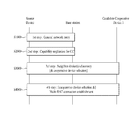
- FIG. 13 is a diagram for one example that a source device becomes a subject for discovery to apply the present invention.
- a step S1310 shown in FIG. 13 may match the former step S1210 shown in FIG. 12.
- a base station 100 may determine whether a specific device is capable of playing a role as a cooperative device for client cooperation in consideration of a moving speed (e.g., no mobility, low mobility, etc.), a location, a presence or non-presence of cooperative device candidate in the vicinity, the number of cooperative device candidates present in the vicinity, a retained power level, a channel status (e.g., a channel status of high quality, etc.) and the like.
- a moving speed e.g., no mobility, low mobility, etc.
- a location e.g., a presence or non-presence of cooperative device candidate in the vicinity
- the number of cooperative device candidates present in the vicinity e.g., a retained power level
- a channel status e.g., a channel status of high quality, etc.
- a 1st cooperative device candidate 120, a 2nd cooperative device candidate 130 and a 3rd cooperative device candidate 140 are determined as cooperative device candidates by the base station 100.
- the base station 100 may be able to make a request for playing a role as a cooperative device for client cooperation to each of the 1st cooperative device candidate 120, the 2nd cooperative device candidate 130 and the 3rd cooperative device candidate 140.
- each of the 1st cooperative device candidate 120 and the 2nd cooperative device candidate grants the corresponding request and that the 3rd cooperative device candidate 140 does not grant the corresponding request.
- each of the 1st cooperative device candidate 120 and the 2nd cooperative device candidate 130 transmits information required for the client cooperation to the base station 100 to cope with the corresponding request grant.
- the information required for the client cooperation may include a system type (e.g., IEEE 802.11a, IEEE 802.11b, IEEE 802.11g, 802. 11n, etc.), a system version of Bluetooth, a MAC address used for its multi-RAT system, a service set identifier and the like.
- a system type e.g., IEEE 802.11a, IEEE 802.11b, IEEE 802.11g, 802. 11n, etc.
- a system version of Bluetooth e.g., IEEE 802.11a, IEEE 802.11b, IEEE 802.11g, 802. 11n, etc.
- Steps S1320 to S1350 shown in FIG. 13 may correspond to the former step S1220 shown in FIG. 12.
- the base station 100 may transmit information on the cooperative device candidate groups 120 and 130 existing within its coverage to the source device 110.
- the information on the information required for the client cooperation may include a system type (e.g., IEEE 802.11a, IEEE 802.11b, IEEE 802.11g, 802. 11n, etc.), a system version of Bluetooth, a MAC address used for its multi-RAT system, a service set identifier and the like.
- Groups 120 and 130 may include MAC address, multi-RAT system, system version and the like.
- the source device 100 sends a probe message to the 1st cooperative device candidate 120 and may then receive a probe response message from the 1st cooperative device candidate 120 in response to the sent probe message [S1330].
- the source device 100 sends a probe message to the 2nd cooperative device candidate 130 and may not receive a probe response message from the 2nd cooperative device candidate 130 in response to the sent probe message [S1340].
- the source device 110 reports the information on the 1st cooperative device candidate 120 as a neighbor device (e.g., a device present in the vicinity) to the base station 100 [S1350].
- the information on the 1st cooperative device candidate 120 may include a MAC address.
- the step S1360 shown in FIG. 13 may correspond to the former steps S1230 to S1250 shown in FIG. 12.
- the base station 100 identifies the 1st cooperative device candidate 120 using the received MAC address of the 1st cooperative device candidate 120 and then determines whether the identified 1st cooperative device candidate 120 meets the requisites as a cooperative device for the client cooperation.
- the base station 100 If the 1st cooperative device candidate 120 meets the requisites as the cooperative device for the client cooperation, the base station 100 notifies this fact to the source device 110.
- the source device 110 updates a list using the received information on the neighbor cooperative device candidate from the base station 100 and may be then able to transceive data with the base station 100 using the cooperative device candidate 120 contained in the list.
- the source device 110 may be able to update the list of the neighbor cooperative device candidates periodically or in response to a specific event.
- the corresponding source device 110 may delete the corresponding cooperative device candidates from the list of the neighbor cooperative device candidates.
- the source device 110 may report the modified or maintained list of the neighbor cooperative device candidates to the base station periodically or in response to a request made by the base station.
- FIG. 14 is a diagram for one example that a cooperative device becomes a subject for discovery to apply the present invention.
- a step S1410 shown in FIG. 14 matches the former step S1210 shown in FIG. 12.
- a base station 100 may determine whether a specific device is capable of playing a role as a cooperative device for client cooperation in consideration of a moving speed (e.g., no mobility, low mobility, etc.), a location, a presence or non-presence of cooperative device candidate in the vicinity, the number of cooperative device candidates present in the vicinity, a retained power level, a channel status (e.g., a channel status of high quality, etc.) and the like.
- a moving speed e.g., no mobility, low mobility, etc.
- a location e.g., a presence or non-presence of cooperative device candidate in the vicinity
- the number of cooperative device candidates present in the vicinity e.g., a retained power level
- a channel status e.g., a channel status of high quality, etc.
- the base station 100 may be able to make a request for playing a role as a cooperative device for client cooperation to each of the 1st cooperative device candidate 120, the 2nd cooperative device candidate 130 and the 3rd cooperative device candidate 140.
- each of the 1st cooperative device candidate 120 and the 2nd cooperative device candidate grants the corresponding request and that the 3rd cooperative device candidate 140 does not grant the corresponding request.
- each of the 1st cooperative device candidate 120 and the 2nd cooperative device candidate 130 transmits information required for the client cooperation to the base station 100 to cope with the corresponding request grant.
- the information required for the client cooperation may include a system type (e.g., IEEE 802.11a, IEEE 802.11b, IEEE 802.11g, 802. 11n, etc.), a system version of Bluetooth, a MAC address used for its multi-RAT system, a service set identifier and the like.
- a system type e.g., IEEE 802.11a, IEEE 802.11b, IEEE 802.11g, 802. 11n, etc.
- a system version of Bluetooth e.g., IEEE 802.11a, IEEE 802.11b, IEEE 802.11g, 802. 11n, etc.
- FIG. 14 shows that the information on the source device 110 may be transmitted to each of the 1st cooperative device candidate 120 and the 2nd cooperative device candidate 130.
- each of the 1st cooperative device candidate 120 and the 2nd cooperative device candidate 130 may be able to obtain the information on the source device 110 in advance.
- Steps S1420 to S1440 shown in FIG. 14 may correspond to the former step S1220 shown in FIG. 12.
- the 1st cooperative device candidate 120 sends a probe message to the source device 110 and may then receive a probe response message from the source device 110 in response to the sent probe message.
- the 2nd cooperative device candidate 130 sends a probe message to the source device 110 and may not receive a probe response message from the source device 110 in response to the sent probe message.
- the 1st cooperative device candidate 120 having successfully received the probe response message from the source device 110 may be able to transmit its MAC address, multi-RAT system, system version and the like to the base station 100.
- the 1st cooperative device candidate 120 transmits its MAC address to the base station 100.
- the step S1450 shown in FIG. 14 may correspond to the former steps S1230 to S1250 shown in FIG. 12.
- the base station 100 identifies the 1st cooperative device candidate 120 using the received MAC address of the 1st cooperative device candidate 120 and then determines whether the identified 1st cooperative device candidate 120 meets the requisites as a cooperative device for the client cooperation.
- the base station 100 If the 1st cooperative device candidate 120 meets the requisites as the cooperative device for the client cooperation, the base station 100 notifies this fact to the source device 110.
- the source device 110 updates a list using the received information on the neighbor cooperative device candidate from the base station 100 and may be then able to transceive data with the base station 100 using the cooperative device candidate 120 contained in the list.
- the source device 110 may be able to update the list of the neighbor cooperative device candidates periodically or in response to a specific event.
- the corresponding source device 110 may delete the corresponding cooperative device candidates from the list of the neighbor cooperative device candidates.
- the source device 110 may report the modified or maintained list of the neighbor cooperative device candidates to the base station periodically or in response to a request made by the base station.
- FIG. 15 is a block diagram of configurations of a base station apparatus 1510 and a communication apparatus 1520 supporting a multi-RAT system according to one preferred embodiment of the present invention.
- a terminology as a user equipment, a communication device and a communication apparatus has been interchangeably used.
- a user equipment apparatus in the following description.
- a base station apparatus 1510 may include a receiving module 1511, a transmitting module 1512, a processor 1513, a memory 1514 and a plurality of antennas 1515.
- a plurality of the antennas 1515 may mean the base station apparatus supporting MIMO transmission and reception.
- the receiving module 1511 may be able to receive various signals, data and informations in UL from a user equipment.
- the transmitting module 1512 may be able to transmit various signals, data and informations in DL to the user equipment.
- the process 1513 may be able to control overall operations of the base station apparatus 1510.
- the processor 1513 of the base station apparatus 1510 may also perform a function of operating information received by the base station apparatus 1510, information to be transmitted by the base station apparatus 1510 and the like.
- the memory 1514 may be able to store the operated information and the like for prescribed duration and may be substituted with such a component as a buffer (not shown in the drawing) and the like.
- a user equipment apparatus 1520 may include a receiving module 1521, a transmitting module 1522, a processor 1523, a memory 1524 and a plurality of antennas 1525.
- a plurality of the antennas 1525 may mean the user equipment apparatus supporting MIMO transmission and reception.
- the receiving module 1521 may be able to receive various signals, data and informations in DL from a base station.
- the transmitting module 1522 may be able to transmit various signals, data and informations in UL to the base station.
- the process 1523 may be able to control overall operations of the user equipment apparatus 1520.
- the processor 1523 of the user equipment apparatus 1520 may also perform a function of operating information received by the user equipment apparatus 1520, information to be transmitted by the user equipment apparatus 1520 and the like.
- the memory 1524 may be able to store the operated information and the like for prescribed duration and may be substituted with such a component as a buffer (not shown in the drawing) and the like.
- the above-described detailed configurations of the base station apparatus and the user equipment apparatus may be implemented in a manner that the above-mentioned descriptions of the embodiments of the present invention are independently applied or that at least two of the embodiments of the present invention are simultaneously applied. And, the redundant contents may be omitted for clarity.
- the description of the base station apparatus 1510 may be identically applicable to a relay apparatus as a DL transmission subject or a UL reception subject.
- the description of the user equipment apparatus 1520 may be identically applicable to a relay apparatus as a DL reception subject or a UL transmission subject.
- Embodiments of the present invention can be implemented using various means. For instance, embodiments of the present invention can be implemented using hardware, firmware, software and/or any combinations thereof.
- a method according to each embodiment of the present invention can be implemented by at least one selected from the group consisting of ASICs (application specific integrated circuits), DSPs (digital signal processors), DSPDs (digital signal processing devices), PLDs (programmable logic devices), FPGAs (field programmable gate arrays), processor, controller, microcontroller, microprocessor and the like.
- ASICs application specific integrated circuits
- DSPs digital signal processors
- DSPDs digital signal processing devices
- PLDs programmable logic devices
- FPGAs field programmable gate arrays
- processor controller, microcontroller, microprocessor and the like.
- a method according to each embodiment of the present invention can be implemented by modules, procedures, and/or functions for performing the above-explained functions or operations.
- Software code is stored in a memory unit and is then drivable by a processor.
- the memory unit is provided within or outside the processor to exchange data with the processor through the various means known in public.
- the present invention may be applicable to such a system as a multi-RAT system, a wireless communication system and the like.
- the present invention may be applicable to a wireless mobile communication apparatus used for a cellular system.
Landscapes
- Engineering & Computer Science (AREA)
- Computer Networks & Wireless Communication (AREA)
- Signal Processing (AREA)
- Computer Security & Cryptography (AREA)
- Mobile Radio Communication Systems (AREA)
Abstract
La présente invention se rapporte à un procédé et à un appareil de transmission et de réception de données au cours d'une communication sans fil. Dans une communication exécutée par un équipement d'utilisateur qui prend en charge une pluralité de technologies d'accès radio (multi-RAT, Radio Access Technology), le procédé selon la présente invention consiste : à recevoir des premières informations pour identifier un premier équipement d'utilisateur candidat collaboratif parmi les premiers équipements d'utilisateur candidats collaboratifs qui correspondent à au moins un équipement d'une pluralité d'équipements d'utilisateur candidats collaboratifs ; à transmettre les premières informations à une station de base ; à recevoir, depuis la station de base, des informations relatives à au moins un second équipement d'utilisateur candidat collaboratif déterminé parmi le ou les premiers équipements d'utilisateur candidats collaboratifs, au moyen des premières informations ; et à réaliser une communication de premières données avec la station de base de façon collaborative avec le ou les seconds équipements d'utilisateur candidats collaboratifs. D'autre part, l'équipement d'utilisateur et une pluralité des équipements d'utilisateur candidats collaboratifs prennent en charge une communication directe, sans avoir recours à un point d'accès.
Priority Applications (1)
| Application Number | Priority Date | Filing Date | Title |
|---|---|---|---|
| US14/002,067 US9363842B2 (en) | 2011-03-01 | 2012-02-27 | Method of transmitting and receiving data in a wireless communication system and apparatus therefor |
Applications Claiming Priority (2)
| Application Number | Priority Date | Filing Date | Title |
|---|---|---|---|
| US201161448186P | 2011-03-01 | 2011-03-01 | |
| US61/448,186 | 2011-03-01 |
Publications (2)
| Publication Number | Publication Date |
|---|---|
| WO2012118311A2 true WO2012118311A2 (fr) | 2012-09-07 |
| WO2012118311A3 WO2012118311A3 (fr) | 2012-12-20 |
Family
ID=46758366
Family Applications (1)
| Application Number | Title | Priority Date | Filing Date |
|---|---|---|---|
| PCT/KR2012/001460 Ceased WO2012118311A2 (fr) | 2011-03-01 | 2012-02-27 | Procédé de transmission et de réception de données dans un système de communication sans fil, et appareil correspondant |
Country Status (2)
| Country | Link |
|---|---|
| US (1) | US9363842B2 (fr) |
| WO (1) | WO2012118311A2 (fr) |
Cited By (8)
| Publication number | Priority date | Publication date | Assignee | Title |
|---|---|---|---|---|
| WO2014047949A1 (fr) * | 2012-09-29 | 2014-04-03 | 华为技术有限公司 | Procédé, dispositif et système de communication coopérative multiutilisateur |
| WO2014097224A1 (fr) * | 2012-12-21 | 2014-06-26 | Telefonaktiebolaget Lm Ericsson (Publ) | Emission et réception multipoints coordonnées assistées par dispositif mobile |
| WO2014122581A1 (fr) * | 2013-02-05 | 2014-08-14 | Telefonaktiebolaget L M Ericsson (Publ) | Détermination d'un ensemble de regroupement de dispositifs mobiles |
| WO2015096072A1 (fr) * | 2013-12-25 | 2015-07-02 | 华为技术有限公司 | Procédé, appareil et système d'établissement d'une communication collaborative |
| EP2915401A4 (fr) * | 2012-11-05 | 2016-07-27 | Nokia Technologies Oy | Procédé et appareil pour une recherche et une communication de dispositif à dispositif, dans une proximité contrôlée par un réseau |
| US9642122B2 (en) | 2012-12-21 | 2017-05-02 | Telefonaktiebolaget L M Ericsson (Publ) | Determining a cluster set of mobile devices |
| US10200937B2 (en) | 2013-12-25 | 2019-02-05 | Huawei Technologies Co., Ltd | Message broadcast method, base station, and user equipment |
| US10397308B2 (en) | 2015-06-15 | 2019-08-27 | Telefonaktiebolaget Lm Ericsson (Publ) | File transfer by mobile user collaboration |
Families Citing this family (8)
| Publication number | Priority date | Publication date | Assignee | Title |
|---|---|---|---|---|
| US20140376426A1 (en) * | 2013-06-20 | 2014-12-25 | Gary David Boudreau | Machine type communication aggregator apparatus and method |
| EP2890214A1 (fr) * | 2013-12-26 | 2015-07-01 | Telefonica Digital España, S.L.U. | Procédé permettant de fournir une connectivité de données sans fil entre des dispositifs informatiques utilisateur dans une zone donnée et dispositif informatique |
| US9426624B2 (en) | 2014-04-29 | 2016-08-23 | Qualcomm Incorporated | Providing location information for expressions |
| US9735930B2 (en) * | 2014-05-02 | 2017-08-15 | Telefonaktiebolaget Lm Ericsson (Publ) | System and method using a secondary network node for handling packet retransmissions |
| KR20150133509A (ko) * | 2014-05-20 | 2015-11-30 | 삼성전자주식회사 | 데이터 플로우 관리 방법 및 전자 장치 |
| US9788361B2 (en) * | 2015-09-18 | 2017-10-10 | Qualcomm Incorporated | Setting transmission parameters in a shared communication medium |
| US11290908B2 (en) * | 2016-08-03 | 2022-03-29 | Telefonaktiebolaget Lm Ericsson (Publ) | Radio node, wireless device, access network node, and methods performed therein |
| US11937144B2 (en) * | 2021-07-08 | 2024-03-19 | Qualcomm Incorporated | Cooperative user equipment switching |
Family Cites Families (13)
| Publication number | Priority date | Publication date | Assignee | Title |
|---|---|---|---|---|
| EP1528722A1 (fr) * | 2003-10-31 | 2005-05-04 | Siemens Mobile Communications S.p.A. | Procédé pour signalisation rapide dans un gestion de la qualité de service dans un services en continu dans un réseau de télécommunications mobile |
| JP4624227B2 (ja) * | 2005-09-29 | 2011-02-02 | 京セラ株式会社 | 通信端末、移動体通信システム及び通信制御方法 |
| JP4727371B2 (ja) * | 2005-09-29 | 2011-07-20 | 京セラ株式会社 | 通信端末、移動体通信システム、および通信方法 |
| US20070097934A1 (en) * | 2005-11-03 | 2007-05-03 | Jesse Walker | Method and system of secured direct link set-up (DLS) for wireless networks |
| JP4960381B2 (ja) * | 2006-12-07 | 2012-06-27 | 三菱電機株式会社 | 無線通信システム、無線端末局、無線基地局および無線通信方法 |
| WO2008088923A1 (fr) * | 2007-01-19 | 2008-07-24 | Taproot Systems, Inc. | Points de présence sur un réseau mobile |
| US8068454B2 (en) * | 2007-11-07 | 2011-11-29 | Motorola Solutions, Inc. | System for enabling mobile coverage extension and peer-to-peer communications in an ad hoc network and method of operation therefor |
| BRPI0822299A2 (pt) * | 2008-03-11 | 2015-06-30 | Thomson Licensing | Associação conjunta, encaminhamento adequado e alocação de taxa em redes de trabalho em malha sem fios com múltiplos saltos |
| US8229812B2 (en) * | 2009-01-28 | 2012-07-24 | Headwater Partners I, Llc | Open transaction central billing system |
| US8730853B2 (en) * | 2008-09-05 | 2014-05-20 | Mediatek Inc. | Methods for responding to co-located coexistence (CLC) request from a mobile electronic device and communications apparatuses capable of controlling multi-radio coexistence |
| EP2282586B1 (fr) | 2009-07-24 | 2013-02-20 | Research In Motion Limited | Réseau préféré configurable par l'opérateur et sélection de technologie à accès radio pour l'itinérance de dispositifs multi-RAT |
| US8355389B2 (en) * | 2010-03-12 | 2013-01-15 | Nokia Corporation | Simultaneous transmissions during a transmission opportunity |
| US8406160B2 (en) * | 2010-05-21 | 2013-03-26 | Qualcomm Incorporated | Time-sliced search of radio access technologies during connected-mode radio link failure |
-
2012
- 2012-02-27 WO PCT/KR2012/001460 patent/WO2012118311A2/fr not_active Ceased
- 2012-02-27 US US14/002,067 patent/US9363842B2/en not_active Expired - Fee Related
Cited By (28)
| Publication number | Priority date | Publication date | Assignee | Title |
|---|---|---|---|---|
| CN103891344B (zh) * | 2012-09-29 | 2018-12-14 | 华为技术有限公司 | 一种多用户协作通信的方法、设备及系统 |
| WO2014047949A1 (fr) * | 2012-09-29 | 2014-04-03 | 华为技术有限公司 | Procédé, dispositif et système de communication coopérative multiutilisateur |
| US9642175B2 (en) | 2012-09-29 | 2017-05-02 | Huawei Technologies Co., Ltd. | Method, device, and system for multiple users cooperative communication |
| CN103891344A (zh) * | 2012-09-29 | 2014-06-25 | 华为技术有限公司 | 一种多用户协作通信的方法、设备及系统 |
| EP2892277A4 (fr) * | 2012-09-29 | 2015-12-30 | Huawei Tech Co Ltd | Procédé, dispositif et système de communication coopérative multiutilisateur |
| EP2915401A4 (fr) * | 2012-11-05 | 2016-07-27 | Nokia Technologies Oy | Procédé et appareil pour une recherche et une communication de dispositif à dispositif, dans une proximité contrôlée par un réseau |
| US10524109B2 (en) | 2012-11-05 | 2019-12-31 | Nokia Technologies Oy | Method and apparatus for network-controlled proximity device to device discovery and communication |
| US10028123B2 (en) | 2012-11-05 | 2018-07-17 | Nokia Technologies Oy | Method and apparatus for network-controlled proximity device to device discovery and communication |
| KR101857932B1 (ko) * | 2012-12-21 | 2018-05-14 | 텔레폰악티에볼라겟엘엠에릭슨(펍) | 모바일 장치 지원 협력 멀티포인트 전송 및 수신 |
| KR101719938B1 (ko) * | 2012-12-21 | 2017-03-24 | 텔레폰악티에볼라겟엘엠에릭슨(펍) | 모바일 장치 지원 협력 멀티포인트 전송 및 수신 |
| CN105900351A (zh) * | 2012-12-21 | 2016-08-24 | 瑞典爱立信有限公司 | 移动装置辅助的协调多点传送和接收 |
| US9444528B2 (en) | 2012-12-21 | 2016-09-13 | Telefonaktiebolaget Lm Ericsson (Publ) | Mobile device assisted coordinated multipoint transmission and reception |
| WO2014097224A1 (fr) * | 2012-12-21 | 2014-06-26 | Telefonaktiebolaget Lm Ericsson (Publ) | Emission et réception multipoints coordonnées assistées par dispositif mobile |
| US10440721B2 (en) | 2012-12-21 | 2019-10-08 | Telefonaktiebolaget L M Ericsson (Publ) | Determining a cluster set of mobile devices |
| US9571169B2 (en) | 2012-12-21 | 2017-02-14 | Telefonaktiebolaget Lm Ericsson (Publ) | Mobile device assisted coordinated multipoint transmission and reception |
| US9642122B2 (en) | 2012-12-21 | 2017-05-02 | Telefonaktiebolaget L M Ericsson (Publ) | Determining a cluster set of mobile devices |
| KR20150093815A (ko) * | 2012-12-21 | 2015-08-18 | 텔레폰악티에볼라겟엘엠에릭슨(펍) | 모바일 장치 지원 협력 멀티포인트 전송 및 수신 |
| US9780842B2 (en) | 2012-12-21 | 2017-10-03 | Telefonaktiebolaget Lm Ericsson (Publ) | Mobile device assisted coordinated multipoint transmission and reception |
| JP2016506153A (ja) * | 2012-12-21 | 2016-02-25 | テレフオンアクチーボラゲット エル エム エリクソン(パブル) | モバイルデバイス支援型の協調マルチポイント送信及び受信 |
| WO2014122581A1 (fr) * | 2013-02-05 | 2014-08-14 | Telefonaktiebolaget L M Ericsson (Publ) | Détermination d'un ensemble de regroupement de dispositifs mobiles |
| EP3086480A3 (fr) * | 2013-02-05 | 2017-01-18 | Telefonaktiebolaget LM Ericsson (publ) | Détermination d'un ensemble de grappes de dispositifs |
| US9860927B2 (en) | 2013-12-25 | 2018-01-02 | Huawei Technologies Co., Ltd | Method, apparatus, and system for establishing cooperative communication |
| US10200937B2 (en) | 2013-12-25 | 2019-02-05 | Huawei Technologies Co., Ltd | Message broadcast method, base station, and user equipment |
| WO2015096072A1 (fr) * | 2013-12-25 | 2015-07-02 | 华为技术有限公司 | Procédé, appareil et système d'établissement d'une communication collaborative |
| CN105009680B (zh) * | 2013-12-25 | 2019-04-19 | 华为技术有限公司 | 一种建立协同通信的方法、装置及系统 |
| CN105009680A (zh) * | 2013-12-25 | 2015-10-28 | 华为技术有限公司 | 一种建立协同通信的方法、装置及系统 |
| US10674548B2 (en) | 2013-12-25 | 2020-06-02 | Huawei Technologies Co., Ltd. | Method, apparatus, and system for establishing cooperative communication |
| US10397308B2 (en) | 2015-06-15 | 2019-08-27 | Telefonaktiebolaget Lm Ericsson (Publ) | File transfer by mobile user collaboration |
Also Published As
| Publication number | Publication date |
|---|---|
| WO2012118311A3 (fr) | 2012-12-20 |
| US20130336227A1 (en) | 2013-12-19 |
| US9363842B2 (en) | 2016-06-07 |
Similar Documents
| Publication | Publication Date | Title |
|---|---|---|
| WO2021049907A1 (fr) | Réponse d'accès aléatoire et résolution de conflit | |
| WO2012053842A1 (fr) | Procédé de transmission et de réception de données dans un système à multiples technologies d'accès radio utilisant un point d'accès et appareil correspondant | |
| WO2018084660A1 (fr) | Procédé d'émission/réception de canal de commande de liaison montante physique entre un terminal et une station de base dans un système de communication sans fil et dispositif prenant en charge ledit procédé | |
| WO2018231030A1 (fr) | Procédés d'émission et de réception de canal physique de commande de liaison montante entre un terminal et une station de base dans un système de communication sans fil, et appareils pour sa prise en charge | |
| WO2019074337A1 (fr) | Procédé et dispositif permettant d'effectuer une connexion initiale dans un système de communication sans fil | |
| WO2021034023A1 (fr) | Procédé et appareil de partage de ressources de fréquences entre fournisseurs de communications mobiles dans un système de communication sans fil | |
| WO2012057547A2 (fr) | Procédé et appareil de mesure d'un état de canal entre des terminaux dans un système d'accès sans fil qui prend en charge une communication coopérative | |
| WO2018199584A1 (fr) | Procédé de réception d'un signal de référence de suivi de phase par un terminal dans un système de communication sans fil et dispositif correspondant | |
| WO2021033945A1 (fr) | Procédé de configuration de ressource de liaison latérale dans un système de communication | |
| WO2012053844A2 (fr) | Procédé d'envoi et de réception de données dans un système à multiples technologies d'accès radio et appareil correspondant | |
| WO2016126136A1 (fr) | Procédé et système de découverte d'ue dans un réseau d2d | |
| WO2016048068A1 (fr) | Procédé pour émettre un signal de dispositif à dispositif (d2d) et terminal associé | |
| EP3011689A1 (fr) | Procédés tdm ul pour agrégation de porteuses inter-noeuds b évolués | |
| WO2018030841A1 (fr) | Procédé permettant de rapporter des informations de mesure de signal de référence au moyen d'un terminal dans un système de communication sans fil et appareil prenant en charge ce dernier | |
| WO2021187933A1 (fr) | Procédé et dispositif de commande de nœud de relais | |
| WO2019031944A1 (fr) | Procédé d'émission et de réception d'un signal dans un système de communication sans fil et dispositif correspondant | |
| WO2019103517A1 (fr) | Procédé et dispositif permettant de réaliser un transfert intercellulaire dans un système de communication sans fil | |
| WO2018151340A1 (fr) | Procédé de mesure de canal entre terminaux dans un système de communication sans fil, et dispositif associé | |
| WO2024014862A1 (fr) | Procédé et appareil d'utilisation d'un modèle d'apprentissage automatique/intelligence artificielle dans un réseau de communication sans fil | |
| WO2024210493A1 (fr) | Procédé d'émission et de réception de rar et dispositif associé | |
| WO2023014143A1 (fr) | Procédé et appareil d'émission et de réception de liaison montante dans un système de communication sans fil | |
| WO2017052026A1 (fr) | Procédé pour accéder à une cellule à onde millimétrique dans un système de communication sans fil et dispositif associé | |
| WO2014051198A1 (fr) | Procédé de génération d'un signal de référence de sondage, procédé d'émission d'un signal de liaison montante et station de base | |
| WO2017192019A1 (fr) | Procédé destiné à obtenir des informations sur les numérologies dans un système de communication sans fil et dispositif associé | |
| WO2017160050A1 (fr) | Procédé d'estimation d'indice de symbole dans un système de communication sans fil et appareil associé |
Legal Events
| Date | Code | Title | Description |
|---|---|---|---|
| 121 | Ep: the epo has been informed by wipo that ep was designated in this application |
Ref document number: 12752350 Country of ref document: EP Kind code of ref document: A2 |
|
| WWE | Wipo information: entry into national phase |
Ref document number: 14002067 Country of ref document: US |
|
| NENP | Non-entry into the national phase |
Ref country code: DE |
|
| 122 | Ep: pct application non-entry in european phase |
Ref document number: 12752350 Country of ref document: EP Kind code of ref document: A2 |