WO2012120574A1 - 二次電池用負極合材及び負極、並びに二次電池 - Google Patents
二次電池用負極合材及び負極、並びに二次電池 Download PDFInfo
- Publication number
- WO2012120574A1 WO2012120574A1 PCT/JP2011/006078 JP2011006078W WO2012120574A1 WO 2012120574 A1 WO2012120574 A1 WO 2012120574A1 JP 2011006078 W JP2011006078 W JP 2011006078W WO 2012120574 A1 WO2012120574 A1 WO 2012120574A1
- Authority
- WO
- WIPO (PCT)
- Prior art keywords
- negative electrode
- mass
- secondary battery
- electrode mixture
- active material
- Prior art date
- Legal status (The legal status is an assumption and is not a legal conclusion. Google has not performed a legal analysis and makes no representation as to the accuracy of the status listed.)
- Ceased
Links
Images

Classifications
-
- H—ELECTRICITY
- H01—ELECTRIC ELEMENTS
- H01M—PROCESSES OR MEANS, e.g. BATTERIES, FOR THE DIRECT CONVERSION OF CHEMICAL ENERGY INTO ELECTRICAL ENERGY
- H01M4/00—Electrodes
- H01M4/02—Electrodes composed of, or comprising, active material
- H01M4/36—Selection of substances as active materials, active masses, active liquids
- H01M4/38—Selection of substances as active materials, active masses, active liquids of elements or alloys
- H01M4/386—Silicon or alloys based on silicon
-
- H—ELECTRICITY
- H01—ELECTRIC ELEMENTS
- H01M—PROCESSES OR MEANS, e.g. BATTERIES, FOR THE DIRECT CONVERSION OF CHEMICAL ENERGY INTO ELECTRICAL ENERGY
- H01M4/00—Electrodes
- H01M4/02—Electrodes composed of, or comprising, active material
- H01M4/13—Electrodes for accumulators with non-aqueous electrolyte, e.g. for lithium-accumulators; Processes of manufacture thereof
- H01M4/134—Electrodes based on metals, Si or alloys
-
- H—ELECTRICITY
- H01—ELECTRIC ELEMENTS
- H01M—PROCESSES OR MEANS, e.g. BATTERIES, FOR THE DIRECT CONVERSION OF CHEMICAL ENERGY INTO ELECTRICAL ENERGY
- H01M4/00—Electrodes
- H01M4/02—Electrodes composed of, or comprising, active material
- H01M4/62—Selection of inactive substances as ingredients for active masses, e.g. binders, fillers
-
- H—ELECTRICITY
- H01—ELECTRIC ELEMENTS
- H01M—PROCESSES OR MEANS, e.g. BATTERIES, FOR THE DIRECT CONVERSION OF CHEMICAL ENERGY INTO ELECTRICAL ENERGY
- H01M4/00—Electrodes
- H01M4/02—Electrodes composed of, or comprising, active material
- H01M4/62—Selection of inactive substances as ingredients for active masses, e.g. binders, fillers
- H01M4/621—Binders
- H01M4/622—Binders being polymers
-
- H—ELECTRICITY
- H01—ELECTRIC ELEMENTS
- H01M—PROCESSES OR MEANS, e.g. BATTERIES, FOR THE DIRECT CONVERSION OF CHEMICAL ENERGY INTO ELECTRICAL ENERGY
- H01M4/00—Electrodes
- H01M4/02—Electrodes composed of, or comprising, active material
- H01M4/62—Selection of inactive substances as ingredients for active masses, e.g. binders, fillers
- H01M4/624—Electric conductive fillers
- H01M4/625—Carbon or graphite
-
- H—ELECTRICITY
- H01—ELECTRIC ELEMENTS
- H01M—PROCESSES OR MEANS, e.g. BATTERIES, FOR THE DIRECT CONVERSION OF CHEMICAL ENERGY INTO ELECTRICAL ENERGY
- H01M10/00—Secondary cells; Manufacture thereof
- H01M10/05—Accumulators with non-aqueous electrolyte
- H01M10/052—Li-accumulators
- H01M10/0525—Rocking-chair batteries, i.e. batteries with lithium insertion or intercalation in both electrodes; Lithium-ion batteries
-
- Y—GENERAL TAGGING OF NEW TECHNOLOGICAL DEVELOPMENTS; GENERAL TAGGING OF CROSS-SECTIONAL TECHNOLOGIES SPANNING OVER SEVERAL SECTIONS OF THE IPC; TECHNICAL SUBJECTS COVERED BY FORMER USPC CROSS-REFERENCE ART COLLECTIONS [XRACs] AND DIGESTS
- Y02—TECHNOLOGIES OR APPLICATIONS FOR MITIGATION OR ADAPTATION AGAINST CLIMATE CHANGE
- Y02E—REDUCTION OF GREENHOUSE GAS [GHG] EMISSIONS, RELATED TO ENERGY GENERATION, TRANSMISSION OR DISTRIBUTION
- Y02E60/00—Enabling technologies; Technologies with a potential or indirect contribution to GHG emissions mitigation
- Y02E60/10—Energy storage using batteries
Definitions
- the present invention relates to a negative electrode composite material for a secondary battery such as a lithium ion secondary battery, a negative electrode, and a secondary battery.
- secondary batteries such as lithium ion secondary batteries are used in a wide range of fields such as mobile phones and laptop computers.
- Si silicon
- Si alone can occlude and release Li (lithium), and expands and contracts along with occluding and releasing Li.
- a silicon-containing powder containing a simple substance of silicon is used as a negative electrode active material, the silicon-containing powder is pulverized by repetition of charge and discharge, the conductive path in the negative electrode mixture is divided, and parts that can not participate in electrochemical reaction increase. The battery capacity gradually decreases. For this reason, there existed a problem that cycle characteristics were low.
- JP-A-2010-232077 it has been proposed to use a polyimide-silica hybrid resin as a binder resin. Since this resin contains silica (Si) in the molecule, it has high adhesion to the active material Si, and the polyimide portion of the hybrid resin absorbs the expansion and contraction of Si, so the negative electrode active material is pulverized. To improve the cycle characteristics of the battery.
- Si silica
- SiOx silicon oxide
- SiOx silicon oxide
- SiOx is known to decompose into Si and SiO 2 when heat-treated. This is called disproportionation reaction, and in the case of homogeneous solid silicon monoxide SiO which has a ratio of Si to O of approximately 1: 1, it is separated into two phases of Si phase and SiO 2 phase by internal reaction of the solid. Do.
- the Si phase obtained by separation is very fine and is covered by the SiO 2 phase.
- the SiO 2 phase absorbs the expansion and contraction of the Si phase to improve the cycle characteristics of the battery.
- composite particles consisting of a simple substance silicon-silicon-nickel compound (Japanese Patent Laid-Open No. 2010-33830), silicon as a carbon material Or a mixture of silicon compounds (Japanese Patent Laid-Open No. 2002-198036), carbon deposited on the surface of SiO to form a covering layer (Japanese Patent Laid-Open No. 2009-272153), SiO / graphite / carbon composite ( JP-A-2002-231225) can be mentioned.
- JP 2004-303638 A JP, 2010-232077, A JP, 2010-33830, A Japanese Patent Application Laid-Open No. 2002-198036 JP, 2009-272153, A JP 2002-231225 A
- a lithium ion battery In recent years, it has been considered to mount a lithium ion battery also on vehicles such as hybrid vehicles and electric vehicles. In vehicles such as hybrid vehicles, a lithium ion battery is required to have a high capacity output in a short time, that is, a high rate characteristic.
- the present application has been made in view of such circumstances, and an object thereof is to provide a negative electrode composite material for a secondary battery excellent in high rate characteristics, a negative electrode, and a secondary battery.
- the negative electrode composite material for a secondary battery according to the present invention comprises a negative electrode active material consisting of elemental silicon and a silicon compound, graphite, and an alkoxysilyl group having a structure represented by the general formula (I) bonded to a polyamideimide resin And a polyamide-imide-silica hybrid resin.
- single silicon and a silicon compound are used as the negative electrode active material.
- Single silicon is a component capable of inserting and extracting lithium ions, and causes expansion and contraction in accordance with the insertion and extraction of lithium ions.
- the silicon compound absorbs expansion and contraction of single silicon and suppresses the volume change of the entire negative electrode active material.
- Graphite is also a buffer material that absorbs the volume change of elemental silicon.
- polyamide imide-silica hybrid resin is a binder resin having polyamide imide in its skeleton, and unlike the case where it has polyimide in its skeleton, its irreversible capacity to lithium ions is low and the initial efficiency of the battery is high.
- Single silicon has a small irreversible capacity to lithium ions.
- silicon compounds such as SiO 2 have a large irreversible capacity to lithium ions. Therefore, it is possible to suppress an increase in irreversible capacity caused by using a silicon compound by using a polyamideimide having a small irreversible capacity as a skeleton instead of using a polyimide having a large irreversible capacity as a skeleton of the binder resin. . Therefore, the initial efficiency of the battery can be improved, and the high rate characteristics can be improved.
- Polyamideimide forming the skeleton of the polyamideimide-silica hybrid resin has high mechanical strength and also has a certain degree of elasticity. For this reason, it is possible to absorb the volume change of the negative electrode mixture while following the expansion and contraction of the negative electrode active material. Therefore, the negative electrode mixture has a small volume change and can improve the cycle characteristics of the battery.
- the polyamideimide-silica hybrid resin is a binder resin having an alkoxysilyl group represented by formula (I). Since the alkoxysilyl group contains silica (Si), it has good adhesion to a negative electrode active material composed of elemental silicon and a silicon compound. Therefore, the polyamideimide-silica hybrid resin can firmly hold the negative electrode active materials together, and can suppress the pulverization of the negative electrode active material. Therefore, a secondary battery using the negative electrode composite material of the present invention is excellent in cycle characteristics when charge and discharge are repeated.
- formula (I) alkoxysilyl group represented by formula (I). Since the alkoxysilyl group contains silica (Si), it has good adhesion to a negative electrode active material composed of elemental silicon and a silicon compound. Therefore, the polyamideimide-silica hybrid resin can firmly hold the negative electrode active materials together, and can suppress the pulverization of the negative electrode active material. Therefore, a secondary battery using the negative electrode composite material of the present invention is excellent
- polyamideimide has a lower heat treatment temperature during production than polyimide, and is inexpensive. For this reason, the manufacturing cost of a battery can be made low by using polyamide imide as a frame part of binder resin.
- the negative electrode for a secondary battery of the present invention is characterized by comprising the above-mentioned negative electrode composite material for a secondary battery and a current collector.
- the secondary battery of the present invention is characterized by comprising the above-described negative electrode for a secondary battery, a positive electrode, and an electrolytic solution.
- the negative electrode composite material for a secondary battery of the present invention contains the single silicon and silicon compound as an active material and the polyamideimide-silica hybrid resin as a binder resin as described above, the high rate characteristics of the battery can be enhanced. Can. Moreover, according to the negative electrode and secondary battery using the negative electrode composite material for secondary batteries, high-rate characteristics can be enhanced.
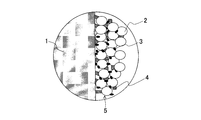
- the negative electrode composite material 5 for a secondary battery according to the present invention is obtained by forming the negative electrode active material 2, the graphite 3 and the binder resin 4 into a predetermined shape, and in many cases, It is formed in the form of a sheet or layer on the surface of the current collector 1.
- the binder resin 4 is dispersed between the negative electrode active material 2, the graphite 3 and the current collector 1, and the negative electrode active material 2, the graphite 3 and the current collector 1 are connected to each other. Since FIG. 1 is a schematic view, the drawn shape is not accurate. Although the binder resin 4 is described in powder form in FIG. 1, it is indeterminate. Further, as shown in FIG. 1, the surface of the current collector 1 is not entirely covered with the binder resin 4, the negative electrode active material 2 and / or the graphite 3, and the negative electrode active material 2 and the current collector 1 are not An air gap exists in some places between the surface.
- the density of the negative electrode mixture for secondary batteries is it is preferable 0.8 g / cm 3 or more 1.5 g / cm 3 or less.
- the density of the negative electrode mixture refers to the density of the negative electrode mixture after the negative electrode mixture is applied to a current collector, fired, and allowed to cool.
- the negative electrode composite having the above-described predetermined range of density has both ion conductivity and conductivity. Therefore, a secondary battery using this negative electrode mixture can exhibit higher high rate characteristics.
- the density of the negative electrode mixture is desirably 1.0 g / cm 3 or more and 1.5 g / cm 3 or less.
- the range of the density of the negative electrode mixture is based on the experimental results described later. The reason why the high rate characteristics are good when the density of the negative electrode mixture is in this range is considered as follows.
- the negative electrode composite has a conductive path and an ion conductive path involved in electric capacity.
- the conduction path is a passage through which electricity (electrons) circulate
- the ion conduction path is a passage through which lithium ions circulate.
- the number of voids through which lithium ions can flow in the negative electrode mixture decreases, and the ion conduction path decreases.
- the negative electrode composite material is in the above range, the conductive path and the ion conductive path are formed in a well-balanced manner, and as a result, the high rate characteristics are enhanced.
- the density of the negative electrode mixture is less than 0.8 g / cm 3 , the conductive paths in the negative electrode mixture become too small, so even if the number of ion conductive paths is large, the improvement of the high rate characteristics is expected It is difficult to do.
- the density of the negative electrode mixture exceeds 1.5 g / cm 3 , the discharge capacity may be reduced. This is because the number of voids through which lithium ions in the negative electrode mixture can pass is small, the ion conduction path is too small, and the degree of adhesion between the materials constituting the negative electrode mixture is too strong. It is believed that the electrolyte is less likely to penetrate into the
- the negative electrode active material 2 contained in the negative electrode mixture is composed of a single silicon phase 21 and a silicon compound phase 22.
- the single silicon phase 21 may be miniaturized.
- the silicon compound phase 22 may be coated with at least one finely divided silicon phase 21. The influence of expansion and contraction of the single silicon phase 21 on the negative electrode mixture can be suppressed.
- the single silicon phase 21 is made of a single substance of Si and occludes and releases Li ions.
- the single silicon phase 21 expands and contracts in accordance with the absorption and release of Li ions.
- the silicon compound phase 22 absorbs the expansion and contraction of the single silicon phase 21.
- the silicon compound phase 22 is made of, for example, a compound containing silicon oxide (SiO x ) (0.5 ⁇ x ⁇ 1.5) such as silicon dioxide (SiO 2 ).
- the silicon compound phase 22 may contain, in addition to silicon oxide (SiO 2 ), an element of periodic table group 2 (group 2A) or an element of periodic table group 1 (group 2A).
- the periodic table group 2 element and the periodic table group 1 element often form a composite oxide with silicon oxide.
- Group 2 elements of the periodic table one or more selected from the group of Ca (calcium), Mg (magnesium), Ba (barium), Sr (strintium), Ra (radium), and Be (beryllium) can be mentioned .
- the periodic table group 1 element includes one or more selected from the group consisting of Li (lithium), Na (sodium), K (potassium), Rb (rubidium), Cs (cesium), and Fr (francium).
- the mass ratio of elemental silicon to the silicon compound in the negative electrode active material is preferably 70 to 120. Further, the lower limit of the mass ratio may be 70, preferably 90, and the upper limit may be 120, preferably 100. If the mass ratio exceeds 120, the expansion and contraction of the negative electrode active material accompanying the lithium absorption and release of single silicon may be large, the negative electrode active material may be pulverized, the conductive path may be divided, and the electric capacity may be reduced. There is. On the other hand, when the mass ratio is less than 70, the amount of absorption and release of Li by the negative electrode active material is small, and the electric capacity may be reduced.
- the negative electrode active material may be composed of only elemental silicon and a silicon compound.
- the negative electrode active material is mainly composed of elemental silicon and a silicon compound, it may further contain a known active material. Specifically, for example, at least one of the group consisting of SiC, an alkali metal silicate, and an alkaline earth metal silicate may be mixed.
- the negative electrode active material may have a particulate or powder form.
- the average particle size of the negative electrode active material is preferably 0.01 to 10 ⁇ m, and more preferably 0.01 to 5 ⁇ m.
- the mass ratio of the negative electrode active material is preferably 30 to 60% by mass, based on 100% by mass of the entire negative electrode mixture. In this case, the battery capacity is high. If the mass ratio of the negative electrode active material is less than 30% by mass, the battery capacity may be lowered and the high rate characteristics of the battery may be reduced. If it exceeds 60% by mass, the buffer material in the negative electrode mixture The relative amount of graphite decreases, and the volume change of the negative electrode active material can not be sufficiently absorbed, which may accelerate the deterioration of the cycle.
- the lower limit of the mass ratio of the negative electrode active material is 30% by mass, preferably 40% by mass
- the upper limit is 60% by mass, preferably 50% by mass, based on 100% by mass of the entire negative electrode mixture. is there.
- Graphite contained in the negative electrode mixture is a buffer material capable of absorbing the volume change of the negative electrode active material accompanying the absorption and release of Li ions. By adding graphite to the negative electrode mixture, the graphite absorbs the volume change of the negative electrode active material, and the volume change of the entire negative electrode mixture can be suppressed.
- the mass ratio of graphite is preferably 20 to 50% by mass, based on 100% by mass of the entire negative electrode mixture. In this case, the volume change of the whole negative electrode mixture can be suppressed, and the conductivity of the negative electrode mixture becomes high. If the mass ratio of graphite is less than 20% by mass, the battery capacity may decrease, and if it exceeds 50% by mass, the relative amount of graphite as a buffer material in the negative electrode mixture decreases. The volume change of the negative electrode active material can not be sufficiently absorbed, which may accelerate the deterioration of the cycle.
- the lower limit of the mass ratio of graphite is 20% by mass, preferably 30% by mass, and the upper limit is 50% by mass, preferably 40% by mass, based on 100% by mass of the entire negative electrode mixture. .
- the binder resin is made of a polyamide imide-silica hybrid resin, and can bind the negative electrode active material and the graphite integrally.
- the polyamideimide-silica hybrid resin has an alkoxysilyl group having a structure represented by the general formula (I).
- the polyamideimide-silica hybrid resin is a hybrid of polyamideimide and silica. Since polyamideimide is a resin, it has a certain degree of elasticity and high mechanical strength. Therefore, the expansion and contraction of single silicon can be flexibly followed. Therefore, the cycle characteristics of the battery can be enhanced.
- the polyamideimide-silica hybrid resin has polyamideimide as a skeleton part.
- the polyamideimide of the skeleton has lower irreversible capacity to lithium ions and higher initial efficiency than the case of polyimide. Since elemental silicon itself can occlude and release lithium ions, there is little irreversible capacity with respect to lithium ions.
- the silicon compound when there is a silicon compound such as SiO 2 , the silicon compound reacts with lithium ions to form Li silicate. Li silicate is relatively stable and is difficult to release lithium ions, and has a large irreversible capacity. For this reason, the initial efficiency of the battery can be improved by using polyamide imide having a small irreversible capacity as the skeleton of the binder resin, as compared with the case of using a polyimide having a large irreversible capacity.
- the polyamideimide-silica hybrid resin has an alkoxysilyl group having a structure represented by formula (I).
- the alkoxysilyl group may be bonded to any site of the polyamideimide, and the number of bonds is one or more.
- the alkoxysilyl group is preferably bonded to the terminal end of the polyamideimide.
- the alkoxysilyl group may be bonded to one terminal site of the polyamideimide or may be bonded to both terminal sites.
- the alkoxysilyl group has a sol-gel reaction site structure, and the sol-gel reaction site structure is a structure that contributes to the reaction when performing the sol-gel method.
- the sol-gel method a solution of an inorganic or organic metal salt is used as a starting solution, this solution is converted to a colloidal solution (Sol) by hydrolysis and condensation polymerization reaction, and the reaction is further promoted to obtain a solid (Gel) which has lost fluidity. It is a method to form.
- All of the OH groups in the polyamideimide-silica hybrid resin can be polycondensed, and it is also possible to carry out a dehydration condensation polymerization reaction with an organic polymer having an OH group at an end.
- the polyamide-imide-silica hybrid resin can also react with sol-gel reaction sites or OH groups of the resin at the time of curing of the binder resin by having a sol-gel reaction site structure represented by the above general formula (I).
- sol-gel reaction site structure represented by the above general formula (I).
- adhesion with the current collector and the negative electrode active material which are inorganic components is good, and the current collector can firmly hold the negative electrode active material and graphite.
- the polyamideimide-silica hybrid resin can be synthesized by known techniques, and various commercial products such as trade name "Compoceran H900” (manufactured by Arakawa Chemical Industries, Ltd.) can be suitably used.
- the chemical formula (II) of the basic skeleton of the trade name "Composelan H900” is shown below.
- X represents an alkyl linking group (alkyl spacer)
- Me represents a methyl group
- m and o represent integers.
- the polyamideimide-silica hybrid resin is represented by the formula (B): R 1 m SiO (4-m) / 2 (m is an integer of 1 to 3 or 0 to 2, R 1 is an alkyl group having 8 or less carbon atoms or an aryl group
- the alkoxysilyl group-containing silane-modified polyamideimide resin cured product has a structure shown in The structure represented by the formula (B) is a gelled fine silica site structure (high-order network structure of siloxane bonds). This structure is a structure of an organic silicon polymer composed of a siloxane bond, and is a structure obtained by polycondensation of silanol of the following formula (C).
- R 1 represents an organic group, and for example, represents an alkyl group or an aryl group having 8 or less carbon atoms.
- M 1 to 3 or an integer of 0 to 2, n> 1)
- the mass ratio of the polyamideimide-silica hybrid resin is preferably 0.5 to 50% by mass, and further preferably 0.5 to 20% by mass, based on 100% by mass of the entire negative electrode mixture. Is desirable. In this case, the conductivity of the negative electrode mixture increases and the battery capacity also increases.
- the mass ratio of the polyamideimide-silica hybrid resin is less than 0.5% by mass, the negative electrode mixture may be peeled off from the current collector, and when it exceeds 50% by mass, the negative electrode active in the negative electrode mixture The relative content of substances may be reduced and the electrical capacity may be reduced. Furthermore, when the mass ratio of the polyamideimide-silica hybrid resin is 20% by mass or less, the battery capacity is further improved.
- the lower limit of the mass ratio of the polyamideimide-silica hybrid resin is 0.5% by mass, desirably 5% by mass, and the upper limit is 50% by mass, based on 100% by mass of the entire negative electrode mixture. Furthermore, it is 20% by mass, preferably 15% by mass.
- the total amount of the negative electrode mixture for a secondary battery is 100% by mass, 30 to 60% by mass of the negative electrode active material, 20 to 50% by mass of the graphite, and 0.5 to 20% by mass of the polyamideimide-silica hybrid resin It is preferable to contain and. According to the negative electrode composite material of the above configuration, it is possible to obtain a secondary battery further excellent in high rate characteristics.
- the negative electrode mixture may contain a conductive aid in addition to the above-mentioned negative electrode active material, graphite, and binder resin.
- a conductive aid for example, ketjen black, acetylene black, carbon black and the like can be used.
- ⁇ Method of manufacturing negative electrode mixture In order to manufacture a negative electrode mixture for a secondary battery, the following active material preparation step, mixing step, coating step, pressing step and curing step are performed.
- a raw material powder containing silicon monoxide is used as a raw material.
- silicon monoxide in the raw material powder containing silicon monoxide is disproportionated into two phases of a silicon oxide phase such as SiO 2 and a single silicon phase.
- silicon monoxide SiO n: n is 0.5 ⁇ n ⁇ 1.5
- SiO n: n 0.5 ⁇ n ⁇ 1.5
- Disproportionation of silicon monoxide of the raw material powder proceeds by giving energy to the raw material powder.
- the method of heating raw material powder, milling, etc. is mentioned.
- the raw material powder containing non-crystalline silicon monoxide powder is heat-treated at 800 to 1200 ° C. for 1 to 5 hours in an inert atmosphere such as vacuum or in an inert gas.
- an inert atmosphere such as vacuum or in an inert gas.
- the raw material powder may be mixed under vacuum or in an inert gas atmosphere such as argon gas using a V-type mixer, a ball mill, an attritor, a jet mill, a vibration mill, a high energy ball mill or the like.
- a V-type mixer a ball mill
- an attritor a jet mill
- a vibration mill a high energy ball mill or the like.
- the rotational speed of the container of the ball milling apparatus may be 500 rpm or more, 700 rpm or more, or 700 to 800 rpm
- the mixing time may be 10 to 50 hours.
- a heat treatment may be further performed after milling to further promote disproportionation of silicon monoxide.
- the negative electrode active material prepared in the above-described active material preparation step is mixed with a binder resin and graphite, and a solvent or the like is added to form a slurry-like mixture.
- the content of the negative electrode active material, the binder resin and the graphite is 30 to 60% by mass, 20 to 50% by mass of the negative electrode active material, and 0 to 20% of the binder resin, based on 100% by mass of the entire negative electrode mixture for secondary battery. It is good to mix so that it becomes%.
- a slurry-like mixture containing a negative electrode active material, graphite and a binder resin is applied to the surface of the current collector.
- the coating thickness is preferably 10 ⁇ m to 300 ⁇ m.
- a predetermined pressing force is applied to the applied slurry by a pressing machine or the like.
- the pressure applied to the slurry is preferably 0 to 5 kN, more preferably 1.5 to 3 kN.
- a negative electrode mixture having a density of 0.8 g / cm 3 or more and 1.5 g / cm 3 or less can be manufactured.
- the curing step is a step of curing the binder resin.
- the pressed mixture is fixed on the current collector surface by curing the binder resin.
- a sol-gel curing reaction also occurs due to the structure represented by the formula (I) that the binder resin has. Since the polyamide imide-silica hybrid resin containing an alkoxysilyl group which has undergone a sol-gel curing reaction has a gelled fine silica site structure (high-order network structure of siloxane bonds), adhesion between the negative electrode mixture and the current collector Good sex.
- the negative electrode active material is generally used in a state of being pressure-bonded to the current collector as an active material layer in the negative electrode.
- the current collector metal mesh or metal foil can be used.
- a current collector made of copper or a copper alloy may be used.
- the manufacturing method of a negative electrode there is no limitation in particular in the manufacturing method of a negative electrode, and the manufacturing method of the electrode for secondary batteries generally implemented may be followed.
- graphite and the binder resin are mixed with the negative electrode active material, and an appropriate amount of an organic solvent is added as necessary to obtain a paste-like electrode mixture.
- the electrode mixture is applied to the surface of a current collector, dried, and pressed if necessary by pressing or the like.
- the manufactured electrode is a sheet-like electrode.
- the sheet-like electrode may be cut into dimensions according to the specifications of the secondary battery to be produced.
- a secondary battery is configured of the positive electrode, the above-described negative electrode for secondary battery, and an electrolyte.
- a secondary battery using a non-aqueous electrolytic solution in which an electrolytic material is dissolved in an organic solvent as the electrolytic solution is referred to as a non-aqueous secondary battery.
- the secondary battery, including the non-aqueous secondary battery, is provided with a separator interposed between the positive electrode and the negative electrode, if necessary.
- the electrolyte is not limited to the non-aqueous electrolyte.
- the separator separates the positive electrode and the negative electrode and holds the non-aqueous electrolytic solution, and a thin microporous film such as polyethylene or polypropylene can be used.
- the non-aqueous electrolytic solution is obtained by dissolving an alkali metal salt which is an electrolyte in an organic solvent.
- an alkali metal salt which is an electrolyte in an organic solvent.
- aprotic organic solvents such as propylene carbonate (PC), ethylene carbonate (EC), dimethyl carbonate (DMC), diethyl carbonate (DEC), ethyl methyl carbonate (EMC) and the like Can be used.
- an alkali metal salt soluble in an organic solvent such as LiPF 6 , LiBF 4 , LiAsF 6 , LiI, LiClO 4 , NaPF 6 , NaBF 4 , NaAsF 6 , LiBOB can be used.
- the negative electrode comprises the above-mentioned negative electrode mixture and a current collector.
- the positive electrode includes a positive electrode active material capable of inserting and removing alkali metal ions, and a binder for binding the positive electrode active material. Furthermore, a conductive aid may be included.
- the positive electrode active material, the conductive additive and the binder are not particularly limited as long as they can be used in a secondary battery. Specifically, examples of the positive electrode active material include LiCoO 2 , LiNi 1/3 Co 1/3 Mn 1/3 O 2 , Li 2 MnO 2 , and S.
- the current collector may be any one commonly used for the positive electrode of the secondary battery, such as aluminum, nickel, stainless steel and the like.
- the shape of the secondary battery is not particularly limited, and various shapes such as a cylindrical shape, a laminated shape, and a coin shape can be adopted.
- the separator is interposed between the positive electrode and the negative electrode to form an electrode body, and the distance from the positive electrode current collector and the negative electrode current collector to the positive electrode terminal and the negative electrode terminal leading to the outside is for current collection
- the electrode body is sealed in a battery film or a battery case together with a non-aqueous electrolytic solution to form a battery.
- the negative electrode composite material for a secondary battery of this example was produced as follows, and a discharge rate characteristic evaluation test of the battery was performed.
- a commercially available negative electrode active material composed of SiO powder was prepared.
- the SiO powder contains a silicon oxide phase and a single silicon phase.
- the negative electrode active material, graphite, ketjen black (KB) as a conductive additive, and polyamideimide-silica hybrid resin as a binder resin are mixed, and a solvent is added to obtain a slurry-like mixture.
- the polyamideimide-silica hybrid resin is a componente 900H (trade name, manufactured by Arakawa Chemical Industry Co., Ltd., product number H901-2, solvent composition: NMP / xylene (Xyl), cured) having the chemical structural formula shown in the above-mentioned "Chemical Formula 2 A residual content of 30%, a viscosity of 8000 mPa ⁇ s, silica in the cured content, 2 wt%, and the cured content means a solid content obtained by curing the resin and removing volatile components).
- a slurry-like mixture is deposited on one side of a copper foil as a current collector using a doctor blade, pressed at a predetermined pressure, heated at 200 ° C. for 2 hours, and allowed to cool did.
- a negative electrode in which the negative electrode mixture was fixed to the surface of the current collector was formed.
- the density of the negative electrode composite after leaving to cool was 0.9 g / cm 3 , 1.2 g / cm 3 , and 1.6 g / cm 3, and was set to Samples 1, 2 and 3, respectively.
- the above-mentioned pressing pressure when forming the samples 1, 2 and 3 was 5 kN, 2 kN and 1 kN.
- lithium nickel composite oxide LiNi 1/3 Co 1/3 Mn 1/3 O 2 as a positive electrode active material and polyvinylidene fluoride (PVDF) as a binder are mixed to form a slurry, and this slurry is collected It apply
- PVDF polyvinylidene fluoride
- a positive electrode was obtained by fixing the positive electrode mixture on the surface of the current collector.
- a cell guard as a separator was sandwiched between the positive electrode and the negative electrode.
- a plurality of battery elements comprising a combination of the positive electrode, the separator and the negative electrode were laminated. The peripheries of the two aluminum films were sealed by heat welding except for a part of them to form a bag.
- the laminated battery element was placed in a bag-like aluminum film, and an electrolyte was further placed.
- the component of the electrolytic solution was a mixed solution of ethylene carbonate (EC) and dimethyl carbonate (DMC). Thereafter, while the vacuum was applied, the opening of the aluminum film was completely hermetically sealed. At this time, the tips of the current collectors on the positive electrode side and the negative electrode side were made to project from the edge of the film so as to be connectable to the external terminal. Thereby, a laminate battery was obtained.
- EC ethylene carbonate
- DMC dimethyl carbonate
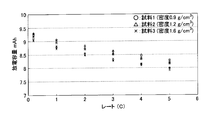
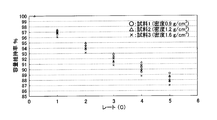
- FIG. 4 shows the capacity maintenance rate for each discharge rate.
- the horizontal axis in FIG. 4 represents the C rate, and the vertical axis represents the capacity retention rate.
- the capacity retention rate is a relative value of the discharge capacity at another rate, assuming that the discharge capacity at 0.2 C is 100% for each sample.
- the discharge capacity decreased as the C rate increased.
- a difference occurs in the rate of decrease of the capacity retention rate.
- the decreasing rate of the capacity retention rate of the samples 1 and 2 having a low density of the negative electrode mixture was smaller than the decreasing rate of the capacity retention rate of the sample 3 having a high density of the negative electrode mixture. This indicates that the lower the density, the more electricity can be emitted at high rates. From this experiment, it is understood that the high rate characteristics are excellent when the density of the negative electrode mixture is 0.8 g / cm 3 or more and 1.5 g / cm 3 or less.
- the capacity retention rate of Sample 3 having a density of 1.6 g / cm 3 was low. This is considered to be due to the fact that the density was too high, the electrolytic solution did not easily penetrate into the inside of the negative electrode mixture, and the discharge capacity was low. In particular, the capacity retention rate at high rate of sample 3 was low. It is considered that this is because Sample 3 had too large a density of the negative electrode mixture, there were few air gaps (ion conduction paths) through which lithium ions could pass, and lack of rapidity in lithium ion movement in a short time. Be
- the negative electrode composite made of single silicon and silicon compound, the negative electrode composite made of graphite and the polyamideimide-silica hybrid resin is excellent in high rate characteristics, and the density of the negative electrode composite is 0.8 g / g. In the case of cm 3 or more and 1.5 g / cm 3 or less, it is understood that the high rate characteristic is particularly excellent.
Landscapes
- Chemical & Material Sciences (AREA)
- Chemical Kinetics & Catalysis (AREA)
- Electrochemistry (AREA)
- General Chemical & Material Sciences (AREA)
- Engineering & Computer Science (AREA)
- Materials Engineering (AREA)
- Battery Electrode And Active Subsutance (AREA)
Priority Applications (3)
| Application Number | Priority Date | Filing Date | Title |
|---|---|---|---|
| EP11860268.9A EP2685529A4 (de) | 2011-03-08 | 2011-10-31 | Negativelektrodenmischung und negativelektrode zur verwendung für eine sekundärbatterie und sekundärbatterie |
| CN201180069043XA CN103415946A (zh) | 2011-03-08 | 2011-10-31 | 二次电池用负极混合材料、负极及二次电池 |
| US14/003,196 US20130337323A1 (en) | 2011-03-08 | 2011-10-31 | Negative-electrode mixture material for lithium-ion secondary battery, and negative electrode, as well as secondary battery |
Applications Claiming Priority (2)
| Application Number | Priority Date | Filing Date | Title |
|---|---|---|---|
| JP2011050150A JP2012186119A (ja) | 2011-03-08 | 2011-03-08 | 二次電池用負極合材、二次電池用負極、二次電池及びこれを用いた車両 |
| JP2011-050150 | 2011-03-08 |
Publications (1)
| Publication Number | Publication Date |
|---|---|
| WO2012120574A1 true WO2012120574A1 (ja) | 2012-09-13 |
Family
ID=46797586
Family Applications (1)
| Application Number | Title | Priority Date | Filing Date |
|---|---|---|---|
| PCT/JP2011/006078 Ceased WO2012120574A1 (ja) | 2011-03-08 | 2011-10-31 | 二次電池用負極合材及び負極、並びに二次電池 |
Country Status (5)
| Country | Link |
|---|---|
| US (1) | US20130337323A1 (de) |
| EP (1) | EP2685529A4 (de) |
| JP (1) | JP2012186119A (de) |
| CN (1) | CN103415946A (de) |
| WO (1) | WO2012120574A1 (de) |
Families Citing this family (2)
| Publication number | Priority date | Publication date | Assignee | Title |
|---|---|---|---|---|
| DE112016001667T5 (de) * | 2015-04-10 | 2017-12-28 | Kabushiki Kaisha Toyota Jidoshokki | Negative elektrode für nicht-wässrige elektrolyt-sekundärbatterie und nicht-wässrige elektrolyt-sekundärbatterie |
| CN114883569B (zh) * | 2022-07-06 | 2022-10-25 | 天能新能源(湖州)有限公司 | 一种锂离子电池负极用Fe掺杂的Si/C复合材料的制备方法 |
Citations (13)
| Publication number | Priority date | Publication date | Assignee | Title |
|---|---|---|---|---|
| JP2002198036A (ja) | 2000-12-22 | 2002-07-12 | Sony Corp | 負極及び非水電解質電池並びにそれらの製造方法 |
| JP2002231225A (ja) | 2001-02-01 | 2002-08-16 | Hitachi Chem Co Ltd | 複合電極材料とその製造方法、これを用いたリチウムイオン二次電池用負極及びリチウムイオン二次電池 |
| JP2004303638A (ja) | 2003-03-31 | 2004-10-28 | Canon Inc | リチウム二次電池 |
| JP2005310759A (ja) * | 2004-03-26 | 2005-11-04 | Shin Etsu Chem Co Ltd | 珪素複合体粒子及びその製造方法並びに非水電解質二次電池用負極材 |
| JP2008153117A (ja) * | 2006-12-19 | 2008-07-03 | Nec Tokin Corp | 非水電解質二次電池用負極およびそれを用いた非水電解質二次電池 |
| WO2009128319A1 (ja) * | 2008-04-18 | 2009-10-22 | 株式会社豊田自動織機 | リチウムイオン二次電池用負極とその製造方法 |
| JP2009272153A (ja) | 2008-05-08 | 2009-11-19 | Hitachi Maxell Ltd | リチウム二次電池 |
| JP2010033830A (ja) | 2008-07-28 | 2010-02-12 | Nec Tokin Corp | 非水電解質二次電池用負極およびそれを用いた非水電解質二次電池 |
| WO2010050507A1 (ja) * | 2008-10-31 | 2010-05-06 | 日立マクセル株式会社 | 非水二次電池 |
| JP2010182479A (ja) * | 2009-02-04 | 2010-08-19 | Toyota Industries Corp | リチウムイオン二次電池用負極及びその製造方法 |
| JP2010232077A (ja) | 2009-03-27 | 2010-10-14 | Toyota Industries Corp | 非水系二次電池用電極およびその製造方法 |
| JP2011060676A (ja) * | 2009-09-14 | 2011-03-24 | Shin-Etsu Chemical Co Ltd | 非水電解質二次電池用負極及びリチウムイオン二次電池 |
| JP2011086480A (ja) * | 2009-10-15 | 2011-04-28 | Toray Ind Inc | リチウムイオン電池電極用バインダー、それを用いたリチウムイオン電池電極用ペーストおよびリチウムイオン電池電極の製造方法 |
Family Cites Families (6)
| Publication number | Priority date | Publication date | Assignee | Title |
|---|---|---|---|---|
| US7790316B2 (en) * | 2004-03-26 | 2010-09-07 | Shin-Etsu Chemical Co., Ltd. | Silicon composite particles, preparation thereof, and negative electrode material for non-aqueous electrolyte secondary cell |
| JP5128873B2 (ja) * | 2007-08-10 | 2013-01-23 | 株式会社豊田自動織機 | 二次電池用電極及びその製造方法 |
| JP2009164104A (ja) * | 2007-09-06 | 2009-07-23 | Canon Inc | 負極用電極材料、その製造方法ならびに該材料を用いた電極構造体及び蓄電デバイス |
| KR100913177B1 (ko) * | 2007-09-17 | 2009-08-19 | 삼성에스디아이 주식회사 | 리튬 이차 전지용 음극 활물질 및 이의 제조 방법 |
| WO2010150513A1 (ja) * | 2009-06-23 | 2010-12-29 | キヤノン株式会社 | 電極構造体及び蓄電デバイス |
| JP5120371B2 (ja) * | 2009-12-24 | 2013-01-16 | 株式会社豊田自動織機 | リチウムイオン二次電池用負極 |
-
2011
- 2011-03-08 JP JP2011050150A patent/JP2012186119A/ja active Pending
- 2011-10-31 US US14/003,196 patent/US20130337323A1/en not_active Abandoned
- 2011-10-31 EP EP11860268.9A patent/EP2685529A4/de not_active Withdrawn
- 2011-10-31 WO PCT/JP2011/006078 patent/WO2012120574A1/ja not_active Ceased
- 2011-10-31 CN CN201180069043XA patent/CN103415946A/zh active Pending
Patent Citations (13)
| Publication number | Priority date | Publication date | Assignee | Title |
|---|---|---|---|---|
| JP2002198036A (ja) | 2000-12-22 | 2002-07-12 | Sony Corp | 負極及び非水電解質電池並びにそれらの製造方法 |
| JP2002231225A (ja) | 2001-02-01 | 2002-08-16 | Hitachi Chem Co Ltd | 複合電極材料とその製造方法、これを用いたリチウムイオン二次電池用負極及びリチウムイオン二次電池 |
| JP2004303638A (ja) | 2003-03-31 | 2004-10-28 | Canon Inc | リチウム二次電池 |
| JP2005310759A (ja) * | 2004-03-26 | 2005-11-04 | Shin Etsu Chem Co Ltd | 珪素複合体粒子及びその製造方法並びに非水電解質二次電池用負極材 |
| JP2008153117A (ja) * | 2006-12-19 | 2008-07-03 | Nec Tokin Corp | 非水電解質二次電池用負極およびそれを用いた非水電解質二次電池 |
| WO2009128319A1 (ja) * | 2008-04-18 | 2009-10-22 | 株式会社豊田自動織機 | リチウムイオン二次電池用負極とその製造方法 |
| JP2009272153A (ja) | 2008-05-08 | 2009-11-19 | Hitachi Maxell Ltd | リチウム二次電池 |
| JP2010033830A (ja) | 2008-07-28 | 2010-02-12 | Nec Tokin Corp | 非水電解質二次電池用負極およびそれを用いた非水電解質二次電池 |
| WO2010050507A1 (ja) * | 2008-10-31 | 2010-05-06 | 日立マクセル株式会社 | 非水二次電池 |
| JP2010182479A (ja) * | 2009-02-04 | 2010-08-19 | Toyota Industries Corp | リチウムイオン二次電池用負極及びその製造方法 |
| JP2010232077A (ja) | 2009-03-27 | 2010-10-14 | Toyota Industries Corp | 非水系二次電池用電極およびその製造方法 |
| JP2011060676A (ja) * | 2009-09-14 | 2011-03-24 | Shin-Etsu Chemical Co Ltd | 非水電解質二次電池用負極及びリチウムイオン二次電池 |
| JP2011086480A (ja) * | 2009-10-15 | 2011-04-28 | Toray Ind Inc | リチウムイオン電池電極用バインダー、それを用いたリチウムイオン電池電極用ペーストおよびリチウムイオン電池電極の製造方法 |
Non-Patent Citations (1)
| Title |
|---|
| See also references of EP2685529A4 |
Also Published As
| Publication number | Publication date |
|---|---|
| EP2685529A1 (de) | 2014-01-15 |
| JP2012186119A (ja) | 2012-09-27 |
| CN103415946A (zh) | 2013-11-27 |
| EP2685529A4 (de) | 2014-12-31 |
| US20130337323A1 (en) | 2013-12-19 |
Similar Documents
| Publication | Publication Date | Title |
|---|---|---|
| JP6178316B2 (ja) | フッ素化電解質組成物 | |
| JP5370630B2 (ja) | リチウムイオン二次電池用負極およびリチウムイオン二次電池 | |
| US11088359B2 (en) | Secondary battery-use anode and method of manufacturing the same, secondary battery and method of manufacturing the same, battery pack, electric vehicle, electric power storage system, electric power tool, and electronic apparatus | |
| JP5263416B1 (ja) | 二次電池およびそれを搭載した車両 | |
| JP6011607B2 (ja) | 非水系電解質二次電池 | |
| JP6052179B2 (ja) | リチウムイオン二次電池 | |
| CN102549819B (zh) | 非水电解液型锂离子二次电池 | |
| JP2013137873A (ja) | リチウムイオン二次電池 | |
| JP5505480B2 (ja) | リチウムイオン二次電池用負極及びその負極を用いたリチウムイオン二次電池 | |
| JP5505479B2 (ja) | リチウムイオン二次電池用負極及びその負極を用いたリチウムイオン二次電池 | |
| JPWO2017026268A1 (ja) | 二次電池用負極およびその製造方法、二次電池およびその製造方法、ならびに電池パック、電動車両、電力貯蔵システム、電動工具および電子機器 | |
| WO2014002939A1 (ja) | 非水電解質二次電池及び非水電解質二次電池の製造方法 | |
| JP5482858B2 (ja) | リチウムイオン二次電池 | |
| JP5445683B2 (ja) | 負極材料、リチウム二次電池、および負極材料の製造方法 | |
| JP5601549B2 (ja) | 非水電解液およびその利用 | |
| JP6233348B2 (ja) | 非水電解質二次電池およびその製造方法 | |
| WO2012120574A1 (ja) | 二次電池用負極合材及び負極、並びに二次電池 | |
| JP5683547B2 (ja) | リチウムイオン二次電池用負極及びリチウムイオン二次電池 | |
| JP5862490B2 (ja) | リチウムイオン二次電池 | |
| JP2013175314A (ja) | リチウムイオン二次電池および車両 | |
| JP5827193B2 (ja) | 非水電解質二次電池用負極の製造方法 | |
| JP2014116217A (ja) | リチウムイオン二次電池用正極及びリチウムイオン二次電池 |
Legal Events
| Date | Code | Title | Description |
|---|---|---|---|
| 121 | Ep: the epo has been informed by wipo that ep was designated in this application |
Ref document number: 11860268 Country of ref document: EP Kind code of ref document: A1 |
|
| WWE | Wipo information: entry into national phase |
Ref document number: 14003196 Country of ref document: US |
|
| WWE | Wipo information: entry into national phase |
Ref document number: 2011860268 Country of ref document: EP |
|
| NENP | Non-entry into the national phase |
Ref country code: DE |