WO2012120747A1 - Compositions de ciment et leur procédé de production - Google Patents
Compositions de ciment et leur procédé de production Download PDFInfo
- Publication number
- WO2012120747A1 WO2012120747A1 PCT/JP2011/079223 JP2011079223W WO2012120747A1 WO 2012120747 A1 WO2012120747 A1 WO 2012120747A1 JP 2011079223 W JP2011079223 W JP 2011079223W WO 2012120747 A1 WO2012120747 A1 WO 2012120747A1
- Authority
- WO
- WIPO (PCT)
- Prior art keywords
- mass
- content
- cement
- cement composition
- clinker
- Prior art date
- Legal status (The legal status is an assumption and is not a legal conclusion. Google has not performed a legal analysis and makes no representation as to the accuracy of the status listed.)
- Ceased
Links
Images
Classifications
-
- C—CHEMISTRY; METALLURGY
- C04—CEMENTS; CONCRETE; ARTIFICIAL STONE; CERAMICS; REFRACTORIES
- C04B—LIME, MAGNESIA; SLAG; CEMENTS; COMPOSITIONS THEREOF, e.g. MORTARS, CONCRETE OR LIKE BUILDING MATERIALS; ARTIFICIAL STONE; CERAMICS; REFRACTORIES; TREATMENT OF NATURAL STONE
- C04B7/00—Hydraulic cements
- C04B7/24—Cements from oil shales, residues or waste other than slag
-
- C—CHEMISTRY; METALLURGY
- C04—CEMENTS; CONCRETE; ARTIFICIAL STONE; CERAMICS; REFRACTORIES
- C04B—LIME, MAGNESIA; SLAG; CEMENTS; COMPOSITIONS THEREOF, e.g. MORTARS, CONCRETE OR LIKE BUILDING MATERIALS; ARTIFICIAL STONE; CERAMICS; REFRACTORIES; TREATMENT OF NATURAL STONE
- C04B7/00—Hydraulic cements
- C04B7/02—Portland cement
- C04B7/06—Portland cement using alkaline raw materials
-
- C—CHEMISTRY; METALLURGY
- C04—CEMENTS; CONCRETE; ARTIFICIAL STONE; CERAMICS; REFRACTORIES
- C04B—LIME, MAGNESIA; SLAG; CEMENTS; COMPOSITIONS THEREOF, e.g. MORTARS, CONCRETE OR LIKE BUILDING MATERIALS; ARTIFICIAL STONE; CERAMICS; REFRACTORIES; TREATMENT OF NATURAL STONE
- C04B7/00—Hydraulic cements
- C04B7/14—Cements containing slag
- C04B7/147—Metallurgical slag
- C04B7/153—Mixtures thereof with other inorganic cementitious materials or other activators
- C04B7/17—Mixtures thereof with other inorganic cementitious materials or other activators with calcium oxide containing activators
- C04B7/19—Portland cements
-
- C—CHEMISTRY; METALLURGY
- C04—CEMENTS; CONCRETE; ARTIFICIAL STONE; CERAMICS; REFRACTORIES
- C04B—LIME, MAGNESIA; SLAG; CEMENTS; COMPOSITIONS THEREOF, e.g. MORTARS, CONCRETE OR LIKE BUILDING MATERIALS; ARTIFICIAL STONE; CERAMICS; REFRACTORIES; TREATMENT OF NATURAL STONE
- C04B7/00—Hydraulic cements
- C04B7/24—Cements from oil shales, residues or waste other than slag
- C04B7/26—Cements from oil shales, residues or waste other than slag from raw materials containing flue dust, i.e. fly ash
-
- C—CHEMISTRY; METALLURGY
- C04—CEMENTS; CONCRETE; ARTIFICIAL STONE; CERAMICS; REFRACTORIES
- C04B—LIME, MAGNESIA; SLAG; CEMENTS; COMPOSITIONS THEREOF, e.g. MORTARS, CONCRETE OR LIKE BUILDING MATERIALS; ARTIFICIAL STONE; CERAMICS; REFRACTORIES; TREATMENT OF NATURAL STONE
- C04B7/00—Hydraulic cements
- C04B7/24—Cements from oil shales, residues or waste other than slag
- C04B7/28—Cements from oil shales, residues or waste other than slag from combustion residues, e.g. ashes or slags from waste incineration
-
- C—CHEMISTRY; METALLURGY
- C04—CEMENTS; CONCRETE; ARTIFICIAL STONE; CERAMICS; REFRACTORIES
- C04B—LIME, MAGNESIA; SLAG; CEMENTS; COMPOSITIONS THEREOF, e.g. MORTARS, CONCRETE OR LIKE BUILDING MATERIALS; ARTIFICIAL STONE; CERAMICS; REFRACTORIES; TREATMENT OF NATURAL STONE
- C04B7/00—Hydraulic cements
- C04B7/345—Hydraulic cements not provided for in one of the groups C04B7/02 - C04B7/34
-
- C—CHEMISTRY; METALLURGY
- C04—CEMENTS; CONCRETE; ARTIFICIAL STONE; CERAMICS; REFRACTORIES
- C04B—LIME, MAGNESIA; SLAG; CEMENTS; COMPOSITIONS THEREOF, e.g. MORTARS, CONCRETE OR LIKE BUILDING MATERIALS; ARTIFICIAL STONE; CERAMICS; REFRACTORIES; TREATMENT OF NATURAL STONE
- C04B7/00—Hydraulic cements
- C04B7/36—Manufacture of hydraulic cements in general
-
- Y—GENERAL TAGGING OF NEW TECHNOLOGICAL DEVELOPMENTS; GENERAL TAGGING OF CROSS-SECTIONAL TECHNOLOGIES SPANNING OVER SEVERAL SECTIONS OF THE IPC; TECHNICAL SUBJECTS COVERED BY FORMER USPC CROSS-REFERENCE ART COLLECTIONS [XRACs] AND DIGESTS
- Y02—TECHNOLOGIES OR APPLICATIONS FOR MITIGATION OR ADAPTATION AGAINST CLIMATE CHANGE
- Y02P—CLIMATE CHANGE MITIGATION TECHNOLOGIES IN THE PRODUCTION OR PROCESSING OF GOODS
- Y02P40/00—Technologies relating to the processing of minerals
- Y02P40/10—Production of cement, e.g. improving or optimising the production methods; Cement grinding
Definitions
- the present invention relates to a cement composition and a method for producing the same.
- the cement composition reacts with the components contained in the cement composition and water to form a hydrate and develop strength.
- the strength of mortar or concrete increases as the amount of hydrate produced increases.
- Non-Patent Document 1 As a method for improving the strength development property of concrete, means such as “increase the fineness (brane specific surface area)” and “increase the C 3 S content” are used (for example, Non-Patent Document 1). .
- Non-Patent Document 1 concrete or the like can be obtained by means of changing the fineness and mineral composition of the cement composition such as “fineness of fineness (brane specific surface area)” and “increasing the C 3 S content”.
- fineness of fineness brane specific surface area
- C 3 S content increases the limestone basic unit as a raw material, and CO 2 emission by decarboxylation of limestone and This also leads to an increase in energy for clinker firing, and in either case, the amount of CO 2 generated in cement production is increased, which is not preferable in terms of environment.
- the present invention has been made in view of the above circumstances, and improves the strength expression of a cured body such as mortar or concrete while maintaining appropriate fresh properties (standard soft water content, setting time) of mortar and concrete. It is an object of the present invention to provide a cement composition that can be produced and a method for producing the same.
- a cement composition is used in order to improve the strength development of a cured body such as mortar or concrete while maintaining the fresh properties of mortar or concrete.
- the inventors have found that it is effective to control the content of vanadium soot (V) therein, and have completed the present invention.
- the present invention relates to a cement composition having a V content of 0.0063 to 0.012% by mass.
- the present invention relates to the above cement composition, wherein the Sr content is 0.035 to 0.08% by mass.
- the present invention relates to the above cement composition, wherein the Mo content is 0.0002 to 0.007% by mass and the MgO content is 1 to 3% by mass.
- the present invention relates to the above cement composition comprising a cement clinker having an SO 3 content of 0.2 to 1.2% by mass.
- the present invention relates to the above-mentioned cement composition having an SO 3 content of 1.6 to 2.5% by mass.
- the present invention relates to the above cement composition having an R 2 O content of 0.3 to 0.6% by mass.
- the present invention has a C 3 S content of 45 to 70% by mass, a C 2 S content of 5 to 25% by mass, a C 3 A content of 6 to 15% by mass and a C 4 AF content of 7 to 15% by mass. % Of the cement composition.
- the present invention provides limestone, meteorite, coal ash, clay, blast furnace slag, construction generated soil, sewage sludge, hydrocake, and iron source so that the V content of the cement composition is 0.0063 to 0.012% by mass. Adjusting the raw material intensity of a raw material selected from the group consisting of: (A) producing a cement clinker by firing the adjusted raw material; and (B) pulverizing the cement clinker, gypsum and mixed material.
- the present invention relates to a method for producing a cement composition.
- the present invention in order to maintain the proper fresh properties of cement paste, mortar or concrete, while maintaining the standard soft water amount (water amount necessary for obtaining a certain softness) and setting time of cement paste. Further, it is possible to provide a cement composition capable of maintaining and improving the strength development property (for example, the strength development property of a material age of 28 days) of a cured body such as mortar or concrete and a method for producing the same.
- the cement composition according to this embodiment is characterized in that the V content is 0.0063 to 0.012% by mass.
- Vanadium (V) is a trace component contained in the cement composition.
- the present inventors have determined that the V content in the cement composition affects the strength development of a cement paste, mortar, or concrete hardened body using the cement composition, and the V content of the cement composition. Has been found to improve the strength development of these hardened bodies while maintaining the proper fresh properties (standard soft water content, setting time) of cement paste, mortar or concrete It was.
- the V content of the cement composition is the content ratio (% by mass) with respect to the total mass of the cement composition, and cement by the Cement Association standard test method JCAS I-52 2000 “ICP emission spectroscopic analysis and electric heating atomic absorption spectroscopic analysis method” It can be measured according to the "quantitative method of trace components in”.
- the V content in the cement composition is 0.0063 to 0.012% by mass, preferably 0.0070 to 0.012% by mass, more preferably 0.0080 to 0.0115% by mass. More preferably, the content is 0.0090 to 0.0105% by mass.
- the V content in the cement composition is less than 0.063% by mass or more than 0.012% by mass, the strength development of a cured body such as mortar or concrete using the cement composition according to the present embodiment is appropriately achieved. It may not be maintained.
- the cement composition according to the present embodiment has a strontium (Sr) content of preferably 0.035 to 0.08% by mass, more preferably an Sr content of 0.04 to 0.075% by mass, and still more preferably. It is 0.041 to 0.07% by mass, particularly preferably 0.042 to 0.06% by mass.
- Sr content in the cement composition is within the above range, the strength properties of a hardened body such as mortar or concrete can be maintained while maintaining the fresh properties (standard soft water content and setting time) of the cement composition. Can be maintained and improved.
- the Sr content in the cement composition is the content ratio (mass%) with respect to the total mass of the cement composition, and this content ratio is determined by the Cement Association standard test method JCAS I-52 2000 “ICP emission spectroscopic analysis and electric heating type” It can be measured according to the “quantification method of trace components in cement by atomic absorption analysis”.
- the cement composition according to the present embodiment has a molybdenum (Mo) content of preferably 0.0002 to 0.007 mass%, more preferably 0.0002 to 0.0065 mass%, and still more preferably 0.0002 to 0.0002 mass%.
- the amount is 0.0064% by mass, particularly preferably 0.0002 to 0.0063% by mass.
- the Mo content in the cement composition is the content ratio (mass%) with respect to the total mass of the cement composition, and this content ratio is determined by the Cement Association standard test method JCAS I-52 2000 “ICP emission spectroscopic analysis and electric heating type” It can be measured according to the “quantification method of trace components in cement by atomic absorption analysis”.
- the MgO content is preferably 1 to 3% by mass, more preferably 1 to 2.5% by mass, still more preferably 1 to 2% by mass, and particularly preferably 1 to 1.% by mass. 5% by mass.
- the MgO content in the cement composition is the content ratio (mass%) with respect to the total mass of the cement composition, and this content ratio should be measured according to JIS R 5202: 1998 “Chemical analysis method of Portland cement”. Can do.
- the cement composition according to the present embodiment is preferably formed using a cement clinker having an SO 3 content of 0.2 to 1.2.
- the SO 3 content of the cement clinker is more preferably 0.25 to 0.90% by mass, still more preferably 0.3 to 0.70% by mass.
- the SO 3 content of the cement clinker is within the above range, it becomes easy to adjust the SO 3 content of the cement composition obtained by pulverizing the cement clinker, gypsum, and the mixture to a predetermined range. preferable.
- the cement composition according to the present embodiment has an R 2 O content of preferably 0.3 to 0.6% by mass, more preferably 0.35 to 0.6% by mass, and still more preferably 0.35. To 0.55% by mass, particularly preferably 0.4 to 0.5% by mass.
- the R 2 O content in the cement composition is the content ratio (mass%) with respect to the total mass of the cement composition, and this content ratio is measured according to JIS R 5202: 1998 “Chemical analysis method of Portland cement”. can do.
- the R 2 O (alkali) content of the cement composition refers to an amount represented by the following formula (I).
- R 2 O content of cement composition Na 2 O content + 0.658 ⁇ K 2 O content (I)
- the cement composition according to the present embodiment has an SO 3 content of preferably 1.6 to 2.5% by mass, more preferably 1.7 to 2.5% by mass, and still more preferably 1.8 to 2.5% by mass. 2.48% by mass.
- the SO 3 content in the cement composition is the content ratio (mass%) with respect to the total mass of the cement composition, and this content ratio is measured according to JIS R 5202: 1998 “Chemical analysis method of Portland cement”. be able to.
- the mineral composition of the cement composition according to the present embodiment preferably has a C 3 S content of 45 to 70% by mass, a C 2 S content of 5 to 25% by mass, and a C 3 A content of 6 to 15% by mass.
- C 4 AF content is 7 to 15% by mass, more preferably C 3 S content is 48 to 65% by mass, C 2 S content is 10 to 25% by mass, and C 3 A content is 8 to 8%.
- 13 mass% and C 4 AF content is 8-12 mass%, more preferably C 3 S content is 50-64 mass%, C 2 S content is 11-20 mass%, C 3 A content.
- the C 4 AF content is 8 to 11% by mass, and particularly preferably, the C 3 S content is 53 to 60% by mass, the C 2 S content is 11 to 18% by mass, and C 3 The A content is 9 to 11% by mass, and the C 4 AF content is 8 to 10% by mass. If the mineral composition of the cement composition is within the above range, the strength development of hardened bodies such as mortar or concrete can be easily maintained while maintaining the fresh properties of mortar and concrete (standard soft water content, setting time). Can be improved.
- C 3 S content (alite phase), C 2 S content (belite phase), C 3 A content (aluminate phase), C 4 AF content (ferrite phase) in the cement composition Is calculated by the following Borg equations [1] to [4].
- CaO content”, SiO 2 content”, “Al 2 O 3 content” and “Fe 2 O 3 content” in the formula are respectively CaO, SiO 2 and Al 2 O 3 in the cement composition. a content (mass%) and for the entire mass of the cement composition of Fe 2 O 3. These content ratios can be measured by JIS R 5202 “Method for chemical analysis of Portland cement” or JIS R 5204 “Method for fluorescent X-ray analysis of cement”.
- Examples of raw materials for cement clinker in step (A) include limestone, meteorite, coal ash, clay, blast furnace slag, construction generated soil, sewage sludge, hydrocake, and iron source.
- Coal ash is generated from a coal-fired power plant or the like, and includes cinder ash, fly ash, clinker ash, and bottom ash.
- Examples of construction generated soil include residual soil, mud soil, waste soil, etc., which are generated as a result of construction work.
- Examples of sewage sludge include sludge, dry pulverized limestone, and incineration residues.
- Hydrocake is a by-product generated in the process of adding a small amount of calcium hydroxide to seawater when removing seawater magnesia clinker, and removing carbon dioxide in seawater.
- the thing which has a salt as a main component is mentioned.
- the iron source include copper tangling and blast furnace dust.
- it is a raw material which contains V to some extent, it may be other than said limestone, meteorite, coal ash, clay, blast furnace slag, construction generated soil, sewage sludge, hydrocake, and iron source.
- the raw material unit of the cement clinker raw material in the step (A) is limestone 700 to 1400 kg / t-clinker, meteorite 20 to 150 kg / t on a dry basis (in a state not containing moisture) per ton (t) of cement clinker.
- -Clinker coal ash 0-300kg / t-clinker, clay 0-100kg / t-clinker, blast furnace slag 0-100kg / t-clinker, construction generated soil 10-150kg / t-clinker, sewage sludge 0-100kg / t It is preferred to use clinker, hydrocake 0-100 kg / t-clinker and iron source 30-80 kg / t-clinker.
- step (A) as a raw material for cement clinker, limestone 800 to 1300 kg / t-clinker, meteorite 20 to 100 kg / t-clinker, coal ash 10 to 250 kg / t-clinker, clay 0 to 80 kg / t-clinker, blast furnace slag 5-50 kg / t-clinker, construction generated soil 20-150 kg / t-clinker, sewage sludge 0-70 kg / t-clinker, hydrocake 20-80 kg / t-clinker and iron source 30- More preferably, 60 kg / t-clinker is used. More preferably, the coal ash is 20 to 250 kg / t-clinker on a dry basis.
- the V content of each cement clinker raw material is measured, and the raw material intensity of the cement clinker raw material containing a large amount of V is mainly adjusted.
- the raw material basic unit is adjusted so that the V content of the composition is 0.0063 to 0.012 mass%.
- a method of adjusting the raw material unit of the cement clinker raw material specifically, a previously prepared cement composition is sampled, the V content in the cement composition is measured, and the V content in the cement composition is determined.
- a method using a cement clinker obtained by adjusting the raw material basic unit of the cement clinker raw material so that it becomes 0.0063 to 0.012 mass% and firing this raw material can be mentioned.
- the “raw material basic unit” means the mass (kg / t-clinker) of each raw material used for producing 1 ton of cement clinker.
- it may be other than said limestone, meteorite, coal ash, clay, blast furnace slag, construction generated soil, sewage sludge, hydrocake, and iron source.
- the use amount (raw material basic unit) of coal ash, construction generated soil, clay, iron source (copper tangled, blast furnace dust), etc. has a great influence on the V content of the cement composition.
- the raw material unit of the cement clinker raw material it is preferable to adjust the raw material unit of the cement clinker raw material so that the Sr content of the cement composition is 0.035 to 0.08 mass%.
- the raw material unit of the cement clinker raw material it is preferable to adjust the raw material unit of the cement clinker raw material so that the Mo content of the cement composition is 0.0002 to 0.007% by mass.
- the raw material unit of the cement clinker raw material so that the MgO content of the cement composition is 1 to 3% by mass.
- the raw material unit of the cement clinker raw material so that the R 2 O content of the cement composition is 0.3 to 0.6% by mass.
- the cement composition prepared in advance is sampled, and the Sr content and Mo content in the cement composition are sampled.
- the MgO content and the R 2 O content are measured, and the raw material raw material of the cement clinker raw material is set so that the Sr content, Mo content, MgO content and R 2 O content in the cement composition are specific amounts.
- the raw material unit of the cement clinker raw material it is preferable to adjust the raw material unit of the cement clinker raw material so that the SO 3 content of the cement clinker is 0.2 to 1.2% by mass.
- V content in the raw materials, Sr content, Mo content, MgO content and R 2 O content is content (wt%) for each entire raw material (100 wt%).
- the V content is preferably 0.0001 to 0.002% by mass, more preferably 0.0001 to 0.0015% by mass, still more preferably 0.0002 to 0.0012% by mass, particularly preferably. 0.0002 to 0.001% by mass is used.
- the Sr content is preferably 0.005 to 0.07% by mass, more preferably 0.005 to 0.06% by mass, still more preferably 0.01 to 0.06% by mass, and particularly preferably 0.015 to 0.055 mass is used.
- the Mo content is preferably 0.002% by mass or less, more preferably 0.001% by mass or less, still more preferably 0.0005% by mass or less, and particularly preferably 0.0003% by mass or less.
- the MgO content is preferably 0.1 to 1.5% by mass or less, more preferably 0.2 to 1.3% by mass or less, still more preferably 0.25 to 1.1% by mass or less, particularly preferably 0. Use 3 to 1.0% by mass.
- the R 2 O content is preferably 0.05% by mass or less, more preferably 0.001 to 0.04% by mass, still more preferably 0.005 to 0.03% by mass, and particularly preferably 0.005 to 0%. 0.02% by mass is used.
- the V content is preferably 0.001 to 0.01% by mass, more preferably 0.001 to 0.008% by mass, still more preferably 0.002 to 0.007% by mass, particularly preferably. 0.003 to 0.006% by mass is used.
- the Sr content is preferably 0.001 to 0.04% by mass, more preferably 0.001 to 0.03% by mass, still more preferably 0.001 to 0.025% by mass, and particularly preferably 0.001 to 0.04% by mass. Use 0.02 mass%.
- the Mo content is preferably 0.002% by mass or less, more preferably 0.001% by mass or less, still more preferably 0.0005% by mass or less, and particularly preferably 0.0004% by mass or less.
- the MgO content is preferably 0.05 to 1.0% by mass, more preferably 0.1 to 0.8% by mass, still more preferably 0.1 to 0.6% by mass, particularly preferably 0.1 to 0% by mass. Use 5% by mass.
- the R 2 O content is preferably 0.1 to 4.0% by mass, more preferably 0.1 to 3.0% by mass, still more preferably 0.3 to 2.5% by mass, and particularly preferably 0.8. 3 to 2.0% by mass is used.
- the coal ash has a V content of preferably 0.01 to 0.1% by mass, more preferably 0.01 to 0.08% by mass, still more preferably 0.015 to 0.07% by mass, particularly preferably. Is 0.035 to 0.06% by mass.
- V content preferably 0.01 to 0.1% by mass, more preferably 0.01 to 0.08% by mass, still more preferably 0.015 to 0.07% by mass, particularly preferably. Is 0.035 to 0.06% by mass.
- the Sr content is preferably 0.02 to 0.2% by mass, more preferably 0.02 to 0.15% by mass, still more preferably 0.02 to 0.13% by mass, and particularly preferably 0.02 to 0.2% by mass. A 0.12 mass% thing is used.
- the Mo content is preferably 0.004% by mass or less, more preferably 0.003% by mass or less, still more preferably 0.002% by mass or less, and particularly preferably 0.0015% by mass or less.
- the MgO content is preferably 0.2 to 3.0% by mass, more preferably 0.4 to 3.0% by mass, still more preferably 0.4 to 2.5% by mass, and particularly preferably 0.4 to 3.0% by mass. 2.3% by mass is used.
- the R 2 O content is preferably 0.1 to 3.5% by mass, more preferably 0.2 to 3.0% by mass, still more preferably 0.3 to 2.5% by mass, and particularly preferably 0. 5 to 2.0% by mass is used.
- the V content is preferably 0.001 to 0.02% by mass, more preferably 0.001 to 0.015% by mass, still more preferably 0.003 to 0.012% by mass, and particularly preferably. Is 0.004 to 0.01% by mass.
- the Sr content is preferably 0.02 to 0.08% by mass, more preferably 0.02 to 0.07% by mass, still more preferably 0.02 to 0.06% by mass, and particularly preferably 0.02 to 0.08% by mass. Use 0.05 mass% or less.
- the Mo content is preferably 0.002% by mass or less, more preferably 0.001% by mass or less, still more preferably 0.0005% by mass or less, and particularly preferably 0.0003% by mass or less.
- the MgO content is preferably 3.0 to 10% by mass, more preferably 3.0 to 8.0% by mass, still more preferably 3.0 to 7.0% by mass, and particularly preferably 4.0 to 7.% by mass. Use 0% by weight.
- the R 2 O content is preferably 0.02 to 1.0% by mass, more preferably 0.04 to 0.8% by mass, still more preferably 0.06 to 0.6% by mass, and particularly preferably 0.8. Use the one of 08 to 0.5% by mass.
- the V content is preferably 0.005 to 0.05% by mass, more preferably 0.005 to 0.03% by mass, still more preferably 0.01 to 0.025% by mass, and particularly preferably.
- the Sr content is preferably 0.001 to 0.03% by mass, more preferably 0.003 to 0.025% by mass, still more preferably 0.003 to 0.02% by mass, and particularly preferably 0.004 to 0.04% by mass.
- a thing of 0.015 mass% or less is used.
- the Mo content is preferably 0.002% by mass or less, more preferably 0.001% by mass or less, still more preferably 0.0005% by mass or less, and particularly preferably 0.0004% by mass or less.
- the MgO content is preferably 0.3 to 6.0% by mass, more preferably 0.3 to 5.0% by mass, still more preferably 0.3 to 4.0% by mass, and particularly preferably 0.5%. Use 4.0% by mass.
- the R 2 O content is preferably 0.5 to 4.0% by mass, more preferably 0.7 to 3.5% by mass, still more preferably 1.0 to 3.0% by mass, Preferably 1.2 to 2.8% by mass is used.
- the V content is preferably 0.0001 to 0.03% by mass, more preferably 0.0001 to 0.025% by mass, still more preferably 0.005 to 0.02% by mass, and particularly Preferably, 0.007 to 0.02 mass% is used.
- the Sr content is preferably 0.01 to 0.4% by mass, more preferably 0.01 to 0.3% by mass, still more preferably 0.01 to 0.2% by mass, particularly preferably 0.015 to Use 0.1% by mass.
- the Mo content is preferably 0.002% by mass or less, more preferably 0.001% by mass or less, still more preferably 0.0005% by mass or less, and particularly preferably 0.0004% by mass or less.
- the MgO content is preferably 0.5 to 6.0% by mass, more preferably 0.5 to 5.5% by mass, still more preferably 1.0 to 5.0% by mass, and particularly preferably 1.0 to 5.0% by mass. Use 4.0% by weight.
- the R 2 O content is preferably 0.5 to 4.5% by mass, more preferably 0.7 to 4.0% by mass, still more preferably 1.0 to 3.5% by mass, and particularly preferably 1. 2 to 3.0% by mass is used.
- the sewage sludge has a V content of preferably 0.0001 to 0.01% by mass, more preferably 0.0001 to 0.007% by mass, still more preferably 0.0005 to 0.005% by mass, and particularly preferably. Is 0.0007 to 0.004% by mass.
- the Sr content is preferably 0.001 to 0.1% by mass, more preferably 0.001 to 0.07% by mass, still more preferably 0.001 to 0.05% by mass, and particularly preferably 0.001 to Use 0.04 mass%.
- the Mo content is preferably 0.002% by mass or less, more preferably 0.0015% by mass or less, still more preferably 0.0012% by mass or less, and 0.0011% by mass or less.
- the MgO content is preferably 0.05 to 4.0% by mass, more preferably 0.1 to 4.0% by mass, still more preferably 0.1 to 3.0% by mass, and particularly preferably 0.1 to 4.0% by mass. Use 2.5% by mass.
- the R 2 O content is preferably 0.4 to 3.5% by mass, more preferably 0.6 to 3.0% by mass, still more preferably 0.8 to 2.5% by mass, and particularly preferably 1. Use 0 to 2.0% by mass.
- the hydrocake has a V content of preferably 0.001 to 0.1% by mass, more preferably 0.01 to 0.08% by mass, still more preferably 0.01 to 0.06% by mass, particularly preferably. Is 0.01 to 0.05% by mass.
- the Sr content is preferably 0.1 to 0.8% by mass, more preferably 0.1 to 0.7% by mass, still more preferably 0.1 to 0.6% by mass, and particularly preferably 0.1 to 0.7% by mass. Use 0.5% by weight.
- the Mo content is preferably 0.002% by mass or less, more preferably 0.001% by mass or less, still more preferably 0.0005% by mass or less, and particularly preferably 0.0003% by mass or less.
- the MgO content is preferably 5 to 30% by mass, more preferably 5 to 25% by mass, still more preferably 10 to 25% by mass, and particularly preferably 10 to 20% by mass.
- the R 2 O content is preferably 0.02 to 1.5% by mass, more preferably 0.04 to 1.2% by mass, still more preferably 0.06 to 1.0% by mass, and particularly preferably 0.8. The one with 08 to 0.8% by mass is used.
- the V content is preferably 0.001 to 0.05% by mass, more preferably 0.003 to 0.03% by mass, and still more preferably 0.005 to 0.03% by mass. %, 0.005 to 0.02 mass%.
- the Sr content is preferably 0.005 to 0.05% by mass, more preferably 0.005 to 0.04% by mass, still more preferably 0.005 to 0.03% by mass, and particularly preferably 0.005 to 0.05% by mass.
- the Mo content is preferably 0.0002 to 0.8% by mass, more preferably 0.0002 to 0.6% by mass, still more preferably 0.0002 to 0.4% by mass, and particularly preferably 0.0002 to Use 0.3% by mass.
- the MgO content is preferably 0.5 to 3.0% by mass, more preferably 0.5 to 2.5% by mass, still more preferably 0.6 to 2.0% by mass, and particularly preferably 0.7 to 3.0% by mass. Use 1.5% by mass.
- the R 2 O content is preferably 0.04 to 2% by mass, more preferably 0.06 to 1.8% by mass, still more preferably 0.08 to 1.6% by mass, and particularly preferably 1 to 1.% by mass. Use 4% by weight.
- the V content is preferably 0.001 to 0.03% by mass, more preferably 0.003 to 0.02% by mass, and still more preferably 0.005 to 0.02% by mass. %, Particularly preferably 0.008 to 0.015% by mass.
- the Sr content is preferably 0.001 to 0.03% by mass, more preferably 0.001 to 0.02% by mass, still more preferably 0.002 to 0.015% by mass, and particularly preferably 0.002 to 0.02% by mass.
- the Mo content is preferably 0.004% by mass or less, more preferably 0.003% by mass or less, still more preferably 0.002% by mass or less, and particularly preferably 0.001% by mass or less.
- the MgO content is preferably 0.1 to 3.0% by mass, more preferably 0.15 to 2.0% by mass, still more preferably 0.15 to 1.5% by mass, particularly preferably 0.2 to Use 1.5% by mass.
- the R 2 O content is preferably 0.002 to 1.0% by mass, more preferably 0.004 to 0.8% by mass, still more preferably 0.006 to 0.6% by mass, and particularly preferably 0.8. Use 008 to 0.4 mass%.
- the V content is preferably 0.05 to 0.5% by mass, more preferably 0.08 to 0.5% by mass, and still more preferably 0.1 to 0.4% by mass. Soot, deiron slag, or the like can be selected and used as a raw material for controlling the V content in the cement composition.
- the cement clinker can be manufactured using an existing cement manufacturing facility such as an SP system (multistage cyclone preheating system) or an NSP system (multistage cyclone preheating system equipped with a calcining furnace).
- SP system multistage cyclone preheating system
- NSP system multistage cyclone preheating system equipped with a calcining furnace
- a quality control sample is collected during cement clinker firing, the V content of this sample is measured, and the use of each raw material is based on the V content in each raw material.
- the ratio (raw material basic unit) is adjusted so that the V content in the cement clinker is 0.0063 to 0.012% by mass.
- step (A) (firing step) of the present invention an example in which a cement clinker is manufactured using an existing cement manufacturing facility of the NSP method will be described.
- each raw material of the cement clinker is not particularly limited, but it is preferable to pulverize and mix with a raw material pulverization mill or the like, and further to mix with a blending silo.
- the cement clinker raw material that has been pulverized and mixed can be further fired using a suspension preheater and a rotary kiln, which are existing equipment.
- a cement clinker having a V content of 0.0063 to 0.012% by mass can also be produced by adjusting the firing conditions such as the firing temperature and firing time of the cement clinker.
- the firing temperature of the cement clinker is not particularly limited, but when an NSP type cement production facility is used, the temperature of the cement clinker in the vicinity of the rotary kiln outlet is preferably 800 to 1700 ° C, more preferably 900 to 1600 ° C. More preferably, it is 1000 to 1500 ° C.
- the firing time is 20 minutes to 2 hours, more preferably 30 minutes to 2 hours, and still more preferably 45 minutes to 1.5 hours.
- the obtained cement clinker is preferably cooled to about 100 to 200 ° C., for example, by a clinker cooler provided on the downstream side of the rotary kiln.
- the cooling rate is preferably 10 to 60 ° C./min, more preferably 15 to 45 ° C./min, and further preferably 15 to 30 ° C./min.
- the cooling rate is in the range of 10 to 60 ° C./min, it is possible to produce a cement clinker from which a cement composition capable of producing mortar and concrete having excellent strength development properties can be obtained.
- step (B) pulverization step
- a step of pulverizing the cement clinker, gypsum and the mixed material will be described.
- the cement composition can be produced by mixing and pulverizing a cement clinker having a V content of 0.0063 to 0.012% by mass and gypsum.
- the gypsum desirably satisfies the quality specified in JIS R 9151 “Natural gypsum for cement”. Specifically, dihydrate gypsum, hemihydrate gypsum, and insoluble anhydrous gypsum are preferably used.
- the SO 3 content in the cement composition is 1.6 to 2.5% by mass with respect to the cement clinker having a V content of 0.0063 to 0.012% by mass. It is preferable to mix and grind gypsum so that it is more preferably 1.7 to 2.5% by mass, and still more preferably 1.8 to 2.48% by mass.
- pulverization method The method of using classifiers, such as grinders, such as a ball mill, and a separator, is mentioned.
- the cement clinker content is 95 to 97% by mass with respect to the total mass of the cement composition, and the gypsum content is 3 to 5% by mass. It is preferable.
- the cement composition may further contain a mixed material.
- a mixed material blast furnace slag specified by JIS R 5211 “Blast Furnace Cement”, siliceous mixed material specified by JIS R 5212 “Silica Cement”, fly ash specified by JIS A 6201 “Fly Ash for Concrete”. Limestone fine powder can be used.
- the total content (% by mass) of the mixed material is preferably 5% by mass or less with respect to the total mass of the cement composition.
- the brane specific surface area of the cement composition according to this embodiment is preferably 2800 to 4000 cm 2 / g. When the brain specific surface area is within the above range, it is possible to produce mortar or concrete having further excellent strength development.
- the brane specific surface area of the cement composition is more preferably 3000 to 3800 cm 2 / g, and still more preferably 3000 to 3500 cm 2 / g.
- cement clinker ingredients As cement clinker raw material, the V content of limestone, silica stone, coal ash, clay, blast furnace slag, construction generated soil, sewage sludge, hydrocake and iron source (copper tangled, blast furnace dust) is measured in advance, and the raw material of the above raw material The basic unit was adjusted so that the V content of the cement clinker was 0.0063 to 0.012% by mass. Further, the Sr content is 0.035 to 0.08 mass%, the Mo content is 0.0002 to 0.007 mass%, the MgO content is 1 to 3 mass%, and the R 2 O content is 0.3 to 0.3 mass%.
- the use ratio (raw material basic unit) of each raw material was adjusted so that a cement clinker of 0.6% by mass was obtained. Also, dihydrate gypsum was used to adjust the amount of SO 3 in the cement composition.
- Sr content, Mo content The amounts, MgO content and R 2 O content are listed in Table 1.
- the chemical components and raw material basic units shown below are dry base (water-free state) raw material basic units. In Table 1, “ ⁇ 0.00025” indicates that the Mo content is 0.00025% by mass or less.
- V, Sr, Mo, MgO and R 2 O in the raw materials are determined by the Cement Association standard test method JCAS I-52 2000 “Method for quantifying trace components in cement by ICP emission spectroscopic analysis and electric heating atomic absorption analysis”. It measured according to.
- cement clinker ingredients The basic unit of each raw material used as a cement clinker raw material was limestone 800-1300 kg / t-clinker, silica 20-150 kg / t-clinker, coal ash 10-250 kg / t-clinker, clay 0-100 kg / t-clinker, Blast furnace slag 0-100 kg / t-clinker, construction generated soil 20-150 kg / t-clinker, sewage sludge 0-100 kg / t-clinker, hydrocake 0-100 kg / t-clinker and iron source 30-80 kg / t-clinker (5 to 50 kg / t-clinker from copper tangled, 25 to 55 kg / t-clinker from blast furnace dust).
- the cement clinker raw material was prepared, and the prepared raw material was baked in an NSP kiln at a maximum temperature of 1200 to 1500 ° C. to produce a cement clinker.
- the temperature of the cement clinker in the vicinity of the NSP kiln outlet was 1000-1500 ° C.
- the cement clinker was cooled from 1000-1400 ° C. to 100-200 ° C. at a cooling rate of 10-60 ° C./min with a clinker cooler provided on the downstream side of the rotary kiln.
- the obtained cement clinker is blended with dihydrate gypsum so that the content of SO 3 in the cement composition is 2% by mass, and further mixed material (limestone, blast furnace slag) is 4% by mass of limestone and 1% by mass of blast furnace slag. And pulverized with an actual mill so that the specific surface area of the brain was 3100 to 3400 cm 2 / g to obtain a cement composition.
- the color tone b value of the cement composition is shown in Table 4 as a result of measurement using a colorimetric color difference meter (Spectro Color Meter Se2000 manufactured by Nippon Denshoku Industries Co., Ltd.).
- the measurement method is as follows. 500 g of cement composition is put in a kneading bowl, water is added and kneaded, cement paste is put into a container, the surface is smoothed, the standard bar is lowered, and the standard bar is 30 seconds later.
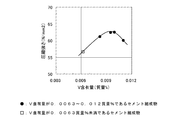
- FIG. 1 The relationship between the V content of the cement composition and the 28-day compressive strength is shown in FIG. As shown in FIG. 1, when the V content of the cement composition is 0.0063 to 0.012 mass% (Examples 1 to 4, the symbol “ ⁇ ” in FIG. 1), a certain strength development property (The mortar compressive strength at the age of 28 days can be maintained and improved at 60 N / mm 2 or more. On the other hand, when the V content of the cement composition was less than 0.0063% by mass (Comparative Example 1, symbol “ ⁇ ” in FIG. 1), strength development was reduced.
- a cement composition having a V content of 0.0063 to 0.012% by mass and preferably an Sr content of 0.035 to 0.08% by mass has a large difference in the standard soft water amount compared to the cement composition (Comparative Example 1) in which the V content of the cement composition is less than 0.0063% by mass while maintaining and improving a certain strength development.
- the setting time since the setting time is longer, it can be confirmed that the freshness (standard soft water amount, setting time) is maintained.
- the cement composition having a cement composition having a V content of 0.0063 to 0.012% by mass, preferably an Sr content of 0.035 to 0.08% by mass While maintaining the fresh properties of concrete (standard soft water content, setting time), strength development can be maintained and improved.
Landscapes
- Chemical & Material Sciences (AREA)
- Engineering & Computer Science (AREA)
- Ceramic Engineering (AREA)
- Materials Engineering (AREA)
- Structural Engineering (AREA)
- Organic Chemistry (AREA)
- Inorganic Chemistry (AREA)
- Combustion & Propulsion (AREA)
- Curing Cements, Concrete, And Artificial Stone (AREA)
- Processing Of Solid Wastes (AREA)
Abstract
La présente invention concerne des compositions de ciment permettant de conserver ou d'améliorer la capacité d'acquisition de la résistance d'une pâte de ciment, d'un mortier ou d'un béton tout en conservant les propriétés de la pâte de ciment, du mortier ou du béton à l'état frais. L'invention concerne également un procédé de production desdites compositions. L'invention concerne, donc, une composition de ciment caractérisée par une teneur en V pouvant varier de 0,0063 à 0,012 % en poids ; une composition de ciment telle que décrite ci-dessus, présentant une teneur en Sr pouvant varier de 0,035 à 0,08 % en poids ; et un procédé de production de compositions de ciment comprenant une étape (A) consistant à ajuster les quantités de chacune des matières premières choisies dans le groupe constitué du calcaire, de la silice, des cendres de houille, de l'argile, du laitier de haut fourneau, de la terre provenant de travaux de construction, des boues d'épuration, des gâteaux de filtration contenant des liants hydrauliques et des sources de fer, de façon à obtenir une composition de ciment présentant une teneur en V variant de 0,0063 à 0,12 % en poids, puis à faire cuire lesdites matières premières à la teneur ainsi ajustée afin d'obtenir un clinker ; et une étape (B) consistant à réduire en poudre un mélange constitué dudit clinker, de gypse et d'un adjuvant.
Priority Applications (4)
| Application Number | Priority Date | Filing Date | Title |
|---|---|---|---|
| PH1/2013/501838A PH12013501838B1 (en) | 2011-03-09 | 2011-12-16 | Cement composition and method for producing the same |
| CN201180069078.3A CN103415483B (zh) | 2011-03-09 | 2011-12-16 | 水泥组合物及其制造方法 |
| SG2013067160A SG193341A1 (en) | 2011-03-09 | 2011-12-16 | Cement compositions and process for producing same |
| KR1020137026253A KR101828120B1 (ko) | 2011-03-09 | 2011-12-16 | 시멘트 조성물 및 그의 제조 방법 |
Applications Claiming Priority (2)
| Application Number | Priority Date | Filing Date | Title |
|---|---|---|---|
| JP2011051725A JP5029768B1 (ja) | 2011-03-09 | 2011-03-09 | セメント組成物及びその製造方法 |
| JP2011-051725 | 2011-03-09 |
Publications (1)
| Publication Number | Publication Date |
|---|---|
| WO2012120747A1 true WO2012120747A1 (fr) | 2012-09-13 |
Family
ID=46797728
Family Applications (1)
| Application Number | Title | Priority Date | Filing Date |
|---|---|---|---|
| PCT/JP2011/079223 Ceased WO2012120747A1 (fr) | 2011-03-09 | 2011-12-16 | Compositions de ciment et leur procédé de production |
Country Status (6)
| Country | Link |
|---|---|
| JP (1) | JP5029768B1 (fr) |
| KR (1) | KR101828120B1 (fr) |
| CN (1) | CN103415483B (fr) |
| PH (1) | PH12013501838B1 (fr) |
| SG (1) | SG193341A1 (fr) |
| WO (1) | WO2012120747A1 (fr) |
Cited By (3)
| Publication number | Priority date | Publication date | Assignee | Title |
|---|---|---|---|---|
| JP2017171518A (ja) * | 2016-03-22 | 2017-09-28 | 住友大阪セメント株式会社 | セメントクリンカ組成物およびポルトランドセメント組成物 |
| JP2017171519A (ja) * | 2016-03-22 | 2017-09-28 | 住友大阪セメント株式会社 | セメントクリンカ組成物および高炉セメント組成物 |
| CN116573869A (zh) * | 2023-05-26 | 2023-08-11 | 安徽建筑大学 | 一种利用矿渣废料生产水泥熟料的方法 |
Families Citing this family (5)
| Publication number | Priority date | Publication date | Assignee | Title |
|---|---|---|---|---|
| JP6061080B2 (ja) * | 2012-12-28 | 2017-01-18 | 三菱マテリアル株式会社 | セリウムを含有する水硬性組成物およびその強度低下抑制方法 |
| JP6112900B2 (ja) * | 2013-02-21 | 2017-04-12 | 株式会社トクヤマ | セメントクリンカー製造用原料粒子の製造方法 |
| JP5907440B1 (ja) * | 2014-11-13 | 2016-04-26 | 住友大阪セメント株式会社 | セメントクリンカ及びセメント組成物 |
| JP5907439B1 (ja) * | 2014-11-13 | 2016-04-26 | 住友大阪セメント株式会社 | セメントクリンカ及びセメント組成物 |
| CN104844091B (zh) * | 2015-05-05 | 2017-07-28 | 中国建筑材料科学研究总院 | 一种适用于生土砌块的生土砌筑粘结材料及其制备方法 |
Citations (2)
| Publication number | Priority date | Publication date | Assignee | Title |
|---|---|---|---|---|
| JP2007514634A (ja) * | 2003-12-18 | 2007-06-07 | ラファルジュ | 水硬性無機組成物、その製造方法、並びにそのような組成物を含有するセメント製品および水硬性バインダー |
| JP4811534B1 (ja) * | 2010-06-01 | 2011-11-09 | 宇部興産株式会社 | セメント組成物及びセメント組成物の製造方法 |
Family Cites Families (3)
| Publication number | Priority date | Publication date | Assignee | Title |
|---|---|---|---|---|
| CN1785878A (zh) * | 2004-12-12 | 2006-06-14 | 攀钢集团钢城企业总公司废旧物资分公司 | 一种钒钛转炉钢渣用作水泥铁质校正原料的方法 |
| DE102007035257B3 (de) * | 2007-07-27 | 2008-11-13 | Forschungszentrum Karlsruhe Gmbh | Einphasiges hydraulisches Bindemittel, Verfahren zu seiner Herstellung und mit diesem Bindemittel hergestellter Baustoff |
| JP2011020890A (ja) * | 2009-07-15 | 2011-02-03 | Ube Industries Ltd | セメント組成物の水和熱低減方法及びセメント組成物の製造方法 |
-
2011
- 2011-03-09 JP JP2011051725A patent/JP5029768B1/ja active Active
- 2011-12-16 PH PH1/2013/501838A patent/PH12013501838B1/en unknown
- 2011-12-16 KR KR1020137026253A patent/KR101828120B1/ko active Active
- 2011-12-16 SG SG2013067160A patent/SG193341A1/en unknown
- 2011-12-16 WO PCT/JP2011/079223 patent/WO2012120747A1/fr not_active Ceased
- 2011-12-16 CN CN201180069078.3A patent/CN103415483B/zh active Active
Patent Citations (3)
| Publication number | Priority date | Publication date | Assignee | Title |
|---|---|---|---|---|
| JP2007514634A (ja) * | 2003-12-18 | 2007-06-07 | ラファルジュ | 水硬性無機組成物、その製造方法、並びにそのような組成物を含有するセメント製品および水硬性バインダー |
| JP4811534B1 (ja) * | 2010-06-01 | 2011-11-09 | 宇部興産株式会社 | セメント組成物及びセメント組成物の製造方法 |
| WO2011152248A1 (fr) * | 2010-06-01 | 2011-12-08 | 宇部興産株式会社 | Composition de ciment et procédé de production de ladite composition de ciment |
Non-Patent Citations (2)
| Title |
|---|
| KAGAKU BUNSEKI SENMON IINKAI HOKOKU I-8 CEMENT OYOBI CEMENT GENRYO CHU NO BIRYO SEIBUN NO TEIRYO, March 1981 (1981-03-01), pages 15 - 22 * |
| L. CUSSINO: "INFLUENZA DELL'ANIDRIDE VANADICA SULL'IDRATAZIONE DEL CEMENTO", CEMENTO, April 1986 (1986-04-01), pages 435 - 444 * |
Cited By (4)
| Publication number | Priority date | Publication date | Assignee | Title |
|---|---|---|---|---|
| JP2017171518A (ja) * | 2016-03-22 | 2017-09-28 | 住友大阪セメント株式会社 | セメントクリンカ組成物およびポルトランドセメント組成物 |
| JP2017171519A (ja) * | 2016-03-22 | 2017-09-28 | 住友大阪セメント株式会社 | セメントクリンカ組成物および高炉セメント組成物 |
| CN116573869A (zh) * | 2023-05-26 | 2023-08-11 | 安徽建筑大学 | 一种利用矿渣废料生产水泥熟料的方法 |
| CN116573869B (zh) * | 2023-05-26 | 2024-05-28 | 安徽建筑大学 | 一种利用矿渣废料生产水泥熟料的方法 |
Also Published As
| Publication number | Publication date |
|---|---|
| KR101828120B1 (ko) | 2018-02-09 |
| JP5029768B1 (ja) | 2012-09-19 |
| PH12013501838B1 (en) | 2018-09-21 |
| CN103415483A (zh) | 2013-11-27 |
| JP2012188308A (ja) | 2012-10-04 |
| CN103415483B (zh) | 2015-09-30 |
| PH12013501838A1 (en) | 2013-10-14 |
| SG193341A1 (en) | 2013-10-30 |
| KR20140015442A (ko) | 2014-02-06 |
Similar Documents
| Publication | Publication Date | Title |
|---|---|---|
| KR101404381B1 (ko) | 시멘트 조성물 및 시멘트 조성물의 제조 방법 | |
| JP4968390B1 (ja) | セメント組成物及びその製造方法 | |
| JP5029768B1 (ja) | セメント組成物及びその製造方法 | |
| JP2012246190A (ja) | セメント組成物の製造方法 | |
| JP2011132045A (ja) | セメント組成物の水和熱低減方法 | |
| JP2023131119A (ja) | セメント組成物 | |
| JP2013103865A (ja) | セメントペーストの製造方法 | |
| JP2015010009A (ja) | 混合セメント | |
| JP2010228926A (ja) | セメント組成物及びその製造方法 | |
| JP6036167B2 (ja) | 低炭素型セメントペースト組成物 | |
| JP4494743B2 (ja) | セメント組成物の製造方法 | |
| JP4775495B1 (ja) | セメント組成物及びその製造方法 | |
| JP2010001196A (ja) | セメント組成物 | |
| JP2013023422A (ja) | 焼成物の製造方法 | |
| JP5932478B2 (ja) | セメント組成物およびその製造方法 | |
| JP2013107780A (ja) | セメントクリンカおよびセメント組成物 | |
| JP2012246189A (ja) | セメント組成物の製造方法 | |
| JP6981481B2 (ja) | セメント組成物およびその製造方法 | |
| JP6217305B2 (ja) | 低水和熱セメント組成物及びその製造方法 | |
| JP2013087036A (ja) | 低水和熱セメントクリンカおよび低水和熱セメント組成物 | |
| JP6676999B2 (ja) | セメント組成物およびその製造方法 | |
| JP6672862B2 (ja) | セメント組成物およびその製造方法 | |
| JP2014185042A (ja) | セメント組成物 | |
| JP4770988B2 (ja) | 低水和熱セメント組成物及びその製造方法 | |
| JP2012201562A (ja) | セメント組成物及びその製造方法 |
Legal Events
| Date | Code | Title | Description |
|---|---|---|---|
| 121 | Ep: the epo has been informed by wipo that ep was designated in this application |
Ref document number: 11860626 Country of ref document: EP Kind code of ref document: A1 |
|
| NENP | Non-entry into the national phase |
Ref country code: DE |
|
| ENP | Entry into the national phase |
Ref document number: 20137026253 Country of ref document: KR Kind code of ref document: A |
|
| 122 | Ep: pct application non-entry in european phase |
Ref document number: 11860626 Country of ref document: EP Kind code of ref document: A1 |