WO2012120902A1 - Magnétron, et dispositif utilisant des micro-ondes - Google Patents
Magnétron, et dispositif utilisant des micro-ondes Download PDFInfo
- Publication number
- WO2012120902A1 WO2012120902A1 PCT/JP2012/001656 JP2012001656W WO2012120902A1 WO 2012120902 A1 WO2012120902 A1 WO 2012120902A1 JP 2012001656 W JP2012001656 W JP 2012001656W WO 2012120902 A1 WO2012120902 A1 WO 2012120902A1
- Authority
- WO
- WIPO (PCT)
- Prior art keywords
- anode
- magnetron
- cylinder
- vane
- anode cylinder
- Prior art date
- Legal status (The legal status is an assumption and is not a legal conclusion. Google has not performed a legal analysis and makes no representation as to the accuracy of the status listed.)
- Ceased
Links
Images

Classifications
-
- H—ELECTRICITY
- H01—ELECTRIC ELEMENTS
- H01J—ELECTRIC DISCHARGE TUBES OR DISCHARGE LAMPS
- H01J23/00—Details of transit-time tubes of the types covered by group H01J25/00
- H01J23/16—Circuit elements, having distributed capacitance and inductance, structurally associated with the tube and interacting with the discharge
- H01J23/18—Resonators
- H01J23/20—Cavity resonators; Adjustment or tuning thereof
-
- H—ELECTRICITY
- H01—ELECTRIC ELEMENTS
- H01J—ELECTRIC DISCHARGE TUBES OR DISCHARGE LAMPS
- H01J25/00—Transit-time tubes, e.g. klystrons, travelling-wave tubes, magnetrons
- H01J25/50—Magnetrons, i.e. tubes with a magnet system producing an H-field crossing the E-field
- H01J25/52—Magnetrons, i.e. tubes with a magnet system producing an H-field crossing the E-field with an electron space having a shape that does not prevent any electron from moving completely around the cathode or guide electrode
- H01J25/58—Magnetrons, i.e. tubes with a magnet system producing an H-field crossing the E-field with an electron space having a shape that does not prevent any electron from moving completely around the cathode or guide electrode having a number of resonators; having a composite resonator, e.g. a helix
- H01J25/587—Multi-cavity magnetrons
Definitions
- the present invention relates to a magnetron and a device using microwaves.
- Patent Document 1 Description of the Related Art Conventionally, there has been known one prepared by a process in which a brazing material is disposed on an inner wall of an anode cylinder and a joining portion of each anode vane and heated at a high temperature to braze the anode vane in the anode cylinder (for example, see Patent Document 1).
- positioning is performed by a large number of protrusions formed on the inner surface of the anode cylinder, and the protrusions are formed by half punching that presses the outer surface of the anode cylinder.
- Patent Document 1 can maintain high accuracy of the mutual positional relationship of the anode vanes without using a positioning jig when brazing the anode cylinder.
- a member that becomes a base of an anode cylinder is created by a drawing process, and then a number of half-projection protrusions for positioning purposes formed on the inner surface of the anode member are pressed, and then the cylinder The anode vane is brazed to the inner surface. Therefore, in Patent Document 1, the process until the anode vane is brazed to the inner surface of the anode cylinder is complicated, and the posture of the anode vane is unstable until the brazing is completed. Further, in Patent Document 1, the position of the anode vane may not be aligned. Therefore, in Patent Document 1, variation in oscillation efficiency may increase and noise may occur.
- the present invention has been made to solve the above-described problems, and an object of the present invention is to provide a magnetron and a microwave utilization device capable of stabilizing the position accuracy of the anode vane and improving the quality.
- a magnetron according to the present invention includes an anode cylinder in which a plurality of anode vanes are radially arranged on an inner wall surface, a top shell connected to the anode cylinder and housing an antenna connected to the anode vane, A cathode cylinder connected to the side opposite to the top shell in the anode cylinder, and a positioning portion provided on the inner surface of the anode cylinder for positioning the anode vanes.
- the positioning portion is a step.
- the magnetron according to the present invention includes a protrusion continuous in the circumferential direction of the inner surface of the anode cylinder, and the step is a surface orthogonal to the axis of the anode cylinder in the protrusion.
- the above-described magnetron is mounted on the microwave utilization apparatus according to the present invention.
- the positional accuracy of the anode vane can be stabilized and the quality can be improved.
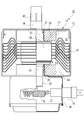
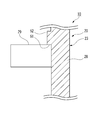
- Sectional drawing of the magnetron of the microwave utilization apparatus of one Embodiment which concerns on this invention Sectional drawing of the core tube of the magnetron of the microwave utilization apparatus of one Embodiment which concerns on this invention Sectional drawing of the attachment part of the anode vane of the magnetron of the microwave utilization apparatus of one Embodiment which concerns on this invention
- a magnetron 10 is used for a microwave-utilizing device, and includes a yoke 12, an A-side magnet 13 and a K-side magnet arranged in the yoke 12. 14 and a cooling circuit 15 formed from a radiator 16 disposed in the yoke 12.
- the magnetron 10 also includes an LC filter circuit 17 formed from a choke coil 18 and a capacitor 19, and a core tube 20.
- the magnetron 10 is a continuous wave magnetron having an oscillation frequency of 2450 MHz.
- the magnetic circuit 11 uses the A side magnet 13 and the K side magnet 14 (see FIG. 2) 21 of the A side magnet 13 and the K side magnetic pole of the K side magnet 14 (see FIG. 2). 2) to form an orthogonal electrostatic magnetic field that is effectively guided to the working space.
- the A-side magnet 13 and the K-side magnet 14 are a permanent magnet system using a ferrite magnet, and are an internal magnetic circuit system.
- the cooling circuit 15 has a function of preventing heat generation as an anode loss of the magnetron 10 and operates the magnetron 10 stably.
- the radiator 16 is attached to the outer periphery of an anode (see FIG. 2) 23 that is an anode cylinder included in the core tube 20, and is forcibly cooled by wind sent by a fan (not shown).
- a choke coil 18 and a capacitor 19 are accommodated in a filter case 24.
- the cathode (see FIG. 2) 25 which is a cathode cylinder included in the core tube 20, is in the working space in the tube, the first lead wire 26 and the There is a possibility of leakage through the two lead wires 27. Therefore, the LC filter circuit 17 prevents unnecessary radio wave leakage.
- the core tube 20 has a plurality of anode vanes 29 arranged radially on the inner wall surface of the anode body 28 of the anode 23.
- the core tube 20 includes a top shell 31 that houses the antenna 30 connected to the anode vane 29, and a cathode 25 that is connected to the anode 23 on the side opposite to the top shell 31.
- the core tube 20 is supported by the cathode 25 to hold the filament coil 32 at the center of each anode vane 29, and the second lead 27 is supported by the cathode 25 and connected to the anode 23.
- the core tube 20 penetrates the insulating member 33 that seals the opposite side of the cathode 25 to the anode 23, and the first connecting terminal 34 and the second connecting terminal 33 connected to the first lead wire 26. And a second connection terminal 35 connected to the lead wire 27.
- the core tube 20 includes an exhaust pipe 36 having electrical conductivity that penetrates the insulating member 33.
- the top shell 31 includes an A side tube 37, an insulating ring 38, an exhaust pipe 39, a first A choke 40, and a second A choke 41.
- the top shell 31 is combined with the anode 23 to emit high frequency energy to the outside through the antenna 30. Further, high frequency noise is suppressed by the first A choke 40 and the second A choke 41.
- the top shell 31 is evacuated (gas discharged) by sealing and is covered with the antenna tube 42 after chip-off.
- the anode 23 forms an LC circuit by arranging anode vanes 29 radially at equal intervals.
- the anode 23 has an anode vane 29 connected to every other one by a large pressure equalizing ring 43 and a small pressure equalizing ring 44, and an A side magnetic pole 21 is attached to the upper part, and a K side magnetic pole 22 is attached to the lower part.
- the anode vane 29 must maintain the same potential for the anode 23 in order for the magnetron 10 to oscillate stably.
- the anode 23 has the same potential in terms of direct current and is integrated, but is a cavity resonator divided into ten in terms of high frequency.
- An antenna 30 for guiding high frequency energy to the outside is joined to one anode vane 29 by brazing.
- the A-side magnetic pole 21 and the K-side magnetic pole 22 have a function of effectively guiding the magnetic field into a working space that is a space between the inner surface of the anode vane 29 and the outer diameter of the filament coil 32 of the cathode 25.
- a first lead wire 26 and a second lead wire 27 are accommodated via a support plate 46 in a K-side side tube 45 connected to the anode 23.
- An A-side end hat 47 that supports the upper end portion of the filament coil 32 and a K-side end hat 48 that supports the lower end portion of the filament coil 32 are attached to the first lead wire 26.
- the first lead wire 26 is inserted below the insulating member 33 through one lead wire insertion hole 49 provided in the insulating member 33, and the second lead wire 27 is insulated through the other lead wire insertion hole 50 provided in the insulating member 33. It is inserted below the member 33.
- the anode 23 has a step 51 that is a positioning portion for positioning the plurality of anode vanes 29 on the inner wall surface of the anode body 28.
- the anode body 28 includes a protrusion 52 continuous in the circumferential direction of its inner wall surface, and the step 51 is a surface orthogonal to the axis of the anode body 28 of the anode 23 in the protrusion 52.
- the upper and lower inner diameters of the anode 23 are made equal across the protrusion 52, and the A-side magnetic pole 21 and the K-side magnetic pole 22 can be shared.
- the anode vane 29 In attaching the anode vane 29, the anode vane 29 is pushed from the lower side of the axis of the anode main body 28 toward the protrusion 52 and proceeds.
- the anode vane 29 is positioned by the step 51 of the anode body 28 and brazed to the anode body 28.
- the posture of the anode vane does not become unstable until the brazing of the anode vane is completed, unlike the conventional one. Therefore, the positional accuracy of the anode vane 29 can be stabilized.
- anode vane 29 is mechanically fixed to the step 51 by being pushed from the lower side of the axis of the anode main body 28 toward the protrusion 52, and thus the position of the anode vane 29 is not aligned. There is nothing. Therefore, variation in oscillation efficiency does not increase and noise does not occur.
- the anode vane 29 is positioned at a predetermined position by the positioning unit. Therefore, according to the magnetron 10 and the microwave utilization apparatus of one embodiment, it is not necessary to perform a complicated brazing process unlike the conventional one, and the attitude of the anode vane 29 until the brazing is completed. Does not become unstable. Therefore, according to the magnetron 10 and the microwave utilization device of the embodiment, the positional accuracy of the anode vane 29 can be stabilized.
- the anode body 28 can be easily formed by a minimum change to the conventional anode body 28. .
- the anode vane 29 is pushed toward the projecting portion 52 from below the axis of the anode body 28, thereby causing a step in the anode body 28. 51 is fixed mechanically. Therefore, according to the magnetron 10 and the microwave utilization device of the embodiment, since the position of the anode vane 29 does not become uniform, variation in oscillation efficiency does not increase and noise is not generated. Can be improved.
- the yoke, radiator, LC filter circuit and the like are not limited to the above-described embodiment, and appropriate modifications and improvements can be made.
- the position accuracy of the anode vane can be stabilized and the quality can be improved.
Landscapes
- Microwave Tubes (AREA)
Abstract
La présente invention concerne un magnétron (10), comprenant : un cylindre d'anode (23), dans lequel une pluralité d'ailettes d'anode (29) est disposée sous forme radiale sur une surface de paroi intérieure ; une coque supérieure (31), qui est connectée au cylindre d'anode (23), et qui loge une antenne (30) connectée aux ailettes d'anode (29) ; un cylindre de cathode (25), sur le côté du cylindre d'anode (23) opposé à la coque supérieure (31) ; et des parties de positionnement (51), qui positionnent chacune des ailettes d'anode (29) disposées sur la surface intérieure du cylindre d'anode (23).
Applications Claiming Priority (2)
| Application Number | Priority Date | Filing Date | Title |
|---|---|---|---|
| JP2011053204A JP2012190649A (ja) | 2011-03-10 | 2011-03-10 | マグネトロンおよびマイクロ波利用機器 |
| JP2011-053204 | 2011-03-10 |
Publications (1)
| Publication Number | Publication Date |
|---|---|
| WO2012120902A1 true WO2012120902A1 (fr) | 2012-09-13 |
Family
ID=46797873
Family Applications (1)
| Application Number | Title | Priority Date | Filing Date |
|---|---|---|---|
| PCT/JP2012/001656 Ceased WO2012120902A1 (fr) | 2011-03-10 | 2012-03-09 | Magnétron, et dispositif utilisant des micro-ondes |
Country Status (2)
| Country | Link |
|---|---|
| JP (1) | JP2012190649A (fr) |
| WO (1) | WO2012120902A1 (fr) |
Cited By (1)
| Publication number | Priority date | Publication date | Assignee | Title |
|---|---|---|---|---|
| CN115954247A (zh) * | 2023-01-13 | 2023-04-11 | 中山市美格电子科技有限公司 | 一种阳极组件的安装结构 |
Citations (5)
| Publication number | Priority date | Publication date | Assignee | Title |
|---|---|---|---|---|
| JPS6261243A (ja) * | 1985-09-09 | 1987-03-17 | Toshiba Corp | マグネトロンの陽極構体およびその製造方法 |
| JPS63143721A (ja) * | 1986-12-04 | 1988-06-16 | Toshiba Corp | マグネトロン陽極の製造方法 |
| JPS63226850A (ja) * | 1987-03-16 | 1988-09-21 | Matsushita Electric Ind Co Ltd | マグネトロン |
| JPH01251540A (ja) * | 1988-03-31 | 1989-10-06 | Toshiba Corp | 電子レンジ用マグネトロン |
| JP2001060440A (ja) * | 1999-08-20 | 2001-03-06 | Sanyo Electric Co Ltd | マグネトロン |
-
2011
- 2011-03-10 JP JP2011053204A patent/JP2012190649A/ja active Pending
-
2012
- 2012-03-09 WO PCT/JP2012/001656 patent/WO2012120902A1/fr not_active Ceased
Patent Citations (5)
| Publication number | Priority date | Publication date | Assignee | Title |
|---|---|---|---|---|
| JPS6261243A (ja) * | 1985-09-09 | 1987-03-17 | Toshiba Corp | マグネトロンの陽極構体およびその製造方法 |
| JPS63143721A (ja) * | 1986-12-04 | 1988-06-16 | Toshiba Corp | マグネトロン陽極の製造方法 |
| JPS63226850A (ja) * | 1987-03-16 | 1988-09-21 | Matsushita Electric Ind Co Ltd | マグネトロン |
| JPH01251540A (ja) * | 1988-03-31 | 1989-10-06 | Toshiba Corp | 電子レンジ用マグネトロン |
| JP2001060440A (ja) * | 1999-08-20 | 2001-03-06 | Sanyo Electric Co Ltd | マグネトロン |
Cited By (1)
| Publication number | Priority date | Publication date | Assignee | Title |
|---|---|---|---|---|
| CN115954247A (zh) * | 2023-01-13 | 2023-04-11 | 中山市美格电子科技有限公司 | 一种阳极组件的安装结构 |
Also Published As
| Publication number | Publication date |
|---|---|
| JP2012190649A (ja) | 2012-10-04 |
Similar Documents
| Publication | Publication Date | Title |
|---|---|---|
| KR101974742B1 (ko) | 마그네트론 | |
| US9035551B2 (en) | Coaxial magnetron | |
| KR100498564B1 (ko) | 마그네트론장치 | |
| WO2012120902A1 (fr) | Magnétron, et dispositif utilisant des micro-ondes | |
| JP2012190650A (ja) | マグネトロンおよびマイクロ波利用機器 | |
| CN101409199A (zh) | 具有散热片限位结构的磁控管 | |
| JP2009081018A (ja) | マグネトロン、マグネトロンの製造装置およびマグネトロンの製造方法 | |
| JP2015056348A (ja) | ヘリックス型進行波管およびヘリックス型進行波管の製造方法 | |
| JP2011192459A (ja) | マグネトロン及びマイクロ波利用機器 | |
| KR20070068924A (ko) | 마그네트론의 초크필터 | |
| CN115836376B (zh) | 磁控管 | |
| JP2677962B2 (ja) | マグネトロン | |
| JPWO2019009173A1 (ja) | マグネトロンとこれを備えたマイクロ波加熱装置 | |
| CN103715042A (zh) | 磁控管和微波利用设备 | |
| KR101151128B1 (ko) | 마그네트론 | |
| KR101076934B1 (ko) | 마그네트론 | |
| JP2015065115A (ja) | マグネトロン | |
| JP6762827B2 (ja) | マグネトロン及びその製造方法 | |
| CN102820193B (zh) | 磁控管的阴极部结构 | |
| JP2015065111A (ja) | マグネトロン | |
| KR100346421B1 (ko) | 마그네트론 | |
| JP2016071999A (ja) | マグネトロン | |
| KR100871122B1 (ko) | 마그네트론의 안테나 | |
| JP2006324029A (ja) | マグネトロン | |
| JP6356992B2 (ja) | チョークコイル及びマグネトロン |
Legal Events
| Date | Code | Title | Description |
|---|---|---|---|
| 121 | Ep: the epo has been informed by wipo that ep was designated in this application |
Ref document number: 12754900 Country of ref document: EP Kind code of ref document: A1 |
|
| NENP | Non-entry into the national phase |
Ref country code: DE |
|
| 122 | Ep: pct application non-entry in european phase |
Ref document number: 12754900 Country of ref document: EP Kind code of ref document: A1 |