WO2012120905A1 - Structure organométallique réticulée, matériau organique réticulé et leurs procédés de production - Google Patents
Structure organométallique réticulée, matériau organique réticulé et leurs procédés de production Download PDFInfo
- Publication number
- WO2012120905A1 WO2012120905A1 PCT/JP2012/001659 JP2012001659W WO2012120905A1 WO 2012120905 A1 WO2012120905 A1 WO 2012120905A1 JP 2012001659 W JP2012001659 W JP 2012001659W WO 2012120905 A1 WO2012120905 A1 WO 2012120905A1
- Authority
- WO
- WIPO (PCT)
- Prior art keywords
- organic
- metal
- mof
- crosslinked
- organic structure
- Prior art date
- Legal status (The legal status is an assumption and is not a legal conclusion. Google has not performed a legal analysis and makes no representation as to the accuracy of the status listed.)
- Ceased
Links
- 0 *Cc1cc(-c(cc2)ccc2C(O)=O)c(C*)cc1-c(cc1)ccc1C(O)=O Chemical compound *Cc1cc(-c(cc2)ccc2C(O)=O)c(C*)cc1-c(cc1)ccc1C(O)=O 0.000 description 1
Images






Classifications
-
- C—CHEMISTRY; METALLURGY
- C07—ORGANIC CHEMISTRY
- C07D—HETEROCYCLIC COMPOUNDS
- C07D249/00—Heterocyclic compounds containing five-membered rings having three nitrogen atoms as the only ring hetero atoms
- C07D249/02—Heterocyclic compounds containing five-membered rings having three nitrogen atoms as the only ring hetero atoms not condensed with other rings
- C07D249/04—1,2,3-Triazoles; Hydrogenated 1,2,3-triazoles
-
- C—CHEMISTRY; METALLURGY
- C07—ORGANIC CHEMISTRY
- C07F—ACYCLIC, CARBOCYCLIC OR HETEROCYCLIC COMPOUNDS CONTAINING ELEMENTS OTHER THAN CARBON, HYDROGEN, HALOGEN, OXYGEN, NITROGEN, SULFUR, SELENIUM OR TELLURIUM
- C07F1/00—Compounds containing elements of Groups 1 or 11 of the Periodic Table
- C07F1/06—Potassium compounds
-
- C—CHEMISTRY; METALLURGY
- C07—ORGANIC CHEMISTRY
- C07F—ACYCLIC, CARBOCYCLIC OR HETEROCYCLIC COMPOUNDS CONTAINING ELEMENTS OTHER THAN CARBON, HYDROGEN, HALOGEN, OXYGEN, NITROGEN, SULFUR, SELENIUM OR TELLURIUM
- C07F3/00—Compounds containing elements of Groups 2 or 12 of the Periodic Table
- C07F3/06—Zinc compounds
Definitions
- the present invention relates to a crosslinked metal organic structure and a novel covalent organic structure.
- Covalent organic structures (COF: Covalent-Organic® Framework) and metal organic structures (MOF: Metal-Organic® Framework) are known as organic porous materials with organic skeletons and nano-order pores. ing.
- a covalent organic structure is a structure in which rigid organic molecules are accumulated by covalent bonds.
- the metal organic structure is a structure in which organic ligands are accumulated by coordination bonds with metal ions.
- Non-Patent Document 1 It has been reported that metal organic structures and covalent organic structures have gas storage properties (see Non-Patent Document 1) or catalytic properties (see Non-Patent Document 2). ing. To enhance such properties, the interaction between the structure and its guest molecule is important. In view of this, a contrivance has been proposed to increase the interaction between the structure and its guest molecule by introducing a specific functional group or structure into the organic molecule of the structure.
- Non-Patent Document 3 an amino group introduced into the skeleton of a covalent organic structure and an isocyanate derivative are reacted (see Non-Patent Document 3), or an acetylene derivative is reacted with an azide group introduced into the skeleton of a metal organic structure. (See Non-Patent Document 4), a method for post-modifying the structure has been proposed.
- the inventor of the present invention focused on producing a network polymer using a metal organic structure as a template. That is, the organic ligands of the metal organic structure are cross-linked to obtain a cross-linked metal organic structure; and subsequently, metal ions are extracted from the cross-linked metal organic structure to obtain a metal organic structure (MOF). )
- MOF metal organic structure
- both the metal organic structure and the covalently bonded organic structure have a problem that they decompose in an acidic solvent and dissolve themselves or lose organic porosity.
- the skeleton of the metal organic structure is cross-linked by a covalent bond (chemical reaction), so that the material does not decompose even in various solvents.
- the present inventor has found that an organic cross-linked product prepared by extracting metal ions from a cross-linked metal organic structure is regenerated into a cross-linked metal organic structure by adsorbing metal ions. That is, the present invention provides a new metal ion adsorbent.
- the first of the present invention relates to a method for producing a crosslinked metal organic structure and an organic crosslinked product shown below.
- Step A for preparing a metal organic structure containing an organic ligand and a metal ion linking the organic ligand; and cross-linking the ligand with a cross-linking agent;
- a step B for producing a cross-linked metal organic structure.
- a method for producing an organic structure wherein the organic ligand has a functional group, and the crosslinking agent has two or more functional groups that can react with the functional group to form a covalent bond.
- a method of producing a crosslinked organic material comprising: a step B; and a step C of removing a part or all of the metal ions from the crosslinked metal-organic structure.
- the second of the present invention relates to the following cross-linked metal organic structure and covalent organic structure.
- a crosslinked metal organic structure comprising an organic ligand, a metal ion that links the organic ligand, and a crosslinking group that bridges the organic ligand.
- An organic crosslinked product obtained by removing a part or all of the metal ions from the crosslinked metal-organic structure according to [4].
- the cross-linked organic material according to [5] wherein the cross-linked organic material can become the cross-linked metal organic structure by adsorbing metal ions.
- a new design policy of a covalently bonded organic structure is provided, and a covalently bonded organic structure having an unprecedented structure can be provided. Furthermore, since the crosslinked organic substance provided by the present invention has a metal ion adsorption ability, it can be applied to a metal recovery raw material.
- FIG. 5A shows an optical micrograph before immersion (left side) and an optical micrograph after immersion (right side) of sample No. 5 in Table 1;
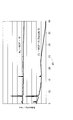
- FIG. 6 is a chart showing ATR-IR spectra of metal organic structure N 3 -MOF-15, cross-linked metal organic structure CL-MOF-15, and organic cross-linked substance PG-MOF-15.
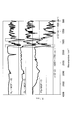
- FIG. 5 is a chart showing XPS spectra of a metal organic structure IR-MOF-9, a crosslinkable metal organic structure CL-MOF-15, and an organic crosslinker PG-MOF-15 that are not reacted with a crosslinking agent.
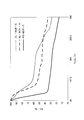
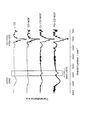
- thermogravimetric analysis (TGA) test of the metal organic structure N 3 -MOF-15, the cross-linked metal organic structure CL-MOF-15, and the organic cross-linked product PG-MOF-15 not reacted with the cross-linking agent is shown. It is a graph. ATR-IR of metal organic structure N 3 -MOF-15, cross-linked metal organic structure CL-MOF-15, organic cross-linked body PG-MOF-15 and regenerated cross-linked metal organic structure ReCL-MOF-15 It is a chart figure showing a spectrum. The state in which the cross-linked metal organic structure CL-CD-MOF is changed to the organic cross-linked product PG-CD-MOF in a solvent is observed with an optical microscope.
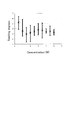
- FIG. 5 is a graph showing the degree of swelling of the organic crosslinked product PG-CD-MOF.
- the horizontal axis represents the concentration of the crosslinking agent L1, and the vertical axis represents the degree of swelling.
- FIG. 4 is a chart showing FT-IR spectra of metal organic structure CD-MOF, cross-linked metal organic structure CL-CD-MOF, and organic cross-linked product PG-CD-MOF.
- 2 is a scanning electron microscope image of metal organic structure CD-MOF, cross-linked metal organic structure CL-CD-MOF, and organic cross-linked product PG-CD-MOF.
- A (b) CD-MOF, (c) (d) CL-CD-MOF, (e) (f) PG-CD-MOF.
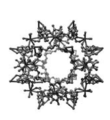
- a ball-and-stick model of CD-MOF (referred to as ( ⁇ -CD) 6) in which 6 molecules of ⁇ -CD are associated.
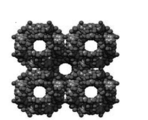
- a space-filling model of CD-MOF in which a plurality of ( ⁇ -CD) 6 are associated in a body-centered cubic lattice structure.
- a metal organic structure 30 can be obtained by reacting an organic ligand 10 and a metal ion 20.
- the organic ligand 10 has a functional group 11 having reactivity with a crosslinking agent 40 described later.
- the crosslinkable metal organic structure 50 is obtained by reacting the crosslinker 40 with the functional group 11 of the metal organic structure 30.
- the organic crosslinked body 60 is a covalent organic structure reflecting the structure of the crosslinked metal organic structure 50. Therefore, when the metal ion 20 is provided to the organic crosslinked body 60, the metal ion 20 is taken in and regenerated into the crosslinked metal organic structure 50.
- the metal organic structure 30, the cross-linked metal organic structure 50, and the organic cross-linked body 60 will be described in this order.
- the metal organic structure 30 is obtained by reacting the organic ligand 10 and the metal ion 20.
- Organic ligand 10 has a molecular structure called “rigid molecule”.
- a rigid molecule is a molecule in which rotation and bending within the molecule are restricted, and examples thereof include a cyclic molecule, an aromatic ring, or a rod-like molecule in which aromatic rings are connected.
- Examples of cyclic molecules include cyclodextrins.
- Examples of the aromatic ring include phenylene, naphthylene, anthracenylene, pentacene, porphyrin, carborane, thiophene, pyridine, C60 and the like.
- a rigid molecule is obtained by connecting one or more of these aromatic rings.
- a rigid molecule has a phenylene structure, a diphenylene structure in which two phenylenes are linked, and a terphenylene structure in which three phenylene groups are linked.
- the organic ligand 10 has two or more functional groups (coordinating functional groups) that can coordinate to metal atoms.
- functional groups that can be coordinated to a metal atom include a carboxyl group, a pyridinyl group, an amino group, a porphyrinyl group, an acetylacetonate group, a hydroxyl group, a Schiff base, an amino acid residue, and the like.
- the organic ligand 10 has a functional group 11 having reactivity with a cross-linking agent 40 described later.
- One functional group 11 may be introduced into the organic ligand 10, or two or more functional groups 11 may be introduced.
- the kind of the functional group 11 is not particularly limited, and may be an azide group, an amino group, a carboxyl group and analogs thereof, a double bond, a triple bond, an isocyanate group, a hydroxyl group, and the like.
- the functional group 11 is an azide group, it can be reacted with the crosslinking agent 40 introduced with an acetylene group; if the functional group 11 is an amino group, it can be reacted with the crosslinking agent 40 introduced with an isocyanate group. it can.
- Examples of the preferred organic ligand 10 include the following compounds.
- the metal ion 20 is, for example, a metal ion of an actinide element or lanthanide element, and is an ion of a metal element belonging to Group 1 to Group 16 of the periodic table.
- Specific examples of the metal ion 20 include Li + , Na + , K + , Rb + , Be 2+ , Mg 2+ , Ca 2+ , Sr 2+ , Ba 2+ , Sc 3+ , Y 3+ , Ti 4+ , Zr 4+ , Hf 4+.
- the organic metal structure 30 is manufactured by, for example, solvothermal reaction of the organic ligand 10 and the metal ion 20 based on a conventional method.
- the solvothermal reaction is usually carried out in the presence of an acid or base, and the solvent and raw materials are charged from room temperature to high temperature (300 degrees), at atmospheric pressure or in a pressure vessel, and the temperature is raised to the boiling point or higher. The inside pressure is higher than atmospheric pressure.
- N, N-diethylformamide (DEF) or N, N-dimethylformamide (DMF) is used as a solvent in the solvothermal reaction. This is because they decompose slowly at high temperatures to form amine bases slowly.
- the conditions for the solvothermal reaction are appropriately set.
- the metal organic structure 30 preferably has a crystal structure.
- the metal organic structure 30 is a porous material having nano-order pores. The size of the pores is controlled by the length of the organic ligand 10 (distance between coordination functional groups) and the like.
- the crosslinkable metal organic structure 50 is obtained by reacting the metal organic structure 30 and the crosslinker 40.
- the cross-linking agent 40 has two or more groups that react with the functional group 11 introduced into the organic ligand 10 of the metal organic structure 30.
- the crosslinking agent may be a divalent crosslinking agent or a trivalent or higher crosslinking agent.
- Specific examples of the crosslinking agent 40 when the functional group 11 is an azide group include the following compounds.
- the design of the crosslinking agent 40 is performed in consideration of the distance between the functional groups 11 in the metal organic structure 30.
- the reaction between the metal organic structure 30 and the crosslinking agent 40 is not particularly limited, but is preferably performed under mild conditions. That is, the reaction with the crosslinking agent 40 is completed while maintaining the crystal structure of the metal organic structure 30.
- the organic cross-linked body 60 is obtained by removing the metal ions 20 from the cross-linked metal organic structure 50.
- the removal of the metal ion 20 is realized by cutting the coordination bond between the coordination functional group of the organic ligand 10 and the metal ion 20.
- the coordination functional group of the organic ligand 10 is a carboxyl group
- the metal ion 20 is dissociated by immersing the cross-linked metal organic structure 50 in a protonated solvent, and the porosity is utilized. It can be removed by washing.
- a basic solvent may be used in place of the protonated solvent.
- the proton source of the protonation solvent may be hydrochloric acid, nitric acid or the like.
- the solvent for the protonated solvent is preferably a mixed solvent of water and an organic solvent. This is because the organic solvent is preferably a good solvent for the crosslinkable metal organic structure 50, whereby the protonated solvent easily penetrates into the crosslinkable metal organic structure 50 and promotes the cleavage of the coordination bond. .
- the organic cross-linked body 60 can regenerate the cross-linked metal organic structure 50 by adsorbing the metal ions 20.
- the regenerated crosslinkable metal organic structure 50 is not necessarily the same structure, and crystallinity may be changed.
- the metal ions 20 to be adsorbed are not necessarily the same ions as the removed metal ions 20 and may be other metal ions.
- the cross-linked metal organic structure and organic cross-linked product thus produced have voids inside as well as the metal organic structure, and therefore adsorbents of specific molecules other than metal ions in gases and liquids. Can also be used.
- Toluene was added to the residue obtained by evaporating the solvent under reduced pressure, washed with a saturated aqueous sodium chloride solution, and then dried over anhydrous sodium sulfate. After the solvent was distilled off under reduced pressure, the residue was purified by column chromatography (silica gel, chloroform) to obtain a yellowish white solid.
- FIG. 2 shows an ATR-IR spectrum of the metal organic structure N 3 -MOF-15 and an ATR-IR spectrum of sample No. 5 in Table 1. As shown in FIG. 2, in sample No. 5, it can be seen that the peak at 2090 cm ⁇ 1 has disappeared.
- FIG. 3 shows an optical micrograph of the metal organic structure N 3 -MOF-15 and an optical micrograph of sample No. 5 in Table 1.
- Sample No. 5 is also a cubic yellow crystal similar to the metal organic structure N 3 -MOF-15.
- FIG. 4 shows the XRPD pattern of the metal organic structure N 3 -MOF-15 and the XRPD pattern of sample No. 5 in Table 1.
- any XRPD pattern since the peaks are coincident, it can be understood that the crosslinking reaction has progressed while maintaining the crystal structure.
- FIG. 5A shows an optical micrograph before immersion (left side) and an optical micrograph after immersion (right side) of sample No. 5 in Table 1. As shown in FIG. 5A, it can be seen that the volume is increased by about 4.34 times due to swelling by immersion.
- FIG. 5B shows an optical micrograph before immersion (left side) and an optical micrograph after immersion (right side) of sample No. 7 in Table 1. As shown in FIG. 5B, it can be seen that the volume is increased by about 2.37 times due to swelling by immersion.
- the swelling ratios of No5, No7 and No8 are shown in the following table. As shown in Table 2, it was suggested that the higher the concentration of the crosslinking agent during the crosslinking reaction, the higher the swelling ratio (Comparison between No5 and No7 to No8). When the concentration of the crosslinking agent is too high, it is considered that the crosslinking rate is lowered because the ligands of the metal structure cannot be crosslinked by the crosslinking agent.
- FIG. 6 shows a metal organic structure not reacted with a crosslinking agent (reference sample; metal organic structure composed of 4,4′-biphenyldicarboxylic acid and zinc ions), and a crosslinked metal organic structure CL-MOF-15.
- 2 shows an ATR-IR spectrum of the organic crosslinked product PG-MOF-15.
- a peak around 1390 to 1400 cm ⁇ 1 observed with the metal organic structure N 3 -MOF-15 and the crosslinked metal organic structure CL-MOF-15 C—O It can be seen that (surface deflection) has disappeared.
- FIG. 7 shows a metal organic structure IR-MOF-9 that is not reacted with a crosslinking agent (a metal organic structure synthesized by using a dicarboxylic acid having a biphenyl group as a linker and zinc ions as metal ions), a crosslinked type 2 shows XPS spectra of metal-organic structure CL-MOF-15 and organic crosslinked product PG-MOF-15.
- the XPS spectrum was observed by using a sample substrate cast / dried on an indium substrate as a measurement substrate. As shown in FIG.
- FIG. 8 shows guests of the metal organic structure N 3 -MOF-15, the cross-linked metal organic structure CL-MOF-15, and the organic cross-linked product PG-MOF-15 that were not reacted with the cross-linking agent (diethyl as a solvent).
- the results of a thermogravimetric analysis (TGA) test to evaluate the inclusion ability of formamide DEF) are shown.
- the thermogravimetric analysis (TGA) test was performed under the conditions of a sample amount of about 5 mg, a measurement temperature region of 30 to 500 ° C., a temperature rising rate of 3.0 ° C./min, and a nitrogen gas flow rate of 200 ml / min.
- the first mass decrease occurs rapidly from 30 ° C. to 150 ° C .; the second mass decrease occurs near 200 ° C .; from 380 ° C. to 450 ° C.
- a third mass loss has occurred.
- the first decrease in mass appears to be caused by the removal of the guest solvent diethylformamide.
- the second mass loss is believed to be due to the decomposition of the azido group.
- the third mass loss is believed to be due to the decomposition of the structural skeleton itself.
- the second mass reduction (around 200 ° C.) is not observed. This is probably because the crosslinked metal organic structure CL-MOF-15 has no azide group. Further, the first mass decrease in the mass curve of the cross-linked metal organic structure CL-MOF-15 is less than the first mass decrease in the mass curve of the metal organic structure N 3 -MOF-15. This is presumably because the volume of pores in the cross-linked metal organic structure CL-MOF-15 is reduced by cross-linking.
- Regeneration from crosslinked organic material PG-MOF-15 to crosslinked metal organic structure CL-MOF-15 Re-coordination of zinc ions to crosslinked organic material PG-MOF-15 from which metal ions (zinc ions) have been removed Thus, it was regenerated into a cross-linked metal organic structure CL-MOF-15.
- the regenerated crosslinked organic metal structure is called ReCL-MOF-15.
- the metal was re-coordinated under the conditions shown in Table 3. Specifically, for example, in No. 2 in the table below, the organic crosslinked product PG-MOF-15 was infiltrated into a 0.25 mM zinc nitrate hexahydrate / DEF solution and allowed to stand at 80 ° C. for 36 hours.
- FIG. 9 shows metal organic structure N 3 -MOF-15, cross-linked metal organic structure CL-MOF-15, organic cross-linked body PG-MOF-15, and regenerated cross-linked metal organic structure ReCL-MOF- 15 ATR-IR spectra are shown.
- Example 2 Synthesis of metal organic structure CD-MOF ([(C 48 H 80 O 40 ) (KOH) 2 ] n.) ⁇ -cyclodextrin ( ⁇ -CD) represented by the following structural formula is the smallest structural unit, A CD-MOF having a structure in which ⁇ -CD is regularly and three-dimensionally associated by a coordinate bond between a hydroxyl group of ⁇ -CD and a potassium ion was synthesized.
- the composition formula of CD-MOF is represented by [(C 48 H 80 O 40 ) (KOH) 2 ] n. Specifically, it was synthesized according to the method described in Angew. Chem. Int. Ed. 2010, 49, 8630.
- FIG. 14 shows a ball-and-stick model of CD-MOF (referred to as ( ⁇ -CD) 6) in which six molecules of ⁇ -CD are associated, and CD in which a plurality of ( ⁇ -CD) 6 are associated in a body-centered cubic lattice structure
- ⁇ -CD CD-MOF
- metal organic structure CD-MOF 20 mg is taken in a sample of the synthesis of cross-linked metal organic structure CL-CD-MOF, and ethylene glycol diglycidyl ether (crosslinking agent L1) / ethanol solution at a concentration of 1.5 to 5.0 M And allowed to stand at 65 ° C. for 3 days to carry out an internal crosslinking reaction to obtain a crosslinked metal organic structure CL-CD-MOF as transparent crystals.
- FIG. 10 shows a state in which the cross-linked metal organic structure CL-CD-MOF is changed to the organic cross-linked product PG-CD-MOF in a solvent, as observed with an optical microscope. The shape did not change, only the size changed due to swelling.
- FIG. 11 shows the degree of swelling of the organic crosslinked product PG-CD-MOF obtained by carrying out an internal crosslinking reaction in various concentration regions of the crosslinking agent L1 and removing the coordination of potassium ions.
- L PG-CD-MOF represents the length of one side of the crystal of the organic crosslinked product PG-CD-MOF
- L CL-CD-MOF represents the length of one side of the crosslinked metal-organic structure CL-CD-MOF.
- the concentration of the crosslinking agent L1 is 1.5 to 2.0M
- the degree of swelling is the lowest, indicating that the crosslinking reaction proceeds at the highest density. Thereafter, the experiment was conducted with the concentration of the cross-linking agent L1 unified at 1.5M.
- FIG. 12 shows the result of measuring the FT-IR spectrum of the cross-linked metal organic structure CL-CD-MOF produced by the cross-linking agent L1.
- the stretching intensity of C—O—C derived from ⁇ -CD (1150-1120 cm-1) is broad, and the peak intensity derived from the methylene chain due to modification of the crosslinking agent L1 (2920-2850 cm-1) was confirmed to increase. From this, it is thought that the crosslinking agent L1 is reacting as expected.
- the metal organic structure CD-MOF which is a crystal has a cubic shape
- the crosslinked metal organic structure CL-CD-MOF which is a product of the crosslinking reaction and the organic compound crosslinked body PG-CD-MOF after hydrolysis Both of them were found to maintain the form of the metal organic structure CD-MOF.
- the dried sample In addition to the sample swollen with the solvent, the dried sample also had a structure with linear sides and vertices derived from the crystals from which the organic crosslinked product PG-CD-MOF was derived.
- a new design policy of a covalently bonded organic structure is provided, and a covalently bonded organic structure having an unprecedented structure can be provided. Furthermore, since the organic cross-linked product provided by the present invention has a metal ion adsorption ability, it can be applied to a metal recovery raw material such as metal ions or a sustained release system of a drug.
Landscapes
- Chemical & Material Sciences (AREA)
- Organic Chemistry (AREA)
Abstract
La présente invention concerne un procédé de production d'un matériau organique réticulé inédit, fondé sur l'idée consistant à produire une structure organique à liaisons covalentes dont la structure reflète celle d'une structure organométallique. L'invention concerne, plus précisément, un procédé de production d'un matériau organique réticulé comprenant une étape (A) consistant à préparer une structure organométallique comprenant des ligands organiques et des ions métalliques reliant lesdits ligands organiques; une étape (B) consistant à réticuler les ligands au moyen d'un agent de réticulation afin de produire une structure organométallique réticulée; et une étape (C) consistant à éliminer au moins certains des ions métalliques de ladite structure organométallique réticulée.
Applications Claiming Priority (2)
| Application Number | Priority Date | Filing Date | Title |
|---|---|---|---|
| JP2011051649 | 2011-03-09 | ||
| JP2011-051649 | 2011-03-09 |
Publications (1)
| Publication Number | Publication Date |
|---|---|
| WO2012120905A1 true WO2012120905A1 (fr) | 2012-09-13 |
Family
ID=46797876
Family Applications (1)
| Application Number | Title | Priority Date | Filing Date |
|---|---|---|---|
| PCT/JP2012/001659 Ceased WO2012120905A1 (fr) | 2011-03-09 | 2012-03-09 | Structure organométallique réticulée, matériau organique réticulé et leurs procédés de production |
Country Status (1)
| Country | Link |
|---|---|
| WO (1) | WO2012120905A1 (fr) |
Citations (4)
| Publication number | Priority date | Publication date | Assignee | Title |
|---|---|---|---|---|
| JPS5513796A (en) * | 1978-07-13 | 1980-01-30 | Chinoin Gyogyszer Es Vegyeszet | Cyclodextrinnpolyvinyl alcohol*polymer and process for polymerizing same in form of particles*fibers*block or film |
| JPS5757701A (en) * | 1980-08-07 | 1982-04-07 | Chinoin Gyogyszer Es Vegyeszet | Cellulose derivative and manufacture |
| WO2006012569A1 (fr) * | 2004-07-22 | 2006-02-02 | The Scripps Research Institute | Materiaux polymeres obtenus par 'click chemistry' |
| JP2011213743A (ja) * | 2010-03-31 | 2011-10-27 | Aomori Prefectural Industrial Technology Research Center | 粒状シクロデキストリンポリマーおよびその製造方法 |
-
2012
- 2012-03-09 WO PCT/JP2012/001659 patent/WO2012120905A1/fr not_active Ceased
Patent Citations (4)
| Publication number | Priority date | Publication date | Assignee | Title |
|---|---|---|---|---|
| JPS5513796A (en) * | 1978-07-13 | 1980-01-30 | Chinoin Gyogyszer Es Vegyeszet | Cyclodextrinnpolyvinyl alcohol*polymer and process for polymerizing same in form of particles*fibers*block or film |
| JPS5757701A (en) * | 1980-08-07 | 1982-04-07 | Chinoin Gyogyszer Es Vegyeszet | Cellulose derivative and manufacture |
| WO2006012569A1 (fr) * | 2004-07-22 | 2006-02-02 | The Scripps Research Institute | Materiaux polymeres obtenus par 'click chemistry' |
| JP2011213743A (ja) * | 2010-03-31 | 2011-10-27 | Aomori Prefectural Industrial Technology Research Center | 粒状シクロデキストリンポリマーおよびその製造方法 |
Non-Patent Citations (7)
| Title |
|---|
| CHWALEK, M. ET AL.: "Synthesis and biological evaluation of multivalent carbohydrate ligands obtained by click assembly of pseudo-rotaxanes", ORGANIC & BIOMOLECULAR CHEMISTRY, vol. 7, no. 8, 2009, pages 1680 - 8, PAGE 1682 * |
| GOTO, Y. ET AL.: "''Clickable'' Metal-Organic Framework", J. AM. CHEM. SOC., vol. 130, no. 44, 2008, pages 14354 - 5 * |
| KENTA KOKADO ET AL.: "Takosei Haii Ko Bunshi no Jigo Shushoku ni yoru 3 Jigen Network Polymer no Gosei", POLYMER PREPRINTS, JAPAN, vol. 60, no. L, 10 May 2011 (2011-05-10), pages 1PB012 * |
| KOTA SUGIKAWA ET AL.: "Click Chemistry o Riyo shita Haii Ko Bunshi eno Jigo Shushoku Hanno", POLYMER PREPRINTS, JAPAN, vol. 59, no. 2, pages 3R04 * |
| SMALDONE, R.A. ET AL.: "Metal-Organic Frameworks from Edible Natural Products", ANGEW. CHEM. INT. ED., vol. 49, 2010, pages 8630 - 4 * |
| TAKUMI ISHIWATARI ET AL.: "Takosei Haii Ko Bunshi o Igata to shita 3 Jigen Network Polymer no Kochiku", CSJ: THE CHEMICAL SOCIETY OF JAPAN KOEN YOKOSHU, vol. 91, no. 3, 11 March 2011 (2011-03-11), pages 872 * |
| YAO, F. ET AL.: "Sliding-Graft Interpenetrating Polymer Networks from Simultaneous ''Click Chemistry'' and Atom Transfer Radical Polymerization", MACROMOLECULES, vol. 43, no. 23, 2010, WASHINGTON, DC, UNITED STATES, pages 9761 - 70 * |
Similar Documents
| Publication | Publication Date | Title |
|---|---|---|
| JP5496676B2 (ja) | 金属錯体及びその製造方法 | |
| US20100170395A1 (en) | Tetratopic Phenyl Compounds, Related Metal-Organic Framework Materials and Post-Assembly Elaboration | |
| CN107148422A (zh) | 包含微孔金属有机骨架的有序超晶格的介观材料 | |
| JP5787665B2 (ja) | 金属錯体、並びにそれからなる吸着材、吸蔵材及び分離材 | |
| KR20110041381A (ko) | 탈수소화가능한 지지체에 전이금속을 도입한 지지체-전이금속하이드라이드 복합체의 개선된 제조방법 및 그의 중간체 | |
| Patra et al. | Silver nanoparticle-functionalized postsynthetically modified thiol MOF UiO-66-NH-SH for efficient CO2 fixation | |
| CN116075494A (zh) | 碱土金属甲酸盐的制造方法 | |
| JP2010180199A (ja) | 金属錯体及びその製造方法 | |
| JP5725784B2 (ja) | 金属錯体及びそれからなる分離材 | |
| CN115433364B (zh) | 一种氢键有机分子框架材料hof-nbda及其制备方法和应用 | |
| CN116917296A (zh) | 锌金属有机骨架材料的合成方法 | |
| CN108147960A (zh) | 一种功能修饰铝金属有机框架材料及其制备方法 | |
| CN109201113A (zh) | 一种功能化金属有机骨架复合材料及其制备方法 | |
| US8389755B2 (en) | Gas adsorption material, precursor of same, and method of producing gas adsorption material | |
| Wamba et al. | Facile aqueous medium synthesis of highly stable Zr-MOFs with promising CO2/CH4 adsorption selectivity for natural gas and biogas upgradation | |
| JP5437554B2 (ja) | 多孔性金属錯体の製造方法、多孔性金属錯体、吸着材、分離材、ガス吸着材及び水素吸着材 | |
| JP2012520851A (ja) | ギ酸マグネシウムを基礎とする多孔質の有機金属骨格材料を無溶媒で製造する方法 | |
| JP2010180200A (ja) | 金属錯体及びその製造方法 | |
| US20250281899A1 (en) | METAL-ORGANIC FRAMEWORKS BASED ON UiO-66 AND METHOD FOR DIRECT AIR CAPTURE OF CARBON DIOXIDE | |
| CN110283333B (zh) | 一种三维层柱结构双配体锌配合物及其制备方法 | |
| EP2762228A1 (fr) | Matériaux de structure métallo-organique ultraporeuse et leur procédé de production | |
| JP2018126678A (ja) | 選択吸着材料 | |
| JP5292679B2 (ja) | 水素吸蔵材料である多孔性金属錯体の製造方法 | |
| KR20190124478A (ko) | 일산화탄소에 대한 선택적 흡착능을 갖는 일산화탄소 흡착제 및 이의 제조방법 | |
| JP5452074B2 (ja) | 金属錯体及びその製造方法 |
Legal Events
| Date | Code | Title | Description |
|---|---|---|---|
| 121 | Ep: the epo has been informed by wipo that ep was designated in this application |
Ref document number: 12754728 Country of ref document: EP Kind code of ref document: A1 |
|
| NENP | Non-entry into the national phase |
Ref country code: DE |
|
| 122 | Ep: pct application non-entry in european phase |
Ref document number: 12754728 Country of ref document: EP Kind code of ref document: A1 |
|
| NENP | Non-entry into the national phase |
Ref country code: JP |