WO2012124115A1 - 生体情報取得装置、生体情報照合装置、及びプログラム - Google Patents
生体情報取得装置、生体情報照合装置、及びプログラム Download PDFInfo
- Publication number
- WO2012124115A1 WO2012124115A1 PCT/JP2011/056454 JP2011056454W WO2012124115A1 WO 2012124115 A1 WO2012124115 A1 WO 2012124115A1 JP 2011056454 W JP2011056454 W JP 2011056454W WO 2012124115 A1 WO2012124115 A1 WO 2012124115A1
- Authority
- WO
- WIPO (PCT)
- Prior art keywords
- information
- feature
- unit
- encrypted
- feature information
- Prior art date
- Legal status (The legal status is an assumption and is not a legal conclusion. Google has not performed a legal analysis and makes no representation as to the accuracy of the status listed.)
- Ceased
Links
Images












Classifications
-
- G—PHYSICS
- G06—COMPUTING OR CALCULATING; COUNTING
- G06V—IMAGE OR VIDEO RECOGNITION OR UNDERSTANDING
- G06V40/00—Recognition of biometric, human-related or animal-related patterns in image or video data
- G06V40/10—Human or animal bodies, e.g. vehicle occupants or pedestrians; Body parts, e.g. hands
-
- G—PHYSICS
- G06—COMPUTING OR CALCULATING; COUNTING
- G06F—ELECTRIC DIGITAL DATA PROCESSING
- G06F21/00—Security arrangements for protecting computers, components thereof, programs or data against unauthorised activity
- G06F21/30—Authentication, i.e. establishing the identity or authorisation of security principals
- G06F21/31—User authentication
- G06F21/32—User authentication using biometric data, e.g. fingerprints, iris scans or voiceprints
-
- G—PHYSICS
- G06—COMPUTING OR CALCULATING; COUNTING
- G06F—ELECTRIC DIGITAL DATA PROCESSING
- G06F21/00—Security arrangements for protecting computers, components thereof, programs or data against unauthorised activity
- G06F21/60—Protecting data
- G06F21/62—Protecting access to data via a platform, e.g. using keys or access control rules
- G06F21/6218—Protecting access to data via a platform, e.g. using keys or access control rules to a system of files or objects, e.g. local or distributed file system or database
- G06F21/6245—Protecting personal data, e.g. for financial or medical purposes
-
- G—PHYSICS
- G06—COMPUTING OR CALCULATING; COUNTING
- G06V—IMAGE OR VIDEO RECOGNITION OR UNDERSTANDING
- G06V40/00—Recognition of biometric, human-related or animal-related patterns in image or video data
- G06V40/10—Human or animal bodies, e.g. vehicle occupants or pedestrians; Body parts, e.g. hands
- G06V40/12—Fingerprints or palmprints
- G06V40/1365—Matching; Classification
-
- G—PHYSICS
- G06—COMPUTING OR CALCULATING; COUNTING
- G06V—IMAGE OR VIDEO RECOGNITION OR UNDERSTANDING
- G06V40/00—Recognition of biometric, human-related or animal-related patterns in image or video data
- G06V40/10—Human or animal bodies, e.g. vehicle occupants or pedestrians; Body parts, e.g. hands
- G06V40/14—Vascular patterns
-
- G—PHYSICS
- G06—COMPUTING OR CALCULATING; COUNTING
- G06V—IMAGE OR VIDEO RECOGNITION OR UNDERSTANDING
- G06V40/00—Recognition of biometric, human-related or animal-related patterns in image or video data
- G06V40/50—Maintenance of biometric data or enrolment thereof
- G06V40/53—Measures to keep reference information secret, e.g. cancellable biometrics
-
- G—PHYSICS
- G07—CHECKING-DEVICES
- G07C—TIME OR ATTENDANCE REGISTERS; REGISTERING OR INDICATING THE WORKING OF MACHINES; GENERATING RANDOM NUMBERS; VOTING OR LOTTERY APPARATUS; ARRANGEMENTS, SYSTEMS OR APPARATUS FOR CHECKING NOT PROVIDED FOR ELSEWHERE
- G07C2209/00—Indexing scheme relating to groups G07C9/00 - G07C9/38
- G07C2209/12—Comprising means for protecting or securing the privacy of biometric data, e.g. cancellable biometrics
Definitions
- the present invention relates to a biological information acquisition device, a biological information collation device, and a program.
- biometrics authentication using personal biometric information such as fingerprints, faces, veins, irises, etc. as a technology for confirming the identity of a person without human intervention when entering or leaving a facility. It's being used.
- biometric information such as fingerprints, faces, veins, irises, etc.
- biometric information such as fingerprints, faces, veins, irises, etc.
- PIN Personal Identification ⁇ Number
- FIG. 1 shows a configuration example of the personal authentication device
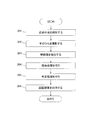
- FIG. 2 is a flowchart showing an example of authentication processing performed by the personal authentication device of FIG. 1 includes an irradiation unit 101, a photographing unit 102, an extraction unit 103, a storage unit 104, a collation unit 105, and a determination unit 106.
- the irradiation unit 101 irradiates near-infrared light on a human body part such as the palm 111 that is easy to image a vein (step 201), and the imaging unit 102 images the intensity distribution of reflected or transmitted light. An image is acquired (step 202).
- the extraction unit 103 performs feature extraction processing to extract a vein image from the image (step 203).
- the storage unit 104 stores vein images of individuals registered in advance. Feature information such as a vein image obtained by photographing at the time of authentication is called collation data, and registered feature information such as a vein image is called registration data or a registration template.
- the collation unit 105 collates the collation data with the registered data (step 204), and the determination unit 106 determines whether or not they match (step 205), and outputs an authentication result 112 (step 206).
- a positive authentication result indicating that the person is registered is output.
- a negative result is output.
- the authentication result is output.
- the similarity between the collation data and the registered data is expressed by a scale called collation distance, and when the collation distance is smaller than a given threshold, it is determined that the two match.
- Registration data is usually stored in a storage device such as a user-owned Integrated Circuit (IC) card or a database of a server, and verification processing is executed by a computer close to the user or a centrally managed server.
- Server-type authentication in which registration data is stored and verified on the server, has advantages in that it can be efficiently used due to the concentration of computer resources, and management of registration data becomes easy and can be used in common at multiple locations.
- biometric information registration data and verification data
- the biometric information of each individual cannot be changed, so the influence at the time of outflow is great.
- encryption technology has been conventionally used to protect biometric information.
- a method is also known in which feature information is extracted after performing predetermined conversion processing on biometric information, and the feature information and registered information are collated. At this time, in order to prevent the deterioration of the authentication accuracy, a method for limiting the conversion processing to line-symmetric conversion and rotation and a method for limiting the matching processing to a special one have been proposed.
- the conventional personal authentication technology described above has the following problems.
- the biometric information is encrypted by the encryption technique, it is necessary to decrypt the biometric information before performing the collation process, so that there is a possibility that the decrypted biometric information may flow out.
- conversion processing is performed on biometric information, authentication accuracy generally deteriorates.
- the type of conversion is limited, and thus biometric information before conversion may be decoded.
- the method of limiting the collation process to a special one cannot be applied to other collation processes.
- Secret calculation technology has a problem of lack of practicality because the calculation amount is enormous except for simple calculations such as summation and maximum value. Since the verification process of personal authentication involves complicated calculations, it is difficult to apply secret calculation technology.
- the biometric information may be decoded based on the detected position correction amount.
- An object of the present invention is to protect biometric information without degrading authentication accuracy in personal authentication using biometric information.
- the biological information acquisition device includes an acquisition unit, an extraction unit, a correction unit, a conversion unit, and a reception unit.
- the acquisition unit acquires biometric information for authentication, and the extraction unit extracts first feature information from the biometric information for authentication.
- the correction unit decrypts the encrypted position correction information to acquire the position correction information, and corrects the first feature information based on the acquired position correction information, whereby the first feature information and the registration biometrics are corrected. Alignment is performed between the second feature information extracted from the information.
- the conversion unit converts the corrected first feature information, and transmits the converted first feature information to the biometric information matching device that stores the converted second feature information.
- the receiving unit receives the result of collating the converted first feature information and the converted second feature information from the biometric information collating device.
- the biometric information verification device includes a generation unit, a transmission unit, a reception unit, a verification unit, and a storage unit.
- the generation unit generates encrypted position correction information
- the transmission unit transmits the encrypted position correction information to the biometric information acquisition apparatus.
- the receiving unit is corrected based on the position correction information in order to perform alignment between the first feature information extracted from the biometric information for authentication and the second feature information extracted from the biometric information for registration. After that, the further converted first feature information is received from the biological information acquisition device.
- the position correction information is acquired by decrypting the encrypted position correction information in the biometric information acquisition apparatus.
- the storage unit stores the converted second feature information.
- the collation unit collates the converted first feature information with the converted second feature information, and transmits the collation result to the biometric information acquisition apparatus.
- biometric information acquisition device or biometric information matching device it is possible to protect the biometric information without degrading the authentication accuracy.
- the alignment process is a process of correcting the positional deviation between the biometric information at the time of registration (biological information for registration) and the biometric information at the time of authentication (biometric information for authentication), and the accuracy of personal authentication using the biometric information is improved.
- This is a necessary process to enhance.
- this alignment process for example, using coordinate conversion including a position correction amount parameter, a parameter value that matches biometric information for registration and biometric information for authentication as much as possible is obtained.
- the coordinate transformation for example, parallel movement or affine transformation is used.
- the alignment process and the collation distance calculation process are separated, the alignment is performed before the biological information is converted, and the collation distance is calculated after the conversion. In this respect, it differs from a technique for performing a collation process in which both are combined after conversion of biological information.
- the alignment process and the collation distance calculation process are referred to as separate computer environments (apparatuses). Thereby, the risk that biometric information is decoded can be reduced.
- the computer environment that performs the alignment process may be referred to as a client
- the computer environment that performs the collation distance calculation process may be referred to as a server.
- FIG. 3 shows a configuration example of the personal authentication system of the embodiment.
- the personal authentication system in FIG. 3 includes a biometric information acquisition apparatus 301 and a biometric information collation apparatus 302.
- the biometric information acquisition apparatus 301 corresponds to, for example, a client
- the biometric information matching apparatus 302 corresponds to, for example, a server.
- the biological information acquisition apparatus 301 includes an acquisition unit 311, an extraction unit 312, a correction unit 313, a conversion unit 314, and a reception unit 315.
- the biometric information collation apparatus 302 includes a generation unit 321, a transmission unit 322, a reception unit 323, a collation unit 324, and a storage unit 325.
- the acquisition unit 311 of the biometric information acquisition apparatus 301 acquires biometric information for authentication, and the extraction unit 312 extracts first feature information from the biometric information for authentication.
- the storage unit 325 of the biometric information matching device 302 stores the converted second feature information.
- the second feature information is feature information extracted from the biometric information for registration.
- the generation unit 321 generates encrypted position correction information, and the transmission unit 322 transmits the encrypted position correction information to the biometric information acquisition apparatus 301.
- the correction unit 313 of the biometric information acquisition apparatus 301 acquires the position correction information by decrypting the encrypted position correction information, and corrects the first feature information based on the acquired position correction information. Alignment between the feature information and the second feature information is performed.
- the conversion unit 314 converts the corrected first feature information, and transmits the converted first feature information to the biometric information matching device 302.
- the receiving unit 323 of the biometric information matching device 302 receives the converted first feature information from the biometric information acquisition device 301.
- the collation unit 324 collates the converted first feature information with the converted second feature information, and transmits the collation result to the biometric information acquisition apparatus 301.
- the receiving unit 315 of the biometric information acquisition apparatus 301 receives the collation result from the biometric information collation apparatus 302. According to such a personal authentication system, it is possible to prevent deterioration in authentication accuracy by performing the alignment process before conversion, and the biometric information is decoded because the alignment process and the collation process are performed by separate devices. Risk of being reduced.
- FIG. 4 shows a configuration example of a client 401 that performs automatic door opening / closing control.
- a client 401 in FIG. 4 corresponds to the biometric information acquisition apparatus 301 in FIG. 3, and includes an irradiation unit 411, an imaging unit 412, an extraction unit 413, a correction unit 414, a conversion unit 415, a storage unit 416, an input unit 417, and a communication unit 418. , An output unit 419, and a control unit 420.
- the irradiation unit 411 and the imaging unit 412 correspond to the acquisition unit 311 in FIG. 3 and are installed near an automatic door, for example.
- the irradiation unit 411 emits near-infrared light
- the imaging unit 412 images the user.
- the extraction unit 413 extracts a vein image from the image
- the correction unit 414 corrects and aligns the vein image at the time of authentication
- the conversion unit 415 converts the vein image.
- the storage unit 416 stores conversion parameters used for conversion.
- the input unit 417 acquires user identification information (ID) input by the user, and the communication unit 418 communicates with the server 501 via the communication path 402.
- the output unit 419 notifies the user of the authentication result, and the control unit 420 performs automatic door opening / closing control based on the authentication result.
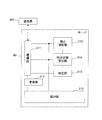
- FIG. 5 shows a configuration example of the server 501 that performs the collation process between the collation data and the registration data.
- a server 501 in FIG. 5 corresponds to the biometric information collating apparatus 302 in FIG. 3, and includes a communication unit 511, a registration unit 512, a storage unit 513, a collation distance calculation unit 514, and a determination unit 515.
- the communication unit 511 communicates with the client 401 via the communication path 402, and the registration unit 512 registers registration data in the storage unit 513.
- the collation distance calculation unit 514 and the determination unit 515 correspond to the collation unit 324 in FIG.
- the collation distance calculation unit 514 calculates the collation distance between the collation data and the registration data, and the determination unit 515 determines whether or not the collation data and the registration data match based on the collation distance.
- FIG. 6 is a flowchart illustrating an example of registration processing performed by the client 401 and the server 501.
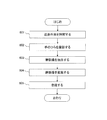
- a user who wishes to register a vein image holds his hand over the irradiation unit 411 and the imaging unit 412 of the client 401.
- the irradiation unit 411 irradiates the palm with near-infrared light (step 601), and the imaging unit 412 captures the palm and acquires an image (step 602).
- the input unit 417 transfers the user ID input by the user to the communication unit 418.
- the user ID can be read from the user's IC card, for example, or can be input using an input device such as a keyboard.
- the extraction unit 413 performs feature extraction processing to extract a vein image from the image (step 603).
- the conversion unit 415 converts the vein image using the conversion parameter, stores the conversion parameter in the storage unit 416, and transfers the converted vein image to the communication unit 418 (step 604).
- the communication unit 418 transmits the user ID and the converted vein image to the server 501 via the communication path 402.
- FIG. 7 is a flowchart illustrating an example of authentication processing performed by the client 401 and the server 501.
- a user who wishes to enter the room holds his hand over the irradiation unit 411 and the photographing unit 412 of the client 401.
- the irradiation unit 411 irradiates the palm with near-infrared light (step 701), and the imaging unit 412 captures the palm and acquires an image (step 702).
- the user may input the user ID into the input unit 417.
- the input unit 417 transfers the input user ID to the communication unit 418.
- the extraction unit 413 performs feature extraction processing to extract a vein image from the image (step 703), and the correction unit 414 corrects the vein image and performs alignment (step 704).
- the conversion unit 415 converts the vein image using the conversion parameter stored in the storage unit 416, and transfers the converted vein image to the communication unit 418 (step 705).
- the communication unit 418 transmits the converted vein image as verification data to the server 501 via the communication path 402. When the user ID is input, the user ID is also transmitted as verification data.
- the communication unit 511 of the server 501 receives the verification data, and the verification distance calculation unit 514 calculates the verification distance between the verification data and the registered data stored in the storage unit 513 (step 706).
- the collation data includes a user ID
- the registration data corresponding to the user ID is used.
- the registration data corresponding to all the user IDs are in order. Used for.
- the determination unit 515 determines whether the collation data and the registration data match (step 205), and outputs an authentication result (step 707). If the calculated collation distance is smaller than the given threshold, it is determined that both match, and if the collation distance is equal to or greater than the threshold, it is determined that they do not match. When it is determined that the matching data and the registered data match, a positive authentication result indicating that the person or one of the registrants is output, and when it is determined that the matching data and the registered data do not match, A negative authentication result is output.
- the communication unit 511 transmits the authentication result to the client 401 via the communication path 402.
- the control unit 420 of the client 401 performs control to open the automatic door according to the positive authentication result (step 708). If the authentication result is negative, the automatic door is not opened. At this time, the output unit 419 notifies the user of the authentication result using a lamp, a buzzer, or the like. In the case of a positive authentication result, entry permission is notified to the user, and in the case of a negative authentication result, entry permission is notified to the user.
- the vein image before conversion by the conversion unit 415 at the time of registration may be referred to as registration data, and the vein image before correction by the correction unit 414 or conversion by the conversion unit 415 is verified at the time of authentication.
- registration data the vein image before conversion by the correction unit 414 or conversion by the conversion unit 415 is verified at the time of authentication.
- data sometimes called data.
- CMOS complementary metal-oxide semiconductor
- CCD charge-coupled device
- the extraction unit 417 extracts feature information of the image captured by the imaging unit 412 as a vein image.
- the feature information for example, pixel values and positions of a plurality of feature point pixels included in the image are used.
- the background portion is represented as a bright pattern and the veins are represented as a dark pattern. Therefore, for example, using a pixel value such as a luminance value, a pixel having a pixel value larger than the threshold is regarded as a background pixel, a pixel having a pixel value equal to or smaller than the threshold is regarded as a feature point pixel, and a vein image composed of feature point pixels Can be extracted.
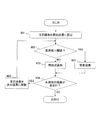
- FIG. 8 is a flowchart showing an example of such feature extraction processing.
- the extraction unit 417 sets a target pixel at the start position on the captured image (step 801).
- the start position for example, the upper left pixel of the image is used, but is not limited thereto.
- the pixel value of the target pixel is compared with a threshold value (step 802). If the pixel value is larger than the threshold value (step 802, YES), the target pixel is regarded as a background pixel (step 805). If the pixel value is less than or equal to the threshold (step 802, NO), the target pixel is regarded as a feature point pixel, and its coordinate value is recorded as a vein image (step 803).
- step 804 it is checked whether or not an unprocessed pixel remains (step 804). If an unprocessed pixel remains (step 804, YES), the target pixel is moved to the next pixel (step 806). ), The processing after step 802 is repeated. As the next pixel, for example, a pixel adjacent to the right of the pixel of interest or a pixel at the left end of the line one stage below is used, but is not limited thereto. If there is no unprocessed pixel (step 804, NO), the process is terminated.
- the threshold value in step 802 a value smaller than the average background pixel value is used, and the value is determined according to the light intensity of the irradiation unit 411 and the sensitivity of the photographing unit 412. For example, when the pixel value range is 0 to 255, any value of 50 to 200 is used as the threshold value, and preferably 150 is used as the threshold value.
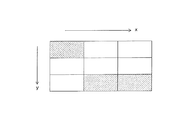
- FIG. 9 shows an example of a photographed image.
- an image composed of 9 pixels of 3 horizontal and 3 vertical is used, but an image composed of more pixels is actually used. If the horizontal axis is the x-axis and the vertical axis is the y-axis, the position of each pixel can be represented by a coordinate value (x, y).
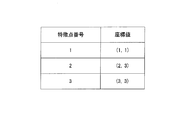
- the feature point number in FIG. 10 is feature point pixel identification information, and the coordinate value represents the position of the feature point pixel.
- the coordinate values of the feature point pixels with feature point numbers 1, 2, and 3 are (1, 1), (2, 3), and (3, 3), respectively.
- the extracted biometric information is often composed of a plurality of feature points having integer coordinate values. Therefore, the feature extraction process of FIG. 8 can be applied to such personal authentication as it is. In addition to the feature extraction process of FIG. 8, various feature extraction processes can be used.
- the correcting unit 414 performs alignment processing for correcting the vein image of the collation data.
- this alignment processing for example, there are the following two types.
- (1) Processing for calculating collation distance with respect to various position correction amounts processing for calculating the collation distance by converting the corrected vein image after correcting the vein image at the time of authentication with one position correction amount. It becomes the composition which repeats.
- As the final collation distance for example, the minimum value of the calculated collation distance is used.
- the correction unit 414 generates various position correction amounts and generates corrected vein images corresponding to the respective position correction amounts. For example, when parallel movement in units of one pixel is used as the alignment process, a combination of the parallel movement amounts of the respective pixels is used as the position correction amount.
- the processing can be performed when the individual cannot be specified by the extracted information and when the individual can be specified by the extracted information. are categorized. For example, information such as the coordinate value of one feature point or the coordinate value of the center of gravity of all feature points cannot identify an individual. However, if information such as a combination of coordinate values of all feature points is used, the individual can be identified. Is possible.
- the position correction amount can be calculated by a simple method. For example, a difference vector between the two is obtained from the coordinate value of a specific feature point at the time of registration and at the time of authentication, and is used as the amount of parallel movement. Alternatively, a difference vector between the centroids of all feature points at the time of registration and authentication can be obtained and used as a translation amount.
- a correction assisting unit 1101 is added to the server 501 in FIG.
- the correction assisting unit 1101 corresponds to the generating unit 321 in FIG.
- the correction unit 414 of the client 401 calculates the position correction amount by exchanging information with the correction auxiliary unit 1101.
- this method is similar to challenge-response type password authentication, but in password authentication, exact match of character strings is determined, whereas in this method, the position correction amount is calculated. Special processing is performed.
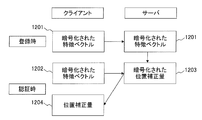
- FIG. 12 shows an example of such position correction amount calculation processing.
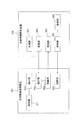
- the correction unit 414 encrypts the feature vector indicating the position of the feature point pixel of the vein image, and the communication unit 418 transmits the encrypted feature vector 1201 to the server 501.
- the communication unit 511 transfers the encrypted feature vector 1201 to the registration unit 512, and the registration unit 512 stores the encrypted feature vector 1201 in the storage unit 513.
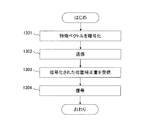
- FIG. 13 is a flowchart of processing performed by the client 401 in FIG. 4 during authentication
- FIG. 14 is a flowchart of processing performed by the server 501 in FIG. 11 during authentication.
- the correction unit 414 of the client 401 encrypts the feature vector indicating the position of the feature point pixel of the vein image (Step 1301)
- the communication unit 418 transmits the encrypted feature vector 1202 to the server 501 ( Step 1302).
- the communication unit 511 of the server 501 receives the encrypted feature vector 1202 and transfers it to the correction assisting unit 1101 (step 1401).
- the correction assisting unit 1101 calculates the encrypted position correction amount 1203 using the encrypted feature vectors 1201 and 1202 (step 1402). Then, the communication unit 511 transmits the encrypted position correction amount 1203 to the client 401 (step 1403).
- the communication unit 418 of the client 401 receives the encrypted position correction amount 1203 (step 1303), and the correction unit 414 decrypts the encrypted position correction amount 1203 to obtain the position correction amount 1204 ( Step 1304).
- the correction unit 414 encrypts the feature vector using a random matrix having random numbers as elements, and the correction auxiliary unit 1101 is encrypted by a predetermined operation using the encrypted feature vectors 1201 and 1202. A position correction amount 1203 is calculated. Then, the correction unit 414 decrypts the encrypted position correction amount 1203 using the characteristics of a predetermined calculation performed by the correction auxiliary unit 1101.
- the correction assisting unit 1101 performs an operation using the encrypted feature vectors 1201 and 1202, and thus the value of the feature vector that is the feature information of the vein image is obtained from the server 501. There is no spillage. Furthermore, since the calculation result is the encrypted position correction amount 1203, the value of the position correction amount 1204 does not flow out from the server 501. Therefore, the position correction amount 1204 can be calculated in the client 401 while protecting the user's biological information.
- the coordinate values f 'i of the i-th feature point pixels in the registration data, the coordinate values f i of the i-th feature point pixels in the matching data can be described as follows.
- i a feature point number
- n the number of feature point pixels
- T represents a transposition of a matrix or a vector.
- the feature point pixels corresponding to the registered data and the collation data are assigned the same number.
- a and b represent a coefficient matrix and a coefficient vector of affine transformation, respectively, and correspond to the position correction amount 1204 in FIG.
- the least square method is used to determine A and b, and A and b that minimize the following evaluation function J are obtained.
- b is the coordinate value of the center of gravity of f ′ 1 to f ′ n
- the coordinate value of the center of gravity of f 1 to f n Is expressed as follows.
- M of formula (11) represents a moment matrix whose elements are the product sum of x 1 ⁇ x n and y 1 ⁇ y n.
- M and B can be directly calculated using f ′ i and f i , and A can be calculated using the inverse matrix M ⁇ 1 of M according to the following equation.
- A BM ⁇ 1 (13)
- u and v correspond to the encrypted feature vector 1201 in FIG. 12, are transmitted from the client 401 to the server 501, and are stored in the storage unit 513.
- R 1 is stored in the storage unit 416 of the client 401.
- the random orthogonal matrix R 1 can be generated by the following method, for example. 1. Set random numbers to all elements of the matrix. 2. The matrix is orthonormalized by the Gram-Schmidt orthonormalization method. As a result, the matrix is corrected so that the size of the column vector is 1 and any two column vectors are orthogonal.
- the random regular matrix R 2 for example, can be used a random orthogonal matrix.
- S and t correspond to the encrypted feature vector 1202 of FIG. 12, and are transmitted from the client 401 to the server 501 together with the encrypted moment matrix M ′.
- the correction assisting unit 1101 calculates B using the following equation using u and v stored in the storage unit 513 and the received s and t.
- a ′ corresponds to the encrypted position correction amount 1203 in FIG. 12 and is transmitted from the server 501 to the client 401.
- the correction unit 414 calculates A by the following equation.
- A A'R 2 (22) If A is obtained, b can be calculated based on the coordinate value of the center of gravity, which is information that does not specify an individual, according to Equation (5).
- the client 401 uses the random matrices R 1 and R 2 to encrypt the feature vector and the matrix M, but instead of the random matrix, other matrices not known to the server 501 are used. May be used. In addition to the affine transformation, other physical and optically reasonable transformations can be used for the alignment process.
- the position correction amount calculation processing when the correspondence between the feature point pixels between the registered data and the collation data is unknown will be described.
- the position correction amount can be calculated after performing the pre-processing for associating the closest feature point pixels with each other. If the correspondence between the feature point pixels is obtained, the position correction amount can be calculated by applying the processing shown in FIGS. 13 and 14, and therefore, the preprocessing will be mainly described below.
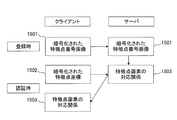
- FIG. 15 shows an example of such preprocessing.
- the correction unit 414 At the time of registration, the correction unit 414 generates a feature point number image having the feature point number of the feature point pixel closest to each pixel included in the vein image as the pixel value of the pixel, and encrypts the feature point number image. .
- the communication unit 418 transmits the encrypted feature point number image 1501 to the server 501. Then, the communication unit 511 transfers the encrypted feature point number image 1501 to the registration unit 512, and the registration unit 512 stores the encrypted feature point number image 1501 in the storage unit 513.
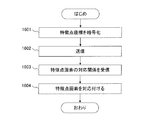
- FIG. 16 is a flowchart of processing performed by the client 401 in FIG. 4 during authentication
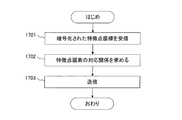
- FIG. 17 is a flowchart of processing performed by the server 501 in FIG. 11 during authentication.
- the correction unit 414 of the client 401 encrypts the coordinate values (feature point coordinates) of each feature point pixel of the vein image (step 1601), and the communication unit 418 uses the encrypted feature point coordinates 1502 as the server 501. (Step 1602).
- the communication unit 511 of the server 501 receives the encrypted feature point coordinates 1502 and transfers it to the correction assisting unit 1101 (step 1701).
- the correction assisting unit 1101 uses the encrypted feature point number image 1501 and the encrypted feature point coordinates 1502 to obtain a feature point pixel correspondence 1503 between the registered data and the collation data (step 1702). Then, the communication unit 511 transmits the feature point pixel correspondence 1503 to the client 401 (step 1703).
- the communication unit 418 of the client 401 receives the feature point pixel correspondence 1503 (step 1603), and the correction unit 414 uses the feature point pixel correspondence 1503 to store each feature point number of the matching data in the registered data. Corresponding to each feature point number (step 1604).
- the correction unit 414 encrypts the feature point number image and the feature point coordinates using, for example, random replacement.
- Random replacement can be generated, for example, by generating a random number in the range from 1 to m in order and recording the order, where m is the total number of pixels in the image. However, duplicate numbers shall be excluded.
- the correction assisting unit 1101 converts, for example, the coordinate value of each feature point number included in the encrypted feature point coordinates 1502 into a feature point number using the encrypted feature point number image 1501, thereby enabling a feature.
- a point pixel correspondence 1503 is obtained.
- the correction assisting unit 1101 performs processing using the encrypted feature point number image 1501 and the encrypted feature point coordinates 1502, and thus the coordinates of each feature point pixel from the server 501.
- the value never flows out. Therefore, the feature point pixel correspondence 1503 can be obtained in the server 501 while protecting the user's biological information.
- the correction unit 414 obtains the feature point number of the feature point pixel closest to each pixel of the captured image.
- one of the feature point pixels is selected according to the ascending order of the feature point numbers, the order determined using random numbers, or the like.
- the feature point pixel closest to the pixel having the coordinate value (1, 1) is the pixel itself, the feature point number is “1”. Since the feature point pixel closest to the pixel with the coordinate value (2, 2) is the pixel with the coordinate value (2, 3), the feature point number is “2”.
- the feature point pixels closest to the pixel with the coordinate value (3, 1) are the pixel with the coordinate value (1, 1) and the pixel with the coordinate value (3, 3). In this case, for example, the pixel having the coordinate value (1, 1) is selected in the ascending order of the feature point number, and the feature point number is “1”.
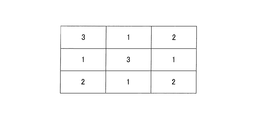
- the correction unit 414 generates a feature point number image as shown in FIG.
- a name such as P ⁇ b> 1 is added to each pixel for easy understanding of the replacement.
- the correction unit 414 rearranges the pixels of the feature point number image by random replacement as shown in FIG.
- the replacement in FIG. 19 represents an operation of replacing each pixel described in the upper row with each pixel described in the lower row.
- the pixel P1 of the feature point number image of FIG. 18 is replaced with the pixel P9, and the pixel P2 is replaced with the pixel P1.
- the feature point number image of FIG. 18 is converted into an image as shown in FIG.
- the image in FIG. 20 corresponds to the encrypted feature point number image 1501 in FIG. 15 and is transmitted from the client 401 to the server 501.
- the correction unit 414 changes the coordinate value of each feature point pixel according to the replacement of FIG. Generate feature point coordinates.
- the feature point pixel of the feature point number “1” in FIG. 10 corresponds to the pixel P1, and the pixel P1 moves to the position of the pixel P2 by the replacement in FIG. , 1).
- the feature point pixel with the feature point number “2” corresponds to the pixel P8, and the pixel P8 moves to the position of the pixel P7, so the coordinate value is changed from (2, 3) to (1, 3). Is done. Since the feature point pixel with the feature point number “3” corresponds to the pixel P9, and the pixel P9 moves to the position of the pixel P1, its coordinate value is changed from (3, 3) to (1, 1).
- the feature point coordinates in FIG. 21 obtained in this way correspond to the encrypted feature point coordinates 1502 in FIG. 15 and are transmitted from the client 401 to the server 501.
- the correction assistance unit 1101 of the server 501 obtains the pixel value of the pixel corresponding to the coordinate value of each feature point number in FIG. 21 in the feature point number image in FIG. Corresponds to the feature point number.
- the feature point number “1” of the collation data is the feature of the registered data. Corresponding to the point number “1”. Similarly, since the pixel value of the pixel corresponding to the coordinate value (1, 3) of the feature point number “2” is “2”, the feature point number “2” of the collation data is the feature point number “ 2 ". Since the pixel value of the pixel corresponding to the coordinate value (1, 1) of the feature point number “3” is “3”, the feature point number “3” of the collation data corresponds to the feature point number “3” of the registered data. Attached.
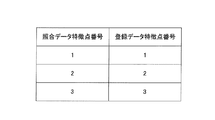
- the correction unit 414 associates each feature point number of the collation data with each feature point number of the registration data based on the received correspondence of the feature point pixels, and then performs the position correction amount by the process shown in FIG. Is calculated.
- the correspondence relationship in FIG. 22 shows the best correspondence.
- the identity conversion that does not move the feature point pixel is optimal as the alignment processing, and the identity matrix coefficient matrix A can be obtained by the calculations of the equations (1) to (22).
- the identity conversion with the parallel movement amount of 0 can be obtained.
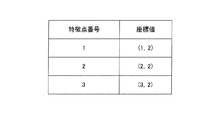
- the feature point pixel with the feature point number “1” corresponds to the pixel P4, and the pixel P4 is changed to the pixel P8 by the replacement in FIG. Therefore, the coordinate value is changed from (1,2) to (2,3).
- the feature point pixel with the feature point number “2” corresponds to the pixel P5, and the pixel P5 moves to the position of the pixel P3. Therefore, the coordinate value is changed from (2, 2) to (3, 1). Is done.
- the client 401 uses random replacement for encrypting the feature point number image and the feature point coordinates, but instead of random replacement, other replacements not known to the server 501 are used. May be.
- the conversion unit 415 assigns a pixel value to each pixel based on a scale indicating how close each pixel included in the captured image is to the feature point pixel. For example, a pixel value “0” can be assigned to a pixel whose distance from the feature point pixel is within a certain range, and a pixel value “1” can be assigned to the other pixels. Thereby, it is possible to increase the collation accuracy between the registration data and the collation data by giving the feature point pixels a certain range of width.
- the conversion unit 415 rearranges each pixel of the image generated in this way by random replacement, and generates a converted vein image.
- the converted vein image is transmitted from the client 401 to the server 501 as registration data.
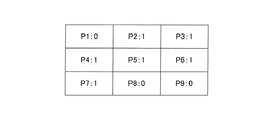
- a pixel value “0” is assigned to a pixel whose distance from each feature point pixel is 0 in the image of FIG. 9, and a pixel value “1” is assigned to the other pixels.
- an image as shown in FIG. 25 is generated. If the pixels of the image of FIG. 25 are rearranged by the replacement of FIG. 19, a converted vein image as shown in FIG. 26 is generated.
- the conversion unit 415 changes the coordinate value of each feature point pixel of the vein image using the replacement used for the registration data conversion process, and generates a converted vein image.
- the converted vein image is transmitted from the client 401 to the server 501 as verification data.
- vein image of FIG. 10 when the vein image of FIG. 10 is converted by the replacement of FIG. 19, a converted vein image as shown in FIG. 21 is generated, and when the vein image of FIG. 23 is converted by the replacement of FIG. A vein image is generated.
- the client 401 uses random replacement to convert the vein image, but instead of random replacement, another replacement that is not known to the server 501 may be used.
- the collation distance calculation unit 514 calculates a collation distance between the converted vein image stored as registration data in the storage unit 513 and the converted vein image that is the collation data received from the client 401 at the time of authentication.
- the collation distance for example, the total sum of the distance differences based on the above scale between the closest feature point pixels is used.
- the collation distance calculation unit 514 first repeats the process of setting 0 to the variable S that holds the sum and adding the pixel value corresponding to each coordinate value of the collation data to S. When the processing is completed for all coordinate values of the collation data, the value of S is output as the collation distance.
- the pixel values corresponding to the coordinate values (2, 1), (1, 3), and (1, 1) are all 0 in the image of FIG. Therefore, 0 is output as the collation distance.
- the pixel values corresponding to the coordinate values (2, 3), (3, 1), and (2, 2) are all 1 in the image of FIG. Therefore, 3 is output as the collation distance.
- the collation distance can be efficiently calculated with a calculation amount proportional to the number of feature point pixels.
- the storage unit 416 stores the conversion parameters used for the conversion process. For example, when the replacement of FIG. 19 is used for the conversion process, information indicating the replacement is stored as a conversion parameter. Different conversion parameters can be used for each user ID.
- the correction unit 414 encrypts the feature vector, the matrix M, the feature point number image, and the feature point coordinates, the parameters used for encrypting the information are also stored in the storage unit 416.
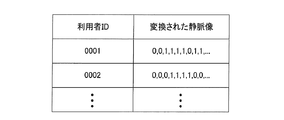
- the storage unit 513 stores the user ID and the converted vein image in association with each other.
- the storage unit 513 is mounted in the server 501 as a database having a format as shown in FIG.
- the vein image is converted into a column of numerical values (pixel values) according to a certain rule and stored.
- the correction assisting unit 1101 obtains the encrypted position correction amount 1203 and the feature point pixel correspondence 1503
- the encrypted feature vector 1201 and the encrypted feature point number image 1501 are also stored in the storage unit 513.
- biometric information can be protected without deteriorating authentication accuracy.
- the collation distance can be calculated efficiently with the amount of computation proportional to the number of feature point pixels, and a huge amount of calculation is not required, realizing a highly practical personal authentication technology. There are advantages to being.
- the server 501 performs verification processing.
- a portable information processing device such as a user IC card can perform verification processing.
- This personal authentication system includes the client 401, the IC card 2801, and the server 2901 shown in FIG.
- the IC card 2801 includes a communication unit 2811, a storage unit 2812, a collation distance calculation unit 514, and a determination unit 515.
- the communication unit 2811 communicates with the client 401, and the storage unit 2812 stores registration data.
- the operations of the collation distance calculation unit 514 and the determination unit 515 are the same as those of the server 501 in FIGS.
- the server 2901 includes a communication unit 511, a registration unit 512, a storage unit 513, and a correction auxiliary unit 1101. Operations of the communication unit 511, the registration unit 512, and the correction auxiliary unit 1101 are the same as those of the server 501 in FIG.
- the storage unit 513 stores the encrypted feature vector 1201 and the encrypted feature point number image 1501.
- the storage unit 513 can also store registration data.
- the server 2901 operates as a position correction auxiliary device that assists the alignment by the client 401, and the IC card 2801 performs a matching process between the matched matching data and the registered data.
- the biometric information used for calculating the collation distance is stored in the IC card 2801 that is possessed by the user and difficult to read illegally, thereby improving the safety of the biometric information. Further, by providing the correction auxiliary unit 1101 having a relatively large calculation amount in the server 2901, personal authentication can be performed at high speed using the IC card 2801 having inferior calculation ability.
- another portable information processing apparatus such as a mobile phone or a personal digital assistant (PDA) may be used.
- feature information extracted from biological information other than veins can also be used as registration data and verification data.
- feature information is extracted by capturing images of other parts of the human body, such as fingerprints, faces, and irises, and determining the positions of feature point pixels.
- the personal authentication system of the embodiment uses biometric information such as account transaction of a financial institution via an automated teller machine (ATM) or a communication network, login to a computer, access to confidential information, etc. in addition to room entry management. Applicable to various personal authentication.
- biometric information such as account transaction of a financial institution via an automated teller machine (ATM) or a communication network, login to a computer, access to confidential information, etc. in addition to room entry management. Applicable to various personal authentication.
- the biometric information acquisition apparatus 301, biometric information collation apparatus 302 in FIG. 3, the client 401 in FIG. 4, the server 501, the IC card 2801 in FIG. 28, and the server 2901 in FIG. It is realizable using a processing apparatus (computer).
- CPU 30 includes a central processing unit (CPU) 3001, a memory 3002, an input device 3003, an output device 3004, an external storage device 3005, a medium driving device 3006, and a network connection device 3007. These are connected to each other by a bus 3008.
- CPU central processing unit
- the memory 3002 is a semiconductor memory such as a Read Only Memory (ROM), a Random Access Memory (RAM), or a flash memory, for example, and stores programs and data used for registration processing or authentication processing.
- the CPU 3001 performs registration processing or authentication processing by executing a program using the memory 3002.
- the memory 3002 can also be used as the storage unit 325 in FIG. 3, the storage unit 416 in FIG. 4, the storage unit 513 in FIGS. 5, 11, 29, or the storage unit 2812 in FIG.
- the input device 3003 is, for example, a keyboard, a pointing device, etc., and is used for inputting instructions and information from a user or an operator.
- the output device 3004 is, for example, a display device, a printer, a speaker, or the like, and is used to output an inquiry to a user or an operator or a processing result.
- the input device 3003 can also be used as the input unit 417 in FIG. 4, and the output device 3004 can also be used as the output unit 419 in FIG.
- the external storage device 3005 is, for example, a magnetic disk device, an optical disk device, a magneto-optical disk device, a tape device, or the like.
- the external storage device 3005 includes a hard disk drive.
- the information processing apparatus can store programs and data in the external storage device 3005 and load them into the memory 3002 for use.
- the medium driving device 3006 drives the portable recording medium 3009 and accesses the recorded contents.
- the portable recording medium 3009 is a memory device, a flexible disk, an optical disk, a magneto-optical disk, or the like.
- the portable recording medium 3009 includes Compact Disk Read Only Memory (CD-ROM), Digital Versatile Disk (DVD), Universal Serial Bus (USB) memory, and the like. A user or an operator can store programs and data in the portable recording medium 3009 and load them into the memory 3002 for use.
- the computer-readable recording medium for storing the program and data used for the simulation processing is a physical (non-temporary) such as the memory 3002, the external storage device 3005, and the portable recording medium 3009. ) Includes recording media.
- the network connection device 3007 is a communication interface that is connected to a communication network such as the communication path 402 and performs data conversion associated with communication.
- the information processing apparatus can receive a program and data from an external apparatus via the network connection apparatus 3007 and load them into the memory 3002 for use.
- the network connection device 3007 can be used as the receiving unit 315, the transmitting unit 322, the receiving unit 323 in FIG. 3, the communication unit 418 in FIG. 4, the communication unit 511 in FIGS. 5, 11, and 29, or the communication unit 2811 in FIG. Can be used.
- the input device 3003, the output device 3004, the external storage device 3005, and the medium drive device 3006 can be omitted.
Landscapes
- Engineering & Computer Science (AREA)
- Theoretical Computer Science (AREA)
- General Physics & Mathematics (AREA)
- Physics & Mathematics (AREA)
- Computer Security & Cryptography (AREA)
- General Health & Medical Sciences (AREA)
- General Engineering & Computer Science (AREA)
- Software Systems (AREA)
- Health & Medical Sciences (AREA)
- Bioethics (AREA)
- Computer Hardware Design (AREA)
- Human Computer Interaction (AREA)
- Multimedia (AREA)
- Medical Informatics (AREA)
- Databases & Information Systems (AREA)
- Collating Specific Patterns (AREA)
- Measurement Of The Respiration, Hearing Ability, Form, And Blood Characteristics Of Living Organisms (AREA)
Priority Applications (4)
| Application Number | Priority Date | Filing Date | Title |
|---|---|---|---|
| EP11860845.4A EP2688008B1 (de) | 2011-03-17 | 2011-03-17 | Vorrichtung zur erfassung biologischer informationen, vorrichtung für den vergleich biologischer informationen und programm |
| PCT/JP2011/056454 WO2012124115A1 (ja) | 2011-03-17 | 2011-03-17 | 生体情報取得装置、生体情報照合装置、及びプログラム |
| JP2013504489A JP5754502B2 (ja) | 2011-03-17 | 2011-03-17 | 生体情報取得装置、生体情報照合装置、及びプログラム |
| US14/025,393 US9245178B2 (en) | 2011-03-17 | 2013-09-12 | Biological information obtaining apparatus and biological information collating apparatus |
Applications Claiming Priority (1)
| Application Number | Priority Date | Filing Date | Title |
|---|---|---|---|
| PCT/JP2011/056454 WO2012124115A1 (ja) | 2011-03-17 | 2011-03-17 | 生体情報取得装置、生体情報照合装置、及びプログラム |
Related Child Applications (1)
| Application Number | Title | Priority Date | Filing Date |
|---|---|---|---|
| US14/025,393 Continuation US9245178B2 (en) | 2011-03-17 | 2013-09-12 | Biological information obtaining apparatus and biological information collating apparatus |
Publications (1)
| Publication Number | Publication Date |
|---|---|
| WO2012124115A1 true WO2012124115A1 (ja) | 2012-09-20 |
Family
ID=46830242
Family Applications (1)
| Application Number | Title | Priority Date | Filing Date |
|---|---|---|---|
| PCT/JP2011/056454 Ceased WO2012124115A1 (ja) | 2011-03-17 | 2011-03-17 | 生体情報取得装置、生体情報照合装置、及びプログラム |
Country Status (4)
| Country | Link |
|---|---|
| US (1) | US9245178B2 (de) |
| EP (1) | EP2688008B1 (de) |
| JP (1) | JP5754502B2 (de) |
| WO (1) | WO2012124115A1 (de) |
Cited By (7)
| Publication number | Priority date | Publication date | Assignee | Title |
|---|---|---|---|---|
| JP2015028724A (ja) * | 2013-07-30 | 2015-02-12 | 富士通株式会社 | 生体情報認証装置および生体情報処理方法 |
| JP2015064818A (ja) * | 2013-09-26 | 2015-04-09 | 国立大学法人東京工業大学 | 機密生体サーバー認証 |
| JP2016522487A (ja) * | 2013-05-10 | 2016-07-28 | イーリス−ゲゼルシャフト ミット ベシュレンクテル ハフツング インフラレッド アンド インテリジェント センサーズ | 手の静脈パターンを記録するセンサシステム及び方法 |
| JP2017532630A (ja) * | 2014-08-13 | 2017-11-02 | クゥアルコム・インコーポレイテッドQualcomm Incorporated | バイオメトリックデータおよび非バイオメトリックデータに基づいて認証データを生成するシステムおよび方法 |
| WO2018222211A1 (en) * | 2017-06-02 | 2018-12-06 | Visa International Service Association | Secure biometric authentication using electronic identity |
| JP2018206386A (ja) * | 2017-06-02 | 2018-12-27 | 富士通株式会社 | 特徴ベクトルの生成及び暗号化 |
| JP2019519874A (ja) * | 2016-04-27 | 2019-07-11 | ヴイティアイピー サール | 静脈網に基づく生体認証システム、およびツリー構造の唯一で反証可能性のないエンコーディング、及び関連する方法 |
Families Citing this family (3)
| Publication number | Priority date | Publication date | Assignee | Title |
|---|---|---|---|---|
| JP6241230B2 (ja) * | 2013-11-28 | 2017-12-06 | 富士通株式会社 | 生体情報判定装置及びプログラム |
| US10846386B2 (en) * | 2016-08-22 | 2020-11-24 | Lenovo (Singapore) Pte. Ltd. | Pulse sensors for biometric identification |
| JP6794766B2 (ja) * | 2016-10-19 | 2020-12-02 | 日本電気株式会社 | 指紋処理装置、指紋処理方法、プログラム、指紋処理回路 |
Citations (7)
| Publication number | Priority date | Publication date | Assignee | Title |
|---|---|---|---|---|
| JP2000011176A (ja) | 1998-06-23 | 2000-01-14 | Fujitsu Ltd | 認証装置及び記憶媒体 |
| JP2006154033A (ja) | 2004-11-26 | 2006-06-15 | Nippon Telegr & Teleph Corp <Ntt> | 秘密計算方法及びシステム、並びにプログラム |
| JP2007293807A (ja) | 2006-03-29 | 2007-11-08 | Hitachi Information & Control Solutions Ltd | 生体認証方法およびシステム |
| JP2007328502A (ja) | 2006-06-07 | 2007-12-20 | Hitachi Information & Control Solutions Ltd | 生体認証方法及びシステム |
| JP2008129743A (ja) | 2006-11-20 | 2008-06-05 | Hitachi Ltd | 生体情報の特徴量変換方法、その装置およびそれを用いたユーザ認証システム |
| JP2010108365A (ja) | 2008-10-31 | 2010-05-13 | Hitachi Ltd | 生体認証方法およびシステム |
| JP2011013912A (ja) * | 2009-07-01 | 2011-01-20 | Fujitsu Ltd | 生体認証システム,生体認証方法,生体認証装置,生体情報処理装置,生体認証プログラムおよび生体情報処理プログラム |
Family Cites Families (12)
| Publication number | Priority date | Publication date | Assignee | Title |
|---|---|---|---|---|
| JP4127546B2 (ja) * | 2003-04-15 | 2008-07-30 | 富士通株式会社 | 画像照合装置、画像照合方法、及び画像照合プログラム |
| CA2584121C (en) * | 2004-10-15 | 2014-08-19 | The Regents Of The University Of Colorado, A Body Corporate | Revocable biometrics with robust distance metrics |
| US20060104484A1 (en) * | 2004-11-16 | 2006-05-18 | Bolle Rudolf M | Fingerprint biometric machine representations based on triangles |
| JP4631560B2 (ja) * | 2005-06-27 | 2011-02-16 | 富士ゼロックス株式会社 | 使用者判別システム、使用者判別方法、及びプログラム |
| JP2007149066A (ja) * | 2005-10-25 | 2007-06-14 | Toshiba Corp | 認証システム、装置及びプログラム |
| US7445160B2 (en) * | 2006-06-14 | 2008-11-04 | Hewlett-Packard Development Company, L.P. | Position location using error correction |
| FR2903513B1 (fr) * | 2006-07-10 | 2008-12-05 | Sagem Defense Securite | Procede d'identification d'un individu utilisant une fonctio n de transformation et dispositif d'identification associe |
| US8417960B2 (en) * | 2006-09-06 | 2013-04-09 | Hitachi, Ltd. | Method for generating an encryption key using biometrics authentication and restoring the encryption key and personal authentication system |
| WO2009011661A1 (en) * | 2007-07-18 | 2009-01-22 | Agency For Science, Technology And Research | Method and device for determining a similarity value between minutiae templates |
| JP2010165323A (ja) * | 2009-01-19 | 2010-07-29 | Fujitsu Ltd | 生体認証方法及びシステム |
| IL199657A0 (en) * | 2009-07-02 | 2011-08-01 | Carmel Haifa University Economic Corp Ltd | Face representation systems for privacy aware applications and methods useful in conjunction therewith |
| US8577091B2 (en) * | 2009-07-17 | 2013-11-05 | The University Of Maryland | Method and apparatus for authenticating biometric scanners |
-
2011
- 2011-03-17 WO PCT/JP2011/056454 patent/WO2012124115A1/ja not_active Ceased
- 2011-03-17 EP EP11860845.4A patent/EP2688008B1/de not_active Not-in-force
- 2011-03-17 JP JP2013504489A patent/JP5754502B2/ja not_active Expired - Fee Related
-
2013
- 2013-09-12 US US14/025,393 patent/US9245178B2/en active Active
Patent Citations (7)
| Publication number | Priority date | Publication date | Assignee | Title |
|---|---|---|---|---|
| JP2000011176A (ja) | 1998-06-23 | 2000-01-14 | Fujitsu Ltd | 認証装置及び記憶媒体 |
| JP2006154033A (ja) | 2004-11-26 | 2006-06-15 | Nippon Telegr & Teleph Corp <Ntt> | 秘密計算方法及びシステム、並びにプログラム |
| JP2007293807A (ja) | 2006-03-29 | 2007-11-08 | Hitachi Information & Control Solutions Ltd | 生体認証方法およびシステム |
| JP2007328502A (ja) | 2006-06-07 | 2007-12-20 | Hitachi Information & Control Solutions Ltd | 生体認証方法及びシステム |
| JP2008129743A (ja) | 2006-11-20 | 2008-06-05 | Hitachi Ltd | 生体情報の特徴量変換方法、その装置およびそれを用いたユーザ認証システム |
| JP2010108365A (ja) | 2008-10-31 | 2010-05-13 | Hitachi Ltd | 生体認証方法およびシステム |
| JP2011013912A (ja) * | 2009-07-01 | 2011-01-20 | Fujitsu Ltd | 生体認証システム,生体認証方法,生体認証装置,生体情報処理装置,生体認証プログラムおよび生体情報処理プログラム |
Non-Patent Citations (2)
| Title |
|---|
| A. JUELS; M. SUDAN: "A Fuzzy Vault Scheme", PROCEEDINGS OF IEEE INTERNATIONAL SYMPOSIUM ON INFORMATION THEORY, 2002, pages 408 |
| See also references of EP2688008A4 |
Cited By (10)
| Publication number | Priority date | Publication date | Assignee | Title |
|---|---|---|---|---|
| JP2016522487A (ja) * | 2013-05-10 | 2016-07-28 | イーリス−ゲゼルシャフト ミット ベシュレンクテル ハフツング インフラレッド アンド インテリジェント センサーズ | 手の静脈パターンを記録するセンサシステム及び方法 |
| JP2015028724A (ja) * | 2013-07-30 | 2015-02-12 | 富士通株式会社 | 生体情報認証装置および生体情報処理方法 |
| JP2015064818A (ja) * | 2013-09-26 | 2015-04-09 | 国立大学法人東京工業大学 | 機密生体サーバー認証 |
| JP2017532630A (ja) * | 2014-08-13 | 2017-11-02 | クゥアルコム・インコーポレイテッドQualcomm Incorporated | バイオメトリックデータおよび非バイオメトリックデータに基づいて認証データを生成するシステムおよび方法 |
| JP2019519874A (ja) * | 2016-04-27 | 2019-07-11 | ヴイティアイピー サール | 静脈網に基づく生体認証システム、およびツリー構造の唯一で反証可能性のないエンコーディング、及び関連する方法 |
| JP7101659B2 (ja) | 2016-04-27 | 2022-07-15 | ヴイティアイピー サール | 静脈網に基づく生体認証システム、およびツリー構造の唯一で反証可能性のないエンコーディング、及び関連する方法 |
| WO2018222211A1 (en) * | 2017-06-02 | 2018-12-06 | Visa International Service Association | Secure biometric authentication using electronic identity |
| JP2018206386A (ja) * | 2017-06-02 | 2018-12-27 | 富士通株式会社 | 特徴ベクトルの生成及び暗号化 |
| US11190355B2 (en) | 2017-06-02 | 2021-11-30 | Visa International Service Association | Secure biometric authentication using electronic identity |
| JP7155614B2 (ja) | 2017-06-02 | 2022-10-19 | 富士通株式会社 | 特徴ベクトルの生成及び暗号化 |
Also Published As
| Publication number | Publication date |
|---|---|
| JP5754502B2 (ja) | 2015-07-29 |
| US9245178B2 (en) | 2016-01-26 |
| EP2688008B1 (de) | 2016-05-04 |
| EP2688008A1 (de) | 2014-01-22 |
| EP2688008A4 (de) | 2014-08-20 |
| US20140016834A1 (en) | 2014-01-16 |
| JPWO2012124115A1 (ja) | 2014-07-17 |
Similar Documents
| Publication | Publication Date | Title |
|---|---|---|
| JP5754502B2 (ja) | 生体情報取得装置、生体情報照合装置、及びプログラム | |
| JP6651565B2 (ja) | バイオメトリックテンプレートセキュリティおよびキー生成 | |
| US11799642B2 (en) | Biometric public key system providing revocable credentials | |
| US11227037B2 (en) | Computer system, verification method of confidential information, and computer | |
| US11063936B2 (en) | Encryption parameter selection | |
| Belkhede et al. | Biometric mechanism for enhanced security of online transaction on Android system: A design approach | |
| KR101845192B1 (ko) | 내적 연산 적용을 위한 지문 정보 변경 방법 및 시스템 | |
| Kavitha et al. | Enhancing digital security: a comprehensive multi-model authentication framework leveraging cryptography and biometrics | |
| KR101838432B1 (ko) | 바이오매트릭스와 함수암호-내적을 이용한 인증 방법 및 시스템 | |
| US12475204B2 (en) | Method for authenticating a user of a mobile device | |
| Montano et al. | SecureMD5: A new stream cipher for secure file systems and encryption key generation with artificial intelligence | |
| Champaneria et al. | A Novel Approach for Securing Fingerprint Biometrics using Local Minutiae Structure | |
| Maiti et al. | Fingerprint bio-metric: Confronting challenges, embracing evolution, and extending utility—A review | |
| Jegede et al. | Face recognition and template protection with shielding function | |
| Rajashree et al. | BIO-CRYPT-Enhancing security with biometric encryption | |
| Kukreja et al. | Privacy Enhancement in Biometric Systems by Template Protection using Deep Learning | |
| Ali et al. | Low quality fingerprint template encryption algorithm | |
| KR20180097060A (ko) | 바이오매트릭스를 이용하여 키를 생성하는 방법 및 시스템 | |
| Motita et al. | An Improved Template Inversion Attack Against Korean Face Images | |
| Sardar et al. | Face Recognition System Using Multicolor Image Analysis and Template Protection with BioCryptosystem | |
| Roja et al. | MySQL and MATLAB Interfacing for Biometric Template Protection with Encryption | |
| Bansal et al. | Multilevel Network protection Based on Palm Print Biometric | |
| HK40010987A (en) | Biometric template security and key generation | |
| HK40010987B (en) | Biometric template security and key generation | |
| HK40011440B (en) | Methods and systems for biometric template security and key generation |
Legal Events
| Date | Code | Title | Description |
|---|---|---|---|
| 121 | Ep: the epo has been informed by wipo that ep was designated in this application |
Ref document number: 11860845 Country of ref document: EP Kind code of ref document: A1 |
|
| ENP | Entry into the national phase |
Ref document number: 2013504489 Country of ref document: JP Kind code of ref document: A |
|
| NENP | Non-entry into the national phase |
Ref country code: DE |