WO2012124681A1 - Procédé d'amplification d'acides nucléiques et son application - Google Patents
Procédé d'amplification d'acides nucléiques et son application Download PDFInfo
- Publication number
- WO2012124681A1 WO2012124681A1 PCT/JP2012/056381 JP2012056381W WO2012124681A1 WO 2012124681 A1 WO2012124681 A1 WO 2012124681A1 JP 2012056381 W JP2012056381 W JP 2012056381W WO 2012124681 A1 WO2012124681 A1 WO 2012124681A1
- Authority
- WO
- WIPO (PCT)
- Prior art keywords
- nucleic acid
- primer
- seq
- acid amplification
- amplification method
- Prior art date
- Legal status (The legal status is an assumption and is not a legal conclusion. Google has not performed a legal analysis and makes no representation as to the accuracy of the status listed.)
- Ceased
Links
Images





Classifications
-
- C—CHEMISTRY; METALLURGY
- C12—BIOCHEMISTRY; BEER; SPIRITS; WINE; VINEGAR; MICROBIOLOGY; ENZYMOLOGY; MUTATION OR GENETIC ENGINEERING
- C12Q—MEASURING OR TESTING PROCESSES INVOLVING ENZYMES, NUCLEIC ACIDS OR MICROORGANISMS; COMPOSITIONS OR TEST PAPERS THEREFOR; PROCESSES OF PREPARING SUCH COMPOSITIONS; CONDITION-RESPONSIVE CONTROL IN MICROBIOLOGICAL OR ENZYMOLOGICAL PROCESSES
- C12Q1/00—Measuring or testing processes involving enzymes, nucleic acids or microorganisms; Compositions therefor; Processes of preparing such compositions
- C12Q1/68—Measuring or testing processes involving enzymes, nucleic acids or microorganisms; Compositions therefor; Processes of preparing such compositions involving nucleic acids
- C12Q1/6844—Nucleic acid amplification reactions
-
- C—CHEMISTRY; METALLURGY
- C12—BIOCHEMISTRY; BEER; SPIRITS; WINE; VINEGAR; MICROBIOLOGY; ENZYMOLOGY; MUTATION OR GENETIC ENGINEERING
- C12Q—MEASURING OR TESTING PROCESSES INVOLVING ENZYMES, NUCLEIC ACIDS OR MICROORGANISMS; COMPOSITIONS OR TEST PAPERS THEREFOR; PROCESSES OF PREPARING SUCH COMPOSITIONS; CONDITION-RESPONSIVE CONTROL IN MICROBIOLOGICAL OR ENZYMOLOGICAL PROCESSES
- C12Q1/00—Measuring or testing processes involving enzymes, nucleic acids or microorganisms; Compositions therefor; Processes of preparing such compositions
- C12Q1/68—Measuring or testing processes involving enzymes, nucleic acids or microorganisms; Compositions therefor; Processes of preparing such compositions involving nucleic acids
- C12Q1/6876—Nucleic acid products used in the analysis of nucleic acids, e.g. primers or probes
- C12Q1/6888—Nucleic acid products used in the analysis of nucleic acids, e.g. primers or probes for detection or identification of organisms
- C12Q1/689—Nucleic acid products used in the analysis of nucleic acids, e.g. primers or probes for detection or identification of organisms for bacteria
Definitions
- the present invention relates to a nucleic acid amplification method and use thereof, and in particular, to a nucleic acid amplification method that can be performed under isothermal conditions and use thereof.
- a LAMP (Loop-mediated isothermal amplification) method has been put to practical use as a method capable of amplifying nucleic acids under isothermal conditions and detecting amplification by visual observation (see Patent Document 1).
- the LAMP method is intended to promote amplification by devising the primer structure.
- four or six types of primers that recognize six or eight regions are required. Therefore, the primer DNA design method is complicated, and it is not always possible to design a primer that allows efficient gene amplification.
- the LAMP method amplifies a very small amount of target in a short time and uses a larger amount of primer than PCR.
- 4 or 6 primers with various sequences are used at a high dose, nonspecific binding The risk of false positive amplification due to increases. Furthermore, the cost required for primer synthesis cannot be ignored.
- tuberculosis is still one of the most important infectious diseases in which 9 million people are registered as new patients annually and 1.8 million people are dead worldwide. Diagnosing early and initiating appropriate treatment is the best way to prevent the spread of infection, but it takes more than 4 weeks for M. tuberculosis to form colonies on the medium. Reduction of the time required is a major issue, and rapid development of a determination method is required. Therefore, in order to quickly determine infectious diseases such as tuberculosis, the reaction rate and amplification efficiency are comparable to those of the LAMP method, and it is performed under isothermal conditions that are superior in specificity, simplicity, and cost to the LAMP method. Development of a possible nucleic acid amplification method is desired.
- An object of the present invention is to provide a nucleic acid amplification method that does not require special equipment, can be carried out quickly, simply, and at low cost, and has high amplification efficiency and high specificity.
- a reaction solution preparation step for preparing a reaction solution containing the following (a) to (e) and a nucleic acid synthesis step for performing nucleic acid synthesis using the obtained reaction solution, and after the nucleic acid synthesis step A nucleic acid amplification method comprising no heat denaturation step of nucleic acid.
- A Template nucleic acid having a repetitive sequence
- C Primer 1 that binds within the repetitive sequence of the template nucleic acid
- C Primer 2 that binds within the repetitive sequence of the complementary strand of the template nucleic acid
- D Strand displacement type DNA synthase
- [3] The nucleic acid amplification method according to [1] or [2], wherein the nucleic acid synthesis step is performed isothermally.
- [4] A pathogen detection method using the nucleic acid amplification method according to any one of [1] to [3].
- [5] A method for detecting an allergen, comprising using the nucleic acid amplification method according to any one of [1] to [3].
- [6] A species discrimination method using the nucleic acid amplification method according to any one of [1] to [3].
- [7] In the nucleic acid amplification method according to any one of [1] to [3], primer 1 comprising the base sequence represented by SEQ ID NO: 1 and primer 2 comprising the base sequence represented by SEQ ID NO: 2 And a method for detecting Mycobacterium tuberculosis.
- primer 1 comprising the base sequence represented by SEQ ID NO: 3 and primer 2 comprising the base sequence represented by SEQ ID NO: 4 And a method for detecting Salmonella.
- primer 1 comprising the base sequence represented by SEQ ID NO: 5 and the primer 2 comprising the base sequence represented by SEQ ID NO: 6 And a leishmania detection method.
- a kit comprising primer 2 which binds within the repetitive sequence of [11] The kit for nucleic acid amplification according to [10], further including a strand displacement type DNA synthase.
- a primer 1 comprising a base sequence represented by SEQ ID NO: 3 and a primer 2 comprising a base sequence represented by SEQ ID NO: 4 and specifically amplifying a repetitive sequence of Salmonella
- a primer 1 comprising the base sequence represented by SEQ ID NO: 5 and a primer 2 comprising the base sequence represented by SEQ ID NO: 6 and specifically amplifying a Leishmania repetitive sequence The kit according to [10] or [11].
- nucleic acid amplification method that does not require special equipment, can be carried out quickly, simply, and at low cost, and has high amplification efficiency and high specificity. Since the nucleic acid amplification method of the present invention has high amplification efficiency and specificity, it can be amplified even with a small amount of a target gene present in a sample. It can be used in a wide range of fields such as species discrimination.
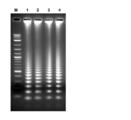
- tuberculosis DNA using the nucleic acid amplification method of this invention, and analyzing the amplified product by agarose gel electrophoresis.
- the nucleic acid amplification method of the present invention comprises (a) a template nucleic acid having a repetitive sequence, (b) a primer 1 that binds within the repetitive sequence of the template nucleic acid, and (c) that binds within a repetitive sequence of a complementary strand of the template nucleic acid.
- This is a nucleic acid amplification method that can be carried out under isothermal conditions using primer 2 and (d) a strand displacement type DNA synthase.
- the repetitive sequence of the template nucleic acid has a repetitive structure with a spacer in between, but the repetitive sequence of the template nucleic acid may have no spacer.
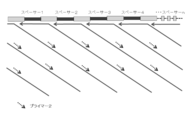
- FIG. 1 shows a state in which the primers 1 and 2 are bound in the repetitive sequence of each strand at the portion where the double-stranded template nucleic acid is unwound.
- the primer 1 bound in the repetitive sequence of the template nucleic acid is extended by a strand displacement type DNA synthase (middle portion in FIG. 1), and the front strand is peeled off (lower portion in FIG. 1).
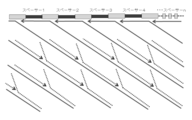
- the peeled strand becomes a new single-stranded template nucleic acid, and the primer 2 is successively bound (FIG. 2).
- Primer 2 also extends while peeling off the front strand by strand displacement type DNA synthase (FIG. 3).
- FIGS. 4 to 6 for convenience of explanation, only one strand from which primer 1 has been extended and removed is shown.
- the strand from which primer 2 has been extended and peeled becomes a new single-stranded template, and primer 1 is bound (FIG. 4).
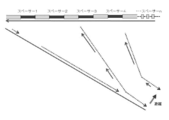
- the strand is peeled off to form a free strand, and primer 1 is bound to the free strand to extend (FIG. 5).
- the strand that has been newly bonded and extended is also peeled off at the tip, and a new free strand is born.
- a primer having the complementary sequence of primer 1 Since a new primer having the complementary sequence of primer 1 is generated in the same manner, when the amplification reaction proceeds, a primer having a sequence that recognizes four positions in the repetitive sequence is mixed. Since these free strands function as primers and are also templates each consisting of a repetitive sequence, the amplification reaction accelerates with time. As for the double strand formed by the last primer of each template nucleic acid, as long as the reaction temperature is maintained at a temperature sufficient for primer binding, dissociation and primer binding occur with a certain probability. The reaction up to 6 is repeated.
- the amplification product has a size corresponding to the interval at which the primer 1 and the primer 2 face each other, and the electrophoresis image of the amplification product becomes a ladder (see FIG. 8).
- the electrophoretic image extends to the polymer region. It becomes a smear shape.
- the present invention comprises a reaction solution preparation step for preparing a reaction solution containing the following (a) to (e), and a nucleic acid synthesis step for performing nucleic acid synthesis using the obtained reaction solution, There is provided a nucleic acid amplification method characterized by not having a nucleic acid heat denaturation step later.
- A Template nucleic acid having a repetitive sequence
- B Primer 1 that binds within the repetitive sequence of the template nucleic acid
- C Primer 2 that binds within the repetitive sequence of the complementary strand of the template nucleic acid
- D Strand displacement type DNA synthase
- the template nucleic acid that can be used in the nucleic acid amplification method of the present invention needs to be a nucleic acid having a repetitive sequence.
- any nucleic acid having a repetitive sequence can be suitably used as a template nucleic acid in the nucleic acid amplification method of the present invention.
- the template nucleic acid may be single-stranded or double-stranded.
- the template nucleic acid may be any of DNA, RNA, and DNA / RNA hybrid. Furthermore, even if the constituent nucleotide is substituted with an artificial derivative or a natural DNA or RNA is modified, it is included in the template nucleic acid as long as it functions as a template for complementary strand synthesis.
- the repeated sequence may be any sequence as long as the same sequence is present twice or more, and the number of repetitions is not limited. Further, it may be a repetitive sequence in which the same sequences are directly adjacent to each other, or a repetitive sequence in which the same sequences are adjacent to each other with a spacer in between. The orientations of adjacent arrays may be reversed. That is, the sequence to which primer 1 binds and the sequence to which primer 2 binds may be mixed on the same strand.
- the homology between each repetitive sequence may be about 70% or more, preferably about 80% or more, more preferably about 90% or more, and further preferably about 95% or more.
- a sequence having a length of about 10 to 500 base pairs is preferably present three or more times at intervals of 1000 base pairs or less, and about 15 to 500 bases. More preferably, the sequence having the length of the pair is present 3 times or more at intervals of 1000 base pairs or less, and the sequence having a length of about 30 to 200 base pairs is present at least 4 times at intervals of 500 base pairs or less. It is more preferable.
- the repetitive sequences include, for example, tandem repeats (satellite DNA, minisatellite), short interspersed repetitive sequences (Short Interspersed elements: SINE), CRISPR (Clustered Regularly Interspaced Short Palindromic Repeats) and the like. Since it is known that a repetitive sequence exists on the genomes of all organisms including microorganisms and animals and plants, the nucleic acid amplification method of the present invention can suitably use the genomes of all organisms as template nucleic acids.
- Primers used in the nucleic acid amplification method of the present invention are of two types: primer 1 that binds to the repetitive sequence of the template nucleic acid and primer 2 that binds to the repetitive sequence of the complementary strand of the template nucleic acid.
- the primer may bind to any part within the repetitive sequence, and a primer with high specificity may be appropriately designed based on the base sequence of the repetitive sequence.
- the primer may have a chain length that can be recognized by a DNA synthase, and usually has a chain length of about 5 bases, but is preferably about 10 bases or more in order to increase specificity. More preferably, about 15 bases or more. Although an upper limit is not specifically limited, About 50 bases or less are preferable.
- primer 1 and the primer 2 do not hybridize with each other to form a primer dimer. That is, it is preferable that a sequence complementary to the 3 'end of each primer is not included in the primer. As long as the nucleic acid synthesis and nucleic acid amplification are not hindered, the 5 'ends of primer 1 and primer 2 may overlap. In the present inventors, when both primers are designed and used so that the 5 ′ ends of primer 1 and primer 2 overlap, amplification is accelerated compared to the case of using primers 1 and 2 that do not overlap. I have confirmed that.
- the nucleic acid amplification method of the present invention it is preferable to use two types of primers in which the 5 'ends of primer 1 and primer 2 overlap.
- the range of the overlap at the 5 'end is not particularly limited, but is preferably about 5 to 50%, more preferably about 10 to 30%.
- the primer can be chemically synthesized by a known nucleic acid synthesis method using a commercially available nucleic acid synthesizer.
- the strand displacement type DNA synthase used in the nucleic acid amplification method of the present invention is not particularly limited as long as it has sequence-dependent complementary strand synthesis activity and strand displacement activity.
- Known strand displacement DNA synthetases include, for example, Bst DNA polymerase, Bca (exo-) DNA polymerase, Klenow fragment of DNA polymerase I, Vent DNA polymerase, Vent (Exo-) DNA polymerase, Deep Vent DNA polymerase, Deep Vent (Exo-) DNA polymerase, ⁇ 29 phage DNA polymerase, MS-2 phage DNA polymerase, Z-Taq DNA polymerase (trade name), KOD DNA polymerase, and the like can be mentioned, and any of them can be suitably used for the nucleic acid amplification method of the present invention. it can.
- Bst DNA polymerase and Bca (exo-) DNA polymerase are particularly preferable because they have a certain degree of heat resistance and high catalytic activity.
- the reaction solution essentially contains (e) a nucleotide that serves as a substrate for the strand displacement DNA synthase.
- a buffering agent, salts and the like are usually added to the reaction solution, and an enzyme protective agent, a melting temperature (Tm) adjusting agent, a surfactant and the like are added as necessary.
- Tm melting temperature
- a surfactant a surfactant and the like are added as necessary.
- a neutral to weakly alkaline buffering agent such as Tris-HCl is used. What is necessary is just to adjust pH to optimal pH vicinity according to the DNA synthetase to be used.
- Salts are appropriately added for maintaining enzyme activity and adjusting the melting temperature (Tm) of nucleic acids, and specifically, KCl, NaCl, MgCl 2 , MgSO 4 , (NH 4 ) 2 SO 4, etc. are used.
- an enzyme protective agent bovine serum albumin or saccharide is used.
- dimethyl sulfoxide (DMSO), formamide, betaine (N, N, N, -trimethylglycine) or the like is used as a regulator for the melting temperature (Tm).
- DMSO dimethyl sulfoxide
- betaine N, N, N, -trimethylglycine
- Tween 20 Triton X or the like is used.
- betaine N, N, N, -trimethylglycine
- a tetraalkylammonium salt is used as necessary to improve the strand displacement efficiency.
- reagents for visual confirmation of amplification and the like can be appropriately added.
- the nucleic acid synthesis reaction proceeds and the repetitive sequence region of the template nucleic acid is amplified.
- the temperature of the nucleic acid synthesis step is not particularly limited as long as it is a temperature at which the strand displacement type DNA synthase can maintain the activity and the primer can bind to the template nucleic acid. Therefore, the upper limit is the temperature at which the template nucleic acid is not subjected to heat denaturation. In order to improve the reaction rate and amplification efficiency, it is preferable to select a temperature in the vicinity of the optimum temperature of the strand displacement type DNA synthase to be used.
- a temperature at which the double strand of the template nucleic acid can be unraveled moderately specifically about 50 to 70 ° C.
- a strand displacement type DNA synthase having an optimum temperature in such a temperature range is used. It is preferable.
- the nucleic acid amplification method of the present invention since the nucleic acid synthesis reaction can proceed under isothermal conditions throughout, there is no need to change the reaction temperature. However, it does not prevent changing the temperature in the nucleic acid synthesis step, and a method of changing the temperature in the nucleic acid synthesis step is also included in the present invention.
- the nucleic acid amplification method of the present invention is characterized by having no nucleic acid heat denaturation step after the nucleic acid synthesis step. Due to this feature, the nucleic acid amplification method of the present invention is clearly distinguished from the PCR method in which the temperature cycle of the nucleic acid denaturation step, annealing step, and nucleic acid synthesis step is repeated.
- the nucleic acid amplification method of the present invention does not have a nucleic acid thermal denaturation step after the nucleic acid synthesis step, but may have a nucleic acid thermal denaturation step before the nucleic acid synthesis step.
- the primer can be easily bound to the template nucleic acid by starting the nucleic acid synthesis reaction after heat denaturation to make the template nucleic acid single-stranded before the nucleic acid synthesis step. Can be done.
- such a denaturation step may be performed only once as a pretreatment before the start of the nucleic acid synthesis reaction.
- an enzyme deactivation step may be provided after the nucleic acid synthesis step.
- the nucleic acid synthesis reaction can be terminated by the enzyme deactivation process.
- the means for inactivating the enzyme is not particularly limited. For example, a known means such as heating, addition of acid, addition of alkali may be used.
- the reaction solution is subjected to, for example, agarose gel electrophoresis, and amplification products can be detected by detecting amplification products. Specificity of the amplification can be confirmed by detecting the amplified product in a ladder shape with the expected size, determining the base sequence of the amplified product, and the like. In systems where amplification specificity is established, only the presence or absence of amplification need be confirmed. The presence or absence of amplification may be confirmed by electrophoresis of the amplified product. For example, by adding magnesium ions to the reaction solution, it is released from deoxynucleotide triphosphate in the reaction solution along with the DNA synthesis reaction.
- turbidity can be determined by visual observation, but can be measured over time using a commercially available turbidimeter (see Examples 1, 2, and 4).
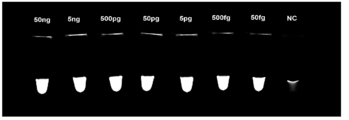
- calcein and manganese added to the reaction solution, it becomes easier to visually determine the presence or absence of amplification.
- the calcein solution bound to manganese is non-fluorescent orange, but pyrophosphate released from deoxynucleotide triphosphate in the reaction solution during the DNA synthesis reaction binds to manganese, so that free calcein solution The color changes to fluorescent greenish yellow.
- the presence or absence of amplification can be determined by visually confirming the color tone of the reaction solution. Moreover, the presence or absence of amplification can be determined by visually confirming the presence or absence of fluorescence in the reaction solution under an ultraviolet lamp. Furthermore, amplification determination can be performed by adding a pyrophosphate detection reagent.
- nucleic acid amplification method of the present invention a nucleic acid having a repetitive sequence is used as a template nucleic acid, and two types of primers, primer 1 that binds to the repetitive sequence and primer 2 that binds to a repetitive sequence of the complementary strand of the template nucleic acid, are used. It is a method of amplifying nucleic acid using it, and can be carried out under isothermal conditions. There are many repetitive sequence regions on the genome of an organism, many of which are known to be species-specific. Therefore, the nucleic acid amplification method of the present invention is extremely useful for the use of specific organism detection.
- the retention status differs for each individual or strain in the same species, and therefore, it is possible to detect a specific strain or use it for each individual or strain type.
- the nucleic acid amplification method of the present invention has a reaction rate and amplification efficiency comparable to those of the LAMP method, and is superior to the LAMP method in terms of simplicity and cost. Therefore, infectious disease diagnosis, environmental health inspection, food inspection In the field of research reagents and the like, it can be expected to be used as a nucleic acid amplification method replacing the LAMP method. Specifically, it is suitable for pathogen detection, allergen detection, detection of toxin-producing organism contamination, detection of useful microorganisms, identification of species, identification of specific strains within organisms and type of individuals. can do.
- the nucleic acid amplification method of the present invention can be used for pathogen detection by designing a primer specific to the repetitive sequence of the target pathogen. Therefore, the present invention includes a pathogen detection method using the nucleic acid amplification method of the present invention.
- the pathogen detection method of the present invention examples include bacteria, fungi, viruses, parasites, and protozoa.
- the sample used in the pathogen detection method of the present invention is not particularly limited, but a biological sample can be suitably used, and it is preferable to directly apply the biological sample.
- biological samples include body fluids such as blood, tissue fluid, lymph fluid, cerebrospinal fluid, pus, mucus, runny nose, sputum, urine, feces, ascites; skin, lung, kidney, mucous membrane, various organs, bone, etc. Tissue, nasal cavity, bronchial, skin, various organs, bone and other cleaning fluids; dialysis drainage and the like. Since the pathogen detection method of the present invention can be carried out quickly, simply and at low cost, it is very advantageous as a pathogen detection method that can be carried out at the bedside.
- a method for detecting Mycobacterium tuberculosis is provided by using primer 1 comprising the base sequence represented by SEQ ID NO: 1 and primer 2 comprising the base sequence represented by SEQ ID NO: 2.
- primer 1 comprising the base sequence represented by SEQ ID NO: 1
- primer 2 comprising the base sequence represented by SEQ ID NO: 2.
- the Salmonella detection method is provided by using the primer 1 which consists of a base sequence represented by sequence number 3, and the primer 2 which consists of a base sequence represented by sequence number 4.
- a leishmania detection method can be provided by using the primer 1 consisting of the base sequence represented by SEQ ID NO: 5 and the primer 2 consisting of the base sequence represented by SEQ ID NO: 6 (Example 5). reference).
- the nucleic acid amplification method of the present invention can be used for detection of allergens by designing primers specific to repetitive sequences possessed by organisms that provide allergens. Therefore, the present invention includes an allergen detection method using the nucleic acid amplification method of the present invention.
- the allergen to be detected may be an allergen derived from a living organism and containing a nucleic acid. Specific examples include, but are not limited to, wheat, shrimp, crab, buckwheat, peanuts, apples, straw, soybeans, pork, ticks, cat hair, mold, and cedar pollen.
- the sample used in the allergen detection method of the present invention is not particularly limited, and examples thereof include processed foods, beverages, raw materials thereof, wiping materials for living environment, and dust collected from the atmosphere. Since the allergen detection method of the present invention does not require special equipment used in general allergen detection methods such as ELISA and PCR, it can be implemented in small-scale facilities such as town factories, retail stores, and clinics. It is advantageous in that it is.
- the nucleic acid amplification method of the present invention can be used to distinguish species by designing a primer specific for the repetitive sequence of the target organism. Therefore, the present invention includes a species discrimination method using the nucleic acid amplification method of the present invention.
- the purpose of species identification is detection of contamination of organisms that may produce toxins, screening of useful microorganisms in the environment, and origin of specific organisms for religious reasons Examples include, but are not limited to, inspection of substance contamination, inspection of capture or use of prohibited biological materials, and inspection of consistency with food labeling and quality labeling.
- the sample used in the method for distinguishing biological species of the present invention is not particularly limited, and examples thereof include products using biological materials such as food and leather products or materials thereof, samples collected from the environment such as soil, seawater, and lake water. It is done.
- the biological species identification method of the present invention is advantageous in that it can be performed quickly, simply and inexpensively, so that a large amount of samples can be inspected continuously.
- the present invention provides a kit for carrying out the nucleic acid amplification method of the present invention.
- the kit of this invention should just contain the primer 1 couple
- the kit of the present invention only needs to include primer 1 and primer 2, and the configuration of the kit other than primer 1 and 2 is not particularly limited, but preferably includes a strand displacement type DNA synthase.
- kits may be appropriately selected to form a kit.
- suitable reagents and instruments include nucleotides that serve as substrates for strand displacement DNA synthase, positive control template nucleic acids, amplification reaction solutions, reaction tubes, sample preparation reagents, instruction manuals, and the like.
- the primer 1 and the primer 2 are the primer 1 consisting of the base sequence represented by SEQ ID NO: 1 and the primer 2 consisting of the base sequence represented by SEQ ID NO: 2, respectively. Kits that specifically amplify sequences can be provided.
- the primer 1 and the primer 2 are respectively a primer 1 consisting of a base sequence represented by SEQ ID NO: 3 and a primer 2 consisting of a base sequence represented by SEQ ID NO: 4, respectively. Kits that specifically amplify repetitive sequences can be provided.
- the primer 1 and the primer 2 are respectively the primer 1 consisting of the base sequence represented by SEQ ID NO: 5 and the primer 2 consisting of the base sequence represented by SEQ ID NO: 6, thereby allowing Leishmania.
- a kit for specifically amplifying the repetitive sequence of can be provided.
- Example 1 The test was carried out targeting a repetitive sequence called DR (Direct Repeat) existing on the Mycobacterium tuberculosis genome.
- DR Direct Repeat
- genomic DNA was obtained from a multidrug-resistant tuberculosis strain isolated from a Japanese patient, and a DNA sample was prepared by 10-fold serial dilution from 25 ng / ⁇ L to 25 fg / ⁇ L. Distilled water was used as a negative control.
- the primers used are shown in Table 1.
- FIG. 8 shows the result of analyzing the amplification product in the reaction solution by agarose gel electrophoresis. As a result, DNA fragments of about 70 base pairs were taken as one unit, and fragments of various lengths that were an integral multiple of the DNA fragment were detected.
- Example 2 Using the reaction solution having the same composition as in Example 1, a specificity test using 21 types of atypical acid-fast bacteria shown in Table 3 (Mycobacterium other than Mycobacterium tuberculosis) was performed. In each of the atypical acid-fast strains, genomic DNA was extracted from a standard strain obtained from the Tuberculosis Prevention Association Tuberculosis Research Institute by the same method as in Example 1, and a 2.5 ng / ⁇ L solution was prepared and used. . Further, Mycobacterium bovis BCG Tokyo strain, which is a Mycobacterium tuberculosis group, was used as a positive control, and an extracted DNA solution was similarly prepared. Distilled water was used as a negative control.
- Mycobacterium bovis BCG Tokyo strain which is a Mycobacterium tuberculosis group
- a fluorescence visual detection / detection reagent Etheral reagent
- Example 4 The test was carried out targeting a tandem repeat sequence (Tandem Repeat) present on the Salmonella (Salmonella enterica subsp. Enterica serovar enteritidis) genome.
- Genomic DNA was obtained from a Salmonella (serotype Enteritidis) strain isolated from a Thai patient using a DNA extraction kit (Qiagen DNA Mini Kit), and a DNA sample diluted 10-fold from 5 ng / ⁇ L to 50 fg / ⁇ L was prepared. did. Distilled water was used as a negative control.
- the primers used are shown in Table 4.
- Example 5 Tests were conducted targeting tandem repeats present on the Leishmania donovani genome.
- DNA sample obtained from a Leishmania donovani strain isolated from a Ghanaian patient using a DNA extraction kit (Qiagen DNA Mini Kit) and diluted 10-fold from 1.8 ng / ⁇ L to 180 fg / ⁇ L was prepared. Distilled water was used as a negative control.
- the primers used are shown in Table 5.
- the present invention is useful for diagnosis of infectious diseases, food inspection, identification of biological species, and the like.
Landscapes
- Chemical & Material Sciences (AREA)
- Life Sciences & Earth Sciences (AREA)
- Organic Chemistry (AREA)
- Proteomics, Peptides & Aminoacids (AREA)
- Analytical Chemistry (AREA)
- Zoology (AREA)
- Wood Science & Technology (AREA)
- Health & Medical Sciences (AREA)
- Engineering & Computer Science (AREA)
- Microbiology (AREA)
- Immunology (AREA)
- Molecular Biology (AREA)
- Biotechnology (AREA)
- Biophysics (AREA)
- Physics & Mathematics (AREA)
- Biochemistry (AREA)
- Bioinformatics & Cheminformatics (AREA)
- General Engineering & Computer Science (AREA)
- General Health & Medical Sciences (AREA)
- Genetics & Genomics (AREA)
- Chemical Kinetics & Catalysis (AREA)
- Measuring Or Testing Involving Enzymes Or Micro-Organisms (AREA)
Abstract
L'invention concerne un procédé d'amplification d'acides nucléiques caractérisé par : une étape de préparation de solution de réaction pour la préparation d'une solution de réaction contenant (a) à (e) ci-dessous ; une étape de synthèse d'acides nucléiques pour la synthèse d'acides nucléiques à l'aide de la solution de réaction résultante ; et pas d'étape de dénaturation thermique d'acide nucléique après l'étape de synthèse d'acide nucléique. Ledit procédé d'amplification d'acides nucléiques ne nécessite aucun équipement spécial, permet une mise en œuvre rapide, facile et à faible coût, et présente à la fois une efficacité d'amplification élevée et une spécificité élevée. La solution de réaction contient (a) un acide nucléique matrice présentant des séquences répétées, (b) une amorce (1) qui se lie aux séquences répétées de l'acide nucléique matrice, (c) une amorce (2) qui se lie aux séquences répétées du brin complémentaire de l'acide nucléique matrice, (d) une ADN synthétase de type à déplacement de brin et (e) des nucléotides qui servent en tant que substrats pour l'ADN synthétase de type à déplacement de brin.
Priority Applications (1)
| Application Number | Priority Date | Filing Date | Title |
|---|---|---|---|
| JP2013504733A JP5688702B2 (ja) | 2011-03-14 | 2012-03-13 | 核酸増幅方法およびその利用 |
Applications Claiming Priority (2)
| Application Number | Priority Date | Filing Date | Title |
|---|---|---|---|
| JP2011-055327 | 2011-03-14 | ||
| JP2011055327 | 2011-03-14 |
Publications (1)
| Publication Number | Publication Date |
|---|---|
| WO2012124681A1 true WO2012124681A1 (fr) | 2012-09-20 |
Family
ID=46830748
Family Applications (1)
| Application Number | Title | Priority Date | Filing Date |
|---|---|---|---|
| PCT/JP2012/056381 Ceased WO2012124681A1 (fr) | 2011-03-14 | 2012-03-13 | Procédé d'amplification d'acides nucléiques et son application |
Country Status (2)
| Country | Link |
|---|---|
| JP (1) | JP5688702B2 (fr) |
| WO (1) | WO2012124681A1 (fr) |
Cited By (2)
| Publication number | Priority date | Publication date | Assignee | Title |
|---|---|---|---|---|
| CN114045330A (zh) * | 2021-12-23 | 2022-02-15 | 川北医学院附属医院 | 一种基于滑动复制的核酸等温扩增方法 |
| CN115701839A (zh) * | 2023-01-05 | 2023-02-14 | 深圳无微华斯生物科技有限公司 | 一种恒温扩增试剂盒及常温保存方法 |
Families Citing this family (1)
| Publication number | Priority date | Publication date | Assignee | Title |
|---|---|---|---|---|
| CN114901817A (zh) | 2019-12-27 | 2022-08-12 | 株式会社钟化 | 引物组及使用其检测目标核酸的方法 |
Family Cites Families (3)
| Publication number | Priority date | Publication date | Assignee | Title |
|---|---|---|---|---|
| US6124120A (en) * | 1997-10-08 | 2000-09-26 | Yale University | Multiple displacement amplification |
| CA2510587A1 (fr) * | 2002-12-20 | 2004-07-15 | Qiagen Gmbh | Amplification de l'acide nucleique |
| WO2008143627A2 (fr) * | 2006-09-14 | 2008-11-27 | Ibis Biosciences, Inc. | Procédé d'amplification ciblée de génome entier pour l'identification d'agents pathogènes |
-
2012
- 2012-03-13 WO PCT/JP2012/056381 patent/WO2012124681A1/fr not_active Ceased
- 2012-03-13 JP JP2013504733A patent/JP5688702B2/ja active Active
Non-Patent Citations (4)
Cited By (3)
| Publication number | Priority date | Publication date | Assignee | Title |
|---|---|---|---|---|
| CN114045330A (zh) * | 2021-12-23 | 2022-02-15 | 川北医学院附属医院 | 一种基于滑动复制的核酸等温扩增方法 |
| CN114045330B (zh) * | 2021-12-23 | 2024-02-09 | 川北医学院附属医院 | 一种基于滑动复制的核酸等温扩增方法 |
| CN115701839A (zh) * | 2023-01-05 | 2023-02-14 | 深圳无微华斯生物科技有限公司 | 一种恒温扩增试剂盒及常温保存方法 |
Also Published As
| Publication number | Publication date |
|---|---|
| JPWO2012124681A1 (ja) | 2014-07-24 |
| JP5688702B2 (ja) | 2015-03-25 |
Similar Documents
| Publication | Publication Date | Title |
|---|---|---|
| Wang et al. | CRISPR‐Cas system for biomedical diagnostic platforms | |
| JP2019201658A (ja) | 非干渉性、ノイズキャンセル性のポリヌクレオチド識別タグを用いたマルチプレックスパイロシーケンシング | |
| CN101736073B (zh) | 一种气单胞菌和嗜水气单胞菌双重pcr快速检测试剂盒和检测方法 | |
| US20230159986A1 (en) | Methods for detecting and sequencing a target nucleic acid | |
| JP2025162555A (ja) | 核酸増幅及び/又は検出用方法及び試薬 | |
| JP2010046042A (ja) | 特定遺伝子の検出方法 | |
| EP3902929B1 (fr) | Système de détection microfluidique rapide et portable en tant qu'alternative au procédé de culture classique de salmonella | |
| CN108950032A (zh) | 一种霍乱弧菌附属毒素蛋白编码基因的检测方法和应用 | |
| JP5688702B2 (ja) | 核酸増幅方法およびその利用 | |
| JP2022513696A (ja) | カンジダ・アウリス(candida auris)の検出のための組成物および方法 | |
| CN107868849A (zh) | 检测对虾ihhnv病毒的引物组及其应用 | |
| ES3051413T3 (en) | Primer set for detecting candida auris, candida auris detection kit, and method for detecting candida auris | |
| JP5019431B2 (ja) | インフルエンザ菌の検出方法、インフルエンザ菌検出用プライマーセット及びインフルエンザ菌検出用キット | |
| JP7176682B2 (ja) | 白癬菌の遺伝子をlamp法により検出するためのプライマーセット及びそれを含むキット並びにそれらを用いて白癬菌を検出する方法 | |
| JP2014522659A (ja) | 保存生成物および任意生成物の蛍光標識フラグメントを生成するための核酸の増幅方法 | |
| JP5548357B2 (ja) | アスペルギルスフミガタス(Aspergillusfumigatus)類縁菌の検出方法 | |
| JP6728657B2 (ja) | 核酸増幅法 | |
| JP2006061134A (ja) | 結核菌検出のためのプライマーおよび検出同定法 | |
| CN103740822B (zh) | 一种spf小鼠病原菌核酸荧光定量pcr联合快速检测试剂盒及检测方法 | |
| JP2015139434A5 (fr) | ||
| Zende et al. | Loop-mediated isothermal amplification assay (LAMP): A rapid tool for diagnosis of foodborne and zoonotic pathogens: A review | |
| JP6996075B2 (ja) | 食中毒原因菌の迅速検出方法 | |
| EP2455470A1 (fr) | Procede d'amplification d'acide nucleique | |
| JP2013220032A (ja) | Lamp法を用いた大腸菌o抗原型の検査方法および検査キット | |
| RU2743861C1 (ru) | Система CRISPR-Cas для выявления гена антибиотикоустойчивости blaVIM-2 (металло-бета-лактамаза класс B VIM-2) Pseudomonas aeruginosa в ультранизких концентрациях |
Legal Events
| Date | Code | Title | Description |
|---|---|---|---|
| 121 | Ep: the epo has been informed by wipo that ep was designated in this application |
Ref document number: 12757267 Country of ref document: EP Kind code of ref document: A1 |
|
| DPE1 | Request for preliminary examination filed after expiration of 19th month from priority date (pct application filed from 20040101) | ||
| ENP | Entry into the national phase |
Ref document number: 2013504733 Country of ref document: JP Kind code of ref document: A |
|
| NENP | Non-entry into the national phase |
Ref country code: DE |
|
| 122 | Ep: pct application non-entry in european phase |
Ref document number: 12757267 Country of ref document: EP Kind code of ref document: A1 |