WO2012124779A1 - シート部材の自動ジッパー装置及びシート製品の製造方法 - Google Patents
シート部材の自動ジッパー装置及びシート製品の製造方法 Download PDFInfo
- Publication number
- WO2012124779A1 WO2012124779A1 PCT/JP2012/056760 JP2012056760W WO2012124779A1 WO 2012124779 A1 WO2012124779 A1 WO 2012124779A1 JP 2012056760 W JP2012056760 W JP 2012056760W WO 2012124779 A1 WO2012124779 A1 WO 2012124779A1
- Authority
- WO
- WIPO (PCT)
- Prior art keywords
- sheet member
- sheet
- zipper device
- automatic zipper
- magnet
- Prior art date
- Legal status (The legal status is an assumption and is not a legal conclusion. Google has not performed a legal analysis and makes no representation as to the accuracy of the status listed.)
- Ceased
Links
Images


Classifications
-
- B—PERFORMING OPERATIONS; TRANSPORTING
- B29—WORKING OF PLASTICS; WORKING OF SUBSTANCES IN A PLASTIC STATE IN GENERAL
- B29D—PRODUCING PARTICULAR ARTICLES FROM PLASTICS OR FROM SUBSTANCES IN A PLASTIC STATE
- B29D30/00—Producing pneumatic or solid tyres or parts thereof
- B29D30/06—Pneumatic tyres or parts thereof (e.g. produced by casting, moulding, compression moulding, injection moulding, centrifugal casting)
- B29D30/08—Building tyres
- B29D30/20—Building tyres by the flat-tyre method, i.e. building on cylindrical drums
-
- B—PERFORMING OPERATIONS; TRANSPORTING
- B29—WORKING OF PLASTICS; WORKING OF SUBSTANCES IN A PLASTIC STATE IN GENERAL
- B29C—SHAPING OR JOINING OF PLASTICS; SHAPING OF MATERIAL IN A PLASTIC STATE, NOT OTHERWISE PROVIDED FOR; AFTER-TREATMENT OF THE SHAPED PRODUCTS, e.g. REPAIRING
- B29C65/00—Joining or sealing of preformed parts, e.g. welding of plastics materials; Apparatus therefor
- B29C65/56—Joining or sealing of preformed parts, e.g. welding of plastics materials; Apparatus therefor using mechanical means or mechanical connections, e.g. form-fits
-
- B—PERFORMING OPERATIONS; TRANSPORTING
- B29—WORKING OF PLASTICS; WORKING OF SUBSTANCES IN A PLASTIC STATE IN GENERAL
- B29C—SHAPING OR JOINING OF PLASTICS; SHAPING OF MATERIAL IN A PLASTIC STATE, NOT OTHERWISE PROVIDED FOR; AFTER-TREATMENT OF THE SHAPED PRODUCTS, e.g. REPAIRING
- B29C65/00—Joining or sealing of preformed parts, e.g. welding of plastics materials; Apparatus therefor
- B29C65/78—Means for handling the parts to be joined, e.g. for making containers or hollow articles, e.g. means for handling sheets, plates, web-like materials, tubular articles, hollow articles or elements to be joined therewith; Means for discharging the joined articles from the joining apparatus
- B29C65/7802—Positioning the parts to be joined, e.g. aligning, indexing or centring
-
- B—PERFORMING OPERATIONS; TRANSPORTING
- B29—WORKING OF PLASTICS; WORKING OF SUBSTANCES IN A PLASTIC STATE IN GENERAL
- B29C—SHAPING OR JOINING OF PLASTICS; SHAPING OF MATERIAL IN A PLASTIC STATE, NOT OTHERWISE PROVIDED FOR; AFTER-TREATMENT OF THE SHAPED PRODUCTS, e.g. REPAIRING
- B29C65/00—Joining or sealing of preformed parts, e.g. welding of plastics materials; Apparatus therefor
- B29C65/78—Means for handling the parts to be joined, e.g. for making containers or hollow articles, e.g. means for handling sheets, plates, web-like materials, tubular articles, hollow articles or elements to be joined therewith; Means for discharging the joined articles from the joining apparatus
- B29C65/7841—Holding or clamping means for handling purposes
- B29C65/785—Holding or clamping means for handling purposes using magnetic forces to hold at least one of the parts to be joined
-
- B—PERFORMING OPERATIONS; TRANSPORTING
- B29—WORKING OF PLASTICS; WORKING OF SUBSTANCES IN A PLASTIC STATE IN GENERAL
- B29C—SHAPING OR JOINING OF PLASTICS; SHAPING OF MATERIAL IN A PLASTIC STATE, NOT OTHERWISE PROVIDED FOR; AFTER-TREATMENT OF THE SHAPED PRODUCTS, e.g. REPAIRING
- B29C65/00—Joining or sealing of preformed parts, e.g. welding of plastics materials; Apparatus therefor
- B29C65/78—Means for handling the parts to be joined, e.g. for making containers or hollow articles, e.g. means for handling sheets, plates, web-like materials, tubular articles, hollow articles or elements to be joined therewith; Means for discharging the joined articles from the joining apparatus
- B29C65/7855—Provisory fixing
-
- B—PERFORMING OPERATIONS; TRANSPORTING
- B29—WORKING OF PLASTICS; WORKING OF SUBSTANCES IN A PLASTIC STATE IN GENERAL
- B29C—SHAPING OR JOINING OF PLASTICS; SHAPING OF MATERIAL IN A PLASTIC STATE, NOT OTHERWISE PROVIDED FOR; AFTER-TREATMENT OF THE SHAPED PRODUCTS, e.g. REPAIRING
- B29C66/00—General aspects of processes or apparatus for joining preformed parts
- B29C66/01—General aspects dealing with the joint area or with the area to be joined
- B29C66/05—Particular design of joint configurations
- B29C66/10—Particular design of joint configurations particular design of the joint cross-sections
- B29C66/11—Joint cross-sections comprising a single joint-segment, i.e. one of the parts to be joined comprising a single joint-segment in the joint cross-section
- B29C66/114—Single butt joints
- B29C66/1142—Single butt to butt joints
-
- B—PERFORMING OPERATIONS; TRANSPORTING
- B29—WORKING OF PLASTICS; WORKING OF SUBSTANCES IN A PLASTIC STATE IN GENERAL
- B29C—SHAPING OR JOINING OF PLASTICS; SHAPING OF MATERIAL IN A PLASTIC STATE, NOT OTHERWISE PROVIDED FOR; AFTER-TREATMENT OF THE SHAPED PRODUCTS, e.g. REPAIRING
- B29C66/00—General aspects of processes or apparatus for joining preformed parts
- B29C66/40—General aspects of joining substantially flat articles, e.g. plates, sheets or web-like materials; Making flat seams in tubular or hollow articles; Joining single elements to substantially flat surfaces
- B29C66/41—Joining substantially flat articles ; Making flat seams in tubular or hollow articles
- B29C66/43—Joining a relatively small portion of the surface of said articles
- B29C66/432—Joining a relatively small portion of the surface of said articles for making tubular articles or closed loops, e.g. by joining several sheets ; for making hollow articles or hollow preforms
- B29C66/4322—Joining a relatively small portion of the surface of said articles for making tubular articles or closed loops, e.g. by joining several sheets ; for making hollow articles or hollow preforms by joining a single sheet to itself
-
- B—PERFORMING OPERATIONS; TRANSPORTING
- B29—WORKING OF PLASTICS; WORKING OF SUBSTANCES IN A PLASTIC STATE IN GENERAL
- B29C—SHAPING OR JOINING OF PLASTICS; SHAPING OF MATERIAL IN A PLASTIC STATE, NOT OTHERWISE PROVIDED FOR; AFTER-TREATMENT OF THE SHAPED PRODUCTS, e.g. REPAIRING
- B29C66/00—General aspects of processes or apparatus for joining preformed parts
- B29C66/40—General aspects of joining substantially flat articles, e.g. plates, sheets or web-like materials; Making flat seams in tubular or hollow articles; Joining single elements to substantially flat surfaces
- B29C66/49—Internally supporting the, e.g. tubular, article during joining
-
- B—PERFORMING OPERATIONS; TRANSPORTING
- B29—WORKING OF PLASTICS; WORKING OF SUBSTANCES IN A PLASTIC STATE IN GENERAL
- B29C—SHAPING OR JOINING OF PLASTICS; SHAPING OF MATERIAL IN A PLASTIC STATE, NOT OTHERWISE PROVIDED FOR; AFTER-TREATMENT OF THE SHAPED PRODUCTS, e.g. REPAIRING
- B29C66/00—General aspects of processes or apparatus for joining preformed parts
- B29C66/70—General aspects of processes or apparatus for joining preformed parts characterised by the composition, physical properties or the structure of the material of the parts to be joined; Joining with non-plastics material
- B29C66/71—General aspects of processes or apparatus for joining preformed parts characterised by the composition, physical properties or the structure of the material of the parts to be joined; Joining with non-plastics material characterised by the composition of the plastics material of the parts to be joined
-
- B—PERFORMING OPERATIONS; TRANSPORTING
- B29—WORKING OF PLASTICS; WORKING OF SUBSTANCES IN A PLASTIC STATE IN GENERAL
- B29C—SHAPING OR JOINING OF PLASTICS; SHAPING OF MATERIAL IN A PLASTIC STATE, NOT OTHERWISE PROVIDED FOR; AFTER-TREATMENT OF THE SHAPED PRODUCTS, e.g. REPAIRING
- B29C66/00—General aspects of processes or apparatus for joining preformed parts
- B29C66/70—General aspects of processes or apparatus for joining preformed parts characterised by the composition, physical properties or the structure of the material of the parts to be joined; Joining with non-plastics material
- B29C66/72—General aspects of processes or apparatus for joining preformed parts characterised by the composition, physical properties or the structure of the material of the parts to be joined; Joining with non-plastics material characterised by the structure of the material of the parts to be joined
- B29C66/721—Fibre-reinforced materials
- B29C66/7212—Fibre-reinforced materials characterised by the composition of the fibres
-
- B—PERFORMING OPERATIONS; TRANSPORTING
- B29—WORKING OF PLASTICS; WORKING OF SUBSTANCES IN A PLASTIC STATE IN GENERAL
- B29C—SHAPING OR JOINING OF PLASTICS; SHAPING OF MATERIAL IN A PLASTIC STATE, NOT OTHERWISE PROVIDED FOR; AFTER-TREATMENT OF THE SHAPED PRODUCTS, e.g. REPAIRING
- B29C66/00—General aspects of processes or apparatus for joining preformed parts
- B29C66/70—General aspects of processes or apparatus for joining preformed parts characterised by the composition, physical properties or the structure of the material of the parts to be joined; Joining with non-plastics material
- B29C66/72—General aspects of processes or apparatus for joining preformed parts characterised by the composition, physical properties or the structure of the material of the parts to be joined; Joining with non-plastics material characterised by the structure of the material of the parts to be joined
- B29C66/721—Fibre-reinforced materials
- B29C66/7214—Fibre-reinforced materials characterised by the length of the fibres
- B29C66/72141—Fibres of continuous length
-
- B—PERFORMING OPERATIONS; TRANSPORTING
- B29—WORKING OF PLASTICS; WORKING OF SUBSTANCES IN A PLASTIC STATE IN GENERAL
- B29C—SHAPING OR JOINING OF PLASTICS; SHAPING OF MATERIAL IN A PLASTIC STATE, NOT OTHERWISE PROVIDED FOR; AFTER-TREATMENT OF THE SHAPED PRODUCTS, e.g. REPAIRING
- B29C66/00—General aspects of processes or apparatus for joining preformed parts
- B29C66/80—General aspects of machine operations or constructions and parts thereof
- B29C66/81—General aspects of the pressing elements, i.e. the elements applying pressure on the parts to be joined in the area to be joined, e.g. the welding jaws or clamps
- B29C66/814—General aspects of the pressing elements, i.e. the elements applying pressure on the parts to be joined in the area to be joined, e.g. the welding jaws or clamps characterised by the design of the pressing elements, e.g. of the welding jaws or clamps
- B29C66/8141—General aspects of the pressing elements, i.e. the elements applying pressure on the parts to be joined in the area to be joined, e.g. the welding jaws or clamps characterised by the design of the pressing elements, e.g. of the welding jaws or clamps characterised by the surface geometry of the part of the pressing elements, e.g. welding jaws or clamps, coming into contact with the parts to be joined
- B29C66/81411—General aspects of the pressing elements, i.e. the elements applying pressure on the parts to be joined in the area to be joined, e.g. the welding jaws or clamps characterised by the design of the pressing elements, e.g. of the welding jaws or clamps characterised by the surface geometry of the part of the pressing elements, e.g. welding jaws or clamps, coming into contact with the parts to be joined characterised by its cross-section, e.g. transversal or longitudinal, being non-flat
- B29C66/81415—General aspects of the pressing elements, i.e. the elements applying pressure on the parts to be joined in the area to be joined, e.g. the welding jaws or clamps characterised by the design of the pressing elements, e.g. of the welding jaws or clamps characterised by the surface geometry of the part of the pressing elements, e.g. welding jaws or clamps, coming into contact with the parts to be joined characterised by its cross-section, e.g. transversal or longitudinal, being non-flat being bevelled
- B29C66/81419—General aspects of the pressing elements, i.e. the elements applying pressure on the parts to be joined in the area to be joined, e.g. the welding jaws or clamps characterised by the design of the pressing elements, e.g. of the welding jaws or clamps characterised by the surface geometry of the part of the pressing elements, e.g. welding jaws or clamps, coming into contact with the parts to be joined characterised by its cross-section, e.g. transversal or longitudinal, being non-flat being bevelled and flat
-
- B—PERFORMING OPERATIONS; TRANSPORTING
- B29—WORKING OF PLASTICS; WORKING OF SUBSTANCES IN A PLASTIC STATE IN GENERAL
- B29C—SHAPING OR JOINING OF PLASTICS; SHAPING OF MATERIAL IN A PLASTIC STATE, NOT OTHERWISE PROVIDED FOR; AFTER-TREATMENT OF THE SHAPED PRODUCTS, e.g. REPAIRING
- B29C66/00—General aspects of processes or apparatus for joining preformed parts
- B29C66/80—General aspects of machine operations or constructions and parts thereof
- B29C66/81—General aspects of the pressing elements, i.e. the elements applying pressure on the parts to be joined in the area to be joined, e.g. the welding jaws or clamps
- B29C66/814—General aspects of the pressing elements, i.e. the elements applying pressure on the parts to be joined in the area to be joined, e.g. the welding jaws or clamps characterised by the design of the pressing elements, e.g. of the welding jaws or clamps
- B29C66/8141—General aspects of the pressing elements, i.e. the elements applying pressure on the parts to be joined in the area to be joined, e.g. the welding jaws or clamps characterised by the design of the pressing elements, e.g. of the welding jaws or clamps characterised by the surface geometry of the part of the pressing elements, e.g. welding jaws or clamps, coming into contact with the parts to be joined
- B29C66/81433—General aspects of the pressing elements, i.e. the elements applying pressure on the parts to be joined in the area to be joined, e.g. the welding jaws or clamps characterised by the design of the pressing elements, e.g. of the welding jaws or clamps characterised by the surface geometry of the part of the pressing elements, e.g. welding jaws or clamps, coming into contact with the parts to be joined being toothed, i.e. comprising several teeth or pins, or being patterned
-
- B—PERFORMING OPERATIONS; TRANSPORTING
- B29—WORKING OF PLASTICS; WORKING OF SUBSTANCES IN A PLASTIC STATE IN GENERAL
- B29C—SHAPING OR JOINING OF PLASTICS; SHAPING OF MATERIAL IN A PLASTIC STATE, NOT OTHERWISE PROVIDED FOR; AFTER-TREATMENT OF THE SHAPED PRODUCTS, e.g. REPAIRING
- B29C66/00—General aspects of processes or apparatus for joining preformed parts
- B29C66/80—General aspects of machine operations or constructions and parts thereof
- B29C66/81—General aspects of the pressing elements, i.e. the elements applying pressure on the parts to be joined in the area to be joined, e.g. the welding jaws or clamps
- B29C66/814—General aspects of the pressing elements, i.e. the elements applying pressure on the parts to be joined in the area to be joined, e.g. the welding jaws or clamps characterised by the design of the pressing elements, e.g. of the welding jaws or clamps
- B29C66/8145—General aspects of the pressing elements, i.e. the elements applying pressure on the parts to be joined in the area to be joined, e.g. the welding jaws or clamps characterised by the design of the pressing elements, e.g. of the welding jaws or clamps characterised by the constructional aspects of the pressing elements, e.g. of the welding jaws or clamps
- B29C66/81463—General aspects of the pressing elements, i.e. the elements applying pressure on the parts to be joined in the area to be joined, e.g. the welding jaws or clamps characterised by the design of the pressing elements, e.g. of the welding jaws or clamps characterised by the constructional aspects of the pressing elements, e.g. of the welding jaws or clamps comprising a plurality of single pressing elements, e.g. a plurality of sonotrodes, or comprising a plurality of single counter-pressing elements, e.g. a plurality of anvils, said plurality of said single elements being suitable for making a single joint
- B29C66/81465—General aspects of the pressing elements, i.e. the elements applying pressure on the parts to be joined in the area to be joined, e.g. the welding jaws or clamps characterised by the design of the pressing elements, e.g. of the welding jaws or clamps characterised by the constructional aspects of the pressing elements, e.g. of the welding jaws or clamps comprising a plurality of single pressing elements, e.g. a plurality of sonotrodes, or comprising a plurality of single counter-pressing elements, e.g. a plurality of anvils, said plurality of said single elements being suitable for making a single joint one placed behind the other in a single row in the feed direction
-
- B—PERFORMING OPERATIONS; TRANSPORTING
- B29—WORKING OF PLASTICS; WORKING OF SUBSTANCES IN A PLASTIC STATE IN GENERAL
- B29C—SHAPING OR JOINING OF PLASTICS; SHAPING OF MATERIAL IN A PLASTIC STATE, NOT OTHERWISE PROVIDED FOR; AFTER-TREATMENT OF THE SHAPED PRODUCTS, e.g. REPAIRING
- B29C66/00—General aspects of processes or apparatus for joining preformed parts
- B29C66/80—General aspects of machine operations or constructions and parts thereof
- B29C66/81—General aspects of the pressing elements, i.e. the elements applying pressure on the parts to be joined in the area to be joined, e.g. the welding jaws or clamps
- B29C66/814—General aspects of the pressing elements, i.e. the elements applying pressure on the parts to be joined in the area to be joined, e.g. the welding jaws or clamps characterised by the design of the pressing elements, e.g. of the welding jaws or clamps
- B29C66/8145—General aspects of the pressing elements, i.e. the elements applying pressure on the parts to be joined in the area to be joined, e.g. the welding jaws or clamps characterised by the design of the pressing elements, e.g. of the welding jaws or clamps characterised by the constructional aspects of the pressing elements, e.g. of the welding jaws or clamps
- B29C66/81463—General aspects of the pressing elements, i.e. the elements applying pressure on the parts to be joined in the area to be joined, e.g. the welding jaws or clamps characterised by the design of the pressing elements, e.g. of the welding jaws or clamps characterised by the constructional aspects of the pressing elements, e.g. of the welding jaws or clamps comprising a plurality of single pressing elements, e.g. a plurality of sonotrodes, or comprising a plurality of single counter-pressing elements, e.g. a plurality of anvils, said plurality of said single elements being suitable for making a single joint
- B29C66/81469—General aspects of the pressing elements, i.e. the elements applying pressure on the parts to be joined in the area to be joined, e.g. the welding jaws or clamps characterised by the design of the pressing elements, e.g. of the welding jaws or clamps characterised by the constructional aspects of the pressing elements, e.g. of the welding jaws or clamps comprising a plurality of single pressing elements, e.g. a plurality of sonotrodes, or comprising a plurality of single counter-pressing elements, e.g. a plurality of anvils, said plurality of said single elements being suitable for making a single joint one placed next to the other in a single line transverse to the feed direction, e.g. shoulder to shoulder sonotrodes
-
- B—PERFORMING OPERATIONS; TRANSPORTING
- B29—WORKING OF PLASTICS; WORKING OF SUBSTANCES IN A PLASTIC STATE IN GENERAL
- B29C—SHAPING OR JOINING OF PLASTICS; SHAPING OF MATERIAL IN A PLASTIC STATE, NOT OTHERWISE PROVIDED FOR; AFTER-TREATMENT OF THE SHAPED PRODUCTS, e.g. REPAIRING
- B29C66/00—General aspects of processes or apparatus for joining preformed parts
- B29C66/80—General aspects of machine operations or constructions and parts thereof
- B29C66/81—General aspects of the pressing elements, i.e. the elements applying pressure on the parts to be joined in the area to be joined, e.g. the welding jaws or clamps
- B29C66/816—General aspects of the pressing elements, i.e. the elements applying pressure on the parts to be joined in the area to be joined, e.g. the welding jaws or clamps characterised by the mounting of the pressing elements, e.g. of the welding jaws or clamps
-
- B—PERFORMING OPERATIONS; TRANSPORTING
- B29—WORKING OF PLASTICS; WORKING OF SUBSTANCES IN A PLASTIC STATE IN GENERAL
- B29C—SHAPING OR JOINING OF PLASTICS; SHAPING OF MATERIAL IN A PLASTIC STATE, NOT OTHERWISE PROVIDED FOR; AFTER-TREATMENT OF THE SHAPED PRODUCTS, e.g. REPAIRING
- B29C66/00—General aspects of processes or apparatus for joining preformed parts
- B29C66/80—General aspects of machine operations or constructions and parts thereof
- B29C66/82—Pressure application arrangements, e.g. transmission or actuating mechanisms for joining tools or clamps
- B29C66/822—Transmission mechanisms
- B29C66/8221—Scissor or lever mechanisms, i.e. involving a pivot point
-
- B—PERFORMING OPERATIONS; TRANSPORTING
- B29—WORKING OF PLASTICS; WORKING OF SUBSTANCES IN A PLASTIC STATE IN GENERAL
- B29C—SHAPING OR JOINING OF PLASTICS; SHAPING OF MATERIAL IN A PLASTIC STATE, NOT OTHERWISE PROVIDED FOR; AFTER-TREATMENT OF THE SHAPED PRODUCTS, e.g. REPAIRING
- B29C66/00—General aspects of processes or apparatus for joining preformed parts
- B29C66/80—General aspects of machine operations or constructions and parts thereof
- B29C66/82—Pressure application arrangements, e.g. transmission or actuating mechanisms for joining tools or clamps
- B29C66/824—Actuating mechanisms
- B29C66/8242—Pneumatic or hydraulic drives
-
- B—PERFORMING OPERATIONS; TRANSPORTING
- B29—WORKING OF PLASTICS; WORKING OF SUBSTANCES IN A PLASTIC STATE IN GENERAL
- B29C—SHAPING OR JOINING OF PLASTICS; SHAPING OF MATERIAL IN A PLASTIC STATE, NOT OTHERWISE PROVIDED FOR; AFTER-TREATMENT OF THE SHAPED PRODUCTS, e.g. REPAIRING
- B29C66/00—General aspects of processes or apparatus for joining preformed parts
- B29C66/80—General aspects of machine operations or constructions and parts thereof
- B29C66/82—Pressure application arrangements, e.g. transmission or actuating mechanisms for joining tools or clamps
- B29C66/824—Actuating mechanisms
- B29C66/8244—Actuating mechanisms magnetically driven
-
- B—PERFORMING OPERATIONS; TRANSPORTING
- B29—WORKING OF PLASTICS; WORKING OF SUBSTANCES IN A PLASTIC STATE IN GENERAL
- B29C—SHAPING OR JOINING OF PLASTICS; SHAPING OF MATERIAL IN A PLASTIC STATE, NOT OTHERWISE PROVIDED FOR; AFTER-TREATMENT OF THE SHAPED PRODUCTS, e.g. REPAIRING
- B29C66/00—General aspects of processes or apparatus for joining preformed parts
- B29C66/80—General aspects of machine operations or constructions and parts thereof
- B29C66/83—General aspects of machine operations or constructions and parts thereof characterised by the movement of the joining or pressing tools
- B29C66/836—Moving relative to and tangentially to the parts to be joined, e.g. transversely to the displacement of the parts to be joined, e.g. using a X-Y table
- B29C66/8362—Rollers, cylinders or drums moving relative to and tangentially to the parts to be joined
-
- B—PERFORMING OPERATIONS; TRANSPORTING
- B29—WORKING OF PLASTICS; WORKING OF SUBSTANCES IN A PLASTIC STATE IN GENERAL
- B29C—SHAPING OR JOINING OF PLASTICS; SHAPING OF MATERIAL IN A PLASTIC STATE, NOT OTHERWISE PROVIDED FOR; AFTER-TREATMENT OF THE SHAPED PRODUCTS, e.g. REPAIRING
- B29C66/00—General aspects of processes or apparatus for joining preformed parts
- B29C66/90—Measuring or controlling the joining process
- B29C66/92—Measuring or controlling the joining process by measuring or controlling the pressure, the force, the mechanical power or the displacement of the joining tools
- B29C66/924—Measuring or controlling the joining process by measuring or controlling the pressure, the force, the mechanical power or the displacement of the joining tools by controlling or regulating the pressure, the force, the mechanical power or the displacement of the joining tools
- B29C66/9261—Measuring or controlling the joining process by measuring or controlling the pressure, the force, the mechanical power or the displacement of the joining tools by controlling or regulating the pressure, the force, the mechanical power or the displacement of the joining tools by controlling or regulating the displacement of the joining tools
- B29C66/92611—Measuring or controlling the joining process by measuring or controlling the pressure, the force, the mechanical power or the displacement of the joining tools by controlling or regulating the pressure, the force, the mechanical power or the displacement of the joining tools by controlling or regulating the displacement of the joining tools by controlling or regulating the gap between the joining tools
- B29C66/92613—Measuring or controlling the joining process by measuring or controlling the pressure, the force, the mechanical power or the displacement of the joining tools by controlling or regulating the pressure, the force, the mechanical power or the displacement of the joining tools by controlling or regulating the displacement of the joining tools by controlling or regulating the gap between the joining tools the gap being kept constant over time
-
- B—PERFORMING OPERATIONS; TRANSPORTING
- B29—WORKING OF PLASTICS; WORKING OF SUBSTANCES IN A PLASTIC STATE IN GENERAL
- B29D—PRODUCING PARTICULAR ARTICLES FROM PLASTICS OR FROM SUBSTANCES IN A PLASTIC STATE
- B29D30/00—Producing pneumatic or solid tyres or parts thereof
- B29D30/06—Pneumatic tyres or parts thereof (e.g. produced by casting, moulding, compression moulding, injection moulding, centrifugal casting)
- B29D30/38—Textile inserts, e.g. cord or canvas layers, for tyres; Treatment of inserts prior to building the tyre
- B29D30/42—Endless textile bands without bead-rings
-
- B—PERFORMING OPERATIONS; TRANSPORTING
- B29—WORKING OF PLASTICS; WORKING OF SUBSTANCES IN A PLASTIC STATE IN GENERAL
- B29C—SHAPING OR JOINING OF PLASTICS; SHAPING OF MATERIAL IN A PLASTIC STATE, NOT OTHERWISE PROVIDED FOR; AFTER-TREATMENT OF THE SHAPED PRODUCTS, e.g. REPAIRING
- B29C66/00—General aspects of processes or apparatus for joining preformed parts
- B29C66/01—General aspects dealing with the joint area or with the area to be joined
- B29C66/05—Particular design of joint configurations
- B29C66/20—Particular design of joint configurations particular design of the joint lines, e.g. of the weld lines
- B29C66/22—Particular design of joint configurations particular design of the joint lines, e.g. of the weld lines said joint lines being in the form of recurring patterns
- B29C66/221—Particular design of joint configurations particular design of the joint lines, e.g. of the weld lines said joint lines being in the form of recurring patterns being in the form of a sinusoidal wave
-
- B—PERFORMING OPERATIONS; TRANSPORTING
- B29—WORKING OF PLASTICS; WORKING OF SUBSTANCES IN A PLASTIC STATE IN GENERAL
- B29C—SHAPING OR JOINING OF PLASTICS; SHAPING OF MATERIAL IN A PLASTIC STATE, NOT OTHERWISE PROVIDED FOR; AFTER-TREATMENT OF THE SHAPED PRODUCTS, e.g. REPAIRING
- B29C66/00—General aspects of processes or apparatus for joining preformed parts
- B29C66/70—General aspects of processes or apparatus for joining preformed parts characterised by the composition, physical properties or the structure of the material of the parts to be joined; Joining with non-plastics material
- B29C66/73—General aspects of processes or apparatus for joining preformed parts characterised by the composition, physical properties or the structure of the material of the parts to be joined; Joining with non-plastics material characterised by the intensive physical properties of the material of the parts to be joined, by the optical properties of the material of the parts to be joined, by the extensive physical properties of the parts to be joined, by the state of the material of the parts to be joined or by the material of the parts to be joined being a thermoplastic or a thermoset
- B29C66/737—General aspects of processes or apparatus for joining preformed parts characterised by the composition, physical properties or the structure of the material of the parts to be joined; Joining with non-plastics material characterised by the intensive physical properties of the material of the parts to be joined, by the optical properties of the material of the parts to be joined, by the extensive physical properties of the parts to be joined, by the state of the material of the parts to be joined or by the material of the parts to be joined being a thermoplastic or a thermoset characterised by the state of the material of the parts to be joined
- B29C66/7375—General aspects of processes or apparatus for joining preformed parts characterised by the composition, physical properties or the structure of the material of the parts to be joined; Joining with non-plastics material characterised by the intensive physical properties of the material of the parts to be joined, by the optical properties of the material of the parts to be joined, by the extensive physical properties of the parts to be joined, by the state of the material of the parts to be joined or by the material of the parts to be joined being a thermoplastic or a thermoset characterised by the state of the material of the parts to be joined uncured, partially cured or fully cured
- B29C66/73751—General aspects of processes or apparatus for joining preformed parts characterised by the composition, physical properties or the structure of the material of the parts to be joined; Joining with non-plastics material characterised by the intensive physical properties of the material of the parts to be joined, by the optical properties of the material of the parts to be joined, by the extensive physical properties of the parts to be joined, by the state of the material of the parts to be joined or by the material of the parts to be joined being a thermoplastic or a thermoset characterised by the state of the material of the parts to be joined uncured, partially cured or fully cured the to-be-joined area of at least one of the parts to be joined being uncured, i.e. non cross-linked, non vulcanized
- B29C66/73752—General aspects of processes or apparatus for joining preformed parts characterised by the composition, physical properties or the structure of the material of the parts to be joined; Joining with non-plastics material characterised by the intensive physical properties of the material of the parts to be joined, by the optical properties of the material of the parts to be joined, by the extensive physical properties of the parts to be joined, by the state of the material of the parts to be joined or by the material of the parts to be joined being a thermoplastic or a thermoset characterised by the state of the material of the parts to be joined uncured, partially cured or fully cured the to-be-joined area of at least one of the parts to be joined being uncured, i.e. non cross-linked, non vulcanized the to-be-joined areas of both parts to be joined being uncured
-
- B—PERFORMING OPERATIONS; TRANSPORTING
- B29—WORKING OF PLASTICS; WORKING OF SUBSTANCES IN A PLASTIC STATE IN GENERAL
- B29D—PRODUCING PARTICULAR ARTICLES FROM PLASTICS OR FROM SUBSTANCES IN A PLASTIC STATE
- B29D30/00—Producing pneumatic or solid tyres or parts thereof
- B29D30/06—Pneumatic tyres or parts thereof (e.g. produced by casting, moulding, compression moulding, injection moulding, centrifugal casting)
- B29D30/38—Textile inserts, e.g. cord or canvas layers, for tyres; Treatment of inserts prior to building the tyre
- B29D30/42—Endless textile bands without bead-rings
- B29D2030/421—General aspects of the joining methods and devices for creating the bands
- B29D2030/422—Butt joining
-
- B—PERFORMING OPERATIONS; TRANSPORTING
- B29—WORKING OF PLASTICS; WORKING OF SUBSTANCES IN A PLASTIC STATE IN GENERAL
- B29D—PRODUCING PARTICULAR ARTICLES FROM PLASTICS OR FROM SUBSTANCES IN A PLASTIC STATE
- B29D30/00—Producing pneumatic or solid tyres or parts thereof
- B29D30/06—Pneumatic tyres or parts thereof (e.g. produced by casting, moulding, compression moulding, injection moulding, centrifugal casting)
- B29D30/08—Building tyres
- B29D30/20—Building tyres by the flat-tyre method, i.e. building on cylindrical drums
- B29D30/30—Applying the layers; Guiding or stretching the layers during application
- B29D30/3007—Applying the layers; Guiding or stretching the layers during application by feeding a sheet perpendicular to the drum axis and joining the ends to form an annular element
-
- B—PERFORMING OPERATIONS; TRANSPORTING
- B29—WORKING OF PLASTICS; WORKING OF SUBSTANCES IN A PLASTIC STATE IN GENERAL
- B29K—INDEXING SCHEME ASSOCIATED WITH SUBCLASSES B29B, B29C OR B29D, RELATING TO MOULDING MATERIALS OR TO MATERIALS FOR MOULDS, REINFORCEMENTS, FILLERS OR PREFORMED PARTS, e.g. INSERTS
- B29K2105/00—Condition, form or state of moulded material or of the material to be shaped
- B29K2105/06—Condition, form or state of moulded material or of the material to be shaped containing reinforcements, fillers or inserts
- B29K2105/08—Condition, form or state of moulded material or of the material to be shaped containing reinforcements, fillers or inserts of continuous length, e.g. cords, rovings, mats, fabrics, strands or yarns
- B29K2105/10—Cords, strands or rovings, e.g. oriented cords, strands or rovings
- B29K2105/101—Oriented
-
- B—PERFORMING OPERATIONS; TRANSPORTING
- B29—WORKING OF PLASTICS; WORKING OF SUBSTANCES IN A PLASTIC STATE IN GENERAL
- B29K—INDEXING SCHEME ASSOCIATED WITH SUBCLASSES B29B, B29C OR B29D, RELATING TO MOULDING MATERIALS OR TO MATERIALS FOR MOULDS, REINFORCEMENTS, FILLERS OR PREFORMED PARTS, e.g. INSERTS
- B29K2105/00—Condition, form or state of moulded material or of the material to be shaped
- B29K2105/24—Condition, form or state of moulded material or of the material to be shaped crosslinked or vulcanised
- B29K2105/246—Uncured, e.g. green
-
- B—PERFORMING OPERATIONS; TRANSPORTING
- B29—WORKING OF PLASTICS; WORKING OF SUBSTANCES IN A PLASTIC STATE IN GENERAL
- B29L—INDEXING SCHEME ASSOCIATED WITH SUBCLASS B29C, RELATING TO PARTICULAR ARTICLES
- B29L2030/00—Pneumatic or solid tyres or parts thereof
- B29L2030/003—Plies; Breakers
Definitions
- the present invention relates to an automatic zipper device (joining device) for sheet members, for example, an automatic zipper device for sheet members such as a ply for a super large tire, and a method for manufacturing a sheet product.
- Patent Document 1 When an unvulcanized rubber sheet member is pasted on a molding drum to form an unvulcanized tire, the unvulcanized rubber sheet member is cut to the length of one tire and pasted on the molding drum. Thereafter, both end portions are joined, or a plurality of sheet members are overlapped and joined at the side portions. In general, these members are joined by pressing a roller against the joining end and extending the joining surfaces toward the other end so that both ends overlap (see Patent Documents 1 to 3). In addition to this, Patent Document 1 also describes a technique in which a pair of swinging claws are pressed against a rubber sheet to reduce the relative distance between the outer edges and join the rubber sheet.
- a conventional member zipper type hand zipper device is used. That is, (1) When automatic joining is performed, if the sheet member (ply) on the advancing direction side opens even a little, it cannot be corrected in the middle, and the joining means, for example, the joining roll is idle and cannot be joined well. Can happen. (2) Since it is necessary to always apply the joining roll to the sheet member at a constant angle in order to join the joining end portions uniformly, especially when the inclination of the sheet member is large, the inclined portion is joined well. I can't. (3) Since the vicinity of the end of the sheet member cannot be brought into close contact with the lower member as a countermeasure against the folded ply wave, it is not possible to use a joining device that presses down from above.
- An object of the present invention is to automate a conventional hand zipper device that joins end portions of sheet members (plies) in which a plurality of metal cords are aligned on a molding drum, for example, in molding a very large tire or the like.
- the sheet member can be automatically joined.
- the present invention is an automatic zipper device for a sheet member that joins the joined ends of the sheet member wound around the periphery of the forming drum while moving, and takes in the pair of sheet members into the device,
- An automatic zipper device for a sheet member comprising: a pair of rotationally driven biting means for biting and joining the joint ends of the sheet member taken into the device between teeth meshing with each other. is there.
- the present invention is also a sheet product manufacturing method for forming a sheet product by joining the joined end portions of a sheet member embedded with a magnet adsorbing metal cord wound around a molding drum circumference while moving.
- the end portions of a sheet member having a thickness such as a ply for manufacturing a super-large tire can be automatically joined without being manually involved as in the prior art. Therefore, the productivity of the joining operation of the sheet member can be improved and the work burden on the worker can be reduced.
- FIG. 2 is a cross-sectional view of the automatic zipper device of FIG.
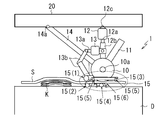
- FIG. 1 is a front view schematically showing an automatic zipper device for a sheet member according to the present embodiment.
- the automatic zipper device 1 includes a pair of bevel gears 10 that are coaxially opposed biting means for joining sheet members, an air motor 11 that rotationally drives the bevel gear 10 around its central axis 10a, and the bevel gear 10 Are provided with an inclined portion following cylinder 12 and a sandwiching cylinder 13 that adjust the height of the sheet member to be joined following the inclination of the sheet member to be joined.
- the pressing roller 15 (4) may be a small-diameter bevel gear that bites each other.
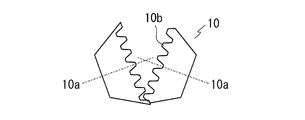
- FIG. 2 is a diagram showing a meshed state of the bevel gear.
- Each bevel gear 10 is arranged so that the extension lines of its central axis 10a intersect so that the lower side of the bevel gears 10 meshes with each other with teeth 10b formed on the outer peripheral surface thereof as shown in FIG. Yes.
- the pair of sheet members S that move relative to the bevel gear 10 is engaged with the bevel gear 10 and joined together.
- the inclined portion following cylinder 12 is an air cylinder, and the tip of the piston rod 12a is connected to the central shaft 10a of the bevel gear 10 (or a casing that supports the central shaft 10a (not shown)) through the sleeve 12b. ing.
- One end of a cylinder 13 is integrally connected to the sleeve 12b in a direction perpendicular to the sleeve 12b, that is, in a horizontal direction.
- the front end of the piston rod 13a of the sandwiching cylinder 13 is rotatably connected to the upper end portion of the "13" -shaped arm 13b as seen in the figure.
- the lower end of the “ ⁇ ”-shaped arm 13 b is pivotally attached to the shaft 13 c of the support frame 16 that supports the pressing rollers 15 (4) and 15 (6), and extends from the piston rod 13 a of the sandwiching cylinder 13.
- the shaft 13c is guided in a groove of a stationary frame body (not shown), and the pressing rollers 15 (4) and 15 (6) are lifted together with the support frame body 16 by the " ⁇ "-shaped arms 13b.
- the sheet member S is pressed against the pair of bevel gears 10 by the pressing roller 15 (4), and the sheet member S is pressed (that is, sandwiched) by the pressing roller 15 (6) against the member contact position stabilizing magnet 15 (3). Hold S so as not to blind.
- the sandwiching cylinder 13, the piston rod 13a, the arm 13b, the support frame 16, the pressing rollers 15 (4) and 15 (6), and the member contact position stabilizing magnet 15 (3) serve as a sandwiching means for the sheet member.
- the sandwiching cylinder 13, the piston rod 13a, the arm 13b, the support frame 16, and the pressing rollers 15 (4) and 15 (6) constitute pressing means included in the sandwiching means.
- the sandwiching means is not limited to the above-described specific configuration.
- the sheet member passing through the bevel gear 10 is sandwiched between the member contact position stabilizing magnets 15 (3), pressed against the pair of bevel gears 10 and joined. Any position can be used as long as the position can be kept constant with respect to the bevel gear 10.
- the sheet member guide portion 15 is configured by the upper and lower portions of the support frame body 16, and is disposed on the upper side from the left side in the figure and on the front side of the bevel gear 10 of the upper support frame body 16 a.
- An induction magnet roller 15 (1) which is a take-in means for taking in and guiding the sheet member S by applying a magnetic force to the resulting reinforcing cord, and front and rear guide rollers 15 (5) for guiding the drawn-in sheet member S are provided. It has been. Further, on the lower side, an induction magnet roller 15 which is disposed on the front side of the bevel gear 10 of the lower support frame 16b and is a taking-in means for taking in and guiding the sheet member S in a pair with the induction magnet roller 15 (1).
- the induction magnet rollers 15 (1) and 15 (2) do not necessarily have to be induction magnets and are permanent
- May be a magnet May be a magnet.
- the upper and lower rollers are rotatably supported by an appropriate support means (or support frame) (not shown).
- the member contact position stabilizing magnet 15 (3) is a stationary frame different from the support frame 16 along the moving direction of the sheet member S taken in on both sides of the bevel gear 10 between the front and rear guide rollers 15 (5). It is attached to the body (not shown) together with the bevel gear 10.
- the member contact position stabilizing magnet 15 (3) attracts the sheet member S and maintains it at a constant height.
- the pressing roller 15 (4) presses the sheet member S against the pair of bevel gears 10, and between the member contact position stabilizing magnet 15 (3) and the pressing roller 15 (6). Then, the sheet member S is sandwiched and held so as not to blind (see FIG. 5). Accordingly, when the sheet member S is pulled up by the magnetic force on both sides of the bevel gear 10 and is engaged between the meshing teeth 10b, the sheet member S can be brought into contact with the bevel gear 10 at a certain angle.
- FIG. 3 is a front view showing a state in which the automatic zipper device 1 is attached to the traversing device (however, the portion of the sheet member S is shown in cross section).
- the traversing device 20 has an appropriate drive mechanism, in this embodiment, a nut that is engaged with a lead screw that is rotationally driven by a motor (not shown), and is integrally attached along the rotation axis of the molding drum D according to the reversible rotation of the motor.
- a drive means of the traversing device 20 you may move the traversing device 20 attached to the rack integrally by rotating a pinion with a motor, for example, using a rack and a pinion.
- other known driving means may be used.
- the upper end of the inclined portion following cylinder 12 of the automatic zipper device 1 is fixed to the traversing device 20 with pins or bolts 12c.
- the support arm 14 is an arm that connects the traversing device 20 and the automatic zipper device 1, the upper end of which is swingably coupled to the traversing device 20 by a pin or bolt 14 a, and the other end is an automatic zipper
- the automatic zipper device 1 is connected to the automatic zipper device 1 by an arbitrary connecting means so that the device 1 can swing corresponding to the vertical displacement.
- the joining surface (joint surface) of the sheet member S is joined (zipping) direction.
- matching is performed according to zero-angle projection light so as to be horizontal.
- the butted end portion of the sheet member S is bent upward to be lifted from the surface of the forming drum D.
- the lower induction magnet roller 15 (2) can easily enter the lower side of the sheet member S through the gap.
- the automatic zipper device 1 is lowered to start the joint.
- the induction magnet rollers 15 (1) and 15 (2) are provided with electromagnets in the roller portion, and the raised end of the sheet member S in which a plurality of magnet-adsorptive metal reinforcing cords are aligned.
- the pair of induction magnet rollers 15 (1) and 15 (2) of the automatic zipper device draws the portion into the automatic zipper device 1 using the magnetic force.
- the induction magnet rollers 15 (1) and 15 (2) prevent the sheet member S from opening before the joint in order to suppress the blind movement of the sheet member S by the magnetic force after the sheet member S is drawn. Can do.
- the automatic zipper device 1 is traversed from the right side to the left side in the drawing.
- the piston rod 13a is extended, the " ⁇ "-shaped arm 13b pivots around the shaft 13c, and the pressing roller together with the support frame 16 attached integrally to the lower end of this " ⁇ "-shaped arm 13b.
- the pressing roller 15 (6) is raised, and the sheet member S attracted to the member contact position stabilizing magnet 15 (3) is pressed against the pair of bevel gears 10 by the pressing roller 15 (4), and the pressing roller At 15 (6), the member contact position stabilizing magnet 15 (3) is pressed and held, and while being bitten by the bevel gear 10 and joined, the sheet member S is held so as not to blind.
- FIG. 3 shows a state in which the automatic zipper device 1 is traversing along the forming drum D from one side portion of the sheet member S in this way.
- the sheet member S is pulled by the pair of induction magnet rollers 15 (1) and 15 (2) by the magnetic force acting on the magnet-adsorbing metal cord, and as described above, the joining end portions are not separated from each other. So that the position is maintained.
- the drawn sheet member S is attracted upward by the member contact position stabilizing magnet 15 (3) so that the joint ends thereof are always in contact with the bevel gear 10 at a constant angle. Maintained.
- the sheet member S is sandwiched between the pair of upper and lower guide rollers 15 (5) and the pressing rollers 15 (4) and 15 (6) pulled up by the piston rod 13a and the " ⁇ "-shaped arm 13b.
- the automatic zipper device 1 moves relative to the automatic zipper device 1 while being held at a fixed position and pressed against the pair of bevel gears 10.
- the sheet member S is joined (zipped) by the pair of bevel gears 10 that are rotationally driven by the air motor 11 so that the joining end portions are bitten.
- the joined sheet member (endless sheet member) S then exits the automatic zipper device 1.
- the seat member S is inclined upward in the vicinity thereof.
- the reaction force received from the inclined surface causes the piston rod 12a of the inclined portion following cylinder 12 connected to the bevel gear 10 to compress the air in the inclined portion following cylinder 12. Degenerate into it.
- the automatic zipper device 1 including the bevel gear 10 and therefore the sheet member guide portion 15 joins the sheet member S along the inclined surface of the sheet member S while changing the vertical position thereof.
- the inclined portion following cylinder 12 can cope with not only the inclined portion but also the bending of the sheet member S.
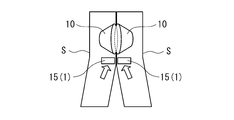
- FIG. 4 is a plan view showing a main part of the automatic zipper apparatus shown for explaining the taking-in of the sheet member S by the induction magnet rollers 15 (1) and 15 (2).
- the sheet member S is attracted by the magnetic force of the pair of upper and lower induction magnet rollers 15 (1) and 15 (2) arranged in the direction orthogonal to the traveling direction of the automatic zipper device 1, and the automatic zipper It is drawn into the device 1.
- the sheet member S that has been pulled in is from the bottom by the magnetic force of the pair of upper and lower induction magnet rollers 15 (1) and 15 (2) and the pressing rollers 15 (4) and 15 (6). Since the position is maintained by receiving the pressing force, it does not blindly move.
- a pair of upper and lower induction magnet rollers 15 (1) and 15 (2) are provided, and the automatic zipper device 1 moves along the joint portion of the sheet member S in order to hold the position with the magnetic force. At this time, the joining end portions of the sheet member S do not open (separate) before joining. Further, the sheet member S drawn into the automatic zipper device is attracted to the member contact position stabilizing magnet 15 (3), and is also applied to the bevel gear 10 by the lower pressing roller 15 (4) and to the pressing roller 15 ( 6), the pair of front and rear guide rollers 15 (5), the small-diameter bevel gear or pressing roller 15 (4), and the pressing roller 15 (6) while being pressed by the member contact position stabilizing magnet 15 (3). ) And are moved relative to each other, and are always engaged with the pair of bevel gears 10 while maintaining a state in which the bevel gears 10 are always in contact with each other at a constant angle.
- FIG. 5 is a cross-sectional view taken along the line AA of the automatic zipper device of FIG. 1 schematically shown.
- the sheet member S is attracted upward by the member contact position stabilizing magnet 15 (3) at both sides of the bevel gear 10 and is pressed by the pressing roller 15 (6).
- the position of the joint is held while being pressed and clamped, and is pressed against the bevel gear 10 by the pressing roller 15 (4), so that the joint position does not shift to the right or left from the center line. Accordingly, it is not necessary to manually press the remaining portion after joining, as in the case of using the hand zipper device, and the joining end portion of the sheet member S with respect to the bevel gear 10 as described above. Since the contact is always made at a constant angle and the ends of the bevel gears 10 are bitten and joined together, the sheet members are always joined uniformly.
- SYMBOLS 1 Automatic zipper device, 10 ... Bevel gear, 10a ... Center axis, 10b ... Teeth, 11 ... Air motor, 12 ... Cylinder following cylinder, 13 ... Clamping cylinder, 13a ⁇ ⁇ ⁇ Piston rod, 13b ⁇ ⁇ ⁇ Loop shaped arm, 13c ⁇ ⁇ ⁇ Shaft, 14 ⁇ ⁇ ⁇ Support arm, 15 ⁇ ⁇ ⁇ Guide part of sheet member, 15 (1), 15 (2) ⁇ ⁇ ⁇ Induction Magnet roller, 15 (3) ... member contact position stabilizing magnet, 15 (4), 15 (6) ... pressure roller, 15 (5) ... guide roller, 20 ... traversing device, D. ..Molding drum, K ... tyre component, S ... sheet member.
Landscapes
- Engineering & Computer Science (AREA)
- Mechanical Engineering (AREA)
- Physics & Mathematics (AREA)
- Fluid Mechanics (AREA)
- Textile Engineering (AREA)
- Tyre Moulding (AREA)
- Lining Or Joining Of Plastics Or The Like (AREA)
Priority Applications (5)
| Application Number | Priority Date | Filing Date | Title |
|---|---|---|---|
| JP2013504773A JP5755726B2 (ja) | 2011-03-15 | 2012-03-15 | シート部材の自動ジッパー装置及びシート製品の製造方法 |
| ES12757822.7T ES2656956T3 (es) | 2011-03-15 | 2012-03-15 | Dispositivo de cierre automático de cremallera para miembro de lámina y método para producir un producto laminar |
| CN201280013346.4A CN103429418B (zh) | 2011-03-15 | 2012-03-15 | 用于片状构件的自动拉链装置和用于制造片状产品的方法 |
| EP12757822.7A EP2687355B1 (de) | 2011-03-15 | 2012-03-15 | Automatische reissverschlussvorrichtung für ein folienelement und verfahren zur herstellung des folienelements |
| US14/003,576 US9403333B2 (en) | 2011-03-15 | 2012-03-15 | Automatic zipper device for sheet member and method for producing sheet product |
Applications Claiming Priority (2)
| Application Number | Priority Date | Filing Date | Title |
|---|---|---|---|
| JP2011057097 | 2011-03-15 | ||
| JP2011-057097 | 2011-03-15 |
Publications (1)
| Publication Number | Publication Date |
|---|---|
| WO2012124779A1 true WO2012124779A1 (ja) | 2012-09-20 |
Family
ID=46830843
Family Applications (1)
| Application Number | Title | Priority Date | Filing Date |
|---|---|---|---|
| PCT/JP2012/056760 Ceased WO2012124779A1 (ja) | 2011-03-15 | 2012-03-15 | シート部材の自動ジッパー装置及びシート製品の製造方法 |
Country Status (6)
| Country | Link |
|---|---|
| US (1) | US9403333B2 (de) |
| EP (1) | EP2687355B1 (de) |
| JP (1) | JP5755726B2 (de) |
| CN (1) | CN103429418B (de) |
| ES (1) | ES2656956T3 (de) |
| WO (1) | WO2012124779A1 (de) |
Cited By (1)
| Publication number | Priority date | Publication date | Assignee | Title |
|---|---|---|---|---|
| CN111152489A (zh) * | 2018-11-08 | 2020-05-15 | 通伊欧轮胎株式会社 | 轮胎部件的制造装置以及制造方法 |
Families Citing this family (3)
| Publication number | Priority date | Publication date | Assignee | Title |
|---|---|---|---|---|
| US11691369B2 (en) | 2019-08-21 | 2023-07-04 | Bridgestone Americas Tire Operations, Llc | Apparatus and method for automatic tire ply sitiching |
| WO2021034437A1 (en) | 2019-08-21 | 2021-02-25 | Bridgestone Americas Tire Operations, Llc | Apparatus and method for automatic tire ply stitching |
| CN112109263B (zh) * | 2020-08-27 | 2021-12-31 | 同济大学 | 一种实心轮胎填充装置 |
Citations (5)
| Publication number | Priority date | Publication date | Assignee | Title |
|---|---|---|---|---|
| JPS62187020A (ja) * | 1986-02-13 | 1987-08-15 | Bridgestone Corp | 帯状材料の端面接合装置 |
| JPH10128868A (ja) * | 1996-11-01 | 1998-05-19 | Bridgestone Corp | シート状材料の接合装置 |
| JP2002166479A (ja) | 2000-09-25 | 2002-06-11 | Yokohama Rubber Co Ltd:The | 帯状ゴム材料の接合方法 |
| JP2005153349A (ja) | 2003-11-26 | 2005-06-16 | Sumitomo Rubber Ind Ltd | コードプライの側縁部接合方法、及びその方法により接合される接合プライを用いたタイヤ |
| JP2007062041A (ja) | 2005-08-29 | 2007-03-15 | Bridgestone Corp | ドラム上へのシート状部材の貼付け方法および貼付け装置 |
Family Cites Families (12)
| Publication number | Priority date | Publication date | Assignee | Title |
|---|---|---|---|---|
| IT1190035B (it) * | 1986-06-05 | 1988-02-10 | Pirelli | Metodo e apparecchiatura per la giunzione testa a testa di spezzoni di tessuto gommato |
| JPS63148417U (de) * | 1987-03-20 | 1988-09-29 | ||
| JPS6431628A (en) * | 1987-07-28 | 1989-02-01 | Ohtsu Tire & Rubber Co Ltd | Joining device of sheet material |
| JP2667497B2 (ja) * | 1989-03-28 | 1997-10-27 | 東洋ゴム工業株式会社 | 自動車タイヤの成型方法 |
| IT1241254B (it) * | 1990-06-08 | 1993-12-29 | Firestone International Developments.P.A. | Dispositivo per la giunzione di materiale autoadesivo in foglio di gomma crusa |
| US5389187A (en) * | 1993-06-30 | 1995-02-14 | The Goodyear Tire & Rubber Company | Apparatus for tire tread application |
| JP3442468B2 (ja) * | 1994-04-05 | 2003-09-02 | 東洋ゴム工業株式会社 | ラジアルタイヤのスチールプライ接合装置 |
| JP3045459B2 (ja) * | 1995-03-07 | 2000-05-29 | 住友ゴム工業株式会社 | カーカスプライの端部接合装置 |
| US6155768A (en) * | 1998-01-30 | 2000-12-05 | Kensington Laboratories, Inc. | Multiple link robot arm system implemented with offset end effectors to provide extended reach and enhanced throughput |
| CA2347561A1 (en) * | 2001-05-14 | 2002-11-14 | Wilhelm Alfred Benedikt | Hoist for pickup truck |
| KR20050109135A (ko) * | 2004-05-14 | 2005-11-17 | 삼성전자주식회사 | 고속 열처리 설비용 도어 락 |
| JP5221412B2 (ja) * | 2009-02-23 | 2013-06-26 | 三菱重工マシナリーテクノロジー株式会社 | カーカスプライの接合装置 |
-
2012
- 2012-03-15 EP EP12757822.7A patent/EP2687355B1/de not_active Not-in-force
- 2012-03-15 ES ES12757822.7T patent/ES2656956T3/es active Active
- 2012-03-15 CN CN201280013346.4A patent/CN103429418B/zh not_active Expired - Fee Related
- 2012-03-15 US US14/003,576 patent/US9403333B2/en not_active Expired - Fee Related
- 2012-03-15 WO PCT/JP2012/056760 patent/WO2012124779A1/ja not_active Ceased
- 2012-03-15 JP JP2013504773A patent/JP5755726B2/ja not_active Expired - Fee Related
Patent Citations (5)
| Publication number | Priority date | Publication date | Assignee | Title |
|---|---|---|---|---|
| JPS62187020A (ja) * | 1986-02-13 | 1987-08-15 | Bridgestone Corp | 帯状材料の端面接合装置 |
| JPH10128868A (ja) * | 1996-11-01 | 1998-05-19 | Bridgestone Corp | シート状材料の接合装置 |
| JP2002166479A (ja) | 2000-09-25 | 2002-06-11 | Yokohama Rubber Co Ltd:The | 帯状ゴム材料の接合方法 |
| JP2005153349A (ja) | 2003-11-26 | 2005-06-16 | Sumitomo Rubber Ind Ltd | コードプライの側縁部接合方法、及びその方法により接合される接合プライを用いたタイヤ |
| JP2007062041A (ja) | 2005-08-29 | 2007-03-15 | Bridgestone Corp | ドラム上へのシート状部材の貼付け方法および貼付け装置 |
Cited By (1)
| Publication number | Priority date | Publication date | Assignee | Title |
|---|---|---|---|---|
| CN111152489A (zh) * | 2018-11-08 | 2020-05-15 | 通伊欧轮胎株式会社 | 轮胎部件的制造装置以及制造方法 |
Also Published As
| Publication number | Publication date |
|---|---|
| CN103429418A (zh) | 2013-12-04 |
| US20130333824A1 (en) | 2013-12-19 |
| JP5755726B2 (ja) | 2015-07-29 |
| EP2687355A1 (de) | 2014-01-22 |
| ES2656956T3 (es) | 2018-03-01 |
| EP2687355A4 (de) | 2014-11-19 |
| US9403333B2 (en) | 2016-08-02 |
| CN103429418B (zh) | 2016-04-06 |
| EP2687355B1 (de) | 2017-11-15 |
| JPWO2012124779A1 (ja) | 2014-07-24 |
Similar Documents
| Publication | Publication Date | Title |
|---|---|---|
| JP5992491B2 (ja) | 接着性のある薄いバンド、特にコードバンドを切断する切断装置 | |
| JP5755726B2 (ja) | シート部材の自動ジッパー装置及びシート製品の製造方法 | |
| EP3572338B1 (de) | Wickelvorrichtung und verfahren zum einwickeln eines reifenwulstkerns | |
| JP4511823B2 (ja) | タイヤの準備プライの製造装置および製造方法 | |
| JP5647267B2 (ja) | ゴム部材の接合装置 | |
| JP2017056729A (ja) | タイヤカーカスプライを継ぎ合わせる装置及び方法 | |
| JPS62236728A (ja) | 円筒状タイヤ構成部材の成形方法および装置 | |
| JP5576992B2 (ja) | シート状部材のバットジョイント装置及び、それの使用方法 | |
| CN116280392A (zh) | 一种玻纤纱卷自动裹膜和抚底一体化装置 | |
| JPH0558266U (ja) | プライ材の接続装置 | |
| JP6151748B2 (ja) | ウエブの継ぎ合わせ方法 | |
| CN210338462U (zh) | 一种套袋分膜设备 | |
| CN112705900A (zh) | 一种筒体环缝压紧扳边机构 | |
| JP6712444B2 (ja) | タイヤ・カーカス・プライ接合装置及び接合方法 | |
| JP6234884B2 (ja) | タイヤ製造装置及びタイヤ製造方法 | |
| CN115741416B (zh) | 一种钕铁硼稀土永磁的表面处理装置 | |
| CN206952395U (zh) | 在线拼板装置 | |
| CN211709469U (zh) | 一种帘布裁切装置 | |
| JP2011240678A (ja) | ゴムシート貼付装置及びゴムシート貼付方法 | |
| CN210338476U (zh) | 一种套袋分膜设备的膜口张开装置 | |
| CN206898088U (zh) | 钢管成型装置 | |
| CN210338463U (zh) | 一种套袋分膜设备的薄膜扯入切断装置 | |
| CN107919196B (zh) | 带供给单元和卷带方法 | |
| CN113148293B (zh) | 自动卷铝箔装置 | |
| CN120697422A (zh) | 一种具有自适应张紧功能的合布机 |
Legal Events
| Date | Code | Title | Description |
|---|---|---|---|
| WWE | Wipo information: entry into national phase |
Ref document number: 201280013346.4 Country of ref document: CN |
|
| 121 | Ep: the epo has been informed by wipo that ep was designated in this application |
Ref document number: 12757822 Country of ref document: EP Kind code of ref document: A1 |
|
| ENP | Entry into the national phase |
Ref document number: 2013504773 Country of ref document: JP Kind code of ref document: A |
|
| WWE | Wipo information: entry into national phase |
Ref document number: 14003576 Country of ref document: US |
|
| WWE | Wipo information: entry into national phase |
Ref document number: 1301005082 Country of ref document: TH |
|
| NENP | Non-entry into the national phase |
Ref country code: DE |
|
| REEP | Request for entry into the european phase |
Ref document number: 2012757822 Country of ref document: EP |
|
| WWE | Wipo information: entry into national phase |
Ref document number: 2012757822 Country of ref document: EP |