WO2012124782A1 - 縮合複素環化合物 - Google Patents
縮合複素環化合物 Download PDFInfo
- Publication number
- WO2012124782A1 WO2012124782A1 PCT/JP2012/056769 JP2012056769W WO2012124782A1 WO 2012124782 A1 WO2012124782 A1 WO 2012124782A1 JP 2012056769 W JP2012056769 W JP 2012056769W WO 2012124782 A1 WO2012124782 A1 WO 2012124782A1
- Authority
- WO
- WIPO (PCT)
- Prior art keywords
- group
- ring
- atom
- optionally substituted
- compound
- Prior art date
- Legal status (The legal status is an assumption and is not a legal conclusion. Google has not performed a legal analysis and makes no representation as to the accuracy of the status listed.)
- Ceased
Links
Images

Classifications
-
- C—CHEMISTRY; METALLURGY
- C07—ORGANIC CHEMISTRY
- C07D—HETEROCYCLIC COMPOUNDS
- C07D471/00—Heterocyclic compounds containing nitrogen atoms as the only ring hetero atoms in the condensed system, at least one ring being a six-membered ring with one nitrogen atom, not provided for by groups C07D451/00 - C07D463/00
- C07D471/12—Heterocyclic compounds containing nitrogen atoms as the only ring hetero atoms in the condensed system, at least one ring being a six-membered ring with one nitrogen atom, not provided for by groups C07D451/00 - C07D463/00 in which the condensed system contains three hetero rings
- C07D471/14—Ortho-condensed systems
-
- A—HUMAN NECESSITIES
- A61—MEDICAL OR VETERINARY SCIENCE; HYGIENE
- A61P—SPECIFIC THERAPEUTIC ACTIVITY OF CHEMICAL COMPOUNDS OR MEDICINAL PREPARATIONS
- A61P25/00—Drugs for disorders of the nervous system
- A61P25/18—Antipsychotics, i.e. neuroleptics; Drugs for mania or schizophrenia
-
- A—HUMAN NECESSITIES
- A61—MEDICAL OR VETERINARY SCIENCE; HYGIENE
- A61P—SPECIFIC THERAPEUTIC ACTIVITY OF CHEMICAL COMPOUNDS OR MEDICINAL PREPARATIONS
- A61P43/00—Drugs for specific purposes, not provided for in groups A61P1/00-A61P41/00
-
- C—CHEMISTRY; METALLURGY
- C07—ORGANIC CHEMISTRY
- C07D—HETEROCYCLIC COMPOUNDS
- C07D471/00—Heterocyclic compounds containing nitrogen atoms as the only ring hetero atoms in the condensed system, at least one ring being a six-membered ring with one nitrogen atom, not provided for by groups C07D451/00 - C07D463/00
- C07D471/02—Heterocyclic compounds containing nitrogen atoms as the only ring hetero atoms in the condensed system, at least one ring being a six-membered ring with one nitrogen atom, not provided for by groups C07D451/00 - C07D463/00 in which the condensed system contains two hetero rings
- C07D471/04—Ortho-condensed systems
-
- C—CHEMISTRY; METALLURGY
- C07—ORGANIC CHEMISTRY
- C07D—HETEROCYCLIC COMPOUNDS
- C07D519/00—Heterocyclic compounds containing more than one system of two or more relevant hetero rings condensed among themselves or condensed with a common carbocyclic ring system not provided for in groups C07D453/00 or C07D455/00
Definitions
- the present invention relates to a condensed heterocyclic compound having an excellent phosphodiesterase 10A inhibitory action and useful as a therapeutic or prophylactic agent for schizophrenia and the like.
- Phosphodiesterases are a superfamily of enzymes encoded by 21 genes, subdivided into 11 independent families by structural and functional properties. Because PDE selectively catalyzes the hydrolysis of 3'-ester bonds to form inactive 5'-monophosphates, these enzymes are universal intracellular second messengers, cyclic Adenosine monophosphate (cAMP) and cyclic guanosine monophosphate (cGMP) are metabolically inactivated.
- cAMP cyclic Adenosine monophosphate
- cGMP cyclic guanosine monophosphate
- the PDE family is based on substrate specificity and is further divided into three groups: i) cAMP-PDE (PDE4, PDE7, PDE8), ii) cGMP-PDE (PDE5, PDE6 and PDE9), and iii) dual substrate PDE (PDE1) , PDE2, PDE3, PDE10 and PDE11).
- CAMP and cGMP are involved in the control of physiological processes such as pro-inflammatory mediator production and action, ion channel function, muscle relaxation, learning and memory formation, differentiation apoptosis, lipogenesis, glycogenolysis, and gluconeogenesis.
- these second messengers play an important role in the control of synaptic transmission, as well as neuronal differentiation and survival in neurons (Non-Patent Document 1).
- Control of these processes by cAMP and cGMP activates protein kinase A (PKA) and protein kinase G (PKG), thereby controlling various substrates (eg, transcription factors, ion channels, various physiological processes) To be phosphorylated.
- PKA protein kinase A
- PKG protein kinase G
- Intracellular cAMP and cGMP concentrations are temporally, spatially and functionally partitioned by the control of adenyl cyclase and guanyl cyclase in response to extracellular signal transduction and their degradation by PDE (Non-patent Document 2).
- PDE plays an important role in cyclic nucleotide signaling because it provides the only means of degrading cyclic nucleotides cAMP and cGMP in cells. Therefore, PDE is expected to be a target for various therapeutic agents.
- Phosphodiesterase 10A was discovered in 1999 (Non-Patent Documents 3 to 5). The expression study reported that PDE10A was most restricted to the known PDE family, and that PDE10A mRNA was highly expressed only in the brain and testis (Non-Patent Documents 6 and 7). PDE10A mRNA and protein are present in high concentrations in striatal medium spiny neurons (MSN) in the brain (Non-patent Documents 8 and 9). MSN has two groups: direct MSN expressing D 1 dopamine receptors involved in (striatonigral system) channel, and indirect D 2 dopamine receptor involved in (striatopallidal system) path It is classified into MSN expressing.
- the function of the direct path is planned and executed, while the indirect path acts as a brake for activating the action. Since PDE10A is expressed in both MSNs, PDE10A inhibitors can activate both of these pathways.
- the antipsychotic effects of current pharmacotherapy D 2 or D 2 / 5-HT 2A antagonists are primarily derived from activation of the indirect tract in the striatum. PDE10A inhibitors can activate this pathway. Therefore, PDE10A inhibitors are promising as antipsychotics. Excessive D 2 receptor antagonism in the brain by D 2 antagonists causes problems of extrapyramidal side effects and hyperprolactinemia.
- PDE10A the expression of PDE10A is to be limited to these striatal pathway in the brain, in comparison with current D 2 antagonists, side effects PDE10A inhibitor is expected to be weak.
- a PDE10A inhibitor for the pituitary D 2 receptor antagonist does not occur, prolactin is predicted that it will not increase.
- the presence of PDE10A in the direct path enhances the possibility of having a number of advantages PDE10A inhibitor over current D 2 antagonists.
- the direct path thought to promote the desired action, activation of this pathway by PDE10A inhibitors may prevent extrapyramidal symptoms induced by excessive D 2 receptor antagonist.
- Activation of this pathway can also promote striatal-thalamic outflow and allow procedural strategies to be performed.
- increasing the concentration of second messengers without blocking dopamine and / or other neurotransmitter receptors has side effects (eg, hyperprolactinemia, weight gain) compared to current antipsychotics. There may also be a therapeutic benefit of less.
- This unique distribution and function in the brain can make PDE10A an important new target for the treatment of neurological and psychiatric disorders, particularly mental disorders such as schizophrenia.
- Patent Document 1 as a phosphodiesterase (PDE) 10 inhibitor, the formula:
- Patent Document 2 as a phosphodiesterase (PDE) 10 inhibitor, the formula:
- Patent Document 3 describes a phosphodiesterase (PDE) 10 inhibitor as a formula:
- Patent Document 4 describes a phosphodiesterase (PDE) 10 inhibitor as a formula:
- Patent Document 5 describes a phosphodiesterase (PDE) 10 inhibitor as a formula:
- Patent Document 6 discloses a phosphodiesterase (PDE) 10 inhibitor having the formula:
- the present invention relates to a fused heterocyclic compound having a PDE10A inhibitory action, which has a chemical structure different from that of known compounds (including the aforementioned compounds), and a prophylactic or therapeutic agent for diseases such as schizophrenia containing the fused heterocyclic compound The purpose is to provide.
- R 1 represents a hydrogen atom or an optionally substituted C 1-6 alkyl group
- X 1 represents CH or a nitrogen atom
- Ring A may have a substituent
- X 2 represents CR 2 or a nitrogen atom
- X 3 represents CR 3 or a nitrogen atom
- X 4 represents CR 4 or a nitrogen atom
- X 5 represents CR 5 or a nitrogen atom
- R 2 , R 3 , R 4 and R 5 each independently represent a hydrogen atom or a substituent
- Ring B represents an optionally substituted 5- or 6-membered nitrogen-containing heterocyclic ring (this nitrogen-containing heterocyclic ring may form a condensed ring with another ring in addition to ring C)
- Ring C represents an optionally substituted 5- or 6-membered ring
- Y represents a constituent atom of ring C selected from a carbon atom and a nitrogen atom
- Z 1 represents a constituent atom
- R 1 represents a hydrogen atom or an optionally substituted C 1-6 alkyl group
- X 1 represents CH or a nitrogen atom
- Ring A may have a substituent
- X 2 represents CR 2 or a nitrogen atom
- X 3 represents CR 3 or a nitrogen atom
- X 4 represents CR 4 or a nitrogen atom
- X 5 represents CR 5 or a nitrogen atom
- R 2 , R 3 , R 4 and R 5 each independently represent a hydrogen atom or a substituent
- Ring B represents an optionally substituted 5- or 6-membered nitrogen-containing heterocycle (the nitrogen-containing heterocycle may further form a condensed ring with another ring in addition to ring C 1 )
- Ring C 1 represents an optionally substituted 5-membered ring
- Z 1 , Z 3 ′ and Z 4 ′ each independently represent a member atom of ring C 1 selected from a carbon atom and a nitrogen atom
- R 1 represents a hydrogen atom or an optionally substituted C 1-6 alkyl group
- X 1 represents CH or a nitrogen atom
- Ring A may have a substituent
- X 2 represents CR 2 or a nitrogen atom
- X 3 represents CR 3 or a nitrogen atom
- X 4 represents CR 4 or a nitrogen atom
- X 5 represents CR 5 or a nitrogen atom
- R 2 , R 3 , R 4 and R 5 each independently represent a hydrogen atom or a substituent
- Ring B represents a 5- or 6-membered nitrogen-containing heterocyclic ring which may be substituted (this nitrogen-containing heterocyclic ring may form a condensed ring with another ring in addition to ring C 2 ).
- R 1 represents a hydrogen atom or an optionally substituted C 1-6 alkyl group
- X 1 represents CH or a nitrogen atom
- Ring A may have a substituent
- X 2 represents CR 2 or a nitrogen atom
- X 3 represents CR 3 or a nitrogen atom
- X 4 represents CR 4 or a nitrogen atom
- X 5 represents CR 5 or a nitrogen atom
- R 2 , R 3 , R 4 and R 5 each independently represent a hydrogen atom or a substituent
- Ring B represents an optionally substituted 5- or 6-membered nitrogen-containing heterocyclic ring (this nitrogen-containing heterocyclic ring may form a condensed ring with another ring in addition to ring C 3 ).
- Ring C 3 represents an optionally substituted 6-membered ring
- Y represents a constituent atom of ring C 3 selected from a carbon atom and a nitrogen atom
- Z 1 represents a constituent atom of ring C 3 selected from a carbon atom and a nitrogen atom
- Z 2 , Z 3 and Z 4 each independently represent a constituent atom of ring C 3 selected from a carbon atom, a nitrogen atom, a sulfur atom and an oxygen atom
- a compound represented by formula (I) (hereinafter sometimes referred to as compound (I)) or a salt thereof has a PDE10A inhibitory action and is useful as a preventive or therapeutic agent for schizophrenia and the like.
- compound (I) or a salt thereof is characterized by excellent PDE10A inhibitory action, low phototoxicity, excellent metabolic stability, and high solubility.
- Compound (I) has the above structure in which a 6-membered ring having X 2 to X 5 is bonded to an oxygen atom and condensed ring BC (D) at the para position, so that Z 5 which is a constituent atom of ring B, In addition, it enables interaction of ⁇ N— on the imidazole ring condensed with ring A and the amino acid residue of PDE10A protein, and selectively inhibits PDE10A.
- Example 14 The inhibitory effect by Example 14 with respect to the spontaneous momentum increase induced by MK-801 in rats is shown.
- halogen atom examples include a fluorine atom, a chlorine atom, a bromine atom, and an iodine atom.
- C 1-6 alkyl (group) examples include methyl, ethyl, propyl, isopropyl, butyl, isobutyl, sec-butyl, tert-butyl, pentyl, isopentyl, Neopentyl, hexyl and the like can be mentioned.
- examples of the “C 2-6 alkenyl (group)” include vinyl, 1-propen-1-yl, 2-propen-1-yl, isopropenyl, 2-butene. -1-yl, 4-penten-1-yl, 5-hexen-1-yl and the like.
- examples of the “C 2-6 alkynyl (group)” include ethynyl, 1-propyn-1-yl, 2-propyn-1-yl, 4-pentyne-1- And 5-hexyn-1-yl.
- C 3-7 cycloalkyl (group) examples include cyclopropyl, cyclobutyl, cyclopentyl, cyclohexyl, cycloheptyl and the like.
- C 6-14 aryl (group) examples include phenyl, 1-naphthyl, 2-naphthyl, 2-biphenylyl, 3-biphenylyl, 4-biphenylyl, 2-biphenyl. Anthril etc. are mentioned.
- examples of the “C 7-16 aralkyl (group)” include benzyl, phenethyl, diphenylmethyl, 1-naphthylmethyl, 2-naphthylmethyl, 2,2-diphenylethyl, Examples include 3-phenylpropyl, 4-phenylbutyl, 5-phenylpentyl, 2-biphenylylmethyl, 3-biphenylylmethyl, 4-biphenylylmethyl, and the like.
- C 6-14 aryl -C 2-6 alkenyl (group) the above substituted by “C 6-14 aryl (group)”
- C 2- means 6 alkenyl (group) ", for example, styryl and the like.
- examples of the “carbon ring having 5 or 6 carbon atoms” include C 5-6 cycloalkane (eg, cyclopentane, cyclohexane), C 5-6 cycloalkene (eg, Cyclopentene, cyclohexene), C 5-6 cycloalkadiene (eg, cyclopentadiene, cyclohexadiene), benzene and the like.
- examples of the “C 3-6 cycloalkane” include cyclopropane, cyclobutane, cyclopentane, cyclohexane and the like.
- examples of the “5- or 6-membered heterocyclic ring” include 5 or 6 containing 1 to 4 heteroatoms selected from a nitrogen atom, a sulfur atom and an oxygen atom in addition to a carbon atom.
- a 6-membered heterocyclic ring is mentioned.
- examples of the “5- or 6-membered heterocyclic ring containing 1 to 4 heteroatoms selected from a nitrogen atom, a sulfur atom and an oxygen atom in addition to a carbon atom” include pyrrolidine , Tetrahydrofuran, tetrahydrothiophene, piperidine, tetrahydropyran, morpholine, thiomorpholine, piperazine, furan, thiophene, pyrrole, oxazole, isoxazole, thiazole, isothiazole, imidazole, pyrazole, 1,2,3-oxadiazole, 1, 2,4-oxadiazole, 1,3,4-oxadiazole, furazane, 1,2,3-thiadiazole, 1,2,4-thiadiazole, 1,3,4-thiadiazole, 1,2,3- Triazole, 1,2,4-triazole, tetrazole, pyridine, pyrid
- the “heterocyclic group” (and the heterocyclic moiety in the substituent) includes a non-aromatic heterocyclic group and an aromatic heterocyclic group, for example, a nitrogen atom, And a 3- to 14-membered heterocyclic group having 1 to 5 heteroatoms selected from a sulfur atom and an oxygen atom.
- the “heterocyclic group” may be monocyclic, bicyclic, or tricyclic.
- examples of the “3- to 14-membered heterocyclic group” include pyrrolyl (eg, 1-pyrrolyl, 2-pyrrolyl, 3-pyrrolyl), furyl (eg, 2-furyl, 3-furyl), thienyl (eg, 2-thienyl, 3-thienyl), pyrazolyl (eg, 1-pyrazolyl, 3-pyrazolyl, 4-pyrazolyl), imidazolyl (eg, 1-imidazolyl, 2-imidazolyl, 4-imidazolyl) ), Isoxazolyl (eg, 3-isoxazolyl, 4-isoxazolyl, 5-isoxazolyl), oxazolyl (eg, 2-oxazolyl, 4-oxazolyl, 5-oxazolyl), isothiazolyl (eg, 3-isothiazolyl, 4-isothiazolyl, 5- Isothiazolyl), thiazolyl (eg, 3-iso
- examples of the “5- to 7-membered heterocyclic group having 1 to 4 heteroatoms selected from a nitrogen atom, a sulfur atom, and an oxygen atom” include the above-mentioned “heterocycle Among the “3- to 14-membered aromatic heterocyclic groups having 1 to 5 heteroatoms selected from nitrogen, sulfur, and oxygen” exemplified for “group”, from nitrogen, sulfur, and oxygen Examples thereof include those having 5 to 7 members having 1 to 4 heteroatoms selected.
- examples of the “5- or 6-membered ring” include benzene, “5- or 6-membered non-aromatic hydrocarbon ring”, “5- or 6-membered aromatic heterocycle”, And “5- or 6-membered non-aromatic heterocycle”.
- examples of the “5- or 6-membered non-aromatic hydrocarbon ring” include benzene, “5- or 6-membered non-aromatic hydrocarbon ring”, “5- or 6-membered aromatic heterocycle”, And “5- or 6-membered non-aromatic heterocycle”.
- the “5- or 6-membered non-aromatic hydrocarbon ring” cyclopentane, cyclohexane, cyclopentene, cyclohexene, 1,3-cyclopentadiene, 1,3-cyclohexadiene, 1,4-cyclohexadiene , Cyclopentine, cyclohexyne and the like.
- the “5- or 6-membered aromatic heterocycle” is selected from, for example, an oxygen atom, a sulfur atom (the sulfur atom may be oxidized) and a nitrogen atom in addition to a carbon atom as a ring-constituting atom.
- 5- or 6-membered monocyclic aromatic heterocycles containing 1 to 4 heteroatoms are selected from, for example, an oxygen atom, a sulfur atom (the sulfur atom may be oxidized) and a nitrogen atom in addition to a carbon atom as a ring-constituting atom.
- Suitable examples of such 5- or 6-membered monocyclic aromatic heterocycle include furan, thiophene, pyridine, pyrimidine, pyridazine, pyrazine, pyrrole, imidazole, pyrazole, thiazole, isothiazole, oxazole, isoxazole, Oxadiazole (eg, 1,2,5-oxadiazole, 1,3,4-oxadiazole), thiadiazole (eg, 1,2,3-thiadiazole, 1,3,4-thiadiazole), triazole ( Examples include 1,2,4-triazole, 1,2,3-triazole), tetrazole, triazine (eg, 1,2,4-triazine) and the like.
- the 5- or 6-membered non-aromatic heterocyclic ring is selected from, for example, an oxygen atom, a sulfur atom (the sulfur atom may be oxidized) and a nitrogen atom in addition to a carbon atom as a ring-constituting atom. Mention may be made of 5- or 6-membered monocyclic non-aromatic heterocycles containing 1 to 4 heteroatoms.
- Suitable examples of such 5- or 6-membered monocyclic non-aromatic heterocycle include pyrrolidine, piperidine, homopiperidine, tetrahydropyridine (eg, 1,2,3,6-tetrahydropyridine), dihydropyridine (eg, 1,2-dihydropyridine, 2,3-dihydropyridine), morpholine, thiomorpholine, 1,1-dioxidethiomorpholine, piperazine, oxazolidine, thiazolidine, imidazolidine, 2-oxoimidazolidine, oxazoline, thiazoline, imidazoline, dioxol (Eg, 1,3-dioxole), dioxolane (eg, 1,3-dioxolane), dihydrooxadiazole (eg, 4,5-dihydro-1,2,4-oxadiazole), pyran, tetrahydropyran, Thiopyran, tetrahydr
- examples of the “5-membered ring” include 5-membered rings among the “5- or 6-membered rings”.
- examples of the “6-membered ring” include 6-membered rings among the “5- or 6-membered rings”.
- examples of the “C 1-6 alkoxy (group)” include methoxy, ethoxy, propoxy, isopropoxy, butoxy, isobutoxy, sec-butoxy, tert-butoxy, pentyloxy, And hexyloxy.
- C 3-7 cycloalkyloxy (group) examples include cyclopropyloxy, cyclobutyloxy, cyclopentyloxy, cyclohexyloxy and the like.
- examples of the “C 6-14 aryloxy (group)” include phenyloxy, 1-naphthyloxy, 2-naphthyloxy and the like.
- examples of the “C 7-16 aralkyloxy (group)” include benzyloxy, phenethyloxy and the like.
- heterocyclic-oxy examples include those similar to the aforementioned “heterocyclic group”.
- heterocycle-oxy (group) specifically, for example, a 3 to 14-membered heterocycle-oxy (group) having 1 to 5 heteroatoms selected from a nitrogen atom, a sulfur atom, and an oxygen atom Etc.
- aromatic heterocyclic-oxy (group) examples include “aromatic heterocyclic group” as an example of the above-mentioned “heterocyclic group”. And the like.
- aromatic heterocycle-oxy (group) specifically, for example, a 3 to 14-membered aromatic heterocycle having 1 to 5 heteroatoms selected from a nitrogen atom, a sulfur atom, and an oxygen atom— An oxy (group) etc. are mentioned.
- examples of the “C 1-6 alkyl-carbonyloxy (group)” include acetoxy, propionyloxy and the like.
- C 1-6 alkoxy-carbonyloxy (group) examples include methoxycarbonyloxy, ethoxycarbonyloxy, propoxycarbonyloxy, butoxycarbonyloxy and the like.
- examples of the “C 3-7 cycloalkyl-carbonyloxy (group)” include cyclopropylcarbonyloxy, cyclobutylcarbonyloxy, cyclopentylcarbonyloxy, cyclohexylcarbonyloxy and the like. It is done.
- examples of the “C 6-14 aryl-carbonyloxy (group)” include benzoyloxy, naphthylcarbonyloxy and the like.
- heterocyclic-carbonyloxy (group) examples include those similar to the above-mentioned “heterocyclic group”.
- heterocycle-carbonyloxy (group) specifically, for example, a 3 to 14-membered heterocycle-carbonyloxy having 1 to 5 heteroatoms selected from a nitrogen atom, a sulfur atom, and an oxygen atom ( Group) and the like.
- examples of the “mono- or di-C 1-6 alkyl-carbamoyl (group)” include mono-C 1-6 alkyl-carbamoyl such as methylcarbamoyl and ethylcarbamoyl. (Group); di-C 1-6 alkyl-carbamoyl (group) such as dimethylcarbamoyl, diethylcarbamoyl and the like.
- examples of the “mono- or di-C 3-7 cycloalkyl-carbamoyl (group)” include cyclopropylcarbamoyl, cyclobutylcarbamoyl, cyclopentylcarbamoyl, cyclohexylcarbamoyl and the like. Can be mentioned.
- examples of the “mono- or di-C 6-14 aryl-carbamoyl (group)” include phenylcarbamoyl, naphthylcarbamoyl and the like.
- heterocyclic moiety of “heterocycle-carbamoyl (group)” include those similar to the above-mentioned “heterocyclic group”.
- heterocycle-carbamoyl (group) specifically, for example, a 3 to 14-membered heterocycle-carbamoyl (group) having 1 to 5 heteroatoms selected from a nitrogen atom, a sulfur atom, and an oxygen atom Etc.
- examples of the “mono- or di-C 1-6 alkyl-carbamoyloxy (group)” include mono-C 1-6 such as methylcarbamoyloxy and ethylcarbamoyloxy.
- examples of the “mono- or di-C 6-14 aryl-carbamoyloxy (group)” include phenylcarbamoyloxy, naphthylcarbamoyloxy and the like.
- examples of the “C 1-6 alkylsulfonyloxy group” include methylsulfonyloxy, ethylsulfonyloxy and the like.
- examples of the “C 1-6 alkylsulfanyl (group)” include methylsulfanyl, ethylsulfanyl, propylsulfanyl, isopropylsulfanyl, butylsulfanyl, sec-butylsulfanyl, tert-butyl. And sulfanyl.
- C 3-7 cycloalkylsulfanyl (group) examples include cyclopropylsulfanyl, cyclobutylsulfanyl, cyclopentylsulfanyl, cyclohexylsulfanyl and the like.
- C 6-14 arylsulfanyl (group) examples include phenylsulfanyl, 1-naphthylsulfanyl, 2-naphthylsulfanyl and the like.
- examples of the “C 7-16 aralkylsulfanyl (group)” include benzylsulfanyl, phenethylsulfanyl and the like.
- heterocyclic-sulfanyl (group) examples include those similar to the above-mentioned “heterocyclic group”.
- heterocycle-sulfanyl (group) specifically, for example, a 3 to 14-membered heterocycle-sulfanyl (group) having 1 to 5 heteroatoms selected from a nitrogen atom, a sulfur atom, and an oxygen atom Is mentioned.
- C 1-6 alkyl-carbonyl (group) examples include acetyl, propionyl, pivaloyl and the like.
- examples of the “C 3-7 cycloalkyl-carbonyl (group)” include cyclopropylcarbonyl, cyclopentylcarbonyl, cyclohexylcarbonyl and the like.
- examples of the “C 6-14 aryl-carbonyl (group)” include benzoyl, 1-naphthoyl, 2-naphthoyl and the like.
- examples of the “C 7-16 aralkyl-carbonyl (group)” include phenylacetyl, 3-phenylpropionyl and the like.
- heterocyclic moiety of “heterocycle-carbonyl (group)” include those similar to the above-mentioned “heterocyclic group”. Specific examples include “3- to 14-membered heterocyclic-carbonyl (group) having 1 to 5 heteroatoms selected from nitrogen atom, sulfur atom, and oxygen atom”, and more specifically, for example, , Picolinoyl, nicotinoyl, isonicotinoyl, 2-thenoyl, 3-thenoyl, 2-furoyl, 3-furoyl, 4-morpholinylcarbonyl, 4-thiomorpholinylcarbonyl, aziridin-1-ylcarbonyl, aziridin-2-yl Carbonyl, azetidin-1-ylcarbonyl, azetidin-2-ylcarbonyl, pyrrolidin-1-ylcarbonyl, pyrrolidin-2-ylcarbonyl, pyrrolidin-2-ylcarbonyl, pyrroli
- examples of the “C 1-6 alkylsulfonyl (group)” include methylsulfonyl, ethylsulfonyl and the like.
- examples of the “C 3-7 cycloalkylsulfonyl (group)” include cyclopropylsulfonyl, cyclobutylsulfonyl, cyclopentylsulfonyl, cyclohexylsulfonyl and the like.
- examples of the “C 6-14 arylsulfonyl (group)” include phenylsulfonyl, 1-naphthylsulfonyl, 2-naphthylsulfonyl and the like.
- heterocyclic moiety of “heterocycle-sulfonyl (group)” include those similar to the above-mentioned “heterocyclic group”.
- Specific examples of the “heterocycle-sulfonyl (group)” include, for example, a 3 to 14-membered heterocycle-sulfonyl (group) having 1 to 5 heteroatoms selected from a nitrogen atom, a sulfur atom, and an oxygen atom. Is mentioned.
- C 1-6 alkylsulfinyl (group) examples include methylsulfinyl, ethylsulfinyl and the like.
- examples of the “C 3-7 cycloalkylsulfinyl (group)” include cyclopropylsulfinyl, cyclobutylsulfinyl, cyclopentylsulfinyl, cyclohexylsulfinyl and the like.
- examples of the “C 6-14 arylsulfinyl (group)” include phenylsulfinyl, 1-naphthylsulfinyl, 2-naphthylsulfinyl and the like.
- heterocyclic moiety of “heterocycle-sulfinyl (group)” include those similar to the above-mentioned “heterocyclic group”.
- heterocycle-sulfinyl (group) specifically, for example, a 3 to 14-membered heterocycle-sulfinyl (group) having 1 to 5 heteroatoms selected from a nitrogen atom, a sulfur atom, and an oxygen atom Is mentioned.
- examples of the “mono- or di-C 1-6 alkyl-amino (group)” include mono-C 1-6 such as methylamino, ethylamino, propylamino and the like. Alkyl-amino (group); di-C 1-6 alkyl-amino (group) such as dimethylamino, diethylamino and the like.
- examples of the “mono- or di-C 3-7 cycloalkyl-amino (group)” include cyclopropylamino, cyclopentylamino, cyclohexylamino and the like.
- examples of the “mono- or di-C 6-14 aryl-amino (group)” include phenylamino, diphenylamino and the like.
- examples of the “mono- or di-C 7-16 aralkyl-amino (group)” include benzylamino and the like.
- heterocyclic moiety of “mono- or di-heterocycle-amino (group)” include those similar to the above-mentioned “heterocyclic group”.
- Specific examples include “3- to 14-membered heterocyclic-amino (group) having 1 to 5 heteroatoms selected from mono- or di-nitrogen atoms, sulfur atoms, and oxygen atoms”, and more.
- Specific examples include (pyridyl-2-yl) amino and the like.
- examples of the “mono- or di- (C 1-6 alkyl-carbonyl) amino (group)” include acetylamino, propionylamino, pivaloylamino and the like.
- examples of the “mono- or di- (C 3-7 cycloalkyl-carbonyl) amino (group)” include cyclopropylcarbonylamino, cyclopentylcarbonylamino, cyclohexylcarbonylamino. Etc.
- examples of the “mono- or di- (C 6-14 aryl-carbonyl) amino (group)” include benzoylamino, naphthoylamino, and the like.
- heterocyclic moiety of “mono- or di- (heterocyclic-carbonyl) amino (group)” include those similar to the above-mentioned “heterocyclic group”.
- “mono- or di- (3 to 14-membered heterocycle-carbonyl having 1 to 5 heteroatoms selected from nitrogen atom, sulfur atom and oxygen atom) amino (group)” can be mentioned. More specifically, for example, (pyridyl-2-ylcarbonyl) amino and the like can be mentioned.
- examples of the “mono- or di- (C 1-6 alkoxy-carbonyl) amino (group)” include methoxycarbonylamino, ethoxycarbonylamino, propoxycarbonylamino, butoxy And carbonylamino.
- examples of the “mono- or di- (C 3-8 cycloalkoxy-carbonyl) amino (group)” include cyclopropoxycarbonylamino, cyclopentyloxycarbonylamino, cyclohexyloxy, and the like. And carbonylamino.
- heterocyclic moiety of “mono- or di- (heterocyclic-oxycarbonyl) amino (group)” include those similar to the above-mentioned “heterocyclic group”. Is mentioned. Specifically, “mono- or di- (3 to 14-membered heterocyclic-oxycarbonyl) amino (group) having 1 to 5 heteroatoms selected from nitrogen atom, sulfur atom and oxygen atom” is More specifically, for example, (pyridyl-2-yloxycarbonyl) amino and the like can be mentioned.
- examples of the “mono- or di- (C 1-6 alkylsulfonyl) amino (group)” include methylsulfonylamino, ethylsulfonylamino and the like.
- examples of the “mono- or di- (C 3-8 cycloalkylsulfonyl) amino (group)” include cyclopropylsulfonylamino, cyclopentylsulfonylamino, cyclohexylsulfonylamino and the like. Is mentioned.
- examples of the “mono- or di- (C 6-14 arylsulfonyl) amino (group)” include phenylsulfonylamino, 2-naphthylsulfonylamino, 1-naphthylsulfonyl. Amino and the like.
- heterocycle (group) of the “mono- or di- (heterocycle-sulfonyl) amino (group)” include the above-mentioned “heterocycle group”. The same thing is mentioned. Specific examples include “mono- or di- (3- to 14-membered heterocycle-sulfonyl) amino (group) having 1 to 5 heteroatoms selected from nitrogen, sulfur and oxygen atoms”. More specifically, for example, (pyridyl-2-ylsulfonyl) amino and the like can be mentioned.
- examples of the “C 1-6 alkoxy-carbonyl (group)” include methoxycarbonyl, ethoxycarbonyl, propoxycarbonyl, tert-butoxycarbonyl and the like.
- examples of the “C 6-14 aryloxy-carbonyl (group)” include phenoxycarbonyl and the like.
- examples of the “C 7-16 aralkyloxy-carbonyl (group)” include benzyloxycarbonyl, phenethyloxycarbonyl and the like.
- examples of the “optionally substituted silyloxy-carbonyl (group)” include trimethylsilyloxycarbonyl (TMS—O—CO—), triethylsilyloxycarbonyl (TES—O), and the like.
- TMS—O—CO— trimethylsilyloxycarbonyl
- TES—O triethylsilyloxycarbonyl
- -CO- tert-butyldimethylsilyloxycarbonyl
- TIPS-O-CO- triisopropylsilyloxycarbonyl
- TDPS-O-CO- tert-butyldiphenylsilyloxycarbonyl
- heterocyclic-C 1-6 alkyl (group) examples include those similar to the above-mentioned “heterocyclic group”. Specifically, “3- to 14-membered heterocyclic-C 1-6 alkyl (group) having 1 to 5 heteroatoms selected from nitrogen atom, sulfur atom and oxygen atom” can be mentioned.
- the “substituent group A” (1) a halogen atom; (2) a nitro group; (3) a cyano group; (4) an optionally substituted C 1-6 alkyl group; (5) an optionally substituted C 2-6 alkenyl group; (6) an optionally substituted C 2-6 alkynyl group; (7) an optionally substituted C 3-7 cycloalkyl group; (8) an optionally substituted C 6-14 aryl group; (9) an optionally substituted C 7-16 aralkyl group; (10) an optionally substituted C 6-14 aryl-C 2-6 alkenyl group; (11) an optionally substituted heterocyclic group; (12) a hydroxy group; (13) an optionally substituted C 1-6 alkoxy group; (14) an optionally substituted C 3-7 cycloalkyloxy group; (15) an optionally substituted C 6-14 aryloxy group; (16) an optionally substituted C 7-16 aralkyloxy group; (17) an optionally substituted
- “Optionally substituted C 1-6 alkyl group” in substituent group A “Optionally substituted C 2-6 alkenyl group”, “Optionally substituted C 2-6 alkynyl group”, “Optionally substituted C 1-6 alkoxy group”, “Optionally substituted C 1-6 alkyl-carbonyloxy group”, “Optionally substituted C 1-6 alkoxy-carbonyloxy group”, “Optionally substituted mono- or di-C 1-6 alkyl-carbamoyl group”, “Optionally substituted mono- or di-C 1-6 alkyl-carbamoyloxy group”, “Optionally substituted C 1-6 alkylsulfonyloxy group”, “Optionally substituted C 1-6 alkylsulfanyl group”, “C 1-6 alkyl-carbonyl group which may be substituted”, “Optionally substituted C 1-6 alkylsulfonyl group”, “Optionally substituted C 1-6 alkylsulfinyl group”, “
- the substituent group B is: (a) a halogen atom; (b) a hydroxy group; (c) a nitro group; (d) a cyano group; (e) an optionally substituted C 6-14 aryl group (the C 6-14 aryl group, a halogen atom, hydroxy group, cyano group, amino group, optionally substituted with one to three halogen atoms Good C 1-6 alkyl group, mono-, or di-C 1-6 alkyl-amino group, mono-, or di-C 6-14 aryl-amino group, mono-, or di-C 7-16 aralkyl- Amino group, C 3-7 cycloalkyl group, C 1-6 alkoxy group, formyl group, C 1-6 alkyl-carbonyl group, C 3-7 cycloalkyl-carbonyl group, C 6-14 aryl-carbonyl group, C 7-16 aralkyl - carbonyl group, C
- C 1-6 alkyl group (provided that the "one to three C 1-6 alkyl group optionally substituted with a halogen atom", a C 1-6 alkyl group, and substituted C 2-6 alkenyl group Not a group), mono- or di-C 1-6 alkyl-amino group, mono- or di-C 6-14 aryl-amino group, mono- or di-C 7-16 aralkyl-amino group, C 3-7 cycloalkyl group, C 1-6 Alkoxy group, formyl group, C 1-6 alkyl-carbonyl group, C 3-7 cycloalkyl-carbonyl group, C 6-14 aryl-carbonyl group, C 7-16 aralkyl-carbonyl group, C 1-6 alkoxy-carbonyl group Group, C 3-7 cycloalkyloxy-carbonyl group, C 6-14 aryloxy-carbonyl group, C 7-16 aralkyloxy-carbonyl group, C 1-6 alky
- C 1-6 alkoxy group is a halogen atom, a hydroxy group, an amino group, mono-, or a di-C 1-6 alkyl-amino group, mono -Or di-C 6-14 aryl-amino group, C 3-7 cycloalkyl group, C 1-6 alkoxy group, formyl group, C 1-6 alkyl-carbonyl group, C 3-7 cycloalkyl-carbonyl group C 6-14 aryl-carbonyl group, C 7-16 aralkyl-carbonyl group, C 1-6 alkoxy-carbonyl group, C 6-14 aryloxy-carbonyl group, C 7-16 aralkyloxy-carbonyl group, C 1 -6 alkylsulfanyl group, C 1-6 alkylsulfanyl group, C 1-6 alkylsulfanyl group, C 1-6 alkylsulfanyl group, C 1-6 alkylsulfanyl group, C 1-6 alkylsul
- the substituent group B ′ is (a) an optionally substituted C 1-6 alkyl group (the C 1-6 alkyl group is a halogen atom, a hydroxy group, a cyano group, an amino group, a mono- or di-C 1-6 alkyl-amino group) Group, mono- or di-C 6-14 aryl-amino group, mono- or di-C 7-16 aralkyl-amino group, C 3-7 cycloalkyl group, C 1-6 alkoxy group, formyl group, C 1-6 alkyl-carbonyl group, C 3-7 cycloalkyl-carbonyl group, C 6-14 aryl-carbonyl group, C 7-16 aralkyl-carbonyl group, C 1-6 alkoxy-carbonyl group, C 6-14 aryloxy - carbonyl group, C 7-16 aralkyloxy - carbonyl group, C 1-6 alkylsulfanyl group, C 1-6
- R 1 represents a hydrogen atom or an optionally substituted C 1-6 alkyl group.
- the “C 1-6 alkyl group” of the “ optionally substituted C 1-6 alkyl group” represented by R 1 is preferably methyl, ethyl, isobutyl and the like.
- the “C 1-6 alkyl group” may have one or more (preferably 1 to 3, more preferably 1) substituents at any substitutable position. Examples of such a substituent include a substituent selected from the above-mentioned substituent group B. When the number of the substituents is 2 or more, these substituents may be the same or different.
- R 1 is preferably a hydrogen atom; 1 to 3 selected from a hydroxy group, a C 1-6 alkoxy group (preferably methoxy), and a C 1-6 alkyl-carbonyl group (preferably acetyl) (preferably, it is a C 1-6 alkyl group (preferably methyl, ethyl, isobutyl) which may be substituted with one substituent.
- X 1 represents CH or a nitrogen atom.
- X 1 is preferably a nitrogen atom. In another embodiment, X 1 is preferably CH.
- Ring A may have a substituent.
- substituents that ring A may have include a substituent selected from the above-mentioned Substituent group A.
- Ring A can have one or more (preferably 1 to 3, more preferably 1) such substituents at any substitutable position.
- X 1 is CH
- the substituent may be located on X 1 .
- the number of the substituents is 2 or more, these substituents may be the same or different.
- the number of substituents in ring A is preferably 0 (that is, unsubstituted).
- X 2 represents CR 2 or a nitrogen atom.
- X 3 represents CR 3 or a nitrogen atom.
- X 4 represents CR 4 or a nitrogen atom.
- X 5 represents CR 5 or a nitrogen atom.
- R 2 , R 3 , R 4 and R 5 each independently represent a hydrogen atom or a substituent.
- R 2 , R 3 , R 4 or R 5 examples include substituents selected from the above-mentioned substituent group A.
- R 2 is preferably a hydrogen atom.
- R 3 is preferably a hydrogen atom.
- R 4 is preferably a hydrogen atom.
- R 5 is preferably a hydrogen atom.
- X 2 is preferably CR 2 (wherein R 2 is as defined above), and more preferably CH.
- X 3 is preferably CR 3 (wherein R 3 is as defined above), and more preferably CH.
- X 4 is preferably CR 4 (wherein R 4 is as defined above), and more preferably CH.
- X 5 is preferably CR 5 (wherein R 5 is as defined above), and more preferably CH.
- Ring B represents a 5- or 6-membered nitrogen-containing heterocyclic ring which may be substituted (this nitrogen-containing heterocyclic ring may form a condensed ring with another ring in addition to ring C).
- the “5- or 6-membered nitrogen-containing heterocycle” of the “optionally substituted 5- or 6-membered nitrogen-containing heterocycle” represented by ring B is not particularly limited as long as Z 5 is ⁇ N— or —N ⁇ .
- Non-limiting examples include “5- or 6-membered monocyclic nitrogen-containing aromatic heterocycle” and “5- or 6-membered monocyclic nitrogen-containing non-aromatic heterocycle”.
- the “5- or 6-membered monocyclic nitrogen-containing aromatic heterocycle” includes, for example, ⁇ N— or —N ⁇ represented by Z 5 , oxygen atom, sulfur atom (the sulfur atom is And a 5- or 6-membered monocyclic nitrogen-containing aromatic heterocycle which may contain 1 to 3 heteroatoms selected from nitrogen atoms.
- Suitable examples of such “5- or 6-membered monocyclic nitrogen-containing aromatic heterocycle” include pyridine, pyrimidine, pyridazine, pyrazine, pyrrole, imidazole, pyrazole, thiazole, isothiazole, oxazole, isoxazole, Oxadiazole (eg, 1,2,5-oxadiazole, 1,3,4-oxadiazole), thiadiazole (eg, 1,2,3-thiadiazole, 1,3,4-thiadiazole), triazole ( Examples include 1,2,4-triazole, 1,2,3-triazole), tetrazole, triazine (eg, 1,2,4-triazine) and the like.
- the “5- or 6-membered monocyclic nitrogen-containing non-aromatic heterocyclic ring” includes, for example, ⁇ N— or —N ⁇ represented by Z 5 , oxygen atom, sulfur atom (the sulfur atom And may be oxidized) and a 5- or 6-membered monocyclic nitrogen-containing non-aromatic heterocyclic ring which may contain 1 to 3 heteroatoms selected from nitrogen atoms.
- Suitable examples of such “5- or 6-membered monocyclic nitrogen-containing non-aromatic heterocycle” include tetrahydropyridine, dihydropyridine, oxazoline, thiazoline, imidazoline, dihydrooxadiazole, pyrazoline, tetrahydropyrimidine, dihydrotriazole , Dihydrooxadiazole, thiazine, dihydropyridazine, tetrahydropyridazine, dihydrothioxazine, dihydrothiazine and the like.
- Ring B is preferably a 5- or 6-membered monocyclic nitrogen-containing aromatic heterocyclic ring such as pyridine, pyrazine, or imidazole, and pyridine or imidazole is particularly preferable.
- the “5- or 6-membered nitrogen-containing heterocycle” may form a condensed ring with another ring in addition to the ring C.
- a condensed ring examples include the above-mentioned “5- or 6-membered monocyclic nitrogen-containing aromatic heterocycle” or “5- or 6-membered monocyclic nitrogen-containing non-aromatic heterocycle” and aromatic Heterocycles (eg, pyrrole, imidazole, pyrazole, pyrazine, pyridine, pyrimidine, thiophene), non-aromatic heterocycles (eg, pyrrolidine, dihydropyridine, tetrahydropyridine, piperidine, tetrahydropyridazine, dioxol), benzene, cycloalkanes (eg, And a ring condensed with 1 or 2 cyclopropane, cyclohexane, cyclopentane) and the like.
- Suitable examples of such a condensed ring are not particularly limited as long as Z 5 is ⁇ N— or —N ⁇ .
- quinoline isoquinoline, quinazoline, quinoxaline, benzoxazole, benzoisoxazole, benzothiazole, Benzimidazole, benzotriazole, indole, indazole, pyrrolopyrazine, imidazopyridine, imidazopyrazine, pyrazolopyridine, thienopyrazole, pyrazolotriazine, triazolopyrimidine, phthalazinin, dihydroindole (eg, 2,3-dihydro-1H-indole ), Dihydroisoindole (eg, 2,3-dihydro-1H-isoindole, 1,3-dihydro-2H-isoindole), dihydroquinoline (eg, 1,2-dihydroquinoline, 3,4-d
- the “5- or 6-membered nitrogen-containing heterocycle” of the “optionally substituted 5- or 6-membered nitrogen-containing heterocycle” represented by ring B is one or more (preferably 1 to (3, more preferably 1) may have a substituent.
- substituents include a substituent selected from the above-mentioned substituent group A. When the number of the substituents is 2 or more, these substituents may be the same or different.
- Ring B is preferably a 5- or 6-membered nitrogen-containing heterocyclic ring (preferably, optionally substituted with 1 to 3 (preferably 1) C 1-6 alkyl group (preferably methyl).
- 5- or 6-membered monocyclic nitrogen-containing aromatic heterocycle such as pyridine, pyrazine, imidazole, etc.
- particularly preferably 1 to 3 (preferably 1) C 1-6 alkyl group preferably, 5- or 6-membered monocyclic nitrogen-containing aromatic heterocycle such as pyridine or imidazole, which may be substituted with methyl).
- Ring C represents an optionally substituted 5- or 6-membered ring.
- Y represents a constituent atom of ring C selected from a carbon atom and a nitrogen atom.
- Z 1 represents a constituent atom of ring C selected from a carbon atom and a nitrogen atom.
- Z 2 , Z 3 and Z 4 each independently represent a member atom of ring C selected from a carbon atom, a nitrogen atom, a sulfur atom and an oxygen atom.
- the “5- or 6-membered ring” of the “optionally substituted 5- or 6-membered ring” represented by ring C is preferably pyridine, dihydropyridine, pyrazole, tetrahydropyridine, piperidine, dihydropyrazole, imidazole, dihydroimidazole, etc. It is.
- Examples of the “constituent atom of ring C selected from a carbon atom, a nitrogen atom, a sulfur atom and an oxygen atom” represented by Z 2 , Z 3 or Z 4 include, for example, —O—, —S—, —N ⁇ , ⁇ N—, —NR 6 —, —CR 7 ⁇ , ⁇ CR 7 —, —SO—, —SO 2 —, or an optionally substituted methylene group (provided that when p is 0, bond between Y and Z 4 is a single bond).
- R 6 and R 7 each independently represent a hydrogen atom or a substituent.
- Examples of the “substituent” represented by R 6 or R 7 include substituents selected from the above-mentioned Substituent group A.
- the “methylene group” of the “optionally substituted methylene group” may have one or two substituents.
- substituents include a substituent selected from the above-mentioned substituent group A and an oxo group. When the number of the substituents is 2, these substituents may be the same or different.
- the “optionally substituted methylene group” is preferably a methylene group.
- An optionally substituted C 1-6 alkyl group (preferably represents methyl or ethyl)), —CR 7 ⁇ , ⁇ CR 7 — (wherein R 7 is preferably a hydrogen atom, An optionally substituted C 1-6 alkyl group (preferably ethyl), an optionally substituted C 1-6 alkoxy group (preferably methoxy)), or an methylene group optionally substituted with an oxo group.
- R 6 is as defined above
- R 7 is as defined above
- An alkyl group preferably, methyl or ethyl)
- —CH ⁇ , ⁇ CH— methylene group (provided that when p is 0, the bond between Y and Z 4 is a single bond) ).
- Ring D represents an optionally substituted 5- or 6-membered ring.
- the “5- or 6-membered ring” of the “optionally substituted 5- or 6-membered ring” represented by ring D is preferably pyridine or imidazole.
- the “5- or 6-membered ring” may have one or more (preferably 1 to 3, more preferably 1) substituents at any substitutable position. Examples of such a substituent include a substituent selected from the above-mentioned substituent group A. When the number of the substituents is 2 or more, these substituents may be the same or different.
- Ring D is preferably a 5- or 6-membered ring (preferably pyridine, imidazole) optionally substituted with 1 to 3 (preferably 1) C 1-6 alkyl group (preferably methyl) ).
- R 1 , X 1 , Ring A, X 2 , X 3 , X 4 , X 5 , Ring B, Z 5 have the same meaning as each symbol in the above formula (I).
- Ring C 1 represents an optionally substituted 5-membered ring.
- Z 1 , Z 3 ′ and Z 4 ′ each independently represent a constituent atom of ring C 1 selected from a carbon atom and a nitrogen atom.
- Examples of the “5-membered ring” of the “optionally substituted 5-membered ring” represented by ring C 1 include the “5- or 6-membered non-aromatic hydrocarbon ring” and the “5- or 6-membered aromatic”.
- the substituent that the “5-membered ring” may have is one or more (preferably 1 to 3, more preferably 1) substituents selected from the above-mentioned substituent group A.
- Examples of the “constituent atom of ring C 1 selected from a carbon atom and a nitrogen atom” represented by Z 1 , Z 3 ′ and Z 4 ′ include, for example,
- the “5-membered ring” represented by ring C 1 may have one or more (preferably 1 to 3, more preferably 1) substituents at any substitutable position.
- Z 1 , Z 3 ′ or Z 4 ′ is
- the substituent may be located on Z 1 , Z 3 ′ or Z 4 ′.
- Examples of such a substituent include a substituent selected from the above-mentioned substituent group A. When the number of the substituents is 2 or more, these substituents may be the same or different.
- the “5-membered ring” of the “optionally substituted 5-membered ring” represented by ring C 1 is preferably a 5-membered nitrogen-containing heterocyclic ring (eg, imidazolidine, dihydropyrrole, pyrrolidine, dihydroimidazole). And more preferably a 5-membered non-aromatic nitrogen-containing heterocyclic ring (eg, imidazolidine).
- the number of substituents in ring C 1 is preferably 0 (ie, unsubstituted).
- Ring D represents an optionally substituted 5- or 6-membered ring.
- the “5- or 6-membered ring” of the “optionally substituted 5- or 6-membered ring” represented by ring D benzene, the aforementioned “5- or 6-membered non-aromatic hydrocarbon ring”, “5 or 6 "Membered aromatic heterocycle” and "5- or 6-membered non-aromatic hydrocarbon ring”.
- Ring D is preferably pyridine or imidazole.
- the “5- or 6-membered ring” may have one or more (preferably 1 to 3, more preferably 1) substituents at any substitutable position. Examples of such a substituent include a substituent selected from the above-mentioned substituent group A.
- the substituent that the “5- or 6-membered ring” may have is preferably an optionally substituted C 1-6 alkyl group (preferably methyl).
- the substituent that the “C 1-6 alkyl group” of the “optionally substituted C 1-6 alkyl group” may have, 1 to 3 selected from the above-mentioned substituent group B The substituent of this is mentioned.
- ring D is preferably a 5- or 6-membered optionally substituted with 1 to 3 (preferably 1) C 1-6 alkyl group (preferably methyl) A ring (preferably pyridine, imidazole). Ring D is more preferably an unsubstituted 5-membered ring (eg, imidazole).
- ring B is preferably a 5- or 6-membered optionally substituted by 1 to 3 (preferably 1) C 1-6 alkyl group (preferably methyl) A ring (preferably pyridine, imidazole). Ring B is more preferably a 6-membered ring (preferably pyridine) optionally substituted with 1 to 3 (preferably 1) C 1-6 alkyl group (preferably methyl).
- a preferred embodiment of R 1 is in accordance with the corresponding preferred embodiment in formula (I).
- X 1 is preferably CH or a nitrogen atom.
- the number of substituents in the ring A is preferably 0 (that is, unsubstituted).
- X 2 , X 3 , X 4 , and X 5 are preferably each CH.
- each symbol has the same meaning as each symbol in the formula (I)).
- a preferable embodiment of each substituent in the formula (Ii) ′ conforms to a preferable embodiment of each corresponding substituent in the formula (Ii).
- Preferable examples of the compound represented by the formula (Ii) ′ or a salt thereof include the following compounds.
- Z 1 is a carbon atom
- the number of substituents in ring A is 0 (ie, unsubstituted);
- X 2 , X 3 , X 4 , and X 5 are all CH
- Ring B is a 6-membered ring (preferably pyridine) optionally substituted with 1 to 3 (preferably 1) C 1-6 alkyl group (preferably methyl);
- Ring D is an unsubstituted 5-membered ring (eg, imidazole), and
- R 1 is a hydrogen atom or a hydroxy group, a C 1-6 alkoxy group (preferably methoxy), and a C 1-6 alkyl- A C 1-6 alkyl group (preferably methyl, ethyl, isobutyl) optionally substituted by 1 to 3 (preferably 1) substituents selected from a carbonyl group (preferably acetyl)
- Ring C 2 shows a 5-membered ring may be substituted.
- Y represents a constituent atom of ring C 2 selected from a carbon atom and a nitrogen atom.
- Z 1 represents a constituent atom of the ring C 2 selected from a carbon atom and a nitrogen atom.
- Z 3 ′′ represents a constituent atom of the ring C 2 selected from a carbon atom, a nitrogen atom, a sulfur atom and an oxygen atom.
- the “5-membered ring” of the “optionally substituted 5-membered ring” represented by ring C 2 includes the “5- or 6-membered non-aromatic hydrocarbon ring” and the “5- or 6-membered aromatic”.
- the substituent that the “5-membered ring” may have is one or more (preferably 1 to 3, more preferably 1) substituents selected from the above-mentioned substituent group A.
- the “constituent atom of ring C 2 selected from a carbon atom and a nitrogen atom” represented by Y and Z 1 is, for example,
- Y is preferably
- Z 1 is preferably
- the “constituent atom of ring C 2 selected from carbon atom, nitrogen atom, sulfur atom and oxygen atom” represented by Z 3 ′′ is, for example, —O—, —S—, —N ⁇ , ⁇ N— , —NR 6 —, —CR 7 ⁇ , ⁇ CR 7 —, —SO—, —SO 2 —, or an optionally substituted methylene group.
- R 6 and R 7 each independently represent a hydrogen atom or a substituent. Examples of the “substituent” represented by R 6 or R 7 include substituents selected from the above-mentioned Substituent group A.
- R 6 is preferably an optionally substituted C 1-6 alkyl group (preferably methyl, ethyl).
- R 7 is preferably a hydrogen atom, an optionally substituted C 1-6 alkyl group (preferably ethyl), or an optionally substituted C 1-6 alkoxy group (preferably methoxy).
- the “methylene group” of the “optionally substituted methylene group” may have one or two substituents.
- substituents include a substituent selected from the above-mentioned substituent group A and an oxo group. When the number of the substituents is 2, these substituents may be the same or different.
- the “optionally substituted methylene group” is preferably a carbonyl group.
- Z 4 ′′ represents —O—, —S—, —N ⁇ , —NR 6 ′ —, —CR 7 ′ ⁇ , —SO—, —SO 2 —, or an optionally substituted methylene group (provided that And a carbonyl group are excluded.
- the “methylene group” of the “optionally substituted methylene group” represented by Z 4 ′′ may have one or two substituents. Examples of such a substituent include a substituent selected from the above-mentioned substituent group A. When the number of the substituents is 2, these substituents may be the same or different.
- R 6 ′, R 7 ′, R 8 and R 9 each independently represent a hydrogen atom or a substituent.
- R 6 ′, R 7 ′, R 8 or R 9 examples include substituents selected from the above-mentioned Substituent group A.
- R 6 ′ is preferably a C 1-6 alkyl group (preferably methyl, ethyl).
- R 7 ′, R 8 and R 9 are preferably a hydrogen atom.
- Z 4 ′′ is preferably —N ⁇ , —NR 6 ′ — (wherein R 6 ′ is as defined above), and more preferably —N ⁇ , —NR 6 ′ —.
- R 6 ′ represents a C 1-6 alkyl group (preferably methyl, ethyl).
- the “5-membered ring” of the “optionally substituted 5-membered ring” represented by ring C 2 is preferably pyrazole or pyrazoline.
- the “5-membered ring” may have one or more (preferably 1 to 3, more preferably 1) substituents at any substitutable position, and Z 3 ′′ or Z 3 It preferably has 1 or more (preferably 1 to 3, more preferably 1) substituents on 4 ′′.
- Y or Z 1 is
- the substituent may be located on Y or Z 1 .
- Examples of such a substituent include a substituent selected from the above-mentioned substituent group A. When the number of the substituents is 2 or more, these substituents may be the same or different.
- R 1 is more preferably a hydrogen atom; methyl.
- X 1 is preferably CH or a nitrogen atom. X 1 is more preferably a nitrogen atom.
- the number of substituents on the ring A is preferably 0 (that is, unsubstituted).
- X 2 , X 3 , X 4 , and X 5 are each preferably CH.
- Z 3 ′′ represents —N ⁇ , ⁇ CR 7 — [wherein R 7 represents a C 1-6 alkyl group (preferably ethyl) or a C 1-6 alkoxy group (preferably methoxy). Or a methylene group optionally substituted with an oxo group, Z 4 ′′ represents —N ⁇ or —NR 6 ′ — [wherein R 6 ′ represents a C 1-6 alkyl group (preferably methyl, ethyl).
- the number of substituents in ring A is 0 (ie, unsubstituted);
- X 2 , X 3 , X 4 , and X 5 are all CH
- Ring B is a 6-membered ring (preferably pyridine) optionally substituted with 1 to 3 (preferably 1) C 1-6 alkyl group (preferably methyl), and R 1 1 to 3 (preferably 1) selected from a hydrogen atom or a hydroxy group, a C 1-6 alkoxy group (preferably methoxy), and a C 1-6 alkyl-carbonyl group (preferably acetyl).
- a compound (I-ii) which is a C 1-6 alkyl group (preferably methyl, ethyl, isobutyl) optionally substituted by a substituent.
- Ring C 3 represents an optionally substituted 6-membered ring.
- Y represents a constituent atom of ring C 3 selected from a carbon atom and a nitrogen atom.
- Z 1 represents a constituent atom of ring C 3 selected from a carbon atom and a nitrogen atom.
- Z 2 , Z 3 and Z 4 each independently represent a member atom of ring C 3 selected from a carbon atom, a nitrogen atom, a sulfur atom and an oxygen atom.
- the “6-membered ring” of the “optionally substituted 6-membered ring” represented by ring C 3 the “5- or 6-membered non-aromatic hydrocarbon ring”, the “5- or 6-membered aromatic” Among the “heterocycle” and the “5- or 6-membered non-aromatic heterocycle”, those which are 6-membered rings are exemplified.
- the substituent that the “6-membered ring” may have is one or more (preferably 1 to 3, more preferably 1) substituents selected from the above-mentioned Substituent group A. Can be mentioned.
- the “constituent atom of ring C 3 selected from a carbon atom and a nitrogen atom” represented by Y and Z 1 is, for example,
- Y is preferably
- Z 1 is preferably
- R 6 and R 7 each independently represent a hydrogen atom or a substituent.
- R 6 or R 7 examples include substituents selected from the above-mentioned Substituent group A.
- R 6 or R 7 is preferably a hydrogen atom.
- the “methylene group” of the “optionally substituted methylene group” may have one or two substituents.
- substituents include a substituent selected from the above-mentioned substituent group A and an oxo group. When the number of the substituents is 2, these substituents may be the same or different.
- the “optionally substituted methylene group” is preferably a methylene group.
- R 7 is of the same meaning as defined above)
- a methylene group which may be substituted more Preferred are —CH ⁇ , ⁇ CH—, and a methylene group.
- Ring D represents an optionally substituted 5- or 6-membered ring.
- formula (I-iii) is of formula (I-iii) ′:
- the “5- or 6-membered ring” of the “optionally substituted 5- or 6-membered ring” represented by ring D is one or more (preferably 1 to 3, more preferably, at any substitutable position).
- 1) substituent (s) may be present. Examples of such a substituent include a substituent selected from the above-mentioned substituent group A. When the number of the substituents is 2 or more, these substituents may be the same or different.
- the preferred embodiment of each substituent in formula (I-iii) is in accordance with the preferred embodiment of each substituent in formula (I).
- R 1 is more preferably a hydrogen atom.
- X 1 is more preferably CH.
- the number of substituents in the ring A is preferably 0 (that is, unsubstituted).
- X 2 , X 3 , X 4 and X 5 are each preferably CH.
- ring B is preferably a 5- or 6-membered optionally substituted with 1 to 3 (preferably 1) C 1-6 alkyl group (preferably methyl) A ring (preferably pyridine, imidazole). Ring B is more preferably a 5-membered ring (preferably imidazole) optionally substituted with 1 to 3 (preferably 1) C 1-6 alkyl group (preferably methyl).
- compound (I-iii) or a salt thereof (hereinafter sometimes referred to as compound (I-iii)) include the following compounds.
- Z 2 , Z 3 and Z 4 are —CH ⁇ , ⁇ CH— or a methylene group
- X 1 is CH
- the number of substituents in ring A is 0 (ie, unsubstituted);
- X 2 , X 3 , X 4 , and X 5 are all CH
- Ring B is a 5-membered ring (preferably imidazole) optionally substituted with 1 to 3 (preferably 1) C 1-6 alkyl group (preferably methyl), and R 1 1 to 3 (preferably 1) selected from a hydrogen atom or a hydroxy group, a C 1-6 alkoxy group (preferably methoxy), and a C 1-6 alkyl-carbonyl group (preferably acetyl).
- a compound (I-iii) which is a C 1-6 alkyl group (preferably methyl, ethyl, isobutyl) optionally substituted by a substituent.
- the most preferred compound (I) is the compound described in Examples 14 and 15 or a salt thereof.
- salts include metal salts, ammonium salts, salts with organic bases, salts with inorganic acids, salts with organic acids, basic or acidic amino acids, and the like.
- metal salt include alkali metal salts such as sodium salt and potassium salt; alkaline earth metal salts such as calcium salt, magnesium salt and barium salt; aluminum salt and the like.
- salt with an organic base include, for example, trimethylamine, triethylamine, pyridine, picoline, 2,6-lutidine, ethanolamine, diethanolamine, triethanolamine, cyclohexylamine, dicyclohexylamine, N, N′-dibenzyl.
- salts with ethylenediamine and the like include salts with hydrochloric acid, hydrobromic acid, nitric acid, sulfuric acid, phosphoric acid and the like.
- salt with organic acid include, for example, formic acid, acetic acid, trifluoroacetic acid, phthalic acid, fumaric acid, oxalic acid, tartaric acid, maleic acid, citric acid, succinic acid, malic acid, methanesulfonic acid, benzene Examples thereof include salts with sulfonic acid and p-toluenesulfonic acid.
- salt with basic amino acid examples include salts with arginine, lysine, ornithine and the like.
- salt with acidic amino acid examples include salts with aspartic acid, glutamic acid and the like. Of these, pharmaceutically acceptable salts are preferred.
- an inorganic salt such as an alkali metal salt (eg, sodium salt, potassium salt) or an alkaline earth metal salt (eg, calcium salt, magnesium salt, barium salt)
- an inorganic acid such as hydrochloric acid, hydrobromic acid, nitric acid, sulfuric acid, phosphoric acid, acetic acid, phthalic acid, fumaric acid
- organic acids such as oxalic acid, tartaric acid, maleic acid, citric acid, succinic acid, methanesulfonic acid and p-toluenesulfonic acid.
- the compound (I) and salts thereof are collectively referred to as the compound of the present invention.
- compound (I) has an isomer such as a tautomer, an optical isomer, a stereoisomer, a positional isomer, a rotational isomer, etc., either one of the isomers or a mixture is included in the compound of the present invention. Is included. Furthermore, when compound (I) has an optical isomer, an optical isomer resolved from a racemate is also encompassed in compound (I).
- Compound (I) may be a crystal, and it is included in compound (I) regardless of whether the crystal form is a single crystal form or a crystal form mixture.
- Compound (I) may be a pharmaceutically acceptable cocrystal or cocrystal salt.
- co-crystals or co-crystal salts are two or more unique at room temperature, each having different physical properties (eg structure, melting point, heat of fusion, hygroscopicity, solubility, stability, etc.). It means a crystalline substance composed of a simple solid.
- the cocrystal or cocrystal salt can be produced according to a cocrystallization method known per se.
- Compound (I) may be a solvate (such as a hydrate) or a non-solvate, and both are encompassed in compound (I).
- a compound labeled or substituted with an isotope eg, 2 H, 3 H, 11 C, 14 C, 18 F, 35 S, 125 I, etc.
- Compound (I) labeled or substituted with an isotope can be used, for example, as a tracer (PET tracer) used in positron emission tomography (PET), and is useful in fields such as medical diagnosis.
- Compound (I) or a prodrug of compound (I) is a compound that is converted into compound (I) or compound (I) by a reaction with an enzyme or gastric acid under physiological conditions in vivo, that is, enzymatically oxidized, reduced, A compound that undergoes hydrolysis or the like and changes to compound (I) or compound (I), or a compound that undergoes hydrolysis or the like by gastric acid or the like and changes to compound (I) or compound (I).
- Compound (I) or a prodrug of compound (I) includes compounds in which the amino group of compound (I) or compound (I) is acylated, alkylated or phosphorylated (for example, the amino group of compound (I) Eicosanoylation, alanylation, pentylaminocarbonylation, (5-methyl-2-oxo-1,3-dioxolen-4-yl) methoxycarbonylation, tetrahydrofuranylation, pyrrolidylmethylation, pivaloyloxymethylation, tert-butylated compounds, etc.); a compound in which the hydroxy group of compound (I) or compound (I) is acylated, alkylated, phosphorylated or borated (for example, compound (I) or compound (I) Hydroxy group is acetylated, palmitoylated, propanoylated, pivaloylated, succinylated, fumarylated, alanyl , Di
- compound (I) can be produced from compound (I) or compound (I) by a known method.
- compound (I) or a prodrug of compound (I) can be obtained under physiological conditions as described in Hirokawa Shoten 1990, “Development of Drugs”, Volume 7, Molecular Design, pages 163 to 198. Or you may change into a compound (I).
- each raw material compound used in the production of compound (I) may form a salt, and as such a salt, the same salt as the above-mentioned salt of compound (I) can be used. Can be mentioned.
- each raw material compound used for the production of compound (I) can be used in the next reaction as a reaction liquid or as a crude product, but can also be isolated from a reaction mixture according to a conventional method, and is known per se. It can be easily purified by means such as separation means such as extraction, concentration, neutralization, filtration, distillation, recrystallization, chromatography and the like.
- the solvent used for the recrystallization include water, alcohols, ethers, hydrocarbons, amides, halogenated hydrocarbons, nitriles, ketones, esters, sulfoxides, organic acids, and the like.
- solvents can be used alone, or two or more kinds of solvents can be mixed at an appropriate ratio, for example, a ratio of 1: 1 to 1:10.
- a ratio of 1: 1 to 1:10 can be used when the compound in a formula is marketed, a commercial item can also be used as it is, and what was manufactured by the method known per se or a method according to it can also be used.
- the substituent which compound (I) has can be converted to a functional group (eg, carboxy group, amino group, hydroxy group, carbonyl group, mercapto group, C 1-6 alkoxy-carbonyl group, C 6-14 aryloxy-carbonyl group).
- a functional group eg, carboxy group, amino group, hydroxy group, carbonyl group, mercapto group, C 1-6 alkoxy-carbonyl group, C 6-14 aryloxy-carbonyl group.
- Group, C 7-16 aralkyloxy-carbonyl group, sulfo group, halogen atom, etc. various compounds can be produced by converting these functional groups by a method known per se or a method analogous thereto. it can.
- the substituent When the substituent is a carboxy group, it can be converted by a reaction such as esterification, reduction, amidation, or conversion to an amino group which may be protected. When the substituent is an amino group, it can be converted by a reaction such as amidation, sulfonylation, nitrosation, alkylation, arylation, imidation and the like. When the substituent is a hydroxy group, it can be converted by a reaction such as esterification, carbamoylation, sulfonylation, alkylation, arylation, oxidation, halogenation and the like.
- the substituent When the substituent is a carbonyl group, it can be converted by a reaction such as reduction, oxidation, imination (including oximation and hydrazonation), (thio) ketalization, alkylideneization, thiocarbonylation, and the like.
- the substituent When the substituent is a mercapto group, it can be converted by a reaction such as alkylation or oxidation.
- the substituent is a C 1-6 alkoxy-carbonyl group, a C 6-14 aryloxy-carbonyl group, or a C 7-16 aralkyloxy-carbonyl group, it can be converted, for example, by a reaction such as reduction or hydrolysis. .
- the substituent when the substituent is a sulfo group, it can be converted by a reaction such as sulfonamidation or reduction.
- the substituent when the substituent is a halogen atom, it can be converted by, for example, various nucleophilic substitution reactions, various coupling reactions, and the like.
- each reaction of the manufacturing method of compound (I) and each reaction of raw material compound synthesis when the raw material compound has an amino group, a carboxy group, a hydroxy group or a heterocyclic group as a substituent, peptide chemistry or the like is added to these groups.
- a protecting group as generally used in (1) may be introduced, and the target compound can be obtained by removing the protecting group as necessary after the reaction.
- amino-protecting group examples include a formyl group, a C 1-6 alkyl-carbonyl group (eg, acetyl, ethylcarbonyl, etc.) each optionally having a substituent, a phenylcarbonyl group, C 1-6.
- Alkyloxy-carbonyl groups eg, methoxycarbonyl, ethoxycarbonyl, tert-butoxycarbonyl (Boc), etc.
- allyloxycarbonyl (Alloc) groups phenyloxycarbonyl groups, fluorenylmethoxycarbonyl (Fmoc) groups, C 7- 10 alkyl-carbonyl groups (eg, benzylcarbonyl, etc.), C 7-10 aralkyl-oxycarbonyl groups (eg, benzyloxycarbonyl (Z), etc.), C 7-10 aralkyl groups (eg, benzyl, etc.), 2- ( Trimethylsilyl) ethoxymethyl (SEM) group, trityl group, fluorine Royle group, N, N-dimethylaminomethylene group, etc.
- SEM Trimethylsilyl
- substituents include a phenyl group, a halogen atom (eg, fluorine atom, chlorine atom, bromine atom, iodine atom), C 1-6 alkyl-carbonyl group (eg, methylcarbonyl, ethylcarbonyl, butylcarbonyl, etc.) , A nitro group or the like is used, and the number of substituents is about 1 to 3.
- a phenyl group e.g, a halogen atom (eg, fluorine atom, chlorine atom, bromine atom, iodine atom), C 1-6 alkyl-carbonyl group (eg, methylcarbonyl, ethylcarbonyl, butylcarbonyl, etc.) , A nitro group or the like is used, and the number of substituents is about 1 to 3.
- Examples of the protecting group for the carboxy group include, for example, C 1-6 alkyl groups (eg, methyl, ethyl, n-propyl, isopropyl, n-butyl, tert-butyl, etc.) each optionally having a substituent,
- C 1-6 alkyl groups eg, methyl, ethyl, n-propyl, isopropyl, n-butyl, tert-butyl, etc.
- An allyl group, benzyl group, phenyl group, trityl group, trialkylsilyl group and the like are used.
- substituents include halogen atoms (eg, fluorine atom, chlorine atom, bromine atom, iodine atom), formyl group, C 1-6 alkyl-carbonyl group (eg, acetyl, ethylcarbonyl, butylcarbonyl, etc.), A nitro group or the like is used, and the number of substituents is about 1 to 3.
- halogen atoms eg, fluorine atom, chlorine atom, bromine atom, iodine atom
- formyl group eg, C 1-6 alkyl-carbonyl group (eg, acetyl, ethylcarbonyl, butylcarbonyl, etc.), A nitro group or the like is used, and the number of substituents is about 1 to 3.
- Examples of the protecting group for a hydroxy group include, for example, C 1-6 alkyl groups (eg, methyl, ethyl, n-propyl, isopropyl, n-butyl, tert-butyl, etc.), each of which may have a substituent, C 7-10 aralkyl group (eg, benzyl), formyl group, C 1-6 alkyl-carbonyl group (eg, acetyl, ethylcarbonyl, etc.), benzoyl group, C 7-10 aralkyl-carbonyl group (eg, benzylcarbonyl) Etc.), tetrahydropyranyl group, furanyl group, silyl group and the like.
- C 1-6 alkyl groups eg, methyl, ethyl, n-propyl, isopropyl, n-butyl, tert-butyl, etc.
- substituents include a halogen atom (eg, fluorine atom, chlorine atom, bromine atom, iodine atom, etc.), C 1-6 alkyl group (eg, methyl, ethyl, n-propyl etc.), phenyl group, C 7 A -10 aralkyl group (eg, benzyl etc.), a C 1-6 alkoxy group (eg methoxy, ethoxy, n-propoxy etc.), a nitro group, etc. are used, and the number of substituents is about 1 to 4.
- halogen atom eg, fluorine atom, chlorine atom, bromine atom, iodine atom, etc.
- C 1-6 alkyl group eg, methyl, ethyl, n-propyl etc.
- phenyl group eg, C 7 A -10 aralkyl group (eg, benzyl etc.)
- compound (I) exists as a configurational isomer (configuration isomer), diastereomer, conformer or the like, each can be isolated by a known means.
- compound (I) is an optically active substance, the racemate can be separated into a (+) isomer and a ( ⁇ ) isomer by an ordinary optical resolution means.
- compound (I) contains optical isomers, stereoisomers, positional isomers, rotational isomers, and tautomers, these are also included as compound (I), and synthetic methods known per se Each can be obtained as a single product by the separation method.
- optical resolution method a method known per se, for example, fractional recrystallization method, chiral column method, diastereomer method and the like are used.
- Racemate and optically active compound eg, (+)-mandelic acid, ( ⁇ )-mandelic acid, (+)-tartaric acid, ( ⁇ )-tartaric acid, (+)-1-phenethylamine, (-)-1-phenethylamine, cinchonine, (-)-cinchonidine, brucine, etc.
- Racemate and optically active compound eg, (+)-mandelic acid, ( ⁇ )-mandelic acid, (+)-tartaric acid, ( ⁇ )-tartaric acid, (+)-1-phenethylamine, (-)-1-phenethylamine, cinchonine, (-)-cinchonidine, brucine, etc.
- Racemate and optically active compound eg, (+)-mandelic acid, ( ⁇ )-mandelic acid, (+)-tartaric acid, ( ⁇ )-tartaric acid, (+)-1-phenethylamine, (-)-1-phenethylamine, cinchon
- a mixture of optical isomers is added to a chiral column such as ENALTIO-OVM (manufactured by Tosoh Corp.), CHIRAL series (manufactured by Daicel Corp.), water, various buffers (eg, phosphate buffer), Optical isomers are separated by developing an organic solvent (eg, ethanol, methanol, isopropanol, acetonitrile, trifluoroacetic acid, diethylamine) as a single or mixed solution. Further, for example, in the case of gas chromatography, separation is performed using a chiral column such as CP-Chirasil-DeX CB (manufactured by GL Sciences).
- a chiral column such as CP-Chirasil-DeX CB (manufactured by GL Sciences).
- Diastereomer method A mixture of racemates is converted into a mixture of diastereomers by chemical reaction with an optically active reagent, and this mixture is converted into a single mixture through ordinary separation means (eg, fractional recrystallization, chromatography method, etc.).
- a method of obtaining an optical isomer by separating an optically active reagent site by chemical treatment such as hydrolysis after forming a substance.
- the compound (I) when the compound (I) has a hydroxy group or a primary or secondary amino group in the molecule, the compound and an optically active organic acid (eg, MTPA [ ⁇ -methoxy- ⁇ - (trifluoromethyl) phenyl Acetic acid], ( ⁇ )-menthoxyacetic acid, etc.) are subjected to a condensation reaction to give diastereomers of ester or amide, respectively.
- an amide or ester diastereomer can be obtained by subjecting the compound and an optically active amine or alcohol reagent to a condensation reaction. The separated diastereomer is converted to the optical isomer of the original compound by subjecting it to an acid hydrolysis or basic hydrolysis reaction.
- the salt of compound (I) is obtained according to a method known per se, for example, when compound (I) is a basic compound, by adding an inorganic acid or an organic acid, or when compound (I) is an acidic compound Can be prepared by adding an organic base or an inorganic base.
- solvent, acid and base used in the method for producing the compound of the present invention will be described below.
- alcohols include methanol, ethanol, 1-propanol, 2-propanol, tert-butyl alcohol, and the like.
- ethers include dimethyl ether, diethyl ether, diisopropyl ether, diphenyl ether, tetrahydrofuran, 1,4-dioxane, 1,2-dimethoxyethane and the like.
- hydrocarbons include benzene, toluene, cyclohexane, hexane, and the like.
- amides examples include N, N-dimethylformamide, N, N-dimethylacetamide, N-methylpyrrolidine, hexamethylphosphoric triamide and the like.
- halogenated hydrocarbons examples include dichloromethane, chloroform, carbon tetrachloride, 1,2-dichloroethane, chlorobenzene and the like.
- nitriles for example, acetonitrile, propionitrile and the like are used.
- ketones for example, acetone, ethyl methyl ketone and the like are used.
- esters for example, ethyl acetate or the like is used.
- sulfoxides for example, dimethyl sulfoxide and the like are used.
- organic acids include formic acid, acetic acid, propionic acid, trifluoroacetic acid, citric acid, methanesulfonic acid, p-toluenesulfonic acid and the like.
- inorganic bases include sodium hydroxide, potassium hydroxide, lithium hydroxide, barium hydroxide and the like.
- organic bases include triethylamine, pyridine and the like.
- bases of the “basic salts” include sodium carbonate, potassium carbonate, cesium carbonate, sodium hydrogen carbonate, sodium acetate, ammonium acetate and the like.
- tertiary amines include triethylamine, tripropylamine, tributylamine, diisopropylethylamine, cyclohexyldimethylamine, 4-dimethylaminopyridine, N, N-dimethylaniline, N-methylpiperidine, N-methylpyrrolidine. N-methylmorpholine, 1,8-diazabicyclo [5,4,0] undec-7-ene and the like are used.
- alkali metal hydrides for example, sodium hydride, potassium hydride and the like are used.
- metal amides include sodium amide, lithium diisopropylamide, lithium hexamethyldisilazide and the like.
- alkyl metals examples include butyl lithium, sec-butyl lithium, tert-butyl lithium and the like.
- aryl metals for example, phenyl lithium and the like are used.
- metal alkoxide sodium methoxide, sodium ethoxide, sodium tert-butoxide, potassium tert-butoxide and the like are used.
- L 1 represents a leaving group
- R 10 represents a hydrogen atom or an optionally substituted C 1-6 alkyl group, or two R 10 represent two oxygen atoms adjacent to each other, Further, a 4,4,5,5-tetramethyl-1,3,2-dioxaborane ring may be formed together with a boron atom
- Q represents a halogen atom or a trifluoromethylsulfonyl group
- Examples of the leaving group represented by L 1 include a halogen atom (eg, fluorine atom, chlorine atom, bromine atom, iodine atom), and optionally halogenated C 1-6 alkylsulfonyl group (eg, methane).
- a halogen atom eg, fluorine atom, chlorine atom, bromine atom, iodine atom
- optionally halogenated C 1-6 alkylsulfonyl group eg, methane
- Sulfonyl, 2,2,2-trifluoroethylsulfonyl), an optionally halogenated C 1-6 alkylsulfonyloxy group eg, methylsulfonyloxy, ethylsulfonyloxy, trifluoromethylsulfonyloxy
- C 1- C 6-10 arylsulfonyloxy group eg, benzenesulfonyloxy, p-toluenesulfonyloxy
- Compounds (2), (4), (5) and (7) are commercially available. Alternatively, it can be produced according to a method known per se or a method analogous thereto.
- Compound (3) can be produced by reacting compound (4) with compound (5).
- Compound (5) is generally used in an amount of about 0.1 to 10 mol, preferably 0.2 to 5 mol, per 1 mol of compound (4).
- This reaction is usually performed in the presence of a palladium catalyst and a base.
- the palladium catalyst include tetrakis (triphenylphosphine) palladium (0), dichlorobis (triphenylphosphine) palladium (II), palladium (II) acetate and the like.
- These palladium catalysts are generally used in an amount of about 0.001-1 mol, preferably 0.01-0.1 mol, per 1 mol of compound (4).
- Examples of the base include inorganic bases, basic salts, metal alkoxides and the like. These bases are generally used in an amount of about 1-10 mol, preferably 2-5 mol, per 1 mol of compound (4).
- This reaction can be carried out by adding a phosphine ligand, if desired.
- Examples of the phosphine ligand include tri-tert-butylphosphine, 2- (di-tert-butylphosphine) biphenyl, 2- (dicyclohexylphosphino) biphenyl, triphenylphosphine, and the like. These phosphine ligands are usually used in an amount of about 2 moles per mole of palladium catalyst.
- This reaction is advantageously performed using a solvent inert to the reaction.
- a solvent is not particularly limited as long as the reaction proceeds.
- a solvent such as water or a mixed solvent thereof is preferred.
- the reaction time varies depending on the reagent and solvent to be used, it is generally 0.5 to 72 hours, preferably 1 to 24 hours.
- the reaction temperature is usually ⁇ 20 to 300 ° C., preferably 0 to 150 ° C.
- microwaves may be irradiated for the purpose of promoting the reaction.
- Compound (1a) can be produced by reacting compound (2) with compound (3).
- Compound (3) is generally used in an amount of about 0.2 to 20 mol, preferably 1.0 to 5 mol, per 1 mol of compound (2).
- This reaction is usually performed in the presence of a base.
- the base include inorganic bases, basic salts, organic bases, metal alkoxides, alkali metal hydrides, metal amides, alkyl metals, and tertiary amines.
- the base is generally used in an amount of about 0.1 to 20 mol, preferably 1.0 to 3 mol, per 1 mol of compound (2).
- This reaction is advantageously performed using a solvent inert to the reaction. Such a solvent is not particularly limited as long as the reaction proceeds.
- reaction time varies depending on the reagent and solvent to be used, it is generally 0.5 to 72 hours, preferably 1 to 24 hours.
- the reaction temperature is usually 0 to 300 ° C., preferably 0 to 150 ° C.
- microwaves may be irradiated for the purpose of promoting the reaction.
- Compound (6) can be produced by reacting compound (2) with compound (7). This reaction can be carried out in the same manner as in Step 2.
- Compound (8) can be produced by reacting compound (6) with bis (pinacolato) diboron or boronic ester.
- Bis (pinacolato) diboron or boronic ester is usually used in an amount of about 1 to 10 mol, preferably 1 to 5 mol, per 1 mol of compound (6).
- this reaction is usually performed in the presence of a palladium catalyst and a base.
- Examples of the palladium catalyst include [1,1′-bis (diphenylphosphino) ferrocene] dichloropalladium (II), dichlorobis (triphenylphosphine) palladium (II), tetrakis (triphenylphosphine) palladium (0), acetic acid. Palladium (II) etc. are mentioned. These palladium catalysts are generally used in an amount of about 0.001-1 mol, preferably 0.01-0.1 mol, per 1 mol of compound (6).
- Examples of the base include inorganic bases, basic salts, metal alkoxides and the like.
- These bases are generally used in an amount of about 1-10 mol, preferably 2-5 mol, per 1 mol of compound (6).
- This reaction can be carried out by adding a phosphine ligand, if desired.
- the phosphine ligand include tri-tert-butylphosphine, 2- (di-tert-butylphosphine) biphenyl, 2- (dicyclohexylphosphino) biphenyl, triphenylphosphine, and the like.
- These phosphine ligands are usually used in an amount of about 2 moles per mole of palladium catalyst. This reaction is advantageously performed using a solvent inert to the reaction.
- Such a solvent is not particularly limited as long as the reaction proceeds.
- a solvent such as water or a mixed solvent thereof is preferred.
- the reaction time varies depending on the reagent and solvent to be used, it is generally 0.5 to 72 hours, preferably 1 to 24 hours.
- the reaction temperature is usually 0 to 200 ° C., preferably 20 to 100 ° C.
- this reaction is usually performed in the presence of an alkyl metal or an aryl metal.
- alkyl metals are generally used in an amount of about 1 to 10 mol, preferably 1 to 5 mol, per 1 mol of compound (6).
- This reaction is advantageously performed using a solvent inert to the reaction.
- a solvent is not particularly limited as long as the reaction proceeds.
- solvents such as ethers and hydrocarbons or a mixed solvent thereof are preferable.
- the reaction time varies depending on the reagent and solvent to be used, it is generally 0.5 to 24 hours, preferably 0.5 to 4 hours.
- the reaction temperature is usually ⁇ 100 to 100 ° C., preferably ⁇ 80 to 40 ° C.
- Compound (1a) can also be produced by reacting compound (8) with compound (4). This reaction can be carried out in the same manner as in Step 1.
- Step 6 Compound (9) can be produced by reacting compound (4) with bis (pinacolato) diboron or boronic ester. This reaction can be carried out in the same manner as in Step 4.
- Step 7 Compound (1a) can also be produced by reacting compound (9) with compound (6). This reaction can be carried out in the same manner as in Step 1.
- Q 1 represents a protecting group, and other symbols are as defined above.
- Examples of the protecting group represented by Q 1 include commonly used protecting groups for hydroxy groups, and benzyl group and methyl group are particularly preferred.
- Compounds (2), (10), (11) and (12) are commercially available. Alternatively, it can be produced according to a method known per se or a method analogous thereto.
- Compound (12) can be produced by reacting compound (10) with compound (11).
- Compound (11) is generally used in an amount of about 0.1-10 mol, preferably 0.2-5 mol, per 1 mol of compound (10). This reaction is usually performed in the presence of a palladium catalyst and a base.
- the palladium catalyst include tris (dibenzylideneacetone) dipalladium (0), dichlorobis (triphenylphosphine) palladium (II), palladium (II) acetate and the like.
- These palladium catalysts are generally used in an amount of about 0.001-1 mol, preferably 0.01-0.1 mol, per 1 mol of compound (10).
- Examples of the base include inorganic bases, basic salts, metal alkoxides and the like. These bases are generally used in an amount of about 1-10 mol, preferably 2-5 mol, per 1 mol of compound (10).
- This reaction can be carried out by adding a phosphine ligand, if desired.
- Examples of the phosphine ligand include 4,5-bis (diphenylphosphino) -9,9-dimethylxanthene and dicyclohexyl [2 ′, 4 ′, 6′-tris (1-methylethyl) biphenyl-2-yl. ] Phosphan etc. are mentioned.
- phosphine ligands are usually used in an amount of about 2 moles per mole of palladium catalyst.
- a solvent inert is not particularly limited as long as the reaction proceeds.
- reaction time varies depending on the reagent and solvent to be used, it is generally 0.5 to 72 hours, preferably 1 to 24 hours.
- the reaction temperature is usually ⁇ 20 to 300 ° C., preferably 0 to 150 ° C.
- microwaves may be irradiated for the purpose of promoting the reaction.
- Step 9 Compound (13) can be produced by removing the protecting group of compound (12). Removal of the protecting group is in accordance with a method known per se, for example, the method described in Wiley-Interscience, 1999, “Protective Groups in Organic Synthesis, 3rd Ed.” (By Theodora W. Greene, Peter GM Wuts). Can be done.
- Step 10 Compound (1b) can be produced by reacting compound (2) with compound (13). This reaction can be carried out in the same manner as in Step 2.
- the compound of the present invention has an excellent PDE10A inhibitory action and is toxic (eg, phototoxicity, acute toxicity, chronic toxicity, genotoxicity, reproductive toxicity, cardiotoxicity, drug interaction, carcinogenicity, etc., particularly phototoxicity. ) Is low, it is excellent in stability (particularly metabolic stability) and pharmacokinetics (absorbability, distribution, metabolism, excretion, etc.), and further exhibits high solubility, it is useful as a pharmaceutical product.
- toxic eg, phototoxicity, acute toxicity, chronic toxicity, genotoxicity, reproductive toxicity, cardiotoxicity, drug interaction, carcinogenicity, etc., particularly phototoxicity.
- Is low it is excellent in stability (particularly metabolic stability) and pharmacokinetics (absorbability, distribution, metabolism, excretion, etc.), and further exhibits high solubility, it is useful as a pharmaceutical product.
- the compound of the present invention has a PDE10A inhibitory action on mammals (eg, mice, rats, hamsters, rabbits, cats, dogs, cows, horses, sheep, monkeys, humans, etc.) and has the following diseases and symptoms: : (1) Psychiatric disorders (eg, short-term psychotic disorders, shared psychotic disorders), (2) alcohol, amphetamine, cannabis, cocaine, hallucinogens, obesity, inhalants, psychosis induced by opioids or phencyclidine, (3) delusional disorder, (4) Anxiety disorder, (5) Movement disorders, (6) Mood disorder, (7) major depressive disorder, (8) Major depressive disorder associated with psychosis (including delusional disorder and schizophrenia), (9) Mild, moderate or severe major depression episodes, (10) mania or mixed mood episodes, (11) contempt mood episode, (12) Depression episode with atypical features, (13) Depressive episodes with depressed features, (14) Depressive episode with tonic features, (15) postpartum onset mood episodes, (16) Depression after stroke, (17) Dys
- the compound of the present invention is excellent in metabolic stability, it is expected to show an excellent therapeutic effect against the above diseases even at a low dose.
- a pharmaceutical composition containing the compound of the present invention is a method known per se as a method for producing a pharmaceutical preparation (eg, Japanese Pharmacopoeia)
- a pharmaceutical preparation eg, Japanese Pharmacopoeia
- the compound of the present invention alone or mixed with a pharmacologically acceptable carrier, for example, tablets (sugar-coated tablets, film-coated tablets, sublingual tablets, orally disintegrating tablets, buccal tablets, etc.) ), Pills, powders, granules, capsules (including soft capsules and microcapsules), troches, syrups, solutions, emulsions, suspensions, controlled-release preparations (eg, immediate-release preparations, slow-release preparations) Release preparation, sustained release microcapsule), aerosol, film (eg, oral disintegrating film, oral mucosa film), injection (eg, subcutaneous injection, intravenous injection, intramuscular injection, Intraperitoneal injection , Drops, transdermal preparations
- Orally or parenterally eg, intravenous, intramuscular, subcutaneous, intraorgan, intranasal, intradermal, ophthalmic, intracerebral, intrarectal, intravaginal, intraperitoneal, intratumoral, near tumor Can be safely administered to the patient's position, lesion, etc.
- Examples of the above-mentioned “pharmacologically acceptable carrier” include various organic or inorganic carrier substances that are commonly used as pharmaceutical materials.
- excipients lubricants, binders and disintegrants in solid preparations, or liquid preparations
- Solvent solubilizing agent, suspending agent, isotonic agent, buffering agent, soothing agent and the like.
- additives such as conventional preservatives, antioxidants, colorants, sweeteners, adsorbents, wetting agents and the like can be used in appropriate amounts.
- excipients include lactose, sucrose, D-mannitol, D-sorbitol, starch, ⁇ -starch, corn starch, dextrin, crystalline cellulose, low-substituted hydroxypropylcellulose, sodium carboxymethylcellulose, gum arabic, pullulan, light anhydrous
- excipients include silicic acid, synthetic aluminum silicate, magnesium aluminate metasilicate, and the like.
- lubricant include magnesium stearate, calcium stearate, talc, colloidal silica and the like.
- binders include ⁇ -starch, crystalline cellulose, sucrose, gum arabic, D-mannitol, trehalose, dextrin, pullulan, hydroxypropylcellulose, hydroxypropylmethylcellulose, polyvinylpyrrolidone, starch, sucrose, gelatin, methylcellulose, carboxymethylcellulose. And sodium carboxymethyl cellulose.
- disintegrant include lactose, sucrose, starch, carboxymethyl cellulose, carboxymethyl cellulose calcium, croscarmellose sodium, carboxymethyl starch sodium, light anhydrous silicic acid, low-substituted hydroxypropyl cellulose, and the like.
- solvent examples include water for injection, physiological saline, Ringer's solution, alcohol, propylene glycol, polyethylene glycol, macrogol, sesame oil, corn oil, olive oil, cottonseed oil and the like.
- solubilizer examples include polyethylene glycol, propylene glycol, D-mannitol, trehalose, benzyl benzoate, ethanol, trisaminomethane, cholesterol, triethanolamine, sodium carbonate, sodium citrate, sodium salicylate, sodium acetate and the like. It is done.
- suspending agent examples include surfactants such as stearyltriethanolamine, sodium lauryl sulfate, laurylaminopropionic acid, lecithin, benzalkonium chloride, benzethonium chloride, and glyceryl monostearate; for example, polyvinyl alcohol, polyvinylpyrrolidone, carboxy
- hydrophilic polymers such as sodium methylcellulose, methylcellulose, hydroxymethylcellulose, hydroxyethylcellulose, hydroxypropylcellulose, polysorbate, and polyoxyethylene hydrogenated castor oil.
- isotonic agent examples include glucose, D-sorbitol, sodium chloride, glycerin, D-mannitol and the like.
- Examples of the buffer include buffer solutions of phosphate, acetate, carbonate, citrate and the like.
- Examples of soothing agents include benzyl alcohol.
- Examples of the preservative include p-hydroxybenzoates, chlorobutanol, benzyl alcohol, phenethyl alcohol, dehydroacetic acid, sorbic acid and the like.
- Examples of the antioxidant include sulfite, ascorbic acid, ⁇ -tocopherol and the like.
- Examples of the colorant include water-soluble edible tar dyes (eg, edible red Nos. 2 and 3, edible yellow Nos. 4 and 5, edible blue Nos.
- water-insoluble lake dyes eg, the above-mentioned water-soluble Edible tar pigment aluminum salts
- natural pigments eg, ⁇ -carotene, chlorophyll, bengara
- sweetening agent include saccharin sodium, dipotassium glycyrrhizinate, aspartame, stevia and the like.
- the content of the compound of the present invention in the medicament of the present invention varies depending on the dosage form, the dose of the compound of the present invention, etc., and is, for example, about 0.01 to 100% by weight of the whole medicament, preferably about 0.1 ⁇ 95% by weight.
- the dose of the compound of the present invention varies depending on the administration subject, administration route, target disease, symptom, etc., but when administered orally to a patient with schizophrenia (adult, about 60 kg body weight), usually about 0.1 to about 20 mg / kg body weight, preferably about 0.2 to about 10 mg / kg body weight, more preferably about 0.5 to about 10 mg / kg body weight. These doses are about 1 to several times a day depending on the symptoms. It is desirable to administer (eg 1 to 3 times).
- the compounds of the present invention may be administered as the sole active substance or, for example, psychosis (especially schizophrenia and bipolar disorder), obsessive compulsive disorder, major depression, Parkinson's disease, Alzheimer's disease, cognitive impairment Alternatively, it may be administered in combination with other drugs such as other drugs used for the treatment of memory loss (hereinafter sometimes referred to as “concomitant drugs”).
- concomitant drugs other drugs used for the treatment of memory loss
- the combination drug of the present invention is referred to as “the combination drug of the present invention”.
- Examples of the concomitant drug include nicotinic ⁇ 7 agonist, nicotinic ⁇ 7 partial agonist, nicotinic ⁇ 7 positive allosteric modulator, PDE2 inhibitor, PDE4 inhibitor, PDE5 inhibitor, other PDE inhibitors, calcium channel blocker, muscarinic m1 and m2 modulators, adenosine receptor modulators, ampakines, glycine transporter 1 inhibitors, NMD AR modulators, mGluR modulators, dopamine modulators, serotonin modulators, selective serotonin reuptake inhibitors, serotonin and norepinephrine reuptake inhibitors, Norepinephrine and dopamine reuptake inhibitors, triple reuptake inhibitors, cannabinoid modulators, cholinesterase inhibitors (eg, donepeji , Rivastigmine, galantamine), and the like.
- PDE2 inhibitor PDE4 inhibitor
- PDE5 inhibitor
- concomitant drug examples include, but are not limited to, other suitable schizophrenia drugs (eg, haloperidol, clozapine, olanzapine, risperidone, aripiprazole, ziprasidone, paliperidone, quetiapine fumarate, etc.), bipolar disorder Drugs (eg, lithium, olanzapine, aripiprazole, valproic acid, etc.), Parkinson's disease drugs (eg, levodopa, bromocriptine, pergolide, pramipexole, tolcapone, procyclidine, trihexyphenidyl, benztropine, etc.), used for the treatment of major depression Drugs (eg, amitriptyline, protriptyline, desipramine, nortriptyline, paroxetine, fluoxetine, sertraline, bupropion, ecitalopram, mirtazapine, venlafaxine, duloxetine ),
- the administration time of the compound of the present invention and the concomitant drug is not limited, and the compound of the present invention or the pharmaceutical composition thereof and the concomitant drug or the pharmaceutical composition thereof are simultaneously administered to the administration subject. It may be administered or may be administered after a time difference.
- the dose of the concomitant drug may be determined according to the dose used clinically, and can be appropriately selected depending on the administration subject, administration route, disease, combination and the like.
- the administration form of the concomitant drug of the present invention is not particularly limited as long as the compound of the present invention and the concomitant drug are combined at the time of administration.
- dosage forms include: (1) administration of a single preparation obtained by simultaneously formulating the compound of the present invention and a concomitant drug, (2) Simultaneous administration by the same route of administration of two types of preparations obtained by separately formulating the compound of the present invention and a concomitant drug, (3) Administration of two types of preparations obtained by separately formulating the compound of the present invention and a concomitant drug at the same administration route with a time difference, (4) Simultaneous administration of two types of preparations obtained by separately formulating the compound of the present invention and the concomitant drug by different administration routes, (5) Administration of two types of preparations obtained by separately formulating the compound of the present invention and the concomitant drug at different administration routes at different time intervals (eg, administration in the order of the compound of the present invention and the concomitant drug) Or administration in the
- the concomitant drug or a pharmaceutical composition thereof when the concomitant drug or a pharmaceutical composition thereof is administered first, the compound of the present invention or the pharmaceutical composition thereof is administered for 1 minute to 3 days, preferably 10 minutes to 1 day after administration of the concomitant drug or the pharmaceutical composition thereof. More preferably, it can be administered within 15 minutes to 1 hour.
- the concomitant drug or the pharmaceutical composition thereof is used for 1 minute to 1 day after administration of the compound of the present invention or the pharmaceutical composition thereof, preferably 10 minutes to It can be administered within 6 hours, more preferably within 15 minutes to 1 hour.
- the dose as a concomitant drug varies depending on the dosage form, administration subject, administration route, target disease, symptom, and the like. For example, when administered orally to a patient with schizophrenia (adult, about 60 kg body weight), it is usually about 0.1. To about 20 mg / kg body weight, preferably about 0.2 to about 10 mg / kg body weight, more preferably about 0.5 to about 10 mg / kg body weight. It is desirable to administer several times (eg, 1 to 3 times).
- the dose can be reduced.
- a concomitant drug can be selected according to the patient's symptoms (mild, severe, etc.)
- the treatment period can be set longer.
- a concomitant drug having a different mechanism of action from the compound of the present invention the therapeutic effect can be sustained.
- excellent effects such as a synergistic effect can be obtained.
- the concomitant drug of the present invention has low toxicity.
- the compound of the present invention, or (and) the concomitant drug is mixed with a pharmacologically acceptable carrier according to a method known per se, and a pharmaceutical composition such as a tablet ( Sugar-coated tablets, film-coated tablets, etc.), powders, granules, capsules (including soft capsules), solutions, emulsions, suspensions, injections, suppositories, sustained-release agents (eg, sublingual tablets, microcapsules, etc.) ), A patch, an orally disintegrating tablet, an orally disintegrating film, and the like, and can be safely administered orally or parenterally (eg, subcutaneous, topical, rectal, intravenous administration, etc.).
- a pharmaceutical composition such as a tablet ( Sugar-coated tablets, film-coated tablets, etc.), powders, granules, capsules (including soft capsules), solutions, emulsions, suspensions, injections, s
- the compounding ratio of the compound of the present invention and the concomitant drug in the concomitant drug of the present invention can be appropriately selected depending on the administration subject, administration route, target disease and the like.
- the concomitant drugs in the concomitant drug of the present invention may be used in combination of two or more as necessary.
- the content of the compound of the present invention in the concomitant drug of the present invention varies depending on the form of the preparation, but is usually about 0.01 to 99.9% by weight, preferably about 0.1 to 50% by weight based on the whole preparation %, More preferably about 0.5 to 20% by weight.
- the content of the concomitant drug in the concomitant drug of the present invention varies depending on the form of the preparation, but is usually about 0.01 to 99.9% by weight, preferably about 0.1 to 50% by weight, more preferably based on the whole preparation Is about 0.5 to 20% by weight.
- the content of additives such as carriers in the combination agent of the present invention varies depending on the form of the preparation, but is usually about 1 to 99.99% by weight, preferably about 10 to 90% by weight, based on the whole preparation. Further, when the compound of the present invention and the concomitant drug are formulated separately, the same content may be used.
- DIAD diisopropyl azodicarboxylate
- DME dimethoxyethane
- DMA dimethylacetamide
- DMF N, N-dimethylformamide
- THF tetrahydrofuran
- DMSO dimethylsulfoxide
- HOBt 1-hydroxybenzotriazole
- EDCI 1- (3-dimethylaminopropyl) -3 -Ethylcarbodiimide / hydrochloride
- LC-MS Liquid chromatography-mass spectrometry spectrum
- ESI Electrospray ionization method API: Atmospheric pressure chemical ionization method
- Example 4 2-Ethyl-3- ⁇ 4-[(1-methyl-1H-benzoimidazol-2-yl) oxy] phenyl ⁇ -2H-pyrazolo [4,3-b] pyridine 3- [4 obtained in Example 3 -(1H-Benzimidazol-2-yloxy) phenyl] -2-ethyl-2H-pyrazolo [4,3-b] pyridine (25 mg), iodomethane (5.72 ⁇ l), cesium carbonate (34.4 mg) and DMF (1 ml) was stirred at room temperature for 2 hours. Water was added to the reaction mixture, and the mixture was extracted with ethyl acetate.
- N ′-[4- (Benzyloxy) phenyl] -2-chloropyridine-3-carbohydrazide To a solution of 2-chloropyridine-3-carboxylic acid (3.30 g) in DMF (50 ml), [4- (benzyl Oxy) phenyl] hydrazine (5.0 g), HOBt (3.7 g), EDCI (4.6 g) and diisopropylethylamine (9.0 g) were added, and the mixture was stirred at room temperature for 12 hours. Water was added to the reaction mixture, and the mixture was extracted with ethyl acetate. The organic layers were combined, dried over anhydrous magnesium sulfate and filtered.
- Example 10 1- ⁇ 2- [4- (9H-imidazo [1 ', 2': 1,2] imidazo [4,5-b] pyridin-9-yl) phenoxy] -1H-benzimidazol-1-yl ⁇ propane -2-one
- Example 11 1- ⁇ 2- [4- (9H-imidazo [1 ', 2': 1,2] imidazo [4,5-b] pyridin-9-yl) phenoxy] -1H-benzimidazol-1-yl ⁇ - 2-Methylpropan-2-ol
- a 1 M methylmagnesium bromide-THF solution (1.2 ml) was added dropwise at -78 ° C. to a suspension of cerium (III) chloride (296 mg) in THF (4 ml).
- Example 12 3-ethyl-1- ⁇ 4-[(3-methyl-3H-imidazo [4,5-b] pyridin-2-yl) oxy] phenyl ⁇ -1H-pyrazolo [3,4-b] pyridine
- Example 8 4- (3-ethyl-1H-pyrazolo [3,4-b] pyridin-1-yl) phenol (120 mg), sodium hydride (60% oily, 20.1 mg) and DMF ( To the mixture (5.0 ml), 3-methyl-2- (methylsulfonyl) -3H-imidazo [4,5-b] pyridine (106 mg) was added and stirred at 180 ° C. for 1 hour under microwave irradiation.
- Example 13 9- ⁇ 4-[(3-Methyl-3H-imidazo [4,5-b] pyridin-2-yl) oxy] phenyl ⁇ -9H-imidazo [1 ', 2': 1,2] imidazo [4, 5-b] pyridine 4- (9H-imidazo [1 ′, 2 ′: 1,2] imidazo [4,5-b] pyridin-9-yl) phenol obtained in Step C) of Example 9 (175 mg ) In DMF (2 ml) was added sodium hydride (60% oily, 32 mg) little by little at room temperature.
- Example 14 9- (4- ⁇ [3- (2-methoxyethyl) -3H-imidazo [4,5-b] pyridin-2-yl] oxy ⁇ phenyl) -9H-imidazo [1 ', 2': 1,2 ] Imidazo [4,5-b] pyridine 4- (9H-imidazo [1 ', 2': 1,2] imidazo [4,5-b] pyridin-9-yl obtained in Step C) of Example 9 ) Sodium hydride (60% oily, 30 mg) was added in portions to a solution of phenol (175 mg) in DMF (2 ml) at room temperature.
- Example 16 9- (4- ⁇ [3- (2-methoxyethyl) -3H-imidazo [4,5-b] pyridin-2-yl] oxy ⁇ phenyl) -5-methyl-9H-imidazo [1 ', 2' : 1,2] imidazo [4,5-b] pyridine 4- (5-methyl-9H-imidazo [1 ', 2': 1,2] imidazo [4,5] obtained in Step E) of Example 15 To a solution of -b] pyridin-9-yl) phenol (370 mg) in DMA (3 ml) was added potassium tert-butoxide (168 mg) at room temperature.
- Example 1 (1) Compound of Example 1 10.0 g (2) Lactose 70.0g (3) Corn starch 50.0g (4) 7.0g of soluble starch (5) Magnesium stearate 3.0 g The compound of Example 1 (10.0 g) and magnesium stearate (3.0 g) were granulated with an aqueous solution of soluble starch (70 mL) (7.0 g as soluble starch), then dried and lactose (70.0 g) And corn starch (50.0 g) (lactose, corn starch, soluble starch, and magnesium stearate are all compatible with the Japanese Pharmacopoeia). The mixture is compressed to obtain tablets.
- Test Example 1 PDE10A Enzyme Activity Inhibition Test After transducing the human PDE10A full-length gene into Sf9 or COS-7 cells, the cells were disrupted, and human PDE10A enzyme was obtained from the sediment after centrifugation. The enzyme extracted from Sf9 cells was partially purified using a Histag affinity column. The enzyme was stored at -70 ° C before use. The enzyme activity of PDE10A was measured using Scintillation Proximity Assay (SPA) (GE Healthcare).
- SPA Scintillation Proximity Assay
- Test example 2 Animals Male SD rats were purchased from Nippon Charles River Co., Ltd. (Kanagawa, Japan) and used for experiments at 8 weeks of age. After arriving at the breeding facility, animals were acclimated for a minimum of one week. Animals were housed under a 12:12 hour light / dark cycle in a temperature and humidity controlled laboratory and were allowed free access to food and water.
- Example 14 was suspended in 0.5% (w / v) methylcellulose aqueous solution and orally administered (po).
- (+)-MK-801 hydrogen maleate (MK-801, Sigma-Aldrich, St. Louis, MO) was dissolved in physiological saline and administered subcutaneously (sc). All drugs were dosed to rats in a volume of 2 mL / kg body weight.
- Inhibition of spontaneous locomotor activity induced by MK-801 Increased locomotor activity induced by psychostimulants (e.g., amphetamine, cocaine, methamphetamine, MK-801 and phencyclidine) in rodents It is widely used as an animal model (Psychopharmacology 1999, vol. 145: 237-250).
- the compound (Example 14) was tested for its inhibitory effect on spontaneous locomotor activity induced by MK-801 using rats. Until the start of the test, male SD rats (8 weeks old) were acclimated in an exercise chamber (Muromachi Kikai Co., Ltd., Tokyo, Japan) with an infrared sensor on top.
- Example 14 (1 mg / kg, po) was administered 60 minutes before MK-801-treated moxibustion (0.3 mg / kg, sc), and MK-801-induced locomotor activity was increased (0- 120 min) was significantly suppressed (Fig. 1).
- the compound of the present invention exhibits an excellent PDE10A inhibitory action, it can provide a clinically useful prophylactic or therapeutic agent for diseases such as schizophrenia.
- the compound of the present invention is useful as a pharmaceutical because it is excellent in terms of drug efficacy, low toxicity, stability, pharmacokinetics and the like.
Landscapes
- Organic Chemistry (AREA)
- Chemical & Material Sciences (AREA)
- Health & Medical Sciences (AREA)
- Bioinformatics & Cheminformatics (AREA)
- Engineering & Computer Science (AREA)
- Life Sciences & Earth Sciences (AREA)
- Veterinary Medicine (AREA)
- Nuclear Medicine, Radiotherapy & Molecular Imaging (AREA)
- General Chemical & Material Sciences (AREA)
- Pharmacology & Pharmacy (AREA)
- Chemical Kinetics & Catalysis (AREA)
- Animal Behavior & Ethology (AREA)
- General Health & Medical Sciences (AREA)
- Public Health (AREA)
- Medicinal Chemistry (AREA)
- Psychiatry (AREA)
- Biomedical Technology (AREA)
- Neurology (AREA)
- Neurosurgery (AREA)
- Pharmaceuticals Containing Other Organic And Inorganic Compounds (AREA)
- Nitrogen Condensed Heterocyclic Rings (AREA)
- Nitrogen And Oxygen Or Sulfur-Condensed Heterocyclic Ring Systems (AREA)
Abstract
Description
ホスホジエステラーゼ(PDE)は、21個の遺伝子によってコードされる酵素のスーパーファミリーであり、構造および機能特性により、独立した11ファミリーに細分される。PDEは、3’-エステル結合の加水分解を選択的に触媒して、不活性な5’-モノリン酸塩を形成するため、これらの酵素は、普遍的な細胞内二次メッセンジャーである、環状アデノシン一リン酸(cAMP)および環状グアノシン一リン酸(cGMP)を代謝的に不活性化する。PDEファミリーは、基質特異性に基づき、さらに3つの群:i)cAMP-PDE(PDE4、PDE7、PDE8)、ii)cGMP-PDE(PDE5、PDE6およびPDE9)、並びにiii)二重基質PDE(PDE1、PDE2、PDE3、PDE10およびPDE11)に分類することができる。

で表される化合物、および下記化合物が記載されている。

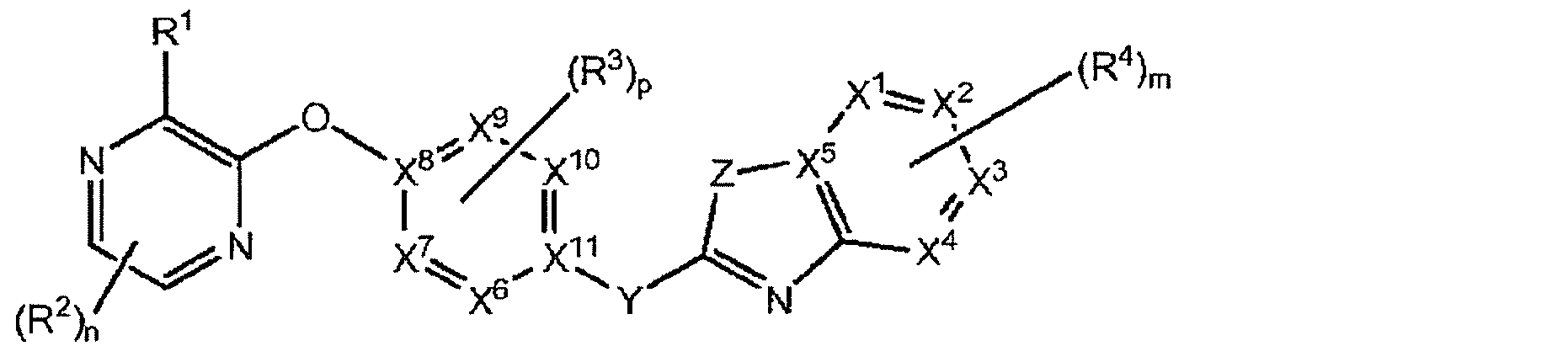
で表される化合物、および下記化合物が記載されている。


で表される化合物、および下記化合物が記載されている。
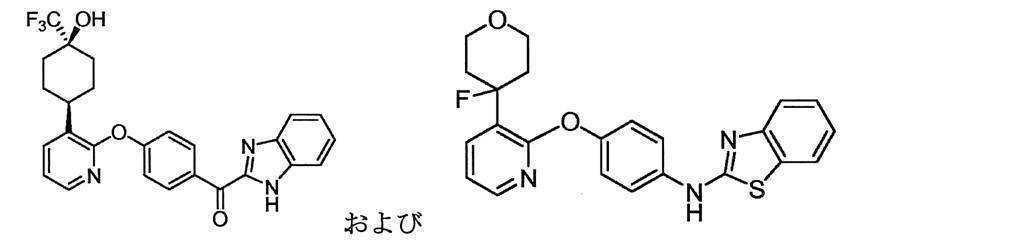

で表される化合物が記載されている。

で表される化合物が記載されている。

で表される化合物が記載されている。
本発明は、公知化合物(前記の化合物を含む)とは化学構造が異なる、PDE10A阻害作用を有する縮合複素環化合物、及び当該縮合複素環化合物を含む統合失調症等の疾患の予防薬または治療薬を提供することを目的とする。
[1’]式(I):
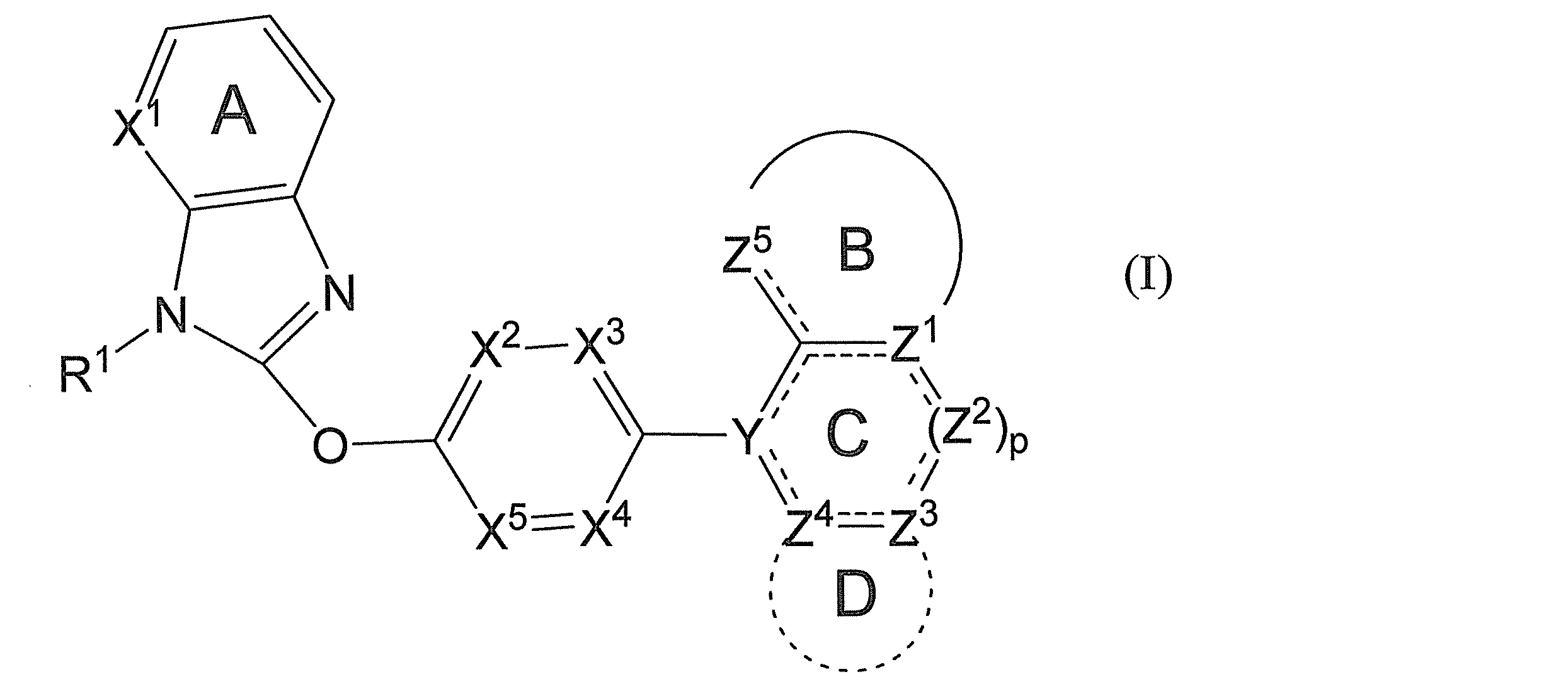
R1は、水素原子または置換されていてもよいC1-6アルキル基を示し、
X1は、CHまたは窒素原子を示し、
環Aは、置換基を有していてもよく、
X2は、CR2または窒素原子を示し、
X3は、CR3または窒素原子を示し、
X4は、CR4または窒素原子を示し、
X5は、CR5または窒素原子を示し、
R2、R3、R4およびR5は、それぞれ独立して、水素原子または置換基を示し、
環Bは、置換されていてもよい5または6員含窒素複素環(該含窒素複素環は、環C以外にさらに他の環と縮合環を形成していてもよい。)を示し、
Z5は、=N-または-N=を示し、
環Cは、置換されていてもよい5または6員環を示し、
Yは、炭素原子および窒素原子から選択される環Cの構成原子を示し、
Z1は、炭素原子および窒素原子から選択される環Cの構成原子を示し、
Z2、Z3およびZ4は、それぞれ独立して、炭素原子、窒素原子、硫黄原子および酸素原子から選択される環Cの構成原子を示し、あるいは、
Z3およびZ4は、一緒になって、環Dを形成してもよく、
環Dは、置換されていてもよい5または6員環を示し、
pは0または1を示し、

(ただし、pが0の場合、YとZ4との間の結合は単結合である。)]
で表される化合物またはその塩;
[1]式(I-i):

R1は、水素原子または置換されていてもよいC1-6アルキル基を示し、
X1は、CHまたは窒素原子を示し、
環Aは、置換基を有していてもよく、
X2は、CR2または窒素原子を示し、
X3は、CR3または窒素原子を示し、
X4は、CR4または窒素原子を示し、
X5は、CR5または窒素原子を示し、
R2、R3、R4およびR5は、それぞれ独立して、水素原子または置換基を示し、
環Bは、置換されていてもよい5または6員含窒素複素環(該含窒素複素環は、環C1以外にさらに他の環と縮合環を形成していてもよい。)を示し、
Z5は、=N-または-N=を示し、
環C1は、置換されていてもよい5員環を示し、
Z1、Z3’およびZ4’は、それぞれ独立して、炭素原子および窒素原子から選択される環C1の構成原子を示し、
環Dは、置換されていてもよい5または6員環を示し、

で表される化合物またはその塩;
[2]式(I-ii):

R1は、水素原子または置換されていてもよいC1-6アルキル基を示し、
X1は、CHまたは窒素原子を示し、
環Aは、置換基を有していてもよく、
X2は、CR2または窒素原子を示し、
X3は、CR3または窒素原子を示し、
X4は、CR4または窒素原子を示し、
X5は、CR5または窒素原子を示し、
R2、R3、R4およびR5は、それぞれ独立して、水素原子または置換基を示し、
環Bは、置換されていてもよい5または6員含窒素複素環(該含窒素複素環は、環C2以外に、さらに他の環と縮合環を形成していてもよい。)を示し、
Z5は、=N-または-N=を示し、
環C2は、置換されていてもよい5員環を示し、
Yは、炭素原子および窒素原子から選択される環C2の構成原子を示し、
Z1は、炭素原子および窒素原子から選択される環C2の構成原子を示し、
Z3’’は、炭素原子、窒素原子、硫黄原子および酸素原子から選択される環C2の構成原子を示し、
Z4’’は、-O-、-S-、-N=、-NR6’-、-CR7’=、-SO-、-SO2-、または置換されていてもよいメチレン基(ただし、カルボニル基を除く。)を示し、
R6’およびR7’は、それぞれ独立して、水素原子または置換基を示し、

で表される化合物またはその塩;
[3]式(I-iii):

R1は、水素原子または置換されていてもよいC1-6アルキル基を示し、
X1は、CHまたは窒素原子を示し、
環Aは、置換基を有していてもよく、
X2は、CR2または窒素原子を示し、
X3は、CR3または窒素原子を示し、
X4は、CR4または窒素原子を示し、
X5は、CR5または窒素原子を示し、
R2、R3、R4およびR5は、それぞれ独立して、水素原子または置換基を示し、
環Bは、置換されていてもよい5または6員含窒素複素環(該含窒素複素環は、環C3以外に、さらに他の環と縮合環を形成していてもよい。)を示し、
Z5は、=N-または-N=を示し、
環C3は、置換されていてもよい6員環を示し、
Yは、炭素原子および窒素原子から選択される環C3の構成原子を示し、
Z1は、炭素原子および窒素原子から選択される環C3の構成原子を示し、
Z2、Z3およびZ4は、それぞれ独立して、炭素原子、窒素原子、硫黄原子および酸素原子から選択される環C3の構成原子を示し、

また、Z3およびZ4は、一緒になって、環Dを形成してもよく、
環Dは、置換されていてもよい5または6員環を示す。]
で表される化合物またはその塩;
[4]Z4’’が、-O-、-S-、-N=、-NR6’-、-CR7’=、-SO-、-SO2-、または-CR8R9-(式中、R8およびR9は、それぞれ独立して、水素原子または置換基を示す。)である、上記[2]記載の化合物またはその塩;
[5]X2、X3、X4およびX5が、それぞれCHである、上記[1]~[3]のいずれか1つに記載の化合物またはその塩;
[6]式(I-i)の化合物が、式(I-i)’:

で表される、上記[1]記載の化合物またはその塩;
[7]9-(4-{[3-(2-メトキシエチル)-3H-イミダゾ[4,5-b]ピリジン-2-イル]オキシ}フェニル)-9H-イミダゾ[1',2':1,2]イミダゾ[4,5-b]ピリジンまたはその塩;
[8]5-メチル-9-{4-[(3-メチル-3H-イミダゾ[4,5-b]ピリジン-2-イル)オキシ]フェニル}-9H-イミダゾ[1',2':1,2]イミダゾ[4,5-b]ピリジンまたはその塩;
[9]上記[1]~[3]のいずれか1つに記載の化合物またはその塩を含有する医薬;
[10]ホスホジエステラーゼ10A阻害薬である、上記[9]記載の医薬;
[11]統合失調症の予防または治療薬である、上記[9]記載の医薬;
[12]上記[1]~[3]のいずれか1つに記載の化合物またはその塩の有効量を哺乳動物に投与することを特徴とする、当該哺乳動物における統合失調症の予防または治療方法;
[13]統合失調症の予防または治療薬の製造のための、上記[1]~[3]のいずれか1つに記載の化合物またはその塩の使用;
[14]統合失調症の予防または治療における使用のための、上記[1]~[3]のいずれか1つに記載の化合物またはその塩;
等に関する。
化合物(I)は、X2~X5を有する6員環がパラ位で酸素原子および縮合環BC(D)と結合する上記の構造をとることにより、環Bの構成原子であるZ5、および環Aと縮合するイミダゾール環上の=N-などと、PDE10Aタンパク質のアミノ酸残基との相互作用を可能とし、PDE10Aを選択的に阻害するものである。
以下に、本発明について詳細に説明する。
本明細書中、特に断りのない限り、「ハロゲン原子」としては、例えば、フッ素原子、塩素原子、臭素原子、及びヨウ素原子が挙げられる。
本明細書中、特に断りのない限り、「C3-6シクロアルカン」としては、例えば、シクロプロパン、シクロブタン、シクロペンタン、シクロヘキサン等が挙げられる。
本明細書中、特に断りのない限り、「炭素原子以外に窒素原子、硫黄原子及び酸素原子から選ばれるヘテロ原子を1~4個含有する5または6員の複素環」としては、例えば、ピロリジン、テトラヒドロフラン、テトラヒドロチオフェン、ピペリジン、テトラヒドロピラン、モルホリン、チオモルホリン、ピペラジン、フラン、チオフェン、ピロール、オキサゾール、イソオキサゾール、チアゾール、イソチアゾール、イミダゾール、ピラゾール、1,2,3-オキサジアゾール、1,2,4-オキサジアゾール、1,3,4-オキサジアゾール、フラザン、1,2,3-チアジアゾール、1,2,4-チアジアゾール、1,3,4-チアジアゾール、1,2,3-トリアゾール、1,2,4-トリアゾール、テトラゾール、ピリジン、ピリダジン、ピリミジン、ピラジン、トリアジン等が挙げられる。
本明細書中、特に断りのない限り、「複素環基」(及び置換基中の複素環部分)とは、非芳香族複素環基、及び芳香族複素環基を含み、例えば、窒素原子、硫黄原子、及び酸素原子から選ばれる1~5個のヘテロ原子を有する3~14員複素環基等が挙げられる。当該「複素環基」は、単環、2環、又は3環性であってよい。
本明細書中、特に断りのない限り、「3~14員複素環基」としては、例えば、ピロリル(例、1-ピロリル、2-ピロリル、3-ピロリル)、フリル(例、2-フリル、3-フリル)、チエニル(例、2-チエニル、3-チエニル)、ピラゾリル(例、1-ピラゾリル、3-ピラゾリル、4-ピラゾリル)、イミダゾリル(例、1-イミダゾリル、2-イミダゾリル、4-イミダゾリル)、イソオキサゾリル(例、3-イソオキサゾリル、4-イソオキサゾリル、5-イソオキサゾリル)、オキサゾリル(例、2-オキサゾリル、4-オキサゾリル、5-オキサゾリル)、イソチアゾリル(例、3-イソチアゾリル、4-イソチアゾリル、5-イソチアゾリル)、チアゾリル(例、2-チアゾリル、4-チアゾリル、5-チアゾリル)、トリアゾリル(例、1,2,3-トリアゾール-4-イル、1,2,4-トリアゾール-3-イル)、オキサジアゾリル(例、1,2,4-オキサジアゾール-3-イル、1,2,4-オキサジアゾール-5-イル)、チアジアゾリル(例、1,2,4-チアジアゾール-3-イル、1,2,4-チアジアゾール-5-イル)、テトラゾリル、ピリジル(例、2-ピリジル、3-ピリジル、4-ピリジル)、ピリダジニル(例、3-ピリダジニル、4-ピリダジニル)、ピリミジニル(例、2-ピリミジニル、4-ピリミジニル、5-ピリミジニル)、ピラジニル、イソインドリル(例、1-イソインドリル、2-イソインドリル、3-イソインドリル、4-イソインドリル、5-イソインドリル、6-イソインドリル、7-イソインドリル)、インドリル(例、1-インドリル、2-インドリル、3-インドリル、4-インドリル、5-インドリル、6-インドリル、7-インドリル)、ベンゾ[b]フラニル(例、2-ベンゾ[b]フラニル、3-ベンゾ[b]フラニル、4-ベンゾ[b]フラニル、5-ベンゾ[b]フラニル、6-ベンゾ[b]フラニル、7-ベンゾ[b]フラニル)、ベンゾ[c]フラニル(例、1-ベンゾ[c]フラニル、4-ベンゾ[c]フラニル、5-ベンゾ[c]フラニル)、ベンゾ[b]チエニル、(例、2-ベンゾ[b]チエニル、3-ベンゾ[b]チエニル、4-ベンゾ[b]チエニル、5-ベンゾ[b]チエニル、6-ベンゾ[b]チエニル、7-ベンゾ[b]チエニル)、ベンゾ[c]チエニル(例、1-ベンゾ[c]チエニル、4-ベンゾ[c]チエニル、5-ベンゾ[c]チエニル)、インダゾリル(例、1-インダゾリル、2-インダゾリル、3-インダゾリル、4-インダゾリル、5-インダゾリル、6-インダゾリル、7-インダゾリル)、ベンゾイミダゾリル(例、1-ベンゾイミダゾリル、2-ベンゾイミダゾリル、4-ベンゾイミダゾリル、5-ベンゾイミダゾリル)、1,2-ベンゾイソオキサゾリル(例、1,2-ベンゾイソオキサゾール-3-イル、1,2-ベンゾイソオキサゾール-4-イル、1,2-ベンゾイソオキサゾール-5-イル、1,2-ベンゾイソオキサゾール-6-イル、1,2-ベンゾイソオキサゾール-7-イル)、ベンゾオキサゾリル(例、2-ベンゾオキサゾリル、4-ベンゾオキサゾリル、5-ベンゾオキサゾリル、6-ベンゾオキサゾリル、7-ベンゾオキサゾリル)、1,2-ベンゾイソチアゾリル(例、1,2-ベンゾイソチアゾール-3-イル、1,2-ベンゾイソチアゾール-4-イル、1,2-ベンゾイソチアゾール-5-イル、1,2-ベンゾイソチアゾール-6-イル、1,2-ベンゾイソチアゾール-7-イル)、ベンゾチアゾリル(例、2-ベンゾチアゾリル、4-ベンゾチアゾリル、5-ベンゾチアゾリル、6-ベンゾチアゾリル、7-ベンゾチアゾリル)、イソキノリル(例、1-イソキノリル、3-イソキノリル、4-イソキノリル、5-イソキノリル)、キノリル(例、2-キノリル、3-キノリル、4-キノリル、5-キノリル、8-キノリル)、シンノリニル(例、3-シンノリニル、4-シンノリニル、5-シンノリニル、6-シンノリニル、7-シンノリニル、8-シンノリニル)、フタラジニル(例、1-フタラジニル、5-フタラジニル、6-フタラジニル)、キナゾリニル(例、2-キナゾリニル、4-キナゾリニル、5-キナゾリニル、6-キナゾリニル、7-キナゾリニル、8-キナゾリニル)、キノキサリニル(例、2-キノキサリニル、5-キノキサリニル、6-キノキサリニル)、ピラゾロ[1,5-a]ピリジル(例、ピラゾロ[1,5-a]ピリジン-2-イル、ピラゾロ[1,5-a]ピリジン-3-イル、ピラゾロ[1,5-a]ピリジン-4-イル、ピラゾロ[1,5-a]ピリジン-5-イル、ピラゾロ[1,5-a]ピリジン-6-イル、ピラゾロ[1,5-a]ピリジン-7-イル)、イミダゾ[1,2-a]ピリジル(例、イミダゾ[1,2-a]ピリジン-2-イル、イミダゾ[1,2-a]ピリジン-3-イル、イミダゾ[1,2-a]ピリジン-5-イル、イミダゾ[1,2-a]ピリジン-6-イル、イミダゾ[1,2-a]ピリジン-7-イル、イミダゾ[1,2-a]ピリジン-8-イル)などの、窒素原子、硫黄原子、及び酸素原子から選ばれる1~5個のヘテロ原子を有する3~14員芳香族複素環基;及び
例えば、テトラヒドロフリル、オキサゾリジニル、イミダゾリニル(例、1-イミダゾリニル、2-イミダゾリニル、4-イミダゾリニル)、アジリジニル(例、1-アジリジニル、2-アジリジニル)、アゼチジニル(例、1-アゼチジニル、2-アゼチジニル)、ピロリジニル(例、1-ピロリジニル、2-ピロリジニル、3-ピロリジニル)、ピペリジル(例、1-ピペリジル、2-ピペリジル、3-ピペリジル)、アゼパニル(例、1-アゼパニル、2-アゼパニル、3-アゼパニル、4-アゼパニル)、アゾカニル(例、1-アゾカニル、2-アゾカニル、3-アゾカニル、4-アゾカニル)、アゾナニル(例、1-アゾナニル、2-アゾナニル、3-アゾナニル、4-アゾナニル、5-アゾナニル)、ピペラジニル(例、1,4-ピペラジン-1-イル、1,4-ピペラジン-2-イル)、ジアゼピニル(例、1,4-ジアゼピン-1-イル、1,4-ジアゼピン-2-イル、1,4-ジアゼピン-5-イル、1,4-ジアゼピン-6-イル)、ジアゾカニル(例、1,4-ジアゾカン-1-イル、1,4-ジアゾカン-2-イル、1,4-ジアゾカン-5-イル、1,4-ジアゾカン-6-イル、1,5-ジアゾカン-1-イル、1,5-ジアゾカン-2-イル、1,5-ジアゾカン-3-イル)、テトラヒドロピラニル(例、テトラヒドロピラン-4-イル)、モルホリニル(例、4-モルホリニル)、チオモルホリニル(例、4-チオモルホリニル)、2-オキサゾリジニル、ジヒドロフリル、ジヒドロピラニル、ジヒドロキノリル、ジヒドロイソキノリル(例、3,4-ジヒドロイソキノリン-2-イル)などの、窒素原子、硫黄原子、及び酸素原子から選ばれる1~5個のヘテロ原子を有する、飽和、又は部分不飽和の、3~14員非芳香族複素環基が挙げられる。
ここで、「5または6員の非芳香族炭化水素環」としては、シクロペンタン、シクロヘキサン、シクロペンテン、シクロへキセン、1,3-シクロペンタジエン、1,3-シクロヘキサジエン、1,4-シクロヘキサジエン、シクロペンチン、シクロへキシン等が挙げられる。
ここで、「5または6員の芳香族複素環」としては、例えば、環構成原子として炭素原子以外に酸素原子、硫黄原子(該硫黄原子は、酸化されていてもよい)および窒素原子から選ばれるヘテロ原子を1~4個含有する5または6員の単環式芳香族複素環が挙げられる。
このような5または6員の単環式芳香族複素環の好適な例としては、フラン、チオフェン、ピリジン、ピリミジン、ピリダジン、ピラジン、ピロール、イミダゾール、ピラゾール、チアゾール、イソチアゾール、オキサゾール、イソオキサゾール、オキサジアゾール(例、1,2,5-オキサジアゾール、1,3,4-オキサジアゾール)、チアジアゾール(例、1,2,3-チアジアゾール、1,3,4-チアジアゾール)、トリアゾール(例、1,2,4-トリアゾール、1,2,3-トリアゾール)、テトラゾール、トリアジン(例、1,2,4-トリアジン)等が挙げられる。
ここで、5または6員の非芳香族複素環としては、例えば、環構成原子として炭素原子以外に酸素原子、硫黄原子(該硫黄原子は、酸化されていてもよい)および窒素原子から選ばれるヘテロ原子を1~4個含有する5または6員の単環式非芳香族複素環が挙げられる。
このような5または6員の単環式非芳香族複素環の好適な例としては、ピロリジン、ピペリジン、ホモピペリジン、テトラヒドロピリジン(例、1,2,3,6-テトラヒドロピリジン)、ジヒドロピリジン(例、1,2-ジヒドロピリジン、2,3-ジヒドロピリジン)、モルホリン、チオモルホリン、1,1-ジオキシドチオモルホリン、ピペラジン、オキサゾリジン、チアゾリジン、イミダゾリジン、2-オキソイミダゾリジン、オキサゾリン、チアゾリン、イミダゾリン、ジオキソール(例、1,3-ジオキソール)、ジオキソラン(例、1,3-ジオキソラン)、ジヒドロオキサジアゾール(例、4,5-ジヒドロ-1,2,4-オキサジアゾール)、ピラン、テトラヒドロピラン、チオピラン、テトラヒドロチオピラン、テトラヒドロフラン、ピラゾリジン、ピラゾリン、テトラヒドロピリミジン、ジヒドロトリアゾール(例、2,3-ジヒドロ-1H-1,2,3-トリアゾール)、テトラヒドロトリアゾール(例、2,3,4,5-テトラヒドロ-1H-1,2,3-トリアゾール)、ジヒドロオキサジアゾール(例、4,5-ジヒドロ-1,2,4-オキサジアゾール)、チアジン(例、1,4-チアジン)、ジヒドロピリダジン(例、1,6-ジヒドロピリダジン)、テトラヒドロピリダジン(例、1,4,5,6-テトラヒドロピリダジン)、ジヒドロチオキサジン(例、2,3-ジヒドロ-1,4-チオキサジン)、ジヒドロチアジン(例、3,4-ジヒドロ-2H-1,4-チアジン)等が挙げられる。
(1)ハロゲン原子;
(2)ニトロ基;
(3)シアノ基;
(4)置換されていてもよいC1-6アルキル基;
(5)置換されていてもよいC2-6アルケニル基;
(6)置換されていてもよいC2-6アルキニル基;
(7)置換されていてもよいC3-7シクロアルキル基;
(8)置換されていてもよいC6-14アリール基;
(9)置換されていてもよいC7-16アラルキル基;
(10)置換されていてもよいC6-14アリール-C2-6アルケニル基;
(11)置換されていてもよい複素環基;
(12)ヒドロキシ基;
(13)置換されていてもよいC1-6アルコキシ基;
(14)置換されていてもよいC3-7シクロアルキルオキシ基;
(15)置換されていてもよいC6-14アリールオキシ基;
(16)置換されていてもよいC7-16アラルキルオキシ基;
(17)置換されていてもよい複素環-オキシ基;
(18)置換されていてもよいC1-6アルキル-カルボニルオキシ基;
(19)置換されていてもよいC1-6アルコキシ-カルボニルオキシ基;
(20)置換されていてもよいC3-7シクロアルキル-カルボニルオキシ基;
(21)置換されていてもよいC6-14アリール-カルボニルオキシ基;
(22)置換されていてもよい複素環-カルボニルオキシ基;
(23)置換されていてもよいカルバモイル基
[例、
カルバモイル基、
置換されていてもよいモノ-、又はジ-C1-6アルキル-カルバモイル基、
置換されていてもよいモノ-、又はジ-C3-7シクロアルキル-カルバモイル基、
置換されていてもよいモノ-、又はジ-C6-14アリール-カルバモイル基、
置換されていてもよいモノ-、又はジ-複素環-カルバモイル基など];
(24)置換されていてもよいモノ-、又はジ-C1-6アルキル-カルバモイルオキシ基;
(25)置換されていてもよいモノ-、又はジ-C6-14アリール-カルバモイルオキシ基;
(26)置換されていてもよいC1-6アルキルスルホニルオキシ基、
(27)メルカプト基;
(28)置換されていてもよいC1-6アルキルスルファニル基;
(29)置換されていてもよいC3-7シクロアルキルスルファニル基;
(30)置換されていてもよいC6-14アリールスルファニル基;
(31)置換されていてもよいC7-16アラルキルスルファニル基;
(32)置換されていてもよい複素環-スルファニル基;
(33)ホルミル基;
(34)置換されていてもよいC1-6アルキル-カルボニル基;
(35)置換されていてもよいC3-7シクロアルキル-カルボニル基;
(36)置換されていてもよいC6-14アリール-カルボニル基;
(37)置換されていてもよいC7-16アラルキル-カルボニル基;
(38)置換されていてもよい複素環-カルボニル基;
(39)置換されていてもよいC1-6アルキルスルホニル基;
(40)置換されていてもよいC3-7シクロアルキルスルホニル基;
(41)置換されていてもよいC6-14アリールスルホニル基;
(42)置換されていてもよい複素環-スルホニル基;
(43)置換されていてもよいC1-6アルキルスルフィニル基;
(44)置換されていてもよいC3-7シクロアルキルスルフィニル基;
(45)置換されていてもよいC6-14アリールスルフィニル基;
(46)置換されていてもよい複素環-スルフィニル基;
(47)スルホ基;
(48)スルファモイル基;
(49)スルフィナモイル基;
(50)スルフェナモイル基;
(51)チオカルバモイル基;
(52)置換されていてもよいアミノ基
[例、
アミノ基、
置換されていてもよいモノ-、又はジ-C1-6アルキル-アミノ基、
置換されていてもよいモノ-、又はジ-C3-7シクロアルキル-アミノ基、
置換されていてもよいモノ-、又はジ-C6-14アリール-アミノ基、
置換されていてもよいモノ-、又はジ-C7-16アラルキル-アミノ基、
置換されていてもよいモノ-、又はジ-複素環-アミノ基、
置換されていてもよいモノ-、又はジ-C6-14アリール-カルボニルアミノ基、
ホルミルアミノ基、
置換されていてもよいモノ-、又はジ-(C1-6アルキル-カルボニル)アミノ基、
置換されていてもよいモノ-、又はジ-(C3-7シクロアルキル-カルボニル)アミノ基、
置換されていてもよいモノ-、又はジ-(複素環-カルボニル)アミノ基、
置換されていてもよいモノ-、又はジ-(C1-6アルコキシ-カルボニル)アミノ基、
置換されていてもよいモノ-、又はジ-(C3-8シクロアルコキシ-カルボニル)アミノ基、
置換されていてもよいモノ-、又はジ-(複素環-オキシカルボニル)アミノ基、
置換されていてもよいモノ-、又はジ-(C1-6アルキルスルホニル)アミノ基、
置換されていてもよいモノ-、又はジ-(C3-8シクロアルキルスルホニル)アミノ基、
置換されていてもよいモノ-、又はジ-(C6-14アリールスルホニル)アミノ基、
置換されていてもよい複素環-スルホニルアミノ基など];
(53)置換されていてもよいC1-6アルコキシ-カルボニル基;
(54)置換されていてもよいC6-14アリールオキシ-カルボニル基;
(55)置換されていてもよいC7-16アラルキルオキシ-カルボニル基;及び
(56)置換されていてもよいシリルオキシ-カルボニル基
からなる。
「置換されていてもよいC1-6アルキル基」、
「置換されていてもよいC2-6アルケニル基」、
「置換されていてもよいC2-6アルキニル基」、
「置換されていてもよいC1-6アルコキシ基」、
「置換されていてもよいC1-6アルキル-カルボニルオキシ基」、
「置換されていてもよいC1-6アルコキシ-カルボニルオキシ基」、
「置換されていてもよいモノ-、又はジ-C1-6アルキル-カルバモイル基」、
「置換されていてもよいモノ-、又はジ-C1-6アルキル-カルバモイルオキシ基」、
「置換されていてもよいC1-6アルキルスルホニルオキシ基」、
「置換されていてもよいC1-6アルキルスルファニル基」、
「置換されていてもよいC1-6アルキル-カルボニル基」、
「置換されていてもよいC1-6アルキルスルホニル基」、
「置換されていてもよいC1-6アルキルスルフィニル基」、
「置換されていてもよいモノ-、又はジ-C1-6アルキル-アミノ基」、
「置換されていてもよいモノ-、又はジ-(C1-6アルキル-カルボニル)アミノ基」、
「置換されていてもよいモノ-、又はジ-(C1-6アルコキシ-カルボニル)アミノ基」、
「置換されていてもよいモノ-、又はジ-(C1-6アルキルスルホニル)アミノ基」、
「置換されていてもよいC1-6アルコキシ-カルボニル基」、及び
「置換されていてもよいシリルオキシ-カルボニル基」の置換基としては、例えば、下記の置換基B群から選択される置換基が挙げられる。当該置換基の数は、1個~置換可能な最大数、より好ましくは1~3個である。
「置換されていてもよいC3-7シクロアルキル基」、
「置換されていてもよいC6-14アリール基」、
「置換されていてもよいC7-16アラルキル基」、
「置換されていてもよいC6-14アリール-C2-6アルケニル基」、
「置換されていてもよい複素環基」、
「置換されていてもよいC3-7シクロアルキルオキシ基」、
「置換されていてもよいC6-14アリールオキシ基」、
「置換されていてもよいC7-16アラルキルオキシ基」、
「置換されていてもよい複素環-オキシ基」、
「置換されていてもよいC3-7シクロアルキル-カルボニルオキシ基」、
「置換されていてもよいC6-14アリール-カルボニルオキシ基」、
「置換されていてもよい複素環-カルボニルオキシ基」、
「置換されていてもよいモノ-、又はジ-C3-7シクロアルキル-カルバモイル基」、
「置換されていてもよいモノ-、又はジ-C6-14アリール-カルバモイル基」、
「置換されていてもよいモノ-、又はジ-複素環-カルバモイル基」、
「置換されていてもよいモノ-、又はジ-C6-14アリール-カルバモイルオキシ基」、
「置換されていてもよいC3-7シクロアルキルスルファニル基」、
「置換されていてもよいC6-14アリールスルファニル基」、
「置換されていてもよいC7-16アラルキルスルファニル基」、
「置換されていてもよい複素環-スルファニル基」、
「置換されていてもよいC3-7シクロアルキル-カルボニル基」、
「置換されていてもよいC6-14アリール-カルボニル基」、
「置換されていてもよいC7-16アラルキル-カルボニル基」、
「置換されていてもよい複素環-カルボニル基」、
「置換されていてもよいC3-7シクロアルキルスルホニル基」、
「置換されていてもよいC6-14アリールスルホニル基」、
「置換されていてもよい複素環-スルホニル基」、
「置換されていてもよいC3-7シクロアルキルスルフィニル基」、
「置換されていてもよいC6-14アリールスルフィニル基」、
「置換されていてもよい複素環-スルフィニル基」、
「置換されていてもよいモノ-、又はジ-C3-7シクロアルキル-アミノ基」、
「置換されていてもよいモノ-、又はジ-C6-14アリール-アミノ基」、
「置換されていてもよいモノ-、又はジ-C7-16アラルキル-アミノ基」、
「置換されていてもよいモノ-、又はジ-複素環-アミノ基」、
「置換されていてもよいモノ-、又はジ-C6-14アリール-カルボニルアミノ基」、
「置換されていてもよいモノ-、又はジ-(C3-7シクロアルキル-カルボニル)アミノ基」、
「置換されていてもよいモノ-、又はジ-(複素環-カルボニル)アミノ基」、
「置換されていてもよいモノ-、又はジ-(C3-8シクロアルコキシ-カルボニル)アミノ基」、
「置換されていてもよいモノ-、又はジ-(複素環-オキシカルボニル)アミノ基」、
「置換されていてもよいモノ-、又はジ-(C3-8シクロアルキルスルホニル)アミノ基」、
「置換されていてもよいモノ-、又はジ-(C6-14アリールスルホニル)アミノ基」、
「置換されていてもよい複素環-スルホニルアミノ基」、
「置換されていてもよいC6-14アリールオキシ-カルボニル基」、及び
「置換されていてもよいC7-16アラルキルオキシ-カルボニル基」の置換基としては、例えば、下記の置換基B群、及び下記の置換基B’群から選択される置換基が挙げられる。当該置換基の数は、1個~置換可能な最大数、より好ましくは1~3個、更に好ましくは1個である。
(a) ハロゲン原子;
(b) ヒドロキシ基;
(c) ニトロ基;
(d) シアノ基;
(e) 置換されていてもよいC6-14アリール基(該C6-14アリール基は、ハロゲン原子、ヒドロキシ基、シアノ基、アミノ基、1~3個のハロゲン原子で置換されていてもよいC1-6アルキル基、モノ-、又はジ-C1-6アルキル-アミノ基、モノ-、又はジ-C6-14アリール-アミノ基、モノ-、又はジ-C7-16アラルキル-アミノ基、C3-7シクロアルキル基、C1-6アルコキシ基、ホルミル基、C1-6アルキル-カルボニル基、C3-7シクロアルキル-カルボニル基、C6-14アリール-カルボニル基、C7-16アラルキル-カルボニル基、C1-6アルコキシ-カルボニル基、C6-14アリールオキシ-カルボニル基、C7-16アラルキルオキシ-カルボニル基、C1-6アルキルスルファニル基、C1-6アルキルスルフィニル基、C1-6アルキルスルホニル基、カルバモイル基、チオカルバモイル基、モノ-、又はジ-C1-6アルキル-カルバモイル基、モノ-、又はジ-C6-14アリール-カルバモイル基等から選択される1~5個(好ましくは1~3個、より好ましくは1個)の置換基で置換されていてもよい);
(f) 置換されていてもよいC6-14アリールオキシ基(該C6-14アリールオキシ基は、ハロゲン原子、ヒドロキシ基、シアノ基、アミノ基、1~3個のハロゲン原子で置換されていてもよいC1-6アルキル基、モノ-、又はジ-C1-6アルキル-アミノ基、モノ-、又はジ-C6-14アリール-アミノ基、モノ-、又はジ-C7-16アラルキル-アミノ基、C3-7シクロアルキル基、C1-6アルコキシ基、ホルミル基、C1-6アルキル-カルボニル基、C3-7シクロアルキル-カルボニル基、C6-14アリール-カルボニル基、C7-16アラルキル-カルボニル基、C1-6アルコキシ-カルボニル基、C6-14アリールオキシ-カルボニル基、C7-16アラルキルオキシ-カルボニル基、C1-6アルキルスルファニル基、C1-6アルキルスルフィニル基、C1-6アルキルスルホニル基、カルバモイル基、チオカルバモイル基、モノ-、又はジ-C1-6アルキル-カルバモイル基、モノ-、又はジ-C6-14アリール-カルバモイル基等から選択される1~5個(好ましくは1~3個、より好ましくは1個)の置換基で置換されていてもよい);
(g) 置換されていてもよいC7-16アラルキルオキシ基(該C7-16アラルキルオキシ基は、ハロゲン原子、ヒドロキシ基、シアノ基、アミノ基、1~3個のハロゲン原子で置換されていてもよいC1-6アルキル基、モノ-、又はジ-C1-6アルキル-アミノ基、モノ-、又はジ-C6-14アリール-アミノ基、モノ-、又はジ-C7-16アラルキル-アミノ基、C3-7シクロアルキル基、C1-6アルコキシ基、ホルミル基、C1-6アルキル-カルボニル基、C3-7シクロアルキル-カルボニル基、C6-14アリール-カルボニル基、C7-16アラルキル-カルボニル基、C1-6アルコキシ-カルボニル基、C6-14アリールオキシ-カルボニル基、C7-16アラルキルオキシ-カルボニル基、C1-6アルキルスルファニル基、C1-6アルキルスルフィニル基、C1-6アルキルスルホニル基、カルバモイル基、チオカルバモイル基、モノ-、又はジ-C1-6アルキル-カルバモイル基、モノ-、又はジ-C6-14アリール-カルバモイル基等から選択される1~5個(好ましくは1~3個、より好ましくは1個)の置換基で置換されていてもよい);
(h) 置換されていてもよい、窒素原子、硫黄原子、及び酸素原子から選ばれる1~5個のヘテロ原子を有する3~14員複素環基(該複素環基は、ハロゲン原子、ヒドロキシ基、シアノ基、アミノ基、1~3個のハロゲン原子で置換されていてもよいC1-6アルキル基、モノ-、又はジ-C1-6アルキル-アミノ基、モノ-、又はジ-C6-14アリール-アミノ基、モノ-、又はジ-C7-16アラルキル-アミノ基、C3-7シクロアルキル基、C1-6アルコキシ基、ホルミル基、C1-6アルキル-カルボニル基、C3-7シクロアルキル-カルボニル基、C6-14アリール-カルボニル基、C7-16アラルキル-カルボニル基、C1-6アルコキシ-カルボニル基、C6-14アリールオキシ-カルボニル基、C7-16アラルキルオキシ-カルボニル基、C1-6アルキルスルファニル基、C1-6アルキルスルフィニル基、C1-6アルキルスルホニル基、カルバモイル基、チオカルバモイル基、モノ-、又はジ-C1-6アルキル-カルバモイル基、モノ-、又はジ-C6-14アリール-カルバモイル基等から選択される1~5個(好ましくは1~3個、より好ましくは1個)の置換基で置換されていてもよい);
(i) 置換されていてもよいアミノ基{例えば、C1-6アルキル基、C2-6アルケニル基、C6-14アリール基、C7-16アラルキル基、複素環基、及び複素環-C1-6アルキル基からなる群から選択される置換基でモノまたはジ置換されていてもよいアミノ基[該C1-6アルキル基、C2-6アルケニル基、C6-14アリール基、C7-16アラルキル基、複素環基、及び複素環-C1-6アルキル基は、それぞれハロゲン原子、ヒドロキシ基、シアノ基、アミノ基、1~3個のハロゲン原子で置換されていてもよいC1-6アルキル基(但し、該「1~3個のハロゲン原子で置換されていてもよいC1-6アルキル基」は、C1-6アルキル基、及びC2-6アルケニル基の置換基ではない)、モノ-、又はジ-C1-6アルキル-アミノ基、モノ-、又はジ-C6-14アリール-アミノ基、モノ-、又はジ-C7-16アラルキル-アミノ基、C3-7シクロアルキル基、C1-6アルコキシ基、ホルミル基、C1-6アルキル-カルボニル基、C3-7シクロアルキル-カルボニル基、C6-14アリール-カルボニル基、C7-16アラルキル-カルボニル基、C1-6アルコキシ-カルボニル基、C3-7シクロアルキルオキシ-カルボニル基、C6-14アリールオキシ-カルボニル基、C7-16アラルキルオキシ-カルボニル基、C1-6アルキルスルファニル基、C3-7シクロアルキルスルファニル基、C1-6アルキルスルフィニル基、C3-7シクロアルキルスルフィニル基、C1-6アルキルスルホニル基、C3-7シクロアルキルスルホニル基、カルバモイル基、チオカルバモイル基、モノ-、又はジ-C1-6アルキル-カルバモイル基、モノ-、又はジ-C6-14アリール-カルバモイル基等から選択される1~5個(好ましくは1~3個、より好ましくは1個)の置換基で置換されていてもよい]};
(j) C3-7シクロアルキル基;
(k) 置換されていてもよいC1-6アルコキシ基[該C1-6アルコキシ基は、ハロゲン原子、ヒドロキシ基、アミノ基、モノ-、又はジ-C1-6アルキル-アミノ基、モノ-、又はジ-C6-14アリール-アミノ基、C3-7シクロアルキル基、C1-6アルコキシ基、ホルミル基、C1-6アルキル-カルボニル基、C3-7シクロアルキル-カルボニル基、C6-14アリール-カルボニル基、C7-16アラルキル-カルボニル基、C1-6アルコキシ-カルボニル基、C6-14アリールオキシ-カルボニル基、C7-16アラルキルオキシ-カルボニル基、C1-6アルキルスルファニル基、C1-6アルキルスルフィニル基、C1-6アルキルスルホニル基、カルバモイル基、チオカルバモイル基、モノ-、又はジ-C1-6アルキル-カルバモイル基、モノ-、又はジ-C6-14アリール-カルバモイル基、トリメチルシリル(TMS)基等から選択される1~5個(好ましくは1~3個、より好ましくは1個)の置換基で置換されていてもよい];
(l) ホルミル基;
(m) C1-6アルキル-カルボニル基(例、アセチル);
(n) C3-7シクロアルキル-カルボニル基;
(o) C6-14アリール-カルボニル基;
(p) C7-16アラルキル-カルボニル基;
(q) C1-6アルコキシ-カルボニル基;
(r) C6-14アリールオキシ-カルボニル基;
(s) C7-16アラルキルオキシ-カルボニル基;
(t) C1-6アルキルスルファニル基;
(u) C1-6アルキルスルフィニル基;
(v) C1-6アルキルスルホニル基;
(w) カルバモイル基;
(x) チオカルバモイル基;
(y) モノ-、又はジ-C1-6アルキル-カルバモイル基(例、メチルカルバモイル、エチルカルバモイル、ジメチルカルバモイル、ジエチルカルバモイル、エチルメチルカルバモイルなど);
(z) モノ-、又はジ-C6-14アリール-カルバモイル基(例、フェニルカルバモイル、1-ナフチルカルバモイル、2-ナフチルカルバモイルなど);及び
(aa) モノ-、又はジ-(窒素原子、硫黄原子、及び酸素原子から選ばれる1~4個のヘテロ原子を有する5~7員複素環)-カルバモイル基(例、2-ピリジルカルバモイル、3-ピリジルカルバモイル、4-ピリジルカルバモイル、2-チエニルカルバモイル、3-チエニルカルバモイルなど)
からなる。
(a) 置換されていてもよいC1-6アルキル基(該C1-6アルキル基は、ハロゲン原子、ヒドロキシ基、シアノ基、アミノ基、モノ-、又はジ-C1-6アルキル-アミノ基、モノ-、又はジ-C6-14アリール-アミノ基、モノ-、又はジ-C7-16アラルキル-アミノ基、C3-7シクロアルキル基、C1-6アルコキシ基、ホルミル基、C1-6アルキル-カルボニル基、C3-7シクロアルキル-カルボニル基、C6-14アリール-カルボニル基、C7-16アラルキル-カルボニル基、C1-6アルコキシ-カルボニル基、C6-14アリールオキシ-カルボニル基、C7-16アラルキルオキシ-カルボニル基、C1-6アルキルスルファニル基、C1-6アルキルスルフィニル基、C1-6アルキルスルホニル基、カルバモイル基、チオカルバモイル基、モノ-、又はジ-C1-6アルキル-カルバモイル基、モノ-、又はジ-C6-14アリール-カルバモイル基等から選択される1~5個(好ましくは1~3個、より好ましくは1個)の置換基で置換されていてもよい);
(b) 置換されていてもよいC2-6アルケニル基(該C2-6アルケニル基は、ハロゲン原子、ヒドロキシ基、シアノ基、アミノ基、モノ-、又はジ-C1-6アルキル-アミノ基、モノ-、又はジ-C6-14アリール-アミノ基、モノ-、又はジ-C7-16アラルキル-アミノ基、C3-7シクロアルキル基、C1-6アルコキシ基、ホルミル基、C1-6アルキル-カルボニル基、C3-7シクロアルキル-カルボニル基、C6-14アリール-カルボニル基、C7-16アラルキル-カルボニル基、C1-6アルコキシ-カルボニル基、C6-14アリールオキシ-カルボニル基、C7-16アラルキルオキシ-カルボニル基、C1-6アルキルスルファニル基、C1-6アルキルスルフィニル基、C1-6アルキルスルホニル基、カルバモイル基、チオカルバモイル基、モノ-、又はジ-C1-6アルキル-カルバモイル基、モノ-、又はジ-C6-14アリール-カルバモイル基等から選択される1~5個(好ましくは1~3個、より好ましくは1個)の置換基で置換されていてもよい);及び
(c) 置換されていてもよいC2-6アルキニル基[該C2-6アルキニル基は、ハロゲン原子、ヒドロキシ基、シアノ基、アミノ基、モノ-、又はジ-C1-6アルキル-アミノ基、モノ-、又はジ-C6-14アリール-アミノ基、モノ-、又はジ-C7-16アラルキル-アミノ基、C3-7シクロアルキル基、C1-6アルコキシ基、ホルミル基、C1-6アルキル-カルボニル基、C3-7シクロアルキル-カルボニル基、C6-14アリール-カルボニル基、C7-16アラルキル-カルボニル基、C1-6アルコキシ-カルボニル基、C6-14アリールオキシ-カルボニル基、C7-16アラルキルオキシ-カルボニル基、C1-6アルキルスルファニル基、C1-6アルキルスルフィニル基、C1-6アルキルスルホニル基、カルバモイル基、チオカルバモイル基、モノ-、又はジ-C1-6アルキル-カルバモイル基、モノ-、又はジ-C6-14アリール-カルバモイル基等から選択される1~5個(好ましくは1~3個、より好ましくは1個)の置換基で置換されていてもよい]
からなる。
R1で示される「置換されていてもよいC1-6アルキル基」の「C1-6アルキル基」は、好ましくは、メチル、エチル、イソブチル等である。
該「C1-6アルキル基」は、置換可能な任意の位置に1個以上(好ましくは、1~3個、より好ましくは1個)の置換基を有していてもよい。このような置換基としては、上記の置換基B群から選択される置換基が挙げられる。該置換基の数が2個以上である場合、これらの置換基は同一でも異なっていてもよい。
X1は、好ましくは、窒素原子である。
別の態様において、X1は、好ましくは、CHである。
環Aが有していてもよい「置換基」としては、上記の置換基A群から選択される置換基が挙げられる。環Aは、このような置換基を、置換可能な任意の位置に1個以上(好ましくは、1~3個、より好ましくは1個)有することができる。X1がCHである場合、置換基はX1上に位置していてもよい。
該置換基の数が2個以上である場合、これらの置換基は同一でも異なっていてもよい。
環Aの置換基の数は、好ましくは0個(すなわち、無置換)である。
X3は、CR3または窒素原子を示す。
X4は、CR4または窒素原子を示す。
X5は、CR5または窒素原子を示す。
R2、R3、R4およびR5は、それぞれ独立して、水素原子または置換基を示す。
R2は、好ましくは、水素原子である。
R3は、好ましくは、水素原子である。
R4は、好ましくは、水素原子である。
R5は、好ましくは、水素原子である。
X3は、好ましくは、CR3(式中、R3は前記と同意義を示す。)であり、より好ましくは、CHである。
X4は、好ましくは、CR4(式中、R4は前記と同意義を示す。)であり、より好ましくは、CHである。
X5は、好ましくは、CR5(式中、R5は前記と同意義を示す。)であり、より好ましくは、CHである。
Z5は、=N-または-N=を示す。
このような「5または6員の単環式含窒素芳香族複素環」の好適な例としては、ピリジン、ピリミジン、ピリダジン、ピラジン、ピロール、イミダゾール、ピラゾール、チアゾール、イソチアゾール、オキサゾール、イソオキサゾール、オキサジアゾール(例、1,2,5-オキサジアゾール、1,3,4-オキサジアゾール)、チアジアゾール(例、1,2,3-チアジアゾール、1,3,4-チアジアゾール)、トリアゾール(例、1,2,4-トリアゾール、1,2,3-トリアゾール)、テトラゾール、トリアジン(例、1,2,4-トリアジン)等が挙げられる。
このような「5または6員の単環式含窒素非芳香族複素環」の好適な例としては、テトラヒドロピリジン、ジヒドロピリジン、オキサゾリン、チアゾリン、イミダゾリン、ジヒドロオキサジアゾール、ピラゾリン、テトラヒドロピリミジン、ジヒドロトリアゾール、ジヒドロオキサジアゾール、チアジン、ジヒドロピリダジン、テトラヒドロピリダジン、ジヒドロチオキサジン、ジヒドロチアジン等が挙げられる。
環Bとしては、ピリジン、ピラジン、イミダゾールなどの5または6員の単環式含窒素芳香族複素環が好ましく、中でもピリジンまたはイミダゾールが好ましい。
このような縮合環の好適な例としては、Z5が=N-または-N=である限り特に制限されず、例えば、キノリン、イソキノリン、キナゾリン、キノキサリン、ベンゾオキサゾール、ベンゾイソオキサゾール、ベンゾチアゾール、ベンゾイミダゾール、ベンゾトリアゾール、インドール、インダゾール、ピロロピラジン、イミダゾピリジン、イミダゾピラジン、ピラゾロピリジン、チエノピラゾール、ピラゾロトリアジン、トリアゾロピリミジン、フタラジニン、ジヒドロインドール(例、2,3-ジヒドロ-1H-インドール)、ジヒドロイソインドール(例、2,3-ジヒドロ-1H-イソインドール、1,3-ジヒドロ-2H-イソインドール)、ジヒドロキノリン(例、1,2-ジヒドロキノリン、3,4-ジヒドロキノリン)、テトラヒドロキノリン(例、1,2,3,4-テトラヒドロキノリン)、ジヒドロイソキノリン(例、1,2-ジヒドロイソキノリン)、テトラヒドロイソキノリン(例、1,2,3,4-テトラヒドロイソキノリン)、ジヒドロフタラジン(例、3,4-ジヒドロフタラジン、1,4-ジヒドロフタラジン)、ベンゾチアジン(例、3,4-ジヒドロ-2H-1,4-ベンゾチアジン)等が挙げられる。
Yは、炭素原子および窒素原子から選択される環Cの構成原子を示す。
Z1は、炭素原子および窒素原子から選択される環Cの構成原子を示す。
Z2、Z3およびZ4は、それぞれ独立して、炭素原子、窒素原子、硫黄原子および酸素原子から選択される環Cの構成原子を示す。




R6およびR7は、それぞれ独立して、水素原子または置換基を示す。
R6またはR7で示される「置換基」としては、上記の置換基A群から選択される置換基が挙げられる。
該「置換されていてもよいメチレン基」は、好ましくは、メチレン基である。
Z3は、好ましくは、-N=、=N-、-NR6-(式中、R6は前記と同意義を示す。)、-CR7=、=CR7-(式中、R7は前記と同意義を示す。)、置換されていてもよいメチレン基であり、より好ましくは、-N=、=N-、-NR6-(式中、R6は、好ましくは、置換されていてもよいC1-6アルキル基(好ましくは、メチル、エチル)を示す。)、-CR7=、=CR7-(式中、R7は、好ましくは、水素原子、置換されていてもよいC1-6アルキル基(好ましくは、エチル)、置換されていてもよいC1-6アルコキシ基(好ましくは、メトキシ)を示す。)、オキソ基で置換されていてもよいメチレン基である。
Z4は、好ましくは、-N=、-NR6-(式中、R6は前記と同意義を示す。)、-CR7=、=CR7-(式中、R7は前記と同意義を示す。)、置換されていてもよいメチレン基であり、より好ましくは、-N=、-NR6-(式中、R6は、好ましくは、置換されていてもよいC1-6アルキル基(好ましくは、メチル、エチル)を示す。)、-CH=、=CH-、メチレン基である(ただし、pが0の場合、YとZ4との間の結合は単結合である)。
環Dは、置換されていてもよい5または6員環を示す。
該「5または6員環」は、置換可能な任意の位置に1個以上(好ましくは、1~3個、より好ましくは1個)の置換基を有していてもよい。このような置換基としては、上記の置換基A群から選択される置換基が挙げられる。該置換基の数が2個以上である場合、これらの置換基は同一でも異なっていてもよい。
Z1、Z3’およびZ4’は、それぞれ独立して、炭素原子および窒素原子から選択される環C1の構成原子を示す。
Z1、Z3’およびZ4’で示される「炭素原子および窒素原子から選択される環C1の構成原子」としては、例えば、





環C1の置換基の数は、好ましくは0個(すなわち、無置換)である。
環Dで示される「置換されていてもよい5または6員環」の「5または6員環」としては、ベンゼン、前記「5または6員の非芳香族炭化水素環」、「5または6員の芳香族複素環」、及び「5または6員の非芳香族炭化水素環」が挙げられる。環Dは、好ましくは、ピリジン、イミダゾールである。
該「5または6員環」は、置換可能な任意の位置に1個以上(好ましくは、1~3個、より好ましくは1個)の置換基を有していてもよい。このような置換基としては、上記の置換基A群から選択される置換基が挙げられる。該置換基の数が2個以上である場合、これらの置換基は同一でも異なっていてもよい。
当該「5または6員環」が有していてもよい置換基として、好ましくは、置換されていてもよいC1-6アルキル基(好ましくは、メチル)である。該「置換されていてもよいC1-6アルキル基」の「C1-6アルキル基」が有していてもよい置換基としては、上記の置換基B群から選択される1~3個の置換基が挙げられる。
式(I-i)において、環Bは、好ましくは、1~3個(好ましくは、1個)のC1-6アルキル基(好ましくは、メチル)で置換されていてもよい5または6員環(好ましくは、ピリジン、イミダゾール)である。環Bとして、より好ましくは、1~3個(好ましくは、1個)のC1-6アルキル基(好ましくは、メチル)で置換されていてもよい6員環(好ましくは、ピリジン)である。
式(I-i)において、R1の好ましい態様は、式(I)において対応する好ましい態様に準ずる。
式(I-i)において、X1は、好ましくは、CHまたは窒素原子である。
式(I-i)において、環Aの置換基の数は、好ましくは0個(すなわち、無置換)である。
式(I-i)において、X2、X3、X4、およびX5は、好ましくは、それぞれCHである。

ここで式(I-i)’における各置換基の好ましい態様は、式(I-i)において対応する各置換基の好ましい態様に準ずる。
Z1が、炭素原子であり、
Z5が、=N-または-N=であり、
X1が、CHまたは窒素原子であり、
環Aの置換基の数が、0個(すなわち、無置換)であり、
X2、X3、X4、およびX5が、いずれもCHであり、
環Bが、1~3個(好ましくは、1個)のC1-6アルキル基(好ましくは、メチル)で置換されていてもよい6員環(好ましくは、ピリジン)であり、
環Dが、無置換の5員環(例、イミダゾール)であり、かつ
R1が、水素原子、またはヒドロキシ基、C1-6アルコキシ基(好ましくは、メトキシ)、及びC1-6アルキル-カルボニル基(好ましくは、アセチル)から選択される1~3個(好ましくは、1個)の置換基で置換されていてもよいC1-6アルキル基(好ましくは、メチル、エチル、イソブチル)である化合物(I-i)’。
R1、X1、環A、X2、X3、X4、X5、環B、Z5は、上記式(I)中における各記号と同意義を示す。
Yは、炭素原子および窒素原子から選択される環C2の構成原子を示す。
Z1は、炭素原子および窒素原子から選択される環C2の構成原子を示す。
Z3’’は、炭素原子、窒素原子、硫黄原子および酸素原子から選択される環C2の構成原子を示す。
YおよびZ1で示される「炭素原子および窒素原子から選択される環C2の構成原子」とは、例えば、





である。

R6およびR7は、それぞれ独立して、水素原子または置換基を示す。
R6またはR7で示される「置換基」としては、上記の置換基A群から選択される置換基が挙げられる。
R6は、好ましくは、置換されていてもよいC1-6アルキル基(好ましくは、メチル、エチル)である。
R7は、好ましくは、水素原子、置換されていてもよいC1-6アルキル基(好ましくは、エチル)、置換されていてもよいC1-6アルコキシ基(好ましくは、メトキシ)である。
該「置換されていてもよいメチレン基」は、好ましくは、カルボニル基である。
Z4’’で示される「置換されていてもよいメチレン基」の「メチレン基」は、1または2個の置換基を有していてもよい。このような置換基としては、上記の置換基A群から選択される置換基が挙げられる。該置換基の数が2個である場合、これらの置換基は同一でも異なっていてもよい。
別の態様として、Z4’’は、-O-、-S-、-N=、-NR6’-、-CR7’=、-SO-、-SO2-、または-CR8R9-を示す。
R6’は、好ましくは、C1-6アルキル基(好ましくは、メチル、エチル)である。
R7’、R8およびR9は、好ましくは、水素原子である。
該「5員環」は、置換可能な任意の位置に1個以上(好ましくは、1~3個、より好ましくは1個)の置換基を有していてもよく、Z3’’またはZ4’’上に1個以上(好ましくは1~3個、より好ましくは1個)の置換基を有しているのが好ましい。YまたはZ1が

Yが、

であり、
Z1が、

Z3’’が、-N=、=CR7-[式中、R7は、C1-6アルキル基(好ましくは、エチル)またはC1-6アルコキシ基(好ましくは、メトキシ)を示す。]またはオキソ基で置換されていてもよいメチレン基であり、
Z4’’が、-N=または-NR6’-[式中、R6’は、C1-6アルキル基(好ましくは、メチル、エチル)を示す。]であり、
Z5が、=N-または-N=であり、
X1が、CHまたは窒素原子であり、
環Aの置換基の数が、0個(すなわち、無置換)であり、
X2、X3、X4、およびX5が、いずれもCHであり、
環Bが、1~3個(好ましくは、1個)のC1-6アルキル基(好ましくは、メチル)で置換されていてもよい6員環(好ましくは、ピリジン)であり、かつ
R1が、水素原子、またはヒドロキシ基、C1-6アルコキシ基(好ましくは、メトキシ)、及びC1-6アルキル-カルボニル基(好ましくは、アセチル)から選択される1~3個(好ましくは、1個)の置換基で置換されていてもよいC1-6アルキル基(好ましくは、メチル、エチル、イソブチル)である化合物(I-ii)。
R1、X1、環A、X2、X3、X4、X5、環B、Z5は、上記式(I)中における各記号と同意義を示す。
Yは、炭素原子および窒素原子から選択される環C3の構成原子を示す。
Z1は、炭素原子および窒素原子から選択される環C3の構成原子を示す。
Z2、Z3およびZ4は、それぞれ独立して、炭素原子、窒素原子、硫黄原子および酸素原子から選択される環C3の構成原子を示す。
YおよびZ1で示される「炭素原子および窒素原子から選択される環C3の構成原子」とは、例えば、




R6およびR7は、それぞれ独立して、水素原子または置換基を示す。
R6またはR7は、好ましくは、水素原子である。
該「置換されていてもよいメチレン基」は、好ましくは、メチレン基である。
環Dは、置換されていてもよい5または6員環を示す。

で表される。
式(I-iii)における各置換基の好ましい態様は、式(I)において対応する各置換基の好ましい態様に準ずる。
式(I-iii)において、R1は、より好ましくは、水素原子である。
式(I-iii)において、X1は、より好ましくは、CHである。
式(I-iii)において、環Aの置換基の数は、好ましくは0個(すなわち、無置換)である。
式(I-iii)において、X2、X3、X4、およびX5は、好ましくは、それぞれCHである。
式(I-iii)において、環Bは、好ましくは、1~3個(好ましくは、1個)のC1-6アルキル基(好ましくは、メチル)で置換されていてもよい5または6員環(好ましくは、ピリジン、イミダゾール)である。環Bとして、より好ましくは、1~3個(好ましくは、1個)のC1-6アルキル基(好ましくは、メチル)で置換されていてもよい5員環(好ましくは、イミダゾール)である。
Yが、

Z1が、

Z2、Z3およびZ4が、-CH=、=CH-またはメチレン基であり、
Z5が、=N-または-N=であり、
X1が、CHであり、
環Aの置換基の数が、0個(すなわち、無置換)であり、
X2、X3、X4、およびX5が、いずれもCHであり、
環Bが、1~3個(好ましくは、1個)のC1-6アルキル基(好ましくは、メチル)で置換されていてもよい5員環(好ましくは、イミダゾール)であり、かつ
R1が、水素原子、またはヒドロキシ基、C1-6アルコキシ基(好ましくは、メトキシ)、及びC1-6アルキル-カルボニル基(好ましくは、アセチル)から選択される1~3個(好ましくは、1個)の置換基で置換されていてもよいC1-6アルキル基(好ましくは、メチル、エチル、イソブチル)である化合物(I-iii)。
このうち、薬学的に許容し得る塩が好ましい。例えば、化合物内に酸性官能基を有する場合には、アルカリ金属塩(例、ナトリウム塩、カリウム塩など)、アルカリ土類金属塩(例、カルシウム塩、マグネシウム塩、バリウム塩など)などの無機塩、アンモニウム塩など、また、化合物内に塩基性官能基を有する場合には、例えば、塩酸、臭化水素酸、硝酸、硫酸、リン酸などの無機酸との塩、酢酸、フタル酸、フマル酸、シュウ酸、酒石酸、マレイン酸、クエン酸、コハク酸、メタンスルホン酸、p-トルエンスルホン酸などの有機酸との塩が挙げられる。
以下、化合物(I)およびその塩を総称して本発明化合物とも称する。
化合物(I)は、結晶であってもよく、結晶形が単一であっても結晶形混合物であっても化合物(I)に包含される。
同位元素(例、2H、3H、11C、14C、18F、35S、125Iなど)などで標識、または置換された化合物も、化合物(I)に包含される。同位元素で標識または置換された化合物(I)は、例えば、陽電子断層法(Positron Emission Tomography:PET)において使用するトレーサー(PETトレーサー)として用いることができ、医療診断などの分野において有用である。
化合物(I)または化合物(I)のプロドラッグは、生体内における生理条件下で酵素や胃酸などによる反応により化合物(I)または化合物(I)に変換する化合物、すなわち酵素的に酸化、還元、加水分解などを起こして化合物(I)または化合物(I)に変化する化合物、胃酸などにより加水分解などを起こして化合物(I)または化合物(I)に変化する化合物をいう。
以下、本発明の化合物の製造法について述べる。
化合物(I)またはその塩は、自体公知の方法、例えば以下に詳述する製造法Aおよび製造法Bで示される製造法またはこれらに準じた方法に従って製造することができる。
以下の各製造法において、化合物(I)の製造に用いられる各原料化合物は、塩を形成していてもよく、このような塩としては、上述した化合物(I)の塩と同様のものが挙げられる。
上記再結晶に用いる溶媒としては、例えば、水、アルコール類、エーテル類、炭化水素類、アミド類、ハロゲン化炭化水素類、ニトリル類、ケトン類、エステル類、スルホキシド類、有機酸類等が挙げられる。これらの溶媒は、単独で用いることもできるし、二種以上の溶媒を適当な割合、例えば、1:1~1:10の割合で混合して用いてもよい。また、式中の化合物が市販されている場合には市販品をそのまま用いることもでき、自体公知の方法、またはそれに準じた方法にて製造したものを用いることもできる。
該置換基がアミノ基の場合、例えば、アミド化、スルホニル化、ニトロソ化、アルキル化、アリール化、イミド化等の反応により変換可能である。
該置換基がヒドロキシ基の場合、例えば、エステル化、カルバモイル化、スルホニル化、アルキル化、アリール化、酸化、ハロゲン化等の反応により変換可能である。
該置換基がカルボニル基の場合、例えば、還元、酸化、イミノ化(オキシム化、ヒドラゾン化を含む)、(チオ)ケタール化、アルキリデン化、チオカルボニル化等の反応により変換可能である。
該置換基がメルカプト基の場合、例えば、アルキル化、酸化等の反応により変換可能である。
該置換基がC1-6アルコキシ-カルボニル基、C6-14アリールオキシ-カルボニル基、またはC7-16アラルキルオキシ-カルボニル基の場合、例えば、還元、加水分解等の反応により変換可能である。
該置換基がスルホ基の場合、例えば、スルホンアミド化、還元等の反応により変換可能である。
該置換基がハロゲン原子の場合、例えば、各種求核置換反応、各種カップリング反応等により変換可能である。
これらの官能基の変換は、自体公知の方法、例えば、Wiley-VCH社、1999年刊、「Comprehensive Organic Transformations」(Richard C. Larock著)に記載の方法等に準じて行えばよい。
例えば、光学分割法としては、自体公知の方法、例えば、分別再結晶法、キラルカラム法、ジアステレオマー法等が用いられる。
1)分別再結晶法
ラセミ体と光学活性な化合物(例、(+)-マンデル酸、(-)-マンデル酸、(+)-酒石酸、(-)-酒石酸、(+)-1-フェネチルアミン、(-)-1-フェネチルアミン、シンコニン、(-)-シンコニジン、ブルシン等)の塩を形成させ、これを分別再結晶法によって分離し、所望により、中和工程を経てフリーの光学異性体を得る方法。
2)キラルカラム法
ラセミ体またはその塩を光学異性体分離用カラム(キラルカラム)にかけて分離する方法。例えば、液体クロマトグラフィーの場合、ENALTIO-OVM(トーソー社製)、ダイセル社製CHIRALシリーズ等のキラルカラムに光学異性体の混合物を添加し、水、種々の緩衝液(例、リン酸緩衝液)、有機溶媒(例、エタノール、メタノール、イソプロパノール、アセトニトリル、トリフルオロ酢酸、ジエチルアミン)を単独あるいは混合した溶液として展開させることにより、光学異性体を分離する。また、例えば、ガスクロマトグラフィーの場合、CP-Chirasil-DeX CB(ジーエルサイエンス社製)等のキラルカラムを使用して分離する。
3)ジアステレオマー法
ラセミ体の混合物を光学活性な試薬との化学反応によってジアステレオマーの混合物とし、これを通常の分離手段(例、分別再結晶、クロマトグラフィー法等)等を経て単一物質とした後、加水分解反応等の化学的な処理により光学活性な試薬部位を切り離すことにより光学異性体を得る方法。例えば、化合物(I)が分子内にヒドロキシ基、または1級もしくは2級アミノ基を有する場合、該化合物と光学活性な有機酸(例、MTPA〔α-メトキシ-α-(トリフルオロメチル)フェニル酢酸〕、(-)-メントキシ酢酸等)等とを縮合反応に付すことにより、それぞれエステル体またはアミド体のジアステレオマーが得られる。一方、化合物(I)がカルボキシ基を有する場合、該化合物と光学活性アミンまたはアルコール試薬とを縮合反応に付すことにより、それぞれアミド体またはエステル体のジアステレオマーが得られる。分離されたジアステレオマーは、酸加水分解または塩基性加水分解反応に付すことにより、元の化合物の光学異性体に変換される。
「アルコール類」としては、例えば、メタノール、エタノール、1-プロパノール、2-プロパノール、tert-ブチルアルコール等が用いられる。
「エーテル類」としては、例えば、ジメチルエーテル、ジエチルエーテル、ジイソプロピルエーテル、ジフェニルエーテル、テトラヒドロフラン、1,4-ジオキサン、1,2-ジメトキシエタン等が用いられる。
「炭化水素類」としては、例えば、ベンゼン、トルエン、シクロヘキサン、ヘキサン等が用いられる。
「アミド類」としては、例えば、N,N-ジメチルホルムアミド、N,N-ジメチルアセトアミド、N-メチルピロリジン、ヘキサメチルホスホリックトリアミド等が用いられる。
「ハロゲン化炭化水素類」としては、例えば、ジクロロメタン、クロロホルム、四塩化炭素、1,2-ジクロロエタン、クロロベンゼン等が用いられる。
「ニトリル類」としては、例えば、アセトニトリル、プロピオニトリル等が用いられる。
「ケトン類」としては、例えば、アセトン、エチルメチルケトン等が用いられる。
「エステル類」としては、例えば、酢酸エチル等が用いられる。
「スルホキシド類」としては、例えば、ジメチルスルホキシド等が用いられる。
「有機酸類」としては、例えば、ギ酸、酢酸、プロピオン酸、トリフルオロ酢酸、クエン酸、メタンスルホン酸、p-トルエンスルホン酸等が用いられる。
「無機塩基類」としては、例えば、水酸化ナトリウム、水酸化カリウム、水酸化リチウム、水酸化バリウム等が用いられる。
「有機塩基類」としては、例えば、トリエチルアミン、ピリジン等が挙げられる。
「塩基性塩類」としては、例えば、炭酸ナトリウム、炭酸カリウム、炭酸セシウム、炭酸水素ナトリウム、酢酸ナトリウム、酢酸アンモニウム等が用いられる。
「第3級アミン類」としては、例えば、トリエチルアミン、トリプロピルアミン、トリブチルアミン、ジイソプロピルエチルアミン、シクロヘキシルジメチルアミン、4-ジメチルアミノピリジン、N,N-ジメチルアニリン、N-メチルピペリジン、N-メチルピロリジン、N-メチルモルホリン、1,8-ジアザビシクロ[5,4,0]ウンデカ-7-エン等が用いられる。
「アルカリ金属水素化物類」としては、例えば、水素化ナトリウム、水素化カリウム等が用いられる。
「金属アミド類」としては、例えば、ナトリウムアミド、リチウムジイソプロピルアミド、リチウムヘキサメチルジシラジド等が用いられる。
「アルキル金属類」としては、例えば、ブチルリチウム、sec-ブチルリチウム、tert-ブチルリチウム等が用いられる。
「アリール金属類」としては、例えば、フェニルリチウム等が用いられる。
「金属アルコキシド類」としては、ナトリウムメトキシド、ナトリウムエトキシド、ナトリウムtert-ブトキシド、カリウムtert-ブトキシド等が用いられる。
化合物(I)中、Yが炭素原子である化合物(以下、化合物(1a)と称する)は、例えば、以下の反応式で示される方法またはこれに準ずる方法により製造することができる。

化合物(2)、(4)、(5)および(7)は、市販品として入手できる。あるいは、自体公知の方法またはこれに準じた方法に従って製造することができる。
化合物(3)は、化合物(4)と化合物(5)を反応させることにより製造することができる。化合物(5)は化合物(4)1モルに対して、通常約0.1~10モル、好ましくは0.2~5モル用いる。
本反応は、通常、パラジウム触媒および塩基の存在下で行われる。パラジウム触媒としては、例えば、テトラキス(トリフェニルホスフィン)パラジウム(0)、ジクロロビス(トリフェニルホスフィン)パラジウム(II)、酢酸パラジウム(II)等が挙げられる。これらのパラジウム触媒は、化合物(4)1モルに対して、通常約0.001~1モル、好ましくは0.01~0.1モル用いる。塩基としては、例えば、無機塩基類、塩基性塩類、金属アルコキシド類等が挙げられる。これらの塩基は、化合物(4)1モルに対して、通常約1~10モル、好ましくは2~5モル用いる。
本反応は、所望により、ホスフィン配位子を加えて行うことができる。ホスフィン配位子としては、例えば、トリ-tert-ブチルホスフィン、2-(ジ-tert-ブチルホスフィン)ビフェニル、2-(ジシクロヘキシルホスフィノ)ビフェニル、トリフェニルホスフィン等が挙げられる。これらのホスフィン配位子は、パラジウム触媒1モルに対して、通常約2モル用いる。
本反応は、反応に不活性な溶媒を用いて行うのが有利である。このような溶媒としては、反応が進行する限り特に限定されないが、例えば、アルコール類、エーテル類、炭化水素類、アミド類、ハロゲン化炭化水素類、ニトリル類、ケトン類、エステル類、スルホキシド類、水等の溶媒もしくはそれらの混合溶媒等が好ましい。
反応時間は、用いる試薬や溶媒により異なるが、通常0.5~72時間、好ましくは1~24時間である。反応温度は、通常-20~300℃、好ましくは0~150℃である。また、反応を促進させる目的で、マイクロ波を照射してもよい。
化合物(1a)は、化合物(2)と化合物(3)とを反応させることによって製造することができる。化合物(3)は、化合物(2)1モルに対し通常約0.2~20モル、好ましくは1.0~5モル用いる。
本反応は、通常、塩基の存在下で行われる。塩基としては、例えば、無機塩基類、塩基性塩類、有機塩基類、金属アルコキシド類、アルカリ金属水素化物類、金属アミド類、アルキル金属類、第3級アミン類等が挙げられる。塩基は、化合物(2)1モルに対し通常約0.1~20モル、好ましくは1.0~3モル用いる。
本反応は、反応に不活性な溶媒を用いて行うのが有利である。このような溶媒としては、反応が進行する限り特に限定されないが、例えば、アルコール類、エーテル類、炭化水素類、アミド類、ハロゲン化炭化水素類、ニトリル類、ケトン類、エステル類、スルホキシド類、水等の溶媒もしくはそれらの混合溶媒等が好ましい。
反応時間は、用いる試薬や溶媒により異なるが、通常0.5~72時間、好ましくは1~24時間である。反応温度は、通常0~300℃、好ましくは0~150℃である。また、反応を促進させる目的で、マイクロ波を照射してもよい。
化合物(6)は、化合物(2)と化合物(7)とを反応させることによって製造することができる。本反応は、工程2と同様に行うことが出来る。
化合物(8)は、化合物(6)とビス(ピナコラト)ジボロンあるいはボロン酸エステルとを反応させることによって製造することができる。
ビス(ピナコラト)ジボロンあるいはボロン酸エステルは、化合物(6)1モルに対して、通常約1~10モル、好ましくは1~5モル用いられる。
ビス(ピナコラト)ジボロンを用いる場合、本反応は、通常パラジウム触媒および塩基の存在下で行われる。パラジウム触媒としては、例えば、[1,1’-ビス(ジフェニルホスフィノ)フェロセン]ジクロロパラジウム(II)、ジクロロビス(トリフェニルホスフィン)パラジウム(II)、テトラキス(トリフェニルホスフィン)パラジウム(0)、酢酸パラジウム(II)等が挙げられる。これらのパラジウム触媒は、化合物(6)1モルに対して、通常約0.001~1モル、好ましくは0.01~0.1モル用いる。塩基としては、例えば、無機塩基類、塩基性塩類、金属アルコキシド類等が挙げられる。これらの塩基は、化合物(6)1モルに対して、通常約1~10モル、好ましくは2~5モル用いる。
本反応は、所望により、ホスフィン配位子を加えて行うことができる。ホスフィン配位子としては、例えば、トリ-tert-ブチルホスフィン、2-(ジ-tert-ブチルホスフィン)ビフェニル、2-(ジシクロヘキシルホスフィノ)ビフェニル、トリフェニルホスフィン等が挙げられる。これらのホスフィン配位子は、パラジウム触媒1モルに対して、通常約2モル用いる。
本反応は、反応に不活性な溶媒を用いて行うのが有利である。このような溶媒としては、反応が進行する限り特に限定されないが、例えば、アルコール類、エーテル類、炭化水素類、アミド類、ハロゲン化炭化水素類、ニトリル類、ケトン類、エステル類、スルホキシド類、水等の溶媒もしくはそれらの混合溶媒等が好ましい。
反応時間は、用いる試薬や溶媒により異なるが、通常0.5~72時間、好ましくは1~24時間である。反応温度は、通常0~200℃、好ましくは20~100℃である。
本反応は、反応に不活性な溶媒を用いて行うのが有利である。このような溶媒としては、反応が進行する限り特に限定されないが、例えば、エーテル類、炭化水素類等の溶媒もしくはそれらの混合溶媒等が好ましい。
反応時間は、用いる試薬や溶媒により異なるが、通常0.5~24時間、好ましくは0.5~4時間である。反応温度は、通常-100~100℃、好ましくは-80~40℃である。
化合物(1a)は、化合物(8)と化合物(4)とを反応させることによっても製造できる。本反応は、工程1と同様に行うことが出来る。
化合物(9)は、化合物(4)とビス(ピナコラト)ジボロンあるいはボロン酸エステルとを反応させることによって製造することができる。本反応は、工程4と同様に行うことが出来る。
化合物(1a)は、化合物(9)と化合物(6)とを反応させることによっても製造できる。本反応は、工程1と同様に行うことが出来る。
化合物(I)中、Yが窒素原子である化合物(以下、化合物(1b)と称する)は、例えば、以下の反応式で示される方法またはこれに準ずる方法により製造することができる。

Q1で示される保護基としては、通常用いられるヒドロキシ基の保護基が挙げられ、特にベンジル基、メチル基が好ましい。
化合物(2)、(10)、(11)および(12)は、市販品として入手できる。あるいは、自体公知の方法またはこれに準じた方法に従って製造することができる。
化合物(12)は、化合物(10)と化合物(11)とを反応させることにより、製造することができる。化合物(11)は化合物(10)1モルに対して、通常約0.1~10モル、好ましくは0.2~5モル用いる。
本反応は、通常、パラジウム触媒および塩基の存在下で行われる。パラジウム触媒としては、例えば、トリス(ジベンジリデンアセトン)二パラジウム(0)、ジクロロビス(トリフェニルホスフィン)パラジウム(II)、酢酸パラジウム(II)等が挙げられる。これらのパラジウム触媒は、化合物(10)1モルに対して、通常約0.001~1モル、好ましくは0.01~0.1モル用いる。塩基としては、例えば、無機塩基類、塩基性塩類、金属アルコキシド類等が挙げられる。これらの塩基は、化合物(10)1モルに対して、通常約1~10モル、好ましくは2~5モル用いる。
本反応は、所望により、ホスフィン配位子を加えて行うことができる。ホスフィン配位子としては、例えば、4,5-ビス(ジフェニルホスフィノ)-9,9-ジメチルキサンテン、ジシクロヘキシル[2’,4’,6’-トリス(1-メチルエチル)ビフェニル-2-イル]ホスファン等が挙げられる。これらのホスフィン配位子は、パラジウム触媒1モルに対して、通常約2モル用いる。例えば、パラジウム触媒としてトリス(ジベンジリデンアセトン)二パラジウム(0)を用いる場合、パラジウム触媒1モルに対して、ホスフィン配位子は通常約4モル用いる。
本反応は、反応に不活性な溶媒を用いて行うのが有利である。このような溶媒としては、反応が進行する限り特に限定されないが、例えば、アルコール類、エーテル類、炭化水素類、アミド類、ハロゲン化炭化水素類、ニトリル類、ケトン類、エステル類、スルホキシド類、水等の溶媒もしくはそれらの混合溶媒等が好ましい。
反応時間は、用いる試薬や溶媒により異なるが、通常0.5~72時間、好ましくは1~24時間である。反応温度は、通常-20~300℃、好ましくは0~150℃である。また、反応を促進させる目的で、マイクロ波を照射してもよい。
化合物(13)は、化合物(12)の保護基を除去することにより、製造することができる。保護基の除去は、自体公知の方法、例えば、Wiley-Interscience社、1999年刊、「Protective Groups in Organic Synthesis, 3rd Ed.」(Theodora W. Greene, Peter G. M. Wuts著)に記載の方法等に準じて行うことができる。
化合物(1b)は、化合物(2)と化合物(13)とを反応させることによって製造できる。本反応は、工程2と同様に行うことが出来る。
(1)精神病性障害(例、短期精神病性障害、共有精神病性障害)、
(2)アルコール、アンフェタミン、大麻、コカイン、幻覚剤、肥満症、吸入薬、オピオイドまたはフェンシクリジンにより誘発される精神病、
(3)妄想性障害、
(4)不安障害、
(5)運動障害、
(6)気分障害、
(7)大うつ病性障害、
(8)精神病(妄想性障害および統合失調症を含む)に併発する大うつ病性障害、
(9)軽度、中等度または重度の大うつ病エピソード、
(10)躁病または混合気分エピソード、
(11)軽躁気分エピソード、
(12)非定型な特徴を伴ううつ病エピソード、
(13)憂鬱な特徴を伴ううつ病エピソード、
(14)緊張性の特徴を伴ううつ病エピソード、
(15)産後発症の気分エピソード、
(16)脳卒中後のうつ、
(17)気分変調性障害、
(18)小うつ病性障害、
(19)自閉症、
(20)薬物依存、
(21)神経変性疾患、
(22)脳外傷に付随する神経変性、
(23)脳卒中に付随する神経変性、
(24)脳梗塞に付随する神経変性、
(25)てんかん発作に付随する神経変性、
(26)神経毒中毒症に付随する神経変性、
(27)多系統萎縮症、
(28)アルツハイマー病、
(29)認知症、
(30)多発脳梗塞性認知症、
(31)アルコール性認知症または他の薬物関連認知症、
(32)頭蓋内腫瘍または脳外傷に付随する認知症、
(33)ハンチントン病またはパーキンソン病に付随する認知症、
(34)エイズ関連認知症、
(35)前頭側頭型認知症、
(36)せん妄、
(37)健忘障害、
(38)外傷後ストレス障害、
(39)精神遅滞、
(40)学習障害(例、読字障害、算数障害、書字表出障害)、
(41)注意欠陥障害/多動性障害、
(42)加齢性認知機能低下、
(43)月経前不快気分障害、
(44)統合失調症の精神病後うつ病性障害、
(45)双極性傷害(I型双極性障害およびII型双極性障害を含む)、
(46)気分循環性障害、
(47)パーキンソン病、
(48)ハンチントン病、
(49)偏執傾向、
(50)統合失調症(例、妄想型統合失調症、解体型統合失調症、緊張型統合失調症、未分化統合失調症、残遺型統合失調症)、
(51)統合失調症様障害、
(52)妄想型の統合失調感情障害、
(53)妄想型の人格障害、
(54)統合失調型の人格障害、
(55)肥満症、
(56)メタボリック症候群、
(57)インスリン非依存性糖尿病(NIDDM)、
(58)耐糖能障害
の予防または治療薬として使用できる。
特に、本発明の化合物は、統合失調症の予防または治療に有用である。
滑沢剤としては、例えばステアリン酸マグネシウム、ステアリン酸カルシウム、タルク、コロイドシリカ等が挙げられる。
結合剤としては、例えばα-デンプン、結晶セルロース、白糖、アラビアゴム、D-マンニトール、トレハロース、デキストリン、プルラン、ヒドロキシプロピルセルロース、ヒドロキシプロピルメチルセルロース、ポリビニルピロリドン、デンプン、ショ糖、ゼラチン、メチルセルロース、カルボキシメチルセルロース、カルボキシメチルセルロースナトリウム等が挙げられる。
崩壊剤としては、例えば乳糖、ショ糖、デンプン、カルボキシメチルセルロース、カルボキシメチルセルロースカルシウム、クロスカルメロースナトリウム、カルボキシメチルスターチナトリウム、軽質無水ケイ酸、低置換度ヒドロキシプロピルセルロース等が挙げられる。
溶剤としては、例えば注射用水、生理食塩水、リンガー液、アルコール、プロピレングリコール、ポリエチレングリコール、マクロゴール、ゴマ油、トウモロコシ油、オリーブ油、綿実油等が挙げられる。
溶解補助剤としては、例えばポリエチレングリコール、プロピレングリコール、D-マンニトール、トレハロース、安息香酸ベンジル、エタノール、トリスアミノメタン、コレステロール、トリエタノールアミン、炭酸ナトリウム、クエン酸ナトリウム、サリチル酸ナトリウム、酢酸ナトリウム等が挙げられる。
懸濁化剤としては、例えばステアリルトリエタノールアミン、ラウリル硫酸ナトリウム、ラウリルアミノプロピオン酸、レシチン、塩化ベンザルコニウム、塩化ベンゼトニウム、モノステアリン酸グリセリン等の界面活性剤;例えばポリビニルアルコール、ポリビニルピロリドン、カルボキシメチルセルロースナトリウム、メチルセルロース、ヒドロキシメチルセルロース、ヒドロキシエチルセルロース、ヒドロキシプロピルセルロース、ポリソルベート、ポリオキシエチレン硬化ヒマシ油等の親水性高分子等が挙げられる。
等張化剤としては、例えばブドウ糖、D-ソルビトール、塩化ナトリウム、グリセリン、D-マンニトール等が挙げられる。
緩衝剤としては、例えばリン酸塩、酢酸塩、炭酸塩、クエン酸塩等の緩衝液等が挙げられる。
無痛化剤としては、例えばベンジルアルコール等が挙げられる。
防腐剤としては、例えばパラオキシ安息香酸エステル類、クロロブタノール、ベンジルアルコール、フェネチルアルコール、デヒドロ酢酸、ソルビン酸等が挙げられる。
抗酸化剤としては、例えば亜硫酸塩、アスコルビン酸、α-トコフェロール等が挙げられる。
着色剤としては、例えば水溶性の食用タール色素(例、食用赤色2号および3号、食用黄色4号および5号、食用青色1号および2号)、水不溶性のレーキ色素(例、上記水溶性の食用タール色素のアルミニウム塩)、天然色素(例、β-カロテン、クロロフィル、ベンガラ)等が挙げられる。
甘味剤としては、例えばサッカリンナトリウム、グリチルリチン酸ジカリウム、アスパルテーム、ステビア等が挙げられる。
本発明の化合物の投与量は、投与対象、投与経路、対象疾患、症状等により異なるが、例えば統合失調症の患者(成人、約60kg体重)に経口投与する場合、通常約0.1~約20mg/kg体重、好ましくは約0.2~約10mg/kg体重、さらに好ましくは約0.5~約10mg/kg体重であり、これらの服用量を症状に応じて1日約1~数回(例、1~3回)投与するのが望ましい。
以下、本発明の化合物と併用薬物を併用して使用することを「本発明の併用剤」と称する。
(1)本発明の化合物と併用薬物とを同時に製剤化して得られる単一の製剤の投与、
(2)本発明の化合物と併用薬物とを別々に製剤化して得られる2種の製剤の同一投与経路での同時投与、
(3)本発明の化合物と併用薬物とを別々に製剤化して得られる2種の製剤の同一投与経路での時間差をおいての投与、
(4)本発明の化合物と併用薬物とを別々に製剤化して得られる2種の製剤の異なる投与経路での同時投与、
(5)本発明の化合物と併用薬物とを別々に製剤化して得られる2種の製剤の異なる投与経路での時間差をおいての投与(例、本発明の化合物、併用薬物の順序での投与、または逆の順序での投与等)等が挙げられる。
(1)本発明の化合物、または併用薬物を単独で投与する場合に比べて、その投与量を軽減することができる、
(2)患者の症状(軽症、重症等)に応じて、併用薬物を選択することができる、
(3)本発明の化合物と作用機序が異なる併用薬物を選択することにより、治療期間を長く設定することができる、
(4)本発明の化合物と作用機序が異なる併用薬物を選択することにより、治療効果の持続を図ることができる、
(5)本発明の化合物と併用薬物とを併用することにより、相乗効果が得られる、等の優れた効果を得ることができる。
本発明の併用剤の製造に用いてもよい「薬理学的に許容される担体」としては、本発明の医薬の製造に用いてもよい「薬理学的に許容される担体」として前記したものが挙げられる。
本発明の併用剤における併用薬物は、必要により、2種以上を適宜組み合わせて用いてもよい。
例えば、本発明の併用剤における本発明の化合物の含有量は、製剤の形態によって異なるが、通常製剤全体に対して約0.01~99.9重量%、好ましくは約0.1~50重量%、さらに好ましくは約0.5~20重量%である。
本発明の併用剤における併用薬物の含有量は、製剤の形態によって異なるが、通常製剤全体に対して約0.01~99.9重量%、好ましくは約0.1~50重量%、さらに好ましくは約0.5~20重量%である。
本発明の併用剤における担体等の添加剤の含有量は、製剤の形態によって相違するが、通常製剤全体に対して約1~99.99重量%、好ましくは約10~90重量%である。
また、本発明の化合物および併用薬物をそれぞれ別々に製剤化する場合も同様の含有量でよい。
以下の参考例、実施例中の「室温」は通常約10℃~約35℃を示す。%は、収率についてはmol/mol%を、クロマトグラフィーで用いられる溶媒については体積%を、その他については重量%を示す。プロトンNMRスペクトルで、OHやNHプロトン等ブロードで確認できないものについてはデータに記載していない。シリカゲルクロマトグラフィーにおいては、メルク社製Kiesselgel 60を用い、塩基性シリカゲルクロマトグラフィーには、富士シリシア化学社製Chromatorex NHを使用した。HPLC(高速液体クロマトグラフィー)において、C18と記載した場合は、オクタデシル結合シリカゲルを用いた。溶出溶媒は、特に断らない限り容量比を示す。
その他の本文中で用いられている略号は下記の意味を示す。
DIAD:ジイソプロピル アゾジカルボキシラート
DME:ジメトキシエタン
DMA:ジメチルアセトアミド
DMF:N,N-ジメチルホルムアミド
THF:テトラヒドロフラン
DMSO:ジメチルスルホキシド
HOBt:1-ヒドロキシベンゾトリアゾール
EDCI:1-(3-ジメチルアミノプロピル)-3-エチルカルボジイミド・塩酸塩
LC-MS:液体クロマトグラフィー-質量分析スペクトル
ESI:エレクトロスプレーイオン化法
API:大気圧化学イオン化法
2-[4-(2-メチルイミダゾ[1,2-a]ピリジン-8-イル)フェノキシ]-1H-ベンゾイミダゾール
2-クロロ-1H-ベンゾイミダゾール(3.8 g)のDMF(25 ml)溶液に0℃で水素化ナトリウム(60%油性, 1.1 g)を数回に分けて加えた。反応混合物を0℃で30分間撹拌した後、2-(トリメチルシリル)エトキシメチルクロリド(4.7 ml)を滴下し、室温で終夜撹拌した。反応混合物を水に注ぎ、酢酸エチルで抽出した。抽出液を飽和食塩水で洗浄後、無水硫酸マグネシウムで乾燥し、溶媒を減圧下留去した。残渣を塩基性シリカゲルカラムクロマトグラフィー(ヘキサン/酢酸エチル)にて精製した後、標題化合物(6.3 g)を得た。
1H NMR (300 MHz, CDCl3) δ -0.05 (9H, s), 0.87-0.95 (2H, m), 3.55-3.61 (2H, m), 5.57 (2H, s), 7.27-7.36 (2H, m), 7.42-7.50 (1H, m), 7.66-7.74 (1H, m).
4-ヒドロキシフェニルボロン酸(1.1 g)、8-ブロモ-2-メチルイミダゾ[1,2-a]ピリジン(1.7 g)、テトラキス(トリフェニルホスフィン)パラジウム(0)(0.28 g)、炭酸ナトリウム(3.0g)、DME(35 ml)および水(7 ml)の混合物をアルゴン雰囲気下、終夜加熱還流した。反応混合物を水に注ぎ、酢酸エチルで抽出した。抽出液を飽和食塩水で洗浄後、無水硫酸マグネシウムで乾燥し、溶媒を減圧下留去した。残渣をシリカゲルカラムクロマトグラフィー(ヘキサン/酢酸エチル)にて精製した後、酢酸エチルから再結晶して、標題化合物(0.46 g)を得た。
MS (ESI+): [M+H]+ 225.2.
1H NMR (300 MHz, DMSO-d6) δ 2.35 (3H, s), 6.81-6.92 (3H, m), 7.29 (1H, dd, J = 7.2, 1.1 Hz), 7.68-7.75 (1H, m), 7.94-8.03 (2H, m), 8.38 (1H, dd, J = 6.6, 1.3 Hz), 9.60 (1H, s).
4-(2-メチルイミダゾ[1,2-a]ピリジン-8-イル)フェノール(0.40 g)のDMF(5 ml)溶液に水素化ナトリウム(60%油性、0.086 g)を加え、室温で5分間撹拌した。反応混合物に2-クロロ-1-{[2-(トリメチルシリル)エトキシ]メチル}-1H-ベンゾイミダゾール(0.50 g)を加え、マイクロウェーブ照射下、150℃で1時間撹拌した。反応混合物を水に注ぎ、酢酸エチルで抽出した。抽出液を飽和食塩水で洗浄後、無水硫酸ナトリウムで乾燥し、溶媒を減圧下留去した。残渣を塩基性シリカゲルカラムクロマトグラフィー(ヘキサン/酢酸エチル)にて精製して、標題化合物(0.57 g)を得た。
MS (API+): [M+H]+ 471.4.
1H NMR (300 MHz, CDCl3) δ -0.02 (9H, s), 0.91-1.02 (2H, m), 2.49 (3H, s), 3.64-3.74 (2H, m), 5.58 (2H, s), 6.77-6.85 (1H, m), 7.19-7.25 (3H, m), 7.38-7.45 (2H,m), 7.45-7.51 (2H, m), 7.56-7.62 (1H, m), 8.04 (1H, dd, J = 6.6, 1.3 Hz), 8.06-8.13 (2H, m).
2-[4-(2-メチルイミダゾ[1,2-a]ピリジン-8-イル)フェノキシ]-1-{[2-(トリメチルシリル)エトキシ]メチル}-1H-ベンゾイミダゾール(0.57 g)および4 M塩化水素-酢酸エチル溶液(20 ml)の混合物を3時間加熱還流した。反応混合物を減圧下濃縮し、残渣に飽和炭酸水素ナトリウム水溶液を加え、酢酸エチルで抽出した。抽出液を無水硫酸ナトリウムで乾燥し、溶媒を減圧下留去した。残渣を酢酸エチルから再結晶して、標題化合物(0.35 g)を得た。
MS (API+): [M+H]+ 341.0.
1H NMR (300 MHz, DMSO-d6) δ 2.38 (3H, s), 6.91-6.98 (1H, m), 7.07-7.15 (2H, m), 7.33-7.41 (2H, m), 7.43 (1H, dd, J = 7.2, 1.1 Hz), 7.47-7.54 (2H, m), 7.76-7.80 (1H, m), 8.17-8.24 (2H, m), 8.48 (1H, dd, J = 6.4, 1.1 Hz), 12.39 (1H, brs).
2-[4-(イミダゾ[1,2-a]ピリジン-8-イル)フェノキシ]-1H-ベンゾイミダゾール
4-ヒドロキシフェニルボロン酸(0.77 g)、8-ブロモイミダゾ[1,2-a]ピリジン(1.1 g)、テトラキス(トリフェニルホスフィン)パラジウム(0)(0.19 g)、炭酸ナトリウム(2.1g)、DME(30 ml)および水(6 ml)の混合物をアルゴン雰囲気下、終夜加熱還流した。反応混合物を水に注ぎ、酢酸エチルで抽出した。抽出液を飽和食塩水で洗浄後、無水硫酸マグネシウムで乾燥し、溶媒を減圧下留去した。残渣をシリカゲルカラムクロマトグラフィー(ヘキサン/酢酸エチル)にて精製した後、酢酸エチルから再結晶して、標題化合物(0.88 g)を得た。
MS (API+): [M+H]+ 211.1.
1H NMR (300 MHz, CDCl3) δ 6.64-6.72 (2H, m), 6.85-6.92 (1H, m), 7.18 (1H, dd, J = 7.0, 1.3 Hz), 7.42-7.50 (2H, m), 7.66 (1H, d, J = 1.1 Hz), 7.73 (1H, d, J = 1.1 Hz), 8.10 (1H, dd, J = 6.8, 1.1 Hz).
4-(イミダゾ[1,2-a]ピリジン-8-イル)フェノール(0.68 g)のDMF(10 ml)溶液に水素化ナトリウム(60%油性、0.13 g)を加え、室温で5分間撹拌した。反応混合物に実施例1の工程A)で得た2-クロロ-1-{[2-(トリメチルシリル)エトキシ]メチル}-1H-ベンゾイミダゾール(0.53 g)を加え、マイクロウェーブ照射下、150℃で1.5時間撹拌した。反応混合物を水に注ぎ、酢酸エチルで抽出した。抽出液を飽和食塩水で洗浄後、無水硫酸ナトリウムで乾燥し、溶媒を減圧下留去した。残渣をシリカゲルカラムクロマトグラフィー(ヘキサン/酢酸エチル)にて精製して、標題化合物(0.53 g)を得た。
MS (ESI+): [M+H]+ 457.5.
1H NMR (300 MHz, CDCl3) δ -0.02 (9H, s), 0.92-1.01 (2H, m), 3.64-3.73 (2H, m), 5.58 (2H, s), 6.85-6.93 (1H, m), 7.19-7.25 (2H, m), 7.29 (1H, dd, J = 6.8, 1.1 Hz), 7.37-7.45 (1H, m), 7.46-7.53 (2H, m), 7.55-7.62 (1H, m), 7.69 (2H, dd, J = 13.0, 1.3 Hz), 8.07-8.17 (3H, m).
2-[4-(イミダゾ[1,2-a]ピリジン-8-イル)フェノキシ]-1-{[2-(トリメチルシリル)エトキシ]メチル}-1H-ベンゾイミダゾール(0.53 g)、4 M塩化水素-酢酸エチル溶液(20 ml)およびメタノール(4 ml)の混合物を3時間加熱還流した。反応混合物を減圧下濃縮し、残渣に飽和炭酸水素ナトリウム水溶液を加え、酢酸エチルで抽出した。抽出液を無水硫酸ナトリウムで乾燥し、溶媒を減圧下留去した。残渣を酢酸エチルから再結晶して、標題化合物(0.29 g)を得た。
MS (API+): [M+H]+ 327.1.
1H NMR (300 MHz, DMSO-d6) δ 6.98-7.06 (1H, m), 7.07-7.17 (2H, m), 7.34-7.42 (2H, m), 7.47-7.55 (3H, m), 7.65 (1H, d, J = 1.1 Hz), 8.06 (1H, d, J = 1.1 Hz), 8.21-8.30 (2H, m), 8.59 (1H, dd, J = 6.8, 1.1 Hz), 12.41 (1H, brs).
3-[4-(1H-ベンゾイミダゾール-2-イルオキシ)フェニル]-2-エチル-2H-ピラゾロ[4,3-b]ピリジン
3-フルオロピリジン-2-カルバルデヒド(5 g)およびヒドラジン一水和物(15 ml)の混合物を還流下、12時間撹拌した。室温に放冷後、溶媒を減圧下留去した。残渣をDMF(15 ml)に溶解させ、氷冷下、N-ブロモスクシンイミド(7.47 g)を加えた。反応混合物を室温で2日間撹拌後、N-ブロモスクシンイミド(7.47 g)を室温で加えた。反応混合物を室温で2時間撹拌後、水を加え、酢酸エチルで抽出した。抽出液を無水硫酸マグネシウムで乾燥し、溶媒を減圧下留去した。残渣をエタノールおよびジイソプロピルエーテルの混合溶媒で懸濁し、固体をろ取して標題化合物(1.2 g)を得た。
1H NMR (300 MHz, DMSO-d6) δ 7.48 (1H, dd, J = 8.5, 4.3 Hz), 8.07 (1H, dt, J = 8.5, 1.3 Hz), 8.59 (1H, dd, J = 4.3, 1.3 Hz), 13.69 (1H, brs).
エタノール(0.118 ml)およびトリフェニルホスフィン(530 mg)のTHF(3 ml)溶液に3-ブロモ-1H-ピラゾロ[4,3-b]ピリジン(200 mg)を加え、50℃に加熱した。DIADのトルエン溶液(1.9 M, 1.06 ml)を50℃で滴下し、30分間撹拌した。反応混合物を室温に戻した後、水を加え、酢酸エチルで抽出した。抽出液を飽和食塩水で洗浄後、無水硫酸マグネシウムで乾燥し、溶媒を減圧下留去した。残渣をシリカゲルカラムクロマトグラフィー(ヘキサン/酢酸エチル)で精製し、標題化合物(71 mg)を得た。
MS (API+): [M+H]+ 226.1.
1H NMR (300 MHz, DMSO-d6) δ 1.49 (3H, t, J = 7.3 Hz), 4.55 (2H, q, J = 7.2 Hz), 7.35 (1H, dd, J = 8.9, 4.0 Hz), 8.13 (1H, dd, J = 8.9, 1.5 Hz), 8.49-8.61 (1H, m).
2-クロロ-1H-ベンゾイミダゾール(5.6 g)、4-ブロモフェノール(9.87 g)およびトリエチルアミン(19.89 ml)の混合物を120℃で15時間撹拌し、酢酸エチルを加えた。反応混合物を1 M水酸化ナトリウム水溶液および飽和食塩水で洗浄後、無水硫酸マグネシウムで乾燥し、溶媒を減圧下留去した。残渣から析出した固体をろ取し、標題化合物(5.77 g)を得た。
MS (API+): [M+H]+ 289.0.
1H NMR (300 MHz, CDCl3) δ 7.15-7.23 (2H, m), 7.27-7.40 (3H, m), 7.48-7.66 (3H, m), 8.60 (1H, brs).
2-(4-ブロモフェノキシ)-1H-ベンゾイミダゾール(6.69 g)、ビス(ピナコラト)ジボロン(8.81 g)、酢酸カリウム(6.81 g)、1,1'-ビス(ジフェニルホスフィノ)フェロセンジクロロパラジウム(II)ジクロロメタン付加体(0.945 g)およびTHF/DMSO(20/1, 189 ml)の混合物をアルゴン雰囲気下、80℃で15時間撹拌した。反応混合物に水を加え、酢酸エチルで抽出した。抽出液を飽和食塩水で洗浄後、無水硫酸マグネシウムで乾燥し、溶媒を減圧下留去した。残渣をシリカゲルクロマトグラフィー(THF/ヘキサン)で精製し、標題化合物(1.32 g)を得た。
MS (API+): [M+H]+ 337.1.
1H NMR (300 MHz, DMSO-d6) δ 1.31 (12H, s), 7.07-7.16 (2H, m), 7.33-7.43 (4H, m), 7.76 (2H, d, J = 8.7 Hz), 12.41 (1H, brs).
2-[4-(4,4,5,5-テトラメチル-1,3,2-ジオキサボロラン-2-イル)フェノキシ]-1H-ベンゾイミダゾール(116 mg)、3-ブロモ-2-エチル-2H-ピラゾロ[4,3-b]ピリジン(71 mg)、テトラキス(トリフェニルホスフィン)パラジウム(0)(36.3 mg)、炭酸セシウム(153 mg)およびDME/水(3/1, 4 ml)の混合物を120℃で40分間マイクロウェーブ照射した。反応混合物に水を加え、酢酸エチルで抽出した。抽出液を飽和食塩水で洗浄後、無水硫酸マグネシウムで乾燥し、溶媒を減圧下留去した。残渣をシリカゲルカラムクロマトグラフィー(ヘキサン/酢酸エチル)で精製し、酢酸エチル/ヘキサンから再結晶して、標題化合物(66.0 mg)を得た。
MS (API+): [M+H]+ 356.2.
1H NMR (300 MHz, DMSO-d6) δ 1.53 (3H, t, J = 7.2 Hz), 4.57 (2H, q, J = 7.2 Hz), 7.05-7.23 (2H, m), 7.28-7.48 (3H, m), 7.59-7.67 (2H, m), 7.78-7.88 (2H, m), 8.14 (1H, d, J = 7.6 Hz), 8.48-8.64 (1H, m), 12.47 (1H, s).
2-エチル-3-{4-[(1-メチル-1H-ベンゾイミダゾール-2-イル)オキシ]フェニル}-2H-ピラゾロ[4,3-b]ピリジン
実施例3で得た3-[4-(1H-ベンゾイミダゾール-2-イルオキシ)フェニル]-2-エチル-2H-ピラゾロ[4,3-b]ピリジン(25 mg)、ヨードメタン(5.72μl)、炭酸セシウム(34.4 mg)およびDMF(1 ml)の混合物を室温で2時間撹拌した。反応混合物に水を加え、酢酸エチルで抽出した。抽出液を飽和食塩水で洗浄後、無水硫酸マグネシウムで乾燥し、溶媒を減圧下留去した。残渣をシリカゲルカラムクロマトグラフィー(ヘキサン/酢酸エチル)で精製し、酢酸エチル/ヘキサンから再結晶して標題化合物(24.0 mg)を得た。
MS (API+): [M+H]+ 370.9.
1H NMR (300 MHz, DMSO-d6) δ 1.53 (3H, t, J = 7.2 Hz), 3.78 (3H, s), 4.57 (2H, q, J = 7.2 Hz), 7.11-7.26 (2H, m), 7.30-7.37 (1H, m), 7.42-7.55 (2H, m), 7.63-7.74 (2H, m), 7.80-7.90 (2H, m), 8.14 (1H, dd, J = 8.7, 1.5 Hz), 8.50-8.59 (1H, m).
2-[4-(5,6,7,8-テトラヒドロイミダゾ[1,2-a]ピリジン-8-イル)フェノキシ]-1H-ベンゾイミダゾール
4-(イミダゾ[1,2-a]ピリジン-8-イル)フェノール(0.22 g)、10%パラジウム炭素(50%含水, 0.10 g)およびメタノール(15 ml)の混合物を水素雰囲気下、室温で5日間撹拌した。反応混合物をろ過し、ろ液を減圧下濃縮した。得られた固体を酢酸エチルで洗浄して、標題化合物(0.14 g)を得た。
MS (API+): [M+H]+ 215.2.
1H NMR (300 MHz, DMSO-d6) δ 1.75-1.97 (3H, m), 2.03-2.20 (1H, m), 3.93-4.08 (3H, m), 6.65 (2H, d, J = 8.7 Hz), 6.80 (1H, d, J = 1.1 Hz), 6.86 (2H, d, J = 8.7 Hz), 7.02 (1H, d, J = 1.1 Hz), 9.19 (1H, brs).
4-(5,6,7,8-テトラヒドロイミダゾ[1,2-a]ピリジン-8-イル)フェノール(0.13 g)のDMF(10 ml)溶液に水素化ナトリウム(60%油性、0.024 g)を加え、室温で5分間撹拌した。反応混合物に実施例1の工程A)で得た2-クロロ-1-{[2-(トリメチルシリル)エトキシ]メチル}-1H-ベンゾイミダゾール(0.17 g)を加え、マイクロウェーブ照射下、150℃で1.5時間撹拌した。反応混合物を水に注ぎ、酢酸エチルで抽出した。抽出液を飽和食塩水で洗浄後、無水硫酸ナトリウムで乾燥し、溶媒を減圧下留去した。残渣を塩基性シリカゲルカラムクロマトグラフィー(ヘキサン/酢酸エチル)にて精製して、標題化合物(0.19 g)を得た。
MS (ESI+): [M+H]+ 461.3.
2-[4-(5,6,7,8-テトラヒドロイミダゾ[1,2-a]ピリジン-8-イル)フェノキシ]-1-{[2-(トリメチルシリル)エトキシ]メチル}-1H-ベンゾイミダゾール(0.19 g)、1.0 Mテトラブチルアンモニウムフルオリド-THF溶液(1.7 ml)およびTHF(3 ml)をマイクロウェーブ照射下、100℃で3時間撹拌した。反応混合物を80℃で終夜撹拌した後、水に注ぎ、酢酸エチルで抽出した。抽出液を飽和食塩水で洗浄後、無水硫酸ナトリウムで乾燥し、溶媒を減圧下留去した。残渣を塩基性シリカゲルカラムクロマトグラフィー(ヘキサン/酢酸エチル)にて精製した後、メタノール/酢酸エチルから再結晶して、標題化合物(0.071 g)を得た。
MS (API+): [M+H]+ 331.1.
1H NMR (300 MHz, DMSO-d6) δ 1.83-2.08 (3H, m), 2.14-2.31 (1H, m), 3.99-4.12 (2H, m), 4.14-4.26 (1H, m), 6.83 (1H, d, J = 1.1 Hz), 7.05-7.12 (3H, m), 7.15-7.21 (2H, m), 7.24-7.39 (4H, m), 12.31 (1H, brs).
1-[4-(1H-ベンゾイミダゾール-2-イルオキシ)フェニル]-3-メトキシ-1H-ピラゾロ[3,4-b]ピリジン
2-クロロピリジン-3-カルボン酸(3.30 g)のDMF(50 ml)溶液に[4-(ベンジルオキシ)フェニル]ヒドラジン(5.0 g)、HOBt(3.7 g)、EDCI(4.6 g)およびジイソプロピルエチルアミン(9.0 g)を加え、室温にて12時間撹拌した。反応混合物に水を加え、酢酸エチルで抽出した。有機層を合わせ、無水硫酸マグネシウムで乾燥し、ろ過した。ろ液を減圧下濃縮し、得られた残留物をシリカゲルカラムクロマトグラフィー(ヘキサン/酢酸エチル)で精製して、標題化合物(5.0 g)を得た。
1H NMR (400 MHz, CDCl3) δ 5.01 (2H, s), 6.90-6.94 (4H, brs), 7.31-7.43 (7H, m), 8.11 (1H, dd, J = 7.6, 2.0 Hz), 8.32-8.40 (1H, brs), 8.50 (1H, dd, J = 4.6, 1.6 Hz)
N'-[4-(ベンジルオキシ)フェニル]-2-クロロピリジン-3-カルボヒドラジド(5.0 g)を無溶媒にて170℃で30分間加熱した。反応混合物を室温まで冷却し、シリカゲルカラムクロマトグラフィー(ヘキサン/酢酸エチル)にて精製して標題化合物(2.0 g)を得た。
1H NMR (400 MHz, CDCl3) δ 1.25-1.95 (1H, brs), 5.13 (2H, s), 7.12-7.15 (3H, m), 7.35-7.38 (1H, m), 7.39-7.43 (2H, m), 7.46-7.50 (2H, m), 7.84-7.86 (2H, m), 8.17 (1H, dd, J = 7.6, 1.6 Hz), 8.60 (1H, dd, J = 6.4, 2.0 Hz).
D)1-[4-(ベンジルオキシ)フェニル]-2-メチル-1,2-ジヒドロ-3H-ピラゾロ[3,4-b]ピリジン-3-オン
1-[4-(ベンジルオキシ)フェニル]-1,2-ジヒドロ-3H-ピラゾロ[3,4-b]ピリジン-3-オン(1.4 g)のDMF(50 ml)溶液に、炭酸カリウム(0.73 g)およびヨードメタン(0.75 g)を室温にて加えた。反応混合物を室温にて2時間撹拌した後、水を加え、酢酸エチルで抽出した。有機層を合わせ、無水硫酸マグネシウムで乾燥し、ろ過した。ろ液を減圧下濃縮し、得られた残留物をシリカゲルカラムクロマトグラフィー(ヘキサン/酢酸エチル)で精製して、1-[4-(ベンジルオキシ)フェニル]-3-メトキシ-1H-ピラゾロ[3,4-b]ピリジン(1.1 g)および1-[4-(ベンジルオキシ)フェニル]-2-メチル-1,2-ジヒドロ-3H-ピラゾロ[3,4-b]ピリジン-3-オン(0.28 g)をそれぞれ得た。
1-[4-(ベンジルオキシ)フェニル]-3-メトキシ-1H-ピラゾロ[3,4-b]ピリジン
1H NMR (400 MHz, CDCl3) δ 3.35 (3H, s), 5.10 (2H, s), 7.08-7.10 (2H, m), 7.15 (1H, dd, J = 7.6, 4.8 Hz), 7.26-7.29 (2H, m), 7.35-7.45(5H, m), 8.22 (1H, dd, J = 7.6, 1.6 Hz), 8.53 (1H, dd, J = 4.8, 1.6 Hz).
1-[4-(ベンジルオキシ)フェニル]-2-メチル-1,2-ジヒドロ-3H-ピラゾロ[3,4-b]ピリジン-3-オン
1H NMR (400 MHz, CDCl3) δ 4.16 (3H, s), 5.12 (2H, s), 7.07-7.11 (3H, m), 7.33-7.47 (5H, m), 8.02-8.08 (3H, m), 8.55 (1H, dd, J = 4.4, 1.6 Hz).
1-[4-(ベンジルオキシ)フェニル]-3-メトキシ-1H-ピラゾロ[3,4-b]ピリジン(1.1 g)および10%パラジウム炭素(50%含水、0.10 g)のメタノール(50 ml)懸濁液を水素雰囲気下、室温にて3時間撹拌した。反応混合物をセライトろ過した後、ろ液をシリカゲルカラムクロマトグラフィー(ヘキサン/酢酸エチル)にて精製して、標題化合物(0.50 g)を得た。
MS (API+): [M+H]+ 242.1.
1H NMR (400 MHz, CDCl3) δ 4.16 (3H, s), 5.59 (1H, brs), 6.89-6.91 (2H, m), 7.11 (1H, dd, J = 8.0, 4.8 Hz), 7.90-7.92 (2H, m), 8.06 (1H, dd, J = 8.0, 1.6 Hz), 8.56 (1H, dd, J = 4.4, 1.2 Hz).
2-クロロ-1H-ベンゾイミダゾール(0.23 g)、4-(3-メトキシ-1H-ピラゾロ[3,4-b]ピリジン-1-イル)フェノール(0.24 g)およびトリエチルアミン(1.0 ml)の混合物を窒素雰囲気下160℃にて7時間撹拌した。反応混合物を室温まで冷却した後、反応混合物にメタノールを加えた。析出した固体をろ去し、ろ液にシリカゲルを加えて、溶媒を減圧下留去した後、シリカゲルカラムクロマトグラフィー(ヘキサン/酢酸エチル)で精製した。次にHPLC(C18)(移動相:水/アセトニトリル(0.1%TFA含有系))で精製して、標題化合物(0.047 g)を得た。
MS (API+): [M+H]+ 358.3.
1H NMR (300 MHz, DMSO-d6) δ 4.16 (3H, s), 7.07-7.19 (2H, m), 7.25-7.43 (3H, m), 7.47-7.63 (2H, m), 8.19-8.45 (3H, m), 8.68 (1H, dd, J = 4.9, 1.9 Hz), 12.38 (1H, brs).
1-[4-(1H-ベンゾイミダゾール-2-イルオキシ)フェニル]-2-メチル-1,2-ジヒドロ-3H-ピラゾロ[3,4-b]ピリジン-3-オン
実施例6の工程D)で得た1-[4-(ベンジルオキシ)フェニル]-2-メチル-1,2-ジヒドロ-3H-ピラゾロ[3,4-b]ピリジン-3-オン(0.28 g)および濃硫酸(5.0 ml)の混合物を室温にて10分間撹拌した。得られた反応混合物を水(10 ml)で希釈し、pH 10になるまで固体の水酸化ナトリウムを加えた後、酢酸エチルで抽出した。有機層を合わせ、無水硫酸マグネシウムで乾燥し、溶媒を減圧下留去した。得られた残留物をシリカゲルカラムクロマトグラフィー(ヘキサン/酢酸エチル)で精製して標題化合物(0.15 g)を得た。
MS (API+): [M+H]+ 242.1.
1H NMR (400 MHz, CD3OD) δ 3.67 (3H, s), 6.91-6.93 (2H, m), 7.17-7.19 (2H, m), 7.26 (1H, dd, J = 8.0, 4.8 Hz), 8.25 (1H, dd, J = 7.6, 1.2 Hz), 8.48 (1H, dd, J = 4.8, 1.6 Hz).
2-クロロ-1H-ベンゾイミダゾール(0.057 g)、1-(4-ヒドロキシフェニル)-2-メチル-1,2-ジヒドロ-3H-ピラゾロ[3,4-b]ピリジン-3-オン(0.060 g)およびトリエチルアミン(3.5 ml)の混合物を窒素雰囲気下160℃にて16時間撹拌した。反応混合物を室温まで冷却した後、メタノールで希釈し、シリカゲルを加えて溶媒を減圧下留去し、シリカゲルカラムクロマトグラフィー(ヘキサン/酢酸エチル)で精製して標題化合物(0.012 g)を得た。
MS (API+): [M+H]+ 358.3.
1H NMR (300 MHz, DMSO-d6) δ 3.19-3.32 (3H, m), 6.55 (2H, s), 6.82-6.94 (1H, m), 7.06-7.43 (4H, m), 7.49-7.81 (2H, m), 8.17-8.34 (1H, m), 8.48-8.67 (2H, m).
3-エチル-1-{4-[(1-メチル-1H-ベンゾイミダゾール-2-イル)オキシ]フェニル}-1H-ピラゾロ[3,4-b]ピリジン
2-クロロピリジン-3-カルボン酸(13 g)、N,O-ジメチルヒドロキシルアミン塩酸塩(8.85 g)、HOBt(5.57 g)、EDCI(15.37 g)およびトリエチルアミン(34.5 ml)をDMF(150 ml)に溶解し、室温にて終夜撹拌した。反応液を飽和炭酸水素ナトリウム水溶液で希釈した後、酢酸エチルで抽出した。有機層を水および飽和食塩水で順次洗浄した後、無水硫酸マグネシウムで乾燥し、減圧下濃縮した。残渣を塩基性シリカゲルカラムクロマトグラフィー(ヘキサン/酢酸エチル)で精製して、標題化合物(10.5 g)を得た。
MS (API+): [M+H]+ 201.0.
1H NMR (300 MHz, DMSO-d6) δ 3.33 (3H, s), 3.47 (3H, s), 7.45-7.63 (1H, m), 7.98-8.08 (1H, m), 8.44-8.55 (1H, m).
2-クロロ-N-メトキシ-N-メチルピリジン-3-カルボキサミド(1.0 g)をTHF(30 ml)に溶解し、3 Mエチルマグネシウムブロミド-ジエチルエーテル溶液(2.0 ml)を室温にて滴下した後、50℃で1時間撹拌した。反応液を1 M塩酸にて希釈した後、酢酸エチルで抽出した。有機層を水および飽和食塩水で順次洗浄した後、無水硫酸マグネシウムで乾燥し、減圧下濃縮した。残渣をシリカゲルカラムクロマトグラフィー(ヘキサン/酢酸エチル)で精製して、標題化合物(630 mg)を得た。
MS (API+): [M+H]+ 170.2.
1H NMR (300 MHz, CDCl3) δ 1.17-1.31 (3H, m), 2.93-3.09 (2H, m), 7.29-7.38 (1H, m), 7.75-7.88 (1H, m), 8.41-8.55 (1H, m).
1-(2-クロロピリジン-3-イル)プロパン-1-オン(600 mg)および[4-(ベンジルオキシ)フェニル]ヒドラジン塩酸塩(976 mg)をエタノール(10 ml)に溶解し、マイクロウェーブ照射下、170℃で3時間撹拌した後、反応液を濃縮した。残渣を塩基性シリカゲルカラムクロマトグラフィー(ヘキサン/酢酸エチル)で精製して、標題化合物(300 mg)を得た。
MS (API+): [M+H]+ 330.1.
1H NMR (300 MHz, CDCl3) δ 1.41-1.50 (3H, m), 3.01-3.12 (2H, m), 5.13 (2H, s), 7.05-7.19 (3H, m), 7.28-7.52 (5H, m), 7.94-8.16 (3H, m), 8.52-8.68 (1H, m).
1-[4-(ベンジルオキシ)フェニル]-3-エチル-1H-ピラゾロ[3,4-b]ピリジン(300 mg)、10%パラジウム炭素(50%含水、97 mg)およびエタノール(10 ml)の混合物を水素雰囲気下、室温にて5時間激しく撹拌した。反応液をろ過した後、ろ液を濃縮して、標題化合物(200 mg)を得た。
MS (API+): [M+H]+ 240.1.
1H NMR (300 MHz, DMSO-d6) δ 1.33-1.44 (3H, m), 2.94-3.09 (2H, m), 6.88-6.97 (2H, m), 7.23-7.34 (1H, m), 7.90-8.01 (2H, m), 8.30-8.41 (1H, m), 8.56-8.64 (1H, m), 9.58 (1H, s).
4-(3-エチル-1H-ピラゾロ[3,4-b]ピリジン-1-イル)フェノール(120 mg)、水素化ナトリウム(60%油性, 21.0 mg)およびDMF(5.0 ml)の混合物に2-クロロ-1-メチル-1H-ベンゾイミダゾール(84 mg)を加え、マイクロウェーブ照射下、180℃で1時間撹拌した。反応液をメタノールで希釈した後、減圧下濃縮した。残渣をシリカゲルカラムクロマトグラフィー(ヘキサン/酢酸エチル)で精製して、標題化合物(100 mg)を得た。
MS (API+): [M+H]+ 370.2.
1H NMR (300 MHz, DMSO-d6) δ 1.31-1.48 (3H, m), 3.01-3.15 (2H, m), 3.77 (3H, s), 7.08-7.26 (2H, m), 7.29-7.52 (3H, m), 7.55-7.72 (2H, m), 8.27-8.52 (3H, m), 8.56-8.76 (1H, m).
9-{4-[(1-メチル-1H-ベンゾイミダゾール-2-イル)オキシ]フェニル}-9H-イミダゾ[1',2':1,2]イミダゾ[4,5-b]ピリジン
N2-[4-(ベンジルオキシ)フェニル]ピリジン-2,3-ジアミン(3.96 g)、臭化シアン(2.88 g)、THF(60 mL)および水(15 mL)の混合物を室温で48時間撹拌した。反応混合物を飽和炭酸水素ナトリウム水溶液に注ぎ、酢酸エチルで抽出した。抽出液を飽和食塩水で洗浄後、無水硫酸マグネシウムで乾燥し、溶媒を減圧下留去した。残渣をシリカゲルカラムクロマトグラフィー(ヘキサン/テトラヒドロフラン)で精製し、活性炭で処理した後、メタノール/水から再結晶して、標題化合物(1.16 g)を得た。
MS (API+): [M+H]+ 317.2.
3-[4-(ベンジルオキシ)フェニル]-3H-イミダゾ[4,5-b]ピリジン-2-アミン(1.58 g)および6.1 Mクロロアセトアルデヒド水溶液(1.64 mL)のDMA(20 mL)溶液を90℃で1.5時間撹拌した。反応混合物を水に注ぎ、酢酸エチルで抽出した。抽出液を水および飽和食塩水で洗浄後、無水硫酸マグネシウムで乾燥し、溶媒を減圧下留去した。残渣を塩基性シリカゲルカラムクロマトグラフィー(ヘキサン/酢酸エチル)で精製した後、ヘキサン/THFから再結晶して、標題化合物(0.665 g)を得た。
MS (API+): [M+H]+ 341.2.
9-[4-(ベンジルオキシ)フェニル]-9H-イミダゾ[1',2':1,2]イミダゾ[4,5-b]ピリジン(2.48 g)、10%パラジウム炭素(50%含水, 2.48 g)、THF(50 mL)およびメタノール(50 mL)の混合物を水素雰囲気下、室温で1時間撹拌した。反応混合物をろ過し、ろ液を減圧下濃縮した。残渣をシリカゲルカラムクロマトグラフィー(ヘキサン/THF)で精製した後、エタノールから再結晶して、標題化合物(1.38 g)を得た。
MS (API+): [M+H]+ 251.0.
4-(9H-イミダゾ[1',2':1,2]イミダゾ[4,5-b]ピリジン-9-イル)フェノール(150 mg)のDMF(2 mL)溶液に水素化ナトリウム(60%油性, 28 mg)を室温で少しずつ加えた。10分間撹拌後、2-クロロ-1-メチル-1H-ベンゾイミダゾール(117 mg)のDMF(1.5 mL)溶液を加え、得られた混合物をマイクロ波照射下、180℃で30分間撹拌した。反応混合物を水に注ぎ、酢酸エチルで抽出した。抽出液を水および飽和食塩水で洗浄後、無水硫酸マグネシウムで乾燥し、溶媒を減圧下留去した。残渣を塩基性シリカゲルカラムクロマトグラフィー(ヘキサン/THF)で精製した後、メタノールから再結晶して、標題化合物(194 mg)を得た。
MS (API+): [M+H]+ 381.2.
mp 232-234℃.
1H NMR (300 MHz, CDCl3) δ 3.77 (3H, s), 7.17-7.26 (4H, m), 7.28 (1H, d, J = 1.9 Hz), 7.46 (1H, d, J = 1.9 Hz), 7.55-7.62 (3H, m), 7.85 (1H, dd, J = 7.9, 1.1 Hz), 8.36 (1H, dd, J = 4.9, 1.1 Hz), 8.48-8.53 (2H, m).
Anal. Calcd for C22H16N6O: C, 69.46; H, 4.24; N, 22.09. Found: C, 69.41; H, 4.30; N, 21.97.
1-{2-[4-(9H-イミダゾ[1',2':1,2]イミダゾ[4,5-b]ピリジン-9-イル)フェノキシ]-1H-ベンゾイミダゾール-1-イル}プロパン-2-オン
2-クロロ-1H-ベンゾイミダゾール(1.53 g)のDMF(20 mL)溶液に水素化ナトリウム(60%油性, 0.480 g)を0℃で少しずつ加えた。10分間撹拌後、クロロアセトン(1.19 mL)を加え、得られた混合物を室温で2時間撹拌した。反応混合物を水に注ぎ、酢酸エチルで抽出した。抽出液を水および飽和食塩水で洗浄後、無水硫酸マグネシウムで乾燥し、溶媒を減圧下留去した。残渣をシリカゲルカラムクロマトグラフィー(ヘキサン/酢酸エチル)で精製した後、酢酸エチルから再結晶して、標題化合物(1.73 g)を得た。
MS (API+), found: 209.0, 211.0.
実施例9の工程C)で得た4-(9H-イミダゾ[1',2':1,2]イミダゾ[4,5-b]ピリジン-9-イル)フェノール(1.13 g)のDMF(10 ml)溶液に水素化ナトリウム(60%油性, 0.200 g)を室温で少しずつ加えた。10分間撹拌後、1-(2-クロロ-1H-ベンゾイミダゾール-1-イル)プロパン-2-オン(1.25 g)のDMF(5 ml)溶液を加え、得られた混合物をマイクロ波照射下、180℃で1.5時間撹拌した。反応混合物を水に注ぎ、酢酸エチルで抽出した。抽出液を水および飽和食塩水で洗浄後、無水硫酸マグネシウムで乾燥し、溶媒を減圧下留去した。残渣を塩基性シリカゲルカラムクロマトグラフィー(ヘキサン/酢酸エチル)で精製した後、メタノールから再結晶して、標題化合物(0.371 g)を得た。
MS (API+): [M+H]+ 423.2.
mp 189-192℃.
1H NMR (300 MHz, CDCl3) δ 2.28 (3H, s), 4.91 (2H, s), 7.06-7.13 (1H, m), 7.18-7.28 (4H, m), 7.46 (1H, d, J = 1.5 Hz), 7.54-7.64 (3H, m), 7.85 (1H, dd, J = 7.9, 1.5 Hz), 8.36 (1H, dd, J = 5.3, 1.5 Hz), 8.49-8.55 (2H, m).
Anal. Calcd for C24H18N6O2: C, 68.24; H, 4.29; N, 19.89. Found: C, 68.10; H, 4.46; N, 19.70.
1-{2-[4-(9H-イミダゾ[1',2':1,2]イミダゾ[4,5-b]ピリジン-9-イル)フェノキシ]-1H-ベンゾイミダゾール-1-イル}-2-メチルプロパン-2-オール
塩化セリウム(III)(296 mg)のTHF(4 ml)懸濁液に1 M臭化メチルマグネシウム-THF溶液(1.2 ml)を-78℃で滴下した。10分間撹拌後、実施例10で得た1-{2-[4-(9H-イミダゾ[1',2':1,2]イミダゾ[4,5-b]ピリジン-9-イル)フェノキシ]-1H-ベンゾイミダゾール-1-イル}プロパン-2-オン(338 mg)のTHF(20 ml)溶液を-78℃で滴下し、得られた混合物を室温に昇温した。反応混合物に水を加え、酢酸エチルで抽出した。抽出液を飽和食塩水で洗浄後、無水硫酸マグネシウムで乾燥し、溶媒を減圧下留去した。残渣を塩基性シリカゲルカラムクロマトグラフィー(ヘキサン/酢酸エチル)に付した後、HPLC(L-Column 2 ODS, 10 mM炭酸水素アンモニウム含有アセトニトリル水溶液)で精製し、メタノール/水から再結晶して、標題化合物(44.0 mg)を得た。
MS (API+): [M+H]+ 439.1.
mp 208-211℃.
1H NMR (300 MHz, CDCl3) δ 1.41 (6H, s), 1.67 (1H, s), 4.18 (2H, s), 7.17-7.28 (4H, m), 7.41-7.48 (2H, m), 7.55-7.61 (3H, m), 7.85 (1H, dd, J = 7.9, 1.5 Hz), 8.36 (1H, dd, J = 4.9, 1.5 Hz), 8.47-8.53 (2H, m).
Anal. Calcd for C25H22N6O2-0.2CH3OH: C, 68.03; H, 5.17; N, 18.89. Found: C, 68.07; H, 5.19; N, 18.97.
3-エチル-1-{4-[(3-メチル-3H-イミダゾ[4,5-b]ピリジン-2-イル)オキシ]フェニル}-1H-ピラゾロ[3,4-b]ピリジン
実施例8の工程D)で得た4-(3-エチル-1H-ピラゾロ[3,4-b]ピリジン-1-イル)フェノール(120 mg)、水素化ナトリウム(60%油性, 20.1 mg)およびDMF(5.0 ml)の混合物に3-メチル-2-(メチルスルホニル)-3H-イミダゾ[4,5-b]ピリジン(106 mg)を加え、マイクロウェーブ照射下、180℃で1時間撹拌した。反応液をメタノールで希釈した後、減圧下濃縮した。残渣をシリカゲルカラムクロマトグラフィー(ヘキサン/酢酸エチル)で精製して、標題化合物(120 mg)を得た。
MS (API+): [M+H]+ 371.2.
1H NMR (300 MHz, DMSO-d6) δ 1.34-1.49 (3H, m), 2.98-3.16 (2H, m), 3.33 (3H, s), 7.13-7.27 (1H, m), 7.32-7.43 (1H, m), 7.60-7.70 (2H, m), 7.76-7.85 (1H, m), 8.16-8.26 (1H, m), 8.34-8.48 (3H, m), 8.63-8.73 (1H, m).
9-{4-[(3-メチル-3H-イミダゾ[4,5-b]ピリジン-2-イル)オキシ]フェニル}-9H-イミダゾ[1',2':1,2]イミダゾ[4,5-b]ピリジン
実施例9の工程C)で得た4-(9H-イミダゾ[1',2':1,2]イミダゾ[4,5-b]ピリジン-9-イル)フェノール(175 mg)のDMF(2 ml)溶液に水素化ナトリウム(60%油性, 32 mg)を室温で少しずつ加えた。10分間撹拌後、3-メチル-2-(メチルスルホニル)-3H-イミダゾ[4,5-b]ピリジン(169 mg)のDMF(1.5 ml)溶液を加え、得られた混合物をマイクロ波照射下、180℃で30分間撹拌した。反応混合物を水に注ぎ、酢酸エチルで抽出した。抽出液を水および飽和食塩水で洗浄後、無水硫酸マグネシウムで乾燥し、溶媒を減圧下留去した。残渣を塩基性シリカゲルカラムクロマトグラフィー(THF)で精製した後、メタノール/水から再結晶して、標題化合物(179 mg)を得た。
MS (API+): [M+H]+ 382.1.
mp 228-231℃.
1H NMR (300 MHz, DMSO-d6) δ 3.79 (3H, s), 7.18-7.23 (2H, m), 7.41 (1H, dd, J = 7.9, 5.3 Hz), 7.67-7.72 (2H, m), 7.80 (1H, dd, J = 7.9, 1.5 Hz), 7.92 (1H, d, J = 1.9 Hz), 8.22 (1H, dd, J = 4.9, 1.5 Hz), 8.32 (1H, dd, J = 7.9, 1.5 Hz), 8.37 (1H, dd, J = 5.3, 1.5 Hz), 8.51-8.56 (2H, m).
Anal. Calcd for C21H15N7O-0.25H2O: C, 65.36; H, 4.05; N, 25.41. Found: C, 65.75; H, 4.18; N, 25.12.
9-(4-{[3-(2-メトキシエチル)-3H-イミダゾ[4,5-b]ピリジン-2-イル]オキシ}フェニル)-9H-イミダゾ[1',2':1,2]イミダゾ[4,5-b]ピリジン
実施例9の工程C)で得た4-(9H-イミダゾ[1',2':1,2]イミダゾ[4,5-b]ピリジン-9-イル)フェノール(175 mg)のDMF(2 ml)溶液に水素化ナトリウム(60%油性, 30 mg)を室温で少しずつ加えた。10分間撹拌後、3-(2-メトキシエチル)-2-(メチルスルホニル)-3H-イミダゾ[4,5-b]ピリジン(191 mg)のDMF(2 ml)溶液を加え、得られた混合物をマイクロ波照射下、180℃で30分間撹拌した。反応混合物を水に注ぎ、酢酸エチルで抽出した。抽出液を飽和食塩水で洗浄後、無水硫酸マグネシウムで乾燥し、溶媒を減圧下留去した。残渣をシリカゲルカラムクロマトグラフィー(ヘキサン/THF)で精製した後、エタノールから再結晶して、標題化合物(198 mg)を得た。
MS (API+): [M+H]+ 426.4.
mp 178-182℃.
1H NMR (300 MHz, CDCl3) δ 3.38 (3H, s), 3.88 (2H, t, J = 5.7 Hz), 4.51 (2H, t, J = 5.7 Hz), 7.14 (1H, dd, J = 7.9, 4.9 Hz), 7.25 (1H, dd, J = 7.9, 5.3 Hz), 7.28 (1H, d, J = 1.5 Hz), 7.46 (1H, d, J = 1.5 Hz), 7.56-7.61 (2H, m), 7.79 (1H, dd, J = 7.9, 1.5 Hz), 7.86 (1H, dd, J = 7.9, 1.5 Hz), 8.23 (1H, dd, J = 4.9, 1.5 Hz), 8.36 (1H, dd, J = 5.3, 1.5 Hz), 8.53-8.58 (2H, m).
Anal. Calcd for C23H19N7O2: C, 64.93; H, 4.50; N, 23.05. Found: C, 65.08; H, 4.43; N, 22.96.
5-メチル-9-{4-[(3-メチル-3H-イミダゾ[4,5-b]ピリジン-2-イル)オキシ]フェニル}-9H-イミダゾ[1',2':1,2]イミダゾ[4,5-b]ピリジン
2-クロロ-4-メチル-3-ニトロピリジン(8.63 g)、4-ベンジルオキシアニリン塩酸塩(13.0 g)およびトリエチルアミン(20.9 ml)のDMSO(150 ml)懸濁液を120℃で終夜撹拌した。反応混合物を水に注ぎ、酢酸エチルで抽出した。抽出液を水および飽和食塩水で洗浄後、無水硫酸マグネシウムで乾燥し、溶媒を減圧下留去した。残渣をヘキサン/酢酸エチルから再結晶して、標題化合物(10.7 g)を得た。
1H NMR (300 MHz, CDCl3) δ 2.57 (3H, s), 5.07 (2H, s), 6.61 (1H, d, J = 4.9 Hz), 6.96-7.01 (2H, m), 7.29-7.46 (7H, m), 8.15 (1H, d, J = 4.9 Hz), 9.10 (1H, s).
亜鉛(40.2 g)、THF(50 ml)および酢酸(100 ml)の混合物にN-[4-(ベンジルオキシ)フェニル]-4-メチル-3-ニトロピリジン-2-アミン(13.75 g)のTHF(150 ml)溶液をゆっくりと加え、得られた混合物を室温で30分間撹拌した。反応混合物をろ過し、ろ液を減圧下濃縮した。残渣を酢酸エチルで希釈し、1 M水酸化ナトリウム水溶液および飽和食塩水で洗浄後、無水硫酸マグネシウムで乾燥し、溶媒を減圧下留去した。残渣を塩基性シリカゲルカラムクロマトグラフィー(ヘキサン/酢酸エチル)で精製した後、ヘキサン/酢酸エチルから再結晶して、標題化合物(8.77 g)を得た。
MS (API+): [M+H]+ 306.1.
N2-[4-(ベンジルオキシ)フェニル]-4-メチルピリジン-2,3-ジアミン(8.70 g)、臭化シアン(6.04 g)、THF(80 ml)および水(20 ml)の混合物を室温で24時間撹拌した。反応混合物を飽和炭酸水素ナトリウム水溶液に注ぎ、酢酸エチルで抽出した。抽出液を飽和食塩水で洗浄後、無水硫酸マグネシウムで乾燥し、溶媒を減圧下留去した。残渣を酢酸エチルで洗浄し、活性炭で処理した後、メタノールから再結晶して、標題化合物(5.60 g)を得た。
MS (API+): [M+H]+ 331.3.
3-[4-(ベンジルオキシ)フェニル]-7-メチル-3H-イミダゾ[4,5-b]ピリジン-2-アミン(4.96 g)および6.1 Mクロロアセトアルデヒド水溶液(4.92 ml)のDMA(50 ml)溶液を100℃で2時間撹拌した。反応混合物を水に注ぎ、酢酸エチルで抽出した。抽出液を水および飽和食塩水で洗浄後、無水硫酸マグネシウムで乾燥し、溶媒を減圧下留去した。残渣をシリカゲルカラムクロマトグラフィー(ヘキサン/THF)で精製した後、ヘキサン/THFから再結晶して、標題化合物(1.39 g)を得た。
MS (API+): [M+H]+ 355.4.
9-[4-(ベンジルオキシ)フェニル]-5-メチル-9H-イミダゾ[1',2':1,2]イミダゾ[4,5-b]ピリジン(1.35 g)、10%パラジウム炭素(50%含水, 0.675 g)、THF(50 ml)およびメタノール(50 ml)の混合物を水素雰囲気下、室温で1時間撹拌した。反応混合物をろ過し、ろ液を減圧下濃縮した。残渣をシリカゲルカラムクロマトグラフィー(ヘキサン/THF)で精製した後、ヘキサン/THFから再結晶して、標題化合物(0.950 g)を得た。
MS (API+): [M+H]+ 265.3.
4-(5-メチル-9H-イミダゾ[1',2':1,2]イミダゾ[4,5-b]ピリジン-9-イル)フェノール(238 mg)のDMA(4 ml)溶液にカリウムtert-ブトキシド(112 mg)を室温で加えた。10分間撹拌後、3-メチル-2-(メチルスルホニル)-3H-イミダゾ[4,5-b]ピリジン(211 mg)を加え、得られた混合物を150℃で1時間撹拌した。反応混合物を水に注ぎ、酢酸エチルで抽出した。抽出液を水および飽和食塩水で洗浄後、無水硫酸マグネシウムで乾燥し、溶媒を減圧下留去した。残渣を塩基性シリカゲルカラムクロマトグラフィー(THF)で精製した後、ヘキサン/THFから再結晶して、標題化合物(229 mg)を得た。
MS (ESI+): [M+H]+ 396.1.
mp 236-239℃.
1H NMR (400 MHz, CDCl3) δ 2.74 (3H, s), 3.86 (3H, s), 7.06 (1H, d, J = 5.1 Hz), 7.14 (1H, dd, J = 7.8, 4.9 Hz), 7.30 (1H, d, J = 1.5 Hz), 7.52 (1H, d, J = 1.5 Hz), 7.57-7.61 (2H, m), 7.79 (1H, dd, J = 7.8, 1.2 Hz), 8.22-8.25 (2H, m), 8.52-8.56 (2H, m).
Anal. Calcd for C22H17N7O: C, 66.82; H, 4.33; N, 24.80. Found: C, 66.53; H, 4.46; N, 24.56.
9-(4-{[3-(2-メトキシエチル)-3H-イミダゾ[4,5-b]ピリジン-2-イル]オキシ}フェニル)-5-メチル-9H-イミダゾ[1',2':1,2]イミダゾ[4,5-b]ピリジン
実施例15の工程E)で得た4-(5-メチル-9H-イミダゾ[1',2':1,2]イミダゾ[4,5-b]ピリジン-9-イル)フェノール(370 mg)のDMA(3 ml)溶液にカリウムtert-ブトキシド(168 mg)を室温で加えた。10分間撹拌後、3-(2-メトキシエチル)-2-(メチルスルホニル)-3H-イミダゾ[4,5-b]ピリジン(383 mg)のDMA(3 ml)溶液を加え、得られた混合物を150℃で1時間撹拌した。反応混合物を水に注ぎ、酢酸エチルで抽出した。抽出液を水および飽和食塩水で洗浄後、無水硫酸マグネシウムで乾燥し、溶媒を減圧下留去した。残渣を塩基性シリカゲルカラムクロマトグラフィー(ヘキサン/THF)で精製した後、アセトンから再結晶して、標題化合物(531 mg)を得た。
MS (API+): [M+H]+ 440.3.
mp 190-192℃.
1H NMR (300 MHz, CDCl3) δ 2.74 (3H, s), 3.38 (3H, s), 3.88 (2H, t, J = 5.7 Hz), 4.51 (2H, t, J = 5.7 Hz), 7.06 (1H, dd, J = 5.3, 0.8 Hz), 7.14 (1H, dd, J = 7.9, 5.3 Hz), 7.29 (1H, d, J = 1.5 Hz), 7.51 (1H, d, J = 1.5 Hz), 7.55-7.60 (2H, m), 7.78 (1H, dd, J = 7.9, 1.5 Hz), 8.22-8.24 (2H, m), 8.50-8.56 (2H, m).
Anal. Calcd for C24H21N7O2: C, 65.59; H, 4.82; N, 22.31. Found: C, 65.52; H, 4.87; N, 22.16.
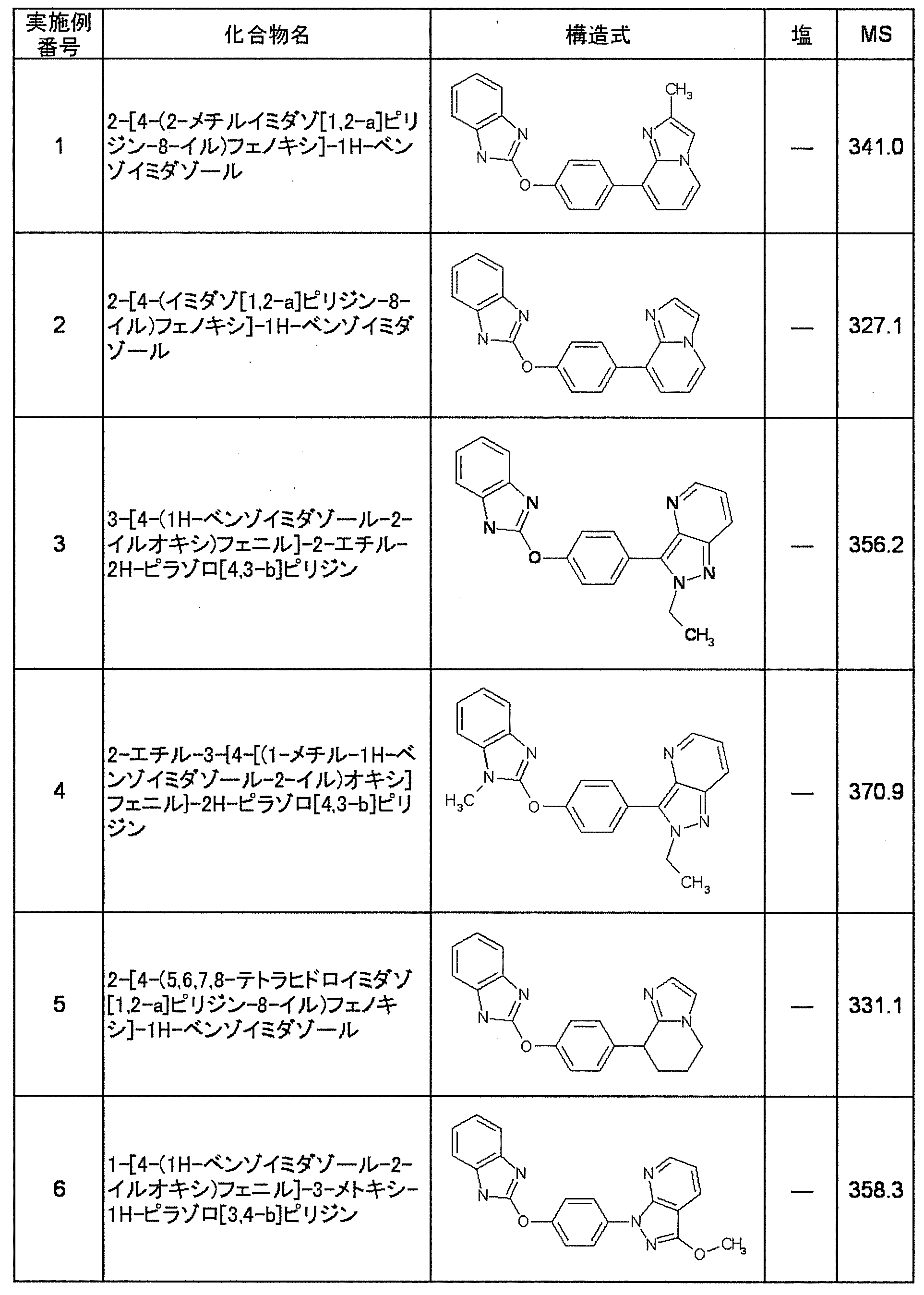


(1)実施例1の化合物 10.0g
(2)乳糖 70.0g
(3)コーンスターチ 50.0g
(4)可溶性デンプン 7.0g
(5)ステアリン酸マグネシウム 3.0g
実施例1の化合物(10.0g)及びステアリン酸マグネシウム(3.0g)を可溶性デンプンの水溶液(70mL)(可溶性デンプンとして7.0g)で顆粒化した後、乾燥し、乳糖(70.0g)及びコーンスターチ(50.0g)と混合する(乳糖、コーンスターチ、可溶性デンプン、及びステアリン酸マグネシウムはいずれも日本薬局方適合品)。混合物を圧縮して錠剤を得る。
ヒトPDE10A全長遺伝子をSf9もしくはCOS-7細胞に形質導入した後、その細胞を破砕し、遠心後の沈渣からヒトPDE10A酵素を得た。Sf9細胞から抽出した酵素については、ヒスタグアフィニティカラムを用いて部分的に精製した。酵素は-70℃で保存した上で使用した。
シンチレーション近接アッセイ(Scintillation Proximity Assay:SPA)(GE Healthcare)を用いてPDE10Aの酵素活性を測定した。被験化合物の阻害活性を測定する為、10μLの段階希釈した被験化合物と20μLのPDE10A酵素とを室温で30分間、アッセイバッファー(50 mM HEPES-NaOH, 8.3 mM MgCl2, 1.7 mM EGTA, 0.1 % BSA (pH 7.4))中で反応させた。反応液中のDMSOの終濃度は1 %であった。
化合物評価は96ウェルハーフエリアプレート(Corning)を用い、2回ずつ行った。基質[3H] cGMP(25又は50 nM;それぞれGE Healthcare又はPerkinElmer)を10μL添加し、総計40μLとすることで反応を開始させた。60分間の室温での反応の後、反応停止の為に硫酸亜鉛を含んだイットリウムSPAビーズ(6 mg/mL、20μL)を添加した。更に1時間の静置後、シンチレーションカウンター(PerkinElmer)を用いた測定を行い、阻害率を計算した。阻害率は、化合物未添加時(コントロール)の値を0%、化合物および酵素未添加時の値を100%とした。これらの結果を表2に示す。

動物
雄性SDラットを日本チャールス・リバー株式会社 (神奈川、日本) から購入し、8週齢で実験に使用した。飼育施設に到着後、動物を最低限1週間馴化させた。動物は、温度と湿度をコントロールした実験室で12:12時間の明暗サイクル下で飼育し、食餌と水を自由摂取させた。
実施例14は、0.5% (w/v) メチルセルロース水溶液に懸濁し、経口投与(p.o.)した。(+)-MK-801 hydrogen maleate (MK-801、シグマアルドリッチ、セントルイス、ミズーリ州) は、生理食塩水に溶解し、皮下投与 (s.c.) した。全ての薬物を、ラットに対して2 mL/kg体重の容量で投薬した。
げっ歯動物において精神刺激薬 (例、アンフェタミン、コカイン、メタンフェタミン、MK-801及びフェンシクリジン) で誘発される自発運動量の亢進が、精神病の動物モデルとして広く使われている (Psychopharmacology 1999, vol. 145: 237-250)。ラットを用いてMK-801により誘発される自発運動量亢進に対する抑制作用について、化合物 (実施例14)を試験した。試験開始まで、雄性SDラット (8週齢) を、赤外線センサーを上部に設置した運動チャンバー (室町機械株式会社、東京、日本) 内に馴化させた。馴化後、動物を投与媒体 (0.5% (w/v) メチルセルロース水溶液)、または実施例14 (1 mg/kg, p.o.) のいずれかで処置し、60分後にMK-801 (塩として0.3 mg/kg, s.c.) を投与した。1分毎の自発運動量を測定し、MK-801の投与から120分間の累計カウントを各処置群について計算した。全てのデータは、平均値と平均値の標準誤差 (n = 5) として表し、Studentのt 検定 (P < 0.05で有意差あり) を用いて統計解析を行った。
Claims (14)
- 式(I-i):

[式中、
R1は、水素原子または置換されていてもよいC1-6アルキル基を示し、
X1は、CHまたは窒素原子を示し、
環Aは、置換基を有していてもよく、
X2は、CR2または窒素原子を示し、
X3は、CR3または窒素原子を示し、
X4は、CR4または窒素原子を示し、
X5は、CR5または窒素原子を示し、
R2、R3、R4およびR5は、それぞれ独立して、水素原子または置換基を示し、
環Bは、置換されていてもよい5または6員含窒素複素環(該含窒素複素環は、環C1以外にさらに他の環と縮合環を形成していてもよい。)を示し、
Z5は、=N-または-N=を示し、
環C1は、置換されていてもよい5員環を示し、
Z1、Z3’およびZ4’は、それぞれ独立して、炭素原子および窒素原子から選択される環C1の構成原子を示し、
環Dは、置換されていてもよい5または6員環を示し、

は、単結合または二重結合を示す。]
で表される化合物またはその塩。 - 式(I-ii):

[式中、
R1は、水素原子または置換されていてもよいC1-6アルキル基を示し、
X1は、CHまたは窒素原子を示し、
環Aは、置換基を有していてもよく、
X2は、CR2または窒素原子を示し、
X3は、CR3または窒素原子を示し、
X4は、CR4または窒素原子を示し、
X5は、CR5または窒素原子を示し、
R2、R3、R4およびR5は、それぞれ独立して、水素原子または置換基を示し、
環Bは、置換されていてもよい5または6員含窒素複素環(該含窒素複素環は、環C2以外に、さらに他の環と縮合環を形成していてもよい。)を示し、
Z5は、=N-または-N=を示し、
環C2は、置換されていてもよい5員環を示し、
Yは、炭素原子および窒素原子から選択される環C2の構成原子を示し、
Z1は、炭素原子および窒素原子から選択される環C2の構成原子を示し、
Z3’’は、炭素原子、窒素原子、硫黄原子および酸素原子から選択される環C2の構成原子を示し、
Z4’’は、-O-、-S-、-N=、-NR6’-、-CR7’=、-SO-、-SO2-、または置換されていてもよいメチレン基(ただし、カルボニル基を除く。)を示し、
R6’およびR7’は、それぞれ独立して、水素原子または置換基を示し、

は、単結合または二重結合を示す。]
で表される化合物またはその塩。 - 式(I-iii):
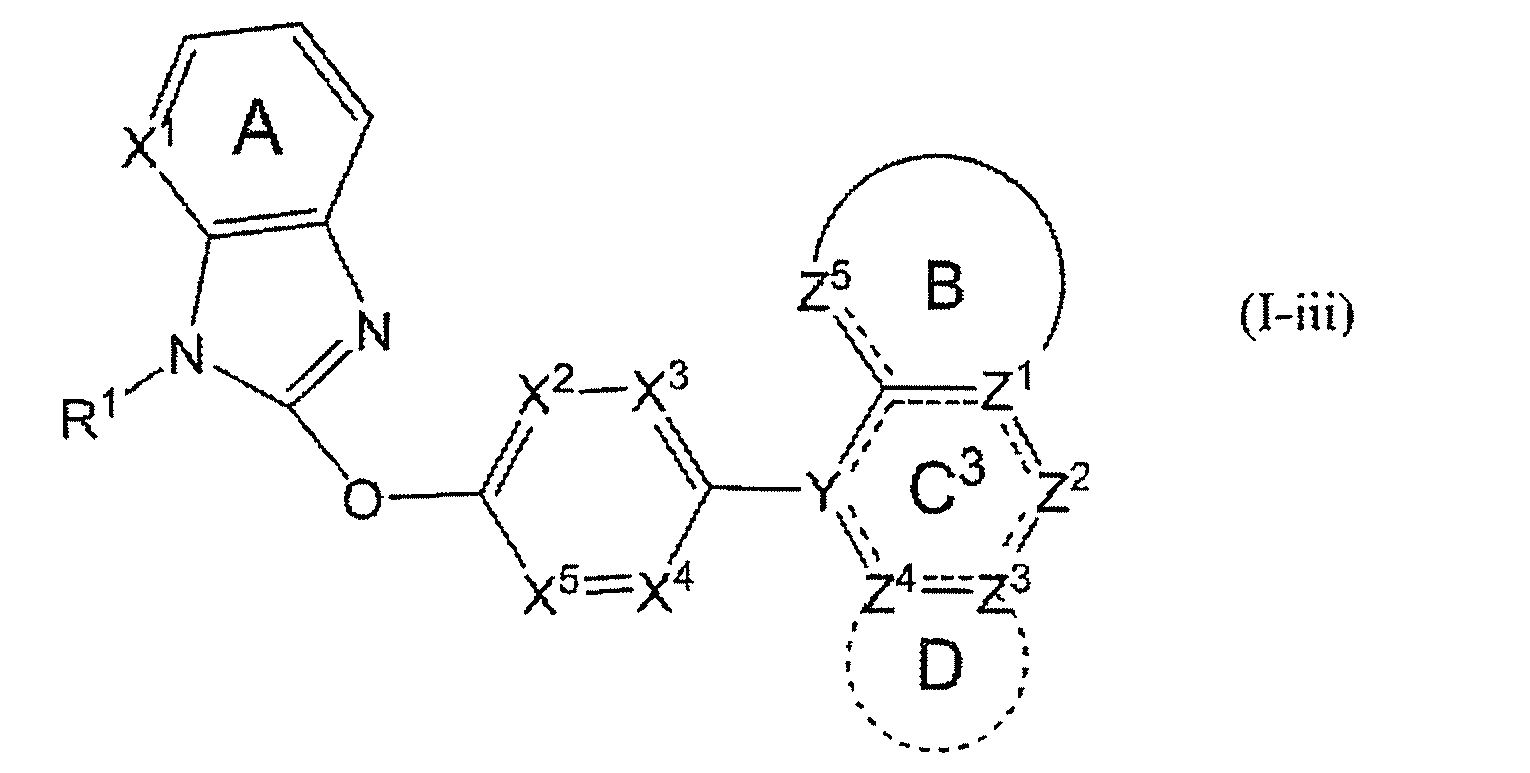
[式中、
R1は、水素原子または置換されていてもよいC1-6アルキル基を示し、
X1は、CHまたは窒素原子を示し、
環Aは、置換基を有していてもよく、
X2は、CR2または窒素原子を示し、
X3は、CR3または窒素原子を示し、
X4は、CR4または窒素原子を示し、
X5は、CR5または窒素原子を示し、
R2、R3、R4およびR5は、それぞれ独立して、水素原子または置換基を示し、
環Bは、置換されていてもよい5または6員含窒素複素環(該含窒素複素環は、環C3以外に、さらに他の環と縮合環を形成していてもよい。)を示し、
Z5は、=N-または-N=を示し、
環C3は、置換されていてもよい6員環を示し、
Yは、炭素原子および窒素原子から選択される環C3の構成原子を示し、
Z1は、炭素原子および窒素原子から選択される環C3の構成原子を示し、
Z2、Z3およびZ4は、それぞれ独立して、炭素原子、窒素原子、硫黄原子および酸素原子から選択される環C3の構成原子を示し、

また、Z3およびZ4は、一緒になって、環Dを形成してもよく、
環Dは、置換されていてもよい5または6員環を示す。]
で表される化合物またはその塩。 - Z4’’が、-O-、-S-、-N=、-NR6’-、-CR7’=、-SO-、-SO2-、または-CR8R9-(式中、R8およびR9は、それぞれ独立して、水素原子または置換基を示す。)である、請求項2記載の化合物またはその塩。
- X2、X3、X4およびX5が、それぞれCHである、請求項1~3のいずれか1項に記載の化合物またはその塩。
- 式(I-i)’:

で表される、請求項1記載の化合物またはその塩。 - 9-(4-{[3-(2-メトキシエチル)-3H-イミダゾ[4,5-b]ピリジン-2-イル]オキシ}フェニル)-9H-イミダゾ[1',2':1,2]イミダゾ[4,5-b]ピリジンまたはその塩。
- 5-メチル-9-{4-[(3-メチル-3H-イミダゾ[4,5-b]ピリジン-2-イル)オキシ]フェニル}-9H-イミダゾ[1',2':1,2]イミダゾ[4,5-b]ピリジンまたはその塩。
- 請求項1~3のいずれか1項に記載の化合物またはその塩を含有する医薬。
- ホスホジエステラーゼ10A阻害薬である、請求項9記載の医薬。
- 統合失調症の予防または治療薬である、請求項9記載の医薬。
- 請求項1~3のいずれか1項に記載の化合物またはその塩の有効量を哺乳動物に投与することを特徴とする、当該哺乳動物における統合失調症の予防または治療方法。
- 統合失調症の予防または治療薬の製造のための、請求項1~3のいずれか1項に記載の化合物またはその塩の使用。
- 統合失調症の予防または治療における使用のための、請求項1~3のいずれか1項に記載の化合物またはその塩。
Priority Applications (3)
| Application Number | Priority Date | Filing Date | Title |
|---|---|---|---|
| US14/002,439 US9029388B2 (en) | 2011-03-16 | 2012-03-15 | Condensed heterocyclic compound |
| JP2013504776A JP5973990B2 (ja) | 2011-03-16 | 2012-03-15 | 縮合複素環化合物 |
| EP12758231.0A EP2687529B1 (en) | 2011-03-16 | 2012-03-15 | Condensed heterocyclic compound |
Applications Claiming Priority (2)
| Application Number | Priority Date | Filing Date | Title |
|---|---|---|---|
| JP2011058562 | 2011-03-16 | ||
| JP2011-058562 | 2011-03-16 |
Publications (1)
| Publication Number | Publication Date |
|---|---|
| WO2012124782A1 true WO2012124782A1 (ja) | 2012-09-20 |
Family
ID=46830846
Family Applications (1)
| Application Number | Title | Priority Date | Filing Date |
|---|---|---|---|
| PCT/JP2012/056769 Ceased WO2012124782A1 (ja) | 2011-03-16 | 2012-03-15 | 縮合複素環化合物 |
Country Status (4)
| Country | Link |
|---|---|
| US (1) | US9029388B2 (ja) |
| EP (1) | EP2687529B1 (ja) |
| JP (1) | JP5973990B2 (ja) |
| WO (1) | WO2012124782A1 (ja) |
Cited By (2)
| Publication number | Priority date | Publication date | Assignee | Title |
|---|---|---|---|---|
| WO2014142322A1 (ja) | 2013-03-15 | 2014-09-18 | 第一三共株式会社 | ベンゾチオフェン誘導体 |
| US9512118B2 (en) | 2011-06-22 | 2016-12-06 | Takeda Pharmaceutical Company Limited | Crystal of fused heterocyclic compound |
Families Citing this family (1)
| Publication number | Priority date | Publication date | Assignee | Title |
|---|---|---|---|---|
| CN114805352B (zh) * | 2015-07-11 | 2023-09-15 | 南京爱德程医药科技有限公司 | 作为pi3k/mtor抑制剂的吡咯并吡啶取代的稠合喹啉化合物 |
Citations (10)
| Publication number | Priority date | Publication date | Assignee | Title |
|---|---|---|---|---|
| WO2006072828A2 (en) | 2005-01-07 | 2006-07-13 | Pfizer Products Inc. | Heteroaromatic quinoline compounds and their use as pde10 inhibitors |
| WO2007091570A1 (ja) * | 2006-02-06 | 2007-08-16 | Taisho Pharmaceutical Co., Ltd. | スフィンゴシン-1-リン酸結合阻害物質 |
| WO2008001182A1 (en) | 2006-06-26 | 2008-01-03 | Pfizer Products Inc. | Tricyclic heteroaryl compounds as pde10 inhibitors |
| WO2008004117A1 (en) | 2006-07-06 | 2008-01-10 | Pfizer Products Inc. | Selective azole pde10a inhibitor compounds |
| JP2010507664A (ja) * | 2006-10-25 | 2010-03-11 | 武田薬品工業株式会社 | ベンズイミダゾール化合物 |
| WO2010057126A1 (en) | 2008-11-14 | 2010-05-20 | Amgen Inc. | Pyridine and pyrimidine derivatives as phosphodiesterase 10 inhibitors |
| WO2010057121A1 (en) | 2008-11-14 | 2010-05-20 | Amgen Inc. | Pyrazine compounds as phosphodiesterase 10 inhibitors |
| US20100190832A1 (en) * | 2008-10-17 | 2010-07-29 | National Institute Of Immunology. | Mechanism-based inhibitors of transthyretin amyloidosis: studies with biphenyl ethers and structural templates |
| WO2010090737A1 (en) | 2009-02-05 | 2010-08-12 | Takeda Pharmaceutical Company Limited | Pyridazinone compounds |
| JP2011058562A (ja) | 2009-09-10 | 2011-03-24 | Kyb Co Ltd | バルブ構造 |
Family Cites Families (10)
| Publication number | Priority date | Publication date | Assignee | Title |
|---|---|---|---|---|
| JP2004510712A (ja) | 2000-09-22 | 2004-04-08 | オーソ−マクニール・フアーマシユーチカル・インコーポレーテツド | オクタヒドロ−インドリジンおよびキノリジンおよびヘキサヒドロ−ピロリジン |
| US7652035B2 (en) | 2004-10-19 | 2010-01-26 | Neurocrine Bioscience, Inc. | CRF receptor antagonists and methods relating thereto |
| NL2000397C2 (nl) | 2006-01-05 | 2007-10-30 | Pfizer Prod Inc | Bicyclische heteroarylverbindingen als PDE10 inhibitoren. |
| SG171954A1 (en) | 2008-12-04 | 2011-07-28 | Hoffmann La Roche | Pyridazinone derivatives |
| WO2011163355A1 (en) | 2010-06-24 | 2011-12-29 | Takeda Pharmaceutical Company Limited | Fused heterocyclic compounds as phosphodiesterases (pdes) inhibitors |
| EP2602254B1 (en) | 2010-08-04 | 2017-06-14 | Takeda Pharmaceutical Company Limited | Heterocyclic compound |
| US9029536B2 (en) * | 2010-08-04 | 2015-05-12 | Takeda Pharmaceutical Company Limited | Fused heterocyclic compounds |
| EP2602255B1 (en) | 2010-08-04 | 2017-04-26 | Takeda Pharmaceutical Company Limited | Fused heterocyclic ring compound |
| US9150588B2 (en) | 2010-08-10 | 2015-10-06 | Takeda Pharmaceutical Company Limited | Substituted pyridazin-4(1H)-ones as phosphodiesterase 10A inhibitors |
| TWI570122B (zh) * | 2011-06-22 | 2017-02-11 | 武田藥品工業股份有限公司 | 稠合雜環化合物之結晶 |
-
2012
- 2012-03-15 WO PCT/JP2012/056769 patent/WO2012124782A1/ja not_active Ceased
- 2012-03-15 US US14/002,439 patent/US9029388B2/en not_active Expired - Fee Related
- 2012-03-15 EP EP12758231.0A patent/EP2687529B1/en not_active Not-in-force
- 2012-03-15 JP JP2013504776A patent/JP5973990B2/ja not_active Expired - Fee Related
Patent Citations (10)
| Publication number | Priority date | Publication date | Assignee | Title |
|---|---|---|---|---|
| WO2006072828A2 (en) | 2005-01-07 | 2006-07-13 | Pfizer Products Inc. | Heteroaromatic quinoline compounds and their use as pde10 inhibitors |
| WO2007091570A1 (ja) * | 2006-02-06 | 2007-08-16 | Taisho Pharmaceutical Co., Ltd. | スフィンゴシン-1-リン酸結合阻害物質 |
| WO2008001182A1 (en) | 2006-06-26 | 2008-01-03 | Pfizer Products Inc. | Tricyclic heteroaryl compounds as pde10 inhibitors |
| WO2008004117A1 (en) | 2006-07-06 | 2008-01-10 | Pfizer Products Inc. | Selective azole pde10a inhibitor compounds |
| JP2010507664A (ja) * | 2006-10-25 | 2010-03-11 | 武田薬品工業株式会社 | ベンズイミダゾール化合物 |
| US20100190832A1 (en) * | 2008-10-17 | 2010-07-29 | National Institute Of Immunology. | Mechanism-based inhibitors of transthyretin amyloidosis: studies with biphenyl ethers and structural templates |
| WO2010057126A1 (en) | 2008-11-14 | 2010-05-20 | Amgen Inc. | Pyridine and pyrimidine derivatives as phosphodiesterase 10 inhibitors |
| WO2010057121A1 (en) | 2008-11-14 | 2010-05-20 | Amgen Inc. | Pyrazine compounds as phosphodiesterase 10 inhibitors |
| WO2010090737A1 (en) | 2009-02-05 | 2010-08-12 | Takeda Pharmaceutical Company Limited | Pyridazinone compounds |
| JP2011058562A (ja) | 2009-09-10 | 2011-03-24 | Kyb Co Ltd | バルブ構造 |
Non-Patent Citations (13)
| Title |
|---|
| "IYAKUHIN no KAIHATSU", vol. 7, 1990, HIROKAWA SHOTEN, article "Design of Molecules", pages: 163 - 198 |
| BRAIN RES., vol. 985, 2003, pages 113 - 126 |
| CIRC. RES., vol. 100, no. 7, 2007, pages 950 - 966 |
| EUR. J. BIOCHEM., vol. 266, 1999, pages 1118 - 1127 |
| GENE, vol. 234, 1999, pages 109 - 117 |
| J. BIOL. CHEM., vol. 274, 1999, pages 18438 - 18445 |
| NAT. REV. DRUG DISCOV., vol. 5, 2006, pages 660 - 670 |
| PROC. NATL. ACAD. SCI. USA, vol. 96, 1999, pages 8991 - 8996 |
| PSYCHOPHARMACOLOGY, vol. 145, 1999, pages 237 - 250 |
| RICHARD C. LAROCK: "Comprehensive Organic Transformations", 1999, WILEY-VCH |
| See also references of EP2687529A4 * |
| THEODORA W. GREENE; PETER G. M. WUTS: "Protective Groups in Organic Synthesis", 1999, WILEY-INTERSCIENCE CORPORATION |
| THEODORA W. GREENE; PETERG. M. WUTS: "Protective Groups in Organic Synthesis", 1999, WILEY-INTERSCIENCE |
Cited By (3)
| Publication number | Priority date | Publication date | Assignee | Title |
|---|---|---|---|---|
| US9512118B2 (en) | 2011-06-22 | 2016-12-06 | Takeda Pharmaceutical Company Limited | Crystal of fused heterocyclic compound |
| WO2014142322A1 (ja) | 2013-03-15 | 2014-09-18 | 第一三共株式会社 | ベンゾチオフェン誘導体 |
| US9464076B2 (en) | 2013-03-15 | 2016-10-11 | Daiichi Sankyo Company, Limited | Benzothiophene derivative |
Also Published As
| Publication number | Publication date |
|---|---|
| JPWO2012124782A1 (ja) | 2014-07-24 |
| EP2687529A4 (en) | 2014-08-20 |
| US9029388B2 (en) | 2015-05-12 |
| EP2687529B1 (en) | 2016-07-13 |
| EP2687529A1 (en) | 2014-01-22 |
| JP5973990B2 (ja) | 2016-08-23 |
| US20130331409A1 (en) | 2013-12-12 |
Similar Documents
| Publication | Publication Date | Title |
|---|---|---|
| JP5739526B2 (ja) | ホスホジエステラーゼ(PDEs)阻害薬としての縮合複素環化合物 | |
| JP6205356B2 (ja) | 複素環化合物 | |
| US20110130384A1 (en) | Amide compound | |
| JP5760085B2 (ja) | 縮合複素環化合物 | |
| JP6157455B2 (ja) | 含窒素複素環化合物 | |
| EP2604597B1 (en) | Heterocyclic compound and use thereof inhibitor of phosphodiesterase 10a | |
| JPWO2015012328A1 (ja) | 複素環化合物 | |
| JP5785548B2 (ja) | 縮合複素環化合物 | |
| EP2602254B1 (en) | Heterocyclic compound | |
| JP5973990B2 (ja) | 縮合複素環化合物 | |
| WO2013035826A1 (ja) | 縮合複素環化合物 |
Legal Events
| Date | Code | Title | Description |
|---|---|---|---|
| 121 | Ep: the epo has been informed by wipo that ep was designated in this application |
Ref document number: 12758231 Country of ref document: EP Kind code of ref document: A1 |
|
| WWE | Wipo information: entry into national phase |
Ref document number: 14002439 Country of ref document: US |
|
| ENP | Entry into the national phase |
Ref document number: 2013504776 Country of ref document: JP Kind code of ref document: A |
|
| REEP | Request for entry into the european phase |
Ref document number: 2012758231 Country of ref document: EP |
|
| WWE | Wipo information: entry into national phase |
Ref document number: 2012758231 Country of ref document: EP |
|
| NENP | Non-entry into the national phase |
Ref country code: DE |