WO2012127703A1 - SiC単結晶の製造方法および製造装置 - Google Patents
SiC単結晶の製造方法および製造装置 Download PDFInfo
- Publication number
- WO2012127703A1 WO2012127703A1 PCT/JP2011/067715 JP2011067715W WO2012127703A1 WO 2012127703 A1 WO2012127703 A1 WO 2012127703A1 JP 2011067715 W JP2011067715 W JP 2011067715W WO 2012127703 A1 WO2012127703 A1 WO 2012127703A1
- Authority
- WO
- WIPO (PCT)
- Prior art keywords
- crystal
- sic single
- solution
- single crystal
- sic
- Prior art date
- Legal status (The legal status is an assumption and is not a legal conclusion. Google has not performed a legal analysis and makes no representation as to the accuracy of the status listed.)
- Ceased
Links
Images






Classifications
-
- C—CHEMISTRY; METALLURGY
- C30—CRYSTAL GROWTH
- C30B—SINGLE-CRYSTAL GROWTH; UNIDIRECTIONAL SOLIDIFICATION OF EUTECTIC MATERIAL OR UNIDIRECTIONAL DEMIXING OF EUTECTOID MATERIAL; REFINING BY ZONE-MELTING OF MATERIAL; PRODUCTION OF A HOMOGENEOUS POLYCRYSTALLINE MATERIAL WITH DEFINED STRUCTURE; SINGLE CRYSTALS OR HOMOGENEOUS POLYCRYSTALLINE MATERIAL WITH DEFINED STRUCTURE; AFTER-TREATMENT OF SINGLE CRYSTALS OR A HOMOGENEOUS POLYCRYSTALLINE MATERIAL WITH DEFINED STRUCTURE; APPARATUS THEREFOR
- C30B15/00—Single-crystal growth by pulling from a melt, e.g. Czochralski method
- C30B15/20—Controlling or regulating
- C30B15/22—Stabilisation or shape controlling of the molten zone near the pulled crystal; Controlling the section of the crystal
-
- C—CHEMISTRY; METALLURGY
- C30—CRYSTAL GROWTH
- C30B—SINGLE-CRYSTAL GROWTH; UNIDIRECTIONAL SOLIDIFICATION OF EUTECTIC MATERIAL OR UNIDIRECTIONAL DEMIXING OF EUTECTOID MATERIAL; REFINING BY ZONE-MELTING OF MATERIAL; PRODUCTION OF A HOMOGENEOUS POLYCRYSTALLINE MATERIAL WITH DEFINED STRUCTURE; SINGLE CRYSTALS OR HOMOGENEOUS POLYCRYSTALLINE MATERIAL WITH DEFINED STRUCTURE; AFTER-TREATMENT OF SINGLE CRYSTALS OR A HOMOGENEOUS POLYCRYSTALLINE MATERIAL WITH DEFINED STRUCTURE; APPARATUS THEREFOR
- C30B17/00—Single-crystal growth onto a seed which remains in the melt during growth, e.g. Nacken-Kyropoulos method
-
- C—CHEMISTRY; METALLURGY
- C30—CRYSTAL GROWTH
- C30B—SINGLE-CRYSTAL GROWTH; UNIDIRECTIONAL SOLIDIFICATION OF EUTECTIC MATERIAL OR UNIDIRECTIONAL DEMIXING OF EUTECTOID MATERIAL; REFINING BY ZONE-MELTING OF MATERIAL; PRODUCTION OF A HOMOGENEOUS POLYCRYSTALLINE MATERIAL WITH DEFINED STRUCTURE; SINGLE CRYSTALS OR HOMOGENEOUS POLYCRYSTALLINE MATERIAL WITH DEFINED STRUCTURE; AFTER-TREATMENT OF SINGLE CRYSTALS OR A HOMOGENEOUS POLYCRYSTALLINE MATERIAL WITH DEFINED STRUCTURE; APPARATUS THEREFOR
- C30B19/00—Liquid-phase epitaxial-layer growth
- C30B19/02—Liquid-phase epitaxial-layer growth using molten solvents, e.g. flux
- C30B19/04—Liquid-phase epitaxial-layer growth using molten solvents, e.g. flux the solvent being a component of the crystal composition
-
- C—CHEMISTRY; METALLURGY
- C30—CRYSTAL GROWTH
- C30B—SINGLE-CRYSTAL GROWTH; UNIDIRECTIONAL SOLIDIFICATION OF EUTECTIC MATERIAL OR UNIDIRECTIONAL DEMIXING OF EUTECTOID MATERIAL; REFINING BY ZONE-MELTING OF MATERIAL; PRODUCTION OF A HOMOGENEOUS POLYCRYSTALLINE MATERIAL WITH DEFINED STRUCTURE; SINGLE CRYSTALS OR HOMOGENEOUS POLYCRYSTALLINE MATERIAL WITH DEFINED STRUCTURE; AFTER-TREATMENT OF SINGLE CRYSTALS OR A HOMOGENEOUS POLYCRYSTALLINE MATERIAL WITH DEFINED STRUCTURE; APPARATUS THEREFOR
- C30B19/00—Liquid-phase epitaxial-layer growth
- C30B19/06—Reaction chambers; Boats for supporting the melt; Substrate holders
- C30B19/061—Tipping system, e.g. by rotation
-
- C—CHEMISTRY; METALLURGY
- C30—CRYSTAL GROWTH
- C30B—SINGLE-CRYSTAL GROWTH; UNIDIRECTIONAL SOLIDIFICATION OF EUTECTIC MATERIAL OR UNIDIRECTIONAL DEMIXING OF EUTECTOID MATERIAL; REFINING BY ZONE-MELTING OF MATERIAL; PRODUCTION OF A HOMOGENEOUS POLYCRYSTALLINE MATERIAL WITH DEFINED STRUCTURE; SINGLE CRYSTALS OR HOMOGENEOUS POLYCRYSTALLINE MATERIAL WITH DEFINED STRUCTURE; AFTER-TREATMENT OF SINGLE CRYSTALS OR A HOMOGENEOUS POLYCRYSTALLINE MATERIAL WITH DEFINED STRUCTURE; APPARATUS THEREFOR
- C30B19/00—Liquid-phase epitaxial-layer growth
- C30B19/12—Liquid-phase epitaxial-layer growth characterised by the substrate
-
- C—CHEMISTRY; METALLURGY
- C30—CRYSTAL GROWTH
- C30B—SINGLE-CRYSTAL GROWTH; UNIDIRECTIONAL SOLIDIFICATION OF EUTECTIC MATERIAL OR UNIDIRECTIONAL DEMIXING OF EUTECTOID MATERIAL; REFINING BY ZONE-MELTING OF MATERIAL; PRODUCTION OF A HOMOGENEOUS POLYCRYSTALLINE MATERIAL WITH DEFINED STRUCTURE; SINGLE CRYSTALS OR HOMOGENEOUS POLYCRYSTALLINE MATERIAL WITH DEFINED STRUCTURE; AFTER-TREATMENT OF SINGLE CRYSTALS OR A HOMOGENEOUS POLYCRYSTALLINE MATERIAL WITH DEFINED STRUCTURE; APPARATUS THEREFOR
- C30B29/00—Single crystals or homogeneous polycrystalline material with defined structure characterised by the material or by their shape
- C30B29/10—Inorganic compounds or compositions
- C30B29/36—Carbides
-
- Y—GENERAL TAGGING OF NEW TECHNOLOGICAL DEVELOPMENTS; GENERAL TAGGING OF CROSS-SECTIONAL TECHNOLOGIES SPANNING OVER SEVERAL SECTIONS OF THE IPC; TECHNICAL SUBJECTS COVERED BY FORMER USPC CROSS-REFERENCE ART COLLECTIONS [XRACs] AND DIGESTS
- Y10—TECHNICAL SUBJECTS COVERED BY FORMER USPC
- Y10T—TECHNICAL SUBJECTS COVERED BY FORMER US CLASSIFICATION
- Y10T117/00—Single-crystal, oriented-crystal, and epitaxy growth processes; non-coating apparatus therefor
- Y10T117/10—Apparatus
- Y10T117/1024—Apparatus for crystallization from liquid or supercritical state
- Y10T117/1032—Seed pulling
Definitions
- the present invention relates to a method and an apparatus for producing an SiC single crystal by a solution method.
- the manufacturing method of the SiC single crystal by the solution method maintains a temperature gradient in which the temperature decreases from the bottom to the top from the inside toward the solution surface in the Si solution in the graphite crucible.
- C dissolved in the Si solution from the graphite crucible in the lower high temperature portion rises mainly by the convection of the solution, reaches the low temperature portion near the solution surface, and becomes supersaturated.
- An SiC seed crystal is held at the tip of a support rod (made of graphite), the lower surface of the seed crystal is brought into contact with the solution as a crystal growth surface, and an SiC single crystal grows by epitaxial growth from a supersaturated solution on the crystal growth surface of the seed crystal. .
- a support rod made of graphite
- the lower surface of the seed crystal is brought into contact with the solution as a crystal growth surface
- an SiC single crystal grows by epitaxial growth from a supersaturated solution on the crystal growth surface of the seed crystal.
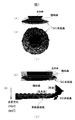
- a large number of crystals grow easily and polycrystallization easily occurs. There was a problem that it penetrated into the crystal region and hindered the long growth and diameter expansion process. That is, as shown in FIG.
- FIG. 1A shows that (A) is the front surface and (B) is the lower surface, and the SiC polycrystal projects like an umbrella so as to cover the entire seed crystal indicated by the broken line.
- FIG. 1 (2) is a similar example, (A) is a front view, (B) is a longitudinal section, and as shown in (B), on the crystal growth surface (lower surface) of the seed crystal indicated by a broken line. It can be seen that the SiC polycrystal (black portion) grown from the side surface of the seed crystal is covered up to the region of the grown single crystal (light gray).
- the present invention in a method for producing an SiC single crystal by a solution method, prevented polycrystallization in which a large number of crystals grow apart from a surface other than the crystal growth surface of the seed crystal or from a graphite rod supporting the seed crystal. It aims at providing the manufacturing method and manufacturing apparatus of a SiC single crystal. According to the present invention, the above object is achieved by using a Si—C solution in a crucible and growing a SiC single crystal starting from a SiC seed crystal in contact with the solution surface.
- the height of the solution wetting on the side surface of the SiC seed crystal is determined with the SiC single crystal grown from the crystal growth surface.
- This can be achieved by a method for producing a SiC single crystal, characterized in that the SiC single crystal grown from the side face is within a range where it grows as an integral SiC single crystal.
- the above object is also an apparatus for performing the method for producing a SiC single crystal of the present invention,
- the above-mentioned soaking height of the solution to the side surface of the SiC seed crystal is within a range in which the SiC single crystal grown from the crystal growth surface and the SiC single crystal grown from the side surface grow as a single SiC single crystal.
- the crystal growth surface of the SiC seed crystal which is the growth starting point of the SiC single crystal
- the height of wetting of the solution to the side surface of the SiC seed crystal is determined from the crystal growth surface. Since the grown SiC single crystal and the SiC single crystal grown from the side face are within the range where they are grown as an integrated SiC single crystal, the crystal growth is from other parts of the seed crystal or from the graphite rod supporting the seed crystal. Polycrystallization can be prevented.
- FIG. 1 is a photograph showing the state of polycrystal generation in the prior art.
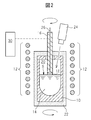
- FIG. 2 is a schematic diagram showing a basic configuration of an apparatus for producing a SiC single crystal by the method of the present invention.
- FIG. 3 is a schematic view showing a comparison between the relationship between the seed crystal and the solution surface in the prior art (1) and the best mode (2) of the present invention.
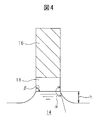
- FIG. 4 is a schematic diagram showing in detail an enlarged relationship between the seed crystal and the solution surface in the present invention.
- FIG. 5 is a photograph showing the presence or absence of macro defects in the grown SiC single crystal when the wetting height on the side surface of the seed crystal is (1) 1 mm, (2) 0.3 mm, and (3) 0 mm.
- FIG. 1 is a photograph showing the state of polycrystal generation in the prior art.
- FIG. 2 is a schematic diagram showing a basic configuration of an apparatus for producing a SiC single crystal by the method of the present invention.
- FIG. 3 is a schematic view showing a comparison between the
- FIG. 6 is a schematic diagram showing a typical example of the lower end shape of the support rod in which the solution wets easily.
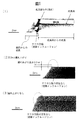
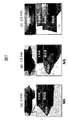
- FIG. 7 is a photograph showing the state of growth when crystal growth is performed while changing the pulling height.
- FIG. 8 is a schematic diagram showing the relationship between each part during SiC growth.
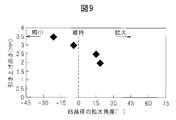
- FIG. 9 is a graph showing the relationship between the lifting height and the enlargement angle.
- FIG. 10 is a photograph showing a SiC single crystal grown by the method of the present invention.
- FIG. 11 is a photograph showing a SiC single crystal grown by the method of the present invention.
- FIG. 12 is a graph showing the relationship between the lifting height and the enlargement angle.
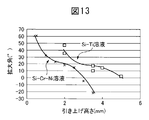
- FIG. 13 is a graph showing the relationship between the lifting height and the enlargement angle when solutions having different compositions are used.
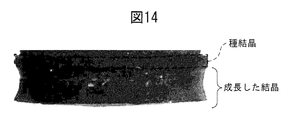
- FIG. 14 is a photograph showing a SiC single crystal grown by the method of the present invention.
- FIG. 15 is a photograph showing a SiC single crystal grown by changing the height of wetting.
- FIG. 2 shows a basic structure of an apparatus for growing an SiC single crystal by a solution method suitable for carrying out the method of the present invention.
- a high frequency heating coil 12 surrounding the periphery of the graphite crucible 10 heats and melts the raw material in the crucible 10 to form a solution 14, and an SiC seed crystal 18 supported on the lower end of the graphite support rod 16 is placed above the solution 14.
- a SiC single crystal is grown on the lower surface of the SiC seed crystal 18 in contact with the solution surface S in an inert atmosphere 20 such as Ar gas.
- the entire graphite crucible 10 is covered with a heat insulating material 22.
- the temperature of the solution surface S is measured in a non-contact manner by the radiation thermometer 24, and the back surface temperature of the seed crystal 18 is measured in a contact manner by a thermocouple 26 such as W-Re.
- the CCD camera 24 is installed in an observation window above the solution surface where the solution surface S can be directly viewed, and can directly observe the solution surface S during SiC growth.
- a radiation thermometer is installed in the observation window above the solution surface where the solution surface S can be directly viewed, and the solution surface temperature before and after the seed crystal 18 is brought into contact with the solution 14 can be measured.
- the thermocouple 26 fixes its detection end to the inside of the lower end of the graphite support rod 16 to which the seed crystal 18 is bonded (position of about 2 mm from the bonding surface of the seed crystal 18), and the seed crystal 18 contacts the solution 14. It is possible to measure the seed crystal temperature immediately after the treatment.
- Si is introduced into the graphite crucible 10 as a raw material for the Si solution and heated by the high-frequency heating coil 12 to form the Si solution.
- C dissolves in the Si solution from the inner wall of the graphite crucible 10 to form a Si—C solution 14.
- the SiC C source is basically the graphite crucible 10, but a graphite block can be additionally introduced.
- the crucible 10 may be made of SiC.
- the wetting height of the solution to the side surface of the SiC seed crystal further depends on the SiC single crystal grown from the crystal growth surface and the SiC single crystal grown from the side surface. It is characterized in that a control device 30 is provided for maintaining and growing so that the crystal grows as a single SiC single crystal.
- the control device 30 electrically and / or mechanically cooperates with a solution surface height detector and a seed crystal support rod drive device (not shown) to appropriately adjust the height of the crystal growth surface of the seed crystal from the solution surface. Control to value.
- the method of the present invention uses the apparatus having the basic configuration of FIG. 2 to bring the Si solution in the graphite crucible into contact with the solution surface while maintaining a temperature gradient that decreases from the inside toward the solution surface. In the method of growing a SiC single crystal starting from the SiC seed crystal, Only the crystal growth surface of the SiC seed crystal, which is the growth starting point of the SiC single crystal, is brought into contact with the solution surface.
- FIG. 3A schematically shows the relationship between the seed crystal and the solution surface in the conventional solution method.
- the seed crystal 18 is held at the lower end of the support bar 16, and the crystal growth surface G is brought into contact with the solution surface S of the solution 14. At that time, as shown in the figure, the crystal growth surface G and the solution surface S coincide with each other, or the crystal growth surface G is slightly below the solution surface S and is slightly immersed in the solution 14.
- the solution 14 wets the side surface of the seed crystal 18, and a meniscus 40 is formed as shown.
- the meniscus 40 is brought into contact with the side surface to form the meniscus 40. From the portion to be formed, a polycrystal 42 composed of a large number of single crystals having different orientations is obtained. That is, polycrystallization as shown in FIG. 1 occurs. Therefore, in the present invention, the height of wetting to the side surface of the seed crystal as shown in FIG. 3 (1) (B) is controlled to prevent polycrystallization. In the best mode, the wetting height is zero. That is, in the best mode, as shown in FIG.
- the crystal growth surface G and the solution surface S are always coincided with each other as shown in FIG. Strictly prevent it from going down and soaking in the solution 14 does not occur. And preferably, immediately after the contact of (A) occurs, it is slightly lifted (for example, within 2 minutes) (lifting height h: FIG. 4), and as shown in (B), between the crystal growth surface G and the solution. Then, a meniscus 50 is formed, and this state is maintained to grow a SiC single crystal. More desirably, the contact angle ⁇ (FIG. 4) formed by the meniscus 50 and the side surface of the seed crystal 18 is 200 degrees or less. Thereby, polycrystallization can be advantageously prevented.
- the wetting height of the solution on the side surface of the SiC seed crystal is such that the SiC single crystal grown from the crystal growth surface of the seed crystal is integrated with the SiC single crystal grown from the side surface of the seed crystal.
- the growth is carried out while maintaining so as to be within the range of growing as a single crystal.
- the crystal grown from the crystal growth surface and the crystal grown from the side surface are not integrated with macro defects. This is a conventional recognition, and as described in the best mode described above, only the crystal growth surface is brought into contact with the solution surface, and wetting of the solution to the side surface has been strictly avoided.
- FIG. 5 (1) shows a case where the wetting height reaches 1 mm, which is the height of the seed crystal. Macro defects occur between the side crystal and the main crystal, and solution infiltration (inclusion) occurs. Therefore, the side crystal and the main crystal grow as separate crystals. This not only causes polycrystallization, but also inhibits the expansion of the SiC single crystal. The expansion growth is essential for the growth of a SiC single crystal having a practical straight body portion.
- FIG. 5 (2) shows a case where wetting up to a height of 0.3 mm occurs on the side surface of the seed crystal, but the side crystal and the main crystal grow as a single crystal without macro defects.
- FIG. 5 (3) shows the best mode when the wetting height is 0 mm, that is, when only the crystal growth surface is in contact with the solution surface, and no macro defect is generated.
- a preliminary experiment is conducted to determine the relationship between the occurrence of macro defects and the wetting height, and the growth is adjusted within the allowable range of the wetting height by adjusting the lifting height according to this relationship. Can do.
- the angle ⁇ (FIG. 4) formed by the crystal growth surface G and the side surface of the seed crystal 18 is desirably 90 degrees or less.
- the rotation of the seed crystal 18 with respect to the solution surface S is started. Rotation makes the temperature and composition of the solution more uniform.
- the solution surface S vibrates, the solution surface S and the crystal growth surface G of the seed crystal 18 can be contacted using this vibration. Also in this case, as soon as contact is made, the seed crystal 18 is pulled up to form the meniscus 50.
- the shape of the lower end of the support bar 16 that holds the seed crystal 18 is easily wetted by the solution 14.
- the other portion (convex portion) of the tip surface approaches the solution surface S, 6 (B)
- the crystal growth surface G of the seed crystal 18 is brought into contact with the solution surface S
- this convex portion also comes into contact with the solution surface S.
- the seed crystal solution 14 also contacts the tip of the support bar 16 and the side surface of the seed crystal 18.
- the front end surface of the support bar 16 is preferably flat, and most preferably, the outer shape of the seed crystal 18 and the outer shape of the front end surface are the same. This makes uniform the heat transfer from the seed crystal to the support rod, which directly affects crystal growth.
- Example 1 A single crystal growth apparatus having the basic configuration shown in FIG. 2 was used. Solid Si, Cr, and Ni were put into the crucible 10 and melted by the heating coil 12 to form a Si-20Cr-5Ni solution.
- Cr and Ni are additive elements for increasing the solubility of C, and are not mixed in the growing SiC single crystal.
- the SiC seed crystal 18 has the [0001] plane as the crystal growth plane, and the angle ⁇ between the crystal growth plane and the side surface is set to 90 °, which is the most desirable. After all of the charged solids were melted to form the above solution, only the crystal growth surface of the seed crystal was brought into contact with the solution surface while maintaining the solution temperature at 1900 ° C. After contact, crystal growth was performed for 2 hours.
- the crystal growth was performed by changing the height h of the crystal growth surface G of the seed crystal 18 from the solution surface S to (a) 0 mm, (b) 1.5 mm, and (c) 2.5 mm.
- the growth state of the obtained crystal is shown in FIG. (A) When the lifting height h is 0 mm, the solution 14 wets up to the support rod 16 in addition to the crystal growth surface G. As a result, polycrystal 42 is generated from the support rod 16 and covers all the seed crystal 18. I have.
- the contact angle ⁇ is considered to have a more essential relationship than the pulling height h.
- Table 1 also shows an enlargement angle ⁇ indicating an enlargement of the diameter of the growing crystal.
- the expansion angle ⁇ is an angle between the pulling axis (vertical direction) of the seed crystal 18 and the meniscus 50 during crystal growth. If the expansion angle ⁇ is a positive value, the crystal expands in diameter as it grows, and conversely if it is negative, the crystal shrinks in diameter as it grows.
- the relationship between the enlargement angle ⁇ and the lifting height h shown in Table 1 is plotted in FIG. As shown in Table 1 and FIG. 9, the enlargement angle ⁇ decreases as the pulling height h increases.
- Example 2 A SiC single crystal was grown in the same manner as in Example 1. However, the angle ⁇ between the crystal growth surface G and the side surface of the seed crystal 18 was 60 degrees. The lifting height was 1.0 mm. The contact angle ⁇ was 180 degrees and was 200 degrees or less. FIG. 10 shows the obtained SiC single crystal. Crystal growth does not occur from a part other than the crystal growth surface G, and polycrystallization is prevented.
- Example 3 A SiC single crystal was grown in the same manner as in Example 2. However, the angle ⁇ between the crystal growth surface G and the side surface of the seed crystal 18 was variously changed. The obtained results are shown in Table 2. As shown in Table 2, polycrystallization is prevented when the angle ⁇ between the crystal growth surface G and the side surface of the seed crystal is 90 degrees or less.
- Example 4 A SiC single crystal was grown in the same manner as in Example 1. However, the angle ⁇ between the crystal growth surface G and the side surface of the seed crystal 18 was 30 degrees. After contacting the crystal growth surface G of the seed crystal with the solution surface S, a meniscus was immediately formed, and the pulling height h was changed in the range of 0.5 to 1.5 mm, and crystal growth was performed for 2 hours.
- Example 5 A SiC single crystal was grown in the same manner as in Example 1.
- FIG. 13 also shows the results of the Si—Cr—Ni solution shown in FIG. 11 for comparison.
- the vertical axis / horizontal axis are interchanged.
- the enlargement angle can be controlled by adjusting the lifting height.
- the relationship curve between the expansion angle and the pulling height is shifted depending on the composition of the solution.
- One reason for the shift may be the viscosity of the solution.
- the Si-Ti solution is more viscous than the Si-Cr-Ni solution.
- Example 6 A SiC single crystal was grown in the same manner as in Example 1.
- FIG. 14 shows the obtained SiC single crystal. It can be confirmed that the crystal is not grown from other than the crystal growth surface G, and the polycrystallization from the side surface can be suppressed.
- Example 7 In the above examples, only the crystal growth surface of the seed crystal was brought into contact with the solution according to the best mode of the present invention, that is, the SiC single crystal was grown at a wetting height of 0. In this example, the allowable range of the wetting height was obtained according to the general form of the present invention. That is, a SiC single crystal was grown in the same manner as in Example 1. However, the angle ⁇ between the crystal growth surface G and the side surface of the seed crystal 18 was 90 degrees. Further, the wetting height was varied (0 mm to 0.9 mm) by adjusting the lifting height (1.0 mm to 3.0 mm).
- the contact angle ⁇ was 180 degrees and was 200 degrees or less.
- 15 (1) to 15 (4) show the obtained SiC single crystal.
- the results are summarized in Table 5. (1) When the wetting height is 0 mm (pulling height is 3.0 mm), that is, when only the crystal growth surface of the seed crystal is in contact with the solution surface (the best mode of the present invention), other than the crystal growth surface Crystals are not grown from these parts, and a good SiC single crystal in which macro defects or polycrystallization is prevented is grown.
- the allowable upper limit of the wetting height is a value in the range of 0.3 mm to 0.68 mm. Furthermore, if the experiment is performed with the wet-up height set finely, a more detailed upper limit value can be obtained. That is, the SiC single crystal can be grown by obtaining the upper limit of the wetting height by a preliminary experiment and setting the manufacturing parameters such as the lifting height so as not to exceed the upper limit. In this way, the diameter of the crystal to grow can be controlled by the enlargement ratio or the reduction ratio by the angle ⁇ between the pulling axis of the seed crystal 18 and the meniscus 50. The angle ⁇ between the pulling shaft and the meniscus 50 can be controlled by the pulling height h of the seed crystal 18.
- a map showing the relationship between the pulling height h and the angle ⁇ between the pulling shaft and the meniscus 50 is prepared in advance, and by using the map to adjust the pulling height h, the relationship between the pulling shaft and the meniscus 50 is established. The angle can be adjusted.
- a method for producing a SiC single crystal by a solution method polycrystallization in which a large number of crystals grow apart from a surface other than the crystal growth surface of the seed crystal or from a graphite rod supporting the seed crystal is performed.
- a method and apparatus for producing a prevented SiC single crystal are provided. Further, the angle ⁇ between the side surface of the seed crystal and the solution surface, the angle ⁇ between the crystal growth surface G and the side surface of the seed crystal, the angle (enlargement angle) ⁇ between the seed crystal pulling axis and the meniscus during crystal growth, the pulling height
- the parameter h it is possible to perform selective control for expanding, reducing, and maintaining a constant diameter of the grown crystal while preventing polycrystallization.
Landscapes
- Chemical & Material Sciences (AREA)
- Engineering & Computer Science (AREA)
- Crystallography & Structural Chemistry (AREA)
- Materials Engineering (AREA)
- Metallurgy (AREA)
- Organic Chemistry (AREA)
- Inorganic Chemistry (AREA)
- Crystals, And After-Treatments Of Crystals (AREA)
Priority Applications (5)
| Application Number | Priority Date | Filing Date | Title |
|---|---|---|---|
| EP11861383.5A EP2690205B1 (de) | 2011-03-23 | 2011-07-27 | Verfahren zum herstellen von sic-einkristallen und herstellungsvorrichtung |
| KR1020137024340A KR101579358B1 (ko) | 2011-03-23 | 2011-07-27 | SiC 단결정의 제조 방법 및 제조 장치 |
| US14/006,640 US9631295B2 (en) | 2011-03-23 | 2011-07-27 | Method for producing SiC single crystals by control of an angle formed by the meniscus and the side face of the seed crystal and production device for the method |
| JP2013505765A JP5758986B2 (ja) | 2011-03-23 | 2011-07-27 | SiC単結晶の製造方法および製造装置 |
| CN201180069491.XA CN103562443B (zh) | 2011-03-23 | 2011-07-27 | SiC单晶的制造方法和制造装置 |
Applications Claiming Priority (4)
| Application Number | Priority Date | Filing Date | Title |
|---|---|---|---|
| JP2011063772 | 2011-03-23 | ||
| JP2011-063772 | 2011-03-23 | ||
| JP2011109837 | 2011-05-16 | ||
| JP2011-109837 | 2011-05-16 |
Publications (1)
| Publication Number | Publication Date |
|---|---|
| WO2012127703A1 true WO2012127703A1 (ja) | 2012-09-27 |
Family
ID=46878894
Family Applications (1)
| Application Number | Title | Priority Date | Filing Date |
|---|---|---|---|
| PCT/JP2011/067715 Ceased WO2012127703A1 (ja) | 2011-03-23 | 2011-07-27 | SiC単結晶の製造方法および製造装置 |
Country Status (7)
| Country | Link |
|---|---|
| US (1) | US9631295B2 (de) |
| EP (1) | EP2690205B1 (de) |
| JP (1) | JP5758986B2 (de) |
| KR (1) | KR101579358B1 (de) |
| CN (1) | CN103562443B (de) |
| TW (1) | TWI443235B (de) |
| WO (1) | WO2012127703A1 (de) |
Cited By (10)
| Publication number | Priority date | Publication date | Assignee | Title |
|---|---|---|---|---|
| WO2014167844A1 (ja) | 2013-04-09 | 2014-10-16 | 新日鐵住金株式会社 | SiC単結晶の製造方法 |
| JP2014201508A (ja) * | 2013-04-09 | 2014-10-27 | 新日鐵住金株式会社 | SiC単結晶の製造方法 |
| JP2014201509A (ja) * | 2013-04-09 | 2014-10-27 | 新日鐵住金株式会社 | SiC単結晶の製造方法 |
| WO2015045716A1 (ja) * | 2013-09-27 | 2015-04-02 | トヨタ自動車株式会社 | SiC単結晶及びその製造方法 |
| JP2015067489A (ja) * | 2013-09-30 | 2015-04-13 | 京セラ株式会社 | 結晶の製造方法 |
| US20150136016A1 (en) * | 2013-11-21 | 2015-05-21 | Toyota Jidosha Kabushiki Kaisha | METHOD FOR PRODUCING SiC SINGLE CRYSTAL |
| CN105970285A (zh) * | 2016-06-22 | 2016-09-28 | 江苏拜尔特光电设备有限公司 | 调节碳化硅单晶生长温度的方法 |
| JPWO2015122184A1 (ja) * | 2014-02-12 | 2017-03-30 | 新日鐵住金株式会社 | SiC単結晶の製造方法 |
| KR20170128527A (ko) | 2015-03-18 | 2017-11-22 | 도요타지도샤가부시키가이샤 | SiC 단결정의 제조 방법 |
| US10100432B2 (en) | 2012-07-19 | 2018-10-16 | Toyota Jidosha Kabushiki Kaisha | Apparatus for producing SiC single crystal and method for producing SiC single crystal |
Families Citing this family (8)
| Publication number | Priority date | Publication date | Assignee | Title |
|---|---|---|---|---|
| CN103608497B (zh) * | 2011-07-04 | 2016-10-12 | 丰田自动车株式会社 | SiC单晶及其制造方法 |
| JP6046405B2 (ja) | 2012-07-19 | 2016-12-14 | トヨタ自動車株式会社 | SiC単結晶のインゴット、その製造装置及びその製造方法 |
| US10345967B2 (en) * | 2014-09-17 | 2019-07-09 | Red Hat, Inc. | User interface for a device |
| JP2016064958A (ja) * | 2014-09-25 | 2016-04-28 | トヨタ自動車株式会社 | SiC単結晶の製造方法 |
| JP6380267B2 (ja) | 2015-07-09 | 2018-08-29 | トヨタ自動車株式会社 | SiC単結晶及びその製造方法 |
| JP6390684B2 (ja) * | 2016-10-07 | 2018-09-19 | トヨタ自動車株式会社 | SiC単結晶の製造方法 |
| KR102453636B1 (ko) * | 2017-10-11 | 2022-10-11 | 주식회사 엘지화학 | SiC 단결정을 제조하는 제조 방법 |
| KR102680683B1 (ko) * | 2019-07-10 | 2024-07-01 | 주식회사 엘지화학 | 실리콘카바이드 단결정의 제조 방법 |
Citations (6)
| Publication number | Priority date | Publication date | Assignee | Title |
|---|---|---|---|---|
| JPH04321590A (ja) | 1991-04-23 | 1992-11-11 | Sumitomo Electric Ind Ltd | 単結晶育成方法 |
| JP2000264790A (ja) * | 1999-03-17 | 2000-09-26 | Hitachi Ltd | 炭化珪素単結晶の製造方法 |
| JP2007197231A (ja) * | 2006-01-24 | 2007-08-09 | Toyota Motor Corp | SiC単結晶の製造方法 |
| JP2007326736A (ja) * | 2006-06-07 | 2007-12-20 | Sumco Corp | シリコン単結晶の製造方法 |
| JP2008105896A (ja) * | 2006-10-25 | 2008-05-08 | Toyota Motor Corp | SiC単結晶の製造方法 |
| JP2010184838A (ja) * | 2009-02-12 | 2010-08-26 | Toyota Motor Corp | 溶液法によるSiC単結晶製造装置 |
Family Cites Families (9)
| Publication number | Priority date | Publication date | Assignee | Title |
|---|---|---|---|---|
| JP2707736B2 (ja) | 1989-04-10 | 1998-02-04 | 三菱マテリアル株式会社 | 単結晶育成方法 |
| US5078830A (en) | 1989-04-10 | 1992-01-07 | Mitsubishi Metal Corporation | Method for growing single crystal |
| US6203611B1 (en) | 1999-10-19 | 2001-03-20 | Memc Electronic Materials, Inc. | Method of controlling growth of a semiconductor crystal to automatically transition from taper growth to target diameter growth |
| JP4453348B2 (ja) * | 2003-11-25 | 2010-04-21 | トヨタ自動車株式会社 | 炭化珪素単結晶の製造方法 |
| JP4225296B2 (ja) | 2005-06-20 | 2009-02-18 | トヨタ自動車株式会社 | 炭化珪素単結晶の製造方法 |
| JP4918897B2 (ja) | 2007-08-29 | 2012-04-18 | 株式会社Sumco | シリコン単結晶引上方法 |
| JP4450074B2 (ja) * | 2008-01-15 | 2010-04-14 | トヨタ自動車株式会社 | 炭化珪素単結晶の成長方法 |
| JP5234184B2 (ja) * | 2009-07-17 | 2013-07-10 | トヨタ自動車株式会社 | SiC単結晶の製造方法 |
| JP5187300B2 (ja) | 2009-11-12 | 2013-04-24 | 株式会社デンソー | 炭化珪素単結晶の製造装置 |
-
2011
- 2011-07-27 US US14/006,640 patent/US9631295B2/en not_active Expired - Fee Related
- 2011-07-27 WO PCT/JP2011/067715 patent/WO2012127703A1/ja not_active Ceased
- 2011-07-27 JP JP2013505765A patent/JP5758986B2/ja not_active Expired - Fee Related
- 2011-07-27 EP EP11861383.5A patent/EP2690205B1/de not_active Not-in-force
- 2011-07-27 CN CN201180069491.XA patent/CN103562443B/zh not_active Expired - Fee Related
- 2011-07-27 KR KR1020137024340A patent/KR101579358B1/ko not_active Expired - Fee Related
- 2011-07-29 TW TW100127014A patent/TWI443235B/zh not_active IP Right Cessation
Patent Citations (6)
| Publication number | Priority date | Publication date | Assignee | Title |
|---|---|---|---|---|
| JPH04321590A (ja) | 1991-04-23 | 1992-11-11 | Sumitomo Electric Ind Ltd | 単結晶育成方法 |
| JP2000264790A (ja) * | 1999-03-17 | 2000-09-26 | Hitachi Ltd | 炭化珪素単結晶の製造方法 |
| JP2007197231A (ja) * | 2006-01-24 | 2007-08-09 | Toyota Motor Corp | SiC単結晶の製造方法 |
| JP2007326736A (ja) * | 2006-06-07 | 2007-12-20 | Sumco Corp | シリコン単結晶の製造方法 |
| JP2008105896A (ja) * | 2006-10-25 | 2008-05-08 | Toyota Motor Corp | SiC単結晶の製造方法 |
| JP2010184838A (ja) * | 2009-02-12 | 2010-08-26 | Toyota Motor Corp | 溶液法によるSiC単結晶製造装置 |
Non-Patent Citations (1)
| Title |
|---|
| See also references of EP2690205A4 |
Cited By (22)
| Publication number | Priority date | Publication date | Assignee | Title |
|---|---|---|---|---|
| US10100432B2 (en) | 2012-07-19 | 2018-10-16 | Toyota Jidosha Kabushiki Kaisha | Apparatus for producing SiC single crystal and method for producing SiC single crystal |
| KR101791652B1 (ko) * | 2013-04-09 | 2017-10-30 | 도요타지도샤가부시키가이샤 | SiC 단결정의 제조 방법 |
| WO2014167844A1 (ja) | 2013-04-09 | 2014-10-16 | 新日鐵住金株式会社 | SiC単結晶の製造方法 |
| EP2985369A4 (de) * | 2013-04-09 | 2016-12-21 | Nippon Steel & Sumitomo Metal Corp | Verfahren zur herstellung eines siliciumeinkristalls |
| KR20150140754A (ko) | 2013-04-09 | 2015-12-16 | 신닛테츠스미킨 카부시키카이샤 | SiC 단결정의 제조 방법 |
| CN105264126A (zh) * | 2013-04-09 | 2016-01-20 | 新日铁住金株式会社 | SiC单晶的制造方法 |
| JP2014201509A (ja) * | 2013-04-09 | 2014-10-27 | 新日鐵住金株式会社 | SiC単結晶の製造方法 |
| JP2014201508A (ja) * | 2013-04-09 | 2014-10-27 | 新日鐵住金株式会社 | SiC単結晶の製造方法 |
| WO2015045716A1 (ja) * | 2013-09-27 | 2015-04-02 | トヨタ自動車株式会社 | SiC単結晶及びその製造方法 |
| JP2015067479A (ja) * | 2013-09-27 | 2015-04-13 | トヨタ自動車株式会社 | SiC単結晶及びその製造方法 |
| CN105593414B (zh) * | 2013-09-27 | 2018-09-07 | 丰田自动车株式会社 | SiC单晶及其制造方法 |
| KR101791834B1 (ko) | 2013-09-27 | 2017-10-31 | 도요타 지도샤(주) | SiC 단결정 및 그 제조 방법 |
| CN105593414A (zh) * | 2013-09-27 | 2016-05-18 | 丰田自动车株式会社 | SiC单晶及其制造方法 |
| JP2015067489A (ja) * | 2013-09-30 | 2015-04-13 | 京セラ株式会社 | 結晶の製造方法 |
| US20150136016A1 (en) * | 2013-11-21 | 2015-05-21 | Toyota Jidosha Kabushiki Kaisha | METHOD FOR PRODUCING SiC SINGLE CRYSTAL |
| JP2015101490A (ja) * | 2013-11-21 | 2015-06-04 | トヨタ自動車株式会社 | SiC単結晶の製造方法 |
| CN104651938A (zh) * | 2013-11-21 | 2015-05-27 | 丰田自动车株式会社 | SiC单晶的制造方法 |
| US9982365B2 (en) | 2013-11-21 | 2018-05-29 | Toyota Jidosha Kabushiki Kaisha | Method for producing SiC single crystal |
| JPWO2015122184A1 (ja) * | 2014-02-12 | 2017-03-30 | 新日鐵住金株式会社 | SiC単結晶の製造方法 |
| KR20170128527A (ko) | 2015-03-18 | 2017-11-22 | 도요타지도샤가부시키가이샤 | SiC 단결정의 제조 방법 |
| US10145025B2 (en) | 2015-03-18 | 2018-12-04 | Toyota Jidosha Kabushiki Kaisha | Method for producing SiC single crystal |
| CN105970285A (zh) * | 2016-06-22 | 2016-09-28 | 江苏拜尔特光电设备有限公司 | 调节碳化硅单晶生长温度的方法 |
Also Published As
| Publication number | Publication date |
|---|---|
| EP2690205A1 (de) | 2014-01-29 |
| EP2690205A4 (de) | 2014-10-22 |
| CN103562443B (zh) | 2016-05-18 |
| CN103562443A (zh) | 2014-02-05 |
| KR101579358B1 (ko) | 2015-12-21 |
| US9631295B2 (en) | 2017-04-25 |
| EP2690205B1 (de) | 2018-04-11 |
| TW201250072A (en) | 2012-12-16 |
| JP5758986B2 (ja) | 2015-08-05 |
| JPWO2012127703A1 (ja) | 2014-07-24 |
| KR20130122798A (ko) | 2013-11-08 |
| TWI443235B (zh) | 2014-07-01 |
| US20140007807A1 (en) | 2014-01-09 |
Similar Documents
| Publication | Publication Date | Title |
|---|---|---|
| JP5758986B2 (ja) | SiC単結晶の製造方法および製造装置 | |
| US9523156B2 (en) | SiC single crystal ingot and production method therefor | |
| JP5821958B2 (ja) | SiC単結晶及びその製造方法 | |
| JP5429288B2 (ja) | SiC単結晶の製造方法 | |
| JP5434801B2 (ja) | SiC単結晶の製造方法 | |
| KR101635693B1 (ko) | 단결정의 제조 장치에 사용되는 종결정 보유 지지축 및 단결정의 제조 방법 | |
| KR101710814B1 (ko) | SiC 단결정의 제조 방법 | |
| CN102191535B (zh) | 蓝宝石单晶体的制造装置 | |
| JP5890377B2 (ja) | SiC単結晶の製造方法 | |
| TW202113167A (zh) | ScAlMgO4單晶及其製作方法和自支撐基板 | |
| JP4835582B2 (ja) | 酸化アルミニウム単結晶の製造方法 | |
| JP2011068515A (ja) | SiC単結晶の製造方法 | |
| JP6030525B2 (ja) | SiC単結晶の製造方法 | |
| JP2016132600A (ja) | サファイア単結晶製造装置、及びサファイア単結晶の製造方法 |
Legal Events
| Date | Code | Title | Description |
|---|---|---|---|
| 121 | Ep: the epo has been informed by wipo that ep was designated in this application |
Ref document number: 11861383 Country of ref document: EP Kind code of ref document: A1 |
|
| ENP | Entry into the national phase |
Ref document number: 2013505765 Country of ref document: JP Kind code of ref document: A |
|
| ENP | Entry into the national phase |
Ref document number: 20137024340 Country of ref document: KR Kind code of ref document: A |
|
| WWE | Wipo information: entry into national phase |
Ref document number: 14006640 Country of ref document: US |
|
| NENP | Non-entry into the national phase |
Ref country code: DE |
|
| WWE | Wipo information: entry into national phase |
Ref document number: 2011861383 Country of ref document: EP |