WO2012128149A1 - Objet poreux à base de carbure de silicium, structure en nid d'abeilles et support de catalyseur de type à chauffage électrique - Google Patents
Objet poreux à base de carbure de silicium, structure en nid d'abeilles et support de catalyseur de type à chauffage électrique Download PDFInfo
- Publication number
- WO2012128149A1 WO2012128149A1 PCT/JP2012/056563 JP2012056563W WO2012128149A1 WO 2012128149 A1 WO2012128149 A1 WO 2012128149A1 JP 2012056563 W JP2012056563 W JP 2012056563W WO 2012128149 A1 WO2012128149 A1 WO 2012128149A1
- Authority
- WO
- WIPO (PCT)
- Prior art keywords
- silicon carbide
- based porous
- porous material
- silicon
- honeycomb structure
- Prior art date
- Legal status (The legal status is an assumption and is not a legal conclusion. Google has not performed a legal analysis and makes no representation as to the accuracy of the status listed.)
- Ceased
Links
Images
Classifications
-
- B—PERFORMING OPERATIONS; TRANSPORTING
- B01—PHYSICAL OR CHEMICAL PROCESSES OR APPARATUS IN GENERAL
- B01J—CHEMICAL OR PHYSICAL PROCESSES, e.g. CATALYSIS OR COLLOID CHEMISTRY; THEIR RELEVANT APPARATUS
- B01J29/00—Catalysts comprising molecular sieves
- B01J29/04—Catalysts comprising molecular sieves having base-exchange properties, e.g. crystalline zeolites
- B01J29/06—Crystalline aluminosilicate zeolites; Isomorphous compounds thereof
-
- B—PERFORMING OPERATIONS; TRANSPORTING
- B01—PHYSICAL OR CHEMICAL PROCESSES OR APPARATUS IN GENERAL
- B01J—CHEMICAL OR PHYSICAL PROCESSES, e.g. CATALYSIS OR COLLOID CHEMISTRY; THEIR RELEVANT APPARATUS
- B01J35/00—Catalysts, in general, characterised by their form or physical properties
- B01J35/50—Catalysts, in general, characterised by their form or physical properties characterised by their shape or configuration
- B01J35/56—Foraminous structures having flow-through passages or channels, e.g. grids or three-dimensional [3D] monoliths
-
- C—CHEMISTRY; METALLURGY
- C04—CEMENTS; CONCRETE; ARTIFICIAL STONE; CERAMICS; REFRACTORIES
- C04B—LIME, MAGNESIA; SLAG; CEMENTS; COMPOSITIONS THEREOF, e.g. MORTARS, CONCRETE OR LIKE BUILDING MATERIALS; ARTIFICIAL STONE; CERAMICS; REFRACTORIES; TREATMENT OF NATURAL STONE
- C04B35/00—Shaped ceramic products characterised by their composition; Ceramics compositions; Processing powders of inorganic compounds preparatory to the manufacturing of ceramic products
- C04B35/515—Shaped ceramic products characterised by their composition; Ceramics compositions; Processing powders of inorganic compounds preparatory to the manufacturing of ceramic products based on non-oxide ceramics
- C04B35/56—Shaped ceramic products characterised by their composition; Ceramics compositions; Processing powders of inorganic compounds preparatory to the manufacturing of ceramic products based on non-oxide ceramics based on carbides or oxycarbides
- C04B35/565—Shaped ceramic products characterised by their composition; Ceramics compositions; Processing powders of inorganic compounds preparatory to the manufacturing of ceramic products based on non-oxide ceramics based on carbides or oxycarbides based on silicon carbide
-
- C—CHEMISTRY; METALLURGY
- C04—CEMENTS; CONCRETE; ARTIFICIAL STONE; CERAMICS; REFRACTORIES
- C04B—LIME, MAGNESIA; SLAG; CEMENTS; COMPOSITIONS THEREOF, e.g. MORTARS, CONCRETE OR LIKE BUILDING MATERIALS; ARTIFICIAL STONE; CERAMICS; REFRACTORIES; TREATMENT OF NATURAL STONE
- C04B35/00—Shaped ceramic products characterised by their composition; Ceramics compositions; Processing powders of inorganic compounds preparatory to the manufacturing of ceramic products
- C04B35/622—Forming processes; Processing powders of inorganic compounds preparatory to the manufacturing of ceramic products
- C04B35/626—Preparing or treating the powders individually or as batches ; preparing or treating macroscopic reinforcing agents for ceramic products, e.g. fibres; mechanical aspects section B
- C04B35/63—Preparing or treating the powders individually or as batches ; preparing or treating macroscopic reinforcing agents for ceramic products, e.g. fibres; mechanical aspects section B using additives specially adapted for forming the products, e.g.. binder binders
- C04B35/6303—Inorganic additives
- C04B35/6316—Binders based on silicon compounds
-
- C—CHEMISTRY; METALLURGY
- C04—CEMENTS; CONCRETE; ARTIFICIAL STONE; CERAMICS; REFRACTORIES
- C04B—LIME, MAGNESIA; SLAG; CEMENTS; COMPOSITIONS THEREOF, e.g. MORTARS, CONCRETE OR LIKE BUILDING MATERIALS; ARTIFICIAL STONE; CERAMICS; REFRACTORIES; TREATMENT OF NATURAL STONE
- C04B38/00—Porous mortars, concrete, artificial stone or ceramic ware; Preparation thereof
- C04B38/0006—Honeycomb structures
-
- B—PERFORMING OPERATIONS; TRANSPORTING
- B01—PHYSICAL OR CHEMICAL PROCESSES OR APPARATUS IN GENERAL
- B01D—SEPARATION
- B01D53/00—Separation of gases or vapours; Recovering vapours of volatile solvents from gases; Chemical or biological purification of waste gases, e.g. engine exhaust gases, smoke, fumes, flue gases, aerosols
- B01D53/34—Chemical or biological purification of waste gases
- B01D53/92—Chemical or biological purification of waste gases of engine exhaust gases
- B01D53/94—Chemical or biological purification of waste gases of engine exhaust gases by catalytic processes
- B01D53/944—Simultaneously removing carbon monoxide, hydrocarbons or carbon making use of oxidation catalysts
-
- B—PERFORMING OPERATIONS; TRANSPORTING
- B01—PHYSICAL OR CHEMICAL PROCESSES OR APPARATUS IN GENERAL
- B01J—CHEMICAL OR PHYSICAL PROCESSES, e.g. CATALYSIS OR COLLOID CHEMISTRY; THEIR RELEVANT APPARATUS
- B01J2235/00—Indexing scheme associated with group B01J35/00, related to the analysis techniques used to determine the catalysts form or properties
- B01J2235/15—X-ray diffraction
-
- B—PERFORMING OPERATIONS; TRANSPORTING
- B01—PHYSICAL OR CHEMICAL PROCESSES OR APPARATUS IN GENERAL
- B01J—CHEMICAL OR PHYSICAL PROCESSES, e.g. CATALYSIS OR COLLOID CHEMISTRY; THEIR RELEVANT APPARATUS
- B01J2235/00—Indexing scheme associated with group B01J35/00, related to the analysis techniques used to determine the catalysts form or properties
- B01J2235/30—Scanning electron microscopy; Transmission electron microscopy
-
- B—PERFORMING OPERATIONS; TRANSPORTING
- B01—PHYSICAL OR CHEMICAL PROCESSES OR APPARATUS IN GENERAL
- B01J—CHEMICAL OR PHYSICAL PROCESSES, e.g. CATALYSIS OR COLLOID CHEMISTRY; THEIR RELEVANT APPARATUS
- B01J23/00—Catalysts comprising metals or metal oxides or hydroxides, not provided for in group B01J21/00
- B01J23/38—Catalysts comprising metals or metal oxides or hydroxides, not provided for in group B01J21/00 of noble metals
-
- B—PERFORMING OPERATIONS; TRANSPORTING
- B01—PHYSICAL OR CHEMICAL PROCESSES OR APPARATUS IN GENERAL
- B01J—CHEMICAL OR PHYSICAL PROCESSES, e.g. CATALYSIS OR COLLOID CHEMISTRY; THEIR RELEVANT APPARATUS
- B01J35/00—Catalysts, in general, characterised by their form or physical properties
- B01J35/30—Catalysts, in general, characterised by their form or physical properties characterised by their physical properties
-
- B—PERFORMING OPERATIONS; TRANSPORTING
- B01—PHYSICAL OR CHEMICAL PROCESSES OR APPARATUS IN GENERAL
- B01J—CHEMICAL OR PHYSICAL PROCESSES, e.g. CATALYSIS OR COLLOID CHEMISTRY; THEIR RELEVANT APPARATUS
- B01J35/00—Catalysts, in general, characterised by their form or physical properties
- B01J35/30—Catalysts, in general, characterised by their form or physical properties characterised by their physical properties
- B01J35/34—Mechanical properties
- B01J35/36—Mechanical strength
-
- C—CHEMISTRY; METALLURGY
- C04—CEMENTS; CONCRETE; ARTIFICIAL STONE; CERAMICS; REFRACTORIES
- C04B—LIME, MAGNESIA; SLAG; CEMENTS; COMPOSITIONS THEREOF, e.g. MORTARS, CONCRETE OR LIKE BUILDING MATERIALS; ARTIFICIAL STONE; CERAMICS; REFRACTORIES; TREATMENT OF NATURAL STONE
- C04B2111/00—Mortars, concrete or artificial stone or mixtures to prepare them, characterised by specific function, property or use
- C04B2111/00474—Uses not provided for elsewhere in C04B2111/00
- C04B2111/0081—Uses not provided for elsewhere in C04B2111/00 as catalysts or catalyst carriers
-
- C—CHEMISTRY; METALLURGY
- C04—CEMENTS; CONCRETE; ARTIFICIAL STONE; CERAMICS; REFRACTORIES
- C04B—LIME, MAGNESIA; SLAG; CEMENTS; COMPOSITIONS THEREOF, e.g. MORTARS, CONCRETE OR LIKE BUILDING MATERIALS; ARTIFICIAL STONE; CERAMICS; REFRACTORIES; TREATMENT OF NATURAL STONE
- C04B2235/00—Aspects relating to ceramic starting mixtures or sintered ceramic products
- C04B2235/02—Composition of constituents of the starting material or of secondary phases of the final product
- C04B2235/30—Constituents and secondary phases not being of a fibrous nature
- C04B2235/34—Non-metal oxides, non-metal mixed oxides, or salts thereof that form the non-metal oxides upon heating, e.g. carbonates, nitrates, (oxy)hydroxides, chlorides
- C04B2235/3427—Silicates other than clay, e.g. water glass
- C04B2235/3463—Alumino-silicates other than clay, e.g. mullite
- C04B2235/3481—Alkaline earth metal alumino-silicates other than clay, e.g. cordierite, beryl, micas such as margarite, plagioclase feldspars such as anorthite, zeolites such as chabazite
-
- C—CHEMISTRY; METALLURGY
- C04—CEMENTS; CONCRETE; ARTIFICIAL STONE; CERAMICS; REFRACTORIES
- C04B—LIME, MAGNESIA; SLAG; CEMENTS; COMPOSITIONS THEREOF, e.g. MORTARS, CONCRETE OR LIKE BUILDING MATERIALS; ARTIFICIAL STONE; CERAMICS; REFRACTORIES; TREATMENT OF NATURAL STONE
- C04B2235/00—Aspects relating to ceramic starting mixtures or sintered ceramic products
- C04B2235/02—Composition of constituents of the starting material or of secondary phases of the final product
- C04B2235/30—Constituents and secondary phases not being of a fibrous nature
- C04B2235/42—Non metallic elements added as constituents or additives, e.g. sulfur, phosphor, selenium or tellurium
- C04B2235/428—Silicon
-
- C—CHEMISTRY; METALLURGY
- C04—CEMENTS; CONCRETE; ARTIFICIAL STONE; CERAMICS; REFRACTORIES
- C04B—LIME, MAGNESIA; SLAG; CEMENTS; COMPOSITIONS THEREOF, e.g. MORTARS, CONCRETE OR LIKE BUILDING MATERIALS; ARTIFICIAL STONE; CERAMICS; REFRACTORIES; TREATMENT OF NATURAL STONE
- C04B2235/00—Aspects relating to ceramic starting mixtures or sintered ceramic products
- C04B2235/02—Composition of constituents of the starting material or of secondary phases of the final product
- C04B2235/50—Constituents or additives of the starting mixture chosen for their shape or used because of their shape or their physical appearance
- C04B2235/54—Particle size related information
- C04B2235/5418—Particle size related information expressed by the size of the particles or aggregates thereof
- C04B2235/5436—Particle size related information expressed by the size of the particles or aggregates thereof micrometer sized, i.e. from 1 to 100 micron
-
- C—CHEMISTRY; METALLURGY
- C04—CEMENTS; CONCRETE; ARTIFICIAL STONE; CERAMICS; REFRACTORIES
- C04B—LIME, MAGNESIA; SLAG; CEMENTS; COMPOSITIONS THEREOF, e.g. MORTARS, CONCRETE OR LIKE BUILDING MATERIALS; ARTIFICIAL STONE; CERAMICS; REFRACTORIES; TREATMENT OF NATURAL STONE
- C04B2235/00—Aspects relating to ceramic starting mixtures or sintered ceramic products
- C04B2235/70—Aspects relating to sintered or melt-casted ceramic products
- C04B2235/80—Phases present in the sintered or melt-cast ceramic products other than the main phase
Definitions
- the present invention relates to a silicon carbide porous body, a honeycomb structure, and an electrically heated catalyst carrier.
- Patent Documents 1 and 2 disclose those containing cordierite as an oxide phase. Specifically, in Example 3 of Patent Document 1, calcium carbonate or the like is added to a mixture obtained by mixing SiC raw material powder, Si powder, and cordierite so that the mass ratio is 80:10:10. After uniformly mixing and kneading to obtain a clay, the clay is formed into a honeycomb shape, and the formed body is calcined and fired to obtain a silicon carbide based porous body.
- This silicon carbide based porous material has a porosity of 48% and a thermal conductivity of 8 W / mK. Further, in Example 2 of Patent Document 2, a fly ash balloon or cordierite is added to a mixture obtained by mixing SiC raw material powder and Si powder, and after mixing and kneading uniformly to obtain a clay, The clay is formed into a honeycomb shape, and the formed body is calcined and fired to obtain a silicon carbide based porous body. This silicon carbide based porous material has a porosity of 52%.
- the porosity is a high value of around 50%, so the thermal conductivity is low and the thermal shock resistance is low. There was a problem of being low. Further, when the porosity is high in this way, the electric resistance is increased, and there is a problem that heat generation due to energization becomes insufficient.
- the present invention has been made to solve such problems, and has as its main object to provide a silicon carbide based porous material having high thermal shock resistance and good resistance heat generation characteristics.
- the present inventors have made various studies on a silicon carbide based porous material containing silicon carbide particles, metallic silicon, and an oxide phase containing cordierite. As a result, cordierite is contained as an oxide phase and open pores. The inventors have found that those having a rate within a predetermined numerical range are excellent in thermal shock resistance and resistance heat generation characteristics, and have completed the present invention.
- a first aspect of the present invention is a carbonization that includes silicon carbide particles, metal silicon, and an oxide phase, wherein the silicon carbide particles are bonded via at least one of the metal silicon and the oxide phase. It is a siliceous porous body, and the oxide phase contains cordierite and has an open porosity of 10 to 40%.
- the second and third aspects of the present invention are a honeycomb structure and an electrically heated catalyst carrier, respectively, composed of the first silicon carbide based porous body of the present invention.
- the first silicon carbide based porous material of the present invention is superior in thermal shock resistance and resistance heat generation characteristics as compared with the conventional silicon carbide based porous material.
- the thermal shock resistance is determined, for example, based on the presence or absence of cracks when taken out to room temperature after being maintained at a predetermined high temperature.
- the resistance heat generation characteristic is determined by, for example, the ultimate temperature or temperature distribution when the positive electrode and the negative electrode are attached to the silicon carbide based porous material, and the silicon carbide based porous material is heated by energizing both electrodes. . Since the second honeycomb structure of the present invention and the third electrically heated catalyst carrier of the present invention both use the first silicon carbide based porous body of the present invention, thermal shock resistance and resistance heat generation Excellent characteristics.
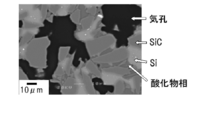
- Example 3 is a SEM photograph of the silicon carbide based porous material of Example 1.
- the first silicon carbide based porous material of the present invention includes silicon carbide particles, metal silicon, and an oxide phase, and the silicon carbide particles are bonded via at least one of the metal silicon and the oxide phase.
- the silicon carbide based porous material has a main component of the oxide phase of cordierite and an open porosity of 10 to 40%.
- the first silicon carbide based porous material of the present invention includes silicon carbide particles, metal silicon, and an oxide phase, and the silicon carbide particles are bonded via at least one of metal silicon and an oxide phase.
- boron, carbon and metal oxides may be contained as sintering aids, and B 4 C, alkaline earth and rare earth metal oxides may be contained.
- the shape of the silicon carbide based porous material include a plate shape, a tube shape, a lotus root shape, and a honeycomb shape.
- the partition wall thickness may be 50 to 500 ⁇ m (preferably 50 to 200 ⁇ m)
- the cell density may be 10 to 200 cells / cm 2 (preferably 50 to 150 cells / cm 2 ).
- the main component of the oxide phase is cordierite Mg 2 Al 4 Si 5 O 18 .
- the main component of the oxide is other than cordierite, it is not preferable because at least one of the thermal shock resistance and the resistance heat generation characteristic is inferior to the case where the main component of the oxide is cordierite.
- the first silicon carbide based porous material of the present invention has an open porosity of 10 to 40%.
- the open porosity is smaller than 10%, it is not preferable because the catalyst is difficult to be supported when used as a catalyst carrier. If the open porosity is larger than 40%, the volume resistivity becomes too large, and there is a possibility that sufficient heat will not be generated even when the voltage is increased when the + and ⁇ poles are attached, and this is not preferable.
- the open porosity is preferably 20 to 40%.
- the open porosity is the total pore volume (unit: cm 3 / g) by mercury intrusion method (JIS R 1655 compliant) and the apparent density (unit: g) by a dry automatic density measuring device by the gas phase substitution method.
- Open porosity can be adjusted by, for example, the amount of pore former used when producing the silicon carbide based porous material, the Si / SiC ratio, the amount of sintering aid, the firing atmosphere, and the like.
- Open porosity [%] total pore volume / ⁇ (1 / apparent density) + total pore volume ⁇ ⁇ 100
- the average pore diameter of the first silicon carbide based porous material of the present invention is not particularly limited, but is preferably 2 to 15 ⁇ m.
- the average pore diameter is smaller than 2 ⁇ m, it is not preferable because the catalyst is difficult to be supported when used as a catalyst carrier. Moreover, since an intensity
- the average pore diameter is a value measured by a mercury intrusion method (based on JIS R 1655).
- the volume resistivity at room temperature of the first silicon carbide based porous material of the present invention is not particularly limited, but is preferably 1 to 80 ⁇ cm, more preferably 10 to 60 ⁇ cm, and more preferably 10 to 40 ⁇ cm. More preferably it is. If the volume resistivity is less than 1 ⁇ cm, an excessive current may flow, which may cause damage to an electric circuit or the like, which is not preferable. Further, if the volume resistivity is larger than 80 ⁇ cm, it is necessary to increase the voltage when the + and ⁇ poles are attached and energized, so that it is necessary to increase the breakdown voltage of the equipment. In this specification, the volume resistivity is a value measured by a four-terminal method.
- the thermal conductivity of the first silicon carbide based porous material of the present invention is not particularly limited, but is preferably 30 to 70 W / m ⁇ K. If the thermal conductivity is less than 30 W / m ⁇ K, even if the positive electrode and the negative electrode are attached and energized to generate heat, the temperature distribution may be uneven, which is not preferable. Although the thermal conductivity is never high, 70 W / m ⁇ K is the upper limit because of the use of silicon carbide material. In this specification, the thermal conductivity was determined as the product of specific heat, thermal diffusivity, and bulk density.
- the strength of the first silicon carbide based porous material of the present invention is not particularly limited, but is preferably 20 to 70 MPa. When the strength is less than 20 MPa, the thermal shock resistance is lowered, which is not preferable. Although the strength has never been high, 70 MPa is the upper limit due to the use of silicon carbide material.
- the silicon carbide based porous material is a honeycomb structure
- the honeycomb structure is processed into a test piece whose longitudinal direction is the cell penetration direction, and a bending test in accordance with JIS R1601. This is a value calculated by the following formula using the aperture ratio of the honeycomb structure separately measured after calculating the bending strength by the following formula.
- Strength Bending strength of honeycomb structure / ⁇ 1- (opening ratio / 100) ⁇
- the first silicon carbide based porous material of the present invention preferably contains 50 to 80% by weight of silicon carbide, 15 to 40% by weight of metallic silicon, and 1 to 25% by weight of cordierite. It is more preferable that it contains ⁇ 71 wt%, metallic silicon 19-36 wt%, and cordierite 3-23 wt%. In this way, the thermal shock resistance and resistance heat generation characteristics are further improved.
- the first silicon carbide based porous material of the present invention preferably has a structure in which silicon carbide particles are bonded by metal silicon. Further, the metal silicon is preferably covered with an oxide phase. This makes it easier to improve the thermal shock resistance and resistance heat generation characteristics. When the metal silicon is covered with an oxide phase, the oxide phase preferably has a thickness of 0.1 to 10 ⁇ m.
- the first silicon carbide based porous material of the present invention can be used for a honeycomb structure.
- the honeycomb structure is used as a catalytic converter by, for example, supporting a noble metal catalyst. That is, one utilization form of the honeycomb structure is a catalyst carrier.
- a catalytic converter an electric heating type catalytic converter is required to have high thermal shock resistance, and therefore, it is particularly preferable to use the first silicon carbide based porous material of the present invention.
- the first method for producing a silicon carbide based porous material of the present invention will be described below by taking a case where the silicon carbide based porous material is a honeycomb structure as an example.
- a silicon carbide powder, a metal silicon powder, and a cordierite powder are mixed, and if necessary, a binder, a surfactant, a pore former, water, and the like are added to produce a forming raw material.
- the mass of the metal silicon powder is preferably about 20 to 40% by mass with respect to the total mass of the silicon carbide powder and the metal silicon powder.
- the average particle diameter of the silicon carbide particles is preferably 5 to 100 ⁇ m, and more preferably 20 to 40 ⁇ m.
- the average particle diameter of the metal-based elementary particles is preferably 0.1 to 20 ⁇ m, and more preferably 1 to 10 ⁇ m.
- the average particle size of the cordierite particles is preferably 0.1 to 50 ⁇ m, and more preferably 1 to 10 ⁇ m. These average particle diameters are values measured by a laser diffraction method.
- the Mg source, the Al source, and the Si source may have a cordierite composition.
- the composition of cordierite is made using talc (3MgO ⁇ 4SiO 2 ⁇ H 2 O), kaolin (2SiO 2 ⁇ Al 2 O 3 ⁇ 2H 2 O), alumina, aluminum hydroxide, silica, etc. It may be made to become.
- it is more preferable to use cordierite powder than to use a raw material that reacts during firing to become cordierite.
- binders examples include methyl cellulose, hydroxypropoxyl cellulose, hydroxyethyl cellulose, carboxymethyl cellulose, and polyvinyl alcohol. Among these, it is preferable to use methyl cellulose and hydroxypropoxyl cellulose in combination.
- the content of the binder is preferably 2 to 10% by mass with respect to the entire forming raw material.
- ethylene glycol, dextrin, fatty acid soap, polyalcohol or the like can be used as the surfactant. These may be used individually by 1 type and may be used in combination of 2 or more type.
- the content of the surfactant is preferably 2% by mass or less with respect to the whole forming raw material.
- the pore former is not particularly limited as long as it becomes pores after firing, and examples thereof include graphite, starch, foamed resin, water absorbent resin, silica gel and the like.
- the pore former content is preferably 10% by mass or less based on the entire forming raw material.
- the average particle size of the pore former is preferably 10 to 30 ⁇ m. If it is smaller than 10 ⁇ m, pores may not be formed sufficiently. If it is larger than 30 ⁇ m, the die may be clogged during molding.
- the average particle diameter of the pore former is a value measured by a laser diffraction method.
- the water content is appropriately adjusted so that the clay hardness is easy to mold, but is preferably 20 to 60% by mass with respect to the entire forming raw material.
- the forming raw material is kneaded to form a clay.
- molding raw material and forming a clay For example, the method of using a kneader, a vacuum clay kneader, etc. can be mentioned.
- the clay is extruded to form a honeycomb formed body.
- a die having a desired overall shape, cell shape, partition wall thickness, cell density and the like.
- the honeycomb formed body has a structure having porous partition walls that define and form a plurality of cells serving as fluid flow paths and an outer peripheral wall located at the outermost periphery.
- the partition wall thickness, cell density, outer peripheral wall thickness, and the like of the honeycomb formed body can be appropriately determined according to the structure of the honeycomb structure to be manufactured in consideration of shrinkage during drying and firing.
- the honeycomb formed body thus obtained is preferably dried before firing.
- the drying method is not particularly limited, and examples thereof include an electromagnetic heating method such as microwave heating drying and high-frequency dielectric heating drying, and an external heating method such as hot air drying and superheated steam drying.
- an electromagnetic heating method such as microwave heating drying and high-frequency dielectric heating drying
- an external heating method such as hot air drying and superheated steam drying.
- the entire molded body can be dried quickly and uniformly without cracks, and after drying a certain amount of moisture with an electromagnetic heating method, the remaining moisture is dried with an external heating method. It is preferable to make it.
- As drying conditions it is preferable to remove water of 30 to 99% by mass with respect to the amount of moisture before drying by an electromagnetic heating method, and then to make the moisture to 3% by mass or less by an external heating method.
- the electromagnetic heating method dielectric heating drying is preferable, and as the external heating method, hot air drying is preferable.
- the length in the central axis direction of the honeycomb formed body is not a desired length, it is preferable to cut both end surfaces (both end portions) to a desired length.
- the cutting method is not particularly limited, and examples thereof include a method using a circular saw cutting machine.
- the honeycomb formed body is fired to produce a honeycomb structure.
- calcination is preferably performed in an air atmosphere at 200 to 600 ° C. for 0.5 to 20 hours. Firing is preferably performed under an inert atmosphere such as nitrogen or argon (oxygen partial pressure is 10 ⁇ 4 atm or less), 1300 to 1600 ° C., and normal pressure for 1 to 20 hours.
- oxygen partial pressure is 10 ⁇ 4 atm or less
- oxidation treatment at 1100 to 1400 ° C. for 1 to 20 hours in the atmosphere (which may contain water vapor) in order to improve durability.
- calcination and baking can be performed using an electric furnace, a gas furnace, etc., for example.
- the first silicon carbide based porous material of the present invention can be used for a honeycomb structure.
- the honeycomb structure is used as, for example, a DPF or a catalytic converter by supporting a noble metal catalyst. That is, one utilization form of the honeycomb structure is a catalyst carrier.
- the electric heating type catalytic converter is required to have high thermal shock resistance, and therefore it is particularly preferable to use the first silicon carbide based porous material of the present invention.
- SiC Silicon carbide
- metal silicon (Si) powder metal silicon (Si) powder
- cordierite particles were mixed at a mass ratio of 64: 28: 8.
- hydroxypropylmethylcellulose as a binder and a water-absorbing resin as a pore former were added, and water was added to form a molding raw material.
- This forming raw material was kneaded and kneaded to prepare a columnar clay.
- the binder content is 7% by mass with respect to the total of the SiC powder and the Si powder
- the pore former content is 2% by mass with respect to the total of the SiC powder and the Si powder
- the water content is It was 35 mass% with respect to the sum total of Si powder.
- the average particle diameter of the SiC powder was 30 ⁇ m, and the average particle diameter of the Si powder was 6 ⁇ m. Moreover, the average particle diameter of the pore former was 20 ⁇ m. In addition, the average particle diameter of a SiC particle, Si particle
- the obtained columnar kneaded material was formed into a honeycomb shape using an extrusion molding machine to obtain a honeycomb formed body.
- the obtained honeycomb formed body was dielectrically heated and dried, and then dried at 120 ° C. for 2 hours using a hot air dryer to obtain a honeycomb dried body.
- the obtained dried honeycomb body was degreased at 450 ° C. for 3 hours in an air atmosphere, and then fired at about 1450 ° C. for 2 hours in an Ar inert atmosphere (oxygen partial pressure of 10 ⁇ 4 atm or less).
- An oxidation treatment was performed at 1200 ° C. for 4 hours to obtain a silicon carbide porous body having a honeycomb structure.
- the honeycomb structure at this time had a partition wall thickness of 90 ⁇ m and a cell density of 90 cells / cm 2 .
- the bottom surface of the honeycomb structure was a circle having a diameter of 93 mm, and the length of the honeycomb structure in the cell extending direction was 100 mm.
- An SEM photograph of the cross section of this honeycomb structure is shown in FIG.
- the resulting silicon carbide porous body having a honeycomb structure had an open porosity of 34%, a strength of 42 MPa, an average pore diameter of 11 ⁇ m, a thermal conductivity of 43 W / mK, and an average linear thermal expansion coefficient of 4.3 ⁇ 10 ⁇ 6.
- K ⁇ 1 and volume resistivity were 36 ⁇ cm.
- the evaluation was “ ⁇ ”, and the temperature distribution was less uneven.
- the evaluation was “ ⁇ ”, indicating a high thermal shock resistance.
- each parameter is the value calculated
- -Composition The composition of the silicon carbide porous body having a honeycomb structure was measured by an internal standard method of powder X-ray diffraction. The deviation between the composition ratio of the raw material and the composition ratio of the silicon carbide based porous material was about 1%.
- -Open porosity From the total pore volume [cm 3 / g] by the mercury intrusion method (JIS R 1655 compliant) and the apparent density [g / cm 3 ] by the dry automatic density measuring machine by the gas phase substitution method, Calculated.
- Open porosity [%] total pore volume / ⁇ (1 / apparent density) + total pore volume ⁇ ⁇ 100 -Average pore diameter It measured by the mercury intrusion method (JISR1655 conformity).
- ⁇ Strength The honeycomb structure is processed into a test piece (longitudinal 5 cells ⁇ width 10 cells ⁇ length 40 mm) with the cell penetration direction as the longitudinal direction, and the bending strength of the honeycomb structure is determined by a bending test according to JIS R1601. After the calculation, the aperture ratio of the honeycomb measured separately was used to calculate the following formula.
- Example 2 ⁇ Electric heat generation test Using a raw material having the same composition as in Example 1, a plate-shaped molded body was separately prepared, and the molded body was subjected to the above-described drying, degreasing, firing, and oxidation treatment to obtain a plate-shaped fired body. A test piece having a length of 30 mm, a width of 40 mm, and a thickness of 0.3 mm was cut out from the fired body. Using the apex of one long side of the test piece as an electrode, the test piece was energized while gradually increasing the voltage from 1 V to 500 V, and the time change of the temperature distribution of the test piece was measured by thermography.
- ⁇ T the difference between the central point of the test piece and the temperature at the midpoint between the electrodes (200 ° C) when the temperature at the midpoint between the electrodes reached 200 ° C.
- ⁇ T was less than 80 ° C.
- ⁇ when it was 80 ° C. to less than 120 ° C.
- ⁇ when it was 120 ° C. or more, “ ⁇ ”. That is, “ ⁇ ”, “ ⁇ ”, “ ⁇ ” are indices representing the uniformity of the temperature distribution of the test piece, “ ⁇ ” and “ ⁇ ” indicate that the temperature distribution is relatively uniform, “ ⁇ ” indicates that the temperature distribution is uneven.
- X indicates that the resistance is too high and no current flows.
- Examples 2 to 17 and Comparative Examples 1 to 5 have the same composition as shown in Table 1, except that the amount of pore former and the average particle size of the raw material are finely adjusted. A porous body was produced. From the measurement results of the composition of the silicon carbide based porous material, the oxide phases of Examples 1 to 17 were cordierite. There were, however, very few different phases (mullite, cristobalite, spinel, sapphirine, etc.). The main component of the oxide phase containing no cordierite of Comparative Examples 1 to 3 was SrO—SiO 2 .
- Example 1 to 17 the two conditions that the oxide phase was a cordierite phase and the open porosity was 10 to 40% were satisfied, whereas in Comparative Examples 2 to 5, Both of the conditions are not satisfied, and Comparative Example 1 only satisfies the condition that the open porosity is 10 to 40%. For this reason, it is considered that good results were obtained in Examples 1 to 17, whereas good results were not obtained in Comparative Examples 1 to 5.
- the thermal conductivity was in the range of 30 to 70 W / mK and the volume resistivity was in the range of 1 to 50 ⁇ cm.
- Comparative Examples 1 to 5 were at least one of thermal conductivity and volume resistivity. Was out of this range. This is also considered to be a reason that good results were obtained in Examples 1 to 17, whereas good results were not obtained in Comparative Examples 1 to 5.
- Comparative Example 4 When Comparative Example 1 having a cordierite phase and Comparative Example 4 having an oxide phase mainly composed of SrO—SiO 2 are compared, Comparative Example 4 has a higher open porosity than Comparative Example 1. Nevertheless, the thermal conductivity is high. From this, it can be said that cordierite has the effect of increasing the thermal conductivity compared to SrO—SiO 2 .
- the first silicon carbide based porous material of the present invention can be used for a honeycomb structure.
- the honeycomb structure is used as a catalytic converter by, for example, supporting a noble metal catalyst. That is, one utilization form of the honeycomb structure is a catalyst carrier.
- the catalyst carrier for the catalytic converter of the electric heating type among the catalytic converters is required to have high thermal shock resistance, it is particularly preferable to use the first silicon carbide based porous material of the present invention.
Landscapes
- Chemical & Material Sciences (AREA)
- Engineering & Computer Science (AREA)
- Ceramic Engineering (AREA)
- Organic Chemistry (AREA)
- Materials Engineering (AREA)
- Structural Engineering (AREA)
- Manufacturing & Machinery (AREA)
- Inorganic Chemistry (AREA)
- Chemical Kinetics & Catalysis (AREA)
- Crystallography & Structural Chemistry (AREA)
- Catalysts (AREA)
- Ceramic Products (AREA)
- Porous Artificial Stone Or Porous Ceramic Products (AREA)
Abstract
Cet objet poreux à base de carbure de silicium comprend des particules de carbure de silicium, du métal silicium et une phase d'oxyde, les particules de carbure de silicium ayant été liées les unes aux autres par l'intermédiaire du métal silicium et/ou de la phase d'oxyde. La phase d'oxyde comprend de la cordiérite comme composant principal, et l'objet poreux a une porosité concernant les vides ouverts de 10-40 %. L'objet poreux comprend, de préférence, 50-80 % en poids de carbure de silicium, 15-40 % en poids de métal silicium et 1-25 % de cordiérite. De plus, l'objet poreux a, de préférence, une résistivité volumique de 1-80 Ωcm et une conductivité thermique de 30-70 W/m·K.
Priority Applications (4)
| Application Number | Priority Date | Filing Date | Title |
|---|---|---|---|
| CN201280012338.8A CN103415490B (zh) | 2011-03-18 | 2012-03-14 | 碳化硅质多孔体、蜂窝结构体及电加热式催化剂载体 |
| EP12761331.3A EP2687502B1 (fr) | 2011-03-18 | 2012-03-14 | Objet poreux à base de carbure de silicium, structure en nid d'abeilles et support de catalyseur de type à chauffage électrique |
| JP2013505920A JP5916146B2 (ja) | 2011-03-18 | 2012-03-14 | 炭化珪素質多孔体、ハニカム構造体及び電気加熱式触媒担体 |
| US14/022,588 US9440225B2 (en) | 2011-03-18 | 2013-09-10 | Silicon carbide porous body, honeycomb structure, and electric heating type catalyst carrier |
Applications Claiming Priority (2)
| Application Number | Priority Date | Filing Date | Title |
|---|---|---|---|
| JP2011060515 | 2011-03-18 | ||
| JP2011-060515 | 2011-03-18 |
Related Child Applications (1)
| Application Number | Title | Priority Date | Filing Date |
|---|---|---|---|
| US14/022,588 Continuation US9440225B2 (en) | 2011-03-18 | 2013-09-10 | Silicon carbide porous body, honeycomb structure, and electric heating type catalyst carrier |
Publications (1)
| Publication Number | Publication Date |
|---|---|
| WO2012128149A1 true WO2012128149A1 (fr) | 2012-09-27 |
Family
ID=46879301
Family Applications (1)
| Application Number | Title | Priority Date | Filing Date |
|---|---|---|---|
| PCT/JP2012/056563 Ceased WO2012128149A1 (fr) | 2011-03-18 | 2012-03-14 | Objet poreux à base de carbure de silicium, structure en nid d'abeilles et support de catalyseur de type à chauffage électrique |
Country Status (5)
| Country | Link |
|---|---|
| US (1) | US9440225B2 (fr) |
| EP (1) | EP2687502B1 (fr) |
| JP (1) | JP5916146B2 (fr) |
| CN (1) | CN103415490B (fr) |
| WO (1) | WO2012128149A1 (fr) |
Cited By (12)
| Publication number | Priority date | Publication date | Assignee | Title |
|---|---|---|---|---|
| EP2727895A1 (fr) * | 2012-10-30 | 2014-05-07 | NGK Insulators, Ltd. | Filtre en SiC en nids d'abeilles avec liant contenant cordierite |
| JP2014117663A (ja) * | 2012-12-18 | 2014-06-30 | Ngk Insulators Ltd | 微粒子捕集フィルタ |
| EP1711122B1 (fr) * | 2004-01-27 | 2014-11-05 | Ivoclar Vivadent AG | MATERIAU COMPOSITE ANORGANIQUE-ANORGANIQUE, PROCEDE DE FABRICATION et son utilisation |
| JP2015178445A (ja) * | 2014-03-18 | 2015-10-08 | 日本碍子株式会社 | ハニカム構造体 |
| JP2016193401A (ja) * | 2015-03-31 | 2016-11-17 | 日本碍子株式会社 | ハニカム構造体、及びその製造方法 |
| JP2017154913A (ja) * | 2016-02-29 | 2017-09-07 | 日本碍子株式会社 | ハニカム構造体の製造方法 |
| JP2019178053A (ja) * | 2018-03-30 | 2019-10-17 | 日本碍子株式会社 | 炭化珪素質多孔体及びその製造方法 |
| JP2021130101A (ja) * | 2020-02-21 | 2021-09-09 | エヌ・イーケムキャット株式会社 | Scr用電気加熱式触媒装置およびこれを用いた排ガス浄化方法 |
| WO2022202903A1 (fr) * | 2021-03-26 | 2022-09-29 | 日立金属株式会社 | Structure céramique en nid d'abeilles à base de carbure de silicium et son procédé de production |
| DE102023200885A1 (de) | 2022-03-15 | 2023-09-21 | Ngk Insulators, Ltd. | Gesinterter verbundkörper, wabenstruktur, elektrisch beheizter katalysator, und verfahren zum herstellen eines gesinterten verbundkörpers |
| JP2024529946A (ja) * | 2021-07-28 | 2024-08-14 | コーニング インコーポレイテッド | 複合構造体、ヒータ装置、高速ライトオフ排ガス後処理システムおよび複合構造体を製造および使用する方法 |
| WO2025110145A1 (fr) * | 2023-11-22 | 2025-05-30 | 株式会社プロテリアル | Structure céramique en nid d'abeille à base de carbure de silicium |
Families Citing this family (14)
| Publication number | Priority date | Publication date | Assignee | Title |
|---|---|---|---|---|
| WO2013147321A1 (fr) | 2012-03-28 | 2013-10-03 | 日本碍子株式会社 | Matière poreuse de carbure de silicium, structure en nid d'abeilles et support de catalyseur de type à chauffage électrique |
| JP5922629B2 (ja) * | 2013-09-27 | 2016-05-24 | 日本碍子株式会社 | 多孔質材料及びその製造方法、並びにハニカム構造体 |
| US20160207840A1 (en) * | 2015-01-21 | 2016-07-21 | The Boeing Company | Extrudable ceramic composition and method of making |
| JP6373782B2 (ja) * | 2015-03-20 | 2018-08-15 | 日本碍子株式会社 | ハニカム構造体 |
| US11365665B2 (en) * | 2016-10-24 | 2022-06-21 | Ngk Insulators, Ltd. | Porous material, honeycomb structure, and method of producing porous material |
| JP6740995B2 (ja) * | 2017-06-30 | 2020-08-19 | 株式会社デンソー | 電気抵抗体、ハニカム構造体、および、電気加熱式触媒装置 |
| US10974226B2 (en) * | 2018-09-24 | 2021-04-13 | Sabic Global Technologies B.V. | Catalytic process for oxidative coupling of methane |
| CN109336610B (zh) * | 2018-11-16 | 2020-08-25 | 南京工业大学 | 碳化硅多孔陶瓷及其低温烧成方法 |
| JP2020161413A (ja) * | 2019-03-27 | 2020-10-01 | 株式会社デンソー | 電気抵抗体、ハニカム構造体、および、電気加熱式触媒装置 |
| CN115106129A (zh) * | 2021-03-19 | 2022-09-27 | 日本碍子株式会社 | 蜂窝结构体及采用了该蜂窝结构体的电加热型载体 |
| JP2022149956A (ja) * | 2021-03-25 | 2022-10-07 | 日本碍子株式会社 | 炭化珪素質多孔体、ハニカム構造体、電気加熱触媒および炭化珪素質多孔体の製造方法 |
| JP2022149955A (ja) * | 2021-03-25 | 2022-10-07 | 日本碍子株式会社 | 複合焼結体、ハニカム構造体、電気加熱触媒および複合焼結体の製造方法 |
| JP2023128877A (ja) * | 2022-03-04 | 2023-09-14 | 日本碍子株式会社 | 複合焼結体、ハニカム構造体、電気加熱触媒および複合焼結体の製造方法 |
| WO2024047097A1 (fr) * | 2022-08-31 | 2024-03-07 | Umicore | Structure stratifiée semi-conductrice composite et procédés de préparation d'une structure stratifiée semi-conductrice composite |
Citations (3)
| Publication number | Priority date | Publication date | Assignee | Title |
|---|---|---|---|---|
| WO2005009922A1 (fr) * | 2003-07-25 | 2005-02-03 | Ngk Insulators, Ltd. | Corps poreux en ceramique et methode d'evaluation de sa permeabilite |
| JP4307781B2 (ja) | 2001-03-30 | 2009-08-05 | 日本碍子株式会社 | 炭化珪素質多孔体及びその製造方法 |
| JP4398260B2 (ja) | 2002-03-29 | 2010-01-13 | 日本碍子株式会社 | 炭化珪素質多孔体及びその製造方法 |
Family Cites Families (6)
| Publication number | Priority date | Publication date | Assignee | Title |
|---|---|---|---|---|
| JP4511065B2 (ja) * | 2000-06-05 | 2010-07-28 | 日本碍子株式会社 | ハニカム構造体とハニカムフィルター、及びそれらの製造方法 |
| US6736875B2 (en) * | 2001-12-13 | 2004-05-18 | Corning Incorporated | Composite cordierite filters |
| CN1800097A (zh) * | 2006-01-18 | 2006-07-12 | 中国科学院上海硅酸盐研究所 | 一种碳化硅─堇青石复合多孔陶瓷及其制备方法 |
| JP5478259B2 (ja) * | 2007-11-30 | 2014-04-23 | 日本碍子株式会社 | 炭化珪素質多孔体 |
| EP2484446A4 (fr) * | 2009-09-28 | 2014-06-11 | Ngk Insulators Ltd | Structure en nid d'abeilles |
| WO2011125225A1 (fr) * | 2010-04-09 | 2011-10-13 | イビデン株式会社 | Structure en nid d'abeille et dispositif de purification de gaz d'échappement |
-
2012
- 2012-03-14 WO PCT/JP2012/056563 patent/WO2012128149A1/fr not_active Ceased
- 2012-03-14 CN CN201280012338.8A patent/CN103415490B/zh not_active Expired - Fee Related
- 2012-03-14 JP JP2013505920A patent/JP5916146B2/ja not_active Expired - Fee Related
- 2012-03-14 EP EP12761331.3A patent/EP2687502B1/fr active Active
-
2013
- 2013-09-10 US US14/022,588 patent/US9440225B2/en active Active
Patent Citations (3)
| Publication number | Priority date | Publication date | Assignee | Title |
|---|---|---|---|---|
| JP4307781B2 (ja) | 2001-03-30 | 2009-08-05 | 日本碍子株式会社 | 炭化珪素質多孔体及びその製造方法 |
| JP4398260B2 (ja) | 2002-03-29 | 2010-01-13 | 日本碍子株式会社 | 炭化珪素質多孔体及びその製造方法 |
| WO2005009922A1 (fr) * | 2003-07-25 | 2005-02-03 | Ngk Insulators, Ltd. | Corps poreux en ceramique et methode d'evaluation de sa permeabilite |
Non-Patent Citations (1)
| Title |
|---|
| See also references of EP2687502A4 |
Cited By (16)
| Publication number | Priority date | Publication date | Assignee | Title |
|---|---|---|---|---|
| EP1711122B1 (fr) * | 2004-01-27 | 2014-11-05 | Ivoclar Vivadent AG | MATERIAU COMPOSITE ANORGANIQUE-ANORGANIQUE, PROCEDE DE FABRICATION et son utilisation |
| EP2727895A1 (fr) * | 2012-10-30 | 2014-05-07 | NGK Insulators, Ltd. | Filtre en SiC en nids d'abeilles avec liant contenant cordierite |
| US9217344B2 (en) | 2012-10-30 | 2015-12-22 | Ngk Insulators, Ltd. | Honeycomb filter |
| JP2014117663A (ja) * | 2012-12-18 | 2014-06-30 | Ngk Insulators Ltd | 微粒子捕集フィルタ |
| JP2015178445A (ja) * | 2014-03-18 | 2015-10-08 | 日本碍子株式会社 | ハニカム構造体 |
| JP2016193401A (ja) * | 2015-03-31 | 2016-11-17 | 日本碍子株式会社 | ハニカム構造体、及びその製造方法 |
| JP2017154913A (ja) * | 2016-02-29 | 2017-09-07 | 日本碍子株式会社 | ハニカム構造体の製造方法 |
| JP2019178053A (ja) * | 2018-03-30 | 2019-10-17 | 日本碍子株式会社 | 炭化珪素質多孔体及びその製造方法 |
| JP2021130101A (ja) * | 2020-02-21 | 2021-09-09 | エヌ・イーケムキャット株式会社 | Scr用電気加熱式触媒装置およびこれを用いた排ガス浄化方法 |
| JP7463126B2 (ja) | 2020-02-21 | 2024-04-08 | エヌ・イーケムキャット株式会社 | Scr用電気加熱式触媒装置およびこれを用いた排ガス浄化方法 |
| WO2022202903A1 (fr) * | 2021-03-26 | 2022-09-29 | 日立金属株式会社 | Structure céramique en nid d'abeilles à base de carbure de silicium et son procédé de production |
| JP7205671B1 (ja) * | 2021-03-26 | 2023-01-17 | 日立金属株式会社 | 炭化珪素質セラミックハニカム構造体及びその製造方法 |
| US11858857B2 (en) | 2021-03-26 | 2024-01-02 | Proterial, Ltd. | Silicon carbide ceramic honeycomb structure and its production method |
| JP2024529946A (ja) * | 2021-07-28 | 2024-08-14 | コーニング インコーポレイテッド | 複合構造体、ヒータ装置、高速ライトオフ排ガス後処理システムおよび複合構造体を製造および使用する方法 |
| DE102023200885A1 (de) | 2022-03-15 | 2023-09-21 | Ngk Insulators, Ltd. | Gesinterter verbundkörper, wabenstruktur, elektrisch beheizter katalysator, und verfahren zum herstellen eines gesinterten verbundkörpers |
| WO2025110145A1 (fr) * | 2023-11-22 | 2025-05-30 | 株式会社プロテリアル | Structure céramique en nid d'abeille à base de carbure de silicium |
Also Published As
| Publication number | Publication date |
|---|---|
| US9440225B2 (en) | 2016-09-13 |
| JP5916146B2 (ja) | 2016-05-11 |
| EP2687502A4 (fr) | 2015-11-04 |
| US20140011667A1 (en) | 2014-01-09 |
| EP2687502A1 (fr) | 2014-01-22 |
| CN103415490B (zh) | 2015-12-09 |
| JPWO2012128149A1 (ja) | 2014-07-24 |
| CN103415490A (zh) | 2013-11-27 |
| EP2687502B1 (fr) | 2019-06-12 |
Similar Documents
| Publication | Publication Date | Title |
|---|---|---|
| JP5916146B2 (ja) | 炭化珪素質多孔体、ハニカム構造体及び電気加熱式触媒担体 | |
| JP6043340B2 (ja) | 多孔質材料、ハニカム構造体及び多孔質材料の製造方法 | |
| JP6025822B2 (ja) | 炭化珪素質多孔体、ハニカム構造体及び電気加熱式触媒担体 | |
| JP5872572B2 (ja) | ハニカム構造体 | |
| JP6006782B2 (ja) | 多孔質材料及びハニカム構造体 | |
| CN102574121B (zh) | 蜂窝状结构体 | |
| JP5922629B2 (ja) | 多孔質材料及びその製造方法、並びにハニカム構造体 | |
| JP6211785B2 (ja) | ハニカム構造体、及びその製造方法 | |
| JP6125869B2 (ja) | 多孔質材料、ハニカム構造体及び多孔質材料の製造方法 | |
| JP5926593B2 (ja) | 多孔質材料及びその製造方法、並びにハニカム構造体 | |
| CN103140455B (zh) | 碳化硅质陶瓷以及蜂窝构造体 | |
| JP2014198650A (ja) | ハニカム構造体、及びその製造方法 | |
| JP6324563B2 (ja) | 多孔質材料の製造方法 | |
| JP5883796B2 (ja) | 炭化珪素質セラミックスの製造方法及びハニカム構造体の製造方法 | |
| JP6257967B2 (ja) | 多孔質材料、ハニカム構造体及びハニカムフィルタ | |
| JPWO2005095302A1 (ja) | セラミックス坏土、セラミックス成形体、セラミックス構造体及びこれらの製造方法 | |
| CN116693316A (zh) | 复合烧结体、蜂窝结构体、电加热催化器及复合烧结体的制造方法 |
Legal Events
| Date | Code | Title | Description |
|---|---|---|---|
| 121 | Ep: the epo has been informed by wipo that ep was designated in this application |
Ref document number: 12761331 Country of ref document: EP Kind code of ref document: A1 |
|
| ENP | Entry into the national phase |
Ref document number: 2013505920 Country of ref document: JP Kind code of ref document: A |
|
| NENP | Non-entry into the national phase |
Ref country code: DE |