WO2012131914A1 - Structure en nid d'abeille et appareil de purification des gaz d'échappement - Google Patents
Structure en nid d'abeille et appareil de purification des gaz d'échappement Download PDFInfo
- Publication number
- WO2012131914A1 WO2012131914A1 PCT/JP2011/057855 JP2011057855W WO2012131914A1 WO 2012131914 A1 WO2012131914 A1 WO 2012131914A1 JP 2011057855 W JP2011057855 W JP 2011057855W WO 2012131914 A1 WO2012131914 A1 WO 2012131914A1
- Authority
- WO
- WIPO (PCT)
- Prior art keywords
- zeolite
- honeycomb structure
- honeycomb
- phosphate
- honeycomb unit
- Prior art date
- Legal status (The legal status is an assumption and is not a legal conclusion. Google has not performed a legal analysis and makes no representation as to the accuracy of the status listed.)
- Ceased
Links
Images

Classifications
-
- B—PERFORMING OPERATIONS; TRANSPORTING
- B01—PHYSICAL OR CHEMICAL PROCESSES OR APPARATUS IN GENERAL
- B01D—SEPARATION
- B01D53/00—Separation of gases or vapours; Recovering vapours of volatile solvents from gases; Chemical or biological purification of waste gases, e.g. engine exhaust gases, smoke, fumes, flue gases, aerosols
- B01D53/34—Chemical or biological purification of waste gases
- B01D53/92—Chemical or biological purification of waste gases of engine exhaust gases
- B01D53/94—Chemical or biological purification of waste gases of engine exhaust gases by catalytic processes
- B01D53/9404—Removing only nitrogen compounds
- B01D53/9409—Nitrogen oxides
- B01D53/9413—Processes characterised by a specific catalyst
- B01D53/9418—Processes characterised by a specific catalyst for removing nitrogen oxides by selective catalytic reduction [SCR] using a reducing agent in a lean exhaust gas
-
- B—PERFORMING OPERATIONS; TRANSPORTING
- B01—PHYSICAL OR CHEMICAL PROCESSES OR APPARATUS IN GENERAL
- B01D—SEPARATION
- B01D53/00—Separation of gases or vapours; Recovering vapours of volatile solvents from gases; Chemical or biological purification of waste gases, e.g. engine exhaust gases, smoke, fumes, flue gases, aerosols
- B01D53/34—Chemical or biological purification of waste gases
- B01D53/74—General processes for purification of waste gases; Apparatus or devices specially adapted therefor
- B01D53/86—Catalytic processes
- B01D53/8621—Removing nitrogen compounds
- B01D53/8625—Nitrogen oxides
- B01D53/8628—Processes characterised by a specific catalyst
-
- C—CHEMISTRY; METALLURGY
- C04—CEMENTS; CONCRETE; ARTIFICIAL STONE; CERAMICS; REFRACTORIES
- C04B—LIME, MAGNESIA; SLAG; CEMENTS; COMPOSITIONS THEREOF, e.g. MORTARS, CONCRETE OR LIKE BUILDING MATERIALS; ARTIFICIAL STONE; CERAMICS; REFRACTORIES; TREATMENT OF NATURAL STONE
- C04B28/00—Compositions of mortars, concrete or artificial stone, containing inorganic binders or the reaction product of an inorganic and an organic binder, e.g. polycarboxylate cements
- C04B28/24—Compositions of mortars, concrete or artificial stone, containing inorganic binders or the reaction product of an inorganic and an organic binder, e.g. polycarboxylate cements containing alkyl, ammonium or metal silicates; containing silica sols
- C04B28/26—Silicates of the alkali metals
-
- C—CHEMISTRY; METALLURGY
- C04—CEMENTS; CONCRETE; ARTIFICIAL STONE; CERAMICS; REFRACTORIES
- C04B—LIME, MAGNESIA; SLAG; CEMENTS; COMPOSITIONS THEREOF, e.g. MORTARS, CONCRETE OR LIKE BUILDING MATERIALS; ARTIFICIAL STONE; CERAMICS; REFRACTORIES; TREATMENT OF NATURAL STONE
- C04B35/00—Shaped ceramic products characterised by their composition; Ceramics compositions; Processing powders of inorganic compounds preparatory to the manufacturing of ceramic products
- C04B35/01—Shaped ceramic products characterised by their composition; Ceramics compositions; Processing powders of inorganic compounds preparatory to the manufacturing of ceramic products based on oxide ceramics
- C04B35/16—Shaped ceramic products characterised by their composition; Ceramics compositions; Processing powders of inorganic compounds preparatory to the manufacturing of ceramic products based on oxide ceramics based on silicates other than clay
- C04B35/18—Shaped ceramic products characterised by their composition; Ceramics compositions; Processing powders of inorganic compounds preparatory to the manufacturing of ceramic products based on oxide ceramics based on silicates other than clay rich in aluminium oxide
-
- C—CHEMISTRY; METALLURGY
- C04—CEMENTS; CONCRETE; ARTIFICIAL STONE; CERAMICS; REFRACTORIES
- C04B—LIME, MAGNESIA; SLAG; CEMENTS; COMPOSITIONS THEREOF, e.g. MORTARS, CONCRETE OR LIKE BUILDING MATERIALS; ARTIFICIAL STONE; CERAMICS; REFRACTORIES; TREATMENT OF NATURAL STONE
- C04B38/00—Porous mortars, concrete, artificial stone or ceramic ware; Preparation thereof
- C04B38/0006—Honeycomb structures
-
- B—PERFORMING OPERATIONS; TRANSPORTING
- B01—PHYSICAL OR CHEMICAL PROCESSES OR APPARATUS IN GENERAL
- B01D—SEPARATION
- B01D2251/00—Reactants
- B01D2251/20—Reductants
- B01D2251/206—Ammonium compounds
- B01D2251/2067—Urea
-
- B—PERFORMING OPERATIONS; TRANSPORTING
- B01—PHYSICAL OR CHEMICAL PROCESSES OR APPARATUS IN GENERAL
- B01D—SEPARATION
- B01D2255/00—Catalysts
- B01D2255/20—Metals or compounds thereof
- B01D2255/207—Transition metals
- B01D2255/20738—Iron
-
- B—PERFORMING OPERATIONS; TRANSPORTING
- B01—PHYSICAL OR CHEMICAL PROCESSES OR APPARATUS IN GENERAL
- B01D—SEPARATION
- B01D2255/00—Catalysts
- B01D2255/20—Metals or compounds thereof
- B01D2255/207—Transition metals
- B01D2255/20761—Copper
-
- B—PERFORMING OPERATIONS; TRANSPORTING
- B01—PHYSICAL OR CHEMICAL PROCESSES OR APPARATUS IN GENERAL
- B01D—SEPARATION
- B01D2255/00—Catalysts
- B01D2255/50—Zeolites
-
- B—PERFORMING OPERATIONS; TRANSPORTING
- B01—PHYSICAL OR CHEMICAL PROCESSES OR APPARATUS IN GENERAL
- B01D—SEPARATION
- B01D2255/00—Catalysts
- B01D2255/50—Zeolites
- B01D2255/502—Beta zeolites
-
- C—CHEMISTRY; METALLURGY
- C04—CEMENTS; CONCRETE; ARTIFICIAL STONE; CERAMICS; REFRACTORIES
- C04B—LIME, MAGNESIA; SLAG; CEMENTS; COMPOSITIONS THEREOF, e.g. MORTARS, CONCRETE OR LIKE BUILDING MATERIALS; ARTIFICIAL STONE; CERAMICS; REFRACTORIES; TREATMENT OF NATURAL STONE
- C04B2235/00—Aspects relating to ceramic starting mixtures or sintered ceramic products
- C04B2235/02—Composition of constituents of the starting material or of secondary phases of the final product
- C04B2235/30—Constituents and secondary phases not being of a fibrous nature
- C04B2235/32—Metal oxides, mixed metal oxides, or oxide-forming salts thereof, e.g. carbonates, nitrates, (oxy)hydroxides, chlorides
- C04B2235/3217—Aluminum oxide or oxide forming salts thereof, e.g. bauxite, alpha-alumina
- C04B2235/3218—Aluminium (oxy)hydroxides, e.g. boehmite, gibbsite, alumina sol
-
- C—CHEMISTRY; METALLURGY
- C04—CEMENTS; CONCRETE; ARTIFICIAL STONE; CERAMICS; REFRACTORIES
- C04B—LIME, MAGNESIA; SLAG; CEMENTS; COMPOSITIONS THEREOF, e.g. MORTARS, CONCRETE OR LIKE BUILDING MATERIALS; ARTIFICIAL STONE; CERAMICS; REFRACTORIES; TREATMENT OF NATURAL STONE
- C04B2235/00—Aspects relating to ceramic starting mixtures or sintered ceramic products
- C04B2235/02—Composition of constituents of the starting material or of secondary phases of the final product
- C04B2235/30—Constituents and secondary phases not being of a fibrous nature
- C04B2235/34—Non-metal oxides, non-metal mixed oxides, or salts thereof that form the non-metal oxides upon heating, e.g. carbonates, nitrates, (oxy)hydroxides, chlorides
- C04B2235/3427—Silicates other than clay, e.g. water glass
- C04B2235/3463—Alumino-silicates other than clay, e.g. mullite
-
- C—CHEMISTRY; METALLURGY
- C04—CEMENTS; CONCRETE; ARTIFICIAL STONE; CERAMICS; REFRACTORIES
- C04B—LIME, MAGNESIA; SLAG; CEMENTS; COMPOSITIONS THEREOF, e.g. MORTARS, CONCRETE OR LIKE BUILDING MATERIALS; ARTIFICIAL STONE; CERAMICS; REFRACTORIES; TREATMENT OF NATURAL STONE
- C04B2235/00—Aspects relating to ceramic starting mixtures or sintered ceramic products
- C04B2235/02—Composition of constituents of the starting material or of secondary phases of the final product
- C04B2235/30—Constituents and secondary phases not being of a fibrous nature
- C04B2235/44—Metal salt constituents or additives chosen for the nature of the anions, e.g. hydrides or acetylacetonate
- C04B2235/447—Phosphates or phosphites, e.g. orthophosphate or hypophosphite
-
- C—CHEMISTRY; METALLURGY
- C04—CEMENTS; CONCRETE; ARTIFICIAL STONE; CERAMICS; REFRACTORIES
- C04B—LIME, MAGNESIA; SLAG; CEMENTS; COMPOSITIONS THEREOF, e.g. MORTARS, CONCRETE OR LIKE BUILDING MATERIALS; ARTIFICIAL STONE; CERAMICS; REFRACTORIES; TREATMENT OF NATURAL STONE
- C04B2235/00—Aspects relating to ceramic starting mixtures or sintered ceramic products
- C04B2235/02—Composition of constituents of the starting material or of secondary phases of the final product
- C04B2235/50—Constituents or additives of the starting mixture chosen for their shape or used because of their shape or their physical appearance
- C04B2235/52—Constituents or additives characterised by their shapes
- C04B2235/5208—Fibers
- C04B2235/5216—Inorganic
- C04B2235/522—Oxidic
- C04B2235/5224—Alumina or aluminates
Definitions
- the present invention relates to a honeycomb structure and an exhaust gas purification device.
- an SCR Selective Catalytic Reduction system that uses ammonia to reduce NOx to nitrogen and water has been known as one of systems for purifying automobile exhaust gas.
- zeolite is known as a material that adsorbs ammonia in the SCR system.
- Patent Document 1 discloses a honeycomb structure having a honeycomb unit including zeolite, inorganic fibers and / or whiskers, and an inorganic binder.
- SAPO has a characteristic that the lattice constant changes and contracts or expands when water adsorbed or desorbed. For this reason, when water is adsorbed on the honeycomb unit containing SAPO or water adsorbed on the honeycomb unit is desorbed, the honeycomb unit tends to contract or expand and easily break.
- the present invention has excellent NOx purification performance, and even if water is adsorbed to the honeycomb unit or water adsorbed to the honeycomb unit is desorbed, the honeycomb unit is damaged or contracted or expanded.
- An object of the present invention is to provide a honeycomb structure capable of suppressing the above and an exhaust gas purification device having the honeycomb structure.
- a honeycomb structure of the present invention is a honeycomb structure having a honeycomb unit including a ⁇ -type zeolite, a phosphate-based zeolite, and an inorganic binder, and a plurality of through holes arranged in parallel in the longitudinal direction with a partition wall therebetween.
- the ⁇ -type zeolite has an average secondary particle size of 0.5 ⁇ m to 5 ⁇ m
- the phosphate zeolite has an average primary particle size of 0.5 ⁇ m to 5 ⁇ m
- the ratio of the mass of the phosphate zeolite to the total mass of the type zeolite and the phosphate zeolite is 5% or more and 35% or less.
- the ratio of the average particle size of the primary particles of the phosphate zeolite to the average particle size of the secondary particles of the ⁇ -type zeolite is preferably 0.25 or more and 4.0 or less.
- the phosphate zeolite is preferably SAPO. *
- the SAPO is preferably SAPO-34. *
- At least one of the ⁇ -type zeolite and the phosphate zeolite is ion-exchanged with copper ions and / or iron ions.
- the inorganic binder is preferably a solid content contained in one or more selected from the group consisting of alumina sol, silica sol, titania sol, water glass, sepiolite, attapulgite and boehmite. *
- the honeycomb unit preferably further includes one or more selected from the group consisting of inorganic fibers, scale-like substances, tetrapot-like substances, and three-dimensional needle-like substances.
- the inorganic fiber is at least one selected from the group consisting of alumina, silica, silicon carbide, silica alumina, glass, potassium titanate, and aluminum borate, and the scaly substance includes glass, muscovite, alumina, and silica.
- the tetrapot-like substance is zinc oxide
- the three-dimensional needle-like substance is alumina, silica, silicon carbide, silica alumina, glass, potassium titanate, boric acid. It is desirable to be at least one selected from the group consisting of aluminum and boehmite. *
- the honeycomb structure of the present invention preferably has a plurality of the honeycomb units.
- the exhaust gas purification apparatus of the present invention has the honeycomb structure of the present invention.
- a structure and an exhaust gas purification apparatus having the honeycomb structure can be provided.
- Fig. 4 is a perspective view showing a honeycomb unit constituting the honeycomb structure of Fig. 3.
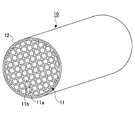
- FIG. 1 shows an example of the honeycomb structure of the present invention.
- the honeycomb structure 10 includes a single honeycomb unit 11 that includes ⁇ -type zeolite, phosphate-based zeolite, and an inorganic binder, and in which a plurality of through holes 11a are arranged in parallel in the longitudinal direction with a partition wall 11b interposed therebetween. Further, the outer peripheral coat layer 12 is formed on the outer peripheral surface excluding both end surfaces of the honeycomb unit 11.
- ⁇ -type zeolite has an average secondary particle size of 0.5 to 5 ⁇ m.
- the average particle size of the secondary particles of ⁇ -type zeolite is less than 0.5 ⁇ m, the exhaust gas does not easily enter into the partition walls 11b of the honeycomb unit 11, and the ⁇ -type zeolite and phosphate-based zeolite purify NOx. Will not be used effectively.
- the average particle size of the secondary particles of ⁇ -type zeolite exceeds 5 ⁇ m, the number of pores in the honeycomb unit 11 decreases, so that the exhaust gas does not easily enter the partition walls 11b of the honeycomb unit 11, and ⁇ -type zeolite Zeolite and phosphate-based zeolite are not effectively used for NOx purification.
- the average particle diameter of primary particles of ⁇ -type zeolite is preferably 0.01 to 0.1 ⁇ m.
- the phosphate zeolite is not particularly limited, but SAPO (silicoaluminophosphate) such as SAPO-5, SAPO-11, and SAPO-34; MeAPO (metalloaluminophosphate); MeAPSO (metal skeleton-substituted silicoaluminophosphate) and the like And two or more of them may be used in combination.
- SAPO sicoaluminophosphate
- MeAPO metaloaluminophosphate
- MeAPSO metal skeleton-substituted silicoaluminophosphate
- the average particle diameter of primary particles of phosphate zeolite is 0.5 to 5 ⁇ m.
- the exhaust gas hardly enters the partition walls 11b of the honeycomb unit 11, and the ⁇ -type zeolite and the phosphate zeolite are NOx. It will not be used effectively for purification.
- the average particle size of the primary particles of the phosphate-based zeolite exceeds 5 ⁇ m, the number of pores in the honeycomb unit 11 decreases, so that the exhaust gas does not easily enter the partition walls 11b of the honeycomb unit 11, and ⁇ Type zeolite and phosphate-based zeolite are not effectively used for NOx purification.
- the ratio of the mass of phosphate zeolite to the total mass of ⁇ -type zeolite and phosphate zeolite is 5 to 35%, preferably 15 to 25%.
- the ratio of the mass of the phosphate zeolite to the total mass of the ⁇ -type zeolite and the phosphate zeolite is less than 5%, the NOx purification performance decreases.
- the ratio of the mass of phosphate zeolite to the total mass of ⁇ -type zeolite and phosphate zeolite exceeds 35%, water adsorbs on the honeycomb unit 11 or desorbs water adsorbed on the honeycomb unit 11.
- the honeycomb unit 11 is easily damaged by contraction or expansion.
- ⁇ -type zeolite is present around the phosphate-based zeolite. Therefore, even if water is adsorbed on the honeycomb unit 11 or desorbed on the honeycomb unit 11, the honeycomb unit 11 contracts or expands. It is possible to suppress damage due to the above. Specifically, when water adsorbs on the honeycomb unit 11 or water adsorbed on the honeycomb unit 11 desorbs, the phosphate zeolite contracts or expands. However, since ⁇ -type zeolite exists, the phosphate zeolite Can be reduced. Since ⁇ -type zeolite also has NOx purification performance, the honeycomb structure 10 can maintain NOx purification performance even if the honeycomb unit 11 contains ⁇ -type zeolite.
- the ratio of the average particle size of the primary particles of the phosphate zeolite to the average particle size of the secondary particles of the ⁇ -type zeolite is preferably 0.25 to 4.0, more preferably 0.8 to 1.2. preferable.
- the ratio of the average particle diameter of the primary particles of the phosphate zeolite to the average particle diameter of the secondary particles of the ⁇ -type zeolite is less than 0.25 or exceeds 4.0, water is adsorbed on the honeycomb unit 11 Alternatively, when water adsorbed on the honeycomb unit 11 is desorbed, the effect of suppressing breakage due to the shrinkage or expansion of the honeycomb unit 11 is reduced.
- ⁇ -type zeolite is preferably ion-exchanged with copper ions and / or iron ions in order to improve NOx purification performance.
- the ⁇ -type zeolite ion-exchanged with copper ions and / or iron ions preferably has an ion exchange amount of 1.0 to 5.0% by mass.
- a metal ion which ion-exchanges beta-type zeolite it is not limited to a copper ion and / or an iron ion, The transition metal ion etc. which can improve the purification
- the phosphate zeolite is preferably ion-exchanged with copper ions and / or iron ions in order to improve NOx purification performance.
- the phosphate zeolite ion-exchanged with copper ions and / or iron ions preferably has an ion exchange amount of 1.0 to 5.0% by mass.
- a metal ion which ion-exchanges a phosphate-type zeolite it is not limited to a copper ion and / or an iron ion, The transition metal ion etc. which can improve the purification
- the honeycomb unit 11 preferably has a content of ⁇ -type zeolite and phosphate-based zeolite per apparent volume of 230 to 400 g / L.
- a content of ⁇ -type zeolite and phosphate-based zeolite per apparent volume of 230 to 400 g / L is less than 230 g / L, it is necessary to increase the apparent volume of the honeycomb unit 11 in order to improve the NOx purification performance. There is.
- the content of ⁇ -type zeolite and phosphate zeolite per apparent volume of the honeycomb unit 11 exceeds 400 g / L, the strength of the honeycomb unit 11 becomes insufficient, or the aperture ratio of the honeycomb unit 11 increases. It gets smaller.
- the inorganic binder contained in the honeycomb unit 11 is not particularly limited, and examples thereof include solids contained in alumina sol, silica sol, titania sol, water glass, sepiolite, attapulgite, boehmite and the like, and two or more kinds may be used in combination.
- the content of the inorganic binder in the honeycomb unit 11 is preferably 5 to 30% by mass, and more preferably 10 to 20% by mass.
- the content of the inorganic binder in the honeycomb unit 11 is less than 5% by mass, the strength of the honeycomb unit 11 is lowered.
- the content of the inorganic binder in the honeycomb unit 11 exceeds 30% by mass, it becomes difficult to extrude the honeycomb unit 11.
- the honeycomb unit 11 preferably further includes at least one selected from the group consisting of inorganic fibers, scale-like substances, tetrapot-like substances, and three-dimensional needle-like substances in order to improve the strength.
- the material constituting the inorganic fiber contained in the honeycomb unit 11 is not particularly limited, and examples thereof include alumina, silica, silicon carbide, silica alumina, glass, potassium titanate, and aluminum borate. Also good.
- the aspect ratio of the inorganic fibers contained in the honeycomb unit 11 is preferably 2 to 1000, more preferably 5 to 800, and even more preferably 10 to 500.
- the aspect ratio of the inorganic fibers contained in the honeycomb unit 11 is less than 2, the effect of improving the strength of the honeycomb unit 11 is reduced.
- the aspect ratio of the inorganic fibers contained in the honeycomb unit 11 exceeds 1000, the mold is clogged when the honeycomb unit 11 is extruded, or the inorganic fibers break and the strength of the honeycomb unit 11 is increased. The effect of improving the quality is reduced.
- the scaly substance means a flat substance, preferably having a thickness of 0.2 to 5.0 ⁇ m, preferably having a maximum length of 10 to 160 ⁇ m, and a ratio of the maximum length to the thickness of 3 It is preferable that it is -250.
- the material constituting the scaly substance contained in the honeycomb unit 11 is not particularly limited, and examples thereof include glass, muscovite, alumina, silica and the like, and two or more kinds may be used in combination.
- the tetrapot-like substance means a substance in which the needle-like portion extends three-dimensionally.
- the average needle-like length of the needle-like portion is preferably 5 to 30 ⁇ m, and the average diameter of the needle-like portion is 0.5. It is preferable that the thickness is ⁇ 5.0 ⁇ m.
- the three-dimensional acicular substance means a substance in which the acicular parts are bonded by an inorganic compound such as glass near the center of each acicular part, and the average acicular length of the acicular parts is 5 to 30 ⁇ m. It is preferable that the average diameter of the needle-shaped part is 0.5 to 5.0 ⁇ m.
- the three-dimensional acicular substance may have a plurality of acicular portions that are three-dimensionally connected, and preferably has a needle-like diameter of 0.1 to 5.0 ⁇ m and a length of 0.3 to It is preferably 30.0 ⁇ m, and the ratio of length to diameter is preferably 1.4 to 50.0.
- the material constituting the three-dimensional acicular substance contained in the honeycomb unit 11 is not particularly limited, and examples thereof include alumina, silica, silicon carbide, silica alumina, glass, potassium titanate, aluminum borate, boehmite, and the like. Two or more species may be used in combination.
- the content of inorganic fiber, scale-like substance, tetrapot-like substance and three-dimensional needle-like substance in the honeycomb unit 11 is preferably 3 to 50% by mass, more preferably 3 to 30% by mass. More preferred is mass%.
- the content of the inorganic fiber, scale-like substance, tetrapot-like substance and three-dimensional needle-like substance in the honeycomb unit 11 is less than 3% by mass, the effect of improving the strength of the honeycomb unit 11 becomes small.
- the honeycomb unit 11 preferably has a porosity of 20 to 50%.
- the porosity of the honeycomb unit 11 is less than 20%, the exhaust gas does not easily enter the partition walls 11b of the honeycomb unit 11, and ⁇ -type zeolite and phosphate-based zeolite are not effectively used for NOx purification. .
- the porosity of the honeycomb unit 11 exceeds 50%, the strength of the honeycomb unit 11 becomes insufficient.
- the porosity of the honeycomb unit 11 can be measured using a mercury intrusion method.
- the honeycomb unit 11 preferably has an opening ratio of a cross section perpendicular to the longitudinal direction of 50 to 75%. If the opening ratio of the cross section perpendicular to the longitudinal direction of the honeycomb unit 11 is less than 50%, the ⁇ -type zeolite and the phosphate-based zeolite are not effectively used for NOx purification. On the other hand, if the opening ratio of the cross section perpendicular to the longitudinal direction of the honeycomb unit 11 exceeds 75%, the strength of the honeycomb unit 11 becomes insufficient.
- the density of the through holes 11a having a cross section perpendicular to the longitudinal direction is preferably 31 to 155 / cm 2 .
- the density of the through-holes 11a having a cross section perpendicular to the longitudinal direction of the honeycomb unit 11 is less than 31 / cm 2 , the ⁇ -type zeolite and the phosphate-based zeolite are difficult to come into contact with the exhaust gas, and the NOx purification performance is improved. descend.
- the density of the through holes 11a having a cross section perpendicular to the longitudinal direction of the honeycomb unit 11 exceeds 155 / cm 2 , the pressure loss of the honeycomb structure 10 increases.
- the thickness of the partition wall 11b of the honeycomb unit 11 is preferably 0.1 to 0.4 mm, and more preferably 0.1 to 0.3 mm.
- the thickness of the partition wall 11b of the honeycomb unit 11 is less than 0.1 mm, the strength of the honeycomb unit 11 decreases.
- the thickness of the partition wall 11b of the honeycomb unit 11 exceeds 0.4 mm, the exhaust gas does not easily enter the partition wall 11b of the honeycomb unit 11, and the ⁇ -type zeolite and the phosphate-based zeolite are used for NOx purification. It will not be used effectively.
- the outer peripheral coat layer 12 preferably has a thickness of 0.1 to 2.0 mm.
- the thickness of the outer peripheral coat layer 12 is less than 0.1 mm, the effect of improving the strength of the honeycomb structure 10 becomes insufficient.
- the thickness of the outer peripheral coat layer 12 exceeds 2.0 mm, the content of ⁇ -type zeolite and phosphate-based zeolite per unit volume of the honeycomb structure 10 is lowered, and the NOx purification performance is lowered.
- the shape of the honeycomb structure 10 is not limited to a cylindrical shape, and examples thereof include a prismatic shape, an elliptical cylindrical shape, a long cylindrical shape, and a rounded chamfered prismatic shape (for example, a rounded chamfered triangular prism shape).
- the shape of the through hole 11a is not limited to a quadrangular prism shape, but may be a triangular prism shape, a hexagonal prism shape, or the like.
- honeycomb structure 10 Next, an example of a method for manufacturing the honeycomb structure 10 will be described.
- ⁇ -type zeolite, phosphate-based zeolite and an inorganic binder and if necessary, one or more selected from the group consisting of inorganic fibers, scale-like substances, tetrapot-like substances and three-dimensional needle-like substances
- a columnar honeycomb formed body in which a plurality of through holes are arranged in parallel in the longitudinal direction with a partition wall therebetween is manufactured by using the raw material paste that is included.
- the inorganic binder contained in the raw material paste is not particularly limited, but is added as alumina sol, silica sol, titania sol, water glass, sepiolite, attapulgite, boehmite, etc., and two or more kinds may be used in combination.
- an organic binder, a dispersion medium, a molding aid and the like may be appropriately added to the raw material paste as necessary.
- the organic binder is not particularly limited, and examples thereof include methyl cellulose, carboxymethyl cellulose, hydroxyethyl cellulose, polyethylene glycol, phenol resin, and epoxy resin, and two or more kinds may be used in combination.
- the added amount of the organic binder is 1 to 10% with respect to the total mass of ⁇ -type zeolite, phosphate-based zeolite, inorganic binder, inorganic fiber, scale-like substance, tetrapot-like substance and three-dimensional acicular substance. It is preferable that
- the dispersion medium is not particularly limited, and examples thereof include water, organic solvents such as benzene, alcohols such as methanol, and the like.
- the molding aid is not particularly limited, and examples thereof include ethylene glycol, dextrin, fatty acid, fatty acid soap, polyalcohol and the like, and two or more kinds may be used in combination.
- the raw material paste it is preferable to mix and knead, and it may be mixed using a mixer, an attritor or the like, or may be kneaded using a kneader or the like.
- the honeycomb formed body is dried by using a dryer such as a microwave dryer, a hot air dryer, a dielectric dryer, a vacuum dryer, a vacuum dryer, a freeze dryer or the like to prepare a honeycomb dried body.
- a dryer such as a microwave dryer, a hot air dryer, a dielectric dryer, a vacuum dryer, a vacuum dryer, a freeze dryer or the like to prepare a honeycomb dried body.
- honeycomb dried body is degreased to produce a honeycomb degreased body.
- the degreasing conditions can be appropriately selected depending on the type and amount of the organic substance contained in the dried honeycomb body, but it is preferably 2 hours at 400 ° C.
- the honeycomb degreased body is fired to produce a cylindrical honeycomb unit 11.
- the firing temperature is preferably 600 to 1200 ° C, and more preferably 600 to 1000 ° C.
- the firing temperature is less than 600 ° C.
- the sintering does not proceed and the strength of the honeycomb unit 11 is lowered.
- the firing temperature exceeds 1200 ° C.
- the sintering proceeds too much, and the reaction sites of ⁇ -type zeolite and phosphate zeolite decrease.
- the outer peripheral coat layer paste is applied to the outer peripheral surface excluding both end surfaces of the cylindrical honeycomb unit 11.
- the inorganic binder contained in the outer periphery coating layer paste is not particularly limited, but is added as silica sol, alumina sol or the like, and two or more kinds may be used in combination. Among these, it is preferable to add as silica sol.
- the material constituting the inorganic particles contained in the outer peripheral coat layer paste is not particularly limited, but examples thereof include carbides such as silicon carbide, nitrides such as silicon nitride and boron nitride, and two or more kinds may be used in combination. . Of these, silicon carbide is preferred because of its excellent thermal conductivity.
- a silica alumina, a mullite, an alumina, a silica etc. are mentioned, You may use 2 or more types together. Of these, alumina is preferable.
- the outer periphery coating layer paste may further contain an organic binder.
- the outer peripheral coat layer paste may further contain balloons, pore formers, and the like, which are fine hollow spheres of oxide ceramics.
- the balloon contained in the outer periphery coating layer paste is not particularly limited, and examples thereof include alumina balloons, glass micro balloons, shirasu balloons, fly ash balloons, mullite balloons, and the like, and two or more kinds may be used in combination. Among these, an alumina balloon is preferable.
- a spherical acrylic particle, a graphite, etc. are mentioned, You may use 2 or more types together.
- the honeycomb unit 11 to which the outer peripheral coat layer paste has been applied is dried and solidified to produce a columnar honeycomb structure 10.
- the outer peripheral coat layer paste contains an organic binder, it is preferably degreased.
- the degreasing conditions can be appropriately selected depending on the kind and amount of the organic matter, but it is preferably 20 minutes at 700 ° C.
- the ⁇ -type zeolite and the phosphate-based zeolite may be ion-exchanged by immersing the honeycomb unit 11 or the honeycomb structure 10 in an aqueous solution containing copper ions and / or iron ions.
- a raw material paste containing at least one of ⁇ -type zeolite ion-exchanged with copper ions and / or iron ions and phosphate-based zeolite ion-exchanged with copper ions and / or iron ions may be used. .
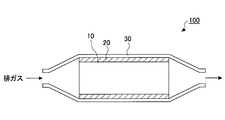
- FIG. 2 shows an example of the exhaust gas purifying apparatus of the present invention.
- the exhaust gas purification apparatus 100 can be manufactured by canning the metal container (shell) 30 in a state where the holding sealing material 20 is disposed on the outer peripheral portion of the honeycomb structure 10. Further, the exhaust gas purification apparatus 100 includes an injection nozzle that injects ammonia or a compound that decomposes to generate ammonia into a pipe (not shown) on the upstream side of the honeycomb structure 10 with respect to the direction in which the exhaust gas flows. Injecting means (not shown) is provided. As a result, ammonia is added to the exhaust gas flowing through the pipe, so that the NOx contained in the exhaust gas is reduced by the ⁇ -type zeolite and phosphate-based zeolite contained in the honeycomb unit 11.
- the compound that decomposes to generate ammonia is not particularly limited as long as it can be heated by exhaust gas in the pipe and generate ammonia, but urea water is preferable because of excellent storage stability.
- the urea water is heated by the exhaust gas in the pipe and hydrolyzes to generate ammonia.
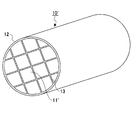
- FIG. 3 shows another example of the honeycomb structure of the present invention.
- a plurality of honeycomb units 11 ′ in which a plurality of through holes 11 a are arranged in parallel in the longitudinal direction with a partition wall 11 b interposed therebetween are bonded via an adhesive layer 13.
- the configuration is the same as that of the honeycomb structure 10.
- the honeycomb unit 11 ′ preferably has a cross-sectional area of 10 to 200 cm 2 in a cross section perpendicular to the longitudinal direction.
- the cross-sectional area of the cross section perpendicular to the longitudinal direction of the honeycomb unit 11 ′ is less than 10 cm 2 , the pressure loss of the honeycomb structure 10 ′ increases.
- the cross-sectional area of the cross section perpendicular to the longitudinal direction of the honeycomb unit 11 ′ exceeds 200 cm 2 , the strength against the thermal stress generated in the honeycomb unit 11 ′ becomes insufficient.
- the honeycomb unit 11 ′ has the same configuration as the honeycomb unit 11 except for the cross-sectional area of the cross section perpendicular to the longitudinal direction.
- the adhesive layer 13 preferably has a thickness of 0.5 to 2.0 mm.
- the thickness of the adhesive layer 13 is less than 0.5 mm, the adhesive strength of the honeycomb unit 11 ′ becomes insufficient.
- the thickness of the adhesive layer 13 exceeds 2.0 mm, the pressure loss of the honeycomb structure 10 ′ increases.
- honeycomb structure 10 Next, an example of a method for manufacturing the honeycomb structure 10 'will be described. First, in the same manner as the honeycomb structure 10, a quadrangular columnar honeycomb unit 11 'is manufactured. Next, an adhesive layer paste is applied to the outer peripheral surface excluding both end faces of the honeycomb unit 11 ′, and the honeycomb units 11 ′ are sequentially bonded and dried and solidified to produce an aggregate of the honeycomb units 11 ′.
- the adhesive layer paste is not particularly limited, and examples thereof include a mixture of inorganic binder and inorganic particles, a mixture of inorganic binder and inorganic fibers, a mixture of inorganic binder, inorganic particles, and inorganic fibers.
- the inorganic binder contained in the adhesive layer paste is not particularly limited, but is added as silica sol, alumina sol or the like, and two or more kinds may be used in combination. Among these, it is preferable to add as silica sol.
- the material constituting the inorganic particles contained in the adhesive layer paste is not particularly limited, but examples thereof include carbides such as silicon carbide, nitrides such as silicon nitride and boron nitride, and two or more kinds may be used in combination. Of these, silicon carbide is preferred because of its excellent thermal conductivity.
- the material constituting the inorganic fiber contained in the adhesive layer paste is not particularly limited, and examples thereof include silica alumina, mullite, alumina, silica and the like, and two or more kinds may be used in combination. Of these, alumina is preferable.
- the adhesive layer paste may contain an organic binder.
- the organic binder contained in the adhesive layer paste is not particularly limited, and examples thereof include polyvinyl alcohol, methyl cellulose, ethyl cellulose, carboxymethyl cellulose and the like, and two or more kinds may be used in combination.
- the adhesive layer paste may further contain balloons that are fine hollow spheres of oxide ceramics, a pore-forming agent, and the like.
- the balloon contained in the adhesive layer paste is not particularly limited, and examples thereof include an alumina balloon, a glass microballoon, a shirasu balloon, a fly ash balloon, and a mullite balloon, and two or more kinds may be used in combination. Among these, an alumina balloon is preferable.
- the pore former contained in the adhesive layer paste is not particularly limited, and examples thereof include spherical acrylic particles and graphite, and two or more kinds may be used in combination.
- the aggregate of the honeycomb units 11 ′ is cut into a cylindrical shape, the aggregate of the cylindrical honeycomb units 11 ′ is manufactured by polishing as necessary.
- the honeycomb unit 11 ′ whose cross section perpendicular to the longitudinal direction is formed into a predetermined shape is bonded to the columnar honeycomb unit 11 ′. You may produce the aggregate
- the shape of the cross section perpendicular to the longitudinal direction of the honeycomb unit 11 ′ is preferably a sector shape with a central angle of 90 °.
- the outer peripheral coat layer paste is applied to the outer peripheral surface excluding both end surfaces of the aggregate of the cylindrical honeycomb units 11 ′.
- the outer periphery coat layer paste may be the same as or different from the adhesive layer paste.
- a columnar honeycomb structure 10 ′ is manufactured by drying and solidifying the aggregate of columnar honeycomb units 11 ′ coated with the outer periphery coating layer paste.
- an organic binder is contained in the adhesive layer paste and / or the outer peripheral coat layer paste, it is preferable to degrease.
- the degreasing conditions can be appropriately selected depending on the kind and amount of the organic matter, but it is preferably 20 minutes at 700 ° C.
- outer peripheral coat layer 12 may not be formed in the honeycomb structures 10 and 10 ′.
- part means “part by mass”.
- Example 1 2400 parts of ⁇ -type zeolite with an average secondary particle diameter of 3 ⁇ m, 600 parts of SAPO-34 with an average primary particle diameter of 3 ⁇ m, 840 parts of boehmite, an average fiber diameter of 6 ⁇ m and an average fiber length of 100 ⁇ m
- a raw material paste 1 was prepared by mixing and kneading 650 parts of alumina fiber, 330 parts of methylcellulose, 330 parts of oleic acid, and 1800 parts of ion-exchanged water.
- the raw material paste 1 was extrusion-molded using an extruder to produce a regular quadrangular prism-shaped honeycomb formed body. Then, the honeycomb formed body was dried at 110 ° C. for 10 minutes using a microwave dryer and a hot air dryer, and then degreased at 400 ° C. for 5 hours. Next, the honeycomb fired body was fired at 700 ° C. for 2 hours. Further, by immersing the honeycomb fired body in an aqueous copper nitrate solution, ⁇ -type zeolite and SAPO-34 were ion-exchanged with copper ions to produce a honeycomb unit 11 ′.
- the ion exchange amount of the zeolite was measured by ICP emission analysis using ICPS-8100 (manufactured by Shimadzu Corporation), and it was 2.7% by mass.
- the honeycomb unit 11 ′ was a regular square column having a side of 38 mm and a length of 150 mm, the density of the through holes 11a was 62 / cm 2 , and the thickness of the partition walls 11b was 0.28 mm.
- alumina fiber having an average fiber diameter of 0.5 ⁇ m and an average fiber length of 15 ⁇ m 767 parts of alumina fiber having an average fiber diameter of 0.5 ⁇ m and an average fiber length of 15 ⁇ m, 2500 parts of silica glass, 17 parts of carboxymethylcellulose, 600 parts of silica sol having a solid content of 30% by mass, and 167 parts of polyvinyl alcohol Part, 167 parts of surfactant and 17 parts of alumina balloon were mixed and kneaded to prepare an adhesive layer paste.
- the adhesive layer paste was applied to the outer peripheral surface excluding both ends of the honeycomb unit 11 ′ so that the thickness of the adhesive layer 13 was 2.0 mm, and 16 honeycomb units 11 ′ were adhered to each other at 150 ° C. Solidified for a minute. Next, a diamond cutter was used to cut into a cylindrical shape so that the cross section perpendicular to the longitudinal direction was substantially point-symmetric, and an aggregate of honeycomb units 11 ′ was produced.
- the microwave dryer and the hot air dryer are applied. Then, the adhesive layer paste was dried and solidified at 150 ° C. for 10 minutes and degreased at 400 ° C. for 2 hours to prepare a cylindrical honeycomb structure 10 ′ having a diameter of 160 mm and a length of 150 mm.
- Example 2 A honeycomb structure 10 ′ was produced in the same manner as in Example 1 except that the addition amounts of ⁇ -type zeolite and SAPO-34 were changed to 2700 parts and 300 parts, respectively.
- Example 3 A honeycomb structure 10 ′ was produced in the same manner as in Example 1 except that the addition amounts of ⁇ -type zeolite and SAPO-34 were changed to 2100 parts and 900 parts, respectively.
- Example 4 A honeycomb structure 10 ′ was produced in the same manner as in Example 1 except that the addition amounts of ⁇ -type zeolite and SAPO-34 were changed to 2850 parts and 150 parts, respectively.
- Example 5 A honeycomb structure 10 ′ was produced in the same manner as in Example 1 except that the addition amounts of ⁇ -type zeolite and SAPO-34 were changed to 1950 parts and 1050 parts, respectively.
- Example 6 Instead of ⁇ -zeolite with an average secondary particle size of 3 ⁇ m and SAPO-34 with an average primary particle size of 3 ⁇ m, ⁇ -type zeolite with an average secondary particle size of 0.5 ⁇ m and primary particles of A honeycomb structure 10 ′ was produced in the same manner as in Example 1 except that SAPO-34 having an average particle diameter of 2 ⁇ m was used.
- Example 7 Instead of ⁇ -zeolite with an average secondary particle size of 3 ⁇ m and SAPO-34 with an average primary particle size of 3 ⁇ m, ⁇ -type zeolite with an average secondary particle size of 1 ⁇ m and an average particle of primary particles A honeycomb structure 10 ′ was produced in the same manner as in Example 1 except that SAPO-34 having a diameter of 4 ⁇ m was used.
- Example 1 A honeycomb structure was manufactured in the same manner as in Example 1 except that the addition amounts of ⁇ -type zeolite and SAPO-34 were changed to 3000 parts and 0 parts, respectively.
- Example 2 A honeycomb structure was manufactured in the same manner as in Example 1 except that the addition amounts of ⁇ -type zeolite and SAPO-34 were changed to 1500 parts and 1500 parts, respectively.
- the NOx purification rate [%] expressed by The constituent components of the simulated gas are 175 ppm of nitric oxide, 175 ppm of nitrogen dioxide, 350 ppm of ammonia, 14% of oxygen, 10% of water, and nitrogen (balance).
- Table 1 shows the evaluation results of the purification rate of cracks in the honeycomb unit and NOx in the sample.
- the sample cut out from the honeycomb unit of Comparative Example 2 has a NOx purification rate of 85%.
- cracks are generated. Occurred. This is presumably because cracks were generated due to contraction and expansion of the honeycomb unit because the ratio of the mass of SAPO-34 to the total mass of ⁇ -type zeolite and SAPO-34 contained in the honeycomb unit was large.
Landscapes
- Chemical & Material Sciences (AREA)
- Engineering & Computer Science (AREA)
- Ceramic Engineering (AREA)
- Chemical Kinetics & Catalysis (AREA)
- Materials Engineering (AREA)
- Structural Engineering (AREA)
- Organic Chemistry (AREA)
- Environmental & Geological Engineering (AREA)
- Health & Medical Sciences (AREA)
- Biomedical Technology (AREA)
- Analytical Chemistry (AREA)
- General Chemical & Material Sciences (AREA)
- Oil, Petroleum & Natural Gas (AREA)
- Combustion & Propulsion (AREA)
- Manufacturing & Machinery (AREA)
- Inorganic Chemistry (AREA)
- Catalysts (AREA)
- Exhaust Gas Treatment By Means Of Catalyst (AREA)
- Exhaust Gas After Treatment (AREA)
Abstract
La présente invention concerne une structure en nid d'abeille ayant une unité en nid d'abeille qui contient une β zéolite, une zéolite phosphate et un liant minéral et qui comporte une pluralité d'orifices traversants agencés en parallèle dans la direction longitudinale séparés par des partitions. La β zéolite a une granulométrie moyenne de particules secondaires de 0,5-5 μm inclus, la zéolite phosphate a une granulométrie moyenne de particules primaires de 0,5-5 μm inclus, et le rapport du poids de la zéolite phosphate sur le poids total de la β zéolite plus la zéolite phosphate est 5-35% inclus.
Priority Applications (3)
| Application Number | Priority Date | Filing Date | Title |
|---|---|---|---|
| PCT/JP2011/057855 WO2012131914A1 (fr) | 2011-03-29 | 2011-03-29 | Structure en nid d'abeille et appareil de purification des gaz d'échappement |
| EP11187264A EP2505250A1 (fr) | 2011-03-29 | 2011-10-31 | Corps structurel en nid d'abeille et appareil de conversion de gaz d'échappement |
| US13/306,902 US8685331B2 (en) | 2011-03-29 | 2011-11-29 | Honeycomb structural body and exhaust gas conversion apparatus |
Applications Claiming Priority (1)
| Application Number | Priority Date | Filing Date | Title |
|---|---|---|---|
| PCT/JP2011/057855 WO2012131914A1 (fr) | 2011-03-29 | 2011-03-29 | Structure en nid d'abeille et appareil de purification des gaz d'échappement |
Publications (1)
| Publication Number | Publication Date |
|---|---|
| WO2012131914A1 true WO2012131914A1 (fr) | 2012-10-04 |
Family
ID=45065679
Family Applications (1)
| Application Number | Title | Priority Date | Filing Date |
|---|---|---|---|
| PCT/JP2011/057855 Ceased WO2012131914A1 (fr) | 2011-03-29 | 2011-03-29 | Structure en nid d'abeille et appareil de purification des gaz d'échappement |
Country Status (3)
| Country | Link |
|---|---|
| US (1) | US8685331B2 (fr) |
| EP (1) | EP2505250A1 (fr) |
| WO (1) | WO2012131914A1 (fr) |
Families Citing this family (3)
| Publication number | Priority date | Publication date | Assignee | Title |
|---|---|---|---|---|
| CN104383917A (zh) * | 2014-05-13 | 2015-03-04 | 四川材料与工艺研究所 | 一种用于含氚空气除氚的催化剂的制备方法 |
| RU2018131407A (ru) * | 2016-02-03 | 2020-03-03 | Басф Корпорейшн | Шабазитный катализатор, совместно обмененный на медь и железо |
| DE102017208418A1 (de) * | 2017-05-18 | 2018-11-22 | Robert Bosch Gmbh | Verfahren zum Herstellen einer nanokristallinen, gassensitiven Schichtstruktur, entsprechende nanokristalline, gassensitive Schichtstruktur, und Gassensor mit einer entsprechenden nanokristallinen, gassensitiven Schichtstruktur |
Citations (5)
| Publication number | Priority date | Publication date | Assignee | Title |
|---|---|---|---|---|
| JPH078754A (ja) * | 1993-06-11 | 1995-01-13 | Tosoh Corp | 排ガス浄化方法 |
| JPH08310810A (ja) * | 1995-05-17 | 1996-11-26 | Nippon Kayaku Co Ltd | 高純度結晶質シリコアルミノリン酸塩の製造方法 |
| WO2006040874A1 (fr) * | 2004-10-08 | 2006-04-20 | Ibiden Co., Ltd. | Structure en nids d'abeille et procede de fabrication de ladite structure |
| WO2009141874A1 (fr) * | 2008-05-20 | 2009-11-26 | イビデン株式会社 | Structure en nid d'abeilles |
| JP2011506237A (ja) * | 2007-11-30 | 2011-03-03 | コーニング インコーポレイテッド | ゼオライト系ハニカム体 |
Family Cites Families (6)
| Publication number | Priority date | Publication date | Assignee | Title |
|---|---|---|---|---|
| JP3842862B2 (ja) * | 1997-03-26 | 2006-11-08 | 日本碍子株式会社 | 排ガス浄化システム |
| KR100719074B1 (ko) * | 2002-11-18 | 2007-05-16 | 아이씨티 코., 엘티디. | 배기가스 정화용 촉매 및 배기가스의 정화 방법 |
| WO2006137149A1 (fr) | 2005-06-24 | 2006-12-28 | Ibiden Co., Ltd. | Corps de structure en nid d’abeille |
| EP2095866B1 (fr) * | 2008-02-25 | 2014-10-29 | JGC Catalysts and Chemicals Ltd. | appareil pour traiter un gaz d'échappement |
| DE102010056428B4 (de) * | 2009-12-28 | 2013-01-31 | Süd-Chemie Ip Gmbh & Co. Kg | Geträgerte Übergangsmetallkatalysatoren |
| FR2960231B1 (fr) * | 2010-05-19 | 2012-07-20 | Rhodia Operations | Composition a base de cerium, de zirconium et de tungstene, procede de preparation et utilisation en catalyse, notamment pour le traitement des gaz d'echappement |
-
2011
- 2011-03-29 WO PCT/JP2011/057855 patent/WO2012131914A1/fr not_active Ceased
- 2011-10-31 EP EP11187264A patent/EP2505250A1/fr not_active Withdrawn
- 2011-11-29 US US13/306,902 patent/US8685331B2/en not_active Expired - Fee Related
Patent Citations (5)
| Publication number | Priority date | Publication date | Assignee | Title |
|---|---|---|---|---|
| JPH078754A (ja) * | 1993-06-11 | 1995-01-13 | Tosoh Corp | 排ガス浄化方法 |
| JPH08310810A (ja) * | 1995-05-17 | 1996-11-26 | Nippon Kayaku Co Ltd | 高純度結晶質シリコアルミノリン酸塩の製造方法 |
| WO2006040874A1 (fr) * | 2004-10-08 | 2006-04-20 | Ibiden Co., Ltd. | Structure en nids d'abeille et procede de fabrication de ladite structure |
| JP2011506237A (ja) * | 2007-11-30 | 2011-03-03 | コーニング インコーポレイテッド | ゼオライト系ハニカム体 |
| WO2009141874A1 (fr) * | 2008-05-20 | 2009-11-26 | イビデン株式会社 | Structure en nid d'abeilles |
Also Published As
| Publication number | Publication date |
|---|---|
| US8685331B2 (en) | 2014-04-01 |
| US20120251400A1 (en) | 2012-10-04 |
| EP2505250A1 (fr) | 2012-10-03 |
Similar Documents
| Publication | Publication Date | Title |
|---|---|---|
| JP5560158B2 (ja) | ハニカム構造体及び排ガス浄化装置 | |
| WO2011061836A1 (fr) | Structure en nid d'abeille et appareil de purification des gaz d'échappement | |
| JP5837408B2 (ja) | ハニカム構造体及び排ガス浄化装置 | |
| JP5317959B2 (ja) | ハニカム構造体 | |
| JP5746061B2 (ja) | ハニカム構造体及びハニカム構造体の製造方法 | |
| JP2011125849A (ja) | ハニカム構造体及び排ガス浄化装置 | |
| JPWO2009141895A1 (ja) | 排ガス浄化装置 | |
| JP6204751B2 (ja) | ハニカム触媒及び排ガス浄化装置 | |
| JP5873562B2 (ja) | ハニカム構造体 | |
| WO2009141886A1 (fr) | Structure en nid d'abeille | |
| WO2011061835A1 (fr) | Structure en nid d'abeille et appareil de purification des gaz d'échappement | |
| JP6245896B2 (ja) | ハニカム触媒及び排ガス浄化装置 | |
| WO2009141898A1 (fr) | Structure en nid d'abeille | |
| WO2011061839A1 (fr) | Structure en nid d'abeille et appareil de purification des gaz d'échappement | |
| JP6245895B2 (ja) | ハニカム触媒及び排ガス浄化装置 | |
| WO2013024545A1 (fr) | Particule composite, structure en nid d'abeilles, procédé de fabrication de cette structure et dispositif de purification de gaz d'échappement | |
| WO2013024548A1 (fr) | Structure en nid d'abeilles, son procédé de fabrication, dispositif de purification de gaz d'échappement et particules de silicoaluminophosphate | |
| JP2012215166A (ja) | 排ガス浄化システム及び排ガス浄化方法 | |
| WO2012131914A1 (fr) | Structure en nid d'abeille et appareil de purification des gaz d'échappement | |
| WO2013024547A1 (fr) | Structure en nid d'abeilles, procédé de fabrication de celle-ci, dispositif de purification de gaz d'échappement et particules de silicoaluminophosphate | |
| JP5563952B2 (ja) | ハニカム構造体及び排ガス浄化装置 | |
| JP5934220B2 (ja) | ハニカム構造体および排ガス浄化装置 | |
| WO2012131913A1 (fr) | Système d'épuration des gaz d'échappement et procédé d'épuration des gaz d'échappement | |
| WO2011061837A1 (fr) | Procédé de fabrication d'une structure en nid d'abeilles et procédé de fabrication d'un appareil de purification des gaz d'échappement | |
| WO2012131915A1 (fr) | Système d'épuration des gaz d'échappement and procédé d'épuration des gaz d'échappement |
Legal Events
| Date | Code | Title | Description |
|---|---|---|---|
| 121 | Ep: the epo has been informed by wipo that ep was designated in this application |
Ref document number: 11862793 Country of ref document: EP Kind code of ref document: A1 |
|
| NENP | Non-entry into the national phase |
Ref country code: DE |
|
| 122 | Ep: pct application non-entry in european phase |
Ref document number: 11862793 Country of ref document: EP Kind code of ref document: A1 |