WO2012132437A1 - 人数計測装置 - Google Patents
人数計測装置 Download PDFInfo
- Publication number
- WO2012132437A1 WO2012132437A1 PCT/JP2012/002163 JP2012002163W WO2012132437A1 WO 2012132437 A1 WO2012132437 A1 WO 2012132437A1 JP 2012002163 W JP2012002163 W JP 2012002163W WO 2012132437 A1 WO2012132437 A1 WO 2012132437A1
- Authority
- WO
- WIPO (PCT)
- Prior art keywords
- person
- measurement reference
- measurement
- flow line
- unit
- Prior art date
- Legal status (The legal status is an assumption and is not a legal conclusion. Google has not performed a legal analysis and makes no representation as to the accuracy of the status listed.)
- Ceased
Links
Images

Classifications
-
- G—PHYSICS
- G06—COMPUTING OR CALCULATING; COUNTING
- G06T—IMAGE DATA PROCESSING OR GENERATION, IN GENERAL
- G06T7/00—Image analysis
- G06T7/20—Analysis of motion
-
- G—PHYSICS
- G06—COMPUTING OR CALCULATING; COUNTING
- G06T—IMAGE DATA PROCESSING OR GENERATION, IN GENERAL
- G06T7/00—Image analysis
- G06T7/10—Segmentation; Edge detection
- G06T7/11—Region-based segmentation
-
- G—PHYSICS
- G06—COMPUTING OR CALCULATING; COUNTING
- G06V—IMAGE OR VIDEO RECOGNITION OR UNDERSTANDING
- G06V20/00—Scenes; Scene-specific elements
- G06V20/50—Context or environment of the image
- G06V20/52—Surveillance or monitoring of activities, e.g. for recognising suspicious objects
- G06V20/53—Recognition of crowd images, e.g. recognition of crowd congestion
-
- G—PHYSICS
- G06—COMPUTING OR CALCULATING; COUNTING
- G06V—IMAGE OR VIDEO RECOGNITION OR UNDERSTANDING
- G06V40/00—Recognition of biometric, human-related or animal-related patterns in image or video data
- G06V40/10—Human or animal bodies, e.g. vehicle occupants or pedestrians; Body parts, e.g. hands
- G06V40/103—Static body considered as a whole, e.g. static pedestrian or occupant recognition
-
- G—PHYSICS
- G06—COMPUTING OR CALCULATING; COUNTING
- G06T—IMAGE DATA PROCESSING OR GENERATION, IN GENERAL
- G06T2207/00—Indexing scheme for image analysis or image enhancement
- G06T2207/30—Subject of image; Context of image processing
- G06T2207/30196—Human being; Person
-
- G—PHYSICS
- G06—COMPUTING OR CALCULATING; COUNTING
- G06T—IMAGE DATA PROCESSING OR GENERATION, IN GENERAL
- G06T2207/00—Indexing scheme for image analysis or image enhancement
- G06T2207/30—Subject of image; Context of image processing
- G06T2207/30232—Surveillance
-
- G—PHYSICS
- G06—COMPUTING OR CALCULATING; COUNTING
- G06T—IMAGE DATA PROCESSING OR GENERATION, IN GENERAL
- G06T2207/00—Indexing scheme for image analysis or image enhancement
- G06T2207/30—Subject of image; Context of image processing
- G06T2207/30242—Counting objects in image
-
- G—PHYSICS
- G06—COMPUTING OR CALCULATING; COUNTING
- G06V—IMAGE OR VIDEO RECOGNITION OR UNDERSTANDING
- G06V20/00—Scenes; Scene-specific elements
- G06V20/50—Context or environment of the image
- G06V20/52—Surveillance or monitoring of activities, e.g. for recognising suspicious objects
Definitions
- the present invention relates to a person counting device that measures the number of people who have passed through a measurement area set in an image of a store or facility.
- Patent Document 1 discloses a technique for extracting a movement line of a moving body from image data captured at different times, and counting the number of persons as passing persons when the movement line passes through a virtual gate set on an observation image. It is disclosed. This is shown in FIG. As shown in the figure, when the flow lines 100 and 101 pass through the virtual gate 110, the number of people is counted as passing persons, and when the flow lines 102 and 103 pass through the virtual gate 111, the number of persons is counted as passing persons.
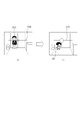
- the child 301 cannot be measured.
- the child 301 can be measured by lowering the measurement line 200, but even if the same person moves away from the camera (not shown), the image of the person becomes smaller, and conversely, the image of the person becomes larger as the camera approaches the camera. Therefore, the person may be remeasured.
- the number of people is measured under normal camera installation conditions, there is a problem that the number of people with high accuracy cannot be measured.
- the present invention has been made in view of such circumstances, and an object of the present invention is to provide a number counting device that can reliably count the number of persons even with a short stature such as a child or an elderly person.
- the number-of-people counting device of the present invention includes a video input unit that inputs video, a person extraction unit that extracts a person from the video input by the video input unit, and a person image extracted by the person extraction unit.
- a flow line creation unit that creates a human flow line from position information, and a person measurement unit that counts the number of people from the positional relationship between the human flow line created by the flow line creation unit and the measurement reference coordinates set in the image
- An attribute extraction unit for obtaining the attribute of the person extracted by the person extraction unit, and the measurement standard of the person flow line corresponding to the person according to the attribute of the person extracted by the attribute extraction unit
- a measurement reference coordinate setting unit for setting coordinates.
- the measurement reference coordinates of the human flow line corresponding to the person are set according to the attribute of the person, the number of persons can be reliably measured even for a short person such as a child or an elderly person.
- the attribute extraction unit extracts an age as an attribute
- the measurement reference coordinate setting unit determines that the age is lower than the first predetermined age or higher than the second predetermined age, otherwise
- the measurement reference coordinates are set in the lower part of the image as compared with the case of.
- the attribute extraction unit extracts gender as an attribute
- the measurement reference coordinate setting unit determines the measurement reference coordinate when the gender is determined to be female compared to the case where the gender is determined to be male. Set in the lower part of the image.
- the attribute extraction unit extracts a movement speed as an attribute
- the measurement reference coordinate setting unit determines that the measurement reference coordinate is compared to the other cases when the movement speed is determined to be slower than a predetermined speed. Is set in the lower part of the image.
- the attribute extraction unit extracts a face orientation as an attribute
- the measurement reference coordinate setting unit determines that the measurement reference coordinate is greater than the other cases when the face orientation is determined to be larger than a predetermined angle. Is set in the lower part of the image.
- the number of persons can be reliably measured even when the face orientation is larger than a predetermined angle.
- the measurement reference coordinate setting unit sets the measurement reference coordinate in the lower part of the image as compared to other cases.
- the number of persons can be reliably measured.
- the measurement reference coordinate setting unit sets the measurement reference coordinate in the lower part of the image when it is determined that the degree of congestion is higher than a predetermined value compared to the other cases.
- the measurement reference coordinate setting destination can be changed according to an adult, a child, or an elderly person, so that the number of people can be reliably measured.
- the setting destination of the measurement reference coordinates set by the measurement reference coordinate setting unit is unknown.
- the detection frequency when it is too crowded, when the detection frequency is extremely small, when the moving speed is extremely fast, or when the moving speed is extremely slow, it is erroneously determined as unknown.
- the number of people is not measured, and the number of people can be measured with high accuracy.
- the person counting unit counts the person flow line as the number of persons.
- the person counting section counts the person flow line as the number of persons.
- the person counting section counts when the measurement reference coordinates are rectangular and the start point of the person flow line is located inside the measurement reference coordinates.
- the number-of-people counting device of the present invention includes a video input unit that inputs video, a person extraction unit that extracts a person from the video input by the video input unit, and a person image extracted by the person extraction unit.
- a flow line creation unit that creates a person flow line from the position information
- a person count unit that counts the number of persons from the positional relationship between the human flow line created in the flow line creation unit and a rectangle set in the image, Equipped with.
- the person flow line is created from the position information in the image of the person extracted from the video, and the number of people is counted from the positional relationship between the created person flow line and the rectangle set in the image. The number of people can be counted.
- the measurement reference coordinates of the human flow line corresponding to the person are set according to the attribute of the person, the number of persons can be surely counted even for a short person such as a child or an elderly person.
- the block diagram which shows schematic structure of the people counting device which concerns on one embodiment of this invention The figure which shows an example of the dynamic change method of the measurement line of the people counting device of FIG.
- movement of the people counting device of FIG. The figure for demonstrating the tracking method of the people counting device of FIG.
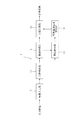
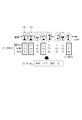
- FIG. 1 is a block diagram showing a schematic configuration of a people counting apparatus according to an embodiment of the present invention.
- the person counting device 1 of the present embodiment includes a video input unit 10, a person extracting unit 11, a flow line creating unit 12, an attribute extracting unit 13, a measurement reference coordinate setting unit 14, and a person counting.
- a measurement reference coordinate of a human flow line corresponding to the person according to the attribute of the person, and the number of people is measured using the measurement reference coordinate.
- the video input unit 10 inputs video output from a camera (not shown).
- the person extraction unit 11 extracts a person region from the video input by the video input unit 10 using a face or person shape pattern or background difference / interframe difference information.
- the flow line creation unit 12 extracts a person's flow line from the correlation (position, image similarity) of the person regions arranged in time series from the person region extracted by the person extraction unit 11.
- the attribute extraction unit 13 extracts attribute information such as a person's age, sex, movement speed, and face orientation from the person region extracted by the person extraction unit 11.
- the attribute extraction unit 13 obtains age, sex, and the like from the image input from the person extraction unit 11. Further, the speed is obtained from the flow line input from the flow line creation unit 12.
- the measurement reference coordinate setting unit 14 sets measurement reference coordinates for each person according to the attribute information acquired by the attribute extraction unit 13.
- the person counting unit 15 counts the number of persons when the measurement reference coordinates are passed.
- the measurement reference coordinate is a measurement line, and when the measurement line and a person flow line intersect, the person flow line is counted as the number of people.
- the measurement area is a line having a narrow width, but may be a rectangle having a wide width. The rectangular rectangular measurement area is described at the end of this specification.
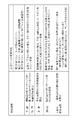
- FIG. 2 is a diagram illustrating an example of a method for dynamically changing a measurement line.
- the types of attributes are “age”, “gender”, “speed”, “face orientation”, and “person detection frequency”.
- the change contents of the measurement line are the first measurement line to the third measurement line.
- 1st measurement line Line set by user 2nd measurement line: Line for children and elderly people (automatic adjustment)
- Third measurement line Line for adults with low detection frequency (automatic adjustment)
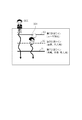
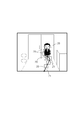
- FIG. 3 is a diagram illustrating an example of the first measurement line 30 set by the user, the second measurement line 31 and the third measurement line 32 that are automatically adjusted.
- the age and gender are estimated from the shape pattern analysis of facial parts (eyes, nose, mouth) and line analysis of wrinkles and sagging.
- the measurement line of the person is changed to the second measurement line 31.
- the speed is obtained by detecting moving pixels per unit time.
- the movement amount (pixel) is small, the change content of the measurement line at the time of speed is determined as a child / elderly person, and the measurement line of the person is changed to the second measurement line 31.
- the face orientation is estimated from the shape pattern analysis of the facial parts.
- the measurement line changes when the face is facing. If the direction in the flow line (average) or the direction at the predetermined position is greater than or equal to the predetermined value, it is determined that the child is an elderly person, and the measurement line is the second measurement line. Change to 31. Because the child is short, it looks down when viewed from the camera (not shown). Elderly people have their hips bent and look down from the camera. Thus, the child / elderly person is discriminated by facing downward.
- the person detection frequency is obtained by calculating the number of detected faces per flow line.
- the change content of the measurement line at the person detection frequency changes the measurement line to the third measurement line 32 when the detection frequency is low.
- the situation where the detection frequency is low is as follows. ⁇ When the entrance is crowded and hidden behind other people ⁇ In the case of a person who is difficult to detect (person who has no difference from the background, wearing sunglasses, etc.)
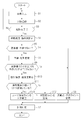
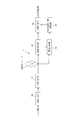
- FIG. 4 is a flowchart for explaining the operation of the people counting apparatus 1 of the present embodiment.
- the video input unit 10 inputs a video (step S1), and the person extraction unit 11 extracts a person area from the video input by the video input unit 10.
- the flow line creation unit 12 extracts the flow line of the person extracted by the person extraction unit 11, and starts tracking the person (step S2).
- the person tracking method for example, there is a tracking method using a face frame.
- FIG. 5 is a diagram for explaining a tracking method using a face frame. As shown in the figure, the face frame 20 is linked in time series from the detected movement amount and movement direction of the face frame 20 per unit time. A flow line 21 is obtained by linking the face frame 20 in time series.
- step S3 If it is determined in step S3 that tracking is not complete (if “No” in step S3), the process returns to step S1. If tracking is determined to be complete (“Yes” in step S3), the moving speed and face The direction is estimated (step S4). After estimating the moving speed and the face direction, it is confirmed from the estimation result that the person being tracked is not an elderly person / child (step S5). In this confirmation, when the person being tracked is an elderly person / child (in the case of “No” in step S5), the second measurement line 31 for the elderly person / child is changed (step S6). And the measurement determination which counts the number of people in the 2nd measurement line 31 is performed (step S7).
- step S8 the age / sex is estimated (step S8).
- the estimation of age and sex is performed as shown in FIG.
- FIG. 6 is a diagram for explaining an age / gender estimation method. As shown in the figure, first, (1) estimation processing is executed for all the faces 40 in the extracted flow line. Next, (2) narrowing down usable faces by age and sex using the face orientation. After narrowing down the faces that can be used by age and sex, (3) averaging the values of the narrowed face (s) 40 for the age and sex.
- the face orientation indicated by “ ⁇ ” is substantially in front, and “X” is substantially directly beside.
- the age is 31 years old and the sex is male. That is, since (25 + 30 + 35 + 35) / 4 ⁇ 31 years old, the man is “3” and the woman is “1”, it is determined to be a man.
- step S9 it is then confirmed from the age / sex estimation results that the user is neither an elderly person (60 years or older) nor a child (10 years or younger) (step S9).
- this confirmation when it is an elderly person (60 years old or older) or a child (10 years old or younger) (in the case of “No” in Step S9), it is changed to the second measurement line 31 for elderly persons / children (Step S6). .
- the measurement determination which counts the number of people in the 2nd measurement line 31 is performed (step S7).
- step S9 if it is determined in step S9 that the user is neither an elderly person (60 years or older) nor a child (10 years or younger) (“Yes” in step S9), the detection frequency / congestion degree is calculated (step S10). Next, it is confirmed from the calculation result of the detection frequency / congestion degree that the detection frequency is low (and is congested) (step S11). In this confirmation, when the detection frequency is not low (and not congested) (“No” in step S11), the first measurement line (the measurement line determined first) 30 set by the user is adopted (step S12). ), The measurement determination of counting the number of people in the first measurement line 30 is performed (step S7).
- step S11 When the detection frequency is low (and congested) in the confirmation in step S11 (“Yes” in step S11), the first measurement line 30 set by the user is corrected downward (step S13), and the corrected third measurement is performed. Measurement determination is performed to count the number of people in line 32 (step S7). Note that the detection frequency / congestion level is not an attribute, but is a determiner for adjusting the measurement line. After performing the process of step S7, this process is finished.
- the video input unit 10 that inputs video
- the person extraction unit 11 that extracts a person from the video input by the video input unit 10
- the person extraction unit A flow line creation unit 12 that creates a human flow line from the position information in the image of the person extracted in 11, and the movement speed, face orientation, age sex, detection frequency, and congestion of the person extracted in the person extraction unit 11.
- An attribute extraction unit 13 for obtaining the attribute of the degree, and a measurement line of the person flow line corresponding to the person according to the attribute of the person extracted by the attribute extraction unit 13 (first measurement line 30 to third measurement line 32)
- a measurement reference coordinate setting unit 14 for setting the number of people, and a number measurement unit 15 for counting the number of people from the positional relationship between the person flow line created by the flow line creation unit 12 and the measurement line set in the image, Person movement speed, face orientation, age gender, Since setting the measurement line of person flow line that corresponds to the person object in accordance with the intellectual frequency, the degree of congestion, it is possible to ensure that people counting even in the low stature of a person, such as children and the elderly.
- the people counting device 1 of the present embodiment three measurement lines (first measurement line 30 to third measurement line 32) are set, but the number may be increased beyond that. By doing in this way, the number of people can be measured with higher accuracy. For example, when it is determined that a woman is present, a measurement line that is slightly lower than the first measurement line 30 can be set, and women can be counted reliably.
- the determination by the first measurement line 30 to the third measurement line 32 is impossible, and it is possible to output “unknown”. For example, (1) When it is too crowded, (2) When the detection frequency is extremely low, (3) When the moving speed is extremely fast, (4) When the moving speed is extremely slow, “Unknown” is output To do. By doing in this way, it is possible to prevent the wrong number of people from being measured and to accurately measure the number of people.
- the measurement area is a narrow line, but it may be a wide rectangle.
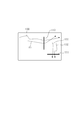
- FIG. 7 is a diagram illustrating an example when the measurement area is rectangular. If the measurement area is a narrow line, the height difference may not be covered, but by making it a wide rectangle, an improvement in accuracy when automatically changing to the second and third measurement lines can be expected. Further, by counting the number of people only when tracking is started within the rectangular measurement area 60 (for example, when a flow line indicated by an arrow 61 is detected), a person who has already entered the store (in the case of a store) can be obtained. It is possible to prevent re-counting due to in-store wandering or the like (for example, a flow line such as an arrow 62).
- the condition for counting the number of people may be set when the starting point of the flow line is in a rectangle and the flow line intersects the outer periphery of the rectangle at least once.
- a condition for counting the number of people a case where the flow line does not intersect with the outer periphery of the rectangle is allowed, and a start point of the flow line may be within the rectangle. In the case of this condition, it is possible to count the number of people even when the entrance is congested and hidden behind others and the detection frequency is low.
- a storage medium such as a magnetic disk, an optical disk, a magneto-optical disk, or a semiconductor memory for distribution. is there.
- the people counting apparatus 1 of the present embodiment can be configured via a network 500 as shown in FIG.
- the position information and the whole body image (or face image) of the person extracted by the person extraction unit 11 are sent to the network 500, and the flow line creation unit 12 and the attribute extraction unit 13 are sent from the network 500.
- Each part is processed based on the in-view position information and the whole body image.
- transmission of the whole body image every frame puts a load on the network 500, and therefore, it may be devised such as transmitting only when the face becomes a predetermined size or more.
- the attribute extraction unit 13 is also arranged on the network transmission side, and only the text information of the position information in the angle of view and the person attribute information (direction, age and sex) is transmitted to the network 500 to reduce the load on the network 500. Is also possible.
- the present invention has an effect that even a short stature person such as a child or an elderly person can surely count the number of people, and is applied to an apparatus or system for counting the number of visitors to a store or the number of visitors to a facility. Is possible.
Landscapes
- Engineering & Computer Science (AREA)
- Physics & Mathematics (AREA)
- General Physics & Mathematics (AREA)
- Theoretical Computer Science (AREA)
- Multimedia (AREA)
- Computer Vision & Pattern Recognition (AREA)
- Human Computer Interaction (AREA)
- Image Analysis (AREA)
- Image Processing (AREA)
Abstract
Description
第1計測ライン:ユーザ設定したライン
第2計測ライン:子供・高齢者向けライン(自動調整)
第3計測ライン:検知頻度の低い成人向けライン(自動調整)
検知頻度が小さい状況とは、以下の場合である。
・入口が混雑していて、他人の影に隠れてしまう場合
・検知し難い人物(背景との差がない人、サングラスをかける等)の場合
図4は、本実施の形態の人数計測装置1の動作を説明するためのフローチャートである。同図において、まず映像入力部10が映像を入力し(ステップS1)、人物抽出部11が、映像入力部10にて入力された映像から人物の領域を抽出する。そして、動線作成部12が、人物抽出部11にて抽出された当該人物の動線を抽出し、当該人物の追跡を開始する(ステップS2)。人物追跡方法には、例えば顔枠を利用した追跡方法がある。図5は、顔枠を利用した追跡方法を説明するための図である。同図に示すように、検出した顔枠20の単位時間あたりの移動量及び移動方向から顔枠20を時系列に紐付けしていく。顔枠20を時系列に紐付けすることで、動線21が得られる。
なお、全身画像を毎フレーム送信するとネットワーク500に負荷がかかるため、顔が所定の大きさ以上となった場合にのみ送信するなど工夫してもよい。
また、属性抽出部13もネットワーク送信側に配置し、ネットワーク500には、画角内位置情報及び人物属性情報(向き,年齢性別など)のテキスト情報のみを送信しネットワーク500の負荷を軽減することも可能である。
10 映像入力部
11 人物抽出部
12 動線作成部
13 属性抽出部
14 計測基準座標設定部
15 人数計測部
20 顔枠
21 動線
30 第1計測ライン
31 第2計測ライン
32 第3計測ライン
40 顔
60 計測エリア
300 大人
301 子供
500 ネットワーク
Claims (13)
- 映像を入力する映像入力部と、
前記映像入力部にて入力された映像から人物を抽出する人物抽出部と、
前記人物抽出部にて抽出された人物の画像内位置情報から人物動線を作成する動線作成部と、
前記動線作成部にて作成された人物動線と画像内に設定された計測基準座標との位置関係から人数をカウントする人数計測部と、
前記人物抽出部にて抽出された前記人物の属性を求める属性抽出部と、
前記属性抽出部にて抽出された前記人物の属性に応じて前記人物に対応する人物動線の前記計測基準座標を設定する計測基準座標設定部と、
を備えた人数計測装置。 - 前記属性抽出部は属性として年齢を抽出し、
前記計測基準座標設定部は、年齢が第1の所定年齢より低いまたは第2の所定年齢より高いと判定された場合にはそれ以外の場合と比べて前記計測基準座標を画像内下方に設定する請求項1に記載の人数計測装置。 - 前記属性抽出部は属性として性別を抽出し、
前記計測基準座標設定部は、性別が女性と判定された場合には性別が男性と判定された場合と比べて前記計測基準座標を画像内下方に設定する請求項1に記載の人数計測装置。 - 前記属性抽出部は属性として移動速度を抽出し、
前記計測基準座標設定部は、移動速度が所定速度より遅いと判定された場合にはそれ以外の場合と比べて前記計測基準座標を画像内下方に設定する請求項1に記載の人数計測装置。 - 前記属性抽出部は属性として顔向きを抽出し、
前記計測基準座標設定部は、顔向きが所定角度より大きいと判定された場合にはそれ以外の場合と比べて前記計測基準座標を画像内下方に設定する請求項1に記載の人数計測装置。 - 前記計測基準座標設定部は、前記人物の検知頻度が所定頻度より低いと判定された場合にはそれ以外の場合と比べて前記計測基準座標を画像内下方に設定する請求項1に記載の人数計測装置。
- 前記計測基準座標設定部は、混雑度が所定値より高いと判定された場合にはそれ以外の場合と比べて前記計測基準座標を画像内下方に設定する請求項1に記載の人数計測装置。
- 前記計測基準座標設定部にて設定される前記計測基準座標の設定先が複数である請求項1乃至請求項7のいずれか一項に記載の人数計測装置。
- 前記計測基準座標設定部にて設定される前記計測基準座標の設定先が不明である請求項1乃至請求項7のいずれか一項に記載の人数計測装置。
- 前記人数計測部は、前記計測基準座標がラインであり前記人物動線と前記ラインが交わった場合にその人物動線を人数としてカウントする請求項1乃至請求項9のいずれか一項に記載の人数計測装置。
- 前記人数計測部は、前記計測基準座標が矩形であり前記人物動線と前記矩形が交わった場合にその人物動線を人数としてカウントする請求項1乃至請求項9のいずれか一項に記載の人数計測装置。
- 前記人数計測部は、前記計測基準座標が矩形であり前記人物動線の始点が前記計測基準座標の内部に位置している場合にカウントする請求項1乃至請求項9のいずれか一項に記載の人数計測装置。
- 映像を入力する映像入力部と、
前記映像入力部にて入力された映像から人物を抽出する人物抽出部と、
前記人物抽出部にて抽出された人物の画像内位置情報から人物動線を作成する動線作成部と、
前記動線作成部にて作成された人物動線と画像内に設定された矩形との位置関係から人数をカウントする人数計測部と、
を備えた人数計測装置。
Priority Applications (4)
| Application Number | Priority Date | Filing Date | Title |
|---|---|---|---|
| CN201280016936.2A CN103477355B (zh) | 2011-03-31 | 2012-03-28 | 人数测量装置 |
| EP12763977.1A EP2693373A4 (en) | 2011-03-31 | 2012-03-28 | DEVICE FOR MEASURING A PERSONNEL NUMBER |
| JP2013507188A JP5975353B2 (ja) | 2011-03-31 | 2012-03-28 | 人数計測装置 |
| US14/008,097 US9390334B2 (en) | 2011-03-31 | 2012-03-28 | Number of persons measurement device |
Applications Claiming Priority (2)
| Application Number | Priority Date | Filing Date | Title |
|---|---|---|---|
| JP2011080294 | 2011-03-31 | ||
| JP2011-080294 | 2011-03-31 |
Publications (1)
| Publication Number | Publication Date |
|---|---|
| WO2012132437A1 true WO2012132437A1 (ja) | 2012-10-04 |
Family
ID=46930209
Family Applications (1)
| Application Number | Title | Priority Date | Filing Date |
|---|---|---|---|
| PCT/JP2012/002163 Ceased WO2012132437A1 (ja) | 2011-03-31 | 2012-03-28 | 人数計測装置 |
Country Status (5)
| Country | Link |
|---|---|
| US (1) | US9390334B2 (ja) |
| EP (1) | EP2693373A4 (ja) |
| JP (1) | JP5975353B2 (ja) |
| CN (1) | CN103477355B (ja) |
| WO (1) | WO2012132437A1 (ja) |
Cited By (8)
| Publication number | Priority date | Publication date | Assignee | Title |
|---|---|---|---|---|
| CN103839308A (zh) * | 2012-11-26 | 2014-06-04 | 中兴通讯股份有限公司 | 人数获取方法、装置及系统 |
| CN104112309A (zh) * | 2014-08-01 | 2014-10-22 | 西安电子科技大学 | 一种采用视频监控自动记录公交车人流量的装置及方法 |
| JP2015203912A (ja) * | 2014-04-11 | 2015-11-16 | パナソニックIpマネジメント株式会社 | 人数計測装置、人数計測システムおよび人数計測方法 |
| JP2016057998A (ja) * | 2014-09-12 | 2016-04-21 | 株式会社日立国際電気 | 物体識別方法 |
| KR20160078154A (ko) * | 2014-12-24 | 2016-07-04 | 주식회사 케이티 | 고객 정보 제공 방법, 장치 및 컴퓨터 프로그램 |
| JP2017174259A (ja) * | 2016-03-25 | 2017-09-28 | 富士ゼロックス株式会社 | 動体計数装置及びプログラム |
| JP2019200590A (ja) * | 2018-05-16 | 2019-11-21 | キヤノン株式会社 | 情報処理装置、撮像装置、情報処理方法及びプログラム |
| US20220375227A1 (en) * | 2019-12-19 | 2022-11-24 | Nec Corporation | Counting system, counting method, and program |
Families Citing this family (18)
| Publication number | Priority date | Publication date | Assignee | Title |
|---|---|---|---|---|
| KR101480348B1 (ko) * | 2013-05-31 | 2015-01-09 | 삼성에스디에스 주식회사 | 사람 검출 장치 및 방법과 사람 계수 장치 및 방법 |
| JP5506989B1 (ja) | 2013-07-11 | 2014-05-28 | パナソニック株式会社 | 追跡支援装置、追跡支援システムおよび追跡支援方法 |
| TW201504977A (zh) * | 2013-07-16 | 2015-02-01 | Univ Nat Cheng Kung | 智慧型節能電源控制裝置與方法 |
| JP6206804B2 (ja) | 2013-09-27 | 2017-10-04 | パナソニックIpマネジメント株式会社 | 移動体追跡装置、移動体追跡システムおよび移動体追跡方法 |
| JP5613815B1 (ja) | 2013-10-29 | 2014-10-29 | パナソニック株式会社 | 滞留状況分析装置、滞留状況分析システムおよび滞留状況分析方法 |
| JP5853141B2 (ja) * | 2014-03-26 | 2016-02-09 | パナソニックIpマネジメント株式会社 | 人数計測装置、人数計測システムおよび人数計測方法 |
| WO2016038872A1 (ja) * | 2014-09-11 | 2016-03-17 | 日本電気株式会社 | 情報処理装置、表示方法およびプログラム記憶媒体 |
| TWI537842B (zh) * | 2014-09-30 | 2016-06-11 | 廣達電腦股份有限公司 | 人流計數系統 |
| JP5906556B1 (ja) * | 2014-10-17 | 2016-04-20 | パナソニックIpマネジメント株式会社 | モニタリング装置、モニタリングシステムおよびモニタリング方法 |
| US20200271462A1 (en) * | 2015-12-28 | 2020-08-27 | Nec Corporation | Surveillance apparatus, control method, and program |
| JP6961363B2 (ja) * | 2017-03-06 | 2021-11-05 | キヤノン株式会社 | 情報処理システム、情報処理方法及びプログラム |
| CN108537828B (zh) * | 2018-04-16 | 2020-12-04 | 成都博锐智晟科技有限公司 | 一种店铺数据分析方法及系统 |
| IT201800003188A1 (it) * | 2018-05-25 | 2019-11-25 | Dispositivo contateste e metodo di processamento di immagini digitali | |
| CN108921874B (zh) * | 2018-07-04 | 2020-12-29 | 百度在线网络技术(北京)有限公司 | 人体跟踪处理方法、装置及系统 |
| US11436839B2 (en) * | 2018-11-02 | 2022-09-06 | Toyota Research Institute, Inc. | Systems and methods of detecting moving obstacles |
| WO2021033316A1 (ja) * | 2019-08-22 | 2021-02-25 | 日本電信電話株式会社 | 人数推定装置、人数推定方法、及び人数推定プログラム |
| CN112116650B (zh) * | 2020-09-29 | 2024-10-18 | 联想(北京)有限公司 | 一种基准线调整方法及装置 |
| CN114241015B (zh) * | 2022-02-28 | 2022-05-13 | 长沙莫之比智能科技有限公司 | 一种基于毫米波雷达的进出人数计数方法和装置 |
Citations (5)
| Publication number | Priority date | Publication date | Assignee | Title |
|---|---|---|---|---|
| JPH06223157A (ja) | 1992-09-30 | 1994-08-12 | Shimizu Corp | 画像センサによる移動体検知システム |
| JPH0993472A (ja) * | 1995-09-28 | 1997-04-04 | Matsushita Electric Ind Co Ltd | 自動監視装置 |
| JP2005135339A (ja) * | 2003-10-31 | 2005-05-26 | Konica Minolta Holdings Inc | 通行人検出方法および装置ならびに通行人計数装置 |
| JP2007287094A (ja) * | 2006-04-20 | 2007-11-01 | Nabtesco Corp | 通行者計数装置及び計数機能付き自動ドア |
| JP2008077430A (ja) * | 2006-09-21 | 2008-04-03 | Oki Electric Ind Co Ltd | 移動体計数装置および移動体計数方法 |
Family Cites Families (10)
| Publication number | Priority date | Publication date | Assignee | Title |
|---|---|---|---|---|
| JP3076982B2 (ja) * | 1997-12-19 | 2000-08-14 | 技研トラステム株式会社 | 移動体計数装置 |
| US7336803B2 (en) | 2002-10-17 | 2008-02-26 | Siemens Corporate Research, Inc. | Method for scene modeling and change detection |
| WO2005020152A1 (ja) * | 2003-08-21 | 2005-03-03 | Matsushita Electric Industrial Co., Ltd. | 人物検出装置および人物検出方法 |
| JP2007241960A (ja) * | 2006-03-13 | 2007-09-20 | Fuji Electric Device Technology Co Ltd | 移動体カウント装置 |
| US7991193B2 (en) * | 2007-07-30 | 2011-08-02 | International Business Machines Corporation | Automated learning for people counting systems |
| JP4858400B2 (ja) * | 2007-10-17 | 2012-01-18 | ソニー株式会社 | 情報提供システム、情報提供装置、情報提供方法 |
| US20090158309A1 (en) * | 2007-12-12 | 2009-06-18 | Hankyu Moon | Method and system for media audience measurement and spatial extrapolation based on site, display, crowd, and viewership characterization |
| CN101763669A (zh) | 2009-10-26 | 2010-06-30 | 杭州六易科技有限公司 | 公交车人流量计数装置 |
| GB2476500B (en) * | 2009-12-24 | 2012-06-20 | Infrared Integrated Syst Ltd | Activity mapping system |
| US20110169917A1 (en) * | 2010-01-11 | 2011-07-14 | Shoppertrak Rct Corporation | System And Process For Detecting, Tracking And Counting Human Objects of Interest |
-
2012
- 2012-03-28 JP JP2013507188A patent/JP5975353B2/ja active Active
- 2012-03-28 CN CN201280016936.2A patent/CN103477355B/zh not_active Expired - Fee Related
- 2012-03-28 WO PCT/JP2012/002163 patent/WO2012132437A1/ja not_active Ceased
- 2012-03-28 EP EP12763977.1A patent/EP2693373A4/en not_active Withdrawn
- 2012-03-28 US US14/008,097 patent/US9390334B2/en active Active
Patent Citations (5)
| Publication number | Priority date | Publication date | Assignee | Title |
|---|---|---|---|---|
| JPH06223157A (ja) | 1992-09-30 | 1994-08-12 | Shimizu Corp | 画像センサによる移動体検知システム |
| JPH0993472A (ja) * | 1995-09-28 | 1997-04-04 | Matsushita Electric Ind Co Ltd | 自動監視装置 |
| JP2005135339A (ja) * | 2003-10-31 | 2005-05-26 | Konica Minolta Holdings Inc | 通行人検出方法および装置ならびに通行人計数装置 |
| JP2007287094A (ja) * | 2006-04-20 | 2007-11-01 | Nabtesco Corp | 通行者計数装置及び計数機能付き自動ドア |
| JP2008077430A (ja) * | 2006-09-21 | 2008-04-03 | Oki Electric Ind Co Ltd | 移動体計数装置および移動体計数方法 |
Non-Patent Citations (1)
| Title |
|---|
| See also references of EP2693373A4 |
Cited By (10)
| Publication number | Priority date | Publication date | Assignee | Title |
|---|---|---|---|---|
| CN103839308A (zh) * | 2012-11-26 | 2014-06-04 | 中兴通讯股份有限公司 | 人数获取方法、装置及系统 |
| US9824460B2 (en) | 2012-11-26 | 2017-11-21 | Xi'an Zhongxing New Software Co.Ltd. | Method, apparatus and system for acquiring headcount |
| JP2015203912A (ja) * | 2014-04-11 | 2015-11-16 | パナソニックIpマネジメント株式会社 | 人数計測装置、人数計測システムおよび人数計測方法 |
| CN104112309A (zh) * | 2014-08-01 | 2014-10-22 | 西安电子科技大学 | 一种采用视频监控自动记录公交车人流量的装置及方法 |
| JP2016057998A (ja) * | 2014-09-12 | 2016-04-21 | 株式会社日立国際電気 | 物体識別方法 |
| KR20160078154A (ko) * | 2014-12-24 | 2016-07-04 | 주식회사 케이티 | 고객 정보 제공 방법, 장치 및 컴퓨터 프로그램 |
| KR102428319B1 (ko) * | 2014-12-24 | 2022-08-02 | 주식회사 케이티 | 고객 정보 제공 방법, 장치 및 컴퓨터 프로그램 |
| JP2017174259A (ja) * | 2016-03-25 | 2017-09-28 | 富士ゼロックス株式会社 | 動体計数装置及びプログラム |
| JP2019200590A (ja) * | 2018-05-16 | 2019-11-21 | キヤノン株式会社 | 情報処理装置、撮像装置、情報処理方法及びプログラム |
| US20220375227A1 (en) * | 2019-12-19 | 2022-11-24 | Nec Corporation | Counting system, counting method, and program |
Also Published As
| Publication number | Publication date |
|---|---|
| CN103477355B (zh) | 2016-04-20 |
| CN103477355A (zh) | 2013-12-25 |
| EP2693373A4 (en) | 2015-02-18 |
| US9390334B2 (en) | 2016-07-12 |
| US20140037147A1 (en) | 2014-02-06 |
| JPWO2012132437A1 (ja) | 2014-07-24 |
| JP5975353B2 (ja) | 2016-08-23 |
| EP2693373A1 (en) | 2014-02-05 |
Similar Documents
| Publication | Publication Date | Title |
|---|---|---|
| JP5975353B2 (ja) | 人数計測装置 | |
| CN104881642B (zh) | 一种内容推送方法、装置及设备 | |
| US8724845B2 (en) | Content determination program and content determination device | |
| US20090220123A1 (en) | Apparatus and method for counting number of objects | |
| JP2020061128A5 (ja) | ||
| US20160127657A1 (en) | Imaging system | |
| JP2010063001A (ja) | 人物追跡装置および人物追跡プログラム | |
| WO2019151117A1 (ja) | 情報処理装置 | |
| JP2013196684A (ja) | 対象物計数方法および対象物計数装置 | |
| CN103238163A (zh) | 用于规定作为广告分发对象的设备,以及广告分发设备 | |
| CN104517298B (zh) | 移动体检测装置 | |
| US10496874B2 (en) | Facial detection device, facial detection system provided with same, and facial detection method | |
| US12201403B2 (en) | Free flow fever screening | |
| CN106663325A (zh) | 图像处理装置、图像处理方法和程序 | |
| JP6558831B2 (ja) | オブジェクト追跡装置、方法およびプログラム | |
| JP5165540B2 (ja) | 身長検出システムおよびこれを用いた自動改札機 | |
| JP6349272B2 (ja) | 移動物体追跡装置 | |
| CN112347904B (zh) | 基于双目深度和图片结构的活体检测方法、装置及介质 | |
| CN107862713A (zh) | 针对轮询会场的摄像机偏转实时检测预警方法及模块 | |
| CN113989894A (zh) | 防尾随方法、装置及计算机可读存储介质 | |
| JP6180906B2 (ja) | 顔認識ゲートシステム | |
| JP7739543B2 (ja) | 学習装置、及びプログラム | |
| CN112686173A (zh) | 一种客流计数方法、装置、电子设备及存储介质 | |
| JP4825350B2 (ja) | 通過物体計数装置及び計数方法 | |
| JP2020166523A (ja) | 興味度情報取得システム、情報処理装置、及び情報処理プログラム |
Legal Events
| Date | Code | Title | Description |
|---|---|---|---|
| WWE | Wipo information: entry into national phase |
Ref document number: 201280016936.2 Country of ref document: CN |
|
| 121 | Ep: the epo has been informed by wipo that ep was designated in this application |
Ref document number: 12763977 Country of ref document: EP Kind code of ref document: A1 |
|
| ENP | Entry into the national phase |
Ref document number: 2013507188 Country of ref document: JP Kind code of ref document: A |
|
| REEP | Request for entry into the european phase |
Ref document number: 2012763977 Country of ref document: EP |
|
| WWE | Wipo information: entry into national phase |
Ref document number: 14008097 Country of ref document: US Ref document number: 2012763977 Country of ref document: EP |
|
| NENP | Non-entry into the national phase |
Ref country code: DE |