WO2012133352A1 - フォトレジスト組成物 - Google Patents
フォトレジスト組成物 Download PDFInfo
- Publication number
- WO2012133352A1 WO2012133352A1 PCT/JP2012/057837 JP2012057837W WO2012133352A1 WO 2012133352 A1 WO2012133352 A1 WO 2012133352A1 JP 2012057837 W JP2012057837 W JP 2012057837W WO 2012133352 A1 WO2012133352 A1 WO 2012133352A1
- Authority
- WO
- WIPO (PCT)
- Prior art keywords
- group
- structural unit
- carbon atoms
- photoresist composition
- polymer
- Prior art date
- Legal status (The legal status is an assumption and is not a legal conclusion. Google has not performed a legal analysis and makes no representation as to the accuracy of the status listed.)
- Ceased
Links
Classifications
-
- C—CHEMISTRY; METALLURGY
- C08—ORGANIC MACROMOLECULAR COMPOUNDS; THEIR PREPARATION OR CHEMICAL WORKING-UP; COMPOSITIONS BASED THEREON
- C08F—MACROMOLECULAR COMPOUNDS OBTAINED BY REACTIONS ONLY INVOLVING CARBON-TO-CARBON UNSATURATED BONDS
- C08F220/00—Copolymers of compounds having one or more unsaturated aliphatic radicals, each having only one carbon-to-carbon double bond, and only one being terminated by only one carboxyl radical or a salt, anhydride ester, amide, imide or nitrile thereof
- C08F220/02—Monocarboxylic acids having less than ten carbon atoms; Derivatives thereof
- C08F220/10—Esters
- C08F220/12—Esters of monohydric alcohols or phenols
- C08F220/16—Esters of monohydric alcohols or phenols of phenols or of alcohols containing two or more carbon atoms
- C08F220/18—Esters of monohydric alcohols or phenols of phenols or of alcohols containing two or more carbon atoms with acrylic or methacrylic acids
- C08F220/1812—C12-(meth)acrylate, e.g. lauryl (meth)acrylate
-
- C—CHEMISTRY; METALLURGY
- C08—ORGANIC MACROMOLECULAR COMPOUNDS; THEIR PREPARATION OR CHEMICAL WORKING-UP; COMPOSITIONS BASED THEREON
- C08F—MACROMOLECULAR COMPOUNDS OBTAINED BY REACTIONS ONLY INVOLVING CARBON-TO-CARBON UNSATURATED BONDS
- C08F220/00—Copolymers of compounds having one or more unsaturated aliphatic radicals, each having only one carbon-to-carbon double bond, and only one being terminated by only one carboxyl radical or a salt, anhydride ester, amide, imide or nitrile thereof
- C08F220/02—Monocarboxylic acids having less than ten carbon atoms; Derivatives thereof
- C08F220/10—Esters
- C08F220/12—Esters of monohydric alcohols or phenols
- C08F220/16—Esters of monohydric alcohols or phenols of phenols or of alcohols containing two or more carbon atoms
- C08F220/18—Esters of monohydric alcohols or phenols of phenols or of alcohols containing two or more carbon atoms with acrylic or methacrylic acids
- C08F220/1806—C6-(meth)acrylate, e.g. (cyclo)hexyl (meth)acrylate or phenyl (meth)acrylate
-
- C—CHEMISTRY; METALLURGY
- C08—ORGANIC MACROMOLECULAR COMPOUNDS; THEIR PREPARATION OR CHEMICAL WORKING-UP; COMPOSITIONS BASED THEREON
- C08F—MACROMOLECULAR COMPOUNDS OBTAINED BY REACTIONS ONLY INVOLVING CARBON-TO-CARBON UNSATURATED BONDS
- C08F220/00—Copolymers of compounds having one or more unsaturated aliphatic radicals, each having only one carbon-to-carbon double bond, and only one being terminated by only one carboxyl radical or a salt, anhydride ester, amide, imide or nitrile thereof
- C08F220/02—Monocarboxylic acids having less than ten carbon atoms; Derivatives thereof
- C08F220/10—Esters
- C08F220/12—Esters of monohydric alcohols or phenols
- C08F220/16—Esters of monohydric alcohols or phenols of phenols or of alcohols containing two or more carbon atoms
- C08F220/18—Esters of monohydric alcohols or phenols of phenols or of alcohols containing two or more carbon atoms with acrylic or methacrylic acids
- C08F220/1808—C8-(meth)acrylate, e.g. isooctyl (meth)acrylate or 2-ethylhexyl (meth)acrylate
-
- C—CHEMISTRY; METALLURGY
- C08—ORGANIC MACROMOLECULAR COMPOUNDS; THEIR PREPARATION OR CHEMICAL WORKING-UP; COMPOSITIONS BASED THEREON
- C08F—MACROMOLECULAR COMPOUNDS OBTAINED BY REACTIONS ONLY INVOLVING CARBON-TO-CARBON UNSATURATED BONDS
- C08F220/00—Copolymers of compounds having one or more unsaturated aliphatic radicals, each having only one carbon-to-carbon double bond, and only one being terminated by only one carboxyl radical or a salt, anhydride ester, amide, imide or nitrile thereof
- C08F220/02—Monocarboxylic acids having less than ten carbon atoms; Derivatives thereof
- C08F220/10—Esters
- C08F220/12—Esters of monohydric alcohols or phenols
- C08F220/16—Esters of monohydric alcohols or phenols of phenols or of alcohols containing two or more carbon atoms
- C08F220/18—Esters of monohydric alcohols or phenols of phenols or of alcohols containing two or more carbon atoms with acrylic or methacrylic acids
- C08F220/1811—C10or C11-(Meth)acrylate, e.g. isodecyl (meth)acrylate, isobornyl (meth)acrylate or 2-naphthyl (meth)acrylate
-
- C—CHEMISTRY; METALLURGY
- C08—ORGANIC MACROMOLECULAR COMPOUNDS; THEIR PREPARATION OR CHEMICAL WORKING-UP; COMPOSITIONS BASED THEREON
- C08F—MACROMOLECULAR COMPOUNDS OBTAINED BY REACTIONS ONLY INVOLVING CARBON-TO-CARBON UNSATURATED BONDS
- C08F220/00—Copolymers of compounds having one or more unsaturated aliphatic radicals, each having only one carbon-to-carbon double bond, and only one being terminated by only one carboxyl radical or a salt, anhydride ester, amide, imide or nitrile thereof
- C08F220/02—Monocarboxylic acids having less than ten carbon atoms; Derivatives thereof
- C08F220/10—Esters
- C08F220/12—Esters of monohydric alcohols or phenols
- C08F220/16—Esters of monohydric alcohols or phenols of phenols or of alcohols containing two or more carbon atoms
- C08F220/18—Esters of monohydric alcohols or phenols of phenols or of alcohols containing two or more carbon atoms with acrylic or methacrylic acids
- C08F220/1818—C13or longer chain (meth)acrylate, e.g. stearyl (meth)acrylate
-
- C—CHEMISTRY; METALLURGY
- C08—ORGANIC MACROMOLECULAR COMPOUNDS; THEIR PREPARATION OR CHEMICAL WORKING-UP; COMPOSITIONS BASED THEREON
- C08F—MACROMOLECULAR COMPOUNDS OBTAINED BY REACTIONS ONLY INVOLVING CARBON-TO-CARBON UNSATURATED BONDS
- C08F224/00—Copolymers of compounds having one or more unsaturated aliphatic radicals, each having only one carbon-to-carbon double bond, and at least one being terminated by a heterocyclic ring containing oxygen
-
- G—PHYSICS
- G03—PHOTOGRAPHY; CINEMATOGRAPHY; ANALOGOUS TECHNIQUES USING WAVES OTHER THAN OPTICAL WAVES; ELECTROGRAPHY; HOLOGRAPHY
- G03F—PHOTOMECHANICAL PRODUCTION OF TEXTURED OR PATTERNED SURFACES, e.g. FOR PRINTING, FOR PROCESSING OF SEMICONDUCTOR DEVICES; MATERIALS THEREFOR; ORIGINALS THEREFOR; APPARATUS SPECIALLY ADAPTED THEREFOR
- G03F7/00—Photomechanical, e.g. photolithographic, production of textured or patterned surfaces, e.g. printing surfaces; Materials therefor, e.g. comprising photoresists; Apparatus specially adapted therefor
- G03F7/004—Photosensitive materials
- G03F7/039—Macromolecular compounds which are photodegradable, e.g. positive electron resists
-
- G—PHYSICS
- G03—PHOTOGRAPHY; CINEMATOGRAPHY; ANALOGOUS TECHNIQUES USING WAVES OTHER THAN OPTICAL WAVES; ELECTROGRAPHY; HOLOGRAPHY
- G03F—PHOTOMECHANICAL PRODUCTION OF TEXTURED OR PATTERNED SURFACES, e.g. FOR PRINTING, FOR PROCESSING OF SEMICONDUCTOR DEVICES; MATERIALS THEREFOR; ORIGINALS THEREFOR; APPARATUS SPECIALLY ADAPTED THEREFOR
- G03F7/00—Photomechanical, e.g. photolithographic, production of textured or patterned surfaces, e.g. printing surfaces; Materials therefor, e.g. comprising photoresists; Apparatus specially adapted therefor
- G03F7/004—Photosensitive materials
- G03F7/039—Macromolecular compounds which are photodegradable, e.g. positive electron resists
- G03F7/0392—Macromolecular compounds which are photodegradable, e.g. positive electron resists the macromolecular compound being present in a chemically amplified positive photoresist composition
- G03F7/0397—Macromolecular compounds which are photodegradable, e.g. positive electron resists the macromolecular compound being present in a chemically amplified positive photoresist composition the macromolecular compound having an alicyclic moiety in a side chain
-
- G—PHYSICS
- G03—PHOTOGRAPHY; CINEMATOGRAPHY; ANALOGOUS TECHNIQUES USING WAVES OTHER THAN OPTICAL WAVES; ELECTROGRAPHY; HOLOGRAPHY
- G03F—PHOTOMECHANICAL PRODUCTION OF TEXTURED OR PATTERNED SURFACES, e.g. FOR PRINTING, FOR PROCESSING OF SEMICONDUCTOR DEVICES; MATERIALS THEREFOR; ORIGINALS THEREFOR; APPARATUS SPECIALLY ADAPTED THEREFOR
- G03F7/00—Photomechanical, e.g. photolithographic, production of textured or patterned surfaces, e.g. printing surfaces; Materials therefor, e.g. comprising photoresists; Apparatus specially adapted therefor
- G03F7/004—Photosensitive materials
- G03F7/09—Photosensitive materials characterised by structural details, e.g. supports, auxiliary layers
- G03F7/11—Photosensitive materials characterised by structural details, e.g. supports, auxiliary layers having cover layers or intermediate layers, e.g. subbing layers
-
- G—PHYSICS
- G03—PHOTOGRAPHY; CINEMATOGRAPHY; ANALOGOUS TECHNIQUES USING WAVES OTHER THAN OPTICAL WAVES; ELECTROGRAPHY; HOLOGRAPHY
- G03F—PHOTOMECHANICAL PRODUCTION OF TEXTURED OR PATTERNED SURFACES, e.g. FOR PRINTING, FOR PROCESSING OF SEMICONDUCTOR DEVICES; MATERIALS THEREFOR; ORIGINALS THEREFOR; APPARATUS SPECIALLY ADAPTED THEREFOR
- G03F7/00—Photomechanical, e.g. photolithographic, production of textured or patterned surfaces, e.g. printing surfaces; Materials therefor, e.g. comprising photoresists; Apparatus specially adapted therefor
- G03F7/20—Exposure; Apparatus therefor
- G03F7/2041—Exposure; Apparatus therefor in the presence of a fluid, e.g. immersion; using fluid cooling means
-
- H—ELECTRICITY
- H10—SEMICONDUCTOR DEVICES; ELECTRIC SOLID-STATE DEVICES NOT OTHERWISE PROVIDED FOR
- H10P—GENERIC PROCESSES OR APPARATUS FOR THE MANUFACTURE OR TREATMENT OF DEVICES COVERED BY CLASS H10
- H10P76/00—Manufacture or treatment of masks on semiconductor bodies, e.g. by lithography or photolithography
Definitions
- the present invention relates to a photoresist composition.
- photoresist compositions as a composition suitable for a shorter wavelength ArF excimer laser, for example, a composition containing a polymer containing an alicyclic group having no large absorption in the 193 nm region in the skeleton is used.
- a composition suitable for a shorter wavelength ArF excimer laser for example, a composition containing a polymer containing an alicyclic group having no large absorption in the 193 nm region in the skeleton is used.
- the polymer those having a spirolactone structure have been proposed (see JP 2002-82441 A and JP 2002-308937 A). It is said that such a polymer having a spirolactone structure can improve the development contrast of a photoresist composition containing the polymer.
- the photoresist composition for forming a finer resist pattern has improved lithography performance using not only basic characteristics such as sensitivity and resolution but also MEEF, DOF, LWR, etc. as an index. Etc. are desired.
- the present invention has been made based on the circumstances as described above, and its purpose is not only basic characteristics such as sensitivity, but also a photoresist composition that sufficiently satisfies lithography performance with MEEF, DOF, LWR, etc. as an index. Is to provide things.
- One or more polymer components (hereinafter also referred to as “[A] polymer component”) having a structural unit (II) containing at least one structure selected from the group consisting of: and [B] acid generation
- a photoresist composition containing a body is a hydrogen atom, a fluorine atom, a hydroxyl group, or a monovalent organic group having 1 to 20 carbon atoms.
- R 2 and R 3 are each independently a hydrogen atom or a fluorine atom.
- a hydroxyl group or a monovalent organic group having 1 to 20 carbon atoms, or R 2 and R 3 are bonded to each other to form a ring structure having 3 to 10 carbon atoms together with the carbon atom to which they are bonded.
- A is an integer of 1 to 6.
- R 4 and R 5 are each Independently, a hydrogen atom, a fluorine atom, a hydroxyl group or a monovalent organic group having 1 to 20 carbon atoms, or R 4 and R 5 are bonded to each other, and together with the carbon atom to which they are bonded, carbon A ring structure of formula 3 to 10 is formed, provided that one of the hydrogen atoms contained in the ring structure is Or all may be substituted.
- the photoresist composition comprises [A] a polymer component having a structural unit (I) containing a lactone structure represented by the above formula (1) and a structural unit (II) containing a cyclic structure such as a cyclic carbonate. Since it contains, it is excellent in the lithography performance which used MEEF, LWR, DOF etc. as a parameter
- the structural unit (II) is preferably a structural unit (II-1) represented by the following formula (2).
- R 6 is a hydrogen atom, a fluorine atom, a methyl group or a trifluoromethyl group
- R 7 is a hydrocarbon group having 1 to 10 carbon atoms
- X is —O—, —COO—, —OCO—, or —NH—, where n is an integer of 0 to 10.
- n is 2 or more, the plurality of R 6 and X may be the same or different.
- R 8 is a single bond or a hydrocarbon group having 1 to 5 carbon atoms
- R 9 is a cyclic organic group having at least one structure selected from the group consisting of a cyclic carbonate structure, a sultone structure, and a lactone structure. (However, some or all of the hydrogen atoms of R 7 to R 9 may be substituted.)
- the photoresist composition is further improved in lithography performance using MEEF, LWR, DOF, etc. as an index.
- the polymer component further has a structural unit (III) represented by the following formula (3).
- R 10 represents a hydrogen atom, a fluorine atom, a methyl group or a trifluoromethyl group.
- R 11 to R 13 each independently represents an alkyl group having 1 to 4 carbon atoms, or a carbon atom.
- R 11 and R 12 may be bonded to each other to form an alicyclic structure together with the carbon atom to which they are bonded. A part or all of hydrogen atoms of the group and the alicyclic group may be substituted.
- the structural unit (III) represented by the above formula (3) has an acid dissociable group that is easily dissociated by the action of an acid generated from the [B] acid generator upon exposure, the photoresist composition [A]
- the polymer component further has the structural unit (III), so that basic characteristics such as sensitivity can be sufficiently satisfied.
- the cyclic organic group having the lactone structure represented by R 9 is a norbornane lactone group or a butyrolactone group, the cyclic organic group having the cyclic carbonate structure is an ethylene carbonate group, and the cyclic organic group having the sultone structure is norbornane.
- a sultone group is preferred.
- the content of the structural unit (I) in the polymer component is 5 mol% or more and 60 mol% or less, and the total content of the structural unit (I) and the structural unit (III) is 10 mol% or more and 80 It is preferable that it is below mol%.
- the photoresist composition has MEEF, LWR, Lithographic performance using DOF or the like as an index can be particularly improved.
- the content of the structural unit in the polymer component is determined by measuring the 13 C-NMR spectrum of the [A] polymer component, and from the area ratio of the peak corresponding to each structural unit in the obtained spectrum. It can obtain
- the photoresist composition of the present invention contains a [A] polymer component having a structural unit (I) containing a lactone structure and a structural unit (II) containing a cyclic structure such as a cyclic carbonate. Therefore, in addition to basic characteristics such as sensitivity, the lithography performance using MEEF, LWR, DOF, etc. as an index is excellent. Therefore, a fine pattern can be formed with high accuracy by using the photoresist composition.
- the photoresist composition contains a [A] polymer component and a [B] acid generator. Moreover, you may contain another component, unless the effect of this invention is impaired. Hereinafter, each component will be described in detail.
- the polymer component is a structural unit (I) represented by the above formula (1) and a structural unit other than the structural unit (I) in the same or different polymers, and a cyclic carbonate structure,
- the photoresist composition satisfies basic characteristics such as sensitivity and is excellent in MEEF, DOF, and LWR.
- the [A] polymer component is a copolymer of a plurality of types of monomer compounds such as a monomer compound that provides the structural unit (I) and a monomer compound that provides the structural unit (II). Or two or more polymers obtained by blending a plurality of polymers such as a polymer of a monomer compound that gives the structural unit (I) and a polymer of the monomer compound that gives the structural unit (II).
- the component may be included.
- the structural unit (III) represented by the above formula (3) is preferably included. Furthermore, you may have another structural unit, unless the effect of this invention is impaired.
- each structural unit will be described in detail.
- the structural unit (I) is represented by the above formula (1). [A] Since the polymer component has a structural unit (I) containing a specific lactone structure directly connected to the polymer main chain, the photoresist composition is excellent in MEEF performance, DOF and LWR.
- R 1 is a hydrogen atom, a fluorine atom, a hydroxyl group or a monovalent organic group having 1 to 20 carbon atoms.
- R 2 and R 3 are each independently a hydrogen atom, a fluorine atom, a hydroxyl group, or a monovalent organic group having 1 to 20 carbon atoms, or R 2 and R 3 are bonded to each other and bonded A ring structure having 3 to 10 carbon atoms is formed together with the carbon atoms.
- a is an integer of 1 to 6. However, when a is 2 or more, the plurality of R 2 and R 3 may be the same or different.
- R 4 and R 5 are each independently a hydrogen atom, a fluorine atom, a hydroxyl group, or a monovalent organic group having 1 to 20 carbon atoms, or R 4 and R 5 are bonded to each other and bonded to each other.
- a ring structure having 3 to 10 carbon atoms is formed together with the carbon atoms. However, one part or all part of the hydrogen atom which the said ring structure has may be substituted.
- Examples of the monovalent organic group having 1 to 20 carbon atoms represented by R 1 to R 5 include a chain hydrocarbon group having 1 to 20 carbon atoms, an alicyclic hydrocarbon group having 3 to 20 carbon atoms, And an aromatic hydrocarbon group having 6 to 20 carbon atoms, a heterocyclic group having 3 to 10 nuclear atoms, an epoxy group, a cyano group, a carboxy group, and a group represented by —R′—QR ′′.
- R ′ is a single bond or a hydrocarbon group having 1 to 20 carbon atoms.
- R ′′ is an optionally substituted hydrocarbon group having 1 to 20 carbon atoms.
- Q is —O—, —CO—, —NH—, —SO 2 —, —SO— or a group formed by combining these.
- halogen atoms such as fluorine atoms, cyano groups, carboxy groups, hydroxyl groups, thiol groups, etc. May be.
- Examples of the chain hydrocarbon group having 1 to 20 carbon atoms include a methyl group, an ethyl group, a propyl group, a butyl group, a pentyl group, a hexyl group, an octyl group, and a decyl group.
- a methyl group, an ethyl group, a propyl group, a butyl group and a pentyl group are preferable, and a methyl group and an ethyl group are more preferable.
- Examples of the alicyclic hydrocarbon group having 3 to 20 carbon atoms include monocyclic alicyclic hydrocarbon groups such as cyclopropyl group, cyclobutyl group, cyclohexyl group, cyclooctyl group, and cyclodecyl group; norbornyl group And a polycyclic alicyclic hydrocarbon group such as an adamantyl group.
- Examples of the aromatic hydrocarbon group having 6 to 20 carbon atoms include a phenyl group and a naphthyl group.
- heterocyclic group having 3 to 10 nuclear atoms examples include lactone group, cyclic carbonate group, sultone group, furyl group, thienyl group, benzofuryl group, benzothienyl group, dibenzofuryl group, dibenzothienyl group, pyridyl group and the like. Is mentioned. Among these, a lactone group, a cyclic carbonate group, and a sultone group are preferable, and a lactone group is more preferable.
- Examples of the hydrocarbon group having 1 to 20 carbon atoms represented by R ′ and R ′′ in —R′—QR ′′ include, for example, a chain hydrocarbon group having 1 to 20 carbon atoms, and 3 to 20 carbon atoms. And an alicyclic hydrocarbon group and an aromatic hydrocarbon group having 6 to 20 carbon atoms. For each, the same groups as those exemplified for the monovalent organic group having 1 to 20 carbon atoms represented by R 1 to R 5 can be given.
- Examples of the ring structure having 3 to 10 carbon atoms formed together with the carbon atom to which R 2 and R 3 and R 4 and R 5 are bonded include cyclopropane, cyclohexane, norbornane, adamantane, etc. And a heterocyclic ring containing a hetero atom such as an oxygen atom, a sulfur atom, or a nitrogen atom.
- cyclopentane, cyclohexane and adamantane are preferable as the alicyclic ring
- cyclic ether, lactone and sultone are preferable as the heterocyclic ring.
- substituents in which part or all of the hydrogen atoms in the ring structure may be substituted include, for example, a fluorine atom, a hydroxyl group, a carboxy group, a cyano group, a sulfanyl group, and a chain hydrocarbon having 1 to 20 carbon atoms.
- a fluorine atom for example, a fluorine atom, a hydroxyl group, a carboxy group, a cyano group, a sulfanyl group, and a chain hydrocarbon having 1 to 20 carbon atoms.
- R 2 and R 3 are preferably hydrogen atoms. Moreover, as said a, 1 is preferable.
- Examples of the structural unit (I) include structural units represented by the following formulas (1-1) to (1-71).
- At least one group of R 4 and R 5 are structural units, structural units in which at least one group of R 4 and R 5 is a cyclic organic group, R 4 and R 5 bonded to an oxygen atom And a structural unit forming a ring structure with the carbon atom to which they are bonded, a structural unit containing a hydroxyl group, and the like are preferable.
- the above formulas (1-1) to (1-9), (1-12) to (1-21), (1-25) to (1-47), (1-55) to (1-67) ), (1-69) to (1-71) and the like are more preferred, and (1-1), (1-17), (1-19), (1-70) and (1) -71) is more preferred.
- the content of the structural unit (I) is such that the total amount of the structural unit (I) is 1 mol% or more and 80 mol% or less with respect to all the structural units constituting the [A] polymer component. Is preferable, and more preferably 5 mol% or more and 60 mol% or less. By setting the content of the structural unit (I) in the above range, excellent lithography performance can be exhibited while maintaining other performance.
- the [A] polymer component may have 1 type, or 2 or more types of structural units (I).
- Examples of the monomer that gives the structural unit (I) include compounds represented by the following formulas.
- the monomer giving the structural unit (I) can be produced, for example, by the following method.
- the structural unit (II) is a structural unit other than the structural unit (I) and includes at least one structure selected from the group consisting of a cyclic carbonate structure, a sultone structure, and a lactone structure.
- the said photoresist composition can improve MEEF performance, DOF, and LWR by containing the [A] polymer component which has structural unit (II).
- the structural unit (II) is preferably a structural unit (II-1) represented by the above formula (2).
- the photoresist composition can further improve MEEF performance, DOF, and LWR by containing the [A] polymer component having the structural unit (II-1) having the specific structure.
- R 6 is a hydrogen atom, a fluorine atom, a methyl group or a trifluoromethyl group.
- R 7 is a hydrocarbon group having 1 to 10 carbon atoms.
- X is —O—, —COO—, —OCO— or —NH—.
- n is an integer of 0 to 10. When n is 2 or more, the plurality of R 7 and X may be the same or different.
- R 8 is a single bond or a hydrocarbon group having 1 to 5 carbon atoms.
- R 9 is a cyclic organic group having at least one structure selected from the group consisting of a cyclic carbonate structure, a sultone structure, and a lactone structure. However, part or all of the hydrogen atoms of R 7 to R 9 may be substituted.
- Examples of the hydrocarbon group having 1 to 10 carbon atoms represented by R 7 include a chain hydrocarbon group having 1 to 10 carbon atoms, an alicyclic hydrocarbon group having 3 to 10 carbon atoms, and 6 to 6 carbon atoms. 10 aromatic hydrocarbon groups and the like.
- Examples of the chain hydrocarbon group having 1 to 10 carbon atoms include a methylene group, an ethylene group, and a propylene group. Of these, a methylene group and an ethylene group are preferred.
- Examples of the alicyclic hydrocarbon group having 3 to 10 carbon atoms include a cyclopropylene group, a cyclohexylene group, and an adamantylene group. Of these, an adamantylene group is preferred.
- Examples of the aromatic hydrocarbon group having 6 to 10 carbon atoms include a phenylene group and a naphthylene group.
- X is preferably —O— or —COO—.
- N is preferably an integer of 0 to 5, more preferably 0 and 1.
- Examples of the hydrocarbon group having 1 to 5 carbon atoms represented by R 8 include a chain hydrocarbon group having 1 to 5 carbon atoms and an alicyclic hydrocarbon group having 3 to 5 carbon atoms.
- Examples of the chain hydrocarbon group having 1 to 5 carbon atoms include a methylene group, an ethylene group, and a propylene group. Of these, a methylene group is preferred.
- Examples of the alicyclic hydrocarbon group having 3 to 5 carbon atoms include a cyclopropylene group and a cyclobutylene group.
- R 8 is preferably a single bond or a methylene group.
- Examples of the cyclic organic group having a cyclic carbonate structure represented by R 9 include an ethylene carbonate group, a 1,3-propylene carbonate group, a cyclopentene carbonate group, a cyclohexene carbonate group, and a norbornene carbonate group.
- Examples of the cyclic organic group having a sultone structure include a propiosluton group, a butyrosulton group, a valero sultone group, and an adamantane sultone group.
- Examples of the cyclic organic group having the lactone structure include a propiolactone group, a butyrolactone group, a valerolactone group, an adamantane lactone group, and the like.
- the cyclic organic group having a cyclic carbonate structure is preferably an ethylene carbonate group
- the cyclic organic group having a sultone structure is preferably a norbornane sultone group
- the cyclic organic group having a lactone structure is a norbornane lactone group.
- a butyrolactone group are preferred.
- Examples of the substituent in which part or all of the hydrogen atoms of R 7 to R 9 may be substituted include, for example, a halogen atom, a hydroxyl group, a carboxyl group, a keto group, a sulfonamide group, an amino group, an amide group, A cyano group, an acetyl group, etc. are mentioned.
- structural unit (II) structural units represented by the following formulas (2-1) to (2-17) can be mentioned as preferred structural units.
- R ⁇ 6 > is synonymous with the said Formula (2).
- the content of the structural unit (II) is such that the total amount of the structural unit (II) with respect to all the structural units constituting the [A] polymer component is 5 mol% or more and 80 mol% or less. Preferably, 5 mol% or more and 60 mol% or less are more preferable. By making content of structural unit (II) into the said range, the outstanding lithography performance can be exhibited, maintaining another performance.
- the [A] polymer component may have 1 type, or 2 or more types of structural units (II).
- Examples of the monomer compound that gives the structural unit (II) include compounds represented by the following formulae.
- the polymer component preferably has a structural unit (III).
- the photoresist composition can sufficiently satisfy basic characteristics such as sensitivity, and can include MEEF, DOF and An excellent resist pattern can be formed by LWR.
- R 10 is a hydrogen atom, a fluorine atom, a methyl group or a trifluoromethyl group.
- R 11 to R 13 are each independently an alkyl group having 1 to 4 carbon atoms or an alicyclic group having 4 to 20 carbon atoms. However, R 11 and R 12 may be bonded to each other to form a divalent alicyclic structure together with the carbon atom to which they are bonded. Moreover, one part or all part of the hydrogen atom which the said alkyl group and alicyclic group have may be substituted.
- Examples of the alkyl group having 1 to 4 carbon atoms represented by R 11 to R 13 include a methyl group, an ethyl group, an n-propyl group, an i-propyl group, an n-butyl group, an i-butyl group, and a tert-butyl group. , 2-methylpropyl group, 1-methylpropyl group and the like.
- Examples of the alicyclic group having 4 to 20 carbon atoms represented by R 11 to R 13 include a polycyclic alicyclic group having a bridged skeleton such as an adamantane skeleton and a norbornane skeleton; and a cycloaliphatic group such as cyclopentane and cyclohexane. And a monocyclic alicyclic group having an alkane skeleton. These groups may be substituted with one or more of linear, branched or cyclic alkyl groups having 1 to 10 carbon atoms, for example.
- Examples of the aromatic hydrocarbon group having 6 to 20 carbon atoms represented by R 11 to R 13 include benzene, naphthalene, phenanthrene, anthracene, tetracene, pentacene, pyrene, picene, toluene, xylene, ethylbenzene, mesitylene, cumene and the like. And a group obtained by removing one hydrogen atom from an aromatic hydrocarbon group.
- Examples of the alicyclic structure that R 11 and R 12 may be bonded to each other and formed together with the carbon atom to which they are bonded include polycyclic fatty acids having a bridged skeleton such as adamantane and norbornane. Examples thereof include a cyclic structure and a monocyclic alicyclic structure having a cycloalkane skeleton such as cyclopentane and cyclohexane.
- the structural unit (III) is preferably a structural unit represented by the following formula.
- R 10 has the same meaning as the above formula (3).
- R 11 is an alkyl group having 1 to 4 carbon atoms.
- m is an integer of 1 to 6.
- more preferred structural units include structural units represented by the following formulas (3-1) to (3-22).
- R 10 has the same meaning as the above formula (3).
- the content of the structural unit (III) is preferably 10% by mole to 80% by mole, more preferably 15% by mole to 80% with respect to all structural units constituting the [A] polymer component. More preferred is mol%, and more preferred is 20 mol% to 70 mol%. By making the content rate of structural unit (III) into the said range, the lithography performance of the resist pattern obtained improves more.
- the [A] polymer component may have 1 type, or 2 or more types of structural units (III).
- Examples of the monomer that gives the structural unit (III) include monomers represented by the following formulas.
- the polymer component may contain a structural unit having a hydrophilic functional group (hereinafter also referred to as “structural unit (IV)”).
- structural unit (IV) a structural unit having a hydrophilic functional group
- Examples of the structural unit (IV) include a structural unit represented by the following formula.
- R 14 is a hydrogen atom, a fluorine atom, a methyl group or a trifluoromethyl group.
- the content of the structural unit (IV) in the polymer component is preferably 0 mol% to 30 mol%, preferably 5 mol% to 20 mol%, based on all structural units constituting the [A] polymer component. Is more preferable.
- the polymer component may have one or more structural units (IV).
- the content of the structural unit (I) in the polymer component [A] is 1 mol% or more and 70 mol% or less, and
- the total content of the structural unit (I) and the structural unit (III) is preferably from 10 mol% to 80 mol%, and the content of the structural unit (I) is from 5 mol% to 60 mol%. More preferably, the total content of the structural unit (I) and the structural unit (III) is 20 mol% or more and 70 mol% or less.
- the content of the structural unit (I) is 10 mol% or more and 50 mol% or less, and the total content of the structural unit (I) and the structural unit (III) is 30 mol% or more and 60 mol% or less. Further preferred.
- the weight average molecular weight of the polymer (i) having the structural unit (I) is the structural unit ( It is preferred that the polymer (ii) having II) is larger than the weight average molecular weight.
- the polymer component [A] is a blend of the polymer (i) having the structural unit (I) and the polymer (ii) having the structural unit (II)
- the weight average molecular weight of the polymer (i) is larger than the weight average molecular weight of the polymer (ii)
- the lithography performance using MEEF, LWR or the like as an index is excellent.
- the polymer component can be produced, for example, by polymerizing monomers corresponding to predetermined structural units in a suitable solvent using a radical polymerization initiator.
- a method of dropping a solution containing a monomer and a radical initiator into a reaction solvent or a solution containing the monomer to cause a polymerization reaction, a solution containing the monomer, and a solution containing the radical initiator Separately, a method of dropping a reaction solvent or a monomer-containing solution into a polymerization reaction, a plurality of types of solutions containing each monomer, and a solution containing a radical initiator, It is preferable to synthesize by a method such as a method of dropping it into a reaction solvent or a solution containing a monomer to cause a polymerization reaction.
- the reaction temperature in these methods may be appropriately determined depending on the initiator type. Usually, it is 30 ° C to 180 ° C, preferably 40 ° C to 160 ° C, and more preferably 50 ° C to 140 ° C.
- the dropping time varies depending on the reaction temperature, the type of initiator, the monomer to be reacted, etc., but is usually 30 minutes to 8 hours, preferably 45 minutes to 6 hours, more preferably 1 hour to 5 hours. .
- the total reaction time including the dropping time varies depending on the conditions as in the dropping time, but is usually from 30 minutes to 8 hours, preferably from 45 minutes to 7 hours, and more preferably from 1 hour to 6 hours.
- radical initiator used in the polymerization examples include azobisisobutyronitrile, 2,2′-azobis (4-methoxy-2,4-dimethylvaleronitrile), 2,2′-azobis (2-cyclopropyl). Propionitrile), 2,2′-azobis (2,4-dimethylvaleronitrile), 2,2′-azobis (2-methylpropionitrile), and the like. Two or more of these initiators may be mixed and used.
- the polymerization solvent is not limited as long as it is a solvent other than a solvent that inhibits polymerization (nitrobenzene having a polymerization inhibiting effect, mercapto compound having a chain transfer effect, etc.) and can dissolve the monomer.
- the polymerization solvent include alcohol solvents, ketone solvents, amide solvents, ester / lactone solvents, nitrile solvents, and mixed solvents thereof. These solvents can be used alone or in combination of two or more.
- the resin obtained by the polymerization reaction is preferably recovered by a reprecipitation method. That is, after completion of the polymerization reaction, the target resin is recovered as a powder by introducing the polymerization solution into a reprecipitation solvent.
- a reprecipitation solvent alcohols or alkanes can be used alone or in admixture of two or more.
- the resin can be recovered by removing low-molecular components such as monomers and oligomers by a liquid separation operation, a column operation, an ultrafiltration operation, or the like.
- polymer component is one polymer component having the structural unit (I) and the structural unit (II) in the same polymer
- a monomer that gives the structural unit (I) and A monomer giving the structural unit (II) can be produced by copolymerization by the above-described method.
- the polymer component is two or more polymer components having the structural unit (I) and the structural unit (II) in different polymers
- a monomer that gives the structural unit (I) is used.
- the polymer having the structural unit (I) is produced by polymerization by the above-described method, and the polymer having the structural unit (II) is produced by further polymerizing the monomer giving the structural unit (II) by the above-described method.
- polymer component can be adjusted by mixing both.
- the polystyrene-reduced weight average molecular weight (Mw) of the polymer component by gel permeation chromatography (GPC) is not particularly limited, but is preferably 1,000 or more and 500,000 or less, and preferably 2,000 or more and 400,000 or less. More preferred.
- Mw of the [A] polymer is less than 1,000, the heat resistance when used as a resist tends to decrease.
- Mw of the [A] polymer exceeds 500,000, the developability when used as a resist tends to be lowered.
- the ratio (Mw / Mn) of Mw to polystyrene-converted number average molecular weight (Mn) by GPC of the polymer component is usually from 1 to 5, preferably from 1 to 3, preferably from 1 to 2. More preferred. By setting Mw / Mn in such a range, the photoresist film has excellent resolution performance.
- polymer components are two or more polymer components having the structural unit (I) and the structural unit (II) in different polymers, Mw and Mw / About Mn, it is good in it being the same range as the above.
- Mw and Mn in this specification are analyzed using GPC columns (Toso, G2000HXL, G3000HXL, G4000HXL), flow rate of 1.0 ml / min, elution solvent tetrahydrofuran, and column temperature of 40 ° C. It is a value measured by gel permeation chromatography (GPC) using monodisperse polystyrene as a standard under conditions.
- GPC gel permeation chromatography
- the acid generator is a compound that generates an acid by light passing through a mask in an exposure process, which is one process of forming a resist pattern.
- the [B] acid generator in the photoresist composition, even in an embodiment of a compound as described later (hereinafter, this embodiment is also referred to as “[B] acid generator”), as a part of the polymer It may be a built-in embodiment or both of these embodiments.
- Examples of the acid generator include onium salt compounds, sulfonimide compounds, halogen-containing compounds, diazoketone compounds, and the like. Of these [B] acid generators, onium salt compounds are preferred.
- onium salt compounds examples include sulfonium salts (including tetrahydrothiophenium salts), iodonium salts, phosphonium salts, diazonium salts, pyridinium salts, and the like.
- sulfonium salt examples include triphenylsulfonium trifluoromethanesulfonate, triphenylsulfonium nonafluoro-n-butanesulfonate, triphenylsulfonium perfluoro-n-octanesulfonate, triphenylsulfonium 2-bicyclo [2.2.1] hept.
- triphenylsulfonium trifluoromethanesulfonate triphenylsulfonium nonafluoro-n-butanesulfonate, triphenylsulfonium 1,1-difluoro-2- (1-adamantyl) ethanesulfonate, triphenylsulfonium 1,1,2, 2-tetrafluoro-6- (1-adamantylcarbonyloxy) hexane-1-sulfonate, triphenylsulfonium 3- (2-oxa-3-oxo-1,7,7-trimethylbicyclo [2,2,1] Heptane-1-ylcarbonyloxy) -1,1,2-trifluoropropane-1-sulfonate, triphenylsulfonium 5- (norbornane lactonyloxycarbonyl-1,2-cyclohexanediylcarbonyloxy) -1,1,2, , 2-te
- tetrahydrothiophenium salt examples include 1- (4-n-butoxynaphthalen-1-yl) tetrahydrothiophenium trifluoromethanesulfonate and 1- (4-n-butoxynaphthalen-1-yl) tetrahydrothiophenium.
- Nonafluoro-n-butanesulfonate 1- (4-n-butoxynaphthalen-1-yl) tetrahydrothiophenium perfluoro-n-octanesulfonate, 1- (4-n-butoxynaphthalen-1-yl) tetrahydrothio Phenium 2- (bicyclo [2.2.1] hept-2-yl) -1,1,2,2-tetrafluoroethanesulfonate, 1- (4-n-butoxynaphthalen-1-yl) tetrahydrothiofe 1,1,2-trifluoro-4- (1-adamantylcarbonyloxy) ) Butane-1-sulfonate, 1- (6-n-butoxynaphthalen-2-yl) tetrahydrothiophenium trifluoromethanesulfonate, 1- (6-n-butoxynaphthalen-2-yl) tetrahydrothiophenium nonafluoro -N
- iodonium salt examples include diphenyliodonium trifluoromethanesulfonate, diphenyliodonium nonafluoro-n-butanesulfonate, diphenyliodonium perfluoro-n-octanesulfonate, diphenyliodonium 2-bicyclo [2.2.1] hept-2-yl.
- sulfonimide compound examples include N- (trifluoromethanesulfonyloxy) bicyclo [2.2.1] hept-5-ene-2,3-dicarboximide, N- (nonafluoro-n-butanesulfonyloxy) bicyclo [2.2.1] Hept-5-ene-2,3-dicarboximide, N- (perfluoro-n-octanesulfonyloxy) bicyclo [2.2.1] hept-5-ene-2,3 -Dicarboximide, N- (2-bicyclo [2.2.1] hept-2-yl-1,1,2,2-tetrafluoroethanesulfonyloxy) bicyclo [2.2.1] hept-5 Examples include ene-2,3-dicarboximide. Of these sulfonimide compounds, N- (trifluoromethanesulfonyloxy) bicyclo [2.2.1] hept-5-ene-2,
- [B] acid generators may be used alone or in combination of two or more.
- the amount used when the acid generator is an “agent” is [A] 100 mass of the polymer component from the viewpoint of ensuring the sensitivity and lithography performance of the resist coating film formed from the photoresist composition. 0.01 parts by mass or more and 25 parts by mass or less is preferable, and 0.1 parts by mass or more and 20 parts by mass or less is more preferable.
- ⁇ Other optional components Other optional components that may be contained in the photoresist composition include [C] acid diffusion control agent, [D] polymer containing fluorine atom, [E] additive, solvent, alicyclic skeleton containing Examples thereof include compounds, surfactants and sensitizers. Hereinafter, each component will be described in detail.
- the photoresist composition preferably further contains a [C] acid diffusion controller.
- This [C] acid diffusion control agent controls the diffusion phenomenon in the resist film of the acid generated from the [B] acid generator by exposure, and suppresses an undesirable chemical reaction in the non-exposed region.
- the storage stability of the resulting photoresist composition is improved, the resolution as a resist is further improved, and from exposure to heat treatment after exposure.
- a change in the line width of the resist pattern due to fluctuations in the holding time (PED) can be suppressed, and a composition having excellent process stability can be obtained.
- a nitrogen-containing compound having an Nt-alkoxycarbonyl group is preferably used.
- nitrogen-containing compounds such as tertiary amine compounds, quaternary ammonium hydroxide compounds, and other nitrogen-containing heterocyclic compounds are used as the [C] acid diffusion controller.
- tertiary amine compounds include triethylamine, tri-n-propylamine, tri-n-butylamine, tri-n-pentylamine, tri-n-hexylamine, tri-n-heptylamine, tri-n-octyl.
- Tri (cyclo) alkylamines such as amine, cyclohexyldimethylamine, dicyclohexylmethylamine, and tricyclohexylamine; Fragrances such as aniline, N-methylaniline, N, N-dimethylaniline, 2-methylaniline, 3-methylaniline, 4-methylaniline, 4-nitroaniline, 2,6-dimethylaniline, 2,6-diisopropylaniline Group amines; Alkanolamines such as triethanolamine, N, N-di (hydroxyethyl) aniline; N, N, N ′, N′-tetramethylethylenediamine, N, N, N ′, N′-tetrakis (2-hydroxypropyl) ethylenediamine, 1,3-bis [1- (4-aminophenyl) -1- Methylethyl] benzenetetramethylenediamine, bis (2-dimethylaminoethyl) ether, bis (2-dieth
- Examples of the quaternary ammonium hydroxide compound include tetra-n-propylammonium hydroxide and tetra-n-butylammonium hydroxide.
- an onium salt compound that decomposes by exposure and loses basicity as acid diffusion controllability can be used.
- an onium salt compound include a sulfonium salt compound represented by the following formula (5-1) and an iodonium salt compound represented by the following formula (5-2).
- R 15 to R 19 in the above formulas (5-1) and (5-2) are each independently a hydrogen atom, an alkyl group, an alkoxyl group, a hydroxyl group, or a halogen atom.
- Anb ⁇ represents OH ⁇ , R 20 —COO ⁇ , R 20 —SO 3 — (wherein R 20 independently represents an alkyl group, an aryl group, or an alkanol group), or the following formula:
- the anion represented by (6) is represented.
- sulfonium salt compound and the iodonium salt compound include triphenylsulfonium hydroxide, triphenylsulfonium acetate, triphenylsulfonium salicylate, diphenyl-4-hydroxyphenylsulfonium hydroxide, diphenyl-4-hydroxyphenylsulfonium acetate.
- Diphenyl-4-hydroxyphenylsulfonium salicylate bis (4-tert-butylphenyl) iodonium hydroxide, bis (4-tert-butylphenyl) iodonium acetate, bis (4-tert-butylphenyl) iodonium hydroxide, Bis (4-t-butylphenyl) iodonium acetate, bis (4-t-butylphenyl) iodonium salicylate, 4-t Butylphenyl-4-hydroxyphenyliodonium hydroxide, 4-t-butylphenyl-4-hydroxyphenyliodonium acetate, 4-t-butylphenyl-4-hydroxyphenyliodonium salicylate, bis (4-t-butylphenyl) Iodonium 10-camphorsulfonate, diphenyliodonium 10-camphorsulfonate, triphenylsulfonium 10-camphorsulfonate,
- triphenylsulfonium salicylate triphenylsulfonium 10-camphorsulfonate
- 4- cyclohexylsulfonylphenyldiphenylsulfonium 5,6-bis (2,2,2-trifluoroethyloxycarbonyl) bicyclo [2,2 , 1] heptane-2-sulfonate is preferred.
- the acid diffusion controller can be used alone or in combination of two or more.
- the content ratio of the acid diffusion controller is preferably 10 parts by mass or less, and more preferably 0.1 parts by mass or more and 8 parts by mass or less with respect to 100 parts by mass of the polymer component [A].
- the amount used exceeds 10 parts by mass, the sensitivity as a resist tends to decrease.
- the photoresist composition may further contain a polymer containing [D] fluorine atoms (hereinafter also referred to as “[D] polymer”).
- [D] A polymer is a polymer containing a fluorine atom, and it is preferable that a fluorine atom content rate is higher than a [A] polymer component.
- the photoresist composition contains the [D] polymer
- the hydrophobicity of the resist film is improved, and even when immersion exposure is performed, the substance elution suppression is excellent, and the resist film, the immersion liquid,
- the receding contact angle of the photoresist composition can be sufficiently increased, and when the scan exposure is performed at a high speed, water droplets do not remain, and the usefulness of the photoresist composition for immersion exposure increases.
- [D] As an aspect of the polymer, for example, a structure in which a fluorinated alkyl group is bonded to the main chain; A structure in which a fluorinated alkyl group is bonded to the side chain; Examples include a structure in which a fluorinated alkyl group is bonded to the main chain and the side chain.
- Monomers that give a structure in which a fluorinated alkyl group is bonded to the main chain include, for example, ⁇ -trifluoromethyl acrylate compounds, ⁇ -trifluoromethyl acrylate compounds, ⁇ , ⁇ -trifluoromethyl acrylate compounds, one or more types Examples thereof include compounds in which the hydrogen at the vinyl moiety is substituted with a fluorinated alkyl group such as a trifluoromethyl group.
- Monomers that give a structure in which a fluorinated alkyl group is bonded to the side chain include, for example, those in which the side chain of an alicyclic olefin compound such as norbornene is a fluorinated alkyl group or a derivative thereof, acrylic acid or methacrylic acid side Examples thereof include ester compounds in which the chain is a fluorinated alkyl group or a derivative thereof, and one or more olefin side chains (parts not including a double bond) being a fluorinated alkyl group or a derivative thereof.
- Monomers that give a structure in which a fluorinated alkyl group is bonded to the main chain and side chain include, for example, ⁇ -trifluoromethylacrylic acid, ⁇ -trifluoromethylacrylic acid, ⁇ , ⁇ -trifluoromethylacrylic acid, etc.
- One or more vinyl moiety hydrogens are substituted with a fluorinated alkyl group such as a trifluoromethyl group.
- the hydrogen bonded to the double bond of one or more alicyclic olefin compounds is replaced with a fluorinated alkyl group such as a trifluoromethyl group, and the side chain is a fluorinated alkyl group or a derivative thereof. And the like.
- an alicyclic olefin compound shows the compound in which a part of ring is a double bond.
- the polymer preferably has a structural unit (d1) represented by the following formula (7) and / or a structural unit (d2) represented by the formula (8), and the structural unit (d1) and You may have "another structural unit” other than a structural unit (d2).
- a structural unit (d1) represented by the following formula (7) and / or a structural unit (d2) represented by the formula (8)
- the structural unit (d1) and You may have "another structural unit” other than a structural unit (d2).
- each structural unit will be described in detail.
- the structural unit (d1) is a structural unit represented by the following formula (7).
- R 21 is a hydrogen atom, a fluorine atom, a methyl group or a trifluoromethyl group.
- R 22 is a C 1-6 alkyl group having a fluorine atom, or a C 4-20 monovalent alicyclic hydrocarbon group having a fluorine atom. However, in the alkyl group and alicyclic hydrocarbon group, part or all of the hydrogen atoms may be substituted.
- Examples of the monomer that gives the structural unit (d1) include trifluoromethyl (meth) acrylate, 2,2,2-trifluoroethyl (meth) acrylate, perfluoroethyl (meth) acrylate, perfluoro n-propyl ( (Meth) acrylate, perfluoro i-propyl (meth) acrylate, perfluoro n-butyl (meth) acrylate, perfluoro i-butyl (meth) acrylate, perfluoro t-butyl (meth) acrylate, perfluorocyclohexyl (meth) Acrylate, 2- (1,1,1,3,3,3-hexafluoro) propyl (meth) acrylate, 1- (2,2,3,3,4,4,5,5-octafluoro) pentyl ( (Meth) acrylate, 1- (2,2,3,3,4,4,5,5-octafluoro) he Sil (me
- Examples of the structural unit (d1) include structural units represented by the following formulas (7-1) and (7-2).
- R 21 has the same meaning as in the above formula (7).
- the content of the structural unit (d1) is preferably 10 mol% to 70 mol%, more preferably 20 mol% to 50 mol%, based on all structural units constituting the [D] polymer. More preferred.
- the polymer may have one or more structural units (d1).
- the structural unit (d2) is a structural unit represented by the following formula (8).
- R 23 is a hydrogen atom, a fluorine atom, a methyl group or a trifluoromethyl group.
- R 24 is a (k + 1) -valent linking group.
- Y is a divalent linking group having a fluorine atom.
- R 25 is a hydrogen atom or a monovalent organic group. k is an integer of 1 to 3. However, when k is 2 or 3, the plurality of Y and R 25 may be the same or different.
- Examples of the structural unit (d2) include structural units represented by the following formulas (8-1) and (8-2).
- R 24 is a divalent linear, branched or cyclic saturated or unsaturated hydrocarbon group having 1 to 20 carbon atoms.
- R 23 , Y and R 25 are as defined in the above formula (8).
- R 23 , Y, R 25 and k are as defined in the above formula (8). However, when k is 2 or 3, the plurality of Y and R 25 may be the same or different.
- Examples of the structural units represented by the above formulas (8-1) and (8-2) include the following formulas (8-1-1), (8-1-2), and (8-2-1): ).
- R 23 has the same meaning as in the above formula (8).
- Examples of the monomer that gives the structural unit (d2) include (meth) acrylic acid (1,1,1-trifluoro-2-trifluoromethyl-2-hydroxy-3-propyl) ester and (meth) acrylic acid. (1,1,1-trifluoro-2-trifluoromethyl-2-hydroxy-4-butyl) ester, (meth) acrylic acid (1,1,1-trifluoro-2-trifluoromethyl-2-hydroxy -5-pentyl) ester, (meth) acrylic acid (1,1,1-trifluoro-2-trifluoromethyl-2-hydroxy-4-pentyl) ester, (meth) acrylic acid 2- ⁇ [5- ( 1 ′, 1 ′, 1′-trifluoro-2′-trifluoromethyl-2′-hydroxy) propyl] bicyclo [2.2.1] heptyl ⁇ ester and the like.
- the content of the structural unit (d2) is preferably 20% by mole to 80% by mole, more preferably 30% by mole to 70% by mole, based on all the structural units constituting the [D] polymer. More preferred.
- the [D] polymer may have 1 type, or 2 or more types of structural units (d2).
- the polymer further includes, as “other structural units”, a structural unit having a lactone structure, a cyclic carbonate structure or a sultone structure in order to increase solubility in a developer, and an alicyclic structure in order to increase etching resistance.
- other structural units a structural unit having a lactone structure, a cyclic carbonate structure or a sultone structure in order to increase solubility in a developer, and an alicyclic structure in order to increase etching resistance.
- One or more structural units may be included.
- Examples of the structural unit having a lactone structure, a cyclic carbonate structure, or a sultone structure include the same structural units as those exemplified as the structural unit (II) of the above-mentioned [A] polymer component.
- Examples of the structural unit including an alicyclic structure include a structural unit represented by the following formula (9).
- R 26 represents a hydrogen atom, a fluorine atom, a methyl group or a trifluoromethyl group.
- Y 2 is an alicyclic hydrocarbon group having 4 to 20 carbon atoms.
- Examples of the monomer that gives a structural unit containing an alicyclic compound include (meth) acrylic acid-bicyclo [2.2.1] hept-2-yl ester and (meth) acrylic acid-bicyclo [2.2. 2] Oct-2-yl ester, (meth) acrylic acid-tricyclo [5.2.1.0 2,6 ] dec-7-yl ester, (meth) acrylic acid-tricyclo [3.3.1.1] 3,7 ] dec-1-yl ester, (meth) acrylic acid-tricyclo [3.3.1.1 3,7 ] dec-2-yl ester, and the like.
- the structural unit (d1), the structural unit (d2), and other structural units may have only one kind of each structural unit, or may contain two or more kinds.
- the polymer does not contain a unit having an aromatic group.
- an ArF light source when used, it may cause a decrease in sensitivity. Further, when developing with a negative developer, the shape may deteriorate.
- the content of the polymer is preferably 1 part by mass to 15 parts by mass, and more preferably 2 parts by mass to 10 parts by mass with respect to 100 parts by mass of the polymer component [A].
- the polymer can be produced, for example, by polymerizing a monomer corresponding to each predetermined structural unit in a suitable solvent using a radical polymerization initiator.
- a polymerization initiator a solvent, etc. which are used for the synthesis
- the reaction temperature in the above polymerization is usually preferably 40 ° C to 150 ° C and 50 ° C to 120 ° C.
- the reaction time is usually preferably 1 hour to 48 hours and 1 hour to 24 hours.
- the weight average molecular weight (Mw) in terms of polystyrene by gel permeation chromatography (GPC) of the polymer is preferably 1,000 to 50,000, more preferably 1,000 to 30,000, and 1,000. ⁇ 10,000 is particularly preferred.
- Mw weight average molecular weight
- GPC gel permeation chromatography
- the ratio (Mw / Mn) between the Mw of the polymer and the polystyrene-equivalent number average molecular weight (Mn) by the GPC method is usually 1 to 3, preferably 1 to 2.
- the photoresist composition may contain an [E] additive when a resist pattern is formed using an immersion exposure method.
- Examples of the [E] additive that may be contained in the photoresist composition include ⁇ -butyrolactone, propylene carbonate, and the like. Of these, ⁇ -butyrolactone is preferred.
- the photoresist composition usually contains a solvent.
- the solvent is not particularly limited as long as it can dissolve at least the [A] polymer component, the [B] acid generator and other components.
- As the solvent alcohol solvents, ether solvents, ketone organic solvents, amide solvents, ester organic solvents, hydrocarbon solvents and the like can be used.
- alcohol solvents include methanol, ethanol, n-propanol, i-propanol, n-butanol, i-butanol, sec-butanol, tert-butanol, n-pentanol, i-pentanol, 2-methylbutanol, sec-pentanol, tert-pentanol, 3-methoxybutanol, n-hexanol, 2-methylpentanol, sec-hexanol, 2-ethylbutanol, sec-heptanol, 3-heptanol, n-octanol, 2-ethylhexanol , Sec-octanol, n-nonyl alcohol, 2,6-dimethyl-4-heptanol, n-decanol, sec-undecyl alcohol, trimethylnonyl alcohol, sec-tetradecyl alcohol, sec-hept
- ether solvent examples include diethyl ether, dipropyl ether, dibutyl ether, diphenyl ether and the like.
- ketone solvent examples include acetone, methyl ethyl ketone, methyl-n-propyl ketone, methyl-n-butyl ketone, diethyl ketone, methyl-i-butyl ketone, methyl-n-pentyl ketone, ethyl-n-butyl ketone, methyl-n- And ketone solvents such as hexyl ketone, di-i-butyl ketone, trimethylnonanone, cyclopentanone, cyclohexanone, cycloheptanone, cyclooctanone, methylcyclohexanone, 2,4-pentanedione, acetonylacetone, acetophenone, etc. .
- amide solvents include N, N′-dimethylimidazolidinone, N-methylformamide, N, N-dimethylformamide, N, N-diethylformamide, acetamide, N-methylacetamide, N, N-dimethylacetamide, Examples thereof include N-methylpropionamide and N-methylpyrrolidone.
- ester solvents include diethyl carbonate, propylene carbonate, methyl acetate, ethyl acetate, ⁇ -butyrolactone, ⁇ -valerolactone, n-propyl acetate, i-propyl acetate, n-butyl acetate, i-butyl acetate, sec sec -Butyl, n-pentyl acetate, sec-pentyl acetate, 3-methoxybutyl acetate, methyl pentyl acetate, 2-ethylbutyl acetate, 2-ethylhexyl acetate, benzyl acetate, cyclohexyl acetate, methyl cyclohexyl acetate, n-nonyl acetate, acetoacetic acid Methyl, ethyl acetoacetate, ethylene glycol monomethyl ether, ethylene glycol monoethyl ether a
- hydrocarbon solvent examples include n-pentane, i-pentane, n-hexane, i-hexane, n-heptane, i-heptane, 2,2,4-trimethylpentane, n-octane, i-octane and cyclohexane.
- Aliphatic hydrocarbon solvents such as methylcyclohexane; Fragrances such as benzene, toluene, xylene, mesitylene, ethylbenzene, trimethylbenzene, methylethylbenzene, n-propylbenzene, i-propylbenzene, diethylbenzene, i-butylbenzene, triethylbenzene, di-i-propylbenzene, n-amylnaphthalene Group hydrocarbon solvents and the like.
- Fragrances such as benzene, toluene, xylene, mesitylene, ethylbenzene, trimethylbenzene, methylethylbenzene, n-propylbenzene, i-propylbenzene, diethylbenzene, i-butylbenzene, triethylbenzene, di-i-propyl
- ester solvents and ketone solvents are preferable, and propylene glycol monomethyl ether acetate and cyclohexanone are more preferable.
- These organic solvents may be used alone or in combination of two or more.
- An alicyclic skeleton compound is a component that exhibits an action of further improving dry etching resistance, pattern shape, adhesion to a substrate, and the like.
- Examples of the alicyclic skeleton compound include adamantane derivatives such as 1-adamantanecarboxylic acid, 2-adamantanone, and 1-adamantanecarboxylic acid t-butyl; deoxycholic acid t-butyl, deoxycholic acid t-butoxycarbonylmethyl, Deoxycholic acid esters such as 2-ethoxyethyl deoxycholate; Lithocholic acid esters such as tert-butyl lithocholic acid, t-butoxycarbonylmethyl lithocholic acid, 2-ethoxyethyl lithocholic acid; 3- [2-hydroxy-2 , 2-Bis (trifluoromethyl) ethyl] tetracyclo [4.4.0.1 2,5 . 1 7,10 ] dodecane
- Surfactants are components that have the effect of improving coatability, striation, developability, and the like.
- examples of the surfactant include polyoxyethylene lauryl ether, polyoxyethylene stearyl ether, polyoxyethylene oleyl ether, polyoxyethylene n-octylphenyl ether, polyoxyethylene n-nonylphenyl ether, polyethylene glycol dilaurate, polyethylene glycol diacrylate.
- nonionic surfactants such as stearate
- the following trade names are KP341 (manufactured by Shin-Etsu Chemical Co., Ltd.), Polyflow No. 75, no.
- the sensitizer absorbs radiation energy and transmits the energy to the [C] acid generator, thereby increasing the amount of acid generated. It has the effect of improving the “sensitivity”.
- the sensitizer include carbazoles, acetophenones, benzophenones, naphthalenes, phenols, biacetyl, eosin, rose bengal, pyrenes, anthracenes, phenothiazines and the like.
- the photoresist composition can be prepared, for example, by mixing the [A] polymer component, the [B] acid generator and other optional components in a predetermined ratio in the solvent.
- the photoresist composition is usually dissolved in a solvent so that the total solid content is 1% by mass to 30% by mass, preferably 1.5% by mass to 25% by mass. It is prepared by filtering with a filter of about 2 ⁇ m.
- step (1) a step of forming a coating film of the photoresist composition on a substrate
- step (2) A step of irradiating at least a part of the coating film
- step (3) a step of developing the coating film irradiated with the radiation
- a resist pattern excellent in MEEF, LWR and DOF can be formed using the photoresist composition. Accordingly, even with radiation such as KrF excimer laser, ArF excimer laser, EUV, etc., it is possible to form a fine pattern from the photoresist composition with high accuracy and stability, and further miniaturization is expected in the future. It can be suitably used for manufacturing semiconductor devices.
- a photoresist composition or a solution of the photoresist composition obtained by dissolving the photoresist composition in a solvent is applied to a silicon wafer, silicon dioxide, reflection, or the like by a coating means such as spin coating, cast coating, or roll coating. It is applied to a substrate such as a wafer coated with a protective film so as to have a predetermined film thickness.
- the solvent in the coating film is usually baked (SB) at a temperature of about 70 ° C. to 160 ° C. Volatilizes to form a resist film.
- Step (2) the resist film formed in the step (1) is exposed by irradiation with radiation (in some cases through an immersion medium such as water). At this time, radiation is irradiated through a mask having a predetermined pattern.
- the radiation is appropriately selected from visible light, ultraviolet light, far ultraviolet light, X-rays, charged particle beams, EUV, etc. according to the line width of the target pattern.
- far ultraviolet rays represented by ArF excimer laser (wavelength 193 nm) and KrF excimer laser (wavelength 248 nm) are preferable, and light sources capable of forming finer patterns such as EUV (extreme ultraviolet ray, wavelength 13.5 nm) are preferred.
- PEB post-exposure baking
- a resist pattern is formed by developing the exposed resist film with a developer. After development, it is common to wash with water and dry.
- the developer include sodium hydroxide, potassium hydroxide, sodium carbonate, sodium silicate, sodium metasilicate, aqueous ammonia, ethylamine, n-propylamine, diethylamine, di-n-propylamine, triethylamine, methyldiethylamine, ethyl Dimethylamine, triethanolamine, tetramethylammonium hydroxide, tetrabutylammonium hydroxide, pyrrole, piperidine, choline, 1,8-diazabicyclo- [5.4.0] -7-undecene, 1,5-diazabicyclo- [ 4.3.0]
- An aqueous alkali solution in which at least one alkaline compound such as 5-nonene is dissolved is preferable.
- an immersion liquid insoluble immersion protective film is formed on the resist film.
- the immersion protective film include a solvent-peeling protective film that peels off with a solvent before the step (3) (see, for example, JP-A-2006-227632), and a developer that peels off simultaneously with the development in the step (3). Any of peelable protective films (for example, see International Publication No. 2005-069096, International Publication No. 2006-035790, etc.) may be used.
- the weight average molecular weight (Mw) and number average molecular weight (Mn) are GPC columns manufactured by Tosoh Corporation (2 G2000HXL, 1 G3000HXL, 1 G4000HXL), flow rate: 1.0 mL / min, elution solvent: tetrahydrofuran, column temperature. : Measured by gel permeation chromatography (GPC) using monodisperse polystyrene as a standard under analysis conditions of 40 ° C. The degree of dispersion (Mw / Mn) was calculated from the measurement results of Mw and Mn.
- GPC gel permeation chromatography
- the structural unit derived from the monomer in the polymer was analyzed using JNM-ECX400 manufactured by JEOL Ltd. and deuterated chloroform as a measurement solvent.
- the content of the structural unit in the polymer can be determined as an average value in the polymer from the area ratio of peaks corresponding to each structural unit in the obtained spectrum by measuring the 13 C-NMR spectrum of the polymer.
- the polymerization solution was cooled with water and cooled to 30 ° C. or lower.
- the cooled polymerization solution was put into 800 g of methanol, and the precipitated white powder was separated by filtration.
- the filtered white powder was washed twice with 160 g of methanol, filtered, and dried at 50 ° C. for 17 hours to obtain a white powdery polymer component (A-1) (30 g, yield 75%). ).
- Mw of the obtained polymer component (A-1) was 4000, and Mw / Mn was 1.4.
- the content of the structural unit derived from the compound (M-1): the structural unit derived from the compound (Ss-1): the structural unit derived from the compound (L-1) was 46:23 : 31 (mol%).
- the polymerization solution was cooled with water and cooled to 30 ° C. or lower.
- the cooled polymerization solution was put into 800 g of methanol, and the precipitated white powder was separated by filtration.
- the filtered white powder was washed twice with 160 g of methanol, then filtered and dried at 50 ° C. for 17 hours to obtain a white powdery polymer (36 g, yield 90%).
- a polymer was obtained in the same manner as above except that 22.8 g (50 mol%) of compound (L-1) was used instead of 20 g (50 mol%) of compound (Ss-1).
- the above two types of polymers were mixed at a molar ratio of 1: 1 to obtain a polymer component (A-20).
- the physical properties of the two types of polymers are shown in Table 1.
- a polymer component (A-21) was obtained in the same manner as in Synthesis Example 20, except that a predetermined amount of the monomers listed in Table 1 were blended.
- Table 1 shows the Mw, Mw / Mn, yield (%), and the content of the structural unit derived from each monomer in each polymer.
- the polymerization solution was cooled with water and cooled to 30 ° C. or lower.
- the filtered white powder was washed twice with 120 g of methanol, filtered and dried at 50 ° C. for 17 hours to obtain a white powdery polymer component (D-1) (20 g, 67% yield). ).
- Mw of the obtained polymer (D-1) was 4,200, and Mw / Mn was 1.4.
- the content of the structural unit derived from the compound (M-1): the structural unit derived from the compound (Ss-1): the structural unit derived from the compound (L-1) was 48.5. : 51.5 (mol%).
- Polymer component (A-1) 100 parts by mass, acid generator (B-1) 10 parts by mass, acid diffusion controller (C-3) 2 parts by mass, (C-4) 3 parts by mass, polymer (D -1) 4 parts by mass, 30 parts by mass of ⁇ -butyrolactone as additive (E-1), 1,750 parts by mass of solvent (F-1) and 750 parts by mass of (F-2) were mixed, and the resulting mixture
- the solution was filtered through a filter having a pore size of 0.2 ⁇ m to prepare a photoresist composition.
- Examples 2 to 21 and Comparative Examples 1 to 9 A photoresist composition was prepared in the same manner as in Example 1 except that each type and amount of components shown in Table 3 were used.
- each photoresist composition was post-exposure baked (PEB) at 95 ° C. for 60 seconds. Thereafter, the resist film was developed with a 2.38 mass% tetramethylammonium hydroxide aqueous solution, washed with water, and dried to form a positive resist pattern.
- an exposure amount at which a portion exposed through a mask pattern for forming a pattern of 50 nm Line 100 nm Pitch forms a Line having a line width of 50 nm was defined as an optimum exposure amount (Eop).
- This optimum exposure amount was defined as sensitivity (mJ / cm 2 ).
- a scanning electron microscope Hitachi High-Technologies Corporation, CG4000
- the sensitivity was 40 (mJ / cm 2 ) or less, it was evaluated as good.
- MEEF A positive resist pattern was formed by the same method as in the sensitivity (mJ / cm 2 ) evaluation, and Eop was measured.
- LS patterns were formed through mask patterns for forming patterns of 48 nm line 100 nm, 49 nm line 100 nm pitch, 50 nm line 100 nm pitch, 51 nm line 100 nm pitch, and 52 nm line 100 nm pitch, respectively.
- the slope of the straight line when the line size (nm) of the mask was plotted on the horizontal axis and the line width (nm) formed on the resist film using each mask pattern was plotted on the vertical axis was calculated as MEEF.
- the MEEF straight line
- LWR (nm) A positive resist pattern was formed by the same method as in the sensitivity (mJ / cm 2 ) evaluation, and Eop was measured. A line having a line width of 50 nm formed by the Eop was observed from above the pattern, and the line width was measured at any 10 points. The 3-sigma value (variation) of the measured line width was defined as LWR (nm). If the value of this LWR was 5.4 nm or less, it was evaluated that the formed pattern shape was good.
- DOF (nm) The focus swing when the pattern size resolved by the 50 nm line and space pattern mask is within ⁇ 10% of the mask design dimension at the optimum exposure (Eop) in the sensitivity evaluation. was DOF (nm).
- the photoresist composition of the present invention was excellent in sensitivity, MEEF, DOF, and LWR lithography performances.
- the photoresist composition of the present invention is suitably used in the formation of resist patterns in the lithography process of various electronic devices such as semiconductor devices and liquid crystal devices.
Landscapes
- Chemical & Material Sciences (AREA)
- Health & Medical Sciences (AREA)
- Chemical Kinetics & Catalysis (AREA)
- Medicinal Chemistry (AREA)
- Polymers & Plastics (AREA)
- Organic Chemistry (AREA)
- Physics & Mathematics (AREA)
- General Physics & Mathematics (AREA)
- Spectroscopy & Molecular Physics (AREA)
- Engineering & Computer Science (AREA)
- Architecture (AREA)
- Structural Engineering (AREA)
- Addition Polymer Or Copolymer, Post-Treatments, Or Chemical Modifications (AREA)
- Materials For Photolithography (AREA)
Abstract
本発明の目的は、感度等の基本特性を十分に満足し、MEEF、DOF及びLWR等のリソグラフィー性能に優れるフォトレジスト組成物を提供することである。本発明は、[A]同一又は異なる重合体中に、下記式(1)で表される構造単位(I)と、この構造単位(I)以外の構造単位であって、環状カーボネート構造、スルトン構造及びラクトン構造からなる群より選択される少なくとも1種の構造を含む構造単位(II)とを有する1種以上の重合体成分、並びに[B]酸発生体を含有するフォトレジスト組成物である。
Description
本発明は、フォトレジスト組成物に関する。
集積回路素子等を製造する微細加工の分野において、より高い集積度を得るためにKrFエキシマレーザー(波長248nm)やArFエキシマレーザー(波長193nm)等に代表される短波長放射線を使用したリソグラフィー技術の開発が行われている。これらの放射線に適応するフォトレジスト材料としては、高感度、高解像性等の観点から、酸解離性基を有する成分と放射線の照射により酸を発生する酸発生剤とを含有した化学増幅型のフォトレジスト組成物が広く用いられている(特開昭59-45439号公報参照)。
このようなフォトレジスト組成物のうち、より短波長のArFエキシマレーザーに適した組成物として、例えば193nm領域に大きな吸収を有しない脂環式基を骨格中に含む重合体を含有する組成物が知られている。また、上記重合体としては、スピロラクトン構造を有するものが提案されている(特開2002-82441号公報、特開2002-308937号公報参照)。このようなスピロラクトン構造を有する重合体は、それを含有するフォトレジスト組成物の現像コントラストを向上させることができるとされている。
しかしながら、さらなるデバイスの微細化が進んでいる近年にあっては、フォトレジスト組成物に要求される性能レベルはさらに高まり、より優れたリソグラフィー特性等が求められるため、従来のフォトレジスト組成物を用いても、その高いレベルの要求には応えることができていない。例えば、従来のフォトレジスト組成物は、マスクエラー許容度を表すMEEF(Mask Error Enhancemnt Factor)、焦点深度を表すDOF(Depth Of Focus)、ライン幅のバラツキを表すLWR(Line Width Roughness)等を指標としたリソグラフィー特性を十分に満足することができないのが現状である。
このような状況に鑑み、より微細なレジストパターンを形成するためのフォトレジスト組成物には感度、解像性等の基本特性のみならず、MEEF、DOF、LWR等を指標としたリソグラフィー性能の向上等が望まれている。
本発明は以上のような事情に基づいてなされたものであり、その目的は感度等の基本特性だけではなく、MEEF、DOF、LWR等を指標としたリソグラフィー性能をも十分に満足するフォトレジスト組成物を提供することである。
上記課題を解決するためになされた発明は、
[A]同一又は異なる重合体中に、下記式(1)で表される構造単位(I)と、この構造単位(I)以外の構造単位であって、環状カーボネート構造、スルトン構造及びラクトン構造からなる群より選択される少なくとも1種の構造を含む構造単位(II)とを有する1種以上の重合体成分(以下、「[A]重合体成分」ともいう)、並びに
[B]酸発生体
を含有するフォトレジスト組成物である。

(式(1)中、R1は、水素原子、フッ素原子、水酸基又は炭素数1~20の1価の有機基である。R2及びR3は、それぞれ独立して、水素原子、フッ素原子、水酸基又は炭素数1~20の1価の有機基であるか、又はR2及びR3が互いに結合して、それらが結合している炭素原子と共に、炭素数3~10の環構造を形成している。aは、1~6の整数である。但し、aが2以上の場合、複数のR2及びR3は、それぞれ同一でも異なっていてもよい。R4及びR5は、それぞれ独立して、水素原子、フッ素原子、水酸基又は炭素数1~20の1価の有機基であるか、又はR4及びR5が互いに結合して、それらが結合している炭素原子と共に、炭素数3~10の環構造を形成している。但し、上記環構造が有する水素原子の一部又は全部は置換されていてもよい。)
[A]同一又は異なる重合体中に、下記式(1)で表される構造単位(I)と、この構造単位(I)以外の構造単位であって、環状カーボネート構造、スルトン構造及びラクトン構造からなる群より選択される少なくとも1種の構造を含む構造単位(II)とを有する1種以上の重合体成分(以下、「[A]重合体成分」ともいう)、並びに
[B]酸発生体
を含有するフォトレジスト組成物である。
当該フォトレジスト組成物は、上記式(1)で表されるラクトン構造を含む構造単位(I)と、環状カーボネート等の環状構造を含む構造単位(II)とを有する[A]重合体成分を含有するため、MEEF、LWR、DOF等を指標としたリソグラフィー性能に優れる。
構造単位(II)が、下記式(2)で表される構造単位(II-1)であることが好ましい。

(式(2)中、R6は、水素原子、フッ素原子、メチル基又はトリフルオロメチル基である。R7は、炭素数1~10の炭化水素基である。Xは、-O-、-COO-、-OCO-又は-NH-である。nは、0~10の整数である。nが2以上の場合、複数のR6及びXは、それぞれ同一でも異なっていてもよい。R8は、単結合又は炭素数1~5の炭化水素基である。R9は、環状カーボネート構造、スルトン構造及びラクトン構造からなる群より選択される少なくとも1種の構造を有する環状有機基である。但し、R7~R9が有する水素原子の一部又は全部は置換されていてもよい。)
上記構造単位(II)を、上記式(2)で表される特定構造とすることにより、当該フォトレジスト組成物は、MEEF、LWR、DOF等を指標としたリソグラフィー性能がより向上する。
[A]重合体成分が下記式(3)で表される構造単位(III)をさらに有することが好ましい。
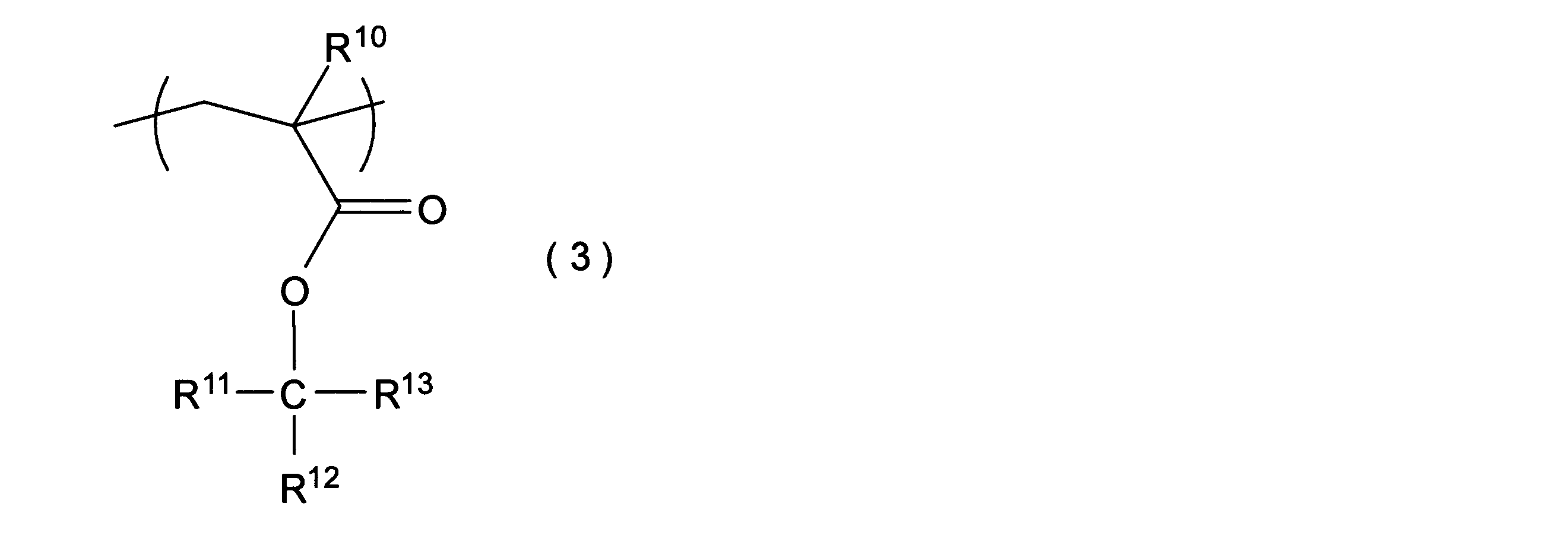
(式(3)中、R10は、水素原子、フッ素原子、メチル基又はトリフルオロメチル基である。R11~R13は、それぞれ独立して、炭素数1~4のアルキル基、又は炭素数4~20の脂環式基である。但し、R11及びR12は、互いに結合して、それらが結合している炭素原子と共に脂環式構造を形成してもよい。また、上記アルキル基及び脂環式基が有する水素原子の一部又は全部は置換されていてもよい。)
上記式(3)で表される構造単位(III)は、露光により[B]酸発生体から発生する酸の作用により解離し易い酸解離性基を有しているため、当該フォトレジスト組成物は、[A]重合体成分中に構造単位(III)をさらに有することで、感度等の基本特性を十分に満足することができる。
上記R9で表されるラクトン構造を有する環状有機基がノルボルナンラクトン基又はブチロラクトン基であり、上記環状カーボネート構造を有する環状有機基がエチレンカーボネート基であり、上記スルトン構造を有する環状有機基がノルボルナンスルトン基であることが好ましい。上記構造単位(II)が有する環状有機基を上記特定の基とすることで、当該フォトレジスト組成物は、MEEF、LWR、DOF等を指標としたリソグラフィー性能をさらに向上させることができる。
[A]重合体成分における構造単位(I)の含有率が5モル%以上60モル%以下であり、かつ構造単位(I)及び構造単位(III)の含有率の合計が10モル%以上80モル%以下であることが好ましい。[A]重合体成分における上記構造単位(I)及び(III)の含有率を上記特定の範囲とすることで、当該フォトレジスト組成物は、感度等の基本性能に加えて、MEEF、LWR、DOF等を指標としたリソグラフィー性能を特に向上させることができる。
[A]重合体成分における構造単位の含有率は、[A]重合体成分の13C-NMRスペクトルを測定し、得られたスペクトルにおける各構造単位に対応するピークの面積比から、[A]重合体成分における平均値として求めることができる。
以上説明したように、本発明のフォトレジスト組成物は、ラクトン構造を含む構造単位(I)と、環状カーボネート等の環状構造を含む構造単位(II)とを有する[A]重合体成分を含有するため、感度等の基本特性に加えて、MEEF、LWR、DOF等を指標としたリソグラフィー性能にも優れる。そのため、当該フォトレジスト組成物を用いると、微細なパターンを高精度で形成することが可能となる。
<フォトレジスト組成物>
当該フォトレジスト組成物は、[A]重合体成分及び[B]酸発生体を含有する。また、本発明の効果を損なわない限りその他の成分を含有してもよい。以下、各成分について詳述する。
当該フォトレジスト組成物は、[A]重合体成分及び[B]酸発生体を含有する。また、本発明の効果を損なわない限りその他の成分を含有してもよい。以下、各成分について詳述する。
<[A]重合体成分>
[A]重合体成分は、同一又は異なる重合体中に、上記式(1)で表される構造単位(I)と、この構造単位(I)以外の構造単位であって、環状カーボネート構造、スルトン構造及びラクトン構造からなる群より選択される少なくとも1種の構造を含む構造単位(II)とを有する1種以上の重合体成分である。当該フォトレジスト組成物は、[A]重合体成分を含有することで、感度等の基本特性を満足すると共に、MEEF、DOF及びLWRに優れる。
[A]重合体成分は、同一又は異なる重合体中に、上記式(1)で表される構造単位(I)と、この構造単位(I)以外の構造単位であって、環状カーボネート構造、スルトン構造及びラクトン構造からなる群より選択される少なくとも1種の構造を含む構造単位(II)とを有する1種以上の重合体成分である。当該フォトレジスト組成物は、[A]重合体成分を含有することで、感度等の基本特性を満足すると共に、MEEF、DOF及びLWRに優れる。
なお、[A]重合体成分としては、構造単位(I)を与える単量体化合物、構造単位(II)を与える単量体化合物等の複数種の単量体化合物の共重合体であってもよいし、構造単位(I)を与える単量体化合物の重合体と、構造単位(II)を与える単量体化合物の重合体等の複数の重合体をブレンドした2種以上の重合体を含む成分であってもよい。また、構造単位(I)及び構造単位(II)に加えて、上記式(3)で表される構造単位(III)を有することが好ましい。さらに、本発明の効果を損なわない限り、他の構造単位を有してもよい。以下、各構造単位を詳述する。
[構造単位(I)]
構造単位(I)は、上記式(1)で表される。[A]重合体成分は、重合体主鎖に直結した特定のラクトン構造を含む構造単位(I)を有するため、当該フォトレジスト組成物は、MEEF性能、DOF及びLWRに優れる。
構造単位(I)は、上記式(1)で表される。[A]重合体成分は、重合体主鎖に直結した特定のラクトン構造を含む構造単位(I)を有するため、当該フォトレジスト組成物は、MEEF性能、DOF及びLWRに優れる。
上記式(1)中、R1は、水素原子、フッ素原子、水酸基又は炭素数1~20の1価の有機基である。R2及びR3は、それぞれ独立して、水素原子、フッ素原子、水酸基又は炭素数1~20の1価の有機基であるか、又はR2及びR3が互いに結合して、それらが結合している炭素原子と共に、炭素数3~10の環構造を形成している。aは、1~6の整数である。但し、aが2以上の場合、複数のR2及びR3は、それぞれ同一でも異なっていてもよい。R4及びR5は、それぞれ独立して、水素原子、フッ素原子、水酸基又は炭素数1~20の1価の有機基であるか、又はR4及びR5が互いに結合して、それらが結合している炭素原子と共に、炭素数3~10の環構造を形成している。但し、上記環構造が有する水素原子の一部又は全部は置換されていてもよい。
上記R1~R5で表される炭素数1~20の1価の有機基としては、例えば炭素数1~20の鎖状炭化水素基、炭素数3~20の脂環式炭化水素基、炭素数6~20の芳香族炭化水素基、核原子数3~10の複素環基、エポキシ基、シアノ基、カルボキシ基、及び-R’-Q-R”で表される基等が挙げられる。但し、R’は単結合又は炭素数1~20の炭化水素基である。R”は置換されていてもよい炭素数1~20の炭化水素基である。Qは-O-、-CO-、-NH-、-SO2-、-SO-又はこれらを組み合わせてなる基である。上記鎖状炭化水素基、脂環式炭化水素基及び芳香族炭化水素基が有する水素原子の一部又は全部は、フッ素原子等のハロゲン原子、シアノ基、カルボキシ基、水酸基、チオール基等で置換されていてもよい。
上記炭素数1~20の鎖状炭化水素基としては、例えば、メチル基、エチル基、プロピル基、ブチル基、ペンチル基、へキシル基、オクチル基、デシル基等が挙げられる。これらのうち、メチル基、エチル基、プロピル基、ブチル基及びペンチル基が好ましく、メチル基及びエチル基がより好ましい。
上記炭素数3~20の脂環式炭化水素基としては、例えば、シクロプロピル基、シクロブチル基、シクロへキシル基、シクロオクチル基、シクロデシル基等の単環の脂環式炭化水素基;ノルボルニル基、アダマンチル基等の多環の脂環式炭化水素基等が挙げられる。
上記炭素数6~20の芳香族炭化水素基としては、例えば、フェニル基、ナフチル基等が挙げられる。
上記核原子数3~10の複素環基としては、例えば、ラクトン基、環状カーボネート基、スルトン基、フリル基、チエニル基、ベンゾフリル基、ベンゾチエニル基、ジベンゾフリル基、ジベンゾチエニル基、ピリジル基等が挙げられる。これらのうち、ラクトン基、環状カーボネート基及びスルトン基が好ましく、ラクトン基がより好ましい。
上記-R’-Q-R”におけるR’及びR”で表される炭素数1~20の炭化水素基としては、例えば、炭素数1~20の鎖状炭化水素基、炭素数3~20の脂環式炭化水素基、炭素数6~20の芳香族炭化水素基等が挙げられる。それぞれについては、上記R1~R5で表される炭素数1~20の1価の有機基において例示した基と同様の基を挙げることができる。
R2及びR3並びにR4及びR5が互いに結合して、それらが結合している炭素原子と共に形成する炭素数3~10の環構造としては、例えば、シクロプロパン、シクロヘキサン、ノルボルナン、アダマンタン等の脂環、酸素原子、硫黄原子、窒素原子等のヘテロ原子を含む複素環等が挙げられる。これらのうち、脂環としては、シクロペンタン、シクロヘキサン及びアダマンタンが好ましく、複素環としては、環状エーテル、ラクトン及びスルトンが好ましい。
上記環構造が有する水素原子の一部又は全部が置換されていてもよい置換基としては、例えば、フッ素原子、水酸基、カルボキシ基、シアノ基、スルファニル基、炭素数1~20の鎖状炭化水素基、炭素数3~20の脂環式炭化水素基、炭素数6~20の芳香族炭化水素基、核原子数3~10の複素環基、これらの基を組み合わせてなる基、これらの基のいずれかとエステル基、シリル基、-NH-、-CO-等を組み合わせてなる基等が挙げられる。これらのうち、水酸基、水酸基を含む基、炭素数1~3の鎖状炭化水素基が好ましい。
上記R2及びR3としては、水素原子であることが好ましい。また、上記aとしては、1が好ましい。
構造単位(I)としては、例えば、下記式(1-1)~(1-71)で表される構造単位等が挙げられる。
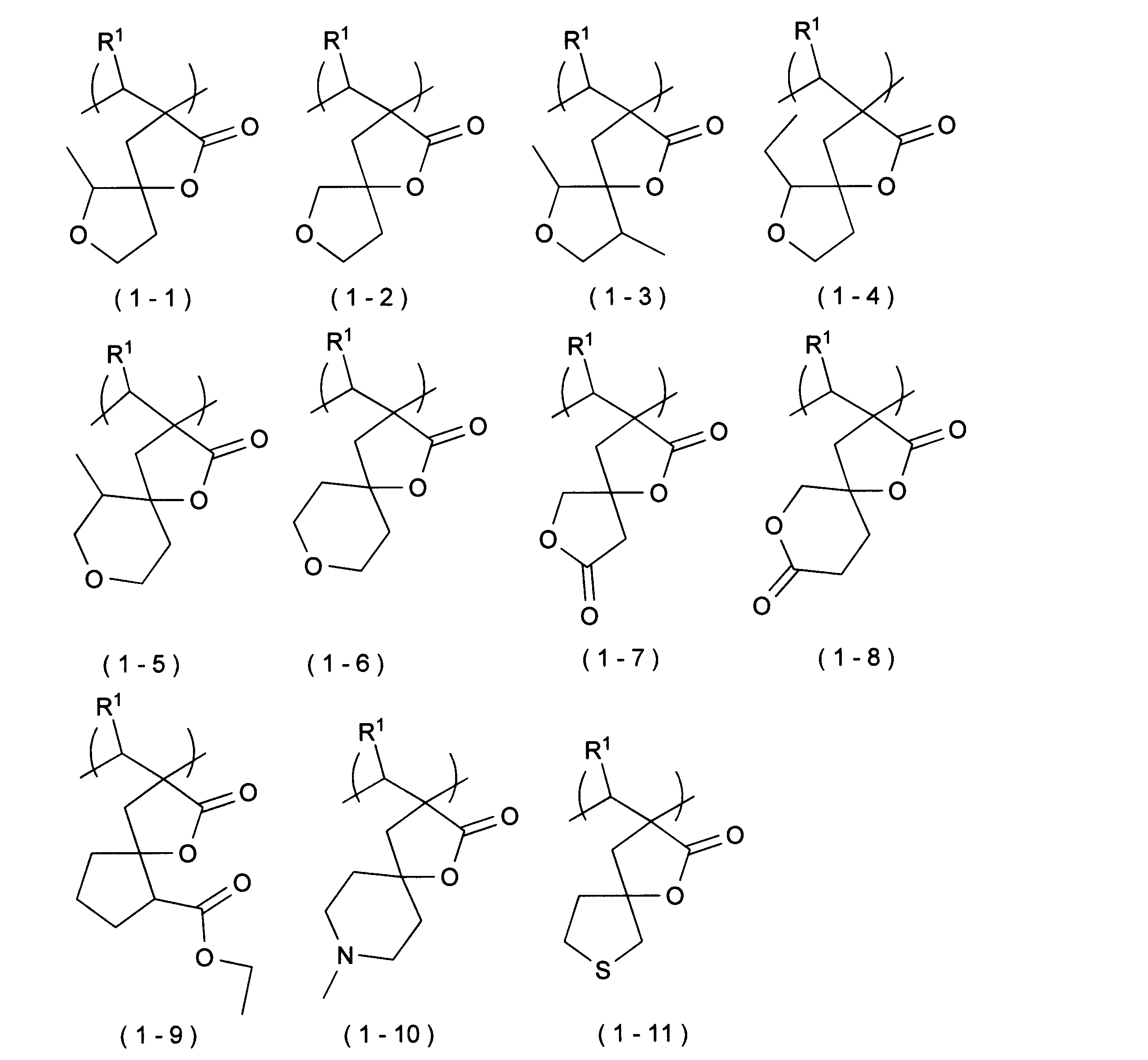

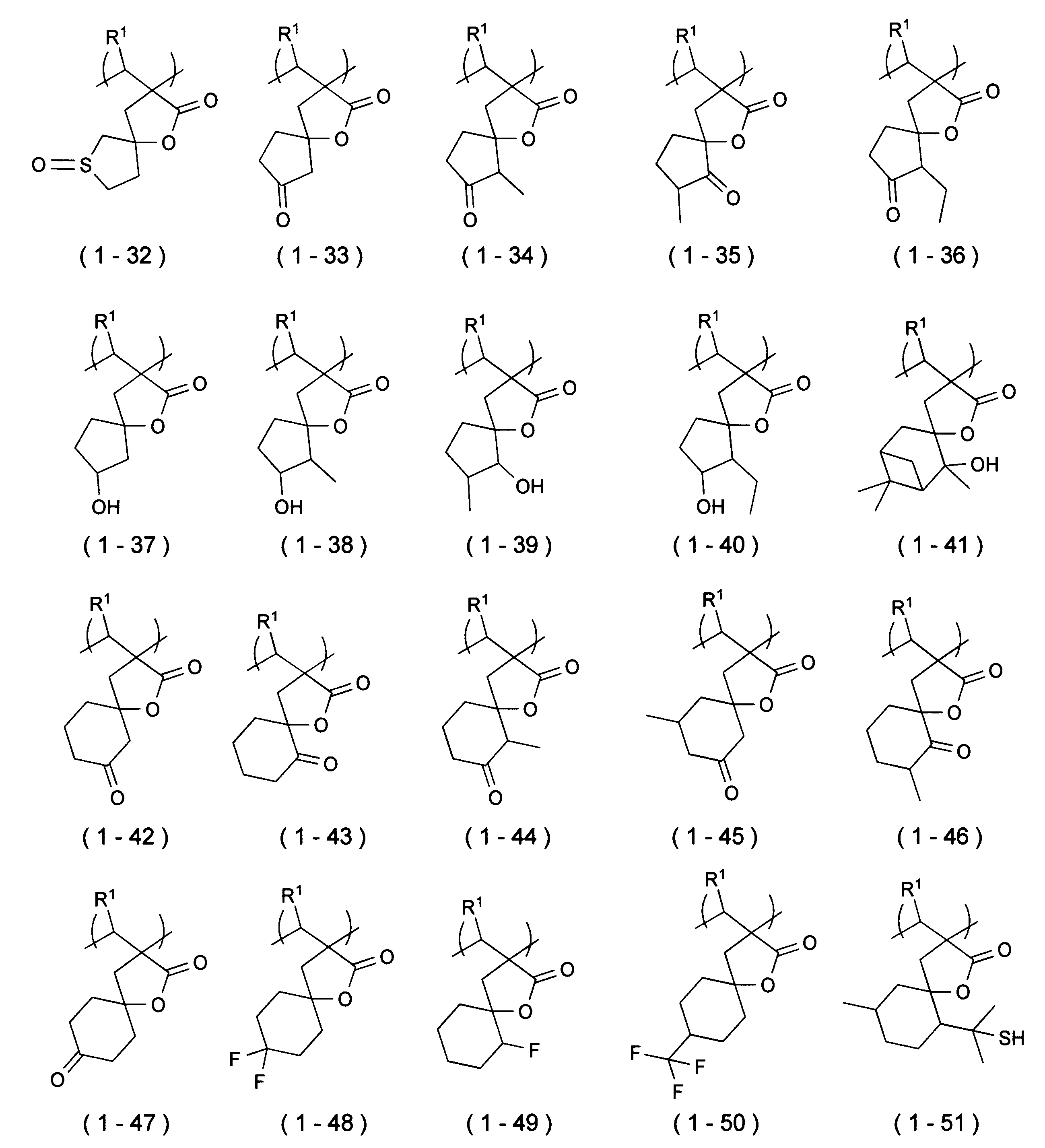

これらのうち、R4及びR5の少なくとも1つの基が酸素原子を含む構造単位、R4及びR5の少なくとも1つの基が環状の有機基である構造単位、R4及びR5が結合してそれらが結合する炭素原子と共に環構造を形成している構造単位、水酸基を含む構造単位等が好ましい。中でも、上記式(1-1)~(1-9)、(1-12)~(1-21)、(1-25)~(1-47)、(1-55)~(1-67)、(1-69)~(1-71)等で表される構造単位がより好ましく、(1-1)、(1-17)、(1-19)、(1-70)及び(1-71)で表される構造単位がさらに好ましい。
[A]重合体成分において、構造単位(I)の含有率は、[A]重合体成分を構成する全構造単位に対する構造単位(I)の総量が1モル%以上80モル%以下であることが好ましく、5モル%以上60モル%以下がより好ましい。構造単位(I)の含有量を上記範囲とすることで、他の性能を維持しつつ、優れたリソグラフィー性能を発揮することができる。なお、[A]重合体成分は、構造単位(I)を1種、又は2種以上有していてもよい。
構造単位(I)を与える単量体としては、例えば、下記式で表される化合物が挙げられる。

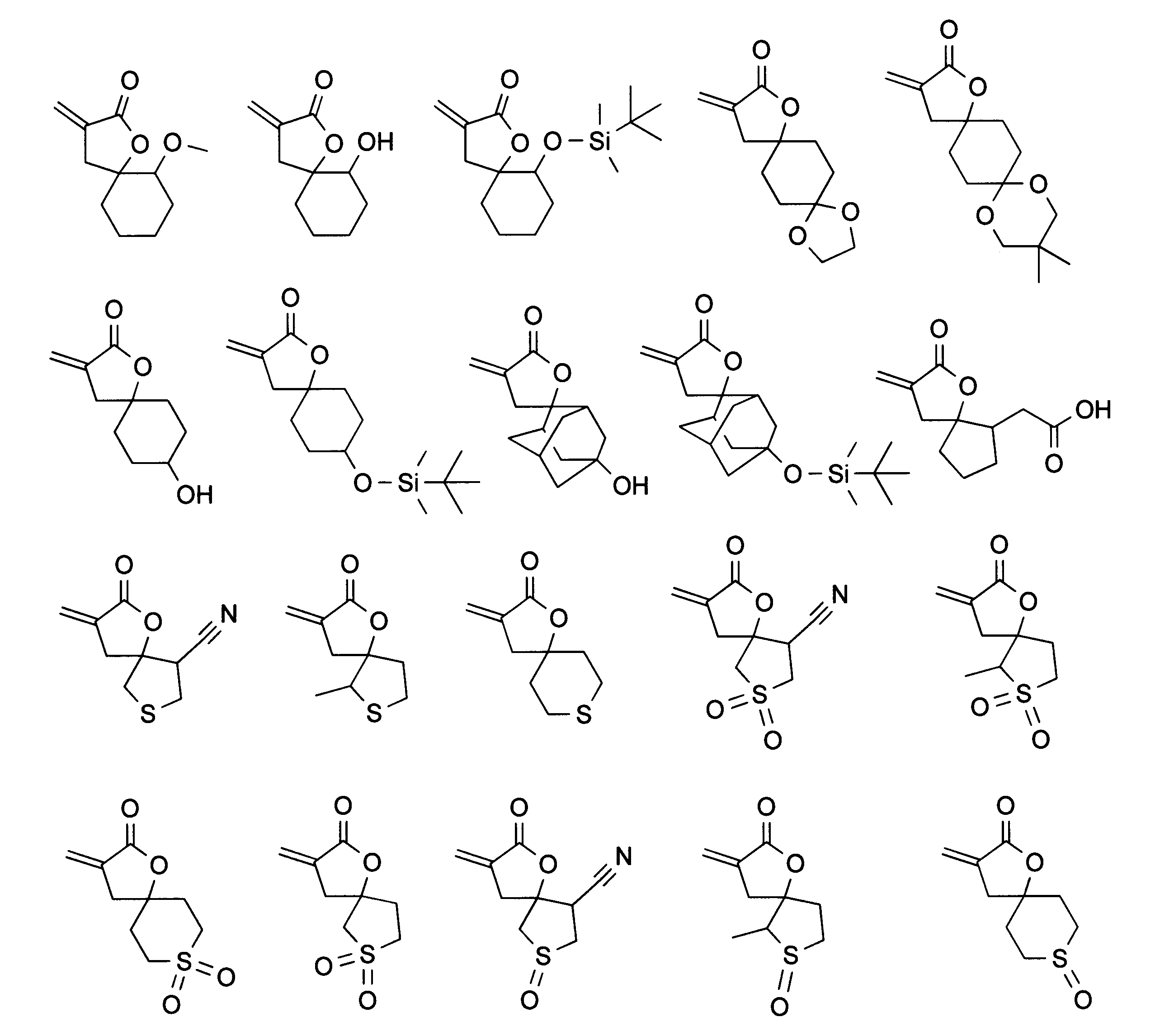
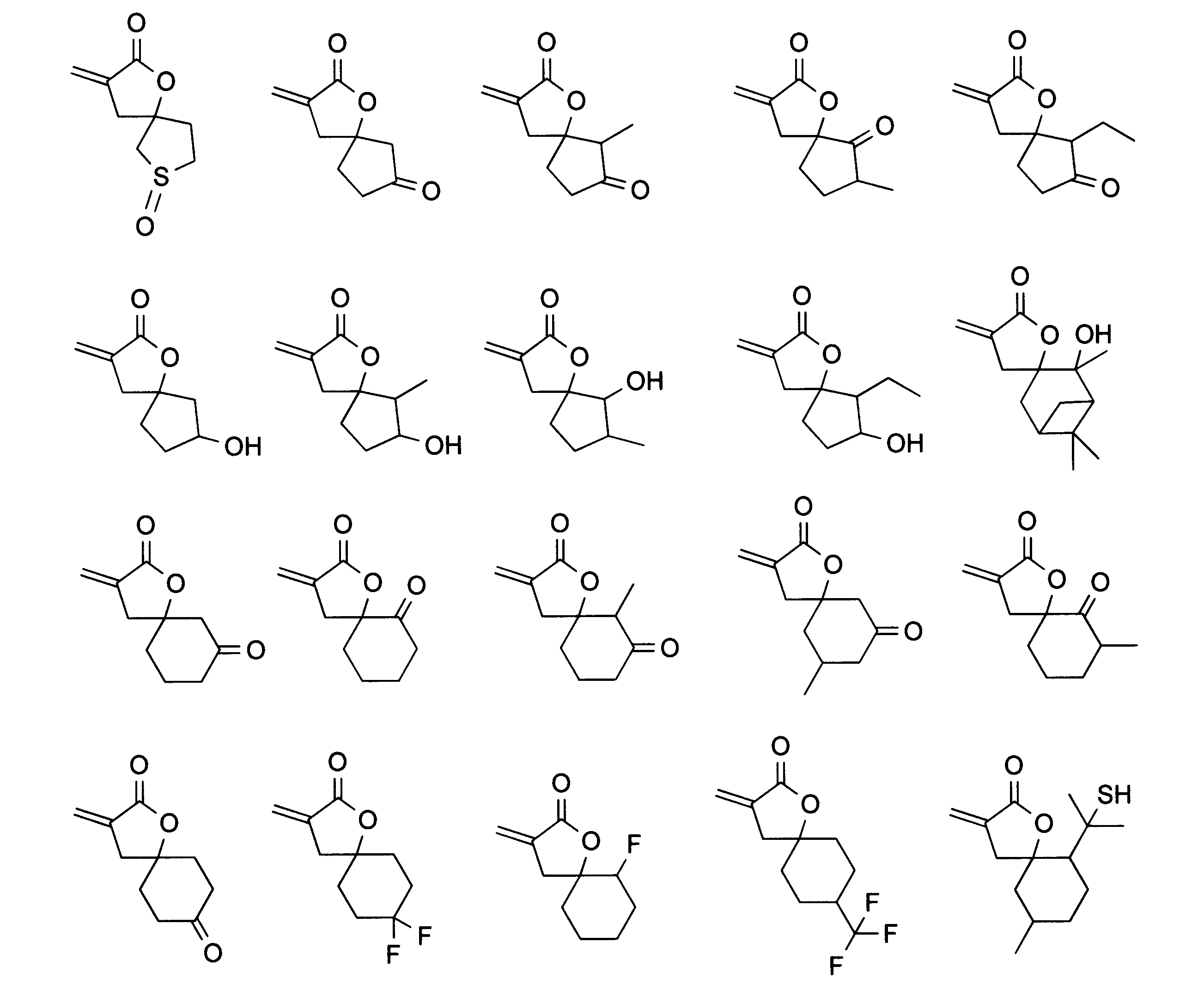

構造単位(I)を与える単量体は、例えば下記方法により製造することができる。
亜鉛粉末が添加されたテトラヒドロフラン(THF)溶媒中に、それぞれTHFに溶解させた2-メチルテトラヒドロフラン-3-オン(化合物a)と、エチル(2-ブロモメチル)アクリレート(化合物b)とを滴下し、室温で撹拌させることで、化合物aと化合物bとが反応し、6-メチル-3-メチレン-1,7-ジオキサスピロ[4,4]ノナン-2-オン(上記式(1-1)で表される化合物)が合成される。なお、亜鉛粉末が添加されたTHF溶媒中に、化合物a及びbの添加前にクロロトリメチルシラン等の活性化剤を入れるとよい。また、式(1-1)で表される化合物以外の化合物においては、適宜化合物aを替えること等によって同様に合成することができる。
[構造単位(II)]
構造単位(II)は、構造単位(I)以外の構造単位であって、環状カーボネート構造、スルトン構造及びラクトン構造からなる群より選択される少なくとも1種の構造を含む構造単位である。当該フォトレジスト組成物は、構造単位(II)を有する[A]重合体成分を含有することで、MEEF性能、DOF及びLWRを向上させることができる。
構造単位(II)は、構造単位(I)以外の構造単位であって、環状カーボネート構造、スルトン構造及びラクトン構造からなる群より選択される少なくとも1種の構造を含む構造単位である。当該フォトレジスト組成物は、構造単位(II)を有する[A]重合体成分を含有することで、MEEF性能、DOF及びLWRを向上させることができる。
構造単位(II)は、上記式(2)で表される構造単位(II-1)であることが好ましい。当該フォトレジスト組成物は、上記特定構造の構造単位(II-1)を有する[A]重合体成分を含有することで、MEEF性能、DOF及びLWRをさらに向上させることができる。
上記式(2)中、R6は、水素原子、フッ素原子、メチル基又はトリフルオロメチル基である。R7は、炭素数1~10の炭化水素基である。Xは、-O-、-COO-、-OCO-又は-NH-である。nは、0~10の整数である。nが2以上の場合、複数のR7及びXは、それぞれ同一でも異なっていてもよい。R8は、単結合又は炭素数1~5の炭化水素基である。R9は、環状カーボネート構造、スルトン構造及びラクトン構造からなる群より選択される少なくとも1種の構造を有する環状有機基である。但し、R7~R9が有する水素原子の一部又は全部は置換されていてもよい。
上記R7で表される炭素数1~10の炭化水素基としては、例えば、炭素数1~10の鎖状炭化水素基、炭素数3~10の脂環式炭化水素基、炭素数6~10の芳香族炭化水素基等が挙げられる。
上記炭素数1~10の鎖状炭化水素基としては、例えば、メチレン基、エチレン基、プロピレン基等が挙げられる。これらのうち、メチレン基及びエチレン基が好ましい。
上記炭素数3~10の脂環式炭化水素基としては、例えば、シクロプロピレン基、シクロヘキシレン基、アダマンチレン基等が挙げられる。これらのうち、アダマンチレン基が好ましい。
上記炭素数6~10の芳香族炭化水素基としては、例えば、フェニレン基、ナフチレン基等が挙げられる。
上記Xとしては、-O-及び-COO-が好ましい。
上記nとしては、0~5の整数が好ましく、0及び1がより好ましい。
上記R8で表される炭素数1~5の炭化水素基としては、例えば、炭素数1~5の鎖状炭化水素基、炭素数3~5の脂環式炭化水素基等が挙げられる。
上記炭素数1~5の鎖状炭化水素基としては、例えば、メチレン基、エチレン基、プロピレン基等が挙げられる。これらのうち、メチレン基が好ましい。
上記炭素数3~5の脂環式炭化水素基としては、例えば、シクロプロピレン基、シクロブチレン基等が挙げられる。
上記R8としては、単結合及びメチレン基が好ましい。
上記R9で表される環状カーボネート構造を有する環状有機基としては、例えば、エチレンカーボネート基、1,3-プロピレンカーボネート基、シクロペンテンカーボネート基、シクロヘキセンカーボネート基、ノルボルネンカーボネート基等が挙げられる。上記スルトン構造を有する環状有機基としては、例えば、プロピオスルトン基、ブチロスルトン基、バレロスルトン基、アダマンタンスルトン基等が挙げられる。上記ラクトン構造を有する環状有機基としては、例えば、プロピオラクトン基、ブチロラクトン基、バレロラクトン基、アダマンタンラクトン基等が挙げられる。
これらのうち、環状カーボネート構造を有する環状有機基としては、エチレンカーボネート基が好ましく、スルトン構造を有する環状有機基としては、ノルボルナンスルトン基が好ましく、ラクトン構造を有する環状有機基としては、ノルボルナンラクトン基及びブチロラクトン基が好ましい。
上記R7~R9が有する水素原子の一部又は全部が置換されていてもよい置換基としては、例えば、ハロゲン原子、水酸基、カルボキシル基、ケト基、スルホンアミド基、アミノ基、アミド基、シアノ基、アセチル基等が挙げられる。
構造単位(II)としては、下記式(2-1)~(2-17)で表される構造単位を好ましい構造単位として挙げることができる。


上記式中、R6は、上記式(2)と同義である。
これらのうち、当該フォトレジスト組成物のリソグラフィー性能を向上させる観点から、上記式(2-1)、(2-4)、(2-8)、(2-12)及び(2-13)で表される構造単位がより好ましい。
[A]重合体成分において、構造単位(II)の含有率は[A]重合体成分を構成する全構造単位に対する構造単位(II)の総量が5モル%以上80モル%以下であることが好ましく、5モル%以上60モル%以下がより好ましい。構造単位(II)の含有量を上記範囲とすることで、他の性能を維持しつつ、優れたリソグラフィー性能を発揮することができる。なお、[A]重合体成分は、構造単位(II)を1種又は2種以上有していてもよい。
構造単位(II)を与える単量体化合物としては、例えば、下記式で表される化合物が挙げられる。
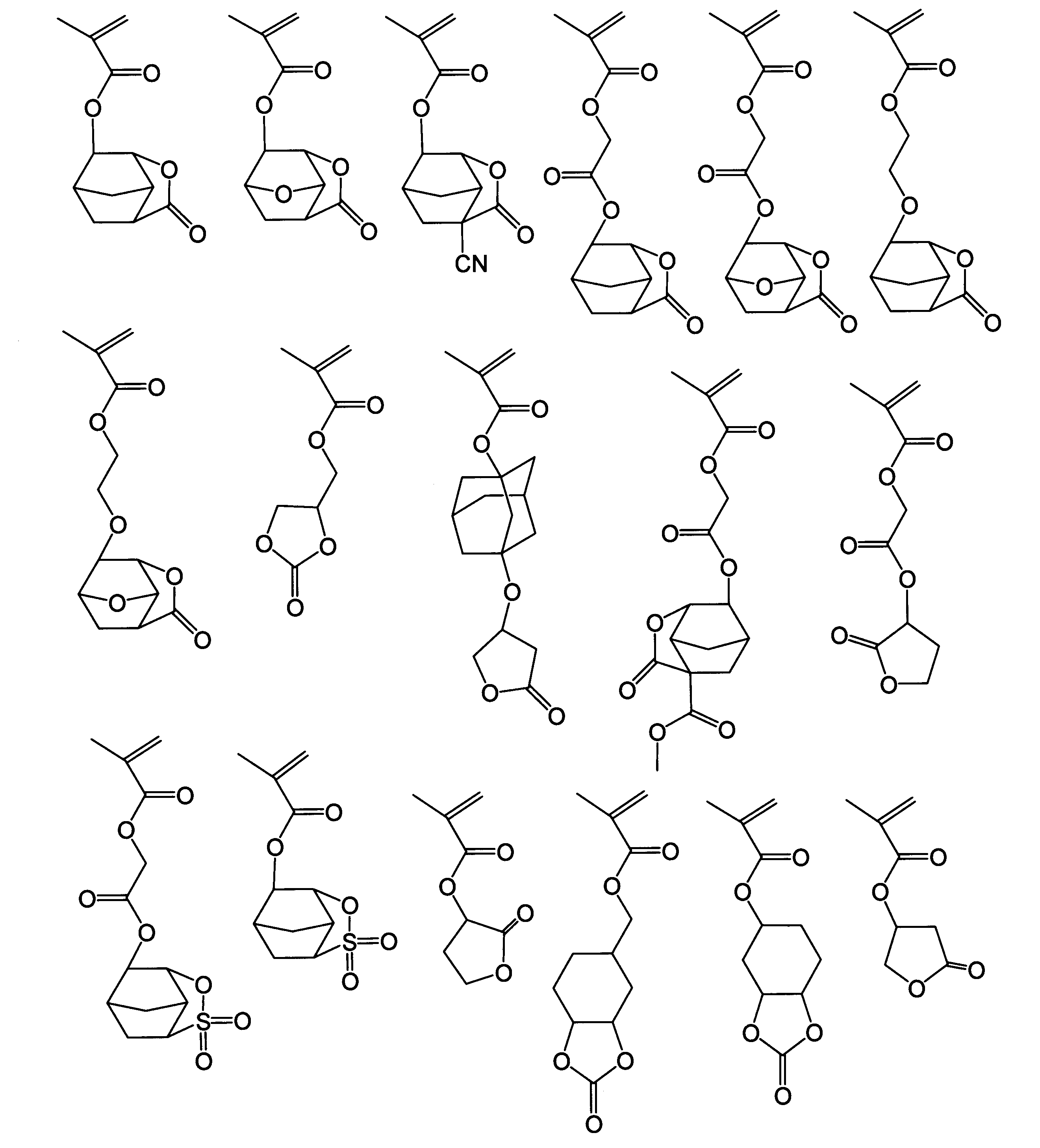
[構造単位(III)]
[A]重合体成分は、構造単位(III)を有することが好ましい。[A]重合体成分が、酸解離性基を有するこの構造単位(III)を有することで、当該フォトレジスト組成物は、感度等の基本特性を十分満足することができると共に、MEEF、DOF及びLWRにより優れるレジストパターンの形成が可能となる。
[A]重合体成分は、構造単位(III)を有することが好ましい。[A]重合体成分が、酸解離性基を有するこの構造単位(III)を有することで、当該フォトレジスト組成物は、感度等の基本特性を十分満足することができると共に、MEEF、DOF及びLWRにより優れるレジストパターンの形成が可能となる。
構造単位(III)は上記式(3)で表される。上記式(3)中、R10は、水素原子、フッ素原子、メチル基又はトリフルオロメチル基である。R11~R13は、それぞれ独立して、炭素数1~4のアルキル基又は炭素数4~20の脂環式基である。但し、R11及びR12は、互いに結合して、それらが結合している炭素原子と共に2価の脂環式構造を形成していてもよい。また、上記アルキル基、及び脂環式基が有する水素原子の一部又は全部は置換されていてもよい。
上記R11~R13が表す炭素数1~4のアルキル基としては、例えばメチル基、エチル基、n-プロピル基、i-プロピル基、n-ブチル基、i-ブチル基、tert-ブチル基、2-メチルプロピル基、1-メチルプロピル基等が挙げられる。
上記R11~R13が表す炭素数4~20の脂環式基としては、例えばアダマンタン骨格、ノルボルナン骨格等の有橋式骨格を有する多環の脂環式基;シクロペンタン、シクロヘキサン等のシクロアルカン骨格を有する単環の脂環式基が挙げられる。また、これらの基は、例えば炭素数1~10の直鎖状、分岐状又は環状のアルキル基の1種以上で置換されていてもよい。
上記R11~R13が表す炭素数6~20の芳香族炭化水素基としては、例えばベンゼン、ナフタレン、フェナントレン、アントラセン、テトラセン、ペンタセン、ピレン、ピセン、トルエン、キシレン、エチルベンゼン、メシチレン、クメン等の芳香族炭化水素基から1個の水素原子を除いた基等が挙げられる。
R11とR12とが互いに結合して、それらが結合している炭素原子と共に形成していてもよい脂環式構造としては、例えばアダマンタン、ノルボルナン等の有橋式骨格を有する多環の脂環式構造、シクロペンタン、シクロヘキサン等のシクロアルカン骨格を有する単環の脂環式構造等が挙げられる。
構造単位(III)としては、下記式で表される構造単位が好ましい。

上記式中、R10は、上記式(3)と同義である。R11は、炭素数1~4のアルキル基である。mは、1~6の整数である。
これらのうち、より好ましい構造単位として、下記式(3-1)~(3-22)で表される構造単位が挙げられる。
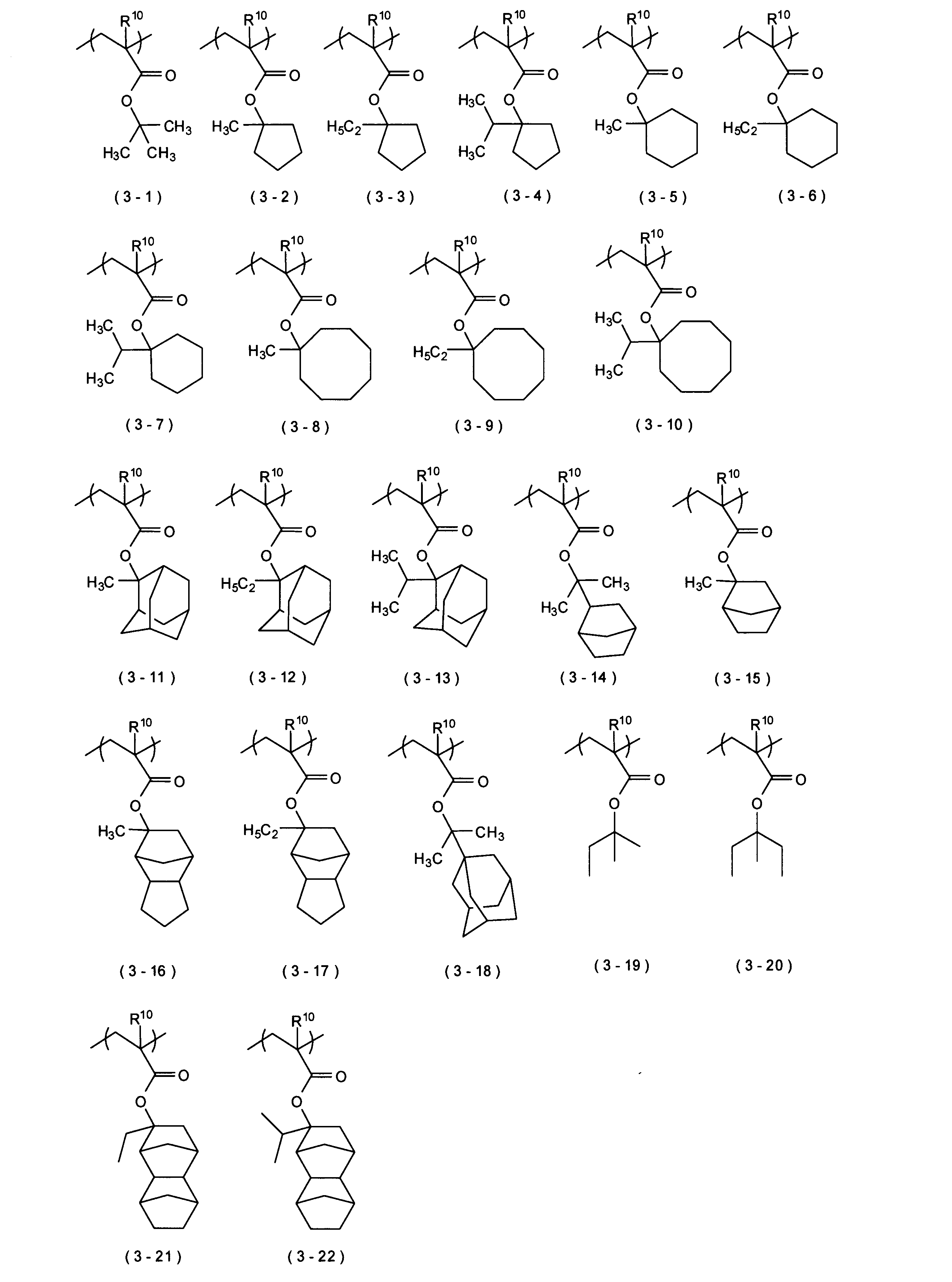
上記式中、R10は上記式(3)と同義である。
これらのうち、上記式(3-2)、(3-3)(3-4)、(3-7)、(3-9)、(3-11)~(3-14)、(3-18)、(3-19)(3-21)及び(3-22)で表される構造単位がさらに好ましい。
[A]重合体成分において、構造単位(III)の含有率としては、[A]重合体成分を構成する全構造単位に対して、10モル%~80モル%が好ましく、15モル%~80モル%がより好ましく、20モル%~70モル%がさらに好ましい。構造単位(III)の含有率を上記範囲とすることで、得られるレジストパターンのリソグラフィー性能がより向上する。なお、[A]重合体成分は、構造単位(III)を1種又は2種以上有していてもよい。
構造単位(III)を与える単量体としては、例えば、下記式で表される単量体等が挙げられる。
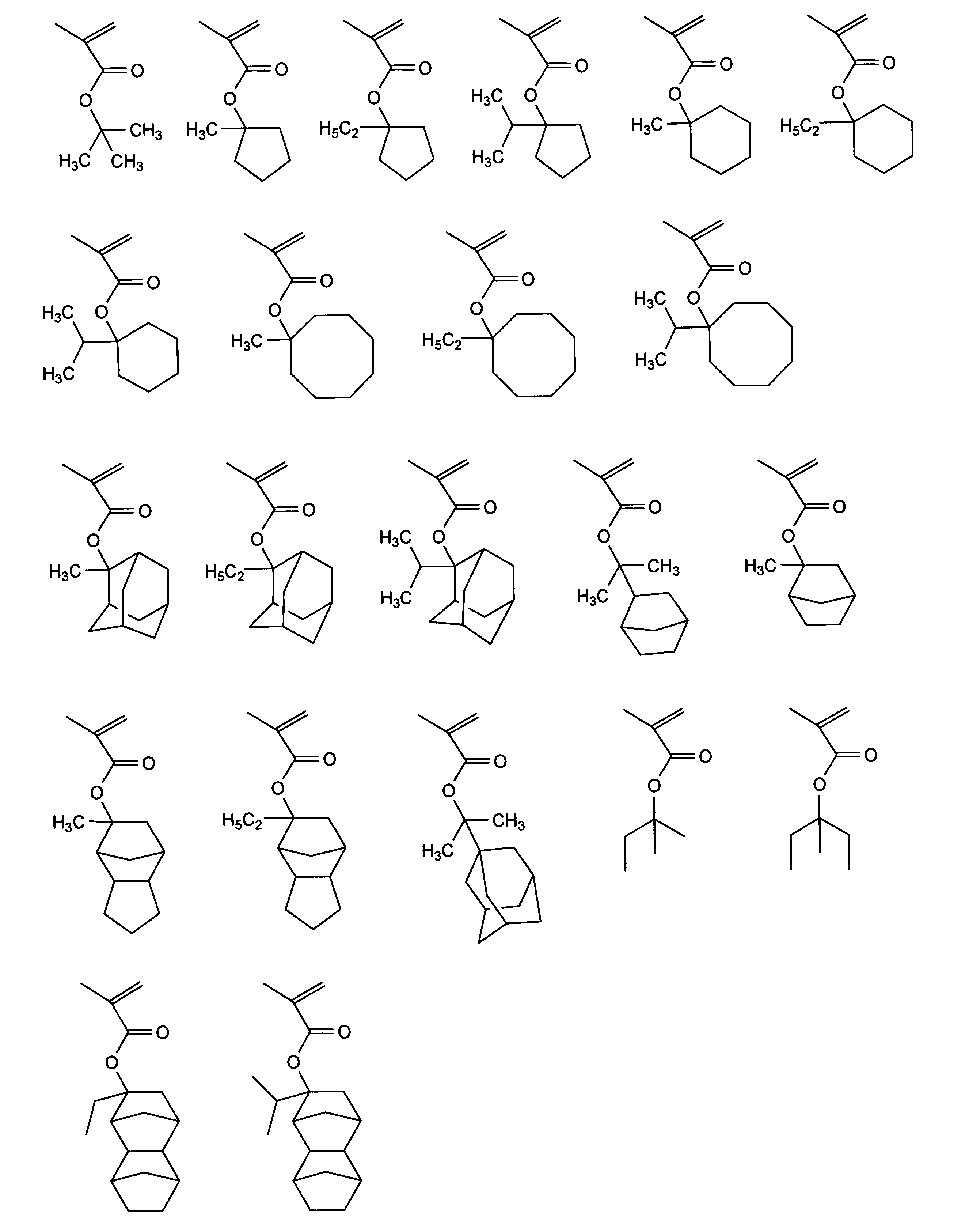
[その他の構造単位]
[A]重合体成分は、親水性官能基を有する構造単位(以下、「構造単位(IV)」ともいう)を含んでいてもよい。[A]重合体成分が構造単位(IV)をさらに含むことで、レジストパターンのリソグラフィー性能をより向上できる。
[A]重合体成分は、親水性官能基を有する構造単位(以下、「構造単位(IV)」ともいう)を含んでいてもよい。[A]重合体成分が構造単位(IV)をさらに含むことで、レジストパターンのリソグラフィー性能をより向上できる。
構造単位(IV)としては、例えば、下記式で表される構造単位が挙げられる。

上記式中、R14は、水素原子、フッ素原子、メチル基又はトリフルオロメチル基である。
[A]重合体成分における構造単位(IV)の含有率としては、[A]重合体成分を構成する全構造単位に対して0モル%~30モル%が好ましく、5モル%~20モル%がより好ましい。[A]重合体成分は、構造単位(IV)を1種又は2種以上有していてもよい。
また、当該フォトレジスト組成物のMEEF等を指標としたリソグラフィー性能を向上させる観点から、[A]重合体成分における構造単位(I)の含有率が1モル%以上70モル%以下であり、かつ構造単位(I)及び構造単位(III)の含有率の合計が10モル%以上80モル%以下であることが好ましく、構造単位(I)の含有率が5モル%以上60モル%以下であり、かつ構造単位(I)及び構造単位(III)の含有率の合計が20モル%以上70モル%以下であることがより好ましい。構造単位(I)の含有率が10モル%以上50モル%以下であり、かつ構造単位(I)及び構造単位(III)の含有率の合計が30モル%以上60モル%以下であることがさらに好ましい。
[A]重合体成分が、異なる重合体中に構造単位(I)及び構造単位(II)をそれぞれ含む場合、構造単位(I)を有する重合体(i)の重量平均分子量が、構造単位(II)を有する重合体(ii)の重量平均分子量より大きいことが好ましい。当該フォトレジスト組成物は、[A]重合体成分が、構造単位(I)を有する重合体(i)と構造単位(II)を有する重合体(ii)とのブレンドである場合には、重合体(i)の重量平均分子量が重合体(ii)の重量平均分子量より大きいと、MEEF、LWR等を指標としたリソグラフィー性能により優れる。
<[A]重合体成分の合成方法>
[A]重合体成分は、例えば所定の各構造単位に対応する単量体を、ラジカル重合開始剤を使用し、適当な溶媒中で重合することにより製造できる。例えば、単量体及びラジカル開始剤を含有する溶液を、反応溶媒又は単量体を含有する溶液に滴下して重合反応させる方法、単量体を含有する溶液と、ラジカル開始剤を含有する溶液とを各別に、反応溶媒又は単量体を含有する溶液に滴下して重合反応させる方法、各々の単量体を含有する複数種の溶液と、ラジカル開始剤を含有する溶液とを各別に、反応溶媒又は単量体を含有する溶液に滴下して重合反応させる方法等の方法で合成することが好ましい。
[A]重合体成分は、例えば所定の各構造単位に対応する単量体を、ラジカル重合開始剤を使用し、適当な溶媒中で重合することにより製造できる。例えば、単量体及びラジカル開始剤を含有する溶液を、反応溶媒又は単量体を含有する溶液に滴下して重合反応させる方法、単量体を含有する溶液と、ラジカル開始剤を含有する溶液とを各別に、反応溶媒又は単量体を含有する溶液に滴下して重合反応させる方法、各々の単量体を含有する複数種の溶液と、ラジカル開始剤を含有する溶液とを各別に、反応溶媒又は単量体を含有する溶液に滴下して重合反応させる方法等の方法で合成することが好ましい。
これらの方法における反応温度は開始剤種によって適宜決定すればよい。通常30℃~180℃であり、40℃~160℃が好ましく、50℃~140℃がより好ましい。滴下時間は、反応温度、開始剤の種類、反応させる単量体等の条件によって異なるが、通常、30分~8時間であり、45分~6時間が好ましく、1時間~5時間がより好ましい。また、滴下時間を含む全反応時間も、滴下時間と同様に条件により異なるが、通常、30分~8時間であり、45分~7時間が好ましく、1時間~6時間がより好ましい。
上記重合に使用されるラジカル開始剤としては、アゾビスイソブチロニトリル、2,2’-アゾビス(4-メトキシ-2,4-ジメチルバレロニトリル)、2,2’-アゾビス(2-シクロプロピルプロピオニトリル)、2,2’-アゾビス(2,4-ジメチルバレロニトリル)、2,2’-アゾビス(2-メチルプロピオニトリル)等が挙げられる。これらの開始剤は2種以上を混合して使用してもよい。
重合溶媒としては、重合を阻害する溶媒(重合禁止効果を有するニトロベンゼン、連鎖移動効果を有するメルカプト化合物等)以外の溶媒であって、その単量体を溶解可能な溶媒であれば限定されない。重合溶媒としては、例えば、アルコール系溶媒、ケトン系溶媒、アミド系溶媒、エステル・ラクトン系溶媒、ニトリル系溶媒及びその混合溶媒等が挙げられる。これらの溶媒は、単独又は2種以上を併用できる。
重合反応により得られた樹脂は、再沈殿法により回収することが好ましい。すなわち、重合反応終了後、重合液を再沈溶媒に投入することにより、目的の樹脂を粉体として回収する。再沈溶媒としては、アルコール類やアルカン類等を単独で又は2種以上を混合して使用することができる。再沈殿法の他に、分液操作やカラム操作、限外ろ過操作等により、単量体、オリゴマー等の低分子成分を除去して、樹脂を回収することもできる。
なお、[A]重合体成分が同一の重合体中に上記構造単位(I)及び構造単位(II)を有する1種の重合体成分である場合、構造単位(I)を与える単量体及び構造単位(II)を与える単量体を、上述の方法により共重合させて製造できる。また、[A]重合体成分が異なる重合体中に上記構造単位(I)及び構造単位(II)を有する2種以上の重合体成分である場合、構造単位(I)を与える単量体を上述の方法により重合して構造単位(I)を有する重合体を製造し、さらに構造単位(II)を与える単量体を上述の方法により重合して構造単位(II)を有する重合体を製造し、両者を混合することにより、[A]重合体成分を調整することができる。
[A]重合体成分のゲルパーミエーションクロマトグラフィ(GPC)によるポリスチレン換算重量平均分子量(Mw)は、特に限定されないが、1,000以上500,000以下が好ましく、2,000以上400,000以下がより好ましい。なお、[A]重合体のMwが1,000未満であると、レジストとしたときの耐熱性が低下する傾向がある。一方、[A]重合体のMwが500,000を超えると、レジストとしたときの現像性が低下する傾向がある。
また、[A]重合体成分のGPCによるポリスチレン換算数平均分子量(Mn)に対するMwの比(Mw/Mn)は、通常1以上5以下であり、1以上3以下が好ましく、1以上2以下がより好ましい。Mw/Mnをこのような範囲とすることで、フォトレジスト膜が解像性能に優れたものとなる。
なお、[A]重合体成分が異なる重合体中に上記構造単位(I)及び構造単位(II)を有する2種以上の重合体成分である場合には、それぞれの重合体におけるMw及びMw/Mnについて、上記と同様の範囲であるとよい。
なお、本明細書のMw及びMnは、GPCカラム(東ソー製、G2000HXL 2本、G3000HXL 1本、G4000HXL 1本)を用い、流量1.0ミリリットル/分、溶出溶媒テトラヒドロフラン、カラム温度40℃の分析条件で、単分散ポリスチレンを標準とするゲルパーミエーションクロマトグラフィー(GPC)により測定した値をいう。
<[B]酸発生体>
[B]酸発生体は、レジストパターン形成の一工程である露光工程において、マスクを通過した光によって酸を発生する化合物である。当該フォトレジスト組成物における[B]酸発生体の含有形態としては、後述するような化合物の態様(以下、この態様を「[B]酸発生剤」ともいう)でも、重合体の一部として組み込まれた態様でも、これらの両方の態様でもよい。
[B]酸発生体は、レジストパターン形成の一工程である露光工程において、マスクを通過した光によって酸を発生する化合物である。当該フォトレジスト組成物における[B]酸発生体の含有形態としては、後述するような化合物の態様(以下、この態様を「[B]酸発生剤」ともいう)でも、重合体の一部として組み込まれた態様でも、これらの両方の態様でもよい。
[B]酸発生剤としては、例えば、オニウム塩化合物、スルホンイミド化合物、ハロゲン含有化合物、ジアゾケトン化合物等が挙げられる。これらの[B]酸発生剤のうち、オニウム塩化合物が好ましい。
オニウム塩化合物としては、例えば、スルホニウム塩(テトラヒドロチオフェニウム塩を含む)、ヨードニウム塩、ホスホニウム塩、ジアゾニウム塩、ピリジニウム塩等が挙げられる。
スルホニウム塩としては、例えば、トリフェニルスルホニウムトリフルオロメタンスルホネート、トリフェニルスルホニウムノナフルオロ-n-ブタンスルホネート、トリフェニルスルホニウムパーフルオロ-n-オクタンスルホネート、トリフェニルスルホニウム2-ビシクロ[2.2.1]ヘプト-2-イル-1,1,2,2-テトラフルオロエタンスルホネート、トリフェニルスルホニウム1,1-ジフルオロ-2-(1-アダマンチル)エタンスルホネート、トリフェニルスルホニウム1,1,2,2-テトラフルオロ-6-(1-アダマンチルカルボニロキシ)ヘキサン-1-スルホネート、トリフェニルスルホニウム3-(2-オキサ-3-オキソ-1,7,7-トリメチルビシクロ[2,2,1]ヘプタン-1-イルカルボニルオキシ)-1,1,2-トリフルオロプロパン-1-スルホネート、トリフェニルスルホニウム5-(ノルボルナンラクトニルオキシカルボニル-1,2-シクロヘキサンジイルカルボニルオキシ)-1,1,2,2-テトラフルオロペンタン-1-スルホネート、4-シクロヘキシルフェニルジフェニルスルホニウムトリフルオロメタンスルホネート、4-シクロヘキシルフェニルジフェニルスルホニウムノナフルオロ-n-ブタンスルホネート、4-シクロヘキシルフェニルジフェニルスルホニウムパーフルオロ-n-オクタンスルホネート、4-シクロヘキシルフェニルジフェニルスルホニウム2-ビシクロ[2.2.1]ヘプト-2-イル-1,1,2,2-テトラフルオロエタンスルホネート、4-メタンスルホニルフェニルジフェニルスルホニウムトリフルオロメタンスルホネート、4-メタンスルホニルフェニルジフェニルスルホニウムノナフルオロ-n-ブタンスルホネート、4-メタンスルホニルフェニルジフェニルスルホニウムパーフルオロ-n-オクタンスルホネート、4-メタンスルホニルフェニルジフェニルスルホニウム2-ビシクロ[2.2.1]ヘプト-2-イル-1,1,2,2-テトラフルオロエタンスルホネート、トリフェニルホスホニウム1,1,2,2-テトラフルオロ-6-(1-アダマンタンカルボニロキシ)-ヘキサン-1-スルホネート等が挙げられる。これらのうち、トリフェニルスルホニウムトリフルオロメタンスルホネート、トリフェニルスルホニウムノナフルオロ-n-ブタンスルホネート、トリフェニルスルホニウム1,1-ジフルオロ-2-(1-アダマンチル)エタンスルホネート、トリフェニルスルホニウム1,1,2,2-テトラフルオロ-6-(1-アダマンチルカルボニロキシ)ヘキサン-1-スルホネート、トリフェニルスルホニウム3-(2-オキサ-3-オキソ-1,7,7-トリメチルビシクロ[2,2,1]ヘプタン-1-イルカルボニルオキシ)-1,1,2-トリフルオロプロパン-1-スルホネート、トリフェニルスルホニウム5-(ノルボルナンラクトニルオキシカルボニル-1,2-シクロヘキサンジイルカルボニルオキシ)-1,1,2,2-テトラフルオロペンタン-1-スルホネートが好ましい。
テトラヒドロチオフェニウム塩としては、例えば、1-(4-n-ブトキシナフタレン-1-イル)テトラヒドロチオフェニウムトリフルオロメタンスルホネート、1-(4-n-ブトキシナフタレン-1-イル)テトラヒドロチオフェニウムノナフルオロ-n-ブタンスルホネート、1-(4-n-ブトキシナフタレン-1-イル)テトラヒドロチオフェニウムパーフルオロ-n-オクタンスルホネート、1-(4-n-ブトキシナフタレン-1-イル)テトラヒドロチオフェニウム2-(ビシクロ[2.2.1]ヘプト-2-イル)-1,1,2,2-テトラフルオロエタンスルホネート、1-(4-n-ブトキシナフタレン-1-イル)テトラヒドロチオフェニウム1,1,2-トリフルオロ-4-(1-アダマンチルカルボニロキシ)ブタン-1-スルホンネート、1-(6-n-ブトキシナフタレン-2-イル)テトラヒドロチオフェニウムトリフルオロメタンスルホネート、1-(6-n-ブトキシナフタレン-2-イル)テトラヒドロチオフェニウムノナフルオロ-n-ブタンスルホネート、1-(6-n-ブトキシナフタレン-2-イル)テトラヒドロチオフェニウムパーフルオロ-n-オクタンスルホネート、1-(6-n-ブトキシナフタレン-2-イル)テトラヒドロチオフェニウム2-ビシクロ[2.2.1]ヘプト-2-イル-1,1,2,2-テトラフルオロエタンスルホネート、1-(3,5-ジメチル-4-ヒドロキシフェニル)テトラヒドロチオフェニウムトリフルオロメタンスルホネート、1-(3,5-ジメチル-4-ヒドロキシフェニル)テトラヒドロチオフェニウムノナフルオロ-n-ブタンスルホネート、1-(3,5-ジメチル-4-ヒドロキシフェニル)テトラヒドロチオフェニウムパーフルオロ-n-オクタンスルホネート、1-(3,5-ジメチル-4-ヒドロキシフェニル)テトラヒドロチオフェニウム2-ビシクロ[2.2.1]ヘプト-2-イル-1,1,2,2-テトラフルオロエタンスルホネート等が挙げられる。これらのテトラヒドロチオフェニウム塩のうち、1-(4-n-ブトキシナフタレン-1-イル)テトラヒドロチオフェニウムノナフルオロ-n-ブタンスルホネート、1-(4-n-ブトキシナフタレン-1-イル)テトラヒドロチオフェニウムパーフルオロ-n-オクタンスルホネート及び1-(3,5-ジメチル-4-ヒドロキシフェニル)テトラヒドロチオフェニウムノナフルオロ-n-ブタンスルホネート、1-(4-n-ブトキシナフタレン-1-イル)テトラヒドロチオフェニウム2-(ビシクロ[2.2.1]ヘプト-2-イル)-1,1,2,2-テトラフルオロエタンスルホネート、1-(4-n-ブトキシナフタレン-1-イル)テトラヒドロチオフェニウム1,1,2-トリフルオロ-4-(1-アダマンチルカルボニロキシ)ブタン-1-スルホンネートが好ましい。
ヨードニウム塩としては、例えば、ジフェニルヨードニウムトリフルオロメタンスルホネート、ジフェニルヨードニウムノナフルオロ-n-ブタンスルホネート、ジフェニルヨードニウムパーフルオロ-n-オクタンスルホネート、ジフェニルヨードニウム2-ビシクロ[2.2.1]ヘプト-2-イル-1,1,2,2-テトラフルオロエタンスルホネート、ビス(4-t-ブチルフェニル)ヨードニウムトリフルオロメタンスルホネート、ビス(4-t-ブチルフェニル)ヨードニウムノナフルオロ-n-ブタンスルホネート、ビス(4-t-ブチルフェニル)ヨードニウムパーフルオロ-n-オクタンスルホネート、ビス(4-t-ブチルフェニル)ヨードニウム2-ビシクロ[2.2.1]ヘプト-2-イル-1,1,2,2-テトラフルオロエタンスルホネート等が挙げられる。これらのヨードニウム塩のうち、ビス(4-t-ブチルフェニル)ヨードニウムノナフルオロ-n-ブタンスルホネートが好ましい。
スルホンイミド化合物としては、例えば、N-(トリフルオロメタンスルホニルオキシ)ビシクロ[2.2.1]ヘプト-5-エン-2,3-ジカルボキシイミド、N-(ノナフルオロ-n-ブタンスルホニルオキシ)ビシクロ[2.2.1]ヘプト-5-エン-2,3-ジカルボキシイミド、N-(パーフルオロ-n-オクタンスルホニルオキシ)ビシクロ[2.2.1]ヘプト-5-エン-2,3-ジカルボキシイミド、N-(2-ビシクロ[2.2.1]ヘプト-2-イル-1,1,2,2-テトラフルオロエタンスルホニルオキシ)ビシクロ[2.2.1]ヘプト-5-エン-2,3-ジカルボキシイミド等が挙げられる。これらのスルホンイミド化合物のうち、N-(トリフルオロメタンスルホニルオキシ)ビシクロ[2.2.1]ヘプト-5-エン-2,3-ジカルボキシイミドが好ましい。
これらの[B]酸発生剤は、単独で使用してもよく2種以上を併用してもよい。[B]酸発生体が「剤」である場合の使用量としては、当該フォトレジスト組成物により形成されるレジスト塗膜の感度及びリソグラフィー性能を確保する観点から、[A]重合体成分100質量部に対して、0.01質量部以上25質量部以下が好ましく、0.1質量部以上20質量部以下がより好ましい。
<その他の任意成分>
当該フォトレジスト組成物に含有されてもよいその他の任意成分としては、[C]酸拡散制御剤、[D]フッ素原子を含有する重合体、[E]添加剤、溶媒、脂環式骨格含有化合物、界面活性剤、増感剤等を挙げることができる。以下、各成分について詳述する。
当該フォトレジスト組成物に含有されてもよいその他の任意成分としては、[C]酸拡散制御剤、[D]フッ素原子を含有する重合体、[E]添加剤、溶媒、脂環式骨格含有化合物、界面活性剤、増感剤等を挙げることができる。以下、各成分について詳述する。
<[C]酸拡散制御剤>
当該フォトレジスト組成物は、[C]酸拡散制御剤をさらに含有することが好ましい。この[C]酸拡散制御剤は、露光により[B]酸発生体から生じる酸のレジスト被膜中における拡散現象を制御し、非露光領域における好ましくない化学反応を抑制するものである。このような[C]酸拡散制御剤を配合することにより、得られるフォトレジスト組成物の貯蔵安定性が向上し、またレジストとしての解像度がさらに向上するとともに、露光から露光後の加熱処理までの引き置き時間(PED)の変動によるレジストパターンの線幅変化を抑えることができ、プロセス安定性に極めて優れた組成物が得られる。
当該フォトレジスト組成物は、[C]酸拡散制御剤をさらに含有することが好ましい。この[C]酸拡散制御剤は、露光により[B]酸発生体から生じる酸のレジスト被膜中における拡散現象を制御し、非露光領域における好ましくない化学反応を抑制するものである。このような[C]酸拡散制御剤を配合することにより、得られるフォトレジスト組成物の貯蔵安定性が向上し、またレジストとしての解像度がさらに向上するとともに、露光から露光後の加熱処理までの引き置き時間(PED)の変動によるレジストパターンの線幅変化を抑えることができ、プロセス安定性に極めて優れた組成物が得られる。
[C]酸拡散制御剤としては、例えば、N-t-アルコキシカルボニル基を有する窒素含有化合物が好ましく用いられる。具体的には、N-t-ブトキシカルボニルジ-n-オクチルアミン、N-t-アミロキシカルボニルジ-n-オクチルアミン、N-t-ブトキシカルボニルジ-n-ノニルアミン、N-t-アミロキシカルボニルジ-n-ノニルアミン、N-t-ブトキシカルボニルジ-n-デシルアミン、N-t-アミロキシカルボニルジ-n-デシルアミン、N-t-ブトキシカルボニルジシクロヘキシルアミン、N-t-アミロキシカルボニルジシクロヘキシルアミン、N-t-ブトキシカルボニル-1-アダマンチルアミン、N-t-アミロキシカルボニル-1-アダマンチルアミン、N-t-ブトキシカルボニル-2-アダマンチルアミン、N-t-アミロキシカルボニル-2-アダマンチルアミン、N-t-ブトキシカルボニル-N-メチル-1-アダマンチルアミン、N-t-アミロキシカルボニル-N-メチル-1-アダマンチルアミン、(S)-(-)-1-(t-ブトキシカルボニル)-2-ピロリジンメタノール、(S)-(-)-1-(t-アミロキシカルボニル)-2-ピロリジンメタノール、(R)-(+)-1-(t-ブトキシカルボニル)-2-ピロリジンメタノール、(R)-(+)-1-(t-アミロキシカルボニル)-2-ピロリジンメタノール、N-t-ブトキシカルボニル-4-ヒドロキシピペリジン、N-t-アミロキシカルボニル-4-ヒドロキシピペリジン、N-t-ブトキシカルボニルピロリジン、N-t-アミロキシカルボニルピロリジン、N,N’-ジ-t-ブトキシカルボニルピペラジン、N,N’-ジ-t-アミロキシカルボニルピペラジン、N,N-ジ-t-ブトキシカルボニル-1-アダマンチルアミン、N,N-ジ-t-アミロキシカルボニル-1-アダマンチルアミン、N-t-ブトキシカルボニル-4,4’-ジアミノジフェニルメタン、N-t-アミロキシカルボニル-4,4’-ジアミノジフェニルメタン、N,N’-ジ-t-ブトキシカルボニルヘキサメチレンジアミン、N,N’-ジ-t-アミロキシカルボニルヘキサメチレンジアミン、N,N,N’,N’-テトラ-t-ブトキシカルボニルヘキサメチレンジアミン、N,N,N’,N’-テトラ-t-アミロキシカルボニルヘキサメチレンジアミン、N,N’-ジ-t-ブトキシカルボニル-1,7-ジアミノヘプタン、N,N’-ジ-t-アミロキシカルボニル-1,7-ジアミノヘプタン、N,N’-ジ-t-ブトキシカルボニル-1,8-ジアミノオクタン、N,N’-ジ-t-アミロキシカルボニル-1,8-ジアミノオクタン、N,N’-ジ-t-ブトキシカルボニル-1,9-ジアミノノナン、N,N’-ジ-t-アミロキシカルボニル-1,9-ジアミノノナン、N,N’-ジ-t-ブトキシカルボニル-1,10-ジアミノデカン、N,N’-ジ-t-アミロキシカルボニル-1,10-ジアミノデカン、N,N’-ジ-t-ブトキシカルボニル-1,12-ジアミノドデカン、N,N’-ジ-t-アミロキシカルボニル-1,12-ジアミノドデカン、N,N’-ジ-t-ブトキシカルボニル-4,4’-ジアミノジフェニルメタン、N,N’-ジ-t-アミロキシカルボニル-4,4’-ジアミノジフェニルメタン、N-t-ブトキシカルボニルベンズイミダゾール、N-t-ブトキシカルボニルベンズイミダゾール、N-t-アミロキシカルボニル-2-メチルベンズイミダゾール、N-t-ブトキシカルボニル-2-フェニルベンズイミダゾール、N-t-アミロキシカルボニル-2-フェニルベンズイミダゾール、2-フェニルイミダゾール等の化合物が挙げられる。これらのうち、N-t-ブトキシカルボニル-4-ヒドロキシピペリジン、N-t-アミロキシカルボニル-4-ヒドロキシピペリジン及び2-フェニルイミダゾールが好ましい。
また、[C]酸拡散制御剤としては、上記化合物以外にも、例えば、3級アミン化合物、4級アンモニウムヒドロキシド化合物、その他含窒素複素環化合物等の含窒素化合物が用いられる。
3級アミン化合物としては、例えば、トリエチルアミン、トリ-n-プロピルアミン、トリ-n-ブチルアミン、トリ-n-ペンチルアミン、トリ-n-ヘキシルアミン、トリ-n-ヘプチルアミン、トリ-n-オクチルアミン、シクロヘキシルジメチルアミン、ジシクロヘキシルメチルアミン、トリシクロヘキシルアミン等のトリ(シクロ)アルキルアミン類;
アニリン、N-メチルアニリン、N,N-ジメチルアニリン、2-メチルアニリン、3-メチルアニリン、4-メチルアニリン、4-ニトロアニリン、2,6-ジメチルアニリン、2,6-ジイソプロピルアニリン等の芳香族アミン類;
トリエタノールアミン、N,N-ジ(ヒドロキシエチル)アニリン等のアルカノールアミン類;
N,N,N’,N’-テトラメチルエチレンジアミン、N,N,N’,N’-テトラキス(2-ヒドロキシプロピル)エチレンジアミン、1,3-ビス[1-(4-アミノフェニル)-1-メチルエチル]ベンゼンテトラメチレンジアミン、ビス(2-ジメチルアミノエチル)エーテル、ビス(2-ジエチルアミノエチル)エーテル等が挙げられる。
アニリン、N-メチルアニリン、N,N-ジメチルアニリン、2-メチルアニリン、3-メチルアニリン、4-メチルアニリン、4-ニトロアニリン、2,6-ジメチルアニリン、2,6-ジイソプロピルアニリン等の芳香族アミン類;
トリエタノールアミン、N,N-ジ(ヒドロキシエチル)アニリン等のアルカノールアミン類;
N,N,N’,N’-テトラメチルエチレンジアミン、N,N,N’,N’-テトラキス(2-ヒドロキシプロピル)エチレンジアミン、1,3-ビス[1-(4-アミノフェニル)-1-メチルエチル]ベンゼンテトラメチレンジアミン、ビス(2-ジメチルアミノエチル)エーテル、ビス(2-ジエチルアミノエチル)エーテル等が挙げられる。
4級アンモニウムヒドロキシド化合物としては、例えばテトラ-n-プロピルアンモニウムヒドロキシド、テトラ-n-ブチルアンモニウムヒドロキシド等が挙げられる。
さらに、[C]酸拡散制御剤としては、露光により分解して酸拡散制御性としての塩基性を失うオニウム塩化合物を用いることもできる。このようなオニウム塩化合物の具体例としては、下記式(5-1)で表されるスルホニウム塩化合物、および下記式(5-2)で表されるヨードニウム塩化合物を挙げることができる。

上記式(5-1)及び式(5-2)におけるR15~R19は、それぞれ独立して、水素原子、アルキル基、アルコキシル基、ヒドロキシル基、又はハロゲン原子である。
また、Anb-は、OH-、R20-COO-、R20-SO3 -(但し、R20は、それぞれ独立して、アルキル基、アリール基、又はアルカノール基である。)、又は下記式(6)で表されるアニオンを表す。
また、Anb-は、OH-、R20-COO-、R20-SO3 -(但し、R20は、それぞれ独立して、アルキル基、アリール基、又はアルカノール基である。)、又は下記式(6)で表されるアニオンを表す。

上記スルホニウム塩化合物およびヨードニウム塩化合物の具体例としては、トリフェニルスルホニウムハイドロオキサイド、トリフェニルスルホニウムアセテート、トリフェニルスルホニウムサリチレート、ジフェニル-4-ヒドロキシフェニルスルホニウムハイドロオキサイド、ジフェニル-4-ヒドロキシフェニルスルホニウムアセテート、ジフェニル-4-ヒドロキシフェニルスルホニウムサリチレート、ビス(4-t-ブチルフェニル)ヨードニウムハイドロオキサイド、ビス(4-t-ブチルフェニル)ヨードニウムアセテート、ビス(4-t-ブチルフェニル)ヨードニウムハイドロオキサイド、ビス(4-t-ブチルフェニル)ヨードニウムアセテート、ビス(4-t-ブチルフェニル)ヨードニウムサリチレート、4-t-ブチルフェニル-4-ヒドロキシフェニルヨードニウムハイドロオキサイド、4-t-ブチルフェニル-4-ヒドロキシフェニルヨードニウムアセテート、4-t-ブチルフェニル-4-ヒドロキシフェニルヨードニウムサリチレート、ビス(4-t-ブチルフェニル)ヨードニウム10-カンファースルホネート、ジフェニルヨードニウム10-カンファースルホネート、トリフェニルスルホニウム10-カンファースルホネート、4-t-ブトキシフェニル・ジフェニルスルホニウム10-カンファースルホネート、4-(シクロヘキシルスルホニルフェニルジフェニルスルホニウム5,6-ビス(2,2,2-トリフルオロエチルオキシカルボニル)ビシクロ[2,2,1]ヘプタン-2-スルホネート等を挙げることができる。これらのうち、トリフェニルスルホニウムサリチレート、トリフェニルスルホニウム10-カンファースルホネート及び4-(シクロヘキシルスルホニルフェニルジフェニルスルホニウム5,6-ビス(2,2,2-トリフルオロエチルオキシカルボニル)ビシクロ[2,2,1]ヘプタン-2-スルホネートがこのましい。
[C]酸拡散制御剤は、1種を単独で又は2種以上を混合して使用することができる。酸拡散制御剤の含有割合としては、[A]重合体成分100質量部に対して、10質量部以下が好ましく、0.1質量部以上8質量部以下がより好ましい。使用量が10質量部を超えると、レジストとしての感度が低下する傾向にある。
<[D]フッ素原子を含む重合体>
当該フォトレジスト組成物は、[D]フッ素原子を含む重合体(以下、「[D]重合体」ともいう)をさらに含有できる。[D]重合体はフッ素原子を含む重合体であり、[A]重合体成分よりフッ素原子含有率が高いことが好ましい。当該フォトレジスト組成物が[D]重合体を含有することで、レジスト膜の疎水性が向上し液浸露光を行った場合においても物質溶出抑制性に優れ、また、レジスト膜と液浸液との後退接触角を十分に高くでき、高速でスキャン露光した場合に水滴が残らない等の効果を奏するため、当該フォトレジスト組成物の液浸露光用としての有用性が高まる。
当該フォトレジスト組成物は、[D]フッ素原子を含む重合体(以下、「[D]重合体」ともいう)をさらに含有できる。[D]重合体はフッ素原子を含む重合体であり、[A]重合体成分よりフッ素原子含有率が高いことが好ましい。当該フォトレジスト組成物が[D]重合体を含有することで、レジスト膜の疎水性が向上し液浸露光を行った場合においても物質溶出抑制性に優れ、また、レジスト膜と液浸液との後退接触角を十分に高くでき、高速でスキャン露光した場合に水滴が残らない等の効果を奏するため、当該フォトレジスト組成物の液浸露光用としての有用性が高まる。
[D]重合体の態様としては、例えば
主鎖にフッ素化アルキル基が結合した構造;
側鎖にフッ素化アルキル基が結合した構造;
主鎖と側鎖とにフッ素化アルキル基が結合した構造が挙げられる。
主鎖にフッ素化アルキル基が結合した構造;
側鎖にフッ素化アルキル基が結合した構造;
主鎖と側鎖とにフッ素化アルキル基が結合した構造が挙げられる。
主鎖にフッ素化アルキル基が結合した構造を与える単量体としては、例えばα-トリフルオロメチルアクリレート化合物、β-トリフルオロメチルアクリレート化合物、α,β-トリフルオロメチルアクリレート化合物、1種類以上のビニル部位の水素がトリフルオロメチル基等のフッ素化アルキル基で置換された化合物等が挙げられる。
側鎖にフッ素化アルキル基が結合した構造を与える単量体としては、例えばノルボルネン等の脂環式オレフィン化合物の側鎖がフッ素化アルキル基やその誘導体であるもの、アクリル酸又はメタクリル酸の側鎖がフッ素化アルキル基やその誘導体のエステル化合物、1種類以上のオレフィンの側鎖(二重結合を含まない部位)がフッ素化アルキル基やその誘導体であるもの等が挙げられる。
主鎖と側鎖とにフッ素化アルキル基が結合した構造を与える単量体としては、例えばα-トリフルオロメチルアクリル酸、β-トリフルオロメチルアクリル酸、α,β-トリフルオロメチルアクリル酸等の側鎖がフッ素化アルキル基やその誘導体のエステル化合物、1種類以上のビニル部位の水素がトリフルオロメチル基等のフッ素化アルキル基で置換された化合物の側鎖をフッ素化アルキル基やその誘導体で置換したもの、1種類以上の脂環式オレフィン化合物の二重結合に結合している水素をトリフルオロメチル基等のフッ素化アルキル基で置換し、かつ側鎖がフッ素化アルキル基やその誘導体であるもの等が挙げられる。なお、脂環式オレフィン化合物とは、環の一部が二重結合である化合物を示す。
[D]重合体は、下記式(7)で表される構造単位(d1)及び/又は式(8)で表される構造単位(d2)を有することが好ましく、また構造単位(d1)及び構造単位(d2)以外の「他の構造単位」を有してもよい。以下、各構造単位を詳述する。
[構造単位(d1)]
構造単位(d1)は下記式(7)で表される構造単位である。
構造単位(d1)は下記式(7)で表される構造単位である。

上記式(7)中、R21は水素原子、フッ素原子、メチル基又はトリフルオロメチル基である。R22はフッ素原子を有する炭素数1~6のアルキル基、又はフッ素原子を有する炭素数4~20の1価の脂環式炭化水素基である。但し、上記アルキル基及び脂環式炭化水素基は、水素原子の一部又は全部が置換されていてもよい。
構造単位(d1)を与える単量体としては、例えばトリフルオロメチル(メタ)アクレート、2,2,2-トリフルオロエチル(メタ)アクリレート、パーフルオロエチル(メタ)アクリレート、パーフルオロn-プロピル(メタ)アクリレート、パーフルオロi-プロピル(メタ)アクリレート、パーフルオロn-ブチル(メタ)アクリレート、パーフルオロi-ブチル(メタ)アクリレート、パーフルオロt-ブチル(メタ)アクリレート、パーフルオロシクロヘキシル(メタ)アクリレート、2-(1,1,1,3,3,3-ヘキサフルオロ)プロピル(メタ)アクリレート、1-(2,2,3,3,4,4,5,5-オクタフルオロ)ペンチル(メタ)アクリレート、1-(2,2,3,3,4,4,5,5-オクタフルオロ)ヘキシル(メタ)アクリレート、パーフルオロシクロヘキシルメチル(メタ)アクリレート、1-(2,2,3,3,3-ペンタフルオロ)プロピル(メタ)アクリレート、1-(2,2,3,3,4,4,4-ヘプタフルオロ)ペンタ(メタ)アクリレート、1-(3,3,4,4,5,5,6,6,7,7,8,8,9,9,10,10,10-ヘプタデカフルオロ)デシル(メタ)アクリレート、1-(5-トリフルオロメチル-3,3,4,4,5,6,6,6-オクタフルオロ)ヘキシル(メタ)アクリレート等が挙げられる。
構造単位(d1)としては、例えば下記式(7-1)及び(7-2)で表される構造単位が挙げられる。

上記式(7-1)及び(7-2)中、R21は上記式(7)と同義である。
[D]重合体において、構造単位(d1)の含有率としては[D]重合体を構成する全構造単位に対して、10モル%~70モル%が好ましく、20モル%~50モル%がより好ましい。なお[D]重合体は、構造単位(d1)を1種又は2種以上を有してもよい。
[構造単位(d2)]
構造単位(d2)は、下記式(8)で表される構造単位である。
構造単位(d2)は、下記式(8)で表される構造単位である。

上記式(8)中、R23は水素原子、フッ素原子、メチル基又はトリフルオロメチル基である。R24は(k+1)価の連結基である。Yはフッ素原子を有する2価の連結基である。R25は水素原子又は1価の有機基である。kは1~3の整数である。但し、kが2又は3の場合、複数のY及びR25はそれぞれ同一であっても異なっていてもよい。
上記構造単位(d2)としては、例えば下記式(8-1)及び(8-2)で表される構造単位が挙げられる。
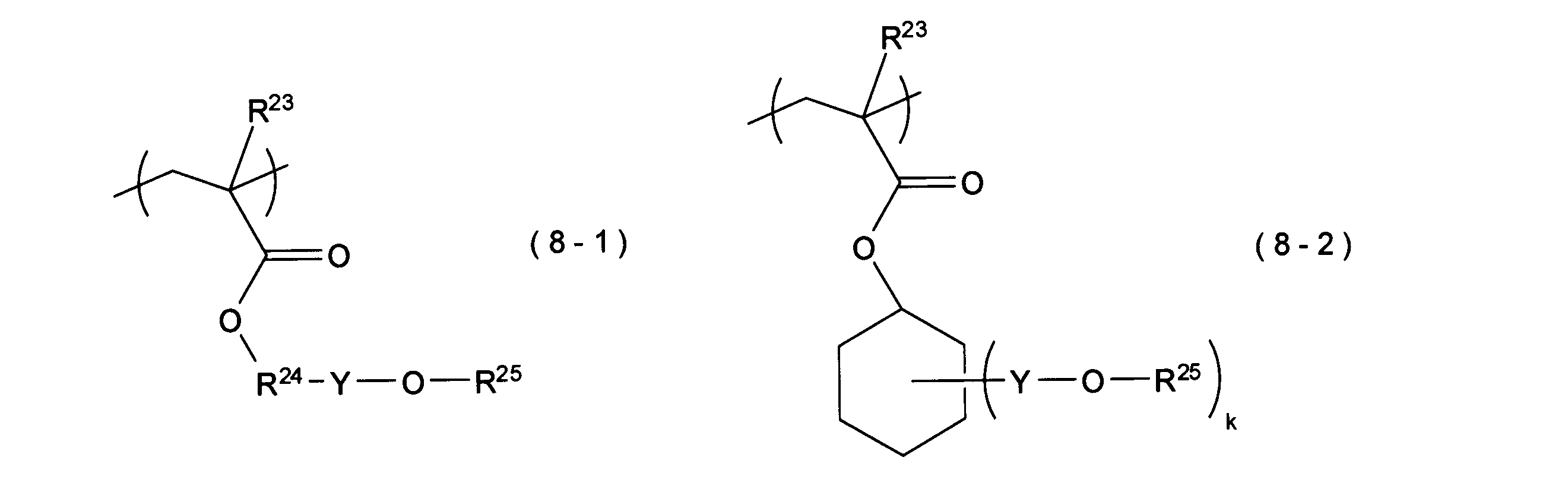
上記式(8-1)中、R24は炭素数1~20の2価の直鎖状、分岐状又は環状の飽和若しくは不飽和の炭化水素基である。R23、Y及びR25は上記式(8)と同義である。
上記式(8-2)中、R23、Y、R25及びkは上記式(8)と同義である。但し、kが2又は3の場合、複数のY及びR25はそれぞれ同一でも異なっていてもよい。
上記式(8-2)中、R23、Y、R25及びkは上記式(8)と同義である。但し、kが2又は3の場合、複数のY及びR25はそれぞれ同一でも異なっていてもよい。
上記式(8-1)及び式(8-2)で示される構造単位としては、例えば、下記式(8-1-1)、式(8-1-2)及び式(8-2-1)で表される構造単位が挙げられる。
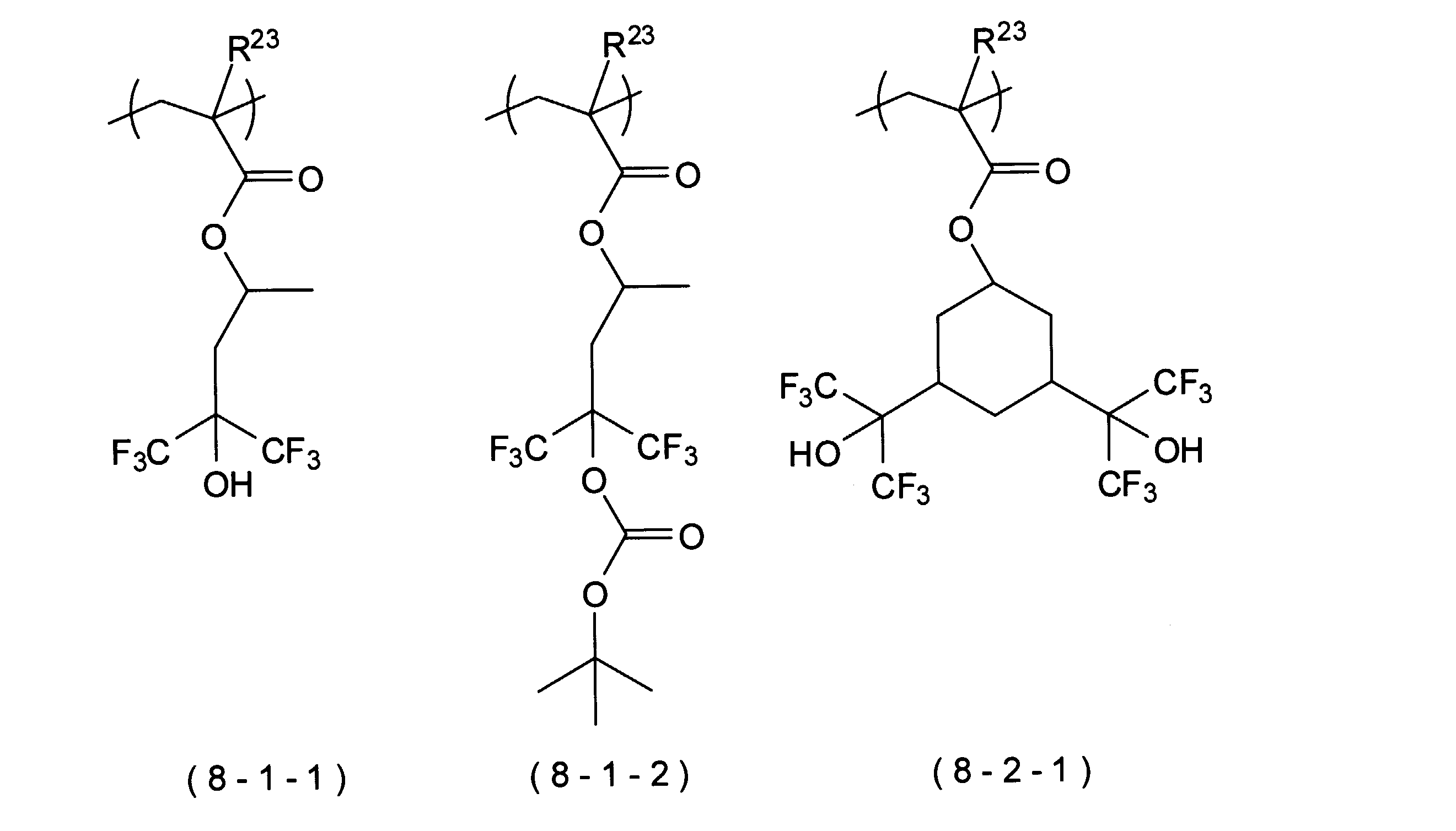
上記式(8-1-1)、(8-1-2)及び(8-2-1)中、R23は上記式(8)と同義である。
構造単位(d2)を与える単量体としては、例えば(メタ)アクリル酸(1,1,1-トリフルオロ-2-トリフルオロメチル-2-ヒドロキシ-3-プロピル)エステル、(メタ)アクリル酸(1,1,1-トリフルオロ-2-トリフルオロメチル-2-ヒドロキシ-4-ブチル)エステル、(メタ)アクリル酸(1,1,1-トリフルオロ-2-トリフルオロメチル-2-ヒドロキシ-5-ペンチル)エステル、(メタ)アクリル酸(1,1,1-トリフルオロ-2-トリフルオロメチル-2-ヒドロキシ-4-ペンチル)エステル、(メタ)アクリル酸2-{[5-(1’,1’,1’-トリフルオロ-2’-トリフルオロメチル-2’-ヒドロキシ)プロピル]ビシクロ[2.2.1]ヘプチル}エステル等が挙げられる。
[D]重合体において、構造単位(d2)の含有率としては[D]重合体を構成する全構造単位に対して、20モル%~80モル%が好ましく、30モル%~70モル%がより好ましい。なお、[D]重合体は、構造単位(d2)を1種、又は2種以上を有してもよい。
[他の構造単位]
[D]重合体は、さらに「他の構造単位」として、現像液への可溶性を高めるためにラクトン構造、環状カーボネート構造又はスルトン構造を有する構造単位、エッチング耐性を高めるために脂環式構造を含む構造単位等を1種以上有してもよい。
[D]重合体は、さらに「他の構造単位」として、現像液への可溶性を高めるためにラクトン構造、環状カーボネート構造又はスルトン構造を有する構造単位、エッチング耐性を高めるために脂環式構造を含む構造単位等を1種以上有してもよい。
ラクトン構造、環状カーボネート構造又はスルトン構造を有する構造単位としては、上記[A]重合体成分が有する構造単位(II)として例示した構造単位と同様の構造単位を挙げることができる。
脂環式構造を含む構造単位としては、例えば下記式(9)で表される構造単位が挙げられる。

式(9)中、R26は水素原子、フッ素原子、メチル基又はトリフルオロメチル基である。Y2は炭素数4~20の脂環式炭化水素基である。
脂環式化合物を含む構造単位を与える単量体としては、例えば(メタ)アクリル酸-ビシクロ[2.2.1]ヘプト-2-イルエステル、(メタ)アクリル酸-ビシクロ[2.2.2]オクタ-2-イルエステル、(メタ)アクリル酸-トリシクロ[5.2.1.02,6]デカ-7-イルエステル、(メタ)アクリル酸-トリシクロ[3.3.1.13,7]デカ-1-イルエステル、(メタ)アクリル酸-トリシクロ[3.3.1.13,7]デカ-2-イルエステル等が挙げられる。
[D]重合体において、構造単位(d1)、構造単位(d2)及び他の構造単位は、それぞれの構造単位を1種のみを有していても2種以上を含有してもよいが、[D]重合体は芳香族基を有する単位を含まないことが好ましい。特にArF光源を用いる場合、感度の低下の原因となる場合がある。また、ネガ型現像液を用いて現像すると形状が劣化する場合がある。
[D]重合体の含有割合としては、[A]重合体成分100質量部に対して、1質量部~15質量部が好ましく、2質量部~10質量部がより好ましい。
<[D]重合体の合成方法>
[D]重合体は、例えば所定の各構造単位に対応する単量体を、ラジカル重合開始剤を使用し、適当な溶媒中で重合することにより製造できる。なお、[D]重合体の合成に使用される重合開始剤、溶媒等としては、上記[A]重合体成分の合成方法において例示したものと同様のものを挙げることができる。
[D]重合体は、例えば所定の各構造単位に対応する単量体を、ラジカル重合開始剤を使用し、適当な溶媒中で重合することにより製造できる。なお、[D]重合体の合成に使用される重合開始剤、溶媒等としては、上記[A]重合体成分の合成方法において例示したものと同様のものを挙げることができる。
上記重合における反応温度としては、通常40℃~150℃、50℃~120℃が好ましい。反応時間としては、通常1時間~48時間、1時間~24時間が好ましい。
[D]重合体のゲルパーミエーションクロマトグラフィ(GPC)法によるポリスチレン換算重量平均分子量(Mw)としては、1,000~50,000が好ましく、1,000~30,000がより好ましく、1,000~10,000が特に好ましい。[D]重合体のMwが1,000未満の場合、十分な前進接触角を得ることができない。一方、Mwが50,000を超えると、レジストとした際の現像性が低下する傾向にある。
[D]重合体のMwとGPC法によるポリスチレン換算数平均分子量(Mn)との比(Mw/Mn)としては、通常1~3であり、好ましくは1~2である。
<[E]添加剤>
当該フォトレジスト組成物は、液浸露光法を使用しレジストパターンを形成する場合等に、[E]添加剤を配合することができる。当該フォトレジスト組成物が含有してもよい[E]添加剤としては、例えば、γ-ブチロラクトン、プロピレンカーボネート等が挙げられる。これらのうち、γ-ブチロラクトンが好ましい。
当該フォトレジスト組成物は、液浸露光法を使用しレジストパターンを形成する場合等に、[E]添加剤を配合することができる。当該フォトレジスト組成物が含有してもよい[E]添加剤としては、例えば、γ-ブチロラクトン、プロピレンカーボネート等が挙げられる。これらのうち、γ-ブチロラクトンが好ましい。
<溶媒>
当該フォトレジスト組成物は、通常溶媒を含有する。溶媒としては、少なくとも[A]重合体成分、[B]酸発生体及びその他の成分を溶解可能な溶媒であれば特に限定されない。溶媒としては、アルコール系溶媒、エーテル系溶媒、ケトン系有機溶媒、アミド系溶媒、エステル系有機溶媒、炭化水素系溶媒等を用いることができる。
当該フォトレジスト組成物は、通常溶媒を含有する。溶媒としては、少なくとも[A]重合体成分、[B]酸発生体及びその他の成分を溶解可能な溶媒であれば特に限定されない。溶媒としては、アルコール系溶媒、エーテル系溶媒、ケトン系有機溶媒、アミド系溶媒、エステル系有機溶媒、炭化水素系溶媒等を用いることができる。
アルコール系溶媒としては、例えば
メタノール、エタノール、n-プロパノール、i-プロパノール、n-ブタノール、i-ブタノール、sec-ブタノール、tert-ブタノール、n-ペンタノール、i-ペンタノール、2-メチルブタノール、sec-ペンタノール、tert-ペンタノール、3-メトキシブタノール、n-ヘキサノール、2-メチルペンタノール、sec-ヘキサノール、2-エチルブタノール、sec-ヘプタノール、3-ヘプタノール、n-オクタノール、2-エチルヘキサノール、sec-オクタノール、n-ノニルアルコール、2,6-ジメチル-4-ヘプタノール、n-デカノール、sec-ウンデシルアルコール、トリメチルノニルアルコール、sec-テトラデシルアルコール、sec-ヘプタデシルアルコール、フルフリルアルコール、フェノール、シクロヘキサノール、メチルシクロヘキサノール、3,3,5-トリメチルシクロヘキサノール、ベンジルアルコール、ジアセトンアルコール等のモノアルコール系溶媒;
エチレングリコール、1,2-プロピレングリコール、1,3-ブチレングリコール、2,4-ペンタンジオール、2-メチル-2,4-ペンタンジオール、2,5-ヘキサンジオール、2,4-ヘプタンジオール、2-エチル-1,3-ヘキサンジオール、ジエチレングリコール、ジプロピレングリコール、トリエチレングリコール、トリプロピレングリコール等の多価アルコール系溶媒;
エチレングリコールモノメチルエーテル、エチレングリコールモノエチルエーテル、エチレングリコールモノプロピルエーテル、エチレングリコールモノブチルエーテル、エチレングリコールモノヘキシルエーテル、エチレングリコールモノフェニルエーテル、エチレングリコールモノ-2-エチルブチルエーテル、ジエチレングリコールモノメチルエーテル、ジエチレングリコールモノエチルエーテル、ジエチレングリコールモノプロピルエーテル、ジエチレングリコールモノブチルエーテル、ジエチレングリコールモノヘキシルエーテル、プロピレングリコールモノメチルエーテル、プロピレングリコールモノエチルエーテル、プロピレングリコールモノプロピルエーテル、プロピレングリコールモノブチルエーテル、ジプロピレングリコールモノメチルエーテル、ジプロピレングリコールモノエチルエーテル、ジプロピレングリコールモノプロピルエーテル等の多価アルコール部分エーテル系溶媒等が挙げられる。
メタノール、エタノール、n-プロパノール、i-プロパノール、n-ブタノール、i-ブタノール、sec-ブタノール、tert-ブタノール、n-ペンタノール、i-ペンタノール、2-メチルブタノール、sec-ペンタノール、tert-ペンタノール、3-メトキシブタノール、n-ヘキサノール、2-メチルペンタノール、sec-ヘキサノール、2-エチルブタノール、sec-ヘプタノール、3-ヘプタノール、n-オクタノール、2-エチルヘキサノール、sec-オクタノール、n-ノニルアルコール、2,6-ジメチル-4-ヘプタノール、n-デカノール、sec-ウンデシルアルコール、トリメチルノニルアルコール、sec-テトラデシルアルコール、sec-ヘプタデシルアルコール、フルフリルアルコール、フェノール、シクロヘキサノール、メチルシクロヘキサノール、3,3,5-トリメチルシクロヘキサノール、ベンジルアルコール、ジアセトンアルコール等のモノアルコール系溶媒;
エチレングリコール、1,2-プロピレングリコール、1,3-ブチレングリコール、2,4-ペンタンジオール、2-メチル-2,4-ペンタンジオール、2,5-ヘキサンジオール、2,4-ヘプタンジオール、2-エチル-1,3-ヘキサンジオール、ジエチレングリコール、ジプロピレングリコール、トリエチレングリコール、トリプロピレングリコール等の多価アルコール系溶媒;
エチレングリコールモノメチルエーテル、エチレングリコールモノエチルエーテル、エチレングリコールモノプロピルエーテル、エチレングリコールモノブチルエーテル、エチレングリコールモノヘキシルエーテル、エチレングリコールモノフェニルエーテル、エチレングリコールモノ-2-エチルブチルエーテル、ジエチレングリコールモノメチルエーテル、ジエチレングリコールモノエチルエーテル、ジエチレングリコールモノプロピルエーテル、ジエチレングリコールモノブチルエーテル、ジエチレングリコールモノヘキシルエーテル、プロピレングリコールモノメチルエーテル、プロピレングリコールモノエチルエーテル、プロピレングリコールモノプロピルエーテル、プロピレングリコールモノブチルエーテル、ジプロピレングリコールモノメチルエーテル、ジプロピレングリコールモノエチルエーテル、ジプロピレングリコールモノプロピルエーテル等の多価アルコール部分エーテル系溶媒等が挙げられる。
エーテル系溶媒としては、例えばジエチルエーテル、ジプロピルエーテル、ジブチルエーテル、ジフェニルエーテル等が挙げられる。
ケトン系溶媒としては、例えばアセトン、メチルエチルケトン、メチル-n-プロピルケトン、メチル-n-ブチルケトン、ジエチルケトン、メチル-i-ブチルケトン、メチル-n-ペンチルケトン、エチル-n-ブチルケトン、メチル-n-ヘキシルケトン、ジ-i-ブチルケトン、トリメチルノナノン、シクロペンタノン、シクロヘキサノン、シクロヘプタノン、シクロオクタノン、メチルシクロヘキサノン、2,4-ペンタンジオン、アセトニルアセトン、アセトフェノン等のケトン系溶媒が挙げられる。
アミド系溶媒としては、例えばN,N’-ジメチルイミダゾリジノン、N-メチルホルムアミド、N,N-ジメチルホルムアミド、N,N-ジエチルホルムアミド、アセトアミド、N-メチルアセトアミド、N,N-ジメチルアセトアミド、N-メチルプロピオンアミド、N-メチルピロリドン等が挙げられる。
エステル系溶媒としては、例えばジエチルカーボネート、プロピレンカーボネート、酢酸メチル、酢酸エチル、γ-ブチロラクトン、γ-バレロラクトン、酢酸n-プロピル、酢酸i-プロピル、酢酸n-ブチル、酢酸i-ブチル、酢酸sec-ブチル、酢酸n-ペンチル、酢酸sec-ペンチル、酢酸3-メトキシブチル、酢酸メチルペンチル、酢酸2-エチルブチル、酢酸2-エチルヘキシル、酢酸ベンジル、酢酸シクロヘキシル、酢酸メチルシクロヘキシル、酢酸n-ノニル、アセト酢酸メチル、アセト酢酸エチル、酢酸エチレングリコールモノメチルエーテル、酢酸エチレングリコールモノエチルエーテル、酢酸ジエチレングリコールモノメチルエーテル、酢酸ジエチレングリコールモノエチルエーテル、酢酸ジエチレングリコールモノ-n-ブチルエーテル、酢酸プロピレングリコールモノメチルエーテル、酢酸プロピレングリコールモノエチルエーテル、酢酸プロピレングリコールモノプロピルエーテル、酢酸プロピレングリコールモノブチルエーテル、酢酸ジプロピレングリコールモノメチルエーテル、酢酸ジプロピレングリコールモノエチルエーテル、ジ酢酸グリコール、酢酸メトキシトリグリコール、プロピオン酸エチル、プロピオン酸n-ブチル、プロピオン酸i-アミル、シュウ酸ジエチル、シュウ酸ジ-n-ブチル、乳酸メチル、乳酸エチル、乳酸n-ブチル、乳酸n-アミル、マロン酸ジエチル、フタル酸ジメチル、フタル酸ジエチル等が挙げられる。
炭化水素系溶媒としては、例えば
n-ペンタン、i-ペンタン、n-ヘキサン、i-ヘキサン、n-ヘプタン、i-ヘプタン、2,2,4-トリメチルペンタン、n-オクタン、i-オクタン、シクロヘキサン、メチルシクロヘキサン等の脂肪族炭化水素系溶媒;
ベンゼン、トルエン、キシレン、メシチレン、エチルベンゼン、トリメチルベンゼン、メチルエチルベンゼン、n-プロピルベンゼン、i-プロピルベンゼン、ジエチルベンゼン、i-ブチルベンゼン、トリエチルベンゼン、ジ-i-プロピルベンセン、n-アミルナフタレン等の芳香族炭化水素系溶媒等が挙げられる。
n-ペンタン、i-ペンタン、n-ヘキサン、i-ヘキサン、n-ヘプタン、i-ヘプタン、2,2,4-トリメチルペンタン、n-オクタン、i-オクタン、シクロヘキサン、メチルシクロヘキサン等の脂肪族炭化水素系溶媒;
ベンゼン、トルエン、キシレン、メシチレン、エチルベンゼン、トリメチルベンゼン、メチルエチルベンゼン、n-プロピルベンゼン、i-プロピルベンゼン、ジエチルベンゼン、i-ブチルベンゼン、トリエチルベンゼン、ジ-i-プロピルベンセン、n-アミルナフタレン等の芳香族炭化水素系溶媒等が挙げられる。
これらのうち、エステル系溶媒及びケトン系溶媒が好ましく、酢酸プロピレングリコールモノメチルエーテル及びシクロヘキサノンがより好ましい。これらの有機溶媒は、単独で使用してもよく2種以上を併用してもよい。
[脂環式骨格化合物]
脂環式骨格化合物は、ドライエッチング耐性、パターン形状、基板との接着性等をさらに改善する作用を示す成分である。脂環式骨格化合物としては、例えば1-アダマンタンカルボン酸、2-アダマンタノン、1-アダマンタンカルボン酸t-ブチル等のアダマンタン誘導体類;デオキシコール酸t-ブチル、デオキシコール酸t-ブトキシカルボニルメチル、デオキシコール酸2-エトキシエチル等のデオキシコール酸エステル類;リトコール酸t-ブチル、リトコール酸t-ブトキシカルボニルメチル、リトコール酸2-エトキシエチル等のリトコール酸エステル類;3-[2-ヒドロキシ-2,2-ビス(トリフルオロメチル)エチル]テトラシクロ[4.4.0.12,5.17,10]ドデカン、2-ヒドロキシ-9-メトキシカルボニル-5-オキソ-4-オキサ-トリシクロ[4.2.1.03,7]ノナン等が挙げられる。
脂環式骨格化合物は、ドライエッチング耐性、パターン形状、基板との接着性等をさらに改善する作用を示す成分である。脂環式骨格化合物としては、例えば1-アダマンタンカルボン酸、2-アダマンタノン、1-アダマンタンカルボン酸t-ブチル等のアダマンタン誘導体類;デオキシコール酸t-ブチル、デオキシコール酸t-ブトキシカルボニルメチル、デオキシコール酸2-エトキシエチル等のデオキシコール酸エステル類;リトコール酸t-ブチル、リトコール酸t-ブトキシカルボニルメチル、リトコール酸2-エトキシエチル等のリトコール酸エステル類;3-[2-ヒドロキシ-2,2-ビス(トリフルオロメチル)エチル]テトラシクロ[4.4.0.12,5.17,10]ドデカン、2-ヒドロキシ-9-メトキシカルボニル-5-オキソ-4-オキサ-トリシクロ[4.2.1.03,7]ノナン等が挙げられる。
[界面活性剤]
界面活性剤は塗布性、ストリエーション、現像性等を改良する作用を示す成分である。界面活性剤としては、例えばポリオキシエチレンラウリルエーテル、ポリオキシエチレンステアリルエーテル、ポリオキシエチレンオレイルエーテル、ポリオキシエチレンn-オクチルフェニルエーテル、ポリオキシエチレンn-ノニルフェニルエーテル、ポリエチレングリコールジラウレート、ポリエチレングリコールジステアレート等のノニオン系界面活性剤の他、以下商品名として、KP341(信越化学工業製)、ポリフローNo.75、同No.95(以上、共栄社化学製)、エフトップEF301、同EF303、同EF352(以上、トーケムプロダクツ製)、メガファックF171、同F173(以上、大日本インキ化学工業製)、フロラードFC430、同FC431(以上、住友スリーエム製)、アサヒガードAG710、サーフロンS-382、同SC-101、同SC-102、同SC-103、同SC-104、同SC-105、同SC-106(以上、旭硝子製)等が挙げられる。
界面活性剤は塗布性、ストリエーション、現像性等を改良する作用を示す成分である。界面活性剤としては、例えばポリオキシエチレンラウリルエーテル、ポリオキシエチレンステアリルエーテル、ポリオキシエチレンオレイルエーテル、ポリオキシエチレンn-オクチルフェニルエーテル、ポリオキシエチレンn-ノニルフェニルエーテル、ポリエチレングリコールジラウレート、ポリエチレングリコールジステアレート等のノニオン系界面活性剤の他、以下商品名として、KP341(信越化学工業製)、ポリフローNo.75、同No.95(以上、共栄社化学製)、エフトップEF301、同EF303、同EF352(以上、トーケムプロダクツ製)、メガファックF171、同F173(以上、大日本インキ化学工業製)、フロラードFC430、同FC431(以上、住友スリーエム製)、アサヒガードAG710、サーフロンS-382、同SC-101、同SC-102、同SC-103、同SC-104、同SC-105、同SC-106(以上、旭硝子製)等が挙げられる。
[増感剤]
増感剤は、放射線のエネルギーを吸収して、そのエネルギーを[C]酸発生体に伝達しそれにより酸の生成量を増加する作用を示すものであり、当該フォトレジスト組成物の「みかけの感度」を向上させる効果を有する。増感剤としては、例えばカルバゾール類、アセトフェノン類、ベンゾフェノン類、ナフタレン類、フェノール類、ビアセチル、エオシン、ローズベンガル、ピレン類、アントラセン類、フェノチアジン類等が挙げられる。
増感剤は、放射線のエネルギーを吸収して、そのエネルギーを[C]酸発生体に伝達しそれにより酸の生成量を増加する作用を示すものであり、当該フォトレジスト組成物の「みかけの感度」を向上させる効果を有する。増感剤としては、例えばカルバゾール類、アセトフェノン類、ベンゾフェノン類、ナフタレン類、フェノール類、ビアセチル、エオシン、ローズベンガル、ピレン類、アントラセン類、フェノチアジン類等が挙げられる。
<フォトレジスト組成物の調製方法>
当該フォトレジスト組成物は、例えば上記溶媒中で[A]重合体成分、[B]酸発生体及びその他の任意成分を所定の割合で混合することにより調製できる。当該フォトレジスト組成物は通常、その使用に際して、全固形分濃度が1質量%~30質量%、好ましくは1.5質量%~25質量%となるように溶媒に溶解した後、例えば孔径0.2μm程度のフィルターでろ過することによって、調製される。
当該フォトレジスト組成物は、例えば上記溶媒中で[A]重合体成分、[B]酸発生体及びその他の任意成分を所定の割合で混合することにより調製できる。当該フォトレジスト組成物は通常、その使用に際して、全固形分濃度が1質量%~30質量%、好ましくは1.5質量%~25質量%となるように溶媒に溶解した後、例えば孔径0.2μm程度のフィルターでろ過することによって、調製される。
<レジストパターンの形成方法>
本発明のフォトレジスト組成物を用いたレジストパターンの形成方法について以下に説明する。
本発明のフォトレジスト組成物を用いたレジストパターンの形成方法について以下に説明する。
本発明のフォトレジスト組成物を用いたレジストパターンの形成方法としては、例えば
(1)当該フォトレジスト組成物の塗膜を基板上に形成する工程(以下、「工程(1)」ともいう)、
(2)上記塗膜の少なくとも一部に放射線を照射する工程(以下、「工程(2)」ともいう)、及び
(3)上記放射線が照射された塗膜を現像する工程(以下、「工程(3)」ともいう)、及び
を有する形成方法が挙げられる。以下、各工程を詳述する。
(1)当該フォトレジスト組成物の塗膜を基板上に形成する工程(以下、「工程(1)」ともいう)、
(2)上記塗膜の少なくとも一部に放射線を照射する工程(以下、「工程(2)」ともいう)、及び
(3)上記放射線が照射された塗膜を現像する工程(以下、「工程(3)」ともいう)、及び
を有する形成方法が挙げられる。以下、各工程を詳述する。
上記形成方法によると、当該フォトレジスト組成物を用いてMEEF、LWR及びDOFに優れるレジストパターンを形成できる。従って、KrFエキシマレーザー、ArFエキシマレーザー、EUV等の放射線であっても、当該フォトレジスト組成物から微細パターンを高精度にかつ安定して形成することができ、今後更に微細化が進行すると予想される半導体デバイス製造用に好適に用いることができる。
[工程(1)]
本工程では、フォトレジスト組成物又はこれを溶媒に溶解させて得られた当該フォトレジスト組成物の溶液を、回転塗布、流延塗布、ロール塗布等の塗布手段によって、シリコンウエハー、二酸化シリコン、反射防止膜で被覆されたウエハー等の基板上に所定の膜厚となるように塗布し、場合によっては通常70℃~160℃程度の温度でソフトベーク(SB)することにより塗膜中の溶媒を揮発させレジスト膜を形成する。
本工程では、フォトレジスト組成物又はこれを溶媒に溶解させて得られた当該フォトレジスト組成物の溶液を、回転塗布、流延塗布、ロール塗布等の塗布手段によって、シリコンウエハー、二酸化シリコン、反射防止膜で被覆されたウエハー等の基板上に所定の膜厚となるように塗布し、場合によっては通常70℃~160℃程度の温度でソフトベーク(SB)することにより塗膜中の溶媒を揮発させレジスト膜を形成する。
[工程(2)]
本工程では、工程(1)で形成されたレジスト膜に(場合によっては、水等の液浸媒体を介して)、放射線を照射し露光させる。なお、この際所定のパターンを有するマスクを通して放射線を照射する。放射線としては、目的とするパターンの線幅に応じて、可視光線、紫外線、遠紫外線、X線、荷電粒子線、EUV等から適宜選択して照射する。これらのうち、ArFエキシマレーザー(波長193nm)、KrFエキシマレーザー(波長248nm)に代表される遠紫外線が好ましく、EUV(極紫外線、波長13.5nm)等のより微細なパターンを形成可能な光源であっても好適に使用できる。次いで、ポストエクスポージャーベーク(PEB)を行うことが好ましい。このPEBにより、[A]重合体成分の酸解離性基の脱離を円滑に進行させることが可能となる。PEBの加熱条件は、フォトレジスト組成物の配合組成によって適宜選定することができるが、通常50℃~180℃程度である。
本工程では、工程(1)で形成されたレジスト膜に(場合によっては、水等の液浸媒体を介して)、放射線を照射し露光させる。なお、この際所定のパターンを有するマスクを通して放射線を照射する。放射線としては、目的とするパターンの線幅に応じて、可視光線、紫外線、遠紫外線、X線、荷電粒子線、EUV等から適宜選択して照射する。これらのうち、ArFエキシマレーザー(波長193nm)、KrFエキシマレーザー(波長248nm)に代表される遠紫外線が好ましく、EUV(極紫外線、波長13.5nm)等のより微細なパターンを形成可能な光源であっても好適に使用できる。次いで、ポストエクスポージャーベーク(PEB)を行うことが好ましい。このPEBにより、[A]重合体成分の酸解離性基の脱離を円滑に進行させることが可能となる。PEBの加熱条件は、フォトレジスト組成物の配合組成によって適宜選定することができるが、通常50℃~180℃程度である。
[工程(3)]
本工程では、露光されたレジスト膜を、現像液で現像することによりレジストパターンを形成する。現像後は、水で洗浄し、乾燥することが一般的である。現像液としては、例えば水酸化ナトリウム、水酸化カリウム、炭酸ナトリウム、ケイ酸ナトリウム、メタケイ酸ナトリウム、アンモニア水、エチルアミン、n-プロピルアミン、ジエチルアミン、ジ-n-プロピルアミン、トリエチルアミン、メチルジエチルアミン、エチルジメチルアミン、トリエタノールアミン、テトラメチルアンモニウムヒドロキシド、テトラブチルアンモニウムヒドロキシド、ピロール、ピペリジン、コリン、1,8-ジアザビシクロ-[5.4.0]-7-ウンデセン、1,5-ジアザビシクロ-[4.3.0]-5-ノネン等のアルカリ性化合物の少なくとも1種を溶解したアルカリ水溶液が好ましい。
本工程では、露光されたレジスト膜を、現像液で現像することによりレジストパターンを形成する。現像後は、水で洗浄し、乾燥することが一般的である。現像液としては、例えば水酸化ナトリウム、水酸化カリウム、炭酸ナトリウム、ケイ酸ナトリウム、メタケイ酸ナトリウム、アンモニア水、エチルアミン、n-プロピルアミン、ジエチルアミン、ジ-n-プロピルアミン、トリエチルアミン、メチルジエチルアミン、エチルジメチルアミン、トリエタノールアミン、テトラメチルアンモニウムヒドロキシド、テトラブチルアンモニウムヒドロキシド、ピロール、ピペリジン、コリン、1,8-ジアザビシクロ-[5.4.0]-7-ウンデセン、1,5-ジアザビシクロ-[4.3.0]-5-ノネン等のアルカリ性化合物の少なくとも1種を溶解したアルカリ水溶液が好ましい。
なお、液浸露光を行う場合は、工程(2)の前に、液浸液とレジスト膜との直接の接触を保護するために、液浸液不溶性の液浸用保護膜をレジスト膜上に設けてもよい。液浸用保護膜としては、工程(3)の前に溶媒により剥離する溶媒剥離型保護膜(例えば、特開2006-227632号公報等参照)、工程(3)の現像と同時に剥離する現像液剥離型保護膜(例えば、国際公開第2005-069076号、国際公開第2006-035790号等参照)のいずれを用いてもよい。
以下に本発明を実施例により具体的に説明するが、本発明はこれらの実施例に限定されるものではない。
重量平均分子量(Mw)及び数平均分子量(Mn)は、東ソー社製のGPCカラム(G2000HXL2本、G3000HXL1本、G4000HXL1本)を使用し、流量:1.0mL/分、溶出溶媒:テトラヒドロフラン、カラム温度:40℃の分析条件で、単分散ポリスチレンを標準とするゲルパーミエーションクロマトグラフィ(GPC)により測定した。また、分散度(Mw/Mn)は、Mw及びMnの測定結果より算出した。
重合体中の単量体由来の構成単位の分析は、日本電子社製のJNM-ECX400を使用し、測定溶媒として重クロロホルムを使用して分析を行った。重合体における構造単位の含有率は、重合体の13C-NMRスペクトルを測定し、得られたスペクトルにおける各構造単位に対応するピークの面積比から、重合体における平均値として求めることができる。
<[A]重合体成分の合成>
[A]重合体成分及び後述する[D]重合体の合成に用いた単量体を下記に示す。
[A]重合体成分及び後述する[D]重合体の合成に用いた単量体を下記に示す。


[合成例1]
化合物(M-1)18.5g(50モル%)、化合物(Ss-1)9.3g(25モル%)、及び化合物(L-1)12.2g(25モル%)を80gの2-ブタノンに溶解し、AIBN 3.6gを添加して単量体溶液を調製した。40gの2-ブタノンを入れた200mLの三口フラスコを30分窒素パージした後、撹拌しながら80℃に加熱し、調製した単量体溶液を滴下漏斗にて3時間かけて滴下した。滴下開始を重合反応の開始時間とし、重合反応を6時間実施した。重合反応終了後、重合溶液を水冷して30℃以下に冷却した。800gのメタノール中に冷却した重合溶液を投入し、析出した白色粉末をろ別した。ろ別した白色粉末を160gのメタノールで2回洗浄した後、ろ別し、50℃で17時間乾燥させて白色粉末状の重合体成分(A-1)を得た(30g、収率75%)。得られた重合体成分(A-1)のMwは4000であり、Mw/Mnは1.4であった。また、13C-NMR分析の結果、化合物(M-1)由来の構造単位:化合物(Ss-1)由来の構造単位:化合物(L-1)由来の構造単位の含有率は、46:23:31(モル%)であった。
化合物(M-1)18.5g(50モル%)、化合物(Ss-1)9.3g(25モル%)、及び化合物(L-1)12.2g(25モル%)を80gの2-ブタノンに溶解し、AIBN 3.6gを添加して単量体溶液を調製した。40gの2-ブタノンを入れた200mLの三口フラスコを30分窒素パージした後、撹拌しながら80℃に加熱し、調製した単量体溶液を滴下漏斗にて3時間かけて滴下した。滴下開始を重合反応の開始時間とし、重合反応を6時間実施した。重合反応終了後、重合溶液を水冷して30℃以下に冷却した。800gのメタノール中に冷却した重合溶液を投入し、析出した白色粉末をろ別した。ろ別した白色粉末を160gのメタノールで2回洗浄した後、ろ別し、50℃で17時間乾燥させて白色粉末状の重合体成分(A-1)を得た(30g、収率75%)。得られた重合体成分(A-1)のMwは4000であり、Mw/Mnは1.4であった。また、13C-NMR分析の結果、化合物(M-1)由来の構造単位:化合物(Ss-1)由来の構造単位:化合物(L-1)由来の構造単位の含有率は、46:23:31(モル%)であった。
[合成例2~19、比較合成例1~9]
表1に記載の単量体を所定量配合した以外は、合成例1と同様に操作して重合体成分(A-2)~(A-19)及び(a-1)~(a-9)を得た。また、得られた各重合体のMw、Mw/Mn、収率(%)及び各重合体における各単量体に由来する構造単位の含有率を合わせて表1に示す。
表1に記載の単量体を所定量配合した以外は、合成例1と同様に操作して重合体成分(A-2)~(A-19)及び(a-1)~(a-9)を得た。また、得られた各重合体のMw、Mw/Mn、収率(%)及び各重合体における各単量体に由来する構造単位の含有率を合わせて表1に示す。
[合成例20]
化合物(M-1)20g(50モル%)及び化合物(Ss-1)20g(50モル%)を80gの2-ブタノンに溶解し、アゾビスイソブチロニトリル(AIBN)3.9gを添加して単量体溶液を調製した。40gの2-ブタノンを入れた200mLの三口フラスコを30分窒素パージした後、撹拌しながら80℃に加熱し、調製した単量体溶液を滴下漏斗にて3時間かけて滴下した。滴下開始を重合反応の開始時間とし、重合反応を6時間実施した。重合反応終了後、重合溶液を水冷して30℃以下に冷却した。800gのメタノール中に冷却した重合溶液を投入し、析出した白色粉末をろ別した。ろ別した白色粉末を160gのメタノールで2回洗浄した後、ろ別し、50℃で17時間乾燥させて白色粉末状の重合体を得た(36g、収率90%)。さらに、化合物(Ss-1)20g(50モル%)の替わりに、化合物(L-1)22.8g(50モル%)を用いた以外は、上記と同様の方法により重合体を得た。上記2種類の重合体を1:1のモル比で混合し、重合体成分(A-20)とした。なお、上記2種類の重合体の物性値は表1に示す。
化合物(M-1)20g(50モル%)及び化合物(Ss-1)20g(50モル%)を80gの2-ブタノンに溶解し、アゾビスイソブチロニトリル(AIBN)3.9gを添加して単量体溶液を調製した。40gの2-ブタノンを入れた200mLの三口フラスコを30分窒素パージした後、撹拌しながら80℃に加熱し、調製した単量体溶液を滴下漏斗にて3時間かけて滴下した。滴下開始を重合反応の開始時間とし、重合反応を6時間実施した。重合反応終了後、重合溶液を水冷して30℃以下に冷却した。800gのメタノール中に冷却した重合溶液を投入し、析出した白色粉末をろ別した。ろ別した白色粉末を160gのメタノールで2回洗浄した後、ろ別し、50℃で17時間乾燥させて白色粉末状の重合体を得た(36g、収率90%)。さらに、化合物(Ss-1)20g(50モル%)の替わりに、化合物(L-1)22.8g(50モル%)を用いた以外は、上記と同様の方法により重合体を得た。上記2種類の重合体を1:1のモル比で混合し、重合体成分(A-20)とした。なお、上記2種類の重合体の物性値は表1に示す。
[合成例21]
表1に記載の単量体を所定量配合した以外は、合成例20と同様に操作して重合体成分(A-21)を得た。また、得られた各重合体のMw、Mw/Mn、収率(%)及び各重合体における各単量体に由来する構造単位の含有率を合わせて表1に示す。
表1に記載の単量体を所定量配合した以外は、合成例20と同様に操作して重合体成分(A-21)を得た。また、得られた各重合体のMw、Mw/Mn、収率(%)及び各重合体における各単量体に由来する構造単位の含有率を合わせて表1に示す。
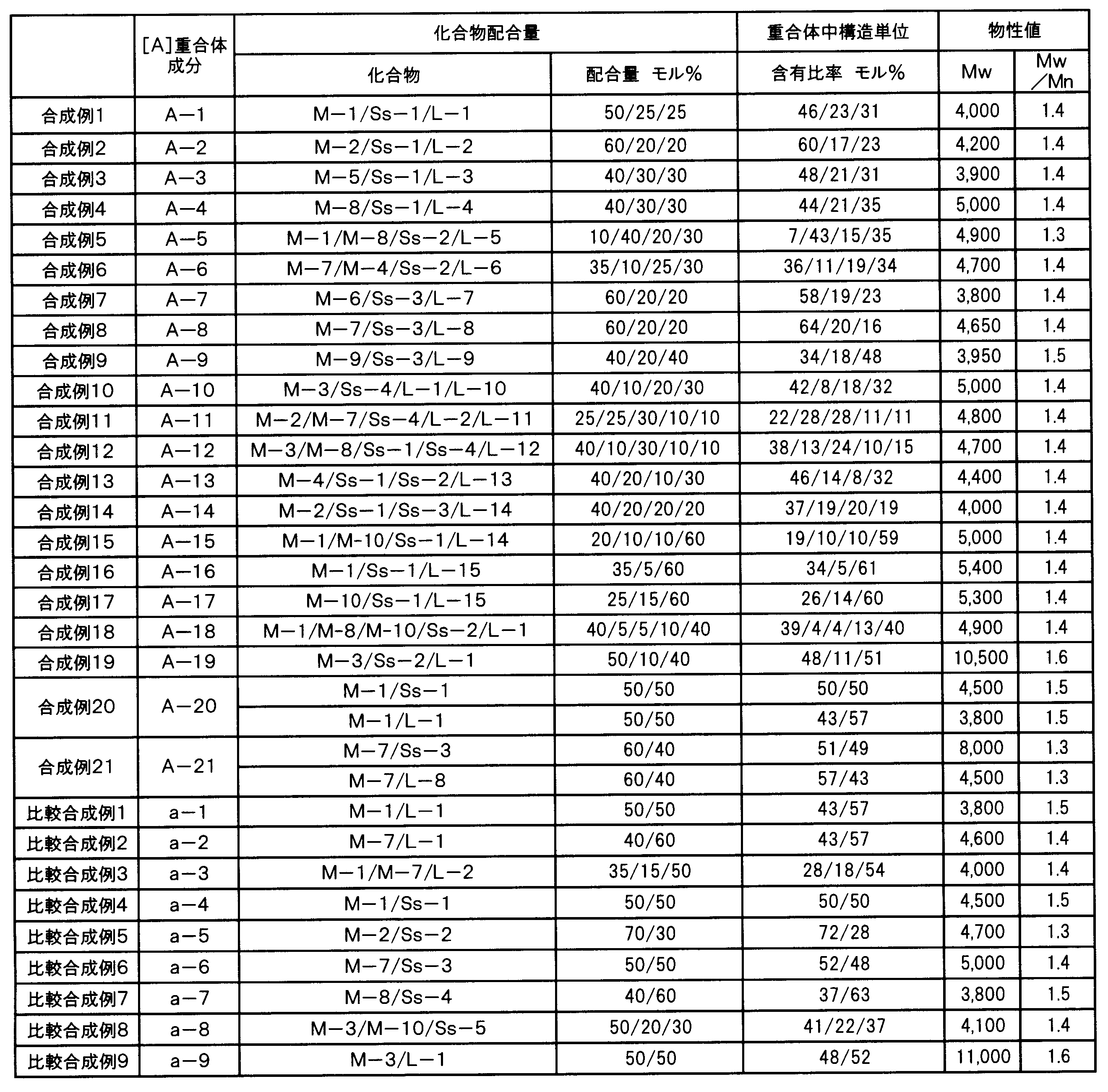
<[D]重合体の合成>
[合成例22]
化合物(M-13)15.8g(50モル%)及び化合物(M-7)14.2g(50モル%)を60gの2-ブタノンに溶解し、AIBN2.9gを添加して単量体溶液を調製した。30gの2-ブタノンを入れた300mLの三口フラスコを30分窒素パージした後、撹拌しながら80℃に加熱し、調製した単量体溶液を滴下漏斗にて3時間かけて滴下した。滴下開始を重合反応の開始時間とし、重合反応を6時間実施した。重合反応終了後、重合溶液を水冷して30℃以下に冷却した。600gのメタノール:水=8:2の溶液に重合溶液を投入し、析出した白色粉末をろ別した。ろ別した白色粉末を120gのメタノールで2回洗浄した後、ろ別し、50℃で17時間乾燥させて白色粉末状の重合体成分(D-1)を得た(20g、収率67%)。得られた重合体(D-1)のMwは4,200であり、Mw/Mnは1.4であった。また、13C-NMR分析の結果、化合物(M-1)由来の構造単位:化合物(Ss-1)由来の構造単位:化合物(L-1)由来の構造単位の含有率は、48.5:51.5(モル%)であった。
[合成例22]
化合物(M-13)15.8g(50モル%)及び化合物(M-7)14.2g(50モル%)を60gの2-ブタノンに溶解し、AIBN2.9gを添加して単量体溶液を調製した。30gの2-ブタノンを入れた300mLの三口フラスコを30分窒素パージした後、撹拌しながら80℃に加熱し、調製した単量体溶液を滴下漏斗にて3時間かけて滴下した。滴下開始を重合反応の開始時間とし、重合反応を6時間実施した。重合反応終了後、重合溶液を水冷して30℃以下に冷却した。600gのメタノール:水=8:2の溶液に重合溶液を投入し、析出した白色粉末をろ別した。ろ別した白色粉末を120gのメタノールで2回洗浄した後、ろ別し、50℃で17時間乾燥させて白色粉末状の重合体成分(D-1)を得た(20g、収率67%)。得られた重合体(D-1)のMwは4,200であり、Mw/Mnは1.4であった。また、13C-NMR分析の結果、化合物(M-1)由来の構造単位:化合物(Ss-1)由来の構造単位:化合物(L-1)由来の構造単位の含有率は、48.5:51.5(モル%)であった。
[合成例23~24]
表2に記載の単量体を所定量配合した以外は、合成例22と同様に操作して重合体(D-2)~(D-3)を得た。また、得られた各重合体のMw、Mw/Mn、収率(%)及び各重合体における各単量体に由来する構造単位の含有率を合わせて表2に示す。
表2に記載の単量体を所定量配合した以外は、合成例22と同様に操作して重合体(D-2)~(D-3)を得た。また、得られた各重合体のMw、Mw/Mn、収率(%)及び各重合体における各単量体に由来する構造単位の含有率を合わせて表2に示す。
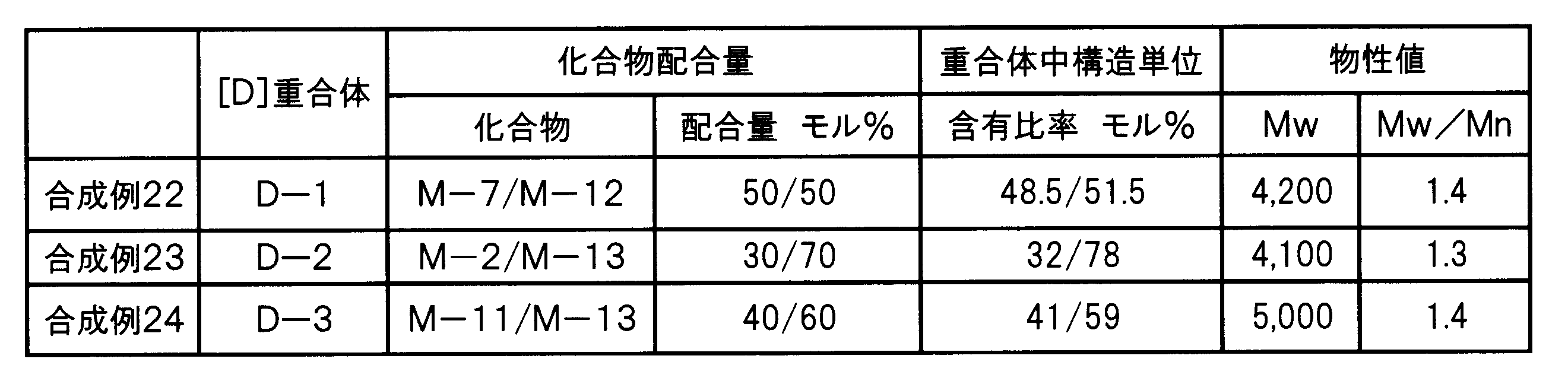
<フォトレジスト組成物の調製>
フォトレジスト組成物の調製に用いた[B]酸発生体、[C]酸拡散制御剤、[E]添加剤及び溶媒について以下に示す。
フォトレジスト組成物の調製に用いた[B]酸発生体、[C]酸拡散制御剤、[E]添加剤及び溶媒について以下に示す。
<[B]酸発生剤>
B-1~B-7:下記式で表される化合物
B-1~B-7:下記式で表される化合物

<[C]酸拡散制御剤>
C-1~C-6:下記式で表される化合物
C-1~C-6:下記式で表される化合物

<溶媒>
F-1:酢酸プロピレングリコールモノメチルエーテル
F-2:シクロヘキサノン
F-1:酢酸プロピレングリコールモノメチルエーテル
F-2:シクロヘキサノン
[実施例1]
重合体成分(A-1)100質量部、酸発生剤(B-1)10質量部、酸拡散制御剤(C-3)2質量部、(C-4)3質量部、重合体(D-1)4質量部、添加剤(E-1)としてのγブチロラクトン30質量部、溶媒(F-1)1,750質量部、(F-2)750質量部を混合し、得られた混合溶液を孔径0.2μmのフィルターでろ過して、フォトレジスト組成物を調製した。
重合体成分(A-1)100質量部、酸発生剤(B-1)10質量部、酸拡散制御剤(C-3)2質量部、(C-4)3質量部、重合体(D-1)4質量部、添加剤(E-1)としてのγブチロラクトン30質量部、溶媒(F-1)1,750質量部、(F-2)750質量部を混合し、得られた混合溶液を孔径0.2μmのフィルターでろ過して、フォトレジスト組成物を調製した。
[実施例2~21及び比較例1~9]
表3に示す種類、量の各成分を使用した以外は実施例1と同様に操作して、フォトレジスト組成物を調製した。
表3に示す種類、量の各成分を使用した以外は実施例1と同様に操作して、フォトレジスト組成物を調製した。

<評価>
実施例1~21及び比較例1~9のフォトレジスト組成物について、下記評価を行った。評価結果は表3に合わせて示す。
[感度の評価]
下層反射防止膜(ARC66、日産化学社製)を形成した12インチシリコンウェハ上にフォトレジスト組成物によって、膜厚75nmの被膜を形成し、100℃で60秒間ソフトベーク(SB)を行った。次に、この被膜を、ArFエキシマレーザー液浸露光装置(NSR S610C、NIKON社製)を用い、NA=1.3、ratio=0.800、Annularの条件により、50nmLine100nmPitchのパターン形成用のマスクパターンを介して露光した。露光後、各フォトレジスト組成物について95℃で60秒間ポストエクスポージャーベーク(PEB)を行った。その後、2.38質量%のテトラメチルアンモニウムヒドロキシド水溶液により現像し、水洗し、乾燥して、ポジ型のレジストパターンを形成した。このとき、50nmLine100nmPitchのパターン形成用のマスクパターンを介して露光した部分が線幅50nmのLineを形成する露光量を最適露光量(Eop)とした。この最適露光量を感度(mJ/cm2)とした。なお、測長には走査型電子顕微鏡(日立ハイテクノロジーズ社、CG4000)を用いた。感度が40(mJ/cm2)以下である場合、良好であると評価した。
実施例1~21及び比較例1~9のフォトレジスト組成物について、下記評価を行った。評価結果は表3に合わせて示す。
[感度の評価]
下層反射防止膜(ARC66、日産化学社製)を形成した12インチシリコンウェハ上にフォトレジスト組成物によって、膜厚75nmの被膜を形成し、100℃で60秒間ソフトベーク(SB)を行った。次に、この被膜を、ArFエキシマレーザー液浸露光装置(NSR S610C、NIKON社製)を用い、NA=1.3、ratio=0.800、Annularの条件により、50nmLine100nmPitchのパターン形成用のマスクパターンを介して露光した。露光後、各フォトレジスト組成物について95℃で60秒間ポストエクスポージャーベーク(PEB)を行った。その後、2.38質量%のテトラメチルアンモニウムヒドロキシド水溶液により現像し、水洗し、乾燥して、ポジ型のレジストパターンを形成した。このとき、50nmLine100nmPitchのパターン形成用のマスクパターンを介して露光した部分が線幅50nmのLineを形成する露光量を最適露光量(Eop)とした。この最適露光量を感度(mJ/cm2)とした。なお、測長には走査型電子顕微鏡(日立ハイテクノロジーズ社、CG4000)を用いた。感度が40(mJ/cm2)以下である場合、良好であると評価した。
[MEEF]
上記感度(mJ/cm2)の評価における方法と同様の方法により、ポジ型のレジストパターンを形成し、Eopを測定した。上記Eopにて、48nmライン100nm、49nmライン100nmピッチ、50nmライン100nmピッチ、51nmライン100nmピッチ、52nmライン100nmピッチとするパターン形成用のマスクパターンをそれぞれ介してLSパターンを形成した。このとき、マスクのラインサイズ(nm)を横軸に、各マスクパターンを用いてレジスト膜に形成されたライン幅(nm)を縦軸にプロットしたときの直線の傾きをMEEFとして算出した。MEEF(直線の傾き)は、その値が1に近いほどマスク再現性が良好である。結果を表2に合わせて示す。
上記感度(mJ/cm2)の評価における方法と同様の方法により、ポジ型のレジストパターンを形成し、Eopを測定した。上記Eopにて、48nmライン100nm、49nmライン100nmピッチ、50nmライン100nmピッチ、51nmライン100nmピッチ、52nmライン100nmピッチとするパターン形成用のマスクパターンをそれぞれ介してLSパターンを形成した。このとき、マスクのラインサイズ(nm)を横軸に、各マスクパターンを用いてレジスト膜に形成されたライン幅(nm)を縦軸にプロットしたときの直線の傾きをMEEFとして算出した。MEEF(直線の傾き)は、その値が1に近いほどマスク再現性が良好である。結果を表2に合わせて示す。
[LWR(nm)]
上記感度(mJ/cm2)の評価における方法と同様の方法により、ポジ型のレジストパターンを形成し、Eopを測定した。上記Eopにて形成された線幅50nmのLineを、パターン上部から観察し、任意の10点において線幅を測定した。線幅の測定値の3シグマ値(ばらつき)をLWR(nm)とした。このLWRの値が5.4nm以下であれば、形成されたパターン形状が良好であると評価した。
上記感度(mJ/cm2)の評価における方法と同様の方法により、ポジ型のレジストパターンを形成し、Eopを測定した。上記Eopにて形成された線幅50nmのLineを、パターン上部から観察し、任意の10点において線幅を測定した。線幅の測定値の3シグマ値(ばらつき)をLWR(nm)とした。このLWRの値が5.4nm以下であれば、形成されたパターン形状が良好であると評価した。
[DOF(nm)]
上記感度の評価における最適露光量(Eop)にて、50nmのライン・アンド・スペースパターン用マスクで解像されるパターン寸法が、マスクの設計寸法の±10%以内となる場合のフォーカスの振れ幅をDOF(nm)とした。
上記感度の評価における最適露光量(Eop)にて、50nmのライン・アンド・スペースパターン用マスクで解像されるパターン寸法が、マスクの設計寸法の±10%以内となる場合のフォーカスの振れ幅をDOF(nm)とした。
表2に示す通り、本発明のフォトレジスト組成物は、感度、MEEF、DOF及びLWRのリソグラフィー性能全てにおいて優れていることがわかった。
本発明のフォトレジスト組成物は、半導体デバイス、液晶デバイス等の各種電子デバイスのリソグラフィー工程におけるレジストパターンの形成において好適に用いられる。
Claims (5)
- [A]同一又は異なる重合体中に、下記式(1)で表される構造単位(I)と、この構造単位(I)以外の構造単位であって、環状カーボネート構造、スルトン構造及びラクトン構造からなる群より選択される少なくとも1種の構造を含む構造単位(II)とを有する1種以上の重合体成分、並びに
[B]酸発生体
を含有するフォトレジスト組成物。

- 構造単位(II)が、下記式(2)で表される構造単位(II-1)である請求項1に記載のフォトレジスト組成物。

- [A]重合体成分が下記式(3)で表される構造単位(III)をさらに有する請求項1又は請求項2に記載のフォトレジスト組成物。

- 上記R9で表されるラクトン構造を有する環状有機基がノルボルナンラクトン基又はブチロラクトン基であり、上記環状カーボネート構造を有する環状有機基がエチレンカーボネート基であり、上記スルトン構造を有する環状有機基がノルボルナンスルトン基である請求項2又は請求項3に記載のフォトレジスト組成物。
- [A]重合体成分における構造単位(I)の含有率が5モル%以上60モル%以下であり、かつ構造単位(I)及び構造単位(III)の含有率の合計が10モル%以上80モル%以下である請求項1から請求項4のいずれか1項に記載のフォトレジスト組成物。
Priority Applications (1)
| Application Number | Priority Date | Filing Date | Title |
|---|---|---|---|
| JP2013507575A JP5862657B2 (ja) | 2011-03-31 | 2012-03-26 | フォトレジスト組成物 |
Applications Claiming Priority (2)
| Application Number | Priority Date | Filing Date | Title |
|---|---|---|---|
| JP2011080878 | 2011-03-31 | ||
| JP2011-080878 | 2011-03-31 |
Publications (1)
| Publication Number | Publication Date |
|---|---|
| WO2012133352A1 true WO2012133352A1 (ja) | 2012-10-04 |
Family
ID=46931069
Family Applications (1)
| Application Number | Title | Priority Date | Filing Date |
|---|---|---|---|
| PCT/JP2012/057837 Ceased WO2012133352A1 (ja) | 2011-03-31 | 2012-03-26 | フォトレジスト組成物 |
Country Status (3)
| Country | Link |
|---|---|
| JP (1) | JP5862657B2 (ja) |
| TW (1) | TW201250381A (ja) |
| WO (1) | WO2012133352A1 (ja) |
Cited By (12)
| Publication number | Priority date | Publication date | Assignee | Title |
|---|---|---|---|---|
| JP2013114085A (ja) * | 2011-11-29 | 2013-06-10 | Fujifilm Corp | 感活性光線性又は感放射線性樹脂組成物、並びに、該組成物を用いたレジスト膜、パターン形成方法、電子デバイスの製造方法及び電子デバイス |
| JP2013117693A (ja) * | 2011-12-05 | 2013-06-13 | Fujifilm Corp | 感活性光線性又は感放射線性樹脂組成物、並びに、該組成物を用いたレジスト膜、パターン形成方法、電子デバイスの製造方法及び電子デバイス |
| JP2013190637A (ja) * | 2012-03-14 | 2013-09-26 | Tokyo Ohka Kogyo Co Ltd | 溶剤現像ネガ型レジスト組成物、レジストパターン形成方法 |
| JP2013205837A (ja) * | 2012-03-29 | 2013-10-07 | Jsr Corp | フォトレジスト組成物及びレジストパターン形成方法 |
| US20130280657A1 (en) * | 2012-04-02 | 2013-10-24 | Jsr Corporation | Photoresist composition and resist pattern-forming method |
| JP2014077999A (ja) * | 2012-09-21 | 2014-05-01 | Sumitomo Chemical Co Ltd | 樹脂、レジスト組成物及びレジストパターンの製造方法 |
| WO2014185288A1 (ja) * | 2013-05-14 | 2014-11-20 | 富士フイルム株式会社 | 感活性光線性又は感放射線性樹脂組成物、及びそれを用いたパターン形成方法 |
| JP2014224991A (ja) * | 2013-04-18 | 2014-12-04 | 住友化学株式会社 | レジスト組成物及びレジストパターンの製造方法 |
| WO2015037520A1 (ja) * | 2013-09-12 | 2015-03-19 | Jsr株式会社 | 樹脂組成物、レジストパターン形成方法及び重合体 |
| WO2017065207A1 (ja) * | 2015-10-16 | 2017-04-20 | 東京応化工業株式会社 | レジスト組成物およびレジストパターン形成方法 |
| JP2017201427A (ja) * | 2017-07-28 | 2017-11-09 | 東京応化工業株式会社 | レジスト組成物及びレジストパターン形成方法 |
| JP2018097125A (ja) * | 2016-12-12 | 2018-06-21 | Jsr株式会社 | 感放射線性樹脂組成物及びレジストパターン形成方法 |
Families Citing this family (1)
| Publication number | Priority date | Publication date | Assignee | Title |
|---|---|---|---|---|
| KR102537251B1 (ko) * | 2018-06-28 | 2023-05-26 | 후지필름 가부시키가이샤 | 감활성광선성 또는 감방사선성 수지 조성물, 패턴 형성 방법, 전자 디바이스의 제조 방법, 수지 |
Citations (7)
| Publication number | Priority date | Publication date | Assignee | Title |
|---|---|---|---|---|
| JP2001081139A (ja) * | 1999-07-12 | 2001-03-27 | Mitsubishi Rayon Co Ltd | レジスト用樹脂および化学増幅型レジスト組成物 |
| JP2002006502A (ja) * | 2000-04-20 | 2002-01-09 | Mitsubishi Rayon Co Ltd | レジスト用(共)重合体およびレジスト組成物 |
| JP2003107709A (ja) * | 2001-09-28 | 2003-04-09 | Fuji Photo Film Co Ltd | ポジ型レジスト組成物 |
| WO2003035637A1 (fr) * | 2001-10-23 | 2003-05-01 | Mitsubishi Rayon Co., Ltd. | Derives de 5-methylene-1,3-dioxolan-4-one, leur procede de production, polymeres de ces derives, compositions de protection, et procede de formation d'une matrice |
| JP2006317794A (ja) * | 2005-05-13 | 2006-11-24 | Fuji Photo Film Co Ltd | レジスト組成物及びそれを用いたパターン形成方法 |
| JP2010262258A (ja) * | 2008-11-12 | 2010-11-18 | Tokyo Ohka Kogyo Co Ltd | レジスト組成物及びレジストパターン形成方法 |
| WO2011007780A1 (ja) * | 2009-07-17 | 2011-01-20 | Jsr株式会社 | 感放射線性樹脂組成物及び化合物 |
-
2012
- 2012-03-26 WO PCT/JP2012/057837 patent/WO2012133352A1/ja not_active Ceased
- 2012-03-26 JP JP2013507575A patent/JP5862657B2/ja active Active
- 2012-03-29 TW TW101111065A patent/TW201250381A/zh unknown
Patent Citations (7)
| Publication number | Priority date | Publication date | Assignee | Title |
|---|---|---|---|---|
| JP2001081139A (ja) * | 1999-07-12 | 2001-03-27 | Mitsubishi Rayon Co Ltd | レジスト用樹脂および化学増幅型レジスト組成物 |
| JP2002006502A (ja) * | 2000-04-20 | 2002-01-09 | Mitsubishi Rayon Co Ltd | レジスト用(共)重合体およびレジスト組成物 |
| JP2003107709A (ja) * | 2001-09-28 | 2003-04-09 | Fuji Photo Film Co Ltd | ポジ型レジスト組成物 |
| WO2003035637A1 (fr) * | 2001-10-23 | 2003-05-01 | Mitsubishi Rayon Co., Ltd. | Derives de 5-methylene-1,3-dioxolan-4-one, leur procede de production, polymeres de ces derives, compositions de protection, et procede de formation d'une matrice |
| JP2006317794A (ja) * | 2005-05-13 | 2006-11-24 | Fuji Photo Film Co Ltd | レジスト組成物及びそれを用いたパターン形成方法 |
| JP2010262258A (ja) * | 2008-11-12 | 2010-11-18 | Tokyo Ohka Kogyo Co Ltd | レジスト組成物及びレジストパターン形成方法 |
| WO2011007780A1 (ja) * | 2009-07-17 | 2011-01-20 | Jsr株式会社 | 感放射線性樹脂組成物及び化合物 |
Cited By (19)
| Publication number | Priority date | Publication date | Assignee | Title |
|---|---|---|---|---|
| JP2013114085A (ja) * | 2011-11-29 | 2013-06-10 | Fujifilm Corp | 感活性光線性又は感放射線性樹脂組成物、並びに、該組成物を用いたレジスト膜、パターン形成方法、電子デバイスの製造方法及び電子デバイス |
| JP2013117693A (ja) * | 2011-12-05 | 2013-06-13 | Fujifilm Corp | 感活性光線性又は感放射線性樹脂組成物、並びに、該組成物を用いたレジスト膜、パターン形成方法、電子デバイスの製造方法及び電子デバイス |
| JP2013190637A (ja) * | 2012-03-14 | 2013-09-26 | Tokyo Ohka Kogyo Co Ltd | 溶剤現像ネガ型レジスト組成物、レジストパターン形成方法 |
| JP2013205837A (ja) * | 2012-03-29 | 2013-10-07 | Jsr Corp | フォトレジスト組成物及びレジストパターン形成方法 |
| US20130280657A1 (en) * | 2012-04-02 | 2013-10-24 | Jsr Corporation | Photoresist composition and resist pattern-forming method |
| US9329474B2 (en) * | 2012-04-02 | 2016-05-03 | Jsr Corporation | Photoresist composition and resist pattern-forming method |
| JP2014077999A (ja) * | 2012-09-21 | 2014-05-01 | Sumitomo Chemical Co Ltd | 樹脂、レジスト組成物及びレジストパターンの製造方法 |
| JP2014224991A (ja) * | 2013-04-18 | 2014-12-04 | 住友化学株式会社 | レジスト組成物及びレジストパターンの製造方法 |
| JP2014222338A (ja) * | 2013-05-14 | 2014-11-27 | 富士フイルム株式会社 | 感活性光線性又は感放射線性樹脂組成物、及びそれを用いたパターン形成方法 |
| WO2014185288A1 (ja) * | 2013-05-14 | 2014-11-20 | 富士フイルム株式会社 | 感活性光線性又は感放射線性樹脂組成物、及びそれを用いたパターン形成方法 |
| WO2015037520A1 (ja) * | 2013-09-12 | 2015-03-19 | Jsr株式会社 | 樹脂組成物、レジストパターン形成方法及び重合体 |
| JPWO2015037520A1 (ja) * | 2013-09-12 | 2017-03-02 | Jsr株式会社 | 樹脂組成物、レジストパターン形成方法及び重合体 |
| US10331031B2 (en) | 2013-09-12 | 2019-06-25 | Jsr Corporation | Resin composition, resist pattern-forming method and polymer |
| WO2017065207A1 (ja) * | 2015-10-16 | 2017-04-20 | 東京応化工業株式会社 | レジスト組成物およびレジストパターン形成方法 |
| JPWO2017065207A1 (ja) * | 2015-10-16 | 2018-08-02 | 東京応化工業株式会社 | レジスト組成物およびレジストパターン形成方法 |
| US11150554B2 (en) | 2015-10-16 | 2021-10-19 | Tokyo Ohka Kogyo Co., Ltd. | Resist composition and method of forming resist pattern |
| JP2018097125A (ja) * | 2016-12-12 | 2018-06-21 | Jsr株式会社 | 感放射線性樹脂組成物及びレジストパターン形成方法 |
| JP7062874B2 (ja) | 2016-12-12 | 2022-05-09 | Jsr株式会社 | 感放射線性樹脂組成物及びレジストパターン形成方法 |
| JP2017201427A (ja) * | 2017-07-28 | 2017-11-09 | 東京応化工業株式会社 | レジスト組成物及びレジストパターン形成方法 |
Also Published As
| Publication number | Publication date |
|---|---|
| TW201250381A (en) | 2012-12-16 |
| JP5862657B2 (ja) | 2016-02-16 |
| JPWO2012133352A1 (ja) | 2014-07-28 |
Similar Documents
| Publication | Publication Date | Title |
|---|---|---|
| JP5862657B2 (ja) | フォトレジスト組成物 | |
| JP5967082B2 (ja) | フォトレジスト組成物 | |
| JP6019677B2 (ja) | フォトレジスト組成物及びレジストパターン形成方法 | |
| JP5920435B2 (ja) | 化合物 | |
| JP5786426B2 (ja) | フォトレジスト組成物、レジストパターン形成方法 | |
| JP6149656B2 (ja) | フォトレジスト組成物、レジストパターン形成方法、重合体及び化合物 | |
| JP5724791B2 (ja) | 感放射線性樹脂組成物及びレジストパターンの形成方法 | |
| JP5772417B2 (ja) | フォトレジスト組成物 | |
| JP5783111B2 (ja) | フォトレジスト組成物及びレジストパターン形成方法 | |
| WO2017057203A1 (ja) | 感放射線性樹脂組成物及びレジストパターン形成方法 | |
| JP5737114B2 (ja) | 化合物、重合体及びフォトレジスト組成物 | |
| WO2012074025A1 (ja) | 感放射線性樹脂組成物、これを用いたパターン形成方法、重合体及び化合物 | |
| JP5540818B2 (ja) | 感放射線性樹脂組成物及び重合体 | |
| JP6319291B2 (ja) | 感放射線性樹脂組成物、レジストパターン形成方法、感放射線性酸発生剤及び化合物 | |
| JP5857522B2 (ja) | 化合物及びフォトレジスト組成物 | |
| WO2013047528A1 (ja) | フォトレジスト組成物及びレジストパターン形成方法 | |
| JP5790382B2 (ja) | フォトレジスト組成物 | |
| JP5915327B2 (ja) | 感放射線性樹脂組成物及びレジストパターン形成方法 | |
| JP5954332B2 (ja) | フォトレジスト組成物及びレジストパターン形成方法 | |
| JP2013088763A (ja) | フォトレジスト組成物 | |
| JP5783118B2 (ja) | フォトレジスト組成物、レジストパターン形成方法及び重合体 | |
| JP2016224123A (ja) | 感放射線性樹脂組成物及びレジストパターン形成方法 |
Legal Events
| Date | Code | Title | Description |
|---|---|---|---|
| 121 | Ep: the epo has been informed by wipo that ep was designated in this application |
Ref document number: 12764097 Country of ref document: EP Kind code of ref document: A1 |
|
| ENP | Entry into the national phase |
Ref document number: 2013507575 Country of ref document: JP Kind code of ref document: A |
|
| NENP | Non-entry into the national phase |
Ref country code: DE |
|
| 122 | Ep: pct application non-entry in european phase |
Ref document number: 12764097 Country of ref document: EP Kind code of ref document: A1 |