WO2012133385A1 - 水系ホース - Google Patents
水系ホース Download PDFInfo
- Publication number
- WO2012133385A1 WO2012133385A1 PCT/JP2012/057888 JP2012057888W WO2012133385A1 WO 2012133385 A1 WO2012133385 A1 WO 2012133385A1 JP 2012057888 W JP2012057888 W JP 2012057888W WO 2012133385 A1 WO2012133385 A1 WO 2012133385A1
- Authority
- WO
- WIPO (PCT)
- Prior art keywords
- hose
- ethylene
- inner layer
- carbon black
- outer layer
- Prior art date
- Legal status (The legal status is an assumption and is not a legal conclusion. Google has not performed a legal analysis and makes no representation as to the accuracy of the status listed.)
- Ceased
Links
Images
Classifications
-
- B—PERFORMING OPERATIONS; TRANSPORTING
- B32—LAYERED PRODUCTS
- B32B—LAYERED PRODUCTS, i.e. PRODUCTS BUILT-UP OF STRATA OF FLAT OR NON-FLAT, e.g. CELLULAR OR HONEYCOMB, FORM
- B32B1/00—Layered products having a non-planar shape
- B32B1/08—Tubular products
-
- B—PERFORMING OPERATIONS; TRANSPORTING
- B32—LAYERED PRODUCTS
- B32B—LAYERED PRODUCTS, i.e. PRODUCTS BUILT-UP OF STRATA OF FLAT OR NON-FLAT, e.g. CELLULAR OR HONEYCOMB, FORM
- B32B25/00—Layered products comprising a layer of natural or synthetic rubber
- B32B25/10—Layered products comprising a layer of natural or synthetic rubber next to a fibrous or filamentary layer
-
- B—PERFORMING OPERATIONS; TRANSPORTING
- B32—LAYERED PRODUCTS
- B32B—LAYERED PRODUCTS, i.e. PRODUCTS BUILT-UP OF STRATA OF FLAT OR NON-FLAT, e.g. CELLULAR OR HONEYCOMB, FORM
- B32B27/00—Layered products comprising a layer of synthetic resin
- B32B27/12—Layered products comprising a layer of synthetic resin next to a fibrous or filamentary layer
-
- B—PERFORMING OPERATIONS; TRANSPORTING
- B32—LAYERED PRODUCTS
- B32B—LAYERED PRODUCTS, i.e. PRODUCTS BUILT-UP OF STRATA OF FLAT OR NON-FLAT, e.g. CELLULAR OR HONEYCOMB, FORM
- B32B27/00—Layered products comprising a layer of synthetic resin
- B32B27/18—Layered products comprising a layer of synthetic resin characterised by the use of special additives
- B32B27/26—Layered products comprising a layer of synthetic resin characterised by the use of special additives using curing agents
-
- C—CHEMISTRY; METALLURGY
- C08—ORGANIC MACROMOLECULAR COMPOUNDS; THEIR PREPARATION OR CHEMICAL WORKING-UP; COMPOSITIONS BASED THEREON
- C08J—WORKING-UP; GENERAL PROCESSES OF COMPOUNDING; AFTER-TREATMENT NOT COVERED BY SUBCLASSES C08B, C08C, C08F, C08G or C08H
- C08J7/00—Chemical treatment or coating of shaped articles made of macromolecular substances
- C08J7/04—Coating
- C08J7/0427—Coating with only one layer of a composition containing a polymer binder
-
- C—CHEMISTRY; METALLURGY
- C08—ORGANIC MACROMOLECULAR COMPOUNDS; THEIR PREPARATION OR CHEMICAL WORKING-UP; COMPOSITIONS BASED THEREON
- C08J—WORKING-UP; GENERAL PROCESSES OF COMPOUNDING; AFTER-TREATMENT NOT COVERED BY SUBCLASSES C08B, C08C, C08F, C08G or C08H
- C08J7/00—Chemical treatment or coating of shaped articles made of macromolecular substances
- C08J7/04—Coating
- C08J7/043—Improving the adhesiveness of the coatings per se, e.g. forming primers
-
- F—MECHANICAL ENGINEERING; LIGHTING; HEATING; WEAPONS; BLASTING
- F16—ENGINEERING ELEMENTS AND UNITS; GENERAL MEASURES FOR PRODUCING AND MAINTAINING EFFECTIVE FUNCTIONING OF MACHINES OR INSTALLATIONS; THERMAL INSULATION IN GENERAL
- F16L—PIPES; JOINTS OR FITTINGS FOR PIPES; SUPPORTS FOR PIPES, CABLES OR PROTECTIVE TUBING; MEANS FOR THERMAL INSULATION IN GENERAL
- F16L11/00—Hoses, i.e. flexible pipes
- F16L11/04—Hoses, i.e. flexible pipes made of rubber or flexible plastics
- F16L11/08—Hoses, i.e. flexible pipes made of rubber or flexible plastics with reinforcements embedded in the wall
- F16L11/085—Hoses, i.e. flexible pipes made of rubber or flexible plastics with reinforcements embedded in the wall comprising one or more braided layers
-
- B—PERFORMING OPERATIONS; TRANSPORTING
- B32—LAYERED PRODUCTS
- B32B—LAYERED PRODUCTS, i.e. PRODUCTS BUILT-UP OF STRATA OF FLAT OR NON-FLAT, e.g. CELLULAR OR HONEYCOMB, FORM
- B32B2274/00—Thermoplastic elastomer material
-
- B—PERFORMING OPERATIONS; TRANSPORTING
- B32—LAYERED PRODUCTS
- B32B—LAYERED PRODUCTS, i.e. PRODUCTS BUILT-UP OF STRATA OF FLAT OR NON-FLAT, e.g. CELLULAR OR HONEYCOMB, FORM
- B32B2597/00—Tubular articles, e.g. hoses, pipes
-
- C—CHEMISTRY; METALLURGY
- C08—ORGANIC MACROMOLECULAR COMPOUNDS; THEIR PREPARATION OR CHEMICAL WORKING-UP; COMPOSITIONS BASED THEREON
- C08J—WORKING-UP; GENERAL PROCESSES OF COMPOUNDING; AFTER-TREATMENT NOT COVERED BY SUBCLASSES C08B, C08C, C08F, C08G or C08H
- C08J2323/00—Characterised by the use of homopolymers or copolymers of unsaturated aliphatic hydrocarbons having only one carbon-to-carbon double bond; Derivatives of such polymers
- C08J2323/02—Characterised by the use of homopolymers or copolymers of unsaturated aliphatic hydrocarbons having only one carbon-to-carbon double bond; Derivatives of such polymers not modified by chemical after treatment
- C08J2323/16—Ethene-propene or ethene-propene-diene copolymers
-
- C—CHEMISTRY; METALLURGY
- C08—ORGANIC MACROMOLECULAR COMPOUNDS; THEIR PREPARATION OR CHEMICAL WORKING-UP; COMPOSITIONS BASED THEREON
- C08J—WORKING-UP; GENERAL PROCESSES OF COMPOUNDING; AFTER-TREATMENT NOT COVERED BY SUBCLASSES C08B, C08C, C08F, C08G or C08H
- C08J2433/00—Characterised by the use of homopolymers or copolymers of compounds having one or more unsaturated aliphatic radicals, each having only one carbon-to-carbon double bond, and only one being terminated by only one carboxyl radical, or of salts, anhydrides, esters, amides, imides, or nitriles thereof; Derivatives of such polymers
- C08J2433/04—Characterised by the use of homopolymers or copolymers of compounds having one or more unsaturated aliphatic radicals, each having only one carbon-to-carbon double bond, and only one being terminated by only one carboxyl radical, or of salts, anhydrides, esters, amides, imides, or nitriles thereof; Derivatives of such polymers esters
- C08J2433/06—Characterised by the use of homopolymers or copolymers of compounds having one or more unsaturated aliphatic radicals, each having only one carbon-to-carbon double bond, and only one being terminated by only one carboxyl radical, or of salts, anhydrides, esters, amides, imides, or nitriles thereof; Derivatives of such polymers esters of esters containing only carbon, hydrogen, and oxygen, the oxygen atom being present only as part of the carboxyl radical
Definitions
- the present invention relates to an aqueous hose such as a radiator hose used for connection between an engine and a radiator in a vehicle such as an automobile.
- a water-based hose material for example, a rubber composition mainly composed of ethylene-propylene-diene terpolymer rubber (EPDM) has been used (see Patent Document 1).
- EPDM ethylene-propylene-diene terpolymer rubber
- the rubber composition described in Patent Document 1 is mainly composed of EPDM as a rubber component, it is excellent in water resistance such as coolant resistance (LLC resistance).
- LLC resistance coolant resistance
- the heat resistance level is limited to about 170 ° C. ⁇ 200 hours, and the high heat resistance level (170 ° C. ⁇ 600 hours) could not be satisfied.
- the present invention has been made in view of such circumstances, and an object thereof is to provide an aqueous hose excellent in heat resistance and water resistance.
- an aqueous hose of the present invention is an aqueous hose comprising an inner layer and an outer layer formed on the outer periphery thereof, and the inner layer contains the following (A) and (B): It is composed of an ethylene-propylene rubber composition, the outer layer is made of an acrylic rubber composition containing the following (a) and (b), and the inner layer and the outer layer are bonded with a silane adhesive.
- a Ethylene-propylene rubber.
- B Crosslinking agent.
- A Acrylic rubber.
- the present inventor has conducted extensive research in order to obtain an aqueous hose excellent in heat resistance and water resistance.
- the inner layer of the water-based hose is formed of a material mainly composed of ethylene-propylene rubber excellent in water resistance such as LLC resistance, and the outer layer of the water-based hose is mainly composed of acrylic rubber excellent in heat resistance.
- the experiment was carried out in the light of the material to be formed, but it was found that both layers had poor adhesion. Therefore, the inventor conducted further experiments focusing on the silane-based adhesive.
- Silane-based adhesives are effective as adhesives for ethylene-propylene-based rubbers, but are considered to be less effective as adhesives for acrylic rubbers, and this has been regarded as common technical knowledge.
- the water-based hose of the present invention has an inner layer made of an ethylene-propylene rubber composition containing an ethylene-propylene rubber (A) and a crosslinking agent (B), and an outer layer made of an acrylic rubber ( a) and an acrylic rubber composition containing carbon black (b) having a hydroxyl group on the surface, and the inner layer and the outer layer are bonded together by a silane-based adhesive. Therefore, the water-based hose of the present invention is excellent in heat resistance and water resistance, and is excellent in interlayer adhesion between the inner layer and the outer layer.
- the interlayer adhesion between the inner layer and the outer layer is further improved.
- the content of the carbon black (b) having a hydroxyl group on the surface is 30 to 80 parts by weight with respect to 100 parts by weight of the acrylic rubber (a), excellent interlayer adhesion can be achieved without reducing heat resistance. Sex can be maintained.
- water-based hose is provided with a reinforcing yarn layer at the interface between the inner layer and the outer layer, pressure resistance is improved and interlayer adhesion is further improved.
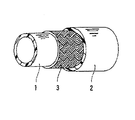
- the water-based hose of the present invention is configured, for example, by forming a reinforcing yarn layer 3 at the interface between the inner layer 1 and the outer layer 2 as shown in FIG.
- the inner layer 1 is composed of an ethylene-propylene rubber composition containing the following (A) and (B), and the outer layer 2 is an acrylic rubber composition containing the following (a) and (b):
- the inner layer 1 and the outer layer 2 are bonded with a silane-based adhesive.
- A Ethylene-propylene rubber.
- B Crosslinking agent.
- A Acrylic rubber.
- B Carbon black having a hydroxyl group on the surface.
- the ethylene-propylene rubber composition contains an ethylene-propylene rubber (A) and a crosslinking agent (B) as essential components.
- Ethylene-propylene rubber (A) Examples of the ethylene-propylene rubber (A) include ethylene-propylene-diene terpolymer rubber (EPDM), ethylene-propylene copolymer rubber (EPM), etc., either alone or in combination of two or more. Used.
- EPDM ethylene-propylene-diene terpolymer rubber
- EPM ethylene-propylene copolymer rubber
- the ethylene-propylene rubber (A) is preferably one having an iodine value in the range of 6 to 30 and an ethylene ratio in the range of 48 to 70% by weight, particularly preferably in view of excellent stability under high temperature and pressure. Has an iodine value of 10 to 24 and an ethylene ratio of 50 to 60% by weight.
- the diene monomer (third component) contained in the EPDM is preferably a diene monomer having 5 to 20 carbon atoms, specifically 1,4-pentadiene, 1,4-hexadiene, 1,5-hexadiene. 2,5-dimethyl-1,5-hexadiene, 1,4-octadiene, 1,4-cyclohexadiene, cyclooctadiene, dicyclopentadiene (DCP), 5-ethylidene-2-norbornene (ENB), 5- Butylidene-2-norbornene, 2-methallyl-5-norbornene, 2-isopropenyl-5-norbornene and the like.
- DCP dicyclopentadiene
- ENB 5-ethylidene-2-norbornene
- ENB 5- Butylidene-2-norbornene
- 2-methallyl-5-norbornene 2-isopropenyl-5-norborn
- Crosslinking agent (B) As said crosslinking agent (B), sulfur, a peroxide crosslinking agent (peroxide crosslinking agent), etc. are individual or used together, for example. Among these, a peroxide crosslinking agent is preferable in terms of heat resistance.
- peroxide crosslinking agent examples include 1,1-bis (t-butylperoxy) -3,3,5-trimethylcyclohexane, 1,1-bis (t-hexylperoxy) -3,3, 5-trimethylcyclohexane, 1,1-bis (t-hexylperoxy) cyclohexane, 1,1-bis (t-butylperoxy) cyclododecane, 1,1-bis (t-butylperoxy) cyclohexane, 2, Pers such as 2-bis (t-butylperoxy) octane, n-butyl-4,4-bis (t-butylperoxy) butane, n-butyl-4,4-bis (t-butylperoxy) valerate, etc.
- the content thereof is preferably 1 to 20 parts by weight, particularly preferably 3 to 100 parts by weight with respect to 100 parts by weight of the ethylene-propylene rubber (A). 15 parts by weight.
- sulfur is used as the crosslinking agent (B)
- the content thereof is preferably 0.5 to 15 parts by weight, particularly preferably 1 to 1 part by weight based on 100 parts by weight of the ethylene-propylene rubber (A). 5 parts by weight. If the amount of the crosslinking agent (B) is too small, the vulcanization is insufficient and the strength of the hose is inferior. If the amount of the crosslinking agent (B) is too much, it becomes too hard and the flexibility of the hose tends to be inferior. There is a tendency for the time to be shortened and the workability to deteriorate.
- the ethylene-propylene rubber composition used in the present invention includes a vulcanization accelerator, carbon black, a vulcanization aid, process oil, A co-crosslinking agent, an anti-aging agent and the like may be appropriately blended as necessary. These may be used alone or in combination of two or more.
- vulcanization accelerator examples include vulcanization accelerators such as thiazole, sulfenamide, thiuram, aldehyde ammonia, aldehyde amine, guanidine, and thiourea. These may be used alone or in combination of two or more. Of these, sulfenamide-based vulcanization accelerators are preferred because they are excellent in vulcanization reactivity.
- the content of the vulcanization accelerator is preferably 0.1 to 10 parts by weight, particularly preferably 0.5 to 3 parts by weight with respect to 100 parts by weight of the ethylene-propylene rubber (A).
- Examples of the thiazole vulcanization accelerator include dibenzothiazyl disulfide (MBTS), 2-mercaptobenzothiazole (MBT), 2-mercaptobenzothiazole sodium salt (NaMBT), and 2-mercaptobenzothiazole zinc salt (ZnMBT). Etc. These may be used alone or in combination of two or more. Among these, dibenzothiazyl disulfide (MBTS) and 2-mercaptobenzothiazole (MBT) are preferable in terms of excellent vulcanization reactivity.
- sulfenamide vulcanization accelerator examples include N-oxydiethylene-2-benzothiazolylsulfenamide (NOBS), N-cyclohexyl-2-benzothiazolylsulfenamide (CBS), Nt -Butyl-2-benzothiazoylsulfenamide (BBS), N, N'-dicyclohexyl-2-benzothiazoylsulfenamide and the like. These may be used alone or in combination of two or more.
- thiuram vulcanization accelerator examples include tetramethylthiuram disulfide (TMTD), tetraethylthiuram disulfide (TETD), tetrabutylthiuram disulfide (TBTD), tetrakis (2-ethylhexyl) thiuram disulfide (TOT), tetrabenzylthiuram.
- TMTD tetramethylthiuram disulfide
- TETD tetraethylthiuram disulfide
- TBTD tetrabutylthiuram disulfide
- TOT tetrakis (2-ethylhexyl) thiuram disulfide
- TOT tetrabenzylthiuram.
- examples thereof include disulfide (TBzTD). These may be used alone or in combination of two or more.
- Carbon black As the carbon black, those excellent in extrudability and reinforcing properties are preferable. For example, those of SAF class, ISAF class, HAF class, MAF class, FEF class, GPF class, SRF class, FT class, MT class, etc. Can be given. These may be used alone or in combination of two or more.
- the content of the carbon black is preferably 20 to 140 parts by weight, particularly preferably 60 to 120 parts by weight with respect to 100 parts by weight of the ethylene-propylene rubber (A). If the amount of carbon black is too small, the effect of reinforcing properties is poor, and if the amount of carbon black is too large, the electric resistance tends to be low and the electric insulation tends to deteriorate.
- vulcanization aid examples include zinc white (ZnO), stearic acid, magnesium oxide and the like. These may be used alone or in combination of two or more.
- the content of the vulcanization aid is preferably 1 to 25 parts by weight, particularly preferably 3 to 10 parts by weight, based on 100 parts by weight of the ethylene-propylene rubber (A).
- Process oil examples include naphthenic oil, paraffinic oil, and aroma oil. These may be used alone or in combination of two or more.
- the content of the process oil is preferably 5 to 100 parts by weight, particularly preferably 20 to 80 parts by weight with respect to 100 parts by weight of the ethylene-propylene rubber (A).
- co-crosslinking agent for example, divinylbenzene, triallyl isocyanurate (TAIC) is preferably used, and together with these, triallyl cyanurate, diacetone diacrylamide, polyethylene glycol diacrylate, polyethylene glycol dimethacrylate, trimethylol.
- TAIC triallyl isocyanurate
- the content of the co-crosslinking agent is preferably 0.1 to 10 parts by weight, particularly preferably 0.5 to 5 parts by weight with respect to 100 parts by weight of the ethylene-propylene rubber (A).
- Anti-aging agent examples include carbamate-based, phenylenediamine-based, phenol-based, diphenylamine-based, quinoline-based anti-aging agents, and waxes. These may be used alone or in combination of two or more.
- the content of the anti-aging agent is preferably 0.5 to 10 parts by weight, particularly preferably 1 to 4 parts by weight with respect to 100 parts by weight of the ethylene-propylene rubber (A).
- the ethylene-propylene rubber composition used in the present invention includes, for example, a vulcanization accelerator, carbon black, a vulcanization aid, process oil, etc. in the ethylene-propylene rubber (A) and the crosslinking agent (B). It can mix
- kneaders such as a kneader, a Banbury mixer, and an open roll.
- Acrylic rubber composition which is a material for the outer layer of the water-based hose of the present invention will be described.
- the acrylic rubber composition contains acrylic rubber (a) and carbon black (b) having a hydroxyl group on the surface as essential components.
- Acrylic rubber (a) examples include those having an acrylate content of 70 to 100% by weight, an ethylene content of 0 to 10% by weight, and a vinyl acetate content of 0 to 20% by weight. It is preferable from the point.
- acrylate ester examples include alkoxy acrylates such as methyl acrylate, ethyl acrylate, n-butyl acrylate, methoxyethyl acrylate, and the like.
- the acrylic rubber (a) may be copolymerized with 0 to 5% by weight of a crosslinking site-containing monomer.
- a crosslinking site-containing monomer As said monomer, the monomer etc. which have an active halogen group, an epoxy group, a carboxyl group, a hydroxyl group, an amide group, a diene group etc. are mention
- epoxy groups such as glycidyl methacrylate and carboxyl groups such as monobutyl maleate are preferable.
- Carbon black (b) having a hydroxyl group on the surface Examples of the carbon black include furnace black such as HAF carbon black, MAF carbon black, FEF carbon black, SRF carbon black and GPF carbon black, and thermal black such as FT carbon black and MT carbon black. These may be used alone or in combination of two or more.
- the nitrogen adsorption specific surface area of the specific carbon black (b) is preferably 7 ⁇ 10 3 to 125 ⁇ 10 3 m 2 / kg from the viewpoint of heat resistance, and particularly preferably 35 ⁇ from the viewpoint of heat resistance and adhesiveness. 10 3 to 125 ⁇ 10 3 m 2 / kg.
- the nitrogen adsorption specific surface area can be measured, for example, according to the method described in JIS K 6217-2.
- OH amount of the specific carbon black (b) is 0.20 to 0.65 meq. / G, particularly preferably 0.30 to 0.65 meq. / G.
- the OH amount can be determined by, for example, the total acid group amount-strong acid group amount.
- Total amount of acidic groups The solution is obtained by adding sodium hydroxide aqueous solution to carbon black, shaking and centrifuging, then adding methyl orange to the supernatant and titrating with hydrochloric acid aqueous solution.
- the content of the specific carbon black (b) is preferably 30 to 80 parts by weight, particularly preferably 40 to 60 parts by weight, based on 100 parts by weight of the acrylic rubber (a), from the viewpoint of heat resistance. .
- the specific carbon black (b) is too small, the interlayer adhesion tends to deteriorate, and when the specific carbon black (b) is too large, the heat resistance tends to deteriorate.
- the acrylic rubber composition used in the present invention includes an acrylic rubber (a) and carbon black (b) having a hydroxyl group on the surface, a crosslinking agent, a reinforcing material, a white filler, a plasticizer, and vulcanization acceleration. Agents, processing aids, anti-aging agents, flame retardants, etc. may be blended as necessary. These may be used alone or in combination of two or more.
- crosslinking agent for example, an amine crosslinking agent, an acid anhydride crosslinking agent, a urea crosslinking agent, a Lewis acid crosslinking agent and the like are used alone or in combination. Among these, an amine crosslinking agent is preferable from the viewpoint of heat resistance.
- amine cross-linking agent examples include hexamethylene diamine, hexamethylene diamine carbamate, tetramethylene pentamine, N, N′-dicinnamylidene-1,6-hexane diamine, 4,4′-methylene bis (cyclohexylamine), 4, 4'-methylenedianiline, 4,4'-oxyphenyldiphenylamine, m-phenylenediamine, p-phenylenediamine, 4,4'-methylenebis (o-chloroaniline), 4,4'-diaminodiphenyl ether, 3,4 '-Diaminodiphenyl ether, 4,4'-(m-phenylenediisopropylidene) dianiline, 4,4 '-(p-phenylenediisopropylidene) dianiline, 2,2'-bis [4- (4-aminophenoxy) Phenyl] propane, 4,4'-diaminobe Du
- the content of the crosslinking agent is preferably from 0.1 to 10 parts by weight, particularly preferably from 0.3 to 5 parts by weight, based on 100 parts by weight of the acrylic rubber (a).
- the acrylic rubber composition used in the present invention includes, for example, an acrylic rubber (a) and carbon black (b) having a hydroxyl group on the surface, if necessary, a crosslinking agent or the like, and kneader or Banbury mixer. It can be prepared by kneading using a kneader such as a roll.
- silane-based adhesive that bonds the inner layer 1 and the outer layer 2
- a silane-based adhesive a room-temperature vulcanized silane adhesive (RTV) vulcanized with a mixture of a curing agent or air moisture, even if it is a heat-cured silane-based adhesive that is vulcanized by heating.
- RTV room-temperature vulcanized silane adhesive
- Silicone may be used, and specifically, an oligomer obtained by reacting a silane coupling agent and having an amino group, a vinyl group or the like as a functional group is preferable.
- Examples of the reinforcing yarn forming the reinforcing yarn layer 3 include vinylon (polyvinyl alcohol) yarn, polyamide (nylon) yarn, aramid yarn, polyethylene terephthalate (PET) yarn and the like. Among these, an aramid yarn is preferable from the viewpoint of heat resistance.
- Examples of the braiding method of the reinforcing yarn include spiral knitting, knitting knitting, and blade knitting.
- an ethylene-propylene rubber composition as an inner layer material and an acrylic rubber composition as an outer layer material are prepared.
- an ethylene-propylene rubber composition (inner layer material) is extruded onto a mandrel, and a silane adhesive is applied thereon by a method such as coating, brushing, or dipig.
- a silane adhesive is applied thereon by a method such as coating, brushing, or dipig.
- an acrylic rubber composition (outer layer material) is extruded on the surface, and then the hose is vulcanized (for example, heated at 160 ° C.
- the water-based hose of the present invention is not limited to the structure shown in FIG. 1, and it is also possible to form a reinforcing outermost layer made of a rubber material on the outer periphery of the outer layer 2.
- the reinforcing yarn layer 3 may be omitted.
- the outer diameter of the hose is preferably 10 to 90 mm, particularly preferably 20 to 60 mm.
- the thickness of the inner layer 1 is preferably 0.5 to 20 mm, particularly preferably 2 to 4 mm
- the thickness of the outer layer 2 is preferably 0.5 to 5 mm, particularly preferably 1 to 3 mm.
- Zinc oxide (Mitsui Mining & Mining, 2 types of zinc oxide)
- Carbon black (C1) SRF grade carbon black (manufactured by Cabot Japan, Show Black IP-200) (nitrogen adsorption specific surface area (Multi): 21 m 2 / g, DBP oil absorption: 135 ml / 100 g)
- Carbon black (C2) SRF grade carbon black (Nitrogen adsorption specific surface area (Multi): 21 m 2 / g, DBP oil absorption: 112 ml / 100 g)
- Carbon black (b1) Show Black N110 (nitrogen adsorption specific surface area: 135 ⁇ 10 3 m 2 / kg, OH amount: 0.59 meq./g) manufactured by Cabot Japan
- Carbon black (b2) Show black N220 (nitrogen adsorption specific surface area: 122 ⁇ 10 3 m 2 / kg, OH amount: 0.61 meq./g) manufactured by Cabot Japan
- Carbon black (b3) Show black N330 (nitrogen adsorption specific surface area: 76 ⁇ 10 3 m 2 / kg, OH amount: 0.55 meq./g) manufactured by Cabot Japan
- Carbon black (b4) SEAST SO (Nitrogen adsorption specific surface area: 35 ⁇ 10 3 m 2 / kg, OH amount: 0.31 meq./g), manufactured by Tokai Carbon Co., Ltd.
- Example 1 An ethylene-propylene rubber composition (inner layer material) and an acrylic rubber composition (outer layer material) are laminated in the combinations shown in Table 3 below, and a silane-based adhesive (Lord Far East, Chemlock, Inc.). AP-133) was used to bond both layers to produce an aqueous hose. That is, an ethylene-propylene rubber composition (inner layer material) was extruded on a mandrel, and a silane adhesive was applied thereon by coating. Next, an acrylic rubber composition (outer layer material) is extruded on the surface, heated at 160 ° C. for 1 hour, and further subjected to secondary vulcanization in an oven at 150 ° C.
- a silane-based adhesive Lid Far East, Chemlock, Inc.
- Examples 2 to 11, Comparative Examples 1 and 2 A water-based hose was prepared in the same manner as in Example 1 except that the combination of the ethylene-propylene rubber composition (inner layer material) and the acrylic rubber composition (outer layer material) was changed to the combinations shown in Table 3 below. Produced. In Comparative Example 2, a polyolefin-based adhesive (Lord Far East, Chemlock 6100) was used instead of the silane-based adhesive.
- Example 11 uses the ethylene-propylene rubber composition (EP4) containing carbon black (C2) as the inner layer material, it can impart high volume resistivity to the inner layer material. (See Table 1), and it is expected to improve electrochemical stability when it comes into contact with a metal pipe or the like.
- EP4 ethylene-propylene rubber composition
- C2 carbon black
- Comparative Example 1 did not use an adhesive, the interlayer adhesion was inferior. Since Comparative Example 2 used a polyolefin adhesive instead of the silane adhesive, the interlayer adhesion was inferior.
- the aqueous hose of the present invention can be used for, for example, a radiator hose, a heater hose, and the like.
Landscapes
- Chemical & Material Sciences (AREA)
- Engineering & Computer Science (AREA)
- Mechanical Engineering (AREA)
- Health & Medical Sciences (AREA)
- Chemical Kinetics & Catalysis (AREA)
- Medicinal Chemistry (AREA)
- Polymers & Plastics (AREA)
- Organic Chemistry (AREA)
- General Engineering & Computer Science (AREA)
- Rigid Pipes And Flexible Pipes (AREA)
- Laminated Bodies (AREA)
- Compositions Of Macromolecular Compounds (AREA)
Abstract
耐熱性および耐水性に優れた水系ホースを提供するため、本発明の水系ホースは、内層1と、その外周に形成される外層2とを備えた水系ホースであって、内層1が、下記の(A)および(B)を含有するエチレン-プロピレン系ゴム組成物からなり、外層2が、下記の(a)および(b)を含有するアクリル系ゴム組成物からなり、内層1と外層2とがシラン系接着剤により接着されているという構成をとる。 (A)エチレン-プロピレン系ゴム。 (B)架橋剤。 (a)アクリル系ゴム。 (b)表面に水酸基を有するカーボンブラック。
Description
本発明は、自動車等の車両において、エンジンとラジエータとの接続に用いられるラジエータホース等の水系ホースに関するものである。
近年、自動車の技術動向においては小型化や高出力化が進んでいる。これに伴い、エンジンルームのスペースが一段と狭くなることにより熱がこもる等、周辺ホースの熱害が懸念される。一方、燃費向上のために排気される熱を回収するシステム等が新たに採用されているが、これらシステムに用いられるLLC等の不凍液を媒体に熱を輸送するホースにおいては、熱源に積極的に近づくために一段と高い耐熱性(170℃×600時間)が要求される。
従来、このような水系ホース用材料としては、例えば、エチレン-プロピレン-ジエン三元共重合ゴム(EPDM)を主成分とするゴム組成物が使用されている(特許文献1参照)。
しかしながら、上記特許文献1に記載のゴム組成物は、ゴム成分としてEPDMを主成分とするため、耐クーラント性(耐LLC性)等の耐水性には優れているが、このようなゴム組成物では、耐熱性のレベルは約170℃×200時間程度が限界であり、高い耐熱性レベル(170℃×600時間)を満たすことはできなかった。
本発明は、このような事情に鑑みなされたもので、耐熱性および耐水性に優れた水系ホースの提供をその目的とする。
上記の目的を達成するため、本発明の水系ホースは、内層と、その外周に形成される外層とを備えた水系ホースであって、内層が、下記の(A)および(B)を含有するエチレン-プロピレン系ゴム組成物からなり、外層が、下記の(a)および(b)を含有するアクリル系ゴム組成物からなり、内層と外層とがシラン系接着剤により接着されているという構成をとる。
(A)エチレン-プロピレン系ゴム。
(B)架橋剤。
(a)アクリル系ゴム。
(b)表面に水酸基を有するカーボンブラック。
(A)エチレン-プロピレン系ゴム。
(B)架橋剤。
(a)アクリル系ゴム。
(b)表面に水酸基を有するカーボンブラック。
すなわち、本発明者は、耐熱性および耐水性に優れた水系ホースを得るため、鋭意研究を重ねた。そして、水系ホースの内層を、耐LLC性等の耐水性に優れたエチレン-プロピレン系ゴムを主成分する材料により形成し、水系ホースの外層を、耐熱性に優れたアクリル系ゴムを主成分とする材料により形成することを想起し実験したが、両層は接着性が悪いことがわかった。そこで、本発明者はシラン系接着剤に着目してさらに実験を重ねた。シラン系接着剤は、エチレン-プロピレン系ゴム用の接着剤として有効であるが、アクリル系ゴム用の接着剤としてはあまり有効でないと考えられ、これが技術常識とされていた。しかし、研究を重ねた結果、外層のアクリル系ゴム中に、表面に水酸基を有するカーボンブラックを配合すると、上記技術常識に反して、両層の層間接着力が向上し、耐熱性および耐水性に優れた水系ホースが得られることを見いだし、本発明に到達した。この理由は明らかではないが、外層に配合したカーボンブラックの水酸基と、界面のシラン系接着剤とが化学結合等により結合するため、内層と外層との層間接着性が向上するものと考えられる。
以上のように、本発明の水系ホースは、その内層がエチレン-プロピレン系ゴム(A)および架橋剤(B)を含有するエチレン-プロピレン系ゴム組成物からなるとともに、その外層がアクリル系ゴム(a)および表面に水酸基を有するカーボンブラック(b)を含有するアクリル系ゴム組成物からなり、かつ、内層と外層とがシラン系接着剤により接着されている。そのため、本発明の水系ホースは、耐熱性および耐水性に優れるともに、内層と外層との層間接着性に優れている。
また、表面に水酸基を有するカーボンブラック(b)の窒素吸着比表面積が、35×103~125×103m2/kgであると、内層と外層との層間接着性がさらに向上する。
そして、表面に水酸基を有するカーボンブラック(b)の含有量が、アクリル系ゴム(a)100重量部に対して30~80重量部であると、耐熱性を低下させることなく、優れた層間接着性を保持することができる。
さらに、水系ホースが、内層と外層との界面に補強糸層を備えたものであると、耐圧性が向上し、層間接着性もさらに向上する。
つぎに、本発明の実施の形態について詳しく説明する。ただし、本発明は、この実施の形態に限られるものではない。
本発明の水系ホースは、例えば、図1に示すように、内層1と、外層2との界面に、補強糸層3が形成されて構成されている。
本発明においては、上記内層1が下記の(A)および(B)を含有するエチレン-プロピレン系ゴム組成物からなり、外層2が下記の(a)および(b)を含有するアクリル系ゴム組成物からなり、内層1と外層2とがシラン系接着剤により接着されている。これが、本発明の最大の特徴である。
(A)エチレン-プロピレン系ゴム。
(B)架橋剤。
(a)アクリル系ゴム。
(b)表面に水酸基を有するカーボンブラック。
(A)エチレン-プロピレン系ゴム。
(B)架橋剤。
(a)アクリル系ゴム。
(b)表面に水酸基を有するカーボンブラック。
つぎに、各層の形成材料について説明する。
《エチレン-プロピレン系ゴム組成物》
まず、本発明の水系ホースの内層用材料となる、エチレン-プロピレン系ゴム組成物について説明する。
上記エチレン-プロピレン系ゴム組成物は、エチレン-プロピレン系ゴム(A)と、架橋剤(B)とを必須成分とする。
まず、本発明の水系ホースの内層用材料となる、エチレン-プロピレン系ゴム組成物について説明する。
上記エチレン-プロピレン系ゴム組成物は、エチレン-プロピレン系ゴム(A)と、架橋剤(B)とを必須成分とする。
《エチレン-プロピレン系ゴム(A)》
上記エチレン-プロピレン系ゴム(A)としては、例えば、エチレン-プロピレン-ジエン三元共重合ゴム(EPDM)、エチレン-プロピレン共重合ゴム(EPM)等があげられ、単独でもしくは2種以上併せて用いられる。
上記エチレン-プロピレン系ゴム(A)としては、例えば、エチレン-プロピレン-ジエン三元共重合ゴム(EPDM)、エチレン-プロピレン共重合ゴム(EPM)等があげられ、単独でもしくは2種以上併せて用いられる。
上記エチレン-プロピレン系ゴム(A)としては、高温高圧下での安定性に優れる点で、ヨウ素価が6~30の範囲、エチレン比率が48~70重量%の範囲のものが好ましく、特に好ましくはヨウ素価が10~24の範囲、エチレン比率が50~60重量%の範囲のものである。
上記EPDMに含まれるジエン系モノマー(第3成分)としては、炭素数5~20のジエン系モノマーが好ましく、具体的には、1,4-ペンタジエン、1,4-ヘキサジエン、1,5-ヘキサジエン、2,5-ジメチル-1,5-ヘキサジエン、1,4-オクタジエン、1,4-シクロヘキサジエン、シクロオクタジエン、ジシクロペンタジエン(DCP)、5-エチリデン-2-ノルボルネン(ENB)、5-ブチリデン-2-ノルボルネン、2-メタリル-5-ノルボルネン、2-イソプロペニル-5-ノルボルネン等があげられる。これらジエン系モノマー(第3成分)のなかでも、ジシクロペンタジエン(DCP)、5-エチリデン-2-ノルボルネン(ENB)が好ましい。
《架橋剤(B)》
上記架橋剤(B)としては、例えば、硫黄、過酸化物架橋剤(パーオキサイド架橋剤)等が、単独でもしくは併用される。これらのなかでも、耐熱性の点で、過酸化物架橋剤が好ましい。
上記架橋剤(B)としては、例えば、硫黄、過酸化物架橋剤(パーオキサイド架橋剤)等が、単独でもしくは併用される。これらのなかでも、耐熱性の点で、過酸化物架橋剤が好ましい。
上記過酸化物架橋剤としては、例えば、1,1-ビス(t-ブチルパーオキシ)-3,3,5-トリメチルシクロヘキサン、1,1-ビス(t-ヘキシルパーオキシ)-3,3,5-トリメチルシクロヘキサン、1,1-ビス(t-ヘキシルパーオキシ)シクロヘキサン、1,1-ビス(t-ブチルパーオキシ)シクロドデカン、1,1-ビス(t-ブチルパーオキシ)シクロヘキサン、2,2-ビス(t-ブチルパーオキシ)オクタン、n-ブチル-4,4-ビス(t-ブチルパーオキシ)ブタン、n-ブチル-4,4-ビス(t-ブチルパーオキシ)バレレート等のパーオキシケタール類や、ジ-t-ブチルパーオキサイド、ジクミルパーオキサイド、t-ブチルクミルパーオキサイド、α,α′-ビス(t-ブチルパーオキシ-m-イソプロピル)ベンゼン、α,α′-ビス(t-ブチルパーオキシ)ジイソプロピルベンゼン、2,5-ジメチル-2,5-ジ(t-ブチルペルオキシ)ヘキサン、2,5-ジメチル-2,5-ビス(t-ブチルパーオキシ)ヘキシン-3等のジアルキルパーオキサイド類や、アセチルパーオキサイド、イソブチリルパーオキサイド、オクタノイルパーオキサイド、デカノイルパーオキサイド、ラウロイルパーオキサイド、3,5,5-トリメチルヘキサノイルパーオキサイド、ベンゾイルパーオキサイド、2,4-ジクロロベンゾイルパーオキサイド、m-トリオイルパーオキサイド等のジアシルパーオキサイド類や、t-ブチルパーオキシアセテート、t-ブチルパーオキシイソブチレート、t-ブチルパーオキシ-2-エチルヘキサノエート、t-ブチルパーオキシラウリレート、t-ブチルパーオキシベンゾエート、ジ-t-ブチルパーオキシイソフタレート、2,5-ジメチル-2,5-ジ(ベンゾイルパーオキシ)ヘキサン、t-ブチルパーオキシマレイン酸、t-ブチルパーオキシイソプロピルカーボネート、クミルパーオキシオクテート等のパーオキシエステル類や、t-ブチルハイドロパーオキサイド、クメンハイドロパーオキサイド、ジイソプロピルベンゼンハイドロパーオキサイド、2,5-ジメチルヘキサン-2,5-ジハイドロパーオキサイド、1,1,3,3,-テトラメチルブチルパーオキサイド等のハイドロパーオキサイド類等があげられる。これらは単独でもしくは2種以上併せて用いられる。
上記架橋剤(B)として過酸化物架橋剤を使用する場合、その含有量は、エチレン-プロピレン系ゴム(A)100重量部に対して、1~20重量部が好ましく、特に好ましくは3~15重量部である。また、上記架橋剤(B)として硫黄を使用する場合、その含有量は、エチレン-プロピレン系ゴム(A)100重量部に対して、0.5~15重量部が好ましく、特に好ましくは1~5重量部である。架橋剤(B)が少なすぎると、加硫が不充分で、ホースの強度に劣り、架橋剤(B)が多すぎると、硬くなりすぎ、ホースの柔軟性に劣る傾向がみられる他、スコーチタイムが短くなり、加工性が悪化する傾向がみられる。
本発明で使用するエチレン-プロピレン系ゴム組成物には、上記エチレン-プロピレン系ゴム(A)および架橋剤(B)に加えて、加硫促進剤、カーボンブラック、加硫助剤、プロセスオイル、共架橋剤、老化防止剤等を、必要に応じて適宜に配合しても差し支えない。これらは単独でもしくは2種以上併せて用いられる。
《加硫促進剤》
上記加硫促進剤としては、例えば、チアゾール系,スルフェンアミド系,チウラム系,アルデヒドアンモニア系,アルデヒドアミン系,グアニジン系,チオウレア系等の加硫促進剤があげられる。これらは単独でもしくは2種以上併せて用いられる。これらのなかでも、加硫反応性に優れる点で、スルフェンアミド系加硫促進剤が好ましい。
上記加硫促進剤としては、例えば、チアゾール系,スルフェンアミド系,チウラム系,アルデヒドアンモニア系,アルデヒドアミン系,グアニジン系,チオウレア系等の加硫促進剤があげられる。これらは単独でもしくは2種以上併せて用いられる。これらのなかでも、加硫反応性に優れる点で、スルフェンアミド系加硫促進剤が好ましい。
上記加硫促進剤の含有量は、エチレン-プロピレン系ゴム(A)100重量部に対して、0.1~10重量部が好ましく、特に好ましくは0.5~3重量部である。
上記チアゾール系加硫促進剤としては、例えば、ジベンゾチアジルジスルフィド(MBTS)、2-メルカプトベンゾチアゾール(MBT)、2-メルカプトベンゾチアゾールナトリウム塩(NaMBT)、2-メルカプトベンゾチアゾール亜鉛塩(ZnMBT)等があげられる。これらは単独でもしくは2種以上併せて用いられる。これらのなかでも、加硫反応性に優れる点で、ジベンゾチアジルジスルフィド(MBTS)、2-メルカプトベンゾチアゾール(MBT)が好ましい。
上記スルフェンアミド系加硫促進剤としては、例えば、N-オキシジエチレン-2-ベンゾチアゾリルスルフェンアミド(NOBS)、N-シクロヘキシル-2-ベンゾチアゾリルスルフェンアミド(CBS)、N-t-ブチル-2-ベンゾチアゾイルスルフェンアミド(BBS)、N,N′-ジシクロヘキシル-2-ベンゾチアゾイルスルフェンアミド等があげられる。これらは単独でもしくは2種以上併せて用いられる。
上記チウラム系加硫促進剤としては、例えば、テトラメチルチウラムジスルフィド(TMTD)、テトラエチルチウラムジスルフィド(TETD)、テトラブチルチウラムジスルフィド(TBTD)、テトラキス(2-エチルヘキシル)チウラムジスルフィド(TOT)、テトラベンジルチウラムジスルフィド(TBzTD)等があげられる。これらは単独でもしくは2種以上併せて用いられる。
《カーボンブラック》
上記カーボンブラックとしては、押出加工性や補強性に優れたものが好ましく、例えば、SAF級、ISAF級、HAF級、MAF級、FEF級、GPF級、SRF級、FT級、MT級等のものがあげられる。これらは単独でもしくは2種以上併せて用いられる。
上記カーボンブラックとしては、押出加工性や補強性に優れたものが好ましく、例えば、SAF級、ISAF級、HAF級、MAF級、FEF級、GPF級、SRF級、FT級、MT級等のものがあげられる。これらは単独でもしくは2種以上併せて用いられる。
上記カーボンブラックの含有量は、上記エチレン-プロピレン系ゴム(A)100重量部に対して、20~140重量部が好ましく、特に好ましくは60~120重量部である。カーボンブラックが少なすぎると、補強性の効果が乏しく、カーボンブラックが多すぎると、電気抵抗が低くなり、電気絶縁性が悪くなる傾向がみられる。
《加硫助剤》
上記加硫助剤としては、例えば、亜鉛華(ZnO)、ステアリン酸、酸化マグネシウム等があげられる。これらは単独でもしくは2種以上併せて用いられる。
上記加硫助剤としては、例えば、亜鉛華(ZnO)、ステアリン酸、酸化マグネシウム等があげられる。これらは単独でもしくは2種以上併せて用いられる。
上記加硫助剤の含有量は、上記エチレン-プロピレン系ゴム(A)100重量部に対して、1~25重量部が好ましく、特に好ましくは3~10重量部である。
《プロセスオイル》
上記プロセスオイルとしては、例えば、ナフテン系オイル、パラフィン系オイル、アロマ系オイル等があげられる。これらは単独でもしくは2種以上併せて用いられる。
上記プロセスオイルとしては、例えば、ナフテン系オイル、パラフィン系オイル、アロマ系オイル等があげられる。これらは単独でもしくは2種以上併せて用いられる。
上記プロセスオイルの含有量は、上記エチレン-プロピレン系ゴム(A)100重量部に対して、5~100重量部が好ましく、特に好ましくは20~80重量部である。
《共架橋剤》
上記共架橋剤としては、例えば、ジビニルベンゼン、トリアリルイソシアヌレート(TAIC)が好適に用いられ、これらとともに、トリアリルシアヌレート、ダイアセトンジアクリルアミド、ポリエチレングリコールジアクリレート、ポリエチレングリコールジメタクリレート、トリメチロールプロパントリメタクリレート、トリメチロールプロパントリアクリレート、エチレングリコールジメタクリレート、トリエチレングリコールジメタクリレート、ジエチレングリコールジメタクリレート、ジイソプロペニルベンゼン、p-キノンジオキシム、p,p-ジベンゾイルキノンジオキシム、フェニルマレイミド、アリルメタクリレート、N,N-m-フェニレンビスマレイミド、ジアリルフタレート、テトラアリルオキシエタン、1,2-ポリブタジエン等があげられる。これらは単独でもしくは2種以上併せて用いられる。
上記共架橋剤としては、例えば、ジビニルベンゼン、トリアリルイソシアヌレート(TAIC)が好適に用いられ、これらとともに、トリアリルシアヌレート、ダイアセトンジアクリルアミド、ポリエチレングリコールジアクリレート、ポリエチレングリコールジメタクリレート、トリメチロールプロパントリメタクリレート、トリメチロールプロパントリアクリレート、エチレングリコールジメタクリレート、トリエチレングリコールジメタクリレート、ジエチレングリコールジメタクリレート、ジイソプロペニルベンゼン、p-キノンジオキシム、p,p-ジベンゾイルキノンジオキシム、フェニルマレイミド、アリルメタクリレート、N,N-m-フェニレンビスマレイミド、ジアリルフタレート、テトラアリルオキシエタン、1,2-ポリブタジエン等があげられる。これらは単独でもしくは2種以上併せて用いられる。
上記共架橋剤の含有量は、上記エチレン-プロピレン系ゴム(A)100重量部に対して、0.1~10重量部が好ましく、特に好ましくは0.5~5重量部である。
《老化防止剤》
上記老化防止剤としては、例えば、カルバメート系,フェニレンジアミン系,フェノール系,ジフェニルアミン系,キノリン系等の老化防止剤や、ワックス類等があげられる。これらは単独でもしくは2種以上併せて用いられる。
上記老化防止剤としては、例えば、カルバメート系,フェニレンジアミン系,フェノール系,ジフェニルアミン系,キノリン系等の老化防止剤や、ワックス類等があげられる。これらは単独でもしくは2種以上併せて用いられる。
上記老化防止剤の含有量は、上記エチレン-プロピレン系ゴム(A)100重量部に対して、0.5~10重量部が好ましく、特に好ましくは1~4重量部である。
本発明で使用するエチレン-プロピレン系ゴム組成物は、例えば、上記エチレン-プロピレン系ゴム(A)および架橋剤(B)に、加硫促進剤、カーボンブラック、加硫助剤、プロセスオイル等を必要に応じて配合し、これらをニーダー,バンバリーミキサー,オープンロール等の混練機を用いて混練することにより、調製することができる。
《アクリル系ゴム組成物》
つぎに、本発明の水系ホースの外層用材料となる、アクリル系ゴム組成物について説明する。
上記アクリル系ゴム組成物は、アクリル系ゴム(a)と、表面に水酸基を有するカーボンブラック(b)とを必須成分とする。
つぎに、本発明の水系ホースの外層用材料となる、アクリル系ゴム組成物について説明する。
上記アクリル系ゴム組成物は、アクリル系ゴム(a)と、表面に水酸基を有するカーボンブラック(b)とを必須成分とする。
《アクリル系ゴム(a)》
上記アクリル系ゴム(a)としては、アクリル酸エステル含有量が70~100重量%、エチレン含有量が0~10重量%、酢酸ビニル含有量が0~20重量%であるものが、耐熱性の点から好ましい。
上記アクリル系ゴム(a)としては、アクリル酸エステル含有量が70~100重量%、エチレン含有量が0~10重量%、酢酸ビニル含有量が0~20重量%であるものが、耐熱性の点から好ましい。
上記アクリル酸エステルとしては、例えば、アクリル酸メチル、アクリル酸エチル、アクリル酸n-ブチル、アクリル酸メトキシエチル等のアクリル酸アルコキシアクリル等があげられる。
なお、上記アクリル系ゴム(a)には、架橋席含有モノマーを0~5重量%共重合させても差し支えない。上記モノマーとしては、例えば、活性ハロゲン基、エポキシ基、カルボキシル基、水酸基、アミド基、ジエン基等を有するモノマー等があげられる。なかでも、グリシジルメタアクリレート等のエポキシ基、マレイン酸モノブチル等のカルボキシル基が好ましい。
《表面に水酸基を有するカーボンブラック(b)》
上記カーボンブラックとしては、例えば、HAFカーボンブラック、MAFカーボンブラック、FEFカーボンブラック、SRFカーボンブラック、GPFカーボンブラック等のファーネスブラックや、FTカーボンブラック、MTカーボンブラック等のサーマルブラックがあげられる。これらは単独でもしくは2種以上併せて用いられる。
上記カーボンブラックとしては、例えば、HAFカーボンブラック、MAFカーボンブラック、FEFカーボンブラック、SRFカーボンブラック、GPFカーボンブラック等のファーネスブラックや、FTカーボンブラック、MTカーボンブラック等のサーマルブラックがあげられる。これらは単独でもしくは2種以上併せて用いられる。
上記特定のカーボンブラック(b)の窒素吸着比表面積は、耐熱性の点から、7×10³~125×103m2/kgが好ましく、耐熱・接着性の点から、特に好ましくは35×103~125×103m2/kgである。
上記窒素吸着比表面積は、例えば、JIS K 6217-2に記載の方法に準じて測定することができる。
また、上記特定のカーボンブラック(b)のOH量は、接着性の点から、0.20~0.65meq./gが好ましく、特に好ましくは0.30~0.65meq./gである。
上記OH量(水酸基量)は、例えば、全酸性基量-強酸性基量で求めることができる。〈全酸性基量〉
カーボンブラックに水酸化ナトリウム水溶液を加え振とうし遠心分離した後、上澄み液にメチルオレンジを加え塩酸水溶液で滴定することにより求める。
〈強酸性基量〉
カーボンブラックに炭酸ナトリウム水溶液を加え振とうし遠心分離した後、上澄み液にメチルオレンジを加え塩酸水溶液で滴定することにより求める。
カーボンブラックに水酸化ナトリウム水溶液を加え振とうし遠心分離した後、上澄み液にメチルオレンジを加え塩酸水溶液で滴定することにより求める。
〈強酸性基量〉
カーボンブラックに炭酸ナトリウム水溶液を加え振とうし遠心分離した後、上澄み液にメチルオレンジを加え塩酸水溶液で滴定することにより求める。
上記特定のカーボンブラック(b)の含有量は、耐熱性の点から、上記アクリル系ゴム(a)100重量部に対して30~80重量部が好ましく、特に好ましくは40~60重量部である。上記特定のカーボンブラック(b)が少なすぎると、層間接着性が悪くなる傾向がみられ、上記特定のカーボンブラック(b)が多すぎると、耐熱性が悪くなる傾向がみられる。
本発明で使用するアクリル系ゴム組成物には、アクリル系ゴム(a)および表面に水酸基を有するカーボンブラック(b)に加えて、架橋剤、補強材、白色充填材、可塑剤、加硫促進剤、加工助剤、老化防止剤、難燃剤等を必要に応じて配合しても差し支えない。これらは単独でもしくは2種以上併せて用いられる。
《架橋剤》
上記架橋剤としては、例えば、アミン架橋剤、酸無水物架橋剤、尿素架橋剤、ルイス酸架橋剤等が、単独でもしくは併用される。これらのなかでも、耐熱性の点で、アミン架橋剤が好ましい。
上記架橋剤としては、例えば、アミン架橋剤、酸無水物架橋剤、尿素架橋剤、ルイス酸架橋剤等が、単独でもしくは併用される。これらのなかでも、耐熱性の点で、アミン架橋剤が好ましい。
上記アミン架橋剤としては、例えば、ヘキサメチレンジアミン、ヘキサメチレンジアミンカルバメート、テトラメチレンペンタミン、N,N′-ジシンナミリデン-1,6-ヘキサンジアミン、4,4′-メチレンビス(シクロヘキシルアミン)、4,4′-メチレンジアニリン、4,4′-オキシフェニルジフェニルアミン、m-フェニレンジアミン、p-フェニレンジアミン、4,4′-メチレンビス(o-クロロアニリン)、4,4′-ジアミノジフェニルエーテル、3,4′-ジアミノジフェニルエーテル、4,4′-(m-フェニレンジイソプロピリデン)ジアニリン、4,4′-(p-フェニレンジイソプロピリデン)ジアニリン、2,2′-ビス〔4-(4-アミノフェノキシ)フェニル〕プロパン、4,4′-ジアミノベンズアニリド、4,4′-ビス(4-アミノフェノキシ)ビフェニル、m-キシリレンジアミン、p-キシリレンジアミン、1,3,5-ベンゼントリアミン、1,3,5-ベンゼントリアミノメチル、ヘキサメチレンジアミン-シンナムアルデヒド付加物、ヘキサメチレンジアミン-ジベンゾエート塩等があげられる。これらは単独でもしくは2種以上併せて用いられる。
上記架橋剤の含有量は、上記アクリル系ゴム(a)100重量部に対して、0.1~10重量部が好ましく、特に好ましくは0.3~5重量部である。
本発明で使用するアクリル系ゴム組成物は、例えば、アクリル系ゴム(a)および表面に水酸基を有するカーボンブラック(b)に、必要に応じて架橋剤等を配合し、これらをニーダー,バンバリーミキサー,ロール等の混練機を用いて混練することにより、調製することができる。
《シラン系接着剤》
つぎに、内層1と外層2とを接着するシラン系接着剤について説明する。
上記シラン系接着剤としては、加熱によって加硫する熱加硫形のシラン系接着剤であっても、硬化剤の混合または空気の湿気で加硫させる室温加硫形のシラン系接着剤(RTVシリコーン)であってもよく、具体的には、シランカップリング剤を反応させてオリゴマーとしたもので、かつ官能基としてアミノ基、ビニル基等を有するものが好ましい。
つぎに、内層1と外層2とを接着するシラン系接着剤について説明する。
上記シラン系接着剤としては、加熱によって加硫する熱加硫形のシラン系接着剤であっても、硬化剤の混合または空気の湿気で加硫させる室温加硫形のシラン系接着剤(RTVシリコーン)であってもよく、具体的には、シランカップリング剤を反応させてオリゴマーとしたもので、かつ官能基としてアミノ基、ビニル基等を有するものが好ましい。
《補強糸層》
つぎに、内層1と外層2との界面に形成される補強糸層3について説明する。
つぎに、内層1と外層2との界面に形成される補強糸層3について説明する。
上記補強糸層3を形成する補強糸としては、例えば、ビニロン(ポリビニルアルコール)糸、ポリアミド(ナイロン)糸、アラミド糸、ポリエチレンテレフタレート(PET)糸等があげられる。これらのなかでも、耐熱性の観点から、アラミド糸が好ましい。
上記補強糸の編み組み方法としては、例えば、スパイラル編み、ニッティング編み、ブレード編み等があげられる。
つぎに、本発明の水系ホースの製法について具体的に説明する。すなわち、前述の方法に従い、内層用材料となるエチレン-プロピレン系ゴム組成物、および外層用材料となるアクリル系ゴム組成物をそれぞれ調製する。つぎに、エチレン-プロピレン系ゴム組成物(内層用材料)をマンドレル上に押出成形し、その上に、シラン系接着剤を、コーティング,刷毛塗り,ディピッグ等の方法により塗布する。続いて、補強糸をスパイラル状に編み組みした後、その表面に、アクリル系ゴム組成物(外層用材料)を押出成形した後、ホースを加硫(例えば、160℃×1時間加熱した後、さらに、150℃×8時間オーブンにて二次加硫)する。これにより、内層1の外周面に補強糸層3を介して外層2が形成されてなる水系ホース(図1参照)を得ることができる。
本発明の水系ホースは、前記図1に示した構造に限定されるものではなく、外層2の外周に、さらに、ゴム材料からなる補強用の最外層を形成することも可能である。なお、補強糸層3は省略しても差し支えない。
本発明の水系ホースにおいて、ホース外径は10~90mmが好ましく、特に好ましくは20~60mmである。また、内層1の厚みは0.5~20mmが好ましく、特に好ましくは2~4mmであり、外層2の厚みは0.5~5mmが好ましく、特に好ましくは1~3mmである。
つぎに、実施例について比較例と併せて説明する。ただし、本発明はこれら実施例に限定されるものではない。
まず、実施例および比較例に先立ち、下記に示す材料を準備した。
まず、実施例および比較例に先立ち、下記に示す材料を準備した。
《エチレン-プロピレン系ゴム組成物の調製》
下記の表1に示す各成分を同表に示す割合で配合し、バンバリーミキサーおよびオープンロールを用いて混練して、エチレン-プロピレン系ゴム組成物を調製した。そして、このエチレン-プロピレン系ゴム組成物の体積固有抵抗率は、JIS K 6271に準じて測定した。その結果を、下記の表1に併せて示した。
下記の表1に示す各成分を同表に示す割合で配合し、バンバリーミキサーおよびオープンロールを用いて混練して、エチレン-プロピレン系ゴム組成物を調製した。そして、このエチレン-プロピレン系ゴム組成物の体積固有抵抗率は、JIS K 6271に準じて測定した。その結果を、下記の表1に併せて示した。

〔EPDM(A1)〕
住友化学工業社製、エスプレン505
住友化学工業社製、エスプレン505
〔EPM(A2)〕
住友化学工業社製、エスプレン201
住友化学工業社製、エスプレン201
〔加硫助剤〕
酸化亜鉛(三井金属鉱業社製、酸化亜鉛2種)
酸化亜鉛(三井金属鉱業社製、酸化亜鉛2種)
〔加硫助剤(ステアリン酸)〕
日本油脂社製、ビーズステアリン酸さくら
日本油脂社製、ビーズステアリン酸さくら
〔カーボンブラック(C1)〕
SRF級カーボンブラック(キャボットジャパン社製、ショウブラックIP-200)(窒素吸着比表面積(Multi):21m2/g、DBP吸油量:135ml/100g)
SRF級カーボンブラック(キャボットジャパン社製、ショウブラックIP-200)(窒素吸着比表面積(Multi):21m2/g、DBP吸油量:135ml/100g)
〔カーボンブラック(C2)〕
SRF級カーボンブラック(窒素吸着比表面積(Multi):21m2/g、DBP吸油量:112ml/100g)
SRF級カーボンブラック(窒素吸着比表面積(Multi):21m2/g、DBP吸油量:112ml/100g)
〔パラフィン系オイル〕
日本サン石油社製、サンフレックス2280
日本サン石油社製、サンフレックス2280
〔加硫促進剤(i)〕
三新化学工業社製、サンセラーTT-G
三新化学工業社製、サンセラーTT-G
〔加硫促進剤(ii)〕
三新化学工業社製、サンセラーTET-G
三新化学工業社製、サンセラーTET-G
〔加硫促進剤(iii) 〕
三新化学工業社製、サンセラーCZ-G
三新化学工業社製、サンセラーCZ-G
〔加硫促進剤(iv)〕
大内新興化学工業社製、ノクセラーBZ-G
大内新興化学工業社製、ノクセラーBZ-G
〔架橋剤(B1)〕
硫黄(鶴見化学工業社製、サルファックスT-10)
硫黄(鶴見化学工業社製、サルファックスT-10)
〔過酸化物架橋剤(B2)〕
日本油脂社製、パークミルD40
日本油脂社製、パークミルD40
〔共架橋剤〕
TAIC(日本化成社製)
TAIC(日本化成社製)
《アクリル系ゴム組成物の調製》
下記の表2に示す各成分を同表に示す割合で配合し、これらをバンバリーミキサーやニーダーを用いて混練することにより、アクリル系ゴム組成物を調製した。
下記の表2に示す各成分を同表に示す割合で配合し、これらをバンバリーミキサーやニーダーを用いて混練することにより、アクリル系ゴム組成物を調製した。
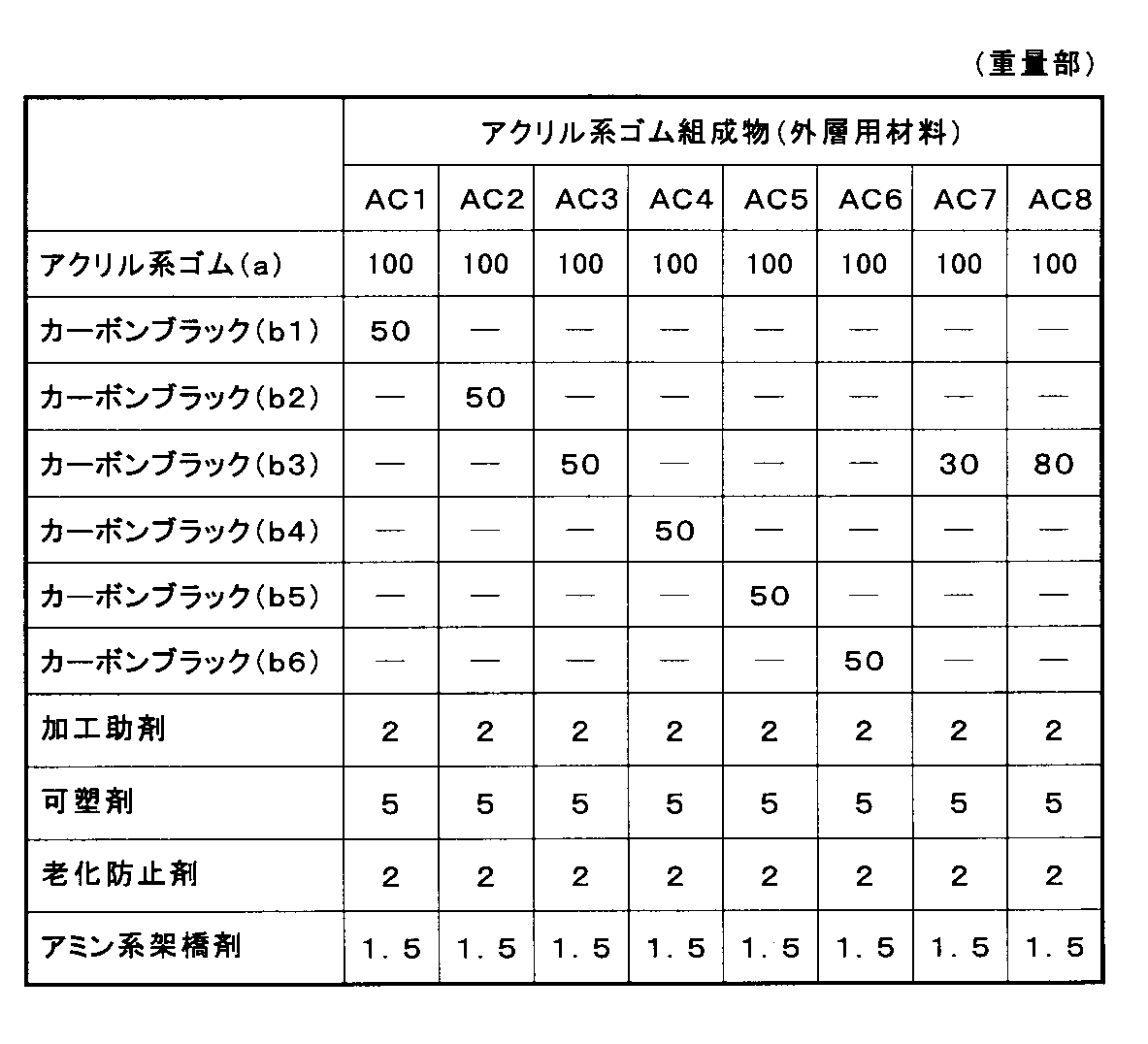
〔アクリル系ゴム(a)〕
日本ゼオン社製、ニポールAR31
日本ゼオン社製、ニポールAR31
〔カーボンブラック(b1)〕
キャボットジャパン社製、ショウブラックN110(窒素吸着比表面積:135×103m2/kg、OH量:0.59meq./g)
キャボットジャパン社製、ショウブラックN110(窒素吸着比表面積:135×103m2/kg、OH量:0.59meq./g)
〔カーボンブラック(b2)〕
キャボットジャパン社製、ショウブラックN220(窒素吸着比表面積:122×103m2/kg、OH量:0.61meq./g)
キャボットジャパン社製、ショウブラックN220(窒素吸着比表面積:122×103m2/kg、OH量:0.61meq./g)
〔カーボンブラック(b3)〕
キャボットジャパン社製、ショウブラックN330(窒素吸着比表面積:76×103m2/kg、OH量:0.55meq./g)
キャボットジャパン社製、ショウブラックN330(窒素吸着比表面積:76×103m2/kg、OH量:0.55meq./g)
〔カーボンブラック(b4)〕
東海カーボン社製、シーストSO(窒素吸着比表面積:35×103m2/kg、OH量:0.31meq./g)
東海カーボン社製、シーストSO(窒素吸着比表面積:35×103m2/kg、OH量:0.31meq./g)
〔カーボンブラック(b5)〕
東海カーボン社製、シーストS(窒素吸着比表面積:23×103m2/kg、OH量:0.18meq./g)
東海カーボン社製、シーストS(窒素吸着比表面積:23×103m2/kg、OH量:0.18meq./g)
〔カーボンブラック(b6)〕
キャンカーブ社製、サーマックスN990(窒素吸着比表面積:7×10³m2/kg、OH量:0.1meq./g)
キャンカーブ社製、サーマックスN990(窒素吸着比表面積:7×10³m2/kg、OH量:0.1meq./g)
〔加工助剤(ステアリン酸)〕
日本油脂社製、ビーズステアリン酸さくら
日本油脂社製、ビーズステアリン酸さくら
〔可塑剤〕
旭電化工業社製、アデカサイザーRS735
旭電化工業社製、アデカサイザーRS735
〔老化防止剤〕
クロンプトン社製、ナウガード445
クロンプトン社製、ナウガード445
〔アミン系架橋剤〕
大内新興化学工業社製、バルノックAB
大内新興化学工業社製、バルノックAB
〔実施例1〕
エチレン-プロピレン系ゴム組成物(内層用材料)およびアクリル系ゴム組成物(外層用材料)を、下記の表3に示す組み合わせで積層し、シラン系接着剤(ロード・ファー・イースト社製、ケムロックAP-133)を用いて両層を接着して、水系ホースを作製した。すなわち、エチレン-プロピレン系ゴム組成物(内層用材料)をマンドレル上に押出成形し、その上に、シラン系接着剤を、コーティングにより塗布した。つぎに、その表面に、アクリル系ゴム組成物(外層用材料)を押出成形し、160℃×1時間加熱し、さらに、150℃×8時間オーブンにて二次加硫することにより、内層(厚み3mm)の外周面に外層(厚み2mm)が形成されてなる水系ホース(内径12mm、外径22mm)を作製した。
エチレン-プロピレン系ゴム組成物(内層用材料)およびアクリル系ゴム組成物(外層用材料)を、下記の表3に示す組み合わせで積層し、シラン系接着剤(ロード・ファー・イースト社製、ケムロックAP-133)を用いて両層を接着して、水系ホースを作製した。すなわち、エチレン-プロピレン系ゴム組成物(内層用材料)をマンドレル上に押出成形し、その上に、シラン系接着剤を、コーティングにより塗布した。つぎに、その表面に、アクリル系ゴム組成物(外層用材料)を押出成形し、160℃×1時間加熱し、さらに、150℃×8時間オーブンにて二次加硫することにより、内層(厚み3mm)の外周面に外層(厚み2mm)が形成されてなる水系ホース(内径12mm、外径22mm)を作製した。
〔実施例2~11、比較例1,2〕
エチレン-プロピレン系ゴム組成物(内層用材料)およびアクリル系ゴム組成物(外層用材料)の組み合わせを、下記の表3に示す組み合わせに変更する以外は、実施例1と同様にして水系ホースを作製した。なお、比較例2は、シラン系接着剤に代えて、ポリオレフィン系接着剤(ロード・ファー・イースト社製、ケムロック6100)を使用した。
エチレン-プロピレン系ゴム組成物(内層用材料)およびアクリル系ゴム組成物(外層用材料)の組み合わせを、下記の表3に示す組み合わせに変更する以外は、実施例1と同様にして水系ホースを作製した。なお、比較例2は、シラン系接着剤に代えて、ポリオレフィン系接着剤(ロード・ファー・イースト社製、ケムロック6100)を使用した。
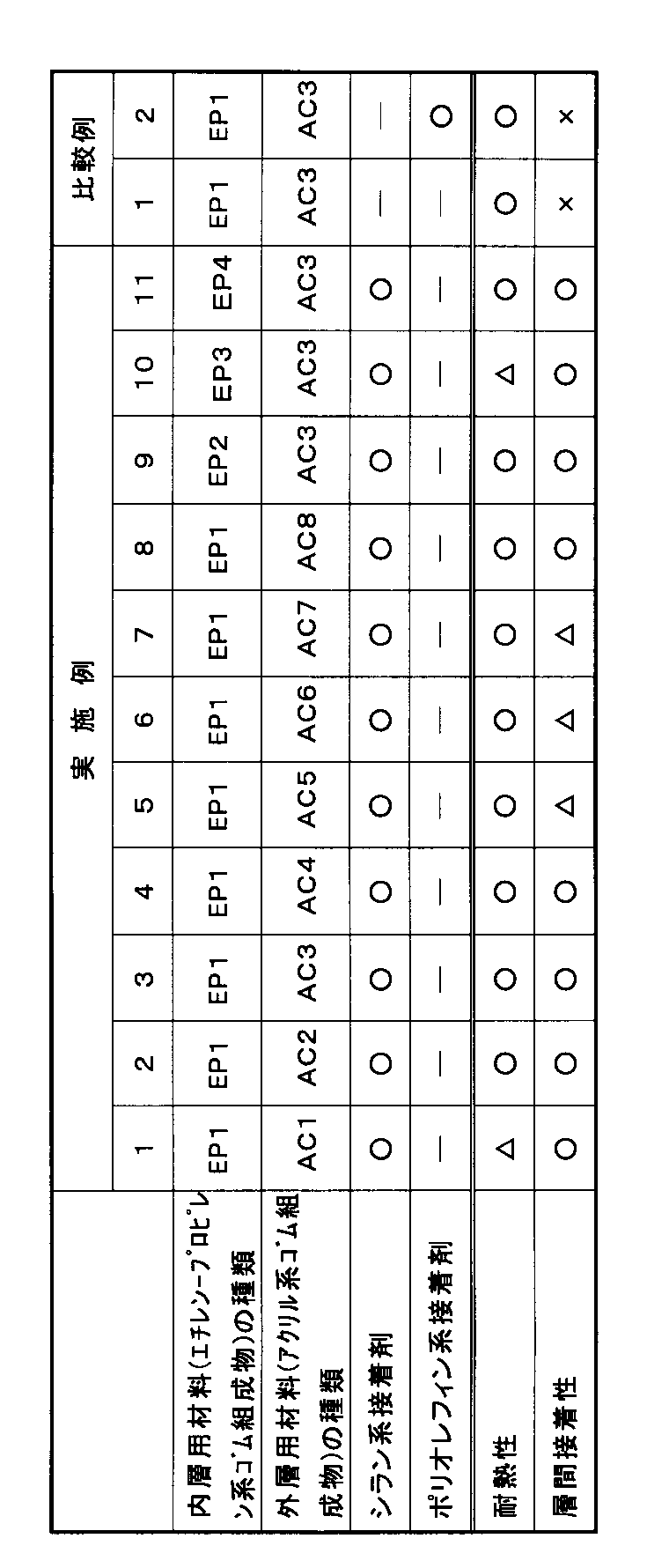
このようにして得られた実施例および比較例の水系ホースを用いて、下記の基準に従い、各特性の評価を行った。これらの結果を、上記表3に併せて示した。
〔耐熱性〕
170℃×600時間老化後の各ホースの外面から採取したJIS5号ダンベルを作成し、JIS K 6251に準じて、破断伸び(EB)を評価した。
〈評価〉
○:伸びが200%以上
△:伸びが100%以上で200%より小さい
×:伸びが100%より小さい
170℃×600時間老化後の各ホースの外面から採取したJIS5号ダンベルを作成し、JIS K 6251に準じて、破断伸び(EB)を評価した。
〈評価〉
○:伸びが200%以上
△:伸びが100%以上で200%より小さい
×:伸びが100%より小さい
〔層間接着性〕
各耐熱ホースから、厚み3mm(内層の厚み1.5mm、外層の厚み1.5mm)、幅25.4mmの試験片を切り出し、その試験片の内層を、引張試験機(JIS B 7721)を用いて、毎分50mmの速度で引き剥がし、その際の層間接着力(N/mm)を測定した。
〈評価〉
○:2.4N/mm以上
△:2.0N/mm以上で2.4N/mmより小さい
×:2.0N/mmより小さい
各耐熱ホースから、厚み3mm(内層の厚み1.5mm、外層の厚み1.5mm)、幅25.4mmの試験片を切り出し、その試験片の内層を、引張試験機(JIS B 7721)を用いて、毎分50mmの速度で引き剥がし、その際の層間接着力(N/mm)を測定した。
〈評価〉
○:2.4N/mm以上
△:2.0N/mm以上で2.4N/mmより小さい
×:2.0N/mmより小さい
上記表3の結果より、実施例品は、いずれも耐熱性に優れていた。また、シラン系接着剤により内層と外層とを接着しているため、層間接着性も良好であった。なお、実施例11品は、カーボンブラック(C2)を含有するエチレン-プロピレン系ゴム組成物(EP4)を内層用材料に使用しているため、内層材に高い体積固有抵抗率を付与することができ(表1参照)、金属パイプ等と接触する際の電気化学的安定性の向上が見込まれる。
これに対して、比較例1は、接着剤を使用しないため、層間接着性が劣っていた。
比較例2は、シラン系接着剤に代えて、ポリオレフィン系接着剤を使用しているため、層間接着性が劣っていた。
比較例2は、シラン系接着剤に代えて、ポリオレフィン系接着剤を使用しているため、層間接着性が劣っていた。
なお、上記実施例においては、本発明における具体的な形態について示したが、上記実施例は単なる例示にすぎず、限定的に解釈されるものではない。当業者に明らかな様々な変形は、本発明の範囲内であることが企図されている。
本発明の水系ホースは、例えば、ラジエータホース、ヒータホース等に使用することができる。
1 内層
2 外層
3 補強糸層
2 外層
3 補強糸層
Claims (5)
- 内層と、その外周に形成される外層とを備えた水系ホースであって、内層が、下記の(A)および(B)を含有するエチレン-プロピレン系ゴム組成物からなり、外層が、下記の(a)および(b)を含有するアクリル系ゴム組成物からなり、内層と外層とがシラン系接着剤により接着されていることを特徴とする水系ホース。
(A)エチレン-プロピレン系ゴム。
(B)架橋剤。
(a)アクリル系ゴム。
(b)表面に水酸基を有するカーボンブラック。 - (b)の窒素吸着比表面積が、35×103~125×103m2/kgである請求項1記載の水系ホース。
- (b)の含有量が、(a)100重量部に対して30~80重量部である請求項1または2記載の水系ホース。
- 内層と外層との界面に補強糸層を備えた請求項1~3のいずれか一項に記載の水系ホース。
- 水系ホースが、ラジエータホースまたはヒータホースである請求項1~4のいずれか一項に記載の水系ホース。
Priority Applications (1)
| Application Number | Priority Date | Filing Date | Title |
|---|---|---|---|
| JP2013507596A JP5703369B2 (ja) | 2011-03-30 | 2012-03-27 | 水系ホース |
Applications Claiming Priority (2)
| Application Number | Priority Date | Filing Date | Title |
|---|---|---|---|
| JP2011074931 | 2011-03-30 | ||
| JP2011-074931 | 2011-03-30 |
Publications (1)
| Publication Number | Publication Date |
|---|---|
| WO2012133385A1 true WO2012133385A1 (ja) | 2012-10-04 |
Family
ID=46931102
Family Applications (1)
| Application Number | Title | Priority Date | Filing Date |
|---|---|---|---|
| PCT/JP2012/057888 Ceased WO2012133385A1 (ja) | 2011-03-30 | 2012-03-27 | 水系ホース |
Country Status (2)
| Country | Link |
|---|---|
| JP (1) | JP5703369B2 (ja) |
| WO (1) | WO2012133385A1 (ja) |
Cited By (3)
| Publication number | Priority date | Publication date | Assignee | Title |
|---|---|---|---|---|
| EP3360677A1 (en) * | 2017-02-10 | 2018-08-15 | Eaton Intelligent Power Limited | Non conductive rubber hose |
| EP3862179B1 (de) * | 2020-02-04 | 2024-09-04 | ContiTech Techno-Chemie GmbH | Mehrschichtiger flexibler schlauch und dessen verwendung |
| WO2025070333A1 (ja) * | 2023-09-26 | 2025-04-03 | 住友理工株式会社 | 積層ホースのゴム層用ゴム組成物、積層ホース、及び自動車用積層ホース |
Citations (7)
| Publication number | Priority date | Publication date | Assignee | Title |
|---|---|---|---|---|
| JPH02261884A (ja) * | 1989-03-31 | 1990-10-24 | Toyoda Gosei Co Ltd | 接着性組成物 |
| JPH03199246A (ja) * | 1989-12-27 | 1991-08-30 | Bridgestone Corp | ゴム組成物 |
| JPH04337185A (ja) * | 1991-05-14 | 1992-11-25 | Toyoda Gosei Co Ltd | 複層ゴムホース |
| JPH11198307A (ja) * | 1998-01-07 | 1999-07-27 | Sumitomo Chem Co Ltd | 積層体及びラジエーターホース |
| JP2002005345A (ja) * | 2000-06-20 | 2002-01-09 | Tokai Rubber Ind Ltd | 耐熱高圧ホース |
| JP2008246751A (ja) * | 2007-03-29 | 2008-10-16 | Tokai Rubber Ind Ltd | 自動車用水系ホースの製法およびそれにより得られた自動車用水系ホース |
| JP2009286987A (ja) * | 2008-06-02 | 2009-12-10 | Teijin Fibers Ltd | 繊維補強ゴム成形物の製造方法 |
-
2012
- 2012-03-27 JP JP2013507596A patent/JP5703369B2/ja not_active Expired - Fee Related
- 2012-03-27 WO PCT/JP2012/057888 patent/WO2012133385A1/ja not_active Ceased
Patent Citations (7)
| Publication number | Priority date | Publication date | Assignee | Title |
|---|---|---|---|---|
| JPH02261884A (ja) * | 1989-03-31 | 1990-10-24 | Toyoda Gosei Co Ltd | 接着性組成物 |
| JPH03199246A (ja) * | 1989-12-27 | 1991-08-30 | Bridgestone Corp | ゴム組成物 |
| JPH04337185A (ja) * | 1991-05-14 | 1992-11-25 | Toyoda Gosei Co Ltd | 複層ゴムホース |
| JPH11198307A (ja) * | 1998-01-07 | 1999-07-27 | Sumitomo Chem Co Ltd | 積層体及びラジエーターホース |
| JP2002005345A (ja) * | 2000-06-20 | 2002-01-09 | Tokai Rubber Ind Ltd | 耐熱高圧ホース |
| JP2008246751A (ja) * | 2007-03-29 | 2008-10-16 | Tokai Rubber Ind Ltd | 自動車用水系ホースの製法およびそれにより得られた自動車用水系ホース |
| JP2009286987A (ja) * | 2008-06-02 | 2009-12-10 | Teijin Fibers Ltd | 繊維補強ゴム成形物の製造方法 |
Cited By (5)
| Publication number | Priority date | Publication date | Assignee | Title |
|---|---|---|---|---|
| EP3360677A1 (en) * | 2017-02-10 | 2018-08-15 | Eaton Intelligent Power Limited | Non conductive rubber hose |
| US11300232B2 (en) | 2017-02-10 | 2022-04-12 | Danfoss Power Solutions Ii Technology A/S | Non conductive rubber hose |
| US11774011B2 (en) | 2017-02-10 | 2023-10-03 | Danfoss A/S | Non conductive rubber hose |
| EP3862179B1 (de) * | 2020-02-04 | 2024-09-04 | ContiTech Techno-Chemie GmbH | Mehrschichtiger flexibler schlauch und dessen verwendung |
| WO2025070333A1 (ja) * | 2023-09-26 | 2025-04-03 | 住友理工株式会社 | 積層ホースのゴム層用ゴム組成物、積層ホース、及び自動車用積層ホース |
Also Published As
| Publication number | Publication date |
|---|---|
| JPWO2012133385A1 (ja) | 2014-07-28 |
| JP5703369B2 (ja) | 2015-04-15 |
Similar Documents
| Publication | Publication Date | Title |
|---|---|---|
| JP4991973B2 (ja) | 水系ホース用ゴム組成物およびそれを用いて得られる水系ホース | |
| KR20140012622A (ko) | 가류 접착용 조성물 | |
| CN104093769B (zh) | 丙烯酸类橡胶/氟橡胶组合物的制造方法、交联性组合物、层叠体及耐热空气橡胶软管 | |
| EP1568484A1 (en) | Heat-resistant hose | |
| JP5703369B2 (ja) | 水系ホース | |
| JP2003287162A (ja) | 耐熱燃料ホース | |
| US10221306B2 (en) | Rubber composition for hose, and hose | |
| ES2653641T3 (es) | Elastómero acrílico, composición del elastómero acrílico, laminado, sustancia transversal y miembro moldeo | |
| EP1975196B1 (en) | Hydrin rubber composition and heat-resistant hose using the same as material | |
| JP2016070332A (ja) | 耐熱ホース | |
| JP4989897B2 (ja) | ゴム組成物及び該ゴム組成物を用いたホース | |
| JP5752972B2 (ja) | 耐熱エアホース | |
| JP5641515B2 (ja) | 自動車用耐熱ホース | |
| CN110446607A (zh) | 层叠体 | |
| JP7771967B2 (ja) | カルボキシル基含有アクリルゴム組成物および積層体 | |
| JP2018095780A (ja) | カルボキシル基含有アクリルゴム組成物 | |
| JP2006247883A (ja) | オイルホース | |
| JP2015009384A (ja) | ゴム積層体 | |
| JP5719556B2 (ja) | 水系ホース用ゴム組成物およびそれを用いて得られる水系ホース | |
| JP7319788B2 (ja) | 耐熱ホース | |
| WO2019107415A1 (ja) | 水系ホース用ゴム組成物およびそれを用いて得られる水系ホース | |
| JP5870816B2 (ja) | 積層体および積層体の製造方法 | |
| JP6171623B2 (ja) | ゴム積層体 | |
| CN110023406A (zh) | 层叠体用组合物 | |
| JP2004281293A (ja) | 燃料電池システム用ホース材料およびそれを用いてなる燃料電池システム用ホース |
Legal Events
| Date | Code | Title | Description |
|---|---|---|---|
| 121 | Ep: the epo has been informed by wipo that ep was designated in this application |
Ref document number: 12765144 Country of ref document: EP Kind code of ref document: A1 |
|
| ENP | Entry into the national phase |
Ref document number: 2013507596 Country of ref document: JP Kind code of ref document: A |
|
| NENP | Non-entry into the national phase |
Ref country code: DE |
|
| 122 | Ep: pct application non-entry in european phase |
Ref document number: 12765144 Country of ref document: EP Kind code of ref document: A1 |