WO2012140839A1 - Dispositif générateur de flux et procédé générateur de flux - Google Patents
Dispositif générateur de flux et procédé générateur de flux Download PDFInfo
- Publication number
- WO2012140839A1 WO2012140839A1 PCT/JP2012/002088 JP2012002088W WO2012140839A1 WO 2012140839 A1 WO2012140839 A1 WO 2012140839A1 JP 2012002088 W JP2012002088 W JP 2012002088W WO 2012140839 A1 WO2012140839 A1 WO 2012140839A1
- Authority
- WO
- WIPO (PCT)
- Prior art keywords
- encoding
- data
- header
- unit
- information
- Prior art date
- Legal status (The legal status is an assumption and is not a legal conclusion. Google has not performed a legal analysis and makes no representation as to the accuracy of the status listed.)
- Ceased
Links
Images








Classifications
-
- H—ELECTRICITY
- H04—ELECTRIC COMMUNICATION TECHNIQUE
- H04N—PICTORIAL COMMUNICATION, e.g. TELEVISION
- H04N19/00—Methods or arrangements for coding, decoding, compressing or decompressing digital video signals
- H04N19/90—Methods or arrangements for coding, decoding, compressing or decompressing digital video signals using coding techniques not provided for in groups H04N19/10-H04N19/85, e.g. fractals
- H04N19/93—Run-length coding
-
- H—ELECTRICITY
- H04—ELECTRIC COMMUNICATION TECHNIQUE
- H04N—PICTORIAL COMMUNICATION, e.g. TELEVISION
- H04N19/00—Methods or arrangements for coding, decoding, compressing or decompressing digital video signals
- H04N19/42—Methods or arrangements for coding, decoding, compressing or decompressing digital video signals characterised by implementation details or hardware specially adapted for video compression or decompression, e.g. dedicated software implementation
- H04N19/436—Methods or arrangements for coding, decoding, compressing or decompressing digital video signals characterised by implementation details or hardware specially adapted for video compression or decompression, e.g. dedicated software implementation using parallelised computational arrangements
Definitions
- the present invention relates to a stream generation device and a stream generation method in an information processing apparatus having an image encoding function.
- H. H.264 / AVC standard image coding system (hereinafter referred to as H.264 coding system) has become the mainstream video coding system.
- H. In the H.264 encoding method it is possible to greatly improve the encoding efficiency by using arithmetic encoding that has not been used in standards such as MPEG-2.
- Patent Document 1 As a conventional image encoding apparatus that performs arithmetic encoding, there is an apparatus that sequentially encodes input data in which header information and quantized data are configured in units of pictures, respectively. As such an apparatus, for example, one described in Patent Document 1 is known.
- An object of the present invention is to provide a stream generation apparatus that can efficiently generate a stream that has both high error tolerance and high compression in consideration of the above-described conventional problems.
- a stream generation device provides input data including quantized data that is quantized image data and a header corresponding to the quantized data.
- a stream generation device that generates a stream by performing variable length encoding and compression encoding, and is information for specifying a position in the header of information necessary for the compression encoding for the quantized data The variable length coding and the compression coding for the header with respect to the input data before or after the coding related information is inserted;
- a first encoding unit that performs a first process including the intermediate data that is the input data after the first process including the encoding-related information;
- a first transfer control unit that transfers to a storage unit connected to the second transfer control unit that reads the intermediate data from the storage unit, and the encoding of the header included in the read intermediate data
- An extraction unit that extracts information necessary for the compression encoding of the quantized data from a position indicated by the information, and the compression encoding using the information extracted by the extraction unit, which is read
- the stream generation device can efficiently generate a stream that achieves both high error tolerance and high compression.
- FIG. 1 is a diagram illustrating a configuration example of an AV (Audio and Visual) system including an image encoding unit according to the first embodiment.
- FIG. 2 is a block diagram showing a schematic configuration of the image coding apparatus according to the first embodiment.
- FIG. 3 is a block diagram showing an outline of the configuration of the image encoding unit in the first embodiment.
- FIG. 4 is a block diagram illustrating a schematic configuration of the stream generation device according to the first embodiment.
- FIG. 5 is a diagram illustrating an example of a configuration of intermediate data transferred from the preceding stage to the main memory in the first embodiment.
- FIG. 6 is a flowchart illustrating an example of a process flow of the image encoding unit according to the first embodiment.
- FIG. 1 is a diagram illustrating a configuration example of an AV (Audio and Visual) system including an image encoding unit according to the first embodiment.
- FIG. 2 is a block diagram showing a schematic configuration of the image coding apparatus according to the first embodiment
- FIG. 7A is a flowchart showing an example of the flow of processing in encoding_1 shown in FIG.
- FIG. 7B is a flowchart illustrating an example of a process flow in the encoding_2 illustrated in FIG.
- FIG. 8 is a diagram illustrating an example of the configuration of intermediate data transferred from the preceding stage to the main memory in the second embodiment.
- FIG. 9 is a flowchart illustrating an example of the processing flow of encoding_1 in the second embodiment.
- FIG. 10 is a diagram illustrating an example of the configuration of intermediate data transferred from the preceding stage to the main memory in the third embodiment.
- FIG. 11A is a flowchart illustrating an example of a process flow of encoding_1 in the third embodiment.
- FIG. 11B is a flowchart illustrating an example of a process flow of encoding_2 in the third embodiment.
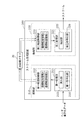
- FIG. 12 is a block diagram showing an outline of the configuration when the image encoding apparatus has two memories for saving intermediate data.
- FIG. 13 is a block diagram showing an outline of the configuration when the first main memory and the second main memory are connected to the stream generation device.
- image coding information is divided into several partitions and classified into important information and information that is not, and the partition where important information is stored makes it difficult for information to be lost. Applied.
- a header including information such as an encoding method is aggregated at the head portion of the stream, and then encoded quantized data is arranged.
- such a stream generation apparatus has a problem that, for example, an increase in processing time, an increase in processing capacity, or an increase in power consumption occurs.
- a stream generation device provides input data including quantized data, which is quantized image data, and a header corresponding to the quantized data.
- a stream generation device that generates a stream by performing variable length encoding and compression encoding, and is information for specifying a position in the header of information necessary for the compression encoding for the quantized data The variable length coding and the compression coding for the header with respect to the input data before or after the coding related information is inserted;
- a first encoding unit that performs a first process including the intermediate data that is the input data after the first process including the encoding-related information;
- a first transfer control unit that transfers to a storage unit connected to the second transfer control unit that reads the intermediate data from the storage unit, and the encoding of the header included in the read intermediate data
- An extraction unit that extracts information necessary for the compression encoding of the quantized data from a position indicated by the information, and the compression encoding using the information extracted by the extraction unit, which is read A
- the stream generation device provides variable length encoding and compression for input data including quantized data that is quantized image data and a header corresponding to the quantized data.
- a stream generation device that generates a stream by performing encoding, and acquires, from the header, encoding related information that is information necessary for the compression encoding of the quantized data, and the acquired encoding related information
- a first process including the variable length coding and the compression coding for the header on the input data before or after the encoding related information is inserted.
- a first encoding unit and intermediate data that is the input data after the first processing including the encoding-related information are stored in a storage unit connected to the stream generation device.
- a first transfer control unit that transmits, a second transfer control unit that reads the intermediate data from the storage unit, an extraction unit that extracts the encoding-related information from the read intermediate data, and the extraction unit
- a second encoding unit that generates the stream.
- the stream generation devices generate intermediate data in the preceding process.
- the intermediate data is input data after the first processing including encoding related information used for compression encoding of quantized data.
- the encoding related information is information necessary for the compression encoding of the quantized data or information for specifying the position of the information in the header.
- the generated intermediate data is temporarily stored in the storage unit and read out for later processing.
- the extraction unit can easily extract information necessary for compression coding of the quantized data from the intermediate data read from the storage unit without performing processing such as decoding the entire header. That is, it is possible to efficiently perform compression encoding on quantized data using encoding-related information.
- a stream with data partitioning can be generated.
- the insertion unit needs a flag, which is information for specifying a position in the header, of information necessary for the compression coding for the quantized data as the coding related information for the compression coding.
- This information may be inserted before and after the information, and the extraction unit may extract information necessary for the compression encoding that exists between the two flags.
- the insertion unit sets a start position and a size of information necessary for the compression coding, which is information for specifying a position in the header of information necessary for the compression coding with respect to the quantized data.
- a flag to be inserted before the information necessary for the compression coding as the coding related information, and the extraction unit is necessary for the compression coding based on the start position and the size indicated by the flag. Such information may be extracted.
- the insertion unit inserts the encoding-related information immediately after uncompressed data included in the input data
- the extraction unit inserts the encoding-related information inserted immediately after the uncompressed data. Information may be extracted.
- the insertion unit may insert the encoding related information into the quantized data
- the extraction unit may extract the encoding related information from the quantized data included in the intermediate data. Good.
- the insertion unit may insert the encoding-related information into the quantized data by replacing high-frequency component data included in the quantized data with information necessary for the compression encoding. .
- the first transfer control unit transfers the intermediate data to the storage unit, and (i) stores the header after the first processing included in the intermediate data is performed.
- a second memory provided in the storage unit, wherein (ii) the quantized data after the first processing included in the intermediate data is performed, The data may be stored in a second memory that is physically different from the first memory.
- the first encoding unit performs the variable length encoding and the compression encoding for the header and the input of the quantized data to the first transfer control unit, which is the first processing.
- the second encoding unit performs the variable length encoding and the compression encoding on the quantized data after the first processing included in the read intermediate data, which is the second processing. Also good.
- the first encoding unit may perform the variable length encoding and the compression encoding for the header and the variable length encoding for the quantized data, which are the first processing.
- the present invention can be realized as an image encoding device including the stream generation device according to any one of the above aspects.
- the present invention can also be realized as a stream generation method including a characteristic process executed by the stream generation apparatus according to any one of the above aspects.
- the present invention can be realized as a program for causing a computer to execute each process included in the stream generation method, and as a recording medium on which the program is recorded.
- the program can be distributed via a transmission medium such as the Internet or a recording medium such as a DVD.
- the present invention can also be realized as an integrated circuit including a part or all of the configuration of the stream generation device according to any one of the above aspects.
- FIG. 1 is a diagram illustrating a configuration example of an AV (Audio and Visual) system 500 including an image encoding unit 100 according to the first embodiment.
- AV Audio and Visual
- the AV system 500 includes a stream input / output unit 510, a memory input / output unit 511, an internal memory 512, an internal control unit 513, an image decoding unit 514, an audio decoding unit 515, an image processing unit 516, an audio processing unit 517, an audio code , An image input / output unit 519, an audio input / output unit 520, and an image encoding unit 100.
- the AV system 500 is connected to the external memory 550, and data can be exchanged with the external memory 550.
- the AV system 500 can also operate according to a control signal from the external control unit 560.
- the image encoding unit 100 is an apparatus having a stream generation apparatus 200 that generates a stream indicating a moving image by encoding input data.
- the configuration of the stream generation device 200 will be described later with reference to FIG.
- the image encoding unit 100 is connected to other functional blocks via a bus, and exchanges data, control signals, and the like. Note that the stream generation apparatus 200 generates intermediate data in the stream generation process, and the external memory 550 or the internal memory 512 is used as the save destination.
- direct operation control for the stream generation device 200 may be performed by the external control unit 560 or may be performed by the internal control unit 513.
- the image encoding unit 100 including the stream generation device 200 uses the image data input from the image input / output unit 519 to perform arithmetic encoding and data partitioning. Can be generated. Also, the generated stream is output from the stream input / output unit 510 and received by an external playback device via the Internet, for example.
- FIG. 2 is a block diagram showing an outline of the configuration of the image encoding device 10 according to the first embodiment.
- the image encoding device 10 includes an image encoding unit 100, a control unit 50, and a main storage memory 20.
- the main memory 20 is a memory (for example, DRAM (Dynamic Random Access Memory)) for storing data.
- DRAM Dynamic Random Access Memory
- the control unit 50 includes a processor (not shown) such as a CPU (Central Processing Unit) and a memory control circuit (not shown).
- a processor such as a CPU (Central Processing Unit) and a memory control circuit (not shown).
- the image encoding unit 100 saves intermediate data for the input image via the control unit 50 using the main storage memory 20 installed outside the image encoding unit 100. And compressed data is generated while performing restoration. The image encoding unit 100 further outputs the compressed data as a stream.
- the image encoding unit 100 when the image encoding unit 100 is provided in the AV system 500 described above, at least one of the internal memory 512 and the external memory 550 functions as the main memory 20.
- the control unit 50 not only controls data transfer between the image encoding unit 100 and the main storage memory 20, but also controls the image encoding unit 100.
- FIG. 3 is a block diagram showing a schematic configuration of the image encoding unit 100 according to the first embodiment.
- An image input to the image encoding unit 100 is connected to the in-plane prediction unit 101 that removes redundant information by prediction using the spatial correlation in the screen and the temporal correlation between the screens via the switch 103.
- the information is input to the inter-surface prediction unit 102 that removes redundant information by the used prediction.
- the switch 104 selects one of the intra prediction unit 101 and the inter prediction unit 102 according to the type of picture to be encoded, or depending on whether intra prediction or inter prediction is suitable for encoding the image. Select.
- difference data that is difference image data that is a difference between the input image and the predicted image is input to the frequency conversion unit 105.
- the difference data input to the frequency conversion unit 105 is converted into information of a two-dimensional frequency component by, for example, discrete cosine transformation (Discrete Cosine Transform (DCT)).
- DCT Discrete Cosine Transform
- the DCT coefficient data obtained by this conversion is compressed by the quantization unit 106 by setting all the data of high frequency components having little influence on human vision to “0”.
- Data obtained by the quantizing unit 106 and concentrated on relatively low frequency components (hereinafter referred to as “quantized data”) is variable-length encoded in the stream generation apparatus 200 in, for example, a zigzag scanned order. And further compressed by arithmetic coding or the like.
- the stream generation apparatus 200 further adds head information (hereinafter referred to as “header”) indicating encoding information such as an encoding type to the compressed data, and outputs the stream as a stream.
- head information hereinafter referred to as “header”
- the quantized data is input to the inverse quantization unit 107 in order to restore the information close to the state before the quantization again, and then the original difference data or the approximation thereof is performed by the inverse frequency transform unit 108. Restored to data.
- the reconstructed image is generated by synthesizing the restored data and the predicted image data corresponding to the data.
- the generated reconstructed image is saved in the main memory 20 as it is or after the deblocking processing by the loop filter 109 is performed, and is read from the main memory 20 when performing inter-plane prediction thereafter.
- the frequency conversion unit 105 and the inverse frequency conversion unit 108 may employ a method other than the discrete cosine transform as the frequency conversion method. Further, a method other than zigzag may be applied as the scanning order in the stream generation device 200. In addition, as a compression encoding method in the stream generation device 200, a method other than variable length encoding and arithmetic encoding may be employed.
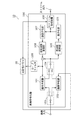
- FIG. 4 is a block diagram showing an outline of the configuration of the stream generation device 200 according to the first embodiment.
- the stream generation device 200 includes a front stage unit 210 and a rear stage unit 220.
- Each of the pre-stage unit 210 and the post-stage unit 220 can communicate with the main storage memory 20 that is connected to the stream generation device 200 and is an example of a storage unit.
- the stream generation device 200 performs variable length coding and compression coding on the quantized data input from the quantization unit 106 and the input data including a header indicating information necessary for decoding an image. To generate and output a stream.
- binarization is executed as variable length encoding
- arithmetic encoding is executed as compression encoding
- Arithmetic coding processing is performed in units such as slices or pictures that are larger than macroblocks, for example.
- the pre-stage unit 210 includes a first processing unit 211 and a first transfer control unit 212.
- the first processing unit 211 includes an insertion unit 215 and a first encoding unit 216.
- the insertion unit 215 inserts encoding related information, which is information used for compression encoding of quantized data, obtained from information included in the input header, into the input data.
- a flag which is an example of information for specifying a position in the header of information necessary for compression encoding, is used as encoding-related information that is information used for compression encoding of quantized data. Inserted into.
- This flag is realized by, for example, a unique data string that cannot exist in the data string after arithmetic coding. More specifically, the flag is a data string in which “0” or “1” of a predetermined number or more continues.
- “information necessary for compression encoding of quantized data” is information for specifying a probability table to be referred to when the quantized data is arithmetically encoded, for example.
- this information is expressed as “probability information”.
- the probability information for example, a random variable corresponding to the quantized data is exemplified.
- encoding skip information is information indicating that, for example, when the coefficient values indicated in the quantized data are all zero, compression encoding for the quantized data should be skipped.
- the first encoding unit 216 performs first processing including variable length encoding on the header and the compression encoding on the input data before or after the encoding related information is inserted.
- binarization and arithmetic coding are performed on the header in which the flag is inserted, and the quantized data is input to the first transfer control unit 212.
- the post-stage unit 220 can easily detect the flag from the arithmetically encoded header.
- the first transfer control unit 212 transfers the intermediate data that is the input data after the first process, including the flag, to the main memory 20. Specifically, the header that has been subjected to arithmetic coding and the quantized data that has been input and is included in the intermediate data is stored in different storage areas in the main memory 20.
- the first transfer control unit 212 saves the header and the quantized data included in the intermediate data after the first processing is performed in separate storage areas in the main memory 20.
- the first transfer control unit 212 holds at least two types of transfer control information for controlling such save processing, and refers to these transfer control information during the save processing (transfer processing). .
- the first transfer control unit 212 holds save transfer information a corresponding to the storage area where the header is stored and save transfer information b corresponding to the storage area where the quantized data is stored. Yes.
- the post-stage unit 220 includes a second processing unit 221 and a second transfer control unit 222.
- the second processing unit 221 includes an extraction unit 225 and a second encoding unit 226.
- the second transfer control unit 222 reads the intermediate data from the main memory 20 and transfers it to the second processing unit 221.
- the second transfer control unit 222 reads the header that has been subjected to arithmetic coding from the main memory 20 and transfers the header to the second processing unit 221.
- the second transfer control unit 222 further reads the quantized data that has not been binarized and arithmetically encoded from the main memory 20 and transfers it to the second processing unit 221.
- the extraction unit 225 of the second processing unit 221 extracts information indicated by the encoding related information from the intermediate data read by the second transfer control unit 222.
- the extraction unit 225 detects a flag (start flag) that is encoding-related information included in the arithmetically encoded header included in the intermediate data, and the start flag and the next flag (end flag). Probability information existing between the two is extracted. More specifically, the probability information read from between the start flag and the end flag is decoded and used for arithmetic encoding by the second encoding unit 226.
- the second encoding unit 226 is a compression encoding using the information extracted by the extraction unit 225, and includes a compression encoding for the quantized data after the first processing included in the read intermediate data.
- a stream is generated by performing two processes.
- the quantized data is not binarized and arithmetically encoded by the first process, but is binarized and arithmetically encoded by the second encoding unit 226.
- the probability table referred to in the arithmetic coding is specified by the probability information extracted by the extraction unit 225. Furthermore, the probability table based on the probability information is updated as necessary.
- the second encoding unit 226 generates a stream in which the first encoded data and the second encoded data are obtained by the first process and the second process.
- the first encoded data is data composed of headers for a predetermined unit that has been subjected to variable length encoding and compression encoding.
- the second encoded data is data composed of a predetermined unit of quantized data that has been subjected to variable length encoding and compression encoding.
- the header and the quantized data included in the intermediate data after the first processing are stored in different storage areas in the main memory 20. Has been.
- the second transfer control unit 222 reads a header for a predetermined unit after the first process is performed from each storage area, and also performs a quantization for a predetermined unit after the first process is performed Read data. That is, the intermediate data saved in the main memory 20 is restored by the second transfer control unit 222.
- a header for a predetermined unit after the first processing acquired by the second transfer control unit 222 that is, a header for a predetermined unit that has been performed up to the arithmetic coding
- the data is transmitted to the second processing unit 221 and the probability information is extracted.
- the quantized data for a predetermined unit after the first processing read by the second transfer control unit 222 is performed, that is, the quantized data for a predetermined unit that has not been binarized and arithmetically encoded.
- the digitized data is transmitted to the second processing unit 221 and binarized and arithmetically encoded.
- the header (first encoded data) for a predetermined unit obtained up to arithmetic coding and the quantized data for the predetermined unit (second encoded) obtained up to arithmetic coding are obtained in this way.
- Data is output from the second processing unit 221 as a stream.
- start flag and the end flag are not necessary for decoding the stream.
- the second encoding unit 226 deletes these flags when generating the stream.
- the second transfer control unit 222 holds at least two types of transfer control information for controlling the above-described header and quantized data return processing, and transfers these during the return processing (transfer processing). Refer to the control information.
- the second transfer control unit 222 holds return transfer information a corresponding to the storage area where the header is stored and return transfer information b corresponding to the storage area where the quantized data is stored. ing.
- the stream generation device 200 has the above-described configuration, thereby realizing a stream generation to which both data partitioning and arithmetic coding are applied.
- the first processing unit 211 of the pre-stage unit 210 inserts a flag for specifying the position of the probability information included in the header into the header.
- latter stage part 220 can recognize the position of the probability information contained in a header easily.
- the second processing unit 221 can decode only the probability information without decoding the entire header, and can use the obtained probability information for arithmetic coding of the quantized data. .
- each of the first processing unit 211 and the second processing unit 221 performs processing including binarization and arithmetic coding.
- a save area for binary data generated in this process for example, a predetermined storage area in the main memory 20 or a storage area (not shown) in the stream generation apparatus 200 is used.
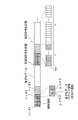
- FIG. 5 is a diagram illustrating an example of a configuration of intermediate data transferred from the pre-stage unit 210 to the main memory 20 in the first embodiment.
- the intermediate data in the first embodiment includes a header and quantized data.
- header 1 header 1
- header 2 header 2
- the header 1 is included in the non-arithmetic coding section, and includes frame information, version information, stream start code, angle of view information, and the like.
- the header 2 is a frame header, for example, and has size information (hereinafter referred to as “separation information”) indicating the size of quantized data in units of macroblocks, for example. More specifically, the header 2 stores correction information, filter information, Boolean probability information, and the like necessary for decoding arithmetically encoded frame information.
- the header 3 is composed of macro block headers (denoted as “MH” in FIG. 5) for a predetermined unit (for example, n pieces constituting one picture), for example, and each macro block header is a quantum block corresponding to itself. Probability information necessary for arithmetic coding of the digitized data.
- the predetermined unit is exemplified by a picture or a slice.
- the quantized data arranged immediately after the header 3 is quantized data corresponding to the header 3. That is, the data portion immediately after the header 3 is constituted by a series of quantized data for each macroblock corresponding to the predetermined unit.
- the quantized data is included in the arithmetic coding section.
- the binarization and arithmetic coding of the quantized data are performed after the intermediate data is acquired by the rear-stage unit 220 as described above, and then the second processing unit 221. Executed by. Therefore, at the time when the intermediate data is transferred from the pre-stage unit 210 to the main memory 20, the quantized data is not binarized or arithmetically encoded.
- the second processing unit 221 of the post-stage unit 220 divides the predetermined unit of quantized data included in the intermediate data into quantized data for each macroblock by referring to the delimiter information included in the header 2 described above. can do.
- a flag is inserted by the inserting unit 215 before and after the probability information and the delimiter information.
- S-flag start flag
- E-flag end flag
- flags are unique data strings as described above, and are skipped when the first encoding unit 216 performs binarization and arithmetic encoding on the header 2 and the header 3. That is, these flags are left as intermediate data in a unique data string.
- the second processing unit 221 of the rear stage unit 220 can easily detect the S-flag and the E-flag. That is, the second processing unit 221 can easily extract the probability information or delimiter information existing between the S-flag and the E-flag.
- the extraction unit 225 of the second processing unit 221 reads the data included in the header from immediately after the S-flag to the E-flag, and decodes only the read data. As a result, the probability information or delimiter information existing between the S-flag and the E-flag is extracted.
- the position of the probability information is not specified by the set of the S-flag and the E-flag, but the size of the probability information is shown in the S-flag, for example, as shown in the lower right diagram of FIG. Size information may be included. Also in this case, the probability information can be easily acquired by the subsequent stage unit 220.
- the extraction unit 225 determines the probability based on the start position of the probability information (for example, immediately after the S-flag) indicated by the S-flag and the size information. Information can be extracted.
- the position of the delimiter information may be specified by including size information indicating the size of the delimiter information in the S-flag indicating the start position.
- the E-flag is also treated as information indicating the start position of the probability information or the like when probability information or the like exists immediately after the E-flag. That is, when a plurality of types of information necessary for arithmetic coding of quantized data are consecutive, the E-flag arranged between the plurality of types of information is information indicating the end position of the information immediately before the E-flag. As well as information indicating the start position of information immediately after the E-flag.
- an S-flag and an E-flag may be inserted into the header so that a plurality of types of information continuously existing in a header are sandwiched between a set of S-flag and E-flag. .
- the post-stage unit 220 can easily acquire information necessary for arithmetic coding on the quantized data by detecting the S-flag or the S-flag and the E flag. .
- FIG. 5 shows an outline of the configuration of the intermediate data transferred from the pre-stage unit 210 to the main memory 20, and the header (headers 1 to 3) and the quantized data are shown to be continuous. Yes. However, in the main memory 20, as described above, the header (headers 1 to 3) and the quantized data are stored in separate storage areas.
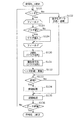
- FIG. 6 is a flowchart illustrating an example of a processing flow of the image encoding unit 100 according to the first embodiment.
- an image size, a frame rate, a bit rate, and the like, which are parameters used when performing image encoding, are set in advance (S100). After the setting, the image data is input to the image encoding unit 100.
- the input image data (input data) is repeatedly processed in a predetermined unit such as a picture, in which an encoding process in block units such as a macro block and intermediate data generated thereby are converted into stream data. A process for conversion is prepared.
- the above-described intra prediction and inter prediction are performed on a macro block basis (S110). Also, quantized data is generated by frequency conversion and quantization, and a header necessary for decoding is generated (S115).
- the header and quantized data generated in this way are input to the stream generation device 200, and encoding_1 is executed (S120).
- the first processing unit 211 performs first processing on the header and the quantized data
- the first transfer control unit 212 includes an intermediate including encoding-related information obtained by the first processing. Data is transferred to the main memory 20.
- encoding_1 (S120) is completed for all macroblocks for one picture
- encoding_2 is executed by the stream generation device 200 (S150).
- the second transfer control unit 222 reads the intermediate data for one picture (the header and quantized data after the first processing is performed), and the second processing unit 221 reads the 1 A second process is performed on the intermediate data for the picture.
- the stream generating apparatus 200 outputs a stream in which various headers are aggregated within a predetermined range, that is, a stream that has been subjected to data partitioning.
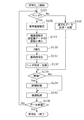
- FIG. 7A is a flowchart illustrating an example of a process flow in the encoding_1 illustrated in FIG.
- the first processing unit 211 of the pre-stage unit 210 determines whether or not the input data to be processed is a header (S121). If the input data is not a header (No in S121), that is, if the input data is quantized data, the code amount of the quantized data is measured and the measurement results are accumulated (S122). In the present embodiment, the quantized data is not encoded by the first encoding unit 216 and is input to the first transfer control unit 212 as it is.
- the insertion unit 215 performs a flag insertion process (S123, S124) in the header.
- the insertion unit 215 inserts flags (S-flag, E-flag) before and after the data field (S124).
- the insertion unit 215 inserts an S-flag including information indicating the size of the data field before inserting the E-flag, as described in the description of FIG. It may be omitted.
- the header that has undergone the flag insertion processing (S123, S124) is binarized by the first encoding unit 216 (S130) and arithmetically encoded (S131). In the binarization and arithmetic encoding processes, the flag with the header inserted is skipped as described above.
- the first encoding unit 216 can easily determine whether or not the data to be processed is a flag. Output without encoding and arithmetic coding. Therefore, the flag remains a unique data string that can be easily detected by the post-stage unit 220.
- flag insertion, binarization, and arithmetic coding may not be performed in this order.
- the first encoding unit 216 binarizes the header. Thereafter, the insertion unit 215 calculates a position where the flag should be inserted based on the specified insertion position and the change amount of the data length due to the binarization, and inserts the flag at the calculated position. Further, the first encoding unit 216 arithmetically encodes the part other than the flag of the header.
- the first transfer control unit 212 terminates the connection with the next header or quantized data. Processing is performed (S134).
- the first transfer control unit 212 further displays intermediate data (a header that has been binarized and arithmetically encoded or quantized data that has not been binarized and arithmetically encoded) obtained by the above processing. 5 is saved in the main memory 20 in accordance with the data format shown in FIG.
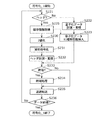
- FIG. 7B is a flowchart illustrating an example of a process flow in the encoding_2 illustrated in FIG.
- the second transfer control unit 222 of the post-stage unit 220 restores the intermediate data from the main memory 20 (S151). That is, the intermediate data is read from the main memory 20.
- the second transfer control unit 222 measures the code amount of the read data. The measurement result is compared with the total code amount of the quantized data (S153). The result of this comparison is used for termination determination (S160) described later. Further, the quantized data is transmitted to the second processing unit 221.
- the second transfer control unit 222 reads the header as intermediate data (Yes in S152), the header is transmitted to the second processing unit 221.
- the extraction unit 225 checks the presence or absence of a flag for the header (S154).
- the extraction unit 225 extracts the probability information existing at the position indicated by the flag (S155).
- the extraction unit 225 reads and decodes the probability information existing between the S-flag and the E-flag as described above.
- the processing example shown in the flowchart shows the flow of processing when probability information is extracted as information necessary for arithmetic coding on quantized data.
- delimiter information see FIG. 5
- the delimiter information is read and decoded by the extraction unit 225, as in the case of the probability information.
- the probability information and the delimiter information extracted in this way are transmitted to the second encoding unit 226.
- the second encoding unit 226 divides the quantized data received from the second transfer control unit 222 into macroblock units using the received delimiter information.
- the second encoding unit 226 uses the received probability information to specify and update a probability table used for arithmetic coding of the quantized data corresponding to the probability information (S156).
- each piece of probability information and each piece of quantized data is defined by the arrangement order of the intermediate data (see FIG. 5).
- the probability information acquired from the kth macroblock header from the left among the n macroblock headers present in FIG. 5 is the left of the quantized data in units of n macroblocks illustrated in FIG. This corresponds to the kth quantized data.
- the code amount of the data to be processed is measured, and the measurement result is compared with the total code amount of the header (S157). The result of this comparison is used for termination determination (S160) described later.
- the second encoding unit 226 performs binarization (S158) and arithmetic encoding (S159) of the quantized data in units of macroblocks.
- S158 binarization
- S159 arithmetic encoding
- a probability table after being updated (S156) as necessary is referred to.
- the second transfer control unit 222 detects that the data to be processed is the end of the header or the quantized data from the result of the comparison (S153, S157) (Yes in S160), the second transfer control unit 222 performs a termination process ( S161).
- the second encoding unit 226 corresponds to the plurality of arithmetically encoded headers for one picture and the plurality of headers.
- a stream in which the arithmetically encoded quantized data is continuous is generated and output. If the data to be processed is not the end of the picture (No in S162), the process of encoding_2 is executed again.
- the first processing unit 211 of the upstream unit 210 performs encoding related information (flag in the present embodiment) that is information used for arithmetic coding of quantized data. ) Is inserted to generate intermediate data.
- the extraction unit 225 of the post-stage unit 220 that receives such intermediate data can decode only the part that is originally necessary without decoding the entire header that has been subjected to arithmetic coding. As a result, information (such as probability information) necessary for arithmetic coding on the quantized data is efficiently acquired.
- the upstream part 210 of the stream generation device 200 inserts a flag for specifying the position of the necessary information in the arithmetically encoded header into the header, so that the downstream part 220 It is possible to efficiently perform arithmetic coding of the digitized data.
- information necessary for the arithmetic coding of the quantized data is acquired from the header before the arithmetic coding, and is transmitted from the pre-stage unit 210 to the post-stage unit 220 through a path different from the intermediate data transmission path. Is also possible.
- stream generation apparatus 200 in the present embodiment arithmetic coding and data partitioning are performed without providing a transmission path for information necessary for arithmetic coding of quantized data separately from a transmission path for intermediate data. Efficient generation of streams to which is applied.
- the basic configuration of the stream generation device 200 in the second embodiment is the same as the basic configuration of the stream generation device 200 in the first embodiment shown in FIG. 4, and detailed description thereof is omitted here. .
- the stream generation device 200 according to the second embodiment is provided in the image coding unit 100 (see FIGS. 1 to 3) and encodes the input image data, similarly to the stream generation device 200 according to the first embodiment. And can function as a device for generating a stream.
- the basic processing flow of the image encoding unit 100 including the stream generation device 200 in the second embodiment is also the same as the processing flow shown in FIG. 6, and detailed description thereof is omitted here.
- FIG. 8 is a diagram illustrating an example of a configuration of intermediate data transferred from the pre-stage unit 210 to the main memory 20 in the second embodiment.
- the intermediate data in the second embodiment includes a header and quantized data, similar to the intermediate data in the first embodiment. Also, three types of headers, header 1, header 2 and header 3, are included in the intermediate data.
- the flag for specifying the position of the probability information is not inserted in each macroblock header, and the probability information included in each macroblock header is inserted immediately after the header 1 of the non-arithmetic coding section. Yes.
- probability information is copied from each of the n macroblock headers, and the copied n pieces of probability information are immediately after the header 1 that is uncompressed data as encoding related information. Has been inserted.
- the extraction unit 225 of the post-stage unit 220 can easily read and decode the probability information. That is, probability information is easily extracted.
- the probability information inserted immediately after the header 1 is unnecessary for the final stream, and is eventually deleted by the second encoding unit 226, for example.
- the extraction unit 225 can recognize what position should be decoded immediately after the header 1 which is uncompressed data.
- the extraction unit 225 can easily extract the probability information.
- the position of the delimiter information in the header 2 is indicated by a flag (S-flag, E-flag).
- this delimiter information may also be copied from the header 2 and inserted, for example, between the header 1 and the probability information, similarly to the probability information.
- the header heads 1 to 3 and the probability information immediately after the header 1 are displayed. And the quantized data are stored in separate storage areas.
- FIG. 9 is a flowchart showing an example of the processing flow of encoding_1 in the second embodiment.
- the insertion unit 215 acquires probability information from the header (S126). Is called.
- the inserting unit 215 inserts the probability information immediately after the uncompressed data (header 1) received as input data before the header (S127).
- the delimiter information is omitted in the processing flow shown in FIG. 9, for example, as in the first embodiment, the delimiter information is added to the header 2 by the flag insertion process (S123, S124 in FIG. 7A). Flags (S-flag, E-flag) for specifying the position of are inserted.
- processing such as binarization (S130) of the header is performed, and the header is stored in the main memory 20 in the data format shown in FIG.
- the encoding_2 process is performed by the post-stage unit 220.
- the intermediate data is read from the main memory 20 by the second transfer control unit 222.
- the extraction unit 225 extracts probability information existing immediately after the uncompressed data (header 1) in the read intermediate data.
- the extracted probability information is used for arithmetic coding of the quantized data by the second coding unit 226.
- a stream to which arithmetic coding and data partitioning are applied is generated as in the first embodiment.
- the encoding related information that is information used for arithmetic coding of the quantized data in the first processing unit 211 of the front-end unit 210.
- Intermediate data into which is inserted is generated.
- information necessary for arithmetic coding of quantized data such as probability information is inserted immediately after uncompressed data (header 1) as coding related information.
- the extraction unit 225 of the post-stage unit 220 that receives such intermediate data can decode only the part that is originally necessary without decoding the entire header that has been subjected to arithmetic coding. That is, information (such as probability information) necessary for arithmetic coding on quantized data is efficiently acquired. As a result, efficient generation of a stream to which arithmetic coding and data partitioning are applied is realized.
- the stream generation device 200 in the present embodiment efficient generation of a stream in which high error tolerance and high compression are compatible is realized.
- the basic configuration of the stream generation device 200 in the third embodiment is the same as the basic configuration of the stream generation device 200 in the first embodiment shown in FIG. 4, and detailed description thereof is omitted here. .
- the stream generation device 200 according to the third embodiment is provided in the image encoding unit 100 (see FIGS. 1 to 3), as with the stream generation device 200 according to the first embodiment, and encodes input image data. And can function as a device for generating a stream.
- the basic processing flow of the image encoding unit 100 including the stream generation device 200 according to Embodiment 3 is also the same as the processing flow shown in FIG. 6, and detailed description thereof is omitted here.
- FIG. 10 is a diagram illustrating an example of the configuration of intermediate data transferred from the pre-stage unit 210 to the main memory 20 in the third embodiment.
- the intermediate data in the third embodiment includes a header and quantized data, similar to the intermediate data in the first embodiment. Also, three types of headers, header 1, header 2 and header 3, are included in the intermediate data.
- a flag for specifying the position of probability information is not inserted into each macroblock header, and probability information is inserted into each of the quantized data in units of macroblocks.
- the insertion unit 215 replaces the quantized high-frequency DCT coefficient data (high-frequency component data) included in the quantized data with probability information corresponding to the quantized data. Thereby, the probability information is inserted into the quantized data.
- the above-described encoding skip information may be replaced with high-frequency component data as information necessary for compression encoding of quantized data.
- the high-frequency component data has a continuous zero (zero) coefficient. Even if the data area of the high-frequency component data is entirely replaced with the zero coefficient, the influence on the image quality perceived by humans is not affected. Very few.
- this data area is used as an embedding area for information necessary for compression encoding such as probability information, and for example, at the stage of final stream generation, all the embedded probability information is replaced with zero coefficients.
- the extraction unit 225 of the post-stage unit 220 can easily extract probability information from each of the quantized data in units of macroblocks.
- delimiter information for obtaining quantized data in units of macroblocks is specified by, for example, the S-flag and E-flag inserted in the header 2 as in the first embodiment.
- FIG. 11A is a flowchart illustrating an example of a process flow of encoding_1 according to the third embodiment.
- the first processing unit 211 of the pre-stage unit 210 determines whether or not the input data to be processed is a header (S221). When the input data to be processed is a header (Yes in S221), probability information is acquired from the header by the insertion unit 215 (S225).
- the acquired plurality of pieces of probability information are stored in a predetermined storage area of the insertion unit 215, for example, in the order of acquisition, and are read in the order of acquisition at the time of subsequent insertion into quantized data (S223). It will be.
- the header is binarized by the first encoding unit 216 (S230) and arithmetically encoded (S231). Thereafter, the code amount is measured and accumulated for the header that has been subjected to arithmetic coding (S232).
- the input data is not a header (No in S221), that is, if the input data is quantized data, the code amount of the quantized data is measured and the measurement result is accumulated (S222).
- the inserting unit 215 inserts the probability information corresponding to the quantized data, which is acquired and held by the probability information acquisition process (S225), into the quantized data (S223).
- the first transfer control unit 212 connects the next header or quantized data to the end. Is terminated (S234).
- the first transfer control unit 212 further displays intermediate data (a header that has been binarized and arithmetically encoded or quantized data that has not been binarized and arithmetically encoded) obtained by the above processing.
- the data is saved in the main memory 20 according to the data format shown in FIG. 10 (S235).
- FIG. 11B is a flowchart illustrating an example of a process flow of encoding_2 in the third embodiment.
- the second transfer control unit 222 of the post-stage unit 220 restores the intermediate data from the main memory 20 (S241). That is, the intermediate data is read from the main memory 20.
- the second transfer control unit 222 When the second transfer control unit 222 reads the header as intermediate data (Yes in S242), the second transfer control unit 222 measures the code amount of the read data, and compares the measurement result with the total code amount of the header (S243). In addition, the header is transmitted to the second processing unit 221.
- the quantized data is transmitted to the second processing unit 221.
- the extraction unit 225 of the second processing unit 221 extracts probability information from the quantized data (S244).
- the extracted probability information is passed to the second encoding unit 226, and the second encoding unit 226 uses the probability information to specify a probability table used for arithmetic coding of quantized data corresponding to the probability information. And update etc. are performed (S245).
- the code amount of the quantized data is measured, and the measurement result is compared with the total code amount of the quantized data (S246).
- the second encoding unit 226 performs binarization (S247) and arithmetic encoding (S248) on the quantized data.
- S247 binarization
- S248 arithmetic encoding
- the probability table after the above update (S245) is made is referred to.
- the second transfer control unit 222 detects that the data to be processed is the end of the header or the quantized data from the result of the comparison (S243, S246) (Yes in S249), the second transfer control unit 222 performs a termination process ( S250).
- the second encoding unit 226 corresponds to a plurality of arithmetically encoded headers for one picture and the plurality of headers.
- a stream in which the arithmetically encoded quantized data is continuous is generated and output. If the data to be processed is not the end of the picture (No in S251), the process of encoding_2 is executed again.
- the first processing unit 211 of the front-end unit 210 encodes information that is information used for arithmetic coding of quantized data. Intermediate data into which related information is inserted is generated.
- information necessary for arithmetic coding of quantized data such as probability information, is inserted into the quantized data as coding related information.
- quantized data including information necessary for arithmetic coding of the quantized data is stored in the main memory 20 as intermediate data without being binarized and arithmetic coded.
- the extraction unit 225 of the post-stage unit 220 that acquires such intermediate data from the main memory 20 easily extracts information necessary for arithmetic coding of the quantized data from the quantized data included in the intermediate data. can do. As a result, efficient generation of a stream to which arithmetic coding and data partitioning are applied is realized.
- intermediate data that is input data after the first process including the encoding-related information is transferred from the pre-stage unit 210 to the main memory 20.
- the header that has been subjected to arithmetic coding and the input quantized data that are included in the intermediate data are stored in different storage areas in the main memory 20.
- the main memory 20 that fulfills such a role may be replaced with two physically different memories so that the header is stored in one memory and the quantized data is stored in the other memory.
- FIG. 12 is a block diagram showing an outline of the configuration when the image encoding device 10 has two memories for saving intermediate data.
- the image encoding unit 100 is connected to the first main storage memory 21 and the second main storage memory 22 via the control unit 50.
- FIG. 13 is a block diagram showing an outline of the configuration when the first main storage memory 21 and the second main storage memory 22 are connected to the stream generation device 200.
- the first main memory 21 is a header memory and the second main memory 22 is a quantized data memory. That is, it is assumed that the first main storage memory 21 and the second main storage memory 22 constitute a storage unit 20a that temporarily stores intermediate data. In this case, the following processing is performed.
- the first transfer control unit 212 transfers the intermediate data generated by the first processing unit 211 to the storage unit 20a, whereby (i) the header after the first process included in the intermediate data is performed
- the second main memory provided in the storage unit 20a is stored in the first main memory 21 provided in the storage unit 20a, and (ii) the quantized data after the first process included in the intermediate data is performed. 22 and stored in a second main memory 22 that is physically different from the first main memory 21.
- the header / data separation circuit 213 included in the first transfer control unit 212 transfers the arithmetically encoded header to the first main memory 21 in accordance with the save transfer information a.
- the header / data separation circuit 213 transfers the quantized data that has not been binarized and arithmetically encoded to the second main memory 22 in accordance with the save transfer information b.
- the header / data concatenation circuit 223 included in the second transfer control unit 222 acquires a header for a predetermined unit such as a picture from the first main memory 21 in accordance with the return transfer information a. Further, the header / data connection circuit 223 acquires the predetermined unit of quantized data from the second main memory 22 in accordance with the return transfer information b.
- the first processing unit 211 of the stream generation device 200 does not perform binarization and arithmetic coding on quantized data. .
- the first processing unit 211 may binarize the quantized data. Even when the quantized data is binarized, if the relationship between the sizes of the quantized data before and after binarization is defined by a function or the like, the second processing unit 221 performs quantization after binarization. Data can be divided into macroblock units using delimiter information.
- the present invention is not limited to this.
- a device that does not intend a technique called “data partitioning” is a device that stores the header and the quantized data in different areas on the stream, and the quantization.
- the present invention is applicable to an apparatus that generates the stream by performing subsequent processing in two stages.
- Embodiments 1 to 3 binarization is adopted as variable length coding, and arithmetic coding is adopted as compression coding.
- the present invention is not limited to this.
- a series of codes in which the process result of the previous stage is variable length data and the process result of the previous stage is compressed together by a predetermined amount in the subsequent stage can be applied to any apparatus that performs the digitization process.
- each of the stream generation devices 200 may be a program module executed by a CPU or the like.
- each component may be configured by dedicated hardware or may be realized by executing a software program suitable for each component.
- Each component may be realized by a program execution unit such as a CPU or a processor reading and executing a software program recorded on a recording medium such as a hard disk or a semiconductor memory.
- the software that implements the stream generation device 200 is the following program.
- this program causes the computer to execute the following stream generation method.
- the stream generation method performs variable length coding and compression coding on input data including quantized data, which is quantized image data, and a header corresponding to the quantized data.
- a stream generation method for generating wherein the encoding-related information, which is information for specifying a position in the header of information necessary for the compression encoding with respect to the quantized data, is inserted into the header
- a first encoding step for performing a first process including the variable length encoding and the compression encoding on the header with respect to the input data before or after the encoding related information is inserted;
- Information necessary for the compression encoding of the quantized data is extracted from the second transfer step of reading inter-data and the position of the header included in the read intermediate data indicated by the encoding-related information
- the stream generation method acquires, from the header, encoding related information that is information necessary for the compression encoding of the quantized data, and inserts the acquired encoding related information into the input data
- a first encoding step for performing a first process including the variable length encoding and the compression encoding on the header with respect to the input data before or after the encoding related information is inserted A first transfer step of transferring the intermediate data, which is the input data after the first processing including the conversion related information, to the storage unit, a second transfer step of reading the intermediate data from the storage unit, and An extraction step of extracting the encoding related information from the intermediate data, and the compression using the encoding related information extracted in the extraction step
- Second encoding for generating the stream by performing a second process including the compression encoding on the quantized data after the first process included in the read intermediate data Steps may be included.
- all or a part of the plurality of components constituting each of the stream generation devices 200 may be configured by one system LSI (Large Scale Integration).
- the system LSI is an ultra-multifunctional LSI manufactured by integrating a plurality of components on one chip. Specifically, a microprocessor, a ROM (Read Only Memory), a RAM (Random Access Memory), etc. It is a computer system comprised including.
- the present invention may be realized as a stream generation method including operations of characteristic components included in the stream generation device 200.
- the present invention may also be realized as a program that causes a computer to execute each step included in such a stream generation method.
- the present invention may be realized as a computer-readable recording medium that stores such a program.
- the program may be distributed via a transmission medium such as the Internet.
- the present invention can provide a stream generation device and a stream generation method that can efficiently generate a stream in which high error tolerance and high compression are compatible. Therefore, the present invention is useful as a stream generation device or the like provided in an apparatus that compresses and outputs image data.
Landscapes
- Engineering & Computer Science (AREA)
- Multimedia (AREA)
- Signal Processing (AREA)
- Computing Systems (AREA)
- Theoretical Computer Science (AREA)
- Compression Or Coding Systems Of Tv Signals (AREA)
Abstract
L'invention concerne un dispositif générateur de flux (200) servant à générer un flux en soumettant des données d'entrée à un encodage de longueur variable et à un encodage compressif, le dispositif générateur de flux comportant : une unité d'insertion (215) servant à insérer, dans les données d'entrée, des informations associées à l'encodage, qui sont des informations utilisées pour encoder en compression des données quantifiées ; un premier encodeur (216) servant à soumettre un en-tête à un premier traitement qui comprend un encodage à longueur variable et un encodage compressif ; un premier contrôleur de transfert (212) servant à transférer des données intermédiaires d'unité de mémoire, qui sont des données d'entrées qui ont été soumises au premier traitement ; un second contrôleur de transfert (222) servant à récupérer les données intermédiaires de l'unité de mémoire ; une unité d'extraction (225) servant à extraire les informations indiquées dans les informations associées à l'encodage des données intermédiaires ; et un second encodeur (226) servant à générer un flux en effectuant un second traitement qui comprend un encodage compressif de données quantifiées, au moyen des informations extraites de l'unité d'extraction (225).
Priority Applications (2)
| Application Number | Priority Date | Filing Date | Title |
|---|---|---|---|
| JP2013509751A JPWO2012140839A1 (ja) | 2011-04-11 | 2012-03-26 | ストリーム生成装置およびストリーム生成方法 |
| US14/048,435 US20140037014A1 (en) | 2011-04-11 | 2013-10-08 | Stream generation apparatus and stream generation method |
Applications Claiming Priority (2)
| Application Number | Priority Date | Filing Date | Title |
|---|---|---|---|
| JP2011-087756 | 2011-04-11 | ||
| JP2011087756 | 2011-04-11 |
Related Child Applications (1)
| Application Number | Title | Priority Date | Filing Date |
|---|---|---|---|
| US14/048,435 Continuation US20140037014A1 (en) | 2011-04-11 | 2013-10-08 | Stream generation apparatus and stream generation method |
Publications (1)
| Publication Number | Publication Date |
|---|---|
| WO2012140839A1 true WO2012140839A1 (fr) | 2012-10-18 |
Family
ID=47009034
Family Applications (1)
| Application Number | Title | Priority Date | Filing Date |
|---|---|---|---|
| PCT/JP2012/002088 Ceased WO2012140839A1 (fr) | 2011-04-11 | 2012-03-26 | Dispositif générateur de flux et procédé générateur de flux |
Country Status (3)
| Country | Link |
|---|---|
| US (1) | US20140037014A1 (fr) |
| JP (1) | JPWO2012140839A1 (fr) |
| WO (1) | WO2012140839A1 (fr) |
Cited By (2)
| Publication number | Priority date | Publication date | Assignee | Title |
|---|---|---|---|---|
| GB2521352A (en) * | 2013-12-16 | 2015-06-24 | Imagination Tech Ltd | Encoder configuration |
| JP2017512032A (ja) * | 2014-03-13 | 2017-04-27 | クゥアルコム・インコーポレイテッドQualcomm Incorporated | 3dビデオコーディングのための制限付き深度イントラモードコーディング |
Families Citing this family (1)
| Publication number | Priority date | Publication date | Assignee | Title |
|---|---|---|---|---|
| US11792877B2 (en) * | 2020-02-21 | 2023-10-17 | Qualcomm Incorporated | Indication triggering transmission of known data for training artificial neural networks |
Citations (2)
| Publication number | Priority date | Publication date | Assignee | Title |
|---|---|---|---|---|
| JP2004129206A (ja) * | 2002-04-26 | 2004-04-22 | Ntt Docomo Inc | 信号符号化方法、信号復号方法、信号符号化装置、信号復号装置、信号符号化プログラム、及び、信号復号プログラム |
| WO2008018324A1 (fr) * | 2006-08-08 | 2008-02-14 | Panasonic Corporation | Dispositif de codage d'image, son procédé et son circuit intégré |
Family Cites Families (3)
| Publication number | Priority date | Publication date | Assignee | Title |
|---|---|---|---|---|
| TW416220B (en) * | 1998-01-23 | 2000-12-21 | Matsushita Electric Industrial Co Ltd | Image transmitting method, image processing method, image processing device, and data storing medium |
| JPH11261958A (ja) * | 1998-03-09 | 1999-09-24 | Sony Corp | 映像編集装置及び映像編集方法 |
| JP4664406B2 (ja) * | 2006-12-11 | 2011-04-06 | パナソニック株式会社 | 動画像復号化装置、半導体装置、映像機器および動画像復号化方法 |
-
2012
- 2012-03-26 JP JP2013509751A patent/JPWO2012140839A1/ja active Pending
- 2012-03-26 WO PCT/JP2012/002088 patent/WO2012140839A1/fr not_active Ceased
-
2013
- 2013-10-08 US US14/048,435 patent/US20140037014A1/en not_active Abandoned
Patent Citations (2)
| Publication number | Priority date | Publication date | Assignee | Title |
|---|---|---|---|---|
| JP2004129206A (ja) * | 2002-04-26 | 2004-04-22 | Ntt Docomo Inc | 信号符号化方法、信号復号方法、信号符号化装置、信号復号装置、信号符号化プログラム、及び、信号復号プログラム |
| WO2008018324A1 (fr) * | 2006-08-08 | 2008-02-14 | Panasonic Corporation | Dispositif de codage d'image, son procédé et son circuit intégré |
Cited By (7)
| Publication number | Priority date | Publication date | Assignee | Title |
|---|---|---|---|---|
| GB2521352A (en) * | 2013-12-16 | 2015-06-24 | Imagination Tech Ltd | Encoder configuration |
| GB2521352B (en) * | 2013-12-16 | 2015-11-04 | Imagination Tech Ltd | Encoder configuration |
| US9774873B2 (en) | 2013-12-16 | 2017-09-26 | Imagination Technologies Limited | Frame processor for data stream encoder |
| US10728563B2 (en) | 2013-12-16 | 2020-07-28 | Imagination Technologies Limited | Data stream encoder configuration |
| US11546619B2 (en) | 2013-12-16 | 2023-01-03 | Imagination Technologies Limited | Data stream encoder configuration |
| JP2017512032A (ja) * | 2014-03-13 | 2017-04-27 | クゥアルコム・インコーポレイテッドQualcomm Incorporated | 3dビデオコーディングのための制限付き深度イントラモードコーディング |
| US10687079B2 (en) | 2014-03-13 | 2020-06-16 | Qualcomm Incorporated | Constrained depth intra mode coding for 3D video coding |
Also Published As
| Publication number | Publication date |
|---|---|
| US20140037014A1 (en) | 2014-02-06 |
| JPWO2012140839A1 (ja) | 2014-07-28 |
Similar Documents
| Publication | Publication Date | Title |
|---|---|---|
| CN102577378B (zh) | 用于对模式信息进行编码和解码的方法和设备 | |
| CN101087416B (zh) | 用于压缩数字数据的系统和方法 | |
| CN106027065B (zh) | 解码装置和解码方法 | |
| CN101087417B (zh) | 图像编码装置 | |
| US20130083840A1 (en) | Advance encode processing based on raw video data | |
| US8731050B2 (en) | Image encoding apparatus and image decoding apparatus | |
| CN110944173B (zh) | 视频解码方法、装置、电子设备以及存储介质 | |
| CN101040535B (zh) | 转换成中间格式的两步算术解码 | |
| WO2018196368A1 (fr) | Procédé de recompression de données multimédia | |
| CN117136540A (zh) | 残差编码方法及设备、视频编码方法及设备、存储介质 | |
| WO2023051222A1 (fr) | Procédé et appareil de filtrage, procédé et appareil de codage, procédé et appareil de décodage, support lisible par ordinateur et dispositif électronique | |
| MX2012004747A (es) | Codificacion de graficos integrados: corriente de bits reclasificada para descodificacion paralela. | |
| WO2023051223A1 (fr) | Procédé et appareil de filtrage, procédé et appareil de codage, procédé et appareil de décodage, support lisible par ordinateur et dispositif électronique | |
| CN108024114A (zh) | 一种基于标志位参数修改的大容量无损hevc信息隐藏方法 | |
| WO2012140839A1 (fr) | Dispositif générateur de flux et procédé générateur de flux | |
| WO2022174637A1 (fr) | Procédé de codage et de décodage vidéo, appareil de codage et de décodage vidéo, support lisible par ordinateur et dispositif électronique | |
| JP5396559B1 (ja) | 画像符号化装置、画像符号化方法、画像符号化プログラムおよび記録媒体 | |
| KR101710619B1 (ko) | 단계적인 영상 부호화, 복호화 방법 및 장치 | |
| CN107005706B (zh) | 用于再编码图像的方法及其装置 | |
| CN112449183A (zh) | 视频编码器、视频解码器以及视频系统 | |
| WO2017036061A1 (fr) | Procédé de codage d'image, procédé et dispositif de décodage d'image | |
| JP5884062B2 (ja) | ストリーム生成装置、ストリーム生成方法、ストリーム処理装置、およびストリーム処理方法 | |
| WO2007148596A1 (fr) | dispositif de codage d'image et procédé de codage d'image | |
| US20050232362A1 (en) | High-speed image compression apparatus using last non-zero detection circuit | |
| TW202106014A (zh) | 影像處理裝置及影像處理方法 |
Legal Events
| Date | Code | Title | Description |
|---|---|---|---|
| 121 | Ep: the epo has been informed by wipo that ep was designated in this application |
Ref document number: 12771097 Country of ref document: EP Kind code of ref document: A1 |
|
| ENP | Entry into the national phase |
Ref document number: 2013509751 Country of ref document: JP Kind code of ref document: A |
|
| NENP | Non-entry into the national phase |
Ref country code: DE |
|
| 122 | Ep: pct application non-entry in european phase |
Ref document number: 12771097 Country of ref document: EP Kind code of ref document: A1 |