WO2012141210A1 - Particule organique photosensible - Google Patents
Particule organique photosensible Download PDFInfo
- Publication number
- WO2012141210A1 WO2012141210A1 PCT/JP2012/059894 JP2012059894W WO2012141210A1 WO 2012141210 A1 WO2012141210 A1 WO 2012141210A1 JP 2012059894 W JP2012059894 W JP 2012059894W WO 2012141210 A1 WO2012141210 A1 WO 2012141210A1
- Authority
- WO
- WIPO (PCT)
- Prior art keywords
- unit structure
- photosensitive composition
- group
- meth
- organic particles
- Prior art date
- Legal status (The legal status is an assumption and is not a legal conclusion. Google has not performed a legal analysis and makes no representation as to the accuracy of the status listed.)
- Ceased
Links
- 0 C*(C(CC1)C2)C1(CS(ON(C(c1c3c4cccc3ccc1)=O)C4=O)(=O)=O)C2=O Chemical compound C*(C(CC1)C2)C1(CS(ON(C(c1c3c4cccc3ccc1)=O)C4=O)(=O)=O)C2=O 0.000 description 5
- JOXIMZWYDAKGHI-UHFFFAOYSA-N Cc(cc1)ccc1S(O)(=O)=O Chemical compound Cc(cc1)ccc1S(O)(=O)=O JOXIMZWYDAKGHI-UHFFFAOYSA-N 0.000 description 1
Images


Classifications
-
- G—PHYSICS
- G03—PHOTOGRAPHY; CINEMATOGRAPHY; ANALOGOUS TECHNIQUES USING WAVES OTHER THAN OPTICAL WAVES; ELECTROGRAPHY; HOLOGRAPHY
- G03F—PHOTOMECHANICAL PRODUCTION OF TEXTURED OR PATTERNED SURFACES, e.g. FOR PRINTING, FOR PROCESSING OF SEMICONDUCTOR DEVICES; MATERIALS THEREFOR; ORIGINALS THEREFOR; APPARATUS SPECIALLY ADAPTED THEREFOR
- G03F7/00—Photomechanical, e.g. photolithographic, production of textured or patterned surfaces, e.g. printing surfaces; Materials therefor, e.g. comprising photoresists; Apparatus specially adapted therefor
- G03F7/004—Photosensitive materials
- G03F7/0045—Photosensitive materials with organic non-macromolecular light-sensitive compounds not otherwise provided for, e.g. dissolution inhibitors
-
- C—CHEMISTRY; METALLURGY
- C08—ORGANIC MACROMOLECULAR COMPOUNDS; THEIR PREPARATION OR CHEMICAL WORKING-UP; COMPOSITIONS BASED THEREON
- C08F—MACROMOLECULAR COMPOUNDS OBTAINED BY REACTIONS ONLY INVOLVING CARBON-TO-CARBON UNSATURATED BONDS
- C08F220/00—Copolymers of compounds having one or more unsaturated aliphatic radicals, each having only one carbon-to-carbon double bond, and only one being terminated by only one carboxyl radical or a salt, anhydride ester, amide, imide or nitrile thereof
- C08F220/02—Monocarboxylic acids having less than ten carbon atoms; Derivatives thereof
- C08F220/10—Esters
- C08F220/26—Esters containing oxygen in addition to the carboxy oxygen
- C08F220/28—Esters containing oxygen in addition to the carboxy oxygen containing no aromatic rings in the alcohol moiety
- C08F220/281—Esters containing oxygen in addition to the carboxy oxygen containing no aromatic rings in the alcohol moiety and containing only one oxygen, e.g. furfuryl (meth)acrylate or 2-methoxyethyl (meth)acrylate
-
- C—CHEMISTRY; METALLURGY
- C08—ORGANIC MACROMOLECULAR COMPOUNDS; THEIR PREPARATION OR CHEMICAL WORKING-UP; COMPOSITIONS BASED THEREON
- C08F—MACROMOLECULAR COMPOUNDS OBTAINED BY REACTIONS ONLY INVOLVING CARBON-TO-CARBON UNSATURATED BONDS
- C08F220/00—Copolymers of compounds having one or more unsaturated aliphatic radicals, each having only one carbon-to-carbon double bond, and only one being terminated by only one carboxyl radical or a salt, anhydride ester, amide, imide or nitrile thereof
- C08F220/02—Monocarboxylic acids having less than ten carbon atoms; Derivatives thereof
- C08F220/52—Amides or imides
- C08F220/54—Amides, e.g. N,N-dimethylacrylamide or N-isopropylacrylamide
-
- C—CHEMISTRY; METALLURGY
- C08—ORGANIC MACROMOLECULAR COMPOUNDS; THEIR PREPARATION OR CHEMICAL WORKING-UP; COMPOSITIONS BASED THEREON
- C08L—COMPOSITIONS OF MACROMOLECULAR COMPOUNDS
- C08L101/00—Compositions of unspecified macromolecular compounds
-
- G—PHYSICS
- G03—PHOTOGRAPHY; CINEMATOGRAPHY; ANALOGOUS TECHNIQUES USING WAVES OTHER THAN OPTICAL WAVES; ELECTROGRAPHY; HOLOGRAPHY
- G03F—PHOTOMECHANICAL PRODUCTION OF TEXTURED OR PATTERNED SURFACES, e.g. FOR PRINTING, FOR PROCESSING OF SEMICONDUCTOR DEVICES; MATERIALS THEREFOR; ORIGINALS THEREFOR; APPARATUS SPECIALLY ADAPTED THEREFOR
- G03F7/00—Photomechanical, e.g. photolithographic, production of textured or patterned surfaces, e.g. printing surfaces; Materials therefor, e.g. comprising photoresists; Apparatus specially adapted therefor
- G03F7/004—Photosensitive materials
-
- G—PHYSICS
- G03—PHOTOGRAPHY; CINEMATOGRAPHY; ANALOGOUS TECHNIQUES USING WAVES OTHER THAN OPTICAL WAVES; ELECTROGRAPHY; HOLOGRAPHY
- G03F—PHOTOMECHANICAL PRODUCTION OF TEXTURED OR PATTERNED SURFACES, e.g. FOR PRINTING, FOR PROCESSING OF SEMICONDUCTOR DEVICES; MATERIALS THEREFOR; ORIGINALS THEREFOR; APPARATUS SPECIALLY ADAPTED THEREFOR
- G03F7/00—Photomechanical, e.g. photolithographic, production of textured or patterned surfaces, e.g. printing surfaces; Materials therefor, e.g. comprising photoresists; Apparatus specially adapted therefor
- G03F7/004—Photosensitive materials
- G03F7/0046—Photosensitive materials with perfluoro compounds, e.g. for dry lithography
-
- G—PHYSICS
- G03—PHOTOGRAPHY; CINEMATOGRAPHY; ANALOGOUS TECHNIQUES USING WAVES OTHER THAN OPTICAL WAVES; ELECTROGRAPHY; HOLOGRAPHY
- G03F—PHOTOMECHANICAL PRODUCTION OF TEXTURED OR PATTERNED SURFACES, e.g. FOR PRINTING, FOR PROCESSING OF SEMICONDUCTOR DEVICES; MATERIALS THEREFOR; ORIGINALS THEREFOR; APPARATUS SPECIALLY ADAPTED THEREFOR
- G03F7/00—Photomechanical, e.g. photolithographic, production of textured or patterned surfaces, e.g. printing surfaces; Materials therefor, e.g. comprising photoresists; Apparatus specially adapted therefor
- G03F7/004—Photosensitive materials
- G03F7/0047—Photosensitive materials characterised by additives for obtaining a metallic or ceramic pattern, e.g. by firing
-
- G—PHYSICS
- G03—PHOTOGRAPHY; CINEMATOGRAPHY; ANALOGOUS TECHNIQUES USING WAVES OTHER THAN OPTICAL WAVES; ELECTROGRAPHY; HOLOGRAPHY
- G03F—PHOTOMECHANICAL PRODUCTION OF TEXTURED OR PATTERNED SURFACES, e.g. FOR PRINTING, FOR PROCESSING OF SEMICONDUCTOR DEVICES; MATERIALS THEREFOR; ORIGINALS THEREFOR; APPARATUS SPECIALLY ADAPTED THEREFOR
- G03F7/00—Photomechanical, e.g. photolithographic, production of textured or patterned surfaces, e.g. printing surfaces; Materials therefor, e.g. comprising photoresists; Apparatus specially adapted therefor
- G03F7/004—Photosensitive materials
- G03F7/0048—Photosensitive materials characterised by the solvents or agents facilitating spreading, e.g. tensio-active agents
-
- G—PHYSICS
- G03—PHOTOGRAPHY; CINEMATOGRAPHY; ANALOGOUS TECHNIQUES USING WAVES OTHER THAN OPTICAL WAVES; ELECTROGRAPHY; HOLOGRAPHY
- G03F—PHOTOMECHANICAL PRODUCTION OF TEXTURED OR PATTERNED SURFACES, e.g. FOR PRINTING, FOR PROCESSING OF SEMICONDUCTOR DEVICES; MATERIALS THEREFOR; ORIGINALS THEREFOR; APPARATUS SPECIALLY ADAPTED THEREFOR
- G03F7/00—Photomechanical, e.g. photolithographic, production of textured or patterned surfaces, e.g. printing surfaces; Materials therefor, e.g. comprising photoresists; Apparatus specially adapted therefor
- G03F7/004—Photosensitive materials
- G03F7/038—Macromolecular compounds which are rendered insoluble or differentially wettable
-
- G—PHYSICS
- G03—PHOTOGRAPHY; CINEMATOGRAPHY; ANALOGOUS TECHNIQUES USING WAVES OTHER THAN OPTICAL WAVES; ELECTROGRAPHY; HOLOGRAPHY
- G03F—PHOTOMECHANICAL PRODUCTION OF TEXTURED OR PATTERNED SURFACES, e.g. FOR PRINTING, FOR PROCESSING OF SEMICONDUCTOR DEVICES; MATERIALS THEREFOR; ORIGINALS THEREFOR; APPARATUS SPECIALLY ADAPTED THEREFOR
- G03F7/00—Photomechanical, e.g. photolithographic, production of textured or patterned surfaces, e.g. printing surfaces; Materials therefor, e.g. comprising photoresists; Apparatus specially adapted therefor
- G03F7/004—Photosensitive materials
- G03F7/038—Macromolecular compounds which are rendered insoluble or differentially wettable
- G03F7/0382—Macromolecular compounds which are rendered insoluble or differentially wettable the macromolecular compound being present in a chemically amplified negative photoresist composition
-
- G—PHYSICS
- G03—PHOTOGRAPHY; CINEMATOGRAPHY; ANALOGOUS TECHNIQUES USING WAVES OTHER THAN OPTICAL WAVES; ELECTROGRAPHY; HOLOGRAPHY
- G03F—PHOTOMECHANICAL PRODUCTION OF TEXTURED OR PATTERNED SURFACES, e.g. FOR PRINTING, FOR PROCESSING OF SEMICONDUCTOR DEVICES; MATERIALS THEREFOR; ORIGINALS THEREFOR; APPARATUS SPECIALLY ADAPTED THEREFOR
- G03F7/00—Photomechanical, e.g. photolithographic, production of textured or patterned surfaces, e.g. printing surfaces; Materials therefor, e.g. comprising photoresists; Apparatus specially adapted therefor
- G03F7/004—Photosensitive materials
- G03F7/038—Macromolecular compounds which are rendered insoluble or differentially wettable
- G03F7/0388—Macromolecular compounds which are rendered insoluble or differentially wettable with ethylenic or acetylenic bands in the side chains of the photopolymer
-
- G—PHYSICS
- G03—PHOTOGRAPHY; CINEMATOGRAPHY; ANALOGOUS TECHNIQUES USING WAVES OTHER THAN OPTICAL WAVES; ELECTROGRAPHY; HOLOGRAPHY
- G03F—PHOTOMECHANICAL PRODUCTION OF TEXTURED OR PATTERNED SURFACES, e.g. FOR PRINTING, FOR PROCESSING OF SEMICONDUCTOR DEVICES; MATERIALS THEREFOR; ORIGINALS THEREFOR; APPARATUS SPECIALLY ADAPTED THEREFOR
- G03F7/00—Photomechanical, e.g. photolithographic, production of textured or patterned surfaces, e.g. printing surfaces; Materials therefor, e.g. comprising photoresists; Apparatus specially adapted therefor
- G03F7/20—Exposure; Apparatus therefor
-
- G—PHYSICS
- G03—PHOTOGRAPHY; CINEMATOGRAPHY; ANALOGOUS TECHNIQUES USING WAVES OTHER THAN OPTICAL WAVES; ELECTROGRAPHY; HOLOGRAPHY
- G03F—PHOTOMECHANICAL PRODUCTION OF TEXTURED OR PATTERNED SURFACES, e.g. FOR PRINTING, FOR PROCESSING OF SEMICONDUCTOR DEVICES; MATERIALS THEREFOR; ORIGINALS THEREFOR; APPARATUS SPECIALLY ADAPTED THEREFOR
- G03F7/00—Photomechanical, e.g. photolithographic, production of textured or patterned surfaces, e.g. printing surfaces; Materials therefor, e.g. comprising photoresists; Apparatus specially adapted therefor
- G03F7/26—Processing photosensitive materials; Apparatus therefor
- G03F7/30—Imagewise removal using liquid means
- G03F7/32—Liquid compositions therefor, e.g. developers
-
- C—CHEMISTRY; METALLURGY
- C08—ORGANIC MACROMOLECULAR COMPOUNDS; THEIR PREPARATION OR CHEMICAL WORKING-UP; COMPOSITIONS BASED THEREON
- C08F—MACROMOLECULAR COMPOUNDS OBTAINED BY REACTIONS ONLY INVOLVING CARBON-TO-CARBON UNSATURATED BONDS
- C08F220/00—Copolymers of compounds having one or more unsaturated aliphatic radicals, each having only one carbon-to-carbon double bond, and only one being terminated by only one carboxyl radical or a salt, anhydride ester, amide, imide or nitrile thereof
- C08F220/02—Monocarboxylic acids having less than ten carbon atoms; Derivatives thereof
- C08F220/10—Esters
- C08F220/20—Esters of polyhydric alcohols or phenols, e.g. 2-hydroxyethyl (meth)acrylate or glycerol mono-(meth)acrylate
-
- C—CHEMISTRY; METALLURGY
- C08—ORGANIC MACROMOLECULAR COMPOUNDS; THEIR PREPARATION OR CHEMICAL WORKING-UP; COMPOSITIONS BASED THEREON
- C08F—MACROMOLECULAR COMPOUNDS OBTAINED BY REACTIONS ONLY INVOLVING CARBON-TO-CARBON UNSATURATED BONDS
- C08F220/00—Copolymers of compounds having one or more unsaturated aliphatic radicals, each having only one carbon-to-carbon double bond, and only one being terminated by only one carboxyl radical or a salt, anhydride ester, amide, imide or nitrile thereof
- C08F220/02—Monocarboxylic acids having less than ten carbon atoms; Derivatives thereof
- C08F220/10—Esters
- C08F220/26—Esters containing oxygen in addition to the carboxy oxygen
- C08F220/30—Esters containing oxygen in addition to the carboxy oxygen containing aromatic rings in the alcohol moiety
- C08F220/302—Esters containing oxygen in addition to the carboxy oxygen containing aromatic rings in the alcohol moiety and two or more oxygen atoms in the alcohol moiety
-
- C—CHEMISTRY; METALLURGY
- C08—ORGANIC MACROMOLECULAR COMPOUNDS; THEIR PREPARATION OR CHEMICAL WORKING-UP; COMPOSITIONS BASED THEREON
- C08F—MACROMOLECULAR COMPOUNDS OBTAINED BY REACTIONS ONLY INVOLVING CARBON-TO-CARBON UNSATURATED BONDS
- C08F220/00—Copolymers of compounds having one or more unsaturated aliphatic radicals, each having only one carbon-to-carbon double bond, and only one being terminated by only one carboxyl radical or a salt, anhydride ester, amide, imide or nitrile thereof
- C08F220/02—Monocarboxylic acids having less than ten carbon atoms; Derivatives thereof
- C08F220/52—Amides or imides
- C08F220/54—Amides, e.g. N,N-dimethylacrylamide or N-isopropylacrylamide
- C08F220/56—Acrylamide; Methacrylamide
-
- C—CHEMISTRY; METALLURGY
- C08—ORGANIC MACROMOLECULAR COMPOUNDS; THEIR PREPARATION OR CHEMICAL WORKING-UP; COMPOSITIONS BASED THEREON
- C08F—MACROMOLECULAR COMPOUNDS OBTAINED BY REACTIONS ONLY INVOLVING CARBON-TO-CARBON UNSATURATED BONDS
- C08F220/00—Copolymers of compounds having one or more unsaturated aliphatic radicals, each having only one carbon-to-carbon double bond, and only one being terminated by only one carboxyl radical or a salt, anhydride ester, amide, imide or nitrile thereof
- C08F220/02—Monocarboxylic acids having less than ten carbon atoms; Derivatives thereof
- C08F220/52—Amides or imides
- C08F220/54—Amides, e.g. N,N-dimethylacrylamide or N-isopropylacrylamide
- C08F220/58—Amides, e.g. N,N-dimethylacrylamide or N-isopropylacrylamide containing oxygen in addition to the carbonamido oxygen, e.g. N-methylolacrylamide, N-(meth)acryloylmorpholine
Definitions
- the present invention relates to a photosensitive composition containing water-soluble organic fine particles capable of photopatterning, and a patterning method using the same.
- organic fine particles that polymerize monomers consisting of hydrophilic monomers, (meth) acrylamide monomers, and crosslinkable unsaturated monomers (eg, polyacrylate compounds) in a solvent that dissolves the monomers but does not dissolve the resulting polymer.
- a method is disclosed (see Patent Document 1 and Patent Document 2).
- the crosslinkable unsaturated monomer is a monomer that undergoes intramolecular crosslinking, and a dispersion of crosslinked particles (polymer) is formed by the above production method.
- the hydrophilic monomer is considered to exhibit the effect of stabilizing the dispersion of the produced polymer (fine particles).
- the obtained polymer is 0.03 to 1 ⁇ m, and it becomes possible to form a coating film excellent in hydrophilicity by coating a composition using these hydrophilic organic fine particles on a substrate.
- Application to hydrophilizing agents, liquid crystal spacers, column fillers, antifouling paints, etc. is being studied.
- the present invention provides a photosensitive composition capable of photopatterning.
- the present invention is a photosensitive composition comprising water-soluble organic particles and a solvent, wherein the solvent is a poor solvent for the water-soluble organic particles.
- the photosensitive composition of the present invention is applied to a substrate and dried to form a photosensitive film, and a material capable of pattern formation by exposure and development, and a patterning method thereof are provided.
- the present invention includes, as a first aspect, a photosensitive composition containing water-soluble organic particles and a solvent, wherein the solvent is a poor solvent for the water-soluble organic particles,
- the water-soluble organic particles include a unit structure (A) for forming organic particles, a unit structure (B) for forming crosslinks between particles, and a unit structure (C) for imparting dispersibility.
- the photosensitive composition according to the first aspect comprising a polymer, wherein the composition further contains a photoacid generator
- the water-soluble organic particles include a unit structure (A) for forming organic particles, a unit structure (B) for forming crosslinks between particles, a unit structure (C) for imparting dispersibility, and light.
- the photosensitive composition according to the first aspect comprising a polymer containing a unit structure (D) having an acid generating group
- the monomer that forms the unit structure (A) is (meth) acrylic acid amide, N-alkyl (meth) acrylic acid amide, or N-aryl (meth) acrylic acid amide.
- the photosensitive composition according to the third aspect is N-hydroxyalkyl (meth) acrylic acid amide, N-hydroxyaryl (meth) acrylic acid amide, N-alkoxyalkyl (meth) acrylic acid amide, N-alkoxyaryl (meth) acrylic acid amide, hydroxyalkyl (meth) acrylate, hydroxyaryl (meth) acrylate, alkoxyalkyl (meth) acrylate, or alkoxyaryl (meth) acrylate, the second aspect or The photosensitive composition according to the third aspect, As a sixth aspect, the photosensitive composition according to the second aspect or the third aspect, wherein the monomer forming the unit structure (C) is a compound obtained by esterifying (meth) acrylic acid with a polyether, As a seventh aspect, the water-soluble organic particles have a unit structure (A): unit structure (B): unit structure (C) in a molar ratio of 1: 0.
- the water-soluble organic particles have a unit structure (A): unit structure (B): unit structure (C): unit structure (D) in a molar ratio of 1: 0.01 to 3.00: 0.
- the photosensitive composition according to any one of the third to sixth aspects which is contained at a ratio of 0.1 to 3.00
- the poor solvent is a solvent containing ether, ester, hydrocarbon, ketone, aldehyde, or alcohol
- the poor solvent is a solvent containing propylene glycol monomethyl ether, propylene glycol monomethyl ether acetate, ethylene glycol monobutyl ether, ethanol, propanol, isopropanol, or butanol.
- Photosensitive composition according to as an eleventh aspect the photosensitive composition according to any one of the first to tenth aspects is applied to a substrate and dried to form a photosensitive film, and the film is exposed through a mask.
- a pattern forming method including a step and a step of developing with a developer;
- the pattern forming method according to the eleventh aspect further comprising a step of heating after the exposing step,
- a thirteenth aspect relates to the pattern forming method according to the eleventh aspect or the twelfth aspect, in which the developer is water or an aqueous medium.
- the photosensitive composition of the present invention contains water-soluble organic particles and a solvent that is a poor solvent for the organic particles, that is, the water-soluble organic particles exist as organic particles without dissolving in the solvent.
- the photosensitive composition of the present invention is a composition having good dispersibility of water-soluble organic particles without using a dispersion stabilizer, and is uniform on the substrate without being affected by the use of the dispersion stabilizer.
- a photosensitive film can be formed.
- the water-soluble organic particles do not dissolve in the poor solvent of the photosensitive composition but maintain the particle property, but dissolve in a developer (for example, water).
- the photosensitive composition can be easily developed with a developer such as water (for example, water) by applying the photosensitive composition to a substrate, drying, forming a photosensitive film, and exposing through a mask. Yes, pattern formation is possible. For this reason, for example, by using water-soluble organic particles as biocompatible materials or biocompatible materials, it is possible to photo-pattern biocompatible organic particles. For example, if the pattern portion can suppress protein absorption, the cell culture can be controlled by patterning.
- the photosensitive composition of the present invention can be expected to be applied to medical devices such as cell culture substrates, biochips, biosensors, and microarray chips.
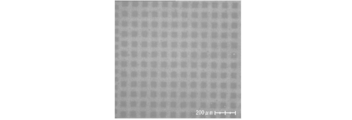
- FIG. 1 is a diagram showing a 500 ⁇ m ⁇ 500 ⁇ m square pattern formed on a silicon wafer using the photosensitive composition 1 prepared in Example 1.
- FIG. 2 is a diagram showing an optical micrograph of a 500 ⁇ m ⁇ 500 ⁇ m square pattern formed on a silicon wafer using the photosensitive composition 1 prepared in Example 1.
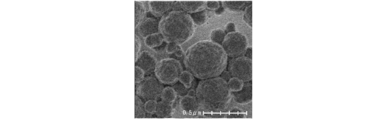
- FIG. 3 is a diagram showing an SEM photograph of a 500 ⁇ m ⁇ 500 ⁇ m square pattern light irradiation part formed on a silicon wafer using the photosensitive composition 1 prepared in Example 1.
- FIG. 4 is a view showing an SEM photograph of an unirradiated portion of a 500 ⁇ m ⁇ 500 ⁇ m square pattern formed on a silicon wafer using the photosensitive composition 1 prepared in Example 1.
- the present invention is a photosensitive composition
- a photosensitive composition comprising water-soluble organic particles and a solvent, wherein the solvent is a poor solvent for the water-soluble organic particles.
- the water-soluble organic particles are particles obtained by forming a water-soluble organic resin, and preferably have a unit structure (A) for forming organic particles, a unit structure (B) for forming cross-links between particles, and imparting dispersibility.
- the photosensitive composition further contains a photoacid generator.
- the water-soluble organic particles preferably include a unit structure (A) for forming organic particles, a unit structure (B) for forming crosslinks between particles, a unit structure (C) for imparting dispersibility, and a photoacid. It consists of a polymer containing the unit structure (D) which has a generating group.
- the unit structure (B) forms a cross-link between organic particles by a photoacid generator by exposure light during exposure or an acid generated from a photoacid generating group in the unit structure (D), and a developer is used in a later development process. It has a role of forming a pattern without being removed by the above. Further, the portion that has not been irradiated with the exposure light is removed by the developer without being crosslinked.
- the unit structure (C) is a unit structure having a role necessary for developing good dispersibility without causing aggregation of organic particles in a poor solvent of the photosensitive composition.
- the unit structure (A) is a unit structure for particle formation, and the unit structure (B) and the unit structure (C), and in some cases, the unit structure (D) are arranged at appropriate intervals in the organic particles. It is a unit structure that also plays a role.
- the organic particle contained in the photosensitive composition of this invention is comprised by the polymer containing the unit structure which bears each of these characteristics.
- Examples of the monomer that forms the unit structure (A) for forming organic particles include (meth) acrylic acid amide, N-alkyl (meth) acrylic acid amide, N-aryl (meth) acrylic acid amide, and the like.
- (meth) acrylic acid represents both methacrylic acid and acrylic acid.
- alkyl group in the N-alkyl (meth) acrylic acid amide examples include alkyl groups having 1 to 10 carbon atoms, such as methyl group, ethyl group, n-propyl group, i-propyl group, cyclopropyl group, n -Butyl group, i-butyl group, s-butyl group, t-butyl group, cyclobutyl group, 1-methyl-cyclopropyl group, 2-methyl-cyclopropyl group, n-pentyl group, 1-methyl-n-butyl Group, 2-methyl-n-butyl group, 3-methyl-n-butyl group, 1,1-dimethyl-n-propyl group, 1,2-dimethyl-n-propyl group, 2,2-dimethyl-n- Propyl group, 1-ethyl-n-propyl group, cyclopentyl group, 1-methyl-cyclobutyl group, 2-methyl-cyclobutyl group, 3-
- aryl group in the N-aryl (meth) acrylic amide examples include aryl groups having 6 to 30 carbon atoms, such as a phenyl group, an o-methylphenyl group, an m-methylphenyl group, a p-methylphenyl group, o-chlorophenyl group, m-chlorophenyl group, p-chlorophenyl group, o-fluorophenyl group, p-fluorophenyl group, o-methoxyphenyl group, p-methoxyphenyl group, p-nitrophenyl group, p- Cyanophenyl group, ⁇ -naphthyl group, ⁇ -naphthyl group, o-biphenylyl group, m-biphenylyl group, p-biphenylyl group, 1-anthryl group, 2-anthryl group, 9-anthryl group, 1-phenanthryl group, 2-
- the monomer that forms the unit structure (B) for the formation of cross-links between particles is a unit structure having a hydroxy group that forms cross-links between particles, such as N-hydroxyalkyl (meth) acrylic acid amide, N-hydroxyaryl.
- Examples include alkoxyalkyl and alkoxyaryl (meth) acrylate.
- alkyl group and aryl group in the compound those mentioned as the alkyl group in the above-mentioned N-alkyl (meth) acrylic acid amide and the aryl group in N-aryl (meth) acrylic acid amide can be used.
- alkoxy group examples include alkoxy groups having 1 to 10 carbon atoms, such as methoxy group, ethoxy group, n-propoxy group, i-propoxy group, n-butoxy group, i-butoxy group, s-butoxy group, t- Butoxy group, n-pentoxy group, 1-methyl-n-butoxy group, 2-methyl-n-butoxy group, 3-methyl-n-butoxy group, 1,1-dimethyl-n-propoxy group, 1,2- Dimethyl-n-propoxy group, 2,2-dimethyl-n-propoxy group, 1-ethyl-n-propoxy group, n-hexyloxy group, 1-methyl-n-pentyloxy group, 2-methyl-n-pentyl Oxy group, 3-methyl-n-pentyloxy group, 4-methyl-n-pentyloxy group, 1,1-dimethyl-n-butoxy group, 1,2-dimethyl-n-butoxy group, 1,3-di Til-n-butoxy
- Examples of the monomer forming the unit structure (C) for imparting dispersibility include a unit structure formed from a compound obtained by esterifying (meth) acrylic acid with a polyether.
- This compound is a compound obtained by esterifying the carboxyl group of (meth) acrylic acid with a polyether.
- the polyether is a compound in which a large number of oxyalkylene units are linked, and the degree of polymerization thereof is, for example, 10 to 200, or 20 to 120.
- This unit structure (C) is capable of grafting a polymer, and contributes to the good dispersibility exhibited when the produced polymer is converted into organic particles.
- alkylene group in an oxyalkylene unit the alkylene group induced
- ethylene and propylene can be used conveniently.
- the end of the polyether is an alkyl group bonded to an oxygen atom of an ether bond, and the above-described alkyl group is exemplified.
- a methyl group can be preferably used.
- unit structure (C) examples include unit structures formed from compounds represented by the following formulas (C-1) and (C-2).
- R 1 represents an alkylene group of the oxyalkylene unit
- R 2 represents the terminal alkyl group
- n represents the degree of polymerization of the oxyalkylene unit and is, for example, 10 to 200, or 20 to 120.
- a compound represented by the above formula (C-1) a compound in which the carboxyl group of acrylic acid is esterified with a polyether composed of oxyethylene having a polymerization degree of 90 and the terminal is a methyl group is commercially available from NOF Corporation.
- the names Bremer PME4000 and PME1000 are commercially available.
- the photosensitive composition further contains a photoacid generator described in detail below.
- the photoacid generator shown below forms a unit structure (D) having a photoacid generator group by bonding a part of the photoacid generator with a polymer unit structure (for example, acryloyl group or methacryloyl group). It can be used as a sulmonomer.
- Examples of the photoacid generator used in the photosensitive composition of the present invention include onium salt compounds, sulfonimide compounds, and disulfonyldiazomethane compounds.
- diphenyliodonium hexafluorophosphate As onium salt compounds effective for KrF excimer laser (wavelength 248 nm) and ArF excimer laser (wavelength 193 nm), diphenyliodonium hexafluorophosphate, diphenyliodonium trifluoromethanesulfonate, diphenyliodonium nonafluoronormalbutanesulfonate, diphenyliodonium perfluoronormaloctanesulfonate Iodonium salt compounds such as diphenyliodonium camphorsulfonate, bis (4-tert-butylphenyl) iodonium camphorsulfonate and bis (4-tert-butylphenyl) iodonium trifluoromethanesulfonate, and triphenylsulfonium hexafluoroantimonate, triphenylsulfonium Nonafluorono
- sulfonimide compounds include N- (trifluoromethanesulfonyloxy) succinimide, N- (nonafluoronormalbutanesulfonyloxy) succinimide, N- (camphorsulfonyloxy) succinimide and N- (trifluoromethanesulfonyloxy) naphthalimide. Can be mentioned.
- disulfonyldiazomethane compounds effective for KrF excimer laser (wavelength 248 nm) and ArF excimer laser (wavelength 193 nm) include, for example, bis (trifluoromethylsulfonyl) diazomethane, bis (cyclohexylsulfonyl) diazomethane, bis (phenylsulfonyl) diazomethane, Examples thereof include bis (p-toluenesulfonyl) diazomethane, bis (2,4-dimethylbenzenesulfonyl) diazomethane, and methylsulfonyl-p-toluenesulfonyldiazomethane.
- photoacid generators for g-line (wavelength 436 nm), h-line (wavelength 405 nm), and i-line (wavelength 365 nm) compounds represented by the following chemical formulas (2-1) to (2-5) are used. Can be used.
- the above photoacid generator can be used in combination with the following other photoacid generators in less than 50% by mass of the total photoacid generator.
- specific examples of such other photoacid generators include triazine compounds, acetophenone derivative compounds, disulfone compounds, diazomethane compounds, sulfonic acid derivative compounds, diaryliodonium salts, triarylsulfonium salts, triarylphosphonium salts, Although an iron arene complex etc. can be used, it is not limited to these.
- diphenyliodonium chloride diphenyliodonium mesylate, diphenyliodonium tosylate, diphenyliodonium bromide, diphenyliodonium tetrafluoroborate, diphenyliodonium hexafluoroantimonate, diphenyliodonium hexafluoroarsenate, bis (p-tert- Butylphenyl) iodonium hexafluorophosphate, bis (p-tert-butylphenyl) iodonium mesylate, bis (p-tert-butylphenyl) iodonium tosylate, bis (p-tert-butylphenyl) iodonium tetrafluoroborate, bis ( p-tert-butylphenyl) iodonium chloride, bis (p-chlorophenyl) iodonium chloride, bis (p-
- photoacid generators for g-line (wavelength 436 nm), h-line (wavelength 405 nm) and i-line (wavelength 365 nm) are represented by the following chemical formulas (2-6) to (2-69). Compounds can be used.
- photoacid generator Only one type of photoacid generator can be used, or two or more types can be used in combination.
- preferred examples of the water-soluble organic particles include polymers containing combinations of unit structures represented by the following formulas (1) to (7).
- azobisisobutyronitrile or the like may be used as a polymerization initiator. It can.
- This polymerization is radical polymerization, and the compound that forms the unit structure (A) to unit structure (D) dissolves, but becomes a poor solvent for the water-soluble organic particles formed after the polymerization.
- Polymerization is carried out in a solvent.
- the polymerization temperature is, for example, 60 to 180 ° C. or the reflux temperature of the solvent, and the polymerization time can be performed, for example, from 0.1 to 6 hours.
- the above-mentioned water-soluble organic particles preferably have a particle size in the range of 10 to 1500 nm, 50 to 1000 nm, or 100 to 800 nm.
- the solvent used in the present invention is a poor solvent for water-soluble organic particles, that is, does not substantially dissolve the water-soluble organic particles, and dissolves the photoacid generator. Moreover, a solvent with high coating property is preferable.
- solvents include solvents containing ethers, esters, hydrocarbons, ketones, aldehydes, or alcohols, such as methyl cellosolve acetate, ethyl cellosolve acetate, propylene glycol, propylene glycol monomethyl ether, propylene glycol monoethyl ether, methyl.
- solvents can be used alone or in combination of two or more.
- solvent in the present invention propylene glycol monomethyl ether, propylene glycol monomethyl ether acetate, ethylene glycol monobutyl ether, ethanol, propanol, isopropanol, or butanol is preferable, and propylene glycol monomethyl ether can be particularly preferably used.
- the solid content in the photosensitive composition of the present invention is, for example, 0.1 to 30% by mass, or 0.1 to 20% by mass, or 1 to 10% by mass. Solid content is what remove
- the proportion of the water-soluble organic particles in the solid content is, for example, 70 to 100% by mass, or 80 to 99.5% by mass, or 80 to 90% by mass when the water-soluble organic particles have a photoacid generating group. It is. In the case where the water-soluble organic particles do not have a photoacid generating group and separately contain a photoacid generator, the proportion of the water-soluble organic particles in the solid content is, for example, 70 to 99.9% by mass. Or 80 to 95% by mass, or 80 to 98% by mass, and the photoacid generator can be contained in a solid content in a proportion of 0.1 to 20% by mass, or 1 to 10% by mass.
- the photosensitive composition of the present invention may contain other additives generally added to the photosensitive composition such as a surfactant as other components.
- the photosensitive composition according to the present invention can contain a basic compound.
- An amine can be illustrated as a basic compound.
- a basic compound such as an amine can react with a photoacid generating group or an acid generated from a photoacid generator at the time of exposure to reduce the sensitivity of the photosensitive coating. Further, it is possible to suppress the diffusion of the acid generated from the photoacid generating group in the photosensitive film of the exposed portion or the photoacid generator to the photosensitive coating in the unexposed portion.
- the amine is not particularly limited.
- tertiary amines such as isopropanolamine, phenyldiethanolamine, stearyldiethanolamine and diazabicyclooctane
- aromatic amines such as pyridine and 4-dimethylaminopyridine.
- primary amines such as benzylamine and normal butylamine, and secondary amines such as diethylamine and dinormalbutylamine are also included.
- Amine can be used alone or in combination of two or more.
- the content thereof is 0.001 to 5 parts by mass, for example 0.01 to 1 part by mass, or 0.1 to 0.1 parts by mass with respect to 100 parts by mass of the solid content of the photosensitive composition. 0.5 parts by mass. If the amine content is greater than the above value, the sensitivity may be too low.
- the photosensitive composition of the present invention is applied to various substrates (for example, a glass substrate, a ceramic substrate, a plastic substrate, a silicon wafer, etc.) as a base material by an appropriate application method such as a spinner or a coater, and then fired.
- a photosensitive film is formed.
- the firing conditions are appropriately selected from firing temperatures of 50 ° C. to 100 ° C. and firing times of 0.1 minutes to 10 minutes.
- the firing temperature is 60 ° C. to 90 ° C.
- the firing time is 1 to 5 minutes.
- the film thickness of the formed photosensitive film is several nm to several ⁇ m.
- Exposure uses g-line (wavelength 436 nm), h-line (wavelength 405 nm), i-line (wavelength 365 nm), KrF excimer laser (wavelength 248 nm), ArF excimer laser (wavelength 193 nm), F2 excimer laser (wavelength 157 nm), etc. can do.
- post-exposure bake can be performed as necessary.
- the post-exposure heating is performed under conditions appropriately selected from a heating temperature of 100 ° C. to 200 ° C. and a heating time of 1 to 20 minutes.
- the photosensitive coating obtained from the photosensitive composition is a negative resist, and the exposed portion undergoes a dehydration reaction of hydroxy groups by the acid from the photoacid generator, thereby causing cross-linking between the particles. Occurs to form a crosslinked structure and becomes insoluble in the developer.
- the developer is water or an aqueous medium.
- the aqueous medium has a pH near neutral and can also contain additives such as surfactants. However, pure water can be preferably used.
- Synthesis example 1 5.5 g of acrylamide, 1.5 g of N-hydroxymethyl acrylamide, 1.0 g of 2-hydroxyethyl methacrylate, 1.5 g of Blemmer PME4000 (trade name, manufactured by NOF Corporation) and 0.13 g of azobisisobutyronitrile.
- a mixture dissolved in 14.4 g of propylene glycol monomethyl ether was dropped into 24.1 g of propylene glycol monomethyl ether heated to reflux over 2 hours.
- the obtained dispersion having a solid content of 20% is milky white, and the water-soluble organic particles are particles composed of a polymer corresponding to the polymer having a unit structure represented by the above formula (4).
- the particle size was 300 to 500 nm (according to SEM observation).
- Synthesis example 2 5.5 g of acrylamide, 1.5 g of N-hydroxymethylacrylamide, 1.0 g of 2-hydroxyethyl methacrylate, 0.5 g of Blemmer PME4000 (trade name, manufactured by NOF Corporation) and 0.13 g of azobisisobutyronitrile.
- a mixture dissolved in 12.9 g of propylene glycol monomethyl ether was dropped into 21.6 g of propylene glycol monomethyl ether heated to reflux over 2 hours.
- the obtained dispersion having a solid content of 20% is milky white, and the water-soluble organic particles are particles composed of a polymer corresponding to the polymer having a unit structure represented by the above formula (4).
- the particle size was 500 to 800 nm (according to SEM observation).
- Synthesis example 3 5.5 g of acrylamide, 1.5 g of N-hydroxymethyl acrylamide, 1.0 g of 2-hydroxyethyl methacrylate, 3.0 g of Blemmer PME4000 (trade name, manufactured by NOF Corporation) and 0.13 g of azobisisobutyronitrile.
- a mixture dissolved in 16.7 g of propylene glycol monomethyl ether was dropped into 27.8 g of propylene glycol monomethyl ether heated to reflux over 2 hours.
- the obtained dispersion having a solid content of 20% is milky white, and the water-soluble organic particles are particles composed of a polymer corresponding to the polymer having a unit structure represented by the above formula (4).
- the particle size was 100 to 200 nm (according to SEM observation).
- Synthesis example 4 5.5 g of acrylamide, 1.5 g of N-hydroxymethylacrylamide, 1.0 g of 2-hydroxyethyl methacrylate, 1.5 g of Blemmer PME1000 (trade name, manufactured by NOF Corporation) and 0.13 g of azobisisobutyronitrile
- a mixture dissolved in 14.4 g of propylene glycol monomethyl ether was dropped into 24.1 g of propylene glycol monomethyl ether heated to reflux over 2 hours.
- the obtained dispersion having a solid content of 20% is milky white, and the water-soluble organic particles are particles composed of a polymer corresponding to the polymer having a unit structure represented by the above formula (5).
- the particle size was 100 to 300 nm (according to SEM observation).
- Synthesis example 5 5.5 g of acrylamide, 1.5 g of N-methoxymethylmethacrylamide, 1.0 g of 2-hydroxyethyl methacrylate, 1.5 g of Blemmer PME4000 (trade name, manufactured by NOF Corporation) and 0.13 g of azobisisobutyronitrile was added dropwise to 24.1 g of propylene glycol monomethyl ether heated to reflux over 2 hours.
- the obtained dispersion having a solid content of 20% is milky white, and the water-soluble organic particles are particles composed of a polymer corresponding to the polymer having a unit structure represented by the above formula (6).
- the particle size was 300 to 500 nm (according to SEM observation).
- Synthesis Example 6 5.5 g of acrylamide, 1.5 g of N-hydroxymethyl acrylamide, 1.5 g of Bremer PME4000 (trade name, manufactured by NOF Corporation) and 0.13 g of azobisisobutyronitrile are dissolved in 15.0 g of propylene glycol monomethyl ether. The resulting mixture was dropped into 25.0 g of propylene glycol monomethyl ether heated to reflux over 2 hours. The obtained dispersion having a solid content of 20% is milky white, and the water-soluble organic particles are particles made of a polymer corresponding to the polymer having a unit structure represented by the above formula (1). The particle size was 300 to 500 nm (according to SEM observation).
- Synthesis example 7 5.5 g of acrylamide, 1.5 g of N-hydroxymethyl acrylamide, 1.0 g of 2-hydroxyethyl methacrylate, 1.5 g of Bremer PME4000 (trade name, manufactured by NOF Corporation), TPS-IMA (trade name) (generic name) : Triphenylsulfonium 2-methacryloyloxy-1,1-difluoroethanesulfonate (manufactured by Central Glass Co., Ltd.) 0.01 g and azobisisobutyronitrile 0.13 g dissolved in propylene glycol monomethyl ether 14.4 g The solution was added dropwise to 24.1 g of propylene glycol monomethyl ether heated to reflux over 2 hours.
- the obtained dispersion having a solid content of 20% is milky white, and the water-soluble organic particles are particles made of a polymer corresponding to the polymer having the unit structure represented by the above formula (7).
- the particle size was 300 to 500 nm (according to SEM observation).
- Example 1 To 2 g of the dispersion obtained in Synthesis Example 1, 0.01 g of a photoacid generator PAI-1001 (trade name, a compound represented by the formula (2-35) manufactured by Midori Chemical Co., Ltd.), propylene glycol monomethyl ether 18. 8 g was added to obtain a dispersion (photosensitive composition 1).
- a photoacid generator PAI-1001 (trade name, a compound represented by the formula (2-35) manufactured by Midori Chemical Co., Ltd.), propylene glycol monomethyl ether 18. 8 g was added to obtain a dispersion (photosensitive composition 1).
- Example 2 To 2 g of the dispersion obtained in Synthesis Example 7, 18.8 g of propylene glycol monomethyl ether was added to obtain a dispersion (photosensitive composition 2).
- Comparative Example 1 To 2 g of the dispersion obtained in Comparative Synthesis Example 1, 0.01 g of a photoacid generator PAI-1001 (trade name, manufactured by Midori Chemical Co., Ltd.) and 18.8 g of propylene glycol monomethyl ether were added and the dispersion (photosensitive composition 3) was added. ).
- FIG. 1 shows a square pattern formed using the photosensitive composition 1 prepared in Example 1, FIG.
- FIG. 2 shows an optical micrograph of the square pattern
- FIG. 3 shows an SEM photograph of a light irradiation part of the square pattern
- FIG. 4 shows SEM photographs of the unirradiated portions of the square pattern.
- the photosensitive compositions 1 and 2 prepared in Example 1 and Example 2 were able to create an organic particle pattern in the optical microscope and SEM observation, but the photosensitive composition 3 prepared in Comparative Example 1 was on a silicon wafer. Since the organic particles supported on the surface were originally insoluble in water, patterning could not be performed by development with water.
- the photosensitive composition of the present invention is a material that can be applied to a substrate and dried to form a photosensitive film, which can be patterned by exposure and development, and can be patterned.
Landscapes
- Physics & Mathematics (AREA)
- General Physics & Mathematics (AREA)
- Chemical & Material Sciences (AREA)
- Spectroscopy & Molecular Physics (AREA)
- Medicinal Chemistry (AREA)
- Organic Chemistry (AREA)
- Polymers & Plastics (AREA)
- Health & Medical Sciences (AREA)
- Chemical Kinetics & Catalysis (AREA)
- Engineering & Computer Science (AREA)
- Ceramic Engineering (AREA)
- Addition Polymer Or Copolymer, Post-Treatments, Or Chemical Modifications (AREA)
- Materials For Photolithography (AREA)
- Photosensitive Polymer And Photoresist Processing (AREA)
- Compositions Of Macromolecular Compounds (AREA)
Abstract
Priority Applications (4)
| Application Number | Priority Date | Filing Date | Title |
|---|---|---|---|
| JP2013509943A JP5943210B2 (ja) | 2011-04-12 | 2012-04-11 | 感光性有機粒子 |
| EP12771827.8A EP2698669A4 (fr) | 2011-04-12 | 2012-04-11 | Particule organique photosensible |
| KR1020137027458A KR101920651B1 (ko) | 2011-04-12 | 2012-04-11 | 감광성 유기 입자 |
| US14/111,021 US9140989B2 (en) | 2011-04-12 | 2012-04-11 | Photosensitive organic particles |
Applications Claiming Priority (2)
| Application Number | Priority Date | Filing Date | Title |
|---|---|---|---|
| JP2011-088286 | 2011-04-12 | ||
| JP2011088286 | 2011-04-12 |
Publications (1)
| Publication Number | Publication Date |
|---|---|
| WO2012141210A1 true WO2012141210A1 (fr) | 2012-10-18 |
Family
ID=47009377
Family Applications (1)
| Application Number | Title | Priority Date | Filing Date |
|---|---|---|---|
| PCT/JP2012/059894 Ceased WO2012141210A1 (fr) | 2011-04-12 | 2012-04-11 | Particule organique photosensible |
Country Status (6)
| Country | Link |
|---|---|
| US (1) | US9140989B2 (fr) |
| EP (1) | EP2698669A4 (fr) |
| JP (1) | JP5943210B2 (fr) |
| KR (1) | KR101920651B1 (fr) |
| TW (1) | TWI529482B (fr) |
| WO (1) | WO2012141210A1 (fr) |
Cited By (3)
| Publication number | Priority date | Publication date | Assignee | Title |
|---|---|---|---|---|
| JP2012242556A (ja) * | 2011-05-18 | 2012-12-10 | Fujifilm Corp | パターン形成方法、感活性光線性又は感放射線性樹脂組成物、レジスト膜、電子デバイスの製造方法、及び、電子デバイス |
| CN105492670A (zh) * | 2013-08-30 | 2016-04-13 | 日产化学工业株式会社 | 纤维形成用组合物及使用该纤维的生物相容性材料 |
| JPWO2015056789A1 (ja) * | 2013-10-17 | 2017-03-09 | 日産化学工業株式会社 | 感光性繊維およびその製造方法 |
Families Citing this family (3)
| Publication number | Priority date | Publication date | Assignee | Title |
|---|---|---|---|---|
| CN107532337A (zh) * | 2015-04-22 | 2018-01-02 | 日产化学工业株式会社 | 感光性纤维及纤维图案的形成方法 |
| KR102306740B1 (ko) | 2017-07-14 | 2021-09-28 | 미쯔비시 케미컬 주식회사 | 열가소성 수지 조성물, 성형체, 및 차량용 부품 |
| JP2025169708A (ja) * | 2024-05-02 | 2025-11-14 | 信越化学工業株式会社 | 密着膜形成用組成物、パターン形成方法、及び密着膜の形成方法 |
Citations (7)
| Publication number | Priority date | Publication date | Assignee | Title |
|---|---|---|---|---|
| JPH083251A (ja) | 1994-06-20 | 1996-01-09 | Kansai Paint Co Ltd | 親水性架橋重合体微粒子及びその製造方法 |
| JPH08120003A (ja) | 1994-10-24 | 1996-05-14 | Kansai Paint Co Ltd | 親水性架橋重合体微粒子及びその製造方法 |
| JP2004037955A (ja) * | 2002-07-04 | 2004-02-05 | Kunihiro Ichimura | 感活性エネルギー線樹脂組成物、感活性エネルギー線樹脂フィルム及び該フィルムを用いるパターン形成方法 |
| JP2004109951A (ja) * | 2002-09-20 | 2004-04-08 | Japan Science & Technology Corp | 偏光カラーフィルターとその製造方法 |
| JP2005070579A (ja) * | 2003-08-27 | 2005-03-17 | Japan Science & Technology Agency | 光照射又は熱処理による蛍光特性の変化を利用する書き換え可能な光メモリー材料 |
| JP2005271576A (ja) * | 2004-01-09 | 2005-10-06 | Fuji Photo Film Co Ltd | 平版印刷版原版及びそれを用いた平版印刷方法 |
| JP2010197996A (ja) * | 2009-01-30 | 2010-09-09 | Jsr Corp | 感光性絶縁樹脂組成物及びその硬化物並びに絶縁膜の製造方法 |
Family Cites Families (9)
| Publication number | Priority date | Publication date | Assignee | Title |
|---|---|---|---|---|
| US3440047A (en) * | 1964-08-10 | 1969-04-22 | Gen Aniline & Film Corp | Photopolymer offset printing plates of the etch type |
| US4772646A (en) * | 1986-11-17 | 1988-09-20 | Halliburton Company | Concentrated hydrophilic polymer suspensions |
| US6130303A (en) * | 1988-12-19 | 2000-10-10 | Cytec Technology Corp. | Water-soluble, highly branched polymeric microparticles |
| US5368931A (en) * | 1991-07-10 | 1994-11-29 | Fuji Photo Film Co., Ltd. | Lithographic printing plate precursor of direct image type |
| JPH05173011A (ja) * | 1991-12-24 | 1993-07-13 | Oji Kako Kk | カラーフィルター |
| US20060293425A1 (en) | 2003-08-26 | 2006-12-28 | Japan Science And Technology Agency | Method for producing functional polyimide fine particle and rewritable memory material utilizing change in fluorescence characteristics caused in fluorescence characteristics caused by light irradiation or heat treatment |
| US20050153239A1 (en) | 2004-01-09 | 2005-07-14 | Fuji Photo Film Co., Ltd. | Lithographic printing plate precursor and lithographic printing method using the same |
| JP2006271576A (ja) * | 2005-03-29 | 2006-10-12 | Aruze Corp | 遊技機 |
| JP2012013906A (ja) * | 2010-06-30 | 2012-01-19 | Sanyo Chem Ind Ltd | 感光性樹脂組成物 |
-
2012
- 2012-04-11 EP EP12771827.8A patent/EP2698669A4/fr not_active Withdrawn
- 2012-04-11 KR KR1020137027458A patent/KR101920651B1/ko active Active
- 2012-04-11 US US14/111,021 patent/US9140989B2/en active Active
- 2012-04-11 WO PCT/JP2012/059894 patent/WO2012141210A1/fr not_active Ceased
- 2012-04-11 JP JP2013509943A patent/JP5943210B2/ja active Active
- 2012-04-12 TW TW101113019A patent/TWI529482B/zh active
Patent Citations (7)
| Publication number | Priority date | Publication date | Assignee | Title |
|---|---|---|---|---|
| JPH083251A (ja) | 1994-06-20 | 1996-01-09 | Kansai Paint Co Ltd | 親水性架橋重合体微粒子及びその製造方法 |
| JPH08120003A (ja) | 1994-10-24 | 1996-05-14 | Kansai Paint Co Ltd | 親水性架橋重合体微粒子及びその製造方法 |
| JP2004037955A (ja) * | 2002-07-04 | 2004-02-05 | Kunihiro Ichimura | 感活性エネルギー線樹脂組成物、感活性エネルギー線樹脂フィルム及び該フィルムを用いるパターン形成方法 |
| JP2004109951A (ja) * | 2002-09-20 | 2004-04-08 | Japan Science & Technology Corp | 偏光カラーフィルターとその製造方法 |
| JP2005070579A (ja) * | 2003-08-27 | 2005-03-17 | Japan Science & Technology Agency | 光照射又は熱処理による蛍光特性の変化を利用する書き換え可能な光メモリー材料 |
| JP2005271576A (ja) * | 2004-01-09 | 2005-10-06 | Fuji Photo Film Co Ltd | 平版印刷版原版及びそれを用いた平版印刷方法 |
| JP2010197996A (ja) * | 2009-01-30 | 2010-09-09 | Jsr Corp | 感光性絶縁樹脂組成物及びその硬化物並びに絶縁膜の製造方法 |
Non-Patent Citations (1)
| Title |
|---|
| See also references of EP2698669A4 |
Cited By (4)
| Publication number | Priority date | Publication date | Assignee | Title |
|---|---|---|---|---|
| JP2012242556A (ja) * | 2011-05-18 | 2012-12-10 | Fujifilm Corp | パターン形成方法、感活性光線性又は感放射線性樹脂組成物、レジスト膜、電子デバイスの製造方法、及び、電子デバイス |
| CN105492670A (zh) * | 2013-08-30 | 2016-04-13 | 日产化学工业株式会社 | 纤维形成用组合物及使用该纤维的生物相容性材料 |
| US9957644B2 (en) | 2013-08-30 | 2018-05-01 | Nissan Chemical Industries, Ltd. | Fiber-forming composition and bio-compatible material using said fiber |
| JPWO2015056789A1 (ja) * | 2013-10-17 | 2017-03-09 | 日産化学工業株式会社 | 感光性繊維およびその製造方法 |
Also Published As
| Publication number | Publication date |
|---|---|
| TWI529482B (zh) | 2016-04-11 |
| JP5943210B2 (ja) | 2016-06-29 |
| EP2698669A1 (fr) | 2014-02-19 |
| US9140989B2 (en) | 2015-09-22 |
| EP2698669A4 (fr) | 2014-11-26 |
| KR20140018301A (ko) | 2014-02-12 |
| TW201307994A (zh) | 2013-02-16 |
| US20140045119A1 (en) | 2014-02-13 |
| JPWO2012141210A1 (ja) | 2014-07-28 |
| KR101920651B1 (ko) | 2018-11-21 |
Similar Documents
| Publication | Publication Date | Title |
|---|---|---|
| EP2095189B1 (fr) | Composition pour former un film de fondation de résist contenant un accélérateur de dissolution de faible masse moléculaire | |
| US8227172B2 (en) | Method of producing semiconductor device using resist underlayer film by photo-crosslinking curing | |
| JP5943210B2 (ja) | 感光性有機粒子 | |
| TWI575323B (zh) | 感光性光阻下層膜形成組成物 | |
| KR102203366B1 (ko) | 레지스트 패턴 피복용 도포액 | |
| CN105324719A (zh) | 包含吡咯酚醛清漆树脂的抗蚀剂下层膜形成用组合物 | |
| TWI665525B (zh) | 含有具有雜原子的環狀有機基之含矽阻劑底層膜形成組成物 | |
| KR20100058574A (ko) | 분지형 폴리히드록시스틸렌을 포함하는 레지스트 하층막 형성 조성물 | |
| JP6195078B2 (ja) | スルホン構造及びアミン構造を有するシリコン含有レジスト下層膜形成組成物 | |
| US8685615B2 (en) | Photosensitive resist underlayer film forming composition | |
| JP6493683B2 (ja) | ラクトン構造含有ポリマーを含む電子線レジスト下層膜形成組成物 | |
| JP7841430B2 (ja) | 薬液耐性保護膜 | |
| JP2011175135A (ja) | アミドビニルエーテル基含有架橋剤を含む感光性レジスト下層膜形成組成物 | |
| WO2023084961A1 (fr) | Film protecteur résistant aux produits chimiques | |
| WO2021201197A1 (fr) | Composition filmogène |
Legal Events
| Date | Code | Title | Description |
|---|---|---|---|
| 121 | Ep: the epo has been informed by wipo that ep was designated in this application |
Ref document number: 12771827 Country of ref document: EP Kind code of ref document: A1 |
|
| ENP | Entry into the national phase |
Ref document number: 2013509943 Country of ref document: JP Kind code of ref document: A |
|
| WWE | Wipo information: entry into national phase |
Ref document number: 14111021 Country of ref document: US |
|
| NENP | Non-entry into the national phase |
Ref country code: DE |
|
| ENP | Entry into the national phase |
Ref document number: 20137027458 Country of ref document: KR Kind code of ref document: A |
|
| WWE | Wipo information: entry into national phase |
Ref document number: 2012771827 Country of ref document: EP |