WO2012141274A1 - 有機電界発光素子、有機電界発光素子用材料、膜、発光層、及び有機電界発光素子の作製方法 - Google Patents
有機電界発光素子、有機電界発光素子用材料、膜、発光層、及び有機電界発光素子の作製方法 Download PDFInfo
- Publication number
- WO2012141274A1 WO2012141274A1 PCT/JP2012/060078 JP2012060078W WO2012141274A1 WO 2012141274 A1 WO2012141274 A1 WO 2012141274A1 JP 2012060078 W JP2012060078 W JP 2012060078W WO 2012141274 A1 WO2012141274 A1 WO 2012141274A1
- Authority
- WO
- WIPO (PCT)
- Prior art keywords
- group
- substituent
- ring
- atom
- molecular
- Prior art date
- Legal status (The legal status is an assumption and is not a legal conclusion. Google has not performed a legal analysis and makes no representation as to the accuracy of the status listed.)
- Ceased
Links
- 0 CCOc1c(*N)c(*N)c(*C)c(**)c1C1=*(*2Oc(c(*N=O)c(*)c(C(F)(F)F)c3*(C)C)c3C3=*2c2c(c(**)c4**)ICN3)c2c4ICC1 Chemical compound CCOc1c(*N)c(*N)c(*C)c(**)c1C1=*(*2Oc(c(*N=O)c(*)c(C(F)(F)F)c3*(C)C)c3C3=*2c2c(c(**)c4**)ICN3)c2c4ICC1 0.000 description 3
- IVTXDSDUEVLIQU-UHFFFAOYSA-N CC(C)(C)C(C1)C=Cc(c2c(cccc3c([n](c4c5ccc(C(C)(C)C)c4)-c4ccccc4)c5c4ccc5)c3c4c5c22)c1[n]2-c1ccccc1 Chemical compound CC(C)(C)C(C1)C=Cc(c2c(cccc3c([n](c4c5ccc(C(C)(C)C)c4)-c4ccccc4)c5c4ccc5)c3c4c5c22)c1[n]2-c1ccccc1 IVTXDSDUEVLIQU-UHFFFAOYSA-N 0.000 description 1
- YWRWUVKTSAULLI-UHFFFAOYSA-N CC(C)(C)c(cc1)cc2c1[o]c(c1cc(C(C)(C)C)c3)c2c(cc(C(C)(C)C)cc24)c2c1c3c1c4[o]c2ccc(C(C)(C)C)cc12 Chemical compound CC(C)(C)c(cc1)cc2c1[o]c(c1cc(C(C)(C)C)c3)c2c(cc(C(C)(C)C)cc24)c2c1c3c1c4[o]c2ccc(C(C)(C)C)cc12 YWRWUVKTSAULLI-UHFFFAOYSA-N 0.000 description 1
- BNHOZVXTJPERPA-UHFFFAOYSA-N CC(C)(C)c(cc1)cc2c1[s]c1c2c2cc(C(C)(C)C)cc3c2c2c1cc(C(C)(C)C)cc2c1c3[s]c2ccc(C(C)(C)C)cc12 Chemical compound CC(C)(C)c(cc1)cc2c1[s]c1c2c2cc(C(C)(C)C)cc3c2c2c1cc(C(C)(C)C)cc2c1c3[s]c2ccc(C(C)(C)C)cc12 BNHOZVXTJPERPA-UHFFFAOYSA-N 0.000 description 1
- HJZBCKXSHGPSPN-UHFFFAOYSA-N CC(C)(C)c(cc12)cc(c-3c(c4cc(C(C)(C)C)c5)[Si](C)(C)c6c-3c(cccc3)c3cc6)c1c4c5c-1c2[Si](C)(C)c2c-1c(cccc1)c1cc2 Chemical compound CC(C)(C)c(cc12)cc(c-3c(c4cc(C(C)(C)C)c5)[Si](C)(C)c6c-3c(cccc3)c3cc6)c1c4c5c-1c2[Si](C)(C)c2c-1c(cccc1)c1cc2 HJZBCKXSHGPSPN-UHFFFAOYSA-N 0.000 description 1
- XNYKREYKNUYQRQ-UHFFFAOYSA-N CC(C)(C)c(cc12)cc(c3c(c4cc(C(C)(C)C)c5)[Si+](C)(C)C6=C3C=C3C=CC=CC3C6)c1c4c5c-1c2[Si](C)(C)c2c-1cc(cccc1)c1c2 Chemical compound CC(C)(C)c(cc12)cc(c3c(c4cc(C(C)(C)C)c5)[Si+](C)(C)C6=C3C=C3C=CC=CC3C6)c1c4c5c-1c2[Si](C)(C)c2c-1cc(cccc1)c1c2 XNYKREYKNUYQRQ-UHFFFAOYSA-N 0.000 description 1
- HXCARXSCDZFELO-UHFFFAOYSA-N CC(C)(C)c(cc1c2c(c3cc(C(C)(C)C)c4)[o]c(cc5)c2cc5-c2ccccc2)cc2c1c3c4c(c1c3)c2[o]c1ccc3-c1ccccc1 Chemical compound CC(C)(C)c(cc1c2c(c3cc(C(C)(C)C)c4)[o]c(cc5)c2cc5-c2ccccc2)cc2c1c3c4c(c1c3)c2[o]c1ccc3-c1ccccc1 HXCARXSCDZFELO-UHFFFAOYSA-N 0.000 description 1
- QLAQDTHBWIWGLU-UHFFFAOYSA-N CC(C)(C)c1cc(c([s]c(cc2)c3cc2-c2ccccc2)c3c2cc(C(C)(C)C)c3)c4c2c3c([s]c(cc2)c3cc2-c2ccccc2)c3c4c1 Chemical compound CC(C)(C)c1cc(c([s]c(cc2)c3cc2-c2ccccc2)c3c2cc(C(C)(C)C)c3)c4c2c3c([s]c(cc2)c3cc2-c2ccccc2)c3c4c1 QLAQDTHBWIWGLU-UHFFFAOYSA-N 0.000 description 1
- LRJWJJYUVJPSKS-NIGIKXNVSA-N CC([C@@H](CNC1C=C(C)C(C)=CC1CC/C=C/c(c(O)c1)ccc1OC)CO)C=C Chemical compound CC([C@@H](CNC1C=C(C)C(C)=CC1CC/C=C/c(c(O)c1)ccc1OC)CO)C=C LRJWJJYUVJPSKS-NIGIKXNVSA-N 0.000 description 1
- NDJOXYMQQUZAED-UHFFFAOYSA-N C[Si](C)(C)C(CC1)=Cc(c2c3cccc2)c1[n]3-c1cc(-c2ccccc2)cc(-[n](c(cccc2)c2c2c3)c2ccc3[Si](C)(C)C)c1 Chemical compound C[Si](C)(C)C(CC1)=Cc(c2c3cccc2)c1[n]3-c1cc(-c2ccccc2)cc(-[n](c(cccc2)c2c2c3)c2ccc3[Si](C)(C)C)c1 NDJOXYMQQUZAED-UHFFFAOYSA-N 0.000 description 1
- XSZYBMMYQCYIPC-UHFFFAOYSA-N Cc(c(C)c1)cc(N)c1N Chemical compound Cc(c(C)c1)cc(N)c1N XSZYBMMYQCYIPC-UHFFFAOYSA-N 0.000 description 1
- XBCMEAGVOSOELJ-UHFFFAOYSA-N Cc(cc1)ccc1-c1c(ccc(c(-c(cc2)ccc2F)c2)c3c(cc4)c2-c(cc2)ccc2F)c3c4c(-c(cc2)ccc2F)c1 Chemical compound Cc(cc1)ccc1-c1c(ccc(c(-c(cc2)ccc2F)c2)c3c(cc4)c2-c(cc2)ccc2F)c3c4c(-c(cc2)ccc2F)c1 XBCMEAGVOSOELJ-UHFFFAOYSA-N 0.000 description 1
- YWDKXMURZVHGTM-UHFFFAOYSA-N Cc(cc1)ccc1-c1cc(-c2ccc(C)cc2)c(cc2)c3c1ccc(c(-c1ccc(C)cc1)c1)c3c2c1-c1ccc(C)cc1 Chemical compound Cc(cc1)ccc1-c1cc(-c2ccc(C)cc2)c(cc2)c3c1ccc(c(-c1ccc(C)cc1)c1)c3c2c1-c1ccc(C)cc1 YWDKXMURZVHGTM-UHFFFAOYSA-N 0.000 description 1
- XBNLWVCZYPKTNH-UHFFFAOYSA-N FC(c1cc(-c2c(ccc(c3c(cc4)c(-c5cc(C(F)(F)F)cc(C(F)(F)F)c5)c5)c5-c5cc(C(F)(F)F)cc(C(F)(F)F)c5)c3c4c(-c3cc(C(F)(F)F)cc(C(F)(F)F)c3)c2)cc(C(F)(F)F)c1)(F)F Chemical compound FC(c1cc(-c2c(ccc(c3c(cc4)c(-c5cc(C(F)(F)F)cc(C(F)(F)F)c5)c5)c5-c5cc(C(F)(F)F)cc(C(F)(F)F)c5)c3c4c(-c3cc(C(F)(F)F)cc(C(F)(F)F)c3)c2)cc(C(F)(F)F)c1)(F)F XBNLWVCZYPKTNH-UHFFFAOYSA-N 0.000 description 1
- LYOMPPLHDCWOED-UHFFFAOYSA-N c(cc1)cc(c2ccccc22)c1[n]2-c(cccc1)c1-c(cccc1)c1-[n]1c(cccc2)c2c2c1cccc2 Chemical compound c(cc1)cc(c2ccccc22)c1[n]2-c(cccc1)c1-c(cccc1)c1-[n]1c(cccc2)c2c2c1cccc2 LYOMPPLHDCWOED-UHFFFAOYSA-N 0.000 description 1
- BLKOARILDOHNJH-UHFFFAOYSA-N c(cc1)ccc1-[n](c(ccc(-c1c2[o]c3ccccc3c2ccc1)c1)c1c1c2)c1ccc2-c1cccc2c1[o]c1c2cccc1 Chemical compound c(cc1)ccc1-[n](c(ccc(-c1c2[o]c3ccccc3c2ccc1)c1)c1c1c2)c1ccc2-c1cccc2c1[o]c1c2cccc1 BLKOARILDOHNJH-UHFFFAOYSA-N 0.000 description 1
- QIADJHLTECMOOM-UHFFFAOYSA-N c(cc1)ccc1-c(cc1)ccc1[Si](c(cc1)ccc1-c1ccccc1)([n]1c2ccccc2c2c1cccc2)[n]1c2ccccc2c2c1cccc2 Chemical compound c(cc1)ccc1-c(cc1)ccc1[Si](c(cc1)ccc1-c1ccccc1)([n]1c2ccccc2c2c1cccc2)[n]1c2ccccc2c2c1cccc2 QIADJHLTECMOOM-UHFFFAOYSA-N 0.000 description 1
- FDBVYFKAPDUYBI-UHFFFAOYSA-N c(cc1)ccc1-c(cccc1)c1-c1ccc2[s]c(ccc(-c(cccc3)c3-c3ccccc3)c3)c3c2c1 Chemical compound c(cc1)ccc1-c(cccc1)c1-c1ccc2[s]c(ccc(-c(cccc3)c3-c3ccccc3)c3)c3c2c1 FDBVYFKAPDUYBI-UHFFFAOYSA-N 0.000 description 1
- DLOSINNFZOXMPL-UHFFFAOYSA-N c(cc1)ccc1-c1nc2ccccc2[n]1-c1cc(-[n]2c(-c3ccccc3)nc3c2cccc3)cc(-[n]2c(-c3ccccc3)nc3ccccc23)c1 Chemical compound c(cc1)ccc1-c1nc2ccccc2[n]1-c1cc(-[n]2c(-c3ccccc3)nc3c2cccc3)cc(-[n]2c(-c3ccccc3)nc3ccccc23)c1 DLOSINNFZOXMPL-UHFFFAOYSA-N 0.000 description 1
- CSHWQDPOILHKBI-UHFFFAOYSA-N c(cc1-c2cccc3c2c-2ccc3)cc3c1c-2ccc3 Chemical compound c(cc1-c2cccc3c2c-2ccc3)cc3c1c-2ccc3 CSHWQDPOILHKBI-UHFFFAOYSA-N 0.000 description 1
- LKYWKMLWYLQWJF-UHFFFAOYSA-N c1cc(c(-c2ccncc2)c2)c3c4c1c(-c1ccncc1)cc(-c1ccncc1)c4ccc3c2-c1ccncc1 Chemical compound c1cc(c(-c2ccncc2)c2)c3c4c1c(-c1ccncc1)cc(-c1ccncc1)c4ccc3c2-c1ccncc1 LKYWKMLWYLQWJF-UHFFFAOYSA-N 0.000 description 1
- SMAJQIMJGFHCCR-UHFFFAOYSA-N c1ccc2[s]c(c(-c3cc(-c4cccc5c4[s]c4ccccc54)cc(-c4cccc5c4[s]c4ccccc54)c3)ccc3)c3c2c1 Chemical compound c1ccc2[s]c(c(-c3cc(-c4cccc5c4[s]c4ccccc54)cc(-c4cccc5c4[s]c4ccccc54)c3)ccc3)c3c2c1 SMAJQIMJGFHCCR-UHFFFAOYSA-N 0.000 description 1
Images


Classifications
-
- C—CHEMISTRY; METALLURGY
- C09—DYES; PAINTS; POLISHES; NATURAL RESINS; ADHESIVES; COMPOSITIONS NOT OTHERWISE PROVIDED FOR; APPLICATIONS OF MATERIALS NOT OTHERWISE PROVIDED FOR
- C09K—MATERIALS FOR MISCELLANEOUS APPLICATIONS, NOT PROVIDED FOR ELSEWHERE
- C09K11/00—Luminescent materials, e.g. electroluminescent or chemiluminescent
- C09K11/06—Luminescent materials, e.g. electroluminescent or chemiluminescent containing organic luminescent materials
-
- H—ELECTRICITY
- H05—ELECTRIC TECHNIQUES NOT OTHERWISE PROVIDED FOR
- H05B—ELECTRIC HEATING; ELECTRIC LIGHT SOURCES NOT OTHERWISE PROVIDED FOR; CIRCUIT ARRANGEMENTS FOR ELECTRIC LIGHT SOURCES, IN GENERAL
- H05B33/00—Electroluminescent light sources
- H05B33/10—Apparatus or processes specially adapted to the manufacture of electroluminescent light sources
-
- H—ELECTRICITY
- H10—SEMICONDUCTOR DEVICES; ELECTRIC SOLID-STATE DEVICES NOT OTHERWISE PROVIDED FOR
- H10K—ORGANIC ELECTRIC SOLID-STATE DEVICES
- H10K85/00—Organic materials used in the body or electrodes of devices covered by this subclass
- H10K85/30—Coordination compounds
- H10K85/341—Transition metal complexes, e.g. Ru(II)polypyridine complexes
- H10K85/346—Transition metal complexes, e.g. Ru(II)polypyridine complexes comprising platinum
-
- H—ELECTRICITY
- H10—SEMICONDUCTOR DEVICES; ELECTRIC SOLID-STATE DEVICES NOT OTHERWISE PROVIDED FOR
- H10K—ORGANIC ELECTRIC SOLID-STATE DEVICES
- H10K85/00—Organic materials used in the body or electrodes of devices covered by this subclass
- H10K85/60—Organic compounds having low molecular weight
- H10K85/615—Polycyclic condensed aromatic hydrocarbons, e.g. anthracene
- H10K85/622—Polycyclic condensed aromatic hydrocarbons, e.g. anthracene containing four rings, e.g. pyrene
-
- C—CHEMISTRY; METALLURGY
- C09—DYES; PAINTS; POLISHES; NATURAL RESINS; ADHESIVES; COMPOSITIONS NOT OTHERWISE PROVIDED FOR; APPLICATIONS OF MATERIALS NOT OTHERWISE PROVIDED FOR
- C09K—MATERIALS FOR MISCELLANEOUS APPLICATIONS, NOT PROVIDED FOR ELSEWHERE
- C09K2211/00—Chemical nature of organic luminescent or tenebrescent compounds
- C09K2211/10—Non-macromolecular compounds
- C09K2211/1003—Carbocyclic compounds
- C09K2211/1007—Non-condensed systems
-
- C—CHEMISTRY; METALLURGY
- C09—DYES; PAINTS; POLISHES; NATURAL RESINS; ADHESIVES; COMPOSITIONS NOT OTHERWISE PROVIDED FOR; APPLICATIONS OF MATERIALS NOT OTHERWISE PROVIDED FOR
- C09K—MATERIALS FOR MISCELLANEOUS APPLICATIONS, NOT PROVIDED FOR ELSEWHERE
- C09K2211/00—Chemical nature of organic luminescent or tenebrescent compounds
- C09K2211/10—Non-macromolecular compounds
- C09K2211/1003—Carbocyclic compounds
- C09K2211/1011—Condensed systems
-
- C—CHEMISTRY; METALLURGY
- C09—DYES; PAINTS; POLISHES; NATURAL RESINS; ADHESIVES; COMPOSITIONS NOT OTHERWISE PROVIDED FOR; APPLICATIONS OF MATERIALS NOT OTHERWISE PROVIDED FOR
- C09K—MATERIALS FOR MISCELLANEOUS APPLICATIONS, NOT PROVIDED FOR ELSEWHERE
- C09K2211/00—Chemical nature of organic luminescent or tenebrescent compounds
- C09K2211/10—Non-macromolecular compounds
- C09K2211/1018—Heterocyclic compounds
- C09K2211/1025—Heterocyclic compounds characterised by ligands
- C09K2211/1029—Heterocyclic compounds characterised by ligands containing one nitrogen atom as the heteroatom
-
- C—CHEMISTRY; METALLURGY
- C09—DYES; PAINTS; POLISHES; NATURAL RESINS; ADHESIVES; COMPOSITIONS NOT OTHERWISE PROVIDED FOR; APPLICATIONS OF MATERIALS NOT OTHERWISE PROVIDED FOR
- C09K—MATERIALS FOR MISCELLANEOUS APPLICATIONS, NOT PROVIDED FOR ELSEWHERE
- C09K2211/00—Chemical nature of organic luminescent or tenebrescent compounds
- C09K2211/10—Non-macromolecular compounds
- C09K2211/1018—Heterocyclic compounds
- C09K2211/1025—Heterocyclic compounds characterised by ligands
- C09K2211/1044—Heterocyclic compounds characterised by ligands containing two nitrogen atoms as heteroatoms
-
- C—CHEMISTRY; METALLURGY
- C09—DYES; PAINTS; POLISHES; NATURAL RESINS; ADHESIVES; COMPOSITIONS NOT OTHERWISE PROVIDED FOR; APPLICATIONS OF MATERIALS NOT OTHERWISE PROVIDED FOR
- C09K—MATERIALS FOR MISCELLANEOUS APPLICATIONS, NOT PROVIDED FOR ELSEWHERE
- C09K2211/00—Chemical nature of organic luminescent or tenebrescent compounds
- C09K2211/10—Non-macromolecular compounds
- C09K2211/1018—Heterocyclic compounds
- C09K2211/1025—Heterocyclic compounds characterised by ligands
- C09K2211/1059—Heterocyclic compounds characterised by ligands containing three nitrogen atoms as heteroatoms
-
- C—CHEMISTRY; METALLURGY
- C09—DYES; PAINTS; POLISHES; NATURAL RESINS; ADHESIVES; COMPOSITIONS NOT OTHERWISE PROVIDED FOR; APPLICATIONS OF MATERIALS NOT OTHERWISE PROVIDED FOR
- C09K—MATERIALS FOR MISCELLANEOUS APPLICATIONS, NOT PROVIDED FOR ELSEWHERE
- C09K2211/00—Chemical nature of organic luminescent or tenebrescent compounds
- C09K2211/18—Metal complexes
- C09K2211/185—Metal complexes of the platinum group, i.e. Os, Ir, Pt, Ru, Rh or Pd
-
- H—ELECTRICITY
- H10—SEMICONDUCTOR DEVICES; ELECTRIC SOLID-STATE DEVICES NOT OTHERWISE PROVIDED FOR
- H10K—ORGANIC ELECTRIC SOLID-STATE DEVICES
- H10K50/00—Organic light-emitting devices
- H10K50/10—OLEDs or polymer light-emitting diodes [PLED]
- H10K50/11—OLEDs or polymer light-emitting diodes [PLED] characterised by the electroluminescent [EL] layers
Definitions
- the present invention relates to an organic electroluminescent element, an organic electroluminescent element material, a film, a light emitting layer, and a method for manufacturing the organic electroluminescent element.
- An organic electroluminescent element is a self-luminous display device, and is used for displays and illumination.
- a display using an organic electroluminescent element has advantages in display performance such as higher visibility and less dependency on viewing angle compared to conventional CRT and LCD. There is also an advantage that the display can be reduced in weight and thickness.
- the organic electroluminescence device has the possibility of realizing illumination in a shape that could not be realized so far by using a flexible substrate.
- the organic electroluminescent device has excellent characteristics including the above-mentioned matters, but generally, the refractive index of each layer constituting the organic electroluminescent device including the light emitting layer is higher than that of air.
- the refractive index of an organic layer such as a light emitting layer is 1.6 to 1.9. For this reason, the emitted light is easily totally reflected at the interface, and its light extraction efficiency is less than 20%, and most of the light is lost. That is, there is a problem that the light emission efficiency (external quantum efficiency) is low.
- Non-Patent Document 1 a method for improving the light extraction efficiency by controlling the shape of the luminescent compound itself and the orientation of the luminescent compound by using a liquid crystalline host material has been proposed.
- a rod-like fluorescent material is used to increase the polarization emission ratio, and since it is oriented uniaxially, the luminous efficiency is improved by Forster energy transfer (fluorescence resonance energy transfer) and light emission reabsorption. There was a problem that decreased. Moreover, since the electric exciton generation efficiency of the fluorescent material is as low as about 25%, there is a problem that the external quantum efficiency cannot be improved as a result.
- Patent Document 1 a phosphorescent material that does not decrease in luminous efficiency due to Forster-type energy transfer is used as a light emitting material, and alignment is performed by applying a liquid crystal host material.
- Patent Document 2 A light emitting device has been proposed (Patent Document 1, Patent Document 2).
- Patent Document 3 In order to solve such a problem, for example, an attempt has been made to align a non-liquid crystalline material (Patent Document 3). However, it is limited to a very limited material, and the efficiency and durability required for the organic electroluminescence device are insufficient.
- an object of the present invention is to provide an organic electroluminescent device that can satisfy high external quantum efficiency and high durability, an organic electroluminescent device material used therefor, and a method for manufacturing the organic electroluminescent device. .
- An organic electroluminescent device having a pair of electrodes including an anode and a cathode on a substrate, and at least one organic layer including a light emitting layer between the electrodes, In the light emitting layer, a planar light emitting material having an aspect ratio (molecular length / molecular thickness) of 3 or more in molecular length and molecular thickness, and an aspect ratio (molecular length / molecular thickness) of 2 or less in molecular length and molecular thickness.
- An organic electroluminescent device having a size ratio of the molecular radius of the light emitting material to the molecular radius of the host material (the molecular radius of the light emitting material / the molecular radius of the host material) of 0.8 to 1.2.
- the organic electroluminescent element according to [1] or [2], wherein the phosphorescent compound is a platinum complex represented by the following general formula (C-1).
- Q 1 , Q 2 , Q 3 and Q 4 each independently represent a ligand coordinated to Pt.
- L 1 , L 2 and L 3 are each independently a single bond, double bond Represents a group consisting of a bond, a divalent linking group, or a combination thereof, and Q 3 and Q 4 may be linked to form a ring.
- X, Y, Z, and M each independently represent a carbon atom or a nitrogen atom, provided that either Z or Y is a nitrogen atom, where Y is When it is a nitrogen atom, X is a carbon atom, m, n, p, and q each independently represents an integer of 0 to 3.
- Ar represents a substituted or unsubstituted aryl group
- R 1 to R 3 and R 30 each independently represents an alkyl group, an aryl group, an alkoxy group, an aryloxy group, a fluorine atom, a cyano group, a silyl group, or a heterocyclic group, and m, n, p, and q are 2 or more.
- a plurality of R 1 , R 2 , R 3 and R 30 may be linked to each other to form a cyclic structure, and Q is a carbon atom or a nitrogen atom.
- X, Y, and Z each independently represent a carbon atom or a nitrogen atom, one of Z and Y is a nitrogen atom, and Y is a nitrogen atom.
- X is a carbon atom
- m, n, p and q each independently represents an integer of 0 to 3.
- Ar represents a substituted or unsubstituted aryl group
- R 1 to R 4 represent Each independently represents an alkyl group, an aryl group, an alkoxy group, an aryloxy group, a fluorine atom, a cyano group, a silyl group, or a heterocyclic group, and when m, n, p, and q are 2 or more, a plurality of R 1 R 4 may be connected to each other next to each other to form a cyclic structure.
- X, Y, and Z each independently represent a carbon atom or a nitrogen atom, and either Z or Y is a nitrogen atom.
- Y is a nitrogen atom
- X is a carbon atom
- r, s, t and u each independently represents an integer of 0 to 3.
- R 5 to R 8 each independently represents an alkyl group, an aryl group, an alkoxy group, Represents an aryloxy group, a fluorine atom, a cyano group, a silyl group, or a heterocyclic group, and when r, s, t, and u are 2 or more, a plurality of R 5 to R 8 are connected to each other and cyclic W 1 and W 2 each independently represent an alkyl group, and may be bonded to each other to form a cyclic structure.
- a and B represent a cyclic structure
- A represents an aromatic ring
- B represents an aromatic heterocycle.
- R 13 to R 16 each independently represents a hydrogen atom, an alkyl group, an aryl group, a silyl group, or a heterocyclic group
- R 14 and R 15 , R 13 and R 16 are bonded to each other to form a cyclic structure. It may be formed.
- R P 1 to R P 10 may each independently have a hydrogen atom, an aromatic hydrocarbon group that may have a substituent, or a substituent.
- R PE 1 to R PE 4 are each independently an alkyl group, aryl group, heterocyclic group, amino group, silyl group, alkyloxycarbonyl group, aryloxycarbonyl group, carbamoyl group.
- n PE 1 to n PE 4 each independently represents an integer of 0 to 3. When n PE 1 to n PE 4 is 2 or more, the plurality of R PE 1 to R PE 4 may be bonded to each other to form a ring. Further, the hydrogen atom in the formula may be a deuterium atom.
- R F 1 to R F 10 may each independently have a hydrogen atom, an aromatic hydrocarbon group which may have a substituent, or a substituent.
- An alkenyl group, an alkynyl group which may have a substituent, an alkyl group which may have a substituent, a silyl group which may have a substituent, a heterocyclic ring which may have a substituent Represents a group, an alkylamino group which may have a substituent, or an arylamino group which may have a substituent, wherein at least one of R F 1 to R F 10 is a substituent other than a hydrogen atom .
- the organic electroluminescence device according to any one of [1] to [9], wherein the host material is a metal complex compound.
- a flat light emitting material having an aspect ratio (molecular length / molecular thickness) of 3 or more and a host material having an aspect ratio (molecular length / molecular thickness) of 2 or less of the molecular length and molecular thickness.
- an organic electroluminescent device that can satisfy a high degree of orientation, high external quantum efficiency, and high durability, and an organic electroluminescent device material used therefor.
- the substituent group A and the substituent group B are defined as follows.
- An alkyl group preferably having 1 to 30 carbon atoms, more preferably 1 to 20 carbon atoms, particularly preferably 1 to 10 carbon atoms, such as methyl, ethyl, isopropyl, tert-butyl, n-octyl, n-decyl, n-hexadecyl, cyclopropyl, cyclopentyl, cyclohexyl, etc.
- alkenyl groups preferably having 2 to 30 carbon atoms, more preferably 2 to 20 carbon atoms, particularly preferably 2 to 10 carbon atoms, such as vinyl , Allyl, 2-butenyl, 3-pentenyl, etc.
- alkynyl groups preferably having 2 to 30 carbon atoms, more preferably 2 to 20 carbon atoms, particularly preferably 2 to 10 carbon atoms, such as propargyl ,
- pyridyloxy pyrazyloxy, pyrimidyloxy, quinolyloxy, etc.
- an acyl group preferably having 2 to 30 carbon atoms, more preferably 2 to 20 carbon atoms, and particularly preferably 2 to 12 carbon atoms.
- Benzoyl, formyl, pivaloyl, etc. an alkoxycarbonyl group (preferably having 2 to 30 carbon atoms, more preferably 2 to 20 carbon atoms, particularly preferably 2 to 12 carbon atoms such as methoxycarbonyl, ethoxy Carbonyl, etc.), an aryloxycarbonyl group (preferably Has 7 to 30 carbon atoms, more preferably 7 to 20 carbon atoms, particularly preferably 7 to 12 carbon atoms, and examples thereof include phenyloxycarbonyl.
- an alkoxycarbonyl group preferably having 2 to 30 carbon atoms, more preferably 2 to 20 carbon atoms, particularly preferably 2 to 12 carbon atoms such as methoxycarbonyl, ethoxy Carbonyl, etc.
- an aryloxycarbonyl group preferably Has 7 to 30 carbon atoms, more preferably 7 to 20 carbon atoms, particularly preferably 7 to 12 carbon atoms, and examples thereof include phenyloxycarbonyl.
- An acyloxy group (preferably having 2 to 30 carbon atoms, more preferably 2 to 20 carbon atoms, particularly preferably 2 to 10 carbon atoms, such as acetoxy, benzoyloxy, etc.), an acylamino group (preferably 2-30 carbon atoms, more preferably 2-20 carbon atoms, particularly preferably 2-10 carbon atoms, and examples thereof include acetylamino, benzoylamino and the like, and alkoxycarbonylamino groups (preferably having 2-2 carbon atoms).
- an aryloxycarbonylamino group preferably having 7 to 30 carbon atoms, more preferably 7 to 20 carbon atoms, particularly preferably 7 to 12 carbon atoms, for example phenyloxycarbonyl And sulfonylamino groups (preferably having 1 to 30 carbon atoms, more preferably 1 to 20 carbon atoms, particularly preferably 1 to 12 carbon atoms, such as methanesulfonylamino and benzenesulfonylamino).
- an aryloxycarbonylamino group preferably having 7 to 30 carbon atoms, more preferably 7 to 20 carbon atoms, particularly preferably 7 to 12 carbon atoms, for example phenyloxycarbonyl And sulfonylamino groups (preferably having 1 to 30 carbon atoms, more preferably 1 to 20 carbon atoms, particularly preferably 1 to 12 carbon atoms, such as methanesulfonylamino and benzenesulfonylamino).
- a sulfamoyl group (preferably having 0 to 30 carbon atoms, more preferably 0 to 20 carbon atoms, particularly preferably 0 to 12 carbon atoms, such as sulfamoyl, methylsulfamoyl, dimethylsulfamoyl, phenyl Sulfamoyl, etc.), carbamoyl groups (preferably having 1 to 30 carbon atoms, more preferably 1 to 20 carbon atoms, particularly preferably 1 to 12 carbon atoms, such as carbamoyl, methylcarbamoyl, diethylcarbamoyl, Phenylcarbamoyl etc.), alkylthio group ( Preferably, it has 1 to 30 carbon atoms, more preferably 1 to 20 carbon atoms, particularly preferably 1 to 12 carbon atoms, such as methylthio, ethylthio, etc.), an arylthio group (preferably 6 to 30 carbon atoms).
- Rufinyl group (preferably having 1 to 30 carbon atoms, more preferably 1 to 20 carbon atoms, particularly preferably 1 to 12 carbon atoms, and examples thereof include methanesulfinyl and benzenesulfinyl. ), A ureido group (preferably having 1 to 30 carbon atoms, more preferably 1 to 20 carbon atoms, particularly preferably 1 to 12 carbon atoms, such as ureido, methylureido, phenylureido, etc.), phosphoric acid An amide group (preferably having 1 to 30 carbon atoms, more preferably 1 to 20 carbon atoms, particularly preferably 1 to 12 carbon atoms, such as diethyl phosphoric acid amide and phenyl phosphoric acid amide), a hydroxy group , Mercapto group, halogen atom (eg fluorine atom, chlorine atom, bromine atom, iodine atom), cyano group, sulfo group, carb
- Is for example, a nitrogen atom, oxygen atom, sulfur atom, phosphorus atom, silicon atom, selenium atom, tellurium atom, specifically pyridyl, pyrazinyl, pyrimidyl, pyridazinyl, pyrrolyl, pyrazolyl, triazolyl, imidazolyl, oxazolyl, thiazolyl, And isoxazolyl, isothiazolyl, quinolyl, furyl, thienyl, selenophenyl, tellurophenyl, piperidyl, piperidino, morpholino, pyrrolidyl, pyrrolidino, benzoxazolyl, benzoimidazolyl, benzothiazolyl, carbazolyl group, azepinyl group, silolyl group and the like.
- a silyl group (preferably having 3 to 40 carbon atoms, more preferably 3 to 30 carbon atoms, particularly preferably 3 to 24 carbon atoms, and examples thereof include trimethylsilyl and triphenylsilyl).
- a aryloxy group (preferably having 3 to 40 carbon atoms, more preferably 3 to 30 carbon atoms, particularly preferably 3 to 24 carbon atoms, such as trimethylsilyloxy, triphenylsilyloxy, etc.), phosphoryl group (for example, A diphenylphosphoryl group, a dimethylphosphoryl group, etc.).
- These substituents may be further substituted, and examples of the further substituent include a group selected from the substituent group A described above. When there are a plurality of the further substituents, the substituents may be connected to each other to form a ring.
- alkyl group preferably having 1 to 30 carbon atoms, more preferably 1 to 20 carbon atoms, particularly preferably 1 to 10 carbon atoms, such as methyl, ethyl, isopropyl, tert-butyl, n-octyl, n-decyl, n-hexadecyl, cyclopropyl, cyclopentyl, cyclohexyl, etc.
- alkenyl groups preferably having 2 to 30 carbon atoms, more preferably 2 to 20 carbon atoms, particularly preferably 2 to 10 carbon atoms, such as vinyl , Allyl, 2-butenyl, 3-pentenyl, etc.
- alkynyl groups preferably having 2 to 30 carbon atoms, more preferably 2 to 20 carbon atoms, particularly preferably 2 to 10 carbon atoms, such as propargyl , 3-pentynyl, etc.
- aryl groups preferably having 6 to 30 carbon atoms, more
- the material for an organic electroluminescent element of the present invention comprises a flat light emitting material having an aspect ratio (molecular length / molecular thickness) of 3 or more in molecular length and molecular thickness, and an aspect ratio (molecular length / molecular thickness / molecular thickness). And a size ratio (molecular radius of the light emitting material / molecular radius of the host material) between the molecular radius of the light emitting material and the molecular radius of the host material is 0. 8 to 1.2.
- the organic electroluminescent element material of the present invention contains at least a flat light emitting material having an aspect ratio of 3 or more and a host material having an aspect ratio of 2 or less, and the molecular radius of the light emitting material and the molecules of the host material By setting the size ratio with respect to the radius to 0.8 to 1.2, when the organic electroluminescent element material is applied to film formation such as a light emitting layer of the organic electroluminescent element, the amorphous property of the formed film is improved. In addition, the durability of the formed film is improved. In order to improve light extraction efficiency with luminescent materials, it is important to increase the directivity of light emission by arranging guest (luminescent material) molecules in a highly ordered manner by arranging flat host molecules with a large aspect ratio.
- the host molecules are arranged in a highly ordered manner, there is a problem that the amorphous film is crystallized at the time of preparation, and device characteristics such as durability are deteriorated. According to the study by the present inventors, it was found that when a guest molecule having high planarity is used, the guest molecule is arranged in a certain order or more even when a host molecule having a small aspect ratio is used.
- the organic electroluminescent device material of the present invention when the light emitting material and the host material are close in size, the organic electroluminescent device material is deposited to form a light emitting layer of the organic electroluminescent device. There is nothing to do.
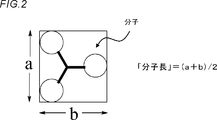
- the “molecular length” of the light emitting material and the host material means the lengths a and b of the two sides in the closest rectangle when the material molecules are assumed to have a flat plate structure, as shown in FIG. Mean value [(a + b) / 2].
- the “closest quadrangle” is defined as a quadrangle in which the average value [(a + b) / 2] of a and b is the smallest among quadrilaterals (rectangles or squares) whose two sides are in contact with the molecule.
- This “molecular length” is defined as follows by theoretical calculation. That is, the density functional theory method is used.
- the basis function is 6-31G * and the exchange correlation functional is B3LYP / LANL2DZ.
- the average length of two sides in the closest rectangle in the ball and stick display is defined as the molecular length.
- the “molecular thickness” refers to the flat plate portion of the flat plate structure as the x axis and the y axis (for example, the direction of the side of the length a in FIG. 2 is the y axis and the direction of the side of the length b is the x axis).
- the molecular thickness is also obtained by the same method as the molecular length, and the length in the thickness direction of the molecule in the ball and stick display is defined as the molecular thickness.
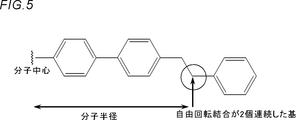
- Molecular radius means the distance from the center of a molecule to an atom connected to the free rotational bond of a group of two free rotational bonds. When there is no group in which two free rotational bonds are continuous (in the case of 0 or 1), it means the atom farthest from the molecular center.
- the “molecular center” means the center of the chromophore or the molecular core.
- the central metal of the complex is the molecular center.
- the condensed ring structure is the molecular center.
- “Free-rotation bond” is a free-rotation bond axis.
- a bond axis to which a methyl group is connected is a free-rotation bond, but a bond axis to which a rigid group such as a phenyl group is connected is not freely rotatable. . Therefore, as shown in FIG. 3, when two or more methylene groups are continuously linked from the phenyl group on the molecular center side, [(molecular center) -Ph—CH 2 —CH 2 —CH 2 —.
- the “distance from the molecular center to two consecutive groups” means the carbon atom of the second methylene group from the molecular center to the molecular center side (in FIG. 3, This means the distance to the circled atoms.
- two or more phenyl groups (Ph) are continuously connected, for example, when four are continuously connected as shown in FIG. 4, [(molecular center) -Ph-Ph-Ph-Ph] is an example.
- the carbon atom at the 4-position (the atom surrounded by a circle in FIG. 4) of the fourth phenyl group from the molecule center is the atom farthest from the molecule center.
- the distance to the carbon atom is the “molecular radius”. Furthermore, as shown in FIG. 5, when a phenyl group and a methylene group are linked [(molecular center) -Ph-Ph-CH 2 -CH 2 -Ph], the second phenyl from the molecular center is taken as an example. Since two methylene groups whose bond axes can freely rotate are bonded continuously between the group and the third phenyl group, the carbon atom of the second methylene group from the center of the molecule (FIG. 5). The distance from the center of the molecule to the circle is “the distance from the center of the molecule to two consecutive atoms” (ie, “molecular radius”).
- an amino group, a silyl group, an alkoxy group, an alkylthio group, and the like can be given as the group whose bond axis is a freely rotatable axis.
- examples of the group whose bond axis is not freely rotatable include a cyclohexane ring, a condensed aryl group, and a heterocycle.
- the molecular radius is also obtained by the same method as the molecular length, and in the ball and stick display, the free rotational bond is connected to the free rotational bond of the group in which two free rotational bonds are continuous from the center of the molecule when viewed from the z-axis direction. It can be obtained from the length to the atom to be.
- the light emitting material used for the organic electroluminescent element material of the present invention will be described.
- the light emitting material has an aspect ratio (molecular length / molecular thickness) of 3 or more, preferably 5 or more, more preferably 5 or more and 30 or less from the viewpoint of improving the orientation of the host material without disturbing the orientation of the host material.
- the molecular radius of the luminescent material is preferably 0.40 nm to 3.0 nm, more preferably 0.45 nm to 2.0 nm, and particularly preferably 0.5 nm to 1.5 nm. This range is preferable from the viewpoints of improving the orientation, ease of controlling the emission intensity and emission wavelength, and the like.
- the size ratio between the molecular radius of the luminescent material and the molecular radius of the host material is 0.8 to 1.2, and 0.85 to 1.15. Is preferable, and 0.9 to 1.1 is more preferable. When the size ratio is within this range, the luminance in the front direction of the organic electroluminescent element increases.
- the light emitting material either a phosphorescent material or a fluorescent material can be used. From the viewpoint of luminous efficiency, a phosphorescent material is preferable.
- the phosphorescent material include a complex containing a transition metal atom. These may be used alone or in combination of two or more.
- the complex may have one transition metal atom in the compound or may be a so-called binuclear complex having two or more. Different metal atoms may be contained simultaneously.
- Examples of the ligand of the complex include G.I. Wilkinson et al., Comprehensive Coordination Chemistry, Pergamon Press, 1987, H.C. Listed by Yersin, “Photochemistry and Photophysics of Coordination Compounds”, published by Springer-Verlag, 1987, Akio Yamamoto, “Organic Metal Chemistry-Fundamentals and Applications,” published by Soukabo, 1982, etc. It is done.
- Examples of the ligand include aromatic carbocyclic ligand, nitrogen-containing heterocyclic ligand, diketone ligand, carboxylic acid ligand, alcoholate ligand, carbon monoxide ligand, isonitrile coordination Child, cyano ligand and the like.
- a nitrogen-containing heterocyclic ligand is particularly preferable.
- the aromatic carbocyclic ligand include a cyclopentadienyl anion, a benzene anion, and a naphthyl anion.
- the nitrogen-containing heterocyclic ligand include phenylpyridine, benzoquinoline, quinolinol, bipyridyl, phenanthroline and the like.
- the diketone ligand include acetylacetone.
- the carboxylic acid ligand include an acetic acid ligand.
- the alcoholate ligand include a phenolate ligand.
- transition metal atoms include ruthenium, rhodium, palladium, osmium, iridium, and platinum.
- the light emitting material is not particularly limited and may be appropriately selected depending on the intended purpose.
- a phosphorescent compound is preferable, and a tetradentate structure having a planar coordination structure is preferable in that the aspect ratio is 3 or more.
- Platinum (platinum complex) is preferable, and a platinum complex having a salen or porphyrin skeleton is more preferable.
- the platinum complex is preferably a platinum complex represented by the general formula (C-1).
- Q 1 , Q 2 , Q 3 and Q 4 each independently represent a ligand coordinated to Pt.
- L 1 , L 2 and L 3 are each independently a single bond, double bond Represents a group consisting of a bond, a divalent linking group, or a combination thereof, and Q 3 and Q 4 may be linked to form a ring.
- Q 1 , Q 2 , Q 3 and Q 4 each independently represent a ligand coordinated to Pt.
- the bond between Q 1 , Q 2 , Q 3 and Q 4 and Pt may be any of a covalent bond, an ionic bond, a coordinate bond, and the like.
- a carbon atom, a nitrogen atom, an oxygen atom, a sulfur atom, and a phosphorus atom are preferable, and in Q ⁇ 1 >, Q ⁇ 2 >, Q ⁇ 3 > and Q ⁇ 4 >
- a carbon atom, a nitrogen atom, an oxygen atom, a sulfur atom, and a phosphorus atom are preferable, and in Q ⁇ 1 >, Q ⁇ 2 >, Q ⁇ 3 > and Q ⁇ 4 >
- at least one is preferably a carbon atom, more preferably two are carbon atoms, particularly preferably two are carbon atoms and two are nitrogen atoms.
- Q 1 , Q 2 , Q 3 and Q 4 bonded to Pt by a carbon atom may be an anionic ligand or a neutral ligand, and the anionic ligand is a vinyl ligand, Aromatic hydrocarbon ring ligand (eg benzene ligand, naphthalene ligand, anthracene ligand, phenanthrene ligand etc.), heterocyclic ligand (eg furan ligand, thiophene ligand, pyridine) Ligand, pyrazine ligand, pyrimidine ligand, pyridazine ligand, triazine ligand, thiazole ligand, oxazole ligand, pyrrole ligand, imidazole ligand, pyrazole ligand, triazole A ligand, an oxadiazole ligand, a thiadiazole ligand, and a condensed ring containing them
- a carbene ligand is mentioned as a neutral ligand.
- Q 1 , Q 2 , Q 3 and Q 4 bonded to Pt with a nitrogen atom may be neutral ligands or anionic ligands, and as neutral ligands, nitrogen-containing aromatic hetero Ring ligand (pyridine ligand, pyrazine ligand, pyrimidine ligand, pyridazine ligand, triazine ligand, imidazole ligand, pyrazole ligand, triazole ligand, oxazole ligand, Examples include thiazole ligands and condensed rings containing them (for example, quinoline ligands, benzimidazole ligands), amine ligands, nitrile ligands, and imine ligands.
- anionic ligands include amino ligands, imino ligands, nitrogen-containing aromatic heterocyclic ligands (pyrrole ligands, imidazole ligands, triazole ligands, and condensed rings containing them) (For example, indole ligand, benzimidazole ligand, etc.)).
- Q 1 , Q 2 , Q 3 and Q 4 bonded to Pt with an oxygen atom may be neutral ligands or anionic ligands, and neutral ligands are ether ligands, Examples include ketone ligands, ester ligands, amide ligands, oxygen-containing heterocyclic ligands (furan ligands, oxazole ligands and condensed rings containing them (benzoxazole ligands, etc.)). It is done.
- the anionic ligand include an alkoxy ligand, an aryloxy ligand, a heteroaryloxy ligand, an acyloxy ligand, a silyloxy ligand, and the like.
- Q 1 , Q 2 , Q 3 and Q 4 bonded to Pt with a sulfur atom may be neutral ligands or anionic ligands, and neutral ligands include thioether ligands, Examples include thioketone ligands, thioester ligands, thioamide ligands, sulfur-containing heterocyclic ligands (thiophene ligands, thiazole ligands and condensed rings containing them (such as benzothiazole ligands)). It is done.
- the anionic ligand include an alkyl mercapto ligand, an aryl mercapto ligand, and a heteroaryl mercapto ligand.
- Q 1 , Q 2 , Q 3 and Q 4 bonded to Pt with a phosphorus atom may be neutral ligands or anionic ligands, and neutral ligands include phosphine ligands, Examples include phosphate ester ligands, phosphite ester ligands, and phosphorus-containing heterocyclic ligands (phosphinin ligands, etc.).
- Anionic ligands include phosphino ligands and phosphinyl ligands. And phosphoryl ligands.
- the ligands represented by Q 1 , Q 2 , Q 3, and Q 4 may have a substituent, and those listed as the substituent group A can be appropriately applied as the substituent.
- substituents may be connected to each other (when Q 3 and Q 4 are connected, a Pt complex of a cyclic tetradentate ligand is formed).
- the ligand represented by Q 1 , Q 2 , Q 3 and Q 4 is preferably an aromatic hydrocarbon ring ligand bonded to Pt with a carbon atom, or an aromatic heterocyclic ring bonded to Pt with a carbon atom.
- L 1 , L 2 and L 3 represent a group consisting of a single bond, a double bond, a divalent linking group, or a combination thereof.
- Divalent linking groups represented by L 1 , L 2 and L 3 include alkylene groups (methylene, ethylene, propylene, etc.), arylene groups (phenylene, naphthalenediyl), heteroarylene groups (pyridinediyl, thiophenediyl, etc.) ), Imino group (—NR—) (eg phenylimino group), oxy group (—O—), thio group (—S—), phosphinidene group (—PR—) (eg phenylphosphinidene group), silylene group (-SiRR'-) (dimethylsilylene group, diphenylsilylene group, etc.), carbonyl group, or a combination thereof.
- linking groups may further have a substituent.
- R and R ′ each independently represents a substituent.
- substituents those mentioned as the substituent group A can be applied.
- the substituents may be connected to each other to form a ring.
- L 2 and L 3 are preferably a single bond, an alkylene group, an arylene group, a heteroarylene group, an imino group, an oxy group, a thio group, or a silylene group, and more preferably.
- a disubstituted methylene group more preferably a single bond, dimethylmethylene group, diethylmethylene group, diisobutylmethylene group, dibenzylmethylene group, ethylmethylmethylene group, methylpropylmethylene group, isobutylmethylmethylene group, diphenylmethylene group, Methylphenylmethylene group, cyclohexanediyl group, cyclopen Njiiru group fluorenediyl group, a fluoromethyl methylene group particularly preferably a single bond, dimethylmethylene group, diphenylmethylene group, a cyclohexane diyl group, most preferably single bond.
- L 1 is preferably an alkylene group, an arylene group, a heteroarylene group, an imino group, an oxy group, a thio group, a silylene group or a carbonyl group, more preferably an alkylene group, an arylene group or an imino group, still more preferably an alkylene group Group and imino group, more preferably methylene group and imino group.
- substituents may be connected to each other to form a ring.
- L 1 is more preferably a single bond, a disubstituted methylene group, or an optionally substituted arylimino group, and more preferably a dimethylmethylene group, a diethylmethylene group, a diisobutylmethylene group, a dibenzylmethylene group, or an ethylmethylmethylene group.
- Methylpropylmethylene group isobutylmethylmethylene group, diphenylmethylene group, methylphenylmethylene group, cyclohexanediyl group, cyclopentanediyl group, fluorenediyl group, fluoromethylmethylene group, phenylimino group, 4-t-butylphenylimino And particularly preferably a dimethylmethylene group, a diphenylmethylene group, a cyclohexanediyl group, or a phenylimino group. If possible, these groups may be further substituted with the groups mentioned in the substituent group A.
- platinum complexes represented by the general formula (C-1) a platinum complex represented by the following general formula (C-2) is more preferable.
- L 21 represents a single bond or a divalent linking group.
- a 21 , A 22 , B 21 , and B 22 each independently represent a carbon atom or a nitrogen atom, but two or more represent a nitrogen atom.
- Z 21 , Z 22 , Z 23 and Z 24 each independently represent a benzene ring or a nitrogen-containing aromatic heterocycle.
- L 21 represents a single bond or a divalent linking group, and the preferred range is the same as L 1 in the general formula (C-1).
- a 21 , A 22 , B 21 , and B 22 each independently represent a carbon atom or a nitrogen atom, but two or more represent a nitrogen atom, preferably two or three represent a nitrogen atom, and two represent a nitrogen atom. Is more preferable. From the viewpoint of the stability of the complex, it is preferable that A 21 and A 22 represent a nitrogen atom, or that B 21 and B 22 represent a nitrogen atom.
- Z 21 , Z 22 , Z 23 and Z 24 each independently represent a benzene ring or a nitrogen-containing aromatic heterocycle.
- the nitrogen-containing aromatic heterocycle represented by Z 21 , Z 22 , Z 23 and Z 24 include a pyridine ring, a pyrimidine ring, a pyrazine ring, a pyridazine ring, a triazine ring, an imidazole ring, a pyrazole ring, an oxazole ring and a thiazole ring. , Triazole ring, oxadiazole ring, thiadiazole ring, and the like.
- the ring represented by Z 23 or Z 24 is preferably a benzene ring, a pyridine ring, a pyrazine ring, an imidazole ring or a pyrazole ring, more preferably A benzene ring, a pyridine ring, and a pyrazole ring, more preferably a benzene ring and a pyridine ring.
- the benzene ring and nitrogen-containing aromatic heterocycle represented by Z 21 , Z 22 , Z 23 , and Z 24 may have a substituent, and examples of the substituent on the carbon atom include the substituent group A.
- the substituent group B is applicable as a substituent on the nitrogen atom.
- the substituent on the carbon atom is preferably an alkyl group, a fluoroalkyl group, an aryl group, a heterocyclic group, a dialkylamino group, a diarylamino group, an alkoxy group, an aryloxy group, a silyl group, a cyano group, or a halogen atom.
- the alkyl group represents a substituted or unsubstituted alkyl group having 1 to 20 carbon atoms, and may have a linear, branched or cyclic structure.
- the alkyl group preferably has 1 to 12 carbon atoms, for example, methyl group, butyl group, pentyl group, hexyl group, octyl group, decyl group, dodecyl group, t-butyl group, t-amyl group, s-butyl. Groups and the like.
- the aryl group represents a substituted or unsubstituted aryl group having 6 to 10 carbon atoms and may be condensed, and examples thereof include a phenyl group, a toluyl group, and a naphthyl group.
- the fluoroalkyl group is preferably a trifluoromethyl group.
- the alkoxy group represents a substituted or unsubstituted alkoxy group having 1 to 20 carbon atoms, and may have a linear, branched or cyclic structure.
- the alkoxy group preferably has 1 to 12 carbon atoms, and examples thereof include a methoxy group, a butyloxy group, an octyloxy group, a decyloxy group, a dodecyloxy group, a s-octyloxy group, and a benzyloxy group.
- the heterocyclic group represents a substituted or unsubstituted nitrogen-containing aromatic heterocyclic group having 6 to 10 carbon atoms, which may be condensed, such as a pyridine ring, a pyrazine ring, a pyrimidine ring, a pyridazine ring, Examples thereof include a triazine ring and a carbazole ring, and a carbazole ring is preferable.
- the diarylamino group represents a substituted or unsubstituted diarylamino group having 6 to 10 carbon atoms and may be condensed, and examples thereof include a diphenylamino group, a ditoluylamino group, and a dinaphthylamino group.
- the dialkylamino group represents a substituted or unsubstituted dialkylamino having 2 to 20 carbon atoms, and may have any of a linear, branched or cyclic structure.
- the dialkylamino group preferably has 2 to 12 carbon atoms. Specifically, for example, a dimethylamino group, a diethylamino group, a dioctylamino group, a didecylamino group, a didodecylamino group, a dit-butylamino group, a dit -Amylamino group, di-s-butylamino group and the like.
- the aryloxy group represents a substituted or unsubstituted aryloxy group having 6 to 10 carbon atoms and may be condensed, and examples thereof include a phenyloxy group, a toluyloxy group, and a naphthyloxy group.
- the silyl group represents a silyl group substituted with 3 to 24 carbon atoms, and may be any of a trialkylsilyl group, an aryldialkylsilyl group, an alkyldiarylsilyl group, and a triarylsilyl group.
- the silyl group preferably has 3 to 18 carbon atoms, and specific examples include a trimethylsilyl group, a t-butyldimethylsilyl group, a triphenylsilyl group, a t-butyldiphenylsilyl group, and the like.
- a halogen atom a fluorine atom is preferable.
- the substituent is appropriately selected for controlling the emission wavelength and potential, but in the case of increasing the wavelength, an electron donating group and an aromatic ring group are preferable, for example, an alkyl group, a dialkylamino group, an alkoxy group, an aryl group, An aromatic heterocyclic group or the like is selected.
- an electron withdrawing group is preferable, and for example, a fluorine atom, a cyano group, a trifluoroalkyl group, and the like are selected.
- the substituent on the nitrogen atom is preferably an alkyl group, an aryl group, or an aromatic heterocyclic group, and an alkyl group or an aryl group is preferable from the viewpoint of the stability of the complex.
- the above substituents on Z 21 , Z 22 , Z 23 , and Z 24 may be linked to form a condensed ring.
- the ring formed include a benzene ring, a pyridine ring, a pyrazine ring, a pyridazine ring, Examples include a pyrimidine ring, an imidazole ring, an oxazole ring, a thiazole ring, a pyrazole ring, a thiophene ring, and a furan ring.
- the platinum complex represented by the general formula (C-2) becomes a Pt complex of a cyclic tetradentate ligand.
- platinum complexes represented by the general formula (C-2) one of more preferred embodiments is a platinum complex represented by the following general formula (C-3).
- a 301 to A 313 each independently represents C—R or a nitrogen atom.
- R represents a hydrogen atom or a substituent.
- L 31 represents a single bond or a divalent linking group.
- Y, Z and M each independently represent a carbon atom or a nitrogen atom, and either Z or Y is a nitrogen atom.
- L 31 has the same meaning as L 21 in formula (C-2), and the preferred range is also the same.
- a 301 to A 306 each independently represents C—R or a nitrogen atom.
- R represents a hydrogen atom or a substituent.
- substituent represented by R those exemplified as the substituent group A can be applied.
- a 301 to A 306 are preferably C—R, and Rs may be connected to each other to form a ring.
- R in A 302 and A 305 is preferably a hydrogen atom, alkyl group, trifluoroalkyl group, aryl group, heterocyclic group, dialkylamino group, diarylamino group , An alkoxy group, an aryloxy group, a silyl group, a cyano group, or a halogen atom, a hydrogen atom, an alkyl group, a trifluoroalkyl group, an aryl group, a heterocyclic group, a diarylamino group, an alkoxy group, a cyano group, or A halogen atom is more preferable, a hydrogen atom, an alkyl group, an alkoxy group, or a cyano group is further preferable, and a hydrogen atom is particularly preferable.
- the alkyl group and aryl group may further have a substituent, and examples of the substituent include an alkyl group, an aryl group, a cyano group, an amino group, a halogen atom, and a fluoroalkyl group.
- substituent include an alkyl group, an aryl group, a cyano group, an amino group, a halogen atom, and a fluoroalkyl group.
- An alkyl group having 6 to 6 atoms, a cyano group, an amino group, a halogen atom and a fluoroalkyl group preferably a trifluoromethyl group
- more preferably an alkyl group having 1 to 6 carbon atoms and a halogen atom (preferably a fluorine atom). is there.
- R in A 302 and A 305 is preferably an aryl group from the viewpoint of improving the durability of the device, and a hydrogen atom or an alkyl group from the viewpoint of a short emission wavelength.
- An amino group, an alkoxy group, a fluorine atom, and a cyano group are preferable.
- R in A 301 , A 303 , A 304 and A 306 is preferably a hydrogen atom, an alkyl group, an aryl group, an amino group, an alkoxy group, an aryloxy group, a fluorine atom or a cyano group, more preferably a hydrogen atom or an amino group.
- a 307 , A 308 , A 309 and A 310 each independently represent C—R or a nitrogen atom.
- R represents a hydrogen atom or a substituent.
- substituent represented by R those exemplified as the substituent group A can be applied.
- R is preferably a hydrogen atom, alkyl group, trifluoroalkyl group, aryl group, aromatic heterocyclic group, dialkylamino group, diaryl An amino group, an alkyloxy group, a cyano group, and a halogen atom, more preferably a hydrogen atom, an alkyl group, a trifluoroalkyl group, an aryl group, a dialkylamino group, a cyano group, a fluorine atom, still more preferably a hydrogen atom, An alkyl group, a trifluoromethyl group, and a fluorine atom; If possible, the substituents may be linked to form a condensed ring structure.
- a 308 is preferably a nitrogen atom.
- the six-membered ring formed from two carbon atoms and A 307 , A 308 , A 309 and A 310 includes a benzene ring, a pyridine ring, a pyrazine ring, a pyrimidine ring, a pyridazine ring, and a triazine.
- a ring is mentioned, More preferably, they are a benzene ring, a pyridine ring, a pyrazine ring, a pyrimidine ring, and a pyridazine ring, Especially preferably, they are a benzene ring and a pyridine ring.
- the 6-membered ring is a pyridine ring, a pyrazine ring, a pyrimidine ring, or a pyridazine ring (particularly preferably a pyridine ring), a hydrogen atom present at a position where a metal-carbon bond is formed as compared with a benzene ring. Since acidity improves, it is advantageous at the point which becomes easier to form a metal complex.
- a 311 , A 312 and A 313 each independently represent C—R or a nitrogen atom.
- R represents a hydrogen atom or a substituent.
- substituent represented by R those exemplified as the substituent group A can be applied.
- R is preferably a hydrogen atom, alkyl group, trifluoroalkyl group, aryl group, heterocyclic group, dialkylamino group, diarylamino group, alkoxy group , Aryloxy group, cyano group, halogen atom, more preferably hydrogen atom, alkyl group, trifluoroalkyl group, aryl group, dialkylamino group, cyano group, fluorine atom, more preferably hydrogen atom, alkyl group , A trifluoromethyl group and a fluorine atom.
- substituents may be linked to form a condensed ring structure. At least one of A 311 , A 3
- platinum complexes represented by the general formula (C-3) one of more preferred embodiments is a platinum complex represented by the following general formula (C-3-1).
- X, Y, Z, and M each independently represent a carbon atom or a nitrogen atom, provided that either Z or Y is a nitrogen atom, where Y is When it is a nitrogen atom, X is a carbon atom, m, n, p, and q each independently represents an integer of 0 to 3.
- Ar represents a substituted or unsubstituted aryl group
- R 1 to R 3 and R 30 each independently represents an alkyl group, an aryl group, an alkoxy group, an aryloxy group, a fluorine atom, a cyano group, a silyl group, or a heterocyclic group, and m, n, p, and q are 2 or more.
- a plurality of R 1 , R 2 , R 3 and R 30 may be linked to each other to form a cyclic structure, and Q is a carbon atom or a nitrogen atom.
- X, Y, and Z represent a carbon atom or a nitrogen atom, and one of Z and Y is a nitrogen atom, and when Y is a nitrogen atom, X is It is a carbon atom.
- Z is a carbon atom
- Y is a nitrogen atom
- X is a carbon atom.
- m, n and p each independently represents an integer of 0 to 3.
- m is preferably 0 to 2, and more preferably 0 to 1.
- n is preferably from 0 to 2, more preferably from 0 to 1.
- p is preferably 0 to 2, more preferably 0 to 1.
- R 1 to R 3 each independently represents an alkyl group, an aryl group, an alkoxy group, an aryloxy group, a fluorine atom, a cyano group, a silyl group, or a heterocyclic group.
- the alkyl group represents a substituted or unsubstituted alkyl group having 1 to 20 carbon atoms, and may have a linear, branched or cyclic structure.
- the alkyl group preferably has 1 to 12 carbon atoms, and specifically includes, for example, methyl group, butyl group, pentyl group, hexyl group, octyl group, decyl group, dodecyl group, n-butyl group, t-butyl group.
- the aryl group represents a substituted or unsubstituted aryl group having 6 to 10 carbon atoms and may be condensed, and examples thereof include a phenyl group, a toluyl group, and a naphthyl group.
- the alkoxy group represents a substituted or unsubstituted alkoxy group having 1 to 20 carbon atoms, and may have a linear, branched or cyclic structure.
- the alkoxy group preferably has 1 to 12 carbon atoms, and specific examples include a methoxy group, an octyloxy group, a decyloxy group, a dodecyloxy group, a s-octyloxy group, and a benzyloxy group.
- the aryloxy group represents a substituted or unsubstituted aryloxy group having 6 to 10 carbon atoms and may be condensed, and examples thereof include a phenyloxy group, a toluyloxy group, and a naphthyloxy group.
- the silyl group represents a silyl group substituted with a hydrocarbon group having 3 to 24 carbon atoms, and may be any of a trialkylsilyl group, an aryldialkylsilyl group, an alkyldiarylsilyl group, and a triarylsilyl group. .
- the silyl group preferably has 3 to 18 carbon atoms, and specific examples include a trimethylsilyl group, a t-butyldimethylsilyl group, a triphenylsilyl group, a t-butyldiphenylsilyl group, and the like.
- heterocyclic group examples include pyridine ring, pyrimidine ring, pyrazine ring, pyridazine ring, triazine ring, imidazole ring, pyrazole ring, oxazole ring, thiazole ring, triazole ring, oxadiazole ring, thiadiazole ring, thiophene ring, furan A ring etc. are mentioned.
- R 1 and R 2 are preferably an alkyl group, an aryl group, a fluorine atom, a cyano group or a silyl group, more preferably an alkyl group or an aryl group, and a phenyl group.
- R 3 is preferably an alkyl group or an aryl group, more preferably a methyl group, a trifluoromethyl group, or a phenyl group, and even more preferably a methyl group or a trifluoromethyl group.
- Examples of the aryl group represented by Ar include a phenyl group and a naphthyl group, and a phenyl group is preferable.
- the aryl group represented by Ar may further have a substituent, and examples of the substituent include an alkyl group, an aryl group, a cyano group, an amino group, a fluorine atom, and a fluoroalkyl group, preferably 1 to 6 carbon atoms.
- An alkyl group, a cyano group, an amino group, a fluorine atom, and a fluoroalkyl group (preferably a trifluoromethyl group), and more preferably an alkyl group having 1 to 6 carbon atoms and a fluorine atom.
- Ar is more preferably a phenyl group having a substituent, and the substituent is preferably a methyl group, a t-butyl group, a 4-pentyl-cyclohexyl group, a 4-pentyl-cyclohexylmethoxy group, or the like.
- the plurality of R 1 to R 3 may be connected to each other adjacent to each other to form a cyclic structure.
- M and Q are each independently a carbon atom or a nitrogen atom. q represents an integer of 0 to 3, and an integer of 0 to 2 is preferable.
- R 30 represents an alkyl group, an aryl group, an alkoxy group, an aryloxy group, a fluorine atom, a cyano group, a silyl group, or a heterocyclic group.
- the alkyl group represents a substituted or unsubstituted alkyl group having 1 to 20 carbon atoms, and may have a linear, branched or cyclic structure.
- the alkyl group preferably has 1 to 12 carbon atoms. Specifically, for example, methyl group, octyl group, decyl group, dodecyl group, n-butyl group, t-butyl group, t-amyl group, s- A butyl group etc. are mentioned.
- the aryl group represents a substituted or unsubstituted aryl group having 6 to 10 carbon atoms and may be condensed, and examples thereof include a phenyl group, a toluyl group, and a naphthyl group.
- the alkoxy group represents a substituted or unsubstituted alkoxy group having 1 to 20 carbon atoms, and may have a linear, branched or cyclic structure.
- the alkoxy group preferably has 1 to 12 carbon atoms, and specific examples include a methoxy group, an octyloxy group, a decyloxy group, a dodecyloxy group, a s-octyloxy group, and a benzyloxy group.
- the aryloxy group represents a substituted or unsubstituted aryloxy group having 6 to 10 carbon atoms and may be condensed, and specifically includes a phenyloxy group, a toluyloxy group, a naphthyloxy group, and the like. Can be mentioned.
- the silyl group represents a silyl group substituted with 3 to 24 carbon atoms, and may be any of a trialkylsilyl group, an aryldialkylsilyl group, an alkyldiarylsilyl group, and a triarylsilyl group.
- the silyl group preferably has 3 to 18 carbon atoms, and specific examples include a trimethylsilyl group, a t-butyldimethylsilyl group, a triphenylsilyl group, a t-butyldiphenylsilyl group, and the like.
- the heterocyclic group include pyridine ring, pyrimidine ring, pyrazine ring, pyridazine ring, triazine ring, imidazole ring, pyrazole ring, oxazole ring, thiazole ring, triazole ring, oxadiazole ring, thiadiazole ring, thiophene ring, furan A ring etc. are mentioned.
- R 30 is preferably a fluorine atom.
- platinum complexes represented by the general formula (C-2) one of the more preferred embodiments is a platinum complex represented by the following general formula (C-4).
- a 401 to A 414 each independently represents C—R or a nitrogen atom.
- R represents a hydrogen atom or a substituent.
- L 41 represents a single bond or a divalent linking group.
- a 401 to A 414 each independently represents C—R or a nitrogen atom.
- R represents a hydrogen atom or a substituent. Or as a substituent represented by R, what was mentioned as the said substituent group A is applicable.
- a 401 to A 406 are preferably C—R, and Rs may be connected to each other to form a ring.
- R in A 402 and A 405 is preferably a hydrogen atom, an alkyl group, an aryl group, an amino group, an alkoxy group, an aryloxy group, a fluorine atom, or a cyano group.
- R in A 401 , A 403 , A 404 and A 406 is preferably a hydrogen atom, an alkyl group, an aryl group, an amino group, an alkoxy group, an aryloxy group, a fluorine atom or a cyano group, more preferably a hydrogen atom or an amino group.
- L 41 has the same meaning as L 21 in formula (C-2), and the preferred range is also the same.
- the number of N is preferably 0 to 2, and more preferably 0 to 1.
- a 408 or A 412 is preferably a nitrogen atom, and both A 408 and A 412 are more preferably nitrogen atoms.
- R in A 408 and A 412 is preferably a hydrogen atom, alkyl group, trifluoroalkyl group, aryl group, amino group, alkoxy group, aryloxy group, fluorine atom A cyano group, more preferably a hydrogen atom, a trifluoroalkyl group, an alkyl group, an aryl group, a fluorine atom or a cyano group, and particularly preferably a hydrogen atom, a phenyl group, a trifluoroalkyl group or a cyano group.
- R in A 407 , A 409 , A 411 and A 413 is preferably a hydrogen atom, an alkyl group, a trifluoroalkyl group, an aryl group, an amino group, an alkoxy group, an aryloxy group, a fluorine atom or a cyano group, more preferably Is a hydrogen atom, a trifluoroalkyl group, a fluorine atom or a cyano group, particularly preferably a hydrogen atom, a phenyl group or a fluorine atom.
- R in A 410 and A 414 is preferably a hydrogen atom or a fluorine atom, and more preferably a hydrogen atom.
- Rs may be connected to each other to form a ring, and examples of the ring formed include a benzene ring. It is done.
- platinum complexes represented by the general formula (C-2) one of the more preferred embodiments is a platinum complex represented by the following general formula (C-5).
- a 501 to A 512 each independently represents C—R or a nitrogen atom, R represents a hydrogen atom or a substituent, and L 51 represents a single bond or a divalent linkage.
- Y and Z each independently represent a carbon atom or a nitrogen atom, at least one of which is a nitrogen atom.
- a 501 to A 506 and L 51 have the same meanings as A 401 to A 406 and L 41 in formula (C-4), and preferred ranges are also the same.
- a 507 , A 508 , A 509 , A 510 , A 511 and A 512 each independently represent C—R or a nitrogen atom.
- R represents a hydrogen atom or a substituent.
- substituent represented by R those exemplified as the substituent group A can be applied.
- R is preferably a hydrogen atom, an alkyl group, a trifluoroalkyl group, an aryl group, an aromatic heterocyclic group.
- An embodiment in which at least one of A 507 , A 508 , and A 509 , and at least one of A 510 , A 511, and A 512 is a nitrogen atom is also preferable. In this embodiment, A 510 or A 507 is A nitrogen atom is preferred.
- platinum complexes represented by the general formula (C-5) one of more preferred embodiments is a platinum complex represented by the following general formula (C-5-1).
- X, Y, and Z each independently represent a carbon atom or a nitrogen atom, one of Z and Y is a nitrogen atom, and Y is a nitrogen atom.
- X is a carbon atom
- m, n, p and q each independently represents an integer of 0 to 3.
- Ar represents a substituted or unsubstituted aryl group
- R 1 to R 4 represent Each independently represents an alkyl group, an aryl group, an alkoxy group, an aryloxy group, a fluorine atom, a cyano group, a silyl group, or a heterocyclic group, and when m, n, p, and q are 2 or more, a plurality of R 1 R 4 may be connected to each other next to each other to form a cyclic structure.
- X, Y, and Z represent a carbon atom or a nitrogen atom, and one of Z and Y is a nitrogen atom, and when Y is a nitrogen atom, X is It is a carbon atom.
- Z is a carbon atom
- Y is a nitrogen atom
- X is a carbon atom.
- m, n, p and q each independently represents an integer of 0 to 3.
- m is preferably 0 to 2, and more preferably 0 to 1.
- n is preferably from 0 to 2, more preferably from 0 to 1.
- p is preferably 0 to 2, more preferably 0 to 1.
- q is preferably 0 to 2, and more preferably 0 to 1.
- R 1 to R 4 each independently represents an alkyl group, an aryl group, an alkoxy group, an aryloxy group, a fluorine atom, a cyano group, a silyl group, or a heterocyclic group.
- the alkyl group represents a substituted or unsubstituted alkyl group having 1 to 20 carbon atoms, and may have a linear, branched or cyclic structure.
- the alkyl group preferably has 1 to 12 carbon atoms, and specifically includes, for example, methyl group, butyl group, pentyl group, hexyl group, octyl group, decyl group, dodecyl group, n-butyl group, t-butyl group.
- the aryl group represents a substituted or unsubstituted aryl group having 6 to 10 carbon atoms and may be condensed, and examples thereof include a phenyl group, a toluyl group, and a naphthyl group.
- the alkoxy group represents a substituted or unsubstituted alkoxy group having 1 to 20 carbon atoms, and may have a linear, branched or cyclic structure.
- the alkoxy group preferably has 1 to 12 carbon atoms, and specific examples include a methoxy group, an octyloxy group, a decyloxy group, a dodecyloxy group, a s-octyloxy group, and a benzyloxy group.
- the aryloxy group represents a substituted or unsubstituted aryloxy group having 6 to 10 carbon atoms and may be condensed, and examples thereof include a phenyloxy group, a toluyloxy group, and a naphthyloxy group.
- the silyl group represents a silyl group substituted with a hydrocarbon group having 3 to 24 carbon atoms, and may be any of a trialkylsilyl group, an aryldialkylsilyl group, an alkyldiarylsilyl group, and a triarylsilyl group. .
- the silyl group preferably has 3 to 18 carbon atoms, and specific examples include a trimethylsilyl group, a t-butyldimethylsilyl group, a triphenylsilyl group, a t-butyldiphenylsilyl group, and the like.
- heterocyclic group examples include pyridine ring, pyrimidine ring, pyrazine ring, pyridazine ring, triazine ring, imidazole ring, pyrazole ring, oxazole ring, thiazole ring, triazole ring, oxadiazole ring, thiadiazole ring, thiophene ring, furan A ring etc. are mentioned.
- R 1 and R 2 are preferably an alkyl group, an aryl group, a fluorine atom, a cyano group or a silyl group, more preferably an alkyl group or an aryl group, and a phenyl group.
- R 3 and R 4 are preferably an alkyl group or an aryl group, more preferably a methyl group, a trifluoromethyl group, or a phenyl group, and even more preferably a methyl group or a trifluoromethyl group.
- Examples of the aryl group represented by Ar include a phenyl group and a naphthyl group, and a phenyl group is preferable.
- the aryl group represented by Ar may further have a substituent, and examples of the substituent include an alkyl group, an aryl group, a cyano group, an amino group, a fluorine atom, and a fluoroalkyl group, preferably 1 to 6 carbon atoms.
- An alkyl group, a cyano group, an amino group, a fluorine atom, and a fluoroalkyl group (preferably a trifluoromethyl group), and more preferably an alkyl group having 1 to 6 carbon atoms and a fluorine atom.
- Ar is more preferably a phenyl group having a substituent, and the substituent is preferably a methyl group, a t-butyl group, a 4-pentyl-cyclohexyl group, a 4-pentyl-cyclohexylmethoxy group, or the like.
- the plurality of R 1 to R 4 may be connected to each other adjacent to each other to form a cyclic structure.
- platinum complexes represented by the general formula (C-2) one of the more preferable embodiments is a platinum complex represented by the following general formula (C-6).
- X, Y and Z represent a carbon atom or a nitrogen atom, and either Z or Y is a nitrogen atom.
- Y is a nitrogen atom
- X is a carbon atom.
- R, s, t and u each independently represents an integer of 0 to 3.
- R 5 to R 8 each independently represents an alkyl group, an aryl group, an alkoxy group, an aryloxy group, a fluorine atom, Represents a cyano group, a silyl group, or a heterocyclic group, and when r, s, t, and u are 2 or more, a plurality of R 5 to R 8 may be linked to each other to form a cyclic structure.
- W 1 and W 2 each independently represent an alkyl group, and may be bonded to each other to form a cyclic structure.
- X, Y and Z have the same meanings as X, Y and Z in the general formula (C-5-1), and preferred ranges are also the same.
- R 5 to R 8 have the same meanings as R 1 to R 4 in formula (C-5-1).
- R 5 and R 6 are preferably an alkyl group, an alkoxy group, an aryl group, a fluorine atom, or a cyano group.
- an optionally substituted methyl group, butyl group, octyl group, decyl group, dodecyl group and the like are preferable, and a butyl group, a trifluoromethyl group, an octyl group, A decyl group is more preferred.
- the alkoxy group represented by R 5 and R 6 is preferably a decyloxy group.
- the aryl group represented by R 5 and R 6 is preferably a phenyl group which may have a substituent.
- the substituent is preferably an alkyl group, and more preferably a propyl group or a butyl group.
- R 7 and R 8 are preferably an alkyl group or an aryl group.
- r, s, t, and u each independently represent an integer of 0 to 3.
- r is preferably 0 to 2, and more preferably 0 or 1.
- s is preferably 0 to 2, more preferably 0 or 1.
- t is preferably 0 or 1
- u is preferably 0 or 1.
- the plurality of R 5 to R 8 may be connected to each other adjacent to each other to form a cyclic structure.
- the cyclic structure include a structure that forms a fluorene ring together with a benzene ring, a benzofuran ring, and a 6-membered ring having Z.
- W 1 and W 2 each represent an alkyl group having 1 to 10 carbon atoms and may be bonded to each other to form a cyclic structure.
- alkyl group represented by W 1 and W 2 include a methyl group, an ethyl group, an n-propyl group, an n-butyl group, and a pentyl group.
- cyclic structure formed by combining W 1 and W 2 include a cyclohexyl cyclic structure.
- W 1 and W 2 are preferably a methyl group from the viewpoint of a high aspect ratio or are bonded to each other to form a cyclohexyl ring structure.
- platinum complexes represented by the general formula (C-1) another more preferable embodiment is a platinum complex represented by the following general formula (C-7).
- L 61 represents a single bond or a divalent linking group.
- a 61 represents a carbon atom or a nitrogen atom.
- Z 61 and Z 62 each independently represent a nitrogen-containing aromatic heterocycle.
- Z 63 represents a benzene ring or an aromatic heterocycle, and Q is an anionic acyclic ligand bonded to Pt.
- L 61 represents a single bond or a divalent linking group, and a preferred range is the same as L 1 in the general formula (C-1).
- a 61 represents a carbon atom or a nitrogen atom. In view of the stability of the complex and the light emission quantum yield of the complex, A 61 is preferably a carbon atom.
- Z 61 and Z 62 are synonymous with Z 21 and Z 22 in the general formula (C-2), respectively, and preferred ranges thereof are also the same.
- Z 63 has the same meaning as Z 23 in formula (C-2), and the preferred range is also the same.
- Q is an anionic acyclic ligand that binds to Pt.
- An acyclic ligand is one in which atoms bonded to Pt do not form a ring in the form of a ligand.
- a carbon atom, a nitrogen atom, an oxygen atom, and a sulfur atom are preferable, a nitrogen atom and an oxygen atom are more preferable, and an oxygen atom is the most preferable.
- a vinyl ligand is mentioned as Q couple
- Q bonded to Pt with an oxygen atom includes an alkoxy ligand, an aryloxy ligand, a heteroaryloxy ligand, an acyloxy ligand, a silyloxy ligand, a carboxyl ligand, a phosphate ligand, Examples thereof include sulfonic acid ligands.
- Examples of Q bonded to Pt with a sulfur atom include alkyl mercapto ligands, aryl mercapto ligands, heteroaryl mercapto ligands, and thiocarboxylic acid ligands.
- the ligand represented by Q may have a substituent, and those exemplified as the substituent group A can be appropriately applied as the substituent. Moreover, substituents may be connected to each other.
- the ligand represented by Q is preferably a ligand bonded to Pt with an oxygen atom, and more preferably an acyloxy ligand, an alkyloxy ligand, an aryloxy ligand, a heteroaryloxy ligand , A silyloxy ligand, and more preferably an acyloxy ligand.
- platinum complexes represented by the general formula (C-7) one of the more preferred embodiments is a platinum complex represented by the following general formula (C-8).
- a 701 to A 710 each independently represents C—R or a nitrogen atom, R represents a hydrogen atom or a substituent, and L 71 represents a single bond or a divalent linkage.
- Q represents an anionic acyclic ligand that binds to Pt.
- L 71 has the same meaning as L 61 in formula (C-6), and the preferred range is also the same.
- a 701 to A 710 have the same meanings as A 401 to A 410 in formula (C-4), and preferred ranges are also the same.
- Q has the same meaning as that in formula (C-6), and the preferred range is also the same.
- platinum complexes represented by the general formula (C-1) another preferred embodiment is a platinum complex represented by the following general formula (C-9).
- a and B represent a cyclic structure
- A represents an aromatic ring
- B represents an aromatic heterocycle.
- R 13 to R 16 each independently represents a hydrogen atom, an alkyl group, an aryl group, a silyl group, or a heterocyclic group
- R 14 and R 15 , R 13 and R 16 are bonded to each other to form a cyclic structure. It may be formed.
- A represents an aromatic ring.
- the aromatic ring include an aromatic hydrocarbon ring and an aromatic heterocycle, and an aromatic hydrocarbon ring is preferable.
- an aromatic hydrocarbon ring represented by A a benzene ring and a naphthalene ring are preferable.
- the aromatic heterocycle represented by A a pyridine ring, a pyrazine ring, a pyrimidine ring and a quinoline ring are preferable.
- B represents an aromatic heterocycle.
- a pyridine ring and a pyrimidine ring are preferable.
- A is a benzene ring and B is a non-ring (does not form a ring), A is a naphthalene ring and B is a non-ring, and A is a benzene ring and B is a pyridine ring, or More preferably, A is a non-ring and B is a pyridine ring.
- R 13 to R 16 represent a hydrogen atom, an alkyl group, an aryl group, a silyl group, or a heterocyclic group, and R 14 and R 15 , or R 13 and R 16 may be bonded to each other to form a cyclic structure. .
- the alkyl group represents a substituted or unsubstituted alkyl group having 1 to 20 carbon atoms, and may have a linear, branched or cyclic structure.
- the alkyl group preferably has 1 to 12 carbon atoms, and examples thereof include a methyl group, a butyl group, a pentyl group, a hexyl group, an octyl group, a decyl group, and a dodecyl group.
- the aryl group represents a substituted or unsubstituted aryl group having 6 to 10 carbon atoms and may be condensed, and examples thereof include a phenyl group, a toluyl group, and a naphthyl group.
- the silyl group represents a silyl group substituted with 3 to 24 carbon atoms, and may be any of a trialkylsilyl group, an aryldialkylsilyl group, an alkyldiarylsilyl group, and a triarylsilyl group.
- the silyl group preferably has 3 to 18 carbon atoms, and examples thereof include a trimethylsilyl group, a t-butyldimethylsilyl group, a triphenylsilyl group, and a t-butyldiphenylsilyl group.
- heterocyclic group examples include pyridine ring, pyrimidine ring, pyrazine ring, pyridazine ring, triazine ring, imidazole ring, pyrazole ring, oxazole ring, thiazole ring, triazole ring, oxadiazole ring, thiadiazole ring, thiophene ring, furan A ring etc. are mentioned.
- R 13 , R 14 , R 15 and R 16 are each preferably a substituted or unsubstituted aryl group, or an aromatic ring in which R 13 and R 16 , and R 14 and R 15 are bonded to each other.
- the aromatic ring include a benzene ring.
- the aromatic ring may further have a substituent, for example, an alkyl group (methyl group, butyl group, pentyl group, hexyl group, octyl group, decyl group), alkoxy group (methoxy group, ethoxy group, butoxy group). Etc.).
- an aromatic ring in which R 13 and R 16 , R 14 and R 15 are bonded to each other is preferable from the viewpoint of aspect ratio and molecular size.
- a more preferred embodiment of the compound represented by the general formula (C-9) is a compound represented by the following general formula (C-9-1).
- B may form an aromatic 6-membered heterocycle.
- R 17 to R 26 each independently represents an alkyl group, an aryl group, an alkoxy group, an aryloxy group, a fluorine atom, a cyano group, a silyl group, or a heterocyclic group, and R 17 and R 18 , R 18 and R 19 , R 19 and R 20 , R 21 and R 22 , R 22 and R 23 , R 23 and R 24 , and R 25 and R 26 may be bonded to each other to form a cyclic structure.
- R 17 , R 20 , R 21 and R 24 are preferably a hydrogen atom or an alkyl group.
- R 18 , R 19 , R 22 and R 23 are preferably an alkyl group, an alkoxy group, an aryl group, an aryloxy group, a fluorine atom, a cyano group or a silyl group, more preferably an alkyl group or an alkoxy group, a decyloxy group or a dodecyl group.
- R 25 to R 26 are preferably a hydrogen atom, an alkyl group, a fluorine atom, or an aromatic ring in which R 25 and R 26 are bonded.
- the aromatic 6-membered heterocycle represented by B is preferably a pyridine ring or a pyrimidine ring, and more preferably a pyridine ring.
- the ring may have a substituent, and examples of the substituent include an alkyl group (methyl group and butyl group) and an aryl group (phenyl group).
- the platinum complex is preferably a platinum complex represented by the general formula (C-1) from the viewpoint of planarity, and represented by any one of the general formulas (C-2), (C-7), and (C-9).
- the platinum complex is more preferably a platinum complex represented by the general formula (C-2) or (C-9).
- the platinum complex represented by the general formula (C-2) is a platinum complex represented by any one of the general formulas (C-3), (C-4), (C-5), and (C-6). And is more preferably a platinum complex represented by any one of the general formulas (C-3-1), (C-5-1), and (C-6).
- a platinum complex represented by -5-1) or (C-6) is particularly preferred.
- platinum complex represented by the general formula (C-1) include [0143] to [0152], [0157] to [0158], and [0162] to [0168] of JP-A-2005-310733.
- JP-A-2007-96255, [0055] to [0071], JP-A-2006-313796 0043] include - [0046], platinum complexes exemplified other following can be mentioned.
- Examples of the platinum complex represented by the general formula (C-1) and other platinum complexes having an aspect ratio of 3 or more are shown below.
- the alkyl group and the alkyl group in the exemplified compound include a linear alkyl group, a branched alkyl group, and a cycloalkyl group, and preferably a linear alkyl group.
- Examples of the platinum complex compound represented by the general formula (C-1) include Journal of Organic Chemistry 53,786, (1988), G.S. R. Newkome et al. ), Page 789, method described in left column 53 to right column 7, line 790, method described in left column 18 to 38, method 790, method described in right column 19 to 30 and The combination, Chemische Berichte 113, 2749 (1980), H.C. Lexy et al.), Page 2752, lines 26 to 35, and the like.
- a ligand or a dissociated product thereof and a metal compound are mixed with a solvent (for example, a halogen solvent, an alcohol solvent, an ether solvent, an ester solvent, a ketone solvent, a nitrile solvent, an amide solvent, a sulfone solvent,
- a solvent for example, a halogen solvent, an alcohol solvent, an ether solvent, an ester solvent, a ketone solvent, a nitrile solvent, an amide solvent, a sulfone solvent
- a base inorganic and organic bases such as sodium methoxide, t-butoxypotassium, triethylamine, potassium carbonate, etc.
- a base inorganic and organic bases such as sodium methoxide, t-butoxypotassium, triethylamine, potassium carbonate, etc.
- fluorescent material examples include pyrene derivatives, perylene derivatives, fluoranthene derivatives, chrysene derivatives, and coumarin derivatives. Of these, pyrene derivatives, perylene derivatives, fluoranthene derivatives, and chrysene derivatives are preferable from the viewpoint of material stability.
- pyrene derivatives As the pyrene derivative, a conventionally known pyrene derivative can be used, but a compound represented by the following general formula (P-1) is preferably used.
- P-1) a compound represented by the following general formula (P-1)
- R P 1 to R P 10 each independently represents a hydrogen atom, an aromatic hydrocarbon group which may have a substituent, an alkenyl group which may have a substituent, or a substituent.
- R P 1 to R P 10 each independently represent a hydrogen atom, an aromatic hydrocarbon group that may have a substituent, an alkyl group that may have a substituent, or a substituent.
- a good silyl group, a heterocyclic group which may have a substituent, an alkylamino group which may have a substituent, and an arylamino group which may have a substituent are represented. These may be bonded to each other and condensed.
- At least one of R P 1 to R P 10 is a substituent other than a hydrogen atom.
- R P 1 to R P 10 are substituents other than hydrogen atoms
- the substituents other than a plurality of hydrogen atoms may be the same or different. It is preferable that they are the same in terms of ease of synthesis, and are preferably different in that the emission wavelength can be tuned.
- the substituents other than the hydrogen atoms of R P 1 to R P 10 may have an aromatic hydrocarbon group or a substituent which may have a substituent.
- a good silyl group is preferable, and an aromatic hydrocarbon group which may have a substituent is particularly preferable.
- the substituents other than the hydrogen atoms of R P 1 to R P 10 may be an alkyl group which may have a substituent or an aryl which may have a substituent.
- R P 1 , R P 3 to R P 6 , and R P 8 to R P 10 are hydrogen in terms of obtaining a long emission wavelength.
- An aromatic hydrocarbon which may have a substituent as a substituent other than an atom, an alkenyl group which may have a substituent, and a heterocyclic group which may have a substituent are preferable.
- the aromatic hydrocarbon group of R P 1 to R P 10 is preferably one having 6 to 16 carbon atoms, and specific examples include phenyl group, biphenyl group, phenanthryl group, naphthyl group, anthryl group, fluorenyl group and the like. It is done.
- the alkyl group represented by R P 1 to R P 10 is preferably an alkyl group having 1 to 10 carbon atoms, and specific examples include i-propyl group, t-butyl group, cyclohexyl group and the like.
- the silyl group represented by R P 1 to R P 10 is preferably one having 3 to 20 carbon atoms.
- the heterocyclic group represented by R P 1 to R P 10 is preferably one having 3 to 10 carbon atoms, and specific examples include pyridyl group, thienyl group, oxazole group, oxadiazole group, benzothienyl group, dibenzofuryl group. , Dibenzothienyl group, pyrazyl group, pyrimidyl group, pyrazoyl group, imidazolyl group, phenylcarbazoyl group and the like.
- the alkylamino group represented by R P 1 to R P 10 is preferably an alkylamino group having 1 to 10 carbon atoms, and specific examples thereof include a dimethylamino group, a diethylamino group, a dipropylamino group, a dibutylamino group, and the like.
- the arylamino group represented by R P 1 to R P 10 is preferably one having 6 to 30 carbon atoms, and specific examples thereof include a diphenylamino group, a carbazoyl group, and a phenylnaphthylamino group.
- substituents may further have a substituent.
- substituents that may be included are aryl group, arylamino group, alkyl group, perfluoroalkyl group, halide group, carboxyl group, cyano group, alkoxyl group, aryloxy group, carbonyl group, oxycarbonyl group, carboxyl group An acid group, a heterocyclic group, etc. are mentioned.
- it is an aryl group having 6 to 16 carbon atoms, an arylamino group having 12 to 30 carbon atoms, an alkyl group having 1 to 12 carbon atoms, a perfluoroalkyl group having 1 to 12 carbon atoms, a fluoride group, or 1 to 10 carbon atoms.
- examples of the aryl group having 6 to 16 carbon atoms include a phenyl group, a naphthyl group, a phenanthryl group, and the like.
- examples of the arylamino group having 12 to 30 carbon atoms include a diphenylamino group, a carbazoyl group, and a phenylcarbazoyl group.
- Examples of the alkyl group having 1 to 12 carbon atoms include a methyl group, an ethyl group, a butyl group, an i-propyl group, a neopentthiol group, and a t-butyl group.
- Examples of the perfluoroalkyl group having 1 to 12 carbon atoms include a trifluoromethyl group.
- Examples of the oxycarbonyl group having 1 to 10 carbon atoms include a methoxycarbonyl group and an ethoxycarbonyl group.
- Examples of the alkoxy group having 1 to 10 carbon atoms include a methoxy group and an ethoxy group.
- Examples of the aryloxy group having 6 to 16 carbon atoms include a phenyloxy group.
- Examples of the carbonyl group having 2 to 16 carbon atoms include an acetyl group and a phenylcarbonyl group.
- heterocyclic group having 5 to 20 carbon atoms examples include pyridyl group, thienyl group, oxazole group, oxadiazole group, benzothienyl group, dibenzofuryl group, dibenzothienyl group, pyrazyl group, pyrimidyl group, pyrazoyl group, imidazolyl Groups and the like.
- substituents that R P 1 to R P 10 and R P 1 to R P 10 may have, electron donating groups such as arylamino groups and alkoxy groups, thienyl groups, and benzothienyl groups And the like contribute to the increase in the emission wavelength of the compound (P-1). Therefore, by selecting these substituents as the substituents that R P 1 to R P 10 and R P 1 to R P 10 may have, it is possible to obtain those that exhibit green light emission.
- R P 1 to R P 10 are it is synonymous with R P 1 ⁇ R P 10 in the general formula (P-1).
- R P 1 and R P 2, R P 6 and R P 7 in the general formula (P-1c), the general formula (P R P 1 and R P 10, R P 5 and R P 6 in -1d), the general formula (R P 9 and R P 10 in the P-1e), R P 4 and R P 5 is bonded to each other to form a ring
- the ring formed here is preferably a 5- or 6-membered ring, more preferably a 6-membered ring.
- the pyrene derivatives represented by the general formulas (P-1a) to (P-1e) can be synthesized according to the following scheme.
- perylene derivatives As the perylene derivative, a conventionally known perylene derivative can be used, but a compound represented by the following general formula (PE-1) is preferably used.
- general formula (PE-1) a compound represented by the following general formula (PE-1)
- R PE 1 to R PE 4 are each independently an alkyl group, aryl group, heterocyclic group, amino group, silyl group, alkyloxycarbonyl group, aryloxycarbonyl group, carbamoyl group, alkoxy group, aryloxy Represents a group, a heteroaryloxy group, an alkylthio group, or an arylthio group, which may have a substituent. These may be bonded to each other to form a ring.
- n PE 1 to n PE 4 each independently represents an integer of 0 to 3. When n PE 1 to n PE 4 is 2 or more, the plurality of R PE 1 to R PE 4 may be bonded to each other to form a ring.
- the hydrogen atom in the formula may be a deuterium atom.
- R PE 1 to R PE 4 are preferably an alkyl group, an aryl group, a heterocyclic group, an amino group, a silyl group, an alkoxy group, an aryloxy group, a heteroaryloxy group, an alkylthio group or an arylthio group, and an alkyl group or an aryl group , A heterocyclic group, an amino group, and a silyl group are more preferable. These groups may have a substituent, and examples of the substituent include the groups mentioned in the above-mentioned substituent group A. In the case of having a plurality of substituents, the substituents may be linked to form a ring.
- n PE 1 to n PE 4 are preferably from 0 to 2, and more preferably from 0 to 1.
- R pe is independently an alkyl group, aryl group, heterocyclic group, amino group, silyl group, alkyloxycarbonyl group, aryloxycarbonyl group, carbamoyl.
- R pe in the general formulas (PE-1d) to (PE-1f) each independently form a 5-membered or 6-membered ring, and the ring may further have a substituent.
- the hydrogen atom in the general formulas (PE-1a) to (PE-1f) may be a deuterium atom.
- Rpe is preferably an alkyl group (such as a methyl group, a propyl group, or a butyl group), an aryl group (such as a phenyl group or a naphthyl group), a heterocyclic group (such as a pyridyl group), an amino group, a silyl group, or an amide group. It is. Examples of the substituent that the ring formed by R pe and R pe may have include an alkyl group (such as a methyl group and a butyl group) and an aryl group (such as a phenyl group).
- perylene derivatives that can be used in the present invention are shown below, but the present invention is not limited thereto.
- the perylene derivative represented by the general formula (PE-1) can be synthesized according to the following scheme.
- R pe has the same meaning as R PE 1 to R PE 4 in formula (PE-1).
- X represents a halogen atom.
- fluoranthene derivative As the fluoranthene derivative, a conventionally known fluoranthene derivative can be used, but a compound represented by the following general formula (F-1) is preferably used.
- F-1) a compound represented by the following general formula (F-1)
- R F 1 to R F 10 are each independently a hydrogen atom, an aromatic hydrocarbon group which may have a substituent, an alkenyl group which may have a substituent, or a substituent.
- R F 1 to R F 10 may each independently have a hydrogen atom, an aromatic hydrocarbon group that may have a substituent, an alkyl group that may have a substituent, or a substituent.
- a good silyl group, a heterocyclic group which may have a substituent, an alkylamino group which may have a substituent, and an arylamino group which may have a substituent are represented. These may be bonded to each other and condensed.
- At least one of R F 1 to R F 10 is a substituent other than a hydrogen atom.
- R F 1 to R F 10 are substituents other than hydrogen atoms
- the substituents other than a plurality of hydrogen atoms may be the same or different. It is preferable that they are the same in terms of ease of synthesis, and are preferably different in that the emission wavelength can be tuned.
- the aromatic hydrocarbon group of R F 1 to R F 10 is preferably one having 6 to 16 carbon atoms, and specific examples include phenyl group, biphenyl group, phenanthryl group, naphthyl group, anthryl group, fluorenyl group and the like. It is done.
- the alkyl group represented by R F 1 to R F 10 is preferably an alkyl group having 1 to 10 carbon atoms, and specific examples include i-propyl group, t-butyl group, cyclohexyl group and the like.
- the silyl group represented by R F 1 to R F 10 is preferably one having 3 to 20 carbon atoms, and specific examples include trimethylsilyl group, dimethylphenylsilyl group, dimethylbutylsilyl group, triisopropylsilyl group, methyldibutylsilyl group.
- the heterocyclic group represented by R F 1 to R F 10 is preferably one having 3 to 10 carbon atoms, and specific examples include pyridyl group, thienyl group, oxazole group, oxadiazole group, benzothienyl group, dibenzofuryl group.
- the alkylamino group represented by R F 1 to R F 10 is preferably one having 1 to 10 carbon atoms, and specific examples include a dimethylamino group, a diethylamino group, a dipropylamino group, a dibutylamino group, and the like.
- the arylamino group represented by R F 1 to R F 10 is preferably one having 6 to 30 carbon atoms, and specific examples include a diphenylamino group, a carbazoyl group, a phenylnaphthylamino group, and the like.
- substituents may further have a substituent.
- substituents that may be included are aryl group, arylamino group, alkyl group, perfluoroalkyl group, halide group, carboxyl group, cyano group, alkoxyl group, aryloxy group, carbonyl group, oxycarbonyl group, carboxyl group An acid group, a heterocyclic group, etc. are mentioned.
- it is an aryl group having 6 to 16 carbon atoms, an arylamino group having 12 to 30 carbon atoms, an alkyl group having 1 to 12 carbon atoms, a perfluoroalkyl group having 1 to 12 carbon atoms, a fluoride group, or 1 to 10 carbon atoms.
- examples of the aryl group having 6 to 16 carbon atoms include a phenyl group, a naphthyl group, a phenanthryl group, and the like.
- examples of the arylamino group having 12 to 30 carbon atoms include a diphenylamino group, a carbazoyl group, and a phenylcarbazoyl group.
- Examples of the alkyl group having 1 to 12 carbon atoms include a methyl group, an ethyl group, a butyl group, an i-propyl group, a neopentthiol group, and a t-butyl group.
- Examples of the perfluoroalkyl group having 1 to 12 carbon atoms include a trifluoromethyl group.
- Examples of the oxycarbonyl group having 1 to 10 carbon atoms include a methoxycarbonyl group and an ethoxycarbonyl group.
- Examples of the alkoxy group having 1 to 10 carbon atoms include a methoxy group and an ethoxy group.
- Examples of the aryloxy group having 6 to 16 carbon atoms include a phenyloxy group.
- Examples of the carbonyl group having 2 to 16 carbon atoms include an acetyl group and a phenylcarbonyl group.
- heterocyclic group having 5 to 20 carbon atoms examples include pyridyl group, thienyl group, oxazole group, oxadiazole group, benzothienyl group, dibenzofuryl group, dibenzothienyl group, pyrazyl group, pyrimidyl group, pyrazoyl group, imidazolyl Groups and the like.
- an electron donating group such as an arylamino group and an alkoxy group, a thienyl group, and a benzothienyl group And the like contribute to an increase in the emission wavelength of the compound represented by formula (F-1). Therefore, by selecting these substituents as the substituents that R F 1 to R F 10 and R F 1 to R F 10 may have, it is possible to obtain those that emit green light.
- fluoranthene derivatives that can be used in the present invention are shown below, but the present invention is not limited thereto.
- the content of the luminescent material in the organic electroluminescent element material is preferably 0.1% by mass to 30% by mass, more preferably 1% by mass to 25% by mass, and particularly preferably 5% by mass to 20% by mass.
- the transition dipole moment of the luminescent material it is preferable to orient the transition dipole moment of the luminescent material horizontally with respect to the anode. Since the transition dipole moment of the luminescent material is oriented horizontally with respect to the anode, the luminous component in the vertical direction with respect to the anode is increased, which is advantageous in that the light extraction efficiency is improved and the luminous efficiency is improved. is there. For this reason, the ratio of the horizontal alignment component of the transition dipole moment of the light emitting material in the light emitting layer is preferably greater than 85%, and more preferably 90% or greater.
- the direction of the transition dipole moment is defined as follows by theoretical calculation. The theoretical calculation here is performed using Gaussian 03 (Gaussian, USA).
- the direction of the transition dipole moment can be obtained by performing the structure optimization calculation and using the structure having the minimum generation energy. Or after forming a light emitting layer, it can also measure by an ATR-IR measuring method or a grazing incidence UV measuring method.
- the host material used in the present invention has an aspect ratio (molecular length / molecular thickness) of 2 or less, preferably 1 to 1.9, and preferably 1.3 to 1.9 from the viewpoint of suppressing crystallization in the light emitting layer. Is more preferable.
- the aspect ratio of the host material is larger than 2, the host material is likely to be regularly arranged, so that the crystallinity of the film formed using the host material is increased and the durability is deteriorated.
- the molecular radius of the host material is preferably 0.40 nm to 3.0 nm, more preferably 0.45 nm to 2.0 nm, and particularly preferably 0.5 nm to 1.5 nm. This range is preferable from the viewpoints of improving the orientation, ease of controlling the emission intensity and emission wavelength, and the like.
- the host material used in the present invention is not particularly limited as long as the aspect ratio is 2 or less and the size ratio with the light emitting material is 0.8 to 1.2. Preferably there is.
- Examples of structures having an aspect ratio of 2 or less include those having quaternary carbon, quaternary silicon, ortho-linking, meta-linking, and metal elements in the center, and preferably having a molecular structure twisted by a substituent. Can be mentioned.
- a compound represented by any one of the following general formulas (H-1) to (H-4) is preferable.
- Z 100 to Z 103 each independently represents an alkyl group, a substituted or unsubstituted aromatic ring composed of 5 or 6 members, and these may be further condensed with an aromatic ring. Good. Z 100 to Z 103 may be bonded to each other via a single bond or a divalent to tetravalent linking group to form a condensed ring. A ′ represents a carbon atom or a silicon atom.
- Z 104 and Z 105 each independently represents an alkyl group, a substituted or unsubstituted 5-membered or 6-membered aromatic ring, which may be further condensed with an aromatic ring. Good.
- Z 104 and Z 105 , Z 104 and B ′, and Z 105 and B ′ may be bonded via a single bond or a bivalent to tetravalent linking group to form a condensed ring.
- B ′ represents a carbon atom or a nitrogen atom which may have a substituent, and a plurality of B ′ may be the same or different.
- Z 106 and Z 107 each independently represent an alkyl group, a substituted or unsubstituted aromatic ring composed of 6 or 6 members, and these may be further condensed with an aromatic ring. Good.
- Z 106 and Z 107 , Z 106 and B ′, and Z 107 and B ′ may be bonded via a single bond or a bivalent to tetravalent linking group to form a condensed ring.
- B ′ represents a carbon atom or a nitrogen atom which may have a substituent, and a plurality of B ′ may be the same or different.
- Z 108 and Z 109 each independently represent an alkyl group, a substituted or unsubstituted 5-membered or 6-membered aromatic ring, which may be further condensed with an aromatic ring. Good.
- M ′ represents a divalent to tetravalent metal atom
- L represents a coordination bond, a single bond, or a divalent linking group.
- n ′ represents an integer of 2 or 3
- a plurality of Z 108 , Z 109 , and L may be the same or different.
- the alkyl group is preferably an alkyl group having 1 to 10 carbon atoms, for example, a methyl group, an ethyl group, an isopropyl group, a t-butyl group, a neopentyl group, an isobutyl group, a cyclohexyl group. Groups and the like.
- Z 100 to Z 109 represent an aromatic ring consisting of a 5-membered or 6-membered ring
- the aromatic ring include a benzene ring, a pyridine ring, a pyrimidine ring, a pyrazine ring, a triazine ring, an imidazole ring, a pyrazole ring, an oxazole ring
- Examples include a thiazole ring, a triazole ring, an oxadiazole ring, a thiadiazole ring, a furan ring, and a thiophene ring.
- aromatic ring such as benzene ring, pyridine ring, pyrimidine ring, pyrazine ring, triazine ring, imidazole ring, pyrazole ring, oxazole ring, thiazole ring, triazole ring, oxadiazole ring, thiadiazole ring.
- aromatic ring such as benzene ring, pyridine ring, pyrimidine ring, pyrazine ring, triazine ring, imidazole ring, pyrazole ring, oxazole ring, thiazole ring, triazole ring, oxadiazole ring, thiadiazole ring.
- a furan ring, a thiophene ring or the like examples include a carbazole structure, a dibenzofuran structure, a dibenzothiophene structure, and a fluorene structure.
- the aromatic ring may have a substituent.
- the substituent is not particularly limited, and examples thereof include an alkyl group, an aryl group, an alkoxy group, an aryloxy group, a heteroaryl group, an amino group, an alkylthio group, an arylthio group, and a silyl group.
- the alkyl group an alkyl group having 1 to 10 carbon atoms is preferable, and specifically, a methyl group, isopropyl, t-butyl, isobutyl, neopentyl, and cyclohexyl are preferable.
- aryl group examples include phenyl group, biphenyl group, naphthyl group, fluorene, dibenzothiophene, dibenzofuran, phenanthrene, anthracene and the like.
- the alkoxy group is preferably an alkoxy group having 1 to 6 carbon atoms, and specific examples include a methoxy group and an ethoxy group.
- the aryloxy group is preferably an aryloxy group having 6 to 12 carbon atoms, and specific examples include a phenoxy group and a naphthyloxy group.
- the heteroaryl group is preferably a heteroaryl group having 2 to 10 carbon atoms, specifically, thiophene, thiazole, thiadiazole, furan, oxazole, oxadiazole, pyridine, pyrimidine, triazine, benzothiol, benzothiazole, benzofuran.
- Specific examples of the amino group include a diarylamino group, an N-aryl-N-alkylamino group, and a dialkylamino group.
- the alkylthio group is preferably an alkylthio group having 1 to 6 carbon atoms, and specific examples include a methylthio group and an ethylthio group.
- the arylthio group is preferably an arylthio group having 6 to 12 carbon atoms, and specific examples include a phenylthio group and a naphthylthio group.
- the silyl group is preferably a silyl group having 3 to 18 carbon atoms, and specific examples include a trimethylsilyl group and a dimethylphenylsilyl group. These substituents may further have a substituent.
- Examples of the further substituent include an alkyl group (for example, methyl group, isopropyl group, t-butyl group, neopentyl group, isobutyl group), aryl group (for example, , Phenyl group, tolyl group, naphthyl group), silyl group (trimethylsilyl group) and the like.
- the cyclic structure has a plurality of substituents, the plurality of substituents may be the same or different.
- Examples of the substituent for B ′ include a hydrogen atom, an alkyl group, an aryl group, an alkoxy group, an aryloxy group, a heteroaryl group, an amino group, an alkylthio group, an arylthio group, and a silyl group.
- the preferred range is the same as the substituent that the aromatic ring may have when Z 100 to Z 109 represent an aromatic ring composed of a 5-membered or 6-membered ring.
- Examples of the metal atom represented by M ′ include aluminum, gallium, indium, beryllium, magnesium, titanium, zirconium, zinc, copper, and the like, and aluminum, beryllium, and zinc are preferable from the viewpoint of the stability of the complex.
- L represents a coordination bond, a single bond, or a divalent linking group
- examples of the divalent linking group include a nitrogen atom, an oxygen atom, and a sulfur atom.
- Z 100 to Z 103 , Z 104 and Z 105 , Z 104 and B ′, Z 105 and B ′, Z 106 and Z 107 , Z 106 and B ′, Z 107 and B ′ are each a single bond or divalent to tetravalent
- the divalent to tetravalent linking groups include an oxygen atom, a sulfur atom, an optionally substituted carbon atom, a nitrogen atom, and a silicon atom.
- the substituent include an alkyl group, an aryl group, an alkoxy group, an aryloxy group, a heteroaryl group, an amino group, an alkylthio group, an arylthio group, and a silyl group.
- the preferred range is the same as the substituent that the aromatic ring may have when Z 100 to Z 109 represent an aromatic ring composed of a 5-membered or 6-membered ring.
- a compound represented by the following general formula (H-5) is also preferred as a structure having an aspect ratio of 2 or less.
- Z 110 and Z 111 each independently represent an alkyl group, a substituted or unsubstituted 5-membered or 6-membered aromatic ring, which may be further condensed with an aromatic ring. Good. Z 110 and Z 111 may be bonded via a single bond or a divalent to tetravalent linking group to form a condensed ring.
- X ′ represents a carbon atom, an oxygen atom, a nitrogen atom, or a sulfur atom, and the carbon atom or the nitrogen atom may have a substituent.
- Z 110 and Z 111 have the same meanings as Z 100 to Z 109 , and preferred ranges thereof are also the same, but a carbazole ring, dibenzofuran ring, and dibenzothiophene ring are particularly preferred, and these may further have a substituent.
- X ′ preferably represents an oxygen atom, a nitrogen atom, or a sulfur atom, and the nitrogen atom may have a substituent (preferably an aryl group).
- the content of the host material in the organic electroluminescent element material is preferably 70% by mass to 99.9% by mass, more preferably 75% by mass to 99% by mass, and particularly preferably 80% by mass to 95% by mass.
- the organic electroluminescent element material of the present invention it is possible to obtain a film in which the orientation of the host material and the light emitting material is high and the amorphous property is good.
- the film is preferably formed by a vacuum deposition process from the viewpoint of orientation, but a film having both good orientation and amorphous properties can be obtained by a coating process (wet process).
- the film can be used as a light-emitting layer of an organic electroluminescence device, and has a high orientation, so that the light extraction efficiency is excellent, and since the amorphous property is good, a highly durable light-emitting layer can be obtained.
- the organic electroluminescent element in the present invention is an organic electroluminescent element having a pair of electrodes including an anode and a cathode and at least one organic layer including a light emitting layer between the electrodes on a substrate, A planar light emitting material having an aspect ratio (molecular length / molecular thickness) of 3 or more and a host material having an aspect ratio (molecular length / molecular thickness) of 2 or less of the molecular length and molecular thickness;
- the size ratio of the molecular radius of the luminescent material to the molecular radius of the host material is 0.8 to 1.2.
- the light emitting layer is an organic layer, and further includes at least one organic layer between the light emitting layer and the anode, but may further have an organic layer in addition to these.
- at least one of the anode and the cathode is preferably transparent or translucent.
- FIG. 1 shows an example of the configuration of an organic electroluminescent device according to the present invention.
- a light emitting layer 6 is sandwiched between an anode 3 and a cathode 9 on a support substrate 2.
- a hole injection layer 4, a hole transport layer 5, a light emitting layer 6, a hole block layer 7, and an electron transport layer 8 are laminated in this order between the anode 3 and the cathode 9.
- Anode / hole transport layer / light emitting layer / electron transport layer / cathode Anode / hole transport layer / light emitting layer / block layer / electron transport layer / cathode, Anode / hole transport layer / light emitting layer / block layer / electron transport layer / electron injection layer / cathode, Anode / hole injection layer / hole transport layer / light emitting layer / electron transport layer / electron injection layer / cathode, Anode / hole injection layer / hole transport layer / light emitting layer / block layer / electron transport layer / cathode, Anode / hole injection layer / hole transport layer / light emitting layer / block layer / electron transport layer / cathode, Anode / hole injection layer / hole transport layer / light emitting layer / block layer / electron transport layer / cathode, Anode / hole injection layer / hole transport layer / light emitting layer / block layer
- the element configuration, the substrate, the cathode, and the anode of the organic electroluminescence element are described in detail in, for example, Japanese Patent Application Laid-Open No. 2008-270736, and the matters described in the publication can be applied to the present invention.
- the substrate used in the present invention is preferably a substrate that does not scatter or attenuate light emitted from the organic layer.
- a substrate that does not scatter or attenuate light emitted from the organic layer In the case of an organic material, it is preferable that it is excellent in heat resistance, dimensional stability, solvent resistance, electrical insulation, and workability.
- the anode usually only needs to have a function as an electrode for supplying holes to the organic layer, and there is no particular limitation on the shape, structure, size, etc., depending on the use and purpose of the light-emitting element, It can select suitably from well-known electrode materials.
- the anode is usually provided as a transparent anode.
- the cathode usually has a function as an electrode for injecting electrons into the organic layer, and there is no particular limitation on the shape, structure, size, etc., and it is known depending on the use and purpose of the light-emitting element.
- the electrode material can be selected as appropriate.
- Organic layer in the present invention will be described.
- each organic layer is preferably formed by any of dry processes such as vacuum deposition and sputtering, and wet processes such as transfer, printing, spin coating, and bar coating.
- dry methods a vacuum deposition method, a sputtering method, etc. can be used.
- wet method wet film forming method
- a gravure coating method, a spray coating method, an ink jet method, or the like can be used.
- These film forming methods can be appropriately selected according to the material of the organic layer.
- the film is formed by a wet method, it may be dried after the film is formed. Drying is performed by selecting conditions such as temperature and pressure so that the coating layer is not damaged.
- the coating solution used in the wet film-forming method (coating process) usually comprises an organic layer material and a solvent for dissolving or dispersing it.
- a solvent is not specifically limited, What is necessary is just to select according to the material used for an organic layer.
- Specific examples of the solvent include halogen solvents (chloroform, carbon tetrachloride, dichloromethane, 1,2-dichloroethane, chlorobenzene, etc.), ketone solvents (acetone, methyl ethyl ketone, diethyl ketone, n-propyl methyl ketone, cyclohexanone, etc.), Aromatic solvents (benzene, toluene, xylene, etc.), ester solvents (ethyl acetate, n-propyl acetate, n-butyl acetate, methyl propionate, ethyl propionate, ⁇ -butyrolactone, diethyl carbonate,
- the light emitting layer contains the aforementioned organic electroluminescent element material of the present invention.
- the light emitting material from the viewpoint of orientation, the light emitting material having high planarity described above is preferable, a phosphorescent light emitting material is preferable, and a platinum complex is more preferable.
- a luminescent material may be used independently or may use 2 or more types together.
- the light emitting layer can be formed by a vacuum deposition process or a wet process. From the viewpoint of orientation, the light emitting layer is preferably formed by a vacuum deposition process.
- the content of the light emitting material in the light emitting layer is not particularly limited, but is preferably, for example, 0.1 to 30% by mass, more preferably 1 to 25% by mass, and 5 to 20% by mass. Particularly preferred.
- the host compound is a compound that causes energy transfer from the excited state to the light-emitting material, and as a result, emits the emitted light.
- the light emitting layer contains the host material described above.
- the content of the host material in the light emitting layer is preferably 70% by mass to 99.9% by mass, more preferably 75% by mass to 99% by mass, and particularly preferably 80% by mass to 95% by mass.
- materials other than the above-described host materials may be included. Specific examples thereof include carbazole derivatives, triazole derivatives, oxazole derivatives, oxadiazole derivatives, imidazole derivatives, polyarylalkane derivatives, pyrazoline derivatives, Pyrazolone derivatives, phenylenediamine derivatives, arylamine derivatives, amino-substituted chalcone derivatives, styrylanthracene derivatives, fluorenone derivatives, hydrazone derivatives, stilbene derivatives, silazane derivatives, aromatic tertiary amine compounds, styrylamine compounds, aromatic dimethylidene compounds, porphyrins Compounds, anthraquinodimethane derivatives, anthrone derivatives, diphenylquinone derivatives, thiopyran dioxide derivatives, carbodiimide derivatives, fluorenylidenemethane Conductor, distyrylpyrazine
- the thickness of the light emitting layer is preferably 10 to 200 nm, more preferably 20 to 80 nm, from the viewpoint of suppressing an increase in driving voltage and preventing a short circuit.
- the organic electroluminescent element of the present invention may have a hole injection layer and a hole transport layer.
- the hole injection layer and the hole transport layer are layers having a function of receiving holes from the anode or the anode side and transporting them to the cathode side.
- the hole injection layer and the hole transport layer are described in detail, for example, in JP-A-2008-270736 and JP-A-2007-266458, and the matters described in these publications can be applied to the present invention.
- the organic electroluminescent element of the present invention may have an electron injection layer and an electron transport layer.
- the electron injection layer and the electron transport layer are layers having a function of receiving electrons from the cathode or the cathode side and transporting them to the anode side.
- the electron injection material and the electron transport material used for these layers may be a low molecular compound or a high molecular compound.
- the electron injection layer and the electron transport layer are described in detail, for example, in JP-A-2008-270736 and JP-A-2007-266458, and the matters described in these publications can be applied to the present invention.
- the hole blocking layer is a layer having a function of preventing holes transported from the anode side to the light emitting layer from passing through to the cathode side.
- a hole blocking layer can be provided as an organic layer adjacent to the light emitting layer on the cathode side.
- organic compounds constituting the hole blocking layer include aluminum (III) bis (2-methyl-8-quinolinato) 4-phenylphenolate (Aluminum (III) bis (2-methyl-8-quinolinato) 4- aluminum complexes such as phenylphenolate (abbreviated as BAlq), triazole derivatives, 2,9-dimethyl-4,7-diphenyl-1,10-phenanthroline (2,9-Dimethyl-4,7-diphenyl-1,10-) phenanthroline derivatives such as phenanthroline (abbreviated as BCP), triphenylene derivatives, carbazole derivatives, and the like.
- the thickness of the hole blocking layer is preferably 1 nm to 500 nm, more preferably 5 nm to 200 nm, and even more preferably 10 nm to 100 nm.
- the hole blocking layer may have a single layer structure made of one or more of the materials described above, or may have a multilayer structure made of a plurality of layers having the same composition or different compositions.
- the electron blocking layer is a layer having a function of preventing electrons transported from the cathode side to the light emitting layer from passing through to the anode side.
- an electron blocking layer can be provided as an organic layer adjacent to the light emitting layer on the anode side.
- the thickness of the electron blocking layer is preferably 1 nm to 500 nm, more preferably 5 nm to 200 nm, and even more preferably 10 nm to 100 nm.
- the electron blocking layer may have a single layer structure composed of one or more of the above-described materials, or may have a multilayer structure composed of a plurality of layers having the same composition or different compositions.
- the organic electroluminescence device of the present invention has a protective layer described in JP-A-7-85974, 7-192866, 8-22891, 10-275682, 10-106746, etc. Also good.
- the protective layer is formed on the uppermost surface of the light emitting element.
- the top surface refers to the outer surface of the back electrode, and the base material, the back electrode, the organic layer, and the transparent electrode are laminated in this order. In some cases, it refers to the outer surface of the transparent electrode.
- the shape, size, thickness and the like of the protective layer are not particularly limited.
- the material for forming the protective layer is not particularly limited as long as it has a function of suppressing intrusion or permeation of a light-emitting element such as moisture or oxygen into the element. Silicon, germanium oxide, germanium dioxide or the like can be used.
- the method for forming the protective layer is not particularly limited. For example, vacuum deposition, sputtering, reactive sputtering, molecular sensing epitaxy, cluster ion beam, ion plating, plasma polymerization, plasma CVD, laser CVD Thermal CVD method, coating method, etc. can be applied.
- the organic electroluminescent element is preferably provided with a sealing layer for preventing moisture and oxygen from entering.
- a material for forming the sealing layer a copolymer of tetrafluoroethylene and at least one comonomer, a fluorinated copolymer having a cyclic structure in the copolymer main chain, polyethylene, polypropylene, polymethyl methacrylate, polyimide, Polyurea, polytetrafluoroethylene, polychlorotrifluoroethylene, polydichlorodifluoroethylene, chlorotrifluoroethylene or a copolymer of dichlorodifluoroethylene and another comonomer, a water-absorbing substance having a water absorption of 1% or more, a water absorption of 0.
- metal In, Sn, Pb, Au, Cu, Ag, Al, Tl, Ni, etc.
- metal oxide MgO, SiO, SiO 2 , Al 2 O 3 , GeO, NiO, CaO, BaO, Fe 2 O 3 , Y 2 O 3, TiO 2 , etc.
- metal fluorides M F 2, LiF, AlF 3, CaF 2 , etc.
- liquid fluorinated carbon perfluoroalkane, perfluoro amines, perfluoroether, etc.
- the liquid fluorinated carbon as dispersed adsorbent moisture or oxygen, etc. Can be used.
- the organic electroluminescence device of the present invention emits light by applying a direct current (which may include an alternating current component as necessary) voltage (usually 2 to 15 volts) or a direct current between the anode and the cathode. Obtainable.
- the driving method of the organic electroluminescence device of the present invention is described in JP-A-2-148687, JP-A-6-301355, JP-A-5-290080, JP-A-7-134558, JP-A-8-234585, and JP-A-8-2441047.
- the driving method described in each publication, Japanese Patent No. 2784615, US Pat. Nos. 5,828,429, 6023308, and the like can be applied.
- the organic electroluminescent element of the present invention can be suitably used for a display element, a display, a backlight, an electrophotography, an illumination light source, a recording light source, an exposure light source, a reading light source, a sign, a signboard, an interior, or optical communication.
- it is preferably used for a device that is driven in a region where light emission luminance is high, such as a light emitting device, a lighting device, and a display device.
- the present invention will be described more specifically with reference to the following examples.
- the materials, reagents, substance amounts and ratios, operations, and the like shown in the following examples can be appropriately changed without departing from the gist of the present invention. Therefore, the scope of the present invention is not limited to the following specific examples.
- the mixing ratio of the solvent represents a volume ratio.
- a ligand or a dissociated product thereof and a metal compound are mixed with a solvent (for example, a halogen solvent, an alcohol solvent, an ether solvent, an ester solvent, a ketone solvent, a nitrile solvent, an amide solvent, a sulfone solvent,
- a solvent for example, a halogen solvent, an alcohol solvent, an ether solvent, an ester solvent, a ketone solvent, a nitrile solvent, an amide solvent, a sulfone solvent
- a base inorganic and organic bases such as sodium methoxide, t-butoxypotassium, triethylamine, potassium carbonate, etc.
- a base inorganic and organic bases such as sodium methoxide, t-butoxypotassium, triethylamine, potassium carbonate, etc.
- Example 1 The order parameter and crystallinity of the light emitting layer were evaluated as follows.
- the cleaned quartz substrate is put into a vapor deposition apparatus, a film is formed by co-depositing the host material and the light emitting material shown in Table 1 below at a ratio (mass ratio) of 85:15, and the light emitting material is measured by the ATR-IR deflection measurement.
- the order parameters were calculated.
- membrane was confirmed with the polarizing microscope what passed for one week in a 40 degreeC thermostat after film preparation.
- the results are shown in Table 1.
- “crystallinity” means “ ⁇ ” when no crystal was observed with a polarizing microscope, and “X” when crystal was observed. It is preferable that no crystals are observed.
- Example 2 ⁇ Element creation example 1> A glass substrate having a thickness of 0.5 mm and a 2.5 cm square ITO film (manufactured by Geomat Co., Ltd., surface resistance 10 ⁇ / ⁇ ) is placed in a cleaning container, subjected to ultrasonic cleaning in 2-propanol, and then subjected to UV-ozone treatment for 30 minutes. Went. The following organic compound layers were sequentially deposited on the transparent anode (ITO film) by vacuum deposition. The “ ⁇ / ⁇ ” has the same meaning as “ ⁇ / sq.”.
- First layer HIL-1: film thickness 10 nm
- This laminated body is put in a glove box substituted with nitrogen gas without being exposed to the atmosphere, and sealed with a glass sealing can and an ultraviolet curable adhesive (XNR5516HV, manufactured by Nagase Ciba Co., Ltd.).
- the device of the present invention 11 was obtained.
- each element was obtained using the material shown in Table 2 as the material of the third layer.
- the performance of the device was evaluated as follows.
- the durability shown in Table 2 is shown as a relative value where the element of the eleventh aspect of the present invention is 1. The larger the number, the better the durability.
- Table 3 shows the results of fabricating an element in the same manner as in Example 2 except that the layer configuration was changed to the following, and performing the same evaluation as in Example 2.
- the durability shown in Table 3 was expressed as a relative value with 1.0 of the element of the present invention 15.
- Third layer: host materials and light emitting materials described in Table 3 (mass ratio 93: 7): film thickness 30 nm
- Example 4 Evaluation of organic electroluminescence device (coating) -Preparation of coating solution for light emitting layer formation- MEK (methyl ethyl ketone) (99.0% by mass) is mixed with the light emitting material (0.1% by mass) and the host material (0.9% by mass) shown in Table 4, and each coating solution for forming a light emitting layer is prepared.
- MEK methyl ethyl ketone
- the light emitting layer forming coating solution was spin-coated (1,300 rpm, 30 seconds) to a thickness of about 40 nm on the hole injection layer to form a light emitting layer.
- BAlq was formed as an electron transport layer on the light emitting layer by a vacuum deposition method so as to have a thickness of 40 nm.
- lithium fluoride (LiF) was formed as an electron injection layer by a vacuum deposition method so as to have a thickness of 1 nm. Furthermore, 70 nm of metal aluminum was vapor-deposited to make a cathode.
- the laminate produced as described above is placed in a glove box substituted with argon gas, and sealed with a stainless steel sealing can and an ultraviolet curing adhesive (XNR5516HV, manufactured by Nagase Ciba Co., Ltd.). Thereby, each organic electroluminescent element was produced.
- Table 4 shows the result of evaluation similar to that of Example 2 for the obtained element. The durability shown in Table 4 is shown as a relative value where the element of the present invention 16 is 1.
- an organic electroluminescent device that can satisfy a high degree of orientation, high external quantum efficiency, and high durability, and an organic electroluminescent device material used therefor.
Landscapes
- Chemical & Material Sciences (AREA)
- Engineering & Computer Science (AREA)
- Materials Engineering (AREA)
- Physics & Mathematics (AREA)
- Spectroscopy & Molecular Physics (AREA)
- Manufacturing & Machinery (AREA)
- Crystallography & Structural Chemistry (AREA)
- Inorganic Chemistry (AREA)
- Organic Chemistry (AREA)
- Electroluminescent Light Sources (AREA)
- Devices For Indicating Variable Information By Combining Individual Elements (AREA)
- Organic Low-Molecular-Weight Compounds And Preparation Thereof (AREA)
Abstract
発光層に、(分子長/分子厚み)が3以上の平板状発光材料と、(分子長/分子厚み)が2以下のホスト材料とを含有し、(発光材料の分子半径/ホスト材料の分子半径)が、0.8~1.2である、有機電界発光素子により、高い配向度、高い外部量子効率、及び高い耐久性を満足する。
Description
本発明は、有機電界発光素子、有機電界発光素子用材料、膜、発光層、及び有機電界発光素子の作製方法に関する。
有機電界発光素子は、自発光型の表示装置であり、ディスプレイや照明の用途に用いられる。有機電界発光素子を用いたディスプレイは、従来のCRTやLCDと比較して視認性が高い、視野角依存性が少ないといった表示性能の利点を有する。また、ディスプレイを軽量化、薄層化できるといった利点もある。
有機電界発光素子は、軽量化、薄層化という利点に加え、フレキシブル基板を用いることで、これまで実現できなかった形状の照明を実現できる可能性を持っている。
有機電界発光素子は、軽量化、薄層化という利点に加え、フレキシブル基板を用いることで、これまで実現できなかった形状の照明を実現できる可能性を持っている。
このように有機電界発光素子は、上記の事項をはじめとする優れた特徴を有するが、一般に、発光層を含め有機電界発光素子を構成する各層の屈折率は空気より高い。例えば、有機電界発光素子では、発光層などの有機層の屈折率は1.6~1.9である。このため、発光した光は界面で全反射しやすく、その光取り出し効率は20%に満たず、大部分の光を損失してしまう。即ち、発光効率(外部量子効率)が低いという問題があった。
このような問題を解決するために、例えば、液晶性のホスト材料を用いることで発光性化合物そのものの形状や発光性化合物の配向を制御することで光取り出し効率を向上させる方法が提案されている(非特許文献1)。
しかしながら、この提案では、偏光発光比を上げるために棒状の蛍光材料を用いており、かつ一軸に配向させた為に、フェルスター型のエネルギー移動(蛍光共鳴エネルギー移動)及び発光再吸収により発光効率が低下するという問題があった。また、蛍光材料の電気的励起子生成効率は約25%と低いため、結果として外部量子効率を向上させることができないという問題もあった。
このような問題を解決するために、例えば、フェルスター型のエネルギー移動による発光効率の低下が原理的にない燐光材料を発光材料として用い、液晶性のホスト材料を塗布成膜することで配向させた発光素子が提案されている(特許文献1、特許文献2)。
しかしながら、これらの提案では、いずれも配向させるために液晶性の材料を用いている為、有機EL素子として十分な膜強度がなく、長時間発光時の膜質変化や液晶性を発現させる置換基の影響による材料安定性の低下などの問題があった。
このような問題を解決するために、例えば、非液晶性の材料を配向させる試みがなされている(特許文献3)。しかしながら、ごく限られた素材に限定されており、有機電界発光素子に求められる効率及び耐久性が不十分であった。
このように、高い外部量子効率及び高い耐久性を満足することができる有機電界発光素子の速やかな開発が強く求められているのが現状である。
Polymers For Advanced Technologies,9,443-460(1998)
本発明は、従来における前記諸問題を解決し、以下の目的を達成することを課題とする。即ち、本発明は、高い外部量子効率及び高い耐久性を満足することができる有機電界発光素子、それに用いる有機電界発光素子用材料、及び有機電界発光素子の製造方法を提供することを目的とする。
前記課題を解決するための手段は以下のとおりである。即ち、
[1]
基板上に、陽極及び陰極を含む一対の電極と、電極間に発光層を含む少なくとも一層の有機層を有する有機電界発光素子であって、
発光層に、分子長と分子厚みとのアスペクト比(分子長/分子厚み)が3以上の平板状発光材料と、分子長と分子厚みとのアスペクト比(分子長/分子厚み)が2以下のホスト材料とを少なくとも含有し、
発光材料の分子半径と、ホスト材料の分子半径とのサイズ比(発光材料の分子半径/ホスト材料の分子半径)が、0.8~1.2である、有機電界発光素子。
[2]
発光材料が、燐光発光性化合物である[1]に記載の有機電界発光素子。
[3]
燐光発光性化合物が下記一般式(C-1)で表される白金錯体である[1]又は[2]に記載の有機電界発光素子。
基板上に、陽極及び陰極を含む一対の電極と、電極間に発光層を含む少なくとも一層の有機層を有する有機電界発光素子であって、
発光層に、分子長と分子厚みとのアスペクト比(分子長/分子厚み)が3以上の平板状発光材料と、分子長と分子厚みとのアスペクト比(分子長/分子厚み)が2以下のホスト材料とを少なくとも含有し、
発光材料の分子半径と、ホスト材料の分子半径とのサイズ比(発光材料の分子半径/ホスト材料の分子半径)が、0.8~1.2である、有機電界発光素子。
[2]
発光材料が、燐光発光性化合物である[1]に記載の有機電界発光素子。
[3]
燐光発光性化合物が下記一般式(C-1)で表される白金錯体である[1]又は[2]に記載の有機電界発光素子。

(式中、Q1、Q2、Q3及びQ4はそれぞれ独立にPtに配位する配位子を表す。L1、L2、及びL3は、それぞれ独立に、単結合、二重結合、二価の連結基、又はこれらの組合せからなる基を表す。Q3とQ4が連結して環を形成してもよい。)
[4]
白金錯体が、下記一般式(C-3-1)、(C-5-1)、(C-6)、又は(C-9)で表される[3]に記載の有機電界発光素子。
[4]
白金錯体が、下記一般式(C-3-1)、(C-5-1)、(C-6)、又は(C-9)で表される[3]に記載の有機電界発光素子。
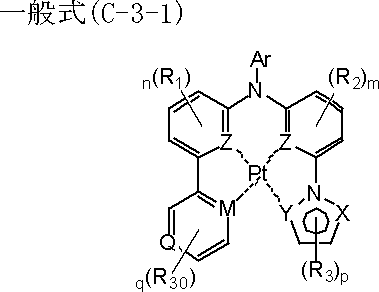
(一般式(C-3-1)中、X、Y、Z、Mは、それぞれ独立に、炭素原子又は窒素原子を表す。ただし、ZとYのいずれか一方は窒素原子である。Yが窒素原子のときは、Xは炭素原子である。m、n、p、及びqは、それぞれ独立に、0~3の整数を表す。Arは置換又は無置換のアリール基を表す。R1~R3及びR30は、それぞれ独立に、アルキル基、アリール基、アルコキシ基、アリールオキシ基、フッ素原子、シアノ基、シリル基、ヘテロ環基を表す。m、n、p、qが2以上の場合、複数のR1、R2、R3及びR30は各々隣同士が互いに連結して環状構造を形成してもよい。Qは、炭素原子又は窒素原子である。)
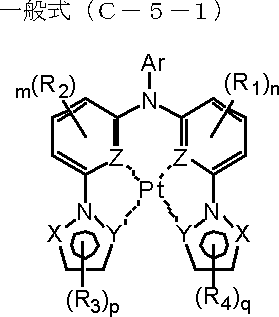
(一般式(C-5-1)中、X、Y、及びZはそれぞれ独立に、炭素原子又は窒素原子を表し、ZとYのいずれか一方が、窒素原子であり、Yが窒素原子のときは、Xは、炭素原子である。m、n、p及び、qは、それぞれ独立に0~3の整数を表す。Arは置換又は無置換のアリール基を表す。R1~R4はそれぞれ独立に、アルキル基、アリール基、アルコキシ基、アリールオキシ基、フッ素原子、シアノ基、シリル基、ヘテロ環基を表し、m、n、p、及びqが2以上の場合、複数のR1~R4は各々隣同士で互いに連結して環状構造を形成してもよい。)

(一般式(C-6)中、X,Y,及びZはそれぞれ独立に、炭素原子又は窒素原子を表し、ZとYのいずれか一方が、窒素原子である。Yが窒素原子のときは、Xは、炭素原子である。r、s、t、及びuは、それぞれ独立に0~3の整数を表す。R5~R8は、それぞれ独立に、アルキル基、アリール基、アルコキシ基、アリールオキシ基、フッ素原子、シアノ基、シリル基、ヘテロ環基を表し、r、s、t、及びuが2以上の場合、複数のR5~R8は各々隣同士で互いに連結して環状構造を形成してもよい。W1及びW2は、それぞれ独立に、アルキル基を表し、互いに結合して環状構造を形成してもよい。)

式中、A及びBは、環状構造を表し、Aは芳香環を表し、Bは芳香族ヘテロ環を表す。A及びBの一方が環を形成するとき、他方は環を形成しなくてもよい。R13~R16は、それぞれ独立に、水素原子、アルキル基、アリール基、シリル基、又はヘテロ環基を表し、R14とR15、R13とR16は、互いに結合して環状構造を形成してもよい。
[5]
発光材料が、蛍光発光性化合物である[1]に記載の有機電界発光素子。
[6]
蛍光発光性化合物が、下記一般式(P-1)で表される[5]に記載の有機電界発光素子。
一般式(P-1)
[5]
発光材料が、蛍光発光性化合物である[1]に記載の有機電界発光素子。
[6]
蛍光発光性化合物が、下記一般式(P-1)で表される[5]に記載の有機電界発光素子。
一般式(P-1)

(一般式(P-1)中、RP
1~RP
10は、それぞれ独立に、水素原子、置換基を有していても良い芳香族炭化水素基、置換基を有していても良いアルケニル基、置換基を有していても良いアルキニル基、置換基を有していても良いアルキル基、置換基を有していても良いシリル基、置換基を有していても良いヘテロ環基、置換基を有していても良いアルキルアミノ基、置換基を有していても良いアリールアミノ基を表し、RP
1~RP
10の少なくとも1つは水素原子以外の置換基である。)
[7]
蛍光発光性化合物が、下記一般式(PE-1)で表される[5]に記載の有機電界発光素子。
一般式(PE-1)
[7]
蛍光発光性化合物が、下記一般式(PE-1)で表される[5]に記載の有機電界発光素子。
一般式(PE-1)
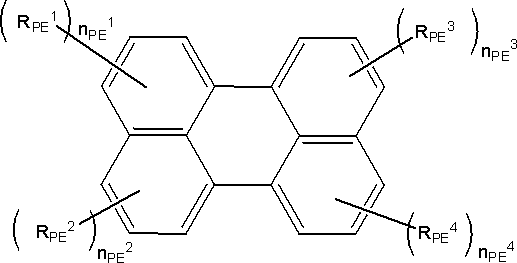
(一般式(PE-1)中、RPE
1~RPE
4は、それぞれ独立に、アルキル基、アリール基、ヘテロ環基、アミノ基、シリル基、アルキルオキシカルボニル基、アリールオキシカルボニル基、カルバモイル基、アルコキシ基、アリールオキシ基、ヘテロアリールオキシ基、アルキルチオ基、アリールチオ基を表し、これらは置換基を有していても良い。また、これらは互いに結合して環を形成しても良い。
nPE 1~nPE 4は、それぞれ独立に、0~3の整数を表す。nPE 1~nPE 4が2以上のとき、複数のRPE 1~RPE 4はそれぞれ互いに結合して環を形成しても良い。
また、式中の水素原子は重水素原子であっても良い。)
[8]
蛍光発光性化合物が、下記一般式(F-1)で表される[5]に記載の有機電界発光素子。
nPE 1~nPE 4は、それぞれ独立に、0~3の整数を表す。nPE 1~nPE 4が2以上のとき、複数のRPE 1~RPE 4はそれぞれ互いに結合して環を形成しても良い。
また、式中の水素原子は重水素原子であっても良い。)
[8]
蛍光発光性化合物が、下記一般式(F-1)で表される[5]に記載の有機電界発光素子。

(一般式(F-1)中、RF
1~RF
10は、それぞれ独立に、水素原子、置換基を有していても良い芳香族炭化水素基、置換基を有していても良いアルケニル基、置換基を有していても良いアルキニル基、置換基を有していても良いアルキル基、置換基を有していても良いシリル基、置換基を有していても良いヘテロ環基、置換基を有していても良いアルキルアミノ基、置換基を有していても良いアリールアミノ基を表し、RF
1~RF
10の少なくとも1つは水素原子以外の置換基である。)
[9]
平板状発光材料の分子長と分子厚みとのアスペクト比(分子長/分子厚み)が5より大きい、[1]~[8]のいずれか1項に記載の有機電界発光素子。
[10]
ホスト材料が金属錯体化合物である[1]~[9]のいずれか1項に記載の有機電界発光素子。
[11]
分子長と分子厚みとのアスペクト比(分子長/分子厚み)が3以上の平板状発光材料と、分子長と分子厚みとのアスペクト比(分子長/分子厚み)が2以下のホスト材料とを少なくとも含有し、発光材料の分子半径と、ホスト材料の分子半径とのサイズ比(発光材料の分子半径/ホスト材料の分子半径)が、0.8~1.2である、有機電界発光素子用材料。
[12]
発光層を、[11]に記載の有機電界発光素子用材料を用いた真空蒸着プロセス又は湿式プロセスにて形成する工程を少なくとも含む有機電界発光素子の製造方法。
[13]
[11]に記載の有機電界発光素子用材料を含有する膜。
[14]
[1]~[10]のいずれか1項に記載の有機電界発光素子を用いた発光装置。
[15]
[1]~[10]のいずれか1項に記載の有機電界発光素子を用いた表示装置。
[16]
[1]~[10]のいずれか1項に記載の有機電界発光素子を用いた照明装置。
[9]
平板状発光材料の分子長と分子厚みとのアスペクト比(分子長/分子厚み)が5より大きい、[1]~[8]のいずれか1項に記載の有機電界発光素子。
[10]
ホスト材料が金属錯体化合物である[1]~[9]のいずれか1項に記載の有機電界発光素子。
[11]
分子長と分子厚みとのアスペクト比(分子長/分子厚み)が3以上の平板状発光材料と、分子長と分子厚みとのアスペクト比(分子長/分子厚み)が2以下のホスト材料とを少なくとも含有し、発光材料の分子半径と、ホスト材料の分子半径とのサイズ比(発光材料の分子半径/ホスト材料の分子半径)が、0.8~1.2である、有機電界発光素子用材料。
[12]
発光層を、[11]に記載の有機電界発光素子用材料を用いた真空蒸着プロセス又は湿式プロセスにて形成する工程を少なくとも含む有機電界発光素子の製造方法。
[13]
[11]に記載の有機電界発光素子用材料を含有する膜。
[14]
[1]~[10]のいずれか1項に記載の有機電界発光素子を用いた発光装置。
[15]
[1]~[10]のいずれか1項に記載の有機電界発光素子を用いた表示装置。
[16]
[1]~[10]のいずれか1項に記載の有機電界発光素子を用いた照明装置。
本発明によれば、高い配向度、高い外部量子効率、及び高い耐久性を満足することができる有機電界発光素子、それに用いる有機電界発光素子用材料を提供することができる。
以下、本発明について詳細に説明する。なお、本明細書において「~」はその前後に記載される数値をそれぞれ最小値及び最大値として含む範囲を示す。
本発明において、置換基群A、置換基群Bを下記のように定義する。
(置換基群A)
アルキル基(好ましくは炭素数1~30、より好ましくは炭素数1~20、特に好ましくは炭素数1~10であり、例えばメチル、エチル、イソプロピル、tert-ブチル、n-オクチル、n-デシル、n-ヘキサデシル、シクロプロピル、シクロペンチル、シクロヘキシルなどが挙げられる。)、アルケニル基(好ましくは炭素数2~30、より好ましくは炭素数2~20、特に好ましくは炭素数2~10であり、例えばビニル、アリル、2-ブテニル、3-ペンテニルなどが挙げられる。)、アルキニル基(好ましくは炭素数2~30、より好ましくは炭素数2~20、特に好ましくは炭素数2~10であり、例えばプロパルギル、3-ペンチニルなどが挙げられる。)、アリール基(好ましくは炭素数6~30、より好ましくは炭素数6~20、特に好ましくは炭素数6~12であり、例えばフェニル、p-メチルフェニル、ナフチル、アントラセニルなどが挙げられる。)、アミノ基(好ましくは炭素数0~30、より好ましくは炭素数0~20、特に好ましくは炭素数0~10であり、例えばアミノ、メチルアミノ、ジメチルアミノ、ジエチルアミノ、ジベンジルアミノ、ジフェニルアミノ、ジトリルアミノなどが挙げられる。)、アルコキシ基(好ましくは炭素数1~30、より好ましくは炭素数1~20、特に好ましくは炭素数1~10であり、例えばメトキシ、エトキシ、ブトキシ、2-エチルヘキシロキシなどが挙げられる。)、アリールオキシ基(好ましくは炭素数6~30、より好ましくは炭素数6~20、特に好ましくは炭素数6~12であり、例えばフェニルオキシ、1-ナフチルオキシ、2-ナフチルオキシなどが挙げられる。)、ヘテロ環オキシ基(好ましくは炭素数1~30、より好ましくは炭素数1~20、特に好ましくは炭素数1~12であり、例えばピリジルオキシ、ピラジルオキシ、ピリミジルオキシ、キノリルオキシなどが挙げられる。)、アシル基(好ましくは炭素数2~30、より好ましくは炭素数2~20、特に好ましくは炭素数2~12であり、例えばアセチル、ベンゾイル、ホルミル、ピバロイルなどが挙げられる。)、アルコキシカルボニル基(好ましくは炭素数2~30、より好ましくは炭素数2~20、特に好ましくは炭素数2~12であり、例えばメトキシカルボニル、エトキシカルボニルなどが挙げられる。)、アリールオキシカルボニル基(好ましくは炭素数7~30、より好ましくは炭素数7~20、特に好ましくは炭素数7~12であり、例えばフェニルオキシカルボニルなどが挙げられる。)、アシルオキシ基(好ましくは炭素数2~30、より好ましくは炭素数2~20、特に好ましくは炭素数2~10であり、例えばアセトキシ、ベンゾイルオキシなどが挙げられる。)、アシルアミノ基(好ましくは炭素数2~30、より好ましくは炭素数2~20、特に好ましくは炭素数2~10であり、例えばアセチルアミノ、ベンゾイルアミノなどが挙げられる。)、アルコキシカルボニルアミノ基(好ましくは炭素数2~30、より好ましくは炭素数2~20、特に好ましくは炭素数2~12であり、例えばメトキシカルボニルアミノなどが挙げられる。)、アリールオキシカルボニルアミノ基(好ましくは炭素数7~30、より好ましくは炭素数7~20、特に好ましくは炭素数7~12であり、例えばフェニルオキシカルボニルアミノなどが挙げられる。)、スルホニルアミノ基(好ましくは炭素数1~30、より好ましくは炭素数1~20、特に好ましくは炭素数1~12であり、例えばメタンスルホニルアミノ、ベンゼンスルホニルアミノなどが挙げられる。)、スルファモイル基(好ましくは炭素数0~30、より好ましくは炭素数0~20、特に好ましくは炭素数0~12であり、例えばスルファモイル、メチルスルファモイル、ジメチルスルファモイル、フェニルスルファモイルなどが挙げられる。)、カルバモイル基(好ましくは炭素数1~30、より好ましくは炭素数1~20、特に好ましくは炭素数1~12であり、例えばカルバモイル、メチルカルバモイル、ジエチルカルバモイル、フェニルカルバモイルなどが挙げられる。)、アルキルチオ基(好ましくは炭素数1~30、より好ましくは炭素数1~20、特に好ましくは炭素数1~12であり、例えばメチルチオ、エチルチオなどが挙げられる。)、アリールチオ基(好ましくは炭素数6~30、より好ましくは炭素数6~20、特に好ましくは炭素数6~12であり、例えばフェニルチオなどが挙げられる。)、ヘテロ環チオ基(好ましくは炭素数1~30、より好ましくは炭素数1~20、特に好ましくは炭素数1~12であり、例えばピリジルチオ、2-ベンズイミゾリルチオ、2-ベンズオキサゾリルチオ、2-ベンズチアゾリルチオなどが挙げられる。)、スルホニル基(好ましくは炭素数1~30、より好ましくは炭素数1~20、特に好ましくは炭素数1~12であり、例えばメシル、トシルなどが挙げられる。)、スルフィニル基(好ましくは炭素数1~30、より好ましくは炭素数1~20、特に好ましくは炭素数1~12であり、例えばメタンスルフィニル、ベンゼンスルフィニルなどが挙げられる。)、ウレイド基(好ましくは炭素数1~30、より好ましくは炭素数1~20、特に好ましくは炭素数1~12であり、例えばウレイド、メチルウレイド、フェニルウレイドなどが挙げられる。)、リン酸アミド基(好ましくは炭素数1~30、より好ましくは炭素数1~20、特に好ましくは炭素数1~12であり、例えばジエチルリン酸アミド、フェニルリン酸アミドなどが挙げられる。)、ヒドロキシ基、メルカプト基、ハロゲン原子(例えばフッ素原子、塩素原子、臭素原子、ヨウ素原子)、シアノ基、スルホ基、カルボキシル基、ニトロ基、ヒドロキサム酸基、スルフィノ基、ヒドラジノ基、イミノ基、ヘテロ環基(芳香族ヘテロ環基も包含し、好ましくは炭素数1~30、より好ましくは炭素数1~12であり、ヘテロ原子としては、例えば窒素原子、酸素原子、硫黄原子、リン原子、ケイ素原子、セレン原子、テルル原子であり、具体的にはピリジル、ピラジニル、ピリミジル、ピリダジニル、ピロリル、ピラゾリル、トリアゾリル、イミダゾリル、オキサゾリル、チアゾリル、イソキサゾリル、イソチアゾリル、キノリル、フリル、チエニル、セレノフェニル、テルロフェニル、ピペリジル、ピペリジノ、モルホリノ、ピロリジル、ピロリジノ、ベンゾオキサゾリル、ベンゾイミダゾリル、ベンゾチアゾリル、カルバゾリル基、アゼピニル基、シロリル基などが挙げられる。)、シリル基(好ましくは炭素数3~40、より好ましくは炭素数3~30、特に好ましくは炭素数3~24であり、例えばトリメチルシリル、トリフェニルシリルなどが挙げられる。)、シリルオキシ基(好ましくは炭素数3~40、より好ましくは炭素数3~30、特に好ましくは炭素数3~24であり、例えばトリメチルシリルオキシ、トリフェニルシリルオキシなどが挙げられる。)、ホスホリル基(例えばジフェニルホスホリル基、ジメチルホスホリル基などが挙げられる。)が挙げられる。これらの置換基は更に置換されてもよく、更なる置換基としては、以上に説明した置換基群Aから選択される基を挙げることができる。該更なる置換基が複数ある場合には、該置換基同士は互いに連結して環を形成してもよい。
(置換基群A)
アルキル基(好ましくは炭素数1~30、より好ましくは炭素数1~20、特に好ましくは炭素数1~10であり、例えばメチル、エチル、イソプロピル、tert-ブチル、n-オクチル、n-デシル、n-ヘキサデシル、シクロプロピル、シクロペンチル、シクロヘキシルなどが挙げられる。)、アルケニル基(好ましくは炭素数2~30、より好ましくは炭素数2~20、特に好ましくは炭素数2~10であり、例えばビニル、アリル、2-ブテニル、3-ペンテニルなどが挙げられる。)、アルキニル基(好ましくは炭素数2~30、より好ましくは炭素数2~20、特に好ましくは炭素数2~10であり、例えばプロパルギル、3-ペンチニルなどが挙げられる。)、アリール基(好ましくは炭素数6~30、より好ましくは炭素数6~20、特に好ましくは炭素数6~12であり、例えばフェニル、p-メチルフェニル、ナフチル、アントラセニルなどが挙げられる。)、アミノ基(好ましくは炭素数0~30、より好ましくは炭素数0~20、特に好ましくは炭素数0~10であり、例えばアミノ、メチルアミノ、ジメチルアミノ、ジエチルアミノ、ジベンジルアミノ、ジフェニルアミノ、ジトリルアミノなどが挙げられる。)、アルコキシ基(好ましくは炭素数1~30、より好ましくは炭素数1~20、特に好ましくは炭素数1~10であり、例えばメトキシ、エトキシ、ブトキシ、2-エチルヘキシロキシなどが挙げられる。)、アリールオキシ基(好ましくは炭素数6~30、より好ましくは炭素数6~20、特に好ましくは炭素数6~12であり、例えばフェニルオキシ、1-ナフチルオキシ、2-ナフチルオキシなどが挙げられる。)、ヘテロ環オキシ基(好ましくは炭素数1~30、より好ましくは炭素数1~20、特に好ましくは炭素数1~12であり、例えばピリジルオキシ、ピラジルオキシ、ピリミジルオキシ、キノリルオキシなどが挙げられる。)、アシル基(好ましくは炭素数2~30、より好ましくは炭素数2~20、特に好ましくは炭素数2~12であり、例えばアセチル、ベンゾイル、ホルミル、ピバロイルなどが挙げられる。)、アルコキシカルボニル基(好ましくは炭素数2~30、より好ましくは炭素数2~20、特に好ましくは炭素数2~12であり、例えばメトキシカルボニル、エトキシカルボニルなどが挙げられる。)、アリールオキシカルボニル基(好ましくは炭素数7~30、より好ましくは炭素数7~20、特に好ましくは炭素数7~12であり、例えばフェニルオキシカルボニルなどが挙げられる。)、アシルオキシ基(好ましくは炭素数2~30、より好ましくは炭素数2~20、特に好ましくは炭素数2~10であり、例えばアセトキシ、ベンゾイルオキシなどが挙げられる。)、アシルアミノ基(好ましくは炭素数2~30、より好ましくは炭素数2~20、特に好ましくは炭素数2~10であり、例えばアセチルアミノ、ベンゾイルアミノなどが挙げられる。)、アルコキシカルボニルアミノ基(好ましくは炭素数2~30、より好ましくは炭素数2~20、特に好ましくは炭素数2~12であり、例えばメトキシカルボニルアミノなどが挙げられる。)、アリールオキシカルボニルアミノ基(好ましくは炭素数7~30、より好ましくは炭素数7~20、特に好ましくは炭素数7~12であり、例えばフェニルオキシカルボニルアミノなどが挙げられる。)、スルホニルアミノ基(好ましくは炭素数1~30、より好ましくは炭素数1~20、特に好ましくは炭素数1~12であり、例えばメタンスルホニルアミノ、ベンゼンスルホニルアミノなどが挙げられる。)、スルファモイル基(好ましくは炭素数0~30、より好ましくは炭素数0~20、特に好ましくは炭素数0~12であり、例えばスルファモイル、メチルスルファモイル、ジメチルスルファモイル、フェニルスルファモイルなどが挙げられる。)、カルバモイル基(好ましくは炭素数1~30、より好ましくは炭素数1~20、特に好ましくは炭素数1~12であり、例えばカルバモイル、メチルカルバモイル、ジエチルカルバモイル、フェニルカルバモイルなどが挙げられる。)、アルキルチオ基(好ましくは炭素数1~30、より好ましくは炭素数1~20、特に好ましくは炭素数1~12であり、例えばメチルチオ、エチルチオなどが挙げられる。)、アリールチオ基(好ましくは炭素数6~30、より好ましくは炭素数6~20、特に好ましくは炭素数6~12であり、例えばフェニルチオなどが挙げられる。)、ヘテロ環チオ基(好ましくは炭素数1~30、より好ましくは炭素数1~20、特に好ましくは炭素数1~12であり、例えばピリジルチオ、2-ベンズイミゾリルチオ、2-ベンズオキサゾリルチオ、2-ベンズチアゾリルチオなどが挙げられる。)、スルホニル基(好ましくは炭素数1~30、より好ましくは炭素数1~20、特に好ましくは炭素数1~12であり、例えばメシル、トシルなどが挙げられる。)、スルフィニル基(好ましくは炭素数1~30、より好ましくは炭素数1~20、特に好ましくは炭素数1~12であり、例えばメタンスルフィニル、ベンゼンスルフィニルなどが挙げられる。)、ウレイド基(好ましくは炭素数1~30、より好ましくは炭素数1~20、特に好ましくは炭素数1~12であり、例えばウレイド、メチルウレイド、フェニルウレイドなどが挙げられる。)、リン酸アミド基(好ましくは炭素数1~30、より好ましくは炭素数1~20、特に好ましくは炭素数1~12であり、例えばジエチルリン酸アミド、フェニルリン酸アミドなどが挙げられる。)、ヒドロキシ基、メルカプト基、ハロゲン原子(例えばフッ素原子、塩素原子、臭素原子、ヨウ素原子)、シアノ基、スルホ基、カルボキシル基、ニトロ基、ヒドロキサム酸基、スルフィノ基、ヒドラジノ基、イミノ基、ヘテロ環基(芳香族ヘテロ環基も包含し、好ましくは炭素数1~30、より好ましくは炭素数1~12であり、ヘテロ原子としては、例えば窒素原子、酸素原子、硫黄原子、リン原子、ケイ素原子、セレン原子、テルル原子であり、具体的にはピリジル、ピラジニル、ピリミジル、ピリダジニル、ピロリル、ピラゾリル、トリアゾリル、イミダゾリル、オキサゾリル、チアゾリル、イソキサゾリル、イソチアゾリル、キノリル、フリル、チエニル、セレノフェニル、テルロフェニル、ピペリジル、ピペリジノ、モルホリノ、ピロリジル、ピロリジノ、ベンゾオキサゾリル、ベンゾイミダゾリル、ベンゾチアゾリル、カルバゾリル基、アゼピニル基、シロリル基などが挙げられる。)、シリル基(好ましくは炭素数3~40、より好ましくは炭素数3~30、特に好ましくは炭素数3~24であり、例えばトリメチルシリル、トリフェニルシリルなどが挙げられる。)、シリルオキシ基(好ましくは炭素数3~40、より好ましくは炭素数3~30、特に好ましくは炭素数3~24であり、例えばトリメチルシリルオキシ、トリフェニルシリルオキシなどが挙げられる。)、ホスホリル基(例えばジフェニルホスホリル基、ジメチルホスホリル基などが挙げられる。)が挙げられる。これらの置換基は更に置換されてもよく、更なる置換基としては、以上に説明した置換基群Aから選択される基を挙げることができる。該更なる置換基が複数ある場合には、該置換基同士は互いに連結して環を形成してもよい。
(置換基群B)
アルキル基(好ましくは炭素数1~30、より好ましくは炭素数1~20、特に好ましくは炭素数1~10であり、例えばメチル、エチル、イソプロピル、tert-ブチル、n-オクチル、n-デシル、n-ヘキサデシル、シクロプロピル、シクロペンチル、シクロヘキシルなどが挙げられる。)、アルケニル基(好ましくは炭素数2~30、より好ましくは炭素数2~20、特に好ましくは炭素数2~10であり、例えばビニル、アリル、2-ブテニル、3-ペンテニルなどが挙げられる。)、アルキニル基(好ましくは炭素数2~30、より好ましくは炭素数2~20、特に好ましくは炭素数2~10であり、例えばプロパルギル、3-ペンチニルなどが挙げられる。)、アリール基(好ましくは炭素数6~30、より好ましくは炭素数6~20、特に好ましくは炭素数6~12であり、例えばフェニル、p-メチルフェニル、ナフチル、アントラセニルなどが挙げられる。)、シアノ基、ヘテロ環基(芳香族ヘテロ環基も包含し、好ましくは炭素数1~30、より好ましくは炭素数1~12であり、ヘテロ原子としては、例えば窒素原子、酸素原子、硫黄原子、リン原子、ケイ素原子、セレン原子、テルル原子であり、具体的にはピリジル、ピラジニル、ピリミジル、ピリダジニル、ピロリル、ピラゾリル、トリアゾリル、イミダゾリル、オキサゾリル、チアゾリル、イソキサゾリル、イソチアゾリル、キノリル、フリル、チエニル、セレノフェニル、テルロフェニル、ピペリジル、ピペリジノ、モルホリノ、ピロリジル、ピロリジノ、ベンゾオキサゾリル、ベンゾイミダゾリル、ベンゾチアゾリル、カルバゾリル基、アゼピニル基、シロリル基などが挙げられる。)これらの置換基は更に置換されてもよく、更なる置換基としては、前記置換基群Aから選択される基を挙げることができる。該更なる置換基が複数ある場合には、該置換基同士は互いに連結して環を形成してもよい。
アルキル基(好ましくは炭素数1~30、より好ましくは炭素数1~20、特に好ましくは炭素数1~10であり、例えばメチル、エチル、イソプロピル、tert-ブチル、n-オクチル、n-デシル、n-ヘキサデシル、シクロプロピル、シクロペンチル、シクロヘキシルなどが挙げられる。)、アルケニル基(好ましくは炭素数2~30、より好ましくは炭素数2~20、特に好ましくは炭素数2~10であり、例えばビニル、アリル、2-ブテニル、3-ペンテニルなどが挙げられる。)、アルキニル基(好ましくは炭素数2~30、より好ましくは炭素数2~20、特に好ましくは炭素数2~10であり、例えばプロパルギル、3-ペンチニルなどが挙げられる。)、アリール基(好ましくは炭素数6~30、より好ましくは炭素数6~20、特に好ましくは炭素数6~12であり、例えばフェニル、p-メチルフェニル、ナフチル、アントラセニルなどが挙げられる。)、シアノ基、ヘテロ環基(芳香族ヘテロ環基も包含し、好ましくは炭素数1~30、より好ましくは炭素数1~12であり、ヘテロ原子としては、例えば窒素原子、酸素原子、硫黄原子、リン原子、ケイ素原子、セレン原子、テルル原子であり、具体的にはピリジル、ピラジニル、ピリミジル、ピリダジニル、ピロリル、ピラゾリル、トリアゾリル、イミダゾリル、オキサゾリル、チアゾリル、イソキサゾリル、イソチアゾリル、キノリル、フリル、チエニル、セレノフェニル、テルロフェニル、ピペリジル、ピペリジノ、モルホリノ、ピロリジル、ピロリジノ、ベンゾオキサゾリル、ベンゾイミダゾリル、ベンゾチアゾリル、カルバゾリル基、アゼピニル基、シロリル基などが挙げられる。)これらの置換基は更に置換されてもよく、更なる置換基としては、前記置換基群Aから選択される基を挙げることができる。該更なる置換基が複数ある場合には、該置換基同士は互いに連結して環を形成してもよい。
[有機電界発光素子用材料]
本発明の有機電界発光素子用材料は、分子長と分子厚みとのアスペクト比(分子長/分子厚み)が3以上の平板状発光材料と、分子長と分子厚みとのアスペクト比(分子長/分子厚み)が2以下のホスト材料とを少なくとも含有し、前記発光材料の分子半径と、前記ホスト材料の分子半径とのサイズ比(発光材料の分子半径/ホスト材料の分子半径)が、0.8~1.2である。
本発明の有機電界発光素子用材料は、分子長と分子厚みとのアスペクト比(分子長/分子厚み)が3以上の平板状発光材料と、分子長と分子厚みとのアスペクト比(分子長/分子厚み)が2以下のホスト材料とを少なくとも含有し、前記発光材料の分子半径と、前記ホスト材料の分子半径とのサイズ比(発光材料の分子半径/ホスト材料の分子半径)が、0.8~1.2である。
本発明の有機電界発光素子用材料は、アスペクト比が3以上の平板状発光材料と、アスペクト比が2以下のホスト材料とを少なくとも含有し、前記発光材料の分子半径と、前記ホスト材料の分子半径とのサイズ比を0.8~1.2とすることにより、該有機電界発光素子用材料を有機電界発光素子の発光層などの膜形成に適用した場合、該形成膜のアモルファス性が向上し、該形成膜の耐久性が向上する。
これまで発光素材により光取り出し効率を向上させるには、アスペクト比の大きい平板状のホスト分子を高秩序に配列させることでゲスト(発光材料)分子が配列し、発光の指向性を高めることが重要と考えられてきた。しかし、ホスト分子を高秩序に配列させると作成時はアモルファスであった膜が結晶化し、耐久性などの素子特性を低下させる問題があった。
本発明者らの検討により、平面性の高いゲスト分子を用いると、予想に反しアスペクト比の小さなホスト分子を用いた場合でもゲスト分子が一定のオーダー以上で配列することが分かった。
また、本発明の有機電界発光素子用材料において、発光材料とホスト材料のサイズが近くなると、該有機電界発光素子用材料を蒸着することにより有機電界発光素子の発光層を形成する場合、相分離することがない。
これまで発光素材により光取り出し効率を向上させるには、アスペクト比の大きい平板状のホスト分子を高秩序に配列させることでゲスト(発光材料)分子が配列し、発光の指向性を高めることが重要と考えられてきた。しかし、ホスト分子を高秩序に配列させると作成時はアモルファスであった膜が結晶化し、耐久性などの素子特性を低下させる問題があった。
本発明者らの検討により、平面性の高いゲスト分子を用いると、予想に反しアスペクト比の小さなホスト分子を用いた場合でもゲスト分子が一定のオーダー以上で配列することが分かった。
また、本発明の有機電界発光素子用材料において、発光材料とホスト材料のサイズが近くなると、該有機電界発光素子用材料を蒸着することにより有機電界発光素子の発光層を形成する場合、相分離することがない。
なお、本発明において、発光材料及びホスト材料の「分子長」とは、図2に示すように、材料の分子を平板構造と仮定したときに最も近接する四角形における2辺の長さa、bの平均値[(a+b)/2]を意味する。ここで、「最も近接する四角形」とは、2辺が分子に接する四角形(長方形又は正方形)のうち、a、bの平均値[(a+b)/2]が最小となるときの四角形と定義する。この「分子長」は、理論計算により下記のように規定される。即ち、密度汎関数法を用いて行い、具体的には、Gaussian03(米ガウシアン社)を用いて、基底関数:6-31G*、交換相関汎関数:B3LYP/LANL2DZにて、構造最適化計算を行う。構造最適化計算により得られた最適化構造を用い、ボール&スティック表示で最も近接する四角形における2辺の平均長さを分子長と定義する。
また、「分子厚み」とは、前記平板構造の平板部位をx軸、y軸(例えば、図2の長さaの辺の方向をy軸、長さbの辺の方向をx軸)と仮定したときの、該x軸及びy軸と直交するz軸方向の分子の厚みを意味する。分子厚みについても、分子長と同様の手法で求められ、ボール&スティック表示における分子の厚み方向の長さを分子厚みと定義する。
また、「分子厚み」とは、前記平板構造の平板部位をx軸、y軸(例えば、図2の長さaの辺の方向をy軸、長さbの辺の方向をx軸)と仮定したときの、該x軸及びy軸と直交するz軸方向の分子の厚みを意味する。分子厚みについても、分子長と同様の手法で求められ、ボール&スティック表示における分子の厚み方向の長さを分子厚みと定義する。
また、「分子半径」とは、分子中心から自由回転結合が2個連続する基の該自由回転結合に連結する原子までの距離を意味する。自由回転結合が2個連続する基が存在しない場合(0個又は1個の場合)には、分子中心から最も遠い原子を意味する。
ここで、「分子中心」とは、クロモフォアの中心又は分子コア部を意味する。例えば、下記で発光材料として例示する白金錯体のように、中心金属に対してクロモフォアを有する金属錯体の場合には、該錯体の中心金属が分子中心である。また、下記でホスト材料として例示する縮環構造のコアに対して置換基を有する材料の場合には、該縮環構造が分子中心である。
「自由回転結合」とは、自由回転可能な結合軸であり、例えば、メチル基が連結する結合軸は自由回転結合であるが、フェニル基など剛直な基が連結する結合軸は自由回転可能でない。
したがって、図3に示すように、分子中心側のフェニル基からメチレン基が2個以上連続して連結した場合[(分子中心)-Ph-CH2-CH2-CH2-・・・]を例に取ると、「分子中心から2個連続する基までの距離」(即ち、「分子半径」)とは、分子中心から該分子中心側より2番目のメチレン基の炭素原子(図3中、円で囲った原子)までの距離を意味する。また、フェニル基(Ph)が2個以上連続して連結した場合、例えば、図4に示すように4個連続して連結した場合[(分子中心)-Ph-Ph-Ph-Ph]を例に取ると、自由回転結合がないため、分子中心より4個目のフェニル基のうち4位の炭素原子(図4中、円で囲った原子)が分子中心から最も遠い原子となり、分子中心から該炭素原子までの距離が「分子半径」となる。更にまた、図5に示すように、フェニル基とメチレン基が連結した場合[(分子中心)-Ph-Ph-CH2-CH2-Ph]を例に取ると、分子中心から2番目のフェニル基と3番目のフェニル基の間に結合軸が自由回転可能なメチレン基が2個連続して結合しているので、分子中心から該分子中心側より2番目のメチレン基の炭素原子(図5中、円で囲った原子)までの距離が「分子中心から2個連続する原子までの距離」(即ち、「分子半径」)となる。
ここで、「分子中心」とは、クロモフォアの中心又は分子コア部を意味する。例えば、下記で発光材料として例示する白金錯体のように、中心金属に対してクロモフォアを有する金属錯体の場合には、該錯体の中心金属が分子中心である。また、下記でホスト材料として例示する縮環構造のコアに対して置換基を有する材料の場合には、該縮環構造が分子中心である。
「自由回転結合」とは、自由回転可能な結合軸であり、例えば、メチル基が連結する結合軸は自由回転結合であるが、フェニル基など剛直な基が連結する結合軸は自由回転可能でない。
したがって、図3に示すように、分子中心側のフェニル基からメチレン基が2個以上連続して連結した場合[(分子中心)-Ph-CH2-CH2-CH2-・・・]を例に取ると、「分子中心から2個連続する基までの距離」(即ち、「分子半径」)とは、分子中心から該分子中心側より2番目のメチレン基の炭素原子(図3中、円で囲った原子)までの距離を意味する。また、フェニル基(Ph)が2個以上連続して連結した場合、例えば、図4に示すように4個連続して連結した場合[(分子中心)-Ph-Ph-Ph-Ph]を例に取ると、自由回転結合がないため、分子中心より4個目のフェニル基のうち4位の炭素原子(図4中、円で囲った原子)が分子中心から最も遠い原子となり、分子中心から該炭素原子までの距離が「分子半径」となる。更にまた、図5に示すように、フェニル基とメチレン基が連結した場合[(分子中心)-Ph-Ph-CH2-CH2-Ph]を例に取ると、分子中心から2番目のフェニル基と3番目のフェニル基の間に結合軸が自由回転可能なメチレン基が2個連続して結合しているので、分子中心から該分子中心側より2番目のメチレン基の炭素原子(図5中、円で囲った原子)までの距離が「分子中心から2個連続する原子までの距離」(即ち、「分子半径」)となる。
なお、結合軸が自由回転可能な軸となる基としては、上記のメチル基(メチレン基)以外に、アミノ基、シリル基、アルコキシ基、アルキルチオ基などが挙げられる。また、結合軸が自由回転可能でない軸となる基としては、上記のフェニル基以外に、シクロヘキサン環、縮環アリール基、ヘテロ環などが挙げられる。
分子半径についても、分子長と同様の手法で求められ、ボール&スティック表示において、前述のz軸方向から見たときの分子中心から自由回転結合が2個連続する基の該自由回転結合に連結する原子までの長さにより求めることができる。
分子半径についても、分子長と同様の手法で求められ、ボール&スティック表示において、前述のz軸方向から見たときの分子中心から自由回転結合が2個連続する基の該自由回転結合に連結する原子までの長さにより求めることができる。
以下、本発明の有機電界発光素子用材料の構成について説明する。
(発光材料)
本発明の有機電界発光素子用材料に用いる発光材料について説明する。
発光材料としては、ホスト材料の配向を乱さないで自身の配向性を向上させる観点から、アスペクト比(分子長/分子厚み)は3以上であり、5以上が好ましく、5以上かつ30以下がより好ましく、5.3~20が特に好ましい。
前記アスペクト比が3より小さいと、分子揺らぎが大きくなり、配向性が低下することがある。
本発明の有機電界発光素子用材料に用いる発光材料について説明する。
発光材料としては、ホスト材料の配向を乱さないで自身の配向性を向上させる観点から、アスペクト比(分子長/分子厚み)は3以上であり、5以上が好ましく、5以上かつ30以下がより好ましく、5.3~20が特に好ましい。
前記アスペクト比が3より小さいと、分子揺らぎが大きくなり、配向性が低下することがある。
発光材料の分子半径としては、0.40nm~3.0nmが好ましく、0.45nm~2.0nmがより好ましく、0.5nm~1.5nmが特に好ましい。この範囲であることは、配向性の向上、発光強度と発光波長の制御し易さ等の観点から好ましい。
また、発光材料の分子半径とホスト材料の分子半径とのサイズ比(発光材料の分子半径/ホスト材料の分子半径)としては、0.8~1.2であり、0.85~1.15が好ましく、0.9~1.1がより好ましい。前記サイズ比がこの範囲であると、有機電界発光素子の正面方向の輝度が上昇する。
発光材料としては、燐光発光性材料及び蛍光発光性材料のいずれも用いることができる。発光効率の観点からは、燐光発光性材料が好ましい。燐光発光性材料としては例えば遷移金属原子を含む錯体などが挙げられる。これらは、1種単独で使用してもよく、2種以上を併用してもよい。
前記錯体は、化合物中に遷移金属原子を1つ有してもよいし、また、2つ以上有するいわゆる複核錯体であってもよい。異種の金属原子を同時に含有していてもよい。
前記錯体は、化合物中に遷移金属原子を1つ有してもよいし、また、2つ以上有するいわゆる複核錯体であってもよい。異種の金属原子を同時に含有していてもよい。
錯体の配位子としては、例えば、G.Wilkinson等著,Comprehensive Coordination Chemistry,Pergamon Press社1987年発行、H.Yersin著,「Photochemistry and Photophysics of Coordination Compounds」Springer-Verlag社1987年発行、山本明夫著「有機金属化学-基礎と応用-」裳華房社、1982年発行等に記載の配位子などが挙げられる。
配位子としては、例えば、芳香族炭素環配位子、含窒素ヘテロ環配位子、ジケトン配位子、カルボン酸配位子、アルコラト配位子、一酸化炭素配位子、イソニトリル配位子、シアノ配位子などが挙げられる。これらの中でも、含窒素ヘテロ環配位子が特に好ましい。
芳香族炭素環配位子としては、例えば、シクロペンタジエニルアニオン、ベンゼンアニオン、又はナフチルアニオンなどが挙げられる。
含窒素ヘテロ環配位子としては、例えば、フェニルピリジン、ベンゾキノリン、キノリノール、ビピリジル、フェナントロリンなどが挙げられる。
ジケトン配位子としては、例えば、アセチルアセトンなどが挙げられる。
カルボン酸配位子としては、例えば、酢酸配位子などが挙げられる。
アルコラト配位子としては、例えば、フェノラト配位子などが挙げられる。
配位子としては、例えば、芳香族炭素環配位子、含窒素ヘテロ環配位子、ジケトン配位子、カルボン酸配位子、アルコラト配位子、一酸化炭素配位子、イソニトリル配位子、シアノ配位子などが挙げられる。これらの中でも、含窒素ヘテロ環配位子が特に好ましい。
芳香族炭素環配位子としては、例えば、シクロペンタジエニルアニオン、ベンゼンアニオン、又はナフチルアニオンなどが挙げられる。
含窒素ヘテロ環配位子としては、例えば、フェニルピリジン、ベンゾキノリン、キノリノール、ビピリジル、フェナントロリンなどが挙げられる。
ジケトン配位子としては、例えば、アセチルアセトンなどが挙げられる。
カルボン酸配位子としては、例えば、酢酸配位子などが挙げられる。
アルコラト配位子としては、例えば、フェノラト配位子などが挙げられる。
遷移金属原子としては、例えばルテニウム、ロジウム、パラジウム、オスミウム、イリジウム、白金などが挙げられる
発光材料としては、特に制限はなく、目的に応じて適宜選択することができるが、燐光発光性化合物が好ましく、前記アスペクト比が3以上となる点で、平面状の配位構造である4座となる白金(白金錯体)が好ましく、サレン系、ポルフィリン系骨格の白金錯体がより好ましい。
前記白金錯体としては、一般式(C-1)で表される白金錯体であることが好ましい。
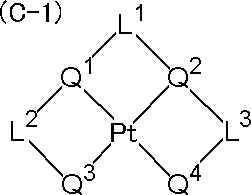
(式中、Q1、Q2、Q3及びQ4はそれぞれ独立にPtに配位する配位子を表す。L1、L2、及びL3は、それぞれ独立に、単結合、二重結合、二価の連結基、又はこれらの組合せからなる基を表す。Q3とQ4が連結して環を形成してもよい。)
一般式(C-1)について説明する。Q1、Q2、Q3及びQ4はそれぞれ独立にPtに配位する配位子を表す。この時、Q1、Q2、Q3及びQ4とPtの結合は、共有結合、イオン結合、配位結合などいずれであっても良い。Q1、Q2、Q3及びQ4中のPtに結合する原子としては、炭素原子、窒素原子、酸素原子、硫黄原子、リン原子が好ましく、Q1、Q2、Q3及びQ4中のPtに結合する原子の内、少なくとも一つが炭素原子であることが好ましく、二つが炭素原子であることがより好ましく、二つが炭素原子で、二つが窒素原子であることが特に好ましい。
炭素原子でPtに結合するQ1、Q2、Q3及びQ4としては、アニオン性の配位子でも中性の配位子でもよく、アニオン性の配位子としてはビニル配位子、芳香族炭化水素環配位子(例えばベンゼン配位子、ナフタレン配位子、アントラセン配位子、フェナントレン配位子など)、ヘテロ環配位子(例えばフラン配位子、チオフェン配位子、ピリジン配位子、ピラジン配位子、ピリミジン配位子、ピリダジン配位子、トリアジン配位子、チアゾール配位子、オキサゾール配位子、ピロール配位子、イミダゾール配位子、ピラゾール配位子、トリアゾール配位子、オキサジアゾール配位子、チアジアゾール配位子、及び、それらを含む縮環体(例えばキノリン配位子、ベンゾチアゾール配位子など))が挙げられる。中性の配位子としてはカルベン配位子が挙げられる。
窒素原子でPtに結合するQ1、Q2、Q3及びQ4としては、中性の配位子でもアニオン性の配位子でもよく、中性の配位子としては含窒素芳香族ヘテロ環配位子(ピリジン配位子、ピラジン配位子、ピリミジン配位子、ピリダジン配位子、トリアジン配位子、イミダゾール配位子、ピラゾール配位子、トリアゾール配位子、オキサゾール配位子、チアゾール配位子及びそれらを含む縮環体(例えばキノリン配位子、ベンゾイミダゾール配位子など))、アミン配位子、ニトリル配位子、イミン配位子が挙げられる。アニオン性の配位子としては、アミノ配位子、イミノ配位子、含窒素芳香族ヘテロ環配位子(ピロール配位子、イミダゾール配位子、トリアゾール配位子及びそれらを含む縮環体(例えはインドール配位子、ベンゾイミダゾール配位子など))が挙げられる。
酸素原子でPtに結合するQ1、Q2、Q3及びQ4としては、中性の配位子でもアニオン性の配位子でもよく、中性の配位子としてはエーテル配位子、ケトン配位子、エステル配位子、アミド配位子、含酸素ヘテロ環配位子(フラン配位子、オキサゾール配位子及びそれらを含む縮環体(ベンゾオキサゾール配位子など))が挙げられる。アニオン性の配位子としては、アルコキシ配位子、アリールオキシ配位子、ヘテロアリールオキシ配位子、アシルオキシ配位子、シリルオキシ配位子などが挙げられる。
硫黄原子でPtに結合するQ1、Q2、Q3及びQ4としては、中性の配位子でもアニオン性の配位子でもよく、中性の配位子としてはチオエーテル配位子、チオケトン配位子、チオエステル配位子、チオアミド配位子、含硫黄ヘテロ環配位子(チオフェン配位子、チアゾール配位子及びそれらを含む縮環体(ベンゾチアゾール配位子など))が挙げられる。アニオン性の配位子としては、アルキルメルカプト配位子、アリールメルカプト配位子、ヘテロアリールメルカプト配位子などが挙げられる。
リン原子でPtに結合するQ1、Q2、Q3及びQ4としては、中性の配位子でもアニオン性の配位子でもよく、中性の配位子としてはホスフィン配位子、リン酸エステル配位子、亜リン酸エステル配位子、含リンヘテロ環配位子(ホスフィニン配位子など)が挙げられ、アニオン性の配位子としては、ホスフィノ配位子、ホスフィニル配位子、ホスホリル配位子などが挙げられる。
Q1、Q2、Q3及びQ4で表される配位子は、置換基を有していてもよく、置換基としては前記置換基群Aとして挙げたものが適宜適用できる。また置換基同士が連結していても良い(Q3とQ4が連結した場合、環状四座配位子のPt錯体になる)。
炭素原子でPtに結合するQ1、Q2、Q3及びQ4としては、アニオン性の配位子でも中性の配位子でもよく、アニオン性の配位子としてはビニル配位子、芳香族炭化水素環配位子(例えばベンゼン配位子、ナフタレン配位子、アントラセン配位子、フェナントレン配位子など)、ヘテロ環配位子(例えばフラン配位子、チオフェン配位子、ピリジン配位子、ピラジン配位子、ピリミジン配位子、ピリダジン配位子、トリアジン配位子、チアゾール配位子、オキサゾール配位子、ピロール配位子、イミダゾール配位子、ピラゾール配位子、トリアゾール配位子、オキサジアゾール配位子、チアジアゾール配位子、及び、それらを含む縮環体(例えばキノリン配位子、ベンゾチアゾール配位子など))が挙げられる。中性の配位子としてはカルベン配位子が挙げられる。
窒素原子でPtに結合するQ1、Q2、Q3及びQ4としては、中性の配位子でもアニオン性の配位子でもよく、中性の配位子としては含窒素芳香族ヘテロ環配位子(ピリジン配位子、ピラジン配位子、ピリミジン配位子、ピリダジン配位子、トリアジン配位子、イミダゾール配位子、ピラゾール配位子、トリアゾール配位子、オキサゾール配位子、チアゾール配位子及びそれらを含む縮環体(例えばキノリン配位子、ベンゾイミダゾール配位子など))、アミン配位子、ニトリル配位子、イミン配位子が挙げられる。アニオン性の配位子としては、アミノ配位子、イミノ配位子、含窒素芳香族ヘテロ環配位子(ピロール配位子、イミダゾール配位子、トリアゾール配位子及びそれらを含む縮環体(例えはインドール配位子、ベンゾイミダゾール配位子など))が挙げられる。
酸素原子でPtに結合するQ1、Q2、Q3及びQ4としては、中性の配位子でもアニオン性の配位子でもよく、中性の配位子としてはエーテル配位子、ケトン配位子、エステル配位子、アミド配位子、含酸素ヘテロ環配位子(フラン配位子、オキサゾール配位子及びそれらを含む縮環体(ベンゾオキサゾール配位子など))が挙げられる。アニオン性の配位子としては、アルコキシ配位子、アリールオキシ配位子、ヘテロアリールオキシ配位子、アシルオキシ配位子、シリルオキシ配位子などが挙げられる。
硫黄原子でPtに結合するQ1、Q2、Q3及びQ4としては、中性の配位子でもアニオン性の配位子でもよく、中性の配位子としてはチオエーテル配位子、チオケトン配位子、チオエステル配位子、チオアミド配位子、含硫黄ヘテロ環配位子(チオフェン配位子、チアゾール配位子及びそれらを含む縮環体(ベンゾチアゾール配位子など))が挙げられる。アニオン性の配位子としては、アルキルメルカプト配位子、アリールメルカプト配位子、ヘテロアリールメルカプト配位子などが挙げられる。
リン原子でPtに結合するQ1、Q2、Q3及びQ4としては、中性の配位子でもアニオン性の配位子でもよく、中性の配位子としてはホスフィン配位子、リン酸エステル配位子、亜リン酸エステル配位子、含リンヘテロ環配位子(ホスフィニン配位子など)が挙げられ、アニオン性の配位子としては、ホスフィノ配位子、ホスフィニル配位子、ホスホリル配位子などが挙げられる。
Q1、Q2、Q3及びQ4で表される配位子は、置換基を有していてもよく、置換基としては前記置換基群Aとして挙げたものが適宜適用できる。また置換基同士が連結していても良い(Q3とQ4が連結した場合、環状四座配位子のPt錯体になる)。
Q1、Q2、Q3及びQ4で表される配位子として好ましくは、炭素原子でPtに結合する芳香族炭化水素環配位子、炭素原子でPtに結合する芳香族ヘテロ環配位子、窒素原子でPtに結合する含窒素芳香族ヘテロ環配位子、アシルオキシ配位子、アルキルオキシ配位子、アリールオキシ配位子、ヘテロアリールオキシ配位子、シリルオキシ配位子であり、より好ましくは、炭素原子でPtに結合する芳香族炭化水素環配位子、炭素原子でPtに結合する芳香族ヘテロ環配位子、窒素原子でPtに結合する含窒素芳香族ヘテロ環配位子、アシルオキシ配位子、アリールオキシ配位子であり、更に好ましくは炭素原子でPtに結合する芳香族炭化水素環配位子、炭素原子でPtに結合する芳香族ヘテロ環配位子、窒素原子でPtに結合する含窒素芳香族ヘテロ環配位子、アシルオキシ配位子である。
L1、L2及びL3は、単結合、二重結合、二価の連結基、又はこれらの組合せからなる基を表す。L1、L2及びL3で表される二価の連結基としては、アルキレン基(メチレン、エチレン、プロピレンなど)、アリーレン基(フェニレン、ナフタレンジイル)、ヘテロアリーレン基(ピリジンジイル、チオフェンジイルなど)、イミノ基(-NR-)(フェニルイミノ基など)、オキシ基(-O-)、チオ基(-S-)、ホスフィニデン基(-PR-)(フェニルホスフィニデン基など)、シリレン基(-SiRR’-)(ジメチルシリレン基、ジフェニルシリレン基など)、カルボニル基、又はこれらを組み合わせたものが挙げられる。これらの連結基は、更に置換基を有していてもよい。R及びR’はそれぞれ独立に、置換基を表す。これら置換基としては前記置換基群Aとして挙げたものが適用できる。該置換基が複数ある場合には、該置換基同士は互いに連結して環を形成してもよい。
錯体の安定性及び発光量子収率の観点から、L2及びL3として好ましくは単結合、アルキレン基、アリーレン基、ヘテロアリーレン基、イミノ基、オキシ基、チオ基、シリレン基であり、より好ましくは単結合、アルキレン基、アリーレン基、イミノ基であり、更に好ましくは単結合、アルキレン基、アリーレン基であり、更に好ましくは、単結合、メチレン基、フェニレン基であり、更に好ましくは単結合、二置換のメチレン基であり、更に好ましくは単結合、ジメチルメチレン基、ジエチルメチレン基、ジイソブチルメチレン基、ジベンジルメチレン基、エチルメチルメチレン基、メチルプロピルメチレン基、イソブチルメチルメチレン基、ジフェニルメチレン基、メチルフェニルメチレン基、シクロヘキサンジイル基、シクロペンタンジイル基、フルオレンジイル基、フルオロメチルメチレン基であり、特に好ましくは単結合、ジメチルメチレン基、ジフェニルメチレン基、シクロヘキサンジイル基であり、最も好ましくは単結合である。
錯体の安定性及び発光量子収率の観点から、L2及びL3として好ましくは単結合、アルキレン基、アリーレン基、ヘテロアリーレン基、イミノ基、オキシ基、チオ基、シリレン基であり、より好ましくは単結合、アルキレン基、アリーレン基、イミノ基であり、更に好ましくは単結合、アルキレン基、アリーレン基であり、更に好ましくは、単結合、メチレン基、フェニレン基であり、更に好ましくは単結合、二置換のメチレン基であり、更に好ましくは単結合、ジメチルメチレン基、ジエチルメチレン基、ジイソブチルメチレン基、ジベンジルメチレン基、エチルメチルメチレン基、メチルプロピルメチレン基、イソブチルメチルメチレン基、ジフェニルメチレン基、メチルフェニルメチレン基、シクロヘキサンジイル基、シクロペンタンジイル基、フルオレンジイル基、フルオロメチルメチレン基であり、特に好ましくは単結合、ジメチルメチレン基、ジフェニルメチレン基、シクロヘキサンジイル基であり、最も好ましくは単結合である。
L1として好ましくはアルキレン基、アリーレン基、ヘテロアリーレン基、イミノ基、オキシ基、チオ基、シリレン基、カルボニル基であり、より好ましくはアルキレン基、アリーレン基、イミノ基であり、更に好ましくはアルキレン基、イミノ基であり、更に好ましくはメチレン基、イミノ基である。これらは置換基を有していてもよく、該置換基としては前記置換基群Aとして挙げたものが適用できる。該置換基が複数ある場合には、該置換基同士は互いに連結して環を形成してもよい。
L1として更に好ましくは単結合、二置換のメチレン基、置換されてもよいアリールイミノ基であり、更に好ましくはジメチルメチレン基、ジエチルメチレン基、ジイソブチルメチレン基、ジベンジルメチレン基、エチルメチルメチレン基、メチルプロピルメチレン基、イソブチルメチルメチレン基、ジフェニルメチレン基、メチルフェニルメチレン基、シクロヘキサンジイル基、シクロペンタンジイル基、フルオレンジイル基、フルオロメチルメチレン基、フェニルイミノ基、4-t-ブチルフェニルイミノ基であり、特に好ましくはジメチルメチレン基、ジフェニルメチレン基、シクロヘキサンジイル基、フェニルイミノ基である。これらの基は可能であれば更に前記置換基群Aで挙げた基で置換されていてもよい。
L1として更に好ましくは単結合、二置換のメチレン基、置換されてもよいアリールイミノ基であり、更に好ましくはジメチルメチレン基、ジエチルメチレン基、ジイソブチルメチレン基、ジベンジルメチレン基、エチルメチルメチレン基、メチルプロピルメチレン基、イソブチルメチルメチレン基、ジフェニルメチレン基、メチルフェニルメチレン基、シクロヘキサンジイル基、シクロペンタンジイル基、フルオレンジイル基、フルオロメチルメチレン基、フェニルイミノ基、4-t-ブチルフェニルイミノ基であり、特に好ましくはジメチルメチレン基、ジフェニルメチレン基、シクロヘキサンジイル基、フェニルイミノ基である。これらの基は可能であれば更に前記置換基群Aで挙げた基で置換されていてもよい。
一般式(C-1)で表される白金錯体のうち、より好ましくは下記一般式(C-2)で表される白金錯体である。

(式中、L21は単結合又は二価の連結基を表す。A21、A22、B21、B22はそれぞれ独立に炭素原子又は窒素原子を表すが、2つ以上が窒素原子を表す。Z21、Z22、Z23、Z24はそれぞれ独立にベンゼン環又は含窒素芳香族ヘテロ環を表す。)
一般式(C-2)について説明する。L21は単結合又は二価の連結基を表し、好ましい範囲は前記一般式(C-1)中のL1と同様である。
A21、A22、B21、B22はそれぞれ独立に炭素原子又は窒素原子を表すが、2つ以上が窒素原子を表し、2つ又は3つが窒素原子を表すことが好ましく、2つが窒素原子を表すことがより好ましい。錯体の安定性の観点からA21及びA22が窒素原子を表す、又はB21及びB22が窒素原子であることを表すことが好ましい。
Z21、Z22、Z23、Z24は、それぞれ独立にベンゼン環又は含窒素芳香族ヘテロ環を表す。Z21、Z22、Z23、Z24で表される含窒素芳香族ヘテロ環としては、ピリジン環、ピリミジン環、ピラジン環、ピリダジン環、トリアジン環、イミダゾール環、ピラゾール環、オキサゾール環、チアゾール環、トリアゾール環、オキサジアゾール環、チアジアゾール環、などが挙げられる。錯体の安定性、発光波長制御及び発光量子収率の観点からZ23、Z24で表される環として好ましくは、ベンゼン環、ピリジン環、ピラジン環、イミダゾール環、ピラゾール環であり、より好ましくはベンゼン環、ピリジン環、ピラゾール環であり、更に好ましくはベンゼン環、ピリジン環である。
前記Z21、Z22、Z23、Z24で表されるベンゼン環、含窒素芳香族ヘテロ環は置換基を有していてもよく、炭素原子上の置換基としては前記置換基群Aが、窒素原子上の置換基としては前記置換基群Bが適用できる。
炭素原子上の置換基として好ましくはアルキル基、フルオロアルキル基、アリール基、へテロ環基、ジアルキルアミノ基、ジアリールアミノ基、アルコキシ基、アリールオキシ基、シリル基、シアノ基、又はハロゲン原子であり、アルキル基、フルオロアルキル基、アリール基、アリールオキシ基、へテロ環基、ジアリールアミノ基、アルコキシ基、シアノ基、又はハロゲン原子がより好ましく、アルキル基、アルコキシ基、アリール基、アリールオキシ基、フッ素原子、又はシアノ基が更に好ましい。
前記アルキル基としては、炭素数1~20の置換又は無置換のアルキル基を表し、直鎖、分岐、環状いずれの構造であってもよい。前記アルキル基としては、炭素数1~12が好ましく、例えば、メチル基、ブチル基、ペンチル基、ヘキシル基、オクチル基、デシル基、ドデシル基、t-ブチル基、t-アミル基、s-ブチル基などが挙げられる。
前記アリール基としては、炭素数6~10の置換又は無置換のアリール基を表し、縮環していてもよく、例えば、フェニル基、トルイル基、ナフチル基などが挙げられる。
前記フルオロアルキル基としては、トリフルオロメチル基が好ましい。
前記アルコキシ基としては、炭素数1~20の置換又は無置換のアルコキシ基を表し、直鎖、分岐、環状いずれの構造であってもよい。前記アルコキシ基としては、炭素数1~12が好ましく、例えば、メトキシ基、ブチルオキシ基、オクチルオキシ基、デシルオキシ基、ドデシルオキシ基、s-オクチルオキシ基、ベンジルオキシ基などが挙げられる。
前記へテロ環基としては、炭素数6~10の置換又は無置換の含窒素芳香族へテロ環基を表し、縮環していてもよく、ピリジン環、ピラジン環、ピリミジン環、ピリダジン環、トリアジン環、カルバゾール環などが挙げられ、カルバゾール環が好ましい。
前記ジアリールアミノ基としては、炭素数6~10の置換又は無置換のジアリールアミノ基を表し、縮環していてもよく、ジフェニルアミノ基、ジトルイルアミノ基、ジナフチルアミノ基などが挙げられる。
前記ジアルキルアミノ基としては、炭素数2~20の置換又は無置換のジアルキルアミノを表し、直鎖、分岐、環状いずれの構造であってもよい。前記ジアルキルアミノ基としては、炭素数2~12が好ましく、具体的には、例えば、ジメチルアミノ基、ジエチルアミノ基、ジオクチルアミノ基、ジデシルアミノ基、ジドデシルアミノ基、ジt-ブチルアミノ基、ジt-アミルアミノ基、ジs-ブチルアミノ基などが挙げられる。
前記アリールオキシ基としては、炭素数6~10の置換又は無置換のアリールオキシ基を表し、縮環していてもよく、フェニルオキシ基、トルイルオキシ基、ナフチルオキシ基などが挙げられる。
前記シリル基としては、炭素数3~24の炭素原子で置換されたシリル基を表し、トリアルキルシリル基、アリールジアルキルシリル基、アルキルジアリールシリル基、トリアリールシリル基のいずれであってもよい。前記シリル基としては、炭素数3~18が好ましく、具体的には、例えば、トリメチルシリル基、t-ブチルジメチルシリル基、トリフェニルシリル基、t-ブチルジフェニルシリル基などが挙げられる。
ハロゲン原子としては、フッ素原子が好ましい。
前記アリール基としては、炭素数6~10の置換又は無置換のアリール基を表し、縮環していてもよく、例えば、フェニル基、トルイル基、ナフチル基などが挙げられる。
前記フルオロアルキル基としては、トリフルオロメチル基が好ましい。
前記アルコキシ基としては、炭素数1~20の置換又は無置換のアルコキシ基を表し、直鎖、分岐、環状いずれの構造であってもよい。前記アルコキシ基としては、炭素数1~12が好ましく、例えば、メトキシ基、ブチルオキシ基、オクチルオキシ基、デシルオキシ基、ドデシルオキシ基、s-オクチルオキシ基、ベンジルオキシ基などが挙げられる。
前記へテロ環基としては、炭素数6~10の置換又は無置換の含窒素芳香族へテロ環基を表し、縮環していてもよく、ピリジン環、ピラジン環、ピリミジン環、ピリダジン環、トリアジン環、カルバゾール環などが挙げられ、カルバゾール環が好ましい。
前記ジアリールアミノ基としては、炭素数6~10の置換又は無置換のジアリールアミノ基を表し、縮環していてもよく、ジフェニルアミノ基、ジトルイルアミノ基、ジナフチルアミノ基などが挙げられる。
前記ジアルキルアミノ基としては、炭素数2~20の置換又は無置換のジアルキルアミノを表し、直鎖、分岐、環状いずれの構造であってもよい。前記ジアルキルアミノ基としては、炭素数2~12が好ましく、具体的には、例えば、ジメチルアミノ基、ジエチルアミノ基、ジオクチルアミノ基、ジデシルアミノ基、ジドデシルアミノ基、ジt-ブチルアミノ基、ジt-アミルアミノ基、ジs-ブチルアミノ基などが挙げられる。
前記アリールオキシ基としては、炭素数6~10の置換又は無置換のアリールオキシ基を表し、縮環していてもよく、フェニルオキシ基、トルイルオキシ基、ナフチルオキシ基などが挙げられる。
前記シリル基としては、炭素数3~24の炭素原子で置換されたシリル基を表し、トリアルキルシリル基、アリールジアルキルシリル基、アルキルジアリールシリル基、トリアリールシリル基のいずれであってもよい。前記シリル基としては、炭素数3~18が好ましく、具体的には、例えば、トリメチルシリル基、t-ブチルジメチルシリル基、トリフェニルシリル基、t-ブチルジフェニルシリル基などが挙げられる。
ハロゲン原子としては、フッ素原子が好ましい。
置換基は発光波長や電位の制御のために適宜選択されるが、長波長化させる場合には電子供与性基、芳香環基が好ましく、例えばアルキル基、ジアルキルアミノ基、アルコキシ基、アリール基、芳香族ヘテロ環基などが選択される。また短波長化させる場合には電子求引性基が好ましく、例えばフッ素原子、シアノ基、トリフルオロアルキル基などが選択される。
窒素原子上の置換基として好ましくは、アルキル基、アリール基、又は芳香族ヘテロ環基であり、錯体の安定性の観点からアルキル基、又はアリール基が好ましい。
Z21、Z22、Z23、Z24上の前記置換基同士は連結して縮合環を形成していてもよく、形成される環としては、ベンゼン環、ピリジン環、ピラジン環、ピリダジン環、ピリミジン環、イミダゾール環、オキサゾール環、チアゾール環、ピラゾール環、チオフェン環、フラン環などが挙げられる。Z23とZ24が有する置換基同士が連結した場合、一般式(C-2)で表される白金錯体は環状四座配位子のPt錯体になる。
一般式(C-2)で表される白金錯体のうち、より好ましい態様の一つは下記一般式(C-3)で表される白金錯体である。
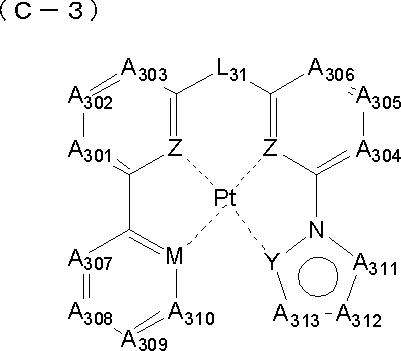
(式中、A301~A313は、それぞれ独立に、C-R又は窒素原子を表す。Rは水素原子又は置換基を表す。L31は単結合又は二価の連結基を表す。Y,Z、Mは、それぞれ独立に炭素原子又は窒素原子を表し、ZとYのいずれか一方が、窒素原子である。)
一般式(C-3)について説明する。
L31は一般式(C-2)におけるL21と同義であり、また好ましい範囲も同様である。
L31は一般式(C-2)におけるL21と同義であり、また好ましい範囲も同様である。
A301~A306はそれぞれ独立にC-R又は窒素原子を表す。Rは水素原子又は置換基を表す。Rで表される置換基としては、前記置換基群Aとして挙げたものが適用できる。
A301~A306として好ましくはC-Rであり、R同士が互いに連結して環を形成していても良い。A301~A306がC-Rである場合に、A302、A305のRとして好ましくは水素原子、アルキル基、トリフルオロアルキル基、アリール基、へテロ環基、ジアルキルアミノ基、ジアリールアミノ基、アルコキシ基、アリールオキシ基、シリル基、シアノ基、又はハロゲン原子であり、水素原子、アルキル基、トリフルオロアルキル基、アリール基、へテロ環基、ジアリールアミノ基、アルコキシ基、シアノ基、又はハロゲン原子がより好ましく、水素原子、アルキル基、アルコキシ基、又はシアノ基が更に好ましく、水素原子が特に好ましい。該アルキル基、及びアリール基は更に置換基を有しても良く、該置換基としてはアルキル基、アリール基、シアノ基、アミノ基、ハロゲン原子、フルオロアルキル基が挙げられ、好ましくは炭素数1~6のアルキル基、シアノ基、アミノ基、ハロゲン原子、フルオロアルキル基(好ましくはトリフルオロメチル基)であり、更に好ましくは炭素数1~6のアルキル基、ハロゲン原子(好ましくはフッ素原子)である。A302、A305がC-Rである場合、該A302、A305のRとしては、素子の耐久性向上の観点からはアリール基が好ましく、発光波長が短いという観点では水素原子、アルキル基、アミノ基、アルコキシ基、フッ素原子、シアノ基が好ましい。
A301、A303、A304、A306のRとして好ましくは水素原子、アルキル基、アリール基、アミノ基、アルコキシ基、アリールオキシ基、フッ素原子、シアノ基であり、より好ましくは水素原子、アミノ基、アルコキシ基、アリールオキシ基、フッ素原子であり、特に好ましくは水素原子である。
A301~A306として好ましくはC-Rであり、R同士が互いに連結して環を形成していても良い。A301~A306がC-Rである場合に、A302、A305のRとして好ましくは水素原子、アルキル基、トリフルオロアルキル基、アリール基、へテロ環基、ジアルキルアミノ基、ジアリールアミノ基、アルコキシ基、アリールオキシ基、シリル基、シアノ基、又はハロゲン原子であり、水素原子、アルキル基、トリフルオロアルキル基、アリール基、へテロ環基、ジアリールアミノ基、アルコキシ基、シアノ基、又はハロゲン原子がより好ましく、水素原子、アルキル基、アルコキシ基、又はシアノ基が更に好ましく、水素原子が特に好ましい。該アルキル基、及びアリール基は更に置換基を有しても良く、該置換基としてはアルキル基、アリール基、シアノ基、アミノ基、ハロゲン原子、フルオロアルキル基が挙げられ、好ましくは炭素数1~6のアルキル基、シアノ基、アミノ基、ハロゲン原子、フルオロアルキル基(好ましくはトリフルオロメチル基)であり、更に好ましくは炭素数1~6のアルキル基、ハロゲン原子(好ましくはフッ素原子)である。A302、A305がC-Rである場合、該A302、A305のRとしては、素子の耐久性向上の観点からはアリール基が好ましく、発光波長が短いという観点では水素原子、アルキル基、アミノ基、アルコキシ基、フッ素原子、シアノ基が好ましい。
A301、A303、A304、A306のRとして好ましくは水素原子、アルキル基、アリール基、アミノ基、アルコキシ基、アリールオキシ基、フッ素原子、シアノ基であり、より好ましくは水素原子、アミノ基、アルコキシ基、アリールオキシ基、フッ素原子であり、特に好ましくは水素原子である。
A307、A308、A309及びA310は、それぞれ独立に、C-R又は窒素原子を表す。Rは水素原子又は置換基を表す。Rで表される置換基としては、前記置換基群Aとして挙げたものが適用できる。A307、A308、A309及びA310がC-Rである場合に、Rとして好ましくは水素原子、アルキル基、トリフルオロアルキル基、アリール基、芳香族へテロ環基、ジアルキルアミノ基、ジアリールアミノ基、アルキルオキシ基、シアノ基、ハロゲン原子であり、より好ましくは、水素原子、アルキル基、トリフルオロアルキル基、アリール基、ジアルキルアミノ基、シアノ基、フッ素原子、更に好ましくは、水素原子、アルキル基、トリフルオロメチル基、フッ素原子である。また可能な場合は置換基同士が連結して縮環構造を形成してもよい。発光波長を短波長側にシフトさせる場合、A308が窒素原子であることが好ましい。
一般式(C-3)において2つの炭素原子とA307、A308、A309及びA310から形成される6員環としては、ベンゼン環、ピリジン環、ピラジン環、ピリミジン環、ピリダジン環、トリアジン環が挙げられ、より好ましくは、ベンゼン環、ピリジン環、ピラジン環、ピリミジン環、ピリダジン環であり、特に好ましくはベンゼン環、ピリジン環である。前記6員環が、ピリジン環、ピラジン環、ピリミジン環、ピリダジン環(特に好ましくはピリジン環)であることにより、ベンゼン環と比較して、金属-炭素結合を形成する位置に存在する水素原子の酸性度が向上する為、より金属錯体を形成しやすくなる点で有利である。
A311、A312及びA313は、それぞれ独立に、C-R又は窒素原子を表す。Rは水素原子又は置換基を表す。Rで表される置換基としては、前記置換基群Aとして挙げたものが適用できる。A311、A312及びA313がC-Rである場合に、Rとして好ましくは水素原子、アルキル基、トリフルオロアルキル基、アリール基、へテロ環基、ジアルキルアミノ基、ジアリールアミノ基、アルコキシ基、アリールオキシ基、シアノ基、ハロゲン原子であり、より好ましくは、水素原子、アルキル基、トリフルオロアルキル基、アリール基、ジアルキルアミノ基、シアノ基、フッ素原子、更に好ましくは、水素原子、アルキル基、トリフルオロメチル基、フッ素原子である。また可能な場合は置換基同士が連結して、縮環構造を形成してもよい。
A311、A312及びA313のうち少なくとも一つは窒素原子であることが好ましく、特にA311が窒素原子であることが好ましい。
A311、A312及びA313のうち少なくとも一つは窒素原子であることが好ましく、特にA311が窒素原子であることが好ましい。
一般式(C-3)で表される白金錯体のうち、より好ましい態様の一つは下記一般式(C-3-1)で表される白金錯体である。

(一般式(C-3-1)中、X、Y、Z、Mは、それぞれ独立に、炭素原子又は窒素原子を表す。ただし、ZとYのいずれか一方は窒素原子である。Yが窒素原子のときは、Xは炭素原子である。m、n、p、及びqは、それぞれ独立に、0~3の整数を表す。Arは置換又は無置換のアリール基を表す。R1~R3及びR30は、それぞれ独立に、アルキル基、アリール基、アルコキシ基、アリールオキシ基、フッ素原子、シアノ基、シリル基、ヘテロ環基を表す。m、n、p、qが2以上の場合、複数のR1、R2、R3及びR30は各々隣同士が互いに連結して環状構造を形成してもよい。Qは、炭素原子又は窒素原子である。)
一般式(C-3-1)中、X,Y,Zは、炭素原子又は窒素原子を表し、ZとYのいずれか一方が、窒素原子であり、Yが窒素原子のときは、Xは炭素原子である。好ましくは、Zが炭素原子、Yが窒素原子、Xが炭素原子である。
m、n、pは、それぞれ独立に0~3の整数を表す。これらの中でも、mは0~2が好ましく、0~1がより好ましい。nは0~2が好ましく、0~1がより好ましい。pは0~2が好ましく、0~1がより好ましい。
m、n、pは、それぞれ独立に0~3の整数を表す。これらの中でも、mは0~2が好ましく、0~1がより好ましい。nは0~2が好ましく、0~1がより好ましい。pは0~2が好ましく、0~1がより好ましい。
R1~R3は、それぞれ独立に、アルキル基、アリール基、アルコキシ基、アリールオキシ基、フッ素原子、シアノ基、シリル基、又はヘテロ環基を表す。
前記アルキル基としては、炭素数1~20の置換又は無置換のアルキル基を表し、直鎖、分岐、環状いずれの構造であってもよい。前記アルキル基としては、炭素数1~12が好ましく、具体的には、例えば、メチル基、ブチル基、ペンチル基、ヘキシル基、オクチル基、デシル基、ドデシル基、n-ブチル基、t-ブチル基、t-アミル基、s-ブチル基などが挙げられる。
前記アリール基としては、炭素数6~10の置換又は無置換のアリール基を表し、縮環していてもよく、例えば、フェニル基、トルイル基、ナフチル基などが挙げられる。
前記アルコキシ基としては、炭素数1~20の置換又は無置換のアルコキシ基を表し、直鎖、分岐、環状いずれの構造であってもよい。前記アルコキシ基としては、炭素数1~12が好ましく、具体的には、例えば、メトキシ基、オクチルオキシ基、デシルオキシ基、ドデシルオキシ基、s-オクチルオキシ基、ベンジルオキシ基などが挙げられる。
前記アリールオキシ基としては、炭素数6~10の置換又は無置換のアリールオキシ基を表し、縮環していてもよく、フェニルオキシ基、トルイルオキシ基、ナフチルオキシ基などが挙げられる。
前記シリル基としては、炭素数3~24の炭化水素基で置換されたシリル基を表し、トリアルキルシリル基、アリールジアルキルシリル基、アルキルジアリールシリル基、トリアリールシリル基のいずれであってもよい。前記シリル基としては、炭素数3~18が好ましく、具体的には、例えば、トリメチルシリル基、t-ブチルジメチルシリル基、トリフェニルシリル基、t-ブチルジフェニルシリル基などが挙げられる。
前記へテロ環基としては、ピリジン環、ピリミジン環、ピラジン環、ピリダジン環、トリアジン環、イミダゾール環、ピラゾール環、オキサゾール環、チアゾール環、トリアゾール環、オキサジアゾール環、チアジアゾール環、チオフェン環、フラン環などが挙げられる。
また、R1及びR2としては、アルキル基、アリール基、フッ素原子、シアノ基又はシリル基であることが好ましく、アルキル基又はアリール基であることがより好ましく、フェニル基であることが好ましい。
R3は、アルキル基又はアリール基であることが好ましく、メチル基、トリフルオロメチル基、フェニル基がより好ましく、メチル基、トリフルオロメチル基が更に好ましい。
前記アルキル基としては、炭素数1~20の置換又は無置換のアルキル基を表し、直鎖、分岐、環状いずれの構造であってもよい。前記アルキル基としては、炭素数1~12が好ましく、具体的には、例えば、メチル基、ブチル基、ペンチル基、ヘキシル基、オクチル基、デシル基、ドデシル基、n-ブチル基、t-ブチル基、t-アミル基、s-ブチル基などが挙げられる。
前記アリール基としては、炭素数6~10の置換又は無置換のアリール基を表し、縮環していてもよく、例えば、フェニル基、トルイル基、ナフチル基などが挙げられる。
前記アルコキシ基としては、炭素数1~20の置換又は無置換のアルコキシ基を表し、直鎖、分岐、環状いずれの構造であってもよい。前記アルコキシ基としては、炭素数1~12が好ましく、具体的には、例えば、メトキシ基、オクチルオキシ基、デシルオキシ基、ドデシルオキシ基、s-オクチルオキシ基、ベンジルオキシ基などが挙げられる。
前記アリールオキシ基としては、炭素数6~10の置換又は無置換のアリールオキシ基を表し、縮環していてもよく、フェニルオキシ基、トルイルオキシ基、ナフチルオキシ基などが挙げられる。
前記シリル基としては、炭素数3~24の炭化水素基で置換されたシリル基を表し、トリアルキルシリル基、アリールジアルキルシリル基、アルキルジアリールシリル基、トリアリールシリル基のいずれであってもよい。前記シリル基としては、炭素数3~18が好ましく、具体的には、例えば、トリメチルシリル基、t-ブチルジメチルシリル基、トリフェニルシリル基、t-ブチルジフェニルシリル基などが挙げられる。
前記へテロ環基としては、ピリジン環、ピリミジン環、ピラジン環、ピリダジン環、トリアジン環、イミダゾール環、ピラゾール環、オキサゾール環、チアゾール環、トリアゾール環、オキサジアゾール環、チアジアゾール環、チオフェン環、フラン環などが挙げられる。
また、R1及びR2としては、アルキル基、アリール基、フッ素原子、シアノ基又はシリル基であることが好ましく、アルキル基又はアリール基であることがより好ましく、フェニル基であることが好ましい。
R3は、アルキル基又はアリール基であることが好ましく、メチル基、トリフルオロメチル基、フェニル基がより好ましく、メチル基、トリフルオロメチル基が更に好ましい。
Arが表すアリール基としては、フェニル基、ナフチル基を挙げることができ、フェニル基であることが好ましい。Arが表すアリール基は更に置換基を有しても良く、該置換基としてはアルキル基、アリール基、シアノ基、アミノ基、フッ素原子、フルオロアルキル基が挙げられ、好ましくは炭素数1~6のアルキル基、シアノ基、アミノ基、フッ素原子、フルオロアルキル基(好ましくはトリフルオロメチル基)であり、更に好ましくは炭素数1~6のアルキル基、フッ素原子である。Arとしてより好ましくは、置換基を有するフェニル基であり、該置換基としては、メチル基、t-ブチル基、4-ペンチル-シクロヘキシル基、4-ペンチル-シクロヘキシルメトキシ基などが好ましい。
m、n、pが2以上の場合、複数のR1~R3は各々隣同士で互いに連結して環状構造を形成してもよい。
M、Qとしては、それぞれ独立に炭素原子又は窒素原子である。
qは、0~3の整数を表し、0~2の整数が好ましい。
m、n、pが2以上の場合、複数のR1~R3は各々隣同士で互いに連結して環状構造を形成してもよい。
M、Qとしては、それぞれ独立に炭素原子又は窒素原子である。
qは、0~3の整数を表し、0~2の整数が好ましい。
R30は、アルキル基、アリール基、アルコキシ基、アリールオキシ基、フッ素原子、シアノ基、シリル基、ヘテロ環基を表す。
前記アルキル基としては、炭素数1~20の置換又は無置換のアルキル基を表し、直鎖、分岐、環状いずれの構造であってもよい。前記アルキル基としては、炭素数1~12が好ましく、具体的には、例えば、メチル基、オクチル基、デシル基、ドデシル基、n-ブチル基、t-ブチル基、t-アミル基、s-ブチル基などが挙げられる。
前記アリール基としては、炭素数6~10の置換又は無置換のアリール基を表し、縮環していてもよく、例えば、フェニル基、トルイル基、ナフチル基などが挙げられる。
前記アルコキシ基としては、炭素数1~20の置換又は無置換のアルコキシ基を表し、直鎖、分岐、環状いずれの構造であってもよい。前記アルコキシ基としては、炭素数1~12が好ましく、具体的には、例えば、メトキシ基、オクチルオキシ基、デシルオキシ基、ドデシルオキシ基、s-オクチルオキシ基、ベンジルオキシ基などが挙げられる。
前記アリールオキシ基としては、炭素数6~10の置換又は無置換のアリールオキシ基を表し、縮環していてもよく、具体的には、フェニルオキシ基、トルイルオキシ基、ナフチルオキシ基などが挙げられる。
前記シリル基は、炭素数3~24の炭素原子で置換されたシリル基を表し、トリアルキルシリル基、アリールジアルキルシリル基、アルキルジアリールシリル基、トリアリールシリル基のいずれであってもよい。前記シリル基としては、炭素数3~18が好ましく、具体的には、例えば、トリメチルシリル基、t-ブチルジメチルシリル基、トリフェニルシリル基、t-ブチルジフェニルシリル基などが挙げられる。
前記へテロ環基としては、ピリジン環、ピリミジン環、ピラジン環、ピリダジン環、トリアジン環、イミダゾール環、ピラゾール環、オキサゾール環、チアゾール環、トリアゾール環、オキサジアゾール環、チアジアゾール環、チオフェン環、フラン環などが挙げられる。
R30としては、フッ素原子が好ましい。
前記アルキル基としては、炭素数1~20の置換又は無置換のアルキル基を表し、直鎖、分岐、環状いずれの構造であってもよい。前記アルキル基としては、炭素数1~12が好ましく、具体的には、例えば、メチル基、オクチル基、デシル基、ドデシル基、n-ブチル基、t-ブチル基、t-アミル基、s-ブチル基などが挙げられる。
前記アリール基としては、炭素数6~10の置換又は無置換のアリール基を表し、縮環していてもよく、例えば、フェニル基、トルイル基、ナフチル基などが挙げられる。
前記アルコキシ基としては、炭素数1~20の置換又は無置換のアルコキシ基を表し、直鎖、分岐、環状いずれの構造であってもよい。前記アルコキシ基としては、炭素数1~12が好ましく、具体的には、例えば、メトキシ基、オクチルオキシ基、デシルオキシ基、ドデシルオキシ基、s-オクチルオキシ基、ベンジルオキシ基などが挙げられる。
前記アリールオキシ基としては、炭素数6~10の置換又は無置換のアリールオキシ基を表し、縮環していてもよく、具体的には、フェニルオキシ基、トルイルオキシ基、ナフチルオキシ基などが挙げられる。
前記シリル基は、炭素数3~24の炭素原子で置換されたシリル基を表し、トリアルキルシリル基、アリールジアルキルシリル基、アルキルジアリールシリル基、トリアリールシリル基のいずれであってもよい。前記シリル基としては、炭素数3~18が好ましく、具体的には、例えば、トリメチルシリル基、t-ブチルジメチルシリル基、トリフェニルシリル基、t-ブチルジフェニルシリル基などが挙げられる。
前記へテロ環基としては、ピリジン環、ピリミジン環、ピラジン環、ピリダジン環、トリアジン環、イミダゾール環、ピラゾール環、オキサゾール環、チアゾール環、トリアゾール環、オキサジアゾール環、チアジアゾール環、チオフェン環、フラン環などが挙げられる。
R30としては、フッ素原子が好ましい。
一般式(C-2)で表される白金錯体のうち、より好ましい態様の一つは下記一般式(C-4)で表される白金錯体である。

(一般式(C-4)中、A401~A414はそれぞれ独立にC-R又は窒素原子を表す。Rは水素原子又は置換基を表す。L41は単結合又は二価の連結基を表す。)
一般式(C-4)について説明する。
A401~A414はそれぞれ独立にC-R又は窒素原子を表す。Rは水素原子又は置換基を表す。
又はRで表される置換基としては、前記置換基群Aとして挙げたものが適用できる。
A401~A406として好ましくはC-Rであり、R同士が互いに連結して環を形成していても良い。A401~A406がC-Rである場合に、A402、A405のRとして好ましくは水素原子、アルキル基、アリール基、アミノ基、アルコキシ基、アリールオキシ基、フッ素原子、シアノ基であり、より好ましくは水素原子、アミノ基、アルコキシ基、アリールオキシ基、フッ素原子であり、特に好ましくは水素原子、フッ素原子、アルキル基である。A401、A403、A404、A406のRとして好ましくは水素原子、アルキル基、アリール基、アミノ基、アルコキシ基、アリールオキシ基、フッ素原子、シアノ基であり、より好ましくは水素原子、アミノ基、アルコキシ基、アリールオキシ基、フッ素原子であり、特に好ましく水素原子である。
L41は、前記一般式(C-2)におけるL21と同義であり、また好ましい範囲も同様である。
A401~A414はそれぞれ独立にC-R又は窒素原子を表す。Rは水素原子又は置換基を表す。
又はRで表される置換基としては、前記置換基群Aとして挙げたものが適用できる。
A401~A406として好ましくはC-Rであり、R同士が互いに連結して環を形成していても良い。A401~A406がC-Rである場合に、A402、A405のRとして好ましくは水素原子、アルキル基、アリール基、アミノ基、アルコキシ基、アリールオキシ基、フッ素原子、シアノ基であり、より好ましくは水素原子、アミノ基、アルコキシ基、アリールオキシ基、フッ素原子であり、特に好ましくは水素原子、フッ素原子、アルキル基である。A401、A403、A404、A406のRとして好ましくは水素原子、アルキル基、アリール基、アミノ基、アルコキシ基、アリールオキシ基、フッ素原子、シアノ基であり、より好ましくは水素原子、アミノ基、アルコキシ基、アリールオキシ基、フッ素原子であり、特に好ましく水素原子である。
L41は、前記一般式(C-2)におけるL21と同義であり、また好ましい範囲も同様である。
A407~A414としては、A407~A410とA411~A414のそれぞれにおいて、N(窒素原子)の数は、0~2が好ましく、0~1がより好ましい。発光波長を短波長側にシフトさせる場合、A408及びA412のいずれかが窒素原子であることが好ましく、A408とA412が共に窒素原子であることが更に好ましい。
A407~A414がC-Rを表す場合に、A408、A412のRとして好ましくは水素原子、アルキル基、トリフルオロアルキル基、アリール基、アミノ基、アルコキシ基、アリールオキシ基、フッ素原子、シアノ基であり、より好ましくは水素原子、トリフルオロアルキル基、アルキル基、アリール基、フッ素原子、シアノ基であり、特に好ましくは、水素原子、フェニル基、トリフルオロアルキル基、シアノ基である。A407、A409、A411、A413のRとして好ましくは水素原子、アルキル基、トリフルオロアルキル基、アリール基、アミノ基、アルコキシ基、アリールオキシ基、フッ素原子、シアノ基であり、より好ましくは水素原子、トリフルオロアルキル基、フッ素原子、シアノ基であり、特に好ましく水素原子、フェニル基、フッ素原子である。A410、A414のRとして好ましくは水素原子、フッ素原子であり、より好ましくは水素原子である。A407~A409、A411~A413のいずれかがC-Rを表す場合に、R同士が互いに連結して環を形成していても良く、形成される環としては例えばベンゼン環が挙げられる。
A407~A414がC-Rを表す場合に、A408、A412のRとして好ましくは水素原子、アルキル基、トリフルオロアルキル基、アリール基、アミノ基、アルコキシ基、アリールオキシ基、フッ素原子、シアノ基であり、より好ましくは水素原子、トリフルオロアルキル基、アルキル基、アリール基、フッ素原子、シアノ基であり、特に好ましくは、水素原子、フェニル基、トリフルオロアルキル基、シアノ基である。A407、A409、A411、A413のRとして好ましくは水素原子、アルキル基、トリフルオロアルキル基、アリール基、アミノ基、アルコキシ基、アリールオキシ基、フッ素原子、シアノ基であり、より好ましくは水素原子、トリフルオロアルキル基、フッ素原子、シアノ基であり、特に好ましく水素原子、フェニル基、フッ素原子である。A410、A414のRとして好ましくは水素原子、フッ素原子であり、より好ましくは水素原子である。A407~A409、A411~A413のいずれかがC-Rを表す場合に、R同士が互いに連結して環を形成していても良く、形成される環としては例えばベンゼン環が挙げられる。
一般式(C-2)で表される白金錯体のうち、より好ましい態様の一つは下記一般式(C-5)で表される白金錯体である。

(一般式(C-5)中、A501~A512は、それぞれ独立に、C-R又は窒素原子を表す。Rは水素原子又は置換基を表す。L51は単結合又は二価の連結基を表す。Y及びZはそれぞれ独立に、炭素原子又は窒素原子を表し、少なくとも一方が、窒素原子である。)
一般式(C-5)について説明する。A501~A506及びL51は、前記一般式(C-4)におけるA401~A406及びL41と同義であり、好ましい範囲も同様である。
A507、A508、A509、A510、A511及びA512は、それぞれ独立に、C-R又は窒素原子を表す。Rは水素原子又は置換基を表す。Rで表される置換基としては、前記置換基群Aとして挙げたものが適用できる。A507、A508、A509、A510、A511及びA512がC-Rである場合に、Rとして好ましくは水素原子、アルキル基、トリフルオロアルキル基、アリール基、芳香族へテロ環基、ジアルキルアミノ基、ジアリールアミノ基、アルキルオキシ基、シアノ基、ハロゲン原子であり、より好ましくは、水素原子、アルキル基、トリフルオロアルキル基、アリール基、ジアルキルアミノ基、シアノ基、フッ素原子、更に好ましくは、水素原子、アルキル基、トリフルオロメチル基、フッ素原子である。また可能な場合は置換基同士が連結して、縮環構造を形成してもよい。A507、A508、及びA509のうちの少なくとも一つ、A510、A511及びA512のうち少なくとも一つは窒素原子である態様も好ましく、この態様の場合にはA510又はA507が窒素原子であることが好ましい。
一般式(C-5)で表される白金錯体のうち、より好ましい態様の一つは下記一般式(C-5-1)で表される白金錯体である。
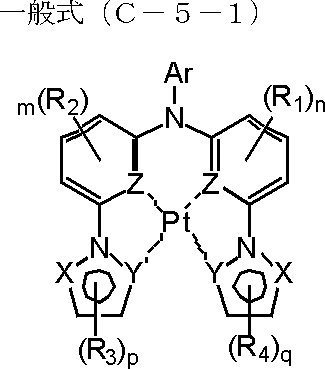
(一般式(C-5-1)中、X、Y、及びZはそれぞれ独立に、炭素原子又は窒素原子を表し、ZとYのいずれか一方が、窒素原子であり、Yが窒素原子のときは、Xは、炭素原子である。m、n、p及び、qは、それぞれ独立に0~3の整数を表す。Arは置換又は無置換のアリール基を表す。R1~R4はそれぞれ独立に、アルキル基、アリール基、アルコキシ基、アリールオキシ基、フッ素原子、シアノ基、シリル基、ヘテロ環基を表し、m、n、p、及びqが2以上の場合、複数のR1~R4は各々隣同士で互いに連結して環状構造を形成してもよい。)
一般式(C-5-1)中、X,Y,Zは、炭素原子又は窒素原子を表し、ZとYのいずれか一方が、窒素原子であり、Yが窒素原子のときは、Xは炭素原子である。好ましくは、Zが炭素原子、Yが窒素原子、Xが炭素原子である。
m、n、p、qは、それぞれ独立に0~3の整数を表す。これらの中でも、mは0~2が好ましく、0~1がより好ましい。nは0~2が好ましく、0~1がより好ましい。pは0~2が好ましく、0~1がより好ましい。qは0~2が好ましく、0~1がより好ましい。
m、n、p、qは、それぞれ独立に0~3の整数を表す。これらの中でも、mは0~2が好ましく、0~1がより好ましい。nは0~2が好ましく、0~1がより好ましい。pは0~2が好ましく、0~1がより好ましい。qは0~2が好ましく、0~1がより好ましい。
R1~R4は、それぞれ独立に、アルキル基、アリール基、アルコキシ基、アリールオキシ基、フッ素原子、シアノ基、シリル基、又はヘテロ環基を表す。
前記アルキル基としては、炭素数1~20の置換又は無置換のアルキル基を表し、直鎖、分岐、環状いずれの構造であってもよい。前記アルキル基としては、炭素数1~12が好ましく、具体的には、例えば、メチル基、ブチル基、ペンチル基、ヘキシル基、オクチル基、デシル基、ドデシル基、n-ブチル基、t-ブチル基、t-アミル基、s-ブチル基などが挙げられる。
前記アリール基としては、炭素数6~10の置換又は無置換のアリール基を表し、縮環していてもよく、例えば、フェニル基、トルイル基、ナフチル基などが挙げられる。
前記アルコキシ基としては、炭素数1~20の置換又は無置換のアルコキシ基を表し、直鎖、分岐、環状いずれの構造であってもよい。前記アルコキシ基としては、炭素数1~12が好ましく、具体的には、例えば、メトキシ基、オクチルオキシ基、デシルオキシ基、ドデシルオキシ基、s-オクチルオキシ基、ベンジルオキシ基などが挙げられる。
前記アリールオキシ基としては、炭素数6~10の置換又は無置換のアリールオキシ基を表し、縮環していてもよく、フェニルオキシ基、トルイルオキシ基、ナフチルオキシ基などが挙げられる。
前記シリル基としては、炭素数3~24の炭化水素基で置換されたシリル基を表し、トリアルキルシリル基、アリールジアルキルシリル基、アルキルジアリールシリル基、トリアリールシリル基のいずれであってもよい。前記シリル基としては、炭素数3~18が好ましく、具体的には、例えば、トリメチルシリル基、t-ブチルジメチルシリル基、トリフェニルシリル基、t-ブチルジフェニルシリル基などが挙げられる。
前記へテロ環基としては、ピリジン環、ピリミジン環、ピラジン環、ピリダジン環、トリアジン環、イミダゾール環、ピラゾール環、オキサゾール環、チアゾール環、トリアゾール環、オキサジアゾール環、チアジアゾール環、チオフェン環、フラン環などが挙げられる。
また、R1及びR2としては、アルキル基、アリール基、フッ素原子、シアノ基又はシリル基であることが好ましく、アルキル基又はアリール基であることがより好ましく、フェニル基であることが好ましい。
R3及びR4は、アルキル基又はアリール基であることが好ましく、メチル基、トリフルオロメチル基、フェニル基がより好ましく、メチル基、トリフルオロメチル基が更に好ましい。
前記アルキル基としては、炭素数1~20の置換又は無置換のアルキル基を表し、直鎖、分岐、環状いずれの構造であってもよい。前記アルキル基としては、炭素数1~12が好ましく、具体的には、例えば、メチル基、ブチル基、ペンチル基、ヘキシル基、オクチル基、デシル基、ドデシル基、n-ブチル基、t-ブチル基、t-アミル基、s-ブチル基などが挙げられる。
前記アリール基としては、炭素数6~10の置換又は無置換のアリール基を表し、縮環していてもよく、例えば、フェニル基、トルイル基、ナフチル基などが挙げられる。
前記アルコキシ基としては、炭素数1~20の置換又は無置換のアルコキシ基を表し、直鎖、分岐、環状いずれの構造であってもよい。前記アルコキシ基としては、炭素数1~12が好ましく、具体的には、例えば、メトキシ基、オクチルオキシ基、デシルオキシ基、ドデシルオキシ基、s-オクチルオキシ基、ベンジルオキシ基などが挙げられる。
前記アリールオキシ基としては、炭素数6~10の置換又は無置換のアリールオキシ基を表し、縮環していてもよく、フェニルオキシ基、トルイルオキシ基、ナフチルオキシ基などが挙げられる。
前記シリル基としては、炭素数3~24の炭化水素基で置換されたシリル基を表し、トリアルキルシリル基、アリールジアルキルシリル基、アルキルジアリールシリル基、トリアリールシリル基のいずれであってもよい。前記シリル基としては、炭素数3~18が好ましく、具体的には、例えば、トリメチルシリル基、t-ブチルジメチルシリル基、トリフェニルシリル基、t-ブチルジフェニルシリル基などが挙げられる。
前記へテロ環基としては、ピリジン環、ピリミジン環、ピラジン環、ピリダジン環、トリアジン環、イミダゾール環、ピラゾール環、オキサゾール環、チアゾール環、トリアゾール環、オキサジアゾール環、チアジアゾール環、チオフェン環、フラン環などが挙げられる。
また、R1及びR2としては、アルキル基、アリール基、フッ素原子、シアノ基又はシリル基であることが好ましく、アルキル基又はアリール基であることがより好ましく、フェニル基であることが好ましい。
R3及びR4は、アルキル基又はアリール基であることが好ましく、メチル基、トリフルオロメチル基、フェニル基がより好ましく、メチル基、トリフルオロメチル基が更に好ましい。
Arが表すアリール基としては、フェニル基、ナフチル基を挙げることができ、フェニル基であることが好ましい。Arが表すアリール基は更に置換基を有しても良く、該置換基としてはアルキル基、アリール基、シアノ基、アミノ基、フッ素原子、フルオロアルキル基が挙げられ、好ましくは炭素数1~6のアルキル基、シアノ基、アミノ基、フッ素原子、フルオロアルキル基(好ましくはトリフルオロメチル基)であり、更に好ましくは炭素数1~6のアルキル基、フッ素原子)である。Arとしてより好ましくは、置換基を有するフェニル基であり、該置換基としては、メチル基、t-ブチル基、4-ペンチル-シクロヘキシル基、4-ペンチル-シクロヘキシルメトキシ基などが好ましい。
m、n、p、q、が2以上の場合、複数のR1~R4は各々隣同士で互いに連結して環状構造を形成してもよい。
m、n、p、q、が2以上の場合、複数のR1~R4は各々隣同士で互いに連結して環状構造を形成してもよい。
一般式(C-2)で表される白金錯体のうち、より好ましい態様の一つは下記一般式(C-6)で表される白金錯体である。

(一般式(C-6)中、X,Y,Zは、炭素原子又は窒素原子を表し、ZとYのいずれか一方が窒素原子である。Yが窒素原子のときは、Xは炭素原子である。r、s、t、uは、それぞれ独立に0~3の整数を表す。R5~R8は、それぞれ独立に、アルキル基、アリール基、アルコキシ基、アリールオキシ基、フッ素原子、シアノ基、シリル基、又はヘテロ環基を表し、r、s、t、uが2以上の場合、複数のR5~R8は各々隣同士で互いに連結して環状構造を形成してもよい。W1とW2は、各々独立にアルキル基を表し、互いに結合して環状構造を形成してもよい。)
一般式(C-6)中、X,Y,Zは、一般式(C-5-1)のX,Y,Zと同義であり、好ましい範囲も同じである。
R5~R8は、一般式(C-5-1)のR1~R4と同義である。
R5及びR6としては、アルキル基、アルコキシ基、アリール基、フッ素原子、シアノ基が好ましい。
R5及びR6が表すアルキル基としては、置換基を有してもよい、メチル基、ブチル基、オクチル基、デシル基、ドデシル基などが好ましく、ブチル基、トリフルオロメチル基、オクチル基、デシル基がより好ましい。
R5及びR6が表すアルコキシ基としては、デシルオキシ基が好ましい。
R5及びR6が表すアリール基としては、置換基を有してもよいフェニル基が好ましく、該置換基としては、アルキル基が好ましく、プロピル基、ブチル基がより好ましい。
R7及びR8は、アルキル基又はアリール基であることが好ましい。
R5及びR6としては、アルキル基、アルコキシ基、アリール基、フッ素原子、シアノ基が好ましい。
R5及びR6が表すアルキル基としては、置換基を有してもよい、メチル基、ブチル基、オクチル基、デシル基、ドデシル基などが好ましく、ブチル基、トリフルオロメチル基、オクチル基、デシル基がより好ましい。
R5及びR6が表すアルコキシ基としては、デシルオキシ基が好ましい。
R5及びR6が表すアリール基としては、置換基を有してもよいフェニル基が好ましく、該置換基としては、アルキル基が好ましく、プロピル基、ブチル基がより好ましい。
R7及びR8は、アルキル基又はアリール基であることが好ましい。
r、s、t、u、は、それぞれ独立に0~3の整数を表す。これらの中でも、rは0~2が好ましく、0又は1がより好ましい。sは0~2が好ましく、0又は1がより好ましい。tは0又は1が好ましく、uは0又は1が好ましい。
r、s、t、u、が2以上の場合、複数のR5~R8は各々隣同士で互いに連結して環状構造を形成してもよい。該環状構造としては、ベンゼン環、ベンゾフラン環、及びZを有する6員環とともにフルオレン環などを形成する構造が挙げられる。
r、s、t、u、が2以上の場合、複数のR5~R8は各々隣同士で互いに連結して環状構造を形成してもよい。該環状構造としては、ベンゼン環、ベンゾフラン環、及びZを有する6員環とともにフルオレン環などを形成する構造が挙げられる。
W1とW2としては、炭素数1~10のアルキル基を表し、互いに結合して環状構造を形成してもよい。
W1とW2が表すアルキル基としては、例えば、メチル基、エチル基、n-プロピル基、n-ブチル基、ペンチル基などが挙げられる。
また、W1とW2が結合して形成する環状構造としては、シクロヘキシル環状構造が挙げられる。
W1とW2としては、高アスペクト比の観点でメチル基であるか、互いに結合してシクロヘキシル環状構造を形成することが好ましい。
W1とW2が表すアルキル基としては、例えば、メチル基、エチル基、n-プロピル基、n-ブチル基、ペンチル基などが挙げられる。
また、W1とW2が結合して形成する環状構造としては、シクロヘキシル環状構造が挙げられる。
W1とW2としては、高アスペクト比の観点でメチル基であるか、互いに結合してシクロヘキシル環状構造を形成することが好ましい。
一般式(C-1)で表される白金錯体のうち、より好ましい別の態様は下記一般式(C-7)で表される白金錯体である。

(式中、L61は単結合又は二価の連結基を表す。A61は炭素原子又は窒素原子を表す。Z61、Z62は、それぞれ独立に、含窒素芳香族ヘテロ環を表す。Z63はベンゼン環又は芳香族ヘテロ環を表す。QはPtに結合するアニオン性の非環状配位子である。)
一般式(C-7)について説明する。L61は、単結合又は二価の連結基を表し、好ましい範囲は前記一般式(C-1)中のL1と同様である。
A61は炭素原子又は窒素原子を表す。錯体の安定性の観点及び錯体の発光量子収率の観点からA61は炭素原子であることが好ましい。
Z61、Z62は、それぞれ前記一般式(C-2)におけるZ21、Z22と同義であり、また好ましい範囲も同様である。Z63は、前記一般式(C-2)におけるZ23と同義であり、また好ましい範囲も同様である。
QはPtに結合するアニオン性の非環状配位子である。非環状配位子とはPtに結合する原子が配位子の状態で環を形成していないものである。Q中のPtに結合する原子としては、炭素原子、窒素原子、酸素原子、硫黄原子が好ましく、窒素原子、酸素原子がより好ましく、酸素原子が最も好ましい。
炭素原子でPtに結合するQとしてはビニル配位子が挙げられる。窒素原子でPtに結合するQとしてはアミノ配位子、イミノ配位子が挙げられる。酸素原子でPtに結合するQとしては、アルコキシ配位子、アリールオキシ配位子、ヘテロアリールオキシ配位子、アシルオキシ配位子、シリルオキシ配位子、カルボキシル配位子、リン酸配位子、スルホン酸配位子などが挙げられる。硫黄原子でPtに結合するQとしては、アルキルメルカプト配位子、アリールメルカプト配位子、ヘテロアリールメルカプト配位子、チオカルボン酸配位子などが挙げられる。
Qで表される配位子は、置換基を有していてもよく、置換基としては前記置換基群Aとして挙げたものが適宜適用できる。また置換基同士が連結していても良い。
炭素原子でPtに結合するQとしてはビニル配位子が挙げられる。窒素原子でPtに結合するQとしてはアミノ配位子、イミノ配位子が挙げられる。酸素原子でPtに結合するQとしては、アルコキシ配位子、アリールオキシ配位子、ヘテロアリールオキシ配位子、アシルオキシ配位子、シリルオキシ配位子、カルボキシル配位子、リン酸配位子、スルホン酸配位子などが挙げられる。硫黄原子でPtに結合するQとしては、アルキルメルカプト配位子、アリールメルカプト配位子、ヘテロアリールメルカプト配位子、チオカルボン酸配位子などが挙げられる。
Qで表される配位子は、置換基を有していてもよく、置換基としては前記置換基群Aとして挙げたものが適宜適用できる。また置換基同士が連結していても良い。
Qで表される配位子として好ましくは酸素原子でPtに結合する配位子であり、より好ましくはアシルオキシ配位子、アルキルオキシ配位子、アリールオキシ配位子、ヘテロアリールオキシ配位子、シリルオキシ配位子であり、更に好ましくはアシルオキシ配位子である。
一般式(C-7)で表される白金錯体のうち、より好ましい態様の一つは下記一般式(C-8)で表される白金錯体である。
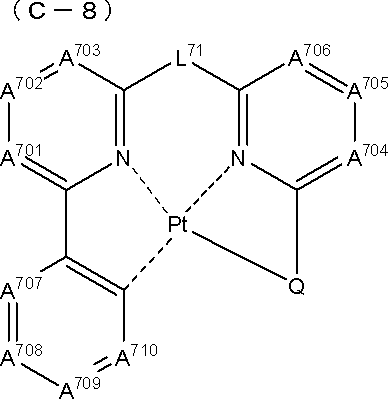
(一般式(C-8)中、A701~A710は、それぞれ独立に、C-R又は窒素原子を表す。Rは水素原子又は置換基を表す。L71は単結合又は二価の連結基を表す。QはPtに結合するアニオン性の非環状配位子である。)
一般式(C-8)について説明する。L71は、前記一般式(C-6)中のL61と同義であり、また好ましい範囲も同様である。A701~A710は一般式(C-4)におけるA401~A410と同義であり、また好ましい範囲も同様である。Qは一般式(C-6)におけるそれと同義であり、また好ましい範囲も同様である。
一般式(C-1)で表される白金錯体のうち、別の好ましい態様の1つとして下記一般式(C-9)で表される白金錯体が挙げられる。

式中、A及びBは、環状構造を表し、Aは芳香環を表し、Bは芳香族ヘテロ環を表す。A及びBの一方が環を形成するとき、他方は環を形成しなくてもよい。R13~R16は、それぞれ独立に、水素原子、アルキル基、アリール基、シリル基、又はヘテロ環基を表し、R14とR15、R13とR16は、互いに結合して環状構造を形成してもよい。
一般式(C-9)について説明する。
Aは芳香環を表す。芳香環としては、芳香族炭化水素環、芳香族ヘテロ環が挙げられ、芳香族炭化水素環が好ましい。Aが表す芳香族炭化水素環としては、ベンゼン環、ナフタレン環が好ましい。Aが表す芳香族ヘテロ環としては、ピリジン環、ピラジン環、ピリミジン環、キノリン環が好ましい。
Bは芳香族ヘテロ環を表す。Bが表す芳香族ヘテロ環としては、ピリジン環、ピリミジン環が好ましい。
A及びBの組合せとしては、Aがベンゼン環でBが非環(環を形成しない)、Aがナフタレン環でBが非環であることが好ましく、Aがベンゼン環かつBがピリジン環、又はAが非環かつBがピリジン環であることより好ましい。
R13~R16は、水素原子、アルキル基、アリール基、シリル基、ヘテロ環基を表し、R14とR15、R13とR16は、互いに結合して環状構造を形成してもよい。
前記アルキル基としては、炭素数1~20の置換又は無置換のアルキル基を表し、直鎖、分岐、環状いずれの構造であってもよい。前記アルキル基としては、炭素数1~12が好ましく、例えばメチル基、ブチル基、ペンチル基、ヘキシル基、オクチル基、デシル基、ドデシル基などが挙げられる。
前記アリール基としては、炭素数6~10の置換又は無置換のアリール基を表し、縮環していてもよく、例えば、フェニル基、トルイル基、ナフチル基などが挙げられる。
前記シリル基としては、炭素数3~24の炭素原子で置換されたシリル基を表し、トリアルキルシリル基、アリールジアルキルシリル基、アルキルジアリールシリル基、トリアリールシリル基のいずれであってもよい。前記シリル基としては、炭素数3~18が好ましく、トリメチルシリル基、t-ブチルジメチルシリル基、トリフェニルシリル基、t-ブチルジフェニルシリル基などが挙げられる。
前記へテロ環基としては、ピリジン環、ピリミジン環、ピラジン環、ピリダジン環、トリアジン環、イミダゾール環、ピラゾール環、オキサゾール環、チアゾール環、トリアゾール環、オキサジアゾール環、チアジアゾール環、チオフェン環、フラン環などが挙げられる。
Aは芳香環を表す。芳香環としては、芳香族炭化水素環、芳香族ヘテロ環が挙げられ、芳香族炭化水素環が好ましい。Aが表す芳香族炭化水素環としては、ベンゼン環、ナフタレン環が好ましい。Aが表す芳香族ヘテロ環としては、ピリジン環、ピラジン環、ピリミジン環、キノリン環が好ましい。
Bは芳香族ヘテロ環を表す。Bが表す芳香族ヘテロ環としては、ピリジン環、ピリミジン環が好ましい。
A及びBの組合せとしては、Aがベンゼン環でBが非環(環を形成しない)、Aがナフタレン環でBが非環であることが好ましく、Aがベンゼン環かつBがピリジン環、又はAが非環かつBがピリジン環であることより好ましい。
R13~R16は、水素原子、アルキル基、アリール基、シリル基、ヘテロ環基を表し、R14とR15、R13とR16は、互いに結合して環状構造を形成してもよい。
前記アルキル基としては、炭素数1~20の置換又は無置換のアルキル基を表し、直鎖、分岐、環状いずれの構造であってもよい。前記アルキル基としては、炭素数1~12が好ましく、例えばメチル基、ブチル基、ペンチル基、ヘキシル基、オクチル基、デシル基、ドデシル基などが挙げられる。
前記アリール基としては、炭素数6~10の置換又は無置換のアリール基を表し、縮環していてもよく、例えば、フェニル基、トルイル基、ナフチル基などが挙げられる。
前記シリル基としては、炭素数3~24の炭素原子で置換されたシリル基を表し、トリアルキルシリル基、アリールジアルキルシリル基、アルキルジアリールシリル基、トリアリールシリル基のいずれであってもよい。前記シリル基としては、炭素数3~18が好ましく、トリメチルシリル基、t-ブチルジメチルシリル基、トリフェニルシリル基、t-ブチルジフェニルシリル基などが挙げられる。
前記へテロ環基としては、ピリジン環、ピリミジン環、ピラジン環、ピリダジン環、トリアジン環、イミダゾール環、ピラゾール環、オキサゾール環、チアゾール環、トリアゾール環、オキサジアゾール環、チアジアゾール環、チオフェン環、フラン環などが挙げられる。
R13、R14、R15、R16は、置換又は無置換のアリール基、又はR13とR16、R14とR15がそれぞれ結合した芳香環であることが好ましい。該芳香環としては、ベンゼン環が挙げられる。該芳香環は更に置換基を有していてもよく、例えば、アルキル基(メチル基、ブチル基、ペンチル基、ヘキシル基、オクチル基、デシル基)、アルコキシ基(メトキシ基、エトキシ基、ブトキシ基など)等が挙げられる。
これらの中でも、アスペクト比及び分子サイズの観点でR13とR16、R14とR15、がそれぞれ結合した芳香環が好ましい。
これらの中でも、アスペクト比及び分子サイズの観点でR13とR16、R14とR15、がそれぞれ結合した芳香環が好ましい。
一般式(C-9)で表される化合物のより好ましい態様としては、下記一般式(C-9-1)の化合物が挙げられる。

式中、Bは、芳香族の6員ヘテロ環を形成してもよい。
R17~R26は、それぞれ独立に、アルキル基、アリール基、アルコキシ基、アリールオキシ基、フッ素原子、シアノ基、シリル基、ヘテロ環基を表し、R17とR18、R18とR19、R19とR20、R21とR22、R22とR23、R23とR24、R25とR26は互いに結合して環状構造を形成してもよい。R17~R26が表す、アルキル基、アリール基、アルコキシ基、アリールオキシ基、シアノ基、シリル基、ヘテロ環基の好ましい例は、R13~R26が表す各基の例と同じである。
R17、R20、R21、R24は、水素原子、アルキル基が好ましい。
R18、R19、R22、R23は、アルキル基、アルコキシ基、アリール基、アリールオキシ基、フッ素原子、シアノ基、シリル基が好ましく、アルキル基、アルコキ基がより好ましく、デシルオキシ基、ドデシルオキシ基が更に好ましい。
R25~R26は、水素原子、アルキル基、フッ素原子、又はR25とR26が結合した芳香環が好ましい。
Bが表す芳香族6員ヘテロ環としては、ピリジン環、ピリミジン環が好ましく、ピリジン環がより好ましい。該環には置換基を有していてもよく、置換基としてはアルキル基(メチル基、ブチル基)、アリール基(フェニル基)が挙げられる。
R17~R26は、それぞれ独立に、アルキル基、アリール基、アルコキシ基、アリールオキシ基、フッ素原子、シアノ基、シリル基、ヘテロ環基を表し、R17とR18、R18とR19、R19とR20、R21とR22、R22とR23、R23とR24、R25とR26は互いに結合して環状構造を形成してもよい。R17~R26が表す、アルキル基、アリール基、アルコキシ基、アリールオキシ基、シアノ基、シリル基、ヘテロ環基の好ましい例は、R13~R26が表す各基の例と同じである。
R17、R20、R21、R24は、水素原子、アルキル基が好ましい。
R18、R19、R22、R23は、アルキル基、アルコキシ基、アリール基、アリールオキシ基、フッ素原子、シアノ基、シリル基が好ましく、アルキル基、アルコキ基がより好ましく、デシルオキシ基、ドデシルオキシ基が更に好ましい。
R25~R26は、水素原子、アルキル基、フッ素原子、又はR25とR26が結合した芳香環が好ましい。
Bが表す芳香族6員ヘテロ環としては、ピリジン環、ピリミジン環が好ましく、ピリジン環がより好ましい。該環には置換基を有していてもよく、置換基としてはアルキル基(メチル基、ブチル基)、アリール基(フェニル基)が挙げられる。
白金錯体は平面性の観点から一般式(C-1)で表される白金錯体が好ましく、一般式(C-2)、(C-7)、及び(C-9)のいずれかで表される白金錯体であることがより好ましく、一般式(C-2)又は(C-9)で表される白金錯体であることが更に好ましい。一般式(C-2)で表される白金錯体は、一般式(C-3)、(C-4)、(C-5)、及び(C-6)のいずれかで表される白金錯体であることが好ましく、一般式(C-3-1)、(C-5-1)、及び(C-6)のいずれかで表される白金錯体であることがより好ましく、一般式(C-5-1)又は(C-6)で表される白金錯体であることが特に好ましい。
一般式(C-1)で表される白金錯体として具体的には、特開2005-310733号公報の〔0143〕~〔0152〕、〔0157〕~〔0158〕、〔0162〕~〔0168〕に記載の化合物、特開2006-256999号公報の〔0065〕~〔0083〕に記載の化合物、特開2006-93542号公報の〔0065〕~〔0090〕に記載の化合物、特開2007-73891号公報の〔0063〕~〔0071〕に記載の化合物、特開2007-324309号公報の〔0079〕~〔0083〕に記載の化合物、特開2006-93542号公報の〔0065〕~〔0090〕に記載の化合物、特開2007-96255号公報の〔0055〕~〔0071〕に記載の化合物、特開2006-313796号公報の〔0043〕~〔0046〕が挙げられ、その他以下に例示する白金錯体が挙げられる。
以下に、一般式(C-1)で表される白金錯体、及びその他のアスペクト比が3以上の白金錯体を例示する。なお、例示化合物におけるアルキル基及びアルキル基は直鎖アルキル基、分岐アルキル基、シクロアルキル基を含むものとし、好ましくは直鎖アルキル基である。
以下に、一般式(C-1)で表される白金錯体、及びその他のアスペクト比が3以上の白金錯体を例示する。なお、例示化合物におけるアルキル基及びアルキル基は直鎖アルキル基、分岐アルキル基、シクロアルキル基を含むものとし、好ましくは直鎖アルキル基である。

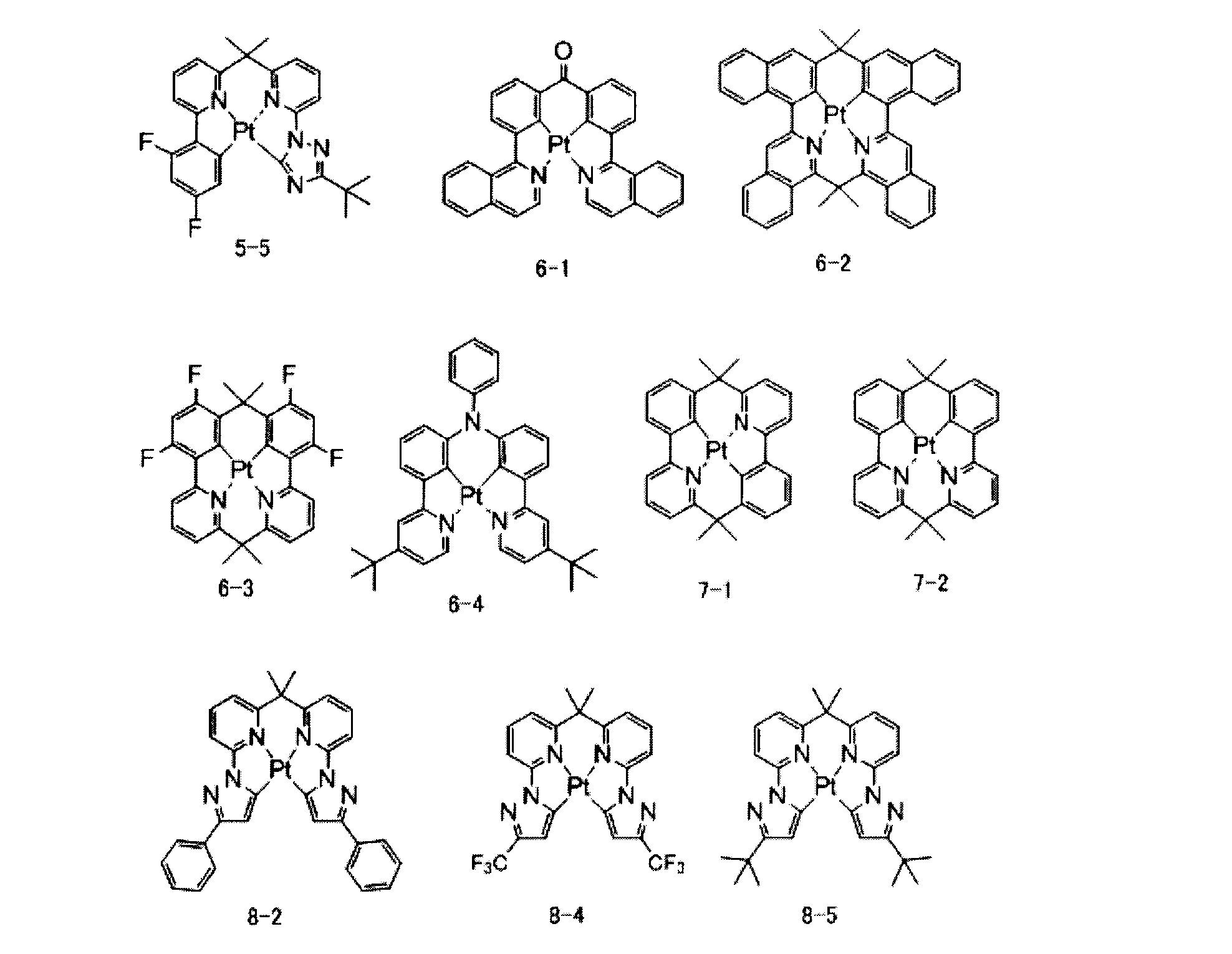


一般式(C-1)で表される白金錯体化合物は、例えば、Journal of Organic Chemistry 53,786,(1988)、G.R.Newkome et al.)の、789頁、左段53行~右段7行に記載の方法、790頁、左段18行~38行に記載の方法、790頁、右段19行~30行に記載の方法及びその組み合わせ、Chemische Berichte 113,2749(1980)、H.Lexyほか)の、2752頁、26行~35行に記載の方法等、種々の手法で合成できる。
例えば、配位子、又はその解離体と金属化合物を溶媒(例えば、ハロゲン系溶媒、アルコール系溶媒、エーテル系溶媒、エステル系溶媒、ケトン系溶媒、ニトリル系溶媒、アミド系溶媒、スルホン系溶媒、スルホキサイド系溶媒、水などが挙げられる)の存在下、若しくは、溶媒非存在下、塩基の存在下(無機、有機の種々の塩基、例えば、ナトリウムメトキシド、t-ブトキシカリウム、トリエチルアミン、炭酸カリウムなどが挙げられる)、若しくは、塩基非存在下、室温以下、若しくは加熱し(通常の加熱以外にもマイクロウェーブで加熱する手法も有効である)得ることができる。
例えば、配位子、又はその解離体と金属化合物を溶媒(例えば、ハロゲン系溶媒、アルコール系溶媒、エーテル系溶媒、エステル系溶媒、ケトン系溶媒、ニトリル系溶媒、アミド系溶媒、スルホン系溶媒、スルホキサイド系溶媒、水などが挙げられる)の存在下、若しくは、溶媒非存在下、塩基の存在下(無機、有機の種々の塩基、例えば、ナトリウムメトキシド、t-ブトキシカリウム、トリエチルアミン、炭酸カリウムなどが挙げられる)、若しくは、塩基非存在下、室温以下、若しくは加熱し(通常の加熱以外にもマイクロウェーブで加熱する手法も有効である)得ることができる。
(蛍光発光性材料)
蛍光発光材料としては、ピレン誘導体、ペリレン誘導体、フルオランテン誘導体、クリセン誘導体、クマリン誘導体等が挙げられる。なかでも、材料安定性の観点から、ピレン誘導体、ペリレン誘導体、フルオランテン誘導体、クリセン誘導体が好ましい。
蛍光発光材料としては、ピレン誘導体、ペリレン誘導体、フルオランテン誘導体、クリセン誘導体、クマリン誘導体等が挙げられる。なかでも、材料安定性の観点から、ピレン誘導体、ペリレン誘導体、フルオランテン誘導体、クリセン誘導体が好ましい。
[ピレン誘導体]
ピレン誘導体としては、従来から知られているピレン誘導体を使用できるが、下記一般式(P-1)で表される化合物が好ましく使用される。
一般式(P-1)
ピレン誘導体としては、従来から知られているピレン誘導体を使用できるが、下記一般式(P-1)で表される化合物が好ましく使用される。
一般式(P-1)

(式中、RP
1~RP
10は、それぞれ独立に、水素原子、置換基を有していても良い芳香族炭化水素基、置換基を有していても良いアルケニル基、置換基を有していても良いアルキニル基、置換基を有していても良いアルキル基、置換基を有していても良いシリル基、置換基を有していても良いヘテロ環基、置換基を有していても良いアルキルアミノ基、置換基を有していても良いアリールアミノ基を表し、RP
1~RP
10の少なくとも1つは水素原子以外の置換基である。)
<RP
1~RP
10>
(置換基RP 1~RP 10の種類)
RP 1~RP 10はそれぞれ独立に水素原子、若しくは置換基を有していても良い芳香族炭化水素基、置換基を有していても良いアルキル基、置換基を有していても良いシリル基、置換基を有していても良いヘテロ環基、置換基を有していても良いアルキルアミノ基、置換基を有していても良いアリールアミノ基を表す。これらは互いに結合して縮環しても良い。
RP 1~RP 10の少なくとも1つは水素原子以外の置換基である。
(置換基RP 1~RP 10の種類)
RP 1~RP 10はそれぞれ独立に水素原子、若しくは置換基を有していても良い芳香族炭化水素基、置換基を有していても良いアルキル基、置換基を有していても良いシリル基、置換基を有していても良いヘテロ環基、置換基を有していても良いアルキルアミノ基、置換基を有していても良いアリールアミノ基を表す。これらは互いに結合して縮環しても良い。
RP 1~RP 10の少なくとも1つは水素原子以外の置換基である。
RP
1~RP
10の2以上が水素原子以外の置換基である場合、複数の水素原子以外の置換基は同一であっても異なっても良い。合成の容易さの点では同一であることが好ましく、発光波長のチューニングが可能な点では異なることが好ましい。
また、高い発光効率を得るという点で、RP
1~RP
10の水素原子以外の置換基は、置換基を有していても良い芳香族炭化水素基、置換基を有していても良いシリル基であることが好ましく、特に置換基を有していても良い芳香族炭化水素基であることが好ましい。また、半値幅の狭い発光を得るという点では、RP
1~RP
10の水素原子以外の置換基は、置換基を有していても良いアルキル基、置換基を有しても良いアリールアミノ基、置換基を有していても良いヘテロ環基が好ましく、発光波長の長いものを得るという点では、RP
1、RP
3~RP
6、RP
8~RP
10が水素原子以外の置換基として置換基を有していても良い芳香族炭化水素、置換基を有していても良いアルケニル基、置換基を有していても良いヘテロ環基であることが好ましい。
RP
1~RP
10の芳香族炭化水素基としては、炭素数6~16のものが好ましく、具体例としてはフェニル基、ビフェニル基、フェナントリル基、ナフチル基、アントリル基、フルオレニル基等が挙げられる。
RP 1~RP 10が表すアルキル基としては、炭素数1~10のものが好ましく、具体例としてはi-プロピル基、t-ブチル基、シクロヘキシル基等が挙げられる。
RP 1~RP 10が表すシリル基としては、炭素数3~20のものが好ましく、具体例としてはトリメチルシリル基、ジメチルフェニルシリル基、ジメチルブチルシリル基、トリイソプロピルシリル基、メチルジブチルシリル基等が挙げられる。
RP 1~RP 10が表すヘテロ環基としては、炭素数3~10のものが好ましく、具体例としてはピリジル基、チエニル基、オキサゾール基、オキサジアゾール基、ベンゾチエニル基、ジベンゾフリル基、ジベンゾチエニル基、ピラジル基、ピリミジル基、ピラゾイル基、イミダゾイル基、フェニルカルバゾイル基等が挙げられる。
RP 1~RP 10が表すアルキルアミノ基としては、炭素数1~10のものが好ましく、具体例としては、ジメチルアミノ基、ジエチルアミノ基、ジプロピルアミノ基、ジブチルアミノ基等が挙げられる。
RP 1~RP 10が表すアリールアミノ基としては、炭素数6~30のものが好ましく、具体例としては、ジフェニルアミノ基、カルバゾイル基、フェニルナフチルアミノ基等が挙げられる。
RP 1~RP 10が表すアルキル基としては、炭素数1~10のものが好ましく、具体例としてはi-プロピル基、t-ブチル基、シクロヘキシル基等が挙げられる。
RP 1~RP 10が表すシリル基としては、炭素数3~20のものが好ましく、具体例としてはトリメチルシリル基、ジメチルフェニルシリル基、ジメチルブチルシリル基、トリイソプロピルシリル基、メチルジブチルシリル基等が挙げられる。
RP 1~RP 10が表すヘテロ環基としては、炭素数3~10のものが好ましく、具体例としてはピリジル基、チエニル基、オキサゾール基、オキサジアゾール基、ベンゾチエニル基、ジベンゾフリル基、ジベンゾチエニル基、ピラジル基、ピリミジル基、ピラゾイル基、イミダゾイル基、フェニルカルバゾイル基等が挙げられる。
RP 1~RP 10が表すアルキルアミノ基としては、炭素数1~10のものが好ましく、具体例としては、ジメチルアミノ基、ジエチルアミノ基、ジプロピルアミノ基、ジブチルアミノ基等が挙げられる。
RP 1~RP 10が表すアリールアミノ基としては、炭素数6~30のものが好ましく、具体例としては、ジフェニルアミノ基、カルバゾイル基、フェニルナフチルアミノ基等が挙げられる。
これらの置換基は更に置換基を有していても良い。更に有しても良い置換基としては、アリール基、アリールアミノ基、アルキル基、パーフルオロアルキル基、ハライド基、カルボキシル基、シアノ基、アルコキシル基、アリールオキシ基、カルボニル基、オキシカルボニル基、カルボン酸基、ヘテロ環基などが挙げられる。好ましくは、炭素数6~16のアリール基、炭素数12~30のアリールアミノ基、炭素数1~12のアルキル基、炭素数1~12のパーフルオロアルキル基、フルオライド基、炭素数1~10のオキシカルボニル基、シアノ基、炭素数1~10のアルコキシ基、炭素数6~16のアリールオキシ基、炭素数2~16のカルボニル基、炭素数5~20のヘテロ環基などが挙げられる。
更に有しても良い置換基のうち、炭素数6~16のアリール基の例としては、フェニル基、ナフチル基、フェナントリル基などが挙げられる。
炭素数12~30のアリールアミノ基の例としては、ジフェニルアミノ基、カルバゾイル基、フェニルカルバゾイル基などが挙げられる。
炭素数1~12のアルキル基の例としては、メチル基、エチル基、ブチル基、i-プロピル基、ネオペンチオル基、t-ブチル基などが挙げられる。
炭素数1~12のパーフルオロアルキル基の例としては、トリフルオロメチル基などが挙げられる。
炭素数1~10のオキシカルボニル基の例としては、メトキシカルボニル基、エトキシカルボニル基などが挙げられる。
炭素数1~10のアルコキシ基の例としては、メトキシ基、エトキシ基などが挙げられる。
炭素数6~16のアリールオキシ基の例としては、フェニルオキシ基などが挙げられる。
炭素数2~16のカルボニル基の例としては、アセチル基、フェニルカルボニル基などが挙げられる。
炭素数5~20のヘテロ環基の例としては、ピリジル基、チエニル基、オキサゾール基、オキサジアゾール基、ベンゾチエニル基、ジベンゾフリル基、ジベンゾチエニル基、ピラジル基、ピリミジル基、ピラゾイル基、イミダゾイル基などが挙げられる。
以上に説明したRP 1~RP 10及びRP 1~RP 10が有しても良い置換基のうち、アリールアミノ基やアルコキシ基などの電子供与性の基、チエニル基、ベンゾチエニル基などのヘテロ環基は、化合物(P-1)の発光波長の長波長化に寄与する。よってRP 1~RP 10やRP 1~RP 10が有しても良い置換基として、これらの置換基を選択することによって、緑色発光を呈するものを得ることもできる。
炭素数12~30のアリールアミノ基の例としては、ジフェニルアミノ基、カルバゾイル基、フェニルカルバゾイル基などが挙げられる。
炭素数1~12のアルキル基の例としては、メチル基、エチル基、ブチル基、i-プロピル基、ネオペンチオル基、t-ブチル基などが挙げられる。
炭素数1~12のパーフルオロアルキル基の例としては、トリフルオロメチル基などが挙げられる。
炭素数1~10のオキシカルボニル基の例としては、メトキシカルボニル基、エトキシカルボニル基などが挙げられる。
炭素数1~10のアルコキシ基の例としては、メトキシ基、エトキシ基などが挙げられる。
炭素数6~16のアリールオキシ基の例としては、フェニルオキシ基などが挙げられる。
炭素数2~16のカルボニル基の例としては、アセチル基、フェニルカルボニル基などが挙げられる。
炭素数5~20のヘテロ環基の例としては、ピリジル基、チエニル基、オキサゾール基、オキサジアゾール基、ベンゾチエニル基、ジベンゾフリル基、ジベンゾチエニル基、ピラジル基、ピリミジル基、ピラゾイル基、イミダゾイル基などが挙げられる。
以上に説明したRP 1~RP 10及びRP 1~RP 10が有しても良い置換基のうち、アリールアミノ基やアルコキシ基などの電子供与性の基、チエニル基、ベンゾチエニル基などのヘテロ環基は、化合物(P-1)の発光波長の長波長化に寄与する。よってRP 1~RP 10やRP 1~RP 10が有しても良い置換基として、これらの置換基を選択することによって、緑色発光を呈するものを得ることもできる。
なお、化合物(P-1)のうち、特に好ましいものは次の一般式(P-1a)、(P-1b)、(P-1c)、(P-1d)、又は(P-1e)で表される化合物である(以下の一般式(P-1a),(P-1b)、(P-1c)、(P-1d)、(P-1e)において、RP
1~RP
10は一般式(P-1)におけるRP
1~RP
10と同義である。また、一般式(P-1c)におけるRP
1とRP
2、RP
6とRP
7、一般式(P-1d)におけるRP
1とRP
10、RP
5とRP
6、一般式(P-1e)におけるRP
9とRP
10、RP
4とRP
5は互いに結合して環を形成する。ここで形成される環としては、5又は6員環が好ましく、6員環がより好ましい。


以下に、本発明で使用できるピレン誘導体の具体例を示すが、本発明はこれらに限定されない。
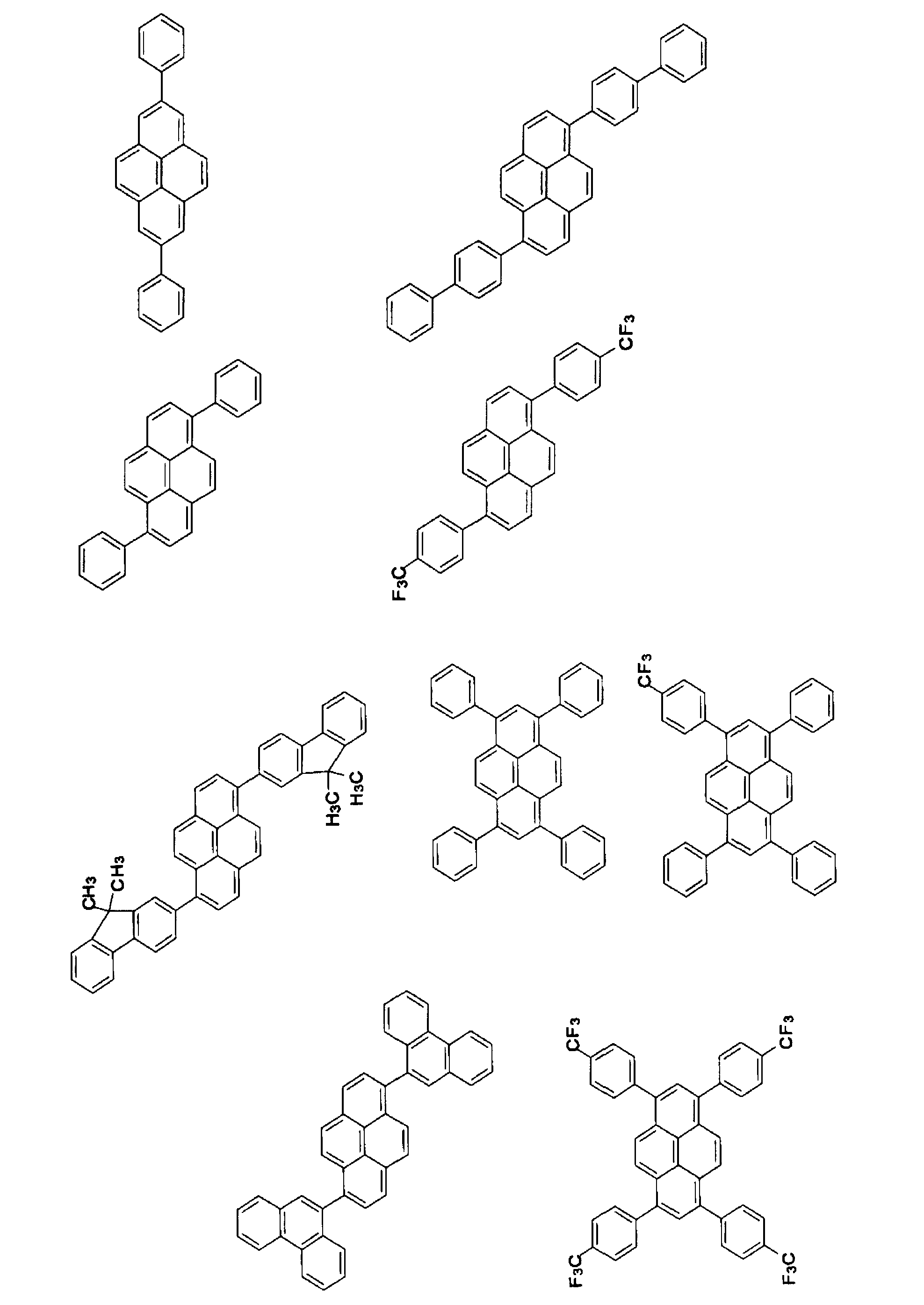


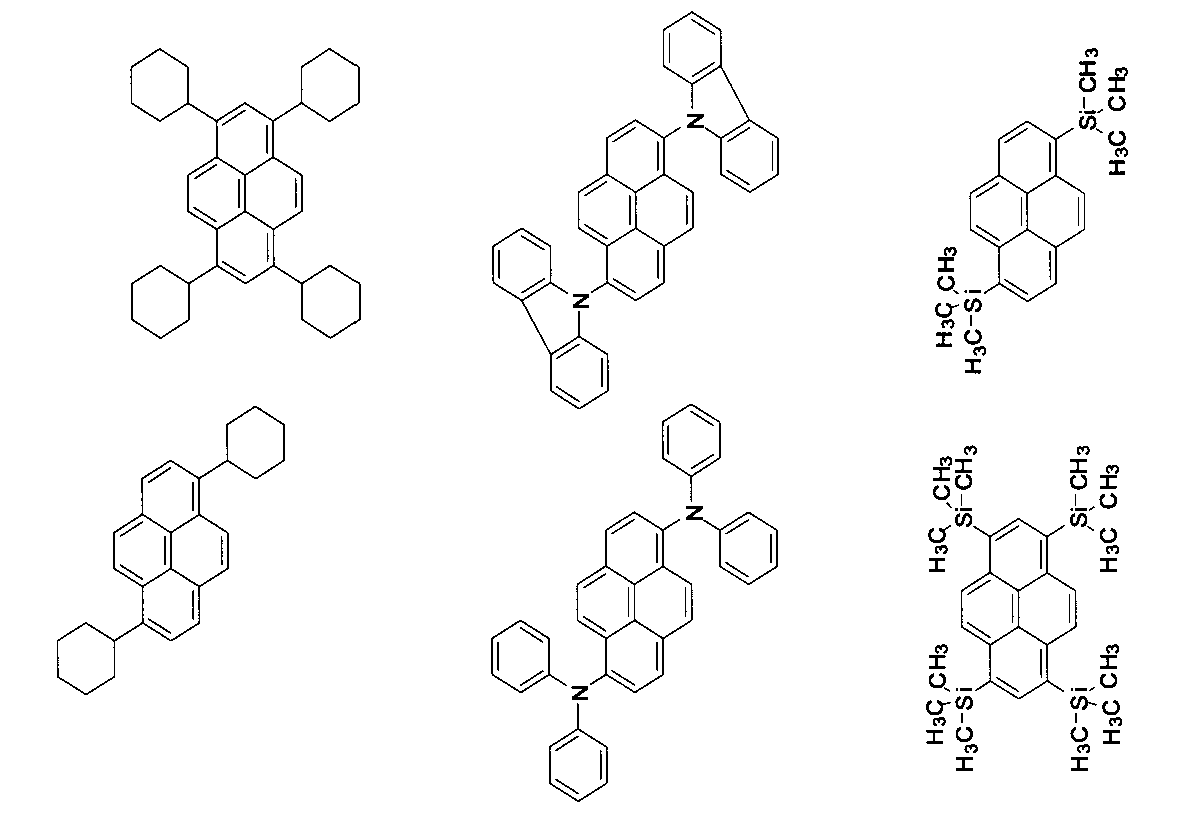

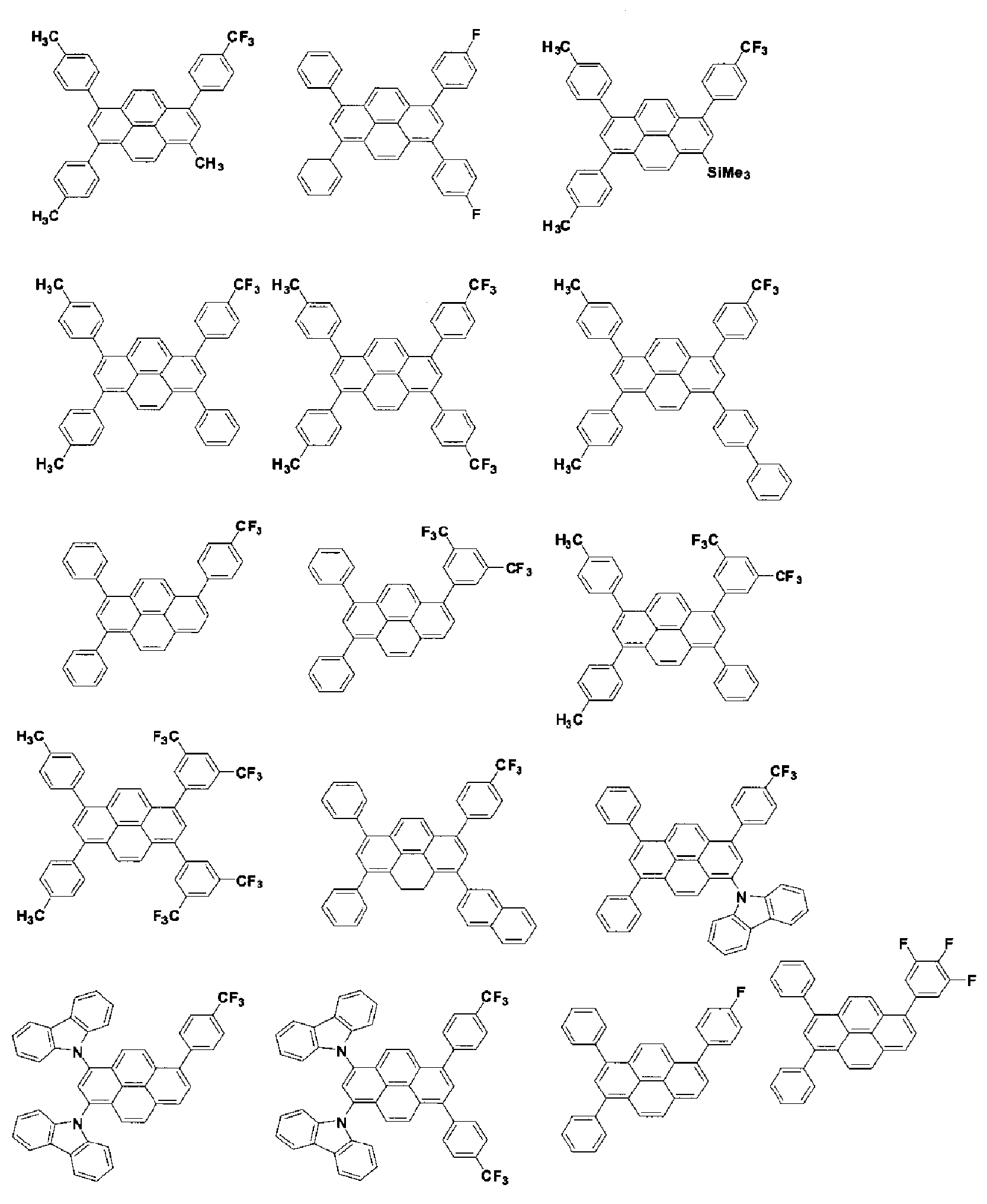


一般式(P-1a)~(P-1e)で表されるピレン誘導体は、下記スキームに従い合成することができる。
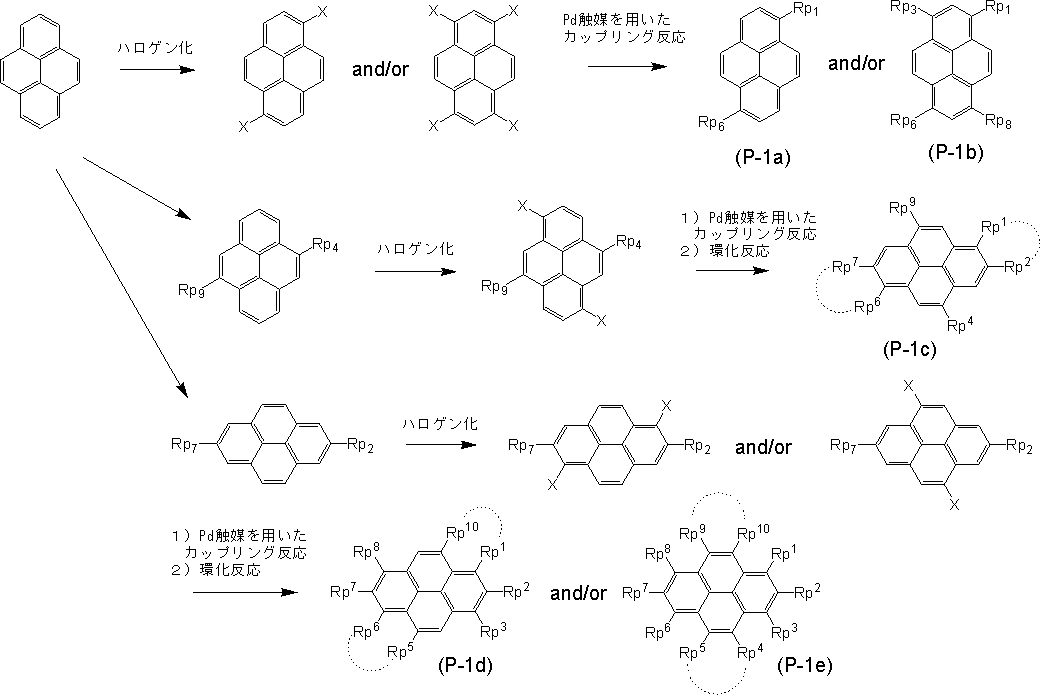
[ペリレン誘導体]
ペリレン誘導体としては、従来から知られているペリレン誘導体を使用できるが、下記一般式(PE-1)で表される化合物が好ましく使用される。
一般式(PE-1)
ペリレン誘導体としては、従来から知られているペリレン誘導体を使用できるが、下記一般式(PE-1)で表される化合物が好ましく使用される。
一般式(PE-1)

式中、RPE
1~RPE
4は、それぞれ独立に、アルキル基、アリール基、ヘテロ環基、アミノ基、シリル基、アルキルオキシカルボニル基、アリールオキシカルボニル基、カルバモイル基、アルコキシ基、アリールオキシ基、ヘテロアリールオキシ基、アルキルチオ基、アリールチオ基を表し、これらは置換基を有していても良い。また、これらは互いに結合して環を形成しても良い。
nPE 1~nPE 4は、それぞれ独立に、0~3の整数を表す。nPE 1~nPE 4が2以上のとき、複数のRPE 1~RPE 4はそれぞれ互いに結合して環を形成しても良い。
また、式中の水素原子は重水素原子であっても良い。
nPE 1~nPE 4は、それぞれ独立に、0~3の整数を表す。nPE 1~nPE 4が2以上のとき、複数のRPE 1~RPE 4はそれぞれ互いに結合して環を形成しても良い。
また、式中の水素原子は重水素原子であっても良い。
RPE
1~RPE
4は、アルキル基、アリール基、ヘテロ環基、アミノ基、シリル基、アルコキシ基、アリールオキシ基、ヘテロアリールオキシ基、アルキルチオ基、アリールチオ基が好ましく、アルキル基、アリール基、ヘテロ環基、アミノ基、シリル基がより好ましい。こられの基は置換基を有していてもよく、置換基としては前述の置換基群Aで挙げた基が挙げられる。置換基を複数有する場合には、該置換基同士が連結して環を形成してもよい。
nPE 1~nPE 4は、0~2が好ましく、0~1がより好ましい。
nPE 1~nPE 4は、0~2が好ましく、0~1がより好ましい。
一般式(PE-1)で表される化合物としては、以下の一般式(PE-1a)~(PE-1f)のいずれかで表される化合物が好ましい。
一般式(PE-1a)~(PE-1f)において、Rpeは、それぞれ独立に、アルキル基、アリール基、ヘテロ環基、アミノ基、シリル基、アルキルオキシカルボニル基、アリールオキシカルボニル基、カルバモイル基、アルコキシ基、アリールオキシ基、ヘテロアリールオキシ基、アルキルチオ基、アリールチオ基を表す。これらは更に置換基を有していてもよい。更に、一般式(PE-1d)~(PE-1f)におけるRpeは、それぞれ独立に、5員又は6員の環を形成し、該環は更に置換基を有してもよい。
また、一般式(PE-1a)~(PE-1f)中の水素原子は重水素原子であってもよい。
一般式(PE-1a)~(PE-1f)において、Rpeは、それぞれ独立に、アルキル基、アリール基、ヘテロ環基、アミノ基、シリル基、アルキルオキシカルボニル基、アリールオキシカルボニル基、カルバモイル基、アルコキシ基、アリールオキシ基、ヘテロアリールオキシ基、アルキルチオ基、アリールチオ基を表す。これらは更に置換基を有していてもよい。更に、一般式(PE-1d)~(PE-1f)におけるRpeは、それぞれ独立に、5員又は6員の環を形成し、該環は更に置換基を有してもよい。
また、一般式(PE-1a)~(PE-1f)中の水素原子は重水素原子であってもよい。
Rpeとしては、好ましくは、アルキル基(メチル基、プロピル基、ブチル基など)、アリール基(フェニル基、ナフチル基など)、ヘテロ環基(ピリジル基など)、アミノ基、シリル基、アミド基である。
Rpe及びRpeが形成する環が有してもよい置換基としては、アルキル基(メチル基、ブチル基など)、アリール基(フェニル基など)が挙げられる。
Rpe及びRpeが形成する環が有してもよい置換基としては、アルキル基(メチル基、ブチル基など)、アリール基(フェニル基など)が挙げられる。

以下に、本発明で使用できるペリレン誘導体の具体例を示すが、本発明はこれらに限定されない。

一般式(PE-1)で表されるペリレン誘導体は、下記スキームに従い合成することができる。

上記スキーム中、Rpeは、一般式(PE-1)におけるRPE
1~RPE
4と同義である。Xはハロゲン原子を表す。
[フルオランテン誘導体]
フルオランテン誘導体としては、従来から知られているフルオランテン誘導体を使用できるが、下記一般式(F-1)で表される化合物が好ましく使用される。
一般式(F-1)
フルオランテン誘導体としては、従来から知られているフルオランテン誘導体を使用できるが、下記一般式(F-1)で表される化合物が好ましく使用される。
一般式(F-1)

(式中、RF
1~RF
10は、それぞれ独立に、水素原子、置換基を有していても良い芳香族炭化水素基、置換基を有していても良いアルケニル基、置換基を有していても良いアルキニル基、置換基を有していても良いアルキル基、置換基を有していても良いシリル基、置換基を有していても良いヘテロ環基、置換基を有していても良いアルキルアミノ基、置換基を有していても良いアリールアミノ基を表し、RF
1~RF
10の少なくとも1つは水素原子以外の置換基である。)
<RF
1~RF
10>
(置換基RF 1~RF 10の種類)
RF 1~RF 10はそれぞれ独立に水素原子、若しくは置換基を有していても良い芳香族炭化水素基、置換基を有していても良いアルキル基、置換基を有していても良いシリル基、置換基を有していても良いヘテロ環基、置換基を有していても良いアルキルアミノ基、置換基を有していても良いアリールアミノ基を表す。これらは互いに結合して縮環しても良い。
RF 1~RF 10の少なくとも1つは水素原子以外の置換基である。
(置換基RF 1~RF 10の種類)
RF 1~RF 10はそれぞれ独立に水素原子、若しくは置換基を有していても良い芳香族炭化水素基、置換基を有していても良いアルキル基、置換基を有していても良いシリル基、置換基を有していても良いヘテロ環基、置換基を有していても良いアルキルアミノ基、置換基を有していても良いアリールアミノ基を表す。これらは互いに結合して縮環しても良い。
RF 1~RF 10の少なくとも1つは水素原子以外の置換基である。
RF
1~RF
10の2以上が水素原子以外の置換基である場合、複数の水素原子以外の置換基は同一であっても異なっても良い。合成の容易さの点では同一であることが好ましく、発光波長のチューニングが可能な点では異なることが好ましい。
RF
1~RF
10の芳香族炭化水素基としては、炭素数6~16のものが好ましく、具体例としてはフェニル基、ビフェニル基、フェナントリル基、ナフチル基、アントリル基、フルオレニル基等が挙げられる。
RF 1~RF 10が表すアルキル基としては、炭素数1~10のものが好ましく、具体例としてはi-プロピル基、t-ブチル基、シクロヘキシル基等が挙げられる。
RF 1~RF 10が表すシリル基としては、炭素数3~20のものが好ましく、具体例としてはトリメチルシリル基、ジメチルフェニルシリル基、ジメチルブチルシリル基、トリイソプロピルシリル基、メチルジブチルシリル基等が挙げられる。
RF 1~RF 10が表すヘテロ環基としては、炭素数3~10のものが好ましく、具体例としてはピリジル基、チエニル基、オキサゾール基、オキサジアゾール基、ベンゾチエニル基、ジベンゾフリル基、ジベンゾチエニル基、ピラジル基、ピリミジル基、ピラゾイル基、イミダゾイル基、フェニルカルバゾイル基等が挙げられる。
RF 1~RF 10が表すアルキルアミノ基としては、炭素数1~10のものが好ましく、具体例としては、ジメチルアミノ基、ジエチルアミノ基、ジプロピルアミノ基、ジブチルアミノ基等が挙げられる。
RF 1~RF 10が表すアリールアミノ基としては、炭素数6~30のものが好ましく、具体例としては、ジフェニルアミノ基、カルバゾイル基、フェニルナフチルアミノ基等が挙げられる。
RF 1~RF 10が表すアルキル基としては、炭素数1~10のものが好ましく、具体例としてはi-プロピル基、t-ブチル基、シクロヘキシル基等が挙げられる。
RF 1~RF 10が表すシリル基としては、炭素数3~20のものが好ましく、具体例としてはトリメチルシリル基、ジメチルフェニルシリル基、ジメチルブチルシリル基、トリイソプロピルシリル基、メチルジブチルシリル基等が挙げられる。
RF 1~RF 10が表すヘテロ環基としては、炭素数3~10のものが好ましく、具体例としてはピリジル基、チエニル基、オキサゾール基、オキサジアゾール基、ベンゾチエニル基、ジベンゾフリル基、ジベンゾチエニル基、ピラジル基、ピリミジル基、ピラゾイル基、イミダゾイル基、フェニルカルバゾイル基等が挙げられる。
RF 1~RF 10が表すアルキルアミノ基としては、炭素数1~10のものが好ましく、具体例としては、ジメチルアミノ基、ジエチルアミノ基、ジプロピルアミノ基、ジブチルアミノ基等が挙げられる。
RF 1~RF 10が表すアリールアミノ基としては、炭素数6~30のものが好ましく、具体例としては、ジフェニルアミノ基、カルバゾイル基、フェニルナフチルアミノ基等が挙げられる。
これらの置換基は更に置換基を有していても良い。更に有しても良い置換基としては、アリール基、アリールアミノ基、アルキル基、パーフルオロアルキル基、ハライド基、カルボキシル基、シアノ基、アルコキシル基、アリールオキシ基、カルボニル基、オキシカルボニル基、カルボン酸基、ヘテロ環基などが挙げられる。好ましくは、炭素数6~16のアリール基、炭素数12~30のアリールアミノ基、炭素数1~12のアルキル基、炭素数1~12のパーフルオロアルキル基、フルオライド基、炭素数1~10のオキシカルボニル基、シアノ基、炭素数1~10のアルコキシ基、炭素数6~16のアリールオキシ基、炭素数2~16のカルボニル基、炭素数5~20のヘテロ環基などが挙げられる。
更に有しても良い置換基のうち、炭素数6~16のアリール基の例としては、フェニル基、ナフチル基、フェナントリル基などが挙げられる。
炭素数12~30のアリールアミノ基の例としては、ジフェニルアミノ基、カルバゾイル基、フェニルカルバゾイル基などが挙げられる。
炭素数1~12のアルキル基の例としては、メチル基、エチル基、ブチル基、i-プロピル基、ネオペンチオル基、t-ブチル基などが挙げられる。
炭素数1~12のパーフルオロアルキル基の例としては、トリフルオロメチル基などが挙げられる。
炭素数1~10のオキシカルボニル基の例としては、メトキシカルボニル基、エトキシカルボニル基などが挙げられる。
炭素数1~10のアルコキシ基の例としては、メトキシ基、エトキシ基などが挙げられる。
炭素数6~16のアリールオキシ基の例としては、フェニルオキシ基などが挙げられる。
炭素数2~16のカルボニル基の例としては、アセチル基、フェニルカルボニル基などが挙げられる。
炭素数5~20のヘテロ環基の例としては、ピリジル基、チエニル基、オキサゾール基、オキサジアゾール基、ベンゾチエニル基、ジベンゾフリル基、ジベンゾチエニル基、ピラジル基、ピリミジル基、ピラゾイル基、イミダゾイル基などが挙げられる。
以上に説明したRF 1~RF 10及びRF 1~RF 10が有しても良い置換基のうち、アリールアミノ基やアルコキシ基などの電子供与性の基、チエニル基、ベンゾチエニル基などのヘテロ環基は、一般式(F-1)で表される化合物の発光波長の長波長化に寄与する。よってRF 1~RF 10やRF 1~RF 10が有しても良い置換基として、これらの置換基を選択することによって、緑色発光を呈するものを得ることもできる。
炭素数12~30のアリールアミノ基の例としては、ジフェニルアミノ基、カルバゾイル基、フェニルカルバゾイル基などが挙げられる。
炭素数1~12のアルキル基の例としては、メチル基、エチル基、ブチル基、i-プロピル基、ネオペンチオル基、t-ブチル基などが挙げられる。
炭素数1~12のパーフルオロアルキル基の例としては、トリフルオロメチル基などが挙げられる。
炭素数1~10のオキシカルボニル基の例としては、メトキシカルボニル基、エトキシカルボニル基などが挙げられる。
炭素数1~10のアルコキシ基の例としては、メトキシ基、エトキシ基などが挙げられる。
炭素数6~16のアリールオキシ基の例としては、フェニルオキシ基などが挙げられる。
炭素数2~16のカルボニル基の例としては、アセチル基、フェニルカルボニル基などが挙げられる。
炭素数5~20のヘテロ環基の例としては、ピリジル基、チエニル基、オキサゾール基、オキサジアゾール基、ベンゾチエニル基、ジベンゾフリル基、ジベンゾチエニル基、ピラジル基、ピリミジル基、ピラゾイル基、イミダゾイル基などが挙げられる。
以上に説明したRF 1~RF 10及びRF 1~RF 10が有しても良い置換基のうち、アリールアミノ基やアルコキシ基などの電子供与性の基、チエニル基、ベンゾチエニル基などのヘテロ環基は、一般式(F-1)で表される化合物の発光波長の長波長化に寄与する。よってRF 1~RF 10やRF 1~RF 10が有しても良い置換基として、これらの置換基を選択することによって、緑色発光を呈するものを得ることもできる。
以下に、本発明で使用できるフルオランテン誘導体の具体例を示すが、本発明はこれらに限定されない。
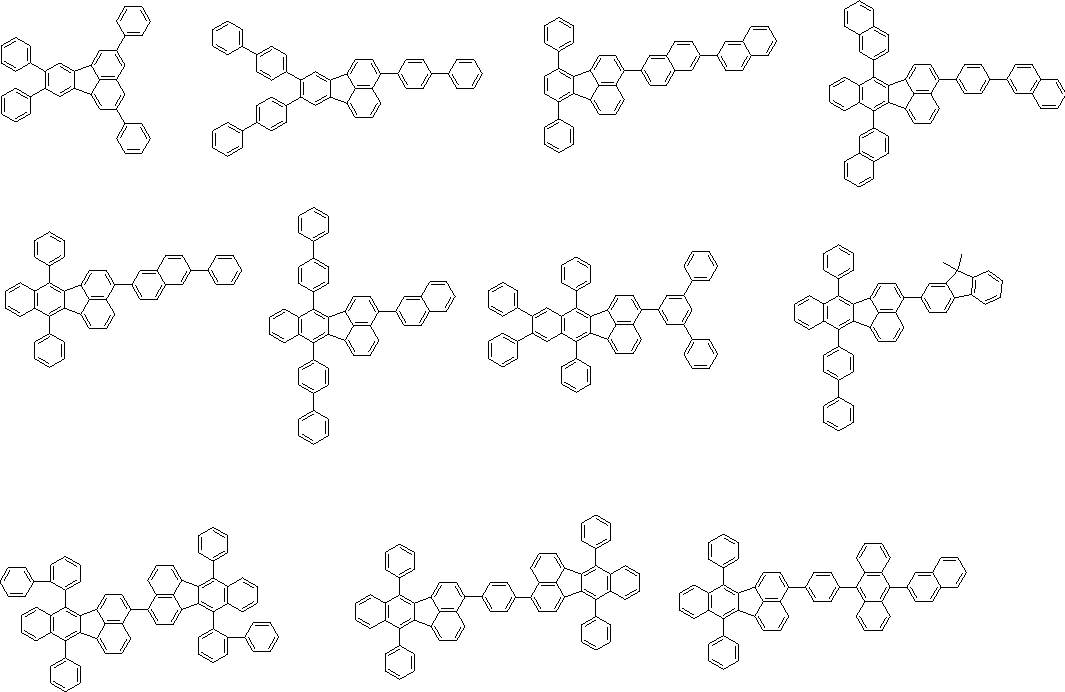
有機電界発光素子用材料における発光材料の含有量は、0.1質量%~30質量%が好ましく、1質量%~25質量%がより好ましく、5質量%~20質量%が特に好ましい。
有機電界発光素子においては、発光材料の遷移双極子モーメントを陽極に対して水平に配向させることが好ましい。発光材料の遷移双極子モーメントが陽極に対して水平に配向されることで、陽極に対して垂直方向への発光成分が増加し、光取り出し効率を向上させ、発光効率を向上させる点で有利である。このため、発光層における発光材料の遷移双極子モーメントの水平配向成分の割合が85%より大きいことが好ましく、90%以上であることがより好ましい。
遷移双極子モーメントの方向としては、理論計算により下記のように規定される。ここでいう理論計算は、Gaussian03(米ガウシアン社)を用いて行う。計算に使用する分子構造は、構造最適化計算を行って生成エネルギーが最小となる構造を用い、遷移双極子モーメントの方向を求めることができる。
あるいは、発光層を形成した後、ATR-IR測定法や斜入射UV測定法により測定することもできる。
遷移双極子モーメントの方向としては、理論計算により下記のように規定される。ここでいう理論計算は、Gaussian03(米ガウシアン社)を用いて行う。計算に使用する分子構造は、構造最適化計算を行って生成エネルギーが最小となる構造を用い、遷移双極子モーメントの方向を求めることができる。
あるいは、発光層を形成した後、ATR-IR測定法や斜入射UV測定法により測定することもできる。
(ホスト材料)
本発明に用いるホスト材料は、発光層中の結晶化を抑制する観点から、アスペクト比(分子長/分子厚み)は2以下であり、1~1.9が好ましく、1.3~1.9が更に好ましい。
ホスト材料のアスペクト比が2より大きいと、ホスト材料が規則的に配列しやすくなるため、該ホスト材料を用いて形成された膜の結晶性が高くなり、耐久性が悪化する。
本発明に用いるホスト材料は、発光層中の結晶化を抑制する観点から、アスペクト比(分子長/分子厚み)は2以下であり、1~1.9が好ましく、1.3~1.9が更に好ましい。
ホスト材料のアスペクト比が2より大きいと、ホスト材料が規則的に配列しやすくなるため、該ホスト材料を用いて形成された膜の結晶性が高くなり、耐久性が悪化する。
ホスト材料の分子半径としては、0.40nm~3.0nmが好ましく、0.45nm~2.0nmがより好ましく、0.5nm~1.5nmが特に好ましい。この範囲であることは、配向性の向上、発光強度と発光波長の制御し易さ等の観点から好ましい。
本発明に用いるホスト材料は、上記アスペクト比が2以下であり、発光材料とのサイズ比が0.8~1.2となる関係を満たすものであれば、特に限定されないが、金属錯体化合物であることが好ましい。
アスペクト比が2以下になるような構造としては、例えば中心に4級炭素、4級珪素、オルト連結、メタ連結、金属元素を有するもので、好ましくは置換基によりねじれた分子構造を有するものが挙げられる。好ましくは、下記一般式(H-1)~(H-4)のいずれかで表される化合物である。

一般式(H-1)中、Z100~Z103は各々独立にアルキル基、置換若しくは無置換の5員又は6員環からなる芳香環を表し、これらは更に芳香環で縮環されてもよい。Z100~Z103はそれぞれ単結合又は2~4価の連結基を介して結合し、縮合環を形成してもよい。A’は炭素原子又は珪素原子を表す。
一般式(H-2)中、Z104及びZ105は各々独立にアルキル基、置換若しくは無置換の5員又は6員環からなる芳香環を表し、これらは更に芳香環で縮環されてもよい。Z104とZ105、Z104とB’、Z105とB’はそれぞれ単結合又は2~4価の連結基を介して結合し、縮合環を形成してもよい。B’は置換基を有してもよい炭素原子又は窒素原子を表し、複数のB’はそれぞれ同一でも異なっていてもよい。
一般式(H-3)中、Z106及びZ107は各々独立にアルキル基、置換若しくは無置換の5員又は6員環からなる芳香環を表し、これらは更に芳香環で縮環されてもよい。Z106とZ107、Z106とB’、Z107とB’はそれぞれ単結合又は2~4価の連結基を介して結合し、縮合環を形成してもよい。B’は置換基を有してもよい炭素原子又は窒素原子を表し、複数のB’はそれぞれ同一でも異なっていてもよい。
一般式(H-4)中、Z108及びZ109は各々独立にアルキル基、置換若しくは無置換の5員又は6員環からなる芳香環を表し、これらは更に芳香環で縮環されてもよい。M’は2~4価の金属原子を表し、Lは配位結合、単結合、又は2価の連結基を表す。n’は2又は3の整数を表し、複数のZ108、Z109、Lはそれぞれ同一でも異なっていてもよい。
一般式(H-2)中、Z104及びZ105は各々独立にアルキル基、置換若しくは無置換の5員又は6員環からなる芳香環を表し、これらは更に芳香環で縮環されてもよい。Z104とZ105、Z104とB’、Z105とB’はそれぞれ単結合又は2~4価の連結基を介して結合し、縮合環を形成してもよい。B’は置換基を有してもよい炭素原子又は窒素原子を表し、複数のB’はそれぞれ同一でも異なっていてもよい。
一般式(H-3)中、Z106及びZ107は各々独立にアルキル基、置換若しくは無置換の5員又は6員環からなる芳香環を表し、これらは更に芳香環で縮環されてもよい。Z106とZ107、Z106とB’、Z107とB’はそれぞれ単結合又は2~4価の連結基を介して結合し、縮合環を形成してもよい。B’は置換基を有してもよい炭素原子又は窒素原子を表し、複数のB’はそれぞれ同一でも異なっていてもよい。
一般式(H-4)中、Z108及びZ109は各々独立にアルキル基、置換若しくは無置換の5員又は6員環からなる芳香環を表し、これらは更に芳香環で縮環されてもよい。M’は2~4価の金属原子を表し、Lは配位結合、単結合、又は2価の連結基を表す。n’は2又は3の整数を表し、複数のZ108、Z109、Lはそれぞれ同一でも異なっていてもよい。
Z100~Z109がアルキル基を表す場合、該アルキル基としては炭素数1~10のアルキル基が好ましく、例えばメチル基、エチル基、イソプロピル基、t-ブチル基、ネオペンチル基、イソブチル基、シクロヘキシル基等が挙げられる。
Z100~Z109が5員又は6員環からなる芳香環を表す場合、該芳香環としては、ベンゼン環、ピリジン環、ピリミジン環、ピラジン環、トリアジン環、イミダゾール環、ピラゾール環、オキサゾール環、チアゾール環、トリアゾール環、オキサジアゾール環、チアジアゾール環、フラン環、チオフェン環などが挙げられる。これらは更に芳香環で縮環されてもよく、ベンゼン環、ピリジン環、ピリミジン環、ピラジン環、トリアジン環、イミダゾール環、ピラゾール環、オキサゾール環、チアゾール環、トリアゾール環、オキサジアゾール環、チアジアゾール環、フラン環、チオフェン環などで縮環されていてもよい。縮環により形成される構造としては、カルバゾール構造、ジベンゾフラン構造、ジベンゾチオフェン構造、フルオレン構造などが挙げられる。
Z100~Z109が5員又は6員環からなる芳香環を表す場合、該芳香環は置換基を有してもよい。該置換基は特に限定されないが、アルキル基、アリール基、アルコキシ基、アリールオキシ基、ヘテロアリール基、アミノ基、アルキルチオ基、アリールチオ基、シリル基等が挙げられる。アルキル基としては、炭素数1~10のアルキル基が好ましく、具体的にはメチル基、イソプロピル、t-ブチル、イソブチル、ネオペンチル、シクロヘキシルが好ましい。アリール基としては、フェニル基、ビフェニル基、ナフチル基、フルオレン、ジベンゾチオフェン、ジベンゾフラン、フェナントレン、アントラセン等が挙げられる。アルコキシ基としては、炭素数1~6のアルコキシ基が好ましく、具体的には、メトキシ基、エトキシ基等が挙げられる。アリールオキシ基としては、炭素数6~12のアリールオキシ基が好ましく、具体的には、フェノキシ基、ナフチルオキシ基等が挙げられる。ヘテロアリール基としては、炭素数2~10のヘテロアリール基が好ましく、具体的には、チオフェン、チアゾール、チアジアゾール、フラン、オキサゾール、オキサジアゾール、ピリジン、ピリミジン、トリアジン、ベンゾチオール、ベンゾチアゾール、ベンゾフラン、ベンゾオキサゾール、キノリン、ピロール、ピラゾール、イミダゾール、トリアゾール、ベンゾピロール、ベンゾピラゾール、ベンゾイミダゾール等が挙げられる。アミノ基としては、具体的には、ジアリールアミノ基、N-アリール-N-アルキルアミノ基、ジアルキルアミノ基等が挙げられる。アルキルチオ基としては、炭素数1~6のアルキルチオ基が好ましく、具体的には、メチルチオ基、エチルチオ基等が挙げられる。アリールチオ基としては、炭素数6~12のアリールチオ基が好ましく、具体的には、フェニルチオ基、ナフチルチオ基等が挙げられる。シリル基としては、炭素数3~18のシリル基が好ましく、具体的には、トリメチルシリル基、ジメチルフェニルシリル基等が挙げられる。
これらの置換基は更に置換基を有してもよく、該更なる置換基としては、アルキル基(例えば、メチル基、イソプロピル基、t-ブチル基、ネオペンチル基、イソブチル基)、アリール基(例えば、フェニル基、トリル基、ナフチル基)、シリル基(トリメチルシリル基)等が挙げられる。環状構造が置換基を複数有する場合、該複数の置換基は同一でも異なってもよい。
これらの置換基は更に置換基を有してもよく、該更なる置換基としては、アルキル基(例えば、メチル基、イソプロピル基、t-ブチル基、ネオペンチル基、イソブチル基)、アリール基(例えば、フェニル基、トリル基、ナフチル基)、シリル基(トリメチルシリル基)等が挙げられる。環状構造が置換基を複数有する場合、該複数の置換基は同一でも異なってもよい。
B’の置換基としては、水素原子、アルキル基、アリール基、アルコキシ基、アリールオキシ基、ヘテロアリール基、アミノ基、アルキルチオ基、アリールチオ基、シリル基等が挙げられる。好ましい範囲としては、Z100~Z109が5員又は6員環からなる芳香環を表す場合に該芳香環が有してもよい置換基と同じである。
M’で表される金属原子としては、アルミニウム、ガリウム、インジウム、ベリリウム、マグネシウム、チタン、ジルコニウム、亜鉛、銅等が挙げられ、錯体の安定性の観点からアルミニウム、ベリリウム、亜鉛が好ましい。
Lは配位結合、単結合、2価の連結基を表すが、2価の連結基としては窒素原子、酸素原子、硫黄原子が挙げられる。
Z100~Z103、Z104とZ105、Z104とB’、Z105とB’、Z106とZ107、Z106とB’、Z107とB’はそれぞれ単結合又は2~4価の連結基を介して結合し、縮合環を形成してもよく、2~4価の連結基としては酸素原子、硫黄原子、置換基を有してもよい炭素原子、窒素原子、珪素原子が挙げられる。置換基としてはアルキル基、アリール基、アルコキシ基、アリールオキシ基、ヘテロアリール基、アミノ基、アルキルチオ基、アリールチオ基、シリル基等が挙げられる。好ましい範囲としては、Z100~Z109が5員又は6員環からなる芳香環を表す場合に該芳香環が有してもよい置換基と同じである。
アスペクト比が2以下になるような構造として下記一般式(H-5)で表される化合物も好ましい。
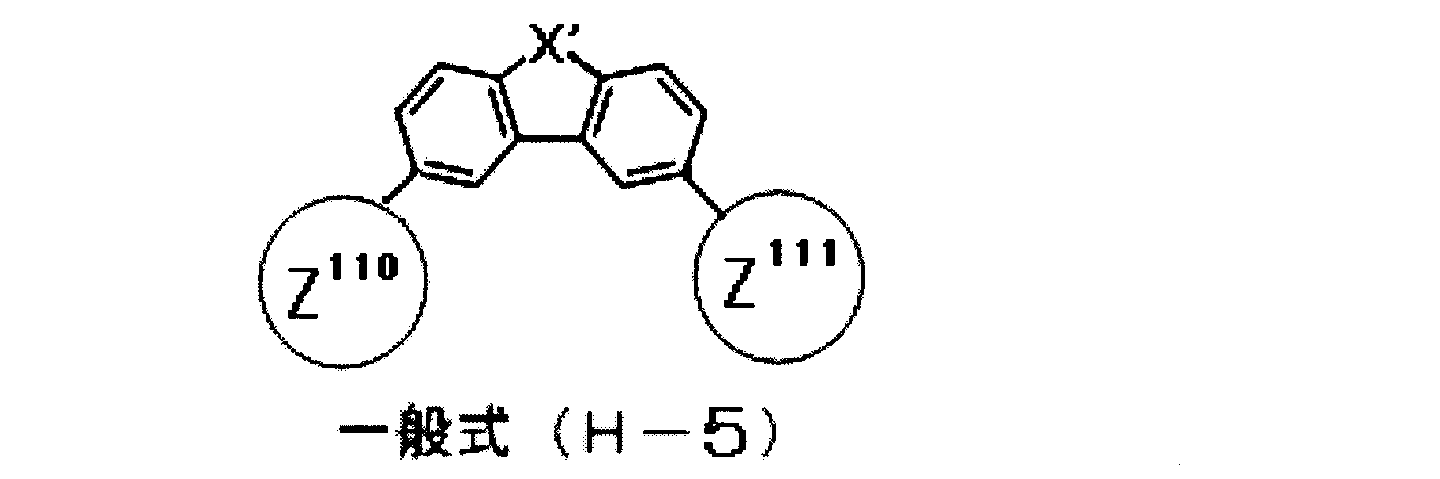
一般式(H-5)中、Z110及びZ111は各々独立にアルキル基、置換若しくは無置換の5員又は6員環からなる芳香環を表し、これらは更に芳香環で縮環されてもよい。Z110及びZ111はそれぞれ単結合又は2~4価の連結基を介して結合し、縮合環を形成してもよい。X’は炭素原子、酸素原子、窒素原子、又は硫黄原子を表し、該炭素原子又は窒素原子は置換基を有してもよい。
Z110及びZ111はZ100~Z109と同義であり、好ましい範囲も同様であるが、特にカルバゾール環、ジベンゾフラン環、ジベンゾチオフェン環が好ましく、これらは更に置換基を有してもよい。
X’は好ましくは酸素原子、窒素原子、又は硫黄原子を表し、該窒素原子は置換基(好ましくはアリール基)を有してもよい。
X’は好ましくは酸素原子、窒素原子、又は硫黄原子を表し、該窒素原子は置換基(好ましくはアリール基)を有してもよい。
以下に、アスペクト比が2以下のホスト材料の具体例を下記に示すが、本発明はこれらの化合物に限定されない。


有機電界発光素子用材料におけるホスト材料の含有量は、70質量%~99.9質量%が好ましく、75質量%~99質量%がより好ましく、80質量%~95質量%が特に好ましい。
〔膜〕
本発明の有機電界発光素子用材料により、ホスト材料及び発光材料の配向性が高く、かつアモルファス性の良好な膜を得ることができる。該膜は、配向性の観点から真空蒸着プロセスにより形成することが好ましいが、塗布プロセス(湿式プロセス)によっても配向性及びアモルファス性の双方が良好な膜を得ることができる。該膜は、有機電界発光素子の発光層として用いることができ、配向性が高いため光取り出し効率に優れ、アモルファス性が良好なため高耐久性の発光層とすることができる。
本発明の有機電界発光素子用材料により、ホスト材料及び発光材料の配向性が高く、かつアモルファス性の良好な膜を得ることができる。該膜は、配向性の観点から真空蒸着プロセスにより形成することが好ましいが、塗布プロセス(湿式プロセス)によっても配向性及びアモルファス性の双方が良好な膜を得ることができる。該膜は、有機電界発光素子の発光層として用いることができ、配向性が高いため光取り出し効率に優れ、アモルファス性が良好なため高耐久性の発光層とすることができる。
〔有機電界発光素子〕
本発明における有機電界発光素子について詳細に説明する。
本発明における有機電界発光素子は、基板上に、陽極及び陰極を含む一対の電極と、該電極間に発光層を含む少なくとも一層の有機層を有する有機電界発光素子であって、該発光層に、分子長と分子厚みとのアスペクト比(分子長/分子厚み)が3以上の平板状発光材料と、分子長と分子厚みとのアスペクト比(分子長/分子厚み)が2以下のホスト材料とを少なくとも含有し、前記発光材料の分子半径と、前記ホスト材料の分子半径とのサイズ比(発光材料の分子半径/ホスト材料の分子半径)が、0.8~1.2である。
本発明における有機電界発光素子について詳細に説明する。
本発明における有機電界発光素子は、基板上に、陽極及び陰極を含む一対の電極と、該電極間に発光層を含む少なくとも一層の有機層を有する有機電界発光素子であって、該発光層に、分子長と分子厚みとのアスペクト比(分子長/分子厚み)が3以上の平板状発光材料と、分子長と分子厚みとのアスペクト比(分子長/分子厚み)が2以下のホスト材料とを少なくとも含有し、前記発光材料の分子半径と、前記ホスト材料の分子半径とのサイズ比(発光材料の分子半径/ホスト材料の分子半径)が、0.8~1.2である。
本発明の有機電界発光素子において、発光層は有機層であり、発光層と陽極の間に更に少なくとも一層の有機層を含むが、これら以外にも更に有機層を有していてもよい。
発光素子の性質上、陽極及び陰極のうち少なくとも一方の電極は、透明若しくは半透明であることが好ましい。
図1は、本発明に係る有機電界発光素子の構成の一例を示している。
図1に示される本発明に係る有機電界発光素子10は、支持基板2上において、陽極3と陰極9との間に発光層6が挟まれている。具体的には、陽極3と陰極9との間に正孔注入層4、正孔輸送層5、発光層6、正孔ブロック層7、及び電子輸送層8がこの順に積層されている。
発光素子の性質上、陽極及び陰極のうち少なくとも一方の電極は、透明若しくは半透明であることが好ましい。
図1は、本発明に係る有機電界発光素子の構成の一例を示している。
図1に示される本発明に係る有機電界発光素子10は、支持基板2上において、陽極3と陰極9との間に発光層6が挟まれている。具体的には、陽極3と陰極9との間に正孔注入層4、正孔輸送層5、発光層6、正孔ブロック層7、及び電子輸送層8がこの順に積層されている。
<有機層の構成>
前記有機層の層構成としては、特に制限はなく、有機電界発光素子の用途、目的に応じて適宜選択することができるが、陽極上に又は陰極上に形成されるのが好ましい。この場合、有機層は、陽極又は陰極上の前面又は一面に形成される。
有機層の形状、大きさ、及び厚み等については、特に制限はなく、目的に応じて適宜選択することができる。
前記有機層の層構成としては、特に制限はなく、有機電界発光素子の用途、目的に応じて適宜選択することができるが、陽極上に又は陰極上に形成されるのが好ましい。この場合、有機層は、陽極又は陰極上の前面又は一面に形成される。
有機層の形状、大きさ、及び厚み等については、特に制限はなく、目的に応じて適宜選択することができる。
具体的な層構成として、下記が挙げられるが本発明はこれらの構成に限定されるものではない。
・陽極/正孔輸送層/発光層/電子輸送層/陰極、
・陽極/正孔輸送層/発光層/ブロック層/電子輸送層/陰極、
・陽極/正孔輸送層/発光層/ブロック層/電子輸送層/電子注入層/陰極、
・陽極/正孔注入層/正孔輸送層/発光層/電子輸送層/電子注入層/陰極、
・陽極/正孔注入層/正孔輸送層/発光層/ブロック層/電子輸送層/陰極、
・陽極/正孔注入層/正孔輸送層/発光層/ブロック層/電子輸送層/電子注入層/陰極。
有機電界発光素子の素子構成、基板、陰極及び陽極については、例えば、特開2008-270736号公報に詳述されており、該公報に記載の事項を本発明に適用することができる。
・陽極/正孔輸送層/発光層/電子輸送層/陰極、
・陽極/正孔輸送層/発光層/ブロック層/電子輸送層/陰極、
・陽極/正孔輸送層/発光層/ブロック層/電子輸送層/電子注入層/陰極、
・陽極/正孔注入層/正孔輸送層/発光層/電子輸送層/電子注入層/陰極、
・陽極/正孔注入層/正孔輸送層/発光層/ブロック層/電子輸送層/陰極、
・陽極/正孔注入層/正孔輸送層/発光層/ブロック層/電子輸送層/電子注入層/陰極。
有機電界発光素子の素子構成、基板、陰極及び陽極については、例えば、特開2008-270736号公報に詳述されており、該公報に記載の事項を本発明に適用することができる。
<基板>
本発明で使用する基板としては、有機層から発せられる光を散乱又は減衰させない基板であることが好ましい。有機材料の場合には、耐熱性、寸法安定性、耐溶剤性、電気絶縁性、及び加工性に優れていることが好ましい。
本発明で使用する基板としては、有機層から発せられる光を散乱又は減衰させない基板であることが好ましい。有機材料の場合には、耐熱性、寸法安定性、耐溶剤性、電気絶縁性、及び加工性に優れていることが好ましい。
<陽極>
陽極は、通常、有機層に正孔を供給する電極としての機能を有していればよく、その形状、構造、大きさ等については特に制限はなく、発光素子の用途、目的に応じて、公知の電極材料の中から適宜選択することができる。前述のごとく、陽極は、通常透明陽極として設けられる。
陽極は、通常、有機層に正孔を供給する電極としての機能を有していればよく、その形状、構造、大きさ等については特に制限はなく、発光素子の用途、目的に応じて、公知の電極材料の中から適宜選択することができる。前述のごとく、陽極は、通常透明陽極として設けられる。
<陰極>
陰極は、通常、有機層に電子を注入する電極としての機能を有していればよく、その形状、構造、大きさ等については特に制限はなく、発光素子の用途、目的に応じて、公知の電極材料の中から適宜選択することができる。
陰極は、通常、有機層に電子を注入する電極としての機能を有していればよく、その形状、構造、大きさ等については特に制限はなく、発光素子の用途、目的に応じて、公知の電極材料の中から適宜選択することができる。
基板、陽極、陰極については、特開2008-270736号公報の段落番号〔0070〕~〔0089〕に記載の事項を本発明に適用することができる。
<有機層>
本発明における有機層について説明する。
本発明における有機層について説明する。
〔有機層の形成〕
本発明の有機電界発光素子において、各有機層は、真空蒸着法やスパッタ法等の乾式成膜法、転写法、印刷法、スピンコート法、バーコート法等の湿式プロセスのいずれによっても好適に形成することができる。乾式法としては真空蒸着法、スパッタ法等が使用でき、湿式法(湿式製膜法)としてはディッピング法、スピンコート法、ディップコート法、キャスト法、ダイコート法、ロールコート法、バーコート法、グラビアコート法、スプレーコート法、インクジェット法等が使用可能である。
これらの成膜法は有機層の材料に応じて適宜選択できる。
湿式法により製膜した場合は製膜した後に乾燥してよい。乾燥は塗布層が損傷しないように温度、圧力等の条件を選択して行う。
本発明の有機電界発光素子において、各有機層は、真空蒸着法やスパッタ法等の乾式成膜法、転写法、印刷法、スピンコート法、バーコート法等の湿式プロセスのいずれによっても好適に形成することができる。乾式法としては真空蒸着法、スパッタ法等が使用でき、湿式法(湿式製膜法)としてはディッピング法、スピンコート法、ディップコート法、キャスト法、ダイコート法、ロールコート法、バーコート法、グラビアコート法、スプレーコート法、インクジェット法等が使用可能である。
これらの成膜法は有機層の材料に応じて適宜選択できる。
湿式法により製膜した場合は製膜した後に乾燥してよい。乾燥は塗布層が損傷しないように温度、圧力等の条件を選択して行う。
上記湿式製膜法(塗布プロセス)で用いる塗布液は通常、有機層の材料と、それを溶解又は分散するための溶剤からなる。溶剤は特に限定されず、有機層に用いる材料に応じて選択すればよい。溶剤の具体例としては、ハロゲン系溶剤(クロロホルム、四塩化炭素、ジクロロメタン、1,2-ジクロロエタン、クロロベンゼン等)、ケトン系溶剤(アセトン、メチルエチルケトン、ジエチルケトン、n-プロピルメチルケトン、シクロヘキサノン等)、芳香族系溶剤(ベンゼン、トルエン、キシレン等)、エステル系溶剤(酢酸エチル、酢酸n-プロピル、酢酸n-ブチル、プロピオン酸メチル、プロピオン酸エチル、γ-ブチロラクトン、炭酸ジエチル等)、エーテル系溶剤(テトラヒドロフラン、ジオキサン等)、アミド系溶剤(ジメチルホルムアミド、ジメチルアセトアミド等)、ジメチルスルホキシド、アルコール系溶剤(メタノール、プロパノール、ブタノールなど)、水等が挙げられる。
なお、塗布液中の溶剤に対する固形分量は特に制限はなく、塗布液の粘度も製膜方法に応じて任意に選択することができる。
なお、塗布液中の溶剤に対する固形分量は特に制限はなく、塗布液の粘度も製膜方法に応じて任意に選択することができる。
〔発光層〕
本発明の有機電界発光素子において、発光層は前述の本発明の有機電界発光素子用材料を含む。
発光材料としては、配向性の観点から、前述した平面性の高い発光材料が好ましく、燐光発光材料であることが好ましく、白金錯体であることが更に好ましい。発光材料は単独で使用しても2種以上を併用してもよい。
発光層は、真空蒸着プロセスや湿式プロセスで形成することができる。配向性の観点から発光層は真空蒸着プロセスにより形成することが好ましい。
本発明の有機電界発光素子において、発光層は前述の本発明の有機電界発光素子用材料を含む。
発光材料としては、配向性の観点から、前述した平面性の高い発光材料が好ましく、燐光発光材料であることが好ましく、白金錯体であることが更に好ましい。発光材料は単独で使用しても2種以上を併用してもよい。
発光層は、真空蒸着プロセスや湿式プロセスで形成することができる。配向性の観点から発光層は真空蒸着プロセスにより形成することが好ましい。
発光層中の発光材料の含有量は特に制限されないが、例えば0.1~30質量%であることが好ましく、1~25質量%であるのがより好ましく、5~20質量%であることが特に好ましい。
上記ホスト化合物とは、その励起状態から発光材料へエネルギー移動が起こり、その結果、該発光を発光させる化合物である。
本発明の有機電界発光素子では、発光層前述したホスト材料を含有する。該ホスト材料の発光層中での含有量は、70質量%~99.9質量%が好ましく、75質量%~99質量%がより好ましく、80質量%~95質量%が特に好ましい。
本発明の有機電界発光素子では、発光層前述したホスト材料を含有する。該ホスト材料の発光層中での含有量は、70質量%~99.9質量%が好ましく、75質量%~99質量%がより好ましく、80質量%~95質量%が特に好ましい。
ホスト材料としては、前述のホスト材料以外の材料を含有させてもよく、その具体例としては、カルバゾール誘導体、トリアゾール誘導体、オキサゾール誘導体、オキサジアゾール誘導体、イミダゾール誘導体、ポリアリールアルカン誘導体、ピラゾリン誘導体、ピラゾロン誘導体、フェニレンジアミン誘導体、アリールアミン誘導体、アミノ置換カルコン誘導体、スチリルアントラセン誘導体、フルオレノン誘導体、ヒドラゾン誘導体、スチルベン誘導体、シラザン誘導体、芳香族第三級アミン化合物、スチリルアミン化合物、芳香族ジメチリデン化合物、ポルフィリン化合物、アントラキノジメタン誘導体、アントロン誘導体、ジフェニルキノン誘導体、チオピランジオキシド誘導体、カルボジイミド誘導体、フルオレニリデンメタン誘導体、ジスチリルピラジン誘導体、ナフタレンペリレン等のヘテロ環テトラカルボン酸無水物、フタロシアニン誘導体、8-キノリノール誘導体の金属錯体、メタルフタロシアニン、ベンゾオキサゾールやベンゾチアゾール等を配位子とする金属錯体、ポリシラン化合物、ポリ(N-ビニルカルバゾール)誘導体、アニリン共重合体、チオフェンオリゴマー、ポリチオフェン等の導電性高分子、ポリチオフェン誘導体、ポリフェニレン誘導体、ポリフェニレンビニレン誘導体、ポリフルオレン誘導体等が挙げられる。ホスト化合物は1種単独で使用しても2種以上を併用してもよい。
発光層の厚みは、駆動電圧上昇を抑え、また短絡を防止する観点から、10~200nmとするのが好ましく、20~80nmとするのがより好ましい。
(正孔注入層、正孔輸送層)
本発明の有機電界発光素子は、正孔注入層、及び正孔輸送層を有してもよい。正孔注入層、及び正孔輸送層は、陽極又は陽極側から正孔を受け取り陰極側に輸送する機能を有する層である。
正孔注入層、正孔輸送層については、例えば、特開2008-270736、特開2007-266458に詳述されており、これらの公報に記載の事項を本発明に適用することができる。
本発明の有機電界発光素子は、正孔注入層、及び正孔輸送層を有してもよい。正孔注入層、及び正孔輸送層は、陽極又は陽極側から正孔を受け取り陰極側に輸送する機能を有する層である。
正孔注入層、正孔輸送層については、例えば、特開2008-270736、特開2007-266458に詳述されており、これらの公報に記載の事項を本発明に適用することができる。
(電子注入層、電子輸送層)
本発明の有機電界発光素子は、電子注入層、及び電子輸送層を有してもよい。電子注入層、及び電子輸送層は、陰極又は陰極側から電子を受け取り陽極側に輸送する機能を有する層である。これらの層に用いる電子注入材料、電子輸送材料は低分子化合物であっても高分子化合物であってもよい。
電子注入層、電子輸送層については、例えば、特開2008-270736、特開2007-266458に詳述されており、これらの公報に記載の事項を本発明に適用することができる。
本発明の有機電界発光素子は、電子注入層、及び電子輸送層を有してもよい。電子注入層、及び電子輸送層は、陰極又は陰極側から電子を受け取り陽極側に輸送する機能を有する層である。これらの層に用いる電子注入材料、電子輸送材料は低分子化合物であっても高分子化合物であってもよい。
電子注入層、電子輸送層については、例えば、特開2008-270736、特開2007-266458に詳述されており、これらの公報に記載の事項を本発明に適用することができる。
(正孔ブロック層)
正孔ブロック層は、陽極側から発光層に輸送された正孔が、陰極側に通りぬけることを防止する機能を有する層である。本発明において、発光層と陰極側で隣接する有機層として、正孔ブロック層を設けることができる。
正孔ブロック層を構成する有機化合物の例としては、アルミニウム(III)ビス(2-メチル-8-キノリナト)4-フェニルフェノレート(Aluminum(III)bis(2-methyl-8-quinolinato)4-phenylphenolate(BAlqと略記する))等のアルミニウム錯体、トリアゾール誘導体、2,9-ジメチル-4,7-ジフェニル-1,10-フェナントロリン(2,9-Dimethyl-4,7-diphenyl-1,10-phenanthroline(BCPと略記する))等のフェナントロリン誘導体、トリフェニレン誘導体、カルバゾール誘導体等が挙げられる。
正孔ブロック層の厚さとしては、1nm~500nmであるのが好ましく、5nm~200nmであるのがより好ましく、10nm~100nmであるのが更に好ましい。
正孔ブロック層は、上述した材料の一種又は二種以上からなる単層構造であってもよいし、同一組成又は異種組成の複数層からなる多層構造であってもよい。
正孔ブロック層は、陽極側から発光層に輸送された正孔が、陰極側に通りぬけることを防止する機能を有する層である。本発明において、発光層と陰極側で隣接する有機層として、正孔ブロック層を設けることができる。
正孔ブロック層を構成する有機化合物の例としては、アルミニウム(III)ビス(2-メチル-8-キノリナト)4-フェニルフェノレート(Aluminum(III)bis(2-methyl-8-quinolinato)4-phenylphenolate(BAlqと略記する))等のアルミニウム錯体、トリアゾール誘導体、2,9-ジメチル-4,7-ジフェニル-1,10-フェナントロリン(2,9-Dimethyl-4,7-diphenyl-1,10-phenanthroline(BCPと略記する))等のフェナントロリン誘導体、トリフェニレン誘導体、カルバゾール誘導体等が挙げられる。
正孔ブロック層の厚さとしては、1nm~500nmであるのが好ましく、5nm~200nmであるのがより好ましく、10nm~100nmであるのが更に好ましい。
正孔ブロック層は、上述した材料の一種又は二種以上からなる単層構造であってもよいし、同一組成又は異種組成の複数層からなる多層構造であってもよい。
(電子ブロック層)
電子ブロック層は、陰極側から発光層に輸送された電子が、陽極側に通りぬけることを防止する機能を有する層である。本発明において、発光層と陽極側で隣接する有機層として、電子ブロック層を設けることができる。
電子ブロック層を構成する有機化合物の例としては、例えば前述の正孔輸送材料として挙げたものが適用できる。
電子ブロック層の厚さとしては、1nm~500nmであるのが好ましく、5nm~200nmであるのがより好ましく、10nm~100nmであるのが更に好ましい。
電子ブロック層は、上述した材料の一種又は二種以上からなる単層構造であってもよいし、同一組成又は異種組成の複数層からなる多層構造であってもよい。
電子ブロック層は、陰極側から発光層に輸送された電子が、陽極側に通りぬけることを防止する機能を有する層である。本発明において、発光層と陽極側で隣接する有機層として、電子ブロック層を設けることができる。
電子ブロック層を構成する有機化合物の例としては、例えば前述の正孔輸送材料として挙げたものが適用できる。
電子ブロック層の厚さとしては、1nm~500nmであるのが好ましく、5nm~200nmであるのがより好ましく、10nm~100nmであるのが更に好ましい。
電子ブロック層は、上述した材料の一種又は二種以上からなる単層構造であってもよいし、同一組成又は異種組成の複数層からなる多層構造であってもよい。
〔その他の有機層〕
本発明の有機電界発光素子は、特開平7-85974号、同7-192866号、同8-22891号、同10-275682号、同10-106746号等に記載の保護層を有していてもよい。保護層は発光素子の最上面に形成する。ここで最上面とは、基材、透明電極、有機層及び背面電極をこの順に積層する場合には背面電極の外側表面を指し、基材、背面電極、有機層及び透明電極をこの順に積層する場合には透明電極の外側表面を指す。保護層の形状、大きさ、厚み等は特に限定されない。保護層をなす材料は、水分や酸素等の発光素子を劣化させ得るものが素子内に侵入又は透過するのを抑制する機能を有しているものであれば特に限定されず、酸化ケイ素、二酸化ケイ素、酸化ゲルマニウム、二酸化ゲルマニウム等が使用できる。
本発明の有機電界発光素子は、特開平7-85974号、同7-192866号、同8-22891号、同10-275682号、同10-106746号等に記載の保護層を有していてもよい。保護層は発光素子の最上面に形成する。ここで最上面とは、基材、透明電極、有機層及び背面電極をこの順に積層する場合には背面電極の外側表面を指し、基材、背面電極、有機層及び透明電極をこの順に積層する場合には透明電極の外側表面を指す。保護層の形状、大きさ、厚み等は特に限定されない。保護層をなす材料は、水分や酸素等の発光素子を劣化させ得るものが素子内に侵入又は透過するのを抑制する機能を有しているものであれば特に限定されず、酸化ケイ素、二酸化ケイ素、酸化ゲルマニウム、二酸化ゲルマニウム等が使用できる。
保護層の形成方法は特に限定はなく、例えば真空蒸着法、スパッタリング法、反応性スパッタリング法、分子センエピタキシ法、クラスターイオンビーム法、イオンプレーティング法、プラズマ重合法、プラズマCVD法、レーザーCVD法、熱CVD法、コーティング法等が適用できる。
〔封止〕
また、有機電界発光素子には水分や酸素の侵入を防止するための封止層を設けるのが好ましい。封止層を形成する材料としては、テトラフルオロエチレンと少なくとも1種のコモノマーとの共重合体、共重合主鎖に環状構造を有する含フッ素共重合体、ポリエチレン、ポリプロピレン、ポリメチルメタクリレート、ポリイミド、ポリユリア、ポリテトラフルオロエチレン、ポリクロロトリフルオロエチレン、ポリジクロロジフルオロエチレン、クロロトリフルオロエチレン又はジクロロジフルオロエチレンと他のコモノマーとの共重合体、吸水率1%以上の吸水性物質、吸水率0.1%以下の防湿性物質、金属(In、Sn、Pb、Au、Cu、Ag、Al、Tl、Ni等)、金属酸化物(MgO、SiO、SiO2、Al2O3、GeO、NiO、CaO、BaO、Fe2O3、Y2O3、TiO2等)、金属フッ化物(MgF2、LiF、AlF3、CaF2等)、液状フッ素化炭素(パーフルオロアルカン、パーフルオロアミン、パーフルオロエーテル等)、該液状フッ素化炭素に水分や酸素の吸着剤を分散させたもの等が使用可能である。
また、有機電界発光素子には水分や酸素の侵入を防止するための封止層を設けるのが好ましい。封止層を形成する材料としては、テトラフルオロエチレンと少なくとも1種のコモノマーとの共重合体、共重合主鎖に環状構造を有する含フッ素共重合体、ポリエチレン、ポリプロピレン、ポリメチルメタクリレート、ポリイミド、ポリユリア、ポリテトラフルオロエチレン、ポリクロロトリフルオロエチレン、ポリジクロロジフルオロエチレン、クロロトリフルオロエチレン又はジクロロジフルオロエチレンと他のコモノマーとの共重合体、吸水率1%以上の吸水性物質、吸水率0.1%以下の防湿性物質、金属(In、Sn、Pb、Au、Cu、Ag、Al、Tl、Ni等)、金属酸化物(MgO、SiO、SiO2、Al2O3、GeO、NiO、CaO、BaO、Fe2O3、Y2O3、TiO2等)、金属フッ化物(MgF2、LiF、AlF3、CaF2等)、液状フッ素化炭素(パーフルオロアルカン、パーフルオロアミン、パーフルオロエーテル等)、該液状フッ素化炭素に水分や酸素の吸着剤を分散させたもの等が使用可能である。
本発明の有機電界発光素子は、陽極と陰極との間に直流(必要に応じて交流成分を含んでもよい)電圧(通常2ボルト~15ボルト)、又は直流電流を印加することにより、発光を得ることができる。
本発明の有機電界発光素子の駆動方法については、特開平2-148687号、同6-301355号、同5-29080号、同7-134558号、同8-234685号、同8-241047号の各公報、特許第2784615号、米国特許5828429号、同6023308号の各明細書、等に記載の駆動方法を適用することができる。
本発明の有機電界発光素子は、表示素子、ディスプレイ、バックライト、電子写真、照明光源、記録光源、露光光源、読み取り光源、標識、看板、インテリア、又は光通信等に好適に利用できる。特に、発光装置、照明装置、表示装置等の発光輝度が高い領域で駆動されるデバイスに好ましく用いられる。
本発明の有機電界発光素子は、表示素子、ディスプレイ、バックライト、電子写真、照明光源、記録光源、露光光源、読み取り光源、標識、看板、インテリア、又は光通信等に好適に利用できる。特に、発光装置、照明装置、表示装置等の発光輝度が高い領域で駆動されるデバイスに好ましく用いられる。
以下に実施例を挙げて本発明を更に具体的に説明する。以下の実施例に示す材料、試薬、物質量とその割合、操作等は本発明の主旨から逸脱しない限り適宜変更することができる。従って本発明の範囲は以下の具体例に制限されるものではない。
以下、溶媒の混合比は体積比を表す。
以下、溶媒の混合比は体積比を表す。
〔発光材料(ゲスト)の合成〕
本発明における白金錯体は、例えば、Journal of Organic Chemistry 53,786,(1988)、G.R.Newkome et al.)の、789頁、左段53行~右段7行に記載の方法、790頁、左段18行~38行に記載の方法、790頁、右段19行~30行に記載の方法及びその組み合わせ、Chemische Berichte 113,2749(1980)、H.Lexyほか)の、2752頁、26行~35行に記載の方法等、種々の手法で合成できる。
例えば、配位子、又はその解離体と金属化合物を溶媒(例えば、ハロゲン系溶媒、アルコール系溶媒、エーテル系溶媒、エステル系溶媒、ケトン系溶媒、ニトリル系溶媒、アミド系溶媒、スルホン系溶媒、スルホキサイド系溶媒、水などが挙げられる)の存在下、若しくは、溶媒非存在下、塩基の存在下(無機、有機の種々の塩基、例えば、ナトリウムメトキシド、t-ブトキシカリウム、トリエチルアミン、炭酸カリウムなどが挙げられる)、若しくは、塩基非存在下、室温以下、若しくは加熱し(通常の加熱以外にもマイクロウェーブで加熱する手法も有効である)得ることができる。
本発明における白金錯体は、例えば、Journal of Organic Chemistry 53,786,(1988)、G.R.Newkome et al.)の、789頁、左段53行~右段7行に記載の方法、790頁、左段18行~38行に記載の方法、790頁、右段19行~30行に記載の方法及びその組み合わせ、Chemische Berichte 113,2749(1980)、H.Lexyほか)の、2752頁、26行~35行に記載の方法等、種々の手法で合成できる。
例えば、配位子、又はその解離体と金属化合物を溶媒(例えば、ハロゲン系溶媒、アルコール系溶媒、エーテル系溶媒、エステル系溶媒、ケトン系溶媒、ニトリル系溶媒、アミド系溶媒、スルホン系溶媒、スルホキサイド系溶媒、水などが挙げられる)の存在下、若しくは、溶媒非存在下、塩基の存在下(無機、有機の種々の塩基、例えば、ナトリウムメトキシド、t-ブトキシカリウム、トリエチルアミン、炭酸カリウムなどが挙げられる)、若しくは、塩基非存在下、室温以下、若しくは加熱し(通常の加熱以外にもマイクロウェーブで加熱する手法も有効である)得ることができる。
<D-1の合成>

(化合物1aの合成)
2-ヒドロキシ-4-メトキシベンズアルデヒド(1.6g)、4,5-ジメチル-1,2-フェニレンジアミン(0.73g)のエタノール溶液(30ml)に酢酸5滴を1ml駒込ピペットで滴下し、80℃で6時間反応させた。析出した固体を濾取し、エタノールで再結晶することにより、化合物1a(2.0g)を得た。
(D-1の合成)
化合物1a(0.9g)、酢酸ナトリウム(0.19g)のアセトニトリル溶液(30ml)に、PtCl2(0.61g)のDMSO(ジメチルスルホキシド)溶液(15ml)を80℃にて滴下し、7時間反応させた。反応液を濾過し、THF(テトラヒドロフラン)で再結晶することにより、D-1(1.04g)を得た。なお、化合物の同定は元素分析、NMR及びMASSスペクトルにより行った。
2-ヒドロキシ-4-メトキシベンズアルデヒド(1.6g)、4,5-ジメチル-1,2-フェニレンジアミン(0.73g)のエタノール溶液(30ml)に酢酸5滴を1ml駒込ピペットで滴下し、80℃で6時間反応させた。析出した固体を濾取し、エタノールで再結晶することにより、化合物1a(2.0g)を得た。
(D-1の合成)
化合物1a(0.9g)、酢酸ナトリウム(0.19g)のアセトニトリル溶液(30ml)に、PtCl2(0.61g)のDMSO(ジメチルスルホキシド)溶液(15ml)を80℃にて滴下し、7時間反応させた。反応液を濾過し、THF(テトラヒドロフラン)で再結晶することにより、D-1(1.04g)を得た。なお、化合物の同定は元素分析、NMR及びMASSスペクトルにより行った。
<D-3の合成>
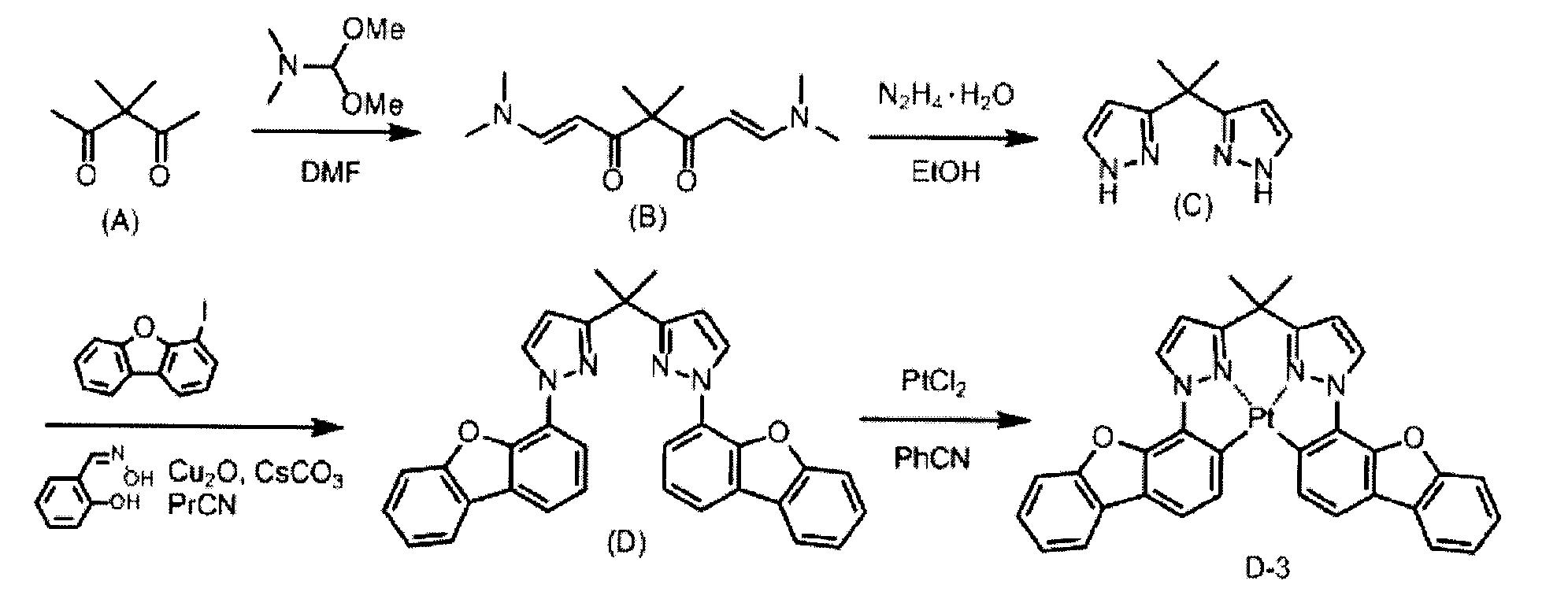
窒素雰囲気下、100mLの三口フラスコに、3,3-ジメチル-2,4-ペンタンジオン(A)10g(78mmol)、ジメチルホルムアミド-ジメチルアセタール27.6mL、ジメチルホルムアミド60mLを仕込み、18時間、150℃で反応させた。反応液を減圧下で、濃縮した後、残渣をシリカゲルクロマトグラフィー(展開液:酢酸エチル/メタノール=9/1)で精製し、化合物(B)を4.83g得た(収率26%)。
窒素雰囲気下、300mLの三口フラスコに、化合物(B)2.70g(21.0mmol)、ヒドラジン一水和物1.19g(23.8mmol)、エタノール200mLを仕込み、7時間加熱還流させた。反応液を濃縮し、残渣をシリカゲルクロマトグラフィー(展開液:酢酸エチル/エタノール=8/2)で精製し、化合物(C)を1.77g得た(収率89%)。
窒素雰囲気下、200mLの三口フラスコに、化合物(C)1.00g(4.20mmol)、4-ヨードジベンゾフラン4.94g(16.8mmol)、酸化銅81.1mg(0.567mmol)、サリチルアルドキシム311mg(2.27mmol)、炭酸セシウム7.39g(38.3mmol)、ブチロニトリル100mLを仕込み、140℃で16時間反応させた。反応液を濾過し、濃縮した。得られた残渣をシリカゲルクロマトグラフィー(展開液:ヘキサン/酢酸エチル=10/1)で精製し、化合物(D)を1.18g得た(収率55%)。なお、化合物の同定は元素分析、NMR及びMASSスペクトルにより行った。
窒素雰囲気下、50mLのナスフラスコに、化合物(D)0.51g(1mmol)、塩化第一白金0.26g(1mmol)、ベンゾニトリル30mLを仕込み、200℃で5時間、加熱した。室温まで冷却後、反応液にヘキサン40mLを加え、析出した茶褐色の固体をシリカゲルクロマトグラフィー(展開液:クロロホルム)で精製することによりD-3を0.13g得た。収率18%。


(実施例1)
発光層のオーダーパラメータ及び結晶性は以下のように評価した。
洗浄した石英基板を蒸着装置に入れ、下記表1に示すホスト材料と発光材料を85:15の比率(質量比)で共蒸着させた膜を作成し、ATR-IRの変角測定により発光材料のオーダーパラメータを算出した。また膜作成後、40℃の恒温槽で1週間経過したものを偏光顕微鏡により膜中の結晶の有無を確認した。結果を表1に示す。
表中、結晶性とは偏光顕微鏡により結晶が観測されなかったものを○、結晶が観測されたものを×とした。結晶は観測されない方が好ましい。
発光層のオーダーパラメータ及び結晶性は以下のように評価した。
洗浄した石英基板を蒸着装置に入れ、下記表1に示すホスト材料と発光材料を85:15の比率(質量比)で共蒸着させた膜を作成し、ATR-IRの変角測定により発光材料のオーダーパラメータを算出した。また膜作成後、40℃の恒温槽で1週間経過したものを偏光顕微鏡により膜中の結晶の有無を確認した。結果を表1に示す。
表中、結晶性とは偏光顕微鏡により結晶が観測されなかったものを○、結晶が観測されたものを×とした。結晶は観測されない方が好ましい。

表1の結果からわかるように、アスペクト比が3以上の発光材料と、アスペクト比が2以下のホスト材料を用い、かつ(発光材料分子半径/ホスト材料分子半径)比が0.8から1.2の範囲とした本発明の実施例は、高い水平配向秩序度Sを与え、結晶性は見られないことがわかる。
(実施例2)
〈素子作成例1〉
厚み0.5mm、2.5cm角のITO膜を有するガラス基板(ジオマテック社製、表面抵抗10Ω/□)を洗浄容器に入れ、2-プロパノール中で超音波洗浄した後、30分間UV-オゾン処理を行った。この透明陽極(ITO膜)上に真空蒸着法にて以下の有機化合物層を順次蒸着した。前記「Ω/□」は「Ω/sq.」と同じ意味である。
第1層:HIL-1 :膜厚10nm
第2層:NPD :膜厚30nm
第3層:H-1及びD-1(質量比95:5) :膜厚30nm
第4層:ETL-1 :膜厚50nm
この上に、フッ化リチウム1nm及び金属アルミニウム70nmをこの順に蒸着し陰極とした。
この積層体を、大気に触れさせることなく、窒素ガスで置換したグローブボックス内に入れ、ガラス製の封止缶及び紫外線硬化型の接着剤(XNR5516HV、長瀬チバ(株)製)を用いて封止し、本発明11の素子を得た。
同様に第3層の材料として表2に示す材料を用いて各素子を得た。
〈素子作成例1〉
厚み0.5mm、2.5cm角のITO膜を有するガラス基板(ジオマテック社製、表面抵抗10Ω/□)を洗浄容器に入れ、2-プロパノール中で超音波洗浄した後、30分間UV-オゾン処理を行った。この透明陽極(ITO膜)上に真空蒸着法にて以下の有機化合物層を順次蒸着した。前記「Ω/□」は「Ω/sq.」と同じ意味である。
第1層:HIL-1 :膜厚10nm
第2層:NPD :膜厚30nm
第3層:H-1及びD-1(質量比95:5) :膜厚30nm
第4層:ETL-1 :膜厚50nm
この上に、フッ化リチウム1nm及び金属アルミニウム70nmをこの順に蒸着し陰極とした。
この積層体を、大気に触れさせることなく、窒素ガスで置換したグローブボックス内に入れ、ガラス製の封止缶及び紫外線硬化型の接着剤(XNR5516HV、長瀬チバ(株)製)を用いて封止し、本発明11の素子を得た。
同様に第3層の材料として表2に示す材料を用いて各素子を得た。
素子の性能は以下のように評価した。
(a) 外部量子効率
東陽テクニカ製ソースメジャーユニット2400を用いて、直流電圧を各素子に印加し発光させ、その輝度をトプコン社製輝度計BM-8を用いて測定した。発光スペクトルと発光波長は浜松ホトニクス製スペクトルアナライザーPMA-11を用いて測定した。これらを元に輝度が1000cd/m2付近の外部量子効率を輝度換算法により算出した。効率は数字が大きいほど好ましい。
(a) 外部量子効率
東陽テクニカ製ソースメジャーユニット2400を用いて、直流電圧を各素子に印加し発光させ、その輝度をトプコン社製輝度計BM-8を用いて測定した。発光スペクトルと発光波長は浜松ホトニクス製スペクトルアナライザーPMA-11を用いて測定した。これらを元に輝度が1000cd/m2付近の外部量子効率を輝度換算法により算出した。効率は数字が大きいほど好ましい。
(b) 素子耐久性
KEITHLEY社製ソースメジャーユニット2400を用いて、室温において、初期の発光輝度1,000cd/m2となるように定電流(2.5mA/cm2)を印加して連続的に駆動を行い、発光輝度が10%低下するまでの時間を測定した。なお、発光輝度は、トプコン社製輝度計SR-3により測定した。表2中に示す耐久性は、本発明11の素子を1とする相対値で示した。耐久性は数字が大きいほど好ましい。
KEITHLEY社製ソースメジャーユニット2400を用いて、室温において、初期の発光輝度1,000cd/m2となるように定電流(2.5mA/cm2)を印加して連続的に駆動を行い、発光輝度が10%低下するまでの時間を測定した。なお、発光輝度は、トプコン社製輝度計SR-3により測定した。表2中に示す耐久性は、本発明11の素子を1とする相対値で示した。耐久性は数字が大きいほど好ましい。
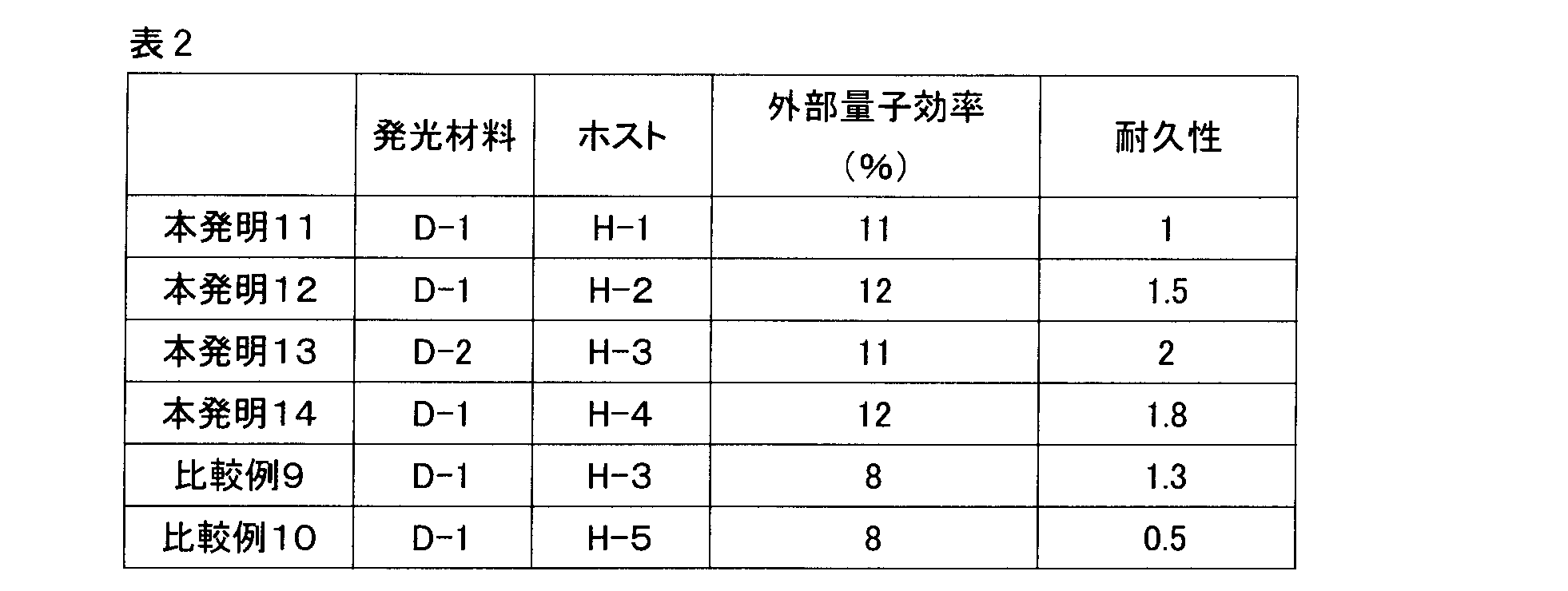
(実施例3)
層構成を以下に示すものに変えた以外は実施例2と同様にして素子を作製し、実施例2と同様の評価を行った結果を表3に示す。表3中に示す耐久性は、本発明15の素子を1.0とする相対値で示した。
第1層:HIL-1:膜厚10nm
第2層:HTL-2:膜厚20nm
第3層:表3中に記載のホスト材料、発光材料(質量比=93:7):膜厚30nm
第4層:ETL-2:膜厚30nm
層構成を以下に示すものに変えた以外は実施例2と同様にして素子を作製し、実施例2と同様の評価を行った結果を表3に示す。表3中に示す耐久性は、本発明15の素子を1.0とする相対値で示した。
第1層:HIL-1:膜厚10nm
第2層:HTL-2:膜厚20nm
第3層:表3中に記載のホスト材料、発光材料(質量比=93:7):膜厚30nm
第4層:ETL-2:膜厚30nm

(実施例4)
(有機電界発光素子評価(塗布))
-発光層形成用塗布液の調製-
表4に示す、発光材料(0.1質量%)、及び、ホスト材料(0.9質量%)に、MEK(メチルエチルケトン)(99.0質量%)を混合し、各発光層形成用塗布液を得た。
(有機電界発光素子評価(塗布))
-発光層形成用塗布液の調製-
表4に示す、発光材料(0.1質量%)、及び、ホスト材料(0.9質量%)に、MEK(メチルエチルケトン)(99.0質量%)を混合し、各発光層形成用塗布液を得た。
(素子作製手順)
-有機電界発光素子の作製-
25mm×25mm×0.7mmのガラス基板上にITOを150nmの厚みで蒸着し製膜したものを透明支持基板とした。この透明支持基板をエッチング、洗浄した。
このITOガラス基板上に、下記構造式で表されるPTPDES-2(ケミプロ化成製、Tg=205℃)2質量部を電子工業用シクロヘキサノン(関東化学製)98質量部に溶解し、厚みが約40nmとなるようにスピンコート(2,000rpm、20秒間)した後、120℃で30分間乾燥と160℃で10分間アニール処理することで、正孔注入層を成膜した。
-有機電界発光素子の作製-
25mm×25mm×0.7mmのガラス基板上にITOを150nmの厚みで蒸着し製膜したものを透明支持基板とした。この透明支持基板をエッチング、洗浄した。
このITOガラス基板上に、下記構造式で表されるPTPDES-2(ケミプロ化成製、Tg=205℃)2質量部を電子工業用シクロヘキサノン(関東化学製)98質量部に溶解し、厚みが約40nmとなるようにスピンコート(2,000rpm、20秒間)した後、120℃で30分間乾燥と160℃で10分間アニール処理することで、正孔注入層を成膜した。

上記正孔注入層上に前記各発光層形成用塗布液を厚みが約40nmとなるようにスピンコート(1,300rpm、30秒間)し、発光層とした。
次いで、発光層上に、電子輸送層として、BAlqを、厚みが40nmとなるように真空蒸着法にて形成した。
次いで、発光層上に、電子輸送層として、BAlqを、厚みが40nmとなるように真空蒸着法にて形成した。
電子輸送層上に、電子注入層としてフッ化リチウム(LiF)を、厚みが1nmとなるように真空蒸着法にて形成した。更に金属アルミニウムを70nm蒸着し、陰極とした。
以上により作製した積層体を、アルゴンガスで置換したグロ-ブボックス内に入れ、ステンレス製の封止缶及び紫外線硬化型の接着剤(XNR5516HV、長瀬チバ(株)製)を用いて封止することで、各有機電界発光素子を作製した。
得られた素子について、実施例2と同様の評価を行った結果を表4に示す。表4中に示す耐久性は、本発明16の素子を1とする相対値で示した。
以上により作製した積層体を、アルゴンガスで置換したグロ-ブボックス内に入れ、ステンレス製の封止缶及び紫外線硬化型の接着剤(XNR5516HV、長瀬チバ(株)製)を用いて封止することで、各有機電界発光素子を作製した。
得られた素子について、実施例2と同様の評価を行った結果を表4に示す。表4中に示す耐久性は、本発明16の素子を1とする相対値で示した。

表2~4の結果からわかるように、アスペクト比が3以上の発光材料と、アスペクト比が2以下のホスト材料を用い、かつ(発光材料分子半径/ホスト材料分子半径)比が0.8から1.2の範囲とした本発明の実施例は、効率及び耐久性に優れることがわかる。

本発明によれば、高い配向度、高い外部量子効率、及び高い耐久性を満足することができる有機電界発光素子、それに用いる有機電界発光素子用材料を提供することができる。
本発明を詳細にまた特定の実施態様を参照して説明したが、本発明の精神と範囲を逸脱することなく様々な変更や修正を加えることができることは当業者にとって明らかである。
本出願は、2011年4月12日出願の日本特許出願(特願2011-088681)、及び2012年4月11日出願の日本特許出願(特願2012-090577)に基づくものであり、その内容はここに参照として取り込まれる。
本出願は、2011年4月12日出願の日本特許出願(特願2011-088681)、及び2012年4月11日出願の日本特許出願(特願2012-090577)に基づくものであり、その内容はここに参照として取り込まれる。
2・・・基板
3・・・陽極
4・・・正孔注入層
5・・・正孔輸送層
6・・・発光層
7・・・正孔ブロック層
8・・・電子輸送層
9・・・陰極
10・・・有機電界発光素子
3・・・陽極
4・・・正孔注入層
5・・・正孔輸送層
6・・・発光層
7・・・正孔ブロック層
8・・・電子輸送層
9・・・陰極
10・・・有機電界発光素子
Claims (16)
- 基板上に、陽極及び陰極を含む一対の電極と、該電極間に発光層を含む少なくとも一層の有機層を有する有機電界発光素子であって、
該発光層に、分子長と分子厚みとのアスペクト比(分子長/分子厚み)が3以上の平板状発光材料と、分子長と分子厚みとのアスペクト比(分子長/分子厚み)が2以下のホスト材料とを少なくとも含有し、
前記発光材料の分子半径と、前記ホスト材料の分子半径とのサイズ比(発光材料の分子半径/ホスト材料の分子半径)が、0.8~1.2である、有機電界発光素子。 - 前記発光材料が、燐光発光性化合物である請求項1に記載の有機電界発光素子。
- 前記燐光発光性化合物が下記一般式(C-1)で表される白金錯体である請求項1又は2に記載の有機電界発光素子。

(式中、Q1、Q2、Q3及びQ4はそれぞれ独立にPtに配位する配位子を表す。L1、L2、及びL3は、それぞれ独立に、単結合、二重結合、二価の連結基、又はこれらの組合せからなる基を表す。Q3とQ4が連結して環を形成してもよい。) - 前記白金錯体が、下記一般式(C-3-1)、(C-5-1)、(C-6)、又は(C-9)で表される請求項3に記載の有機電界発光素子。

(一般式(C-3-1)中、X、Y、Z、Mは、それぞれ独立に、炭素原子又は窒素原子を表す。ただし、ZとYのいずれか一方は窒素原子である。Yが窒素原子のときは、Xは炭素原子である。m、n、p、及びqは、それぞれ独立に、0~3の整数を表す。Arは置換又は無置換のアリール基を表す。R1~R3及びR30は、それぞれ独立に、アルキル基、アリール基、アルコキシ基、アリールオキシ基、フッ素原子、シアノ基、シリル基、ヘテロ環基を表す。m、n、p、qが2以上の場合、複数のR1、R2、R3及びR30は各々隣同士が互いに連結して環状構造を形成してもよい。Qは、炭素原子又は窒素原子である。)
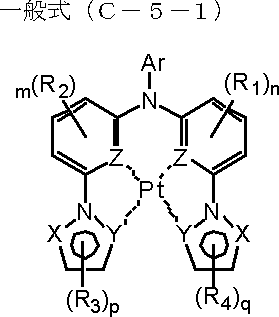
(一般式(C-5-1)中、X、Y、及びZはそれぞれ独立に、炭素原子又は窒素原子を表し、ZとYのいずれか一方が、窒素原子であり、Yが窒素原子のときは、Xは、炭素原子である。m、n、p及び、qは、それぞれ独立に0~3の整数を表す。Arは置換又は無置換のアリール基を表す。R1~R4はそれぞれ独立に、アルキル基、アリール基、アルコキシ基、アリールオキシ基、フッ素原子、シアノ基、シリル基、ヘテロ環基を表し、m、n、p、及びqが2以上の場合、複数のR1~R4は各々隣同士で互いに連結して環状構造を形成してもよい。)

(一般式(C-6)中、X,Y,及びZはそれぞれ独立に、炭素原子又は窒素原子を表し、ZとYのいずれか一方が、窒素原子である。Yが窒素原子のときは、Xは、炭素原子である。r、s、t、及びuは、それぞれ独立に0~3の整数を表す。R5~R8は、それぞれ独立に、アルキル基、アリール基、アルコキシ基、アリールオキシ基、フッ素原子、シアノ基、シリル基、ヘテロ環基を表し、r、s、t、及びuが2以上の場合、複数のR5~R8は各々隣同士で互いに連結して環状構造を形成してもよい。W1及びW2は、それぞれ独立に、アルキル基を表し、互いに結合して環状構造を形成してもよい。)

式中、A及びBは、環状構造を表し、Aは芳香環を表し、Bは芳香族ヘテロ環を表す。A及びBの一方が環を形成するとき、他方は環を形成しなくてもよい。R13~R16は、それぞれ独立に、水素原子、アルキル基、アリール基、シリル基、又はヘテロ環基を表し、R14とR15、R13とR16は、互いに結合して環状構造を形成してもよい。 - 前記発光材料が、蛍光発光性化合物である請求項1に記載の有機電界発光素子。
- 前記蛍光発光性化合物が、下記一般式(P-1)で表される請求項5に記載の有機電界発光素子。
一般式(P-1)

(一般式(P-1)中、RP 1~RP 10は、それぞれ独立に、水素原子、置換基を有していても良い芳香族炭化水素基、置換基を有していても良いアルケニル基、置換基を有していても良いアルキニル基、置換基を有していても良いアルキル基、置換基を有していても良いシリル基、置換基を有していても良いヘテロ環基、置換基を有していても良いアルキルアミノ基、置換基を有していても良いアリールアミノ基を表し、RP 1~RP 10の少なくとも1つは水素原子以外の置換基である。) - 前記蛍光発光性化合物が、下記一般式(PE-1)で表される請求項5に記載の有機電界発光素子。
一般式(PE-1)
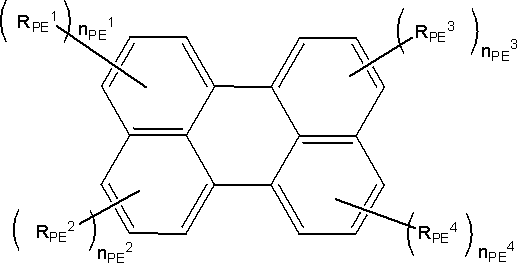
(一般式(PE-1)中、RPE 1~RPE 4は、それぞれ独立に、アルキル基、アリール基、ヘテロ環基、アミノ基、シリル基、アルキルオキシカルボニル基、アリールオキシカルボニル基、カルバモイル基、アルコキシ基、アリールオキシ基、ヘテロアリールオキシ基、アルキルチオ基、アリールチオ基を表し、これらは置換基を有していても良い。また、これらは互いに結合して環を形成しても良い。
nPE 1~nPE 4は、それぞれ独立に、0~3の整数を表す。nPE 1~nPE 4が2以上のとき、複数のRPE 1~RPE 4はそれぞれ互いに結合して環を形成しても良い。
また、式中の水素原子は重水素原子であっても良い。) - 前記蛍光発光性化合物が、下記一般式(F-1)で表される請求項5に記載の有機電界発光素子。
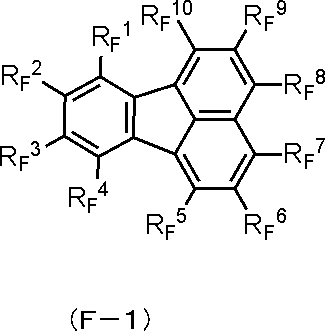
(一般式(F-1)中、RF 1~RF 10は、それぞれ独立に、水素原子、置換基を有していても良い芳香族炭化水素基、置換基を有していても良いアルケニル基、置換基を有していても良いアルキニル基、置換基を有していても良いアルキル基、置換基を有していても良いシリル基、置換基を有していても良いヘテロ環基、置換基を有していても良いアルキルアミノ基、置換基を有していても良いアリールアミノ基を表し、RF 1~RF 10の少なくとも1つは水素原子以外の置換基である。) - 前記平板状発光材料の分子長と分子厚みとのアスペクト比(分子長/分子厚み)が5より大きい、請求項1~8のいずれか1項に記載の有機電界発光素子。
- 前記ホスト材料が金属錯体化合物である請求項1~9のいずれか1項に記載の有機電界発光素子。
- 分子長と分子厚みとのアスペクト比(分子長/分子厚み)が3以上の平板状発光材料と、分子長と分子厚みとのアスペクト比(分子長/分子厚み)が2以下のホスト材料とを少なくとも含有し、前記発光材料の分子半径と、前記ホスト材料の分子半径とのサイズ比(発光材料の分子半径/ホスト材料の分子半径)が、0.8~1.2である、有機電界発光素子用材料。
- 発光層を、請求項11に記載の有機電界発光素子用材料を用いた真空蒸着プロセス又は湿式プロセスにて形成する工程を少なくとも含む有機電界発光素子の製造方法。
- 請求項11に記載の有機電界発光素子用材料を含有する膜。
- 請求項1~10のいずれか1項に記載の有機電界発光素子を用いた発光装置。
- 請求項1~10のいずれか1項に記載の有機電界発光素子を用いた表示装置。
- 請求項1~10のいずれか1項に記載の有機電界発光素子を用いた照明装置。
Applications Claiming Priority (4)
| Application Number | Priority Date | Filing Date | Title |
|---|---|---|---|
| JP2011088681 | 2011-04-12 | ||
| JP2011-088681 | 2011-04-12 | ||
| JP2012090577A JP6014350B2 (ja) | 2011-04-12 | 2012-04-11 | 有機電界発光素子、有機電界発光素子用材料、膜、発光層、及び有機電界発光素子の作製方法 |
| JP2012-090577 | 2012-04-11 |
Publications (1)
| Publication Number | Publication Date |
|---|---|
| WO2012141274A1 true WO2012141274A1 (ja) | 2012-10-18 |
Family
ID=47009437
Family Applications (1)
| Application Number | Title | Priority Date | Filing Date |
|---|---|---|---|
| PCT/JP2012/060078 Ceased WO2012141274A1 (ja) | 2011-04-12 | 2012-04-12 | 有機電界発光素子、有機電界発光素子用材料、膜、発光層、及び有機電界発光素子の作製方法 |
Country Status (2)
| Country | Link |
|---|---|
| JP (1) | JP6014350B2 (ja) |
| WO (1) | WO2012141274A1 (ja) |
Cited By (1)
| Publication number | Priority date | Publication date | Assignee | Title |
|---|---|---|---|---|
| US9512137B2 (en) | 2010-08-05 | 2016-12-06 | Idemitsu Kosan Co., Ltd. | Organic electroluminescence device |
Families Citing this family (32)
| Publication number | Priority date | Publication date | Assignee | Title |
|---|---|---|---|---|
| DE112011101526T5 (de) | 2010-04-30 | 2013-05-16 | Arizona Board Of Regents Acting For And On Behalf Of Arizona State University | Synthese von vierfach koordinierten Palladium-Komplexen und deren Anwendungen in lichtemittierenden Vorrichtungen |
| JP2013080898A (ja) * | 2011-09-22 | 2013-05-02 | Nippon Hoso Kyokai <Nhk> | 有機発光素子及びこれを用いた表示装置 |
| WO2014047616A1 (en) | 2012-09-24 | 2014-03-27 | Arizona Board Of Regents For And On Behalf Of Arizona State University | Metal compounds, methods, and uses thereof |
| US20150274762A1 (en) | 2012-10-26 | 2015-10-01 | Arizona Board Of Regents Acting For And On Behalf Of Arizona State University | Metal complexes, methods, and uses thereof |
| JP6603445B2 (ja) | 2013-06-10 | 2019-11-06 | アリゾナ・ボード・オブ・リージェンツ・オン・ビハーフ・オブ・アリゾナ・ステイト・ユニバーシティー | 改変された発光スペクトルを有する蛍光性四座配位金属錯体 |
| JP6804823B2 (ja) * | 2013-10-14 | 2020-12-23 | アリゾナ・ボード・オブ・リージェンツ・オン・ビハーフ・オブ・アリゾナ・ステイト・ユニバーシティーArizona Board of Regents on behalf of Arizona State University | 白金錯体およびデバイス |
| US10020455B2 (en) | 2014-01-07 | 2018-07-10 | Arizona Board Of Regents On Behalf Of Arizona State University | Tetradentate platinum and palladium complex emitters containing phenyl-pyrazole and its analogues |
| US9941479B2 (en) | 2014-06-02 | 2018-04-10 | Arizona Board Of Regents On Behalf Of Arizona State University | Tetradentate cyclometalated platinum complexes containing 9,10-dihydroacridine and its analogues |
| US9923155B2 (en) | 2014-07-24 | 2018-03-20 | Arizona Board Of Regents On Behalf Of Arizona State University | Tetradentate platinum (II) complexes cyclometalated with functionalized phenyl carbene ligands and their analogues |
| WO2016025921A1 (en) | 2014-08-15 | 2016-02-18 | Arizona Board Of Regents On Behalf Of Arizona State University | Non-platinum metal complexes for excimer based single dopant white organic light emitting diodes |
| US11329244B2 (en) | 2014-08-22 | 2022-05-10 | Arizona Board Of Regents On Behalf Of Arizona State University | Organic light-emitting diodes with fluorescent and phosphorescent emitters |
| US9920242B2 (en) | 2014-08-22 | 2018-03-20 | Arizona Board Of Regents On Behalf Of Arizona State University | Metal-assisted delayed fluorescent materials as co-host materials for fluorescent OLEDs |
| KR102360228B1 (ko) * | 2014-10-22 | 2022-02-09 | 솔루스첨단소재 주식회사 | 유기 전계 발광 소자 |
| US10033003B2 (en) | 2014-11-10 | 2018-07-24 | Arizona Board Of Regents On Behalf Of Arizona State University | Tetradentate metal complexes with carbon group bridging ligands |
| US9865825B2 (en) | 2014-11-10 | 2018-01-09 | Arizona Board Of Regents On Behalf Of Arizona State University | Emitters based on octahedral metal complexes |
| US9879039B2 (en) | 2015-06-03 | 2018-01-30 | Arizona Board Of Regents On Behalf Of Arizona State University | Tetradentate and octahedral metal complexes containing naphthyridinocarbazole and its analogues |
| US11930662B2 (en) | 2015-06-04 | 2024-03-12 | Arizona Board Of Regents On Behalf Of Arizona State University | Transparent electroluminescent devices with controlled one-side emissive displays |
| US11335865B2 (en) | 2016-04-15 | 2022-05-17 | Arizona Board Of Regents On Behalf Of Arizona State University | OLED with multi-emissive material layer |
| US10177323B2 (en) | 2016-08-22 | 2019-01-08 | Arizona Board Of Regents On Behalf Of Arizona State University | Tetradentate platinum (II) and palladium (II) complexes and octahedral iridium complexes employing azepine functional groups and their analogues |
| KR20210083134A (ko) | 2016-10-12 | 2021-07-06 | 아리조나 보드 오브 리젠츠 온 비하프 오브 아리조나 스테이트 유니버시티 | 협대역 적색 인광성 4좌 백금(ii) 착물 |
| US11183670B2 (en) | 2016-12-16 | 2021-11-23 | Arizona Board Of Regents On Behalf Of Arizona State University | Organic light emitting diode with split emissive layer |
| WO2018140765A1 (en) | 2017-01-27 | 2018-08-02 | Jian Li | Metal-assisted delayed fluorescent emitters employing pyrido-pyrrolo-acridine and analogues |
| US10516117B2 (en) | 2017-05-19 | 2019-12-24 | Arizona Board Of Regents On Behalf Of Arizona State University | Metal-assisted delayed fluorescent emttters employing benzo-imidazo-phenanthridine and analogues |
| US11101435B2 (en) | 2017-05-19 | 2021-08-24 | Arizona Board Of Regents On Behalf Of Arizona State University | Tetradentate platinum and palladium complexes based on biscarbazole and analogues |
| WO2019079508A2 (en) | 2017-10-17 | 2019-04-25 | Jian Li | PREFERRED MOLECULAR ORIENTATED PHOSPHORESCENT EXCIMERS AS MONOCHROMATIC TRANSMITTERS FOR DISPLAY AND LIGHTING APPLICATIONS |
| US11647643B2 (en) | 2017-10-17 | 2023-05-09 | Arizona Board Of Regents On Behalf Of Arizona State University | Hole-blocking materials for organic light emitting diodes |
| US12037348B2 (en) | 2018-03-09 | 2024-07-16 | Arizona Board Of Regents On Behalf Of Arizona State University | Blue and narrow band green and red emitting metal complexes |
| US11878988B2 (en) | 2019-01-24 | 2024-01-23 | Arizona Board Of Regents On Behalf Of Arizona State University | Blue phosphorescent emitters employing functionalized imidazophenthridine and analogues |
| US11594691B2 (en) | 2019-01-25 | 2023-02-28 | Arizona Board Of Regents On Behalf Of Arizona State University | Light outcoupling efficiency of phosphorescent OLEDs by mixing horizontally aligned fluorescent emitters |
| US11785838B2 (en) | 2019-10-02 | 2023-10-10 | Arizona Board Of Regents On Behalf Of Arizona State University | Green and red organic light-emitting diodes employing excimer emitters |
| CN113683625B (zh) | 2020-05-19 | 2025-06-10 | 亚利桑那州立大学董事会 | 用于有机发光二极管的金属辅助延迟荧光发射体 |
| US11945985B2 (en) | 2020-05-19 | 2024-04-02 | Arizona Board Of Regents On Behalf Of Arizona State University | Metal assisted delayed fluorescent emitters for organic light-emitting diodes |
Citations (3)
| Publication number | Priority date | Publication date | Assignee | Title |
|---|---|---|---|---|
| JP2009260286A (ja) * | 2008-03-21 | 2009-11-05 | Fujifilm Corp | 有機電界発光素子 |
| JP2010135689A (ja) * | 2008-12-08 | 2010-06-17 | Fujifilm Corp | 白色有機電界発光素子 |
| JP2010209143A (ja) * | 2009-03-06 | 2010-09-24 | Mitsubishi Chemicals Corp | 有機電界発光素子用組成物、有機電界発光素子、有機elディスプレイおよび有機el照明 |
-
2012
- 2012-04-11 JP JP2012090577A patent/JP6014350B2/ja active Active
- 2012-04-12 WO PCT/JP2012/060078 patent/WO2012141274A1/ja not_active Ceased
Patent Citations (3)
| Publication number | Priority date | Publication date | Assignee | Title |
|---|---|---|---|---|
| JP2009260286A (ja) * | 2008-03-21 | 2009-11-05 | Fujifilm Corp | 有機電界発光素子 |
| JP2010135689A (ja) * | 2008-12-08 | 2010-06-17 | Fujifilm Corp | 白色有機電界発光素子 |
| JP2010209143A (ja) * | 2009-03-06 | 2010-09-24 | Mitsubishi Chemicals Corp | 有機電界発光素子用組成物、有機電界発光素子、有機elディスプレイおよび有機el照明 |
Cited By (1)
| Publication number | Priority date | Publication date | Assignee | Title |
|---|---|---|---|---|
| US9512137B2 (en) | 2010-08-05 | 2016-12-06 | Idemitsu Kosan Co., Ltd. | Organic electroluminescence device |
Also Published As
| Publication number | Publication date |
|---|---|
| JP2012231135A (ja) | 2012-11-22 |
| JP6014350B2 (ja) | 2016-10-25 |
Similar Documents
| Publication | Publication Date | Title |
|---|---|---|
| JP6014350B2 (ja) | 有機電界発光素子、有機電界発光素子用材料、膜、発光層、及び有機電界発光素子の作製方法 | |
| JP5794813B2 (ja) | 有機電界発光素子、有機電界発光素子用材料、膜、及び有機電界発光素子の作製方法 | |
| JP5627883B2 (ja) | 有機電界発光素子 | |
| JP6118036B2 (ja) | 有機電界発光素子、有機電界発光素子用材料、膜、発光層、及び有機電界発光素子の作製方法 | |
| JP5847420B2 (ja) | 有機電界発光素子及び化合物 | |
| JP6132470B2 (ja) | 有機電界発光素子、該素子に用いる化合物および有機電界発光素子用材料、並びに該素子を用いた発光装置、表示装置及び照明装置 | |
| JP5981736B2 (ja) | 有機電界発光素子、並びに、該有機電界発光素子を用いた発光装置、表示装置及び照明装置 | |
| JP5753658B2 (ja) | 電荷輸送材料及び有機電界発光素子 | |
| JP2012079898A (ja) | 有機電界発光素子 | |
| WO2010113726A1 (ja) | 燐光発光素子用材料及びこれを用いた有機電界発光素子 | |
| JP2012079895A (ja) | 有機電界発光素子 | |
| WO2012005361A1 (ja) | 有機電界発光素子 | |
| JP5973762B2 (ja) | 電荷輸送材料、有機電界発光素子及び該素子を用いたことを特徴とする発光装置、表示装置または照明装置 | |
| WO2011086867A1 (ja) | 有機電界発光素子 | |
| JP5623229B2 (ja) | 有機電界発光素子用材料、膜、発光層、有機電界発光素子、及び有機電界発光素子の製造方法 | |
| JP5718023B2 (ja) | 有機電界発光素子、及び有機電界発光素子の製造方法 | |
| JP5606861B2 (ja) | 有機電界発光素子用材料、膜、発光層、有機電界発光素子、及び有機電界発光素子の製造方法 | |
| JP5743694B2 (ja) | 有機電界発光素子用ドナーシート、有機電界発光素子、有機電界発光素子、及び有機電界発光素子の製造方法 | |
| JP5636244B2 (ja) | 有機電界発光素子 | |
| JP5886928B2 (ja) | 有機電界発光素子用材料、並びにそれを含有する膜、及び有機電界発光素子 | |
| JP6059193B2 (ja) | 有機電界発光素子、表示装置、照明装置、及び有機電界発光素子の製造方法。 | |
| JP5642011B2 (ja) | 有機電界発光素子の作製方法 | |
| JP2012079896A (ja) | 有機電界発光素子用材料、並びにそれを含有する膜、及び有機電界発光素子 |
Legal Events
| Date | Code | Title | Description |
|---|---|---|---|
| 121 | Ep: the epo has been informed by wipo that ep was designated in this application |
Ref document number: 12771058 Country of ref document: EP Kind code of ref document: A1 |
|
| NENP | Non-entry into the national phase |
Ref country code: DE |
|
| 32PN | Ep: public notification in the ep bulletin as address of the adressee cannot be established |
Free format text: NOTING OF LOSS OF RIGHTS PURSUANT TO RULE 112(1) EPC (EPO FORM 1205A DATED 20/01/2014) |
|
| 122 | Ep: pct application non-entry in european phase |
Ref document number: 12771058 Country of ref document: EP Kind code of ref document: A1 |