WO2012144033A1 - Particules conductrices réfléchissant la lumière, adhésif conducteur anisotrope et dispositif électroluminescent - Google Patents
Particules conductrices réfléchissant la lumière, adhésif conducteur anisotrope et dispositif électroluminescent Download PDFInfo
- Publication number
- WO2012144033A1 WO2012144033A1 PCT/JP2011/059724 JP2011059724W WO2012144033A1 WO 2012144033 A1 WO2012144033 A1 WO 2012144033A1 JP 2011059724 W JP2011059724 W JP 2011059724W WO 2012144033 A1 WO2012144033 A1 WO 2012144033A1
- Authority
- WO
- WIPO (PCT)
- Prior art keywords
- light
- particles
- anisotropic conductive
- particle
- reflective
- Prior art date
- Legal status (The legal status is an assumption and is not a legal conclusion. Google has not performed a legal analysis and makes no representation as to the accuracy of the status listed.)
- Ceased
Links
Images


Classifications
-
- H—ELECTRICITY
- H01—ELECTRIC ELEMENTS
- H01B—CABLES; CONDUCTORS; INSULATORS; SELECTION OF MATERIALS FOR THEIR CONDUCTIVE, INSULATING OR DIELECTRIC PROPERTIES
- H01B1/00—Conductors or conductive bodies characterised by the conductive materials; Selection of materials as conductors
- H01B1/02—Conductors or conductive bodies characterised by the conductive materials; Selection of materials as conductors mainly consisting of metals or alloys
-
- C—CHEMISTRY; METALLURGY
- C08—ORGANIC MACROMOLECULAR COMPOUNDS; THEIR PREPARATION OR CHEMICAL WORKING-UP; COMPOSITIONS BASED THEREON
- C08G—MACROMOLECULAR COMPOUNDS OBTAINED OTHERWISE THAN BY REACTIONS ONLY INVOLVING UNSATURATED CARBON-TO-CARBON BONDS
- C08G59/00—Polycondensates containing more than one epoxy group per molecule; Macromolecules obtained by polymerising compounds containing more than one epoxy group per molecule using curing agents or catalysts which react with the epoxy groups
- C08G59/18—Macromolecules obtained by polymerising compounds containing more than one epoxy group per molecule using curing agents or catalysts which react with the epoxy groups ; e.g. general methods of curing
- C08G59/40—Macromolecules obtained by polymerising compounds containing more than one epoxy group per molecule using curing agents or catalysts which react with the epoxy groups ; e.g. general methods of curing characterised by the curing agents used
- C08G59/42—Polycarboxylic acids; Anhydrides, halides or low molecular weight esters thereof
-
- C—CHEMISTRY; METALLURGY
- C09—DYES; PAINTS; POLISHES; NATURAL RESINS; ADHESIVES; COMPOSITIONS NOT OTHERWISE PROVIDED FOR; APPLICATIONS OF MATERIALS NOT OTHERWISE PROVIDED FOR
- C09J—ADHESIVES; NON-MECHANICAL ASPECTS OF ADHESIVE PROCESSES IN GENERAL; ADHESIVE PROCESSES NOT PROVIDED FOR ELSEWHERE; USE OF MATERIALS AS ADHESIVES
- C09J11/00—Features of adhesives not provided for in group C09J9/00, e.g. additives
- C09J11/02—Non-macromolecular additives
- C09J11/04—Non-macromolecular additives inorganic
-
- C—CHEMISTRY; METALLURGY
- C09—DYES; PAINTS; POLISHES; NATURAL RESINS; ADHESIVES; COMPOSITIONS NOT OTHERWISE PROVIDED FOR; APPLICATIONS OF MATERIALS NOT OTHERWISE PROVIDED FOR
- C09J—ADHESIVES; NON-MECHANICAL ASPECTS OF ADHESIVE PROCESSES IN GENERAL; ADHESIVE PROCESSES NOT PROVIDED FOR ELSEWHERE; USE OF MATERIALS AS ADHESIVES
- C09J163/00—Adhesives based on epoxy resins; Adhesives based on derivatives of epoxy resins
-
- C—CHEMISTRY; METALLURGY
- C09—DYES; PAINTS; POLISHES; NATURAL RESINS; ADHESIVES; COMPOSITIONS NOT OTHERWISE PROVIDED FOR; APPLICATIONS OF MATERIALS NOT OTHERWISE PROVIDED FOR
- C09J—ADHESIVES; NON-MECHANICAL ASPECTS OF ADHESIVE PROCESSES IN GENERAL; ADHESIVE PROCESSES NOT PROVIDED FOR ELSEWHERE; USE OF MATERIALS AS ADHESIVES
- C09J9/00—Adhesives characterised by their physical nature or the effects produced, e.g. glue sticks
- C09J9/02—Electrically-conducting adhesives
-
- H—ELECTRICITY
- H01—ELECTRIC ELEMENTS
- H01B—CABLES; CONDUCTORS; INSULATORS; SELECTION OF MATERIALS FOR THEIR CONDUCTIVE, INSULATING OR DIELECTRIC PROPERTIES
- H01B1/00—Conductors or conductive bodies characterised by the conductive materials; Selection of materials as conductors
- H01B1/20—Conductive material dispersed in non-conductive organic material
- H01B1/22—Conductive material dispersed in non-conductive organic material the conductive material comprising metals or alloys
-
- H—ELECTRICITY
- H10—SEMICONDUCTOR DEVICES; ELECTRIC SOLID-STATE DEVICES NOT OTHERWISE PROVIDED FOR
- H10H—INORGANIC LIGHT-EMITTING SEMICONDUCTOR DEVICES HAVING POTENTIAL BARRIERS
- H10H20/00—Individual inorganic light-emitting semiconductor devices having potential barriers, e.g. light-emitting diodes [LED]
- H10H20/80—Constructional details
- H10H20/85—Packages
- H10H20/855—Optical field-shaping means, e.g. lenses
- H10H20/856—Reflecting means
-
- H—ELECTRICITY
- H10—SEMICONDUCTOR DEVICES; ELECTRIC SOLID-STATE DEVICES NOT OTHERWISE PROVIDED FOR
- H10H—INORGANIC LIGHT-EMITTING SEMICONDUCTOR DEVICES HAVING POTENTIAL BARRIERS
- H10H20/00—Individual inorganic light-emitting semiconductor devices having potential barriers, e.g. light-emitting diodes [LED]
- H10H20/80—Constructional details
- H10H20/85—Packages
- H10H20/857—Interconnections, e.g. lead-frames, bond wires or solder balls
-
- C—CHEMISTRY; METALLURGY
- C08—ORGANIC MACROMOLECULAR COMPOUNDS; THEIR PREPARATION OR CHEMICAL WORKING-UP; COMPOSITIONS BASED THEREON
- C08K—Use of inorganic or non-macromolecular organic substances as compounding ingredients
- C08K9/00—Use of pretreated ingredients
- C08K9/02—Ingredients treated with inorganic substances
-
- H—ELECTRICITY
- H10—SEMICONDUCTOR DEVICES; ELECTRIC SOLID-STATE DEVICES NOT OTHERWISE PROVIDED FOR
- H10H—INORGANIC LIGHT-EMITTING SEMICONDUCTOR DEVICES HAVING POTENTIAL BARRIERS
- H10H20/00—Individual inorganic light-emitting semiconductor devices having potential barriers, e.g. light-emitting diodes [LED]
- H10H20/80—Constructional details
- H10H20/84—Coatings, e.g. passivation layers or antireflective coatings
- H10H20/841—Reflective coatings, e.g. dielectric Bragg reflectors
-
- H—ELECTRICITY
- H10—SEMICONDUCTOR DEVICES; ELECTRIC SOLID-STATE DEVICES NOT OTHERWISE PROVIDED FOR
- H10W—GENERIC PACKAGES, INTERCONNECTIONS, CONNECTORS OR OTHER CONSTRUCTIONAL DETAILS OF DEVICES COVERED BY CLASS H10
- H10W72/00—Interconnections or connectors in packages
- H10W72/071—Connecting or disconnecting
- H10W72/074—Connecting or disconnecting of anisotropic conductive adhesives
-
- H—ELECTRICITY
- H10—SEMICONDUCTOR DEVICES; ELECTRIC SOLID-STATE DEVICES NOT OTHERWISE PROVIDED FOR
- H10W—GENERIC PACKAGES, INTERCONNECTIONS, CONNECTORS OR OTHER CONSTRUCTIONAL DETAILS OF DEVICES COVERED BY CLASS H10
- H10W72/00—Interconnections or connectors in packages
- H10W72/20—Bump connectors, e.g. solder bumps or copper pillars; Dummy bumps; Thermal bumps
- H10W72/261—Functions other than electrical connecting
-
- H—ELECTRICITY
- H10—SEMICONDUCTOR DEVICES; ELECTRIC SOLID-STATE DEVICES NOT OTHERWISE PROVIDED FOR
- H10W—GENERIC PACKAGES, INTERCONNECTIONS, CONNECTORS OR OTHER CONSTRUCTIONAL DETAILS OF DEVICES COVERED BY CLASS H10
- H10W72/00—Interconnections or connectors in packages
- H10W72/30—Die-attach connectors
- H10W72/321—Structures or relative sizes of die-attach connectors
- H10W72/325—Die-attach connectors having a filler embedded in a matrix
-
- H—ELECTRICITY
- H10—SEMICONDUCTOR DEVICES; ELECTRIC SOLID-STATE DEVICES NOT OTHERWISE PROVIDED FOR
- H10W—GENERIC PACKAGES, INTERCONNECTIONS, CONNECTORS OR OTHER CONSTRUCTIONAL DETAILS OF DEVICES COVERED BY CLASS H10
- H10W72/00—Interconnections or connectors in packages
- H10W72/30—Die-attach connectors
- H10W72/351—Materials of die-attach connectors
- H10W72/352—Materials of die-attach connectors comprising metals or metalloids, e.g. solders
-
- H—ELECTRICITY
- H10—SEMICONDUCTOR DEVICES; ELECTRIC SOLID-STATE DEVICES NOT OTHERWISE PROVIDED FOR
- H10W—GENERIC PACKAGES, INTERCONNECTIONS, CONNECTORS OR OTHER CONSTRUCTIONAL DETAILS OF DEVICES COVERED BY CLASS H10
- H10W72/00—Interconnections or connectors in packages
- H10W72/30—Die-attach connectors
- H10W72/351—Materials of die-attach connectors
- H10W72/353—Materials of die-attach connectors not comprising solid metals or solid metalloids, e.g. ceramics
-
- H—ELECTRICITY
- H10—SEMICONDUCTOR DEVICES; ELECTRIC SOLID-STATE DEVICES NOT OTHERWISE PROVIDED FOR
- H10W—GENERIC PACKAGES, INTERCONNECTIONS, CONNECTORS OR OTHER CONSTRUCTIONAL DETAILS OF DEVICES COVERED BY CLASS H10
- H10W72/00—Interconnections or connectors in packages
- H10W72/30—Die-attach connectors
- H10W72/351—Materials of die-attach connectors
- H10W72/353—Materials of die-attach connectors not comprising solid metals or solid metalloids, e.g. ceramics
- H10W72/354—Materials of die-attach connectors not comprising solid metals or solid metalloids, e.g. ceramics comprising polymers
-
- H—ELECTRICITY
- H10—SEMICONDUCTOR DEVICES; ELECTRIC SOLID-STATE DEVICES NOT OTHERWISE PROVIDED FOR
- H10W—GENERIC PACKAGES, INTERCONNECTIONS, CONNECTORS OR OTHER CONSTRUCTIONAL DETAILS OF DEVICES COVERED BY CLASS H10
- H10W72/00—Interconnections or connectors in packages
- H10W72/50—Bond wires
- H10W72/551—Materials of bond wires
- H10W72/552—Materials of bond wires comprising metals or metalloids, e.g. silver
- H10W72/5522—Materials of bond wires comprising metals or metalloids, e.g. silver comprising gold [Au]
-
- H—ELECTRICITY
- H10—SEMICONDUCTOR DEVICES; ELECTRIC SOLID-STATE DEVICES NOT OTHERWISE PROVIDED FOR
- H10W—GENERIC PACKAGES, INTERCONNECTIONS, CONNECTORS OR OTHER CONSTRUCTIONAL DETAILS OF DEVICES COVERED BY CLASS H10
- H10W72/00—Interconnections or connectors in packages
- H10W72/851—Dispositions of multiple connectors or interconnections
- H10W72/874—On different surfaces
- H10W72/884—Die-attach connectors and bond wires
-
- H—ELECTRICITY
- H10—SEMICONDUCTOR DEVICES; ELECTRIC SOLID-STATE DEVICES NOT OTHERWISE PROVIDED FOR
- H10W—GENERIC PACKAGES, INTERCONNECTIONS, CONNECTORS OR OTHER CONSTRUCTIONAL DETAILS OF DEVICES COVERED BY CLASS H10
- H10W72/00—Interconnections or connectors in packages
- H10W72/90—Bond pads, in general
-
- H—ELECTRICITY
- H10—SEMICONDUCTOR DEVICES; ELECTRIC SOLID-STATE DEVICES NOT OTHERWISE PROVIDED FOR
- H10W—GENERIC PACKAGES, INTERCONNECTIONS, CONNECTORS OR OTHER CONSTRUCTIONAL DETAILS OF DEVICES COVERED BY CLASS H10
- H10W72/00—Interconnections or connectors in packages
- H10W72/90—Bond pads, in general
- H10W72/941—Dispositions of bond pads
- H10W72/9415—Dispositions of bond pads relative to the surface, e.g. recessed, protruding
-
- H—ELECTRICITY
- H10—SEMICONDUCTOR DEVICES; ELECTRIC SOLID-STATE DEVICES NOT OTHERWISE PROVIDED FOR
- H10W—GENERIC PACKAGES, INTERCONNECTIONS, CONNECTORS OR OTHER CONSTRUCTIONAL DETAILS OF DEVICES COVERED BY CLASS H10
- H10W74/00—Encapsulations, e.g. protective coatings
-
- H—ELECTRICITY
- H10—SEMICONDUCTOR DEVICES; ELECTRIC SOLID-STATE DEVICES NOT OTHERWISE PROVIDED FOR
- H10W—GENERIC PACKAGES, INTERCONNECTIONS, CONNECTORS OR OTHER CONSTRUCTIONAL DETAILS OF DEVICES COVERED BY CLASS H10
- H10W74/00—Encapsulations, e.g. protective coatings
- H10W74/10—Encapsulations, e.g. protective coatings characterised by their shape or disposition
- H10W74/15—Encapsulations, e.g. protective coatings characterised by their shape or disposition on active surfaces of flip-chip devices, e.g. underfills
-
- H—ELECTRICITY
- H10—SEMICONDUCTOR DEVICES; ELECTRIC SOLID-STATE DEVICES NOT OTHERWISE PROVIDED FOR
- H10W—GENERIC PACKAGES, INTERCONNECTIONS, CONNECTORS OR OTHER CONSTRUCTIONAL DETAILS OF DEVICES COVERED BY CLASS H10
- H10W90/00—Package configurations
- H10W90/701—Package configurations characterised by the relative positions of pads or connectors relative to package parts
- H10W90/721—Package configurations characterised by the relative positions of pads or connectors relative to package parts of bump connectors
- H10W90/724—Package configurations characterised by the relative positions of pads or connectors relative to package parts of bump connectors between a chip and a stacked insulating package substrate, interposer or RDL
-
- H—ELECTRICITY
- H10—SEMICONDUCTOR DEVICES; ELECTRIC SOLID-STATE DEVICES NOT OTHERWISE PROVIDED FOR
- H10W—GENERIC PACKAGES, INTERCONNECTIONS, CONNECTORS OR OTHER CONSTRUCTIONAL DETAILS OF DEVICES COVERED BY CLASS H10
- H10W90/00—Package configurations
- H10W90/701—Package configurations characterised by the relative positions of pads or connectors relative to package parts
- H10W90/731—Package configurations characterised by the relative positions of pads or connectors relative to package parts of die-attach connectors
- H10W90/734—Package configurations characterised by the relative positions of pads or connectors relative to package parts of die-attach connectors between a chip and a stacked insulating package substrate, interposer or RDL
-
- H—ELECTRICITY
- H10—SEMICONDUCTOR DEVICES; ELECTRIC SOLID-STATE DEVICES NOT OTHERWISE PROVIDED FOR
- H10W—GENERIC PACKAGES, INTERCONNECTIONS, CONNECTORS OR OTHER CONSTRUCTIONAL DETAILS OF DEVICES COVERED BY CLASS H10
- H10W90/00—Package configurations
- H10W90/701—Package configurations characterised by the relative positions of pads or connectors relative to package parts
- H10W90/751—Package configurations characterised by the relative positions of pads or connectors relative to package parts of bond wires
- H10W90/754—Package configurations characterised by the relative positions of pads or connectors relative to package parts of bond wires between a chip and a stacked insulating package substrate, interposer or RDL
-
- H—ELECTRICITY
- H10—SEMICONDUCTOR DEVICES; ELECTRIC SOLID-STATE DEVICES NOT OTHERWISE PROVIDED FOR
- H10W—GENERIC PACKAGES, INTERCONNECTIONS, CONNECTORS OR OTHER CONSTRUCTIONAL DETAILS OF DEVICES COVERED BY CLASS H10
- H10W99/00—Subject matter not provided for in other groups of this subclass
-
- Y—GENERAL TAGGING OF NEW TECHNOLOGICAL DEVELOPMENTS; GENERAL TAGGING OF CROSS-SECTIONAL TECHNOLOGIES SPANNING OVER SEVERAL SECTIONS OF THE IPC; TECHNICAL SUBJECTS COVERED BY FORMER USPC CROSS-REFERENCE ART COLLECTIONS [XRACs] AND DIGESTS
- Y10—TECHNICAL SUBJECTS COVERED BY FORMER USPC
- Y10T—TECHNICAL SUBJECTS COVERED BY FORMER US CLASSIFICATION
- Y10T428/00—Stock material or miscellaneous articles
- Y10T428/29—Coated or structually defined flake, particle, cell, strand, strand portion, rod, filament, macroscopic fiber or mass thereof
- Y10T428/2982—Particulate matter [e.g., sphere, flake, etc.]
- Y10T428/2991—Coated
-
- Y—GENERAL TAGGING OF NEW TECHNOLOGICAL DEVELOPMENTS; GENERAL TAGGING OF CROSS-SECTIONAL TECHNOLOGIES SPANNING OVER SEVERAL SECTIONS OF THE IPC; TECHNICAL SUBJECTS COVERED BY FORMER USPC CROSS-REFERENCE ART COLLECTIONS [XRACs] AND DIGESTS
- Y10—TECHNICAL SUBJECTS COVERED BY FORMER USPC
- Y10T—TECHNICAL SUBJECTS COVERED BY FORMER US CLASSIFICATION
- Y10T428/00—Stock material or miscellaneous articles
- Y10T428/29—Coated or structually defined flake, particle, cell, strand, strand portion, rod, filament, macroscopic fiber or mass thereof
- Y10T428/2982—Particulate matter [e.g., sphere, flake, etc.]
- Y10T428/2991—Coated
- Y10T428/2993—Silicic or refractory material containing [e.g., tungsten oxide, glass, cement, etc.]
-
- Y—GENERAL TAGGING OF NEW TECHNOLOGICAL DEVELOPMENTS; GENERAL TAGGING OF CROSS-SECTIONAL TECHNOLOGIES SPANNING OVER SEVERAL SECTIONS OF THE IPC; TECHNICAL SUBJECTS COVERED BY FORMER USPC CROSS-REFERENCE ART COLLECTIONS [XRACs] AND DIGESTS
- Y10—TECHNICAL SUBJECTS COVERED BY FORMER USPC
- Y10T—TECHNICAL SUBJECTS COVERED BY FORMER US CLASSIFICATION
- Y10T428/00—Stock material or miscellaneous articles
- Y10T428/29—Coated or structually defined flake, particle, cell, strand, strand portion, rod, filament, macroscopic fiber or mass thereof
- Y10T428/2982—Particulate matter [e.g., sphere, flake, etc.]
- Y10T428/2991—Coated
- Y10T428/2998—Coated including synthetic resin or polymer
Definitions
- the present invention uses a light-reflective conductive particle for an anisotropic conductive adhesive used for anisotropically conductive connection of a light emitting element to a wiring board, an anisotropic conductive adhesive containing the same, and the adhesive
- the present invention relates to a light emitting device in which a light emitting element is mounted on a wiring board.
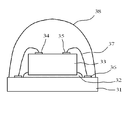
- a light-emitting device using a light-emitting diode (LED) element is widely used, and the structure of an old-type light-emitting device is such that an LED element 33 is bonded onto a substrate 31 with a die bond adhesive 32 as shown in FIG.
- the p electrode 34 and the n electrode 35 on the upper surface are wire-bonded to the connection terminal 36 of the substrate 31 with a gold wire 37, and the entire LED element 33 is sealed with a transparent mold resin 38.
- the gold wire absorbs light having a wavelength of 400 to 500 nm emitted from the LED element 33 to the upper surface side, and a part of the light emitted to the lower surface side is emitted.
- the luminous efficiency of the LED element 33 is reduced by being absorbed by the die bond adhesive 32.
- the light reflecting layer 40 must be provided on the LED element 33 by a metal vapor deposition method or the like so that the p-electrode 34 and the n-electrode 35 are insulated from each other. There was a problem that it was not possible.
- the surface of the conductive particles covered with gold, nickel or copper in the cured anisotropic conductive paste or anisotropic conductive film is brown to dark brown, and
- the epoxy resin binder itself in which the conductive particles are dispersed is also brown due to the imidazole-based latent curing agent commonly used for curing, and the light emission efficiency of the light emitted from the light emitting element (light extraction efficiency) ) Is difficult to improve, and the color of light (light emission color) cannot be reflected as it is.
- An object of the present invention is to solve the above-described problems of the prior art, and light-emitting elements such as light-emitting diodes (LEDs) are flip-chip mounted on a wiring board using an anisotropic conductive adhesive to emit light.
- LEDs light-emitting diodes
- the LED element does not have a light reflection layer that increases the manufacturing cost, and the light emission efficiency is not lowered.
- an anisotropic conductive adhesive containing the same and a light-emitting device in which a light-emitting element is flip-chip mounted on a wiring board using the adhesive.
- the present inventor can avoid reducing the luminous efficiency, on the surface of the conductive particles to be blended in the anisotropic conductive adhesive, By providing a white to gray light reflecting layer made of specific inorganic particles so as not to fall below a specific coverage, the light emission efficiency of the light emitting element and the reflected light color of the conductive particles are reduced.
- the present inventors have found that a hue difference can be prevented during this period, and have completed the present invention.
- the present invention is a light-reflective conductive particle for an anisotropic conductive adhesive used for anisotropic conductive connection of a light emitting element to a wiring board, the core particle coated with a metal material,
- a light-reflective conductive particle comprising a light-reflective layer formed of light-reflective inorganic particles having a refractive index of 1.52 or more on a surface thereof, and a covering ratio of the light-reflective layer on the surface of the core particle being 70% or more.
- the present invention also provides an anisotropic conductive adhesive for use in anisotropic conductive connection of a light emitting element to a wiring board, wherein the light reflective conductive particles described above are applied to visible light having a wavelength of 380 to 780 nm.
- An anisotropic conductive adhesive is provided which is dispersed in a thermosetting resin composition that gives a cured product having an optical path length of 1 cm and a light transmittance (JIS K7105) of 80% or more.
- the present invention provides a light emitting device in which a light emitting element is mounted on a wiring board by a flip chip method through the above-mentioned anisotropic conductive adhesive.
- the light-reflective conductive particles of the present invention for anisotropic conductive adhesive used for anisotropic conductive connection of a light-emitting element to a wiring board are composed of core particles coated with a metal material and a refractive index on the surface thereof. Is composed of a white to gray light reflecting layer formed of light reflecting inorganic particles having a particle size of 1.52 or more, and the coverage of the surface of the core particles by the light reflecting layer is 70% or more. It is.
- the anisotropic conductive adhesive of the present invention is a cured product in which the light-reflective conductive particles have a light transmittance (JIS K7105) of 80% or more with an optical path length of 1 cm with respect to visible light having a wavelength of 380 to 780 nm. It is made to disperse
- JIS K7105 light transmittance
- the light emitting device obtained by flip-chip mounting the light emitting element on the wiring board using the anisotropic conductive adhesive layer of the present invention does not cause coloring even when the anisotropic conductive adhesive is cured, and contains Since the light-reflecting conductive particles that are used have a small wavelength dependency of the reflection property with respect to visible light, the light emission efficiency is improved and the light emission color of the light-emitting element can be reflected as it is.
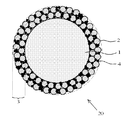
- FIG. 1A and 1B are cross-sectional views of the light-reflective conductive particles 10 and 20 of the present invention for an anisotropic conductive adhesive. First, the light reflective conductive particles in FIG. 1A will be described.
- the light-reflective conductive particle 10 includes a core particle 1 coated with a metal material and a light-reflecting layer 3 formed on the surface of the light-reflective inorganic particle 2 having a refractive index of 1.52 or more. .
- the light-reflective inorganic particles 2 having a refractive index of 1.52 or more are inorganic particles that exhibit white under sunlight. Accordingly, the light reflecting layer 3 formed from them exhibits white to gray.
- the expression of white to gray means that the wavelength dependency of the reflection characteristic for visible light is small and the visible light is easily reflected.
- Preferred examples of the light reflecting inorganic particles 2 include at least one selected from titanium oxide (TiO 2 ) particles, zinc oxide (ZnO) particles, and aluminum oxide (Al 2 O 3 ) particles.
- titanium oxide particles titanium oxide particles, zinc oxide particles, or aluminum oxide particles, if there is a concern about photodegradation of a cured product of a cured thermosetting resin of an anisotropic conductive adhesive, it is catalytic to photodegradation.
- Zinc oxide having a high refractive index can be preferably used.
- the core particle 1 Since the core particle 1 is subjected to anisotropic conductive connection, its surface is made of a metal material.
- the surface is coated with a metal material, an aspect in which the core particle 1 itself is a metal material, or an aspect in which the surface of the resin particle is coated with a metal material can be given.
- a metal material used in conventional conductive particles for anisotropic conductive connection can be used.
- examples thereof include gold, nickel, copper, silver, solder, palladium, aluminum, alloys thereof, multilayered products thereof (for example, nickel plating / gold flash plating products), and the like. Above all, gold, nickel, and copper turn the conductive particles brown, so that the effects of the present invention can be enjoyed over other metal materials.
- the resin particle portion of the metal-coated resin particle conventionally used as the conductive particle for anisotropic conductive connection is used as the resin particle.
- resin particles include styrene resin particles, benzoguanamine resin particles, and nylon resin particles.
- a method of coating the resin particles with a metal material a conventionally known method can be employed, and an electroless plating method, an electrolytic plating method, or the like can be used.
- the layer thickness of the metal material to be coated is sufficient to ensure good connection reliability, and is usually 0.1 to 3 ⁇ m, preferably depending on the particle size of the resin particles and the type of metal. 0.1 to 1 ⁇ m.
- the particle size of the core particle 1 having a metal material surface is too small, conduction will be poor, and if it is too large, a short circuit between patterns tends to occur. Therefore, it is preferably 1 to 20 ⁇ m, more preferably 3 to 5 ⁇ m, particularly preferably. 3 to 5 ⁇ m.
- the shape of the core particle 1 is preferably a spherical shape, but may be a flake shape or a rugby ball shape.
- the layer thickness of the light reflecting layer 3 formed from the light reflecting inorganic particles 2 is too small with respect to the particle size of the core particle 1 from the viewpoint of the relative size with respect to the particle size of the core particle 1, it is reflected.
- the rate decreases, and if it is too large, there is a tendency for poor conduction, so the content is preferably 0.5 to 50%, more preferably 1 to 25%.
- the light-reflecting inorganic particles 2 constituting the light-reflecting layer 3 have a particle size that is too small to cause the light-reflecting phenomenon, and if it is too large, it is difficult to form the light-reflecting layer. Therefore, it is preferably 0.02 to 4 ⁇ m, more preferably 0.1 to 1 ⁇ m, and particularly preferably 0.2 to 0.5 ⁇ m.
- the particle size of the light-reflecting inorganic particles 2 is such that the light to be reflected (that is, the light emitted from the light emitting element) is not transmitted. It is preferable that it is 50% or more of the wavelength.
- examples of the shape of the light-reflective inorganic particles 2 include an amorphous shape, a spherical shape, a scale shape, and a needle shape. Among them, a spherical shape from the viewpoint of the light diffusion effect, and a scale shape from the point of the total reflection effect. Shape is preferred.
- the light-reflective conductive particles 10 in FIG. 1A are formed by a known film forming technique (so-called mechano-fusion method) in which a film composed of small-sized particles is formed on the surface of large-sized particles by physically colliding large and small powders. ).
- the light-reflective inorganic particles 2 are fixed so as to bite into the metal material on the surface of the core particle 1.
- the inorganic particles are hardly fused and fixed, the monolayer of the inorganic particles forms the light-reflective layer 3.
- the layer thickness of the light reflecting layer 3 is considered to be equivalent to or slightly thinner than the particle size of the light reflecting inorganic particles 2.
- the light reflective conductive particles 20 in FIG. 1B will be described.
- the light-reflective layer 3 contains a thermoplastic resin 4 that functions as an adhesive, and the light-reflective inorganic particles 2 are fixed to each other by the thermoplastic resin 4. 2 differs from the light-reflective conductive particle 10 in FIG. 1A in that it is multilayered (for example, multilayered into two or three layers). By including such a thermoplastic resin 4, the mechanical strength of the light reflecting layer 3 is improved, and the inorganic particles are less likely to be peeled off.
- the light reflective conductive particle 20 of FIG. 1B can be manufactured by a mechano-fusion method.
- a particulate thermoplastic resin 4 may be used in combination.
- the light reflective conductive particle 20 of FIG. 1B is also manufactured simultaneously.
- thermoplastic resin 4 a halogen-free thermoplastic resin can be preferably used for the purpose of reducing the environmental load, and for example, polyolefins such as polyethylene and polypropylene, polystyrene, acrylic resins, and the like can be preferably used. .
- Such light-reflective conductive particles 20 can also be manufactured by a mechanofusion method. If the particle size of the thermoplastic resin 4 applied to the mechano-fusion method is too small, the effect as an adhesive is small, and if it is too large, it is difficult to adhere to the core particle 1, so that it is preferably 0.02 to 4 ⁇ m, more preferably 0.1 to 1 ⁇ m. Further, if the blending amount of the thermoplastic resin 4 is too small, the effect as an adhesive is small, and if it is too large, an unintended particle aggregate is generated. Therefore, with respect to 100 parts by mass of the core particle 1, The amount is preferably 0.2 to 500 parts by mass, more preferably 4 to 25 parts by mass.
- the coverage is 70% or more, preferably 80% or more.
- the covering ratio is measured by arranging the light-reflective conductive particles on the pressure-sensitive adhesive tape so as to form a single-layer particle layer, and capturing a 100-fold enlarged planar image obtained by a CCD camera into a personal computer.
- the image processing software can perform the calculation by calculating an average coverage based on a predetermined binarization process (a process for converting a grayscale image into a binary image) (coverage measurement method A).
- 30 conductive particles arbitrarily selected with a scanning electron microscope are enlarged (for example, 8000 times), and for each conductive particle, a covering state with attached insulating particles is sketched in a plane, It can also be performed by calculating an average coverage of 30 pieces (coverage measurement method B). Or it can also carry out by empirically judging that it has coat
- the core particle having a surface made of gold, nickel or copper has a brown surface color, whereas such a core particle can be observed in gray.
- a criterion is that the coverage is 70% or more.
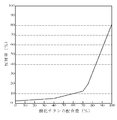
- titanium oxide powder having an average particle size of 0.5 ⁇ m is added to the thermosetting epoxy binder composition used in the thermosetting epoxy binder composition used in Example 1 of the present specification. Dry the paint uniformly mixed in such an amount that the ratio of the titanium oxide powder to the total of the titanium oxide powder is 0%, 40%, 50%, 60%, 70%, 80%, 90%, 100%.
- a black plate was coated to a thickness of 100 ⁇ m, heated at 200 ° C. for 1 minute to cure, and the resulting cured product was used with a spectrophotometer (U3300, Hitachi, Ltd.), wavelength 450 nm.
- the reflectance (JIS K7105) with respect to light is measured, the reflectance curve of FIG. 1C is obtained. From FIG. 1C, it is observed that the ratio of the titanium oxide powder to the total of the thermosetting epoxy binder composition and the titanium oxide powder increases sharply at 70%.
- This anisotropic conductive adhesive is obtained by dispersing the light-reflective conductive particles of the present invention in a thermosetting resin composition, and can take a form such as a paste or a film.
- thermosetting resin composition used for the anisotropic conductive adhesive of the present invention it is preferable to use a transparent and colorless one as much as possible. This is because the light reflecting efficiency of the light-reflective conductive particles in the anisotropic conductive adhesive is reflected without decreasing, and the light color of incident light is not changed.
- colorless and transparent means that the cured product of the anisotropic conductive adhesive has a light transmittance (JIS K7105) of 80% or more, preferably 90% or more with respect to visible light having a wavelength of 380 to 780 nm.
- the amount of the light-reflective conductive particles with respect to 100 parts by mass of the thermosetting resin composition is preferably 1 to 100 parts by mass, more preferably 10 to 50 parts by mass.
- the reflective property of the anisotropic conductive adhesive of the present invention is that the reflectance (JIS K7105) of light having a wavelength of 450 nm of a 100 ⁇ m-thick cured product of the anisotropic conductive adhesive is improved in order to improve the light emission efficiency of the light emitting element. , Preferably at least 15%.
- the reflection characteristics and blending amount of the light-reflective conductive particles to be used, the blending composition of the thermosetting resin composition, and the like may be appropriately adjusted. Usually, if the amount of the light-reflective conductive particles having good reflection characteristics is increased, the reflectance tends to increase.
- the reflective property of the anisotropic conductive adhesive can be evaluated from the viewpoint of refractive index (JIS K7142). That is, if the refractive index difference between the thermosetting resin composition of the anisotropic conductive adhesive and the light-reflective conductive particles is too large, the light-reflective conductive particles and the thermosetting resin composition surrounding the light-reflective conductive particles This is because the amount of light reflection at the interface with the cured product increases. Specifically, it is desired that the difference in refractive index between the thermosetting resin composition and the light-reflecting inorganic particles is 0.02 or more, preferably 0.3 or more. In general, the refractive index of a thermosetting resin composition mainly composed of an epoxy resin is about 1.5.
- thermosetting resin composition constituting the anisotropic conductive adhesive of the present invention
- those used in conventional anisotropic conductive adhesives and anisotropic conductive films can be used.
- a thermosetting resin composition is obtained by blending a curing agent with an insulating binder resin.
- the insulating binder resin is preferably an epoxy resin mainly composed of an alicyclic epoxy resin, a heterocyclic epoxy compound, a hydrogenated epoxy resin, or the like.
- Preferred examples of the alicyclic epoxy compound include those having two or more epoxy groups in the molecule. These may be liquid or solid. Specific examples include glycidyl hexahydrobisphenol A, 3,4-epoxycyclohexenylmethyl-3 ′, 4′-epoxycyclohexene carboxylate, and the like. Among these, glycidyl hexahydrobisphenol A, 3,4-epoxycyclohexenylmethyl-3 ′, 4 is preferable because it can ensure light transmission suitable for mounting LED elements on the cured product and is excellent in rapid curing. '-Epoxycyclohexenecarboxylate can be preferably used.
- heterocyclic epoxy compound examples include an epoxy compound having a triazine ring, and 1,3,5-tris (2,3-epoxypropyl) -1,3,5-triazine-2,4 is particularly preferable. , 6- (1H, 3H, 5H) -trione.
- hydrogenated epoxy compound hydrogenated products of the above-described alicyclic epoxy compounds and heterocyclic epoxy compounds, and other known hydrogenated epoxy resins can be used.
- the alicyclic epoxy compound, the heterocyclic epoxy compound and the hydrogenated epoxy compound may be used singly or in combination of two or more.
- other epoxy compounds may be used in combination as long as the effects of the present invention are not impaired.
- an acid anhydride As the curing agent, an acid anhydride, an imidazole compound, dicyan, or the like can be used.
- acid anhydrides that are difficult to discolor the cured product particularly alicyclic acid anhydride-based curing agents, can be preferably used.
- methylhexahydrophthalic anhydride (MeHHPA) or the like can be preferably used.
- thermosetting resin composition of the anisotropic conductive adhesive of the present invention when an alicyclic epoxy compound and an alicyclic acid anhydride-based curing agent are used, the respective amounts used are alicyclic acid anhydrides. If the amount of the physical curing agent is too small, the amount of uncured epoxy compound increases, resulting in poor curing. If the amount is too large, the corrosion of the adherend material tends to be accelerated by the influence of the excess curing agent.
- the alicyclic acid anhydride curing agent is preferably used in an amount of 80 to 120 parts by weight, more preferably 95 to 105 parts by weight, based on 100 parts by weight of the compound.
- the anisotropic conductive adhesive of the present invention can be produced by uniformly mixing light-reflective conductive particles and a thermosetting resin composition. Also, when using anisotropic conductive adhesives as anisotropic conductive films, they are dispersed and mixed together with a solvent such as toluene, and applied to the peeled PET film so as to have the desired thickness. What is necessary is just to dry at the temperature of about 80 degreeC.
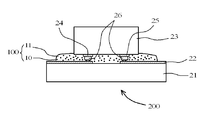
- the light-emitting device 200 includes the connection terminal 22 on the substrate 21 and the connection bumps 26 formed on the n-electrode 24 and the p-electrode 25 of the LED element 23 as light-emitting elements.
- an anisotropic conductive adhesive is applied and the substrate 21 and the LED element 23 are flip-chip mounted.
- the cured product 100 of the anisotropic conductive adhesive is obtained by dispersing the light-reflective conductive particles 10 in the cured product 11 of the thermosetting resin composition.
- light emitted from the LED element 23 toward the substrate 21 is light-reflective conductive in the cured product 100 of the anisotropic conductive adhesive. Reflected by the particles 10 and emitted from the upper surface of the LED element 23. Accordingly, it is possible to prevent a decrease in luminous efficiency.
- Example 1 (Creation of light-reflective conductive particles) 4 parts by mass of titanium oxide powder (KR-380, Titanium Industry Co., Ltd.) having an average particle size of 0.5 ⁇ m and Au coated resin conductive particles having an average particle size of 5 ⁇ m with a brown appearance color (spherical shape having an average particle size of 4.6 ⁇ m) Particles obtained by electroless gold plating of 0.2 ⁇ m thickness on acrylic resin particles: 20 parts by weight of Bright 20GNB4.6EH, Nippon Chemical Industry Co., Ltd. are put into a mechanofusion apparatus (AMS-GMP, Hosokawa Micron Corporation).
- AMS-GMP Hosokawa Micron Corporation
- the light-reflective conductive particles of Example 1 were formed by forming a light-reflective layer made of titanium oxide particles with a thickness of about 0.3 ⁇ m on the surface of the conductive particles under the conditions of a rotation speed of 1000 rpm and a rotation time of 20 minutes. Obtained. The appearance color of the light reflective conductive particles was gray.
- the obtained anisotropic conductive adhesive was applied to a white plate made of ceramic so as to have a dry thickness of 100 ⁇ m, and heated at 200 ° C. for 1 minute to be cured. About this hardened
- a glass epoxy substrate having a wiring obtained by plating Ni / Au (5.0 ⁇ m thickness / 0.3 ⁇ m thickness) on a 50 ⁇ m pitch copper wiring using the anisotropic conductive adhesive prepared in the light reflectance evaluation test. , 15 [mu] m height of the test IC chips 6mm square with gold bumps (conductive connection area / conductor - space 1600 ⁇ m 2 / 50 ⁇ mP) to 200 ° C., and flip chip mounted in 60 seconds, provided that 1Kg / chip, test IC Got a module.
- TCT temperature cycle test
- Example 2 Light whose appearance color is gray as in Example 1, except that the rotation speed of the mechanofusion device (AMS-GMP, Hosokawa Micron Co., Ltd.) is changed from 1000 rpm to 700 rpm and the rotation time is changed from 20 minutes to 10 minutes. Reflective conductive particles were obtained, and an anisotropic conductive adhesive was obtained. Further, in the same manner as in Example 1, the coverage ratio and the reflectance were measured, and further an electrical property (conduction reliability, insulation reliability) evaluation test was performed. The obtained results are shown in Table 1.
- AMS-GMP mechanofusion device
- Example 3 The appearance color was the same as in Example 1 except that Ni coated resin conductive particles (52NR-4.6EH, Nippon Chemical Industry Co., Ltd.) having an average particle size of 5.0 ⁇ m were used instead of Au coated resin conductive particles. Obtained gray light-reflective conductive particles, and an anisotropic conductive adhesive was obtained. Further, in the same manner as in Example 1, the coverage ratio and the reflectance were measured, and further an electrical property (conduction reliability, insulation reliability) evaluation test was performed. The obtained results are shown in Table 1.
- Ni coated resin conductive particles 52NR-4.6EH, Nippon Chemical Industry Co., Ltd.
- Example 4 4 parts by mass of titanium oxide powder (KR-380, Titanium Industry Co., Ltd.) having an average particle size of 0.5 ⁇ m and polystyrene (PS) particles (Grossdale 204S, Mitsui Chemicals, Inc.) having an average particle size of 0.2 ⁇ m as adhesive particles Co., Ltd.) 3 parts by mass and conductive particles having an average particle size of 5 ⁇ m (particles obtained by subjecting spherical acrylic resin particles having an average particle size of 4.6 ⁇ m to electroless gold plating of 0.2 ⁇ m thickness: Bright 20GNB4.6EH, Nippon Chemical Industry ( 20 parts by mass into a mechanofusion apparatus (AMS-GMP, Hosokawa Micron Corporation), and on the surface of the conductive particles under the conditions of a rotation speed of 1000 rpm and a rotation time of 20 minutes, styrene and titanium oxide particles By forming a light reflection layer having a thickness of about 1 ⁇ m, light reflective conductive particles having a gray
- Example 5 External color as in Example 3 except that Ni coated resin conductive particles (52NR-4.6EH, Nippon Chemical Industry Co., Ltd.) having an average particle size of 5.0 ⁇ m were used instead of Au coated resin conductive particles. Obtained gray light-reflective conductive particles, and an anisotropic conductive adhesive was obtained. Further, similarly to Example 1, the coverage and reflectance were measured, and further an electrical property (conduction reliability, insulation reliability) evaluation test was performed. The obtained results are shown in Table 1.
- Example 6 Use polyethylene (PE) particles (Amipearl WF300, Mitsui Chemicals) with an average particle size of 0.2 ⁇ m instead of polystyrene particles (Grossdale 204S, Mitsui Chemicals, Inc.) with an average particle size of 0.2 ⁇ m.
- PE polyethylene
- Example 3 Light-reflective conductive particles having a gray appearance color were obtained, and an anisotropic conductive adhesive was further obtained. Further, in the same manner as in Example 1, the coverage ratio and the reflectance were measured, and further an electrical property (conduction reliability, insulation reliability) evaluation test was performed. The obtained results are shown in Table 1.
- Example 7 The appearance color was the same as in Example 3 except that instead of the titanium oxide powder having an average particle diameter of 0.5 ⁇ m, zinc oxide powder having an average particle diameter of 0.5 ⁇ m (one type of zinc oxide, Hakusuitec Co., Ltd.) was used. Obtained gray light-reflective conductive particles, and an anisotropic conductive adhesive was obtained. Further, in the same manner as in Example 1, the coverage ratio and the reflectance were measured, and further an electrical property (conduction reliability, insulation reliability) evaluation test was performed. The obtained results are shown in Table 1.
- Example 8 The appearance color was the same as in Example 3 except that aluminum oxide powder (AE-2500SI, Admatechs Co., Ltd.) having an average particle diameter of 0.5 ⁇ m was used instead of titanium oxide powder having an average particle diameter of 0.5 ⁇ m. Obtained gray light-reflective conductive particles, and an anisotropic conductive adhesive was obtained. Further, in the same manner as in Example 1, the coverage ratio and the reflectance were measured, and further an electrical property (conduction reliability, insulation reliability) evaluation test was performed. The obtained results are shown in Table 1.
- aluminum oxide powder AE-2500SI, Admatechs Co., Ltd.
- Example 9 Instead of titanium oxide powder having an average particle diameter of 0.5 ⁇ m, light-reflective conductive particles having a gray appearance color were obtained in the same manner as in Example 3 except that magnesium carbonate having an average particle diameter of 0.5 ⁇ m was used. An anisotropic conductive adhesive was obtained. Further, in the same manner as in Example 1, the coverage ratio and the reflectance were measured, and further an electrical property (conduction reliability, insulation reliability) evaluation test was performed. The obtained results are shown in Table 1.
- Example 10 The appearance color is gray in the same manner as in Example 3 except that titanium oxide powder having an average particle diameter of 0.2 ⁇ m (JR405, Teika) is used instead of titanium oxide powder having an average particle diameter of 0.5 ⁇ m. Light-reflective conductive particles were obtained, and further an anisotropic conductive adhesive was obtained. Further, in the same manner as in Example 1, the coverage ratio and the reflectance were measured, and further an electrical property (conduction reliability, insulation reliability) evaluation test was performed. The obtained results are shown in Table 1.
- Comparative Example 1 Using Au coated resin conductive particles having a brown appearance color (particles obtained by electroless gold plating of 0.2 ⁇ m thickness on spherical acrylic resin particles having an average particle diameter of 4.6 ⁇ m: Bright 20GNB4.6EH, Nippon Chemical Industry Co., Ltd.) An anisotropic conductive adhesive was obtained in the same manner as in Example 1. Further, in the same manner as in Example 1, the reflectance was measured, and further an electrical property (conduction reliability, insulation reliability) evaluation test was performed. The obtained results are shown in Table 1.
- Comparative Example 2 Comparative Example 1 except that instead of the Au-coated resin conductive particles, Ni-coated resin conductive particles (52NR-4.6EH, Nippon Chemical Industry Co., Ltd.) having a brown appearance color and an average particle diameter of 5.0 ⁇ m are used. Similarly, an anisotropic conductive adhesive was obtained. Further, in the same manner as in Example 1, the reflectance was measured, and further an electrical property (conduction reliability, insulation reliability) evaluation test was performed. The obtained results are shown in Table 1.
- Comparative Example 3 3 parts by mass of polystyrene-based particles (Grossdale 204S, Mitsui Chemicals, Inc.) with an average particle size of 0.2 ⁇ m and conductive particles with an average particle size of 5 ⁇ m (spherical acrylic resin particles with an average particle size of 4.6 ⁇ m are 0.2 ⁇ m thick) Electroless gold-plated particles: Bright 20GNB4.6EH, Nippon Kagaku Kogyo Co., Ltd.
- Comparative Example 4 Instead of titanium oxide powder with an average particle size of 0.5 ⁇ m, use silicon oxide (silica) powder (Seahoster KEP-30, Nippon Shokubai Co., Ltd.) with a refractive index of 1.45 and an average particle size of 0.5 ⁇ m. Otherwise, conductive particles having a brown appearance color were obtained in the same manner as in Example 3, and further an anisotropic conductive adhesive was obtained. Further, in the same manner as in Example 1, the coverage ratio and the reflectance were measured, and further an electrical property (conduction reliability, insulation reliability) evaluation test was performed. The obtained results are shown in Table 1.
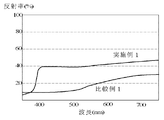
- the anisotropic conductive adhesives using the light-reflective conductive particles of Examples 1 to 10 have a coverage by the light-reflective layer of 70% or more, and the light reflectivities are all 15% or more. Yes, the blue color of 450 nm light was reflected as it was. In addition, the conduction reliability and the insulation reliability were also good results.
- the light-reflective conductive particle of the present invention increases the manufacturing cost when a light-emitting device is manufactured by flip-chip mounting a light-emitting element such as a light-emitting diode (LED) element on a wiring board using an anisotropic conductive adhesive.
- a light-emitting element such as a light-emitting diode (LED) element
- the anisotropic conductive adhesive of the present invention is useful when the LED element is flip-chip mounted.
Landscapes
- Chemical & Material Sciences (AREA)
- Organic Chemistry (AREA)
- Physics & Mathematics (AREA)
- Dispersion Chemistry (AREA)
- Spectroscopy & Molecular Physics (AREA)
- Medicinal Chemistry (AREA)
- Chemical Kinetics & Catalysis (AREA)
- Polymers & Plastics (AREA)
- Health & Medical Sciences (AREA)
- Inorganic Chemistry (AREA)
- Adhesives Or Adhesive Processes (AREA)
- Led Device Packages (AREA)
- Conductive Materials (AREA)
- Non-Insulated Conductors (AREA)
- Powder Metallurgy (AREA)
Abstract
Priority Applications (5)
| Application Number | Priority Date | Filing Date | Title |
|---|---|---|---|
| JP2012534453A JPWO2012144033A1 (ja) | 2011-04-20 | 2011-04-20 | 光反射性導電粒子、異方性導電接着剤及び発光装置 |
| US13/575,786 US20130105841A1 (en) | 2011-04-20 | 2011-04-20 | Light-reflective conductive particle, anisotropic conductive adhesive, and light-emitting device |
| PCT/JP2011/059724 WO2012144033A1 (fr) | 2011-04-20 | 2011-04-20 | Particules conductrices réfléchissant la lumière, adhésif conducteur anisotrope et dispositif électroluminescent |
| TW100128832A TWI517456B (zh) | 2011-04-20 | 2011-08-12 | Light reflective conductive particles, anisotropic conductive adhesives and light-emitting devices |
| US14/222,249 US8975654B2 (en) | 2011-04-20 | 2014-03-21 | Light-reflective conductive particle, anisotropic conductive adhesive, and light-emitting device |
Applications Claiming Priority (1)
| Application Number | Priority Date | Filing Date | Title |
|---|---|---|---|
| PCT/JP2011/059724 WO2012144033A1 (fr) | 2011-04-20 | 2011-04-20 | Particules conductrices réfléchissant la lumière, adhésif conducteur anisotrope et dispositif électroluminescent |
Related Child Applications (2)
| Application Number | Title | Priority Date | Filing Date |
|---|---|---|---|
| US13/575,786 A-371-Of-International US20130105841A1 (en) | 2011-04-20 | 2011-04-20 | Light-reflective conductive particle, anisotropic conductive adhesive, and light-emitting device |
| US14/222,249 Continuation US8975654B2 (en) | 2011-04-20 | 2014-03-21 | Light-reflective conductive particle, anisotropic conductive adhesive, and light-emitting device |
Publications (1)
| Publication Number | Publication Date |
|---|---|
| WO2012144033A1 true WO2012144033A1 (fr) | 2012-10-26 |
Family
ID=47041183
Family Applications (1)
| Application Number | Title | Priority Date | Filing Date |
|---|---|---|---|
| PCT/JP2011/059724 Ceased WO2012144033A1 (fr) | 2011-04-20 | 2011-04-20 | Particules conductrices réfléchissant la lumière, adhésif conducteur anisotrope et dispositif électroluminescent |
Country Status (4)
| Country | Link |
|---|---|
| US (2) | US20130105841A1 (fr) |
| JP (1) | JPWO2012144033A1 (fr) |
| TW (1) | TWI517456B (fr) |
| WO (1) | WO2012144033A1 (fr) |
Cited By (1)
| Publication number | Priority date | Publication date | Assignee | Title |
|---|---|---|---|---|
| JP2017228533A (ja) * | 2017-07-20 | 2017-12-28 | 日本化学工業株式会社 | 被覆導電性粉体、被覆導電性粉体の製造方法、被覆導電性粉体を含む導電性接着剤及び接着構造体 |
Families Citing this family (6)
| Publication number | Priority date | Publication date | Assignee | Title |
|---|---|---|---|---|
| US9053405B1 (en) * | 2013-08-27 | 2015-06-09 | Flextronics Ap, Llc | Printed RFID circuit |
| EP3051598A4 (fr) * | 2013-09-26 | 2017-06-28 | Dexerials Corporation | Dispositif émetteur de lumière, adhésif conducteur anisotrope et procédé de fabrication d'un dispositif émetteur de lumière |
| JP2015153981A (ja) * | 2014-02-18 | 2015-08-24 | 日亜化学工業株式会社 | 発光装置 |
| US9812625B2 (en) * | 2014-02-18 | 2017-11-07 | Nichia Corporation | Light-emitting device having resin member with conductive particles |
| JP6432416B2 (ja) * | 2014-04-14 | 2018-12-05 | 日亜化学工業株式会社 | 半導体装置 |
| EP3308218A4 (fr) * | 2015-06-11 | 2019-01-09 | E Ink California, LLC | Particules colorées composites |
Citations (4)
| Publication number | Priority date | Publication date | Assignee | Title |
|---|---|---|---|---|
| JP2007123613A (ja) * | 2005-10-28 | 2007-05-17 | Nichia Chem Ind Ltd | 発光装置 |
| JP2007157940A (ja) * | 2005-12-02 | 2007-06-21 | Nichia Chem Ind Ltd | 発光装置および発光装置の製造方法 |
| JP2007258324A (ja) * | 2006-03-22 | 2007-10-04 | Matsushita Electric Ind Co Ltd | 発光装置の製造方法および発光装置 |
| JP2011057917A (ja) * | 2009-09-14 | 2011-03-24 | Sony Chemical & Information Device Corp | 光反射性異方性導電接着剤及び発光装置 |
Family Cites Families (1)
| Publication number | Priority date | Publication date | Assignee | Title |
|---|---|---|---|---|
| JPH11168235A (ja) | 1997-12-05 | 1999-06-22 | Toyoda Gosei Co Ltd | 発光ダイオード |
-
2011
- 2011-04-20 WO PCT/JP2011/059724 patent/WO2012144033A1/fr not_active Ceased
- 2011-04-20 JP JP2012534453A patent/JPWO2012144033A1/ja active Pending
- 2011-04-20 US US13/575,786 patent/US20130105841A1/en not_active Abandoned
- 2011-08-12 TW TW100128832A patent/TWI517456B/zh not_active IP Right Cessation
-
2014
- 2014-03-21 US US14/222,249 patent/US8975654B2/en not_active Expired - Fee Related
Patent Citations (4)
| Publication number | Priority date | Publication date | Assignee | Title |
|---|---|---|---|---|
| JP2007123613A (ja) * | 2005-10-28 | 2007-05-17 | Nichia Chem Ind Ltd | 発光装置 |
| JP2007157940A (ja) * | 2005-12-02 | 2007-06-21 | Nichia Chem Ind Ltd | 発光装置および発光装置の製造方法 |
| JP2007258324A (ja) * | 2006-03-22 | 2007-10-04 | Matsushita Electric Ind Co Ltd | 発光装置の製造方法および発光装置 |
| JP2011057917A (ja) * | 2009-09-14 | 2011-03-24 | Sony Chemical & Information Device Corp | 光反射性異方性導電接着剤及び発光装置 |
Cited By (1)
| Publication number | Priority date | Publication date | Assignee | Title |
|---|---|---|---|---|
| JP2017228533A (ja) * | 2017-07-20 | 2017-12-28 | 日本化学工業株式会社 | 被覆導電性粉体、被覆導電性粉体の製造方法、被覆導電性粉体を含む導電性接着剤及び接着構造体 |
Also Published As
| Publication number | Publication date |
|---|---|
| TWI517456B (zh) | 2016-01-11 |
| US20130105841A1 (en) | 2013-05-02 |
| US8975654B2 (en) | 2015-03-10 |
| JPWO2012144033A1 (ja) | 2014-07-28 |
| US20140225144A1 (en) | 2014-08-14 |
| TW201246634A (en) | 2012-11-16 |
Similar Documents
| Publication | Publication Date | Title |
|---|---|---|
| JP5526698B2 (ja) | 光反射性導電粒子、異方性導電接着剤及び発光装置 | |
| JP5617210B2 (ja) | 光反射性異方性導電接着剤及び発光装置 | |
| JP5609716B2 (ja) | 光反射性異方性導電接着剤及び発光装置 | |
| JP5402804B2 (ja) | 発光装置の製造方法 | |
| JP5555038B2 (ja) | 光反射性異方性導電接着剤及び発光装置 | |
| WO2012144033A1 (fr) | Particules conductrices réfléchissant la lumière, adhésif conducteur anisotrope et dispositif électroluminescent | |
| JP2012212865A (ja) | 光反射性異方性導電接着剤及び発光装置 | |
| JP2014030026A (ja) | 異方性導電接着剤及び発光装置 | |
| JP5785306B2 (ja) | 光反射性異方性導電接着剤及び発光装置 | |
| HK1170255B (en) | Light-reflective anisotropic electroconductive adhesive agent and light-emitting device | |
| HK1191450B (en) | Light-reflective anisotropic conductive adhesive and light-emitting device | |
| HK1191450A (en) | Light-reflective anisotropic conductive adhesive and light-emitting device | |
| HK1178320B (en) | Light-reflective anisotropic conductive adhesive agent, and light emitting device |
Legal Events
| Date | Code | Title | Description |
|---|---|---|---|
| ENP | Entry into the national phase |
Ref document number: 2012534453 Country of ref document: JP Kind code of ref document: A |
|
| WWE | Wipo information: entry into national phase |
Ref document number: 13575786 Country of ref document: US |
|
| 121 | Ep: the epo has been informed by wipo that ep was designated in this application |
Ref document number: 11864019 Country of ref document: EP Kind code of ref document: A1 |
|
| NENP | Non-entry into the national phase |
Ref country code: DE |
|
| 122 | Ep: pct application non-entry in european phase |
Ref document number: 11864019 Country of ref document: EP Kind code of ref document: A1 |